EP1449646A1 - Multilayer bottle and process for its production - Google Patents
Multilayer bottle and process for its production Download PDFInfo
- Publication number
- EP1449646A1 EP1449646A1 EP02775474A EP02775474A EP1449646A1 EP 1449646 A1 EP1449646 A1 EP 1449646A1 EP 02775474 A EP02775474 A EP 02775474A EP 02775474 A EP02775474 A EP 02775474A EP 1449646 A1 EP1449646 A1 EP 1449646A1
- Authority
- EP
- European Patent Office
- Prior art keywords
- layer
- polyester resin
- thermoplastic polyester
- multilayer container
- polyglycolic acid
- Prior art date
- Legal status (The legal status is an assumption and is not a legal conclusion. Google has not performed a legal analysis and makes no representation as to the accuracy of the status listed.)
- Granted
Links
Images
Classifications
-
- B—PERFORMING OPERATIONS; TRANSPORTING
- B32—LAYERED PRODUCTS
- B32B—LAYERED PRODUCTS, i.e. PRODUCTS BUILT-UP OF STRATA OF FLAT OR NON-FLAT, e.g. CELLULAR OR HONEYCOMB, FORM
- B32B27/00—Layered products comprising a layer of synthetic resin
- B32B27/36—Layered products comprising a layer of synthetic resin comprising polyesters
-
- B—PERFORMING OPERATIONS; TRANSPORTING
- B29—WORKING OF PLASTICS; WORKING OF SUBSTANCES IN A PLASTIC STATE IN GENERAL
- B29C—SHAPING OR JOINING OF PLASTICS; SHAPING OF MATERIAL IN A PLASTIC STATE, NOT OTHERWISE PROVIDED FOR; AFTER-TREATMENT OF THE SHAPED PRODUCTS, e.g. REPAIRING
- B29C49/00—Blow-moulding, i.e. blowing a preform or parison to a desired shape within a mould; Apparatus therefor
- B29C49/0005—Blow-moulding, i.e. blowing a preform or parison to a desired shape within a mould; Apparatus therefor characterised by the material
-
- B—PERFORMING OPERATIONS; TRANSPORTING
- B29—WORKING OF PLASTICS; WORKING OF SUBSTANCES IN A PLASTIC STATE IN GENERAL
- B29C—SHAPING OR JOINING OF PLASTICS; SHAPING OF MATERIAL IN A PLASTIC STATE, NOT OTHERWISE PROVIDED FOR; AFTER-TREATMENT OF THE SHAPED PRODUCTS, e.g. REPAIRING
- B29C45/00—Injection moulding, i.e. forcing the required volume of moulding material through a nozzle into a closed mould; Apparatus therefor
- B29C45/16—Making multilayered or multicoloured articles
- B29C45/1642—Making multilayered or multicoloured articles having a "sandwich" structure
- B29C45/1646—Injecting parison-like articles
-
- B—PERFORMING OPERATIONS; TRANSPORTING
- B29—WORKING OF PLASTICS; WORKING OF SUBSTANCES IN A PLASTIC STATE IN GENERAL
- B29C—SHAPING OR JOINING OF PLASTICS; SHAPING OF MATERIAL IN A PLASTIC STATE, NOT OTHERWISE PROVIDED FOR; AFTER-TREATMENT OF THE SHAPED PRODUCTS, e.g. REPAIRING
- B29C49/00—Blow-moulding, i.e. blowing a preform or parison to a desired shape within a mould; Apparatus therefor
- B29C49/22—Blow-moulding, i.e. blowing a preform or parison to a desired shape within a mould; Apparatus therefor using multilayered preforms or parisons
-
- B—PERFORMING OPERATIONS; TRANSPORTING
- B32—LAYERED PRODUCTS
- B32B—LAYERED PRODUCTS, i.e. PRODUCTS BUILT-UP OF STRATA OF FLAT OR NON-FLAT, e.g. CELLULAR OR HONEYCOMB, FORM
- B32B27/00—Layered products comprising a layer of synthetic resin
- B32B27/06—Layered products comprising a layer of synthetic resin as the main or only constituent of a layer, which is next to another layer of the same or of a different material
- B32B27/08—Layered products comprising a layer of synthetic resin as the main or only constituent of a layer, which is next to another layer of the same or of a different material of synthetic resin
-
- B—PERFORMING OPERATIONS; TRANSPORTING
- B32—LAYERED PRODUCTS
- B32B—LAYERED PRODUCTS, i.e. PRODUCTS BUILT-UP OF STRATA OF FLAT OR NON-FLAT, e.g. CELLULAR OR HONEYCOMB, FORM
- B32B7/00—Layered products characterised by the relation between layers; Layered products characterised by the relative orientation of features between layers, or by the relative values of a measurable parameter between layers, i.e. products comprising layers having different physical, chemical or physicochemical properties; Layered products characterised by the interconnection of layers
- B32B7/04—Interconnection of layers
- B32B7/12—Interconnection of layers using interposed adhesives or interposed materials with bonding properties
-
- B—PERFORMING OPERATIONS; TRANSPORTING
- B65—CONVEYING; PACKING; STORING; HANDLING THIN OR FILAMENTARY MATERIAL
- B65D—CONTAINERS FOR STORAGE OR TRANSPORT OF ARTICLES OR MATERIALS, e.g. BAGS, BARRELS, BOTTLES, BOXES, CANS, CARTONS, CRATES, DRUMS, JARS, TANKS, HOPPERS, FORWARDING CONTAINERS; ACCESSORIES, CLOSURES, OR FITTINGS THEREFOR; PACKAGING ELEMENTS; PACKAGES
- B65D1/00—Rigid or semi-rigid containers having bodies formed in one piece, e.g. by casting metallic material, by moulding plastics, by blowing vitreous material, by throwing ceramic material, by moulding pulped fibrous material or by deep-drawing operations performed on sheet material
- B65D1/02—Bottles or similar containers with necks or like restricted apertures, designed for pouring contents
- B65D1/0207—Bottles or similar containers with necks or like restricted apertures, designed for pouring contents characterised by material, e.g. composition, physical features
- B65D1/0215—Bottles or similar containers with necks or like restricted apertures, designed for pouring contents characterised by material, e.g. composition, physical features multilayered
-
- B—PERFORMING OPERATIONS; TRANSPORTING
- B29—WORKING OF PLASTICS; WORKING OF SUBSTANCES IN A PLASTIC STATE IN GENERAL
- B29C—SHAPING OR JOINING OF PLASTICS; SHAPING OF MATERIAL IN A PLASTIC STATE, NOT OTHERWISE PROVIDED FOR; AFTER-TREATMENT OF THE SHAPED PRODUCTS, e.g. REPAIRING
- B29C49/00—Blow-moulding, i.e. blowing a preform or parison to a desired shape within a mould; Apparatus therefor
- B29C49/42—Component parts, details or accessories; Auxiliary operations
- B29C49/78—Measuring, controlling or regulating
- B29C2049/7879—Stretching, e.g. stretch rod
-
- B—PERFORMING OPERATIONS; TRANSPORTING
- B29—WORKING OF PLASTICS; WORKING OF SUBSTANCES IN A PLASTIC STATE IN GENERAL
- B29C—SHAPING OR JOINING OF PLASTICS; SHAPING OF MATERIAL IN A PLASTIC STATE, NOT OTHERWISE PROVIDED FOR; AFTER-TREATMENT OF THE SHAPED PRODUCTS, e.g. REPAIRING
- B29C2949/00—Indexing scheme relating to blow-moulding
- B29C2949/07—Preforms or parisons characterised by their configuration
- B29C2949/072—Preforms or parisons characterised by their configuration having variable wall thickness
-
- B—PERFORMING OPERATIONS; TRANSPORTING
- B29—WORKING OF PLASTICS; WORKING OF SUBSTANCES IN A PLASTIC STATE IN GENERAL
- B29C—SHAPING OR JOINING OF PLASTICS; SHAPING OF MATERIAL IN A PLASTIC STATE, NOT OTHERWISE PROVIDED FOR; AFTER-TREATMENT OF THE SHAPED PRODUCTS, e.g. REPAIRING
- B29C2949/00—Indexing scheme relating to blow-moulding
- B29C2949/07—Preforms or parisons characterised by their configuration
- B29C2949/072—Preforms or parisons characterised by their configuration having variable wall thickness
- B29C2949/0724—Preforms or parisons characterised by their configuration having variable wall thickness at body portion
-
- B—PERFORMING OPERATIONS; TRANSPORTING
- B29—WORKING OF PLASTICS; WORKING OF SUBSTANCES IN A PLASTIC STATE IN GENERAL
- B29C—SHAPING OR JOINING OF PLASTICS; SHAPING OF MATERIAL IN A PLASTIC STATE, NOT OTHERWISE PROVIDED FOR; AFTER-TREATMENT OF THE SHAPED PRODUCTS, e.g. REPAIRING
- B29C2949/00—Indexing scheme relating to blow-moulding
- B29C2949/07—Preforms or parisons characterised by their configuration
- B29C2949/073—Preforms or parisons characterised by their configuration having variable diameter
-
- B—PERFORMING OPERATIONS; TRANSPORTING
- B29—WORKING OF PLASTICS; WORKING OF SUBSTANCES IN A PLASTIC STATE IN GENERAL
- B29C—SHAPING OR JOINING OF PLASTICS; SHAPING OF MATERIAL IN A PLASTIC STATE, NOT OTHERWISE PROVIDED FOR; AFTER-TREATMENT OF THE SHAPED PRODUCTS, e.g. REPAIRING
- B29C2949/00—Indexing scheme relating to blow-moulding
- B29C2949/07—Preforms or parisons characterised by their configuration
- B29C2949/073—Preforms or parisons characterised by their configuration having variable diameter
- B29C2949/0733—Preforms or parisons characterised by their configuration having variable diameter at body portion
-
- B—PERFORMING OPERATIONS; TRANSPORTING
- B29—WORKING OF PLASTICS; WORKING OF SUBSTANCES IN A PLASTIC STATE IN GENERAL
- B29C—SHAPING OR JOINING OF PLASTICS; SHAPING OF MATERIAL IN A PLASTIC STATE, NOT OTHERWISE PROVIDED FOR; AFTER-TREATMENT OF THE SHAPED PRODUCTS, e.g. REPAIRING
- B29C2949/00—Indexing scheme relating to blow-moulding
- B29C2949/07—Preforms or parisons characterised by their configuration
- B29C2949/076—Preforms or parisons characterised by their configuration characterised by the shape
- B29C2949/0768—Preforms or parisons characterised by their configuration characterised by the shape characterised by the shape of specific parts of preform
- B29C2949/077—Preforms or parisons characterised by their configuration characterised by the shape characterised by the shape of specific parts of preform characterised by the neck
- B29C2949/0772—Closure retaining means
- B29C2949/0773—Threads
-
- B—PERFORMING OPERATIONS; TRANSPORTING
- B29—WORKING OF PLASTICS; WORKING OF SUBSTANCES IN A PLASTIC STATE IN GENERAL
- B29C—SHAPING OR JOINING OF PLASTICS; SHAPING OF MATERIAL IN A PLASTIC STATE, NOT OTHERWISE PROVIDED FOR; AFTER-TREATMENT OF THE SHAPED PRODUCTS, e.g. REPAIRING
- B29C2949/00—Indexing scheme relating to blow-moulding
- B29C2949/07—Preforms or parisons characterised by their configuration
- B29C2949/0861—Other specified values, e.g. values or ranges
- B29C2949/0862—Crystallinity
-
- B—PERFORMING OPERATIONS; TRANSPORTING
- B29—WORKING OF PLASTICS; WORKING OF SUBSTANCES IN A PLASTIC STATE IN GENERAL
- B29C—SHAPING OR JOINING OF PLASTICS; SHAPING OF MATERIAL IN A PLASTIC STATE, NOT OTHERWISE PROVIDED FOR; AFTER-TREATMENT OF THE SHAPED PRODUCTS, e.g. REPAIRING
- B29C2949/00—Indexing scheme relating to blow-moulding
- B29C2949/07—Preforms or parisons characterised by their configuration
- B29C2949/0861—Other specified values, e.g. values or ranges
- B29C2949/0862—Crystallinity
- B29C2949/0865—Crystallinity at the body portion
-
- B—PERFORMING OPERATIONS; TRANSPORTING
- B29—WORKING OF PLASTICS; WORKING OF SUBSTANCES IN A PLASTIC STATE IN GENERAL
- B29C—SHAPING OR JOINING OF PLASTICS; SHAPING OF MATERIAL IN A PLASTIC STATE, NOT OTHERWISE PROVIDED FOR; AFTER-TREATMENT OF THE SHAPED PRODUCTS, e.g. REPAIRING
- B29C2949/00—Indexing scheme relating to blow-moulding
- B29C2949/20—Preforms or parisons whereby a specific part is made of only one component, e.g. only one layer
- B29C2949/22—Preforms or parisons whereby a specific part is made of only one component, e.g. only one layer at neck portion
-
- B—PERFORMING OPERATIONS; TRANSPORTING
- B29—WORKING OF PLASTICS; WORKING OF SUBSTANCES IN A PLASTIC STATE IN GENERAL
- B29C—SHAPING OR JOINING OF PLASTICS; SHAPING OF MATERIAL IN A PLASTIC STATE, NOT OTHERWISE PROVIDED FOR; AFTER-TREATMENT OF THE SHAPED PRODUCTS, e.g. REPAIRING
- B29C2949/00—Indexing scheme relating to blow-moulding
- B29C2949/20—Preforms or parisons whereby a specific part is made of only one component, e.g. only one layer
- B29C2949/24—Preforms or parisons whereby a specific part is made of only one component, e.g. only one layer at flange portion
-
- B—PERFORMING OPERATIONS; TRANSPORTING
- B29—WORKING OF PLASTICS; WORKING OF SUBSTANCES IN A PLASTIC STATE IN GENERAL
- B29C—SHAPING OR JOINING OF PLASTICS; SHAPING OF MATERIAL IN A PLASTIC STATE, NOT OTHERWISE PROVIDED FOR; AFTER-TREATMENT OF THE SHAPED PRODUCTS, e.g. REPAIRING
- B29C2949/00—Indexing scheme relating to blow-moulding
- B29C2949/30—Preforms or parisons made of several components
- B29C2949/3016—Preforms or parisons made of several components at body portion
- B29C2949/3018—Preforms or parisons made of several components at body portion partially
-
- B—PERFORMING OPERATIONS; TRANSPORTING
- B29—WORKING OF PLASTICS; WORKING OF SUBSTANCES IN A PLASTIC STATE IN GENERAL
- B29C—SHAPING OR JOINING OF PLASTICS; SHAPING OF MATERIAL IN A PLASTIC STATE, NOT OTHERWISE PROVIDED FOR; AFTER-TREATMENT OF THE SHAPED PRODUCTS, e.g. REPAIRING
- B29C2949/00—Indexing scheme relating to blow-moulding
- B29C2949/30—Preforms or parisons made of several components
- B29C2949/302—Preforms or parisons made of several components at bottom portion
-
- B—PERFORMING OPERATIONS; TRANSPORTING
- B29—WORKING OF PLASTICS; WORKING OF SUBSTANCES IN A PLASTIC STATE IN GENERAL
- B29C—SHAPING OR JOINING OF PLASTICS; SHAPING OF MATERIAL IN A PLASTIC STATE, NOT OTHERWISE PROVIDED FOR; AFTER-TREATMENT OF THE SHAPED PRODUCTS, e.g. REPAIRING
- B29C2949/00—Indexing scheme relating to blow-moulding
- B29C2949/30—Preforms or parisons made of several components
- B29C2949/3024—Preforms or parisons made of several components characterised by the number of components or by the manufacturing technique
- B29C2949/3026—Preforms or parisons made of several components characterised by the number of components or by the manufacturing technique having two or more components
- B29C2949/3028—Preforms or parisons made of several components characterised by the number of components or by the manufacturing technique having two or more components having three or more components
-
- B—PERFORMING OPERATIONS; TRANSPORTING
- B29—WORKING OF PLASTICS; WORKING OF SUBSTANCES IN A PLASTIC STATE IN GENERAL
- B29C—SHAPING OR JOINING OF PLASTICS; SHAPING OF MATERIAL IN A PLASTIC STATE, NOT OTHERWISE PROVIDED FOR; AFTER-TREATMENT OF THE SHAPED PRODUCTS, e.g. REPAIRING
- B29C2949/00—Indexing scheme relating to blow-moulding
- B29C2949/30—Preforms or parisons made of several components
- B29C2949/3032—Preforms or parisons made of several components having components being injected
-
- B—PERFORMING OPERATIONS; TRANSPORTING
- B29—WORKING OF PLASTICS; WORKING OF SUBSTANCES IN A PLASTIC STATE IN GENERAL
- B29C—SHAPING OR JOINING OF PLASTICS; SHAPING OF MATERIAL IN A PLASTIC STATE, NOT OTHERWISE PROVIDED FOR; AFTER-TREATMENT OF THE SHAPED PRODUCTS, e.g. REPAIRING
- B29C2949/00—Indexing scheme relating to blow-moulding
- B29C2949/30—Preforms or parisons made of several components
- B29C2949/3032—Preforms or parisons made of several components having components being injected
- B29C2949/3034—Preforms or parisons made of several components having components being injected having two or more components being injected
- B29C2949/3036—Preforms or parisons made of several components having components being injected having two or more components being injected having three or more components being injected
-
- B—PERFORMING OPERATIONS; TRANSPORTING
- B29—WORKING OF PLASTICS; WORKING OF SUBSTANCES IN A PLASTIC STATE IN GENERAL
- B29C—SHAPING OR JOINING OF PLASTICS; SHAPING OF MATERIAL IN A PLASTIC STATE, NOT OTHERWISE PROVIDED FOR; AFTER-TREATMENT OF THE SHAPED PRODUCTS, e.g. REPAIRING
- B29C49/00—Blow-moulding, i.e. blowing a preform or parison to a desired shape within a mould; Apparatus therefor
- B29C49/071—Preforms or parisons characterised by their configuration, e.g. geometry, dimensions or physical properties
-
- B—PERFORMING OPERATIONS; TRANSPORTING
- B29—WORKING OF PLASTICS; WORKING OF SUBSTANCES IN A PLASTIC STATE IN GENERAL
- B29C—SHAPING OR JOINING OF PLASTICS; SHAPING OF MATERIAL IN A PLASTIC STATE, NOT OTHERWISE PROVIDED FOR; AFTER-TREATMENT OF THE SHAPED PRODUCTS, e.g. REPAIRING
- B29C49/00—Blow-moulding, i.e. blowing a preform or parison to a desired shape within a mould; Apparatus therefor
- B29C49/08—Biaxial stretching during blow-moulding
- B29C49/087—Means for providing controlled or limited stretch ratio
-
- B—PERFORMING OPERATIONS; TRANSPORTING
- B29—WORKING OF PLASTICS; WORKING OF SUBSTANCES IN A PLASTIC STATE IN GENERAL
- B29C—SHAPING OR JOINING OF PLASTICS; SHAPING OF MATERIAL IN A PLASTIC STATE, NOT OTHERWISE PROVIDED FOR; AFTER-TREATMENT OF THE SHAPED PRODUCTS, e.g. REPAIRING
- B29C49/00—Blow-moulding, i.e. blowing a preform or parison to a desired shape within a mould; Apparatus therefor
- B29C49/42—Component parts, details or accessories; Auxiliary operations
- B29C49/64—Heating or cooling preforms, parisons or blown articles
- B29C49/6604—Thermal conditioning of the blown article
- B29C49/6605—Heating the article, e.g. for hot fill
-
- B—PERFORMING OPERATIONS; TRANSPORTING
- B29—WORKING OF PLASTICS; WORKING OF SUBSTANCES IN A PLASTIC STATE IN GENERAL
- B29K—INDEXING SCHEME ASSOCIATED WITH SUBCLASSES B29B, B29C OR B29D, RELATING TO MOULDING MATERIALS OR TO MATERIALS FOR MOULDS, REINFORCEMENTS, FILLERS OR PREFORMED PARTS, e.g. INSERTS
- B29K2031/00—Use of polyvinylesters or derivatives thereof as moulding material
-
- B—PERFORMING OPERATIONS; TRANSPORTING
- B29—WORKING OF PLASTICS; WORKING OF SUBSTANCES IN A PLASTIC STATE IN GENERAL
- B29K—INDEXING SCHEME ASSOCIATED WITH SUBCLASSES B29B, B29C OR B29D, RELATING TO MOULDING MATERIALS OR TO MATERIALS FOR MOULDS, REINFORCEMENTS, FILLERS OR PREFORMED PARTS, e.g. INSERTS
- B29K2067/00—Use of polyesters or derivatives thereof, as moulding material
-
- B—PERFORMING OPERATIONS; TRANSPORTING
- B29—WORKING OF PLASTICS; WORKING OF SUBSTANCES IN A PLASTIC STATE IN GENERAL
- B29K—INDEXING SCHEME ASSOCIATED WITH SUBCLASSES B29B, B29C OR B29D, RELATING TO MOULDING MATERIALS OR TO MATERIALS FOR MOULDS, REINFORCEMENTS, FILLERS OR PREFORMED PARTS, e.g. INSERTS
- B29K2067/00—Use of polyesters or derivatives thereof, as moulding material
- B29K2067/04—Polyesters derived from hydroxycarboxylic acids
- B29K2067/043—PGA, i.e. polyglycolic acid or polyglycolide
-
- B—PERFORMING OPERATIONS; TRANSPORTING
- B29—WORKING OF PLASTICS; WORKING OF SUBSTANCES IN A PLASTIC STATE IN GENERAL
- B29K—INDEXING SCHEME ASSOCIATED WITH SUBCLASSES B29B, B29C OR B29D, RELATING TO MOULDING MATERIALS OR TO MATERIALS FOR MOULDS, REINFORCEMENTS, FILLERS OR PREFORMED PARTS, e.g. INSERTS
- B29K2067/00—Use of polyesters or derivatives thereof, as moulding material
- B29K2067/04—Polyesters derived from hydroxycarboxylic acids
- B29K2067/046—PLA, i.e. polylactic acid or polylactide
-
- B—PERFORMING OPERATIONS; TRANSPORTING
- B29—WORKING OF PLASTICS; WORKING OF SUBSTANCES IN A PLASTIC STATE IN GENERAL
- B29K—INDEXING SCHEME ASSOCIATED WITH SUBCLASSES B29B, B29C OR B29D, RELATING TO MOULDING MATERIALS OR TO MATERIALS FOR MOULDS, REINFORCEMENTS, FILLERS OR PREFORMED PARTS, e.g. INSERTS
- B29K2995/00—Properties of moulding materials, reinforcements, fillers, preformed parts or moulds
- B29K2995/0018—Properties of moulding materials, reinforcements, fillers, preformed parts or moulds having particular optical properties, e.g. fluorescent or phosphorescent
- B29K2995/0026—Transparent
-
- B—PERFORMING OPERATIONS; TRANSPORTING
- B29—WORKING OF PLASTICS; WORKING OF SUBSTANCES IN A PLASTIC STATE IN GENERAL
- B29K—INDEXING SCHEME ASSOCIATED WITH SUBCLASSES B29B, B29C OR B29D, RELATING TO MOULDING MATERIALS OR TO MATERIALS FOR MOULDS, REINFORCEMENTS, FILLERS OR PREFORMED PARTS, e.g. INSERTS
- B29K2995/00—Properties of moulding materials, reinforcements, fillers, preformed parts or moulds
- B29K2995/0037—Other properties
- B29K2995/004—Semi-crystalline
-
- B—PERFORMING OPERATIONS; TRANSPORTING
- B29—WORKING OF PLASTICS; WORKING OF SUBSTANCES IN A PLASTIC STATE IN GENERAL
- B29K—INDEXING SCHEME ASSOCIATED WITH SUBCLASSES B29B, B29C OR B29D, RELATING TO MOULDING MATERIALS OR TO MATERIALS FOR MOULDS, REINFORCEMENTS, FILLERS OR PREFORMED PARTS, e.g. INSERTS
- B29K2995/00—Properties of moulding materials, reinforcements, fillers, preformed parts or moulds
- B29K2995/0037—Other properties
- B29K2995/0065—Permeability to gases
- B29K2995/0067—Permeability to gases non-permeable
-
- B—PERFORMING OPERATIONS; TRANSPORTING
- B29—WORKING OF PLASTICS; WORKING OF SUBSTANCES IN A PLASTIC STATE IN GENERAL
- B29L—INDEXING SCHEME ASSOCIATED WITH SUBCLASS B29C, RELATING TO PARTICULAR ARTICLES
- B29L2031/00—Other particular articles
- B29L2031/712—Containers; Packaging elements or accessories, Packages
-
- B—PERFORMING OPERATIONS; TRANSPORTING
- B32—LAYERED PRODUCTS
- B32B—LAYERED PRODUCTS, i.e. PRODUCTS BUILT-UP OF STRATA OF FLAT OR NON-FLAT, e.g. CELLULAR OR HONEYCOMB, FORM
- B32B2307/00—Properties of the layers or laminate
- B32B2307/50—Properties of the layers or laminate having particular mechanical properties
- B32B2307/514—Oriented
- B32B2307/518—Oriented bi-axially
-
- B—PERFORMING OPERATIONS; TRANSPORTING
- B32—LAYERED PRODUCTS
- B32B—LAYERED PRODUCTS, i.e. PRODUCTS BUILT-UP OF STRATA OF FLAT OR NON-FLAT, e.g. CELLULAR OR HONEYCOMB, FORM
- B32B2307/00—Properties of the layers or laminate
- B32B2307/70—Other properties
- B32B2307/724—Permeability to gases, adsorption
- B32B2307/7242—Non-permeable
-
- B—PERFORMING OPERATIONS; TRANSPORTING
- B32—LAYERED PRODUCTS
- B32B—LAYERED PRODUCTS, i.e. PRODUCTS BUILT-UP OF STRATA OF FLAT OR NON-FLAT, e.g. CELLULAR OR HONEYCOMB, FORM
- B32B2367/00—Polyesters, e.g. PET, i.e. polyethylene terephthalate
-
- B—PERFORMING OPERATIONS; TRANSPORTING
- B32—LAYERED PRODUCTS
- B32B—LAYERED PRODUCTS, i.e. PRODUCTS BUILT-UP OF STRATA OF FLAT OR NON-FLAT, e.g. CELLULAR OR HONEYCOMB, FORM
- B32B2439/00—Containers; Receptacles
-
- B—PERFORMING OPERATIONS; TRANSPORTING
- B32—LAYERED PRODUCTS
- B32B—LAYERED PRODUCTS, i.e. PRODUCTS BUILT-UP OF STRATA OF FLAT OR NON-FLAT, e.g. CELLULAR OR HONEYCOMB, FORM
- B32B2439/00—Containers; Receptacles
- B32B2439/40—Closed containers
- B32B2439/60—Bottles
-
- B—PERFORMING OPERATIONS; TRANSPORTING
- B65—CONVEYING; PACKING; STORING; HANDLING THIN OR FILAMENTARY MATERIAL
- B65D—CONTAINERS FOR STORAGE OR TRANSPORT OF ARTICLES OR MATERIALS, e.g. BAGS, BARRELS, BOTTLES, BOXES, CANS, CARTONS, CRATES, DRUMS, JARS, TANKS, HOPPERS, FORWARDING CONTAINERS; ACCESSORIES, CLOSURES, OR FITTINGS THEREFOR; PACKAGING ELEMENTS; PACKAGES
- B65D2565/00—Wrappers or flexible covers; Packaging materials of special type or form
- B65D2565/38—Packaging materials of special type or form
- B65D2565/381—Details of packaging materials of special type or form
- B65D2565/387—Materials used as gas barriers
-
- Y—GENERAL TAGGING OF NEW TECHNOLOGICAL DEVELOPMENTS; GENERAL TAGGING OF CROSS-SECTIONAL TECHNOLOGIES SPANNING OVER SEVERAL SECTIONS OF THE IPC; TECHNICAL SUBJECTS COVERED BY FORMER USPC CROSS-REFERENCE ART COLLECTIONS [XRACs] AND DIGESTS
- Y02—TECHNOLOGIES OR APPLICATIONS FOR MITIGATION OR ADAPTATION AGAINST CLIMATE CHANGE
- Y02W—CLIMATE CHANGE MITIGATION TECHNOLOGIES RELATED TO WASTEWATER TREATMENT OR WASTE MANAGEMENT
- Y02W30/00—Technologies for solid waste management
- Y02W30/50—Reuse, recycling or recovery technologies
- Y02W30/80—Packaging reuse or recycling, e.g. of multilayer packaging
Definitions
- the present invention relates generally to a multilayer container that at least comprises a polyglycolic acid layer and a thermoplastic polyester resin layer, and more specifically to a multilayer container that has a structure wherein an intermediate layer comprising at least one polyglycolic acid layer is embedded in a thermoplastic polyester resin layer, and is improved in terms of gas barrier properties, heat resistance, moldability, transparency and durability.
- the present invention is also concerned with a process for producing said multilayer container by co-injection stretch blow molding.
- the multilayer container according to the invention taking advantage of its properties, finds applications as containers for drinks and foods such as carbonated fruit juices, lactic drinks, beers, wines, soy sauces, sauces, jams, jellies, soups, and salad oils.
- thermoplastic resins have been developed in the form of containers for a variety of drinks and foods.
- single-layer PET bottles comprising polyethylene terephthalate (PET) are commonly used as such blow molded containers.
- PET polyethylene terephthalate
- the PET bottles are found to be less than satisfactory for containers for stuffs sensitive to oxygen, and so are required to have gas barrier properties in general, and carbonic acid gas barrier properties for carbonated beverages as well.
- liquid food stuffs such as jams, jellies and fruit sauces are packed in blow molded containers, this is generally achieved by hot-filling.
- carbonated fruit juices or lactic drinks, etc. are heat sterilized by hot-water showering upon packed in blow molded containers.
- the blow molded containers are required to have properties high enough to stand up to heat and pressure. To sum up, the blow molded containers must possess high gas barrier properties and heat resistance enough to be resistant to hot-filling.
- JP-A 56-64839 proposes a multilayer container production process wherein a container precursor having a multilayer structure comprising an outer PET layer and an inner PET layer with an intermediate layer formed of a methaxylene group-containing polyamide resin, and then subjected to biaxial stretch blow molding.
- JP-A 57-128516 comes up with a blow molded container having a multilayer structure comprising at least two thermoplastic resins, wherein at least a thin portion of its body has a three- or multi-layer structure, at least the end of its opening has a single structure, and at least the thin portion of its body has a biaxially oriented multilayer structure.
- PET is used as the thermoplastic resin that forms the inner and outer layers and the end of the opening
- EVOH or a methaxylene group-containing polyamide resin is used for the intermediate layer.
- JP-A 62-199425 discloses a process for producing a biaxially stretched container, wherein a multilayer pre-molding article comprising an inner PET layer and an outer PET layer with at least one intermediate layer comprising a gas barrier resin is subjected to biaxially stretch blow molding in a mold held at a thermally fixed temperature and the blow molded article is heat treated, after which the blow molded article is cooled and removed from the mold.
- a multilayer pre-molding article comprising an inner PET layer and an outer PET layer with at least one intermediate layer comprising a gas barrier resin is subjected to biaxially stretch blow molding in a mold held at a thermally fixed temperature and the blow molded article is heat treated, after which the blow molded article is cooled and removed from the mold.
- multilayer containers having a structure of, for instance, PET/EVOH/PET or PET/MXD6/PET layer construction and obtained by co-injection stretch blow molding, for instance, in container forms for beers or wines, have already been commercially put on the market.
- EVOH has a melting point close to a thermal decomposition temperature, a high melt viscosity, etc., however, it is considerably difficult to subject EVOH in combination with PET to co-injection stretch blow molding. More exactly, it is difficult to determine conditions for co-injection stretch blow molding of two such resins, because there is a large difference in proper molding temperature between them.
- the melting temperature becomes high by crosslinking (gelation) of EVOH, ending up with instable melt flows.
- MXD6 nylon that is a typical methaxylene group-containing polyamide resin possesses very excellent co-injection capability when used in combination with PET, because of having a melting point close to that of PET. In addition, since both resins have an approximate glass transition temperature, it is easy to determine a proper molding temperature for stretch blow molding. However, MXD6 nylon is less satisfactory than EVOH in terms of gas barrier properties, and so a blow molded container with an MXD6 nylon intermediate layer does not lend itself to applications where oxygen barrier properties are needed over an extended period of time or high gas barrier properties are demanded.
- JP-A 61-47337 discloses a process for producing a multilayer bottle of layer construction comprising PET/HBR/PET by co-injection stretch blow molding, wherein a resin obtained by polycondensation of dimethyl terephthalate and ethylene glycol is mixed with a resin obtained by ring-opening of glycolide at various mixing ratios, the mixture is melt polymerized to obtain a polymer (HBR) having high gas barrier properties, and the HBR and PET are subjected to co-injection stretch blow molding.
- HBR polymer having high gas barrier properties
- the oxygen gas barrier properties of the HBR set forth in that publication is not sufficiently elevated, say, on the order of 2.3 x 10 -13 cm 3 ⁇ cm/cm 2 ⁇ sec ⁇ cmHg at best, as estimated by an oxygen permeability coefficient (PO 2 ) measured at 25°C.
- That publication says nothing specific to a heat-resistant blow molded container having heat resistance enough to stand up to hot-filling.
- JP-A 10-138371 discloses a gas barrier, multilayer hollow container having a multilayer wall construction wherein a thermoplastic resin layer is laminated on at least one side of a layer formed of polyglycolic acid. That publication sets forth a process for producing a multilayer hollow container by multilayer extrusion blow molding, multilayer injection blow molding or the like, and gives a specific example of producing a multilayer hollow container comprising an inner PET layer and an outer PET layer with a polyglycolic acid intermediate layer interleaved between them via an adhesive layer by means of co-injection stretch blow molding.
- a primary object of the invention is to provide a multilayer container that is much more improved in terms of gas barrier properties, heat resistance, moldability, transparency and durability, and its production process.
- a multilayer container that at least comprises a polyglycolic acid layer and a thermoplastic polyester resin layer, and has a high level of gas barrier properties and heat resistance enough to stand up to hot-filling and excellent in transparency as well can be obtained by using a polyglycolic acid excellent in gas barrier properties as an intermediate layer, and embedding the polyglycolic acid entirely in the thermoplastic polyester resin layer so that the polyglycolic acid layer is protected from hydrolysis, etc., while the type of thermoplastic polyester resin and molding conditions for co-injection stretch blow molding are selected.
- the inventors have also found that relations among melt viscosities of the respective resins upon co-injection molding as well as suitable ranges for temperature conditions, stretch factors, etc. upon stretch blow molding can be properly determined by a combined use of polyglycolic acid and thermoplastic polyester resin. Further, the inventors have found that if the biaxial orientation of a container body is thermally fixed during stretch blow molding where, for instance, PET is used as the thermoplastic polyester resin, then heat resistance can be much more improved. Such findings have underlain the present invention.
- the present invention provides a multilayer container that at least comprises a polyglycolic acid layer and a thermoplastic polyester resin layer, wherein:
- the present invention also provides a multilayer container production process involving the steps of co-injecting at least polyglycolic acid and a thermoplastic polyester resin to form a bottomed multilayer preform, and then subjecting said multilayer preform to biaxial stretch blow molding, thereby producing a multilayer container, characterized in that:
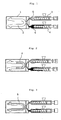
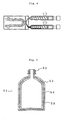
- Figs. 1, 2, 3 and 4 are illustrative in section of typical examples of co-injection molding
- Fig. 5 is illustrative in section of one embodiment of the multilayer container according to the invention.
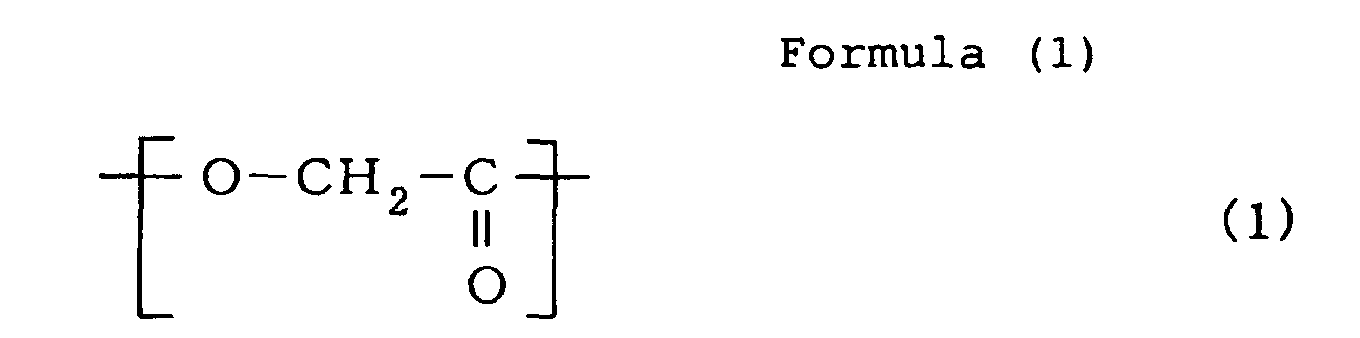
- the polyglycolic acid used herein is a homopolymer or copolymer containing a repeating unit represented by the following formula (1) :
- the proportion of the repeating unit having formula (1) contained in the polyglycolic acid is at least 60% by weight, preferably at least 70% by weight, and more preferably at least 80% by weight, with the upper limit placed at 100% by weight. As the proportion of the repeating unit having formula (1) is too low, gas barrier properties and heat resistance drop.
- the polyglycolic acid may contain at least one of repeating units such as those represented by the following formulae (2) to (6).
- n is equal 1 to 10 and m is equal 0 to 10.
- J is equal 1 to 10.
- R 1 and R 2 are each independently a hydrogen atom or an alkyl group having 1 to 10 carbon atoms, and k is equal to 2 to 10.
- Polyglycolic acids may be synthesized by dehydration and polycondensation of glycolic acid, dealcoholization and polycondensation of an alkyl ester of glycolic acid, ring-opening polymerization of glycolide, etc.
- a catalyst e.g., cationic catalysts such as tin organic carboxylates, tin halogenides and antimony halogenides
- the ring-opening polymerization should preferably rely on bulk polymerization or solution polymerization.
- copolymers of polyglycolic acid may be synthesized by copolymerization of glycolide, glycolic acid or an alkyl ester of glycolic acid in suitable combinations with a comonomer or comonomers such as cyclic monomers, for instance, ethylene oxalate, lactide, lactones (e.g., ⁇ -propiolactone, ⁇ -butyrolactone, pivalolactone, ⁇ -butyrolactone, ⁇ -valerolactone, ⁇ -methyl- ⁇ -valerolactone, ⁇ -caprolactone) , trimethylene carbonate and 1,3-dioxane; hydroxycarboxylic acids, for instance, lactic acid, 3-hydroxypropanoic acid, 3-hydroxybutanoic acid, 4-hydroxybutanoic acid and 6-hydroxycaproic acid, or an alkyl ester thereof; a substantially equimolar mixture of an aliphatic diol such as
- the polyglycolic acid used herein should have an oxygen permeability coefficient of up to 5.0 x 10 -14 cm 3 ⁇ cm/cm 2 ⁇ sec ⁇ cmHg as measured at a temperature of 23°C and a relative humidity (RH) of 80% persuant to JIS K-7126. With a polyglycolic acid having too large an oxygen permeability coefficient, it is impossible to obtain any multilayer container excellent in oxygen gas barrier properties. In most cases, the polyglycolic acid used herein should have an oxygen permeability coefficient in the range of 1.0 x 10- 14 to 5.0 ⁇ 10 -14 cm 3 ⁇ cm/cm 2 ⁇ sec ⁇ cmHg.
- the polyglycolic acid used herein should also have a melt viscosity of preferably 100 to 1,500 Pa ⁇ s, and more preferably 150 to 800 Pa ⁇ s, as measured at a temperature. of 240°C and a shear rate of 100 sec -1 .
- melt processing temperature of polyglycolic acid is about 240°C.
- melt viscosity of polyglycolic acid is too low or too high at 240°C, it is difficult to determine any proper molding conditions for co-injection of the polyglycolic acid and thermoplastic polyester resin.
- the polyglycolic acid used herein should have a melting point (Tm) of preferably 200°C or higher, and more preferably 210°C or higher.
- Tm melting point
- a polyglycolic acid has a melting point of about 220°C, a glass transition temperature of about 38°C and a crystallization temperature of about 91°C.
- Tm melting point
- those thermal properties of polyglycolic acid fluctuate in dependence on its molecular weight, copolymerizable component, etc.
- the neat resin of the polyglycolic acid may be used by itself; however, it is noted that a resin composition comprising inorganic fillers, other thermoplastic resins, plasticizers, etc. added to the polyglycolic acid may be used in a range that is not detrimental to the object of the invention.
- various additives such as heat stabilizers, light stabilizers, moistureproofing agents, waterproofing agents, water repellent agents, lubricants, releasing agents, coupling agents, pigments and dyes may be added to the polyglycolic acid.
- thermoplastic polyester resins other than the polyglycolic acid may be used.
- thermoplastic aromatic polyester resins that are composed mainly of aromatic dicarboxylic acids or their alkyl esters and glycols.
- thermoplastic aromatic polyester resins for instance, include polyethylene terephthalate (PET), non-crystalline polyethylene terephthalate copolymers (PETG) containing 1,4-cyclohexanedimethanol as a main copolymerizable component, polyethylene naphthalate (PEN), polybutylene terephthalate (PBT), poly-1,4-cyclohexylene-dimethylene terephthalate-isophthalate copolymers (PCTA), and mixtures of two or more thereof.
- PET polyethylene terephthalate
- PETG non-crystalline polyethylene terephthalate copolymers
- PEN polyethylene naphthalate
- PBT polybutylene terephthalate
- PCTA poly-1,4-cyclohexylene-dimethylene terephthalate-isophthalate copolymers
- PET is a thermoplastic polyester resin having a melting point of about 255°C, a glass transition temperature of about 76°C and a crystallization temperature of about 170°C.
- PETG is a non-crystalline polyethylene terephthalate copolymer that contains 1,4-cyclohexanedimethanol as a main component, and more specifically a copolyester in which a part of ethylene glycol that is a glycol component forming PET is replaced by 1,4-cyclohexanedimethanol.
- the proportion of 1,4-cyclohexanedimethanol in the glycol component is of the order of 30 to 35 mol%.
- Preferable PETGs include those produced and sold as by Eastman Chemical Co., Ltd., U.S.A., and Sky Green Co., Ltd.
- PEN is a thermoplastic polyester resin having a melting point of about 256°C, a glass transition temperature of about 120°C and a crystallization temperature of about 220°C.
- PCTA is a thermoplastic saturated copolyester resin that is obtained by polycondensation of 1,4-cyclohexanedimethanol with terephthalic acid and isophthalic acid.
- Preferred PCTAs include KODAR THERM X6761 made by Eastman Chemical Co., Ltd., U.S.A.
- copolyesters in which a part of the acid component in PET is replaced by isophthalic acid or naphthalene dicarboxylate, copolyesters in which a part of the glycol component in PET is replaced by a special diol such as diethylene glycol, etc.
- thermoplastic polyester resin it is acceptable to use aliphatic polyesters other than the polyglycolic acid, for instance, polylactic acid (with a melting point of about 178°C, a glass transition temperature of about 53°C and a crystallization temperature of about 103°C), etc. In applications where durability is needed, however, it is preferable to use the thermoplastic aromatic polyester resins.
- the thermoplastic polyester resin should have an inherent viscosity (IV value) of usually 0.5 to 1.5 dl/g, preferably 0.6 to 1.0 dl/g, and more preferably 0.7 to 0.85 dl/g.
- IV value (dl/g) of the thermoplastic polyester resin may be found by measuring that of a solution of 0.5% by weight of resin in o-chlorophenol or a phenol/chloroethane (60/40% by weight) mixed solvent at 30°C using Canon Ubbelohde Type 1B Viscometer pursuant to ASTM D4603-96.
- the thermoplastic polyester resin should also have a melt viscosity ( ⁇ ) of preferably 100 to 300 Pa ⁇ s, and more preferably 120 to 250 Pa ⁇ s, as measured at a temperature of 280°C and a shear rate of 100 sec -1 .
- thermoplastic polyester resin may contain various additives such as inorganic fillers, other thermoplastic resins, heat stabilizers, light stabilizers, moistureproofing agents, waterproofing agents, water repellent agents, lubricants, releasing agents, coupling agents, pigments and dyes.
- additives such as inorganic fillers, other thermoplastic resins, heat stabilizers, light stabilizers, moistureproofing agents, waterproofing agents, water repellent agents, lubricants, releasing agents, coupling agents, pigments and dyes.
- inorganic fillers may be added to the thermoplastic polyester resin, if desired.
- Preferable clays for nano-composites are natural smectite purified from bentonite, and primarily montmorillonite.
- montmorillonite that has an aspect ratio of preferably 200 or higher, more preferably 300 or higher, with a limited content of impurities such as silica.
- thermoplastic polyester resin composition in which 0.5 to 5% by weight of clay for nano-composites is dispersed in the thermoplastic polyester resin, is a clay hybrid material that can have improved heat resistance with no detriment to the transparency of a thermoplastic polyester resin layer.
- the use of PET with the clay for nano-composites dispersed in it contributes to a 20 to 30°C improvement in heat deformation temperature.
- the clay for nano-composites may be processed into a hybrid material by dispersion in the thermoplastic polyester resin by known intercalation, melt mixing with the thermoplastic polyester resin, or the like.
- the multilayer container of the invention has a structure in which the intermediate polyglycolic acid layer is entirely embedded in the thermoplastic polyester resin layer, it is not always necessary to interleave an adhesive layer between adjacent resin layers. For the purpose of enhancing strength to interlayer separation, etc., however, it is acceptable to interleave an adhesive layer between the polyglycolic acid layer and the thermoplastic polyester resin layer.
- the adhesives used herein should preferably be an adhesive resin that has affinity for both the polyglycolic acid and the thermoplastic polyester resin and can be extruded or injected with both the resins.
- exemplary adhesives are maleic anhydride-modified polyolefin resins (e.g., Modic S525 made by Mitsubishi Resin Co., Ltd., and Admer QF551 and NF550 made by Mitsui Chemical Co., Ltd.), glycidyl group-containing ethylene copolymers (e.g., Lexpearl RA3150 made by Nippon Oil Co., Ltd., and Bond Fast 2C made by Sumitomo Chemical Co., Ltd.), thermoplastic polyurethanes (e.g., Kuramiron 1195L made by Kuraray Co., Ltd.), copolyester-based adhesives, polyamide ⁇ ionomers (e.g., AM 7926 made by Mitsui Du Pont Co., Ltd.), and polyacrylamide resins (X
- the adhesive layer has a thickness of usually 1 to 1,000 ⁇ m, preferably 3 to 500 ⁇ m, and more preferably 5 to 100 ⁇ m.
- a desiccant may be incorporated in the adhesive layer.
- the desiccant it is possible to prevent hydrolysis of polyglycolic acid due to entrance of moisture from within and without the multilayer container.
- the desiccants used herein include inorganic compounds such as sodium secondary phosphate, calcium chloride, sodium chloride, ammonium chloride, potassium carbonate, sodium nitrate, magnesium chloride and magnesium sulfate, and organic compounds such as cane sugar.
- the amount of the desiccant contained in the adhesive is of the order of 1 to 40% by weight. Too much desiccant is detrimental to adhesion, and too little desiccant is less effective.
- high water absorption resins such as a crosslinked polyacrylic acid (salt) and a crosslinked starch/acrylic acid salt graft copolymer.
- the multilayer container of the invention comprises a polyglycolic acid layer excellent in oxygen gas barrier properties and a thermoplastic polyester resin layer.
- an inner and an outer thermoplastic polyester resin layer are provided, and at the body and bottom of the multilayer container, an intermediate layer comprising at least one polyglycolic acid layer is embedded in the thermoplastic polyester resin layer.
- the end of an opening in the multilayer container is formed of a thermoplastic polyester resin layer alone, and the body of the multilayer container is biaxially oriented. Further, the multilayer container is of heat resistance enough to stand up to a 20-second hot-filling at 93°C.
- FIG. 5 is illustrative in section of one embodiment of the multilayer container of the invention.
- a multilayer container 51 is constructed of an opening end 52, a body and a bottom.
- an outer layer 53 and an inner layer 55 are each formed of a thermoplastic polyester resin layer, and an intermediate layer 54 is formed of a poly-glycolic acid layer.
- the opening end 52 (mouth) of the multilayer container is formed of a single thermoplastic polyester resin layer. Therefore, the polyglycolic acid layer 54 is entirely embedded in the thermoplastic polyester resin.
- polyglycolic acids are good at oxygen gas barrier properties and carbonic acid gas barrier properties.
- a poly-glycolic acid having particularly improved oxygen gas barrier properties is used.
- polyglycolic acids are biodegradable polymers sensitive to hydrolysis. For this reason, a multilayer container comprising only a combination of a polyglycolic acid layer with other resin layer is likely to undergo degradation from the opening end. If the polyglycolic acid layer is embedded in the thermoplastic polyester resin layer, then effective prevention of degradation by hydrolysis, etc. of the poly-glycolic acid layer is achievable.
- the height of the multilayer container from its bottom to the tip of the polyglycolic acid layer is here called the “implanting height”.
- This "implanting height” should preferably be kept constant at a height near to the opening end and during molding. Fluctuations in the implanting height at the time of molding gives rise to a lowering of gas barrier properties, because the resultant multilayer container does not include a polyglycolic acid layer portion just only at the opening end but also at the shoulder.
- polyglycolic acid layer of Fig. 5 is a single layer, it is understood that the polyglycolic acid layer may comprises two or more layer units.
- PGA stands for a polyglycolic acid layer
- Polyyester a thermoplastic polyester resin
- Adhesive an adhesive layer.
- Polyester/PGA/Polyester Polyester/Adhesive/PGA/Adhesive/Polyester, Polyester/PGA/Polyester/PGA/Polyester, Polyester/Adhesive/PGA/Adhesive/Polyester/Adhesive/PGA/Adhe sive/Polyester, Polyester/PGA/Polyester/PGA/Polyester/PGA/Polyester, and Polyester/Adhesive/PGA/Adhesive/Polyester/Adhesive/PGA/Adhe sive/Polyester/Adhesive/PGA/Adhesive/Polyester.
- the respective thermoplastic polyester resin layers may be formed of the same type of thermoplastic polyester resin or different types of thermoplastic polyester resins.
- the thermoplastic polyester resin 55 that gives the inner layer may be formed of a neat resin
- the thermoplastic polyester resin 53 that gives the outer layer may be formed of a thermoplastic polyester resin (resin composition) with additives such as UV absorbers and coloring agents added thereto.
- a regrind layer comprising molding scraps may be additionally provided as an intermediate layer.
- the thermoplastic polyester resin may contain a clay for nano-composites.
- the adhesive layer may contain a desiccant and a high water absorption resin.
- the polyglycolic acid layer comprises one or two layer units.
- the gas barrier properties of the multilayer container can be enhanced, even when their total thickness is substantially equal to that of the single layer.
- the thickness of the total layers that form the body (side wall) of the multilayer container may properly be determined depending on what it is used for; however, that total thickness is of the order of usually 100 ⁇ m to 5 mm, preferably 150 ⁇ m to 3 mm, and more preferably 300 ⁇ m to 2 mm.
- a heat-resistant bottle or heat-resistant, pressure-resistant bottle of 1.5 L has a weight of the order of 50 to 60 g.
- an aseptic packing bottle may have a thin body because of being filled up at normal temperature and pressure; a 1.5 L bottle may have a weight of the order of 40 to 50 g.
- the total thickness of the thermoplastic polyester resin layers is of the order of usually 50 ⁇ m to 4.5 mm, preferably 100 ⁇ m to 2.5 mm, and more preferably 200 ⁇ m to 1 mm.
- the total thickness of the intermediate polyglycolic acid layers is usually 5 ⁇ m or greater, preferably 5 to 200 ⁇ m, and more preferably 10 to 100 ⁇ m.
- the polyglycolic acid layer may be used in a single layer form, it may be provided in a split barrier layer wherein the polyglycolic acid layer is split into two or more units. When the polyglycolic acid layer is provided in a single layer form, it is preferable to locate that layer somewhat outside of the central portion of multilayer construction, because what is filled is often a fluid.
- the adhesive layer has a thickness of usually 1 to 1,000 ⁇ m, preferably 3 to 500 ⁇ m, and more preferably 5 to 100 ⁇ m, as already mentioned.
- the opening end 52 of the multilayer container should preferably be configured in such a way as to be capped by a lid. Upon heat treatment of this opening end 52, the thermoplastic polyester resin may be crystallized. The crystallization of the opening end should preferably be done at a preform-making stage prior to stretch blow molding. A bottomed, multilayer preform is formed by co-injection, and the opening end of that multilayer preform is then heated to about 200°C by near-infrared irradiation for crystallization.
- thermoplastic polyester resin that forms the opening end has a crystallinity of usually 25% by volume or greater, and preferably 30% by volume or greater. Especially when PET is used as the thermoplastic polyester resin, it is preferable to crystallize the opening end by heat treatment in favor of the gas barrier properties and heat resistance of the multilayer container.
- the body of the multilayer container should preferably be thermally fixed by heat treatment in a biaxially oriented state.
- PET is used as the thermoplastic polyester resin
- the biaxially oriented state of the body be thermally fixed by heat treatment upon stretch blow molding.
- Such thermal fixation ensures that heat resistance enough to stand up to hot-filling at 80°C or higher is given to the body.
- a multilayer container that is obtained using as the thermoplastic polyester resin a resin having excellent heat resistance such as PEN to make up a layer construction such as PEN/PGA/PEN or PEN/PGA/PEN/PGA/PEN can provide a heat-resistant bottle that can be hot-filled and have improved UV barrier properties and gas barrier properties, even without recourse to crystallization of the opening end of a multilayer preform by heat treatment or thermal fixation of the body or the whole of the container by heat treatment.
- the body of the multilayer container according to the invention should preferably have transparency as represented by a haze value of 4.0% or lower.
- a multilayer container is produced by co-injecting at least a polyglycolic acid and a thermoplastic polyester resin to form a bottomed, multilayer preform and then subjecting the multilayer preform to biaxial stretch blow molding.
- a gas barrier resin is used, which contains the repeating unit having the aforesaid formula (1) at a proportion of at least 60% by weight and has an oxygen permeability coefficient of up to 5.0 x 10 -14 cm 3 ⁇ cm/cm 2 ⁇ sec ⁇ cmHg as measured at a temperature of 23°C and a relative humidity of 80% pursuant to JIS K-7126.
- a molding machine equipped with a plurality of injection cylinders is used to co-inject the respective resin melts through one gate into a single preform mold cavity by successive or concurrent molding in one clamp operation.
- a bottomed, multilayer preform is prepared, which comprises (A) an inner layer and an outer layer, each composed of a thermoplastic polyester resin layer, (B) an intermediate layer comprising at least one polyglycolic acid layer and embedded in the thermoplastic polyester resin layer, (C) the end of an opening formed of a thermoplastic resin layer alone, and (D) the rest comprising a three- or multi-layer construction.
- the respective resin melts are injected through the associated cylinders at different injection timings in a continuous, alternate manner, so that the previously injected thermoplastic polyester resin forms an inner and an outer layer, and the subsequently injected poly glycolic acid forms an intermediate layer, thereby preparing a multilayer preform.
- the respective resin melts are injected through the associated cylinders at such varied injection timings that the thermoplastic polyester resin is first injected, during which the polyglycolic acid is injected at some point, so that both resins are concurrently and continuously injected to prepare a multilayer preform in which an inner and an outer layer are made up of the thermoplastic polyester resin and the an intermediate layer is made up of the polyglycolic acid.
- thermoplastic polyester resin 5 is injected through an injection cylinder 3 in a cavity 2 in a mold 1.
- polyglycolic acid 6 is injected through another injection cylinder 4 into a thermoplastic polyester resin 7 molten in the cavity 2.
- the poly-glycolic acid forms a polyglycolic acid layer 8 in the thermoplastic polyester resin 7 in a molten state.
- another portion of the thermoplastic polyester resin 5 is again injected through the injection cylinder 3 to fill up the mold cavity entirely. In this way, there is obtained a multilayer preform that is sealed at its bottom with the thermoplastic polyester resin.
- thermoplastic polyester resin polyglycolic acid and thermoplastic polyester resin are injected successively in this order, it is possible to obtain a multilayer preform made up of two resins/five layers, and having a layer construction of polyester/PGA/polyester/PGA/ polyester.
- thermoplastic polyester resin is intentionally stopped at the gate, there is obtained a multilayer preform made up of two resins/three layers, and having a layer construction of polyester/PGA/polyester.
- the melt viscosities of the respective resins upon co-injection should preferably be controlled such that the ratio ( ⁇ T / ⁇ P ) of the melt viscosity ( ⁇ T ) of the thermoplastic polyester resin to the melt viscosity of ( ⁇ P ) of the polyglycolic acid, as measured at the melting temperatures of the respective resins and the shear rate of 100 sec -1 , is 1 or lower.
- melt viscosities of both resins in a molten state are controlled, then the inner and outer layers will be formed of the thermoplastic polyester resin and the intermediate (core) layer will be formed of the polyglycolic acid.
- control it is desired that control be carried out such that the melt viscosity of the thermoplastic polyester resin becomes lower than that of the polyglycolic acid.
- the melt viscosity ratio ( ⁇ T / ⁇ P ) should preferably be in the range of 0.3 to less than 1. The preferable melt viscosity ratio can be adjusted by control of the type and melting temperature (injection temperature) of each resin.
- the resin temperature upon co-injection molding is usually in the range of 265 to 290°C.
- the resin temperature upon co-injection molding is usually in the range of 225 to 260°C.
- the opening end of the multilayer preform is heat treated for crystallization of thermoplastic polyester resin layer.
- the opening end of a bottomed, multilayer preform has a single thermoplastic polyester resin layer structure, and so is less than satisfactory in terms of heat resistance and gas barrier properties. For this reason, it is desired that prior to subjecting the preform to stretch blow molding, the opening end be heated to about 200°C by irradiation with infrared rays as an example for crystallization.
- the post-crystallization crystallinity of the thermoplastic polyester resin at the opening end is usually 25% by volume or greater, and preferably 30% by volume or greater.
- a resin having a high glass transition temperature such as a polycarbonate or polyallylate resin
- a resin having a high glass transition temperature such as a polycarbonate or polyallylate resin
- the multilayer preform is then subjected to stretch blow molding.
- the multilayer preform is regulated at a temperature at which it is stretchable, and then inserted into a blow mold cavity, where stretch blow molding is carried out with a pressurized fluid such as air blown therein.
- Stretch blow molding may be carried out in either a hot-parison method or a cold-parison method. It is here noted that the "parison" means a preform.
- a pressurized air such as compressed air is blown in the bottomed, multilayer preform heated to a stretch temperature for expansion and stretching.
- the stretch factor is of the order of 1.5 to 3 in the axial direction and 3 to 5 in the circumferential direction.
- the blow-up ratio total stretch factor is of the order of 6 to 9 for general-purpose blow molded bottles, 8 to 9.5 for pressure-resistance bottles, 6 to 7.5 for heat-resistant bottles, and 7 to 8 for large bottles.
- stretch blow molding is generally carried out in the temperature range of the glass transition temperature to the crystallization temperature inclusive of the resins.
- the thermoplastic polyester resin is a non-crystalline resin like PETG
- stretch blow molding is conducted in the temperature range of the glass transition temperature (about 81°C for PETG) to the melting temperature (about 180°C or higher for PETG) inclusive of the resin, because there is no definite crystallization temperature or melting point.
- thermoplastic polyester resin is PET
- compressed air is blown in the multilayer preform at a temperature ranging from the glass transition temperature to the crystallization temperature inclusive of PET, preferably at a temperature of 80 to 170°C, wherein a stretching rod is inserted for biaxial stretching in the axial (longitudinal) and circumferential (lateral) directions.
- the intermediate polyglycolic acid layer has a glass transition temperature of about 38°C, and so is easily stretchable following the stretching of the thermoplastic polyester resin that forms the inner and the outer layer.
- the biaxially oriented body of the multilayer container be thermally fixed simultaneously with stretch blow molding.
- Heat treatment occurring in the mold heated to such a high temperature ensures that the biaxially oriented state is thermally fixed and, at the same time, the crystallization of the thermoplastic polyester resin progresses.
- the heat treatment also ensures that internal distortion resulting from the stretch blow molding step is relaxed, ending up with promoted orientation and crystallization.
- the oriented crystals in the body well keep transparency, even when the orientation and crystallization of the body are promoted.
- the post-thermal fixation crystallinity of the body sidewall is usually 28% by volume or higher.
- the thermal fixation should preferably be done in favor of heat resistance.
- the body of the multilayer container is heat treated (thermally fixed) in a stretch blow mold simultaneously with stretch blow molding, while the mold has been heated to a temperature of 100°C or higher, for the purpose of preventing thermal shrinkage and deformation of the container at the time of hot-filling. More specifically, the mold is heated to a temperature of 100 to 165°C, and preferably 145 to 155°C for general-purpose heat-resistant containers and 160 to 165°C for containers of high heat resistance.
- a heat treatment time of usually 1 to 30 seconds, and preferably 2 to 20 seconds is used.
- a sample was prepared by crystallization of an about 0.2 mm thick non-crystalline sheet of each resin by a 5-minute heating at 150°C.
- the melt viscosity of the sample was measured at a shear rate of 100 sec -1 and at a resin temperature of 240°C for poly-glycolic acid and 280°C for PET.
- the oxygen permeability of the multilayer container was measured at a measurement temperature of 20°C while the inside of the container was kept at 100% RH (relative humidity) and the outside at 65% RH.
- Hot water of 80°C was hot-filled in a multilayer container, which was then allowed to stand alone for 1 minute. How the opening end and the body of the multilayer container were deformed or shrunk was observed to make estimations on the following ranks:
- the body of a multilayer container was cut out, and its haze value was measured to make estimations on the following ranks:
- a homopolymer (with a glass transition temperature of 38°C, a melting point of 221°C and a crystallization temperature of 91°C) having a melt viscosity [ ⁇ P ] of 500 Pa ⁇ s, as measured at a temperature of 240°C and a shear rate of 100 sec -1 , was used for polyglycolic acid.
- This polyglycolic acid had an oxygen permeability coefficient (PO 2 ) of 2.5 x 10 -14 cm 3 ⁇ cm/cm 2 ⁇ sec ⁇ cmHg, and a carbonic acid permeability coefficient (PCO 2 ) of 8.9 x 10 -14 cm 3 ⁇ cm/cm 2 ⁇ sec ⁇ cmHg, the latter being measured using a double-side moistening gas permeability tester made by GL Sciences Inc.
- PO 2 oxygen permeability coefficient
- PCO 2 carbonic acid permeability coefficient
- a PET (with an IV value of 0.8 dl/g, a glass transition temperature of 75°C, a melting point of 252°C and a crystallization temperature of 150°C) having a melt viscosity [ ⁇ T ] of 190 Pa ⁇ s, as measured at a temperature of 280°C and a shear rate of 100 sec -1 , was used for a thermoplastic polyester resin.
- this multilayer preform was heated by infrared irradiation to 200°C for crystallization.
- stretch blow molding was carried out by blowing compressed air in a stretch blow mold cavity at a resin temperature of 160°C and a stretch factor (blow-up ratio) of about 6 (about 2 in an axial direction and about 3 in a circumferential direction). While the mold had been heated to a temperature of 160°C, a multilayer container was heat treated for 5 seconds at the time of stretch blow molding, thereby thermally fixing the whole container including its body.
- the compressed air was changed over to cooling air which was regulated to a temperature of 5°C for internal cooling and then flowed through the mold, immediately whereupon the multilayer container was removed from the mold, and then slowly cooled, thereby obtaining a multilayer container product having an internal volume of 1,500 ml and a PET/PGA/PET/PGA/PET layer construction, wherein the opening end had a single PET layer, the body and bottom were formed of the polyglycolic acid layer and the polyglycolic acid layer was embedded in the PET layer.
- the weight of the preform was about 50 g.
- the total layer thickness of the multilayer container product was 330 ⁇ m, the total thickness of the inner and outer layers and the intermediate PET layer was 300 ⁇ m, and the thickness of the polyglycolic acid layers was 15 ⁇ m for each layer and 30 ⁇ m in all.
- the crystallinity of the opening end of the multilayer container product was 31% by volume or greater.
- Example 1 was repeated with the exception that the injection of PET was intentionally stopped at a gate portion at the time of preparing a preform by co-injection.
- a multilayer container product which had a layer construction of PET (100 ⁇ m)/PGA (30 ⁇ m)/PET (200 ⁇ m) as viewed from the outer layer and in which the opening end was made up of a single PET layer, the body and the bottom were each made up of a polyglycolic acid layer and a polyglycolic acid layer was embedded in the inner and the outer PET layer.
- the weight of the preform was about 50 g
- the total layer thickness of the multilayer container product was 330 ⁇ m
- the total PET layer thickness of the inner and outer layers was 300 ⁇ m
- the thickness of the polyglycolic acid was 30 ⁇ m.
- a multilayer container product was molded as in Example 2 with the exception that MXD6 nylon (P-6001 made by Mitsubishi Gas Chemistries Co., Ltd. with a melting point of 243°C, a glass transition temperature of 75°C, a crystallization temperature of 163°C and an MI of 7 g/10 minute) was used in place of the polyglycolic acid.
- MXD6 nylon P-6001 made by Mitsubishi Gas Chemistries Co., Ltd. with a melting point of 243°C, a glass transition temperature of 75°C, a crystallization temperature of 163°C and an MI of 7 g/10 minute
- PET inner/outer layer
- MXD6 nylon intermediate layer
- a merging hot runner block at 270°C.
- the weight of the preform was about 50 g
- the total layer thickness of the body of the multilayer container product was 330 ⁇ m
- the total thickness of the inner and outer PET layers was 300 ⁇ m
- the thickness of the MXD6 nylon layer was 30 ⁇ m.
- a multilayer container product was molded as in Example 2 with the exception that EVOH resin (DC3212 made by Nippon Synthesis Chemistries Co., Ltd. with a melting point of 183°C, a glass transition temperature of 61°C, a crystallization temperature of 160°C and an MI of 12 g/10 minute) was used in place of the polyglycolic acid.
- EVOH resin DC3212 made by Nippon Synthesis Chemistries Co., Ltd. with a melting point of 183°C, a glass transition temperature of 61°C, a crystallization temperature of 160°C and an MI of 12 g/10 minute
- the leading end of an injection cylinder on the inner/outer layer (PET) side was set at 270°C
- the leading end of an injection cylinder on the intermediate layer (EVOH) side at 200°C
- a hot runner block where PET and EVOH merged together at 260°C.
- the weight of the preform was about 50 g
- a multilayer container product was molded as in Example 2 with the exception that neither was crystallization of the opening end of the preform conducted, nor was any heat treatment carried out in the mold upon stretch blow molding.
- the weight of the preform was about 50 g
- the total layer thickness of the body of the multilayer container product was 330 ⁇ m
- the total thickness of the inner/outer PET layers was 300 ⁇ m
- the thickness of the polyglycolic acid was 30 ⁇ m.
- Example 1 a polyethylene terephthalate (PEN) homopolymer (with a melting point of 265°C, a glass transition temperature of 120°C and a crystallization temperature of 220°C) was used in place of the PET, and neither was the crystallization of the opening end of the preform conducted, nor was the thermal fixation of the container body carried out in the mold. Otherwise, Example 1 was repeated to prepare a multilayer container product. This multilayer container product had heat resistance enough to stand up to not only hot-filling but also boiling, and improved oxygen gas barrier properties as well.
- PEN polyethylene terephthalate
- a multilayer container product was prepared as in Example 1 with the exception that a PET/clay nano-composite (PET containing 3% by weight of clay for nano-composites) obtained according to the method set forth in ANTEC 2000 pp-2412 was used in place of PET.
- PET PET/clay nano-composite
- the resultant multilayer container product was somewhat higher in oxygen permeability than that of Example 1, and had heat resistance enough to stand up to not only hot-filling but also boiling as well as improved oxygen gas barrier properties.
- the multilayer container product of Example 1 has improved oxygen permeability, because the intermediate layer is divided into two layer units to achieve a split barrier system.
- the multilayer container or stretch blow molded product of Example 3 had heat resistance enough to stand up to boiling treatments even without recourse to the crystallization of the opening end and the heat treatment of the container body in the mold, because PEN was used for the thermoplastic polyester resin.
- the present invention provides a multilayer container significantly improved in terms of gas barrier properties, heat resistance, moldability, transparency and durability, and its production process. Having by far higher oxygen, and carbonic acid gas barrier properties, the multilayer container of the invention may be used in the form of various bottles, wide-mouthed bottles, cups or the like. The multilayer container of the invention has also heat resistance enough to stand up to hot-filling.
Landscapes
- Engineering & Computer Science (AREA)
- Mechanical Engineering (AREA)
- Manufacturing & Machinery (AREA)
- Ceramic Engineering (AREA)
- Blow-Moulding Or Thermoforming Of Plastics Or The Like (AREA)
- Laminated Bodies (AREA)
- Containers Having Bodies Formed In One Piece (AREA)
- Processing And Handling Of Plastics And Other Materials For Molding In General (AREA)
Abstract
Description
Also carbonated fruit juices or lactic drinks, etc. are heat sterilized by hot-water showering upon packed in blow molded containers. Thus, the blow molded containers are required to have properties high enough to stand up to heat and pressure. To sum up, the blow molded containers must possess high gas barrier properties and heat resistance enough to be resistant to hot-filling.

characterized in that:






Polyester/PGA/Polyester, Polyester/Adhesive/PGA/Adhesive/Polyester, Polyester/PGA/Polyester/PGA/Polyester, Polyester/Adhesive/PGA/Adhesive/Polyester/Adhesive/PGA/Adhe sive/Polyester, Polyester/PGA/Polyester/PGA/Polyester/PGA/Polyester, and Polyester/Adhesive/PGA/Adhesive/Polyester/Adhesive/PGA/Adhe sive/Polyester/Adhesive/PGA/Adhesive/Polyester.
On the other hand, an aseptic packing bottle may have a thin body because of being filled up at normal temperature and pressure; a 1.5 L bottle may have a weight of the order of 40 to 50 g.
At this step, a bottomed, multilayer preform is prepared, which comprises (A) an inner layer and an outer layer, each composed of a thermoplastic polyester resin layer, (B) an intermediate layer comprising at least one polyglycolic acid layer and embedded in the thermoplastic polyester resin layer, (C) the end of an opening formed of a thermoplastic resin layer alone, and (D) the rest comprising a three- or multi-layer construction.

Claims (20)
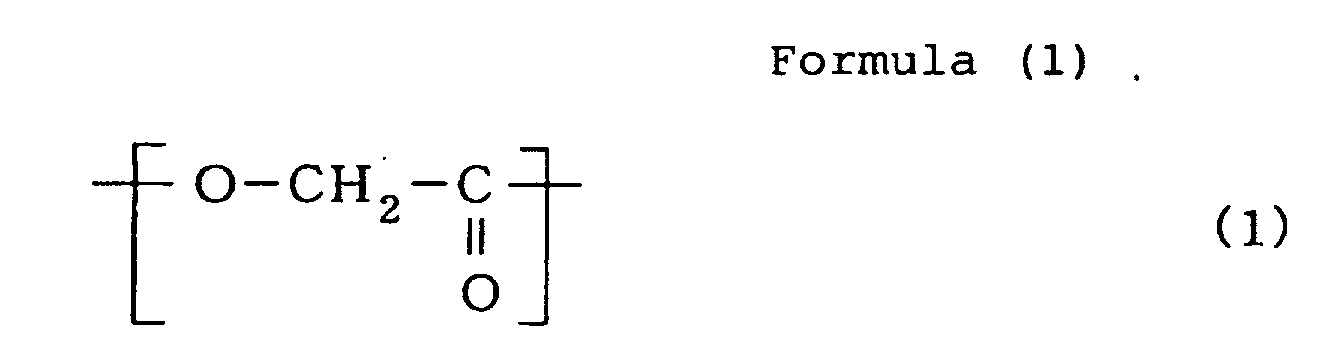
- A multilayer container that at least comprises a polyglycolic acid layer and a thermoplastic polyester resin layer, wherein:(a) said polyglycolic acid is a gas barrier resin that contains a repeating unit represented by formula (1) at a proportion of at least 60% by weight and has an oxygen permeability coefficient of up to 5.0 x 10⁻¹⁴ (cm3·cm/cm2· sec·cmHg) as measured at a temperature of 23°C and a relative humidity of 80% pursuant to JIS K-7126,
 (b) at a body and a bottom of the multilayer container, the thermoplastic polyester resin forms an inner layer and an outer layer,(c) at the body and the bottom of the multilayer container, an intermediate layer comprising at least one polyglycolic acid layer is embedded in the thermoplastic polyester resin layer,(d) an end of an opening in the multilayer container is formed of a thermoplastic polyester resin layer alone,(e) the body of the multilayer container is biaxially oriented, and(f) the multilayer container is of heat resistance enough to stand up to hot-filling at 93°C for 20 seconds.
 - The multilayer container according to claim 1, wherein the thermoplastic polyester resin layer at the opening end of the multilayer container is crystallized.
- The multilayer container according to claim 1, wherein the body of the multilayer container is thermally fixed in a biaxially oriented state.
- The multilayer container according to claim 1, wherein the body of the multilayer container has a transparency as represented by a haze value of 4.0% or lower.
- The multilayer container according to claim 1, wherein the intermediate layer comprises at least two polyglycolic acid layers.
- The multilayer container according to claim 1, wherein the body and the bottom of the multilayer container have a layer construction comprising (i) thermoplastic polyester resin/polyglycolic acid/ thermoplastic polyester resin or (ii) thermoplastic polyester resin/polyglycolic acid/thermoplastic polyester resin/polyglycolic acid/thermoplastic polyester resin.
- The multilayer container according to claim 1, wherein the thermoplastic polyester resin is a thermoplastic aromatic polyester resin.
- The multilayer container according to claim 7, wherein the thermoplastic aromatic polyester resin is at least one thermoplastic aromatic polyester resin selected from the group consisting of polyethylene terephthalate (PET), a non-crystalline polyethylene terephthalate copolymer (PETG) containing 1,4-cyclohexanedimethanol as a copolymerizing component, polyethylene naphthalate (PEN), polybutylene terephthalate (PBT) and a poly-1,4-cyclohexylenedimethylene terephthalate·isophthalate copolymer (PCTA).
- The multilayer container according to claim 1, wherein the thermoplastic polyester resin is a polyethylene terephthalate, and the body of the multilayer container is thermally fixed in a biaxially oriented state.
- The multilayer container according to claim 1, wherein the thermoplastic polyester resin is a thermoplastic polyester resin composition that contains a clay for nano-composites.
- The multilayer container according to claim 1, wherein an adhesive layer is interleaved between the polyglycolic acid layer and the thermoplastic polyester layer.
- The multilayer container according to claim 10, wherein the adhesive layer contains a desiccant.
- The multilayer container according to claim 1, which further contains a regrind layer in the body and bottom thereof.
- A multilayer container production process involving the steps of co-injecting at least polyglycolic acid and a thermoplastic polyester resin to form a bottomed multilayer preform, and then subjecting said multilayer preform to biaxial stretch blow molding, thereby producing a multilayer container, wherein:(I) said polyglycolic acid is a gas barrier resin that contains a repeating unit represented by formula (1) at a proportion of at least 60% by weight and has an oxygen permeability coefficient of up to 5.0 x 10⁻¹⁴ cm3 · cm/cm2 · sec·cmHg as measured at a temperature of 23°C and a relative humidity of 80% according to JIS K-7126,
 (II) a molding machine equipped with a plurality of injection cylinders is used to co-inject resin melts through one gate into a single preform mold cavity by successive or concurrent molding in one clamping operation, thereby making a bottomed, multilayer preform comprising (A) an inner layer and an outer layer, each composed of a thermoplastic polyester resin layer, (B) an intermediate layer comprising at least one polyglycolic acid layer and embedded in the thermoplastic polyester resin layer, (C) an end of an opening formed of a thermoplastic resin layer alone, and (D) the rest comprising a three- or multi-layer construction,(III) if necessary, the end of the opening in the multilayer preform is heat treated to crystallize the thermoplastic polyester resin layer, and(IV) after regulated to a temperature at which stretch is possible, the multilayer preform is inserted into a blow mold cavity where the multiform preform is blow molded while a pressurized fluid is blown thereinto.
 - The production process according to claim 14, wherein at the step (II), the multilayer preform is prepared by concurrent molding, wherein the melt viscosity of each resin upon co-injection is controlled in such a way as to provide a ratio (ηT/ηP) of 1 or lower, where ηP is a melt viscosity of the polyglycolic acid and ηT is a melt viscosity of the thermoplastic polyester resin, each measured at a melting temperature thereof and a shear rate of 100 sec-1.
- The production process according to claim 14, wherein at the step (II), the multilayer preform is prepared by successive molding, wherein the respective molten resins are injected through the associated cylinders at such varied timings that said molten resins are continuously and alternately injected so that a previously injected thermoplastic polyester resin is formed into the inner and outer layers and a subsequently injected polyglycolic acid is formed into the intermediate layer.
- The production process according to claim 14, wherein at the step (II), the multilayer preform is prepared by successive molding, wherein the respective molten resins are injected through the associated cylinders at such varied timings that the thermoplastic polyester resin is first injected, during which the poly-glycolic acid is injected at some point so that both resins are concurrently and continuously injected to form the thermoplastic polyester resin into the inner and outer layers and the polyglycolic acid into the intermediate layer.
- The production process according to claim 14, wherein at the step (III), the opening end of the multilayer preform is heat treated to crystallize the thermoplastic polyester resin layer to a crystallinity of 25 vol% or higher.
- The production process according to claim 14, wherein at the step (IV), biaxial stretch blow molding is carried out at a stretch factor of 1.5 to 3 in an axial direction and 3 to 5 in a circumferential direction.
- The production process according to claim 14, wherein at the step (IV), while the mold has been heated to a temperature of 100 to 165°C, a biaxially oriented body of the multilayer container is thermally fixed simultaneously with stretch blow molding.
Applications Claiming Priority (3)
| Application Number | Priority Date | Filing Date | Title |
|---|---|---|---|
| JP2001336601 | 2001-11-01 | ||
| JP2001336601A JP3978012B2 (en) | 2001-11-01 | 2001-11-01 | Multilayer container and manufacturing method thereof |
| PCT/JP2002/011464 WO2003037624A1 (en) | 2001-11-01 | 2002-11-01 | Multilayer bottle and process for its production |
Publications (3)
| Publication Number | Publication Date |
|---|---|
| EP1449646A1 true EP1449646A1 (en) | 2004-08-25 |
| EP1449646A4 EP1449646A4 (en) | 2006-04-26 |
| EP1449646B1 EP1449646B1 (en) | 2008-05-14 |
Family
ID=19151396
Family Applications (1)
| Application Number | Title | Priority Date | Filing Date |
|---|---|---|---|
| EP20020775474 Expired - Lifetime EP1449646B1 (en) | 2001-11-01 | 2002-11-01 | Multilayer bottle and process for its production |
Country Status (8)
| Country | Link |
|---|---|
| US (1) | US7713464B2 (en) |
| EP (1) | EP1449646B1 (en) |
| JP (1) | JP3978012B2 (en) |
| KR (1) | KR100920392B1 (en) |
| CN (1) | CN100349736C (en) |
| AT (1) | ATE395184T1 (en) |
| DE (1) | DE60226632D1 (en) |
| WO (1) | WO2003037624A1 (en) |
Cited By (7)
| Publication number | Priority date | Publication date | Assignee | Title |
|---|---|---|---|---|
| WO2005072944A1 (en) | 2004-01-30 | 2005-08-11 | Kureha Corporation | Hollow container and process for producing the same |
| WO2006099700A3 (en) * | 2005-03-25 | 2007-03-22 | Resilux | Device and process for manufacturing a preform, preform for blow moulding a container and such a container |
| EP1550549A4 (en) * | 2002-05-29 | 2008-08-06 | Kureha Corp | Container of biodegradable heat-resistant hard resin molding |
| EP1982829A1 (en) * | 2007-04-20 | 2008-10-22 | Aisapack Holding SA | Container for wine or a similar beverage |
| EP1964673A4 (en) * | 2005-12-22 | 2010-03-17 | Mitsubishi Gas Chemical Co | MULTILAYER BOTTLE |
| EP1864797A4 (en) * | 2005-04-01 | 2010-10-13 | Kureha Corp | BLOW MOLDED MULTILAYER CONTAINER AND PROCESS FOR PRODUCTION THEREOF |
| EP1795342A4 (en) * | 2004-09-30 | 2010-11-03 | Toyo Kohan Co Ltd | Multilayer resin film and method for producing multilayer resin film |
Families Citing this family (55)
| Publication number | Priority date | Publication date | Assignee | Title |
|---|---|---|---|---|
| JP4294475B2 (en) | 2001-07-19 | 2009-07-15 | 東洋製罐株式会社 | Biaxial stretch blow thermoset container and method for manufacturing the same |
| AU2003242308A1 (en) | 2002-05-21 | 2003-12-02 | Kureha Chemical Industry Company, Limited | Bottle excellent in recyclability and method for recycling the bottle |
| TWI247782B (en) * | 2003-01-10 | 2006-01-21 | Mitsui Chemicals Inc | Polyester resins composition |
| JP2005002205A (en) * | 2003-06-11 | 2005-01-06 | Asahi Denka Kogyo Kk | Thermoplastic polyester resin composition |
| KR100745093B1 (en) | 2003-08-12 | 2007-08-01 | 미쓰이 가가쿠 가부시키가이샤 | Polyester resin and polyester resin lamination container |
| CN100450752C (en) * | 2003-10-01 | 2009-01-14 | 株式会社吴羽 | Method for producing multilayer stretch-molded article |
| US7648836B1 (en) * | 2004-01-28 | 2010-01-19 | Phase Dynamics, Inc. | Moisture and sediment analysis |
| JP4579569B2 (en) * | 2004-04-16 | 2010-11-10 | 株式会社クレハ | Multi-layer biaxially stretched blow bottle and manufacturing method thereof |
| KR100844632B1 (en) * | 2004-06-23 | 2008-07-07 | 네이쳐웍스 엘엘씨 | Injection stretch blow molding method using polylactide resin |
| SG144138A1 (en) * | 2005-03-15 | 2008-07-29 | Coca Cola Co | Overmolded containers and methods of manufacture and use thereof |
| US20080251492A1 (en) * | 2005-03-15 | 2008-10-16 | Colgate-Palmolive Company | Overmolded Containers With Improved Gripping and Methods of Manufacture Thereof |
| US8734923B2 (en) * | 2005-03-15 | 2014-05-27 | Colgate-Palmolive Company | Blow molded polyester container with an over-molded thermoplastic layer |
| EP1757421A1 (en) * | 2005-08-22 | 2007-02-28 | Aisapack Holding SA | Multilayered preform and method of manufacturing it |
| US20080029509A1 (en) * | 2006-08-04 | 2008-02-07 | Wu Yih-Ming | Moistureproof container |
| JP4871745B2 (en) * | 2007-01-23 | 2012-02-08 | 中本パックス株式会社 | Retort food container manufacturing method |
| US20080230954A1 (en) * | 2007-03-20 | 2008-09-25 | Green Harvest Technologies, Llc | Injection Stretch Blow Molded Polylactide Bottle and Process For Making Same |
| CN101678596B (en) | 2007-03-28 | 2012-07-04 | 东洋制罐株式会社 | Biaxially stretched blow-molded container and process for producing the same |
| US8245848B2 (en) | 2008-08-21 | 2012-08-21 | Sacred Green, Inc. | Compostable container for storing fluids |
| US8079413B2 (en) | 2008-12-23 | 2011-12-20 | W. Lynn Frazier | Bottom set downhole plug |
| US8899317B2 (en) | 2008-12-23 | 2014-12-02 | W. Lynn Frazier | Decomposable pumpdown ball for downhole plugs |
| JP4737295B2 (en) * | 2009-01-19 | 2011-07-27 | マツダ株式会社 | Molding method and molding apparatus for foamed resin molded product |
| PL2398712T3 (en) * | 2009-02-18 | 2022-02-07 | Indorama Germany Gmbh | Bottle for carbonated pasteurized products |
| US9127527B2 (en) | 2009-04-21 | 2015-09-08 | W. Lynn Frazier | Decomposable impediments for downhole tools and methods for using same |
| US9109428B2 (en) | 2009-04-21 | 2015-08-18 | W. Lynn Frazier | Configurable bridge plugs and methods for using same |
| US9562415B2 (en) | 2009-04-21 | 2017-02-07 | Magnum Oil Tools International, Ltd. | Configurable inserts for downhole plugs |
| US9163477B2 (en) | 2009-04-21 | 2015-10-20 | W. Lynn Frazier | Configurable downhole tools and methods for using same |
| US9181772B2 (en) | 2009-04-21 | 2015-11-10 | W. Lynn Frazier | Decomposable impediments for downhole plugs |
| US9062522B2 (en) | 2009-04-21 | 2015-06-23 | W. Lynn Frazier | Configurable inserts for downhole plugs |
| JP5365916B2 (en) * | 2009-05-29 | 2013-12-11 | 株式会社吉野工業所 | Synthetic resin thick-walled molded product |
| US9522773B2 (en) | 2009-07-09 | 2016-12-20 | Entegris, Inc. | Substantially rigid collapsible liner and flexible gusseted or non-gusseted liners and methods of manufacturing the same and methods for limiting choke-off in liners |
| CN102481773A (en) * | 2009-08-31 | 2012-05-30 | 株式会社吴羽 | Laminate and stretched laminate using same |
| TW201242670A (en) | 2010-11-23 | 2012-11-01 | Advanced Tech Materials | Liner-based dispenser |
| CN103648920B (en) | 2011-03-01 | 2016-10-05 | 高级技术材料公司 | Nested blow molded liner and overpack and method of manufacture |
| FR2987985B1 (en) * | 2012-03-15 | 2014-06-06 | Albea Services | FLEXIBLE TUBE WITH APPLICATOR PLUG |
| US20140087108A1 (en) * | 2012-09-26 | 2014-03-27 | Earth Renewable Technologies | Extrudable composition derived from renewable resources and method of making molded articles utilizing the same |
| JP6061250B2 (en) * | 2013-06-28 | 2017-01-18 | 株式会社吉野工業所 | Synthetic resin windowed container, preform, and preform injection molding method |
| CH710702A1 (en) * | 2015-02-06 | 2016-08-15 | Alpla Werke Alwin Lehner Gmbh & Co Kg | Process for producing thin-walled plastic small parts and thin-walled plastic small parts. |
| CN104608335B (en) * | 2015-02-09 | 2020-04-21 | 扬州吉山津田光电科技有限公司 | Injection mold of double-color bottle and manufacturing process of double-color bottle |
| JP6776511B2 (en) * | 2015-07-01 | 2020-10-28 | 大日本印刷株式会社 | Manufacturing method of composite container, composite preform and composite container |
| JP6880553B2 (en) * | 2016-02-24 | 2021-06-02 | 東洋製罐グループホールディングス株式会社 | Composite container and its manufacturing method |
| MX2018010762A (en) * | 2016-03-11 | 2019-01-10 | Ring Container Tech Llc | Method of manufacture of a container. |
| US12441045B2 (en) | 2019-11-04 | 2025-10-14 | Ring Container Technologies, Llc | Container and method of manufacture |
| EP4177033B1 (en) * | 2016-11-18 | 2025-10-01 | Husky Injection Molding Systems Ltd. | Molded article, container and a method for the molding and recycling thereof |
| CA3066500C (en) * | 2017-06-23 | 2024-06-04 | Husky Injection Molding Systems Ltd. | Molded article with selectively varied core layer geometry and hot runner nozzles for producing same |
| CA3076881A1 (en) * | 2017-10-06 | 2019-04-11 | Kikkoman Corporation | Synthetic resin multilayer bottle |
| EP3470195B1 (en) | 2017-10-12 | 2026-04-29 | The Procter & Gamble Company | Blow molded article with visual effects, preform, method |
| KR20210092332A (en) * | 2017-10-19 | 2021-07-23 | 닛세이 에이. 에스. 비 기카이 가부시키가이샤 | Method for producing resin vessel made of resin, mould unit and moulding apparatus |
| WO2019117895A1 (en) * | 2017-12-13 | 2019-06-20 | Amcor Rigid Plastics Usa, Llc | Passive barrier layer placement within carbonated beverage container wall to improve shelf-life |
| JP7242398B2 (en) * | 2019-04-23 | 2023-03-20 | 大日本印刷株式会社 | Composite container manufacturing method and manufacturing device, composite preform manufacturing method and manufacturing device |
| CA3155300A1 (en) * | 2019-11-04 | 2021-05-14 | Paul Vincent Kelley | Container and method of manufacture |
| WO2021142194A1 (en) * | 2020-01-08 | 2021-07-15 | The Procter & Gamble Company | Blow molded multilayer article with color gradient |
| JP7422865B2 (en) * | 2020-04-06 | 2024-01-26 | 日精エー・エス・ビー機械株式会社 | Hot runner type and resin container manufacturing equipment |
| JP7453408B2 (en) | 2020-04-10 | 2024-03-19 | ザ プロクター アンド ギャンブル カンパニー | Multilayer thermoplastic articles with unique visual effects and recycled thermoplastic materials |
| US12473116B2 (en) | 2021-08-13 | 2025-11-18 | Pepsico, Inc. | Multi-layer bottle |
| WO2024168000A1 (en) * | 2023-02-10 | 2024-08-15 | The Coca-Cola Company | Multilayer pet bottles with low light transmittance |
Family Cites Families (24)
| Publication number | Priority date | Publication date | Assignee | Title |
|---|---|---|---|---|
| JPS5841181B2 (en) | 1979-11-02 | 1983-09-10 | 東洋紡績株式会社 | Manufacturing method for multilayer containers |
| JPS57128516A (en) | 1981-10-23 | 1982-08-10 | Toyobo Co Ltd | Blow-molded container having multilayer construction and method for producing the same |
| US4565851A (en) * | 1983-04-25 | 1986-01-21 | Eastman Kodak Company | Containers having improved gas barrier properties |
| US5562960A (en) * | 1984-02-15 | 1996-10-08 | Yoshino Kogyosho Co., Ltd. | Double-blown PET bottle shaped container having essentially no residual stress and superior heat resistance |
| US4609516A (en) * | 1984-02-17 | 1986-09-02 | Continental Pet Technologies, Inc. | Method of forming laminated preforms |
| JPS6147337A (en) | 1984-08-15 | 1986-03-07 | 東洋製罐株式会社 | Plastic vessel having excellent gas barrier property |
| JPH0778117B2 (en) | 1985-07-30 | 1995-08-23 | 三井石油化学工業株式会社 | Co-condensed polyester and its manufacturing method |
| SE504354C2 (en) | 1986-02-28 | 1997-01-20 | Toyo Seikan Kaisha Ltd | Process for making a biaxially drawn vessel and biaxially drawn polyester vessel |
| JPS62199425A (en) | 1986-02-28 | 1987-09-03 | Toyo Seikan Kaisha Ltd | Manufacture of heat shrinkage resistant gas-barrier biaxially oriented polyester container |
| US6217818B1 (en) * | 1995-07-07 | 2001-04-17 | Continental Pet Technologies, Inc. | Method of making preform and container with crystallized neck finish |
| JP4073052B2 (en) * | 1996-04-30 | 2008-04-09 | 株式会社クレハ | Polyglycolic acid sheet and method for producing the same |
| JP3731838B2 (en) * | 1996-04-30 | 2006-01-05 | 株式会社クレハ | Polyglycolic acid oriented film and method for producing the same |
| US6001439A (en) * | 1996-05-09 | 1999-12-14 | Kureha Kagaku Kogyo K.K. | Stretch blow molded container and production process thereof |
| DE69725208T2 (en) | 1996-05-09 | 2004-07-15 | Kureha Kagaku Kogyo K.K. | Stretch blow molded container and process for its manufacture |
| KR100451402B1 (en) * | 1996-07-19 | 2004-10-06 | 구레하 가가쿠 고교 가부시키가이샤 | Gas-barrier composite film |
| JP3838757B2 (en) | 1996-09-13 | 2006-10-25 | 株式会社クレハ | Gas barrier multilayer hollow container |
| US6673403B1 (en) * | 1996-09-13 | 2004-01-06 | Kureha Kagaku Kogyo K.K. | Gas-barrier, multi-layer hollow container |
| CA2494247C (en) | 1997-04-16 | 2006-03-28 | Husky Injection Molding Systems Ltd. | Partial crystallization method and apparatus of amorphous plastic articles |
| US7097890B1 (en) * | 1998-07-31 | 2006-08-29 | Chevron Phillips Chemical Co. Lp | Polymer with pendent cyclic olefinic functions for oxygen scavenging packaging |
| WO2000010790A1 (en) * | 1998-08-20 | 2000-03-02 | Eastman Chemical Company | A process for forming a multilayer, coinjected or coextruded article |
| US6562276B1 (en) * | 1998-08-20 | 2003-05-13 | Eastman Chemical Company | Process for forming a multilayer, coinjected article |
| JP2000202970A (en) * | 1999-01-13 | 2000-07-25 | Pi Gijutsu Kenkyusho:Kk | Polyimide-coated film |
| AU758920B2 (en) * | 1999-11-30 | 2003-04-03 | Yoshino Kogyosho Co., Ltd. | Polyester resin lamination vessel and molding method therefor |
| JP3858113B2 (en) | 1999-11-30 | 2006-12-13 | 株式会社吉野工業所 | Heat resistant polyester resin laminate container and molding method thereof |
-
2001
- 2001-11-01 JP JP2001336601A patent/JP3978012B2/en not_active Expired - Fee Related
-
2002
- 2002-11-01 US US10/494,132 patent/US7713464B2/en not_active Expired - Fee Related
- 2002-11-01 EP EP20020775474 patent/EP1449646B1/en not_active Expired - Lifetime
- 2002-11-01 AT AT02775474T patent/ATE395184T1/en not_active IP Right Cessation
- 2002-11-01 WO PCT/JP2002/011464 patent/WO2003037624A1/en not_active Ceased
- 2002-11-01 DE DE60226632T patent/DE60226632D1/en not_active Expired - Lifetime
- 2002-11-01 CN CNB028217950A patent/CN100349736C/en not_active Expired - Fee Related
- 2002-11-01 KR KR1020047005876A patent/KR100920392B1/en not_active Expired - Fee Related
Cited By (11)
| Publication number | Priority date | Publication date | Assignee | Title |
|---|---|---|---|---|
| EP1550549A4 (en) * | 2002-05-29 | 2008-08-06 | Kureha Corp | Container of biodegradable heat-resistant hard resin molding |
| WO2005072944A1 (en) | 2004-01-30 | 2005-08-11 | Kureha Corporation | Hollow container and process for producing the same |
| EP1795342A4 (en) * | 2004-09-30 | 2010-11-03 | Toyo Kohan Co Ltd | Multilayer resin film and method for producing multilayer resin film |
| WO2006099700A3 (en) * | 2005-03-25 | 2007-03-22 | Resilux | Device and process for manufacturing a preform, preform for blow moulding a container and such a container |
| EP1864797A4 (en) * | 2005-04-01 | 2010-10-13 | Kureha Corp | BLOW MOLDED MULTILAYER CONTAINER AND PROCESS FOR PRODUCTION THEREOF |
| US7976919B2 (en) | 2005-04-01 | 2011-07-12 | Kureha Corporation | Multilayer blow molded container and production process thereof |
| EP1964673A4 (en) * | 2005-12-22 | 2010-03-17 | Mitsubishi Gas Chemical Co | MULTILAYER BOTTLE |
| US7927678B2 (en) | 2005-12-22 | 2011-04-19 | Mitsubishi Gas Chemical Company, Inc. | Multilayer bottle |
| EP1982829A1 (en) * | 2007-04-20 | 2008-10-22 | Aisapack Holding SA | Container for wine or a similar beverage |
| WO2008129369A1 (en) * | 2007-04-20 | 2008-10-30 | Aisapack Holding S.A. | Container for wine or similar beverage |
| US8210390B2 (en) | 2007-04-20 | 2012-07-03 | Aisapack Holding S.A. | Container for wine or similar beverage |
Also Published As
| Publication number | Publication date |
|---|---|
| CN100349736C (en) | 2007-11-21 |
| JP3978012B2 (en) | 2007-09-19 |
| EP1449646A4 (en) | 2006-04-26 |
| EP1449646B1 (en) | 2008-05-14 |
| CN1578731A (en) | 2005-02-09 |
| US20050011892A1 (en) | 2005-01-20 |
| DE60226632D1 (en) | 2008-06-26 |
| ATE395184T1 (en) | 2008-05-15 |
| JP2003136657A (en) | 2003-05-14 |
| KR20040058012A (en) | 2004-07-02 |
| WO2003037624A1 (en) | 2003-05-08 |
| KR100920392B1 (en) | 2009-10-07 |
| US7713464B2 (en) | 2010-05-11 |
Similar Documents
| Publication | Publication Date | Title |
|---|---|---|
| EP1449646B1 (en) | Multilayer bottle and process for its production | |
| US6426128B1 (en) | Co-processable multi-layer laminates for forming high strength, haze-free, transparent articles and methods of producing same | |
| EP0109305B1 (en) | Laminates and their use in making containers | |
| CA2248106C (en) | Multilayer container resistant to elevated temperatures and pressures, and method of making the same | |
| JP4579569B2 (en) | Multi-layer biaxially stretched blow bottle and manufacturing method thereof | |
| US7976919B2 (en) | Multilayer blow molded container and production process thereof | |
| US20040043169A1 (en) | Multilayer structures of poly(1,3-propane 2,6 naphthalate) and poly(ethylene terephthalate) | |
| EP0822213A1 (en) | Polyester, polyester composition, polyester laminate, and process for producing biaxially stretched polyester bottles | |
| KR101357989B1 (en) | Biaxially stretch blow-molded container and process for producing the same | |
| JP3997102B2 (en) | Multilayer blow molded container | |
| US20110101573A1 (en) | Hollow container and process for producing the same | |
| JP7779859B2 (en) | Multilayer preforms and containers | |
| WO2017180629A1 (en) | Polyester containers and films with reduced gas permeability | |
| WO1998013266A9 (en) | Transparent oxygen-scavenging article including biaxially-oriented polyester | |
| WO1998013266A1 (en) | Transparent oxygen-scavenging article including biaxially-oriented polyester | |
| JP2009173033A (en) | Multi-layer container with gas barrier property | |
| JP3742644B2 (en) | polyester |
Legal Events
| Date | Code | Title | Description |
|---|---|---|---|
| PUAI | Public reference made under article 153(3) epc to a published international application that has entered the european phase |
Free format text: ORIGINAL CODE: 0009012 |
|
| 17P | Request for examination filed |
Effective date: 20040521 |
|
| AK | Designated contracting states |
Kind code of ref document: A1 Designated state(s): AT BE BG CH CY CZ DE DK EE ES FI FR GB GR IE IT LI LU MC NL PT SE SK TR |
|
| AX | Request for extension of the european patent |
Extension state: AL LT LV MK RO SI |
|
| RAP1 | Party data changed (applicant data changed or rights of an application transferred) |
Owner name: KUREHA CORPORATION |
|
| A4 | Supplementary search report drawn up and despatched |
Effective date: 20060314 |
|
| RIC1 | Information provided on ipc code assigned before grant |
Ipc: B29K 67/00 20060101ALI20060309BHEP Ipc: B29C 49/22 20060101ALI20060309BHEP Ipc: B29C 49/64 20060101ALI20060309BHEP Ipc: B29C 49/08 20060101ALI20060309BHEP Ipc: B32B 27/36 20060101AFI20030509BHEP Ipc: B65D 1/00 20060101ALI20060309BHEP |
|
| 17Q | First examination report despatched |
Effective date: 20070129 |
|
| GRAP | Despatch of communication of intention to grant a patent |
Free format text: ORIGINAL CODE: EPIDOSNIGR1 |
|
| GRAS | Grant fee paid |
Free format text: ORIGINAL CODE: EPIDOSNIGR3 |
|
| GRAA | (expected) grant |
Free format text: ORIGINAL CODE: 0009210 |
|
| AK | Designated contracting states |
Kind code of ref document: B1 Designated state(s): AT BE BG CH CY CZ DE DK EE ES FI FR GB GR IE IT LI LU MC NL PT SE SK TR |
|
| REG | Reference to a national code |
Ref country code: GB Ref legal event code: FG4D |
|
| REG | Reference to a national code |
Ref country code: CH Ref legal event code: EP |
|
| REG | Reference to a national code |
Ref country code: IE Ref legal event code: FG4D Free format text: LANGUAGE OF EP DOCUMENT: FRENCH |
|
| REF | Corresponds to: |
Ref document number: 60226632 Country of ref document: DE Date of ref document: 20080626 Kind code of ref document: P |
|
| PG25 | Lapsed in a contracting state [announced via postgrant information from national office to epo] |
Ref country code: ES Free format text: LAPSE BECAUSE OF FAILURE TO SUBMIT A TRANSLATION OF THE DESCRIPTION OR TO PAY THE FEE WITHIN THE PRESCRIBED TIME-LIMIT Effective date: 20080825 Ref country code: FI Free format text: LAPSE BECAUSE OF FAILURE TO SUBMIT A TRANSLATION OF THE DESCRIPTION OR TO PAY THE FEE WITHIN THE PRESCRIBED TIME-LIMIT Effective date: 20080514 |
|
| NLV1 | Nl: lapsed or annulled due to failure to fulfill the requirements of art. 29p and 29m of the patents act | ||
| PG25 | Lapsed in a contracting state [announced via postgrant information from national office to epo] |
Ref country code: AT Free format text: LAPSE BECAUSE OF FAILURE TO SUBMIT A TRANSLATION OF THE DESCRIPTION OR TO PAY THE FEE WITHIN THE PRESCRIBED TIME-LIMIT Effective date: 20080514 Ref country code: NL Free format text: LAPSE BECAUSE OF FAILURE TO SUBMIT A TRANSLATION OF THE DESCRIPTION OR TO PAY THE FEE WITHIN THE PRESCRIBED TIME-LIMIT Effective date: 20080514 |
|
| PG25 | Lapsed in a contracting state [announced via postgrant information from national office to epo] |
Ref country code: CZ Free format text: LAPSE BECAUSE OF FAILURE TO SUBMIT A TRANSLATION OF THE DESCRIPTION OR TO PAY THE FEE WITHIN THE PRESCRIBED TIME-LIMIT Effective date: 20080514 Ref country code: DK Free format text: LAPSE BECAUSE OF FAILURE TO SUBMIT A TRANSLATION OF THE DESCRIPTION OR TO PAY THE FEE WITHIN THE PRESCRIBED TIME-LIMIT Effective date: 20080514 Ref country code: SE Free format text: LAPSE BECAUSE OF FAILURE TO SUBMIT A TRANSLATION OF THE DESCRIPTION OR TO PAY THE FEE WITHIN THE PRESCRIBED TIME-LIMIT Effective date: 20080814 Ref country code: PT Free format text: LAPSE BECAUSE OF FAILURE TO SUBMIT A TRANSLATION OF THE DESCRIPTION OR TO PAY THE FEE WITHIN THE PRESCRIBED TIME-LIMIT Effective date: 20081014 |
|
| PG25 | Lapsed in a contracting state [announced via postgrant information from national office to epo] |
Ref country code: SK Free format text: LAPSE BECAUSE OF FAILURE TO SUBMIT A TRANSLATION OF THE DESCRIPTION OR TO PAY THE FEE WITHIN THE PRESCRIBED TIME-LIMIT Effective date: 20080514 |
|
| PLBE | No opposition filed within time limit |
Free format text: ORIGINAL CODE: 0009261 |
|
| STAA | Information on the status of an ep patent application or granted ep patent |
Free format text: STATUS: NO OPPOSITION FILED WITHIN TIME LIMIT |
|
| 26N | No opposition filed |
Effective date: 20090217 |
|
| PG25 | Lapsed in a contracting state [announced via postgrant information from national office to epo] |
Ref country code: EE Free format text: LAPSE BECAUSE OF FAILURE TO SUBMIT A TRANSLATION OF THE DESCRIPTION OR TO PAY THE FEE WITHIN THE PRESCRIBED TIME-LIMIT Effective date: 20080514 Ref country code: BG Free format text: LAPSE BECAUSE OF FAILURE TO SUBMIT A TRANSLATION OF THE DESCRIPTION OR TO PAY THE FEE WITHIN THE PRESCRIBED TIME-LIMIT Effective date: 20080814 |
|
| PG25 | Lapsed in a contracting state [announced via postgrant information from national office to epo] |
Ref country code: MC Free format text: LAPSE BECAUSE OF NON-PAYMENT OF DUE FEES Effective date: 20081130 |
|
| REG | Reference to a national code |
Ref country code: CH Ref legal event code: PL |
|
| PG25 | Lapsed in a contracting state [announced via postgrant information from national office to epo] |
Ref country code: IT Free format text: LAPSE BECAUSE OF FAILURE TO SUBMIT A TRANSLATION OF THE DESCRIPTION OR TO PAY THE FEE WITHIN THE PRESCRIBED TIME-LIMIT Effective date: 20080514 |
|
| PG25 | Lapsed in a contracting state [announced via postgrant information from national office to epo] |
Ref country code: LI Free format text: LAPSE BECAUSE OF NON-PAYMENT OF DUE FEES Effective date: 20081130 Ref country code: CH Free format text: LAPSE BECAUSE OF NON-PAYMENT OF DUE FEES Effective date: 20081130 Ref country code: IE Free format text: LAPSE BECAUSE OF NON-PAYMENT OF DUE FEES Effective date: 20081101 |
|
| PG25 | Lapsed in a contracting state [announced via postgrant information from national office to epo] |
Ref country code: CY Free format text: LAPSE BECAUSE OF FAILURE TO SUBMIT A TRANSLATION OF THE DESCRIPTION OR TO PAY THE FEE WITHIN THE PRESCRIBED TIME-LIMIT Effective date: 20080514 Ref country code: LU Free format text: LAPSE BECAUSE OF NON-PAYMENT OF DUE FEES Effective date: 20081101 |
|
| PG25 | Lapsed in a contracting state [announced via postgrant information from national office to epo] |
Ref country code: TR Free format text: LAPSE BECAUSE OF FAILURE TO SUBMIT A TRANSLATION OF THE DESCRIPTION OR TO PAY THE FEE WITHIN THE PRESCRIBED TIME-LIMIT Effective date: 20080514 |
|
| PG25 | Lapsed in a contracting state [announced via postgrant information from national office to epo] |
Ref country code: GR Free format text: LAPSE BECAUSE OF FAILURE TO SUBMIT A TRANSLATION OF THE DESCRIPTION OR TO PAY THE FEE WITHIN THE PRESCRIBED TIME-LIMIT Effective date: 20080815 |
|
| PGFP | Annual fee paid to national office [announced via postgrant information from national office to epo] |
Ref country code: DE Payment date: 20101027 Year of fee payment: 9 |
|
| PGFP | Annual fee paid to national office [announced via postgrant information from national office to epo] |
Ref country code: GB Payment date: 20101027 Year of fee payment: 9 Ref country code: BE Payment date: 20101020 Year of fee payment: 9 |
|
| PGFP | Annual fee paid to national office [announced via postgrant information from national office to epo] |
Ref country code: FR Payment date: 20111118 Year of fee payment: 10 |
|
| BERE | Be: lapsed |
Owner name: KUREHA CORP. Effective date: 20111130 |
|
| PG25 | Lapsed in a contracting state [announced via postgrant information from national office to epo] |
Ref country code: BE Free format text: LAPSE BECAUSE OF NON-PAYMENT OF DUE FEES Effective date: 20111130 |
|
| GBPC | Gb: european patent ceased through non-payment of renewal fee |
Effective date: 20121101 |
|
| REG | Reference to a national code |
Ref country code: FR Ref legal event code: ST Effective date: 20130731 |
|
| REG | Reference to a national code |
Ref country code: DE Ref legal event code: R119 Ref document number: 60226632 Country of ref document: DE Effective date: 20130601 |
|
| PG25 | Lapsed in a contracting state [announced via postgrant information from national office to epo] |
Ref country code: DE Free format text: LAPSE BECAUSE OF NON-PAYMENT OF DUE FEES Effective date: 20130601 |
|
| PG25 | Lapsed in a contracting state [announced via postgrant information from national office to epo] |
Ref country code: GB Free format text: LAPSE BECAUSE OF NON-PAYMENT OF DUE FEES Effective date: 20121101 Ref country code: FR Free format text: LAPSE BECAUSE OF NON-PAYMENT OF DUE FEES Effective date: 20121130 |