EP1444558B1 - Verfahren und gerät zur verhinderung von unauthorisierten kopien von digitaler information - Google Patents
Verfahren und gerät zur verhinderung von unauthorisierten kopien von digitaler information Download PDFInfo
- Publication number
- EP1444558B1 EP1444558B1 EP02777659A EP02777659A EP1444558B1 EP 1444558 B1 EP1444558 B1 EP 1444558B1 EP 02777659 A EP02777659 A EP 02777659A EP 02777659 A EP02777659 A EP 02777659A EP 1444558 B1 EP1444558 B1 EP 1444558B1
- Authority
- EP
- European Patent Office
- Prior art keywords
- track
- sections
- section
- watermark
- last
- Prior art date
- Legal status (The legal status is an assumption and is not a legal conclusion. Google has not performed a legal analysis and makes no representation as to the accuracy of the status listed.)
- Expired - Lifetime
Links
- 238000000034 method Methods 0.000 title claims abstract description 16
- 238000009877 rendering Methods 0.000 claims abstract description 28
- 238000013475 authorization Methods 0.000 claims 2
- 239000000463 material Substances 0.000 description 20
- 239000011230 binding agent Substances 0.000 description 4
- 230000003287 optical effect Effects 0.000 description 4
- 238000010586 diagram Methods 0.000 description 2
- 239000000284 extract Substances 0.000 description 2
- 241000208818 Helianthus Species 0.000 description 1
- 235000003222 Helianthus annuus Nutrition 0.000 description 1
- 230000006835 compression Effects 0.000 description 1
- 238000007906 compression Methods 0.000 description 1
- 238000001514 detection method Methods 0.000 description 1
- 230000000694 effects Effects 0.000 description 1
- 238000005516 engineering process Methods 0.000 description 1
- 230000006870 function Effects 0.000 description 1
- 238000003780 insertion Methods 0.000 description 1
- 230000037431 insertion Effects 0.000 description 1
- 230000000873 masking effect Effects 0.000 description 1
- 230000002265 prevention Effects 0.000 description 1
- 230000004044 response Effects 0.000 description 1
- 230000000717 retained effect Effects 0.000 description 1
- 238000005070 sampling Methods 0.000 description 1
- 230000005236 sound signal Effects 0.000 description 1
Images

Classifications
-
- G—PHYSICS
- G11—INFORMATION STORAGE
- G11B—INFORMATION STORAGE BASED ON RELATIVE MOVEMENT BETWEEN RECORD CARRIER AND TRANSDUCER
- G11B20/00—Signal processing not specific to the method of recording or reproducing; Circuits therefor
- G11B20/10—Digital recording or reproducing
-
- G—PHYSICS
- G11—INFORMATION STORAGE
- G11B—INFORMATION STORAGE BASED ON RELATIVE MOVEMENT BETWEEN RECORD CARRIER AND TRANSDUCER
- G11B20/00—Signal processing not specific to the method of recording or reproducing; Circuits therefor
- G11B20/00086—Circuits for prevention of unauthorised reproduction or copying, e.g. piracy
- G11B20/00884—Circuits for prevention of unauthorised reproduction or copying, e.g. piracy involving a watermark, i.e. a barely perceptible transformation of the original data which can nevertheless be recognised by an algorithm
-
- G—PHYSICS
- G11—INFORMATION STORAGE
- G11B—INFORMATION STORAGE BASED ON RELATIVE MOVEMENT BETWEEN RECORD CARRIER AND TRANSDUCER
- G11B20/00—Signal processing not specific to the method of recording or reproducing; Circuits therefor
- G11B20/00086—Circuits for prevention of unauthorised reproduction or copying, e.g. piracy
-
- G—PHYSICS
- G11—INFORMATION STORAGE
- G11B—INFORMATION STORAGE BASED ON RELATIVE MOVEMENT BETWEEN RECORD CARRIER AND TRANSDUCER
- G11B20/00—Signal processing not specific to the method of recording or reproducing; Circuits therefor
- G11B20/00086—Circuits for prevention of unauthorised reproduction or copying, e.g. piracy
- G11B20/00166—Circuits for prevention of unauthorised reproduction or copying, e.g. piracy involving measures which result in a restriction to authorised contents recorded on or reproduced from a record carrier, e.g. music or software
Definitions
- This invention relates primarily to the field of consumer electronics, and in particular to the protection of copy-protected content material.
- optical discs and other digital storage media are widely used throughout the world because of their capacity to store and read information.
- an optical disc such as a compact disc (CD)
- CD compact disc
- a digital information signal is recorded on one surface and the recorded information is reproduced using a laser beam to pick up the digital signal.
- CD digital video disc
- CD-ROM read only memory
- MP3 Motion Picture Experts Group, Audio Layer 3
- the MP3 format for storing and transmitting compressed audio files has made the wide-scale distribution of audio recordings feasible, because a 30 or 40 megabyte digital audio recording of a song can be compressed into a 3 or 4 megabyte MP3 file.
- this MP3 file can be downloaded to a user's computer in a few minutes.
- an unauthorized malicious party may read songs from an original and legitimate CD, encode the songs into MP3 format, and place the MP3 encoded song on the Internet for wide-scale illegitimate distribution.
- the unauthorized malicious party could provide a direct dial-in service for downloading the MP3 encoded song.
- the illicit copy of the MP3 encoded song can be subsequently rendered by audio playback devices, or can, for example, be decompressed and stored onto a recordable CD for playback on a conventional CD player.
- SDMI Secured Digital Music Initiative
- RIAA Recording Industry Association of America
- SDMI Secure Digital Music Initiative
- a digital watermark is embedded in the content material so as to be detectable, but unobtrusive.
- An audio playback of a digital music recording containing a watermark, for example, will be substantially indistinguishable from a playback of the same recording without the watermark.
- a watermark detection device is able to distinguish these two recordings based on the presence or absence of the watermark.
- a number of protection schemes including those of the SDMI, have taken advantage of this characteristic of lossy reproduction to distinguish legitimate material from illegitimate material, based on the presence or absence of an appropriate watermark.
- two types of watermarks are defined: "robust" watermarks, and "fragile” watermarks.
- a robust watermark is one that is expected to survive a lossy reproduction that is designed to retain a substantial portion of the original content material, such as an MP3 encoding of an audio recording.
- a fragile watermark is one that is expected to be corrupted by a lossy reproduction or other illicit tampering.
- an SDMI compliant device is configured to refuse to render watermarked material with a corrupted or absent fragile watermark, except if the corruption or absence is justified by an "SDMI-certified" process, such as an SDMI compression of copy protected material for use on a portable player.
- an "SDMI-certified” process such as an SDMI compression of copy protected material for use on a portable player.
- the term "render” is used herein to include any processing or transferring of the content material, such as playing, recording, converting, validating, storing, loading and the like.
- An SDMI-compliant device has been envisioned that allows an owner of a digital recording, such as a CD, to make only four digital copies, based on detected robust and fragile watermarks, of an original CD per copying session.
- the SDMI-compliant device does not allow a copy of the CD to be re-copied, if there is an absence or corruption of a fragile watermark when a robust watermark is present.
- the SDMI-compliant device will allow a user to copy a section of a track from the original CD of approximately 15 seconds or less. The 15 seconds section of a track may be imported, recorded onto a recordable CD, transmitted over the Internet in the form of an MP3 file, etc.
- a song could be imported in 15-second sections, each section individually identified as a separate song or track and including a TOC (Table of Contents). Each section would then be imported and rendered as a sequence of 15 second "songs", thus piecing together the original song.
- TOC Table of Contents
- an apparatus and a method that may be used to prevent a medium from being copied a certain number of times and does not force a user who has legally recorded tracks to listen to gaps in a medium. It is also desirable that the apparatus and method be compatible with SDMI and like standards. For example, in addition to being used in preventing in excess of a number of recordings, it is desirable that sections of the medium of up to a pre-determined number of seconds, for example, 15 seconds may be imported, rendered and recorded even if the number of authorized recordings has already been met.
- one object of the invention is to provide a system that prevents the unauthorized importing of digital audio recording without inserting a time gap between songs.
- the invention provides a method as claimed in Claim 1.
- the reserved bits are incorporated in the watermark so that at least one such bit is marked in a first section of the track and the last section of the track for each track or song of the medium or other original recording.
- the invention also relates to a recording medium having a watermark recorded thereon that includes the special bits as so positioned.
- the invention also relates to a system or device that records or renders data originating from a medium or other original recording or a track of a medium or other original recording by first determining where a first and last section of the track, having a watermark, are located; decoding the watermark from the track; determining whether at least one special bit is marked in the first and last sections of each track; and also determining whether the interposed sequence IDs in the track have the proper order between the first and last sections of the track. If not, then recording or rendering is prevented.
- the recording or rendering device or system allows authorized copying or rendering of an authorized copy, prevents piecing together a song using smaller sections, and does not insert an artificial gap between tracks in order to do so. It is also compatible with the SDMI protocol. If a track is authorized to be rendered, then the at least one special bit will be detected in the first and last sections of the track and the interposed sequence IDs will be in order. Thus, the rendering will be authorized.
- the rendering is not authorized (for example, the limit has been exceeded as evidenced by a corruption of fragile watermarks in a number of sections of the song), and a user attempts to record or render a song using 15-second sections masked as "songs" (i.e., each having an associated TOC), then the at least one special bit will not be found in the first and last sections of the track or song. Nor will it find the correct sequence IDs interposed between the first and last sections of the track. Thus, there is no need for a 2 second gap imposed between tracks to prevent unauthorized copying, because the recording is denied before any importation or recording even occurs.
- FIG. 1 illustrates an example block diagram of a protection system 100 in accordance with this invention.
- the protection system 100 comprises an encoder 110 that encodes content material onto a medium 130, and a decoder 120 that renders the content material from the medium 130 and is discussed in greater detail in copending U.S. Application Serial No. 09/536,944.
- Encoder 110 receives music data of a content source 101 to reader or selector 112.
- a binder 116 extracts portions of the content data from reader and attaches a watermark thereto.
- the term "watermark” referred to in this application is defined as a robust, watermark, fragile watermark or any type of watermark that can be rendered, stored and recorded by a CD reader or optical disc device.
- the watermark is mixed with the content data (in this case, an audio signal) to provide a decodable and identifiable data structure, such as that shown in FIG.2.
- the watermark data is provided so that it does not effect the audio quality of the content material.
- Encoder 110 includes a recorder 114 that records the content material from the reader 112 and the content material and watermark from the binder 116 onto the medium 130.
- FIG. 2 there is an illustration of a track that includes a representation of a recorded data structure, such as that recorded by recorder 114 onto medium 130, of FIG.1, in accordance with the present invention.
- Data is stored in the form of a track 201, which may represent, for example, one song recorded on a CD.
- the recorded data on the track 201 comprises watermark data 201a and music data 201b.
- the watermark data 201 a and music data 201b are depicted separately in FIG. 2, it is understood that these data items are mixed (for example, by binder 116 and recorder 114 of FIG.1) and stored together on the track in digital format.
- the watermark data 201a does not interfere with the audio playback, and may be extracted from the track (via a decoder for example) to provide for authentication discussed below.
- the track may contain more information than the information recited above.
- the watermark data 201 a and music data 201b comprising track 201, although depicted separately in reference numbers 201 a and 201b, are mixed and recorded together on the track.
- An enhanced representation of track 201 is shown as track 201c in Fig. 2.
- the track is divided into a sequence of track sections 1, 2, ..., n. (These track sections are also represented in the depictions of watermark data 201a and music data 201b.)
- Each track section is a particular length of time, for example, approximately 15 seconds. Thus, if a track is a song that is 3:00 minutes long, it may be comprised of twelve 15-second track sections. (Those of ordinary skill in the art will recognize that a track may be longer or shorter than three minutes and that the track sections may be longer or shorter than 15 seconds.) Much of each track section 1, 2, ..., n is comprised of the mixed music and watermark data. However, each section may also include other control and identification data.
- each of the n sections of track 1 includes three related data elements: 1) CDID (Compact Disc Identification) or unique identifier which is the same for all sections on a CD (or album), or all other storage medium 2) a track number, and 3) a section identifier (sequence IDs).
- CDID Compact Disc Identification
- a section identifier a section identifier
- the watermark encoded on each track section (having sequence IDs 1, 2, ..., n) of the track 201b has at least one reserved or special bit. For example, if there are 50 data bits in the watermark of each track section, the 8 th bit may be reserved for the special bit.
- the special bit is marked (for example, given value "1") in the first and last (nth) track section of the track and not marked (for example, given value "0") in the other track sections 2, 3, ...., n-1.
- the track of FIG. 2 is formatted by the binder 116 and recorder 114 of encoder 110 of FIG. 1 and recorded onto medium 130. There may of course, be multiple tracks of like structure recorded.
- the track may be "burned", transferred, copied or placed on a medium such as a CD by other sources than those shown in FIG. 1.
- the watermarks embedded with special bits, sequence IDs, etc. may be in any part of the watermark, such as the CDID or track number.
- decoder 120 in accordance with this invention comprises a renderer 122 and a gate 124 that is controlled by an entirety checker 126 discussed in the above-cited copending U.S. Application.
- Renderer 122 includes software that checks, for example, whether the special bit is marked in the appropriate sections and other authentication checking in accordance with the invention, as described further below.
- Entirety checker 126 may sample the sections of the CD to determine if other random sections of the album are present and consistent with the track being rendered and, if not, deny rendering.
- Gate 124 outputs the rendered signal, if authorized.
- CD Reader 132 in Fig. 1 is used in the description below to represent a downloading for rendering of a track that is authorized under the SDMI or like protocols.
- CD reader 132 may download a track comprised of track sections 1, 2, ..., n as shown in Fig. 2 and described above from a CD 130.
- CD reader 132 may also download for rendering multiple tracks formatted as shown in Fig. 2.
- song extractor 142 extracts a song from the medium 130 and communicates it to an example CD imitator 144, representative of a possible illicit download of the song via the Internet.
- the CD imitator 144 represents, for example, a software program that provides information in response to a conventional CD-read command.
- the information received from the song extractor can be written to a CD medium, and provided to the conventional CD reader 132.
- song extractor 142 includes software that attempts to evade the SDMI or like protocols.
- song extractor 142 may convert the track downloaded from the medium 130 into a compressed (e.g., MP3) file, which will corrupt a fragile watermark.
- the song extractor 142 may attempt to avoid the number of recordings authorized by the protocol (four for SDMI).
- the song extractor 142 may download individual track sections of each track and mask each individual track section as a separate track or "song" in an associated TOC. If each track section is less than 15 seconds, such importing is authorized by an SDMI system.
- the CD imitator 144 will place the track sections masked as separate tracks back-to-back for rendering, thus piecing together the original track as a compilation of 15 seconds masked tracks (i.e., track sections).
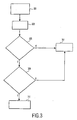
- FIG. 3 there is a flow chart that illustrates an embodiment of the invention as performed by the software or renderer 122, which will prevent such unauthorized rendering.
- the renderer 122 receives a data stream from the CD reader 132 or CD imitator 144.
- a first (1) section and a last (n) section such as shown in FIG. 2, are identified in the data stream.
- reader 132 utilizes a software-processing portion that recognizes the beginning and end of a track of medium 130 as given in the TOC area of the CD, reader 132 selects a track and downloads it to decoder 120.
- the first (1) and last (n) sections of the track may be identified using the sequence ID number field present in each section, which will identify section 1 and section n, as noted above.
- step 303 the data for the first and nth sections are decoded and the watermark data is extracted.
- the special bits reserved in the watermark of each of the first and nth section of the track is examined to see if it is marked in step 305 (for example, have logic level "1"). If not then rendering is denied, (step 307).
- the medium may not have a marked robust or fragile watermark with at least one special bit on the first (1) and last (n) sections of a track, because (for example), a system (such as the song extractor 142 and CD imitator 144) has re-cast the track data in an attempt to reproduce a track in excess of the allotted four times.
- step 309 it is determined if the sequence IDs of the track sections 2, 3, ..., n-1 interposed between the first (1) and last (n) sections of the track are present and in the correct sequence. If the proper order of sequence IDs interposed between the first (1) and last (n) sections of the track is not found, the rendering is denied in step 307. If it is determined that the sequence IDs are interposed between the first and last sections of the track are in the proper order, then rendering is authorized in step 311. If the track is authorized for rendering, then the track may be played, "burned,” transferred, etc.
- Fig. 3 may be repeated for subsequent tracks provided from the medium 130, for example, an entire CD. If any particular track of a CD is unauthorized, however, the rendering of any further tracks may be denied.
- a CD reader 132 supplies a track that has the format as shown in Fig. 2, then the renderer 122 will find the special bits marked on the first and last (nth) track section of the track ("yes" in decision block 305 of Fig. 3) and will also find that the sequence IDs for track sections 2, 3, ..., n-1 are in the proper order ("yes” in decision block 309). Thus, the rendering will be authorized (at least preliminarily) in step 311. It is noted that the decoder 120 may still deny rendering. For example, if the entirety checker 126 determines that sections of the watermark have been corrupted or do not exist (for example, because it is a bootleg or has been recorded more than four times in the SDMI domain), then the rendering is denied.
- the song extractor 142 and CD imitator 144 is used to describe how the processing of Fig. 3 avoids attempts to thwart unauthorized copying.
- the song extractor 142 may attempt to avoid the number of recordings authorized by the protocol (four for SDMI).
- the song extractor 142 may download individual track sections (such as track sections 1, 2, ..., n in Fig. 2) of each track and mask each individual track section as a separate track or "song" in an associated TOC. If each track section is less than 15 seconds, such importing is otherwise authorized by an SDMI compliant system.
- any device including the SDMI compliant system will play the tracks in any order.
- the renderer 122 of the invention will process the masked track section as a track using the processing of Fig. 3.
- the renderer 122 of the invention will process the masked track section as a track using the processing of Fig. 3.
- it will attempt to find a special bit marked in the first and nth track section of the "track" (i.e., the masked track section) in step 305.
- the first track section it will find a special bit in step 305.
- the renderer will allow a song having a single track section and only one bit therein to be rendered as special cases of steps 305 and 309, since there may be instances of a very short song (of 15 seconds or less).
- the first track section will pass step 305.
- the track sections after the first section (and before the nth section) that are presented as a separate track will fail in step 305, since they will not have a marked special bit.
- the nth section like the first section, will generally pass step 305.
- tracks sections 2, 3, ..., n-1 when masked as separate tracks, do not advance beyond step 305 before rendering is denied, unauthorized importing of a track by masking individual track sections is prevented. At most, only the first and last track sections (that is, the first and last 15 seconds of the song) are rendered. For all intents and purposes such a pieced together "song" is worthless. By using this technique, there is no need for inserting time gaps between imported tracks, which, as noted above, may on occasion insert undesired gaps during authorized rendering and recording of original tracks.
- sequence IDs of the track being focused on were numbered 1, 2, ..., n.
- the sequence ID may increase in sequence from the first track section of the first track to the last track section of the last track.
- the first track may have sequence IDs of 1, 2, ..., n.
- the second track will have sequence IDs of n+1, n+2, ... n+m, where m is the number of track sections in the second track.
- the third track will have sequence IDs that begin with n+m+1, and so on.
- the data format of FIG.2 and the processing of FIG.3 may be modified, so that the special bit is marked only in the first track section of the track (i.e. track section of ref. No. 201C of FIG.2).
- the processing only looks for the special bit to be marked on the first track section. While such a format may be vulnerable to attack, more than the above-described embodiment, it may nonetheless provide adequate protection against many types of unauthorized importing.
- the first and last sections of the tracks both use special bits
- using more than one bit may improve control over rendering and thus decrease vulnerability to unauthorized copying.
- the first section of a track may be marked with two special bits, while the last section is marked with one special bit.
- the system would then have additional data for identifying which section was a first section and which is a last section in identifying an attempt at unauthorized copying.
Landscapes
- Engineering & Computer Science (AREA)
- Computer Security & Cryptography (AREA)
- Signal Processing (AREA)
- Multimedia (AREA)
- Signal Processing For Digital Recording And Reproducing (AREA)
- Storage Device Security (AREA)
Claims (13)
- Verfahren zum Ermitteln der Autorisierung der Renderung einer digitalen Aufzeichnung (201), wobei das Verfahren die nachfolgenden Verfahrensschritte umfasst:a) das Identifizieren eines ersten Teils (1) und eines letzten Teils (n) einer Spur (201),b) das Decodieren eines Wasserzeichens (201 a) aus dem ersten und dem letzten Teil der Spur,c) das Ermitteln, ob wenigstens ein reserviertes Bit in dem Wasserzeichen in dem ersten und dem letzten Teil der Spur markiert ist, undd) das Ermitteln, ob Sequenz IDs in Teile zwischen dem ersten und dem letzten Teil der Spur in sequentieller Reihenfolge eingefügt worden sind.
- Verfahren nach Anspruch 1, mit dem zusätzlichen Schritt, dass wenigstens eine vorläufige Autorisierung einer Renderung der Spur geschaffen wird, wenn die Ermittlungen in den Schritten c) und d) beide positiv sind.
- Verfahren nach Anspruch 2, mit dem zusätzlichen Schritt, dass eine Renderung der Spur abgewiesen wird, wenn wenigstens einer der Ermittlungen in den Schritten c) und d) negativ sind.
- Verfahren nach Anspruch 2, wobei aufeinander folgende digitale Spuren, die autorisiert sind, mit einem Null-Zeitspalt zwischen denselben gerendert werden.
- Gerät (114) zum Durchführen einer digitalen Aufzeichnung (201), bestehend aus einer Spur mit einer Anzahl sequentiell vorgesehener Teile (1-n), mit einem ersten Spurteil (1) und einem letzten Spurteil (n), wobei dieses Gerät vorgesehen ist zum:a) Liefern eines Datenstromes zur Aufzeichnung in der Spur, undb) Mischen von Wasserzeichendaten mit dem Datenstrom, wobei die Wasserzeichendaten wenigstens ein reserviertes Bit haben, das einer Stelle in jedem der Spurteile entspricht, wobei das reservierte Bit in den Wasserzeichendaten entsprechend dem ersten Spurteil und dem letzten Spurteil markiert ist.
- Gerät nach Anspruch 5, wobei dieses weiterhin vorgesehen ist zum:c) Umwandeln der gemischten Wasserzeichendaten und des Datenstroms in eine digitale Form, undd) Aufzeichnen der Spur in einem Aufzeichnungsmedium.
- Gerät nach Anspruch 6, wobei der Schritt zum Aufzeichnen der Spur in einem Aufzeichnungsmedium das Aufzeichnen einer Sequenz ID in jedem der aufeinander folgenden Spurteile umfasst, wobei die Sequenz ID die sequentielle Lage des betreffenden Spurteils in der Spur identifiziert.
- Gerät nach Anspruch 6, wobei der Schritt der Aufzeichnung der Spur in einem Aufzeichnungsmedium das Aufzeichnen einer Sequenz ID in jedem der aufeinander folgenden Spurteile umfasst, wobei die Sequenz ID die sequentielle Lage des betreffenden Spurteils gegenüber einer Vielzahl anderer Spuren identifiziert, die je aus Spurteilen bestehen.
- Aufzeichnungsmedium (130) mit wenigstens einer Spur von Daten (201) mit einem darin aufgezeichneten Wasserzeichen (201a), wobei die wenigstens eine Spur mit Daten aus eine Anzahl Spurteile (1-n) besteht, die einen ersten Spurteil (1) und einen letzen Spurteil (n) enthalten, wobei die Spurteile wenigstens ein spezielles Bit aufweisen, das in dem Wasserzeichen reserviert ist, wobei das spezielle Bit in dem ersten Spurteil und in dem letzten Spurteil markiert ist.
- Aufzeichnungsmedium nach Anspruch 9, wobei jeder Spurteil der Spur Sequenz ID Daten aufweist, welche die sequentielle Lage des Spurteils in der Spur identifizieren.
- Aufzeichnungsmedium nach Anspruch 10, wobei die Sequenz IDs für die Sequenz von Spurenteilen, anfangend mit dem ersten Spurteil und endend mit dem letzten Spurteil 1, 2, ...,n sind, wobei n die Anzahl Spurteile in der Spur ist.
- Aufzeichnungsmedium nach Anspruch 9, wobei jeder Spurteil der Spur Sequenz ID Daten aufweist, welche die sequentielle Lage des betreffenden Spurteils gegenüber einer Vielzahl anderer Spuren identifiziert, die je aus Spurteilen bestehen.
- Aufzeichnungsmedium nach Anspruch 12, wobei die Sequenz IDs für die Sequenz von Spurteilen, anfangend mit dem ersten Spurteil und endend mit dem letzten Spurteil n, n+1,...,n+m sind, wobei n die Sequenz ID für den ersten Spurteil ist und m die Anzahl Spurteile in der Spur ist.
Applications Claiming Priority (3)
| Application Number | Priority Date | Filing Date | Title |
|---|---|---|---|
| US992924 | 1997-12-18 | ||
| US09/992,924 US7194617B2 (en) | 2001-11-05 | 2001-11-05 | Method and apparatus to prevent the unauthorized copying of digital information |
| PCT/IB2002/004462 WO2003040856A2 (en) | 2001-11-05 | 2002-10-24 | Method and apparatus to prevent the unauthorized copying of digital information |
Publications (2)
| Publication Number | Publication Date |
|---|---|
| EP1444558A2 EP1444558A2 (de) | 2004-08-11 |
| EP1444558B1 true EP1444558B1 (de) | 2006-01-11 |
Family
ID=25538889
Family Applications (1)
| Application Number | Title | Priority Date | Filing Date |
|---|---|---|---|
| EP02777659A Expired - Lifetime EP1444558B1 (de) | 2001-11-05 | 2002-10-24 | Verfahren und gerät zur verhinderung von unauthorisierten kopien von digitaler information |
Country Status (9)
| Country | Link |
|---|---|
| US (1) | US7194617B2 (de) |
| EP (1) | EP1444558B1 (de) |
| JP (1) | JP2005508562A (de) |
| KR (1) | KR20040053280A (de) |
| CN (1) | CN1608293A (de) |
| AT (1) | ATE315802T1 (de) |
| AU (1) | AU2002339610A1 (de) |
| DE (1) | DE60208707T2 (de) |
| WO (1) | WO2003040856A2 (de) |
Cited By (1)
| Publication number | Priority date | Publication date | Assignee | Title |
|---|---|---|---|---|
| US7587603B2 (en) | 2000-02-07 | 2009-09-08 | Koninklijke Philips Electronics N.V. | Protecting content from illicit reproduction by proof of existence of a complete data set via self-referencing sections |
Families Citing this family (13)
| Publication number | Priority date | Publication date | Assignee | Title |
|---|---|---|---|---|
| US7724919B2 (en) * | 1994-10-21 | 2010-05-25 | Digimarc Corporation | Methods and systems for steganographic processing |
| US7224819B2 (en) | 1995-05-08 | 2007-05-29 | Digimarc Corporation | Integrating digital watermarks in multimedia content |
| US7006661B2 (en) | 1995-07-27 | 2006-02-28 | Digimarc Corp | Digital watermarking systems and methods |
| US6891959B2 (en) | 2000-04-19 | 2005-05-10 | Digimarc Corporation | Hiding information out-of-phase in color channels |
| US7196259B2 (en) | 2002-01-11 | 2007-03-27 | Yamaha Corporation | Performance data transmission controlling apparatus and electronic musical instrument capable of acquiring performance data |
| US20050021470A1 (en) * | 2002-06-25 | 2005-01-27 | Bose Corporation | Intelligent music track selection |
| US20040225519A1 (en) * | 2002-06-25 | 2004-11-11 | Martin Keith D. | Intelligent music track selection |
| US20030236582A1 (en) * | 2002-06-25 | 2003-12-25 | Lee Zamir | Selection of items based on user reactions |
| WO2005059754A1 (en) * | 2003-12-17 | 2005-06-30 | Mix & Burn | Recording and security system |
| FI20065452A0 (fi) * | 2006-06-29 | 2006-06-29 | Valtion Teknillinen | Menetelmä sisällön välittämiseen |
| EP2009638A1 (de) * | 2007-06-28 | 2008-12-31 | THOMSON Licensing | Kopierverhinderung eines Videos wenn die Fingerabdruckunterschied vor und nach dessen Änderung über einen Grenzwert liegt |
| US20090013260A1 (en) * | 2007-07-06 | 2009-01-08 | Martin Keith D | Intelligent music track selection in a networked environment |
| US8719946B2 (en) | 2012-03-05 | 2014-05-06 | Song1, Llc | System and method for securely retrieving and playing digital media |
Family Cites Families (16)
| Publication number | Priority date | Publication date | Assignee | Title |
|---|---|---|---|---|
| US6611607B1 (en) * | 1993-11-18 | 2003-08-26 | Digimarc Corporation | Integrating digital watermarks in multimedia content |
| CN1294588C (zh) * | 1996-07-24 | 2007-01-10 | 皇家菲利浦电子有限公司 | 光盘录取装置 |
| US6081897A (en) * | 1997-01-13 | 2000-06-27 | Recording Industry Of America | Apparatus for monitoring and preventing unauthorized copying of digital data |
| JP3488603B2 (ja) * | 1997-09-16 | 2004-01-19 | 株式会社東芝 | 電子透かしを利用したコピープロテクトシステム |
| US6591365B1 (en) * | 1999-01-21 | 2003-07-08 | Time Warner Entertainment Co., Lp | Copy protection control system |
| US6785815B1 (en) * | 1999-06-08 | 2004-08-31 | Intertrust Technologies Corp. | Methods and systems for encoding and protecting data using digital signature and watermarking techniques |
| JP2003529790A (ja) * | 2000-02-01 | 2003-10-07 | コーニンクレッカ フィリップス エレクトロニクス エヌ ヴィ | 完全なデータセットの存在の証明による不法な製造からのコンテンツの保護 |
| US7228425B1 (en) * | 2000-02-07 | 2007-06-05 | Koninklijke Philips Electronics N. V. | Protecting content from illicit reproduction by proof of existence of a complete data set via self-referencing sections |
| US6865676B1 (en) * | 2000-03-28 | 2005-03-08 | Koninklijke Philips Electronics N.V. | Protecting content from illicit reproduction by proof of existence of a complete data set via a linked list |
| WO2001057867A2 (en) * | 2000-02-07 | 2001-08-09 | Koninklijke Philips Electronics N.V. | Protecting content from illicit reproduction |
| FR2805071B1 (fr) * | 2000-02-11 | 2002-05-03 | Moulage Plastique De L Ouest | Disque optique protege contre la copie et procede de protection pour un tel disque |
| US20020001277A1 (en) * | 2000-03-28 | 2002-01-03 | Thomas Keith E. | Method for encoding and recording non-audio data on a compact disc |
| KR100365353B1 (ko) * | 2000-04-11 | 2002-12-18 | 엘지전자 주식회사 | 복사 방지 수단이 마련된 컴팩트 디스크 재생/기록기 및그 복사방법 |
| US20010054144A1 (en) * | 2000-06-16 | 2001-12-20 | Michael Epstein | Confirming the existence of a complete data set under multiple control scenarios |
| US6925342B2 (en) * | 2000-12-05 | 2005-08-02 | Koninklijke Philips Electronics N.V. | System and method for protecting digital media |
| JP3746230B2 (ja) * | 2001-09-29 | 2006-02-15 | 株式会社東芝 | レコーディング装置、コピー制御方法及びプログラム |
-
2001
- 2001-11-05 US US09/992,924 patent/US7194617B2/en not_active Expired - Fee Related
-
2002
- 2002-10-24 AT AT02777659T patent/ATE315802T1/de not_active IP Right Cessation
- 2002-10-24 WO PCT/IB2002/004462 patent/WO2003040856A2/en not_active Ceased
- 2002-10-24 KR KR10-2004-7006808A patent/KR20040053280A/ko not_active Withdrawn
- 2002-10-24 CN CNA028220080A patent/CN1608293A/zh active Pending
- 2002-10-24 AU AU2002339610A patent/AU2002339610A1/en not_active Abandoned
- 2002-10-24 DE DE60208707T patent/DE60208707T2/de not_active Expired - Fee Related
- 2002-10-24 JP JP2003542423A patent/JP2005508562A/ja not_active Withdrawn
- 2002-10-24 EP EP02777659A patent/EP1444558B1/de not_active Expired - Lifetime
Cited By (1)
| Publication number | Priority date | Publication date | Assignee | Title |
|---|---|---|---|---|
| US7587603B2 (en) | 2000-02-07 | 2009-09-08 | Koninklijke Philips Electronics N.V. | Protecting content from illicit reproduction by proof of existence of a complete data set via self-referencing sections |
Also Published As
| Publication number | Publication date |
|---|---|
| ATE315802T1 (de) | 2006-02-15 |
| US20030088775A1 (en) | 2003-05-08 |
| AU2002339610A1 (en) | 2003-05-19 |
| CN1608293A (zh) | 2005-04-20 |
| DE60208707T2 (de) | 2006-11-02 |
| WO2003040856A3 (en) | 2004-05-27 |
| EP1444558A2 (de) | 2004-08-11 |
| KR20040053280A (ko) | 2004-06-23 |
| DE60208707D1 (de) | 2006-04-06 |
| WO2003040856A2 (en) | 2003-05-15 |
| JP2005508562A (ja) | 2005-03-31 |
| US7194617B2 (en) | 2007-03-20 |
Similar Documents
| Publication | Publication Date | Title |
|---|---|---|
| JP4046767B2 (ja) | 記録信号のコピー防止システム | |
| CN1135852C (zh) | 传递内容信息和与其相关的附加信息的方法和系统 | |
| CN1187277A (zh) | 采用视频指纹对各种记录媒体拷贝保护的方法和装置 | |
| US7194617B2 (en) | Method and apparatus to prevent the unauthorized copying of digital information | |
| KR20020073526A (ko) | 디지털 매체를 보호하기 위한 시스템 및 방법 | |
| US6986048B1 (en) | Protecting content from illicit reproduction by proof of existence of a complete data set using security identifiers | |
| JP2001023298A (ja) | コンテンツの記録媒体及びその再生装置 | |
| RU2292092C2 (ru) | Способ копирования, устраняющий возможность побитного копирования цифровых данных, и считывающее устройство для его осуществления | |
| US20020076048A1 (en) | System and method for inserting disruptions into merged digital recordings | |
| KR100912097B1 (ko) | 복제 방지 신호 처리 방법 및 장치 | |
| WO2003049105A1 (en) | Apparatus and methods for detecting illicit content that has been imported into a secure domain | |
| AU784650B2 (en) | Protecting content from illicit reproduction by proof of existence of a complete data set | |
| US7213004B2 (en) | Apparatus and methods for attacking a screening algorithm based on partitioning of content | |
| KR20040041624A (ko) | 콘텐트 스크리닝 알고리즘에 대한 불순화 공격을 방지하는장치 및 방법 | |
| MXPA01003898A (en) | Copy method avoiding bit-to-bit duplication of digital data and reading device for implementing same | |
| CZ20001089A3 (cs) | Způsob omezení přístupu k zaznamenaným digitálním datům |
Legal Events
| Date | Code | Title | Description |
|---|---|---|---|
| PUAI | Public reference made under article 153(3) epc to a published international application that has entered the european phase |
Free format text: ORIGINAL CODE: 0009012 |
|
| AK | Designated contracting states |
Kind code of ref document: A2 Designated state(s): AT BE BG CH CY CZ DE DK EE ES FI FR GB GR IE IT LI LU MC NL PT SE SK TR |
|
| AX | Request for extension of the european patent |
Extension state: AL LT LV MK RO SI |
|
| 17P | Request for examination filed |
Effective date: 20041129 |
|
| GRAP | Despatch of communication of intention to grant a patent |
Free format text: ORIGINAL CODE: EPIDOSNIGR1 |
|
| GRAS | Grant fee paid |
Free format text: ORIGINAL CODE: EPIDOSNIGR3 |
|
| GRAA | (expected) grant |
Free format text: ORIGINAL CODE: 0009210 |
|
| AK | Designated contracting states |
Kind code of ref document: B1 Designated state(s): AT BE BG CH CY CZ DE DK EE ES FI FR GB GR IE IT LI LU MC NL PT SE SK TR |
|
| PG25 | Lapsed in a contracting state [announced via postgrant information from national office to epo] |
Ref country code: BE Free format text: LAPSE BECAUSE OF FAILURE TO SUBMIT A TRANSLATION OF THE DESCRIPTION OR TO PAY THE FEE WITHIN THE PRESCRIBED TIME-LIMIT Effective date: 20060111 Ref country code: NL Free format text: LAPSE BECAUSE OF FAILURE TO SUBMIT A TRANSLATION OF THE DESCRIPTION OR TO PAY THE FEE WITHIN THE PRESCRIBED TIME-LIMIT Effective date: 20060111 Ref country code: AT Free format text: LAPSE BECAUSE OF FAILURE TO SUBMIT A TRANSLATION OF THE DESCRIPTION OR TO PAY THE FEE WITHIN THE PRESCRIBED TIME-LIMIT Effective date: 20060111 Ref country code: SK Free format text: LAPSE BECAUSE OF FAILURE TO SUBMIT A TRANSLATION OF THE DESCRIPTION OR TO PAY THE FEE WITHIN THE PRESCRIBED TIME-LIMIT Effective date: 20060111 Ref country code: CH Free format text: LAPSE BECAUSE OF FAILURE TO SUBMIT A TRANSLATION OF THE DESCRIPTION OR TO PAY THE FEE WITHIN THE PRESCRIBED TIME-LIMIT Effective date: 20060111 Ref country code: FI Free format text: LAPSE BECAUSE OF FAILURE TO SUBMIT A TRANSLATION OF THE DESCRIPTION OR TO PAY THE FEE WITHIN THE PRESCRIBED TIME-LIMIT Effective date: 20060111 Ref country code: LI Free format text: LAPSE BECAUSE OF FAILURE TO SUBMIT A TRANSLATION OF THE DESCRIPTION OR TO PAY THE FEE WITHIN THE PRESCRIBED TIME-LIMIT Effective date: 20060111 Ref country code: IT Free format text: LAPSE BECAUSE OF FAILURE TO SUBMIT A TRANSLATION OF THE DESCRIPTION OR TO PAY THE FEE WITHIN THE PRESCRIBED TIME-LIMIT;WARNING: LAPSES OF ITALIAN PATENTS WITH EFFECTIVE DATE BEFORE 2007 MAY HAVE OCCURRED AT ANY TIME BEFORE 2007. THE CORRECT EFFECTIVE DATE MAY BE DIFFERENT FROM THE ONE RECORDED. Effective date: 20060111 |
|
| REG | Reference to a national code |
Ref country code: CH Ref legal event code: EP |
|
| REG | Reference to a national code |
Ref country code: IE Ref legal event code: FG4D |
|
| REF | Corresponds to: |
Ref document number: 60208707 Country of ref document: DE Date of ref document: 20060406 Kind code of ref document: P |
|
| PG25 | Lapsed in a contracting state [announced via postgrant information from national office to epo] |
Ref country code: BG Free format text: LAPSE BECAUSE OF FAILURE TO SUBMIT A TRANSLATION OF THE DESCRIPTION OR TO PAY THE FEE WITHIN THE PRESCRIBED TIME-LIMIT Effective date: 20060411 Ref country code: DK Free format text: LAPSE BECAUSE OF FAILURE TO SUBMIT A TRANSLATION OF THE DESCRIPTION OR TO PAY THE FEE WITHIN THE PRESCRIBED TIME-LIMIT Effective date: 20060411 Ref country code: SE Free format text: LAPSE BECAUSE OF FAILURE TO SUBMIT A TRANSLATION OF THE DESCRIPTION OR TO PAY THE FEE WITHIN THE PRESCRIBED TIME-LIMIT Effective date: 20060411 |
|
| PG25 | Lapsed in a contracting state [announced via postgrant information from national office to epo] |
Ref country code: ES Free format text: LAPSE BECAUSE OF FAILURE TO SUBMIT A TRANSLATION OF THE DESCRIPTION OR TO PAY THE FEE WITHIN THE PRESCRIBED TIME-LIMIT Effective date: 20060422 |
|
| PG25 | Lapsed in a contracting state [announced via postgrant information from national office to epo] |
Ref country code: PT Free format text: LAPSE BECAUSE OF FAILURE TO SUBMIT A TRANSLATION OF THE DESCRIPTION OR TO PAY THE FEE WITHIN THE PRESCRIBED TIME-LIMIT Effective date: 20060612 |
|
| NLV1 | Nl: lapsed or annulled due to failure to fulfill the requirements of art. 29p and 29m of the patents act | ||
| REG | Reference to a national code |
Ref country code: CH Ref legal event code: PL |
|
| ET | Fr: translation filed | ||
| PG25 | Lapsed in a contracting state [announced via postgrant information from national office to epo] |
Ref country code: IE Free format text: LAPSE BECAUSE OF NON-PAYMENT OF DUE FEES Effective date: 20061024 |
|
| PG25 | Lapsed in a contracting state [announced via postgrant information from national office to epo] |
Ref country code: MC Free format text: LAPSE BECAUSE OF NON-PAYMENT OF DUE FEES Effective date: 20061031 |
|
| PLBE | No opposition filed within time limit |
Free format text: ORIGINAL CODE: 0009261 |
|
| STAA | Information on the status of an ep patent application or granted ep patent |
Free format text: STATUS: NO OPPOSITION FILED WITHIN TIME LIMIT |
|
| 26N | No opposition filed |
Effective date: 20061012 |
|
| PG25 | Lapsed in a contracting state [announced via postgrant information from national office to epo] |
Ref country code: DE Free format text: LAPSE BECAUSE OF NON-PAYMENT OF DUE FEES Effective date: 20070501 |
|
| GBPC | Gb: european patent ceased through non-payment of renewal fee |
Effective date: 20061024 |
|
| REG | Reference to a national code |
Ref country code: FR Ref legal event code: ST Effective date: 20070629 |
|
| PG25 | Lapsed in a contracting state [announced via postgrant information from national office to epo] |
Ref country code: GB Free format text: LAPSE BECAUSE OF NON-PAYMENT OF DUE FEES Effective date: 20061024 |
|
| PG25 | Lapsed in a contracting state [announced via postgrant information from national office to epo] |
Ref country code: GR Free format text: LAPSE BECAUSE OF FAILURE TO SUBMIT A TRANSLATION OF THE DESCRIPTION OR TO PAY THE FEE WITHIN THE PRESCRIBED TIME-LIMIT Effective date: 20060412 Ref country code: FR Free format text: LAPSE BECAUSE OF NON-PAYMENT OF DUE FEES Effective date: 20061031 Ref country code: CZ Free format text: LAPSE BECAUSE OF FAILURE TO SUBMIT A TRANSLATION OF THE DESCRIPTION OR TO PAY THE FEE WITHIN THE PRESCRIBED TIME-LIMIT Effective date: 20060111 |
|
| PG25 | Lapsed in a contracting state [announced via postgrant information from national office to epo] |
Ref country code: EE Free format text: LAPSE BECAUSE OF FAILURE TO SUBMIT A TRANSLATION OF THE DESCRIPTION OR TO PAY THE FEE WITHIN THE PRESCRIBED TIME-LIMIT Effective date: 20060111 |
|
| PG25 | Lapsed in a contracting state [announced via postgrant information from national office to epo] |
Ref country code: TR Free format text: LAPSE BECAUSE OF FAILURE TO SUBMIT A TRANSLATION OF THE DESCRIPTION OR TO PAY THE FEE WITHIN THE PRESCRIBED TIME-LIMIT Effective date: 20060111 Ref country code: LU Free format text: LAPSE BECAUSE OF NON-PAYMENT OF DUE FEES Effective date: 20061024 |
|
| PG25 | Lapsed in a contracting state [announced via postgrant information from national office to epo] |
Ref country code: CY Free format text: LAPSE BECAUSE OF FAILURE TO SUBMIT A TRANSLATION OF THE DESCRIPTION OR TO PAY THE FEE WITHIN THE PRESCRIBED TIME-LIMIT Effective date: 20060111 |