EP1442799A1 - Process for coating metallic bodies and primer compositions to be used in the process - Google Patents
Process for coating metallic bodies and primer compositions to be used in the process Download PDFInfo
- Publication number
- EP1442799A1 EP1442799A1 EP02777857A EP02777857A EP1442799A1 EP 1442799 A1 EP1442799 A1 EP 1442799A1 EP 02777857 A EP02777857 A EP 02777857A EP 02777857 A EP02777857 A EP 02777857A EP 1442799 A1 EP1442799 A1 EP 1442799A1
- Authority
- EP
- European Patent Office
- Prior art keywords
- resin
- coating
- weight
- metal object
- binder component
- Prior art date
- Legal status (The legal status is an assumption and is not a legal conclusion. Google has not performed a legal analysis and makes no representation as to the accuracy of the status listed.)
- Withdrawn
Links
Classifications
-
- C—CHEMISTRY; METALLURGY
- C09—DYES; PAINTS; POLISHES; NATURAL RESINS; ADHESIVES; COMPOSITIONS NOT OTHERWISE PROVIDED FOR; APPLICATIONS OF MATERIALS NOT OTHERWISE PROVIDED FOR
- C09D—COATING COMPOSITIONS, e.g. PAINTS, VARNISHES OR LACQUERS; FILLING PASTES; CHEMICAL PAINT OR INK REMOVERS; INKS; CORRECTING FLUIDS; WOODSTAINS; PASTES OR SOLIDS FOR COLOURING OR PRINTING; USE OF MATERIALS THEREFOR
- C09D123/00—Coating compositions based on homopolymers or copolymers of unsaturated aliphatic hydrocarbons having only one carbon-to-carbon double bond; Coating compositions based on derivatives of such polymers
- C09D123/02—Coating compositions based on homopolymers or copolymers of unsaturated aliphatic hydrocarbons having only one carbon-to-carbon double bond; Coating compositions based on derivatives of such polymers not modified by chemical after-treatment
- C09D123/04—Homopolymers or copolymers of ethene
- C09D123/08—Copolymers of ethene
-
- C—CHEMISTRY; METALLURGY
- C09—DYES; PAINTS; POLISHES; NATURAL RESINS; ADHESIVES; COMPOSITIONS NOT OTHERWISE PROVIDED FOR; APPLICATIONS OF MATERIALS NOT OTHERWISE PROVIDED FOR
- C09D—COATING COMPOSITIONS, e.g. PAINTS, VARNISHES OR LACQUERS; FILLING PASTES; CHEMICAL PAINT OR INK REMOVERS; INKS; CORRECTING FLUIDS; WOODSTAINS; PASTES OR SOLIDS FOR COLOURING OR PRINTING; USE OF MATERIALS THEREFOR
- C09D123/00—Coating compositions based on homopolymers or copolymers of unsaturated aliphatic hydrocarbons having only one carbon-to-carbon double bond; Coating compositions based on derivatives of such polymers
- C09D123/02—Coating compositions based on homopolymers or copolymers of unsaturated aliphatic hydrocarbons having only one carbon-to-carbon double bond; Coating compositions based on derivatives of such polymers not modified by chemical after-treatment
- C09D123/04—Homopolymers or copolymers of ethene
- C09D123/08—Copolymers of ethene
- C09D123/0846—Copolymers of ethene with unsaturated hydrocarbons containing other atoms than carbon or hydrogen atoms
- C09D123/0869—Acids or derivatives thereof
-
- C—CHEMISTRY; METALLURGY
- C09—DYES; PAINTS; POLISHES; NATURAL RESINS; ADHESIVES; COMPOSITIONS NOT OTHERWISE PROVIDED FOR; APPLICATIONS OF MATERIALS NOT OTHERWISE PROVIDED FOR
- C09D—COATING COMPOSITIONS, e.g. PAINTS, VARNISHES OR LACQUERS; FILLING PASTES; CHEMICAL PAINT OR INK REMOVERS; INKS; CORRECTING FLUIDS; WOODSTAINS; PASTES OR SOLIDS FOR COLOURING OR PRINTING; USE OF MATERIALS THEREFOR
- C09D163/00—Coating compositions based on epoxy resins; Coating compositions based on derivatives of epoxy resins
-
- C—CHEMISTRY; METALLURGY
- C09—DYES; PAINTS; POLISHES; NATURAL RESINS; ADHESIVES; COMPOSITIONS NOT OTHERWISE PROVIDED FOR; APPLICATIONS OF MATERIALS NOT OTHERWISE PROVIDED FOR
- C09D—COATING COMPOSITIONS, e.g. PAINTS, VARNISHES OR LACQUERS; FILLING PASTES; CHEMICAL PAINT OR INK REMOVERS; INKS; CORRECTING FLUIDS; WOODSTAINS; PASTES OR SOLIDS FOR COLOURING OR PRINTING; USE OF MATERIALS THEREFOR
- C09D167/00—Coating compositions based on polyesters obtained by reactions forming a carboxylic ester link in the main chain; Coating compositions based on derivatives of such polymers
-
- C—CHEMISTRY; METALLURGY
- C09—DYES; PAINTS; POLISHES; NATURAL RESINS; ADHESIVES; COMPOSITIONS NOT OTHERWISE PROVIDED FOR; APPLICATIONS OF MATERIALS NOT OTHERWISE PROVIDED FOR
- C09D—COATING COMPOSITIONS, e.g. PAINTS, VARNISHES OR LACQUERS; FILLING PASTES; CHEMICAL PAINT OR INK REMOVERS; INKS; CORRECTING FLUIDS; WOODSTAINS; PASTES OR SOLIDS FOR COLOURING OR PRINTING; USE OF MATERIALS THEREFOR
- C09D5/00—Coating compositions, e.g. paints, varnishes or lacquers, characterised by their physical nature or the effects produced; Filling pastes
- C09D5/08—Anti-corrosive paints
- C09D5/082—Anti-corrosive paints characterised by the anti-corrosive pigment
- C09D5/084—Inorganic compounds
-
- C—CHEMISTRY; METALLURGY
- C08—ORGANIC MACROMOLECULAR COMPOUNDS; THEIR PREPARATION OR CHEMICAL WORKING-UP; COMPOSITIONS BASED THEREON
- C08L—COMPOSITIONS OF MACROMOLECULAR COMPOUNDS
- C08L23/00—Compositions of homopolymers or copolymers of unsaturated aliphatic hydrocarbons having only one carbon-to-carbon double bond; Compositions of derivatives of such polymers
- C08L23/02—Compositions of homopolymers or copolymers of unsaturated aliphatic hydrocarbons having only one carbon-to-carbon double bond; Compositions of derivatives of such polymers not modified by chemical after-treatment
- C08L23/04—Homopolymers or copolymers of ethene
- C08L23/08—Copolymers of ethene
-
- C—CHEMISTRY; METALLURGY
- C08—ORGANIC MACROMOLECULAR COMPOUNDS; THEIR PREPARATION OR CHEMICAL WORKING-UP; COMPOSITIONS BASED THEREON
- C08L—COMPOSITIONS OF MACROMOLECULAR COMPOUNDS
- C08L23/00—Compositions of homopolymers or copolymers of unsaturated aliphatic hydrocarbons having only one carbon-to-carbon double bond; Compositions of derivatives of such polymers
- C08L23/02—Compositions of homopolymers or copolymers of unsaturated aliphatic hydrocarbons having only one carbon-to-carbon double bond; Compositions of derivatives of such polymers not modified by chemical after-treatment
- C08L23/04—Homopolymers or copolymers of ethene
- C08L23/08—Copolymers of ethene
- C08L23/0846—Copolymers of ethene with unsaturated hydrocarbons containing atoms other than carbon or hydrogen
- C08L23/0869—Copolymers of ethene with unsaturated hydrocarbons containing atoms other than carbon or hydrogen with unsaturated acids, e.g. [meth]acrylic acid; with unsaturated esters, e.g. [meth]acrylic acid esters
-
- C—CHEMISTRY; METALLURGY
- C08—ORGANIC MACROMOLECULAR COMPOUNDS; THEIR PREPARATION OR CHEMICAL WORKING-UP; COMPOSITIONS BASED THEREON
- C08L—COMPOSITIONS OF MACROMOLECULAR COMPOUNDS
- C08L63/00—Compositions of epoxy resins; Compositions of derivatives of epoxy resins
-
- C—CHEMISTRY; METALLURGY
- C08—ORGANIC MACROMOLECULAR COMPOUNDS; THEIR PREPARATION OR CHEMICAL WORKING-UP; COMPOSITIONS BASED THEREON
- C08L—COMPOSITIONS OF MACROMOLECULAR COMPOUNDS
- C08L67/00—Compositions of polyesters obtained by reactions forming a carboxylic ester link in the main chain; Compositions of derivatives of such polymers
-
- C—CHEMISTRY; METALLURGY
- C08—ORGANIC MACROMOLECULAR COMPOUNDS; THEIR PREPARATION OR CHEMICAL WORKING-UP; COMPOSITIONS BASED THEREON
- C08L—COMPOSITIONS OF MACROMOLECULAR COMPOUNDS
- C08L77/00—Compositions of polyamides obtained by reactions forming a carboxylic amide link in the main chain; Compositions of derivatives of such polymers
Definitions
- the present invention relates to a metal object-coating method, and more particularly to a metal object-coating method capable of forming a protective coating layer showing good properties in heat resistance, corrosion resistance and impact resistance onto a piping for use in an automobile brake oil or fuel, and many metal pipes arranged and used as a supply line such as an oiling and gas feeding for various kinds of machines, apparatuses, etc., and to a primer composition used in the method.
- a chromate coating film formed onto a galvanized steel pipe and aluminum pipe followed by forming a coating film by use of a coating composition containing as a base resin a thermoplastic resin, for example, a vinyl fluoride resin based coating composition, vinylidene fluoride resin based coating composition, polyamide resin (nylon) based coating composition and the like (see, for example, Japanese Patent Application Laid-Open Nos. 286950/97, 262903/97 and 2002-3779).
- thermoplastic resin based coating composition is coated in the above coating system
- poor adhesion properties of a coating film formed from the thermoplastic resin may produce problems such as peeling off on fabrication, development of cracks in the coating film layer by the impact due to rebounding stones, peeling off of the cracked coating film, resulting in seriously reducing corrosion resistance.
- the present invention relates to a metal object-coating method, which method comprises coating a primer composition (I) prepared by adding an inorganic anti-corrosive agent to at least one binder component selected from the group consisting of a binder component (A) containing an epoxy resin and at least one of amino resin and phenol resin, a binder component (B) containing a polyester resin, epoxy resin and phenol resin, and a binder component (C) containing ⁇ -olefin ⁇ ⁇ , ⁇ -ethylenically unsaturated carboxylic acid copolymer resin onto the surface of a metal object coating substrate to form a primer coating film layer, followed by coating a topcoat coating composition consisting of a thermoplastic resin based coating composition (II), preferably a vinyl fluoride resin based coating composition, a vinylidene fluoride resin based coating composition or a polyamide resin based coating composition, onto the primer coating film layer to form a topcoat coating film layer consisting of a thermoplastic resin coating film; and
- the metal object in the present invention may include metal parts used in automobile parts, household appliances, general-purpose and the like, and particularly metal pipes known in the art and used as pipings for use in the automobile.
- the metal pipe may include, for example, a single-rolled steel pipe, double-rolled steel pipe, seamless steel pipe and the like formed from a SPCC steel sheet respectively, ones having a copper layer on the surface of folded surface thereof, electrically welded steel pipe, drawn steel pipe, other metal pipe such as aluminum pipe and the like.
- the metal object in the present invention may preferably include ones prepared by forming a galvanized layer on the metal surface, followed by forming a chromate film thereonto, and ones prepared by forming a zinc alloy-plated layer, for example, a zinc-nickel alloy-plated layer, followed by forming a chromate film thereonto from the standpoint of corrosion resistance.
- the galvanized layer may be formed by the usual electrical plating method by use of an acid electrolysis bath or an alkali electrolysis bath, and the chromate coating layer may be formed by the known chromic acid chromate treatment, a phosphoric acid chromate treatment, or a coating chromate treatment containing an organic high molecule.
- the resulting chromate coating film may of hexavalent chrome, trivalent chrome or a mixture of trivalent chrome and hexavalent chrome.
- the primer composition (I) is coated onto the surface of the metal object coating substrate to form a primer coating film layer.
- the primer composition (I) is prepared by adding an inorganic anti-corrosive agent to at least one binder component selected from the group consisting of a binder component (A) containing an epoxy resin and at least one of amino resin and phenol resin, a binder component (B) containing a polyester resin, epoxy resin and phenol resin, and a binder component (C) containing ⁇ -olefin ⁇ , ⁇ -ethylenically unsaturated carboxylic acid copolymer resin.
- the primer composition of the present invention is explained hereinafter.
- Binder Component (A) Containing Epoxy Resin and at least one of Amino Resin and Phenol Resin
- a first binder component used in the primer composition (I) of the present invention is the binder component (A) containing the epoxy resin as a base resin and at least one of amino resin and phenol resin as a crosslinking agent.
- the epoxy resin is a compound having at least two epoxy groups in one molecule, and may include any known ones without particular limitations, for example, a liquid epoxy resin, solid epoxy resin and the like.
- the resin may be dissolved or dispersed into a resin-soluble or dispersible organic solvent.
- the epoxy resin may include, for example, epoxy resin (a) containing alicyclic epoxy group such as epoxy group on an alicyclic hydrocarbon ring and an epoxy group directly bonded to a carbon atom forming the alicyclic hydrocarbon ring, an epoxy resin (b) containing an aliphatic epoxy group such as an epoxy group on a straight-chain hydrocarbon other than the above, and an epoxy resin (c) containing aliphatic and alicyclic epoxy group.
- epoxy resin (a) containing alicyclic epoxy group such as epoxy group on an alicyclic hydrocarbon ring and an epoxy group directly bonded to a carbon atom forming the alicyclic hydrocarbon ring
- an epoxy resin (b) containing an aliphatic epoxy group such as an epoxy group on a straight-chain hydrocarbon other than the above
- an epoxy resin (c) containing aliphatic and alicyclic epoxy group may include, for example, epoxy resin (a) containing alicyclic epoxy group such as epoxy group on an alicyclic hydrocarbon
- the epoxy resin (a) may include, for example, a radical homopolymer of a radically polymerizable monomer containing alicyclic epoxy group (3,4-epoxycyclohexylmethyl (meth)acrylate), a copolymer of the above monomer with other radically polymerizable monomer such as C 1-24 -alkyl or cycloalkyl ester of (meth)acrylic acid, styrene and the like, 3,4-epoxy-cyclohexylmethyl-3,4-epoxycyclohexane carboxylate, bis(2,3-epoxy-cyclopentyl)ether, dicyclopentadiene dioxide, bis(3,4-epoxy-cyclohexylmethyl) of ethylene glycol, 3,4-epoxy-6-methylcyclohexylmethyl-3,4-epoxy-cyclohexane carboxylate, bis(3,4-epoxy-cyclohexylmethyl) adipate,
- the epoxy resin (b) may include, for example, a radical homopolymer of a radically polymerizable monomer containing aliphatic epoxy group such as glycidyl (meth)acrylate, a copolymer of the above monomer with other radically polymerizable monomer, for example, C 1-24 alkyl or cycloalkyl ester of (meth)acrylic acid, hydroxyl group-containing unsaturated monomers such as hydroxyethyl (meth)acrylate, aromatic compounds such as styrene, nitrile compounds such as (meth)acrylonitrile, and the like; bisphenol type epoxy resin, novolak type epoxy resin, ⁇ -caprolactam-modified bisphenol type epoxy resin, (poly)ethylene glycol diglycidyl ether, (poly)propylene glycol diglycidyl ether, neopentyl glycol diglycidyl ether, trimethylol propane triglycidyl ether and the like
- the epoxy resin (c) may include, for example, a copolymer of an aliphatic epoxy group-containing radically polymerizable monomer, alicyclic epoxy group-containing radically polymerizable monomer, and optionally other radically polymerizable monomer, vinylcyclohexene diepoxide, and the like.
- the epoxy resin represented by trade names may include, for example, bisphenol/epichlorohydrin type epoxy resin such as Epikote 1002, 1004, 1007, 1009, 1010 (all marketed by Oil Shell Epoxy Co., Ltd.), Araldite GY-6084, 6097, 6099 (all marketed by Ciba-Geigy Ltd.), DER-662, 664, 667 (all marketed by Dow Chemical Co.), Epototo YD-012PK, YD-014D, YD-909, YD-6020 (all marketed by Tohto Kasei Co., Ltd.) and the like; novolak type epoxy resin such as EPPN-201, 202, EOCN-1020, 102S (all marketed by Nippon Kayaku Co., Ltd.), and the like; Epolead GT300 (trade name, marketed by Daicel Chemical Industries, Ltd., trifunctional alicyclic epoxy resin), Epolead GT400 (trade name, marketed by Daicel Chemical Industries, Ltd
- the amino resin used as the crosslinking agent of the epoxy resin may include a methyloled amino resin obtained by the reaction of an amino component such as melamine, urea, benzoguanamine, acetoguanamine, steroguanamine, spiroguanamine, dicyandiamide, and the like with aldehyde.
- an amino component such as melamine, urea, benzoguanamine, acetoguanamine, steroguanamine, spiroguanamine, dicyandiamide, and the like with aldehyde.
- the aldehyde may include, for example, formaldehyde, paraformaldehyde, acetoaldehyde, benzaldehyde and the like.
- the amino resin may also include ones obtained by etherifying the methyloled amino resin with a suitable alcohol. Examples of the alcohol used in the etherification may include methyl alcohol, ethyl alcohol, n-propyl alcohol, i-propyl alcohol, n-butyl alcohol, i-butyl alcohol, 2-ethylbutanol, 2-ethylhexanol and the like.
- the amino resin is preferably a methyloled melamine obtained by etherifying at least part of the methylol group.
- the phenol resin used as a crosslinking agent of the epoxy resin may include a phenol resin obtained by reacting phenols with formaldehydes.
- the phenols used for obtaining the phenol resin may include, for example, phenols having one benzene ring in one molecule such as phenol, methylphenol, p-ethylphenol, p-n-propylphenol, p-isopropylphenol, p-n-butylphenol, p-tert-butylphenol, p-tert-amylphenol, o-cresol, m-cresol, p-cresol, p-cyclohexylphenol, p-octylphenol, p-nonylphenol, 3,5-xylenol, resorcinol, catechol and the like; phenols having two benzene rings in one molecule such as phenyl o-cresol, p-phenyl phenol and the like; bisphenol A, bisphenol F, 1,1-bis(4-hydroxyphenyl) ethane, 2,2-bis(4-hydroxyphenyl)butane, bis(4
- phenols selected from the group consisting of o-cresol, p-cresol, p-ethylphenol, p-n-propylphenol, p-isopropylphenol, p-tert-butylphenol, p-octylphenol, p-nonylphenol, phenol, m-cresol, 3,5-xylenol, resorcinol, catechol, bisphenol A and bisphenol F are preferable.
- the formaldehydes may include formaldehyde, paraformaldehyde, trioxane and the like. These may be used alone or in combination.
- the reaction between phenols and formaldehydes may be carried out in a catalyst such as an inorganic acid, organic acid, organic acid metal salt and the like.
- the phenol resin may include a resol type phenol resin and a novolak type phenol resin. Of these, the resol type phenol resin is preferable.
- the amino resin and phenol resin are used as the crosslinking agents for the epoxy resin, and may be used alone or in combination.
- a mixing ratio of the epoxy resin to at least one of amino resin and phenol resin in the binder component (A) is such that the epoxy resin is in the range of 56 to 98% by weight, preferably 60 to 94% by weight, at least one of the amino resin and phenol resin is in the range of 2 to 44% by weight, preferably 6 to 40% by weight based on a total solid content thereof from the standpoints of curing properties, fabrication properties, water resistance, corrosion resistance and the like of the primer coating film layer.
- a combined use of the amino resin and phenol resin as the crosslinking agents is preferable.
- the combined use of the amino resin and phenol resin may improve adhesion properties to the metal object and corrosion resistance.
- respective mixing amounts are preferably such that the epoxy resin is in the range of 56 to 98% by weight, preferably 60 to 94% by weight, more preferably 70 to 90% by weight, the amino resin is in the range of 1 to 22% by weight, preferably 3 to 20% by weight, more preferably 5 to 15% by weight, and the phenol resin is in the range of 1 to 22% by weight, preferably 3 to 20% by weight, more preferably 5 to 15% by weight.
- An epoxy resin less than 56% by weight may result poor properties in fabrication properties, water resistance, and corrosion resistance. On the other hand, when more than 98% by weight, curing properties, water resistance and corrosion resistance may be reduced.
- An amino resin less than 1% by weight may reduce adhesion properties to the substrate. On the other hand, when more than 22% by weight, fabrication properties and water resistance may be poor.
- a phenol resin less than 1% by weight may reduce adhesion properties to the top layer. On the other hand, when more than 22% by weight, fabrication properties may be poor.
- Binder Component (B) Containing Polyester Resin, Epoxy Resin and Phenol Resin
- the binder component (B) containing polyester resin, epoxy resin and phenol resin is a second binder component used in the primer composition (I) of the present invention.
- the polyester resin is an esterified product between a polybasic acid component and a polyhydric alcohol component.
- the polybasic acid component may mainly include at least one dibasic acid selected from, for example, phthalic anhydride, isophthalic acid, terephthalic acid, orthophthalic acid, 2,6-naphthalene dicarboxylic acid, tetrahydrophthalic anhydride, hexahydrophthalic anhydride, hydrogenated dicarboxybisphenol A, hydrogenated dimer acid, hydrogenated naphthalene dicarboxylic acid, 1,4-cyclohexane dicarboxylic acid, 1,2-cyclohexane dicarboxylic acid, tricyclodecane dicarboxylic acid, succinic acid, fumaric acid, adipic acid, sebacic acid, maleic anhydride and the like, and lower alkyl esterified products thereof, and may optionally include a monobasic acid such as benzoic acid, crotonic acid
- the polyhydric alcohol component may include a dihydric alcohol such as ethylene glycol, diethylene glycol, 1,2-propylene glycol, 1,3-propanediol, 1,4-butanediol, neopentyl glycol, 3-methylpentanediol, 1,4-hexanediol, 1,6-hexanediol, 1,4-cyclohexanedimethanol, hydrogenated bisphenol A, an alkylene oxide adduct of bisphenol A and/or bisphenol F, tricyclodecane glycol and the like, and may optionally include trihydric or higher polyhydric alcohol such as glycerin, trimethylolethane, trimethylolpropane, pentaerythritol and the like. These polyhydric alcohols may be used alone or in combination.
- the polyester resin is preferably such that the alcohol component consists of 20 to 90 mol% of an ethylene oxide and/or propylene oxide adduct of bisphenol A, 20 to 90 mol% of an ethylene oxide and/or propylene oxide adduct of bisphenol F and 10 to 80 mol% of other alcohol, and that the acid component consists of 70 to 30 mol% of an aromatic dicarboxylic acid and 30 to 70 mol% of an aliphatic carboxylic acid component, from the standpoint of fabrication properties of a resulting coating film.
- the polyester resin is preferably a straight-chain or low branched chain polyester resin from the standpoint of fabrication properties of a resulting coating film.
- a mixing amount of the trihydric or higher polyhydric alcohol component, trivalent or higher polybasic acid component or trivalent or higher hydroxy acid component is preferably 5% by weight or less based on a total amount of starting materials, because when more than 5% by weight, fabrication properties of the resulting coating film may be reduced.
- the polyester resin may be prepared by a method which comprises mixing the acid component and alcohol component, followed by subjecting to an esterification reaction or ester exchange reaction by a known preparation process, for example, a melt process, solvent process and the like to obtain a saturated polyester resin.
- a high molecular weight polyester resin may be obtained optionally by carrying out a polycondensation reaction under the conditions of 200 to 300°C, preferably 230 to 280°C, under a vacuum of 1000 Pa or less, preferably 100 Pa or less, in the presence of a catalyst such as antimony trioxide, germanium oxide, N-butyltitanate, dibutyltinoxidotriethyl phosphate and the like.
- the polyester resin has a number average molecular weight in the range of 3,000 to 30,000, preferably 10,000 to 30,000.
- a number average molecular weight less than 3,000 may result poor properties in coating film properties such as fabrication properties.
- a number average molecular weight more than 30,000 may increase viscosity, resulting in reducing handling properties.
- the epoxy resin used in the binder component (B) may include the epoxy resin used in the binder component (A).
- the phenol resin used in the binder component (B) may include the phenol resin used in the binder component (A).
- a mixing ratio of the polyester resin, epoxy resin and phenol resin in the binder component (B) is such that the polyester is 30 to 98% by weight, preferably 50 to 90% by weight, the epoxy resin is 1 to 50% by weight, preferably 5 to 30% by weight, and the phenol resin is 1 to 50% by weight, preferably 5 to 30% by weight based on a total solid content from the standpoints of curing properties, fabrication properties, water resistance, corrosion resistance and the like of the primer coating film layer.
- a polyester resin less than 30% by weight may result poor properties in fabrication properties and corrosion resistance.
- adhesion properties to the substrate and the top layer may be reduced.
- An epoxy resin less than 1% by weight may reduce adhesion properties to the substrate.
- fabrication properties may be poor.
- a phenol resin less than 1% by weight may reduce adhesion properties to the top layer.
- fabrication properties may be poor.
- the ⁇ -olefin ⁇ , ⁇ -ethylenically unsaturated carboxylic acid copolymer resin-containing binder component (C) is a third binder used in the primer composition (I) of the present invention.
- the ⁇ -olefin ⁇ , ⁇ -ethylenically unsaturated carboxylic acid copolymer resin is a copolymer resin between ⁇ -olefin and ⁇ , ⁇ -ethylenically unsaturated carboxylic acid.
- the ⁇ -olefin may include, for example, ethylene, propylene, butylene, isoprene and the like.
- the ⁇ , ⁇ -ethylenically unsaturated carboxylic acid may include, for example, acrylic acid, methacrylic acid, maleic acid and the like.
- An amount of the ⁇ , ⁇ -ethylenically unsaturated carboxylic acid in the copolymer resin is preferably in the range of 5 to 30% by weight, preferably 5 to 20% by weight based on a total amount of the monomers of the copolymer resin.
- An ⁇ , ⁇ -ethylenically unsaturated carboxylic acid less than 5% by weight may result poor adhesion properties to the substrate and top coating.
- water resistance may be poor and corrosion resistance may be reduced.
- the ⁇ -olefin ⁇ , ⁇ -ethylenically unsaturated carboxylic acid copolymer resin may particularly include an ethylene ⁇ acrylic acid copolymer resin.
- the ethylene ⁇ acrylic acid copolymer resin may include, as trade names, Primacor 5980 (acrylic acid content 20%), Primacor 5981 (acrylic acid content 20%), Primacor 5983 (acrylic acid content 20%), Primacor 5990 (acrylic acid content 20%), and Primacor 5991 (acrylic acid content 20%) (the above are all marketed by Dow Chemical Co.), Escol 5000 (acrylic acid content 6.2%), Escol 5001 (acrylic acid content 6.2%), Escol 5100 (acrylic acid content 11%) and Escol 5110 (acrylic acid content 11%) (the above are all marketed by Exxon Chemical Japan Ltd.), and the like.
- the binder component (A), binder component (B) and binder component (C) as the binder components of the primer composition may be used alone or in combination.
- the binder component (A), binder component (B) and binder component (C) may optionally contain, for example, polyisobutylene, butyl rubber, butadiene rubber, isoprene rubber, ethylene-vinyl acetate copolymer, terpene resin and the like in such a range as not to give adverse effects on performances.
- the inorganic anticorrosive agent used in the primer composition may include, for example, a chrome based pigment such as strontium chromate and the like, and a chrome-free, environmental pollution-free anti-corrosive pigments, preferably environmental pollution-free anti-corrosive pigments from the standpoint of environmental protection.
- a chrome based pigment such as strontium chromate and the like
- a chrome-free, environmental pollution-free anti-corrosive pigments preferably environmental pollution-free anti-corrosive pigments from the standpoint of environmental protection.
- the environmental pollution-free anti-corrosive pigment may include, for example, a condensed phosphate based anti-corrosive pigment such as a zinc phosphate based anti-corrosive pigment, magnesium phosphate based anti-corrosive pigment, aluminum phosphate based anti-corrosive pigment, calcium phosphate based anti-corrosive pigment, zinc phosphite based anti-corrosive pigment, magnesium phosphite based anti-corrosive pigment, calcium phosphite based anti-corrosive pigment, aluminum phosphite based anti-corrosive pigment and the like, a pigment prepared by treating the surface of the condensed phosphate based anti-corrosive pigment with a metal compound; a zinc based anti-corrosive pigment such as zinc molybdate based anti-corrosive pigment, zinc cyanamide based anti-corrosive pigment, zinc calcium cyanamide based anti-corrosive pigment, silica and the like. These may be used alone or in
- the condensed phosphate used in the pigment prepared by treating the surface of the condensed phosphate based anti-corrosive pigment with the metal compound may include aluminum condensed phosphate, particularly aluminum tripolyphosphate, and the metal compound may include magnesium silicate, particularly magnesium hexasilicate.
- the silica may particularly include an amorphous silica, preferably an amorphous silica having a mean particle size of 1 to 10 ⁇ m, and a pore volume of 0.05 to 2.0 ml/g.
- the inorganic anti-corrosive agent is preferably at least one pigment selected from the group consisting of a pigment prepared by treating the surface of aluminum dihydrogen tripolyphosphate with magnesium hexasilicate, magnesium phosphate based anti-corrosive pigment and an amorphous silica.
- a mixing ratio of the inorganic anti-corrosive agent is 3 to 200 parts by weight, preferably 3 to 100 parts by weight, more preferably 5 to 50 parts by weight per 100 parts by weight of a total resin solid content in the composition.
- An anti-corrosive pigment less than 3 parts by weight may result poor corrosion resistance.
- physical performances of a resulting coating film may be poor.
- the binder component may be dissolved or dispersed into an organic solvent.
- the organic solvent may include, for example, a hydrocarbon solvent such as hexane, butane, isooctane, unsaturated aliphatic hydrocarbon, benzene, toluene, o-, m-, p-xylene, cyclohexane and the like; an ether solvent such as dioxane, tetrahydrofuran, cellosolve, methylcellosolve, butylcellosolve, methylcarbitol, 2-methoxyethanol, 2-butoxyethanol, diethylene glycol, diethylene glycol monoethyl ether, diethylene glycol monobutyl ether, diethylene glycol monoethyl ether acetate, triethylene glycol monomethyl ether, 1-methoxy-2-propanol, 1-ethoxy-2-propanol, dipropylene glycol monomethyl ether and the like; a ketone
- the primer composition (I) has a solid content in the range of 10 to 80% by weight, preferably 20 to 60% by weight.
- the primer composition (I) may optionally contain pigments other than the above, colorants, fiffers, flow controlling agents, polymer fine particles, other resins and crosslinking agents, and the like.
- Coating of the primer composition (I) may be carried out any known coating methods depending on a shape of the metal object so as to be a dry film thickness in the range of 2 to 20 ⁇ m, preferably 2 to 15 ⁇ m.
- the formation of the primer coating film layer is followed by coating a topcoat coating composition consisting of a thermoplastic resin based coating composition (II) onto the primer coating film layer to form a topcoat coating film layer consisting of a thermoplastic resin coating film layer.
- the thermoplastic resin based coating composition (II) may preferably include a vinyl fluoride resin based coating composition, vinylidene fluoride resin based coating composition, a polyamide resin based coating composition and the like.
- topcoat coating film layer consisting of the thermoplastic resin coating film layer
- the topcoat coating film layer may be carried out by any known methods depending on a shape of the metal object.
- coating onto a metal pipe may be carried out by a method which comprises forming a primer coating film layer, followed by preheating the metal pipe, and subjecting to an extrusion molding method.
- a resulting film thickness is in the range of 20 to 180 ⁇ m.
- Epikote 1010 (trade name, marketed by Oil Shell Epoxy Co., Ltd., bisphenol/epichlorohydrin type epoxy resin) was dissolved in 65 parts of diethylene glycol monoethyl ether acetate to obtain an epoxy resin (EP-1) solution having a solid content of 35%.
- a double wall stainless mixer was charged with 100 parts of the epoxy resin (EP-1) solution and 100 parts of an inorganic anti-corrosive agent as shown in Table 1, followed by stirring at a low speed for mixing, and dispersing in a beed mill dispersion mixer for 40 minutes to obtain a dispersed paste shown in Table 1.
- Example 1 was duplicated except that respective formulations as shown in Table 1 were used to obtain respective primer compositions.
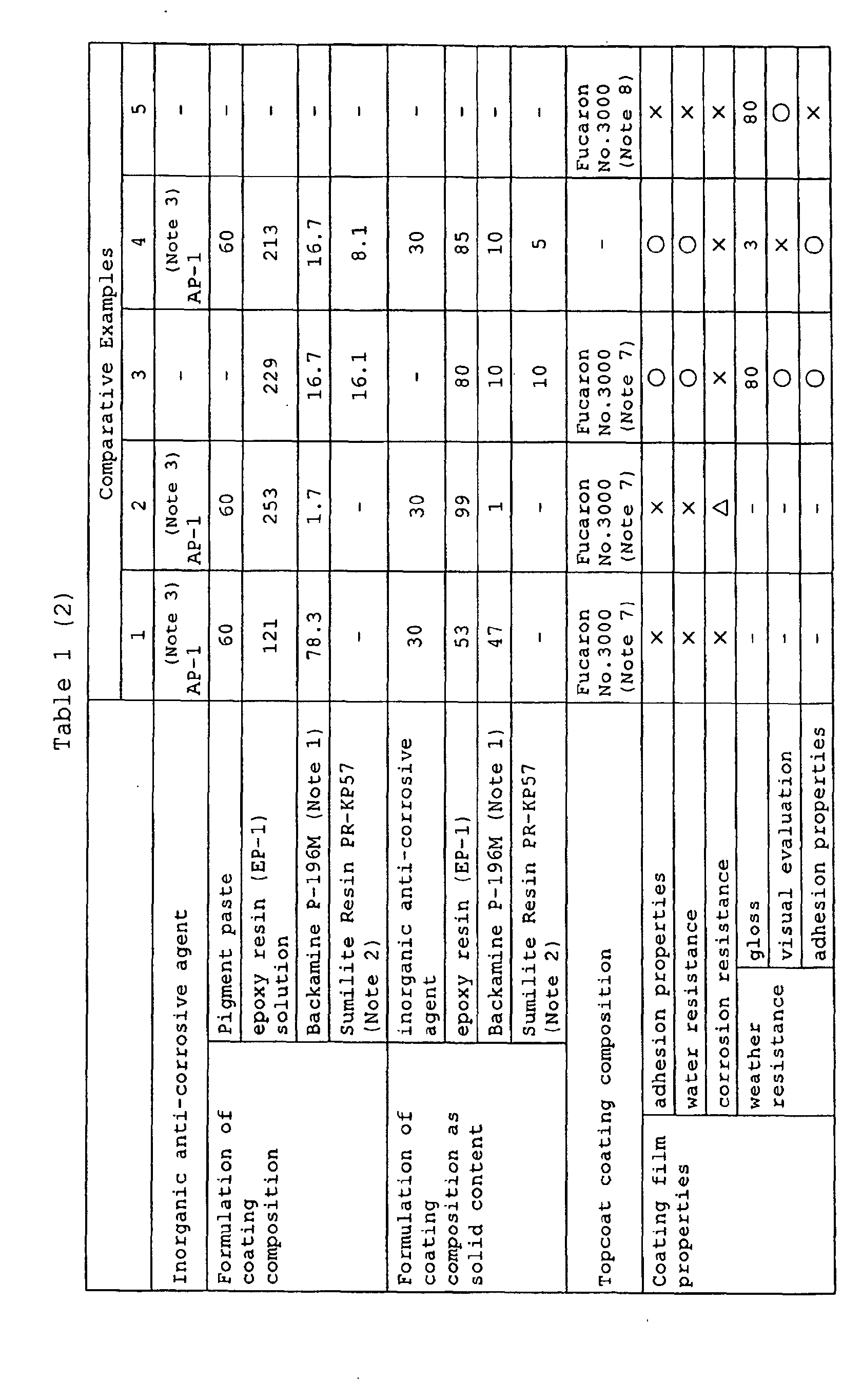
- Respective primer compositions obtained in Examples and Comparative Examples were coated onto a galvanized steel sheet (Zinkote, trade name, marketed by Nippon Steel Corporation) by a bar coater so as to be a dry film thickness of 5 ⁇ m, followed by heat curing at 200°C for 5 minutes to form respective primer coating films, coating thereonto Fucaron No. 3000 (Note 7) or Fucaron No. 4000 (Note 8) as a topcoat coating composition so as to be a cured coating film thickness of 30 ⁇ m, heat curing at 230°C for 3 minutes to obtain a test coating panel, and subjecting the test coating panel to the following tests. Test results are shown in Table 1.
- Fucaron No. 3000 (the above trade name) as a topcoat coating composition was coated onto the galvanized steel sheet (Zinkote, trade name, marketed by Nippon Steel Corporation) in the same coating conditions as above without coating the primer composition, followed by heat curing to obtain a test coating panel. Results are shown in Table 1.
- a reactor equipped with a stirrer, heating device, reflux condenser and thermometer was charged with 150 parts of phenol, 850 parts of p-cresol and 580 parts of 80% formaldehyde, followed by adding manganese acetate to control a pH of reaction at 6.2, slowly raising temperature up to 110°C, reacting for 5 hours under reflux and under normal pressure, carrying out dehydration reaction under a vacuum of 47 to 80 Pa, completing the dehydration reaction at the time when the temperature reached 120°C under a vacuum of 53 Pa to obtain phenol resin (PH-1), and preparing a 60% solid content phenol resin (PH-1) solution with xylene.
- Inorganic anti-corrosive agent (AP-6) amorphous silica, mean particle size 4.3 ⁇ m, pore volume 0.4 ml.
- Inorganic anti-corrosive agent (AP-7) K White 140 W (trade name, marketed by Tayka Corporation, zinc oxide-treated aluminum dihydrogen tripolyphosphate).
- Inorganic anti-corrosive agent (AP-8) LF Bowsei MC-400WZ (trade name, marketed by Kikuchi Color & Chemicals Corporation, zinc calcium molybdate based anti-corrosive agent).
- the primer composition obtained in Example 7 was coated onto a steel sheet (Zinkote EG-C, trade name, marketed by Nippon Steel Corporation) prepared by applying a chromate treatment onto the surface of a galvanized steel sheet having a zinc-plated amount of 20 g/m 2 (one side) by a bar coater so as to be a dry film thickness of 5 ⁇ m, followed by heat curing at 230°C for one minute to form a primer coating film layer, coating thereonto Fucaron No. 3000 (Note 7) so as to be a cured coating film thickness of 30 ⁇ m, and heat curing at 230°C for 3 minutes to obtain a test coating panel.
- a steel sheet Zinkote EG-C, trade name, marketed by Nippon Steel Corporation
- Example 15 was duplicated except that combinations of primer compositions and topcoat coating compositions as shown in Table 3 were used respectively to obtain respective test coating panels.
- the topcoat coating composition is polyamide resin based coating composition
- Orgasol 2002 D (Note 14) was used as the topcoat coating composition was dispersed into propyl alcohol so as to be a non-volatile matter content of 50%, followed by coating so as to be a cured coating film thickness of 150 ⁇ m, and heat curing at 230°C for 3 minutes to obtain respective test coating panels.
- Fucaron No. 4000 (Note 8) was coated directly onto Zinkote EG-C (the above trade name) under the same coating conditions as above without coating a primer composition, followed by heat curing to obtain a test coating panel.
- a reactor equipped with a stirrer, heating device, reflux condenser and thermometer was charged with 199 g (1.2 moles) of isophthalic acid, 100 g (0.6 mole) of terephthalic acid, 175 g (1.2 moles) of adipic acid, 74 g (1.2 moles) of ethylene glycol, 491 g (1.5 moles) of Newpol BPE-20 (trade name, marketed by Sanyo Chemical Industries, Ltd., ethylene oxide adduct of bisphenol A, average degree of addition 2.2, hydroxyl value 343), and 0.1 g of dibutyltindioxide, followed by subjecting to esterification reaction at 250°C in the presence of an inert gas, removing a produced water, proceeding the reaction to an acid value of 1.0, adding 0.2 g of antimony trioxide and 0.4 g of triethyl phosphate, performing a polycondensation reaction at 280°C under a vacuum of 100 Pa to obtain a polyester resin (
- polyester resins (PE-1) and (PE-2), phenol resins (PH-1) and (PH-2), epoxy resins (EP-1) and (EP-2), and inorganic anti-corrosive agents were mixed and dispersed to obtain respective primer compositions.
- mixed amounts are represented by solid content.
- a nickel-zinc alloy-galvanized steel sheet having a plated amount of 40 g/m 2 (one side) was subjected a chromate treatment so that a coating weight of a coating chromate solution may be in the range of 10 to 200 mg/m 2 , followed by forming a primer coating film layer, and forming a topcoat coating film layer to obtain respective test coating panels as shown in Table 5.
- mixed amounts are represented by solid content.
- Ethylene ⁇ acrylic acid copolymer resin kind (Note 19) EAA-1 (Note 20) EAA-2 (Note 21) EAA-3 (Note 22) EAA-4 amount 100 100 100 100 Inorganic anti-corrosive agent kind (Note 3) AP-1 (Note 6) AP-4 (Note 16) AP-10 (Note 10) AP-6 amount 10 30 50 100 Component Comparative Examples 23 24 Ethylene-acrylic acid copolymer resin kind (Note 19) EAA-1 (Note 20) EAA-2 amount 100 100 Inorganic anti-corrosive agent kind (Note 3) AP-1 (Note 3) AP-1 amount 1 250 (Note 20) EAA-1: Primacor 5980, trade name, marketed by Dow Chemical Co., acrylic acid content 20%, ethylene ⁇ acrylic acid copolymer resin solution.
- EAA-2 Primacor 5990, trade name, marketed by Dow Chemical Co., acrylic acid content 20%, ethylene ⁇ acrylic acid copolymer resin solution.
- EAA-3 Escol 5000, trade name, marketed by Exxon Chemical Japan Ltd., acrylic acid content 6.2%, ethylene ⁇ acrylic acid copolymer resin solution.
- EAA-4 Escol 5100, trade name, marketed by Exxon Chemical Japan Ltd., acrylic acid content 11%, ethylene ⁇ acrylic acid copolymer resin solution.
- Example 51 was duplicated no primer composition was used to obtain a test coating panel.
- a nickel-zinc-ally-galvanized steel sheet having a plated amount of 40 g/m 2 (one side) was subjected to a chromate treatment so that a coating weight of a coating chromate solution may be in the range of 10 to 200 mg/m 2 , followed by forming a primer coating film layer, and forming a topcoat coating film layer to obtain respective test coating panels as shown in Table 7.
- a primer coating film layer was formed onto an aluminum plate in accordance with JIS A 1050 as a metal substrate, followed by forming a topcoat coating film layer to obtain a test coating panel.
- the present invention can provide a metal object-coating method capable of forming a protective coating film showing good properties in heat resistance, corrosion resistance and impact resistance, along with improved adhesion properties of the thermoplastic resin coating film and good adhesion properties thereof to impact.
- the metal object-coating method of the present is suitably applicable to metal pipings for use in the automobile.
Landscapes
- Chemical & Material Sciences (AREA)
- Life Sciences & Earth Sciences (AREA)
- Engineering & Computer Science (AREA)
- Materials Engineering (AREA)
- Wood Science & Technology (AREA)
- Organic Chemistry (AREA)
- Inorganic Chemistry (AREA)
- Chemical Kinetics & Catalysis (AREA)
- Application Of Or Painting With Fluid Materials (AREA)
- Paints Or Removers (AREA)
- Preventing Corrosion Or Incrustation Of Metals (AREA)
- Laminated Bodies (AREA)
Abstract
The present invention relates to metal object-coating
method, which method comprises coating a primer composition
(I) prepared by adding an inorganic anti-corrosive agent to
at least one binder component selected from the group
consisting of a binder component (A) containing an epoxy
resin and at least one of amino resin and phenol resin, a
binder component (B) containing a polyester resin, epoxy
resin and phenol resin, and a binder component (C) containing
α-olefin·α,β-ethylenically unsaturated carboxylic acid
copolymer resin onto the surface of a metal object coating
substrate to form a primer coating film layer, followed by
coating a topcoat coating composition consisting of a
thermoplastic resin based coating composition (II) onto the
primer coating film layer to form a topcoat coating film
layer consisting of a thermoplastic resin coating film layer;
and the primer composition used in the method.
Description
The present invention relates to a metal object-coating
method, and more particularly to a metal object-coating
method capable of forming a protective coating layer showing
good properties in heat resistance, corrosion resistance and
impact resistance onto a piping for use in an automobile
brake oil or fuel, and many metal pipes arranged and used as
a supply line such as an oiling and gas feeding for various
kinds of machines, apparatuses, etc., and to a primer
composition used in the method.
Application of a protective coating onto an outer
surface of the metal pipe is known in the art.
For the purpose of preventing damages due to rebounding
stones, corrosion due to a road antifreezing agent such as a
rock stone and damages due to contact between pipings on
metal pipings for the automobile brake oil or fuel, which are
arranged on an underfloor surface in the automobile body, a
chromate coating film formed onto a galvanized steel pipe and
aluminum pipe, followed by forming a coating film by use of a
coating composition containing as a base resin a
thermoplastic resin, for example, a vinyl fluoride resin
based coating composition, vinylidene fluoride resin based
coating composition, polyamide resin (nylon) based coating
composition and the like (see, for example, Japanese Patent
Application Laid-Open Nos. 286950/97, 262903/97 and
2002-3779).
However, in the case where the thermoplastic resin
based coating composition is coated in the above coating
system, poor adhesion properties of a coating film formed
from the thermoplastic resin may produce problems such as
peeling off on fabrication, development of cracks in the
coating film layer by the impact due to rebounding stones,
peeling off of the cracked coating film, resulting in
seriously reducing corrosion resistance.
It is an object of the present invention to provide a
metal object-coating method capable of improving the adhesion
properties of the thermoplastic resin coating film and
keeping adhesion properties against to impact due to
rebounding stones, and forming a protective coating layer
showing good properties in heat resistance, corrosion
resistance and impact resistance.
The present invention relates to a metal object-coating
method, which method comprises coating a primer composition
(I) prepared by adding an inorganic anti-corrosive agent to
at least one binder component selected from the group
consisting of a binder component (A) containing an epoxy
resin and at least one of amino resin and phenol resin, a
binder component (B) containing a polyester resin, epoxy
resin and phenol resin, and a binder component (C) containing
α-olefin · α,β-ethylenically unsaturated carboxylic acid
copolymer resin onto the surface of a metal object coating
substrate to form a primer coating film layer, followed by
coating a topcoat coating composition consisting of a
thermoplastic resin based coating composition (II),
preferably a vinyl fluoride resin based coating composition,
a vinylidene fluoride resin based coating composition or a
polyamide resin based coating composition, onto the primer
coating film layer to form a topcoat coating film layer
consisting of a thermoplastic resin coating film; and a
primer composition used in the method.
The metal object in the present invention may include
metal parts used in automobile parts, household appliances,
general-purpose and the like, and particularly metal pipes
known in the art and used as pipings for use in the
automobile. The metal pipe may include, for example, a
single-rolled steel pipe, double-rolled steel pipe, seamless
steel pipe and the like formed from a SPCC steel sheet
respectively, ones having a copper layer on the surface of
folded surface thereof, electrically welded steel pipe, drawn
steel pipe, other metal pipe such as aluminum pipe and the
like.
The metal object in the present invention may
preferably include ones prepared by forming a galvanized
layer on the metal surface, followed by forming a chromate
film thereonto, and ones prepared by forming a zinc alloy-plated
layer, for example, a zinc-nickel alloy-plated layer,
followed by forming a chromate film thereonto from the
standpoint of corrosion resistance.
The galvanized layer may be formed by the usual
electrical plating method by use of an acid electrolysis bath
or an alkali electrolysis bath, and the chromate coating
layer may be formed by the known chromic acid chromate
treatment, a phosphoric acid chromate treatment, or a coating
chromate treatment containing an organic high molecule. The
resulting chromate coating film may of hexavalent chrome,
trivalent chrome or a mixture of trivalent chrome and
hexavalent chrome.
In the present invention, the primer composition (I) is
coated onto the surface of the metal object coating substrate
to form a primer coating film layer. The primer composition
(I) is prepared by adding an inorganic anti-corrosive agent
to at least one binder component selected from the group
consisting of a binder component (A) containing an epoxy
resin and at least one of amino resin and phenol resin, a
binder component (B) containing a polyester resin, epoxy
resin and phenol resin, and a binder component (C) containing
α-olefin·α,β-ethylenically unsaturated carboxylic acid
copolymer resin.
The primer composition of the present invention is
explained hereinafter.
A first binder component used in the primer composition
(I) of the present invention is the binder component (A)
containing the epoxy resin as a base resin and at least one
of amino resin and phenol resin as a crosslinking agent.
The epoxy resin is a compound having at least two epoxy
groups in one molecule, and may include any known ones
without particular limitations, for example, a liquid epoxy
resin, solid epoxy resin and the like. In the case where the
solid epoxy resin is used, the resin may be dissolved or
dispersed into a resin-soluble or dispersible organic solvent.
Specific examples of the epoxy resin may include, for
example, epoxy resin (a) containing alicyclic epoxy group
such as epoxy group on an alicyclic hydrocarbon ring and an
epoxy group directly bonded to a carbon atom forming the
alicyclic hydrocarbon ring, an epoxy resin (b) containing an
aliphatic epoxy group such as an epoxy group on a straight-chain
hydrocarbon other than the above, and an epoxy resin
(c) containing aliphatic and alicyclic epoxy group.
The epoxy resin (a) may include, for example, a radical
homopolymer of a radically polymerizable monomer containing
alicyclic epoxy group (3,4-epoxycyclohexylmethyl
(meth)acrylate), a copolymer of the above monomer with other
radically polymerizable monomer such as C1-24-alkyl or
cycloalkyl ester of (meth)acrylic acid, styrene and the like,
3,4-epoxy-cyclohexylmethyl-3,4-epoxycyclohexane carboxylate,
bis(2,3-epoxy-cyclopentyl)ether, dicyclopentadiene dioxide,
bis(3,4-epoxy-cyclohexylmethyl) of ethylene glycol, 3,4-epoxy-6-methylcyclohexylmethyl-3,4-epoxy-cyclohexane
carboxylate, bis(3,4-epoxy-cyclohexylmethyl) adipate, 3,4-epoxy-cyclohexene
carboxylic acid ethylene glycol diester,
bis(3,4-epoxy-cyclohexyl)acetal, 3,4-epoxy-cyclohexylmethyl-3,4-epoxy-cyclohexylmethyl-e-caprolactone-modified
3,4-epoxy-cyclohexyl
carboxylate, 3,4-epoxy-cyclohexylvinyl, 3,4-epoxycyclohexylmethyl
(meth)acrylate, 3,4-epoxy-cyclohexylmethyl-ε-caprolactone-modified
(meth)acrylate and the like.
The epoxy resin (b) may include, for example, a radical
homopolymer of a radically polymerizable monomer containing
aliphatic epoxy group such as glycidyl (meth)acrylate, a
copolymer of the above monomer with other radically
polymerizable monomer, for example, C1-24 alkyl or cycloalkyl
ester of (meth)acrylic acid, hydroxyl group-containing
unsaturated monomers such as hydroxyethyl (meth)acrylate,
aromatic compounds such as styrene, nitrile compounds such as
(meth)acrylonitrile, and the like; bisphenol type epoxy resin,
novolak type epoxy resin, ε-caprolactam-modified bisphenol
type epoxy resin, (poly)ethylene glycol diglycidyl ether,
(poly)propylene glycol diglycidyl ether, neopentyl glycol
diglycidyl ether, trimethylol propane triglycidyl ether and
the like.
The epoxy resin (c) may include, for example, a
copolymer of an aliphatic epoxy group-containing radically
polymerizable monomer, alicyclic epoxy group-containing
radically polymerizable monomer, and optionally other
radically polymerizable monomer, vinylcyclohexene diepoxide,
and the like.
The epoxy resin represented by trade names may include,
for example, bisphenol/epichlorohydrin type epoxy resin such
as Epikote 1002, 1004, 1007, 1009, 1010 (all marketed by Oil
Shell Epoxy Co., Ltd.), Araldite GY-6084, 6097, 6099 (all
marketed by Ciba-Geigy Ltd.), DER-662, 664, 667 (all marketed
by Dow Chemical Co.), Epototo YD-012PK, YD-014D, YD-909, YD-6020
(all marketed by Tohto Kasei Co., Ltd.) and the like;
novolak type epoxy resin such as EPPN-201, 202, EOCN-1020,
102S (all marketed by Nippon Kayaku Co., Ltd.), and the like;
Epolead GT300 (trade name, marketed by Daicel Chemical
Industries, Ltd., trifunctional alicyclic epoxy resin),
Epolead GT400 (trade name, marketed by Daicel Chemical
Industries, Ltd., tetrafunctional alicyclic epoxy resin),
EHPE (trade name, marketed by Daicel Chemical Industries,
Ltd., trifunctional alicyclic epoxy resin), and the like.
The amino resin used as the crosslinking agent of the
epoxy resin may include a methyloled amino resin obtained by
the reaction of an amino component such as melamine, urea,
benzoguanamine, acetoguanamine, steroguanamine,
spiroguanamine, dicyandiamide, and the like with aldehyde.
The aldehyde may include, for example, formaldehyde,
paraformaldehyde, acetoaldehyde, benzaldehyde and the like.
The amino resin may also include ones obtained by etherifying
the methyloled amino resin with a suitable alcohol. Examples
of the alcohol used in the etherification may include methyl
alcohol, ethyl alcohol, n-propyl alcohol, i-propyl alcohol,
n-butyl alcohol, i-butyl alcohol, 2-ethylbutanol, 2-ethylhexanol
and the like. The amino resin is preferably a
methyloled melamine obtained by etherifying at least part of
the methylol group.
The phenol resin used as a crosslinking agent of the
epoxy resin may include a phenol resin obtained by reacting
phenols with formaldehydes.
The phenols used for obtaining the phenol resin may
include, for example, phenols having one benzene ring in one
molecule such as phenol, methylphenol, p-ethylphenol, p-n-propylphenol,
p-isopropylphenol, p-n-butylphenol, p-tert-butylphenol,
p-tert-amylphenol, o-cresol, m-cresol, p-cresol,
p-cyclohexylphenol, p-octylphenol, p-nonylphenol, 3,5-xylenol,
resorcinol, catechol and the like; phenols having two benzene
rings in one molecule such as phenyl o-cresol, p-phenyl
phenol and the like; bisphenol A, bisphenol F, 1,1-bis(4-hydroxyphenyl)
ethane, 2,2-bis(4-hydroxyphenyl)butane, bis(4-hydroxyphenyl)-1,1-isobutane,
bis(4-hydroxy-tert-butylphenyl)-2,2-propane,
p-(4-hydroxyphenyl)phenol, oxybis(4-hydroxyphenyl),
sulfonylbis(4-hydroxyphenyl), 4,4'-dihydroxybenzophenone,
bis(2-hydroxynaphthyl)methane and the
like. These may be used alone or in combination.
Of these, phenols selected from the group consisting of
o-cresol, p-cresol, p-ethylphenol, p-n-propylphenol, p-isopropylphenol,
p-tert-butylphenol, p-octylphenol, p-nonylphenol,
phenol, m-cresol, 3,5-xylenol, resorcinol,
catechol, bisphenol A and bisphenol F are preferable.
The formaldehydes may include formaldehyde,
paraformaldehyde, trioxane and the like. These may be used
alone or in combination.
The reaction between phenols and formaldehydes may be
carried out in a catalyst such as an inorganic acid, organic
acid, organic acid metal salt and the like.
The phenol resin may include a resol type phenol resin
and a novolak type phenol resin. Of these, the resol type
phenol resin is preferable.
The amino resin and phenol resin are used as the
crosslinking agents for the epoxy resin, and may be used
alone or in combination.
A mixing ratio of the epoxy resin to at least one of
amino resin and phenol resin in the binder component (A) is
such that the epoxy resin is in the range of 56 to 98% by
weight, preferably 60 to 94% by weight, at least one of the
amino resin and phenol resin is in the range of 2 to 44% by
weight, preferably 6 to 40% by weight based on a total solid
content thereof from the standpoints of curing properties,
fabrication properties, water resistance, corrosion
resistance and the like of the primer coating film layer.
In the present invention, a combined use of the amino
resin and phenol resin as the crosslinking agents is
preferable. The combined use of the amino resin and phenol
resin may improve adhesion properties to the metal object and
corrosion resistance.
When combined, respective mixing amounts are preferably
such that the epoxy resin is in the range of 56 to 98% by
weight, preferably 60 to 94% by weight, more preferably 70 to
90% by weight, the amino resin is in the range of 1 to 22% by
weight, preferably 3 to 20% by weight, more preferably 5 to
15% by weight, and the phenol resin is in the range of 1 to
22% by weight, preferably 3 to 20% by weight, more preferably
5 to 15% by weight.
An epoxy resin less than 56% by weight may result poor
properties in fabrication properties, water resistance, and
corrosion resistance. On the other hand, when more than 98%
by weight, curing properties, water resistance and corrosion
resistance may be reduced. An amino resin less than 1% by
weight may reduce adhesion properties to the substrate. On
the other hand, when more than 22% by weight, fabrication
properties and water resistance may be poor. A phenol resin
less than 1% by weight may reduce adhesion properties to the
top layer. On the other hand, when more than 22% by weight,
fabrication properties may be poor.
The binder component (B) containing polyester resin,
epoxy resin and phenol resin is a second binder component
used in the primer composition (I) of the present invention.
The polyester resin is an esterified product between a
polybasic acid component and a polyhydric alcohol component.
The polybasic acid component may mainly include at least one
dibasic acid selected from, for example, phthalic anhydride,
isophthalic acid, terephthalic acid, orthophthalic acid, 2,6-naphthalene
dicarboxylic acid, tetrahydrophthalic anhydride,
hexahydrophthalic anhydride, hydrogenated dicarboxybisphenol
A, hydrogenated dimer acid, hydrogenated naphthalene
dicarboxylic acid, 1,4-cyclohexane dicarboxylic acid, 1,2-cyclohexane
dicarboxylic acid, tricyclodecane dicarboxylic
acid, succinic acid, fumaric acid, adipic acid, sebacic acid,
maleic anhydride and the like, and lower alkyl esterified
products thereof, and may optionally include a monobasic acid
such as benzoic acid, crotonic acid, p-t-butylbenzoic acid
and the like, and a trivalent or higher polybasic acid such
as trimellitic anhydride, methylcyclohexene tricarboxylic
acid, pyromellitic anhydride and the like. The polyhydric
alcohol component may include a dihydric alcohol such as
ethylene glycol, diethylene glycol, 1,2-propylene glycol,
1,3-propanediol, 1,4-butanediol, neopentyl glycol, 3-methylpentanediol,
1,4-hexanediol, 1,6-hexanediol, 1,4-cyclohexanedimethanol,
hydrogenated bisphenol A, an alkylene
oxide adduct of bisphenol A and/or bisphenol F,
tricyclodecane glycol and the like, and may optionally
include trihydric or higher polyhydric alcohol such as
glycerin, trimethylolethane, trimethylolpropane,
pentaerythritol and the like. These polyhydric alcohols may
be used alone or in combination.
The polyester resin is preferably such that the alcohol
component consists of 20 to 90 mol% of an ethylene oxide
and/or propylene oxide adduct of bisphenol A, 20 to 90 mol%
of an ethylene oxide and/or propylene oxide adduct of
bisphenol F and 10 to 80 mol% of other alcohol, and that the
acid component consists of 70 to 30 mol% of an aromatic
dicarboxylic acid and 30 to 70 mol% of an aliphatic
carboxylic acid component, from the standpoint of fabrication
properties of a resulting coating film. The polyester resin
is preferably a straight-chain or low branched chain
polyester resin from the standpoint of fabrication properties
of a resulting coating film. A mixing amount of the
trihydric or higher polyhydric alcohol component, trivalent
or higher polybasic acid component or trivalent or higher
hydroxy acid component is preferably 5% by weight or less
based on a total amount of starting materials, because when
more than 5% by weight, fabrication properties of the
resulting coating film may be reduced.
The polyester resin may be prepared by a method which
comprises mixing the acid component and alcohol component,
followed by subjecting to an esterification reaction or ester
exchange reaction by a known preparation process, for example,
a melt process, solvent process and the like to obtain a
saturated polyester resin. Preferably, in the case of
obtaining a straight chain polyester resin, a high molecular
weight polyester resin may be obtained optionally by carrying
out a polycondensation reaction under the conditions of 200
to 300°C, preferably 230 to 280°C, under a vacuum of 1000 Pa
or less, preferably 100 Pa or less, in the presence of a
catalyst such as antimony trioxide, germanium oxide, N-butyltitanate,
dibutyltinoxidotriethyl phosphate and the like.
The polyester resin has a number average molecular
weight in the range of 3,000 to 30,000, preferably 10,000 to
30,000. A number average molecular weight less than 3,000
may result poor properties in coating film properties such as
fabrication properties. On the other hand, a number average
molecular weight more than 30,000 may increase viscosity,
resulting in reducing handling properties.
The epoxy resin used in the binder component (B) may
include the epoxy resin used in the binder component (A).
The phenol resin used in the binder component (B) may
include the phenol resin used in the binder component (A).
A mixing ratio of the polyester resin, epoxy resin and
phenol resin in the binder component (B) is such that the
polyester is 30 to 98% by weight, preferably 50 to 90% by
weight, the epoxy resin is 1 to 50% by weight, preferably 5
to 30% by weight, and the phenol resin is 1 to 50% by weight,
preferably 5 to 30% by weight based on a total solid content
from the standpoints of curing properties, fabrication
properties, water resistance, corrosion resistance and the
like of the primer coating film layer. A polyester resin
less than 30% by weight may result poor properties in
fabrication properties and corrosion resistance. On the
other hand, when more than 98% by weight, adhesion properties
to the substrate and the top layer may be reduced. An epoxy
resin less than 1% by weight may reduce adhesion properties
to the substrate. On the other hand, when more than 50% by
weight, fabrication properties may be poor. A phenol resin
less than 1% by weight may reduce adhesion properties to the
top layer. On the other hand, when more than 50% by weight,
fabrication properties may be poor.
The α-olefin·α,β-ethylenically unsaturated carboxylic
acid copolymer resin-containing binder component (C) is a
third binder used in the primer composition (I) of the
present invention.
The α-olefin·α,β-ethylenically unsaturated carboxylic
acid copolymer resin is a copolymer resin between α-olefin
and α,β-ethylenically unsaturated carboxylic acid. The
α-olefin may include, for example, ethylene, propylene,
butylene, isoprene and the like. The α,β-ethylenically
unsaturated carboxylic acid may include, for example, acrylic
acid, methacrylic acid, maleic acid and the like. An amount
of the α,β-ethylenically unsaturated carboxylic acid in the
copolymer resin is preferably in the range of 5 to 30% by
weight, preferably 5 to 20% by weight based on a total amount
of the monomers of the copolymer resin. An α,β-ethylenically
unsaturated carboxylic acid less than 5% by weight may result
poor adhesion properties to the substrate and top coating.
On the other hand, when more than 30% by weight, water
resistance may be poor and corrosion resistance may be
reduced.
The α-olefin·α,β-ethylenically unsaturated carboxylic
acid copolymer resin may particularly include an
ethylene·acrylic acid copolymer resin. Specific examples of
the ethylene·acrylic acid copolymer resin may include, as
trade names, Primacor 5980 (acrylic acid content 20%),
Primacor 5981 (acrylic acid content 20%), Primacor 5983
(acrylic acid content 20%), Primacor 5990 (acrylic acid
content 20%), and Primacor 5991 (acrylic acid content 20%)
(the above are all marketed by Dow Chemical Co.), Escol 5000
(acrylic acid content 6.2%), Escol 5001 (acrylic acid content
6.2%), Escol 5100 (acrylic acid content 11%) and Escol 5110
(acrylic acid content 11%) (the above are all marketed by
Exxon Chemical Japan Ltd.), and the like.
The binder component (A), binder component (B) and
binder component (C) as the binder components of the primer
composition may be used alone or in combination. The binder
component (A), binder component (B) and binder component (C)
may optionally contain, for example, polyisobutylene, butyl
rubber, butadiene rubber, isoprene rubber, ethylene-vinyl
acetate copolymer, terpene resin and the like in such a range
as not to give adverse effects on performances.
The inorganic anticorrosive agent used in the primer
composition may include, for example, a chrome based pigment
such as strontium chromate and the like, and a chrome-free,
environmental pollution-free anti-corrosive pigments,
preferably environmental pollution-free anti-corrosive
pigments from the standpoint of environmental protection.
The environmental pollution-free anti-corrosive pigment may
include, for example, a condensed phosphate based anti-corrosive
pigment such as a zinc phosphate based anti-corrosive
pigment, magnesium phosphate based anti-corrosive
pigment, aluminum phosphate based anti-corrosive pigment,
calcium phosphate based anti-corrosive pigment, zinc
phosphite based anti-corrosive pigment, magnesium phosphite
based anti-corrosive pigment, calcium phosphite based anti-corrosive
pigment, aluminum phosphite based anti-corrosive
pigment and the like, a pigment prepared by treating the
surface of the condensed phosphate based anti-corrosive
pigment with a metal compound; a zinc based anti-corrosive
pigment such as zinc molybdate based anti-corrosive pigment,
zinc cyanamide based anti-corrosive pigment, zinc calcium
cyanamide based anti-corrosive pigment, silica and the like.
These may be used alone or in combination.
The condensed phosphate used in the pigment prepared by
treating the surface of the condensed phosphate based anti-corrosive
pigment with the metal compound may include
aluminum condensed phosphate, particularly aluminum
tripolyphosphate, and the metal compound may include
magnesium silicate, particularly magnesium hexasilicate.
The silica may particularly include an amorphous silica,
preferably an amorphous silica having a mean particle size of
1 to 10 µm, and a pore volume of 0.05 to 2.0 ml/g.
In the present invention, the inorganic anti-corrosive
agent is preferably at least one pigment selected from the
group consisting of a pigment prepared by treating the
surface of aluminum dihydrogen tripolyphosphate with
magnesium hexasilicate, magnesium phosphate based anti-corrosive
pigment and an amorphous silica.
A mixing ratio of the inorganic anti-corrosive agent is
3 to 200 parts by weight, preferably 3 to 100 parts by weight,
more preferably 5 to 50 parts by weight per 100 parts by
weight of a total resin solid content in the composition. An
anti-corrosive pigment less than 3 parts by weight may result
poor corrosion resistance. On the other hand, when more than
200 parts by weight, physical performances of a resulting
coating film may be poor.
In the primer composition, the binder component may be
dissolved or dispersed into an organic solvent. The organic
solvent may include, for example, a hydrocarbon solvent such
as hexane, butane, isooctane, unsaturated aliphatic
hydrocarbon, benzene, toluene, o-, m-, p-xylene, cyclohexane
and the like; an ether solvent such as dioxane,
tetrahydrofuran, cellosolve, methylcellosolve,
butylcellosolve, methylcarbitol, 2-methoxyethanol, 2-butoxyethanol,
diethylene glycol, diethylene glycol monoethyl
ether, diethylene glycol monobutyl ether, diethylene glycol
monoethyl ether acetate, triethylene glycol monomethyl ether,
1-methoxy-2-propanol, 1-ethoxy-2-propanol, dipropylene glycol
monomethyl ether and the like; a ketone solvent such as
acetone, methyl ethyl ketone, isophorone, dicyclohexanone and
the like; an ester solvent such as methyl acetate, ethyl
acetate, propyl acetate, butyl acetate, isobutyl acetate,
pentyl acetate, 2-methoxybutyl acetate, 2-ethylhexyl acetate,
benzyl acetate, cyclohexyl acetate, ethylene glycol
monoacetate, cellosolve acetate, carbitol acetate, ethyl
acetoacetate and the like; other solvents such as pyridine,
formamide, N,N-dimethylformamide, acetoamide and the like.
The primer composition (I) has a solid content in the
range of 10 to 80% by weight, preferably 20 to 60% by weight.
The primer composition (I) may optionally contain
pigments other than the above, colorants, fiffers, flow
controlling agents, polymer fine particles, other resins and
crosslinking agents, and the like.
Coating of the primer composition (I) may be carried
out any known coating methods depending on a shape of the
metal object so as to be a dry film thickness in the range of
2 to 20 µm, preferably 2 to 15 µm.
In the method of the present invention, the formation
of the primer coating film layer is followed by coating a
topcoat coating composition consisting of a thermoplastic
resin based coating composition (II) onto the primer coating
film layer to form a topcoat coating film layer consisting of
a thermoplastic resin coating film layer. The thermoplastic
resin based coating composition (II) may preferably include a
vinyl fluoride resin based coating composition, vinylidene
fluoride resin based coating composition, a polyamide resin
based coating composition and the like.
Formation of the topcoat coating film layer consisting
of the thermoplastic resin coating film layer may be carried
out by any known methods depending on a shape of the metal
object. For example, in the case of the polyamide resin
based coating composition, coating onto a metal pipe may be
carried out by a method which comprises forming a primer
coating film layer, followed by preheating the metal pipe,
and subjecting to an extrusion molding method. A resulting
film thickness is in the range of 20 to 180 µm.
The present invention is explained more in detail by
the following Examples, in which "part" and "%" represent
"part by weight" and "% by weight" respectively.
35 parts of Epikote 1010 (trade name, marketed by Oil
Shell Epoxy Co., Ltd., bisphenol/epichlorohydrin type epoxy
resin) was dissolved in 65 parts of diethylene glycol
monoethyl ether acetate to obtain an epoxy resin (EP-1)
solution having a solid content of 35%.
A double wall stainless mixer was charged with 100
parts of the epoxy resin (EP-1) solution and 100 parts of an
inorganic anti-corrosive agent as shown in Table 1, followed
by stirring at a low speed for mixing, and dispersing in a
beed mill dispersion mixer for 40 minutes to obtain a
dispersed paste shown in Table 1.
To 60 parts of a paste prepared by use of the inorganic
anti-corrosive agent (AP-1) (Note 3) were added 227 parts of
the epoxy resin (EP-1) solution and 16.7 parts of Backamine
P196M (Note 1) as a crosslinking agent, followed by mixing to
obtain a primer composition.
Example 1 was duplicated except that respective
formulations as shown in Table 1 were used to obtain
respective primer compositions.
Respective primer compositions obtained in Examples and
Comparative Examples were coated onto a galvanized steel
sheet (Zinkote, trade name, marketed by Nippon Steel
Corporation) by a bar coater so as to be a dry film thickness
of 5 µm, followed by heat curing at 200°C for 5 minutes to
form respective primer coating films, coating thereonto
Fucaron No. 3000 (Note 7) or Fucaron No. 4000 (Note 8) as a
topcoat coating composition so as to be a cured coating film
thickness of 30 µm, heat curing at 230°C for 3 minutes to
obtain a test coating panel, and subjecting the test coating
panel to the following tests. Test results are shown in
Table 1.
In Comparative Example 5, Fucaron No. 3000 (the above
trade name) as a topcoat coating composition was coated onto
the galvanized steel sheet (Zinkote, trade name, marketed by
Nippon Steel Corporation) in the same coating conditions as
above without coating the primer composition, followed by
heat curing to obtain a test coating panel. Results are
shown in Table 1.



A reactor equipped with a stirrer, heating device,
reflux condenser and thermometer was charged with 150 parts
of phenol, 850 parts of p-cresol and 580 parts of 80%
formaldehyde, followed by adding manganese acetate to control
a pH of reaction at 6.2, slowly raising temperature up to
110°C, reacting for 5 hours under reflux and under normal
pressure, carrying out dehydration reaction under a vacuum of
47 to 80 Pa, completing the dehydration reaction at the time
when the temperature reached 120°C under a vacuum of 53 Pa to
obtain phenol resin (PH-1), and preparing a 60% solid content
phenol resin (PH-1) solution with xylene.
The epoxy resin solution, phenol resin solution and
inorganic anti-corrosive agents were mixed according to the
formulation shown in Table 2, followed by dispersing to
obtain respective primer compositions. In Table 2, the
formulation is represented by solid content.
| Examples | |||||
| 7 | 8 | 9 | 10 | 11 | |
| Epoxy resin (EP-1) | 80 | 90 | 85 | 70 | 80 |
| Backamine P-196M (Note 1) | 10 | 10 | - | 15 | 10 |
| Phenol resin (PH-1) | 10 | - | 15 | 15 | 10 |
| Inorganic anti-corrosive agent (AP-1) (Note 3) | 30 | 25 | - | - | - |
| Inorganic anti-corrosive agent (AP-5) (Note 9) | - | - | 20 | - | 15 |
| Inorganic anti-corrosive agent (AP-6) (Note 10) | - | - | - | 30 | 15 |
| Inorganic anti-corrosive agent (AP-7) (Note 11) | - | - | - | - | - |
| Inorganic anti-corrosive agent (AP-8) (Note 12) | - | - | - | - | - |
| Inorganic anti-corrosive agent (AP-9) (Note 13) | - | - | - | - | - |
| Examples | Comparative Examples | ||||
| 12 | 13 | 14 | 6 | 7 | |
| Epoxy resin (EP-1) | 80 | 80 | 80 | 50 | 80 |
| Backamine P-196M (Note 1) | 10 | 10 | 10 | 25 | 10 |
| Phenol resin (PH-1) | 10 | 10 | 10 | 25 | 10 |
| Inorganic anti-corrosive agent (AP-1) (Note 3) | - | - | - | 30 | - |
| Inorganic anti-corrosive agent (AP-5) (Note 9) | - | - | - | - | - |
| Inorganic anti-corrosive agent (AP-6) (Note 10) | - | - | - | - | - |
| Inorganic anti-corrosive agent (AP-7) (Note 11) | 30 | - | - | - | - |
| Inorganic anti-corrosive agent (AP-8) (Note 12) | - | 30 | - | - | - |
| Inorganic anti-corrosive agent (AP-9) (Note 13) | - | - | 30 | - | - |
| (Note 9) Inorganic anti-corrosive agent (AP-5): CRF-15 (trade name, marketed by Kikuchi Color & Chemicals Corporation, magnesium phosphate based pigment). | |||||
| (Note 10) Inorganic anti-corrosive agent (AP-6): amorphous silica, mean particle size 4.3 µm, pore volume 0.4 ml. | |||||
| (Note 11) Inorganic anti-corrosive agent (AP-7): K White 140 W (trade name, marketed by Tayka Corporation, zinc oxide-treated aluminum dihydrogen tripolyphosphate). | |||||
| (Note 12) Inorganic anti-corrosive agent (AP-8): LF Bowsei MC-400WZ (trade name, marketed by Kikuchi Color & Chemicals Corporation, zinc calcium molybdate based anti-corrosive agent). | |||||
| (Note 13) Inorganic anti-corrosive agent (AP-9): LF Bowsei ZP-50S (trade name, marketed by Kikuchi Color & Chemicals Corporation, zinc phosphate based anti-corrosive agent). |
The primer composition obtained in Example 7 was coated
onto a steel sheet (Zinkote EG-C, trade name, marketed by
Nippon Steel Corporation) prepared by applying a chromate
treatment onto the surface of a galvanized steel sheet having
a zinc-plated amount of 20 g/m2 (one side) by a bar coater so
as to be a dry film thickness of 5 µm, followed by heat
curing at 230°C for one minute to form a primer coating film
layer, coating thereonto Fucaron No. 3000 (Note 7) so as to
be a cured coating film thickness of 30 µm, and heat curing
at 230°C for 3 minutes to obtain a test coating panel.
Example 15 was duplicated except that combinations of
primer compositions and topcoat coating compositions as shown
in Table 3 were used respectively to obtain respective test
coating panels. In the case where the topcoat coating
composition is polyamide resin based coating composition,
Orgasol 2002 D (Note 14) was used as the topcoat coating
composition was dispersed into propyl alcohol so as to be a
non-volatile matter content of 50%, followed by coating so as
to be a cured coating film thickness of 150 µm, and heat
curing at 230°C for 3 minutes to obtain respective test
coating panels.
In Comparative Example 10, Fucaron No. 4000 (Note 8)
was coated directly onto Zinkote EG-C (the above trade name)
under the same coating conditions as above without coating a
primer composition, followed by heat curing to obtain a test
coating panel.
Respective test coating panels obtained as above were
subjected to the following tests. Test results are shown in
Table 3.

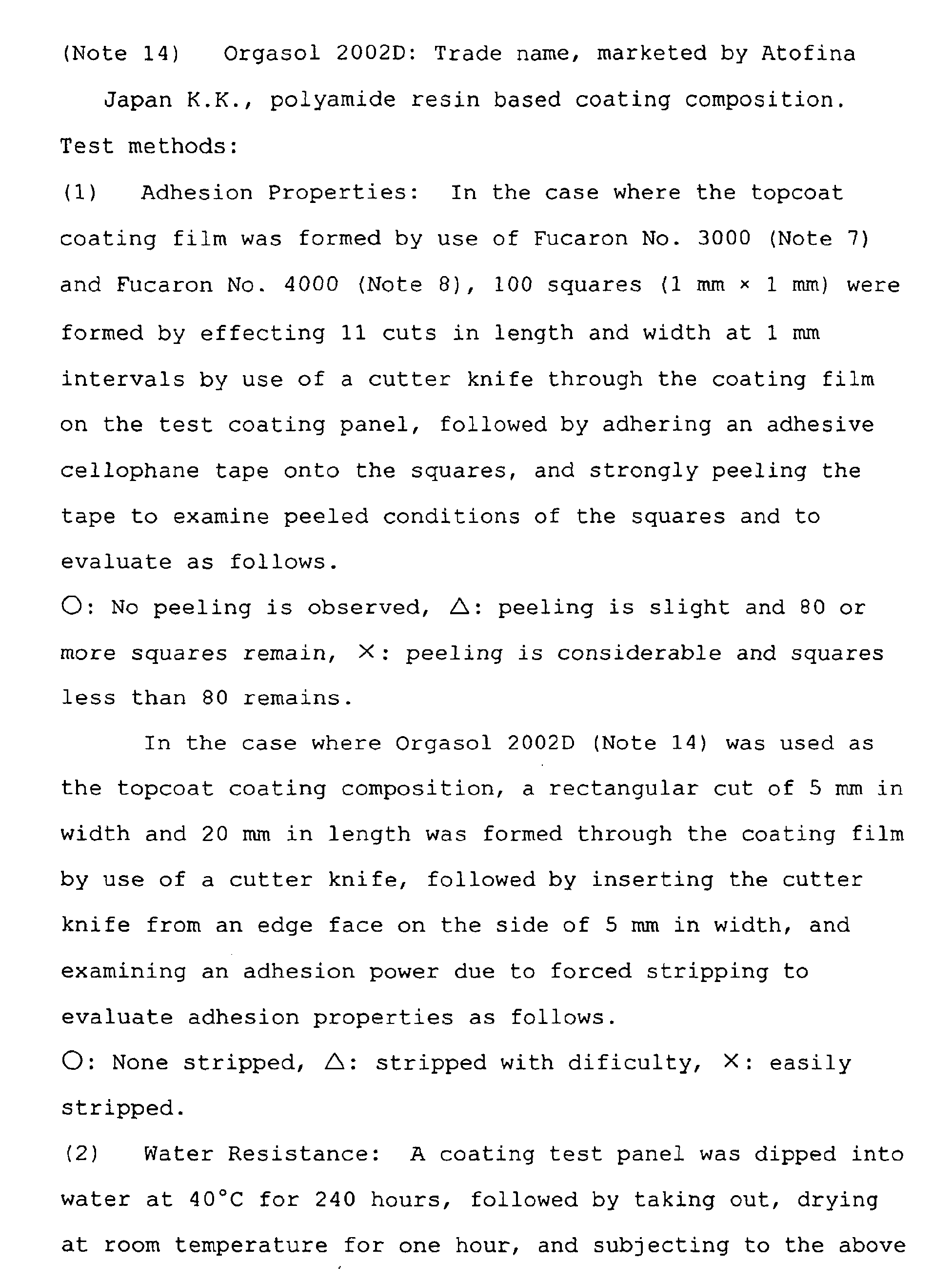
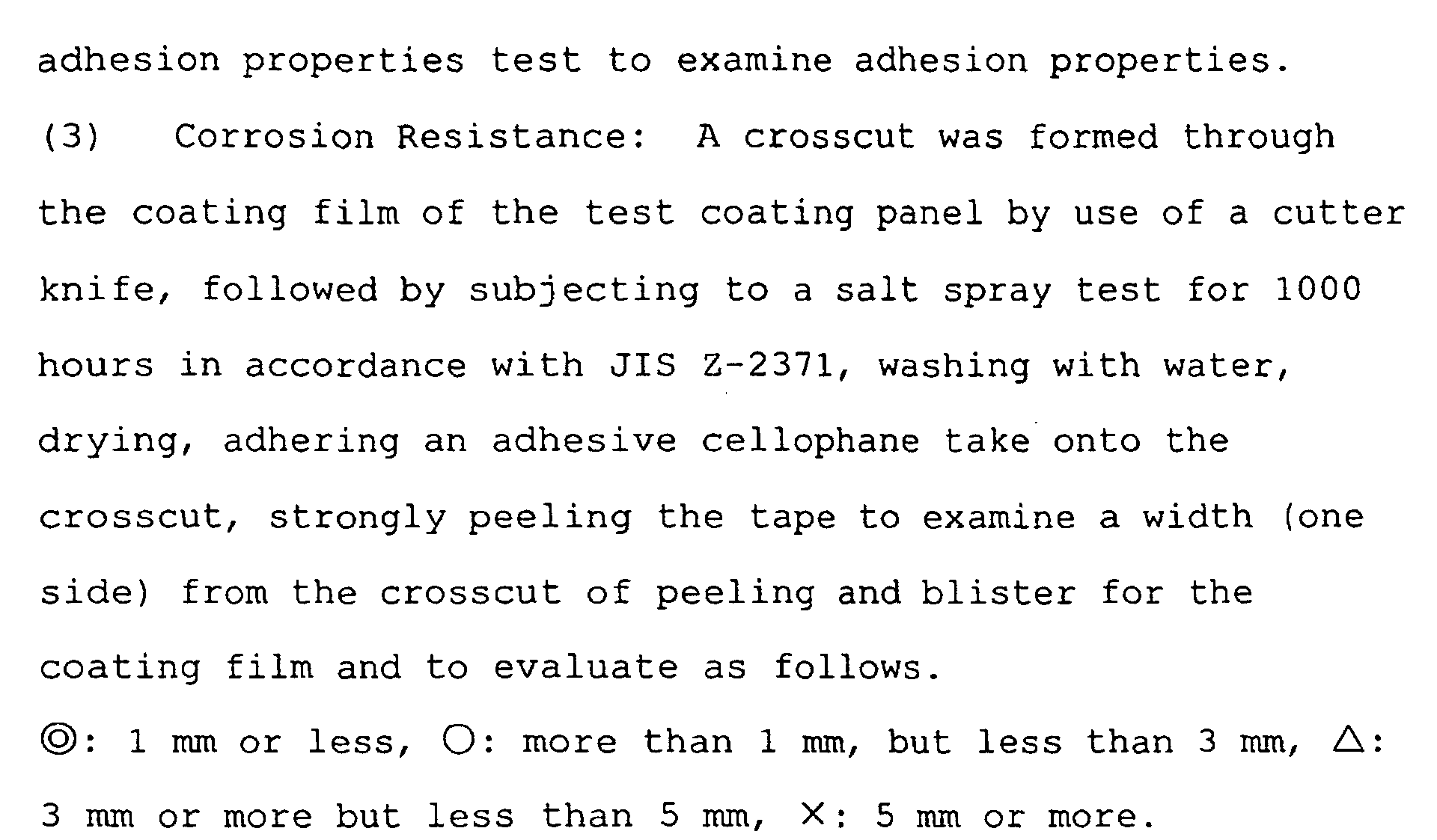
A reactor equipped with a stirrer, heating device,
reflux condenser and thermometer was charged with 199 g (1.2
moles) of isophthalic acid, 100 g (0.6 mole) of terephthalic
acid, 175 g (1.2 moles) of adipic acid, 74 g (1.2 moles) of
ethylene glycol, 491 g (1.5 moles) of Newpol BPE-20 (trade
name, marketed by Sanyo Chemical Industries, Ltd., ethylene
oxide adduct of bisphenol A, average degree of addition 2.2,
hydroxyl value 343), and 0.1 g of dibutyltindioxide, followed
by subjecting to esterification reaction at 250°C in the
presence of an inert gas, removing a produced water,
proceeding the reaction to an acid value of 1.0, adding 0.2 g
of antimony trioxide and 0.4 g of triethyl phosphate,
performing a polycondensation reaction at 280°C under a
vacuum of 100 Pa to obtain a polyester resin (PE-1) having a
number average molecular weight of 22,000. The polyester
resin (PE-1) was dissolved in a mixed solvent of Solvesso 150
(trade name, marketed by Esso Standard Oil Co.,
Ltd.)/cyclohexanone = 50/50 (weight ratio) to prepare a resin
solution having a heating residue of 40%.
The same reactor as used in Synthesis Example 2 was
charged with 199 g (1.2 moles) of isophthalic acid, 100 g
(0.6 mole) of terephthalic acid, 175 g (1.2 moles) of adipic
acid, 74 g (1.2 moles) of ethylene glycol, 449 g (1.5 moles)
of Newpol BPE-20 (trade name, marketed by Sanyo Chemical
Industries, Ltd., ethylene oxide adduct of bisphenol A,
average degree of addition 2.2, hydroxyl value 343), and 0.1
g of dibutyltindioxide, followed by subjecting to
esterification reaction at 250°C in the presence of an inert
gas, removing a produced water, proceeding the reaction to an
acid value of 1.0, adding 0.2 g of antimony trioxide and 0.4
g of triethyl phosphate, performing a polycondensation
reaction at 280°C under a vacuum of 100 Pa to obtain a
polyester resin (PE-2) having a number average molecular
weight of 22,000. The polyester resin (PE-2) was dissolved
in a mixed solvent of Solvesso 150 (trade name, marketed by
Esso Standard Oil Co., Ltd.)/cyclohexanone = 50/50 (weight
ratio) to prepare a resin solution having a heating residue
of 40%.
The same reactor as in Synthesis Example 2 was charged
with 1000 parts of paracresol, 400 parts of 80%
paraformaldehyde, 550 parts of 37% formalin and 300 parts of
cellosolve acetate, followed by adding lead acetate to
control pH of the reaction system at 5.1, slowly raising the
temperature up to 110°C, reacting for 5 hours in a reflux
state, and under normal pressure, subjecting to a dehydration
reaction under normal pressure, completing the dehydration
reaction when the temperature reached 120°C to obtain a
phenol resin (PH-2), which was dissolved in xylene to prepare
a resin solution having a heating residue to 60%.
According to the formulations as shown in Table 4,
polyester resins (PE-1) and (PE-2), phenol resins (PH-1) and
(PH-2), epoxy resins (EP-1) and (EP-2), and inorganic anti-corrosive
agents were mixed and dispersed to obtain
respective primer compositions. In Table 4, mixed amounts
are represented by solid content.


With the combinations of primer compositions and
topcoat coating compositions shown in Table 5, respective
test coating panels were obtained by the same method is
described Examples 15-23 and Comparative Examples 8-10.
A nickel-zinc alloy-galvanized steel sheet having a
plated amount of 40 g/m2 (one side) was subjected a chromate
treatment so that a coating weight of a coating chromate
solution may be in the range of 10 to 200 mg/m2, followed by
forming a primer coating film layer, and forming a topcoat
coating film layer to obtain respective test coating panels
as shown in Table 5.
The coating test panels were subjected the following
tests. Results are shown in Table 5.

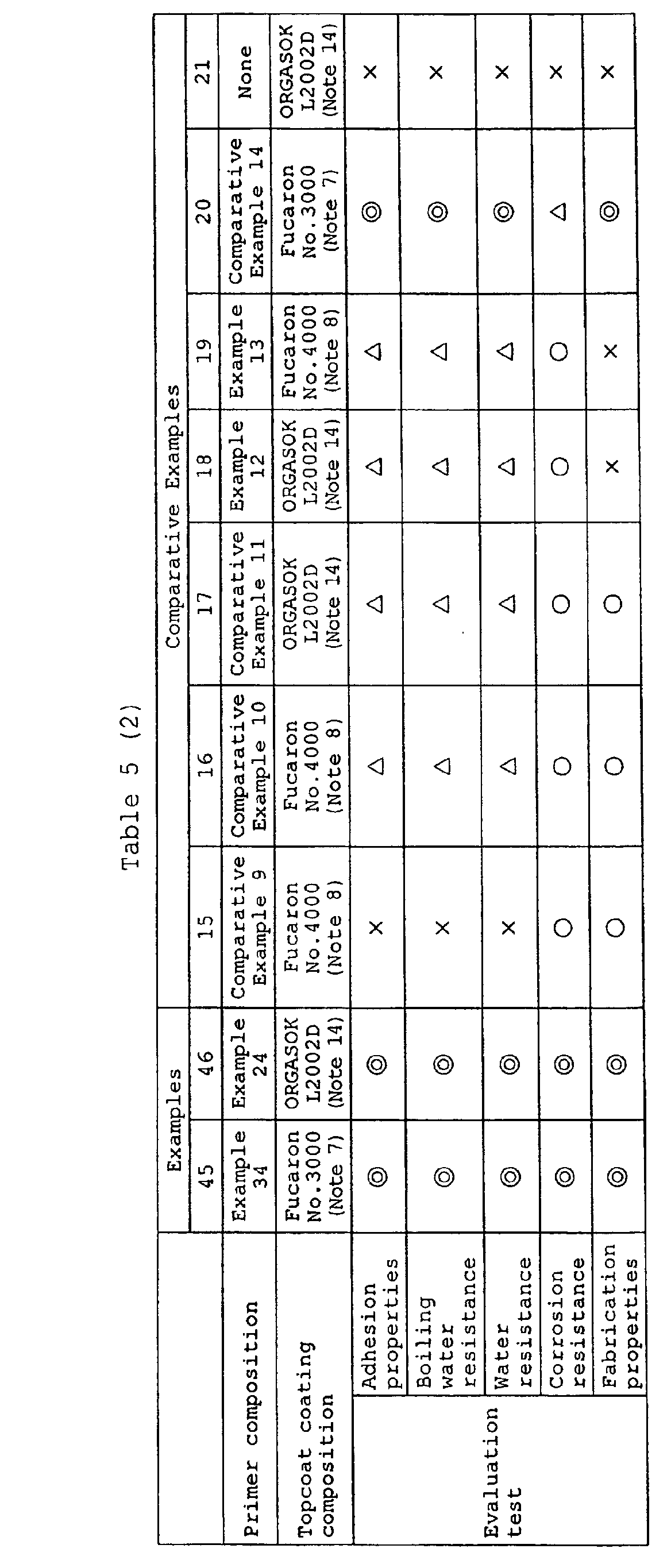


Respective ethylene·acrylic acid copolymer resin
solutions controlled so as to be a resin solid content of 20%
with a mixed solvent of xylene/butanol = 9/1 (weight ratio)
and respective inorganic anti-corrosive agents were mixed
according to the formulations shown in Table 6, followed by
dispersing to obtain respective primer compositions. In
Table 6, mixed amounts are represented by solid content.
| Component | Examples | ||||
| 47 | 48 | 49 | 50 | ||
| Ethylene·acrylic acid copolymer resin | kind | (Note 19) EAA-1 | (Note 20) EAA-2 | (Note 21) EAA-3 | (Note 22) EAA-4 |
| amount | 100 | 100 | 100 | 100 | |
| Inorganic anti-corrosive agent | kind | (Note 3) AP-1 | (Note 6) AP-4 | (Note 16) AP-10 | (Note 10) AP-6 |
| amount | 10 | 30 | 50 | 100 |
| Component | Comparative Examples | ||
| 23 | 24 | ||
| Ethylene-acrylic acid copolymer resin | kind | (Note 19) EAA-1 | (Note 20) EAA-2 |
| amount | 100 | 100 | |
| Inorganic anti-corrosive agent | kind | (Note 3) AP-1 | (Note 3) AP-1 |
| amount | 1 | 250 | |
| (Note 20) EAA-1: Primacor 5980, trade name, marketed by Dow Chemical Co., acrylic acid content 20%, ethylene·acrylic acid copolymer resin solution. | |||
| (Note 21) EAA-2: Primacor 5990, trade name, marketed by Dow Chemical Co., acrylic acid content 20%, ethylene·acrylic acid copolymer resin solution. | |||
| (Note 22) EAA-3: Escol 5000, trade name, marketed by Exxon Chemical Japan Ltd., acrylic acid content 6.2%, ethylene·acrylic acid copolymer resin solution. | |||
| (Note 23) EAA-4: Escol 5100, trade name, marketed by Exxon Chemical Japan Ltd., acrylic acid content 11%, ethylene·acrylic acid copolymer resin solution. |
With combinations of primer compositions and topcoat
coating compositions as shown in Table 7, respective test
coating panels were obtained in the same manners as in
Examples 15-23 and Comparative Examples 8-10.
For example, Example 51 was duplicated no primer
composition was used to obtain a test coating panel.
A nickel-zinc-ally-galvanized steel sheet having a
plated amount of 40 g/m2 (one side) was subjected to a
chromate treatment so that a coating weight of a coating
chromate solution may be in the range of 10 to 200 mg/m2,
followed by forming a primer coating film layer, and forming
a topcoat coating film layer to obtain respective test
coating panels as shown in Table 7.
With the combination as shown in Table 7, a primer
coating film layer was formed onto an aluminum plate in
accordance with JIS A 1050 as a metal substrate, followed by
forming a topcoat coating film layer to obtain a test coating
panel.
Above test coating panels were subjected to evaluation
tests in the same manner as in Examples 35-46 and Comparative
Examples 15-21. Results are shown in Table 7.

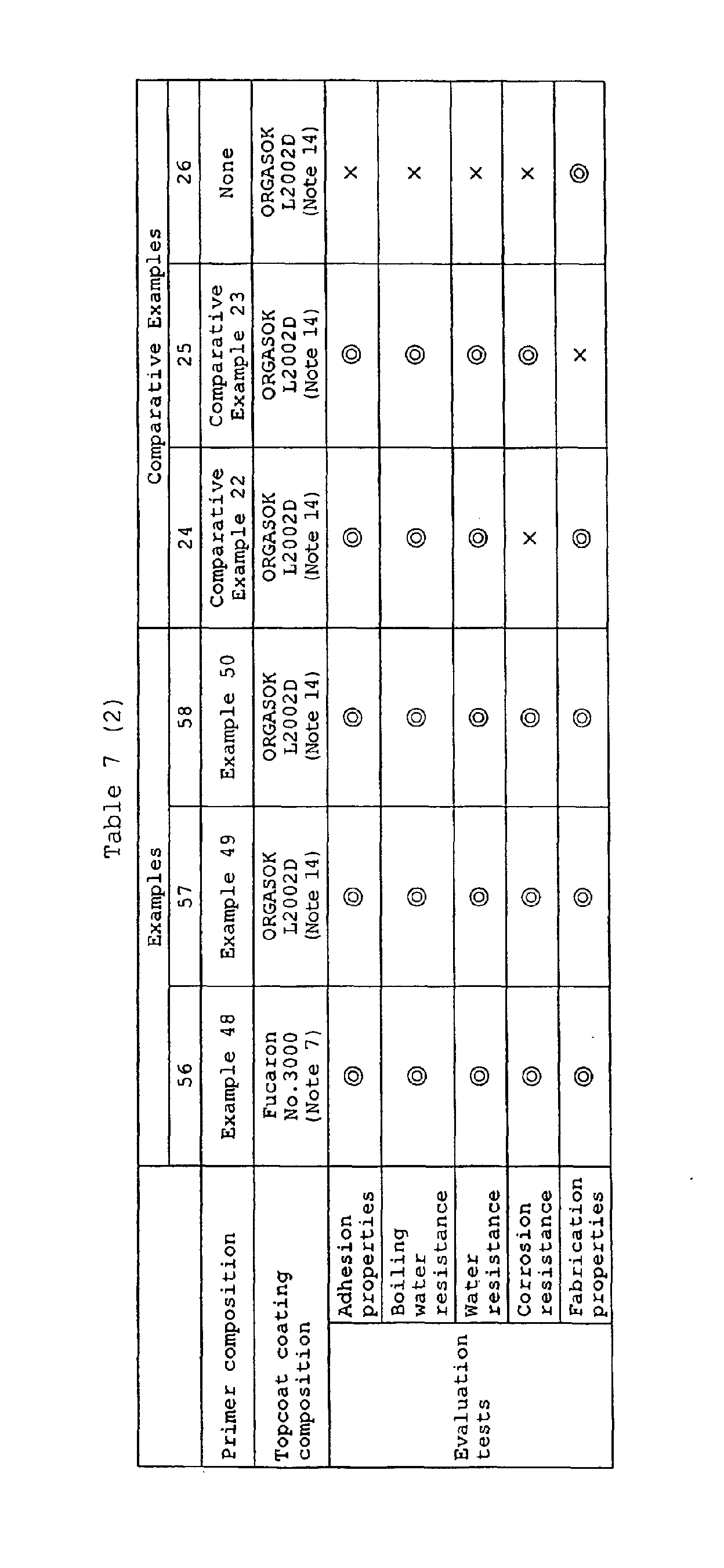
The present invention can provide a metal object-coating
method capable of forming a protective coating film
showing good properties in heat resistance, corrosion
resistance and impact resistance, along with improved
adhesion properties of the thermoplastic resin coating film
and good adhesion properties thereof to impact.
The metal object-coating method of the present is
suitably applicable to metal pipings for use in the
automobile.
Claims (12)
- A metal object-coating method, which method comprises coating a primer composition (I) prepared by adding an inorganic anti-corrosive agent to at least one binder component selected from the group consisting of a binder component (A) containing an epoxy resin and at least one of amino resin and phenol resin, a binder component (B) containing a polyester resin, epoxy resin and phenol resin, and a binder component (C) containing α-olefin·α,β-ethylenically unsaturated carboxylic acid copolymer resin onto the surface of a metal object coating substrate to form a primer coating film layer, followed by coating a topcoat coating composition consisting of a thermoplastic resin based coating composition (II) onto the primer coating film layer to form a topcoat coating film layer consisting of a thermoplastic resin coating film layer.
- A metal object-coating method as claimed in claim 1, wherein the thermoplastic resin-based coating composition (II) is a vinyl fluoride resin based coating composition, a vinylidene fluoride resin based coating composition or a polyamide resin based coating composition.
- A metal object-coating method as claimed in claim 1 or 2, wherein the binder component (A) is such that the epoxy resin is in the range of 56 to 98% by weight, at least one of the amino resin and phenol resin is in the range of 2 to 44% by weight based on a total solid content of the epoxy resin and at least one of the amino resin and phenol resin respectively.
- A metal object-coating method as claimed in claim 1 or 2, wherein the binder component (A) is such that the epoxy resin is in the range of 56 to 98% by weight, the amino resin is in the range of 1 to 22% by weight, and the phenol resin is in the range of 1 to 22% by weight based on a total solid content of the epoxy resin and at least one of the amino resin and phenol resin respectively.
- A metal object-coating method as claimed in claim 1 or 2, wherein the binder component (B) is such that the polyester resin is in the range of 30 to 98% by weight, the epoxy resin is in the range of 1 to 50% by weight, and the phenol resin is in the range of 1 to 50% by weight based on a total solid content of the polyester resin, epoxy resin and phenol resin respectively.
- A metal object-coating method as claimed in claim 1 or 2, wherein the inorganic anti-corrosive agent is in the range of 3 to 200 parts by weight per 100 parts by weight of a resin solid content in the primer composition.
- A metal object-coating method as claimed in claim 1, wherein the α-olefin·α,β-ethylenically unsaturated carboxylic acid copolymer resin is an ethylene·acrylic acid copolymer resin.
- A metal object-coating method as claimed in claim 1, wherein an amount of the α,β-ethylenically unsaturated carboxylic acid in the copolymer resin is 5 to 30% by weight based on a total amount of the monomers of the copolymer resin.
- A metal object-coating method as claimed in any one of claims 1 to 8, wherein the inorganic anti-corrosive agent is at least one anti-corrosive pigment selected from the group consisting of a condensed phosphate based anti-corrosive agent, molybdate based anti-corrosive agent and silica.
- A metal object-coating method as claimed in claim 9, wherein the inorganic anti-corrosive agent is at least one pigment selected from the group consisting of a pigment prepared by treating the surface of aluminum dihydrogen tripolyphosphate with magnesium hexasilicate, a magnesium phosphate based anti-corrosive pigment and an amorphous silica.
- A primer composition used in the method as claimed in any one of claims 1 to 10.
- A metal object coated by the method as claimed in any one of claims 1 to 10.
Applications Claiming Priority (7)
| Application Number | Priority Date | Filing Date | Title |
|---|---|---|---|
| JP2001319876 | 2001-10-17 | ||
| JP2001319876 | 2001-10-17 | ||
| JP2001362187 | 2001-11-28 | ||
| JP2001362187 | 2001-11-28 | ||
| JP2002006172 | 2002-01-15 | ||
| JP2002006172 | 2002-01-15 | ||
| PCT/JP2002/010734 WO2003033173A1 (en) | 2001-10-17 | 2002-10-16 | Process for coating metallic bodies and primer compositions to be used in the process |
Publications (2)
| Publication Number | Publication Date |
|---|---|
| EP1442799A1 true EP1442799A1 (en) | 2004-08-04 |
| EP1442799A4 EP1442799A4 (en) | 2008-05-07 |
Family
ID=27347693
Family Applications (1)
| Application Number | Title | Priority Date | Filing Date |
|---|---|---|---|
| EP02777857A Withdrawn EP1442799A4 (en) | 2001-10-17 | 2002-10-16 | Process for coating metallic bodies and primer compositions to be used in the process |
Country Status (4)
| Country | Link |
|---|---|
| EP (1) | EP1442799A4 (en) |
| JP (1) | JP4263099B2 (en) |
| KR (1) | KR20040054727A (en) |
| WO (1) | WO2003033173A1 (en) |
Cited By (11)
| Publication number | Priority date | Publication date | Assignee | Title |
|---|---|---|---|---|
| WO2008152461A1 (en) * | 2007-06-15 | 2008-12-18 | Basf Coatings Japan Ltd. | Primer composition |
| WO2008155611A1 (en) * | 2007-06-19 | 2008-12-24 | Basf Coatings Japan Ltd. | Primer composition |
| WO2009001182A1 (en) * | 2007-06-22 | 2008-12-31 | Basf Coatings Japan Ltd. | Primer composition |
| WO2009007809A1 (en) * | 2007-06-20 | 2009-01-15 | Basf Coatings Japan Ltd. | Primer composition |
| EP1947154A4 (en) * | 2005-10-20 | 2011-12-14 | Chugoku Marine Paints | POLYFUNCTIONAL EPOXY RESIN COATING COMPOSITION CONTAINING RUST-PROOF PIGMENT, COATING FILM OBTAINED THEREFROM, COATED FILM-COATED BASE, AND RUST-PROTECTION METHOD |
| CN103602208A (en) * | 2013-10-10 | 2014-02-26 | 安徽真信涂料有限公司 | A kind of high temperature resistant flame retardant antirust paint and preparation method thereof |
| WO2014072249A1 (en) * | 2012-11-07 | 2014-05-15 | Basf Se | Mixtures for the coating of metallic surfaces |
| CN104194568A (en) * | 2014-09-18 | 2014-12-10 | 苏州圣谱拉新材料科技有限公司 | Antirust primer for automobile accessories and preparation method thereof |
| CN104212342A (en) * | 2014-09-18 | 2014-12-17 | 江苏海晟涂料有限公司 | Heat insulation and corrosion prevention coating and preparation method thereof |
| CN104962179A (en) * | 2015-07-22 | 2015-10-07 | 河北晨阳工贸集团有限公司 | Primer applicable to security door and preparation method of primer |
| CN113150646A (en) * | 2021-04-02 | 2021-07-23 | 湖北巴司特科技股份有限公司 | Preparation method of novel inorganic hybrid modified epoxy coating |
Families Citing this family (5)
| Publication number | Priority date | Publication date | Assignee | Title |
|---|---|---|---|---|
| JP4569101B2 (en) * | 2003-12-02 | 2010-10-27 | Jfeスチール株式会社 | Pre-coated steel sheet coating composition and pre-coated steel sheet |
| KR101290581B1 (en) * | 2011-05-26 | 2013-07-29 | 신평기 | Resin-coated aluminum pipe and process for producing the same |
| JP6422023B2 (en) * | 2015-01-19 | 2018-11-14 | アイカ工業株式会社 | Resin composition for metal coating and coating method |
| KR101744505B1 (en) | 2015-08-19 | 2017-06-28 | 삼화페인트공업주식회사 | Metal frame and coating method thereof |
| CN113789094A (en) * | 2021-09-06 | 2021-12-14 | 华迪钢业集团有限公司 | High-temperature-resistant seamless stainless steel pipe and machining process thereof |
Family Cites Families (11)
| Publication number | Priority date | Publication date | Assignee | Title |
|---|---|---|---|---|
| GB1254048A (en) * | 1969-07-12 | 1971-11-17 | Toyo Seikan Kaisha Ltd | Primer for metals |
| JPS5182326A (en) * | 1975-01-17 | 1976-07-19 | Shinto Paint Co Ltd | KINZOKUYO PURAIMAASOSEIBUTSU |
| JPS58133871A (en) * | 1982-02-05 | 1983-08-09 | Asahi Glass Co Ltd | Corrosion preventive coating method |
| JPS5991055A (en) * | 1982-11-18 | 1984-05-25 | 三井化学株式会社 | Olefin group polymer metallic laminate |
| JPS59150575A (en) * | 1983-02-17 | 1984-08-28 | Ube Ind Ltd | Coating method for metal surface |
| JPH0372578A (en) * | 1989-05-30 | 1991-03-27 | Kansai Paint Co Ltd | Double-layered coating film for can internal surface |
| JP2863861B2 (en) * | 1989-08-04 | 1999-03-03 | 久保孝ペイント株式会社 | Antirust paint and coating method using the same |
| US5562989A (en) * | 1992-08-18 | 1996-10-08 | E. I. Du Pont De Nemours And Company | Method of protecting metal against corrosion with thermoplatic coatings |
| JP3952218B2 (en) * | 1996-04-18 | 2007-08-01 | 東洋紡績株式会社 | Painted metal plate |
| JP4554001B2 (en) * | 1999-01-06 | 2010-09-29 | 三井・デュポンポリケミカル株式会社 | Rust-proof paint and rust-proof metal material |
| JP2001106967A (en) * | 1999-10-04 | 2001-04-17 | Kansai Paint Co Ltd | Water-based coating composition and coated article coated with the composition |
-
2002
- 2002-10-16 EP EP02777857A patent/EP1442799A4/en not_active Withdrawn
- 2002-10-16 JP JP2003535953A patent/JP4263099B2/en not_active Expired - Lifetime
- 2002-10-16 KR KR10-2004-7005714A patent/KR20040054727A/en not_active Ceased
- 2002-10-16 WO PCT/JP2002/010734 patent/WO2003033173A1/en not_active Ceased
Cited By (13)
| Publication number | Priority date | Publication date | Assignee | Title |
|---|---|---|---|---|
| EP1947154A4 (en) * | 2005-10-20 | 2011-12-14 | Chugoku Marine Paints | POLYFUNCTIONAL EPOXY RESIN COATING COMPOSITION CONTAINING RUST-PROOF PIGMENT, COATING FILM OBTAINED THEREFROM, COATED FILM-COATED BASE, AND RUST-PROTECTION METHOD |
| WO2008152461A1 (en) * | 2007-06-15 | 2008-12-18 | Basf Coatings Japan Ltd. | Primer composition |
| WO2008155611A1 (en) * | 2007-06-19 | 2008-12-24 | Basf Coatings Japan Ltd. | Primer composition |
| WO2009007809A1 (en) * | 2007-06-20 | 2009-01-15 | Basf Coatings Japan Ltd. | Primer composition |
| WO2009001182A1 (en) * | 2007-06-22 | 2008-12-31 | Basf Coatings Japan Ltd. | Primer composition |
| WO2014072249A1 (en) * | 2012-11-07 | 2014-05-15 | Basf Se | Mixtures for the coating of metallic surfaces |
| CN103602208A (en) * | 2013-10-10 | 2014-02-26 | 安徽真信涂料有限公司 | A kind of high temperature resistant flame retardant antirust paint and preparation method thereof |
| CN103602208B (en) * | 2013-10-10 | 2016-01-20 | 安徽真信涂料有限公司 | A kind of high-temperature-resistant flame-retardant anti-rust paint and preparation method thereof |
| CN104194568A (en) * | 2014-09-18 | 2014-12-10 | 苏州圣谱拉新材料科技有限公司 | Antirust primer for automobile accessories and preparation method thereof |
| CN104212342A (en) * | 2014-09-18 | 2014-12-17 | 江苏海晟涂料有限公司 | Heat insulation and corrosion prevention coating and preparation method thereof |
| CN104962179A (en) * | 2015-07-22 | 2015-10-07 | 河北晨阳工贸集团有限公司 | Primer applicable to security door and preparation method of primer |
| CN113150646A (en) * | 2021-04-02 | 2021-07-23 | 湖北巴司特科技股份有限公司 | Preparation method of novel inorganic hybrid modified epoxy coating |
| CN113150646B (en) * | 2021-04-02 | 2022-07-08 | 湖北巴司特科技股份有限公司 | Preparation method of novel inorganic hybrid modified epoxy coating |
Also Published As
| Publication number | Publication date |
|---|---|
| KR20040054727A (en) | 2004-06-25 |
| JP4263099B2 (en) | 2009-05-13 |
| EP1442799A4 (en) | 2008-05-07 |
| WO2003033173A1 (en) | 2003-04-24 |
| JPWO2003033173A1 (en) | 2005-02-03 |
Similar Documents
| Publication | Publication Date | Title |
|---|---|---|
| JP4263099B2 (en) | Metal object coating method and primer composition used in the method | |
| CA1325928C (en) | Chip resistant coatings | |
| US5527840A (en) | Aqueous coating composition | |
| US5001173A (en) | Aqueous epoxy resin compositions and metal substrates coated therewith | |
| JP2007314762A (en) | Powder coating composition and heavy anticorrosion coated steel material using the same | |
| US5082698A (en) | Aqueous epoxy resin compositions and metal substrates coated therewith | |
| JPWO2006038491A1 (en) | Thermosetting powder coating composition | |
| US20050276983A1 (en) | Metal object-coating method and primer composition used in the same | |
| JP2006219731A (en) | Coating material composition for rear surface of precoated metal and precoated metal obtained by using the same | |
| JP2002121469A (en) | Aqueous coating composition and coated article coated with this composition | |
| JPH11241048A (en) | Aqueous coating composition and coated article coated with this composition | |
| WO2002048234A2 (en) | Epoxy resins and process for making the same | |
| JP3276633B2 (en) | Resin composition for water-based paint | |
| JP2002121470A (en) | Aqueous paint composition and coated article coated with this paint composition | |
| WO2009001182A1 (en) | Primer composition | |
| Tess | Epoxy resin coatings | |
| JPH028789B2 (en) | ||
| JPS5993758A (en) | Primer composition | |
| JP4463895B2 (en) | Multi-layer coating formation method | |
| US6689831B1 (en) | Chromium-free, curable coating compositions for metal substrates | |
| JPH10259229A (en) | Aqueous coating composition and coating obtained therefrom | |
| KR100573428B1 (en) | Aqueous coating composition | |
| JPH08325509A (en) | Thermosetting aqueous composition for metal coating | |
| JP3233721B2 (en) | Cationic electrodeposition coating composition | |
| JPS61162563A (en) | Highly corrosion proof steel plate and production thereof |
Legal Events
| Date | Code | Title | Description |
|---|---|---|---|
| PUAI | Public reference made under article 153(3) epc to a published international application that has entered the european phase |
Free format text: ORIGINAL CODE: 0009012 |
|
| 17P | Request for examination filed |
Effective date: 20040506 |
|
| AK | Designated contracting states |
Kind code of ref document: A1 Designated state(s): AT BE BG CH CY CZ DE DK EE ES FI FR GB GR IE IT LI LU MC NL PT SE SK TR |
|
| AX | Request for extension of the european patent |
Extension state: AL LT LV MK RO SI |
|
| A4 | Supplementary search report drawn up and despatched |
Effective date: 20080408 |
|
| 17Q | First examination report despatched |
Effective date: 20081117 |
|
| STAA | Information on the status of an ep patent application or granted ep patent |
Free format text: STATUS: THE APPLICATION IS DEEMED TO BE WITHDRAWN |
|
| 18D | Application deemed to be withdrawn |
Effective date: 20090328 |