EP1441365A1 - Proton conducting membrane-process for its production-and fuel cells made by using the same - Google Patents
Proton conducting membrane-process for its production-and fuel cells made by using the same Download PDFInfo
- Publication number
- EP1441365A1 EP1441365A1 EP02802706A EP02802706A EP1441365A1 EP 1441365 A1 EP1441365 A1 EP 1441365A1 EP 02802706 A EP02802706 A EP 02802706A EP 02802706 A EP02802706 A EP 02802706A EP 1441365 A1 EP1441365 A1 EP 1441365A1
- Authority
- EP
- European Patent Office
- Prior art keywords
- group
- conducting membrane
- proton conducting
- compound
- general formula
- Prior art date
- Legal status (The legal status is an assumption and is not a legal conclusion. Google has not performed a legal analysis and makes no representation as to the accuracy of the status listed.)
- Withdrawn
Links
- 0 C*(C(C)(C)N(C)C*)[Cn] Chemical compound C*(C(C)(C)N(C)C*)[Cn] 0.000 description 6
- JAPMJSVZDUYFKL-UHFFFAOYSA-N C1C2C1CCC2 Chemical compound C1C2C1CCC2 JAPMJSVZDUYFKL-UHFFFAOYSA-N 0.000 description 1
Images

Classifications
-
- C—CHEMISTRY; METALLURGY
- C08—ORGANIC MACROMOLECULAR COMPOUNDS; THEIR PREPARATION OR CHEMICAL WORKING-UP; COMPOSITIONS BASED THEREON
- C08G—MACROMOLECULAR COMPOUNDS OBTAINED OTHERWISE THAN BY REACTIONS ONLY INVOLVING UNSATURATED CARBON-TO-CARBON BONDS
- C08G77/00—Macromolecular compounds obtained by reactions forming a linkage containing silicon with or without sulfur, nitrogen, oxygen or carbon in the main chain of the macromolecule
- C08G77/04—Polysiloxanes
- C08G77/22—Polysiloxanes containing silicon bound to organic groups containing atoms other than carbon, hydrogen and oxygen
- C08G77/28—Polysiloxanes containing silicon bound to organic groups containing atoms other than carbon, hydrogen and oxygen sulfur-containing groups
-
- H—ELECTRICITY
- H01—ELECTRIC ELEMENTS
- H01M—PROCESSES OR MEANS, e.g. BATTERIES, FOR THE DIRECT CONVERSION OF CHEMICAL ENERGY INTO ELECTRICAL ENERGY
- H01M8/00—Fuel cells; Manufacture thereof
- H01M8/02—Details
-
- C—CHEMISTRY; METALLURGY
- C08—ORGANIC MACROMOLECULAR COMPOUNDS; THEIR PREPARATION OR CHEMICAL WORKING-UP; COMPOSITIONS BASED THEREON
- C08G—MACROMOLECULAR COMPOUNDS OBTAINED OTHERWISE THAN BY REACTIONS ONLY INVOLVING UNSATURATED CARBON-TO-CARBON BONDS
- C08G77/00—Macromolecular compounds obtained by reactions forming a linkage containing silicon with or without sulfur, nitrogen, oxygen or carbon in the main chain of the macromolecule
- C08G77/48—Macromolecular compounds obtained by reactions forming a linkage containing silicon with or without sulfur, nitrogen, oxygen or carbon in the main chain of the macromolecule in which at least two but not all the silicon atoms are connected by linkages other than oxygen atoms
- C08G77/50—Macromolecular compounds obtained by reactions forming a linkage containing silicon with or without sulfur, nitrogen, oxygen or carbon in the main chain of the macromolecule in which at least two but not all the silicon atoms are connected by linkages other than oxygen atoms by carbon linkages
-
- C—CHEMISTRY; METALLURGY
- C08—ORGANIC MACROMOLECULAR COMPOUNDS; THEIR PREPARATION OR CHEMICAL WORKING-UP; COMPOSITIONS BASED THEREON
- C08J—WORKING-UP; GENERAL PROCESSES OF COMPOUNDING; AFTER-TREATMENT NOT COVERED BY SUBCLASSES C08B, C08C, C08F, C08G or C08H
- C08J5/00—Manufacture of articles or shaped materials containing macromolecular substances
- C08J5/20—Manufacture of shaped structures of ion-exchange resins
- C08J5/22—Films, membranes or diaphragms
- C08J5/2206—Films, membranes or diaphragms based on organic and/or inorganic macromolecular compounds
- C08J5/2275—Heterogeneous membranes
-
- H—ELECTRICITY
- H01—ELECTRIC ELEMENTS
- H01B—CABLES; CONDUCTORS; INSULATORS; SELECTION OF MATERIALS FOR THEIR CONDUCTIVE, INSULATING OR DIELECTRIC PROPERTIES
- H01B1/00—Conductors or conductive bodies characterised by the conductive materials; Selection of materials as conductors
- H01B1/06—Conductors or conductive bodies characterised by the conductive materials; Selection of materials as conductors mainly consisting of other non-metallic substances
- H01B1/12—Conductors or conductive bodies characterised by the conductive materials; Selection of materials as conductors mainly consisting of other non-metallic substances organic substances
- H01B1/122—Ionic conductors
-
- H—ELECTRICITY
- H01—ELECTRIC ELEMENTS
- H01M—PROCESSES OR MEANS, e.g. BATTERIES, FOR THE DIRECT CONVERSION OF CHEMICAL ENERGY INTO ELECTRICAL ENERGY
- H01M8/00—Fuel cells; Manufacture thereof
- H01M8/10—Fuel cells with solid electrolytes
- H01M8/1016—Fuel cells with solid electrolytes characterised by the electrolyte material
- H01M8/1018—Polymeric electrolyte materials
- H01M8/102—Polymeric electrolyte materials characterised by the chemical structure of the main chain of the ion-conducting polymer
- H01M8/1037—Polymeric electrolyte materials characterised by the chemical structure of the main chain of the ion-conducting polymer having silicon, e.g. sulfonated crosslinked polydimethylsiloxanes
-
- H—ELECTRICITY
- H01—ELECTRIC ELEMENTS
- H01M—PROCESSES OR MEANS, e.g. BATTERIES, FOR THE DIRECT CONVERSION OF CHEMICAL ENERGY INTO ELECTRICAL ENERGY
- H01M8/00—Fuel cells; Manufacture thereof
- H01M8/10—Fuel cells with solid electrolytes
- H01M8/1016—Fuel cells with solid electrolytes characterised by the electrolyte material
- H01M8/1018—Polymeric electrolyte materials
- H01M8/1069—Polymeric electrolyte materials characterised by the manufacturing processes
- H01M8/1072—Polymeric electrolyte materials characterised by the manufacturing processes by chemical reactions, e.g. in situ polymerisation or in situ crosslinking
- H01M8/1074—Sol-gel processes
-
- C—CHEMISTRY; METALLURGY
- C08—ORGANIC MACROMOLECULAR COMPOUNDS; THEIR PREPARATION OR CHEMICAL WORKING-UP; COMPOSITIONS BASED THEREON
- C08J—WORKING-UP; GENERAL PROCESSES OF COMPOUNDING; AFTER-TREATMENT NOT COVERED BY SUBCLASSES C08B, C08C, C08F, C08G or C08H
- C08J2383/00—Characterised by the use of macromolecular compounds obtained by reactions forming in the main chain of the macromolecule a linkage containing silicon with or without sulfur, nitrogen, oxygen, or carbon only; Derivatives of such polymers
- C08J2383/04—Polysiloxanes
- C08J2383/06—Polysiloxanes containing silicon bound to oxygen-containing groups
-
- H—ELECTRICITY
- H01—ELECTRIC ELEMENTS
- H01M—PROCESSES OR MEANS, e.g. BATTERIES, FOR THE DIRECT CONVERSION OF CHEMICAL ENERGY INTO ELECTRICAL ENERGY
- H01M2300/00—Electrolytes
- H01M2300/0017—Non-aqueous electrolytes
- H01M2300/0065—Solid electrolytes
- H01M2300/0082—Organic polymers
-
- H—ELECTRICITY
- H01—ELECTRIC ELEMENTS
- H01M—PROCESSES OR MEANS, e.g. BATTERIES, FOR THE DIRECT CONVERSION OF CHEMICAL ENERGY INTO ELECTRICAL ENERGY
- H01M2300/00—Electrolytes
- H01M2300/0088—Composites
- H01M2300/0091—Composites in the form of mixtures
-
- H—ELECTRICITY
- H01—ELECTRIC ELEMENTS
- H01M—PROCESSES OR MEANS, e.g. BATTERIES, FOR THE DIRECT CONVERSION OF CHEMICAL ENERGY INTO ELECTRICAL ENERGY
- H01M4/00—Electrodes
- H01M4/86—Inert electrodes with catalytic activity, e.g. for fuel cells
- H01M4/8605—Porous electrodes
-
- H—ELECTRICITY
- H01—ELECTRIC ELEMENTS
- H01M—PROCESSES OR MEANS, e.g. BATTERIES, FOR THE DIRECT CONVERSION OF CHEMICAL ENERGY INTO ELECTRICAL ENERGY
- H01M8/00—Fuel cells; Manufacture thereof
- H01M8/10—Fuel cells with solid electrolytes
- H01M8/1016—Fuel cells with solid electrolytes characterised by the electrolyte material
- H01M8/1018—Polymeric electrolyte materials
- H01M8/1041—Polymer electrolyte composites, mixtures or blends
- H01M8/1046—Mixtures of at least one polymer and at least one additive
- H01M8/1051—Non-ion-conducting additives, e.g. stabilisers, SiO2 or ZrO2
-
- Y—GENERAL TAGGING OF NEW TECHNOLOGICAL DEVELOPMENTS; GENERAL TAGGING OF CROSS-SECTIONAL TECHNOLOGIES SPANNING OVER SEVERAL SECTIONS OF THE IPC; TECHNICAL SUBJECTS COVERED BY FORMER USPC CROSS-REFERENCE ART COLLECTIONS [XRACs] AND DIGESTS
- Y02—TECHNOLOGIES OR APPLICATIONS FOR MITIGATION OR ADAPTATION AGAINST CLIMATE CHANGE
- Y02E—REDUCTION OF GREENHOUSE GAS [GHG] EMISSIONS, RELATED TO ENERGY GENERATION, TRANSMISSION OR DISTRIBUTION
- Y02E60/00—Enabling technologies; Technologies with a potential or indirect contribution to GHG emissions mitigation
- Y02E60/30—Hydrogen technology
- Y02E60/50—Fuel cells
-
- Y—GENERAL TAGGING OF NEW TECHNOLOGICAL DEVELOPMENTS; GENERAL TAGGING OF CROSS-SECTIONAL TECHNOLOGIES SPANNING OVER SEVERAL SECTIONS OF THE IPC; TECHNICAL SUBJECTS COVERED BY FORMER USPC CROSS-REFERENCE ART COLLECTIONS [XRACs] AND DIGESTS
- Y02—TECHNOLOGIES OR APPLICATIONS FOR MITIGATION OR ADAPTATION AGAINST CLIMATE CHANGE
- Y02P—CLIMATE CHANGE MITIGATION TECHNOLOGIES IN THE PRODUCTION OR PROCESSING OF GOODS
- Y02P70/00—Climate change mitigation technologies in the production process for final industrial or consumer products
- Y02P70/50—Manufacturing or production processes characterised by the final manufactured product
-
- Y—GENERAL TAGGING OF NEW TECHNOLOGICAL DEVELOPMENTS; GENERAL TAGGING OF CROSS-SECTIONAL TECHNOLOGIES SPANNING OVER SEVERAL SECTIONS OF THE IPC; TECHNICAL SUBJECTS COVERED BY FORMER USPC CROSS-REFERENCE ART COLLECTIONS [XRACs] AND DIGESTS
- Y10—TECHNICAL SUBJECTS COVERED BY FORMER USPC
- Y10T—TECHNICAL SUBJECTS COVERED BY FORMER US CLASSIFICATION
- Y10T442/00—Fabric [woven, knitted, or nonwoven textile or cloth, etc.]
- Y10T442/20—Coated or impregnated woven, knit, or nonwoven fabric which is not [a] associated with another preformed layer or fiber layer or, [b] with respect to woven and knit, characterized, respectively, by a particular or differential weave or knit, wherein the coating or impregnation is neither a foamed material nor a free metal or alloy layer
- Y10T442/2418—Coating or impregnation increases electrical conductivity or anti-static quality
- Y10T442/2467—Sulphur containing
Definitions
- the proton conducting inorganic material is crushed to be mixed with an elastomer (Japanese Patent Application Laid-Open No.8-249923) or with a polymer containing sulfonic acid group (Japanese Patent Application Laid-Open No.10-69817).
- Japanese Patent Application Laid-Open No.8-249923 Japanese Patent Application Laid-Open No.8-249923
- a polymer containing sulfonic acid group Japanese Patent Application Laid-Open No.10-69817
- these methods have their own problems.
- the polymer as the binder for each of these methods is merely mixed with an inorganic crosslinked compound, and has basic thermal properties not much different from those of the polymer itself, with the result that it undergoes structural changes in a high temperature range, failing to stably exhibit proton conductivity, and its proton conductivity is generally not high.
- the first aspect of the present invention is a proton conducting membrane crosslinkable and having a crosslinked structure by the silicon-oxygen bond, wherein the proton conducting membrane comprises
- the 23 rd aspect of the present invention is the proton conducting membrane of the 21 st or 22 nd aspect, wherein the whiskers (L) are of boron carbide, silicon carbide, alumina, aluminum borate, silicon nitride or K 2 O ⁇ 6TiO 2 .
- the 56 th aspect of the present invention is the method of the 54 th aspect for producing the proton conducting membrane, wherein the crosslinking agent (G) is of a hydrolyzable, metallic compound having Ti, Zr or Al.
- the membrane having a crosslinked structure at a sufficient crosslinking density will no longer undergo significant changes in size and hence in strength under dry and wet conditional cycles.
- the crosslinked structure can be formed by incorporating, e.g., epoxy, crosslinkable acrylic, melamine or unsaturated polyester resin.
- such a crosslinked structure is not sufficiently stable for extended periods for a fuel cell membrane, which is exposed to high temperature and humidity under a strongly acidic condition resulting from the presence of proton.
- the hydrolyzable silyl compounds as the starting materials for these compounds are supplied by Gelest, Inc.
- the crosslinkable, starting compounds can be produced by hydrosilylation of trialkoxysilane, dialkoxyalkylsilane or monoalkoxydialkylsilane with a commercial reagent, e.g., 1,2,4-trivinyl cyclohexane, triallylamine or the like (e.g., those supplied by Aldrich) in the presence of chloroplatinic acid as a catalyst.
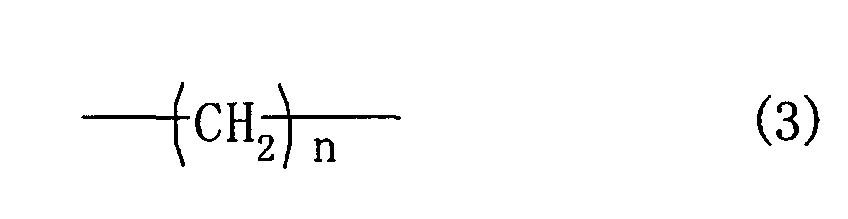
- the hydrocarbons include alkylene and aromatic-containing chains. Of these, particularly preferable ones include straight-chain molecular chains composed of polymethylene chain free of branch or the like. They are represented, e.g., by the general formula (3): (wherein, "n" is an integer of 1 to 30).
- R 1 is branched, for example, the methine hydrogen in the branch may be pulled out by an active radical or the like produced while the fuel cell is working to cut the bond which connects the crosslinks to each other.
- the benzyl site may become an active site to trigger decomposition or another reaction, to possibly deteriorate stability of the membrane.
- R 3 preferably has a structure represented by the general formula (6): (wherein, "n" is an integer of 1 to 20).
- the portion bound to sulfonic acid may be methine-structured, with the result that sulfonic acid may be similarly eliminated/released by oxidation or the like.
- the short fibrous material (J) is preferably in the form of short glass fibers (M) or whiskers (L).
- the short glass fibers (M) can be produced from glass fibers by an adequate method, e.g., crushing.
- the whiskers (L) are fine fibers of crystalline structure, and used for reinforcing the membrane to prevent cracking.
- the whiskers preferably have dimensions of diameter: 0.1 to 3 ⁇ m, length: 1 to 20 ⁇ m and aspect ratio: 5 to 100, more preferably 10 to 50. When excessively fine, the whiskers will agglomerate with each other, and difficult to handle. When excessively coarse, they may not fully exhibit the reinforcing effect.
- This method comprises, as described above, the first step of preparing a mixture containing an organic/inorganic hybrid, crosslinkable compound (C) and compound (D), the former having 2 or more crosslinkable silyl groups and carbon atoms each being bonded to the silyl group via the covalent bond and the latter having a crosslinkable silyl group and acid group, second step of forming the above mixture into a film, and third step of hydrolyzing/condensing or only condensing the hydrolyzable silyl group contained in the mixture formed into the film to form a crosslinked structure. It is described in more detail for the starting materials and treatment conditions, among others, for these steps orderly.
- a vinyl siloxane compound with trimethoxysilane, dimethoxymetylsilane or methoxydimethylsilane added to the vinyl group by hydrosilylation is also suitably used.
- These vinyl compounds include polydimethylsiloxane with vinyl at the terminal, diphenylsiloxane-dimethylsiloxane copolymer with vinyl at the terminal, polyphenylmethylsiloxane with vinyl at the terminal, polyvinylmethylsiloxane, vinyl methylsiloxane-dimethylsiloxane copolymer, vinyl methylsiloxane-diphenylsiloxane copolymer, vinyl methylsiloxane-trifluoropropylmethylsiloxane copolymer and polyvinylmethoxysiloxane.
- the compound (E) containing a mercapto group is not limited so long as it has a mercapto group and crosslinkable silyl group.
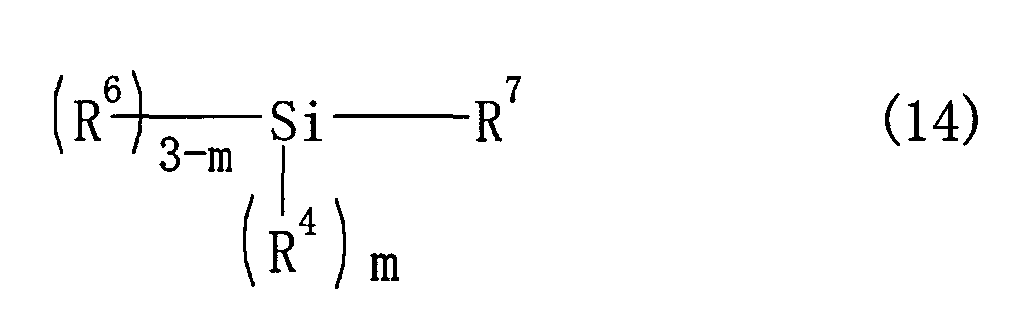
- a compound represented by the general formula (14) is suitably used: (wherein, R 7 is a molecular chain group having at least one mercapto group; R 4 is methyl, ethyl, propyl or phenyl group; R 6 is Cl, or OCH 3 , OC 2 H 5 , OC 6 H 5 , OH or OCOCH 3 group; and "m" is 0, 1 or 2).
- a membrane was prepared in the same manner as in EXAMPLE 1, except that 0.6g of bis[3-(triethoxysilyl)propyl]tetrasulfide (Gelest, Inc. SIB1825.0), 1.1g of bis3-(triethoxysilyl)octane and 0.3g of 1N hydrochloric acid were used, and the water washing step was saved.
- the membrane was immersed in 20g of a 30% aqueous solution of hydrogen peroxide at 50°C continuously for 3 hours. The membrane was withdrawn from the system, after it was cooled, immersed in 1N sulfuric acid over a night, and then washed in a flow of water at 60°C for 2 hours.
- Table 1 The evaluation results and the like of the membrane are given in Table 1.
- a membrane was prepared in the same manner as in EXAMPLE 8, except that 3-mercaptopropyltrimethoxysilane was replaced by 3-mercaptopropyltrimethoxysilane-methyltrimethoxysilane cooligomer (Shin-etsu Silicones X-41-1810).
- the cooligomer's molar equivalent was set at the same level as that of the mercapto group.
- the evaluation results and the like of the membrane are given in Table 1.
- a membrane was prepared in the same manner as in EXAMPLE 17.
- the evaluation results and the like of the membrane are given in Table 1.
- the present invention provides a crosslinkable, proton-conducting membrane having a crosslinked structure by a silicon-oxygen bond, well serviceable at high temperature by satisfying the requirements of comprising (a) an organic/inorganic hybrid structure (A) covalently bonded to 2 or more silicon-oxygen crosslinks and, at the same time, having a carbon atom, and (b) an acid containing structure (B) having an acid group, covalently bonded to a silicon-oxygen crosslink and having an acidic group
- A organic/inorganic hybrid structure
- B an acid containing structure having an acid group, covalently bonded to a silicon-oxygen crosslink and having an acidic group
- the membrane of the present invention can increase operating temperature to 100°C or higher for a PEFC, which has been attracting much attention recently, and hence can improve power generation efficiency and reduce poisoning of the catalyst by CO.
- a fuel cell operating at high temperature allows to utilize its waste heat for cogeneration to produce power and heat, thus drastically enhancing its total energy efficiency.
Landscapes
- Chemical & Material Sciences (AREA)
- Engineering & Computer Science (AREA)
- Manufacturing & Machinery (AREA)
- Chemical Kinetics & Catalysis (AREA)
- General Chemical & Material Sciences (AREA)
- Medicinal Chemistry (AREA)
- Health & Medical Sciences (AREA)
- Polymers & Plastics (AREA)
- Organic Chemistry (AREA)
- Sustainable Energy (AREA)
- Electrochemistry (AREA)
- Sustainable Development (AREA)
- Life Sciences & Earth Sciences (AREA)
- Crystallography & Structural Chemistry (AREA)
- Dispersion Chemistry (AREA)
- Physics & Mathematics (AREA)
- Spectroscopy & Molecular Physics (AREA)
- Inorganic Chemistry (AREA)
- Materials Engineering (AREA)
- Conductive Materials (AREA)
- Fuel Cell (AREA)
- Silicon Polymers (AREA)
- Manufacture Of Macromolecular Shaped Articles (AREA)
Abstract
Description
Fuel cells generally fall into several categories by electrolyte type. Of these, a polymer electrolyte fuel cell (sometimes referred to as PEFC), being more compact and generating higher output than any other type, is considered to be a leading fuel cell type in the future for various purposes, e.g., small-size on-site facilities, and as power sources for movable applications (e.g., vehicles) and portable applications.
In the fuel cell, the proton conducting membrane is responsible for transferring the proton produced on the anode to the cathode side. As described above, flow of the proton takes place in concert with that of the electron. It is therefore necessary to conduct a sufficient quantity of the proton at high speed, for the PEFC to produce high output (or high current density). Therefore, it is not too much to say that performance of the proton conducting membrane is a key to performance of the PEFC. The proton conducting membrane also works as the insulation film which electrically insulates the anode and cathode from each other and as the fuel barrier membrane which prevents the fuel to be supplied to the anode side from leaking to the cathode side, in addition to transferring the proton.
For these reasons, the maximum allowable temperature for stable operation for extended periods is normally considered to be 80°C.
Thus, operability of PEFCs at high temperature is demanded from various aspects. Nevertheless, however, its operating temperature is limited to 80°C by the heat resistance consideration of the proton conducting membrane, as discussed above at present.
Some of more representative ones are heat-resistant aromatic-based polymers to replace the conventional fluorine-based membranes. These include polybenzimidazole (Japanese Patent Application Laid-Open No.9-110982), polyether sulfone (Japanese Patent Application Laid-Open Nos.10-21943 and 10-45913), and polyetheretherketone (Japanese Patent Application Laid-Open No.9-87510).
These aromatic-based polymers have an advantage of limited structural changes at high temperature. However, many of them have the aromatic structure directly incorporated with sulfonic acid or carboxylic acid group. They tend to suffer notable desulfonation or decarboxylation at high temperature, and are unsuitable for the membranes working at high temperature.










For example, a NafionR (Du Pont) membrane, which represents the fluorine-based resin membranes, is greatly swollen under a wet condition to lose strength, although strong and flexible under a dry condition. A membrane which shows a significantly increased size under a wet condition from that under a dry condition causes various problems, e.g., difficulty in making a membrane-electrode assembly (sometimes referred to as MEA), and possible failure of the membrane or MEA while the fuel cell is working, because the membrane invariably expands or contracts under changed temperature and humidity conditions within the fuel cell as a result of the changed operational conditions. Moreover, failure of the membrane is possibly caused not only by the dimensional change but also by a differential pressure produced within the cell, because of its decreased strength under a wet condition.
The crosslinked structure can be formed by incorporating, e.g., epoxy, crosslinkable acrylic, melamine or unsaturated polyester resin. However, such a crosslinked structure is not sufficiently stable for extended periods for a fuel cell membrane, which is exposed to high temperature and humidity under a strongly acidic condition resulting from the presence of proton.
The crosslinked structure for the proton-conducting membrane of the present invention is mainly formed by silicon-oxygen bond. However, the other metal-oxygen bonds may be used, so long as they make no sacrifice of the cost and easiness of the production process. Moreover, silicon-oxygen bond may be used in combination with phosphorus-oxygen or boron-oxygen bond. When silicon-oxygen bond is used in combination with another metal-oxygen bond, the ratio of silicon to the other metal in the crosslinked structure is generally 50% by mol or more per 100% by mol of the total metallic atoms, although not determined sweepingly.
Proton-conducting membranes including a silicon-oxygen bond have been studied for fuel cells. Each of these membranes is produced by the sol-gel process involving hydrolysis/condensation using tetraethoxy or tetramethoxy silane as the starting material. For example, the process proposed by Minami et al., described earlier, gives a proton-conducting membrane durable to high temperature (Solid State Ionics, 74 (1994), P. 105).
However, the sol-gel process involving only an inorganic material gives a glassy, hard, fragile membrane. A proton-conducting membrane is generally produced to have a thickness of 100µm or less. A glassy, fragile membrane 100µm or less in thickness will be easily cracked, when it is assembled with an electrode, incorporated in a fuel cell or working in the fuel cell. It is therefore difficult to use such a membrane for a fuel cell. It is in itself difficult to produce a defect-free membrane having a sufficient size (e.g., 10 square inches) to be assembled into a fuel cell.
For example, Poinsignon et al. propose a process for condensing benzyltriethoxysilane, n-hexyltriethoxysilane or triethoxysilane (Electrochimica Acta, 37 (1992), P.1615). It is reported that the membrane produced by this process, although having flexibility to some extent, is soluble in water, when benzyltriethoxysilane, for example, is sulfonated, because of greatly reduced substantial crosslinking density. They attempt to further incorporate the crosslinked structure to prevent the above problem. However, the resultant membrane becomes fragile, and fails to achieve originally intended flexibility. In other words, it is impossible to produce a flexible membrane when an alkyl- or aryl-substituted silicon-oxygen crosslinked structure has the crosslink only at one terminal.
On the other hand, the proton-conducting membrane of the present invention includes the organic/inorganic hybrid structure (A), described above, as the basic crosslinked structure. The membrane including such a compound can have adjusted membrane properties, beginning with flexibility, by designing the molecular structure between the crosslinked structures. Fuel gas barrier capacity as one of the important properties for a fuel cell membrane can be adjusted by controlling crosslinking density and structure.
First, the structures having 3 or more crosslinked sites are described. These are some of the examples which can be easily obtained commercially or synthesized, and the present invention is by no means limited them. The term "crosslinkable silyl group" described herein is a silicon oxide group bonded to a crosslinking group via a covalent bond. For example, those having 3 crosslinked sites include 1,3,5-tris (crosslinkable silylethyl)-2,4,6-trimethyl benzene, tris (p-crosslinkable silylpropylphenyl)amine and tris (p-crosslinkable silylpropyl)isocyanurate. The hydrolyzable silyl compounds as the starting materials for these compounds are supplied by Gelest, Inc.
Moreover, for 1,2,4-tri(crosslinkable silylethyl)cyclohexane, tri(crosslinkable silylpropyl)amine and the like, the crosslinkable, starting compounds can be produced by hydrosilylation of trialkoxysilane, dialkoxyalkylsilane or monoalkoxydialkylsilane with a commercial reagent, e.g., 1,2,4-trivinyl cyclohexane, triallylamine or the like (e.g., those supplied by Aldrich) in the presence of chloroplatinic acid as a catalyst.
The crosslinkable, starting compounds can be produced by the reaction with, e.g., 3-triethoxysilylpropylisocyanate or the like for those having 3 hydroxyl or amino groups in the molecular structure, and by the reaction with, e.g., 3-triethoxysilylpropylamine for those having a reactive group, e.g., isocyanate, in the molecular structure.
Some of the crosslinkable precursors for these structures are commercially available and directly used. They can be synthesized from those precursors having an unsaturated bond by hydrosilylation of the corresponding silyl compounds. They can be similarly synthesized when the precursors have hydroxyl, amino group or the like.
Popall et al. propose a similar system, which is a coating material with a silicon-oxygen crosslink at one terminal and another crosslink with epoxy or methacrylic group at the other terminal (Electrochimica Acta, 43 (1998), P.1301). These crosslinked structures, however, have the ether or ester bond amenable to hydrolysis under the high temperature/humidity and strongly acidic conditions produced while the fuel cell is working, the former bond being produced by the epoxy crosslinking and the latter left by the methacrylic bond crosslinking. The crosslinked structure should be highly resistant to acid and heat, e.g., that formed by a crosslinking group such as Si-O, like the one used for the present invention, to be used for a fuel cell. The mixed system of organic and inorganic crosslinks proposed by Popall et al. is intended for a patterning material but not for a fuel cell membrane. The one for a patterning material is similar to that for a fuel cell, but technically quite different, because of different objects and functions.
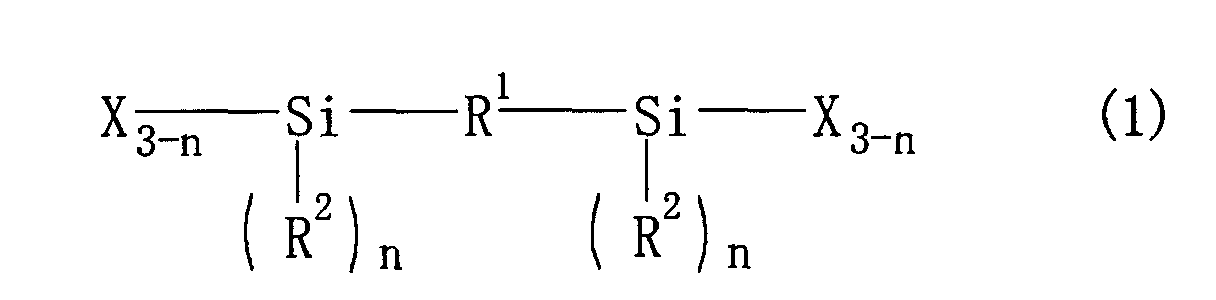
R1 is a carbon-containing group for controlling membrane properties, e.g., flexibility. The membrane will be hard and fragile when it contains no carbon atom. It will be insufficiently crosslinked and sufficient heat resistance will be no longer expected, when the chain has more than 50 carbon atoms.
The preferred embodiments of R1 include hydrocarbon groups. R1 may contain a hetero atom, but may be decomposed when exposed to an acid or heat. By contrast, a hydrocarbon compound is resistant to an acid, and very stable. The hydrocarbons include alkylene and aromatic-containing chains.
Of these, particularly preferable ones include straight-chain molecular chains composed of polymethylene chain free of branch or the like. They are represented, e.g., by the general formula (3):

When R1 is branched, for example, the methine hydrogen in the branch may be pulled out by an active radical or the like produced while the fuel cell is working to cut the bond which connects the crosslinks to each other. When it contains an aromatic compound, mainly the benzyl site may become an active site to trigger decomposition or another reaction, to possibly deteriorate stability of the membrane. R1 containing a hydrocarbon compound having an aromatic ring is more stable than that having a hetero atom, but possibility of decomposition cannot be ruled out when the fuel cell works for extended periods.
By contrast, when R1 is a straight-chain polymethylene chain, it makes the structure stable to attacks by an acid, radical or the like. Such a structure is suitable for a heat-resistant fuel cell membrane. The straight-chain polymethylene chain is not only stable but also of flexible structure, and can impart adequate flexibility to the membrane. Therefore, the membrane can be adjusted for denseness, the adjustment mainly achieved by molecular length of the polymethylene chain.
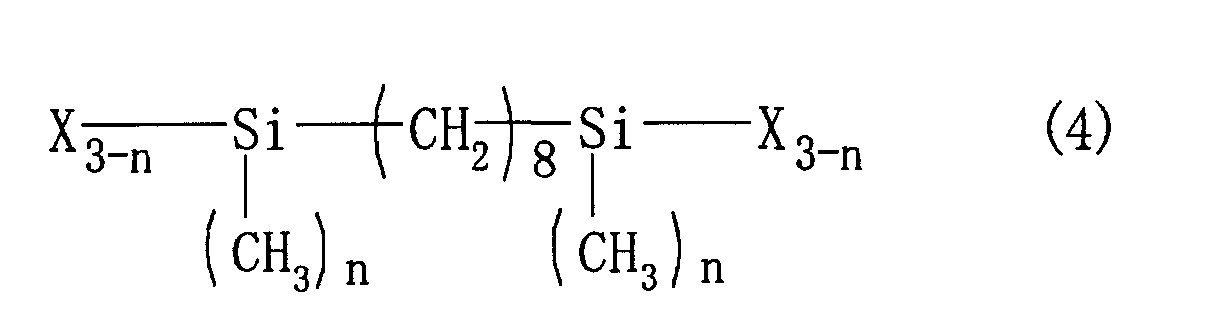
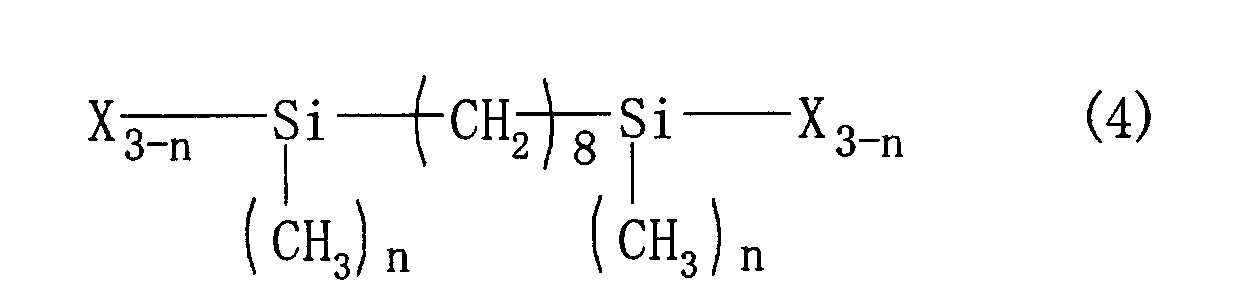
The polymethylene having a molecular length of 1 to 30 can give the membrane which satisfies all of the properties of heat resistance, flexibility and fuel gas barrier characteristics. The membrane tends to be more flexible as methylene molecular chain length increases, and tougher as it decreases, although not sweepingly generalized, because these properties are also affected by number of the crosslinking groups. Of these polymethylenes, those having the structure with 8 methylenes connected in series, represented by the general formula (4), are more preferable for their availability:
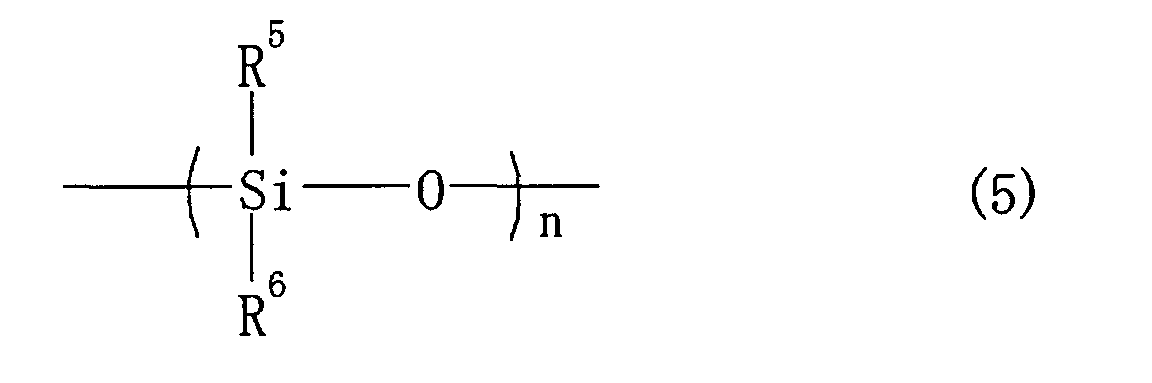
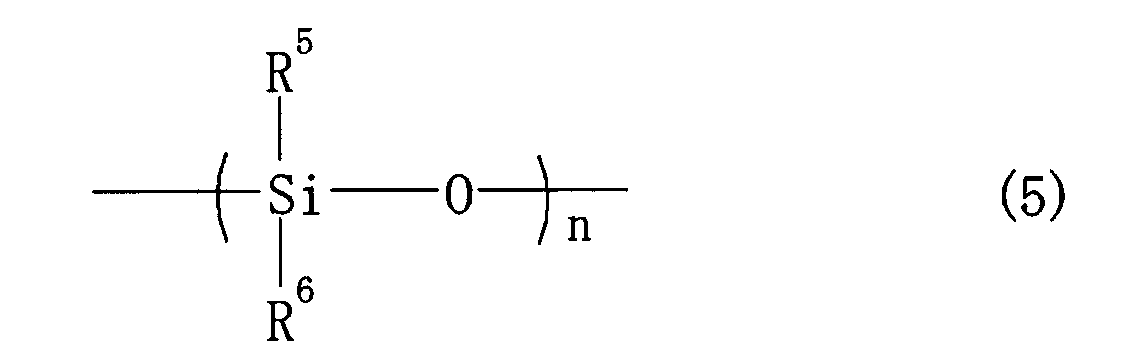
The siloxane compound may have a branched or cyclic structure, or the like, but is particularly preferably of straight-chain structure for its high flexibility. These straight-chain siloxane compounds have a structure represented by the general formula (5):
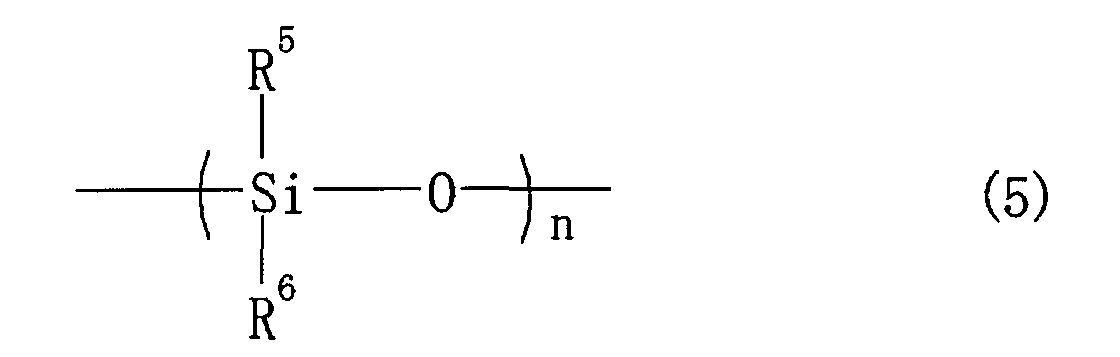
R5 and R6 are generally methyl group for the dimethyl siloxane structure. However, those having ethyl, propyl or phenyl group to increase solubility can be also suitably used. These siloxane compounds can be produced from those having alkoxysilyl, silanol, halogenated silyl or silanolate group at the corresponding siloxane terminal as the starting compounds, which are commercialized by, e.g., Gelest, Inc.
The siloxane compound with silanol group at the terminal may be reacted with tetraethoxysilane, tetraacetoxysilane or hydrolyzable metallic compound of Ti, Zr, Al or the like, to be more crosslinkable beforehand.
The structure of the straight-chain siloxane with the Si-O crosslink at the terminal is very stable and useful as the basic crosslinked structure for proton-conducting membranes for fuel cells.
The organic/inorganic hybrid structure (A) may be composed of 2 or more structure types. For example, it may be a mixture of organic/inorganic hybrid structure having a hydrocarbon compound and that having a siloxane compound. Such a mixture can be adjusted for crosslinking density or the like by the composition, and hence for membrane flexibility, gas barrier characteristics or the like. The membrane properties can be also adjusted by mixing organic/inorganic hybrid structures of different organic chain length, crosslinking group number, substituent type or the like.
When the acid group is extracted and released out of the membrane in the presence of water supplied to the fuel cell or of water or the like produced while the fuel cell is working, proton concentration in the membrane decreases to deteriorate its proton conductivity. Therefore, some measures are preferably taken to securely hold the acid in the membrane stably for extended periods, e.g., by covalently bonding the acid instead of ionic interactions. NafionR, for example, contains sulfonic acid via covalent bond, and it is known that the sulfonic acid group itself is stably kept in the membrane for extended periods, although the membrane may be deteriorated by the creep phenomenon.
However, it has preferably a structure by the general formula (2):
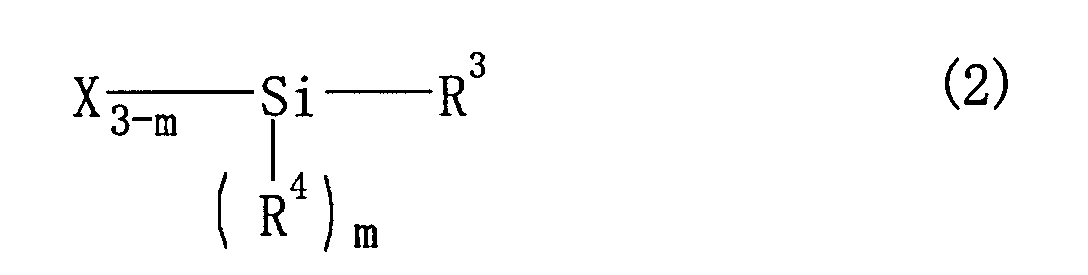
R3 has at least one acid group and is bound to the crosslinking group via a covalent bond. Various acid groups are useful for the present invention. For example, they include sulfonic, phosphonic, carboxylic, sulfuric, phosphoric and boric acid, of which sulfonic acid is particularly preferable, because it has a low pKa value, can secure proton in the membrane at a sufficiently high concentration and is thermally stable.
When the acid group is sulfonic acid, R3 preferably has a structure represented by the general formula (6):

Of these structures, the one having "n" of 3 is particularly preferable because it is easily obtained; 3-trihydroxysilylpropylsulfonic acid, which can be used as the starting material, is commercialized by Gelest, Inc., and the synthesis process using allyl bromide as the starting compound is already established.
The (A)/(B) ratio is normally in a range from 1:9 to 9:1, although varying depending on structure of each structure and process by which the membrane is produced.
The fibrous material (I) should be resistant to high temperature and acid concentration within a fuel cell. Those suitably used for the present invention include fluorine resin represented by polytetrafluoroethylene, cyclic polyolefin resin, high-molecular-weight polyolefin and inorganic materials, e.g., glass as the materials resistant to these severe environments.
Of these, fluorine resin is particularly preferable as a reinforcing agent for the proton-conducting membrane of the present invention for its high chemical stability. Those fluorine resins useful for the fibrous material for the present invention include Tomoegawa Paper's P-50. Moreover, porous membranes, e.g., Advantech's H020A142C and Nihon Millipore's membrane filter JG, are also useful. These fluorine materials may not be always adhesive securely to a proton-conducting material. Therefore, they may be surface treated, as required, by a wet process with a silane coupling agent, or dry process, e.g., corona or plasma treatment.
The glass fiber material is highly adhesive to the organic/inorganic hybrid structure (A) and acid-containing structure (B). Silanol group, when left on the glass fiber surfaces, can react with the structures (A) and (B), to make the glass fibers highly fast adhesive to the structures (A) and (B). Therefore, it brings a desirable effect for the present invention.
Alkali- or acid-resistant glass is more preferable than common E glass for the fibrous material, because it is more resistant to acid, which is present at a high concentration within a fuel cell.
Glass is an inorganic material generally composed of SiO2, B2O3, P2O5, Al2O3, among others, as the major ingredients, and normally incorporated with an alkali component, e.g., Na2O or K2O, to decrease softening temperature.
Alkali-resistant glass may be incorporated with a Ca2O component to prevent flow of alkali, and means glass having a chemical formula represented by Na2O-ZrO2 (TiO2)-SiO2. It is accepted that increasing ZrO2 content increases resistance to alkali.
Acid-resistant glass preferably contains an alkali component, e.g., Na2O or K2O, at a lower content. For example, quartz glass mainly composed of SiO2, or borosilicate glass mainly composed of SiO2, B2O3 and the like are suitably used.
The fibrous material (I) may morphologically fall into short fibrous material (J) and long fibrous material (K). Each is described in detail.
The present invention may be incorporated with a short fibrous material (J) only, long fibrous material (K) only or combination thereof as the fibrous material (I).
The fibrous material (I), when composed of glass or another inorganic material, can be treated at high temperature or by oxidation to activate the surface. This surface treatment is preferable for the present invention, because it improves its adhesion to the organic/inorganic hybrid structure
The fibrous material may be also treated with a silane coupling agent, which can be selected from the commercial products in consideration of its adhesion to the organic/inorganic hybrid structure (A) and acid-containing structure (B).
The suitable silane coupling agent contains an acid group and can impart proton conductivity to the fibrous material (I) surface. These silane coupling agents include 3-trihydroxysilylpropanesulfonic acid. The fibrous material (I) may be also treated for silane coupling with a sulfur-containing compound, e.g., 3-mercaptopropyltriethoxysilane and then for oxidation, or treated with a halogenated silane coupling agent, e.g., 3-bromopropyltriethoxysilane and then treated to substitute the halogen group by sulfurous acid. The other common treatment methods with a silane coupling agent include drying and/or baking a mixture of alkoxysilane or halogenated silane and the fibrous material (I) after hydrolyzing the former to be compatible with the latter.
The whiskers (L) are fine fibers of crystalline structure, and used for reinforcing the membrane to prevent cracking. The whiskers preferably have dimensions of diameter: 0.1 to 3µm, length: 1 to 20µm and aspect ratio: 5 to 100, more preferably 10 to 50. When excessively fine, the whiskers will agglomerate with each other, and difficult to handle. When excessively coarse, they may not fully exhibit the reinforcing effect. The materials for the whiskers (L) include boron carbide, silicon carbide, alumina, aluminum borate, silicon nitride and K2O ·6TiO2. The reinforcing agent preferably has a functional group (e.g., OH group), on the surface, which can trigger the silane coupling reaction, to have improved adhesion to the hardenable material which forms the silicon-oxygen bond. The whiskers (L) can have an activated surface when treated for oxidation on the surface.
When excessively incorporated, the whiskers (L) may not be dispersed sufficiently to possibly cause excessive permeation of the gas, and may decrease conductivity of the membrane. When incorporated insufficiently, they may not fully exhibit their effect. Therefore, they are incorporated at 1 to 75 parts by weight per 100 parts by weight of the organic/inorganic hybrid structure (A) and acid-containing structure (B) totaled.
The most simple method to incorporate the short fibrous material (J) into the proton-conducting membrane is mixing it with the organic/inorganic hybrid structure (A) and acid-containing structure (B) while the starting solution of these structures are prepared. They are preferably mixed by a homogenizer or ball mill, to strongly agitate them to prevent agglomeration. The mixture is preferably used immediately after it is prepared to prevent separation, or else treated to have a certain viscosity to prevent the mixture from being easily separated.
The preferable materials for the long fibrous material (K) include fluorine resin represented by polytetrafluoroethylene, and glass, in particular glass, for their excellent adhesion to the crosslinked structure (A).
The glass fibers are preferably, in particular, 10mm long or more and continuous, viewed from the reinforcing effect. They are also preferably 3 to 20µm in diameter, more preferably 9 to 13µm. When finer than 3µm, they tend to be scattered into air. Moreover, it is accepted that they can easily enter the blood tubes to injure human health. The fibers having a diameter larger than 20µm are extremely stimulus to the human skin, and are not well distributed in the paper-making step, which is later described, to cause an uneven distribution.
The short glass fibers can be well dispersed when mixed and agitated with the starting materials for the structures (A) and (B). However, the long glass fibers may not be evenly distributed in the proton-conducting membrane of the present invention, unless they are dispersed beforehand in the form of thin film. The glass fiber forms are described in detail.
The proton-conducting membrane of the present invention is normally 10 to 300µm thick, preferably 30 to 100µm thick.
The membrane thinner than 10µm may be insufficiently durable and tends to suffer defects, e.g., pinholes. The one thicker than 300µm has excessively high resistance to conduction, and is also unsuitable for fuel cells as an electrolytic membrane.
The glass fibers for the proton-conducting membrane fall into 3 types in consideration of the limitation of membrane thickness; woven fabric, non-woven fabric and glass fiber paper made by a paper-making process. Of these, woven and non-woven fabric can be selected, when the glass fibers are used as the continuous ones. The fabric is preferably of a type which can use continuous fibers in order to exhibit a sufficient strength in the form of thin film.
The woven fabrics may be square, diagonal, Turkish satin, gauze elastic, and leno weaves, among others, of which a square weave is particularly preferable for the present invention to prevent elongation of the membrane. The square weave is preferably not excessively tight to reduce its effect of blocking proton conductance in the membrane, because the ion conductance passages may be blocked in an excessively tight membrane. A fairly coarse weave, e.g., that of yarns thinned out on every other yarn, is preferable. Such a weave is referred to as thirled, square weave in the present invention.
The square weave structure is defined by yarn count and density (pitch), among others. The following structure is preferable for the proton conducting membrane of the present invention.
The yarn is a bundle of 50 to 1000 twisted glass fibers, and its count is represented by Tex having a unit of mass (g) per 1000m. Its count is preferably 3 to 50 Tex. The finer yarn is more easily cut in the production process, although showing better properties. The yarn thicker than 50 Tex is difficult to make the base on the thin film suitable for the proton conducting membrane.
Weave density, which is referred to as count density or pitch, means number of the yarns per 25mm width. The weave of low density cannot exhibit the reinforcing effect sufficiently. Conversely, weave density is limited by fineness of the yarn. The weave preferably has a density of 40 to 200 yarns/25mm width.
Thickness of the square weave is essentially determined by the above specifications, 20 to 100µm based on the above specifications.
Density (mass per unit area), which is related to thickness, is normally 10 to 50g/m2, preferably 15 to 25 g/m2 for the same reasons described above.
The long fibrous material (K) cannot directly form a uniform composite structure, even when mixed beforehand with the starting materials for the organic/inorganic hybrid structure (A) and acid-containing structure (B), unlike the short fibrous material (J). Therefore, it preferably has a specific shape (sheet) before it is incorporated.
The long fibrous material (K), to be incorporated to form a composite structure, is preferably loaded with a starting mixture of the organic/inorganic hybrid structure (A) and acid-containing structure (B). It may be loaded by pressing or the liquid, starting mixture on the sheet, or rolling. The loading method can be optionally selected from the known, simple ones.
The loading methods are described above for glass fibers. However, the similar methods are applicable to the other fibrous materials, e.g., those composed of fluorine resin, cyclopolyolefin resin or high-molecular-weight polyolefin resin.
These additives include the following i) to iv):
Content of these additives is not limited so long as it is not harmful to performance of the membrane. However, content of the total additives is preferably 50% or less by weight based on the total membrane weight, although not sweepingly generalized, because content not harmful to the performance greatly varies additive by additive.
It is described in more detail for the starting materials and treatment conditions, among others, for these steps orderly.
The first method of the present invention first prepares a mixture containing an organic/inorganic hybrid, crosslinkable compound (C) and acid containing compound (D).
The proton conducting membrane of the present invention should satisfy the requirements of simultaneously containing (a) an organic/inorganic hybrid structure (A) covalently bonded to 2 or more silicon-oxygen crosslinks and having a carbon atom, and (b) an acid containing structure (B) having an acid group, covalently bonded to a silicon-oxygen crosslink and having an acidic group. Therefore, the starting materials each corresponding to the organic/inorganic hybrid structure (A) or acid containing structure (B) are used to form the crosslinked structure.
A hydrolyzable silyl group is one of the crosslinking precursors for forming the crosslinked structure. The hydrolyzable silyl group as the crosslinking precursor forms the crosslink composed of the Si-O bond by hydrolysis and subsequent condensation. This process is known as the sol-gel process.
It is important for the present invention to use an organic/inorganic hybrid, crosslinkable compound (C) having 2 or more crosslinkable silyl groups and carbon atoms each being bonded to the silyl group via the covalent bond, in order to form the organic/inorganic hybrid structure (A).
The crosslinkable compounds having 3 or more crosslinked sites include 1,3,5-tris(trichlorosilylethyl)-2,4,6-trimethylbenzene, tris(p-trichlorosilylpropylphenyl)amine and tris(3-trimethoxysilylpropyl)isocyanurate. They are commercialized by Gelest, Inc., and can be directly used as the crosslinkable compounds. Moreover, 1,2,4-trivinylcyclohexane and triallylamine (both commercialized by Aldrich) can be treated for hydrosilylation with trialkoxysilane, dialkoxyalkylsilane or monoalkoxydialkylsilane to produce the corresponding starting compounds. The starting compounds can be also produced by the reaction with, e.g., 3-triethoxysilylpropylisocyanate or the like for the compounds having hydroxyl or amino group in the molecular structure, and by the reaction with, e.g., 3-triethoxysilylpropylamine for those having a reactive group, e.g., isocyanate, in the molecular structure.
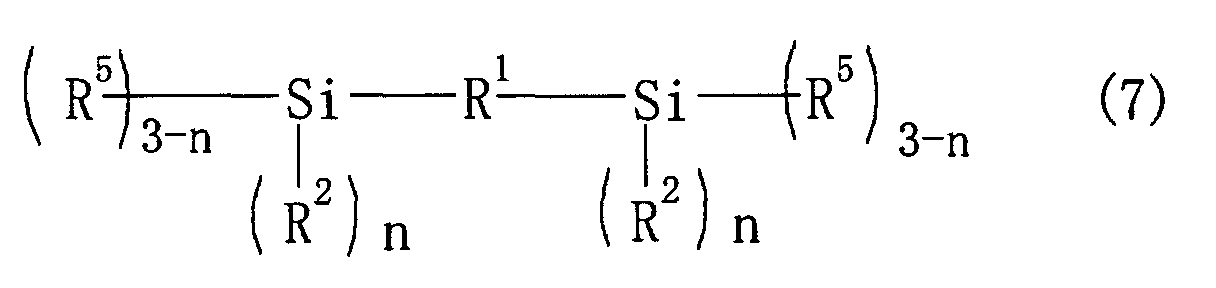
Some of the crosslinkable precursors for these structures are commercially available and directly used. They can be synthesized from the precursor having the corresponding unsaturated bond, when available, by hydrosilylation of the crosslinkable silyl compound.
Many compounds with a hydrocarbon as R1 are commercially available or easily synthesized. When it has an aromatic ring, divinylbenzene, 1,4'-divinylbiphenyl or divinylnaphthalene, for example, can be easily converted into the corresponding crosslinkable compound by hydrosilylation. Bis(trimethoxysilylethyl)benzene is commercialized by Gelest, Inc.

Other compounds of different chain length can be easily synthesized into the corresponding crosslinkable compounds by hydrosilylation of those compounds with unsaturated bonds at both terminals, e.g., 1,3 -butadiene, 1,9-decadiene, 1,13-tetradecadiene, 1,15-hexadecadiene and 1,21-docosadiene. Moreover, compounds of longer chain can be also synthesized.
For hydrosilylation of unsaturated bonds, functional group number of the crosslinking group can be freely selected when triethoxysilane, diethoxymethylsilane or ethoxydimethylsilane is used as the hydrosilyl compound, and hence crosslinking density or the like can be finely designed.
A siloxane-based compound can be suitably used for a proton-conducting membrane, because of its stability to acid and heat and resistance to oxidation.
Examples of these siloxane compounds are those represented by the general formula (10):

These siloxane-based compounds useful for the siloxane-based organic/inorganic hybrid, crosslinkable compound (C) for the present invention include, but not limited to, the following ones.
Polydimethylsiloxane with silanol at both terminals, polydiphenylsiloxane with silanol at both terminals, polydimethylsiloxane-polydiphenylsiloxane copolymer with silanol at both terminals, polydimethylsiloxane with chlorine at both terminals, polydimethylsiloxane with diacetoxymethyl at the terminal, polydimethylsiloxane with methoxy at the terminal, polydimethylsiloxane with dimethoxymethylsilyl at the terminal, polydimethylsiloxane with trimethoxysilyl at the terminal and methoxymethylsiloxane-dimethylsiloxane copolymer, which are commercialized by, e.g., Gelest, Inc.
Of these, a polydimethylsiloxane-based compound is particularly suitably used, because of its availability. The polydimethylsiloxane-based organic/inorganic hybrid, crosslinkable compound (C) is represented by the general formula (11):

In the first method of the present invention, it is important to use a compound (D) having a crosslinkable silyl group and acid group to form the crosslinked structure (B) containing an acid group. The compound (D) is not limited, so long as it contains a silyl group which can be bonded and acid group. For example, those compounds represented by the general formula (12) can be used:

Various acid groups are useful as the ones which R3 has. For example, they include sulfonic, phosphonic, carboxylic, sulfuric, phosphoric and boric acid, of which sulfonic acid is particularly preferable, because it has a low pKa value, can secure proton in the membrane at a sufficiently high concentration and is thermally stable.
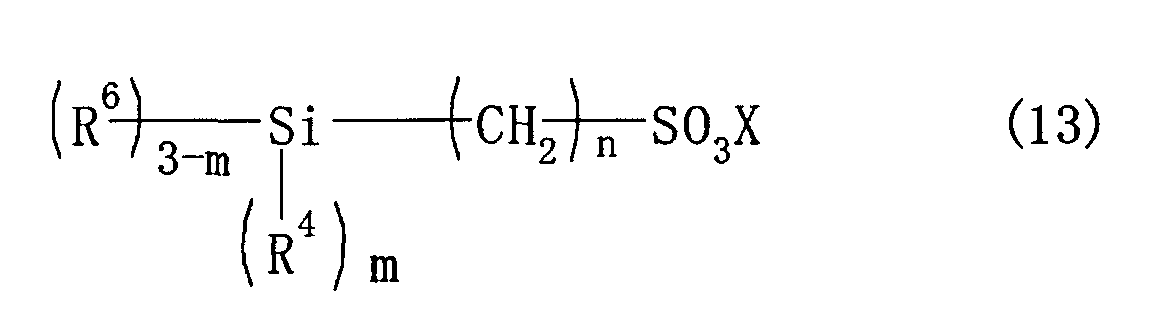
When the structure (B) containing an acid group has a structure represented by the general formula (6), the acid containing compound (D) as the starting material for the corresponding precursor has a structure represented by the general formula (13):
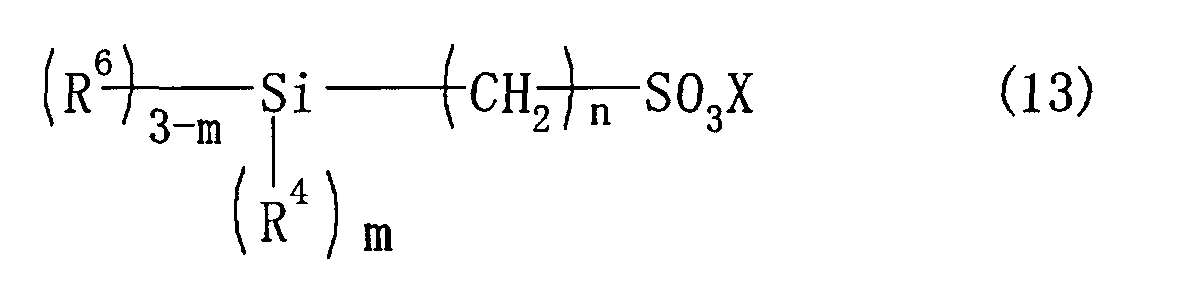
Of the starting compounds for these structures, trihydroxysilylpropylsulfonic acid for the structure having "n" of 3, commercialized by Gelest, Inc., is particularly preferable because of its availability.
Moreover, compounds disclosed by Japanese Patent Laid-open Publication No.54-138522 (USP 4,152,165) are also suitably used as the acid-containing compound (D).
A crosslinkable, metallic compound which gives another metal oxide (e.g., that of titanium, zirconium or aluminum oxide) can be suitably used as the crosslinking agent (G). These metallic compounds include mono-, di-, tri- or tetra-alkoxide of titanium, zirconium or aluminum. A crosslinkable metal containing a substituent, e.g., complex with acetylacetone, may be also incorporated to adjust reactivity. The crosslinked structure may be also incorporated with phosphoric, phosphorous or boric acid in combination with the above. Content of the hydrolyzable metallic compound other than silicon compound is not limited, but preferably 50% by mol or less on the hydrolyzable silyl group for cost and easiness of controlling the reaction.
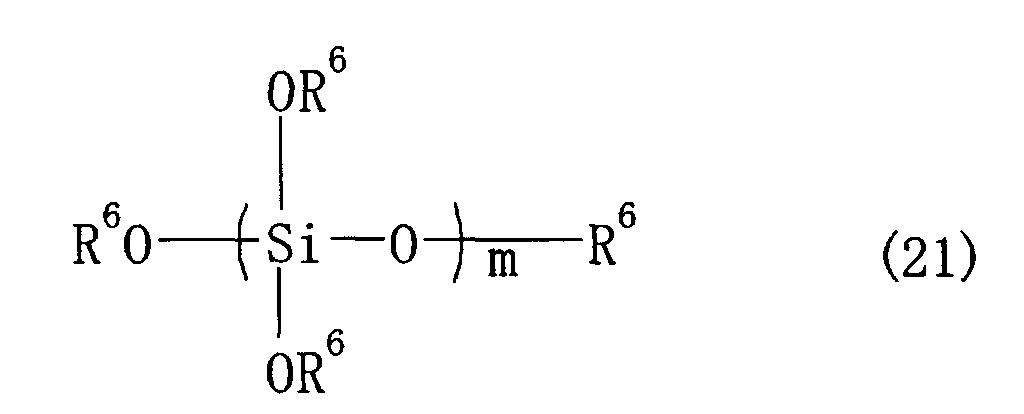
The hydrolyzable alkoxysilane polymer can be suitably used, because it has adequate crosslinking performance and its reactivity itself is easily controlled. When the organic/inorganic hybrid structure (A) has one silanol group at the terminal, in particular, use of the crosslinking agent (G) imparts adequate softness and strength simultaneously to the membrane.
Ratio of the solvent is not limited, but the content is preferably adjusted to give a solids concentration of 80 to 10% by weight.
The first step for mixing the starting compounds for the precursors may use another optional component, e.g., reinforcing agent, softening agent, surfactant, dispersant, reaction promoter, stabilizer, colorant, antioxidant, or inorganic or organic filler, within limits not harmful to the object of the present invention.
The mixing may be achieved by a known method, e.g., agitation or vibration. The mixing method is not limited, so long as it can sufficiently mix the materials. Heating, pressurizing, defoaming, degassing or the like may be used, as required.
The film-making method is not limited, so long as it can give a uniform film. Film thickness can be optionally varied in a range from 10µm to 1mm. It is adequately selected in consideration of proton conductivity, fuel permeability and mechanical strength of the film, among others. It is not limited, but preferably, in general, in a range from 30 to 300µm on a dry basis.
The film may be incorporated with a support or reinforcing agent of fibers, mat or fibrils during the film-making step. These are preferably of glass, silicon resin, fluorine resin or polymeric material in consideration of their resistance to heat and acid.
The objective membrane is produced under heating at an optional temperature in a range from room temperature to around 300°C in the crosslinking step. It is heated by a known method, e.g., heating in an oven, or in an autoclave under pressure.
The precursor mixture solution may be incorporated with water or heated in a hydrothermal condition beforehand to perform the hydrolysis/condensation more efficiently in the third step.
An acid, e.g., hydrochloric, sulfuric or phosphoric acid, may be incorporated as a catalyst beforehand in the reaction system, to accelerate formation of the crosslinked structure. Formation of the crosslinked structure can be accelerated also in the presence of a base. Therefore, a basic catalyst, e.g., ammonia or sodium hydroxide, may be also used.
When the proton-conducting membrane of the present invention is to be used at a high temperature of 100°C or higher, it is preferably heated at service temperature or higher. This can be achieved directly in the crosslinking step effected at 100 to 300°C, or by heating at 100 to 300°C subsequent to the crosslinking step where the membrane is hardened by the sol-gel process at, e.g., 5 to 40°C for 2 hours or more. It can be heated by an ordinary heat source, far-infrared ray, electromagnetic wave induction, microwaves, or a combination thereof.
The membrane undergoing these steps may be washed with water, as required. The washing medium is preferably distilled or ion-exchanged water free of metallic ion. It may be also treated with sulfuric acid or hydrogen peroxide, to remove impurities and unnecessary metallic ions, and thereby to further increase proton content in the membrane.
The treated membrane may be further irradiated with ultraviolet or electron beams to further increase extent of crosslinking.
The second method of the present invention first prepares a mixture containing an organic/inorganic hybrid, crosslinkable compound (C) and mercapto-containing compound (E) containing a crosslinkable silyl group and mercapto group.
The proton conducting membrane of the present invention should satisfy, as mentioned earlier, the requirements of simultaneously containing an organic/inorganic hybrid structure (A) and an acid-containing structure (B). Therefore, the starting materials each corresponding to the organic/inorganic hybrid structure (A) or acid-containing structure (B) are used to form the crosslinked structure.
Accordingly, an organic/inorganic hybrid, crosslinkable compound (C) as the starting material for the organic/inorganic hybrid structure (A) is the same as that for the first method.
For the starting material for the acid-containing structure (B), on the other hand, a compound (E) containing a mercapto group is used in place of a compound (D) containing an acid group for the first method. A mercapto group can be converted into sulfonic acid as a functional group, and the acid-containing structure (B) can be obtained by incorporation of the mercapto group followed by its oxidation.

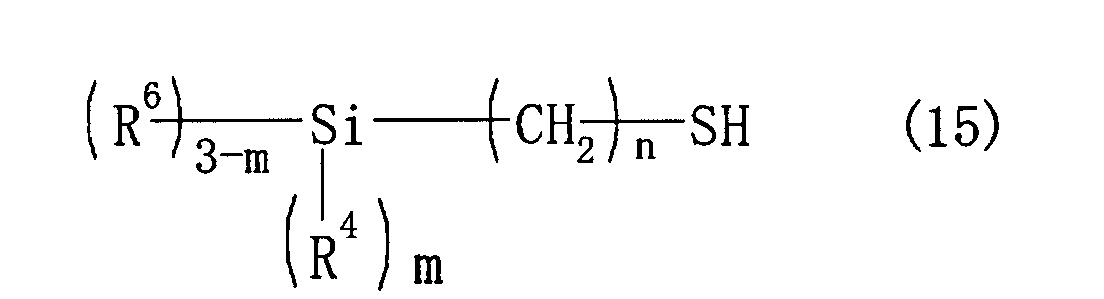
Of these compounds, the compound (E) containing a mercapto group is more preferably represented by the general formula (15) in consideration of stability of R7 to heat, acid and oxidation:
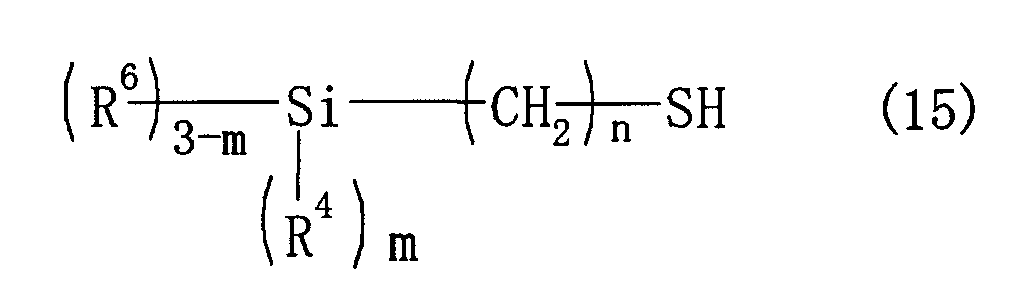
The compounds represented by the above formula are commercially available. The known ones include 3-mercaptopropyltrimethoxysilane, 3-mercaptopropyltriethoxysilane, 3-mercaptopropylmethyldimethoxysilane, mercaptomethyltrimethoxysilane and mercaptomethyldiethoxysilane.
The compounds useful for the compound (E) containing a mercapto group, other than those commercially available, can be easily synthesized by, e.g., reaction of sodium hydrosulfide with a halide having an alkoxysilyl group and halogenated alkyl, e.g., 3-chloropropyltrimethoxysilane, or hydrolysis of an alkyl group having an alkoxysilyl group and unsaturated bond, e.g., allyltriethoxysilane, after thioacetic acid or the like is added.
They may be a polymer or oligomer, which can be synthesized from the compound containing a mercapto group as the starting compound.
Examples of the polymers or oligomers have a structure represented by the general formula (16):
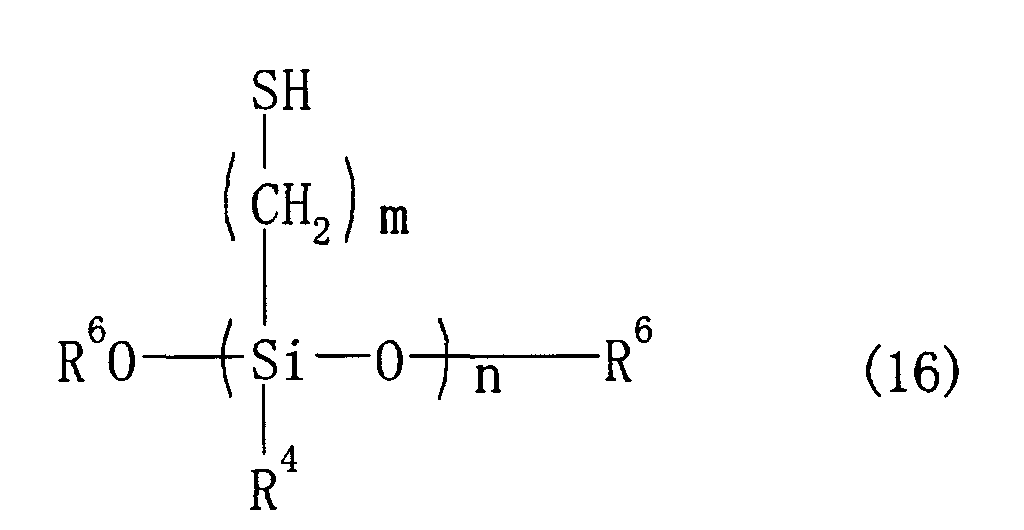
Moreover, "n" in the general formula (16) is preferably 3 or more, because the oxidation-produced sulfonic acid group has a chain structure, which accelerates the proton conduction and, at the same time, provides a strong polar field to allow water to be collected more efficiently. On the other hand, "n" above 500 is not preferable, because the molecule is difficult to synthesize, has reduced compatibility with the organic/inorganic hybrid, crosslinkable compound (C), and is difficult to form a uniform membrane. In particular, when R4 is a hydrocarbon group, inclusion of the molecule in the membrane is prevented because of reduced number of the functional groups, and substantially "n" is preferably 300 or less.
The compound represented by the general formula (16) with R4 of OCH3 group, "m" of 3 and "n" of 10 is commercialized by Shin-etsu Silicones (X-41-1805).
This oligomer can be also easily synthesized, e.g., by the method disclosed by Journal of Polymer Science, Part A, Polymer Chemistry, Vol.37, P.1017 (1999). This method can synthesize the oligomer and polymer having a molecular weight of up to several tens of thousands using the mercapto compound represented by the general formula (14) or (15) as the starting material by selecting an adequate reaction catalyst, and controlling quantity of water for hydrolysis and reaction time, among others. These oligomers and polymers can be readily available, and can be suitably used for the present invention.
For example, the compound represented by the general formula (16) with R4 of CH3 group, "m" of 3 and "n" of 3 to 300 can be synthesized by the method similar to that described in the above literature using 3-mercaptopropylmethyldimethoxysilane as a commercial product. These can give the membrane of high flexibility, and suitably used for the present invention.
Moreover, the oligomer or polymer represented by the general formula (17) can be also suitably used:
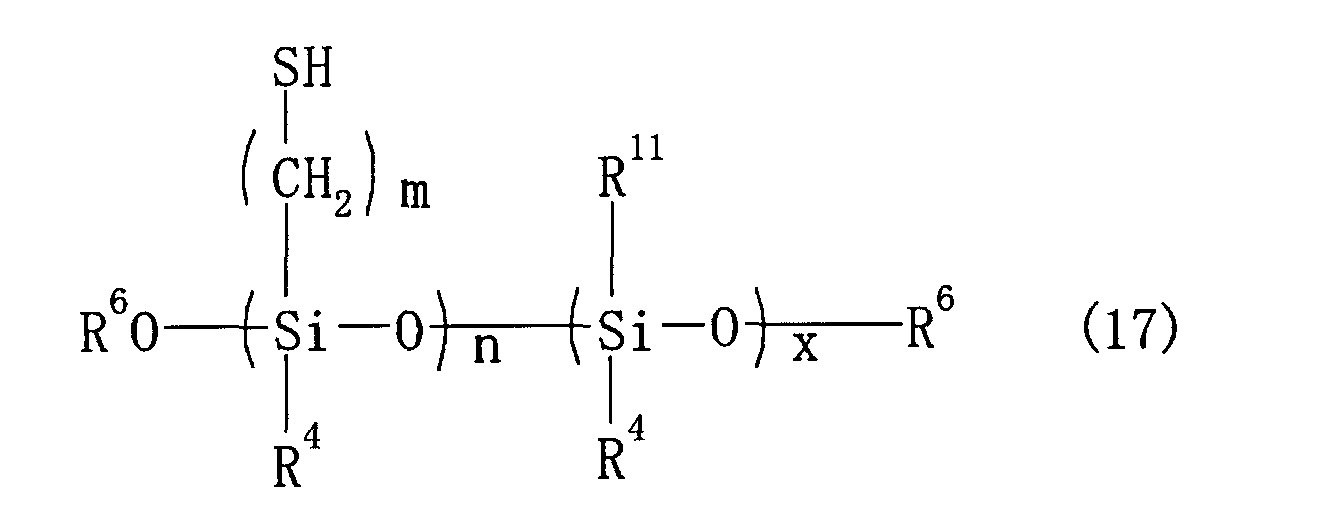
The compound represented by the general formula (17) with R4 of OCH3 group, "m" of 3 and "n+x" of around 10 is commercialized by Shin-etsu Silicones (X-41-1810). These compounds can be easily synthesized by referring to the above-described literature using 2 or more alkoxysilane compounds, and can be suitably used for the present invention.
In addition, a crosslinking agent (G), another additive, solvent or the like may be used, as required, as is the case with the first method.
A common oxidizing agent is used for oxidizing the mercapto group. These agents include nitric acid, hydrogen peroxide, oxygen, organic peroxide (percarboxylic acid), bromine water, hypochlorite, hypobromite, potassium permanganate and chromate.
The oxidation of mercapto group in the presence of the above oxidizing agent is a known process, described in Jikken Kagaku Koza (Maruzen, third edition, P.1775) and literature cited therein. Of these agents, hydrogen peroxide and organic peroxide (e.g., peracetic and perbenzoic acid) are more suitably used, because they are handled relatively easily and give a high oxidation yield.
It is described in more detail for the starting materials and treatment conditions, among others, for these steps orderly.
The third method of the present invention first prepares a mixture containing an organic/inorganic hybrid, crosslinkable compound (C) and compound (F) containing a crosslinkable silyl group and polysulfide group.
The proton conducting membrane of the present invention should satisfy, as mentioned earlier, the requirements of simultaneously containing an organic/inorganic hybrid structure (A) and acid-containing structure (B). Therefore, the starting materials each corresponding to the organic/inorganic hybrid structure (A) or acid-containing structure (B) are used to form the crosslinked structure.
Accordingly, an organic/inorganic hybrid, crosslinkable compound (C) as the starting material for the organic/inorganic hybrid structure (A) is the same as that for the first and second method.
For the starting material for the acid-containing structure (B), on the other hand, a compound (F) containing a polysulfide group is used in place of a compound (D) containing an acid group for the first method or compound (E) containing a mercapto group for the second method.
A polysulfide group can be converted into sulfonic acid as a functional group by oxidation. The acid-containing structure (B) can be produced by oxidation of the polysulfide group introduced.
The polysulfide group means a structure in which sulfur atoms are bonded to each other to form a chain, from a disulfide group (-S-S-) having 2 sulfur atoms to octasulfide group having 8 sulfur atoms.
Each of these groups is useful for the present invention. However, a disulfide (-S-S-) and tetrasulfide (-S-S-S-S-) group are more preferable for their general availability.

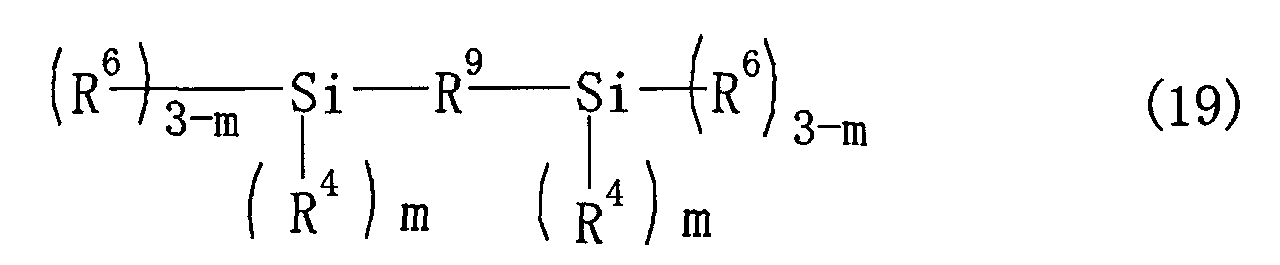
Of these compounds, the compound (F) containing a polysulfide group is more preferably represented by the general formula (19), which has a structure similar to that of the organic/inorganic hybrid, crosslinkable compound (C), in consideration of reactivity with the compound (C):
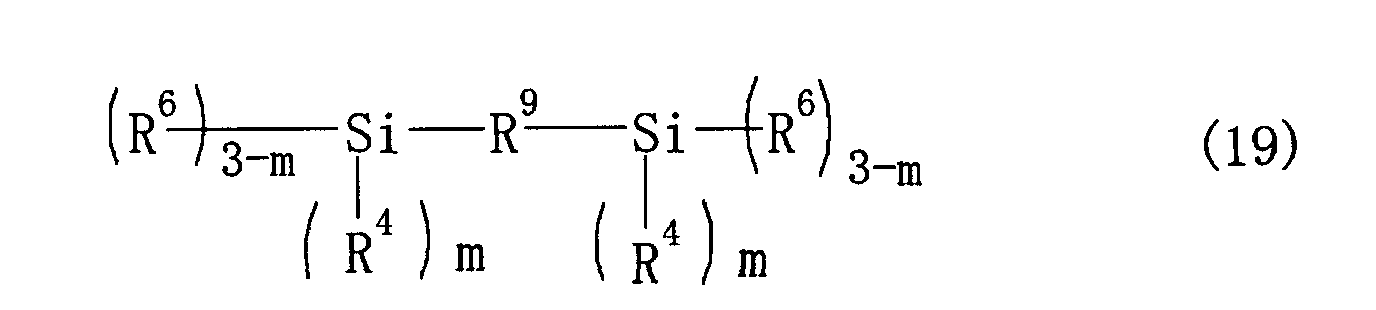
Of these compounds, the compound (F) containing a polysulfide group is more preferably represented by the general formula (20) in consideration of stability of R8 to heat, acid and oxidation:

The compounds represented by the above formula are commercially available. The known ones include bis[3-(triethoxysilyl)propyl]tetrasulfide (Gelest, Inc. SIB1825.0), and bis[3-(triethoxysilyl)propyl]disulfide (Shin-etsu Silicones KBE886B).
In addition, a crosslinking agent (G), another additive, solvent or the like may be used, as required, as is the case with the first and second methods.
The fourth step for oxidizing a polysulfide group in the third method can be similar to that of the fourth step for oxidizing a mercapto group in the second method.
Oxidation of a mercapto group differs from that of a polysulfide group in that the former gives one sulfonic acid group per one mercapto group whereas the latter gives 2 sulfonic acid groups per one polysulfide group, when a polysulfide-containing compound has a structure represented by the general formula (19) or (20).
Therefore, when a polysulfide-containing compound (F) having a structure represented by the general formula (19) or (20) is used, a proton-conducting membrane can be obtained at a mixing ratio of an organic/inorganic hybrid, crosslinkable compound (C) to the polysulfide-containing compound (F) from 95:5. The membrane has a sufficient strength when the ratio is kept at 10:90 or higher. The mixing ratio is preferably in the above range, accordingly.
It is described in more detail for the starting materials and treatment conditions, among others, for these steps orderly.
The fourth method of the present invention first prepares a mixture containing an organic/inorganic hybrid, crosslinkable compound (C) and compound (H) containing a crosslinkable silyl group and halogen group.
The proton conducting membrane of the present invention should satisfy, as mentioned earlier, the requirements of simultaneously containing an organic/inorganic hybrid structure (A) and acid-containing structure (B). Therefore, the starting materials each corresponding to the organic/inorganic hybrid structure (A) or acid-containing structure (B) are used to form the crosslinked structure.
Accordingly, an organic/inorganic hybrid, crosslinkable compound (C) as the starting material for the organic/inorganic hybrid structure (A) is the same as that for the first to the third methods.
For the starting material for the acid-containing structure (B), on the other hand, a compound (H) containing a halogen group is used in place of a compound (D) containing an acid group for the first method, compound (E) containing a mercapto group for the second method, or compound (F) containing a polysulfide group for the third method.
The halogen group means chlorine, bromine, iodine or the like. In addition to a halogen group, a leaving group may be also used so long as it is reactive with sulfurous acid for substitution. These groups include tosylate and methanesulfonylate. However, the halogen group is more preferable than the leaving group, because it is generally more easily available.
A halogen group can be converted into sulfonic acid as a functional group by substitution with sulfurous acid. The reaction is known, and disclosed by, e.g., Organic Syntheses Collective Volume 2 (1943), P.558 and 564. The substitution reaction can be carried out easily and in a high yield by heating, e.g., sodium sulfite and a compound containing a halogen group in a mixed solvent of alcohol and water. The reaction product is generally in the form of salt, and may be post-treated with sulfuric acid or the like to be protonic.

Of these compounds, the compound (H) containing a halogen group is more preferably represented by the general formula (23) in consideration of stability of R12 to heat, acid and oxidation:
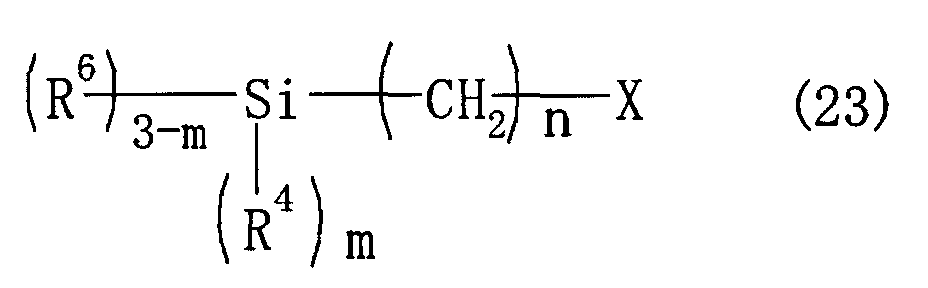
These compounds can be easily synthesized by reacting a compound having a halogen group at one terminal and unsaturated bond at the other terminal, represented by the general formula (24), with trialkoxysilane, dialkoxyalkylsilane, monoalkoxydialkylsilane or the like for hydrosilylation:

For the hydrosilylation, bromine or iodine as the halogen group is more preferable than chlorine.
These compounds may be used as the oligomers or polymers, synthesized by the method disclosed by, e.g., Journal of Polymer Science, Part A, Polymer Chemistry, Vol.37, P.1017 (1999)), cited earlier.
In addition, a crosslinking agent (G), another additive, solvent or the like may be used, as required, as is the case with the first to third methods.
In this substitution process, the film-like object containing the halogen-containing compound (H) is reacted with a sulfite compound, e.g., sulfurous acid (aqueous solution), sodium sulfite, potassium sulfite, sodium hydrogen sulfite or potassium hydrogen sulfite, for which the method disclosed by Organic Syntheses Collective Volume 2 (1943), P.558 and 564 may be used. More specifically, a simple method involves heating the crosslinked membrane produced in an alcoholic aqueous solution containing sulfite ion.
The halogen group can be converted into sulfonic acid or its salt in the above step. When the salt is produced, the membrane is immersed in sulfuric acid or the like, to become a proton-conducting membrane.
When a halogen-containing compound (H) having a structure represented by the general formula (22) or (23) is used, a proton-conducting membrane can be obtained at a mixing ratio of an organic/inorganic hybrid, crosslinkable compound (C) to the halogen-containing compound (H) from 1:9. The membrane has a sufficient strength when the ratio is kept at 9:1 or lower. The mixing ratio is preferably in the above range, accordingly.
More specifically, each of the above methods further comprises an additional step for compositing the fibrous material. Some of the examples of this step are described below, which by no means limit the present invention. This step varies depending on, e.g., type and quantity of the fibrous material, as described below.
When the fibrous material (I) is a short fibrous material (J), e.g., short glass fibers (M) or whiskers (L), it may be added to the mixture in the first step of one of the first to fourth methods. It is preferably mixed with the mixture by a homogenizer or ball mill, which involves strong agitation to prevent agglomeration. The mixture is preferably used immediately after it is prepared to prevent separation, or else treated to have a certain viscosity to prevent the mixture from being easily separated.
When excessively incorporated, the short fibrous material (J) may not be dispersed sufficiently to possibly cause excessive permeation of the gas, and may decrease conductivity of the membrane. When incorporated insufficiently, it may not fully exhibit its effect. Therefore, it is incorporated at 1 to 75 parts by weight per 100 parts by weight of the organic/inorganic hybrid structure (A) and acid-containing structure (B) totaled.
On the other hand, a long fibrous material (K) as the fibrous material (I) cannot directly form a uniform composite structure, even when mixed beforehand with the starting materials for the organic/inorganic hybrid structure (A) and acid-containing structure (B), unlike the short fibrous material (J). Therefore, it preferably has a specific shape (sheet shape) before it is incorporated.
The long fibrous material (K), to be incorporated in the second step of one of the first to fourth methods, is preferably loaded with a starting mixture of the organic/inorganic hybrid structure (A) and acid-containing structure (B). It may be loaded by pressing or the liquid, starting mixture on the sheet, or rolling. The loading method can be optionally selected from the known, simple ones.
- ○ :
- The membrane can be bent, and is kept flexible.
- × :
- The membrane cannot be bent.
In the above analysis, the sample was supported in an electrically insulated closed container, and measured for its proton conductivity at varying temperature in a water vapor atmosphere (95 to 100%RH), where cell temperature was increased from room temperature to 160°C by a temperature controller. Proton conductivity was measured at each temperature level, and the value measured at 60°C is reported in this specification as the representative one. Moreover, the results obtained only at 140°C, or 60°C and 160°C are also reported for representative EXAMPLES. For the measurement at 100°C, the measurement tank was pressurized.
- ○ :
- No change is observed before and after the treatment.
- × :
- Embrittlement, disintegration, discoloration or deformation of the treated membrane is observed.
The membrane was immersed in 7.0mL of glacial acetic acid, to which 5.6mL of a 30% aqueous solution of hydrogen peroxide was added little by little at 70°C. Then, the system was heated to 70°C, at which it was held for 20 minutes. The membrane was withdrawn from the system, after it was cooled, immersed in 1N sulfuric acid over a night, and then washed in a flow of water at 60°C for 2 hours. The evaluation results and the like of the membrane are given in Table 1.
The membrane was withdrawn from the system, after it was cooled, immersed in 1N sulfuric acid over a night, and then washed in a flow of water at 60°C for 2 hours. The evaluation results and the like of the membrane are given in Table 1.
The evaluation results and the like of the membrane are given in Table 1.
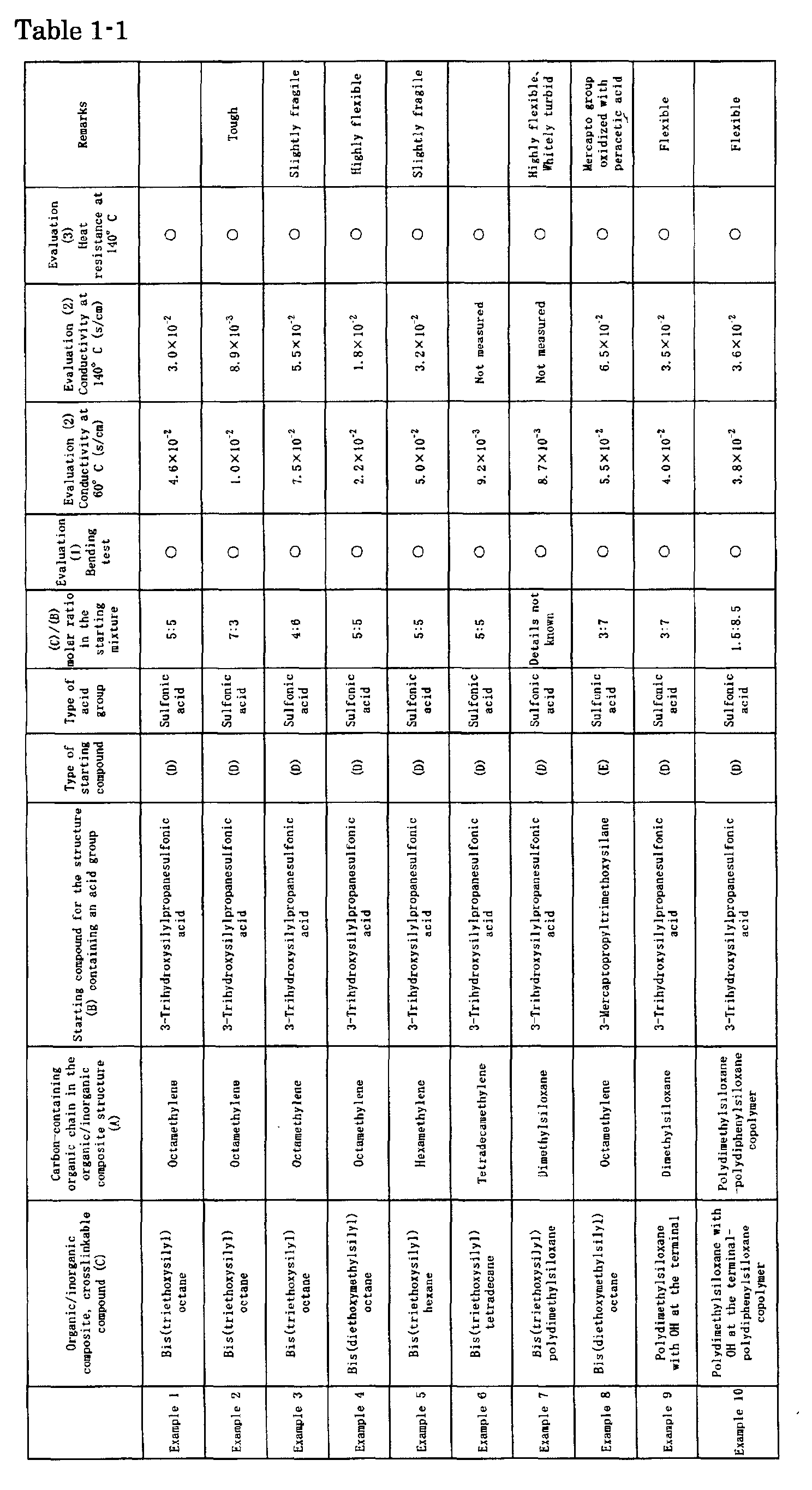


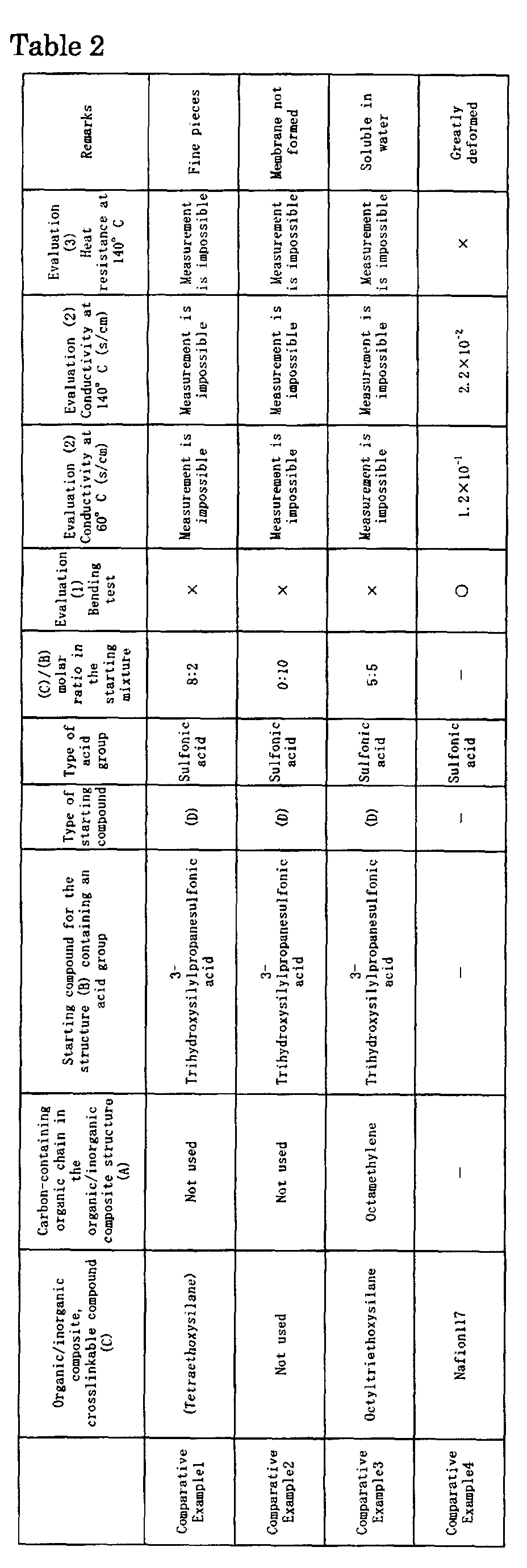
It is also apparent, as shown in Table 2, that formation of a membrane in itself is difficult using an acid-containing structure (B) alone (COMPARATIVE EXAMPLE 2). Moreover, an organic/inorganic hybrid structure (A) free of carbon-containing structure as a soft component gives a glassy membrane, which is difficult to handle and, at the same time, cannot have a large area (COMPARATIVE EXAMPLE 1). Still more, an organic/inorganic hybrid structure (A) free of bond which connects the crosslinked segments to each other only gives a membrane soluble in water, even if it has a soft component, as pointed out by Poinsignon et al. (COMPARATIVE EXAMPLE 3).
The membrane of the present invention can increase operating temperature to 100°C or higher for a PEFC, which has been attracting much attention recently, and hence can improve power generation efficiency and reduce poisoning of the catalyst by CO. Moreover, a fuel cell operating at high temperature allows to utilize its waste heat for cogeneration to produce power and heat, thus drastically enhancing its total energy efficiency.
Claims (63)
- A proton conducting membrane crosslinkable and having a crosslinked structure by the silicon-oxygen bond, wherein said proton conducting membrane comprises(a) an organic/inorganic hybrid structure (A) covalently bonded to 2 or more silicon-oxygen crosslinks and, having a carbon atom, and(b) an acid containing structure (B) having an acid group, covalently bonded to a silicon-oxygen crosslink and having an acid group.
- The proton conducting membrane according to Claim 1, wherein said organic/inorganic hybrid structure (A) is represented by the general formula (1):(wherein, X is an -O- bond or OH group involved in the crosslinking; R1 is a carbon-containing group of 1 to 50 carbon atoms; R2 is methyl, ethyl, propyl or phenyl group; and "n" is an integer of 0, 1 or 2).

- The proton conducting membrane according to Claim 2, wherein R1 in the general formula (1) is a hydrocarbon group.
- The proton conducting membrane according to Claim 3, wherein R1 in the general formula (1) has a structure represented by the general formula (3):(wherein, "n" is an integer of 1 to 30).
- The proton conducting membrane according to Claim 4, wherein said organic/inorganic hybrid structure (A) is represented by the general formula (4):(wherein, X is an -O- bond or OH group involved in the crosslinking; and "n" is an integer of 0, 1 or 2).
- The proton conducting membrane according to Claim 2, wherein R1 in the general formula (1) has a siloxane structure.
- The proton conducting membrane according to Claim 6, wherein R1 in the general formula (1) is represented by the general formula (5):(wherein, R5 and R6 are each methyl, ethyl, propyl or phenyl, which may be the same or different; and "n" is an integer of 1 to 20).
- The proton conducting membrane according to Claim 1, wherein said structure (B) containing an acid group is represented by the general formula (2):(wherein, X is an -O- bond or OH group involved in the crosslinking; R3 is a molecular chain group having at least one acid group; R4 is methyl, ethyl, propyl or phenyl group; and "m" is an integer of 0, 1 or 2).

- The proton conducting membrane according to Claim 8, wherein said acid group which R3 in the general formula (2) has is sulfonic acid group.
- The proton conducting membrane according to Claim 9, wherein R3 in the general formula (2) is represented by the general formula (6):(wherein, "n" is an integer of 1 to 20).

- The proton conducting membrane according to Claim 10, wherein "n" in the general formula (6) is 3.
- The proton conducting membrane according to one of Claims 1 to 11 which is further composited with a fibrous material (I).
- The proton conducting membrane according to Claim 12, wherein said fibrous material (I) is composed of a short fibrous material (J) and/or long fibrous material (K).
- The proton conducting membrane according to Claim 12, wherein said fibrous material (I) is surface-treated with a silane coupling agent to have a proton-conductive surface.
- The proton conducting membrane according to Claim 12, wherein said fibrous material (I) is composed of glass fibers.
- The proton conducting membrane according to Claim 15, wherein said glass fibers are of alkali- or acid-resistant glass.
- The proton conducting membrane according to Claim 13, wherein said long fibrous material (K) is composed of glass fibers in the form of woven fabric, non-woven fabric or glass fiber paper produced by a paper-making process.
- The proton conducting membrane according to Claim 17, wherein said long fibrous material (K) is in the form of thirled, square-weave fabric.
- The proton conducting membrane according to Claim 17, wherein said long fibrous material (K) has a thickness of 300µm or less.
- The proton conducting membrane according to Claim 12, wherein said short fibrous material (J) is incorporated at 1 to 75% by weight on the organic/inorganic hybrid structure (A) and acid-containing structure (B) totaled.
- The proton conducting membrane according to Claim 13, wherein said short fibrous material (J) is composed of whiskers (L) and/or short glass fibers (M).
- The proton conducting membrane according to Claim 21, wherein said whiskers (L) have a diameter of 0.1 to 3µm, length of 1 to 20µm and aspect ratio of 5 to 100.
- The proton conducting membrane according to Claim 21 or 22, wherein said whiskers (L) are of boron carbide, silicon carbide, alumina, aluminum borate, silicon nitride or K2O · 6TiO2.
- A method for producing the proton conducting membrane of one of Claims 1 to 23, comprising steps of preparing a mixture containing an organic/inorganic hybrid, crosslinkable compound (C) and compound (D), the former having 2 or more crosslinkable silyl groups and carbon atoms each being bonded to the silyl group via the covalent bond and the latter having a crosslinkable silyl group and acid group, as the first step; forming the above mixture into a film as the second step; and hydrolyzing/condensing or only condensing the hydrolyzable silyl group contained in the mixture formed into the film to form a crosslinked structure as the third step.
- A method for producing the proton conducting membrane of one of Claims 1 to 23, comprising steps of preparing a mixture containing an organic/inorganic hybrid, crosslinkable compound (C) and compound (E), the former having 2 or more crosslinkable silyl groups and carbon atoms each being bonded to the silyl group via the covalent bond and the latter having a crosslinkable silyl group and mercapto group, as the first step; forming the above mixture into a film as the second step; hydrolyzing and condensing the hydrolyzable silyl group contained in the mixture formed into the film to form a crosslinked structure as the third step; and oxidation of the mercapto group in the crosslinked structure obtained in the third step into sulfonic acid as the fourth step.
- A method for producing the proton conducting membrane of one of Claims 1 to 23, comprising steps of preparing a mixture containing an organic/inorganic hybrid, crosslinkable compound (C) and compound (F), the former having 2 or more crosslinkable silyl groups and carbon atoms each being bonded to the silyl group via the covalent bond and the latter having a crosslinkable silyl group and polysulfide group, as the first step; forming the above mixture into a film as the second step; hydrolyzing and condensing the hydrolyzable silyl group contained in the mixture formed into the film to form a crosslinked structure as the third step; and oxidation of the polysulfide group in the crosslinked structure obtained in the third step into sulfonic acid as the fourth step.
- A method for producing the proton conducting membrane of one of Claims 1 to 23, comprising steps of preparing a mixture containing an organic/inorganic hybrid, crosslinkable compound (C) and compound (H), the former having 2 or more crosslinkable silyl groups and carbon atoms each being bonded to the silyl group via the covalent bond and the latter having a crosslinkable silyl group and halogen group, as the first step; forming the above mixture into a film as the second step; hydrolyzing and condensing the hydrolyzable silyl group contained in the mixture formed into the film to form a crosslinked structure as the third step; and substitution of the halogen group in the crosslinked structure obtained in the third step with sulfonic acid group as the fourth step.
- The method according to one of Claims 24 to 27 for producing the proton conducting membrane, wherein said organic/inorganic hybrid, crosslinkable compound (C) is represented by the general formula (7):(wherein, R1 is a carbon-containing group of 1 to 50 carbon atoms; R2 is methyl, ethyl, propyl or phenyl group; R5 is Cl, or OCH3, OC2H5, OC6H5, OH or OCOCH3 group; and "n" is 0, 1 or 2).

- The method according to Claim 28 for producing the proton conducting membrane, wherein R1 in the general formula (7) is a hydrocarbon group.
- The method according to Claim 29 for producing the proton conducting membrane, wherein said organic/inorganic hybrid, crosslinkable compound (C) is represented by the general formula (8):(wherein, R2 is methyl, ethyl, propyl or phenyl group; R5 is Cl, or OCH3, OC2H5, OC6H5, OH or OCOCH3 group; "m" is an integer of 1 to 30; and "n" is 0, 1 or 2).

- The method according to Claim 30 for producing the proton conducting membrane, wherein said organic/inorganic hybrid, crosslinkable compound (C) is represented by the general formula (9):(wherein, R5 is OCH3 or OC2H5 group; and "n" is 0, 1 or 2).

- The method according to Claim 28 for producing the proton conducting membrane, wherein said organic/inorganic hybrid, crosslinkable compound (C) is represented by the general formula (10):(wherein, R11, R12, R13 and R14 are each methyl, ethyl, propyl or phenyl group, which may be the same or different; R5 is Cl, or OCH3, OC2H5, OC6H5, OH or OCOCH3 group; "m" is an integer of 1 to 30; and "n" is 0, 1 or 2).
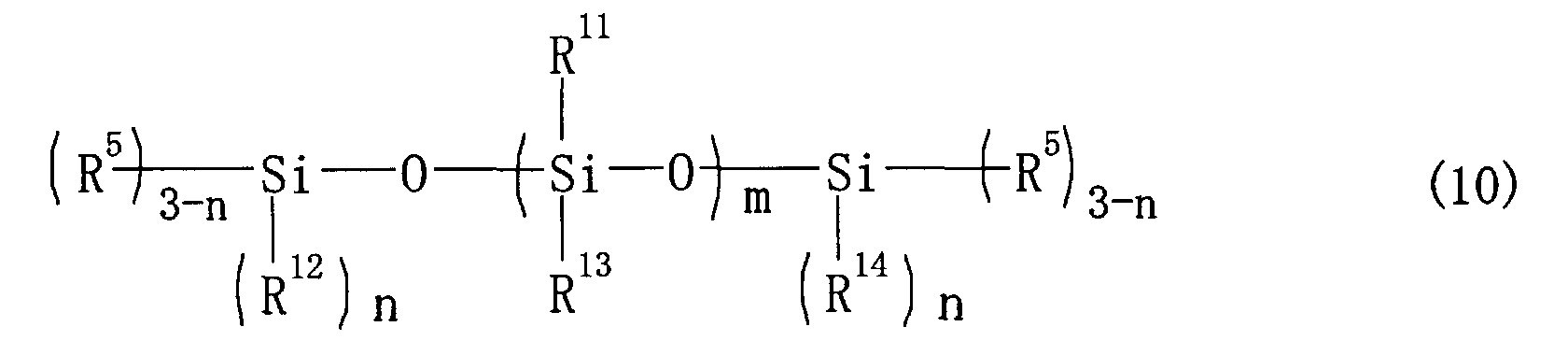
- The method according to Claim 32 for producing the proton conducting membrane, wherein said organic/inorganic hybrid, crosslinkable compound (C) is represented by the general formula (11):(wherein, R5 is Cl, or OCH3, OC2H5, OC6H5, OH or OCOCH3 group; "m" is an integer of 1 to 30; and "n" is 0, 1 or 2).
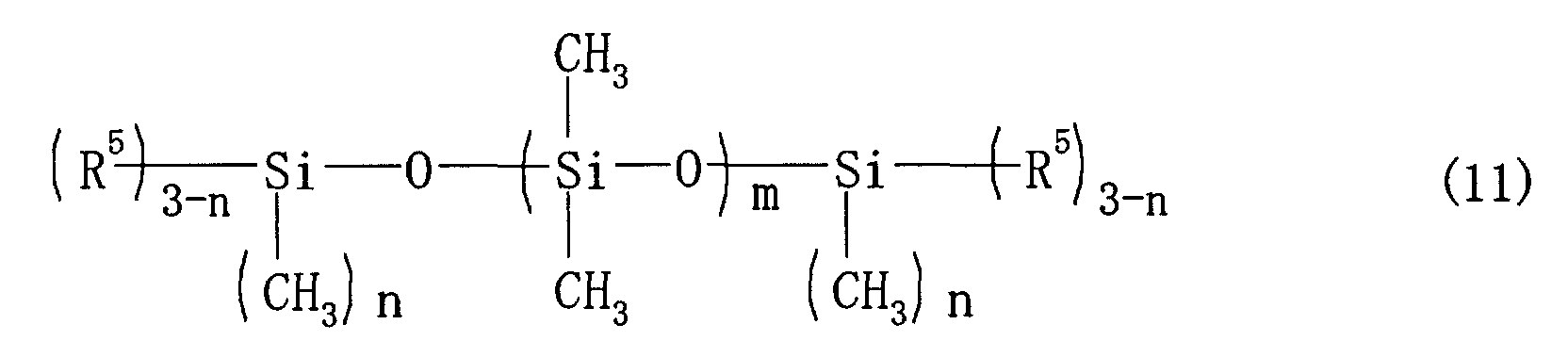
- The method according to Claim 24 for producing the proton conducting membrane, wherein said acid containing compound (D) is represented by the general formula (12):(wherein, R3 is a molecular chain group having at least one acid group; R4 is methyl, ethyl, propyl or phenyl group; R6 is Cl, or OCH3, OC2H5, OC6H5, OH or OCOCH3 group; "m" is 0, 1 or 2).
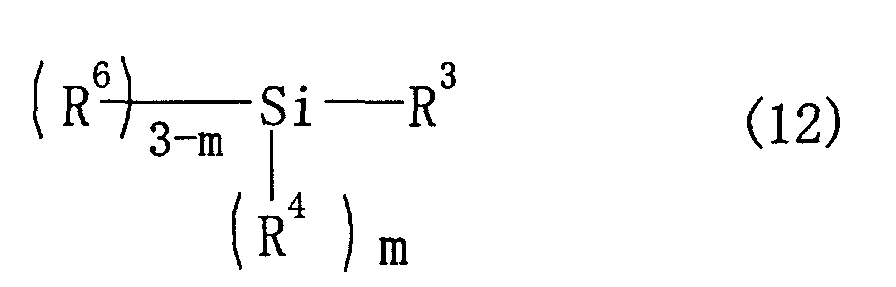
- The method according to Claim 34 for producing the proton conducting membrane, wherein said acid containing compound (D) is sulfonic acid group.
- The method according to Claim 35 for producing the proton conducting membrane, wherein said acid containing compound (D) is represented by the general formula (13):(wherein, R4 is methyl, ethyl, propyl or phenyl group; R6 is Cl, or OCH3, OC2H5, OC6H5, OH or OCOCH3 group; X is hydrogen, an alkali metal, alkyl group or ammonium group; "m" is 0, 1 or 2; and "n" is an integer of 1 to 20).

- The method according to Claim 36 for producing the proton conducting membrane, wherein "n" in the general formula (13) is 3.
- The method according to Claim 24 for producing the proton conducting membrane, wherein said organic/inorganic hybrid, crosslinkable compound (C) and acid containing compound (D) are incorporated in a mixing ratio of 9:1 to 1:9 by weight.
- The method according to Claim 25 for producing the proton conducting membrane, wherein said compound (E) having mercapto group is represented by the general formula (14):(wherein, R7 is a molecular chain group having at least one mercapto group; R4 is methyl, ethyl, propyl or phenyl group; R6 is Cl, or OCH3, OC2H5, OC6H5, OH or OCOCH3 group; and "m" is 0, 1 or 2).

- The method according to Claim 39 for producing the proton conducting membrane, wherein said compound (E) having mercapto group is represented by the general formula (15):(wherein, R4 is methyl, ethyl, propyl or phenyl group; R6 is Cl, or OCH3, OC2H5, OC6H5, OH or OCOCH3 group; "m" is 0, 1 or 2; and "n" is an integer of 1 to 20).

- The method according to Claim 25 for producing the proton conducting membrane, wherein said compound (E) having mercapto group is represented by the general formula (16):(wherein, R6 is H, or CH3, C2H5, C3H7 or C6H5 group; R4 is CH3, C2H5, C3H7, C6H5, OH, OCH3, OC2H5, OC6H5 group, or O-Si bond; "m" is an integer of 1 to 20; and "n" is an integer of 3 to 500).
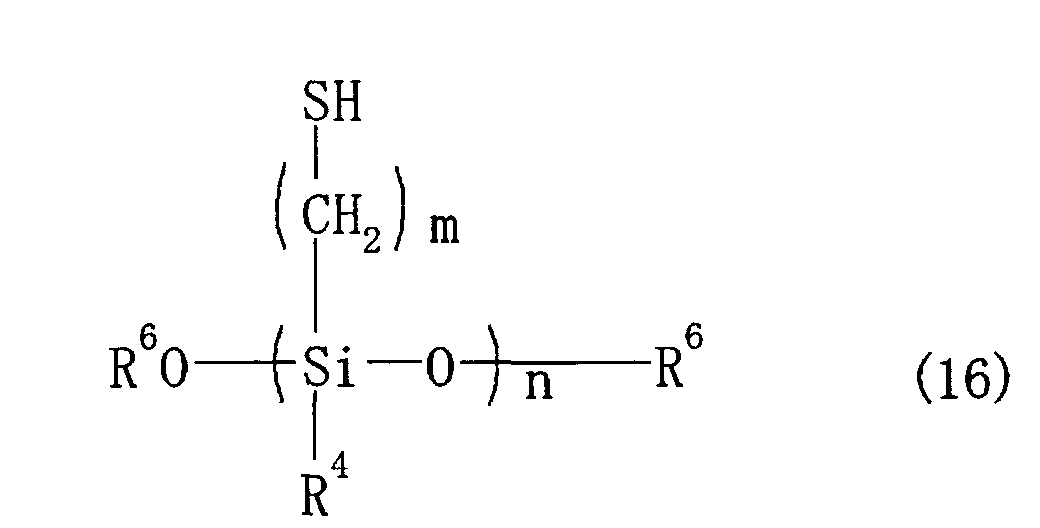
- The method according to Claim 41 for producing the proton conducting membrane, wherein R4, "m" and "n" in the general formula (16) are OCH3 group, 3 and an integer of 3 to 100, respectively.
- The method according to Claim 41 for producing the proton conducting membrane, wherein R4, "m" and "n" in the general formula (16) are CH3 group, 3 and an integer of 3 to 300, respectively.
- The method according to Claim 25 for producing the proton conducting membrane, wherein said compound (E) having mercapto group is represented by the general formula (17):(wherein, R6 is H, or CH3, C2H5, C3H7 or C6H5 group; R4 is CH3, C2H5, C3H7, C6H5, OH, OCH3, OC2H5 or OC6H5 group, R11 is a substitute of 6 carbon atoms or less; "m" is an integer of 1 to 20; "n" is an integer of 3 to 500; and "n+x" is an integer of 500 or less, where the unit containing mercapto group and that containing R11 may be present in a block or random form).
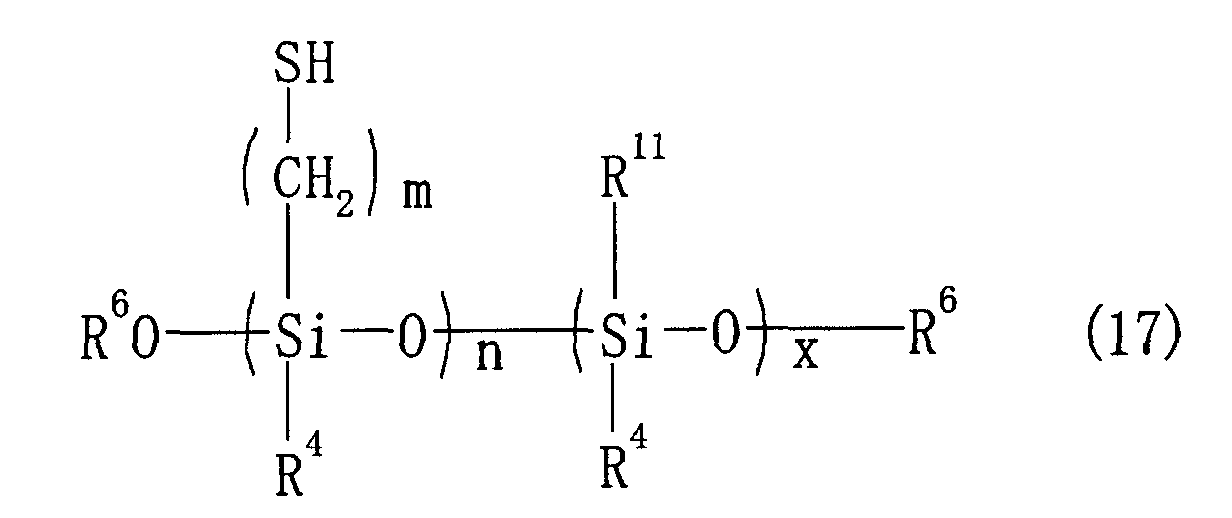
- The method according to Claim 44 for producing the proton conducting membrane, wherein R4, "m" and "n+x" in the general formula (17) are OCH3 group, 3 and an integer of 50 or less, respectively.
- The method according to Claim 25 for producing the proton conducting membrane, wherein said organic/inorganic hybrid, crosslinkable compound (C) and compound (E) having mercapto group are incorporated in a mixing ratio of 9:1 to 1:9 by weight.
- The method according to Claim 26 for producing the proton conducting membrane, wherein said compound (F) having a polysulfide group is represented by the general formula (18):(wherein, R8 is a molecular chain group having at least one polysulfide group; R4 is methyl, ethyl, propyl or phenyl group; R6 is Cl, or OCH3, OC2H5, OC6H5, OH or OCOCH3 group; and "m" is 0, 1 or 2).

- The method according to Claim 47 for producing the proton conducting membrane, wherein said compound (F) having a polysulfide group is represented by the general formula (19):(wherein, R9 is a molecular chain group having at least one polysulfide group; R4 is methyl, ethyl, propyl or phenyl group; R6 is Cl, or OCH3, OC2H5, OC6H5, OH or OCOCH3 group; and "m" is 0, 1 or 2).
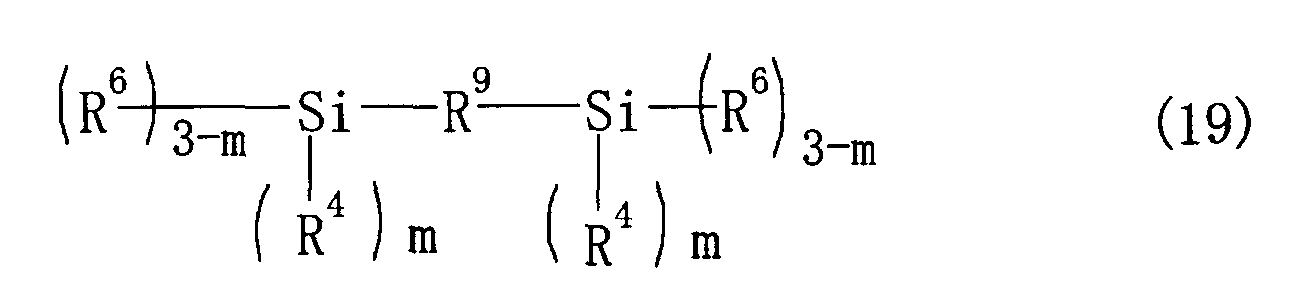
- The method according to Claim 48 for producing the proton conducting membrane, wherein said compound (F) having a polysulfide group is represented by the general formula (20):(wherein, R10 is a polysulfide group; R4 is methyl, ethyl, propyl or phenyl group; R6 is Cl, or OCH3, OC2H5, OC6H5, OH or OCOCH3 group; "m" is 0, 1 or 2; and "n" is an integer of 1 to 6).
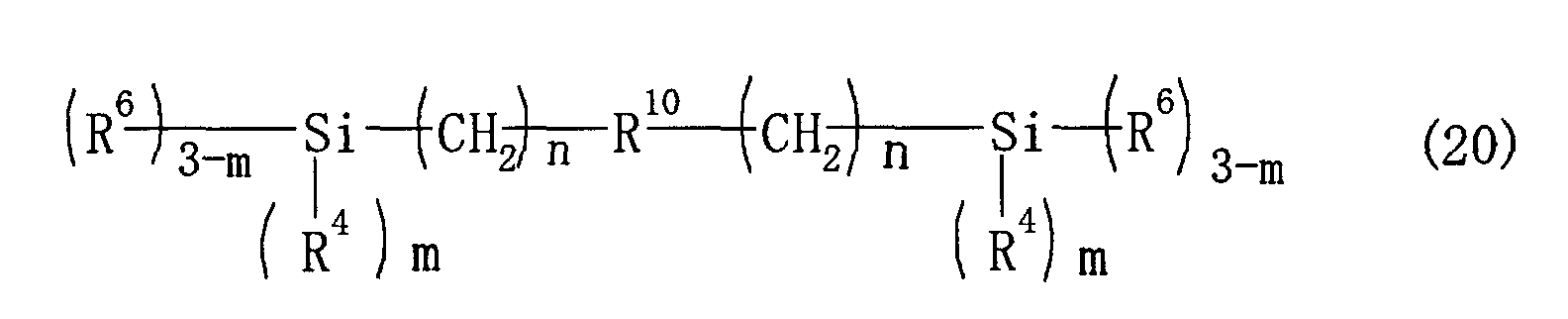
- The method according to Claim 49 for producing the proton conducting membrane, wherein "n" in the general formula (20) is 3.
- The method according to one of Claims 47 to 50 for producing the proton conducting membrane, wherein said polysulfide group is tetrasulfide group (-S-S-S-S-).
- The method according to one of Claims 47 to 50 for producing the proton conducting membrane, wherein said polysulfide group is disulfide group (-S-S-).
- The method according to Claim 26 for producing the proton conducting membrane, wherein said organic/inorganic hybrid, crosslinkable compound (C) and compound (F) having a polysulfide group are incorporated in a mixing ratio of 95:5 to 10:90 by weight.
- The method according to one of Claims24 to 27 for producing the proton conducting membrane, wherein a crosslinking agent (G) of hydrolyzable, metallic compound is used for the first step.
- The method according to Claim 54 for producing the proton conducting membrane, wherein said crosslinking agent (G) is of a compound represented by the general formula (21):(wherein, R6 is CH3 or C2H5 group; and "m" is an integer of 1 to 300).

- The method according to Claim 54 for producing the proton conducting membrane, wherein said crosslinking agent (G) is of a hydrolyzable, metallic compound having Ti, Zr or Al.
- The method according to Claim 27 for producing the proton conducting membrane, wherein said compound (H) having a halogen group is represented by the general formula (22):(wherein, R12 is a molecular chain group having at least one halogen group; R4 is methyl, ethyl, propyl or phenyl group; R6 is Cl, or OCH3, OC2H5, OC6H5, OH or OCOCH3 group; and "m" is 0, 1 or 2).

- The method according to Claim 57 for producing the proton conducting membrane, wherein said compound (H) having a halogen group is represented by the general formula (23):(wherein, R4 is methyl, ethyl, propyl or phenyl group, R6 is Cl, or OCH3, OC2H5, OC6H5, OH or OCOCH3 group; X is Cl, Br or I; "n" is an integer of 1 to 20; and "m" is 0, 1 or 2).

- The method according to Claim 27 for producing the proton conducting membrane, wherein said organic/inorganic hybrid, crosslinkable compound (C) and compound (H) having a halogen group are incorporated in a mixing ratio of 9:1 to 1:9 by weight.
- The method according to one of Claims 24 to 27 for producing the proton conducting membrane, wherein a step for aging at 100 to 300°C is included as a post-treatment step.
- The method according to one of Claims 24 to 27 for producing the proton conducting membrane, wherein said short fibrous material (J) is incorporated in the mixture in the first step, when it is incorporated as said fibrous material (I) to be composited with the proton-conducting membrane.
- The method according to one of Claims 49 to 60 for producing the proton conducting membrane, wherein said long fibrous material (K) is loaded in the second step with the mixture obtained in the first step, when it is incorporated in the form of sheet as said fibrous material (I) to be composited with the proton-conducting membrane.
- A fuel cell which uses the proton conducting membrane according to one of Claims 1 to 23.
Applications Claiming Priority (7)
| Application Number | Priority Date | Filing Date | Title |
|---|---|---|---|
| JP2001332977 | 2001-10-30 | ||
| JP2001332977 | 2001-10-30 | ||
| JP2002029781 | 2002-02-06 | ||
| JP2002029781 | 2002-02-06 | ||
| JP2002109493 | 2002-04-11 | ||
| JP2002109493 | 2002-04-11 | ||
| PCT/JP2002/011242 WO2003041091A1 (en) | 2001-10-30 | 2002-10-29 | Proton conducting membrane, process for its production, and fuel cells made by using the same |
Publications (2)
| Publication Number | Publication Date |
|---|---|
| EP1441365A1 true EP1441365A1 (en) | 2004-07-28 |
| EP1441365A4 EP1441365A4 (en) | 2010-02-24 |
Family
ID=27347755
Family Applications (1)
| Application Number | Title | Priority Date | Filing Date |
|---|---|---|---|
| EP02802706A Withdrawn EP1441365A4 (en) | 2001-10-30 | 2002-10-29 | PROTON CONDUCTIVE MEMBRANE, PROCESS FOR PRODUCING THE SAME, AND FUEL CELLS OBTAINED USING THE MEMBRANE |
Country Status (7)
| Country | Link |
|---|---|
| US (2) | US7214756B2 (en) |
| EP (1) | EP1441365A4 (en) |
| JP (1) | JP3679104B2 (en) |
| KR (1) | KR100526085B1 (en) |
| CN (1) | CN1230832C (en) |
| CA (1) | CA2433320C (en) |
| WO (1) | WO2003041091A1 (en) |
Cited By (2)
| Publication number | Priority date | Publication date | Assignee | Title |
|---|---|---|---|---|
| EP1463140A3 (en) * | 2003-03-25 | 2009-11-25 | FUJIFILM Corporation | Silica sol composition, membrane electrode assembly with proton-exchange membrane, and fuel cell |
| EP1635413A4 (en) * | 2003-06-13 | 2009-12-30 | Sekisui Chemical Co Ltd | PROTON CONDUCTIVE FILM, METHOD FOR MANUFACTURING THE SAME, AND FUEL CELL USING THE SAME |
Families Citing this family (45)
| Publication number | Priority date | Publication date | Assignee | Title |
|---|---|---|---|---|
| TWI269478B (en) * | 2003-02-06 | 2006-12-21 | Sekisui Chemical Co Ltd | Proton conducting membrane, method for producing the same and fuel cell using the same |
| JP4769577B2 (en) * | 2003-04-25 | 2011-09-07 | 積水化学工業株式会社 | PROTON CONDUCTIVE MEMBRANE, MANUFACTURING METHOD THEREOF, AND FUEL CELL USING THE PROTON CONDUCTIVE MEMBRANE |
| JP2005005046A (en) * | 2003-06-10 | 2005-01-06 | Canon Inc | Siloxane polymer electrolyte membrane and solid polymer fuel cell using the same |
| JP4643132B2 (en) * | 2003-07-29 | 2011-03-02 | 積水化学工業株式会社 | Proton conductive membrane, method for producing the same, and fuel cell using the same |
| KR100528345B1 (en) | 2003-08-29 | 2005-11-15 | 삼성에스디아이 주식회사 | Polymer Nano-Composite membrane and fuel cell adopting the same |
| US7183370B2 (en) * | 2003-09-11 | 2007-02-27 | Toyota Technical Center Usa, Inc | Phosphonic-acid grafted hybrid inorganic-organic proton electrolyte membranes (PEMs) |
| JPWO2005027250A1 (en) * | 2003-09-12 | 2006-11-24 | ローム株式会社 | Proton conductive membrane, method for producing the same, and fuel cell using the same |
| EP1523057A1 (en) * | 2003-09-26 | 2005-04-13 | Paul Scherer Institut | Membrane electrode assembly (MEA), method for its manufacturing and a method for preparing a membrane to be assembled in a MEA |
| JP2005146176A (en) * | 2003-11-18 | 2005-06-09 | Ebara Corp | Organic-silica composite membrane having sulfonic acid group and method for producing the same |
| JP4971789B2 (en) * | 2004-03-04 | 2012-07-11 | 日本板硝子株式会社 | Proton conductive membrane reinforcing material and proton conductive membrane and fuel cell using the same |
| JP4547713B2 (en) * | 2004-04-20 | 2010-09-22 | 株式会社豊田中央研究所 | Electrolyte membrane |
| JP2005332800A (en) * | 2004-04-23 | 2005-12-02 | Sekisui Chem Co Ltd | Proton conducting membrane for direct methanol fuel cell |
| JP2005314531A (en) * | 2004-04-28 | 2005-11-10 | Sony Corp | Hybrid silica polymer, method for producing the same, and proton conductive material |
| US7811693B2 (en) | 2004-05-13 | 2010-10-12 | Toyota Motor Engineering & Manfacturing North America, Inc. | Proton exchange membranes (PEM) based on hybrid inorganic-organic copolymers with grafted phosphoric acid groups and implanted metal cations |
| JP4645884B2 (en) * | 2004-09-01 | 2011-03-09 | 株式会社豊田中央研究所 | Silica-based mesostructure and method for producing the same |
| KR100590038B1 (en) | 2004-09-07 | 2006-06-14 | 삼성에스디아이 주식회사 | Fuel cell system and fuel supply |
| JP2006114277A (en) * | 2004-10-13 | 2006-04-27 | Toyota Motor Corp | Proton conducting material, solid polymer electrolyte membrane, and fuel cell |
| JPWO2006057239A1 (en) * | 2004-11-26 | 2008-06-05 | 日本板硝子株式会社 | Proton conducting membrane, fuel cell using the same, and method for producing proton conducting membrane |
| WO2006075611A1 (en) * | 2005-01-12 | 2006-07-20 | Nippon Sheet Glass Company, Limited | Electrolyte membrane-reinforcing material, electrolyte membrane using same, fuel cell, and method for producing electrolyte membrane-reinforcing material |
| JP2006324140A (en) * | 2005-05-19 | 2006-11-30 | Samsung Sdi Co Ltd | Cathode electrode for fuel cell and fuel cell |
| US7977392B2 (en) * | 2005-12-22 | 2011-07-12 | Daimler Ag | Water insoluble additive for improving conductivity of an ion exchange membrane |
| KR101193164B1 (en) * | 2006-02-21 | 2012-10-19 | 삼성에스디아이 주식회사 | Organic polymer siloxane compounds containing sulfonic acid group and fuel cell comprising the same |
| KR100984591B1 (en) * | 2006-05-04 | 2010-09-30 | 한국화학연구원 | Electrode active material with improved stability and electrochemical device using the same |
| US20100196794A1 (en) * | 2006-08-07 | 2010-08-05 | Masahiro Kurokawa | Electrode for fuel cell, method for producing the same, and fuel cell |
| WO2008024780A2 (en) * | 2006-08-22 | 2008-02-28 | Georgia Tech Research Corporation | Fuel cell vent |
| JP2008066113A (en) * | 2006-09-07 | 2008-03-21 | Toyota Motor Corp | Proton conducting material, solid polymer electrolyte membrane, and fuel cell |
| TWI430502B (en) * | 2007-03-02 | 2014-03-11 | Sekisui Chemical Co Ltd | Proton conductive film, membrane-electrode assembly and solid polymer fuel cell |
| EP2131431B1 (en) | 2007-03-16 | 2013-05-01 | Sekisui Chemical Co., Ltd. | Membrane-electrode bonding agent, proton conducting membrane with bonding layer, membrane-electrode assembly, solid polymer fuel cell, and method for producing membrane-electrode assembly |
| CN101611510B (en) * | 2007-03-16 | 2013-04-24 | 积水化学工业株式会社 | Membrane-electrode bonding agent, proton conducting membrane with bonding layer, membrane-electrode assembly, solid polymer fuel cell, and method for producing membrane-electrode assembly |
| US8293407B2 (en) * | 2007-03-16 | 2012-10-23 | Sekisui Chemical Co., Ltd. | Electrode binder, electrode, membrane-electrode assembly and polymer electrolyte fuel cell |
| JP5564755B2 (en) * | 2007-06-26 | 2014-08-06 | 日産自動車株式会社 | Electrolyte membrane and membrane electrode assembly using the same |
| KR100969011B1 (en) * | 2008-02-20 | 2010-07-09 | 현대자동차주식회사 | High Temperature Polymer Blend Electrolyte Membrane and Its Manufacturing Method |
| JP5175619B2 (en) * | 2008-05-29 | 2013-04-03 | 積水化学工業株式会社 | Proton conducting membrane and method for producing the same |
| US7858266B2 (en) * | 2008-07-10 | 2010-12-28 | Gm Global Technology Operations, Inc. | Structural reinforcement of membrane electrodes |
| FR2964331B1 (en) * | 2010-09-03 | 2017-12-15 | Commissariat Energie Atomique | CHEMICALLY STABILIZED MEMBRANE, PROCESS FOR PREPARING THE SAME AND USES THEREOF |
| WO2012176341A1 (en) * | 2011-06-24 | 2012-12-27 | Nippon Kodoshi Corporation | Inorganic/polymeric hybrid catalytic materials containing metal nano-particles therein |
| US9450223B2 (en) | 2012-02-06 | 2016-09-20 | Samsung Sdi Co., Ltd. | Lithium secondary battery |
| KR101683212B1 (en) | 2012-02-07 | 2016-12-06 | 삼성에스디아이 주식회사 | Method of preparing lithium secondary battery |
| RU2584988C2 (en) * | 2012-02-14 | 2016-05-27 | Ниппон Кодоси Корпорейшн | Inorganic/polymer catalyst hybrid materials with high activity in different solvents |
| JP6059563B2 (en) * | 2013-03-08 | 2017-01-11 | 川研ファインケミカル株式会社 | Alumina film, alumina sol, and method for producing alumina film |
| WO2016208486A1 (en) * | 2015-06-24 | 2016-12-29 | ユニチカ株式会社 | Solid electrolyte reinforcement member and solid electrolyte film including reinforcement member |
| KR102586433B1 (en) * | 2018-04-26 | 2023-10-06 | 현대자동차주식회사 | Method For Manufacturing The Electrolyte Membrane For Fuel Cell And Electrolyte Membrane Manufactured By The Same |
| KR102232262B1 (en) * | 2019-03-29 | 2021-03-24 | 한국화학연구원 | Composite separator for redox flow battery and redox flow battery comprising the same |
| JP7738486B2 (en) | 2019-06-04 | 2025-09-12 | メンブリオン・インコーポレイテッド | Ceramic cation exchange materials |
| CN118974064A (en) * | 2022-03-24 | 2024-11-15 | Agc株式会社 | Compound, composition, surface treatment agent, method for producing article, and article |
Family Cites Families (17)
| Publication number | Priority date | Publication date | Assignee | Title |
|---|---|---|---|---|
| DE2758415A1 (en) * | 1977-12-28 | 1979-07-12 | Fraunhofer Ges Forschung | SILICIC ACID HETEROPOLYCONDENSATES, PROCESS FOR THEIR PRODUCTION AND THEIR USE AS MEMBRANES AND ADSORBENTS |
| JPS6079043A (en) * | 1983-10-07 | 1985-05-04 | Nippon Telegr & Teleph Corp <Ntt> | Polysiloxane containing polycyclic aromatic group and production thereof |
| DE4135170A1 (en) * | 1991-10-24 | 1993-04-29 | Wacker Chemie Gmbh | METHOD FOR PRODUCING ORGANOSILICIUM COMPOUNDS CONTAINING SULFUR CONTAINING SULFUR |
| DE4223539C1 (en) * | 1992-07-17 | 1993-11-25 | Degussa | Shaped organopolysiloxanes containing sulfonate groups, process for their preparation and use |
| EP0581296A2 (en) * | 1992-07-30 | 1994-02-02 | Dow Corning Toray Silicone Co., Ltd. | Ionically conductive organosiloxane polymer compositions |
| US5427706A (en) * | 1992-08-28 | 1995-06-27 | Dow Corning Toray Silicon Co., Ltd. | Electroviscous fluids containing metal sulfonate functional organopolysiloxanes |
| US5468574A (en) * | 1994-05-23 | 1995-11-21 | Dais Corporation | Fuel cell incorporating novel ion-conducting membrane |
| US5532300A (en) * | 1994-08-12 | 1996-07-02 | National Starch And Chemical Investment Holding Corporation | Water-borne, water redispersible, laminating adhesives for nonwoven applications |
| US6620320B1 (en) | 1998-06-03 | 2003-09-16 | Creavis Gesellschaft Fuer Technologie Und Innovation Mbh | Ion-conducting composite which is permeable to matter, method for producing said composite, and use of the same |
| EP0985443B1 (en) * | 1998-09-10 | 2010-10-27 | Fraunhofer-Gesellschaft zur Förderung der angewandten Forschung e.V. | Semipermeable membranes |
| JP4538867B2 (en) * | 1999-06-28 | 2010-09-08 | 株式会社豊田中央研究所 | Polymer electrolyte composite membrane |
| JP2001035509A (en) * | 1999-07-19 | 2001-02-09 | Agency Of Ind Science & Technol | Ion conductive membrane |
| JP4539896B2 (en) * | 1999-09-17 | 2010-09-08 | 独立行政法人産業技術総合研究所 | Proton conductive membrane, method for producing the same, and fuel cell using the same |
| US6841601B2 (en) * | 2001-03-13 | 2005-01-11 | Dais-Analytic Corporation | Crosslinked polymer electrolyte membranes for heat and moisture exchange devices |
| JP2002309016A (en) * | 2001-04-13 | 2002-10-23 | National Institute Of Advanced Industrial & Technology | Flexible proton conductive membrane, method for producing the same, and fuel cell using the same |
| DE10163518A1 (en) * | 2001-12-21 | 2003-07-10 | Fraunhofer Ges Forschung | Proton-conductive membranes / layers and process for their preparation |
| JPWO2005027250A1 (en) * | 2003-09-12 | 2006-11-24 | ローム株式会社 | Proton conductive membrane, method for producing the same, and fuel cell using the same |
-
2002
- 2002-10-29 EP EP02802706A patent/EP1441365A4/en not_active Withdrawn
- 2002-10-29 KR KR10-2003-7008703A patent/KR100526085B1/en not_active Expired - Fee Related
- 2002-10-29 WO PCT/JP2002/011242 patent/WO2003041091A1/en not_active Ceased
- 2002-10-29 CA CA2433320A patent/CA2433320C/en not_active Expired - Fee Related
- 2002-10-29 JP JP2003543039A patent/JP3679104B2/en not_active Expired - Fee Related
- 2002-10-29 CN CNB028033167A patent/CN1230832C/en not_active Expired - Fee Related
- 2002-10-29 US US10/450,845 patent/US7214756B2/en not_active Expired - Lifetime
-
2007
- 2007-03-23 US US11/727,036 patent/US20070213495A1/en not_active Abandoned
Cited By (3)
| Publication number | Priority date | Publication date | Assignee | Title |
|---|---|---|---|---|
| EP1463140A3 (en) * | 2003-03-25 | 2009-11-25 | FUJIFILM Corporation | Silica sol composition, membrane electrode assembly with proton-exchange membrane, and fuel cell |
| EP1635413A4 (en) * | 2003-06-13 | 2009-12-30 | Sekisui Chemical Co Ltd | PROTON CONDUCTIVE FILM, METHOD FOR MANUFACTURING THE SAME, AND FUEL CELL USING THE SAME |
| US7829237B2 (en) | 2003-06-13 | 2010-11-09 | Sekisui Chemical Co., Ltd. | Proton conductive film, method for producing the same, and fuel cell using same |
Also Published As
| Publication number | Publication date |
|---|---|
| US20040062970A1 (en) | 2004-04-01 |
| KR20040060839A (en) | 2004-07-06 |
| KR100526085B1 (en) | 2005-11-08 |
| CN1230832C (en) | 2005-12-07 |
| WO2003041091A1 (en) | 2003-05-15 |
| US7214756B2 (en) | 2007-05-08 |
| EP1441365A4 (en) | 2010-02-24 |
| CA2433320C (en) | 2013-06-25 |
| JP3679104B2 (en) | 2005-08-03 |
| HK1063528A1 (en) | 2004-12-31 |
| CA2433320A1 (en) | 2003-05-15 |
| CN1481559A (en) | 2004-03-10 |
| US20070213495A1 (en) | 2007-09-13 |
| JPWO2003041091A1 (en) | 2005-03-03 |
Similar Documents
| Publication | Publication Date | Title |
|---|---|---|
| US7214756B2 (en) | Proton conducting membrane, process for its production, and fuel cells made by using the same | |
| EP1223632B1 (en) | Proton-conductive membrane, method for producting the same, and fuel cell using the same | |
| KR100701549B1 (en) | Proton conductive membrane, manufacturing method thereof and fuel cell using same | |
| US7183370B2 (en) | Phosphonic-acid grafted hybrid inorganic-organic proton electrolyte membranes (PEMs) | |
| KR100754095B1 (en) | Proton conductive film, method for producing same, and fuel cell using same | |
| CN101622745B (en) | Proton conductive membrane, membrane-electrode assembly and solid polymer fuel cell | |
| CN101371393B (en) | Membrane electrode group and polymer electrolyte membrane fuel cell containing the membrane electrode group | |
| JP4394906B2 (en) | FUEL CELL ELECTRODE, METHOD FOR PRODUCING THE SAME, AND FUEL CELL USING THE SAME | |
| KR101214319B1 (en) | Proton Conductive Membrane, Manufacturing Method Thereof and Fuel Cell Using Such Proton Conductive Membrane | |
| JP4161750B2 (en) | Proton conducting material, proton conducting material membrane, and fuel cell | |
| JP4643132B2 (en) | Proton conductive membrane, method for producing the same, and fuel cell using the same | |
| CN100416708C (en) | Proton conducting membrane, method for manufacturing the same and fuel cell using the same | |
| JP5291349B2 (en) | Proton conducting membrane, membrane-electrode assembly, and polymer electrolyte fuel cell | |
| WO2007139147A1 (en) | Ion conductive polymer composition, method for producing the same, film containing the ion conductive polymer composition, and electrochemical device using the film |
Legal Events
| Date | Code | Title | Description |
|---|---|---|---|
| PUAI | Public reference made under article 153(3) epc to a published international application that has entered the european phase |
Free format text: ORIGINAL CODE: 0009012 |
|
| 17P | Request for examination filed |
Effective date: 20030822 |
|
| AK | Designated contracting states |
Kind code of ref document: A1 Designated state(s): AT BE BG CH CY CZ DE DK EE ES FI FR GB GR IE IT LI LU MC NL PT SE SK TR |
|
| A4 | Supplementary search report drawn up and despatched |
Effective date: 20100125 |
|
| 17Q | First examination report despatched |
Effective date: 20100728 |
|
| GRAJ | Information related to disapproval of communication of intention to grant by the applicant or resumption of examination proceedings by the epo deleted |
Free format text: ORIGINAL CODE: EPIDOSDIGR1 |
|
| GRAP | Despatch of communication of intention to grant a patent |
Free format text: ORIGINAL CODE: EPIDOSNIGR1 |
|
| GRAP | Despatch of communication of intention to grant a patent |
Free format text: ORIGINAL CODE: EPIDOSNIGR1 |
|
| INTG | Intention to grant announced |
Effective date: 20170228 |
|
| STAA | Information on the status of an ep patent application or granted ep patent |
Free format text: STATUS: THE APPLICATION IS DEEMED TO BE WITHDRAWN |
|
| 18D | Application deemed to be withdrawn |
Effective date: 20170711 |
|
| RIC1 | Information provided on ipc code assigned before grant |
Ipc: C08J 5/22 20060101ALI20030520BHEP Ipc: H01B 1/06 20060101AFI20030520BHEP Ipc: C08G 77/50 20060101ALI20030520BHEP Ipc: H01M 8/02 20160101ALI20030520BHEP Ipc: H01M 8/10 20160101ALI20030520BHEP |