EP1440991A1 - Curing agent composition for epoxy resins, epoxy resin composition and use thereof - Google Patents
Curing agent composition for epoxy resins, epoxy resin composition and use thereof Download PDFInfo
- Publication number
- EP1440991A1 EP1440991A1 EP02768102A EP02768102A EP1440991A1 EP 1440991 A1 EP1440991 A1 EP 1440991A1 EP 02768102 A EP02768102 A EP 02768102A EP 02768102 A EP02768102 A EP 02768102A EP 1440991 A1 EP1440991 A1 EP 1440991A1
- Authority
- EP
- European Patent Office
- Prior art keywords
- group
- carbon atoms
- compound
- represent
- hydrogen atom
- Prior art date
- Legal status (The legal status is an assumption and is not a legal conclusion. Google has not performed a legal analysis and makes no representation as to the accuracy of the status listed.)
- Withdrawn
Links
- 0 CC*C1(CC(C2)=C(C)CC)*2C1C(C(C)*)C1C*C1 Chemical compound CC*C1(CC(C2)=C(C)CC)*2C1C(C(C)*)C1C*C1 0.000 description 3
Images

Classifications
-
- C—CHEMISTRY; METALLURGY
- C08—ORGANIC MACROMOLECULAR COMPOUNDS; THEIR PREPARATION OR CHEMICAL WORKING-UP; COMPOSITIONS BASED THEREON
- C08G—MACROMOLECULAR COMPOUNDS OBTAINED OTHERWISE THAN BY REACTIONS ONLY INVOLVING UNSATURATED CARBON-TO-CARBON BONDS
- C08G59/00—Polycondensates containing more than one epoxy group per molecule; Macromolecules obtained by polymerising compounds containing more than one epoxy group per molecule using curing agents or catalysts which react with the epoxy groups
- C08G59/18—Macromolecules obtained by polymerising compounds containing more than one epoxy group per molecule using curing agents or catalysts which react with the epoxy groups ; e.g. general methods of curing
- C08G59/40—Macromolecules obtained by polymerising compounds containing more than one epoxy group per molecule using curing agents or catalysts which react with the epoxy groups ; e.g. general methods of curing characterised by the curing agents used
-
- H—ELECTRICITY
- H10—SEMICONDUCTOR DEVICES; ELECTRIC SOLID-STATE DEVICES NOT OTHERWISE PROVIDED FOR
- H10W—GENERIC PACKAGES, INTERCONNECTIONS, CONNECTORS OR OTHER CONSTRUCTIONAL DETAILS OF DEVICES COVERED BY CLASS H10
- H10W74/00—Encapsulations, e.g. protective coatings
- H10W74/40—Encapsulations, e.g. protective coatings characterised by their materials
- H10W74/47—Encapsulations, e.g. protective coatings characterised by their materials comprising organic materials, e.g. plastics or resins
-
- C—CHEMISTRY; METALLURGY
- C08—ORGANIC MACROMOLECULAR COMPOUNDS; THEIR PREPARATION OR CHEMICAL WORKING-UP; COMPOSITIONS BASED THEREON
- C08G—MACROMOLECULAR COMPOUNDS OBTAINED OTHERWISE THAN BY REACTIONS ONLY INVOLVING UNSATURATED CARBON-TO-CARBON BONDS
- C08G59/00—Polycondensates containing more than one epoxy group per molecule; Macromolecules obtained by polymerising compounds containing more than one epoxy group per molecule using curing agents or catalysts which react with the epoxy groups
- C08G59/18—Macromolecules obtained by polymerising compounds containing more than one epoxy group per molecule using curing agents or catalysts which react with the epoxy groups ; e.g. general methods of curing
- C08G59/40—Macromolecules obtained by polymerising compounds containing more than one epoxy group per molecule using curing agents or catalysts which react with the epoxy groups ; e.g. general methods of curing characterised by the curing agents used
- C08G59/62—Alcohols or phenols
- C08G59/621—Phenols
-
- C—CHEMISTRY; METALLURGY
- C08—ORGANIC MACROMOLECULAR COMPOUNDS; THEIR PREPARATION OR CHEMICAL WORKING-UP; COMPOSITIONS BASED THEREON
- C08G—MACROMOLECULAR COMPOUNDS OBTAINED OTHERWISE THAN BY REACTIONS ONLY INVOLVING UNSATURATED CARBON-TO-CARBON BONDS
- C08G59/00—Polycondensates containing more than one epoxy group per molecule; Macromolecules obtained by polymerising compounds containing more than one epoxy group per molecule using curing agents or catalysts which react with the epoxy groups
- C08G59/18—Macromolecules obtained by polymerising compounds containing more than one epoxy group per molecule using curing agents or catalysts which react with the epoxy groups ; e.g. general methods of curing
- C08G59/68—Macromolecules obtained by polymerising compounds containing more than one epoxy group per molecule using curing agents or catalysts which react with the epoxy groups ; e.g. general methods of curing characterised by the catalysts used
- C08G59/688—Macromolecules obtained by polymerising compounds containing more than one epoxy group per molecule using curing agents or catalysts which react with the epoxy groups ; e.g. general methods of curing characterised by the catalysts used containing phosphorus
Definitions
- the present invention relates to a semiconductor device obtained by sealing a semiconductor integrated circuit with an epoxy resin.
- the present invention provides an epoxy resin composition which has various physical properties satisfactory to make the composition usable for its application, e.g., low hygroscopicity and excellent melt-flowability of the resin composition in particular and which provides overall cracking resistance. Further, the present invention also relates to an epoxy resin composition comprising a catalyst which causes a functional group such as a phenolic hydroxyl group or an ester group to react with an epoxy group quickly, and a cured product of the epoxy resin composition.
- IC integrated circuits
- LSI large scale integrated circuit
- epoxy resin compositions using a phenol resin as a curing agent are used in large quantities.
- the sealants using these epoxy resin compositions have problems such as improvement in mechanical properties as well as:
- reaction formula (1) hydrophilicity becomes higher due to the hydroxyl group, and even if a basic skeleton is rendered hydrophobic, a reduction in the moisture absorptivity as a whole is limited. (wherein A represents an epoxy residue, and B represents a phenol residue).
- the ion impurities in (ii)-2 are a problem of purification and purity of the epoxy resin in particular and are not intrinsic.
- modification of the resin and/or control of the side reaction can cause the epoxy resin composition to fully exhibit physical properties inherent in the epoxy resin composition.
- a phosphine such as trialkylphosphine or triarylphosphine, imidazole, a tertiary amine or the like is used as a catalyst, and particularly for sealing a semiconductor, imidazole and the phosphines are often used.
- these catalysts are used in the reaction between an epoxy group and an ester group, imidazole having reaction activity is liable to cause epoxy homopolymerization which is the foregoing side reaction, and the problem of the foregoing (ii)-2 is remarkable.
- the phosphines do not have these problems, they have slow curing speed and provide substantially no cured product.
- the phosphine oxide derivative due to hydrolytic properties of the phosphine oxide derivative, if a cured resin absorbs water with the derivative contained therein and is exposed to high temperatures as in reflow soldering, the derivative is decomposed easily, and electric conductivity increases significantly. That is, the phosphine oxide derivative is not suitable as a sealant in some cases.
- phosphazenium compound which is a curing catalyst is already disclosed in Japanese Patent Application Laid-Open No. 77289/1998 which also discloses that the phosphazenium compound exhibits high activity in a unit reaction between an epoxy group and an ester group.
- the compound When the ionic phosphazenium compound is used as a catalyst, it is conceivable that the compound may not be a favorable catalyst for a sealant with respect to which control of inclusion of ionic substances is generally strict.
- an epoxy resin composition suitable for use as a sealant, a cured product thereof, and a curing agent composition for the epoxy resin composition are provided.
- An object of the present invention is to provide a composition for causing a phenol resin for providing a cured epoxy resin resin having low hygroscopicity and excellent electric characteristics or an ester derivative thereof resulting from esterification of some or all hydroxyl groups of the phenol resin with an aliphatic acyl group or aromatic acyl group to react with an epoxy resin or compound effectively.
- an object of the present invention is to provide an epoxy resin composition for a semiconductor sealant which is excellent in cracking resistance and electric characteristics, a cured product of the composition, a semiconductor device produced by use of the composition, and a curing agent composition for an epoxy resin.
- the present inventors have found that such objects can be achieved by a specific compound comprising a stable cation and a counter anion and have completed the present invention on the basis of this finding.
- the present invention is a curing agent composition for an epoxy resin which comprises a compound as a curing agent (B) which is selected from the group consisting of the following (B1) to (B3):
- an epoxy resin composition comprising:
- the present invention is a cured epoxy resin obtained by heat-curing the foregoing epoxy resin composition.
- the present invention is a semiconductor device obtained by sealing a semiconductor integrated circuit by use of the foregoing epoxy resin composition.
- an epoxy resin composition comprising:
- Fig. 1 is a graph showing the curing behavior of an epoxy resin composition when CURELASTOMETER is used.
- a curing accelerator (C) a salt comprising a stable cation and a counter anion typified by a salt of a phosphazenium compound which is represented by the foregoing formula (1) is used, and as the curing agent (B), a compound selected from the group consisting of the following (B1) to (B3)is used:
- a mixing ratio of the compound (B1) and the compound (B2) is arbitrary and should be determined by determining desired physical properties of a cured product according to target application and grade.
- hygroscopicity lowers as the number of ester groups increases, while adhesion to metal such as a lead frame improves as the number of hydroxyl groups increases, whereby mechanical strength is improved.
- the phosphazenium compound of the formula (1) when used as the essential accelerator, a reaction between an epoxy group and an ester group which has conventionally been unable to proceed to a sufficient degree can fully proceed as a curing reaction, a problem of the side reaction of the foregoing problem (ii) can be solved, and a cured product which is excellent particularly in flexibility, moisture resistance, cracking resistance and electric characteristics can be provided, as compared with when conventional imidazole or triphenylphosphine is used as the accelerator.
- a resin composition prepared by adding an organic and/or inorganic filler(s) (D) to the epoxy resin composition exhibits extremely excellent performance as a sealant for a semiconductor integrated circuit.
- the phosphine oxide derivative has hydrolytic properties as a compound and has a problem with respect to electrical reliability
- the phosphazenium compound used in the present invention is stable. Thus, the difference in electrical reliability occurs.
- the epoxy resin composition of the present invention is preferably an epoxy resin composition comprising:
- substituents R 1 s each represent a hydrogen atom, a linear, branched or cyclic alkyl group having 1 to 10 carbon atoms or an aryl or aralkyl group having 6 to 10 carbon atoms and may be all the same or different from one another.
- R 1 include a hydrogen atom; a linear, branched or cyclic alkyl group such as a methyl group, an ethyl group, an n-propyl group, an isopropyl group, an n-butyl group, an s-butyl group, a t-butyl group, a 1-pentyl group, a 2-pentyl group, a 3-pentyl group, a 2-methyl-1-butyl group, an isopentyl group, a t-pentyl group, a 3-methyl-2-butyl group, a neopentyl group, an n-hexyl group, a 4-methyl-2-pentyl group, a cyclopentyl group, a cyclohexyl group, a 1-heptyl group, a 3-heptyl group, a 1-octyl group, a 2-octyl group, a 2-e
- an aliphatic hydrocarbon group having 1 to 6 carbon atoms such as a methyl group, an ethyl group, an n-propyl group, an isopropyl group, an n-butyl group or a cyclohexyl group is preferable, and the methyl group and the ethyl group are more preferable.
- Z - represents a halogen anion, hydroxy anion, alkoxy anion, aryloxy anion or carboxy anion.
- any anions can be used as long as they do not inhibit the effect of the present invention.
- Z - include a halogen anion such as a fluorine anion, a chlorine anion, a bromine anion or an iodine anion; a hydroxy anion; an alkoxy anion derived from an alcohol such as methanol, ethanol, n-propanol, isopropanol, allyl alcohol, n-butanol, s-butanol, t-butanol, cyclohexanol, 2-heptanol, 1-octanol, 1-decanol or octahydronaphthol; an aryloxy anion derived from an aromatic hydroxy compound such as phenol, cresol, xylenol, naphthol, 2-methyl-1-naphthol or 9-phenanthrol; and a carboxy anion derived from a carboxylic acid such as formic acid, acetic acid, propionic acid, butyric acid, is
- the hydroxy anion an alkoxy anion derived from an alcohol having 1 to 4 carbon atoms such as methanol, ethanol, n-propanol, isopropanol, n-butanol, s-butanol or t-butanol; an aryloxy anion derived from an aromatic hydroxy compound having 6 to 8 carbon atoms such as phenol or cresol; and a benzoyloxy anion derived from benzoic acid are preferable. More preferable are the hydroxy anion, a methoxy anion, a phenoxy anion and the benzoyloxy anion. The most preferable is the hydroxy anion.
- phosphazenium compounds may be used solely or in admixture of two or more.
- phosphazenium compounds can be synthesized in accordance with a method disclosed in Japanese Patent Application Laid-Open No. 77289/1998 or a similar method.
- the curing accelerator (C) is used in an amount of 0.001 to 25 wt% (0.001 to 25 g/100 g), preferably 0.01 to 15 wt%, more preferably 0.1 to 8 wt%, based on 100 wt% of a resin component (total of the epoxy resin (A) and the curing agent (B)).
- a generally used, known accelerator other than the phosphazenium compound such as imidazole, e.g., 2-methylimidazole or a phosphine, e.g., triphenylphosphine, may be used in an amount of 0.5 to 500 wt% of the phosphazenium compound.
- a generally used, known accelerator other than the phosphazenium compound such as imidazole, e.g., 2-methylimidazole or a phosphine, e.g., triphenylphosphine
- the phosphazenium compound has almost no deliquescent properties. Even in the following preparation of the composition, it can be handled under a normal atmosphere as in the case of other compounds.
- the epoxy resin as the component (A) is an epoxy resin having two or more epoxy groups in a molecule.
- the epoxy resin (A) a variety of conventionally known epoxy resins can be used regardless of molecular structure, molecular weight and the like as long as they can be cured by a variety of curing agents as will be described later.
- the epoxy resin (A) include a novolac epoxy resin represented by the following formula (II), a phenol-dicyclopentadiene-type epoxy resin represented by the following formula (III), a phenol-aralkyl-resin-type epoxy resin represented by the following formula (IV), a naphthol-aralkyl-resin-type epoxy resin represented by the following formula (V), a biphenol-type-epoxy-containing epoxy resin represented by the following formula (VI) or a bisphenol-type-epoxy-containing epoxy resin represented by the following formula (VII): (wherein R 2 s each represent a hydrogen atom, a methyl group or an ethyl group, and n which is the number of recurring units represents an integer of 0 to 50, its average being within a range of 0 to 15), (wherein R 3 s each represent a hydrogen atom, a halogen atom, a linear, branched or cyclic aliphatic al
- epoxy resin (A) a variety of conventionally known epoxy resins can be used.
- an epoxy resin synthesized from a variety of novolac resins including epichlorohydrin and bisphenol, an alicyclic epoxy resin or an epoxy resin incorporating a halogen atom such as chlorine or bromine can be used.
- the above epoxy resins can be used solely or in admixture of two or more.
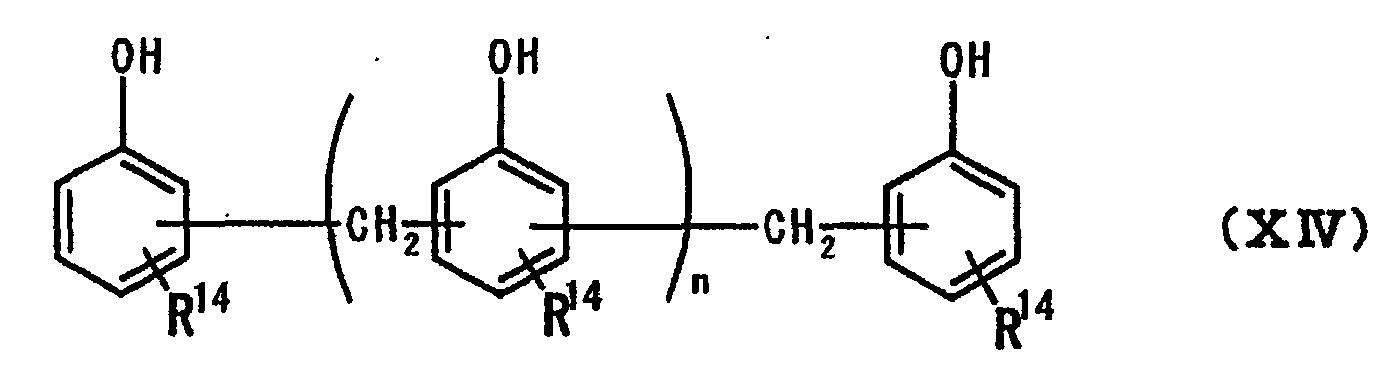
- Preferable examples thereof include dihydroxybenzenes such as catechol, resorcin and hydroquinone, dihydroxynaphthalenes such as 1,4-dihydroxynaphthalene, 1,5-dihydroxynaphthalene, 1,6-dihydroxynaphthalene, 2,5-dihydroxynaphthalene and 2,6-dihydroxynaphthalene, epoxy resins obtained by epoxidating phenolic hydroxyl groups of a phenol novolac resin represented by the following formula (XIV): (wherein R 14 s each represent a hydrogen atom, a methyl group or an ethyl group, and n which is the number of recurring units represents an integer of 0 to 50, its average being within a range of 0 to 15), a phenol-dicyclopentadiene resin represented by the following formula (XV): (wherein R 15 s each represent a hydrogen atom, a halogen atom, a linear, branched or cyclic
- any phenolic-hydroxyl-group-containing compounds or resins 0 to 100 mol% of the hydroxyl groups of which have been esterified by acyl groups and ester derivatives thereof can be used.
- the curing agent (B) include a novolac resin represented by the following formula (VIII) or an ester derivative thereof, a phenol-dicyclopentadiene resin represented by the following formula (IX) or an ester derivative thereof, a phenol aralkyl resin represented by the following formula (X) or an ester derivative thereof, a naphthol aralkyl resin represented by the following formula (XI) or an ester derivative thereof, a biphenol compound represented by the following formula (XII) or an ester derivative thereof, or a bisphenol compound represented by the following formula (XIII) or an ester derivative thereof: (wherein R 8 s each represent a hydrogen atom, a methyl group or an ethyl group; n which is the number of recurring units represents an integer of 0 to 50, its average being within a range of 0 to 15; and As each represent a hydrogen atom in the case of the compound (B1) and an aromatic acyl group in the case of the
- curing agent (B) Particularly preferable examples include:
- Esterification of these phenol resins can be performed in accqrdance with a known method.
- an esterifying agent used to esterify the above hydroxyl groups may be any of an organic carboxylic anhydride, an organic carboxylic halide and an organic carboxylic acid.
- a convenient esterifying agent may be selected according to characteristics of an esterifying agent based on the number of carbon atoms of an ester desired to be derived.
- esterifying agent examples include acetic anhydride, acetyl chloride, acetyl bromide, acetic acid, propionic anhydride, propionyl chloride, propionyl bromide, propionic acid, butyric anhydride, butyric chloride, butyric acid, valeric anhydride, valeric chloride, valeric bromide, valeric acid, pivalic chloride, pivalic acid, phenylacetic acid, phenyl acetyl chloride, 2-phenylpropionic acid, 3-phenylpropionic acid, o-tolylacetic acid, m-tolylacetic acid, p-tolylacetic acid, cumenic acid, benzoic anhydride, benzoic chloride, benzoic bromide, benzoic acid, o-methylbenzoic chloride, m-methylbenzoic chloride, p-methylbenzoic chloride, o-methylbenzoic acid, m-
- esterifying agents can be used solely or in admixture of two or more.
- the rate of esterification is 0 to 100 mol%, preferably 10 to 100 mol%, more preferably 50 to 100 mol%, much more preferably 80 to 100 mol%, most preferably 90 to 100 mol%.
- an esterification rate of 0% simply implies a phenol compound or a phenol resin.
- the epoxy resin composition of the present invention a phenol compound or phenol resin or an ester derivative thereof is used as the curing agent for an epoxy resin having two or more functional groups. Since the epoxy resin composition of the present invention is intended for use as a thermosetting resin in the same applications as a conventional epoxy-phenol cured product is used, such a combination of the constituents that the composition can take a three-dimensional structure after cured is desirable.
- a total of hydroxyl groups and ester groups, that is, active groups is 0.5 to 1.5 mole equivalents, preferably 0.7 to 1.3 mole equivalents, based on 1 mole equivalent of epoxy groups. In actual use, it is more preferable to adjust and use a molar ratio with which optimum physical properties of a cured product can be obtained.
- any techniques may be used.
- the phosphazenium compound of the formula (1) as the accelerator is melt-mixed into the curing agent sufficiently in advance and the mixture is then mixed with the epoxy resin or these may be mixed together simultaneously.
- these materials may be dry-blended in powdery form.
- an organic and/or inorganic filler(s) as a component (D) and other additives may be added to the epoxy resin composition.
- the epoxy resin composition of the present invention when used as a sealant for a semiconductor integrated circuit, it is desirable to use the organic and/or inorganic filler(s) (D) and a variety of additives such as a colorant, e.g. carbon black, a mold releasing agent, a coupling agent and a flame retardant for the purposes of improving its mechanical properties and reducing an overall cost.
- a colorant e.g. carbon black
- a mold releasing agent e.g. carbon black
- a coupling agent e.g. carbon black
- a flame retardant e.g. carbon black
- the amount of the organic and/or inorganic filler(s) (D) is preferably 100 parts by weight to 1,900 parts by weight based on 100 parts by weight of a total of the epoxy resin (A) and the curing agent (B). From the viewpoints of moisture resistance and mechanical strength, the amount is more preferably not smaller than 250 parts by weight, particularly preferably not smaller 550 parts by weight.
- Illustrative examples of the organic and/or inorganic filler(s) (D) include powders such as silica, alumina, silicon nitride, silicon carbide, talc, calcium silicate, calcium carbonate, mica, clay and titanium white, and fibers such as glass fibers, carbon fibers and aramid fibers.
- powders such as silica, alumina, silicon nitride, silicon carbide, talc, calcium silicate, calcium carbonate, mica, clay and titanium white
- fibers such as glass fibers, carbon fibers and aramid fibers.
- crystalline silica and/or fused silica are/is preferably used in the sealant.
- the silicas desirably have spherical shapes or a combination of spherical shapes and irregular shapes.
- the coupling agent in consideration of mechanical strength and heat resistance, it is desirable to use a coupling agent to improve adhesion between the resin and the filler.
- the coupling agent include a silane coupling agent, a titanate coupling agent, an aluminate coupling agent and a zircoaluminate coupling agent.
- the silane coupling agent is preferable, and particularly, a silane coupling agent having a functional group which reacts with an epoxy group is the most preferable.
- Such a coupling agent include vinyl trimethoxysilane, vinyl triethoxysilane, N-(2-aminomethyl)-3-aminopropylmethyldimethoxysilane, N-(2-aminoethyl)-3-aminopropyltrimethoxysilane, 3-aminopropyltriethoxysilane, 3-anilinopropyltriethoxysilane, 3-glycidoxypropyltrimethoxysilane, 3-glycidoxypropylmethyldimethoxysilane, 2-(3,4-epoxycyclohexyl)ethyltrimethoxysilane, 3-methacryloxypropyltrimethoxysilane, and 3-mercaptopropyltrimethoxysilane. These can be used solely or in combination of two or more.
- these coupling agents be adsorbed to the surface of the filler or solidified by a reaction in advance.
- low pressure transfer molding can be said to be the most commonly used.
- other methods such as injection molding, compression molding and cast molding can also be used, and a special technique using a solvent can also be used.
- the obtained resin was dissolved in 1,400 g of toluene and then washed with hot water at 60 to 70°C until waste water becomes neutral, and toluene was distilled off at 150°C/5 mmHg at the highest so as to obtain 370 g of phenol novolac resin having completely acetylated hydroxyl groups. Its hydroxyl group equivalent was not smaller than 3,000 g/eq (undetectable).
- the obtained resin was dissolved in 1,400 g of toluene and then washed with hot water at 60 to 70°C until waste water becomes neutral, and toluene was distilled off at 150°C/5 mmHg at the highest so as to obtain 590 g of phenol novolac resin having completely benzoylated hydroxyl groups. Its hydroxyl group equivalent was not smaller than 3,000 g/eq (undetectable).
- the obtained resin was dissolved in 1,400 g of toluene and then washed with hot water at 60 to 70°C until waste water becomes neutral, and toluene was distilled off at 150°C/5 mmHg at the highest so as to obtain 609 g of phenol aralkyl resin having completely acetylated hydroxyl groups. Its hydroxyl group equivalent was not smaller than 3,000 g/eq (undetectable).
- the obtained resin was dissolved in 1,400 g of toluene and then washed with hot water at 60 to 70°C until waste water becomes neutral, and toluene was distilled off at 150°C/5 mmHg at the highest so as to obtain 785 g of phenol aralkyl resin having completely benzoylated hydroxyl groups. Its hydroxyl group equivalent was not smaller than 3,000 g/eq (undetectable).
- the obtained resin was dissolved in 1,400 g of toluene and then washed with hot water at 60 to 70°C until waste water becomes neutral, and toluene was distilled off at 150°C/5 mmHg at the highest so as to obtain 610 g of phenol-dicyclopentadiene-resin-type resin having completely acetylated hydroxyl groups. Its hydroxyl group equivalent was not smaller than 3,000 g/eq (undetectable).
- the obtained resin was dissolved in 1,400 g of toluene and then washed with hot water at 60 to 70°C until waste water becomes neutral, and toluene was distilled off at 150°C/5 mmHg at the highest so as to obtain 810 g of phenol-dicyclopentadiene-resin-type resin having completely benzoylated hydroxyl groups. Its hydroxyl group equivalent was not smaller than 3,000 g/eq (undetectable).
- the obtained resin was dissolved in 1,400 g of toluene and then washed with hot water at 60 to 70°C until waste water becomes neutral, and toluene was distilled off at 150°C/5 mmHg at the highest so as to obtain 745 g of naphthol aralkyl resin having completely acetylated hydroxyl groups. Its hydroxyl group equivalent was not smaller than 3,000 g/eq (undetectable).
- the obtained resin was dissolved in 1,400 g of toluene and then washed with hot water at 60 to 70°C until waste water becomes neutral, and toluene was distilled off at 150°C/5 mmHg at the highest so as to obtain 923 g of naphthol aralkyl resin having completely benzoylated hydroxyl groups. Its hydroxyl group equivalent was not smaller than 3,000 g/eq (undetectable).
- a filler and other additives were added in the following amounts, and the mixture was roll-mixed under heating so as to obtain a molding material for a sealant:
- a cured product was obtained under conditions of 175°C/10 min and 150 kg/cm 2 and then after-cured at 175°C/8 hr (nitrogen atmosphere) so as to fully cure the product. Physical properties were measured by use of the cured product.
- test semiconductor devices were prepared by low pressure transfer molding, and a cracking test was conducted by means of a solder bath.
- Example 2 Tests were conducted in the same manner as in Example 1 except that the curing agent was changed to the benzoylated phenol novolac resin of Synthesis Example 2.
- Example 2 Tests were conducted in the same manner as in Example 1 except that the epoxy compound was changed to YX-4000H, the curing agent was changed to the acetylated phenol aralkyl resin of Synthesis Example 3, and a composition was obtained by a method comprising the steps of fully melt-mixing the curing agent with the accelerator at 120°C in advance and then adding the epoxy resin.
- Example 5 Tests were conducted in the same manner as in Example 1 except that the curing agent was changed to the acetylated phenol-dicyclopentadiene resin of Synthesis Example 5.
- a resin composition was prepared in the same manner as in Example 1 except that the accelerator was changed to 0.015 mol of triphenylphosphine. However, a cured product was not obtained. Further, although gelation time was also measured at 150°C and 200°C for 20 minutes, the test was stopped since no gelation was seen.
- a resin composition was prepared in the same manner as in Example 2 except that the accelerator was changed to 0.015 mol of triphenylphosphine. However, a cured product was not obtained. Further, although gelation time was also measured at 150°C and 200°C for 20 minutes, the test was stopped since no gelation was seen.
- Tests were conducted in the same manner as in Example 3 except that the accelerator was changed to 0.015 mol of triphenylphosphine and the curing agent was changed to a phenol aralkyl resin (trade name: MIREX XLC-4L, hydroxyl group equivalent: 169 g/eq, product of Mitsui Chemicals, Inc.).
- Tests were conducted in the same manner as in Example 3 except that the curing agent was changed to a mixture of the benzoylated phenol novolac resin of Synthesis Example 2 and a phenol novolac resin (trade name: BRG#558, product of SHOWA HIGHPOLYMER, hydroxyl group equivalent: 104 g/eq) at a mixing ratio of 88:12 (ratio of functional groups).
- a resin composition was prepared in the same manner as in Example 9 except that the accelerator was changed to 0.015 mol of triphenylphosphine. However, a cured product was not obtained.
- a resin composition was prepared in the same manner as in Example 10 except that the accelerator was changed to 0.015 mol of triphenylphosphine. However, a cured product was not obtained.
- An epoxy resin composition containing the accelerator and phosphazenium compound of the present invention as essential components and a compound whose hydroxyl groups have been esterified by acyl groups as a curing agent has far superior hygroscopicity and is very advantageous in terms of cracking resistance as compared with a conventional epoxy resin/phenol resin cured product. It is thereby understood that the epoxy resin compound is excellent in cracking resistance as a sealant.
- triphenylphosphine which is a conventional accelerator is used, triphenylphosphine does not cause a curing reaction in portions esterified by acryl groups, as shown by Comparative Examples 1 and 2. From this fact, it is understood that the esterified curing agent and the phosphazenium compound are essential components so as to obtain high physical properties as the sealant in the present invention.
- a filler and other additives were added in the following amounts, and the mixture was roll-mixed under heating so as to obtain a molding material for a sealant:
- a cured product was obtained under conditions of 150°C ⁇ 185°C/5 min, 185°C/5 min and 150 kg/cm 2 and then after-cured at 185°C/8 hr (nitrogen atmosphere) so as to fully cure the product. Tests were conducted with respect to curing behavior and the like.
- Tests were conducted in the same manner as in Example 11 except that the curing agent was changed to a phenol-dicyclopentadiene resin (trade name: DPR-5000, product of Mitsui Chemicals, Inc., hydroxyl group equivalent: 180 g/eq).
- a phenol-dicyclopentadiene resin (trade name: DPR-5000, product of Mitsui Chemicals, Inc., hydroxyl group equivalent: 180 g/eq).
- Tests were conducted in the same manner as in Example 14 except that the curing agent was changed to a phenol aralkyl resin (trade name: MIREX XLC-4L, hydroxyl group equivalent: 169 g/eq, product of Mitsui Chemicals, Inc.).
- a phenol aralkyl resin trade name: MIREX XLC-4L, hydroxyl group equivalent: 169 g/eq, product of Mitsui Chemicals, Inc.
- Tests were conducted in the same manner as in Example 16 except that the curing agent was changed to a phenol aralkyl resin (trade name: MIREX XLC-4L, hydroxyl group equivalent: 169 g/eq, product of Mitsui Chemicals, Inc.).
- a phenol aralkyl resin trade name: MIREX XLC-4L, hydroxyl group equivalent: 169 g/eq, product of Mitsui Chemicals, Inc.
- Example 17 Tests were conducted in the same manner as in Example 17 except that the epoxy resin was changed to a phenol-aralkyl-resin-type epoxy resin: MIREX XLC-4L (product of Mitsui Chemicals, Inc., hydroxyl group equivalent: 169 g/eq) epoxidated in accordance with a conventional method.
- MIREX XLC-4L product of Mitsui Chemicals, Inc., hydroxyl group equivalent: 169 g/eq
- TPP triphenylphosphine
- TPP triphenylphosphine
- TPP triphenylphosphine
- TPP triphenylphosphine
- TPP triphenylphosphine
- TPP triphenylphosphine
- TPP triphenylphosphine
- TPP triphenylphosphine
- TPP triphenylphosphine
- TPP triphenylphosphine
- Tests were conducted in the same manner as in Example 11 except that the accelerator was changed to 0.008 mol of 2-undecylimidazole.
- Tests were conducted in the same manner as in Example 12 except that the accelerator was changed to 0.008 mol of 2-undecylimidazole.
- Tests were conducted in the same manner as in Example 13 except that the accelerator was changed to 0.015 mol of 2-methylimidazole.
- Tests were conducted in the same manner as in Example 14 except that the accelerator was changed to 0.015 mol of 2-methylimidazole.
- Tests were conducted in the same manner as in Example 15 except that the accelerator was changed to 0.015 mol of 2-methylimidazole.
- Tests were conducted in the same manner as in Example 16 except that the accelerator was changed to 0.008 mol of 2-undecylimidazole.
- Tests were conducted in the same manner as in Example 17 except that the accelerator was changed to 0.008 mol of 2-undecylimidazole.
- Tests were conducted in the same manner as in Example 18 except that the accelerator was changed to 0.008 mol of 2-undecylimidazole.
- Tests were conducted in the same manner as in Example 19 except that the accelerator was changed to 0.008 mol of 2-undecylimidazole.
- Fig. 1 is a graph showing the curing behavior of an epoxy resin composition when CURELASTOMETER is used.
- Curing Behavior This was measured by CURELASTOMETER V model manufactured by NSC.
- phosphazene compound of the formula 1 wherein all R1s were a methyl group was dissolved in 100 g of pure water and then boiled at 95°C for 20 hours and then at 125°C for 20 hours (in a glass autoclave). Thereafter, conductivity of the water was measured.
- Conductivity was measured in the same manner by use of 0.05 g of tris[tris(dimethylamino)phospholanilideneamino]phosphine oxide in place of the phosphazene compound of Example 18.
- the essential phosphazene catalyst in the present invention shows constant conductivity regardless of the processing temperature, thereby inferring it from analogy that the catalyst is stable, the phosphine oxide compound of the Comparative Example shows that conductivity became over four times larger as the temperature increased from 95°C to 125°C. That is, it is assumed that at high temperatures, it produces a conductive material of some type by decomposition. Therefore, it has been found that they have a large difference with respect to electric characteristics as a sealant.
- the gelation time is significantly reduced, and the time required for 90% curing in measurement of an increase in torque along with curing by use of the CURELASTOMETER is significantly reduced. This leads to a reduction in cost along with a shortened production cycle in industrial production of a sealant and makes a great contribution from an industrial standpoint.
- the epoxy resin composition obtained by the present invention can be used in industrial fields in which the conventional epoxy resin composition has been used. Particularly, when used as a sealant for a semiconductor, it provides a package with better cracking resistance than the conventional epoxy resin/phenol resin cured product does.
Landscapes
- Chemical & Material Sciences (AREA)
- Health & Medical Sciences (AREA)
- Chemical Kinetics & Catalysis (AREA)
- Medicinal Chemistry (AREA)
- Polymers & Plastics (AREA)
- Organic Chemistry (AREA)
- Epoxy Resins (AREA)
- Structures Or Materials For Encapsulating Or Coating Semiconductor Devices Or Solid State Devices (AREA)
Abstract
An epoxy resin composition comprising an epoxy
resin (A), a curing agent (B) and a curing accelerator (C),
wherein the curing agent (B) is a phenol compound having
two or more functional groups or a compound obtained by esterification
of the phenol compound or a mixture of these
compounds, and the curing accelerator (C) is a salt of a
phosphazenium compound represented by a formula (I):
 (wherein R1s each represent a hydrogen atom, a linear,
branched or cyclic alkyl group having 1 to 10 carbon atoms
or an aryl or aralkyl group having 6 to 10 carbon atoms and
may be all the same or different from one another; and Z-
represents a halogen anion, hydroxy anion, alkoxy anion,
aryloxy anion or carboxy anion).
(wherein R1s each represent a hydrogen atom, a linear,
branched or cyclic alkyl group having 1 to 10 carbon atoms
or an aryl or aralkyl group having 6 to 10 carbon atoms and
may be all the same or different from one another; and Z-
represents a halogen anion, hydroxy anion, alkoxy anion,
aryloxy anion or carboxy anion).
Description
The present invention relates to a semiconductor
device obtained by sealing a semiconductor integrated circuit
with an epoxy resin. The present invention provides
an epoxy resin composition which has various physical properties
satisfactory to make the composition usable for its
application, e.g., low hygroscopicity and excellent melt-flowability
of the resin composition in particular and
which provides overall cracking resistance. Further, the
present invention also relates to an epoxy resin composition
comprising a catalyst which causes a functional group
such as a phenolic hydroxyl group or an ester group to react
with an epoxy group quickly, and a cured product of the
epoxy resin composition.
Heretofore, integrated circuits (IC) and large
scale integrated circuit (LSI) have been protected from
malfunctions caused by dirt, dust, heat, moisture or light
in an external atmosphere by sealants for protecting them
in order for the circuits to be actually used.
In recent years, the sealants have been gradually
shifted from sealing with metal materials and ceramic materials
to sealing with resins, and at present, epoxy resin
sealants are predominantly used.
In particular, in view of balance between costs and
physical properties, epoxy resin compositions using a phenol
resin as a curing agent are used in large quantities.
The sealants using these epoxy resin compositions have
problems such as improvement in mechanical properties as
well as:
Generally, the occurrence of cracks at the time of
reflow soldering in (i) is assumed to be caused by water in
the resin which expands sharply when exposed to high temperatures
at the time of reflow soldering. Hence, means
for solving the problem is largely focused on control of
moisture absorptivity of the resin, and mechanical strength
and adhesion of the resin to metal are also involved in the
means on the whole.
However, since a reaction between an epoxy group
and a hydroxyl group is a reaction which always produces a
hydroxyl group as shown by the following reaction formula
(1), hydrophilicity becomes higher due to the hydroxyl
group, and even if a basic skeleton is rendered hydrophobic,
a reduction in the moisture absorptivity as a whole is limited.
 (wherein A represents an epoxy residue, and B represents a
phenol residue).
(wherein A represents an epoxy residue, and B represents a
phenol residue).
As a technique for solving these problems, a technique
disclosed in, for example, EP 959088 which uses a
phosphine oxide derivative as a curing accelerator has been
studied.
Since an epoxy resin composition using the accelerator
is cured by use of the phenol resin, moisture absorptivity
is almost the same as that when triphenylphosphine
or imidazole which is a commonly used accelerator
is used. As for improvements in other physical properties,
however, a significant improvement in cracking resistance
is seen.
Further, its curing behavior has a significantly
great merit from an industrial standpoint in that initial
curing takes long time and complete curing takes short time.
Meanwhile, with respect to the improvement in electrical
reliability in (ii), the following problems exist.
Of these, the ion impurities in (ii)-2 are a problem
of purification and purity of the epoxy resin in particular
and are not intrinsic. As for the problem of (ii)-1,
modification of the resin and/or control of the side reaction
can cause the epoxy resin composition to fully exhibit
physical properties inherent in the epoxy resin composition.
These problems indicated by (ii)-1 and (ii)-2 influence
a technique to be described hereinafter.
That is, for the purpose of reducing the moisture
absorptivity of the resin in the foregoing problem (i), a
reaction between an epoxy group and an ester group as disclosed
in Japanese Patent Application Laid-Open No.
53327/1987 applied by Nishikubo et al. has been proposed.
In the publication, a quaternary onium salt and a
crown ether complex are set forth as preferable catalysts,
and in a paper [Addition Reaction of Epoxy Compound with
Ester and Its Application to Synthesis of Polymer, Synthetic
Organic Chemistry, Vol. 49, pp. 218 to 233 (1991)]
by Nishikubo et al., yields when the catalysts are used as
unit reactions are specifically described. According to
the paper, although the highest yield is 91% which is a
yield when tetrabutylammonium chloride is used, the yields
are generally low.
It is needless to say that if an ionic compound
such as the quaternary onium salt and the crown ether complex
remain in a resin used as a sealant for a semiconductor
integrated circuit, this means that the ionic impurities
described in the foregoing (ii)-1 are added as a curing
accelerator, thereby causing undesirable results such
as an electrical short circuit as well as corrosion of
metal portions in contact with the impurities, and these
undesirable results and the corrosion in turn cause serious
defects in products.
Meanwhile, in a general addition reaction between
an epoxy resin and a phenol resin, a phosphine such as trialkylphosphine
or triarylphosphine, imidazole, a tertiary
amine or the like is used as a catalyst, and particularly
for sealing a semiconductor, imidazole and the phosphines
are often used. When these catalysts are used in the reaction
between an epoxy group and an ester group, imidazole
having reaction activity is liable to cause epoxy homopolymerization
which is the foregoing side reaction, and the
problem of the foregoing (ii)-2 is remarkable. On the
other hand, although the phosphines do not have these problems,
they have slow curing speed and provide substantially
no cured product.
Therefore, the idea of preparing a curing agent for
an epoxy resin by esterifying some or all hydroxyl groups
of the phenol resin as the curing agent for the purpose of
obtaining lower hygroscopicity has heretofore not been implemented
because no effective curing catalyst has been
available.
Under such circumstances, in recent years, a phosphazene
catalyst for curing an ester group and an epoxy
group effectively has been proposed. More specifically, it
has been found that the phosphine oxide derivative disclosed
in the foregoing EP 959088 is effective for an epoxy-ester
curing reaction. Japanese Patent Application
Laid-Open No. 80049/2000 discloses its production and high
activity in a unit reaction between an epoxy group and an
ester group (reaction between monofunctional compounds),
and Japanese Patent Application Laid-Open No. 349662/1999
discloses its application to a sealant.
However, it has been found that due to hydrolytic
properties of the phosphine oxide derivative, if a cured
resin absorbs water with the derivative contained therein
and is exposed to high temperatures as in reflow soldering,
the derivative is decomposed easily, and electric conductivity
increases significantly. That is, the phosphine oxide
derivative is not suitable as a sealant in some cases.
Further, a phosphazenium compound which is a curing
catalyst is already disclosed in Japanese Patent Application
Laid-Open No. 77289/1998 which also discloses that the
phosphazenium compound exhibits high activity in a unit reaction
between an epoxy group and an ester group.
In consideration of these facts, it may seem to be
easy to use the phosphazenium compound together with an epoxy
resin having two or more functional epoxy groups and a
phenol resin having two or more functional groups or an ester
derivative thereof as a thermosetting resin. However,
it is generally known that a basic reaction does not necessarily
exhibit the same level of reaction activity under a
reaction in a polymer.
That is, it must be considered in the case of a
three-dimensional crosslinking curing reaction that as
three-dimensional crosslinking proceeds, skeletal steric
hindrance occurs due to bondings occurring in the vicinity
of functional groups and molecules are fixed along with
curing, so that the curing reaction may not proceed easily.
When the ionic phosphazenium compound is used as a
catalyst, it is conceivable that the compound may not be a
favorable catalyst for a sealant with respect to which control
of inclusion of ionic substances is generally strict.
Under the circumstances, in the present invention,
an epoxy resin composition suitable for use as a sealant, a
cured product thereof, and a curing agent composition for
the epoxy resin composition.
An object of the present invention is to provide a
composition for causing a phenol resin for providing a
cured epoxy resin resin having low hygroscopicity and excellent
electric characteristics or an ester derivative
thereof resulting from esterification of some or all hydroxyl
groups of the phenol resin with an aliphatic acyl
group or aromatic acyl group to react with an epoxy resin
or compound effectively. In particular, an object of the
present invention is to provide an epoxy resin composition
for a semiconductor sealant which is excellent in cracking
resistance and electric characteristics, a cured product of
the composition, a semiconductor device produced by use of
the composition, and a curing agent composition for an epoxy
resin.
The present inventors have found that such objects
can be achieved by a specific compound comprising a stable
cation and a counter anion and have completed the present
invention on the basis of this finding.
That is, the present invention is a curing agent
composition for an epoxy resin which comprises a compound
as a curing agent (B) which is selected from the group consisting
of the following (B1) to (B3):
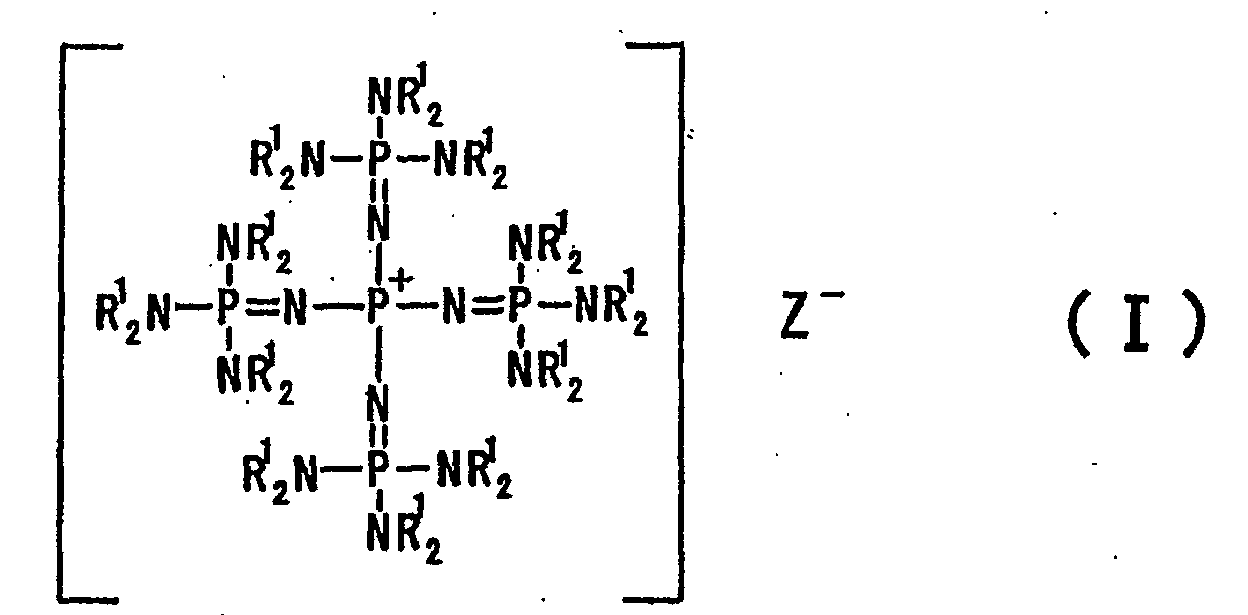
Further, the present invention is an epoxy resin
composition comprising:
- (B1) a phenol compound having two or more functional groups,
- (B2) a compound in which a hydroxyl group of a phenol compound having two or more functional groups is esterified with an acyl group, and
- (B3) a mixture of the above (B1) and (B2),
Still further, the present invention is a cured epoxy
resin obtained by heat-curing the foregoing epoxy resin
composition.
Still further, the present invention is a semiconductor
device obtained by sealing a semiconductor integrated
circuit by use of the foregoing epoxy resin composition.
Still further, the present invention is an epoxy
resin composition comprising:
- (B1) a phenol compound having two or more functional groups,
- (B2) a compound in which a hydroxyl group of a phenol compound having two or more functional groups is esterified with an acyl group, and
- (B3) a mixture of the above (B1) and (B2),
Fig. 1 is a graph showing the curing behavior of an
epoxy resin composition when CURELASTOMETER is used.
In the present invention, as a curing accelerator
(C), a salt comprising a stable cation and a counter anion
typified by a salt of a phosphazenium compound which is
represented by the foregoing formula (1) is used, and as
the curing agent (B), a compound selected from the group
consisting of the following (B1) to (B3)is used:
When the mixture (B3) is used, a mixing ratio of
the compound (B1) and the compound (B2) is arbitrary and
should be determined by determining desired physical properties
of a cured product according to target application
and grade.
That is, hygroscopicity lowers as the number of ester
groups increases, while adhesion to metal such as a
lead frame improves as the number of hydroxyl groups increases,
whereby mechanical strength is improved.
In the epoxy resin composition of the present invention,
when the phosphazenium compound of the formula (1)
is used as the essential accelerator, a reaction between an
epoxy group and an ester group which has conventionally
been unable to proceed to a sufficient degree can fully
proceed as a curing reaction, a problem of the side reaction
of the foregoing problem (ii) can be solved, and a
cured product which is excellent particularly in flexibility,
moisture resistance, cracking resistance and electric
characteristics can be provided, as compared with when conventional
imidazole or triphenylphosphine is used as the
accelerator.
Further, even when an unesterified phenol resin is
used, heat resistance is improved and complete curing becomes
fast, as compared with when the conventional accelerator
is used.
In addition, a resin composition prepared by adding
an organic and/or inorganic filler(s) (D) to the epoxy
resin composition exhibits extremely excellent performance
as a sealant for a semiconductor integrated circuit.
Meanwhile, as compared with the aforementioned
prior art using a phosphine oxide derivative as a curing
accelerator, electrical reliability as electrical and electronic
products improves.
That is, while the phosphine oxide derivative has
hydrolytic properties as a compound and has a problem with
respect to electrical reliability, the phosphazenium compound
used in the present invention is stable. Thus, the
difference in electrical reliability occurs.
That is, the epoxy resin composition of the present
invention is preferably an epoxy resin composition comprising:
Hereinafter, the phosphazenium compound represented
by the formula (1) which is used in the present invention
will be described.
In the formula (1), substituents R1s each represent
a hydrogen atom, a linear, branched or cyclic alkyl group
having 1 to 10 carbon atoms or an aryl or aralkyl group
having 6 to 10 carbon atoms and may be all the same or different
from one another.
Illustrative examples of R1 include a hydrogen atom;
a linear, branched or cyclic alkyl group such as a methyl
group, an ethyl group, an n-propyl group, an isopropyl
group, an n-butyl group, an s-butyl group, a t-butyl group,
a 1-pentyl group, a 2-pentyl group, a 3-pentyl group, a 2-methyl-1-butyl
group, an isopentyl group, a t-pentyl group,
a 3-methyl-2-butyl group, a neopentyl group, an n-hexyl
group, a 4-methyl-2-pentyl group, a cyclopentyl group, a
cyclohexyl group, a 1-heptyl group, a 3-heptyl group, a 1-octyl
group, a 2-octyl group, a 2-ethyl-1-hexyl group, a
nonyl group or a decyl group; an aryl group such as a
phenyl group; and an aralkyl group such as a toluyl group,
a benzyl group, a 1-phenylethyl group or a 2-phenylethyl
group.
Of these, an aliphatic hydrocarbon group having 1
to 6 carbon atoms such as a methyl group, an ethyl group,
an n-propyl group, an isopropyl group, an n-butyl group or
a cyclohexyl group is preferable, and the methyl group and
the ethyl group are more preferable.
In the formula (1), Z- represents a halogen anion,
hydroxy anion, alkoxy anion, aryloxy anion or carboxy anion.
In addition, any anions can be used as long as they
do not inhibit the effect of the present invention.
Illustrative examples of Z- include a halogen anion
such as a fluorine anion, a chlorine anion, a bromine anion
or an iodine anion; a hydroxy anion; an alkoxy anion derived
from an alcohol such as methanol, ethanol, n-propanol,
isopropanol, allyl alcohol, n-butanol, s-butanol, t-butanol,
cyclohexanol, 2-heptanol, 1-octanol, 1-decanol or octahydronaphthol;
an aryloxy anion derived from an aromatic hydroxy
compound such as phenol, cresol, xylenol, naphthol,
2-methyl-1-naphthol or 9-phenanthrol; and a carboxy anion
derived from a carboxylic acid such as formic acid, acetic
acid, propionic acid, butyric acid, isobutyric acid,
caproic acid, decanecarboxylic acid, oleic acid, benzoic
acid or naphthoic acid.
Of these, the hydroxy anion; an alkoxy anion derived
from an alcohol having 1 to 4 carbon atoms such as
methanol, ethanol, n-propanol, isopropanol, n-butanol, s-butanol
or t-butanol; an aryloxy anion derived from an aromatic
hydroxy compound having 6 to 8 carbon atoms such as
phenol or cresol; and a benzoyloxy anion derived from benzoic
acid are preferable. More preferable are the hydroxy
anion, a methoxy anion, a phenoxy anion and the benzoyloxy
anion. The most preferable is the hydroxy anion.
These phosphazenium compounds may be used solely or
in admixture of two or more.
These phosphazenium compounds can be synthesized in
accordance with a method disclosed in Japanese Patent Application
Laid-Open No. 77289/1998 or a similar method.
In the epoxy resin composition of the present invention,
the curing accelerator (C) is used in an amount of
0.001 to 25 wt% (0.001 to 25 g/100 g), preferably 0.01 to
15 wt%, more preferably 0.1 to 8 wt%, based on 100 wt% of a
resin component (total of the epoxy resin (A) and the curing
agent (B)).
Further, in the epoxy resin composition of the present
invention, together with the phosphazenium compound, a
generally used, known accelerator other than the phosphazenium
compound, such as imidazole, e.g., 2-methylimidazole
or a phosphine, e.g., triphenylphosphine, may be used in an
amount of 0.5 to 500 wt% of the phosphazenium compound.
The characteristics of the present invention are exhibited
readily when the amount is not higher than 500 wt% (fivefold
equivalent).
The phosphazenium compound has almost no deliquescent
properties. Even in the following preparation of the
composition, it can be handled under a normal atmosphere as
in the case of other compounds.
In the epoxy resin composition of the present invention,
the epoxy resin as the component (A) is an epoxy
resin having two or more epoxy groups in a molecule. As
the epoxy resin (A), a variety of conventionally known epoxy
resins can be used regardless of molecular structure,
molecular weight and the like as long as they can be cured
by a variety of curing agents as will be described later.
Firstly, preferable examples of the epoxy resin (A)
include a novolac epoxy resin represented by the following
formula (II), a phenol-dicyclopentadiene-type epoxy resin
represented by the following formula (III), a phenol-aralkyl-resin-type
epoxy resin represented by the following
formula (IV), a naphthol-aralkyl-resin-type epoxy resin
represented by the following formula (V), a biphenol-type-epoxy-containing
epoxy resin represented by the following
formula (VI) or a bisphenol-type-epoxy-containing epoxy
resin represented by the following formula (VII):
 (wherein R2s each represent a hydrogen atom, a methyl group
or an ethyl group, and n which is the number of recurring
units represents an integer of 0 to 50, its average being
within a range of 0 to 15),
(wherein R2s each represent a hydrogen atom, a methyl group
or an ethyl group, and n which is the number of recurring
units represents an integer of 0 to 50, its average being
within a range of 0 to 15),
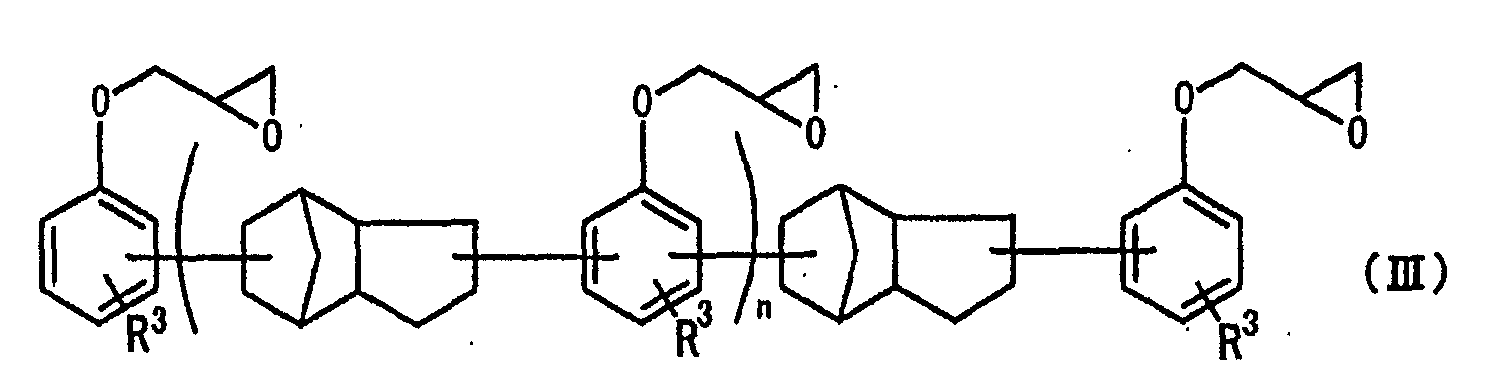 (wherein R3s each represent a hydrogen atom, a halogen atom,
a linear, branched or cyclic aliphatic alkyl group having 1
to 8 carbon atoms, an alkoxy group having 1 to 10 carbon
atoms or a phenyl group, and n which is the number of recurring
units represents an integer of 0 to 50, its average
being within a range of 0 to 15),
(wherein R3s each represent a hydrogen atom, a halogen atom,
a linear, branched or cyclic aliphatic alkyl group having 1
to 8 carbon atoms, an alkoxy group having 1 to 10 carbon
atoms or a phenyl group, and n which is the number of recurring
units represents an integer of 0 to 50, its average
being within a range of 0 to 15),
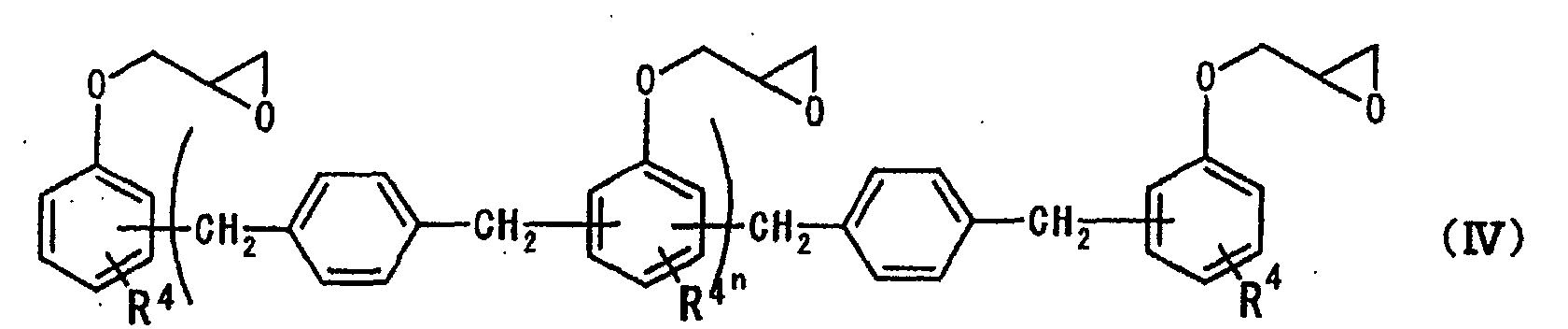 (wherein R4s each represent a hydrogen atom, a halogen atom,
a linear, branched or cyclic aliphatic alkyl group having 1
to 8 carbon atoms, an alkoxy group having 1 to 10 carbon
atoms or a phenyl group, and n which is the number of recurring
units represents an integer of 0 to 50, its average
being within a range of 0 to 15),
(wherein R4s each represent a hydrogen atom, a halogen atom,
a linear, branched or cyclic aliphatic alkyl group having 1
to 8 carbon atoms, an alkoxy group having 1 to 10 carbon
atoms or a phenyl group, and n which is the number of recurring
units represents an integer of 0 to 50, its average
being within a range of 0 to 15),
 (wherein R5s each represent a hydrogen atom, a halogen atom,
a linear, branched or cyclic aliphatic alkyl group having 1
to 8 carbon atoms, an alkoxy group having 1 to 10 carbon
atoms, a phenyl group or a glycidyl ether group, and n
which is the number of recurring units represents an integer
of 0 to 50, its average being within a range of 0 to
15),
(wherein R5s each represent a hydrogen atom, a halogen atom,
a linear, branched or cyclic aliphatic alkyl group having 1
to 8 carbon atoms, an alkoxy group having 1 to 10 carbon
atoms, a phenyl group or a glycidyl ether group, and n
which is the number of recurring units represents an integer
of 0 to 50, its average being within a range of 0 to
15),
 (wherein R6s each represent a hydrogen atom, a methyl group
or an ethyl group and may be all the same or different from
one another), and
(wherein R6s each represent a hydrogen atom, a methyl group
or an ethyl group and may be all the same or different from
one another), and
 (wherein R7s each represent a hydrogen atom, an alkyl group
having 1 to 10 carbon atoms, an alkoxyl group having 1 to
10 carbon atoms, an aryl group having 6 to 10 carbon atoms,
an aryloxy group having 6 to 10 carbon atoms or halogen and
may be all the same or different from one another, and Y
represents an alkylidene having 1 to 10 carbon atoms, an
alkylene having 2 to 10 carbon atoms, a cycloalkylidene
having 3 to 10 carbon atoms, a cycloalkylene having 3 to 10
carbon atoms or a divalent group such as -O-, -CO-, -CO2-,
-S-, -SO- or -SO2-).
(wherein R7s each represent a hydrogen atom, an alkyl group
having 1 to 10 carbon atoms, an alkoxyl group having 1 to
10 carbon atoms, an aryl group having 6 to 10 carbon atoms,
an aryloxy group having 6 to 10 carbon atoms or halogen and
may be all the same or different from one another, and Y
represents an alkylidene having 1 to 10 carbon atoms, an
alkylene having 2 to 10 carbon atoms, a cycloalkylidene
having 3 to 10 carbon atoms, a cycloalkylene having 3 to 10
carbon atoms or a divalent group such as -O-, -CO-, -CO2-,
-S-, -SO- or -SO2-).
As the epoxy resin (A), a variety of conventionally
known epoxy resins can be used. For example, an epoxy
resin synthesized from a variety of novolac resins including
epichlorohydrin and bisphenol, an alicyclic epoxy resin
or an epoxy resin incorporating a halogen atom such as
chlorine or bromine can be used. The above epoxy resins
can be used solely or in admixture of two or more.
Preferable examples thereof include dihydroxybenzenes
such as catechol, resorcin and hydroquinone, dihydroxynaphthalenes
such as 1,4-dihydroxynaphthalene, 1,5-dihydroxynaphthalene,
1,6-dihydroxynaphthalene, 2,5-dihydroxynaphthalene
and 2,6-dihydroxynaphthalene, epoxy
resins obtained by epoxidating phenolic hydroxyl groups of
a phenol novolac resin represented by the following formula
(XIV):
 (wherein R14s each represent a hydrogen atom, a methyl group
or an ethyl group, and n which is the number of recurring
units represents an integer of 0 to 50, its average being
within a range of 0 to 15),
(wherein R14s each represent a hydrogen atom, a methyl group
or an ethyl group, and n which is the number of recurring
units represents an integer of 0 to 50, its average being
within a range of 0 to 15),
a phenol-dicyclopentadiene resin represented by the following formula (XV):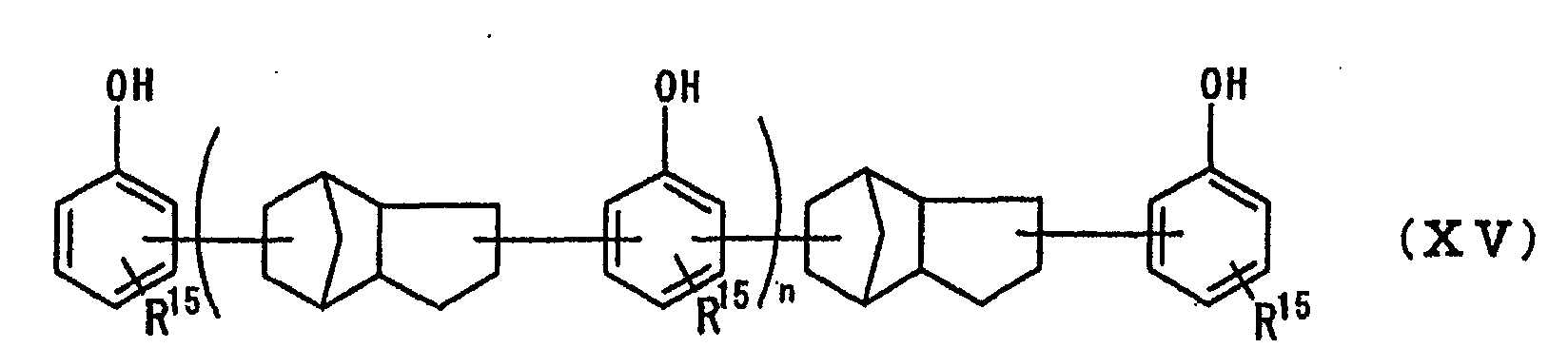 (wherein R15s each represent a hydrogen atom, a halogen atom,
a linear, branched or cyclic aliphatic alkyl group having 1
to 8 carbon atoms, an alkoxy group having 1 to 10 carbon
atoms or a phenyl group, and n which is the number of recurring
units represents an integer of 0 to 50, its average
being within a range of 0 to 15),
(wherein R15s each represent a hydrogen atom, a halogen atom,
a linear, branched or cyclic aliphatic alkyl group having 1
to 8 carbon atoms, an alkoxy group having 1 to 10 carbon
atoms or a phenyl group, and n which is the number of recurring
units represents an integer of 0 to 50, its average
being within a range of 0 to 15),
a phenol aralkyl resin represented by a formula (XVI):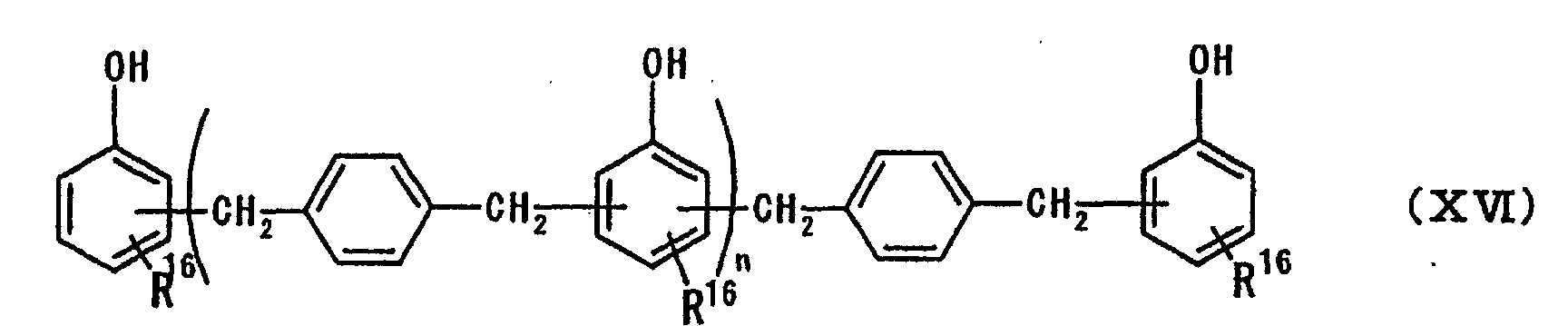 (wherein R16s each represent a hydrogen atom, a halogen atom,
a linear, branched or cyclic aliphatic alkyl group having 1
to 8 carbon atoms, an alkoxy group having 1 to 10 carbon
atoms or a phenyl group, and n which is the number of recurring
units represents an integer of 0 to 50, its average
being within a range of 0 to 15),
(wherein R16s each represent a hydrogen atom, a halogen atom,
a linear, branched or cyclic aliphatic alkyl group having 1
to 8 carbon atoms, an alkoxy group having 1 to 10 carbon
atoms or a phenyl group, and n which is the number of recurring
units represents an integer of 0 to 50, its average
being within a range of 0 to 15),
a naphthol aralkyl resin represented by a formula (XVII): (wherein R17s each represent a hydrogen atom, a halogen atom,
a linear, branched or cyclic aliphatic alkyl group having 1
to 8 carbon atoms, an alkoxy group having 1 to 10 carbon
atoms, a phenyl group or a hydroxyl group, and n which is
the number of recurring units represents an integer of 0 to
50, its average being within a range of 0 to 15),
(wherein R17s each represent a hydrogen atom, a halogen atom,
a linear, branched or cyclic aliphatic alkyl group having 1
to 8 carbon atoms, an alkoxy group having 1 to 10 carbon
atoms, a phenyl group or a hydroxyl group, and n which is
the number of recurring units represents an integer of 0 to
50, its average being within a range of 0 to 15),
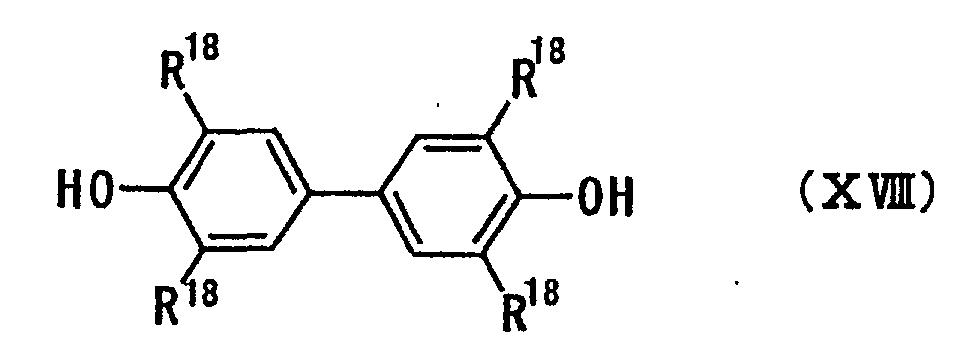
a biphenol represented by the following formula (XVIII): (wherein R18s each represent a hydrogen atom, a methyl group
or an ethyl group and may be all the same or different from
one another) and
(wherein R18s each represent a hydrogen atom, a methyl group
or an ethyl group and may be all the same or different from
one another) and
a bisphenol represented by a formula (XIX): (wherein R19s each represent a hydrogen atom, an alkyl group
having 1 to 10 carbon atoms, an alkoxyl group having 1 to
10 carbon atoms, an aryl group having 6 to 10 carbon atoms,
an aryloxy group having 6 to 10 carbon atoms or halogen and
may be all the same or different from one another, and Y
represents an alkylidene having 1 to 10 carbon atoms, an
alkylene having 2 to 10 carbon atoms, a cycloalkylidene
having 3 to 10 carbon atoms, a cycloalkylene having 3 to 10
carbon atoms or a divalent group such as -O-, -CO-, -CO2-,
-S-, -SO- or -SO2-),
(wherein R19s each represent a hydrogen atom, an alkyl group
having 1 to 10 carbon atoms, an alkoxyl group having 1 to
10 carbon atoms, an aryl group having 6 to 10 carbon atoms,
an aryloxy group having 6 to 10 carbon atoms or halogen and
may be all the same or different from one another, and Y
represents an alkylidene having 1 to 10 carbon atoms, an
alkylene having 2 to 10 carbon atoms, a cycloalkylidene
having 3 to 10 carbon atoms, a cycloalkylene having 3 to 10
carbon atoms or a divalent group such as -O-, -CO-, -CO2-,
-S-, -SO- or -SO2-),
epoxy resins obtained by epoxidating amino groups of aromatic polyamines such as 4,4'-diaminophenylmethane, 4,4'-diaminodiphenyl ether, 4,4'-diaminodiphenyl sulfone, 2,2'-bis(4,4'-diaminophenyl)propane, m-xylylenediamine, p-xylylenediamine and an aralkyl aniline resin represented by the following formula (XX):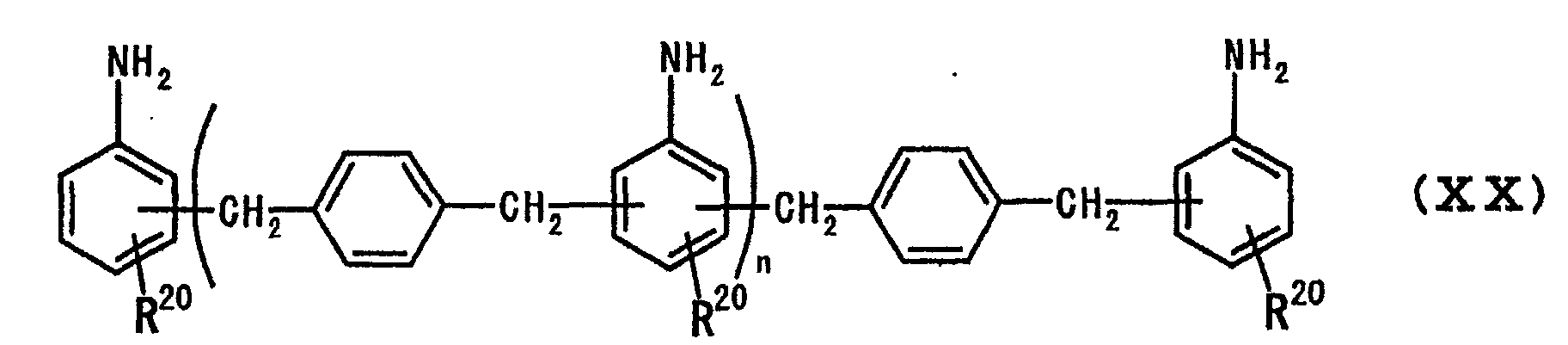 (wherein R20s each represent a hydrogen atom, a halogen atom,
a linear, branched or cyclic aliphatic alkyl group having 1
to 8 carbon atoms, an alkoxy group having 1 to 10 carbon
atoms or a phenyl group, and n which is the number of recurring
units represents an integer of 0 to 50, its average
being within a range of 0 to 15), and
(wherein R20s each represent a hydrogen atom, a halogen atom,
a linear, branched or cyclic aliphatic alkyl group having 1
to 8 carbon atoms, an alkoxy group having 1 to 10 carbon
atoms or a phenyl group, and n which is the number of recurring
units represents an integer of 0 to 50, its average
being within a range of 0 to 15), and
epoxy compounds or resins derived from aminophenols such as m-aminophenol, p-aminophenol, 2-(4-aminophenyl)-2-(4'-hydroxyphenyl)propane and 4-aminophenyl-(4'-hydroxyphenyl)-methane.
a phenol-dicyclopentadiene resin represented by the following formula (XV):
a phenol aralkyl resin represented by a formula (XVI):
a naphthol aralkyl resin represented by a formula (XVII):
a biphenol represented by the following formula (XVIII):
a bisphenol represented by a formula (XIX):
epoxy resins obtained by epoxidating amino groups of aromatic polyamines such as 4,4'-diaminophenylmethane, 4,4'-diaminodiphenyl ether, 4,4'-diaminodiphenyl sulfone, 2,2'-bis(4,4'-diaminophenyl)propane, m-xylylenediamine, p-xylylenediamine and an aralkyl aniline resin represented by the following formula (XX):
epoxy compounds or resins derived from aminophenols such as m-aminophenol, p-aminophenol, 2-(4-aminophenyl)-2-(4'-hydroxyphenyl)propane and 4-aminophenyl-(4'-hydroxyphenyl)-methane.
More preferable of these are epoxy resins or compounds
obtained by epoxidating a phenol novolac resin, a
phenol dicyclopentadiene resin, a phenol aralkyl resin, a
naphthol aralkyl resin, a biphenol and a bisphenol.
In the epoxy resin composition of the present invention,
as the curing agent as the component (B), any phenolic-hydroxyl-group-containing
compounds or resins 0 to
100 mol% of the hydroxyl groups of which have been esterified
by acyl groups and ester derivatives thereof can be
used.
Firstly, preferable examples of the curing agent
(B) include a novolac resin represented by the following
formula (VIII) or an ester derivative thereof, a phenol-dicyclopentadiene
resin represented by the following formula
(IX) or an ester derivative thereof, a phenol aralkyl
resin represented by the following formula (X) or an ester
derivative thereof, a naphthol aralkyl resin represented by
the following formula (XI) or an ester derivative thereof,
a biphenol compound represented by the following formula
(XII) or an ester derivative thereof, or a bisphenol compound
represented by the following formula (XIII) or an ester
derivative thereof:
 (wherein R8s each represent a hydrogen atom, a methyl group
or an ethyl group; n which is the number of recurring units
represents an integer of 0 to 50, its average being within
a range of 0 to 15; and As each represent a hydrogen atom
in the case of the compound (B1) and an aromatic acyl group
in the case of the compound (B2)),
(wherein R8s each represent a hydrogen atom, a methyl group
or an ethyl group; n which is the number of recurring units
represents an integer of 0 to 50, its average being within
a range of 0 to 15; and As each represent a hydrogen atom
in the case of the compound (B1) and an aromatic acyl group
in the case of the compound (B2)),
 (wherein R9s each represent a hydrogen atom, a halogen atom,
a linear, branched or cyclic aliphatic alkyl group having 1
to 8 carbon atoms, an alkoxy group having 1 to 10 carbon
atoms or a phenyl group; n which is the number of recurring
units represents an integer of 0 to 50, its average being
within a range of 0 to 15; and As each represent a hydrogen
atom in the case of the compound (B1) and an aromatic acyl
group in the case of the compound (B2)),
(wherein R9s each represent a hydrogen atom, a halogen atom,
a linear, branched or cyclic aliphatic alkyl group having 1
to 8 carbon atoms, an alkoxy group having 1 to 10 carbon
atoms or a phenyl group; n which is the number of recurring
units represents an integer of 0 to 50, its average being
within a range of 0 to 15; and As each represent a hydrogen
atom in the case of the compound (B1) and an aromatic acyl
group in the case of the compound (B2)),
 (wherein R10s each represent a hydrogen atom, a halogen atom,
a linear, branched or cyclic aliphatic alkyl group having 1
to 8 carbon atoms, an alkoxy group having 1 to 10 carbon
atoms or a phenyl group; n which is the number of recurring
units represents an integer of 0 to 50, its average being
within a range of 0 to 15; and As each represent a hydrogen
atom in the case of the compound (B1) and an aromatic acyl
group in the case of the compound (B2)),
(wherein R10s each represent a hydrogen atom, a halogen atom,
a linear, branched or cyclic aliphatic alkyl group having 1
to 8 carbon atoms, an alkoxy group having 1 to 10 carbon
atoms or a phenyl group; n which is the number of recurring
units represents an integer of 0 to 50, its average being
within a range of 0 to 15; and As each represent a hydrogen
atom in the case of the compound (B1) and an aromatic acyl
group in the case of the compound (B2)),
 (wherein R11s each represent a hydrogen atom, a halogen atom,
a linear, branched or cyclic aliphatic alkyl group having 1
to 8 carbon atoms, an alkoxy group having 1 to 10 carbon
atoms or a phenyl group; n which is the number of recurring
units represents an integer of 0 to 50, its average being
within a range of 0 to 15; and As each represent a hydrogen
atom in the case of the compound (B1) and an aromatic acyl
group in the case of the compound (B2)),
(wherein R11s each represent a hydrogen atom, a halogen atom,
a linear, branched or cyclic aliphatic alkyl group having 1
to 8 carbon atoms, an alkoxy group having 1 to 10 carbon
atoms or a phenyl group; n which is the number of recurring
units represents an integer of 0 to 50, its average being
within a range of 0 to 15; and As each represent a hydrogen
atom in the case of the compound (B1) and an aromatic acyl
group in the case of the compound (B2)),
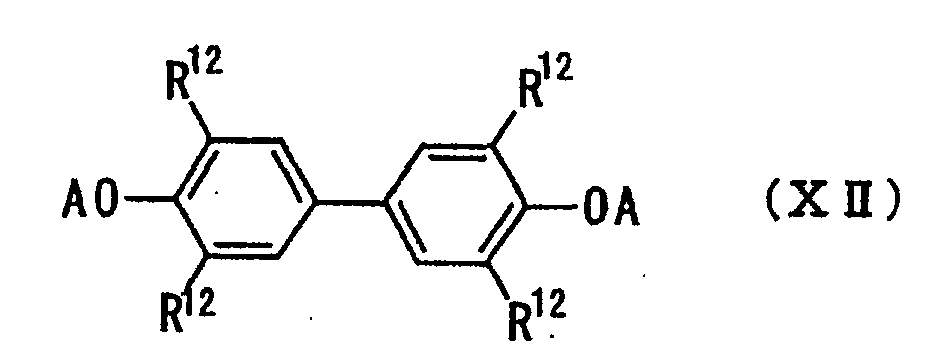 (wherein R12s each represent a hydrogen atom, a methyl group
or an ethyl group and may be all the same or different from
one another; and As each represent a hydrogen atom in the
case of the compound (B1) and an aromatic acyl group in the
case of the compound (B2)), and
(wherein R12s each represent a hydrogen atom, a methyl group
or an ethyl group and may be all the same or different from
one another; and As each represent a hydrogen atom in the
case of the compound (B1) and an aromatic acyl group in the
case of the compound (B2)), and
 (wherein R13s each represent a hydrogen atom, an alkyl group
having 1 to 10 carbon atoms, an alkoxyl group having 1 to
10 carbon atoms, an aryl group having 6 to 10 carbon atoms,
an aryloxy group having 6 to 10 carbon atoms or halogen and
may be all the same or different from one another; Y represents
an alkylidene having 1 to 10 carbon atoms, an alkylene
having 2 to 10 carbon atoms, a cycloalkylidene having
3 to 10 carbon atoms, a cycloalkylene having 3 to 10
carbon atoms or a divalent group such as -O-, -CO-, -CO2-,
-S-, -SO- or -SO2-; and As each represent a hydrogen atom in
the case of the compound (B1) and an aromatic acyl group in
the case of the compound (B2)).
(wherein R13s each represent a hydrogen atom, an alkyl group
having 1 to 10 carbon atoms, an alkoxyl group having 1 to
10 carbon atoms, an aryl group having 6 to 10 carbon atoms,
an aryloxy group having 6 to 10 carbon atoms or halogen and
may be all the same or different from one another; Y represents
an alkylidene having 1 to 10 carbon atoms, an alkylene
having 2 to 10 carbon atoms, a cycloalkylidene having
3 to 10 carbon atoms, a cycloalkylene having 3 to 10
carbon atoms or a divalent group such as -O-, -CO-, -CO2-,
-S-, -SO- or -SO2-; and As each represent a hydrogen atom in
the case of the compound (B1) and an aromatic acyl group in
the case of the compound (B2)).
Particularly preferable examples of the curing
agent (B) include:




Esterification of these phenol resins can be performed
in accqrdance with a known method. Further, an esterifying
agent used to esterify the above hydroxyl groups
may be any of an organic carboxylic anhydride, an organic
carboxylic halide and an organic carboxylic acid. A convenient
esterifying agent may be selected according to
characteristics of an esterifying agent based on the number
of carbon atoms of an ester desired to be derived.
Specific examples of the esterifying agent include
acetic anhydride, acetyl chloride, acetyl bromide, acetic
acid, propionic anhydride, propionyl chloride, propionyl
bromide, propionic acid, butyric anhydride, butyric chloride,
butyric acid, valeric anhydride, valeric chloride,
valeric bromide, valeric acid, pivalic chloride, pivalic
acid, phenylacetic acid, phenyl acetyl chloride, 2-phenylpropionic
acid, 3-phenylpropionic acid, o-tolylacetic
acid, m-tolylacetic acid, p-tolylacetic acid, cumenic acid,
benzoic anhydride, benzoic chloride, benzoic bromide, benzoic
acid, o-methylbenzoic chloride, m-methylbenzoic chloride,
p-methylbenzoic chloride, o-methylbenzoic acid, m-methylbenzoic
acid, p-methylbenzoic acid, dimethylbenzoic
acid, and naphthoic acid.
These esterifying agents can be used solely or in
admixture of two or more.
Further, in the present invention, the rate of esterification
is 0 to 100 mol%, preferably 10 to 100 mol%,
more preferably 50 to 100 mol%, much more preferably 80 to
100 mol%, most preferably 90 to 100 mol%.
In this regard, an esterification rate of 0% simply
implies a phenol compound or a phenol resin.
In the epoxy resin composition of the present invention,
a phenol compound or phenol resin or an ester derivative
thereof is used as the curing agent for an epoxy
resin having two or more functional groups. Since the epoxy
resin composition of the present invention is intended
for use as a thermosetting resin in the same applications
as a conventional epoxy-phenol cured product is used, such
a combination of the constituents that the composition can
take a three-dimensional structure after cured is desirable.
As for the mixing ratio of the epoxy resin (A) and
the curing agent (B), a total of hydroxyl groups and ester
groups, that is, active groups, is 0.5 to 1.5 mole equivalents,
preferably 0.7 to 1.3 mole equivalents, based on 1
mole equivalent of epoxy groups. In actual use, it is more
preferable to adjust and use a molar ratio with which optimum
physical properties of a cured product can be obtained.
To prepare the epoxy resin composition of the present
invention, any techniques may be used. For example,
it is possible that the phosphazenium compound of the formula
(1) as the accelerator is melt-mixed into the curing
agent sufficiently in advance and the mixture is then mixed
with the epoxy resin or these may be mixed together simultaneously.
Further, to fully homogenize these materials, they
may be dry-blended in powdery form.
In the epoxy resin composition of the present invention,
as required, an organic and/or inorganic filler(s)
as a component (D) and other additives may be added to the
epoxy resin composition.
Particularly, when the epoxy resin composition of
the present invention is used as a sealant for a semiconductor
integrated circuit, it is desirable to use the organic
and/or inorganic filler(s) (D) and a variety of additives
such as a colorant, e.g. carbon black, a mold releasing
agent, a coupling agent and a flame retardant for the
purposes of improving its mechanical properties and reducing
an overall cost.
The amount of the organic and/or inorganic
filler(s) (D) is preferably 100 parts by weight to 1,900
parts by weight based on 100 parts by weight of a total of
the epoxy resin (A) and the curing agent (B). From the
viewpoints of moisture resistance and mechanical strength,
the amount is more preferably not smaller than 250 parts by
weight, particularly preferably not smaller 550 parts by
weight.
Illustrative examples of the organic and/or inorganic
filler(s) (D) include powders such as silica, alumina,
silicon nitride, silicon carbide, talc, calcium silicate,
calcium carbonate, mica, clay and titanium white, and fibers
such as glass fibers, carbon fibers and aramid fibers.
Of these, crystalline silica and/or fused silica are/is
preferably used in the sealant. Further, in consideration
of flowability of the resin composition at the time of
molding, the silicas desirably have spherical shapes or a
combination of spherical shapes and irregular shapes.
Further, in the epoxy resin composition of the present
invention, in consideration of mechanical strength and
heat resistance, it is desirable to use a coupling agent to
improve adhesion between the resin and the filler. Illustrative
examples of the coupling agent include a silane
coupling agent, a titanate coupling agent, an aluminate
coupling agent and a zircoaluminate coupling agent. Of
these, the silane coupling agent is preferable, and particularly,
a silane coupling agent having a functional
group which reacts with an epoxy group is the most preferable.
Specific examples of such a coupling agent include
vinyl trimethoxysilane, vinyl triethoxysilane, N-(2-aminomethyl)-3-aminopropylmethyldimethoxysilane,
N-(2-aminoethyl)-3-aminopropyltrimethoxysilane,
3-aminopropyltriethoxysilane,
3-anilinopropyltriethoxysilane, 3-glycidoxypropyltrimethoxysilane,
3-glycidoxypropylmethyldimethoxysilane,
2-(3,4-epoxycyclohexyl)ethyltrimethoxysilane, 3-methacryloxypropyltrimethoxysilane,
and 3-mercaptopropyltrimethoxysilane.
These can be used solely or in combination
of two or more.
It is desirable that these coupling agents be adsorbed
to the surface of the filler or solidified by a reaction
in advance.
As a method for producing a semiconductor device by
sealing a semiconductor integrated circuit by use of the
epoxy resin composition of the present invention, low pressure
transfer molding can be said to be the most commonly
used. However, other methods such as injection molding,
compression molding and cast molding can also be used, and
a special technique using a solvent can also be used.
Hereinafter, the present invention will be described
in detail with reference to Examples. However, the
present invention shall not be limited by the Examples in
any way.
To a glass container equipped with a thermometer,
an agitator, a dropping funnel and a reflux condenser, 312
g (3 mol) of phenol novolac resin (trade name: BRG#558,
product of SHOWA HIGHPOLYMER, hydroxyl group equivalent:
104 g/eq) was added, and the internal temperature of the
container was raised to 125°C. With the internal temperature
kept at the above temperature, 336.9 g (3.3 mol) of
acetic anhydride was added dropwise in two hours under agitation.
Thereafter, with the internal temperature kept at
125°C, the reaction was carried out for 2 hours, and then
the temperature was raised to 140°C. At 140 to 150°C, the
mixture was aged for 2 hours, and then excessive acetic anhydride
and by-produced acetic acid were distilled off under
a reduced pressure at 150°C/10 mmHg at the highest.
The obtained resin was dissolved in 1,400 g of
toluene and then washed with hot water at 60 to 70°C until
waste water becomes neutral, and toluene was distilled off
at 150°C/5 mmHg at the highest so as to obtain 370 g of
phenol novolac resin having completely acetylated hydroxyl
groups. Its hydroxyl group equivalent was not smaller than
3,000 g/eq (undetectable).
To a glass container equipped with a thermometer,
an agitator, a dropping funnel and a reflux condenser, 312
g (3 mol) of phenol novolac resin (trade name: BRG#558,
product of SHOWA HIGHPOLYMER, hydroxyl group equivalent:
104 g/eq) was added, and the internal temperature of the
container was raised to 125°C. With the internal temperature
kept at the above temperature, 421.7 g (3 mol) of benzoyl
chloride was added dropwise in two hours under agitation.
A hydrogen chloride gas produced during the reaction
was absorbed into a trap. Thereafter, with the internal
temperature kept at 125°C, the reaction was carried out for
2 hours, and then the temperature was raised to 140°C. At
140 to 150°C, the mixture was aged for 2 hours, and then
hydrochloric acid was removed under a slightly reduced
pressure.
The obtained resin was dissolved in 1,400 g of
toluene and then washed with hot water at 60 to 70°C until
waste water becomes neutral, and toluene was distilled off
at 150°C/5 mmHg at the highest so as to obtain 590 g of
phenol novolac resin having completely benzoylated hydroxyl
groups. Its hydroxyl group equivalent was not smaller than
3,000 g/eq (undetectable).
To a glass container equipped with a thermometer,
an agitator, a dropping funnel and a reflux condenser, 507
g (3 mol) of phenol aralkyl resin (trade name: MIREX XLC-4L,
hydroxyl group equivalent: 169 g/eq, product of Mitsui
Chemicals, Inc.) was added, and the internal temperature of
the container was raised to 125°C. With the internal temperature
kept at the above temperature, 336.9 g (3.3 mol)
of acetic anhydride was added dropwise in two hours under
agitation. Thereafter, with the internal temperature kept
at 125°C, the reaction was carried out for 2 hours, and
then the temperature was raised to 140°C. At 140 to 150°C,
the mixture was aged for 2 hours, and then excessive acetic
anhydride and by-produced acetic acid were distilled off
under a reduced pressure at 150°C/10 mmHg at the highest.
The obtained resin was dissolved in 1,400 g of
toluene and then washed with hot water at 60 to 70°C until
waste water becomes neutral, and toluene was distilled off
at 150°C/5 mmHg at the highest so as to obtain 609 g of
phenol aralkyl resin having completely acetylated hydroxyl
groups. Its hydroxyl group equivalent was not smaller than
3,000 g/eq (undetectable).
To a glass container equipped with a thermometer,
an agitator, a dropping funnel and a reflux condenser, 507
g (3 mol) of phenol aralkyl resin (trade name: MIREX XLC-4L,
hydroxyl group equivalent: 169 g/eq, product of Mitsui
Chemicals, Inc.) was added, and the internal temperature of
the container was raised to 125°C. With the internal temperature
kept at the above temperature, 421.7 g (3 mol) of
benzoyl chloride was added dropwise in two hours under agitation.
A hydrogen chloride gas produced during the reaction
was absorbed into a trap. Thereafter, with the internal
temperature kept at 125°C, the reaction was carried out
for 2 hours, and then the temperature was raised to 140°C.
At 140 to 150°C, the mixture was aged for 2 hours, and then
hydrochloric acid was removed under a slightly reduced
pressure.
The obtained resin was dissolved in 1,400 g of
toluene and then washed with hot water at 60 to 70°C until
waste water becomes neutral, and toluene was distilled off
at 150°C/5 mmHg at the highest so as to obtain 785 g of
phenol aralkyl resin having completely benzoylated hydroxyl
groups. Its hydroxyl group equivalent was not smaller than
3,000 g/eq (undetectable).
To a glass container equipped with a thermometer,
an agitator, a dropping funnel and a reflux condenser, 540
g (3 mol) of phenol-dicyclopentadiene resin (trade name:
DPR-5000, product of Mitsui Chemicals, Inc., hydroxyl group
equivalent: 180 g/eq) was added, and the internal temperature
of the container was raised to 125°C. With the internal
temperature kept at the above temperature, 336.9 g (3.3
mol) of acetic anhydride was added dropwise in two hours
under agitation. Thereafter, with the internal temperature
kept at 125°C, the reaction was carried out for 2 hours,
and then the temperature was raised to 140°C. At 140 to
150°C, the mixture was aged for 2 hours, and then excessive
acetic anhydride and by-produced acetic acid were distilled
off under a reduced pressure at 150°C/10 mmHg at the highest.
The obtained resin was dissolved in 1,400 g of
toluene and then washed with hot water at 60 to 70°C until
waste water becomes neutral, and toluene was distilled off
at 150°C/5 mmHg at the highest so as to obtain 610 g of
phenol-dicyclopentadiene-resin-type resin having completely
acetylated hydroxyl groups. Its hydroxyl group equivalent
was not smaller than 3,000 g/eq (undetectable).
To a glass container equipped with a thermometer,
an agitator, a dropping funnel and a reflux condenser, 540
g (3 mol) of phenol-dicyclopentadiene resin (trade name:
DPR-5000, product of Mitsui Chemicals, Inc., hydroxyl group
equivalent: 180 g/eq) was added, and the internal temperature
of the container was raised to 125°C. With the internal
temperature kept at the above temperature, 421.7 g (3
mol) of benzoyl chloride was added dropwise in two hours
under agitation. A hydrogen chloride gas produced during
the reaction was absorbed into a trap. Thereafter, with
the internal temperature kept at 125°C, the reaction was
carried out for 2 hours, and then the temperature was
raised to 140°C. At 140 to 150°C, the mixture was aged for
2 hours, and then hydrochloric acid was removed under a
slightly reduced pressure.
The obtained resin was dissolved in 1,400 g of
toluene and then washed with hot water at 60 to 70°C until
waste water becomes neutral, and toluene was distilled off
at 150°C/5 mmHg at the highest so as to obtain 810 g of
phenol-dicyclopentadiene-resin-type resin having completely
benzoylated hydroxyl groups. Its hydroxyl group equivalent
was not smaller than 3,000 g/eq (undetectable).
To a glass container equipped with a thermometer,
an agitator, a dropping funnel and a reflux condenser, 654
g (3 mol) of naphthol aralkyl resin (trade name: α-NX-3.2,
product of Mitsui Chemicals, Inc., hydroxyl group equivalent:
218 g/eq) was added, and the internal temperature of
the container was raised to 125°C. With the internal temperature
kept at the above temperature, 336.9 g (3.3 mol)
of acetic anhydride was added dropwise in two hours under
agitation. Thereafter, with the internal temperature kept
at 125°C, the reaction was carried out for 2 hours, and
then the temperature was raised to 140°C. At 140 to 150°C,
the mixture was aged for 2 hours, and then excessive acetic
anhydride and by-produced acetic acid were distilled off
under a reduced pressure at 150°C/10 mmHg at the highest.
The obtained resin was dissolved in 1,400 g of
toluene and then washed with hot water at 60 to 70°C until
waste water becomes neutral, and toluene was distilled off
at 150°C/5 mmHg at the highest so as to obtain 745 g of
naphthol aralkyl resin having completely acetylated hydroxyl
groups. Its hydroxyl group equivalent was not
smaller than 3,000 g/eq (undetectable).
To a glass container equipped with a thermometer,
an agitator, a dropping funnel and a reflux condenser, 654
g (3 mol) of naphthol aralkyl resin (trade name: α-NX-3.2,
product of Mitsui Chemicals, Inc., hydroxyl group equivalent:
218 g/eq) was added, and the internal temperature of
the container was raised to 125°C. With the internal temperature
kept at the above temperature, 421.7 g (3 mol) of
benzoyl chloride was added dropwise in two hours under agitation.
A hydrogen chloride gas produced during the reaction
was absorbed into a trap. Thereafter, with the internal
temperature kept at 125°C, the reaction was carried out
for 2 hours, and then the temperature was raised to 140°C.
At 140 to 150°C, the mixture was aged for 2 hours, and then
hydrochloric acid was removed under a slightly reduced
pressure.
The obtained resin was dissolved in 1,400 g of
toluene and then washed with hot water at 60 to 70°C until
waste water becomes neutral, and toluene was distilled off
at 150°C/5 mmHg at the highest so as to obtain 923 g of
naphthol aralkyl resin having completely benzoylated hydroxyl
groups. Its hydroxyl group equivalent was not
smaller than 3,000 g/eq (undetectable).
588 g of phenol novolac resin having 88% of its hydroxyl
groups benzoylated was obtained in the same manner
as in Synthesis Example 2 except that the amount of benzoyl
chloride was changed to 371.2 g (2.64 mol). Its hydroxyl
group equivalent was 958 g/eq.
1 gram equivalent of o-cresol novolac (trade name:
EOCN102S-65, product of NIPPON KAYAKU CO., LTD., epoxy
equivalent: 210 g/eq) as an epoxy resin and 1 gram equivalent
of the acetylated phenol novolac resin (ester equivalent:
146 g/eq = calculated value) of Synthesis Example 1
as a curing agent were fully melt-mixed with each other at
100°C so as to obtain a homogeneous resin mixture.
To the resin mixture, 0.0055 mol of phosphazenium
compound of the foregoing formula (1) wherein R1 was a
methyl group was added as a curing accelerator, and the resulting
mixture was mixed at 120°C for 1 minute so as to
obtain a resin composition.
To 200 g of the resin composition, a filler and
other additives were added in the following amounts, and
the mixture was roll-mixed under heating so as to obtain a
molding material for a sealant:
Using a portion of the molding material, a cured
product was obtained under conditions of 175°C/10 min and
150 kg/cm2 and then after-cured at 175°C/8 hr (nitrogen atmosphere)
so as to fully cure the product. Physical properties
were measured by use of the cured product.
Further, by use of the same molding material, test
semiconductor devices were prepared by low pressure transfer
molding, and a cracking test was conducted by means of
a solder bath.
Tests were conducted in the same manner as in Example
1 except that the curing agent was changed to the benzoylated
phenol novolac resin of Synthesis Example 2.
Tests were conducted in the same manner as in Example
1 except that the epoxy compound was changed to YX-4000H,
the curing agent was changed to the acetylated phenol
aralkyl resin of Synthesis Example 3, and a composition
was obtained by a method comprising the steps of fully
melt-mixing the curing agent with the accelerator at 120°C
in advance and then adding the epoxy resin.
Tests were conducted in the same manner as in Example
3 except that the curing agent was changed to the benzoylated
phenol aralkyl resin of Synthesis Example 4.
Tests were conducted in the same manner as in Example
1 except that the curing agent was changed to the acetylated
phenol-dicyclopentadiene resin of Synthesis Example
5.
Tests were conducted in the same manner as in Example
1 except that the curing agent was changed to the benzoylated
phenol-dicyclopentadiene resin of Synthesis Example
6.
Tests were conducted in the same manner as in Example
3 except that the curing agent was changed to the acetylated
naphthol aralkyl resin of Synthesis Example 7.
Tests were conducted in the same manner as in Example
3 except that the curing agent was changed to the benzoylated
naphthol aralkyl resin of Synthesis Example 8.
A resin composition was prepared in the same manner
as in Example 1 except that the accelerator was changed to
0.015 mol of triphenylphosphine. However, a cured product
was not obtained. Further, although gelation time was also
measured at 150°C and 200°C for 20 minutes, the test was
stopped since no gelation was seen.
A resin composition was prepared in the same manner
as in Example 2 except that the accelerator was changed to
0.015 mol of triphenylphosphine. However, a cured product
was not obtained. Further, although gelation time was also
measured at 150°C and 200°C for 20 minutes, the test was
stopped since no gelation was seen.
Tests were conducted in the same manner as in Comparative
Example 1 except that the curing agent was changed
to a phenol novolac resin (trade name: BRG#558, product of
SHOWA HIGHPOLYMER, hydroxyl group equivalent: 104 g/eq).
Tests were conducted in the same manner as in Comparative
Example 1 except that the curing agent was changed
to a phenol-dicyclopentadiene-resin-type resin (trade name:
DPR-5000, product of Mitsui Chemicals, Inc., hydroxyl group
equivalent: 180 g/eq).
Tests were conducted in the same manner as in Example
3 except that the accelerator was changed to 0.015 mol
of triphenylphosphine and the curing agent was changed to a
phenol aralkyl resin (trade name: MIREX XLC-4L, hydroxyl
group equivalent: 169 g/eq, product of Mitsui Chemicals,
Inc.).
Tests were conducted in the same manner as in Example
3 except that the curing agent was changed to the phenol
novolac resin of Synthesis Example 9 having 88% of its
hydroxyl groups benzoylated.
Tests were conducted in the same manner as in Example
3 except that the curing agent was changed to a mixture
of the benzoylated phenol novolac resin of Synthesis Example
2 and a phenol novolac resin (trade name: BRG#558,
product of SHOWA HIGHPOLYMER, hydroxyl group equivalent:
104 g/eq) at a mixing ratio of 88:12 (ratio of functional
groups).
A resin composition was prepared in the same manner
as in Example 9 except that the accelerator was changed to
0.015 mol of triphenylphosphine. However, a cured product
was not obtained.
A resin composition was prepared in the same manner
as in Example 10 except that the accelerator was changed to
0.015 mol of triphenylphosphine. However, a cured product
was not obtained.
The results of the foregoing Examples and Comparative
Examples are shown in Tables 1 to 4. Gelation times
of the resin compositions prior to the roll mixing were
measured at 150°C. Further, physical properties were measured
in accordance with the following testing methods.
- Tg (Glass Transition Temperature): This was measured in accordance with a TMA needle penetration method (Shimadzu TMA-DRW DT-30).
- Post-Boiling Water Absorption: An increase in weight after boiled in boiling water of 100°C for 2 hours was measured.
- V.P.S Test: Test semiconductor devices were molded and left to stand in a bath kept at a constant temperature of 85°C and a constant humidity of 85% for 168 hours. Immediately after that, the devices were put in a Fluorinert™ liquid (product of Sumitomo 3M, FC-70) of 240°C. The number of semiconductors whose package resins were cracked was counted. The test value was expressed in the form of a fraction, with a numerator representing the number of cracked semiconductors and n = 5.
| Ex.1 | Ex.2 | Ex.3 | Ex.4 | Ex.5 | |
| Glass Transition Temperature (°C) | 153 | 148 | 108 | 99 | 129 |
| Post-Boiling Water Absorption (%) | 0.09 | 0.16 | 0.09 | 0.08 | 0.08 |
| V.P.S Test (Rate of Occurrence of Cracks (%)) | 0 | 0 | 0 | 0 | 0 |
| Gelation Time (min' sec") | 4'41" | 5'25" | 5'22" | 5'52" | 4'59" |
| Ex.6 | Ex.7 | Ex.8 | Ex.9 | Ex.10 | |
| Glass Transition Temperature (°C) | 119 | 111 | 105 | 116 | 116 |
| Post-Boiling Water Absorption (%) | 0.10 | 0.11 | 0.06 | 0.10 | 0.10 |
| V.P.S Test (Rate of Occurrence of Cracks (%)) | 0 | 0 | 0 | 0 | 0 |
| Gelation Time (min' sec") | 5'56" | 5'42" | 5'30" | 5'35" | 5'31" |
| Comp. Ex.1 | Comp. Ex.2 | Comp. Ex.3 | Comp. Ex.4 | Comp. Ex.5 | |
| Glass Transition Temperature (°C) | --- | --- | 173 | 141 | 100 |
| Post-Boiling Water Absorption (%) | --- | --- | 0.21 | 0.15 | 0.12 |
| V.P.S Test (Rate of Occurrence of Cracks (%)) | --- | --- | 3 | 2 | 1 |
| Gelation Time (min' sec") | Not Cured | Not Cured | 3'38" | 4'41" | 4.37" |
| Comp. Ex.6 | Comp. Ex.7 | |
| Glass Transition Temperature (°C) | --- | --- |
| Post-Boiling Water Absorption (%) | --- | --- |
| V.P.S Test (Rate of Occurrence of Cracks (%)) | --- | --- |
| Gelation Time (min' sec") | Not Cured | Not Cured |
With reference to the foregoing Examples, curing of
the esterified phenol resins and the epoxy resins has been
described in detail. An epoxy resin composition containing
the accelerator and phosphazenium compound of the present
invention as essential components and a compound whose hydroxyl
groups have been esterified by acyl groups as a curing
agent has far superior hygroscopicity and is very advantageous
in terms of cracking resistance as compared with
a conventional epoxy resin/phenol resin cured product. It
is thereby understood that the epoxy resin compound is excellent
in cracking resistance as a sealant.
Further, it is realized that when triphenylphosphine
(TPP) which is a conventional accelerator is used,
triphenylphosphine does not cause a curing reaction in portions
esterified by acryl groups, as shown by Comparative
Examples 1 and 2. From this fact, it is understood that
the esterified curing agent and the phosphazenium compound
are essential components so as to obtain high physical
properties as the sealant in the present invention.
1 gram equivalent of o-cresol novolac (trade name:
EOCN102S-65, product of NIPPON KAYAKU CO., LTD., epoxy
equivalent: 210 g/eq) as an epoxy resin and 1 gram equivalent
of phenol novolac resin (trade name: BRG#558, product
of SHOWA HIGHPOLYMER, hydroxyl group equivalent: 104 g/eq)
as a curing agent were fully melt-mixed with each other at
100°C so as to obtain a homogeneous resin mixture.
To the resin mixture, 0.0055 mol of phosphazenium
compound of the foregoing formula (1) wherein all Rs were a
methyl group and Z- was a hydroxy anion was added as a curing
accelerator, and the resulting mixture was mixed at
80°C for 1 minute so as to obtain a resin composition.
To 200 g of the resin composition, a filler and
other additives were added in the following amounts, and
the mixture was roll-mixed under heating so as to obtain a
molding material for a sealant:
Using a portion of the molding material, a cured
product was obtained under conditions of 150°C→185°C/5 min,
185°C/5 min and 150 kg/cm2 and then after-cured at 185°C/8
hr (nitrogen atmosphere) so as to fully cure the product.
Tests were conducted with respect to curing behavior and
the like.
Tests were conducted in the same manner as in Example
11 except that the curing agent was changed to a phenol-dicyclopentadiene
resin (trade name: DPR-5000, product
of Mitsui Chemicals, Inc., hydroxyl group equivalent: 180
g/eq).
Tests were conducted in the same manner as in Example
12 except that the epoxy resin was changed to tetramethylbiphenoldiglycidyl
ether (trade name: YX4000H, product
of JER CO., LTD., epoxy equivalent: 184 g/eq).
Tests were conducted in the same manner as in Example
13 except that the curing agent was changed to a naphthol
aralkyl resin (trade name: α-NX-3.2, product of Mitsui
Chemicals, Inc., hydroxyl group equivalent: 218 g/eq).
Tests were conducted in the same manner as in Example
14 except that the curing agent was changed to a phenol
aralkyl resin (trade name: MIREX XLC-4L, hydroxyl group
equivalent: 169 g/eq, product of Mitsui Chemicals, Inc.).
Tests were conducted in the same manner as in Example
11 except that the epoxy resin was changed to a phenol-dicyclopentadiene-resin-type
epoxy resin (trade name:
EPICHRON HP-7200, product of DAINIPPON INK AND CHEMICALS,
INC., epoxy equivalent: 262 g/eq).
Tests were conducted in the same manner as in Example
16 except that the curing agent was changed to a phenol
aralkyl resin (trade name: MIREX XLC-4L, hydroxyl group
equivalent: 169 g/eq, product of Mitsui Chemicals, Inc.).
Tests were conducted in the same manner as in Example
17 except that the epoxy resin was changed to a phenol-aralkyl-resin-type
epoxy resin: MIREX XLC-4L (product of
Mitsui Chemicals, Inc., hydroxyl group equivalent: 169
g/eq) epoxidated in accordance with a conventional method.
Tests were conducted in the same manner as in Example
11 except that the epoxy resin was changed to a dihydroxynaphthalenediglycidyl
ether (trade name: EPICHRON HP-4032,
product of DAINIPPON INK AND CHEMICALS, INC., 150
g/eq).
Tests were conducted in the same manner as in Example
19 except that the epoxy resin was changed to bisphenol-A-type
diglycidyl ether (trade name: EPICOAT 828, product
of JER CO., LTD., epoxy equivalent: 184 g/eq).
Tests were conducted in the same manner as in Example
11 except that the accelerator was changed to 0.008 mol
of triphenylphosphine (TPP).
Tests were conducted in the same manner as in Example
12 except that the accelerator was changed to 0.008 mol
of triphenylphosphine (TPP).
Tests were conducted in the same manner as in Example
13 except that the accelerator was changed to 0.015 mol
of triphenylphosphine (TPP).
Tests were conducted in the same manner as in Example
14 except that the accelerator was changed to 0.015 mol
of triphenylphosphine (TPP).
Tests were conducted in the same manner as in Example
15 except that the accelerator was changed to 0.015 mol
of triphenylphosphine (TPP).
Tests were conducted in the same manner as in Example
16 except that the accelerator was changed to 0.008 mol
of triphenylphosphine (TPP).
Tests were conducted in the same manner as in Example
17 except that the accelerator was changed to 0.008 mol
of triphenylphosphine (TPP).
Tests were conducted in the same manner as in Example
18 except that the accelerator was changed to 0.008 mol
of triphenylphosphine (TPP).
Tests were conducted in the same manner as in Example
19 except that the accelerator was changed to 0.008 mol
of triphenylphosphine (TPP).
Tests were conducted in the same manner as in Example
20 except that the accelerator was changed to 0.015 mol
of triphenylphosphine (TPP).
Tests were conducted in the same manner as in Example
11 except that the accelerator was changed to 0.008 mol
of 2-undecylimidazole.
Tests were conducted in the same manner as in Example
12 except that the accelerator was changed to 0.008 mol
of 2-undecylimidazole.
Tests were conducted in the same manner as in Example
13 except that the accelerator was changed to 0.015 mol
of 2-methylimidazole.
Tests were conducted in the same manner as in Example
14 except that the accelerator was changed to 0.015 mol
of 2-methylimidazole.
Tests were conducted in the same manner as in Example
15 except that the accelerator was changed to 0.015 mol
of 2-methylimidazole.
Tests were conducted in the same manner as in Example
16 except that the accelerator was changed to 0.008 mol
of 2-undecylimidazole.
Tests were conducted in the same manner as in Example
17 except that the accelerator was changed to 0.008 mol
of 2-undecylimidazole.
Tests were conducted in the same manner as in Example
18 except that the accelerator was changed to 0.008 mol
of 2-undecylimidazole.
Tests were conducted in the same manner as in Example
19 except that the accelerator was changed to 0.008 mol
of 2-undecylimidazole.
The results of the foregoing Examples and Comparative
Examples are shown in Tables 5 to 10. A method for
testing curing behavior is as follows. Further, Fig. 1 is
a graph showing the curing behavior of an epoxy resin composition
when CURELASTOMETER is used.
Curing Behavior: This was measured by CURELASTOMETER V
model manufactured by NSC.
| Ex.11 | Ex.12 | Ex.13 | Ex.14 | Ex.15 | |
| Glass Transition Temperature (°C) | 179 | 147 | 138 | 135 | 119 |
| Flexural Strength (Kgf/mm2) | 14.9 | 13.5 | 12 | 12.5 | 12.3 |
| Flexural Elastic Modulus (Kgf/mm2) | 1500 | 1540 | 1670 | 1610 | 1650 |
| Post-Boiling Water Absorption (%) | 0.16 | 0.09 | 0.08 | 0.11 | 0.09 |
| V.P.S Test (Number of Cracks/10) | 0 | 0 | 0 | 0 | 0 |
| Gelation Time (min' sec") | 3'01" | 3'31" | 5'12" | 5'02" | 5'13" |
| Torque Start tsx (min' sec") | 10" | 19" | 1'05" | 1'12" | 1'10" |
| 10% Cured t' c (min' sec") | 19" | 34" | 1'24" | 1'41" | 1'31" |
| 90% Cured t' c (min' sec") | 2'21" | 3'15" | 2'58" | 3'17" | 3'07" |
| Ex.16 | Ex.17 | Ex.18 | Ex.19 | Ex.20 | |
| Glass Transition Temperature (°C) | 158 | 129 | 131 | 146 | 140 |
| Flexural Strength (Kgf/mm2) | 13.8 | 13.5 | 13 | 13.6 | 12.2 |
| Flexural Elastic Modulus (Kgf/mm2) | 1460 | 1590 | 1620 | 1530 | 1630 |
| Post-Boiling Water Absorption (%) | 0.14 | 0.11 | 0.12 | 0.14 | 0.13 |
| V.P.S Test (Number of Cracks/10) | 0 | 0 | 0 | 0 | 0 |
| Gelation Time (min' sec") | 3'28" | 3'18" | 3'31" | 3'20" | 5'22" |
| Torque Start tsx (min' sec") | 09" | 11" | 13" | 09" | 1'35" |
| 10% Cured t' c (min' sec") | 22" | 23" | 25" | 21" | 2'07" |
| 90% Cured t' c (min' sec") | 2'55" | 2'45" | 2'37" | 2'35" | 4'57" |
| Comp. Ex.8 | Comp. Ex.9 | Camp. Ex.10 | Comp. Ex.11 | Comp. Ex.12 | |
| Glass Transition Temperature (°C) | 175 | 145 | 106 | 115 | 102 |
| Flexural Strength (Kgf/mm2) | 13.9 | 13.5 | 12.2 | 12.4 | 13 |
| Flexural Elastic Modulus (Kgf/mm2) | 1500 | 1500 | 1550 | 1540 | 1540 |
| Post-Boiling Water Absorption (%) | 0.22 | 0.15 | 0.1 | 0.1 | 0.09 |
| V.P.S Test (Number of Cracks/10) | 2 | 2 | 1 | 1 | 1 |
| Gelation Time (min' sec") | 5'08" | 6'55" | 4'23" | 4'28" | 4'39" |
| Torque Start tsx (min' sec") | 18" | 35" | 29" | 28" | 29" |
| 10% Cured t' c (min' sec") | 23" | 43" | 41" | 39" | 39" |
| 90% Cured t' c (min' sec") | 5'48" | 9'22" | 9'29" | 7'21" | 6'58" |
| Comp. Ex.13 | Comp. Ex.14 | Comp. Ex.15 | Comp. Ex.16 | Comp. Ex.17 | |
| Glass Transition Temperature (°C) | 152 | 126 | 129 | 147 | 138 |
| Flexural Strength (Kgf/mm2) | 12.8 | 12.8 | 12.6 | 12.7 | 12.3 |
| Flexural Elastic Modulus (Kgf/mm2) | 1440 | 1550 | 1460 | 1515 | 1550 |
| Post-Boiling Water Absorption (%) | 0.21 | 0.17 | 0.18 | 0.22 | 0.13 |
| V.P.S Test (Number of Cracks/10) | 2 | 2 | 2 | 2 | 1 |
| Gelation Time (min' sec") | 5'13" | 6'31" | 6'12" | 5'45" | 4'33" |
| Torque Start tsx (min' sec") | 17" | 21" | 21" | 29" | 29" |
| 10% Cured t' c (min' sec") | 29" | 31" | 30" | 41" | 41" |
| 90% Cured t' c (min' sec") | 5'55" | 6'22" | 6'21" | 6'09" | 6'29" |
| Comp. Ex.18 | Comp. Ex.19 | Comp. Ex.20 | Comp. Ex.21 | Comp. Ex.22 | |
| Glass Transition Temperature (°C) | 175 | 144 | 107 | 116 | 104 |
| Flexural Strength (Kgf/mm2) | 14.1 | 13.5 | 12.3 | 12.4 | 12.6 |
| Flexural Elastic Modulus (Kgf/mm2) | 1480 | 1510 | 1550 | 1530 | 1510 |
| Post-Boiling Water Absorption (%) | 0.21 | 0.15 | 0.1 | 0.09 | 0.12 |
| V.P.S Test (Number of Cracks/10) | 2 | 2 | 1 | 1 | 1 |
| Gelation Time (min' sec") | 4'25" | 5'22" | 4'37" | 4'45" | 4'41" |
| Torque Start tsx (min' sec") | 23" | 27" | 38" | 30" | 26" |
| 10% Cured t' c (min' sec") | 30" | 40" | 59" | 52" | 51" |
| 90% Cured t' c (min' sec") | 5'13" | 6'18" | 9'45" | 7'11" | 6'45" |
| Comp. Ex.23 | Comp. Ex.24 | Comp. Ex.25 | Comp. Ex.26 | |
| Glass Transition Temperature (°C) | 151 | 125 | 127 | 146 |
| Flexural Strength (Kgf/mm2) | 12.9 | 12.8 | 12.3 | 13.7 |
| Flexural Elastic Modulus (Kgf/mm2) | 1410 | 1470 | 1490 | 1540 |
| Post-Boiling Water Absorption (%) | 0.2 | 0.15 | 0.16 | 0.2 |
| V.P.S Test (Number of Cracks/10) | 2 | 2 | 1 | 2 |
| Gelation Time (min' sec") | 4'52" | 5'19" | 5'22" | 4'55" |
| Torque Start tsx (min' sec") | 22" | 25" | 25" | 25" |
| 10% Cured t' c (min' sec") | 33" | 34" | 36" | 35" |
| 90% Cured t' c (min' sec") | 5'25" | 5'31" | 5'18" | 5'54" |
0.05 g of phosphazene compound of the formula 1
wherein all R1s were a methyl group was dissolved in 100 g
of pure water and then boiled at 95°C for 20 hours and then
at 125°C for 20 hours (in a glass autoclave). Thereafter,
conductivity of the water was measured.
Conductivity was measured in the same manner by use
of 0.05 g of tris[tris(dimethylamino)phospholanilideneamino]phosphine
oxide in place of the phosphazene compound
of Example 18.
The results of the foregoing Example and Comparative
Example are shown in Table 11.
| Ex.21 | Comp.Ex.25 | |||
| Processing Temperature | 95°C | 125°C | 95°C | 125°C |
| Conductivity (µs/cm) | 100 | 104 | 94 | 413 |
As is understood from these conductivities, while
the essential phosphazene catalyst in the present invention
shows constant conductivity regardless of the processing
temperature, thereby inferring it from analogy that the
catalyst is stable, the phosphine oxide compound of the
Comparative Example shows that conductivity became over
four times larger as the temperature increased from 95°C to
125°C. That is, it is assumed that at high temperatures,
it produces a conductive material of some type by decomposition.
Therefore, it has been found that they have a
large difference with respect to electric characteristics
as a sealant.
Further, as has already been described with reference
to Examples, it is understood that when a phosphazene
compound which is an essential accelerator in the present
invention is used in a case where a phenol resin is used as
a curing agent, improvements in physical properties such as
an increase in Tg and lowered moisture absorptivity can be
recognized and, what is more, distinctive curing properties
can also be seen, as compared with when conventionally used
general-purpose triphenylphosphine is used.
That is, the gelation time is significantly reduced,
and the time required for 90% curing in measurement of an
increase in torque along with curing by use of the CURELASTOMETER
is significantly reduced. This leads to a reduction
in cost along with a shortened production cycle in industrial
production of a sealant and makes a great contribution
from an industrial standpoint.
As described above, the epoxy resin composition obtained
by the present invention can be used in industrial
fields in which the conventional epoxy resin composition
has been used. Particularly, when used as a sealant for a
semiconductor, it provides a package with better cracking
resistance than the conventional epoxy resin/phenol resin
cured product does.
Claims (13)
- A curing agent composition for an epoxy resin, comprising a compound as a curing agent (B) which is selected from the group consisting of the following (B1) to (B3):(B1) a phenol compound having two or more functional groups,(B2) a compound in which a hydroxyl group of a phenol compound having two or more functional groups is esterified with an acyl group, and(B3) a mixture of the compounds (B1) and (B2), and a salt of a phosphazenium compound as a curing accelerator (C) which is represented by the following formula (I) :(wherein R1s each represent a hydrogen atom, a linear, branched or cyclic alkyl group having 1 to 10 carbon atoms or an aryl or aralkyl group having 6 to 10 carbon atoms and may be all the same or different from one another; and Z- represents a halogen anion, hydroxy anion, alkoxy anion, aryloxy anion or carboxy anion).

- The composition of claim 1, wherein R1s in the formula (1) are each a methyl group or an ethyl group.
- The composition of claim 1, wherein Z- in the formula (1) is a hydroxy anion.
- The composition of claim 1, wherein the curing agent (B) is a novolac resin represented by the following formula (VIII) or an ester derivative thereof, a phenol-dicyclopentadiene resin represented by the following formula (IX) or an ester derivative thereof, a phenol aralkyl resin represented by the following formula (X) or an ester derivative thereof, a naphthol aralkyl resin represented by the following formula (XI) or an ester derivative thereof, a biphenol compound represented by the following formula (XII) or an ester derivative thereof, or a bisphenol compound represented by the following formula (XIII) or an ester derivative thereof:(wherein R8s each represent a hydrogen atom, a methyl group or an ethyl group; n which is the number of recurring units represents an integer of 0 to 50, its average being within a range of 0 to 15; and As each represent a hydrogen atom in the case of the compound (B1) and an aromatic acyl group in the case of the compound (B2)),
 (wherein R9s each represent a hydrogen atom, a halogen atom, a linear, branched or cyclic aliphatic alkyl group having 1 to 8 carbon atoms, an alkoxy group having 1 to 10 carbon atoms or a phenyl group; n which is the number of recurring units represents an integer of 0 to 50, its average being within a range of 0 to 15; and As each represent a hydrogen atom in the case of the compound (B1) and an aromatic acyl group in the case of the compound (B2)),
 (wherein R10s each represent a hydrogen atom, a halogen atom, a linear, branched or cyclic aliphatic alkyl group having 1 to 8 carbon atoms, an alkoxy group having 1 to 10 carbon atoms or a phenyl group; n which is the number of recurring units represents an integer of 0 to 50, its average being within a range of 0 to 15; and As each represent a hydrogen atom in the case of the compound (B1) and an aromatic acyl group in the case of the compound (B2)),
 (wherein R11s each represent a hydrogen atom, a halogen atom, a linear, branched or cyclic aliphatic alkyl group having 1 to 8 carbon atoms, an alkoxy group having 1 to 10 carbon atoms or a phenyl group; n which is the number of recurring units represents an integer of 0 to 50, its average being within a range of 0 to 15; and As each represent a hydrogen atom in the case of the compound (B1) and an aromatic acyl group in the case of the compound (B2)),
 (wherein R12s each represent a hydrogen atom, a methyl group or an ethyl group and may be all the same or different from one another; and As each represent a hydrogen atom in the case of the compound (B1) and an aromatic acyl group in the case of the compound (B2)), and
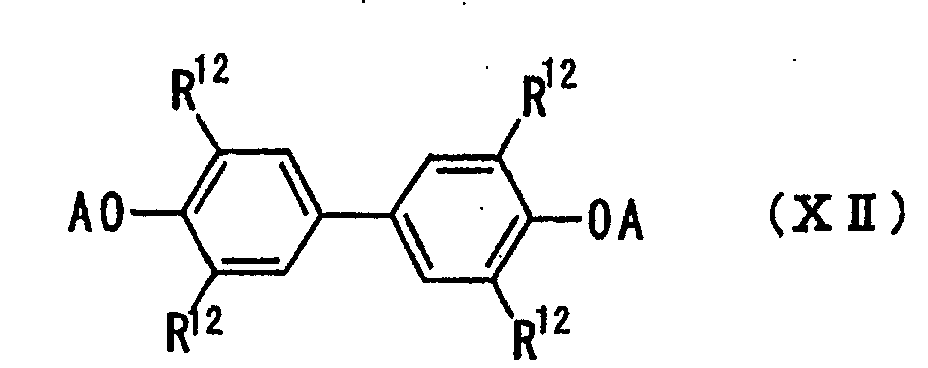 (wherein R13s each represent a hydrogen atom, an alkyl group having 1 to 10 carbon atoms, an alkoxyl group having 1 to 10 carbon atoms, an aryl group having 6 to 10 carbon atoms, an aryloxy group having 6 to 10 carbon atoms or halogen and may be all the same or different from one another; Y represents an alkylidene having 1 to 10 carbon atoms, an alkylene having 2 to 10 carbon atoms, a cycloalkylidene having 3 to 10 carbon atoms, a cycloalkylene having 3 to 10 carbon atoms or a divalent group such as -O-, -CO-, -CO2-, -S-, -SO- or -SO2-; and As each represent a hydrogen atom in the case of the compound (B1) and an aromatic acyl group in the case of the compound (B2)).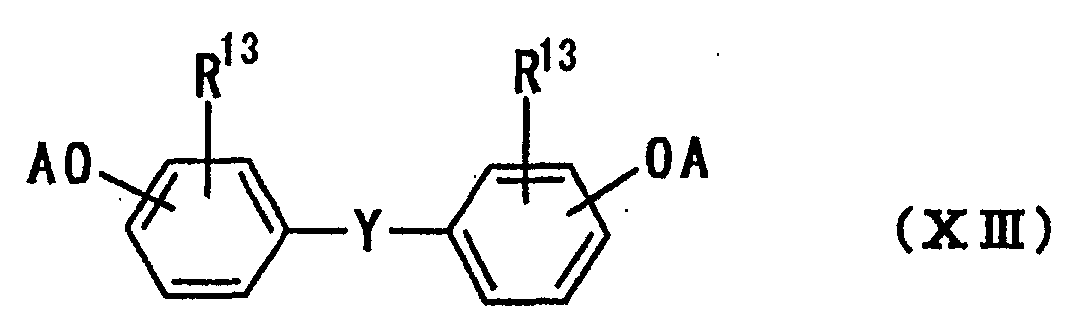
- An epoxy resin composition comprising:wherein the curing agent (B) is a compound selected from the group consisting of the following (B1) to (B3):(A) an epoxy resin having two or more epoxy groups in a molecule,(B) a curing agent, and(C) a curing accelerator,(B1) a phenol compound having two or more functional groups,(B2) a compound in which a hydroxyl group of a phenol compound having two or more functional groups is esterified with an acyl group, and(B3) a mixture of the (B1) and (B2), and the curing accelerator (C) is a salt of a phosphazenium compound which is represented by the following formula (I):(wherein R1s each represent a hydrogen atom, a linear, branched or cyclic alkyl group having 1 to 10 carbon atoms or an aryl or aralkyl group having 6 to 10 carbon atoms and may be all the same or different from one another; and Z- represents a halogen anion, hydroxy anion, alkoxy anion, aryloxy anion or carboxy anion).

- The composition of claim 5, wherein R1s in the formula (1) each represent a methyl group or an ethyl group.
- The composition of claim 5, wherein Z- in the formula (1) represents a hydroxy anion.
- The composition of claim 5, wherein the epoxy resin (A) having two or more epoxy groups in a molecule is a novolac epoxy resin represented by the following formula (II), a phenol-dicyclopentadiene epoxy resin represented by the following formula (III), a phenol-aralkyl-resin-type epoxy resin represented by the following formula (IV), a naphthol-aralkyl-resin-type epoxy resin represented by the following formula (V), a biphenol-type-epoxy-containing epoxy resin represented by the following formula (VI) or a bisphenol-type-epoxy-containing epoxy resin represented by the following formula (VII):(wherein R2s each represent a hydrogen atom, a methyl group or an ethyl group, and n which is the number of recurring units represents an integer of 0 to 50, its average being within a range of 0 to 15),
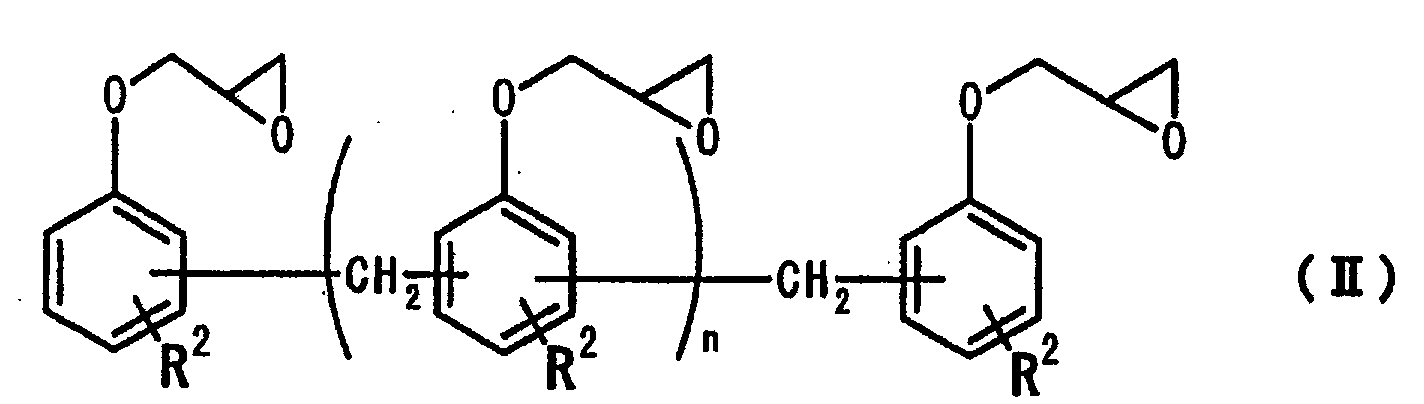 (wherein R3s each represent a hydrogen atom, a halogen atom, a linear, branched or cyclic aliphatic alkyl group having 1 to 8 carbon atoms, an alkoxy group having 1 to 10 carbon atoms or a phenyl group, and n which is the number of recurring units represents an integer of 0 to 50, its average being within a range of 0 to 15),
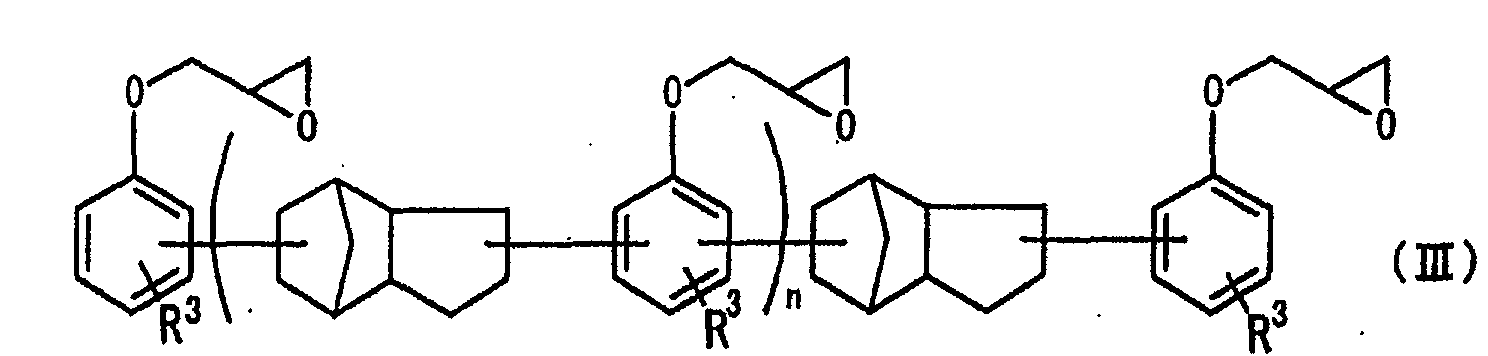 (wherein R4s each represent a hydrogen atom, a halogen atom, a linear, branched or cyclic aliphatic alkyl group having 1 to 8 carbon atoms, an alkoxy group having 1 to 10 carbon atoms or a phenyl group, and n which is the number of recurring units represents an integer of 0 to 50, its average being within a range of 0 to 15),
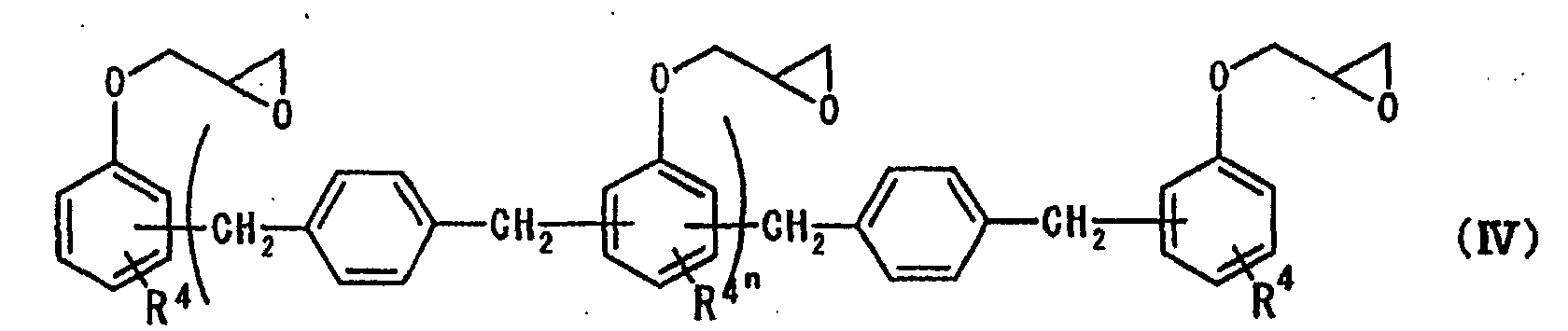 (wherein R5s each represent a hydrogen atom, a halogen atom, a linear, branched or cyclic aliphatic alkyl group having 1 to 8 carbon atoms, an alkoxy group having 1 to 10 carbon atoms, a phenyl group or a glycidyl ether group, and n which is the number of recurring units represents an integer of 0 to 50, its average being within a range of 0 to 15),
 (wherein R6s each represent a hydrogen atom, a methyl group or an ethyl group and may be all the same or different from one another), and
 (wherein R7s each represent a hydrogen atom, an alkyl group having 1 to 10 carbon atoms, an alkoxyl group having 1 to 10 carbon atoms, an aryl group having 6 to 10 carbon atoms, an aryloxy group having 6 to 10 carbon atoms or halogen and may be all the same or different from one another, and Y represents an alkylidene having 1 to 10 carbon atoms, an alkylene having 2 to 10 carbon atoms, a cycloalkylidene having 3 to 10 carbon atoms, a cycloalkylene having 3 to 10 carbon atoms or a divalent group such as -O-, -CO-, -CO2-, -S-, -SO- or -SO2-).
- The composition of claim 5, wherein the curing agent (B) is a novolac resin represented by the following formula (VIII) or an ester derivative thereof, a phenol-dicyclopentadiene resin represented by the following formula (IX) or an ester derivative thereof, a phenol aralkyl resin represented by the following formula (X) or an ester derivative thereof, a naphthol aralkyl resin represented by the following formula (XI) or an ester derivative thereof, a biphenol compound represented by the following formula (XII) or an ester derivative thereof, or a bisphenol compound represented by the following formula (XIII) or an ester derivative thereof:(wherein R8s each represent a hydrogen atom, a methyl group or an ethyl group; n which is the number of recurring units represents an integer of 0 to 50, its average being within a range of 0 to 15; and As each represent a hydrogen atom in the case of the compound (B1) and an aromatic acyl group in the case of the compound (B2)),
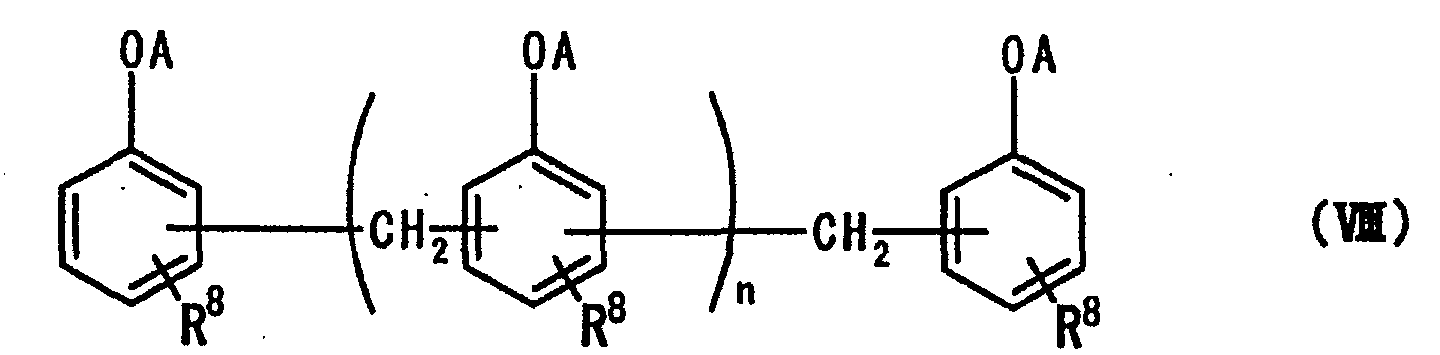 (wherein R9s each represent a hydrogen atom, a halogen atom, a linear, branched or cyclic aliphatic alkyl group having 1 to 8 carbon atoms, an alkoxy group having 1 to 10 carbon atoms or a phenyl group; n which is the number of recurring units represents an integer of 0 to 50, its average being within a range of 0 to 15; and As each represent a hydrogen atom in the case of the compound (B1) and an aromatic acyl group in the case of the compound (B2)),
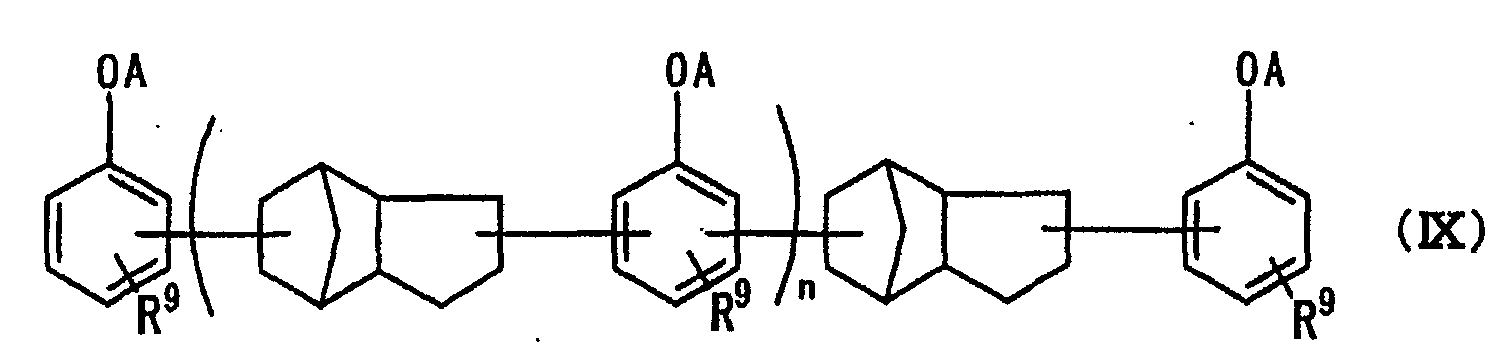 (wherein R10s each represent a hydrogen atom, a halogen atom, a linear, branched or cyclic aliphatic alkyl group having 1 to 8 carbon atoms, an alkoxy group having 1 to 10 carbon atoms or a phenyl group; n which is the number of recurring units represents an integer of 0 to 50, its average being within a range of 0 to 15; and As each represent a hydrogen atom in the case of the compound (B1) and an aromatic acyl group in the case of the compound (B2)),
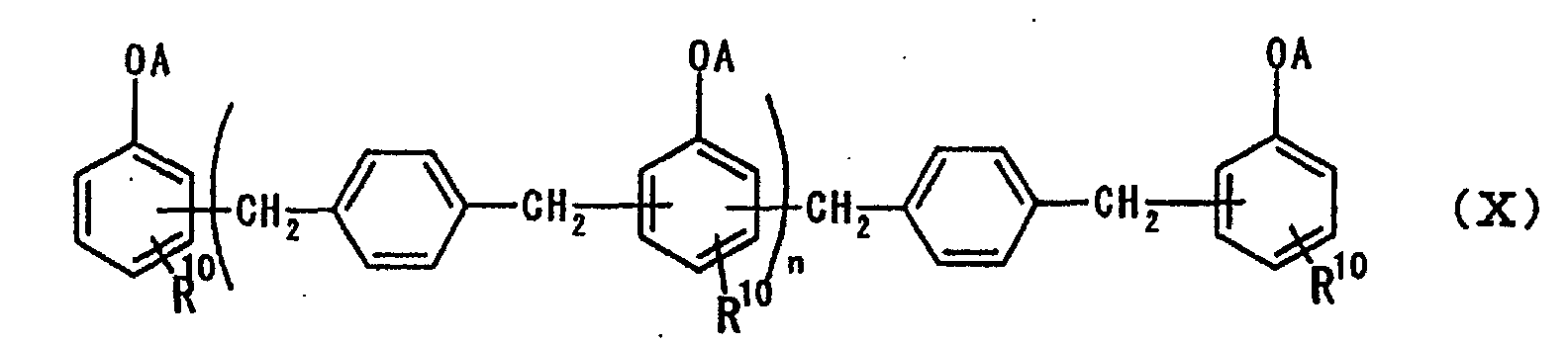 (wherein R11s each represent a hydrogen atom, a halogen atom, a linear, branched or cyclic aliphatic alkyl group having 1 to 8 carbon atoms, an alkoxy group having 1 to 10 carbon atoms or a phenyl group; n which is the number of recurring units represents an integer of 0 to 50, its average being within a range of 0 to 15; and As each represent a hydrogen atom in the case of the compound (B1) and an aromatic acyl group in the case of the compound (B2)),
 (wherein R12s each represent a hydrogen atom, a methyl group or an ethyl group and may be all the same or different from one another; and As each represent a hydrogen atom in the case of the compound (B1) and an aromatic acyl group in the case of the compound (B2)), and
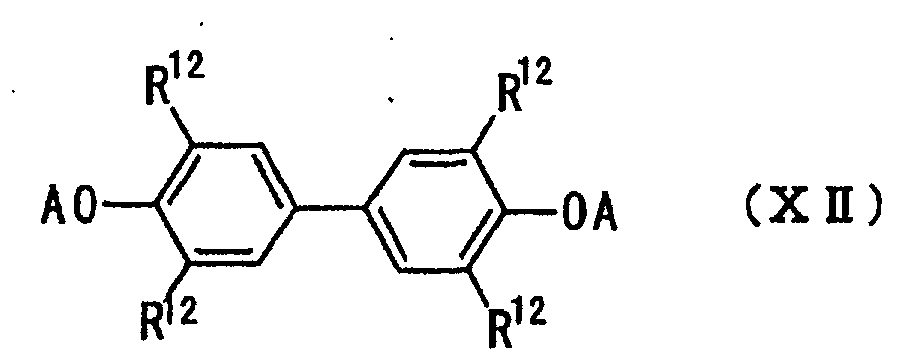 (wherein R13s each represent a hydrogen atom, an alkyl group having 1 to 10 carbon atoms, an alkoxyl group having 1 to 10 carbon atoms, an aryl group having 6 to 10 carbon atoms, an aryloxy group having 6 to 10 carbon atoms or halogen and may be all the same or different from one another; Y represents an alkylidene having 1 to 10 carbon atoms, an alkylene having 2 to 10 carbon atoms, a cycloalkylidene having 3 to 10 carbon atoms, a cycloalkylene having 3 to 10 carbon atoms or a divalent group such as -O-, -CO-, -CO2-, -S-, -SO- or -SO2-; and As each represent a hydrogen atom in the case of the compound (B1) and an aromatic acyl group in the case of the compound (B2)).
- The composition of claim 5, containing an organic and/or inorganic filler(s) (D) in an amount of 100 to 1,900 parts by weight based on 100 parts by weight of a total of the epoxy resin (A) having two or more epoxy groups in a molecule and the curing agent (B).
- A cured epoxy resin obtained by heat-curing the epoxy resin composition of claim 5.
- A semiconductor device obtained by sealing a semiconductor integrated circuit by use of the epoxy resin composition of claim 5.
- An epoxy resin composition comprising:wherein the curing agent (B) is a compound selected from the group consisting of the following (B1) to (B3):(A) an epoxy resin having two or more epoxy groups in a molecule,(B) a curing agent, and(C) a curing accelerator,and the curing accelerator (C) is a salt comprising a stable cation and a counter anion.(B1) a phenol compound having two or more functional groups,(B2) a compound in which a hydroxyl group of a phenol compound having two or more functional groups is esterified with an acyl group, and(B3) a mixture of the above (B1) and (B2),
Applications Claiming Priority (5)
| Application Number | Priority Date | Filing Date | Title |
|---|---|---|---|
| JP2001302166 | 2001-09-28 | ||
| JP2001302165 | 2001-09-28 | ||
| JP2001302166 | 2001-09-28 | ||
| JP2001302165 | 2001-09-28 | ||
| PCT/JP2002/009992 WO2003029322A1 (en) | 2001-09-28 | 2002-09-27 | Curing agent composition for epoxy resins, epoxy resin composition and use thereof |
Publications (2)
| Publication Number | Publication Date |
|---|---|
| EP1440991A1 true EP1440991A1 (en) | 2004-07-28 |
| EP1440991A4 EP1440991A4 (en) | 2005-01-05 |
Family
ID=26623348
Family Applications (1)
| Application Number | Title | Priority Date | Filing Date |
|---|---|---|---|
| EP02768102A Withdrawn EP1440991A4 (en) | 2001-09-28 | 2002-09-27 | CURING AGENT COMPOSITION FOR EPOXY RESINS, EPOXY RESIN COMPOSITION AND USE THEREOF |
Country Status (7)
| Country | Link |
|---|---|
| US (1) | US6911503B2 (en) |
| EP (1) | EP1440991A4 (en) |
| JP (1) | JP4527977B2 (en) |
| KR (1) | KR100592638B1 (en) |
| CN (1) | CN1223622C (en) |
| TW (1) | TWI238167B (en) |
| WO (1) | WO2003029322A1 (en) |
Families Citing this family (13)
| Publication number | Priority date | Publication date | Assignee | Title |
|---|---|---|---|---|
| JP3813105B2 (en) * | 2002-03-28 | 2006-08-23 | 三井化学株式会社 | Epoxy resin composition having excellent curability, cured product thereof and use thereof |
| BRPI0512937A (en) * | 2004-07-01 | 2008-04-15 | Mitsui Chemicals Inc | phosphazene supported catalyst, new compounds thereof and their uses |
| JP4731884B2 (en) * | 2004-11-10 | 2011-07-27 | ニチアス株式会社 | Conductive epoxy resin composition, epoxy resin molded body, and method for producing fuel cell separator |
| CN101133097B (en) * | 2005-01-26 | 2011-11-09 | 日立化成工业株式会社 | Curing accelerator, curable resin composition and electronic device |
| JPWO2011019061A1 (en) * | 2009-08-13 | 2013-01-17 | 昭和電工株式会社 | Method for producing polyglycidyl ether compound |
| CN102061063A (en) * | 2010-12-10 | 2011-05-18 | 湖北省京珠高速公路管理处 | A kind of epoxy resin grouting material for road engineering repair and maintenance and preparation method thereof |
| CN102558769B (en) * | 2010-12-31 | 2015-11-25 | 第一毛织株式会社 | For the composition epoxy resin of encapsulated semiconductor device and the semiconducter device that encapsulated by this composition epoxy resin |
| JP5237507B1 (en) * | 2011-06-23 | 2013-07-17 | 三井化学株式会社 | Surface sealant for optical semiconductor, method for producing organic EL device using the same, organic EL device, and organic EL display panel |
| CN107365476B (en) * | 2016-05-12 | 2019-11-08 | 中山台光电子材料有限公司 | Resin combination and finished product as made from it |
| TWI808973B (en) * | 2017-06-28 | 2023-07-21 | 日商迪愛生股份有限公司 | Active ester compound and curable composition |
| CN107915830A (en) * | 2017-11-27 | 2018-04-17 | 陕西生益科技有限公司 | A kind of active ester curing agent and composition epoxy resin |
| CN113340773A (en) * | 2021-06-10 | 2021-09-03 | 攀钢集团重庆钒钛科技有限公司 | Method for detecting fluidity of titanium dioxide |
| CN117701118B (en) * | 2023-12-14 | 2024-05-03 | 珠海市金团化学品有限公司 | Preparation method of photo-curing aqueous epoxy acrylate emulsion |
Family Cites Families (21)
| Publication number | Priority date | Publication date | Assignee | Title |
|---|---|---|---|---|
| DE4424219A1 (en) * | 1994-07-09 | 1996-01-11 | Basf Ag | Process for the preparation of 2,5-dihydrofuran |
| US5990352A (en) * | 1996-02-20 | 1999-11-23 | Mitsui Chemicals, Inc. | Phosphazenium salt and preparation process thereof, and process for producing poly(alkylene oxide) |
| JP3497054B2 (en) | 1996-02-20 | 2004-02-16 | 三井化学株式会社 | Phosphazenium salt, method for producing the same, and method for producing polyalkylene oxide |
| JP3703296B2 (en) * | 1997-05-22 | 2005-10-05 | 三井化学株式会社 | Method for producing polymer |
| JP3838795B2 (en) * | 1997-12-22 | 2006-10-25 | 三井化学株式会社 | [Tris (dimethylamino) phosphonioamino] tris [tris (dimethylamino) phosphoranylideneamino] phosphonium dichloride and method for producing the same |
| JP3966641B2 (en) * | 1998-04-16 | 2007-08-29 | 三井化学株式会社 | Method for producing oxyalkylene derivative |
| US6310147B1 (en) | 1998-05-21 | 2001-10-30 | Mitsui Chemicals, Inc. | Epoxy-resin composition and use thereof |
| JP3688120B2 (en) * | 1998-06-11 | 2005-08-24 | 三井化学株式会社 | Epoxy resin composition and use thereof |
| JP3973304B2 (en) * | 1998-10-29 | 2007-09-12 | 三井化学株式会社 | Method for producing 2-oxazolidone derivative |
| JP2000355606A (en) * | 1999-04-13 | 2000-12-26 | Mitsui Chemicals Inc | Preparation of polymer |
| JP2000319358A (en) | 1999-05-13 | 2000-11-21 | Mitsui Chemicals Inc | Epoxy resin composition and its use |
| JP2000327748A (en) | 1999-05-18 | 2000-11-28 | Mitsui Chemicals Inc | Epoxy resin composition and its use |
| JP2000327747A (en) | 1999-05-18 | 2000-11-28 | Mitsui Chemicals Inc | Epoxy resin composition and use thereof |
| JP3945558B2 (en) | 1999-07-13 | 2007-07-18 | 三井化学株式会社 | A method for producing a polyalkylene oxide having an ether bond and an ester bond at a terminal. |
| JP4439620B2 (en) * | 1999-07-23 | 2010-03-24 | 三井化学株式会社 | Method for producing phosphazenium salt |
| JP2001040084A (en) * | 1999-08-03 | 2001-02-13 | Mitsui Chemicals Inc | Production of polyol |
| JP4409002B2 (en) * | 1999-09-22 | 2010-02-03 | 三井化学株式会社 | Method for producing phosphazenium salt |
| JP2002069160A (en) * | 1999-12-14 | 2002-03-08 | Mitsui Chemicals Inc | Sealing agent for liquid crystal display cell, composition for sealing agent for liquid crystal display cell and liquid crystal display element |
| JP4612219B2 (en) * | 2000-04-20 | 2011-01-12 | 三井化学株式会社 | Process for producing substituted aromatic compounds |
| JP4718666B2 (en) * | 2000-06-06 | 2011-07-06 | 三井化学株式会社 | Epoxy resin composition and adhesive sheet |
| JP2004018720A (en) * | 2002-06-18 | 2004-01-22 | Mitsui Chemicals Inc | Adhesive for semiconductor device |
-
2002
- 2002-09-27 CN CNB028042433A patent/CN1223622C/en not_active Expired - Fee Related
- 2002-09-27 WO PCT/JP2002/009992 patent/WO2003029322A1/en not_active Ceased
- 2002-09-27 US US10/432,368 patent/US6911503B2/en not_active Expired - Lifetime
- 2002-09-27 JP JP2003532562A patent/JP4527977B2/en not_active Expired - Fee Related
- 2002-09-27 TW TW091122468A patent/TWI238167B/en not_active IP Right Cessation
- 2002-09-27 KR KR1020037010910A patent/KR100592638B1/en not_active Expired - Fee Related
- 2002-09-27 EP EP02768102A patent/EP1440991A4/en not_active Withdrawn
Also Published As
| Publication number | Publication date |
|---|---|
| CN1489608A (en) | 2004-04-14 |
| WO2003029322A1 (en) | 2003-04-10 |
| EP1440991A4 (en) | 2005-01-05 |
| KR100592638B1 (en) | 2006-06-23 |
| JP4527977B2 (en) | 2010-08-18 |
| CN1223622C (en) | 2005-10-19 |
| US6911503B2 (en) | 2005-06-28 |
| KR20030077636A (en) | 2003-10-01 |
| TWI238167B (en) | 2005-08-21 |
| WO2003029322A9 (en) | 2003-11-13 |
| US20040044167A1 (en) | 2004-03-04 |
| JPWO2003029322A1 (en) | 2005-01-13 |
Similar Documents
| Publication | Publication Date | Title |
|---|---|---|
| KR101090654B1 (en) | Epoxy resin molding material for sealing and electronic component device | |
| US6911503B2 (en) | Curing agent composition for epoxy resins, epoxy resin composition and use thereof | |
| KR101076977B1 (en) | Resin composition for semiconductor encapsulation and semiconductor device | |
| JP4349683B2 (en) | Epoxy resin composition and use thereof | |
| JP2005145911A (en) | Aryloxysilane compound, its production method and its use | |
| US6297332B1 (en) | Epoxy-resin composition and use thereof | |
| JPH09255852A (en) | Epoxy resin composition for sealing material and semiconductor device using the same | |
| US6310147B1 (en) | Epoxy-resin composition and use thereof | |
| JP2002226552A (en) | Epoxy resin composition and use thereof | |
| KR20050058727A (en) | Epoxy resin composition for encapsulation of semiconductor device | |
| JP2867471B2 (en) | Resin composition | |
| JP4643000B2 (en) | Ester group-containing compound and epoxy resin composition | |
| JP2010031233A (en) | Semiconductor sealing epoxy resin composition, and one side sealing type semiconductor device produced by sealing semiconductor device using the same | |
| JP3688120B2 (en) | Epoxy resin composition and use thereof | |
| JP3693495B2 (en) | Epoxy resin composition and use thereof | |
| JP2643547B2 (en) | Epoxy resin composition for semiconductor encapsulation | |
| KR100529257B1 (en) | Epoxy Resin Composition for Packaging Semiconductor Device | |
| KR100527826B1 (en) | Epoxy Resin Composition for Encapsulating Semiconductor Device | |
| JPH0730236B2 (en) | Epoxy resin composition for semiconductor encapsulation | |
| KR102659602B1 (en) | An epoxy resin composition for encapsulating semiconductor device and a semicondoctor encapsulated using the same | |
| JP2000327747A (en) | Epoxy resin composition and use thereof | |
| JP2024129417A (en) | Encapsulating resin composition | |
| JP2000053748A (en) | Epoxy resin composition and its use | |
| JP2000169551A (en) | Epoxy resin composition and its use | |
| JP2000319358A (en) | Epoxy resin composition and its use |
Legal Events
| Date | Code | Title | Description |
|---|---|---|---|
| PUAI | Public reference made under article 153(3) epc to a published international application that has entered the european phase |
Free format text: ORIGINAL CODE: 0009012 |
|
| 17P | Request for examination filed |
Effective date: 20030704 |
|
| AK | Designated contracting states |
Kind code of ref document: A1 Designated state(s): AT BE BG CH CY CZ DE DK EE ES FI FR GB GR IE IT LI LU MC NL PT SE SK TR |
|
| RAP1 | Party data changed (applicant data changed or rights of an application transferred) |
Owner name: MITSUI CHEMICALS, INC. |
|
| A4 | Supplementary search report drawn up and despatched |
Effective date: 20041123 |
|
| STAA | Information on the status of an ep patent application or granted ep patent |
Free format text: STATUS: THE APPLICATION IS DEEMED TO BE WITHDRAWN |
|
| 18D | Application deemed to be withdrawn |
Effective date: 20050207 |