EP1440979A1 - Process for the preparation of hypoallergenic mosaic proteins - Google Patents
Process for the preparation of hypoallergenic mosaic proteins Download PDFInfo
- Publication number
- EP1440979A1 EP1440979A1 EP03001242A EP03001242A EP1440979A1 EP 1440979 A1 EP1440979 A1 EP 1440979A1 EP 03001242 A EP03001242 A EP 03001242A EP 03001242 A EP03001242 A EP 03001242A EP 1440979 A1 EP1440979 A1 EP 1440979A1
- Authority
- EP
- European Patent Office
- Prior art keywords
- allergen
- mosaic
- phl
- ige
- rphl
- Prior art date
- Legal status (The legal status is an assumption and is not a legal conclusion. Google has not performed a legal analysis and makes no representation as to the accuracy of the status listed.)
- Granted
Links
Images


Classifications
-
- C—CHEMISTRY; METALLURGY
- C07—ORGANIC CHEMISTRY
- C07K—PEPTIDES
- C07K14/00—Peptides having more than 20 amino acids; Gastrins; Somatostatins; Melanotropins; Derivatives thereof
- C07K14/415—Peptides having more than 20 amino acids; Gastrins; Somatostatins; Melanotropins; Derivatives thereof from plants
-
- A—HUMAN NECESSITIES
- A61—MEDICAL OR VETERINARY SCIENCE; HYGIENE
- A61P—SPECIFIC THERAPEUTIC ACTIVITY OF CHEMICAL COMPOUNDS OR MEDICINAL PREPARATIONS
- A61P37/00—Drugs for immunological or allergic disorders
- A61P37/08—Antiallergic agents
-
- A—HUMAN NECESSITIES
- A61—MEDICAL OR VETERINARY SCIENCE; HYGIENE
- A61K—PREPARATIONS FOR MEDICAL, DENTAL OR TOILETRY PURPOSES
- A61K39/00—Medicinal preparations containing antigens or antibodies
- A61K2039/51—Medicinal preparations containing antigens or antibodies comprising whole cells, viruses or DNA/RNA
- A61K2039/53—DNA (RNA) vaccination
-
- A—HUMAN NECESSITIES
- A61—MEDICAL OR VETERINARY SCIENCE; HYGIENE
- A61K—PREPARATIONS FOR MEDICAL, DENTAL OR TOILETRY PURPOSES
- A61K38/00—Medicinal preparations containing peptides
Definitions
- the present invention relates to mosaic antigens derived from naturally occurring allergens, in particular timothy grass pollen allergen Phl p 2.
- the mosaic antigens display reduced allergenic activity and are useful as allergy vaccines for the treatment of sensitized allergic patients and for prophylactic vaccination.
- IgE-mediated allergies A large percentage of the population suffers from IgE-mediated allergies. Those patients suffer from allergic reactions against several antigens. A high percentage of the allergic reactions are caused by plant pollen. The symptoms of allergy like allergic rhinoconjunctivitis, asthma, dermatitis and even anaphylactic shock are due to IgE recognition of allergens. The IgE molecules are largely responsible for the symptoms of allergic reactions such as hay fever, asthma and hives.
- the IgE molecules bind to an allergen like e.g. plant pollen.
- the tail region of the IgE molecule, the Fc part binds to Fc receptors which are mainly located on the surface of mast cells in tissues and basophils in the blood.
- Antigen binding triggers the mast cells or basophils to secrete a variety of cytokines and biologically active compounds, especially histamine.
- cytokines and biologically active compounds especially histamine.
- These molecules cause blood vessels to dilate and become leaky which in turn helps white blood cells, antibodies and complements components to enter sites of reaction.
- Those molecules are on the other hand largely responsible for the symptoms of allergic reactions.
- There are different degrees of allergic reactions which range from slight itching of the eyes and the symptoms of a slight cold over severe pains to live-threatening symptoms like anaphylactic shock which may occur for example after the sting of a bee.
- allergy vaccines which are based on the application of small amounts of hypoallergenic compounds. It is believed that by applying hypoallergenic vaccines IgG antibodies are produced which react with the allergen immediately after the individual has come into contact with the allergen. By those so-called blocking antibodies a contact between the allergen and the IgE molecules present in the patient's body is largely avoided. Therefore the reaction between the allergen and the mast cells mediated by IgE molecules is largely avoided.
- allergen-containing vaccines In the field of therapy of allergic reactions different vaccines have been used. Formerly small amounts of the allergen have been applied to the patients. With the development of genetic engineering recombinant allergens may be used for vaccination. A major disadvantage of such allergen-containing vaccines is that the application of such vaccines causes in the patient unwanted side-effects. If for example the allergen against which the patient is allergic is applied subcutaneously to the patient an unwanted side-effect like itching up to anaphylatic shock can occur since the IgE antibodies present in the patient's body react with the allergen and cause the allergic reaction.
- hypoallergenic mosaic antigen provided by the present process means that the antigen comprises substantially all amino acids of the naturally occurring allergen.
- the difference compared with the naturally occurring antigen is, however, that the allergen is in a first step split into different parts.
- the amino acid sequence of the allergen is known it is common general knowledge of a person skilled in the art to prepare peptides of varying lengths from the antigen.
- the peptides may either be prepared by chemical synthesis which is well-known in the art.
- the peptides can be easily prepared by Polymerase Chain Reaction since suitable primers can be easily synthesized when the sequence is known.
- each part of the allergen which is present as a peptide or polypeptide has to be determined. This can be done by reacting the peptide with sera from patients which are allergic against the naturally occurring allergen.
- the IgE antibodies present in such sera will react with the peptide if an IgE epitope is present on the peptide. If there are, however, no linear IgE epitopes or if conformational IgE epitopes are destroyed by separating the whole naturally occurring allergen there will be no binding of IgE with the peptide.
- the IgE antibodies can subsequently easily be detected by reaction with specific anti-antibodies which bind to the IgE antibody. Those anti-antibodies are usually labeled for detection.
- the allergen it is an important aspect of the present invention to divide the allergen into such parts which do not react with IgE antibodies. If a part of the allergen still reacts with IgE antibodies in a substantial amount such parts of the allergen should not be used for the preparation of the mosaic antigen. It is advisable to test the parts of the naturally occurring antigen to be used in the mosaic antigen with sera from different allergic patients since there may be variations with regard to specifity and amount of IgE concentration in each serum.
- the allergen When the allergen has been split up into several parts which do not have any detectable IgE reactivity those parts are newly arranged in order to provide the mosaic antigen. That the part of the allergen does not have a substantial IgE reactivity means that the IgE reactivity of the whole, naturally occurring allergen is tested with preferably at least five sera from allergic patients and the parts thereof are tested as well. The binding of IgE molecules to the allergen and the parts thereof is determined quantitatively and the IgE reactivity of the part has to be reduced to not more than 10%, preferably not more than 5% of the value obtained for the naturally occurring allergen.
- the rearrangement of the parts of the naturally occurring allergen to the mosaic antigen means in the simplest case that the allergen is split up into two parts, namely part A having the N-terminus and ending at the cleavage side and part B starting with the cleavage side and ending with the carboxy terminus of the polypeptide.
- Cleavage site means the position in the polypeptide where one part ends and another part starts. If both parts of the naturally occurring antigen do not have a substantial IgE reactivity the two parts are rearranged in such a manner that now part B represents the N-terminus and part A represents the C-terminus.
- the naturally occurring allergen is split up into three parts having the naturally occurring order A, B and C there are several mosaic antigens possible, namely for example C, B, A; or A, C, B.
- the mosaic antigen contains substantially all amino acids of the naturally occurring antigen. Certainly some amino acids which do clearly have no functions may be deleted or some amino acids may be deleted caused by production reasons, but as much as possible amino acids should be maintained.
- the mosaic antigen may also comprise amino acids used for production purposes.
- the cleavage sites are preferably selected in order to destroy the IgE eptiopes whereby the IgE epitopes are maintained as far as possible.
- allergens of group 2 are described in the following publication:
- the allergen used for the mosaic antigen is the timothy grass pollen allergen Phl p 2.
- the sequence of the grass pollen allergen Phl p 2 is disclosed in WO 94/23035.
- a more detailed description of the Phl p 2 from timothy grass pollen is provided in De Marino et al., Structure (1999) Vol. 7, No. 8, p. 943-952.
- the Phl p 2 antigen is preferred since it reacts with serum lgE from about 70% of grass pollen allergic individuals and elicits histamine release from basophils of sensitized patients.
- the Phl p 2 allergen is preferably split into three peptides, namely peptide 1 having amino acids 1-33, peptide 2 having amino acids 34-64 and peptide 3 having amino acids 65-96.
- peptide 1 having amino acids 1-33
- peptide 2 having amino acids 34-64
- peptide 3 having amino acids 65-96.
- This mosaic antigen has the advantage that a sufficient amount of blocking IgE antibodies is produced, but the undesired side-reactions associated with the vaccination are nearly completely avoided.
- the amino acid sequence of the preferred mosaic allergen has SEQ ID NO:1.
- the DNA coding for this preferred mosaic allergen has SEQ ID NO:2.
- the mosaic allergen provided by the present disclosure can preferably be used for the preparation of a medicament for the treatment of an allergic reaction.
- the preferred Phl p 2 mosaic antigen can be used for the preparation of a medicament for the treatment of grass pollen allergy. Since the Phl p 2 is an antigen against which a large percentage of allergic patients have formed IgE antibodies the mosaic antigen is very helpful in the treatment of patients suffering from hay fever.
- a mosaic antigen as prepared by the described process can be formulated as a medicament for the treatment of an allergic reaction.
- the main component is the mosaic antigen which is preferably administered together with an adjuvant.
- adjuvants which are suitable for the application to humans like e.g. aluminium hydroxide gel.
- DNA vaccine it is also possible to use a DNA coding for a mosaic antigen or a DNA sequence complementary thereto as a DNA vaccine.
- a suitable polynucleotide sequence is inserted into the target cells.
- a DNA vaccine may also contain regulatory elements like promotors, ribosome bindinig sites or termination sequences.
- Such DNA sequences should preferably be incorporated into a suitable carrier which allows the DNA to come to the protein synthesizing machinery of the cells.
- a mosaic antigen as described in detail herein is preferably intended for human application. It is, however, also possible to use the mosaic antigen for valuable animals like pets (e.g. dogs or cats) or horses.
- Phl p 2 fragments without allergenic activity, peptides, each comprising about 1/3 of the Phl p 2 protein were chemically synthesized (Table 1). The peptides had a length between 32 and 34 aminoacids with molecular weights of around 3.7 kDa and together covered the complete Phl p 2 amino acid sequence.
- the three peptides were synthesized using Fmoc (9-fluorenylmethoxycarbonyl)-strategy with HBTU (2-(1H-benzotriazol-1-yl) 1,1,3,3, tetramethyluronium hexafluorophosphat)-activation (0.1 mmol small-scale cycles) on the Applied Biosystems (Foster City, CA) peptide synthesizer Model 433A.
- Preloaded PEG-PS polyethylenglycol polysterene
- resins (0.15-0.2 mmol/g loading) (per Septive Biosystems, Warrington, UK) were used as solid phase to build up the peptides. Chemicals were purchased from Applied Biosystems.
- Phl p 2-derived peptides The allergenic activity of the Phl p 2-derived peptides was evaluated by comparing the IgE-reactivity of complete rPhl p 2 with the peptides by dot blot analysis ( Figure 1). Nitrocellulose-dotted Phl p 2-derived peptides (P1-P3), an immunologically unrelated major grass pollen allergen, rPhl p 5 (Vrtala S, Sperr WR, Reimitzer I, van Ree R, Laffer S, Muller WD, Valent P, Lechner K, Rumpold H, Kraft D, Scheiner O, Valenta R.
- a recombinant Phl p 2 mosaic protein was obtained by recombination of the three Phl p 2-derived peptides in altered sequence. This mosaic protein was created under the assumption that recombination of three non-allergenic Phl p 2 fragments in altered order will deliver a mosaic protein with disrupted three-dimensional structure and consequently reduced allergenic activity. In addition it was expected that the mosaic protein will exhibit better immunogenicity compared to the individual smaller peptide units and preserve the entire primary amino acid sequence of Phl p 2 thus containing the relevant T cell epitopes of Phl p 2.
- Figure 2 shows the assembly of the three peptides in the natural Phl p 2 allergen compared to that of the Phl p 2 mosaic protein.
- a recombinant Phl p 2 containing a C-terminal hexahistidine tail and a recombinant Phl p 2 mosaic protein was produced which also contained a C-terminal hexahistidine tail (Figure 2) to allow the purfication of both proteins by Nickel affinity chromatography (Quiagen, Hilden, Germany).
- Phl p 2 mosaic was construced by PCR-based gene amplification of cDNAs coding for the three peptides in the order shown in Figure 2 using the primers displayed in Figure 3 and the Phl p 2-encoding cDNA (Dolecek C, Vrtala S, Laffer S, Steinberger P, Kraft D, Scheiner O, Valenta R. Molecular characterization of Phl p II, a major timothy grass (Phleum pratense) pollen allergen. FEBS Lett. 1993, 335: 299-304) as template as described (Linhart B, Jahn-Schmid B, Verdino P, Keller W, Ebner C, Kraft D, Valenta R. Combination vaccines for the treatment of grass pollen allergy consisting of genetically engineered hybrid molecules with increased immunogenicity. FASEB J. 2002, 16: 1301-1303).
- FIG 4 shows the DNA and deduced amino acid sequence of the recombinant Phl p 2 mosaic protein.
- the his-tagged mosaic protein is encoded by a DNA of 309 bp coding for a protein with a calculated molecular of 11769 Da almost identical to the his-tagged recombinant Phl p 2 allergen (11784 Da).
- the cDNA coding for a his-tagged rPhl p 2 allergen was obtained by PCR using a combination of the 5' primer P2/1 (SEQ ID NO:6) and the 3' primer P2/7 (SEQ ID NO:12): CGC GAA TTC TCA GTG GTG GTG GTG GTG GTG GTG GTG CTC TTC TGG CGC GTA GGT GGC and the cDNA coding for Phl p 2 as a template.
- the cDNAs coding for the his-tagged Phl p 2 mosaic and the his-tagged Phl p 2 allergen were separately ligated into Nde I/Eco RI cut plasmids pET17b (Novagen).
- the DNA sequences of the two plasmid constructs was confirmed by sequence analysis and the recombinant proteins were expressed in Escherichia coli BL21 (DE3) (Novagen) by induction with 0.5-mM isopropyl- ⁇ -thiogalactopyranoside at an optical density at 600 nm of 0.4 in liquid culture (LB,medium containing 100mg/l ampicillin) for additional 4 hours at 37°C.
- E.coli cells from a 500 ml culture were harvested by centrifugation and prepared for purificaton under native (rPhl p 2) or denaturing conditions (rPhl p 2 mosaic) according to the manufactorers advice (Quiagen, Hilden, Germany). Protein samples were analysed for purity by sodium dodecyl sulfate-polyacrylamide gel electrophoresis (SDS-PAGE) and protein staining (Fling SP, Gregerson DS. Peptide and protein molecular weight determination by electrophoresis using a high-molarity Tris buffer system without urea. Anal.Biochem. 1986, 155:83-88) ( Figure 4).
- Figure 5 shows the purity of the his-tagged recombinant proteins (rPhl p 2: P2; rPhl p 2 mosaic: P2M). Although the two proteins did not show a completely identical migration behaviour in the SDS-PAGE, mass spectroscopical analysis performed as described by Niederberger V, Hayek B, Vrtala S, Laffer S, Twardosz A, Vangelista L, Sperr WR, Valent P, Rumpold H, Kraft D, Ehrenberger K, Valenta R, Spitzauer S. Calcium-dependent immunoglobulin E recognition of the apo- and calcium-bound form of a cross-reactive two EF-hand timothy grass pollen allergen, Phl p 7. FASEB J.
- Example 3 rPhl p 2 mosaic lacks IgE reactivity and allergenic properties
- the IgE binding capacity of purified Phl p 2 mosaic was compared with that of Phl p 2 wildtype by dot blot experiments as described for the peptides using sera from twelve timothy grass pollen allergic patients ( Figure 7). Sera from all 12 grass pollen allergic patients contained IgE antibodies against rPhl p 2 but no serum exhibited IgE reactivity to the rPhl p 2 mosaic or the negative control, human serum albumin ( Figure 7). The strongly reduced allergenic activity of the rPhl p 2 mosaic was further demonstrated by basophil histamine release and skin test experiments.
- Basophils from a grass pollen allergic patient were enriched by dextran sedimentation and exposed to increasing concentrations of purified rPhl p 2 or rPhl p 2 mosaic as described (Valent P, Besemer J, Muhm M, Majdic O; Lechner K, Bettelhei P. Interleukin 3 activates human blood basophils via high-affinity binding sites. Proc.Natl.Acad.Sci. USA 1989, 86: 5542-5546).
- Histamine released in the cell free supernatants was determined in triplicates by radioimmuno assay and is expressed as mean percentage of the total histamine content of the cells as described by Valent et al.
- Figure 8 shows that the rPhl p 2 mosaic (maximal release between 1 and 10 ⁇ g/ml) exhibited a more than 1000 fold reduced allergenic activity compared to the rPhl p 2 allergen (maximal release 10 -3 ⁇ g/ml).
- rPhl p 2 mosaic The strongly reduced allergenic activity of rPhl p 2 mosaic was confirmed by skin testing in grass pollen allergic patients (Table 2). SPTs (skin prick tests) were performed on the individuals' forearms. Twenty microliter aliquots containing 5 concentrations of rPhl p 2 and of Phl p 2-derived mosaic P2M (1 ⁇ g/ml, 2 ⁇ g/ml, 4 ⁇ g/ml, 8 ⁇ g/ml, 16 ⁇ g/ml) were applied. In addition, standardized skin prick solutions (timothy grass pollen extract and histamine) (Allergopharma, Reinbeck, Germany) were tested.
- rPhl p 2 induced strong wheal reactions already at the lowest concentration tested, i.e., 1 ⁇ g/ml, whereas rPhl p 2 mosaic induced only mild wheal reactions at the maximal concentrations tested (i.e., 8-16 ⁇ g/ml) thus confirming the reduced allergenic activity of the mosaic protein.
- Example 4 Immunization with the rPhl p 2 mosaic induces IgG antibodies that recognize rPhl p 2 wildtype and inhibit allergic patients IgE binding to Phl p 2.
- the rabbit anti-rPhl p 2 mosaic antiserum reacted strongly with the immunogen (rPhl p 2 mosaic) as well as with the rPhl p 2 allergen ( Figure 9).
- the antibody reactivity was of comparable intensity as that obtained with the antiserum produced by immunization with the KLH-coupled mosaic and stronger than the reactivity induced by immunization with the rPhl p 2 allergen ( Figure 9).
- the anti-Phl p 2 mosaic antibodies inhibited the binding of grass pollen allergic patients IgE binding to Phl p 2 (20.93% average inhibition) albeit to a lower degree as was achieved by preincubation with antibodies induced by immunization with the rPhl p 2 allergen (54.73% average inhibition).
Landscapes
- Health & Medical Sciences (AREA)
- Chemical & Material Sciences (AREA)
- Life Sciences & Earth Sciences (AREA)
- Organic Chemistry (AREA)
- Medicinal Chemistry (AREA)
- General Health & Medical Sciences (AREA)
- Biophysics (AREA)
- Biochemistry (AREA)
- Genetics & Genomics (AREA)
- Gastroenterology & Hepatology (AREA)
- Molecular Biology (AREA)
- Proteomics, Peptides & Aminoacids (AREA)
- Botany (AREA)
- Chemical Kinetics & Catalysis (AREA)
- Pharmacology & Pharmacy (AREA)
- Bioinformatics & Cheminformatics (AREA)
- Immunology (AREA)
- Pulmonology (AREA)
- General Chemical & Material Sciences (AREA)
- Nuclear Medicine, Radiotherapy & Molecular Imaging (AREA)
- Engineering & Computer Science (AREA)
- Animal Behavior & Ethology (AREA)
- Public Health (AREA)
- Veterinary Medicine (AREA)
- Peptides Or Proteins (AREA)
- Medicines Containing Antibodies Or Antigens For Use As Internal Diagnostic Agents (AREA)
- Preparation Of Compounds By Using Micro-Organisms (AREA)
Abstract
Description
- The present invention relates to mosaic antigens derived from naturally occurring allergens, in particular timothy grass pollen
allergen Phl p 2. The mosaic antigens display reduced allergenic activity and are useful as allergy vaccines for the treatment of sensitized allergic patients and for prophylactic vaccination. - A large percentage of the population suffers from IgE-mediated allergies. Those patients suffer from allergic reactions against several antigens. A high percentage of the allergic reactions are caused by plant pollen. The symptoms of allergy like allergic rhinoconjunctivitis, asthma, dermatitis and even anaphylactic shock are due to IgE recognition of allergens. The IgE molecules are largely responsible for the symptoms of allergic reactions such as hay fever, asthma and hives.
- The IgE molecules bind to an allergen like e.g. plant pollen. The tail region of the IgE molecule, the Fc part binds to Fc receptors which are mainly located on the surface of mast cells in tissues and basophils in the blood. Antigen binding triggers the mast cells or basophils to secrete a variety of cytokines and biologically active compounds, especially histamine. These molecules cause blood vessels to dilate and become leaky which in turn helps white blood cells, antibodies and complements components to enter sites of reaction. Those molecules are on the other hand largely responsible for the symptoms of allergic reactions. There are different degrees of allergic reactions which range from slight itching of the eyes and the symptoms of a slight cold over severe pains to live-threatening symptoms like anaphylactic shock which may occur for example after the sting of a bee.
- In order to avoid these allergic reactions allergy vaccines have been developed which are based on the application of small amounts of hypoallergenic compounds. It is believed that by applying hypoallergenic vaccines IgG antibodies are produced which react with the allergen immediately after the individual has come into contact with the allergen. By those so-called blocking antibodies a contact between the allergen and the IgE molecules present in the patient's body is largely avoided. Therefore the reaction between the allergen and the mast cells mediated by IgE molecules is largely avoided.
- In the field of therapy of allergic reactions different vaccines have been used. Formerly small amounts of the allergen have been applied to the patients. With the development of genetic engineering recombinant allergens may be used for vaccination. A major disadvantage of such allergen-containing vaccines is that the application of such vaccines causes in the patient unwanted side-effects. If for example the allergen against which the patient is allergic is applied subcutaneously to the patient an unwanted side-effect like itching up to anaphylatic shock can occur since the IgE antibodies present in the patient's body react with the allergen and cause the allergic reaction.
- In order to overcome the undesired side-effects a process for the preparation of an hypoallergenic mosaic antigen derived from an allergen is disclosed whereby
- a) in a first step the allergen is split into at least two parts and the IgE reactivity of each part is determined and
- b) in a second step those parts of the allergen which have no detectable IgE reaction are combined to a mosaic antigen which comprises the amino acids of the allergen but the order of the amino acids of the mosaic antigen is different from that of the naturally occurring allergen.
-
- The term "hypoallergenic mosaic antigen" provided by the present process means that the antigen comprises substantially all amino acids of the naturally occurring allergen. The difference compared with the naturally occurring antigen is, however, that the allergen is in a first step split into different parts. When the amino acid sequence of the allergen is known it is common general knowledge of a person skilled in the art to prepare peptides of varying lengths from the antigen. The peptides may either be prepared by chemical synthesis which is well-known in the art. Alternatively the peptides can be easily prepared by Polymerase Chain Reaction since suitable primers can be easily synthesized when the sequence is known.
- The reactivity of each part of the allergen which is present as a peptide or polypeptide has to be determined. This can be done by reacting the peptide with sera from patients which are allergic against the naturally occurring allergen. The IgE antibodies present in such sera will react with the peptide if an IgE epitope is present on the peptide. If there are, however, no linear IgE epitopes or if conformational IgE epitopes are destroyed by separating the whole naturally occurring allergen there will be no binding of IgE with the peptide. The IgE antibodies can subsequently easily be detected by reaction with specific anti-antibodies which bind to the IgE antibody. Those anti-antibodies are usually labeled for detection.
- It is an important aspect of the present invention to divide the allergen into such parts which do not react with IgE antibodies. If a part of the allergen still reacts with IgE antibodies in a substantial amount such parts of the allergen should not be used for the preparation of the mosaic antigen. It is advisable to test the parts of the naturally occurring antigen to be used in the mosaic antigen with sera from different allergic patients since there may be variations with regard to specifity and amount of IgE concentration in each serum.
- When the allergen has been split up into several parts which do not have any detectable IgE reactivity those parts are newly arranged in order to provide the mosaic antigen. That the part of the allergen does not have a substantial IgE reactivity means that the IgE reactivity of the whole, naturally occurring allergen is tested with preferably at least five sera from allergic patients and the parts thereof are tested as well. The binding of IgE molecules to the allergen and the parts thereof is determined quantitatively and the IgE reactivity of the part has to be reduced to not more than 10%, preferably not more than 5% of the value obtained for the naturally occurring allergen.
- The rearrangement of the parts of the naturally occurring allergen to the mosaic antigen means in the simplest case that the allergen is split up into two parts, namely part A having the N-terminus and ending at the cleavage side and part B starting with the cleavage side and ending with the carboxy terminus of the polypeptide. Cleavage site means the position in the polypeptide where one part ends and another part starts. If both parts of the naturally occurring antigen do not have a substantial IgE reactivity the two parts are rearranged in such a manner that now part B represents the N-terminus and part A represents the C-terminus.
- When the naturally occurring allergen is split up into three parts having the naturally occurring order A, B and C there are several mosaic antigens possible, namely for example C, B, A; or A, C, B. The more parts are formed the more options for providing mosaic antigens are provided. In a preferred embodiment of the present invention it is avoided to combine parts which are localized in adjacent positions in the naturally occurring allergen, e.g. C, A, B. The reason therefore is that IgE binding epitopes may be formed again on the mosaic antigen. It is, however, essential that the mosaic antigen contains substantially all amino acids of the naturally occurring antigen. Certainly some amino acids which do clearly have no functions may be deleted or some amino acids may be deleted caused by production reasons, but as much as possible amino acids should be maintained. Moreover the mosaic antigen may also comprise amino acids used for production purposes. Preferably in the parts of the naturally occurring allergen which are reorganized in the mosaic antigen are as large as possible. The cleavage sites are preferably selected in order to destroy the IgE eptiopes whereby the IgE epitopes are maintained as far as possible.
- In a preferred embodiment the process is used with allergens of
group 2. Preferredgroup 2 allergens are described in the following publication: - Freidhoff LR, Ehrlich-Kautzky E, Grant JH, Meyers DA, Marsh DG. A study of the human immune response to Lolium perenne (rye) pollen and its components, Lol p I and Lol p II (rye I and rye II). I. Prevalence of reactivity to the allergens and correlations among skin test, IgE antibody, and IgG antibody data. J Allergy Clin Immunol 1986, 78, 1190-1201. Freidhoff LR, Ehrlich-Kautzky E, Meyers DA, Marsh DG. A study of the human immune response to Lolium perenne (rye) pollen and its components, Lol p I and Lol p II (Rye I and Rye II). II. Longitudinal variation of antibody levels in relation to symptomatology and pollen exposure and correction of seasonally elevated antibody levels to basal values. J Allergy Clin Immunol 1987, 80, 646-655. Ansari AA, Shenbagamurthi P, Marsh DG. Complete amino acid sequence of a Lolium perenne (perennial rye grass) pollen allergen, Lol p II. J Biol Chem 1989, 264, 11181-11185. Dolecek C, Vrtala S, Laffer S, Steinberger P, Kraft D, Scheiner O, Valenta R. Molecular characterization of Phl p II, a major timothy grass (Phleum pratense) pollen allergen. FEBS Lett 1993, 335, 299-304.
- In an especially preferred embodiment the allergen used for the mosaic antigen is the timothy grass pollen allergen
Phl p 2. The sequence of the grass pollen allergenPhl p 2 is disclosed in WO 94/23035. A more detailed description of thePhl p 2 from timothy grass pollen is provided in De Marino et al., Structure (1999) Vol. 7, No. 8, p. 943-952. ThePhl p 2 antigen is preferred since it reacts with serum lgE from about 70% of grass pollen allergic individuals and elicits histamine release from basophils of sensitized patients. - In the course of the present invention it has been found that the
Phl p 2 allergen is preferably split into three peptides, namelypeptide 1 having amino acids 1-33,peptide 2 having amino acids 34-64 andpeptide 3 having amino acids 65-96. By rearranging the peptides in theorder - The amino acid sequence of the preferred mosaic allergen has SEQ ID NO:1. The DNA coding for this preferred mosaic allergen has SEQ ID NO:2.
- The mosaic allergen provided by the present disclosure can preferably be used for the preparation of a medicament for the treatment of an allergic reaction. The preferred
Phl p 2 mosaic antigen can be used for the preparation of a medicament for the treatment of grass pollen allergy. Since thePhl p 2 is an antigen against which a large percentage of allergic patients have formed IgE antibodies the mosaic antigen is very helpful in the treatment of patients suffering from hay fever. - A mosaic antigen as prepared by the described process can be formulated as a medicament for the treatment of an allergic reaction. The main component is the mosaic antigen which is preferably administered together with an adjuvant. There are several adjuvants which are suitable for the application to humans like e.g. aluminium hydroxide gel. In another embodiment of the present invention it is also possible to link the mosaic antigen directly by covalent binding to another component which generally enhances the immunologic reaction of the body.
- It is also possible to use a DNA coding for a mosaic antigen or a DNA sequence complementary thereto as a DNA vaccine. For nucleic acid vaccines a suitable polynucleotide sequence is inserted into the target cells. In addition to the sequence coding for the mosaic antigen such a DNA vaccine may also contain regulatory elements like promotors, ribosome bindinig sites or termination sequences. Such DNA sequences should preferably be incorporated into a suitable carrier which allows the DNA to come to the protein synthesizing machinery of the cells.
- A mosaic antigen as described in detail herein is preferably intended for human application. It is, however, also possible to use the mosaic antigen for valuable animals like pets (e.g. dogs or cats) or horses.
- The figures and tables describe preferred embodiments of the present invention:
- Figure 1: Comparison of the IgE reactivity of synthetic Phl p 2-derived peptides and
complete rPhl p 2 (recombinantly produced wild type allergen). Nitrocelluloses containing (A)
dotted
Phl p 2 peptides (P1, P2, P3), human serum albumin (HSA), a control peptide (P), and a non-cross-reactive timothy grass pollen allergen (rPhl p 5) and (B)rPhl p 5 and Phl p 2 (rPhl p 2) were exposed to sera from 35 grass pollen allergic patients (1-35) and to serum from a non-allergic individual (N). - Figure 2: Schematic representation of recombinant his-tagged
Phl p 2 wildtype and recombinant his-taggedPhl p 2 mosaic. The position of the three peptides is indicated. - Figure 3: DNA sequence of the primers used for the construction of the
Phl p 2 mosaic and schematic representation of PCR approach used for the assembly of the cDNA coding for therPhl p 2 mosaic. The Nde I and Eco R I restriction sites are underlined in primer P2/1 and P2/6, respectively. The primers correspond to SEQ ID NO:6 to SEQ ID NO:11. - Figure 4: cDNA (SEQ ID NO:2) and deduced amino acid sequence (SEQ ID NO:1) and of
the his-tagged
Phl p 2 mosaic. Aminoacids are displayed in the single letter code, base pair and amino acid numbers are shown on the right margin. - Figure 5: Purity of
rPhl p 2 mosaic andrPhl p 2. Comassie stained gel containing Phl p 2 (lane P2),Phl p 2 mosaic (lane P2M) and a molecular weight marker (lane M). - Figure 6: Mass spectroscopical analysis of purified
rPhl p 2 mosaic (A) and rPhl p 2 (B). The mass/charge ratio is shown on the x-axis and the signal intensity is expressed as percentage of the most intensive signal obtained in the investigated mass range. - Figure 7: Comparison of the IgE binding capacity of rPhl p 2 (P2) and the
rPhl p 2 mosaic (P2M). Nitrocellulose dotted rPhl p 2 (P2) andrPhl p 2 mosaic (P2M), as well as human serum albumine (HSA) were probed with serum from 12 Phl p 2-reactive grass pollen allergic patients (1-12). Bound IgE antibodies were detected with 125l-labeled anti-human lgE antibodies and visualized by autoradiography. - Figure 8: Reduced allergenic activity of
rPhl p 2 mosaic determined by basophil histamine release. Basophils from a grass pollen allergic patient were exposed to increasing concentrations ofrPhl p 2 andrPhl p 2 mosaic (x-axis). Histamine release is expressed as percentage of total histamine release on the y-axis. - Figure 9:
Rabbit anti-rPhl p 2 mosaic antibodies recognize therPhl p 2 wildtype allergen. Rabbit antisera raised against therPhl p 2 mosaic (αP2M), KLH-coupled mosaic (αP2M-KLH) and rPhl p 2 (αPhl p 2) as well as buffer (C) were exposed to dot-blotted KLH, human serum albumin (HSA), rPhl p 2 (P2) andrPhl p 2 mosaic (P2M). Bound rabbit antibodies were detected with 125I-labeled donkey anti-rabbit lgG and visualized by autoradiography. - Table 1: Characteristics of Phl p 2-derived synthetic peptides. Sequence, number of amino
acids, position in the
Phl p 2 allergen, molecular weight and isoelectric point of the peptides are displayed.Peptide 1 corresponds to SEQ ID NO:3,Peptide 3 corresponds to SEQ ID NO:4 andPeptide 2 corresponds to SEQ ID NO:5. - Table 2: Immediate type skin reactions to complete
rPhl p 2 and toPhl p 2 mosaic (P2M). Two timothy grass pollen allergic patients (Individual 1,2) were tested for skin reactivity with P2 and P2M. The mean wheal diameters (mm) are displayed for five different concentrations ofrPhl p 2 andPhl p 2 mosaic, as well as for timothy grass pollen extract and histamine. - Table 3: Inhibition of grass pollen allergic patients IgE binding to
rPhl p 2 by rabbit αP2M and rabbit αP2 antibodies. The percentage inhibition of IgE binding is displayed for 5 patients. -
- The invention is further illustrated by the following examples:
- In order to identify
Phl p 2 fragments without allergenic activity, peptides, each comprising about 1/3 of thePhl p 2 protein were chemically synthesized (Table 1). The peptides had a length between 32 and 34 aminoacids with molecular weights of around 3.7 kDa and together covered thecomplete Phl p 2 amino acid sequence. - The three peptides were synthesized using Fmoc (9-fluorenylmethoxycarbonyl)-strategy with HBTU (2-(1H-benzotriazol-1-yl) 1,1,3,3, tetramethyluronium hexafluorophosphat)-activation (0.1 mmol small-scale cycles) on the Applied Biosystems (Foster City, CA) peptide synthesizer Model 433A. Preloaded PEG-PS (polyethylenglycol polysterene ) resins (0.15-0.2 mmol/g loading) (per Septive Biosystems, Warrington, UK) were used as solid phase to build up the peptides. Chemicals were purchased from Applied Biosystems. Coupling of amino acids was confirmed by conductivity monitoring in a feedback control system. One cysteine residue was added to each peptide at the N- or C-terminus to facilitate coupling of the peptides to carriers. Peptides were cleaved from the resins with a mixture of : 250 µl dest. water, 250 µl Triisopropylsilan (Flukan, Buchs, Switzerland), 9.5 ml TFA for 2 h and precipitated in tert-Butylmethylether (Flukan, Buchs, Switzerland). The identitiy of the peptides was checked by mass-spectrometry and they were purified to >90% purity by preparative HPLC (PiChem, Graz, Austria) (Focke M, Mahler V, Ball T, Sperr WR, Majlesi Y, Valent P, Kraft D, Valenta R. Nonanaphylactic synthetic peptides derived from B cell epitopes of the major grass pollen allergen,
Phl p 1, for allergy vaccination. FASEB J. 2001, 15: 2042-2044. - The allergenic activity of the Phl p 2-derived peptides was evaluated by comparing the IgE-reactivity of
complete rPhl p 2 with the peptides by dot blot analysis (Figure 1). Nitrocellulose-dotted Phl p 2-derived peptides (P1-P3), an immunologically unrelated major grass pollen allergen, rPhl p 5 (Vrtala S, Sperr WR, Reimitzer I, van Ree R, Laffer S, Muller WD, Valent P, Lechner K, Rumpold H, Kraft D, Scheiner O, Valenta R. cDNA cloning of a major allergen from timothy grass (Phleum pratense) pollen; characterization of the recombiniant Phl p V allergen. J.Immunol. 1993, 151: 4773-4781), and for control purposes, human serum albumin as well as a control peptide were exposed to sera from grass pollen allergic patients and to serum from a non-allergic individual. - Bound IgE antibodies were detected as described previously (Valenta R, Duchêne M, Ebner C, Valent P, Sillaber C, Deviller P, Ferreira F, Tejkl M, Edelmann H, Kraft D, Scheiner O. Profilins constitute a novel family of functional plant pan-allergens. J.Exp.Med. 1992, 175: 377-385). Sera from all 35 grass pollen allergic patients showed IgE reactivity to nitrocellulose-dotted
rPhl p 2 but no serum reacted with any of the three Phl p 2-derived peptides (Figure 1). Serum from the non-allergic individual displayed no IgE reactivity to any of the peptides or proteins. - A
recombinant Phl p 2 mosaic protein was obtained by recombination of the three Phl p 2-derived peptides in altered sequence. This mosaic protein was created under the assumption that recombination of threenon-allergenic Phl p 2 fragments in altered order will deliver a mosaic protein with disrupted three-dimensional structure and consequently reduced allergenic activity. In addition it was expected that the mosaic protein will exhibit better immunogenicity compared to the individual smaller peptide units and preserve the entire primary amino acid sequence ofPhl p 2 thus containing the relevant T cell epitopes ofPhl p 2. - Figure 2 shows the assembly of the three peptides in the
natural Phl p 2 allergen compared to that of thePhl p 2 mosaic protein. In order to compare the two proteins arecombinant Phl p 2 containing a C-terminal hexahistidine tail and arecombinant Phl p 2 mosaic protein was produced which also contained a C-terminal hexahistidine tail (Figure 2) to allow the purfication of both proteins by Nickel affinity chromatography (Quiagen, Hilden, Germany). - The
recombinant Phl p 2 mosaic was construced by PCR-based gene amplification of cDNAs coding for the three peptides in the order shown in Figure 2 using the primers displayed in Figure 3 and the Phl p 2-encoding cDNA (Dolecek C, Vrtala S, Laffer S, Steinberger P, Kraft D, Scheiner O, Valenta R. Molecular characterization of Phl p II, a major timothy grass (Phleum pratense) pollen allergen. FEBS Lett. 1993, 335: 299-304) as template as described (Linhart B, Jahn-Schmid B, Verdino P, Keller W, Ebner C, Kraft D, Valenta R. Combination vaccines for the treatment of grass pollen allergy consisting of genetically engineered hybrid molecules with increased immunogenicity. FASEB J. 2002, 16: 1301-1303). - Figure 4 shows the DNA and deduced amino acid sequence of the
recombinant Phl p 2 mosaic protein. The his-tagged mosaic protein is encoded by a DNA of 309 bp coding for a protein with a calculated molecular of 11769 Da almost identical to the his-taggedrecombinant Phl p 2 allergen (11784 Da). - The cDNA coding for a his-tagged
rPhl p 2 allergen was obtained by PCR using a combination of the 5' primer P2/1 (SEQ ID NO:6) and the 3' primer P2/7 (SEQ ID NO:12): CGC GAA TTC TCA GTG GTG GTG GTG GTG GTG CTC TTC TGG CGC GTA GGT GGC and the cDNA coding forPhl p 2 as a template. - The cDNAs coding for the his-tagged
Phl p 2 mosaic and the his-taggedPhl p 2 allergen were separately ligated into Nde I/Eco RI cut plasmids pET17b (Novagen). The DNA sequences of the two plasmid constructs was confirmed by sequence analysis and the recombinant proteins were expressed in Escherichia coli BL21 (DE3) (Novagen) by induction with 0.5-mM isopropyl-β-thiogalactopyranoside at an optical density at 600 nm of 0.4 in liquid culture (LB,medium containing 100mg/l ampicillin) for additional 4 hours at 37°C. E.coli cells from a 500 ml culture were harvested by centrifugation and prepared for purificaton under native (rPhl p 2) or denaturing conditions (rPhl p 2 mosaic) according to the manufactorers advice (Quiagen, Hilden, Germany). Protein samples were analysed for purity by sodium dodecyl sulfate-polyacrylamide gel electrophoresis (SDS-PAGE) and protein staining (Fling SP, Gregerson DS. Peptide and protein molecular weight determination by electrophoresis using a high-molarity Tris buffer system without urea. Anal.Biochem. 1986, 155:83-88) (Figure 4). - Figure 5 shows the purity of the his-tagged recombinant proteins (rPhl p 2: P2;
rPhl p 2 mosaic: P2M). Although the two proteins did not show a completely identical migration behaviour in the SDS-PAGE, mass spectroscopical analysis performed as described by Niederberger V, Hayek B, Vrtala S, Laffer S, Twardosz A, Vangelista L, Sperr WR, Valent P, Rumpold H, Kraft D, Ehrenberger K, Valenta R, Spitzauer S. Calcium-dependent immunoglobulin E recognition of the apo- and calcium-bound form of a cross-reactive two EF-hand timothy grass pollen allergen,Phl p 7. FASEB J. 1999, 13: 843-856 showed almost identical molecular weights of the two proteins (rPhl p 2: 11775 Da;rPhl p 2 mosaic: 11770 Da) which were in good agreement with the deduced molecular weights including the methionines at their N-terminus (Figure 6). - The IgE binding capacity of purified
Phl p 2 mosaic (P2M) was compared with that ofPhl p 2 wildtype by dot blot experiments as described for the peptides using sera from twelve timothy grass pollen allergic patients (Figure 7). Sera from all 12 grass pollen allergic patients contained IgE antibodies againstrPhl p 2 but no serum exhibited IgE reactivity to therPhl p 2 mosaic or the negative control, human serum albumin (Figure 7). The strongly reduced allergenic activity of therPhl p 2 mosaic was further demonstrated by basophil histamine release and skin test experiments. Basophils from a grass pollen allergic patient were enriched by dextran sedimentation and exposed to increasing concentrations of purifiedrPhl p 2 orrPhl p 2 mosaic as described (Valent P, Besemer J, Muhm M, Majdic O; Lechner K,Bettelhei P. Interleukin 3 activates human blood basophils via high-affinity binding sites. Proc.Natl.Acad.Sci. USA 1989, 86: 5542-5546). - Histamine released in the cell free supernatants was determined in triplicates by radioimmuno assay and is expressed as mean percentage of the total histamine content of the cells as described by Valent et al.
- Figure 8 shows that the
rPhl p 2 mosaic (maximal release between 1 and 10 µg/ml) exhibited a more than 1000 fold reduced allergenic activity compared to therPhl p 2 allergen (maximal release 10-3 µg/ml). - The strongly reduced allergenic activity of
rPhl p 2 mosaic was confirmed by skin testing in grass pollen allergic patients (Table 2). SPTs (skin prick tests) were performed on the individuals' forearms. Twenty microliter aliquots containing 5 concentrations ofrPhl p 2 and of Phl p 2-derived mosaic P2M (1 µg/ml, 2 µg/ml, 4 µg/ml, 8 µg/ml, 16 µg/ml) were applied. In addition, standardized skin prick solutions (timothy grass pollen extract and histamine) (Allergopharma, Reinbeck, Germany) were tested. Reactions were recorded 20 minutes after SPT by photography and by transferring the ballpoint pen-surrounded wheal area with a scotch tape to paper. The mean wheal diameter (Dm) was calculated by measuring the maximal longitudinal and transversal diameter and dividing their sum by 2 as described by Focke et al., 2001. -
rPhl p 2 induced strong wheal reactions already at the lowest concentration tested, i.e., 1 µg/ml, whereasrPhl p 2 mosaic induced only mild wheal reactions at the maximal concentrations tested (i.e., 8-16 µg/ml) thus confirming the reduced allergenic activity of the mosaic protein. - In order to test whether immunization with
Phl p 2 mosaic andPhl p 2 mosaic will induce IgG antibodies that react withnatural Phl p 2, rabbits were immunized withrPhl p 2 mosaic, KLH-coupledrPhl p 2 mosaic orrPhl p 2 using Freund's adjuvant as described by Focke et al. - The reactivity of rabbit IgG antibodies with
rPhl p 2 was studied by dot blot experiments (Figure 9).Phl p 2 wildtype (P2) as well as the correspondingimmunogen Phl p 2 mosaic (P2M) were dotted onto nitrocellulose-strips (1µg/ dot). Nitrocelluloses were exposed to the rabbits preimmune or immune sera (1:500) and bound rabbit antibodies were detected with a 1:1000 diluted 125I-labeled donkey anti-rabbit antiserum (Amersham Pharmacia Biotech) as described by Valenta et al., 1992. - The
rabbit anti-rPhl p 2 mosaic antiserum reacted strongly with the immunogen (rPhl p 2 mosaic) as well as with therPhl p 2 allergen (Figure 9). The antibody reactivity was of comparable intensity as that obtained with the antiserum produced by immunization with the KLH-coupled mosaic and stronger than the reactivity induced by immunization with therPhl p 2 allergen (Figure 9). - It was studied whether IgG antibodies induced by immunization with the
rPhl p 2 mosaic inhibit the binding of allergic patients' serum IgE to completerPhl p 2 by ELISA competition using sera from five grass pollen allergic patients (Table 3). ELISA plates (Nunc Maxisorp, Rokslide, Denmark) were coated with rPhl p 2 (1µg/ml) and preincubated either with a 1:100 dilution of each of theanti-Phl p 2 mosaic andanti-Phl p 2 antiserum and, for control purposes, with the corresponding preimmunsera. After washing plates were incubated with 1:3 diluted sera from five Phl p 2-sensitized grass pollen allergic patients and bound IgE antibodies were detected with alkaline phosphate conjugated monoclonal rat anti-human IgE antibody (Pharmingen, San Diego, CA), diluted 1:1000. The percentage inhibition of IgE binding achieved by preincubation with the anti-Phl p 2 mosaic andPhl p 2 was calculated as follows: %inhibition of IgE binding= 100-ODl/ODPx100. ODl and ODP represent the extinctions after preincubation with the rabbits immune and preimmune serum, respectively as described by Focke et al., 2001. - The
anti-Phl p 2 mosaic antibodies inhibited the binding of grass pollen allergic patients IgE binding to Phl p 2 (20.93% average inhibition) albeit to a lower degree as was achieved by preincubation with antibodies induced by immunization with therPhl p 2 allergen (54.73% average inhibition). - The results of the immunization studies thus show that antibodies raised against the
rPhl p 2 mosaic recognize thePhl p 2 wildtype allergen and inhibit allergic patients IgE recognition ofPhl p 2.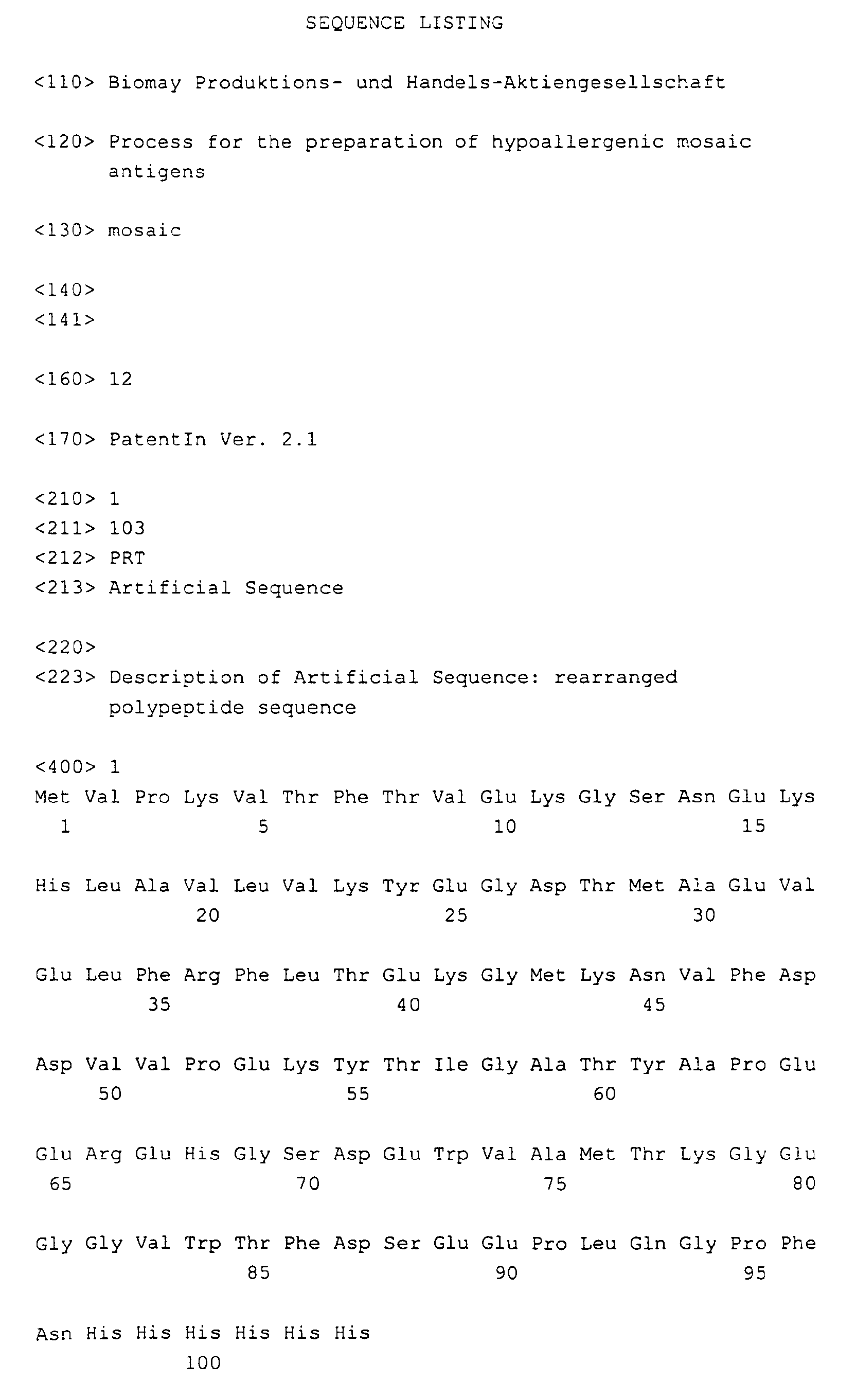


Claims (14)
- Process for the preparation of an hypoallergenic mosaic antigen derived from an allergen wherebya) in a first step the allergen is split into at least two parts and the IgE reactivity of each part is determined andb) in a second step those parts of the allergen which have no detectable IgE reaction are combined to a mosaic antigen which comprises the amino acids of the allergen but the order of the amino acids of the mosaic antigen is different from that of the naturally occurring allergen.
- Process according to claim 1 wherein in the first step at least two parts of the allergen are prepared by chemical synthesis or by using the polymerase chain reaction and each part of the allergen is separately reacted with serum obtained from allergic individuals and the reactivity of IgE antibodies contained within such serum with each part of the allergen is determined.
- Process according to claims 1 or 2 wherein the order of the parts of the allergen having no substantial reactivity with IgE antibodies obtained from allergic individuals does not correspond with the order of those parts in the naturally occurring allergen insofar as the part normally occurring at the N-terminus and the part normally occurring at the C-terminus are replaced by each other.
- Process according to any of the preceding claims wherein the allergen is a group 2 allergen.
- Process according to any of the preceding claims wherein the allergen is the timothy grass pollen allergen Phl p 2.
- Process according to claim 5 wherein the allergen Phl p 2 is split into three peptides, namely peptide 1 having amino acids 1-33, peptide 2 having amino acids 34-64 and peptide 3 having amino acids 65-96 of the amino acid sequence of naturally occurring Phl p 2 and the mosaic antigen is provided by linking the peptides in the order peptide 1, peptide 3 and peptide 2.
- Mosaic allergen having the amino acid sequence of SEQ ID NO: 1.
- DNA sequence having SEQ ID NO:2 coding for the mosaic allergen of claim 7 or a sequence complementary thereto.
- Use of a mosaic allergen obtainable by a process according to any one of claims 1-6 for the preparation of a medicament for the treatment of an allergic reaction.
- Use of a mosaic allergen according to claim 9 wherein the allergic reaction is caused by grass pollen.
- Use of a mosaic allergen according to claim 10 wherein the allergic reaction is caused by timothy grass pollen.
- Use of a mosaic allergen according to claim 11 wherein the allergic reaction is caused by timothy grass pollen Phl p 2.
- Vaccine for the treatment of allergic patients characterized in that it comprises a mosaic allergen obtainable by any process according to claims 1-6 or the mosaic allergen of claim 7.
- Vaccine for the treatment of grass pollen allergic patients characterized in that it comprises a DNA sequence coding for a mosaic antigen obtainable by a process according to any of claims 1-6 or the DNA of claim 8 or sequences complementary to any of these DNA sequences.
Priority Applications (13)
| Application Number | Priority Date | Filing Date | Title |
|---|---|---|---|
| AT03001242T ATE307141T1 (en) | 2003-01-21 | 2003-01-21 | METHOD FOR PREPARING HYPOALLERGENIC MOSAIC PROTEINS |
| EP03001242A EP1440979B1 (en) | 2003-01-21 | 2003-01-21 | Process for the preparation of hypoallergenic mosaic proteins |
| DK03001242T DK1440979T3 (en) | 2003-01-21 | 2003-01-21 | Process for the preparation of hypoallergenic mosaic proteins |
| ES03001242T ES2247433T3 (en) | 2003-01-21 | 2003-01-21 | PROCEDURE FOR THE PREPARATION OF HYPOALLERGENIC MOSAIC PROTEINS. |
| DE60301944T DE60301944T2 (en) | 2003-01-21 | 2003-01-21 | Method for preparing hypoallergenic mosaic proteins # |
| JP2004566792A JP4756864B2 (en) | 2003-01-21 | 2003-12-18 | Method for producing hypoallergenic mosaic antigen |
| CNA2003801090772A CN1742019A (en) | 2003-01-21 | 2003-12-18 | Process for the preparation of hypoallergenic mosaic proteins |
| PCT/EP2003/014507 WO2004065414A1 (en) | 2003-01-21 | 2003-12-18 | Process for the preparation of hypoallergenic mosaic antigens |
| AU2003293931A AU2003293931B2 (en) | 2003-01-21 | 2003-12-18 | Process for the preparation of hypoallergenic mosaic antigens |
| US10/542,735 US7491396B2 (en) | 2003-01-21 | 2003-12-18 | Process for the preparation of hypoallergenic mosaic antigens |
| CA2513711A CA2513711C (en) | 2003-01-21 | 2003-12-18 | Process for the preparation of hypoallergenic mosaic antigens |
| US12/349,614 US20090148466A1 (en) | 2003-01-21 | 2009-01-07 | Process for the Preparation of Hypoallergenic Mosaic Antigens |
| US13/179,116 US8709435B2 (en) | 2003-01-21 | 2011-07-08 | Hypallergenic mosaic antigens and methods of making same |
Applications Claiming Priority (1)
| Application Number | Priority Date | Filing Date | Title |
|---|---|---|---|
| EP03001242A EP1440979B1 (en) | 2003-01-21 | 2003-01-21 | Process for the preparation of hypoallergenic mosaic proteins |
Publications (2)
| Publication Number | Publication Date |
|---|---|
| EP1440979A1 true EP1440979A1 (en) | 2004-07-28 |
| EP1440979B1 EP1440979B1 (en) | 2005-10-19 |
Family
ID=32524174
Family Applications (1)
| Application Number | Title | Priority Date | Filing Date |
|---|---|---|---|
| EP03001242A Expired - Lifetime EP1440979B1 (en) | 2003-01-21 | 2003-01-21 | Process for the preparation of hypoallergenic mosaic proteins |
Country Status (11)
| Country | Link |
|---|---|
| US (2) | US7491396B2 (en) |
| EP (1) | EP1440979B1 (en) |
| JP (1) | JP4756864B2 (en) |
| CN (1) | CN1742019A (en) |
| AT (1) | ATE307141T1 (en) |
| AU (1) | AU2003293931B2 (en) |
| CA (1) | CA2513711C (en) |
| DE (1) | DE60301944T2 (en) |
| DK (1) | DK1440979T3 (en) |
| ES (1) | ES2247433T3 (en) |
| WO (1) | WO2004065414A1 (en) |
Cited By (10)
| Publication number | Priority date | Publication date | Assignee | Title |
|---|---|---|---|---|
| WO2007124526A1 (en) * | 2006-05-03 | 2007-11-08 | Biomay Ag | Phl p 1 allergen derivative |
| WO2007124524A1 (en) | 2006-04-28 | 2007-11-08 | Biomay Ag | House dust mite allergen |
| WO2009118642A3 (en) * | 2008-03-25 | 2009-12-03 | Bial Industrial Farmaceutica S.A. | Hypoallergenic hybrid proteins of major group 1 and 2 mite allergens for use in the treatment of allergies |
| EP2295076A1 (en) * | 2009-09-10 | 2011-03-16 | Biomay Ag | Hypoallergenic hybrid polypeptides for the treatment of allergy |
| EP2607376A1 (en) * | 2011-12-22 | 2013-06-26 | Biomay Ag | Hypoallergenic allergen derivatives of Pru p 3 for immunotherapy of IgE-mediated peach allergy |
| US8697083B2 (en) | 2006-04-12 | 2014-04-15 | Bial Industrial Farmaceutica, S.A. | Hypoallergenic chimeric proteins belonging to the lipid transfer family of parietaria judaica for use in the treatment of allergies |
| EP2952200A1 (en) * | 2014-06-04 | 2015-12-09 | Alk-Abelló A/S | Allergen for prophylactic treatment of allergy |
| WO2018149927A1 (en) | 2017-02-15 | 2018-08-23 | Euroimmun Medizinische Labordiagnostika Ag | Assay for the diagnosis of peanut allergy |
| US11020477B2 (en) | 2007-09-28 | 2021-06-01 | Biontech Rna Pharmaceuticals Gmbh | RNA vaccines |
| US12398200B2 (en) | 2017-06-23 | 2025-08-26 | Mabylon Ag | Anti-allergen antibodies |
Families Citing this family (8)
| Publication number | Priority date | Publication date | Assignee | Title |
|---|---|---|---|---|
| US8709435B2 (en) | 2003-01-21 | 2014-04-29 | Biomay Ag | Hypallergenic mosaic antigens and methods of making same |
| AT501101B1 (en) * | 2004-12-02 | 2008-01-15 | Biomay Ag | PROTEIN ALLERGEN DERIVATIVE |
| DE102004058963A1 (en) * | 2004-12-08 | 2006-06-14 | Schaeffler Kg | Timing pulley |
| AT503690A1 (en) | 2006-06-09 | 2007-12-15 | Biomay Ag | HYPOALLERGENIC MOLECULES |
| US7806641B2 (en) * | 2007-08-30 | 2010-10-05 | Ascentool, Inc. | Substrate processing system having improved substrate transport system |
| JP6041490B2 (en) * | 2009-10-30 | 2016-12-07 | 日本製紙株式会社 | Protein having immunogenicity of cedar pollen, polynucleotide encoding the protein, and uses thereof |
| PT2853271T (en) | 2010-02-12 | 2018-07-09 | Laboratorios Leti S L | Allergen extracts |
| MX2016012840A (en) * | 2014-03-31 | 2017-05-09 | Boehringer Ingelheim Vetmedica Gmbh | Improved modular antigen transportation molecules and uses therof. |
Citations (2)
| Publication number | Priority date | Publication date | Assignee | Title |
|---|---|---|---|---|
| WO1994023035A2 (en) * | 1993-04-01 | 1994-10-13 | Biomay Produktions- Und Handelsgesellschaft M.B.H. | RECOMBINANT TIMOTHY GRASS POLLEN ALLERGEN Phl p II |
| EP1221317A1 (en) * | 2000-12-28 | 2002-07-10 | SHAN-Beteiligungsgesellschaft m.b.H. | Vaccines containing hybrid polypeptides consisting of at least two different allergenic proteins |
Family Cites Families (2)
| Publication number | Priority date | Publication date | Assignee | Title |
|---|---|---|---|---|
| US5547669A (en) * | 1989-11-03 | 1996-08-20 | Immulogic Pharma Corp | Recombinant peptides comprising T cell epitopes of the cat allergen, Fel d I |
| JP4246794B2 (en) * | 1991-10-16 | 2009-04-02 | メルク パテント ゲーエムベーハー | Recombitope peptide |
-
2003
- 2003-01-21 AT AT03001242T patent/ATE307141T1/en not_active IP Right Cessation
- 2003-01-21 ES ES03001242T patent/ES2247433T3/en not_active Expired - Lifetime
- 2003-01-21 EP EP03001242A patent/EP1440979B1/en not_active Expired - Lifetime
- 2003-01-21 DK DK03001242T patent/DK1440979T3/en active
- 2003-01-21 DE DE60301944T patent/DE60301944T2/en not_active Expired - Lifetime
- 2003-12-18 WO PCT/EP2003/014507 patent/WO2004065414A1/en not_active Ceased
- 2003-12-18 CN CNA2003801090772A patent/CN1742019A/en active Pending
- 2003-12-18 CA CA2513711A patent/CA2513711C/en not_active Expired - Fee Related
- 2003-12-18 US US10/542,735 patent/US7491396B2/en not_active Expired - Fee Related
- 2003-12-18 AU AU2003293931A patent/AU2003293931B2/en not_active Ceased
- 2003-12-18 JP JP2004566792A patent/JP4756864B2/en not_active Expired - Fee Related
-
2009
- 2009-01-07 US US12/349,614 patent/US20090148466A1/en not_active Abandoned
Patent Citations (2)
| Publication number | Priority date | Publication date | Assignee | Title |
|---|---|---|---|---|
| WO1994023035A2 (en) * | 1993-04-01 | 1994-10-13 | Biomay Produktions- Und Handelsgesellschaft M.B.H. | RECOMBINANT TIMOTHY GRASS POLLEN ALLERGEN Phl p II |
| EP1221317A1 (en) * | 2000-12-28 | 2002-07-10 | SHAN-Beteiligungsgesellschaft m.b.H. | Vaccines containing hybrid polypeptides consisting of at least two different allergenic proteins |
Non-Patent Citations (12)
| Title |
|---|
| AKDIS C A ET AL: "REGULATION OF SPECIFIC IMMUNE RESPONSES BY CHEMICAL AND STRUCTURAL MODIFICATIONS OF ALLERGENS", INTERNATIONAL ARCHIVES OF ALLERGY AND IMMUNOLOGY, vol. 121, no. 4, 2000, pages 261 - 269, XP001016273, ISSN: 1018-2438 * |
| ANSARI A A ET AL: "COMPLETE AMINO ACID SEQUENCE OF A LOLIUM-PERENNE PERENNIAL RYE GRASS POLLEN ALLERGEN LOL P II", JOURNAL OF BIOLOGICAL CHEMISTRY, vol. 264, no. 19, 1989, pages 11181 - 11185, XP002242173, ISSN: 0021-9258 * |
| DE MARINO S ET AL: "An immunoglobulin-like fold in a major plant allergen: The solution structure of Phl p 2 from timothy grass pollen.", STRUCTURE (LONDON), vol. 7, no. 8, 15 August 1999 (1999-08-15), pages 943 - 952, XP002242174, ISSN: 0969-2126 * |
| DOLECEK CHRISTIANE ET AL: "Molecular characterization of Phl p II, a major timothy grass (Phleum pratense) pollen allergen.", FEBS (FEDERATION OF EUROPEAN BIOCHEMICAL SOCIETIES) LETTERS, vol. 335, no. 3, 1993, pages 299 - 304, XP002242172, ISSN: 0014-5793 * |
| FERREIRA FATIMA ET AL: "Genetic engineering of allergens: Future therapeutic products.", INTERNATIONAL ARCHIVES OF ALLERGY AND IMMUNOLOGY, vol. 128, no. 3, July 2002 (2002-07-01), July, 2002, pages 171 - 178, XP009011303, ISSN: 1018-2438 * |
| FOCKE M ET AL: "Nonanaphylactic synthetic peptides derived from B cell epitopes of the major grass pollen allergen, Phl p 1, for allergy vaccination.", THE FASEB JOURNAL: OFFICIAL PUBLICATION OF THE FEDERATION OF AMERICAN SOCIETIES FOR EXPERIMENTAL BIOLOGY. UNITED STATES SEP 2001, vol. 15, no. 11, September 2001 (2001-09-01), pages 2042 - 2044, XP002242171, ISSN: 0892-6638 * |
| FREIDHOFF L R ET AL: "A STUDY OF THE HUMAN IMMUNE RESPONSE TO LOLIUM PERENNE (RYE) POLLEN AND ITS COMPONENTS, LOL P I AND LOL P II (RYE I AND RYE II). I. PREVALENCE OF REACTIVITY TO THE ALLERGENS AND CORRELATIONS AMONG SKIN TEST, IGE ANTIBODY, AND IGG ANTIBODY DATA", JOURNAL OF ALLERGY AND CLINICAL IMMUNOLOGY, MOSBY - YEARLY BOOK, INC, US, vol. 78, 1 July 1986 (1986-07-01), pages 1190 - 1201, XP002053587, ISSN: 0091-6749 * |
| HAGE-HAMSTEN VAN M ET AL: "SKIN TEST EVALUATION OF GENETICALLY ENGINEERED HYPOALLERGENIC DERIVATIVES OF THE MAJOR BIRCH POLLEN ALLERGEN, BET V 1: RESULTS OBTAINED WITH A MIX OF TWO RECOMBINANT BET V 1 FRAGMENTS AND RECOMBINANT BET V 1 TRIMER IN A SWEDISH POPULATION BEFORE THE BIRCHPOLLEN SEASON", JOURNAL OF ALLERGY AND CLINICAL IMMUNOLOGY, MOSBY - YEARLY BOOK, INC, US, vol. 104, no. 5, November 1999 (1999-11-01), pages 969 - 977, XP001022679, ISSN: 0091-6749 * |
| SCHRAMM G ET AL: "Allergen engineering: variants of the timothy grass pollen allergen Phl p 5b with reduced IgE-binding capacity but conserved T cell reactivity", JOURNAL OF IMMUNOLOGY, WILLIAMS & WILKINS CO, US, vol. 162, no. 4, 15 February 1999 (1999-02-15), pages 2406 - 2414, XP002216586, ISSN: 0022-1767 * |
| VALENTA R ET AL: "Mapping of the IgE and IgG binding sites of the major timothy grass poleen allergen Phl p 2 by gene fragmentation", JOINT CONGRESS OF THE BRITISH SOCIETY FOR IMMUNOLOGY AND THE BIOCHEMICAL SOCIETY, 10 December 1996 (1996-12-10), pages 30, XP002950278 * |
| VALENTA RUDOLF ET AL: "Recombinant allergen molecules: Tools to study effector cell activation.", IMMUNOLOGICAL REVIEWS, vol. 179, February 2001 (2001-02-01), pages 119 - 127, XP002242170, ISSN: 0105-2896 * |
| VRTALA S ET AL: "Conversion of the major birch pollen allergen, bet v 1, into two nonanaphylactic T cell epitope-containing fragments: Candidates for a novel form of specific immunotherapy", JOURNAL OF CLINICAL INVESTIGATION, NEW YORK, NY, US, vol. 99, no. 7, 1997, pages 1673 - 1681, XP002221492, ISSN: 0021-9738 * |
Cited By (20)
| Publication number | Priority date | Publication date | Assignee | Title |
|---|---|---|---|---|
| US9522939B2 (en) | 2006-04-12 | 2016-12-20 | Bial Industrial Farmaceutica, S.A. | Hypoallergenic chimeric proteins belonging to the lipid transfer family of Parietaria judaica for use in the treatment of allergies |
| US8697083B2 (en) | 2006-04-12 | 2014-04-15 | Bial Industrial Farmaceutica, S.A. | Hypoallergenic chimeric proteins belonging to the lipid transfer family of parietaria judaica for use in the treatment of allergies |
| WO2007124524A1 (en) | 2006-04-28 | 2007-11-08 | Biomay Ag | House dust mite allergen |
| JP2009535041A (en) * | 2006-05-03 | 2009-10-01 | ビオマイ アクチエンゲゼルシャフト | PHLP1 allergen derivative |
| WO2007124526A1 (en) * | 2006-05-03 | 2007-11-08 | Biomay Ag | Phl p 1 allergen derivative |
| US11020477B2 (en) | 2007-09-28 | 2021-06-01 | Biontech Rna Pharmaceuticals Gmbh | RNA vaccines |
| US8951530B2 (en) | 2008-03-25 | 2015-02-10 | Bial Industrial Farmaceutica, S.A. | Hypoallergenic hybrid proteins of major group 1 and 2 mite allergens for use in the treatment of allergies |
| WO2009118642A3 (en) * | 2008-03-25 | 2009-12-03 | Bial Industrial Farmaceutica S.A. | Hypoallergenic hybrid proteins of major group 1 and 2 mite allergens for use in the treatment of allergies |
| EP2436692A3 (en) * | 2008-03-25 | 2012-06-27 | Bial Industrial Farmaceutica, S.A. | Hypoallergenic hybrid proteins of major group 1 and 2 mite allergens for use in the treatment of allergies |
| EP2436691A3 (en) * | 2008-03-25 | 2012-06-27 | Bial Industrial Farmaceutica, S.A. | Hypoallergenic hybrid proteins of major group 1 and 2 mite allergens for use in the treatment of allergies |
| WO2011029869A1 (en) * | 2009-09-10 | 2011-03-17 | Biomay Ag | Hypoallergenic hybrid polypeptides for the treatment of allergy |
| US9103835B2 (en) | 2009-09-10 | 2015-08-11 | Biomay Ag | Hypoallergenic hybrid polypeptides for the treatment of allergy |
| EP2295076A1 (en) * | 2009-09-10 | 2011-03-16 | Biomay Ag | Hypoallergenic hybrid polypeptides for the treatment of allergy |
| WO2013092953A1 (en) * | 2011-12-22 | 2013-06-27 | Biomay Ag | Hypoallergenic allergen derivatives of pru p 3 for immunotherapy of ige-mediated peach allergy |
| EP2607376A1 (en) * | 2011-12-22 | 2013-06-26 | Biomay Ag | Hypoallergenic allergen derivatives of Pru p 3 for immunotherapy of IgE-mediated peach allergy |
| EP2952200A1 (en) * | 2014-06-04 | 2015-12-09 | Alk-Abelló A/S | Allergen for prophylactic treatment of allergy |
| WO2015185684A1 (en) * | 2014-06-04 | 2015-12-10 | Alk-Abelló A/S | Allergen for prophylactic treatment of allergy |
| WO2018149927A1 (en) | 2017-02-15 | 2018-08-23 | Euroimmun Medizinische Labordiagnostika Ag | Assay for the diagnosis of peanut allergy |
| US10871493B2 (en) | 2017-02-15 | 2020-12-22 | Euroimmun Medizinische Labordiagnostika Ag | Assay for the diagnosis of peanut allergy |
| US12398200B2 (en) | 2017-06-23 | 2025-08-26 | Mabylon Ag | Anti-allergen antibodies |
Also Published As
| Publication number | Publication date |
|---|---|
| US20060263391A1 (en) | 2006-11-23 |
| AU2003293931B2 (en) | 2010-03-04 |
| US7491396B2 (en) | 2009-02-17 |
| US20090148466A1 (en) | 2009-06-11 |
| CA2513711C (en) | 2014-07-08 |
| JP2006523436A (en) | 2006-10-19 |
| AU2003293931A1 (en) | 2004-08-13 |
| CA2513711A1 (en) | 2004-08-05 |
| CN1742019A (en) | 2006-03-01 |
| JP4756864B2 (en) | 2011-08-24 |
| DE60301944T2 (en) | 2006-06-01 |
| WO2004065414A1 (en) | 2004-08-05 |
| DE60301944D1 (en) | 2006-03-02 |
| ATE307141T1 (en) | 2005-11-15 |
| EP1440979B1 (en) | 2005-10-19 |
| DK1440979T3 (en) | 2005-12-19 |
| ES2247433T3 (en) | 2006-03-01 |
Similar Documents
| Publication | Publication Date | Title |
|---|---|---|
| US20090148466A1 (en) | Process for the Preparation of Hypoallergenic Mosaic Antigens | |
| Vrtala et al. | cDNA cloning of a major allergen from timothy grass (Phleum pratense) pollen; characterization of the recombinant Phl p V allergen. | |
| Focke et al. | Nonanaphylactic synthetic peptides derived from B cell epitopes of the major grass pollen allergen, Phl p 1, for allergy vaccination | |
| JP2007151555A (en) | Allergen proteins and peptides from house dust mites and uses therefor | |
| US20090074801A1 (en) | Hypoallergenic allergy vaccines based on the timothy grass pollen allergen phl p 7 | |
| US9120866B2 (en) | DNA sequence and preparation of grass pollen allergen Phl p 4 by recombinant methods | |
| JP5363441B2 (en) | Phlp5a derivative with reduced allergenicity and retained T cell reactivity | |
| JPH06197768A (en) | Japanese cedar pollen antigen and its encoding gene | |
| JP2009535041A (en) | PHLP1 allergen derivative | |
| US6335020B1 (en) | Allergenic peptides from ragweed pollen | |
| JP4253122B2 (en) | Non-anaphylactic forms of allergens and their use | |
| ES2340767T3 (en) | ALLERGENS OF DOMESTIC POWDER ACAROS. | |
| WO1992016554A1 (en) | Protein allergens of the species cynodon dactylon | |
| Bhalla | Genetic engineering of pollen allergens for hayfever immunotherapy | |
| US20020064530A1 (en) | Variants of phleum pratense allergenic proteins | |
| JP4960102B2 (en) | DNA sequences and recombinant preparations of group 4 major allergens from cereal | |
| AU2013204574B2 (en) | DNA-sequence and recombinant production of group 4 major allergens from cereals | |
| JP2007176953A (en) | Peptide immunotherapy for allergic diseases | |
| JP2005336204A (en) | Peptide immunotherapy for allergic diseases | |
| JP2005126447A (en) | Peptide immunotherapy for allergic diseases |
Legal Events
| Date | Code | Title | Description |
|---|---|---|---|
| PUAI | Public reference made under article 153(3) epc to a published international application that has entered the european phase |
Free format text: ORIGINAL CODE: 0009012 |
|
| 17P | Request for examination filed |
Effective date: 20040219 |
|
| AK | Designated contracting states |
Kind code of ref document: A1 Designated state(s): AT BE BG CH CY CZ DE DK EE ES FI FR GB GR HU IE IT LI LU MC NL PT SE SI SK TR |
|
| AX | Request for extension of the european patent |
Extension state: AL LT LV MK RO |
|
| GRAP | Despatch of communication of intention to grant a patent |
Free format text: ORIGINAL CODE: EPIDOSNIGR1 |
|
| AKX | Designation fees paid |
Designated state(s): AT BE BG CH CY CZ DE DK EE ES FI FR GB GR HU IE IT LI LU MC NL PT SE SI SK TR |
|
| RAP1 | Party data changed (applicant data changed or rights of an application transferred) |
Owner name: BIOMAY PRODUKTIONS- UND HANDELS- AKTIENGESELLSCHAF |
|
| GRAS | Grant fee paid |
Free format text: ORIGINAL CODE: EPIDOSNIGR3 |
|
| GRAA | (expected) grant |
Free format text: ORIGINAL CODE: 0009210 |
|
| AK | Designated contracting states |
Kind code of ref document: B1 Designated state(s): AT BE BG CH CY CZ DE DK EE ES FI FR GB GR HU IE IT LI LU MC NL PT SE SI SK TR |
|
| PG25 | Lapsed in a contracting state [announced via postgrant information from national office to epo] |
Ref country code: CZ Free format text: LAPSE BECAUSE OF FAILURE TO SUBMIT A TRANSLATION OF THE DESCRIPTION OR TO PAY THE FEE WITHIN THE PRESCRIBED TIME-LIMIT Effective date: 20051019 Ref country code: NL Free format text: LAPSE BECAUSE OF FAILURE TO SUBMIT A TRANSLATION OF THE DESCRIPTION OR TO PAY THE FEE WITHIN THE PRESCRIBED TIME-LIMIT Effective date: 20051019 Ref country code: SI Free format text: LAPSE BECAUSE OF FAILURE TO SUBMIT A TRANSLATION OF THE DESCRIPTION OR TO PAY THE FEE WITHIN THE PRESCRIBED TIME-LIMIT Effective date: 20051019 Ref country code: SK Free format text: LAPSE BECAUSE OF FAILURE TO SUBMIT A TRANSLATION OF THE DESCRIPTION OR TO PAY THE FEE WITHIN THE PRESCRIBED TIME-LIMIT Effective date: 20051019 Ref country code: AT Free format text: LAPSE BECAUSE OF FAILURE TO SUBMIT A TRANSLATION OF THE DESCRIPTION OR TO PAY THE FEE WITHIN THE PRESCRIBED TIME-LIMIT Effective date: 20051019 Ref country code: BE Free format text: LAPSE BECAUSE OF FAILURE TO SUBMIT A TRANSLATION OF THE DESCRIPTION OR TO PAY THE FEE WITHIN THE PRESCRIBED TIME-LIMIT Effective date: 20051019 Ref country code: FI Free format text: LAPSE BECAUSE OF FAILURE TO SUBMIT A TRANSLATION OF THE DESCRIPTION OR TO PAY THE FEE WITHIN THE PRESCRIBED TIME-LIMIT Effective date: 20051019 |
|
| REG | Reference to a national code |
Ref country code: GB Ref legal event code: FG4D |
|
| REG | Reference to a national code |
Ref country code: CH Ref legal event code: EP |
|
| REG | Reference to a national code |
Ref country code: IE Ref legal event code: FG4D |
|
| REG | Reference to a national code |
Ref country code: CH Ref legal event code: NV Representative=s name: PATENTANWAELTE SCHAAD, BALASS, MENZL & PARTNER AG |
|
| REG | Reference to a national code |
Ref country code: DK Ref legal event code: T3 |
|
| REG | Reference to a national code |
Ref country code: SE Ref legal event code: TRGR |
|
| PG25 | Lapsed in a contracting state [announced via postgrant information from national office to epo] |
Ref country code: BG Free format text: LAPSE BECAUSE OF FAILURE TO SUBMIT A TRANSLATION OF THE DESCRIPTION OR TO PAY THE FEE WITHIN THE PRESCRIBED TIME-LIMIT Effective date: 20060119 Ref country code: GR Free format text: LAPSE BECAUSE OF FAILURE TO SUBMIT A TRANSLATION OF THE DESCRIPTION OR TO PAY THE FEE WITHIN THE PRESCRIBED TIME-LIMIT Effective date: 20060119 |
|
| PG25 | Lapsed in a contracting state [announced via postgrant information from national office to epo] |
Ref country code: IE Free format text: LAPSE BECAUSE OF NON-PAYMENT OF DUE FEES Effective date: 20060123 |
|
| PG25 | Lapsed in a contracting state [announced via postgrant information from national office to epo] |
Ref country code: LU Free format text: LAPSE BECAUSE OF NON-PAYMENT OF DUE FEES Effective date: 20060131 Ref country code: MC Free format text: LAPSE BECAUSE OF NON-PAYMENT OF DUE FEES Effective date: 20060131 |
|
| REG | Reference to a national code |
Ref country code: ES Ref legal event code: FG2A Ref document number: 2247433 Country of ref document: ES Kind code of ref document: T3 |
|
| REF | Corresponds to: |
Ref document number: 60301944 Country of ref document: DE Date of ref document: 20060302 Kind code of ref document: P |
|
| NLV1 | Nl: lapsed or annulled due to failure to fulfill the requirements of art. 29p and 29m of the patents act | ||
| PG25 | Lapsed in a contracting state [announced via postgrant information from national office to epo] |
Ref country code: HU Free format text: LAPSE BECAUSE OF FAILURE TO SUBMIT A TRANSLATION OF THE DESCRIPTION OR TO PAY THE FEE WITHIN THE PRESCRIBED TIME-LIMIT Effective date: 20060420 |
|
| ET | Fr: translation filed | ||
| PLBE | No opposition filed within time limit |
Free format text: ORIGINAL CODE: 0009261 |
|
| STAA | Information on the status of an ep patent application or granted ep patent |
Free format text: STATUS: NO OPPOSITION FILED WITHIN TIME LIMIT |
|
| 26N | No opposition filed |
Effective date: 20060720 |
|
| REG | Reference to a national code |
Ref country code: IE Ref legal event code: MM4A |
|
| PG25 | Lapsed in a contracting state [announced via postgrant information from national office to epo] |
Ref country code: EE Free format text: LAPSE BECAUSE OF FAILURE TO SUBMIT A TRANSLATION OF THE DESCRIPTION OR TO PAY THE FEE WITHIN THE PRESCRIBED TIME-LIMIT Effective date: 20051019 |
|
| PG25 | Lapsed in a contracting state [announced via postgrant information from national office to epo] |
Ref country code: TR Free format text: LAPSE BECAUSE OF FAILURE TO SUBMIT A TRANSLATION OF THE DESCRIPTION OR TO PAY THE FEE WITHIN THE PRESCRIBED TIME-LIMIT Effective date: 20051019 |
|
| PG25 | Lapsed in a contracting state [announced via postgrant information from national office to epo] |
Ref country code: CY Free format text: LAPSE BECAUSE OF FAILURE TO SUBMIT A TRANSLATION OF THE DESCRIPTION OR TO PAY THE FEE WITHIN THE PRESCRIBED TIME-LIMIT Effective date: 20051019 |
|
| REG | Reference to a national code |
Ref country code: FR Ref legal event code: PLFP Year of fee payment: 13 |
|
| PGFP | Annual fee paid to national office [announced via postgrant information from national office to epo] |
Ref country code: PT Payment date: 20150213 Year of fee payment: 13 Ref country code: DE Payment date: 20150226 Year of fee payment: 13 Ref country code: CH Payment date: 20150223 Year of fee payment: 13 Ref country code: ES Payment date: 20150223 Year of fee payment: 13 Ref country code: DK Payment date: 20150223 Year of fee payment: 13 Ref country code: IT Payment date: 20150223 Year of fee payment: 13 |
|
| PGFP | Annual fee paid to national office [announced via postgrant information from national office to epo] |
Ref country code: SE Payment date: 20150223 Year of fee payment: 13 Ref country code: GB Payment date: 20150223 Year of fee payment: 13 Ref country code: FR Payment date: 20150217 Year of fee payment: 13 |
|
| REG | Reference to a national code |
Ref country code: DE Ref legal event code: R119 Ref document number: 60301944 Country of ref document: DE |
|
| REG | Reference to a national code |
Ref country code: DK Ref legal event code: EBP Effective date: 20160131 |
|
| REG | Reference to a national code |
Ref country code: CH Ref legal event code: PL |
|
| GBPC | Gb: european patent ceased through non-payment of renewal fee |
Effective date: 20160121 |
|
| REG | Reference to a national code |
Ref country code: FR Ref legal event code: ST Effective date: 20160930 |
|
| PG25 | Lapsed in a contracting state [announced via postgrant information from national office to epo] |
Ref country code: CH Free format text: LAPSE BECAUSE OF NON-PAYMENT OF DUE FEES Effective date: 20160131 Ref country code: LI Free format text: LAPSE BECAUSE OF NON-PAYMENT OF DUE FEES Effective date: 20160131 Ref country code: GB Free format text: LAPSE BECAUSE OF NON-PAYMENT OF DUE FEES Effective date: 20160121 Ref country code: DE Free format text: LAPSE BECAUSE OF NON-PAYMENT OF DUE FEES Effective date: 20160802 |
|
| PG25 | Lapsed in a contracting state [announced via postgrant information from national office to epo] |
Ref country code: FR Free format text: LAPSE BECAUSE OF NON-PAYMENT OF DUE FEES Effective date: 20160201 Ref country code: PT Free format text: LAPSE BECAUSE OF NON-PAYMENT OF DUE FEES Effective date: 20160721 Ref country code: SE Free format text: LAPSE BECAUSE OF NON-PAYMENT OF DUE FEES Effective date: 20160122 |
|
| PG25 | Lapsed in a contracting state [announced via postgrant information from national office to epo] |
Ref country code: IT Free format text: LAPSE BECAUSE OF NON-PAYMENT OF DUE FEES Effective date: 20160121 |
|
| PG25 | Lapsed in a contracting state [announced via postgrant information from national office to epo] |
Ref country code: DK Free format text: LAPSE BECAUSE OF NON-PAYMENT OF DUE FEES Effective date: 20160131 |
|
| REG | Reference to a national code |
Ref country code: ES Ref legal event code: FD2A Effective date: 20170227 |
|
| PG25 | Lapsed in a contracting state [announced via postgrant information from national office to epo] |
Ref country code: ES Free format text: LAPSE BECAUSE OF NON-PAYMENT OF DUE FEES Effective date: 20160122 |