EP1440852A1 - Temperature compensated air bag - Google Patents
Temperature compensated air bag Download PDFInfo
- Publication number
- EP1440852A1 EP1440852A1 EP04075052A EP04075052A EP1440852A1 EP 1440852 A1 EP1440852 A1 EP 1440852A1 EP 04075052 A EP04075052 A EP 04075052A EP 04075052 A EP04075052 A EP 04075052A EP 1440852 A1 EP1440852 A1 EP 1440852A1
- Authority
- EP
- European Patent Office
- Prior art keywords
- air bag
- temperature
- gas
- sensing
- control system
- Prior art date
- Legal status (The legal status is an assumption and is not a legal conclusion. Google has not performed a legal analysis and makes no representation as to the accuracy of the status listed.)
- Withdrawn
Links
- 230000000452 restraining effect Effects 0.000 claims abstract description 25
- 238000013022 venting Methods 0.000 claims description 22
- 239000003999 initiator Substances 0.000 claims description 17
- 230000007246 mechanism Effects 0.000 claims description 10
- 238000000034 method Methods 0.000 claims description 7
- 230000000977 initiatory effect Effects 0.000 claims 1
- 239000007789 gas Substances 0.000 description 35
- 238000009529 body temperature measurement Methods 0.000 description 8
- 238000004146 energy storage Methods 0.000 description 6
- IJGRMHOSHXDMSA-UHFFFAOYSA-N Atomic nitrogen Chemical compound N#N IJGRMHOSHXDMSA-UHFFFAOYSA-N 0.000 description 4
- 238000004891 communication Methods 0.000 description 4
- 238000010586 diagram Methods 0.000 description 3
- 238000012545 processing Methods 0.000 description 3
- 239000000758 substrate Substances 0.000 description 3
- 230000004913 activation Effects 0.000 description 2
- 239000003990 capacitor Substances 0.000 description 2
- 229910052757 nitrogen Inorganic materials 0.000 description 2
- 230000009467 reduction Effects 0.000 description 2
- XUIMIQQOPSSXEZ-UHFFFAOYSA-N Silicon Chemical compound [Si] XUIMIQQOPSSXEZ-UHFFFAOYSA-N 0.000 description 1
- 150000001875 compounds Chemical class 0.000 description 1
- 230000006378 damage Effects 0.000 description 1
- 230000001419 dependent effect Effects 0.000 description 1
- 238000013461 design Methods 0.000 description 1
- 230000000694 effects Effects 0.000 description 1
- 230000000116 mitigating effect Effects 0.000 description 1
- 238000012986 modification Methods 0.000 description 1
- 230000004048 modification Effects 0.000 description 1
- 230000008569 process Effects 0.000 description 1
- 229910052710 silicon Inorganic materials 0.000 description 1
- 239000010703 silicon Substances 0.000 description 1
- 239000010409 thin film Substances 0.000 description 1
- 238000009966 trimming Methods 0.000 description 1
Images



Classifications
-
- B—PERFORMING OPERATIONS; TRANSPORTING
- B60—VEHICLES IN GENERAL
- B60R—VEHICLES, VEHICLE FITTINGS, OR VEHICLE PARTS, NOT OTHERWISE PROVIDED FOR
- B60R21/00—Arrangements or fittings on vehicles for protecting or preventing injuries to occupants or pedestrians in case of accidents or other traffic risks
- B60R21/01—Electrical circuits for triggering passive safety arrangements, e.g. airbags, safety belt tighteners, in case of vehicle accidents or impending vehicle accidents
- B60R21/015—Electrical circuits for triggering passive safety arrangements, e.g. airbags, safety belt tighteners, in case of vehicle accidents or impending vehicle accidents including means for detecting the presence or position of passengers, passenger seats or child seats, and the related safety parameters therefor, e.g. speed or timing of airbag inflation in relation to occupant position or seat belt use
-
- B—PERFORMING OPERATIONS; TRANSPORTING
- B60—VEHICLES IN GENERAL
- B60R—VEHICLES, VEHICLE FITTINGS, OR VEHICLE PARTS, NOT OTHERWISE PROVIDED FOR
- B60R21/00—Arrangements or fittings on vehicles for protecting or preventing injuries to occupants or pedestrians in case of accidents or other traffic risks
- B60R21/01—Electrical circuits for triggering passive safety arrangements, e.g. airbags, safety belt tighteners, in case of vehicle accidents or impending vehicle accidents
- B60R2021/01204—Actuation parameters of safety arrangents
- B60R2021/01211—Expansion of air bags
-
- B—PERFORMING OPERATIONS; TRANSPORTING
- B60—VEHICLES IN GENERAL
- B60R—VEHICLES, VEHICLE FITTINGS, OR VEHICLE PARTS, NOT OTHERWISE PROVIDED FOR
- B60R21/00—Arrangements or fittings on vehicles for protecting or preventing injuries to occupants or pedestrians in case of accidents or other traffic risks
- B60R21/01—Electrical circuits for triggering passive safety arrangements, e.g. airbags, safety belt tighteners, in case of vehicle accidents or impending vehicle accidents
- B60R2021/01204—Actuation parameters of safety arrangents
- B60R2021/01211—Expansion of air bags
- B60R2021/01225—Expansion of air bags control of expansion volume
-
- B—PERFORMING OPERATIONS; TRANSPORTING
- B60—VEHICLES IN GENERAL
- B60R—VEHICLES, VEHICLE FITTINGS, OR VEHICLE PARTS, NOT OTHERWISE PROVIDED FOR
- B60R21/00—Arrangements or fittings on vehicles for protecting or preventing injuries to occupants or pedestrians in case of accidents or other traffic risks
- B60R21/02—Occupant safety arrangements or fittings, e.g. crash pads
- B60R21/16—Inflatable occupant restraints or confinements designed to inflate upon impact or impending impact, e.g. air bags
- B60R21/26—Inflatable occupant restraints or confinements designed to inflate upon impact or impending impact, e.g. air bags characterised by the inflation fluid source or means to control inflation fluid flow
- B60R21/276—Inflatable occupant restraints or confinements designed to inflate upon impact or impending impact, e.g. air bags characterised by the inflation fluid source or means to control inflation fluid flow with means to vent the inflation fluid source, e.g. in case of overpressure
Definitions
- the present invention generally relates to vehicle installed air bag restraint devices and, more particularly, relates to a control system for controlling an air bag restraint system.
- Air bag restraint devices for mitigating potential injuries to vehicle occupants for certain types of vehicle accidents.
- front impact air bags are frequently installed in the steering column and dash in the front of passenger vehicles, while side impact air bags are side mounted on the roof rail.
- Automotive air bag systems typically include an initiator, such as an ignitor, for actuating a pyrotechnic charge which generates gas, such as nitrogen, to inflate the air bag.
- Vehicle crash sensors such as accelerometers, are typically used to detect the onset of an accident. The sensed signals are processed to predict the occurrence of certain crash events which are severe enough to warrant the activation of the air bag.
- the air bag is electronically deployed to provide a restraining force for the vehicle occupant.
- Air bag restraining force should be sufficient to counteract the kinetic energy of the occupant to slow the occupant down so that the occupant's velocity is substantially matched to that of the vehicle before the occupant impacts the vehicle interior.
- Air bag restraint systems can be designed to operate over a wide range of vehicle conditions. These conditions may include a range of speeds, passenger sizes, seating positions, and the presence of belted or unbelted occupants, all of which may affect the air bag design requirements. Higher velocity speeds and larger passengers result in a larger kinetic energy and, thus, generally require greater opposing restraining forces. Smaller occupants and occupants seated close to the steering wheel generally require lower restraining forces.
- the amount of restraining force generated by the air bag may need to be varied in order to optimize the air bag performance.
- the amount of restraining force that the air bag applies is a function of both the mass of gas filling the air bag and the size of any vent holes.
- the ambient temperature of the inflator module affects the temperature of the gas filling the air bag. The gas is significantly cooled as it passes through the various screens and the output ports of the inflator. Lower ambient temperatures can reduce the resultant gas pressure which creates a corresponding reduction in the generated restraining force.
- the amount of restraining force generated by a conventional air bag may vary as a function of the ambient temperature of the inflator.
- an air bag system and a control system for controlling an air bag in a vehicle which compensate for ambient temperature variations so as to optimize air bag performance.
- the control system includes a temperature sensor for sensing temperature of an air bag device, and an air bag controller for controlling actuation of an air bag in a vehicle.
- the controller controls restraining force produced by the air bag as a function of the sensed temperature.
- the air bag compensates to changes in temperature so as to optimize the air bag performance.
- an air bag restraint system having an initiator 10 and an air bag 18 installed in the steering column 22 of a vehicle, such as an automotive passenger vehicle.
- the air bag restraint system may be conventionally mounted within the steering wheel column 22 to apply, upon actuation, a restraining force to the driver of the vehicle in the event of certain detected conditions indicative of a vehicle passenger, or in the side roof rail for a side impact air bag.
- the initiator 10 provides electronic controls and a pyrotechnic charge for filling the air bag with gas (e.g., nitrogen) to create a restraining force to oppose the kinetic energy of the occupant.
- gas e.g., nitrogen
- the initiator 10 shown and described herein is also referred to as a "smart ignitor" which generally includes control electronics formed in an integrated circuit, such as an application specific integrated circuit (ASIC) 20, shown assembled on top of a substrate 28.
- the smart ignitor (initiator) 10 further includes an energy storage device 36, a thin film bridge element 26, and a pyrotechnic charge provided in a charge canister 16.
- the substrate 28 supporting the control ASIC 20, energy storage device 36, bridge element 26, and charge canister 16 are generally shown assembled on top of a header 14 which is inserted into a base 12. It should be appreciated that the components of the initiator 10 may be packaged in various arrangements.
- the air bag initiator 10 receives control signals from a central control module (see FIG.
- the central control module senses dynamic characteristics of the vehicle via one or more sensors (not shown) and determines when certain vehicle impacts (crashes) occur. This may include the use of one or more sensors such as accelerometers for detecting a front impact vehicle collision or a side impact vehicle collision.
- the processing of sensed signals to determine such collisions for controlling an air bag restraint system are well-known to those skilled in the art.
- the control ASIC 20 includes integrated circuitry formed on a substrate (die) for providing various functions, such as those shown in FIG. 2.
- the control ASIC 20 may include diagnostic circuitry 32, charging circuitry 34, a communication transceiver 38, and temperature sensing circuitry 40.
- the communication transceiver 38 allows for communication with various other devices including central control module 30 and various sensors (not shown).
- the charging circuitry 34 controls charging of an energy storage device 36, which is shown separate from the ASIC 20. However, energy storage device 36 may be found on ASIC 20.
- the energy storage device 36 may include a capacitor for storing energy, with the charging circuitry controlling the voltage applied to the capacitor.
- the energy storage device 36 stores a sufficient charge to generate a large current in bridge element 26 sufficient to ignite the pyrotechnic compound.
- the present invention employs temperature sensing circuitry 40 to sense the ambient temperature of the air bag inflator 10. Since the initiator 10 is mounted within the air bag inflator module, the die temperature of the control ASIC 20 provides a good indicator of the ambient temperature of the air bag inflator 10.
- the temperature sensing circuitry 40 may be embedded in the control die 28 and temperature information can be transmitted via the communication transceiver 38 to the central control module 30 along with other diagnostic status information.
- the information received by the central control module 30 can be used with an appropriate control mechanism to adjust the amount of gas generated and inflated into the air bag, and may compensate for the ambient temperature affect on the resulting restraining force.
- the present invention is able to control the resulting restraining force as a function of the sensed temperature so as to compensate for temperature-based variations.
- a first embodiment of the temperature measurement circuitry 40 is illustrated in FIG. 3 made up of a plurality of transistors Q1-Q7, resistors R1-R4, and amplifier 42.
- Transistors Q1 and Q2 are configured as a current mirror to provide an equal amount of current I to transistors Q3-Q6 and transistor Q7. If the area of transistors Q3-Q6 and Q7 are equal, such that the current density for transistors Q3-Q6 is one-quarter of the current density of transistor Q7, the difference in current density causes a corresponding difference in the base emitter voltage drops.
- the base emitter voltage drop of transistors Q3-Q6 for silicon devices will be about 36 mV less than the base emitter voltage drop of transistor Q7 at a temperature of twenty-five degrees Celsius (25°C), with a positive temperature coefficient of 0.12 mV/°C. Accordingly, a 36 mV differential will be developed across resistor R1. With resistor R2 having a value eight times greater than resistor R1, the voltage drop across resistor R2 will be sixteen times the voltage drop across resistor R1 for the value shown. The voltage across resistor R2 will have a positive temperature coefficient of 1.9 mV/°C. This positive temperature coefficient is almost exactly matched to the negative temperature coefficient (T c ) of the base emitter voltage of transistor Q7. The sum of the voltage drop across resistor R2 and the voltage drop across the base emitter junction of transistor Q7 produces a zero temperature coefficient T c reference voltage at the base of transistor Q7.
- the amplifier (AMP) 42 amplifies the voltage differential between the base and emitter of transistor Q7, thus producing an output voltage that is proportional to the temperature of the die.
- An amplifier gain of twenty produces an output voltage swing of approximately five volts for a temperature swing of one hundred twenty-five degrees Celsius (125°C), which represents a typical automotive temperature range of negative forty degrees Celsius (-40°C) to eighty-five degrees Celsius (85°C).
- resistors R3 and R4 allow the output voltage to be trimmed to zero volts at a specific temperature by using a resistive trimming process which should be evident to those skilled in the art.
- the output of the amplifier 42 is shown connected to an analog-to-digital (A/D) converter 44 for converting the analog voltage output to a digital signal.
- A/D converter 44 could be configured using multiple comparators with various thresholds.
- the digital output signal from the A/D converter 44 is shown transmitted serially to the central control module 30 for processing to generate an air bag control signal which compensates for the sensed ambient temperature variations.
- Thermistor-based temperature measurement circuitry 40' for sensing ambient temperature of the air bag initiator is shown in FIG. 4, according to a second embodiment of the present invention.
- the thermistor-based temperature measurement circuitry 40' includes a thermistor R t for sensing temperature, and a constant current power source I s for producing a voltage across the thermistor R t that is proportional to the temperature.
- the voltage produced across thermistor R t is normalized by amplifier (AMP) 42.
- AMP amplifier
- the output of amplifier 42 is shown connected to an A/D converter 44 for digitizing the analog signal. The digitized output is then transmitted as serial data to the central control module 30, as described above.
- temperature of the air bag initiator 10 or other air bag device may be sensed with the use of the transistor-based temperature measurement circuitry 40 according to one embodiment, or the thermistor-based temperature measurement circuitry 40' according to another embodiment. While transistor-based and thermistor-based temperature measurement circuitry 40 and 40' are shown and described herein, it should be appreciated that other types and configurations of temperature sensing circuitry may be employed to sense temperature of a component of the air bag for use in connection with the present invention, without departing from the teachings of the present invention.
- the central control module 30, or other signal processing device performs a control routine which uses the sensed temperature to control the amount of restraining force generated by the air bag restraint system to compensate for temperature variations.
- the ambient temperature of the air bag system particularly the inflator module, affects the temperature of the gas filling the air bag. In effect, the gas is significantly cooled as it passes through various screens and output ports (not shown) of the air bag initiator 10. Lower ambient temperatures tend to reduce the resulting gas pressure in the air bag, thus creating a corresponding reduction in the restraining force.
- the sensed ambient temperature By employing the sensed ambient temperature, the resulting variability in the air bag restraint system performance is controlled.
- the control routine for controlling the air bag restraining force based on temperature may vary depending on the type of air bag restraint system which may include multi-stage air bags with fixed venting, single-stage air bags with variable venting, and other types of controlled air bag restraint systems.
- the control routine may provide course adjustment of the air bag restraining force by selecting the appropriate stage as shown in the following table.
- Stage 3 This provides for course adjustment of the amount of gas inflated into the air bag depending on three temperature compensated ranges. Also shown is an uncompensated range with the air bag output level having four selectable stages 1-4 which may be selected according to known air bag control routines that vary depending on vehicle speed, size of the occupant, seating position, belted or unbelted occupant, and other characteristics as are known in the art. According to the present invention, the air bag output level is further adjusted as a function of the sensed ambient temperature by selecting an appropriate stage dependent on the sensed temperature.
- the control routine may alternately be configured to provide control of a venting mechanism in a multi- or single-stage system having adjustable venting.
- Air bag restraint systems that include the use of a controlled venting mechanism typically calculate the amount of output gas required for sufficient occupant restraint. This calculation may factor in various parameters including occupant mass, seat belt usage, crash severity, occupant position, and other characteristics.
- the central control module 30 may activate sufficient air bag stages to generate excess gas output based upon the sensed ambient temperature, according to the present invention. To vent excess gas, the venting mechanism is activated to vent the excess gas and, thus, inflate the desired amount of gas into the air bag.
- the venting control may accommodate either a fixed vent size open for a variable time, or a variable vent size open for a fixed time.
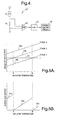
- the control routine may adjust the amount of venting in a vent-type air bag restraint system according to the examples shown in FIG. 5A and 5B.
- gas output generated for three stages of a multi-stage, variable venting air bag restraint system are shown by lines 50a-50c as a function of inflator temperature, as compared to a desired level shown by line 52.
- the amount of excess gas that must be vented is shown by lines 54a-54c in FIG. 5B.
- the central control module 30 activates the venting mechanism at the appropriate time to divert the excess gas produced away from the inflator output port so as to limit the amount of gas that enters the air bag to the desired level.
- the central control module 30 may control either a normally closed or normally open venting system.
- a normally closed system the time until the vent is activated (vent opened) is inversely proportional to the amount of excess gas expected, as shown by line 56 in FIG. 6A.
- the length of time the vent is active (vent open) is indirectly proportional to the amount of excess gas produced, as shown by line 58 in FIG. 6B.
- the control routine controls the amount of output gas to provide sufficient restraint for an actual gas event in a three-stage air bag system with variable venting.
- the desired amount of output gas is shown by lines 52.
- the control routine determines which stage to deploy based on both the desired amount of gas output and the ambient temperature of the air bag inflator.
- the control routine further selects the stage that generates a quantity of gas output that is greater than, but closest to the desirable output level.
- the selected output stage may be as follows: Temperature Stage Selected Temp ⁇ A 3 A ⁇ Temp ⁇ B 2 Temp>B 1
- the control routine determines the amount of excess output gas that will be produced by the system if the air bag inflator were not vented.
- a value of excess output gas is calculated by subtracting the desired amount of gas output from the actual amount of output gas produced from the selected output stage at the given temperature.
- the present invention senses the temperature of a component, such as the initiator, of an air bag restraint system and adjusts the restraining force generated by the air bag system so as to compensate for temperature variations. While the present invention is shown having two embodiments of temperature sensing circuitry, and a central control module 30 and control routine for adjusting the variability of the restraining force according to several examples, it should be appreciated that other temperature sensing techniques and other control routines for adjusting the restraining force may be used without departing from the teachings of the present invention.
Landscapes
- Engineering & Computer Science (AREA)
- Mechanical Engineering (AREA)
- Air Bags (AREA)
Abstract
An air bag restraint system and control system for controlling
an air bag (18) in a vehicle and compensating for ambient temperature
variations. The control system includes a temperature sensor (40) for sensing
temperature of an air bag device (10), and an air bag controller (30) for
controlling actuation of an air bag (18). The controller (30) controls
restraining force produced by the air bag (18) as a function of the sensed
temperature. Accordingly, the air bag (18) compensates to changes in
temperature so as to optimize the air bag performance.
Description
- The present invention generally relates to vehicle installed air bag restraint devices and, more particularly, relates to a control system for controlling an air bag restraint system.
- Passenger automotive vehicles are commonly equipped with air bag restraint devices for mitigating potential injuries to vehicle occupants for certain types of vehicle accidents. For example, front impact air bags are frequently installed in the steering column and dash in the front of passenger vehicles, while side impact air bags are side mounted on the roof rail. Automotive air bag systems typically include an initiator, such as an ignitor, for actuating a pyrotechnic charge which generates gas, such as nitrogen, to inflate the air bag. Vehicle crash sensors, such as accelerometers, are typically used to detect the onset of an accident. The sensed signals are processed to predict the occurrence of certain crash events which are severe enough to warrant the activation of the air bag. The air bag is electronically deployed to provide a restraining force for the vehicle occupant.
- The air bag restraining force should be sufficient to counteract the kinetic energy of the occupant to slow the occupant down so that the occupant's velocity is substantially matched to that of the vehicle before the occupant impacts the vehicle interior. Air bag restraint systems can be designed to operate over a wide range of vehicle conditions. These conditions may include a range of speeds, passenger sizes, seating positions, and the presence of belted or unbelted occupants, all of which may affect the air bag design requirements. Higher velocity speeds and larger passengers result in a larger kinetic energy and, thus, generally require greater opposing restraining forces. Smaller occupants and occupants seated close to the steering wheel generally require lower restraining forces.
- To accommodate the above-described conditions, the amount of restraining force generated by the air bag may need to be varied in order to optimize the air bag performance. The amount of restraining force that the air bag applies is a function of both the mass of gas filling the air bag and the size of any vent holes. Additionally, the ambient temperature of the inflator module affects the temperature of the gas filling the air bag. The gas is significantly cooled as it passes through the various screens and the output ports of the inflator. Lower ambient temperatures can reduce the resultant gas pressure which creates a corresponding reduction in the generated restraining force. As a consequence, the amount of restraining force generated by a conventional air bag may vary as a function of the ambient temperature of the inflator.
- It is therefore desirable to provide for an air bag system in a vehicle which compensates for ambient temperature variations associated with the air bag. In addition, it is desirable to provide for an air bag control system which compensates for the ambient temperature conditions so as to optimize performance of the air bag over a wide temperature range.
- In accordance with the teachings of the present invention, an air bag system and a control system for controlling an air bag in a vehicle are provided which compensate for ambient temperature variations so as to optimize air bag performance. The control system includes a temperature sensor for sensing temperature of an air bag device, and an air bag controller for controlling actuation of an air bag in a vehicle. The controller controls restraining force produced by the air bag as a function of the sensed temperature. Thus, the air bag compensates to changes in temperature so as to optimize the air bag performance.
- These and other features, advantages and objects of the present invention will be further understood and appreciated by those skilled in the art by reference to the following specification, claims and appended drawings.
- The present invention will now be described, by way of example, with reference to the accompanying drawings, in which:
- FIG. 1 is an exploded perspective view of an air bag restraint system installed in a vehicle;
- FIG. 2 is a block diagram of a control system for controlling the air bag restraint system;
- FIG. 3 is a circuit diagram illustrating a transistor-based temperature measurement circuit for sensing temperature of the air bag initiator, according to a first embodiment;
- FIG. 4 is a circuit diagram illustrating a thermistor-based temperature measurement circuit for sensing temperature of the air bag initiator, according to a second embodiment;
- FIGS. 5A and 5B are graphs illustrating gas output and excess gas to be vented as a function of inflator temperature according to a variable venting air bag embodiment; and
- FIGS. 6A and 6B are graphs illustrating vent activation as a function of excess gas for normally closed and normally open vent air bag systems, respectively.
-
- Referring to FIG. 1, an air bag restraint system is generally shown having an
initiator 10 and anair bag 18 installed in thesteering column 22 of a vehicle, such as an automotive passenger vehicle. The air bag restraint system may be conventionally mounted within thesteering wheel column 22 to apply, upon actuation, a restraining force to the driver of the vehicle in the event of certain detected conditions indicative of a vehicle passenger, or in the side roof rail for a side impact air bag. Theinitiator 10 provides electronic controls and a pyrotechnic charge for filling the air bag with gas (e.g., nitrogen) to create a restraining force to oppose the kinetic energy of the occupant. It should be appreciated that various types of air bag initiators may be employed in connection with the present invention. - The
initiator 10 shown and described herein is also referred to as a "smart ignitor" which generally includes control electronics formed in an integrated circuit, such as an application specific integrated circuit (ASIC) 20, shown assembled on top of asubstrate 28. The smart ignitor (initiator) 10 further includes anenergy storage device 36, a thinfilm bridge element 26, and a pyrotechnic charge provided in acharge canister 16. Thesubstrate 28 supporting thecontrol ASIC 20,energy storage device 36,bridge element 26, andcharge canister 16 are generally shown assembled on top of aheader 14 which is inserted into abase 12. It should be appreciated that the components of theinitiator 10 may be packaged in various arrangements. Theair bag initiator 10 receives control signals from a central control module (see FIG. 2) which may include a stand alone controller or may be integrated with one or more other vehicle controllers. The central control module senses dynamic characteristics of the vehicle via one or more sensors (not shown) and determines when certain vehicle impacts (crashes) occur. This may include the use of one or more sensors such as accelerometers for detecting a front impact vehicle collision or a side impact vehicle collision. The processing of sensed signals to determine such collisions for controlling an air bag restraint system are well-known to those skilled in the art. - The control ASIC 20 includes integrated circuitry formed on a substrate (die) for providing various functions, such as those shown in FIG. 2. The
control ASIC 20 may includediagnostic circuitry 32,charging circuitry 34, acommunication transceiver 38, andtemperature sensing circuitry 40. Thecommunication transceiver 38 allows for communication with various other devices includingcentral control module 30 and various sensors (not shown). Thecharging circuitry 34 controls charging of anenergy storage device 36, which is shown separate from theASIC 20. However,energy storage device 36 may be found on ASIC 20. Theenergy storage device 36 may include a capacitor for storing energy, with the charging circuitry controlling the voltage applied to the capacitor. Theenergy storage device 36 stores a sufficient charge to generate a large current inbridge element 26 sufficient to ignite the pyrotechnic compound. - The present invention employs
temperature sensing circuitry 40 to sense the ambient temperature of theair bag inflator 10. Since theinitiator 10 is mounted within the air bag inflator module, the die temperature of the control ASIC 20 provides a good indicator of the ambient temperature of theair bag inflator 10. Thetemperature sensing circuitry 40 may be embedded in thecontrol die 28 and temperature information can be transmitted via thecommunication transceiver 38 to thecentral control module 30 along with other diagnostic status information. The information received by thecentral control module 30 can be used with an appropriate control mechanism to adjust the amount of gas generated and inflated into the air bag, and may compensate for the ambient temperature affect on the resulting restraining force. Thus, by sensing ambient temperature of theair bag initiator 10, the present invention is able to control the resulting restraining force as a function of the sensed temperature so as to compensate for temperature-based variations. - A first embodiment of the
temperature measurement circuitry 40 is illustrated in FIG. 3 made up of a plurality of transistors Q1-Q7, resistors R1-R4, andamplifier 42. Transistors Q1 and Q2 are configured as a current mirror to provide an equal amount of current I to transistors Q3-Q6 and transistor Q7. If the area of transistors Q3-Q6 and Q7 are equal, such that the current density for transistors Q3-Q6 is one-quarter of the current density of transistor Q7, the difference in current density causes a corresponding difference in the base emitter voltage drops. The base emitter voltage drop of transistors Q3-Q6 for silicon devices will be about 36 mV less than the base emitter voltage drop of transistor Q7 at a temperature of twenty-five degrees Celsius (25°C), with a positive temperature coefficient of 0.12 mV/°C. Accordingly, a 36 mV differential will be developed across resistor R1. With resistor R2 having a value eight times greater than resistor R1, the voltage drop across resistor R2 will be sixteen times the voltage drop across resistor R1 for the value shown. The voltage across resistor R2 will have a positive temperature coefficient of 1.9 mV/°C. This positive temperature coefficient is almost exactly matched to the negative temperature coefficient (Tc) of the base emitter voltage of transistor Q7. The sum of the voltage drop across resistor R2 and the voltage drop across the base emitter junction of transistor Q7 produces a zero temperature coefficient Tc reference voltage at the base of transistor Q7. - The amplifier (AMP) 42 amplifies the voltage differential between the base and emitter of transistor Q7, thus producing an output voltage that is proportional to the temperature of the die. An amplifier gain of twenty produces an output voltage swing of approximately five volts for a temperature swing of one hundred twenty-five degrees Celsius (125°C), which represents a typical automotive temperature range of negative forty degrees Celsius (-40°C) to eighty-five degrees Celsius (85°C). Additionally, resistors R3 and R4 allow the output voltage to be trimmed to zero volts at a specific temperature by using a resistive trimming process which should be evident to those skilled in the art.
- The output of the
amplifier 42 is shown connected to an analog-to-digital (A/D)converter 44 for converting the analog voltage output to a digital signal. The A/D converter 44 could be configured using multiple comparators with various thresholds. The digital output signal from the A/D converter 44 is shown transmitted serially to thecentral control module 30 for processing to generate an air bag control signal which compensates for the sensed ambient temperature variations. - Thermistor-based temperature measurement circuitry 40' for sensing ambient temperature of the air bag initiator is shown in FIG. 4, according to a second embodiment of the present invention. The thermistor-based temperature measurement circuitry 40' includes a thermistor Rt for sensing temperature, and a constant current power source Is for producing a voltage across the thermistor Rt that is proportional to the temperature. The voltage produced across thermistor Rt is normalized by amplifier (AMP) 42. The output of
amplifier 42 is shown connected to an A/D converter 44 for digitizing the analog signal. The digitized output is then transmitted as serial data to thecentral control module 30, as described above. - Accordingly, temperature of the
air bag initiator 10 or other air bag device may be sensed with the use of the transistor-basedtemperature measurement circuitry 40 according to one embodiment, or the thermistor-based temperature measurement circuitry 40' according to another embodiment. While transistor-based and thermistor-basedtemperature measurement circuitry 40 and 40' are shown and described herein, it should be appreciated that other types and configurations of temperature sensing circuitry may be employed to sense temperature of a component of the air bag for use in connection with the present invention, without departing from the teachings of the present invention. - The
central control module 30, or other signal processing device, performs a control routine which uses the sensed temperature to control the amount of restraining force generated by the air bag restraint system to compensate for temperature variations. The ambient temperature of the air bag system, particularly the inflator module, affects the temperature of the gas filling the air bag. In effect, the gas is significantly cooled as it passes through various screens and output ports (not shown) of theair bag initiator 10. Lower ambient temperatures tend to reduce the resulting gas pressure in the air bag, thus creating a corresponding reduction in the restraining force. By employing the sensed ambient temperature, the resulting variability in the air bag restraint system performance is controlled. - The control routine for controlling the air bag restraining force based on temperature may vary depending on the type of air bag restraint system which may include multi-stage air bags with fixed venting, single-stage air bags with variable venting, and other types of controlled air bag restraint systems. In a multi-stage air bag restraint system having six output stages (stage 0-5) for generating varying amounts of gas, the control routine may provide course adjustment of the air bag restraining force by selecting the appropriate stage as shown in the following table.
Temperature Compensation - Multi-Stage, Fixed Venting Condition Air Bag Output Level Uncompensated Stage 1 Stage 2Stage 3Stage 4 Compensated -40° C Stage 2 Stage 3Stage 4 Stage 5 Compensated +25° C Stage 1 Stage 2Stage 3Stage 4 Compensated +105°C Stage 0 Stage 1Stage 2Stage 3 - The control routine may alternately be configured to provide control of a venting mechanism in a multi- or single-stage system having adjustable venting. Air bag restraint systems that include the use of a controlled venting mechanism typically calculate the amount of output gas required for sufficient occupant restraint. This calculation may factor in various parameters including occupant mass, seat belt usage, crash severity, occupant position, and other characteristics. The
central control module 30 may activate sufficient air bag stages to generate excess gas output based upon the sensed ambient temperature, according to the present invention. To vent excess gas, the venting mechanism is activated to vent the excess gas and, thus, inflate the desired amount of gas into the air bag. The venting control may accommodate either a fixed vent size open for a variable time, or a variable vent size open for a fixed time. - The control routine may adjust the amount of venting in a vent-type air bag restraint system according to the examples shown in FIG. 5A and 5B. Referring particularly to FIG. 5A, gas output generated for three stages of a multi-stage, variable venting air bag restraint system are shown by
lines 50a-50c as a function of inflator temperature, as compared to a desired level shown byline 52. The amount of excess gas that must be vented is shown bylines 54a-54c in FIG. 5B. Thecentral control module 30 activates the venting mechanism at the appropriate time to divert the excess gas produced away from the inflator output port so as to limit the amount of gas that enters the air bag to the desired level. - The
central control module 30 may control either a normally closed or normally open venting system. For a normally closed system, the time until the vent is activated (vent opened) is inversely proportional to the amount of excess gas expected, as shown byline 56 in FIG. 6A. For a normally open system, the length of time the vent is active (vent open) is indirectly proportional to the amount of excess gas produced, as shown byline 58 in FIG. 6B. - The control routine controls the amount of output gas to provide sufficient restraint for an actual gas event in a three-stage air bag system with variable venting. The desired amount of output gas is shown by
lines 52. The control routine then determines which stage to deploy based on both the desired amount of gas output and the ambient temperature of the air bag inflator. The control routine further selects the stage that generates a quantity of gas output that is greater than, but closest to the desirable output level. For the example shown, the selected output stage may be as follows:Temperature Stage Selected Temp<A 3 A<Temp< B 2 Temp> B 1 - The control routine determines the amount of excess output gas that will be produced by the system if the air bag inflator were not vented. A value of excess output gas is calculated by subtracting the desired amount of gas output from the actual amount of output gas produced from the selected output stage at the given temperature.
- Accordingly, the present invention senses the temperature of a component, such as the initiator, of an air bag restraint system and adjusts the restraining force generated by the air bag system so as to compensate for temperature variations. While the present invention is shown having two embodiments of temperature sensing circuitry, and a
central control module 30 and control routine for adjusting the variability of the restraining force according to several examples, it should be appreciated that other temperature sensing techniques and other control routines for adjusting the restraining force may be used without departing from the teachings of the present invention. - It will be understood by those who practice the invention and those skilled in the art, that various modifications and improvements may be made to the invention without departing from the spirit of the disclosed concept. The scope of protection afforded is to be determined by the claims and by the breadth of interpretation allowed by law.
Claims (20)
- A temperature compensated air bag control system for controlling an air bag (18) on a vehicle, said control system comprising:a temperature sensor (40) for sensing temperature of an air bag device (10); andan air bag controller (30) for controlling actuation of an air bag (18) in a vehicle, wherein the controller (30) controls restraining force produced by the air bag (18) as a function of the sensed temperature.
- The air bag control system as defined in claim 1, wherein the controller (30) varies an amount of gas inflated into the air bag (18) as a function of the sensed temperature.
- The air bag control system as defined in claim 2, wherein the air bag (18) has a venting mechanism, and wherein the controller (30) varies the amount of gas inflated into the air bag (18) by venting excess gas with the venting mechanism.
- The air bag control system as defined in claim 1, wherein the air bag device comprises an air bag inflator assembly (10).
- The air bag control system as defined in claim 1, wherein the temperature sensor comprises temperature sensing circuitry (40).
- The air bag control system as defined in claim 5, wherein the temperature sensing circuitry is formed on an integrated circuit (20).
- The air bag control system as defined in claim 5, wherein the temperature sensing circuitry (40) comprises a current mirror (Q1 and Q2) and temperature sensitive transistors.
- The air bag control system as defined in claim 5, wherein the temperature sensing circuitry comprises a thermistor (Rt).
- An air bag restraint system for a vehicle, said air bag restraint system comprising:wherein the controller (30) controls restraining force produced by the air bag (18) as a function of the sensed temperature.an air bag (18);an inflator assembly (10) for inflating gas into the air bag (18);a temperature sensor (40) for sensing temperature of the inflator assembly (10); anda controller (30) for controlling actuation of the air bag (18),
- The air bag restraint system as defined in claim 9, wherein the temperature sensor (40) senses temperature of an air bag initiator (10).
- The air bag restraint system as defined in claim 9, wherein the controller (30) varies an amount of gas inflated into the air bag (18) as a function of the sensed temperature.
- The air bag restraint system as defined in claim 11, wherein the air bag (18) has a venting mechanism, wherein the controller (30) varies the amount of gas inflated into the air bag (18) by venting excess gas with the venting mechanism.
- The air bag restraint system as defined in claim 9, wherein the temperature sensor comprises temperature sensing circuitry (40).
- The air bag restraint system as defined in claim 13, wherein the temperature sensing circuitry is formed on an integrated circuit (20).
- The air bag restraint system as defined in claim 13, wherein the temperature sensor circuitry comprises a current mirror (Q1 and Q2) and temperature sensitive transistors.
- The air bag restraint system as defined in claim 13, wherein the temperature sensor circuitry comprises a thermistor (Rt).
- A method of controlling an air bag (18) in a vehicle, said method comprising the steps of:sensing temperature of an air bag device (10);sensing a crash event of a vehicle;initiating deployment of the air bag (18) upon sensing the crash event; andcontrolling the amount of restraining force produced by the air bag (18) as a function of the sensed temperature.
- The method as defined in claim 17, wherein the step of controlling a restraining force comprises varying an amount of gas inflated into the air bag (18) as a function of the sensed temperature.
- The method as defined in claim 18, wherein said step of varying the amount of inflated gas comprises generating gas and venting excess gas with a venting mechanism.
- The method as defined in claim 17, wherein said step of sensing temperature comprises sensing temperature with sensing circuitry (40) on an integrated circuit (20).
Applications Claiming Priority (2)
| Application Number | Priority Date | Filing Date | Title |
|---|---|---|---|
| US348356 | 1999-07-07 | ||
| US10/348,356 US7000946B2 (en) | 2003-01-21 | 2003-01-21 | Temperature compensated air bag control system |
Publications (1)
| Publication Number | Publication Date |
|---|---|
| EP1440852A1 true EP1440852A1 (en) | 2004-07-28 |
Family
ID=32594909
Family Applications (1)
| Application Number | Title | Priority Date | Filing Date |
|---|---|---|---|
| EP04075052A Withdrawn EP1440852A1 (en) | 2003-01-21 | 2004-01-07 | Temperature compensated air bag |
Country Status (2)
| Country | Link |
|---|---|
| US (1) | US7000946B2 (en) |
| EP (1) | EP1440852A1 (en) |
Families Citing this family (3)
| Publication number | Priority date | Publication date | Assignee | Title |
|---|---|---|---|---|
| US7481453B2 (en) * | 1991-07-09 | 2009-01-27 | Automotive Technologies International, Inc. | Inflator system |
| US7744122B2 (en) * | 1995-12-12 | 2010-06-29 | Automotive Technologies International, Inc. | Driver side aspirated airbags |
| DE102005030991B3 (en) * | 2005-07-02 | 2007-01-04 | Daimlerchrysler Ag | Restraint system |
Citations (5)
| Publication number | Priority date | Publication date | Assignee | Title |
|---|---|---|---|---|
| US5722687A (en) * | 1996-02-09 | 1998-03-03 | Siemens Automotive Corporation | Airbags squib with temperature bias |
| JPH10132601A (en) * | 1996-10-29 | 1998-05-22 | Fuji Koki Corp | Signal voltage-current converting circuit |
| DE19810537A1 (en) * | 1998-03-11 | 1999-09-16 | Trw Airbag Sys Gmbh & Co Kg | Method of operating vehicle passenger restraining system e.g. air bag system |
| US6396249B1 (en) * | 1999-09-30 | 2002-05-28 | Denso Corporation | Load actuation circuit |
| DE10107273A1 (en) * | 2001-02-16 | 2002-08-22 | Volkswagen Ag | Safety device for vehicle occupants and method for controlling a safety device |
Family Cites Families (20)
| Publication number | Priority date | Publication date | Assignee | Title |
|---|---|---|---|---|
| DE3616184A1 (en) * | 1985-08-21 | 1987-02-26 | Rheinmetall Gmbh | PRESSURE VALVE FOR A PYROTECHNICAL GAS GENERATOR |
| US5366242A (en) * | 1993-11-01 | 1994-11-22 | Trw Vehicle Safety Systems Inc. | Apparatus for controlling inflation of an air bag |
| US5626359A (en) * | 1993-12-02 | 1997-05-06 | Trw Vehicle Safety Systems, Inc. | Method and apparatus for controlling an actuatable restraining device in response to discrete control zones |
| US5413378A (en) * | 1993-12-02 | 1995-05-09 | Trw Vehicle Safety Systems Inc. | Method and apparatus for controlling an actuatable restraining device in response to discrete control zones |
| US5489806A (en) * | 1994-05-11 | 1996-02-06 | Morton International, Inc. | Airbag horn switch with temperature compensation |
| US5460405A (en) * | 1994-06-28 | 1995-10-24 | Trw Vehicle Safety Systems Inc. | Apparatus for inflating an inflatable vehicle occupant restraint |
| DE29511448U1 (en) * | 1995-07-15 | 1996-11-14 | Robert Bosch Gmbh, 70469 Stuttgart | Airbag module |
| JPH0948319A (en) * | 1995-08-04 | 1997-02-18 | Toyo Tire & Rubber Co Ltd | Inflator for air bag device |
| US5613702A (en) * | 1996-02-23 | 1997-03-25 | Trw Vehicle Safety Systems Inc. | Apparatus for inflating an inflatable vehicle occupant restraint |
| US5801619A (en) | 1996-03-04 | 1998-09-01 | Delco Electronics Corp. | Analog signal processing system and decision logic for controlling airbag deployment |
| US5722689A (en) * | 1996-11-19 | 1998-03-03 | Chen; Fou Min | Cushioning device for safety belt of vehicle |
| US6039346A (en) | 1997-01-17 | 2000-03-21 | General Motors Corporation | Air bag module with variable inflation |
| DE19727229C1 (en) * | 1997-06-26 | 1998-07-23 | Siemens Ag | Temperature supervision circuit arrangement for electronic component |
| US6123358A (en) | 1998-05-11 | 2000-09-26 | General Motors Corporation | Air bag module with variable inflation |
| US5965952A (en) * | 1998-08-06 | 1999-10-12 | Breed Automotive Technology, Inc. | Vehicle horn and control function switch with compensation and method of operation |
| US6196582B1 (en) | 1999-09-22 | 2001-03-06 | Delphi Technologies, Inc. | Variable output inflator for an air bag |
| US6550807B1 (en) * | 2000-11-21 | 2003-04-22 | Trw Vehicle Safety Systems Inc. | Air bag module with electronically modulated vent |
| US6588796B2 (en) | 2001-03-08 | 2003-07-08 | Delphi Technologies, Inc. | High pressure air bag inflation system |
| US6619692B2 (en) * | 2001-03-27 | 2003-09-16 | Trw Inc. | Air bag inflators |
| US6906900B2 (en) * | 2002-12-19 | 2005-06-14 | Freescale Semiconductor, Inc. | Structure and method of thermally protecting power devices for airbag deployment |
-
2003
- 2003-01-21 US US10/348,356 patent/US7000946B2/en not_active Expired - Lifetime
-
2004
- 2004-01-07 EP EP04075052A patent/EP1440852A1/en not_active Withdrawn
Patent Citations (5)
| Publication number | Priority date | Publication date | Assignee | Title |
|---|---|---|---|---|
| US5722687A (en) * | 1996-02-09 | 1998-03-03 | Siemens Automotive Corporation | Airbags squib with temperature bias |
| JPH10132601A (en) * | 1996-10-29 | 1998-05-22 | Fuji Koki Corp | Signal voltage-current converting circuit |
| DE19810537A1 (en) * | 1998-03-11 | 1999-09-16 | Trw Airbag Sys Gmbh & Co Kg | Method of operating vehicle passenger restraining system e.g. air bag system |
| US6396249B1 (en) * | 1999-09-30 | 2002-05-28 | Denso Corporation | Load actuation circuit |
| DE10107273A1 (en) * | 2001-02-16 | 2002-08-22 | Volkswagen Ag | Safety device for vehicle occupants and method for controlling a safety device |
Non-Patent Citations (1)
| Title |
|---|
| PATENT ABSTRACTS OF JAPAN vol. 1998, no. 10 31 August 1998 (1998-08-31) * |
Also Published As
| Publication number | Publication date |
|---|---|
| US20040140654A1 (en) | 2004-07-22 |
| US7000946B2 (en) | 2006-02-21 |
Similar Documents
| Publication | Publication Date | Title |
|---|---|---|
| US5413378A (en) | Method and apparatus for controlling an actuatable restraining device in response to discrete control zones | |
| US6129168A (en) | Weight sensor for vehicular safety restraint systems | |
| US5626359A (en) | Method and apparatus for controlling an actuatable restraining device in response to discrete control zones | |
| US5997033A (en) | Adaptive airbag inflation method and apparatus | |
| US6020812A (en) | Vehicle occupant sensing system | |
| US6282473B1 (en) | System and method for controlling a vehicle occupant protection device | |
| US5900677A (en) | Sensing logic system and method for adaptive control of vehicle restraint devices | |
| US5967548A (en) | Safety arrangement | |
| US6416080B1 (en) | Apparatus and method for protecting a vehicle occupant utilizing a correlation between an occupant-associated center and a distance to an occupant-associated surface | |
| JP2005239128A (en) | Twin air bag device | |
| US7422086B2 (en) | Vehicle impact sensor using both accelerometer and pressure sensing for side impact detection | |
| US6496764B1 (en) | Vehicle impact-sensing method with improved severity discrimination | |
| GB2303479A (en) | Airbag safety system for vehicle passengers | |
| US5205582A (en) | Occupant protective system | |
| US6249730B1 (en) | Vehicle occupant protection system and method utilizing Z-axis central safing | |
| JP2007519560A (en) | Car occupant restraint system | |
| US6494284B1 (en) | Seat arrangement for a vehicle having an actuatable occupant protection device | |
| US20020063418A1 (en) | Restraining device with dynamic "danger" zone | |
| KR101014537B1 (en) | Passenger detection device of car | |
| JP2002234414A (en) | Vehicle airbag device | |
| US7000946B2 (en) | Temperature compensated air bag control system | |
| US6487483B1 (en) | System and method of occupant sensing | |
| JPH05213142A (en) | Air bag controller | |
| JP2001328506A (en) | Air bag device | |
| JP2001278002A (en) | Airbag device |
Legal Events
| Date | Code | Title | Description |
|---|---|---|---|
| PUAI | Public reference made under article 153(3) epc to a published international application that has entered the european phase |
Free format text: ORIGINAL CODE: 0009012 |
|
| AK | Designated contracting states |
Kind code of ref document: A1 Designated state(s): AT BE BG CH CY CZ DE DK EE ES FI FR GB GR HU IE IT LI LU MC NL PT RO SE SI SK TR |
|
| AX | Request for extension of the european patent |
Extension state: AL LT LV MK |
|
| 17P | Request for examination filed |
Effective date: 20050128 |
|
| AKX | Designation fees paid |
Designated state(s): DE FR GB |
|
| 17Q | First examination report despatched |
Effective date: 20050330 |
|
| STAA | Information on the status of an ep patent application or granted ep patent |
Free format text: STATUS: THE APPLICATION IS DEEMED TO BE WITHDRAWN |
|
| 18D | Application deemed to be withdrawn |
Effective date: 20060801 |