EP1440077B1 - Synthetic heparin pentasaccharides - Google Patents
Synthetic heparin pentasaccharides Download PDFInfo
- Publication number
- EP1440077B1 EP1440077B1 EP02766941.5A EP02766941A EP1440077B1 EP 1440077 B1 EP1440077 B1 EP 1440077B1 EP 02766941 A EP02766941 A EP 02766941A EP 1440077 B1 EP1440077 B1 EP 1440077B1
- Authority
- EP
- European Patent Office
- Prior art keywords
- group
- benzyl
- substituted
- sop
- groups
- Prior art date
- Legal status (The legal status is an assumption and is not a legal conclusion. Google has not performed a legal analysis and makes no representation as to the accuracy of the status listed.)
- Expired - Lifetime
Links
- HTTJABKRGRZYRN-UHFFFAOYSA-N Heparin Chemical compound OC1C(NC(=O)C)C(O)OC(COS(O)(=O)=O)C1OC1C(OS(O)(=O)=O)C(O)C(OC2C(C(OS(O)(=O)=O)C(OC3C(C(O)C(O)C(O3)C(O)=O)OS(O)(=O)=O)C(CO)O2)NS(O)(=O)=O)C(C(O)=O)O1 HTTJABKRGRZYRN-UHFFFAOYSA-N 0.000 title description 26
- 229960002897 heparin Drugs 0.000 title description 21
- 229920000669 heparin Polymers 0.000 title description 21
- -1 benzyloxy, substituted benzyloxy Chemical group 0.000 claims description 90
- 238000002360 preparation method Methods 0.000 claims description 66
- 125000001797 benzyl group Chemical group [H]C1=C([H])C([H])=C(C([H])=C1[H])C([H])([H])* 0.000 claims description 65
- 125000006239 protecting group Chemical group 0.000 claims description 45
- KXDHJXZQYSOELW-UHFFFAOYSA-M Carbamate Chemical compound NC([O-])=O KXDHJXZQYSOELW-UHFFFAOYSA-M 0.000 claims description 35
- 125000004122 cyclic group Chemical group 0.000 claims description 35
- 150000004043 trisaccharides Chemical class 0.000 claims description 35
- 125000003903 2-propenyl group Chemical group [H]C([*])([H])C([H])=C([H])[H] 0.000 claims description 30
- 238000000034 method Methods 0.000 claims description 28
- 125000005257 alkyl acyl group Chemical group 0.000 claims description 26
- 125000005258 alkyl aryl acyl group Chemical group 0.000 claims description 25
- 125000002496 methyl group Chemical group [H]C([H])([H])* 0.000 claims description 25
- 229920001499 Heparinoid Polymers 0.000 claims description 23
- 239000002554 heparinoid Substances 0.000 claims description 23
- 150000002016 disaccharides Chemical class 0.000 claims description 22
- 229940025770 heparinoids Drugs 0.000 claims description 22
- 125000004172 4-methoxyphenyl group Chemical group [H]C1=C([H])C(OC([H])([H])[H])=C([H])C([H])=C1* 0.000 claims description 20
- 125000005251 aryl acyl group Chemical group 0.000 claims description 20
- 125000003236 benzoyl group Chemical group [H]C1=C([H])C([H])=C(C([H])=C1[H])C(*)=O 0.000 claims description 16
- 229910052739 hydrogen Inorganic materials 0.000 claims description 15
- 125000005587 carbonate group Chemical group 0.000 claims description 13
- 238000010511 deprotection reaction Methods 0.000 claims description 12
- 125000000852 azido group Chemical group *N=[N+]=[N-] 0.000 claims description 11
- 125000002887 hydroxy group Chemical group [H]O* 0.000 claims description 11
- 125000004469 siloxy group Chemical group [SiH3]O* 0.000 claims description 11
- 239000007787 solid Substances 0.000 claims description 11
- 125000004184 methoxymethyl group Chemical group [H]C([H])([H])OC([H])([H])* 0.000 claims description 9
- 229910019142 PO4 Inorganic materials 0.000 claims description 8
- 239000010452 phosphate Substances 0.000 claims description 8
- DHKHKXVYLBGOIT-UHFFFAOYSA-N acetaldehyde Diethyl Acetal Natural products CCOC(C)OCC DHKHKXVYLBGOIT-UHFFFAOYSA-N 0.000 claims description 7
- 125000003342 alkenyl group Chemical group 0.000 claims description 7
- 150000001412 amines Chemical class 0.000 claims description 7
- 125000004217 4-methoxybenzyl group Chemical group [H]C1=C([H])C(=C([H])C([H])=C1OC([H])([H])[H])C([H])([H])* 0.000 claims description 5
- 125000003545 alkoxy group Chemical group 0.000 claims description 5
- 125000000217 alkyl group Chemical group 0.000 claims description 5
- 230000021615 conjugation Effects 0.000 claims description 5
- 230000008569 process Effects 0.000 claims description 5
- 125000000547 substituted alkyl group Chemical group 0.000 claims description 5
- 125000004001 thioalkyl group Chemical group 0.000 claims description 5
- 125000005000 thioaryl group Chemical group 0.000 claims description 5
- 125000002221 trityl group Chemical group [H]C1=C([H])C([H])=C([H])C([H])=C1C([*])(C1=C(C(=C(C(=C1[H])[H])[H])[H])[H])C1=C([H])C([H])=C([H])C([H])=C1[H] 0.000 claims description 5
- 229910052736 halogen Inorganic materials 0.000 claims description 4
- 150000002367 halogens Chemical class 0.000 claims description 4
- NBIIXXVUZAFLBC-UHFFFAOYSA-K phosphate Chemical compound [O-]P([O-])([O-])=O NBIIXXVUZAFLBC-UHFFFAOYSA-K 0.000 claims description 4
- 125000000037 tert-butyldiphenylsilyl group Chemical group [H]C1=C([H])C([H])=C([H])C([H])=C1[Si]([H])([*]C(C([H])([H])[H])(C([H])([H])[H])C([H])([H])[H])C1=C([H])C([H])=C([H])C([H])=C1[H] 0.000 claims description 4
- YQTCQNIPQMJNTI-UHFFFAOYSA-N 2,2-dimethylpropan-1-one Chemical group CC(C)(C)[C]=O YQTCQNIPQMJNTI-UHFFFAOYSA-N 0.000 claims description 3
- 125000002777 acetyl group Chemical group [H]C([H])([H])C(*)=O 0.000 claims description 3
- 125000003302 alkenyloxy group Chemical group 0.000 claims description 3
- 125000004104 aryloxy group Chemical group 0.000 claims description 3
- 125000002668 chloroacetyl group Chemical group ClCC(=O)* 0.000 claims description 3
- 238000004519 manufacturing process Methods 0.000 claims description 3
- 125000001424 substituent group Chemical group 0.000 claims description 3
- 230000002194 synthesizing effect Effects 0.000 claims description 3
- 239000000825 pharmaceutical preparation Substances 0.000 claims description 2
- KXDHJXZQYSOELW-UHFFFAOYSA-N Carbamic acid Chemical group NC(O)=O KXDHJXZQYSOELW-UHFFFAOYSA-N 0.000 claims 3
- 125000000242 4-chlorobenzoyl group Chemical group ClC1=CC=C(C(=O)*)C=C1 0.000 claims 2
- FJHBVJOVLFPMQE-QFIPXVFZSA-N 7-Ethyl-10-Hydroxy-Camptothecin Chemical compound C1=C(O)C=C2C(CC)=C(CN3C(C4=C([C@@](C(=O)OC4)(O)CC)C=C33)=O)C3=NC2=C1 FJHBVJOVLFPMQE-QFIPXVFZSA-N 0.000 claims 2
- 239000003937 drug carrier Substances 0.000 claims 2
- 125000005524 levulinyl group Chemical group 0.000 claims 2
- 125000001181 organosilyl group Chemical group [SiH3]* 0.000 claims 2
- HITJFUSPLYBJPE-UHFFFAOYSA-N dihydroresveratrol Chemical compound C1=CC(O)=CC=C1CCC1=CC(O)=CC(O)=C1 HITJFUSPLYBJPE-UHFFFAOYSA-N 0.000 claims 1
- 125000004014 thioethyl group Chemical group [H]SC([H])([H])C([H])([H])* 0.000 claims 1
- 125000004055 thiomethyl group Chemical group [H]SC([H])([H])* 0.000 claims 1
- 238000010561 standard procedure Methods 0.000 description 273
- YMWUJEATGCHHMB-UHFFFAOYSA-N Dichloromethane Chemical compound ClCCl YMWUJEATGCHHMB-UHFFFAOYSA-N 0.000 description 161
- 230000015572 biosynthetic process Effects 0.000 description 119
- 239000000243 solution Substances 0.000 description 111
- 238000003786 synthesis reaction Methods 0.000 description 96
- XEKOWRVHYACXOJ-UHFFFAOYSA-N Ethyl acetate Chemical compound CCOC(C)=O XEKOWRVHYACXOJ-UHFFFAOYSA-N 0.000 description 92
- 125000003118 aryl group Chemical group 0.000 description 87
- OKKJLVBELUTLKV-UHFFFAOYSA-N Methanol Chemical compound OC OKKJLVBELUTLKV-UHFFFAOYSA-N 0.000 description 69
- 150000001875 compounds Chemical class 0.000 description 59
- YXFVVABEGXRONW-UHFFFAOYSA-N Toluene Chemical compound CC1=CC=CC=C1 YXFVVABEGXRONW-UHFFFAOYSA-N 0.000 description 54
- 239000000203 mixture Substances 0.000 description 53
- HEDRZPFGACZZDS-MICDWDOJSA-N Trichloro(2H)methane Chemical compound [2H]C(Cl)(Cl)Cl HEDRZPFGACZZDS-MICDWDOJSA-N 0.000 description 50
- 238000006243 chemical reaction Methods 0.000 description 49
- 238000010898 silica gel chromatography Methods 0.000 description 49
- XLYOFNOQVPJJNP-UHFFFAOYSA-N water Chemical compound O XLYOFNOQVPJJNP-UHFFFAOYSA-N 0.000 description 49
- RTZKZFJDLAIYFH-UHFFFAOYSA-N Diethyl ether Chemical compound CCOCC RTZKZFJDLAIYFH-UHFFFAOYSA-N 0.000 description 48
- UIIMBOGNXHQVGW-UHFFFAOYSA-M Sodium bicarbonate Chemical compound [Na+].OC([O-])=O UIIMBOGNXHQVGW-UHFFFAOYSA-M 0.000 description 47
- 239000000047 product Substances 0.000 description 44
- 239000011541 reaction mixture Substances 0.000 description 44
- ZMXDDKWLCZADIW-UHFFFAOYSA-N N,N-Dimethylformamide Chemical compound CN(C)C=O ZMXDDKWLCZADIW-UHFFFAOYSA-N 0.000 description 39
- 238000000746 purification Methods 0.000 description 38
- 238000003756 stirring Methods 0.000 description 37
- QTBSBXVTEAMEQO-UHFFFAOYSA-N Acetic acid Chemical compound CC(O)=O QTBSBXVTEAMEQO-UHFFFAOYSA-N 0.000 description 34
- ZMANZCXQSJIPKH-UHFFFAOYSA-N Triethylamine Chemical compound CCN(CC)CC ZMANZCXQSJIPKH-UHFFFAOYSA-N 0.000 description 34
- JUJWROOIHBZHMG-UHFFFAOYSA-N Pyridine Chemical compound C1=CC=NC=C1 JUJWROOIHBZHMG-UHFFFAOYSA-N 0.000 description 32
- WEVYAHXRMPXWCK-UHFFFAOYSA-N Acetonitrile Chemical compound CC#N WEVYAHXRMPXWCK-UHFFFAOYSA-N 0.000 description 31
- 235000019439 ethyl acetate Nutrition 0.000 description 31
- 125000000956 methoxy group Chemical group [H]C([H])([H])O* 0.000 description 31
- CSCPPACGZOOCGX-UHFFFAOYSA-N Acetone Chemical compound CC(C)=O CSCPPACGZOOCGX-UHFFFAOYSA-N 0.000 description 30
- CSNNHWWHGAXBCP-UHFFFAOYSA-L Magnesium sulfate Chemical compound [Mg+2].[O-][S+2]([O-])([O-])[O-] CSNNHWWHGAXBCP-UHFFFAOYSA-L 0.000 description 30
- KRKNYBCHXYNGOX-UHFFFAOYSA-N citric acid Chemical compound OC(=O)CC(O)(C(O)=O)CC(O)=O KRKNYBCHXYNGOX-UHFFFAOYSA-N 0.000 description 30
- 229940093499 ethyl acetate Drugs 0.000 description 30
- HPALAKNZSZLMCH-UHFFFAOYSA-M sodium;chloride;hydrate Chemical class O.[Na+].[Cl-] HPALAKNZSZLMCH-UHFFFAOYSA-M 0.000 description 28
- 238000002425 crystallisation Methods 0.000 description 26
- 230000008025 crystallization Effects 0.000 description 26
- 239000007858 starting material Substances 0.000 description 26
- 238000005160 1H NMR spectroscopy Methods 0.000 description 25
- 239000007832 Na2SO4 Substances 0.000 description 23
- PMZURENOXWZQFD-UHFFFAOYSA-L Sodium Sulfate Chemical compound [Na+].[Na+].[O-]S([O-])(=O)=O PMZURENOXWZQFD-UHFFFAOYSA-L 0.000 description 23
- 239000012044 organic layer Substances 0.000 description 23
- 229910052938 sodium sulfate Inorganic materials 0.000 description 23
- VYPSYNLAJGMNEJ-UHFFFAOYSA-N Silicium dioxide Chemical compound O=[Si]=O VYPSYNLAJGMNEJ-UHFFFAOYSA-N 0.000 description 22
- 229910000030 sodium bicarbonate Inorganic materials 0.000 description 22
- WYURNTSHIVDZCO-UHFFFAOYSA-N Tetrahydrofuran Chemical compound C1CCOC1 WYURNTSHIVDZCO-UHFFFAOYSA-N 0.000 description 21
- WFDIJRYMOXRFFG-UHFFFAOYSA-N Acetic anhydride Chemical compound CC(=O)OC(C)=O WFDIJRYMOXRFFG-UHFFFAOYSA-N 0.000 description 20
- 238000003776 cleavage reaction Methods 0.000 description 18
- 230000007017 scission Effects 0.000 description 18
- 150000004044 tetrasaccharides Chemical class 0.000 description 17
- UMJSCPRVCHMLSP-UHFFFAOYSA-N pyridine Natural products COC1=CC=CN=C1 UMJSCPRVCHMLSP-UHFFFAOYSA-N 0.000 description 16
- 239000002904 solvent Substances 0.000 description 16
- HEMHJVSKTPXQMS-UHFFFAOYSA-M Sodium hydroxide Chemical compound [OH-].[Na+] HEMHJVSKTPXQMS-UHFFFAOYSA-M 0.000 description 15
- 229910052943 magnesium sulfate Inorganic materials 0.000 description 15
- PCLIMKBDDGJMGD-UHFFFAOYSA-N N-bromosuccinimide Chemical compound BrN1C(=O)CCC1=O PCLIMKBDDGJMGD-UHFFFAOYSA-N 0.000 description 14
- 229920006395 saturated elastomer Polymers 0.000 description 14
- 125000000999 tert-butyl group Chemical group [H]C([H])([H])C(*)(C([H])([H])[H])C([H])([H])[H] 0.000 description 13
- 0 *C[C@@]1O[C@@](*)C(*)C(*)[C@@]1O[C@@](C(*)C(*)[C@]1*)OC1C(*)=O Chemical compound *C[C@@]1O[C@@](*)C(*)C(*)[C@@]1O[C@@](C(*)C(*)[C@]1*)OC1C(*)=O 0.000 description 12
- HEDRZPFGACZZDS-UHFFFAOYSA-N Chloroform Chemical compound ClC(Cl)Cl HEDRZPFGACZZDS-UHFFFAOYSA-N 0.000 description 12
- 230000013595 glycosylation Effects 0.000 description 12
- 238000006206 glycosylation reaction Methods 0.000 description 12
- VLKZOEOYAKHREP-UHFFFAOYSA-N n-Hexane Chemical compound CCCCCC VLKZOEOYAKHREP-UHFFFAOYSA-N 0.000 description 12
- 239000003208 petroleum Substances 0.000 description 12
- 229930182475 S-glycoside Natural products 0.000 description 11
- 150000003569 thioglycosides Chemical class 0.000 description 11
- WLLIXJBWWFGEHT-UHFFFAOYSA-N [tert-butyl(dimethyl)silyl] trifluoromethanesulfonate Chemical compound CC(C)(C)[Si](C)(C)OS(=O)(=O)C(F)(F)F WLLIXJBWWFGEHT-UHFFFAOYSA-N 0.000 description 10
- 235000000346 sugar Nutrition 0.000 description 10
- 229940086542 triethylamine Drugs 0.000 description 10
- 102000004411 Antithrombin III Human genes 0.000 description 9
- 108090000935 Antithrombin III Proteins 0.000 description 9
- 229960005348 antithrombin iii Drugs 0.000 description 9
- 150000002772 monosaccharides Chemical class 0.000 description 9
- URGAHOPLAPQHLN-UHFFFAOYSA-N sodium aluminosilicate Chemical compound [Na+].[Al+3].[O-][Si]([O-])=O.[O-][Si]([O-])=O URGAHOPLAPQHLN-UHFFFAOYSA-N 0.000 description 9
- DTQVDTLACAAQTR-UHFFFAOYSA-N trifluoroacetic acid Substances OC(=O)C(F)(F)F DTQVDTLACAAQTR-UHFFFAOYSA-N 0.000 description 9
- XEEYBQQBJWHFJM-UHFFFAOYSA-N Iron Chemical group [Fe] XEEYBQQBJWHFJM-UHFFFAOYSA-N 0.000 description 8
- LQZMLBORDGWNPD-UHFFFAOYSA-N N-iodosuccinimide Substances IN1C(=O)CCC1=O LQZMLBORDGWNPD-UHFFFAOYSA-N 0.000 description 8
- 230000003197 catalytic effect Effects 0.000 description 8
- 239000010410 layer Substances 0.000 description 8
- FPGGTKZVZWFYPV-UHFFFAOYSA-M tetrabutylammonium fluoride Chemical compound [F-].CCCC[N+](CCCC)(CCCC)CCCC FPGGTKZVZWFYPV-UHFFFAOYSA-M 0.000 description 8
- UPQQXPKAYZYUKO-UHFFFAOYSA-N 2,2,2-trichloroacetamide Chemical class OC(=N)C(Cl)(Cl)Cl UPQQXPKAYZYUKO-UHFFFAOYSA-N 0.000 description 7
- SECXISVLQFMRJM-UHFFFAOYSA-N N-Methylpyrrolidone Chemical compound CN1CCCC1=O SECXISVLQFMRJM-UHFFFAOYSA-N 0.000 description 7
- 239000002253 acid Substances 0.000 description 7
- 230000000694 effects Effects 0.000 description 7
- 238000001914 filtration Methods 0.000 description 7
- 125000002924 primary amino group Chemical group [H]N([H])* 0.000 description 7
- 239000000741 silica gel Substances 0.000 description 7
- 229910002027 silica gel Inorganic materials 0.000 description 7
- QAEDZJGFFMLHHQ-UHFFFAOYSA-N trifluoroacetic anhydride Chemical compound FC(F)(F)C(=O)OC(=O)C(F)(F)F QAEDZJGFFMLHHQ-UHFFFAOYSA-N 0.000 description 7
- VHYFNPMBLIVWCW-UHFFFAOYSA-N 4-Dimethylaminopyridine Chemical compound CN(C)C1=CC=NC=C1 VHYFNPMBLIVWCW-UHFFFAOYSA-N 0.000 description 6
- JGFZNNIVVJXRND-UHFFFAOYSA-N N,N-Diisopropylethylamine (DIPEA) Chemical compound CCN(C(C)C)C(C)C JGFZNNIVVJXRND-UHFFFAOYSA-N 0.000 description 6
- WQDUMFSSJAZKTM-UHFFFAOYSA-N Sodium methoxide Chemical compound [Na+].[O-]C WQDUMFSSJAZKTM-UHFFFAOYSA-N 0.000 description 6
- 125000000649 benzylidene group Chemical group [H]C(=[*])C1=C([H])C([H])=C([H])C([H])=C1[H] 0.000 description 6
- 229930182470 glycoside Natural products 0.000 description 6
- RAXXELZNTBOGNW-UHFFFAOYSA-N imidazole Natural products C1=CNC=N1 RAXXELZNTBOGNW-UHFFFAOYSA-N 0.000 description 6
- 238000007254 oxidation reaction Methods 0.000 description 6
- 239000006188 syrup Substances 0.000 description 6
- 235000020357 syrup Nutrition 0.000 description 6
- SDTORDSXCYSNTD-UHFFFAOYSA-N 1-methoxy-4-[(4-methoxyphenyl)methoxymethyl]benzene Chemical compound C1=CC(OC)=CC=C1COCC1=CC=C(OC)C=C1 SDTORDSXCYSNTD-UHFFFAOYSA-N 0.000 description 5
- 101100456566 Caenorhabditis elegans dpy-22 gene Proteins 0.000 description 5
- 238000006640 acetylation reaction Methods 0.000 description 5
- PASDCCFISLVPSO-UHFFFAOYSA-N benzoyl chloride Chemical compound ClC(=O)C1=CC=CC=C1 PASDCCFISLVPSO-UHFFFAOYSA-N 0.000 description 5
- AGEZXYOZHKGVCM-UHFFFAOYSA-N benzyl bromide Chemical compound BrCC1=CC=CC=C1 AGEZXYOZHKGVCM-UHFFFAOYSA-N 0.000 description 5
- 238000006664 bond formation reaction Methods 0.000 description 5
- 229920001429 chelating resin Polymers 0.000 description 5
- 239000000706 filtrate Substances 0.000 description 5
- 239000000543 intermediate Substances 0.000 description 5
- 239000000725 suspension Substances 0.000 description 5
- ITMCEJHCFYSIIV-UHFFFAOYSA-N triflic acid Chemical compound OS(=O)(=O)C(F)(F)F ITMCEJHCFYSIIV-UHFFFAOYSA-N 0.000 description 5
- FTVLMFQEYACZNP-UHFFFAOYSA-N trimethylsilyl trifluoromethanesulfonate Chemical compound C[Si](C)(C)OS(=O)(=O)C(F)(F)F FTVLMFQEYACZNP-UHFFFAOYSA-N 0.000 description 5
- RIOQSEWOXXDEQQ-UHFFFAOYSA-N triphenylphosphine Chemical compound C1=CC=CC=C1P(C=1C=CC=CC=1)C1=CC=CC=C1 RIOQSEWOXXDEQQ-UHFFFAOYSA-N 0.000 description 5
- YYROPELSRYBVMQ-UHFFFAOYSA-N 4-toluenesulfonyl chloride Chemical compound CC1=CC=C(S(Cl)(=O)=O)C=C1 YYROPELSRYBVMQ-UHFFFAOYSA-N 0.000 description 4
- 101100310641 Caenorhabditis elegans sop-2 gene Proteins 0.000 description 4
- 239000002841 Lewis acid Substances 0.000 description 4
- UDCDOJQOXWCCSD-UHFFFAOYSA-N N,N-dimethyl-N'-p-tolylsulfamide Chemical compound CN(C)S(=O)(=O)NC1=CC=C(C)C=C1 UDCDOJQOXWCCSD-UHFFFAOYSA-N 0.000 description 4
- PXIPVTKHYLBLMZ-UHFFFAOYSA-N Sodium azide Chemical compound [Na+].[N-]=[N+]=[N-] PXIPVTKHYLBLMZ-UHFFFAOYSA-N 0.000 description 4
- 208000007536 Thrombosis Diseases 0.000 description 4
- DRUIESSIVFYOMK-UHFFFAOYSA-N Trichloroacetonitrile Chemical compound ClC(Cl)(Cl)C#N DRUIESSIVFYOMK-UHFFFAOYSA-N 0.000 description 4
- 206010047249 Venous thrombosis Diseases 0.000 description 4
- 150000007513 acids Chemical class 0.000 description 4
- 239000003146 anticoagulant agent Substances 0.000 description 4
- 238000006480 benzoylation reaction Methods 0.000 description 4
- 238000005574 benzylation reaction Methods 0.000 description 4
- 229960004132 diethyl ether Drugs 0.000 description 4
- FFHWGQQFANVOHV-UHFFFAOYSA-N dimethyldioxirane Chemical compound CC1(C)OO1 FFHWGQQFANVOHV-UHFFFAOYSA-N 0.000 description 4
- 150000002170 ethers Chemical class 0.000 description 4
- 229940052303 ethers for general anesthesia Drugs 0.000 description 4
- 239000000937 glycosyl acceptor Substances 0.000 description 4
- 150000002373 hemiacetals Chemical class 0.000 description 4
- 230000007062 hydrolysis Effects 0.000 description 4
- 238000006460 hydrolysis reaction Methods 0.000 description 4
- 229910052742 iron Inorganic materials 0.000 description 4
- 150000007517 lewis acids Chemical class 0.000 description 4
- 239000002808 molecular sieve Substances 0.000 description 4
- 230000003647 oxidation Effects 0.000 description 4
- BWHMMNNQKKPAPP-UHFFFAOYSA-L potassium carbonate Chemical compound [K+].[K+].[O-]C([O-])=O BWHMMNNQKKPAPP-UHFFFAOYSA-L 0.000 description 4
- 229920005989 resin Polymers 0.000 description 4
- 239000011347 resin Substances 0.000 description 4
- KJTULOVPMGUBJS-UHFFFAOYSA-N tert-butyl-[tert-butyl(diphenyl)silyl]oxy-diphenylsilane Chemical compound C=1C=CC=CC=1[Si](C=1C=CC=CC=1)(C(C)(C)C)O[Si](C(C)(C)C)(C=1C=CC=CC=1)C1=CC=CC=C1 KJTULOVPMGUBJS-UHFFFAOYSA-N 0.000 description 4
- WSLDOOZREJYCGB-UHFFFAOYSA-N 1,2-Dichloroethane Chemical compound ClCCCl WSLDOOZREJYCGB-UHFFFAOYSA-N 0.000 description 3
- NHQDETIJWKXCTC-UHFFFAOYSA-N 3-chloroperbenzoic acid Chemical compound OOC(=O)C1=CC=CC(Cl)=C1 NHQDETIJWKXCTC-UHFFFAOYSA-N 0.000 description 3
- 229960000549 4-dimethylaminophenol Drugs 0.000 description 3
- QGZKDVFQNNGYKY-UHFFFAOYSA-O Ammonium Chemical compound [NH4+] QGZKDVFQNNGYKY-UHFFFAOYSA-O 0.000 description 3
- 206010051055 Deep vein thrombosis Diseases 0.000 description 3
- QOSSAOTZNIDXMA-UHFFFAOYSA-N Dicylcohexylcarbodiimide Chemical compound C1CCCCC1N=C=NC1CCCCC1 QOSSAOTZNIDXMA-UHFFFAOYSA-N 0.000 description 3
- IAZDPXIOMUYVGZ-UHFFFAOYSA-N Dimethylsulphoxide Chemical compound CS(C)=O IAZDPXIOMUYVGZ-UHFFFAOYSA-N 0.000 description 3
- PIICEJLVQHRZGT-UHFFFAOYSA-N Ethylenediamine Chemical compound NCCN PIICEJLVQHRZGT-UHFFFAOYSA-N 0.000 description 3
- WQZGKKKJIJFFOK-ZNVMLXAYSA-N L-idopyranose Chemical group OC[C@@H]1OC(O)[C@H](O)[C@@H](O)[C@@H]1O WQZGKKKJIJFFOK-ZNVMLXAYSA-N 0.000 description 3
- KWYUFKZDYYNOTN-UHFFFAOYSA-M Potassium hydroxide Chemical compound [OH-].[K+] KWYUFKZDYYNOTN-UHFFFAOYSA-M 0.000 description 3
- 239000000370 acceptor Substances 0.000 description 3
- 230000021736 acetylation Effects 0.000 description 3
- 229940127219 anticoagulant drug Drugs 0.000 description 3
- 239000007864 aqueous solution Substances 0.000 description 3
- 239000012267 brine Substances 0.000 description 3
- 239000003153 chemical reaction reagent Substances 0.000 description 3
- 238000004587 chromatography analysis Methods 0.000 description 3
- 239000000386 donor Substances 0.000 description 3
- 239000000348 glycosyl donor Substances 0.000 description 3
- 229940127215 low-molecular weight heparin Drugs 0.000 description 3
- QARBMVPHQWIHKH-UHFFFAOYSA-N methanesulfonyl chloride Chemical compound CS(Cl)(=O)=O QARBMVPHQWIHKH-UHFFFAOYSA-N 0.000 description 3
- 239000003960 organic solvent Substances 0.000 description 3
- KJIFKLIQANRMOU-UHFFFAOYSA-N oxidanium;4-methylbenzenesulfonate Chemical compound O.CC1=CC=C(S(O)(=O)=O)C=C1 KJIFKLIQANRMOU-UHFFFAOYSA-N 0.000 description 3
- 239000000758 substrate Substances 0.000 description 3
- JOXIMZWYDAKGHI-UHFFFAOYSA-N toluene-4-sulfonic acid Chemical compound CC1=CC=C(S(O)(=O)=O)C=C1 JOXIMZWYDAKGHI-UHFFFAOYSA-N 0.000 description 3
- 230000009466 transformation Effects 0.000 description 3
- NQPHMXWPDCSHTE-UHFFFAOYSA-N trifluoromethanesulfonyl azide Chemical compound FC(F)(F)S(=O)(=O)N=[N+]=[N-] NQPHMXWPDCSHTE-UHFFFAOYSA-N 0.000 description 3
- HEVMDQBCAHEHDY-UHFFFAOYSA-N (Dimethoxymethyl)benzene Chemical compound COC(OC)C1=CC=CC=C1 HEVMDQBCAHEHDY-UHFFFAOYSA-N 0.000 description 2
- NNHYAHOTXLASEA-UHFFFAOYSA-N 1-(dimethoxymethyl)-4-methoxybenzene Chemical compound COC(OC)C1=CC=C(OC)C=C1 NNHYAHOTXLASEA-UHFFFAOYSA-N 0.000 description 2
- CBDLNOVOFXJEOB-UHFFFAOYSA-N 1-methoxy-4-(4-methoxyphenoxy)benzene Chemical compound C1=CC(OC)=CC=C1OC1=CC=C(OC)C=C1 CBDLNOVOFXJEOB-UHFFFAOYSA-N 0.000 description 2
- HVHZEKKZMFRULH-UHFFFAOYSA-N 2,6-ditert-butyl-4-methylpyridine Chemical compound CC1=CC(C(C)(C)C)=NC(C(C)(C)C)=C1 HVHZEKKZMFRULH-UHFFFAOYSA-N 0.000 description 2
- WLHCBQAPPJAULW-UHFFFAOYSA-N 4-methylbenzenethiol Chemical compound CC1=CC=C(S)C=C1 WLHCBQAPPJAULW-UHFFFAOYSA-N 0.000 description 2
- JOOXCMJARBKPKM-UHFFFAOYSA-N 4-oxopentanoic acid Chemical compound CC(=O)CCC(O)=O JOOXCMJARBKPKM-UHFFFAOYSA-N 0.000 description 2
- 239000012359 Methanesulfonyl chloride Substances 0.000 description 2
- BAVYZALUXZFZLV-UHFFFAOYSA-N Methylamine Chemical compound NC BAVYZALUXZFZLV-UHFFFAOYSA-N 0.000 description 2
- LRHPLDYGYMQRHN-UHFFFAOYSA-N N-Butanol Chemical compound CCCCO LRHPLDYGYMQRHN-UHFFFAOYSA-N 0.000 description 2
- OVRNDRQMDRJTHS-UHFFFAOYSA-N N-acelyl-D-glucosamine Natural products CC(=O)NC1C(O)OC(CO)C(O)C1O OVRNDRQMDRJTHS-UHFFFAOYSA-N 0.000 description 2
- OVRNDRQMDRJTHS-FMDGEEDCSA-N N-acetyl-beta-D-glucosamine Chemical compound CC(=O)N[C@H]1[C@H](O)O[C@H](CO)[C@@H](O)[C@@H]1O OVRNDRQMDRJTHS-FMDGEEDCSA-N 0.000 description 2
- MBLBDJOUHNCFQT-LXGUWJNJSA-N N-acetylglucosamine Natural products CC(=O)N[C@@H](C=O)[C@@H](O)[C@H](O)[C@H](O)CO MBLBDJOUHNCFQT-LXGUWJNJSA-N 0.000 description 2
- 229910002651 NO3 Inorganic materials 0.000 description 2
- NHNBFGGVMKEFGY-UHFFFAOYSA-N Nitrate Chemical compound [O-][N+]([O-])=O NHNBFGGVMKEFGY-UHFFFAOYSA-N 0.000 description 2
- KDLHZDBZIXYQEI-UHFFFAOYSA-N Palladium Chemical compound [Pd] KDLHZDBZIXYQEI-UHFFFAOYSA-N 0.000 description 2
- WGLPBDUCMAPZCE-UHFFFAOYSA-N Trioxochromium Chemical compound O=[Cr](=O)=O WGLPBDUCMAPZCE-UHFFFAOYSA-N 0.000 description 2
- 150000001241 acetals Chemical class 0.000 description 2
- 150000001298 alcohols Chemical class 0.000 description 2
- 230000002785 anti-thrombosis Effects 0.000 description 2
- IVRMZWNICZWHMI-UHFFFAOYSA-N azide group Chemical group [N-]=[N+]=[N-] IVRMZWNICZWHMI-UHFFFAOYSA-N 0.000 description 2
- QVQLCTNNEUAWMS-UHFFFAOYSA-N barium oxide Chemical compound [Ba]=O QVQLCTNNEUAWMS-UHFFFAOYSA-N 0.000 description 2
- ZOAIGCHJWKDIPJ-UHFFFAOYSA-M caesium acetate Chemical compound [Cs+].CC([O-])=O ZOAIGCHJWKDIPJ-UHFFFAOYSA-M 0.000 description 2
- 150000001735 carboxylic acids Chemical class 0.000 description 2
- 230000015271 coagulation Effects 0.000 description 2
- 238000005345 coagulation Methods 0.000 description 2
- 238000011109 contamination Methods 0.000 description 2
- 238000001816 cooling Methods 0.000 description 2
- 230000008878 coupling Effects 0.000 description 2
- 238000010168 coupling process Methods 0.000 description 2
- 238000005859 coupling reaction Methods 0.000 description 2
- 230000020176 deacylation Effects 0.000 description 2
- 238000005947 deacylation reaction Methods 0.000 description 2
- 238000007257 deesterification reaction Methods 0.000 description 2
- 230000001419 dependent effect Effects 0.000 description 2
- 125000000664 diazo group Chemical group [N-]=[N+]=[*] 0.000 description 2
- FAMRKDQNMBBFBR-BQYQJAHWSA-N diethyl azodicarboxylate Substances CCOC(=O)\N=N\C(=O)OCC FAMRKDQNMBBFBR-BQYQJAHWSA-N 0.000 description 2
- 239000000539 dimer Substances 0.000 description 2
- KPUWHANPEXNPJT-UHFFFAOYSA-N disiloxane Chemical compound [SiH3]O[SiH3] KPUWHANPEXNPJT-UHFFFAOYSA-N 0.000 description 2
- 239000012153 distilled water Substances 0.000 description 2
- 238000001035 drying Methods 0.000 description 2
- 230000032050 esterification Effects 0.000 description 2
- 238000005886 esterification reaction Methods 0.000 description 2
- 238000001704 evaporation Methods 0.000 description 2
- 230000008020 evaporation Effects 0.000 description 2
- 150000002338 glycosides Chemical class 0.000 description 2
- 125000003147 glycosyl group Chemical group 0.000 description 2
- RCBVKBFIWMOMHF-UHFFFAOYSA-L hydroxy-(hydroxy(dioxo)chromio)oxy-dioxochromium;pyridine Chemical compound C1=CC=NC=C1.C1=CC=NC=C1.O[Cr](=O)(=O)O[Cr](O)(=O)=O RCBVKBFIWMOMHF-UHFFFAOYSA-L 0.000 description 2
- AEMOLEFTQBMNLQ-CLQWQSTFSA-N l-iduronic acid Chemical compound O[C@H]1O[C@H](C(O)=O)[C@H](O)[C@@H](O)[C@@H]1O AEMOLEFTQBMNLQ-CLQWQSTFSA-N 0.000 description 2
- 230000001404 mediated effect Effects 0.000 description 2
- 150000004702 methyl esters Chemical class 0.000 description 2
- GDOPTJXRTPNYNR-UHFFFAOYSA-N methyl-cyclopentane Natural products CC1CCCC1 GDOPTJXRTPNYNR-UHFFFAOYSA-N 0.000 description 2
- XKBGEWXEAPTVCK-UHFFFAOYSA-M methyltrioctylammonium chloride Chemical compound [Cl-].CCCCCCCC[N+](C)(CCCCCCCC)CCCCCCCC XKBGEWXEAPTVCK-UHFFFAOYSA-M 0.000 description 2
- 239000000178 monomer Substances 0.000 description 2
- 229950006780 n-acetylglucosamine Drugs 0.000 description 2
- 238000006386 neutralization reaction Methods 0.000 description 2
- 229910052757 nitrogen Inorganic materials 0.000 description 2
- 239000012074 organic phase Substances 0.000 description 2
- NWVVVBRKAWDGAB-UHFFFAOYSA-N p-methoxyphenol Chemical compound COC1=CC=C(O)C=C1 NWVVVBRKAWDGAB-UHFFFAOYSA-N 0.000 description 2
- NFHFRUOZVGFOOS-UHFFFAOYSA-N palladium;triphenylphosphane Chemical compound [Pd].C1=CC=CC=C1P(C=1C=CC=CC=1)C1=CC=CC=C1.C1=CC=CC=C1P(C=1C=CC=CC=1)C1=CC=CC=C1.C1=CC=CC=C1P(C=1C=CC=CC=1)C1=CC=CC=C1.C1=CC=CC=C1P(C=1C=CC=CC=1)C1=CC=CC=C1 NFHFRUOZVGFOOS-UHFFFAOYSA-N 0.000 description 2
- 239000011736 potassium bicarbonate Substances 0.000 description 2
- 229910000028 potassium bicarbonate Inorganic materials 0.000 description 2
- 229910000027 potassium carbonate Inorganic materials 0.000 description 2
- TYJJADVDDVDEDZ-UHFFFAOYSA-M potassium hydrogencarbonate Chemical compound [K+].OC([O-])=O TYJJADVDDVDEDZ-UHFFFAOYSA-M 0.000 description 2
- 150000003141 primary amines Chemical class 0.000 description 2
- 239000000377 silicon dioxide Substances 0.000 description 2
- AKHNMLFCWUSKQB-UHFFFAOYSA-L sodium thiosulfate Chemical compound [Na+].[Na+].[O-]S([O-])(=O)=S AKHNMLFCWUSKQB-UHFFFAOYSA-L 0.000 description 2
- 150000008163 sugars Chemical class 0.000 description 2
- 229910052717 sulfur Inorganic materials 0.000 description 2
- MHYGQXWCZAYSLJ-UHFFFAOYSA-N tert-butyl-chloro-diphenylsilane Chemical compound C=1C=CC=CC=1[Si](Cl)(C(C)(C)C)C1=CC=CC=C1 MHYGQXWCZAYSLJ-UHFFFAOYSA-N 0.000 description 2
- 125000001981 tert-butyldimethylsilyl group Chemical group [H]C([H])([H])[Si]([H])(C([H])([H])[H])[*]C(C([H])([H])[H])(C([H])([H])[H])C([H])([H])[H] 0.000 description 2
- 230000001225 therapeutic effect Effects 0.000 description 2
- 238000006276 transfer reaction Methods 0.000 description 2
- WJKHJLXJJJATHN-UHFFFAOYSA-N triflic anhydride Chemical compound FC(F)(F)S(=O)(=O)OS(=O)(=O)C(F)(F)F WJKHJLXJJJATHN-UHFFFAOYSA-N 0.000 description 2
- 239000013638 trimer Substances 0.000 description 2
- UBKHZMUUWXOLAS-KKOKAIPGSA-N (2R,3R,4S,5R,6S)-6-[tert-butyl(diphenyl)silyl]-2-(hydroxymethyl)-6-methoxy-4,5-bis(phenylmethoxy)oxan-3-ol Chemical compound [Si](C1=CC=CC=C1)(C1=CC=CC=C1)(C(C)(C)C)[C@]1(OC)[C@H](OCC2=CC=CC=C2)[C@@H](OCC2=CC=CC=C2)[C@H](O)[C@H](O1)CO UBKHZMUUWXOLAS-KKOKAIPGSA-N 0.000 description 1
- GKOAZLMRFSFJOL-GKHCUFPYSA-N (2r,3s,4r,5r,6s)-5-azido-2-(hydroxymethyl)-6-methylsulfanyloxane-3,4-diol Chemical compound CS[C@@H]1O[C@H](CO)[C@@H](O)[C@H](O)[C@H]1N=[N+]=[N-] GKOAZLMRFSFJOL-GKHCUFPYSA-N 0.000 description 1
- NWZSZGALRFJKBT-KNIFDHDWSA-N (2s)-2,6-diaminohexanoic acid;(2s)-2-hydroxybutanedioic acid Chemical compound OC(=O)[C@@H](O)CC(O)=O.NCCCC[C@H](N)C(O)=O NWZSZGALRFJKBT-KNIFDHDWSA-N 0.000 description 1
- MIOPJNTWMNEORI-GMSGAONNSA-N (S)-camphorsulfonic acid Chemical compound C1C[C@@]2(CS(O)(=O)=O)C(=O)C[C@@H]1C2(C)C MIOPJNTWMNEORI-GMSGAONNSA-N 0.000 description 1
- NWUYHJFMYQTDRP-UHFFFAOYSA-N 1,2-bis(ethenyl)benzene;1-ethenyl-2-ethylbenzene;styrene Chemical compound C=CC1=CC=CC=C1.CCC1=CC=CC=C1C=C.C=CC1=CC=CC=C1C=C NWUYHJFMYQTDRP-UHFFFAOYSA-N 0.000 description 1
- MOHYOXXOKFQHDC-UHFFFAOYSA-N 1-(chloromethyl)-4-methoxybenzene Chemical compound COC1=CC=C(CCl)C=C1 MOHYOXXOKFQHDC-UHFFFAOYSA-N 0.000 description 1
- 238000001644 13C nuclear magnetic resonance spectroscopy Methods 0.000 description 1
- HEWZVZIVELJPQZ-UHFFFAOYSA-N 2,2-dimethoxypropane Chemical compound COC(C)(C)OC HEWZVZIVELJPQZ-UHFFFAOYSA-N 0.000 description 1
- ATVJXMYDOSMEPO-UHFFFAOYSA-N 3-prop-2-enoxyprop-1-ene Chemical compound C=CCOCC=C ATVJXMYDOSMEPO-UHFFFAOYSA-N 0.000 description 1
- QGZKDVFQNNGYKY-UHFFFAOYSA-N Ammonia Chemical compound N QGZKDVFQNNGYKY-UHFFFAOYSA-N 0.000 description 1
- 206010002383 Angina Pectoris Diseases 0.000 description 1
- 206010002388 Angina unstable Diseases 0.000 description 1
- 229910015900 BF3 Inorganic materials 0.000 description 1
- 102000015081 Blood Coagulation Factors Human genes 0.000 description 1
- 108010039209 Blood Coagulation Factors Proteins 0.000 description 1
- KZMGYPLQYOPHEL-UHFFFAOYSA-N Boron trifluoride etherate Chemical compound FB(F)F.CCOCC KZMGYPLQYOPHEL-UHFFFAOYSA-N 0.000 description 1
- 241000283690 Bos taurus Species 0.000 description 1
- DRSHXJFUUPIBHX-UHFFFAOYSA-N COc1ccc(cc1)N1N=CC2C=NC(Nc3cc(OC)c(OC)c(OCCCN4CCN(C)CC4)c3)=NC12 Chemical compound COc1ccc(cc1)N1N=CC2C=NC(Nc3cc(OC)c(OC)c(OCCCN4CCN(C)CC4)c3)=NC12 DRSHXJFUUPIBHX-UHFFFAOYSA-N 0.000 description 1
- 208000024172 Cardiovascular disease Diseases 0.000 description 1
- AEMOLEFTQBMNLQ-AQKNRBDQSA-N D-glucopyranuronic acid Chemical compound OC1O[C@H](C(O)=O)[C@@H](O)[C@H](O)[C@H]1O AEMOLEFTQBMNLQ-AQKNRBDQSA-N 0.000 description 1
- 102000004190 Enzymes Human genes 0.000 description 1
- 108090000790 Enzymes Proteins 0.000 description 1
- 102000009123 Fibrin Human genes 0.000 description 1
- 108010073385 Fibrin Proteins 0.000 description 1
- BWGVNKXGVNDBDI-UHFFFAOYSA-N Fibrin monomer Chemical compound CNC(=O)CNC(=O)CN BWGVNKXGVNDBDI-UHFFFAOYSA-N 0.000 description 1
- 206010061218 Inflammation Diseases 0.000 description 1
- 241001465754 Metazoa Species 0.000 description 1
- 238000005481 NMR spectroscopy Methods 0.000 description 1
- 208000006011 Stroke Diseases 0.000 description 1
- QAOWNCQODCNURD-UHFFFAOYSA-N Sulfuric acid Chemical compound OS(O)(=O)=O QAOWNCQODCNURD-UHFFFAOYSA-N 0.000 description 1
- 208000007814 Unstable Angina Diseases 0.000 description 1
- ODPCGAJKZDHANX-ONUIULTDSA-N [(2s,3r,4r,5s,6r)-2-[tert-butyl(diphenyl)silyl]-4,5-dihydroxy-6-(hydroxymethyl)oxan-3-yl]-diazonioazanide Chemical compound C=1C=CC=CC=1[Si](C=1C=CC=CC=1)(C(C)(C)C)[C@@H]1O[C@H](CO)[C@@H](O)[C@H](O)[C@H]1N=[N+]=[N-] ODPCGAJKZDHANX-ONUIULTDSA-N 0.000 description 1
- YFHNDHXQDJQEEE-UHFFFAOYSA-N acetic acid;hydrazine Chemical compound NN.CC(O)=O YFHNDHXQDJQEEE-UHFFFAOYSA-N 0.000 description 1
- 230000004913 activation Effects 0.000 description 1
- BHELZAPQIKSEDF-UHFFFAOYSA-N allyl bromide Chemical compound BrCC=C BHELZAPQIKSEDF-UHFFFAOYSA-N 0.000 description 1
- 238000004458 analytical method Methods 0.000 description 1
- 230000003110 anti-inflammatory effect Effects 0.000 description 1
- 210000001367 artery Anatomy 0.000 description 1
- 239000012298 atmosphere Substances 0.000 description 1
- QVGXLLKOCUKJST-UHFFFAOYSA-N atomic oxygen Chemical compound [O] QVGXLLKOCUKJST-UHFFFAOYSA-N 0.000 description 1
- 230000008901 benefit Effects 0.000 description 1
- HUZCTWYDQIQZPM-UHFFFAOYSA-N benzyl 2,2,2-trichloroethanimidate Chemical compound ClC(Cl)(Cl)C(=N)OCC1=CC=CC=C1 HUZCTWYDQIQZPM-UHFFFAOYSA-N 0.000 description 1
- 230000000740 bleeding effect Effects 0.000 description 1
- 210000004369 blood Anatomy 0.000 description 1
- 239000008280 blood Substances 0.000 description 1
- 210000000601 blood cell Anatomy 0.000 description 1
- 230000023555 blood coagulation Effects 0.000 description 1
- 239000003114 blood coagulation factor Substances 0.000 description 1
- 229940019700 blood coagulation factors Drugs 0.000 description 1
- 210000004204 blood vessel Anatomy 0.000 description 1
- 150000001720 carbohydrates Chemical class 0.000 description 1
- 235000014633 carbohydrates Nutrition 0.000 description 1
- 150000007942 carboxylates Chemical group 0.000 description 1
- OPNPQXLQERQBBV-UHFFFAOYSA-N carbromal Chemical compound CCC(Br)(CC)C(=O)NC(N)=O OPNPQXLQERQBBV-UHFFFAOYSA-N 0.000 description 1
- 238000002144 chemical decomposition reaction Methods 0.000 description 1
- 239000003795 chemical substances by application Substances 0.000 description 1
- 238000002512 chemotherapy Methods 0.000 description 1
- 238000010549 co-Evaporation Methods 0.000 description 1
- 238000004440 column chromatography Methods 0.000 description 1
- 230000001010 compromised effect Effects 0.000 description 1
- 238000011161 development Methods 0.000 description 1
- FAVAVMFXAKZTMV-UHFFFAOYSA-N dibutylboranyl trifluoromethanesulfonate Chemical compound CCCCB(CCCC)OS(=O)(=O)C(F)(F)F FAVAVMFXAKZTMV-UHFFFAOYSA-N 0.000 description 1
- 238000010790 dilution Methods 0.000 description 1
- 239000012895 dilution Substances 0.000 description 1
- BADXJIPKFRBFOT-UHFFFAOYSA-N dimedone Chemical compound CC1(C)CC(=O)CC(=O)C1 BADXJIPKFRBFOT-UHFFFAOYSA-N 0.000 description 1
- 125000000118 dimethyl group Chemical group [H]C([H])([H])* 0.000 description 1
- 208000037265 diseases, disorders, signs and symptoms Diseases 0.000 description 1
- 208000035475 disorder Diseases 0.000 description 1
- 239000003814 drug Substances 0.000 description 1
- 238000012377 drug delivery Methods 0.000 description 1
- 230000002255 enzymatic effect Effects 0.000 description 1
- 125000004185 ester group Chemical group 0.000 description 1
- DNJIEGIFACGWOD-UHFFFAOYSA-N ethanethiol Chemical compound CCS DNJIEGIFACGWOD-UHFFFAOYSA-N 0.000 description 1
- FAMRKDQNMBBFBR-UHFFFAOYSA-N ethyl n-ethoxycarbonyliminocarbamate Chemical compound CCOC(=O)N=NC(=O)OCC FAMRKDQNMBBFBR-UHFFFAOYSA-N 0.000 description 1
- 125000000031 ethylamino group Chemical group [H]C([H])([H])C([H])([H])N([H])[*] 0.000 description 1
- 229950003499 fibrin Drugs 0.000 description 1
- 239000012467 final product Substances 0.000 description 1
- YVECGMZCTULTIS-PBXRRBTRSA-N glucal Chemical compound OC[C@H]1OC=C[C@@H](O)[C@@H]1O YVECGMZCTULTIS-PBXRRBTRSA-N 0.000 description 1
- 239000003102 growth factor Substances 0.000 description 1
- 230000001435 haemodynamic effect Effects 0.000 description 1
- IKDUDTNKRLTJSI-UHFFFAOYSA-N hydrazine monohydrate Substances O.NN IKDUDTNKRLTJSI-UHFFFAOYSA-N 0.000 description 1
- 125000004435 hydrogen atom Chemical group [H]* 0.000 description 1
- 230000004054 inflammatory process Effects 0.000 description 1
- 208000014674 injury Diseases 0.000 description 1
- 201000004332 intermediate coronary syndrome Diseases 0.000 description 1
- 238000011835 investigation Methods 0.000 description 1
- 239000003456 ion exchange resin Substances 0.000 description 1
- 229920003303 ion-exchange polymer Polymers 0.000 description 1
- 229940040102 levulinic acid Drugs 0.000 description 1
- 210000004072 lung Anatomy 0.000 description 1
- 238000007726 management method Methods 0.000 description 1
- 125000000250 methylamino group Chemical group [H]N(*)C([H])([H])[H] 0.000 description 1
- 125000002816 methylsulfanyl group Chemical group [H]C([H])([H])S[*] 0.000 description 1
- 125000004170 methylsulfonyl group Chemical group [H]C([H])([H])S(*)(=O)=O 0.000 description 1
- 230000004048 modification Effects 0.000 description 1
- 238000012986 modification Methods 0.000 description 1
- 210000004877 mucosa Anatomy 0.000 description 1
- 208000010125 myocardial infarction Diseases 0.000 description 1
- 239000012299 nitrogen atmosphere Substances 0.000 description 1
- 229920001542 oligosaccharide Polymers 0.000 description 1
- 230000001590 oxidative effect Effects 0.000 description 1
- 229910052760 oxygen Inorganic materials 0.000 description 1
- 239000001301 oxygen Substances 0.000 description 1
- 125000001037 p-tolyl group Chemical group [H]C1=C([H])C(=C([H])C([H])=C1*)C([H])([H])[H] 0.000 description 1
- LQAVWYMTUMSFBE-UHFFFAOYSA-N pent-4-en-1-ol Chemical compound OCCCC=C LQAVWYMTUMSFBE-UHFFFAOYSA-N 0.000 description 1
- 238000009522 phase III clinical trial Methods 0.000 description 1
- 230000010118 platelet activation Effects 0.000 description 1
- 239000002244 precipitate Substances 0.000 description 1
- CAEWJEXPFKNBQL-UHFFFAOYSA-N prop-2-enyl carbonochloridate Chemical compound ClC(=O)OCC=C CAEWJEXPFKNBQL-UHFFFAOYSA-N 0.000 description 1
- 230000002685 pulmonary effect Effects 0.000 description 1
- 230000009257 reactivity Effects 0.000 description 1
- 238000010992 reflux Methods 0.000 description 1
- 238000011160 research Methods 0.000 description 1
- 230000035945 sensitivity Effects 0.000 description 1
- QRUBYZBWAOOHSV-UHFFFAOYSA-M silver trifluoromethanesulfonate Chemical compound [Ag+].[O-]S(=O)(=O)C(F)(F)F QRUBYZBWAOOHSV-UHFFFAOYSA-M 0.000 description 1
- 239000011734 sodium Substances 0.000 description 1
- WBHQBSYUUJJSRZ-UHFFFAOYSA-M sodium bisulfate Chemical compound [Na+].OS([O-])(=O)=O WBHQBSYUUJJSRZ-UHFFFAOYSA-M 0.000 description 1
- 229910000342 sodium bisulfate Inorganic materials 0.000 description 1
- BEOOHQFXGBMRKU-UHFFFAOYSA-N sodium cyanoborohydride Chemical compound [Na+].[B-]C#N BEOOHQFXGBMRKU-UHFFFAOYSA-N 0.000 description 1
- 101150028528 sop-3 gene Proteins 0.000 description 1
- 230000000707 stereoselective effect Effects 0.000 description 1
- 239000012258 stirred mixture Substances 0.000 description 1
- 239000000126 substance Substances 0.000 description 1
- 239000006228 supernatant Substances 0.000 description 1
- DPKBAXPHAYBPRL-UHFFFAOYSA-M tetrabutylazanium;iodide Chemical compound [I-].CCCC[N+](CCCC)(CCCC)CCCC DPKBAXPHAYBPRL-UHFFFAOYSA-M 0.000 description 1
- 238000002560 therapeutic procedure Methods 0.000 description 1
- 238000006257 total synthesis reaction Methods 0.000 description 1
- 230000008733 trauma Effects 0.000 description 1
- ILJSQTXMGCGYMG-UHFFFAOYSA-N triacetic acid Chemical compound CC(=O)CC(=O)CC(O)=O ILJSQTXMGCGYMG-UHFFFAOYSA-N 0.000 description 1
- 125000001889 triflyl group Chemical group FC(F)(F)S(*)(=O)=O 0.000 description 1
- 125000000026 trimethylsilyl group Chemical group [H]C([H])([H])[Si]([*])(C([H])([H])[H])C([H])([H])[H] 0.000 description 1
- UCPYLLCMEDAXFR-UHFFFAOYSA-N triphosgene Chemical compound ClC(Cl)(Cl)OC(=O)OC(Cl)(Cl)Cl UCPYLLCMEDAXFR-UHFFFAOYSA-N 0.000 description 1
- 230000002792 vascular Effects 0.000 description 1
- 230000003612 virological effect Effects 0.000 description 1
- 239000011592 zinc chloride Substances 0.000 description 1
- JIAARYAFYJHUJI-UHFFFAOYSA-L zinc dichloride Chemical compound [Cl-].[Cl-].[Zn+2] JIAARYAFYJHUJI-UHFFFAOYSA-L 0.000 description 1
- 150000008505 β-D-glucopyranosides Chemical class 0.000 description 1
Images


Classifications
-
- C—CHEMISTRY; METALLURGY
- C07—ORGANIC CHEMISTRY
- C07H—SUGARS; DERIVATIVES THEREOF; NUCLEOSIDES; NUCLEOTIDES; NUCLEIC ACIDS
- C07H9/00—Compounds containing a hetero ring sharing at least two hetero atoms with a saccharide radical
-
- A—HUMAN NECESSITIES
- A61—MEDICAL OR VETERINARY SCIENCE; HYGIENE
- A61P—SPECIFIC THERAPEUTIC ACTIVITY OF CHEMICAL COMPOUNDS OR MEDICINAL PREPARATIONS
- A61P7/00—Drugs for disorders of the blood or the extracellular fluid
- A61P7/02—Antithrombotic agents; Anticoagulants; Platelet aggregation inhibitors
-
- A—HUMAN NECESSITIES
- A61—MEDICAL OR VETERINARY SCIENCE; HYGIENE
- A61P—SPECIFIC THERAPEUTIC ACTIVITY OF CHEMICAL COMPOUNDS OR MEDICINAL PREPARATIONS
- A61P9/00—Drugs for disorders of the cardiovascular system
- A61P9/10—Drugs for disorders of the cardiovascular system for treating ischaemic or atherosclerotic diseases, e.g. antianginal drugs, coronary vasodilators, drugs for myocardial infarction, retinopathy, cerebrovascula insufficiency, renal arteriosclerosis
-
- C—CHEMISTRY; METALLURGY
- C07—ORGANIC CHEMISTRY
- C07H—SUGARS; DERIVATIVES THEREOF; NUCLEOSIDES; NUCLEOTIDES; NUCLEIC ACIDS
- C07H11/00—Compounds containing saccharide radicals esterified by inorganic acids; Metal salts thereof
-
- C—CHEMISTRY; METALLURGY
- C07—ORGANIC CHEMISTRY
- C07H—SUGARS; DERIVATIVES THEREOF; NUCLEOSIDES; NUCLEOTIDES; NUCLEIC ACIDS
- C07H13/00—Compounds containing saccharide radicals esterified by carbonic acid or derivatives thereof, or by organic acids, e.g. phosphonic acids
- C07H13/02—Compounds containing saccharide radicals esterified by carbonic acid or derivatives thereof, or by organic acids, e.g. phosphonic acids by carboxylic acids
- C07H13/04—Compounds containing saccharide radicals esterified by carbonic acid or derivatives thereof, or by organic acids, e.g. phosphonic acids by carboxylic acids having the esterifying carboxyl radicals attached to acyclic carbon atoms
-
- C—CHEMISTRY; METALLURGY
- C07—ORGANIC CHEMISTRY
- C07H—SUGARS; DERIVATIVES THEREOF; NUCLEOSIDES; NUCLEOTIDES; NUCLEIC ACIDS
- C07H13/00—Compounds containing saccharide radicals esterified by carbonic acid or derivatives thereof, or by organic acids, e.g. phosphonic acids
- C07H13/02—Compounds containing saccharide radicals esterified by carbonic acid or derivatives thereof, or by organic acids, e.g. phosphonic acids by carboxylic acids
- C07H13/08—Compounds containing saccharide radicals esterified by carbonic acid or derivatives thereof, or by organic acids, e.g. phosphonic acids by carboxylic acids having the esterifying carboxyl radicals directly attached to carbocyclic rings
-
- C—CHEMISTRY; METALLURGY
- C07—ORGANIC CHEMISTRY
- C07H—SUGARS; DERIVATIVES THEREOF; NUCLEOSIDES; NUCLEOTIDES; NUCLEIC ACIDS
- C07H15/00—Compounds containing hydrocarbon or substituted hydrocarbon radicals directly attached to hetero atoms of saccharide radicals
- C07H15/02—Acyclic radicals, not substituted by cyclic structures
- C07H15/04—Acyclic radicals, not substituted by cyclic structures attached to an oxygen atom of the saccharide radical
- C07H15/10—Acyclic radicals, not substituted by cyclic structures attached to an oxygen atom of the saccharide radical containing unsaturated carbon-to-carbon bonds
-
- C—CHEMISTRY; METALLURGY
- C07—ORGANIC CHEMISTRY
- C07H—SUGARS; DERIVATIVES THEREOF; NUCLEOSIDES; NUCLEOTIDES; NUCLEIC ACIDS
- C07H15/00—Compounds containing hydrocarbon or substituted hydrocarbon radicals directly attached to hetero atoms of saccharide radicals
- C07H15/18—Acyclic radicals, substituted by carbocyclic rings
-
- C—CHEMISTRY; METALLURGY
- C07—ORGANIC CHEMISTRY
- C07H—SUGARS; DERIVATIVES THEREOF; NUCLEOSIDES; NUCLEOTIDES; NUCLEIC ACIDS
- C07H3/00—Compounds containing only hydrogen atoms and saccharide radicals having only carbon, hydrogen, and oxygen atoms
- C07H3/06—Oligosaccharides, i.e. having three to five saccharide radicals attached to each other by glycosidic linkages
-
- C—CHEMISTRY; METALLURGY
- C07—ORGANIC CHEMISTRY
- C07H—SUGARS; DERIVATIVES THEREOF; NUCLEOSIDES; NUCLEOTIDES; NUCLEIC ACIDS
- C07H5/00—Compounds containing saccharide radicals in which the hetero bonds to oxygen have been replaced by the same number of hetero bonds to halogen, nitrogen, sulfur, selenium, or tellurium
- C07H5/04—Compounds containing saccharide radicals in which the hetero bonds to oxygen have been replaced by the same number of hetero bonds to halogen, nitrogen, sulfur, selenium, or tellurium to nitrogen
-
- C—CHEMISTRY; METALLURGY
- C07—ORGANIC CHEMISTRY
- C07H—SUGARS; DERIVATIVES THEREOF; NUCLEOSIDES; NUCLEOTIDES; NUCLEIC ACIDS
- C07H7/00—Compounds containing non-saccharide radicals linked to saccharide radicals by a carbon-to-carbon bond
- C07H7/02—Acyclic radicals
- C07H7/033—Uronic acids
Definitions
- This invention is directed to intermediates, and processes for the chemical synthesis of AT-III binding heparin or heparinoid, pentasaccharides.
- Vascular thrombosis is a cardiovascular disease indicated by the partial or total occlusion of a blood vessel by a clot containing blood cells and fibrin. In arteries, it results predominantly from platelet activation and leads to heart attack, angina or stroke, whereas venous thrombosis results in inflammation and pulmonary emboli.
- the coagulation of blood is the result of a cascade of events employing various enzymes collectively known as activated blood-coagulation factors. Heparin, a powerful anticoagulant has been used since the late 1930's in the treatment of thrombosis. In its original implementation, tolerance problems were noted and so reduced dosage was suggested to reduce bleeding and improve efficacy.
- Unfractioned heparin is primarily used as an anticoagulant for both therapeutic and surgical indications, and is usually derived from either bovine lung or porcine mucosa. Amongst the modem uses of unfractioned heparin are the management of unstable angina, an adjunct to chemotherapy and anti-inflammatory treatment, and as a modulation agent for growth factors and treatment of haemodynamic disorders.
- LMWHs low molecular weight heparins
- LMWH deep vein thrombosis
- heparins by chemical synthesis. This method would also provide the opportunity to develop second generation heparins or heparinoids, that can be tailored to target particular biological events in the blood coagulation cascade.
- Patent US 4,401,662 claims composition of matter on the pentasaccharide AT-III binding sequence of heparin as does US 4,496,550 .
- Patents EP 0,084,999 and US 4,818,816 detail synthetic methodologies towards pentasaccharide I, and derivative II.
- the present invention provides composition of matter of intermediates, and a process for the synthesis, of AT-III binding heparins and heparinoids. What this entails is a stepwise synthetic process employing monosaccharide building blocks.
- AT-III binding pentasaccharide is such, that under cursory analysis of the individual monomeric units constituting the pentasaccharide, we note that each is distinct from the others. Secondly, we can see that there is an alternating stereospecificity in regard to the glycosidic linkages ( Fig. 2 ). In a synthesis, the difference evident in each block requires that each individual monomer used in the synthesis will need a different protecting group pattern. In light of this, it is essential in the synthesis of the above pentasaccharide that a protecting group strategy is carefully conceived.
- the pentasaccharide displays O-sulphation, N-sulphation, there are free hydroxyl groups, and there are stereospecific glycosidic linkages. Therefore, a protection strategy is required such that (1) sulphation can be effected at the required sites, whilst leaving some hydroxyl groups unsulphated (note that due to the chemical lability of N- and O -sulphates, sulphation needs to be effected late in the synthesis), (2) a protection strategy is required that assists in effecting the appropriate glycosidic linkage and (3) a protection strategy is required that enables the correct (in terms of regio- and stereoisomerism) glycosidic linkages to be formed.
- ⁇ -Glycosidic linkages are typically generated by the use of what are known as non-participating protecting groups, whilst ⁇ -linkages are effected by participating protecting groups.
- Some N - and O -participating and non-participating protecting groups are known to the art (the art being considered carbohydrate chemistry). It is also well known to the art that the kind of protecting groups employed can effect the reactivity of the building block. The culmination of these requirements are demonstrated in the exemplary building block in Fig. 3 below, which displays the kind of characteristics required to effect the synthesis of heparin oligosaccharides.
- X is a leaving group suitable of reacting with another monomer or acceptor, to form an interglycosidic linkage;
- R 1 is a non-participating amino protecting group so as to effect an ⁇ -linkage upon activation of X followed by coupling to an appropriate acceptor;
- R 2 and R 4 can be similarly protected to allow for eventual O -sulphation, whilst R 3 is required to be differentially protected so as to allow the formation of an acceptor hydroxyl group to couple this block to the next in the chain.
- the building blocks in Fig. 4 exemplify the kind of derivatised monosaccharides required to effect the synthesis of heparin AT-III binding pentasaccharides.
- the protecting groups represented by 'R S ' in Fig. 4 are sites that will eventually require O -sulphation, the protecting groups represented by 'R H ' need to be orthogonal to 'R S ' and represents sites that will eventually become hydroxyl groups.
- the substituents 'X 1 ' and 'X 2 ' represent leaving groups that are activated to react with another suitable protected building block to form a glycosidic linkage, and,in the case of X 1 , may also be derivatised as alkyl glycosides or substituted with a group suitable to allow conjugation to a support for drug delivery.
- the 'R L ' groups are protecting groups orthogonal to both 'R S ' and 'R H ', and represent sites through which chain elongation via glycosylation occurs.
- 'R' is representative of either a protected or latent carboxylate function.
- the 'R A ' groups are non-participating amino protecting groups that enable ⁇ -linkages to be formed while the 'R B ' groups may be either a participating or non-participating amino protecting group.
- the initial protection is required to effect the correct stereochemistry in a glycosylation, and second stage protection to allow for the correct sulphation pattern.
- the pentasaccharide can be constructed in a variety of different ways; blocks B and A can be coupled, blocks E and D can be coupled, block C can be coupled to either, and the resulting dimer and trimer can finally be coupled to form the pentasaccharide.
- each block can be added sequentially and so on.
- the present invention provides pentasaccharide building blocks for the preparation of synthetic heparinoids, said pentasaccharide building blocks are specified in claims 1, 2, 3, 4, 5, 6, 7 and 8.
- the present invention provides methods of synthesizing the pentasaccharide building blocks of claim 1, said methods of synthesizing are specified in claims 9 and 10.
- the present invention provides a preparation process of a pentasaccharide, said preparation process is specified in claim 11.
- the present invention provides a manufacturing process of a pharmaceutical preparation, said manufacturing process is specified in claim 12.
- building block A is a monosaccharide building block in the D-glucopyrano configuration, for the preparation of synthetic heparinoids, said building block is represented by General Formula I: Wherein H 1 is selected from the group consisting of hydroxy, alkenyloxy, alkoxy, aryloxy, benzyloxy, substituted benzyloxy; thioalkyl, thioaryl, halogen, imidoyl, phosphate and related phosphate ester type leaving groups, a t butyldiphenylsilyloxy or other such-substituted silyloxy protecting group; a lipoaminoacid or other such group suitable for conjugation to delivery systems or solid supports; and the stereochemistry may be alpha or beta; R A is azido or R A and R H together combine to form a cyclic carbamate; R H allyl, is selected from the group consisting of benzyl or substituted benzyl protecting group, allyl, allyloxy
- R L and R S can combine to form a benzylidene or substituted benzylidene ring.
- building block B is a monosaccharide building block in the L-idopyrano conformation, for the preparation of synthetic heparinoids, said building is represented by General Formula II: Wherein X 2 includes : a hydroxyl group; thioalkyl, thioaryl, halogen, trichloroacetimidoyl, phosphate and related phosphate ester type leaving groups, or other suitable leaving group; a t butyldiphenylsilyloxy or other such substituted silyloxy protecting group; and the stereochemistry may be alpha or beta; other suitable groups will be known to those skilled in the art, R S is defined as in General Formula I, R H is selected from the group consisting of benzyl or substituted benzyl protecting group, allyl, allyloxycarbonyl; R L is defined as in General Formula I; and R E is selected from the group consisting of methyl, C 2 -C 5 alkyl; substituted alkyl, C 3
- building block B may be a monosaccharide building block in the L-idopyrano configuration, for the preparation of synthetic heparinoids, said building block is represented by General Formula III : Wherein X 2 is defined as in General Formula II, R S is defined as in General Formula II, R H is defined as in General Formula I, R L is defined as in General Formula I, and R M includes a ⁇ -methoxyphenyl protecting group or other suitable oxidatively labile protecting group; a trityl group; or, other such suitable protecting groups as known to those skilled in the art.
- Building block C is a monosaccharide building block in the D-glucopyrano configuration for the preparation of synthetic heparinoids, said building is represented by General Formula IV: Wherein X 2 is defined as in General Formula II, R B is selected from the group consisting of an azido function, an amine; an NH-Dde or NH-DTPM group, or R S (adjacent R B )and R B can combine together to form a cyclic carbamate; R L is defined as in General Formula I, and R S (adjacent R B ) is selected from the group consisting of 4-methoxyphenyl; substituted benzyl groups; alkylacyl or alkylarylacyl, and substituted alkylacyl, arylacyl or alkylarylacyl protecting groups; carbonate protecting groups; a t butyldiphenylsilyloxy or other such substituted silyloxy protecting group; allyl, methoxymethyl, methoxyethyl, benzyl
- building block D is a monosaccharide building block in the D-glucuronate configuration for the preparation of synthetic heparinoids, said building block is represented by General Formula V: Wherein X 2 is as defined in General Formula II, R P (adjacent X 2 ) is defined as R P1 in claim 1; R P (adjacent R L ) is defined as R P2 in claim 1; R L is defined as in General Formula I, and R E is defined as in General Formula II.
- building block E is a monosaccharide building block in the D-glucopyrano configuration for the preparation of synthetic heparinoids, said building block is represented by General Formula VI: Wherein X 2 is as defined as in General Formula II; R B is selected from the group consisting of an azido function, an amine; an NH-Dde or NH-DTPM group, or R H (adjacent R B ) and R B can combine together to form a cyclic carbamate; R H (adjacent the ORs moiety) is selected from the group consisting of benzyl or substituted benzyl protecting group, allyl, allyloxycarbonyl; R H (adjacent the Rb moiety) is selected from the group consisting of benzyl or substituted benzyl protecting group, allyl, allyloxycarbonyl, or this R H and R B independently can combine together to form a cyclic carbamate; R S is selected from the group consisting of 4-methoxy
- a monosaccharide building block in the D-glucopyrano configuration for the preparation of synthetic heparinoids is provided, said building block is represented by General Formula VII: Wherein X 1 is defined as in General Formula I, R L is defined as in General Formula I, and R S is defined as in General Formula I. R L and R 6 may also together combine to form a benzylidene or substituted benzylidene ring or
- a disaccharide building block for the preparation of synthetic heparinoids is provided, said building block is represented by General Formula VIII: Wherein X 1 is defined as in General Formula I, R H1 is defined as being selected from R H of General Formula I, with the addition that R H1 and R A can combine together to form a cyclic carbamate, R A is defined as in General Formula I, with the addition that R H1 and R A can combine together to form a cyclic carbamate R S is defined as in General Formula I, R H is defined as in General Formula I, R L is defined as in General Formula I, and R E is defined as in General Formula II
- a disaccharide building block for the preparation of synthetic heparinoids is provided, said building block is represented by General Formula IX: Wherein X 1 is as defined as in General Formula I, R A is defined as in General Formula VIII, R H1 is defined as in General Formula VIII, R S is defined as in General Formula I, R L is defined as in General Formula I, and R M is defined as in General Formula III
- a disaccharide building block for the preparation of synthetic heparinoids is provided, said building block is represented by General Formula X: Wherein X 2 is as defined in General Formula II, R S1 is defined as being selected from R S of General Formula I, with the addition that R S1 and R B can combine together to form a cyclic carbamate. R B is defined as in General Formula IV, with the addition that R S1 and R B can combine together to form a cyclic carbamate. R S is defined as in General Formula I, R P are defined as in General Formula V, R L is defined as in General Formula I, and R E is defined as in General Formula II.
- a disaccharide building block for the preparation of synthetic heparinoids is provided, said building block is represented by General Formula XI: Wherein X 2 is as defined in General Formula II, R P are defined as in General Formula V, R E is defined as in General Formula II, R B is defined as in General Formula IV, with the addition that R B and R H2 can combine to form a cyclic carbamate, R H2 is defined as being selected from R H of General Formula I, with the addition that R B and R H2 can combine to form a cyclic carbamate, R H is defined as in General Formula I, and R S is defined as in General Formula I.
- a disaccharide building block for the preparation of synthetic heparinoids is provided, said building block is represented by General Formula XII: Wherein X 2 is as defined in General Formula II, R P are defined as in General Formula V, R M is defined as in General Formula III, R B and R H2 are as defined in General Formula XI, R H isdefined as in General Formula I, and R S is defined as in General Formula I.
- a disaccharide building block for the preparation of synthetic heparinoids is provided, said building block is represented by General Formula XIII: Wherein X 2 is defined as in General Formula II, R B and R S1 are defined as in General Formula X, R S is defined as in General Formula I, R P is defined as in General Formula V, and A includes; H, Methoxy, Methyl; other suitable substituents will be known to those in the art.
- a trisaccharide building block for the preparation of synthetic heparinoids is provided, which is represented by General Formula XIV: Wherein X 2 is defined as in General Formula II, R B and R S1 are defined as in General Formula X, R S is defined as in General Formula I, R P is defined as in General Formula V, R E is defined as in General Formula II, R B1 is defined as being selected from R B of General Formula IV, with the addition that R B1 can combine together with R H2 to form a cyclic carbamate, R H2 is defined as being selected from R H of General Formula I, with the addition that R H2 can combine together with R B1 to form a cyclic carbamate, and R H is defined as in General Formula I.
- a trisaccharide building block for the preparation of synthetic heparinoids is provided, which is represented by General Formula XV: Wherein X 1 is defined as in General Formula I R A and R H1 are defined as in General Formula VIII, R S (on block A) is defined as in General Formula I, R S (on block B) is defined as in General Formula II, R S (on block C) is defined as in General Formula IV, R H is defined as in General Formula I, R E is defined as in General Formula II, R B and R S1 are defined as in General Formula X, and R L is defined as in General Formula I.
- X 1 is defined as in General Formula I
- R A and R H1 are defined as in General Formula VIII
- R S (on block A) is defined as in General Formula I
- R S (on block B) is defined as in General Formula II
- R S (on block C) is defined as in General Formula IV
- R H is defined as in General Formula I
- R E is defined as in General Formula II
- R B and R S1
- a tetrasaccharide building block for the preparation of synthetic heparinoids is provided, which is represented by General Formula XVI: Wherein X 1 is defined as in General Formula I, R A and R H1 are defined as in General Formula VIII, R S (on block A) is defined as in General Formula I, R S (on block B) is defined as in General Formula II, R S (on block C) is defined as in General Formula IV, R H is defined as in General Formula I, R E (on block B) is defined as in General Formula II, R E (on block D) is defined as in General Formula V, R B and R S1 are defined as in General Formula X, R P is as defined in General Formula V, and R L is as defined in General Formula I.
- X 1 is defined as in General Formula I
- R A and R H1 are defined as in General Formula VIII
- R S (on block A) is defined as in General Formula I
- R S (on block B) is defined as in General Formula II
- R S (on block C) is defined as
- a tetrasaccharide building block for the preparation of synthetic heparinoids is provided, which is represented by General Formula XVII: Wherein X 2 is defined as in General Formula IV, R H (on block B) is defined as in General Formula II, R H (on block E) is defined as in General Formula VI, R E (on block B) is defined as in General Formula II, R E (on block D) is defined as in General Formula V, R B and R S1 are defined as in General Formula X, R S (on block B) is defined as in General Formula II, R S (on block C) is defined as in General Formula IV, R S (on block E) is defined as in General Formula VI, R P is defined as in General Formula V, R L is defined as in General Formula I, and R B1 and R H2 are defined as in General Formula XIV.
- a pentasaccharide building block for the preparation of synthetic heparinoids is provided, which is represented by General Formula XVIII: Wherein X 1 is defined as in General Formula I R A and R H1 are defined as in General Formula VIII, and R H1 can also be allyl and allyloxycarbonyl or R A and R H1 can combine together to form a cyclic carbamate.
- R S (on block A) is defined as in General Formula I
- R S (on block B) is defined as in General Formula II
- R S (on block C) is defined as in General Formula IV
- R S (on block E) is defined as in General Formula VI
- R H (on block B) is defined as in General Formula II
- R H (on block E) is defined as in General Formula VI
- R E (on block B) is defined as in General Formula II
- R E (on block D) is defined as in General Formula V
- R B and R S1 are defined as in General Formula X
- R P is defined as in General Formula V
- R L is defined as in General Formula I
- R B1 and R H2 are defined as in General Formula XIV.
- a method for the preparation of compounds of the eighth aspect involving the step of reacting a compound of the second or third aspect with a compound of the first or seventh aspect to form a new glycosidic bond.
- a method for the preparation of compounds of the eighth aspect involving the step of selectively removing the protecting group R M from compounds of the ninth aspect and oxidizing the product of said deprotection.
- a method for the preparation of compounds of the tenth aspect involving the step of reacting a compound of the fifth aspect with a compound of the fourth or seventh aspect to form a new glycosidic bond.
- a method for the preparation of compounds of the eleventh aspect involving the step of reacting a compound of the fifth aspect with a compound of the sixth or seventh aspect to form a new glycosidic bond.
- a method for preparation of compounds of the thirteenth aspect involving the reaction of a compound of the fourth or seventh aspect with a suitable donor molecule, to form a new glycosidic bond.
- a method for the preparation of compounds of the fourteenth aspect involving the step of using any one or more of the compounds of the fourth, fifth, sixth, seventh, tenth, eleventh, twelfth or thirteenth aspect in a glycosidic bond forming reaction.
- a method for the preparation of compounds of the fifteenth aspect involving the step of using any one or more compounds of the first, second, third, fourth, seventh, eighth and ninth aspects in a glycosidic bond forming reaction.
- a method for the preparation of compounds of the sixteenth aspect involving the step of using any one or more of the compounds of the first, second third, fourth, fifth, seventh, eighth, ninth, tenth, thirteenth or fifteenth aspect in a glycosidic bond forming reaction.
- a method for the preparation of compounds of the seventeenth aspect involving the step of using any one or more of the compounds of the second, third, fourth, fifth, seventh, tenth, eleventh, twelth, thirteenth or fourteenth aspect in a glycosidic bond forming reaction.
- a method for the preparation of compounds of the eighteenth aspect involving the step of using any one or more of the compounds of the 1,2,3,4,5,7, 8, 9, 10, 11, 12, 13, 14, or 15, 16 or 17 th aspect in a glycosidic bond forming reaction.
- Standard operating protocols are provided for many of the examples.
- the starting material (47.5 mmol) was dissolved in acetonitrile (100 - 200 ml) and reacted with benzaldehyde dimethyl acetal (1.2 equiv.) and a catalytic amount of p -toluenesulphonic acid monohydrate (0.01-0.1 equiv).
- the reaction was stirred at 50°C under reduced pressure (350 mbar) until the TLC shows completion. Subsequently, the mixture was neutralized with triethylamine (pH ⁇ 9) and concentrated in vacuo. The remaining residue was dissolved in an organic solvent (e.g.
- the starting material (47.5 mmol) was dissolved in DMF/acetonitrile (1/1, 100 - 200 ml) and reacted with p-methoxybenzaldehyde dimethyl acetal (1.2 equiv.) and a catalytic amount of p -toluenesulphonic acid monohydrate (0.01-0.1 equiv).
- the acetal (16.6 mmol) was dissolved in 100mL of dry acetonitrile and 25 mL MeOH and the solution was reacted with catalytic amounts of p -TosOHxOH 2 .
- the reaction mixture was heated at elevated Temperature (between 40 and 60 °C) until completion and then neutralized with Et 3 N, concentrated in vacuo and purified either by crystallization or by silica gel chromatography.
- the typical yields for the product formation varied between 70 and 95 %.
- the starting material (40.2 mmol) was dissolved in dry N,N'- dimethylformamide (100 mL) at 0°C and reacted with NaH (48.24 mmol, 1.2 eq per OH to be benzylated). Then benzyl bromide (1.1 eq per OH to be benzylated) was added dropwise and stirring continued at 0°C until completion. The same conditions were applied for the introduction of an allyl ether (Allylbromide served as allylating reagent).
- the starting material (40.94 mmol) was dissolved in dry DMF (50ml) and reacted with ethylene diamine (20 ml) at room temperature until completion.
- the reaction mixture was concentrated in vacuo and coevaporated with toluene.
- the residue was suspended in CHCl 3 and filtered through a Celite pad. The filtrate was evaporated and final purification of the residue was achieved either by crystallization or by silica gel chromatography.
- the typical yields for the product formation varied between 85 and 92 %.
- the starting thioglycoside (33.4 mmol) was suspended in 240 ml Acetone and 18 ml of distilled water and stirred for 45 min at -20°C. After addition of NBS (155 mmol) stirring was continued at -20°C. After completion, the reaction was stopped by addition of NaS 2 O 3 /NaHCO 3 (20 % aqueous solution, 1/1) and the mixture diluted with ethyl acetate, subsequently washed with water and saturated brine solution. The organic layer was dried over Na 2 SO 4 and concentrated in vacuo. Final purification was achieved either by crystallization or by silica gel chromatography. The typical yields for the product formation varied between 75 and 90 %.
- the starting thioglycoside (33.4 mmol) was suspended in 240 ml Acetone and 18 ml of distilled water and stirred for 45 min at -20°C. After addition of NIS (56.8 mmol) and TMSOTf (2.84 mmol) stirring was continued until completion. The reaction was stopped by addition of NaS 2 O 3 /NaHCO 3 (20 % aqueous solution , 1/1), diluted with ethyl acetate and washed with water and saturated brine solution. The organic layer was dried over Na 2 SO 4 and concentrated in vacuo. Final purification was achieved either by crystallization (e.g. petroleum spirit/ ethylacetate) or by silica gel chromatography. The typical yields for the product formation varied between 79 and 92 %.
- the starting material (32.04 mmol) was dissolved in dry dichloromethane (50 mL) and dry pyridine (10 mL) and cooled down to - 45°C.
- Benzoyl chloride ( 32.04 mmol) was added dropwise and stirring continued at - 45°C till completion.
- the reaction was concentrated in vacuo and coevaporated with toluene three times.
- the remaining residue was dissolved in dichloromethane and washed with 10% aqueous citric acid solution, saturated aqueous NaHCO 3 solution and saturated brine solution, dried over Na 2 SO 4 and evaporated in vacuo.
- Final purification was achieved either by crystallization or by silica gel chromatography. The typical yields for the product formation varied between 75 and 94 %.
- the starting material (1.15 mol) was dissolved in anhydrous DMF (7.0 ml) and reacted with PDC (11.5 mmol) under stirring at room temperature until complete conversion into the uronic acid.
- the reaction mixture was subsequently poured into 50 ml water and the whole extracted with diethyl ether.
- the combined ether layers were washed with 10 % aqueous citric acid solution, filtered through a short silica gel pad, dried over MgSO 4 , evaporated and dried under high vacuum.
- the starting material (36.8 mmol) was dissolved in dry DMF (80 ml) and cooled to 0°C. Subsequently, hydrazine acetate (44.06 mmol) was added and stirring continued until completion. After addition of acetone and acetic acid the reaction mixture was concentrated in vacuo. The residue was dissolved in dichloromethane and extracted with 10% aqueous citric acid solution, saturated NaHCO 3 solution, water and saturated brine solution, dried over MgSO 4 , evaporated and dried under high vaccuum. Final purification was achieved either by crystallization or by silica gel chromatography. The typical yields for the product formation varied between 72 and 88 %.
- the starting material (23.7 mmol) was suspended in dry MeOH (70 ml) and stirred for 30 mins at 0 °C. Subsequently, NaOMe (0.1 equiv. / O-Acyl group) was added (positive flush of N 2 ) and stirring was continued at 0° C until completion. Finally, the reaction was neutralized with 10 % aqueous HCl and the solvent evaporated. Final purification was achieved either by crystallization or by silica gel chromatography. The typical yield for the product formation varied between 90 and 98 %.
- the starting material (1.18 mmol) was dissolved in 30 ml acetonitrile and 7.5 ml water and cooled to 0°C. Subsequently, CAN (3.83 mmol) was added and stirring continued at 0°C until completion.
- the reaction mixture was diluted with ethyl acetate and extracted with water. The aqueous layer was made alkaline by addition of solid NaHCO 3 and back extracted with ethyl acetate. The combined organic layers were extracted with saturated aqueous NaHCO 3 solution and saturated brine solution, dried over MgSO 4 and evaporated. Final purification was achieved by silica gel chromatography. The typical yields for the product formation varied between 73 and 89 %.
- the starting material (0.60 mmol) was dissolved in 27 ml acetonitrile and 3.0 ml water and cooled to 0°C. Subsequently, CAN (4.5 equiv.) was added and stirring continued from 0°C to room temperature until completion.
- the reaction mixture was diluted with ethyl acetate and extracted with water. The aqueous layer was made alkaline by addition of solid NaHCO 3 and back extracted with ethyl acetate. The combined organic layers were extracted with saturated aqueous NaHCO 3 solution and saturated brine solution, dried over MgSO 4 and evaporated. Final purification was achieved by silica gel chromatography. The typical yields for the product formation varied between 73 and 85 %.
- N-phthaloylated starting material (45.9 mmol) was dissolved in n -butanol (200 ml) and treated with 1,2-diaminoethane (50 ml) at 100°C. After stirring at 100°C until completion, the reaction mixture was concentrated in vacuo, coevaporated with toluene three times and dried under high vacuum. Final purification was achieved by silica gel chromatography. The typical yield for the product formation varied between 78 and 92 %.
- a Lewis acid as promotor e.g. TfOH, 85-170 ⁇ mol
- reaction mixture was quenched with triethyl amine, filtered through a celite pad and extracted with a 10 % aqueous KHCO 3 /Na 2 S 2 O 3 solution, water and saturated brine solution, dried over MgSO 4 and evaporated. Final purification was achieved by silica gel column chromatography. The typical yields for the product formation varied between 65 and 85 %.
- a dry solvent e.g. CH 3 CN, CH 2 Cl 2 , Toluene, Ether
- reaction mixture was quenched with triethyl amine, filtered through a celite pad and extracted with aqueous NaHCO 3 -solution, water and saturated brine solution, dried over Na 2 SO 4 , concentrated in vacuo and purified by silica gel column chromatography.
- the typical yields for the product formation varied between 50 and 85 %.
- PhSCl (0.2 mmol, 2 equiv.) in dry dichloromethane (1 ml) was added dropwise to a mixture of AgOTf (0.2 mmol) in dry dichloromethane (2 ml) at -78°C containing freshly activated molecular sieves 3 ⁇ . After stirring for 15 mins at -78°C, a solution of the thioglycoside (0.1 mmol, 1 equiv.) and DTBMP (0.2 mmol, 2 equiv.) in dry dichloromethane (2 ml) was slowly added.
- the glycosyl acceptor (0.2 mmol, 2 equiv.) in dry dichloromethane (1 ml) was slowly added and stirring continued until completion.
- the reaction was quenched with saturated aqueous NaHCO 3 solution (1 ml), warmed to rt and diluted with dichloromethane.
- the organic layer was dried over MgSO 4 , filtered and evaporated. Final purification was achieved by silica gel chromatography. The typical yields for the product formation varied between 60 and 90 %.
- the starting material (3.49 mmol) was dissolved in dry DMSO (20 ml) and cooled to 0°C. To the stirred solution were added successively benzyl bromide (3.5 equiv./OH-group), barium oxide (1.5 equiv/OH-group), catalytic amounts of TBAI ( 0.05 eqiv./OH-group) and potassium hydroxide (3.5 equiv./ OH-group). Stirring was continued from 0°C to rt until completion. The reaction was quenched with methanol, and further stirred for 30 min. After dilution with ether, the organic layer was washed with water and brine solution, dried over MgSO 4 and concentrated in vacuo. Final purification was achieved by silica gel chromatography.
- the starting material (0.3mmol ester groups) was dissolved in 11.8 ml of a mixture of water and THF (3:7), cooled to 0°C and reacted with 1 M aqueous NaOH-solution (5.0 ml). Stirring was continued until completion and the reaction mixture titurated with 10 % aqueous HCl-solution to a pH of 9.5. After evaporation of the THF, the mixture was freeze dried and the remaining residue purified by silica gel chromatography to yield the product. The typical yields for the product formation varied between 85 and 95 %.
- N -Acetyl-2-deoxy- ⁇ / ⁇ -D-glucopyranoside (8.5 g, 38.4mmol) was suspended in 100 ml dry methanol. Subsequently, 12.0 g Amberlite IR 120 iron exchange resin (H + -form) was added and the reaction mixture refluxed for 70 hrs at 65°C. After cooling to 25°C, the iron exchange resin was removed by filtration and several times extracted with methanol. The combined methanol layers were neutralized with triethyl amine and concentrated in vacuo. The crude residue was purified by crystallization to furnish the title compound in 70 % yield ( ⁇ / ⁇ -mixture).
- Methyl glycoside A-1-i (20.6 mmol) was suspended in 100 ml aqueous NaOH solution (1 M) and stirred under reflux at 120°C until completion. After cooling and neutralization with 10 % aqueous HCl, the mixture was concentrated in vacuo and crude A-1-ii suspended in 200 ml methanol and reacted with N- [(1,3-dimethyl-2,4,6 (1H,3H,5H)-trioxopyrimidin-5-ylidene) methyl]- N',N" -dimethylamine (23.6 mmol) at 50°C (pH - 9.0) until completion.
- crude A-1-iii was reacted with 150 mL acetylation mixture (pyridine/Ac 2 O, 2/1, v/v) until completion, concentrated in vacuo, coevaporated with toluene and dried.
- the residue was suspended in ethyl acetate and extracted with water, 10 % aqueous HCl, saturated, aqueous NaHCO 3 solution and H 2 O, dried over Na 2 SO 4 and concentrated.
- the crude residue was dissolved in dry methanol and reacted with a catalytic amount of NaOMe. After completion, the reaction was neutralized with Amberlite IR 120 and filtered. The organic layer was evaporated and dried to furnish the title compound A-1-iii in 70 % yield (over 4 steps).
- Example 3 Synthesis of Building Block B-1 , conditions: a) SOP 7, (95%); b) 60% aqueous Acetic acid, 60°C (90%); c) Methanesulfonyl chloride, Pyridine, 0°C-RT (87 %); d) Cesium Acetate, Ac 2 O, 120°C (95%); e) SOP 22, (92%); f) 1. 90% TFA, O°C; 2. Ac 2 O, Pyridine; 3. SOP 31, (73%, 3 steps); g) SOP 22, (98%); h) SOP 3, (92%); i) SOP 18, (98%); j) 80% acetic acid, 100°C (98%); k) SOP 26, (89%); I) SOP 23, (98%).
- B-1-ii (15.60 mmol) was dissolved in 60 % aqueous acetic acid (50 ml) and stirred at 60 °C until completion. After neutralization with solid NaHCO 3 , the mixture was evaporated and co evaporated with toluene. Crude B-1-iii was dissolved in CHCl 3 /H 2 O, the organic layer separated, dried over Na 2 SO 4 and evaporated. The remaining residue was purified by a short silica gel chromatography to yield B-1-iii in 90 % (4.36 g).
- B-1-x (8.0 mmol) was dissolved in 80 % aqueous AcOH and heated at 100°C until completion. The mixture was cooled to rt, neutralized with solid NaHCO 3 and dissolved in ethyl acetate/water (1/1). After removal of the aqueous layer, the organic layer was dried over MgSO 4 and evaporated to dryness furnishing B-1-xi in 98 % yield.
- Example 4 Synthesis of L-ido configured glycosyl donor B-2 ; a) SOP 2; b) SOP 18; c) SOP 5; d) SOP 23.
- Example 5 Synthesis of Building Blocks C-1 , C-1a and C-1b , conditions: a) SOP 19; b) SOP 13, (78 %, 2 steps); c) SOP 8, (91 %); d) SOP 22; e) SOP 2, (85%, 2 steps for C-1-vi ); f) SOP 18; g) SOP 5, (75 %, 2 steps for C-1 ).
- Example 7 Synthesis of several carbamoylated Building Blocks C-3a to C-3d and C-4a to C-4d , containing a 6-O benzoyl or 6-O-p-methoxybenzyl protection
- Example 8 Synthesis of several 6-OMp and cyclic 2,3-carbamoyl protected building blocks C-5a to C-5c
- Example 9 Synthesis of building blocks C-6-a , C-6-b and C-7 , conditions; a) SOP 12, (83 %); b) SOP 7; c) SOP 5, (75 %, 2steps); d) SOP 14 ( 82 %); e) SOP 8 (91%).
- Example 11 Synthesis of building block D-1 ; a) SOP 1, (95 %); b) SOP 7, (85 %); c) SOP 13, (92 %); d) SOP 8; e) SOP 4, (70 %, 2 steps); f) 1. SOP 15; 2. SOP 16, (75 %, 2 steps).
- Example 12 Synthesis of Building Block D-2 , conditions: a) 1. SOP 22; 2. SOP 1; b) SOP 7; c) 1. SOP 4; 2. TritCl, Pyridine, (ClCH 2 ) 2 ; 3. SOP 23; d) 1. CrO 3 , H 2 SO 4 , Acetone, 0°C, 2. SOP 16; e) 1. Dimethyl dioxirane, Acetone; 2. EtSH, TFAA, CH 2 Cl 2 , 3. SOP 35.
- Example 13 Synthesis of Building Block D-3 , conditions: a) 1. SOP 4, Amberlite IR 120, H 2 O, 80°C; 2. SOP 18, (85 %, 2 steps) b) 1. SOP 21; 2. SOP 8, (70 %, 2 steps); c) SOP 22, (96 %); d) 1. SOP 15; 2. SOP 16, (80 %, 2 steps); e) SOP 23, (92 %); f) SOP 9, (95 %); g) SOP 25a, (91 %).
- the starting material (57 mmol) and Amberlite IR 120 iron exchange resin (H + -form, 20 g) were suspended in water (180 ml) and stirred at 80 °C until completion.
- the iron exchange resin was removed by filtration and extracted with water The combined aqueous layers were neutralized with triethyl amine and freeze dried.
- Example 14 Syntheses of a range of block D donor sugars D-4 to D-7 from a common intermediate, a 4-O-levulinoyl glucal.
- Example 17 Preparation L-iduronic acid containing disaccharides B-A-1 to B-A-10 ; a) SOP 32a, (76 %, for B-A-1 ); b) SOP 27, (88 %, for B-A-5 ); c) 1.SOP 20; 2. SOP 16, (84 % for B-A-7 , 2 steps); d) SOP 24, (94 %, for B-A-9 ).
- Disaccharide B-A-5 (1.00 g, 1.15 mol) was dissolved in anhydrous DMF (7.0 ml) and reacted with pyridinium dichromate (4.33 g, 11.5 mmol) under stirring at room temperature until complete conversion into the uronic acid. The reaction mixture was subsequently poured into 50 ml water and the whole extracted with diethyl ether. The combined ether layers were washed with 10 % aqueous citric acid solution, filtered through a short silica gel pad, dried over MgSO 4 , evaporated and dried under high vacuum.
- E-D-1 was formed according to SOP 33 with ether as solvent at -30°C and TBDMSOTf as promotor in 86 % yield ( ⁇ / ⁇ -mixture).
- E-D-4 was formed according to SOP 33 with ether as solvent at -30°C and TBDMSOTf as promotor in 84 % yield ( ⁇ / ⁇ -mixture).
- E-D-7 Methyl (2-azido-6-O-benzoyl-3,4-di-O-benzyl-2-deoxy- ⁇ -D-glucopyranosyl)-(1 ⁇ 4)-2,3-di-O-benzyl- ⁇ -D-glucopyranosyl trichloroacetimidyl)uronate
- E-D-27 was formed according to SOP 33 with ether as solvent at -20°C and TBDMSOTf as promotor in 70 % yield ( ⁇ / ⁇ -mixture).
- Example 21 Synthesis of trisaccharide E-D-C-1 to E-D-C-16, conditions: a) SOP 33, (70 % for E-D-C 15 as an ⁇ / ⁇ mixture).
- E-D-C-15 was formed according to SOP 33 with dichloromethane as solvent at 0 to 20°C and TBDMSOTf as promotor in 70 % yield ( ⁇ / ⁇ -mixture).
- Example 22 Synthesis of trisaccharide E-D-C-17 to E-D-C-32, conditions: a) SOP 33.
- Example 23 Formation of trisaccharidic Trichloroacetimidates E-D-C-33 to E-D-C-48, conditions: a) 1. SOP 9; 2. SOP 25, (82% over 2 steps for E-D-C-47
- Example 24 Syntheses of trisaccharides E-D-C-9 to E-D-C-12 and E-D-C-49 to E-D-C-60
- Example 24 Syntheses of trisaccharides E-D-C-9 to E-D-C-12 and E-D-C-49 to E-D-C-60, conditions: a) 1. SOP 33; 2. SOP 24; b) SOP 33. (for D-C-5: 70 %, 2 steps); b) SOP 33, (78 % for E-D-C-9 as an ⁇ / ⁇ mixture).
- D-C-5 was formed according to SOP 33 with ether as solvent at -20°C and TMSOTf as promotor, followed by SOP 24 in 70 % yield (over 2 steps as ⁇ / ⁇ -mixture).
- E-D-C-9 was formed according to SOP 33 with ether as solvent at -20°C and TBDMSOTf as promotor in 78 % yield ( ⁇ / ⁇ -mixture).
- Example 25 Synthesis of trisaccharides E-D-C-41, E-D-C-42 and E-D-C-61 to E-D-C-66
- Example 25 Synthesis of trisaccharides E-D-C-41, E-D-C-42 and E-D-C-61 to E-D-C-66, conditions: a) 1. SOP 39; 2. SOP 38; 3. SOP 16; b) 1. SOP 14; 2. SOP 25a.
- Example 26 An alternative route to the trisaccharides E-D-C-61 and E-D-C-63
- Example 26 An alternative route to the trisaccharides E-D-C-61 and E-D-C-63, conditions: a) 1. SOP 39; 2. SOP 38; 3. SOP 16; 4. Pd(Ph 3 P) 4 , p-TolSO 2 Na, THF, MeOH; b) SOP 33.
- Example 27 Syntheses of blocks E-D-C-67 to E-D-C-70
- Example 27 Syntheses of trisaccharides E-D-C-67 to E-D-C-70, conditions: a) SOP 33; b) SOP 24; c) SOP 33; d) 1. SOP 36; 2. SOP 37.
- Example 28 Synthesis of trisaccharides E-D-C-70 and E-D-C-71, conditions: a) SOP 33, (55% for E-D-C-71, ⁇ / ⁇ mixture).
- E-D-C-71 was formed according to SOP 33 with dichloromethane as solvent at 40°C and TBDMSOTf as promotor in 55 % yield (as ⁇ / ⁇ -mixture).
- Example 29 Syntheses of trisaccharides E-D-C-61, E-D-C-72 and E-D-C-73
- Example 29 Syntheses of trisaccharides E-D-C-72 to E-D-C-73 and E-D-C-61, conditions: a) SOP 33; b) SOP 24; c) SOP 33.
- Example 30 Syntheses of trisaccharides C-B-A-1 to C-B-A-4, conditions: a) SOP 33; b) SOP 32a; c) 1. SOP 27; 2. SOP 20; 3. SOP 16; 4. SOP 24.
- Example 31 Synthesis of trisaccharides C-B-A-5 and C-B-A-8, conditions: a) SOP 33, (50% for C-B-A-5, ⁇ / ⁇ mixture).
- C-B-A-5 was formed according to SOP 33 with ether as solvent at - 20°C and TBDMSOTf as promotor in 50 % yield (as ⁇ / ⁇ -mixture).
- M found 1269.65 (M + H + H 2 O) +
- M calc 1250.43 (M + ).
- Example 32 Syntheses of D-C-B trisaccharides D-C-B-1 to D-C-B-3.
- Example 32 Syntheses of D-C-B-trisaccharides D-C-B-1 to D-C-B-3, conditions: a) 1. SOP 33; 2. SOP 36; 3. SOP 37.
- Example 33 Syntheses of D-C-B trisaccharides D-C-B-4 to D-C-B-7.
- Example 33 Syntheses of D-C-B-trisaccharides D-C-B-4 to D-C-B-7, conditions: a) 1. SOP 33; 2. SOP 36; 3. SOP 37.
- Example 34 Syntheses of tetrasaccharides D-C-B-A-1 to D-C-B-A-2
- Example 34 Syntheses of tetrasaccharides D-C-B-A-1 and D-C-B-A-2, conditions: a) SOP 32a; b)1. SOP 36; 2. SOP 37; 3. SOP 24.
- Example 35 Alternative synthesis of tetrasaccharide D-C-B-A-2, conditions: a) 1. SOP 34; 2. SOP 24.
- Example 36 Syntheses of tetrasaccharides D-C-B-A-3 to D-C-B-A-8
- Example 36 Syntheses of tetrasaccharides D-C-B-A-3 to D-C-B-A-8, conditions: a) 1 SOP 32b; 2. SOP 24.
- Example 37 Syntheses of tetrasaccharides E-D-C-B-1 to E-D-C-B-4
- Example 37 Syntheses of tetrasaccharides E-D-C-B-1 to E-D-C-B-4, conditions: a) SOP 33; b) 1. SOP 36; 2. SOP 37.
- Example 38 Syntheses of blocks E-D-C-B-5 to E-D-C-B-8
- Example 38 Syntheses of tetrasaccharides E-D-C-B-5 to E-D-C-B-8, conditions: a) SOP 33; b) 1. SOP 36; 2. SOP 37.
- Example 39 Syntheses of E-D-C-B-A pentasaccharides P-1 and P-2, conditions: a) SOP 34.
- Example 40 Synthesis of E-D-C-B-A pentasaccharide P-3 to P-26, conditions: a) SOP 33 (75 % for P-19 as an ⁇ / ⁇ mixture).
- Example 41 Alternative syntheses of E-D-C-B-A pentasaccharides P-11, P-12, P-19, P-20 and P-27
- Example 41 Alternative syntheses of E-D-C-B-A pentasaccharides P-11, P-12, P-19, P-20 and P-27, conditions: a) SOP 32a.
- Example 43 Formation of pentasaccharides P-13 and P-30, conditions: a) SOP 32a.
- Example 45 Partial deprotection of pentasaccharide P-19 , conditions: a) SOP 28, 84%; b) SOP 39, 86%.
- Example 46 Partial deprotection of pentasaccharide P-30 , containing a DTPM-group as amino protection
- Example 46 Partial deprotection of pentasaccharide P-30, containing a DTPM-group as amino protection, conditions: a) 1. SOP 28; 2. SOP 39; b) 1. SOP 11 with MeNH 2 as primary amine and MeOH as solvent; 2. SOP 12.
- Example 47 Partial deprotection of pentasaccharide P-1, containing a cyclic carbamate as amino protection
- Example 47 Partial deprotection of pentasaccharide P-1, containing a cyclic carbamate as amino protection, conditions: a) SOP 27; b) SOP 39; c) SOP 12.
- Example 48 Deprotection protocol for pentasaccharides P-37 of claim 4, conditions: a) 1. SOP 27 and 28; 2. SOP 39; 3. SOP 11 with MeNH 2 as primary amine and MeOH as solvent; 4. SOP 12.
- the transformation of P-33 into P-40 has been performed according to literature: Petitou et al., Carbohydr. Res. 1987, 167, 67-75 .
- the 1 H-NMR (400 MHz, D 2 O) of P-40 is shown in figure 6 .
Landscapes
- Chemical & Material Sciences (AREA)
- Organic Chemistry (AREA)
- Health & Medical Sciences (AREA)
- Engineering & Computer Science (AREA)
- Life Sciences & Earth Sciences (AREA)
- General Health & Medical Sciences (AREA)
- Biochemistry (AREA)
- Biotechnology (AREA)
- Genetics & Genomics (AREA)
- Molecular Biology (AREA)
- Bioinformatics & Cheminformatics (AREA)
- Public Health (AREA)
- Animal Behavior & Ethology (AREA)
- Veterinary Medicine (AREA)
- Pharmacology & Pharmacy (AREA)
- Chemical Kinetics & Catalysis (AREA)
- General Chemical & Material Sciences (AREA)
- Medicinal Chemistry (AREA)
- Nuclear Medicine, Radiotherapy & Molecular Imaging (AREA)
- Crystallography & Structural Chemistry (AREA)
- Heart & Thoracic Surgery (AREA)
- Vascular Medicine (AREA)
- Urology & Nephrology (AREA)
- Cardiology (AREA)
- Diabetes (AREA)
- Hematology (AREA)
- Pharmaceuticals Containing Other Organic And Inorganic Compounds (AREA)
- Saccharide Compounds (AREA)
- Polysaccharides And Polysaccharide Derivatives (AREA)
Description
- This invention is directed to intermediates, and processes for the chemical synthesis of AT-III binding heparin or heparinoid, pentasaccharides.
- Vascular thrombosis is a cardiovascular disease indicated by the partial or total occlusion of a blood vessel by a clot containing blood cells and fibrin. In arteries, it results predominantly from platelet activation and leads to heart attack, angina or stroke, whereas venous thrombosis results in inflammation and pulmonary emboli. The coagulation of blood is the result of a cascade of events employing various enzymes collectively known as activated blood-coagulation factors. Heparin, a powerful anticoagulant has been used since the late 1930's in the treatment of thrombosis. In its original implementation, tolerance problems were noted and so reduced dosage was suggested to reduce bleeding and improve efficacy. In the early 1970's, clinical trials did indeed indicate acceptable tolerance was obtainable whilst still preserving antithrombotic activity. Unfractioned heparin (UFH) is primarily used as an anticoagulant for both therapeutic and surgical indications, and is usually derived from either bovine lung or porcine mucosa. Amongst the modem uses of unfractioned heparin are the management of unstable angina, an adjunct to chemotherapy and anti-inflammatory treatment, and as a modulation agent for growth factors and treatment of haemodynamic disorders.
- In the late 1980's, the development of low molecular weight heparins (LMWHs) led to improvements in antithrombotic therapy. LMWHs are derived from UFH by such processes as; chemical degradation, enzymatic depolymerisation and γ-radiation cleavage. This class of heparins has recently been used for treatment of trauma related thrombosis. Of particular interest is the fact that their relative effects on platelets are minimal compared to heparin, providing an immediate advantage when treating platelet compromised patients. The degree of depolymerisation of UFH can be controlled to obtain LMWH of different lengths. Dosage requirements for the treatment of deep vein thrombosis (DVT) are significantly reduced when employing LMWH as opposed to UFH, although in general the efficacy of both therapeutics seems to be comparable. In addition, LMWH can be effective as an alternative therapeutic for patients who have developed a sensitivity to UFH. Unfortunately, there has recently been a great deal of concern in the use of LMWH due to the perceived potential for cross-species viral contamination as a result of the animal source of the parent UFH.
- One way of avoiding the possibility of cross-species contamination, is to prepare heparins by chemical synthesis. This method would also provide the opportunity to develop second generation heparins or heparinoids, that can be tailored to target particular biological events in the blood coagulation cascade.
- An investigation to determine the critical structural motif required for an important binding event in a coagulation cascade involving heparin, dates back to the 1970's. Some structural features of heparin were defined, but the binding domains of interest remained essentially undefined. Research conducted by Lindahl and co-workers1 and separately by Choay and co-workers2 eventually led to the determination that a pentasaccharide sequence constituted the critical binding domain for the pro-anticoagulant cofactor, antithrombin III (AT-III). After determination of the critical heparin sugar sequence, complete chemical syntheses were embarked upon to further prove the theories. Complete syntheses of the pentasaccharide binding domain were completed at similar times by Sinay and co-workers3 and by Van Boeckel and co-workers4.
- Significant difficulties were encountered during both these reported syntheses. The synthesis by Van Boeckel and co-workers provided a method on reasonable scale (156mg's of final product) and with improved yields compared to the Sinay synthesis, but still only provided an overall yield of 0.22%, (compared with 0.053% for the Sinay synthesis). One particular problem encountered during the final deprotection, was the intermolecular reaction of the hemiacetal (the reducing end functionality of the sugar), which led to the formation dimers and trimers. To reduce the likelihood of this occuring, an α-methyl glycoside of the pentasaccharide was synthesised. The structures of interest are represented in Figure 1, wherein I represents the hemiacetal form, and II represents the α-methylglycoside form.

US 4,401,662 claims composition of matter on the pentasaccharide AT-III binding sequence of heparin as doesUS 4,496,550 . PatentsEP 0,084,999 andUS 4,818,816 detail synthetic methodologies towards pentasaccharide I, and derivative II. - Footnotes:
- 1 U. Lindahl et al, Proc. Natl. Acad. Sci. USA 1980, Vol. 77, No. 11, 6551-6555; Reisenfeld, J. et al., J. Biol. Chem. 1981, Vol. 256, No. 5, 2389-2394.
- 2 J Choay et al., Annals New York Academy of Sciences, 1981, 370, 644-649.
- 3 P. Sinay et al., Carbohydrate Research, 132, 1984, C5-C9.
- 4 C. A. A. van Boeckel et al., Carbohydrate Chemistry 4(3), 1985, 293-321.
- 5 J. Choay et al., Ann. New York Academy of Sciences, 1981, 370, 644-649.
- 6 J. Choay et al., Biochem. Biophys. Res. Commun. 1983, 116, 492-499.
- It is an object of the invention to provide a synthetic preparation for heparin pentasaccharides, and intermediates thereof, and to novel intermediates for heparin pentasaccharides, and to novel heparin pentasaccharides.
- The present invention provides composition of matter of intermediates, and a process for the synthesis, of AT-III binding heparins and heparinoids. What this entails is a stepwise synthetic process employing monosaccharide building blocks.
- The nature of the AT-III binding pentasaccharide is such, that under cursory analysis of the individual monomeric units constituting the pentasaccharide, we note that each is distinct from the others. Secondly, we can see that there is an alternating stereospecificity in regard to the glycosidic linkages (Fig. 2).


- In exemplary building block C, X is a leaving group suitable of reacting with another monomer or acceptor, to form an interglycosidic linkage; R1 is a non-participating amino protecting group so as to effect an α-linkage upon activation of X followed by coupling to an appropriate acceptor; R2 and R4 can be similarly protected to allow for eventual O-sulphation, whilst R3 is required to be differentially protected so as to allow the formation of an acceptor hydroxyl group to couple this block to the next in the chain. The building blocks in Fig. 4 exemplify the kind of derivatised monosaccharides required to effect the synthesis of heparin AT-III binding pentasaccharides.

- As is evident, the pentasaccharide can be constructed in a variety of different ways; blocks B and A can be coupled, blocks E and D can be coupled, block C can be coupled to either, and the resulting dimer and trimer can finally be coupled to form the pentasaccharide. Alternatively, each block can be added sequentially and so on. There are a number of alternative coupling sequences that can be easily conceived and the choice made in regard to this, in itself, has a marked effect on the synthetic methodologies that will finally be employed, and therefore impacts on the overall success of the synthesis.
- The present invention provides pentasaccharide building blocks for the preparation of synthetic heparinoids, said pentasaccharide building blocks are specified in claims 1, 2, 3, 4, 5, 6, 7 and 8.
- The present invention provides methods of synthesizing the pentasaccharide building blocks of claim 1, said methods of synthesizing are specified in claims 9 and 10.
- The present invention provides a preparation process of a pentasaccharide, said preparation process is specified in claim 11.
- Finally, the present invention provides a manufacturing process of a pharmaceutical preparation, said manufacturing process is specified in claim 12.
- In one aspect building block A is a monosaccharide building block in the D-glucopyrano configuration, for the preparation of synthetic heparinoids, said building block is represented by General Formula I:

RA is azido or RA and RH together combine to form a cyclic carbamate;
RH allyl, is selected from the group consisting of benzyl or substituted benzyl protecting group, allyl, allyloxycarbonyl, or RH and RA can combine together to form a cyclic carbamate;
RL includes: a H atom; a levulinoyl, chloroacetyl, 4-acetoxybenzoyl, 4-acetamidobenzoyl, 4-azidobenzoyl, or other substituted benzoyl type protecting group; a benzyl group, a 4-acetoxybenzyl, 4-acetamidobenzyl or other such suitable substituted benzyl type protecting group; γ-aminobutyryl, 4-N-[1-(4,4-dimethyl-2,6-dioxocyclohex-1-ylidene)ethylamino]-butyryl, 4-N-[1-(1,3-dimethyl-2,4,6(1H,3H,5H)-trioxopyrimidin-5-ylidene)methylamino]-butyryl, 4-N-Alloc-butyryl, 4-N-Fmoc-butyryl, 4-N-Boc-butyryl type protecting groups; or, other such suitable protecting groups as known to those skilled in the art, and
RS is benzoyl. - Alternatively RL and RS can combine to form a benzylidene or substituted benzylidene ring.
- In a second aspect building block B is a monosaccharide building block in the L-idopyrano conformation, for the preparation of synthetic heparinoids, said building is represented by General Formula II:

RS is defined as in General Formula I,
RH is selected from the group consisting of benzyl or substituted benzyl protecting group, allyl, allyloxycarbonyl; RL is defined as in General Formula I; and
RE is selected from the group consisting of methyl, C2-C5 alkyl; substituted alkyl, C3-C5 alkenyl; or, benzyl and substituted benzyl groups. - In a third aspect building block B may be a monosaccharide building block in the L-idopyrano configuration, for the preparation of synthetic heparinoids, said building block is represented by General Formula III :


RS is defined as in General Formula II,
RH is defined as in General Formula I,
RL is defined as in General Formula I, and
RM includes a ρ-methoxyphenyl protecting group or other suitable oxidatively labile protecting group; a trityl group; or, other such suitable protecting groups as known to those skilled in the art. - Building block C is a monosaccharide building block in the D-glucopyrano configuration for the preparation of synthetic heparinoids, said building is represented by General Formula IV:

RB is selected from the group consisting of an azido function, an amine; an NH-Dde or NH-DTPM group,
or RS (adjacent RB )and RB can combine together to form a cyclic carbamate;
RL is defined as in General Formula I, and
RS (adjacent RB) is selected from the group consisting of 4-methoxyphenyl; substituted benzyl groups; alkylacyl or alkylarylacyl, and substituted alkylacyl, arylacyl or alkylarylacyl protecting groups; carbonate protecting groups; a tbutyldiphenylsilyloxy or other such substituted silyloxy protecting group; allyl, methoxymethyl, methoxyethyl, benzyloxymethyl, or RS and RB may be combined to form a cyclic carbamate;
Rs (adjacent the oxygen) is selected from the group consisting of 4-methoxyphenyl; substituted benzyl groups; alkylacyl or alkylarylacyl, and substituted alkylacyl, arylacyl or alkylarylacyl protecting groups; carbonate protecting groups; a tbutyldiphenylsilyloxy or other such substituted silyloxy protecting group; allyl, methoxymethyl, methoxyethyl, benzyloxymethyl. - In a fifth aspect building block D is a monosaccharide building block in the D-glucuronate configuration for the preparation of synthetic heparinoids, said building block is represented by General Formula V:

RP (adjacent X2) is defined as RP1 in claim 1;
RP (adjacent RL) is defined as RP2 in claim 1;
RL is defined as in General Formula I, and
RE is defined as in General Formula II. - In a sixth aspect building block E is a monosaccharide building block in the D-glucopyrano configuration for the preparation of synthetic heparinoids, said building block is represented by General Formula VI:


RB is selected from the group consisting of an azido function, an amine; an NH-Dde or NH-DTPM group, or RH (adjacent RB) and RB can combine together to form a cyclic carbamate;
RH (adjacent the ORs moiety) is selected from the group consisting of benzyl or substituted benzyl protecting group, allyl, allyloxycarbonyl;
RH (adjacent the Rb moiety) is selected from the group consisting of benzyl or substituted benzyl protecting group, allyl, allyloxycarbonyl, or this RH and RB independently can combine together to form a cyclic carbamate;
RS is selected from the group consisting of 4-methoxyphenyl; substituted benzyl groups; alkylacyl, arylacyl or alkylarylacyl; and substituted alkylacyl, arylacyl or alkylarylacylprotecting groups; carbonate protecting groups; a tbutyldiphenylsilyloxy or other such substituted silyloxy protecting group allyl, methoxymethyl, methoxyethyl, benzyloxymethyl, or RS and RH can be combined to form a cyclic acetal or ketal moiety. - In a seventh aspect a monosaccharide building block in the D-glucopyrano configuration for the preparation of synthetic heparinoids is provided, said building block is represented by General Formula VII:

RL is defined as in General Formula I, and
RS is defined as in General Formula I.
RL and R6 may also together combine to form a benzylidene or substituted benzylidene ring or - In an eighth aspect a disaccharide building block for the preparation of synthetic heparinoids is provided, said building block is represented by General Formula VIII:

RH1 is defined as being selected from RH of General Formula I, with the addition that RH1 and RA can combine together to form a cyclic carbamate, RA is defined as in General Formula I, with the addition that RH1 and RA can combine together to form a cyclic carbamate
RS is defined as in General Formula I,
RH is defined as in General Formula I,
RL is defined as in General Formula I, and
RE is defined as in General Formula II - In a ninth aspect a disaccharide building block for the preparation of synthetic heparinoids is provided, said building block is represented by General Formula IX:

RA is defined as in General Formula VIII,
RH1 is defined as in General Formula VIII,
RS is defined as in General Formula I,
RL is defined as in General Formula I, and
RM is defined as in General Formula III - In a tenth aspect a disaccharide building block for the preparation of synthetic heparinoids is provided, said building block is represented by General Formula X:

RS1 is defined as being selected from RS of General Formula I, with the addition that RS1 and RB can combine together to form a cyclic carbamate.
RB is defined as in General Formula IV, with the addition that RS1 and RB can combine together to form a cyclic carbamate.
RS is defined as in General Formula I,
RP are defined as in General Formula V,
RL is defined as in General Formula I, and
RE is defined as in General Formula II. - In an eleventh aspect a disaccharide building block for the preparation of synthetic heparinoids is provided, said building block is represented by General Formula XI:

RP are defined as in General Formula V,
RE is defined as in General Formula II,
RB is defined as in General Formula IV, with the addition that RB and RH2 can combine to form a cyclic carbamate,
RH2 is defined as being selected from RH of General Formula I, with the addition that RB and RH2 can combine to form a cyclic carbamate,
RH is defined as in General Formula I, and
RS is defined as in General Formula I. - In a twelfth aspect a disaccharide building block for the preparation of synthetic heparinoids is provided, said building block is represented by General Formula XII:

RP are defined as in General Formula V,
RM is defined as in General Formula III,
RB and RH2 are as defined in General Formula XI,
RH isdefined as in General Formula I, and
RS is defined as in General Formula I. - In a thirteenth aspect a disaccharide building block for the preparation of synthetic heparinoids is provided, said building block is represented by General Formula XIII:

RB and RS1 are defined as in General Formula X,
RS is defined as in General Formula I,
RP is defined as in General Formula V, and
A includes; H, Methoxy, Methyl; other suitable substituents will be known to those in the art. - In a fourteenth aspect a trisaccharide building block for the preparation of synthetic heparinoids is provided, which is represented by General Formula XIV:

RB and RS1 are defined as in General Formula X,
RS is defined as in General Formula I,
RP is defined as in General Formula V,
RE is defined as in General Formula II,
RB1 is defined as being selected from RB of General Formula IV, with the addition that RB1 can combine together with RH2 to form a cyclic carbamate,
RH2 is defined as being selected from RH of General Formula I, with the addition that RH2 can combine together with RB1 to form a cyclic carbamate, and
RH is defined as in General Formula I. - In a fifteenth aspect a trisaccharide building block for the preparation of synthetic heparinoids is provided, which is represented by General Formula XV:

RA and RH1 are defined as in General Formula VIII,
RS (on block A) is defined as in General Formula I,
RS (on block B) is defined as in General Formula II,
RS (on block C) is defined as in General Formula IV,
RH is defined as in General Formula I,
RE is defined as in General Formula II,
RB and RS1 are defined as in General Formula X, and
RL is defined as in General Formula I. - In a sixteenth aspect a tetrasaccharide building block for the preparation of synthetic heparinoids is provided, which is represented by General Formula XVI:

RA and RH1 are defined as in General Formula VIII,
RS (on block A) is defined as in General Formula I,
RS (on block B) is defined as in General Formula II,
RS (on block C) is defined as in General Formula IV,
RH is defined as in General Formula I,
RE (on block B) is defined as in General Formula II,
RE (on block D) is defined as in General Formula V,
RB and RS1 are defined as in General Formula X,
RP is as defined in General Formula V, and
RL is as defined in General Formula I. - In an seventeenth aspect a tetrasaccharide building block for the preparation of synthetic heparinoids is provided, which is represented by General Formula XVII:

RH (on block B) is defined as in General Formula II,
RH (on block E) is defined as in General Formula VI,
RE (on block B) is defined as in General Formula II,
RE (on block D) is defined as in General Formula V,
RB and RS1 are defined as in General Formula X,
RS (on block B) is defined as in General Formula II,
RS (on block C) is defined as in General Formula IV,
RS (on block E) is defined as in General Formula VI,
RP is defined as in General Formula V,
RL is defined as in General Formula I, and
RB1 and RH2 are defined as in General Formula XIV. - In a eighteenth aspect a pentasaccharide building block for the preparation of synthetic heparinoids is provided, which is represented by General Formula XVIII:

RA and RH1 are defined as in General Formula VIII, and RH1 can also be allyl and allyloxycarbonyl or RA and RH1 can combine together to form a cyclic carbamate.
RS (on block A) is defined as in General Formula I,
RS (on block B) is defined as in General Formula II,
RS (on block C) is defined as in General Formula IV,
RS (on block E) is defined as in General Formula VI,
RH (on block B) is defined as in General Formula II,
RH (on block E) is defined as in General Formula VI,
RE (on block B) is defined as in General Formula II,
RE (on block D) is defined as in General Formula V,
RB and RS1 are defined as in General Formula X,
RP is defined as in General Formula V,
RL is defined as in General Formula I, and
RB1 and RH2 are defined as in General Formula XIV. - In a nineteenth aspect, there is provided a method for the preparation of compounds of the eighth aspect, involving the step of reacting a compound of the second or third aspect with a compound of the first or seventh aspect to form a new glycosidic bond.
- In a twentieth aspect, there is provided a method for the preparation of compounds of the eighth aspect, involving the step of selectively removing the protecting group RM from compounds of the ninth aspect and oxidizing the product of said deprotection.
- In a twenty first aspect, there is provided a method for the preparation of compounds of the tenth aspect, involving the step of reacting a compound of the fifth aspect with a compound of the fourth or seventh aspect to form a new glycosidic bond.
- In a twenty second aspect, there is provided a method for the preparation of compounds of the eleventh aspect, involving the step of reacting a compound of the fifth aspect with a compound of the sixth or seventh aspect to form a new glycosidic bond.
- In a twenty third aspect, there is provided a method for preparation of compounds of the thirteenth aspect involving the reaction of a compound of the fourth or seventh aspect with a suitable donor molecule, to form a new glycosidic bond.
- In a twenty fourth aspect, there is provided a method for the preparation of compounds of the fourteenth aspect involving the step of using any one or more of the compounds of the fourth, fifth, sixth, seventh, tenth, eleventh, twelfth or thirteenth aspect in a glycosidic bond forming reaction.
- In a twenty fifth aspect, there is provided a method for the preparation of compounds of the fifteenth aspect involving the step of using any one or more compounds of the first, second, third, fourth, seventh, eighth and ninth aspects in a glycosidic bond forming reaction.
- In a twenty sixth aspect, there is provided a method for the preparation of compounds of the sixteenth aspect involving the step of using any one or more of the compounds of the first, second third, fourth, fifth, seventh, eighth, ninth, tenth, thirteenth or fifteenth aspect in a glycosidic bond forming reaction.
- In a twenty seventh aspect, there is provided a method for the preparation of compounds of the seventeenth aspect involving the step of using any one or more of the compounds of the second, third, fourth, fifth, seventh, tenth, eleventh, twelth, thirteenth or fourteenth aspect in a glycosidic bond forming reaction.
- In a twenty eighth aspect, there is provided a method for the preparation of compounds of the eighteenth aspect involving the step of using any one or more of the compounds of the 1,2,3,4,5,7, 8, 9, 10, 11, 12, 13, 14, or 15, 16 or 17th aspect in a glycosidic bond forming reaction.
- The above-mentioned aspects and embodiments of the invention will be described with reference to the following examples: Standard operating protocols (SOP's) are provided for many of the examples.
-
- AcO: Acetyl,
- All: Allyl,
- Alloc: Allyloxycarbonyl,
- Bn: Benzyl,
- Bz: Benzoyl,
- CAN: (NH4)2CeIV(NO3)6, ceric ammonium (IV) nitrate,
- ClAc: Monochloroacetyl,
- Cres: p-Tolyl,
- DCC: Dicyclohexylcarbodiimide,
- Dde: 1-(4,4-dimethyl-2,6-dioxocyclohex-ylidene)ethyl,
- DEAD: Diethyl azodicarboxylate,
- DIPEA: Diisopropylethylamine,
- DMAP:4-N,N-dimethylaminopyridine,
- DMF: N,N-Dimethylformamide,
- DMTST: Dimethyl (methylthio)sulfoniumtetrafluoromethansulfonate,
- DTPMB : 2,6-di-tert-butyl-4-methylpyridine
- DTPM: (1,3-dimethyl-2,4,6 (1H, 3H, 5H)-trioxopyrimidin-5-ylidene) methyl,
- Lev: 4-Oxopentanoyl,
- MCPBA: 3-chloroperbenzoic acid,
- Mes: Methanesulfonyl,
- Mp: 4-Methoxyphenyl,
- Mpm: 4-methoxybenzyl,
- NBS: N-Bromosuccinimide,
- NIS: N-Iodosuccinimide,
- NMP: N-Methylpyrollidone
- NPht: N-Phthaloyl
- PDC: Pyridiniumdichromate,
- Pent: n-Pentenyl,
- Ph3P: Triphenylphosphine,
- Piv: Pivaloyl,
- TBAF: Tetrabutylammoniumfluoride,
- TBDMS: tert-Butyldimethylsilyl,
- TBDPS: tert-Butyldiphenylsilyl,
- TCA: Trichloroacetimidyl,
- TEMPO: 2,2,6,6-Tetramethyl-1-piperidinyloxyl,
- TFA: Trifluoroacetic acid,
- TFAA: Trifluoroacetic acid anhydride,
- Tf: Trifluoromethanesulfonyl,
- TfN3 : Trifluoromethanesulfonyl azide, prepared from NaN3 and Tf2O,
- TfOH: Trifluoromethanesulfonic acid,
- THF: Terahydrofuran,
- TMS: Trimethylsilyl,
- Tos: p-Toluenesulfonyl,
- p-TosOH: p-Toluenesulfonic acid,
- Trit: Triphenylmethyl.
-
- Standard Operating Procedure 1: Formation of Benzylidene acetals
- Standard Operating Procedure 2: Formation of p-Methoxybenzylidene acetals
- Standard Operating Procedure 3: Formation of isopropylidene acetals:
- Standard Operating Procedure 4: Dealkylidenation (Removal of
- isopropylidene, benzylidene and p-methoxybenzylidene)
- Standard Operating Procedure 5: Regioselective opening of the p-methoxy-benzyliden acetal to a 6-O-pMethoxybenzyl ether
- Standard Operating Procedure 6: Regioselective opening of a benzylidene ring to a 4-O-benzoyl ether
- Standard Operating Procedure 7: Introduction of a benzyl or p-methoxybenzyl ether
- Standard Operating Procedure 8:Introdution of a tert-butyldiphenylsilyl ether
- Standard Operating Procedure 9: Cleavage of a tert-Butyl-diphenylsilyl ether
- Standard Operating Procedure 10:Introduction of a N-DTPM-group
- Standard Operating Procedure 11:Cleavage of a N-DTPM-group
- Standard Operating Procedure 12: Introduction of an azide group via diazo transfer reaction
- Standard Operating Procedure 13: Hydrolysis of thioglycosides (NBS)
- Standard Operating Procedure 14: Hydrolysis of thioglycosides (NIS)
- Standard Operating Procedure 15:Chemoselective Oxidation to Uronic acids
- Standard Operating Procedure 16: Methyl ester formation on the Uronic acids
- Standard Operating Procedure 17: Regioselective 6-O-Benzoylation
- Standard Operating Procedure 18: Common procedure for O-Benzoylation
- Standard Operating Procedure 19:Common procedure for O-Acetylation
- Standard Operating Procedure 20: PDC-oxidation of alcohols to carboxylic acids
- Standard Operating Procedure 21:Chemoselective 1-O-Benzoyl cleavage
- Standard Operating Procedure 22: Deacylation under Zemplen conditions
- Standard Operating Procedure 23: Introduction of the 4-Oxopentanoyl (=Levulinoyl) group
- Standard Operating Procedure 24:Cleavage of the 4-Oxopentanoyl (= Levulinoyl) group
- Standard Operating Procedure 25: Formation of Trichloroacetimidates
- Standard Operating Procedure 26: Regioselective introduction of a 6-O-pMethoxyphenyl group under Mitsunobu conditions
- Standard Operating Procedure 27: Cleavage of the p-Methoxyphenyl ether
- Standard Operating Procedure 28: Cleavage of p-Methoxybenzyl ethers
- Standard Operating Procedure 29: Formation of a 2,3-cyclic carbamate
- Standard Operating Procedure 30: Cleavage of the N-phthaloyl group
- Standard Operating Procedure 31: Introduction of a thiocresyl ether at the reducing end
- Standard Operating Procedure 32: Glycosylation with thioglycosides
- a) NIS-promoted glycosylation
- b) DMTST promoted glycosylations:
- Standard Operating Procedure 33: Glycosylations with trichloroacetimidates
- Standard Operating Procedure 34: Glycosylations using 2,3-cyclocarbamoyl protected pThiocresyl glycosides as glycosyl donors
- Standard Operating Procedure 35: Introduction of an Alloc-group
- Standard Operating Procedure 36: Cleavage of an Alloc-group
- Standard Operating Procedure 37: Lewis acid mediated benzylation
- Standard Operating Procedure 38 : benzylation under mild basic conditions
- Standard Operating Procedure 39: Ester cleavage under very mild conditions
- The starting material (47.5 mmol) was dissolved in acetonitrile (100 - 200 ml) and reacted with benzaldehyde dimethyl acetal (1.2 equiv.) and a catalytic amount of p-toluenesulphonic acid monohydrate (0.01-0.1 equiv). The reaction was stirred at 50°C under reduced pressure (350 mbar) until the TLC shows completion. Subsequently, the mixture was neutralized with triethylamine (pH ≈ 9) and concentrated in vacuo. The remaining residue was dissolved in an organic solvent (e.g. dichloromethane or ethyl acetate) and extracted with H2O, saturated brine solution, dried over Na2SO4 and concentrated. Final purification was achieved either by crystallization or by silica gel chromatography. The typical yields for the product formation varied between 70 and 95 %.
- The starting material (47.5 mmol) was dissolved in DMF/acetonitrile (1/1, 100 - 200 ml) and reacted with p-methoxybenzaldehyde dimethyl acetal (1.2 equiv.) and a catalytic amount of p-toluenesulphonic acid monohydrate (0.01-0.1 equiv). The reaction was stirred between 50 - 60°C under reduced pressure (350 mbar) until the TLC shows completion. Subsequently, the mixture was neutralized with triethylamine (pH = 9) and concentrated in vacuo. The remaining residue was dissolved in an organic solvent (e.g. dichloromethane or ethyl acetate) and extracted with H2O, saturated brine solution, dried over Na2SO4 and concentrated. Final purification was achieved either by crystallization or by silica gel chromatography. The typical yields for the product formation varied between 70 and 85 %.
- A solution of starting material (10 mmol) and catalytic amounts of camphorsulfonic acid (0.01-0.1 equiv) in 2,2-dimethoxypropane (50 ml) was stirred at 25°C until completion, neutralized with triethylamine and concentrated. The remaining residue was dissolved in an organic solvent (e.g. dichloromethane or ethyl acetate) and extracted with H2O and saturated brine solution. The organic layer was dried over Na2SO4 and concentrated. Final purification was achieved either by crystallization or by silica gel chromatography. The typical yields for the product formation varied between 75 and 93 %.
- A solution of the acetal (31 mmol) in 150 ml dichloromethane was cooled to 0°C and reacted with 80 % aqueous TFA (20.0 ml, cooled to 0°C). After stirring at 0°C until completion, the reaction mixture was neutralized with 30 % NaOH solution and extracted with water and saturated brine solution. The organic layer was dried over Na2SO4 and concentrated. Final purification was achieved either by crystallization or by silica gel chromatography. The typical yields for the product formation varied between 70 and 95 %.
- The acetal (16.6 mmol) was dissolved in 100mL of dry acetonitrile and 25 mL MeOH and the solution was reacted with catalytic amounts of p-TosOHxOH2. The reaction mixture was heated at elevated Temperature (between 40 and 60 °C) until completion and then neutralized with Et3N, concentrated in vacuo and purified either by crystallization or by silica gel chromatography. The typical yields for the product formation varied between 70 and 95 %.
- A suspension of the starting sugar (10.2 mmol), molecular sieves 3Å (6.5 g, freshly activated) and Na(CN)BH3 (3.85 g, 58.2 mmol) in dry DMF (90 ml) was stirred for 1 hr at r.t. and cooled down to 0°C. Subsequently, a solution of TFA (11.2 mL, 143.9 mmol in 51 mL dry DMF) was added dropwise and stirring continued at 50 to 60°C until completion of the reaction. The reaction mixture was cooled to 20°C, diluted with ethyl acetate and extracted with a saturated aqueous NaHCO3 solution and filtered through a celite pad. The combined organic layers were washed with saturated brine solution, dried over MgSO4 and concentrated. Final purification was achieved either by crystallization or by silica gel chromatography. The typical yields for the product formation varied between 70 and 90 %.
- A solution of the starting material (3.4 mmol) in 25 mL dichloromethane is cooled to 0°C and to it is added of a solution of BH3 in THF (1 M, 34 ml) and a solution of Bu2BOTf in dichloromethane (1 M, 3.7 ml). The reaction is stirred at 0°C till completion and then quenched with 10 ml Et3N and 10 ml MeOH, concentrated and coevaporated three times with toluene. Final purification was achieved either by crystallization or by silica gel chromatography. The typical yield for the product formation varied between 75 and 90 %.
- The starting material (40.2 mmol) was dissolved in dry N,N'-dimethylformamide (100 mL) at 0°C and reacted with NaH (48.24 mmol, 1.2 eq per OH to be benzylated). Then benzyl bromide (1.1 eq per OH to be benzylated) was added dropwise and stirring continued at 0°C until completion. The same conditions were applied for the introduction of an allyl ether (Allylbromide served as allylating reagent).
- The excess of NaH was neutralized by careful addition of acetic acid, followed by concentration of the reaction mixture in vacuo. The residue was dissolved in ethyl acetate and subsequently washed with water, 10 % aqueous HCl solution, saturated aqueous NaHCO3 solution, saturated brine solution, dried over Na2SO4 and concentrated in vacuo. Final purification was achieved either by crystallization or by silica gel chromatography. The typical yield for the product formation varied between 70 and 92 %.
- The same procedure was followed for the formation of the p-methoxybenzyl ether except that p-methoxybenzyl chloride was added to the reaction instead of benzyl bromide and the reaction was performed between 50 and 60°C.
- A mixture of the starting material (29.0 mmol) and imidazole (70.1 mmol) was dissolved in 80 mL anhydrous DMF and heated to 55 °C. To the solution was added tert-butyldiphenylchlorosilane (8.30 mL, 31.9 mmol) and stirring continued at 55°C until completion. The reaction mixture was then cooled to 20 °C and quenched with aqueous NaHCO3 solution. After concentration in vacuo, the residue was taken up in ethyl acetate and the organic phase washed successively, with water, 10% aqueous citric acid, water, saturated brine solution, dried over Na2SO4 and evaporated. Final purification was achieved either by crystallization or by silica gel chromatography. The typical yields for the product formation varied between 85 and 95 %.
- To a solution of the silyl ether (2.15 mmol) in 2.5 mL dry THF and acetic acid (3.44 mmol) was added 1 M TBAF solution in THF (3.22 mL) and stirring continued till completion of the reaction. Subsequently, the reaction mixture was concentrated in vacuo. Final purification was achieved either by crystallization or by silica gel chromatography. The typical yields for the product formation varied between 85 and 97 %.
- To a solution of the starting amine (24.5 mmol) in methanol (60 ml) is added a solution of the DTPM reagent (5.43 g, 25.7 mmol) in methanol (60 ml) at 60 °C. After completion of the reaction, the reaction mixture was concentrated in vacuo, taken up in dichloromethane, extracted with water and saturated brine solution, dried over MgSO4 and evaporated. Final purification was achieved either by crystallization or by silica gel chromatography. The typical yields for the product formation varied between 85 and 97 %.
- The starting material (40.94 mmol) was dissolved in dry DMF (50ml) and reacted with ethylene diamine (20 ml) at room temperature until completion. The reaction mixture was concentrated in vacuo and coevaporated with toluene. The residue was suspended in CHCl3 and filtered through a Celite pad. The filtrate was evaporated and final purification of the residue was achieved either by crystallization or by silica gel chromatography. The typical yields for the product formation varied between 85 and 92 %.
- A solution of sodium azide (492mmol) in water (80mL) was prepared under N2-atmosphere. To this stirred solution was added dichloromethane (100mL) at 0°C, followed by the addition of triflic anhydride (16.5 ml) over 10 min. The mixture was further stirred for 2 hours at 0°C, the organic layer was separated and the aqueous layer was extracted with dichloromethane (2x40 mL). The combined organic layers were washed with saturated, aqueous NaHCO3 solution (80 mL), water (80 mL) and dried over Na2SO4. After filtration, this solution was directly used for the diazotransfer reaction.
- To a solution of the starting material (26.0 mmol) and 4-N,N'-(dimethylamino)pyridine (14.5g) in acetonitrile (100mL) was added dropwise TfN3-solution (85ml) at room temperature within 10 min. The reaction was stirred till complete conversion of the starting material into the product. The reaction mixture was concentrated in vacuo to 30 ml and suspended in chloroform. After filtration through a Celite pad, the filtrate was concentrated and the residue was purified by filtration through a short silica gel pad. The typical yields for the product formation varied between 85 and 95 %.
- The starting thioglycoside (33.4 mmol) was suspended in 240 ml Acetone and 18 ml of distilled water and stirred for 45 min at -20°C. After addition of NBS (155 mmol) stirring was continued at -20°C. After completion, the reaction was stopped by addition of NaS2O3/NaHCO3 (20 % aqueous solution, 1/1) and the mixture diluted with ethyl acetate, subsequently washed with water and saturated brine solution. The organic layer was dried over Na2SO4 and concentrated in vacuo. Final purification was achieved either by crystallization or by silica gel chromatography. The typical yields for the product formation varied between 75 and 90 %.
- The starting thioglycoside (33.4 mmol) was suspended in 240 ml Acetone and 18 ml of distilled water and stirred for 45 min at -20°C. After addition of NIS (56.8 mmol) and TMSOTf (2.84 mmol) stirring was continued until completion. The reaction was stopped by addition of NaS2O3 /NaHCO3 (20 % aqueous solution , 1/1), diluted with ethyl acetate and washed with water and saturated brine solution. The organic layer was dried over Na2SO4 and concentrated in vacuo. Final purification was achieved either by crystallization (e.g. petroleum spirit/ ethylacetate) or by silica gel chromatography. The typical yields for the product formation varied between 79 and 92 %.
- A solution of the starting material (20.0 mmol) in dichloromethane (141 ml) was cooled to 0°C and subsequently mixed with TEMPO (0.205 mmol in 12.8 ml dichloromethane), Aliquat 336 (N-methyl-N,N-dioctyl-1-octanaminium chloride) (12.8 ml of a 0.08 M solution in dichloromethane) and KBr (2.08 mmol in 4.17 ml H2O) and stirring continued at 0°C. After 5 mins, a suspension of Ca(OCl)2 (43.6 mmol) and NaHCO3 (43.6 mmol) in 135 ml H2O was added within 15 mins to the reaction mixture and stirring at 0°C was continued till completion. The reaction was concentrated in vacuo and freeze dried. The crude residue was used as such for the next reactions.
- The crude residue of the oxidation to the uronic acid was dissolved in 50 ml Toluene and 50 ml Methanol and titurated with TMSCHN2-solution (2M in hexane) until completion. The reaction mixture was quenched with acetic acid to destroy excess of esterification reagent and evaporated in vacuo. Final purification was achieved by silica gel chromatography. The typical yields for the product formation varied between 65 and 80 % over the steps oxidation and esterification.
- The starting material (32.04 mmol) was dissolved in dry dichloromethane (50 mL) and dry pyridine (10 mL) and cooled down to - 45°C. Benzoyl chloride ( 32.04 mmol) was added dropwise and stirring continued at - 45°C till completion. The reaction was concentrated in vacuo and coevaporated with toluene three times. The remaining residue was dissolved in dichloromethane and washed with 10% aqueous citric acid solution, saturated aqueous NaHCO3 solution and saturated brine solution, dried over Na2SO4 and evaporated in vacuo. Final purification was achieved either by crystallization or by silica gel chromatography. The typical yields for the product formation varied between 75 and 94 %.
- To a solution of the starting material (11.9mmol) and DMAP (13.6mmol) in 1,2-dichloroethane was added dropwise benzoylchloride (1.7g, 12.1mmol) at 0°C. The mixture was then left b stir until completion (dependent on the substrate between 20 to 55°C). Subsequently, the reaction mixture was diluted with dichloromethane and washed with water, 5% NaHSO4 solution, saturated aqueous NaHCO3 solution and saturated brine solution. The organic layer was dried over MgSO4 followed by removal of the solvent in vacuo to give a crude residue. Final purification was achieved either by crystallization or by silica gel chromatography. The typical yields for the product formation varied between 80 a nd 96 %.
- To a suspension of the starting material (235 mmol, 3 acetylation sites) in pyridine (350 ml) at O°C was added dropwise acetic anhydride (175 ml). After completion of the addition, the reaction was allowed to return to room temperature and stirred until completion. The reaction mixture was evaporated to dryness and 3x coevaporated with toluene. The residue was taken up in dichloromethane and washed with 5 % aqueous NaHSO4-solution, saturated aqueous NaHCO3-solution, water and saturated brine solution. The organic layer was dried over MgSO4 and evaporated. Final purification of the residue was achieved either by crystallization or by silica gel chromatography. The typical yields for the product formation varied between 88 and 98 %.
- The starting material (1.15 mol) was dissolved in anhydrous DMF (7.0 ml) and reacted with PDC (11.5 mmol) under stirring at room temperature until complete conversion into the uronic acid. The reaction mixture was subsequently poured into 50 ml water and the whole extracted with diethyl ether. The combined ether layers were washed with 10 % aqueous citric acid solution, filtered through a short silica gel pad, dried over MgSO4, evaporated and dried under high vacuum.
- The starting material (36.8 mmol) was dissolved in dry DMF (80 ml) and cooled to 0°C. Subsequently, hydrazine acetate (44.06 mmol) was added and stirring continued until completion. After addition of acetone and acetic acid the reaction mixture was concentrated in vacuo. The residue was dissolved in dichloromethane and extracted with 10% aqueous citric acid solution, saturated NaHCO3 solution, water and saturated brine solution, dried over MgSO4, evaporated and dried under high vaccuum. Final purification was achieved either by crystallization or by silica gel chromatography. The typical yields for the product formation varied between 72 and 88 %.
- The starting material (23.7 mmol) was suspended in dry MeOH (70 ml) and stirred for 30 mins at 0 °C. Subsequently, NaOMe (0.1 equiv. / O-Acyl group) was added (positive flush of N2) and stirring was continued at 0° C until completion. Finally, the reaction was neutralized with 10 % aqueous HCl and the solvent evaporated. Final purification was achieved either by crystallization or by silica gel chromatography. The typical yield for the product formation varied between 90 and 98 %.
- To a solution of DCC (31.2 mmol) in 100 mL dichloromethane was added levulinic acid (62.4 mmol) and DIPEA (62.42 mmol). The supernatant was used as such for the levulination reaction.
- The above Lev2O solution was added to a solution of the starting sugar (15.6 mmol) dissolved in 25 mL of dry dichloromethane and stirring was continued until completion. Subsequently, the reaction mixture was filtered through a Celite pad and all combined organic layers were extracted with 10 % aqueous citric acid solution, saturated aqueous brine solution, dried with Na2SO4 and concentrated. Final purification was achieved either by crystallization or by silica gel chromatography. The typical yields for the product formation varied between 85 and 96 %.
- A solution of the starting sugar (1.28 mmol) and acetic acid (1.35 mL) in pyridine (5.0 mL) was cooled to 0 °C followed by addition of hydrazine hydrate (200 µL). Stirring at 0 °C was continued until completion and the reaction mixture diluted with dichloromethane, subsequently extracted with 10% aqueous citric acid, 10 % aqueous NaHCO3 solution, saturated brine solution, dried over Na2SO4, filtered and concentrated. Final purification was achieved either by crystallization or silica gel chromatography. The typical yields for the product formation varied between 80 and 95 %.
- A solution of the starting sugar (1.99 mmol) and trichloroacetonitrile (601 µL, 5.87 mmol) in 5 mL dry dichloromethane was stirred at room temperature for 30 min. The reaction mixture was then cooled to 0°C and DBU (100 µmol) added. Stirring was continued until completion (dependent on the substrate, stirring was performed from 0°C to 20°C). The reaction mixture was concentrated to one half of its volume and directly loaded on a short plug of silica gel and purified via silica gel chromatography. The typical yields for the product formation varied between 78 and 95 %.
- A solution of the starting sugar (1.99 mmol) and trichloroacetonitrile (601 µL, 5.87 mmol) in 5 mL dry dichloromethane is stirred at rt for 30 min. The reaction mixture was then cooled down to 0°C and anhydrous K2CO3 (19.9 mmol) added. The reaction was stirred at 0°C till completion and then filtered through a celite pad. The filtrate was dried over Na2SO4 and evaporated. Final purification was achieved either by crystallization or by silica gel chromatography. The typical yield for the product formation varied between 78 and 95 %.
- A solution of the starting sugar (13.52 mmol), 4-methoxyphenol (20.3 mmol) and triphenylphosphine (20.3 mmol) in 85 ml dry dichloromethane was stirred at 0°C for 45 min. After addition of DEAD-reagent (22.9 mmol) at 0°C, the reaction mixture was further stirred at room temperature until completion, filtered through a celite pad, diluted with dichloromethane and extracted with 10 % aqueous NaHCO3/NaOH solution (1/1), 10 % aqueous citric acid solution and aqueous saturated brine solution. The organic layer was dried over Na2SO4 and concentrated. Final purification was achieved by silica gel chromatography. The typical yield for the product formation varied between 70 and 89 %.
- The starting material (1.18 mmol) was dissolved in 30 ml acetonitrile and 7.5 ml water and cooled to 0°C. Subsequently, CAN (3.83 mmol) was added and stirring continued at 0°C until completion. The reaction mixture was diluted with ethyl acetate and extracted with water. The aqueous layer was made alkaline by addition of solid NaHCO3 and back extracted with ethyl acetate. The combined organic layers were extracted with saturated aqueous NaHCO3 solution and saturated brine solution, dried over MgSO4 and evaporated. Final purification was achieved by silica gel chromatography. The typical yields for the product formation varied between 73 and 89 %.
- The starting material (0.60 mmol) was dissolved in 27 ml acetonitrile and 3.0 ml water and cooled to 0°C. Subsequently, CAN (4.5 equiv.) was added and stirring continued from 0°C to room temperature until completion. The reaction mixture was diluted with ethyl acetate and extracted with water. The aqueous layer was made alkaline by addition of solid NaHCO3 and back extracted with ethyl acetate. The combined organic layers were extracted with saturated aqueous NaHCO3 solution and saturated brine solution, dried over MgSO4 and evaporated. Final purification was achieved by silica gel chromatography. The typical yields for the product formation varied between 73 and 85 %.
- To a stirred solution of the starting material (3.56 mmol) in dichloromethane (100 ml) and 10% aqueous solution of NaHCO3 (75 ml) was added a solution of triphosgene (1.25 mmol) in 10 ml dry dichloromethane. The reaction was stirred at room temperature till completion. The organic phase was washed with water, dried over Na2SO4, filtered and concentrated. Final purification was achieved either by crystallization or silica gel chromatography. The typical yield for the product formation varied between 75 and 95 %.
- The N-phthaloylated starting material (45.9 mmol) was dissolved in n-butanol (200 ml) and treated with 1,2-diaminoethane (50 ml) at 100°C. After stirring at 100°C until completion, the reaction mixture was concentrated in vacuo, coevaporated with toluene three times and dried under high vacuum. Final purification was achieved by silica gel chromatography. The typical yield for the product formation varied between 78 and 92 %.
- A solution of the 1-O-glycosyl acetate (10.48 mmol) and p-thiocresol (12.58 mmol) in dry dichloromethane (30ml) was stirred at 0°C and subsequently activated by the addition of boron trifluoride diethylether complex (12.58mmol) over 5 min. Stirring was continued (0°C → 20°C) until completion and the reaction stopped by the addition of triethyl amine (14.0 mmol). The reaction mixture was diluted with dichloromethane and extracted with saturated NaHCO3-solution, water and saturated brine solution, dried over MgSO4 and evaporated in vacuo. Final purification was achieved by crystallization or silica gel chromatography. The typical yield for the product formation varied between 81 and 92 %.
- A mixture of glycosyl acceptor (1 mmol), thioglycoside (1 mmol) and 1.0 g of freshly activated molecular sieves in 20 ml of a dry solvent (e.g. CH3CN, CH2Cl2, Toluene, Ether) was stirred for 45 min at r.t and cooled down to the reaction temperature. Subsequently, N-Iodosuccinimide (1.7 mmol) was added and stirring continued for 20 min at the reaction temperature. After the addition of a Lewis acid as promotor (e.g. TfOH, 85-170 µmol), stirring was continued at the reaction temperature until completion. The reaction mixture was quenched with triethyl amine, filtered through a celite pad and extracted with a 10 % aqueous KHCO3/Na2S2O3 solution, water and saturated brine solution, dried over MgSO4 and evaporated. Final purification was achieved by silica gel column chromatography. The typical yields for the product formation varied between 65 and 85 %.
- A mixture of glycosyl acceptor (1 mmol), thioglycoside (1 mmol) and 1.0 g of freshly activated molecular sieves in 20 ml of a dry solvent (e.g. CH3CN, CH2Cl2, Toluene, Ether) was stirred for 45 min at r.t and cooled down to the reaction temperature. Subsequently, DMTST (3-5 equiv.) was added and stirring continued at the reaction temperature until completion. The reaction mixture was quenched with triethyl amine, filtered through a celite pad and extracted with aqueous NaHCO3-solution, water and saturated brine solution, dried over Na2SO4, concentrated in vacuo and purified by silica gel column chromatography. The typical yields for the product formation varied between 50 and 85 %.
- A suspension of the trichloroacetimidate (1.54 mmol), glycosyl acceptor (1.13 mmol) and freshly activated molecular sieves (1.0 g) in an anhydrous solvent (e.g. CH3CN, CH2Cl2, Toluene, Ether, 20 mL) was stirred at rt for 1 h and then cooled to reaction temperature. Subsequently, a catalytic amount of a promotor (e.g. TMSOTf, 0.01-0.1 equiv.) was added and stirring continued at reaction temperature until completion. The reaction was quenched with triethylamine) and filtered through a Celite pad. The combined organic layers were washed with aqueous NaHCO3-solution and saturated brine solution, dried over Na2SO4, concentrated in vacuo and purified by silica gel column chromatography. The typical yields for the product formation varied between 50 and 85 %.
- PhSCl (0.2 mmol, 2 equiv.) in dry dichloromethane (1 ml) was added dropwise to a mixture of AgOTf (0.2 mmol) in dry dichloromethane (2 ml) at -78°C containing freshly activated molecular sieves 3 Å. After stirring for 15 mins at -78°C, a solution of the thioglycoside (0.1 mmol, 1 equiv.) and DTBMP (0.2 mmol, 2 equiv.) in dry dichloromethane (2 ml) was slowly added. After further stirring for 15 mins at -78°C, the glycosyl acceptor (0.2 mmol, 2 equiv.) in dry dichloromethane (1 ml) was slowly added and stirring continued until completion. The reaction was quenched with saturated aqueous NaHCO3 solution (1 ml), warmed to rt and diluted with dichloromethane. The organic layer was dried over MgSO4, filtered and evaporated. Final purification was achieved by silica gel chromatography. The typical yields for the product formation varied between 60 and 90 %.
- A solution of starting material (2 mmol), dry pyridine (5 mmol) and dry THF (5 ml) was cooled to 0oC. Subsequently, Allylchloroformate (2.2 mmol) were added dropwise and stirring was continued until completion. The reaction mixture was diluted with dichloromethane and subsequently washed with 10 % aqueous citric acid solution, saturated NaHCO3 solution, water and saturated brine solution. The organic layer was dried over Na2SO4, filtered and evaporated. Final purification was achieved either by crystallization or by silica gel chromatography. The typical yields for the product formation varied between 80 and 95 %.
- A mixture of the Allyloxycarbonate (1.17 mmol), dimedone (1.33 mmol) and Pd(Ph3P)4 (0.30 mmol) was dissolved in dry THF (60 ml) and stirred under Ar atmosphere until completion of the reaction. The reaction mixture was concentrated in vacuo and purified by silica gel chromatography. The typical yields for the product formation varied between 78 and 97 %.
- To a stirred mixture of the starting material (1 mmol) and benzyl trichloroacetimidate in dry hexane/dichloromethane (10 ml, 2/1) was added Lewis acid (0.01-0.05 equiv., e.g. TMSOTf, TfOH) and stirring was continued at rt until completion. The reaction was quenched with triethyl amine and concentrated. Final purification was achieved by silica gel chromatography. The typical yields for the product formation varied between 50 and 92 %.
- The starting material (3.49 mmol) was dissolved in dry DMSO (20 ml) and cooled to 0°C. To the stirred solution were added successively benzyl bromide (3.5 equiv./OH-group), barium oxide (1.5 equiv/OH-group), catalytic amounts of TBAI ( 0.05 eqiv./OH-group) and potassium hydroxide (3.5 equiv./ OH-group). Stirring was continued from 0°C to rt until completion. The reaction was quenched with methanol, and further stirred for 30 min. After dilution with ether, the organic layer was washed with water and brine solution, dried over MgSO4 and concentrated in vacuo. Final purification was achieved by silica gel chromatography.
- The starting material (0.3mmol ester groups) was dissolved in 11.8 ml of a mixture of water and THF (3:7), cooled to 0°C and reacted with 1 M aqueous NaOH-solution (5.0 ml). Stirring was continued until completion and the reaction mixture titurated with 10 % aqueous HCl-solution to a pH of 9.5. After evaporation of the THF, the mixture was freeze dried and the remaining residue purified by silica gel chromatography to yield the product. The typical yields for the product formation varied between 85 and 95 %.
-

- Example 1: Synthesis of building blocks A-1 and A-2 from N-Acetyl glucosamine, yields are reported for R=H, conditions; a) Amberlite IR 120 (ion exchange resin) (H+), MeOH, 60 °C, (70 %); b) 1 M NaOH, 120°C; c) 1. SOP 10; 2. Ac2O, pyridine; 3. NaOMe, MeOH (70 %, 4 steps); d) SOP 1 (91 % for R=H) or SOP 2 for R = OMe; e) SOP 11, (95%); f) SOP 12, (85 %, 2 steps); g) SOP 7, (91 %); h) SOP 4, (91 %); i) SOP 17, (82 %); j) SOP 5.
- N-Acetyl-2-deoxy-α/β-D-glucopyranoside (8.5 g, 38.4mmol) was suspended in 100 ml dry methanol. Subsequently, 12.0 g Amberlite IR 120 iron exchange resin (H+-form) was added and the reaction mixture refluxed for 70 hrs at 65°C. After cooling to 25°C, the iron exchange resin was removed by filtration and several times extracted with methanol. The combined methanol layers were neutralized with triethyl amine and concentrated in vacuo. The crude residue was purified by crystallization to furnish the title compound in 70 % yield (α/β -mixture).
- Methyl glycoside A-1-i (20.6 mmol) was suspended in 100 ml aqueous NaOH solution (1 M) and stirred under reflux at 120°C until completion. After cooling and neutralization with 10 % aqueous HCl, the mixture was concentrated in vacuo and crude A-1-ii suspended in 200 ml methanol and reacted with N-[(1,3-dimethyl-2,4,6 (1H,3H,5H)-trioxopyrimidin-5-ylidene) methyl]-N',N"-dimethylamine (23.6 mmol) at 50°C (pH - 9.0) until completion. After evaporation and drying, crude A-1-iii was reacted with 150 mL acetylation mixture (pyridine/Ac2O, 2/1, v/v) until completion, concentrated in vacuo, coevaporated with toluene and dried. The residue was suspended in ethyl acetate and extracted with water, 10 % aqueous HCl, saturated, aqueous NaHCO3 solution and H2O, dried over Na2SO4 and concentrated. The crude residue was dissolved in dry methanol and reacted with a catalytic amount of NaOMe. After completion, the reaction was neutralized with Amberlite IR 120 and filtered. The organic layer was evaporated and dried to furnish the title compound A-1-iii in 70 % yield (over 4 steps).
- Methyl-2-deoxy-2-N-[1-(1,3-dimethyl-2,4,6(1H, 3H, 5H)-trioxopyrimidin-5-ylidene) methyl]-α-D-glucopyranoside A-1-iii (16.0 g, 44.5mmol) in acetonitrile (200ml) was reacted with benzaldehyde dimethyl acetal (14.0 ml, 92.3 mmol) and a catalytic amount of p-toluenesulphonic acid monohydrate. After 2 hours at 55° C, the mixture was neutralized and evaporated. The remaining residue was extracted, washed and evaporated. Yield: 18.3 g (92 %), Rf = 0.20 (1,2-dichloroethane/ ethylacetate = 7/3).
- Methyl-4,6-O-benzylidene-2-deoxy-2-N-[1-(1,3-dimethyl-2,4,6(1H, 3H, 5H)-trioxopyrimidin-5-ylidene) methyl]-α-D-glucopyranoside A-1-iv-a (18.30 g, 40.90 mmol) in DMF (50ml) was reacted with ethylenediamine (20ml) at room temperature. After stirring for 35 minutes, the mixture was concentrated. Yield: 10.90 g (94.7 %), Rf = 0.18 (chloroform/methanol = 9/1).
- To a solution of methyl-2-amino-4,6-O-benzylidene-2-deoxy-α-D-glucopyranoside (7.5 g, 26.7 mmol) and 4-N,N'-(dimethylamino)pyridine (14.5g) in acetonitrile (100mL) was added TfN3-solution (85ml) at room temperature. The reaction mixture was concentrated and the residue was purified by filtration through a short silica gel pad. Yield: 7.00 g (85.3 %), Rf = 0.18 (chloroform/ methanol = 9/1).
- Methyl 2-azido-2-deoxy-4,6-benzylidene-α-D-glucopyranoside A-1-vi-a (10.87g, 35.40mmol) in N,N'-dimethylformamide (50mL) was reacted with NaH (95 %, 0.92g, 36.4 mmol) and benzyl bromide (5.47 ml, 45.9 mmol). After completion, the excess of NaH was quenched, followed by concentration. The residue was extracted, washed and concentrated. Yield: 12.93 g (92.0 %), Rf = 0.37 (petroleum spirit/ethyl acetate = 3/1).
- Methyl-2-azido-3-O-benzyl-2-deoxy-α-D-glucopyranoside (9.87g, 31.9 mmol) in dichloromethane (50 mL) and pyridine (10 mL) was treated with benzoyl chloride (3.72mL, 32.04 mmol) at - 45°C for 2 hours. The reaction was concentrated and the residue extracted, washed and evaporated. Yield: 10.78 g (81.7 %), Rf = 0.31 (petroleum spirit/ ethylacetate = 1/1).
- 1H-NMR (400 MHz, CDCl3): δ = 8.03 (d, 2 H, Aryl), 7.57 (m, 1H, Aryl), 7.45-7.29 (m, 7H, Aryl), 4.93 (d, 1H, Jgem = 10.8 Hz, OCH2), 4.82 (d, 1H, Jgem = 10.8 Hz, OCH2), 4.81 ( d, 1H, J1,2 = 3.6 Hz, H-1α), 4.73 (dd, 1H, J5,6a = 4.4 Hz, Jgem = 12.0 Hz, H-6a), 4.47 (dd, 1H, J5,6b = 2.0 Hz, H-6b), 3.85 ( dd, 1H, J3,4 = 8.8 Hz, H-3), 3.57 ( ddd, 1H, J4,5 = 10.0 Hz, H-4), 3.45 (s, 3H, OMe), 3.37 (dd, 1H, J2,3 = 10.0 Hz, H-2), 2.80 (bs, 1H, 4-OH).
-

- Example 2: Synthesis of building block A-3 and A-4, conditions: a) SOP 7, (72 % for R = H); b) SOP 4, (82 %); c) SOP 17, (84 %); d) SOP 5.
- 1H-NMR (400 MHz, CDCl3): δ = 10.16 (dd, 1H, JNH,2= 9.4 Hz, J NH, =CH = 14.0 Hz, NH), 8.11 (d, 1H, =C-H), 7.68-7.22 (3m, 8H, Aryl), 4.84 (d, 1H, J1,2 = 3.5 Hz, H-1α), 4.83 (dd, 1H, J6a,6b = 12.3 Hz, J5,6a = 3.5 Hz, H-6a), 4.73 (d, 1H, Jgem = 11.7 Hz, OCH2), 4.46 (dd, 1H, J5,6b = 2.1 Hz, H-6b), 3.91 (m, 1H, H-5), 3.72 (dd, 1H, J3,4 ≈ J2,3 = 8.8 Hz, H-3), 3.57 (ddd, 1H, J4,5 = 9.5 Hz, H-4), 3.48 (s, 3H, OMe), 3.38 (ddd, 1H, J2,3 = 10.5 Hz, H-2), 3.32 (s, 3H, NMe), 3.31 (s, 3H, NMe), 3.05 (bs, 1H, 4-OH).
-
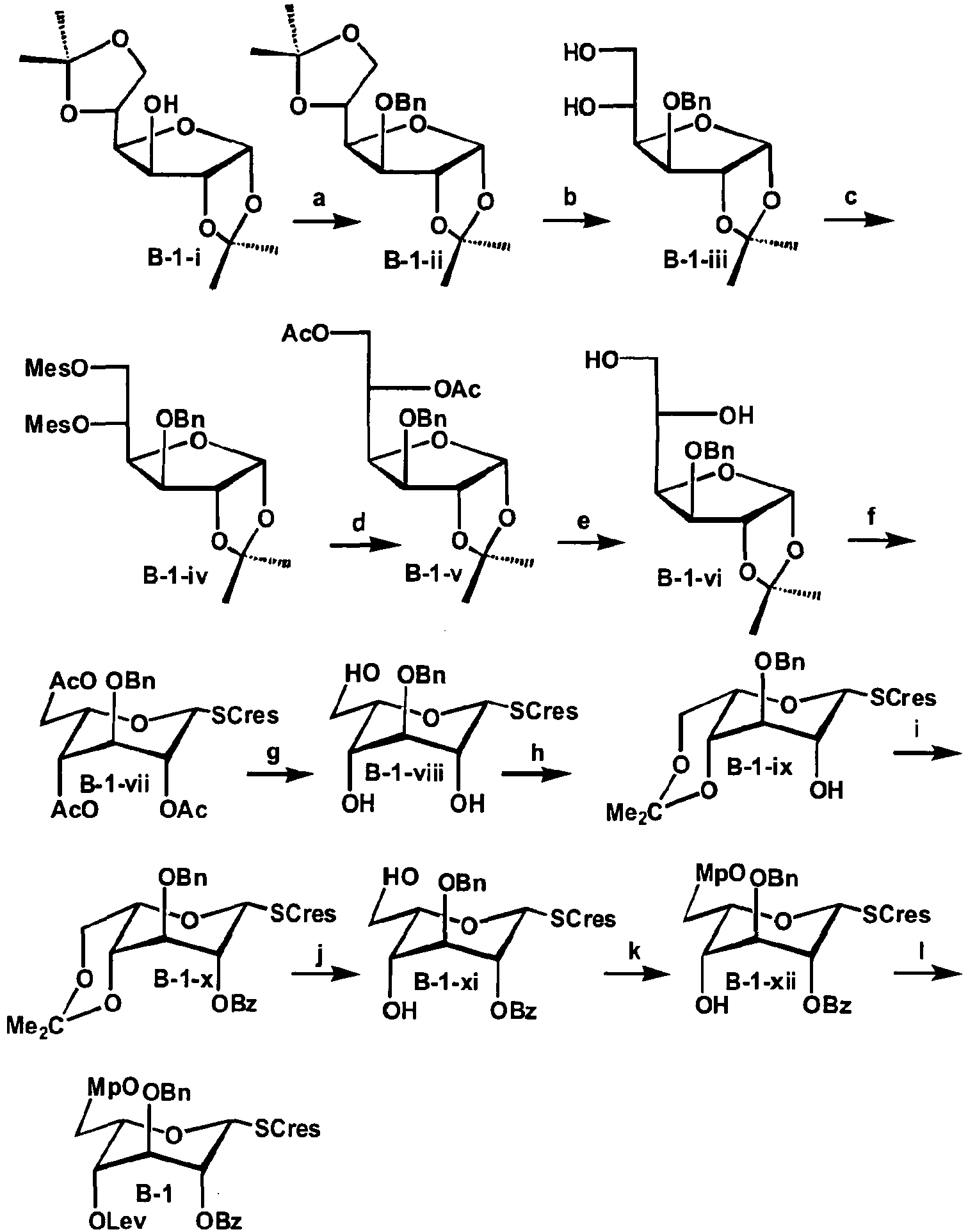
- Example 3: Synthesis of Building Block B-1, conditions: a) SOP 7, (95%); b) 60% aqueous Acetic acid, 60°C (90%); c) Methanesulfonyl chloride, Pyridine, 0°C-RT (87 %); d) Cesium Acetate, Ac2O, 120°C (95%); e) SOP 22, (92%); f) 1. 90% TFA, O°C; 2. Ac2O, Pyridine; 3. SOP 31, (73%, 3 steps); g) SOP 22, (98%); h) SOP 3, (92%); i) SOP 18, (98%); j) 80% acetic acid, 100°C (98%); k) SOP 26, (89%); I) SOP 23, (98%).
- B-1-ii (15.60 mmol) was dissolved in 60 % aqueous acetic acid (50 ml) and stirred at 60 °C until completion. After neutralization with solid NaHCO3, the mixture was evaporated and co evaporated with toluene. Crude B-1-iii was dissolved in CHCl3/H2O, the organic layer separated, dried over Na2SO4 and evaporated. The remaining residue was purified by a short silica gel chromatography to yield B-1-iii in 90 % (4.36 g).
- 17.72 mmol of B-1-iii was dissolved in 25 ml dry pyridine, to which mesyl chloride (methylsulfonyl chloride, 42.5 mmol) was added dropwise at 0°C. The mixture was stirred at 4°C until completion and was subsequently poured into warm water (50°C, 90 ml), cooled and the precipitate isolated by filtration. B-1-iv was obtained after drying in 87 % yield (7.19 g).
- B-1-iv (6.43 mmol) and cesium acetate (64.3 mmol) were suspended in 25 ml acetic anhydride and refluxed at 125 °C until completion. The reaction mixture was concentrated in vacuo, co evaporated with toluene and the residue extracted from ethyl acetate/H2O (1/1). The organic layer was collected and washed with saturated aqueous NaHCO3 solution and saturated brine solution, dried over Na2SO4 and evaporated. Purification was achieved by silica gel chromatography. Yield: 2.68 g (95 %).
- B-1-vi (5.61 mmol) was dissolved in aqueous TFA (90 %, 15 ml) and further stirred at 0°C until completion. The reaction mixture was neutralized with aqueous NaOH solution at 0°C, concentrated in vacuo and dried. The residue was suspended in 90 ml acetylation mixture (pyridine/acetic anhydride = 2/1) and 50 ml dichloromethane at 0°C and further stirred until completion. After concentration in vacuo and co evaporation with toluene, the residue was dissolved in ethyl acetate/H2O (1/1), the organic layer collected and washed with 10 % aqueous citric acid solution, saturated aqueous NaHCO3 solution and brine solution, dried over Na2SO4 and evaporated. The crude residue and p-thiocresol (6.0 mmol) were dissolved in 40 ml anhydrous dichloromethane and cooled to 0°C, reacted with BF3xOEt2 (8.41 mmol) and further stirred at rt until completion. The reaction was stopped with saturated NaHCO3 solution and the organic layer was washed with water, dried over Na2SO4 and evaporated. Final purification was achieved by silica gel chromatography to yield B-1-vii in 73 % over 3 steps.
- B-1-x (8.0 mmol) was dissolved in 80 % aqueous AcOH and heated at 100°C until completion. The mixture was cooled to rt, neutralized with solid NaHCO3 and dissolved in ethyl acetate/water (1/1). After removal of the aqueous layer, the organic layer was dried over MgSO4 and evaporated to dryness furnishing B-1-xi in 98 % yield.
- 1H-NMR (400 MHz, CDCl3): δ = 8.07 (d, 2H, Aryl), 7.57-7.30 (m, 10H, Aryl), 7.10 (d, 2 H, Aryl), 6.88-6.81 (m, 4H, Mp), 5.55 (d, 1H, J1,2 < 1.5 Hz,H-1β), 5.45 (m, 1H, H-2), 5.26 (ddd, 1H, H-5), 5.13 (m, 1H, H-4), 4.91 (d, 1H, Jgem= 12.1 Hz, OCH2), 4.78 (d, 1H, Jgem = 12.1 Hz, OCH2), 4.16 (dd, 1H, Jgem = 9.6 Hz, J5,6a = 7.6 Hz, H-6a), 4.08 (dd, 1H, J5,6b = 5.2 Hz, H-6b), 3.93 (m, 1H, H-3), 3.77 (s, 3H, OCH3), 2.58-2.36 (m, 4H, (CH2)2Lev), 2.32 (s, 3H, SCH3), 2.05 (s, 3H, CH3C=O).
-
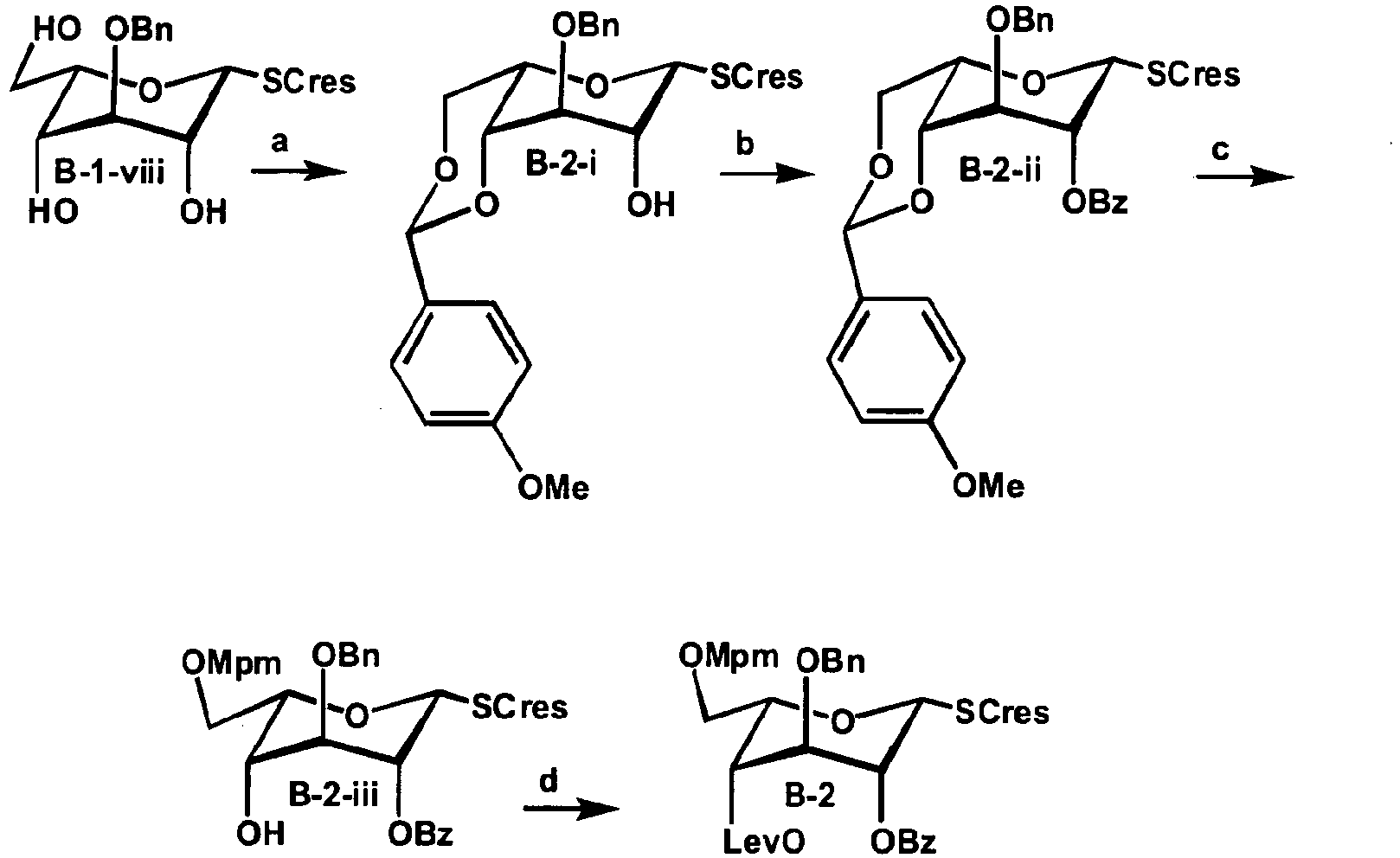
- Example 4: Synthesis of L-ido configured glycosyl donor B-2; a) SOP 2; b) SOP 18; c) SOP 5; d) SOP 23.
-

- Example 5: Synthesis of Building Blocks C-1, C-1a and C-1b, conditions: a) SOP 19; b) SOP 13, (78 %, 2 steps); c) SOP 8, (91 %); d) SOP 22; e) SOP 2, (85%, 2 steps for C-1-vi); f) SOP 18; g) SOP 5, (75 %, 2 steps for C-1).
- To methyl 2-azido-2-deoxy-1-thio-β-D-glucopyranoside. (10g, 42.50 mmol) in pyridine (50ml) at O°C was added acetic anhydride (20g) and the reaction stirred for 1 hour. The reaction mixture was evaporated to dryness and the residue extracted to give the title triacetate (15.23g, quantitative,), Rf=0.7 (CHCl3/Petroleum ethers, 1 :1).
- To a solution of methyl 3,4,6-tri-O-acetyl-2-azido-2-deoxy-1-thio-β-D-glucopyranoside (14.1g, 39 mmol) in wet acetone (200ml) was added NBS (3 equiv.). The resulting mixture was allowed b stir for 2h. The mixture was then quenched, concentrated and the residue purified by silica gel chromatography to give the title hemiacetal as an oil (10.1g, 78%), Rf = 0.5 (EtOAc/Petroleum ether, 1:1).
- A mixture of 2-azido-2-deoxy-β-D-glucopyranosyl tert-butyldiphenylsilane (5.5g,12.42 mmol), 4methoxybenzaldehyde dimethylacetal (4.4g, 24mmol), and 4-toluenesulphonic acid (100mg) in acetonitrile/DMF (200ml, 5:3) were heated at 60°C for 1 hour. The reaction mixture was then neutralized and evaporated to give the crude compound as an oil. The residue was purified by silica chromatography to give the product (6.7g, 96%, 85% from C-1-iv); Rf = 0.8 (dichloromethane/Petroleum ethers; 10:2).
- A mixture of DMAP (1.63g, 13.2 mmol) and benzoyl chloride (1.7g, 12.1mmol) and 2-azido-2-deoxy-4,6-O-(4-methoxybenzylidene)-β-D-glucopyranosyl tert-butyldiphenylsilane (6.7g, 11.9 mmol) in 1,2-dichloroethane (100mL) was stirred at 60°C for 1h. The reaction mixture was quenched, extracted, washed and concentrated to give a crude residue. The residue was passed through a plug of silica to give the product (5.5g, 69%); Rf = 0.7 (dichloromethane/Petroleum ethers; 4:1).
- To a mixture of 2-azido-2-deoxy-3-O-benzoyl-4,6-O-(4-methoxybenzylidene)-β-D-glucopyranosyl tert-butyldiphenylsilane (10g, 15mmol), sodiumcyanoborohydride (5g, 75.6 mmol) and molecular sieves in DMF (200mL) at 0°C was added trifluoroacetic acid (28g, 247mmol) at 0°C and then left to run overnight at rt. The reaction mixture was quenched, filtered and concentrated and the residue purified by column chromatography to give the title compound (7.0g, 70% ), Rf = 0.4 (ethylacetate/petroleum ethers, 3:7).
- 1H-NMR (400 MHz, CDCl3):δ = 8.08 (d, 2 H, Aryl), 7.72 (m, 4 H, Aryl), 7.59 (m, 1H, Aryl), 7.47 (m, 3 H, Aryl), 7.42 (m, 2 H, Aryl), 7.34 (m, 3 H, Aryl), 7.13 (d, 2 H, Mpm) 6.83 (d, 2H, Mpm), 4.96 (dd, 1H, J2,3 = J3,4 = 9.7 Hz, H-3), 4.53 (d, 1H, J1,2 = 7.6 Hz, H-1β), 4.37 (2d, 2 H, OCH2), 3.83 (ddd, 1H, H-4), 3.79 (s, 3 H, OCH3), 3.65 (dd, 1H, H-2), 3.53 (dd, 1H, Jgem= 10.8 Hz, J5,6a = 4.1 Hz, H-6a), 3.46 (dd, 1H, J5,6b = 4.1 Hz, H-6b), 3.12 (m, 1H, H-5), 3.02 (d, 1H, J4,OH = 3.5 Hz, 4-OH), 1.12 (s, 9 H, C(CH3)3).
-

- Example 6: Synthesis of Building Block C-2, conditions: a) SOP 1, (90% for R=SMe); b) SOP 18, (87% for R=SMe); c) SOP 4, p-TosOH, MeOH, CH3CN (86% for R=SMe); d) SOP 17, (92% for R=SMe); e) SOP 13, (94%); f) SOP 8, (82%).
- 1H-NMR (400 MHz, CDCl3): δ=8.09 (d, 2 H, Aryl), 7.97 (d, 2 H, Aryl), 7.72 (m, 4 H, Aryl), 7.60 (m, 1H, Aryl), 7.50-7.27 (m, 11 H, Aryl), 4.98 (dd, 1H, J2,3 ≈ J3,4 = 9.7 Hz, H-3), 4.58 (d, 1H, J1,2 = 7.8 Hz, H-1β), 4.51 (dd, 1H, Jgem = 11.3 Hz, J5,6a = 4.7 Hz, H-6a), 4.36 (dd, 1H, J5,6b = 2.2 Hz, H-6b), 3.72-3.68 (m, 2 H, H-2, H-4), 3.31 (m, 1H, H-5), 3.23 (d, 1H, J4,OH = 4.5 Hz, 4-OH), 1.13 (s, 9 H, C(CH3)3).
-

- Example 7: Synthesis of several carbamoylated building blocks C-3a to C-3d and C-4a to C-4d, containing a 6-O-benzoyl or 6-O-p-methoxybenzyl protection, conditions: a) R = MeO: SOP 2; R = H: SOP 1, (82 %, R1 = SCres, R = H); b) SOP 30, (87 %, R1 = SCres, R = H); c) SOP 29, (95 %, R1 = Scres, R = H); d) SOP 4, (72 %, R1 = SCres); e) SOP 17, (85 %); f) SOP 5.
- 1H-NMR (400 MHz, CDCl3): δ = 8.06 (d, 2 H, Aryl), 7.62 (m, 1H, Aryl), 7.48 (t, 2 H, Aryl), 7.38 (d, 2 H, Aryl), 6.97 (d, 2 H, Aryl), 5.06 (bs, 1H, NH), 4.79 (dd, 1H, Jgem = 12.0 Hz, J5,6a= 3.6 Hz, H-6a), 4.70 (d, 1H, J1,2= 9.2 Hz, H-1β), 4.63 (dd, 1H, J5,6b = 2.0 Hz, H-6b), 4.18 (dd, 1H, J2,3 ≈ J3,4 = 10.4 Hz, H-3), 3.89 (dd, 1H, J4,5 = 9.2 Hz, H-4), 3.72 (m, 1H, H-5), 3.23 (ddd, 1H, H-2), 3.12 (bs, 1H, 4-OH), 2.29 (s, 3H, SCH3).
-

- Example 8: Synthesis of several 6-OMp and cyclic 2,3-carbamoyl protected building blocks C-5a to C-5c, conditions: a) SOP 18, (92 % for R1 = OTBDPS); b) SOP 4, (82 %); c) SOP 26, (75 % for R1 = OTBDPS); d) SOP 30, (87 %); e) SOP 29, (95 %).
- 1H-NMR (400 MHz, CDCl3): δ= 7.69 (m, 2 H, Aryl), 7.63 (m, 2H, Aryl), 7.46-7.31 (m, 6H, Aryl), 6.82 (bs, 4H, Mp), 5.04 ( bs, 1H, NH), 4.78 (d, 1H, J1,2 = 7.6 Hz, H-1β), 4.15-4.10 (m, 3H, H's not assigned), 3.97 (dd, 1H, J =11.6 Hz, J = 9.6 Hz, H not assigned), 3.78 (s, 3H, OMe), 3.56 (m, 1H, H not assigned), 3.48 (m, 1H, H not assigned), 2.80 (bs, 1H, 4-OH), 1.08 (s, 9H, C-(CH3)3).
-

- 1H-NMR (400 MHz, CDCl3): δ=7.43 (d, 2 H, Aryl), 7.25 (m, 4 H, Aryl), 7.08 (d, 2 H, Aryl), 6.88 (m, 4 H, Aryl), 4.81 (d, 1H, Jgem = 10.8 Hz, OCH2), 4.74 (d, 1 H, Jgem = 10.8 Hz, OCH2), 4.53 (d, 1H, Jgem = 11.1 Hz, OCH2), 4.48 (d, 1H, Jgem = 10.8 Hz, OCH2), 4.35 (d, 1H, J1,2 = 10.0 Hz, H-1β), 3.82 (s, 3 H, OCH3), 3.79 (s, 3 H, OCH3), 3.76 (dd, 1H, Jgem = 10.5 Hz, J5,6a = 5.4 Hz, H-6a), 3.70 (dd, 1H, J5,6b = 5.4 Hz, H-6b), 3.56 (ddd, 1H, H-4), 3.42 (m, 1H, H-5), 3.34 (dd, 1H, J3,4 = 8.8 Hz, H-3), 3.24 (dd, 1H, J2,3 = 9.4 Hz, H-2), 2.72 (d, 1H, J4,OH = 3.5 Hz, 4-OH), 2.38 (s, 3 H, SCH3).
- 1H-NMR (400 MHz, CDCl3): 7.63 (d, 4 H, Aryl), 7.35-7.21 (m, 8H, Aryl), 7.08 (m, 2 H, Aryl), 6.83-6.78 (m, 4 H, Aryl), 4.72 (d, 1H, Jgem = 11.0 Hz, OCH2), 4.59 (d, 1H, Jgem = 11.0 Hz, OCH2), 4.29 (d, 1H, J1,2 = 7.8 Hz, H-1β), 4.27 (d, 1H, Jgem = 11.7 Hz, OCH2), 4.21 (d, 1H, Jgem = 11.7 Hz, OCH2), 3.72 (s, 3 H, OCH3), 3.71 (s, 3 H, OCH3), 3.51 (ddd, 1H, J3,4 = J4,5 = 8.6 Hz, H-4), 3.40-3.32 (m, 3 H, H-6a, H-6b, H-2), 3.05 (dd, 1H, J2,3 = 9.8 Hz, H-3), 2.90 (m, 1H, H-5), 2.51 (d, 1H, J4,OH = 2.2 Hz, 4-OH), 1.12 (s, 9 H, C(CH3)3).
-

- Example 10: Synthesis of building blocks C-8a to C-8c, conditions: a) SOP 7, AlIBr, DMF (65 %, R=OTBDPS); b) SOP 4, (86 %, R=OTBDPS); c) SOP 26, (70 %, R=OTBDPS); d) SOP-30; e) SOP 12, (70 %, 2 steps for R=OTBDPS).
- 1H-NMR (400 MHz, CDCl3): δ = 7.72 (m, 4 H, Aryl), 7.43-7.16 (m, 6 H, Aryl), 6.76 (m, 4H, Mp), 5.96 (m, 1H, =CH Allyl), 5.31 (m, 1H, =CH Allyl), 5.22 (m, 1H, =CH Allyl), 4.42 (d, 1H, J1,2 = 7.6 Hz, H-1β), 4.39 (m, 1H, OCH2 Allyl), 4.23 (m, 1H, OCH2 Allyl), 3.97 (dd, 1H, Jgem = 10.0 Hz, J5,6a = 3.6 Hz, H-6a), 3.92 (dd, 1H, J5,6b = 5.2 Hz, H-6b), 3.77 (s, 3 H, OCH3), 3.66 (ddd, 1H, J4,5 = J3,4 = 9.4 Hz, H-4), 3.42 (dd, 1H, J = 9.8 Hz and J = 7.8 Hz, H not assigned), 3.22 (m, 1H, H-5), 3.09 (dd, 1H, J = 8.4 Hz and J = 9.6 Hz, H not assigned), 2.48 (d, 1H, J4,OH = 2.8 Hz, 4-OH), 1.12 (s, 9 H, C(CH3)3).
-

- Example 11: Synthesis of building block D-1; a) SOP 1, (95 %); b) SOP 7, (85 %); c) SOP 13, (92 %); d) SOP 8; e) SOP 4, (70 %, 2 steps); f) 1. SOP 15; 2. SOP 16, (75 %, 2 steps).
- 1H-NMR (400 MHz, CDCl3): δ = 7.72 (m, 4 H, Aryl), 7.41 (m, 2 H, Aryl), 7.32 - 7.25 (m, 14 H, Aryl), 5.04 (d, 1H, Jgem = 11.0 Hz, OCH2), 4.81 (m, 3 H, OCH2), 4.63 (d, 1H, J1,2 = 7.4 Hz, H-β), 3.88 (ddd, 1H, J3,4 ≈ J4,5 = 9.2 Hz, H-4), 3.70 (s, 3 H, OCH3), 3.53 (dd, 1H, J = 7.5 Hz, J = 9.0 Hz, H not assigned), 3.47 (d, 1H, J4,5 = 9.8 Hz, H-5), 3.42 (dd, 1H, J = 8.9 Hz and J = 8.9 Hz, H not assigned), 2.87 (d, 1H, J4,OH = 2.4 Hz, 4-OH), 1.11 (s, 9 H, C(CH3)3).
-
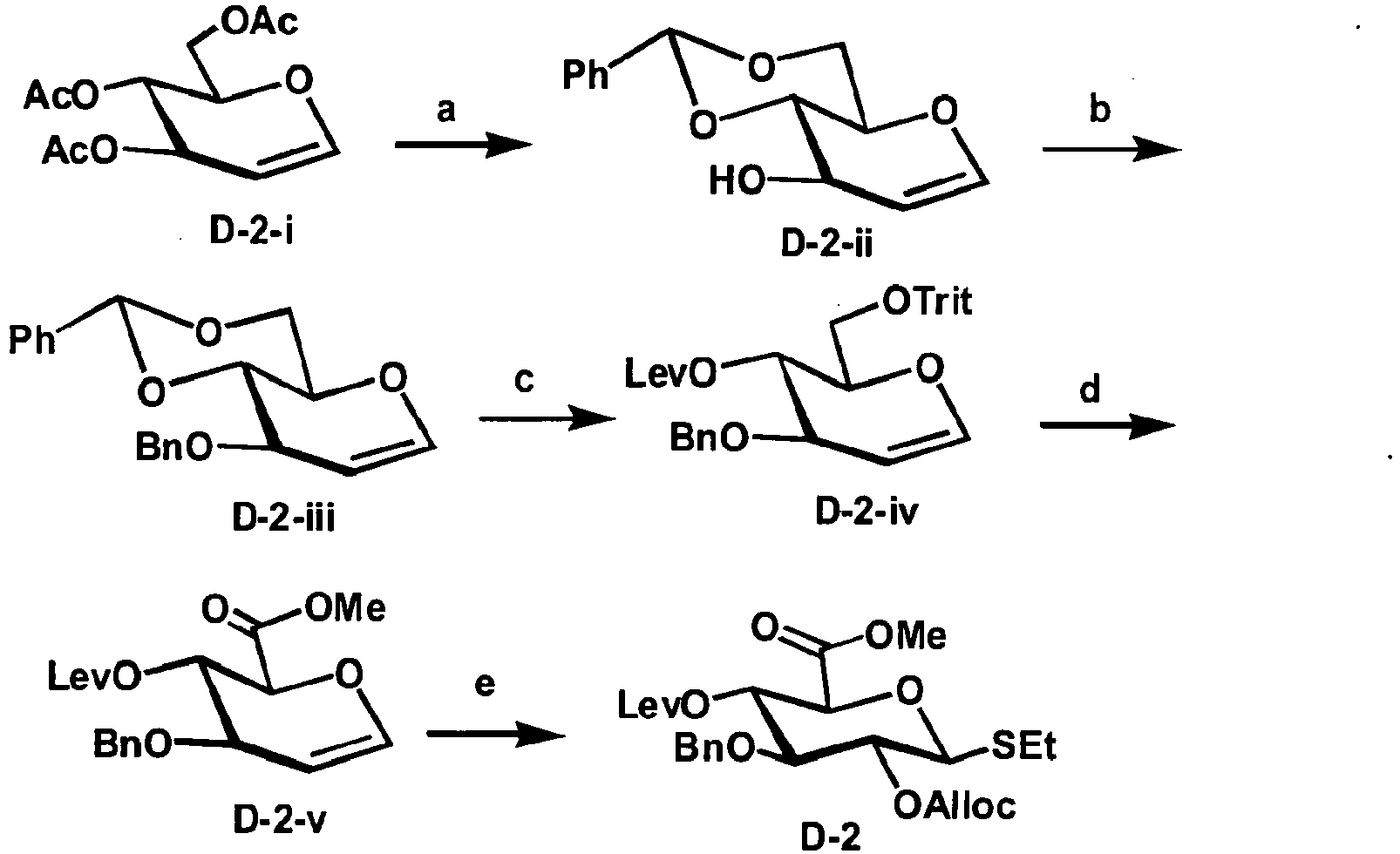
- Example 12: Synthesis of Building Block D-2, conditions: a) 1. SOP 22; 2. SOP 1; b) SOP 7; c) 1. SOP 4; 2. TritCl, Pyridine, (ClCH2)2; 3. SOP 23; d) 1. CrO3, H2SO4, Acetone, 0°C, 2. SOP 16; e) 1. Dimethyl dioxirane, Acetone; 2. EtSH, TFAA, CH2Cl2, 3. SOP 35.
-

- Example 13: Synthesis of Building Block D-3, conditions: a) 1. SOP 4, Amberlite IR 120, H2O, 80°C; 2. SOP 18, (85 %, 2 steps) b) 1. SOP 21; 2. SOP 8, (70 %, 2 steps); c) SOP 22, (96 %); d) 1. SOP 15; 2. SOP 16, (80 %, 2 steps); e) SOP 23, (92 %); f) SOP 9, (95 %); g) SOP 25a, (91 %).
- The starting material (57 mmol) and Amberlite IR 120 iron exchange resin (H+-form, 20 g) were suspended in water (180 ml) and stirred at 80 °C until completion. The iron exchange resin was removed by filtration and extracted with water The combined aqueous layers were neutralized with triethyl amine and freeze dried.
- 1H-NMR (400 MHz, CDCl3): δ = 7.95 (m, 2 H, Aryl), 7.68 (m, 2 H, Aryl), 7.58 - 7.12 (m, 16 H, Aryl), 5.47 (dd, J1,2 = 7.6 Hz, J2,3 = 9.6 Hz, H-2), 5.31 (dd, J3,4 = 9.6 Hz, H-4), 4.64 (d, 1H, 7.6 Hz, H-1β), 4.60 (d, 1H, Jgem = 12.0 Hz, OCH2), 4.55 (d, 1H, Jgem = 12.0 Hz, OCH2), 3.74 (dd, 1H, H-3), 3.70 (s, 3H, OCH3), 3.63 (d, 1H, J4,5 = 9.6 Hz, H-5), 2.68 - 2.16 (m, 4H, (CH2)2-Lev), 2.15 (s, 3H, CH3), 0.96 (s, 9H, C(CH3)3).
-

- Example 14: Syntheses of D-4 to D-7 as donor sugars, conditions: a) 1. Dimethyl dioxirane, Acetone; 2. TBAF, THF; 3. SOP 35; b) 1. Dimethyl dioxirane, Acetone; 2. 4-penten-1-ol, ZnCl2, CH2Cl2; 3. SOP 35; c) 1. Dimethyl dioxirane, Acetone; 2. ArSH, TFAA, CH2Cl2, (Ar = Ph, p-Tol); 3. SOP 35 or (ClAc)2O, Pyridine, CH2Cl2 (for D-6b); d) MCPBA, CH2Cl2 (for D-6b as substrate).
-

- Example 15: Synthesis of Building Block E-1 to E-4, conditions: a) SOP 8; b) SOP 7; c) SOP 9, (84% over 3 steps, R=SMe); d) SOP 18, (82%, R=SMe); e) 1. SOP 13, (75%, for E-1-iv-a as starting material); 2. SOP 25b, (88%); f) 1. TosCl, Pyridine; 2. p-MeO-C6H4-ONa, NMP, 60°C; g) SOP 7, (78 %, R=SMe); h) 1. SOP 14; 2. SOP 25b, (79 %, 2 steps, R=SMe).
- A mixture of methyl 2-azido-2-deoxy-thio-fi-Drglucopyranoside (10g, 42.5mmol) and imidazole (4.9 g, 71.25 mmol) in 20 mL DMF was treated with tert-butyidiphenylchlorosilane (11.6mL, 44.63mmol) for 2h. The reaction mixture was concentrated, extracted, washed and dried. yield: 23g (crude light yellow syrup), Rf = 0.74 (CHC3/methanol = 9/1).
- The silyl ether from the previous step in 50 mL DMF, was treated with 2.68g of 95% NaH (106.25 mmol) and 12.64 mL (106.25 mmol) of benzyl bromide at 0 °C. After 1h the excess NaH was quenched and the reaction concentrated, extracted, washed and concentrated to afford a yellow syrup yield: 28.5g (crude yellow syrup), Rf = 0.80 (hexane/ethyl acetate =7/3).
- The crude yellow syrup from the above reaction was treated with 36.5 mL AcOH and 106.3 mL (106.25 mmol) of 1 M solution of TBAF in THF overnight. The reaction was concentrated and purified by chromatography to afford the title compound. 14.9g (84%, 3 steps) Rf=0.36 (petroleum spirit/ethyl acetate = 7/3)
- Methyl 2-azido-2,3 di-O-benzyl-2-deoxy-thio-β-D-glucopyranoside (14.5 g, 34.9 mmol) in dichloromethane (200 ml) and anhydrous pyridine (8.6 ml, 106.2 mmol) was treated with benzoylchloride (4.93 ml, 42.5 mmol) at 0°C for 1 hour. The reaction mixture was quenched, extracted, washed and evaporated. The residue was purified by silica gel column chromatography to afford the title compound as a white solid.
Yield: 14.9 g (82 %), Rf = 0.82 (Petroleum spirit/Ethyl acetate = 7/3). - Methyl 2-azido-6-O-benzoyl-2,3di-O-benzyl-2-deoxy-thio-? -D-glucopyranoside (8.68 g, 16.7 mmol) in acetone (50 ml) was treated with N-bromosuccinimide (8.92 g, 50.12 mmol) at 0°C for 1 hour. The reaction mixture was then quenched, extracted, washed and evaporated, furnishing a yellow syrup which was purified by chromatography. Yield: 6.13 g (75%), Rf = 0.57 (Petroleum spirit/Ethyl acetate = 7/3). A cooled mixture of 2-azido-6-O-benzoyl-2,3 di-O-benzyl- 2-deoxy-α/β-glucopyranose (5g, 10.2 mmol), K2CO3 (7.0 g , 51 mmol) and trichloroacetonitrile (5.1 ml, 51 mmol) in 30 ml of dichloromethane was stirred for 2h. The mixture was then filtered through celite and the filtrate was concentrated and purified on a short column of silica gel to obtain the title compound as an amorphous white solid. Yield 5.69 g (88%), Rf = 0.85 (Petroleum spirit/Ethyl acetate = 7/3).
- 1H-NMR (400 MHz, CDCl3): δ=8.73 (s, 1H, C=NH), 8.00 (m, 2 H, Aryl), 7.56 (m, 1H, Aryl), 7.43-7.25 (m, 12 H, Aryl), 5.66 (d, 1H, J = 8.4 Hz, H-1β), 4.95 (d, 1H, Jgem = 10.8 Hz, OCH2), 4.87 (d, 2H, J = 10.8 Hz , OCH2), 4.62 (d, 2H, Jgem = 10.8 Hz, OCH2), 4.58 (dd, 1H, Jgem = 12.4 Hz, J5,6a = 2.0 Hz, H-6a), 4.46 (dd, 1H, J5,6b = 3.6 Hz, H-6b), 3.77-3.72 (m, 3H, H-5, 2H not assigned), 3.62 (dd, 1H, J = 8.3 Hz, J = 9.7 Hz, H not assigned).
- 1H-NMR (400 MHz, CDCl3): δ = 8.70 (s, 1H, C=NH), 7.38-7.22 (m, 10H, Aryl), 7.13 (m, 2H, Aryl), 6.83 (d, 2H, Mpm), 6.44 (d, 1H, J1,2 = 3.5 Hz, H-1α), 4.93 (d, 1H, Jgem = 10.5 Hz, OCH2), 4.89 (d, 1H, Jgem = 10.5 Hz, OCH2), 4.78 (d, 1H, Jgem = 10.5 Hz, OCH2), 4.57 (d, 1H, Jgem = 11.7 Hz, OCH2), 4.51 (d, 1H, Jgem = 11.7 Hz, OCH2), 4.39 (d, 1H, Jgem = 11.7 Hz, OCH2), 4.02 (dd, 1H, J3,4 = J2,3 = 9.5 Hz, H-3), 3.98 (m, 1H, H-5), 3.86 (dd, 1H, J4,5 = 9.6 Hz, H-4), 3.76 (dd, 1H, H-2), 3.75 (s, 3H, OCH3), 3.69 (dd, 1H, J5,6a = 3.5 Hz, Jgem = 10.5 Hz, H-6a), 3.63 (dd, 1H, J5,6b = 1.8 Hz, H-6b).
-

- Example 16: Syntheses of Building Blocks E-5 to E-8, conditions: a) SOP 6, (85 %, R=SMe); b) SOP 30, (86 %, R=SMe); c) SOP 10, (88 %, R=SMe); d) SOP 18, (92 %, R=SMe); e) 1. SOP 13; 2. SOP 25b, (85 %, 2 steps, R=SMe); f) SOP 7; g) 1. SOP 14; 2. SOP 25b; h) 1. TsCl, DMF; 2. p-MeO-C6H4-ONa, NMP, 60°C; i) SOP 8.
- 1H-NMR (400 MHz, CDCl3): δ = 10.20 (dd, 1H, JNH,=C-H = 14.0 Hz, JNH,H-2 = 9.9 Hz, NH), 8.80 (s, 1H, C=NH), 8.16 (d, 1H, =C-H), 7.99 (m, 2H, Aryl) 7.58 (m, 1H, Aryl), 7.45 (m, 2 H, Aryl), 7.30-7.17 (m, 10H, Aryl), 6.42 (d, 1H, J1,2 = 3.6 Hz, H-1α), 4.89 (d, 1H, Jgem = 8.4 Hz, OCH2), 4.68-4.60 (m, 3H, OCH2), 4.58 (dd, 1H, J5,6a = 2.0 Hz, Jgem = 12.4 Hz, H-6a), 4.51 (dd, 1H, J5,6b = 4.0 Hz, H-6b), 4.22 (m, 1H, H-5), 4.03 (dd, 1H, J3,4 = J2,3 = 9.6 Hz, H-3), 3.80 (dd, 1H, J4,5 = 9.4 Hz, H-4), 3.70 (ddd, 1H, H-2), 3.32 (s, 3 H, NCH3), 3.25 (s, 3 H, NCH3).
-

- Example 17: Preparation L-iduronic acid containing disaccharides B-A-1 to B-A-10; a) SOP 32a, (76 %, for B-A-1); b) SOP 27, (88 %, for B-A-5); c) 1.SOP 20; 2. SOP 16, (84 % for B-A-7, 2 steps); d) SOP 24, (94 %, for B-A-9).
- A suspension of A-1 (410 mg, 992 µmol), B-1 (680 mg, 992 µmol) and freshly activated molecular sieves 4 Å (1.0 g) in dry CH2Cl2 (20 mL) was stirred for 90 min at 0°C. N-lodosuccinimide (405 mg, 1.8 mmol) was added and stirring continued for 20 min. After addition of trifluoromethanesulfonic acid (10.6 µl, 119.7 µmol), the reaction mixture was further stirred until completion (from 0°C to 25 °C) and quenched with aqueous NaHCO3-solution (10 %). The mixture was diluted with CH2Cl2 and filtered through a celite pad. The filtrate was washed with a 10 % KHCO3/Na2S2O3 solution, water and saturated brine solution, dried over MgSO4 and evaporated. Final purification was achieved by silica gel column chromatography. Yield: 730 mg (76 %).
- Disaccharide B-A-5 (1.00 g, 1.15 mol) was dissolved in anhydrous DMF (7.0 ml) and reacted with pyridinium dichromate (4.33 g, 11.5 mmol) under stirring at room temperature until complete conversion into the uronic acid. The reaction mixture was subsequently poured into 50 ml water and the whole extracted with diethyl ether. The combined ether layers were washed with 10 % aqueous citric acid solution, filtered through a short silica gel pad, dried over MgSO4, evaporated and dried under high vacuum. The crude residue was dissolved in Toluene (3 ml) and methanol (3 ml) and titurated with TMSCHN2 solution (2M in hexane) until completion. The excess of TMSCHN2 was destroyed by addition of acetic acid and the mixture evaporated. Final purification was achieved via silica gel chromatography. Yield: 871 mg (84 %).
- 1H-NMR (400 MHz, CDCl3): δ = 8.03 (m, 2H, Aryl), 7.91 (m, 2H, Aryl), 7.53 (m, 2H, Aryl), 7.42-7.23 (m, 14H, Aryl), 5.37 (d, 1H, J1,2 < 1.5 Hz, H-1'α), 5.21 (m, 1H, H-2'), 4.97 (d, 1H, J4,5 = 2.3 Hz, H-5'), 4.84 (d, 2H, Jgem = 10.8 Hz, OCH2), 4.81 (d, 1H, Jgem = 10.8 Hz, OCH2), 4.80 (d, 1H, J1,2 = 3.6 Hz, H-1α), 4.77 (1H, J5,6a = 1.8 Hz, H-6a), 4.70 (m, 2H, OCH2), 4.47 (dd, 1H, J5,6b = 4.2 Hz, Jgem = 12.3 Hz, H-6b), 4.05-3.97 (m, 3H, H4', H-4, H-5), 3.91-3.87 (m, 2H, H-3', H-3), 3.49 (s, 3H, OCH3), 3.44 (m, 1H, H-2), 3.43 (s, 3H, OCH3).
Selected 13C-NMR (100 MHz, CDCl3): δ = 98.73 C-1 (JCH = 172.5 Hz), 98.35 C-1' (JCH = 171.8 Hz). -

- Example 18 : Syntheses of disaccharides E-D-1 to E-D-12, conditions: a) SOP 32 a/b for X =SMe/ Scres or SOP 33 for X = OTCA, (88 % for E-D-1 via E-1, 84% for E-D-4 via E-5, as α/β mixtures), b) 1. SOP 9; 2. SOP 25a, (90 % for E-D-7 over 2 steps).
- A mixture of 2-azido-6-O-benzoyl-2,3 di-O-benzyl- 2-deoxy-α/β-D-glucopyranosyl trichloroacetimidate (2.5 g, 3.94 mmol), and methyl (tert-butyldiphenylsilyl 2,3-di-O-benzyl-β-D-glucopyranoside) uronate (1.6 g, 2.55 mmol) and molecular sieves 4A (2.5 g) in 50 ml diethyl ether was treated with TBDMSOTf (180 µl, 788.76 µmol) at -20°C for 1h. The reaction was quenched filtered, concentrated and the residue purified by silica gel column chromatography to obtain the desired disaccharide 2.48 g, 88%. Rf= 0.67 (toluene/ethyl acetate 9/1)
- E-D-1 was formed according to SOP 33 with ether as solvent at -30°C and TBDMSOTf as promotor in 86 % yield (α/β-mixture).
1H-NMR (400 MHz, CDCl3): δ = 8.00 (m, 2H, Aryl), 7.68 (m, 4H, Aryl), 7.56 (m, 1H, Aryl), 7.42 (m, 4H, Aryl), 7.36-7.17 (m, 24H, Aryl), 5.47 (d, 1H, J1,2 = 3.8 Hz, H-1'α), 5.02 (d, 1H, Jgem = 11.4 Hz, OCH2), 4.97 (d, 1H, Jgem = 11.0 Hz, OCH2), 4.84 (m, 4H, OCH2), 4.75 (d, 1H, Jgem = 11.4 Hz, OCH2), 4.66 (d, 1H, J1,2 = 7.5 Hz, H-1β), 4.57 (d, 1H, Jgem = 10.9 Hz, OCH2), 4.45 (m, 2H, H-6'a, H-6'b), 4.15 (dd, J = 8.8 Hz and J = 9.6 Hz), 3.86 (m, 1H), 3.65 (s, 3H, OCH3, 3.68-3.58 (m, 3H), 3.55 (d, 1H, J4,5 = 10.0 Hz, H-5), 3.31 (dd, 1H, J2,3 = 10.2 Hz, H-2'), 1.12 (s, 9H, C(CH3)3). - E-D-4 was formed according to SOP 33 with ether as solvent at -30°C and TBDMSOTf as promotor in 84 % yield (α/β-mixture).
- Selected 1H-NMR (400 MHz, CDCl3): δ = 10.02 (dd, 1H, JNH,=C-H = 14.4 Hz, JNH,H-2 = 9.6 Hz, N-H), 8.02 (m, 2 H, Aryl), 7.79 (d, 1H, =C-H), 7.72-6.93 (m, 33 H, Aryl), 5.60 (d, 1H, J1,2 = 3.6 Hz, H-1'α), 4.49 (d, 1H, J1,2 = 7.8 Hz, H-1β), 3.66 (s, 3 H, OCH3), 3.29 (s, 3 H, NCH3), 3.28 (s, 3 H, NCH3), 1.14 (s, 9 H, C(CH3)3).
- A solution of methyl (2-azido-6-O-benzoyl-3,4-di-O-benzyl-2-deoxy-α-D-glucopyranosyl)-(1→4)-tert-butyldiphenylsilyl 2,3-di-O-benzyl-β-D-glucopyranoside) uronate (2.09 g, 1.90 mmol) in acetic acid (1.74 ml, 30.45 mmol) and 1 M solution of tetrabutylammoniumfluoride (7.6 ml, 7.61 mmol) was stirred at room temperature overnight. The reaction mixture was then concentrated and the residual syrup was purified by silica gel column chromatography to obtain the desired hemiacetal. Yield: 1.57 g (95.8%), Rf= 0.21 (toluene/ethyl acetate 9/1).
- A mixture of methyl (2-azido-6-O-benzoyl-3,4-di-O-benzyl-2-deoxy-α-D-glucopyranosyl)-(1→4)-2,3-di-O-benzyl-di-D-glucopyranosyl)uronate (594 mg, 690.70 µmol), trichloroacetonitrile (280 µl, 2.74 mmol) and DBU (31 µl, 209.3 µmol) in 8.0 ml dichloromethane was stirred at 0°C for 1 h. The mixture was then concentrated and purified on a short column of silica gel to obtain the title compound as an amorphous white solid. Yield: 662 mg (95.3 %), Rf= 0.46 (toluene/ethyl acetate 9/1).
- Selected 1H-NMR (400 MHz, CDCl3): δ= 8.68 (s, 1H, C=NH), 8.00 (m, 2H, Aryl), 7.56 (m, 2H, Aryl), 7.43-7.23 (m, 22H, Aryl), 6.48 (d, 1H, J1,2 = 4.3 Hz, H-1α), 5.59 (d, 1H, h1,2 = 3.6 Hz, H-1'α), 5.03 (1H, Jgem = 10.8 Hz, OCH2), 4.93-4.83 (m, 4H, OCH2), 4.70 (d, 1H, Jgem= 12.0 Hz, OCH2), 4.64 (d, 1H, Jgem = 12.0 Hz, OCH2), 4.60 (d, 1H, Jgem= 11.2 Hz, OCH2), 4.47 (m, 2H, H-6'a, H-6'b), 4.42 (m, 1H, not assigned), 4.15 (m, 2H, not assigned), 3.97 (dd, 1H, J = 8.2 Hz and J = 10.2 Hz, not assigned), 3.80 (m, 1H, not assigned), 3.76 (m, 3H, OCH3), 3.72-3.64 (m, 2H, not assigned), 3.30 (dd, 1H, J2,3 = 10.4 Hz, H-2').
-

- Example 19: Syntheses of disaccharides E-D-13 to E-D-44, conditions: a) SOP 32 a/b for X = SMe/ Scres or SOP 33 for X = OTCA (70 % for E-D-23, α/β mixture); b) 1. SOP 9; 2. SOP 25a.
- Selected 1H-NMR (400 MHz, CDCl3): δ= 7.58 (m, 2H, Aryl), 7.54 (m, 2H, Aryl), 7.36 - 7.00 (m, 23 H, Aryl), 6.73 (m, 2H, Aryl), 5.37 (d, 1H, J1,2 = 3.9 Hz, H-1'α), 5.12 (dd, 1H, J2,3 = 8.8 Hz, H-2), 4.63 (d, 1H, Jgem = 11.2 Hz, OCH2), 4.58 (d, 1H, Jgem = 11.2 Hz, OCH2), 4.48 (d, 1H, J1,2 = 7.3 Hz, H-1β), 3.66 (s, 3 H, OCH3), 3.55 (s, 3 H, OCH3), 3.34 (m, 1H), 3.22 (dd, 1H, J = 3.4 Hz, J = 10.7 Hz), 1.81 (s, 3 H, OAc), 0.98 (s, 9H, C(CH3)3).
-

- Example 20: Synthesis of alternative E-D-disaccharides E-D-45 to E-D-50, conditions: a) SOP 32a/b for X = SMe/SCres or SOP 33 for X = OTCA, diethyl ether, TBDMS-OTf, -20 deg. C (75 % for E-D-45 as α/β-mixture).
-

- Example 21: Synthesis of trisaccharide E-D-C-1 to E-D-C-16, conditions: a) SOP 33, (70 % for E-D-C 15 as an α/β mixture).
- E-D-C-15 was formed according to SOP 33 with dichloromethane as solvent at 0 to 20°C and TBDMSOTf as promotor in 70 % yield (α/β-mixture).
1H-NMR (400 MHz, CDCl3): δ = 7.93 (m, 2H, Aryl), 7.87 (m, 2H, Aryl), 7.66 (m, 2H, Aryl), 7.61 (m, 2H, Aryl), 7.46 (m, 2H, Aryl), 7.38-6.99 (m, 32 H, Aryl), 6.79 (m, 2H, Aryl), 5.27 (d, 1H, J1,2 = 3.8 Hz, H-1"α), 4.99 (dd, 1H, J3,4 = J2,3 = 9.5 Hz, H-3), 4.80-4.69 (m, 6 H, OCH2), 4.52 (m, 3 H, OCH2), 4.40 (d, 1H, J1,2 = 8.0 Hz, H-1β), 4.38-4.32 (m, 2 H, not assigned), 4.29 (d, 1H, J1,2 = 7.5 Hz, H-1'β), 4.15 (m, 1H, Jgem = 12.0 Hz, OCH2), 4.02 (dd, 1H, J4,5 = 9.6 Hz, H-4), 3.80 (2 dd, 2 H, H3", H-4'), 3.71, (s, 3 H, OCH3), 3.67 (m, 1H, not assigned), 3.61-3.53 (m, 2 H, H-5', H-2'), 3.46 (dd, 1H, Jgem = 11.2 Hz, J5,6a = 2.4 Hz, H-6a), 3.41 (dd, 1H, J2,3 = J3,4 = 9.0 Hz, H-3'), 3.27 (s, 3 H, OCH3), 3.21 (dd, 1H, J2,3 = 10.0 Hz, H-2"), 3.14 (dd, 1H, H-2'), 3.00 (dd, 1H, J5,6b <2.0 Hz, H-6b), 2.75 (m, 1H, H-5) 1.05 (s, 9H,C(CH3)3). -

- Example 22: Synthesis of trisaccharide E-D-C-17 to E-D-C-32, conditions: a) SOP 33.
-

- Example 23: Formation of trisaccharidic Trichloroacetimidates E-D-C-33 to E-D-C-48, conditions: a) 1. SOP 9; 2. SOP 25, (82% over 2 steps for E-D-C-47
-

- Example 24: Syntheses of trisaccharides E-D-C-9 to E-D-C-12 and E-D-C-49 to E-D-C-60, conditions: a) 1. SOP 33; 2. SOP 24; b) SOP 33. (for D-C-5: 70 %, 2 steps); b) SOP 33, (78 % for E-D-C-9 as an α/β mixture).
- D-C-5 was formed according to SOP 33 with ether as solvent at -20°C and TMSOTf as promotor, followed by SOP 24 in 70 % yield (over 2 steps as α/β-mixture).
Selected 1H-NMR (400 MHz in CDCl3): δ = 7.88 (m, 2H, Ar), 7.67- 7.58 (m, 5H, Ar), 7.42 (m, 2H, Ar), 7.37-7.12 (m, 16H, Aryl), 6.84 (m, 3H, Ar), 5.14 (dd, 1H, J1,2 = 8.2 Hz, J2,3 = 9.5Hz, H-2'), 4.90 (d, 1H, Jgem = 10.7 Hz, OCH2), 4.73 (d, 1H, Jgem = 11.5 Hz, OCH2), 4.65 (d, 1H, J1,2 = 8.2 Hz, H-1'β), 4.63-4.58 (m, 2 H, OCH2), 4.51 (d, 1H, Jgem= 12.0 Hz, OCH2), 4.20 (d, 1H, h2 = 7.9 Hz, H-1β), 4.05 (d, 1H, Jgem = 11.9 Hz, OCH2), 4.02 - 3.95 (m, 2H, not assigned), 3.81 (s, 3H, OCH3), 3.80 (s, 3H, OCH3), 3.71 (d, 1H, J4,5 = 9.9 Hz, H-5'), 3.67 (s, 3H, OCH3), 3.47 - 3.40 (m, 3H, not assigned), 3.21 (dd, 1H, J = 9.0 Hz, J = 9.8 Hz, not assigned), 3.00 (dd, 1H, J5,6b = 1.4 Hz, Jgem = 10.5 Hz, H-6b), 2.63 (m, 1H, H-5), 2.35 (bs, 1H, 4-OH), 1.07 (s, 9H, C(CH3)3). - E-D-C-9 was formed according to SOP 33 with ether as solvent at -20°C and TBDMSOTf as promotor in 78 % yield (α/β-mixture).
Selected 1H-NMR (400 MHz, CDCl3): δ = 7.77 (m, 2H, Aryl), 7.59, 7.54 (2m, 2 x 2H, Aryl), 7.35 - 7.00 (m, 30 H, Aryl), 6.88 (m, 2H, Aryl), 6.82 (m, 2H, Aryl), 6.73 (m, 2H, Aryl), 5.41 (d, 1H, J1,2 = 3.5 Hz, H-1"α), 5.19 (dd, 1H, J2,3 = J1,2 = 9.6 Hz, H-2'), 4.85 - 4.78 (m, 4 H, OCH2), 4.67 (m, 2H, OCH2), 4.65 (d, 1H, J1,2 = 8.5 Hz, H-1β, not assigned), 4.38 (d, 1H, Jgem = 11.1 Hz, OCH2), 4.29 (d, 1H, Jgem = 11.7 Hz, OCH2), 4.17 (dd, 1H, not assigned), 4.11 (d, 1H, J1,2 = 7.9 Hz, H-1β not assigned), 4.03 (d, 1H, Jgem = 12.0 Hz, OCH2), 3.90 - 3.76 (m, 3H, not assigned), 3.730, 3.727 (2s, 2 x 3H, OCH3), 3.65 (s, 3H, OCH3), 3.54 (s, 3H, OCH3), 2.89 (dd, 1H, Jgem = 10.5 Hz, J5,6b < 2.0 Hz, H-6b), 2.52 (m, 1H, H-5), 1.02 (s, 9 H, C(CH3)3). -

- Example 25: Synthesis of trisaccharides E-D-C-41, E-D-C-42 and E-D-C-61 to E-D-C-66, conditions: a) 1. SOP 39; 2. SOP 38; 3. SOP 16; b) 1. SOP 14; 2. SOP 25a.
-

- Example 26: An alternative route to the trisaccharides E-D-C-61 and E-D-C-63, conditions: a) 1. SOP 39; 2. SOP 38; 3. SOP 16; 4. Pd(Ph3P)4, p-TolSO2Na, THF, MeOH; b) SOP 33.
-

- Example 27 : Syntheses of trisaccharides E-D-C-67 to E-D-C-70, conditions: a) SOP 33; b) SOP 24; c) SOP 33; d) 1. SOP 36; 2. SOP 37.
-

- Example 28: Synthesis of trisaccharides E-D-C-70 and E-D-C-71, conditions: a) SOP 33, (55% for E-D-C-71, α/β mixture).
- E-D-C-71 was formed according to SOP 33 with dichloromethane as solvent at 40°C and TBDMSOTf as promotor in 55 % yield (as α/β-mixture).
Selected 1H-NMR (400 MHz, CDCl3): δ = 7.91 (m, 2H, Aryl), 7.61 (m, 2H, Aryl), 7.55 (m, 2H, Aryl), 7.50 - 7.02 (m, 29 H, Aryl), 6.65 (m, 4H, Mp), 5.38 (d, 1H, J1,2 = 3.9 Hz, H-1 "α), 5.22 (bs, 1H, NH), 4.67 (d, 1H, J1,2 = 7.4 Hz, H-1β, not assigned), 4.50 (d, 1H, J1,2 = 7.8 Hz, H-1β, not assigned), 3.92 (d, 1H, J4,5 = 9.8 Hz, H-5'), 3.698 (s, 3 H, OCH3), 3.693 (s, 3 H, OCH3), 1.03 (s, 9 H, C(CH3)3).
Mfound = 1408.52 (M+H2O)+, Mcalc = 1390.54 (M+). -

- Example 29: Syntheses of trisaccharides E-D-C-72 to E-D-C-73 and E-D-C-61, conditions: a) SOP 33; b) SOP 24; c) SOP 33.
-

- Example 30: Syntheses of trisaccharides C-B-A-1 to C-B-A-4, conditions: a) SOP 33; b) SOP 32a; c) 1. SOP 27; 2. SOP 20; 3. SOP 16; 4. SOP 24.
-

- Example 31: Synthesis of trisaccharides C-B-A-5 and C-B-A-8, conditions: a) SOP 33, (50% for C-B-A-5, α/β mixture).
- C-B-A-5 was formed according to SOP 33 with ether as solvent at - 20°C and TBDMSOTf as promotor in 50 % yield (as α/β-mixture).
Mfound = 1269.65 (M+H+H2O)+, Mcalc = 1250.43 (M+). -

- Example 32: Syntheses of D-C-B-trisaccharides D-C-B-1 to D-C-B-3, conditions: a) 1. SOP 33; 2. SOP 36; 3. SOP 37.
-

- Example 33: Syntheses of D-C-B-trisaccharides D-C-B-4 to D-C-B-7, conditions: a) 1. SOP 33; 2. SOP 36; 3. SOP 37.
-

- Example 34: Syntheses of tetrasaccharides D-C-B-A-1 and D-C-B-A-2, conditions: a) SOP 32a; b)1. SOP 36; 2. SOP 37; 3. SOP 24.
-

- Example 35: Alternative synthesis of tetrasaccharide D-C-B-A-2, conditions: a) 1. SOP 34; 2. SOP 24.
-

- Example 36: Syntheses of tetrasaccharides D-C-B-A-3 to D-C-B-A-8, conditions: a) 1 SOP 32b; 2. SOP 24.
-

- Example 37: Syntheses of tetrasaccharides E-D-C-B-1 to E-D-C-B-4, conditions: a) SOP 33; b) 1. SOP 36; 2. SOP 37.
-

- Example 38: Syntheses of tetrasaccharides E-D-C-B-5 to E-D-C-B-8, conditions: a) SOP 33; b) 1. SOP 36; 2. SOP 37.
-

- Example 39: Syntheses of E-D-C-B-A pentasaccharides P-1 and P-2, conditions: a) SOP 34.
-

- Example 40: Synthesis of E-D-C-B-A pentasaccharide P-3 to P-26, conditions: a) SOP 33 (75 % for P-19 as an α/β mixture).
- P-19 was formed according to SOP 33 with dichloromethane as solvent at - 20°C and TMSOTf as promotor;
Mfound = 2068.76 (M+H+H2O)+, Mcalc = 2049.74 (M+). -

- Example 41: Alternative syntheses of E-D-C-B-A pentasaccharides P-11, P-12, P-19, P-20 and P-27, conditions: a) SOP 32a.
-

- Example 42: Alternative syntheses of some E-D-C-B-A pentasaccharides, conditions: a) SOP 32a (for R = SCres) or SOP 33 (for R = OTCA).
-

- Example 43: Formation of pentasaccharides P-13 and P-30, conditions: a) SOP 32a.
-

- Example 44: Formation of pentasaccharide P-19 and P-31 conditions: a) SOP 33
- A mixture of O-(2-azido-6-O-benzoyl-3,4-di-O-benzyl-2-deoxy-a-D-glucopyranosyl)-(1→4)-(methyl 2,3-di-O-benzyl-β-D-glucopyranosyluronate)-(1→4)-2-azido-3-O-benzoyl-2-deoxy-6-O-p-methoxybenzyl-α-D-glucopyranosyltrichloroacetimidate (30.0 mg, 21.2 µmol) and methyl (methyl 2-O-benzoyl-3-O-benzyl-α-L-idupyranosyluronate)-(1→4)-2-azido-3-O-benzyl-6-O-benzoyl-2-deoxy-α-D-glucopyranoside (15.4 mg 19.3 µmol) and 100 mg of molecular sieves 4Å in 1.5 ml dry dichloromethane was treated with TBDMSOTf (0.97 µl, 4.24 µmol) at -20°C for 20 hours. The reaction was quenched, filtered and concentrated. Further purification of the title compound was achieved by silica gel chromatography Yield: 15.83 mg (40%), Rf= 0.30 (toluene/ethyl acetate = 9/1).
-

- Example 45: Partial deprotection of pentasaccharide P-19, conditions: a) SOP 28, 84%; b) SOP 39, 86%.
- Mfound = 1503.5 (M-N2+2H)+, Mcalc = 1529.51 (M+).
- To ease the structural proof, a small part of P-33 was transformed into the bis methyl uronurate derivative and characterized via NMR-spectroscopy. Characteristic 1H-NMR-spectral regions are shown in
figure 5 .
Mfound = 1514.62 (M+H)+, Mcalc = 1513.58 (M+). -

- Example 46: Partial deprotection of pentasaccharide P-30, containing a DTPM-group as amino protection, conditions: a) 1. SOP 28; 2. SOP 39; b) 1. SOP 11 with MeNH2 as primary amine and MeOH as solvent; 2. SOP 12.
-

- Example 47: Partial deprotection of pentasaccharide P-1, containing a cyclic carbamate as amino protection, conditions: a) SOP 27; b) SOP 39; c) SOP 12.
-
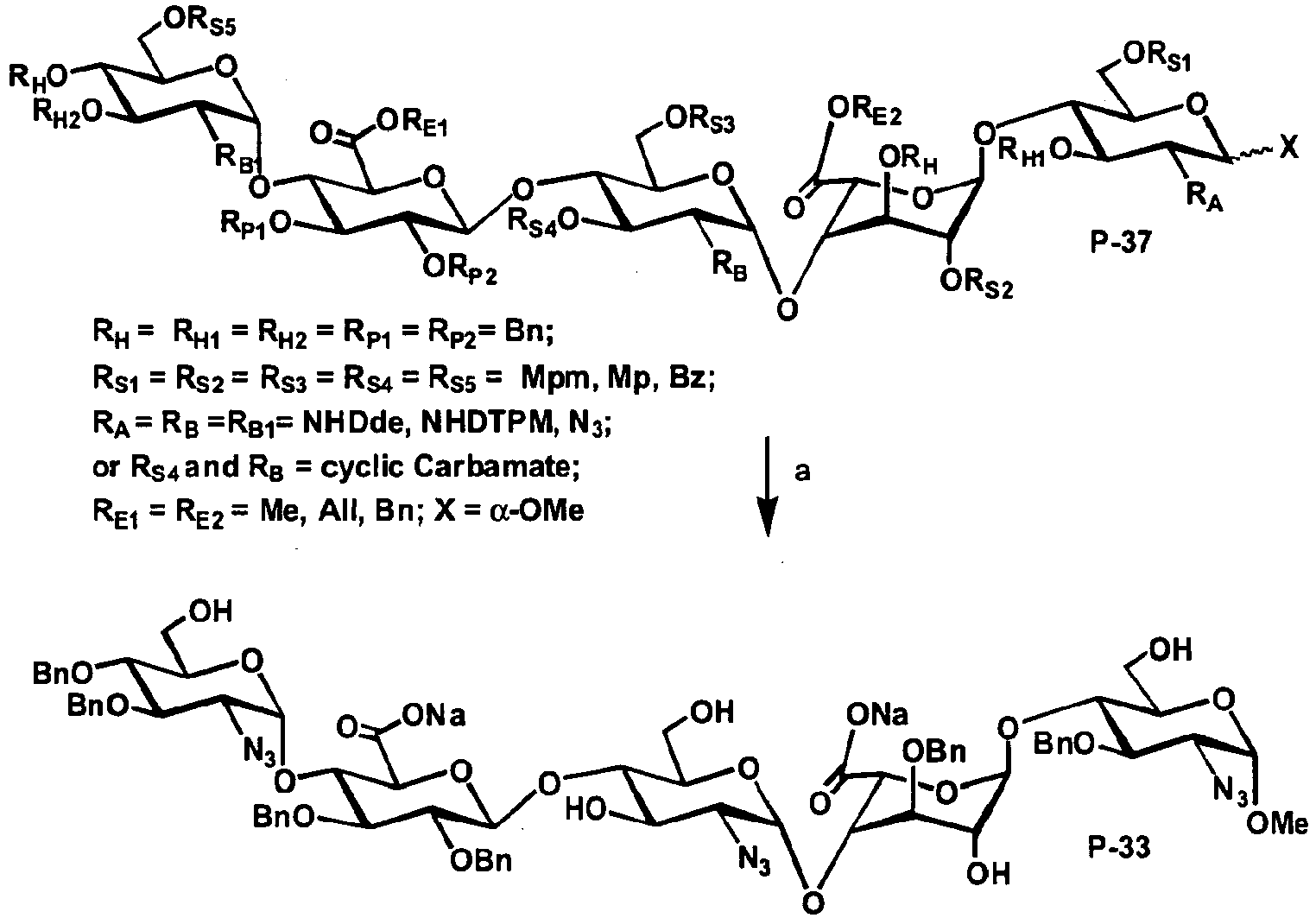
- Example 48: Deprotection protocol for pentasaccharides P-37 of claim 4, conditions: a) 1. SOP 27 and 28; 2. SOP 39; 3. SOP 11 with MeNH2 as primary amine and MeOH as solvent; 4. SOP 12.
-

- Example 49: Transformation of pentasaccharide P-33 into the O-and N-sulfated pentasaccharide P-40, conditions: a) SO3xNMe3, DMF, 50°C; b) H2 (70 psi), Pd/C, H2O; c) SO3xPyridine, H2O, pH = 9.5. The transformation of P-33 into P-40 has been performed according to literature: Petitou et al., Carbohydr. Res. 1987, 167, 67-75.
The 1H-NMR (400 MHz, D2O) of P-40 is shown infigure 6 .
Claims (12)
- A pentasaccharide building block for the preparation of synthetic heparinoids, said building block being of General Formula I,

X1 is selected from the group consisting of hydroxy, alkenyloxy, alkoxy, aryloxy, benzyloxy, substituted benzyloxy; thioalkyl, thioaryl, halogen, imidoyl, phosphate and related phosphate ester type leaving groups, a tbutyldiphenylsilyloxy or other such-substituted silyloxy protecting group; a lipoaminoacid or other such group suitable for conjugation to delivery systems or solid supports; and the stereochemistry may be alpha or beta;
RH is selected from the group consisting of benzyl or substituted benzyl protecting group, allyl, allyloxycarbonyl;
RH1 is selected from the group consisting of benzyl or substituted benzyl protecting group, allyl, allyloxycarbonyl, or RH1 and RA can combine together to form a cyclic carbamate;
RH2 is selected from the group consisting of benzyl or substituted benzyl protecting group, allyl, allyloxycarbonyl, or RH2 and RB1 independently can combine together to form a cyclic carbamate;
RA is azido or RA and RH1 together combine to form a cyclic carbamate;
RS1 is benzoyl;
RS2 is benzoyl;
RS3 is selected from the group consisting of 4-methoxyphenyl; substituted benzyl groups; alkylacyl or alkylarylacyl, and substituted alkylacyl, arylacyl or alkylarylacyl protecting groups; carbonate protecting groups; a tbutyldiphenylsilyloxy or other such substituted silyloxy protecting group; allyl, methoxymethyl, methoxyethyl, benzyloxymethyl;
RS4 is selected from the group consisting of 4-methoxyphenyl; substituted benzyl groups; alkylacyl or alkylarylacyl, and substituted alkylacyl, arylacyl or alkylarylacyl protecting groups; carbonate protecting groups; a tbutyldiphenylsilyloxy or other such substituted silyloxy protecting group; allyl, methoxymethyl, methoxyethyl, benzyloxymethyl,
or RS4 and RB may be combined to form a cyclic carbamate;
RS5 is selected from the group consisting of 4-methoxyphenyl; substituted benzyl groups; alkylacyl, arylacyl or alkylarylacyl, and substituted alkylacyl, arylacyl or alkylarylacyl protecting groups; carbonate protecting groups; a tbutyldiphenylsilyloxy or other such substituted silyloxy protecting group; allyl, methoxymethyl, methoxyethyl, benzyloxymethyl,
or RS5 and RH can be combined to form a cyclic acetal or ketal moiety;
RE1 is selected from the group consisting of methyl, C2-C5 alkyl; substituted alkyl, C3-C5 alkenyl; or, benzyl and substituted benzyl groups;
RE2 is selected from the group consisting of methyl, C2-C5 alkyl; substituted alkyl, C3-C5 alkenyl; or, benzyl and substituted benzyl groups;
RB is selected from the group consisting of an azido function, an amine; an NH-Dde or NH-DTPM group, or RS4 and RB can combine together to form a cyclic carbamate;
RB1 is selected from the group consisting of an azido function, an amine; an NH-Dde or NH-DTPM group, or RH2 and RB1 can combine together to form a cyclic carbamate;
RP1 is selected from the group consisting of 4-methoxyphenyl; benzyl, substituted benzyl groups; alkylacyl, arylacyl and alkylarylacyl, or substituted alkylacyl, arylacyl and alkylarylacyl protecting groups; carbonate protecting groups;
RP2 is selected from the group consisting of 4-methoxyphenyl; benzyl, substituted benzyl groups; alkylacyl, arylacyl and alkylarylacyl, or substituted alkylacyl, arylacyl and alkylarylacyl protecting groups; carbonate protecting groups, silyl protecting groups, carbamate protecting groups, C3-C5 alkenyl. - The pentasaccharide building block of claim 1, wherein X1 is C1 to C5 alkoxy.
- The pentasaccharide building block of claim 1, wherein RP1, RH and RH, is benzyl.
- The pentasaccharide building block of claim 1, wherein RP1 and RP2 is benzyl or substituted benzyl.
- The pentasaccharide building block of claim 1, wherein RE2 is methyl.
- The pentasaccharide building block of claim 1, wherein RB is azido or RB and RS4 combine to form a cyclic carbamate.
- The pentasaccharide building block of claim 1, wherein RP2 is selected from benzyl, chloroacetyl, acetyl, benzoyl, substituted benzoyl, pivaloyl, levulinyl or allyloxycarbonyl.
- The pentasaccharide building block of claim 1, wherein X1 is C1-C5 alkoxy, RS1 and RS2 is benzoyl, RS3 and RS4 are independently selected from 4-methoxybenzyl, 4-methoxyphenyl, 4-chlorobenzoyl, tert-butyldiphenylsilyl or allyl, RS5 is selected from benzoyl, 4-methoxybenzyl, 4-methoxyphenyl, 4-chlorobenzoyl, tert-butyldiphenylsilyl or allyl, RE2 is methyl, RP1, RH, RH1 and RH2 is benzyl and RP2 is selected from benzyl, chloroacetyl, acetyl, benzoyl, substituted benzoyl, pivaloyl, levulinyl or allyloxycarbonyl.
- A method of synthesizing the pentasaccharide of claim 1, comprising the steps of forming a trisaccharide EDC of formula II,
 X2 is selected from thioalkyl, thioaryl, halogen, trichloroacetimidoyl, phosphate and related phosphate ester type leaving groups, n-pentenyl and the stereochemistry may be alpha or beta;RH is selected from the group consisting of benzyl or substituted benzyl protecting group, allyl, allyloxycarbonyl;RH2 is selected from the group consisting of benzyl or substituted benzyl protecting group, allyl, allyloxycarbonyl, or RH2 and RB1 independently can combine together to form a cyclic carbamate;RS3 is selected from the group consisting of 4-methoxyphenyl; substituted benzyl groups; alkylacyl or alkylarylacyl, and substituted alkylacyl, arylacyl or alkylarylacyl protecting groups; carbonate protecting groups; a tbutyldiphenylsilyloxy or other such substituted silyloxy protecting group allyl, methoxymethyl, methoxyethyl, benzyloxymethyl;RS4 is selected from the group consisting of 4-methoxyphenyl; substituted benzyl groups; alkylacyl or alkylarylacyl, and substituted alkylacyl, arylacyl or alkylarylacyl protecting groups; carbonate protecting groups; a tbutyldiphenylsilyloxy or other such substituted silyloxy protecting group, allyl, methoxymethyl, methoxyethyl, benzyloxymethyl, or RS4 and RB may be combined to form a cyclic carbamate;RS5 is selected from the group consisting of 4-methoxyphenyl; substituted benzyl groups; alkylacyl, arylacyl or alkylarylacyl, and substituted alkylacyl, arylacyl or alkylarylacyl protecting groups; carbonate protecting groups; a tbutyldiphenylsilyloxy or other such substituted silyloxy protecting groups, allyl, methoxymethyl, methoxyethyl, benzyloxymethyl, carbamate protecting groups, trityl, or RS5 and RH can be combined to form a cyclic acetal or ketal moiety;RE1 is selected from the group consisting of methyl, C2-C5 alkyl; substituted alkyl, C3-C5 alkenyl; or, benzyl and substituted benzyl groups;RB is selected from the group consisting of an azido function, an amine; an NH-Dde or NH-DTPM group, or RS4 and RB can combine together to form a cyclic carbamate;RB1 is selected from the group consisting of an azido function, an amine; an NH-Dde or NH-DTPM group, or RH2 and RB1 can combine together to form a cyclic carbamate;RP1 is selected from the group consisting of 4-methoxyphenyl; benzyl, substituted benzyl groups; alkylacyl, arylacyl and alkylarylacyl, or substituted alkylacyl, arylacyl and alkylarylacyl protecting groups; carbonate protecting groups;RP2 is selected from the group consisting of 4-methoxyphenyl; benzyl, substituted benzyl groups; alkylacyl, arylacyl and alkylarylacyl, or substituted alkylacyl, arylacyl and alkylarylacyl protecting groups; carbonate protecting groups, silyl protecting groups, carbamate protecting groups, C3-C5 alkenyl;and forming a disaccharide BA of formula III
 X1 is selected from the group consisting of alkoxy, alkenyloxy, aryloxy, benzyloxy, substituted benzyloxy ; thioalkyl, thioaryl, a tbutyldiphenylsilyloxy or other such substituted silyloxy protecting group; a lipoaminoacid or other such group suitable for conjugation to delivery systems or solid supports; and the stereochemistry may be alpha or beta;RH1 is selected from the group consisting of benzyl or substituted benzyl protecting group, allyl, allyloxycarbonyl, or RH1 and RA can combine together to form a cyclic carbamate;RA is azido or RA and RH1 together combine to form a cyclic carbamate;RS1 is benzoyl;RS2 is benzoyl;RQ is either a)-(C=O)-ORE2 wherein RE2 is selected from the group consisting of methyl, C2-C5 alkyl; substituted alkyl, C3-C5 alkenyl; or, benzyl and substituted benzyl groups;
or b) -(CH2)-ORM wherein RM in selected from p-methoxyphenyl, p-methoxybenzyl, a trityl group, allyl, levulinoyl;RL is H;and linking the trisaccharide to the disaccharide to form the pentasaccharide. - A method of claim 9, wherein:X1 is selected from the group consisting of hydroxy, methoxy, thiomethyl, thioethyl, thiocresyl, trichloroacetimidoyl, a tbutyldiphenylsilyloxy a lipoaminoacid suitable for conjugation to delivery systems or solid supports; and the stereochemistry may be alpha or beta;RH, RH, and RH2 are independently selected from a benzyl or substituted benzyl protecting group, or RH1 and RA or RH2 and RB1 independently can combine together to form a cyclic carbamate;RS3 and RS4 are independently selected from: 4-methoxyphenyl; 4-methoxybenzyl; or RS4 and RB may be combined to form a cyclic carbamate;RS5 is selected from: 4-methoxyphenyl or 4-methoxybenzyl or benzoyl;RE1 and RE2 are independently selected from methyl, allyl or, benzyl and substituted benzyl groups;RB and RB, are independently selected from an azido function; an NH-Dde or NH-DTPM group; additionally RS4 and RB or RH2 and RB, independently can combine together to form a cyclic carbamate;RP1 is benzyl;RP2 is selected from the group consisting of benzyl; benzoyl, allyloxycarbonyl;X2 is selected from thiomethyl, thiocresyl, or trichloroacetimidoyl, and the stereochemistry may be alpha or beta;RQ is either a) - (C=O)-ORE2 wherein RE2 is methyl, allyl or benzyl;
or b) -(CH2)-ORM wherein RM is selected from p-methoxyphenyl, p-methoxybenzyl, a trityl group;RL is H;and linking the trisaccharide to the disaccharide to form the pentasaccharide. - Preparation process of a pentasaccharide having the formula:

- Manufacturing of a pharmaceutical preparation comprising a pharmaceutical effective amount of the pentasaccharide product obtained by the preparation process according to claim 11 together with a pharmaceutical carrier,
wherein (i) the process of claim 11 is carried out to prepare the desired pentasaccharide product, and (ii) the obtained pentasaccharide product is mixed with a pharmaceutical carrier.
Priority Applications (1)
| Application Number | Priority Date | Filing Date | Title |
|---|---|---|---|
| EP12188642.8A EP2557086A3 (en) | 2001-09-07 | 2002-09-06 | Synthetic heparin pentasaccharides |
Applications Claiming Priority (3)
| Application Number | Priority Date | Filing Date | Title |
|---|---|---|---|
| AUPR758701 | 2001-09-07 | ||
| AUPR758701 | 2001-09-07 | ||
| PCT/AU2002/001228 WO2003022860A1 (en) | 2001-09-07 | 2002-09-06 | Synthetic heparin pentasaccharides |
Related Child Applications (2)
| Application Number | Title | Priority Date | Filing Date |
|---|---|---|---|
| EP12188642.8A Division EP2557086A3 (en) | 2001-09-07 | 2002-09-06 | Synthetic heparin pentasaccharides |
| EP12188642.8 Division-Into | 2012-10-16 |
Publications (3)
| Publication Number | Publication Date |
|---|---|
| EP1440077A1 EP1440077A1 (en) | 2004-07-28 |
| EP1440077A4 EP1440077A4 (en) | 2010-06-02 |
| EP1440077B1 true EP1440077B1 (en) | 2013-05-01 |
Family
ID=34437858
Family Applications (2)
| Application Number | Title | Priority Date | Filing Date |
|---|---|---|---|
| EP02766941.5A Expired - Lifetime EP1440077B1 (en) | 2001-09-07 | 2002-09-06 | Synthetic heparin pentasaccharides |
| EP12188642.8A Withdrawn EP2557086A3 (en) | 2001-09-07 | 2002-09-06 | Synthetic heparin pentasaccharides |
Family Applications After (1)
| Application Number | Title | Priority Date | Filing Date |
|---|---|---|---|
| EP12188642.8A Withdrawn EP2557086A3 (en) | 2001-09-07 | 2002-09-06 | Synthetic heparin pentasaccharides |
Country Status (10)
| Country | Link |
|---|---|
| US (5) | US7541445B2 (en) |
| EP (2) | EP1440077B1 (en) |
| JP (1) | JP4688414B2 (en) |
| CN (1) | CN1558911B (en) |
| AU (1) | AU2002331426B2 (en) |
| CA (4) | CA2806561C (en) |
| DK (1) | DK1440077T3 (en) |
| ES (1) | ES2423888T3 (en) |
| PT (1) | PT1440077E (en) |
| WO (1) | WO2003022860A1 (en) |
Cited By (1)
| Publication number | Priority date | Publication date | Assignee | Title |
|---|---|---|---|---|
| WO2021083735A1 (en) | 2019-10-29 | 2021-05-06 | Hepoligo Solutions Aps | Process for the production of 1,6-anhydro sugars |
Families Citing this family (41)
| Publication number | Priority date | Publication date | Assignee | Title |
|---|---|---|---|---|
| AU2002331426B2 (en) | 2001-09-07 | 2008-01-10 | Dr. Reddy's Laboratories Sa | Synthetic heparin pentasaccharides |
| AU2002950657A0 (en) * | 2002-08-08 | 2002-09-12 | Alchemia Limited | Derivatives of monosaccharides for drug discovery |
| JP2006143694A (en) * | 2004-11-16 | 2006-06-08 | Tokyo Kasei Kogyo Kk | NEW p-METHOXYPHENYL SUGAR DERIVATIVE |
| ES2336297B1 (en) * | 2008-10-08 | 2011-01-24 | Laboratorios Farmaceuticos Rovi, S.A. | PENTASACARIDOS SYNTHESIS PROCEDURE DEPROTECTED FROM A PENTASACARIDO PRECURSOS PROTECTED. |
| AU2010234779A1 (en) | 2009-03-30 | 2011-10-20 | University Of Georgia Research Foundation, Inc. | Heparan sulfate synthesis |
| WO2011014793A2 (en) * | 2009-07-31 | 2011-02-03 | Reliable Biopharmaceutical Corporation | Process for preparing fondaparinux sodium and intermediates useful in the synthesis thereof |
| US8420790B2 (en) | 2009-10-30 | 2013-04-16 | Reliable Biopharmaceutical Corporation | Efficient and scalable process for the manufacture of Fondaparinux sodium |
| EP2512448B1 (en) * | 2009-12-18 | 2016-07-06 | Endotis Pharma | Pharmaceutical oral dosage form containing a synthetic oligosaccharide |
| EP2683746A4 (en) * | 2011-03-10 | 2014-09-03 | Callaghan Innovation Res Ltd | OLIGOSACCHARIDE COMPOUNDS |
| US20130005954A1 (en) * | 2011-06-28 | 2013-01-03 | Apicore, Llc | Process for preparing heparinoids and intermediates useful in the synthesis thereof |
| CN103360439B (en) | 2012-04-02 | 2017-12-15 | 浙江海正药业股份有限公司 | Prepare new intermediate of heparin pentasaccharides and preparation method thereof |
| US20150284419A1 (en) * | 2012-05-25 | 2015-10-08 | Zhejiang Hisun Pharmaceutical Co., Ltd. | Method for preparing fully protection heparin pentasaccharide and intermediate thereof |
| CN102690302B (en) * | 2012-05-30 | 2015-07-01 | 济南圣泉唐和唐生物科技有限公司 | Preparation method of 1,2-O-isopropylidene-3-O-benzyl-alpha-D-glucofuranose |
| CN102718808A (en) * | 2012-06-04 | 2012-10-10 | 浙江星月药物科技股份有限公司 | Methods for preparing class-one polysaccharide derivative and intermediate of class-one polysaccharide derivative |
| WO2013184564A1 (en) * | 2012-06-05 | 2013-12-12 | Academia Sinica | Methods and intermediates for the preparation of fondaparinux |
| CN102775450B (en) * | 2012-07-03 | 2015-04-08 | 华东师范大学 | Method for preparing 1,6-Anhydro-2-azido-2-deoxy-beta-D-glucopyranose |
| CN102898487B (en) * | 2012-11-13 | 2016-03-09 | 麦科罗夫(南通)生物制药有限公司 | A kind of sulphur reaches liver certain herbaceous plants with big flowers sodium disaccharides intermediate fragments BA and synthetic method thereof |
| CN102942601B (en) * | 2012-11-30 | 2015-09-30 | 江苏华泰晨光药业有限公司 | A kind of preparation method of intermediate of Fondaparinux sodium |
| WO2014205115A2 (en) | 2013-06-19 | 2014-12-24 | The Regents Of The University Of California | Regioselective silyl exchange of per-silylated oligosaccharides |
| KR20160036609A (en) * | 2013-07-25 | 2016-04-04 | 시노팜 타이완 리미티드 | Process for the production of fondaparinux sodium |
| US10072039B2 (en) * | 2013-07-25 | 2018-09-11 | Scinopharm Taiwan, Ltd. | Process for the production of Fondaparinux sodium |
| WO2015011519A1 (en) * | 2013-07-25 | 2015-01-29 | Scinopharm Taiwan, Ltd. | Process for the production of fondaparinux sodium |
| US9346844B2 (en) | 2013-07-25 | 2016-05-24 | Scinopharm Taiwan, Ltd. | Process for the production of fondaparinux sodium |
| CN103601765B (en) * | 2013-09-02 | 2017-01-04 | 上海艾康睿医药科技有限公司 | Fondaparinux sodium and intermediate thereof and preparation method |
| CN105612168A (en) | 2013-11-14 | 2016-05-25 | 浙江海正药业股份有限公司 | A kind of disaccharide intermediate and its synthetic method |
| CN104098618A (en) * | 2014-07-25 | 2014-10-15 | 河北常山生化药业股份有限公司 | Intermediate of fondaparinux sodium and preparation method for intermediate and fondaparinux sodium |
| WO2016040779A1 (en) * | 2014-09-12 | 2016-03-17 | The Board Of Trustees Of The University Of Illinois | Urea derivatives of polyene macrolide antibiotics |
| US9909534B2 (en) | 2014-09-22 | 2018-03-06 | Ini Power Systems, Inc. | Carbureted engine having an adjustable fuel to air ratio |
| CN105985387A (en) * | 2015-02-04 | 2016-10-05 | 苏州朗科生物技术有限公司 | Fondaparinux sodium impurity compound, preparation method therefor and use of Fondaparinux sodium impurity compound |
| CN105985388A (en) * | 2015-02-04 | 2016-10-05 | 苏州朗科生物技术有限公司 | Fondaparinux sodium impurity compound, preparation method therefor and application of Fondaparinux sodium impurity compound |
| CN104910217B (en) * | 2015-06-19 | 2018-04-17 | 天津红日药业股份有限公司 | Reference compound for Fondaparinux sodium quality control |
| CN104876979B (en) * | 2015-06-19 | 2018-10-09 | 天津红日药业股份有限公司 | One kind having active sulfonated five sugar compounds of Anti-Xa factor |
| US10023603B2 (en) | 2015-07-16 | 2018-07-17 | Formosa Laboratories, Inc. | Preparation of monosaccharides, disaccharides, trisaccharides, and pentasaccharides of heparinoids |
| CN106518935B (en) * | 2016-10-26 | 2019-05-21 | 陕西国防工业职业技术学院 | A kind of synthetic method of bis- deoxidation -3- amino-L- idose of 3,6- and its derivative |
| CN107501359B (en) * | 2017-08-24 | 2020-07-31 | 深圳市海滨制药有限公司 | Fondaparinux sodium impurity compound and preparation method and application thereof |
| US11306157B2 (en) | 2018-12-21 | 2022-04-19 | California Institute Of Technology | Expedient synthesis of core disaccharide building blocks from natural polysaccharides for heparan sulfate oligosaccharide assembly |
| CN109734757B (en) * | 2019-03-11 | 2020-09-11 | 淮北师范大学 | Preparation method of related substance B of fondaparinux sodium injection |
| WO2021043631A1 (en) | 2019-09-02 | 2021-03-11 | Hepoligo Solutions Aps | Intermediates useful for preparing iduronic acid containing di- and polysaccharides |
| CN110746471B (en) * | 2019-11-04 | 2021-06-25 | 江苏美迪克化学品有限公司 | Preparation method of fondaparinux sodium disaccharide intermediate |
| EP4247826A1 (en) * | 2020-11-19 | 2023-09-27 | Indian Institute Of Science Education And Research | Silver assisted gold catalysis for the preparation of fondaparinux pentasaccharide and intermediates |
| CN112552359B (en) * | 2020-12-21 | 2022-11-25 | 北京大学 | Automatic preparation method of fondaparinux sodium pentasaccharide intermediate |
Family Cites Families (25)
| Publication number | Priority date | Publication date | Assignee | Title |
|---|---|---|---|---|
| US187381A (en) * | 1877-02-13 | Improvement in air and steasvj blowers for furnaces | ||
| US13862A (en) * | 1855-12-04 | Cutting pile fabrics | ||
| US684691A (en) | 1901-03-23 | 1901-10-15 | Donald E Webster | Micrometer-gage. |
| IL61201A (en) | 1979-10-05 | 1984-09-30 | Choay Sa | Oligosaccharides having no more than 8 saccharide moieties,their obtention from heparin and pharmaceutical compositions containing them |
| CA1171375A (en) | 1980-09-15 | 1984-07-24 | Ulf P.F. Lindahl | Oligosaccharides having selective anticoagulation activity |
| FR2531436A1 (en) * | 1982-08-06 | 1984-02-10 | Choay Sa | Substituted pentasaccharides possessing biological properties, their preparation and their uses as medicaments |
| US4818816A (en) * | 1981-04-28 | 1989-04-04 | Choay, S.A. | Process for the organic synthesis of oligosaccharides and derivatives thereof |
| FR2504535B1 (en) | 1981-04-28 | 1987-08-14 | Choay Sa | DISACCHARIDES DERIVED FROM URONIC ACID AND GLUCOSAMINE AND PHARMACEUTICAL COMPOSITIONS CONTAINING THEM FOR THE CONTROL OF BLOOD COAGULATION |
| FR2519987A1 (en) * | 1982-01-15 | 1983-07-22 | Choay Sa | Uronic acid derivs. - useful as glycoside intermediates or hapten(s) |
| FR2518550A1 (en) * | 1981-12-23 | 1983-06-24 | Choay Sa | Uronic acid derivs. - useful as glycoside intermediates or hapten(s) |
| CA1247608A (en) * | 1981-12-23 | 1988-12-28 | Jean Choay | Derivatives having uronic acid structure; process for preparing the same and their biological uses |
| US4801583A (en) * | 1982-01-15 | 1989-01-31 | Choay S.A. | Oligosaccharides and their biological applications |
| AU563351C (en) | 1982-01-15 | 2003-06-19 | Glaxo Group Limited | Synthesis of oligosaccharides |
| FR2564468B1 (en) * | 1984-05-16 | 1994-12-23 | Choay Sa | NOVEL OLIGOSACCHARIDES, THEIR SYNTHESIS PREPARATION AND THEIR BIOLOGICAL APPLICATIONS |
| JPS63218691A (en) | 1987-03-09 | 1988-09-12 | Rikagaku Kenkyusho | Novel pentasaccharide compound and its production method, and anticoagulant and antithrombotic agent |
| EP0333243A3 (en) * | 1988-03-10 | 1989-09-27 | Akzo N.V. | Sulphated k5 antigen and sulphated k5 antigen fragments |
| JPH03237101A (en) * | 1989-12-18 | 1991-10-23 | Rikagaku Kenkyusho | Intermediate for synthesis of glycosylphosphatidylinositol anchor and intermediate for synthesis of glycosylphosphatidylinositol anchor-related compounds |
| JPH0616692A (en) * | 1992-07-03 | 1994-01-25 | Nisshin Oil Mills Ltd:The | New sugar derivative |
| CA2100821C (en) * | 1993-07-19 | 2001-01-16 | Stephen Hanessian | Stereocontrolled glycosidation |
| JP3837876B2 (en) * | 1996-11-05 | 2006-10-25 | 和光純薬工業株式会社 | Azidohalogenobenzyl derivatives and methods for protecting hydroxyl groups |
| JP3005669B2 (en) | 1996-12-19 | 2000-01-31 | 工業技術院長 | Method for producing asymmetric fluorinated primary amines |
| US6538117B1 (en) * | 1999-08-10 | 2003-03-25 | The Scripps Research Institute | Programmable one-pot oligosaccharide synthesis |
| TWI289566B (en) * | 1999-12-07 | 2007-11-11 | N.V.Organon | Antithrombotic compound |
| CA2435637A1 (en) * | 2001-01-23 | 2002-08-01 | Massachusetts Institute Of Technology | Solid- and solution -phase synthesis of heparin and other glycosaminoglycans |
| AU2002331426B2 (en) | 2001-09-07 | 2008-01-10 | Dr. Reddy's Laboratories Sa | Synthetic heparin pentasaccharides |
-
2002
- 2002-09-06 AU AU2002331426A patent/AU2002331426B2/en not_active Ceased
- 2002-09-06 JP JP2003526933A patent/JP4688414B2/en not_active Expired - Fee Related
- 2002-09-06 CN CN028218558A patent/CN1558911B/en not_active Expired - Fee Related
- 2002-09-06 CA CA2806561A patent/CA2806561C/en not_active Expired - Fee Related
- 2002-09-06 PT PT2766941T patent/PT1440077E/en unknown
- 2002-09-06 CA CA2806723A patent/CA2806723C/en not_active Expired - Fee Related
- 2002-09-06 DK DK02766941.5T patent/DK1440077T3/en active
- 2002-09-06 EP EP02766941.5A patent/EP1440077B1/en not_active Expired - Lifetime
- 2002-09-06 US US10/488,677 patent/US7541445B2/en not_active Expired - Fee Related
- 2002-09-06 WO PCT/AU2002/001228 patent/WO2003022860A1/en not_active Ceased
- 2002-09-06 ES ES02766941T patent/ES2423888T3/en not_active Expired - Lifetime
- 2002-09-06 EP EP12188642.8A patent/EP2557086A3/en not_active Withdrawn
- 2002-09-06 CA CA2459562A patent/CA2459562C/en not_active Expired - Fee Related
- 2002-09-06 CA CA2806604A patent/CA2806604C/en not_active Expired - Fee Related
-
2009
- 2009-01-15 US US12/354,643 patent/US8114970B2/en not_active Expired - Fee Related
-
2011
- 2011-12-14 US US13/326,147 patent/US8404833B2/en not_active Expired - Fee Related
- 2011-12-14 US US13/326,060 patent/US8686131B2/en not_active Expired - Fee Related
-
2014
- 2014-01-29 US US14/167,822 patent/US9243018B2/en not_active Expired - Fee Related
Cited By (1)
| Publication number | Priority date | Publication date | Assignee | Title |
|---|---|---|---|---|
| WO2021083735A1 (en) | 2019-10-29 | 2021-05-06 | Hepoligo Solutions Aps | Process for the production of 1,6-anhydro sugars |
Also Published As
| Publication number | Publication date |
|---|---|
| EP2557086A2 (en) | 2013-02-13 |
| CA2806723C (en) | 2015-12-29 |
| US7541445B2 (en) | 2009-06-02 |
| CA2806723A1 (en) | 2003-03-20 |
| US20150005485A1 (en) | 2015-01-01 |
| CN1558911A (en) | 2004-12-29 |
| DK1440077T3 (en) | 2013-07-08 |
| CA2459562C (en) | 2013-05-07 |
| PT1440077E (en) | 2013-06-04 |
| US20120220759A1 (en) | 2012-08-30 |
| CA2806604A1 (en) | 2003-03-20 |
| US20090187013A1 (en) | 2009-07-23 |
| CA2459562A1 (en) | 2003-03-20 |
| US8686131B2 (en) | 2014-04-01 |
| CA2806604C (en) | 2014-04-08 |
| US9243018B2 (en) | 2016-01-26 |
| EP1440077A1 (en) | 2004-07-28 |
| EP2557086A3 (en) | 2014-11-05 |
| CA2806561C (en) | 2015-12-22 |
| AU2002331426B2 (en) | 2008-01-10 |
| JP4688414B2 (en) | 2011-05-25 |
| US20120208993A1 (en) | 2012-08-16 |
| AU2002331426A1 (en) | 2003-03-24 |
| US8114970B2 (en) | 2012-02-14 |
| JP2005505565A (en) | 2005-02-24 |
| US20050080042A1 (en) | 2005-04-14 |
| CA2806561A1 (en) | 2003-03-20 |
| ES2423888T3 (en) | 2013-09-25 |
| CN1558911B (en) | 2010-05-12 |
| WO2003022860A1 (en) | 2003-03-20 |
| EP1440077A4 (en) | 2010-06-02 |
| US8404833B2 (en) | 2013-03-26 |
Similar Documents
| Publication | Publication Date | Title |
|---|---|---|
| US9243018B2 (en) | Synthetic heparin pentasaccharides | |
| Danishefsky et al. | Application of glycals to the synthesis of oligosaccharides: Convergent total syntheses of the Lewis x trisaccharide sialyl Lewis x antigenic determinant and higher congeners | |
| US8987430B2 (en) | Efficient and scalable process for the manufacture of fondaparinux sodium | |
| RU2167163C2 (en) | Synthetic polysaccharides, method of their synthesis and pharmaceutical composition containing thereof | |
| Slaghek et al. | Synthesis of hyaluronic acid-related di-, tri-, and tetra-saccharides having an N-acetylglucosamine residue at the reducing end | |
| Baldoni et al. | Synthesis of S-and C-galactofuranosides via a galactofuranosyl iodide. Isolable 1-galactofuranosylthiol derivative as a new glycosyl donor | |
| US20040019198A1 (en) | Method of forming glycosidic bonds from thioglycosides using an N,N-dialkylsulfinamide | |
| AU2008200616B2 (en) | Synthetic Heparin Pentasaccharides | |
| Yashunsky et al. | Parasite glycoconjugates. Part 12. 1 Synthesis of deoxy, fluorodeoxy and aminodeoxy disaccharide phosphates, substrate analogues for the elongating α-D-mannopyranosylphosphate transferase in the Leishmania | |
| AU2007203325B2 (en) | Synthetic Heparin Pentasaccharides | |
| Jamois et al. | How to improve chemical synthesis of laminaribiose on a large scale | |
| Pradhan et al. | Studies towards the total synthesis of repeating unit of O-sulfated polysaccharide from marine bacterium Cobetia pacifica KMM 3878 | |
| US5476924A (en) | Protecting group for acetals and methods of using the same in the activation of saccharides | |
| WO2000018777A9 (en) | Method for synthesizing c-glycosides of ulosonic acids | |
| Park | Chiral auxiliaries for 1, 2-cis stereoselective glycosylations |
Legal Events
| Date | Code | Title | Description |
|---|---|---|---|
| PUAI | Public reference made under article 153(3) epc to a published international application that has entered the european phase |
Free format text: ORIGINAL CODE: 0009012 |
|
| 17P | Request for examination filed |
Effective date: 20040305 |
|
| AK | Designated contracting states |
Kind code of ref document: A1 Designated state(s): AT BE BG CH CY CZ DE DK EE ES FI FR GB GR IE IT LI LU MC NL PT SE SK TR |
|
| AX | Request for extension of the european patent |
Extension state: AL LT LV MK RO SI |
|
| A4 | Supplementary search report drawn up and despatched |
Effective date: 20100503 |
|
| 17Q | First examination report despatched |
Effective date: 20101008 |
|
| GRAP | Despatch of communication of intention to grant a patent |
Free format text: ORIGINAL CODE: EPIDOSNIGR1 |
|
| GRAS | Grant fee paid |
Free format text: ORIGINAL CODE: EPIDOSNIGR3 |
|
| GRAP | Despatch of communication of intention to grant a patent |
Free format text: ORIGINAL CODE: EPIDOSNIGR1 |
|
| RIN1 | Information on inventor provided before grant (corrected) |
Inventor name: WEST, MICHAEL, LEO Inventor name: SINGH, LATIKA Inventor name: RAMSDALE, TRACIE, ELIZABETH Inventor name: DRINNAN, NICHOLAS, BARRY Inventor name: SEIFERT, JOACHIM |
|
| GRAA | (expected) grant |
Free format text: ORIGINAL CODE: 0009210 |
|
| AK | Designated contracting states |
Kind code of ref document: B1 Designated state(s): AT BE BG CH CY CZ DE DK EE ES FI FR GB GR IE IT LI LU MC NL PT SE SK TR |
|
| REG | Reference to a national code |
Ref country code: GB Ref legal event code: FG4D |
|
| REG | Reference to a national code |
Ref country code: CH Ref legal event code: EP Ref country code: CH Ref legal event code: NV Representative=s name: NOVAGRAAF INTERNATIONAL SA, CH Ref country code: AT Ref legal event code: REF Ref document number: 609900 Country of ref document: AT Kind code of ref document: T Effective date: 20130515 |
|
| REG | Reference to a national code |
Ref country code: IE Ref legal event code: FG4D |
|
| REG | Reference to a national code |
Ref country code: PT Ref legal event code: SC4A Free format text: AVAILABILITY OF NATIONAL TRANSLATION Effective date: 20130528 |
|
| REG | Reference to a national code |
Ref country code: SE Ref legal event code: TRGR |
|
| REG | Reference to a national code |
Ref country code: DE Ref legal event code: R096 Ref document number: 60244901 Country of ref document: DE Effective date: 20130627 |
|
| REG | Reference to a national code |
Ref country code: DK Ref legal event code: T3 |
|
| REG | Reference to a national code |
Ref country code: NL Ref legal event code: T3 |
|
| REG | Reference to a national code |
Ref country code: ES Ref legal event code: FG2A Ref document number: 2423888 Country of ref document: ES Kind code of ref document: T3 Effective date: 20130925 |
|
| PG25 | Lapsed in a contracting state [announced via postgrant information from national office to epo] |
Ref country code: GR Free format text: LAPSE BECAUSE OF FAILURE TO SUBMIT A TRANSLATION OF THE DESCRIPTION OR TO PAY THE FEE WITHIN THE PRESCRIBED TIME-LIMIT Effective date: 20130802 |
|
| PG25 | Lapsed in a contracting state [announced via postgrant information from national office to epo] |
Ref country code: BG Free format text: LAPSE BECAUSE OF FAILURE TO SUBMIT A TRANSLATION OF THE DESCRIPTION OR TO PAY THE FEE WITHIN THE PRESCRIBED TIME-LIMIT Effective date: 20130801 |
|
| PG25 | Lapsed in a contracting state [announced via postgrant information from national office to epo] |
Ref country code: SK Free format text: LAPSE BECAUSE OF FAILURE TO SUBMIT A TRANSLATION OF THE DESCRIPTION OR TO PAY THE FEE WITHIN THE PRESCRIBED TIME-LIMIT Effective date: 20130501 Ref country code: EE Free format text: LAPSE BECAUSE OF FAILURE TO SUBMIT A TRANSLATION OF THE DESCRIPTION OR TO PAY THE FEE WITHIN THE PRESCRIBED TIME-LIMIT Effective date: 20130501 |
|
| PLBE | No opposition filed within time limit |
Free format text: ORIGINAL CODE: 0009261 |
|
| STAA | Information on the status of an ep patent application or granted ep patent |
Free format text: STATUS: NO OPPOSITION FILED WITHIN TIME LIMIT |
|
| 26N | No opposition filed |
Effective date: 20140204 |
|
| PG25 | Lapsed in a contracting state [announced via postgrant information from national office to epo] |
Ref country code: MC Free format text: LAPSE BECAUSE OF FAILURE TO SUBMIT A TRANSLATION OF THE DESCRIPTION OR TO PAY THE FEE WITHIN THE PRESCRIBED TIME-LIMIT Effective date: 20130501 |
|
| REG | Reference to a national code |
Ref country code: DE Ref legal event code: R097 Ref document number: 60244901 Country of ref document: DE Effective date: 20140204 |
|
| PG25 | Lapsed in a contracting state [announced via postgrant information from national office to epo] |
Ref country code: CY Free format text: LAPSE BECAUSE OF FAILURE TO SUBMIT A TRANSLATION OF THE DESCRIPTION OR TO PAY THE FEE WITHIN THE PRESCRIBED TIME-LIMIT Effective date: 20130501 |
|
| REG | Reference to a national code |
Ref country code: FR Ref legal event code: PLFP Year of fee payment: 14 |
|
| REG | Reference to a national code |
Ref country code: PT Ref legal event code: PC4A Owner name: DR. REDDY'S LABORATORIES SA, CH Effective date: 20151216 |
|
| REG | Reference to a national code |
Ref country code: GB Ref legal event code: 732E Free format text: REGISTERED BETWEEN 20151217 AND 20151223 |
|
| REG | Reference to a national code |
Ref country code: DE Ref legal event code: R082 Ref document number: 60244901 Country of ref document: DE Representative=s name: HOFFMANN - EITLE PATENT- UND RECHTSANWAELTE PA, DE Ref country code: DE Ref legal event code: R081 Ref document number: 60244901 Country of ref document: DE Owner name: DR. REDDY'S LABORATORIES SA, CH Free format text: FORMER OWNER: ALCHEMIA LTD., EIGHT MILE PLAINS, QUEENSLAND, AU |
|
| REG | Reference to a national code |
Ref country code: CH Ref legal event code: PUE Owner name: DR. REDDY'S LABORATORIES SA, CH Free format text: FORMER OWNER: ALCHEMIA LIMITED, AU |
|
| REG | Reference to a national code |
Ref country code: FR Ref legal event code: TP Owner name: DR. REDDY'S LABORATORIES SA, CH Effective date: 20160217 |
|
| REG | Reference to a national code |
Ref country code: ES Ref legal event code: PC2A Owner name: DR. REDDY S LABORATORIES SA Effective date: 20160518 |
|
| REG | Reference to a national code |
Ref country code: NL Ref legal event code: PD Owner name: DR. REDDY'S LABORATORIES SA; CH Free format text: DETAILS ASSIGNMENT: VERANDERING VAN EIGENAAR(S), OVERDRACHT; FORMER OWNER NAME: ALCHEMIA LIMITED Effective date: 20160224 |
|
| REG | Reference to a national code |
Ref country code: FR Ref legal event code: PLFP Year of fee payment: 15 |
|
| REG | Reference to a national code |
Ref country code: FR Ref legal event code: PLFP Year of fee payment: 16 |
|
| REG | Reference to a national code |
Ref country code: FR Ref legal event code: PLFP Year of fee payment: 17 |
|
| PGFP | Annual fee paid to national office [announced via postgrant information from national office to epo] |
Ref country code: IE Payment date: 20190924 Year of fee payment: 18 Ref country code: CZ Payment date: 20190731 Year of fee payment: 18 Ref country code: IT Payment date: 20190913 Year of fee payment: 18 Ref country code: DK Payment date: 20190924 Year of fee payment: 18 Ref country code: FR Payment date: 20190919 Year of fee payment: 18 Ref country code: NL Payment date: 20190925 Year of fee payment: 18 Ref country code: PT Payment date: 20190906 Year of fee payment: 18 Ref country code: SE Payment date: 20190923 Year of fee payment: 18 Ref country code: FI Payment date: 20190924 Year of fee payment: 18 Ref country code: DE Payment date: 20190918 Year of fee payment: 18 Ref country code: TR Payment date: 20190906 Year of fee payment: 18 Ref country code: LU Payment date: 20190925 Year of fee payment: 18 |
|
| PGFP | Annual fee paid to national office [announced via postgrant information from national office to epo] |
Ref country code: BE Payment date: 20190916 Year of fee payment: 18 |
|
| PGFP | Annual fee paid to national office [announced via postgrant information from national office to epo] |
Ref country code: GB Payment date: 20190906 Year of fee payment: 18 Ref country code: AT Payment date: 20190924 Year of fee payment: 18 |
|
| PGFP | Annual fee paid to national office [announced via postgrant information from national office to epo] |
Ref country code: CH Payment date: 20190920 Year of fee payment: 18 |
|
| PGFP | Annual fee paid to national office [announced via postgrant information from national office to epo] |
Ref country code: ES Payment date: 20191017 Year of fee payment: 18 |
|
| REG | Reference to a national code |
Ref country code: DE Ref legal event code: R119 Ref document number: 60244901 Country of ref document: DE |
|
| REG | Reference to a national code |
Ref country code: FI Ref legal event code: MAE |
|
| REG | Reference to a national code |
Ref country code: DK Ref legal event code: EBP Effective date: 20200930 |
|
| PG25 | Lapsed in a contracting state [announced via postgrant information from national office to epo] |
Ref country code: FI Free format text: LAPSE BECAUSE OF NON-PAYMENT OF DUE FEES Effective date: 20200906 Ref country code: CZ Free format text: LAPSE BECAUSE OF NON-PAYMENT OF DUE FEES Effective date: 20200906 |
|
| REG | Reference to a national code |
Ref country code: CH Ref legal event code: PL |
|
| REG | Reference to a national code |
Ref country code: NL Ref legal event code: MM Effective date: 20201001 |
|
| REG | Reference to a national code |
Ref country code: AT Ref legal event code: MM01 Ref document number: 609900 Country of ref document: AT Kind code of ref document: T Effective date: 20200906 |
|
| GBPC | Gb: european patent ceased through non-payment of renewal fee |
Effective date: 20200906 |
|
| REG | Reference to a national code |
Ref country code: BE Ref legal event code: MM Effective date: 20200930 |
|
| PG25 | Lapsed in a contracting state [announced via postgrant information from national office to epo] |
Ref country code: LU Free format text: LAPSE BECAUSE OF NON-PAYMENT OF DUE FEES Effective date: 20200906 Ref country code: NL Free format text: LAPSE BECAUSE OF NON-PAYMENT OF DUE FEES Effective date: 20201001 |
|
| PG25 | Lapsed in a contracting state [announced via postgrant information from national office to epo] |
Ref country code: FR Free format text: LAPSE BECAUSE OF NON-PAYMENT OF DUE FEES Effective date: 20200930 Ref country code: DE Free format text: LAPSE BECAUSE OF NON-PAYMENT OF DUE FEES Effective date: 20210401 Ref country code: PT Free format text: LAPSE BECAUSE OF NON-PAYMENT OF DUE FEES Effective date: 20210409 |
|
| PG25 | Lapsed in a contracting state [announced via postgrant information from national office to epo] |
Ref country code: AT Free format text: LAPSE BECAUSE OF NON-PAYMENT OF DUE FEES Effective date: 20200906 Ref country code: CH Free format text: LAPSE BECAUSE OF NON-PAYMENT OF DUE FEES Effective date: 20200930 Ref country code: BE Free format text: LAPSE BECAUSE OF NON-PAYMENT OF DUE FEES Effective date: 20200930 Ref country code: SE Free format text: LAPSE BECAUSE OF NON-PAYMENT OF DUE FEES Effective date: 20200907 Ref country code: LI Free format text: LAPSE BECAUSE OF NON-PAYMENT OF DUE FEES Effective date: 20200930 Ref country code: IE Free format text: LAPSE BECAUSE OF NON-PAYMENT OF DUE FEES Effective date: 20200906 Ref country code: GB Free format text: LAPSE BECAUSE OF NON-PAYMENT OF DUE FEES Effective date: 20200906 |
|
| REG | Reference to a national code |
Ref country code: SE Ref legal event code: EUG |
|
| PG25 | Lapsed in a contracting state [announced via postgrant information from national office to epo] |
Ref country code: IT Free format text: LAPSE BECAUSE OF NON-PAYMENT OF DUE FEES Effective date: 20200906 |
|
| PG25 | Lapsed in a contracting state [announced via postgrant information from national office to epo] |
Ref country code: DK Free format text: LAPSE BECAUSE OF NON-PAYMENT OF DUE FEES Effective date: 20200930 |
|
| REG | Reference to a national code |
Ref country code: ES Ref legal event code: FD2A Effective date: 20220114 |
|
| PG25 | Lapsed in a contracting state [announced via postgrant information from national office to epo] |
Ref country code: ES Free format text: LAPSE BECAUSE OF NON-PAYMENT OF DUE FEES Effective date: 20200907 |
|
| PG25 | Lapsed in a contracting state [announced via postgrant information from national office to epo] |
Ref country code: TR Free format text: LAPSE BECAUSE OF NON-PAYMENT OF DUE FEES Effective date: 20200906 |