EP1437422A1 - Steel pipe having high formability and method for production thereof - Google Patents
Steel pipe having high formability and method for production thereof Download PDFInfo
- Publication number
- EP1437422A1 EP1437422A1 EP01938656A EP01938656A EP1437422A1 EP 1437422 A1 EP1437422 A1 EP 1437422A1 EP 01938656 A EP01938656 A EP 01938656A EP 01938656 A EP01938656 A EP 01938656A EP 1437422 A1 EP1437422 A1 EP 1437422A1
- Authority
- EP
- European Patent Office
- Prior art keywords
- steel pipe
- diameter
- steel
- value
- reducing rolling
- Prior art date
- Legal status (The legal status is an assumption and is not a legal conclusion. Google has not performed a legal analysis and makes no representation as to the accuracy of the status listed.)
- Withdrawn
Links
Images


Classifications
-
- C—CHEMISTRY; METALLURGY
- C21—METALLURGY OF IRON
- C21D—MODIFYING THE PHYSICAL STRUCTURE OF FERROUS METALS; GENERAL DEVICES FOR HEAT TREATMENT OF FERROUS OR NON-FERROUS METALS OR ALLOYS; MAKING METAL MALLEABLE, e.g. BY DECARBURISATION OR TEMPERING
- C21D8/00—Modifying the physical properties of ferrous metals or ferrous alloys by deformation combined with, or followed by, heat treatment
- C21D8/10—Modifying the physical properties of ferrous metals or ferrous alloys by deformation combined with, or followed by, heat treatment during manufacturing of tubular bodies
-
- B—PERFORMING OPERATIONS; TRANSPORTING
- B21—MECHANICAL METAL-WORKING WITHOUT ESSENTIALLY REMOVING MATERIAL; PUNCHING METAL
- B21C—MANUFACTURE OF METAL SHEETS, WIRE, RODS, TUBES, PROFILES OR LIKE SEMI-MANUFACTURED PRODUCTS OTHERWISE THAN BY ROLLING; AUXILIARY OPERATIONS USED IN CONNECTION WITH METAL-WORKING WITHOUT ESSENTIALLY REMOVING MATERIAL
- B21C37/00—Manufacture of metal sheets, rods, wire, tubes, profiles or like semi-manufactured products, not otherwise provided for; Manufacture of tubes of special shape
- B21C37/06—Manufacture of metal sheets, rods, wire, tubes, profiles or like semi-manufactured products, not otherwise provided for; Manufacture of tubes of special shape of tubes or metal hoses; Combined procedures for making tubes, e.g. for making multi-wall tubes
-
- B—PERFORMING OPERATIONS; TRANSPORTING
- B21—MECHANICAL METAL-WORKING WITHOUT ESSENTIALLY REMOVING MATERIAL; PUNCHING METAL
- B21C—MANUFACTURE OF METAL SHEETS, WIRE, RODS, TUBES, PROFILES OR LIKE SEMI-MANUFACTURED PRODUCTS OTHERWISE THAN BY ROLLING; AUXILIARY OPERATIONS USED IN CONNECTION WITH METAL-WORKING WITHOUT ESSENTIALLY REMOVING MATERIAL
- B21C37/00—Manufacture of metal sheets, rods, wire, tubes, profiles or like semi-manufactured products, not otherwise provided for; Manufacture of tubes of special shape
- B21C37/06—Manufacture of metal sheets, rods, wire, tubes, profiles or like semi-manufactured products, not otherwise provided for; Manufacture of tubes of special shape of tubes or metal hoses; Combined procedures for making tubes, e.g. for making multi-wall tubes
- B21C37/08—Making tubes with welded or soldered seams
-
- C—CHEMISTRY; METALLURGY
- C22—METALLURGY; FERROUS OR NON-FERROUS ALLOYS; TREATMENT OF ALLOYS OR NON-FERROUS METALS
- C22C—ALLOYS
- C22C38/00—Ferrous alloys, e.g. steel alloys
- C22C38/02—Ferrous alloys, e.g. steel alloys containing silicon
-
- C—CHEMISTRY; METALLURGY
- C22—METALLURGY; FERROUS OR NON-FERROUS ALLOYS; TREATMENT OF ALLOYS OR NON-FERROUS METALS
- C22C—ALLOYS
- C22C38/00—Ferrous alloys, e.g. steel alloys
- C22C38/04—Ferrous alloys, e.g. steel alloys containing manganese
-
- C—CHEMISTRY; METALLURGY
- C22—METALLURGY; FERROUS OR NON-FERROUS ALLOYS; TREATMENT OF ALLOYS OR NON-FERROUS METALS
- C22C—ALLOYS
- C22C38/00—Ferrous alloys, e.g. steel alloys
- C22C38/06—Ferrous alloys, e.g. steel alloys containing aluminium
-
- B—PERFORMING OPERATIONS; TRANSPORTING
- B21—MECHANICAL METAL-WORKING WITHOUT ESSENTIALLY REMOVING MATERIAL; PUNCHING METAL
- B21B—ROLLING OF METAL
- B21B17/00—Tube-rolling by rollers of which the axes are arranged essentially perpendicular to the axis of the work, e.g. "axial" tube-rolling
- B21B17/14—Tube-rolling by rollers of which the axes are arranged essentially perpendicular to the axis of the work, e.g. "axial" tube-rolling without mandrel, e.g. stretch-reducing mills
-
- C—CHEMISTRY; METALLURGY
- C21—METALLURGY OF IRON
- C21D—MODIFYING THE PHYSICAL STRUCTURE OF FERROUS METALS; GENERAL DEVICES FOR HEAT TREATMENT OF FERROUS OR NON-FERROUS METALS OR ALLOYS; MAKING METAL MALLEABLE, e.g. BY DECARBURISATION OR TEMPERING
- C21D9/00—Heat treatment, e.g. annealing, hardening, quenching or tempering, adapted for particular articles; Furnaces therefor
- C21D9/08—Heat treatment, e.g. annealing, hardening, quenching or tempering, adapted for particular articles; Furnaces therefor for tubular bodies or pipes
Definitions
- the present invention relates to a steel pipe having superior workability and a method of producing the steel pipe.
- the inventors have conducted studies based on a consideration that working and heat treatment of seam welded steel pipes are required to improve the r-value in a welded portion near the seam. Then, the inventors have studied a method of performing working and heat treatment of a steel pipe evenly at any positions in the circumferential direction, the steel pipe being produced by seam-welding cold-rolled steel having a high r-value.
- the inventors have found that the r-value of the seam welded steel pipe in the longitudinal direction (in the axial direction of the pipe) is noticeably improved to 1.2 or above, in particular to 1.6 or above, at any positions in the circumferential direction, including a seamed portion, by a method of performing diameter-reducing rolling on the seam welded steel pipe in a temperature range of from 600°C to Ac 3 with a reduction in diameter of not less than 30% (referred to as a "method according to the present invention" hereinafter).
- seam welded steel pipes having a high r-value can also be produced using, as base-material strip steel, hot-rolled steel, high tensile strength steel such as dual phase steel, and low, medium and high carbon steel, which have a difficulty in achieving a high r-value in the stage of strip steel.
- an ideal aggregation structure due to the rolling in which the ⁇ 110> axis is parallel to the longitudinal direction and the ⁇ 111> to ⁇ 110> axes are parallel to the radial direction, is formed and then further developed through restoration and recrystallization. That aggregation structure provides a high r-value.
- the aggregation structure due to the rolling produces very great driving forces because crystals are rotated by working strains.
- the aggregation structure due to the rolling is less affected by the second phase and solid solution C. Consequently, even for the type of strip steel which has a difficulty in obtaining a high r-value in the stage of producing steel plates, a high r-value can be obtained in the stage of producing steel pipes.
- the reason why a high r-value is not obtained by performing the diameter-reducing rolling at low temperatures is that ideal crystal rotation is not caused because of high work hardness, or that restoration and recrystallization are not developed at a sufficient level because of low temperatures. Furthermore, the reason why a high r-value is not obtained by a method of performing the diameter-reducing rolling on a steel pipe at low temperatures and then annealing the rolled steel pipe for recrystallization is that the desired aggregation structure is not developed through the cold rolling and the recrystallization because of the effect of the second phase and solid solution C.
- the thickness deviation can be noticeably reduced and the occurrence of wrinkles near the seam can be suppressed by heating a seam welded steel pipe to temperatures of not lower than Ac 1 before the diameter-reducing rolling for austenitic transformation of a part or the whole of a steel structure, because the difference in mechanical properties between the hardened structure of the seam and the remaining portion is reduced.
- the present invention has been accomplished based on the findings set forth above. The features of the present invention are as follows.
- an r-value in the longitudinal direction is not less than 1.2.
- the reason is that the bending workability of the steel pipe is noticeably improved when the r-value is not less than 1.2.
- the high-workability steel pipe has an r-value of not less than 1.6 because the bending workability is further improved when the r-value is not less than 1.6.
- the high-workability steel pipe according to the present invention can be produced by performing diameter-reducing rolling on a steel pipe in a temperature range of from 600°C to Ac 3 with a reduction in diameter of not less than 30%, the steel pipe being produced by seam-welding strip steel and having a seam.
- the r-value is affected by the reduction in diameterand the temperature during the diameter-reducing rolling.
- Fig. 1 is a graph showing the relationship between the r-value in the longitudinal direction and the reduction in diameterresulted at circumferential positions 0°, 90°, 180° and 270° of each steel pipe which was produced by performing the diameter-reducing rolling on a seam welded steel pipe under a condition of the outgoing-side temperature being set to 730°C while changing the reduction in diameterthe seam welded steel pipe being produced by an ordinary method from strip steel having the same composition as steel A in Table 1 given below.
- the seam position is assumed to be at 0° (this is similarly applied to the following description). From Fig. 1, it is understood that, regardless of the circumferential positions, the r-value of not less than 1.3 is obtained at the reduction in diameterof not less than 30%, and the r-value of not less than 1.6 is obtained at the reduction in diameterof not less than 50%.
- Fig. 2 is a graph showing the relationship between the r-value in the longitudinal direction and the outgoing-side temperature resulted at circumferential positions 0°, 90°, 180° and 270° of each steel pipe which was produced by performing the diameter-reducing rolling on a seam welded steel pipe under a condition of the reduction in diameter set to 30% while changing the outgoing-side temperature, the seam welded steel pipe being produced by an ordinary method from strip steel having the same composition as steel A in Table 1 given below. From Fig. 2, it is understood that the r-value of not less than 1.2 is obtained at the outgoing-side temperature of not lower than 600°C.
- a lower limit of the temperature for the diameter-reducing rolling was set to 600°C and a lower limit of the reduction in diameterwas set to 30%.
- an upper limit of the temperature for the diameter-reducing rolling was set to the same as an upper limit of the temperature range in which the steel structure contains ferrite, i.e., the temperature Ac 3 .
- the r-value is not improved even by the diameter-reducing rolling if it is performed on steel whose structure contains no ferrite.
- the temperature Ac 3 depends on the chemical composition of steel, and can be determined based on experiments. A range of temperature Ac 3 is approximately not higher than 900°C.
- the second phase (phase other than ferrite) is not limited to particular one.
- austenite may be the second phase.
- the diameter-reducing rolling is performed at temperatures where ferrite forms the main phase (phase having a volume ratio of 50% or more).
- the gist of the present invention resides in that a steel pipe is subjected to the diameter-reducing rolling in a temperature range where the steel structure has the ferrite phase.
- the heating temperature prior to the diameter-reducing rolling may be any of the temperature at which the steel structure has the single austenitic phase, the temperature at which the steel structure has the two austenitic and ferrite phases, and the temperature at which the steel structure has the single ferrite phase.
- the steel pipe prior to the diameter-reducing rolling, may be rolled at such temperatures as forming austenite as the single phase or the main phase.
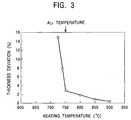
- Fig. 3 is a graph showing the relationship between a heating temperature and a thickness deviation resulted for each steel pipe which was produced by performing the diameter-reducing rolling on a seam welded steel pipe under conditions of the reduction in diameter set to 30% and the rolling temperature set to 700°C while changing the heating temperature, the seam welded steel pipe being produced by an ordinary method from strip steel having the same composition as steel A in Table 1 given below.
- the heating prior to the diameter-reducing rolling is preferably set to be not lower than the temperature Ac 1 from the standpoint of suppressing the thickness deviation and wrinkles occurred near the seam.
- the temperature Ac 1 depends on the chemical composition of the steel pipe, etc., and can be determined based on experiments. A range of temperature Ac 1 is approximately not lower than 800°C. However, if the heating temperature is too high, the crystal grain size would be excessively increased, thus resulting in a problem of, for example, increasing surface roughness during the working. For that reason, the heating temperature is preferably set to be not higher than 900°C.
- the diameter-reducing rolling may be performed, for example, after cooling the steel pipe down to temperatures at which ferrite forms the main phase, or by reheating the steel pipe after cooling it down to the room temperature.
- heat treatment of holding the rolled steel pipe in a temperature range of from 600°C to 900°C for a time of 1 second or longer is performed in the present invention.
- the diameter-reducing rolling is performed at temperatures of not lower than 600°C, the work hardness is low and a sufficient level of workability is obtained with additional treatment. Even so, by performing heat treatment for holding the rolled steel pipe at a certain temperature for a certain time in succession to the diameter-reducing rolling, the elongation and the r-value are further improved. This effect is developed by holding the rolled steel pipe at temperatures of not lower than 600°C for a time of 1 second or longer. However, if the holding temperature exceeds 900°C, the steel structure would be transformed into the single austenitic phase and the r-value would be reduced because of the randomized aggregation structure.
- the heat treatment is preferably performed on conditions of the holding temperature in the range of from 600°C to 900°C and the holding time of 1 second or longer. Additionally, the heat treatment may be performed during cooling subsequent to the diameter-reducing rolling or by reheating the rolled steel pipe after the cooling.
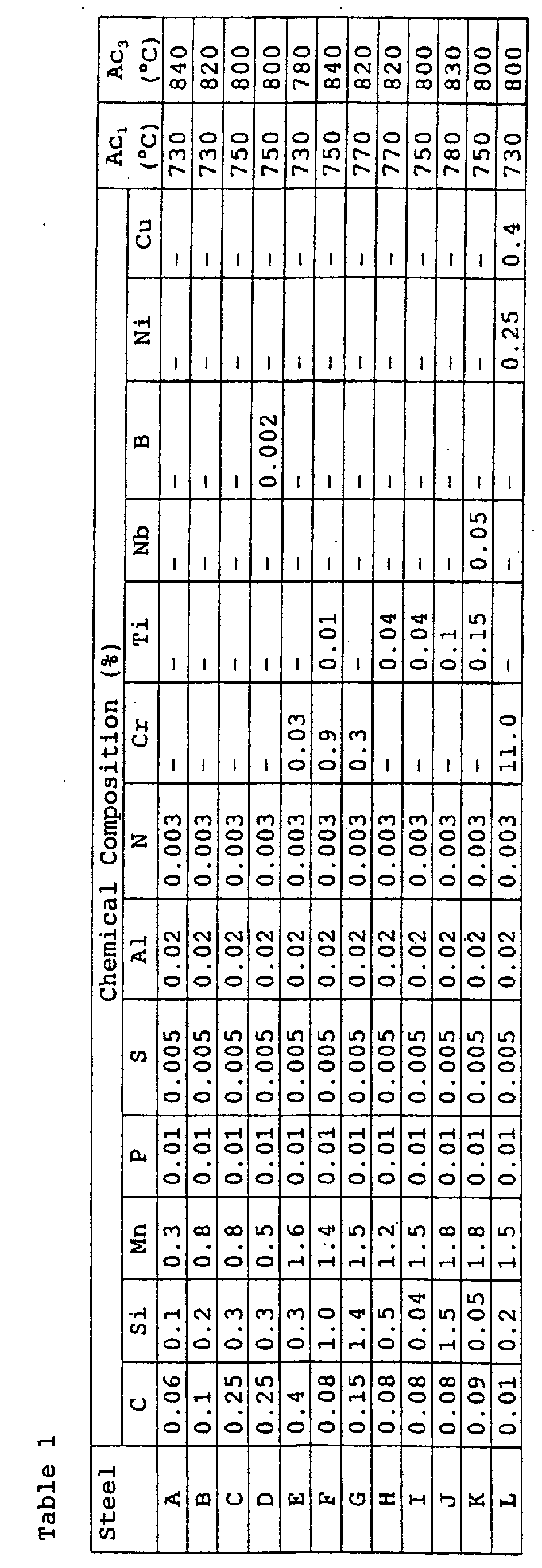
- Seam welded steel pipes were produced by an ordinary method from various kinds of hot-rolled steel plates having chemical compositions shown in Table 1, and the diameter-reducing rolling was performed on each steel pipe under conditions shown in Table 2. Heating of the steel pipe prior to the diameter-reducing rolling was not held at all or held for a time of 1 to 600 seconds after reaching the temperature shown in Table 2.
- Tensile specimens of JIS No. 12-A were sampled from circumferential positions 0°, 90°, 180° and 270° of each steel pipe obtained. After bonding a strain gauge with a gauge length of 2 mm to each specimen, a tensile test was carried out on the specimen by applying a nominal strain of 6 to 7%.
- the presence or absence of wrinkles was determined by observing an image of an area near the seam in a cross-section perpendicular to the axis of the steel pipe, the image being enlarged at a magnification of 50 times.
- the r-value is 1.2 or above at any positions in the circumferential direction in Examples of the present invention, whereas the r-value is below 1.2 in Comparative Examples. Also, in the specimens heated to temperatures of not lower than Ac 1 , the thickness deviation is smaller and wrinkles are not caused.
- a high-workability steel pipe which has a high r-value over an entire area in the circumferential direction, including a seamed portion, and also has a good shape. Limits in bending and expanding work of the steel pipe are noticeably improved, whereby omission of steps due to the integral forming and a reduction in weight can be achieved. Further, seam welded steel pipes having a high r-value can also be produced using, as base materials, hot-rolled steel, high tensile strength steel such as dual phase steel, and low, medium and high carbon steel, which have a difficulty in achieving a high r-value with a conventional method of producing a steel pipe by simply seam-welding a steel plate.
Landscapes
- Chemical & Material Sciences (AREA)
- Engineering & Computer Science (AREA)
- Mechanical Engineering (AREA)
- Materials Engineering (AREA)
- Metallurgy (AREA)
- Organic Chemistry (AREA)
- Manufacturing & Machinery (AREA)
- Physics & Mathematics (AREA)
- Thermal Sciences (AREA)
- Crystallography & Structural Chemistry (AREA)
- Heat Treatment Of Steel (AREA)
- Heat Treatment Of Articles (AREA)
Abstract
The invention provides a steel pipe being superior
in workability, particularly in bending workability, in
which an r-value in the axial direction of the pipe in
a portion where melting or transformation of a steel
material has occurred during seam welding is as high as
comparable to that in a portion where melting or
transformation of the steel material has not occurred,
and a method of producing the steel pipe. In the high-workability
steel pipe, an r-value in the longitudinal
direction is not less than 1.2, more preferably not
less than 1.6, over an entire area in the
circumferential direction, including a seamed portion.
The steel pipe is produced by a method comprising the
step of performing diameter-reducing rolling on a steel
pipe in a temperature range of from 600°C to Ac3 with a
reduction in diameter of not less than 30%, preferably
after heating the steel pipe to temperatures of not
lower than Ac1, the steel pipe being produced by seam-welding
strip steel, or a method further comprising the
step of performing heat treatment of holding the rolled
steel pipe in a temperature range of from 600°C to
900°C for a time of 1 second or longer during cooling
subsequent to the diameter-reducing rolling or by
reheating the rolled steel pipe after the cooling.
Description
The present invention relates to a steel pipe
having superior workability and a method of producing
the steel pipe.
For the purpose of reducing the weight and cost,
the application of seam (electric resistance) welded
steel pipes to automobile parts has been considered.
Conventional seam welded steel pipes, however, have not
been sufficient in workability. Bending is employed to
manufacture, e.g., undercarriage or suspension parts of
automobiles. When the conventional seam welded steel
pipes are subjected to the bending, a problem has been
experienced in that a pipe wall is greatly thinned on
the outer side of a bent portion, and in the worst case
a pipe is ruptured. Even in the case of not causing a
rupture, a large rate of thinning of the pipe wall
requires the use of a material having a greater
thickness to satisfy the design stress, and therefore a
sufficient reduction in weight cannot be achieved.
As disclosed in Japanese Unexamined Patent
Application Publication No. 55-56624, for example, it
is known that improving an r-value (Lankford value) of
a pipe in the axial direction is effective to overcome
the problems described above. As a method for
increasing the r-value of a steel pipe, however, it is
only known to increase the r-value of strip steel as a
base material of a steel pipe as disclosed in, for
example, Japanese Unexamined Patent Application
Publication No. 6-41689. When producing seam welded
steel pipes, there has been a problem that the r-value
is reduced in a portion where melting or transformation
of a steel material has occurred during seam welding.
Another problem has arisen in that the seam welding
cannot be applied to steel plates not having a high r-value,
such as hot-rolled steel plates, high tensile
strength steel plates, and low, medium and high carbon
steel plates.
Accordingly, it is an object of the present
invention to provide a steel pipe being superior in
workability, particularly in bending workability, in
which an r-value of the pipe in the axial direction in
a portion where melting or transformation of a steel
material has occurred during seam welding is as high as
comparable to that in a portion where melting or
transformation of the steel material has not occurred,
and a method of producing the steel pipe.
With the view of overcoming the problems mentioned
above, the inventors have conducted studies based on a
consideration that working and heat treatment of seam
welded steel pipes are required to improve the r-value
in a welded portion near the seam. Then, the inventors
have studied a method of performing working and heat
treatment of a steel pipe evenly at any positions in
the circumferential direction, the steel pipe being
produced by seam-welding cold-rolled steel having a
high r-value. In the process of the studies, the
inventors have found that the r-value of the seam
welded steel pipe in the longitudinal direction (in the
axial direction of the pipe) is noticeably improved to
1.2 or above, in particular to 1.6 or above, at any
positions in the circumferential direction, including a
seamed portion, by a method of performing diameter-reducing
rolling on the seam welded steel pipe in a
temperature range of from 600°C to Ac3 with a reduction
in diameter of not less than 30% (referred to as a
"method according to the present invention"
hereinafter).
As a result of applying the method according to
the present invention to seam welded steel pipes
produced using various kinds of steel plates as base-material
strip steel, the inventors have also found
that a high r-value can be obtained regardless of the
r-value of the original strip steel. Further, it has
been found that with the method according to the
present invention, the restriction of ingredients which
has hitherto been employed to obtain a high r-value in
steel sheets, i.e., a reduction of the C and N contents
and addition of stabilizing elements such as Ti and Nb,
are not required. As a result, seam welded steel pipes
having a high r-value can also be produced using, as
base-material strip steel, hot-rolled steel, high
tensile strength steel such as dual phase steel, and
low, medium and high carbon steel, which have a
difficulty in achieving a high r-value in the stage of
strip steel.
The views of the inventors regarding the reason
why a steel pipe having a high r-value can be obtained
from even a steel plate not having a high r-value are
as follows.
By performing the diameter-reducing rolling on a
seam welded steel pipe in a temperature range of from
600°C to Ac3 with a reduction in diameter of not less
than 30%, an ideal aggregation structure due to the
rolling, in which the <110> axis is parallel to the
longitudinal direction and the <111> to <110> axes are
parallel to the radial direction, is formed and then
further developed through restoration and
recrystallization. That aggregation structure provides
a high r-value. The aggregation structure due to the
rolling produces very great driving forces because
crystals are rotated by working strains. Unlike an
aggregation structure that is created through
recrystallization in the case of obtaining a high r-value
in steel sheets, the aggregation structure due to
the rolling is less affected by the second phase and
solid solution C. Consequently, even for the type of
strip steel which has a difficulty in obtaining a high
r-value in the stage of producing steel plates, a high
r-value can be obtained in the stage of producing steel
pipes.
Also, the reason why a high r-value is not
obtained by performing the diameter-reducing rolling at
low temperatures is that ideal crystal rotation is not
caused because of high work hardness, or that
restoration and recrystallization are not developed at
a sufficient level because of low temperatures.
Furthermore, the reason why a high r-value is not
obtained by a method of performing the diameter-reducing
rolling on a steel pipe at low temperatures
and then annealing the rolled steel pipe for
recrystallization is that the desired aggregation
structure is not developed through the cold rolling and
the recrystallization because of the effect of the
second phase and solid solution C.
In the field of producing steel sheets, there is
known a method of producing a steel sheet having a high
r-value by rolling steel into a sheet in the hot
ferrite range. This method of producing a steel sheet
having a high r-value is featured in that steel
containing C and N in reduced amounts and added with
stabilizing elements such as Ti and Nb is rolled at low
temperatures and then recrystallized. That sheet
rolling at low temperatures differs from the diameter-reducing
rolling at high temperatures intended by the
method according to the present invention. In fact, if
the known sheet rolling in the hot ferrite range is
carried out at 600°C or above, the r-value is not
improved, but rather noticeably lowered on the contrary.
This is because, in the sheet rolling in which draft is
applied in the thickness direction of a sheet, strain
occurs in a direction different from that in the
diameter-reducing rolling of a steel pipe in which
draft is applied in the circumferential direction, and
hence the aggregation structure effective in increasing
the r-value is not developed.
As a result of further continuing the studies, the
inventors have found that, in the method according to
the present invention, the thickness deviation can be
noticeably reduced and the occurrence of wrinkles near
the seam can be suppressed by heating a seam welded
steel pipe to temperatures of not lower than Ac1 before
the diameter-reducing rolling for austenitic
transformation of a part or the whole of a steel
structure, because the difference in mechanical
properties between the hardened structure of the seam
and the remaining portion is reduced. The present
invention has been accomplished based on the findings
set forth above. The features of the present invention
are as follows.
In a high-workability steel pipe according to the
present invention, an r-value in the longitudinal
direction is not less than 1.2. The reason is that the
bending workability of the steel pipe is noticeably
improved when the r-value is not less than 1.2. More
preferably, the high-workability steel pipe has an r-value
of not less than 1.6 because the bending
workability is further improved when the r-value is not
less than 1.6.
The high-workability steel pipe according to the
present invention can be produced by performing
diameter-reducing rolling on a steel pipe in a
temperature range of from 600°C to Ac3 with a reduction
in diameter of not less than 30%, the steel pipe being
produced by seam-welding strip steel and having a seam.
The r-value is affected by the reduction in diameterand
the temperature during the diameter-reducing rolling.
Fig. 1 is a graph showing the relationship between
the r-value in the longitudinal direction and the
reduction in diameterresulted at circumferential
positions 0°, 90°, 180° and 270° of each steel pipe
which was produced by performing the diameter-reducing
rolling on a seam welded steel pipe under a condition
of the outgoing-side temperature being set to 730°C
while changing the reduction in diameterthe seam welded
steel pipe being produced by an ordinary method from
strip steel having the same composition as steel A in
Table 1 given below. The seam position is assumed to
be at 0° (this is similarly applied to the following
description). From Fig. 1, it is understood that,
regardless of the circumferential positions, the r-value
of not less than 1.3 is obtained at the reduction
in diameterof not less than 30%, and the r-value of not
less than 1.6 is obtained at the reduction in
diameterof not less than 50%.
Fig. 2 is a graph showing the relationship between
the r-value in the longitudinal direction and the
outgoing-side temperature resulted at circumferential
positions 0°, 90°, 180° and 270° of each steel pipe
which was produced by performing the diameter-reducing
rolling on a seam welded steel pipe under a condition
of the reduction in diameter set to 30% while changing
the outgoing-side temperature, the seam welded steel
pipe being produced by an ordinary method from strip
steel having the same composition as steel A in Table 1
given below. From Fig. 2, it is understood that the r-value
of not less than 1.2 is obtained at the outgoing-side
temperature of not lower than 600°C.
Based on the experiment results mentioned above, a
lower limit of the temperature for the diameter-reducing
rolling was set to 600°C and a lower limit of
the reduction in diameterwas set to 30%. Also, an
upper limit of the temperature for the diameter-reducing
rolling was set to the same as an upper limit
of the temperature range in which the steel structure
contains ferrite, i.e., the temperature Ac3. The r-value
is not improved even by the diameter-reducing
rolling if it is performed on steel whose structure
contains no ferrite. The temperature Ac3 depends on
the chemical composition of steel, and can be
determined based on experiments. A range of
temperature Ac3 is approximately not higher than 900°C.
In the present invention, so long as the steel
structure contains ferrite, the second phase (phase
other than ferrite) is not limited to particular one.
For example, austenite may be the second phase. More
preferably, the diameter-reducing rolling is performed
at temperatures where ferrite forms the main phase
(phase having a volume ratio of 50% or more).
The gist of the present invention resides in that
a steel pipe is subjected to the diameter-reducing
rolling in a temperature range where the steel
structure has the ferrite phase. From the standpoint
of improving the r-value, there is no particular
restriction upon the history prior to the diameter-reducing
rolling. For example, the heating temperature
prior to the diameter-reducing rolling may be any of
the temperature at which the steel structure has the
single austenitic phase, the temperature at which the
steel structure has the two austenitic and ferrite
phases, and the temperature at which the steel
structure has the single ferrite phase. Further, prior
to the diameter-reducing rolling, the steel pipe may be
rolled at such temperatures as forming austenite as the
single phase or the main phase.
Fig. 3 is a graph showing the relationship between
a heating temperature and a thickness deviation
resulted for each steel pipe which was produced by
performing the diameter-reducing rolling on a seam
welded steel pipe under conditions of the reduction in
diameter set to 30% and the rolling temperature set to
700°C while changing the heating temperature, the seam
welded steel pipe being produced by an ordinary method
from strip steel having the same composition as steel A
in Table 1 given below. From Fig. 3, it is understood
that the heating prior to the diameter-reducing rolling
is preferably set to be not lower than the temperature
Ac1 from the standpoint of suppressing the thickness
deviation and wrinkles occurred near the seam. The
temperature Ac1 depends on the chemical composition of
the steel pipe, etc., and can be determined based on
experiments. A range of temperature Ac1 is
approximately not lower than 800°C. However, if the
heating temperature is too high, the crystal grain size
would be excessively increased, thus resulting in a
problem of, for example, increasing surface roughness
during the working. For that reason, the heating
temperature is preferably set to be not higher than
900°C.
There is no particular restriction upon the
cooling after the heating of the steel pipe.
Subsequent to the heating, the diameter-reducing
rolling may be performed, for example, after cooling
the steel pipe down to temperatures at which ferrite
forms the main phase, or by reheating the steel pipe
after cooling it down to the room temperature.
Further, preferably, after the diameter-reducing
rolling of the steel pipe, heat treatment of holding
the rolled steel pipe in a temperature range of from
600°C to 900°C for a time of 1 second or longer is
performed in the present invention.
In the present invention, since the diameter-reducing
rolling is performed at temperatures of not
lower than 600°C, the work hardness is low and a
sufficient level of workability is obtained with
additional treatment. Even so, by performing heat
treatment for holding the rolled steel pipe at a
certain temperature for a certain time in succession to
the diameter-reducing rolling, the elongation and the
r-value are further improved. This effect is developed
by holding the rolled steel pipe at temperatures of not
lower than 600°C for a time of 1 second or longer.
However, if the holding temperature exceeds 900°C, the
steel structure would be transformed into the single
austenitic phase and the r-value would be reduced
because of the randomized aggregation structure. For
that reason, the heat treatment is preferably performed
on conditions of the holding temperature in the range
of from 600°C to 900°C and the holding time of 1 second
or longer. Additionally, the heat treatment may be
performed during cooling subsequent to the diameter-reducing
rolling or by reheating the rolled steel pipe
after the cooling.
Seam welded steel pipes were produced by an
ordinary method from various kinds of hot-rolled steel
plates having chemical compositions shown in Table 1,
and the diameter-reducing rolling was performed on each
steel pipe under conditions shown in Table 2. Heating
of the steel pipe prior to the diameter-reducing
rolling was not held at all or held for a time of 1 to
600 seconds after reaching the temperature shown in
Table 2. Tensile specimens of JIS No. 12-A were
sampled from circumferential positions 0°, 90°, 180° and
270° of each steel pipe obtained. After bonding a
strain gauge with a gauge length of 2 mm to each
specimen, a tensile test was carried out on the
specimen by applying a nominal strain of 6 to 7%. Then,
a ratio of a true strain εw in the width direction to a
true strain εL in the longitudinal direction was
measured. From a gradient ρ of that ratio, the r-value
was calculated based on the following formulae:
ρ = εL / εw
r-value = ρ/(-1- ρ)
Further, a thickness deviation η was calculated by
measuring a pipe wall thickness ts of a seamed portion
and an average pipe wall thickness tb of the remaining
portion. That is:
thickness deviation η% = (ts - tb)/tb × 100%
Moreover, the presence or absence of wrinkles was
determined by observing an image of an area near the
seam in a cross-section perpendicular to the axis of
the steel pipe, the image being enlarged at a
magnification of 50 times.
Those results are listed in Table 3 along with the
tensile strength (TS) and the elongation (El).
The r-value is 1.2 or above at any positions in
the circumferential direction in Examples of the
present invention, whereas the r-value is below 1.2 in
Comparative Examples. Also, in the specimens heated to
temperatures of not lower than Ac1, the thickness
deviation is smaller and wrinkles are not caused.
According to the present invention, a high-workability
steel pipe can be provided which has a high
r-value over an entire area in the circumferential
direction, including a seamed portion, and also has a
good shape. Limits in bending and expanding work of
the steel pipe are noticeably improved, whereby
omission of steps due to the integral forming and a
reduction in weight can be achieved. Further, seam
welded steel pipes having a high r-value can also be
produced using, as base materials, hot-rolled steel,
high tensile strength steel such as dual phase steel,
and low, medium and high carbon steel, which have a
difficulty in achieving a high r-value with a
conventional method of producing a steel pipe by simply
seam-welding a steel plate. As a result, the present
invention is able to remarkably enlarge the applicable
range of bending of steel pipes and hence greatly
contributes to development of the industry.
| No . | Steel | Heating Temperature (°C) | Incoming-side Temperature in Diameter-Reducing Rolling (°C) | Outgoing-side Temperature in Diameter-Reducing Rolling (°C) | Total Reduction in Diameter (%) | Effective Reduction in Diameter (%) | Heat Treatment | Remarks |
| 1 | A | 800 | 780 | 730 | 50 | 50 | - | Example |
| 2 | A | 900 | 880 | 830 | 50 | 5 | - | Comparative Example |
| 3 | A | 630 | 610 | 560 | 50 | 10 | - | Comparative Example |
| 4 | | 800 | 780 | 730 | 50 | 50 | - | Example |
| 5 | | 800 | 780 | 730 | 50 | 50 | - | Example |
| 6 | | 800 | 780 | 730 | 50 | 50 | 73°c × 5 min. | Example |
| 7 | D | 900 | 720 | 680 | 50 | 50 | - | Example |
| 8 | D | 850 | 720 | 680 | 50 | 50 | - | Example |
| 9 | D | 800 | 780 | 730 | 50 | 50 | - | Example |
| 10 | D | 800 | 720 | 680 | 50 | 50 | - | Example |
| 11 | D | 750 | 720 | 680 | 50 | 50 | - | Example |
| 12 | D | 735 | 720 | 680 | 50 | 50 | - | Example |
| 13 | D | 720 | 720 | 680 | 50 | 50 | - | Example |
| 14 | E | 800 | 780 | 730 | 50 | 50 | - | Example |
| 15 | F | 800 | 780 | 730 | 0 | 0 | - | Comparative Example |
| 16 | F | 800 | 780 | 730 | 15 | 15 | - | Comparative Example |
| 17 | F | 800 | 780 | 730 | 30 | 30 | - | Example |
| 18 | F | 800 | 780 | 730 | 40 | 40 | - | Example |
| 19 | F | 800 | 780 | 730 | 50 | 50 | - | Example |
| 20 | F | 800 | 780 | 730 | 60 | 60 | - | Example |
| 21 | F | 800 | 780 | 730 | 70 | 70 | - | Example |
| 22 | F | 900 | 890 | 850 | 30 | 2 | - | Comparative Example |
| 23 | F | 850 | 840 | 780 | 30 | 30 | - | Example |
| 24 | F | 750 | 730 | 680 | 30 | 30 | - | Example |
| 25 | F | 700 | 680 | 600 | 30 | 30 | - | Example |
| 26 | F | 630 | 610 | 560 | 50 | 10 | - | Comparative Example |
| 27 | G | 900 | 780 | 730 | 50 | 50 | - | Example |
| 28 | G | 850 | 780 | 730 | 50 | 50 | - | Example |
| 29 | G | 800 | 780 | 730 | 30 | 30 | - | Example |
| 30 | G | 800 | 780 | 730 | 40 | 40 | - | Example |
| 31 | G | 800 | 780 | 730 | 50 | 50 | - | Example |
| 32 | H | 800 | 780 | 730 | 50 | 50 | - | Example |
| 33 | I | 800 | 780 | 730 | 50 | 50 | - | Example |
| 34 | J | 800 | 780 | 730 | 50 | 50 | - | Example |
| 35 | K | 800 | 780 | 730 | 50 | 50 | - | Example |
| 36 | L | 760 | 740 | 700 | 60 | 60 | - | Example |
| No | 0° (Seam) | 90° | 180° | 270° | Seam Thick ness Devia tion /% | Wrinkles ○ not occurred × occurred | Remarks | ||||||||
| TS/MPa | E1 /% | r-value | TS/MPa | E1 /% | r-value | TS/MPa | E1 /% | r-value | TS/MPa | E1 /% | r-value | ||||
| 1 | 300 | 55 | 2.0 | 303 | 54 | 2.0 | 307 | 54 | 2.1 | 301 | 55 | 2.1 | 0.3 | ○ | Example |
| 2 | 300 | 45 | 0.8 | 309 | 45 | 0.9 | 307 | 45 | 0.8 | 308 | 45 | 0.8 | 0.3 | ○ | Comparative Example |
| 3 | 450 | 35 | 1.0 | 450 | 35 | 1.1 | 459 | 36 | 1.0 | 451 | 34 | 1.1 | 10.0 | × | Comparative Example |
| 4 | 350 | 50 | 2.0 | 356 | 51 | 2.0 | 356 | 50 | 2.0 | 350 | 51 | 2.0 | 0.5 | ○ | Example |
| 5 | 350 | 50 | 2.4 | 358 | 51 | 2.4 | 351 | 49 | 2.5 | 356 | 49 | 2.4 | 0.5 | ○ | Example |
| 6 | 620 | 25 | 1.8 | 624 | 24 | 1.8 | 625 | 25 | 1.8 | 629 | 25 | 1.9 | 0.3 | ○ | Example |
| 7 | 640 | 27 | 1.7 | 646 | 27 | 1.7 | 641 | 27 | 1.7 | 647 | 26 | 1.7 | 0.5 | ○ | Example |
| 8 | 631 | 25 | 1.7 | 651 | 26 | 1.6 | 641 | 25 | 1.8 | 641 | 25 | 1.8 | 1.0 | ○ | Example |
| 9 | 620 | 28 | 1.8 | 626 | 29 | 1.8 | 621 | 29 | 1.9 | 627 | 28 | 1.9 | 0.5 | ○ | Example |
| 10 | 640 | 24 | 1.6 | 659 | 24 | 1.7 | 632 | 24 | 1.7 | 636 | 24 | 1.7 | 2.0 | ○ | Example |
| 11 | 644 | 22 | 1.6 | 650 | 22 | 1.7 | 635 | 22 | 1.7 | 632 | 22 | 1.8 | 3.0 | ○ | Example |
| 12 | 653 | 20 | 1.6 | 657 | 21 | 1.6 | 640 | 21 | 1.8 | 623 | 21 | 1.8 | 8.0 | × | Example |
| 13 | 644 | 19 | 1.7 | 650 | 19 | 1.7 | 637 | 19 | 1.9 | 614 | 19 | 1.8 | 15.0 | × | Example |
| 14 | 650 | 25 | 1.8 | 652 | 25 | 1.9 | 651 | 25 | 1.8 | 651 | 26 | 1.9 | 0.5 | ○ | Example |
| 15 | 500 | 25 | 0.7 | 508 | 26 | 0.8 | 503 | 24 | 0.8 | 501 | 25 | 0.8 | 0.3 | ○ | Comparative Example |
| 16 | 590 | 28 | 1.0 | 593 | 28 | 1.1 | 599 | 29 | 1.1 | 595 | 28 | 1.0 | 0.3 | ○ | Comparative Example |
| 17 | 610 | 28 | 1.3 | 610 | 28 | 1.3 | 618 | 28 | 1.3 | 614 | 29 | 1.3 | 0.9 | ○ | Example |
| 18 | 610 | 29 | 1.4 | 619 | 29 | 1.4 | 611 | 30 | 1.4 | 611 | 28 | 1.4 | 0.9 | ○ | Example |
| 19 | 610 | 30 | 1.6 | 617 | 31 | 1.7 | 611 | 30 | 1.6 | 615 | 31 | 1.6 | 0.9 | ○ | Example |
| 20 | 610 | 32 | 2.0 | 616 | 31 | 2.0 | 612 | 33 | 2.1 | 610 | 31 | 2.1 | 0.9 | ○ | Example |
| 21 | 610 | 35 | 2.5 | 615 | 35 | 2.6 | 613 | 35 | 2.6 | 618 | 36 | 2.6 | 0.8 | ○ | Example |
| 22 | 590 | 28 | 0.8 | 593 | 27 | 0.8 | 599 | 28 | 0.8 | 593 | 28 | 0.9 | 0.2 | ○ | Comparative Example |
| 23 | 610 | 29 | 1.4 | 612 | 30 | 1.4 | 614 | 30 | 1.5 | 616 | 29 | 1.5 | 0.2 | ○ | Example |
| 24 | 610 | 28 | 1.3 | 613 | 29 | 1.3 | 615 | 28 | 1.4 | 612 | 28 | 1.4 | 0.0 | ○ | Example |
| 25 | 650 | 27 | 1.2 | 651 | 26 | 1.2 | 650 | 27 | 1.2 | 658 | 26 | 1.2 | 3.0 | × | Example |
| 26 | 630 | 22 | 0.9 | 680 | 21 | 1.0 | 687 | 22 | 1.0 | 685 | 23 | 0.9 | 15.0 | × | Comparative Example |
| 27 | 630 | 30 | 1.3 | 638 | 30 | 1.3 | 639 | 31 | 1.4 | 640 | 31 | 1.3 | 0.7 | ○ | Example |
| 28 | 630 | 33 | 1.4 | 636 | 33 | 1.4 | 630 | 33 | 1.5 | 638 | 33 | 1.5 | 0.5 | ○ | Example |
| 29 | 630 | 30 | 1.3 | 638 | 30 | 1.3 | 639 | 31 | 1.4 | 640 | 31 | 1.3 | 0.3 | ○ | Example |
| 30 | 630 | 33 | 1.4 | 636 | 33 | 1.4 | 630 | 33 | 1.5 | 638 | 33 | 1.5 | 0.3 | ○ | Example |
| 31 | 630 | 35 | 1.8 | 637 | 34 | 1.9 | 635 | 35 | 1.8 | 633 | 34 | 1.9 | 0.4 | ○ | Example |
| 32 | 600 | 30 | 1.8 | 606 | 30 | 1.8 | 609 | 30 | 1.9 | 600 | 30 | 1.8 | 0.5 | ○ | Example |
| 33 | 600 | 30 | 1.8 | 604 | 29 | 1.8 | 605 | 31 | 1.9 | 601 | 29 | 1.9 | 0.8 | ○ | Example |
| 34 | 820 | 24 | 1.6 | 823 | 25 | 1.6 | 821 | 25 | 1.7 | 825 | 24 | 1.7 | 0.3 | ○ | Example |
| 35 | 820 | 22 | 1.6 | 821 | 22 | 1.6 | 823 | 23 | 1.7 | 830 | 22 | 1.7 | 0.8 | ○ | Example |
| 36 | 695 | 28 | 1.8 | 595 | 28 | 1.8 | 595 | 28 | 1.8 | 595 | 28 | 1.8 | 0.3 | ○ | Example |
Claims (4)
- A high-workability steel pipe wherein an r-value in the longitudinal direction is not less than 1.2 over an entire area in the circumferential direction, including a seamed portion.
- A method of producing a high-workability steel pipe, said method comprising the step of performing diameter-reducing rolling on a steel pipe in a temperature range of from 600°C to Ac3 with a reduction in diameter of not less than 30%, said steel pipe being produced by seam-welding strip steel.
- A method of producing a high-workability steel pipe according to Claim 2, wherein said method comprises the steps of heating a steel pipe to temperatures of not lower than Ac1, said steel pipe being produced by seam-welding strip steel, and then immediately or after cooling and reheating said steel pipe, performing diameter-reducing rolling in a temperature range of from 600°C to Ac3 with a reduction in diameter of not less than 30%.
- A method of producing a high-workability steel pipe according to Claim 2 or 3, wherein after the diameter-reducing rolling of said steel pipe, heat treatment of holding the rolled steel pipe in a temperature range of from 600°C to 900°C for a time of 1 second or longer is performed during cooling subsequent to the diameter-reducing rolling or by reheating the rolled steel pipe after said cooling.
Applications Claiming Priority (1)
| Application Number | Priority Date | Filing Date | Title |
|---|---|---|---|
| PCT/JP2001/005053 WO2002103069A1 (en) | 2000-01-28 | 2001-06-14 | Steel pipe having high formability and method for production thereof |
Publications (2)
| Publication Number | Publication Date |
|---|---|
| EP1437422A1 true EP1437422A1 (en) | 2004-07-14 |
| EP1437422A4 EP1437422A4 (en) | 2006-08-23 |
Family
ID=11737433
Family Applications (1)
| Application Number | Title | Priority Date | Filing Date |
|---|---|---|---|
| EP01938656A Withdrawn EP1437422A4 (en) | 2001-06-14 | 2001-06-14 | Steel pipe having high formability and method for production thereof |
Country Status (5)
| Country | Link |
|---|---|
| EP (1) | EP1437422A4 (en) |
| CN (1) | CN1234896C (en) |
| BR (1) | BR0110441B1 (en) |
| CA (1) | CA2403830C (en) |
| WO (1) | WO2002103069A1 (en) |
Cited By (3)
| Publication number | Priority date | Publication date | Assignee | Title |
|---|---|---|---|---|
| EP1816225A4 (en) * | 2004-11-26 | 2009-03-25 | Jfe Steel Corp | Steel pipe having excellent electromagnetic properties and process for producing the same |
| EP2868763A4 (en) * | 2012-06-28 | 2015-10-07 | Jfe Steel Corp | HIGH CARBON STEEL TUBE OF EXCELLENT SCRAPABILITY, MACHINABILITY AND SOFTENESS, AND METHOD OF MANUFACTURING THE SAME |
| EP3085800A4 (en) * | 2013-12-20 | 2017-07-05 | Nippon Steel & Sumitomo Metal Corporation | Electric resistance welded steel pipe |
Families Citing this family (2)
| Publication number | Priority date | Publication date | Assignee | Title |
|---|---|---|---|---|
| ES2954141T3 (en) * | 2016-07-14 | 2023-11-20 | Tata Steel Nederland Tubes Bv | Method for in-line manufacturing of steel tube |
| MX2022011054A (en) * | 2020-03-18 | 2022-09-19 | Jfe Steel Corp | Electric resistance welded steel pipe, method for producing same, and structural member for automobile. |
Family Cites Families (13)
| Publication number | Priority date | Publication date | Assignee | Title |
|---|---|---|---|---|
| DE2900022C3 (en) * | 1979-01-02 | 1981-12-03 | Estel Hoesch Werke Ag, 4600 Dortmund | Process for producing profiles |
| JPH04143015A (en) * | 1990-10-05 | 1992-05-18 | Sumitomo Metal Ind Ltd | Manufacture of high tensile electric resistance welded tube having excellent toughness of welded part |
| JPH0641689A (en) * | 1992-06-22 | 1994-02-15 | Nippon Steel Corp | High cr steel tube excellent in workability |
| DE4318931C1 (en) * | 1993-06-03 | 1994-12-01 | Mannesmann Ag | Method for the production of welded tubes |
| JP3518247B2 (en) * | 1996-06-10 | 2004-04-12 | Jfeスチール株式会社 | Welded steel pipe and its manufacturing method |
| JP3481409B2 (en) * | 1996-12-17 | 2003-12-22 | 新日本製鐵株式会社 | Hydroforming method of steel pipe |
| EP0924312B1 (en) * | 1997-06-26 | 2005-12-07 | JFE Steel Corporation | Method for manufacturing super fine granular steel pipe |
| JP3785828B2 (en) * | 1998-09-21 | 2006-06-14 | Jfeスチール株式会社 | Steel pipe drawing method |
| JP3760640B2 (en) * | 1998-09-22 | 2006-03-29 | Jfeスチール株式会社 | Steel pipe manufacturing method |
| JP2000212694A (en) * | 1999-01-20 | 2000-08-02 | Nippon Steel Corp | ERW steel pipe with excellent workability and its manufacturing method |
| JP2001162305A (en) * | 1999-12-08 | 2001-06-19 | Kawasaki Steel Corp | Manufacturing method of steel pipe |
| JP3794230B2 (en) * | 2000-01-28 | 2006-07-05 | Jfeスチール株式会社 | Manufacturing method of high workability steel pipe |
| JP4571754B2 (en) * | 2001-03-13 | 2010-10-27 | 新日本製鐵株式会社 | Manufacturing method of steel pipe with excellent formability |
-
2001
- 2001-06-14 CA CA002403830A patent/CA2403830C/en not_active Expired - Lifetime
- 2001-06-14 CN CNB018086209A patent/CN1234896C/en not_active Expired - Fee Related
- 2001-06-14 BR BRPI0110441-1B1A patent/BR0110441B1/en not_active IP Right Cessation
- 2001-06-14 EP EP01938656A patent/EP1437422A4/en not_active Withdrawn
- 2001-06-14 WO PCT/JP2001/005053 patent/WO2002103069A1/en not_active Ceased
Cited By (6)
| Publication number | Priority date | Publication date | Assignee | Title |
|---|---|---|---|---|
| EP1816225A4 (en) * | 2004-11-26 | 2009-03-25 | Jfe Steel Corp | Steel pipe having excellent electromagnetic properties and process for producing the same |
| US7942984B2 (en) | 2004-11-26 | 2011-05-17 | Jfe Steel Corporation | Steel pipe with good magnetic properties and method of producing the same |
| EP2868763A4 (en) * | 2012-06-28 | 2015-10-07 | Jfe Steel Corp | HIGH CARBON STEEL TUBE OF EXCELLENT SCRAPABILITY, MACHINABILITY AND SOFTENESS, AND METHOD OF MANUFACTURING THE SAME |
| RU2600460C2 (en) * | 2012-06-28 | 2016-10-20 | ДжФЕ СТИЛ КОРПОРЕЙШН | Tube from high-carbon steel with excellent processability in cold state, processability and hardenability and its manufacturing method |
| EP3085800A4 (en) * | 2013-12-20 | 2017-07-05 | Nippon Steel & Sumitomo Metal Corporation | Electric resistance welded steel pipe |
| US10738366B2 (en) | 2013-12-20 | 2020-08-11 | Nippon Steel Corporation | Electric-resistance welded steel pipe |
Also Published As
| Publication number | Publication date |
|---|---|
| WO2002103069A1 (en) | 2002-12-27 |
| BR0110441B1 (en) | 2013-06-18 |
| CA2403830C (en) | 2009-06-30 |
| CA2403830A1 (en) | 2002-12-14 |
| CN1234896C (en) | 2006-01-04 |
| CN1426489A (en) | 2003-06-25 |
| BR0110441A (en) | 2003-07-01 |
| EP1437422A4 (en) | 2006-08-23 |
Similar Documents
| Publication | Publication Date | Title |
|---|---|---|
| US9493865B2 (en) | Thick-walled high-strength hot rolled steel sheet with excellent low-temperature toughness and method of producing same | |
| JP6874913B2 (en) | Square steel pipe and its manufacturing method and building structure | |
| EP2799575B1 (en) | Hot rolled high tensile strength steel sheet and method for manufacturing same | |
| EP3409803B1 (en) | High-strength hot-rolled steel sheet for electric resistance welded steel pipe and manufacturing method therefor | |
| EP2847362B1 (en) | Automotive chassis part made from high strength formable hot rolled steel sheet | |
| US6736910B2 (en) | High carbon steel pipe excellent in cold formability and high frequency hardenability and method for producing the same | |
| US7591914B2 (en) | High-workability steel pipe and method of producing same | |
| US12553544B2 (en) | Electric resistance welded steel pipe, method for producing the same, line pipe, and building structure | |
| EP4502210A1 (en) | Hot-rolled steel sheet and method for manufacturing same, and electric resistance welded steel pipe and method for manufacturing same | |
| WO2020170775A1 (en) | Square steel pipe, method for manufacturing same, and building structure | |
| CA2403830C (en) | High-workability steel pipe and method of producing same | |
| JP7226595B2 (en) | Electric resistance welded steel pipes for line pipes | |
| JP5141440B2 (en) | High-strength steel pipe excellent in workability and manufacturing method thereof | |
| JP3756779B2 (en) | Steel plate for thinned deep drawn ironing can with excellent workability | |
| JP2004131810A (en) | Manufacturing method of steel pipe with excellent buckling resistance | |
| JP4788302B2 (en) | Highly workable steel pipe and manufacturing method thereof | |
| JP2003286544A (en) | Thin-walled steel pipe with excellent hydroformability and its manufacturing method | |
| JP2000054061A (en) | Low-yield-ratio type refractory steel, steel pipe, and method for producing the same | |
| JP6627745B2 (en) | Steel plate for can and method for producing the same | |
| EP4585705A1 (en) | Hot-rolled steel sheet, electric resistance welded steel pipe, rectangular steel pipe, line pipe, and building structure | |
| JP4932570B2 (en) | Steel pipe excellent in workability and manufacturing method thereof | |
| JP2000219933A (en) | High-strength steel pipe with excellent hydraulic formability | |
| KR100617931B1 (en) | High workability steel pipe and manufacturing method | |
| JP4654818B2 (en) | High-rigidity steel pipe and manufacturing method thereof | |
| JP4932571B2 (en) | High-strength steel pipe with excellent workability and manufacturing method thereof |
Legal Events
| Date | Code | Title | Description |
|---|---|---|---|
| PUAI | Public reference made under article 153(3) epc to a published international application that has entered the european phase |
Free format text: ORIGINAL CODE: 0009012 |
|
| 17P | Request for examination filed |
Effective date: 20021030 |
|
| AK | Designated contracting states |
Kind code of ref document: A1 Designated state(s): AT BE CH CY DE DK ES FI FR GB GR IE IT LI LU MC NL PT SE TR |
|
| A4 | Supplementary search report drawn up and despatched |
Effective date: 20060721 |
|
| 17Q | First examination report despatched |
Effective date: 20071018 |
|
| STAA | Information on the status of an ep patent application or granted ep patent |
Free format text: STATUS: THE APPLICATION IS DEEMED TO BE WITHDRAWN |
|
| 18D | Application deemed to be withdrawn |
Effective date: 20150627 |