EP1435284A2 - Magnesiazementplatten, sowie Verfahren und Anlage zur Herstellung derselben - Google Patents
Magnesiazementplatten, sowie Verfahren und Anlage zur Herstellung derselben Download PDFInfo
- Publication number
- EP1435284A2 EP1435284A2 EP03079016A EP03079016A EP1435284A2 EP 1435284 A2 EP1435284 A2 EP 1435284A2 EP 03079016 A EP03079016 A EP 03079016A EP 03079016 A EP03079016 A EP 03079016A EP 1435284 A2 EP1435284 A2 EP 1435284A2
- Authority
- EP
- European Patent Office
- Prior art keywords
- sheet
- fabric
- rollers
- magnesia cement
- plant
- Prior art date
- Legal status (The legal status is an assumption and is not a legal conclusion. Google has not performed a legal analysis and makes no representation as to the accuracy of the status listed.)
- Withdrawn
Links
Images



Classifications
-
- B—PERFORMING OPERATIONS; TRANSPORTING
- B28—WORKING CEMENT, CLAY, OR STONE
- B28B—SHAPING CLAY OR OTHER CERAMIC COMPOSITIONS; SHAPING SLAG; SHAPING MIXTURES CONTAINING CEMENTITIOUS MATERIAL, e.g. PLASTER
- B28B19/00—Machines or methods for applying the material to surfaces to form a permanent layer thereon
- B28B19/0092—Machines or methods for applying the material to surfaces to form a permanent layer thereon to webs, sheets or the like, e.g. of paper, cardboard
-
- B—PERFORMING OPERATIONS; TRANSPORTING
- B32—LAYERED PRODUCTS
- B32B—LAYERED PRODUCTS, i.e. PRODUCTS BUILT-UP OF STRATA OF FLAT OR NON-FLAT, e.g. CELLULAR OR HONEYCOMB, FORM
- B32B13/00—Layered products comprising a a layer of water-setting substance, e.g. concrete, plaster, asbestos cement, or like builders' material
- B32B13/14—Layered products comprising a a layer of water-setting substance, e.g. concrete, plaster, asbestos cement, or like builders' material next to a fibrous or filamentary layer
-
- C—CHEMISTRY; METALLURGY
- C04—CEMENTS; CONCRETE; ARTIFICIAL STONE; CERAMICS; REFRACTORIES
- C04B—LIME, MAGNESIA; SLAG; CEMENTS; COMPOSITIONS THEREOF, e.g. MORTARS, CONCRETE OR LIKE BUILDING MATERIALS; ARTIFICIAL STONE; CERAMICS; REFRACTORIES; TREATMENT OF NATURAL STONE
- C04B28/00—Compositions of mortars, concrete or artificial stone, containing inorganic binders or the reaction product of an inorganic and an organic binder, e.g. polycarboxylate cements
- C04B28/30—Compositions of mortars, concrete or artificial stone, containing inorganic binders or the reaction product of an inorganic and an organic binder, e.g. polycarboxylate cements containing magnesium cements or similar cements
- C04B28/32—Magnesium oxychloride cements, e.g. Sorel cement
-
- C—CHEMISTRY; METALLURGY
- C04—CEMENTS; CONCRETE; ARTIFICIAL STONE; CERAMICS; REFRACTORIES
- C04B—LIME, MAGNESIA; SLAG; CEMENTS; COMPOSITIONS THEREOF, e.g. MORTARS, CONCRETE OR LIKE BUILDING MATERIALS; ARTIFICIAL STONE; CERAMICS; REFRACTORIES; TREATMENT OF NATURAL STONE
- C04B2111/00—Mortars, concrete or artificial stone or mixtures to prepare them, characterised by specific function, property or use
- C04B2111/00474—Uses not provided for elsewhere in C04B2111/00
- C04B2111/00482—Coating or impregnation materials
-
- C—CHEMISTRY; METALLURGY
- C04—CEMENTS; CONCRETE; ARTIFICIAL STONE; CERAMICS; REFRACTORIES
- C04B—LIME, MAGNESIA; SLAG; CEMENTS; COMPOSITIONS THEREOF, e.g. MORTARS, CONCRETE OR LIKE BUILDING MATERIALS; ARTIFICIAL STONE; CERAMICS; REFRACTORIES; TREATMENT OF NATURAL STONE
- C04B2111/00—Mortars, concrete or artificial stone or mixtures to prepare them, characterised by specific function, property or use
- C04B2111/00474—Uses not provided for elsewhere in C04B2111/00
- C04B2111/00612—Uses not provided for elsewhere in C04B2111/00 as one or more layers of a layered structure
-
- Y—GENERAL TAGGING OF NEW TECHNOLOGICAL DEVELOPMENTS; GENERAL TAGGING OF CROSS-SECTIONAL TECHNOLOGIES SPANNING OVER SEVERAL SECTIONS OF THE IPC; TECHNICAL SUBJECTS COVERED BY FORMER USPC CROSS-REFERENCE ART COLLECTIONS [XRACs] AND DIGESTS
- Y02—TECHNOLOGIES OR APPLICATIONS FOR MITIGATION OR ADAPTATION AGAINST CLIMATE CHANGE
- Y02W—CLIMATE CHANGE MITIGATION TECHNOLOGIES RELATED TO WASTEWATER TREATMENT OR WASTE MANAGEMENT
- Y02W30/00—Technologies for solid waste management
- Y02W30/50—Reuse, recycling or recovery technologies
- Y02W30/91—Use of waste materials as fillers for mortars or concrete
Definitions
- the present invention relates to a sheet of magnesia cement, to the panels comprising it and to a method and a plant for the manufacture thereof.
- the panels according to the present invention are particularly useful for forming walls, ceilings, floors and the like, for example in ships.
- magnesia cement As is known, the first magnesia cement was described by Sorel in 1867 who obtained it by combining magnesium oxide with an aqueous solution of magnesium chloride. One of its main components is magnesium oxychloride. This cement is therefore also known as magnesium oxychloride cement.
- Other magnesia cements are (a) magnesium oxysulphate (MOS) cement, which is similar to magnesium oxychloride cement and is obtained by combining magnesium oxide with an aqueous solution of magnesium sulphate, and (b) magnesium phosphate (MAP) cement obtained by reacting magnesium oxide with a soluble phosphate such as, for example, monobasic ammonium phosphate (NH 4 H 2 PO 4 ).
- MOS magnesium oxysulphate
- MAP magnesium phosphate
- magnesia cements may also contain inorganic and/or organic inert fillers.
- EP-A-0,001,992 and DE-A-28 10 180 describe a low-density magnesium oxychloride cement obtained by reacting magnesium oxide with an aqueous solution of magnesium chloride in the presence of hydrogen peroxide and, when required, a suitable catalyst, together with other ingredients such as, for example, derivatives of cellulose, water-soluble albumins, etc.
- WO 02/02477 describes in turn a panel of magnesium oxychloride cement.
- This panel which is rigid and light, is particularly suitable for the construction of internal walls, ceilings and floors in ships, aircraft, civil and/or industrial structures, sanitary environments, laboratories and the like. Moreover, this panel has the advantage that it is not combustible and does not release toxic gases when in contact with flames and is heat-insulating and sound-proof.
- a method has now been found that makes it is possible to manufacture sheets of magnesia cement in a rapid and low-cost manner.
- said magnesia cement has a density which ranges from 850 to 1,350 kg/m 3 .
- said density ranges from 1,000 to 1,250 kg/m 3 and, even more preferably, from 1,150 to 1,250 kg/m 3 .
- magnesia cement having a density which ranges from 850 to 1,350 kg/m 3 will be referred to, for the sake of brevity, as high-density magnesia cement.
- said magnesia cement after the curing step d), has a density which ranges from 150-600 kg/m 3 . Even more preferably said density ranges from 200 to 400 kg/m 3 .
- magnesia cement having a density which ranges from 150-600 kg/m 3 will be referred to, for the sake of brevity, as low-density magnesia cement.
- composition of the mixture which is mixed in step a) depends on the desired density of the sheet and other factors of a cost-related and/or aesthetic nature as well as on the mechanical properties which are to be imparted to the sheet.
- a sheet having a density of between 850 and 1300 kg/m 3 100 parts by weight of magnesium oxide powder are mixed with 90-130 parts by weight of an aqueous solution containing from 40 to 65%, preferably from 45 to 63% by weight of magnesium chloride.
- ingredients are also added, such as phosphoric acid, magnesium trisilicate, naphthalene sulphonate, styrene acrylic resins in an emulsion, sawdust, mineral powders and expanded perlite.
- the quantities by weight of said further ingredients are, relative to 100 parts by weight of magnesium oxide: 0.4-0.5 phosphoric acid; 4-6 magnesium trisilicate; 0.05-0.2 naphthalene sulphonate; 50-100, preferably 60-80, emulsion with 10% by weight of styrene acrylic resin; 10-30, preferably, 15-25, sawdust; 1-10 expanded perlite.
- Step a) is preferably carried out at room temperature in a conventional cement mixing machine.
- Step b) is preferably carried out by metering the paste-like magnesia cement by means of gravity through a hopper.
- said flat rigid support is about 1.3 m wide, about 2.5 m long and about 0.3 m thick. It may be made of metal, wood, a polymer material such as polyethylene, polypropylene, polycarbonate or any other material which is inert with respect to the paste-like magnesia cement.
- step c) is carried out by laying out a web of said at least one first fabric between said flat rigid support and said mixture before they pass through said two rollers.
- said web is laid out on said mixture.
- a web of said at least one first fabric is laid out on and another web of said at least one first fabric is laid out under said mixture.
- a web of second fabric is also laid out on said mixture and another web of said second fabric is laid out under said mixture.
- the fabrics according to the present invention may be both woven fabrics and non-woven fabrics and may be formed by organic or inorganic fibres or mixtures thereof.
- a fabric according to the present invention is a glass fibre meshwork.
- the meshes of said meshwork have dimensions of about 3 x 3 mm.
- the weight of said meshwork is 30-100 g/m 3 .
- the weight of said meshwork is 40-70 g/m 3 and, even more preferably, 45-55 g/m 2 .
- Another fabric according to the present invention typically is a polyester non-woven fabric. Preferably, it has a weight of 10-100 g/m 3 , more preferably, 10-50 g/m 2 , and even more preferably, 10-25 g/m 2 .
- the glass fibre meshwork is placed in direct contact with the magnesia cement and the polyester non-woven fabric is placed on the fabric in the form of glass fibre meshwork.
- the structure of the sheet according to the present invention is characterized by the following combinations:
- step c) of the method of the present invention it is preferred to use several pairs of rollers which gradually reduce (by means of rolling) the thickness of the paste-like sheet until the desired thickness, for example 2-10, preferably 3-6 mm, is reached.
- the sheet is cut at the start and the at the end of each flat rigid support on which it was rolled.
- the flat rigid supports used are 2.5 m long, the sheet will be cut every 2.5 m. Sheets having substantially the same length as the respective flat rigid support are thus formed.
- the flat rigid supports each supporting a respective sheet, may be stacked at a certain distance heightwise from each other, for example 1-5 cm, in suitable racks where the hardening step d) (curing) starts.
- the paste-like sheet When it is required to manufacture a shaped, for example corrugated, sheet, at the end of the step c) and before the step d), the paste-like sheet must be removed from the respective flat rigid support and placed on a shaped support which will provide it with the desired shape and on which step d) will be performed.
- step a a layer, for example of polyethylene, is laid out on the flat rigid support and, if required, said first and second fabrics and, finally, said mixture may be laid out thereon.
- step b) and c) are carried out as described further above.
- operators will remove the polyethylene layer supporting the paste-like sheet from the flat rigid support and will place it on the abovementioned shaped support.
- Step d) may be carried out at room temperature and room humidity level, that is under conditions which are variable during the course of the day and from one day to the next.
- the curing period is about 20-30 days, but after about 3-5 days, the sheets are already self-supporting. After this time period it is therefore advantageous to remove the rigid supports in order to use them for the manufacture of other sheets.
- the curing period may advantageously be reduced by carrying out step d) in a special chamber where the temperature is adjusted to about 25-50°C, preferably about 30-40°C, in an atmosphere which is controlled with particular regard to the humidity and carbon dioxide levels.
- the present invention relates to a plant comprising:
- the distance between the rolling rollers of said at least one pair is adjustable.
- said plant is also provided with at least one idle rotating roller for feeding a web.
- said conveying surface comprises idle rotating conveyor rollers.
- said means for transferring a paste from said mixing machine into the vicinity of said first pair of rolling rollers consist of a hopper formed so as to allow falling, by means of gravity, of a predetermined quantity of mixture per unit of time depending on the speed of rotation of said at least one first pair of rolling rollers.
- the plant according to the present invention is also provided with other pairs of rolling rollers for reducing gradually the thickness of the paste-like sheet to the desired value.
- the maximum number of feeding rollers depends on the maximum number of layers used for the manufacture of a sheet according to the present invention.
- rollers are 5 in number.
- One for feeding the abovementioned layer of polyethylene two for feeding two fabrics to be coupled with the bottom side of the paste-like sheet of magnesia cement and two for feeding two fabrics to be coupled with the top side of said paste-like sheet.
- the mixing machine is charged with magnesium oxide and an aqueous solution of magnesium chloride and with any further possible ingredients. Once the desired mixture has been obtained, the latter is discharged into a hopper from where it falls by means of gravity into the vicinity of said at least one first pair of rolling rollers,
- Rotation of the first pair of rolling rollers drives the web or webs together with the paste-like mass which has fallen from the hopper.
- the flat rigid support carrying the web(s) and the paste-like mass which has undergone initial rolling passes to the other pairs of rolling rollers where its thickness is gradually reduced to a predetermined thickness.
- the sheet is then cut and curing thereof is performed as described further above.
- the abovementioned fabrics become impregnated by said cement and are not easily identifiable, in particular to the naked eye, within the hardened (cured) cement sheet.
- the present invention relates to a magnesia cement sheet coupled with at least one fabric.
- the rolled paste-like mass of magnesia cement gains, during curing, mechanical properties which are superior to those obtained by curing, under the same conditions, the rolled paste-like mass without fabrics.
- said at least one fabric governs the interchange of gases and vapours between the paste-like mass being cured and the surrounding environment so as to favour the acquisition of improved mechanical properties.
- the sheet according to the present invention is light, non-combustible, heat-insulating and sound-proof and does not manufacture toxic gases when in contact with flames.
- the present invention relates to a panel comprising two flat sheets which are parallel to each other and a spacing element which is arranged between said sheets, characterized in that at least one of said sheets or at least said spacing element is made of magnesia cement and has at least one fabric applied to one side thereof.
- both said sheets are made of magnesia cement. Even more advantageously, both said sheets have at least one fabric applied to their top side and at least one fabric applied to their bottom side.
- said magnesia cement from which said sheets are made is a high-density cement.
- said spacing element is also made of magnesia cement. Typically, it is made of of rolled magnesia cement. In one embodiment, said magnesia cement spacing element is rolled in the form of a sheet. Preferably, said magnesia cement spacing element rolled in the form of a sheet also has at least one fabric applied onto its top side as well as a fabric applied onto its bottom side.
- said spacing element in the form of a sheet is shaped.
- said shaping is such as to impart to the sheet a shaped profile with a periodic progression.
- the spacing element in the form of a sheet has a sinusoidal form or has a triangular or square wave form.
- Said shaping has the advantage of forming linear recesses inside which it is possible to arrange pipes and/or cables such as, for example, water ducts or telephone cables or electric power supply cables.
- said shaped sheet is also made of a high-density magnesia cement.
- said spacing element is in the form of a flat sheet and is made of a low-density magnesia cement.
- said spacing element when said spacing element is in the form of a shaped sheet, at least some of the recesses present between said shaped sheet and said two flat sheets are filled with a low-density magnesia cement in order to improve the mechanical properties thereof.
- said spacing element is in the form of a sheet and is particularly useful for forming, using known methods, a panel for internal walls, ceilings and floors in ships, aircraft, civil and/or industrial structures, sanitary environments, laboratories and the like.
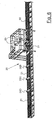
- 10 and 11 denote two flat sheets of high-density magnesia cement according to the present invention, arranged parallel to each other.
- each sheet 10 and 11 comprises an internal central layer 14 obtained by means of rolling of a paste-like magnesia cement, external layers 12 of a first fabric and intermediate layers 13 of a second fabric ( Figures 2 and 4).
- the spacing element is a corrugated sheet 15.
- Said corrugated sheet 15 also comprises an internal central layer 14 obtained by means of rolling of a paste-like magnesia cement, external layers 12 of a first fabric and intermediate layers 13 of a second fabric ( Figures 2 and 5).
- said sheet 15 is suitably shaped (corrugated), while it is still pliable, being to left to cure on a corrugated support.
- said first external layer 12 is preferably formed by a polyester non-woven fabric, while said intermediate layer 13 is preferably formed by a glass fibre meshwork.
- the shaping of the sheet 15 allows spaces or recesses 16 to be obtained between the sheets 10, 15 and 11.
- the corrugated sheet 15 is fixed to the flat sheets 10 and 11 by means of suitable known organic or inorganic adhesive compounds applied in the contact zones 17.
- the recesses 16 may be left empty (as in the case of the recesses indicated by 16A in Figure 1) in order to house electric lines, water pipes or similar pipes or supply ducts for the various service facilities within the cabin, or may be filled, at least partially, with a low-density magnesia cement (as in the case of the recesses indicated by 16B in Figure 1) in order to obtain panels which are rigid and strong as well as being very light.
- a plant 20 according to the present invention comprises two cement mixing machines 23 of the conventional type, a rolling surface 21 and a conveying surface 22.
- the plant also comprises a first pair of rolling rollers 24A and another three pairs of rolling rollers 24B, 24C and 24D, at least one roller of each pair being motorized.
- the plant comprises a hopper 25 for transferring the paste formed inside said mixing machines 23 into the vicinity of said first pair of rolling rollers 24A.
- the plant comprises four idle rotating rollers (26A, 26B, 27A, 27B) each for feeding a web or layer.
- rollers 26A and 26B feed the fabric 13, while the rollers 27A and 27B feed the non-woven fabric 12.
- the conveying surface 22 comprises idle rotating conveyor rollers 28.
- the four pairs of feed rollers 24A, 24B, 24C and 24D gradually reduce the thickness of the paste-like sheet to the desired value.
- the mixing machines 23 were charged with: 137.65 kg of magnesium oxide; 140.40 kg of an aqueous solution with 50% magnesium chloride; 700 kg of phosphoric acid in a concentration of 85%; 5.50 kg of magnesium trisilicate; 90.85 kg of an emulsion containing 10% styrene acrylic resin; 20.65 kg of sawdust; 140 kg of naphthalene sulphonate; 4.13 kg of expanded perlite.
- the mixture was mixed at room temperature until completely uniform and then discharged into the hopper 25.
- a flat rigid support (not shown), 1.3 m wide, 2.5 m long and 3 mm thick was placed under the hopper, and a web of fabric 12 and a web of fabric 13 unwound from the feed cylinders 26A and 27A were laid out over the said support, the front ends of said fabrics 12 and 13 being passed between the rolling rollers of the first pair 24A.
- the motorized roller of the first pair 24A was then activated and the support lined with the webs of fabrics 12 and 13 and with a predetermined quantity of mixture was driven between the rolling rollers of said first pair 24A, while another two webs of fabrics 12 and 13 were unwound from the respective cylinders 26B and 27B and arranged on the mixture.
- the flat rigid support carrying the sheet of magnesia cement according to the invention being formed was passed between the second pair 24B and then between the third and fourth pair 24C and 24D, respectively, where the thickness of the sheet being formed was gradually reduced to 3mm.
- the paste-like sheet of magnesia cement placed on the flat rigid support was cut at the front and rear end of the said flat rigid support.
- the method proceeded continuously with the feeding, by the conveying surface 22, of a flat rigid support in direct contact with the previous support under the hopper 25.
- the rolling speed was 2 m/min.
- the sheets of magnesia cement thus obtained have a density of 1,250 kg/m 3 and possess several advantageous properties. For example, they do not have a reduced weight and their mechanical properties remain unchanged even after 60 days immersed in water.
Landscapes
- Chemical & Material Sciences (AREA)
- Engineering & Computer Science (AREA)
- Ceramic Engineering (AREA)
- Structural Engineering (AREA)
- Inorganic Chemistry (AREA)
- Chemical Kinetics & Catalysis (AREA)
- Mechanical Engineering (AREA)
- Materials Engineering (AREA)
- Organic Chemistry (AREA)
- Laminated Bodies (AREA)
- Press-Shaping Or Shaping Using Conveyers (AREA)
- Producing Shaped Articles From Materials (AREA)
- Devices For Post-Treatments, Processing, Supply, Discharge, And Other Processes (AREA)
Applications Claiming Priority (2)
| Application Number | Priority Date | Filing Date | Title |
|---|---|---|---|
| ITMI20022789 | 2002-12-31 | ||
| ITMI20022789 ITMI20022789A1 (it) | 2002-12-31 | 2002-12-31 | Pannello per la realizzazione di pareti, soffitti, pavimenti |
Publications (2)
| Publication Number | Publication Date |
|---|---|
| EP1435284A2 true EP1435284A2 (de) | 2004-07-07 |
| EP1435284A3 EP1435284A3 (de) | 2005-11-23 |
Family
ID=32500565
Family Applications (1)
| Application Number | Title | Priority Date | Filing Date |
|---|---|---|---|
| EP20030079016 Withdrawn EP1435284A3 (de) | 2002-12-31 | 2003-12-29 | Magnesiazementplatten, sowie Verfahren und Anlage zur Herstellung derselben |
Country Status (2)
| Country | Link |
|---|---|
| EP (1) | EP1435284A3 (de) |
| IT (1) | ITMI20022789A1 (de) |
Cited By (4)
| Publication number | Priority date | Publication date | Assignee | Title |
|---|---|---|---|---|
| KR100745175B1 (ko) | 2005-06-15 | 2007-08-02 | 건 희 서 | 산화마그네슘을 주재로 하는 불연성 건축 내장재의 연속제조 방법 및 그 장치 |
| CN102322111A (zh) * | 2011-06-21 | 2012-01-18 | 王翔 | 一种氯氧镁水泥发泡轻质墙板及制备方法和设备 |
| EP2161246A3 (de) * | 2008-06-16 | 2012-08-29 | Eraclit-Venier S.p.A. | Zusammensetzung zur Herstellung dekorativer Elemente |
| EP4430012A4 (de) * | 2021-11-11 | 2026-03-04 | Triton Mgo Products Llc | Herstellung von magnesiumoxychloridzementplatten |
Families Citing this family (1)
| Publication number | Priority date | Publication date | Assignee | Title |
|---|---|---|---|---|
| CN110253742B (zh) * | 2019-06-11 | 2020-11-20 | 广东友力智能科技有限公司 | 一种一体化墙板自动化生产线 |
Family Cites Families (6)
| Publication number | Priority date | Publication date | Assignee | Title |
|---|---|---|---|---|
| FR2323504A1 (fr) * | 1975-09-11 | 1977-04-08 | Knut Dederichs Stahl Maschinen | Procede de fabrication de panneaux de construction et dispositif pour sa mise en oeuvre |
| DE2752004A1 (de) * | 1977-11-22 | 1979-05-23 | Bayer Ag | Verschaeumbare magnesiazementmischung |
| US5268028A (en) * | 1987-08-25 | 1993-12-07 | Oldcastle, Inc. | Lightweight concrete roof tiles and similar products |
| US5728209A (en) * | 1995-11-13 | 1998-03-17 | Mbt Holding Ag | Unitized cement admixture |
| ITPC20000025A1 (it) * | 2000-07-03 | 2002-01-03 | Alberto Vaghini | Pannello in schiuma magnesiaca e relativo procedimento di produzione. |
| US6402830B1 (en) * | 2000-11-20 | 2002-06-11 | Randy C. Schaffer | Lightweight concrete composition |
-
2002
- 2002-12-31 IT ITMI20022789 patent/ITMI20022789A1/it unknown
-
2003
- 2003-12-29 EP EP20030079016 patent/EP1435284A3/de not_active Withdrawn
Cited By (5)
| Publication number | Priority date | Publication date | Assignee | Title |
|---|---|---|---|---|
| KR100745175B1 (ko) | 2005-06-15 | 2007-08-02 | 건 희 서 | 산화마그네슘을 주재로 하는 불연성 건축 내장재의 연속제조 방법 및 그 장치 |
| EP2161246A3 (de) * | 2008-06-16 | 2012-08-29 | Eraclit-Venier S.p.A. | Zusammensetzung zur Herstellung dekorativer Elemente |
| CN102322111A (zh) * | 2011-06-21 | 2012-01-18 | 王翔 | 一种氯氧镁水泥发泡轻质墙板及制备方法和设备 |
| CN102322111B (zh) * | 2011-06-21 | 2013-08-07 | 王翔 | 一种氯氧镁水泥发泡轻质墙板及制备方法和设备 |
| EP4430012A4 (de) * | 2021-11-11 | 2026-03-04 | Triton Mgo Products Llc | Herstellung von magnesiumoxychloridzementplatten |
Also Published As
| Publication number | Publication date |
|---|---|
| EP1435284A3 (de) | 2005-11-23 |
| ITMI20022789A1 (it) | 2004-07-01 |
Similar Documents
| Publication | Publication Date | Title |
|---|---|---|
| US4303722A (en) | Building components | |
| US4233368A (en) | Method for the production of glass fiber-reinforced gypsum sheets and gypsum board formed therefrom | |
| US4265979A (en) | Method for the production of glass fiber-reinforced gypsum sheets and gypsum board formed therefrom | |
| EP1228277B1 (de) | Wandplatte mit gasbeton enthaltendem kern | |
| EP2117828B1 (de) | Wasserfester zementartiger artikel und herstellungsverfahren dafür | |
| PL126003B1 (en) | Method of manufacturing reinforced products of hydraulic binders | |
| EP0019998B2 (de) | Schichtkörper aus verstärktem Schaumstoff und Verfahren zu ihrer Herstellung | |
| EP1435284A2 (de) | Magnesiazementplatten, sowie Verfahren und Anlage zur Herstellung derselben | |
| US6787486B1 (en) | Backerboard sheet including aerated concrete core | |
| US20070141304A1 (en) | Perforated board formed from cementitious material and process and system for producing same | |
| CN115667179A (zh) | 中子束遮蔽石膏系建筑用板、中子束遮蔽石膏系建筑用板的制造方法 | |
| EP3157745B1 (de) | Gipsprodukte mit verstärktem glasfaservlies | |
| KR101038970B1 (ko) | 펄라이트 시트를 제조하는 방법 및 이를 이용하여 제조된 펄라이트 제품 | |
| EP1537061A2 (de) | Verfahren zur herstellung eines hydraulischen bindemittels oder thermoplastischen enthaltenden produkt | |
| KR101155503B1 (ko) | 일체형 단열 보드 및 그 제조방법 | |
| GB2225599A (en) | Cementitious Board | |
| US7399520B2 (en) | Fibre-reinforced building article and manufacturing method thereof | |
| KR20180111135A (ko) | 난연성 샌드위치 패널의 제조 방법 | |
| JPH0732442A (ja) | パネル材およびその製造方法 | |
| DE4010898A1 (de) | Verfahren zum herstellen von baumaterialien wie betonen, asphalten, estrichmaterialien, platten, blockziegel usw. | |
| US20020043343A1 (en) | System and method for making aerated concrete sheets and using magnetic field to flatten a saw blade | |
| US20010023732A1 (en) | System and method for making aerated concrete sheets using lower and upper conveyors | |
| KR0148857B1 (ko) | 발포 세라믹 판넬의 제조방법 | |
| JPH01283137A (ja) | 軽量石膏板 | |
| JPH04124055A (ja) | 軽量石膏硬化体 |
Legal Events
| Date | Code | Title | Description |
|---|---|---|---|
| PUAI | Public reference made under article 153(3) epc to a published international application that has entered the european phase |
Free format text: ORIGINAL CODE: 0009012 |
|
| AK | Designated contracting states |
Kind code of ref document: A2 Designated state(s): AT BE BG CH CY CZ DE DK EE ES FI FR GB GR HU IE IT LI LU MC NL PT RO SE SI SK TR |
|
| AX | Request for extension of the european patent |
Extension state: AL LT LV MK |
|
| PUAL | Search report despatched |
Free format text: ORIGINAL CODE: 0009013 |
|
| AK | Designated contracting states |
Kind code of ref document: A3 Designated state(s): AT BE BG CH CY CZ DE DK EE ES FI FR GB GR HU IE IT LI LU MC NL PT RO SE SI SK TR |
|
| AX | Request for extension of the european patent |
Extension state: AL LT LV MK |
|
| RIC1 | Information provided on ipc code assigned before grant |
Ipc: 7B 28B 5/02 B Ipc: 7B 32B 13/14 B Ipc: 7C 04B 9/02 B Ipc: 7C 04B 28/32 B Ipc: 7B 28B 19/00 A |
|
| AKX | Designation fees paid | ||
| REG | Reference to a national code |
Ref country code: DE Ref legal event code: 8566 |
|
| STAA | Information on the status of an ep patent application or granted ep patent |
Free format text: STATUS: THE APPLICATION IS DEEMED TO BE WITHDRAWN |
|
| 18D | Application deemed to be withdrawn |
Effective date: 20060524 |