EP1430876A1 - Composition pour coloration de fibres kératiniques contenant un colorant direct et un polymère particulier, procédé de préparation de cette composition et procédé de coloration avec ladite composition. - Google Patents
Composition pour coloration de fibres kératiniques contenant un colorant direct et un polymère particulier, procédé de préparation de cette composition et procédé de coloration avec ladite composition. Download PDFInfo
- Publication number
- EP1430876A1 EP1430876A1 EP03293258A EP03293258A EP1430876A1 EP 1430876 A1 EP1430876 A1 EP 1430876A1 EP 03293258 A EP03293258 A EP 03293258A EP 03293258 A EP03293258 A EP 03293258A EP 1430876 A1 EP1430876 A1 EP 1430876A1
- Authority
- EP
- European Patent Office
- Prior art keywords
- acid
- composition according
- composition
- nitrobenzene
- polymer
- Prior art date
- Legal status (The legal status is an assumption and is not a legal conclusion. Google has not performed a legal analysis and makes no representation as to the accuracy of the status listed.)
- Withdrawn
Links
Classifications
-
- A—HUMAN NECESSITIES
- A61—MEDICAL OR VETERINARY SCIENCE; HYGIENE
- A61Q—SPECIFIC USE OF COSMETICS OR SIMILAR TOILETRY PREPARATIONS
- A61Q5/00—Preparations for care of the hair
- A61Q5/10—Preparations for permanently dyeing the hair
-
- A—HUMAN NECESSITIES
- A61—MEDICAL OR VETERINARY SCIENCE; HYGIENE
- A61K—PREPARATIONS FOR MEDICAL, DENTAL OR TOILETRY PURPOSES
- A61K8/00—Cosmetics or similar toiletry preparations
- A61K8/18—Cosmetics or similar toiletry preparations characterised by the composition
- A61K8/72—Cosmetics or similar toiletry preparations characterised by the composition containing organic macromolecular compounds
- A61K8/81—Cosmetics or similar toiletry preparations characterised by the composition containing organic macromolecular compounds obtained by reactions involving only carbon-to-carbon unsaturated bonds
- A61K8/8141—Compositions of homopolymers or copolymers of compounds having one or more unsaturated aliphatic radicals, each having only one carbon-to-carbon double bond, and at least one being terminated by only one carboxyl radical, or of salts, anhydrides, esters, amides, imides or nitriles thereof; Compositions of derivatives of such polymers
- A61K8/8158—Homopolymers or copolymers of amides or imides, e.g. (meth) acrylamide; Compositions of derivatives of such polymers
-
- A—HUMAN NECESSITIES
- A61—MEDICAL OR VETERINARY SCIENCE; HYGIENE
- A61K—PREPARATIONS FOR MEDICAL, DENTAL OR TOILETRY PURPOSES
- A61K2800/00—Properties of cosmetic compositions or active ingredients thereof or formulation aids used therein and process related aspects
- A61K2800/40—Chemical, physico-chemical or functional or structural properties of particular ingredients
- A61K2800/42—Colour properties
- A61K2800/43—Pigments; Dyes
Definitions
- Today hair coloring products allow change the hair color for a few hours, a few days, a few weeks, a few months with a return to the initial state or a persistence of the result, while respecting the integrity of the fiber.
- Patent FR 2 815 635 relates to a process for the preparation of an aqueous dispersion of a polymer to limit variations in viscosity of the mixture reaction throughout the polymerization.
- Patent FR 2 812 295 relates to a process for the preparation of a high molecular weight cationic polymer based on dialkyl salt and of diallyl ammonium in the form of pearls by the technique of reverse suspension polymerization.
- the Applicant has found, surprisingly and advantageously that the introduction of particular polymers which are in the form dispersed or in dissolved form in the coloring compositions keratin fibers containing a particular direct dye allowed to obtain a decrease in selectivity, climbs and toughness of colors superior to those obtained in the absence of this polymer under dispersed or dissolved form.
- keratin fiber coloring compositions are moreover capable of producing other potentially interesting effects such as thickening of the composition upon dilution.
- the applicant has discovered that in dispersed form in the dye composition, the particular polymer could protect direct dyes from degradations linked to external agents. This protection is even more important if the direct dyes are introduced during the synthesis of polymers in dispersed form. he should also be noted that if the dilution of the initial dispersion in the final composition is sufficient, it will lead to the solubilization of hydrodispersed polymer particles.
- the invention also relates to a process for preparing the compositions dyes, dyeing processes for keratin fibers incorporating these compounds, as well as dyeing devices or "kits" with several compartments.
- the composition contains at least one direct dye chosen from benzene nitro direct dyes, azo direct dyes, quinone direct dyes and in particular anthraquinone dyes and naphthoquinonics, azine direct dyes, direct dyes methine and azomethine, triarylmethane direct dyes, direct dyes derived from phenols, aminophenols, naphthols, direct dyes derived from porphyrins, in particular tetraphenylporphyrins, metalloporphyrins, direct dyes indoamines, xanthene dyes, natural direct dyes.
- direct dye chosen from benzene nitro direct dyes, azo direct dyes, quinone direct dyes and in particular anthraquinone dyes and naphthoquinonics, azine direct dyes, direct dyes methine and azomethine, triarylmethane direct dyes, direct dyes derived from phenols, aminophenol
- Direct dyes can be non-ionic in nature, cationic, anionic or amphoteric.
- the direct dye (s) used represent preferably from 0.001% to 10% by weight approximately of the total weight of the tinctotrial composition and even more preferably from 0.005% to 5% by weight approximately.
- direct dyes can be introduced during of the polymerization and / or after it.
- water-soluble polymer in dispersed form or in the form dissolved in the sense of the present invention a polymer potentially water soluble, i.e. with potential solubility in water is greater than 0.1% by weight at 25 ° C (visual assessment) and which can be used ultimately in soluble or dispersed form.
- Said polymers used in the context of the present invention are advantageously obtained from water-soluble monomers comprising at least one double bond. These can be chosen from cationic, anionic, nonionic monomers and their mixtures.
- anionic monomers of acid (meth) acrylic, acrylamido-2-methylpropanesulfonic acid, acid itaconic and their alkali metal, alkaline earth or ammonium or those from an organic amine such as alkanolamine.
- nonionic monomers of among (meth) acrylamide, N-vinylformamide, N-vinylacetoamide and hydroxypropyl (meth) acrylate.
- water-soluble cationic monomers may especially mention the hydrochloride or the sulfate derived from (meth) dimethylaminoethyl acrylate, (meth) acryloyloxyethyltrimethylammonium chloride, (meth) acryloyloxyethyldimethylbenzylammonium chloride, hydrochloride or sulfate derived from N- [dimethylaminopropyl] (meth) acrylamide, (meth) acrylamidopropyltrimethylammonium chloride, (meth) acrylamidopropyldimethylbenzylammonium chloride, hydrochloride or sulfate derived from dimethylaminohydroxypropryl (meth) acrylate, chloride (meth) acryloyloxyhydroxypropyltrimethylammonium, chloride (meth) acryloyloxyhydroxypropyldimethylbenzylammonium and the dimethyldially
- the polymer according to the invention is polymerized to starting from at least one cationic monomer as defined above.
- the polymers are polymerized from a cationic monomer and acrylic acid, the number of moles of the cationic monomer being greater than the number of mole of acrylic acid.
- the polymers described above have more particularly a weight molecular weight greater than 1,000,000 and preferably between 1,000 000 and 50 000 000.
- the molecular weight is determined by the method RSV (Reduced Specific Viscocity) as defined in "Principles of Polymer Chemistry "Cornell University Press, Ithaca, NY 1953 Chapter VII "Determination of molecular Weight” pp 266-316.
- the polymers of the invention can be present at a concentration between 0.05% and 10%, preferably between 0.1% and 5%, and even more preferably between 0.2% and 2% by weight relative to the total weight of the composition.
- the dispersing agent used in the present invention is a (poly) electrolyte, preferably a cationic (poly) electrolyte obtained by polymerization of 50 to 100 mol% of at least one monomer cationic chosen from salts, for example, hydrochlorides or sulfates, derivatives of dimethylaminoethyl (meth) acrylate, of N- [dimethylaminopropyl] (meth) acrylamide, or a di (meth) allylamine, (meth) acryloyloxyethyltrimethylammonium chloride, chloride (meth) acrylamidopropyltrimethylammonium, dimethyldiallylammonium chloride, and mixtures thereof, and from 50 to 0 mol% acrylamide.
- a polyamine such as a polyalkyleneamine.
- the aqueous saline solution which serves as a dispersion to the polymer is an aqueous saline solution allowing dissolve the water-soluble monomers comprising double bonds and the dispersing agent, but not dissolving the polymer got.
- the solution aqueous may also contain monovalent anionic salts, such as sodium chloride and ammonium chloride.
- reaction medium makes it possible to obtain, when the medium is stirred during polymerization, a stable dispersion of polymer.
- agents preventing the increase in viscosity (A) to (G), as described above allows the polymerization of water-soluble monomers as described above, with a low speed agitator while avoiding the formation of coarse particles. It is best that agents preventing the increase in viscosity (A) to (G) are soluble in water, better still dissolved in the aqueous saline solution which serves as a medium of dispersion.
- compound (A) there may be mentioned oxalic acid, adipic acid, tartaric acid, malic acid, phthalic acid and their salts.
- compound (B) there may be mentioned in particular the resorcinol and pyrogallol.
- compound (D) there may be mentioned in particular the sodium gluconate, potassium gluconate, gluconate ammonium, and various amino salts of gluconic acid.
- compound (E) mention may in particular be made of those obtained by allowing a compound which generates radicals to react under a stream of oxygenated gas, in a solution containing methoxyhydroquinone and / or a cationic (meth) acrylic monomer.
- the compound that generates radicals can be an initiator of polymerization commonly used in radical polymerization.
- azo polymerization initiator water-soluble such as 2,2'-azobis (2-amidinopropane) hydrochloride, sold for example under the name V-50 by the company Wako Chemical Industries, or 2,2'-azobis [2- (2-imidazoline-2-yl) propane hydrochloride] sold for example under the trade name VA-044 by the company Wako Chemical Industries, or a initiator of water-soluble redox polymerization such as the ammonium persulphate / sodium hydrogen sulphite association.
- an azo polymerization initiator water-soluble such as 2,2'-azobis (2-amidinopropane) hydrochloride, sold for example under the name V-50 by the company Wako Chemical Industries, or 2,2'-azobis [2- (2-imidazoline-2-yl) propane hydrochloride] sold for example under the trade name VA-044 by the company Wako Chemical Industries, or a initiator of water-soluble redox polymerization such as the ammonium persulphate
- An agent preventing viscosity increase can be obtained (F) by reaction of a polymerization initiator which is a compound which generates radicals, under an oxidizing atmosphere, for example under a stream of oxygenated gas, with a dispersing agent according to the invention.
- the polymerization initiator can be a polymerization initiator water-soluble azo as mentioned above, or an initiator of water-soluble redox polymerization such as the ammonium persulphate / sodium hydrogen sulphite association.
- the agent preventing viscosity increase (G) can be obtained in the form of an oxidized polymer of low molecular mass, by oxidation of a dispersing agent according to the invention obtained by polymerization of a cationic (meth) acrylic monomer, with hydrogen peroxide or halogen as an oxidant.
- These agents preventing the increase in viscosity (A) to (G) can be used alone or as a mixture, in an amount of preferably between 10 ppm and 10,000 ppm relative to the weight of the reaction solution.
- the medium suitable for the composition for dyeing keratin fibers is preferably an aqueous medium consisting of water or of a mixture of water and a cosmetically acceptable solvent, preferably chosen from lower alcohols C 1 - C 4, benzyl alcohol, polyol ethers, alkanes, C 5 -C 10, ketones C 3 -C 4 alkyl acetates, C 1 -C 4, dimethoxyethane, and mixtures thereof.
- a cosmetically acceptable solvent preferably chosen from lower alcohols C 1 - C 4, benzyl alcohol, polyol ethers, alkanes, C 5 -C 10, ketones C 3 -C 4 alkyl acetates, C 1 -C 4, dimethoxyethane, and mixtures thereof.
- the pH of the compositions of the invention is generally understood between 3 and 11, preferably between 4 and 10.
- the cosmetic additives are chosen from surfactants anionic, cationic, nonionic or amphoteric, agents non-polymeric thickeners such as acids or electrolytes, antioxidants, dispersing agents, sequestering agents, perfumes, conditioning agents, preservatives, opacifying agents, alkaline agents, acidic agents as well as any other adjuvant usually used in dyeing materials keratin.
- surfactants anionic, cationic, nonionic or amphoteric agents non-polymeric thickeners such as acids or electrolytes, antioxidants, dispersing agents, sequestering agents, perfumes, conditioning agents, preservatives, opacifying agents, alkaline agents, acidic agents as well as any other adjuvant usually used in dyeing materials keratin.
- additives are present in the composition according to the invention in an amount ranging from 0 to 20% by weight relative to the total weight of the composition.
- composition applied to the hair can be presented in various dosage forms, such as a lotion, a cream, a gel or any other suitable form for dyeing keratin fibers. It can also be conditioned under pressure in aerosol can in the presence of a propellant and form a foam.
- the propellant used can be constituted by the liquefied or compressed gases usually used for the preparation of aerosol compositions.
- gases usually used for the preparation of aerosol compositions.
- a variant of this process consists in introducing at least one direct dye according to the invention at the time of preparation of the dispersion of polymer and introduce the dispersion containing the one or more direct dyes in the final medium of the dye composition.
- the present invention also relates to a method of direct coloring of keratin materials, in particular the hair, such as that the composition described above is applied to the fibers keratin.
- the direct dye (s) usable according to the invention and the polymer or polymers used in the invention can be applied to the fibers simultaneously or sequentially.
- the composition according to the invention is formed by two compositions, one A containing at least one dye direct as defined above and the other B containing at least one water-soluble polymer as previously defined in dispersed form or dissolved, composition A can be applied before composition B or vice versa, the composition according to the invention being thus formed directly on the fibers.
- the application time is generally between 3 and 60 minutes and preferably between 5 40 minutes.
- the application temperature is preferably understood between room temperature and 80 ° C, preferably between 25 ° C and 55 ° C.
- the invention also relates to a device with 2 compartments for dyeing keratin fibers, in particular fibers human keratin and more particularly the hair, such as first compartment contains a coloring composition containing, at minus one direct dye as defined above, and another compartment contains a composition containing in a medium suitable for dyeing, at least one water-soluble polymer such as previously described in dispersed or dissolved form and preferably in dispersed form, said polymer being obtained by polymerization in an aqueous saline solution of at least one water-soluble monomer comprising at least one double bond containing at least one agent dispersant consisting of a soluble (poly) electrolyte, and at least one agent preventing viscosity increase. So once the two compositions contained in this mixed device, the composition according to the invention.
Landscapes
- Life Sciences & Earth Sciences (AREA)
- Health & Medical Sciences (AREA)
- Animal Behavior & Ethology (AREA)
- General Health & Medical Sciences (AREA)
- Public Health (AREA)
- Veterinary Medicine (AREA)
- Birds (AREA)
- Epidemiology (AREA)
- Cosmetics (AREA)
Abstract
Description
- au moins un colorant direct particulier,
- et au moins un polymère hydrosoluble sous forme dispersée ou sous forme solubilisée de PM moyen en poids supérieur à 106, ledit polymère étant obtenu et introduit dans la composition sous forme d'une dispersion issue de la polymérisation dans une solution aqueuse saline d'au moins un monomère hydrosoluble comportant au moins une double liaison en présence :
- d'au moins un agent dispersant constitué par un (poly)électrolyte soluble,
- et d'au moins un agent empêchant l'augmentation de la viscosité.
- 1,4-diamino-2-nitrobenzène
- 1-amino-2 nitro-4-β- hydroxyéthylaminobenzène
- 1-amino-2 nitro-4-bis(β-hydroxyéthyl)-aminobenzène
- 1,4-Bis(β-hydroxyéthylamino)-2-nitrobenzène
- 1-β-hydroxyéthylamino-2-nitro-4-bis-(β-hydroxyéthylamino)-benzène
- 1-β-hydroxyéthylamino-2-nitro-4-aminobenzène
- 1-β-hydroxyéthylamino-2-nitro-4-(éthyl)(β-hydroxyéthyl)-aminobenzène
- 1-amino-3-méthyl-4-β-hydroxyéthylamino-6-nitrobenzène
- 1-amino-2-nitro-4-β-hydroxyéthylamino-5-chlorobenzène
- 1,2-Diamino-4-nitrobenzène
- 1-amino-2-β-hydroxyéthylamino-5-nitrobenzène
- 1,2-Bis-(β-hydroxyéthylamino)-4-nitrobenzène
- 1-amino-2-tris-(hydroxyméthyl)-méthylamino-5-nitrobenzène
- 1-Hydroxy-2-amino-5-nitrobenzène
- 1-Hydroxy-2-amino-4-nitrobenzène
- 1-Hydroxy-3-nitro-4-aminobenzène
- 1-Hydroxy-2-amino-4,6-dinitrobenzène
- 1-β-hydroxyéthyloxy-2-β-hydroxyéthylamino-5-nitrobenzène
- 1-Méthoxy-2-β-hydroxyéthylamino-5-nitrobenzène
- 1-β-hydroxyéthyloxy-3-méthylamino-4-nitrobenzène
- 1-β,γ-dihydroxypropyloxy-3-méthylamino-4-nitrobenzène
- 1-β-hydroxyéthylamino-4-β,γ-dihydroxypropyloxy-2-nitrobenzène
- 1-β,γ-dihydroxypropylamino-4-trifluorométhyl-2-nitrobenzène
- 1-β-hydroxyéthylamino-4-trifluorométhyl-2-nitrobenzène
- 1-β-hydroxyéthylamino-3-méthyl-2-nitrobenzène
- 1-β-aminoéthylamino-5-méthoxy-2-nitrobenzène
- 1-Hydroxy-2-chloro-6-éthylamino-4-nitrobenzène
- 1-Hydroxy-2-chloro-6-amino-4-nitrobenzène
- 1-Hydroxy-6-bis-(β-hydroxyéthyl)-amino-3-nitrobenzène
- 1-β-hydroxyéthylamino-2-nitrobenzène
- 1-Hydroxy-4-β-hydroxyéthylamino-3-nitrobenzène.
- chlorure de 1,3-diméthyl-2-[[4-(diméthylamino)phényl]azo]-1H-imidazolium,
- chlorure de 1,3-diméthyl-2-[(4-aminophényl)azo]-1H-Imidazolium,
- méthylsulfate de 1-méthyl-4-[(méthylphénylhydrazono)méthyl]-pyridinium.
- Disperse Red 17
- Acid Yellow 9
- Acid Black 1
- Basic Red 22
- Basic Red 76
- Basic Yellow 57
- Basic Brown 16
- Acid Yellow 36
- Acid Orange 7
- Acid Red 33
- Acid Red 35
- Basic Brown 17
- Acid Yellow 23
- Acid Orange 24
- Disperse Black 9.
- Disperse Red 15
- Solvent Violet 13
- Acid Violet 43
- Disperse Violet 1
- Disperse Violet 4
- Disperse Blue 1
- Disperse Violet 8
- Disperse Blue 3
- Disperse Red 11
- Acid Blue 62
- Disperse Blue 7
- Basic Blue 22
- Disperse Violet 15
- Basic Blue 99
- 1-N-méthylmorpholiniumpropylamino-4-hydroxyanthraquinone
- 1-Aminopropylamino-4-méthylaminoanthraquinone
- 1-Aminopropylaminoanthraquinone
- 5-β-hydroxyéthyl-1,4-diaminoanthraquinone
- 2-Aminoéthylaminoanthraquinone
- 1,4-Bis-(β,γ-dihydroxypropylamino)-anthraquinone.
- Basic Blue 17
- Basic Red 2.
- Basic Green 1
- Acid blue 9
- Basic Violet 3
- Basic Violet 14
- Basic Blue 7
- Acid Violet 49
- Basic Blue 26
- Acid Blue 7
- 2-β-hydroxyéthlyamino-5-[bis-(β-4'-hydroxyéthyl)amino]anilino-1,4-benzoquinone
- 2-β-hydroxyéthylamino-5-(2'-méthoxy-4'-amino)anilino-1,4-benzoquinone
- 3-N(2'-Chloro-4'-hydroxy)phényl-acétylamino-6-méthoxy-1,4-benzoquinone imine
- 3-N(3'-Chloro-4'-méthylamino)phényl-uréido-6-méthyl-1,4-benzoquinone imine
- 3-[4'-N-(Ethyl,carbamylméthyl)-amino]-phényl-uréido-6-méthyl-1,4-benzoquinone imine.


- Y représente une fonction amide, un ester (O-CO ou CO-O), un uréthane ou une urée,
- A représente un groupement alkylène en C1-C10 linéaire ou ramifié, cyclique ou acyclique, pouvant être substitué ou interrompu par un groupement aromatique ou hétéroaromatique divalent. Les groupements alkylènes peuvent être interrompus par un atome d'oxygène, un atome d'azote, un atome de soufre ou un atome de phosphore ; l'alkylène pouvant contenir une fonction cétone, un amide, un ester (O-CO ou CO-O), un uréthane, ou une urée,
- n est un nombre entier variant de 0 à 1,
- X- représente un contre ion anionique, comme par exemple un chlorure ou un sulfate.
- 0 à 30% en moles d'acide acrylique,
- 0 à 95,5% en moles d'acrylamide et,
- 0,5 à 100% en moles d'au moins un monomère cationique représenté dans la formule (I) telle que définie ci-dessus.
- 10% de chlorure d'acryloyloxyéthyldiméthylbenzylammonium et de 90% d'acrylamide,
- 30% de chlorure d'acryloyloxytriméthylammonium, 50% de chlorure d'acryloyloxyéthyldiméthylbenzylammonium, et de 20 % d'acrylamide,
- 10% de chlorure d'acryloyloxyéthyltriméthylammonium et de 90% d'acrylamide
- 30% de chlorure de diallyldiméthylammonium et de 70% d'acrylamide
- 30% d'acide acrylique et de 70% d'acrylamide.
- d'au moins un agent dispersant constitué par un (poly)électrolyte soluble,
- et d'au moins un agent empêchant l'augmentation de la viscosité.
Claims (44)
- Composition pour la teinture des fibres kératiniques, en particulier des fibres kératiniques humaines telles que les cheveux humains contenant dans un milieu approprié:au moins un colorant direct choisi parmi les colorants directs nitrés benzèniques, les colorants directs azoïques, les colorants directs quinoniques, les colorants directs aziniques, les colorants directs méthiniques et azométhiniques, les colorants directs triarylméthaniques, les colorants directs dérivés des phénols, des aminophénols, des naphtols, les colorants directs dérivés des porphyrines, les colorants directs indoaminiques, les colorants xanthèniques, les colorants directs naturels,et au moins un polymère hydrosoluble sous forme dispersée ou sous forme solubilisée de PM moyen en poids supérieur à 106, ledit polymère étant obtenu et introduit dans la composition sous forme d'une dispersion issue de la polymérisation dans une solution aqueuse saline d'au moins un monomère hydrosoluble comportant au moins une double liaison en présence :d'au moins un agent dispersant constitué par un (poly)électrolyte soluble,et d'au moins un agent empêchant l'augmentation de la viscosité.
- Composition selon la revendication 1 caractérisée par le fait que le colorant direct est de nature non ionique, cationique, anionique ou amphotère.
- Composition selon la revendication 1 ou 2, caractérisée par le fait que le colorant est fluorescent.
- Composition selon l'une quelconque des revendications 1 à 3,
caractérisée par le fait que le colorant direct est un colorant direct benzènique nitré choisi parmi :1,4-diamino-2-nitrobenzène1-amino-2 nitro-4-β- hydroxyéthylaminobenzène1-amino-2 nitro-4-bis(β-hydroxyéthyl)-aminobenzène1,4-Bis(β-hydroxyéthylamino)-2-nitrobenzène1-β-hydroxyéthylamino-2-nitro-4-bis-(β-hydroxyéthylamino)-benzène1-β-hydroxyéthylamino-2-nitro-4-aminobenzène1-β-hydroxyéthylamino-2-nitro-4-(éthyl)(β-hydroxyéthyl)-aminobenzène1-amino-3-méthyl-4-β-hydroxyéthylamino-6-nitrobenzène1-amino-2-nitro-4-β-hydroxyéthylamino-5-chlorobenzène1,2-Diamino-4-nitrobenzène1-amino-2-β-hydroxyéthylamino-5-nitrobenzène1,2-Bis-(β-hydroxyéthylamino)-4-nitrobenzène1-amino-2-tris-(hydroxyméthyl)-méthylamino-5-nitrobenzène1-Hydroxy-2-amino-5-nitrobenzène1-Hydroxy-2-amino-4-nitrobenzène1-Hydroxy-3-nitro-4-aminobenzène1-Hydroxy-2-amino-4,6-dinitrobenzène1-β-hydroxyéthyloxy-2-β-hydroxyéthylamino-5-nitrobenzène1-Méthoxy-2-β-hydroxyéthylamino-5-nitrobenzène1-β-hydroxyéthyloxy-3-méthylamino-4-nitrobenzène1-β,γ-dihydroxypropyloxy-3-méthylamino-4-nitrobenzène1-β-hydroxyéthylamino-4-β,γ-dihydroxypropyloxy-2-nitrobenzène1-β,γ-dihydroxypropylamino-4-trifluorométhyl-2-nitrobenzène1-β-hydroxyéthylamino-4-trifluorométhyl-2-nitrobenzène1-β-hydroxyéthylamino-3-méthyl-2-nitrobenzène1-β-aminoéthylamino-5-méthoxy-2-nitrobenzène1-Hydroxy-2-chloro-6-éthylamino-4-nitrobenzène1-Hydroxy-2-chloro-6-amino-4-nitrobenzène1-Hydroxy-6-bis-(β-hydroxyéthyl)-amino-3-nitrobenzène1-β-hydroxyéthylamino-2-nitrobenzène1-Hydroxy-4-β-hydroxyéthylamino-3-nitrobenzène. - Composition selon l'une quelconque des revendications 1 à 3,
caractérisée par le fait que le colorant direct est un colorant direct azoïque choisi parmi :chlorure de 1,3-diméthyl-2-[[4-(diméthylamino)phényl]azo]-1H-imidazolium,chlorure de 1,3-diméthyl-2-[(4-aminophényl)azo]-1H-Imidazolium,méthylsulfate de 1-méthyl-4-[(méthylphénylhydrazono)méthyl]-pyridiniumDi sperse Red 17Acid Yellow 9Acid Black 1Basic Red 22Basic Red 76Basic Yellow 57Basic Brown 16Acid Yellow 36Acid Orange 7Acid Red 33Acid Red 35Basic Brown 17Acid Yellow 23Acid Orange 24Disperse Black 9.1-(4'-aminodiphénylazo)-2-méthyl-4bis-(β-hydroxyéthyl)amino-benzèneacide 4-hydroxy-3-(2-méthoxy-phénylazo)-1-naphtalène sulfonique. - Composition selon l'une quelconque des revendications 1 à 3,
caractérisée par le fait que le colorant direct est un colorant direct quinonique choisi parmi :Disperse Red 15Solvent Violet 13Acid Violet 43Disperse Violet 1Disperse Violet 4Disperse Blue 1Disperse Violet 8Disperse Blue 3Disperse Red 11Acid Blue 62Disperse Blue 7Basic Blue 22Disperse Violet 15Basic Blue 991-N-méthylmorpholiniumpropylamino-4-hydroxyanthraquinone1-Aminopropylamino-4-méthylaminoanthraquinone1-Aminopropylaminoanthraquinone5-β-hydroxyéthyl-1,4-diaminoanthraquinone2-Aminoéthylaminoanthraquinone1,4-Bis-(β,γ-dihydroxypropylamino)-anthraquinone. - Composition selon l'une quelconque des revendications 1 à 3,
caractérisée par le fait que le colorant direct est un colorant azinique choisi parmi:Basic Blue 17Basic Red 2. - Composition selon l'une quelconque des revendications 1 à 3,
caractérisée par le fait que le colorant direct est un colorant triarylméthanique choisi parmi :Basic Green 1Acid blue 9Basic Violet 3Basic Violet 14Basic Blue 7Acid Violet 49Basic Blue 26Acid Blue 7 - Composition selon l'une quelconque des revendications 1 à 3,
caractérisée par le fait que le colorant direct est un colorant indoaminique choisi parmi :2-β-hydroxyéthlyamino-5-[bis-(β-4'-hydroxyéthyl)amino]anilino-1,4-benzoquinone2-β-hydroxyéthylamino-5-(2'-méthoxy-4'-amino)anilino-1,4-benzoquinone3-N(2'-Chloro-4'-hydroxy)phényl-acétylamino-6-méthoxy-1,4-benzoquinone imine3-N(3'-Chloro-4'-méthylamino)phényl-uréido-6-méthyl-1,4-benzoquinone imine3-[4'-N-(Ethyl,carbamylméthyl)-amino]-phényl-uréido-6-méthyl-1,4-benzoquinone imine. - Composition selon l'une quelconque des revendications 1 à 3, caractérisée par le fait que le colorant direct est un colorant direct naturel choisi parmi : la lawsone, la juglone, l'alizarine, la purpurine, l'acide carminique, l'acide kermésique, la purpurogalline, le protocatéchaldéhyde, l'indigo, l'isatine, la curcumine, la spinulosine, l'apigénidine.
- Composition selon l'une quelconque des revendications 1 à 10, caractérisée en ce que le ou les colorants directs utilisés représentent de préférence, de 0,001% à 10% en poids environ du poids total de la composition tinctotriale et encore plus préférentiellement de 0,005% à 5% en poids environ.
- Composition selon l'une quelconque des revendications 1 à 11, caractérisée en ce que le ou les monomères hydrosolubles comportant au moins une double liaison sont choisis parmi des monomères cationiques, anioniques, non anioniques et leurs mélanges.
- Composition selon la revendication 12, caractérisée en ce que les monomères anioniques sont choisis parmi l'acide (méth)acrylique, l'acide acrylamido-2-méthylpropanesulfonique, l'acide itaconique et leurs sels d'un métal alcalin, d'alcalinoterreux ou d'ammonium ou ceux issus d'une amine organique telle que l'alcanolamine.
- Composition selon la revendication 12, caractérisée en ce que les monomères non ioniques sont choisis parmi le (méth)acrylamide, le N-vinylformamide, le N-vinylacétoamide et le (méth)acrylate d'hydroxypropyle.
- Composition selon la revendication 12, caractérisée en ce que les monomères cationiques sont choisis parmi les sels d'ammonium quaternaire dérivés d'une diallylamine, et ceux répondant à la formule suivante (I) :dans laquelle :
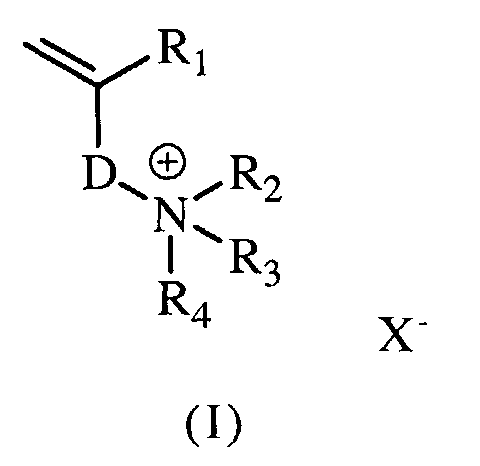 dans lequel :R1 représente un atome d'hydrogène ou un groupement méthyle,R2 et R3, identiques ou différents, représentent un atome d'hydrogène ou un groupe alkyle en C1-C4 linéaire ou ramifié,R4 représente un atome d'hydrogène, un groupe alkyle en C1-C4 linéaire ou ramifié, un groupe aryle,D représente le motif suivant,
 Y représente une fonction amide, un ester (O-CO ou CO-O), un uréthane ou une urée,A représente un groupement alkylène en C1-C10 linéaire ou ramifié, cyclique ou acyclique, pouvant être substitué ou interrompu par un aromatique ou un hétéroaromatique divalent, les groupements alkylènes pouvant être interrompus par un atome d'oxygène, un atome d'azote, un atome de soufre ou un atome de phosphore ; l'alkylène pouvant contenir une cétone, un amide, un ester (O-CO ou CO-O), un uréthane, ou une urée,n est un nombre entier variant de 0 à 1,X- représente un contre ion anionique, comme un chlorure ou un sulfate.
 - Composition selon l'une quelconque des revendications 1 à 15, caractérisée par le fait que le polymère est polymérisé à partir d'au moins un monomère cationique tel que défini à la revendication 15.
- Composition selon l'une quelconque des revendications de 1 à 16, caractérisée en ce que le polymère est polymérisé à partir des monomères comportant au moins une double liaison suivants :0 à 30% en moles d'acide acrylique,0 à 95,5% en moles d'acrylamide et,0,5 à 100% en moles d'au moins un monomère cationique de formule (I) telle que définie dans la revendication 15.
- Composition selon la revendication 17, caractérisée en ce que le polymère est polymérisé à partir d'un monomère cationique et d'acide acrylique, le nombre de mole du monomère cationique étant supérieur au nombre de mole d'acide acrylique.
- Composition selon la revendication 17, caractérisée en ce que le polymère est polymérisé à partir de 10% de chlorure d'acryloyloxyéthyldiméthylbenzylammonium et de 90% d'acrylamide,
- Composition selon la revendication 17, caractérisée en ce que le polymère est polymérisé à partir de 30% de chlorure d'acryloyloxytriméthylammonium, 50% de chlorure d'acryloyloxyéthyldiméthylbenzylammonium, et de 20 % d'acrylamide,
- Composition selon la revendication 17, caractérisée en ce que le polymère est polymérisé à partir de 10% de chlorure d'acryloyloxyéthyltriméthylammonium et de 90% d'acrylamide,
- Composition selon la revendication 17, caractérisée en ce que le polymère hydrosoluble est polymérisé à partir de 30% de chlorure de diallyldiméthylammonium et de 70% d'acrylamide,
- Composition selon l'une quelconque des revendications 1 à 14, caractérisée en ce que le polymère est polymérisé à partir de 30% d'acide acrylique et de 70% d'acrylamide.
- Composition selon l'une quelconque des revendications 1 à 23, caractérisée en ce que le ou les polymères de l'invention sont présents à une concentration comprise entre 0,05% et 10%, de préférence entre 0,1% et 5%, et encore plus préférentiellement entre 0,2% et 2% en poids par rapport au poids total de la composition.
- Composition selon l'une quelconque des revendications 1 à 24, caractérisée en ce que l'agent dispersant est un (poly)électrolyte cationique obtenu par polymérisation de 50 à 100% en moles d'au moins un monomère cationique choisi parmi les sels dérivés du (méth)acrylate de diméthylaminoéthyle, du N-[diméthylaminopropyl]-(méth)acrylamide, ou d'une di(méth)allylamine, le chlorure de (méth)acryloyloxytriméthylammonium, le chlorure de (méth)acrylamidopropyltriméthylammonium, le chlorure de diméthyldiallylammonium, et leurs mélanges, et de 50 à 0% en moles d'acrylamide.
- Composition selon l'une quelconque des revendications 1 à 25, caractérisée en ce que la solution aqueuse saline comprend au moins un sel anionique divalent.
- Composition selon la revendication 26, caractérisée en ce que le sel anionique divalent est choisi parmi le sulfate d'ammonium, l'hydrogénosulfate d'ammonium, le sulfate de sodium, l'hydrogénosulfate de sodium, le sulfate de magnésium, l'hydrogénosulfate de magnésium, le sulfate d'aluminium, l'hydrogénosulfate d'aluminium.
- Composition selon l'une quelconque des revendications 1 à 27, caractérisée en ce que l'agent empêchant l'augmentation de la viscosité du milieu réactionnel lors de la polymérisation est choisi parmi :leurs mélanges.(A) les acides polycarboxyliques ou leurs sels,(B)les polyphénols,(C)les composés cycliques contenant un groupe hydroxy et un groupe carboxy, ou leurs sels,(D)l'acide gluconique ou ses sels,(E)les produits réactionnels obtenus par réaction d'une méthoxyhydroquinone et/ou d'un monomère cationique (méth)acrylique avec un composé qui génère des radicaux, sous une atmosphère oxydante,(F)les produits réactionnels obtenus par réaction d'un polymère cationique (méth)acrylique avec un composé qui génère des radicaux, sous une atmosphère oxydante,(G)les produits réactionnels obtenus par réaction d'un polymère cationique (méth)acrylique avec un oxydant, et
- Composition selon la revendication 28, caractérisée en ce que l'agent empêchant l'augmentation de la viscosité (A) est choisi parmi l'acide oxalique, l'acide adipique, l'acide tartrique, l'acide malique, l'acide phtalique et leurs sels.
- Composition selon la revendication 28, caractérisée en ce que l'agent empêchant l'augmentation de la viscosité (B) est choisi parmi le résorcinol et le pyrogallol.
- Composition selon la revendication 28, caractérisée en ce que l'agent empêchant l'augmentation de la viscosité (C) est choisi parmi l'acide m-hydroxybenzoïque, l'acide p-hydroxybenzoïque, l'acide salicylique, l'acide gallique, l'acide tannique et leurs sels.
- Composition selon la revendication 28, caractérisée en ce que l'agent empêchant l'augmentation de la viscosité (D) est choisi parmi le gluconate de sodium, le gluconate de potassium, le gluconate d'ammonium, et différents sels aminés de l'acide gluconique.
- Composition selon l'une quelconque des revendications 1 à 32, caractérisée en ce que le milieu approprié pour la composition pour la coloration de fibres kératiniques est de préférence un milieu aqueux constitué par de l'eau ou par un mélange d'eau et d'un solvant cosmétiquement acceptable.
- Composition selon la revendication 33, caractérisée en ce que le solvant approprié est choisi parmi les alcools inférieurs en C1-C4, l'alcool benzylique, les éthers de polyols, les alcanes en C5-C10, les cétones en C3-C4, les acétates d'alkyles en C1-C4, le diméthoxyéthane, et leurs mélanges.
- Composition selon l'une quelconque des revendications 1 à 34, telle qu'elle comprend des additifs cosmétiques choisis parmi des agents tensio-actifs anioniques, cationiques, non-ioniques ou amphotères, des agents épaississants non polymériques comme des acides ou des électrolytes, des agents antioxydants, des agents dispersants, des agents séquestrants, des parfums, des agents de conditionnement, des agents conservateurs, des agents opacifiants, des agents alcalins, des agents acides.
- Composition selon l'une quelconque des revendications 1 à 35, caractérisée en ce que le polymère hydrosoluble introduit sous forme dispersée est solubilisée.
- Composition selon l'une quelconque des revendications 1 à 36, caractérisée en ce qu'elle se présente sous la forme d'une lotion, d'une crème, d'un gel.
- Composition selon l'une quelconque des revendications 1 à 37, caractérisée en ce qu'elle est conditionnée en aérosol.
- Procédé de préparation de composition caractérisé par le fait qu'il consiste à introduire dans un milieu contenant au moins un colorant direct tel que défini dans les revendications 1 à 11 et au moins un polymère hydrosoluble sous forme dispersée ou sous forme solubilisée de PM moyen supérieur à 106, ledit polymère étant obtenu et introduit dans la composition sous forme d'une dispersion issue de la polymérisation dans une solution aqueuse saline d'au moins un monomère hydrosoluble comportant au moins une double liaison en présence :d'au moins un agent dispersant constitué par un (poly)électrolyte soluble,et d'au moins un agent empêchant l'augmentation de la viscosité.
- Procédé de préparation de composition, caractérisée par le fait qu'il consiste à introduire dans un milieu cosmétiquement acceptable au moins une dispersion d'un polymère hydrosoluble de PM moyen en poids supérieur à 106, ledit polymère étant obtenu et introduit dans la composition sous forme d'une dispersion issue de la polymérisation dans une solution aqueuse saline d'au moins un monomère hydrosoluble comportant au moins une double liaison en présence :et contenant au moins un colorant direct tel que défini dans les revendications 1 à 11, et au moins un.d'au moins un agent dispersant constitué par un (poly)électrolyte soluble,et d'au moins un agent empêchant l'augmentation de la viscosité,
- Procédé de teinture des fibres kératiniques et en particulier fibres kératiniques humaines, et plus particulièrement les cheveux, caractérisé par le fait qu'il consiste à appliquer sur les fibres une composition telle que définie dans les revendications 1 à 38 ; le temps d'application étant compris généralement entre 3 et 60 minutes et préférentiellement entre 5 à 40 minutes ; la température d'application étant comprise de préférence entre la température ambiante et 80°C préférentiellement entre 25°C et 55°C.
- Procédé selon la revendications 41, caractérisé par le fait qu'il consiste à appliquer sur les fibres une composition formée par une composition A contenant au moins un colorant direct tel que défini dans les revendications 1 à 11, et par une composition B contenant au moins un polymère hydrosoluble sous forme dispersée ou solubilisée de PM moyen en poids supérieur à 106; la composition A étant appliquée sur les fibres avant la composition B.
- Procédé selon la revendication 41, caractérisé par le fait qu'il consiste à appliquer sur les fibres une composition formée par une composition A contenant au moins un colorant direct tel que défini dans les revendications 1 à 11, et par une composition B contenant au moins un polymère hydrosoluble sous forme de dispersée ou solubilisée de PM moyen en poids supérieur à 106 ; la composition B étant appliquée sur les fibres avant la composition A.
- Dispositif à 2 compartiments pour la teinture des fibres kératiniques en particulier de fibres kératiniques humaines et plus particulièrement les cheveux, caractérisé par le fait qu'un premier compartiment renferme une composition colorante contenant, dans un milieu approprié pour la teinture, au moins un colorant direct tel que défini dans les revendications 1 à 11, et qu'un autre compartiment renferme une composition contenant au moins un polymère hydrosoluble sous forme de dispersée ou solubilisée de PM moyen en poids supérieur à 106, ledit polymère étant obtenu par polymérisation dans une solution aqueuse saline d'au moins un monomère hydrosoluble comportant au moins une double liaison contenant au moins un agent dispersant constitué par un (poly)électrolyte soluble, et au moins un agent empêchant l'augmentation de la viscosité.
Applications Claiming Priority (2)
| Application Number | Priority Date | Filing Date | Title |
|---|---|---|---|
| FR0216205 | 2002-12-19 | ||
| FR0216205A FR2848834B1 (fr) | 2002-12-19 | 2002-12-19 | Composition pour coloration de fibres keratiniques contenant un colorant direct et un polymere particulier, procede de preparation de cette composition et procede de coloration avec ladite composition |
Publications (1)
| Publication Number | Publication Date |
|---|---|
| EP1430876A1 true EP1430876A1 (fr) | 2004-06-23 |
Family
ID=32338952
Family Applications (1)
| Application Number | Title | Priority Date | Filing Date |
|---|---|---|---|
| EP03293258A Withdrawn EP1430876A1 (fr) | 2002-12-19 | 2003-12-19 | Composition pour coloration de fibres kératiniques contenant un colorant direct et un polymère particulier, procédé de préparation de cette composition et procédé de coloration avec ladite composition. |
Country Status (2)
| Country | Link |
|---|---|
| EP (1) | EP1430876A1 (fr) |
| FR (1) | FR2848834B1 (fr) |
Cited By (1)
| Publication number | Priority date | Publication date | Assignee | Title |
|---|---|---|---|---|
| EP2104486B2 (fr) † | 2006-10-17 | 2021-04-14 | L'Oréal | Utilisation de colorants naturels pour la coloration des cheveux humains |
Citations (6)
| Publication number | Priority date | Publication date | Assignee | Title |
|---|---|---|---|---|
| EP0503507A1 (fr) * | 1991-03-08 | 1992-09-16 | Kao Corporation | Composition tinctoriale pour fibres kératiniques |
| EP0673641A1 (fr) * | 1994-03-21 | 1995-09-27 | L'oreal | Composition de teinture d'oxydation des fibres kératiniques comprenant un dérivé de paraphénylènediamine et un polymère substantif cationique ou amphotère et utilisation |
| US5454841A (en) * | 1992-11-19 | 1995-10-03 | Clairol, Inc. | Compositions and method for temporarily coloring hair using a complex of water soluble melanin and a cationic material |
| EP0953334A2 (fr) * | 1998-04-06 | 1999-11-03 | L'oreal | Composition de teinture pour fibres kératiniques avec un colorant direct cationique et un polymère substantif |
| EP1048290A2 (fr) * | 1999-04-30 | 2000-11-02 | Bristol-Myers Squibb Company | Teinture d'oxydation pour les cheveux avec des propriétés conditionnantes et une déposition améliorée de la couleur |
| EP1206929A2 (fr) * | 2000-11-16 | 2002-05-22 | Wella Aktiengesellschaft | Utilisation de préparations ajustées au point isoélectrique des cheveux pour le conditionnement de cheveux en teinture oxydante |
-
2002
- 2002-12-19 FR FR0216205A patent/FR2848834B1/fr not_active Expired - Fee Related
-
2003
- 2003-12-19 EP EP03293258A patent/EP1430876A1/fr not_active Withdrawn
Patent Citations (6)
| Publication number | Priority date | Publication date | Assignee | Title |
|---|---|---|---|---|
| EP0503507A1 (fr) * | 1991-03-08 | 1992-09-16 | Kao Corporation | Composition tinctoriale pour fibres kératiniques |
| US5454841A (en) * | 1992-11-19 | 1995-10-03 | Clairol, Inc. | Compositions and method for temporarily coloring hair using a complex of water soluble melanin and a cationic material |
| EP0673641A1 (fr) * | 1994-03-21 | 1995-09-27 | L'oreal | Composition de teinture d'oxydation des fibres kératiniques comprenant un dérivé de paraphénylènediamine et un polymère substantif cationique ou amphotère et utilisation |
| EP0953334A2 (fr) * | 1998-04-06 | 1999-11-03 | L'oreal | Composition de teinture pour fibres kératiniques avec un colorant direct cationique et un polymère substantif |
| EP1048290A2 (fr) * | 1999-04-30 | 2000-11-02 | Bristol-Myers Squibb Company | Teinture d'oxydation pour les cheveux avec des propriétés conditionnantes et une déposition améliorée de la couleur |
| EP1206929A2 (fr) * | 2000-11-16 | 2002-05-22 | Wella Aktiengesellschaft | Utilisation de préparations ajustées au point isoélectrique des cheveux pour le conditionnement de cheveux en teinture oxydante |
Cited By (1)
| Publication number | Priority date | Publication date | Assignee | Title |
|---|---|---|---|---|
| EP2104486B2 (fr) † | 2006-10-17 | 2021-04-14 | L'Oréal | Utilisation de colorants naturels pour la coloration des cheveux humains |
Also Published As
| Publication number | Publication date |
|---|---|
| FR2848834A1 (fr) | 2004-06-25 |
| FR2848834B1 (fr) | 2005-03-11 |
Similar Documents
| Publication | Publication Date | Title |
|---|---|---|
| US6846333B2 (en) | Keratin fiber dyeing composition comprising a particular aminosilicone | |
| EP1935455B1 (fr) | Composition de teinture directe comprenant un tensio-actif cationique, un biohétéropolysaccharide, un tensio-actif amphotère et un colorant direct | |
| EP1335694B1 (fr) | Composition de teinture directe pour fibres keratiniques comprenant un polyurethane associatif cationique | |
| EP1433473A1 (fr) | Composition tinctoriale contenant un colorant direct polycationique particulier, procédé de teinture, utilisation et dispositifs à plusieurs compartiments | |
| KR20030039296A (ko) | 특정 아미노 실리콘을 함유하는 케라틴 섬유 염색 조성물 | |
| FR2717383A1 (fr) | Composition de teinture d'oxydation des fibres kératiniques comprenant un dérivé de paraphénylènediamine et un polymère substantif cationique ou amphotère et utilisation. | |
| EP1627626B1 (fr) | Composition tinctoriale comprenant un colorant hydrophobe particulier et un acide | |
| FR3112078A1 (fr) | Composition de coloration des fibres kératiniques à partir de composés à motif indole | |
| EP1600148A1 (fr) | Composition pour la coloration des fibres kératiniques comprenant un composé portant au moins une fonction amine, un pigment et un agent de couplage chimique | |
| EP1757326B1 (fr) | Composition de coloration directe comprenant des composés oxygénés insolubles, procédés mettant en oeuvre cette composition | |
| EP1757328B1 (fr) | Composition tinctoriale comprenant des composés insolubles, procédés mettant en oeuvre cette composition. | |
| KR20060021898A (ko) | 혼합 발색단을 갖는 하나 이상의 양이온성 직접 염료를함유하는 염색 라이트닝 조성물 | |
| FR3136974A1 (fr) | Procédé de traitement des fibres kératiniques comprenant une étape de prétraitement ou de post-traitement | |
| EP1237526B1 (fr) | Composition de teinture directe pour fibres keratiniques comprenant un polymere epaississant a squelette aminoplaste-ether | |
| EP1634622A1 (fr) | Procédé de coloration de fibres kératiniques à partir d'une composition comprenant un colorant hydrophobe particulier | |
| EP1357886B1 (fr) | Composition de teinture directe pour fibres keratiniques comprenant un poly(vinyllactame) cationique | |
| EP1345576B1 (fr) | Composition de teinture directe pour fibres keratiniques a base de polymeres amphiphiles d'au moins un monomere a insaturation ethylenique a groupement sulfonique et comportant une partie hydrophobe | |
| US20060005326A1 (en) | Dyeing composition comprising at least one elastomeric film-forming polymer and at least one dyestuff | |
| EP1889605B1 (fr) | Composition tinctoriale comprenant un colorant direct et un polymère amphotère comprenant des motifs acrylamide, halogénure de dialkyldiallylammonium et acide carboxylique vinylique | |
| EP1886661B1 (fr) | Composition tinctoriale comprenant un colorant direct et un polymère amphotère comprenant des motifs acrylamide, halogénure de dialkyldiallylammonium et acide carboxylique vinylique | |
| FR2848834A1 (fr) | Composition pour coloration de fibres keratiniques contenant un colorant direct et un polymere particulier, procede de preparation de cette composition et procede de coloration avec ladite composition | |
| EP1621184A1 (fr) | Composition de coloration comprenant un polymère filmogène élastomère et une matière colorante | |
| EP1738799B1 (fr) | Utilisation de composés azoïques polycationiques en teinture des fibres kératiniques | |
| EP1430877A1 (fr) | Composition pour coloration de fibres kératiniques contenant une base d'oxydation et un polymère particulier, procédé de préparation de cette composition et procédé de coloration avec ladite composition | |
| FR3136979A1 (fr) | Procédé de traitement des fibres kératiniques mettant en œuvre un sel de carnitine ou de dérivé de carnitine |
Legal Events
| Date | Code | Title | Description |
|---|---|---|---|
| PUAI | Public reference made under article 153(3) epc to a published international application that has entered the european phase |
Free format text: ORIGINAL CODE: 0009012 |
|
| 17P | Request for examination filed |
Effective date: 20031230 |
|
| AK | Designated contracting states |
Kind code of ref document: A1 Designated state(s): AT BE BG CH CY CZ DE DK EE ES FI FR GB GR HU IE IT LI LU MC NL PT RO SE SI SK TR |
|
| AX | Request for extension of the european patent |
Extension state: AL LT LV MK |
|
| RIN1 | Information on inventor provided before grant (corrected) |
Inventor name: SAMAIN, HENRI Inventor name: GUERIN, FREDERIC |
|
| AKX | Designation fees paid |
Designated state(s): AT BE BG CH CY CZ DE DK EE ES FI FR GB GR HU IE IT LI LU MC NL PT RO SE SI SK TR |
|
| 17Q | First examination report despatched |
Effective date: 20070112 |
|
| STAA | Information on the status of an ep patent application or granted ep patent |
Free format text: STATUS: THE APPLICATION IS DEEMED TO BE WITHDRAWN |
|
| 18D | Application deemed to be withdrawn |
Effective date: 20070523 |