EP1429813B1 - Vorrichtung zum gesteuerten freisetzen mehrerer duft-/lock-stoffe und verfahren zum betrieb der vorrichtung - Google Patents
Vorrichtung zum gesteuerten freisetzen mehrerer duft-/lock-stoffe und verfahren zum betrieb der vorrichtung Download PDFInfo
- Publication number
- EP1429813B1 EP1429813B1 EP02798736A EP02798736A EP1429813B1 EP 1429813 B1 EP1429813 B1 EP 1429813B1 EP 02798736 A EP02798736 A EP 02798736A EP 02798736 A EP02798736 A EP 02798736A EP 1429813 B1 EP1429813 B1 EP 1429813B1
- Authority
- EP
- European Patent Office
- Prior art keywords
- set forth
- temperature
- odoriferous
- several
- fragrances
- Prior art date
- Legal status (The legal status is an assumption and is not a legal conclusion. Google has not performed a legal analysis and makes no representation as to the accuracy of the status listed.)
- Expired - Lifetime
Links
- 239000000126 substance Substances 0.000 title claims abstract description 15
- 238000013270 controlled release Methods 0.000 title claims description 3
- 238000011017 operating method Methods 0.000 title 1
- 238000001704 evaporation Methods 0.000 claims abstract description 23
- 230000008020 evaporation Effects 0.000 claims abstract description 21
- 238000005516 engineering process Methods 0.000 claims abstract description 16
- 238000004458 analytical method Methods 0.000 claims abstract description 3
- 239000003205 fragrance Substances 0.000 claims description 67
- 238000010438 heat treatment Methods 0.000 claims description 28
- 239000007788 liquid Substances 0.000 claims description 24
- 238000005086 pumping Methods 0.000 claims description 15
- 238000000034 method Methods 0.000 claims description 12
- 239000000919 ceramic Substances 0.000 claims description 9
- 238000004519 manufacturing process Methods 0.000 claims description 9
- 230000008859 change Effects 0.000 claims description 6
- 239000000758 substrate Substances 0.000 claims description 2
- 239000003016 pheromone Substances 0.000 claims 13
- 239000006185 dispersion Substances 0.000 claims 1
- 238000001556 precipitation Methods 0.000 claims 1
- 230000035945 sensitivity Effects 0.000 claims 1
- 230000004064 dysfunction Effects 0.000 abstract 1
- 239000012530 fluid Substances 0.000 abstract 1
- 239000005667 attractant Substances 0.000 description 20
- 239000002304 perfume Substances 0.000 description 17
- 239000003570 air Substances 0.000 description 14
- 230000031902 chemoattractant activity Effects 0.000 description 10
- 239000004033 plastic Substances 0.000 description 6
- 229920003023 plastic Polymers 0.000 description 6
- 238000001514 detection method Methods 0.000 description 5
- 230000008901 benefit Effects 0.000 description 4
- 239000012528 membrane Substances 0.000 description 4
- 235000019645 odor Nutrition 0.000 description 4
- 230000035943 smell Effects 0.000 description 3
- 239000012080 ambient air Substances 0.000 description 2
- 230000015556 catabolic process Effects 0.000 description 2
- 229940112822 chewing gum Drugs 0.000 description 2
- 235000015218 chewing gum Nutrition 0.000 description 2
- 238000001816 cooling Methods 0.000 description 2
- 238000006731 degradation reaction Methods 0.000 description 2
- 230000007613 environmental effect Effects 0.000 description 2
- 239000011888 foil Substances 0.000 description 2
- 230000010354 integration Effects 0.000 description 2
- 230000003993 interaction Effects 0.000 description 2
- 239000002184 metal Substances 0.000 description 2
- 230000002085 persistent effect Effects 0.000 description 2
- 230000002028 premature Effects 0.000 description 2
- 230000008569 process Effects 0.000 description 2
- 238000012545 processing Methods 0.000 description 2
- 239000007921 spray Substances 0.000 description 2
- 238000003860 storage Methods 0.000 description 2
- 241000238631 Hexapoda Species 0.000 description 1
- 239000004743 Polypropylene Substances 0.000 description 1
- 230000009471 action Effects 0.000 description 1
- 239000000443 aerosol Substances 0.000 description 1
- 230000032683 aging Effects 0.000 description 1
- 230000015572 biosynthetic process Effects 0.000 description 1
- 238000009529 body temperature measurement Methods 0.000 description 1
- 230000001143 conditioned effect Effects 0.000 description 1
- 238000010276 construction Methods 0.000 description 1
- 230000007547 defect Effects 0.000 description 1
- 230000002950 deficient Effects 0.000 description 1
- 230000001419 dependent effect Effects 0.000 description 1
- 230000008021 deposition Effects 0.000 description 1
- 230000001627 detrimental effect Effects 0.000 description 1
- 238000011161 development Methods 0.000 description 1
- 230000018109 developmental process Effects 0.000 description 1
- 238000010586 diagram Methods 0.000 description 1
- 238000007599 discharging Methods 0.000 description 1
- 230000000694 effects Effects 0.000 description 1
- 238000004049 embossing Methods 0.000 description 1
- 238000005530 etching Methods 0.000 description 1
- 230000003203 everyday effect Effects 0.000 description 1
- 238000002347 injection Methods 0.000 description 1
- 239000007924 injection Substances 0.000 description 1
- 239000012212 insulator Substances 0.000 description 1
- 230000002452 interceptive effect Effects 0.000 description 1
- 238000012423 maintenance Methods 0.000 description 1
- 230000007257 malfunction Effects 0.000 description 1
- 238000005259 measurement Methods 0.000 description 1
- 238000000520 microinjection Methods 0.000 description 1
- 238000000465 moulding Methods 0.000 description 1
- 238000000059 patterning Methods 0.000 description 1
- -1 polypropylene Polymers 0.000 description 1
- 229920001155 polypropylene Polymers 0.000 description 1
- 238000003825 pressing Methods 0.000 description 1
- 238000004393 prognosis Methods 0.000 description 1
- 230000009467 reduction Effects 0.000 description 1
- 239000000565 sealant Substances 0.000 description 1
- 230000035939 shock Effects 0.000 description 1
- 229910052710 silicon Inorganic materials 0.000 description 1
- 239000010703 silicon Substances 0.000 description 1
- 239000013589 supplement Substances 0.000 description 1
- 238000002560 therapeutic procedure Methods 0.000 description 1
- 230000007723 transport mechanism Effects 0.000 description 1
- 239000003039 volatile agent Substances 0.000 description 1
Images




Classifications
-
- A—HUMAN NECESSITIES
- A01—AGRICULTURE; FORESTRY; ANIMAL HUSBANDRY; HUNTING; TRAPPING; FISHING
- A01M—CATCHING, TRAPPING OR SCARING OF ANIMALS; APPARATUS FOR THE DESTRUCTION OF NOXIOUS ANIMALS OR NOXIOUS PLANTS
- A01M1/00—Stationary means for catching or killing insects
- A01M1/20—Poisoning, narcotising, or burning insects
- A01M1/2022—Poisoning or narcotising insects by vaporising an insecticide
- A01M1/2061—Poisoning or narcotising insects by vaporising an insecticide using a heat source
- A01M1/2072—Poisoning or narcotising insects by vaporising an insecticide using a heat source combined with a fan
-
- A—HUMAN NECESSITIES
- A61—MEDICAL OR VETERINARY SCIENCE; HYGIENE
- A61L—METHODS OR APPARATUS FOR STERILISING MATERIALS OR OBJECTS IN GENERAL; DISINFECTION, STERILISATION OR DEODORISATION OF AIR; CHEMICAL ASPECTS OF BANDAGES, DRESSINGS, ABSORBENT PADS OR SURGICAL ARTICLES; MATERIALS FOR BANDAGES, DRESSINGS, ABSORBENT PADS OR SURGICAL ARTICLES
- A61L9/00—Disinfection, sterilisation or deodorisation of air
- A61L9/015—Disinfection, sterilisation or deodorisation of air using gaseous or vaporous substances, e.g. ozone
- A61L9/02—Disinfection, sterilisation or deodorisation of air using gaseous or vaporous substances, e.g. ozone using substances evaporated in the air by heating or combustion
-
- A—HUMAN NECESSITIES
- A61—MEDICAL OR VETERINARY SCIENCE; HYGIENE
- A61L—METHODS OR APPARATUS FOR STERILISING MATERIALS OR OBJECTS IN GENERAL; DISINFECTION, STERILISATION OR DEODORISATION OF AIR; CHEMICAL ASPECTS OF BANDAGES, DRESSINGS, ABSORBENT PADS OR SURGICAL ARTICLES; MATERIALS FOR BANDAGES, DRESSINGS, ABSORBENT PADS OR SURGICAL ARTICLES
- A61L9/00—Disinfection, sterilisation or deodorisation of air
- A61L9/015—Disinfection, sterilisation or deodorisation of air using gaseous or vaporous substances, e.g. ozone
- A61L9/02—Disinfection, sterilisation or deodorisation of air using gaseous or vaporous substances, e.g. ozone using substances evaporated in the air by heating or combustion
- A61L9/03—Apparatus therefor
- A61L9/035—Apparatus therefor emanating multiple odours
Definitions
- the invention relates to a device for controlled release several fragrances / attractants by evaporation, and to a process for Operation of the device.
- fragrance delivery systems for personal scenting conduct air by perfume-soaked Porös stresses.
- the fragrance quality is with these Systems not constant, as the fragrance evaporates fractionated, d. H. the Volatile substances evaporate faster than the low volatility, which a permanent detrimental deviation and change the fragrance impression to Episode has.
- the application of small amounts of perfume for only one only person is possible with high technical overhead.
- these systems are expensive to install and need a large space.
- a common problem of the fragrance devices described so far is the lack of ability to monitor whether perfume is really applied and if so, in what quantity. So it can happen that the device scent should deploy, but this by air bubbles in the supply lines or by a defective fan is disturbed. This is especially true for the Piezospritzköpfe to, even the smallest air bubbles, the z. B. by vibrations or when filling into the system, can be put out of action.
- fragrance systems Another common problem of the previous fragrance systems is the addition of perfume residues inside the devices that are in contact with the have different already vaporous fragrances. It comes by to smells or mixed smells. In addition, they are inherently expensive and difficult and time-consuming to fill, and thus for the mass market not suitable.
- the device according to the invention is characterized by a controlled metering conveyor comprising a microsystem technology manufactured micropump for the promotion of liquid fragrances and attractants to an evaporator, and by means for detecting the Evaporation temperature directly at the evaporator for operating state analysis, and the method of operating the device according to the invention characterized in that the evaporation temperature of the scent and / or Attractants measures and, using this reading, the evaporation temperature and / or the pumping rate and / or the evaporation time controls, and / or that the evaporation temperature of the fragrance and / or Attractants measures and using this measurement error in the operation identified.
- Under the "evaporation temperature” is the Understood temperature that the evaporator has or those in the immediate Evaporation area or in this area just leaving steam prevails.
- Micropumps used for the transport of liquid fragrances or attractants have passive or even in contrast to the piezoelectric injection head active valves, which make it possible to build up a suction pressure, and thus a flexible, but airtight reservoir such.
- the flexibility of the reservoir is important because the suction pressure the micropump is comparatively low, and by the folding the reservoir whose airtight seal is possible.
- inactive Condition closed valves and the airtight folding tube is the delicate fragrance or attractant excellent against environmental influences or Self-evaporation protected, and the ambient air is not constant Evaporation of one or more fragrances contaminated.
- micropumps in contrast to piezo heads, transport much higher amounts of liquid, The fragrances can be greatly diluted, what their chemical aggressiveness significantly reduced and the use of easily replaceable plastic containers as a reservoir, so z. As the Falttuben allowed, since this now chemically not be attacked.
- micropumps are relative Insensitive to air bubbles, as it compresses through the valves and can be pumped out.
- Microsystem micropumps are characterized in that they are assigned by microsystem technology Manufacturing processes such. B. patterning by masks and etching, Micro injection molding technology, micro-embossing technology, micro-impression technology or else LIGA technology and are made of silicon, but also of plastics such as B. polypropylene. Manufacturing process and operation of the Micropumps are also in the book “Fundamentals of microsystems technology", Hanser-Verlag Kunststoff, shown on pages 140 to 142.
- micropumps together with a temperature measurement directly at the evaporators leads to a number of important Advantages, as this easily controls all operating conditions of the device and can be corrected.
- the fan fails, or the nozzle discharging the gaseous fragrance to the user z. B. from a chewing gum is closed.
- a separate transport of the fragrances from the reservoir through the Hoses and separate pumps to separate evaporators prevented the formation of mixed odors, since at no point the liquid fragrance or Attractants are mixed.
- the flow tube can be trained separately for each fragrance and / or but also the common nozzle via a surface heating or prevent a warm air flow as with a warm air blower.
- fragrances can be used via a valve from n to m lines, this also preferably in microsystem technology produced by fewer micropumps than the number of fragrances or just by a single micropump and carry in accordance evaporate less evaporator units.
- a further cost reduction leaves itself by extensive integration of the individual parts in hybrid or monolithic Achieve construction, d. H. Integration of the used components like Micropumps and evaporators on a common carrier, or more Micropumps on a support.
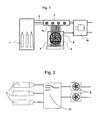
- a fan 5 promotes ambient air perpendicular to the plane of the drawing to a Hadauslöndüse (not in the drawing) via the evaporators 4, which are located in a flow tube 9.
- temperature sensors continuously measure the temperature the individual evaporator 4.
- An electronic control unit 10 takes over the fragrance commands an external application and takes over the measured values of the temperature at the evaporators 4, and generates the pump voltage, which evaluates the basis the temperature determined operating conditions and controls accordingly the Pumps 3, the fan 5 and the heating fields 4, and / or are status messages outward.
- Each of the micropumps 3, each evaporator 4 and each temperature sensor can be individually controlled or read by the control electronics 10 become.
- each fragrance or attractant has its own components, namely micropump, piping and evaporator.
- Fig. 2 shows an example in which by an n-on-m valve 22, preferably manufactured in microsystem technology, two pumps 3 for the application of three different scents from separate Falttuben 1 sufficient. This helps Cost of fragrance quality the number of micropumps and thus the manufacturing cost to reduce.
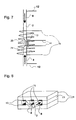
- Figs. 3 to 8 show various embodiments of evaporators.
- the Fig.n 3 to 8 have in common that the respective evaporator massearm and thus fast, and in the immediate vicinity of the heating field, at the liquid scent or attractant evaporates, a temperature sensor is located, or the temperature-dependent change in resistance of the heating resistor itself is used to detect the temperature at the evaporation point.
- FIGS. 3 to 5 and 8 each show a supply line 7 coming from the micropump comes and liquid perfume 8 transported to the heating field of the evaporator 4.
- the evaporator 4 made of hybrid ceramic 15 with roughened heating field 4 and / or measuring resistors 13 with terminals 14, or also made of PTC ceramic or of temperature-resistant foil or plastic with vapor-deposited or galvanically applied and etch-technically structured, metallic heating fields.
- the advantage of the evaporator according to the Fig.n 3 to 5 and 8 is that the single evaporator for each fragrance or attractants can be accommodated as fields on a common carrier plate, which simplifies and reduces the cost of manufacturing and assembling the evaporators and consumes less space in the flow tube 5 of the device.
- Fig. 8 shows an example with three evaporator chambers on a common Carrier substrate of z. B. ceramics.
- Figs. 6 and 7 show evaporators at which the supply line from the pump, in the form of a metallic tube 7, itself serves as an evaporator.
- the evaporator of FIG. 3 from the evaporator 4 in Form of a heating field with terminals 16 in an evaporator pot 6 on the Carrier 15 z. B. in thick film technology or film.
- the liquid perfume 8 is through the tube 7, which comes from the pump 3 and at the bottom of the 17th is cut off obliquely, directed specifically into the evaporator pot 6. There will the fragrance heated on the heating field and thus evaporated.
- About the temperature measuring resistor 13 and its terminals 14 reads the control electronics 10th the current temperature and fed according to the rule logic on the Connections 16 the heating field.
- a potty plate 19 prevents the premature Outflow of the perfume.
- FIG. 4 shows an evaporator unit similar to that in FIG. 3 with the difference that the perfume flows through a bore 11 in the carrier 15 and this Bore is heated from both sides by the heating panels 4.
- Fig. 5 shows a heating element similar to Fig. 4 from the perforated carrier 15 exists.
- two different fragrances 8 of both Pages through the open in the bore 11 at 20 tubes 7 to the heating field 4 flow and evaporate there. If the tube is made of metal, it can additionally heated via connections 12. This speeds up the evaporation and prevents the attachment of perfume to the tube.
- FIG. 6 shows, like FIG. 5, an evaporator in the form of the opening at a location 20 Tube 7, which by electrical current through the terminals 12 is heated.
- the fragrance 8 flows to that caused by the opening 20 Constriction, which is the hottest spot, and evaporates there.
- the temperature sensor 13 which is connected via the terminals 14 to the control electronics, detects the evaporation temperature.
- the control electronics regulates accordingly the predetermined control logic, the current through the terminals 12th
- Fig. 7 shows an evaporator unit as shown in Fig. 6, via an additional Schuwicklung 21 also heated the tube from the outside.
- Fig. 8 shows an evaporator of several layers 23, 24 of hybrid ceramic or foil.
- the intermediate layer 23 is comb-like and produces cavities 25 which are separated from the heating resistors of the evaporator 4 can be heated.
- the tubes 7 are capillaries extending from the side into the Multiple evaporator block can be introduced where it is the liquid Deliver perfume 8 into the cavity 25. This structure is very easy to install when inserting the capillary, since it does not matter if the capillary z. B. a or three mm into the block. If the cavities are not continuous, but laid out like a blind hole, then it is very unlikely that Unsprayed perfume droplets from the cavity 11 spray out and the Contaminate environment.
- the heating and measuring resistors of each individual Cavity can be controlled individually by separate lines or read out.
- FIG. 9 shows by way of example the basic structure of the pumps used Piezo drive, and Fig. 10 this with an electrostatic drive.
- the Pumping is done by a membrane 40, which is deformed by a Piezo 41 or by a counter electrode 42 via an insulator 43, the are applied via voltage contacts 44 with a voltage and a Cause the membrane to flex.
- the membrane 40 bulges upward, is in a pumping chamber 45 via an inlet valve 46th sucked in liquid fragrance or attractant.
- an exhaust valve 47 opens.
- the pumping chamber 45 is pushed out via the outlet valve 47, the pumping cycle can start again.
- FIGS. 9 and 10 show micropumps with passive valves. which are opened or closed solely by suction or pressing pressure. It However, there are also micropumps with actively controlled valves that ever over its own actuator (usually piezoelectric actuator) can be opened and closed can. These micropumps have actively closed over a lower one Leak rate and can also pump forward and backward.
- Fig. 11 is a diagram explaining the methods of error detection.
- the starting point of error detection is generally temperature detection 102 via the temperature sensor 13 on the heating field or at the open position 20 of the metallic tube 7.
- the temperature is detected and compared with the setpoint temperature (step 103). If the detected temperature coincides with the setpoint temperature, then everything OK. The temperature detection will be at regular intervals repeated.
- the Pumping rate of the pump increases (step 105). Any existing air bubbles, as they are z. B. directly after switching on the device, after shocks or may be present after the change of the reservoir blown out quickly.
- the temperature must be up decrease the setpoint or increase the controlled variable heating power - liquid is evaporated again, the error is corrected (step 107).
- This time is hanging z. B. from the length of the leads and their cross section. Sinks the detected Temperature does not decrease within this time or increases the controlled variable heating power not on, the speed of the fan, which is the transport current through generates the air flow tube, reduced (step 109).
- the temperature drops nevertheless not (step 112), there is a defect in the fan or a fault on the flow tube before, z. B. clogged by a finger or chewing gum Outlet opening of the flow tube. If the temperature drops again, so only the reservoir for the liquid is empty (step 113) and must exchanged or refilled.
- the delivery rate the pump is reduced (step 106). Excessive leaked liquid can evaporate faster. After a predetermined time, the detected temperature increase or even above the setpoint (step 108). The excess leaked liquid has evaporated, the pump is on reset the original production rate. Increases the detected temperature within this time, there is another error (step 110).
Landscapes
- Life Sciences & Earth Sciences (AREA)
- Health & Medical Sciences (AREA)
- Pest Control & Pesticides (AREA)
- General Health & Medical Sciences (AREA)
- Epidemiology (AREA)
- Animal Behavior & Ethology (AREA)
- Public Health (AREA)
- Veterinary Medicine (AREA)
- Toxicology (AREA)
- Engineering & Computer Science (AREA)
- Insects & Arthropods (AREA)
- Wood Science & Technology (AREA)
- Zoology (AREA)
- Environmental Sciences (AREA)
- Disinfection, Sterilisation Or Deodorisation Of Air (AREA)
- Fats And Perfumes (AREA)
- Reciprocating Pumps (AREA)
Description
- Fig. 1
- eine schematische Darstellung einer erfindungsgemäßen Vorrichtung zum Freisetzen von Duft- oder Lockstoffen;
- Fig. 2
- ein Schema einer geräteaufwandsmäßig einfacheren Ausführung;
- Fig.n 3 bis 8
- schematische Darstellungen von in der Vorrichtung von Fig. 1 verwendbaren Verdampfern;
- Fig.n 9 und 10
- schematische Darstellungen von in der Vorrichtung von Fig. 1 verwendbaren Mikropumpen;
- Fig. 11
- ein Ablaufdiagramm der von einer Steuerung nach Fig. 1 durchgeführten Verarbeitung.
- Lange Haltbarkeit und Lebensdauer des Duft- bzw. Lockstoffvorrates, da die Falttuben in fast beliebigen Größen existieren, und als lebensmittelgeeignete Behälter weder den Inhalt chemisch beeinflussen noch Luft- und Lichtzutritt erlauben. Dadurch wird nicht nur die gleichbleibende Qualität der Duft- bzw. Lockstoffe ermöglicht, sondern auch die Eigenabdampfung und der damit einhergehende Mischgeruch verhindert.
- Füllstands- und Statusanzeigen
- Ausgleich fertigungsbedingter Schwankungen des Dufttransportmechanismus (hier Mikropumpe) und dessen möglicher Degradation über die Lebensdauer durch Alterung oder durch Umwelteinflüsse (Temperatur, Luftfeuchtigkeit usw.)
- Es kann exakt bestimmt werden, ob und wie viel Duft die Vorrichtung tatsächlich ausgibt, Betriebszustände können ausgegeben und Fehlerzustände beseitigt werden. So kann sich die Vorrichtung z. B. beim Einschalten oder nach dem Befüllen automatisch initialisieren, d. h. so lange pumpen, bis Duftstoff oder Lockstoff an dem jeweiligen Verdampfer ansteht.
- Die Vorrichtung kann wenige bis viele Duftstoffe auf kleinem Raum in vollkommen getrennter Weise beherbergen und diese in sekundenschneller Wechselfolge ausbringen.
- Die Vorrichtung kann von ungeschultem Personal nachgefüllt werden, da Falttuben aus dem Alltag bekannt und leicht zu handhabende Vorratsbehälter sind.
- Die Vorrichtung taugt durch ihren Funktionsumfang für einen breiten Anwendungsbereich und kann mit unverändertem Grundprinzip als Tischgerät oder als Einbaugerät für Spielautomaten, Anzeigeeinheiten, PCs, Spielekonsolen, Terminals, Autos, Fitneßgeräte, Wellneßtherapiegeräte usw. ausgeführt werden.
- Durch seine hohe Dynamik in der Menge des ausbringbaren Duftstoffes kann die Vorrichtung zur reaktionsschnellen Einzel- oder Kleingruppenbeduftung, oder aber auch als variabler Raumbedufter eingesetzt werden.
Claims (20)
- Vorrichtung zum gesteuerten Freisetzen mehrerer Duft- und/oder Lockstoffe durch Verdampfung, gekennzeichnet durch eine kontrolliert dosierende Fördereinrichtung umfassend einen Verdampfer (4) und eine mikrosystemtechnisch hergestellte Mikropumpe (3) mit passiven oder aktiven Ventilen (22) zur Förderung der flüssigen Duft- und Lockstoffe zum Verdampfer (4), und durch eine Einrichtung (13) zur Erfassung der Verdampfungstemperatur unmittelbar am Verdampfer zur Betriebszustandsanalyse.
- Vorrichtung nach Anspruch 1, gekennzeichnet durch ein oder mehrere einzeln ansteuerbare ebene Heizfelder (4) in Dickschicht-Keramik- oder PTC-Keramik- oder Heizfolien-Ausführung zur Erhitzung der flüssigen Duft- und/oder Lockstoffe, und durch in der unmittelbaren Nachbarschaft jedes Heizfeldes angeordnete temperaturempfindliche Elemente (13).
- Vorrichtung nach Anspruch 1, gekennzeichnet durch ein oder mehrere einzeln ansteuerbare ebene Heizfelder (4) in Dickschicht-Keramik- oder PTC-Keramik- oder Heizfolien-Ausführung zur Erhitzung der flüssigen Duft- und/oder Lockstoffe, und durch eine Meßeinrichtung zur Messung der temperaturabhängigen Widerstandesänderung des Heizfeldes.
- Vorrichtung nach einem der Ansprüche 1 bis 3, dadurch gekennzeichnet, daß mehrere Verdampfer vorhanden sind und die Verdampfer jeweils ein metallisches Röhrchen (7) sind, durch das die Stoffe (8) zu pumpen sind, das von elektrischem Strom durchflossen und dadurch erhitzt ist und an dem an einer halbseitigen Öffnung (20) ein Ort erhöhter Temperatur entsteht, an dem der flüssige Lock- und/oder Duftstoff verdampft und in Luft übergeht.
- Vorrichtung nach einem der Ansprüche 1 bis 4, dadurch gekennzeichnet, daß Heizvorrichtungen vorhanden sind, die durch Erwärmung von im Luftströmungskanal (9) befindlichen Bauteilen, durch Erwärmung des Luftstromes und/oder durch Oberflächenbeheizungen die Ablagerung von Duftstoff- oder Lockstoffrückständen auf den Oberflächen innerhalb des Strömungskanals minimieren.
- Vorrichtung nach einem der Ansprüche 1 bis 5, dadurch gekennzeichnet, daß mehrere Vorratsbehälter (1), mehrere Mikropumpen (3) und mehrere Verdampfereinheiten (4) für die Lock- und/oder Duftstoffe vorhanden und durch eine Steuereinheit so gesteuert sind, daß die verschiedenen Lockund/oder Duftstoffe zeitlich versetzt verdampft werden.
- Vorrichtung nach Anspruch 6, gekennzeichnet durch Verwendung eines n-auf-m-Umschaltventils (22), durch das n Flüssigkeiten, befördert von m Mikropumpen (3), auf m Verdampfereinheiten (4) ausbringbar sind.
- Vorrichtung nach Anspruch 6 oder 7, dadurch gekennzeichnet, daß die Pumpen (3), Ventile (22) und Förderleitungen (7), hybrid oder monolithisch, in Mikrosystemtechnik auf einem gemeinsamen Träger ausgeführt sind.
- Vorrichtung nach einem der Ansprüche 1 bis 8, dadurch gekennzeichnet, daß mit der Einrichtung/den Einrichtungen (13) zur Erfassung der Verdampfungstemperatur eine Betriebsanalyse- und Fehleranalyseeinheit (10) verbunden ist, die wiederum mit Betriebszustand- und Fehleranzeigevorrichtungen verbunden ist.
- Vorrichtung nach einem der Ansprüche 1 bis 9, dadurch gekennzeichnet, daß Vorratsbehälter (1) für die flüssigen Duftstoffe und/oder Lockstoffe (8) Falttuben oder Faltbeutel sind.
- Vorrichtung nach Anspruch 10, dadurch gekennzeichnet, daß jede Falttube bzw. jeder Faltbeutel und die dazugehörige Mikropumpe eine gemeinsame Einheit sind, die vorzugsweise zusammengesteckt oder miteinander verschraubt sind.
- Vorrichtung nach einem der Ansprüche 1 bis 11, dadurch gekennzeichnet, daß die Vorrichtung zu ihrer Energieversorgung mit einer mobilen Energiequelle verbunden ist.
- Vorrichtung nach einem der Ansprüche 1 bis 12, dadurch gekennzeichnet, daß mehrere Verdampfer (4) vorhanden sind und die Verdampfer (4) Heizfelder sind, die eine so geringe Masse aufweisen, daß sie in weniger als drei Sekunden und mit weniger als 5 Watt Heizleistung eine Temperatur von über 100° C erreichen.
- Verfahren zum Betrieb der Vorrichtung nach einem der Ansprüche 1 bis 13, dadurch gekennzeichnet, daß man die Verdampfungstemperatur der Duft- und/oder Lockstoffe mißt und unter Verwendung dieses Meßwerts die Verdampfungstemperatur und/oder die Pumprate und/oder die Verdampfungszeit regelt.
- Verfahren insbesondere nach Anspruch 14, zum Betrieb der Vorrichtung nach einem der Ansprüche 1 bis 13, dadurch gekennzeichnet, daß man die Verdampfungstemperatur der Duft- und/oder Lockstoffe mißt und unter Verwendung dieses Meßwerts Fehler im Betriebsablauf identifiziert.
- Verfahren nach Anspruch 15, dadurch gekennzeichnet, daß die Fehler, deren Vorliegen man durch einen Temperaturanstieg erkennt, austretende Lufteinschlüsse aus der Fördereinrichtung umfassen, die man durch Erhöhung der Förderrate schnell ausbläst.
- Verfahren nach Anspruch 15 oder 16, dadurch gekennzeichnet, daß die Fehler, deren Vorliegen man durch eine Temperaturänderung erkennt, Störungen eines Ventilators oder eine Verstopfung der Luftaustrittsöffnung des Luftströmungskanals umfassen.
- Verfahren nach einem der Ansprüche 15 bis 17, dadurch gekennzeichnet, daß die Fehler, deren Vorliegen man durch eine Temperaturänderung erkennt, eine Erschöpfung des Duftstoff- und/oder Lockstoffvorrates und/oder noch vorhandene Flüssigkeitsreste am Verdampfer umfassen.
- Verfahren nach Anspruch 14 oder nach einem der auf Anspruch 14 rückbezogenen Ansprüche 15 bis 18, dadurch gekennzeichnet, daß man anhand der Temperatur-Meßwerte den Durchsatz an flüssigem Duft- und Lockstoff erkennt und die Pumprate der Mikropumpen regelt, wobei man den Durchsatz-Sollwert zum Ausgleich fertigungsbedingter Streuungen der Pumprate der Mikropumpen und/oder personenbezogener Empfindlichkeitsunterschiede des Geruchsempfindens einstellt.
- Verfahren nach einem der Ansprüche 14 bis 19, dadurch gekennzeichnet, daß man durch einen beheizten Luftstrom durch die Vorrichtung oder durch Flächenbeheizung ein Niederschlagen von Duftstoffdampf im Inneren der Vorrichtung verhindert.
Applications Claiming Priority (3)
| Application Number | Priority Date | Filing Date | Title |
|---|---|---|---|
| DE10145954A DE10145954A1 (de) | 2001-09-18 | 2001-09-18 | Universelles Duftausbringungssystem |
| DE10145954 | 2001-09-18 | ||
| PCT/EP2002/010480 WO2003024493A1 (de) | 2001-09-18 | 2002-09-18 | Vorrichtung zum gesteuerten freisetzen mehrerer duft-/lock-stoffe, und verfahren zum betrieb der vorrichtung |
Publications (2)
| Publication Number | Publication Date |
|---|---|
| EP1429813A1 EP1429813A1 (de) | 2004-06-23 |
| EP1429813B1 true EP1429813B1 (de) | 2005-04-20 |
Family
ID=7699421
Family Applications (1)
| Application Number | Title | Priority Date | Filing Date |
|---|---|---|---|
| EP02798736A Expired - Lifetime EP1429813B1 (de) | 2001-09-18 | 2002-09-18 | Vorrichtung zum gesteuerten freisetzen mehrerer duft-/lock-stoffe und verfahren zum betrieb der vorrichtung |
Country Status (5)
| Country | Link |
|---|---|
| EP (1) | EP1429813B1 (de) |
| AT (1) | ATE293462T1 (de) |
| DE (2) | DE10145954A1 (de) |
| ES (1) | ES2237713T3 (de) |
| WO (1) | WO2003024493A1 (de) |
Families Citing this family (5)
| Publication number | Priority date | Publication date | Assignee | Title |
|---|---|---|---|---|
| DE10225698A1 (de) * | 2002-06-10 | 2003-12-18 | Peter Schmidt | Elektroverdampfer |
| DE10308619B4 (de) * | 2003-02-27 | 2008-06-26 | Ruetz, Stefan | Vorrichtung zum Austragen eines Riech- bzw. Duftstoffs |
| DE10326439A1 (de) * | 2003-06-10 | 2005-01-05 | Tillmann, Kai-Uwe | Verfahren und technische Umsetzung der Digitalisierung von Geruchsdaten aus der Umgebungsluft des Aufzeichnungsortes und deren Reproduktion am Ort der Datenausgabe mit entsprechenden Geräten |
| DE10334591B4 (de) * | 2003-07-28 | 2006-03-30 | International Flavors & Fragrances Inc. | Verfahren zum Verteilen von flüssigen Duftstoffen und Vorrichtung zur Durchführung des Verfahrens |
| US20090117012A1 (en) * | 2007-11-07 | 2009-05-07 | The Dial Corporation | Air Treatment Device Utilizing A Sensor For Activation And Operation |
Family Cites Families (7)
| Publication number | Priority date | Publication date | Assignee | Title |
|---|---|---|---|---|
| GR65081B (en) * | 1980-04-19 | 1980-06-28 | Houstoulakis Nikitas | Apparatus for evaporation of insecticidal,deodorants a.t.c materials in planned times |
| JPH02209147A (ja) * | 1989-02-07 | 1990-08-20 | Shimizu Corp | 超音波式香り発生装置 |
| DE4135796A1 (de) | 1991-10-30 | 1993-05-06 | Goetz-Ulrich London Gb Wittek | Verfahren und vorrichtung fuer die ereignisbezogene oder szenengenaue duftdarbietung bei cinematographischen auffuehrungen und dergleichen |
| DE9308368U1 (de) * | 1993-06-04 | 1993-08-19 | Voitino Design Italia S.r.l., Klausen | Vorrichtung zur Abgabe von Duftstoffen in einen Raum |
| US5724256A (en) * | 1996-06-10 | 1998-03-03 | International Business Machines Corporation | Computer controlled olfactory mixer and dispenser for use in multimedia computer applications |
| DE29813461U1 (de) * | 1998-07-28 | 1998-11-05 | Voit, Hans, 82166 Gräfelfing | Vorrichtung zur Abgabe von Duftstoffen |
| DE19938405A1 (de) | 1999-08-13 | 2001-02-22 | Ruetz Technologies | Vorrichtung und Verfahren zum Aufbringen/Auftragen von Duftstoffen |
-
2001
- 2001-09-18 DE DE10145954A patent/DE10145954A1/de not_active Withdrawn
-
2002
- 2002-09-18 ES ES02798736T patent/ES2237713T3/es not_active Expired - Lifetime
- 2002-09-18 AT AT02798736T patent/ATE293462T1/de not_active IP Right Cessation
- 2002-09-18 DE DE50202859T patent/DE50202859D1/de not_active Expired - Fee Related
- 2002-09-18 WO PCT/EP2002/010480 patent/WO2003024493A1/de not_active Ceased
- 2002-09-18 EP EP02798736A patent/EP1429813B1/de not_active Expired - Lifetime
Also Published As
| Publication number | Publication date |
|---|---|
| ATE293462T1 (de) | 2005-05-15 |
| DE10145954A1 (de) | 2003-04-10 |
| DE50202859D1 (de) | 2005-05-25 |
| ES2237713T3 (es) | 2005-08-01 |
| EP1429813A1 (de) | 2004-06-23 |
| WO2003024493A1 (de) | 2003-03-27 |
Similar Documents
| Publication | Publication Date | Title |
|---|---|---|
| US8483553B2 (en) | Volatile emitter with reduced surface deposition and improved scent noticeability | |
| EP3426070B1 (de) | Elektronisches zigarettenprodukt und kartusche für ein elektronisches zigarettenprodukt | |
| EP3157587B1 (de) | Mikrofluidisches ausgabesystem zur freigabe von fluidzusammensetzungen | |
| US10066114B2 (en) | Ink jet delivery system comprising an improved perfume mixture | |
| US7832655B2 (en) | Delivery system for generating liquid active materials using an electromechanical transducer | |
| EP2143576B1 (de) | Duftmittelspender | |
| EP1656161B1 (de) | Verfahren zum verteilen von flüssigen duftstoffen und vorrichtung zur durchführung des verfahrens | |
| US20180290158A1 (en) | Microfluidic delivery device and method of jetting a fluid composition with the same | |
| US20100196195A1 (en) | Automatic air freshener | |
| EP1185310B1 (de) | Gerät zur abgabe von düften und aromenspeicher (duftchip) | |
| CN1254608C (zh) | 输送少量物质的配给装置 | |
| US20110303760A1 (en) | Apparatus and method for controllably releasing a substance | |
| EP1429813A1 (de) | Vorrichtung zum gesteuerten freisetzen mehrerer duft-/lock-stoffe, und verfahren zum betrieb der vorrichtung | |
| WO2007122583A2 (en) | Delivery system for dispensing volatile materials with high level of solids using an electromechanical transducer device | |
| DE10308619B4 (de) | Vorrichtung zum Austragen eines Riech- bzw. Duftstoffs | |
| US20050129568A1 (en) | Environmental system including a micromechanical dispensing device | |
| DE102018109353A1 (de) | Vorrichtung zur Erzeugung von Effektnebel und / oder Effektdampf | |
| AT505655B1 (de) | Duftspender | |
| DE10328965A1 (de) | Vorrichtung zum Beduften eines Kraftfahrzeugs |
Legal Events
| Date | Code | Title | Description |
|---|---|---|---|
| PUAI | Public reference made under article 153(3) epc to a published international application that has entered the european phase |
Free format text: ORIGINAL CODE: 0009012 |
|
| 17P | Request for examination filed |
Effective date: 20040419 |
|
| AK | Designated contracting states |
Kind code of ref document: A1 Designated state(s): AT BE BG CH CY CZ DE DK EE ES FI FR GB GR IE IT LI LU MC NL PT SE SK TR |
|
| AX | Request for extension of the european patent |
Extension state: AL LT LV MK RO SI |
|
| GRAP | Despatch of communication of intention to grant a patent |
Free format text: ORIGINAL CODE: EPIDOSNIGR1 |
|
| GRAS | Grant fee paid |
Free format text: ORIGINAL CODE: EPIDOSNIGR3 |
|
| GRAA | (expected) grant |
Free format text: ORIGINAL CODE: 0009210 |
|
| AK | Designated contracting states |
Kind code of ref document: B1 Designated state(s): AT BE BG CH CY CZ DE DK EE ES FI FR GB GR IE IT LI LU MC NL PT SE SK TR |
|
| PG25 | Lapsed in a contracting state [announced via postgrant information from national office to epo] |
Ref country code: NL Free format text: LAPSE BECAUSE OF FAILURE TO SUBMIT A TRANSLATION OF THE DESCRIPTION OR TO PAY THE FEE WITHIN THE PRESCRIBED TIME-LIMIT Effective date: 20050420 Ref country code: FI Free format text: LAPSE BECAUSE OF FAILURE TO SUBMIT A TRANSLATION OF THE DESCRIPTION OR TO PAY THE FEE WITHIN THE PRESCRIBED TIME-LIMIT Effective date: 20050420 Ref country code: CZ Free format text: LAPSE BECAUSE OF FAILURE TO SUBMIT A TRANSLATION OF THE DESCRIPTION OR TO PAY THE FEE WITHIN THE PRESCRIBED TIME-LIMIT Effective date: 20050420 Ref country code: EE Free format text: LAPSE BECAUSE OF FAILURE TO SUBMIT A TRANSLATION OF THE DESCRIPTION OR TO PAY THE FEE WITHIN THE PRESCRIBED TIME-LIMIT Effective date: 20050420 Ref country code: IE Free format text: LAPSE BECAUSE OF FAILURE TO SUBMIT A TRANSLATION OF THE DESCRIPTION OR TO PAY THE FEE WITHIN THE PRESCRIBED TIME-LIMIT Effective date: 20050420 Ref country code: SK Free format text: LAPSE BECAUSE OF FAILURE TO SUBMIT A TRANSLATION OF THE DESCRIPTION OR TO PAY THE FEE WITHIN THE PRESCRIBED TIME-LIMIT Effective date: 20050420 Ref country code: TR Free format text: LAPSE BECAUSE OF FAILURE TO SUBMIT A TRANSLATION OF THE DESCRIPTION OR TO PAY THE FEE WITHIN THE PRESCRIBED TIME-LIMIT Effective date: 20050420 |
|
| REG | Reference to a national code |
Ref country code: GB Ref legal event code: FG4D Free format text: NOT ENGLISH |
|
| REG | Reference to a national code |
Ref country code: CH Ref legal event code: EP |
|
| GBT | Gb: translation of ep patent filed (gb section 77(6)(a)/1977) |
Effective date: 20050420 |
|
| REG | Reference to a national code |
Ref country code: IE Ref legal event code: FG4D Free format text: LANGUAGE OF EP DOCUMENT: GERMAN |
|
| REF | Corresponds to: |
Ref document number: 50202859 Country of ref document: DE Date of ref document: 20050525 Kind code of ref document: P |
|
| PG25 | Lapsed in a contracting state [announced via postgrant information from national office to epo] |
Ref country code: BG Free format text: LAPSE BECAUSE OF FAILURE TO SUBMIT A TRANSLATION OF THE DESCRIPTION OR TO PAY THE FEE WITHIN THE PRESCRIBED TIME-LIMIT Effective date: 20050720 Ref country code: DK Free format text: LAPSE BECAUSE OF FAILURE TO SUBMIT A TRANSLATION OF THE DESCRIPTION OR TO PAY THE FEE WITHIN THE PRESCRIBED TIME-LIMIT Effective date: 20050720 Ref country code: GR Free format text: LAPSE BECAUSE OF FAILURE TO SUBMIT A TRANSLATION OF THE DESCRIPTION OR TO PAY THE FEE WITHIN THE PRESCRIBED TIME-LIMIT Effective date: 20050720 |
|
| REG | Reference to a national code |
Ref country code: ES Ref legal event code: FG2A Ref document number: 2237713 Country of ref document: ES Kind code of ref document: T3 |
|
| REG | Reference to a national code |
Ref country code: SE Ref legal event code: TRGR |
|
| PG25 | Lapsed in a contracting state [announced via postgrant information from national office to epo] |
Ref country code: IT Free format text: LAPSE BECAUSE OF NON-PAYMENT OF DUE FEES Effective date: 20050918 Ref country code: AT Free format text: LAPSE BECAUSE OF NON-PAYMENT OF DUE FEES Effective date: 20050918 Ref country code: CY Free format text: LAPSE BECAUSE OF FAILURE TO SUBMIT A TRANSLATION OF THE DESCRIPTION OR TO PAY THE FEE WITHIN THE PRESCRIBED TIME-LIMIT Effective date: 20050918 |
|
| PG25 | Lapsed in a contracting state [announced via postgrant information from national office to epo] |
Ref country code: PT Free format text: LAPSE BECAUSE OF FAILURE TO SUBMIT A TRANSLATION OF THE DESCRIPTION OR TO PAY THE FEE WITHIN THE PRESCRIBED TIME-LIMIT Effective date: 20050920 |
|
| PG25 | Lapsed in a contracting state [announced via postgrant information from national office to epo] |
Ref country code: MC Free format text: LAPSE BECAUSE OF NON-PAYMENT OF DUE FEES Effective date: 20050930 Ref country code: BE Free format text: LAPSE BECAUSE OF NON-PAYMENT OF DUE FEES Effective date: 20050930 Ref country code: LU Free format text: LAPSE BECAUSE OF NON-PAYMENT OF DUE FEES Effective date: 20050930 |
|
| NLV1 | Nl: lapsed or annulled due to failure to fulfill the requirements of art. 29p and 29m of the patents act | ||
| REG | Reference to a national code |
Ref country code: IE Ref legal event code: FD4D |
|
| PLBE | No opposition filed within time limit |
Free format text: ORIGINAL CODE: 0009261 |
|
| STAA | Information on the status of an ep patent application or granted ep patent |
Free format text: STATUS: NO OPPOSITION FILED WITHIN TIME LIMIT |
|
| ET | Fr: translation filed | ||
| 26N | No opposition filed |
Effective date: 20060123 |
|
| PG25 | Lapsed in a contracting state [announced via postgrant information from national office to epo] |
Ref country code: CH Free format text: LAPSE BECAUSE OF NON-PAYMENT OF DUE FEES Effective date: 20060930 Ref country code: LI Free format text: LAPSE BECAUSE OF NON-PAYMENT OF DUE FEES Effective date: 20060930 |
|
| REG | Reference to a national code |
Ref country code: CH Ref legal event code: PL |
|
| BERE | Be: lapsed |
Owner name: RUETZ, STEFAN Effective date: 20050930 |
|
| PGFP | Annual fee paid to national office [announced via postgrant information from national office to epo] |
Ref country code: FR Payment date: 20080912 Year of fee payment: 7 |
|
| PGFP | Annual fee paid to national office [announced via postgrant information from national office to epo] |
Ref country code: GB Payment date: 20080918 Year of fee payment: 7 |
|
| PGFP | Annual fee paid to national office [announced via postgrant information from national office to epo] |
Ref country code: DE Payment date: 20080924 Year of fee payment: 7 |
|
| PGFP | Annual fee paid to national office [announced via postgrant information from national office to epo] |
Ref country code: ES Payment date: 20080929 Year of fee payment: 7 Ref country code: SE Payment date: 20080912 Year of fee payment: 7 |
|
| PGFP | Annual fee paid to national office [announced via postgrant information from national office to epo] |
Ref country code: IT Payment date: 20080922 Year of fee payment: 7 |
|
| PGRI | Patent reinstated in contracting state [announced from national office to epo] |
Ref country code: IT Effective date: 20091201 |
|
| EUG | Se: european patent has lapsed | ||
| GBPC | Gb: european patent ceased through non-payment of renewal fee |
Effective date: 20090918 |
|
| REG | Reference to a national code |
Ref country code: FR Ref legal event code: ST Effective date: 20100531 |
|
| PG25 | Lapsed in a contracting state [announced via postgrant information from national office to epo] |
Ref country code: DE Free format text: LAPSE BECAUSE OF NON-PAYMENT OF DUE FEES Effective date: 20100401 Ref country code: FR Free format text: LAPSE BECAUSE OF NON-PAYMENT OF DUE FEES Effective date: 20090930 |
|
| PG25 | Lapsed in a contracting state [announced via postgrant information from national office to epo] |
Ref country code: GB Free format text: LAPSE BECAUSE OF NON-PAYMENT OF DUE FEES Effective date: 20090918 |
|
| PGRI | Patent reinstated in contracting state [announced from national office to epo] |
Ref country code: IT Effective date: 20091201 |
|
| PG25 | Lapsed in a contracting state [announced via postgrant information from national office to epo] |
Ref country code: SE Free format text: LAPSE BECAUSE OF NON-PAYMENT OF DUE FEES Effective date: 20090919 |
|
| REG | Reference to a national code |
Ref country code: ES Ref legal event code: FD2A Effective date: 20110712 |
|
| PG25 | Lapsed in a contracting state [announced via postgrant information from national office to epo] |
Ref country code: ES Free format text: LAPSE BECAUSE OF NON-PAYMENT OF DUE FEES Effective date: 20110630 |
|
| PG25 | Lapsed in a contracting state [announced via postgrant information from national office to epo] |
Ref country code: ES Free format text: LAPSE BECAUSE OF NON-PAYMENT OF DUE FEES Effective date: 20090919 |