EP1427077A2 - Laser mit externem Resonator und verbessertem Einzelmodenbetrieb - Google Patents
Laser mit externem Resonator und verbessertem Einzelmodenbetrieb Download PDFInfo
- Publication number
- EP1427077A2 EP1427077A2 EP03253417A EP03253417A EP1427077A2 EP 1427077 A2 EP1427077 A2 EP 1427077A2 EP 03253417 A EP03253417 A EP 03253417A EP 03253417 A EP03253417 A EP 03253417A EP 1427077 A2 EP1427077 A2 EP 1427077A2
- Authority
- EP
- European Patent Office
- Prior art keywords
- gain element
- laser
- control signal
- wavelength
- resonator
- Prior art date
- Legal status (The legal status is an assumption and is not a legal conclusion. Google has not performed a legal analysis and makes no representation as to the accuracy of the status listed.)
- Granted
Links
Images



Classifications
-
- H—ELECTRICITY
- H01—ELECTRIC ELEMENTS
- H01S—DEVICES USING THE PROCESS OF LIGHT AMPLIFICATION BY STIMULATED EMISSION OF RADIATION [LASER] TO AMPLIFY OR GENERATE LIGHT; DEVICES USING STIMULATED EMISSION OF ELECTROMAGNETIC RADIATION IN WAVE RANGES OTHER THAN OPTICAL
- H01S5/00—Semiconductor lasers
- H01S5/06—Arrangements for controlling the laser output parameters, e.g. by operating on the active medium
- H01S5/068—Stabilisation of laser output parameters
- H01S5/0683—Stabilisation of laser output parameters by monitoring the optical output parameters
- H01S5/0687—Stabilising the frequency of the laser
-
- H—ELECTRICITY
- H01—ELECTRIC ELEMENTS
- H01S—DEVICES USING THE PROCESS OF LIGHT AMPLIFICATION BY STIMULATED EMISSION OF RADIATION [LASER] TO AMPLIFY OR GENERATE LIGHT; DEVICES USING STIMULATED EMISSION OF ELECTROMAGNETIC RADIATION IN WAVE RANGES OTHER THAN OPTICAL
- H01S5/00—Semiconductor lasers
- H01S5/10—Construction or shape of the optical resonator, e.g. extended or external cavity, coupled cavities, bent-guide, varying width, thickness or composition of the active region
- H01S5/14—External cavity lasers
- H01S5/141—External cavity lasers using a wavelength selective device, e.g. a grating or etalon
-
- H—ELECTRICITY
- H01—ELECTRIC ELEMENTS
- H01S—DEVICES USING THE PROCESS OF LIGHT AMPLIFICATION BY STIMULATED EMISSION OF RADIATION [LASER] TO AMPLIFY OR GENERATE LIGHT; DEVICES USING STIMULATED EMISSION OF ELECTROMAGNETIC RADIATION IN WAVE RANGES OTHER THAN OPTICAL
- H01S5/00—Semiconductor lasers
- H01S5/06—Arrangements for controlling the laser output parameters, e.g. by operating on the active medium
- H01S5/065—Mode locking; Mode suppression; Mode selection ; Self pulsating
- H01S5/0651—Mode control
- H01S5/0653—Mode suppression, e.g. specific multimode
- H01S5/0654—Single longitudinal mode emission
-
- H—ELECTRICITY
- H01—ELECTRIC ELEMENTS
- H01S—DEVICES USING THE PROCESS OF LIGHT AMPLIFICATION BY STIMULATED EMISSION OF RADIATION [LASER] TO AMPLIFY OR GENERATE LIGHT; DEVICES USING STIMULATED EMISSION OF ELECTROMAGNETIC RADIATION IN WAVE RANGES OTHER THAN OPTICAL
- H01S5/00—Semiconductor lasers
- H01S5/06—Arrangements for controlling the laser output parameters, e.g. by operating on the active medium
- H01S5/068—Stabilisation of laser output parameters
- H01S5/0683—Stabilisation of laser output parameters by monitoring the optical output parameters
Definitions
- This invention relates to lasers, and more specifically to lasers which operate stably in a single mode.
- a laser consists of a pumped gain element positioned within an optical resonator.
- the pumped gain element provides light amplification
- the optical resonator provides optical feedback, such that light circulates within the optical resonator along a round trip beam path and is repeatedly amplified by the gain element.
- the optical resonator (also referred to as the laser cavity) may be either a ring cavity or a standing-wave cavity.
- the laser cavity defines a set of longitudinal cavity modes, evenly spaced by a wavelength interval referred to as the laser cavity free spectral range (FSR).
- the cavity free spectral range depends on the optical length (i.e., physical length times index of refraction) of the round trip path within the cavity.
- the free spectral range of an etalon is the wavelength separation between two adjacent transmission peaks.
- Laser emission generally occurs at one or more of the cavity mode wavelengths.
- Optical pumping and electrical pumping by current injection are two known methods for pumping the gain element.
- One of the elements within the optical resonator acts as the output coupler, whereby a certain fraction of the circulating light is emitted from the optical resonator to provide the useful laser output.
- the emitted light may or may not be in the visible part of the electromagnetic spectrum.
- a partially transmitting mirror is a known output coupler.
- the output coupler is typically an end face of a semiconductor gain element, which may be coated to provide a degree of reflectivity which optimizes performance.
- Semiconductor gain media typically include an epitaxially grown multilayer structure, and are classified according to the propagation direction of the emitted light.
- a gain element is a surface emitter if the emitted light propagates perpendicular to the plane of the layers.
- a gain element is an edge emitter if the emitted light propagates in the plane of the layers.
- Edge emitting semiconductor gain media typically include a single mode optical waveguide.
- the laser is required to emit radiation at a specific wavelength (e.g., 976.0 nm). Since semiconductor gain elements typically provide significant gain over a wide range of wavelengths (e.g., a range greater than 10 nm), the gain element by itself typically does not select the laser emission wavelength with sufficient accuracy for such applications. Insertion of an optical bandpass filter into the laser cavity is one method for selecting the laser emission wavelength.
- a bandpass filter has relatively low loss in a narrow wavelength band (centered at a center wavelength ⁇ c ), and relatively high loss for all other wavelengths with significant gain.
- a bandpass filter is a suitable wavelength selective element, provided the variation of filter loss with wavelength is greater than the variation of gain with wavelength.
- One approach for making a bandpass filter is to construct an interference filter, which includes multiple layers of low loss optical materials, where the interference between reflections from multiple interfaces within the structure can provide a variety of filter responses (including a bandpass response). Methods for designing and fabricating interference filters to achieve various desired filtering specifications are known in the art.
- an external cavity geometry where the laser cavity includes one or more optical elements which are spaced apart from the gain element.
- the use of an external cavity for a semiconductor laser allows the use of wavelength selective elements which are difficult to fabricate in a monolithic semiconductor structure.
- the flexibility provided by an external cavity configuration generally provides improved optical performance (e.g., improved emission wavelength accuracy and/or an increased side mode suppression ratio) relative to a monolithic semiconductor laser.
- the side mode suppression ratio is a measure of the degree of monomode operation provided by a laser.
- the SMSR is the ratio of the power in the lasing mode to the maximum power in any non-lasing mode.
- a free running laser operating in a single mode will tend to occasionally "hop" from one cavity mode to another cavity mode, and such mode hops cause undesirable changes in output wavelength and/or output power. Therefore, the mode hop rate is another measure of the degree of monomode operation provided by a laser.
- SMSR and mode hop rate for a monomode laser are significantly application-dependent, many applications require high SMSR (e.g., greater than 30 dB) and low mode hop rate (e.g., preferably less than once per minute, more preferably less than once per hour). Some applications require substantially complete elimination of mode hops.
- Laser stabilization is typically provided by an appropriate control system.
- One known approach is to measure the output power and/or wavelength of a laser to derive control signals that are used to alter laser parameters to cause the output power and/or wavelength to maintain desired fixed values.
- the output power and wavelength of an electrically pumped semiconductor laser depend on the laser temperature and the pump current, so these two parameters can be controlled to maintain the power and wavelength at fixed values.
- it is difficult for such a control system to effectively suppress mode hops since monitoring only the laser output does not provide information that clearly "warns" the control system of an impending mode hop so that it can be avoided.
- stable single mode operation of an external cavity semiconductor laser is obtained by a laser control method that monitors at least one optical beam which is generated by reflection from a wavelength selective element within the laser cavity.
- the method of the present invention provides stable single mode operation and significantly suppresses mode hops, because the signal obtained by reflection from a wavelength selective element within the laser cavity provides a clear indication (or warning) of an impending mode hop.
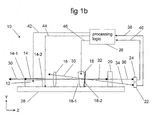
- Figures 1a and 1b taken together, show a preferred embodiment of the invention.
- Figure 1b schematically shows an external cavity semiconductor laser 10 according to the present invention, including a side view of the intracavity elements of this embodiment.
- Figure 1a shows a schematic top view of these intracavity elements.
- Output face 14-1 is preferably coated to provide a low level of reflectivity which optimizes laser output power. Typical reflectivities for output face 14-1 are approximately in the range of 0.5 to 10 percent.
- Gain element 12 is preferably an electrically pumped semiconductor single or multiple quantum well structure which contains a single mode optical waveguide 14. The light reflected from output face 14-1 propagates through waveguide 14 of gain element 12 and is emitted from internal face 14-2 of gain element 12.
- Internal face 14-2 is typically anti-reflection (AR) coated to reduce the effect of the etalon formed by faces 14-1 and 14-2.
- AR anti-reflection
- Typical reflectivities for internal face 14-2 are approximately in the range of 0.05 to 1 percent.
- the axis of waveguide 14 can be configured to intersect internal face 14-2 at an acute angle, which also tends to reduce the effect of the etalon formed by faces 14-1 and 14-2.
- the gain element etalon has a free spectral range (FSR) which depends on the optical length between faces 14-1 and 14-2 of gain element 12.
- a suitable gain element 12 is a JDSU 6560 chip (having horizontal full-width half-maximum (FWHM) beam divergence of about 8.85 degrees, vertical FWHM beam divergence of about 20.5 degrees, and a gain element FSR of about 16.7 GHz).
- FWHM full-width half-maximum
- the invention can, of course, be practiced with other gain elements.
- Optical radiation is emitted from internal face 14-2 of gain element 12 as a diverging beam which is received and collimated by lens 16.
- Lens 16 is preferably AR coated on both surfaces, with a reflectivity of preferably less than 0.5 percent on each surface.
- a suitable lens is Geltech model 350140, which is an aspheric lens with 1.45 mm focal length and a numerical aperture of 0.55, but other lenses with different focal lengths and/or numerical apertures can also be employed to practice the invention.
- the collimated beam propagates from lens 16 to wavelength selective element 18.
- Wavelength selective element 18 is preferably a bandpass interference filter having a transmission FWHM of about 0.1 nm centered on a center wavelength ⁇ c . Filters with bandwidths in the range of about 0.05 to 2 nm are also suitable for practicing the invention.
- the transmission loss at ⁇ c is preferably less than 50 percent, and is more preferably less than 10 percent.
- the transmission loss at wavelengths which are amplified by gain element 12 but are well outside the filter bandwidth (i.e., separated in wavelength from ⁇ c by several times the FWHM) is preferably greater than 90 per cent. Methods for fabricating interference filters to achieve these specifications are known in the art.
- Wavelength selective element 18 typically includes a substrate with two surfaces 18-1 and 18-2.
- the above bandpass interference filter is typically deposited as a multilayer coating on either surface 18-1 or surface 18-2 of wavelength selective element 18.
- the other surface of wavelength selective element 18 is typically AR coated to provide a reflectivity of preferably less than 0.1 percent.
- the substrate of wavelength selective element 18 provides mechanical support for the filter coating. Since wavelength selective element 18 introduces a relatively low loss for ⁇ c and relatively high loss for all other wavelengths which are amplified by gain element 12, laser 10 emits radiation having a wavelength that is at or near (i.e., within about a cavity FSR of) the center wavelength ⁇ c . The choice of ⁇ c is application dependent.
- Wavelength selective element 18 preferably has a narrow bandwidth (e.g., 0.1 nm in this case), to suppress laser emission at cavity modes which are adjacent in wavelength to the lasing mode.
- a narrow bandwidth e.g., 0.1 nm in this case
- other wavelength selective elements having different specifications and/or configurations can also be used to practice the invention.
- Wavelength selective element 18 is preferably tilted with respect to the axis of cavity round trip path 32, so that reflections from its surfaces are not coupled into waveguide 14 of gain element 12.
- Return mirror 20 is preferably a plane mirror with a high reflectivity (i.e., reflectivity > 90 percent) coating on its front surface.
- Return mirror 20 preferably has a large enough clear aperture so that the beam received by mirror 20 is not clipped at the edges. For a Gaussian beam with 1/e amplitude radius w at the position of return mirror 20, preferred clear apertures have a diameter greater than 4w to ensure negligible clipping.
- a Gaussian beam received by return mirror 20 does not have a circular cross section, and in these cases, the 4w criterion for preferred clear apertures is applied using the larger of w h and w v , where w h and w v are the horizontal and vertical 1/e Gaussian beam radii, respectively, at the position of return mirror 20.
- Return mirrors other than the preferred mirror described above can also be used to practice the invention.
- Gain element 12 lens 16, wavelength selective element 18 and mirror 20 are preferably affixed to a monolithic support means 28 (optional), commonly referred to as a bench, to provide mechanical stability for the laser, using mounting hardware and methods which are not shown or discussed, since suitable hardware and methods are known in the art.
- Bench 28 is preferably made from a material such as aluminum nitride which provides high stiffness and low thermal expansion. Other bench materials and configurations may also be used to practice the invention. For example, instead of the flat bench shown on figure 1b, a cylindrical bench can be used. Alternatively, the invention may be practiced without the use of bench 28.
- figure 1b shows these intracavity elements in a schematic side view, as well as additional elements which together comprise a monomode external cavity laser 10.
- wavelength selective element 18 In cases where wavelength selective element 18 is tilted, it is preferable to choose the orientation of this tilt so that beam 33 reflected from surface 18-2 of wavelength selective element 18 toward gain element 12 does not impinge on gain element 12, as shown on figure 1b.
- This preferred tilt orientation eliminates the possibility of reflected beam 33 causing damage to gain element 12.
- a portion of the light traveling on round trip path 32 is reflected from surface 18-2 of wavelength selective element 18 toward mirror 20, and a fraction of this reflected beam is transmitted through mirror 20 as beam 34 which is received by detector 22.
- a portion of the light traveling on round trip path 32 is also transmitted through mirror 20 as beam 36. Due to the tilt of wavelength selective element 18, beam 34 follows a path that differs from cavity round trip path 32, which ensures spatial separation of beam 34 from beam 36, as shown on figure 1b.
- Detector 22 is positioned to receive beam 34, but not beam 36.
- Wavelength selective element 18 is preferably wedged, to reduce the effect of the etalon formed by surfaces 18-1 and 18-2.
- a 0.2 degree wedge is suitable, but other wedge angles may also be used to practice the invention.
- a suitable orientation of this wedge is shown on figure 1a.
- the amount of light reflected from surface 18-1 of wavelength selective element 18 that is received by detector 22 is preferably negligible. This condition can be provided by AR coating of surface 18-1 and/or by choosing a wedge angle between surfaces 18-1 and 18-2 such that the beam reflected from surface 18-1 misses detector 22. If the reflectivity of surface 18-1 is sufficiently low (i.e., its reflectivity is less than about 0.1 percent), then it is not necessary to make the reflection from surface 18-1 miss detector 22 (by choosing a sufficiently large wedge angle for surface 18-1 and 18-2).
- FIGS. 1a and 1b show an embodiment where the bandpass filter is deposited on surface 18-2 and an AR coating is deposited on surface 18-1 of wavelength selective element 18, the invention can also be practiced with the roles of surfaces 18-1 and 18-2 reversed.
- mirror 20 Since light reflected from surface 18-2 of wavelength selective element 18 is transmitted through mirror 20 to be received by detector 22, mirror 20 preferably has a low absorbance (i.e., less than 0.5 percent), where the absorbance is the fraction of incident light that is neither reflected nor transmitted. Mirror 20 need not provide low absorbance in cases where beams reflected from wavelength selective element 18 do not impinge on mirror 20.
- Detector 22 receives optical beam 34 and provides electrical signal 38 to processing logic 26.
- the transmittance of mirror 20 is preferably chosen to ensure that electrical signal 38 is substantially proportional to the intensity of beam 34 (i.e., the optical power incident on detector 22 is low enough to ensure negligible detector saturation).
- Electrical signal 38 is a direct measure of the loss introduced in the laser by wavelength selective element 18. For example, if the laser emission wavelength drifts relative to the center wavelength of wavelength selective element 18 (or vice versa), electrical signal 38 will increase or decrease depending on the separation between the laser emission wavelength and the filter center wavelength. As this wavelength separation increases, the loss introduced by wavelength selective element 18 increases, thus increasing electrical signal 38.
- an increase in electrical signal 38 provides a clear indication of an impending mode hop, so this signal is suitable for use in a control system designed to reduce the mode hop rate.
- Processing logic 26 implements a control method to ensure monomode operation based on electrical signal 38.
- Processing logic 26 receives electrical signal 38, and preferably controls the current supplied to gain element 12 via control output 42.
- processing logic 26 may also receive electrical signal 40, and/or may control the temperature of gain element 12 via control output 42, and/or may control the temperature of bench 28 via control output 44, and/or may control the optical length of wavelength selective element 18 via control output 46.
- the various parameters which may be controlled by processing logic 26 are discussed below.
- control methods based on electrical signal 38 which can be implemented by processing logic 26 to reduce the mode hop rate.
- Such a method can be regarded as the combination of three elements: 1) a method for deriving a control signal from electrical signal 38; 2) the identification of one or more laser parameters which affect the control signal (i.e., how far the laser is from a mode hop); and 3) a control algorithm which specifies the condition on the control signal (e.g., minimization of the control signal) to be achieved by varying the laser parameter(s). Since there are various options for each of these three elements, we consider each element individually.
- One approach for deriving a control signal from electrical signal 38 is to equate the control signal to electrical signal 38.
- An alternative approach is to derive a control signal from electrical signal 38 that does not change when the laser output (or circulating) power changes.
- One way to provide this normalization is shown on figure 1b, where a fraction of light traveling on round trip path 32 is emitted from mirror 20 as reference beam 36, which is received by detector 24.
- Detector 24 provides electrical signal 40 to processing logic 26.
- a control signal equal to the ratio of electrical signal 38 to electrical signal 40 does not change as the laser power changes. For this reason, such a normalized control signal is preferable to a control signal based on signal 38 alone, although either approach may be used to practice the invention.
- control signal can be derived from electrical signal 38 by subtracting an empirically determined background level from electrical signal 38.
- control signal can be derived by calculating the ratio of a corrected electrical signal 38 (with detector 22 background subtracted out) to a corrected electrical signal 40 (with detector 24 background subtracted out).
- Suitable laser control parameters include any parameter that affects the round trip optical path length within the laser resonator. Variation of such a parameter will change the wavelength separation between the laser emission wavelength and the center wavelength of wavelength selective element 18, since varying the round trip path length changes the wavelength of each cavity mode (including the lasing mode). Therefore, suitable control parameters include, but are not limited to, the following: the temperature of any element within the laser; the temperature of any element which establishes the round trip path length (e.g., bench 28); the current supplied to gain element 12, if it is electrically pumped; the optical power supplied to gain element 12 if it is optically pumped; or a signal provided to a phase adjustment element within the laser cavity.
- the temperature of bench 28 and the temperature of gain element 12 can be independently controlled if a second thermoelectric cooler (TEC) is positioned between gain element 12 and bench 28 (in addition to a first TEC positioned beneath bench 28).
- TEC thermoelectric cooler
- a phase adjustment element if present, may be integrated with gain element 12 (e.g., in a similar manner as phase control sections for distributed Bragg reflector lasers), or it may be combined with wavelength selective element 18 (e.g., a wavelength selective element 18 that includes an electro-optic substrate), or it may be a separate element within the optical resonator.
- wavelength selective element 18 e.g., a wavelength selective element 18 that includes an electro-optic substrate
- One algorithm is to adjust the control parameter to minimize the control signal. Methods for minimizing a signal responsive to variation of a parameter are known in the art. This algorithm ensures that the laser emission wavelength is a wavelength of minimum loss induced by wavelength selective element 18. Since all other cavity modes have a higher round trip loss, this algorithm is suitable for decreasing the mode hop rate in cases where gain element 12 does not affect the mode selection process.
- a second algorithm is to adjust the control parameter to maintain the control signal below a predetermined threshold. Methods for maintaining a signal below a threshold value by variation of a parameter that affects the signal are known in the art. This second algorithm is also suitable for decreasing the mode hop rate in cases where gain element 12 does not affect the mode selection process.
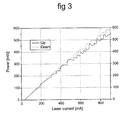
- gain element 12 sometimes affects the mode selection process. This interaction between gain element 12 and the laser emission wavelength is manifested in two ways: 1) the laser exhibits significant hysteresis in the output power vs. pumping level curve (usually called the "LI curve") as the pumping level is increased and then decreased; and 2) stable monomode laser operation is not necessarily obtained when the laser emission wavelength is a wavelength of minimum loss induced by wavelength selective element 18.
- the preferred control algorithm is to maintain the control signal fixed at a predetermined (typically non-minimal) value by varying the control parameter.
- Figure 2 shows how such a value for the control signal can be determined.
- This figure shows a plot of the measured normalized reflection (in arbitrary units) from wavelength selective element 18 (i.e., a control signal equal to the ratio of electrical signal 38 to electrical signal 40) at two slightly different temperatures (crosses 25.0 C and squares 25.8 C) versus the current supplied to gain element 12 (i.e., the control parameter).
- the data in figure 2 is obtained from an embodiment of the invention as shown in figures 1a and 1b.
- sharp vertical transitions in the measured signals are due to mode hops, and the regions between these transitions provide monomode operation.
- the curves on figure 2 show that minimizing the control signal is an inappropriate control algorithm for this laser, since mode hops occur at or near the points of minimum control signal.
- the preferred control algorithm for this laser is to maintain the control signal at about a value of 0.67 (which is roughly the midpoint between the two heavy dotted lines on figure 2) by varying the current supplied to gain element 12. Since the heavy dotted lines on figure 2 are drawn to enclose a range of control signal values corresponding to monomode operation, controlling the current to center the control signal within this range (i.e., by maintaining the control signal at about 0.67) is an effective method for reducing the mode hop rate.
- the specific numerical values obtained in this example may to vary as the details of the laser change, and/or as the calculation of the control signal is varied, this measurement procedure can be used to determine such values for other lasers and/or other methods of calculating the control signal.
- the solid line on figure 3 is a measured LI curve obtained when the current is scanned from a low value to a high value, while the dotted line on figure 3 is a measured LI curve from the same laser obtained by scanning the current from a high value to a low value.
- a desired operating point "from above" For example, suppose it is desired to operate the laser at 700 mA current.
- a preferred way of setting the current to 700 mA is to first set the current to a value that is substantially higher than 700 mA (e.g., 750 to 850 mA), then monotonically decrease the current from this higher value to 700 mA.
- a value that is substantially higher than 700 mA e.g., 750 to 850 mA
- the control signal curves shown in figure 2 are consistent with this approach for dealing with hysteresis, since they were taken by scanning the current from the high end of the current scale to the low end of the current scale.
- a preferred control method to ensure monomode operation of an external cavity laser 10 includes the following three elements: 1) a preferred control signal, which is derived from the ratio of electrical signal 38 to electrical signal 40; 2) a preferred control parameter, which is the current supplied to gain element 12, and 3) a preferred control algorithm, which is to maintain the control signal at a predetermined value.
- This predetermined value for the control signal is preferably chosen by making measurements as indicated in the discussion of figure 2, and then choosing a value that is roughly centered in the range of monomode operation.
- a predetermined control signal level suitable for all of these nominally identical lasers can be derived from measurements of a sample set of lasers using known statistical sampling techniques.
- the free spectral range (FSR) of the etalon formed by faces 14-1 and 14-2 of gain element 12 be approximately an integer multiple of the cavity FSR.
- This matching of the gain element FSR to the cavity FSR provides improved laser operation, as taught in copending, commonly assigned, US patent application 10/327,576, filed Dec. 20, 2002, entitled “Laser with reduced parasitic etalon effect", the teaching of which is incorporated herein in its entirety.
- a preferred wavelength selective element 18 is a fixed wavelength (i.e., non-tunable) bandpass interference filter. Since single mode control of a tunable (i.e., variable wavelength) laser is similar to single mode control of a fixed wavelength laser, the invention can also be practiced using a tunable wavelength selective element 18. Suitable tuning elements for use in such embodiments include, but are not limited to, mechanically rotatable filters or etalons and electrically tunable filters or etalons.
- Suitable electrically tunable filters or etalons include etalons with an electrically adjustable physical separation between the mirrors (e.g., an etalon where the mirror separation is varied electrostatically), and etalons with an electrically adjustable optical length between the mirrors (e.g., an etalon where the mirrors are separated by an electro-optical material such as a ferroelectric crystal or a liquid crystal).
- FIG 4 schematically shows a second embodiment of the invention.
- Monomode external cavity laser 50 shown on figure 4 is the same as laser 10 shown on figure 1b except for the substitution of wavelength selective element 18' on figure 4 for wavelength selective element 18 on figure 1b, and the addition of filter 19 on figure 4 to laser 50.
- filter 19 on figure 4 selects the emission wavelength of laser 50, while wavelength selective element 18' suppresses laser emission at cavity modes adjacent to the laser emission wavelength, thus improving monomode performance.
- the functions of wavelength selection and adjacent cavity mode suppression performed by wavelength selective element 18 on figure 1b are performed by two separate elements (i.e., elements 18' and 19) in the embodiment of figure 4.
- this additional element i.e., element 19
- the embodiment of figure 4 is most suitable in cases where it is difficult (or impossible) to obtain a required level of monomode laser performance with a single optical element (i.e., 18 on figure 1b) that both selects the wavelength and suppresses adjacent cavity modes.
- Filter 19 on figure 4 is preferably a bandpass filter with a center wavelength ⁇ c that is application dependent.
- a preferred wavelength selective element 18 on figure 1a which was a bandpass filter
- the bandwidth of filter 19 need not be as narrow as the preferred bandwidth of wavelength selective element 18.
- another element i.e., wavelength selective element 18' on figure 4
- the functions of filter 19 and mirror 20 can be combined in a single optical element (e.g., an embodiment where a diffraction grating provides retro reflection only for a narrow wavelength range).
- a suitable wavelength selective element 18' satisfies the following three requirements: 1) wavelength selective element 18' has a transmission peak (referred to as peak A) at or near the center wavelength ⁇ c of filter 19; 2) the bandwidth of peak A is substantially less than the bandwidth of filter 19; and 3) wavelength selective element 18' introduces relatively high loss at all wavelengths that are not within peak A, but are near the transmission peak of filter 19. In other words, wavelength selective element 18' selects a single wavelength within the bandwidth of filter 19.
- wavelength selective element 18' As a mode suppressing etalon, the term "etalon 18''' is used as an abbreviation for "a mode suppressing etalon which is a preferred wavelength selective element 18' on figure 4" in the following two paragraphs.
- etalon 18' preferably has a transmission peak bandwidth that is substantially less than the bandwidth of filter 19, so that etalon 18' provides significant suppression of adjacent cavity modes in addition to the suppression provided by filter 19.
- Methods for aligning a transmission peak (i.e., peak A) of etalon 18' with the center wavelength ⁇ c of filter 19, such as adjusting the angle between round trip path 32 and the surfaces of etalon 18', are known in the art.
- the FSR of etalon 18' is preferably at least about equal to the bandwidth of filter 19, which ensures a significant difference between the loss at the wavelength of peak A (at ⁇ c ) and the loss at a wavelength of an adjacent transmission peak of etalon 18'.
- Etalon 18' in figure 4 is preferably inserted into the laser cavity such that it is tilted (i.e., its surface normals make a small angle, preferably 0.1-2 degrees, with respect to round trip path 32), to thereby ensure that beams reflected from its surfaces do not efficiently couple into the laser cavity.
- the finesse of etalon 18' is preferably moderate (e.g., 2 ⁇ finesse ⁇ 10), and the finesse is chosen to provide low loss in transmission through the tilted etalon, and the desired level of spectral selectivity. Since this etalon serves as an absolute wavelength reference for the laser, it is preferably fabricated using a material, such as fused silica, that is mechanically stable and temperature insensitive.
- a longitudinal cavity mode (as defined by the laser resonator) wavelength be present at or near each transmission peak of etalon 18' that is within the wavelength adjustment range (i.e., the range of wavelengths within which the emission wavelength is selected by filter 19 when laser 50 is assembled).
- a preferred method for achieving this alignment of longitudinal modes to the transmission peaks of etalon 18' is to design the laser so that the FSR of etalon 18' is substantially an integer multiple of the cavity FSR, and one of the transmission peaks of the etalon 18' within the wavelength adjustment range is substantially aligned with a longitudinal mode defined by the laser resonator.
- the orientation of the tilt of etalon 18' is preferably chosen to ensure that beam 33 reflected from etalon 18' does not impinge on gain element 12. Beam 34 is received by detector 22 which provides electrical signal 38 in response. Since electrical signal 38 provides a direct measure of the loss introduced by etalon 18' at the lasing wavelength, it is suitable for use in a control system to reduce the mode hop rate, and the various control methods discussed in connection with figures 1b, 2 and 3 are also applicable to the embodiment of figure 4.
- the free spectral range (FSR) of etalon 18' be approximately an integer multiple of the FSR of the etalon formed by faces 14-1 and 14-2 of gain element 12. This matching of the gain element FSR to the FSR of etalon 18' provides improved laser operation, as taught in copending, commonly assigned, US patent application 10/327,576, filed Dec. 20, 2002, entitled "Laser with reduced parasitic etalon effect”.
- a preferred filter 19 is a fixed wavelength (i.e., not tunable) bandpass interference filter. Since single mode control of a tunable laser is similar to single mode control of a fixed wavelength laser, the invention can also be practiced using a tunable filter 19. Suitable tuning elements for use in such embodiments include, but are not limited to, mechanically rotatable filters or etalons, or diffraction gratings and electrically tunable filters or etalons.
- Suitable electrically tunable filters include etalons with an electrically adjustable physical separation between the mirrors (e.g., an etalon where the mirror separation is varied electrostatically), etalons with an electrically adjustable optical length (i.e., length times index of refraction) between the mirrors (e.g., an etalon where the mirrors are separated by an electro-optical material such as a ferroelectric crystal or a liquid crystal), and acousto-optically tuned filters.
- a common feature of the tunable and fixed wavelength embodiments of figures 1b and 4 is a wavelength selective element (which is preferably a bandpass filter in the embodiment of figure 1b, and which is preferably a mode suppressing etalon in the embodiment of figure 4) positioned in the resonator such that a beam reflected from its surface follows a path which differs from the resonator round trip light path.
- the spatial separation of this reflected beam path from the round trip path allows a detector to be positioned to receive the reflected beam without substantially receiving other beams.
- the intensity of the reflected beam is a direct measure of the loss introduced by the wavelength selective element at the laser emission wavelength, which makes it a suitable signal for use in a control method designed to reduce the mode hop rate.
- control methods discussed above for providing monomode operation can be combined with other control methods (e.g., methods for ensuring constant output power).
- the temperature of gain element 12 can be controlled in a second control loop to provide substantially constant output power.
- the two loops preferably have substantially different time constants, to reduce the interaction between the loops.
- the power control loop will naturally tend to be slower than the monomode stabilization loop, since temperature change and output power drift both tend to be slow.
Landscapes
- Physics & Mathematics (AREA)
- Condensed Matter Physics & Semiconductors (AREA)
- General Physics & Mathematics (AREA)
- Electromagnetism (AREA)
- Optics & Photonics (AREA)
- Semiconductor Lasers (AREA)
- Lasers (AREA)
- Laser Surgery Devices (AREA)
Applications Claiming Priority (4)
| Application Number | Priority Date | Filing Date | Title |
|---|---|---|---|
| US308541 | 2002-12-02 | ||
| US10/308,541 US6959024B2 (en) | 2002-02-28 | 2002-12-02 | Laser Tuning by spectrally dependent spatial filtering |
| US409879 | 2003-04-08 | ||
| US10/409,879 US20040202223A1 (en) | 2003-04-08 | 2003-04-08 | External cavity laser having improved single mode operation |
Publications (3)
| Publication Number | Publication Date |
|---|---|
| EP1427077A2 true EP1427077A2 (de) | 2004-06-09 |
| EP1427077A3 EP1427077A3 (de) | 2005-05-11 |
| EP1427077B1 EP1427077B1 (de) | 2007-04-18 |
Family
ID=32314399
Family Applications (1)
| Application Number | Title | Priority Date | Filing Date |
|---|---|---|---|
| EP03253417A Expired - Lifetime EP1427077B1 (de) | 2002-12-02 | 2003-05-30 | Laser mit externem Resonator und verbessertem Einzelmodenbetrieb |
Country Status (4)
| Country | Link |
|---|---|
| EP (1) | EP1427077B1 (de) |
| JP (1) | JP2004193556A (de) |
| AT (1) | ATE360274T1 (de) |
| DE (1) | DE60313277T2 (de) |
Cited By (1)
| Publication number | Priority date | Publication date | Assignee | Title |
|---|---|---|---|---|
| RU2725639C2 (ru) * | 2018-04-09 | 2020-07-03 | Акционерное общество "Российская корпорация ракетно-космического приборостроения и информационных систем" (АО "Российские космические системы") | Перестраиваемый диодный лазер с внешним резонатором |
Families Citing this family (6)
| Publication number | Priority date | Publication date | Assignee | Title |
|---|---|---|---|---|
| US7209499B2 (en) * | 2004-09-22 | 2007-04-24 | Corning Incorporated | Mode-selective frequency tuning system |
| DE102008012859B4 (de) | 2007-12-21 | 2023-10-05 | OSRAM Opto Semiconductors Gesellschaft mit beschränkter Haftung | Laserlichtquelle mit einer Filterstruktur |
| JP2013219124A (ja) * | 2012-04-06 | 2013-10-24 | National Institute Of Advanced Industrial & Technology | 外部共振器半導体レーザ装置 |
| JP5949384B2 (ja) * | 2012-09-24 | 2016-07-06 | 株式会社島津製作所 | レーザ装置の製造方法 |
| JP6519925B2 (ja) * | 2014-08-21 | 2019-05-29 | 住友電工デバイス・イノベーション株式会社 | 波長可変レーザシステム |
| DE102021124466B3 (de) | 2021-09-22 | 2023-03-23 | Ruhr-Universität Bochum, Körperschaft des öffentlichen Rechts | Vorrichtung und Verfahren zur optischen Dehnungsmessung |
Family Cites Families (4)
| Publication number | Priority date | Publication date | Assignee | Title |
|---|---|---|---|---|
| US6018536A (en) * | 1998-11-20 | 2000-01-25 | Sarnoff Corporation | Multiple-wavelength mode-locked laser |
| US6282215B1 (en) * | 1998-10-16 | 2001-08-28 | New Focus, Inc. | Continuously-tunable external cavity laser |
| US6763046B2 (en) * | 2001-03-01 | 2004-07-13 | Applied Optoelectronics, Inc. | Method and system employing multiple reflectivity band reflector for laser wavelength monitoring |
| US6816516B2 (en) * | 2001-03-21 | 2004-11-09 | Intel Corporation | Error signal generation system |
-
2003
- 2003-05-30 EP EP03253417A patent/EP1427077B1/de not_active Expired - Lifetime
- 2003-05-30 DE DE60313277T patent/DE60313277T2/de not_active Expired - Fee Related
- 2003-05-30 AT AT03253417T patent/ATE360274T1/de not_active IP Right Cessation
- 2003-09-01 JP JP2003308811A patent/JP2004193556A/ja active Pending
Cited By (1)
| Publication number | Priority date | Publication date | Assignee | Title |
|---|---|---|---|---|
| RU2725639C2 (ru) * | 2018-04-09 | 2020-07-03 | Акционерное общество "Российская корпорация ракетно-космического приборостроения и информационных систем" (АО "Российские космические системы") | Перестраиваемый диодный лазер с внешним резонатором |
Also Published As
| Publication number | Publication date |
|---|---|
| DE60313277T2 (de) | 2007-12-27 |
| DE60313277D1 (de) | 2007-05-31 |
| ATE360274T1 (de) | 2007-05-15 |
| EP1427077B1 (de) | 2007-04-18 |
| EP1427077A3 (de) | 2005-05-11 |
| JP2004193556A (ja) | 2004-07-08 |
Similar Documents
| Publication | Publication Date | Title |
|---|---|---|
| US5949801A (en) | Tunable laser and method for operating the same | |
| US9722397B2 (en) | Tunable laser and tunable laser module | |
| US12021348B2 (en) | Integrated-optics-based external-cavity laser configured for mode-hop-free wavelength tuning | |
| US20060109873A1 (en) | External cavity laser having improved single mode operation | |
| US6118802A (en) | Optically amplifying semiconductor diodes with curved waveguides for external cavities | |
| US8605760B2 (en) | Feedback-enhanced self-injection locking of lasers to optical resonators | |
| US6959024B2 (en) | Laser Tuning by spectrally dependent spatial filtering | |
| US5077747A (en) | Alignment-insensitive method for wideband tuning of an unmodified semiconductor laser | |
| CN109863655B (zh) | 基于布拉格光栅的超低噪声、高稳定单模工作、高功率半导体激光器 | |
| US20040165641A1 (en) | Optical transmitter comprising a stepwise tunable laser | |
| JP2007515771A (ja) | 外部空洞同調可能レーザの位相制御 | |
| US5442651A (en) | External cavity control semiconductor laser | |
| US6967976B2 (en) | Laser with reflective etalon tuning element | |
| EP0300790A2 (de) | Halbleiterlaser | |
| US6792010B2 (en) | Laser with reduced parasitic etalon effects | |
| CA2342034A1 (en) | Light source for an external cavity laser | |
| EP1427077B1 (de) | Laser mit externem Resonator und verbessertem Einzelmodenbetrieb | |
| US7209499B2 (en) | Mode-selective frequency tuning system | |
| US9819149B2 (en) | Optical transmitter implementing wavelength tunable diode | |
| US6959023B1 (en) | Laser with reflective etalon tuning element | |
| JP2004356505A (ja) | 単一モード動作を向上させた外部キャビティレーザー | |
| US6785305B1 (en) | Tuneable, adjustment-stable semiconductor laser light source and a method for the optically stable, largely continuous tuning of semiconductor lasers | |
| US20060056465A1 (en) | Laser with reflective etalon tuning element | |
| JPH1117286A (ja) | 波長可変レーザ装置 | |
| US12368281B2 (en) | System and method for optical feedback stabilized semiconductor frequency combs |
Legal Events
| Date | Code | Title | Description |
|---|---|---|---|
| PUAI | Public reference made under article 153(3) epc to a published international application that has entered the european phase |
Free format text: ORIGINAL CODE: 0009012 |
|
| AK | Designated contracting states |
Kind code of ref document: A2 Designated state(s): AT BE BG CH CY CZ DE DK EE ES FI FR GB GR HU IE IT LI LU MC NL PT RO SE SI SK TR |
|
| AX | Request for extension of the european patent |
Extension state: AL LT LV MK |
|
| PUAL | Search report despatched |
Free format text: ORIGINAL CODE: 0009013 |
|
| AK | Designated contracting states |
Kind code of ref document: A3 Designated state(s): AT BE BG CH CY CZ DE DK EE ES FI FR GB GR HU IE IT LI LU MC NL PT RO SE SI SK TR |
|
| AX | Request for extension of the european patent |
Extension state: AL LT LV MK |
|
| 17P | Request for examination filed |
Effective date: 20051110 |
|
| AKX | Designation fees paid |
Designated state(s): AT BE BG CH CY CZ DE DK EE ES FI FR GB GR HU IE IT LI LU MC NL PT RO SE SI SK TR |
|
| GRAP | Despatch of communication of intention to grant a patent |
Free format text: ORIGINAL CODE: EPIDOSNIGR1 |
|
| RIN1 | Information on inventor provided before grant (corrected) |
Inventor name: PALDUS, BARBARA Inventor name: KOULIKOV, SERGUEI Inventor name: PAKULSKI, GRZEGORZ Inventor name: CROSSON, ERIC Inventor name: RELLA, CHRIS |
|
| GRAS | Grant fee paid |
Free format text: ORIGINAL CODE: EPIDOSNIGR3 |
|
| GRAA | (expected) grant |
Free format text: ORIGINAL CODE: 0009210 |
|
| RAP1 | Party data changed (applicant data changed or rights of an application transferred) |
Owner name: NEWPORT CORPORATION |
|
| AK | Designated contracting states |
Kind code of ref document: B1 Designated state(s): AT BE BG CH CY CZ DE DK EE ES FI FR GB GR HU IE IT LI LU MC NL PT RO SE SI SK TR |
|
| PG25 | Lapsed in a contracting state [announced via postgrant information from national office to epo] |
Ref country code: CH Free format text: LAPSE BECAUSE OF FAILURE TO SUBMIT A TRANSLATION OF THE DESCRIPTION OR TO PAY THE FEE WITHIN THE PRESCRIBED TIME-LIMIT Effective date: 20070418 Ref country code: FI Free format text: LAPSE BECAUSE OF FAILURE TO SUBMIT A TRANSLATION OF THE DESCRIPTION OR TO PAY THE FEE WITHIN THE PRESCRIBED TIME-LIMIT Effective date: 20070418 Ref country code: SI Free format text: LAPSE BECAUSE OF FAILURE TO SUBMIT A TRANSLATION OF THE DESCRIPTION OR TO PAY THE FEE WITHIN THE PRESCRIBED TIME-LIMIT Effective date: 20070418 Ref country code: LI Free format text: LAPSE BECAUSE OF FAILURE TO SUBMIT A TRANSLATION OF THE DESCRIPTION OR TO PAY THE FEE WITHIN THE PRESCRIBED TIME-LIMIT Effective date: 20070418 |
|
| REG | Reference to a national code |
Ref country code: CH Ref legal event code: EP |
|
| REG | Reference to a national code |
Ref country code: IE Ref legal event code: FG4D |
|
| REF | Corresponds to: |
Ref document number: 60313277 Country of ref document: DE Date of ref document: 20070531 Kind code of ref document: P |
|
| PG25 | Lapsed in a contracting state [announced via postgrant information from national office to epo] |
Ref country code: SE Free format text: LAPSE BECAUSE OF FAILURE TO SUBMIT A TRANSLATION OF THE DESCRIPTION OR TO PAY THE FEE WITHIN THE PRESCRIBED TIME-LIMIT Effective date: 20070718 |
|
| PG25 | Lapsed in a contracting state [announced via postgrant information from national office to epo] |
Ref country code: ES Free format text: LAPSE BECAUSE OF FAILURE TO SUBMIT A TRANSLATION OF THE DESCRIPTION OR TO PAY THE FEE WITHIN THE PRESCRIBED TIME-LIMIT Effective date: 20070729 |
|
| PG25 | Lapsed in a contracting state [announced via postgrant information from national office to epo] |
Ref country code: PT Free format text: LAPSE BECAUSE OF FAILURE TO SUBMIT A TRANSLATION OF THE DESCRIPTION OR TO PAY THE FEE WITHIN THE PRESCRIBED TIME-LIMIT Effective date: 20070918 |
|
| ET | Fr: translation filed | ||
| REG | Reference to a national code |
Ref country code: CH Ref legal event code: PL |
|
| NLV1 | Nl: lapsed or annulled due to failure to fulfill the requirements of art. 29p and 29m of the patents act | ||
| PG25 | Lapsed in a contracting state [announced via postgrant information from national office to epo] |
Ref country code: AT Free format text: LAPSE BECAUSE OF FAILURE TO SUBMIT A TRANSLATION OF THE DESCRIPTION OR TO PAY THE FEE WITHIN THE PRESCRIBED TIME-LIMIT Effective date: 20070418 |
|
| PG25 | Lapsed in a contracting state [announced via postgrant information from national office to epo] |
Ref country code: BE Free format text: LAPSE BECAUSE OF FAILURE TO SUBMIT A TRANSLATION OF THE DESCRIPTION OR TO PAY THE FEE WITHIN THE PRESCRIBED TIME-LIMIT Effective date: 20070418 |
|
| PG25 | Lapsed in a contracting state [announced via postgrant information from national office to epo] |
Ref country code: MC Free format text: LAPSE BECAUSE OF NON-PAYMENT OF DUE FEES Effective date: 20070531 Ref country code: NL Free format text: LAPSE BECAUSE OF FAILURE TO SUBMIT A TRANSLATION OF THE DESCRIPTION OR TO PAY THE FEE WITHIN THE PRESCRIBED TIME-LIMIT Effective date: 20070418 Ref country code: CZ Free format text: LAPSE BECAUSE OF FAILURE TO SUBMIT A TRANSLATION OF THE DESCRIPTION OR TO PAY THE FEE WITHIN THE PRESCRIBED TIME-LIMIT Effective date: 20070418 Ref country code: DK Free format text: LAPSE BECAUSE OF FAILURE TO SUBMIT A TRANSLATION OF THE DESCRIPTION OR TO PAY THE FEE WITHIN THE PRESCRIBED TIME-LIMIT Effective date: 20070418 Ref country code: BG Free format text: LAPSE BECAUSE OF FAILURE TO SUBMIT A TRANSLATION OF THE DESCRIPTION OR TO PAY THE FEE WITHIN THE PRESCRIBED TIME-LIMIT Effective date: 20070718 |
|
| PLBE | No opposition filed within time limit |
Free format text: ORIGINAL CODE: 0009261 |
|
| STAA | Information on the status of an ep patent application or granted ep patent |
Free format text: STATUS: NO OPPOSITION FILED WITHIN TIME LIMIT |
|
| PG25 | Lapsed in a contracting state [announced via postgrant information from national office to epo] |
Ref country code: SK Free format text: LAPSE BECAUSE OF FAILURE TO SUBMIT A TRANSLATION OF THE DESCRIPTION OR TO PAY THE FEE WITHIN THE PRESCRIBED TIME-LIMIT Effective date: 20070418 |
|
| 26N | No opposition filed |
Effective date: 20080121 |
|
| PG25 | Lapsed in a contracting state [announced via postgrant information from national office to epo] |
Ref country code: IT Free format text: LAPSE BECAUSE OF FAILURE TO SUBMIT A TRANSLATION OF THE DESCRIPTION OR TO PAY THE FEE WITHIN THE PRESCRIBED TIME-LIMIT Effective date: 20070418 Ref country code: GR Free format text: LAPSE BECAUSE OF FAILURE TO SUBMIT A TRANSLATION OF THE DESCRIPTION OR TO PAY THE FEE WITHIN THE PRESCRIBED TIME-LIMIT Effective date: 20070719 |
|
| PG25 | Lapsed in a contracting state [announced via postgrant information from national office to epo] |
Ref country code: IE Free format text: LAPSE BECAUSE OF NON-PAYMENT OF DUE FEES Effective date: 20070530 Ref country code: RO Free format text: LAPSE BECAUSE OF FAILURE TO SUBMIT A TRANSLATION OF THE DESCRIPTION OR TO PAY THE FEE WITHIN THE PRESCRIBED TIME-LIMIT Effective date: 20070418 |
|
| PG25 | Lapsed in a contracting state [announced via postgrant information from national office to epo] |
Ref country code: EE Free format text: LAPSE BECAUSE OF FAILURE TO SUBMIT A TRANSLATION OF THE DESCRIPTION OR TO PAY THE FEE WITHIN THE PRESCRIBED TIME-LIMIT Effective date: 20070418 |
|
| PG25 | Lapsed in a contracting state [announced via postgrant information from national office to epo] |
Ref country code: CY Free format text: LAPSE BECAUSE OF FAILURE TO SUBMIT A TRANSLATION OF THE DESCRIPTION OR TO PAY THE FEE WITHIN THE PRESCRIBED TIME-LIMIT Effective date: 20070418 |
|
| PG25 | Lapsed in a contracting state [announced via postgrant information from national office to epo] |
Ref country code: LU Free format text: LAPSE BECAUSE OF NON-PAYMENT OF DUE FEES Effective date: 20070530 |
|
| PGFP | Annual fee paid to national office [announced via postgrant information from national office to epo] |
Ref country code: DE Payment date: 20090528 Year of fee payment: 7 Ref country code: FR Payment date: 20090518 Year of fee payment: 7 |
|
| PG25 | Lapsed in a contracting state [announced via postgrant information from national office to epo] |
Ref country code: TR Free format text: LAPSE BECAUSE OF FAILURE TO SUBMIT A TRANSLATION OF THE DESCRIPTION OR TO PAY THE FEE WITHIN THE PRESCRIBED TIME-LIMIT Effective date: 20070418 Ref country code: HU Free format text: LAPSE BECAUSE OF FAILURE TO SUBMIT A TRANSLATION OF THE DESCRIPTION OR TO PAY THE FEE WITHIN THE PRESCRIBED TIME-LIMIT Effective date: 20071019 |
|
| PGFP | Annual fee paid to national office [announced via postgrant information from national office to epo] |
Ref country code: GB Payment date: 20090528 Year of fee payment: 7 |
|
| GBPC | Gb: european patent ceased through non-payment of renewal fee |
Effective date: 20100530 |
|
| REG | Reference to a national code |
Ref country code: FR Ref legal event code: ST Effective date: 20110131 |
|
| PG25 | Lapsed in a contracting state [announced via postgrant information from national office to epo] |
Ref country code: DE Free format text: LAPSE BECAUSE OF NON-PAYMENT OF DUE FEES Effective date: 20101201 |
|
| PG25 | Lapsed in a contracting state [announced via postgrant information from national office to epo] |
Ref country code: FR Free format text: LAPSE BECAUSE OF NON-PAYMENT OF DUE FEES Effective date: 20100531 |
|
| PG25 | Lapsed in a contracting state [announced via postgrant information from national office to epo] |
Ref country code: GB Free format text: LAPSE BECAUSE OF NON-PAYMENT OF DUE FEES Effective date: 20100530 |