BACKGROUND OF THE INVENTION
Field of the Invention
The present invention relates to a toner, and more
particularly to a toner for developing an electrostatic latent
image formed on an image bearer such as a photoreceptor to
visualize the latent image. The present invention also relates
to a developer including the toner and a container including
the toner or the developer, and a method of producing the toner.
Discussion of the Background
A pressing and heating method with a heating roller in
an electrophotographic image forming method passes a toner image
on a transfer sheet through a surface of the heating roller having
releasability with a toner while contacting the toner image upon
application of pressure. The method can quickly fix a toner
image on the transfer sheet because the surface of the heating
roller contacts the toner image on the transfer sheet upon
application of pressure and heat efficiency in fusion bonding
of the toner image onto the transfer sheet is quite good.
So-called offset phenomena, in which a part of a toner image
adheres to a surface of a heating roller because the toner image
melts and contacts the surface thereof upon application of
pressure and the part of the toner image transfers onto a following
transfer sheet and contaminates the sheet, is largely influenced
by a fixing speed and temperature. Typically, when the fixing
speed is slow, a surface temperature of the heating roller is
set comparatively low, and when the fixing speed is fast, the
surface temperature thereof is set comparatively high. This
is to fix heat quantity imparted from the heating roller to the
toner regardless of the fixing speed.
A toner on a transfer sheet has multiple layers, and
particularly in an image forming apparatus in which a fixing
speed is fast and a surface temperature of the heating roller
is high, a temperature difference between a top layer contacting
the heat roller and a bottom layer contacting the transfer sheet
is large. When the surface temperature of the heating roller
is high, the top layer of the toner tends to cause of fset phenomena .
When the surface temperature of the heating roller is low,
phenomena called low-temperature offset tends to occur, in which
the bottom layer of the toner does not sufficiently melt and
fix on the transfer sheet.
To solve this problem, a method of anchoring a toner on
a transfer sheet by increasing the fixing pressure is usually
used when the fixing speed is high. This method can decrease
the heating roller temperature somewhat and prevent the
high-temperature offset phenomena of the top layer of the toner.
However, because a shearing force applied to the toner is quite
large, the transfer sheet winds the heating roller and a winding
offset occurs, and a trance of a separation pick separating the
transfer sheet from the heating roller tends to appear on a fixed
image. Further, the high pressure crushes a line image and causes
toner scattering when fixed, resulting in deterioration of the
fixed image quality.
In a high-speed fixing method, a toner having a lower
melting viscosity than a toner used in a low-speed fixing method
is typically used and a surface temperature and a fixing pressure
of the heating roller are decreased to prevent the
high-temperature offset and wind offset. However, when such
a toner having a low melting viscosity is used in a low-speed
fixing method, the high-temperature offset phenomena tend to
occur.
As mentioned above, a toner having a good offset resistance
and a wide range of fixable temperature, which is applicable
in both a high-speed and a low-speed fixing methods, is desired.
On the other hand, a particle size of the toner is being
downsized to increase resolution and sharpness of the resultant
image. However, fixability of a halftone image formed with a
small particle size toner deteriorates. This phenomenon
noticeably occurs in high-speed fixing. This is because a toner
amount is small on a halftone image, a toner transferred onto
a concave portion of a transfer sheet receives less heat amount
from a heating roller, and further a fixing pressure deteriorates
as a convex portion of the transfer sheet inhibits the pressure
to the concave portion thereof. As a toner layer transferred
onto a halftone image on the convex portion of the transfer sheet
is thin, a shearing force against a toner particle is larger
than a shearing force against a toner particle on a black solid
image having a thick toner layer. Therefore, the offset
phenomena tend to occur and the resultant fixed image tends to
be a low quality image.
Japanese Laid-Open Patent Publication No. 1-128071
discloses a toner including a polyester resin as a binder resin
and having a specific storage viscosity at 95 °C. However,
fixability and offset resistance thereof still need to be
improved.
Japanese Laid-Open Patent Publication No. 4-353866
discloses a toner having rheologic properties in which a drop
starting temperature of a storage modulus is from 100 to 110 °C,
the toner has a specific storage modulus at 150 °C and a peak
temperature of a loss elasticity is 125 °C. However, as both
the storage modulus and loss elasticity are too small and the
peak temperature of the loss elasticity is too high,
low-temperature fixability of the resultant toner is not improved
and heat resistance thereof is low.
Japanese Laid-Open Patent Publication No. 6-59504
discloses a toner including a specifically structured polyester
resin as a binder resin, and having a specific storage modulus
at from 70 to 120 °C and a specific loss elasticity at from 130
to 180 °C. However, as the storage modulus at from 70 to 120 °C
is large and the loss elasticity at from 130 to 180 °C is small,
a small particle size magnetic toner is difficult to fix at a
low temperature and offset resistance of the toner of the
invention is desired to be improved.
When the small particle size magnetic toner includes a
large amount of a magnetic material, the fixability problem
noticeably occurs. In terms of rheology, an increase of a
colorant included in a toner tends to increase the storage modulus
and loss elasticity. Therefore, when it is cold, a copy image
produced immediately after a copier is switched on occasionally
has worse fixability, which is desired to be improved.
Japanese Laid-Open Patent Publication No. 4-358159
discloses a developer including a vinyl polymer and two
polyethylene and/or polyethylene waxes having different
softening points, one of which is included in polymerizing and
the other of which is included in kneading. As the two waxes
have a high softening point of 100 °C and a small softening point
difference of from 2 to 20 °C, the resultant developer has good
offset resistance, but poor low-temperature fixability.
Japanese Laid-Open Patent Publication No. 4-362953
discloses a toner including a de-free fatty acid carnauba wax
and a rice wax oxide having an acid value of from 10 to 30. The
toner has good low-temperature fixability, but low offset and
blocking resistance and fluidity.
Japanese Laid-Open Patent Publication No. 6-130714
discloses a toner including a linear polyester as a fixing resin
and waxes having a similar softening point to that of the linear
polyester and a higher softening point than that thereof. The
toner practically has good blocking resistance and offset
resistance, but poor low-temperature fixability due to a high
melting point of the waxes.
Japanese Laid-Open Patent Publication No. 11-133665
discloses a dry toner including an urethane-modified polyester
as a toner binder and having a practical sphericity of from 0.90
to 1.00 for the purpose of improving fluidity, low-temperature
fixability and hot offset resistance of the toner. In addition,
the toner having a small particle size has good powder fluidity,
transferability, thermostable preservability, low-temperature
fixability and hot offset resistance. Particularly, when used
in a full-color copier, the resultant image has good glossiness
and an oil application to a heating roller is not required.
As a method of economically obtaining such a dry toner,
Japanese Laid-Open Patent Publications Nos. 11-149180 and.
2000-292981 disclose a dry toner and a method of producing the
toner including a toner binder which is an elongation and/or
a crosslinking reaction product of a prepolymer having an
isocyanate group and a colorant, wherein the dry toner is a
particulate material formed by an elongation and/or a
crosslinking reaction of the prepolymer by amines in a water
medium.
However, although a process using a urea reaction to
prepare a binder in Japanese Laid-Open Patent Publication No.
11-133665 turns a new feature and an effect, the process is a
pulverizing process and the resultant toner does not have
sufficient low-temperaturefixability. Specific conditions of
controlling shapes of a small particle size and a sphere are
not disclosed therein. In Japanese Laid-Open Patent
Publications Nos. 11-149180 and 2000-292981, a toner is formed
by granulation in water, wherein pigments in an oil phase
agglutinate in a water phase interface, and a volume resistance
thereof lowers and non-uniform dispersion thereof cause basic
performance problems of the toner. An effect of the invention
is not exerted without a targeted shape and properties to achieve
oilless, small particle size and to be used in an apparatus.
As the targeted shape and properties are not mentioned in
respective publications, an effect of the invention is difficult
to exert against problems. Particularly, pigments and waxes
tend to gather on a surface of a toner formed by granulation
in water, and when a particle size thereof is not greater than
6 µm, a specific surface area thereof becomes large. Therefore,
a surface design of the particle is essential to obtain desired
chargeability and fixability.
Because of these reasons, a need exists for a toner having
good releasability, offset resistance, blocking resistance and
fluidity as well as fixability.
SUMMARY OF THE INVENTION
Accordingly, an object of the present invention is to
provide a toner capable of fixing well immediately after an
electrophotographic image forming apparatus including the toner
is switched on and at a low electric power, and which has good
releasability, offset resistance, blocking resistance and
fluidity as well in low and high speed electrophotographic image
forming apparatuses.
Another object of the present invention is to provide a
two-component developer including the toner and a carrier, and
a toner container containing the toner or two-component
developer.
Briefly these objects and other objects of the present
invention as hereinafter will become more readily apparent can
be attained by a toner including toner particles including: a
first binder resin; a second binder resin having a glass
transition temperature of from 40 to 55 °C; a colorant; and a
release agent, and a particulate resin material which is located
on surface of the toner particles with a coverage of from 50
to 100 %, and which has a glass transition temperature of from
50 to 90 °C, wherein a weight ratio (W2/W1) between the second
binder resin (W2) and the first binder resin (W1) is from 5/95
to 40/60, and wherein a ratio (G'80/G'180) between a storage
modulus of the toner at 80 °C (G' 80) and a storage modulus at
180 °C (G'180) is from 100 to 1,000.
The G' 80 and G' 180 are preferably from 1x10⁵ to 5x10⁷ (Pa)
and 5x10² to 3x10³ (Pa) respectively.
The first binder resin and second binder resin preferably
include a polyester resin and a modified polyester resin as a
main component respectively.
These and other objects, features and advantages of the
present invention will become apparent upon consideration of
the following description of the preferred embodiments of the
present invention taken in conjunction with the accompanying
drawings.
BRIEF DESCRIPTION OF THE DRAWINGS
Various other objects, features and attendant advantages
of the present invention will be more fully appreciated as the
same becomes better understood from the detailed description
when considered in connection with the accompanying drawings
in which like reference characters designate like corresponding
parts throughout and wherein:
DETAILED DESCRIPTION OF THE INVENTION
Generally, the present invention provides a toner capable
of fixing well immediately after an electrophotographic image
forming apparatus including the toner is switched on and at a
low electric power, and which has good releasability, offset
resistance, blocking resistance and fluidity as well in low and
high speed electrophotographic image forming apparatuses.
The present inventors discovered that a toner including
a particulate resin material having a glass transition
temperature of from 50 to 90 °C and a toner surface coverage
of from 50 to 100 % on a surface thereof; a first binder resin;
a second binder resin having a glass transition temperature of
from 40 to 55 °C; a colorant; and a release agent, wherein a
weight ratio (W2/W1) between the second binder resin (W2) and
the first binder resin (W1) is from 5/95 to 40/60, and wherein
a ratio (G' 80/G' 180) between a storage modulus of the toner at
80 °C (G' 80) and a storage modulus at 180 °C (G' 180) is from 100
to 1,000 has good low-temperature fixability, releasability,
a small particle diameter and well dispersed pigments to produce
high quality images, and good blocking resistance conflicting
the low-temperature fixability when stored. The storage
modulus at 80 °C (G' 80) and at 180 °C (G' 180) are preferably from
1x10⁵ to 5x10⁷ (Pa) and 5x10² to 3x10³ (Pa) respectively.
Particularly to further improve the low-temperature fixability,
G' 80 and G' 180 are more preferably from 1x10⁵ to 5x10⁶ (Pa) and
5x10² to 3x10³ (Pa) respectively.
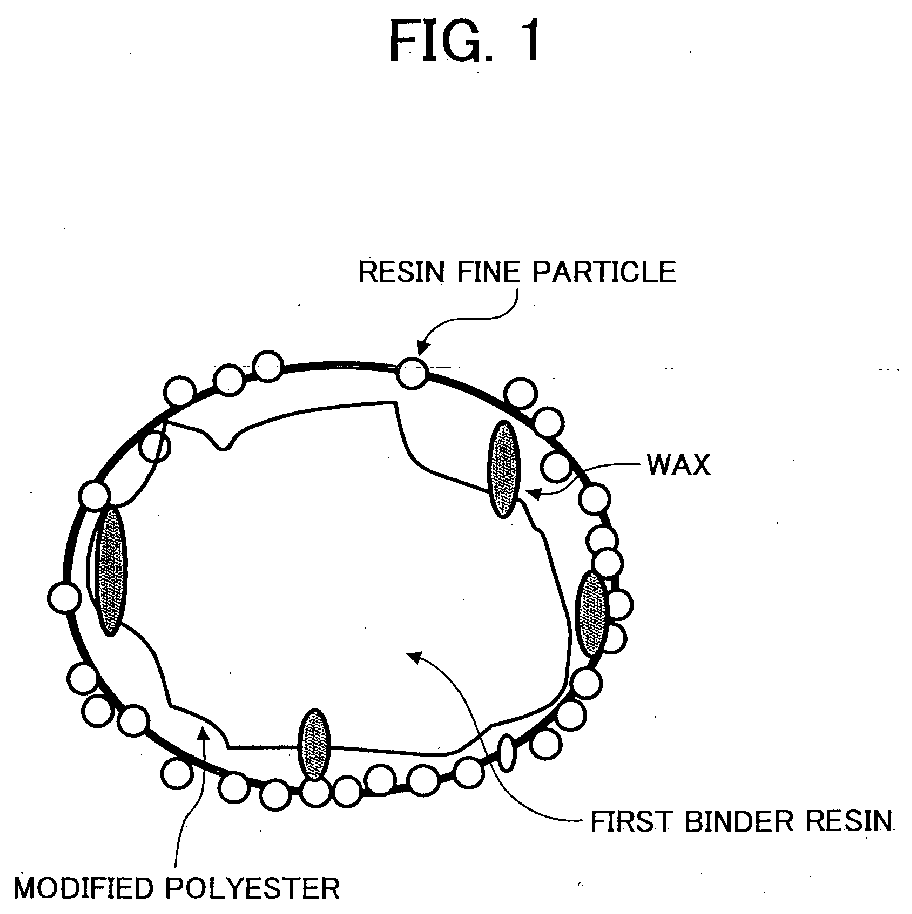
Fig., 1 is a schematic view illustrating a toner particle
of the present invention.
A toner having a ratio (G'80/G'180) between a storage
modulus at 80 °C (G' 80) and a storage modulus at 180 °C (G' 180)
of from 100 to 1,000 has good low-temperature fixability,
releasability, a small particle diameter and well dispersed
pigments to produce high quality images. This is because the
toner starts to being softened to have a fixable elasticity level
at 80 °C, and does not flow and maintains the elasticity at 180 °C
to achieve hot offset resistance.
Conventionally, to achieve low-temperature fixability,
elasticity of a toner at from 80 to 100 °C has been lowered.
However, when the elasticity lowers at around 180 °C, wider
releasability cannot be obtained. Particularly, the
low-temperature fixability can be obtained by lowering the
elasticity at 80 °C while maintaining the elasticity at 180 °C.
It is difficult to form a toner particle having a ratio
(G' 80/G' 180) between a storage modulus at 80 °C (G' 80) and a
storage modulus at 180 °C (G'180) less than 100, and the
low-temperature fixability cannot be obtained when the ratio
is greater than 1,000.
A wide elasticity depends on glass transition temperatures
(Tg) of the first binder resin and second binder resin, their
particle compositions and Tg of the particulate resin material.
When the first binder resin having a low Tg and is present in
a toner particle, and the second binder resin and the particulate
resin material are present close to a surface thereof, the toner
has a viscoelasticity curve due to the inner low-elasticity
binder and surface thin elastic layer. This pseudo capsule
structure performs the low-temperature fixability and prevents
blocking when stored.
A method of measuring the viscoelasticity will be
explained.
A toner sample having a diameter 20 mm and a thickness
of 2mm is fixed on a parallel plate and the viscoelasticity thereof
is measured by RheoStress RS50 from HAAKE at a frequency 1Hz,
a temperature of from 80 to 210 °C, a distortion of 0.1 and a
programming speed of 3 °C/min.
The toner of the present invention is a toner formed by
dissolving or dispersing at least a modified polyester resin
capable of reacting with a compound having an active hydrogen
atom, a colorant and a release agent in an organic solvent;
dispersing the dissolved or dispersed solution in a water medium
in the presence of a particulate polymer; subjecting the
dispersed material to a polyaddition reaction with a reaction
material formed of amines; and removing the solvent from the
dispersed material. The toner is characterized by having a
volume-average particle diameter (Dv) of from 4.0 to 7.0 µm.
Particularly, the toner having a small particle diameter is
advantageous to the low-temperature fixability and hot offset
resistance.
This is because it is considered that heat conductance
of the toner particle and spreadability thereof at surface
concave and convex portions of a paper are improved, and a release
agent tends to be present close to a surface of the toner having
a small particle diameter to exert an effect on the hot offset
resistance.
A dry toner having such particle structure can have
low-temperature fixability and a wide release width in roller
and belt fixations.
It is supposed that a toner fixation on a transfer sheet
in the roller and belt fixation in recent energy-saving copiers,
printers and facsimiles practically starts at from about 70 to
100 °C. As the toner needs to start flowing at around this
temperature to melt, the first binder starts to melt. At this
time, the toner melting status can quantitatively be known by
measuring the storage modulus thereof at 80 °C. The first binder
resin having a Tg of from 45 to 55 °C can achieve the temperature
of from 70 to 100 °C. However, as the first binder resin having
a Tg of from 45 to 55 °C cannot achieve blocking resistance and
thermostable preservability at from 40 to 50 °C, it is
advantageous to form a binder resin close to a surface of the
toner with the second binder resin which is polymerized by a
urea bond formed by a reaction between a prepolymer and amines,
and which has a surface partially network-structured and a
stress resistant three-dimensional structure.
However, when the second binder is thickly present or is
hard, a binder resin and a wax are difficult to filter from an
inside of the toner particle, and therefore a weight ratio
between the second binder resin and the first binder resins
preferably from 5/95 to 40/60.
The toner surface of the present invention is coated with
a particulate resin material having a glass transition
temperature of from 50 to 90 °C at a coverage of from 50 to 100 %
so as to be easily charged. The particulate resin material is
preferably present in an amount of not less than 5 % by weight,
and more preferably from 0.1 to 3 % by weight in the toner such
that the first binder resin and the wax sufficiently filter in
low-temperature fixation. Thus, the first binder resin and wax
sufficiently filter from an inside of the toner by a pressure
and a heat of a fixing roller.
Awax is dispersed in a toner composition to achieve oilless,
and in the toner production method of the present invention,
a toner composition including a wax is first dispersed by a beads
mill to uniformly disperse the wax in the toner. Therefore,
the wax is less exposed on a pulverized interface than a pulverized
toner and is not included in a toner as is in a suspension
polymerized toner, and which is a preferable structure to obtain
low-temperature fixability and fluidity of a toner.
A wax for use in the present invention preferably has a melting
point of from 60 to 120 °C. A polyester resin is most effectively
used as the first binder resin for low-temperature fixability.
When the first unmodified binder resin has a Tg less than
40 °C, the toner has a weak inside cohesive force and is easily
deformed, and therefore the toner does not have preservability.
When the Tg is over 55 °C, low-temperature fixability of
the resultant toner deteriorates. When the ratio between the
second binder resin and first binder resin is not greater than
5/95, a film formation on a surface of the resultant toner is
insufficient and a binder resin having a low Tg filters from
an inside of the toner to cause frequent blocking of the toner.
The toner of the present invention preferably has a
volume-average particle diameter (Dv) of from 4 to 7 µm.
Typically, it is said that the smaller the toner particle
diameter, the more advantageous to produce high resolution and
quality images. However, the small particle diameter of the
toner is disadvantageous thereto to have transferability and
cleanability. When the volume-average particle diameter is
smaller than 4 µm, the resultant toner in a two-component
developer melts and adheres to a surface of a carrier to
deteriorate chargeability thereof when stirred for a long time
in an image developer. When the toner is used in a one-component
developer, toner filming over a developing roller and fusion
bond of the toner to a blade forming a thin layer thereof
tend to occur.
These phenomena also occur when a toner having a larger
content of the particulate resin material than the content
mentioned above.
When the volume-average particle diameter is larger than
7 µm, the resultant toner has a difficulty in producing high
resolution and quality images. In addition, the resultant toner
has a large variation of the particle diameters in many cases
when the toner in a developer is fed and consumed. When the
volume-average particle diameter/a number-average particle
diameter is greater than 1.40, the similar phenomena occur.
When the volume-average particle diameter/number-average
particle diameter is preferably close to 1. 00 in terms of movement
uniformity and stability of the resultant toner, and uniformity
of charged amount thereof.
A ratio (Dv/Dn) between the volume-average particle
diameter and number-average particle diameter (Dn) is
preferably not greater than 1.40, and more preferably from 1.00
to 1.20. The toner of the present invention in a two-component
developer has less particle diameter variation even when the
toner is fed and consumed for a long time, and has good and stable
developability even when stirred for a long time in an image
developer. When the toner is used as a one-component developer,
the toner has less particle diameter variation even when the
toner is fed and consumed, no filming over a developing roller
and no fusion bond to a blade forming a thin layer of the toner.
In addition, the toner has good and stable developability even
when stirred for a long time in an image developer.
It is essential that the particulate resin material for
use in the present invention, which is omnipresent on a surface
of the toner, has a glass transition temperature (Tg) of from
50 to 90 °C and a coverage over a toner particle of from 50 to
100 %. When the coverage is less than 50 %, the first binder
resin has a low Tg and thermostable preservability of the
resultant toner tends to deteriorate. When the glass transition
temperature (Tg) is less than 50 °C, preservability of the
resultant toner deteriorates and blocking thereof occurs when
stored and in an image developer. When the glass transition
temperature (Tg) is greater than 90 °C, the particulate resin
material prevents the resultant toner from adhering to a transfer
sheet and the minimum fixable temperature increases. Therefore,
as the toner does not have a sufficient fixable temperature width,
it cannot be used in a copier having a low-temperature fixing
system and a fixed image thereby peels off. The glass transition
temperature (Tg) is more preferably from 50 to 70 °C.
The particulate resin material preferably has a
weight-average molecular weight not greater than 100,000, and
more preferably not greater than 50,000. A minimum molecular
weight thereof is typically 4,000. When the weight-average
molecular weight is greater than 100, 000, the particulate resin
material prevents the resultant toner from adhering to a transfer
sheet and the minimum fixable temperature increases.
Any thermoplastic and thermosetting resins capable of
forming an aqueous dispersion can be used as the particulate
resin material. Specific examples of the resins include vinyl
resins, polyurethane resins, epoxy resins, polyester resins,
polyamide resins, polyimide resins, silicon resins, phenol
resins, melamine resins, urea resins, aniline resins, ionomer
resins, polycarbonate resins, etc. These can be used alone or
in combination. Among these resins, the vinyl resins,
polyurethane resins, epoxy resin, polyester resins or
combinations of these resins are preferably used because an
aqueous dispersion of a fine-spherical particulate resin
material can easily be obtained.
Specific examples of the vinyl resins include
single-polymerized or copolymerized vinyl monomers such as
styrene-ester(metha)acrylate resins, styrene-butadiene
copolymers, (metha)acrylic acid-esteracrylate polymers,
styrene-acrylonitrile copolymers, styrene-maleic acid
anhydride copolymers and styrene-(metha)acrylic acid
copolymers.
The particulate resin material preferably has a volume
average particle diameter of from 5 to 200 nm, and more
preferably from 20 to 300 nm.
The particulate resin material on the toner of the present
invention is added thereto in a production process thereof to
control the toner formation such as a circularity and a particle
diameter distribution thereof. The particulate resin material
of the present invention improves friction chargeability of the
resultant toner. When the particulate resin material coverage
is less than 50 %, a sufficient friction chargeability cannot
be imparted to the toner, resulting in insufficient image density
and background fouling of images produced thereby.
The particulate resin material coverage is measured by
an image analyzer analyzing a picture photographed by using an
electron microscope. The measuring conditions will be
explained later.
The toner of the present invention preferably has a
specific shape and a distribution thereof. When a toner having
a low average circularity less than 0.94 and an amorphous shape
too apart from a sphere cannot produce high quality images having
a satisfactory transferability and no toner scattering. An
optical (detection) method is used to measure a shape, in which
a suspension liquid including a particulate material is passed
through a flat plate imaging (detector) and the particulate
material image is optically detected by a CCD camera to analyse
the image. A peripheral length of a circle having an area
equivalent to that of a projected image obtained by the method
is divided by an actual peripheral length of the particulate
material to determine an average circularity. A toner having
the average circularity of from 0.940 to 1.000 has a proper density
reproducibility and produces highly fine images. A toner
preferably has an average circularity of from 0.940 to 0.960,
and more preferably from 0.945 to 0.955 and 10 % or less of
particles having a circularity less than 0.940. When the average
circularity is greater than 0.960, poor cleaning on a
photoreceptor and a transfer belt in a system using a blade
cleaning occurs, and which occasionally causes stains on images.
A development and a transfer of an image having a low image area
rate leaves a small amount of a residual toner after transferred
and does not have a problem of poor cleaning. However, the
residual toner after transferred increases in a development and
a transfer of an image having a high image area rate, and causes
background fouling of the resultant images when accumulated.
In addition, the residual toner contaminates a charging roller
contacting a photoreceptor to charge the photoreceptor and
deteriorates the original chargeability of the charging roller.
The average circularity is measured by a flow type particle image
analyzer FPIA-2100 from Toa Medical Electronics Co., Ltd. A
specific measuring method will be explained later.
The toner for use in the present invention preferably has
the shape of a spindle.
A toner having an amorphous shape or a flat shape has a
poor powder fluidity and the following problems. Background
fouling tends to occur because the toner cannot smoothly be
charged by friction. The toner has a poor dot reproducibility
for a fine latent image dot because of having difficulty in being
finely and uniformly arranged. The toner in an electrostatic
transfer method has poor transferability because of having
difficulty in being affected by an electric power line.
When a toner is close to a true sphere, as powder fluidity
thereof is so good that the toner excessively reacts against
an external force, toner particles tend to scatter outside a
dot in development and transfer. As a spherical toner is easy
to roll on a photoreceptor and rolls into a space between the
photoreceptor and a cleaning member to cause poor cleaning in
many cases.
As powder fluidity of the spindle-shaped toner of the
present invention is properly controlled, the toner is smoothly
charged by friction, does not cause background fouling, develops
a fine latent dot in order and is efficiently transferred
afterwards. Further, the powder fluidity properly prevents the
toner from scattering. As the spindle-shaped toner has limited
rolling axes, the toner is difficult to roll into the space between
the photoreceptor and a cleaning member to cause poor cleaning.
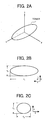
The spindle-shaped toner of the present invention
preferably has the shape of a spindle having a ratio (r2/r1)
between a major axis (r1) and a minor axis (r2) of from 0.5 to
0.8, and a ratio (r3/r2) between a thickness (r3) and the minor
axis (r2) of from 0.7 to 1.0 as shown in Figs. 2A o 2C.
When the ratio (r2/r1) between a major axis (r1) and a minor
axis (r2) is less than 0.5, the resultant toner which is away
from the shape of a true sphere has high cleanability, but poor
dot reproducibility and transferability.
When the ratio (r2/r1) between a major axis (r1) and a minor
axis (r2) is greater than 0.8, the resultant toner which is close
to a sphere occasionally particularly has poor cleanability in
a low temperature and humidity environment. When the ratio
(r3/r2) between a thickness (r3) and the minor axis (r2) is less
than 0.7, the resultant toner which is close to a flat shape
does not scatter so much as an amorphous toner, but does not
have so high a transferability as a spherical toner does. When
the ratio (r3/r2) between a thickness (r3) and the minor axis
(r2) is 1.0, the resultant toner becomes a rotating body having
the major axis as a rotating axis. The shape of a spindle of
the toner of the present invention, which is neither an
amorphous/flat shape nor a true sphere, is a shape satisfying
all friction chargeability, dot reproducibility,
transferability, scattering resistance and cleanability the
both shapes have.
The r1, r2 and r3 are measured by observing the toner with
a scanning electron microscope (SEM) and photographing the toner
while changing a view angle.
Conventional materials can be used as the first unmodified
binder resin. Specific examples of the binder resins
conventionally used for producing a toner include polyester
resins, styrene resins, acrylic resins, epoxy resins, etc.
Among these resins, resins formed from styrene and ester acrylate
copolymers are typically used for a conventional toner. Resins
satisfying the above-mentioned thermal properties are used for
a low-temperature fixable toner. When the polyester resin
having a low softening point and a high glass transition
temperature is used as a binder resin, the resultant toner has
good low-temperature fixability and storage stability. Further,
an ester bond of the polyester resin has a good affinity with
a paper, the resultant toner also has a good offset resistance.
The polyester resin used as a main component for a binder
resin for the toner of the present invention is formed by a
condensation reaction between an acid constituent and an alcohol
constituent, a ring-opening reaction of a cyclic ester or a
reaction among a halogenated compound, an alcohol constituent
and carbon oxide. Polymerizing monomers which are materials
for synthesizing a polyester resin in the above-mentioned liquid
solution of a polymer compound easily forms the toner of the
present invention having good properties. Hereinafter, various
monomers used as materials for synthesizing the polyester resin
will be explained.
First, alcohol and acids having 2 valences or more are
preferably used. Specific examples of the bivalent alcohol
include diol such as ethylene glycol, diethylene glycol,
triethylene glycol, 1,2-propylene glycol, 1,3-propylene glycol,
1,4-butadieneol, neo-pentyl glycol, 1,4-butenediol,
1, 5-pentanediol and 1, 6-hexanediol; and adducts of a bisphenol
A such as bisphenol A, hydrogenated bisphenol A, α,
α'-bis(4-hydroxyphenyl)1,4-diisopropylbenzene,
polyoxyethylene modified bisphenol A and polyoxyproplylene
modified bisphenol A with an alkylene oxide.
Specific examples of the alcohol having 3 valences or more
include sorbitol, 1,2,3,6-hexanetetrol, 1,4-sorbitan,
pentaerythritol, dipentaerythritol, tripentaerythritol,
1,2,4-butanetriol, 1,2,5-pentanetriol, glycerol, diglycerol,
2-methylpropanetriol, 2-methyl-1,2,4-butanetriol,
trimethylolethane, trimethylolpropane,
1,3,5-trihydroxybenzene, etc.
Specific examples of the bivalent acids include maleic
acids, fumaric acids, citraconic acids, itaconic acids,
glutaconic acids, phthalic acids, isophthalic acids,
terephthalic acids, cyclohexane dicarboxylic acids, succinic
acids, adipic acids, sebacic acids, azelaic acids, malonic acids
and other bivalent organic acids. Specific examples of the
trivalent acids include 1,2,4-benzenetricarboxylic acids,
2,5,7-naphthalenetricarboxylic acids,
1,2,4-naphthalenetricarboxylic acids,
1,2,4-butanetricarboxylic acids, 1,2,5-hexanetricarboxylic
acids, 1,3-dicarboxyl-2-methyl-methylenecarboxypropane,
tetra(methylenecarboxyl)methane,
1,2,7,8-octantetracarboxylic acids, etc. Anhydrides and
halides of these organic acids are also preferably used.
Specific examples of other compounds equivalent to the
acid constituents include halides such as
cis-1,2-dichloroethene, trans-1,2-dichloroethene,
1,2-dichloropropene, 2,3-dichloropropene,
1,3-dichloropropene, o-dichlorobenzene, m-dichlorobenzene,
p-dichlorobenzene, o-dibromobenzene, m-dibromobenzene,
p-dibromobenzene,o-chlorobromobenzene,dichloro cyclohexane,
dichloroethane, 1,4-dichlorobutane, 1,8-dichlorooctane,
1,7-dichlorooctane, dichloromethane,
4,4'-dibromovinylphenol and 1,2,4-tribromobenzene.
In the present invention, either of the above-mentioned
acids or alcohol preferably has at least an aromatic ring.
As for a ratio of an amount consumed between the acid and
alcohol, an alcohol group preferably has 0.9 to 1. 5 mol equivalent
weight, and more preferably 1.0 to 1.3 mol equivalent weight
per 1 mol equivalent weight of a carboxyl group. The carboxyl
group also includes the above-mentioned halides which are
compounds equivalent to the acid constituents. Amines can be
used as other additives. Specific examples thereof include
triethylamine, trimethylamine, N,N-dimethylaniline, etc.
Other condensing agents such as dicyclohexylcarbodiimide may
also be used.
The modified polyester resin capable of reacting with a
compound having an active hydrogen atom (RMPE) include a
polyester prepolymer having a functional group reacting with
an active hydrogen atom such as an isocyanate group. Hereinafter,
the polyester resin is referred to as polyester.
A polyester prepolymer having an isocyanate group (A) is
preferably used in the present invention. The prepolymer (A)
is formed from a reaction between polyester having an active
hydrogen atom formed by polycondensation between polyol (PO)
and a polycarboxylic acid (PC), and polyisocyanate (PIC).
Specific examples of the groups including the active hydrogen
include a hydroxyl group (an alcoholic hydroxyl group and a
phenolic hydroxyl group), an amino group, a carboxyl group, a
mercapto group, etc. In particular, the alcoholic hydroxyl
group is preferably used.
As the polyol (PO), diol (DIO) and polyol having 3 valences
or more (TO) can be used, and DIO alone or a mixture of DIO and'
a small amount of TO is preferably used. Specific examples of
DIO include alkylene glycol such as ethylene glycol,
1,2-propylene glycol, 1,3-propylene glycol, 1,4-butanediol,
and 1,6-hexanediol; alkylene ether glycol such as diethylene
glycol, triethylene glycol, dipropylene glycol, polyethylene
glycol, polypropylene glycol and polytetramethylene ether
glycol; alicyclic diol such as 1,4-cyclohexanedimethanol and
hydrogenated bisphenol A; bisphenol such as bisphenol A,
bisphenol F and bisphenol S; adducts of the above-mentioned
alicyclic diol with an alkylene oxide such as ethylene oxide,
propylene oxide and butylene oxide; and adducts of the
above-mentionedbisphenolwithanalkyleneoxidesuchasethylene
oxide, propylene oxide and butylene oxide. In particular,
alkylene glycol having 2 to 12 carbon atoms and adducts of
bisphenol with an alkylene oxide are preferably used, and a
mixture thereof is more preferably used.
Specific examples of the TO include multivalent aliphatic
alcohol having 3 to 8 or more valences such as glycerin,
trimethylolethane, trimethylolpropane, pentaerythritol and
sorbitol; phenol having 3 or more valences such as trisphenol
PA, phenolnovolak, cresolnovolak; and adducts of the
above-mentioned polyphenol having 3 or more valences with an
alkylene oxide.
As the polycarboxylic acid (PC) , dicarboxylic acid (DIC)
and polycarboxylic acid having 3 or more valences (TC) can be
used. DIC alone, or a mixture of DIC and a small amount of TC
are preferably used.
Specific examples of DIC include alkylene dicarboxylic
acids such as succinic acid, adipic acid and sebacic acid;
alkenylene dicarboxylic acid such as maleic acid and fumaric
acid; and aromatic dicarboxylic acids such as phthalic acid,
isophthalic acid, terephthalic acid and naphthalene
dicarboxylicacid. In particular,alkenylene dicarboxylic acid
having 4 to 20 carbon atoms and aromatic dicarboxylic acid having
8 to 20 carbon atoms are preferably used.
Specific examples of TC include aromatic polycarboxylic
acids having 9 to 20 carbon atoms such as trimellitic acid and
pyromellitic acid. PC can be formed from a reaction between
the PO and the above-mentioned acids anhydride or lower alkyl
ester such as methyl ester, ethyl ester and isopropyl ester.
PO and PC are mixed such that an equivalent ratio ( [OH]
/ [COOH] ) between a hydroxyl group [OH] and a carboxylic group
[COOH] is typically from 2/1 to 1/1, preferably from 1.5/1 to
1/1, and more preferably from 1.3/1 to 1.02/1.
Specific examples of the PIC include aliphatic
polyisocyanate such as tetramethylenediisocyanate,
hexamethylenediisocyanate and
2,6-diisocyanatemethylcaproate;alicyclic polyisocyanatesuch
as isophoronediisocyanate and cyclohexylmethanediisocyanate;
aromatic diisocyanate such as tolylenedisocyanate and
diphenylmethanediisocyanate; aromatic-aliphatic diisocyanate
such as α, α, α', α'-tetramethylxylylenediisocyanate;
isocyanurate; the above-mentioned polyisocyanate blocked with
phenol derivatives, oxime and caprolactam; and their
combinations.
The PIC is mixed with polyester such that an equivalent
ratio ( [NCO] / [OH] ) between an isocyanate group [NCO] and
polyester having a hydroxyl group [OH] is typically from 5/1
to 1/1, preferably from 4/1 to 1.2/1 and more preferably from
2.5/1 to 1.5/1. When [NCO] / [OH] is greater than 5, low
temperature fixability of the resultant toner deteriorates.
When [NCO] has a molar ratio less than 1, a urea content in
ester of the modified polyester decreases and hot offset
resistance of the resultant toner deteriorates.
The content of the constitutional component of a
polyisocyanate in the polyester prepolymer (A) having a
polyisocyanate group at its end portion is from 0.5 to 40 % by
weight, preferably from 1 to 30 % by weight and more preferably
from 2 to 20 % by weight. When the content is less than 0.5 %
by weight, hot offset resistance of the resultant toner
deteriorates, and in addition, the heat resistance and low
temperature fixability of the toner also deteriorate. In
contrast, when the content is greater than 40 % by weight, low
temperature fixability of the resultant toner deteriorates.
The number of the isocyanate groups included in a molecule
of the polyester prepolymer (A) is at least 1, preferably from
1. 5 to 3 on average, and more preferably from 1.8 to 2.5 on average.
When the number of the isocyanate group is less than 1 per 1
molecule, the molecular weight of the urea-modified polyester
decreases and hot offset resistance of the resultant toner
deteriorates.
When the above-mentioned polyester prepolymer having an
isocyanate group is reacted with amines (B), a urea-modified
polyester resin (UMPE) can be obtained. The urea-modified
polyester resin (UMPE) is effectively used as a toner binder.
Specific examples of the amines (B) include diamines (B1),
polyamines (B2) having three or more amino groups, amino alcohols
(B3), amino mercaptans (B4), amino acids (B5) and blocked amines
(B6) in which the amines (B1-B5) mentioned above are blocked.
Specific examples of the diamines (B1) include aromatic
diamines (e.g., phenylene diamine, diethyltoluene diamine and
4,4'-diaminodiphenyl methane); alicyclic diamines (e.g.,
4,4'-diamino-3,3'-dimethyldicyclohexyl methane,
diaminocyclohexane and isophorondiamine); aliphatic diamines
(e.g., ethylene diamine, tetramethylene diamine and
hexamethylene diamine); etc.
Specific examples of the polyamines (B2) having three or
more amino groups include diethylene triamine, triethylene
tetramine.
Specific examples of the amino alcohols (B3) include
ethanol amine and hydroxyethyl aniline.
Specific examples of the amino mercaptan (B4) include
aminoethyl mercaptan and aminopropyl mercaptan.
Specific examples of the amino acids (B5) include amino
propionic acid and amino caproic acid.
Specific examples of the blocked amines (B6) include
ketimine compounds which are prepared by reacting one of the
amines B1-B5 mentioned above with a ketone such as acetone, methyl
ethyl ketone and methyl isobutyl ketone; oxazoline compounds,
etc.
Among these amines (B) , diamines (B1) and mixtures in which
a diamine is mixed with a small amount of a polyamine (B2) are
preferably used.
The molecular weight of the urea-modified polyesters can
optionally be controlled using an elongation anticatalyst, if
desired. Specific examples of the elongation anticatalyst
include monoamines such as diethylamine, dibutyl amine, butyl
amine and lauryl amine, and blocked amines, i.e., ketimine
compounds prepared by blocking the monoamines mentioned above.
The mixing ratio (i.e., a ratio [ NCO] /[ NHx] ) of the content
of the prepolymer (A) having an isocyanate group to the amine
(B) is from 1/2 to 2/1, preferably from 1.5/1 to 1/1.5 and more
preferably from 1.2/1 to 1/1.2. When the mixing ratio
is greater than 2 or less than 1/2, molecular weight of the
urea-modified polyester decreases, resulting in deterioration
of hot offset resistance of the resultant toner.
The urea-modified polyester (UMPE) of the present
invention may include an urethane bonding as well as a urea
bonding. The amines (B) act as a compound having an active
hydrogen atom the modified polyester is capable of reacting with.
The UMPE of the present invention can be produced by a
method such as a one-shot method. The weight-average molecular
weight of the modified polyester of the UMPE is not less than
10, 000, preferably from 20, 000 to 10, 000, 000 and more preferably
from 30,000 to 1,000,000. When the weight-average molecular
weight is less than 10, 000, hot offset resistance of the resultant
toner deteriorates. The number-average molecular weight of the
modified polyester of the UMPE is not particularly limited when
the after-mentioned unmodified polyester resin (PE) is used in
combination. Namely, the weight-average molecular weight of
the UMPE resins has priority over the number-average molecular
weight thereof. However, when the UMPE is used alone, the
number-average molecular weight is from 2,000 to 15,000,
preferably from 2, 000 to 10, 000 and more preferably from 2, 000
to 8,000. When the number-average molecular weight is greater
than 20,000, the low temperature fixability of the resultant
toner deteriorates, and in addition the glossiness of full color
images deteriorates.
Specific examples of the colorants for use in the present
invention include any known dyes and pigments such as carbon
black, Nigrosine dyes, black iron oxide, Naphthol Yellow S, Hansa
Yellow (10G, 5G and G), Cadmium Yellow, yellow iron oxide, loess,
chrome yellow, Titan Yellow, polyazo yellow, Oil Yellow, Hansa
Yellow (GR, A, RN and R), Pigment Yellow L, Benzidine Yellow
(G and GR), Permanent Yellow (NCG), Vulcan Fast Yellow (5G and
R), Tartrazine Lake, Quinoline Yellow Lake, Anthrazane Yellow
BGL, isoindolinone yellow, red iron oxide, red lead, orange lead,
cadmium red, cadmium mercury red, antimony orange, Permanent
Red 4R, Para Red, Fire Red, p-chloro-o-nitroaniline red, Lithol
Fast Scarlet G, Brilliant Fast Scarlet, Brilliant Carmine BS,
Permanent Red (F2R, F4R, FRL, FRLL and F4RH), Fast Scarlet VD,
Vulcan Fast Rubine B, Brilliant Scarlet G, Lithol Rubine GX,
Permanent Red F5R, Brilliant Carmine 6B, Pigment Scarlet 3B,
Bordeaux 5B, Toluidine Maroon, Permanent Bordeaux F2K, Helio
Bordeaux BL, Bordeaux 10B, BON Maroon Light, BON Maroon Medium,
Eosin Lake, Rhodamine Lake B, Rhodamine Lake Y, Alizarine Lake,
Thioindigo Red B, Thioindigo Maroon, Oil Red, Quinacridone Red,
Pyrazolone Red, polyazo red, Chrome Vermilion, Benzidine Orange,
perynone orange, Oil Orange, cobalt blue, cerulean blue, Alkali
Blue Lake, Peacock Blue Lake, Victoria Blue Lake, metal-free
Phthalocyanine Blue, Phthalocyanine Blue, Fast Sky Blue,
IndanthreneBlue (RS and BC), Indigo, ultramarine, Prussianblue,
Anthraquinone Blue, Fast Violet B, Methyl Violet Lake, cobalt
violet, manganese violet, dioxane violet, Anthraquinone Violet,
ChromeGreen, zincgreen, chromiumoxide, viridian, emeraldgreen,
Pigment Green B, Naphthol Green B, Green Gold, Acid Green Lake,
Malachite Green Lake, Phthalocyanine Green, Anthraquinone Green,
titanium oxide, zinc oxide, lithopone and the like. These
materials are used alone or in combination.
A content of the colorant in the toner is preferably from
1 to 15 % by weight, and more preferably from 3 to 10 % by weight,
based on total weight of the toner.
The colorant for use in the present invention can be used
as a master batch pigment when combined with a resin.
Specific examples of the resin for use in the master batch
pigment or for use in combination with master batch pigment
include the modified and unmodified polyester resins mentioned
above; styrene polymers and substituted styrene polymers such
as polystyrene, poly-p-chlorostyrene and polyvinyltoluene;
styrene copolymers such as styrene-p-chlorostyrene copolymers,
styrene-propylene copolymers,styrene-vinyltoluenecopolymers,
styrene-vinylnaphthalene copolymers, styrene-methyl acrylate
copolymers, styrene-ethyl acrylate copolymers, styrene-butyl
acrylate copolymers, styrene-octyl acrylate copolymers,
styrene-methyl methacrylate copolymers, styrene-ethyl
methacrylatecopolymers,styrene-butylmethacrylatecopolymers,
styrene-methyl α -chloromethacrylate copolymers,
styrene-acrylonitrile copolymers, styrene-vinyl methyl ketone
copolymers, styrene-butadiene copolymers, styrene-isoprene
copolymers, styrene-acrylonitrile-indene copolymers,
styrene-maleic acid copolymers and styrene-maleic acid ester
copolymers; and other resins such as polymethyl methacrylate,
polybutylmethacrylate, polyvinyl chloride, polyvinyl acetate,
polyethylene, polypropylene, polyesters, epoxy resins, epoxy
polyol resins, polyurethane resins, polyamide resins, polyvinyl
butyral resins, acrylic resins, rosin, modified rosins, terpene
resins, aliphatic or alicyclic hydrocarbon resins, aromatic
petroleum resins, chlorinated paraffin, paraffin waxes, etc.
These resins are used alone or in combination.
The master batch for use in the toner of the present
invention is typically prepared by mixing and kneading a resin
and a colorant upon application of high shear stress thereto.
In this case, an organic solvent can be used to heighten the
interaction of the colorant with the resin. In addition,
flushing methods in which an aqueous paste including a colorant
is mixed with a resin solution of an organic solvent to transfer
the colorant to the resin solution and then the aqueous liquid
and organic solvent are separated and removed can be preferably
used because the resultant wet cake of the colorant can be used
as it is. Of course, a dry powder which is prepared by drying
the wet cake can also be used as a colorant. In this case, a
three roll mill is preferably used for kneading the mixture upon
application of high shear stress.
The toner of the present invention may include a wax
together with a toner binder and a colorant. Specific examples
of the wax include known waxes, e.g., polyolefin waxes such as
polyethylene wax and polypropylene wax; long chain carbon
hydrides such as paraffin wax and sasol wax; and waxes including
carbonyl groups. Among these waxes, the waxes including
carbonyl groups are preferably used. Specific examples thereof
include polyesteralkanate such as carnauba wax, montan wax,
trimethylolpropanetribehenate, pentaelislitholtetrabehenate,
pentaelislitholdiacetatedibehenate, glycerinetribehenate and
1,18-octadecanedioldistearate; polyalkanolesters such as
tristearyltrimellitate and distearylmaleate;
polyamidealkanate such as ethylenediaminebehenylamide;
polyalkylamide such as tristearylamidetrimellitate; and
dialkylketone such as distearylketone. Among'these waxes
including a carbonyl group, polyesteralkanate is preferably
used.
The wax for use in the present invention usually has a
melting point of from 40 to 160 °C, preferably of from 50 to
120 °C, and more preferably of from 60 to 90 °C. A wax having
a melting point less than 40 °C has an adverse effect on its
high temperature preservability, and a wax having a melting point
greater than 160 °C tends to cause cold offset of the resultant
toner when fixed at a low temperature. In addition, the wax
preferably has a melting viscosity of from 5 to 1,000 cps, and
more preferably of from 10 to 100 cps when measured at a temperature
higher than the melting point by 20 °C. A wax having a melting
viscosity greater than 1,000 cps makes it difficult to improve
hot offset resistance and low temperature fixability of the
resultant toner.
A content of the wax in a toner is preferably from 0 to
40 % by weight, and more preferably from 3 to 30 % by weight.
The toner of the present invention may optionally include
a charge controlling agent. Specific examples of the charge
controlling agent include any known charge controlling agents
such as Nigrosine dyes, triphenylmethane dyes, metal complex
dyes including chromium, chelate compounds of molybdic acid,
Rhodamine dyes, alkoxyamines, quaternary ammonium salts
(including fluorine-modified quaternary ammonium salts),
alkylamides, phosphor and compounds including phosphor,
tungsten and compounds including tungsten, fluorine-containing
activators, metal salts of salicylic acid, salicylic acid
derivatives, etc. Specific examples of the marketed products
of the charge controlling agents include BONTRON 03 (Nigrosine
dyes), BONTRON P-51 (quaternary ammonium salt), BONTRON S-34
(metal-containing azo dye) , E-82 (metal complex of oxynaphthoic
acid), E-84 (metal complex of salicylic acid) , and E-89 (phenolic
condensationproduct) , which are manufactured by Orient Chemical
Industries Co., Ltd.; TP-302 and TP-415 (molybdenum complex of
quaternary ammonium salt), which are manufactured by Hodogaya
Chemical Co. , Ltd. ; COPY CHARGE PSY VP2038 (quaternary ammonium
salt), COPY BLUE (triphenyl methane derivative), COPY CHARGE
NEG VP2036 and NX VP434 (quaternary ammonium salt), which are
manufactured by Hoechst AG; LRA-901, and LR-147 (boron complex),
which are manufactured by Japan Carlit Co., Ltd.; copper
phthalocyanine, perylene, quinacridone, azo pigments and
polymers having a functional group such as a sulfonate group,
a carboxyl group, a quaternary ammonium group, etc.
A content of the charge controlling agent is determined
depending on the species of the binder resin used, whether or
not an additive is added and toner manufacturing method (such
as dispersion method) used, and is not particularly limited.
However, the content of the charge controlling agent is typically
from 0.1 to 10 parts by weight, and preferably from 0.2 to 5
parts by weight, per 100 parts by weight of the binder resin
included in the toner. When the content is too high, the toner
has too large charge quantity, and thereby the electrostatic
force of a developing roller attracting the toner increases,
resulting in deterioration of the fluidity of the toner and
decrease of the image density of toner images.
These charge controlling agent can be dissolved and
dispersed after kneaded upon application of heat together with
a master batch pigment and resin, can be added when directly
dissolved and dispersed in an organic solvent or can be fixed
on a toner surface after the toner particles are produced.
As an external additive for improving fluidity,
developability and chargeability of the colored particles of
the present invention, inorganic particulates are preferably
used. The inorganic particulates preferably have a primary
particle diameter of from 2 nm to 2 µm, and more preferably from
20 nm to 500 nm. In addition, a specific surface area of the
inorganic particulates measured by a BET method is preferably
from 20 to 500 m2/g. The content of the external additive is
preferably from 0.01 to 5 % by weight, and more preferably from
0.01 to 2.0 % by weight, based on total weight of the toner.
Specific examples of the inorganic particulates include
silica, alumina, titanium oxide, barium titanate, magnesium
titanate, calcium titanate, strontium titanate, zinc oxicie, tin
oxide, quartz sand, clay, mica, sand-lime, diatomearth, chromium
oxide, ceriumoxide, redironoxide, antimony trioxide, magnesium
oxide, zirconium oxide, barium sulfate, barium carbonate,
calcium carbonate, silicon carbide, silicon nitride, etc.
Other than these materials, polymer particulates such as
polystyrene formed by a soap-free emulsifying polymerization,
a suspension polymerization or a dispersing polymerization,
estermethacrylate or esteracrylate copolymers, silicone resins,
benzoguanamine resins, polycondensation particulates such as
nylon and polymer particles of thermosetting resins can be used.
These external additives , i.e., surface treatment agents
can increase hydrophobicity and prevent deterioration of
fluidity and chargeability of the resultant toner even in high
humidity. Specific examples of the surface treatment agents
include silane coupling agents, sililating agents, silane
coupling agents having an alkyl fluoride group, organic titanate
coupling agents, aluminium coupling agents silicone oils and
modified silicone oils.
The toner of the present invention may include a
cleanability improver for removing a developer remaining on a
photoreceptor and a first transfer medium after transferred.
Specific examples of the cleanability improver include fatty
acid metallic salts such as zinc stearate, calcium stearate and
stearic acid; and polymer particulates prepared by a soap-free
emulsifying polymerization method such as
polymethylmethacrylate particulates and polystyrene
particulates. The polymer particulates comparatively have a
narrow particle diameter distribution and preferably have a
volume-average particle diameter of from 0.01 to 1 µm.
The toner binder of the present invention can be prepared,
for example, by the following method. Polyol and polycarboxylic
acid are heated to a temperature of from 150 to 280 °C in the
presence of a known catalyst such as tetrabutoxy titanate and
dibutyltinoxide. Then water generated is removed, under a
reduced pressure if desired, to prepare a polyester resin having
a hydroxyl group. Then the polyester resin is reacted with
polyisocyanate at a temperature of from 40 to 140 °C to prepare
a prepolymer (A) having an isocyanate group. Further, the
prepolymer (A) is reacted with an amine (B) at a temperature
of from 0 to 140 °C, to prepare a urea-modified polyester.
When polyisocyanate, and A and B are reacted, a solvent
can be used if desired. Suitable solvents include solvents which
do not react with polyisocyanate. Specific examples of such
solvents include aromatic solvents such as toluene and xylene;
ketones such as acetone, methyl ethyl ketone and methyl isobutyl
ketone; esters such as ethyl acetate; amides such as
dimethylformamide and dimethylacetoaminde; ethers such as
tetrahydrofuran. When polyester which does not have a urea
bonding is used in combination with the urea-modified polyester,
a method similar to a method for preparing a polyester resin
having a hydroxyl group is used to prepare the polyester which
does not have a urea bonding, and the polyester which does not
have a urea bonding is dissolved and mixed in a solution after
a reaction of the urea-modified polyester is completed.
The toner of the present invention is produced by the
following method, but the method is not limited thereto.
An aqueous medium for use in the present invention include
water alone and mixtures of water with a solvent which can be
mixed with water. Specific examples of the solvent include
alcohols such as methanol, isopropanol and ethylene glycol;
dimethylformamide; tetrahydrofuran; cellosolves such as methyl
cellosolve; and lower ketones such as acetone and methyl ethyl
ketone.
The toner of the present invention can be prepared by
reacting a dispersion formed of the prepolymer (A) having an
isocyanate group with (B). As a method of stably preparing a
dispersion formed of the urea-modified polyester or the
prepolymer (A) in an aqueous medium, a method of including toner
constituents such as the urea-modified polyester or the
prepolymer (A) into an aqueous medium and dispersing them upon
application of shear stress is preferably used.
A prepolymer (A) and other toner constituents such as
colorants, master batch pigments, release agents, charge
controlling agents, unmodified polyester resins, etc. may be
added into an aqueous medium at the same time when the dispersion
is prepared. However, it is preferable that the toner
constituents are previously mixed and then the mixed toner
constituents are added to the aqueous liquid at the same time.
In addition, colorants, release agents, charge controlling
agents, etc. , are not necessarily added to the aqueous dispersion
before particles are formed, and may be added thereto after
particles are prepared in the aqueous medium. Amethod of dyeing
particles previously formed without a colorant by a known dying
method can also be used.
The dispersion method is not particularly limited, and
low speed shearing methods, high-speed shearing methods,
friction methods, high-pressurejet methods,ultrasonic methods,
etc. can be used. Among these methods, high-speed shearing
methods are preferably used because particles having a particle
diameter of from 2 to 20 µm can be easily prepared. At this
point, the particle diameter (2 to 20 µm) means a particle diameter
of particles including a liquid). When a high-speed shearing
type dispersion machine is used, the rotation speed is not
particularly limited, but the rotation speed is typically from
1,000 to 30,000 rpm, and preferably from 5,000 to 20,000 rpm.
The dispersion time is not also particularly limited, but is
typically from 0.1 to 5 minutes. The temperature in the
dispersion process is typically from 0 to 150°C (underpressure) ,
and preferably from 40 to 98 °C. When the temperature is
relatively high, the urea-modified polyester (i) or prepolymer
(A) can easily be dispersed because the dispersion formed thereof
has a low viscosity.
A content of the aqueous medium to 100 parts by weight
of the toner constituents including the urea-modified polyester
or prepolymer (A) is typically from 50 to 2, 000 parts by weight,
and preferably from 100 to 1,000 parts by weight. When the
content is less than 50 parts by weight, the dispersion of the
toner constituents in the aqueous medium is not satisfactory,
and thereby the resultant mother toner particles do not have
a desired particle diameter. In contrast, when the content is
greater than 2,000, the production cost increases. A dispersant
can preferably be used to prepare a stably dispersed dispersion
including particles having a sharp particle diameter
distribution.
To synthesize the urea-modified polyester from the
prepolymer (A), the amines (B) may be added to the toner
constituents before dispersed in an aqueous medium or after
dispersed. In this case, the urea-modified polyester is formed
on a surface of the toner by priority and a concentration gradient
can be formed in particles.
Specific examples of the dispersants used to emulsify and
disperse an oil phase for a liquid including water in which the
toner constituents are dispersed include anionic surfactants
such as alkylbenzene sulfonic acid salts, α-olefin sulfonic
acid salts, and phosphoric acid salts; cationic surfactants such
as amine salts (e.g., alkyl amine salts, aminoalcohol fatty acid
derivatives, polyamine fatty acid derivatives and imidazoline) ,
and quaternary ammonium salts (e.g., alkyltrimethyl ammonium
salts, dialkyldimethyl ammonium salts, alkyldimethyl benzyl
ammonium salts, pyridinium salts, alkyl isoquinolinium salts
and benzethonium chloride) ; nonionic surfactants such as fatty
acid amide derivatives, polyhydric alcohol derivatives; and
ampholytic surfactants such as alanine,
dodecyldi(aminoethyl)glycin, di(octylaminoethyle)glycin, and
N-alkyl-N,N-dimethylammonium betaine.
A surfactant having a fluoroalkyl group can prepare a
dispersion having good dispersibility even when a small amount
of the surfactant is used.
Specific examples of anionic surfactants having a
fluoroalkyl group include fluoroalkyl carboxylic acids having
from 2 to 10 carbon atoms and their metal salts, disodium
perfluorooctanesulfonylglutamate, sodium
3-{omega-fluoroalkyl(C6-C11)oxy}-1-alkyl(C3-C4) sulfonate,
sodium-{omega-fluoroalkanoyl(C6-C8)-N-ethylamino}-1-propane
sulfonate, fluoroalkyl(C11-C20) carboxylic acids and their
metal salts, perfluoroalkylcarboxylic acids and their metal
salts, perfluoroalkyl(C4-C12)sulfonate and their metal salts,
perfluorooctanesulfonic acid diethanol amides,
N-propyl-N-(2-hydroxyethyl)perfluorooctanesulfone amide,
perfluoroalkyl(C6-C10)sulfoneamidepropyltrimethylammonium
salts, salts of perfluoroalkyl (C6-C10) -N-ethylsulfonylglycin,
monoperfluoroalkyl(C6-C16)ethylphosphates, etc.
Specific examples of the marketed products of such
surfactants having a fluoroalkyl group include SURFLON S-111,
S-112 and S-113, which are manufactured by Asahi Glass Co., Ltd.;
FRORARD FC-93, FC-95, FC-98 and FC-129, which are manufactured
by Sumitomo 3M Ltd.; UNIDYNE DS-101 and DS-102, which are
manufactured by Daikin Industries, Ltd.; MEGAFACE F-110, F-120,
F-113, F-191, F-812 and F-833 which are manufactured by Dainippon
Ink and Chemicals, Inc.; ECTOPEF-102, 103, 104, 105, 112, 123A,
306A, 501, 201 and 204, which are manufactured by Tohchem Products
Co., Ltd. ; FUTARGENT F-100 and F150 manufactured by Neos; etc.
Specific examples of the cationic surfactants, which can
disperse an oil phase including toner constituents in water,
include primary, secondary and tertiary aliphatic amines having
a fluoroalkyl group, aliphatic quaternary ammonium salts such
as erfluoroalkyl (C6-C10) sulfoneamidepropyltrimethylammonium
salts, benzalkonium salts, benzetonium chloride, pyridinium
salts, imidazolinium salts, etc. Specific examples of the
marketed products thereof include SURFLON S-121 (from Asahi Glass
Co., Ltd.); FRORARD FC-135 (from Sumitomo 3M Ltd.); UNIDYNE
DS-202 (from Daikin Industries, Ltd.); MEGAFACE F-150 and F-824
(from Dainippon Ink and Chemicals, Inc.); ECTOP EF-132 (from
Tohchem Products Co., Ltd. ) ; FUTARGENT F-300 (from Neos) ; etc.
In addition, inorganic compound dispersants such as
tricalcium phosphate, calcium carbonate, titanium oxide,
colloidal silica and hydroxyapatite which are hardly insoluble
in water can also be used.
Further, it is possible to stably disperse toner
constituents in water using a polymeric protection colloid.
Specific examples of such protection colloids include polymers
and copolymers prepared using monomers such as acids (e.g.,
acrylic acid, methacrylic acid, α-cyanoacrylic acid, α
-cyanomethacrylic acid, itaconic acid, crotonic acid, fumaric
acid, maleic acid and maleic anhydride) , acrylic monomers having
a hydroxyl group (e.g., β-hydroxyethyl acrylate, β
-hydroxyethyl methacrylate, β-hydroxypropyl acrylate, β
-hydroxypropyl methacrylate, γ-hydroxypropyl acrylate, γ
-hydroxypropyl methacrylate, 3-chloro-2-hydroxypropyl
acrylate, 3-chloro-2-hydroxypropyl methacrylate,
diethyleneglycolmonoacrylic acid esters,
diethyleneglycolmonomethacrylic acid esters,
glycerinmonoacrylic acid esters, N-methylolacrylamide and
N-methylolmethacrylamide) , vinyl alcohol and its ethers (e.g.,
vinyl methyl ether, vinyl ethyl ether and vinyl propyl ether) ,
esters of vinyl alcohol with a compound having a carboxyl group
(i.e., vinyl acetate, vinyl propionate and vinyl butyrate);
acrylic amides (e.g, acrylamide, methacrylamide and
diacetoneacrylamide) and their methylol compounds, acid
chlorides (e.g., acrylic acid chloride and methacrylic acid
chloride) , and monomers having a nitrogen atom or an alicyclic
ring having a nitrogen atom (e.g., vinyl pyridine, vinyl
pyrrolidone, vinyl imidazole and ethylene imine). In addition,
polymers such as polyoxyethylene compounds (e.g.,
polyoxyethylene, polyoxypropylene, polyoxyethylenealkyl
amines, polyoxypropylenealkyl amines, polyoxyethylenealkyl
amides, polyoxypropylenealkyl amides, polyoxyethylene
nonylphenyl ethers, polyoxyethylene laurylphenyl ethers,
polyoxyethylene stearylphenyl esters, and polyoxyethylene
nonylphenyl esters); and cellulose compounds such as methyl
cellulose, hydroxyethyl cellulose and hydroxypropyl cellulose,
can also be used as the polymeric protective colloid.
When an acid such as calcium phosphate or a material soluble
in alkaline is used as a dispersant, the calcium phosphate is
dissolved with an acid such as a hydrochloric acid and washed
with water to remove the calciumphosphate from the toner particle.
Besides this method, it can also be removed by an enzymatic
hydrolysis.
When a dispersant is used, the dispersant may remain on
a surface of the toner particle. However, the dispersant is
preferably washed and removed after the elongation and/or
crosslinking reaction of the prepolymer with amine.
Further, in order to decrease viscosity of a dispersion
medium including the toner constituents, a solvent which can
dissolve the urea-modified polyester or prepolymer (A) can be
used because the resultant particles have a sharp particle
diameter distribution. The solvent is preferably volatile and
has a boiling point lower than 100 °C because of easily removed
from the dispersion after the particles are formed. Specific
examples of such a solvent include toluene, xylene, benzene,
carbon tetrachloride, methylene chloride, 1,2-dichloroethane,
1,1,2-trichloroethane, trichloroethylene, chloroform,
monochlorobenzene, dichloroethylidene, methyl acetate, ethyl
acetate, methyl ethyl ketone, methyl isobutyl ketone, etc.
These solvents can be used alone or in combination. Among these
solvents, aromatic solvents such as toluene and xylene; and
halogenated hydrocarbons such as methylene chloride,
1,2-dichloroethane, chloroform, and carbon tetrachloride are
preferably used.
The addition quantity of such a solvent is from 0 to 300
parts by weight, preferably from 0 to 100, and more preferably
from 25 to 70 parts by weight, per 100 parts by weight of the
prepolymer (A) used. When such a solvent is used to prepare
a particle dispersion, the solvent is removed therefrom under
a normal or reduced pressure after the particles are subjected
to an elongation reaction and/or a crosslinking reaction of the
prepolymer with amine.
When amines (B) as the compounds having an active hydrogen
atom is reacted with the modified polyester capable of reacting
with the compounds having an active hydrogen atom, the elongation
and/or crosslinking reaction time depend on reactivity of an
isocyanate structure of the prepolymer (A) and amine (B), but
is typically from 10 min to 40 hrs, and preferably from 2 to
24 hrs. The reaction temperature is typically from 0 to 150 °C,
and preferably from 40 to 98 °C. In addition, a known catalyst
such as dibutyltinlaurate and dioctyltinlaurate can be used.
To remove an organic solvent from an emulsified dispersion,
a method of gradually raising a temperature of the whole
dispersion to completely remove the organic solvent in the
droplet by vaporizing can be used. Otherwise, a method of
spraying the emulsified dispersion in a dry air, completely
removing a water-insoluble organic solvent in the droplet to
form toner particulates and removing a water dispersant by
vaporizing can also be used. As the dry air, an atmospheric
air, a nitrogen gas, carbon dioxide gas, a gaseous body in which
a combustion gas is heated, and particularly various aerial
currents heated to have a temperature not less than a boiling
point of a solvent used are typically used. A spray dryer, a
belt dryer and a rotary kiln can sufficiently remove the organic
solvent in a short time.
When an emulsified dispersion is washed and dried while
maintaining a wide particle diameter distribution thereof, the
dispersion can be classified to have a desired particle diameter
distribution.
A cyclone, a decanter, a centrifugal separation, etc. can
remove particulates in a dispersion liquid. A powder after the
dispersion liquid is dried can be classified, but the liquid
is preferably classified in terms of efficiency. Unnecessary
fine and coarse particles can be recycled to a kneading process
to form particles. The fine and coarse particles may be wet
when recycled.
Adispersant is preferably removed from a dispersion liquid,
and preferably removed and classified at the same time.
Heterogeneous particles such as release agent
particulates, charge controlling particulates, fluidizing
particulates and colorant particulates can be mixed with a toner
powder after dried. Release of the heterogeneous particles from
composite particles can be prevented by giving a mechanical
stress to a mixed powder to fix and fuse them on a surface of
the composite particles.
Specific methods include a method of applying an impact
strength on a mixture with a blade rotating at a high-speed,
a method of putting a mixture in a high-speed stream and
accelerating the mixture such that particles thereof collide
each other or composite particles thereof collide with a
collision board, etc. Specific examples of the apparatus
include an ONG MILL from Hosokawa Micron Corp., a modified I-type
mill having a lower pulverizing air pressure from Nippon
Pneumatic Mfg. Co., Ltd., a hybridization system from Nara
Machinery Co., Ltd., a Kryptron System from Kawasaki Heavy
Industries, Ltd., an automatic mortar, etc.
The toner of the present invention can be used for a
two-component developer in which the toner is mixed with a
magnetic carrier. A content of the toner is preferably from
1 to 10 parts by weight per 100 parts by weight of the carrier.
Suitable carriers for use in the two component developer
include known carrier materials such as iron powders, ferrite
powders, magnetite powders, magnetic resin carriers, which have
a particle diameter of from about 20 to about 200 µm. A surface
of the carrier may be coated by a resin. Specific examples of
such resins to be coated on the carriers include amino resins
such as urea-formaldehyde resins, melamine resins,
benzoguanamine resins, urea resins, and polyamide resins, and
epoxy resins. In addition, vinyl or vinylidene resins such as
acrylic resins, polymethylmethacrylate resins,
polyacrylonitrile resins, polyvinyl acetate resins,
polyvinyl alcohol resins, polyvinyl butyral resins, polystyrene
resins, styrene-acrylic copolymers, halogenated olefin resins
such as polyvinyl chloride resins, polyester resins such as
polyethyleneterephthalate resins and
polybutyleneterephthalate resins, polycarbonate resins,
polyethylene resins, polyvinyl fluoride resins, polyvinylidene
fluoride resins, polytrifluoroethylene resins,
polyhexafluoropropylene resins, vinylideriefluoride-acrylate
copolymers, vinylidenefluoride-vinylfluoride copolymers,
copolymers of tetrafluoroethylene, vinylidenefluoride and
other monomers including no fluorine atom, and silicone resins.
An electroconductive powder may optionally be included
in the toner. Specific examples of such electroconductive
powders include metal powders, carbon blacks, titanium oxide,
tin oxide, and zinc oxide. The average particle diameter of
such electroconductive powders is preferably not greater than
1 µm. When the particle diameter is too large, it is hard to
control the resistance of the resultant toner.
The toner of the present invention can also be used as
a one-component magnetic or non-magnetic developer without a
carrier.
The container of the present invention contains the toner
of the present invention, or the toner and a carrier.
Having generally described this invention, further
understanding can be obtained by reference to certain specific
examples which are provided herein for the purpose of
illustration only and are not intended to be limiting. In the
descriptions in the following examples, the numbers represent
weight ratios in parts, unless otherwise specified.
EXAMPLES
Production Example 1
752 parts of water, 11 parts of a sodium salt of an adduct
of a sulfuric ester with ethyleneoxide methacrylate (ELEMINOL
RS-30 from Sanyo Chemical Industries, Ltd.), 91 parts of styrene,
81 parts of methacrylate, 100 parts of butylacrylate and 1 part
of persulfate ammonium were mixed in a reactor vessel including
a stirrer and a thermometer, and the mixture was stirred for
15 min at 400 rpm to prepare a white emulsion therein. The white
emulsion was heated to have a temperature of 85 °C and reacted
for 6 hrs. Further, 30 parts of an aqueous solution of persulfate
ammonium having a concentration of 1 % were added thereto and
the mixture was reacted for 5 hrs at 85 °C to prepare an aqueous
dispersion [a particulate dispersion liquid 1] of a vinyl resin
(a copolymer of a sodium salt of an adduct of
styrene-methacrylate-butylacrylate-sulfuric ester with
ethyleneoxide methacrylate). The particulate dispersion
liquid 1 was measured by LA-920 to find a volume-average particle
diameter thereof was 0.10 µm. A part of the particulate
dispersion liquid 1 was dried to isolate a resin component
therefrom. The resin component had a Tg of 64 °C.
Production Example 2
1.050 parts of water, 80 parts of the particulate
dispersion liquid 1, 40 parts of an aqueous solution of sodium
dodecyldiphenyletherdisulfonate having a concentration of
48.5 % (ELEMINOL MON-7 from Sanyo Chemical Industries, Ltd.)
and 95 parts of ethyl acetate were mixed and stirred to prepare
a lacteous liquid [an aqueous phase 1] .
Production Example 3
220 parts of an adduct of bisphenol A with 2 moles of
ethyleneoxide, 561 parts of an adduct of bisphenol A with 3 moles
of propyleneoxide, 218 parts terephthalic acid and 2 parts of
dibutyltinoxide were mixed and reacted in a reactor vessel
including a cooling pipe, a stirrer and a nitrogen inlet pipe
for 8 hrs at a normal pressure and 210 °C. Further, after the
mixture was depressurized by 20 to 65 mm Hg and reacted for 5
hrs, 45 parts of phthalic acid anhydride were added thereto and
reacted for 2 hrs at 180 °C and a normal pressure to prepare
low-molecular-weight polyester 1. The low-molecular-weight
polyester 1 had a number-average molecular weight of 2,200, a
weight-average molecular weight of 7, 700, a Tg of 43 °C and an
acid value of 25.
Production Example 4
682 parts of an adduct of bisphenol A with 2 moles of
ethyleneoxide, 81 parts of an adduct of bisphenol A with 2 moles
of propyleneoxide, 283 parts of terephthalic acid, 22 parts of
trimellitic acid anhydride and 2 parts of dibutyltinoxide were
mixed and reacted in a reactor vessel including. a cooling pipe,
a stirrer and a nitrogen inlet pipe for 8 hrs at a normal pressure
and 130 °C. Further, after the mixture was depressurized by
10 to 15 mm Hg and reacted for 5 hrs to prepare an intermediate
polyester 1. The intermediate polyester 1 had a number-average
molecular weight of 2,100, a weight-average molecular weight
of 10,500, a Tg of 57 °C and an acid value of 0.5 and a hydroxyl
value of 49.
Next, 411 parts of the intermediate polyester 1, 89 parts
of isophoronediisocyanate and 500 parts of ethyl acetate were
reacted in a reactor vessel including a cooling pipe, a stirrer
and a nitrogen inlet pipe for 5 hrs at 100 °C to prepare a
prepolymer 1. The prepolymer 1 includes a free isocyanate in
an amount of 1.43 % by weight.
Production Example 5
170 parts of isophorondiamine and 75 parts of methyl ethyl
ketone were reacted at 50 °C for 5 hrs in a reaction vessel
including a stirrer and a thermometer to prepare a ketimine
compound 1. The ketimine compound 1 had an amine value of 418.
Production Example 6
40 parts of carbon black Mogal L from Cabot Corporation,
60 parts of the low-molecular-weight polyester 1 and 30 parts
of water were pre-dispersed to prepare a mixture which is a
water-logged pigment aggregate. The mixture was kneaded by a
two-roll mil having a surface temperature of 110 °C for 45 min
and pulverized to prepare a master batch 1 having a diameter
of 1 mm.
Production Example 7
378 parts of the low-molecular-weight polyester 1, 110
parts of rice wax, 22 parts of charge controlling agent (salicylic
acid metal complex E-81 from Orient Chemical Industries Co.,
Ltd.) and 900 parts of ethyl acetate were mixed in a reaction
vessel including a stirrer and a thermometer. The mixture was
heated to have a temperature of 80 °C while stirred. After the
temperature of 80 °C was maintained for 5 hrs, the mixture was
cooled to have a temperature of 30 °C in an hour. Then, 500 parts
of the cyan master batch 1 and 500 parts of ethyl acetate were
added to the mixture and mixed for 1 hr to prepare a material
solution 1.
1,000 parts of the material solution 1 were transferred
into another vessel, and the carbon black and wax therein were
dispersed by a T. K. homomixer from Tokushu Kika Kogyo Co. , Ltd.
at 12, 000 rpm for 30 min. Next, 1, 000 parts of an ethyl acetate
solution of the low-molecular-weight polyester 1 having a
concentration of 65 % were added to the material solution 1 and
the mixture was stirred by the homomixer in the same conditions
to prepare a pigment and wax dispersion liquid 1.
Example 1
648 parts of the pigment and wax dispersion liquid 1, 154
parts of the prepolymer 1 and 6. 6 parts of the ketimine compound
1 were mixed in a vessel by a T.K. homomixer from Tokushu Kika
Kogyo Co., Ltd. at 7,000 rpm for 1 min. 1,200 parts of the aqueous
phase 1 were added to the mixture and mixed by the T. K. homomixer
at 13,000 rpm for 30 min to prepare an emulsified slurry 1.
The emulsified slurry 1 was put in a vessel including a
stirrer and a thermometer. After a solvent was removed from
the emulsified slurry 1 at 30 °C for 8 hrs, the slurry was aged
at 45°C for 4 hrs to prepare a dispersion slurry 1. The dispersion
slurry 1 had a volume-average particle diameter of 5.4 µm, and
a number-average particle diameter of 4.40 µm when measured by
Multisizer II.
After the dispersion slurry 1 was filtered under reduced
pressure, 100 parts of ion exchanged water were added thereto
and mixed by the T.K. homomixer at 12,000 rpm for 10 min, and
the mixture was filtered. This operation was repeated 5 times
to remove impurities and prepare a filtered cake 1.
The filtered cake 1 was dried by an air drier at 45 °C
for 48 hrs and sieved by a mesh having an opening of 75 µm to
prepare toner 1 having a volume-average particle diameter (Dv)
of 5.2 µm, a number-average particle diameter (Dn) of 4.42 µm
and a ratio (Dv/Dn) of 1.18 when measured by Multisizer II.
Example 2
The procedures of preparation for the toner 1 were repeated
except for performing ultrasonic alkali washing once before
washing with ion exchanged water to prepare a toner 2 having
a volume-average particle diameter (Dv) of 4.80 µm, a
number-average particle diameter (Dn) of 4.32 µm and a ratio
(Dv/Dn) of 1.11.
Example 3
The procedures of preparation for the toner 1 were repeated
except for changing the rice wax to candelilla wax in Production
Example 7 to prepare a toner 3 having a volume-average particle
diameter (Dv) of 5.80 µm, a number-average particle diameter
(Dn) of 5.17 µm and a ratio (Dv/Dn) of 1.12.
Production Example 8
262 parts of an adduct of bisphenol A with 2 moles of
ethyleneoxide, 202 parts of an adduct of bisphenol A with 2 moles
of propyleneoxide, 236 parts of an adduct of bisphenol A with
3 moles of propyleneoxide, 266 parts terephthalic acid and 2
parts of dibutyltinoxide were mixed and reacted in a reactor
vessel including a cooling pipe, a stirrer and a nitrogen inlet
pipe for 8 hrs at a normal pressure and 210 °C. Further, after
the mixture was depressurized by 10 to 15 mm Hg and reacted for
5 hrs, 34 parts of phthalic acid anhydride were added thereto
and reacted for 2 hrs at 180 °C and a normal pressure to prepare
low-molecular-weight polyester 2. The low-molecular-weight
polyester 1 had a number-average molecular weight of 1,850, a
weight-average molecular weight of 8,520, a Tg of 53 °C and an
acid value of 20.7.
Production Example 9
349 parts of the low-molecular-weight polyester 2, 110
parts of carnauba wax, 22 parts of charge controlling agent
(salicylic acid metal complex E-81 from Orient Chemical
Industries Co., Ltd.) and 947 parts of ethyl acetate were mixed
in a reaction vessel including a stirrer and a thermometer. The
mixture was heated to have a temperature of 80 °C while stirred.
After the temperature of 80 °C was maintained for 5 hrs, the
mixture was cooled to have a temperature of 30 °C in an hour.
Then, 500 parts of the cyan master batch 1 and 500 parts of ethyl
acetate were added to the mixture and mixed for 1 hr to prepare
a material solution 2.
1,324 parts of the material solution 2 were transferred
into another vessel, and the carbon black and wax therein were
dispersed by a T. K. homomixer from Tokushu Kika Kogyo Co. , Ltd.
at 10, 000 rpm for 30 min. Next, 1, 324 parts of an ethyl acetate
solution of the low-molecular-weight polyester 2 having a
concentration of 65 % were added to the material solution 2 and
the mixture was stirred by the homomixer in the same conditions
to prepare a pigment and wax dispersion liquid 2.
Example 4
The procedures of preparation for the toner 1 were repeated
except for changing the pigment and wax dispersion liquid 1 to
pigment and wax dispersion liquid 2 performing alkali washing
twice without application of ultrasound before washing with ion
exchanged water to prepare a toner 4 having a volume-average
particle diameter (Dv) of 5.10 µm, a number-average particle
diameter (Dn) of 4.44 µm and a ratio (Dv/Dn) of 1.14.
Example 5
The procedures of preparation for the toner 1 were repeated
except for performing alkali washing once without application
of ultrasound before washing with ion exchanged water to prepare
a toner 5 having a volume-average particle diameter (Dv) of 6.32
µm, a number-average particle diameter (Dn) of 5.37 µm and a
ratio (Dv/Dn) of 1.15.
Production Example 10
719 parts of an adduct of bisphenol A with 2 moles of
propyleneoxide, 274 parts terephthalic acid and 2 parts of
dibutyltinoxide were mixed and reacted in a reactor vessel
including a cooling pipe, a stirrer and a nitrogen inlet pipe
for 8 hrs at a normal pressure and 210 °C. Further, after the
mixture was depressurized by 20 to 65 mm Hg and reacted for 5
hrs, 7 parts of phthalic acid anhydride were added thereto and
reacted for 2 hrs at 180 °C and a normal pressure to prepare
low-molecular-weight polyester 3. The low-molecular-weight
polyester 1 had a number-average molecular weight of 3,200, a
weight-average molecular weight of 9,200, a Tg of 54 °C and an
acid value of 8.5.
Production Example 11
378 parts of the low-molecular-weight polyester 3, 110
parts of carnauba wax, 10 parts of charge controlling agent
(salicylic acid metal complex E-84 from Orient Chemical
Industries Co., Ltd.) and 947 parts of ethyl acetate were mixed
in a reaction vessel including a stirrer and a thermometer. The
mixture was heated to have a temperature of 80 °C while stirred.
After the temperature of 80 °C was maintained for 5 hrs, the
mixture was cooled to have a temperature of 30 °C in an hour.
Then, 500 parts of the master batch 1 and 500 parts of ethyl
acetate were added to the mixture and mixed for 1 hr to prepare
a material solution 3.
1,324 parts of the material solution 3 were transferred
into another vessel, and a pigment and a wax thereof were dispersed
by a beads mill (an ultra visco mill from Imecs Co. , Ltd. ) filled
with zirconia beads having a diameter of 0.5mm by 80 volume %
on the condition of 3 passes at a liquid feeding speed of 1 kg/hr
and a disk peripheral speed of 6 m/sec. Next, 1,324 parts of
an ethyl acetate solution of the low-molecular-weight polyester
3 having a concentration of 65 % were added to the material solution
3 and the mixture was milled by the beads mill at one time to
prepare a pigment and wax dispersion liquid 3.
Example 6
The procedures of preparation for the toner 1 were repeated
except for changing the pigment and wax dispersion liquid 1 to
pigment and wax dispersion liquid 3 and performing alkali washing
for 4 times without application of ultrasound before washing
with ion exchanged water to prepare a toner 6 having a
volume-average particle diameter (Dv) of 5.80 µm, a
number-average particle diameter (Dn) of 4.95 µm and a ratio
(Dv/Dn) of 1.17.
Example 7
The procedures of preparation for the toner 1 were repeated
except for changing the pigment and wax dispersion liquid 1 to
pigment and wax dispersion liquid 3 and performing alkali washing
twice without application of ultrasound before washing with ion
exchanged water to prepare a toner 7 having a volume-average
particle diameter (Dv) of 6.20 µm, a number-average particle
diameter (Dn) of 5.20 µm and a ratio (Dv/Dn) of 1.19.
Production Example 12
121 parts of an adduct of bisphenol A with 2 moles of
ethyleneoxide, 64 parts of an adduct of bisphenol A with 2 moles
of propyleneoxide, 527 parts of an adduct of bisphenol A with
3 moles of propyleneoxide, 246 parts terephthalic acid, 48 parts
of adipic acid and 2 parts of dibutyltinoxide were mixed and
reacted in a reactor vessel including a cooling pipe, a stirrer
and a nitrogen inlet pipe for 8 hrs at a normal pressure and
230 °C. Further, after the mixture was depressurized by 10 to
15 mm Hg and reacted for 5 hrs, 42 parts of trimellitic acid
anhydride were added thereto and reacted for 2 hrs at 180 °C
and a normal pressure to prepare low-molecular-weight polyester
4. The low-molecular-weight polyester 1 had a number-average
molecular weight of 2,100, a weight-average molecular weight
of 14,000, a Tg of 48 °C and an acid value of 27.3.
Production Example 13
378 parts of the low-molecular-weight polyester 4, 110
parts of carnauba wax, 22 parts of charge controlling agent
(salicylic acid metal complex E-84 from Orient Chemical
Industries Co., Ltd.) and 947 parts of ethyl acetate were mixed
in a reaction vessel including a stirrer and a thermometer. The
mixture was heated to have a temperature of 80 °C while stirred.
After the temperature of 80 °C was maintained for 5 hrs, the
mixture was cooled to have a temperature of 30 °C in an hour.
Then, 500 parts of the master batch 1 and 500 parts of ethyl
acetate were added to the mixture and mixed for 1 hr to prepare
a material solution 4.
1,324 parts of the material solution43 were transferred
into another vessel, and a pigment and a wax thereof were dispersed
by a beads mill (an ultra visco mill from Imecs Co. , Ltd. ) filled
with zirconia beads having a diameter of 0.5mm by 80 volume %
on the condition of 3 passes at a liquid feeding speed of 1 kg/hr
and a disk peripheral speed of 6 m/sec. Next, 1,324 parts of
an ethyl acetate solution of the low-molecular-weight polyester
3 having a concentration of 65 % were added to the material solution
3 and the mixture was milled by the beads mill at one time to
prepare a pigment and wax dispersion liquid 4.
Example 8
The procedures of preparation for the toner 1 were repeated
except for changing the pigment and wax dispersion liquid 1 to
pigment and wax dispersion liquid 4 to prepare a toner 8 having
a volume-average particle diameter (Dv) of 4.80 µm, a
number-average particle diameter (Dn) of 4.00 µm and a ratio
(Dv/Dn) of 1.20.
Example 9
The procedures of preparation for the toner 1 were repeated
except for changing the pigment and wax dispersion liquid 1 to
pigment and wax dispersion liquid 4 and performing ultrasonic
alkali washing once before washing with ion exchanged water to
prepare a toner 9 having a volume-average particle diameter (Dv)
of 5.11 µm, a number-average particle diameter (Dn) of 4.45 µm
and a ratio (Dv/Dn) of 1.15.
Comparative Example 1
After 451 g of 0.1M-Na3PO4 were put in 709 g of ion exchange
water and the mixture was heated to have a temperature of 60 °C,
the mixture was stirred by a T.K. homomixer at 12,000 rpm. 68
g of 1.0M-CaCl2 were gradually added to the mixture to prepare
an aqueous medium including Ca3(PO4)2. 170 g of styrene, 30 g
of 2-ethylhexylacrylate, 10 g of Regal 400R, 60 g of paraffin
wax having a softening point of 70 °C, 5 g of a
di-tert-butylsalicylic acid metal compound and 10 g of a
styrene-methacrylic acid copolymer having a weight-average
molecular weight of 50,000 and an acid value of 20 mg KOH/g were
uniformly dissolved and dispersed by a T. K. homomixer at 12, 000
rpm and 60 °C. 10 g of a polymerization initiator, i.e.,
2,2'-azobis(2,4-dimethylvaleronitrile) were dissolved in the
mixture to prepare a unit of polymerizing monomers. The unit
of polymerizing monomers was put in the aqueous medium and the
mixture was stirred by a T.K. homomixer at 10, 000 rpm and 60 °C
for 20 min in a N2 environment to granulate the unit of polymerizing
monomers. Then, after the mixture was reacted at 60 °C for 3
hrs while stirred with a paddle stirring blade, the mixture was
further reacted at 80 °C for 10 hrs. After the polymerization
reaction, the mixture was cooled and a hydrochloric acid was
added thereto. Further, after calcium phosphate was dissolved
in the mixture, the mixture was filtered, washed with water and
dried to prepare a toner 10 having a volume-average particle
diameter (Dv) of 6.30 µm, a number-average particle diameter
(Dn) of 5.64 µm and a ratio (Dv/Dn) of 1.12.
Comparative Example 2
Production Example 14
In a 4-head flask having a stirrer, a temperature sensor,
a nitrogen inlet pipe, a cooling pipe and a capacity of 1,000
ml, 500 ml of deaerated and distilled water, 28.5 g of 565C from
Nippon Nyukazai, Co., Ltd. and 185.5 g of candelilla wax No.1
from Noda Wax Co. , Ltd. were put in a nitrogen stream and heated
while stirred. When an inner temperature of the mixture was
85 °C, 5N-soduim hydrate was added thereto and the mixture was
heated to have a temperature of 75 °C. Then, the mixture was
stirred upon application of heat for 1 hr and cooled to have
a room temperature to prepare a wax particle aqueous dispersion
1.
100 g of carbon black Mogal L from Cabot corp. and 25 g
of dodecylsodiumsulfate were added in 540 ml of distilled water.
After the mixture was sufficiently stirred, the mixture was
dispersed by a pressurization disperser to prepare a colorant
dispersion liquid 1.
Production Example 15
In a 4-head flask having a stirrer, a cooling pipe, a
temperature sensor, nitrogen inlet pipe and a capacity of 1, 000
ml, 480 ml of distilled water, 0.6 g of dodecyl sodium sulfate,
106.4 g of styrene, 43.2 g of n-butylacrylate and 10.4 g of
methacrylic acid were put in a nitrogen stream and heated while
stirred to have a temperature of 70 °C. Then, an aqueous solution
of an initiator in which 2.1 g of potassium persulfate were
dissolved in 120 ml of distilled water was added to the mixture
and the mixture was stirred in a nitrogen stream at 70 °C for
3 hrs. After the polymerization was completed, the mixture was
cooled to have a room temperature to prepare a polymer binder
particulate dispersion liquid 1.
In a 4-head flask having a stirrer, a cooling pipe, a
temperature sensor, nitrogen inlet pipe and a capacity of 5, 000
ml, 2,400 ml of distilled water, 2. 8 g of dodecyl sodium sulfate,
620 g of styrene, 128 g of n-butylacrylate, 52 g of methacrylic
acid an 27.4 g of tert-dodecylmercaptan were put in a nitrogen
stream and heated while stirred to have a temperature of 70 °C.
Then, an aqueous solution of an initiator in which 11.2 g of
potassium persulfate were dissolved in 600 ml of distilled water
was added to the mixture and the mixture was stirred in a nitrogen
streamat70°C for 3 hrs. After the polymerization was completed,
the mixture was cooled to have a room temperature to prepare
a low-molecular-weight binder particulate dispersion liquid 2.
Production Example 16
In a separable flask having a stirrer, a cooling pipe,
a temperature sensor and a capacity of 1, 000 ml, 47. 6 g of the
polymer binder particulate dispersion liquid 1, 190.5 of the
low-molecular-weight binder particulate dispersion liquid 2,
7.7 g of the wax particle aqueous dispersion 1, 26.7 g of the
colorant dispersion liquid 1 and 252.5 ml of distilled water
were mixed and stirred, and an aqueous solution of 5N-sodium
hydrate was added in the mixture to have a pH of 9.5. Further,
an aqueous solution of sodium chloride in which 50 g of sodium
chloride were dissolved in 600 ml of distilled water, 77 ml of
isopropanol and a surfactant aqueous solution in which 10 mg
of fluorine nonion surfactant FC-170C from Sumitomo 3M Ltd. is
dissolved in 10 ml of distilled water were added to the mixture
in this order. Then, the mixture was reacted at 85 °C for 6 hrs
and cooled to have a room temperature. After an aqueous solution
of 5N-sodium hydrate was added in the mixture to have a pH of
13, the mixture was filtered and suspended in distilled water.
After the mixture was repeatedly filtered and suspended, the
mixture was washed and dried to prepare a toner 11 having a
volume-average particle diameter (Dv) of 6.52 µm, a
number-average particle diameter (Dn) of 5.31 µm and a ratio
(Dv/Dn) of 1.23.
0.7 parts of hydrophobic silica and 0.3 parts of
hydrophobic titanium oxide were mixed with 100 parts of the
respective toners 1 to 11 by a Henschel mixer.
A developer including 5 parts by weight of the toner
including the above-mentioned external additives, i.e., the
hydrophobic silica and titanium oxide and 95 parts by weight
of copper-zinc ferrite carrier coated with a silicone resin and
having an average-particle diameter of 40 µm was prepared, and
copies are continuously produced by imagio Neo 450 capable of
producing 45 A4 size copies from Ricoh Company, Ltd. using the
developer.
Evaluation results of the following items are shown in
Tables 1 to 4.
(a) Particle diameter
The volume-average and number-average particle diameter
of the toner were measured by Coulter Counter TA-II from Coulter
Electronics, Inc. using an aperture of 100 µm.
(b) Charge amount
6 g of the developer was put in a sealed metallic cylinder
and blown to determine charge amount thereof. The toner
concentration was from 4.5 to 5.5 % by weight.
(c) Fixability
Solid images having a toner of 1.0±01 mg/cm2 were produced
on a plain paper transfer sheet RICOH TYPE 6200 and a cardboard
transfer sheet NBS RICOH <135> by imagio Neo 450 having a
changeable fixing belt temperature. A temperature at which the
offset does not occur was determined using the plain paper and
a fixableminimumtemperaturewasdeterminedusingthecardboard.
A fixing roller temperature at which a fixed image has an image
density not less than 70 % after scraped with a pat was determined
as the fixable minimum temperature.
(d) Circularity
A flow-type particle image analyzer FPIA-2000 from SYSMEX
CORPORATION can measure an average circularity. A specific
measuring method includes adding 0.1 to 0. 5 ml of a surfactant,
preferably an alkylbenzenesulfonic acid, as a dispersant in 100
to 150 ml of water from which impure solidmaterials are previously
removed; adding 0.1 to 0.5 g of the toner in the mixture;
dispersing the mixture including the toner with an ultrasonic
disperser for 1 to 3 min to prepare a dispersion liquid having
a concentration of from 3, 000 to 10, 000 pieces/µl; and measuring
the toner shape and distribution with the above-mentioned
measurer.
(e) Particulate resin material coverage
Several electron microscope photographs having a
magnification of 50,000 of a toner surface were taken. Surfaces
having less slopes and cracks were selected from the photographs
and coverage of the particulate resin material over the toner
surface was determined by an area ratio thereof using an image
analyzer Luzex III. An average of 50 particles was determined
as the coverage.
(f) Tg
TG-DSC system TAS-100 from Rigaku Corp. was used to measure
Tg.
First, about 10 mg of a sample in an aluminium container
was loaded on a holder unit, which was set in an electric oven.
After the sample was heated in the oven at from a room temperature
to 150 °C and a programming speed of 10 °C/min, the sample was
left for 10 min at 150 °C. After the samples was cooled to have
a room temperature and left for 10 min, the sample was heated
again in a nitrogen environment to have a temperature of 150 °C
at a programming speed of 10 °C/min and DSC measurement of the
sample was performed. Tg was determined from a contact point
between a tangent of a heat absorption curve close to Tg and
base line using an analyzer in TAS-100.
(g) Image density
Image density of 5 points of a solid image were measured
by X-Rite from X-Rite, Inc.
(h) Background fouling
An image forming process was stopped while a blank image
was developed to adhere a developer on a photoreceptor to an
adhesive tape before the image was transferred. A difference
of image density between the adhesive tape the developer adhered
to and a blank adhesive tape was measured by 938
spectrodensitometer from X-Rite, Inc.
(i) Cleanability
A residual toner after transfer on a photoreceptor after
cleaned was adhered on a Scotch Tape from Sumitomo 3M Ltd. and
transferred onto a white paper. Density of the white paper was
measured by Macbeth reflection densitometer RD514. When a
density difference between the white paper the residual toner
was transferred to and a blank white paper was not greater than
0.01, the cleanability was determined as good (○). When greater
than 0.01, the cleanability was determined as poor (×).
(j) Filming
Toner filming over a developing roller or a photoreceptor
was observed. ○ was no filming, Δ is a stripe filming and ×
is a whole filming.
| | | Toner particle diameter | Circularity | Coverage (5) | Charge amount (-µC/g) |
| | | Dv (µm) | Dn (µm) | Dv/Dn |
| Ex. 1 | Toner 1 | 5.21 | 4.42 | 1.18 | 0 . 951 | 85.0 | 23.5 |
| Ex. 2 | Toner 2 | 4.80 | 4.32 | 1.11 | 0.953 | 69.0 | 24.1 |
| Ex. 3 | Toner 3 | 5.80 | 5.17 | 1.12 | 0.957 | 85.0 | 25.4 |
| Ex. 4 | Toner 4 | 5.10 | 4.44 | 1.15 | 0.949 | 75.0 | 26.5 |
| Ex. 5 | Toner 5 | 6.32 | 5.37 | 1.18 | 0.945 | 84.0 | 27.8 |
| Ex. 6 | Toner 6 | 5.80 | 4.95 | 1.17 | 0.956 | 68.0 | 25.9 |
| Ex. 7 | Toner 7 | 6.20 | 5.20 | 1.19 | 0.955 | 84.0 | 27.1 |
| Ex. 8 | Toner 8 | 4.80 | 4.00 | 1.20 | 0.954 | 82.0 | 24.2 |
| Ex. 9 | Toner 9 | 5.11 | 4.45 | 1.15 | 0.956 | 75.0 | 25.1 |
| Com. Ex. 1 | Toner 10 | 6.30 | 5.65 | 1.12 | 0.983 | - | 27.4 |
| Com. Ex. 2 | Toner 11 | 6.52 | 5.31 | 1.23 | 0.960 | - | 26.8 |
| | Fine dot reproducibility | Image density | Background fouling |
| | | Start | After 10,000 | After 100,000 | Start | After 10,000 | After 100,000 |
| Ex. 1 | o ○ | 1.41 | 1.45 | 1.42 | 0.01 | 0.01 | 0.0 |
| Ex. 2 | o ○ | 1.38 | 1.41 | 1.41 | 0.01 | 0.00 | 0.01 |
| Ex. 3 | o ○ | 1.36 | 1.39 | 1.39 | 0.00 | 0.00 | 0.01 |
| Ex. 4 | o ○ | 1.36 | 1.39 | 1.39 | 0.00 | 0.00 | 0.00 |
| Ex. 5 | o ○ | 1.37 | 1.38 | 1.38 | 0.00 | 0.00 | 0.01 |
| Ex. 6 | ○ | 1.39 | 1.41 | 1.42 | 0.01 | 0.00 | 0.00 |
| Ex. 7 | ○ | 1.38 | 1.40 | 1.38 | 0.00 | 0.00 | 0.01 |
| Ex. 8 | o ○ | 1.42 | 1.43 | 1.42 | 0.01 | 0.01 | 0.00 |
| Ex. 9 | ○ | 1.41 | 1.41 | 1.41 | 0.00 | 0.00 | 0.00 |
| Com. Ex. 1 | o ○ | 1.28 | - | - | 0.02 | - | - |
| Com. Ex. 2 | ○ | 1.36 | 1.44 | - | 0.02 | 0.41 | - |
| | Cleanability | Filming | Charge amount (-µC/g) |
| | Start | After 10,000 | After 100,000 | After 100,000 | Start | After 10,000 | After 100,000 |
| Ex. 1 | ○ | ○ | ○ | ○ | 30.1 | 29.5 | 30.3 |
| Ex. 2 | ○ | ○ | ○ | ○ | 31.6 | 30.2 | 31.7 |
| Ex. 3 | ○ | ○ | ○ | ○ | 30.5 | 30.6 | 31.2 |
| Ex. 4 | ○ | ○ | ○ | ○ | 32.6 | 30.5 | 30.1 |
| Ex. 5 | ○ | ○ | ○ | ○ | 33.6 | 30.2 | 29.4 |
| Ex. 6 | ○ | ○ | ○ | ○ | 31.9 | 30.7 | 30.4 |
| Ex. 7 | ○ | ○ | ○ | ○ | 34.2 | 31.5 | 29.7 |
| Ex. 8 | ○ | ○ | ○ | ○ | 32.6 | 33.2 | 32.7 |
| Ex. 9 | ○ | ○ | ○ | ○ | 33.3 | 32.8 | 32.6 |
| Com. Ex. 1 | × | - | - | - | 32.5 | - | - |
| Com. Ex. 2 | ○ | ○ | - | - | 34. 6 | 16.7 | - |
| | Visco-elasticity | Fixable minimum temperature (°C) | Offset (°C) | Comprehensive evaluation |
| | G' 80 (Pa) | G' 180 (Pa) | G' 80/ G' 180 |
| Ex. 1 | 3.3x10⁶ | 1.2x10³ | 2,750 | 140 | 220 | ○ |
| Ex. 2 | 1.5x10⁶ | 9.5x10² | 1,579 | 140 | 220 | ○ |
| Ex. 3 | 4.5x10⁵ | 7.5x10² | 600 | 130 | 220 | ○ |
| Ex. 4 | 5.5x10⁵ | 1.1x10³ | 500 | 135 | 220 | ○ |
| Ex. 5 | 6.5x10⁶ | 2.5x10³ | 2,600 | 150 | 230 | ○ |
| Ex. 6 | 3.1x10⁶ | 1.7x10³ | 1,824 | 145 | 230 | ○ |
| Ex. 7 | 6.5x10⁶ | 2.7x10³ | 2,407 | 150 | 220 | ○ |
| Ex. 8 | 2.0x10⁶ | 1.3x10³ | 1,538 | 140 | 220 | ○ |
| Ex. 9 | 3.0x10⁶ | 1.1x10³ | 2,727 | 140 | 220 | ○ |
| Com. Ex. 1 | 5.5x10⁷ | 8.1x10² | 67, 901 | 190 | 200 | × |
| Com. Ex. 2 | 3.2x10⁷ | 2.3x10³ | 13, 913 | 175 | 225 | × |
This document claims priority and contains subject matter
related to Japanese Patent Application No. 2002-349008 filed
on November 29, 2002, incorporated herein by reference.
Having now fully described the invention, it will be
apparent to one of ordinary skill in the art that many changes
and modifications can be made thereto without departing from
the spirit and scope of the invention as set forth therein.