EP1424351A1 - Modified olefin copolymer - Google Patents
Modified olefin copolymer Download PDFInfo
- Publication number
- EP1424351A1 EP1424351A1 EP02753238A EP02753238A EP1424351A1 EP 1424351 A1 EP1424351 A1 EP 1424351A1 EP 02753238 A EP02753238 A EP 02753238A EP 02753238 A EP02753238 A EP 02753238A EP 1424351 A1 EP1424351 A1 EP 1424351A1
- Authority
- EP
- European Patent Office
- Prior art keywords
- olefin
- vinyl compound
- based copolymer
- vinyl
- adhesive
- Prior art date
- Legal status (The legal status is an assumption and is not a legal conclusion. Google has not performed a legal analysis and makes no representation as to the accuracy of the status listed.)
- Withdrawn
Links
Classifications
-
- B—PERFORMING OPERATIONS; TRANSPORTING
- B32—LAYERED PRODUCTS
- B32B—LAYERED PRODUCTS, i.e. PRODUCTS BUILT-UP OF STRATA OF FLAT OR NON-FLAT, e.g. CELLULAR OR HONEYCOMB, FORM
- B32B15/00—Layered products comprising a layer of metal
- B32B15/04—Layered products comprising a layer of metal comprising metal as the main or only constituent of a layer, which is next to another layer of the same or of a different material
- B32B15/08—Layered products comprising a layer of metal comprising metal as the main or only constituent of a layer, which is next to another layer of the same or of a different material of synthetic resin
-
- B—PERFORMING OPERATIONS; TRANSPORTING
- B32—LAYERED PRODUCTS
- B32B—LAYERED PRODUCTS, i.e. PRODUCTS BUILT-UP OF STRATA OF FLAT OR NON-FLAT, e.g. CELLULAR OR HONEYCOMB, FORM
- B32B27/00—Layered products comprising a layer of synthetic resin
- B32B27/32—Layered products comprising a layer of synthetic resin comprising polyolefins
-
- B—PERFORMING OPERATIONS; TRANSPORTING
- B32—LAYERED PRODUCTS
- B32B—LAYERED PRODUCTS, i.e. PRODUCTS BUILT-UP OF STRATA OF FLAT OR NON-FLAT, e.g. CELLULAR OR HONEYCOMB, FORM
- B32B7/00—Layered products characterised by the relation between layers; Layered products characterised by the relative orientation of features between layers, or by the relative values of a measurable parameter between layers, i.e. products comprising layers having different physical, chemical or physicochemical properties; Layered products characterised by the interconnection of layers
- B32B7/04—Interconnection of layers
- B32B7/12—Interconnection of layers using interposed adhesives or interposed materials with bonding properties
-
- C—CHEMISTRY; METALLURGY
- C08—ORGANIC MACROMOLECULAR COMPOUNDS; THEIR PREPARATION OR CHEMICAL WORKING-UP; COMPOSITIONS BASED THEREON
- C08F—MACROMOLECULAR COMPOUNDS OBTAINED BY REACTIONS ONLY INVOLVING CARBON-TO-CARBON UNSATURATED BONDS
- C08F255/00—Macromolecular compounds obtained by polymerising monomers on to polymers of hydrocarbons as defined in group C08F10/00
-
- C—CHEMISTRY; METALLURGY
- C08—ORGANIC MACROMOLECULAR COMPOUNDS; THEIR PREPARATION OR CHEMICAL WORKING-UP; COMPOSITIONS BASED THEREON
- C08F—MACROMOLECULAR COMPOUNDS OBTAINED BY REACTIONS ONLY INVOLVING CARBON-TO-CARBON UNSATURATED BONDS
- C08F255/00—Macromolecular compounds obtained by polymerising monomers on to polymers of hydrocarbons as defined in group C08F10/00
- C08F255/02—Macromolecular compounds obtained by polymerising monomers on to polymers of hydrocarbons as defined in group C08F10/00 on to polymers of olefins having two or three carbon atoms
-
- C—CHEMISTRY; METALLURGY
- C09—DYES; PAINTS; POLISHES; NATURAL RESINS; ADHESIVES; COMPOSITIONS NOT OTHERWISE PROVIDED FOR; APPLICATIONS OF MATERIALS NOT OTHERWISE PROVIDED FOR
- C09J—ADHESIVES; NON-MECHANICAL ASPECTS OF ADHESIVE PROCESSES IN GENERAL; ADHESIVE PROCESSES NOT PROVIDED FOR ELSEWHERE; USE OF MATERIALS AS ADHESIVES
- C09J151/00—Adhesives based on graft polymers in which the grafted component is obtained by reactions only involving carbon-to-carbon unsaturated bonds; Adhesives based on derivatives of such polymers
- C09J151/06—Adhesives based on graft polymers in which the grafted component is obtained by reactions only involving carbon-to-carbon unsaturated bonds; Adhesives based on derivatives of such polymers grafted on to homopolymers or copolymers of aliphatic hydrocarbons containing only one carbon-to-carbon double bond
Definitions
- the present invention relates to amodified olefin copolymer, an adhesive containing the modified product as an effective ingredient, a method for adhering a base material with the adhesive, and a laminate prepared by laminating the adhesive and a base material.
- Resins which are excellent in adhesiveness with base materials such as polyethylene and polypropylene, are usedwidely as adhesives forhousings of household appliances , exterior parts of automobiles, paints and the like.
- Subjects of the present invention are to provide a resin further improved in adhesiveness to a base material such as olefin-based resins, an adhesive containing the resin as an effective ingredient, a method for adhering a base material with the adhesive, and a laminate prepared by laminating the adhesive and a base material.
- a first present invention relates to a modified olefin-based copolymer produced by graft-polymerizing an alkenyl aromatic hydrocarbon and/or an unsaturated carboxylic acid or derivative thereof to an olefin-based copolymer containing repeating units derived from a linear ⁇ -olefin and/or ethylene copolymer of ethylene and repeating units derived from a vinyl compound (I) or (II) described below:
- a second present invention relates to an adhesive containing the modified olefin-based copolymer as an effective ingredient.
- a third present invention relates to a adhering method of a base material containing using the above-described adhesive.
- a fourth present invention relates to a laminate prepared by laminating the above-described adhesive to a base material.
- the modified olefin-based copolymer of the present invention is a modified product of the olefin-based copolymer produced by graft-polymerizing an alkenyl aromatic hydrocarbon and/or an unsaturated carboxylic acid or derivative thereof to the olefin-based copolymer containing repeating units derived from a linear ⁇ -olefin and/or ethylene copolymer of ethylene and repeating units derived from a vinyl compound (I) or (II) described below:
- the "steric parameters Es and B1" are parameters indicative of the steric bulkiness of the substituent R (Es and B1 indicate three-dimensional extent and two-dimensional extent, respectively) and are determined by the method described in literature [C. HanschandA. Leo: “Exploring QSARF undamentals and Applications in Chemistry and Biology” Chapter 3 (ACS Professional Reference Book, Washington, DC (1995))].
- the vinyl compounds(I) are exemplified and steric parameters thereof are shown below.
- Compound ES B1 3-methyl-1-butene -1.71 1.90 3-methyl-1-pentene -2.37 1.90 Vinylcyclopentane -1.75 1.90 Vinylcyclohexane -1.81 1.91 4,4-dimethyl-1-pentene -2.91 2.47 3-ethyl-1-pentene -3.12 2.13 3,3-dimethyl-1-butene -2.78 2.60 3,3-dimethyl-1-pentene -3.40 2.60 3,5,5-trimethyl-1-hexene -3.09 1.90 3,4-dimethyl-1-pentene -3.05 1.90 3,4,4-trimethyl-1-pentene -4.57 1.90 3-ethyl-4-methyl-1-pentene -4.35 1.90 3,3-dimethyl-4-methyl-1-pentene -4.66 2.60
- the steric parameter Es of the substituent R is -1.61 or less, preferably -1.70 or less, more preferably -1.72 or less, particularly -1.75 or less, and the steric parameter B1 of the substituent R is 1.53 or more, preferably 1.70 or more, more preferably 1.91 or more.
- the steric parameter Es of the substituent R of the vinyl compound (I) is preferably -3.10 or more, more preferably -2.80 or more, particularly -2.35 or more, most preferably -2.10 or more, and the steric parameter B1 of the substituent R of the vinyl compound (I) is preferably 2.90 or less, more preferably 2.70 or less, particularly 2.60 or less.
- the substituent is a hydrocarbon group, preferably the substituent is a saturated hydrocarbon group, are suitable. Further, those in which the substituent is a cyclic alkyl group, are more suitable, and specific examples thereof include vinyl cyclopentane, vinyl cyclohexane and vinyl cyclooctane. Among these, a vinyl compound in which the substituent is a cyclohexyl group is most suitable.
- the substituent R' of the vinyl compound (II) is a secondary or tertiary alkyl group, the secondary group is preferably a secondary group having 3 to 20 carbon atoms, and the tertiary group is preferably a tertiary group having 4 to 20 carbon atoms.
- R' may be a cycloalkyl group, the cycloalkyl group is preferably a cycloalkyl group having a 3 to 16 membered-ring, more preferably a cycloalkyl group having a 3 to 10 membered-ring and having 3 to 20 carbon atoms.
- a cycloalkyl group having a 3 to 10 membered-ring and having 3 to 20 carbon atoms, and a tertiary alkyl group having 4 to 20 carbon atoms are preferred.
- vinyl compound (II) examples include vinylcyclopropane, vinylcyclobutane, vinylcyclopentane, vinylcyclohexane, vinylcycloheptane, vinylcyclooctane, 3-methyl-1-butene, 3-methyl-1-pentene, 3-methyl-1-hexene, 3-methyl-1-heptene, 3-methyl-1-octene, 3,3-dimethyl-1-butene, 3,3-dimethyl-1-pentene, 3,3-dimethyl-1-hexene, 3,3-dimethyl-1-heptene, 3,3-dimethyl-1-octene, 3,4-dimethyl-1-pentene, 3,4-dimethyl-1-hexene, 3,4-dimethyl-1-heptene, 3,4-dimethyl-1-octene, 3,5-dimethyl-1-hexene, 3,5-dimethyl-1-heptene, 3,5-dimethyl-1-octene, 3,6-di
- Preferable vinyl compound (II) includes vinylcyclopentane, vinylcyclohexane, vinylcycloheptane, vinylcyclooctane, 5-vinyl-2-norbornene, 3-methyl-1-butene, 3-methyl-1-pentene, 3-methyl-1-hexene, 3,3-dimethyl-1-butene, 3,3-dimethyl-1-pentene, 3,4-dimethyl-1-pentene, 3,5-dimethyl-1-hexene, 3,3,4-trimethyl-1-pentene, more preferable vinyl compound (II) includes vinylcyclohexane, the the vinylnorbornene, 3-methyl-1-butene, 3-methyl-1-pentene, 3-methyl-1-hexene, 3,3-dimethyl-1-butene, 3,4-dimethyl-1-pentene and 3,3,4-trimethyl-1-pentene.
- vinyl compound (II) includes vinylcyclohexane and 3,3-dimethyl-1-butene.
- the most preferable vinyl compound (II) includes vinylcyclohexane.
- the content of monomer units of the vinyl compounds (I) and (II) is usually 0.1 to 99 mol% to 100 mol% of all monomer units constituting the olefin-based copolymer, preferably 1 to 90 mol%, particularly preferably 1 to 80 mol% from the viewpoints of a hardness of the modified product of the olefin-based copolymer obtained and adhesiveness of the adhesive.
- the contents of monomer units of the vinyl compounds (I) and (II) can be determined using 1 H-NMR spectrum or 13 C-NMR spectrum.
- the linear ⁇ -olefin used in the present invention includes linear ⁇ -olefins, preferably straight chain ⁇ -olefins having 3 to 20 carbon atoms.
- propylene, 1-butene, 1-pentene, 1-hexene, 1-heptene, 1-octene, 1-nonene, 1-decene, 1-undecene, 1-dodecene, 1-tridecene, 1-tetradecene, 1-pentadecene, 1-hexadecene, 1-heptadecene, 1-octadecene, 1-nonadecene, eicocene and the like are listed.
- propylene, 1-butene, 1-pentene, 1-hexene and 1-octene are preferred and propylene is more preferred.
- the total contents of ethylene units and the straight chain ⁇ -olefin units are usually 1 to 99.9 mol% to 100 mol% of all monomer units constituting the olefin-based copolymer, preferably 10 to 99 mol%, particularly preferably 20 to 99 mol%.
- the olefin-based copolymer used in the present invention is prepared by copolymerizing ethylene and/or the straight chain ⁇ -olefin with the vinyl compound (I) or (II), further an addition-polymerizable monomer may be copolymerized therewith.
- the addition-polymerizable monomer is a monomer excluding ethylene, the straight chain ⁇ -olefins, and the vinyl compounds (I) or (II), and copolymerizable therewith and the carbon number of the monomer is about 3 to about 20.
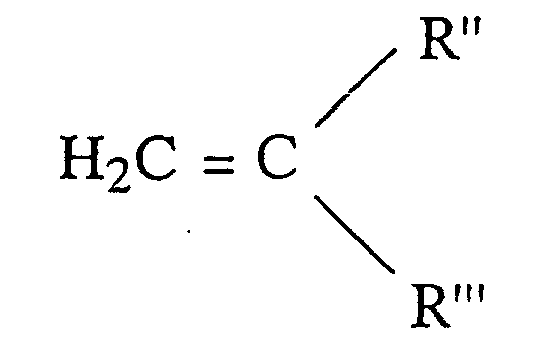
- addition-polymerizable monomer examples include cyclic olefins, vinylidene compounds represented by the general formula (III): (in the formula, respective R" and R"' are independently represent a straight chain, branched chain or cyclic alkyl group having 1 to about 18 carbon atoms, halogen atom or the like.), diene compounds, halogenated vinyl compounds, alkylic acid vinyl compounds, vinylethers, acrylonitriles and the like.
- the cyclic olefins include for example, cyclobutene, cyclopentene, cyclohexene, cyclooctene, 3-methylcyclopentene, 4-methylcyclopentene, 3-methylcyclohexene, 2-norbornene, 5-methyl-2-norbornene, 5-ethyl-2-norbornene, 5-butyl-2-norbornene, 5-phenyl-2-norbornene, 5-benzyl-2-norbornene, 2-tetracyclododecene, 2-tricyclodecene, 2-tricycloundecene, 2-pentacyclopentadecene, 2-pentacyclohexadecene, 8-methyl-2-tetracyclododecene, 8-ethyl-2-tetracyclododecene, 5-acetyl-2-norbornene, 5-acetyloxy-2-norbornene
- More preferable cyclic olefins include cyclopentene, cyclohexene, cyclooctene, 2-norbornene, 5-methyl-2-norbornene, 5-phenyl-2-norbornene, 2-tetracyclododecene, 2-tricyclodecene, 2-tricycloundecene, 2-pentacyclopentadecene, 2-pentacyclohexadecene, 5-acetyl-2-norbornene, 5-acetyloxy-2-norbornene, 5-methoxycarbonyl-2-norbornene, 5-methyl-5-methoxycarbonyl-2-norbornene and 5-cyano-2-norbornene, and 2-tetracyclododecene and 2-norbornene are particularly preferable.
- the vinylidene compounds include, for example, isobutene, 2-methyl-1-butene, 2-methyl-1-pentene, 2-methyl-1-hexene, 2-methyl-1-heptene, 2-methyl-1-octene, 2,3-dimethyl-1-butene, 2,3-dimethyl-1-pentene, 2,3-dimethyl-1-hexene, 2,3-dimethyl-1-heptene, 2,3-dimethyl-1-octene, 2,4-dimethyl-1-pentene, 2,4,4-trimethyl-1-pentene and vinylidene chloride.
- Particularly preferable vinylidene compounds are isobutene, 2,3-dimethyl-1-butene and 2,4,4-trimethyl-1-pentene.
- Diene compounds include 1,3-butadiene, 1,4-pentadiene, 1,5-hexadiene, 1,6-heptadiene, 1,7-octadiene, 1,5-cyclooctadiene, 2,5-norbornadiene, dicyclopentadiene, 5-vinyl-2-norbornene, 5-allyl-2-norbornene, 4-vinyl-1-cyclohexene and 5-ethylidene-2-norbornene.
- diene compounds are 1,4-pentadiene, 1,5-hexadiene, 1,6-heptadiene, 2,5-norbornadiene, dicyclopentadiene, 5-vinyl-2-norbornene, 4-vinyl-1-cyclohexene and 5-ethylidene-2-norbornene
- Vinyl alkylates include, for example, vinyl acetate, vinyl propionate and vinyl butyrate.
- Vinyl ethers include, for example, methyl vinyl ether, ethyl vinyl ether and butyl vinyl ether.
- Halogenated vinyls include, for example, vinyl chloride.
- Acrylonitriles include, for example, acrylonitrile and methacrylonitrile.
- the content of the addition polymerizable monomer units in the olefin-based copolymer is usually within a range not damaging an adhesiveness to propylene of a adhesive obtained, the specific content is about 5 mol% or less and preferably 1 mol% or less to 100 mol% of all monomer units constituting the olefin-based copolymer, and particularly preferably a content in a degree not substantially containing the addition polymerizable monomer units.
- a producing method of the copolymer used in the present invention there are listed methods of copolymerizing ethylene and/or the ⁇ -olefin with the vinyl compound (I) and/or (II) in the presence of a catalyst obtained by contacting isopropylidenebis(indenyl)zirconium dichloride and methylalumoxane.
- a producing method according to a method described in JP 2000-311778 A is preferably adopted.
- the copolymer in the present invention has a structure in which mutual tertiary carbon atoms derived from the vinyl compound(I) and/or the vinyl compound (II), are separated by one methylene group derived from the vinyl compound(I) and /or the vinyl compound (II).
- a copolymer of ethylene with vinylcyclohexane has a structure in which mutual carbon atoms connected to a cyclohexyl group are separated by one methylene group.
- it may have a structure in which said carbon atoms are mutually separated by 2 or 3 or more methylene groups.
- the weight average molecular weight(Mw) and the number average molecular weight are values determined by using a gel permeation chromatograph(GPC) and calibrating with polystyrene (molecular weight 688 to 400,000) standard substance.
- the weight average molecular weight(Mw) of the olefin-based copolymer is usually 5,000 to 1,000,000, preferably 10,000 to 500,000, particularly preferably 15,000 to 400,000.
- the weight average molecular weight(Mw) of the olefin-based copolymer is large, the mechanical strength of an adhesive obtained has an improvement tendency, therefore, it is preferable, and when the weight average molecular weight(Mw) of the olefin-based copolymer is low, the moldability of the olefin-based copolymer has an improvement tendency, therefore it is preferable.
- the olefin-based copolymer used in the present invention has usually an intrinsic viscosity [ ⁇ ] of about 0.08 to about 10.0 dl/g, preferably about 0.10 to about 3.0 dl/g, particularly preferably about 0.15 to about 2.0 dl/g.
- the modified olefin-based copolymer in the present invention is a modified product prepared by graft-polymerizing an alkenyl aromatic hydrocarbon and /or an unsaturated carboxylic acid or derivative thereof to the olefin-based copolymer thus obtained.
- the modified product prepared by graft-polymerizing an alkenyl aromatic hydrocarbon to the olefin-based copolymer is firstly explained.
- a content of the alkenyl aromatic hydrocarbon in the modified product is usually 0.01 to 30 % by weight , preferably 0.05 to 10 % by weight, particularly 0.1 to 5 % by weight to 100 % by weight of the modified product of the olefin-based copolymer.
- the adhesiveness of the modified product has a tendency of improvement. Further, when the graft-polymerized amount of the alkenyl aromatic hydrocarbon is smaller than that in this range, the heat stability of the modified product has a tendency of improvement.
- alkenyl aromatic hydrocarbon used in the present invention for example, an alkenyl compounds having 6 to 25 carbon atoms are listed, specifically alkenyl compounds such as a phenyl group, tolyl group, xylyl group, the third grade butyl phenyl group, vinyl phenyl group, naphthyl group, phenanthryl group and anthracenyl group are listed.
- alkenyl aromatic compounds alkenyl aromatic compounds having a phenyl group, tolyl group, xylyl group, tertiary butyl phenyl group, vinyl phenyl group and naphthyl group are desirable.
- alkenyl aromatic hydrocarbon examples include styrene, alkyl styrene such as p-methylstyrene, m-methylstyrene, o-methylstyrene, p-ethyl styrene, m-ethyl styrene, o-ethyl styrene, 2,4-dimethylstyrene, 2,5-dimethylstyrene, 3,4-dimethylstyrene, 3,5-dimethylstyrene, 3-methyl-5-ethyl styrene, p-tert-butylstyrene, and p- sec-butylstyrene; alkenylbenzenes such as 2-phenyl propylene, 2 -phenyl butene; vinyl naphthalenes such as 1-vinylnaphthalene.
- alkenyl aromatic hydrocarbon 2 or more alkeny
- alkenyl aromatic hydrocarbons styrene, p-methylstyrene, m-methylstyrene, o-methylstyrene, p-tert-butylstyrene, and 1-vinylnaphthalene are preferable, and particularly styrene is preferably applied.
- a graft-polymerized amount of the unsaturated carboxylic acid or derivative thereof to 100 % by weight of the modified olefin-based copolymer is usually 0.01 to 20 % by weight, preferably 0.05 to 10 % by weight, particularly 0.1 to 5 % by weight.
- the unsaturated carboxylic acid or derivative thereof used in the present invention includes, for example, unsaturated carboxylic acid such as acrylic acid, methacrylic acid, crotonic acid, isocrotonic acid, maleic acid, fumaric acid, itaconic acid, citraconic acid, nadic acid, methylnadic acid, himic acid, angelic acid, tetrahydro phthalic acid, sorbic acid, measaconic acid; unsaturation carboxylic acid anhydride such as maleic anhydride, itaconic anhydride, citraconic anhydride, nadic anhydride, methylnadic anhydride, himic anhydride; unsaturated carboxylic acid ester such as methyl acrylate, methyl methacrylate, ethyl acrylate, ethyl methacrylate, n-butyl acrylate, n-butyl methacrylate, iso-butyl acryllate, iso-butyl me
- a producing method of the modified olefin-based copolymer for example, there are a method of adding and graft-polymerizing an alkenyl aromatic hydrocarbon and/or an unsaturated carboxylic acid or derivative thereof after melting the olefin-based copolymer, a method of adding and graft-polymerizing an alkenyl aromatic hydrocarbon and/or an unsaturated carboxylic acid or derivative thereof after dissolving the olefin-based copolymer with a solvent such as toluene or xylene, and the like.
- the producing method described above is usually carried out at a temperature of about 40 to about 350°C.
- Polymerization is usually carried out in the presence of a radical initiator for graft-polymerizing an alkenyl aromatic hydrocarbon and/or an unsaturated carboxylic acid or derivative thereof to the olefin-based copolymer.
- the used amount of the radical initiator is usually 0.001 to 0.5 mol, preferably 0 .005 to 0.1 mol per 1 kg of the olefin-based copolymer.
- the radical initiator includes, for example, organic peroxides such as methyl ethyl ketone peroxide, cyclohexanone peroxide, 3,3,5-trimethylcyclohexanone peroxide, methylcyclohexanone peroxide, methyl acetoacetate peroxide, acetylacetone peroxide, 1,1-bis(tert-butyl peroxy)-3,3,5-trimethylcyclohexane, 1,1-bis(tert-butyl peroxy)cyclohexane, 2,2-bis(tert-butyl peroxy)octane, n-butyl-4,4-bis(tert-butyl peroxy)valerate.
- organic peroxides such as methyl ethyl ketone peroxide, cyclohexanone peroxide, 3,3,5-trimethylcyclohexanone peroxide, methylcyclohexanone peroxide, methyl acetoacetate peroxid
- the modified olefin-based copolymer in the present invention usually has 1.5 to 10 of a molecular weight distribution(Mw/Mn), preferably 1.5 to 7, particularly 1.5 to 5.
- Mw/Mn molecular weight distribution
- the molecular weight distribution of the modified product can be measured in the same manner as in the molecular weight distribution of the above-described of the molecular weight distribution.
- An intrinsic viscosity [ ⁇ ] of the modified olefin-based copolymer in the present invention usually 0.08 to 10.0 dl/g, preferably 0.1 to 3.0 dl/g, particularly preferably 0.15 to 2.0 dl/g from the view point of mechanical strength.
- olefin-based modified products can be used as, for example, adhesives, tackifiers, modifiers of adhesives, heat-sealing agents, paints, primers for paints, films, sheets, construction materials, building materials, automobile parts, electric- or electronic products and packaging materials.
- those are used preferably as adhesives, tackifiers, modifiers of adhesives, heat-sealing agents, paints, and primers for paints from the excellent adhesiveness, particularly as adhesives.
- the adhesive of the present invention is an adhesive containing the modified olefin-based copolymer as an effective ingredient, and may contain stabilizers such as phenol type stabilizers, phosphite type stabilizers, amine type stabilizers, amide type stabilizers, aging preventing agents, weathering stabilizers, precipitation preventing agents, antioxidants, and thermal stabilizers light stabilizers; additives such as thixotropic agents, viscosity improvers, de-foaming agents, surface controlling agents, weathering agents, pigments, pigment dispersants, antistatic agents, lubricants,nucleating agents,flame retardants,oiling agents, and dyes; pigments such as a transition metal compounds(e.g.
- the adhesive may contain a solvent such as water, an aromatic solvent (e.g. toluene, xylene), an aliphatic solvent (e.g. hexane), an ester (e.g.
- ethyl acetate ethyl acetate , butyl acetate
- a ketone e.g. methyl ethylketone, methyl isobutyl ketone
- an alcohol e.g. methanol, isopropyl alcohol, ethylene glycol, propylene glycol
- the content of the solvent in the adhesive is usually about 1.5 to about 30 parts by weight, preferably about 2 to about 20 parts by weight.
- the modified olefin-based copolymer, stabilizers, additives, pigments, fillers and the like may be dissolved or dispersed in the solvent.
- the laminate of the present invention is one prepared by laminating a base material and the adhesive of the present invention.
- the base material include, for example, olefin-based resins such as polypropylenes, polyethylenes, ethylene-propylene copolymers, ethylene-propylene-diene copolymers, and styrene-butadiene-styrene copolymers; thermoplastic resins containing polar groups such as polyesters, polyvinyl chlorides, polyamide resins, (meth) acrylate resins, ethylene-(meth(acrylate resins and ethylene-vinyl acetate resins; thermosetting resins containing polar groups such as epoxy resins, urethane resins, and urea resins; inorganic materials such as metals, glass, and cements; and cellulose polymer materials such as papers and woods.
- the base material may contain the above-described stabilizer, additive, pigment, fillers, solvent and the like.
- a form of the base material includes, for example, a form such as solutions containing a pigment, a solvent and the like in the thermoplastic resin containing polar groups or thermosetting resin containing polar groups; and films or sheets such as decorated films; and the like.
- the solution-like base material prepared by containing the pigment, the solvent and the like in the thermoplastic resin containing polar groups or thermosetting resin containing polar groups as a paint may be laminated.
- the thermoplastic resin containing polar groups and thermosetting resin containing polar groups may be mixed and used.
- the paint obtained may be coated several times.
- a film or sheet of the olefin-based resin or a hydrogenated product obtained by hydrogenating backbone olefin bonds thereof is also preferably applied.
- Producing methods of the laminates include, for example, a method of piling a base material, a sheet-like adhesive and a base material in this order and then hot-pressing them; a method of coating a solution-like adhesive on a base material, drying it and then laminating another base material; a method of adhering and laminating by coating a solution-like adhesive and a solution-like base material on a base material and then heating them; and a method of laminating by co-extruding a base material, sheet-like adhesive and a base material.
- a molecular weight of anolefin-basedcopolymeror a modif ied product of the olefin-based copolymer determined by using a gel permeation chromatograph(GPC) under the below-described conditions, and calibrating the measuring results with standard polystyrenes(molecular weight 688 to 400,000).
- a molecular weight distribution was evaluated as a ratio (Mw/Mn) of a weight average molecular weight (hereinafter, referred to as "Mw”) to a number average molecular weight (hereinafter, referred to as "Mn").
- Type 150-C manufactured by Waters Co., Ltd. Column: Shodex packed column A-80M Measuring temperature: 140°C Measuring solvent: o-dichlorobenzene Measuring concentration: 1 mg/ml
- a content of vinylcyclohexane units in the olefin-based copolymer was determined by using a 13 C-NMR apparatus described below.
- 13 C-NMR apparatus DRX600 manufactured by BRUKER Co., Ltd.
- Measuring solvent a mixed solvent of o-dichlorobenzene and o-dichlorobenzene-d4(volume ratio; 4:1)
- Measuring temperature 135°C
- An content of maleic anhydride was determined by dissolving a sample in a small amount with hot xylene, purifying it through precipitation with anhydrous acetone, preparing a xylene solution by dissolving the sample again, and then titrating with a 0.01 mol-NaOH methanol solution under heating (110-120°C) using a phenolphthalein indicator.
- the content of maleic anhydride was calculated as a dibasic acid.
- a film of 100 ⁇ m-thick was obtained by using polypropylene(Noblen AY564 manufactured by Sumitomo Chemical Company, Ltd.) and forming a film with a Laboplastomill (20 mm ⁇ extruder equipped with a T-die, manufactured by Toyo Seiki, Ltd.) and used as a base material.
- a formed sheet of 2 mm-thick was obtained by molding a similar polypropylene similar to that as above with a 5.5 ounce injection machine (IS100E, manufactured by Toshiba Ltd.) and used as another base material.
- An [ ⁇ ] of the copolymer (B-1) was 0.18 dl/g, Mnwas 10,000, a molecular weight distribution(Mw/Mn) was 2.1, a melting point(Tm) was 116°C, a glass transition point was -5°C, and a content of the VCH units in the copolymer (B-1) was 3 mol%.
- reaction liquid was dropped into a large amount of acetone and filtered matters containing an objective maleic acid-modified product of the propylene-vinylcyclohexane copolymer (B-2) were obtained.
- a grafted amount of maleic anhydride in this modified product (B-2) was 2.12%, and as a result of measurement by GPC, a weight average molecular weight (Mw) was 20,000, a number average molecular weight (Mn) was 10,000 and a molecular weight distribution (Mw/Mn) was 2.0.
- an aluminum foil, a base material(a polypropylene sheet of 2 mm-thick) , the sheet-like adhesive, a base material(a polypropylene sheet of 2 mm-thick) and an aluminum foil were sequentially piled from the upper side, and were maintained for 3 seconds at a temperature of 180 °C under a pressure of 0.3 MPa from the upper side to adhere a part of the pile (25 mm-width).
- the aluminum foils of both sides of a laminate obtained were peeled off , then the resulted laminate was allowed to stand for 1 hour at a temperature of 23 °C and a humidity of 50%.
- the laminate was cut to 10 mm-width x 100 mm-length (adhered length 25 mm) in size, then a part not adhered thereof was held at a temperature of 23 °C and a humidity of 50%, and a peel test was carried out at peeling rate 100 mm/second and a peeled angle of 180° .
- a peel strength to polypropylene was 8.6 (N/10 mm). The results are gathered in Table 1.
- an amount of a obtained propylene-vinylcyclohexane copolymer was 45 parts, an [ ⁇ ] of the copolymer was 0.16 dl/g, Mn was 9,000, a molecular weight distribution (Mw/Mn) was 2.2, a melting point (Tm) was 93 °C, a glass transition point was -8 °C, and a content of the VCH units in the copolymer was 7.6 mol%.
- an amount of a obtained propylene-vinylcyclohexane copolymer was 83 parts, an [ ⁇ ] of the copolymer was 0.14 dl/g, Mn was 7,000, a molecular weight distribution (Mw/Mn) was 2.3, a melting point (Tm) was 97 °C, a glass transition point was 3 °C, and a content of the VCH units in the copolymer was 13 mol%.
- Example 1 The olefin-based copolymer obtained in Example 1 was processed in the same manner as in Example 1 to produce a sheet-like adhesive. Subsequently, a laminate was produced in the same manner as in Example 1, and a peel strength thereof was measured. The result was shown in Table 1.
- Example 2 The olefin-based copolymer obtained in Example 2 was processed in the same manner as in Example 1 to produce a sheet-like adhesive. Subsequently, a laminate was produced in the same manner as in Example 1, and a peel strength thereof was measured. The result was shown in Table 1.
- Example 3 The olefin-based copolymer obtained in Example 3 was processed in the same manner as in Example 1 to produce a sheet-like adhesive. Subsequently, a laminate was produced in the same manner as in Example 1, and a peel strength thereof was measured. The result was shown in Table 1.
- isopropylidenebis(cyclopentadienyl)(3-tert-butyl-5-methyl-2-phenoxy)titanium dichloride, N,N-dimethylaniliniumtetrakis(pentafluorophenyl)borate and triisobutylaluminum were continuously fed from a lower part at rates of 0.000348, 0.001081 and 0.006912 parts per hour, respectively.
- a polymerization liquid was continuously taken out from a upper part of the reaction vessel so that the volume of the polymerization liquid in the polymerization vessel became equal to the inner volume of the polymerization vessel.
- the modified olefin-based copolymer of the present invention can be used as, for example, adhesives, tackifiers, modifiers for adhesives, heat-sealing agents, paints, primers for paints, films, sheets, construction materials, building materials, automobile parts, electric/electronic parts, and packaging materials.
- the adhesive of the present invention has markedly excellent adhesiveness to base materials such as polyolefin resins (e. g. polypropylene).
- the adhesive of the present invention can be utilized for packaging materials, building materials, housings of household appliances, polypropylene laminates for automobile exterior such as bumpers, door moles, door mirrors, and door under-covers by, for example, laminating a decorated film on the adhesive of the present invention, or coating a paint thereon.
Landscapes
- Chemical & Material Sciences (AREA)
- Chemical Kinetics & Catalysis (AREA)
- Organic Chemistry (AREA)
- Health & Medical Sciences (AREA)
- Medicinal Chemistry (AREA)
- Polymers & Plastics (AREA)
- Addition Polymer Or Copolymer, Post-Treatments, Or Chemical Modifications (AREA)
- Adhesives Or Adhesive Processes (AREA)
Abstract
Description
| Compound | ES | B1 |
| 3-methyl-1-butene | -1.71 | 1.90 |
| 3-methyl-1-pentene | -2.37 | 1.90 |
| Vinylcyclopentane | -1.75 | 1.90 |
| Vinylcyclohexane | -1.81 | 1.91 |
| 4,4-dimethyl-1-pentene | -2.91 | 2.47 |
| 3-ethyl-1-pentene | -3.12 | 2.13 |
| 3,3-dimethyl-1-butene | -2.78 | 2.60 |
| 3,3-dimethyl-1-pentene | -3.40 | 2.60 |
| 3,5,5-trimethyl-1-hexene | -3.09 | 1.90 |
| 3,4-dimethyl-1-pentene | -3.05 | 1.90 |
| 3,4,4-trimethyl-1-pentene | -4.57 | 1.90 |
| 3-ethyl-4-methyl-1-pentene | -4.35 | 1.90 |
| 3,3-dimethyl-4-methyl-1-pentene | -4.66 | 2.60 |
| Compound | ES | B1 |
| Propylene | -1.24 | 1.52 |
| 1-butene | -1.31 | 1.52 |
| 1-octene | -1.54 | 1.52 |
| Styrene | -1.01 | 1.71 |
In addition, a molecular weight distribution was evaluated as a ratio (Mw/Mn) of a weight average molecular weight (hereinafter, referred to as "Mw") to a number average molecular weight (hereinafter, referred to as "Mn").
Type: 150-C manufactured by Waters Co., Ltd.
Column: Shodex packed column A-80M
Measuring temperature: 140°C
Measuring solvent: o-dichlorobenzene
Measuring concentration: 1 mg/ml
13C-NMR apparatus: DRX600 manufactured by BRUKER Co., Ltd.
Measuring solvent: a mixed solvent of o-dichlorobenzene and o-dichlorobenzene-d4(volume ratio; 4:1)
Measuring temperature: 135°C
Claims (9)
- A modified olefin-based copolymer produced by graft-polymerizing an alkenyl aromatic hydrocarbon and/or an unsaturated carboxylic acid or derivative thereof to an olefin-based copolymer containing repeating units derived from a linear α-olefin and/or ethylene copolymer of ethylene and repeating units derived from a vinyl compound (I) or (II) described below:Vinyl compound (I): a vinyl compound represented by the general formula CH2=CH-R, wherein steric parameters Es and B1 of the substituent R are respectively -1.64 or less and 1.53 or moreVinyl compound (II): a vinyl compound represented by the general formula CH2=CH-R', wherein a substituent R' is a secondary or tertiary alkyl group.
- The modified olefin-based polymer according to claim 1, wherein the substituent R of the vinyl compound(I) is a cycloalkyl group.
- The modified olefin-based polymer according to claim 1 or 2, wherein the vinyl compound(I) is vinyl cyclohexane.
- The modified olefin-based polymer according to any one of claims 1 to 3, wherein the olefin-based copolymer is an olefin-based copolymer of ethylene and the vinyl compound(I) .
- The modified olefin-based polymer according to any one of claims 1 to 3, wherein the linear α-olefin is propylene.
- The modified olefin-based polymer according to any one of claims 1 to 5, wherein the alkenyl aromatic hydrocarbon is styrene and the unsaturated carboxylic acid or derivative thereof is maleic anhydride.
- An adhesive containing the modified olefin-based polymer as an effective ingredient.
- An adhering method of a base material, comprising using the adhesive of claim 7.
- A laminate prepared by adhering the adhesive of claim 7 to a base material.
Applications Claiming Priority (3)
| Application Number | Priority Date | Filing Date | Title |
|---|---|---|---|
| JP2001240720 | 2001-08-08 | ||
| JP2001240720 | 2001-08-08 | ||
| PCT/JP2002/008002 WO2003014174A1 (en) | 2001-08-08 | 2002-08-06 | Modified olefin copolymer |
Publications (2)
| Publication Number | Publication Date |
|---|---|
| EP1424351A1 true EP1424351A1 (en) | 2004-06-02 |
| EP1424351A4 EP1424351A4 (en) | 2008-04-16 |
Family
ID=19071284
Family Applications (1)
| Application Number | Title | Priority Date | Filing Date |
|---|---|---|---|
| EP02753238A Withdrawn EP1424351A4 (en) | 2001-08-08 | 2002-08-06 | MODIFIED OLEFIN COPOLYMER |
Country Status (6)
| Country | Link |
|---|---|
| US (1) | US7160950B2 (en) |
| EP (1) | EP1424351A4 (en) |
| KR (1) | KR20040024880A (en) |
| CN (1) | CN1285633C (en) |
| CA (1) | CA2456299A1 (en) |
| WO (1) | WO2003014174A1 (en) |
Cited By (1)
| Publication number | Priority date | Publication date | Assignee | Title |
|---|---|---|---|---|
| SG109472A1 (en) * | 2000-10-12 | 2005-03-30 | Sumitomo Chemical Co | Copolymer |
Families Citing this family (12)
| Publication number | Priority date | Publication date | Assignee | Title |
|---|---|---|---|---|
| US7700707B2 (en) | 2002-10-15 | 2010-04-20 | Exxonmobil Chemical Patents Inc. | Polyolefin adhesive compositions and articles made therefrom |
| US7550528B2 (en) | 2002-10-15 | 2009-06-23 | Exxonmobil Chemical Patents Inc. | Functionalized olefin polymers |
| WO2005108442A1 (en) | 2002-10-15 | 2005-11-17 | Exxonmobil Chemical Patents Inc. | Polyolefin adhesive compositions and articles made therefrom |
| JP4274455B2 (en) * | 2003-01-07 | 2009-06-10 | 住友化学株式会社 | Process for producing modified ethylene vinylcyclohexane copolymer resin and modified ethylene vinylcyclohexane copolymer resin |
| US10721543B2 (en) | 2005-06-20 | 2020-07-21 | Winview, Inc. | Method of and system for managing client resources and assets for activities on computing devices |
| CN101636448B (en) * | 2006-12-15 | 2012-08-08 | 住化化科股份有限公司 | Aqueous emulsion of olefin copolymer |
| US7713636B2 (en) * | 2006-12-15 | 2010-05-11 | Exxonmobil Chemical Patents Inc. | Multi-layer films comprising propylene-based polymers |
| CN100453574C (en) * | 2007-03-15 | 2009-01-21 | 上海交通大学 | Preparation method of ethylene-octene-maleic anhydride dibutyl ester graft copolymer |
| JP2014124940A (en) | 2012-12-27 | 2014-07-07 | 3M Innovative Properties Co | Decorative laminated sheet, structure including decorative laminated sheet, and method of manufacturing the same |
| JP6855957B2 (en) * | 2016-06-30 | 2021-04-07 | 日本ポリプロ株式会社 | A decorative film and a method for manufacturing a decorative molded product using the decorative film. |
| JP6855956B2 (en) * | 2016-07-13 | 2021-04-07 | 日本ポリプロ株式会社 | A decorative film and a method for manufacturing a decorative molded product using the decorative film. |
| US10682834B2 (en) * | 2017-03-31 | 2020-06-16 | Toray Plastics (America), Inc. | Antifog polyester lidding film for CPET trays |
Family Cites Families (19)
| Publication number | Priority date | Publication date | Assignee | Title |
|---|---|---|---|---|
| US4298712A (en) * | 1977-08-01 | 1981-11-03 | Chemplex Company | Adhesive blends of elastomer, polyolefin, and graft of polyethylene with unsaturated fused ring anhydrides |
| US4226965A (en) * | 1978-09-28 | 1980-10-07 | Grigoriev Vasily A | Method for preparing polymers and copolymers of higher α-olefines |
| JPS59164316A (en) | 1983-03-09 | 1984-09-17 | Mitsui Petrochem Ind Ltd | Hydrocarbon resin |
| EP0164420B1 (en) * | 1983-11-30 | 1990-06-20 | Mitsubishi Kasei Corporation | 3-methylbutene-1 polymer, its composition, and molding thereof |
| JPS60152519A (en) | 1984-01-23 | 1985-08-10 | Japan Synthetic Rubber Co Ltd | Method for producing modified ethylene/α-olefin copolymer rubber |
| US4719260A (en) * | 1987-02-09 | 1988-01-12 | Eastman Kodak Company | Hot-melt adhesive compositions |
| US5414044A (en) * | 1989-07-19 | 1995-05-09 | Mitsui Petrochemical Industries, Ltd. | Polyolefin resin composition and crosslinked molded article and process for the production thereof |
| JP3132764B2 (en) * | 1991-08-01 | 2001-02-05 | 三井化学株式会社 | Adhesive polyolefin resin composition |
| DE69401224T2 (en) * | 1993-02-26 | 1997-05-15 | Mitsubishi Chem Corp | Thermoplastic resin composition and method for producing modified polyolefin type resin |
| JPH08217835A (en) | 1995-02-15 | 1996-08-27 | Ube Ind Ltd | Modified amorphous polymer |
| JPH093124A (en) | 1995-06-19 | 1997-01-07 | Ube Ind Ltd | Modified amorphous polyolefin and continuous production method thereof |
| US6545091B1 (en) * | 1996-01-25 | 2003-04-08 | E. I. Du Pont De Nemours & Co. | Adhesive compositions based on blends of grafted metallocene catalyzed and non-grafted conventional polyethylenes |
| US6313241B1 (en) * | 1997-10-01 | 2001-11-06 | Cryovac, Inc. | Narrow molecular weight distribution copolymers containing long chain branches and process to form same |
| EP1002808A4 (en) * | 1998-06-05 | 2002-07-24 | Sumitomo Chemical Co | COPOLYMER, MANUFACTURING METHOD THEREOF, AND MOLDED ARTICLE COMPRISING SAME |
| DE19951277A1 (en) * | 1998-10-27 | 2000-05-04 | Sumitomo Chemical Co | Ethylene based copolymer, useful for the production of molded articles and film, contains a vinyl monomer of defined steric parameters. |
| JP2001214052A (en) * | 1999-11-22 | 2001-08-07 | Mitsui Chemicals Inc | Thermoplastic resin composition and its use |
| JP3531159B2 (en) * | 2000-03-31 | 2004-05-24 | 日本製紙株式会社 | Modified polyolefin resin composition and use thereof |
| KR20020029305A (en) | 2000-10-12 | 2002-04-18 | 고오사이 아끼오 | Copolymer |
| SG129994A1 (en) | 2000-12-27 | 2007-03-20 | Sumitomo Chemical Co | Copolymer, adhesive containing the same and laminate |
-
2002
- 2002-08-06 KR KR10-2004-7001945A patent/KR20040024880A/en not_active Withdrawn
- 2002-08-06 CA CA002456299A patent/CA2456299A1/en not_active Abandoned
- 2002-08-06 EP EP02753238A patent/EP1424351A4/en not_active Withdrawn
- 2002-08-06 WO PCT/JP2002/008002 patent/WO2003014174A1/en not_active Ceased
- 2002-08-06 CN CNB028196813A patent/CN1285633C/en not_active Expired - Fee Related
- 2002-08-06 US US10/485,992 patent/US7160950B2/en not_active Expired - Fee Related
Cited By (1)
| Publication number | Priority date | Publication date | Assignee | Title |
|---|---|---|---|---|
| SG109472A1 (en) * | 2000-10-12 | 2005-03-30 | Sumitomo Chemical Co | Copolymer |
Also Published As
| Publication number | Publication date |
|---|---|
| WO2003014174A1 (en) | 2003-02-20 |
| CA2456299A1 (en) | 2003-02-20 |
| CN1285633C (en) | 2006-11-22 |
| KR20040024880A (en) | 2004-03-22 |
| US20040204537A1 (en) | 2004-10-14 |
| CN1564832A (en) | 2005-01-12 |
| US7160950B2 (en) | 2007-01-09 |
| EP1424351A4 (en) | 2008-04-16 |
Similar Documents
| Publication | Publication Date | Title |
|---|---|---|
| EP0100912B1 (en) | Use of a hot-melt adhesive composition and laminated article comprising same | |
| US7160950B2 (en) | Modified olefin copolymer | |
| KR100414934B1 (en) | Ethylene/α-olefin copolymer, composition thereof, film thereof, and uses of these | |
| KR100854011B1 (en) | Polar group-containing olefin copolymers, methods for their preparation, and uses thereof | |
| KR101716558B1 (en) | Coating agent, decorative film and molded body | |
| EP0171626A2 (en) | Adhesive resins and laminate articles | |
| JP2009108181A (en) | Polymer composition, film and container | |
| KR19980032866A (en) | Graft polymer with controlled viscosity | |
| US6294609B1 (en) | Composition based on an ethylene-vinyl alcohol copolymer and its use | |
| JP2003160621A (en) | Modified olefin copolymer | |
| EP1197501B1 (en) | Copolymer | |
| JPH064832B2 (en) | Polymer adhesive | |
| BRPI0720756A2 (en) | OLEFINE-BASED COPOLYMER WATER EMULSION | |
| US7276568B2 (en) | Copolymer, adhesive containing the same and laminate | |
| US20070167568A1 (en) | Tie based on grafted polyethylene and on high-impact or crystal polystyrene with cohesive failure | |
| JP2018039880A (en) | Olefin resin composition, method for producing the same, molded product, and laminate | |
| JP7578501B2 (en) | Decorative Sheet | |
| JP4288952B2 (en) | Resin composition, paint and molded article | |
| JP2004238428A (en) | Primers and moldings | |
| WO2021172153A1 (en) | Graft modified product, adhesive, compatibilizer, and laminate | |
| JP2025152435A (en) | Stretched film and method for producing the same | |
| JP5098752B2 (en) | Suspended or retaining packaging film, packaging member, packaging body and packaging method | |
| EP2450186A1 (en) | Laminate | |
| JP2008138024A (en) | Vinyl compound copolymers, adhesives and laminates | |
| WO2001085815A1 (en) | Modified noncrystalline olefin polymer and resin composition comprising the modified polymer and thermoplastic resin |
Legal Events
| Date | Code | Title | Description |
|---|---|---|---|
| PUAI | Public reference made under article 153(3) epc to a published international application that has entered the european phase |
Free format text: ORIGINAL CODE: 0009012 |
|
| 17P | Request for examination filed |
Effective date: 20040305 |
|
| AK | Designated contracting states |
Kind code of ref document: A1 Designated state(s): AT BE BG CH CY CZ DE DK EE ES FI FR GB GR IE IT LI LU MC NL PT SE SK TR |
|
| RAP1 | Party data changed (applicant data changed or rights of an application transferred) |
Owner name: SUMITOMO CHEMICAL COMPANY, LIMITED |
|
| A4 | Supplementary search report drawn up and despatched |
Effective date: 20080317 |
|
| 17Q | First examination report despatched |
Effective date: 20090514 |
|
| GRAP | Despatch of communication of intention to grant a patent |
Free format text: ORIGINAL CODE: EPIDOSNIGR1 |
|
| RIC1 | Information provided on ipc code assigned before grant |
Ipc: C08F 255/02 20060101AFI20111220BHEP Ipc: B32B 27/32 20060101ALI20111220BHEP Ipc: B32B 7/12 20060101ALI20111220BHEP Ipc: B32B 15/08 20060101ALI20111220BHEP |
|
| RTI1 | Title (correction) |
Free format text: ADHERING METHOD USING AN ADHESIVE COMPRISING A MODIFIED ETHYLENE-VINYLCYCLOHEXANE COPOLYMER |
|
| STAA | Information on the status of an ep patent application or granted ep patent |
Free format text: STATUS: THE APPLICATION IS DEEMED TO BE WITHDRAWN |
|
| 18D | Application deemed to be withdrawn |
Effective date: 20120614 |