EP1423274B1 - Film material - Google Patents
Film material Download PDFInfo
- Publication number
- EP1423274B1 EP1423274B1 EP02768816A EP02768816A EP1423274B1 EP 1423274 B1 EP1423274 B1 EP 1423274B1 EP 02768816 A EP02768816 A EP 02768816A EP 02768816 A EP02768816 A EP 02768816A EP 1423274 B1 EP1423274 B1 EP 1423274B1
- Authority
- EP
- European Patent Office
- Prior art keywords
- film
- film layer
- volatile substance
- approximately
- substance
- Prior art date
- Legal status (The legal status is an assumption and is not a legal conclusion. Google has not performed a legal analysis and makes no representation as to the accuracy of the status listed.)
- Expired - Lifetime
Links
Images

Classifications
-
- B—PERFORMING OPERATIONS; TRANSPORTING
- B32—LAYERED PRODUCTS
- B32B—LAYERED PRODUCTS, i.e. PRODUCTS BUILT-UP OF STRATA OF FLAT OR NON-FLAT, e.g. CELLULAR OR HONEYCOMB, FORM
- B32B27/00—Layered products comprising a layer of synthetic resin
- B32B27/06—Layered products comprising a layer of synthetic resin as the main or only constituent of a layer, which is next to another layer of the same or of a different material
- B32B27/08—Layered products comprising a layer of synthetic resin as the main or only constituent of a layer, which is next to another layer of the same or of a different material of synthetic resin
-
- A—HUMAN NECESSITIES
- A01—AGRICULTURE; FORESTRY; ANIMAL HUSBANDRY; HUNTING; TRAPPING; FISHING
- A01M—CATCHING, TRAPPING OR SCARING OF ANIMALS; APPARATUS FOR THE DESTRUCTION OF NOXIOUS ANIMALS OR NOXIOUS PLANTS
- A01M1/00—Stationary means for catching or killing insects
- A01M1/20—Poisoning, narcotising, or burning insects
- A01M1/2022—Poisoning or narcotising insects by vaporising an insecticide
- A01M1/2027—Poisoning or narcotising insects by vaporising an insecticide without heating
- A01M1/2033—Poisoning or narcotising insects by vaporising an insecticide without heating using a fan
-
- A—HUMAN NECESSITIES
- A01—AGRICULTURE; FORESTRY; ANIMAL HUSBANDRY; HUNTING; TRAPPING; FISHING
- A01M—CATCHING, TRAPPING OR SCARING OF ANIMALS; APPARATUS FOR THE DESTRUCTION OF NOXIOUS ANIMALS OR NOXIOUS PLANTS
- A01M1/00—Stationary means for catching or killing insects
- A01M1/20—Poisoning, narcotising, or burning insects
- A01M1/2022—Poisoning or narcotising insects by vaporising an insecticide
- A01M1/2027—Poisoning or narcotising insects by vaporising an insecticide without heating
- A01M1/2055—Holders or dispensers for solid, gelified or impregnated insecticide, e.g. volatile blocks or impregnated pads
-
- A—HUMAN NECESSITIES
- A01—AGRICULTURE; FORESTRY; ANIMAL HUSBANDRY; HUNTING; TRAPPING; FISHING
- A01M—CATCHING, TRAPPING OR SCARING OF ANIMALS; APPARATUS FOR THE DESTRUCTION OF NOXIOUS ANIMALS OR NOXIOUS PLANTS
- A01M1/00—Stationary means for catching or killing insects
- A01M1/20—Poisoning, narcotising, or burning insects
- A01M1/2022—Poisoning or narcotising insects by vaporising an insecticide
- A01M1/2061—Poisoning or narcotising insects by vaporising an insecticide using a heat source
- A01M1/2072—Poisoning or narcotising insects by vaporising an insecticide using a heat source combined with a fan
-
- A—HUMAN NECESSITIES
- A61—MEDICAL OR VETERINARY SCIENCE; HYGIENE
- A61L—METHODS OR APPARATUS FOR STERILISING MATERIALS OR OBJECTS IN GENERAL; DISINFECTION, STERILISATION OR DEODORISATION OF AIR; CHEMICAL ASPECTS OF BANDAGES, DRESSINGS, ABSORBENT PADS OR SURGICAL ARTICLES; MATERIALS FOR BANDAGES, DRESSINGS, ABSORBENT PADS OR SURGICAL ARTICLES
- A61L9/00—Disinfection, sterilisation or deodorisation of air
- A61L9/015—Disinfection, sterilisation or deodorisation of air using gaseous or vaporous substances, e.g. ozone
- A61L9/04—Disinfection, sterilisation or deodorisation of air using gaseous or vaporous substances, e.g. ozone using substances evaporated in the air without heating
- A61L9/12—Apparatus, e.g. holders, therefor
-
- B—PERFORMING OPERATIONS; TRANSPORTING
- B32—LAYERED PRODUCTS
- B32B—LAYERED PRODUCTS, i.e. PRODUCTS BUILT-UP OF STRATA OF FLAT OR NON-FLAT, e.g. CELLULAR OR HONEYCOMB, FORM
- B32B27/00—Layered products comprising a layer of synthetic resin
- B32B27/32—Layered products comprising a layer of synthetic resin comprising polyolefins
- B32B27/322—Layered products comprising a layer of synthetic resin comprising polyolefins comprising halogenated polyolefins, e.g. PTFE
-
- B—PERFORMING OPERATIONS; TRANSPORTING
- B32—LAYERED PRODUCTS
- B32B—LAYERED PRODUCTS, i.e. PRODUCTS BUILT-UP OF STRATA OF FLAT OR NON-FLAT, e.g. CELLULAR OR HONEYCOMB, FORM
- B32B27/00—Layered products comprising a layer of synthetic resin
- B32B27/34—Layered products comprising a layer of synthetic resin comprising polyamides
-
- B—PERFORMING OPERATIONS; TRANSPORTING
- B32—LAYERED PRODUCTS
- B32B—LAYERED PRODUCTS, i.e. PRODUCTS BUILT-UP OF STRATA OF FLAT OR NON-FLAT, e.g. CELLULAR OR HONEYCOMB, FORM
- B32B27/00—Layered products comprising a layer of synthetic resin
- B32B27/36—Layered products comprising a layer of synthetic resin comprising polyesters
-
- B—PERFORMING OPERATIONS; TRANSPORTING
- B32—LAYERED PRODUCTS
- B32B—LAYERED PRODUCTS, i.e. PRODUCTS BUILT-UP OF STRATA OF FLAT OR NON-FLAT, e.g. CELLULAR OR HONEYCOMB, FORM
- B32B37/00—Methods or apparatus for laminating, e.g. by curing or by ultrasonic bonding
- B32B37/14—Methods or apparatus for laminating, e.g. by curing or by ultrasonic bonding characterised by the properties of the layers
- B32B37/15—Methods or apparatus for laminating, e.g. by curing or by ultrasonic bonding characterised by the properties of the layers with at least one layer being manufactured and immediately laminated before reaching its stable state, e.g. in which a layer is extruded and laminated while in semi-molten state
- B32B37/153—Methods or apparatus for laminating, e.g. by curing or by ultrasonic bonding characterised by the properties of the layers with at least one layer being manufactured and immediately laminated before reaching its stable state, e.g. in which a layer is extruded and laminated while in semi-molten state at least one layer is extruded and immediately laminated while in semi-molten state
-
- B—PERFORMING OPERATIONS; TRANSPORTING
- B32—LAYERED PRODUCTS
- B32B—LAYERED PRODUCTS, i.e. PRODUCTS BUILT-UP OF STRATA OF FLAT OR NON-FLAT, e.g. CELLULAR OR HONEYCOMB, FORM
- B32B7/00—Layered products characterised by the relation between layers; Layered products characterised by the relative orientation of features between layers, or by the relative values of a measurable parameter between layers, i.e. products comprising layers having different physical, chemical or physicochemical properties; Layered products characterised by the interconnection of layers
- B32B7/04—Interconnection of layers
- B32B7/12—Interconnection of layers using interposed adhesives or interposed materials with bonding properties
-
- B—PERFORMING OPERATIONS; TRANSPORTING
- B32—LAYERED PRODUCTS
- B32B—LAYERED PRODUCTS, i.e. PRODUCTS BUILT-UP OF STRATA OF FLAT OR NON-FLAT, e.g. CELLULAR OR HONEYCOMB, FORM
- B32B2307/00—Properties of the layers or laminate
- B32B2307/70—Other properties
- B32B2307/726—Permeability to liquids, absorption
- B32B2307/7265—Non-permeable
-
- B—PERFORMING OPERATIONS; TRANSPORTING
- B32—LAYERED PRODUCTS
- B32B—LAYERED PRODUCTS, i.e. PRODUCTS BUILT-UP OF STRATA OF FLAT OR NON-FLAT, e.g. CELLULAR OR HONEYCOMB, FORM
- B32B2323/00—Polyalkenes
- B32B2323/10—Polypropylene
-
- B—PERFORMING OPERATIONS; TRANSPORTING
- B32—LAYERED PRODUCTS
- B32B—LAYERED PRODUCTS, i.e. PRODUCTS BUILT-UP OF STRATA OF FLAT OR NON-FLAT, e.g. CELLULAR OR HONEYCOMB, FORM
- B32B2327/00—Polyvinylhalogenides
- B32B2327/12—Polyvinylhalogenides containing fluorine
- B32B2327/18—PTFE, i.e. polytetrafluoroethylene
-
- B—PERFORMING OPERATIONS; TRANSPORTING
- B32—LAYERED PRODUCTS
- B32B—LAYERED PRODUCTS, i.e. PRODUCTS BUILT-UP OF STRATA OF FLAT OR NON-FLAT, e.g. CELLULAR OR HONEYCOMB, FORM
- B32B2367/00—Polyesters, e.g. PET, i.e. polyethylene terephthalate
-
- B—PERFORMING OPERATIONS; TRANSPORTING
- B32—LAYERED PRODUCTS
- B32B—LAYERED PRODUCTS, i.e. PRODUCTS BUILT-UP OF STRATA OF FLAT OR NON-FLAT, e.g. CELLULAR OR HONEYCOMB, FORM
- B32B2377/00—Polyamides
-
- B—PERFORMING OPERATIONS; TRANSPORTING
- B32—LAYERED PRODUCTS
- B32B—LAYERED PRODUCTS, i.e. PRODUCTS BUILT-UP OF STRATA OF FLAT OR NON-FLAT, e.g. CELLULAR OR HONEYCOMB, FORM
- B32B2439/00—Containers; Receptacles
-
- Y—GENERAL TAGGING OF NEW TECHNOLOGICAL DEVELOPMENTS; GENERAL TAGGING OF CROSS-SECTIONAL TECHNOLOGIES SPANNING OVER SEVERAL SECTIONS OF THE IPC; TECHNICAL SUBJECTS COVERED BY FORMER USPC CROSS-REFERENCE ART COLLECTIONS [XRACs] AND DIGESTS
- Y10—TECHNICAL SUBJECTS COVERED BY FORMER USPC
- Y10S—TECHNICAL SUBJECTS COVERED BY FORMER USPC CROSS-REFERENCE ART COLLECTIONS [XRACs] AND DIGESTS
- Y10S428/00—Stock material or miscellaneous articles
- Y10S428/905—Odor releasing material
-
- Y—GENERAL TAGGING OF NEW TECHNOLOGICAL DEVELOPMENTS; GENERAL TAGGING OF CROSS-SECTIONAL TECHNOLOGIES SPANNING OVER SEVERAL SECTIONS OF THE IPC; TECHNICAL SUBJECTS COVERED BY FORMER USPC CROSS-REFERENCE ART COLLECTIONS [XRACs] AND DIGESTS
- Y10—TECHNICAL SUBJECTS COVERED BY FORMER USPC
- Y10T—TECHNICAL SUBJECTS COVERED BY FORMER US CLASSIFICATION
- Y10T428/00—Stock material or miscellaneous articles
- Y10T428/13—Hollow or container type article [e.g., tube, vase, etc.]
- Y10T428/1352—Polymer or resin containing [i.e., natural or synthetic]
- Y10T428/1397—Single layer [continuous layer]
-
- Y—GENERAL TAGGING OF NEW TECHNOLOGICAL DEVELOPMENTS; GENERAL TAGGING OF CROSS-SECTIONAL TECHNOLOGIES SPANNING OVER SEVERAL SECTIONS OF THE IPC; TECHNICAL SUBJECTS COVERED BY FORMER USPC CROSS-REFERENCE ART COLLECTIONS [XRACs] AND DIGESTS
- Y10—TECHNICAL SUBJECTS COVERED BY FORMER USPC
- Y10T—TECHNICAL SUBJECTS COVERED BY FORMER US CLASSIFICATION
- Y10T428/00—Stock material or miscellaneous articles
- Y10T428/14—Layer or component removable to expose adhesive
Definitions
- the present invention relates generally to films, and more particularly to a film material.
- a web or sheet of material is often used to protect a surface and/or one or more items that may be disposed on the web or sheet.
- paper has been used for many years to line shelves, drawers and other surfaces of articles.
- the paper may be plain (i.e., uncoated), coated and/or adhesive-backed. Paper or other material has also been used as placemats or as a table covering.
- a web or sheet is as a protective covering on other, larger structures, such as a dropcloth on a floor or a liner in a trunk of a car or on a bed of a truck.
- These products typically must be sufficiently durable to withstand foot traffic and/or other forms of abuse, although less durable materials (e. g., paper) may be used as temporary protective coverings.
- Pollock U. S. Patent No. 5,193,793 discloses a mixing board wherein a plurality of stacked plastic sheets are disposed on a top surface thereof. Each of the plastic sheets has a backing of pressure sensitive adhesive binding the sheets together. A user may mix a compound on a top sheet and may thereafter peel off the top sheet and dispose of same so that a clean surface is provided for subsequent use.
- Peck U. S. Patent No. 5,899,010 discloses a reusable banner system including a sheet of plastic material and a plurality of flexible static cling vinyl indicia that may be placed on the sheet of plastic material to form a message.
- the indicia are maintained in position on the sheet of plastic material by the electrostatic charge carried by the indicia.
- the sheet of plastic material carries an electrostatic charge and the indicia are made of non-porous plastic.
- Stonehouse U. S. Patent No. 5,010,671 discloses a flip chart comprising at least two sheets disposed in overlying relationship.
- the sheets are electrically charged and are releasably securable to a surface by static cling.
- the sheets are adapted for removable marking thereon by a felt pen and are retained on a backing board by staples. Each sheet may be torn from the staples to permit removal of the sheet from the flip chart.
- Boyd U. S. Patent No. 5,207,581 discloses a writing apparatus including flexible electret film that is capable of being erasably written upon by a dry erase marker.
- the apparatus includes a roll of electret film disposed in a receptacle, brackets for mounting the receptacle to a wall or flip chart stand and a cutter for separating the film into sheets.
- Cooledge et al. U. S. Patent No. 5,258,214 discloses a thermoplastic film material having a preprinted image thereon and provided with a static electrical charge for securing the film to a surface.
- the material may be packaged as sheets or in roll form with perforations to permit separation thereof.
- Ahr et al US-A- 6162 454 shows a pocket containing a vaporizable ingredient and having apertures in its upper surface and contained within an outer impervious pocket.
- the inner article can have an adhesive fastener attaching it to the target surface, such as a wearer's garment.
- Spector US-A- 4 814 212 shows a picture frame made of cardboard or open cell plastic impregnated with a volatile ingredient.
- the picture frame holds a transparent sheet carrying an illustration of an item associated with the fragrance impregnated in the frame of material.
- the film is attached to the frame by wrapping entirely around one layer of the frame and then being trapped by a second layer.
- a film material suitable for use in the present invention may comprise a polymer or other material that is readily capable of accepting and retaining an electric charge.
- the material is inexpensive so that it may be used once and recycled or discarded.
- the film material is sufficiently durable to resist contact by a knife or other utensil and has adequate resilience to resist cracking when flexed.
- the material comprises a plastic film that is liquid impermeable and preferably approved by the FDA for contact with food.
- the thickness of the film material is in a range encompassing up to approximately 203 ⁇ m (8 mils), with a range of approximately 12.7 ⁇ m to approximately 127 ⁇ m (0.5 to approximately 5 mils) being preferred, the range of approximately 25.4 ⁇ m to approximately 102 ⁇ m (1 to approximately 4 mils) being more preferred and the range of approximately 38.1 ⁇ m to approximately 76.2 ⁇ m (1.5 to approximately 3 mils) being most preferred.
- the film material is preferably charged by application of a positive or negative electric field of at least approximately 15,000 volts thereto at an approximate distance of between 12.7mm (1 /2) inch) and 25.4mm (1 inch), with at least approximately 20,000 applied volts being more preferred and at least approximately 30,000 applied volts being most preferred substantially at a distance of 19mm (3/4 inch).
- the material may be exposed to a positive electric field on one side thereof and a negative electric field on the other side thereof wherein the magnitudes of the applied fields are as noted above.
- the film material is exposed to the same polarity fields on opposite sides thereof (i.e., a first side of the material is exposed to a first positive field and a second side of the material is exposed to a second positive field or first and second sides of the material are exposed to first and second negative fields, respectively).
- the material preferably retains a charge sufficient to develop an electric field at a voltage substantially equal to at least approximately 1500 volts at a specified time after charging of the material, such as three months or more.
- the material retains sufficient charge to develop an electric field at a voltage of at least approximately 2500 volts, and most preferably at least approximately 3500 volts, at least for the period of time between the initial application of charge to the film material and the longest anticipated time to use by the consumer.
- the film material preferably comprises a monolayer or multilayer structure of any suitable polymer material(s) formed into a film, such as an olefin (e.g., polypropylene or polyethylene), nylon, PET, Teflon, or any other family of chemicals capable of being formed into a film and/or may comprise non-oriented, oriented or biaxially oriented materials.
- a film alternatively may comprise combinations of such materials in different layers that are coextruded or laminated or otherwise joined together.
- the material may be extruded into a web and wound onto one or more large master rolls. The film material is thereafter unwound from the master roll(s), passed through any commercially available electrostatic charging machine.
- FIG. 3 illustrates the foregoing procedure in greater detail wherein film material 10 stored on a large master roll 21 is unwound therefrom by a driven bed roller 23 and passed over a further roller 25 disposed adjacent a charging machine 26.
- the charging machine 26 comprises a Tetra charging bar sold by Simco of Hatfield, PA, which preferably delivers a positive charge to the film material 10.
- the film material travels past the charging machine 26 at a line speed of approximately 4.06 ms -1 (800 feet per minute) although higher or lower travel speeds could alternatively be used.
- the charged film material 10 then passes over further rollers 27a, 27b and 27c and is wound onto individual rolls carried by a rotatable turret 28.
- rollers 25, 27a and 27c are grounded to a machine frame by brushes or other devices and the rollers 27a-27c are insulated by a Teflon coating.
- the roller 25 is preferably coated by an electrically non-conductive industrial hard coating.
- the foregoing manufacturing technique results in less handling by manufacturing personnel, as compared to a technique wherein the extruded film is wound onto a large master roll, and the master roll is thereafter electrostatically charged in bulk and the charged film is unwound from the master roll and wound onto individual rolls or formed into individual sheets.
- This reduction in handling results in better charge retention and improved film quality.
- the foregoing technique results in production of amounts of ozone that are within acceptable limits.
- the film material 10 may be charged while in the semi-molten state, thereby forming an electret having internal charges in the film structure.
- this process comprehends the steps of forming a molten thermoplastic material into a web, electrically charging the web while the web is at a temperature substantially at or above a solidification temperature thereof, cooling the web below the solidification temperature thereof after charging and winding the web into individual rolls immediately following the cooling step.
- the web may be of single layer or multi-layer construction, wherein the latter may be accomplished by coextrusion techniques.
- the method comprehends the use of a charging machine similar or identical to the charging machine 26 described above which is located downstream of an extrusion die that extrudes the thermoplastic web.
- the semi-molten material After charging, the semi-molten material is allowed to cool, either by exposure to ambient conditions or by active chilling by a chiller roll.
- One or both outer surfaces of the web may be corona-treated to permit marking by a marking device.
- the cooled web is preferably immediately rolled onto individual user rolls and packaged.
- the material 10 is exposed to a positive or negative electric field preferably when the film temperature is just greater than the glass transition temperature T G for the material 10. Also preferably, the semi-molten material is exposed to at least approximately 15,000-17,000 volts at an approximate distance of between 12.7 mm (1 ⁇ 2 inch) and 25.4 mm (1 inch), with at least approximately 20,000 applied volts being more preferred and at least approximately 30,000 applied volts being most preferred substantially at a distance of 19 mm (3 ⁇ 4 inch). If desired, the material 10 may be exposed to a positive electric field on one side thereof and a negative electric field on the other side thereof wherein the magnitudes of the applied fields are as noted above.
- the film material 10 is exposed to the same polarity fields on opposite sides thereof , i.e., a first side of the material 10 is exposed to a first positive field and a second side of the material 10 is exposed to a second positive field or first and second sides of the material 10 are exposed to first and second negative fields, respectively.
- the film may initially be charged when partially molten and thereafter may be passed through a charging machine after solidification of the material 10 just before winding into individual rolls as noted above to obtain a product with a combination of internal and surface charges.
- the resulting film preferably has at least the electrical charge retention characteristics specified above. That is, the resulting film material 10 preferably retains a charge sufficient to develop an electric field at a voltage substantially equal to at least approximately 1500 volts at a specified time after charging of the material, such as three months or more. More preferably, the material 10 retains sufficient charge to develop an electric field at a voltage of at least approximately 2500 volts, and most preferably at least approximately 3500 volts, at least for the period of time between the initial application of charge to the film material 10 and the longest anticipated time to use by the consumer.
- the film material 10 may be colorless or pigmented and may be transparent, translucent or opaque, as desired.
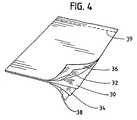
- the material 10 may comprise a multilayer coextruded or laminated structure comprising a cavitated center layer 30 of a polypropylene sold under the trademark OPPALYTE® by Exxon Mobil Corp., first and second intermediate layers 32, 34 of polypropylene modified by the addition of titanium dioxide thereto to obtain a white pigmentation and top and bottom outer layers 36, 38.
- the top outer layer 36 is preferably polypropylene that has been corona-treated to allow marking with either a permanent marking device or to allow removable marking with a dry-erase marker.
- the bottom outer layer 38 is preferably polypropylene modified by the addition of any known material that facilitates cold sealing of the film material 10. If desired the bottom outer layer 38 could be corona-treated to allow permanent or removable marking thereon as noted above. In addition, the resulting film may be laminated to another structure, such as a substrate.
- the material 10 may be printed on one or more surfaces thereof. Also, the film material 10 may be perforated at one or more locations 39 (FIG. 4) to permit tearing into sheets without the need for a cutter bar.
- the film material 10 is identical to the embodiment illustrated in FIG. 4 except that the outer layers 36 and 38 are omitted.
- the three layers are coextruded or laminated and each layer comprises 187,155LLG102 BOPP manufactured by Exxon Mobil Corp., wherein the layers are not modified by pigment and are not cavitated to obtain a ciear product.
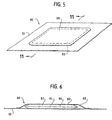
- a volatile material is retained in or by a structure carried by or secured to the film as seen in FIGS. 1 and 2.
- a layer 60 of a first film is disposed atop and secured to a layer 62 of a second film that carries an electric charge to create a pocket 64.
- the layers 60 and 62 may be made of any of the materials described above or any other material and the layer 60 may be secured to the layer 62 in any known manner, such as by heat sealing, adhesive bonding, coextrusion, or the like.
- a pad 66 impregnated with a desired substance, such as a fragrance, insecticide or any other substance as described herein, may be disposed in the pocket 64.
- the pad 66 may comprise a gel disposed in an envelope formed by two layers of vapor permeable material that are secured to one another by any suitable means.
- One or both of the layers 60, 62 may be vapor permeable and/or one or more openings or apertures 68 may be provided in the first and/or second films to permit vapor communication between the ambient surroundings and the pocket 64.
- the holes 68 may initially be covered by one or more removable adhesive strips 70 (shown only in FIG. 1) or other members.
- the resulting product may be placed on any desired object at a desired position (including a top surface, side surface or an undersurface of the object) and is retained thereon by the electric charge carried by the film.
- the adhesive strip(s) 70 may then be removed to expose the substance to the ambient surroundings. The substance, if volatile, will thereafter evaporate and spread in vapor form to the surroundings.
- the pad 66 may be replaced by a different carrier, such as a fibrous pad or other material containing or impregnated with a desired substance.
- a still further alternative is a design whereby a pouch is formed of a material (whether one of the materials described above or any other material), either by folding the material upon itself or by securing two or more pieces of the same or dissimilar materials together to form one more pockets, and securing the pouch by any suitable means (e.g., heat sealing, adhesive, coextrusion, co-lamination or the like) to a section of a film that carries electric charge as described above.
- One or more objects may be disposed in the pocket(s), including a pad impregnated with a substance as described above.
- the material of the pouch may be vapor permeable an/or may include one or more openings extending therethrough.
- One or more holes covered by removable members may be provided as in the preceding embodiment.
- the resulting product may be placed and used as described in the preceding embodiment to expose the impregnated substance to ambient surroundings.
- the desired substance may be a repellant and/or toxic to one or more undesirable organisms, creatures, etc...
- the desired substance may comprise an antimicrobial composition, an insecticide, a bactericide, a herbicide, an animal repellant, or the like.
- the desired substance may be an attractant (such as a fragrance as noted above) or a substance that encourages growth or multiplication of one or more organisms.
- scents and other air quality control active ingredients and insect control ingredients including insecticides, repellants and other insect behavioral and/or developmental modification ingredients.
- any of these substances can be applied to the film material 10 by any suitable means in addition to those described above, such as a composition which is printed directly on the film material 10, a woven or nonwoven fabric or other material impregnated with the substance and laminated or otherwise joined to the material 10, etc....
- the substance may therefore be dispensed without messy and/or sticky residue.
- a substance release arrangement is a 254 mm by 254 mm 50.8 micrometre thick (10 inch by 10 inch 2 mil) polypropylene film with 100 milligrams of transfluthrin or other insecticide or active applied thereto.
- Other insecticidal compositions may instead be used in this manner.
- the resulting material may be supplied in sheet or roll form, and in the latter case, the material may be tom or cut into a desired size by a cutter bar or other implement as described above.
- the material may alternatively be perforated to allow ready separation into individual sheets, also as noted above.
- the material may be placed on a substantially horizontal undersurface or any other surface of an object, such as a tray, table ,countertop, drawer, shelf, a substantially vertical surface, etc..., whereupon the volatile substance volatilizes to release an active ingredient into the surrounding environment.
- any of the foregoing embodiments may be adapted to be utilized with a heater that heats the film material 10 either to initiate or accelerate the release of the substance into the surrounding atmosphere.
- a fan may instead or in addition be used to initiate/accelerate substance release.
- a multi-compartment arrangement 80 includes at least first and second compartments or pockets 82, 84 separated by a rupturable intermediate wall 86.
- the compartments 82, 84 are captured between a base layer comprising a section of the film material 10 and a cover layer 88 that is secured by any suitable means to the base layer.
- each compartment is separated from adjacent compartment(s) by one or more rupturable walls.
- a chemical composition is disposed in each compartment and the rupturable walls may be selectively ruptured by physical manipulation to mix the chemicals and thereby initiate a desired chemical reaction.
- the structure may be retained on any surface by the charge carried by the film material 10.
- the electrically charged sheet of polymer material as described above having the above-noted charge retention and holding characteristics may be coated or impregnated with a volatile substance; such as an insecticide or fragrance, and, if desired, one or both surfaces of the sheet may be treated to permit permanent or removable marking of such surface(s) by a marking device, such as a dry erase marker.
- a marking device such as a dry erase marker.
- the material may be supplied in sheet or roll form, and in the latter case, the material may be torn or cut into a desired size by a cutter bar or other implement as described above. The material may altematively be perforated to allow ready separation into individual sheets, also as noted above.
Landscapes
- Life Sciences & Earth Sciences (AREA)
- Pest Control & Pesticides (AREA)
- Health & Medical Sciences (AREA)
- General Health & Medical Sciences (AREA)
- Toxicology (AREA)
- Engineering & Computer Science (AREA)
- Insects & Arthropods (AREA)
- Wood Science & Technology (AREA)
- Zoology (AREA)
- Environmental Sciences (AREA)
- Epidemiology (AREA)
- Animal Behavior & Ethology (AREA)
- Public Health (AREA)
- Veterinary Medicine (AREA)
- Wrappers (AREA)
- Laminated Bodies (AREA)
- Catching Or Destruction (AREA)
- Packages (AREA)
- Packaging Of Annular Or Rod-Shaped Articles, Wearing Apparel, Cassettes, Or The Like (AREA)
- Details Of Indoor Wiring (AREA)
Description
Claims (12)
- A material, comprising:characterized in that the first film layer carries an electric charge sufficient to develop an electric field of at least 1500 volts 3 months after charging.a first film layer (62);a second film layer (60) secured to the first film layer (62) to form a pocket (64); anda volatile substance (66) disposed in the pocket;
- A material, according to claim 1 wherein the second film layer (60) has a opening (68) extending therethrough.
- The material of claim 1, wherein the first and second film layers (60, 62) are liquid impermeable.
- The material of claim 1 or 2, wherein the second film layer (60) is secured to the first film layer (62) by heat sealing, adhesive bonding, or coextrusion.
- The material of claim 1 or 2, wherein the films are made of a polymer.
- The material of claim 5, wherein the polymer is polypropylene.
- The material of claim 5, wherein the polymer is selected from the group consisting of olefins, nylon, PET and Teflon.
- The material of claim 1 or 2, wherein a removable adhesive strip is secured atop the second layer (60), and the volatile substance is emitted when said removable adhesive strip is removed.
- The material of claim 1 or 2, in combination with a substantially vertical surface to which the material is electrostatically attracted.
- The material of claim 1 or 2, wherein the volatile substance is toxic to an organism or creature.
- The material of claim 1 or 2, wherein the volatile substance is selected from the group comprising a fragrance, an insecticide, a herbicide, an antimicrobial composition, an animal repellent, a bactericide and an attractant.
- The material of claim 1 or 2, wherein the volatile substance encourages growth or multiplication of one or more organisms.
Applications Claiming Priority (3)
| Application Number | Priority Date | Filing Date | Title |
|---|---|---|---|
| US948211 | 2001-09-07 | ||
| US09/948,211 US6899931B2 (en) | 2001-09-07 | 2001-09-07 | Film material |
| PCT/US2002/028459 WO2003022577A1 (en) | 2001-09-07 | 2002-09-06 | Film material |
Publications (2)
| Publication Number | Publication Date |
|---|---|
| EP1423274A1 EP1423274A1 (en) | 2004-06-02 |
| EP1423274B1 true EP1423274B1 (en) | 2005-05-11 |
Family
ID=25487486
Family Applications (1)
| Application Number | Title | Priority Date | Filing Date |
|---|---|---|---|
| EP02768816A Expired - Lifetime EP1423274B1 (en) | 2001-09-07 | 2002-09-06 | Film material |
Country Status (9)
| Country | Link |
|---|---|
| US (1) | US6899931B2 (en) |
| EP (1) | EP1423274B1 (en) |
| JP (1) | JP2005502549A (en) |
| AR (1) | AR036441A1 (en) |
| CA (1) | CA2459922A1 (en) |
| DE (1) | DE60204155T2 (en) |
| ES (1) | ES2238598T3 (en) |
| TW (1) | TW548188B (en) |
| WO (1) | WO2003022577A1 (en) |
Families Citing this family (22)
| Publication number | Priority date | Publication date | Assignee | Title |
|---|---|---|---|---|
| US20030049294A1 (en) * | 2001-09-07 | 2003-03-13 | Jose Porchia | Film material |
| US20030049410A1 (en) * | 2001-09-07 | 2003-03-13 | Munagavalasa Murthy S. | Film material and method of dispensing a volatile substance |
| US20030060350A1 (en) * | 2001-09-07 | 2003-03-27 | Taylor Pamela J. | Method of protecting a surface |
| US6846449B2 (en) * | 2001-09-07 | 2005-01-25 | S. C. Johnson Home Storage, Inc. | Method of producing an electrically charged film |
| US20050000642A1 (en) * | 2003-07-03 | 2005-01-06 | 3M Innovative Properties Company | Cling articles |
| DE202004017916U1 (en) * | 2004-11-18 | 2005-01-13 | Klocke Verpackungs-Service Gmbh | Packing with liquid or paste product has case consisting of at least two edge-side connected, especially peelably welded, cover films between which held perforated film |
| US20060194028A1 (en) * | 2005-02-25 | 2006-08-31 | Best-Rite Chalkboard Company | Replacement skins for a writing surface |
| US7798320B2 (en) * | 2005-06-10 | 2010-09-21 | Philip Morris Usa Inc. | Aromatic pocket tear tape for cigarette pack |
| US8048510B2 (en) * | 2005-09-21 | 2011-11-01 | Whirlpool Corporation | Liner with electrical pathways |
| EP2008566A1 (en) * | 2007-06-25 | 2008-12-31 | The Procter and Gamble Company | Liquid delivery pouch and article comprising the same |
| US20090004433A1 (en) * | 2007-06-26 | 2009-01-01 | Marc Privitera | Fluid Absorbing and/or Disinfecting Surfacing Materials |
| US20100055661A1 (en) * | 2008-08-27 | 2010-03-04 | William Hegwood | Portable retractable dry-erase board and method thereof |
| US20100237068A1 (en) * | 2009-03-17 | 2010-09-23 | Rubbermaid Incorporated | Container With In-Molded Exposed Panel |
| US20130209718A1 (en) * | 2012-02-13 | 2013-08-15 | Ko-Kang Wen | Antimicrobial and Antibacterial Device Protection System |
| DE102012007167A1 (en) * | 2012-04-12 | 2013-10-17 | Linde Ag | Process and device for the molecular evaporation of fragrance / active substances and their propagation |
| US9149031B2 (en) | 2013-09-13 | 2015-10-06 | S.C. Johnson & Son, Inc. | Portable area repellent device |
| US9352062B2 (en) | 2013-10-30 | 2016-05-31 | S.C. Johnson & Son, Inc. | Wearable chemical dispenser |
| US9352064B2 (en) | 2014-06-05 | 2016-05-31 | S. C. Johnson & Son, Inc. | Wearable chemical dispenser |
| US10617262B2 (en) | 2016-09-28 | 2020-04-14 | San Jamar, Inc. | Cutting board systems |
| US10617261B2 (en) | 2016-09-28 | 2020-04-14 | San Jamar, Inc. | Cutting board systems |
| US20210154349A1 (en) * | 2018-04-12 | 2021-05-27 | Zobele Holding, S.P.A. | Device for diffusing volatile substances and method for its manufacturing |
| WO2025199087A1 (en) * | 2024-03-19 | 2025-09-25 | The Procter & Gamble Company | Cartridge with laser marking |
Family Cites Families (260)
| Publication number | Priority date | Publication date | Assignee | Title |
|---|---|---|---|---|
| US49294A (en) * | 1865-08-08 | Improved machine for bending metal rods | ||
| US339810A (en) | 1886-04-13 | John p | ||
| US49410A (en) * | 1865-08-15 | Improved hydropneumatic engine | ||
| US60350A (en) * | 1866-12-11 | evabts | ||
| US68163A (en) * | 1867-08-27 | Improvement in brushes and tops of muoilage-bottles | ||
| US47844A (en) * | 1865-05-23 | Improved process for tanning | ||
| US179884A (en) * | 1876-07-18 | Improvement in pokers | ||
| US47044A (en) * | 1865-03-28 | Improved fruit-gatherer | ||
| US47845A (en) * | 1865-05-23 | Improvement in cook-stoves | ||
| US1151895A (en) | 1914-05-04 | 1915-08-31 | Edward C Mix | Sanitary kneading-board. |
| US1952375A (en) | 1933-02-10 | 1934-03-27 | Joseph W Johnson | Pharmacist's slab |
| US2169055A (en) | 1937-03-29 | 1939-08-08 | Shellmar Products Co | Perfume fixative |
| US2369898A (en) | 1943-08-11 | 1945-02-20 | Seward C Hoel | Mixing slab |
| US3116201A (en) | 1952-02-29 | 1963-12-31 | Shell Oil Co | Organo-phosphorus insecticide |
| US2720013A (en) | 1953-11-02 | 1955-10-11 | Judith C Clarke | Insecticide dispenser |
| DE1042851B (en) | 1957-02-07 | 1958-11-06 | Julius Saemann | Device for the controllable evaporation of a volatile substance |
| US3044885A (en) | 1958-09-15 | 1962-07-17 | Crown Zellerbach Corp | Impregnated sheets for preserving perishable foodstuffs |
| US2956073A (en) | 1960-04-13 | 1960-10-11 | Shell Oil Co | Insecticidally active esters of phosphorus acids and preparation of the same |
| BE613244A (en) | 1961-01-30 | |||
| US3261746A (en) | 1961-12-11 | 1966-07-19 | David W M Copley | Liquid absorbent and vapor releasant block |
| US3240326A (en) | 1962-02-26 | 1966-03-15 | Wendell S Miller | Disinfecting packet |
| NL283312A (en) | 1962-07-12 | |||
| US3120345A (en) | 1963-01-16 | 1964-02-04 | Stephen J Bolger | Device for dispersing volatile materials |
| US3318769A (en) | 1963-05-31 | 1967-05-09 | Shell Oil Co | Resin compositions comprising organo-phosphorus pesticides |
| US3295246A (en) | 1965-09-27 | 1967-01-03 | Landsman Irving | Insect repellent tapes |
| US3458713A (en) | 1966-11-01 | 1969-07-29 | Northern Electric Co | Polycarbonate electrets |
| FR1590647A (en) | 1968-07-12 | 1970-04-20 | ||
| US3655129A (en) | 1968-07-17 | 1972-04-11 | Ppg Industries Inc | Slow release films and methods of making same |
| US3620453A (en) | 1968-09-26 | 1971-11-16 | Abraam Gancberg | Shaped article with insecticidal properties |
| US3576987A (en) | 1968-11-07 | 1971-05-04 | American Cyanamid Co | Chemical lighting device to store, initiate and display chemical light |
| US3644605A (en) | 1969-02-11 | 1972-02-22 | Bell Telephone Labor Inc | Method for producing permanent electret charges in dielectric materials |
| US3567119A (en) | 1969-10-06 | 1971-03-02 | Godfrey Wilbert | Enhanced diffusion of odor vapor from polymers |
| BE758065A (en) | 1969-10-28 | 1971-04-27 | Minnesota Mining & Mfg | INSECT TRAPPING DEVICE |
| JPS5019183B1 (en) | 1970-03-10 | 1975-07-04 | ||
| LU60523A1 (en) | 1970-03-13 | 1971-11-08 | ||
| US3685895A (en) * | 1970-05-18 | 1972-08-22 | Opto Graphics Inc | Electrophotographic charging easel |
| LU61504A1 (en) | 1970-08-12 | 1972-04-05 | ||
| US3857934A (en) | 1971-02-02 | 1974-12-31 | Herculite Protective Fab | Activated polymer materials and process for making same |
| US3864468A (en) | 1971-02-02 | 1975-02-04 | Herculite Protective Fab | Activated polymer materials and process for making same |
| US3705938A (en) | 1971-02-02 | 1972-12-12 | Hercules Protective Fabric Cor | Activated polymer materials and process for making same |
| US3685734A (en) | 1971-02-19 | 1972-08-22 | Minnesota Mining & Mfg | Controlled fragrance release device |
| CA992738A (en) | 1971-04-08 | 1976-07-13 | Naohiro Murayama | Pyroelectric element of polymer film |
| US3985666A (en) | 1971-04-13 | 1976-10-12 | Xerox Corporation | Plastic materials mixed with polar group containing materials |
| US3804077A (en) | 1971-08-05 | 1974-04-16 | Kay Laboratories Inc | Hot or cold pack |
| US3734486A (en) | 1971-09-10 | 1973-05-22 | W Peacey | Mixing board |
| US3874504A (en) | 1971-11-22 | 1975-04-01 | John P Verakas | Chemical thermal pack |
| GB1461445A (en) | 1974-02-20 | 1977-01-13 | Shell Int Research | Slow-release composition |
| US3910410A (en) | 1974-03-19 | 1975-10-07 | Continental Can Co | Resealable package |
| US3950158A (en) | 1974-05-31 | 1976-04-13 | American Medical Products Company | Urea cold pack having an inner bag provided with a perforated seal |
| US4103450A (en) | 1975-12-29 | 1978-08-01 | Minnesota Mining And Manufacturing Company | Insecticidal device |
| US4051159A (en) | 1976-01-12 | 1977-09-27 | Avon Products, Inc. | Transparent fragrance releasing composition and method of making same |
| US4178384A (en) | 1976-03-22 | 1979-12-11 | Fmc Corporation | Pyrethroid insect repellent |
| GB1581333A (en) | 1976-07-02 | 1980-12-10 | Unilever Ltd | Colour change systems |
| FR2357998A1 (en) | 1976-07-05 | 1978-02-03 | Inst Francais Du Petrole | METHOD OF MANUFACTURING SENSITIVE ELEMENTS WITH A PERMANENT ELECTRICAL POLARIZATION OF IMPLEMENTATION |
| US4158440A (en) | 1976-10-12 | 1979-06-19 | The Ridson Manufacturing Company | Device for releasing a volatile substance in a controlled manner |
| US4086499A (en) | 1976-11-26 | 1978-04-25 | Uniroyal Ltd. | Stable electrets of styrene-type polymers |
| CH621142A5 (en) * | 1976-12-08 | 1981-01-15 | Hermann Felchlin | |
| US5290770A (en) | 1976-12-24 | 1994-03-01 | Burroughs Wellcome Co. | Synergistic compositions |
| US4094119A (en) | 1977-03-18 | 1978-06-13 | The Risdon Manufacturing Company | Method of making a product for dispensing a volatile substance |
| CH616898A5 (en) | 1977-04-19 | 1980-04-30 | Apura Gmbh | |
| US4145001A (en) | 1977-09-15 | 1979-03-20 | American Can Company | Packaging for controlled release of volatile substances |
| US4207702A (en) | 1978-04-24 | 1980-06-17 | Dynamic Toy Company, Inc. | Light transmissive flying saucer with chemical lightstick |
| DE2967512D1 (en) | 1978-05-30 | 1985-10-17 | Wellcome Found | Synergistic pyrethroid formulations and their preparation |
| AR228128A1 (en) | 1978-06-22 | 1983-01-31 | Freyberg Chem Fab Werner | PESTICIDE DEVICE AND PREPARATION PROCEDURE OF A TOXIC ATMOSPHERE APPLYING SUCH DEVICE |
| DE7818669U1 (en) | 1978-06-22 | 1978-10-26 | Dr. Werner Freyberg Chemische Fabrik Delitia Nachf.,6941 Laudenbach | DEVICE SUITABLE FOR TAKING UP AND USE OF PEST CONTROL |
| CA1107950A (en) | 1978-08-10 | 1981-09-01 | Anupama Mishra | Electret made of branched alpha-olefin polymer |
| US4275112A (en) | 1978-08-28 | 1981-06-23 | Ionic Controls, Inc. | Support for decorative and communicative material |
| DE2954480C1 (en) | 1979-06-22 | 1994-02-03 | Freyberg Chem Fab Werner | Fumigation device |
| CH639282A5 (en) | 1979-06-26 | 1983-11-15 | Firmenich & Cie | DEVICE FOR SCENTING AMBIENT AIR. |
| US4291245A (en) | 1979-09-04 | 1981-09-22 | Union Carbide Corporation | Electrets |
| CA1141020A (en) | 1979-10-19 | 1983-02-08 | Slawomir W. Sapieha | Electrets from plasma polymerized material |
| DE2945655A1 (en) | 1979-11-12 | 1981-05-21 | Celamerck Gmbh & Co Kg, 6507 Ingelheim | DEVICE FOR THE DELIVERY OF PHERMONES |
| IN152745B (en) | 1980-03-21 | 1984-03-24 | Airwick Ag | |
| DE3029476A1 (en) | 1980-08-02 | 1981-08-13 | Berthold van Dr.-Ing. 7500 Karlsruhe Schoor | Flat foil container for scent samples - has disc enclosed between two gas-tight foils, torn off before application |
| DE3105247A1 (en) | 1980-08-02 | 1982-08-26 | Berthold van Dr.-Ing. 7500 Karlsruhe Schoor | Opening for flat film containers for storing and evaporating very small quantities of perfume |
| US4348439A (en) | 1981-02-18 | 1982-09-07 | Certain-Teed Corporation | Package of wound strand material |
| US4425733A (en) | 1981-07-09 | 1984-01-17 | Fr. Kaiser Gmbh | Fly paper |
| WO1985003275A1 (en) | 1984-01-23 | 1985-08-01 | Laipply Thomas C | Alcohol wipe and methods |
| US4445641A (en) | 1982-01-08 | 1984-05-01 | Bend Research, Inc. | Controlled-release dispenser |
| JPS58141225A (en) | 1982-02-16 | 1983-08-22 | Takasago Corp | Resin composition for fragrant material |
| GB2115696A (en) | 1982-02-17 | 1983-09-14 | Storey Brothers & Co | Insecticidal products |
| US4765982A (en) | 1982-04-30 | 1988-08-23 | Minnesota Mining And Manufacturing Company | Insect control device |
| JPS58180575U (en) | 1982-05-26 | 1983-12-02 | 株式会社島田紙器製作所 | picture display container |
| GB2124147B (en) | 1982-07-21 | 1985-11-13 | Johnson James F J | Releasably mutually-adherent materials |
| DE3227370A1 (en) | 1982-07-22 | 1984-01-26 | Henkel Kgaa | METHOD AND MEANS FOR THE NEED FOR PACKAGING CONTAINERS |
| US4534509A (en) | 1982-09-28 | 1985-08-13 | Firmenich Sa | Multiple compartment plastic packing |
| EP0106648B1 (en) | 1982-10-16 | 1988-05-18 | Johnsen & Jorgensen Jaypak Limited | Bag apparatus |
| US4459634A (en) | 1982-10-22 | 1984-07-10 | Pennwalt Corporation | Reverse field stabilization of polarized polymer films |
| FR2555408B2 (en) | 1983-04-14 | 1986-11-21 | Rombi Max | INSECTICIDE NECKLACE AND MANUFACTURING METHOD THEREOF |
| US4513049A (en) | 1983-04-26 | 1985-04-23 | Mitsui Petrochemical Industries, Ltd. | Electret article |
| US4461808A (en) | 1983-04-27 | 1984-07-24 | Du Pont Canada Inc. | Films from nylon blends having a moisture content of 0.75 to 2.25 weight percent |
| DE3333657A1 (en) | 1983-09-17 | 1985-04-25 | Bayer Ag, 5090 Leverkusen | MOLDED BODIES CONTAINING PYRETHROIDS FOR CONTROLLING EKTOPARASITES |
| GB2150834B (en) | 1983-10-08 | 1988-03-23 | Fumakilla Ltd | Pest control sheet and device for indicating the termination of its effectiveness |
| US4493869A (en) | 1983-10-11 | 1985-01-15 | Minnesota Mining And Manufacturing Company | Fragrance-releasing microcapsules on a see-through substrate |
| JPS60139606A (en) | 1983-12-27 | 1985-07-24 | Sumitomo Chem Co Ltd | Transpiring composition |
| JPS60225416A (en) | 1984-04-24 | 1985-11-09 | 三井化学株式会社 | High performance electret and air filter |
| US4598531A (en) | 1984-07-20 | 1986-07-08 | Clik-Cut, Inc. | Sheet material dispenser and methods of dispensing sheet material and of wrapping items |
| US4880690A (en) | 1984-11-13 | 1989-11-14 | Thermedics, Inc. | Perfume patch |
| GR80944B (en) | 1984-11-14 | 1984-12-06 | Lumperopoulos Ioannis | Method for quality and quantity control of vaporization of aromatic, deodorant, insecticide etc. substances, application thereof for manufacturing plates and use thereof |
| US4720417A (en) | 1984-12-11 | 1988-01-19 | Minnesota Mining And Manufacturing Company | Fragrance-releasing pull-apart sheet |
| DE3511215A1 (en) | 1985-03-28 | 1986-10-02 | iGu AG, Schwyz | Trap for insects |
| US4678684A (en) | 1985-05-02 | 1987-07-07 | Hercules Incorporated | Method for impregnating a thermoplastic polymer |
| DE3531795A1 (en) | 1985-09-06 | 1987-03-12 | Celamerck Gmbh & Co Kg | MOTH PROTECTION AGENT AND METHOD FOR THE PRODUCTION THEREOF |
| US4808454A (en) | 1985-09-17 | 1989-02-28 | Nippon Petrochemicals Company, Limited | Active agent-containing laminated material |
| US4804142A (en) | 1985-10-15 | 1989-02-14 | Riley Thomas J | Pest repellent articles |
| US4741119A (en) | 1985-12-05 | 1988-05-03 | Baryla Stanley J | Electrostatic display board |
| US5229122A (en) | 1986-02-07 | 1993-07-20 | Burroughs Wellcome Co. | Pesticidal compositions |
| US4752496A (en) | 1986-05-27 | 1988-06-21 | Qmax Technology Group, Inc. | Method of applying cosmetics to a substrate and article |
| DE3723380A1 (en) | 1986-07-17 | 1988-04-14 | Shell Agrar Gmbh & Co Kg | Device for the transcuticular application of active ingredients to plants |
| EG18025A (en) | 1986-07-18 | 1993-06-30 | Sumitomo Chemical Co | A method for killing insects by heating fumigation |
| US4720409A (en) | 1986-11-20 | 1988-01-19 | Donald Spector | Film-laminate type air freshener |
| US4696844A (en) | 1986-11-20 | 1987-09-29 | Donald Spector | Film type air freshener |
| JPS63101301U (en) | 1986-12-22 | 1988-07-01 | ||
| JPH075668B2 (en) | 1987-02-04 | 1995-01-25 | チッソ株式会社 | Highly crystalline polypropylene |
| US4884680A (en) | 1987-02-17 | 1989-12-05 | Avon Products, Inc. | Cosmetic display |
| US4717017A (en) | 1987-03-23 | 1988-01-05 | Philip Morris Incorporated | Package with means for releasing aromatic substance on opening |
| US4780117A (en) | 1987-04-14 | 1988-10-25 | Lahey Thomas P | Time release cooling system |
| US4860488A (en) | 1987-06-23 | 1989-08-29 | Nihon Naishi Co., Ltd. | Volatile insecticide emitter |
| EP0300286A3 (en) | 1987-07-22 | 1989-06-07 | Firmenich Sa | Multilayer sandwich sheet and its use in packaging |
| US4781957A (en) | 1987-07-27 | 1988-11-01 | Minnesota Mining And Manufacturing Company | Easy tear masking tape |
| US4786353A (en) | 1987-10-16 | 1988-11-22 | Adolph Coors Company | Laminating method and apparatus with extensible web width control |
| US5010671A (en) | 1987-11-13 | 1991-04-30 | Dennison Stationery Products Company | Flip chart pad |
| US4856651A (en) | 1987-12-22 | 1989-08-15 | Francis Jr Sam E | Chemical thermal pack and method of making same |
| JPH0627361B2 (en) | 1988-01-06 | 1994-04-13 | 東レ株式会社 | Self-adhesive apron |
| US4865855A (en) * | 1988-01-11 | 1989-09-12 | Kimberly-Clark Corporation | Antimicrobial absorbent food pad |
| GB2217981A (en) | 1988-03-21 | 1989-11-08 | Peng Jung Chang | Sanitary table |
| AU607321B2 (en) | 1988-04-15 | 1991-02-28 | Sumitomo Chemical Company, Limited | Grains-storing bag |
| US4814212A (en) | 1988-05-05 | 1989-03-21 | Donald Spector | Automobile air freshener unit |
| JP2672329B2 (en) | 1988-05-13 | 1997-11-05 | 東レ株式会社 | Electret material |
| US4925517A (en) | 1988-06-27 | 1990-05-15 | Minnesota Mining And Manufacturing Company | Method of forming fragrance releasing pull-apart sheets |
| US4824707A (en) | 1988-06-27 | 1989-04-25 | Donald Spector | Decorative air freshener unit |
| US4900876A (en) | 1988-07-11 | 1990-02-13 | S. C. Johnson & Son, Inc. | Powder emitting animal collar and method of making |
| US4901674A (en) | 1988-07-11 | 1990-02-20 | S. C. Johnson & Son, Inc. | Multi-sectional powder emitting animal collar and method of making |
| US4904174A (en) | 1988-09-15 | 1990-02-27 | Peter Moosmayer | Apparatus for electrically charging meltblown webs (B-001) |
| WO1990004550A1 (en) | 1988-10-22 | 1990-05-03 | Derek Albert Bishopp | Container |
| US4908252A (en) | 1988-10-26 | 1990-03-13 | Arcade, Inc. | Pleasant-feeling fragrance sampler containing microcapsules |
| US5186707A (en) | 1988-11-18 | 1993-02-16 | Dowbrands L.P. | Electrostatic pinning in a process for gusseting film web |
| GR890100767A (en) | 1988-11-22 | 1990-12-31 | Sumimoto Chemical Company Limi | Method for controlling insects and/or acarines |
| US4992121A (en) | 1989-02-10 | 1991-02-12 | Rubino Robert M | Electrostatic charging |
| US5156843A (en) | 1989-03-20 | 1992-10-20 | Advanced Polymer Systems, Inc. | Fabric impregnated with functional substances for controlled release |
| US5492696A (en) | 1989-04-14 | 1996-02-20 | The Government Of The United States Of America As Represented By The Secretary Of The Navy | Controlled release microstructures |
| US5037702A (en) | 1989-06-02 | 1991-08-06 | Dennison Manufacturing Company | Erasably, markable articles and methods of making such articles |
| US5024898A (en) | 1989-06-02 | 1991-06-18 | Dennison Manufacturing Company | Erasably markable articles and methods of making such articles |
| US5015476A (en) | 1989-08-11 | 1991-05-14 | Paravax, Inc. | Immunization implant and method |
| JP3052142B2 (en) | 1989-09-14 | 2000-06-12 | 住友化学工業株式会社 | Insecticidal and acaricidal compositions |
| US5258214A (en) | 1989-11-03 | 1993-11-02 | Mobil Oil Corporation | Preprinted thin plastic film wall covering, and method for making the same |
| US4988557A (en) | 1989-12-08 | 1991-01-29 | Minnesota Mining And Manufacturing Company | Fragrance sampling device |
| JP2740315B2 (en) * | 1989-12-27 | 1998-04-15 | 中国パール販売株式会社 | Aseptic cooking plate |
| US5102171A (en) | 1990-02-14 | 1992-04-07 | Saetre Robert S | Static cling greeting card |
| US5057588A (en) | 1990-03-09 | 1991-10-15 | Hoechst Celanese Corp. | Vinylidene cyanide alternating copolymers |
| DE69115900D1 (en) | 1990-06-01 | 1996-02-08 | Reilly Daniel Joseph O | Disposable dispenser bags |
| US5455043A (en) | 1990-06-13 | 1995-10-03 | Fischel-Ghodsian; Fariba | Device for controlled release of vaporous medications through nasal route |
| US5071704A (en) | 1990-06-13 | 1991-12-10 | Fischel Ghodsian Fariba | Device for controlled release of vapors and scents |
| US5031975A (en) * | 1990-06-28 | 1991-07-16 | Anderson Andy J | Cutting board apparatus |
| US5207581A (en) | 1990-07-19 | 1993-05-04 | Boyd Steven L | Writing apparatus including electret film |
| DE4030223A1 (en) | 1990-09-25 | 1992-03-26 | Bayer Ag | PYRETHROID ACTIVE SUBSTANCE COMBINATIONS CONTAINING BENFLUTHRIN AND PRALLETHRIN |
| JP3016880B2 (en) | 1991-02-01 | 2000-03-06 | 三菱化学株式会社 | Highly crystalline polypropylene for film forming |
| US5198287A (en) | 1991-04-01 | 1993-03-30 | Graniteville Company | Insect repellent tent fabric |
| US5252387A (en) | 1991-04-01 | 1993-10-12 | Graniteville Company | Fabrics with insect repellent and a barrier |
| US5249676A (en) | 1991-05-07 | 1993-10-05 | R. J. Reynolds Tobacco Company | Flavor burst structure and method of making the same |
| US5227172A (en) | 1991-05-14 | 1993-07-13 | Exxon Chemical Patents Inc. | Charged collector apparatus for the production of meltblown electrets |
| EP0591417B1 (en) | 1991-06-25 | 1998-08-05 | Minnesota Mining And Manufacturing Company | Spectroscopic sample holder and method for using same |
| JPH0517595A (en) | 1991-07-15 | 1993-01-26 | Matsushita Electric Ind Co Ltd | Polymer ultra-thin film electret and method for producing the same |
| CA2118912C (en) * | 1991-10-04 | 1999-04-06 | Melville Douglas Ball | Peelable laminated structures and process for production thereof |
| US5486411A (en) | 1992-03-26 | 1996-01-23 | The University Of Tennessee Research Corporation | Electrically charged, consolidated non-woven webs |
| US5193793A (en) | 1992-03-31 | 1993-03-16 | Pollock Thomas R | Re-usable combination mixing board and carrying apparatus |
| US5487932A (en) | 1992-06-12 | 1996-01-30 | Minnesota Mining And Manufacturing Company | Applicator wipe for viscous fluids |
| US5280989A (en) | 1992-06-15 | 1994-01-25 | Castillo Rodolfo H | Static cling vinyl halter type cover for vehicle front protection |
| US5339609A (en) | 1992-06-22 | 1994-08-23 | Polycerf, Inc. | Apparatus and process for film wrapping packaged product |
| JPH0631181A (en) | 1992-07-06 | 1994-02-08 | Stonehard Assoc Inc | Production of highly diffused finely powdered metal carrying catalyst |
| US5439172A (en) | 1992-07-29 | 1995-08-08 | The Beautiful Bouquet Company Limited | Planar sampler for a liquid volatile material and method |
| WO1994003964A1 (en) | 1992-08-04 | 1994-02-17 | Peter Marion Rubino | Static support system |
| ZA929997B (en) | 1992-09-25 | 1994-06-20 | Casa Bernardo Ltda | 100% Polyester reinforced material for the manufacture of a laminated film to form an applicator for holding a pest control agent. |
| US5686050A (en) | 1992-10-09 | 1997-11-11 | The University Of Tennessee Research Corporation | Method and apparatus for the electrostatic charging of a web or film |
| JPH06192020A (en) | 1992-11-05 | 1994-07-12 | Sumitomo Chem Co Ltd | Insecticidal composition |
| WO1994012072A2 (en) | 1992-11-24 | 1994-06-09 | The Beautiful Bouquet Company Limited | Volatile liquid samplers and process for their manufacture |
| USRE36717E (en) * | 1992-12-22 | 2000-05-30 | New Age Products, Inc. | Preparation and transfer sheet |
| US6533886B2 (en) * | 1993-01-13 | 2003-03-18 | Southpac Trust International, Inc. | Method of covering a flower pot |
| US5492219A (en) | 1993-02-24 | 1996-02-20 | Illinois Tool Works Inc. | Plural compartment package |
| US5439628A (en) | 1993-03-22 | 1995-08-08 | Inteplast Corporation | Method for manufacturing polypropylene film and sheet |
| US5354996A (en) * | 1993-06-21 | 1994-10-11 | Permacharge Corporation | Metal ion monitoring system |
| IT1265296B1 (en) | 1993-12-20 | 1996-10-31 | Himont Inc | POLYPROPYLENE FILM FOR PACKAGING |
| US5534020A (en) | 1994-01-24 | 1996-07-09 | Cheney, Iii; Henry H. | Instant reusable compress |
| US5834386A (en) | 1994-06-27 | 1998-11-10 | Kimberly-Clark Worldwide, Inc. | Nonwoven barrier |
| JPH07278325A (en) | 1994-04-11 | 1995-10-24 | Mita Ind Co Ltd | Polymer electret film and developer transporting sleeve using the same |
| US5456704A (en) | 1994-04-21 | 1995-10-10 | Kilcullen; Robert J. | Method of treatment with therapeutic moist heating pad |
| US5637401A (en) | 1994-06-08 | 1997-06-10 | Fragrance Technology Trust | Odorant composition, delivery system and method |
| US5477784A (en) * | 1994-06-13 | 1995-12-26 | Permacharge Corporation | Apparatus and method for printing on and polarizing polymer electret film |
| DE69532035T2 (en) | 1994-08-08 | 2004-05-19 | Earth Chemical Co., Ltd. | METHOD FOR COMBATING PAD INSECTS |
| US6159325A (en) * | 1994-08-24 | 2000-12-12 | Graham; Barbara | Electrostatic webs for sewing patterns |
| EP0702052A1 (en) | 1994-09-19 | 1996-03-20 | Unilever Plc | Conical wound polyolefin packaging |
| US5597418A (en) * | 1994-09-30 | 1997-01-28 | New Pig Corporation | Method of making foldable mat for absorbing liquids |
| US5527022A (en) | 1994-11-14 | 1996-06-18 | Faye F. Chen | Cutting board |
| JP3272557B2 (en) | 1994-12-08 | 2002-04-08 | 日野自動車株式会社 | Duct channel unit structure |
| US5545197A (en) | 1995-03-14 | 1996-08-13 | Tecnol Medical Products, Inc. | Reusable heat or cold chemical therapy pack |
| JPH08284063A (en) | 1995-04-10 | 1996-10-29 | Toray Ind Inc | Electret sheet, manufacturing method thereof, and filter substrate |
| US6582714B1 (en) * | 1995-04-10 | 2003-06-24 | S. C. Johnson & Son, Inc. | Article for insert control by passive evaporation of an active ingredient |
| JPH08332154A (en) | 1995-06-07 | 1996-12-17 | Dekusutaa Pacific Kk | Cutting board sheet |
| US5610455A (en) | 1995-06-29 | 1997-03-11 | Minnesota Mining And Manufacturing Company | Electret containing syndiotactic vinyl aromatic polymer |
| DE19530076A1 (en) | 1995-08-16 | 1997-02-20 | Bayer Ag | Composition with insecticidal action |
| US5792242A (en) * | 1996-02-26 | 1998-08-11 | Minnesota Mining And Manufacturing Co. | Electrostatic fibrous filter web |
| US6162454A (en) | 1996-03-08 | 2000-12-19 | The Procter & Gamble Company | Insect repellent article providing low contact wetness |
| GB9605203D0 (en) | 1996-03-12 | 1996-05-15 | Univ Southampton | Control agent |
| US5750645A (en) | 1996-05-10 | 1998-05-12 | Inteplast Corporation | Process for the production of calendered film of polypropylene resin |
| US5826851A (en) | 1996-05-31 | 1998-10-27 | Arbisi; Dominic S. | Plastic mounting membrane using electrostatic attraction |
| US5899010A (en) | 1996-08-21 | 1999-05-04 | Peck; William C. | Static cling banner |
| DE59711803D1 (en) | 1996-10-28 | 2004-09-02 | Ticona Gmbh | Mono or multilayer film |
| US5965235A (en) | 1996-11-08 | 1999-10-12 | The Procter & Gamble Co. | Three-dimensional, amorphous-patterned, nesting-resistant sheet materials and method and apparatus for making same |
| US6351928B2 (en) | 1996-12-17 | 2002-03-05 | Minipack Torre S.P.A. | Device for packaging products in containers sealed with stretchable plastic film |
| US6093413A (en) | 1996-12-27 | 2000-07-25 | Matson; Clifford D. | Article for release of repellents and insecticides |
| US5862960A (en) | 1997-02-28 | 1999-01-26 | S. C. Johnson & Son, Inc. | Aerosol dispenser |
| JP3903487B2 (en) * | 1997-03-07 | 2007-04-11 | ダイキン工業株式会社 | Composite materials for cooking equipment |
| CN1117798C (en) | 1997-05-15 | 2003-08-13 | 智索股份有限公司 | Unstretched polypropylene molding |
| US5989685A (en) * | 1997-05-20 | 1999-11-23 | Permacharge Corporation | Electreet film composition adapted for printing on inkjet printers |
| US5968633A (en) | 1997-06-06 | 1999-10-19 | The Procter & Gamble Company | Selectively-activatible sheet material for dispensing and dispersing a substance onto a target surface |
| US6164478A (en) * | 1997-06-18 | 2000-12-26 | The Tradewell Group, Inc. | Disposable cutting board |
| AU5679598A (en) | 1997-07-10 | 1999-02-08 | Earth Chemical Co. Ltd. | Pesticide applicator |
| JP4135214B2 (en) | 1997-08-06 | 2008-08-20 | 住友化学株式会社 | Insect repellent |
| US5938185A (en) * | 1997-09-03 | 1999-08-17 | Kletter; Howard | Cutting board assembly |
| ZA989378B (en) * | 1997-11-11 | 1999-04-20 | Sumitomo Chemical Co | Sheets with a volatile compound |
| JPH11147805A (en) | 1997-11-18 | 1999-06-02 | Sumitomo Chem Co Ltd | Cockroach repellent |
| US5904985A (en) * | 1997-12-09 | 1999-05-18 | Permacharge Corporation | Electret film composition adapted for printing on computer printers and the like |
| US6284339B1 (en) * | 1997-12-09 | 2001-09-04 | Permacharge Corporation | Electret film composition adapted for printing on computer printers and the like |
| US6116231A (en) | 1998-02-11 | 2000-09-12 | Tempra Technology, Inc. | Liquid heat pack |
| DE19806437A1 (en) | 1998-02-17 | 1999-08-19 | Scholtysik | Quick and effective process to provide a protective film for application to the inside of rooms undergoing building work |
| US5970638A (en) | 1998-02-23 | 1999-10-26 | Henley; Lorinda B. | Sealed ornament |
| US5984294A (en) * | 1998-03-18 | 1999-11-16 | Bogomolny; Edward | Cutting board with replaceable cutting surface |
| FR2776812A1 (en) | 1998-03-27 | 1999-10-01 | Daniel Mandart | Printed labels, can be applied to various surfaces |
| US5961043A (en) | 1998-06-26 | 1999-10-05 | S. C. Johnson & Son, Inc. | Supporting device for dispensing volatile material |
| US6432175B1 (en) * | 1998-07-02 | 2002-08-13 | 3M Innovative Properties Company | Fluorinated electret |
| DE19947146A1 (en) | 1998-10-31 | 2000-05-04 | Bayer Ag | Use of substrates impregnated with selected insecticides, e.g. transfluthrin, to control flying insects indoors at room temperature |
| US6143255A (en) * | 1999-02-12 | 2000-11-07 | Permacharge Corporation | Method for controlling arcing while charging a web |
| US6341602B1 (en) | 1999-03-09 | 2002-01-29 | Fred Fulcher | Package for flameless heating and heater for the package |
| IT247320Y1 (en) | 1999-03-18 | 2002-07-09 | Polli S N C Di Andrea E Ezio P | CUTTING TOP WITH REMOVABLE AND INTERCHANGEABLE CUTTER. |
| DE19916240B4 (en) | 1999-04-10 | 2004-05-06 | H2-Interpower Brennstoffzellensysteme Gmbh I.Ins. | Hydrolyseur |
| US6534079B1 (en) | 1999-06-04 | 2003-03-18 | S. C. Johnson & Son, Inc. | Passive space insect repellant strip |
| US6274232B1 (en) * | 1999-06-18 | 2001-08-14 | The Procter & Gamble Company | Absorbent sheet material having cut-resistant layer and method for making the same |
| US6289889B1 (en) | 1999-07-12 | 2001-09-18 | Tda Research, Inc. | Self-heating flexible package |
| US6376058B1 (en) | 1999-12-21 | 2002-04-23 | Avery Dennison Corporation | Polypropylene based compositions and films and labels formed therefrom |
| US20020064585A1 (en) * | 2000-01-25 | 2002-05-30 | Richard Christianson | Method for use of antimicrobial agents to inhibit microbial growth on ready to eat meat and poultry products |
| US6359239B1 (en) * | 2000-01-27 | 2002-03-19 | Leonard R. Missler | Cutting board with integral scale |
| JP3888835B2 (en) | 2000-05-10 | 2007-03-07 | 花王株式会社 | Disinfection and deodorization method and disinfection and deodorization tool |
| US6770287B1 (en) | 2000-06-19 | 2004-08-03 | The Regents Of The University Of California | Biocidal cellulosic material |
| US6360477B1 (en) | 2000-07-19 | 2002-03-26 | S. C. Johnson & Son, Inc | Insect control pouch |
| US6663830B1 (en) * | 2000-08-22 | 2003-12-16 | John R. Tindall | Wood conditioner with antiseptic properties |
| US7785699B1 (en) | 2000-09-06 | 2010-08-31 | Ward Calvin B | Electrostatically charged porous water-impermeable absorbent laminate for protecting work surfaces from contamination |
| US6478292B1 (en) | 2000-09-13 | 2002-11-12 | Kathleen R. Sellers | Elevated non-slip cutting board |
| TW461810B (en) | 2000-10-19 | 2001-11-01 | Liau Wen Hu | Ice bag capable of rapid cooling |
| US6468635B1 (en) * | 2000-10-23 | 2002-10-22 | Permacharge Corporation | Charged films having high ink absorbency for printing on inkjet printers |
| US20020068163A1 (en) | 2000-12-06 | 2002-06-06 | Mcduff Rodrigue | Electrostatic pad |
| US20020102392A1 (en) * | 2000-12-28 | 2002-08-01 | Kimberly-Clark Worldwide, Inc. | Flexible laminate structures having enclosed discrete regions of a material |
| US6579816B2 (en) * | 2001-01-26 | 2003-06-17 | The Procter & Gamble Company | Multi-purpose absorbent and shred-resistant sheet material |
| US6422551B1 (en) * | 2001-03-12 | 2002-07-23 | Gregory R. Brotz | Disposable cutting board |
| US20030049410A1 (en) | 2001-09-07 | 2003-03-13 | Munagavalasa Murthy S. | Film material and method of dispensing a volatile substance |
| US20030047844A1 (en) | 2001-09-07 | 2003-03-13 | Jose Porchia | Method of producing an electrically charged film |
| US20030060350A1 (en) | 2001-09-07 | 2003-03-27 | Taylor Pamela J. | Method of protecting a surface |
| US20030049294A1 (en) | 2001-09-07 | 2003-03-13 | Jose Porchia | Film material |
| US6846449B2 (en) | 2001-09-07 | 2005-01-25 | S. C. Johnson Home Storage, Inc. | Method of producing an electrically charged film |
| US20030047044A1 (en) | 2001-09-07 | 2003-03-13 | Jose Porchia | Processing method using a film material |
| USD475206S1 (en) | 2002-02-12 | 2003-06-03 | S.C. Johnson Home Storage, Inc. | Disposable sheet |
-
2001
- 2001-09-07 US US09/948,211 patent/US6899931B2/en not_active Expired - Fee Related
-
2002
- 2002-09-05 TW TW091120321A patent/TW548188B/en not_active IP Right Cessation
- 2002-09-06 AR ARP020103372A patent/AR036441A1/en unknown
- 2002-09-06 WO PCT/US2002/028459 patent/WO2003022577A1/en not_active Ceased
- 2002-09-06 JP JP2003526682A patent/JP2005502549A/en active Pending
- 2002-09-06 EP EP02768816A patent/EP1423274B1/en not_active Expired - Lifetime
- 2002-09-06 CA CA002459922A patent/CA2459922A1/en not_active Abandoned
- 2002-09-06 DE DE60204155T patent/DE60204155T2/en not_active Expired - Fee Related
- 2002-09-06 ES ES02768816T patent/ES2238598T3/en not_active Expired - Lifetime
Also Published As
| Publication number | Publication date |
|---|---|
| US20030049394A1 (en) | 2003-03-13 |
| JP2005502549A (en) | 2005-01-27 |
| US6899931B2 (en) | 2005-05-31 |
| EP1423274A1 (en) | 2004-06-02 |
| DE60204155T2 (en) | 2005-10-06 |
| TW548188B (en) | 2003-08-21 |
| AR036441A1 (en) | 2004-09-08 |
| WO2003022577A1 (en) | 2003-03-20 |
| CA2459922A1 (en) | 2003-03-20 |
| DE60204155D1 (en) | 2005-06-16 |
| ES2238598T3 (en) | 2005-09-01 |
Similar Documents
| Publication | Publication Date | Title |
|---|---|---|
| US6899931B2 (en) | Film material | |
| EP1425157B1 (en) | Method of producing an electrically charged film | |
| EP1423835B1 (en) | Method of protecting a surface | |
| US20030049410A1 (en) | Film material and method of dispensing a volatile substance | |
| US6635077B2 (en) | Structure including a film material | |
| EP1425335B1 (en) | Film material | |
| US20030047044A1 (en) | Processing method using a film material | |
| US20030047844A1 (en) | Method of producing an electrically charged film |
Legal Events
| Date | Code | Title | Description |
|---|---|---|---|
| PUAI | Public reference made under article 153(3) epc to a published international application that has entered the european phase |
Free format text: ORIGINAL CODE: 0009012 |
|
| 17P | Request for examination filed |
Effective date: 20040305 |
|
| AK | Designated contracting states |
Kind code of ref document: A1 Designated state(s): AT BE BG CH CY CZ DE DK EE ES FI FR GB GR IE IT LI LU MC NL PT SE SK TR |
|
| AX | Request for extension of the european patent |
Extension state: AL LT LV MK RO SI |
|
| GRAP | Despatch of communication of intention to grant a patent |
Free format text: ORIGINAL CODE: EPIDOSNIGR1 |
|
| GRAS | Grant fee paid |
Free format text: ORIGINAL CODE: EPIDOSNIGR3 |
|
| GRAA | (expected) grant |
Free format text: ORIGINAL CODE: 0009210 |
|
| AK | Designated contracting states |
Kind code of ref document: B1 Designated state(s): DE ES FR GB |
|
| REG | Reference to a national code |
Ref country code: GB Ref legal event code: FG4D |
|
| REG | Reference to a national code |
Ref country code: IE Ref legal event code: FG4D |
|
| REF | Corresponds to: |
Ref document number: 60204155 Country of ref document: DE Date of ref document: 20050616 Kind code of ref document: P |
|
| REG | Reference to a national code |
Ref country code: ES Ref legal event code: FG2A Ref document number: 2238598 Country of ref document: ES Kind code of ref document: T3 |
|
| PG25 | Lapsed in a contracting state [announced via postgrant information from national office to epo] |
Ref country code: ES Free format text: LAPSE BECAUSE OF NON-PAYMENT OF DUE FEES Effective date: 20050907 |
|
| ET | Fr: translation filed | ||
| PLBE | No opposition filed within time limit |
Free format text: ORIGINAL CODE: 0009261 |
|
| STAA | Information on the status of an ep patent application or granted ep patent |
Free format text: STATUS: NO OPPOSITION FILED WITHIN TIME LIMIT |
|
| PG25 | Lapsed in a contracting state [announced via postgrant information from national office to epo] |
Ref country code: DE Free format text: LAPSE BECAUSE OF NON-PAYMENT OF DUE FEES Effective date: 20060401 |
|
| 26N | No opposition filed |
Effective date: 20060214 |
|
| REG | Reference to a national code |
Ref country code: ES Ref legal event code: FD2A Effective date: 20050907 |
|
| GBPC | Gb: european patent ceased through non-payment of renewal fee |
Effective date: 20060906 |
|
| PG25 | Lapsed in a contracting state [announced via postgrant information from national office to epo] |
Ref country code: GB Free format text: LAPSE BECAUSE OF NON-PAYMENT OF DUE FEES Effective date: 20060906 |
|
| PG25 | Lapsed in a contracting state [announced via postgrant information from national office to epo] |
Ref country code: FR Free format text: LAPSE BECAUSE OF NON-PAYMENT OF DUE FEES Effective date: 20050930 |
|
| REG | Reference to a national code |
Ref country code: FR Ref legal event code: ST Effective date: 20110531 |