EP1422407A1 - ENGINE, ENGINE EXHAUST TEMPERATURE CONTROLLING DEVICE AND CONTROLLING METHOD - Google Patents
ENGINE, ENGINE EXHAUST TEMPERATURE CONTROLLING DEVICE AND CONTROLLING METHOD Download PDFInfo
- Publication number
- EP1422407A1 EP1422407A1 EP02770173A EP02770173A EP1422407A1 EP 1422407 A1 EP1422407 A1 EP 1422407A1 EP 02770173 A EP02770173 A EP 02770173A EP 02770173 A EP02770173 A EP 02770173A EP 1422407 A1 EP1422407 A1 EP 1422407A1
- Authority
- EP
- European Patent Office
- Prior art keywords
- exhaust temperature
- cylinders
- engine
- deviation
- load factor
- Prior art date
- Legal status (The legal status is an assumption and is not a legal conclusion. Google has not performed a legal analysis and makes no representation as to the accuracy of the status listed.)
- Granted
Links
Images


Classifications
-
- F—MECHANICAL ENGINEERING; LIGHTING; HEATING; WEAPONS; BLASTING
- F02—COMBUSTION ENGINES; HOT-GAS OR COMBUSTION-PRODUCT ENGINE PLANTS
- F02D—CONTROLLING COMBUSTION ENGINES
- F02D41/00—Electrical control of supply of combustible mixture or its constituents
- F02D41/008—Controlling each cylinder individually
- F02D41/0085—Balancing of cylinder outputs, e.g. speed, torque or air-fuel ratio
-
- F—MECHANICAL ENGINEERING; LIGHTING; HEATING; WEAPONS; BLASTING
- F02—COMBUSTION ENGINES; HOT-GAS OR COMBUSTION-PRODUCT ENGINE PLANTS
- F02D—CONTROLLING COMBUSTION ENGINES
- F02D19/00—Controlling engines characterised by their use of non-liquid fuels, pluralities of fuels, or non-fuel substances added to the combustible mixtures
- F02D19/02—Controlling engines characterised by their use of non-liquid fuels, pluralities of fuels, or non-fuel substances added to the combustible mixtures peculiar to engines working with gaseous fuels
-
- F—MECHANICAL ENGINEERING; LIGHTING; HEATING; WEAPONS; BLASTING
- F02—COMBUSTION ENGINES; HOT-GAS OR COMBUSTION-PRODUCT ENGINE PLANTS
- F02D—CONTROLLING COMBUSTION ENGINES
- F02D19/00—Controlling engines characterised by their use of non-liquid fuels, pluralities of fuels, or non-fuel substances added to the combustible mixtures
- F02D19/02—Controlling engines characterised by their use of non-liquid fuels, pluralities of fuels, or non-fuel substances added to the combustible mixtures peculiar to engines working with gaseous fuels
- F02D19/021—Control of components of the fuel supply system
- F02D19/023—Control of components of the fuel supply system to adjust the fuel mass or volume flow
- F02D19/024—Control of components of the fuel supply system to adjust the fuel mass or volume flow by controlling fuel injectors
-
- F—MECHANICAL ENGINEERING; LIGHTING; HEATING; WEAPONS; BLASTING
- F02—COMBUSTION ENGINES; HOT-GAS OR COMBUSTION-PRODUCT ENGINE PLANTS
- F02D—CONTROLLING COMBUSTION ENGINES
- F02D35/00—Controlling engines, dependent on conditions exterior or interior to engines, not otherwise provided for
- F02D35/02—Controlling engines, dependent on conditions exterior or interior to engines, not otherwise provided for on interior conditions
- F02D35/025—Controlling engines, dependent on conditions exterior or interior to engines, not otherwise provided for on interior conditions by determining temperatures inside the cylinder, e.g. combustion temperatures
-
- F—MECHANICAL ENGINEERING; LIGHTING; HEATING; WEAPONS; BLASTING
- F02—COMBUSTION ENGINES; HOT-GAS OR COMBUSTION-PRODUCT ENGINE PLANTS
- F02D—CONTROLLING COMBUSTION ENGINES
- F02D41/00—Electrical control of supply of combustible mixture or its constituents
- F02D41/02—Circuit arrangements for generating control signals
- F02D41/021—Introducing corrections for particular conditions exterior to the engine
- F02D41/0235—Introducing corrections for particular conditions exterior to the engine in relation with the state of the exhaust gas treating apparatus
- F02D41/024—Introducing corrections for particular conditions exterior to the engine in relation with the state of the exhaust gas treating apparatus to increase temperature of the exhaust gas treating apparatus
- F02D41/0245—Introducing corrections for particular conditions exterior to the engine in relation with the state of the exhaust gas treating apparatus to increase temperature of the exhaust gas treating apparatus by increasing temperature of the exhaust gas leaving the engine
-
- F—MECHANICAL ENGINEERING; LIGHTING; HEATING; WEAPONS; BLASTING
- F02—COMBUSTION ENGINES; HOT-GAS OR COMBUSTION-PRODUCT ENGINE PLANTS
- F02D—CONTROLLING COMBUSTION ENGINES
- F02D41/00—Electrical control of supply of combustible mixture or its constituents
- F02D41/02—Circuit arrangements for generating control signals
- F02D41/14—Introducing closed-loop corrections
- F02D41/1438—Introducing closed-loop corrections using means for determining characteristics of the combustion gases; Sensors therefor
- F02D41/1444—Introducing closed-loop corrections using means for determining characteristics of the combustion gases; Sensors therefor characterised by the characteristics of the combustion gases
- F02D41/1446—Introducing closed-loop corrections using means for determining characteristics of the combustion gases; Sensors therefor characterised by the characteristics of the combustion gases the characteristics being exhaust temperatures
-
- F—MECHANICAL ENGINEERING; LIGHTING; HEATING; WEAPONS; BLASTING
- F02—COMBUSTION ENGINES; HOT-GAS OR COMBUSTION-PRODUCT ENGINE PLANTS
- F02D—CONTROLLING COMBUSTION ENGINES
- F02D41/00—Electrical control of supply of combustible mixture or its constituents
- F02D41/30—Controlling fuel injection
- F02D41/38—Controlling fuel injection of the high pressure type
- F02D41/40—Controlling fuel injection of the high pressure type with means for controlling injection timing or duration
-
- F—MECHANICAL ENGINEERING; LIGHTING; HEATING; WEAPONS; BLASTING
- F02—COMBUSTION ENGINES; HOT-GAS OR COMBUSTION-PRODUCT ENGINE PLANTS
- F02D—CONTROLLING COMBUSTION ENGINES
- F02D2200/00—Input parameters for engine control
- F02D2200/02—Input parameters for engine control the parameters being related to the engine
- F02D2200/10—Parameters related to the engine output, e.g. engine torque or engine speed
- F02D2200/1015—Engines misfires
-
- Y—GENERAL TAGGING OF NEW TECHNOLOGICAL DEVELOPMENTS; GENERAL TAGGING OF CROSS-SECTIONAL TECHNOLOGIES SPANNING OVER SEVERAL SECTIONS OF THE IPC; TECHNICAL SUBJECTS COVERED BY FORMER USPC CROSS-REFERENCE ART COLLECTIONS [XRACs] AND DIGESTS
- Y02—TECHNOLOGIES OR APPLICATIONS FOR MITIGATION OR ADAPTATION AGAINST CLIMATE CHANGE
- Y02T—CLIMATE CHANGE MITIGATION TECHNOLOGIES RELATED TO TRANSPORTATION
- Y02T10/00—Road transport of goods or passengers
- Y02T10/10—Internal combustion engine [ICE] based vehicles
- Y02T10/12—Improving ICE efficiencies
-
- Y—GENERAL TAGGING OF NEW TECHNOLOGICAL DEVELOPMENTS; GENERAL TAGGING OF CROSS-SECTIONAL TECHNOLOGIES SPANNING OVER SEVERAL SECTIONS OF THE IPC; TECHNICAL SUBJECTS COVERED BY FORMER USPC CROSS-REFERENCE ART COLLECTIONS [XRACs] AND DIGESTS
- Y02—TECHNOLOGIES OR APPLICATIONS FOR MITIGATION OR ADAPTATION AGAINST CLIMATE CHANGE
- Y02T—CLIMATE CHANGE MITIGATION TECHNOLOGIES RELATED TO TRANSPORTATION
- Y02T10/00—Road transport of goods or passengers
- Y02T10/10—Internal combustion engine [ICE] based vehicles
- Y02T10/30—Use of alternative fuels, e.g. biofuels
-
- Y—GENERAL TAGGING OF NEW TECHNOLOGICAL DEVELOPMENTS; GENERAL TAGGING OF CROSS-SECTIONAL TECHNOLOGIES SPANNING OVER SEVERAL SECTIONS OF THE IPC; TECHNICAL SUBJECTS COVERED BY FORMER USPC CROSS-REFERENCE ART COLLECTIONS [XRACs] AND DIGESTS
- Y02—TECHNOLOGIES OR APPLICATIONS FOR MITIGATION OR ADAPTATION AGAINST CLIMATE CHANGE
- Y02T—CLIMATE CHANGE MITIGATION TECHNOLOGIES RELATED TO TRANSPORTATION
- Y02T10/00—Road transport of goods or passengers
- Y02T10/10—Internal combustion engine [ICE] based vehicles
- Y02T10/40—Engine management systems
Definitions
- This invention relates to an invention for controlling an electronic fuel spray valve in an engine such as a gas engine, thereby automatically adjusting the exhaust temperatures of cylinders so as to reduce variation between them, and more specifically relates to an engine which can be controlled in this way, and a controlling apparatus and a method for controlling the engine exhaust temperature, which make such control possible.
- the temperatures of the exhausts from the cylinders do not match, and, in engines for commercial use, variation in the exhaust temperatures of the cylinders is presently regulated to less than an average of ⁇ 15°C at a load of 100 %.
- the exhaust temperature of a cylinder which has exceeded this range is adjusted by manually adjusting a gas-adjusting valve of the cylinder, thereby balancing the exhaust temperatures of the cylinders.
- the gas-adjusting valve is adjusted at a load of 100%, there is greater variation between the exhaust temperatures of the cylinders at loads other than 100 %. Furthermore, even at a load of 100%, the set value of the gas-adjusting valve deviates from its initial setting as years pass, so that the set value may require readjustment. Unless this deviation in the set value due to the passage of time is dealt with, variation in the exhaust temperatures of the cylinders will greatly increase, causing misfire and knocking.
- misfire and knocking leads to considerable disadvantages when, for example, operating a co-generation system. That is, in a co-generation system, when the engine suffers misfire or knocking, the engine output (the amount of electricity generated by the system) is reduced as a first step of human or mechanical safety procedures, and, as a second step, the engine is stopped; the result of reducing the engine output and stopping operating is not only to cease supplying the expected power, but may sometimes be non-profitable, after compensation claims of power contract infringement (demand-over).
- a technique for automatically controlling the exhaust temperatures in the cylinders, so as to reliably balance the exhaust temperatures in the cylinders while the engine is operational is desirable. This technique is also important in, for example, safely and stably operating the co-generation system mentioned above.
- This invention has been realized in view of the problems described above, and aims to provide an exhaust temperature control technique which can automatically control variation in the exhaust temperatures of the cylinders, and prevent misfire and knocking by keeping the exhaust temperatures of the cylinders within a predetermined range.
- a first aspect of this invention provides an engine comprising a plurality of cylinders, and a plurality of electronic fuel spray valves which supply fuel and are provided in correspondence with these cylinders: the engine having an exhaust temperature measuring unit which measures the exhaust temperatures of said cylinders, and outputs exhaust temperature signals for each of said cylinders; and a control unit which samples the exhaust temperature signals from the exhaust temperature measuring unit at predetermined time intervals, calculates an average exhaust temperature of all the plurality of cylinders, and, in the case where deviation, determined by comparing this average exhaust temperature with the exhaust temperatures of the cylinders, exceeds a predetermined set deviation, controls the opening period of the electronic fuel spray valve of the corresponding cylinder by a predetermined amount of control.
- a second aspect of this invention provides an exhaust temperature control apparatus of an engine for supplying fuel via an electronic fuel spray valve to a plurality of cylinders comprising: an exhaust temperature measuring unit which measures the exhaust temperatures of said cylinders, and outputs exhaust temperature signals for each of said cylinders; and a control unit which samples the exhaust temperature signals from the exhaust temperature measuring unit at predetermined time intervals, calculates an average exhaust temperature of all the plurality of cylinders, and, in the case where deviation, determined by comparing this average exhaust temperature with the exhaust temperatures of the cylinders, exceeds a predetermined set deviation, controls the opening period of the electronic fuel spray valve of the corresponding cylinder by a predetermined amount of control.
- a third aspect of this invention provides an exhaust temperature control apparatus of an engine which comprising a plurality of cylinders which fuel is supplied to via electronic fuel spray valves, comprising: an exhaust temperature measuring unit which measures the exhaust temperatures of said cylinders, and outputs exhaust temperature signals for each of said cylinders; a load factor measuring unit which detects the load factor of said engine and outputs a load signal; and a control unit which sets a set deviation and control amount in accordance with the load factor of said engine, determines the present load factor of said engine based on the load signal from said load factor measuring unit, samples the exhaust temperature signals from the exhaust temperature measuring unit at predetermined time intervals, calculates an average exhaust temperature of all the plurality of cylinders, and, in the case where deviation, determined by comparing this average exhaust temperature with the exhaust temperatures of the cylinders, exceeds the set deviation in the present load factor, controls the opening period of the electronic fuel spray valve of the corresponding cylinder by a control amount corresponding to the present load factor.
- a fourth aspect of this invention provides an exhaust temperature control method of an engine having a plurality of cylinders in which fuel is supplied to from a plurality of electronic fuel spray valves, comprising the steps of: measuring the exhaust temperatures of said cylinders at predetermined time intervals, outputting exhaust temperature signals for each of said cylinders; calculating an average exhaust temperature of all the plurality of cylinders, and, in the case where deviation, determined by comparing this average exhaust temperature with the exhaust temperatures of the cylinders, exceeds a predetermined set deviation, controlling the opening period of the electronic fuel spray valve of the corresponding cylinder by a predetermined amount of control.
- a fifth aspect of this invention provides an engine comprising: a plurality of cylinders, a plurality of electronic fuel spray valves which are provided in correspondence with these cylinders and opening period thereof can be controlled by control signals, exhaust temperature measuring units which are provided in correspondence with said plurality of cylinders and output the exhaust temperatures of said cylinders as exhaust temperature signals, and a load factor measuring unit which detects the load factor of the engine and outputs a load signal; wherein a computer which controls said engine being used as a control unit, which sets a set deviation and control amount in accordance with the load factor of said engine, determines the present load factor of said engine based on the load signal from said load factor measuring unit, samples the exhaust temperature signals from the exhaust temperature measuring unit at predetermined time intervals, calculates an average exhaust temperature of all the plurality of cylinders, and, in the case where deviation, determined by comparing this average exhaust temperature with the exhaust temperatures of the cylinders, exceeds the set deviation in the present load factor, controls the opening period of the electronic fuel spray valve of the corresponding cylinder
- FIG. 1 is a schematic view of an embodiment of this invention.
- a gas engine of this invention has a plurality of cylinders.
- An electronic fuel spray valve 1 is attached to the cylinder head 2 of each cylinder.
- Each electronic fuel spray valve 1 is connected via a fuel gas pipe 3 to an unillustrated fuel supply source, and supplies gas fuel to a combustion chamber inside the cylinder.
- an exhaust temperature gauge unit 4 is attached to each of the cylinder heads 2 of the cylinders.
- the exhaust temperature gauge units 4 measure the exhaust temperature near the exit of the each cylinder, and output an exhaust temperature signal 10 to a control unit 5, which is explained later.
- a temperature gauge such as a pyrometer can be used as the exhaust temperature gauge unit 4.
- FIG. 1 shows one cylinder, and therefore show one electronic fuel spray valve 1 and one exhaust temperature gauge unit 4, however in fact, the electronic fuel spray valve 1 and the exhaust temperature gauge unit 4 are attached to each of a plurality of cylinders.
- the gas engine of this invention comprises an exhaust temperature control unit 5 (hereinafter abbreviated as "control unit") which controls an opening period of the electronic fuel spray valve 1 in order to keep the exhaust temperature of the cylinders within a predetermined range.
- control unit controls an opening period of the electronic fuel spray valve 1 in order to keep the exhaust temperature of the cylinders within a predetermined range.
- the exhaust temperature gauge unit 4 and the electronic fuel spray valve 1 of each cylinder are connected to the control unit 5, and the exhaust temperature signal 10 is input from the exhaust temperature gauge unit 4; in addition, a control signal 11 is output to each electronic fuel spray valve 1, the opening period of each of the electronic fuel spray valves 1 being adjusted so as to keep the exhaust temperature within the predetermined range.
- a computer which adjusts the opening period of the electronic fuel spray valves 1 by processing data according to a predetermined sequence described later, and a governor, which has been set so that the same controls as the computer are executed, are used as the control unit 5.
- the gas engine of this embodiment comprises a load factor measuring unit 6 which measures the load factor of the engine, and a rotation number measuring unit 7 which measures the number of rotations of the engine. These are connected to the control unit 5, and respectively output a load factor signal 12 and a rotation number signal 13 to the control unit 5.
- the signals 12 and 13 are used as data by the control unit 5 to adjust the opening period of the electronic fuel spray valves 1.
- the gas engine of this embodiment is used as an engine for co-generation, and drives an unillustrated electric generator. Therefore, the load of the engine described above corresponds to the generated electrical power, and the load factor signifies the power rate. More specifically, a signal representing the power generated by the electric generator is sent to an unillustrated generator board, and the signal is output as the load factor signal 12 from the generator board to the control unit 5. That is, in the case of this embodiment, the electric generator and the generator board function as the load factor measuring unit 6.
- a non-contact type rotation number detecting element using light provided in the rotation drive section of the engine, can be used as the rotation number measuring unit 7.
- An input unit 8 for setting predetermined data required for control is connected to the control unit 5 of the gas engine of this embodiment.
- the predetermined data required for control comprises the following (1) to (5).
- the amount of control represents the opening period (in units of [degCA]) of the electronic fuel spray valve 1, which is directly controlled by the control unit 5 in this embodiment.
- a changing amount of the opening period of the valve per a second is shown by the crank angle.
- 0.1 degCA represents the open angle of the fuel spray valve is increased or decreased with 0.1 degCA in a second.
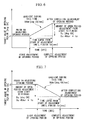
- FIG. 2 schematically shows the control of the exhaust temperature in the engine of this embodiment.
- the control sequence and function of the control unit 5 in this embodiment will be explained with reference to this figure.
- the control unit 5 regularly samples the exhaust temperature of each cylinder and the load of the engine at predetermined time intervals (t samp [seconds]), and determines the set deviation (T limit [°C]) in accordance with the load; in addition, in the control of this embodiment, the control unit 5 calculates the average exhaust temperature (T ave [°C]) of all the cylinders.
- the deviation upper limit value and deviation lower limit value in FIG. 2 respectively represent (average exhaust temperature T ave + set deviation T limit ) [°C] and (average exhaust temperature T ave -set deviation T limit ) [°C]. Even in the case where one of six cylinders departs from the range of the set deviation at a given time, as shown by the broken line in FIG. 2, according to the exhaust temperature control of this embodiment, the exhaust temperature of the cylinder is adjusted to within.the range of the set deviation (between the deviation upper limit and deviation lower limit).
- the control unit 5 performs the above calculation every 0.1 seconds. Furthermore, at a sampling set time of sixty seconds, the control unit 5 performs the above calculation every sixty seconds. In this embodiment, the sampling set time is two seconds.
- the control unit 5 measures the exhaust temperature at the cylinder exit of each cylinder, calculates the average exhaust temperature of all the cylinders, compares the average exhaust temperature with the actual exhaust temperatures at the cylinder exits of the cylinders, and determines whether the exhaust temperature of each cylinder is below the predetermined set deviation. As mentioned above, this set deviation is the plus-minus (upper limit and lower limit) deviation with respect to the average value of the exhaust temperature. Then, the control unit 5 controls the electronic fuel spray valve 1 of any cylinder where the difference between the average exhaust temperature and the actual exhaust temperature departs from the set deviation.
- the opening amount of the electronic fuel spray valve 1 is changed by using the duration rate, and the exhaust temperature of the cylinder being controlled is adjusted so as to be within the set deviation.
- the set deviation and the duration rate can be set to different values at each set load.
- FIG. 3 shows the relationship between the set load (load factor, horizontal axis) and the duration rate R dur [deg • Crank Angle/sec] (vertical axis).
- L 0 is set at 0 %, L 1 at 25 %, etc.
- the duration rate between the points of the set loads (L 0 , L 1 , ...) is set so as to link them in straight lines.
- FIG. 4 shows the relationship between the set load (load factor, horizontal axis) and the set deviation T limit (vertical axis).
- the set loads at this time can be set independently from the set loads of the duration rate.
- each point of the set loads (L 0 , L 1 , ...) is set so as to link them in straight lines.
- the permissible range for the average exhaust temperature of the cylinders becomes plus or minus 10°C, and no control is carried out as long as the difference between the actual exhaust temperature and the average exhaust temperature is within this range; control is carried out when the difference is departed from this range.
- FIG. 5 is a flowchart showing a sequence for controlling the exhaust temperature according to a control program which is written in the control unit 5.
- reference numerals S1 to S9 correspond to steps 1 to 9.
- the control sequence whereby the control unit 5 and the program written therein act in co-operation, and the control functions of the control unit 5 which are thereby realized, will be explained with reference to FIG. 5.
- step S1 the control unit 5 detects the number of rotations of the engine based on the rotation number signal 13, output by the rotation number measuring unit.
- the number of rotations of the engine is, for example, more than 950 rpm
- a control operation is carried out and the sequence proceeds to step S2.
- the number of rotations or the engine is below 950 rpm
- no control operation is carried out, and step 1 is repeated after an appropriate interval.
- the number of rotations of the engine at which control should be carried out can be set as desired from the input unit.
- step 2 the control unit 5 starts sampling the exhaust temperature. That is, based on the exhaust temperature signal 10 which was output from the exhaust temperature gauge unit 4, the control unit 5 detects the exhaust temperature of each cylinder at each predetermined sampling set time t samp [seconds].
- step 3 the control unit 5 instantly calculates the average exhaust temperature T ave [°C] from the exhaust temperatures of the cylinders, input at each sampling set time t samp [seconds].
- step 4 the control unit 5 determines the load factor of the engine from the load factor signal 12, output by the load factor measuring unit 6. Then, from this load factor, the control unit 5 calculates the set deviation T limit [°C] to determine whether to control the electronic fuel spray valve 1 based on FIG. 4, and in addition, when it has been determined to control the electronic fuel spray valve 1 based on FIG. 3, the control unit 5 calculates the duration rate R dur [deg • CA/sec] to be used.
- control unit 5 compares the average exhaust temperature T ave [°C] , which was calculated in step 3, with each (maximum of eighteen cylinder, minimum of sixteen cylinders) exhaust temperature T( n )[°C], and calculates the deviation ⁇ T n [°C] between them.
- step 5 the control unit 5 determines whether the absolute value [ ⁇ T n ] of the deviation ⁇ T n [°C] in the cylinders is greater or smaller than the set deviation T limit [°C] in the abovementioned load factor, and thereby determines whether to control the electronic fuel spray valve 1 of each cylinder.
- step 6 the control unit 5 calculates the code of the exhaust temperature deviation ⁇ T n [°C], and determines whether the present exhaust temperature T (n) [°C] of the cylinder has departed toward the high temperature side or the low temperature side. That is, when ⁇ T n > 0 (equation (1) in step 6 of FIG. 5), the exhaust temperature T (n) ⁇ the average exhaust temperature T ave , and it is determined that the present exhaust temperature T (n) [°C] of the cylinder has departed toward the low temperature side. When ⁇ T n ⁇ 0 (equation (2) in step 6 of FIG. 5), the exhaust temperature T (n) > the average exhaust temperature T ave , and it is determined that the present exhaust temperature T (n) [°C] of the cylinder has departed toward the high temperature side.
- step 6 when the exhaust temperature T (n) of the cylinder ⁇ the average exhaust temperature T ave (i.e. when ⁇ T n > 0), the present exhaust temperature of the cylinder has departed from the lower limit value toward the low temperature side, and consequently, the control unit 5 proceeds to step 7, where the exhaust temperature of the cylinder is increased. That is, the control unit 5 uses the duration rate R dur [deg • CA /sec], which is the changing speed of the opening period of the electronic fuel spray valve 1 of the cylinder and is determined in step 4, to calculate a target value for the opening period as shown in FIG. 6, applies the output signal 11 to the electronic fuel spray valve 1, and changes the opening period of the electronic fuel spray valve 1.
- Target value of opening period [degCA] D 0 + D c
- D c [degCA] R dur [degCA/sec] ⁇ tc [sec].
- step 6 when the exhaust temperature T (n) of the cylinder > the average exhaust temperature T ave (i.e. when ⁇ T n ⁇ 0), the present exhaust temperature of the cylinder has departed from the higher limit value toward the high temperature side, and consequently, the control unit 5 proceeds to step 8, where the exhaust temperature of the cylinder is decreased. That is, the control unit 5 uses the duration rate R dur [deg • CA/sec], which is the changing speed of the opening period of the electronic fuel spray valve I of the cylinder and is determined in step 4, to calculate a target value for the opening period as shown in FIG. 7, applies the output signal 11 to the electronic fuel spray valve 1, and changes the opening period of the electronic fuel spray valve 1.
- Target value of opening period [degCA] D 0 ⁇ D c
- D c [degCA] R dur [degCA/sec] ⁇ tc [sec].
- step 9 the control unit 5 detects the number of rotations of the engine in the same manner as in step 1 and, when the number of rotations of the engine is greater than, for example, 950 rpm, the control sequence returns to step 2 and repeats the procedures of steps 2 through 7, and 8.
- R dur duration rate
- variation in the exhaust temperature is generally greater when at low load, and smaller at high load.
- variation in the exhaust temperature at low load is reduced in the same way as at high load, there is a possibility that unwarranted control will diffuse the exhaust temperature (make it non-divergent).
- the set deviation and duration rate at each load may be changed so that the exhaust temperature remains within an exhaust temperature range which is appropriate for that load.
- the set deviation and duration rate tend to increase as the load decreases, and decrease and medium and high load. Since the set deviation and duration rate are independent, there is a merit that precise control appropriate for the load can be performed.
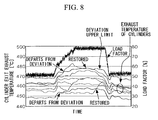
- FIG. 8 is a graph showing effects of controlling the engine according to this embodiment.
- the operational status of the engine is changed from a load factor of 50 % to one of 80 %, and the load factor is then returned to 50 %.
- the set deviation T limit [°C] is set to plus or minus 10°C from the exhaust temperature average value at the cylinder exits of all the cylinders.
- the duration rate R dur [degCA/sec] is set to 0.05 [degCA/sec] at a load factor of between 50 % and 80%.
- FIG. 8 there is a cylinder having an exhaust temperature which has departed from the deviation upper limit and deviation lower limit of the set deviation at the point where the load factor is approximately 65%.
- the exhaust temperature would not be restored and the cylinders would operate with unbalanced exhaust temperatures; however, due to the effect of the control, as shown in FIG. 8, the exhaust temperature is thereafter restored to within its normal range.
- the control even in circumstances where there is a possibility of variation in the exhaust temperatures, the variation can be automatically corrected, and as a result, knocking and misfire caused by an unbalance in the exhaust temperatures of the cylinders can be prevented.
- the engine used in the embodiment described above has a cylinder diameter of 220 mm and six cylinders, but the present invention can achieve similar effects even when the cylinder diameter and number of cylinders are changed. Furthermore, although the duration rate and the set deviation are divided into a total of eight loads, this number can be increased or decreased as necessary.
- this embodiment relates to a gas engine, it can be applied in any other type of gas engine in which the opening period of an electronic fuel spray valve is adjusted in order to control the exhaust temperature.
Landscapes
- Engineering & Computer Science (AREA)
- Chemical & Material Sciences (AREA)
- Combustion & Propulsion (AREA)
- Mechanical Engineering (AREA)
- General Engineering & Computer Science (AREA)
- Electrical Control Of Air Or Fuel Supplied To Internal-Combustion Engine (AREA)
- Combined Controls Of Internal Combustion Engines (AREA)
- Exhaust Gas After Treatment (AREA)
- Output Control And Ontrol Of Special Type Engine (AREA)
Abstract
Description
Claims (5)
- An engine comprising: a plurality of cylinders, and a plurality of electronic fuel spray valves which supply fuel and are provided in correspondence with these cylinders; wherein the engine having an exhaust temperature measuring unit which measures the exhaust temperatures of said cylinders, and outputs exhaust temperature signals for each of said cylinders; and a control unit which samples the exhaust temperature signals from the exhaust temperature measuring unit at predetermined time intervals, calculates an average exhaust temperature of all the plurality of cylinders, and, in the case where deviation, determined by comparing this average exhaust temperature with the exhaust temperatures of the cylinders, exceeds a predetermined set deviation, controls the opening period of the electronic fuel spray valve of the corresponding cylinder by a predetermined amount of control.
- An exhaust temperature control apparatus of an engine for supplying fuel via an electronic fuel spray valve to a plurality of cylinders, comprising: an exhaust temperature measuring unit which measures the exhaust temperatures of said cylinders, and outputs exhaust temperature signals for each of said cylinders; and a control unit which samples the exhaust temperature signals from the exhaust temperature measuring unit at predetermined time intervals, calculates an average exhaust temperature of all the plurality of cylinders, and, in the case where deviation, determined by comparing this average exhaust temperature with the exhaust temperatures of the cylinders, exceeds a predetermined set deviation, controls the opening period of the electronic fuel spray valve of the corresponding cylinder by a predetermined amount of control.
- An exhaust temperature control apparatus of an engine comprising a plurality of cylinders which fuel is supplied to via electronic fuel spray valves, comprising: an exhaust temperature measuring unit which measures the exhaust temperatures of said cylinders, and outputs exhaust temperature signals for each of said cylinders; a load factor measuring unit which detects the load factor of said engine and outputs a load signal; and a control unit which sets a set deviation and control amount in accordance with the load factor of said engine, determines the present load factor of said engine based on the load signal from said load factor measuring unit, samples the exhaust temperature signals from the exhaust temperature measuring unit at predetermined time intervals, calculates an average exhaust temperature of all the plurality of cylinders, and, in the case where deviation, determined by comparing this average exhaust temperature with the exhaust temperatures of the cylinders, exceeds the set deviation in the present load factor, controls the opening period of the electronic fuel spray valve of the corresponding cylinder by a control amount corresponding to the present load factor.
- An exhaust temperature control method of an engine having a plurality of cylinders in which fuel is supplied to from a plurality of electronic fuel spray valves, comprising the steps of: measuring the exhaust temperatures of said cylinders at predetermined time intervals and outputting exhaust temperature signals for each of said cylinders; calculating an average exhaust temperature of all the plurality of cylinders, and; in the case where deviation, determined by comparing this average exhaust temperature with the exhaust temperatures of the cylinders, exceeds a predetermined set deviation, controlling the opening period of the electronic fuel spray valve of the corresponding cylinder by a predetermined amount of control.
- An engine comprising: a plurality of cylinders, a plurality of electronic fuel spray valves which are provided in correspondence with these cylinders and opening period thereof can be controlled by control signals, exhaust temperature measuring units which are provided in correspondence with said plurality of cylinders and output the exhaust temperatures of said cylinders as exhaust temperature signals, and a load factor measuring unit which detects the load factor of the engine and outputs a load signal; wherein a computer which controls said engine being used as a control unit, which sets a set deviation and control amount in accordance with the load factor of said engine, determines the present load factor of said engine based on the load signal from said load factor measuring unit, samples the exhaust temperature signals from the exhaust temperature measuring unit at predetermined time intervals, calculates an average exhaust temperature of all the plurality of cylinders, and, in the case where deviation, determined by comparing this average exhaust temperature with the exhaust temperatures of the cylinders, exceeds the set deviation in the present load factor, controls the opening period of the electronic fuel spray valve of the corresponding cylinder by a control amount corresponding to the present load factor.
Applications Claiming Priority (3)
| Application Number | Priority Date | Filing Date | Title |
|---|---|---|---|
| JP2001259848 | 2001-08-29 | ||
| JP2001259848 | 2001-08-29 | ||
| PCT/JP2002/008728 WO2003018981A1 (en) | 2001-08-29 | 2002-08-29 | Engine, engine exhaust temperature controlling device and controlling method |
Publications (3)
| Publication Number | Publication Date |
|---|---|
| EP1422407A1 true EP1422407A1 (en) | 2004-05-26 |
| EP1422407A4 EP1422407A4 (en) | 2009-10-28 |
| EP1422407B1 EP1422407B1 (en) | 2012-02-22 |
Family
ID=19087159
Family Applications (1)
| Application Number | Title | Priority Date | Filing Date |
|---|---|---|---|
| EP02770173A Expired - Lifetime EP1422407B1 (en) | 2001-08-29 | 2002-08-29 | Engine, engine exhaust temperature controlling device and controlling method |
Country Status (9)
| Country | Link |
|---|---|
| US (1) | US7066164B2 (en) |
| EP (1) | EP1422407B1 (en) |
| KR (1) | KR20040029304A (en) |
| CN (1) | CN1296615C (en) |
| AT (1) | ATE546628T1 (en) |
| DK (1) | DK1422407T3 (en) |
| ES (1) | ES2382149T3 (en) |
| NO (1) | NO337273B1 (en) |
| WO (1) | WO2003018981A1 (en) |
Families Citing this family (43)
| Publication number | Priority date | Publication date | Assignee | Title |
|---|---|---|---|---|
| JP4037379B2 (en) * | 2004-03-29 | 2008-01-23 | 本田技研工業株式会社 | Fuel supply control device for internal combustion engine |
| US10158337B2 (en) | 2004-08-10 | 2018-12-18 | Bongiovi Acoustics Llc | System and method for digital signal processing |
| US8284955B2 (en) | 2006-02-07 | 2012-10-09 | Bongiovi Acoustics Llc | System and method for digital signal processing |
| US7433777B2 (en) * | 2004-11-25 | 2008-10-07 | Hitachi Construction Machinery Co., Ltd. | Engine protection system and method for construction machine |
| US9615189B2 (en) | 2014-08-08 | 2017-04-04 | Bongiovi Acoustics Llc | Artificial ear apparatus and associated methods for generating a head related audio transfer function |
| US10701505B2 (en) | 2006-02-07 | 2020-06-30 | Bongiovi Acoustics Llc. | System, method, and apparatus for generating and digitally processing a head related audio transfer function |
| US10069471B2 (en) | 2006-02-07 | 2018-09-04 | Bongiovi Acoustics Llc | System and method for digital signal processing |
| US10848867B2 (en) | 2006-02-07 | 2020-11-24 | Bongiovi Acoustics Llc | System and method for digital signal processing |
| US7555411B2 (en) * | 2007-01-31 | 2009-06-30 | Gm Global Technology Operations, Inc. | Method and apparatus to monitor a temperature sensing device |
| FI122489B (en) * | 2008-05-26 | 2012-02-15 | Waertsilae Finland Oy | Method and apparatus for stabilizing the diesel engine cylinders |
| JP4772846B2 (en) | 2008-10-01 | 2011-09-14 | 川崎重工業株式会社 | Gas engine knocking control device |
| JP4688916B2 (en) * | 2008-10-01 | 2011-05-25 | 川崎重工業株式会社 | Gas engine control device |
| DE102010001090A1 (en) * | 2010-01-21 | 2011-07-28 | Robert Bosch GmbH, 70469 | Method for operating an internal combustion engine and corresponding device |
| WO2012012511A1 (en) * | 2010-07-20 | 2012-01-26 | Vos David W | System and method for control of internal combustion engine |
| GB2487945A (en) * | 2011-02-10 | 2012-08-15 | Jaguar Cars | Motor Vehicle Shutdown Control |
| US10086694B2 (en) | 2011-09-16 | 2018-10-02 | Gaseous Fuel Systems, Corp. | Modification of an industrial vehicle to include a containment area and mounting assembly for an alternate fuel |
| US9883318B2 (en) | 2013-06-12 | 2018-01-30 | Bongiovi Acoustics Llc | System and method for stereo field enhancement in two-channel audio systems |
| US9264004B2 (en) | 2013-06-12 | 2016-02-16 | Bongiovi Acoustics Llc | System and method for narrow bandwidth digital signal processing |
| US9845744B2 (en) | 2013-07-22 | 2017-12-19 | Gaseous Fuel Systems, Corp. | Fuel mixture system and assembly |
| US9906858B2 (en) | 2013-10-22 | 2018-02-27 | Bongiovi Acoustics Llc | System and method for digital signal processing |
| US10820883B2 (en) | 2014-04-16 | 2020-11-03 | Bongiovi Acoustics Llc | Noise reduction assembly for auscultation of a body |
| US9615813B2 (en) | 2014-04-16 | 2017-04-11 | Bongiovi Acoustics Llc. | Device for wide-band auscultation |
| US10639000B2 (en) | 2014-04-16 | 2020-05-05 | Bongiovi Acoustics Llc | Device for wide-band auscultation |
| US9931929B2 (en) | 2014-10-22 | 2018-04-03 | Jason Green | Modification of an industrial vehicle to include a hybrid fuel assembly and system |
| US20160115881A1 (en) * | 2014-10-22 | 2016-04-28 | Jason Green | Fuel mixture control system |
| US11136932B2 (en) * | 2014-12-17 | 2021-10-05 | Cummins Inc. | Charge-flow adjustment in closed-loop exhaust temperature control on dual fuel engines |
| US9885318B2 (en) | 2015-01-07 | 2018-02-06 | Jason E Green | Mixing assembly |
| US9638672B2 (en) | 2015-03-06 | 2017-05-02 | Bongiovi Acoustics Llc | System and method for acquiring acoustic information from a resonating body |
| CN106481468B (en) * | 2015-08-27 | 2019-07-05 | 长城汽车股份有限公司 | Control method, system and the vehicle of engine |
| JP2018537910A (en) | 2015-11-16 | 2018-12-20 | ボンジョビ アコースティックス リミテッド ライアビリティー カンパニー | Surface acoustic transducer |
| US9621994B1 (en) | 2015-11-16 | 2017-04-11 | Bongiovi Acoustics Llc | Surface acoustic transducer |
| KR102110626B1 (en) * | 2015-12-18 | 2020-05-14 | 한국조선해양 주식회사 | Low load operation system of dual fuel engine and low load operation using the same method |
| CN106194453A (en) * | 2016-08-29 | 2016-12-07 | 重庆红江机械有限责任公司 | The micro-spray of diesel oil is ignited natural gas formula double fuel machine control system and method |
| JP2021521700A (en) | 2018-04-11 | 2021-08-26 | ボンジョビ アコースティックス リミテッド ライアビリティー カンパニー | Audio Enhanced Hearing Protection System |
| WO2020028833A1 (en) | 2018-08-02 | 2020-02-06 | Bongiovi Acoustics Llc | System, method, and apparatus for generating and digitally processing a head related audio transfer function |
| CN109162820A (en) * | 2018-09-06 | 2019-01-08 | 广西玉柴机器股份有限公司 | Cylinder arranges warm update the system |
| CN109306914B (en) * | 2018-09-26 | 2022-06-28 | 潍柴动力股份有限公司 | A method and device for controlling a large-bore engine |
| CN109307553B (en) * | 2018-09-27 | 2020-10-09 | 潍柴重机股份有限公司 | Main bearing maintenance prompting method based on main bearing temperature deviation |
| CN111997771A (en) * | 2020-08-27 | 2020-11-27 | 重庆潍柴发动机有限公司 | Single-cylinder power automatic correction method of multi-point injection electronic control engine |
| CN112709649A (en) * | 2020-12-29 | 2021-04-27 | 东台市建东机械制造有限公司 | Method for correcting fuel injection quantity deviation of diesel engine |
| JP7457663B2 (en) | 2021-02-12 | 2024-03-28 | 三菱重工エンジン&ターボチャージャ株式会社 | Engine control device, engine control method and program |
| CN113074045B (en) * | 2021-04-22 | 2022-04-29 | 东风柳州汽车有限公司 | Engine misfire diagnosis method, engine misfire diagnosis device, engine misfire diagnosis equipment and storage medium |
| CN114458467B (en) * | 2021-12-24 | 2023-05-19 | 中联重科土方机械有限公司 | Control method, device, system, engineering machinery vehicle and machine-readable storage medium |
Family Cites Families (12)
| Publication number | Priority date | Publication date | Assignee | Title |
|---|---|---|---|---|
| DE2144395A1 (en) * | 1971-06-11 | 1973-03-08 | Volkswagenwerk Ag | COMBUSTION MACHINE WITH AT LEAST ONE EXHAUST GAS PURIFICATION ARRANGEMENT |
| DE2330258A1 (en) * | 1973-06-14 | 1975-01-09 | Bosch Gmbh Robert | DEVICE FOR EXHAUST GAS DETOXIFICATION FROM COMBUSTION MACHINERY |
| JPS62186037A (en) * | 1986-02-10 | 1987-08-14 | Toyota Motor Corp | Fuel injector for internal combustion engine |
| DD249941A1 (en) * | 1986-06-13 | 1987-09-23 | Zwickau Ing Hochschule | METHOD FOR REGULATING THE CYLINDER LOAD DISTRIBUTION IN INTERNAL COMBUSTION ENGINES |
| DE3914264C1 (en) * | 1989-04-29 | 1990-09-13 | Daimler-Benz Aktiengesellschaft, 7000 Stuttgart, De | |
| DE4415994A1 (en) * | 1994-05-06 | 1995-11-09 | Bosch Gmbh Robert | Control system for an internal combustion engine |
| JPH10110640A (en) * | 1996-10-04 | 1998-04-28 | Niigata Eng Co Ltd | Combustion balance control device and method between cylinders |
| US6000384A (en) * | 1998-03-06 | 1999-12-14 | Caterpillar Inc. | Method for balancing the air/fuel ratio to each cylinder of an engine |
| DE19955252C2 (en) * | 1999-11-17 | 2002-11-07 | Daimler Chrysler Ag | Method and device for regulating the fuel / air ratio of an Otto engine |
| US6382198B1 (en) * | 2000-02-04 | 2002-05-07 | Delphi Technologies, Inc. | Individual cylinder air/fuel ratio control based on a single exhaust gas sensor |
| US6314952B1 (en) * | 2000-03-23 | 2001-11-13 | General Motors Corporation | Individual cylinder fuel control method |
| DE10062895A1 (en) * | 2000-12-16 | 2002-06-27 | Bosch Gmbh Robert | Method and device for controlling an internal combustion engine |
-
2002
- 2002-08-29 CN CNB028028155A patent/CN1296615C/en not_active Expired - Lifetime
- 2002-08-29 KR KR10-2003-7005907A patent/KR20040029304A/en not_active Ceased
- 2002-08-29 WO PCT/JP2002/008728 patent/WO2003018981A1/en not_active Ceased
- 2002-08-29 DK DK02770173.9T patent/DK1422407T3/en active
- 2002-08-29 US US10/415,047 patent/US7066164B2/en not_active Expired - Lifetime
- 2002-08-29 AT AT02770173T patent/ATE546628T1/en active
- 2002-08-29 EP EP02770173A patent/EP1422407B1/en not_active Expired - Lifetime
- 2002-08-29 ES ES02770173T patent/ES2382149T3/en not_active Expired - Lifetime
-
2003
- 2003-04-25 NO NO20031883A patent/NO337273B1/en not_active IP Right Cessation
Also Published As
| Publication number | Publication date |
|---|---|
| EP1422407A4 (en) | 2009-10-28 |
| NO20031883L (en) | 2003-04-25 |
| US20040003805A1 (en) | 2004-01-08 |
| KR20040029304A (en) | 2004-04-06 |
| ATE546628T1 (en) | 2012-03-15 |
| US7066164B2 (en) | 2006-06-27 |
| ES2382149T3 (en) | 2012-06-05 |
| DK1422407T3 (en) | 2012-06-18 |
| NO337273B1 (en) | 2016-02-29 |
| EP1422407B1 (en) | 2012-02-22 |
| WO2003018981A1 (en) | 2003-03-06 |
| CN1473238A (en) | 2004-02-04 |
| NO20031883D0 (en) | 2003-04-25 |
| CN1296615C (en) | 2007-01-24 |
Similar Documents
| Publication | Publication Date | Title |
|---|---|---|
| EP1422407A1 (en) | ENGINE, ENGINE EXHAUST TEMPERATURE CONTROLLING DEVICE AND CONTROLLING METHOD | |
| US6564774B2 (en) | Feedforward engine control governing system | |
| US5212943A (en) | Reduced thermal stress turbine starting strategy | |
| JP5650929B2 (en) | System and method for correcting gas turbine performance | |
| US7707814B2 (en) | Fuel-flow-rate control device for power generation system | |
| AU2002322000A1 (en) | Feedforward engine control governing system | |
| JPH09505653A (en) | Device and method for metering fuel supply to combustion equipment operated with more than one type of fuel | |
| EP0728919B1 (en) | The fuel supply for a gas turbine regulated in accordance with a synthesized turbine outlet temperature | |
| US20190195133A1 (en) | Method and system for turbine engine temperature regulation | |
| EP1017930A1 (en) | Method and device for determining temperature values in a combustion engine | |
| JP4094380B2 (en) | Engine, engine exhaust temperature control device and control method, and program for causing computer to function as engine exhaust temperature control means | |
| EP1017929B1 (en) | Method and device for controlling a combustion engine | |
| JPH10110640A (en) | Combustion balance control device and method between cylinders | |
| US4506504A (en) | Electronic fuel control system for gas turbine | |
| US7698897B2 (en) | Engine control | |
| JP4335840B2 (en) | Fuel control device and control method for diesel engine for power generation | |
| JPH02267328A (en) | Controller of gas turbine engine and controlling method | |
| SU1636580A1 (en) | Method of control of internal combustion engine | |
| JPH10184462A (en) | Device and method for controlling pressure of pilot gas | |
| US11359557B2 (en) | Method and system for load control in an internal combustion engine | |
| KR20100055387A (en) | Method and device for controlling an internal combustion engine | |
| US20250122846A1 (en) | Engine data processor, internal combustion engine and computer implemented method for setting a powershift reserve | |
| JP3627890B2 (en) | Fuel injection control device for internal combustion engine | |
| JP2005504212A (en) | Internal combustion engine control method and internal combustion engine control apparatus | |
| JP3468921B2 (en) | Turbine generator frequency control device |
Legal Events
| Date | Code | Title | Description |
|---|---|---|---|
| PUAI | Public reference made under article 153(3) epc to a published international application that has entered the european phase |
Free format text: ORIGINAL CODE: 0009012 |
|
| 17P | Request for examination filed |
Effective date: 20030424 |
|
| AK | Designated contracting states |
Kind code of ref document: A1 Designated state(s): AT BE BG CH CY CZ DE DK EE ES FI FR GB GR IE IT LI LU MC NL PT SE SK TR |
|
| A4 | Supplementary search report drawn up and despatched |
Effective date: 20090930 |
|
| 17Q | First examination report despatched |
Effective date: 20100406 |
|
| REG | Reference to a national code |
Ref country code: DE Ref legal event code: R079 Ref document number: 60242269 Country of ref document: DE Free format text: PREVIOUS MAIN CLASS: F02D0019020000 Ipc: F02D0041020000 |
|
| RIC1 | Information provided on ipc code assigned before grant |
Ipc: F02D 41/00 20060101ALI20110908BHEP Ipc: F02D 19/02 20060101ALI20110908BHEP Ipc: F02D 41/14 20060101ALI20110908BHEP Ipc: F02D 41/02 20060101AFI20110908BHEP Ipc: F02D 41/40 20060101ALI20110908BHEP |
|
| GRAP | Despatch of communication of intention to grant a patent |
Free format text: ORIGINAL CODE: EPIDOSNIGR1 |
|
| RTI1 | Title (correction) |
Free format text: ENGINE, ENGINE EXHAUST TEMPERATURE CONTROLLING DEVICE AND CONTROLLING METHOD |
|
| GRAS | Grant fee paid |
Free format text: ORIGINAL CODE: EPIDOSNIGR3 |
|
| GRAA | (expected) grant |
Free format text: ORIGINAL CODE: 0009210 |
|
| RIN1 | Information on inventor provided before grant (corrected) |
Inventor name: GOTO, SATORU,C/O NIIGATA POWER SYSTEMS CO., LTD. Inventor name: ONO, YOSHIHARU, Inventor name: NAKAYAMA, SADAO,C/O NIIGATA POWER SYSTEMS CO., LTD Inventor name: NISHI, YOSHIFUMI,C/O NIIGATA POWER SYSTEMS CO., LT |
|
| AK | Designated contracting states |
Kind code of ref document: B1 Designated state(s): AT BE BG CH CY CZ DE DK EE ES FI FR GB GR IE IT LI LU MC NL PT SE SK TR |
|
| REG | Reference to a national code |
Ref country code: GB Ref legal event code: FG4D |
|
| REG | Reference to a national code |
Ref country code: CH Ref legal event code: EP |
|
| REG | Reference to a national code |
Ref country code: AT Ref legal event code: REF Ref document number: 546628 Country of ref document: AT Kind code of ref document: T Effective date: 20120315 |
|
| REG | Reference to a national code |
Ref country code: IE Ref legal event code: FG4D |
|
| REG | Reference to a national code |
Ref country code: DE Ref legal event code: R096 Ref document number: 60242269 Country of ref document: DE Effective date: 20120419 |
|
| REG | Reference to a national code |
Ref country code: CH Ref legal event code: NV Representative=s name: ISLER & PEDRAZZINI AG |
|
| REG | Reference to a national code |
Ref country code: NL Ref legal event code: T3 |
|
| REG | Reference to a national code |
Ref country code: ES Ref legal event code: FG2A Ref document number: 2382149 Country of ref document: ES Kind code of ref document: T3 Effective date: 20120605 |
|
| REG | Reference to a national code |
Ref country code: DK Ref legal event code: T3 |
|
| PG25 | Lapsed in a contracting state [announced via postgrant information from national office to epo] |
Ref country code: GR Free format text: LAPSE BECAUSE OF FAILURE TO SUBMIT A TRANSLATION OF THE DESCRIPTION OR TO PAY THE FEE WITHIN THE PRESCRIBED TIME-LIMIT Effective date: 20120523 Ref country code: BE Free format text: LAPSE BECAUSE OF FAILURE TO SUBMIT A TRANSLATION OF THE DESCRIPTION OR TO PAY THE FEE WITHIN THE PRESCRIBED TIME-LIMIT Effective date: 20120222 Ref country code: PT Free format text: LAPSE BECAUSE OF FAILURE TO SUBMIT A TRANSLATION OF THE DESCRIPTION OR TO PAY THE FEE WITHIN THE PRESCRIBED TIME-LIMIT Effective date: 20120622 |
|
| PG25 | Lapsed in a contracting state [announced via postgrant information from national office to epo] |
Ref country code: CY Free format text: LAPSE BECAUSE OF FAILURE TO SUBMIT A TRANSLATION OF THE DESCRIPTION OR TO PAY THE FEE WITHIN THE PRESCRIBED TIME-LIMIT Effective date: 20120222 |
|
| PG25 | Lapsed in a contracting state [announced via postgrant information from national office to epo] |
Ref country code: CZ Free format text: LAPSE BECAUSE OF FAILURE TO SUBMIT A TRANSLATION OF THE DESCRIPTION OR TO PAY THE FEE WITHIN THE PRESCRIBED TIME-LIMIT Effective date: 20120222 Ref country code: EE Free format text: LAPSE BECAUSE OF FAILURE TO SUBMIT A TRANSLATION OF THE DESCRIPTION OR TO PAY THE FEE WITHIN THE PRESCRIBED TIME-LIMIT Effective date: 20120222 Ref country code: SE Free format text: LAPSE BECAUSE OF FAILURE TO SUBMIT A TRANSLATION OF THE DESCRIPTION OR TO PAY THE FEE WITHIN THE PRESCRIBED TIME-LIMIT Effective date: 20120222 |
|
| PG25 | Lapsed in a contracting state [announced via postgrant information from national office to epo] |
Ref country code: SK Free format text: LAPSE BECAUSE OF FAILURE TO SUBMIT A TRANSLATION OF THE DESCRIPTION OR TO PAY THE FEE WITHIN THE PRESCRIBED TIME-LIMIT Effective date: 20120222 |
|
| PLBE | No opposition filed within time limit |
Free format text: ORIGINAL CODE: 0009261 |
|
| STAA | Information on the status of an ep patent application or granted ep patent |
Free format text: STATUS: NO OPPOSITION FILED WITHIN TIME LIMIT |
|
| 26N | No opposition filed |
Effective date: 20121123 |
|
| REG | Reference to a national code |
Ref country code: DE Ref legal event code: R097 Ref document number: 60242269 Country of ref document: DE Effective date: 20121123 |
|
| PG25 | Lapsed in a contracting state [announced via postgrant information from national office to epo] |
Ref country code: MC Free format text: LAPSE BECAUSE OF NON-PAYMENT OF DUE FEES Effective date: 20120831 |
|
| REG | Reference to a national code |
Ref country code: IE Ref legal event code: MM4A |
|
| PG25 | Lapsed in a contracting state [announced via postgrant information from national office to epo] |
Ref country code: BG Free format text: LAPSE BECAUSE OF FAILURE TO SUBMIT A TRANSLATION OF THE DESCRIPTION OR TO PAY THE FEE WITHIN THE PRESCRIBED TIME-LIMIT Effective date: 20120522 Ref country code: IE Free format text: LAPSE BECAUSE OF NON-PAYMENT OF DUE FEES Effective date: 20120829 |
|
| PG25 | Lapsed in a contracting state [announced via postgrant information from national office to epo] |
Ref country code: TR Free format text: LAPSE BECAUSE OF FAILURE TO SUBMIT A TRANSLATION OF THE DESCRIPTION OR TO PAY THE FEE WITHIN THE PRESCRIBED TIME-LIMIT Effective date: 20120222 |
|
| PG25 | Lapsed in a contracting state [announced via postgrant information from national office to epo] |
Ref country code: LU Free format text: LAPSE BECAUSE OF NON-PAYMENT OF DUE FEES Effective date: 20120829 |
|
| REG | Reference to a national code |
Ref country code: FR Ref legal event code: PLFP Year of fee payment: 14 |
|
| REG | Reference to a national code |
Ref country code: FR Ref legal event code: PLFP Year of fee payment: 15 |
|
| REG | Reference to a national code |
Ref country code: FR Ref legal event code: PLFP Year of fee payment: 16 |
|
| REG | Reference to a national code |
Ref country code: FR Ref legal event code: PLFP Year of fee payment: 17 |
|
| PGFP | Annual fee paid to national office [announced via postgrant information from national office to epo] |
Ref country code: NL Payment date: 20210715 Year of fee payment: 20 |
|
| PGFP | Annual fee paid to national office [announced via postgrant information from national office to epo] |
Ref country code: AT Payment date: 20210721 Year of fee payment: 20 Ref country code: FI Payment date: 20210721 Year of fee payment: 20 Ref country code: FR Payment date: 20210729 Year of fee payment: 20 Ref country code: IT Payment date: 20210816 Year of fee payment: 20 |
|
| PGFP | Annual fee paid to national office [announced via postgrant information from national office to epo] |
Ref country code: GB Payment date: 20210819 Year of fee payment: 20 Ref country code: ES Payment date: 20210903 Year of fee payment: 20 Ref country code: DK Payment date: 20210726 Year of fee payment: 20 Ref country code: CH Payment date: 20210824 Year of fee payment: 20 Ref country code: DE Payment date: 20210811 Year of fee payment: 20 |
|
| REG | Reference to a national code |
Ref country code: DE Ref legal event code: R071 Ref document number: 60242269 Country of ref document: DE |
|
| REG | Reference to a national code |
Ref country code: CH Ref legal event code: PL Ref country code: NL Ref legal event code: MK Effective date: 20220828 |
|
| REG | Reference to a national code |
Ref country code: ES Ref legal event code: FD2A Effective date: 20220905 Ref country code: DK Ref legal event code: EUP Expiry date: 20220829 |
|
| REG | Reference to a national code |
Ref country code: GB Ref legal event code: PE20 Expiry date: 20220828 |
|
| REG | Reference to a national code |
Ref country code: FI Ref legal event code: MAE |
|
| REG | Reference to a national code |
Ref country code: AT Ref legal event code: MK07 Ref document number: 546628 Country of ref document: AT Kind code of ref document: T Effective date: 20220829 |
|
| PG25 | Lapsed in a contracting state [announced via postgrant information from national office to epo] |
Ref country code: GB Free format text: LAPSE BECAUSE OF EXPIRATION OF PROTECTION Effective date: 20220828 Ref country code: ES Free format text: LAPSE BECAUSE OF EXPIRATION OF PROTECTION Effective date: 20220830 |