EP1416059A1 - Base material for clad steel plate excellent in low-temperature toughness at weld heat-affected zone and method for producing the clad steel plate - Google Patents
Base material for clad steel plate excellent in low-temperature toughness at weld heat-affected zone and method for producing the clad steel plate Download PDFInfo
- Publication number
- EP1416059A1 EP1416059A1 EP20030024753 EP03024753A EP1416059A1 EP 1416059 A1 EP1416059 A1 EP 1416059A1 EP 20030024753 EP20030024753 EP 20030024753 EP 03024753 A EP03024753 A EP 03024753A EP 1416059 A1 EP1416059 A1 EP 1416059A1
- Authority
- EP
- European Patent Office
- Prior art keywords
- mass
- base material
- steel plate
- content
- clad steel
- Prior art date
- Legal status (The legal status is an assumption and is not a legal conclusion. Google has not performed a legal analysis and makes no representation as to the accuracy of the status listed.)
- Granted
Links
Images


Classifications
-
- B—PERFORMING OPERATIONS; TRANSPORTING
- B32—LAYERED PRODUCTS
- B32B—LAYERED PRODUCTS, i.e. PRODUCTS BUILT-UP OF STRATA OF FLAT OR NON-FLAT, e.g. CELLULAR OR HONEYCOMB, FORM
- B32B15/00—Layered products comprising a layer of metal
- B32B15/01—Layered products comprising a layer of metal all layers being exclusively metallic
- B32B15/011—Layered products comprising a layer of metal all layers being exclusively metallic all layers being formed of iron alloys or steels
-
- C—CHEMISTRY; METALLURGY
- C22—METALLURGY; FERROUS OR NON-FERROUS ALLOYS; TREATMENT OF ALLOYS OR NON-FERROUS METALS
- C22C—ALLOYS
- C22C38/00—Ferrous alloys, e.g. steel alloys
- C22C38/002—Ferrous alloys, e.g. steel alloys containing In, Mg, or other elements not provided for in one single group C22C38/001 - C22C38/60
-
- C—CHEMISTRY; METALLURGY
- C22—METALLURGY; FERROUS OR NON-FERROUS ALLOYS; TREATMENT OF ALLOYS OR NON-FERROUS METALS
- C22C—ALLOYS
- C22C38/00—Ferrous alloys, e.g. steel alloys
- C22C38/02—Ferrous alloys, e.g. steel alloys containing silicon
-
- C—CHEMISTRY; METALLURGY
- C22—METALLURGY; FERROUS OR NON-FERROUS ALLOYS; TREATMENT OF ALLOYS OR NON-FERROUS METALS
- C22C—ALLOYS
- C22C38/00—Ferrous alloys, e.g. steel alloys
- C22C38/04—Ferrous alloys, e.g. steel alloys containing manganese
-
- C—CHEMISTRY; METALLURGY
- C22—METALLURGY; FERROUS OR NON-FERROUS ALLOYS; TREATMENT OF ALLOYS OR NON-FERROUS METALS
- C22C—ALLOYS
- C22C38/00—Ferrous alloys, e.g. steel alloys
- C22C38/18—Ferrous alloys, e.g. steel alloys containing chromium
- C22C38/40—Ferrous alloys, e.g. steel alloys containing chromium with nickel
- C22C38/42—Ferrous alloys, e.g. steel alloys containing chromium with nickel with copper
-
- C—CHEMISTRY; METALLURGY
- C22—METALLURGY; FERROUS OR NON-FERROUS ALLOYS; TREATMENT OF ALLOYS OR NON-FERROUS METALS
- C22C—ALLOYS
- C22C38/00—Ferrous alloys, e.g. steel alloys
- C22C38/18—Ferrous alloys, e.g. steel alloys containing chromium
- C22C38/40—Ferrous alloys, e.g. steel alloys containing chromium with nickel
- C22C38/44—Ferrous alloys, e.g. steel alloys containing chromium with nickel with molybdenum or tungsten
-
- C—CHEMISTRY; METALLURGY
- C22—METALLURGY; FERROUS OR NON-FERROUS ALLOYS; TREATMENT OF ALLOYS OR NON-FERROUS METALS
- C22C—ALLOYS
- C22C38/00—Ferrous alloys, e.g. steel alloys
- C22C38/18—Ferrous alloys, e.g. steel alloys containing chromium
- C22C38/40—Ferrous alloys, e.g. steel alloys containing chromium with nickel
- C22C38/46—Ferrous alloys, e.g. steel alloys containing chromium with nickel with vanadium
-
- C—CHEMISTRY; METALLURGY
- C22—METALLURGY; FERROUS OR NON-FERROUS ALLOYS; TREATMENT OF ALLOYS OR NON-FERROUS METALS
- C22C—ALLOYS
- C22C38/00—Ferrous alloys, e.g. steel alloys
- C22C38/18—Ferrous alloys, e.g. steel alloys containing chromium
- C22C38/40—Ferrous alloys, e.g. steel alloys containing chromium with nickel
- C22C38/48—Ferrous alloys, e.g. steel alloys containing chromium with nickel with niobium or tantalum
-
- C—CHEMISTRY; METALLURGY
- C22—METALLURGY; FERROUS OR NON-FERROUS ALLOYS; TREATMENT OF ALLOYS OR NON-FERROUS METALS
- C22C—ALLOYS
- C22C38/00—Ferrous alloys, e.g. steel alloys
- C22C38/18—Ferrous alloys, e.g. steel alloys containing chromium
- C22C38/40—Ferrous alloys, e.g. steel alloys containing chromium with nickel
- C22C38/50—Ferrous alloys, e.g. steel alloys containing chromium with nickel with titanium or zirconium
Definitions
- the present invention relates to a base material for a clad steel plate used in a natural gas pipeline or the like and produced by quenching and tempering (hereinafter referred to as QT), and a method for producing the clad steel plate.
- QT quenching and tempering
- the purpose of use of a clad steel plate varies according to a cladding material used in the clad steel plate.
- the method for producing the clad steel plate also varies according to the cladding material.
- a material equivalent to APIX65 containing C, Si and Mn as main components, and Nb, V, Ca, Al and Mo as additive components or a minute amount of Ti, B, etc. added as alloy components has been used as a base material for the clad steel plate used in a natural gas pipeline or the like.
- This steel is produced by predetermined quenching and tempering (QT), controlled rolling by means of a converter , Thermo-mechanical Controlled Process (TMCP), or the like.
- Patent Document 1 Ti, N, Nb, V and B are added to C, Si, Mn and Al to precipitate minute TiN in steel to thereby reduce the size of austenite grains in the HAZ to improve toughness.
- JP-B-55-26164 (claims, etc.) has also described a method including the steps of: heating the steel at 1250°C to 1400°C; and re-heating the steel under a pressure or at a temperature of not higher than 1150°C.
- JP-A-2001-226739 (paragraphs 0011, 0012, etc.) has described amethod for controlling the number of inclusion grains or the like to suppress increase in size of austenite grains exposed to a high temperature for a long time to thereby improve HAZ toughness.
- the base material exhibits 20 kg ⁇ m Charpy impact energy at 0°C (vE 0°C)
- the fracture appearance transition temperature (hereinafter referred to as FATT) of the base material is about -50°C
- the HAZ exhibits 20 kg ⁇ m of Charpy impact energy at 0°C (vE 0°C) in multi-layer cladding by welding.
- Almost of TiN is however dissolved as solid solution in a neighborhood of the boundary (hereinafter welded bond portion) between the base material and weldmetal heated to the ultimate temperature higher than 1400°C in the HAZ. Accordingly, there is a problem that the toughness improving effect is reduced in the base material component system.
- JP-A-2001-226739 The method disclosed in JP-A-2001-226739 is multi-layer cladding by welding.
- the toughness of the HAZ is 100 to 200 (J) of Charpy impact energy at - 40°C (vE -40°C). It is however difficult to control the minute inclusions in a general steel-making process. This causes increase in cost particularly in melting in an electric furnace.
- the invention is developed upon such circumstances and an object of the invention is to provide a base material for clad steel plate excellent in low-temperature toughness both in the base material requiring low-temperature toughness and in a heat-affected zone due to one-pass welding, and a method for producing the clad steel plate.
- the base material is preferably selected to be not thicker than 50 mm.
- Another object of the invention is to provide a clad steel plate which satisfies the following performance by composite addition of alloy elements.
- the grain size is reduced hyperfinely to be in a range of from about 10 to about 12 in terms of mean crystal gain size to improve the low-temperature toughness of the base material.
- the number of grain size is defined as an index according to JIS G0551 and ISO 643.
- the grains are restrained from becoming coarse in addition to reduction in grain size in order to improve the low-temperature toughness in the boundary between the base material and the weld portion and in the heat-affected zone of the base material.
- the austenitizing temperature range is widened so that various steel kinds of cladding materials canbe combined for production of various kinds of steel plates.
- the invention provides a base material for clad steel plate excellent in low-temperature toughness at a weld heat-affected zone, containing 0.05 % by mass to 0.10 % by mass of C, 0.10 % by mass to 0.30 % by mass of Si, 1.30 % by mass to 1.60 % by mass of Mn, 0.015 % by mass or less of P, 0.002 % by mass or less of S, 0.10 % by mass to 0.50 % by mass of Ni, 0.05 % by mass or less of Cr, 0.005 % by mass to 0.030 % by mass of Cu, 0.05 % by mass to 0.30 % by mass of Mo, 0.015 % by mass to 0.040 % by mass of V, 0.015 % by mass to 0.040 % by mass of Nb, 0.005 % by mass to 0.020 % by mass of Ti, 0.015 % by mass to 0.050 % by mass of Al, 0.0010 %
- Ti/N which is the ratio of the Ti content to the N content is selected to be in a range of from 1.0 to 3.5.
- the number of grain size after quenching and tempering of the clad steel plate is 10 to 12.
- the invention also provides a method of producing a clad steel plate excellent in low-temperature toughness at a weld heat-affected zone, including the steps of: clad-rolling a clad steel plate base material and a cladding material, the base material containing 0.05 % by mass to 0.10 % by mass of C, 0.10 % by mass to 0.30 % by mass of Si, 1.30 % by mass to 1.60 % by mass of Mn, 0.015 % by mass or less of P, 0.002 % by mass or less of S, 0.10 % by mass to 0.50 % by mass of Ni, 0.05 % by mass or less of Cr, 0.005 % by mass to 0.030 % by mass of Cu, 0.
- Ti/N which is the ratio of the Ti content to the N content is selected to be in a range of from 1.0 to 3.5.
- the size of grains in the base material is reduced hyperfinely by addition of proper amounts of Ni, Nb, Al, V, Ti, N, etc.
- increase in grain size in the HAZ is suppressed to obtain excellent high toughness.
- C is a component that is effective in improving the strength of steel. If the C content is lower than 0.05 %, sufficient strength cannot be obtained for general welding. Accordingly, the C content is selected to be not lower than 0.05 %.
- the upper limit of the C content is set at 0.10 % because excessive addition of C remarkably deteriorates weldability of the steel material, HAZ toughness, etc. Incidentally, for the same reason, it is preferable that the lower limit of the C content is set at 0.05 % and that the upper limit of the C content is set at 0.08 %.
- Si is a component necessary for retaining the strength of the base material, deoxidation, etc. To obtain the effect, it is necessary to add at least 0.10 % of Si.
- the upper limit of the Si content is however set at 0.30 % because excessive addition of Si causes hardening of the HAZ to reduce the toughness of the HAZ. Incidentally, for the same reason, it is preferable that the lower limit of the Si content is set at 0.13 % and that the upper limit of the Si content is set at 0.20 %.
- the upper limit of the Mn content is set at 1.60 % in consideration of the toughness and cracking of the weld portion. Incidentally, for the same reason, it is preferable that the lower limit of the Mn content is set at 1.40 % and that the upper limit of the Mn content is set at 1.55 %.
- the P content is as low as possible. Because industrial reduction of the P content causes increase in cost, the upper limit of the P content is set at 0.015 %. S: 0.002 % or lower
- the S content is as low as possible. Because excessive addition of S causes remarkable reduction in toughness, the upper limit of the S content is set at 0.002 %.
- Ni is effective in improving the strength and toughness of the base material. 0.10 % or higher of Ni is added. If the Ni content is lower than 0.10 %, the effect cannot be obtained sufficiently. On the other hand, the upper limit of the Ni content is set at 0.50 % because excessive addition of Ni causes increase in production cost. Incidentally, for the same reason, it is preferable that the lower limit of the Ni content is set at 0.20 % and that the upper limit of the Ni content is set at 0.40 %.
- the upper limit of the Cr content is set at 0.05 % because excessive addition of Cr causes reduction in toughness of the HAZ. Incidentally, for the same reason, it is preferable that the upper limit of the Cr content is set at 0.03 %. To obtain the effect sufficiently, it is preferable that the lower limit of the Cr content is set at 0.01 %.
- Cu improves the strength of the base material. To obtain the effect sufficiently, it is necessary to add 0.005 % or higher of Cu.
- the upper limit of the Cu content is set at 0.030 % because excessive addition of Cu causes increase in cracking sensitivity at welding. Incidentally, for the same reason, it is preferable that the lower limit of the Cu content is set at 0.010 % and that the upper limit of the Cu content is set at 0.025 %.
- Mo is an element for improving the strength and toughness of the base material stably after heating for forming solid solution.
- the lower limit of the Mo content is set at 0.05 % because the effect cannot be obtained if the Mo content is lower than 0.05 %.
- the upper limit of the Mo content is set at 0.30 % because excessive addition of Mo spoils the toughness of the HAZ. Incidentally, for the same reason, it is preferable that the lower limit of the Mo content is set at 0.08 % and that the upper limit of the Mo content is set at 0.20 %.
- V 0.015 % to 0.040 %
- V is an important element for retaining the strength of steel.
- the lower limit of the V content is set at 0.015 % because the effect cannot be obtained sufficiently if the V content is lower than 0.015 %.
- the upper limit of the V content is set at 0.040 % because excessive addition of V exerts bad influence on the toughness value.
- Al is an element that is effective as a deoxidizer. Further, AlN prevents the austenite grain size from becoming coarse at the solution treatment.
- the lower limit of the Al content is set at 0.015 % because the effect cannot be obtained sufficiently if the Al content is lower than 0.015 %.
- the upper limit of the Al content is set at 0.050 % because the grain size refining effect is reduced and the toughness value is saturated if the Al content is higher than 0.050 % and because AlN is produced excessively to cause surface defects of a steel ingot if the Al content is higher than 0.050 %.
- it is preferable that the lower limit of the Al content is set at 0.025 % and that the upper limit of the Al content is set at 0.035 %.
- Ti is effective in finely reducing the structure size after the solid solution treatment in the same manner as Nb and in suppressing increase in grain size by bonding to N which will be described later.
- the lower limit of the Ti content is set at 0.005 % because the effect is low if the added Ti content is lower than 0.005 %.
- the upper limit of the Ti content is set at 0.020 % because toughness is deteriorated greatly by the notch effect if the added Ti content is higher than 0.020 %. Incidentally, for the same reason, it is preferable that the lower limit of the Ti content is set at 0.010 % and that the upper limit of the Ti content is set at 0.016 %.
- Nb is effective in preventing increase in austenite grain size at the time of heating steel to the solution-treatment temperature and in refining the grain size.
- Nb carbide, etc. may be dispersed into the base material finely and evenly so as to be effective in increasing the high-temperature strength, etc.
- the lower limit of the Nb content is set at 0.015 % because the effect cannot be obtained sufficiently if the Nb content is lower than 0.015 %.
- the upper limit of the Nb content is set at 0.040 % because surface defects occur easily in a steel ingot if the Nb content is higher than 0.040 %. Incidentally, for the same reason, it is preferable that the lower limit of the Nb content is set at 0.025 % and that the upper limit of the Nb content is set at 0.035 %.
- Ca is effective in improving resistance to hydrogen induced cracking sensitivity and in improving the impact value because Ca is bonded to S or the like to form a spherically shaped chemical compound such as CaS to thereby form oxide.
- the lower limit of the Ca content is set at 0.0010 % because the effect cannot be obtained sufficiently if the Ca content is lower than 0.0010 %.
- the upper limit of the Ca content is set at 0. 0040 % because resistance to hydrogen induced cracking sensitivity is deteriorated or coarse inclusions are produced as well as surface defects occur easily in a steel ingot if the Ca content is higher than 0.0040 %.
- it is preferable that the lower limit of the Ca content is set at 0.0020 % and that the upper limit of the Ca content is set at 0.0030 %.
- N is effective in improving HAZ toughness when precipitated as TiN.
- the lower limit of the N content is set at 0.0030 % because the effect is reduced if the N content is lower than 0.0030 %. However, if the N content is higher than 0.009 %, solid solution N increases to bring about reduction in HAZ toughness.
- the upper limit of the N content is set at 0.010 % in consideration of correspondence to the added Ti content and improvement of HAZ toughness byminute precipitation of TiN.
- the correlation between the Ti content and the N content is also important to obtain the effect sufficiently. That is, if Ti/N is lower than 1.0, the size of grains become coarse to bring about great reduction in toughness value. If Ti/N is higher than 3.5, the toughness value is reduced for the same reason.
- a clad steel plate base material according to the invention can be prepared in the aforementioned component ranges and produced as ingot steel by an ordinary method or the like.
- the base material and a cladding material which is selected according to the purpose of use or the like are clad-rolled to produce a clad steel plate.
- a high alloy such as Alloy825 can be used as the cladding material for the purpose of use in a natural gas pipeline.
- the thickness of the clad steel plate base material is preferably selected to be not larger than 50 mm. When the thickness of the base material is not smaller than 25 mm, one sheet of base material can be subjected to rolling. When the thickness of the base material is smaller than 25 mm, two sheets of base material in piles can be subjected to rolling.
- the condition for clad rolling is not particularly limited. Clad rolling may be performed by an ordinary method.
- the clad steel plate obtained thus is heated in an austenitizing temperature range of from 900°C to 1150°C to be subjected to a solution treatment, and quenched to be hardened.
- water cooling or oil cooling e.g., at a cooling rate of 200°C/min or higher
- the clad steel plate is heated at 550°C to 650°C to be tempered.
- the heating time for tempering can be selected to be in a range of from 0.5 to 1.0 hour.
- the grain size in the clad steel plate base material can be finely reduced to a range of from No.10 to No.12.
- the clad steel plate may be used as a plate directly or may be used as a clad steel pipe.
- each of front and rear surfaces can be welded by one pass. Even in the case where one-pass welding is used, the fine structure of the HAZ can be retained so that good toughness can be ensured.
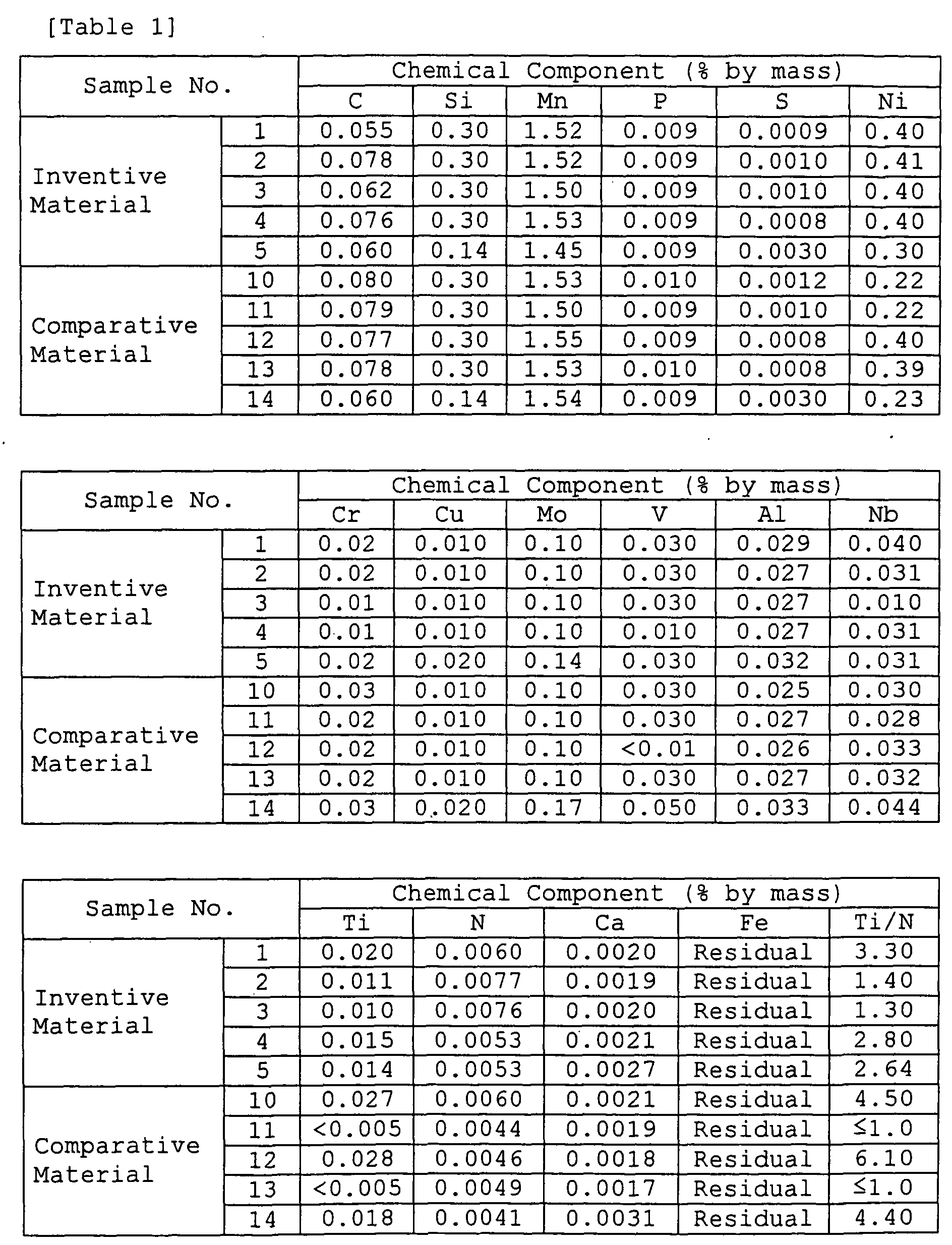
- Each sample having a composition shown in Table 1 was prepared as a 25 kg square steel ingot produced in a vacuum induction melting furnace and rolled into a thickness of 25 mm.
- two rolled sample sheets in piles were welded circumferentially to each other and quenched and tempered in a state of 50 mm thickness on the assumption of quenching and tempering (QT) of the clad steel plate.
- the QT temperature was changed to 930°C, 950°C, 960°C, 980°C, 1050°C and 1140°C. Then, the sample was cooled with water and heated at 580°C for 1.0 hour to be tempered.
- Table 2 shows mechanical properties of the samples quenched and tempered (QT) at 950°C.
- the grain size was in a range of from 10 to 12, that is, the grain size was reducedhyperfinely, and each of the base material and the HAZ exhibited high toughness.
- the grain size was smaller than 10, that is, the grain size was not reduced sufficiently finely, and each of the base material and the HAZ exhibited insufficient toughness.
- Sample No. Absorbed energy (J) Tensile characteristic of base material HAZ Hvmax.
- Inventive Material No. 5 With respect to Inventive Material No. 5 and Comparative Material No.14 (equivalent to the related-art material), absorbed energy was measured while the test temperature was changed. Fig. 1 shows results of the measurement. Inventive Material No. 5 exhibited excellent low-temperature toughness compared with Comparative Material No.14.
- Fig. 2 shows impact characteristic of the base material in each of Inventive Material No. 5 and Comparative Material No. 14 in the case where the austenitizing temperature is changed in a range of from 930°C to 1140°C.
- Comparative Material No.14 exhibited toughness of from 110 to 120 (J) of Charpy impact energy at - 80°C (vE -80°C) when Comparative Material No.14 was quenched and tempered at a temperature of from 950°C to 980°C, and exhibited toughness of about 100 (J) at Charpy impact energy at - 40°C (vE -40°C) when Comparative Material No.14 was quenched and tempered at a temperature of 1050°C.
- Each of the inventive material and the comparative material was subj ected to a one-pass welding test using a 1. 2mm ⁇ weld rod in the welding condition of a current of 300 A, a voltage of 33 V to 34 V and a rate of 270 mm/min in a shielding gas (CO 2 ). Also in this welding, it was confirmed that impact characteristic of the boundary between the base material and the weld portion and the heat-affected zone of the base material after one-pass welding exhibited a far high impact value compared with the related-art material.
- Fig. 3 shows impact characteristic of the boundarybetween the base material and the weld portion and the heat-affected zone of the base material in the case where each of Inventive Material No. 5 and Comparative Material No.14 quenched and tempered at 950°C is subjected to the welding test.
- Inventive Material No. 5 exhibited high toughness of not lower than 150 (J) of Charpy impact energy at - 40°C (vE -40°C) in the aforementioned areas.
- Comparative Material No.14 exhibited toughness of lower than 100 (J) in the neighborhood of the boundary between the base material and the weld portion.
- Table 2 shows the Vickers hardness of the weld portion.
- the maximum hardness of the heat-affected zone in the inventive material was about HV 230, that is, exhibited a low value in terms of hardness after welding compared with the comparative material. This is because the structure in a range of from the Fusion Line portion (the boundary between the base material and the weld portion) to the HAZ is made of bainite and is little hardened.
- Fig. 4 shows results of the drop weight tear test (DWTT) for confirming the brittle fracture arrest temperature of the base material in each of Inventive Material No. 5 and Comparative Material No.14.
- the inventive material exhibited 100 % ductile fracture at -30°C and 70 % or higher ductile fracture at -40°C, that is, exhibited excellent low-temperature toughness compared with the comparative material.
- the mean grain size in the inventive material was No. 10 to No.12, that is, reduced finely compared with the comparative material. This is because balanced addition of proper amounts of alloy elements such as Al, Nb, V, Ti, N, Ni, etc. makes a great contribution to reduction in grain size.
- the base material for clad steel plate contains 0.05 % by mass to 0.10 % by mass of C, 0.10 % by mass to 0.30 % by mass of Si, 1.30 % by mass to 1.60 % by mass of Mn, 0.015 % by mass or less of P, 0.002 % by mass or less of S, 0.10 % by mass to 0.50 % by mass of Ni, 0.05 % by mass or less of Cr, 0.005 % by mass to 0.030 % by mass of Cu, 0.05 % by mass to 0.30 % by mass of Mo, 0.015 % by mass to 0.040 % by mass of V, 0.015 % by mass to 0.040 % by mass of Nb, 0.005 % by mass to 0.020 % by mass of Ti, 0.015 % by mass to 0.050 % by mass of Al, 0.0010 % by mass to 0.0040 % by mass of Ca, and 0.0030
- the advantage of the invention in the boundary between the base material and the weld portion and in the heat-affected zone of the base material after one-pass welding, low-temperature toughness of the weld portion and the base material can be improved greatly compared with a material equivalent to the related-art material APIX65. Furthermore, in the DWTT for confirming the brittle fracture arrest temperature, high percent tough fracture can be obtained even in a low temperature range in which it was impossible to obtain such a high percent tough fracture in the related-art material. Reliability of a clad pipe can be improved greatly, so that the invention is very useful industrially.
- the clad steel plate can be produced by ordinary quenching and tempering. Because there is no additional heat treatment required, reduction both in production step and in production cost can be attained. In addition, because reduction in hardness of the weld HAZ can be attained, cold cracking sensitivity at welding can be reduced.
Landscapes
- Chemical & Material Sciences (AREA)
- Engineering & Computer Science (AREA)
- Materials Engineering (AREA)
- Mechanical Engineering (AREA)
- Metallurgy (AREA)
- Organic Chemistry (AREA)
- Heat Treatment Of Steel (AREA)
- Pressure Welding/Diffusion-Bonding (AREA)
- Heat Treatment Of Articles (AREA)
Abstract
Description
- The present invention relates to a base material for a clad steel plate used in a natural gas pipeline or the like and produced by quenching and tempering (hereinafter referred to as QT), and a method for producing the clad steel plate.
- The present application is based on Japanese Patent Application No. 2002-313742, the entire contents of which are incorporated herein by reference.
- The purpose of use of a clad steel plate varies according to a cladding material used in the clad steel plate. The method for producing the clad steel plate also varies according to the cladding material. Heretofore, a material equivalent to APIX65 containing C, Si and Mn as main components, and Nb, V, Ca, Al and Mo as additive components or a minute amount of Ti, B, etc. added as alloy components has been used as a base material for the clad steel plate used in a natural gas pipeline or the like. This steel is produced by predetermined quenching and tempering (QT), controlled rolling by means of a converter , Thermo-mechanical Controlled Process (TMCP), or the like. Furthermore, forproductionofacladsteelpipe, one-pass highly efficient welding is applied to each of front and rear surfaces of the pipe. Generally, in welding for multi-layer cladding, the size of grains in a boundary between the base material and weldmetal and inabasematerialheat-affected zone (hereinafter also referred to as HAZ) are reduced finely by next-pass heat affection. On the other hand, in one-pass welding, grains in the boundary between the base material and the weld metal and in the base material heat-affected zone is made still coarse to thereby bring lowering of toughness. User' s specifications have been however severe recently, so that the risk of brittle fracture in each portion of the pipe exposed to -40°C at the time of emergency shut down of the pipeline has been suggested. Therefore, the requirement that an impact value in the boundary between the base material and the weld metal and in the base material heat-affected zone (HAZ) should be not smaller than 35 (J) at Charpy impact energy at - 40°C (vE -40°C) has been popularized. Furthermore, a drop weight tear test (hereinafter referred to as DWTT) for checking the brittle fracture arrest temperature has been required of the base material.
Specifications have become severer so that 100 % tough fracture must be ensured at the test at about -20°C. In the related-art quenched and tempered material, it was however very difficult to meet this requirement. Particularly in one-pass welding, it was the best that an impact value of not smaller than 35 (J) of Charpy impact energy at -20°C (vE -20°C) could be obtained in the boundary between the base material and the weld metal and in the base material heat-affected zone and that 100 % tough fracture could be obtained at the DWTT of the base material at a temperature of about -10°C. In addition, segregation has often occurred in the center portion in plate thickness of the related-art material. This has also caused lowering of the impact value. - Various methods for improving toughness of the HAZ have been heretofore proposed. For example, in the related art, according to JP-B-55-26164 (Patent Document 1), Ti, N, Nb, V and B are added to C, Si, Mn and Al to precipitate minute TiN in steel to thereby reduce the size of austenite grains in the HAZ to improve toughness.
- JP-B-55-26164 (claims, etc.) has also described a method including the steps of: heating the steel at 1250°C to 1400°C; and re-heating the steel under a pressure or at a temperature of not higher than 1150°C.
- JP-A-2001-226739 (paragraphs 0011, 0012, etc.) has described amethod for controlling the number of inclusion grains or the like to suppress increase in size of austenite grains exposed to a high temperature for a long time to thereby improve HAZ toughness.
- In the method disclosed in JP-B-55-26164, the base material exhibits 20 kg·m Charpy impact energy at 0°C (
vE 0°C) , the fracture appearance transition temperature (hereinafter referred to as FATT) of the base material is about -50°C, and the HAZ exhibits 20 kg·m of Charpy impact energy at 0°C (vE 0°C) in multi-layer cladding by welding. Almost of TiN is however dissolved as solid solution in a neighborhood of the boundary (hereinafter welded bond portion) between the base material and weldmetal heated to the ultimate temperature higher than 1400°C in the HAZ. Accordingly, there is a problem that the toughness improving effect is reduced in the base material component system. - The method disclosed in JP-A-2001-226739 is multi-layer cladding by welding. In the method, the toughness of the HAZ is 100 to 200 (J) of Charpy impact energy at - 40°C (vE -40°C). It is however difficult to control the minute inclusions in a general steel-making process. This causes increase in cost particularly in melting in an electric furnace.
- In the method disclosed in JP-B-55-26164, because the additional step of re-heating the steel to a temperature of not higher than 1150°C is required, there is a problem that the provision of the additional step causes increase in cost.
- The invention is developed upon such circumstances and an object of the invention is to provide a base material for clad steel plate excellent in low-temperature toughness both in the base material requiring low-temperature toughness and in a heat-affected zone due to one-pass welding, and a method for producing the clad steel plate. The base material is preferably selected to be not thicker than 50 mm.
- It is necessary to satisfy the requirement that low-temperature toughness in the boundary between the base material and a weld portion, the heat-affected zone and the base material should be ensured by ordinary quenching and tempering after one-pass welding. Therefore, another object of the invention is to provide a clad steel plate which satisfies the following performance by composite addition of alloy elements.
- Firstly, while strength is kept the same as in the related art, the grain size is reduced hyperfinely to be in a range of from about 10 to about 12 in terms of mean crystal gain size to improve the low-temperature toughness of the base material. Incidentally, the number of grain size is defined as an index according to JIS G0551 and ISO 643.
- Secondly, the grains are restrained from becoming coarse in addition to reduction in grain size in order to improve the low-temperature toughness in the boundary between the base material and the weld portion and in the heat-affected zone of the base material.
- Thirdly, production of a martensitic structure in the base material and the heat-affected zone is prevented to select the hardness of the HAZ to be not higher than
HV 250. - Fourthly, segregation in the center portion in plate thickness of the steel is reduced.
- Fifthly, the austenitizing temperature range is widened so that various steel kinds of cladding materials canbe combined for production of various kinds of steel plates.
- That is, to solve the problem, the invention provides a base material for clad steel plate excellent in low-temperature toughness at a weld heat-affected zone, containing 0.05 % by mass to 0.10 % by mass of C, 0.10 % by mass to 0.30 % by mass of Si, 1.30 % by mass to 1.60 % by mass of Mn, 0.015 % by mass or less of P, 0.002 % by mass or less of S, 0.10 % by mass to 0.50 % by mass of Ni, 0.05 % by mass or less of Cr, 0.005 % by mass to 0.030 % by mass of Cu, 0.05 % by mass to 0.30 % by mass of Mo, 0.015 % by mass to 0.040 % by mass of V, 0.015 % by mass to 0.040 % by mass of Nb, 0.005 % by mass to 0.020 % by mass of Ti, 0.015 % by mass to 0.050 % by mass of Al, 0.0010 % by mass to 0.0040 % by mass of Ca, 0.0030 % by mass to 0.010 % by mass of N, and the residual part of Fe and unavoidable impurities.
- Preferably, in the base material for clad steel plate excellent in low-temperature toughness at a weld heat-affected zone according to the invention, Ti/N which is the ratio of the Ti content to the N content is selected to be in a range of from 1.0 to 3.5.
- Preferably, in the base material for clad steel plate excellent in low-temperature toughness at a weld heat-affected zone, the number of grain size after quenching and tempering of the clad steel plate is 10 to 12.
- The invention also provides a method of producing a clad steel plate excellent in low-temperature toughness at a weld heat-affected zone, including the steps of: clad-rolling a clad steel plate base material and a cladding material, the base material containing 0.05 % by mass to 0.10 % by mass of C, 0.10 % by mass to 0.30 % by mass of Si, 1.30 % by mass to 1.60 % by mass of Mn, 0.015 % by mass or less of P, 0.002 % by mass or less of S, 0.10 % by mass to 0.50 % by mass of Ni, 0.05 % by mass or less of Cr, 0.005 % by mass to 0.030 % by mass of Cu, 0. 05 % by mass to 0. 30 % by mass of Mo, 0.015 % by mass to 0.040 % by mass of V, 0.015 % by mass to 0.040 % by mass of Nb, 0.005 % by mass to 0.020 % by mass of Ti, 0.015 % by mass to 0.050 % by mass of Al, 0.0010 % by mass to 0.0040 % by mass of Ca, 0.0030 % by mass to 0.010 % by mass of N, and the residual part of Fe and unavoidable impurities; performing a solution treatment by heating the resulting plate at 900°C to 1150°C; and tempering the resulting plate at 550°C to 650°C.
- Preferably, in the method of producing a clad steel plate excellent in low-temperature toughness at a weld heat-affected zone, Ti/N which is the ratio of the Ti content to the N content is selected to be in a range of from 1.0 to 3.5.
- According to the invention, in the base material requiring low-temperature toughness and the heat-affected zone due to one-pass welding, the size of grains in the base material is reduced hyperfinely by addition of proper amounts of Ni, Nb, Al, V, Ti, N, etc. At the same time, increase in grain size in the HAZ is suppressed to obtain excellent high toughness. The limited ranges of components in the invention will be described below in detail.
- C is a component that is effective in improving the strength of steel. If the C content is lower than 0.05 %, sufficient strength cannot be obtained for general welding. Accordingly, the C content is selected to be not lower than 0.05 %. On the other hand, the upper limit of the C content is set at 0.10 % because excessive addition of C remarkably deteriorates weldability of the steel material, HAZ toughness, etc. Incidentally, for the same reason, it is preferable that the lower limit of the C content is set at 0.05 % and that the upper limit of the C content is set at 0.08 %.
- Si is a component necessary for retaining the strength of the base material, deoxidation, etc. To obtain the effect, it is necessary to add at least 0.10 % of Si. The upper limit of the Si content is however set at 0.30 % because excessive addition of Si causes hardening of the HAZ to reduce the toughness of the HAZ. Incidentally, for the same reason, it is preferable that the lower limit of the Si content is set at 0.13 % and that the upper limit of the Si content is set at 0.20 %.
- It is necessary to add 1.30 % or higher of Mn as a component effective in retaining the strength and toughness of the base material. The upper limit of the Mn content is set at 1.60 % in consideration of the toughness and cracking of the weld portion. Incidentally, for the same reason, it is preferable that the lower limit of the Mn content is set at 1.40 % and that the upper limit of the Mn content is set at 1.55 %.
- It is preferable that the P content is as low as possible. Because industrial reduction of the P content causes increase in cost, the upper limit of the P content is set at 0.015 %. S: 0.002 % or lower
- It is preferable that the S content is as low as possible. Because excessive addition of S causes remarkable reduction in toughness, the upper limit of the S content is set at 0.002 %.
- Ni is effective in improving the strength and toughness of the base material. 0.10 % or higher of Ni is added. If the Ni content is lower than 0.10 %, the effect cannot be obtained sufficiently. On the other hand, the upper limit of the Ni content is set at 0.50 % because excessive addition of Ni causes increase in production cost. Incidentally, for the same reason, it is preferable that the lower limit of the Ni content is set at 0.20 % and that the upper limit of the Ni content is set at 0.40 %.
- Cr improves the strength and toughness of the base material. The upper limit of the Cr content is set at 0.05 % because excessive addition of Cr causes reduction in toughness of the HAZ. Incidentally, for the same reason, it is preferable that the upper limit of the Cr content is set at 0.03 %. To obtain the effect sufficiently, it is preferable that the lower limit of the Cr content is set at 0.01 %.
- Cu improves the strength of the base material. To obtain the effect sufficiently, it is necessary to add 0.005 % or higher of Cu. On the other hand, the upper limit of the Cu content is set at 0.030 % because excessive addition of Cu causes increase in cracking sensitivity at welding. Incidentally, for the same reason, it is preferable that the lower limit of the Cu content is set at 0.010 % and that the upper limit of the Cu content is set at 0.025 %.
- Mo is an element for improving the strength and toughness of the base material stably after heating for forming solid solution. The lower limit of the Mo content is set at 0.05 % because the effect cannot be obtained if the Mo content is lower than 0.05 %. The upper limit of the Mo content is set at 0.30 % because excessive addition of Mo spoils the toughness of the HAZ. Incidentally, for the same reason, it is preferable that the lower limit of the Mo content is set at 0.08 % and that the upper limit of the Mo content is set at 0.20 %.
- V is an important element for retaining the strength of steel. The lower limit of the V content is set at 0.015 % because the effect cannot be obtained sufficiently if the V content is lower than 0.015 %. The upper limit of the V content is set at 0.040 % because excessive addition of V exerts bad influence on the toughness value.
- Al is an element that is effective as a deoxidizer. Further, AlN prevents the austenite grain size from becoming coarse at the solution treatment. The lower limit of the Al content is set at 0.015 % because the effect cannot be obtained sufficiently if the Al content is lower than 0.015 %. The upper limit of the Al content is set at 0.050 % because the grain size refining effect is reduced and the toughness value is saturated if the Al content is higher than 0.050 % and because AlN is produced excessively to cause surface defects of a steel ingot if the Al content is higher than 0.050 %. Incidentally, for the same reason, it is preferable that the lower limit of the Al content is set at 0.025 % and that the upper limit of the Al content is set at 0.035 %.
- Ti is effective in finely reducing the structure size after the solid solution treatment in the same manner as Nb and in suppressing increase in grain size by bonding to N which will be described later. The lower limit of the Ti content is set at 0.005 % because the effect is low if the added Ti content is lower than 0.005 %. The upper limit of the Ti content is set at 0.020 % because toughness is deteriorated greatly by the notch effect if the added Ti content is higher than 0.020 %. Incidentally, for the same reason, it is preferable that the lower limit of the Ti content is set at 0.010 % and that the upper limit of the Ti content is set at 0.016 %.
- Nb is effective in preventing increase in austenite grain size at the time of heating steel to the solution-treatment temperature and in refining the grain size. Nb carbide, etc. may be dispersed into the base material finely and evenly so as to be effective in increasing the high-temperature strength, etc. The lower limit of the Nb content is set at 0.015 % because the effect cannot be obtained sufficiently if the Nb content is lower than 0.015 %. The upper limit of the Nb content is set at 0.040 % because surface defects occur easily in a steel ingot if the Nb content is higher than 0.040 %. Incidentally, for the same reason, it is preferable that the lower limit of the Nb content is set at 0.025 % and that the upper limit of the Nb content is set at 0.035 %.
- Ca is effective in improving resistance to hydrogen induced cracking sensitivity and in improving the impact value because Ca is bonded to S or the like to form a spherically shaped chemical compound such as CaS to thereby form oxide. The lower limit of the Ca content is set at 0.0010 % because the effect cannot be obtained sufficiently if the Ca content is lower than 0.0010 %. The upper limit of the Ca content is set at 0. 0040 % because resistance to hydrogen induced cracking sensitivity is deteriorated or coarse inclusions are produced as well as surface defects occur easily in a steel ingot if the Ca content is higher than 0.0040 %. Incidentally, for the same reason, it is preferable that the lower limit of the Ca content is set at 0.0020 % and that the upper limit of the Ca content is set at 0.0030 %.
- N is effective in improving HAZ toughness when precipitated as TiN. The lower limit of the N content is set at 0.0030 % because the effect is reduced if the N content is lower than 0.0030 %. However, if the N content is higher than 0.009 %, solid solution N increases to bring about reduction in HAZ toughness. The upper limit of the N content is set at 0.010 % in consideration of correspondence to the added Ti content and improvement of HAZ toughness byminute precipitation of TiN.
- Ti andNare important elements for improvingHAZ toughness by producing TiN as described above. The correlation between the Ti content and the N content is also important to obtain the effect sufficiently. That is, if Ti/N is lower than 1.0, the size of grains become coarse to bring about great reduction in toughness value. If Ti/N is higher than 3.5, the toughness value is reduced for the same reason.
-
- Fig. 1 is a graph showing impact transition curves after Inventive Material No. 5 and Comparative Material No. 14 are quenched and tempered at 950°C;
- Fig. 2 is a graph showing impact characteristic in the case where the austenitizing temperature in each of Inventive Material No. 5 and Comparative Material No. 14 is changed in a range of from 930°C to 1140°C;
- Fig. 3 is a graph showing impact characteristic of the weld HAZ in each of Inventive Material No. 5 and Comparative Material No. 14;
- Fig. 4 is a graph showing results of a DWTT for confirming the brittle fracture arrest temperature of the base material in each of Inventive Material No. 5 and Comparative Material No. 14; and
- Fig. 5 is a graph showing the relation between low-temperature toughness and Ti/N which is characteristic of components in the inventive material.
-
- An embodiment of the invention will be described below.
- A clad steel plate base material according to the invention can be prepared in the aforementioned component ranges and produced as ingot steel by an ordinary method or the like. The base material and a cladding material which is selected according to the purpose of use or the like are clad-rolled to produce a clad steel plate. Incidentally, for example, a high alloy such as Alloy825 can be used as the cladding material for the purpose of use in a natural gas pipeline. The thickness of the clad steel plate base material is preferably selected to be not larger than 50 mm. When the thickness of the base material is not smaller than 25 mm, one sheet of base material can be subjected to rolling. When the thickness of the base material is smaller than 25 mm, two sheets of base material in piles can be subjected to rolling.
- In the invention, the condition for clad rolling is not particularly limited. Clad rolling may be performed by an ordinary method.
- The clad steel plate obtained thus is heated in an austenitizing temperature range of from 900°C to 1150°C to be subjected to a solution treatment, and quenched to be hardened. On this occasion, water cooling or oil cooling (e.g., at a cooling rate of 200°C/min or higher) can be used as a method for cooling (quenching) the clad steel plate. Then, the clad steel plate is heated at 550°C to 650°C to be tempered. For example, the heating time for tempering can be selected to be in a range of from 0.5 to 1.0 hour.
- By the series of quenching and tempering processes, the grain size in the clad steel plate base material can be finely reduced to a range of from No.10 to No.12.
- The clad steel plate may be used as a plate directly or may be used as a clad steel pipe.
- At the time of welding the clad steel plate, each of front and rear surfaces can be welded by one pass. Even in the case where one-pass welding is used, the fine structure of the HAZ can be retained so that good toughness can be ensured.
- Examples according to the invention will be described below in comparison with Comparative Examples.
- Each sample having a composition shown in Table 1 was prepared as a 25 kg square steel ingot produced in a vacuum induction melting furnace and rolled into a thickness of 25 mm. In this test, two rolled sample sheets in piles were welded circumferentially to each other and quenched and tempered in a state of 50 mm thickness on the assumption of quenching and tempering (QT) of the clad steel plate. The QT temperature was changed to 930°C, 950°C, 960°C, 980°C, 1050°C and 1140°C. Then, the sample was cooled with water and heated at 580°C for 1.0 hour to be tempered.
- Table 2 shows mechanical properties of the samples quenched and tempered (QT) at 950°C. In each inventive material, the grain size was in a range of from 10 to 12, that is, the grain size was reducedhyperfinely, and each of the base material and the HAZ exhibited high toughness. On the contrary, in each comparative material, the grain size was smaller than 10, that is, the grain size was not reduced sufficiently finely, and each of the base material and the HAZ exhibited insufficient toughness.
Sample No. Absorbed energy
(J)Tensile characteristic of base
materialHAZ Hvmax. (L=10 Kgf) Grain size number Base
materialHAZ - 80°C -40°C 0.2% Offset Yield Strength (MPa) Tensile strength (MPa) Expansion (%) Inventive Material 1 187 135 465 486 28.6 230 10.0 2 198 147 490 592 29.6 225 10.2 3 139 119 478 575 30.5 238 10.0 4 235 152 476 583 27.2 228 11.0 5 410 210 478 570 53.9 231 12.0 Comparative Material 10 4 27 564 655 24.8 275 6.5 11 92 67 482 571 30.3 248 7.5 12 9 47 463 560 29.5 245 7.0 13 62 74 495 597 28.6 250 7.5 14 112 81 507 597 28.2 240 7.5 - With respect to Inventive Material No. 5 and Comparative Material No.14 (equivalent to the related-art material), absorbed energy was measured while the test temperature was changed. Fig. 1 shows results of the measurement. Inventive Material No. 5 exhibited excellent low-temperature toughness compared with Comparative Material No.14.
- Fig. 2 shows impact characteristic of the base material in each of Inventive Material No. 5 and Comparative Material No. 14 in the case where the austenitizing temperature is changed in a range of from 930°C to 1140°C. Comparative Material No.14 exhibited toughness of from 110 to 120 (J) of Charpy impact energy at - 80°C (vE -80°C) when Comparative Material No.14 was quenched and tempered at a temperature of from 950°C to 980°C, and exhibited toughness of about 100 (J) at Charpy impact energy at - 40°C (vE -40°C) when Comparative Material No.14 was quenched and tempered at a temperature of 1050°C. On the contrary, Inventive Material No. 5 exhibited high toughness of not lower than 400 (J) of Charpy impact energy at - 80°C (vE -80°C) when Inventive Material No. 5 was quenched and tempered at a temperature of from 930°C to 980°C, and exhibited high toughness of (an impact value of) not lower than 300 (J) of Charpy impact energy at - 40°C (vE -40°C) even when Inventive Material No. 5 was quenched and tempered at a temperature of 1140°C. In this manner, in the inventive material, stable high toughness can be obtained even in the temperature range of from 930°C to 1140°C. Accordingly, the austenitizing temperature range can be widened, so that various kinds of claddingmaterials can be combined for production of various kinds of steel.
- Each of the inventive material and the comparative material was subj ected to a one-pass welding test using a 1. 2mmΦ weld rod in the welding condition of a current of 300 A, a voltage of 33 V to 34 V and a rate of 270 mm/min in a shielding gas (CO2). Also in this welding, it was confirmed that impact characteristic of the boundary between the base material and the weld portion and the heat-affected zone of the base material after one-pass welding exhibited a far high impact value compared with the related-art material.
- Fig. 3 shows impact characteristic of the boundarybetween the base material and the weld portion and the heat-affected zone of the base material in the case where each of Inventive Material No. 5 and Comparative Material No.14 quenched and tempered at 950°C is subjected to the welding test.
- Inventive Material No. 5 exhibited high toughness of not lower than 150 (J) of Charpy impact energy at - 40°C (vE -40°C) in the aforementioned areas. On the contrary, Comparative Material No.14 exhibited toughness of lower than 100 (J) in the neighborhood of the boundary between the base material and the weld portion.
- Table 2 shows the Vickers hardness of the weld portion. The maximum hardness of the heat-affected zone in the inventive material was about HV 230, that is, exhibited a low value in terms of hardness after welding compared with the comparative material. This is because the structure in a range of from the Fusion Line portion (the boundary between the base material and the weld portion) to the HAZ is made of bainite and is little hardened.
- Fig. 4 shows results of the drop weight tear test (DWTT) for confirming the brittle fracture arrest temperature of the base material in each of Inventive Material No. 5 and Comparative Material No.14. The inventive material exhibited 100 % ductile fracture at -30°C and 70 % or higher ductile fracture at -40°C, that is, exhibited excellent low-temperature toughness compared with the comparative material. As shown in Table 2, the mean grain size in the inventive material was No. 10 to No.12, that is, reduced finely compared with the comparative material. This is because balanced addition of proper amounts of alloy elements such as Al, Nb, V, Ti, N, Ni, etc. makes a great contribution to reduction in grain size. Furthermore, this is based on the synergic effect by addition of proper amounts of Ti and N as well as addition of Al, Nb, V, Ti, N, Ni, etc. and based on the balance of added Ti and N in which Ti/N is adjusted to be in a range of from 1.0 to 3.5 to produce stable TiN as shown in Fig. 5. That is, it is obvious that the growth of grains in the heat-affected zone is suppressed by minute precipitation of TiN to thereby improve the toughness value of the HAZ greatly when the ratio Ti/N is selected to be in a range of from 1.0 to 3.5.
- As described above, according to the invention, the following advantage can be obtained when the base material for clad steel plate contains 0.05 % by mass to 0.10 % by mass of C, 0.10 % by mass to 0.30 % by mass of Si, 1.30 % by mass to 1.60 % by mass of Mn, 0.015 % by mass or less of P, 0.002 % by mass or less of S, 0.10 % by mass to 0.50 % by mass of Ni, 0.05 % by mass or less of Cr, 0.005 % by mass to 0.030 % by mass of Cu, 0.05 % by mass to 0.30 % by mass of Mo, 0.015 % by mass to 0.040 % by mass of V, 0.015 % by mass to 0.040 % by mass of Nb, 0.005 % by mass to 0.020 % by mass of Ti, 0.015 % by mass to 0.050 % by mass of Al, 0.0010 % by mass to 0.0040 % by mass of Ca, and 0.0030 % by mass to 0.010 % by mass of N, and when the ratio Ti/N is preferably selected to be in range of from 1.0 to 3.5.
- That is, as the advantage of the invention, in the boundary between the base material and the weld portion and in the heat-affected zone of the base material after one-pass welding, low-temperature toughness of the weld portion and the base material can be improved greatly compared with a material equivalent to the related-art material APIX65. Furthermore, in the DWTT for confirming the brittle fracture arrest temperature, high percent tough fracture can be obtained even in a low temperature range in which it was impossible to obtain such a high percent tough fracture in the related-art material. Reliability of a clad pipe can be improved greatly, so that the invention is very useful industrially. The clad steel plate can be produced by ordinary quenching and tempering. Because there is no additional heat treatment required, reduction both in production step and in production cost can be attained. In addition, because reduction in hardness of the weld HAZ can be attained, cold cracking sensitivity at welding can be reduced.
Claims (5)
- A base material for clad steel plate excellent in low-temperature toughness at base metal and weld heat-affected zone, containing 0.05 % by mass to 0.10 % by mass of C, 0.10 % by mass to 0.30 % by mass of Si, 1.30 % by mass to 1.60 % by mass of Mn, 0.015 % by mass or less of P, 0.002 % by mass or less of S, 0.10 % by mass to 0.50 % by mass of Ni, 0.05 % by mass or less of Cr, 0.005 % by mass to 0.030 % by mass of Cu, 0.05 % by mass to 0.30 % by mass of Mo, 0.015 % by mass to 0.040 % by mass of V, 0. 015 % by mass to 0.040 % by mass of Nb, 0.005 % by mass to 0.020 % by mass of Ti, 0.015 % by mass to 0.050 % by mass of Al, 0. 0010 % by mass to 0.0040 % by mass of Ca, 0.0030 % by mass to 0.010 % by mass of N, and the residual part of Fe and unavoidable impurities.
- A base material for clad steel plate excellent in low-temperature toughness at base metal and weld heat-affected zone according to Claim 1, wherein Ti/N which is the ratio of the Ti content to the N content is selected to be in a range of from 1.0 to 3.5.
- A base material for clad steel plate excellent in low-temperature toughness at a weld heat-affected zone according to Claim 1 or 2, wherein the number of grain size after quenching and tempering of the clad steel plate is 10 to 12.
- A method of producing a clad steel plate excellent in low-temperature toughness at a weld heat-affected zone, comprising the steps of: clad-rolling a clad steel plate base material and a cladding material, said base material containing 0.05 % by mass to 0.10 % by mass of C, 0.10 % by mass to 0.30 % by mass of Si, 1.30 % by mass to 1. 60 % by mass of Mn, 0.015 % by mass or less of P, 0.002 % by mass or less of S, 0.10 % by mass to 0.50 % by mass of Ni, 0.05 % by mass or less of Cr, 0.005 % by mass to 0.030 % by mass of Cu, 0.05 % by mass to 0.30 % by mass of Mo, 0.015 % by mass to 0.040 % by mass of V, 0.015 % by mass to 0.040 % by mass of Nb, 0.005 % by mass to 0.020 % by mass of Ti, 0.015 % by mass to 0.050 % by mass of Al, 0.0010 % by mass to 0.0040 % by mass of Ca, 0.0030 % by mass to 0.010 % by mass of N, and the residual part of Fe and unavoidable impurities; performing a solution treatment by heating the resulting plate at 900°C to 1150°C; and tempering the resulting plate at 550°C to 650°C.
- A method of producing a clad steel plate excellent in low-temperature toughness at a weld heat-affected zone according to Claim 4, wherein Ti/N which is the ratio of the Ti content to the N content is selected to be in a range of from 1.0 to 3.5.
Applications Claiming Priority (2)
| Application Number | Priority Date | Filing Date | Title |
|---|---|---|---|
| JP2002313742A JP3699077B2 (en) | 2002-10-29 | 2002-10-29 | Base material for clad steel plate excellent in low temperature toughness of weld heat affected zone and method for producing the clad steel plate |
| JP2002313742 | 2002-10-29 |
Publications (2)
| Publication Number | Publication Date |
|---|---|
| EP1416059A1 true EP1416059A1 (en) | 2004-05-06 |
| EP1416059B1 EP1416059B1 (en) | 2013-05-08 |
Family
ID=32089489
Family Applications (1)
| Application Number | Title | Priority Date | Filing Date |
|---|---|---|---|
| EP20030024753 Expired - Lifetime EP1416059B1 (en) | 2002-10-29 | 2003-10-29 | Base material for clad steel plate excellent in low-temperature toughness at weld heat-affected zone and method for producing the clad steel plate |
Country Status (2)
| Country | Link |
|---|---|
| EP (1) | EP1416059B1 (en) |
| JP (1) | JP3699077B2 (en) |
Cited By (10)
| Publication number | Priority date | Publication date | Assignee | Title |
|---|---|---|---|---|
| RU2487959C2 (en) * | 2011-10-03 | 2013-07-20 | Российская Федерация, от имени которой выступает Министерство промышленности и торговли Российской Федерации (Минпромторг России) | Two-layer rolled stock |
| EP1726675A3 (en) * | 2005-05-25 | 2016-09-21 | The Japan Steel Works, Ltd. | Base material for a clad steel and method for the production of clad steel from same |
| CN106048147A (en) * | 2016-07-16 | 2016-10-26 | 柳州科尔特锻造机械有限公司 | Alloy steel treatment technology |
| CN106048148A (en) * | 2016-07-16 | 2016-10-26 | 柳州科尔特锻造机械有限公司 | Niobium-contained high-strength alloy steel treatment technology |
| CN111918979A (en) * | 2018-03-30 | 2020-11-10 | 杰富意钢铁株式会社 | Duplex stainless steel clad steel sheet and method for manufacturing same |
| EP3778965A4 (en) * | 2018-03-30 | 2021-02-17 | JFE Steel Corporation | TWO-PHASE STAINLESS STEEL SHEET AND ITS MANUFACTURING PROCESS |
| US11344968B2 (en) | 2016-08-12 | 2022-05-31 | Voestalpine Grobblech Gmbh | Method for producing roll-bonded metal sheets |
| CN114891989A (en) * | 2022-06-20 | 2022-08-12 | 河北普阳钢铁有限公司 | Rolling process of wear-resistant corrosion-resistant composite steel plate |
| EP3943621A4 (en) * | 2019-03-18 | 2023-07-12 | Japan Steel Works M&E, Inc. | BASE MATERIAL FOR CLAD STEEL, CLAD STEEL AND PROCESS FOR PRODUCTION OF CLAD STEEL |
| EP4219146A1 (en) * | 2022-02-01 | 2023-08-02 | Japan Steel Works M&E, Inc. | Clad steel-welded steel pipe and method for producing the same |
Families Citing this family (9)
| Publication number | Priority date | Publication date | Assignee | Title |
|---|---|---|---|---|
| US6726647B1 (en) | 1998-10-23 | 2004-04-27 | Gambro Ab | Method and device for measuring access flow |
| JP4484123B2 (en) * | 2008-02-08 | 2010-06-16 | 株式会社日本製鋼所 | High strength and excellent base material for clad steel plate with excellent weld heat affected zone toughness |
| KR101149132B1 (en) * | 2009-04-27 | 2012-05-25 | 현대제철 주식회사 | Steel with superior impact characteristic at law temperature and the method of producing the same |
| JP5418662B2 (en) | 2012-01-30 | 2014-02-19 | Jfeスチール株式会社 | Base material of high toughness clad steel plate excellent in weld zone toughness and method for producing the clad steel plate |
| JP5527455B2 (en) * | 2012-05-23 | 2014-06-18 | Jfeスチール株式会社 | Base material of high toughness clad steel plate and method for producing the clad steel plate |
| EP3037567B1 (en) | 2013-10-21 | 2019-09-18 | JFE Steel Corporation | Austenitic stainless steel clad steel plate and process for manufacturing same |
| CN104120366B (en) * | 2014-06-21 | 2016-06-29 | 首钢总公司 | A kind of pressure vessel quenched and tempered high tensile strength plate and production method thereof |
| JP6354853B2 (en) | 2014-11-11 | 2018-07-11 | Jfeスチール株式会社 | Ni alloy clad steel sheet and manufacturing method thereof |
| CN111235479B (en) * | 2020-02-17 | 2021-09-24 | 江阴兴澄特种钢铁有限公司 | A kind of manufacturing method of economical pipeline steel |
Citations (7)
| Publication number | Priority date | Publication date | Assignee | Title |
|---|---|---|---|---|
| JPH07278738A (en) * | 1994-04-05 | 1995-10-24 | Nippon Steel Corp | Low temperature steel for welding with excellent toughness |
| JPH08158006A (en) * | 1994-12-06 | 1996-06-18 | Kobe Steel Ltd | High strength steel excellent in toughness in weld heat-affected zone |
| JPH08311549A (en) * | 1995-03-13 | 1996-11-26 | Nippon Steel Corp | Ultra high strength steel pipe manufacturing method |
| JPH1161328A (en) * | 1997-08-28 | 1999-03-05 | Sumitomo Metal Ind Ltd | High Mn steel slab, continuous casting method thereof, and method of manufacturing high tensile steel material |
| US5900075A (en) * | 1994-12-06 | 1999-05-04 | Exxon Research And Engineering Co. | Ultra high strength, secondary hardening steels with superior toughness and weldability |
| WO2001059167A1 (en) * | 2000-02-10 | 2001-08-16 | Nippon Steel Corporation | Steel product having weld heat-affected zone excellent in rigidity |
| JP2001254140A (en) * | 2000-03-08 | 2001-09-18 | Nippon Steel Corp | Large heat input welding steel for earthquake-resistant building |
-
2002
- 2002-10-29 JP JP2002313742A patent/JP3699077B2/en not_active Expired - Lifetime
-
2003
- 2003-10-29 EP EP20030024753 patent/EP1416059B1/en not_active Expired - Lifetime
Patent Citations (8)
| Publication number | Priority date | Publication date | Assignee | Title |
|---|---|---|---|---|
| JPH07278738A (en) * | 1994-04-05 | 1995-10-24 | Nippon Steel Corp | Low temperature steel for welding with excellent toughness |
| JPH08158006A (en) * | 1994-12-06 | 1996-06-18 | Kobe Steel Ltd | High strength steel excellent in toughness in weld heat-affected zone |
| US5900075A (en) * | 1994-12-06 | 1999-05-04 | Exxon Research And Engineering Co. | Ultra high strength, secondary hardening steels with superior toughness and weldability |
| JPH08311549A (en) * | 1995-03-13 | 1996-11-26 | Nippon Steel Corp | Ultra high strength steel pipe manufacturing method |
| JPH1161328A (en) * | 1997-08-28 | 1999-03-05 | Sumitomo Metal Ind Ltd | High Mn steel slab, continuous casting method thereof, and method of manufacturing high tensile steel material |
| WO2001059167A1 (en) * | 2000-02-10 | 2001-08-16 | Nippon Steel Corporation | Steel product having weld heat-affected zone excellent in rigidity |
| EP1262571A1 (en) * | 2000-02-10 | 2002-12-04 | Nippon Steel Corporation | Steel product having weld heat-affected zone excellent in rigidity |
| JP2001254140A (en) * | 2000-03-08 | 2001-09-18 | Nippon Steel Corp | Large heat input welding steel for earthquake-resistant building |
Non-Patent Citations (5)
| Title |
|---|
| PATENT ABSTRACTS OF JAPAN vol. 1996, no. 02 29 February 1996 (1996-02-29) * |
| PATENT ABSTRACTS OF JAPAN vol. 1996, no. 10 31 October 1996 (1996-10-31) * |
| PATENT ABSTRACTS OF JAPAN vol. 1997, no. 03 31 March 1997 (1997-03-31) * |
| PATENT ABSTRACTS OF JAPAN vol. 1999, no. 08 30 June 1999 (1999-06-30) * |
| PATENT ABSTRACTS OF JAPAN vol. 2000, no. 26 1 July 2002 (2002-07-01) * |
Cited By (13)
| Publication number | Priority date | Publication date | Assignee | Title |
|---|---|---|---|---|
| EP1726675A3 (en) * | 2005-05-25 | 2016-09-21 | The Japan Steel Works, Ltd. | Base material for a clad steel and method for the production of clad steel from same |
| RU2487959C2 (en) * | 2011-10-03 | 2013-07-20 | Российская Федерация, от имени которой выступает Министерство промышленности и торговли Российской Федерации (Минпромторг России) | Two-layer rolled stock |
| CN106048147A (en) * | 2016-07-16 | 2016-10-26 | 柳州科尔特锻造机械有限公司 | Alloy steel treatment technology |
| CN106048148A (en) * | 2016-07-16 | 2016-10-26 | 柳州科尔特锻造机械有限公司 | Niobium-contained high-strength alloy steel treatment technology |
| US11344968B2 (en) | 2016-08-12 | 2022-05-31 | Voestalpine Grobblech Gmbh | Method for producing roll-bonded metal sheets |
| EP3778958A4 (en) * | 2018-03-30 | 2021-02-17 | JFE Steel Corporation | Two-phase stainless-clad steel sheet and method for manufacturing same |
| EP3778965A4 (en) * | 2018-03-30 | 2021-02-17 | JFE Steel Corporation | TWO-PHASE STAINLESS STEEL SHEET AND ITS MANUFACTURING PROCESS |
| CN111918979A (en) * | 2018-03-30 | 2020-11-10 | 杰富意钢铁株式会社 | Duplex stainless steel clad steel sheet and method for manufacturing same |
| US11692252B2 (en) | 2018-03-30 | 2023-07-04 | Jfe Steel Corporation | Duplex stainless clad steel plate and method of producing same |
| US11891675B2 (en) | 2018-03-30 | 2024-02-06 | Jfe Steel Corporation | Duplex stainless clad steel plate and method of producing same |
| EP3943621A4 (en) * | 2019-03-18 | 2023-07-12 | Japan Steel Works M&E, Inc. | BASE MATERIAL FOR CLAD STEEL, CLAD STEEL AND PROCESS FOR PRODUCTION OF CLAD STEEL |
| EP4219146A1 (en) * | 2022-02-01 | 2023-08-02 | Japan Steel Works M&E, Inc. | Clad steel-welded steel pipe and method for producing the same |
| CN114891989A (en) * | 2022-06-20 | 2022-08-12 | 河北普阳钢铁有限公司 | Rolling process of wear-resistant corrosion-resistant composite steel plate |
Also Published As
| Publication number | Publication date |
|---|---|
| JP2004149821A (en) | 2004-05-27 |
| JP3699077B2 (en) | 2005-09-28 |
| EP1416059B1 (en) | 2013-05-08 |
Similar Documents
| Publication | Publication Date | Title |
|---|---|---|
| EP1416059B1 (en) | Base material for clad steel plate excellent in low-temperature toughness at weld heat-affected zone and method for producing the clad steel plate | |
| US6183573B1 (en) | High-toughness, high-tensile-strength steel and method of manufacturing the same | |
| US5948183A (en) | Hot-rolled steel sheet and method for forming hot-rolled steel sheet having low yield ratio, high strength and excellent toughness | |
| CN112334589B (en) | Clad steel sheet and method for producing same | |
| EP2811045B1 (en) | Base metal for high-toughness clad steel plate giving weld with excellent toughness, and process for producing said clad steel plate | |
| JP6750572B2 (en) | Clad steel plate having high strength and excellent low temperature toughness as base material and method for producing the same | |
| JP2014101568A (en) | HIGH TOUGHNESS HIGH CORROSION RESISTANCE Ni ALLOY CLAD STEEL SHEET EXCELLENT IN WELD ZONE TOUGHNESS AND PRODUCTION METHOD THEREOF | |
| JP3045856B2 (en) | Method for producing high toughness Cu-containing high tensile steel | |
| CN104321455A (en) | Base material for high-toughness clad steel plate having excellent toughness in welded joints, and method for producing said clad steel plate | |
| JP4252974B2 (en) | Clad steel base material and method for producing clad steel using the clad steel base material | |
| JP4262051B2 (en) | Low alloy ferritic heat resistant steel with excellent high temperature creep strength of weld heat affected zone | |
| CN100476005C (en) | High tensile strength steel material having excellent weldability and toughness and class tensile strength above 550MPa, and manufacturing method therefor | |
| JP2002080930A (en) | Wear resistant steel having excellent toughness and delayed fracture resistance and its production method | |
| JPH10298707A (en) | High-toughness high-tensile steel and its manufacturing method | |
| JP3344305B2 (en) | High-strength steel sheet for line pipe excellent in resistance to hydrogen-induced cracking and method for producing the same | |
| JP7586383B1 (en) | Manufacturing method of clad steel plate | |
| JPH0873983A (en) | Steel plate for welded structure excellent in fatigue strength of welded joint and manufacturing method thereof | |
| JP5028785B2 (en) | High toughness high tensile steel sheet and method for producing the same | |
| JPH06316723A (en) | Production of weather resistant refractory steel material for building construction, excellent in gas cutting property and weldability | |
| JP5151034B2 (en) | Manufacturing method of steel plate for high tension line pipe and steel plate for high tension line pipe | |
| JPH07292445A (en) | Duplex stainless clad steel, its manufacturing method and welding method | |
| JP2002161330A (en) | Wear-resistant steel | |
| JP4250113B2 (en) | Steel plate manufacturing method with excellent earthquake resistance and weldability | |
| JP2003226931A (en) | Direct quenching high-tensile steel plate with excellent arrestability | |
| JP3313440B2 (en) | High corrosion resistance high strength clad steel and method for producing the same |
Legal Events
| Date | Code | Title | Description |
|---|---|---|---|
| PUAI | Public reference made under article 153(3) epc to a published international application that has entered the european phase |
Free format text: ORIGINAL CODE: 0009012 |
|
| AK | Designated contracting states |
Kind code of ref document: A1 Designated state(s): AT BE BG CH CY CZ DE DK EE ES FI FR GB GR HU IE IT LI LU MC NL PT RO SE SI SK TR |
|
| AX | Request for extension of the european patent |
Extension state: AL LT LV MK |
|
| 17P | Request for examination filed |
Effective date: 20040528 |
|
| AKX | Designation fees paid |
Designated state(s): AT FR |
|
| REG | Reference to a national code |
Ref country code: DE Ref legal event code: 8566 |
|
| GRAP | Despatch of communication of intention to grant a patent |
Free format text: ORIGINAL CODE: EPIDOSNIGR1 |
|
| GRAS | Grant fee paid |
Free format text: ORIGINAL CODE: EPIDOSNIGR3 |
|
| GRAA | (expected) grant |
Free format text: ORIGINAL CODE: 0009210 |
|
| AK | Designated contracting states |
Kind code of ref document: B1 Designated state(s): AT FR |
|
| REG | Reference to a national code |
Ref country code: AT Ref legal event code: REF Ref document number: 611152 Country of ref document: AT Kind code of ref document: T Effective date: 20130515 |
|
| PLBE | No opposition filed within time limit |
Free format text: ORIGINAL CODE: 0009261 |
|
| STAA | Information on the status of an ep patent application or granted ep patent |
Free format text: STATUS: NO OPPOSITION FILED WITHIN TIME LIMIT |
|
| 26N | No opposition filed |
Effective date: 20140211 |
|
| REG | Reference to a national code |
Ref country code: FR Ref legal event code: PLFP Year of fee payment: 14 |
|
| REG | Reference to a national code |
Ref country code: FR Ref legal event code: PLFP Year of fee payment: 15 |
|
| REG | Reference to a national code |
Ref country code: FR Ref legal event code: PLFP Year of fee payment: 16 |
|
| REG | Reference to a national code |
Ref country code: AT Ref legal event code: PC Ref document number: 611152 Country of ref document: AT Kind code of ref document: T Owner name: JAPAN STEEL WORKS M&E, INC., JP Effective date: 20201120 |
|
| PGFP | Annual fee paid to national office [announced via postgrant information from national office to epo] |
Ref country code: FR Payment date: 20220908 Year of fee payment: 20 |
|
| PGFP | Annual fee paid to national office [announced via postgrant information from national office to epo] |
Ref country code: AT Payment date: 20220926 Year of fee payment: 20 |
|
| REG | Reference to a national code |
Ref country code: AT Ref legal event code: MK07 Ref document number: 611152 Country of ref document: AT Kind code of ref document: T Effective date: 20231029 |