EP1416013A1 - Insulating member using abrasion-resistant resin composition - Google Patents
Insulating member using abrasion-resistant resin composition Download PDFInfo
- Publication number
- EP1416013A1 EP1416013A1 EP20030256786 EP03256786A EP1416013A1 EP 1416013 A1 EP1416013 A1 EP 1416013A1 EP 20030256786 EP20030256786 EP 20030256786 EP 03256786 A EP03256786 A EP 03256786A EP 1416013 A1 EP1416013 A1 EP 1416013A1
- Authority
- EP
- European Patent Office
- Prior art keywords
- component
- polyamide
- polyolefin
- resin composition
- fibers
- Prior art date
- Legal status (The legal status is an assumption and is not a legal conclusion. Google has not performed a legal analysis and makes no representation as to the accuracy of the status listed.)
- Withdrawn
Links
- 239000011342 resin composition Substances 0.000 title claims abstract description 60
- 238000005299 abrasion Methods 0.000 title claims abstract description 17
- 239000004952 Polyamide Substances 0.000 claims abstract description 71
- 229920002647 polyamide Polymers 0.000 claims abstract description 71
- 239000000835 fiber Substances 0.000 claims abstract description 59
- 229920000098 polyolefin Polymers 0.000 claims abstract description 42
- VYPSYNLAJGMNEJ-UHFFFAOYSA-N Silicium dioxide Chemical compound O=[Si]=O VYPSYNLAJGMNEJ-UHFFFAOYSA-N 0.000 claims abstract description 41
- 229920005672 polyolefin resin Polymers 0.000 claims abstract description 36
- 229920005989 resin Polymers 0.000 claims abstract description 34
- 239000011347 resin Substances 0.000 claims abstract description 34
- 239000006087 Silane Coupling Agent Substances 0.000 claims abstract description 30
- 238000002156 mixing Methods 0.000 claims abstract description 4
- 239000000203 mixture Substances 0.000 claims description 48
- 238000002844 melting Methods 0.000 description 45
- 230000008018 melting Effects 0.000 description 45
- -1 polypropylene Polymers 0.000 description 32
- 238000004898 kneading Methods 0.000 description 29
- 229920001971 elastomer Polymers 0.000 description 20
- 229920001577 copolymer Polymers 0.000 description 19
- 239000004743 Polypropylene Substances 0.000 description 18
- 229920001155 polypropylene Polymers 0.000 description 18
- 239000005060 rubber Substances 0.000 description 17
- 229920002302 Nylon 6,6 Polymers 0.000 description 14
- KKEYFWRCBNTPAC-UHFFFAOYSA-N Terephthalic acid Chemical compound OC(=O)C1=CC=C(C(O)=O)C=C1 KKEYFWRCBNTPAC-UHFFFAOYSA-N 0.000 description 14
- QQVIHTHCMHWDBS-UHFFFAOYSA-N isophthalic acid Chemical compound OC(=O)C1=CC=CC(C(O)=O)=C1 QQVIHTHCMHWDBS-UHFFFAOYSA-N 0.000 description 14
- 239000008188 pellet Substances 0.000 description 14
- 238000000034 method Methods 0.000 description 13
- VGGSQFUCUMXWEO-UHFFFAOYSA-N Ethene Chemical compound C=C VGGSQFUCUMXWEO-UHFFFAOYSA-N 0.000 description 12
- 239000005977 Ethylene Substances 0.000 description 12
- 239000004698 Polyethylene Substances 0.000 description 10
- 229920000573 polyethylene Polymers 0.000 description 10
- 229920002292 Nylon 6 Polymers 0.000 description 9
- 238000005096 rolling process Methods 0.000 description 8
- 229920001955 polyphenylene ether Polymers 0.000 description 7
- 229920003189 Nylon 4,6 Polymers 0.000 description 6
- 239000004695 Polyether sulfone Substances 0.000 description 6
- 239000004734 Polyphenylene sulfide Substances 0.000 description 6
- PPBRXRYQALVLMV-UHFFFAOYSA-N Styrene Chemical compound C=CC1=CC=CC=C1 PPBRXRYQALVLMV-UHFFFAOYSA-N 0.000 description 6
- 239000000956 alloy Substances 0.000 description 6
- 229910045601 alloy Inorganic materials 0.000 description 6
- 238000001816 cooling Methods 0.000 description 6
- 239000005038 ethylene vinyl acetate Substances 0.000 description 6
- 229920006244 ethylene-ethyl acrylate Polymers 0.000 description 6
- 239000000463 material Substances 0.000 description 6
- 239000011159 matrix material Substances 0.000 description 6
- 150000001451 organic peroxides Chemical class 0.000 description 6
- 229920001200 poly(ethylene-vinyl acetate) Polymers 0.000 description 6
- 229920006111 poly(hexamethylene terephthalamide) Polymers 0.000 description 6
- 229920006393 polyether sulfone Polymers 0.000 description 6
- 229920000139 polyethylene terephthalate Polymers 0.000 description 6
- 239000005020 polyethylene terephthalate Substances 0.000 description 6
- 229920000069 polyphenylene sulfide Polymers 0.000 description 6
- VTYYLEPIZMXCLO-UHFFFAOYSA-L Calcium carbonate Chemical compound [Ca+2].[O-]C([O-])=O VTYYLEPIZMXCLO-UHFFFAOYSA-L 0.000 description 5
- 229920000089 Cyclic olefin copolymer Polymers 0.000 description 5
- 239000004713 Cyclic olefin copolymer Substances 0.000 description 5
- 229920000106 Liquid crystal polymer Polymers 0.000 description 5
- 229920000459 Nitrile rubber Polymers 0.000 description 5
- 239000004677 Nylon Substances 0.000 description 5
- 229930040373 Paraformaldehyde Natural products 0.000 description 5
- 239000004697 Polyetherimide Substances 0.000 description 5
- GKXVJHDEWHKBFH-UHFFFAOYSA-N [2-(aminomethyl)phenyl]methanamine Chemical compound NCC1=CC=CC=C1CN GKXVJHDEWHKBFH-UHFFFAOYSA-N 0.000 description 5
- 150000001336 alkenes Chemical class 0.000 description 5
- 125000004432 carbon atom Chemical group C* 0.000 description 5
- 239000000470 constituent Substances 0.000 description 5
- 229920001778 nylon Polymers 0.000 description 5
- JRZJOMJEPLMPRA-UHFFFAOYSA-N olefin Natural products CCCCCCCC=C JRZJOMJEPLMPRA-UHFFFAOYSA-N 0.000 description 5
- 229920001230 polyarylate Polymers 0.000 description 5
- 229920001707 polybutylene terephthalate Polymers 0.000 description 5
- 229920001601 polyetherimide Polymers 0.000 description 5
- 229920006324 polyoxymethylene Polymers 0.000 description 5
- 239000000377 silicon dioxide Substances 0.000 description 5
- HQQADJVZYDDRJT-UHFFFAOYSA-N ethene;prop-1-ene Chemical group C=C.CC=C HQQADJVZYDDRJT-UHFFFAOYSA-N 0.000 description 4
- 239000005042 ethylene-ethyl acrylate Substances 0.000 description 4
- NAQMVNRVTILPCV-UHFFFAOYSA-N hexane-1,6-diamine Chemical compound NCCCCCCN NAQMVNRVTILPCV-UHFFFAOYSA-N 0.000 description 4
- 229920001684 low density polyethylene Polymers 0.000 description 4
- 239000004702 low-density polyethylene Substances 0.000 description 4
- 239000002245 particle Substances 0.000 description 4
- 238000005453 pelletization Methods 0.000 description 4
- 229920001296 polysiloxane Polymers 0.000 description 4
- KIDHWZJUCRJVML-UHFFFAOYSA-N putrescine Chemical compound NCCCCN KIDHWZJUCRJVML-UHFFFAOYSA-N 0.000 description 4
- 238000009987 spinning Methods 0.000 description 4
- JOYRKODLDBILNP-UHFFFAOYSA-N Ethyl urethane Chemical compound CCOC(N)=O JOYRKODLDBILNP-UHFFFAOYSA-N 0.000 description 3
- 239000004642 Polyimide Substances 0.000 description 3
- 229920006362 Teflon® Polymers 0.000 description 3
- YXFVVABEGXRONW-UHFFFAOYSA-N Toluene Chemical compound CC1=CC=CC=C1 YXFVVABEGXRONW-UHFFFAOYSA-N 0.000 description 3
- BGYHLZZASRKEJE-UHFFFAOYSA-N [3-[3-(3,5-ditert-butyl-4-hydroxyphenyl)propanoyloxy]-2,2-bis[3-(3,5-ditert-butyl-4-hydroxyphenyl)propanoyloxymethyl]propyl] 3-(3,5-ditert-butyl-4-hydroxyphenyl)propanoate Chemical compound CC(C)(C)C1=C(O)C(C(C)(C)C)=CC(CCC(=O)OCC(COC(=O)CCC=2C=C(C(O)=C(C=2)C(C)(C)C)C(C)(C)C)(COC(=O)CCC=2C=C(C(O)=C(C=2)C(C)(C)C)C(C)(C)C)COC(=O)CCC=2C=C(C(O)=C(C=2)C(C)(C)C)C(C)(C)C)=C1 BGYHLZZASRKEJE-UHFFFAOYSA-N 0.000 description 3
- 239000003963 antioxidant agent Substances 0.000 description 3
- YACLQRRMGMJLJV-UHFFFAOYSA-N chloroprene Chemical compound ClC(=C)C=C YACLQRRMGMJLJV-UHFFFAOYSA-N 0.000 description 3
- 239000000806 elastomer Substances 0.000 description 3
- 229920001903 high density polyethylene Polymers 0.000 description 3
- 239000004700 high-density polyethylene Substances 0.000 description 3
- 229910052739 hydrogen Inorganic materials 0.000 description 3
- 239000001257 hydrogen Substances 0.000 description 3
- 238000004519 manufacturing process Methods 0.000 description 3
- 150000002825 nitriles Chemical class 0.000 description 3
- 230000003287 optical effect Effects 0.000 description 3
- 150000002978 peroxides Chemical class 0.000 description 3
- 239000004417 polycarbonate Substances 0.000 description 3
- 229920000515 polycarbonate Polymers 0.000 description 3
- 229920001721 polyimide Polymers 0.000 description 3
- 239000011116 polymethylpentene Substances 0.000 description 3
- 229920006124 polyolefin elastomer Polymers 0.000 description 3
- 239000004800 polyvinyl chloride Substances 0.000 description 3
- 230000001012 protector Effects 0.000 description 3
- 239000000454 talc Substances 0.000 description 3
- 229910052623 talc Inorganic materials 0.000 description 3
- 238000003466 welding Methods 0.000 description 3
- PWGJDPKCLMLPJW-UHFFFAOYSA-N 1,8-diaminooctane Chemical compound NCCCCCCCCN PWGJDPKCLMLPJW-UHFFFAOYSA-N 0.000 description 2
- XMNIXWIUMCBBBL-UHFFFAOYSA-N 2-(2-phenylpropan-2-ylperoxy)propan-2-ylbenzene Chemical compound C=1C=CC=CC=1C(C)(C)OOC(C)(C)C1=CC=CC=C1 XMNIXWIUMCBBBL-UHFFFAOYSA-N 0.000 description 2
- XDLMVUHYZWKMMD-UHFFFAOYSA-N 3-trimethoxysilylpropyl 2-methylprop-2-enoate Chemical compound CO[Si](OC)(OC)CCCOC(=O)C(C)=C XDLMVUHYZWKMMD-UHFFFAOYSA-N 0.000 description 2
- 229910002012 Aerosil® Inorganic materials 0.000 description 2
- JHWNWJKBPDFINM-UHFFFAOYSA-N Laurolactam Chemical compound O=C1CCCCCCCCCCCN1 JHWNWJKBPDFINM-UHFFFAOYSA-N 0.000 description 2
- 229920001410 Microfiber Polymers 0.000 description 2
- 229920000299 Nylon 12 Polymers 0.000 description 2
- CTQNGGLPUBDAKN-UHFFFAOYSA-N O-Xylene Chemical compound CC1=CC=CC=C1C CTQNGGLPUBDAKN-UHFFFAOYSA-N 0.000 description 2
- ATUOYWHBWRKTHZ-UHFFFAOYSA-N Propane Chemical compound CCC ATUOYWHBWRKTHZ-UHFFFAOYSA-N 0.000 description 2
- BLRPTPMANUNPDV-UHFFFAOYSA-N Silane Chemical compound [SiH4] BLRPTPMANUNPDV-UHFFFAOYSA-N 0.000 description 2
- 230000009471 action Effects 0.000 description 2
- WNLRTRBMVRJNCN-UHFFFAOYSA-N adipic acid Chemical compound OC(=O)CCCCC(O)=O WNLRTRBMVRJNCN-UHFFFAOYSA-N 0.000 description 2
- TZCXTZWJZNENPQ-UHFFFAOYSA-L barium sulfate Chemical compound [Ba+2].[O-]S([O-])(=O)=O TZCXTZWJZNENPQ-UHFFFAOYSA-L 0.000 description 2
- 229920001400 block copolymer Polymers 0.000 description 2
- 229910000019 calcium carbonate Inorganic materials 0.000 description 2
- 239000004927 clay Substances 0.000 description 2
- 229910052570 clay Inorganic materials 0.000 description 2
- 230000000052 comparative effect Effects 0.000 description 2
- 238000010924 continuous production Methods 0.000 description 2
- 230000008878 coupling Effects 0.000 description 2
- 238000010168 coupling process Methods 0.000 description 2
- 238000005859 coupling reaction Methods 0.000 description 2
- YQLZOAVZWJBZSY-UHFFFAOYSA-N decane-1,10-diamine Chemical compound NCCCCCCCCCCN YQLZOAVZWJBZSY-UHFFFAOYSA-N 0.000 description 2
- QFTYSVGGYOXFRQ-UHFFFAOYSA-N dodecane-1,12-diamine Chemical compound NCCCCCCCCCCCCN QFTYSVGGYOXFRQ-UHFFFAOYSA-N 0.000 description 2
- 150000002148 esters Chemical class 0.000 description 2
- 238000001125 extrusion Methods 0.000 description 2
- 230000002349 favourable effect Effects 0.000 description 2
- 238000009472 formulation Methods 0.000 description 2
- 230000033001 locomotion Effects 0.000 description 2
- 230000007246 mechanism Effects 0.000 description 2
- ZETYUTMSJWMKNQ-UHFFFAOYSA-N n,n',n'-trimethylhexane-1,6-diamine Chemical compound CNCCCCCCN(C)C ZETYUTMSJWMKNQ-UHFFFAOYSA-N 0.000 description 2
- BDJRBEYXGGNYIS-UHFFFAOYSA-N nonanedioic acid Chemical compound OC(=O)CCCCCCCC(O)=O BDJRBEYXGGNYIS-UHFFFAOYSA-N 0.000 description 2
- 239000000049 pigment Substances 0.000 description 2
- WLJVNTCWHIRURA-UHFFFAOYSA-N pimelic acid Chemical compound OC(=O)CCCCCC(O)=O WLJVNTCWHIRURA-UHFFFAOYSA-N 0.000 description 2
- 229920002959 polymer blend Polymers 0.000 description 2
- 230000008569 process Effects 0.000 description 2
- 229920005604 random copolymer Polymers 0.000 description 2
- 239000012260 resinous material Substances 0.000 description 2
- CXMXRPHRNRROMY-UHFFFAOYSA-N sebacic acid Chemical compound OC(=O)CCCCCCCCC(O)=O CXMXRPHRNRROMY-UHFFFAOYSA-N 0.000 description 2
- 229910000077 silane Inorganic materials 0.000 description 2
- TYFQFVWCELRYAO-UHFFFAOYSA-N suberic acid Chemical compound OC(=O)CCCCCCC(O)=O TYFQFVWCELRYAO-UHFFFAOYSA-N 0.000 description 2
- KLNPWTHGTVSSEU-UHFFFAOYSA-N undecane-1,11-diamine Chemical compound NCCCCCCCCCCCN KLNPWTHGTVSSEU-UHFFFAOYSA-N 0.000 description 2
- 238000004804 winding Methods 0.000 description 2
- 239000008096 xylene Substances 0.000 description 2
- YYURRDSMAKOHJQ-UHFFFAOYSA-N (2-methylpropan-2-yl)oxy 3,3-dimethylbutaneperoxoate Chemical compound CC(C)(C)CC(=O)OOOC(C)(C)C YYURRDSMAKOHJQ-UHFFFAOYSA-N 0.000 description 1
- QEQBMZQFDDDTPN-UHFFFAOYSA-N (2-methylpropan-2-yl)oxy benzenecarboperoxoate Chemical compound CC(C)(C)OOOC(=O)C1=CC=CC=C1 QEQBMZQFDDDTPN-UHFFFAOYSA-N 0.000 description 1
- WYTZZXDRDKSJID-UHFFFAOYSA-N (3-aminopropyl)triethoxysilane Chemical compound CCO[Si](OCC)(OCC)CCCN WYTZZXDRDKSJID-UHFFFAOYSA-N 0.000 description 1
- KJOIQMXGNUKOLD-UHFFFAOYSA-N 1-[diacetyl(ethenyl)silyl]ethanone Chemical compound CC(=O)[Si](C=C)(C(C)=O)C(C)=O KJOIQMXGNUKOLD-UHFFFAOYSA-N 0.000 description 1
- KRNWVHUUBDEQET-UHFFFAOYSA-N 2,2,4-trimethylpentoxy 7,7-dimethyloctaneperoxoate Chemical compound CC(C)CC(C)(C)COOOC(=O)CCCCCC(C)(C)C KRNWVHUUBDEQET-UHFFFAOYSA-N 0.000 description 1
- SMZOUWXMTYCWNB-UHFFFAOYSA-N 2-(2-methoxy-5-methylphenyl)ethanamine Chemical compound COC1=CC=C(C)C=C1CCN SMZOUWXMTYCWNB-UHFFFAOYSA-N 0.000 description 1
- NIXOWILDQLNWCW-UHFFFAOYSA-N 2-Propenoic acid Natural products OC(=O)C=C NIXOWILDQLNWCW-UHFFFAOYSA-N 0.000 description 1
- XKBHBVFIWWDGQX-UHFFFAOYSA-N 2-bromo-3,3,4,4,5,5,5-heptafluoropent-1-ene Chemical compound FC(F)(F)C(F)(F)C(F)(F)C(Br)=C XKBHBVFIWWDGQX-UHFFFAOYSA-N 0.000 description 1
- KXGFMDJXCMQABM-UHFFFAOYSA-N 2-methoxy-6-methylphenol Chemical compound [CH]OC1=CC=CC([CH])=C1O KXGFMDJXCMQABM-UHFFFAOYSA-N 0.000 description 1
- NUIZZJWNNGJSGL-UHFFFAOYSA-N 2-phenylpropan-2-yl 2,2-dimethyloctaneperoxoate Chemical compound CCCCCCC(C)(C)C(=O)OOC(C)(C)c1ccccc1 NUIZZJWNNGJSGL-UHFFFAOYSA-N 0.000 description 1
- LFIVUPGZYYBPKC-UHFFFAOYSA-N 3,4-dihydro-2h-chromene;1h-indene Chemical compound C1=CC=C2CC=CC2=C1.C1=CC=C2CCCOC2=C1 LFIVUPGZYYBPKC-UHFFFAOYSA-N 0.000 description 1
- LZNPKXAHSIIHBH-UHFFFAOYSA-N 3-[(2-methylpropan-2-yl)oxyperoxycarbonyl]benzoic acid Chemical compound CC(C)(C)OOOC(=O)C1=CC=CC(C(O)=O)=C1 LZNPKXAHSIIHBH-UHFFFAOYSA-N 0.000 description 1
- ZYAASQNKCWTPKI-UHFFFAOYSA-N 3-[dimethoxy(methyl)silyl]propan-1-amine Chemical compound CO[Si](C)(OC)CCCN ZYAASQNKCWTPKI-UHFFFAOYSA-N 0.000 description 1
- SJECZPVISLOESU-UHFFFAOYSA-N 3-trimethoxysilylpropan-1-amine Chemical compound CO[Si](OC)(OC)CCCN SJECZPVISLOESU-UHFFFAOYSA-N 0.000 description 1
- WSSSPWUEQFSQQG-UHFFFAOYSA-N 4-methyl-1-pentene Chemical compound CC(C)CC=C WSSSPWUEQFSQQG-UHFFFAOYSA-N 0.000 description 1
- VEXZGXHMUGYJMC-UHFFFAOYSA-M Chloride anion Chemical compound [Cl-] VEXZGXHMUGYJMC-UHFFFAOYSA-M 0.000 description 1
- 239000004716 Ethylene/acrylic acid copolymer Substances 0.000 description 1
- UFHFLCQGNIYNRP-UHFFFAOYSA-N Hydrogen Chemical compound [H][H] UFHFLCQGNIYNRP-UHFFFAOYSA-N 0.000 description 1
- 229920010126 Linear Low Density Polyethylene (LLDPE) Polymers 0.000 description 1
- 239000004640 Melamine resin Substances 0.000 description 1
- 229920000877 Melamine resin Polymers 0.000 description 1
- CERQOIWHTDAKMF-UHFFFAOYSA-N Methacrylic acid Chemical compound CC(=C)C(O)=O CERQOIWHTDAKMF-UHFFFAOYSA-N 0.000 description 1
- 229920000571 Nylon 11 Polymers 0.000 description 1
- 229920000305 Nylon 6,10 Polymers 0.000 description 1
- 229920000007 Nylon MXD6 Polymers 0.000 description 1
- OAICVXFJPJFONN-UHFFFAOYSA-N Phosphorus Chemical compound [P] OAICVXFJPJFONN-UHFFFAOYSA-N 0.000 description 1
- NINIDFKCEFEMDL-UHFFFAOYSA-N Sulfur Chemical compound [S] NINIDFKCEFEMDL-UHFFFAOYSA-N 0.000 description 1
- XTXRWKRVRITETP-UHFFFAOYSA-N Vinyl acetate Chemical compound CC(=O)OC=C XTXRWKRVRITETP-UHFFFAOYSA-N 0.000 description 1
- 229910021536 Zeolite Inorganic materials 0.000 description 1
- HCHKCACWOHOZIP-UHFFFAOYSA-N Zinc Chemical compound [Zn] HCHKCACWOHOZIP-UHFFFAOYSA-N 0.000 description 1
- BAPJBEWLBFYGME-UHFFFAOYSA-N acrylic acid methyl ester Natural products COC(=O)C=C BAPJBEWLBFYGME-UHFFFAOYSA-N 0.000 description 1
- 239000000654 additive Substances 0.000 description 1
- 239000001361 adipic acid Substances 0.000 description 1
- 235000011037 adipic acid Nutrition 0.000 description 1
- 125000003545 alkoxy group Chemical group 0.000 description 1
- 125000003368 amide group Chemical group 0.000 description 1
- 150000001412 amines Chemical class 0.000 description 1
- 230000003078 antioxidant effect Effects 0.000 description 1
- QVGXLLKOCUKJST-UHFFFAOYSA-N atomic oxygen Chemical compound [O] QVGXLLKOCUKJST-UHFFFAOYSA-N 0.000 description 1
- 239000012752 auxiliary agent Substances 0.000 description 1
- HAISMSJTPGJFIP-UHFFFAOYSA-N butyl 4-tert-butyl-4,5,5-trimethylhexaneperoxoate Chemical compound CCCCOOC(=O)CCC(C)(C(C)(C)C)C(C)(C)C HAISMSJTPGJFIP-UHFFFAOYSA-N 0.000 description 1
- 239000006229 carbon black Substances 0.000 description 1
- 230000008859 change Effects 0.000 description 1
- 238000006243 chemical reaction Methods 0.000 description 1
- 239000003795 chemical substances by application Substances 0.000 description 1
- 239000011247 coating layer Substances 0.000 description 1
- 239000003086 colorant Substances 0.000 description 1
- 238000004040 coloring Methods 0.000 description 1
- 238000010276 construction Methods 0.000 description 1
- 239000007822 coupling agent Substances 0.000 description 1
- GUJOJGAPFQRJSV-UHFFFAOYSA-N dialuminum;dioxosilane;oxygen(2-);hydrate Chemical compound O.[O-2].[O-2].[O-2].[Al+3].[Al+3].O=[Si]=O.O=[Si]=O.O=[Si]=O.O=[Si]=O GUJOJGAPFQRJSV-UHFFFAOYSA-N 0.000 description 1
- ODADONMDNZJQMW-UHFFFAOYSA-N diethoxy-ethyl-[3-(oxiran-2-ylmethoxy)propyl]silane Chemical compound CCO[Si](CC)(OCC)CCCOCC1CO1 ODADONMDNZJQMW-UHFFFAOYSA-N 0.000 description 1
- OTARVPUIYXHRRB-UHFFFAOYSA-N diethoxy-methyl-[3-(oxiran-2-ylmethoxy)propyl]silane Chemical compound CCO[Si](C)(OCC)CCCOCC1CO1 OTARVPUIYXHRRB-UHFFFAOYSA-N 0.000 description 1
- WHGNXNCOTZPEEK-UHFFFAOYSA-N dimethoxy-methyl-[3-(oxiran-2-ylmethoxy)propyl]silane Chemical compound CO[Si](C)(OC)CCCOCC1CO1 WHGNXNCOTZPEEK-UHFFFAOYSA-N 0.000 description 1
- HNPSIPDUKPIQMN-UHFFFAOYSA-N dioxosilane;oxo(oxoalumanyloxy)alumane Chemical compound O=[Si]=O.O=[Al]O[Al]=O HNPSIPDUKPIQMN-UHFFFAOYSA-N 0.000 description 1
- 239000006185 dispersion Substances 0.000 description 1
- 230000000694 effects Effects 0.000 description 1
- FWDBOZPQNFPOLF-UHFFFAOYSA-N ethenyl(triethoxy)silane Chemical compound CCO[Si](OCC)(OCC)C=C FWDBOZPQNFPOLF-UHFFFAOYSA-N 0.000 description 1
- NKSJNEHGWDZZQF-UHFFFAOYSA-N ethenyl(trimethoxy)silane Chemical compound CO[Si](OC)(OC)C=C NKSJNEHGWDZZQF-UHFFFAOYSA-N 0.000 description 1
- WOXXJEVNDJOOLV-UHFFFAOYSA-N ethenyl-tris(2-methoxyethoxy)silane Chemical compound COCCO[Si](OCCOC)(OCCOC)C=C WOXXJEVNDJOOLV-UHFFFAOYSA-N 0.000 description 1
- YYDBOMXUCPLLSK-UHFFFAOYSA-N ethyl-dimethoxy-[3-(oxiran-2-ylmethoxy)propyl]silane Chemical compound CC[Si](OC)(OC)CCCOCC1CO1 YYDBOMXUCPLLSK-UHFFFAOYSA-N 0.000 description 1
- 239000000945 filler Substances 0.000 description 1
- 239000000446 fuel Substances 0.000 description 1
- 239000003365 glass fiber Substances 0.000 description 1
- 229920001519 homopolymer Polymers 0.000 description 1
- 125000004435 hydrogen atom Chemical group [H]* 0.000 description 1
- 229920002681 hypalon Polymers 0.000 description 1
- 150000002460 imidazoles Chemical class 0.000 description 1
- 239000002649 leather substitute Substances 0.000 description 1
- 229920005610 lignin Polymers 0.000 description 1
- 229920000092 linear low density polyethylene Polymers 0.000 description 1
- 239000004707 linear low-density polyethylene Substances 0.000 description 1
- ZLNQQNXFFQJAID-UHFFFAOYSA-L magnesium carbonate Chemical compound [Mg+2].[O-]C([O-])=O ZLNQQNXFFQJAID-UHFFFAOYSA-L 0.000 description 1
- 239000001095 magnesium carbonate Substances 0.000 description 1
- 229910000021 magnesium carbonate Inorganic materials 0.000 description 1
- VTHJTEIRLNZDEV-UHFFFAOYSA-L magnesium dihydroxide Chemical compound [OH-].[OH-].[Mg+2] VTHJTEIRLNZDEV-UHFFFAOYSA-L 0.000 description 1
- 239000000347 magnesium hydroxide Substances 0.000 description 1
- 229910001862 magnesium hydroxide Inorganic materials 0.000 description 1
- HCWCAKKEBCNQJP-UHFFFAOYSA-N magnesium orthosilicate Chemical compound [Mg+2].[Mg+2].[O-][Si]([O-])([O-])[O-] HCWCAKKEBCNQJP-UHFFFAOYSA-N 0.000 description 1
- 239000000391 magnesium silicate Substances 0.000 description 1
- 229910052919 magnesium silicate Inorganic materials 0.000 description 1
- 235000019792 magnesium silicate Nutrition 0.000 description 1
- 150000007974 melamines Chemical class 0.000 description 1
- 239000000155 melt Substances 0.000 description 1
- 239000010445 mica Substances 0.000 description 1
- 229910052618 mica group Inorganic materials 0.000 description 1
- 229910052901 montmorillonite Inorganic materials 0.000 description 1
- KBJFYLLAMSZSOG-UHFFFAOYSA-N n-(3-trimethoxysilylpropyl)aniline Chemical compound CO[Si](OC)(OC)CCCNC1=CC=CC=C1 KBJFYLLAMSZSOG-UHFFFAOYSA-N 0.000 description 1
- 229910052760 oxygen Inorganic materials 0.000 description 1
- 239000001301 oxygen Substances 0.000 description 1
- 239000003208 petroleum Substances 0.000 description 1
- 229920001568 phenolic resin Polymers 0.000 description 1
- 239000005011 phenolic resin Substances 0.000 description 1
- 150000002989 phenols Chemical class 0.000 description 1
- 229910052698 phosphorus Inorganic materials 0.000 description 1
- 239000011574 phosphorus Substances 0.000 description 1
- 230000000704 physical effect Effects 0.000 description 1
- 229920001748 polybutylene Polymers 0.000 description 1
- 229920000306 polymethylpentene Polymers 0.000 description 1
- 229920000915 polyvinyl chloride Polymers 0.000 description 1
- 239000001294 propane Substances 0.000 description 1
- 239000012779 reinforcing material Substances 0.000 description 1
- 238000000926 separation method Methods 0.000 description 1
- 238000007493 shaping process Methods 0.000 description 1
- 230000035939 shock Effects 0.000 description 1
- 239000002904 solvent Substances 0.000 description 1
- 239000003381 stabilizer Substances 0.000 description 1
- 238000003756 stirring Methods 0.000 description 1
- 229910052717 sulfur Inorganic materials 0.000 description 1
- 239000011593 sulfur Substances 0.000 description 1
- 238000004381 surface treatment Methods 0.000 description 1
- 239000000725 suspension Substances 0.000 description 1
- OPQYOFWUFGEMRZ-UHFFFAOYSA-N tert-butyl 2,2-dimethylpropaneperoxoate Chemical compound CC(C)(C)OOC(=O)C(C)(C)C OPQYOFWUFGEMRZ-UHFFFAOYSA-N 0.000 description 1
- SWAXTRYEYUTSAP-UHFFFAOYSA-N tert-butyl ethaneperoxoate Chemical compound CC(=O)OOC(C)(C)C SWAXTRYEYUTSAP-UHFFFAOYSA-N 0.000 description 1
- 229920006345 thermoplastic polyamide Polymers 0.000 description 1
- DQZNLOXENNXVAD-UHFFFAOYSA-N trimethoxy-[2-(7-oxabicyclo[4.1.0]heptan-4-yl)ethyl]silane Chemical compound C1C(CC[Si](OC)(OC)OC)CCC2OC21 DQZNLOXENNXVAD-UHFFFAOYSA-N 0.000 description 1
- BPSIOYPQMFLKFR-UHFFFAOYSA-N trimethoxy-[3-(oxiran-2-ylmethoxy)propyl]silane Chemical compound CO[Si](OC)(OC)CCCOCC1CO1 BPSIOYPQMFLKFR-UHFFFAOYSA-N 0.000 description 1
- 239000011882 ultra-fine particle Substances 0.000 description 1
- 125000000391 vinyl group Chemical group [H]C([*])=C([H])[H] 0.000 description 1
- 239000010456 wollastonite Substances 0.000 description 1
- 229910052882 wollastonite Inorganic materials 0.000 description 1
- 239000002759 woven fabric Substances 0.000 description 1
- 239000010457 zeolite Substances 0.000 description 1
- 239000011701 zinc Substances 0.000 description 1
- 229910052725 zinc Inorganic materials 0.000 description 1
- 229910000859 α-Fe Inorganic materials 0.000 description 1
Images


Classifications
-
- C—CHEMISTRY; METALLURGY
- C08—ORGANIC MACROMOLECULAR COMPOUNDS; THEIR PREPARATION OR CHEMICAL WORKING-UP; COMPOSITIONS BASED THEREON
- C08J—WORKING-UP; GENERAL PROCESSES OF COMPOUNDING; AFTER-TREATMENT NOT COVERED BY SUBCLASSES C08B, C08C, C08F, C08G or C08H
- C08J5/00—Manufacture of articles or shaped materials containing macromolecular substances
- C08J5/04—Reinforcing macromolecular compounds with loose or coherent fibrous material
- C08J5/046—Reinforcing macromolecular compounds with loose or coherent fibrous material with synthetic macromolecular fibrous material
-
- C—CHEMISTRY; METALLURGY
- C08—ORGANIC MACROMOLECULAR COMPOUNDS; THEIR PREPARATION OR CHEMICAL WORKING-UP; COMPOSITIONS BASED THEREON
- C08L—COMPOSITIONS OF MACROMOLECULAR COMPOUNDS
- C08L23/00—Compositions of homopolymers or copolymers of unsaturated aliphatic hydrocarbons having only one carbon-to-carbon double bond; Compositions of derivatives of such polymers
- C08L23/02—Compositions of homopolymers or copolymers of unsaturated aliphatic hydrocarbons having only one carbon-to-carbon double bond; Compositions of derivatives of such polymers not modified by chemical after-treatment
- C08L23/04—Homopolymers or copolymers of ethene
-
- C—CHEMISTRY; METALLURGY
- C08—ORGANIC MACROMOLECULAR COMPOUNDS; THEIR PREPARATION OR CHEMICAL WORKING-UP; COMPOSITIONS BASED THEREON
- C08J—WORKING-UP; GENERAL PROCESSES OF COMPOUNDING; AFTER-TREATMENT NOT COVERED BY SUBCLASSES C08B, C08C, C08F, C08G or C08H
- C08J2377/00—Characterised by the use of polyamides obtained by reactions forming a carboxylic amide link in the main chain; Derivatives of such polymers
-
- C—CHEMISTRY; METALLURGY
- C08—ORGANIC MACROMOLECULAR COMPOUNDS; THEIR PREPARATION OR CHEMICAL WORKING-UP; COMPOSITIONS BASED THEREON
- C08L—COMPOSITIONS OF MACROMOLECULAR COMPOUNDS
- C08L2205/00—Polymer mixtures characterised by other features
- C08L2205/14—Polymer mixtures characterised by other features containing polymeric additives characterised by shape
- C08L2205/16—Fibres; Fibrils
-
- C—CHEMISTRY; METALLURGY
- C08—ORGANIC MACROMOLECULAR COMPOUNDS; THEIR PREPARATION OR CHEMICAL WORKING-UP; COMPOSITIONS BASED THEREON
- C08L—COMPOSITIONS OF MACROMOLECULAR COMPOUNDS
- C08L77/00—Compositions of polyamides obtained by reactions forming a carboxylic amide link in the main chain; Compositions of derivatives of such polymers
Definitions
- the present invention relates to an insulating member using an abrasion-resistant resin composition. Precisely, the invention relates to such an insulating member which is usable in any severe service conditions, for example, in the inner structure of automobiles.
- Polyolefin resin is widely used since it is light and easy to shape and has good mechanical strength in some degree.
- glass fibers, talc, clay, calcium carbonate and the like may be added to it.
- the additives may detract from the workability of the resin and may increase the weight thereof and, as the case may be, they may worsen the outward appearance of shaped articles of the resin. Therefore desired is polyolefin resin that is free from the drawbacks.
- lightweight bicomponent fibers of polypropylene and polyamide with no interfacial separation of the constituent components are disclosed in, for example, Japanese Patent Publication Nos. 3-279419A (page 2), 4-272222A (page 2) and 4-281015A (page 2).
- These are core/sheath fibers, and the object disclosed is to improve the colorability of polypropylene in the fibers.
- the method disclosed for the fibers comprises high-speed spinning through a spinning nozzle with small orifices and treating the thus-spun fibers with solvent or melting them, and its object is to obtain ultrafine fibers having a fineness of from 0.1 to 1 denier (d). Therefore, the productivity in the method is poor, and the method is uneconomical.
- the fibers are continuous ultrafine fibers and are therefore good material for woven fabrics and synthetic leather that are glossy and have a good feel. However, when filled in and mixed with rubber or resin, they are difficult to knead and disperse since they are continuous fibers.
- Japanese Patent Publication No. 11-302464A discloses a composition that contains from 90 to 99 parts by weight of a polyolefin and from 1 to 10 parts by weight of polyamide fibers. This composition has good shaping workability and is lightweight, and its strength, elasticity and dimensional stability are all good. However, the composition disclosed in this publication is not improved in point of the abrasion resistance thereof.
- various resinous insulating members are used in the inner structure of automobiles.
- the inner structure of automobiles that comprises such insulating members is all the time in severe conditions, for example, exposed to high temperature, shock, vibration, and scattering of oily matter such as oil and fuel.
- various resinous insulating members have been used for automobile parts in different sites to satisfy different heat resistance, oil resistance, impact resistance, abrasion resistance and dimensional stability.
- various resins and rubbers such as polyvinyl chloride (PVC), polyethylene (PE), polypropylene (PP), Teflon (trademark), polyethylene terephthalate (PET), nylon (PA), ethylene-ethyl acrylate copolymer (EEA), ethylene-vinyl acetate copolymer (EVA), polyether-sulfone (PES), polyimide, polyphenylene sulfide (PPS), polyether-nitrile (PEN), olefin-based elastomer, styrene-based elastomer, polybutylene terephthalate (PBT), nylon 6 (PA6), nylon 66 (PA66), nylon 46 (PA46), nylon 6T (PA6T; HPA), polyphenylene ether (PPE
- these resins and rubbers may be combined.
- the applications of these resinous materials are specifically defined depending on their own intrinsic characteristics. However, when the resinous materials are used only directly as they are, they are not satisfactorily resistant to the severe conditions as in the inner structure of automobiles.
- Resinous insulating members to be in the inner structure of automobiles are differentiated by coloration in prescribed colors (red, white, black, blue, green, etc.) for easy construction, wiring and interconnection of the parts.
- coloring wires heretofore employed is a method of kneading dye or pigment in insulating resin while the resin is shaped through extrusion, in which the coating layer of the resin is homogeneously colored to the depth thereof.
- the method is problematic in that the line must be stopped every time for color change and the material loss is therefore great. This means that the productivity in the method is not good and the colored wires of not so much use will be much in stock.
- an insulating member comprised of an abrasion-resistant resin composition prepared by mixing a base resin with a polyamide ultrafine fibers-dispersed polyolefin resin composition comprised of a polyolefin, polyamide fibers, a silane coupling agent and silica particles.
- the polyamide fibers are comprised of the silica particles.
- the content of the silica particles falls within a range from 1 to 100 parts by weight relative to 100 parts by weight of the polyolefin therein.
- a blend ratio of the polyolefin to the polyamide fibers in the polyamide ultrafine fibers-dispersed polyolefin resin composition falls within a range from 5:5 to 9:1 (polyolefin:polyamide).
- the blend ratio is 8:2.
- a mean fiber diameter of the fibrously dispersed polyamide is not greater than 1 ⁇ m, and an aspect ratio thereof falls within a range from 20 to 1000.
- the insulating member of the invention Containing the polyamide ultrafine fibers-dispersed polyolefin resin composition that contains a polyolefin, polyamide fibers, a silane coupling agent and silica particles, the insulating member of the invention have improved abrasion resistance, flame retardancy, strength and elasticity over those of the base resin alone.
- the mechanism of the action of the additional resin composition may be considered as shown in Fig. 1.
- the constituent components of the mixture may receive heat history and pressure history, and, in addition to the bonding formed between the silane-modified part of the polyolefin PO with the silane coupling agent C and the hydrogen of the amido bond of the polyamide fibers PA, additional bonding of the silane-modified part of the polyolefin PO to the silica particles S may be formed.
- the type of the base material to be in the insulating member of the invention may be suitably selected, and the insulating member is usable for electric wires, tapes, tubes, connector housings, fusible links, ultrasonic welding, optical connectors, junction boxes, fuse boxes, dome lamps, rubber materials, protectors, and rubber stopper grommets.
- an insulating member of the invention is formed of an abrasion-resistant resin composition prepared by mixing a base resin with a polyamide ultrafine fibers-dispersed polyolefin resin composition that contains a polyolefin, polyamide fibers, a silane coupling agent and silica particles.
- the polyolefin resin to be used in the polyamide ultrafine fibers-dispersed polyolefin resin composition is preferably one having a melting point that falls between 80 and 250°C.
- Preferred examples of the resin of the type are a homopolymer and a copolymer of olefin having from 2 to 8 carbon atoms, a copolymer of olefin having from 2 to 8 carbon atoms with vinyl acetate, a copolymer of olefin having from 2 to 8 carbon atoms with acrylic acid or its ester, a copolymer of olefin having from 2 to 8 carbon atoms with methacrylic acid or its ester, and a copolymer of olefin having from 2 to 8 carbon atoms with a vinylsilane compound.
- the resin are high-density polyethylene, low-density polyethylene, linear low-density polyethylene, polypropylene, ethylene/propylene block copolymer, ethylene/propylene random copolymer, poly-4-methylpentene-1, polybutene-1, polyhexene-1, ethylene/vinyl acetate copolymer, ethylene/vinyl alcohol copolymer, ethylene/acrylic acid copolymer, ethylene/methyl acrylate copolymer, ethylene/ethyl acrylate copolymer, ethylene/propyl acrylate copolymer, ethylene/butyl acrylate copolymer, ethylene/2-ethylhexyl acrylate copolymer, ethylene/hydroxyethyl acrylate copolymer, ethylene/vinyltrimethoxysilane copolymer, ethylene/vinyltriethoxysilane copolymer, ethylene/vinylsilane
- high-density polyethylene HDPE
- low-density polyethylene LDPE
- linear low-density polyethylene LLDPE
- polypropylene PP
- EPBC ethylene/propylene block copolymer
- EPRC ethylene/propylene random copolymer
- EVA ethylene/vinyl acetate copolymer
- EAA ethylene/ethyl acrylate copolymer
- ethylene/vinyl alcohol copolymer and most preferred are those having a melt flow index (MFI) that falls between 0.2 and 50 g/10 min.
- MFI melt flow index
- the polyamide to be used in the polyamide ultrafine fibers-dispersed polyolefin resin composition is a thermoplastic polyamide having an amide group in the backbone chain thereof (this is hereinafter referred to as "polyamide") and having a melting point that falls between 135 and 350°C and is higher by at least 20°C than the melting point of the polyolefin.
- the polyamide has a melting point falling between 160 and 265°C.
- the polyamide of the type may give tough fibers through extrusion and stretching.
- polyamide examples include nylon 6, nylon 66, nylon 6-nylon 66 copolymer, nylon 610, nylon 46, nylon 11, nylon 12, nylon MXD6, xylylenediamine/adipic acid polycondensate, xylylenediamine/pimelic acid polycondensate, xylylenediamine/suberic acid polycondensate, xylylenediamine/azelaic acid polycondensate, xylylenediamine/sebacic acid polycondensate, tetramethylenediamine/terephthalic acid polycondensate, hexamethylenediamine/terephthalic acid polycondensate, octamethylenediamine/terephthalic acid polycondensate, trimethylhexamethylenediamine/terephthalic acid polycondensate, decamethylenediamine/terephthalic acid polycondensate, undecamethylenediamine/terephthalic acid polycondensate,
- nylon 6 PA6
- nylon 66 PA66
- nylon 12 PA12
- nylon 6-nylon 66 copolymer a polymer that has a molecular weight falling between 10,000 and 200,000.
- the silane coupling agent to be used in the polyamide ultrafine fibers-dispersed polyolefin resin composition is not specifically defined. Its specific examples are vinyltrimethoxysilane, vinyltriethoxysilane, vinyltris( ⁇ -methoxyethoxy)silane, vinyltriacetylsilane, ⁇ -methacryloxypropyltrimethoxysilane, ⁇ -(3,4-epoxycyclohexyl)ethyltrimethoxysilane, ⁇ -glycidoxypropyltrimethoxysilane, ⁇ -glycidoxypropylmethyldimethoxysilane, ⁇ -glycidoxypropylmethyldiethoxysilane, ⁇ -glycidoxypropylethyldimethoxysilane, ⁇ -glycidoxypropylethyldiethoxysilane, N- ⁇ -(aminoethyl)aminopropyltrimethoxysilane, N
- the amount of the silane coupling agent to be in the composition is preferably from 0.1 to 5:5 parts by weight, more preferably from 0.2 to 3.0 parts by weight relative to 100 parts by weight of the total of the polyolefin component and the polyamide component therein (when silica is mixed with the components all at a time, the amount of the silane coupling agent may be from 0.1 to 8.0 parts by weight, preferably from 0.2 to 4.0 parts by weight; but when silica is added later to the resin composition, then the amount of the silane coupling agent may be from 0.1 to 5:5 parts by weight and the silica may be processed for silane coupling).
- the amount of the silane coupling agent is less than 0.1 parts by weight, then the abrasion resistance, the flame retardancy and the strength of the composition could not be high; but if the amount of the silane coupling agent is greater than 5:5 parts by weight, then the elasticity of the composition could not be high. If the amount of the silane coupling agent is less than 0.1 parts by weight, then a firm bond could not be formed between the polyolefin component, the polyamide component and the silica particles, and the strength of the composition could not be high. On the other hand, if the amount of the silane coupling agent is greater than 5:5 parts by weight, then the polyamide component could not form good fine fibers and the elasticity of the composition will be therefore poor.
- An organic peroxide may be used together with the silane coupling agent.
- radicals may be formed in the molecular chains of the polyolefin component and they may react with the silane coupling agent to promote the reaction of the polyolefin component and the silane coupling agent.
- the amount of the organic peroxide to be used may be from 0.01 to 1.0 part by weight relative to 100 parts by weight of the polyolefin component.
- the temperature for the half-life period for one minute of the organic peroxide is the same as the higher one of the melting point of the polyolefin component or the melting point of the silane coupling agent or is higher by around 30°C than that temperature. Concretely, the temperature for the half-life period for one minute of the organic peroxide preferably falls between 110 and 200°C or so.
- organic peroxide examples include di- ⁇ -cumyl peroxide, 1,1-di-t-butylperoxy-3,3,5-trimethylcyclohexane, 1,1-di-t-butylperoxycyclohexane, 2,2-di-t-butylperoxybutane, n-butyl 4,4-di-t-butylperoxyvalerate, 2,2-bis(4,4-di-t-butylperoxycyclohexane)propane, 2,2,4-trimethylpentylperoxy neodecanoate, ⁇ -cumylperoxy neodecanoate, t-butylperoxy neohexanoate, t-butylperoxy pivalate, t-butylperoxy acetate, t-butylperoxy laurate, t-butylperoxy benzoate, t-butylperoxy isophthalate.
- the temperature for the half-life period for one minute falls between a temperature at which the components are melt-kneaded and a temperature higher by around 30°C than the melt-kneading temperature, concretely the temperature for the half-life period for one minute thereof preferably falls between 80 and 260°C, approximately.
- the silica particles to be used in the polyamide ultrafine fibers-dispersed polyolefin resin composition are not specifically defined.
- their particle size falls between 1 nm and 100 ⁇ m, more preferably between 1 nm and 100 nm.
- the content of the silica particles to be in the polyamide ultrafine fibers-dispersed polyolefin resin composition is preferably from 1 to 100 parts by weight, more preferably from 1 to 60 parts by weight relative to 100 parts by weight of the polyolefin resin composition.
- the strength of the composition could not high.
- the amount is less than 1 part by weight, the hydrogen bond part between the silane coupling agent and the silica particles will be unsatisfactory and the composition could not also have the intended abrasion resistance and strength.
- the preferred amount of the silica particles varies depending on the kneading condition in preparing the polyolefin resin composition of the invention, and therefore it may be suitably determined before the constituent components are kneaded.
- the polyamide component in the polyamide ultrafine fibers-dispersed polyolefin resin composition forms fine fibers that are uniformly dispersed in the matrix of the composition.
- at least 70 % by weight, preferably at least 80 % by weight, more preferably at least 90 % by weight of the polyamide component forms fine fibers that are uniformly dispersed in the matrix.
- the mean fiber diameter of the polyamide component fibers is at most 1 ⁇ m, and the mean fiber length thereof is at most 100 ⁇ m.
- the aspect ratio (ratio of fiber length/fiber diameter) of the fibers falls between 20 and 1,000.
- the blend ratio of the polyolefin component to the polyamide component in the polyamide ultrafine fibers-dispersed polyolefin resin composition preferably falls between 5:5 and 9:1 (polyolefin:polyamide) and is more preferably 8:2 (polyolefin:polyamide).
- the blend ratio of the polyolefin component is less than 5, it is unfavorable since the elongation of the composition will lower. If the blend ratio of the polyamide component is less than 1, the elasticity and the strength of the composition could not be high, but if greater than 5, the elongation of the shaped articles of the composition will be poor.
- the method for producing the polyamide ultrafine fibers-dispersed polyolefin resin composition includes the following two ways.
- the method for preparing the resin composition that comprises a polyolefin, polyamide fibers and a silane coupling agent in the mode (A) comprises, for example, the following steps:
- Step (A1 ) will be described below.
- the melt-kneading temperature is not lower than the melting point of the component 1, but preferably higher by 30°C than the melting point.
- the component 1 reacts with the component 2 and is chemically modified by the component 2.
- Melt-kneading them may be effected in any ordinary device generally used for kneading resin or rubber.
- the device includes, for example, Banbury mixer, kneader, kneader extruder, open roll, single-screw kneader, double-screw kneader. Of those devices, most preferred is a double-screw kneader as it may achieve continuous melt-kneading within a short period of time (the same shall apply to the steps mentioned below).
- the melt-kneading temperature is not lower than the melting point of the component 3, but preferably higher by 10°C than the melting point. If the melt-kneading temperature is lower than the melting point of the component 3, the components could not be kneaded and could not be fibrously dispersed. Therefore, they are melt-kneaded at a temperature higher than the melting pint, especially preferably higher by 20°C than the melting point of the component 3.
- Step (A3) will be described below.
- the kneaded mixture obtained in the step is extruded out through a spinneret or through an inflation die or T-die. Spinning and extruding the mixture must be effected at a temperature higher than the melting point of the component 3. Concretely, it is desirable that the operation is effected at a temperature higher by 30°C than the melting point of the component 3. Even when the operation of melt-kneading the mixture is effected at a temperature lower than the melting point of the component 3, the kneaded mixture could not have a structure of fine fibers of the component 3 dispersed in the matrix of the component 1. Accordingly, even when the kneaded mixture of the type is spun and stretched, the component 3 could not form fine fibers.
- Step (A4) will be described below.
- the extruded, string-like or yarn-like product is continuously cooled, stretched or rolled. Cooling the fibrous product followed by stretching or rolling it is effected at a temperature lower by 10°C than the melting point of the component 3. Stretching and rolling it gives tougher fibers, and the treatment is favorable since the fiber-reinforced resin composition thus produced may have better properties.
- the stretching or rolling treatment may be effected, for example, by extruding the kneaded mixture through a spinneret to spin it into a string-like or yarn-like product, followed by winding it around a bobbin with drafting. If desired, it may be pelletized into pellets.
- Drafting the fibrous product as referred to herein means that the winding-up speed of the product is higher than the speed thereof that passes through a spinneret.
- the ratio of winding-up speed/spinneret speed falls between 1.5 and 100, more preferably between 2 and 50, even more preferably between 3 and 30.
- the polyamide fiber-reinforced polyolefin resin composition is preferably in the form of pellets since any additional resin or rubber component may be added to and uniformly kneaded with them.
- the pelletized resin composition may be uniformly kneaded with such additional rubber or resin, and it may readily give a polyamide fiber-reinforced resin composition with fine fibers uniformly dispersed therein.
- the respective steps may be combined into one continuous process to be effected in a double-screw kneader having a plurality of supply ports each feeding one of the respective components and a peroxide or the like into the kneader and having a plurality of kneading zones each correspond to one of the supply ports.
- the process is more economical, stable and safe,
- pellets of the resin composition that comprises a polyolefin, polyamide fibers and a silane coupling agent may be thermally kneaded with silica particles (component 5) in a Banbury mixer, kneader, kneader extruder, open roll, single-screw kneader or double-screw kneader, at a temperature higher by 10°C than the melting point of polyolefin but not higher than the melting point of polyamide.
- a hydrogen bond may be formed between the component 5 and the silane coupling agent in the component 4 through the thermal kneading operation as above.
- the thermally-kneaded mixture is preferably extruded, stretched or rolled, and pelletized.
- the method of producing the resin composition that comprises. a polyolefin, polyamide fibers, a silane coupling agent and silica particles in the production mode (B) is not specifically defined. For example, it comprises the following steps:
- the melt-kneading temperature is not lower than the melting point of the component 1, but preferably higher by 30°C than the melting point.
- the component 1 reacts with the component 2 and is chemically modified by the component 2.
- Melt-kneading them may be effected in any ordinary device generally used for kneading resin or rubber.
- the device includes, for example, Banbury mixer, kneader, kneader extruder, open roll, single-screw kneader, double-screw kneader. Of those devices, most preferred is a double-screw kneader as it may achieve continuous melt-kneading within a short period of time (the same shall apply to the steps mentioned below).
- the melt-kneading temperature is not lower than the melting point of the component 3, but preferably higher by 10°C than the melting point. If the melt-kneading temperature is lower than the melting point of the component 3, the components could not be kneaded and could not be fibrously dispersed. Therefore, they are melt-kneaded at a temperature higher than the melting pint, especially preferably higher by 20°C than the melting point of the component 3.
- Step (B3) will be described below.
- the kneaded mixture obtained in the step is extruded out through a spinneret or through an inflation die or T-die. Spinning and extruding the mixture must be effected at a temperature higher than the melting point of the component 3. Concretely, it is desirable that the operation is effected at a temperature higher by 30°C than the melting point of the component 3. Even when the operation of melt-kneading the mixture is effected at a temperature lower than the melting point of the component 3, the kneaded mixture could not have a structure of fine fibers of the component 3 dispersed in the matrix of the component 1. Accordingly, even when the kneaded mixture of the type is spun and stretched, the component 3 could not form fine fibers,
- Step (B4) will be described below.
- the extruded, string-like or yarn-like product is continuously cooled, stretched or rolled. Cooling the fibrous product followed by stretching or rolling it is effected at a temperature lower by 10°C than the melting point of the component 3. Stretching and rolling it gives tougher fibers, and the treatment is favorable since the fiber-reinforced resin composition thus produced may have better properties.
- the stretching or rolling treatment may be effected, for example, by extruding the kneaded mixture through a spinneret to spin it into a string-like or yarn-like product, followed by winding it around a bobbin with drafting. If desired, it may be pelletized into pellets.
- Drafting the fibrous product as referred to herein means that the winding-up speed of the product is higher than the speed thereof that passes through a spinneret.
- the ratio of winding-up speed/spinneret speed falls between 1.5 and 100, more preferably between 2 and 50, even more preferably between 3 and 30.
- the polyamide fiber-reinforced polyolefin resin composition is preferably in the form of pellets since any additional resin or rubber component may be added to and uniformly kneaded with them.
- the pelletized resin composition may be uniformly kneaded with such additional rubber or resin, and it may readily give a polyamide fiber-reinforced resin composition with fine fibers uniformly dispersed therein.
- the respective steps may be combined into one continuous process to be effected in a double-screw kneader having a plurality of supply ports each feeding one of the respective components and a peroxide or the like into the kneader and having a plurality of kneading zones each corresponding to one of the supply ports.
- the process is more economical, stable and safe.
- the component 1 reacts with the component 2 and is thereby chemically modified with the latter, and fine fibers of the component 3 are dispersed in the matrix of the component 1.
- whisker fibers of the component 1 that are finer than the fine fibers of the component 3 may be formed on the surfaces of the fibers of the component 3.
- the component 3 is also modified with the component 2. It is presumed that the component 5 may chemically bond to the component 1 and the component 3 at their parts that have been chemically modified with the component 2 to thereby partially crosslink the component 1 and the component 3.
- the gel fraction of this embodiment with the component 5 added thereto is higher than that of the other case not containing the component 5. To that effect, the component 5 improve various properties of the resin composition.
- the polyamide ultrafine fibers-dispersed polyolefin resin composition may contain any of various auxiliary agents such as carbon black, white carbon, activated calcium carbonate, ultrafine particles of magnesium silicate, magnesium hydroxide, ferrite, zeolite, high-styrene resin, phenolic resin, lignin, modified melamine resin, chroman-indene resin, petroleum resin; various fillers; such as calcium carbonate, basic magnesium carbonate, clay, talc, mica, zinc flower, montmorillonite, wollastonite, barium sulfate; various stabilizers of, for example, amine-aldehydes, amine-ketones, amines, phenols, imidazoles, sulfur-containing antioxidants, phosphorus-containing antioxidants; and various pigments.
- various auxiliary agents such as carbon black, white carbon, activated calcium carbonate, ultrafine particles of magnesium silicate, magnesium hydroxide, ferrite, zeolite, high-styrene resin,
- the base resin for the insulating member of the invention is not specifically defined and may be suitably selected depending on the use of the insulating member.
- it includes polyvinyl chloride (PVC), polyethylene (PE), polypropylene (PP), Teflon (trademark), polyethylene terephthalate (PET), nylon (PA), ethylene-ethyl acrylate copolymer (EEA), ethylene-vinyl acetate copolymer (EVA), polyether-sulfone (PES), polyimide, polyphenylene sulfide (PPS), polyether-nitrile (PEN), olefin-based elastomer, styrene-based elastomer, polybutylene terephthalate (PBT), nylon 6 (PA6), nylon 66 (PA66), nylon 46 (PA46), nylon 6T (PA6T; HPA), polyphenylene ether (PPE), polyoxymethylene (POM), polyarylate (PAR), polyetherimide (
- the form of the insulating member of the invention is not specifically defined.
- it includes electric wires, tapes, tubes, connector housings, fusible links, ultrasonic welding, optical connectors, junction boxes, fuse boxes, dome lamps, rubber materials, protectors, and rubber stopper grommets.
- PVC, PE, PP, Teflon (trademark), PET, PA EEA, EVA, PES, polyimide, PPS, PEN, olefin-based elastomer, styrene-based elastomer and resin mixtures of two or more of these may be used for electric wires, tapes and tubes;
- PBT, PA6, PA66, PA46, PP, PA6T, PPE and POM may be used for connectors;
- PA6T, PES and PAR may be used for FL;
- PEI may be used for ultrasonic welding;
- LCP, COC and PMP may be used for optical connectors;
- PP, PA66 PP + talc, PPE + PP alloy, PPE + PA66 alloy, PET and PPS may be used for boxes;
- PC and acryl may be used for dome lamps; silicone, EPDM, chloroprene, urethane, polyethylene chloride, and nitrile may be used for
- the resin composition was put into a stainless mesh container, and dipped in xylene at 120°C for 24 hours, and then its weight was measured and expressed as percentage relative to the weight of the non-dipped resin composition.
- Fiber form in point of morphology, dispersibility and mean fiber diameter
- the resin composition was dissolved in xylene, and its fibrous part was taken out of it and then washed. This was observed with a scanning electronic microscope. When fine fibers were dispersed, the dispersibility of the sample was good. When fine fibers or filmy fibers were aggregated, the dispersibility of the sample was not good. In the sample of good dispersibility, 200 fine dispersed fibers were observed with the scanning electronic microscope to determine the fiber diameter. The data were averaged to obtain the mean fiber diameter of the sample.
- the tensile strength, the tensile elasticity and the elongation of the resin composition were measured according to ASTM D638, at a temperature of 23°C. The pulling speed was 50 mm/min.
- the oxygen index at 23°C of the resin composition was obtained according to JIS K7201-2.
- the type of the test piece was IV (length: 80 to 150 mm, width: 6.5 ⁇ 0.5 mm, thickness: 3 ⁇ 0.25 mm).
- method A upper edge surface ignition
- Abrasion resistance (scrape resistance):
- a sample sheet 1 (shaped to have a thickness of 0.3 mm) was put on a lower sheet fixture 2, and an upper sheet fixture 3 was put on the lower sheet fixture 2 to fix the sample sheet 1 thereon.
- an upper sheet fixture 3 was put on the lower sheet fixture 2 to fix the sample sheet 1 thereon.
- a polyolefin component 1
- low-density polyethylene Ube Industries, Ltd.; F522 having a melting point of 110°C and MFR of 5.0 (g/10 min)
- a silane coupling agent component 2
- ⁇ -methacryloxypropyltrimethoxysilane 0.5 parts by weight of an antioxidant, Irganox 1010
- a peroxide di- ⁇ -cumyl peroxide (concentration 40 %)
- silane-modified polyethylene pellets along with 50 parts by weight of a polyamide (component 3), nylon 6 (Ube Industries, Ltd.; 1030B having a melting point of from 215 to 225°C) and 0.5 parts by weight of Irganox 1010, were put into a double-screw extruder equipped with a 3 mm ⁇ dice and set at 235°C, kneaded therein, and extruded out through the dice into strands, which were then cooled in air, taken up with a take-up roll at a draft ratio of 7, stretched by 1.5 times between 5-inch rolls at room temperature, and pelletized.
- a polyamide component 3
- nylon 6 Ube Industries, Ltd.; 1030B having a melting point of from 215 to 225°C
- Irganox 1010 0.5 parts by weight
- the pellets had a diameter of 1 mm and a length of 3 mm.
- the pellets were processed in hot toluene to dissolve polyethylene.
- the insoluble matter did not cling to the stirring blades, and the suspension was uniform. Observed with a scanning electronic microscope, the insoluble matter formed fine fibers having a diameter of 0.3 ⁇ m.
- pellets prepared in the above were mixed with 10 parts by weight of silica particles (component 5; Nippon Aerosil Co.,; Aerosil R972 having a particle size of 16 nm, and put into a two-roll mill heated at 140°C), kneaded therein, extruded out to give a sheet, and pelletized with a pelletizer into pellets of polyolefin resin composition.
- silica particles component 5; Nippon Aerosil Co.,; Aerosil R972 having a particle size of 16 nm
- Polyolefin resin compositions were produced in the same manner as in Example 1, for which, however, the blend ratio of the component 1 to the component 3 was varied as in Table 1 below.
- silane-modified polyethylene that had been prepared in the same manner as in Example 1 was mixed with 10 parts by weight of a component 5, the same silica particles as in Example 1, and put into a two-roll mill heated at 140°C, kneaded therein, and pelletized to give a silica particles-dispersed polyolefin resin composition.
- the silica particles-dispersed polyolefin resin composition prepared in the above was, along with 20 parts by weight of the same component 3 as in Example 1 and 0.5 parts by weight of Irganox 1010, put into a double-screw extruder equipped with a 3 mm ⁇ dice and set at 235°C, kneaded therein, and extruded out through the dice into strands, which were then cooled in air, taken up with a take-up roll at a draft ratio of 7, stretched by 1.5 times between 5-inch rolls at room temperature, and pelletized to obtain a polyolefin resin composition.
- Polyolefin resin compositions were produced in the same manner as in Example 4, for which, however, the amount of the component 5, the same silica particles as in Example 1 was varied as in Table 1 below.
- a polyolefin resin composition was produced in the same manner as in Examples 3 and 4, to which, however, the component 5, the same silica particles as in Example 1 was not added.
- the polyolefin resin composition pellets thus obtained according to the formulation as above were kneaded in a kneader, Brabender Plastograph heated at 150°C, for 5 minutes, and pressed at 120°C into sheets having a thickness of 2 mm. The sheets were tested for their tensile strength.
- Examples 11 and 12 are comparative examples.
- the polyolefin resin compositions that contain a polyolefin, polyamide fibers, a silane coupling agent and silica particles have a higher gel fraction than those not containing any of them, and it is expected that the former compositions have good abrasion resistance and have improved flame retardancy, strength and elasticity.
Landscapes
- Chemical & Material Sciences (AREA)
- Health & Medical Sciences (AREA)
- Chemical Kinetics & Catalysis (AREA)
- Medicinal Chemistry (AREA)
- Polymers & Plastics (AREA)
- Organic Chemistry (AREA)
- Engineering & Computer Science (AREA)
- Manufacturing & Machinery (AREA)
- Materials Engineering (AREA)
- Compositions Of Macromolecular Compounds (AREA)
- Organic Insulating Materials (AREA)
Abstract
Description
- The present invention relates to an insulating member using an abrasion-resistant resin composition. Precisely, the invention relates to such an insulating member which is usable in any severe service conditions, for example, in the inner structure of automobiles.
- Polyolefin resin is widely used since it is light and easy to shape and has good mechanical strength in some degree. When the resin is desired to have higher strength and elasticity, glass fibers, talc, clay, calcium carbonate and the like may be added to it. However, the additives may detract from the workability of the resin and may increase the weight thereof and, as the case may be, they may worsen the outward appearance of shaped articles of the resin. Therefore desired is polyolefin resin that is free from the drawbacks.
- For example, lightweight bicomponent fibers of polypropylene and polyamide with no interfacial separation of the constituent components are disclosed in, for example, Japanese Patent Publication Nos. 3-279419A (page 2), 4-272222A (page 2) and 4-281015A (page 2). These are core/sheath fibers, and the object disclosed is to improve the colorability of polypropylene in the fibers. The method disclosed for the fibers comprises high-speed spinning through a spinning nozzle with small orifices and treating the thus-spun fibers with solvent or melting them, and its object is to obtain ultrafine fibers having a fineness of from 0.1 to 1 denier (d). Therefore, the productivity in the method is poor, and the method is uneconomical. The fibers are continuous ultrafine fibers and are therefore good material for woven fabrics and synthetic leather that are glossy and have a good feel. However, when filled in and mixed with rubber or resin, they are difficult to knead and disperse since they are continuous fibers.
- In Kobunshi Kagaku, Vol. 29, No. 324, 265 (1972), and Kobunshi Ronbunshu, Vol. 47, No. 4, 331 (1990), disclosed is a nylon/polypropylene blend with a small amount of maleic anhydride-modified polypropylene added thereto. In this, the compatibility of the two constituent components with each other is improved, and the particle size of the dispersion particles is extremely reduced to improve the mechanical properties (impact resistance, tensile strength) of the polymer blend. However, the mechanical properties of the polymer blend having a blend ratio of around 50/50 are extremely poor. A composition of polyamide fibers finely dispersed in a polyolefin matrix is disclosed in, for example, Japanese Patent Publication No. 11-106570A (page 1). This composition is hopeful as a reinforcing material for rubber and resin, and when a polyolefin is added thereto, the workability, the strength and the elasticity of the resulting composition are enhanced.
- Japanese Patent Publication No. 11-302464A (page 1) discloses a composition that contains from 90 to 99 parts by weight of a polyolefin and from 1 to 10 parts by weight of polyamide fibers. This composition has good shaping workability and is lightweight, and its strength, elasticity and dimensional stability are all good. However, the composition disclosed in this publication is not improved in point of the abrasion resistance thereof.
- On the other hand, for example, various resinous insulating members are used in the inner structure of automobiles. The inner structure of automobiles that comprises such insulating members is all the time in severe conditions, for example, exposed to high temperature, shock, vibration, and scattering of oily matter such as oil and fuel.
- Heretofore, various resinous insulating members have been used for automobile parts in different sites to satisfy different heat resistance, oil resistance, impact resistance, abrasion resistance and dimensional stability. For these, for example, used are various resins and rubbers such as polyvinyl chloride (PVC), polyethylene (PE), polypropylene (PP), Teflon (trademark), polyethylene terephthalate (PET), nylon (PA), ethylene-ethyl acrylate copolymer (EEA), ethylene-vinyl acetate copolymer (EVA), polyether-sulfone (PES), polyimide, polyphenylene sulfide (PPS), polyether-nitrile (PEN), olefin-based elastomer, styrene-based elastomer, polybutylene terephthalate (PBT), nylon 6 (PA6), nylon 66 (PA66), nylon 46 (PA46), nylon 6T (PA6T; HPA), polyphenylene ether (PPE), polyoxymethylene (POM), polyarylate (PAR), polyetherimide (PEI), liquid-crystalline polymer (LCP), cyclic olefin copolymer (COC), polymethylpentene (PMP), PP alloy, PA66 alloy, polycarbonate (PC), acryl, silicone, ethylene-propylene-diene tercopolymer (EPDM), chloroprene, urethane, polyethylene chloride, nitrile and nitrile rubber (NBR). Optionally two or more different types of these resins and rubbers may be combined. The applications of these resinous materials are specifically defined depending on their own intrinsic characteristics. However, when the resinous materials are used only directly as they are, they are not satisfactorily resistant to the severe conditions as in the inner structure of automobiles.
- Resinous insulating members to be in the inner structure of automobiles are differentiated by coloration in prescribed colors (red, white, black, blue, green, etc.) for easy construction, wiring and interconnection of the parts. For coloring wires, heretofore employed is a method of kneading dye or pigment in insulating resin while the resin is shaped through extrusion, in which the coating layer of the resin is homogeneously colored to the depth thereof. However, the method is problematic in that the line must be stopped every time for color change and the material loss is therefore great. This means that the productivity in the method is not good and the colored wires of not so much use will be much in stock.
- It is therefore an object of the invention to provide an insulating member which has an improved abrasion resistance over the single use of individual resins depending on the characteristics intrinsic to the individual resins, so as to have good impact resistance and dimensional stability and are usable even in any severe service conditions, for example, in the inner structure of automobiles, and so as to have good colorability.
- In order to achieve the above object, according to the invention, there is provided an insulating member, comprised of an abrasion-resistant resin composition prepared by mixing a base resin with a polyamide ultrafine fibers-dispersed polyolefin resin composition comprised of a polyolefin, polyamide fibers, a silane coupling agent and silica particles. Preferably, the polyamide fibers are comprised of the silica particles.
- Preferably, the content of the silica particles falls within a range from 1 to 100 parts by weight relative to 100 parts by weight of the polyolefin therein.
- Prefreably, a blend ratio of the polyolefin to the polyamide fibers in the polyamide ultrafine fibers-dispersed polyolefin resin composition falls within a range from 5:5 to 9:1 (polyolefin:polyamide). Here, it is preferable that the blend ratio is 8:2.
- Preferably, a mean fiber diameter of the fibrously dispersed polyamide is not greater than 1 µm, and an aspect ratio thereof falls within a range from 20 to 1000.
- Containing the polyamide ultrafine fibers-dispersed polyolefin resin composition that contains a polyolefin, polyamide fibers, a silane coupling agent and silica particles, the insulating member of the invention have improved abrasion resistance, flame retardancy, strength and elasticity over those of the base resin alone.
- Though not clear, the mechanism of the action of the additional resin composition may be considered as shown in Fig. 1. When the mixture of polyolefin PO and polyamide PA, silane coupling agent C and silica particles S is kneaded with the base resin, then the constituent components of the mixture may receive heat history and pressure history, and, in addition to the bonding formed between the silane-modified part of the polyolefin PO with the silane coupling agent C and the hydrogen of the amido bond of the polyamide fibers PA, additional bonding of the silane-modified part of the polyolefin PO to the silica particles S may be formed.
- The type of the base material to be in the insulating member of the invention may be suitably selected, and the insulating member is usable for electric wires, tapes, tubes, connector housings, fusible links, ultrasonic welding, optical connectors, junction boxes, fuse boxes, dome lamps, rubber materials, protectors, and rubber stopper grommets.
- The above objects and advantages of the present invention will become more apparent by describing in detail preferred exemplary embodiments thereof with reference to the accompanying drawings, wherein:
- Fig. 1 is a conceptual view showing the presumed action and mechanism of a polyolefin resin composition of the invention; and
- Figs. 2A to 2C are schematic views showing a method of evaluating the abrasion resistance in examples including the polyorefin resin composition of the invention.
-
- Preferred embodiments of the invention will be described below in detail. According to the invention, an insulating member of the invention is formed of an abrasion-resistant resin composition prepared by mixing a base resin with a polyamide ultrafine fibers-dispersed polyolefin resin composition that contains a polyolefin, polyamide fibers, a silane coupling agent and silica particles.
- Not specifically defined, the polyolefin resin to be used in the polyamide ultrafine fibers-dispersed polyolefin resin composition is preferably one having a melting point that falls between 80 and 250°C. Preferred examples of the resin of the type are a homopolymer and a copolymer of olefin having from 2 to 8 carbon atoms, a copolymer of olefin having from 2 to 8 carbon atoms with vinyl acetate, a copolymer of olefin having from 2 to 8 carbon atoms with acrylic acid or its ester, a copolymer of olefin having from 2 to 8 carbon atoms with methacrylic acid or its ester, and a copolymer of olefin having from 2 to 8 carbon atoms with a vinylsilane compound.
- Specific examples of the resin are high-density polyethylene, low-density polyethylene, linear low-density polyethylene, polypropylene, ethylene/propylene block copolymer, ethylene/propylene random copolymer, poly-4-methylpentene-1, polybutene-1, polyhexene-1, ethylene/vinyl acetate copolymer, ethylene/vinyl alcohol copolymer, ethylene/acrylic acid copolymer, ethylene/methyl acrylate copolymer, ethylene/ethyl acrylate copolymer, ethylene/propyl acrylate copolymer, ethylene/butyl acrylate copolymer, ethylene/2-ethylhexyl acrylate copolymer, ethylene/hydroxyethyl acrylate copolymer, ethylene/vinyltrimethoxysilane copolymer, ethylene/vinyltriethoxysilane copolymer, ethylene/vinylsilane copolymer. Also preferred for use herein are halogenopolyolefins such as polyethylene chloride, polyethylene bromide, chlorosulfonated polyethylene.
- Of those, especially preferred are high-density polyethylene (HDPE), low-density polyethylene (LDPE), linear low-density polyethylene (LLDPE), polypropylene (PP), ethylene/propylene block copolymer (EPBC), ethylene/propylene random copolymer (EPRC), ethylene/vinyl acetate copolymer (EVA), ethylene/ethyl acrylate copolymer (EEA), and ethylene/vinyl alcohol copolymer; and most preferred are those having a melt flow index (MFI) that falls between 0.2 and 50 g/10 min. One or more of these may be used herein either singly or as combined.
- Also not specifically defined, the polyamide to be used in the polyamide ultrafine fibers-dispersed polyolefin resin composition is a thermoplastic polyamide having an amide group in the backbone chain thereof (this is hereinafter referred to as "polyamide") and having a melting point that falls between 135 and 350°C and is higher by at least 20°C than the melting point of the polyolefin. Preferably, the polyamide has a melting point falling between 160 and 265°C. Also preferably, the polyamide of the type may give tough fibers through extrusion and stretching.
- Specific examples of the polyamide are nylon 6, nylon 66, nylon 6-nylon 66 copolymer, nylon 610, nylon 46, nylon 11, nylon 12, nylon MXD6, xylylenediamine/adipic acid polycondensate, xylylenediamine/pimelic acid polycondensate, xylylenediamine/suberic acid polycondensate, xylylenediamine/azelaic acid polycondensate, xylylenediamine/sebacic acid polycondensate, tetramethylenediamine/terephthalic acid polycondensate, hexamethylenediamine/terephthalic acid polycondensate, octamethylenediamine/terephthalic acid polycondensate, trimethylhexamethylenediamine/terephthalic acid polycondensate, decamethylenediamine/terephthalic acid polycondensate, undecamethylenediamine/terephthalic acid polycondensate, dodecamethylenediamine/terephthalic acid polycondensate, tetramethylenediamine/isophthalic acid polycondensate, hexamethylenediamine/isophthalic acid polycondensate, octamethylenediamine/isophthalic acid polycondensate, trimethylhexamethylenediamine/isophthalic acid polycondensate, decamethylenediamine/isophthalic acid polycondensate, undecamethylenediamine/isophthalic acid polycondensate, and dodecamethylenediamine/isophthalic acid polycondensate.
- Of those polyamides, especially preferred examples are nylon 6 (PA6), nylon 66 (PA66), nylon 12 (PA12), nylon 6-nylon 66 copolymer. One or more of these may be used herein. Preferably, these polyamides have a molecular weight falling between 10,000 and 200,000.
- The silane coupling agent to be used in the polyamide ultrafine fibers-dispersed polyolefin resin composition is not specifically defined. Its specific examples are vinyltrimethoxysilane, vinyltriethoxysilane, vinyltris(β-methoxyethoxy)silane, vinyltriacetylsilane, γ-methacryloxypropyltrimethoxysilane, β-(3,4-epoxycyclohexyl)ethyltrimethoxysilane, γ-glycidoxypropyltrimethoxysilane, γ-glycidoxypropylmethyldimethoxysilane, γ-glycidoxypropylmethyldiethoxysilane, γ-glycidoxypropylethyldimethoxysilane, γ-glycidoxypropylethyldiethoxysilane, N-β-(aminoethyl)aminopropyltrimethoxysilane, N-β-(aminoethyl)aminopropyltriethoxysilane, N-β-(aminoethyl)aminopropylmethyldimethoxysilane, N-β-(aminoethyl)aminopropylethyldimethoxysilane, N-β-(aminoethyl)aminopropylethyldiethoxysilane, N-β-(aminoethyl)aminopropylethyldiethoxysilane, γ-aminopropyltiethoxysilane, N-phenyl-γ-aminopropyltrimethoxysilane, γ-[N-(β-methacryloxyethyl)-N,N-dimethylammonium (chloride)]propylmethoxysilane, and styryldiaminosilane. Of the above, especially preferred are those having a group that is readily leaved by taking the hydrogen atom from an alkoxy group and/or a polar group, and a vinyl group.
- The amount of the silane coupling agent to be in the composition is preferably from 0.1 to 5:5 parts by weight, more preferably from 0.2 to 3.0 parts by weight relative to 100 parts by weight of the total of the polyolefin component and the polyamide component therein (when silica is mixed with the components all at a time, the amount of the silane coupling agent may be from 0.1 to 8.0 parts by weight, preferably from 0.2 to 4.0 parts by weight; but when silica is added later to the resin composition, then the amount of the silane coupling agent may be from 0.1 to 5:5 parts by weight and the silica may be processed for silane coupling). If the amount of the silane coupling agent is less than 0.1 parts by weight, then the abrasion resistance, the flame retardancy and the strength of the composition could not be high; but if the amount of the silane coupling agent is greater than 5:5 parts by weight, then the elasticity of the composition could not be high. If the amount of the silane coupling agent is less than 0.1 parts by weight, then a firm bond could not be formed between the polyolefin component, the polyamide component and the silica particles, and the strength of the composition could not be high. On the other hand, if the amount of the silane coupling agent is greater than 5:5 parts by weight, then the polyamide component could not form good fine fibers and the elasticity of the composition will be therefore poor.
- An organic peroxide may be used together with the silane coupling agent. When an organic peroxide is used together with it, then radicals may be formed in the molecular chains of the polyolefin component and they may react with the silane coupling agent to promote the reaction of the polyolefin component and the silane coupling agent. The amount of the organic peroxide to be used may be from 0.01 to 1.0 part by weight relative to 100 parts by weight of the polyolefin component. Preferably, the temperature for the half-life period for one minute of the organic peroxide is the same as the higher one of the melting point of the polyolefin component or the melting point of the silane coupling agent or is higher by around 30°C than that temperature. Concretely, the temperature for the half-life period for one minute of the organic peroxide preferably falls between 110 and 200°C or so.
- Specific examples of the organic peroxide are di-α-cumyl peroxide, 1,1-di-t-butylperoxy-3,3,5-trimethylcyclohexane, 1,1-di-t-butylperoxycyclohexane, 2,2-di-t-butylperoxybutane, n-
butyl 4,4-di-t-butylperoxyvalerate, 2,2-bis(4,4-di-t-butylperoxycyclohexane)propane, 2,2,4-trimethylpentylperoxy neodecanoate, α-cumylperoxy neodecanoate, t-butylperoxy neohexanoate, t-butylperoxy pivalate, t-butylperoxy acetate, t-butylperoxy laurate, t-butylperoxy benzoate, t-butylperoxy isophthalate. Above all, preferred are those of which the temperature for the half-life period for one minute falls between a temperature at which the components are melt-kneaded and a temperature higher by around 30°C than the melt-kneading temperature, concretely the temperature for the half-life period for one minute thereof preferably falls between 80 and 260°C, approximately. - The silica particles to be used in the polyamide ultrafine fibers-dispersed polyolefin resin composition (including those processed with coupling agent, those formed through CVD and those subjected to surface treatment with surface-treating agent) are not specifically defined. Preferably, their particle size falls between 1 nm and 100 µm, more preferably between 1 nm and 100 nm.
- Also not specifically defined, the content of the silica particles to be in the polyamide ultrafine fibers-dispersed polyolefin resin composition is preferably from 1 to 100 parts by weight, more preferably from 1 to 60 parts by weight relative to 100 parts by weight of the polyolefin resin composition.
- If the amount is greater than 60 parts by weight, the strength of the composition could not high.
- If, on the other hand, the amount is less than 1 part by weight, the hydrogen bond part between the silane coupling agent and the silica particles will be unsatisfactory and the composition could not also have the intended abrasion resistance and strength.
- In fact, however, the preferred amount of the silica particles varies depending on the kneading condition in preparing the polyolefin resin composition of the invention, and therefore it may be suitably determined before the constituent components are kneaded.
- Almost all of the polyamide component in the polyamide ultrafine fibers-dispersed polyolefin resin composition forms fine fibers that are uniformly dispersed in the matrix of the composition. Concretely, at least 70 % by weight, preferably at least 80 % by weight, more preferably at least 90 % by weight of the polyamide component forms fine fibers that are uniformly dispersed in the matrix. Preferably, the mean fiber diameter of the polyamide component fibers is at most 1 µm, and the mean fiber length thereof is at most 100 µm. Also preferably, the aspect ratio (ratio of fiber length/fiber diameter) of the fibers falls between 20 and 1,000. The polyolefin component bonds to the polyamide component at their interface.
- Though not specifically defined, the blend ratio of the polyolefin component to the polyamide component in the polyamide ultrafine fibers-dispersed polyolefin resin composition preferably falls between 5:5 and 9:1 (polyolefin:polyamide) and is more preferably 8:2 (polyolefin:polyamide).
- If the blend ratio of the polyolefin component is less than 5, it is unfavorable since the elongation of the composition will lower. If the blend ratio of the polyamide component is less than 1, the elasticity and the strength of the composition could not be high, but if greater than 5, the elongation of the shaped articles of the composition will be poor.
- Next described is a method for producing the polyamide ultrafine fibers-dispersed polyolefin resin composition.
- The method for producing the polyamide ultrafine fibers-dispersed polyolefin resin composition includes the following two ways.
- (A) A resin composition that comprises a polyolefin, polyamide fibers and a silane coupling agent is previously prepared and this is kneaded with silica particles.
- (B) A polyolefin, a polyamide, a silane coupling agent and silica particles are kneaded.
-
- Though not specifically defined, the method for preparing the resin composition that comprises a polyolefin, polyamide fibers and a silane coupling agent in the mode (A) comprises, for example, the following steps:
- (A1) melt-kneading a polyolefin (component 1) and a silane coupling agent
(component 2) to chemically modify the
component 1; - (A2) melt-kneading a polyamide (component 3) with the
component 1 that has been chemically modified with thecomponent 2, at a temperature not lower than the melting point of thecomponent 3; - (A3) melt-kneading, chemically modifying and extruding the
polyamide component 3 with thecomponent 1 that has been chemically modified with thecomponent 2 at a temperature not lower than the melting point of thecomponent 3; - (A4) stretching or rolling the melt-kneaded and chemically-modified
extrudate at a temperature not lower than the melting point of the
component 1 but not higher than the melting point of thecomponent 3 with drafting it; - (A5) cooling the stretched or rolled composition to room temperature and pelletizing it; and
- (A6) optionally adding a remaining
polyolefin component 1 to the pellets, and further melt-kneading it at a temperature not higher than the melting point of thecomponent 3, cooling and pelletizing it. -
- Step (A1 ) will be described below. The melt-kneading temperature is not lower than the melting point of the
component 1, but preferably higher by 30°C than the melting point. When the two are melt-kneaded at a temperature higher by 30°C than the melting point of thecomponent 1, then thecomponent 1 reacts with thecomponent 2 and is chemically modified by thecomponent 2. Melt-kneading them may be effected in any ordinary device generally used for kneading resin or rubber. The device includes, for example, Banbury mixer, kneader, kneader extruder, open roll, single-screw kneader, double-screw kneader. Of those devices, most preferred is a double-screw kneader as it may achieve continuous melt-kneading within a short period of time (the same shall apply to the steps mentioned below). - Step (A2) will be described below. The melt-kneading temperature is not lower than the melting point of the
component 3, but preferably higher by 10°C than the melting point. If the melt-kneading temperature is lower than the melting point of thecomponent 3, the components could not be kneaded and could not be fibrously dispersed. Therefore, they are melt-kneaded at a temperature higher than the melting pint, especially preferably higher by 20°C than the melting point of thecomponent 3. - Step (A3) will be described below. The kneaded mixture obtained in the step is extruded out through a spinneret or through an inflation die or T-die. Spinning and extruding the mixture must be effected at a temperature higher than the melting point of the
component 3. Concretely, it is desirable that the operation is effected at a temperature higher by 30°C than the melting point of thecomponent 3. Even when the operation of melt-kneading the mixture is effected at a temperature lower than the melting point of thecomponent 3, the kneaded mixture could not have a structure of fine fibers of thecomponent 3 dispersed in the matrix of thecomponent 1. Accordingly, even when the kneaded mixture of the type is spun and stretched, thecomponent 3 could not form fine fibers. - Step (A4) will be described below. The extruded, string-like or yarn-like product is continuously cooled, stretched or rolled. Cooling the fibrous product followed by stretching or rolling it is effected at a temperature lower by 10°C than the melting point of the
component 3. Stretching and rolling it gives tougher fibers, and the treatment is favorable since the fiber-reinforced resin composition thus produced may have better properties. The stretching or rolling treatment may be effected, for example, by extruding the kneaded mixture through a spinneret to spin it into a string-like or yarn-like product, followed by winding it around a bobbin with drafting. If desired, it may be pelletized into pellets. Drafting the fibrous product as referred to herein means that the winding-up speed of the product is higher than the speed thereof that passes through a spinneret. Preferably, the ratio of winding-up speed/spinneret speed (draft ratio) falls between 1.5 and 100, more preferably between 2 and 50, even more preferably between 3 and 30. - Step (A5) will be described below. The polyamide fiber-reinforced polyolefin resin composition is preferably in the form of pellets since any additional resin or rubber component may be added to and uniformly kneaded with them. The pelletized resin composition may be uniformly kneaded with such additional rubber or resin, and it may readily give a polyamide fiber-reinforced resin composition with fine fibers uniformly dispersed therein.
- Though described separately hereinabove, the respective steps may be combined into one continuous process to be effected in a double-screw kneader having a plurality of supply ports each feeding one of the respective components and a peroxide or the like into the kneader and having a plurality of kneading zones each correspond to one of the supply ports. Comprising the thus-combined steps, the process is more economical, stable and safe,
- The method of kneading the resin composition that comprises a polyolefin, polyamide fibers and a silane coupling agent, with silica particles is not specifically defined. For example, pellets of the resin composition that comprises a polyolefin, polyamide fibers and a silane coupling agent (component 4) may be thermally kneaded with silica particles (component 5) in a Banbury mixer, kneader, kneader extruder, open roll, single-screw kneader or double-screw kneader, at a temperature higher by 10°C than the melting point of polyolefin but not higher than the melting point of polyamide.
- It is presumed that a hydrogen bond may be formed between the component 5 and the silane coupling agent in the
component 4 through the thermal kneading operation as above. The thermally-kneaded mixture is preferably extruded, stretched or rolled, and pelletized. - The method of producing the resin composition that comprises. a polyolefin, polyamide fibers, a silane coupling agent and silica particles in the production mode (B) is not specifically defined. For example, it comprises the following steps:
- (B1) melt-kneading a polyolefin (component 1) with a silane coupling
(component 2) and silica particles (component 5) to chemically modify the
component 1; - (B2) melt-kneading a polyamide (component 3) with the
component 1 that has been chemically modified with thecomponent 2, at a temperature not lower than the melting point of thecomponent 3; - (B3) melt-kneading, chemically modifying and extruding the
polyamide component 3 with thecomponent 1 that has been chemically modified with thecomponent 2 at a temperature not lower than the melting point of thecomponent 3; - (B4) stretching or rolling the melt-kneaded and chemically-modified
extrudate at a temperature not lower than the melting point of the
component 1 but not higher than the melting point of thecomponent 3 with drafting it; - (B5) cooling the stretched or rolled composition to room temperature and pelletizing it; and
- (B6) optionally adding a remaining
polyolefin component 1 to the pellets, and further melt-kneading it at a temperature not higher than the melting point of thecomponent 3, cooling and pelletizing it. -
- Step (B1) will be described below. The melt-kneading temperature is not lower than the melting point of the
component 1, but preferably higher by 30°C than the melting point. When the components are melt-kneaded at a temperature higher by 30°C than the melting point of thecomponent 1, then thecomponent 1 reacts with thecomponent 2 and is chemically modified by thecomponent 2. Melt-kneading them may be effected in any ordinary device generally used for kneading resin or rubber. The device includes, for example, Banbury mixer, kneader, kneader extruder, open roll, single-screw kneader, double-screw kneader. Of those devices, most preferred is a double-screw kneader as it may achieve continuous melt-kneading within a short period of time (the same shall apply to the steps mentioned below). - Step (B2) will be described below. The melt-kneading temperature is not lower than the melting point of the
component 3, but preferably higher by 10°C than the melting point. If the melt-kneading temperature is lower than the melting point of thecomponent 3, the components could not be kneaded and could not be fibrously dispersed. Therefore, they are melt-kneaded at a temperature higher than the melting pint, especially preferably higher by 20°C than the melting point of thecomponent 3. - Step (B3) will be described below. The kneaded mixture obtained in the step is extruded out through a spinneret or through an inflation die or T-die. Spinning and extruding the mixture must be effected at a temperature higher than the melting point of the
component 3. Concretely, it is desirable that the operation is effected at a temperature higher by 30°C than the melting point of thecomponent 3. Even when the operation of melt-kneading the mixture is effected at a temperature lower than the melting point of thecomponent 3, the kneaded mixture could not have a structure of fine fibers of thecomponent 3 dispersed in the matrix of thecomponent 1. Accordingly, even when the kneaded mixture of the type is spun and stretched, thecomponent 3 could not form fine fibers, - Step (B4) will be described below. The extruded, string-like or yarn-like product is continuously cooled, stretched or rolled. Cooling the fibrous product followed by stretching or rolling it is effected at a temperature lower by 10°C than the melting point of the
component 3. Stretching and rolling it gives tougher fibers, and the treatment is favorable since the fiber-reinforced resin composition thus produced may have better properties. The stretching or rolling treatment may be effected, for example, by extruding the kneaded mixture through a spinneret to spin it into a string-like or yarn-like product, followed by winding it around a bobbin with drafting. If desired, it may be pelletized into pellets. Drafting the fibrous product as referred to herein means that the winding-up speed of the product is higher than the speed thereof that passes through a spinneret. Preferably, the ratio of winding-up speed/spinneret speed (draft ratio) falls between 1.5 and 100, more preferably between 2 and 50, even more preferably between 3 and 30. - Step (B5) will be described below. The polyamide fiber-reinforced polyolefin resin composition is preferably in the form of pellets since any additional resin or rubber component may be added to and uniformly kneaded with them. The pelletized resin composition may be uniformly kneaded with such additional rubber or resin, and it may readily give a polyamide fiber-reinforced resin composition with fine fibers uniformly dispersed therein.
- Though described separately hereinabove, the respective steps may be combined into one continuous process to be effected in a double-screw kneader having a plurality of supply ports each feeding one of the respective components and a peroxide or the like into the kneader and having a plurality of kneading zones each corresponding to one of the supply ports. Comprising the thus-combined steps, the process is more economical, stable and safe.
- Thermally kneaded in the manner as above, the
component 1 reacts with thecomponent 2 and is thereby chemically modified with the latter, and fine fibers of thecomponent 3 are dispersed in the matrix of thecomponent 1. As the case may be, whisker fibers of thecomponent 1 that are finer than the fine fibers of thecomponent 3 may be formed on the surfaces of the fibers of thecomponent 3. In this embodiment, thecomponent 3 is also modified with thecomponent 2. It is presumed that the component 5 may chemically bond to thecomponent 1 and thecomponent 3 at their parts that have been chemically modified with thecomponent 2 to thereby partially crosslink thecomponent 1 and thecomponent 3. The gel fraction of this embodiment with the component 5 added thereto is higher than that of the other case not containing the component 5. To that effect, the component 5 improve various properties of the resin composition. - Apart from the above components, the polyamide ultrafine fibers-dispersed polyolefin resin composition may contain any of various auxiliary agents such as carbon black, white carbon, activated calcium carbonate, ultrafine particles of magnesium silicate, magnesium hydroxide, ferrite, zeolite, high-styrene resin, phenolic resin, lignin, modified melamine resin, chroman-indene resin, petroleum resin; various fillers; such as calcium carbonate, basic magnesium carbonate, clay, talc, mica, zinc flower, montmorillonite, wollastonite, barium sulfate; various stabilizers of, for example, amine-aldehydes, amine-ketones, amines, phenols, imidazoles, sulfur-containing antioxidants, phosphorus-containing antioxidants; and various pigments.
- The base resin for the insulating member of the invention is not specifically defined and may be suitably selected depending on the use of the insulating member. For example, it includes polyvinyl chloride (PVC), polyethylene (PE), polypropylene (PP), Teflon (trademark), polyethylene terephthalate (PET), nylon (PA), ethylene-ethyl acrylate copolymer (EEA), ethylene-vinyl acetate copolymer (EVA), polyether-sulfone (PES), polyimide, polyphenylene sulfide (PPS), polyether-nitrile (PEN), olefin-based elastomer, styrene-based elastomer, polybutylene terephthalate (PBT), nylon 6 (PA6), nylon 66 (PA66), nylon 46 (PA46), nylon 6T (PA6T; HPA), polyphenylene ether (PPE), polyoxymethylene (POM), polyarylate (PAR), polyetherimide (PEI), liquid-crystalline polymer (LCP), cyclic olefin copolymer (COC), polymethylpentene (PMP), PP alloy, PA66 alloy, polycarbonate (PC), acryl, silicone, ethylene-propylene-diene tercopolymer (EPDM), chloroprene, urethane, polyethylene chloride, nitrile and nitrile rubber (NBR). Optionally two or more different types of these resins and rubbers may be combined for the base resin.
- The form of the insulating member of the invention is not specifically defined. For example, it includes electric wires, tapes, tubes, connector housings, fusible links, ultrasonic welding, optical connectors, junction boxes, fuse boxes, dome lamps, rubber materials, protectors, and rubber stopper grommets.
- Regarding the details of the base resin suitable for the insulating member of these forms, PVC, PE, PP, Teflon (trademark), PET, PA EEA, EVA, PES, polyimide, PPS, PEN, olefin-based elastomer, styrene-based elastomer and resin mixtures of two or more of these may be used for electric wires, tapes and tubes; PBT, PA6, PA66, PA46, PP, PA6T, PPE and POM may be used for connectors; PA6T, PES and PAR may be used for FL; PEI may be used for ultrasonic welding; LCP, COC and PMP may be used for optical connectors; PP, PA66 PP + talc, PPE + PP alloy, PPE + PA66 alloy, PET and PPS may be used for boxes; PC and acryl may be used for dome lamps; silicone, EPDM, chloroprene, urethane, polyethylene chloride, and nitrile may be used for rubber materials; PP may be used for protectors; and EPDM, NBR and silicone may be used for rubber stopper grommets.
- The invention is described with reference to numeric examples. However, the invention is not limited thereto.
- In the following examples and comparative examples, the physical properties of the polyolefin resin composition were measured in the manner mentioned below.
- The resin composition was put into a stainless mesh container, and dipped in xylene at 120°C for 24 hours, and then its weight was measured and expressed as percentage relative to the weight of the non-dipped resin composition.
- The resin composition was dissolved in xylene, and its fibrous part was taken out of it and then washed. This was observed with a scanning electronic microscope. When fine fibers were dispersed, the dispersibility of the sample was good. When fine fibers or filmy fibers were aggregated, the dispersibility of the sample was not good. In the sample of good dispersibility, 200 fine dispersed fibers were observed with the scanning electronic microscope to determine the fiber diameter. The data were averaged to obtain the mean fiber diameter of the sample.
- The tensile strength, the tensile elasticity and the elongation of the resin composition were measured according to ASTM D638, at a temperature of 23°C. The pulling speed was 50 mm/min.
- The oxygen index at 23°C of the resin composition was obtained according to JIS K7201-2. The type of the test piece was IV (length: 80 to 150 mm, width: 6.5 ± 0.5 mm, thickness: 3 ± 0.25 mm). For sample ignition, employed was method A (upper edge surface ignition).
- As in Fig. 2A, a sample sheet 1 (shaped to have a thickness of 0.3 mm) was put on a
lower sheet fixture 2, and anupper sheet fixture 3 was put on thelower sheet fixture 2 to fix thesample sheet 1 thereon. Thus fixed, the sample sheet exposed out through the window of theupper fixture 3 was processed in the manner mentioned below. - 1) A piano wire 4 (0.45 ± 0.01 mm) was fitted to the
sample sheet 1 in the direction perpendicular to the longitudinal direction of the sheet fixtures, as shown in Fig. 2C. - 2) The
piano wire 4 was moved at 5:5 ± 5 cydes/min (one cycle is one reciprocative motion) as shown in Fig. 2B. - 3) A load of 7 ± 0.05 N was applied to the moving
piano wire 4. - 4) The abrasion length was 15 mm. The number of the reciprocative
motions of the
piano wire 4 that had first reached the lower part of the fixture was counted. Thepiano wire 4 is exchanged for a fresh one in every test. One sample was tested three times, and the minimum value in the three tests was the abrasion resistance value of the sample tested. -
- 100 parts by weight of a polyolefin (component 1), low-density polyethylene [Ube Industries, Ltd.; F522 having a melting point of 110°C and MFR of 5.0 (g/10 min)] was mixed with 1.0 part by weight of a silane coupling agent (component 2), γ-methacryloxypropyltrimethoxysilane, 0.5 parts by weight of an antioxidant, Irganox 1010, and 0.5 parts by weight of a peroxide, di-α-cumyl peroxide (concentration 40 %), and put into a 45mm double-screw extruder heated at 170°C, kneaded therein and pelletized through it to give silane-modified polyethylene pellets.
- All the thus-obtained silane-modified polyethylene pellets, along with 50 parts by weight of a polyamide (component 3), nylon 6 (Ube Industries, Ltd.; 1030B having a melting point of from 215 to 225°C) and 0.5 parts by weight of Irganox 1010, were put into a double-screw extruder equipped with a 3 mm dice and set at 235°C, kneaded therein, and extruded out through the dice into strands, which were then cooled in air, taken up with a take-up roll at a draft ratio of 7, stretched by 1.5 times between 5-inch rolls at room temperature, and pelletized.
- The pellets had a diameter of 1 mm and a length of 3 mm. The pellets were processed in hot toluene to dissolve polyethylene. The insoluble matter did not cling to the stirring blades, and the suspension was uniform. Observed with a scanning electronic microscope, the insoluble matter formed fine fibers having a diameter of 0.3 µm.
- All the pellets prepared in the above were mixed with 10 parts by weight of silica particles (component 5; Nippon Aerosil Co.,; Aerosil R972 having a particle size of 16 nm, and put into a two-roll mill heated at 140°C), kneaded therein, extruded out to give a sheet, and pelletized with a pelletizer into pellets of polyolefin resin composition.
- Polyolefin resin compositions were produced in the same manner as in Example 1, for which, however, the blend ratio of the
component 1 to thecomponent 3 was varied as in Table 1 below. - All the silane-modified polyethylene that had been prepared in the same manner as in Example 1 was mixed with 10 parts by weight of a component 5, the same silica particles as in Example 1, and put into a two-roll mill heated at 140°C, kneaded therein, and pelletized to give a silica particles-dispersed polyolefin resin composition.
- In the same manner as in Example 1, the silica particles-dispersed polyolefin resin composition prepared in the above was, along with 20 parts by weight of the
same component 3 as in Example 1 and 0.5 parts by weight of Irganox 1010, put into a double-screw extruder equipped with a 3 mm dice and set at 235°C, kneaded therein, and extruded out through the dice into strands, which were then cooled in air, taken up with a take-up roll at a draft ratio of 7, stretched by 1.5 times between 5-inch rolls at room temperature, and pelletized to obtain a polyolefin resin composition. - In the same manner as in Formulation Example 1, all the silane-modified polyethylene that had been prepared in the same manner as in Example 1 was, along with 10 parts by weight of the same silica particles (component 5) as in Example 1, 20 parts by weight of the
same component 3 as in Example 1 and 0.5 parts by weight of Irganox, put into a double-screw extruder equipped with a 3 mm dice and set at 235°C, kneaded therein, and extruded out through the dice into strands, which were then cooled in air, taken up with a take-up roll at a draft ratio of 7, stretched by 1.5 times between 5-inch rolls at room temperature, and pelletized to obtain a polyolefin resin composition. - Polyolefin resin compositions were produced in the same manner as in Example 4, for which, however, the amount of the component 5, the same silica particles as in Example 1 was varied as in Table 1 below.
- A polyolefin resin composition was produced in the same manner as in Examples 3 and 4, to which, however, the component 5, the same silica particles as in Example 1 was not added.
- The polyolefin resin composition pellets thus obtained according to the formulation as above were kneaded in a kneader, Brabender Plastograph heated at 150°C, for 5 minutes, and pressed at 120°C into sheets having a thickness of 2 mm. The sheets were tested for their tensile strength.
- The constituent components and the characteristic data of Examples 1 to 12 are shown in Table 1 below. In the table, Examples 11 and 12 are comparative examples.
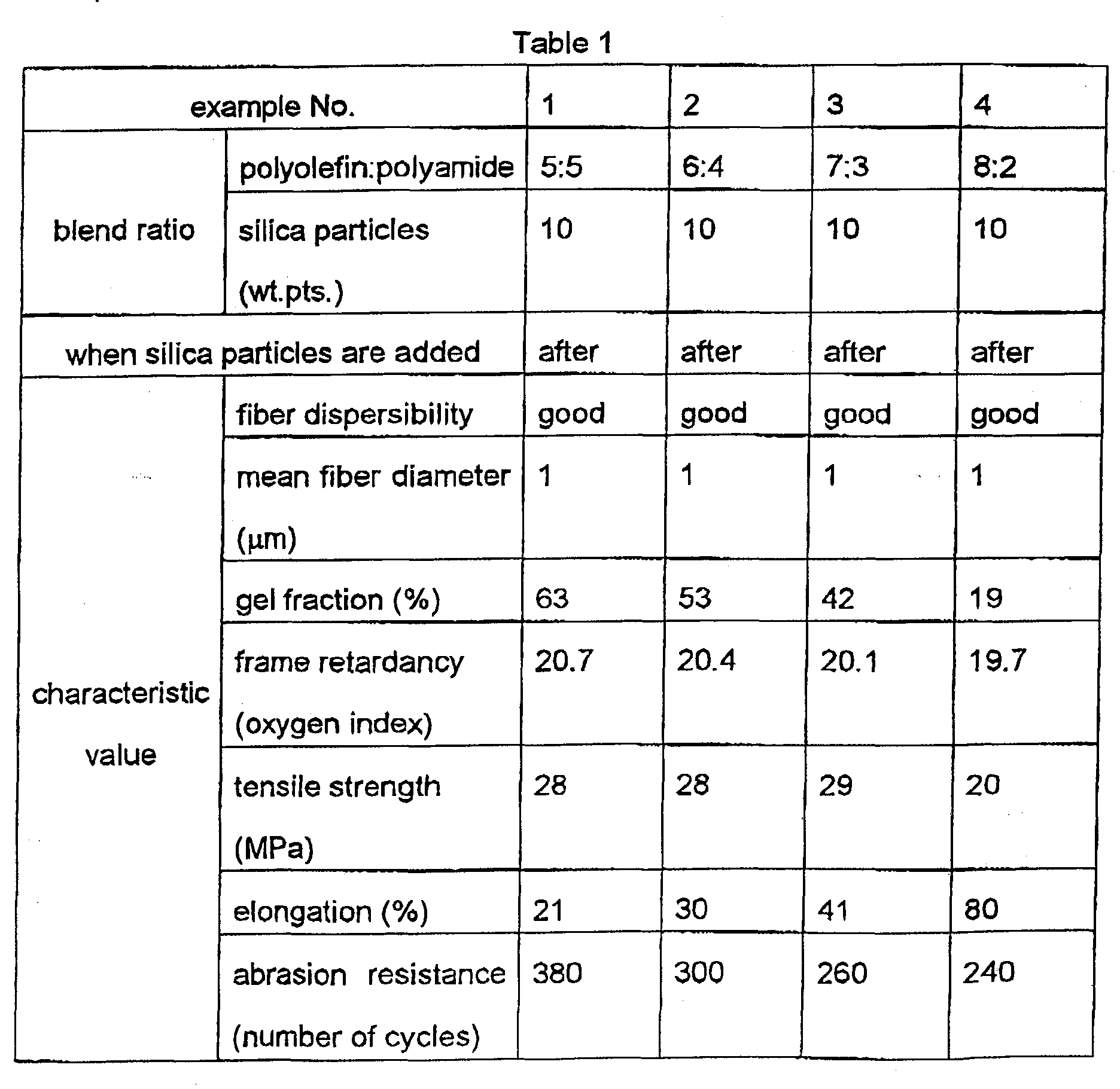


- As in Table 1 above, the polyolefin resin compositions that contain a polyolefin, polyamide fibers, a silane coupling agent and silica particles have a higher gel fraction than those not containing any of them, and it is expected that the former compositions have good abrasion resistance and have improved flame retardancy, strength and elasticity.
Claims (6)
- An insulating member, comprised of an abrasion-resistant resin composition prepared by mixing a base resin with a polyamide ultrafine fibers-dispersed polyolefin resin composition comprised of a polyolefin, polyamide fibers, a silane coupling agent and silica particles.
- The insulating member as set forth in claim 1, wherein the polyamide fibers are comprised of the silica particles.
- The insulating member as set forth in claim 1, wherein the content of the silica particles falls within a range from 1 to 100 parts by weight relative to 100 parts by weight of the polyolefin therein.
- The insulating member as set forth in claim 1, wherein a blend ratio of the polyolefin to the polyamide fibers in the polyamide ultrafine fibers-dispersed polyolefin resin composition falls within a range from 5:5 to 9:1 (polyolefin:polyamide).
- The insulating member as set forth in claim 4, wherein the blend ratio is 8:2.
- The insulating member as set forth in claim 1, wherein a mean fiber diameter of the fibrously dispersed polyamide is not greater than 1 µm, and an aspect ratio thereof falls within a range from 20 to 1000.
Applications Claiming Priority (2)
| Application Number | Priority Date | Filing Date | Title |
|---|---|---|---|
| JP2002314844A JP2004149634A (en) | 2002-10-29 | 2002-10-29 | Insulation parts using abrasion resistant resin composition |
| JP2002314844 | 2002-10-29 |
Publications (1)
| Publication Number | Publication Date |
|---|---|
| EP1416013A1 true EP1416013A1 (en) | 2004-05-06 |
Family
ID=32089511
Family Applications (1)
| Application Number | Title | Priority Date | Filing Date |
|---|---|---|---|
| EP20030256786 Withdrawn EP1416013A1 (en) | 2002-10-29 | 2003-10-28 | Insulating member using abrasion-resistant resin composition |
Country Status (3)
| Country | Link |
|---|---|
| US (1) | US7041726B2 (en) |
| EP (1) | EP1416013A1 (en) |
| JP (1) | JP2004149634A (en) |
Cited By (2)
| Publication number | Priority date | Publication date | Assignee | Title |
|---|---|---|---|---|
| FR2910476A1 (en) * | 2006-12-22 | 2008-06-27 | Rhodia Recherches & Tech | Article, useful for cooling-, oil- and/or hot air- circuits, comprises reinforced silicone elastomer obtained by hardening and/or crosslinking organopolysiloxane composition crosslinkable into elastomer comprising reinforcement |
| WO2008080829A1 (en) * | 2006-12-22 | 2008-07-10 | Bluestar Silicones France | Reinforced silicone elastomer |
Families Citing this family (8)
| Publication number | Priority date | Publication date | Assignee | Title |
|---|---|---|---|---|
| JP4201573B2 (en) * | 2002-10-29 | 2008-12-24 | 矢崎総業株式会社 | Electric wire covering resin composition and electric wire using the same |
| JP2007103247A (en) * | 2005-10-06 | 2007-04-19 | J-Power Systems Corp | Insulating composition and electric wire / cable |
| US20090036588A1 (en) * | 2006-01-20 | 2009-02-05 | Easter Mark R | Silicone wire and cable insulations and jackets with improved abrasion resistance |
| US20100046896A1 (en) * | 2008-08-20 | 2010-02-25 | Amaresh Mahapatra | Liquid crystal polymer blends for use as buffer for optical fiber |
| CA2682058C (en) * | 2009-02-24 | 2012-12-18 | Sharp Kabushiki Kaisha | Air conditioner provided with a heater |
| JP2012025872A (en) * | 2010-07-26 | 2012-02-09 | Daimaru Sangyo Kk | Fiber-reinforced thermoplastic resin composition and method for producing the fiber-reinforced thermoplastic resin composition |
| JP2012077223A (en) * | 2010-10-04 | 2012-04-19 | Daimaru Sangyo Kk | Fiber-reinforced elastomer and method for manufacturing the same |
| JP5917806B2 (en) * | 2011-01-21 | 2016-05-18 | 矢崎総業株式会社 | Method for manufacturing protector and method for manufacturing wire harness |
Citations (4)
| Publication number | Priority date | Publication date | Assignee | Title |
|---|---|---|---|---|
| JPH07224189A (en) * | 1994-02-15 | 1995-08-22 | Ube Ind Ltd | Abrasion resistant rubber composition |
| JPH11106570A (en) * | 1997-09-30 | 1999-04-20 | Ube Ind Ltd | Polyolefin-polyamide resin composition and method for producing the same |
| WO1999048973A1 (en) * | 1998-03-20 | 1999-09-30 | Ube Industries, Ltd. | Resin composition reinforced with polyamide fibers and process for producing the same |
| JP2000007842A (en) * | 1998-06-19 | 2000-01-11 | Ube Ind Ltd | Polyamide fiber reinforced polyolefin resin composition and method for producing the same |
Family Cites Families (4)
| Publication number | Priority date | Publication date | Assignee | Title |
|---|---|---|---|---|
| JPH03279419A (en) | 1990-03-27 | 1991-12-10 | Unitika Ltd | Conjugate fiber |
| JPH04272222A (en) | 1991-02-20 | 1992-09-29 | Unitika Ltd | Light-weight conjugate fiber |
| JPH04281015A (en) | 1991-03-05 | 1992-10-06 | Unitika Ltd | Light-weight conjugate yarn |
| JPH11302464A (en) | 1998-04-24 | 1999-11-02 | Ube Ind Ltd | Polyamide fiber reinforced polyolefin resin composition and method for producing the same |
-
2002
- 2002-10-29 JP JP2002314844A patent/JP2004149634A/en active Pending
-
2003
- 2003-10-28 US US10/693,932 patent/US7041726B2/en not_active Expired - Fee Related
- 2003-10-28 EP EP20030256786 patent/EP1416013A1/en not_active Withdrawn
Patent Citations (4)
| Publication number | Priority date | Publication date | Assignee | Title |
|---|---|---|---|---|
| JPH07224189A (en) * | 1994-02-15 | 1995-08-22 | Ube Ind Ltd | Abrasion resistant rubber composition |
| JPH11106570A (en) * | 1997-09-30 | 1999-04-20 | Ube Ind Ltd | Polyolefin-polyamide resin composition and method for producing the same |
| WO1999048973A1 (en) * | 1998-03-20 | 1999-09-30 | Ube Industries, Ltd. | Resin composition reinforced with polyamide fibers and process for producing the same |
| JP2000007842A (en) * | 1998-06-19 | 2000-01-11 | Ube Ind Ltd | Polyamide fiber reinforced polyolefin resin composition and method for producing the same |
Non-Patent Citations (3)
| Title |
|---|
| PATENT ABSTRACTS OF JAPAN vol. 1995, no. 11 26 December 1995 (1995-12-26) * |
| PATENT ABSTRACTS OF JAPAN vol. 1999, no. 09 30 July 1999 (1999-07-30) * |
| PATENT ABSTRACTS OF JAPAN vol. 2000, no. 04 31 August 2000 (2000-08-31) * |
Cited By (3)
| Publication number | Priority date | Publication date | Assignee | Title |
|---|---|---|---|---|
| FR2910476A1 (en) * | 2006-12-22 | 2008-06-27 | Rhodia Recherches & Tech | Article, useful for cooling-, oil- and/or hot air- circuits, comprises reinforced silicone elastomer obtained by hardening and/or crosslinking organopolysiloxane composition crosslinkable into elastomer comprising reinforcement |
| WO2008080836A1 (en) * | 2006-12-22 | 2008-07-10 | Bluestar Silicones France | Heat and oil resistant vulcanized elastomeric silicon element |
| WO2008080829A1 (en) * | 2006-12-22 | 2008-07-10 | Bluestar Silicones France | Reinforced silicone elastomer |
Also Published As
| Publication number | Publication date |
|---|---|
| US7041726B2 (en) | 2006-05-09 |
| US20040087705A1 (en) | 2004-05-06 |
| JP2004149634A (en) | 2004-05-27 |
Similar Documents
| Publication | Publication Date | Title |
|---|---|---|
| US5948503A (en) | Fine fiber reinforced thermoplastic elastomer composition and process for producing same | |
| US20060167158A1 (en) | Resin composition for coating electric wire and electric wire using the same | |
| CN100463934C (en) | A kind of continuous long fiber reinforced flame retardant thermoplastic resin and preparation method thereof | |
| US7041726B2 (en) | Insulating member using abrasion-resistant resin composition | |
| US20130123388A1 (en) | Fiber-Reinforced Thermoplastic Resin Composition and Process for Producing Fiber-Reinforced Thermoplastic Resin Composition | |
| JP3661736B2 (en) | Method for producing polyolefin-polyamide resin composition | |
| EP1577342A1 (en) | Polyolefin resin composition and processes for the production thereof | |
| JP3326957B2 (en) | Fiber reinforced thermoplastic composition and method for producing the same | |
| US20080300342A1 (en) | Polyolefin Resin Composition and Electric Wire Using the Same | |
| JP3893071B2 (en) | Recycled plastic material and molded article using compatibilizer | |
| JPH11302464A (en) | Polyamide fiber reinforced polyolefin resin composition and method for producing the same | |
| JP3120711B2 (en) | Method for producing fiber-reinforced thermoplastic resin composition | |
| JPH02251550A (en) | Fiber-reinforced composition and method for producing the same | |
| CN116829640B (en) | Glass fiber reinforced acrylic resin composition | |
| KR20070003804A (en) | Process for producing polyolefin-polyamide resin composition | |
| JP2001294760A (en) | High strength and high rigidity thermoplastic resin composition | |
| KR100196545B1 (en) | Fine fiber-reinforced thermoplastics elastomer composition and process for producing the same | |
| JP2000007847A (en) | Polyester fiber reinforced rubber composition and method for producing the same | |
| JP3154390B2 (en) | Method for producing fiber-reinforced elastic composition | |
| DE69513394T2 (en) | Thermoplastic elastomer reinforced with fine fibers and process for its production | |
| WO1999048970A1 (en) | Polyamide fiber-reinforced elastomer composition and process for the production thereof | |
| JPH11209535A (en) | Polyamide fiber reinforced thermoplastic elastomer composition and method for producing the same |
Legal Events
| Date | Code | Title | Description |
|---|---|---|---|
| PUAI | Public reference made under article 153(3) epc to a published international application that has entered the european phase |
Free format text: ORIGINAL CODE: 0009012 |
|
| AK | Designated contracting states |
Kind code of ref document: A1 Designated state(s): AT BE BG CH CY CZ DE DK EE ES FI FR GB GR HU IE IT LI LU MC NL PT RO SE SI SK TR |
|
| AX | Request for extension of the european patent |
Extension state: AL LT LV MK |
|
| 17P | Request for examination filed |
Effective date: 20041027 |
|
| AKX | Designation fees paid |
Designated state(s): DE FR GB |
|
| 17Q | First examination report despatched |
Effective date: 20061127 |
|
| RAP1 | Party data changed (applicant data changed or rights of an application transferred) |
Owner name: YAZAKI CORPORATION |
|
| STAA | Information on the status of an ep patent application or granted ep patent |
Free format text: STATUS: THE APPLICATION IS DEEMED TO BE WITHDRAWN |
|
| 18D | Application deemed to be withdrawn |
Effective date: 20130129 |