EP1416003A1 - RESIN COMPOSITION, COMPOSITION FOR SOLDER RESIST, AND CURED ARTICLE OBTAINED THEREFROM - Google Patents
RESIN COMPOSITION, COMPOSITION FOR SOLDER RESIST, AND CURED ARTICLE OBTAINED THEREFROM Download PDFInfo
- Publication number
- EP1416003A1 EP1416003A1 EP02755859A EP02755859A EP1416003A1 EP 1416003 A1 EP1416003 A1 EP 1416003A1 EP 02755859 A EP02755859 A EP 02755859A EP 02755859 A EP02755859 A EP 02755859A EP 1416003 A1 EP1416003 A1 EP 1416003A1
- Authority
- EP
- European Patent Office
- Prior art keywords
- resin composition
- acid
- composition according
- per molecule
- formula
- Prior art date
- Legal status (The legal status is an assumption and is not a legal conclusion. Google has not performed a legal analysis and makes no representation as to the accuracy of the status listed.)
- Withdrawn
Links
- 239000011342 resin composition Substances 0.000 title claims abstract description 53
- 229910000679 solder Inorganic materials 0.000 title claims abstract description 16
- 239000000203 mixture Substances 0.000 title claims description 14
- 239000003822 epoxy resin Substances 0.000 claims abstract description 45
- 229920000647 polyepoxide Polymers 0.000 claims abstract description 45
- 239000002253 acid Substances 0.000 claims abstract description 36
- 150000001875 compounds Chemical class 0.000 claims abstract description 28
- 125000003178 carboxy group Chemical group [H]OC(*)=O 0.000 claims abstract description 19
- 125000002887 hydroxy group Chemical group [H]O* 0.000 claims abstract description 18
- 229920001971 elastomer Polymers 0.000 claims abstract description 11
- 125000003700 epoxy group Chemical group 0.000 claims abstract description 11
- 239000011229 interlayer Substances 0.000 claims abstract description 8
- 238000013007 heat curing Methods 0.000 claims description 14
- 238000001723 curing Methods 0.000 claims description 11
- 150000008065 acid anhydrides Chemical class 0.000 claims description 9
- 239000010410 layer Substances 0.000 claims description 9
- 239000003795 chemical substances by application Substances 0.000 claims description 8
- 239000003085 diluting agent Substances 0.000 claims description 7
- 125000004435 hydrogen atom Chemical group [H]* 0.000 claims description 5
- 125000005439 maleimidyl group Chemical group C1(C=CC(N1*)=O)=O 0.000 claims description 5
- 239000003505 polymerization initiator Substances 0.000 claims description 5
- YNGDWRXWKFWCJY-UHFFFAOYSA-N 1,4-Dihydropyridine Chemical class C1C=CNC=C1 YNGDWRXWKFWCJY-UHFFFAOYSA-N 0.000 claims description 3
- 150000007513 acids Chemical class 0.000 claims description 3
- 125000004432 carbon atom Chemical group C* 0.000 claims description 3
- 150000001253 acrylic acids Chemical class 0.000 claims description 2
- 150000001735 carboxylic acids Chemical class 0.000 claims 1
- 238000007747 plating Methods 0.000 abstract description 14
- PCHJSUWPFVWCPO-UHFFFAOYSA-N gold Chemical compound [Au] PCHJSUWPFVWCPO-UHFFFAOYSA-N 0.000 abstract description 11
- 229910052737 gold Inorganic materials 0.000 abstract description 11
- 239000010931 gold Substances 0.000 abstract description 11
- 238000005476 soldering Methods 0.000 abstract description 11
- 230000006866 deterioration Effects 0.000 abstract description 7
- 239000003989 dielectric material Substances 0.000 abstract 1
- 239000004615 ingredient Substances 0.000 abstract 1
- 238000000034 method Methods 0.000 description 26
- -1 alkyl phenol Chemical compound 0.000 description 24
- LNEPOXFFQSENCJ-UHFFFAOYSA-N haloperidol Chemical compound C1CC(O)(C=2C=CC(Cl)=CC=2)CCN1CCCC(=O)C1=CC=C(F)C=C1 LNEPOXFFQSENCJ-UHFFFAOYSA-N 0.000 description 21
- 239000000758 substrate Substances 0.000 description 20
- NIXOWILDQLNWCW-UHFFFAOYSA-M Acrylate Chemical compound [O-]C(=O)C=C NIXOWILDQLNWCW-UHFFFAOYSA-M 0.000 description 16
- XLYOFNOQVPJJNP-UHFFFAOYSA-N water Substances O XLYOFNOQVPJJNP-UHFFFAOYSA-N 0.000 description 14
- YEJRWHAVMIAJKC-UHFFFAOYSA-N 4-Butyrolactone Chemical compound O=C1CCCO1 YEJRWHAVMIAJKC-UHFFFAOYSA-N 0.000 description 13
- 239000000976 ink Substances 0.000 description 12
- 239000007795 chemical reaction product Substances 0.000 description 11
- 239000007864 aqueous solution Substances 0.000 description 10
- 238000006243 chemical reaction Methods 0.000 description 10
- HEMHJVSKTPXQMS-UHFFFAOYSA-M Sodium hydroxide Chemical compound [OH-].[Na+] HEMHJVSKTPXQMS-UHFFFAOYSA-M 0.000 description 9
- 229920001577 copolymer Polymers 0.000 description 9
- 239000000463 material Substances 0.000 description 9
- 239000007787 solid Substances 0.000 description 9
- 239000000243 solution Substances 0.000 description 9
- 239000000126 substance Substances 0.000 description 9
- 229920002554 vinyl polymer Polymers 0.000 description 9
- RTZKZFJDLAIYFH-UHFFFAOYSA-N Diethyl ether Chemical compound CCOCC RTZKZFJDLAIYFH-UHFFFAOYSA-N 0.000 description 8
- CDBYLPFSWZWCQE-UHFFFAOYSA-L Sodium Carbonate Chemical compound [Na+].[Na+].[O-]C([O-])=O CDBYLPFSWZWCQE-UHFFFAOYSA-L 0.000 description 8
- PXKLMJQFEQBVLD-UHFFFAOYSA-N bisphenol F Chemical compound C1=CC(O)=CC=C1CC1=CC=C(O)C=C1 PXKLMJQFEQBVLD-UHFFFAOYSA-N 0.000 description 8
- 150000001993 dienes Chemical class 0.000 description 8
- 239000002904 solvent Substances 0.000 description 8
- SMZOUWXMTYCWNB-UHFFFAOYSA-N 2-(2-methoxy-5-methylphenyl)ethanamine Chemical compound COC1=CC=C(C)C=C1CCN SMZOUWXMTYCWNB-UHFFFAOYSA-N 0.000 description 7
- NIXOWILDQLNWCW-UHFFFAOYSA-N 2-Propenoic acid Natural products OC(=O)C=C NIXOWILDQLNWCW-UHFFFAOYSA-N 0.000 description 7
- WSFSSNUMVMOOMR-UHFFFAOYSA-N Formaldehyde Chemical compound O=C WSFSSNUMVMOOMR-UHFFFAOYSA-N 0.000 description 7
- 230000015572 biosynthetic process Effects 0.000 description 7
- 239000003054 catalyst Substances 0.000 description 7
- QSHDDOUJBYECFT-UHFFFAOYSA-N mercury Chemical compound [Hg] QSHDDOUJBYECFT-UHFFFAOYSA-N 0.000 description 7
- 229910052753 mercury Inorganic materials 0.000 description 7
- 239000000047 product Substances 0.000 description 7
- 238000003786 synthesis reaction Methods 0.000 description 7
- FPZWZCWUIYYYBU-UHFFFAOYSA-N 2-(2-ethoxyethoxy)ethyl acetate Chemical compound CCOCCOCCOC(C)=O FPZWZCWUIYYYBU-UHFFFAOYSA-N 0.000 description 6
- IAZDPXIOMUYVGZ-UHFFFAOYSA-N Dimethylsulphoxide Chemical compound CS(C)=O IAZDPXIOMUYVGZ-UHFFFAOYSA-N 0.000 description 6
- XEKOWRVHYACXOJ-UHFFFAOYSA-N Ethyl acetate Chemical compound CCOC(C)=O XEKOWRVHYACXOJ-UHFFFAOYSA-N 0.000 description 6
- LYCAIKOWRPUZTN-UHFFFAOYSA-N Ethylene glycol Chemical compound OCCO LYCAIKOWRPUZTN-UHFFFAOYSA-N 0.000 description 6
- QIGBRXMKCJKVMJ-UHFFFAOYSA-N Hydroquinone Chemical compound OC1=CC=C(O)C=C1 QIGBRXMKCJKVMJ-UHFFFAOYSA-N 0.000 description 6
- ISWSIDIOOBJBQZ-UHFFFAOYSA-N Phenol Chemical compound OC1=CC=CC=C1 ISWSIDIOOBJBQZ-UHFFFAOYSA-N 0.000 description 6
- KWYUFKZDYYNOTN-UHFFFAOYSA-M Potassium hydroxide Chemical compound [OH-].[K+] KWYUFKZDYYNOTN-UHFFFAOYSA-M 0.000 description 6
- PPBRXRYQALVLMV-UHFFFAOYSA-N Styrene Chemical compound C=CC1=CC=CC=C1 PPBRXRYQALVLMV-UHFFFAOYSA-N 0.000 description 6
- YXFVVABEGXRONW-UHFFFAOYSA-N Toluene Chemical compound CC1=CC=CC=C1 YXFVVABEGXRONW-UHFFFAOYSA-N 0.000 description 6
- IISBACLAFKSPIT-UHFFFAOYSA-N bisphenol A Chemical compound C=1C=C(O)C=CC=1C(C)(C)C1=CC=C(O)C=C1 IISBACLAFKSPIT-UHFFFAOYSA-N 0.000 description 6
- 238000011156 evaluation Methods 0.000 description 6
- FPYJFEHAWHCUMM-UHFFFAOYSA-N maleic anhydride Chemical compound O=C1OC(=O)C=C1 FPYJFEHAWHCUMM-UHFFFAOYSA-N 0.000 description 6
- 239000000178 monomer Substances 0.000 description 6
- 239000003208 petroleum Substances 0.000 description 6
- 229920000642 polymer Polymers 0.000 description 6
- 238000006116 polymerization reaction Methods 0.000 description 6
- CNHDIAIOKMXOLK-UHFFFAOYSA-N toluquinol Chemical compound CC1=CC(O)=CC=C1O CNHDIAIOKMXOLK-UHFFFAOYSA-N 0.000 description 6
- RIOQSEWOXXDEQQ-UHFFFAOYSA-N triphenylphosphine Chemical compound C1=CC=CC=C1P(C=1C=CC=CC=1)C1=CC=CC=C1 RIOQSEWOXXDEQQ-UHFFFAOYSA-N 0.000 description 6
- 125000000391 vinyl group Chemical group [H]C([*])=C([H])[H] 0.000 description 6
- KMOUUZVZFBCRAM-OLQVQODUSA-N (3as,7ar)-3a,4,7,7a-tetrahydro-2-benzofuran-1,3-dione Chemical compound C1C=CC[C@@H]2C(=O)OC(=O)[C@@H]21 KMOUUZVZFBCRAM-OLQVQODUSA-N 0.000 description 5
- FALRKNHUBBKYCC-UHFFFAOYSA-N 2-(chloromethyl)pyridine-3-carbonitrile Chemical compound ClCC1=NC=CC=C1C#N FALRKNHUBBKYCC-UHFFFAOYSA-N 0.000 description 5
- ZWEHNKRNPOVVGH-UHFFFAOYSA-N 2-Butanone Chemical compound CCC(C)=O ZWEHNKRNPOVVGH-UHFFFAOYSA-N 0.000 description 5
- BRLQWZUYTZBJKN-UHFFFAOYSA-N Epichlorohydrin Chemical compound ClCC1CO1 BRLQWZUYTZBJKN-UHFFFAOYSA-N 0.000 description 5
- 229920000877 Melamine resin Polymers 0.000 description 5
- XSQUKJJJFZCRTK-UHFFFAOYSA-N Urea Natural products NC(N)=O XSQUKJJJFZCRTK-UHFFFAOYSA-N 0.000 description 5
- 230000000052 comparative effect Effects 0.000 description 5
- 150000002148 esters Chemical class 0.000 description 5
- 239000003960 organic solvent Substances 0.000 description 5
- 229920006395 saturated elastomer Polymers 0.000 description 5
- 238000000926 separation method Methods 0.000 description 5
- 229940014800 succinic anhydride Drugs 0.000 description 5
- MOBNLCPBAMKACS-UHFFFAOYSA-N 2-(1-chloroethyl)oxirane Chemical compound CC(Cl)C1CO1 MOBNLCPBAMKACS-UHFFFAOYSA-N 0.000 description 4
- QTBSBXVTEAMEQO-UHFFFAOYSA-M Acetate Chemical compound CC([O-])=O QTBSBXVTEAMEQO-UHFFFAOYSA-M 0.000 description 4
- 229930185605 Bisphenol Natural products 0.000 description 4
- 239000004593 Epoxy Substances 0.000 description 4
- PEDCQBHIVMGVHV-UHFFFAOYSA-N Glycerine Chemical compound OCC(O)CO PEDCQBHIVMGVHV-UHFFFAOYSA-N 0.000 description 4
- PXHVJJICTQNCMI-UHFFFAOYSA-N Nickel Chemical compound [Ni] PXHVJJICTQNCMI-UHFFFAOYSA-N 0.000 description 4
- 206010034972 Photosensitivity reaction Diseases 0.000 description 4
- LGRFSURHDFAFJT-UHFFFAOYSA-N Phthalic anhydride Natural products C1=CC=C2C(=O)OC(=O)C2=C1 LGRFSURHDFAFJT-UHFFFAOYSA-N 0.000 description 4
- 125000004018 acid anhydride group Chemical group 0.000 description 4
- WNLRTRBMVRJNCN-UHFFFAOYSA-N adipic acid Chemical compound OC(=O)CCCCC(O)=O WNLRTRBMVRJNCN-UHFFFAOYSA-N 0.000 description 4
- 239000003513 alkali Substances 0.000 description 4
- UCMIRNVEIXFBKS-UHFFFAOYSA-N beta-alanine Chemical compound NCCC(O)=O UCMIRNVEIXFBKS-UHFFFAOYSA-N 0.000 description 4
- 150000001732 carboxylic acid derivatives Chemical class 0.000 description 4
- 238000000576 coating method Methods 0.000 description 4
- JHIVVAPYMSGYDF-UHFFFAOYSA-N cyclohexanone Chemical compound O=C1CCCCC1 JHIVVAPYMSGYDF-UHFFFAOYSA-N 0.000 description 4
- 125000001495 ethyl group Chemical group [H]C([H])([H])C([H])([H])* 0.000 description 4
- 125000003055 glycidyl group Chemical group C(C1CO1)* 0.000 description 4
- FUZZWVXGSFPDMH-UHFFFAOYSA-N hexanoic acid Chemical compound CCCCCC(O)=O FUZZWVXGSFPDMH-UHFFFAOYSA-N 0.000 description 4
- 239000003112 inhibitor Substances 0.000 description 4
- 239000003999 initiator Substances 0.000 description 4
- JDSHMPZPIAZGSV-UHFFFAOYSA-N melamine Chemical compound NC1=NC(N)=NC(N)=N1 JDSHMPZPIAZGSV-UHFFFAOYSA-N 0.000 description 4
- VNWKTOKETHGBQD-UHFFFAOYSA-N methane Chemical compound C VNWKTOKETHGBQD-UHFFFAOYSA-N 0.000 description 4
- NWVVVBRKAWDGAB-UHFFFAOYSA-N p-methoxyphenol Chemical compound COC1=CC=C(O)C=C1 NWVVVBRKAWDGAB-UHFFFAOYSA-N 0.000 description 4
- 230000036211 photosensitivity Effects 0.000 description 4
- 229910000029 sodium carbonate Inorganic materials 0.000 description 4
- MUTGBJKUEZFXGO-OLQVQODUSA-N (3as,7ar)-3a,4,5,6,7,7a-hexahydro-2-benzofuran-1,3-dione Chemical compound C1CCC[C@@H]2C(=O)OC(=O)[C@@H]21 MUTGBJKUEZFXGO-OLQVQODUSA-N 0.000 description 3
- VPWNQTHUCYMVMZ-UHFFFAOYSA-N 4,4'-sulfonyldiphenol Chemical class C1=CC(O)=CC=C1S(=O)(=O)C1=CC=C(O)C=C1 VPWNQTHUCYMVMZ-UHFFFAOYSA-N 0.000 description 3
- CSCPPACGZOOCGX-UHFFFAOYSA-N Acetone Chemical compound CC(C)=O CSCPPACGZOOCGX-UHFFFAOYSA-N 0.000 description 3
- NLHHRLWOUZZQLW-UHFFFAOYSA-N Acrylonitrile Chemical compound C=CC#N NLHHRLWOUZZQLW-UHFFFAOYSA-N 0.000 description 3
- UHOVQNZJYSORNB-UHFFFAOYSA-N Benzene Chemical compound C1=CC=CC=C1 UHOVQNZJYSORNB-UHFFFAOYSA-N 0.000 description 3
- NTIZESTWPVYFNL-UHFFFAOYSA-N Methyl isobutyl ketone Chemical compound CC(C)CC(C)=O NTIZESTWPVYFNL-UHFFFAOYSA-N 0.000 description 3
- UIHCLUNTQKBZGK-UHFFFAOYSA-N Methyl isobutyl ketone Natural products CCC(C)C(C)=O UIHCLUNTQKBZGK-UHFFFAOYSA-N 0.000 description 3
- 239000005062 Polybutadiene Substances 0.000 description 3
- VYPSYNLAJGMNEJ-UHFFFAOYSA-N Silicium dioxide Chemical compound O=[Si]=O VYPSYNLAJGMNEJ-UHFFFAOYSA-N 0.000 description 3
- KDYFGRWQOYBRFD-UHFFFAOYSA-N Succinic acid Natural products OC(=O)CCC(O)=O KDYFGRWQOYBRFD-UHFFFAOYSA-N 0.000 description 3
- ZMANZCXQSJIPKH-UHFFFAOYSA-N Triethylamine Chemical compound CCN(CC)CC ZMANZCXQSJIPKH-UHFFFAOYSA-N 0.000 description 3
- 150000001252 acrylic acid derivatives Chemical class 0.000 description 3
- 150000008064 anhydrides Chemical class 0.000 description 3
- JHIWVOJDXOSYLW-UHFFFAOYSA-N butyl 2,2-difluorocyclopropane-1-carboxylate Chemical compound CCCCOC(=O)C1CC1(F)F JHIWVOJDXOSYLW-UHFFFAOYSA-N 0.000 description 3
- 239000004202 carbamide Substances 0.000 description 3
- 239000011248 coating agent Substances 0.000 description 3
- GYZLOYUZLJXAJU-UHFFFAOYSA-N diglycidyl ether Chemical compound C1OC1COCC1CO1 GYZLOYUZLJXAJU-UHFFFAOYSA-N 0.000 description 3
- 238000001035 drying Methods 0.000 description 3
- 239000011810 insulating material Substances 0.000 description 3
- 229940043265 methyl isobutyl ketone Drugs 0.000 description 3
- 238000002156 mixing Methods 0.000 description 3
- WXZMFSXDPGVJKK-UHFFFAOYSA-N pentaerythritol Chemical compound OCC(CO)(CO)CO WXZMFSXDPGVJKK-UHFFFAOYSA-N 0.000 description 3
- 150000002989 phenols Chemical class 0.000 description 3
- 229920002857 polybutadiene Polymers 0.000 description 3
- 238000007650 screen-printing Methods 0.000 description 3
- 235000017550 sodium carbonate Nutrition 0.000 description 3
- 229940001593 sodium carbonate Drugs 0.000 description 3
- 235000011121 sodium hydroxide Nutrition 0.000 description 3
- 238000005507 spraying Methods 0.000 description 3
- 0 *(c1ccccc1)c1ccccc1 Chemical compound *(c1ccccc1)c1ccccc1 0.000 description 2
- WBYWAXJHAXSJNI-VOTSOKGWSA-M .beta-Phenylacrylic acid Natural products [O-]C(=O)\C=C\C1=CC=CC=C1 WBYWAXJHAXSJNI-VOTSOKGWSA-M 0.000 description 2
- PTBDIHRZYDMNKB-UHFFFAOYSA-N 2,2-Bis(hydroxymethyl)propionic acid Chemical compound OCC(C)(CO)C(O)=O PTBDIHRZYDMNKB-UHFFFAOYSA-N 0.000 description 2
- HZAXFHJVJLSVMW-UHFFFAOYSA-N 2-Aminoethan-1-ol Chemical compound NCCO HZAXFHJVJLSVMW-UHFFFAOYSA-N 0.000 description 2
- TXBCBTDQIULDIA-UHFFFAOYSA-N 2-[[3-hydroxy-2,2-bis(hydroxymethyl)propoxy]methyl]-2-(hydroxymethyl)propane-1,3-diol Chemical compound OCC(CO)(CO)COCC(CO)(CO)CO TXBCBTDQIULDIA-UHFFFAOYSA-N 0.000 description 2
- QTWJRLJHJPIABL-UHFFFAOYSA-N 2-methylphenol;3-methylphenol;4-methylphenol Chemical compound CC1=CC=C(O)C=C1.CC1=CC=CC(O)=C1.CC1=CC=CC=C1O QTWJRLJHJPIABL-UHFFFAOYSA-N 0.000 description 2
- OFNISBHGPNMTMS-UHFFFAOYSA-N 3-methylideneoxolane-2,5-dione Chemical compound C=C1CC(=O)OC1=O OFNISBHGPNMTMS-UHFFFAOYSA-N 0.000 description 2
- CYUZOYPRAQASLN-UHFFFAOYSA-N 3-prop-2-enoyloxypropanoic acid Chemical compound OC(=O)CCOC(=O)C=C CYUZOYPRAQASLN-UHFFFAOYSA-N 0.000 description 2
- KWOLFJPFCHCOCG-UHFFFAOYSA-N Acetophenone Chemical compound CC(=O)C1=CC=CC=C1 KWOLFJPFCHCOCG-UHFFFAOYSA-N 0.000 description 2
- 229920002126 Acrylic acid copolymer Polymers 0.000 description 2
- QGZKDVFQNNGYKY-UHFFFAOYSA-N Ammonia Chemical compound N QGZKDVFQNNGYKY-UHFFFAOYSA-N 0.000 description 2
- KAKZBPTYRLMSJV-UHFFFAOYSA-N Butadiene Chemical compound C=CC=C KAKZBPTYRLMSJV-UHFFFAOYSA-N 0.000 description 2
- DKPFZGUDAPQIHT-UHFFFAOYSA-N Butyl acetate Natural products CCCCOC(C)=O DKPFZGUDAPQIHT-UHFFFAOYSA-N 0.000 description 2
- VTYYLEPIZMXCLO-UHFFFAOYSA-L Calcium carbonate Chemical compound [Ca+2].[O-]C([O-])=O VTYYLEPIZMXCLO-UHFFFAOYSA-L 0.000 description 2
- KXDHJXZQYSOELW-UHFFFAOYSA-N Carbamic acid Chemical compound NC(O)=O KXDHJXZQYSOELW-UHFFFAOYSA-N 0.000 description 2
- 229920000298 Cellophane Polymers 0.000 description 2
- WBYWAXJHAXSJNI-SREVYHEPSA-N Cinnamic acid Chemical compound OC(=O)\C=C/C1=CC=CC=C1 WBYWAXJHAXSJNI-SREVYHEPSA-N 0.000 description 2
- RYGMFSIKBFXOCR-UHFFFAOYSA-N Copper Chemical compound [Cu] RYGMFSIKBFXOCR-UHFFFAOYSA-N 0.000 description 2
- XTHFKEDIFFGKHM-UHFFFAOYSA-N Dimethoxyethane Chemical compound COCCOC XTHFKEDIFFGKHM-UHFFFAOYSA-N 0.000 description 2
- VZCYOOQTPOCHFL-OWOJBTEDSA-N Fumaric acid Chemical compound OC(=O)\C=C\C(O)=O VZCYOOQTPOCHFL-OWOJBTEDSA-N 0.000 description 2
- DHMQDGOQFOQNFH-UHFFFAOYSA-N Glycine Chemical compound NCC(O)=O DHMQDGOQFOQNFH-UHFFFAOYSA-N 0.000 description 2
- 229920013646 Hycar Polymers 0.000 description 2
- AVXURJPOCDRRFD-UHFFFAOYSA-N Hydroxylamine Chemical compound ON AVXURJPOCDRRFD-UHFFFAOYSA-N 0.000 description 2
- RRHGJUQNOFWUDK-UHFFFAOYSA-N Isoprene Chemical compound CC(=C)C=C RRHGJUQNOFWUDK-UHFFFAOYSA-N 0.000 description 2
- OFOBLEOULBTSOW-UHFFFAOYSA-N Malonic acid Chemical compound OC(=O)CC(O)=O OFOBLEOULBTSOW-UHFFFAOYSA-N 0.000 description 2
- CERQOIWHTDAKMF-UHFFFAOYSA-M Methacrylate Chemical compound CC(=C)C([O-])=O CERQOIWHTDAKMF-UHFFFAOYSA-M 0.000 description 2
- LRHPLDYGYMQRHN-UHFFFAOYSA-N N-Butanol Chemical compound CCCCO LRHPLDYGYMQRHN-UHFFFAOYSA-N 0.000 description 2
- CTQNGGLPUBDAKN-UHFFFAOYSA-N O-Xylene Chemical compound CC1=CC=CC=C1C CTQNGGLPUBDAKN-UHFFFAOYSA-N 0.000 description 2
- 239000004698 Polyethylene Substances 0.000 description 2
- JUJWROOIHBZHMG-UHFFFAOYSA-N Pyridine Chemical compound C1=CC=NC=C1 JUJWROOIHBZHMG-UHFFFAOYSA-N 0.000 description 2
- 244000028419 Styrax benzoin Species 0.000 description 2
- 235000000126 Styrax benzoin Nutrition 0.000 description 2
- 235000008411 Sumatra benzointree Nutrition 0.000 description 2
- GSEJCLTVZPLZKY-UHFFFAOYSA-N Triethanolamine Chemical compound OCCN(CCO)CCO GSEJCLTVZPLZKY-UHFFFAOYSA-N 0.000 description 2
- ZJCCRDAZUWHFQH-UHFFFAOYSA-N Trimethylolpropane Chemical compound CCC(CO)(CO)CO ZJCCRDAZUWHFQH-UHFFFAOYSA-N 0.000 description 2
- 230000005856 abnormality Effects 0.000 description 2
- 230000002378 acidificating effect Effects 0.000 description 2
- 239000001361 adipic acid Substances 0.000 description 2
- 235000011037 adipic acid Nutrition 0.000 description 2
- 125000002723 alicyclic group Chemical group 0.000 description 2
- ROOXNKNUYICQNP-UHFFFAOYSA-N ammonium persulfate Chemical compound [NH4+].[NH4+].[O-]S(=O)(=O)OOS([O-])(=O)=O ROOXNKNUYICQNP-UHFFFAOYSA-N 0.000 description 2
- MTHSVFCYNBDYFN-UHFFFAOYSA-N anhydrous diethylene glycol Natural products OCCOCCO MTHSVFCYNBDYFN-UHFFFAOYSA-N 0.000 description 2
- 150000004945 aromatic hydrocarbons Chemical class 0.000 description 2
- TZCXTZWJZNENPQ-UHFFFAOYSA-L barium sulfate Chemical compound [Ba+2].[O-]S([O-])(=O)=O TZCXTZWJZNENPQ-UHFFFAOYSA-L 0.000 description 2
- 238000005452 bending Methods 0.000 description 2
- ISAOCJYIOMOJEB-UHFFFAOYSA-N benzoin Chemical compound C=1C=CC=CC=1C(O)C(=O)C1=CC=CC=C1 ISAOCJYIOMOJEB-UHFFFAOYSA-N 0.000 description 2
- 239000012965 benzophenone Substances 0.000 description 2
- 239000007767 bonding agent Substances 0.000 description 2
- 125000000484 butyl group Chemical group [H]C([*])([H])C([H])([H])C([H])([H])C([H])([H])[H] 0.000 description 2
- YCIMNLLNPGFGHC-UHFFFAOYSA-N catechol Chemical compound OC1=CC=CC=C1O YCIMNLLNPGFGHC-UHFFFAOYSA-N 0.000 description 2
- 229930016911 cinnamic acid Natural products 0.000 description 2
- 235000013985 cinnamic acid Nutrition 0.000 description 2
- 229930003836 cresol Natural products 0.000 description 2
- LDHQCZJRKDOVOX-NSCUHMNNSA-N crotonic acid Chemical compound C\C=C\C(O)=O LDHQCZJRKDOVOX-NSCUHMNNSA-N 0.000 description 2
- ZUOUZKKEUPVFJK-UHFFFAOYSA-N diphenyl Chemical compound C1=CC=CC=C1C1=CC=CC=C1 ZUOUZKKEUPVFJK-UHFFFAOYSA-N 0.000 description 2
- 150000002170 ethers Chemical class 0.000 description 2
- 125000000524 functional group Chemical group 0.000 description 2
- BTCSSZJGUNDROE-UHFFFAOYSA-N gamma-aminobutyric acid Chemical compound NCCCC(O)=O BTCSSZJGUNDROE-UHFFFAOYSA-N 0.000 description 2
- 235000011187 glycerol Nutrition 0.000 description 2
- 235000019382 gum benzoic Nutrition 0.000 description 2
- CTRFEEQNDJFNNL-UHFFFAOYSA-N hexanoic acid;pyrrole-2,5-dione Chemical compound O=C1NC(=O)C=C1.CCCCCC(O)=O CTRFEEQNDJFNNL-UHFFFAOYSA-N 0.000 description 2
- WGCNASOHLSPBMP-UHFFFAOYSA-N hydroxyacetaldehyde Natural products OCC=O WGCNASOHLSPBMP-UHFFFAOYSA-N 0.000 description 2
- QQVIHTHCMHWDBS-UHFFFAOYSA-N isophthalic acid Chemical compound OC(=O)C1=CC=CC(C(O)=O)=C1 QQVIHTHCMHWDBS-UHFFFAOYSA-N 0.000 description 2
- 150000002576 ketones Chemical class 0.000 description 2
- 239000007788 liquid Substances 0.000 description 2
- WBYWAXJHAXSJNI-UHFFFAOYSA-N methyl p-hydroxycinnamate Natural products OC(=O)C=CC1=CC=CC=C1 WBYWAXJHAXSJNI-UHFFFAOYSA-N 0.000 description 2
- VYKXQOYUCMREIS-UHFFFAOYSA-N methylhexahydrophthalic anhydride Chemical compound C1CCCC2C(=O)OC(=O)C21C VYKXQOYUCMREIS-UHFFFAOYSA-N 0.000 description 2
- 229910052759 nickel Inorganic materials 0.000 description 2
- XNGIFLGASWRNHJ-UHFFFAOYSA-N phthalic acid Chemical compound OC(=O)C1=CC=CC=C1C(O)=O XNGIFLGASWRNHJ-UHFFFAOYSA-N 0.000 description 2
- 238000006068 polycondensation reaction Methods 0.000 description 2
- 229920000573 polyethylene Polymers 0.000 description 2
- BWHMMNNQKKPAPP-UHFFFAOYSA-L potassium carbonate Chemical compound [K+].[K+].[O-]C([O-])=O BWHMMNNQKKPAPP-UHFFFAOYSA-L 0.000 description 2
- UOHMMEJUHBCKEE-UHFFFAOYSA-N prehnitene Chemical compound CC1=CC=C(C)C(C)=C1C UOHMMEJUHBCKEE-UHFFFAOYSA-N 0.000 description 2
- LLHKCFNBLRBOGN-UHFFFAOYSA-N propylene glycol methyl ether acetate Chemical compound COCC(C)OC(C)=O LLHKCFNBLRBOGN-UHFFFAOYSA-N 0.000 description 2
- WQGWDDDVZFFDIG-UHFFFAOYSA-N pyrogallol Chemical compound OC1=CC=CC(O)=C1O WQGWDDDVZFFDIG-UHFFFAOYSA-N 0.000 description 2
- 230000035484 reaction time Effects 0.000 description 2
- 229920005989 resin Polymers 0.000 description 2
- 239000011347 resin Substances 0.000 description 2
- 238000007789 sealing Methods 0.000 description 2
- 150000003512 tertiary amines Chemical class 0.000 description 2
- VZCYOOQTPOCHFL-UHFFFAOYSA-N trans-butenedioic acid Natural products OC(=O)C=CC(O)=O VZCYOOQTPOCHFL-UHFFFAOYSA-N 0.000 description 2
- LDHQCZJRKDOVOX-UHFFFAOYSA-N trans-crotonic acid Natural products CC=CC(O)=O LDHQCZJRKDOVOX-UHFFFAOYSA-N 0.000 description 2
- 229960004418 trolamine Drugs 0.000 description 2
- 229910052724 xenon Inorganic materials 0.000 description 2
- FHNFHKCVQCLJFQ-UHFFFAOYSA-N xenon atom Chemical compound [Xe] FHNFHKCVQCLJFQ-UHFFFAOYSA-N 0.000 description 2
- 239000008096 xylene Substances 0.000 description 2
- CHGYRPXLVDGWML-UHFFFAOYSA-N (2-amino-4,4-dimethylcyclohexa-1,5-dien-1-yl)-phenylmethanone Chemical compound C1=CC(C)(C)CC(N)=C1C(=O)C1=CC=CC=C1 CHGYRPXLVDGWML-UHFFFAOYSA-N 0.000 description 1
- FEIQOMCWGDNMHM-KBXRYBNXSA-N (2e,4e)-5-phenylpenta-2,4-dienoic acid Chemical compound OC(=O)\C=C\C=C\C1=CC=CC=C1 FEIQOMCWGDNMHM-KBXRYBNXSA-N 0.000 description 1
- CDUQMGQIHYISOP-RMKNXTFCSA-N (e)-2-cyano-3-phenylprop-2-enoic acid Chemical compound OC(=O)C(\C#N)=C\C1=CC=CC=C1 CDUQMGQIHYISOP-RMKNXTFCSA-N 0.000 description 1
- IQBLWPLYPNOTJC-FPLPWBNLSA-N (z)-4-(2-ethylhexoxy)-4-oxobut-2-enoic acid Chemical compound CCCCC(CC)COC(=O)\C=C/C(O)=O IQBLWPLYPNOTJC-FPLPWBNLSA-N 0.000 description 1
- AYAUWVRAUCDBFR-ARJAWSKDSA-N (z)-4-oxo-4-propoxybut-2-enoic acid Chemical compound CCCOC(=O)\C=C/C(O)=O AYAUWVRAUCDBFR-ARJAWSKDSA-N 0.000 description 1
- UOCLXMDMGBRAIB-UHFFFAOYSA-N 1,1,1-trichloroethane Chemical compound CC(Cl)(Cl)Cl UOCLXMDMGBRAIB-UHFFFAOYSA-N 0.000 description 1
- XKSUVRWJZCEYQQ-UHFFFAOYSA-N 1,1-dimethoxyethylbenzene Chemical compound COC(C)(OC)C1=CC=CC=C1 XKSUVRWJZCEYQQ-UHFFFAOYSA-N 0.000 description 1
- UWAWRPNUJOVGCS-UHFFFAOYSA-N 1,2-bis(oxiran-2-ylmethyl)cyclohex-3-ene-1,2-dicarboxylic acid Chemical class C1CC=CC(C(O)=O)(CC2OC2)C1(C(=O)O)CC1CO1 UWAWRPNUJOVGCS-UHFFFAOYSA-N 0.000 description 1
- LZDKZFUFMNSQCJ-UHFFFAOYSA-N 1,2-diethoxyethane Chemical compound CCOCCOCC LZDKZFUFMNSQCJ-UHFFFAOYSA-N 0.000 description 1
- QWQFVUQPHUKAMY-UHFFFAOYSA-N 1,2-diphenyl-2-propoxyethanone Chemical compound C=1C=CC=CC=1C(OCCC)C(=O)C1=CC=CC=C1 QWQFVUQPHUKAMY-UHFFFAOYSA-N 0.000 description 1
- VZXTWGWHSMCWGA-UHFFFAOYSA-N 1,3,5-triazine-2,4-diamine Chemical compound NC1=NC=NC(N)=N1 VZXTWGWHSMCWGA-UHFFFAOYSA-N 0.000 description 1
- OUPZKGBUJRBPGC-UHFFFAOYSA-N 1,3,5-tris(oxiran-2-ylmethyl)-1,3,5-triazinane-2,4,6-trione Chemical compound O=C1N(CC2OC2)C(=O)N(CC2OC2)C(=O)N1CC1CO1 OUPZKGBUJRBPGC-UHFFFAOYSA-N 0.000 description 1
- RYHBNJHYFVUHQT-UHFFFAOYSA-N 1,4-Dioxane Chemical compound C1COCCO1 RYHBNJHYFVUHQT-UHFFFAOYSA-N 0.000 description 1
- DKEGCUDAFWNSSO-UHFFFAOYSA-N 1,8-dibromooctane Chemical compound BrCCCCCCCCBr DKEGCUDAFWNSSO-UHFFFAOYSA-N 0.000 description 1
- KBPLFHHGFOOTCA-UHFFFAOYSA-N 1-Octanol Chemical compound CCCCCCCCO KBPLFHHGFOOTCA-UHFFFAOYSA-N 0.000 description 1
- AJUAJYUOPRGZPK-UHFFFAOYSA-N 1-[5-acetyl-2,6-dimethyl-4-(2-nitrophenyl)-1,4-dihydropyridin-3-yl]ethanone Chemical compound CC(=O)C1=C(C)NC(C)=C(C(C)=O)C1C1=CC=CC=C1[N+]([O-])=O AJUAJYUOPRGZPK-UHFFFAOYSA-N 0.000 description 1
- NILQLFBWTXNUOE-UHFFFAOYSA-N 1-aminocyclopentanecarboxylic acid Chemical compound OC(=O)C1(N)CCCC1 NILQLFBWTXNUOE-UHFFFAOYSA-N 0.000 description 1
- HXKKHQJGJAFBHI-UHFFFAOYSA-N 1-aminopropan-2-ol Chemical compound CC(O)CN HXKKHQJGJAFBHI-UHFFFAOYSA-N 0.000 description 1
- ZIKLJUUTSQYGQI-UHFFFAOYSA-N 1-ethoxy-2-(2-ethoxypropoxy)propane Chemical compound CCOCC(C)OCC(C)OCC ZIKLJUUTSQYGQI-UHFFFAOYSA-N 0.000 description 1
- 239000012956 1-hydroxycyclohexylphenyl-ketone Substances 0.000 description 1
- RTBFRGCFXZNCOE-UHFFFAOYSA-N 1-methylsulfonylpiperidin-4-one Chemical compound CS(=O)(=O)N1CCC(=O)CC1 RTBFRGCFXZNCOE-UHFFFAOYSA-N 0.000 description 1
- XLPJNCYCZORXHG-UHFFFAOYSA-N 1-morpholin-4-ylprop-2-en-1-one Chemical compound C=CC(=O)N1CCOCC1 XLPJNCYCZORXHG-UHFFFAOYSA-N 0.000 description 1
- LDOUJNADNJHDOO-UHFFFAOYSA-N 15-aminopentadecanoic acid Chemical compound NCCCCCCCCCCCCCCC(O)=O LDOUJNADNJHDOO-UHFFFAOYSA-N 0.000 description 1
- QJGFZBNNVXTCLL-UHFFFAOYSA-N 16-aminohexadecanoic acid Chemical compound NCCCCCCCCCCCCCCCC(O)=O QJGFZBNNVXTCLL-UHFFFAOYSA-N 0.000 description 1
- OFAPSLLQSSHRSQ-UHFFFAOYSA-N 1H-triazine-2,4-diamine Chemical compound NN1NC=CC(N)=N1 OFAPSLLQSSHRSQ-UHFFFAOYSA-N 0.000 description 1
- JVYDLYGCSIHCMR-UHFFFAOYSA-N 2,2-bis(hydroxymethyl)butanoic acid Chemical compound CCC(CO)(CO)C(O)=O JVYDLYGCSIHCMR-UHFFFAOYSA-N 0.000 description 1
- UHAMPPWFPNXLIU-UHFFFAOYSA-N 2,2-bis(hydroxymethyl)pentanoic acid Chemical compound CCCC(CO)(CO)C(O)=O UHAMPPWFPNXLIU-UHFFFAOYSA-N 0.000 description 1
- GIMQKKFOOYOQGB-UHFFFAOYSA-N 2,2-diethoxy-1,2-diphenylethanone Chemical compound C=1C=CC=CC=1C(OCC)(OCC)C(=O)C1=CC=CC=C1 GIMQKKFOOYOQGB-UHFFFAOYSA-N 0.000 description 1
- PIZHFBODNLEQBL-UHFFFAOYSA-N 2,2-diethoxy-1-phenylethanone Chemical compound CCOC(OCC)C(=O)C1=CC=CC=C1 PIZHFBODNLEQBL-UHFFFAOYSA-N 0.000 description 1
- KWVGIHKZDCUPEU-UHFFFAOYSA-N 2,2-dimethoxy-2-phenylacetophenone Chemical compound C=1C=CC=CC=1C(OC)(OC)C(=O)C1=CC=CC=C1 KWVGIHKZDCUPEU-UHFFFAOYSA-N 0.000 description 1
- BTJPUDCSZVCXFQ-UHFFFAOYSA-N 2,4-diethylthioxanthen-9-one Chemical compound C1=CC=C2C(=O)C3=CC(CC)=CC(CC)=C3SC2=C1 BTJPUDCSZVCXFQ-UHFFFAOYSA-N 0.000 description 1
- DTQJMAHDNUWGFH-UHFFFAOYSA-N 2,4-diphenyl-4,5-dihydro-1,3-oxazole Chemical compound C1OC(C=2C=CC=CC=2)=NC1C1=CC=CC=C1 DTQJMAHDNUWGFH-UHFFFAOYSA-N 0.000 description 1
- DXPIUHXKXUKZDK-UHFFFAOYSA-N 2,5-dimethyl-4,5-dihydro-1,3-oxazole Chemical compound CC1CN=C(C)O1 DXPIUHXKXUKZDK-UHFFFAOYSA-N 0.000 description 1
- GIAFURWZWWWBQT-UHFFFAOYSA-N 2-(2-aminoethoxy)ethanol Chemical compound NCCOCCO GIAFURWZWWWBQT-UHFFFAOYSA-N 0.000 description 1
- ACUUVWABACRCCZ-UHFFFAOYSA-N 2-(2-ethyl-1h-imidazol-5-yl)propanenitrile Chemical compound CCC1=NC=C(C(C)C#N)N1 ACUUVWABACRCCZ-UHFFFAOYSA-N 0.000 description 1
- JAHNSTQSQJOJLO-UHFFFAOYSA-N 2-(3-fluorophenyl)-1h-imidazole Chemical compound FC1=CC=CC(C=2NC=CN=2)=C1 JAHNSTQSQJOJLO-UHFFFAOYSA-N 0.000 description 1
- KUBDPQJOLOUJRM-UHFFFAOYSA-N 2-(chloromethyl)oxirane;4-[2-(4-hydroxyphenyl)propan-2-yl]phenol Chemical compound ClCC1CO1.C=1C=C(O)C=CC=1C(C)(C)C1=CC=C(O)C=C1 KUBDPQJOLOUJRM-UHFFFAOYSA-N 0.000 description 1
- NWYYWIJOWOLJNR-UHFFFAOYSA-N 2-Amino-3-methyl-1-butanol Chemical compound CC(C)C(N)CO NWYYWIJOWOLJNR-UHFFFAOYSA-N 0.000 description 1
- QWCKQJZIFLGMSD-UHFFFAOYSA-N 2-Aminobutanoic acid Natural products CCC(N)C(O)=O QWCKQJZIFLGMSD-UHFFFAOYSA-N 0.000 description 1
- IMSODMZESSGVBE-UHFFFAOYSA-N 2-Oxazoline Chemical compound C1CN=CO1 IMSODMZESSGVBE-UHFFFAOYSA-N 0.000 description 1
- CQOZJDNCADWEKH-UHFFFAOYSA-N 2-[3,3-bis(2-hydroxyphenyl)propyl]phenol Chemical compound OC1=CC=CC=C1CCC(C=1C(=CC=CC=1)O)C1=CC=CC=C1O CQOZJDNCADWEKH-UHFFFAOYSA-N 0.000 description 1
- ANMWYJOXQXWAQB-UHFFFAOYSA-N 2-[3,5-bis(methoxycarbonyl)-4-(2-nitrophenyl)-4h-pyridin-1-yl]propanoic acid Chemical compound COC(=O)C1=CN(C(C)C(O)=O)C=C(C(=O)OC)C1C1=CC=CC=C1[N+]([O-])=O ANMWYJOXQXWAQB-UHFFFAOYSA-N 0.000 description 1
- 229940058020 2-amino-2-methyl-1-propanol Drugs 0.000 description 1
- STVVMTBJNDTZBF-UHFFFAOYSA-N 2-amino-3-phenylpropan-1-ol Chemical compound OCC(N)CC1=CC=CC=C1 STVVMTBJNDTZBF-UHFFFAOYSA-N 0.000 description 1
- MIQJGZAEWQQAPN-UHFFFAOYSA-N 2-amino-4-methylsulfanylbutan-1-ol Chemical compound CSCCC(N)CO MIQJGZAEWQQAPN-UHFFFAOYSA-N 0.000 description 1
- JCBPETKZIGVZRE-UHFFFAOYSA-N 2-aminobutan-1-ol Chemical compound CCC(N)CO JCBPETKZIGVZRE-UHFFFAOYSA-N 0.000 description 1
- JINGUCXQUOKWKH-UHFFFAOYSA-N 2-aminodecanoic acid Chemical compound CCCCCCCCC(N)C(O)=O JINGUCXQUOKWKH-UHFFFAOYSA-N 0.000 description 1
- XELWBYCKQCNAGY-UHFFFAOYSA-N 2-aminohexadecanoic acid Chemical compound CCCCCCCCCCCCCCC(N)C(O)=O XELWBYCKQCNAGY-UHFFFAOYSA-N 0.000 description 1
- AKVBCGQVQXPRLD-UHFFFAOYSA-N 2-aminooctanoic acid Chemical compound CCCCCCC(N)C(O)=O AKVBCGQVQXPRLD-UHFFFAOYSA-N 0.000 description 1
- ULAXUFGARZZKTK-UHFFFAOYSA-N 2-aminopentan-1-ol Chemical compound CCCC(N)CO ULAXUFGARZZKTK-UHFFFAOYSA-N 0.000 description 1
- FPKCTSIVDAWGFA-UHFFFAOYSA-N 2-chloroanthracene-9,10-dione Chemical compound C1=CC=C2C(=O)C3=CC(Cl)=CC=C3C(=O)C2=C1 FPKCTSIVDAWGFA-UHFFFAOYSA-N 0.000 description 1
- ZCDADJXRUCOCJE-UHFFFAOYSA-N 2-chlorothioxanthen-9-one Chemical compound C1=CC=C2C(=O)C3=CC(Cl)=CC=C3SC2=C1 ZCDADJXRUCOCJE-UHFFFAOYSA-N 0.000 description 1
- KMNCBSZOIQAUFX-UHFFFAOYSA-N 2-ethoxy-1,2-diphenylethanone Chemical compound C=1C=CC=CC=1C(OCC)C(=O)C1=CC=CC=C1 KMNCBSZOIQAUFX-UHFFFAOYSA-N 0.000 description 1
- SJEBAWHUJDUKQK-UHFFFAOYSA-N 2-ethylanthraquinone Chemical compound C1=CC=C2C(=O)C3=CC(CC)=CC=C3C(=O)C2=C1 SJEBAWHUJDUKQK-UHFFFAOYSA-N 0.000 description 1
- XMLYCEVDHLAQEL-UHFFFAOYSA-N 2-hydroxy-2-methyl-1-phenylpropan-1-one Chemical compound CC(C)(O)C(=O)C1=CC=CC=C1 XMLYCEVDHLAQEL-UHFFFAOYSA-N 0.000 description 1
- BQZJOQXSCSZQPS-UHFFFAOYSA-N 2-methoxy-1,2-diphenylethanone Chemical compound C=1C=CC=CC=1C(OC)C(=O)C1=CC=CC=C1 BQZJOQXSCSZQPS-UHFFFAOYSA-N 0.000 description 1
- LWRBVKNFOYUCNP-UHFFFAOYSA-N 2-methyl-1-(4-methylsulfanylphenyl)-2-morpholin-4-ylpropan-1-one Chemical compound C1=CC(SC)=CC=C1C(=O)C(C)(C)N1CCOCC1 LWRBVKNFOYUCNP-UHFFFAOYSA-N 0.000 description 1
- LXBGSDVWAMZHDD-UHFFFAOYSA-N 2-methyl-1h-imidazole Chemical compound CC1=NC=CN1 LXBGSDVWAMZHDD-UHFFFAOYSA-N 0.000 description 1
- GUXJXWKCUUWCLX-UHFFFAOYSA-N 2-methyl-2-oxazoline Chemical compound CC1=NCCO1 GUXJXWKCUUWCLX-UHFFFAOYSA-N 0.000 description 1
- UMWZLYTVXQBTTE-UHFFFAOYSA-N 2-pentylanthracene-9,10-dione Chemical compound C1=CC=C2C(=O)C3=CC(CCCCC)=CC=C3C(=O)C2=C1 UMWZLYTVXQBTTE-UHFFFAOYSA-N 0.000 description 1
- ZXTHWIZHGLNEPG-UHFFFAOYSA-N 2-phenyl-4,5-dihydro-1,3-oxazole Chemical compound O1CCN=C1C1=CC=CC=C1 ZXTHWIZHGLNEPG-UHFFFAOYSA-N 0.000 description 1
- KTALPKYXQZGAEG-UHFFFAOYSA-N 2-propan-2-ylthioxanthen-9-one Chemical compound C1=CC=C2C(=O)C3=CC(C(C)C)=CC=C3SC2=C1 KTALPKYXQZGAEG-UHFFFAOYSA-N 0.000 description 1
- YTPSFXZMJKMUJE-UHFFFAOYSA-N 2-tert-butylanthracene-9,10-dione Chemical compound C1=CC=C2C(=O)C3=CC(C(C)(C)C)=CC=C3C(=O)C2=C1 YTPSFXZMJKMUJE-UHFFFAOYSA-N 0.000 description 1
- GRWFFFOEIHGUBG-UHFFFAOYSA-N 3,4-Epoxy-6-methylcyclohexylmethyl-3,4-epoxy-6-methylcyclo-hexanecarboxylate Chemical compound C1C2OC2CC(C)C1C(=O)OCC1CC2OC2CC1C GRWFFFOEIHGUBG-UHFFFAOYSA-N 0.000 description 1
- SOGCPUBPVYHSMY-UHFFFAOYSA-N 3,4-bis(oxiran-2-ylmethyl)phthalic acid Chemical class C1OC1CC1=C(C(O)=O)C(C(=O)O)=CC=C1CC1CO1 SOGCPUBPVYHSMY-UHFFFAOYSA-N 0.000 description 1
- SZUPZARBRLCVCB-UHFFFAOYSA-N 3-(2-undecylimidazol-1-yl)propanenitrile Chemical compound CCCCCCCCCCCC1=NC=CN1CCC#N SZUPZARBRLCVCB-UHFFFAOYSA-N 0.000 description 1
- MESJRHHDBDCQTH-UHFFFAOYSA-N 3-(dimethylamino)phenol Chemical compound CN(C)C1=CC=CC(O)=C1 MESJRHHDBDCQTH-UHFFFAOYSA-N 0.000 description 1
- FYHHDJRMDOBZJF-UHFFFAOYSA-N 3-aminooctanoic acid Chemical compound CCCCCC(N)CC(O)=O FYHHDJRMDOBZJF-UHFFFAOYSA-N 0.000 description 1
- UJTRCPVECIHPBG-UHFFFAOYSA-N 3-cyclohexylpyrrole-2,5-dione Chemical compound O=C1NC(=O)C(C2CCCCC2)=C1 UJTRCPVECIHPBG-UHFFFAOYSA-N 0.000 description 1
- YAXXOCZAXKLLCV-UHFFFAOYSA-N 3-dodecyloxolane-2,5-dione Chemical compound CCCCCCCCCCCCC1CC(=O)OC1=O YAXXOCZAXKLLCV-UHFFFAOYSA-N 0.000 description 1
- ULMZOZMSDIOZAF-UHFFFAOYSA-N 3-hydroxy-2-(hydroxymethyl)propanoic acid Chemical compound OCC(CO)C(O)=O ULMZOZMSDIOZAF-UHFFFAOYSA-N 0.000 description 1
- ARXVXVOLXMVYIT-UHFFFAOYSA-N 3-methylbutyl 2-(dimethylamino)benzoate Chemical compound CC(C)CCOC(=O)C1=CC=CC=C1N(C)C ARXVXVOLXMVYIT-UHFFFAOYSA-N 0.000 description 1
- VATRWWPJWVCZTA-UHFFFAOYSA-N 3-oxo-n-[2-(trifluoromethyl)phenyl]butanamide Chemical compound CC(=O)CC(=O)NC1=CC=CC=C1C(F)(F)F VATRWWPJWVCZTA-UHFFFAOYSA-N 0.000 description 1
- IHVPYSDWYKUDMU-UHFFFAOYSA-N 3-phenyl-2h-thiazine Chemical compound N1SC=CC=C1C1=CC=CC=C1 IHVPYSDWYKUDMU-UHFFFAOYSA-N 0.000 description 1
- JKZFRKHYUVIIFN-UHFFFAOYSA-N 4-(furan-2-yl)but-2-enoic acid Chemical compound OC(=O)C=CCC1=CC=CO1 JKZFRKHYUVIIFN-UHFFFAOYSA-N 0.000 description 1
- BLFRQYKZFKYQLO-UHFFFAOYSA-N 4-aminobutan-1-ol Chemical compound NCCCCO BLFRQYKZFKYQLO-UHFFFAOYSA-N 0.000 description 1
- LWMIDUUVMLBKQF-UHFFFAOYSA-N 4-methyl-3a,4,5,7a-tetrahydro-2-benzofuran-1,3-dione Chemical compound CC1CC=CC2C(=O)OC(=O)C12 LWMIDUUVMLBKQF-UHFFFAOYSA-N 0.000 description 1
- OECTYKWYRCHAKR-UHFFFAOYSA-N 4-vinylcyclohexene dioxide Chemical compound C1OC1C1CC2OC2CC1 OECTYKWYRCHAKR-UHFFFAOYSA-N 0.000 description 1
- UWHWRJUMACAJPY-UHFFFAOYSA-N 5-methyl-2-phenyl-4,5-dihydro-1,3-oxazole Chemical compound O1C(C)CN=C1C1=CC=CC=C1 UWHWRJUMACAJPY-UHFFFAOYSA-N 0.000 description 1
- JDBDDNFATWXGQZ-UHFFFAOYSA-N 5-methyl-3a,4,5,7a-tetrahydro-2-benzofuran-1,3-dione Chemical compound C1=CC(C)CC2C(=O)OC(=O)C12 JDBDDNFATWXGQZ-UHFFFAOYSA-N 0.000 description 1
- OCKGQJQLOJJVIU-UHFFFAOYSA-N 6-(2-methylphenyl)-1h-triazine-2,4-diamine Chemical compound CC1=CC=CC=C1C1=CC(N)=NN(N)N1 OCKGQJQLOJJVIU-UHFFFAOYSA-N 0.000 description 1
- SUTWPJHCRAITLU-UHFFFAOYSA-N 6-aminohexan-1-ol Chemical compound NCCCCCCO SUTWPJHCRAITLU-UHFFFAOYSA-N 0.000 description 1
- SLXKOJJOQWFEFD-UHFFFAOYSA-N 6-aminohexanoic acid Chemical compound NCCCCCC(O)=O SLXKOJJOQWFEFD-UHFFFAOYSA-N 0.000 description 1
- UXMZXDQTOZIONB-UHFFFAOYSA-N 6-aminooctanoic acid Chemical compound CCC(N)CCCCC(O)=O UXMZXDQTOZIONB-UHFFFAOYSA-N 0.000 description 1
- MWSKJDNQKGCKPA-UHFFFAOYSA-N 6-methyl-3a,4,5,7a-tetrahydro-2-benzofuran-1,3-dione Chemical compound C1CC(C)=CC2C(=O)OC(=O)C12 MWSKJDNQKGCKPA-UHFFFAOYSA-N 0.000 description 1
- GZVHEAJQGPRDLQ-UHFFFAOYSA-N 6-phenyl-1,3,5-triazine-2,4-diamine Chemical compound NC1=NC(N)=NC(C=2C=CC=CC=2)=N1 GZVHEAJQGPRDLQ-UHFFFAOYSA-N 0.000 description 1
- XDOLZJYETYVRKV-UHFFFAOYSA-N 7-Aminoheptanoic acid Chemical compound NCCCCCCC(O)=O XDOLZJYETYVRKV-UHFFFAOYSA-N 0.000 description 1
- KYJSXYQQYWMITG-UHFFFAOYSA-N 7-aminoheptan-1-ol Chemical compound NCCCCCCCO KYJSXYQQYWMITG-UHFFFAOYSA-N 0.000 description 1
- NHJIDZUQMHKGRE-UHFFFAOYSA-N 7-oxabicyclo[4.1.0]heptan-4-yl 2-(7-oxabicyclo[4.1.0]heptan-4-yl)acetate Chemical compound C1CC2OC2CC1OC(=O)CC1CC2OC2CC1 NHJIDZUQMHKGRE-UHFFFAOYSA-N 0.000 description 1
- UQXNEWQGGVUVQA-UHFFFAOYSA-N 8-aminooctanoic acid Chemical compound NCCCCCCCC(O)=O UQXNEWQGGVUVQA-UHFFFAOYSA-N 0.000 description 1
- FWPKWVUFQDXPBW-UHFFFAOYSA-N 9-amino-decanoic acid Chemical compound CC(N)CCCCCCCC(O)=O FWPKWVUFQDXPBW-UHFFFAOYSA-N 0.000 description 1
- RSWGJHLUYNHPMX-UHFFFAOYSA-N Abietic-Saeure Natural products C12CCC(C(C)C)=CC2=CCC2C1(C)CCCC2(C)C(O)=O RSWGJHLUYNHPMX-UHFFFAOYSA-N 0.000 description 1
- 229910002012 Aerosil® Inorganic materials 0.000 description 1
- 239000004475 Arginine Substances 0.000 description 1
- DCXYFEDJOCDNAF-UHFFFAOYSA-N Asparagine Natural products OC(=O)C(N)CC(N)=O DCXYFEDJOCDNAF-UHFFFAOYSA-N 0.000 description 1
- GAWIXWVDTYZWAW-UHFFFAOYSA-N C[CH]O Chemical group C[CH]O GAWIXWVDTYZWAW-UHFFFAOYSA-N 0.000 description 1
- QWCKQJZIFLGMSD-GSVOUGTGSA-N D-alpha-aminobutyric acid Chemical compound CC[C@@H](N)C(O)=O QWCKQJZIFLGMSD-GSVOUGTGSA-N 0.000 description 1
- LCGLNKUTAGEVQW-UHFFFAOYSA-N Dimethyl ether Chemical compound COC LCGLNKUTAGEVQW-UHFFFAOYSA-N 0.000 description 1
- LFQSCWFLJHTTHZ-UHFFFAOYSA-N Ethanol Chemical compound CCO LFQSCWFLJHTTHZ-UHFFFAOYSA-N 0.000 description 1
- YCKRFDGAMUMZLT-UHFFFAOYSA-N Fluorine atom Chemical compound [F] YCKRFDGAMUMZLT-UHFFFAOYSA-N 0.000 description 1
- 239000004471 Glycine Substances 0.000 description 1
- QNAYBMKLOCPYGJ-REOHCLBHSA-N L-alanine Chemical compound C[C@H](N)C(O)=O QNAYBMKLOCPYGJ-REOHCLBHSA-N 0.000 description 1
- ODKSFYDXXFIFQN-BYPYZUCNSA-P L-argininium(2+) Chemical compound NC(=[NH2+])NCCC[C@H]([NH3+])C(O)=O ODKSFYDXXFIFQN-BYPYZUCNSA-P 0.000 description 1
- DCXYFEDJOCDNAF-REOHCLBHSA-N L-asparagine Chemical compound OC(=O)[C@@H](N)CC(N)=O DCXYFEDJOCDNAF-REOHCLBHSA-N 0.000 description 1
- ZDXPYRJPNDTMRX-VKHMYHEASA-N L-glutamine Chemical compound OC(=O)[C@@H](N)CCC(N)=O ZDXPYRJPNDTMRX-VKHMYHEASA-N 0.000 description 1
- JTTHKOPSMAVJFE-VIFPVBQESA-N L-homophenylalanine Chemical compound OC(=O)[C@@H](N)CCC1=CC=CC=C1 JTTHKOPSMAVJFE-VIFPVBQESA-N 0.000 description 1
- AGPKZVBTJJNPAG-WHFBIAKZSA-N L-isoleucine Chemical compound CC[C@H](C)[C@H](N)C(O)=O AGPKZVBTJJNPAG-WHFBIAKZSA-N 0.000 description 1
- ROHFNLRQFUQHCH-YFKPBYRVSA-N L-leucine Chemical compound CC(C)C[C@H](N)C(O)=O ROHFNLRQFUQHCH-YFKPBYRVSA-N 0.000 description 1
- KDXKERNSBIXSRK-YFKPBYRVSA-N L-lysine Chemical compound NCCCC[C@H](N)C(O)=O KDXKERNSBIXSRK-YFKPBYRVSA-N 0.000 description 1
- COLNVLDHVKWLRT-QMMMGPOBSA-N L-phenylalanine Chemical compound OC(=O)[C@@H](N)CC1=CC=CC=C1 COLNVLDHVKWLRT-QMMMGPOBSA-N 0.000 description 1
- AYFVYJQAPQTCCC-GBXIJSLDSA-N L-threonine Chemical compound C[C@@H](O)[C@H](N)C(O)=O AYFVYJQAPQTCCC-GBXIJSLDSA-N 0.000 description 1
- QIVBCDIJIAJPQS-VIFPVBQESA-N L-tryptophane Chemical compound C1=CC=C2C(C[C@H](N)C(O)=O)=CNC2=C1 QIVBCDIJIAJPQS-VIFPVBQESA-N 0.000 description 1
- KZSNJWFQEVHDMF-BYPYZUCNSA-N L-valine Chemical compound CC(C)[C@H](N)C(O)=O KZSNJWFQEVHDMF-BYPYZUCNSA-N 0.000 description 1
- ROHFNLRQFUQHCH-UHFFFAOYSA-N Leucine Natural products CC(C)CC(N)C(O)=O ROHFNLRQFUQHCH-UHFFFAOYSA-N 0.000 description 1
- 239000004472 Lysine Substances 0.000 description 1
- KDXKERNSBIXSRK-UHFFFAOYSA-N Lysine Natural products NCCCCC(N)C(O)=O KDXKERNSBIXSRK-UHFFFAOYSA-N 0.000 description 1
- PEEHTFAAVSWFBL-UHFFFAOYSA-N Maleimide Chemical compound O=C1NC(=O)C=C1 PEEHTFAAVSWFBL-UHFFFAOYSA-N 0.000 description 1
- 239000004640 Melamine resin Substances 0.000 description 1
- CERQOIWHTDAKMF-UHFFFAOYSA-N Methacrylic acid Chemical compound CC(=C)C(O)=O CERQOIWHTDAKMF-UHFFFAOYSA-N 0.000 description 1
- VVQNEPGJFQJSBK-UHFFFAOYSA-N Methyl methacrylate Chemical compound COC(=O)C(C)=C VVQNEPGJFQJSBK-UHFFFAOYSA-N 0.000 description 1
- AFCARXCZXQIEQB-UHFFFAOYSA-N N-[3-oxo-3-(2,4,6,7-tetrahydrotriazolo[4,5-c]pyridin-5-yl)propyl]-2-[[3-(trifluoromethoxy)phenyl]methylamino]pyrimidine-5-carboxamide Chemical compound O=C(CCNC(=O)C=1C=NC(=NC=1)NCC1=CC(=CC=C1)OC(F)(F)F)N1CC2=C(CC1)NN=N2 AFCARXCZXQIEQB-UHFFFAOYSA-N 0.000 description 1
- 229920000459 Nitrile rubber Polymers 0.000 description 1
- FQYUMYWMJTYZTK-UHFFFAOYSA-N Phenyl glycidyl ether Chemical compound C1OC1COC1=CC=CC=C1 FQYUMYWMJTYZTK-UHFFFAOYSA-N 0.000 description 1
- 239000004743 Polypropylene Substances 0.000 description 1
- WUGQZFFCHPXWKQ-UHFFFAOYSA-N Propanolamine Chemical compound NCCCO WUGQZFFCHPXWKQ-UHFFFAOYSA-N 0.000 description 1
- KHPCPRHQVVSZAH-HUOMCSJISA-N Rosin Natural products O(C/C=C/c1ccccc1)[C@H]1[C@H](O)[C@@H](O)[C@@H](O)[C@@H](CO)O1 KHPCPRHQVVSZAH-HUOMCSJISA-N 0.000 description 1
- 239000004115 Sodium Silicate Substances 0.000 description 1
- QAOWNCQODCNURD-UHFFFAOYSA-L Sulfate Chemical compound [O-]S([O-])(=O)=O QAOWNCQODCNURD-UHFFFAOYSA-L 0.000 description 1
- AYFVYJQAPQTCCC-UHFFFAOYSA-N Threonine Natural products CC(O)C(N)C(O)=O AYFVYJQAPQTCCC-UHFFFAOYSA-N 0.000 description 1
- 239000004473 Threonine Substances 0.000 description 1
- GWEVSGVZZGPLCZ-UHFFFAOYSA-N Titan oxide Chemical compound O=[Ti]=O GWEVSGVZZGPLCZ-UHFFFAOYSA-N 0.000 description 1
- QIVBCDIJIAJPQS-UHFFFAOYSA-N Tryptophan Natural products C1=CC=C2C(CC(N)C(O)=O)=CNC2=C1 QIVBCDIJIAJPQS-UHFFFAOYSA-N 0.000 description 1
- 229920001807 Urea-formaldehyde Polymers 0.000 description 1
- KZSNJWFQEVHDMF-UHFFFAOYSA-N Valine Natural products CC(C)C(N)C(O)=O KZSNJWFQEVHDMF-UHFFFAOYSA-N 0.000 description 1
- NJYZCEFQAIUHSD-UHFFFAOYSA-N acetoguanamine Chemical compound CC1=NC(N)=NC(N)=N1 NJYZCEFQAIUHSD-UHFFFAOYSA-N 0.000 description 1
- 150000008062 acetophenones Chemical class 0.000 description 1
- 239000012190 activator Substances 0.000 description 1
- 239000000654 additive Substances 0.000 description 1
- 235000004279 alanine Nutrition 0.000 description 1
- 150000001298 alcohols Chemical class 0.000 description 1
- HYOWVAAEQCNGLE-JTQLQIEISA-N alpha-methyl-L-phenylalanine Chemical compound OC(=O)[C@](N)(C)CC1=CC=CC=C1 HYOWVAAEQCNGLE-JTQLQIEISA-N 0.000 description 1
- WNROFYMDJYEPJX-UHFFFAOYSA-K aluminium hydroxide Chemical compound [OH-].[OH-].[OH-].[Al+3] WNROFYMDJYEPJX-UHFFFAOYSA-K 0.000 description 1
- 150000001412 amines Chemical class 0.000 description 1
- 125000003277 amino group Chemical group 0.000 description 1
- 229960002684 aminocaproic acid Drugs 0.000 description 1
- CBTVGIZVANVGBH-UHFFFAOYSA-N aminomethyl propanol Chemical compound CC(C)(N)CO CBTVGIZVANVGBH-UHFFFAOYSA-N 0.000 description 1
- 229910021529 ammonia Inorganic materials 0.000 description 1
- 229910001870 ammonium persulfate Inorganic materials 0.000 description 1
- JFCQEDHGNNZCLN-UHFFFAOYSA-N anhydrous glutaric acid Natural products OC(=O)CCCC(O)=O JFCQEDHGNNZCLN-UHFFFAOYSA-N 0.000 description 1
- 150000004056 anthraquinones Chemical class 0.000 description 1
- ODKSFYDXXFIFQN-UHFFFAOYSA-N arginine Natural products OC(=O)C(N)CCCNC(N)=N ODKSFYDXXFIFQN-UHFFFAOYSA-N 0.000 description 1
- 229960001230 asparagine Drugs 0.000 description 1
- 235000009582 asparagine Nutrition 0.000 description 1
- RXQNHIDQIJXKTK-UHFFFAOYSA-N azane;pentanoic acid Chemical compound [NH4+].CCCCC([O-])=O RXQNHIDQIJXKTK-UHFFFAOYSA-N 0.000 description 1
- JRPBQTZRNDNNOP-UHFFFAOYSA-N barium titanate Chemical compound [Ba+2].[Ba+2].[O-][Ti]([O-])([O-])[O-] JRPBQTZRNDNNOP-UHFFFAOYSA-N 0.000 description 1
- 229910002113 barium titanate Inorganic materials 0.000 description 1
- 150000001558 benzoic acid derivatives Chemical class 0.000 description 1
- 229960002130 benzoin Drugs 0.000 description 1
- RWCCWEUUXYIKHB-UHFFFAOYSA-N benzophenone Chemical compound C=1C=CC=CC=1C(=O)C1=CC=CC=C1 RWCCWEUUXYIKHB-UHFFFAOYSA-N 0.000 description 1
- 150000008366 benzophenones Chemical class 0.000 description 1
- UUZYBYIOAZTMGC-UHFFFAOYSA-M benzyl(trimethyl)azanium;bromide Chemical compound [Br-].C[N+](C)(C)CC1=CC=CC=C1 UUZYBYIOAZTMGC-UHFFFAOYSA-M 0.000 description 1
- LRRJQNMXIDXNIM-UHFFFAOYSA-M benzyl(trimethyl)azanium;iodide Chemical compound [I-].C[N+](C)(C)CC1=CC=CC=C1 LRRJQNMXIDXNIM-UHFFFAOYSA-M 0.000 description 1
- 229940000635 beta-alanine Drugs 0.000 description 1
- 239000004305 biphenyl Substances 0.000 description 1
- 235000010290 biphenyl Nutrition 0.000 description 1
- MQDJYUACMFCOFT-UHFFFAOYSA-N bis[2-(1-hydroxycyclohexyl)phenyl]methanone Chemical compound C=1C=CC=C(C(=O)C=2C(=CC=CC=2)C2(O)CCCCC2)C=1C1(O)CCCCC1 MQDJYUACMFCOFT-UHFFFAOYSA-N 0.000 description 1
- 230000001680 brushing effect Effects 0.000 description 1
- NTXGQCSETZTARF-UHFFFAOYSA-N buta-1,3-diene;prop-2-enenitrile Chemical compound C=CC=C.C=CC#N NTXGQCSETZTARF-UHFFFAOYSA-N 0.000 description 1
- KDYFGRWQOYBRFD-NUQCWPJISA-N butanedioic acid Chemical compound O[14C](=O)CC[14C](O)=O KDYFGRWQOYBRFD-NUQCWPJISA-N 0.000 description 1
- UTOVMEACOLCUCK-PLNGDYQASA-N butyl maleate Chemical compound CCCCOC(=O)\C=C/C(O)=O UTOVMEACOLCUCK-PLNGDYQASA-N 0.000 description 1
- 239000006227 byproduct Substances 0.000 description 1
- 229910000019 calcium carbonate Inorganic materials 0.000 description 1
- 238000001444 catalytic combustion detection Methods 0.000 description 1
- YACLQRRMGMJLJV-UHFFFAOYSA-N chloroprene Chemical compound ClC(=C)C=C YACLQRRMGMJLJV-UHFFFAOYSA-N 0.000 description 1
- RPBPCPJJHKASGQ-UHFFFAOYSA-K chromium(3+);octanoate Chemical compound [Cr+3].CCCCCCCC([O-])=O.CCCCCCCC([O-])=O.CCCCCCCC([O-])=O RPBPCPJJHKASGQ-UHFFFAOYSA-K 0.000 description 1
- 239000004927 clay Substances 0.000 description 1
- 239000003086 colorant Substances 0.000 description 1
- 238000007796 conventional method Methods 0.000 description 1
- 229910052802 copper Inorganic materials 0.000 description 1
- 239000010949 copper Substances 0.000 description 1
- 239000011889 copper foil Substances 0.000 description 1
- XCJYREBRNVKWGJ-UHFFFAOYSA-N copper(II) phthalocyanine Chemical compound [Cu+2].C12=CC=CC=C2C(N=C2[N-]C(C3=CC=CC=C32)=N2)=NC1=NC([C]1C=CC=CC1=1)=NC=1N=C1[C]3C=CC=CC3=C2[N-]1 XCJYREBRNVKWGJ-UHFFFAOYSA-N 0.000 description 1
- 238000007766 curtain coating Methods 0.000 description 1
- 125000004122 cyclic group Chemical group 0.000 description 1
- IFDVQVHZEKPUSC-UHFFFAOYSA-N cyclohex-3-ene-1,2-dicarboxylic acid Chemical compound OC(=O)C1CCC=CC1C(O)=O IFDVQVHZEKPUSC-UHFFFAOYSA-N 0.000 description 1
- QSAWQNUELGIYBC-UHFFFAOYSA-N cyclohexane-1,2-dicarboxylic acid Chemical compound OC(=O)C1CCCCC1C(O)=O QSAWQNUELGIYBC-UHFFFAOYSA-N 0.000 description 1
- HPXRVTGHNJAIIH-UHFFFAOYSA-N cyclohexanol Chemical compound OC1CCCCC1 HPXRVTGHNJAIIH-UHFFFAOYSA-N 0.000 description 1
- RGYIHQILLSKQEK-UHFFFAOYSA-N cyclopentanamine;methanol Chemical compound OC.NC1CCCC1 RGYIHQILLSKQEK-UHFFFAOYSA-N 0.000 description 1
- SBZXBUIDTXKZTM-UHFFFAOYSA-N diglyme Chemical compound COCCOCCOC SBZXBUIDTXKZTM-UHFFFAOYSA-N 0.000 description 1
- CYCWGQFQPAYBHG-UHFFFAOYSA-N dimethyl 1,2,6-trimethyl-4-(2-nitrophenyl)-4h-pyridine-3,5-dicarboxylate Chemical compound COC(=O)C1=C(C)N(C)C(C)=C(C(=O)OC)C1C1=CC=CC=C1[N+]([O-])=O CYCWGQFQPAYBHG-UHFFFAOYSA-N 0.000 description 1
- HDMWJDPKCBUQGL-UHFFFAOYSA-N dimethyl 1-ethyl-4-(2-nitrophenyl)-4h-pyridine-3,5-dicarboxylate Chemical compound COC(=O)C1=CN(CC)C=C(C(=O)OC)C1C1=CC=CC=C1[N+]([O-])=O HDMWJDPKCBUQGL-UHFFFAOYSA-N 0.000 description 1
- XXBDWLFCJWSEKW-UHFFFAOYSA-N dimethylbenzylamine Chemical compound CN(C)CC1=CC=CC=C1 XXBDWLFCJWSEKW-UHFFFAOYSA-N 0.000 description 1
- VFHVQBAGLAREND-UHFFFAOYSA-N diphenylphosphoryl-(2,4,6-trimethylphenyl)methanone Chemical compound CC1=CC(C)=CC(C)=C1C(=O)P(=O)(C=1C=CC=CC=1)C1=CC=CC=C1 VFHVQBAGLAREND-UHFFFAOYSA-N 0.000 description 1
- 238000007610 electrostatic coating method Methods 0.000 description 1
- BEFDCLMNVWHSGT-UHFFFAOYSA-N ethenylcyclopentane Chemical compound C=CC1CCCC1 BEFDCLMNVWHSGT-UHFFFAOYSA-N 0.000 description 1
- ORBFAMHUKZLWSD-UHFFFAOYSA-N ethyl 2-(dimethylamino)benzoate Chemical compound CCOC(=O)C1=CC=CC=C1N(C)C ORBFAMHUKZLWSD-UHFFFAOYSA-N 0.000 description 1
- 239000000945 filler Substances 0.000 description 1
- 229910052731 fluorine Inorganic materials 0.000 description 1
- 239000011737 fluorine Substances 0.000 description 1
- 230000004907 flux Effects 0.000 description 1
- 239000001530 fumaric acid Substances 0.000 description 1
- NKHAVTQWNUWKEO-UHFFFAOYSA-N fumaric acid monomethyl ester Natural products COC(=O)C=CC(O)=O NKHAVTQWNUWKEO-UHFFFAOYSA-N 0.000 description 1
- 229960003692 gamma aminobutyric acid Drugs 0.000 description 1
- 239000007789 gas Substances 0.000 description 1
- ZDXPYRJPNDTMRX-UHFFFAOYSA-N glutamine Natural products OC(=O)C(N)CCC(N)=O ZDXPYRJPNDTMRX-UHFFFAOYSA-N 0.000 description 1
- VOZRXNHHFUQHIL-UHFFFAOYSA-N glycidyl methacrylate Chemical compound CC(=C)C(=O)OCC1CO1 VOZRXNHHFUQHIL-UHFFFAOYSA-N 0.000 description 1
- 150000002334 glycols Chemical class 0.000 description 1
- 229910052736 halogen Inorganic materials 0.000 description 1
- 150000002367 halogens Chemical class 0.000 description 1
- 238000010438 heat treatment Methods 0.000 description 1
- 125000000623 heterocyclic group Chemical group 0.000 description 1
- 229930195733 hydrocarbon Natural products 0.000 description 1
- 229960004337 hydroquinone Drugs 0.000 description 1
- 150000002460 imidazoles Chemical class 0.000 description 1
- 150000003949 imides Chemical class 0.000 description 1
- 238000007654 immersion Methods 0.000 description 1
- 229960000310 isoleucine Drugs 0.000 description 1
- AGPKZVBTJJNPAG-UHFFFAOYSA-N isoleucine Natural products CCC(C)C(N)C(O)=O AGPKZVBTJJNPAG-UHFFFAOYSA-N 0.000 description 1
- 150000002596 lactones Chemical class 0.000 description 1
- 238000010030 laminating Methods 0.000 description 1
- ZLNQQNXFFQJAID-UHFFFAOYSA-L magnesium carbonate Chemical compound [Mg+2].[O-]C([O-])=O ZLNQQNXFFQJAID-UHFFFAOYSA-L 0.000 description 1
- 239000001095 magnesium carbonate Substances 0.000 description 1
- 229910000021 magnesium carbonate Inorganic materials 0.000 description 1
- VZCYOOQTPOCHFL-UPHRSURJSA-N maleic acid Chemical compound OC(=O)\C=C/C(O)=O VZCYOOQTPOCHFL-UPHRSURJSA-N 0.000 description 1
- 239000011976 maleic acid Substances 0.000 description 1
- 150000007974 melamines Chemical class 0.000 description 1
- 229910052751 metal Inorganic materials 0.000 description 1
- 239000002184 metal Substances 0.000 description 1
- 229910001507 metal halide Inorganic materials 0.000 description 1
- 150000005309 metal halides Chemical class 0.000 description 1
- WSFSSNUMVMOOMR-NJFSPNSNSA-N methanone Chemical compound O=[14CH2] WSFSSNUMVMOOMR-NJFSPNSNSA-N 0.000 description 1
- CRVGTESFCCXCTH-UHFFFAOYSA-N methyl diethanolamine Chemical compound OCCN(C)CCO CRVGTESFCCXCTH-UHFFFAOYSA-N 0.000 description 1
- 125000002496 methyl group Chemical group [H]C([H])([H])* 0.000 description 1
- NKHAVTQWNUWKEO-IHWYPQMZSA-N methyl hydrogen fumarate Chemical compound COC(=O)\C=C/C(O)=O NKHAVTQWNUWKEO-IHWYPQMZSA-N 0.000 description 1
- LVHBHZANLOWSRM-UHFFFAOYSA-N methylenebutanedioic acid Natural products OC(=O)CC(=C)C(O)=O LVHBHZANLOWSRM-UHFFFAOYSA-N 0.000 description 1
- FJDUDHYHRVPMJZ-UHFFFAOYSA-N nonan-1-amine Chemical compound CCCCCCCCCN FJDUDHYHRVPMJZ-UHFFFAOYSA-N 0.000 description 1
- 229920003986 novolac Polymers 0.000 description 1
- BPYXFMVJXTUYRV-UHFFFAOYSA-J octanoate;zirconium(4+) Chemical compound [Zr+4].CCCCCCCC([O-])=O.CCCCCCCC([O-])=O.CCCCCCCC([O-])=O.CCCCCCCC([O-])=O BPYXFMVJXTUYRV-UHFFFAOYSA-J 0.000 description 1
- 150000002918 oxazolines Chemical class 0.000 description 1
- TWNQGVIAIRXVLR-UHFFFAOYSA-N oxo(oxoalumanyloxy)alumane Chemical compound O=[Al]O[Al]=O TWNQGVIAIRXVLR-UHFFFAOYSA-N 0.000 description 1
- 239000013034 phenoxy resin Substances 0.000 description 1
- 229920006287 phenoxy resin Polymers 0.000 description 1
- COLNVLDHVKWLRT-UHFFFAOYSA-N phenylalanine Natural products OC(=O)C(N)CC1=CC=CC=C1 COLNVLDHVKWLRT-UHFFFAOYSA-N 0.000 description 1
- 229960005190 phenylalanine Drugs 0.000 description 1
- 235000008729 phenylalanine Nutrition 0.000 description 1
- 238000000016 photochemical curing Methods 0.000 description 1
- IEQIEDJGQAUEQZ-UHFFFAOYSA-N phthalocyanine Chemical compound N1C(N=C2C3=CC=CC=C3C(N=C3C4=CC=CC=C4C(=N4)N3)=N2)=C(C=CC=C2)C2=C1N=C1C2=CC=CC=C2C4=N1 IEQIEDJGQAUEQZ-UHFFFAOYSA-N 0.000 description 1
- 239000002798 polar solvent Substances 0.000 description 1
- 229920001223 polyethylene glycol Polymers 0.000 description 1
- 229920000139 polyethylene terephthalate Polymers 0.000 description 1
- 239000005020 polyethylene terephthalate Substances 0.000 description 1
- 150000008442 polyphenolic compounds Chemical class 0.000 description 1
- 235000013824 polyphenols Nutrition 0.000 description 1
- 229920001155 polypropylene Polymers 0.000 description 1
- 229920001296 polysiloxane Polymers 0.000 description 1
- 238000011417 postcuring Methods 0.000 description 1
- 229910000027 potassium carbonate Inorganic materials 0.000 description 1
- XTFKWYDMKGAZKK-UHFFFAOYSA-N potassium;gold(1+);dicyanide Chemical compound [K+].[Au+].N#[C-].N#[C-] XTFKWYDMKGAZKK-UHFFFAOYSA-N 0.000 description 1
- 238000007639 printing Methods 0.000 description 1
- HJWLCRVIBGQPNF-UHFFFAOYSA-N prop-2-enylbenzene Chemical compound C=CCC1=CC=CC=C1 HJWLCRVIBGQPNF-UHFFFAOYSA-N 0.000 description 1
- 230000001681 protective effect Effects 0.000 description 1
- 239000011241 protective layer Substances 0.000 description 1
- UMJSCPRVCHMLSP-UHFFFAOYSA-N pyridine Natural products COC1=CC=CN=C1 UMJSCPRVCHMLSP-UHFFFAOYSA-N 0.000 description 1
- 229940079877 pyrogallol Drugs 0.000 description 1
- 230000009257 reactivity Effects 0.000 description 1
- 229920003987 resole Polymers 0.000 description 1
- GHMLBKRAJCXXBS-UHFFFAOYSA-N resorcinol Chemical compound OC1=CC=CC(O)=C1 GHMLBKRAJCXXBS-UHFFFAOYSA-N 0.000 description 1
- 229960001755 resorcinol Drugs 0.000 description 1
- 150000003839 salts Chemical class 0.000 description 1
- 238000005201 scrubbing Methods 0.000 description 1
- 239000000377 silicon dioxide Substances 0.000 description 1
- 229940083608 sodium hydroxide Drugs 0.000 description 1
- 239000001488 sodium phosphate Substances 0.000 description 1
- 229910000162 sodium phosphate Inorganic materials 0.000 description 1
- NTHWMYGWWRZVTN-UHFFFAOYSA-N sodium silicate Chemical compound [Na+].[Na+].[O-][Si]([O-])=O NTHWMYGWWRZVTN-UHFFFAOYSA-N 0.000 description 1
- 229910052911 sodium silicate Inorganic materials 0.000 description 1
- 239000004334 sorbic acid Substances 0.000 description 1
- 235000010199 sorbic acid Nutrition 0.000 description 1
- 229940075582 sorbic acid Drugs 0.000 description 1
- 239000007921 spray Substances 0.000 description 1
- 239000001384 succinic acid Substances 0.000 description 1
- 238000004381 surface treatment Methods 0.000 description 1
- 239000000454 talc Substances 0.000 description 1
- 229910052623 talc Inorganic materials 0.000 description 1
- UFDHBDMSHIXOKF-UHFFFAOYSA-N tetrahydrophthalic acid Natural products OC(=O)C1=C(C(O)=O)CCCC1 UFDHBDMSHIXOKF-UHFFFAOYSA-N 0.000 description 1
- 230000009974 thixotropic effect Effects 0.000 description 1
- OGIDPMRJRNCKJF-UHFFFAOYSA-N titanium oxide Inorganic materials [Ti]=O OGIDPMRJRNCKJF-UHFFFAOYSA-N 0.000 description 1
- KHPCPRHQVVSZAH-UHFFFAOYSA-N trans-cinnamyl beta-D-glucopyranoside Natural products OC1C(O)C(O)C(CO)OC1OCC=CC1=CC=CC=C1 KHPCPRHQVVSZAH-UHFFFAOYSA-N 0.000 description 1
- 150000003918 triazines Chemical class 0.000 description 1
- 229940086542 triethylamine Drugs 0.000 description 1
- ILWRPSCZWQJDMK-UHFFFAOYSA-N triethylazanium;chloride Chemical compound Cl.CCN(CC)CC ILWRPSCZWQJDMK-UHFFFAOYSA-N 0.000 description 1
- YFNKIDBQEZZDLK-UHFFFAOYSA-N triglyme Chemical compound COCCOCCOCCOC YFNKIDBQEZZDLK-UHFFFAOYSA-N 0.000 description 1
- HVYVMSPIJIWUNA-UHFFFAOYSA-N triphenylstibine Chemical compound C1=CC=CC=C1[Sb](C=1C=CC=CC=1)C1=CC=CC=C1 HVYVMSPIJIWUNA-UHFFFAOYSA-N 0.000 description 1
- RYFMWSXOAZQYPI-UHFFFAOYSA-K trisodium phosphate Chemical compound [Na+].[Na+].[Na+].[O-]P([O-])([O-])=O RYFMWSXOAZQYPI-UHFFFAOYSA-K 0.000 description 1
- 150000003672 ureas Chemical class 0.000 description 1
- 239000004474 valine Substances 0.000 description 1
- 229920006163 vinyl copolymer Polymers 0.000 description 1
- 150000003739 xylenols Chemical class 0.000 description 1
Classifications
-
- G—PHYSICS
- G03—PHOTOGRAPHY; CINEMATOGRAPHY; ANALOGOUS TECHNIQUES USING WAVES OTHER THAN OPTICAL WAVES; ELECTROGRAPHY; HOLOGRAPHY
- G03F—PHOTOMECHANICAL PRODUCTION OF TEXTURED OR PATTERNED SURFACES, e.g. FOR PRINTING, FOR PROCESSING OF SEMICONDUCTOR DEVICES; MATERIALS THEREFOR; ORIGINALS THEREFOR; APPARATUS SPECIALLY ADAPTED THEREFOR
- G03F7/00—Photomechanical, e.g. photolithographic, production of textured or patterned surfaces, e.g. printing surfaces; Materials therefor, e.g. comprising photoresists; Apparatus specially adapted therefor
- G03F7/004—Photosensitive materials
- G03F7/038—Macromolecular compounds which are rendered insoluble or differentially wettable
- G03F7/0388—Macromolecular compounds which are rendered insoluble or differentially wettable with ethylenic or acetylenic bands in the side chains of the photopolymer
-
- C—CHEMISTRY; METALLURGY
- C08—ORGANIC MACROMOLECULAR COMPOUNDS; THEIR PREPARATION OR CHEMICAL WORKING-UP; COMPOSITIONS BASED THEREON
- C08F—MACROMOLECULAR COMPOUNDS OBTAINED BY REACTIONS ONLY INVOLVING CARBON-TO-CARBON UNSATURATED BONDS
- C08F290/00—Macromolecular compounds obtained by polymerising monomers on to polymers modified by introduction of aliphatic unsaturated end or side groups
- C08F290/02—Macromolecular compounds obtained by polymerising monomers on to polymers modified by introduction of aliphatic unsaturated end or side groups on to polymers modified by introduction of unsaturated end groups
- C08F290/06—Polymers provided for in subclass C08G
-
- C—CHEMISTRY; METALLURGY
- C08—ORGANIC MACROMOLECULAR COMPOUNDS; THEIR PREPARATION OR CHEMICAL WORKING-UP; COMPOSITIONS BASED THEREON
- C08F—MACROMOLECULAR COMPOUNDS OBTAINED BY REACTIONS ONLY INVOLVING CARBON-TO-CARBON UNSATURATED BONDS
- C08F283/00—Macromolecular compounds obtained by polymerising monomers on to polymers provided for in subclass C08G
- C08F283/10—Macromolecular compounds obtained by polymerising monomers on to polymers provided for in subclass C08G on to polymers containing more than one epoxy radical per molecule
-
- C—CHEMISTRY; METALLURGY
- C08—ORGANIC MACROMOLECULAR COMPOUNDS; THEIR PREPARATION OR CHEMICAL WORKING-UP; COMPOSITIONS BASED THEREON
- C08F—MACROMOLECULAR COMPOUNDS OBTAINED BY REACTIONS ONLY INVOLVING CARBON-TO-CARBON UNSATURATED BONDS
- C08F285/00—Macromolecular compounds obtained by polymerising monomers on to preformed graft polymers
-
- C—CHEMISTRY; METALLURGY
- C08—ORGANIC MACROMOLECULAR COMPOUNDS; THEIR PREPARATION OR CHEMICAL WORKING-UP; COMPOSITIONS BASED THEREON
- C08F—MACROMOLECULAR COMPOUNDS OBTAINED BY REACTIONS ONLY INVOLVING CARBON-TO-CARBON UNSATURATED BONDS
- C08F290/00—Macromolecular compounds obtained by polymerising monomers on to polymers modified by introduction of aliphatic unsaturated end or side groups
- C08F290/02—Macromolecular compounds obtained by polymerising monomers on to polymers modified by introduction of aliphatic unsaturated end or side groups on to polymers modified by introduction of unsaturated end groups
- C08F290/06—Polymers provided for in subclass C08G
- C08F290/064—Polymers containing more than one epoxy group per molecule
-
- C—CHEMISTRY; METALLURGY
- C08—ORGANIC MACROMOLECULAR COMPOUNDS; THEIR PREPARATION OR CHEMICAL WORKING-UP; COMPOSITIONS BASED THEREON
- C08F—MACROMOLECULAR COMPOUNDS OBTAINED BY REACTIONS ONLY INVOLVING CARBON-TO-CARBON UNSATURATED BONDS
- C08F290/00—Macromolecular compounds obtained by polymerising monomers on to polymers modified by introduction of aliphatic unsaturated end or side groups
- C08F290/08—Macromolecular compounds obtained by polymerising monomers on to polymers modified by introduction of aliphatic unsaturated end or side groups on to polymers modified by introduction of unsaturated side groups
- C08F290/14—Polymers provided for in subclass C08G
-
- C—CHEMISTRY; METALLURGY
- C08—ORGANIC MACROMOLECULAR COMPOUNDS; THEIR PREPARATION OR CHEMICAL WORKING-UP; COMPOSITIONS BASED THEREON
- C08G—MACROMOLECULAR COMPOUNDS OBTAINED OTHERWISE THAN BY REACTIONS ONLY INVOLVING UNSATURATED CARBON-TO-CARBON BONDS
- C08G59/00—Polycondensates containing more than one epoxy group per molecule; Macromolecules obtained by polymerising compounds containing more than one epoxy group per molecule using curing agents or catalysts which react with the epoxy groups
- C08G59/14—Polycondensates modified by chemical after-treatment
- C08G59/1433—Polycondensates modified by chemical after-treatment with organic low-molecular-weight compounds
- C08G59/1438—Polycondensates modified by chemical after-treatment with organic low-molecular-weight compounds containing oxygen
- C08G59/1455—Monocarboxylic acids, anhydrides, halides, or low-molecular-weight esters thereof
- C08G59/1461—Unsaturated monoacids
-
- C—CHEMISTRY; METALLURGY
- C08—ORGANIC MACROMOLECULAR COMPOUNDS; THEIR PREPARATION OR CHEMICAL WORKING-UP; COMPOSITIONS BASED THEREON
- C08G—MACROMOLECULAR COMPOUNDS OBTAINED OTHERWISE THAN BY REACTIONS ONLY INVOLVING UNSATURATED CARBON-TO-CARBON BONDS
- C08G59/00—Polycondensates containing more than one epoxy group per molecule; Macromolecules obtained by polymerising compounds containing more than one epoxy group per molecule using curing agents or catalysts which react with the epoxy groups
- C08G59/18—Macromolecules obtained by polymerising compounds containing more than one epoxy group per molecule using curing agents or catalysts which react with the epoxy groups ; e.g. general methods of curing
- C08G59/40—Macromolecules obtained by polymerising compounds containing more than one epoxy group per molecule using curing agents or catalysts which react with the epoxy groups ; e.g. general methods of curing characterised by the curing agents used
- C08G59/42—Polycarboxylic acids; Anhydrides, halides or low molecular weight esters thereof
- C08G59/4284—Polycarboxylic acids; Anhydrides, halides or low molecular weight esters thereof together with other curing agents
-
- C—CHEMISTRY; METALLURGY
- C08—ORGANIC MACROMOLECULAR COMPOUNDS; THEIR PREPARATION OR CHEMICAL WORKING-UP; COMPOSITIONS BASED THEREON
- C08G—MACROMOLECULAR COMPOUNDS OBTAINED OTHERWISE THAN BY REACTIONS ONLY INVOLVING UNSATURATED CARBON-TO-CARBON BONDS
- C08G59/00—Polycondensates containing more than one epoxy group per molecule; Macromolecules obtained by polymerising compounds containing more than one epoxy group per molecule using curing agents or catalysts which react with the epoxy groups
- C08G59/18—Macromolecules obtained by polymerising compounds containing more than one epoxy group per molecule using curing agents or catalysts which react with the epoxy groups ; e.g. general methods of curing
- C08G59/40—Macromolecules obtained by polymerising compounds containing more than one epoxy group per molecule using curing agents or catalysts which react with the epoxy groups ; e.g. general methods of curing characterised by the curing agents used
- C08G59/42—Polycarboxylic acids; Anhydrides, halides or low molecular weight esters thereof
- C08G59/4292—Polycarboxylic acids; Anhydrides, halides or low molecular weight esters thereof together with monocarboxylic acids
-
- C—CHEMISTRY; METALLURGY
- C08—ORGANIC MACROMOLECULAR COMPOUNDS; THEIR PREPARATION OR CHEMICAL WORKING-UP; COMPOSITIONS BASED THEREON
- C08G—MACROMOLECULAR COMPOUNDS OBTAINED OTHERWISE THAN BY REACTIONS ONLY INVOLVING UNSATURATED CARBON-TO-CARBON BONDS
- C08G59/00—Polycondensates containing more than one epoxy group per molecule; Macromolecules obtained by polymerising compounds containing more than one epoxy group per molecule using curing agents or catalysts which react with the epoxy groups
- C08G59/18—Macromolecules obtained by polymerising compounds containing more than one epoxy group per molecule using curing agents or catalysts which react with the epoxy groups ; e.g. general methods of curing
- C08G59/40—Macromolecules obtained by polymerising compounds containing more than one epoxy group per molecule using curing agents or catalysts which react with the epoxy groups ; e.g. general methods of curing characterised by the curing agents used
- C08G59/62—Alcohols or phenols
- C08G59/625—Hydroxyacids
-
- C—CHEMISTRY; METALLURGY
- C08—ORGANIC MACROMOLECULAR COMPOUNDS; THEIR PREPARATION OR CHEMICAL WORKING-UP; COMPOSITIONS BASED THEREON
- C08L—COMPOSITIONS OF MACROMOLECULAR COMPOUNDS
- C08L51/00—Compositions of graft polymers in which the grafted component is obtained by reactions only involving carbon-to-carbon unsaturated bonds; Compositions of derivatives of such polymers
- C08L51/04—Compositions of graft polymers in which the grafted component is obtained by reactions only involving carbon-to-carbon unsaturated bonds; Compositions of derivatives of such polymers grafted on to rubbers
-
- C—CHEMISTRY; METALLURGY
- C08—ORGANIC MACROMOLECULAR COMPOUNDS; THEIR PREPARATION OR CHEMICAL WORKING-UP; COMPOSITIONS BASED THEREON
- C08L—COMPOSITIONS OF MACROMOLECULAR COMPOUNDS
- C08L63/00—Compositions of epoxy resins; Compositions of derivatives of epoxy resins
-
- C—CHEMISTRY; METALLURGY
- C08—ORGANIC MACROMOLECULAR COMPOUNDS; THEIR PREPARATION OR CHEMICAL WORKING-UP; COMPOSITIONS BASED THEREON
- C08L—COMPOSITIONS OF MACROMOLECULAR COMPOUNDS
- C08L63/00—Compositions of epoxy resins; Compositions of derivatives of epoxy resins
- C08L63/10—Epoxy resins modified by unsaturated compounds
-
- G—PHYSICS
- G03—PHOTOGRAPHY; CINEMATOGRAPHY; ANALOGOUS TECHNIQUES USING WAVES OTHER THAN OPTICAL WAVES; ELECTROGRAPHY; HOLOGRAPHY
- G03F—PHOTOMECHANICAL PRODUCTION OF TEXTURED OR PATTERNED SURFACES, e.g. FOR PRINTING, FOR PROCESSING OF SEMICONDUCTOR DEVICES; MATERIALS THEREFOR; ORIGINALS THEREFOR; APPARATUS SPECIALLY ADAPTED THEREFOR
- G03F7/00—Photomechanical, e.g. photolithographic, production of textured or patterned surfaces, e.g. printing surfaces; Materials therefor, e.g. comprising photoresists; Apparatus specially adapted therefor
- G03F7/004—Photosensitive materials
- G03F7/027—Non-macromolecular photopolymerisable compounds having carbon-to-carbon double bonds, e.g. ethylenic compounds
-
- G—PHYSICS
- G03—PHOTOGRAPHY; CINEMATOGRAPHY; ANALOGOUS TECHNIQUES USING WAVES OTHER THAN OPTICAL WAVES; ELECTROGRAPHY; HOLOGRAPHY
- G03F—PHOTOMECHANICAL PRODUCTION OF TEXTURED OR PATTERNED SURFACES, e.g. FOR PRINTING, FOR PROCESSING OF SEMICONDUCTOR DEVICES; MATERIALS THEREFOR; ORIGINALS THEREFOR; APPARATUS SPECIALLY ADAPTED THEREFOR
- G03F7/00—Photomechanical, e.g. photolithographic, production of textured or patterned surfaces, e.g. printing surfaces; Materials therefor, e.g. comprising photoresists; Apparatus specially adapted therefor
- G03F7/004—Photosensitive materials
- G03F7/038—Macromolecular compounds which are rendered insoluble or differentially wettable
-
- H—ELECTRICITY
- H05—ELECTRIC TECHNIQUES NOT OTHERWISE PROVIDED FOR
- H05K—PRINTED CIRCUITS; CASINGS OR CONSTRUCTIONAL DETAILS OF ELECTRIC APPARATUS; MANUFACTURE OF ASSEMBLAGES OF ELECTRICAL COMPONENTS
- H05K3/00—Apparatus or processes for manufacturing printed circuits
- H05K3/22—Secondary treatment of printed circuits
- H05K3/28—Applying non-metallic protective coatings
- H05K3/285—Permanent coating compositions
- H05K3/287—Photosensitive compositions
-
- H—ELECTRICITY
- H05—ELECTRIC TECHNIQUES NOT OTHERWISE PROVIDED FOR
- H05K—PRINTED CIRCUITS; CASINGS OR CONSTRUCTIONAL DETAILS OF ELECTRIC APPARATUS; MANUFACTURE OF ASSEMBLAGES OF ELECTRICAL COMPONENTS
- H05K3/00—Apparatus or processes for manufacturing printed circuits
- H05K3/46—Manufacturing multilayer circuits
- H05K3/4644—Manufacturing multilayer circuits by building the multilayer layer by layer, i.e. build-up multilayer circuits
- H05K3/4673—Application methods or materials of intermediate insulating layers not specially adapted to any one of the previous methods of adding a circuit layer
- H05K3/4676—Single layer compositions
Definitions
- the present invention relates to a resin composition and a cured article thereof, which are applicable to various coating materials, surface treatment materials, materials for use in waveguide, laminated plates, bonding agents, stickers, printing ink, sealing agents, color resists (for use in LCDs and CCDs) and liquid resist ink, and are particularly useful for compositions for use in printed circuit boards. More specifically, the present invention concerns a resin composition which is suitablyusedas solder resist foruse in flexible printed circuit boards, plating resist and multi-layer printed circuit board use inter-layer electric insulating materials, is excellent in developing property, and gives a cured article that forms a coat film superior in adhesion, flexibility (bending property), soldering heat resistance, chemical resistance, resistance to electroless gold plating, and also concerns its cured article.
- a protective layer referred to as a cover coat or a solder mask, is applied on the printed circuit board so as to prevent the solder from adhering to unnecessary portions.
- solder resist ink to be used for such a purpose
- a multi-functional epoxy resin-based ink has been mainly used; however, the problem with this ink is that the resulting cured film is inferior in its flexibility although it provides superior heat resistance. Therefore, the solder resist ink of this type is limited in its use to a rigid plate that does not require any flexibility (bending property) in the cured film, and it is difficult to apply this to flexible printed circuit boards (FPC) that have been widely used in recent years.
- FPC flexible printed circuit boards
- Japanese Patent Application Laid-open No. 2-269166 has disclosed a heat-curing type solder resist inkmade frompolyparabanic acid, epoxy resin and a polar solvent
- JP-A No. 6-41485 has disclosed a solder resist ink of a heat-drying type that uses polyparabanic acid and phenoxy resin as its essential components.
- these solder resists are formed as a resist pattern by using a screen printing process, with the result that there is a limitation in the line width and the like of the screen; thus, these fail to provide a fine image forming process that meets the current demands for high density.
- the objective of the present invention is to provide a resin composition and its cured article, and the resin composition, which is formed by using a specific oligomer (A), is superior in curability (photosensitivity) , even when the used amount of a polymerization initiator is smaller than the conventional used amount, is excellent in developability even when the acid value (mgKOH/g) thereof is smaller than the conventional acid value, and provides a cured film, obtained by thermally curing the resin composition in a post curing process, which forms a coat film that is superior in flexibility, and excellent in soldering heat resistance, resistance to thermal deterioration, resistance to electroless gold plating, acid resistance and water resistance, and the resin composition is also suitably applied to an organic solvent or alkali developing type ink, in particular, a resist ink for use in flexible printed circuit boards.
- A specific oligomer
- the present invention relates to a resin composition which contains:
- part and % represent “part by mass” and “% by mass”, respectively, unless otherwise defined.
- the resin composition of the present invention contains an oligomer (A), and the molecular weight of the oligomer (A) to be used is preferably set in a range of 1000 to 100,000 in the weight-averagemolecularweight, anditsacidvalueispreferably set in a range of 1 to 300 mg KOH/g.
- the oligomer (A) to be used in the present invention is a reaction product obtained by allowing the following components to react with one another: an epoxy resin (a) having at least two epoxy groups per molecule, a compound (b) having two hydroxyl groups and one carboxyl group per molecule, a carboxylated rubbery polymer (c), a monobasic acid (d) containing an unsaturated group, and a multibasic acid anhydride (e) that is an optional component.
- epoxy resin (a) having at least two epoxy groups permolecule to be used specific examples thereof include novolak-type epoxy resins (for example, those obtained by allowing each of novolak compounds, obtained by allowing each of phenols such as phenol, cresol, halogenated phenol and alkyl phenol to react with formaldehyde in the presence of an acidic catalyst, to react with epichlorohydrin and/or methyl epichlorohydrin.
- novolak-type epoxy resins for example, those obtained by allowing each of novolak compounds, obtained by allowing each of phenols such as phenol, cresol, halogenated phenol and alkyl phenol to react with formaldehyde in the presence of an acidic catalyst, to react with epichlorohydrin and/or methyl epichlorohydrin.
- examples thereof include EOCN-103, EOCN-140S, EOCN-1020, EOCN-1027, EPPN-201 and BREN-S made by Nippon Kayaku Co., Ltd.; DEN-431 and DEN-439 made by the Dow Chemical Company; and N-730, N-770, N-865, N-665, N-673 and VH-4150 made by Dainippon Ink and Chemicals, Incorporated, etc.),bisphenol-type epoxy resins (for example, those obtained by allowing each of bisphenols such as bisphenol A, bisphenol F, bisphenol S and tetrabrombisphenol A to react with epichlorohydrin and/or methyl epichlorohydrin, and those epoxyresins representedbythe above-mentioned formula (1) that are obtained by allowing glycidyl ether of bisphenol A and bisphenol F, a condensate of the each of above-mentioned bisphenols and epichlorohydrin and/or methyl epic
- examples thereof include Epicoat 1004 andEpicoat 1002 made by Yuka Shell K.K.; and DER-330 and DER-337 made by the DowChemicalCompany) , trisphenolmethane-type epoxy resins (for example, those obtained by allowing triphenol methane, triscresol methane or the like to react with epichlorohydrin and/or methyl epichlorohydrin.
- examples thereof include EPPN-501, EPPN-502 and the like), tris(2,3-epoxypropyl)isocyanurate, biphenyl diglycidyl ether and other materials such as epoxy resins containing an alicyclic amino group like Celloxide 2021 made by Daicel Chemical Industries, Ltd.; Epomic VG-3101 made by Mitsui Petrochemical Industries, Ltd.; TETRAD-X and TETRAD-C made by Mitsubishi Gas Chemical Company, Inc.; and EPB-13, EPB-27, and the like made by Nippon Soda Co., Ltd., copolymer-type epoxy resins (for example, a copolymer of diglycidyl methacrylate and styrene, and a copolymer of diglycidyl methacrylate, styrene and methylmethacrylate, that is, CP-50M and CP-50S, made by Nippon Oil & Fats Co., Ltd., or
- preferable examples are epoxy resins and the like represented by the above-mentioned formula (1).
- those resins in which the rate of M being a glycidyl group is set to 70 to 90 mole% are preferably used.
- examples thereof include dimethylolated compounds of carboxylic acid, and specific examples thereof include dimethylolated compounds of carboxylic acid having carbon atoms of 2 to 6, preferably, 2 to 4, such as dimethylol propionic acid, dimethylol acetic acid, dimethylol butyric acid, dimethylol valeric acid and dimethylol caproic acid.
- carboxylated rubbery polymer (c) although its structure is not particularly limited, examples thereof include rubbery polymers which have carboxylic groups added to the two molecular terminals of each of the following copolymers, or to the two molecular terminals of a straight-chain polymer, and examples of the copolymers are: a copolymer between a conjugated diene-based vinyl monomer and ethylenic unsaturated mono-basic acid, such as butadiene-acrylic acid copolymer; a copolymer of a conjugated diene-based vinyl monomer, ethylenic unsaturated mono-basic acid and another vinyl monomer, such as butadiene-acrylonitrile-acrylic acid copolymer; a carboxylic acid suspended-type conjugate diene-based vinyl copolymer, such as a maleated polybutadiene, typically represented by the following formula 1 or formula 2.
- each of n and 1 represents an average unit number of repetitions, and is an integer of 1 or more.
- each of a, b and c represents an average unit number of repetitions, and is an integer of 1 or more.
- examples thereof include a diene-based vinyl polymer having carboxylic groups added to the two molecular terminals of polybutadiene dicarboxylic acid represented by, for example, the following structural formula 3; a polymer with carboxyl groups added to the two molecular terminals thereof, which is a copolymer between a conjugated diene-based vinyl monomer and an ethylenic unsaturated mono-basic acid, such as a polymer having carboxylic groups added to the two molecular terminals of a butadiene-acrylonitrile copolymer, represented by the following structural formula 4 (for example, HYCAR CTBN1300 ⁇ 13 [made by B.
- structural formula 4 for example, HYCAR CTBN1300 ⁇ 13 [made by B.
- conjugated diene-based vinyl polymer to be used in the above-mentioned carboxylated rubbery polymer
- polymers derived from isoprene, chloroprene and the like may be used in place of the above-exemplified polymer derived from butadiene.
- polymers derived from isoprene, chloroprene and the like may be used in place of the above-exemplified polymer derived from butadiene.
- each of these may be copolymerized with a conjugated diene-based vinyl monomer.
- ethylenic unsaturated monobasic acid examples thereof include (metha)acrylic acid, crotonic acid, cinnamic acid, acrylic acid dimer, monomethyl maleate, monopropyl maleate, monobutyl maleate, mono (2-ethylhexyl)maleate and sorbic acid, and among these, (metha) acrylic acid is preferably used.
- (metha) acrylic acid is preferably used.
- acrylic acid, methacrylic acid, acrylonitrile, styrene, vinyl toluene and the like may be used.
- the number of carboxyl groups in the rubbery polymer is set in a range of 1 to 5, preferably, 1.5 to 3, in average per molecule.
- examples thereof include unsaturatedmonocarboxylic acid, such as (metha) acrylic acid, acrylic acid dimer, ⁇ -styrylacrylic acid, ⁇ -furfuryl acrylic acid, crotonic acid, ⁇ -cyanocinnamic acid and cinnamic acid.
- unsaturatedmonocarboxylic acid such as (metha) acrylic acid, acrylic acid dimer, ⁇ -styrylacrylic acid, ⁇ -furfuryl acrylic acid, crotonic acid, ⁇ -cyanocinnamic acid and cinnamic acid.
- Examples thereof further include a reaction product between a saturated or unsaturated dibasic anhydride and a (metha)acrylate having one hydroxyl group per molecule, a reaction product between a saturated or unsaturated dibasic acid and a monoglycidyl compound containing an unsaturated group, and a half ester that is a reaction product between a saturated or unsaturated dibasic acid and a monoglycidyl compound containing an unsaturated group, and these can be obtained by allowing the former and the latter to react with each other on the equivalent molar basis.
- examples thereof include succinic anhydride, maleic anhydride, phthalic anhydride, tetrahydrophthalic anhydride, hexahydrophthalic anhydride, methylhexahydrophthalic anhydride, methyltetrahydrophthalic anhydride, itaconic anhydride and methyl endo methylene tetrahydrophthalic anhydride.
- examples thereof include (metha)acrylates having one hydroxyl group per molecule, such as hydroxy ethyl(metha)acrylate, hydroxy propyl(metha)acrylate, hydroxy butyl (metha) acrylate, polyethylene glycolmono (metha) acrylate, glycerin di(metha)acrylate, trimethylol propane di(metha)acrylate, pentaerythritol tri(metha)acrylate, dipentaerythritol penta (metha) acrylate and (metha) acrylate of phenyl glycidyl ether.
- (metha)acrylates having one hydroxyl group per molecule such as hydroxy ethyl(metha)acrylate, hydroxy propyl(metha)acrylate, hydroxy butyl (metha) acrylate, polyethylene glycolmono (metha) acrylate, glycerin di(metha)acrylate, trimethylol propane di(metha)acryl
- saturated or unsaturated dibasic acids examples thereof include: succinic acid, maleic acid, adipic acid, phthalic acid, isophthalic acid, tetrahydrophthalic acid, hexahydrophthalic acid, itaconic acid and fumaric acid.
- monoglycidyl compound containing a unsaturated group examples thereof include the following glycidyl (metha)acrylates:
- examples of the monobasic acid (d) containing an unsaturated group other than those described above include monobasic acid containing a maleimide group.
- the monobasic acid containing a maleimide group as indicated by the following formula, the first example is a compound (d-1) that is synthesized from maleic anhydride and primary aminocarboxylic acid by using a known technique [see "Journal of Medical Chemistry” Vol. 18, pages 1004-1010 (1975) written by D.H. Rich et al.], and the second example is a half ester compound (d-2) between a maleimide compound ([1]) and a compound ([2]) having one acid anhydride group per molecule.
- examples thereof include: asparagine, alanine, ⁇ -alanine, arginine, isoleucine, glycine, glutamine, tryptophan, threonine, valine, phenyl alanine, homophenyl alanine, ⁇ -methylphenyl alanine, lysine, leucine, cycloleucine, 3-aminopropionic acid, ⁇ -aminobutyric acid, 4-aminobutyric acid, aminovaleric acid, 6-aminocaproic acid, 7-aminoheptanic acid, 2-aminocaprylic acid, 3-aminocaprylic acid, 6-aminocaprylic acid, 8-aminocaprylic acid, 9-aminononane acid, 2-aminocapric acid, 9-aminocapric acid, 15-aminopentadecanoic acid, 2-aminopalmit
- maleimide compound containing a hydroxyl group for example, a compound that is synthesized from maleimide and formaldehyde, as indicatedbythe following formula, is used:
- a compound that is synthesized from maleic anhydride andprimary aminoalcohol, as indicatedby the following formula, by using a known technique for example, see the specification of U.S. Patent No. 2526517, JP-ANo. 2-268155 and the like
- these compounds contain one maleimide group and one hydroxyl group per molecule.
- examples thereof include: 2-aminoethanol, 1-amino-2-propanol, 3-amino-1-propanol, 2-amino-2-methyl-1-propanol, 2-amino-3-phenyl-1-propanol, 4-amino-1-butanol, 2-amino-1-butanol, 2-amino-3-methyl-1-butanol, 2-amino-4-methylthio-1-butanol, 2-amino-1-pentanol, (1-aminocyclopentane) methanol, 6-amino-1-hexanol, 7-amino-1-heptanol, and 2-(2-aminoethoxy)ethanol; however, it is not intended to be limited by these.
- examples thereof include maleic anhydride, succinic anhydride, phthalic anhydride, hexahydrophthalic anhydride and tetrahydrophthalic anhydride and methyl-hexahydrophthalic anhydride.
- the above-mentionedhalf ester compound (d-2) canbe obtained by allowing one chemical equivalent of hydroxyl group in the above-mentioned maleimide compound containing a hydroxyl group ([1]) and about one chemical equivalent of anhydride group in the compound ([2]) having one acid anhydride group per molecule to react with each other.
- the reaction temperature is preferably set in a range of 60 to 100°C, and the reaction time is preferably set in a range of 1 to 10 hours.
- an organic solvent may be used on demand.
- Preferable examples of the monobasic acid (d) containing an unsaturated group include acrylic acid and maleimide caproic acid.
- multibasic acid anhydride (e) serving as an optional component
- examples thereof include phthalic anhydride derivatives and the like, such as maleic anhydride, succinic anhydride, itaconic anhydride, dodecylsuccinic anhydride, tetrahydrophthalic anhydride, hexahydrophthalic anhydride, 3-methyltetrahydrophthalic anhydride, 4-methyltetrahydrophthalic anhydride and phthalic anhydride.
- the first specific example isoligomer (A-[1]) that is obtained by allowing the (a) component, (b) component, (c) component and (d) component to react with one another
- the second specific example is oligomer (A-[2]) that is obtained by allowing the (a) component, (b) component, (c) component and (d) component to react with one another, and by allowing the (e) component to react therewith.
- reaction rates of the respective components with one equivalent of epoxy group in the (a) component are preferably allowed to react 0.3 to 1.1 equivalents of carboxylic group, more preferably, 0.9 to 1.05 equivalents thereof, in the total amount of the components (b) + (c) + (d).
- the used amounts of the respective components are preferably set so that the (b) component has 0.05 to 0.5 equivalents, preferably, 0.1 to 0.3 equivalents, the (c) component has 0.05 to 0.3 equivalents, preferably, 0.01 to 0.2 equivalents and the (d) component has 0.2 to 0.945 equivalents, preferably, 0.5 to 0.89 equivalents.
- 0 to 1 equivalent thereof is preferably allowed to react with one equivalent of hydroxyl group in the reaction product of the (a), (b), (c) and (d) components.
- non-solvents or solvents for example, ketones such as acetone, ethylmethyl ketone and cyclohexanone; aromatic hydrocarbons such as benzene, toluene, xylene and tetramethyl benzene; glycol ethers such as ethylene glycol dimethyl ether, ethylene glycol diethyl ether, dipropylene glycol dimethyl ether, dipropylene glycol diethyl ether and triethylene glycol dimethyl ether; esters such as ethyl acetate, butyl acetate, methyl cerosolve acetate, ethyl cerosolve acetate, butyl cerosolve acetate, carbitol acetate, propylene glycol monomethyl ether acetate, dialkyl glutaric acid, dialkyl succinic acid and dialkyl adipic acid; cyclol ethers or solvents, for example, ketones such as acetone,
- a catalyst is preferably used so as to accelerate the reaction, and the used amount of the catalyst is set to 0.1 to 10% with respect to the reaction product.
- the catalyst include: triethyl amine, benzyldimethyl amine triethyl ammonium chloride, benzyltrimethyl ammonium bromide, benzyltrimethyl ammonium iodide, triphenyl phosphine, triphenyl stibine, chromium octanoate and zirconium octanoate.
- a polymerization inhibitor may be used so as to prevent polymerization.
- the polymerization inhibitor include P-methoxy phenol, hydroquinone, methyl hydroquinone and phenyl thiazine.
- the used amount of the polymerization inhibitor is set to 0.05 to 3% with respect to the reaction product.
- the reaction temperature is preferably set to 70 to 120°C, and the reaction time is preferably set to 5 to 40 hours.
- the resin composition of the present invention may further contain a diluent (B).
- diluent (B) include the above-mentioned solvents, organic solvents (B-1), for example, alcohols such as butanol, octyl alcohol, ethylene glycol, glycerin, diethylene glycol monomethyl (or monoethyl) ether, triethylene glycol monomethyl (or monoethyl) ether and tetraethylene glycol monomethyl (or monoethyl) ether, and reactive diluents (B-2) such as carbitol (metha)acrylate, phenoxyethyl (metha) acrylate, acryloylmorpholine, trimethylol propane tri(metha)acrylate, pentaerythritol tri(metha)acrylate, pentaerythritol tetra(metha)acrylate and dipentaerythritol penta and hexa(metha)
- the amounts of (A) and (B) components contained in the resin composition of the present invention is preferably set to 10 to 90% in the total amount of (A) + (B) in the composition, more preferably, 20 to 80%, and with respect to the rates of use of (A) and (B), the rate of (A) is preferably set to 10 to 90%, and the rate of (B) is preferably set to 10 to 90%, and the mass rate of (B)/(A) is preferably set to 5 to 15%.
- the resin composition of the present invention may further contain a photopolymerization initiator (C).
- a photopolymerization initiator (C) examples thereof include benzoins such as benzoin, benzoin methyl ether, benzoin ethyl ether, benzoin propyl ether and benzoin isobutyl ether; acetophenones, such as acetophenone, 2,2-dimethoxy-2-phenyl acetophenone, 2,2-diethoxy-2-phenyl acetophenone, 1,1-dicholroacetophenone, 2-hydroxy-2-methyl-1-phenylpropane-1-one, diethoxy acetophenone, 1-hydroxycyclohexyl phenyl ketone and 2-methyl-1-[4-(methylthio)phenyl]-2-morpholino-propane-1-one; anthraquinones such as 2-ethyl anthraquinone, 2-tertiary-butyl anthra
- the content of the photopolymerization initiator (C) is preferably set to 0.5 to 20 parts, preferably, 2 to 15 parts, more preferably, 2 to 5 parts, with respect to the total mass 100 parts of the (A) component and (B) component.
- the present invention preferably contains a heat curing component (D) as a curing-use component, and by containing this, it is possible to form a printed circuit-board-use material that is excellent in soldering heat resistance and electric properties.
- a heat curing component (D) as a curing-use component, and by containing this, it is possible to form a printed circuit-board-use material that is excellent in soldering heat resistance and electric properties.
- the heat curing component (D) to be used in the present invention although not particularly limited as long as it has a functional group that is subjected to a heat-curing process together with the oligomer (A) in its molecule, examples thereof include: epoxy resins, melamine compounds, urea compounds, oxazoline compounds and phenol compounds.
- epoxy resin specific examples thereof include glycidyl ethers, such as bisphenol A-type epoxy resins, bisphenol F-type epoxy resins, phenol-novolak-type epoxy resins, cresol-novolak-type epoxy resins, trisphenol methane-type epoxy resins, brominated epoxy resins, bixylenol-type epoxy resins and biphenol-type epoxy resins; alicyclic epoxy resins, such as 3,4-epoxy-6-methylcyclohexyl methyl-3,4-epoxy-6-methylcyclohexane carboxylate, 3, 4-epoxycyclohexyl methyl-3, 4-epoxycyclohexane carboxylate, 1-epoxyethyl-3,4- epoxycyclohexane; glycidyl esters, such as diglycidyl phthalic acid esters, diglycidyl tetrahydrophthalic acid esters and glycidyl dimer acid esters;
- examples thereof include melamine and a melamine resin that is a polycondensation product between melamine and formalin.
- examples thereof include urea and a urea resin that is a polycondensation product between urea and formalin.
- examples thereof include 2-oxazoline, 2-methyl-2-oxazoline, 2-phenyl-2-oxazoline, 2,5-dimethyl-2-oxazoline, 5-methyl-2-phenyl-2-oxazoline and 2,4-diphenyl oxazoline.
- examples thereof include phenol, cresol, xylenol, catechol, resorcin, hydroquinone, pyrogallol and resol.
- epoxy resins are preferably used because these resins are particularly superior in reactivity with the carboxyl group in the (A) component, and also has good adhesion to copper.
- epoxy resins having a fusing point of 50°C or more are desirably used, because these make it possible to form a photopolymerization coat film that is free from tacks after the drying process.
- the rate is preferably set to a rate at which the component forms 1.0 to 1.5 so as to provide superior soldering heat resistance and electric properties when formed into a printed circuit board.
- a curing accelerator for the epoxy resin is preferably used so as to accelerate the reactionwith the carboxyl group in the above-mentioned component (A).
- examples thereof include: imidazole compounds such as 2-methyl imidazole, 1-cyanoethyl-2-ethyl imidazole and 1-cyanoethyl-2-undecyl imidazole; triazine derivatives such as melamine, guanamine, acetoguanamine, benzoguanamine, 2,4-diaminotriazine and 2,4-diamino-6-tolyltriazine; tertiary amines such as triethanol amine, pyridine, m-dimethyl aminophenol; and polyphenols.
- imidazole compounds such as 2-methyl imidazole, 1-cyanoethyl-2-ethyl imidazole and 1-cyanoethyl-2-undecyl imidazole
- triazine derivatives such as melamine, guanamine, acetoguanamine, benzoguanamine, 2,4-diaminotriazine and 2,4-diamino
- a substance that is turned into a curing accelerator when subj ected to irradiation from ultraviolet rays and the like may be used, and preferable examples thereof include 1, 4-dihydropyridine derivatives, such as 1-ethyl-3,5-dimethoxycarbonyl-4-(2-nitrophenyl)-1,4-dihydro pyridine, 1,2,6-trimethyl-3,5-dimethoxycarbonyl-4-(2-nitrophenyl)-1,4-dihydropyridine, 2,6-dimethyl-3,5-diacetyl-4-(2-nitrophenyl)-1,4-dihydropyridine and 1-carboxyethyl-3,5-dimethoxycarbonyl-4-(2-nitrophenyl)-1,4-dihydropyridine.
- These curing accelerators may be used alone or in combination.
- various additives may be added thereto, if necessary, in order to improve various properties of the composition; and examples thereof include: fillers such as talc, barium sulfate, calcium carbonate, magnesium carbonate, barium titanate, aluminum hydroxide, aluminum oxide, silica and clay; thixotropic property applying agent such as aerosil; colorants such as phthalocyanine blue, phthalocyanine green and titanium oxide; leveling agents and antifoamers such as silicone and fluorine-based materials; and polymerization inhibitors such as hydroquinone andhydroquinone monomethyl ether.
- fillers such as talc, barium sulfate, calcium carbonate, magnesium carbonate, barium titanate, aluminum hydroxide, aluminum oxide, silica and clay
- thixotropic property applying agent such as aerosil
- colorants such as phthalocyanine blue, phthalocyanine green and titanium oxide
- leveling agents and antifoamers such as silicone and fluorine-based materials
- the above-mentioned (D) component maybepreliminarily mixed in the resin composition; however, the component is more preferably mixed therein prior to the coating process onto the printed circuit board.
- a main agent solution is prepared by blending one portion or the entire portion of (B) component and an epoxy curing accelerator to the (A) component serving as the main component
- a curing agent solution is prepared by blending one portion or the entire portion of (B) component to the (D) component serving as the main component, and these two solutions are preferably mixed upon application of the resin composition.
- the resin composition of the present invention may be used inthefollowingmanner: for example, apolymerfilm (for example, a film made from polyethylene terephthalate, polypropylene, polyethylene or the like) is used as a supporting member, and the resin composition is applied thereon as laminated layers so that, by allowing the organic solvent (B-1) used as the diluent (B) to evaporate, a photosensitive film can be formed.
- apolymerfilm for example, a film made from polyethylene terephthalate, polypropylene, polyethylene or the like
- the resin composition (liquid state or film state) of the present invention is useful for an interlayer insulatingmaterial for electronic parts as well as for resist ink as solder resists for use in printed substrates, and in addition to these applications, it is also used as a sealing agent, a coating material, a coating agent, a bonding agent and the like.
- the cured article of the present invention is formedby curing the above-mentioned resin composition of the present invention through irradiation of energy rays such as ultraviolet rays.
- the curing process through irradiation of energy rays such as ultraviolet rays maybe carriedout by using a conventionalmethod.
- an ultraviolet-ray generator such as a low-pressure mercury lamp, a high-pressure mercury lamp, a super-high pressure mercury lamp, a xenon lamp and an ultraviolet-ray emitting laser (excimer laser and the like), may be used.
- the cured article of the resin composition of the present invention is utilized as an interlayer insulating material for use in, for example, permanent resist and build-up technique, in electric/electronic parts such as printed substrates.
- the film thickness of the cured article layer is preferably set in a range of 0.5 to 160 ⁇ m, more preferably, 1 to 60 ⁇ m.
- the printed circuit board of the present invention may be obtained, for example, in the following manner:
- the composition of the present invention is applied onto a printed circuit-use substrate with a thickness of 5 to 160 ⁇ m, by using a screen printingmethod, a sprayingmethod, a roll coatingmethod, an electrostatic coating method, a curtain coating method and the like, and the coated film is dried at a temperature in a normal range of 60 to 110°C, preferably, 60 to 100°C, so that a coat film that is free from tacks can be formed.
- a photomask having an exposure pattern formed thereon such as a negative-working film
- a photomask having an exposure pattern formed thereon is directly made in contact with the coat film (or placed over the coat film without being made in contact therewith) , and this is irradiated with ultraviolet rays with an intensity in a normal range of 10 to 2000 mJ/cm 2 , and the unexposed portion is developed by using a developer as described below through a process, such as spraying, a shaking immersion, brushing and scrubbing.
- organic solvent to be used for the developing process examples thereof include: halogens such as trichloroethane; aromatic hydrocarbons such as toluene and xylene; esters such as ethyl acetate and butyl acetate; ethers such as 1,4-dioxane and tetrahydrofran; ketones such as methylethyl ketone and methyl isobutyl ketone; lactones such as ⁇ -butyl lactone; glycol derivatives such as butyl cerosolve acetate, carbitol acetate, diethylene glycol dimethylether and propylene glycol monomethyl ether acetate; alicyclic hydrocarbons such as cyclohexanone and cyclohexanol; and solvents such as petroleum solvents like petroleum ether and petroleum naphtha; and water, and with respect to alkali aqueous solutions, alkali aqueous solutions of potassium hydroxide, sodium
- a low-pressure mercury lamp for example, a low-pressure mercury lamp, a middle-pressure mercury lamp, a high-pressure mercury lamp, a super-high pressure mercury lamp, a xenon lamp or a metal halide lamp may be appropriately used.
- laser light and the like may be used as exposure-use active light.
- epoxy resin (a-1) having an epoxy equivalent of 310 g/eq and a softening point of 69°C was obtained.
- epoxy resin (a-1) having an epoxy equivalent of 310 g/eq and a softening point of 69°C was obtained.
- the solid component of the reaction product was 65%, the weight-average molecular weight of the solid component was about 6500 (based upon GPC method), and the acid value of the solid component was
- Epoxy resin (a-1) obtained in synthesis example 1 (310 g) , acrylic acid (71.3 g), triphenylphosphine (1.75 g), methylhydroquinone (0.3 g) and carbitol acetate (206.4 g) were loaded, and this was allowed to react with one another at 98°C for about 35 hours, and to this were then added tetrahydrophthalic anhydride (43.1 g), succinic anhydride (28.4 g) and carbitol acetate (38.5 g), and allowed to react with one another at 90°C for about 10 hours to obtain a reaction product with a solid component of 65%, which had an acid value of the solid component of 72 mgKOH/g and a weight-average molecular weight of the solid component of about 7000 (based upon GPC method).
- Resist compositions of the present invention were blended in accordance with blending compositions of Table 1, and dissolved and kneaded to be prepared. Next, each of the resist compositions thus prepared was applied onto a printed circuit substrate (formed by laminating an imide film with copper foil) by using a screen printing process, and dried at 80° for 20 minutes.
- anegative-workingfilmwasplacedonthissubstrate was irradiated with ultraviolet rays at an accumulated dose of exposure of 600 mJ/cm 2 in accordance with a predetermined pattern by using an exposing machine, and then developed by using ⁇ -butyrolactone (example 1) and an 1.0 wt% Na 2 CO 3 aqueous solution (examples 2, 3 as well as comparative examples 1 to 3), and further subjected to a heat curing process at 150°C for 60 minutes to prepare a sample substrate.
- ⁇ -butyrolactone example 1
- an 1.0 wt% Na 2 CO 3 aqueous solution examples 2, 3 as well as comparative examples 1 to 3
- Step tablets having 21 steps were made in contact with a coat film after the drying process, and this was irradiated with ultraviolet rays having an accumulated quantity of light of 600 mJ/cm 2 .
- this was subjected to a developing process by using ⁇ -butyrolactone (example 1) and a 1% sodium carbonate aqueous solution (examples 2, 3 as well as comparative examples 1 to 3) for 60 seconds under a spraying pressure of 2.0 kg/cm 2 ; thus, the number of steps of coat films that remained without being developedwas confirmed. Evaluation was made based upon the following criteria.
- the coat film was dried at 80°C for 90 minutes, and subjected to a spray developing process by using ⁇ -butyrolactone at 30°C (example 1) and a 1% sodium carbonate aqueous solution (examples 2, 3 as well as comparative examples 1 to 3); thus, the developability thereof was evaluated.
- a sample substrate was coated with rosin-based flux, and immersed in fused solder at 260°C for 10 seconds; then, the resulting substrate was evaluated based upon the state of the cured film when separated by a cellophane tape.
- test substrate was evaluated based upon the state when entirely folded at 180 degrees.
- test substrate After having been left at 125°C for 5 days, the test substrate was evaluated based upon the state thereof when entirely folded at 180 degrees.
- test substrate had been gold-plated as described below, the resulting substrate was evaluatedbased upon the state of the cured film when separated by a cellophane tape (registered trademark).
- a sample substrate was immersed into an acidic defating solution (20 Vol% aqueous solution of MetexL-5B made by Nippon MacDiarmid Co., Ltd.) for 3 minutes to be defatted, and then immersed into flowing water for 3 minutes, and washed.
- the sample substrate was immersed in a 14.3 wt% aqueous solution of ammonium persulfate at room temperature for 3 minutes to be soft-etched, and this was then immersed in flowing water for 3 minutes, and washed.
- the sample substrate was immersed in a catalyst solution (made by Meltex Co., Ltd., 10 Vol% aqueous solution of metal plate activator 350) for 7 minutes so that the catalyst was applied thereto, and this was then immersed in flowing water for 3 minutes, and washed.
- the sample substrate to which the catalyst had been applied was immersed in a 20 Vol% aqueous solution (PH 4.6) of nickel plating solution at 85°C for 20 minutes so that an electroless nickel plating process was carried out thereon.
- the sample substrate was immersed in flowing water for 30 seconds to 1 minute to be washed.
- the sample substrate was immersed in a gold plating solution (made by Meltex Co., Ltd., solution of 15 Vol% AurolectrolessUP and 3 Vol% of potassium gold cyanide, PH 6) at 95°C for 20 minutes so that an electroless gold plating process was carried out thereon, and this was then immersed in flowing water for 3 minutes to be washed, and further immersed in hot water at 60°C for 3 minutes to be hot-water-washed. After this had been sufficiently washed, water was fully shaken off and this was dried to obtain an electroless-gold-plated sample substrate.
- a gold plating solution made by Meltex Co., Ltd., solution of 15 Vol% AurolectrolessUP and 3 Vol% of potassium gold cyanide, PH 6
- the resin composition of the present invention exerts sufficient photosensitivity even when the used amount of a polymerization initiator is made smaller, is excellent in developability, and provides a cured film that is excellent in soldering heat resistance, flexibility, resistance to thermal deterioration and resistance to electroless gold plating.
- the present invention makes it possible to provide a resin composition which exerts sufficient curability, even when the used amount of a polymerization initiator is made smaller, is excellent in developability, provides a cured film that is excellent in flexibility, soldering heat resistance, resistance to thermal deterioration and resistance to electroless gold plating, makes it possible to carry out a developing process by using a lean alkali solution, and is suitably applied to a material for use in solder resist and interlayer insulating layers.
- This resin composition is particularly suitable for solder resist and interlayer insulating layers for use inprinted circuit boards, in particular, flexible printed circuit boards.
Landscapes
- Chemical & Material Sciences (AREA)
- Health & Medical Sciences (AREA)
- Chemical Kinetics & Catalysis (AREA)
- Medicinal Chemistry (AREA)
- Polymers & Plastics (AREA)
- Organic Chemistry (AREA)
- Physics & Mathematics (AREA)
- Spectroscopy & Molecular Physics (AREA)
- General Physics & Mathematics (AREA)
- Emergency Medicine (AREA)
- General Chemical & Material Sciences (AREA)
- Epoxy Resins (AREA)
- Macromonomer-Based Addition Polymer (AREA)
- Non-Metallic Protective Coatings For Printed Circuits (AREA)
- Materials For Photolithography (AREA)
Abstract
A resin composition which is excellent in photosensitively
and developability, gives a cured article excellent in
flexibility, soldering heat resistance, resistance to thermal
deterioration, and resistance to electroless gold plating, and
is suitable especially for use in forming solder resists and
interlayer dielectrics. Theresincompositionischaracterized
by containing an oligomer (A) obtained by reacting the following
ingredients (a) to (d) : an epoxy resin having at least two epoxy
groups per molecule, a compound having two hydroxy groups and
one carboxy group per molecule, a carboxy group per molecule,
a carboxylated rubbery polymer, and a monobasic acid having an
unsatuated group.
Description
- The present invention relates to a resin composition and a cured article thereof, which are applicable to various coating materials, surface treatment materials, materials for use in waveguide, laminated plates, bonding agents, stickers, printing ink, sealing agents, color resists (for use in LCDs and CCDs) and liquid resist ink, and are particularly useful for compositions for use in printed circuit boards. More specifically, the present invention concerns a resin composition which is suitablyusedas solder resist foruse in flexible printed circuit boards, plating resist and multi-layer printed circuit board use inter-layer electric insulating materials, is excellent in developing property, and gives a cured article that forms a coat film superior in adhesion, flexibility (bending property), soldering heat resistance, chemical resistance, resistance to electroless gold plating, and also concerns its cured article.
- In a soldering process that is carried out so as to protect a wiring (circuit) pattern formed on a substrate through a screen printing method and the like from external environment and also to surface-assemble an electric part on a printed circuit board, conventionally, a protective layer, referred to as a cover coat or a solder mask, is applied on the printed circuit board so as to prevent the solder from adhering to unnecessary portions.
- Conventionally, with respect to solder resist ink to be used for such a purpose, a multi-functional epoxy resin-based ink has been mainly used; however, the problem with this ink is that the resulting cured film is inferior in its flexibility although it provides superior heat resistance. Therefore, the solder resist ink of this type is limited in its use to a rigid plate that does not require any flexibility (bending property) in the cured film, and it is difficult to apply this to flexible printed circuit boards (FPC) that have been widely used in recent years.
- Under these circumstances, recently, various resist inks having flexibility have been proposed. For example, Japanese Patent Application Laid-open No. 2-269166 has disclosed a heat-curing type solder resist inkmade frompolyparabanic acid, epoxy resin and a polar solvent, JP-A No. 6-41485 has disclosed a solder resist ink of a heat-drying type that uses polyparabanic acid and phenoxy resin as its essential components. However, these solder resists are formed as a resist pattern by using a screen printing process, with the result that there is a limitation in the line width and the like of the screen; thus, these fail to provide a fine image forming process that meets the current demands for high density. For this reason, in recent years, those of a photographic developing type, such as those disclosed in JP-A No. 2-172749, JP-A No. 2-173750 and JP-A No. 173751, have been proposed; however, these have not achieved sufficient flexibility.
- The objective of the present invention is to provide a resin composition and its cured article, and the resin composition, which is formed by using a specific oligomer (A), is superior in curability (photosensitivity) , even when the used amount of a polymerization initiator is smaller than the conventional used amount, is excellent in developability even when the acid value (mgKOH/g) thereof is smaller than the conventional acid value, and provides a cured film, obtained by thermally curing the resin composition in a post curing process, which forms a coat film that is superior in flexibility, and excellent in soldering heat resistance, resistance to thermal deterioration, resistance to electroless gold plating, acid resistance and water resistance, and the resin composition is also suitably applied to an organic solvent or alkali developing type ink, in particular, a resist ink for use in flexible printed circuit boards.
- In order to solve the above-mentionedproblems, the inventors of the present invention have found that an application of a resin composition containing a specific oligomer (A) makes it possible to achieve the above-mentioned objectives, and devised the present invention.
- In other words, the present invention relates to a resin composition which contains:
- (1) an oligomer (A) obtained by allowing the following components
(a) to (d) to react with one another:
- (a) an epoxy resin having at least two epoxy groups per molecule;
- (b) a compound having two hydroxyl groups and one carboxyl group per molecule;
- (c) a carboxylated rubbery polymer; and
- (d) a monobasic acid having an unsaturated group.
- (2) an oligomer (B) obtained by allowing the following compounds
(a) to (e) to react with one another:
- (a) an epoxy resin having at least two epoxy groups per molecule;
- (b) a compound having two hydroxyl groups and one carboxyl group per molecule;
- (c) a carboxylated rubbery polymer;
- (d) a monobasic acid having an unsaturated group; and
- (e) a multibasic acid anhydride.
- (3) the resin composition described in the above-mentioned (1) or (2) in which the oligomer (A) has a weight-average molecular weight in a range of 1000 to 100,000.
- (4) the resin composition described in any one of the above-mentioned (1) to (3) in which the oligomer (A) has an acid value in a range of 1 to 300 mgKOH/g.
- (5) the resin composition described in any one of the
above-mentioned (1) to (4) in which the epoxy resin (a) having
at least two epoxy groups per molecule is represented by the
following formula (1):
(in formula (1), X is -CH2- or -C(CH3)2-, m is an integer of 1 or more, and M is a hydrogen atom or a group represented by the following formula (G):
 here, in the case when m is 1, M is represented by formula (G) , and in the case when m is larger than 1, at least one of M is represented by formula (G) with the rest thereof being hydrogen atoms.)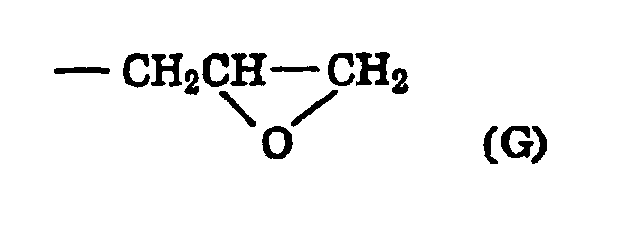
- (6) the resin composition described in the above-mentioned (5) in which in formula (1), the rate of M being represented by formula (G) is in a range of 70 to 90 mole%,
- (7) the resin composition described in any one of the above-mentioned (1) to (6), in which the compound (b) having two hydroxyl groups and one carboxyl group per molecule is a dimethylolated compound of carboxylic acid having 2 to 6 carbon atoms,
- (8) the resin composition described in any one of the above-mentioned (1) to (7), in which the monobasic acid having an unsaturated group (d) is one kind or two or more kinds of compounds selected from the group consisting of (metha) acrylic acids and monobasic acids containing a maleimide group,
- (9) the resin composition described in the above-mentioned (2) inwhichthemultibasicacidanhydride (e) is aphthalicanhydride derivative,
- (10) the resin composition described in any one of the above-mentioned (1) to (9), which contains a photo-polymerization initiator (C),
- (11) the resin composition described in any one of the above-mentioned (1) to (11), which contains a heat curing component (D),
- (12) the resin composition described in the above-mentioned (11) in which the heat curing component (D) is an epoxy resin,
- (13) the resin composition described in the above-mentioned (12), which contains a 1,4-dihydropyridine derivative as a curing accelerator agent for the epoxy resin,
- (14) the resin composition described in any one of the above-mentioned (1) to (13), which contains a diluent (B),
- (15) a composition which contains the resin composition described in the above-mentioned (14), and is used for a solder resist or an interlayer insulating layer for use in a printed circuit board,
- (16) a cured article of the composition described in any one of the above-mentioned (1) to (15),
- (17) a product having a layer of the cured article described in the above-mentioned (16), and
- (18) the product described in the above-mentioned (17), which is a printed circuit board.
-
- The following descriptionwill discuss the present invention in detail. Here, in the following description, "part" and "%" represent "part by mass" and "% by mass", respectively, unless otherwise defined.
- The resin composition of the present invention contains an oligomer (A), and the molecular weight of the oligomer (A) to be used is preferably set in a range of 1000 to 100,000 in the weight-averagemolecularweight, anditsacidvalueispreferably set in a range of 1 to 300 mg KOH/g.
- The oligomer (A) to be used in the present invention is a reaction product obtained by allowing the following components to react with one another: an epoxy resin (a) having at least two epoxy groups per molecule, a compound (b) having two hydroxyl groups and one carboxyl group per molecule, a carboxylated rubbery polymer (c), a monobasic acid (d) containing an unsaturated group, and a multibasic acid anhydride (e) that is an optional component.
- With respect to the epoxy resin (a) having at least two epoxy groups permolecule to be used, specific examples thereof include novolak-type epoxy resins (for example, those obtained by allowing each of novolak compounds, obtained by allowing each of phenols such as phenol, cresol, halogenated phenol and alkyl phenol to react with formaldehyde in the presence of an acidic catalyst, to react with epichlorohydrin and/or methyl epichlorohydrin. With respect to the commercial products, examples thereof include EOCN-103, EOCN-140S, EOCN-1020, EOCN-1027, EPPN-201 and BREN-S made by Nippon Kayaku Co., Ltd.; DEN-431 and DEN-439 made by the Dow Chemical Company; and N-730, N-770, N-865, N-665, N-673 and VH-4150 made by Dainippon Ink and Chemicals, Incorporated, etc.),bisphenol-type epoxy resins (for example, those obtained by allowing each of bisphenols such as bisphenol A, bisphenol F, bisphenol S and tetrabrombisphenol A to react with epichlorohydrin and/or methyl epichlorohydrin, and those epoxyresins representedbythe above-mentioned formula (1) that are obtained by allowing glycidyl ether of bisphenol A and bisphenol F, a condensate of the each of above-mentioned bisphenols and epichlorohydrin and/or methyl epichlorohydrin to react with one another. With respect to the commercial products, examples thereof include Epicoat 1004 andEpicoat 1002 made by Yuka Shell K.K.; and DER-330 and DER-337 made by the DowChemicalCompany) , trisphenolmethane-type epoxy resins (for example, those obtained by allowing triphenol methane, triscresol methane or the like to react with epichlorohydrin and/or methyl epichlorohydrin. With respect to the commercial products, examples thereof include EPPN-501, EPPN-502 and the like), tris(2,3-epoxypropyl)isocyanurate, biphenyl diglycidyl ether and other materials such as epoxy resins containing an alicyclic amino group like Celloxide 2021 made by Daicel Chemical Industries, Ltd.; Epomic VG-3101 made by Mitsui Petrochemical Industries, Ltd.; TETRAD-X and TETRAD-C made by Mitsubishi Gas Chemical Company, Inc.; and EPB-13, EPB-27, and the like made by Nippon Soda Co., Ltd., copolymer-type epoxy resins (for example, a copolymer of diglycidyl methacrylate and styrene, and a copolymer of diglycidyl methacrylate, styrene and methylmethacrylate, that is, CP-50M and CP-50S, made by Nippon Oil & Fats Co., Ltd., or a copolymer of glycidyl methacrylate and cyclohexyl maleimide), or other epoxy resins and the like having a special structure. Among these, in particular, preferable examples are epoxy resins and the like represented by the above-mentioned formula (1). In particular, in formula (1), those resins in which the rate of M being a glycidyl group is set to 70 to 90 mole% are preferably used.
- Next, with respect to the compound (b) having two hydroxyl groups and one carboxyl group per molecule, examples thereof include dimethylolated compounds of carboxylic acid, and specific examples thereof include dimethylolated compounds of carboxylic acid having carbon atoms of 2 to 6, preferably, 2 to 4, such as dimethylol propionic acid, dimethylol acetic acid, dimethylol butyric acid, dimethylol valeric acid and dimethylol caproic acid.
- Moreover, with respect to the carboxylated rubbery polymer (c), although its structure is not particularly limited, examples thereof include rubbery polymers which have carboxylic groups added to the two molecular terminals of each of the following copolymers, or to the two molecular terminals of a straight-chain polymer, and examples of the copolymers are: a copolymer between a conjugated diene-based vinyl monomer and ethylenic unsaturated mono-basic acid, such as butadiene-acrylic acid copolymer; a copolymer of a conjugated diene-based vinyl monomer, ethylenic unsaturated mono-basic acid and another vinyl monomer, such as butadiene-acrylonitrile-acrylic acid copolymer; a carboxylic acid suspended-type conjugate diene-based vinyl copolymer, such as a maleated polybutadiene, typically represented by the following formula 1 or formula 2.(in this formula, each of n and 1 represents an average unit number of repetitions, and is an integer of 1 or more.)
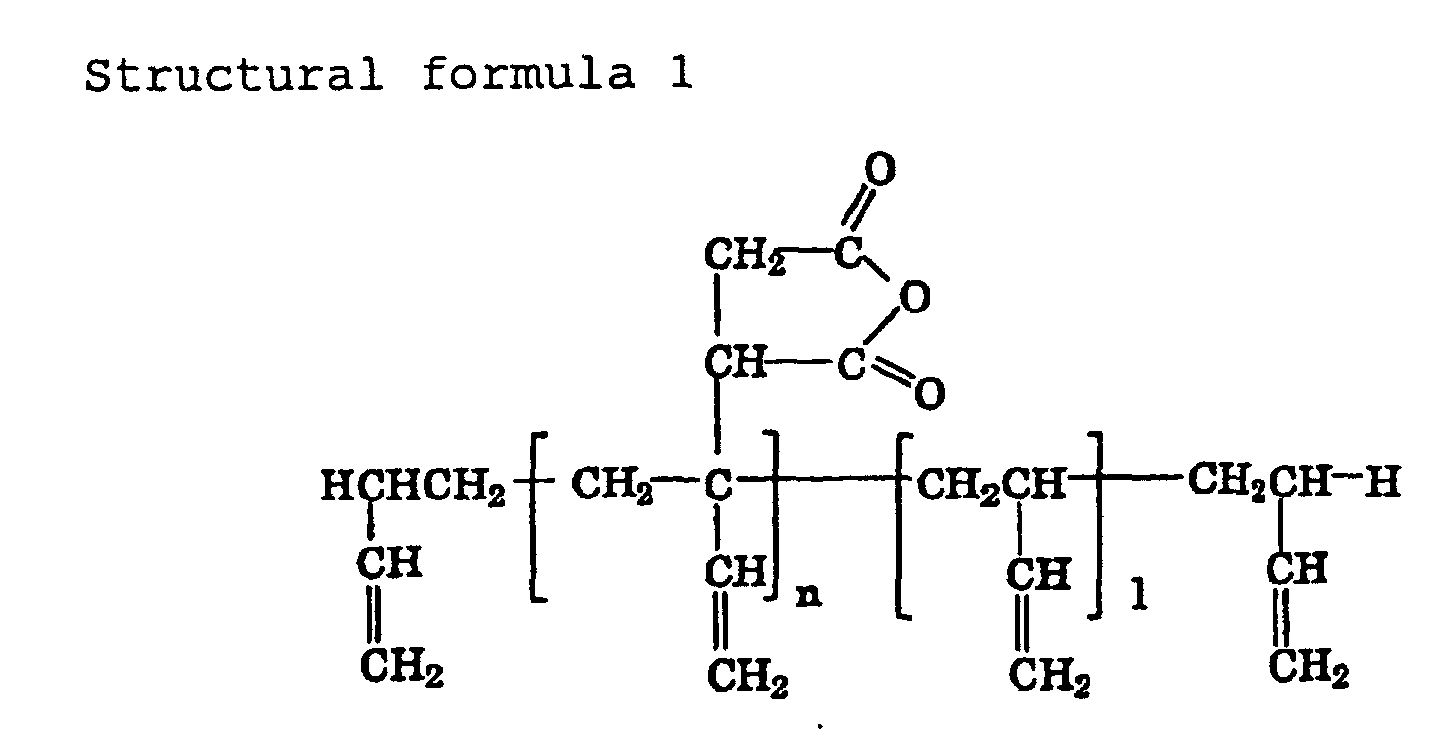 (in this formula, each of a, b and c represents an average unit number of repetitions, and is an integer of 1 or more.)
- With respect to the above-mentioned rubbery polymer having carboxylic groups added to the two molecular terminals of the straight-chain polymer, examples thereof include a diene-based vinyl polymer having carboxylic groups added to the two molecular terminals of polybutadiene dicarboxylic acid represented by, for example, the following structural formula 3; a polymer with carboxyl groups added to the two molecular terminals thereof, which is a copolymer between a conjugated diene-based vinyl monomer and an ethylenic unsaturated mono-basic acid, such as a polymer having carboxylic groups added to the two molecular terminals of a butadiene-acrylonitrile copolymer, represented by the following structural formula 4 (for example, HYCAR CTBN1300 × 13 [made by B. F. Good rich chemical Co., Ltd.] having a molecular weight of 3500, 27% of bonded acrylonitrile, 1.9 carboxyl groups/molecule) ; and a half ester between a conjugated diene-based vinyl polymer and an anhydride, such as a copolymer of polybutadiene glycol and maleic anhydride represented by the following structural formula 5.(in this formula, e represents an average unit number of repetitions, and is an integer of 1 or more.)
 (in this formula, each of f and g represents an average unit number of repetitions, and is an integer of 1 or more.)
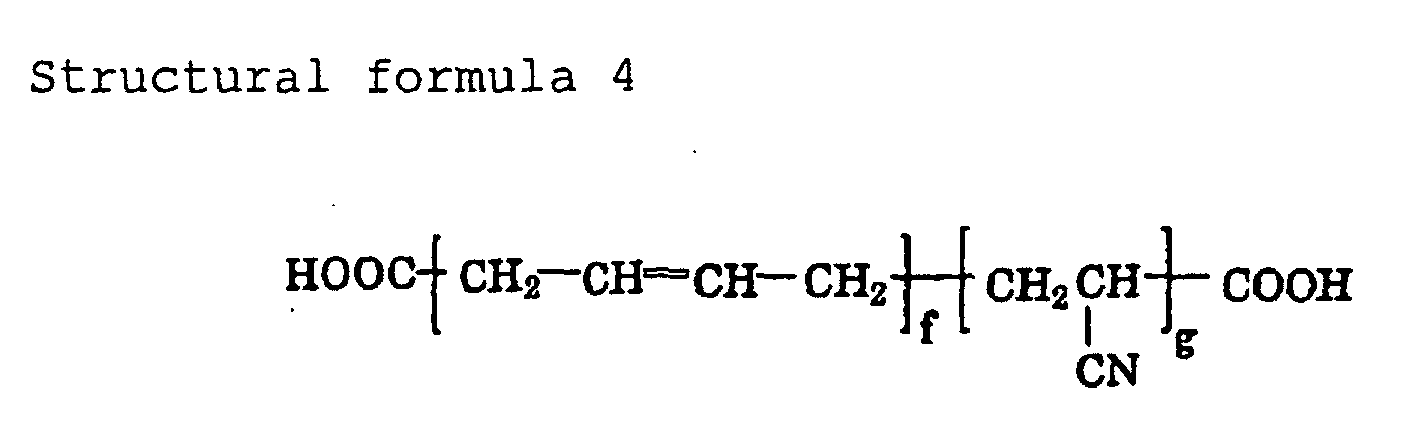 (in this formula, h represents an average unit number of repetitions, and is an integer of 1 or more.)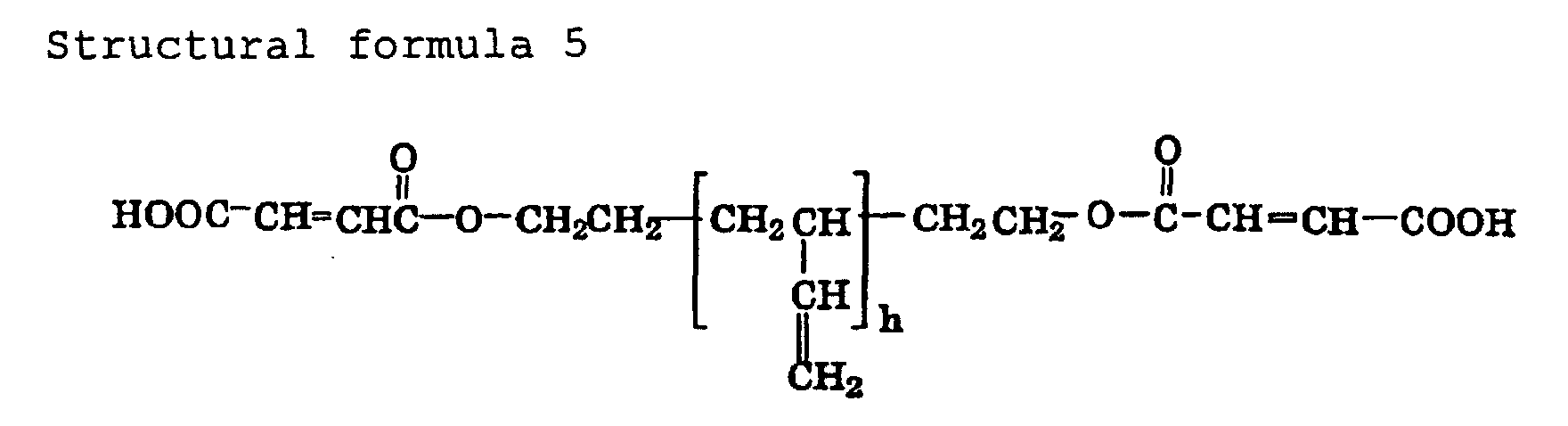
- Here, with respect to the conjugated diene-based vinyl polymer to be used in the above-mentioned carboxylated rubbery polymer, in place of the above-exemplified polymer derived from butadiene, polymers derived from isoprene, chloroprene and the like may be used. Moreover, each of these may be copolymerized with a conjugated diene-based vinyl monomer. With respect to the ethylenic unsaturated monobasic acid, examples thereof include (metha)acrylic acid, crotonic acid, cinnamic acid, acrylic acid dimer, monomethyl maleate, monopropyl maleate, monobutyl maleate, mono (2-ethylhexyl)maleate and sorbic acid, and among these, (metha) acrylic acid is preferably used. With respect to the other vinyl monomer, acrylic acid, methacrylic acid, acrylonitrile, styrene, vinyl toluene and the like may be used.
- Moreover, with respect to the number of carboxyl groups in the rubbery polymer, although not particularly limited, the number of carboxyl groups is set in a range of 1 to 5, preferably, 1.5 to 3, in average per molecule.
- Furthermore, with respect to the specific examples of the monobasic acid having an unsaturated group (d) , examples thereof include unsaturatedmonocarboxylic acid, such as (metha) acrylic acid, acrylic acid dimer, β-styrylacrylic acid, β-furfuryl acrylic acid, crotonic acid, α-cyanocinnamic acid and cinnamic acid. Examples thereof further include a reaction product between a saturated or unsaturated dibasic anhydride and a (metha)acrylate having one hydroxyl group per molecule, a reaction product between a saturated or unsaturated dibasic acid and a monoglycidyl compound containing an unsaturated group, and a half ester that is a reaction product between a saturated or unsaturated dibasic acid and a monoglycidyl compound containing an unsaturated group, and these can be obtained by allowing the former and the latter to react with each other on the equivalent molar basis. Here, with respect to the saturated or unsaturated dibasic acid anhydride, examples thereof include succinic anhydride, maleic anhydride, phthalic anhydride, tetrahydrophthalic anhydride, hexahydrophthalic anhydride, methylhexahydrophthalic anhydride, methyltetrahydrophthalic anhydride, itaconic anhydride and methyl endo methylene tetrahydrophthalic anhydride. Moreover, with respect to the (metha)acrylates, examples thereof include (metha)acrylates having one hydroxyl group per molecule, such as hydroxy ethyl(metha)acrylate, hydroxy propyl(metha)acrylate, hydroxy butyl (metha) acrylate, polyethylene glycolmono (metha) acrylate, glycerin di(metha)acrylate, trimethylol propane di(metha)acrylate, pentaerythritol tri(metha)acrylate, dipentaerythritol penta (metha) acrylate and (metha) acrylate of phenyl glycidyl ether. Moreover, with respect to the saturated or unsaturated dibasic acids, examples thereof include: succinic acid, maleic acid, adipic acid, phthalic acid, isophthalic acid, tetrahydrophthalic acid, hexahydrophthalic acid, itaconic acid and fumaric acid. With respect to the monoglycidyl compound containing a unsaturated group, examples thereof include the following glycidyl (metha)acrylates:
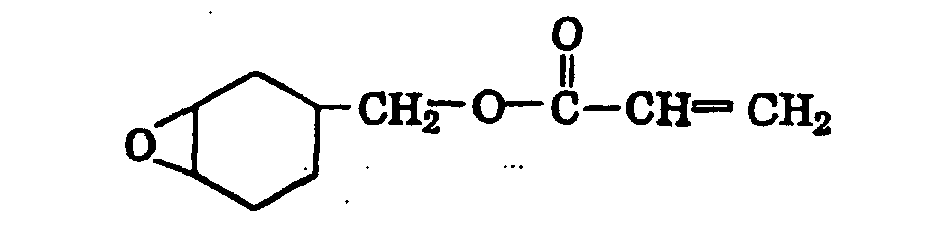
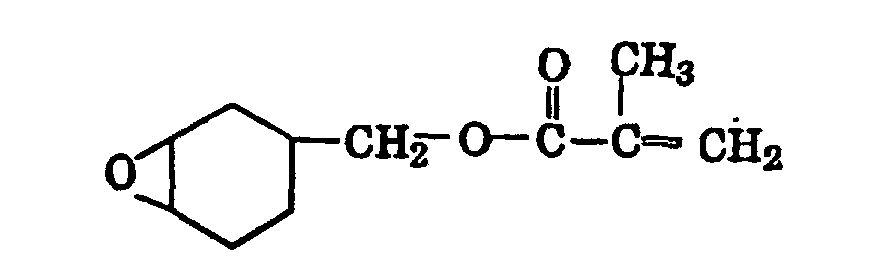


- Furthermore, examples of the monobasic acid (d) containing an unsaturated group other than those described above, include monobasic acid containing a maleimide group. With respect to the monobasic acid containing a maleimide group, as indicated by the following formula, the first example is a compound (d-1) that is synthesized from maleic anhydride and primary aminocarboxylic acid by using a known technique [see "Journal of Medical Chemistry" Vol. 18, pages 1004-1010 (1975) written by D.H. Rich et al.], and the second example is a half ester compound (d-2) between a maleimide compound ([1]) and a compound ([2]) having one acid anhydride group per molecule.

- With respect to the above-mentioned primary aminocarboxylic acid, examples thereof include: asparagine, alanine, β-alanine, arginine, isoleucine, glycine, glutamine, tryptophan, threonine, valine, phenyl alanine, homophenyl alanine, α-methylphenyl alanine, lysine, leucine, cycloleucine, 3-aminopropionic acid, α-aminobutyric acid, 4-aminobutyric acid, aminovaleric acid, 6-aminocaproic acid, 7-aminoheptanic acid, 2-aminocaprylic acid, 3-aminocaprylic acid, 6-aminocaprylic acid, 8-aminocaprylic acid, 9-aminononane acid, 2-aminocapric acid, 9-aminocapric acid, 15-aminopentadecanoic acid, 2-aminopalmitic acid and 16-aminopalmitic acid; however, it is not intended to be limited by these.
- With respect to the maleimide compound containing a hydroxyl group ([1]), for example, a compound that is synthesized from maleimide and formaldehyde, as indicatedbythe following formula, is used:Alternatively, a compound that is synthesized from maleic anhydride andprimary aminoalcohol, as indicatedby the following formula, by using a known technique (for example, see the specification of U.S. Patent No. 2526517, JP-ANo. 2-268155 and the like) is proposed; and these compounds contain one maleimide group and one hydroxyl group per molecule.

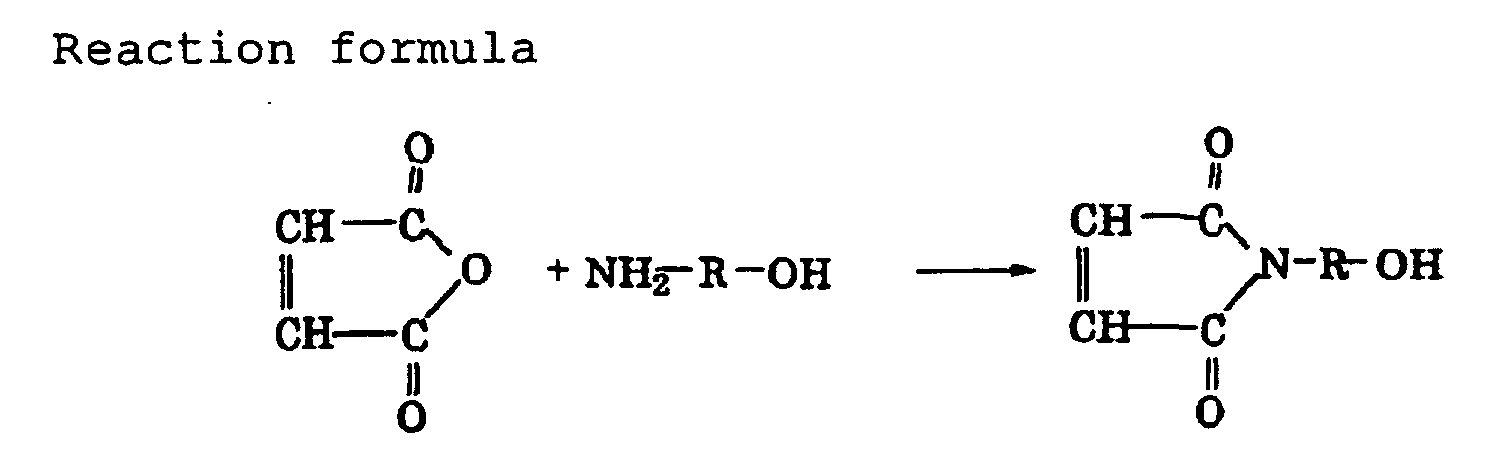
- With respect to the above-mentioned primary aminoalcohol, examples thereof include: 2-aminoethanol, 1-amino-2-propanol, 3-amino-1-propanol, 2-amino-2-methyl-1-propanol, 2-amino-3-phenyl-1-propanol, 4-amino-1-butanol, 2-amino-1-butanol, 2-amino-3-methyl-1-butanol, 2-amino-4-methylthio-1-butanol, 2-amino-1-pentanol, (1-aminocyclopentane) methanol, 6-amino-1-hexanol, 7-amino-1-heptanol, and 2-(2-aminoethoxy)ethanol; however, it is not intended to be limited by these.
- With respect to the above-mentioned compound ([2]) having one acid anhydride group per molecule, examples thereof include maleic anhydride, succinic anhydride, phthalic anhydride, hexahydrophthalic anhydride and tetrahydrophthalic anhydride and methyl-hexahydrophthalic anhydride.
- The above-mentionedhalf ester compound (d-2) canbe obtained by allowing one chemical equivalent of hydroxyl group in the above-mentioned maleimide compound containing a hydroxyl group ([1]) and about one chemical equivalent of anhydride group in the compound ([2]) having one acid anhydride group per molecule to react with each other. The reaction temperature is preferably set in a range of 60 to 100°C, and the reaction time is preferably set in a range of 1 to 10 hours. Upon reaction, an organic solvent may be used on demand.
- Preferable examples of the monobasic acid (d) containing an unsaturated group include acrylic acid and maleimide caproic acid.
- Moreover, with respect to the multibasic acid anhydride (e) serving as an optional component, examples thereof include phthalic anhydride derivatives and the like, such as maleic anhydride, succinic anhydride, itaconic anhydride, dodecylsuccinic anhydride, tetrahydrophthalic anhydride, hexahydrophthalic anhydride, 3-methyltetrahydrophthalic anhydride, 4-methyltetrahydrophthalic anhydride and phthalic anhydride.
- With respect to the oligomer (A) , the first specific example isoligomer (A-[1]) that is obtained by allowing the (a) component, (b) component, (c) component and (d) component to react with one another, and the second specific example is oligomer (A-[2]) that is obtained by allowing the (a) component, (b) component, (c) component and (d) component to react with one another, and by allowing the (e) component to react therewith.
- With respect to the reaction rates of the respective components, with one equivalent of epoxy group in the (a) component are preferably allowed to react 0.3 to 1.1 equivalents of carboxylic group, more preferably, 0.9 to 1.05 equivalents thereof, in the total amount of the components (b) + (c) + (d). Supposing that the total amount of the carboxylic group in the (b) + (c) + (d) components is one equivalent, the used amounts of the respective components are preferably set so that the (b) component has 0.05 to 0.5 equivalents, preferably, 0.1 to 0.3 equivalents, the (c) component has 0.05 to 0.3 equivalents, preferably, 0.01 to 0.2 equivalents and the (d) component has 0.2 to 0.945 equivalents, preferably, 0.5 to 0.89 equivalents.
- With respect to the (e) component, 0 to 1 equivalent thereof is preferably allowed to react with one equivalent of hydroxyl group in the reaction product of the (a), (b), (c) and (d) components.
- With respect to the oligomer-forming reaction, the following materials are preferably used: non-solvents or solvents, for example, ketones such as acetone, ethylmethyl ketone and cyclohexanone; aromatic hydrocarbons such as benzene, toluene, xylene and tetramethyl benzene; glycol ethers such as ethylene glycol dimethyl ether, ethylene glycol diethyl ether, dipropylene glycol dimethyl ether, dipropylene glycol diethyl ether and triethylene glycol dimethyl ether; esters such as ethyl acetate, butyl acetate, methyl cerosolve acetate, ethyl cerosolve acetate, butyl cerosolve acetate, carbitol acetate, propylene glycol monomethyl ether acetate, dialkyl glutaric acid, dialkyl succinic acid and dialkyl adipic acid; cyclic esters such as γ-butyl lactone; and petroleum solvents such as petroleum ethers, petroleum naphtha and solvent naphtha.
- Upon oligomer-forming reaction, a catalyst is preferably used so as to accelerate the reaction, and the used amount of the catalyst is set to 0.1 to 10% with respect to the reaction product. Specific examples of the catalyst include: triethyl amine, benzyldimethyl amine triethyl ammonium chloride, benzyltrimethyl ammonium bromide, benzyltrimethyl ammonium iodide, triphenyl phosphine, triphenyl stibine, chromium octanoate and zirconium octanoate.
- Moreover, during the reaction, a polymerization inhibitor may be used so as to prevent polymerization. Specific examples of the polymerization inhibitor include P-methoxy phenol, hydroquinone, methyl hydroquinone and phenyl thiazine. The used amount of the polymerization inhibitor is set to 0.05 to 3% with respect to the reaction product.
- The reaction temperature is preferably set to 70 to 120°C, and the reaction time is preferably set to 5 to 40 hours.
- The resin composition of the present invention may further contain a diluent (B). Specific examples of the diluent (B) include the above-mentioned solvents, organic solvents (B-1), for example, alcohols such as butanol, octyl alcohol, ethylene glycol, glycerin, diethylene glycol monomethyl (or monoethyl) ether, triethylene glycol monomethyl (or monoethyl) ether and tetraethylene glycol monomethyl (or monoethyl) ether, and reactive diluents (B-2) such as carbitol (metha)acrylate, phenoxyethyl (metha) acrylate, acryloylmorpholine, trimethylol propane tri(metha)acrylate, pentaerythritol tri(metha)acrylate, pentaerythritol tetra(metha)acrylate and dipentaerythritol penta and hexa(metha)acrylate.
- The amounts of (A) and (B) components contained in the resin composition of the present invention is preferably set to 10 to 90% in the total amount of (A) + (B) in the composition, more preferably, 20 to 80%, and with respect to the rates of use of (A) and (B), the rate of (A) is preferably set to 10 to 90%, and the rate of (B) is preferably set to 10 to 90%, and the mass rate of (B)/(A) is preferably set to 5 to 15%.
- The resin composition of the present invention may further contain a photopolymerization initiator (C). With respect to the photopolymerization initiator (C) , examples thereof include benzoins such as benzoin, benzoin methyl ether, benzoin ethyl ether, benzoin propyl ether and benzoin isobutyl ether; acetophenones, such as acetophenone, 2,2-dimethoxy-2-phenyl acetophenone, 2,2-diethoxy-2-phenyl acetophenone, 1,1-dicholroacetophenone, 2-hydroxy-2-methyl-1-phenylpropane-1-one, diethoxy acetophenone, 1-hydroxycyclohexyl phenyl ketone and 2-methyl-1-[4-(methylthio)phenyl]-2-morpholino-propane-1-one; anthraquinones such as 2-ethyl anthraquinone, 2-tertiary-butyl anthraquinone, 2-chloroanthraquinone and 2-amyl anthraquinone; thioxanthones such as 2,4-diethyl thioxanthone, 2-isopropyl thioxanthone and 2-chlorothioxanthone; ketals such as acetophenone dimethyl ketal and benzyl dimethyl ketal; benzophenones such as benzophenone and 4,4-bismethyl aminobenzophenone; and 2,4,6-trimethyl benzoyl diphenyl phosphine oxide.
- These may be used alone, or two or more kinds of these may be used as a mixture, and these may be used in combination with an accelerator like a tertiary amine such as triethanol amine and methyl diethanol amine, and benzoic acid derivatives, such as N,N-dimethyl aminobenzoic acid ethylester and N,N-dimethyl aminobenzoic acid isoamyl ester.
- The content of the photopolymerization initiator (C) is preferably set to 0.5 to 20 parts, preferably, 2 to 15 parts, more preferably, 2 to 5 parts, with respect to the total mass 100 parts of the (A) component and (B) component.
- In addition to the above-mentioned components, the present invention preferably contains a heat curing component (D) as a curing-use component, and by containing this, it is possible to form a printed circuit-board-use material that is excellent in soldering heat resistance and electric properties. With respect to the heat curing component (D) to be used in the present invention, although not particularly limited as long as it has a functional group that is subjected to a heat-curing process together with the oligomer (A) in its molecule, examples thereof include: epoxy resins, melamine compounds, urea compounds, oxazoline compounds and phenol compounds. With respect to the epoxy resin, specific examples thereof include glycidyl ethers, such as bisphenol A-type epoxy resins, bisphenol F-type epoxy resins, phenol-novolak-type epoxy resins, cresol-novolak-type epoxy resins, trisphenol methane-type epoxy resins, brominated epoxy resins, bixylenol-type epoxy resins and biphenol-type epoxy resins; alicyclic epoxy resins, such as 3,4-epoxy-6-methylcyclohexyl methyl-3,4-epoxy-6-methylcyclohexane carboxylate, 3, 4-epoxycyclohexyl methyl-3, 4-epoxycyclohexane carboxylate, 1-epoxyethyl-3,4- epoxycyclohexane; glycidyl esters, such as diglycidyl phthalic acid esters, diglycidyl tetrahydrophthalic acid esters and glycidyl dimer acid esters; and heterocyclic epoxy resins. With respect to the melamine compound, examples thereof include melamine and a melamine resin that is a polycondensation product between melamine and formalin. With respect to the urea compound, examples thereof include urea and a urea resin that is a polycondensation product between urea and formalin. With respect to the oxazoline compound, examples thereof include 2-oxazoline, 2-methyl-2-oxazoline, 2-phenyl-2-oxazoline, 2,5-dimethyl-2-oxazoline, 5-methyl-2-phenyl-2-oxazoline and 2,4-diphenyl oxazoline. With respect to the phenol compound, examples thereof include phenol, cresol, xylenol, catechol, resorcin, hydroquinone, pyrogallol and resol.
- Among these heat curing components (D), epoxy resins are preferably used because these resins are particularly superior in reactivity with the carboxyl group in the (A) component, and also has good adhesion to copper. In particular, epoxy resins having a fusing point of 50°C or more are desirably used, because these make it possible to form a photopolymerization coat film that is free from tacks after the drying process.
- With respect to the preferable range of the used amount of the above-mentioned heat curing component (D), it is set to a rate at which the functional group of the heat curing component (D) forms 0.2 to 3.0 equivalents per carboxyl group in the above-mentioned (A) component. In particular, the rate is preferably set to a rate at which the component forms 1.0 to 1.5 so as to provide superior soldering heat resistance and electric properties when formed into a printed circuit board.
- Moreover, in the case when an epoxy resin is used as the above-mentioned heat curing component (D), a curing accelerator for the epoxy resin is preferably used so as to accelerate the reactionwith the carboxyl group in the above-mentioned component (A). With respect to the curing accelerator for the epoxy resin, examples thereof include: imidazole compounds such as 2-methyl imidazole, 1-cyanoethyl-2-ethyl imidazole and 1-cyanoethyl-2-undecyl imidazole; triazine derivatives such as melamine, guanamine, acetoguanamine, benzoguanamine, 2,4-diaminotriazine and 2,4-diamino-6-tolyltriazine; tertiary amines such as triethanol amine, pyridine, m-dimethyl aminophenol; and polyphenols. Furthermore, a substance that is turned into a curing accelerator when subj ected to irradiation from ultraviolet rays and the like may be used, and preferable examples thereof include 1, 4-dihydropyridine derivatives, such as 1-ethyl-3,5-dimethoxycarbonyl-4-(2-nitrophenyl)-1,4-dihydro pyridine, 1,2,6-trimethyl-3,5-dimethoxycarbonyl-4-(2-nitrophenyl)-1,4-dihydropyridine, 2,6-dimethyl-3,5-diacetyl-4-(2-nitrophenyl)-1,4-dihydropyridine and 1-carboxyethyl-3,5-dimethoxycarbonyl-4-(2-nitrophenyl)-1,4-dihydropyridine. These curing accelerators may be used alone or in combination.
- Moreover, in the present invention, in addition to the above-mentioned oligomer (A), diluent (B),photopolymerization initiator (C) and heat curing component (D), various additives may be added thereto, if necessary, in order to improve various properties of the composition; and examples thereof include: fillers such as talc, barium sulfate, calcium carbonate, magnesium carbonate, barium titanate, aluminum hydroxide, aluminum oxide, silica and clay; thixotropic property applying agent such as aerosil; colorants such as phthalocyanine blue, phthalocyanine green and titanium oxide; leveling agents and antifoamers such as silicone and fluorine-based materials; and polymerization inhibitors such as hydroquinone andhydroquinone monomethyl ether.
- Here, the above-mentioned (D) componentmaybepreliminarily mixed in the resin composition; however, the component is more preferably mixed therein prior to the coating process onto the printed circuit board. In this case, a main agent solution is prepared by blending one portion or the entire portion of (B) component and an epoxy curing accelerator to the (A) component serving as the main component, and a curing agent solution is prepared by blending one portion or the entire portion of (B) component to the (D) component serving as the main component, and these two solutions are preferably mixed upon application of the resin composition.
- The resin composition of the present invention may be used inthefollowingmanner: for example, apolymerfilm (for example, a film made from polyethylene terephthalate, polypropylene, polyethylene or the like) is used as a supporting member, and the resin composition is applied thereon as laminated layers so that, by allowing the organic solvent (B-1) used as the diluent (B) to evaporate, a photosensitive film can be formed.
- The resin composition (liquid state or film state) of the present invention is useful for an interlayer insulatingmaterial for electronic parts as well as for resist ink as solder resists for use in printed substrates, and in addition to these applications, it is also used as a sealing agent, a coating material, a coating agent, a bonding agent and the like.
- The cured article of the present invention is formedby curing the above-mentioned resin composition of the present invention through irradiation of energy rays such as ultraviolet rays. The curing process through irradiation of energy rays such as ultraviolet rays maybe carriedout by using a conventionalmethod. For example, upon applying ultraviolet rays, an ultraviolet-ray generator, such as a low-pressure mercury lamp, a high-pressure mercury lamp, a super-high pressure mercury lamp, a xenon lamp and an ultraviolet-ray emitting laser (excimer laser and the like), may be used. The cured article of the resin composition of the present invention is utilized as an interlayer insulating material for use in, for example, permanent resist and build-up technique, in electric/electronic parts such as printed substrates. The film thickness of the cured article layer is preferably set in a range of 0.5 to 160µm, more preferably, 1 to 60µm.
- The printed circuit board of the present invention may be obtained, for example, in the following manner: In other words, in the case when a liquid-state resin composition is used, the composition of the present invention is applied onto a printed circuit-use substrate with a thickness of 5 to 160µm, by using a screen printingmethod, a sprayingmethod, a roll coatingmethod, an electrostatic coating method, a curtain coating method and the like, and the coated film is dried at a temperature in a normal range of 60 to 110°C, preferably, 60 to 100°C, so that a coat film that is free from tacks can be formed. Thereafter, a photomask having an exposure pattern formed thereon, such as a negative-working film, is directly made in contact with the coat film (or placed over the coat film without being made in contact therewith) , and this is irradiated with ultraviolet rays with an intensity in a normal range of 10 to 2000 mJ/cm2, and the unexposed portion is developed by using a developer as described below through a process, such as spraying, a shaking immersion, brushing and scrubbing. Thereafter, this is further irradiated with ultraviolet rays, if necessary, and then subjected to a heating process at a temperature in a normal range of 100 to 200°C, preferably, 140 to 180°C; thus, it is possible to provide a printed circuit board having a permanent protective film that is superior in flexibility, and satisfies various properties, such as heat resistance, solvent resistance, acid resistance, adhesion and electric properties.
- With respect to the organic solvent to be used for the developing process, examples thereof include: halogens such as trichloroethane; aromatic hydrocarbons such as toluene and xylene; esters such as ethyl acetate and butyl acetate; ethers such as 1,4-dioxane and tetrahydrofran; ketones such as methylethyl ketone and methyl isobutyl ketone; lactones such as γ-butyl lactone; glycol derivatives such as butyl cerosolve acetate, carbitol acetate, diethylene glycol dimethylether and propylene glycol monomethyl ether acetate; alicyclic hydrocarbons such as cyclohexanone and cyclohexanol; and solvents such as petroleum solvents like petroleum ether and petroleum naphtha; and water, and with respect to alkali aqueous solutions, alkali aqueous solutions of potassium hydroxide, sodiumhydroxide, sodiumcarbonate, potassium carbonate, sodium phosphate, sodium silicate, ammonia, amines and the like, may be used. Moreover, with respect to the irradiation light-source used for photo-curing, for example, a low-pressure mercury lamp, a middle-pressure mercury lamp, a high-pressure mercury lamp, a super-high pressure mercury lamp, a xenon lamp or a metal halide lamp may be appropriately used. In addition to these, laser light and the like may be used as exposure-use active light.
- By way of working examples, the present invention will be explained hereinafter. However, the present invention is not limited to these examples.
- The above-mentioned bisphenol F type epoxy resin (380 g) in which, in formula (1), X is -CH2-, M is a hydrogen atom and the average degree of polymerization m is 6.2 (epoxy equivalent: 950g/eq, softening point: 85°C) andepichlorohydrin (925g) were dissolved in 462.5 g of dimethylsulfoxide, and to this was then added 60.9 g (1.5 moles) of 98.5% NaOH at 70°C while being stirred, in 100 minutes. After the addition, this was allowed to further react with one another at 70°C for 3 hours. After completion of the reaction, to this was added 250 g of water, and washed with water. After having been subjected to an oil-water separating process, most of dimethyl sulfoxide and excessive unreacted epichlorohydrin were distilled and collected from the oil phase under reduced pressure, and dimethyl sulfoxide was then distilled off so that the reaction product containing by-product salt was dissolved in 750 g of methylisobutylketone, and to this was further added 10 g of 30% NaOH, and allowed to react for one hour at 70°C. After completion of the reaction, this was washed with 200 g of water twice, and after having been subjected to an oil-water separating process, methylisobutylketone was distilled and collected from the oil phase so that epoxy resin (a-1) having an epoxy equivalent of 310 g/eq and a softening point of 69°C was obtained. When calculated based upon the epoxy equivalent, it was found that in the resulting epoxy resin (a-1), about 5 of 6.2 alcohol-based hydroxyl groups in the above-mentioned starting substance, bisphenol F type epoxy resin, were epoxidized. The resulting epoxy resin (a-1) (310 g), dimethylol propionic acid (20.1 g), HYCAR CTBN1300 × 13 (52.5 g) [made by B.F. Goodrich Chemical Co., Ltd.] having a molecular weight of 3500, 27% of bonded acrylonitrile and a rate of carboxyl group of 1.91/molecule, acrylic acid (43.4 g), maleimide caproic acid (44.2 g)(ratio of number of epoxy groups : total carboxyl groups = 1 : 0.98), triphenyl phosphine (2.0 g), methylhydroquinone (0.3 g) and carbitol acetate (238.4 g) were loaded, and this was allowed to react at 98°C for about 35 hours to obtain oligomer (A-[1]-1). The solid component of the reaction product was 65%, the weight-average molecular weight of the solid component was about 6500 (based upon GPC method), and the acid value of the solid component was 1.5 mgKOH/g.
- The oligomer (A-[1]-1)(681.1 g) obtained in synthesis example 1, tetrahydrophthalic anhydride (53.2 g), succinic anhydride (35.0 g) (number of hydroxyl groups : number of acid anhydride groups = 1 : 0.70) and carbitol acetate (52.2 g) were allowed to react with one another at 90°C for about 10 hours to obtain a reaction product (oligomer (A-[2]-1)) with a solid component of 65%, which had an acid value of the solid component of 72 mgKOH/g and a weight-average molecular weight of the solid component of about 9000 (based upon GPC method).
- Epoxy resin (a-1) obtained in synthesis example 1 (310 g) , acrylic acid (71.3 g), triphenylphosphine (1.75 g), methylhydroquinone (0.3 g) and carbitol acetate (206.4 g) were loaded, and this was allowed to react with one another at 98°C for about 35 hours, and to this were then added tetrahydrophthalic anhydride (43.1 g), succinic anhydride (28.4 g) and carbitol acetate (38.5 g), and allowed to react with one another at 90°C for about 10 hours to obtain a reaction product with a solid component of 65%, which had an acid value of the solid component of 72 mgKOH/g and a weight-average molecular weight of the solid component of about 7000 (based upon GPC method).
- Resist compositions of the present invention were blended in accordance with blending compositions of Table 1, and dissolved and kneaded to be prepared. Next, each of the resist compositions thus prepared was applied onto a printed circuit substrate (formed by laminating an imide film with copper foil) by using a screen printing process, and dried at 80° for 20 minutes. Thereafter, anegative-workingfilmwasplacedonthissubstrate, and this was irradiated with ultraviolet rays at an accumulated dose of exposure of 600 mJ/cm2 in accordance with a predetermined pattern by using an exposing machine, and then developed by using γ-butyrolactone (example 1) and an 1.0 wt% Na2CO3 aqueous solution (examples 2, 3 as well as comparative examples 1 to 3), and further subjected to a heat curing process at 150°C for 60 minutes to prepare a sample substrate. Each of the resulting resist compositions was evaluated with respect to photosensitive performances. In other words, with respect to the resulting sample substrate, evaluation was made on characteristics such as developability, soldering heat resistance, flexibility, resistance to thermal deterioration and resistance to electroless gold plating. The results are shown in Table 2. Here, the evaluation method and evaluation criteria are shown as follows:


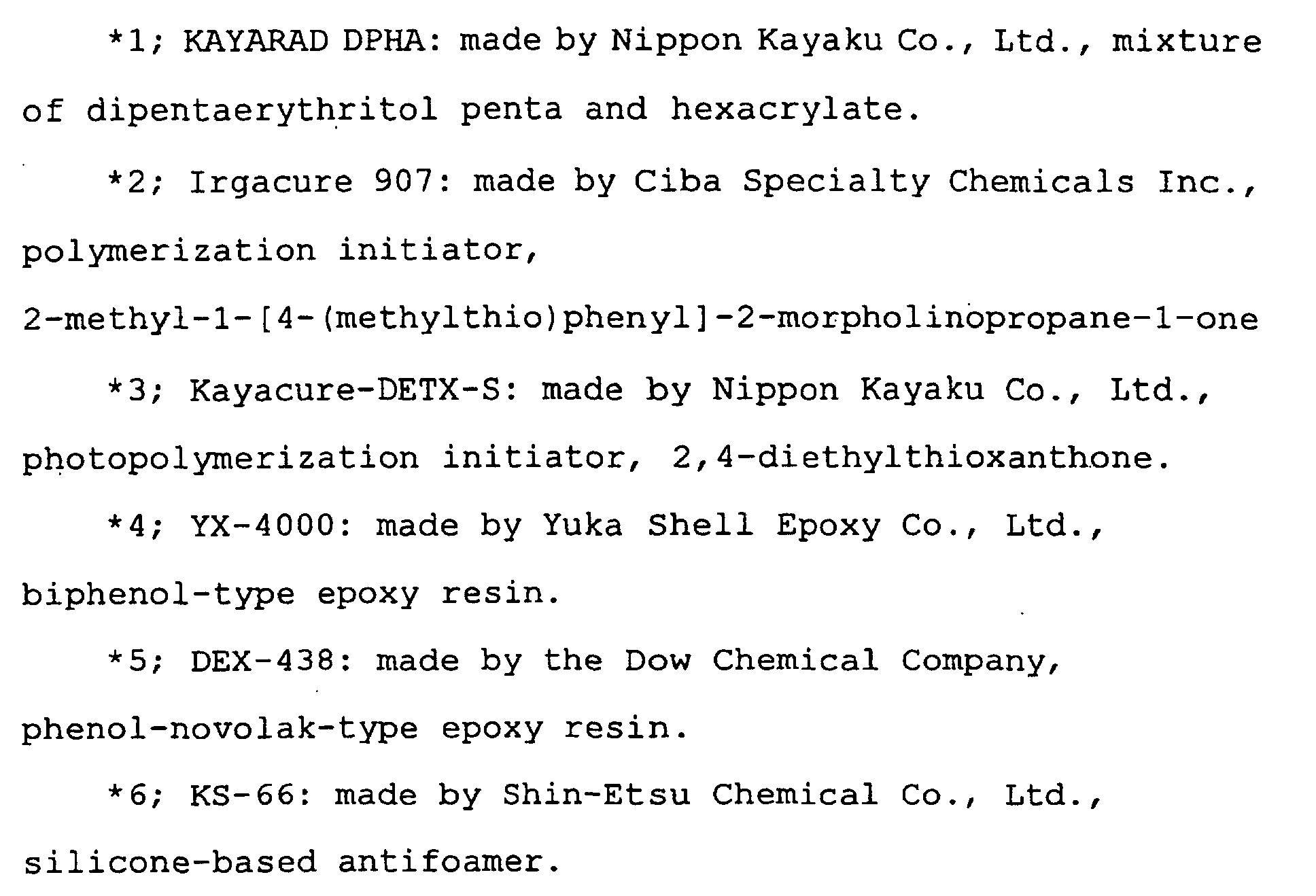
- Step tablets having 21 steps (made by Stopher Co., Ltd.) were made in contact with a coat film after the drying process, and this was irradiated with ultraviolet rays having an accumulated quantity of light of 600 mJ/cm2. Next, this was subjected to a developing process by using γ-butyrolactone (example 1) and a 1% sodium carbonate aqueous solution (examples 2, 3 as well as comparative examples 1 to 3) for 60 seconds under a spraying pressure of 2.0 kg/cm2 ; thus, the number of steps of coat films that remained without being developedwas confirmed. Evaluation was made based upon the following criteria.
- ○... 6 steps or more
- Δ... 4 to 5 steps
- ×... not more than 3 steps
-
- The coat film was dried at 80°C for 90 minutes, and subjected to a spray developing process by using γ-butyrolactone at 30°C (example 1) and a 1% sodium carbonate aqueous solution (examples 2, 3 as well as comparative examples 1 to 3); thus, the developability thereof was evaluated.
- ○... No residual matters were visually observed.
- Δ... Residual matters were visually observed slightly.
- ×... Many residual matters were visually observed.
-
- A sample substrate was coated with rosin-based flux, and immersed in fused solder at 260°C for 10 seconds; then, the resulting substrate was evaluated based upon the state of the cured film when separated by a cellophane tape.
- ○... No abnormality was found.
- ×... Separation occurred.
-
- The test substrate was evaluated based upon the state when entirely folded at 180 degrees.
- ○... No cracks.
- Δ... Cracks slightly occurred.
- ×... Cracks occurred in the folded portion to cause a separation in the cured film.
-
- After having been left at 125°C for 5 days, the test substrate was evaluated based upon the state thereof when entirely folded at 180 degrees.
- ○... No cracks.
- Δ... Cracks slightly occurred.
- ×... Cracks occurred in the folded portion to cause a separation in the cured film.
-
- After the test substrate had been gold-plated as described below, the resulting substrate was evaluatedbased upon the state of the cured film when separated by a cellophane tape (registered trademark).
- ○... No abnormality was found.
- Δ... Separation occurred slightly.
- ×... No separation occurred.
-
- A sample substrate was immersed into an acidic defating solution (20 Vol% aqueous solution of MetexL-5B made by Nippon MacDiarmid Co., Ltd.) for 3 minutes to be defatted, and then immersed into flowing water for 3 minutes, and washed. Next, the sample substrate was immersed in a 14.3 wt% aqueous solution of ammonium persulfate at room temperature for 3 minutes to be soft-etched, and this was then immersed in flowing water for 3 minutes, and washed. Next, the sample substrate was immersed in a catalyst solution (made by Meltex Co., Ltd., 10 Vol% aqueous solution of metal plate activator 350) for 7 minutes so that the catalyst was applied thereto, and this was then immersed in flowing water for 3 minutes, and washed. The sample substrate to which the catalyst had been applied was immersed in a 20 Vol% aqueous solution (PH 4.6) of nickel plating solution at 85°C for 20 minutes so that an electroless nickel plating process was carried out thereon. After having been immersed in 10 Vol% sulfate aqueous solution at room temperature for 1 minute, the sample substrate was immersed in flowing water for 30 seconds to 1 minute to be washed. Next, the sample substrate was immersed in a gold plating solution (made by Meltex Co., Ltd., solution of 15 Vol% AurolectrolessUP and 3 Vol% of potassium gold cyanide, PH 6) at 95°C for 20 minutes so that an electroless gold plating process was carried out thereon, and this was then immersed in flowing water for 3 minutes to be washed, and further immersed in hot water at 60°C for 3 minutes to be hot-water-washed. After this had been sufficiently washed, water was fully shaken off and this was dried to obtain an electroless-gold-plated sample substrate.
Items Example Comparative Example 1 2 3 1 2 3 Photosensitivity ○ ○ ○ ○ ○ × Developability ○ ○ Δ Δ × Δ Soldering heat resistance ○ ○ ○ ○ ○ ○ Flexibility ○ ○ ○ × × × Resistance to thermal deterioration ○ ○ ○ × × × Resistance to electroless gold plating ○ ○ ○ ○ ○ × - As clearly shown by the contents of Table 2, the resin composition of the present invention exerts sufficient photosensitivity even when the used amount of a polymerization initiator is made smaller, is excellent in developability, and provides a cured film that is excellent in soldering heat resistance, flexibility, resistance to thermal deterioration and resistance to electroless gold plating.
- The present invention makes it possible to provide a resin composition which exerts sufficient curability, even when the used amount of a polymerization initiator is made smaller, is excellent in developability, provides a cured film that is excellent in flexibility, soldering heat resistance, resistance to thermal deterioration and resistance to electroless gold plating, makes it possible to carry out a developing process by using a lean alkali solution, and is suitably applied to a material for use in solder resist and interlayer insulating layers. This resin composition is particularly suitable for solder resist and interlayer insulating layers for use inprinted circuit boards, in particular, flexible printed circuit boards.
Claims (18)
- A resin composition comprising:anoligomer (A) obtainedbyallowingthefollowingcomponents (a) to (d) to react with one another:(a) an epoxy resin having at least two epoxy groups per molecule;(b) a compound having at least two hydroxyl groups and one carboxyl group per molecule;(c) a carboxylated rubbery polymer; and(d) a monobasic acid having an unsaturated group.
- A resin composition comprising:an oligomer (A) obtained by allowing the following compounds (a) to (e) to react with one another:(a) an epoxy resin having at least two epoxy groups per molecule;(b) a compound having at least two hydroxyl groups and one carboxyl group per molecule;(c) a carboxylated rubbery polymer;(d) a monobasic acid having an unsaturated group; and(e) a multibasic acid anhydride.
- The resin composition according to claim 1 or claim 2, wherein the oligomer (A) has a weight-average molecular weight in a range of 1000 to 100,000.
- The resin composition according to any one of claims 1 to 3, wherein the oligomer (A) has an acid value in a range of 1 to 300 mgKOH/g.
- The resin composition according to any one of claims 1 to 4, wherein the epoxy resin (a) having at least two epoxy groups per molecule is represented by the following formula (1):in formula (1), X is -CH2- or -C(CH3)2- , m is an integer of 1 or more, and M is a hydrogen atom or a group represented by the following formula (G):
 (here, in the case when m is 1, M is represented by formula (G) , and in the case when m is greater than 1, at least one of M is represented by formula (G) with the rest thereof being hydrogen atoms.)
- The resin composition according to claim 5, wherein in formula (1), the rate of M being represented by formula (G) is in a range of 70 to 90 mole%.
- The resin composition according to any one of claims 1 to 6, wherein the compound (b) having two hydroxyl groups and one carboxyl group per molecule is a dimethylolated compound of carboxylic acid having 2 to 6 carbon atoms.
- The resin composition according to any one of claims 1 to 7, wherein the monobasic acid having an unsaturated group (d) is one kind or two or more kinds of compounds selected from the group consisting of (metha) acrylic acids and monobasic acids containing a maleimide group.
- The resin composition according to claim 2, wherein the multibasic acid anhydride (e) isaphthalicanhydridederivative.
- The resin composition according to any one of claims 1 to 9, further comprising a photo-polymerization initiator (C).
- The resin composition according to any one of claims 1 to 10, further comprising a heat curing component (D).
- The resin composition according to claim 11, wherein the heat curing component (D) is an epoxy resin.
- The resin composition according to claim 12, further comprising a 1,4-dihydropyridine derivative as a curing accelerator agent for the epoxy resin.
- The resin composition according to any one of claims 1 to 13, further comprising a diluent (B).
- A composition, which contains the resin composition according to claim 14, and is used for a solder resist or an interlayer insulating layer for use in a printed circuit board.
- A cured article comprising the composition according to any one of claims 1 to 15.
- A product comprising a layer of the cured article according to claim 16.
- The product according to claim 17, comprising a printed circuit board.
Applications Claiming Priority (3)
| Application Number | Priority Date | Filing Date | Title |
|---|---|---|---|
| JP2001239412 | 2001-08-07 | ||
| JP2001239412 | 2001-08-07 | ||
| PCT/JP2002/008025 WO2003014177A1 (en) | 2001-08-07 | 2002-08-06 | Resin composition, composition for solder resist, and cured article obtained therefrom |
Publications (2)
| Publication Number | Publication Date |
|---|---|
| EP1416003A1 true EP1416003A1 (en) | 2004-05-06 |
| EP1416003A4 EP1416003A4 (en) | 2006-05-03 |
Family
ID=19070172
Family Applications (1)
| Application Number | Title | Priority Date | Filing Date |
|---|---|---|---|
| EP02755859A Withdrawn EP1416003A4 (en) | 2001-08-07 | 2002-08-06 | Resin composition, composition for solder resist, and cured article obtained therefrom |
Country Status (6)
| Country | Link |
|---|---|
| US (1) | US20050004288A1 (en) |
| EP (1) | EP1416003A4 (en) |
| KR (1) | KR20040024871A (en) |
| CN (1) | CN1268664C (en) |
| TW (1) | TW591040B (en) |
| WO (1) | WO2003014177A1 (en) |
Cited By (2)
| Publication number | Priority date | Publication date | Assignee | Title |
|---|---|---|---|---|
| EP1975700A3 (en) * | 2007-03-26 | 2008-10-29 | Nitto Denko Corporation | Method of manufacturing wiring circuit board |
| WO2016085863A1 (en) * | 2014-11-24 | 2016-06-02 | 3D Systems, Incorporated | Inks comprising liquid rubber for 3d printing |
Families Citing this family (12)
| Publication number | Priority date | Publication date | Assignee | Title |
|---|---|---|---|---|
| EP2392619A1 (en) * | 2004-10-07 | 2011-12-07 | Hitachi Chemical Company, Ltd. | Resin composition for optical material, resin film for optical material, and optical waveguide using same |
| CN100358953C (en) * | 2005-05-23 | 2008-01-02 | 容大油墨(惠州)有限公司 | A kind of liquid photosensitive solder resist ink and its circuit board |
| DE102005053553A1 (en) * | 2005-11-08 | 2007-05-16 | Heraeus Gmbh W C | Solder pastes with resin-free flux |
| JP4979963B2 (en) * | 2006-03-10 | 2012-07-18 | 株式会社Adeka | Curable composition for optical material and optical waveguide |
| JP2012063645A (en) * | 2010-09-17 | 2012-03-29 | Nitto Denko Corp | Photosensitive resin composition and circuit board with metal support using the composition |
| US9869392B2 (en) | 2011-10-20 | 2018-01-16 | Lam Research Corporation | Edge seal for lower electrode assembly |
| US9859142B2 (en) | 2011-10-20 | 2018-01-02 | Lam Research Corporation | Edge seal for lower electrode assembly |
| US9635962B2 (en) | 2012-04-12 | 2017-05-02 | Cabeau, Inc. | Travel pillow with lateral and rear support bar and a flat and thin back |
| EP3074213B1 (en) * | 2013-11-26 | 2018-09-26 | Novartis AG | A metal oxide dispersion and uses thereof |
| US10090211B2 (en) | 2013-12-26 | 2018-10-02 | Lam Research Corporation | Edge seal for lower electrode assembly |
| JP6275620B2 (en) * | 2014-10-17 | 2018-02-07 | 日本化薬株式会社 | Photosensitive resin composition and cured product thereof |
| CN110527350B (en) * | 2019-08-26 | 2022-04-15 | 鹤山市炎墨科技有限公司 | High-heat-resistance high-crosslinking-degree photocuring solder resist ink and preparation method thereof |
Family Cites Families (12)
| Publication number | Priority date | Publication date | Assignee | Title |
|---|---|---|---|---|
| JP2877659B2 (en) * | 1993-05-10 | 1999-03-31 | 日本化薬株式会社 | Resist ink composition and cured product thereof |
| JPH0841146A (en) * | 1994-07-27 | 1996-02-13 | Nippon Kayaku Co Ltd | Resin composition, resist ink composition, and its cured item |
| JPH08134331A (en) * | 1994-11-08 | 1996-05-28 | Dainippon Ink & Chem Inc | Photocurable resin composition and flexible solder resist ink |
| JPH0912654A (en) * | 1995-06-26 | 1997-01-14 | Nippon Kayaku Co Ltd | Energy-ray-curable resin composition and its cured item |
| JPH10316729A (en) * | 1997-05-20 | 1998-12-02 | Nippon Kayaku Co Ltd | Resin composition, solder resist resin composition, and cured item thereof |
| JP3731778B2 (en) * | 1997-06-17 | 2006-01-05 | 日本化薬株式会社 | Resin composition, permanent resist resin composition, and cured products thereof |
| JP3759672B2 (en) * | 1997-12-05 | 2006-03-29 | 日本化薬株式会社 | Resin composition and cured product thereof |
| JPH11181040A (en) * | 1997-12-22 | 1999-07-06 | Nippon Kayaku Co Ltd | Resin composition, cured product of the same and printed wiring board |
| JPH11189631A (en) * | 1997-12-26 | 1999-07-13 | Nippon Kayaku Co Ltd | Resin composition, cured product thereof, and printed wiring board |
| JP4042198B2 (en) * | 1998-02-24 | 2008-02-06 | 日立化成工業株式会社 | Photocurable resin composition and photosensitive element using the same |
| JP2981218B1 (en) * | 1998-10-28 | 1999-11-22 | 日華化学株式会社 | Solder photoresist ink composition |
| JP4033428B2 (en) * | 1999-03-31 | 2008-01-16 | 日本化薬株式会社 | Novel unsaturated group-containing polycarboxylic acid resin, resin composition and cured product thereof |
-
2002
- 2002-08-06 EP EP02755859A patent/EP1416003A4/en not_active Withdrawn
- 2002-08-06 WO PCT/JP2002/008025 patent/WO2003014177A1/en not_active Ceased
- 2002-08-06 CN CNB02815438XA patent/CN1268664C/en not_active Expired - Fee Related
- 2002-08-06 US US10/485,004 patent/US20050004288A1/en not_active Abandoned
- 2002-08-06 TW TW091117665A patent/TW591040B/en not_active IP Right Cessation
- 2002-08-06 KR KR10-2004-7000994A patent/KR20040024871A/en not_active Ceased
Non-Patent Citations (2)
| Title |
|---|
| R\MPP: 1999, GEORG THIEME VERLAG , STUTTGART - NEW YORK , XP002369531 * page 1718, right-hand column * * |
| See also references of WO03014177A1 * |
Cited By (5)
| Publication number | Priority date | Publication date | Assignee | Title |
|---|---|---|---|---|
| EP1975700A3 (en) * | 2007-03-26 | 2008-10-29 | Nitto Denko Corporation | Method of manufacturing wiring circuit board |
| US8026045B2 (en) | 2007-03-26 | 2011-09-27 | Nitto Denko Corporation | Method of manufacturing wiring circuit board |
| WO2016085863A1 (en) * | 2014-11-24 | 2016-06-02 | 3D Systems, Incorporated | Inks comprising liquid rubber for 3d printing |
| US11292927B2 (en) | 2014-11-24 | 2022-04-05 | 3D Systems, Incorporated | Inks comprising liquid rubber for 3D printing |
| US11479683B2 (en) | 2014-11-24 | 2022-10-25 | 3D Systems, Inc. | Inks comprising liquid rubber for 3D printing |
Also Published As
| Publication number | Publication date |
|---|---|
| KR20040024871A (en) | 2004-03-22 |
| TW591040B (en) | 2004-06-11 |
| WO2003014177A1 (en) | 2003-02-20 |
| EP1416003A4 (en) | 2006-05-03 |
| CN1268664C (en) | 2006-08-09 |
| CN1538978A (en) | 2004-10-20 |
| US20050004288A1 (en) | 2005-01-06 |
Similar Documents
| Publication | Publication Date | Title |
|---|---|---|
| JP4509561B2 (en) | Thermosetting resin composition | |
| JP4865911B2 (en) | Curable composition containing carboxyl group-containing resin, cured product thereof, and method for obtaining carboxyl group-containing resin | |
| JP2004045792A (en) | Photosetting/thermosetting resin composition and its cured material | |
| US20050004288A1 (en) | Resin composition, composition for solder resist, and cured article obtained therefrom | |
| CN103460134B (en) | Positive type photosensitive organic compound, dry film, solidfied material and printed circuit board (PCB) | |
| US7718714B2 (en) | Resin curable with actinic energy ray, photocurable and thermosetting resin composition containing the same, and cured product obtained therefrom | |
| JP4328593B2 (en) | Composition containing a carboxyl group-containing photosensitive resin | |
| JP5164092B2 (en) | Thermosetting composition and cured product thereof | |
| KR101394173B1 (en) | Photosensitive hybrid resin with improved strength, hardness and adhesion, and curable composition comprising the same and cured product thereof | |
| JP2010066444A (en) | Alkali-developable curable composition and cured product thereof | |
| JP5484772B2 (en) | Curable composition capable of alkali development and cured product thereof | |
| JP5632603B2 (en) | Carboxyl group-containing resin, composition and cured product containing the same, and method for producing carboxyl group-containing resin | |
| JP2003119247A (en) | Resin composition, soldering resist composition and their cured product | |
| JP3953851B2 (en) | Photo-curing / thermosetting resin composition | |
| JP2003048932A (en) | Resin composition, solder-resist resin composition and cured materials thereof | |
| JP5069624B2 (en) | Curable composition capable of alkali development and cured product thereof | |
| JP2004061566A (en) | Photosetting/thermosetting resin composition and printed-wiring board using the same | |
| JP2002308952A (en) | Resin composition, solder resist resin composition and their cured products | |
| JP5484773B2 (en) | Curable composition capable of alkali development and cured product thereof | |
| JP5430884B2 (en) | Curable composition capable of alkali development and cured product thereof | |
| JP5254723B2 (en) | Curable composition capable of alkali development and cured product thereof | |
| JP4111663B2 (en) | Resin composition, solder resist resin composition, and cured products thereof | |
| JP5226402B2 (en) | Curable composition capable of alkali development and cured product thereof | |
| JP4127345B2 (en) | Resin composition, solder resist resin composition, and cured products thereof | |
| JP5254721B2 (en) | Curable composition capable of alkali development and cured product thereof |
Legal Events
| Date | Code | Title | Description |
|---|---|---|---|
| PUAI | Public reference made under article 153(3) epc to a published international application that has entered the european phase |
Free format text: ORIGINAL CODE: 0009012 |
|
| 17P | Request for examination filed |
Effective date: 20040122 |
|
| AK | Designated contracting states |
Kind code of ref document: A1 Designated state(s): AT BE CH CY DE DK ES FI FR GB GR IE IT LI LU MC NL PT SE TR |
|
| RTI1 | Title (correction) |
Free format text: RESIN COMPOSITION, COMPOSITION FOR SOLDER RESIST, AND CURED ARTICLE OBTAINED THEREFROM |
|
| A4 | Supplementary search report drawn up and despatched |
Effective date: 20060321 |
|
| STAA | Information on the status of an ep patent application or granted ep patent |
Free format text: STATUS: THE APPLICATION HAS BEEN WITHDRAWN |
|
| 18W | Application withdrawn |
Effective date: 20060426 |