EP1411328A2 - Method and arrangement for achieving an adjusted engine setting utilizing engine output and/or fuel consumption - Google Patents
Method and arrangement for achieving an adjusted engine setting utilizing engine output and/or fuel consumption Download PDFInfo
- Publication number
- EP1411328A2 EP1411328A2 EP02445160A EP02445160A EP1411328A2 EP 1411328 A2 EP1411328 A2 EP 1411328A2 EP 02445160 A EP02445160 A EP 02445160A EP 02445160 A EP02445160 A EP 02445160A EP 1411328 A2 EP1411328 A2 EP 1411328A2
- Authority
- EP
- European Patent Office
- Prior art keywords
- engine
- determining
- determined
- value
- fuel
- Prior art date
- Legal status (The legal status is an assumption and is not a legal conclusion. Google has not performed a legal analysis and makes no representation as to the accuracy of the status listed.)
- Granted
Links
Images


Classifications
-
- F—MECHANICAL ENGINEERING; LIGHTING; HEATING; WEAPONS; BLASTING
- F02—COMBUSTION ENGINES; HOT-GAS OR COMBUSTION-PRODUCT ENGINE PLANTS
- F02D—CONTROLLING COMBUSTION ENGINES
- F02D41/00—Electrical control of supply of combustible mixture or its constituents
- F02D41/0025—Controlling engines characterised by use of non-liquid fuels, pluralities of fuels, or non-fuel substances added to the combustible mixtures
- F02D41/0027—Controlling engines characterised by use of non-liquid fuels, pluralities of fuels, or non-fuel substances added to the combustible mixtures the fuel being gaseous
-
- F—MECHANICAL ENGINEERING; LIGHTING; HEATING; WEAPONS; BLASTING
- F02—COMBUSTION ENGINES; HOT-GAS OR COMBUSTION-PRODUCT ENGINE PLANTS
- F02D—CONTROLLING COMBUSTION ENGINES
- F02D45/00—Electrical control not provided for in groups F02D41/00 - F02D43/00
-
- F—MECHANICAL ENGINEERING; LIGHTING; HEATING; WEAPONS; BLASTING
- F02—COMBUSTION ENGINES; HOT-GAS OR COMBUSTION-PRODUCT ENGINE PLANTS
- F02D—CONTROLLING COMBUSTION ENGINES
- F02D41/00—Electrical control of supply of combustible mixture or its constituents
- F02D41/02—Circuit arrangements for generating control signals
- F02D41/14—Introducing closed-loop corrections
- F02D41/1497—With detection of the mechanical response of the engine
-
- G—PHYSICS
- G01—MEASURING; TESTING
- G01F—MEASURING VOLUME, VOLUME FLOW, MASS FLOW OR LIQUID LEVEL; METERING BY VOLUME
- G01F1/00—Measuring the volume flow or mass flow of fluid or fluent solid material wherein the fluid passes through a meter in a continuous flow
- G01F1/76—Devices for measuring mass flow of a fluid or a fluent solid material
- G01F1/86—Indirect mass flowmeters, e.g. measuring volume flow and density, temperature or pressure
-
- G—PHYSICS
- G01—MEASURING; TESTING
- G01F—MEASURING VOLUME, VOLUME FLOW, MASS FLOW OR LIQUID LEVEL; METERING BY VOLUME
- G01F9/00—Measuring volume flow relative to another variable, e.g. of liquid fuel for an engine
- G01F9/001—Measuring volume flow relative to another variable, e.g. of liquid fuel for an engine with electric, electro-mechanic or electronic means
-
- F—MECHANICAL ENGINEERING; LIGHTING; HEATING; WEAPONS; BLASTING
- F02—COMBUSTION ENGINES; HOT-GAS OR COMBUSTION-PRODUCT ENGINE PLANTS
- F02D—CONTROLLING COMBUSTION ENGINES
- F02D19/00—Controlling engines characterised by their use of non-liquid fuels, pluralities of fuels, or non-fuel substances added to the combustible mixtures
- F02D19/06—Controlling engines characterised by their use of non-liquid fuels, pluralities of fuels, or non-fuel substances added to the combustible mixtures peculiar to engines working with pluralities of fuels, e.g. alternatively with light and heavy fuel oil, other than engines indifferent to the fuel consumed
- F02D19/0626—Measuring or estimating parameters related to the fuel supply system
- F02D19/0634—Determining a density, viscosity, composition or concentration
-
- F—MECHANICAL ENGINEERING; LIGHTING; HEATING; WEAPONS; BLASTING
- F02—COMBUSTION ENGINES; HOT-GAS OR COMBUSTION-PRODUCT ENGINE PLANTS
- F02D—CONTROLLING COMBUSTION ENGINES
- F02D2200/00—Input parameters for engine control
- F02D2200/02—Input parameters for engine control the parameters being related to the engine
- F02D2200/06—Fuel or fuel supply system parameters
- F02D2200/0614—Actual fuel mass or fuel injection amount
-
- F—MECHANICAL ENGINEERING; LIGHTING; HEATING; WEAPONS; BLASTING
- F02—COMBUSTION ENGINES; HOT-GAS OR COMBUSTION-PRODUCT ENGINE PLANTS
- F02D—CONTROLLING COMBUSTION ENGINES
- F02D2200/00—Input parameters for engine control
- F02D2200/02—Input parameters for engine control the parameters being related to the engine
- F02D2200/10—Parameters related to the engine output, e.g. engine torque or engine speed
- F02D2200/1002—Output torque
-
- Y—GENERAL TAGGING OF NEW TECHNOLOGICAL DEVELOPMENTS; GENERAL TAGGING OF CROSS-SECTIONAL TECHNOLOGIES SPANNING OVER SEVERAL SECTIONS OF THE IPC; TECHNICAL SUBJECTS COVERED BY FORMER USPC CROSS-REFERENCE ART COLLECTIONS [XRACs] AND DIGESTS
- Y02—TECHNOLOGIES OR APPLICATIONS FOR MITIGATION OR ADAPTATION AGAINST CLIMATE CHANGE
- Y02T—CLIMATE CHANGE MITIGATION TECHNOLOGIES RELATED TO TRANSPORTATION
- Y02T10/00—Road transport of goods or passengers
- Y02T10/10—Internal combustion engine [ICE] based vehicles
- Y02T10/30—Use of alternative fuels, e.g. biofuels
Definitions
- the present invention relates to adjustment of at least one engine setting, such a carburetor setting.
- the present invention specifically relates to the adjustment of at least one engine setting to provide for desired engine exhaust emission levels.
- one known method to adjust a carburetor is to make adjustment in connection with monitoring emissions via a CO/CO 2 analyzer.
- the adjustment and emission monitoring process is relatively slow because of lag time associated with achieving accurate analyzer readings subsequent to an adjustment. For example, it may be necessary to wait approximately ten seconds after each adjustment to a carburetor before a CO/CO 2 analyzer accurately indicates the resulting emission levels.
- the present invention provides a method for achieving an adjusted engine setting.
- the method includes running an engine that consumes fuel and determining fuel consumption.
- the method includes determining engine operation output.
- a value utilizing the determined fuel consumption and the determined engine operation output is determined.
- the engine setting is adjusted to cause the determined value to change toward a desired value.
- the present invention provides a method for achieving an adjusted engine setting associated with an exhaust emission level.
- the method includes running an engine that consumes fuel, and determining fuel consumption.
- the method also includes determining a value utilizing the determined fuel, and adjusting the engine setting to cause the determined value to change toward a desired value.
- the present invention provides a method for achieving an adjusted engine setting associated with an exhaust emission level.
- the method includes running an engine that consumes fuel, and determining engine operation output.
- the method also includes determining a value utilizing the determined engine operation output, and adjusting the engine setting to cause the determined value to change toward a desired value.
- the present invention provides an arrangement for achieving an adjusted engine setting.
- the arrangement includes a set-up to run an engine that consumes fuel.
- the arrangement includes means for determining engine operation output.
- the arrangement includes means for determining a value utilizing the determined fuel consumption and the determining engine operation output.
- the arrangement includes means for indicating adjustment utilizing the determined value.
- the present invention provides an arrangement for achieving an adjusted engine setting associated with an exhaust emission level.
- the arrangement includes a set-up to run an engine that consumes fuel, and means for determining fuel consumption.
- the arrangement includes means for determining a value utilizing the determined fuel consumption, and means for indicating adjustment utilizing the determined value.
- the present invention provides an arrangement for achieving an adjusted engine setting associated with an exhaust emission level.
- the arrangement includes a set-up to run an engine that consumes fuel, and means for determining engine operation output.
- the arrangement includes means for determining a value utilizing the determined engine operation output, and means for indicating adjustment utilizing the determined value.
- the engine 12 may be any of several engine types. As such, the engine 12 is schematically shown. However, in one specific example, the engine 12 is a small two-stroke engine that has a rotary output and that is utilized for hand-held tools. Examples of such hand-held tools include chain saws, trimmers, edgers, blowers, and the like.
- the example engine 12 has a relatively small displacement (e.g., 25cc).
- engine setting(s)s are adjusted such that the engine will operate properly and will adhere to applicable exhaust emission regulations.
- One specific setting that must be adjusted on the two-stroke engine 12 is at least one setting of a carburetor 14.
- carburetor settings include the settings for supplies of fuel (e.g., gasoline) and air for combustion within the engine 12.
- the fuel and air settings can be thought of as flow settings (i.e., fuel flow and/or air flow) of the carburetor 14.
- the carburetor 14 can be though of as a flow adjustable component.
- the arrangement 10 in accordance with the present invention may be utilized.
- the arrangement 10 includes an engine run set-up 16.
- the engine run set-up 16 includes all necessary structures, components, devices, etc. that are necessary to support the engine 12, supply fuel to the engine, take or derive necessary sensory information, and control/interact with the engine operation.
- the shown engine run set-up 16 includes a fuel source 18 (e.g., a nurse line) that supplies fuel (e.g., gasoline) 20 to the engine 12.
- a fuel flow sensor 22, a fuel density senor 24, and a fuel temperature sensor 26 operatively interact with the supply of fuel 20 to the engine 12 to derive respective sensory information.
- the arrangement 10 includes a processor 34 that is operatively connected 36-40 to receive sensory data from the fuel flow sensor 22, the fuel density sensor 24, and the fuel temperature sensor 26.
- a speed/torque control/sensor 28 of the engine run set-up 16 interacts 30 with the engine 12 to control the engine output speed and/or the output torque of the engine 12 and to monitor the speed and/or torque of the engine.
- the speed and the torque are outputs of the engine.
- the arrangement 10 includes a controller/monitor 44 that is operatively connected 46, 48 to the speed/torque control/sensor 28 within the engine run set-up 16. The operational speed of the engine 12 and the torque output from the engine are controlled and monitored by the controller/monitor 44.
- the speed/torque control/sensor 28 includes a mechanism that provides a resistance or braking force against the output (i.e., speed and/or torque) of the engine. Such resistance or braking force allows the sensing of the output of the engine output.
- the speed/torque control/sensor 28 outputs at least one electrical signal that is indicative of the speed and/or torque. In one specific example, the signal has an amperage that is indicative of the speed and/or torque. The controller/monitor monitors the electric signal.
- the processor 34 is operatively connected 50 to the controller/monitor 44 such that speed and/or torque indicative information is provided to the processor.
- the processor 34 utilizes the input information (fuel flow, fuel density, fuel temperature, engine torque and/or engine speed) to determine a value that is indicative of whether the engine setting(s) (e.g., carburetor fuel and/or air setting) is properly adjusted.
- the engine setting(s) e.g., carburetor fuel and/or air setting
- the value indicative of whether the setting(s) is properly adjusted is referred to as a Brake Specific value. It is to be appreciated that a different value indicative of proper adjustment is possible.
- the processor 34 determines volume of fuel that is flowing to be utilized by the engine 12.
- the processor 34 also calculates torque.
- the processor 34 calculates power output from the engine 12.
- Power ⁇ * Velocity * 1.404*10 -4 wherein:
- the processor 34 determines the Brake Specific value.
- the Brake Specific value is utilized as an indicator of whether the engine setting(s) is properly adjusted. Specifically, the calculated Brake Specific value may be compared to a reference Brake specific value. Within such an example, when the calculated Brake Specific value is at or acceptably near to the reference Brake Specific value, that individual engine has a properly adjusted engine setting(s).
- an operator interface 60 is a schematic representation of the operator of the arrangement 10, the various interactions that the operator has with the arrangement, and the provision of information to the operator from the processor 34.
- the operator interface 60 is operatively connected 62 to receive output information from the processor 34.
- processor output information is provided to the operator interface via an information display 64.
- the information that can be displayed for perception by the operator may be numeric values (e.g., the calculated Brake specific value or a difference between calculated and reference), which will change as the engine setting(s) is adjusted, or may be information that is more rudimentary (e.g., adjusted vs. non-adjusted).
- the provided even information may also indicate a desired adjustment direction and/or amount.
- the amount of processor activity subsequent to the Brake Specific calculation may be related to the type and presentation of information at the operator interface 60.
- one aspect 66 of the operator interface 60 may include an operator-set reference Brake Specific value. Specifically, the operator may input 68 the desired reference Brake Specific value to the processor 34 if the processor is to be handling determinations as to whether the calculated Brake Specific is at/near the reference Brake Specific.
- the operator interface 60 may also include operator set point speed/torque information 70 that is provided 72 to the controller/monitor 44. Such input information to the controller/monitor 44 is utilized to control the speed/torque at the engine 12 during the adjustment process.
- the setting 66 of the reference Brake Specific value and the set point speed/torque 70 by the operator allow for the arrangement 10 to be utilized for different engines, engine types, or other variables for which accommodation is necessary for a specific engine to be properly adjusted.
- the last shown aspect of the operator interface 60 is for operator adjustment 74 provided 76 to the engine setting(s) (e.g., carburetor) 14.
- engine setting(s) e.g., carburetor
- Such adjustment of the engine setting(s) may be at any level of sophistication (e.g., manual adjustment, automated adjustment, remotely controlled, etc.).
- the adjustment of the engine setting(s) is in real time during running of the engine 12. Also, it is to be appreciated that the adjustment of the engine setting(s) is relatively expedient in that the information regarding whether adjustment of the engine setting(s) has been achieved is a relatively expedient (i.e., immediately responsive to adjustment) process. It is to be appreciated that there is no need to monitor or utilize engine exhaust emissions within the adjustment process. As such, there is no need to wait for an emission analyzer to monitor for changes in exhaust emissions as a response to an adjustment.
- FIG. 2 A flow chart for a process 100 in accordance with the present invention is shown in Fig. 2.
- the process 100 is initiated at step 102 and proceeds to step 104 in which the engine 12 is placed into the run set-up 16.
- step 106 the engine 12 is started to run.
- step 108 the fuel consumption of the engine 12 is monitored. For example, the flow, density, and temperature of the fuel are monitored via sensors 22-26.
- step 110 the speed and/or torque of the running engine 12 is monitored via the speed/torque control/sensor 28 and the controller/monitor 44.
- the Brake Specific value is determined.
- the determination of the Brake Specific value may have various sub steps and may be via various equations and/or means. For example, fuel consumption is determined, engine output (e.g., power) is determined, and the determined fuel consumption and engine output (e.g., power) are utilized to determine the Brake Specific value.
- step 114 it is queried whether the Brake Specific value is at a desired value. It is to be appreciated that the Brake Specific value being at a desired value may mean that the Brake Specific value is within an acceptable range.
- step 114 If the determination at step 114 is negative (i.e., the brake specific value is not at a desired value, and thus the engine setting(s) is not yet properly adjusted), the process 100 goes from step 114 to step 116.
- step 116 the engine setting(s) is adjusted. For example, the carburetor 14 is adjusted on the two-stoke engine 12. Subsequent to the adjustment step at step 116, the process 100 loops again to step 108 to repeat the sequence of steps 108-114.
- step 114 determines whether the Brake Specific value is at the desired value. If the determination at step 114 is affirmative (e.g., the Brake Specific value is at the desired value), the process 100 proceeds from step 114 to step 118. At step 118, with the engine setting(s) properly adjusted, the engine 12 is shut off. At step 120, the engine 12 is removed from the set-up 16 and the process 100 terminates at step 122.
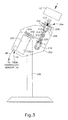
- Fig. 3 illustrates an example construction of a portion of the engine set-up 16 within the arrangement of Fig. 1.
- a stand 200 and pivotable frame 202 is provided that supports a rotational assembly 204.
- a bearing housing 206 of the assembly is fixed relative to the frame 202.
- rubber isolators 208 aid in the support of the bearing housing 206 on the frame 202.
- a portion 210 of the rotational assembly 204 is operatively connectable to a rotational output portion of the engine 12 to be adjusted.
- the portion 210 can drive the rotational portion of the engine 12, or may be driven by the rotational portion of the engine as is discussed further below.
- a shaft 212 extends, downward in the example, from the rotational assembly 204 and is connected to a coupling 214.
- a second shaft 216 is connected to the coupling 214.
- the second shaft 216 extends to another bearing housing 218, which provides rotational support for the second shaft.
- a timing pulley 220 is mounted on the second shaft 216. As such, rotational force is transferable between the pulley 220 and the rotational output portion of the engine 12 connected to the rotational assembly 204.
- a timing belt 222 extends from the timing pulley 220 to another timing pulley 224 associated with an electric motor 226 mounted on the frame 202.
- the electric motor 226 is operational to rotate the associated pulley 224. As such, operation of the electric motor 226 results in transfer of rotational force to the rotational output portion of the engine 12 connected to the rotational assembly 204.
- the electric motor 226 can also be driven. When driven, the electric motor 226 acts as a load or resistance brake. Also, when the electric motor 226 is driven, the motor outputs an electrical signal indicative of the driving force applied to the electric motor. In one example, the output signal has a current (i.e., amperage) that is indicative of the driving force.
- the shown example of Fig. 3 provides at least some of the functions of the speed/torque control/sensor 28 of the arrangement of Fig. 1.
- the engine 12 is operatively connected (as represented by the schematic arrowhead) to the rotational assembly 204 and supported thereat.
- the engine 12 is started via rotational force that is supplied from the electric motor 226.
- the electric motor 226 is operated to rotate the associated pulley 224, the timing belt 222, and the timing pulley 220, etc.
- rotational force is delivered to the rotational portion of the engine 12.
- This aspect provides an auto-start function for the engine 12, in that the initial rotation of the engine is automatically provided.
- the electrical output (via connection 48) is provided by the motor that is indicative of the speed and/or torque of the running engine.
- This speed and/or torque indicative signal (via connection 48) is provided to the controller/monitor 44, with indicative information subsequently being utilized by the processor 34 within the calculations to determine the Brake Specific value.
- the engine 12 can be held at a specific speed or operated to have a specific torque output via provision of a specific braking force provided by the electric motor 226.
- a specific braking force provided by the electric motor 226 As such, in the example of Fig. 3, the relationship between adjustment of the engine setting(s) and the braking force provided by the electric motor 226 results in the value indicative of whether the setting(s) is properly adjusted being referred to as a Brake Specific value.
Landscapes
- Engineering & Computer Science (AREA)
- Chemical & Material Sciences (AREA)
- Combustion & Propulsion (AREA)
- Mechanical Engineering (AREA)
- General Engineering & Computer Science (AREA)
- Physics & Mathematics (AREA)
- Fluid Mechanics (AREA)
- General Physics & Mathematics (AREA)
- Combined Controls Of Internal Combustion Engines (AREA)
- Electrical Control Of Air Or Fuel Supplied To Internal-Combustion Engine (AREA)
- Output Control And Ontrol Of Special Type Engine (AREA)
- Testing Of Engines (AREA)
Abstract
Description
- ϕT =
- Calculated density [g/ccm];
- ϕTDT =
- Measured density of the fuel (e.g., gasoline) [g/ccm];
- α =
- Expansion coefficient of fuel [1/°F];
- TRTD =
- Measured RTD temperature [°F];
- TDT =
- Measured fuel temperature [°F].
- Volume flow =
- Calculated volumetric flow [I/h];
- f =
- Measured frequency of sensor (pulses/second) [Hz];
- Kd =
- Constant [pulses/cc], sensor-specific value for each flow sensor, provided by sensor manufacturer.
- Mass flow =
- Calculated mass flow [kg/h].
- τ =
- Calculated torque [Nm];
- τCOEFF =
- Torque coefficient provided on the motor [Nm/Amp];
- IAVG =
- Measured, averaged current that is indicative of engine output [Amps].
- Power =
- Calculated power [HP];
- Velocity =
- Measured brake speed [RPM].
- Brake Specific =
- Calculated brake specific fuel consumption [kg/(h-HP)].
Claims (23)
- A method for achieving an adjusted engine setting, the method including:running an engine that consumes fuel;determining fuel consumption;determining engine operation output;determining a value utilizing the determined fuel consumption and determined engine operation output; andadjusting the engine setting to cause the determined value to change toward a desired value.
- A method as set forth in claim 1, wherein the method is performed on an engine that has a carburetor, and the engine setting is a carburetor setting.
- A method as set forth in claim 1, wherein the step of determining fuel consumption is performed in real-time as the engine is running.
- A method as set forth in claim 1, wherein the step of determining a value utilizing the determined fuel consumption and determined engine operation output is performed in real-time as the engine is running.
- A method as set forth in claim 1, wherein the step of adjusting the engine setting to cause the determined value to change toward a desired value power is performed in real-time as the engine is running.
- A method as set forth in claim 1, wherein the steps of determining fuel consumption, determining engine operation output, determining a value utilizing the determined fuel consumption and the determined engine operation output, and adjusting the engine setting to cause the determined value to change toward a desired value are performed in real-time as the engine is running.
- A method as set forth in claim 1, wherein the step of determining fuel consumption includes determining mass of fuel.
- A method as set forth in claim 7, wherein the step of determining mass of fuel includes determining density of fuel, determining volume flow of fuel, and determining density flow of fuel using the determined density of fuel and the determined volume flow of fuel.
- A method as set forth in claim 1, wherein the step of determining engine operation output includes determining an output torque from a rotational member of the engine and determining output power.
- A method as set forth in claim 1, wherein the desired value is associated with desired carbon monoxide and carbon dioxide levels within exhaust of the engine.
- A method for achieving an adjusted engine setting associated with an exhaust emission level, the method including:running an engine that consumes fuel;determining fuel consumption;determining a value utilizing the determined fuel; andadjusting the engine setting to cause the determined value to change toward a desired value.
- A method as set forth in claim 11, including determining engine operation output, and the step of determining a value utilizing the determined fuel consumption also utilizes the determined engine operation output to determine the determined value.
- A method for achieving an adjusted engine setting associated with an exhaust emission level, the method including:running an engine that consumes fuel;determining engine operation output;determining a value utilizing the determined engine operation output; andadjusting the engine setting to cause the determined value to change toward a desired value.
- A method as set forth in claim 13, including determining fuel consumption, and the step of determining a value utilizing the determined engine operation output also utilizes the determined fuel consumption to determine the determined value.
- An arrangement for achieving an adjusted engine setting, the arrangement including:a set-up to run an engine that consumes fuel;means for determining fuel consumption;means for determining engine operation output;means for determining a value utilizing the determined fuel consumption and determined engine operation output; andmeans for indicating adjustment utilizing the determined value.
- An arrangement as set forth in claim 15, wherein the means for indicating adjustment includes means for indicating adjustment of a carburetor setting.
- An arrangement as set forth in claim 15, wherein the means for determining fuel consumption includes means for real time determination of the fuel consumption as the engine is running.
- An arrangement as set forth in claim 15, wherein the means for determining a value utilizing the determined fuel consumption and determined engine operation output includes means for real time determination of the value as the engine is running.
- An arrangement as set forth in claim 15, including means for controlling engine operation output.
- An arrangement for achieving an adjusted engine setting associated with an exhaust emission level, the arrangement including:a set-up to run an engine that consumes fuel;means for determining fuel consumption;means for determining a value utilizing the determined fuel consumption; andmeans for indicating adjustment utilizing the determined value.
- An arrangement as set forth in claim 20, including means for determining engine operation output, and the means for determining a value also utilizes determined engine operation output.
- An arrangement for achieving an adjusted engine setting associated with an exhaust emission level, the arrangement including:a set-up to run an engine that consumes fuel;means for determining engine operation output;means for determining a value utilizing the determined engine operation output; andmeans for indicating adjustment utilizing the determined value.
- An arrangement as set forth in claim 22, including means for determining fuel consumption, and the means for determining a value also utilizes determined fuel consumption.
Applications Claiming Priority (2)
| Application Number | Priority Date | Filing Date | Title |
|---|---|---|---|
| US269986 | 2002-10-15 | ||
| US10/269,986 US7353804B2 (en) | 2002-10-15 | 2002-10-15 | Method and arrangement for achieving an adjusted engine setting utilizing engine output and/or fuel consumption |
Publications (3)
| Publication Number | Publication Date |
|---|---|
| EP1411328A2 true EP1411328A2 (en) | 2004-04-21 |
| EP1411328A3 EP1411328A3 (en) | 2006-03-15 |
| EP1411328B1 EP1411328B1 (en) | 2007-12-19 |
Family
ID=32042892
Family Applications (1)
| Application Number | Title | Priority Date | Filing Date |
|---|---|---|---|
| EP02445160A Expired - Lifetime EP1411328B1 (en) | 2002-10-15 | 2002-11-26 | Method and arrangement for achieving an adjusted engine setting utilizing engine output and/or fuel consumption |
Country Status (8)
| Country | Link |
|---|---|
| US (1) | US7353804B2 (en) |
| EP (1) | EP1411328B1 (en) |
| JP (1) | JP2004138040A (en) |
| KR (1) | KR20040034309A (en) |
| CN (1) | CN100422538C (en) |
| AT (1) | ATE381708T1 (en) |
| DE (1) | DE60224193T2 (en) |
| TW (1) | TWI255883B (en) |
Cited By (2)
| Publication number | Priority date | Publication date | Assignee | Title |
|---|---|---|---|---|
| EP1840532A2 (en) | 2005-12-15 | 2007-10-03 | Hamilton Sundstrand Corporation | Ultrasonic-densiometer mass flow sensor for use in flow metering units |
| FR2922598A1 (en) * | 2007-10-17 | 2009-04-24 | Bosch Gmbh Robert | PROCESS FOR DETERMINING THE FLAMMABILITY OF FUEL OF UNKNOWN QUALITY. |
Families Citing this family (29)
| Publication number | Priority date | Publication date | Assignee | Title |
|---|---|---|---|---|
| DE102005017965A1 (en) * | 2005-04-19 | 2006-10-26 | Cristobal Guzman | About the fuel consumption controlled motor vehicle |
| KR100779845B1 (en) * | 2006-11-01 | 2007-11-29 | 지멘스 오토모티브 주식회사 | How Elpia calculates fuel consumption for this vehicle |
| DE102009053236A1 (en) * | 2009-11-06 | 2011-05-12 | Andreas Stihl Ag & Co. Kg | Hand-held implement with an air-cooled internal combustion engine |
| CN101936813B (en) * | 2010-08-10 | 2014-05-14 | 吴明 | Method for detecting exhaust emission under load working conditions by diesel vehicle |
| CN102589893B (en) * | 2012-01-02 | 2014-11-26 | 吴明 | Detecting method for partial load under rated power of diesel vehicle |
| AU2012373249C1 (en) | 2012-03-13 | 2015-07-23 | Micro Motion, Inc. | Indirect mass flow sensor |
| US9416743B2 (en) | 2012-10-03 | 2016-08-16 | GM Global Technology Operations LLC | Cylinder activation/deactivation sequence control systems and methods |
| US9534550B2 (en) | 2012-09-10 | 2017-01-03 | GM Global Technology Operations LLC | Air per cylinder determination systems and methods |
| US9719439B2 (en) | 2012-08-24 | 2017-08-01 | GM Global Technology Operations LLC | System and method for controlling spark timing when cylinders of an engine are deactivated to reduce noise and vibration |
| US9726139B2 (en) | 2012-09-10 | 2017-08-08 | GM Global Technology Operations LLC | System and method for controlling a firing sequence of an engine to reduce vibration when cylinders of the engine are deactivated |
| US9458778B2 (en) * | 2012-08-24 | 2016-10-04 | GM Global Technology Operations LLC | Cylinder activation and deactivation control systems and methods |
| US9458780B2 (en) | 2012-09-10 | 2016-10-04 | GM Global Technology Operations LLC | Systems and methods for controlling cylinder deactivation periods and patterns |
| US9650978B2 (en) | 2013-01-07 | 2017-05-16 | GM Global Technology Operations LLC | System and method for randomly adjusting a firing frequency of an engine to reduce vibration when cylinders of the engine are deactivated |
| US9638121B2 (en) | 2012-08-24 | 2017-05-02 | GM Global Technology Operations LLC | System and method for deactivating a cylinder of an engine and reactivating the cylinder based on an estimated trapped air mass |
| US9458779B2 (en) | 2013-01-07 | 2016-10-04 | GM Global Technology Operations LLC | Intake runner temperature determination systems and methods |
| US9376973B2 (en) | 2012-09-10 | 2016-06-28 | GM Global Technology Operations LLC | Volumetric efficiency determination systems and methods |
| US10227939B2 (en) | 2012-08-24 | 2019-03-12 | GM Global Technology Operations LLC | Cylinder deactivation pattern matching |
| US9382853B2 (en) | 2013-01-22 | 2016-07-05 | GM Global Technology Operations LLC | Cylinder control systems and methods for discouraging resonant frequency operation |
| US9494092B2 (en) | 2013-03-13 | 2016-11-15 | GM Global Technology Operations LLC | System and method for predicting parameters associated with airflow through an engine |
| JP6105156B2 (en) * | 2013-04-30 | 2017-03-29 | マイクロ モーション インコーポレイテッド | Volume flow sensor system with mass flow meter and density meter |
| JP6155138B2 (en) * | 2013-05-22 | 2017-06-28 | 株式会社堀場製作所 | Fuel consumption measuring device |
| DE202014006185U1 (en) | 2013-08-12 | 2014-11-26 | Horiba Ltd. | Fuel consumption calculation unit, fuel consumption calculation program, fuel consumption meter and exhaust gas meter |
| US9789873B2 (en) * | 2014-02-16 | 2017-10-17 | Ford Global Technologies, Llc | Vehicle coasting control system and method |
| US9441550B2 (en) | 2014-06-10 | 2016-09-13 | GM Global Technology Operations LLC | Cylinder firing fraction determination and control systems and methods |
| US9341128B2 (en) | 2014-06-12 | 2016-05-17 | GM Global Technology Operations LLC | Fuel consumption based cylinder activation and deactivation control systems and methods |
| US9556811B2 (en) | 2014-06-20 | 2017-01-31 | GM Global Technology Operations LLC | Firing pattern management for improved transient vibration in variable cylinder deactivation mode |
| US9599047B2 (en) | 2014-11-20 | 2017-03-21 | GM Global Technology Operations LLC | Combination cylinder state and transmission gear control systems and methods |
| US10337441B2 (en) | 2015-06-09 | 2019-07-02 | GM Global Technology Operations LLC | Air per cylinder determination systems and methods |
| TWI593875B (en) * | 2016-01-21 | 2017-08-01 | Rong-Bin Liao | Engine control |
Family Cites Families (17)
| Publication number | Priority date | Publication date | Assignee | Title |
|---|---|---|---|---|
| US2040778A (en) * | 1932-01-28 | 1936-05-12 | Doherty Res Co | Combustion efficiency adjusting apparatus |
| US2073243A (en) | 1935-07-03 | 1937-03-09 | Doherty Res Co | Fuel system testing instrument |
| US2450835A (en) * | 1946-03-16 | 1948-10-05 | Niles Bement Pond Co | Indicating apparatus |
| US3640255A (en) | 1970-11-04 | 1972-02-08 | Atlantic Richfield Co | Carburetor adjusting method |
| US4286324A (en) | 1979-09-24 | 1981-08-25 | Maxwell Ingram | Prime mover fuel efficiency control system |
| US4377143A (en) * | 1980-11-20 | 1983-03-22 | Ford Motor Company | Lean air-fuel control using stoichiometric air-fuel sensors |
| US4493303A (en) * | 1983-04-04 | 1985-01-15 | Mack Trucks, Inc. | Engine control |
| JPS59188052A (en) * | 1983-04-08 | 1984-10-25 | Nippon Denso Co Ltd | Air-fuel ratio control for internal-combustion engine |
| DE3334622C2 (en) | 1983-09-24 | 1985-07-11 | Dr.Ing.H.C. F. Porsche Ag, 7000 Stuttgart | Test bench for internal combustion engines with a dynamometer |
| US4716872A (en) | 1985-09-17 | 1988-01-05 | Pol Alexander T | Economic speed indicator |
| US5107815A (en) * | 1990-06-22 | 1992-04-28 | Massachusetts Institute Of Technology | Variable air/fuel engine control system with closed-loop control around maximum efficiency and combination of otto-diesel throttling |
| JPH04234542A (en) * | 1990-12-28 | 1992-08-24 | Honda Motor Co Ltd | Air-fuel ratio control method for internal combustion engine |
| US5431042A (en) | 1994-03-10 | 1995-07-11 | General Motors Corporation | Engine emissions analyzer |
| JP3587957B2 (en) * | 1997-06-12 | 2004-11-10 | 日立建機株式会社 | Engine control device for construction machinery |
| US6014858A (en) * | 1997-08-19 | 2000-01-18 | Zankowski; Arthur | Apparatus and method for reducing harmful products of combustion |
| US6189523B1 (en) | 1998-04-29 | 2001-02-20 | Anr Pipeline Company | Method and system for controlling an air-to-fuel ratio in a non-stoichiometric power governed gaseous-fueled stationary internal combustion engine |
| JP3804402B2 (en) * | 2000-05-19 | 2006-08-02 | トヨタ自動車株式会社 | Vehicle driving force control device and driving force control method |
-
2002
- 2002-10-15 US US10/269,986 patent/US7353804B2/en not_active Expired - Fee Related
- 2002-11-26 DE DE60224193T patent/DE60224193T2/en not_active Expired - Fee Related
- 2002-11-26 AT AT02445160T patent/ATE381708T1/en not_active IP Right Cessation
- 2002-11-26 EP EP02445160A patent/EP1411328B1/en not_active Expired - Lifetime
- 2002-11-27 TW TW091134435A patent/TWI255883B/en active
- 2002-12-05 KR KR1020020076872A patent/KR20040034309A/en not_active Ceased
- 2002-12-05 JP JP2002354323A patent/JP2004138040A/en active Pending
- 2002-12-17 CN CNB021566585A patent/CN100422538C/en not_active Expired - Fee Related
Cited By (4)
| Publication number | Priority date | Publication date | Assignee | Title |
|---|---|---|---|---|
| EP1840532A2 (en) | 2005-12-15 | 2007-10-03 | Hamilton Sundstrand Corporation | Ultrasonic-densiometer mass flow sensor for use in flow metering units |
| EP1840532A3 (en) * | 2005-12-15 | 2008-06-18 | Hamilton Sundstrand Corporation | Ultrasonic-densiometer mass flow sensor for use in flow metering units |
| US7600417B2 (en) | 2005-12-15 | 2009-10-13 | Hamilton Sundstrand Corporation | Ultrasonic-densiometer mass flow sensor for use in flow metering units |
| FR2922598A1 (en) * | 2007-10-17 | 2009-04-24 | Bosch Gmbh Robert | PROCESS FOR DETERMINING THE FLAMMABILITY OF FUEL OF UNKNOWN QUALITY. |
Also Published As
| Publication number | Publication date |
|---|---|
| US7353804B2 (en) | 2008-04-08 |
| US20040069290A1 (en) | 2004-04-15 |
| JP2004138040A (en) | 2004-05-13 |
| ATE381708T1 (en) | 2008-01-15 |
| CN100422538C (en) | 2008-10-01 |
| KR20040034309A (en) | 2004-04-28 |
| EP1411328A3 (en) | 2006-03-15 |
| DE60224193D1 (en) | 2008-01-31 |
| TWI255883B (en) | 2006-06-01 |
| TW200405924A (en) | 2004-04-16 |
| DE60224193T2 (en) | 2008-12-04 |
| EP1411328B1 (en) | 2007-12-19 |
| CN1490507A (en) | 2004-04-21 |
Similar Documents
| Publication | Publication Date | Title |
|---|---|---|
| EP1411328B1 (en) | Method and arrangement for achieving an adjusted engine setting utilizing engine output and/or fuel consumption | |
| US5791145A (en) | Natural gas engine control system | |
| US6732572B1 (en) | Method and device for monitoring and/or determining motor oil quality | |
| US8726715B2 (en) | Method and device for calibrating a torque measurement unit | |
| US20120017585A1 (en) | Control device of premix combustion engine | |
| US20050273238A1 (en) | Automotive performance meter | |
| EP1069297B1 (en) | Fault detection of a motor vehicle oxygen sensor | |
| JP2006517014A (en) | Instruction, recording and evaluation system for driving information mode of fuel-saving vehicles | |
| JP2000018084A (en) | Engine management system | |
| US6874360B1 (en) | Method of determining rubbing friction torque in a motor vehicle powertrain | |
| EP1403547A3 (en) | Creep torque control apparatus | |
| JP5615577B2 (en) | Electric vehicle behavior change support device, behavior change support method, vehicle inspection device, and vehicle inspection method | |
| JP2007120334A (en) | Abnormality diagnosis device for vehicle drive system | |
| EP0484553A1 (en) | Output display device in engine for motor vehicle | |
| US7460944B2 (en) | Damping device and damping method for suppressing torsional oscillations in a drivetrain | |
| EP0464822B1 (en) | A method and apparatus for measuring physical quantities, in particular power, in turbocompressor forced induction internal-combustion engines | |
| JP2001098997A (en) | Engine friction estimation device and engine fuel consumption diagnosis device | |
| US10052933B2 (en) | System for controlling the drivability mode of a hybrid motor vehicle | |
| JP7612776B1 (en) | System and method for assessing work machine performance - Patents.com | |
| CN112912604B (en) | Method and system for regulating the speed of an internal combustion engine driving a separable device | |
| JP5406735B2 (en) | Fuel consumption evaluation system | |
| JP2003294582A (en) | Test method and test device for vehicle drive source output transmitter | |
| JP2511505Y2 (en) | Vehicle air conditioner failure diagnosis device | |
| KR100354040B1 (en) | Method for controlling prejudgement power on/off of automatic transmission in vehicle | |
| RU2025693C1 (en) | Method of determination of technical condition of transmission of motor vehicle |
Legal Events
| Date | Code | Title | Description |
|---|---|---|---|
| PUAI | Public reference made under article 153(3) epc to a published international application that has entered the european phase |
Free format text: ORIGINAL CODE: 0009012 |
|
| AK | Designated contracting states |
Kind code of ref document: A2 Designated state(s): AT BE BG CH CY CZ DE DK EE ES FI FR GB GR IE IT LI LU MC NL PT SE SK TR |
|
| AX | Request for extension of the european patent |
Extension state: AL LT LV MK RO SI |
|
| PUAL | Search report despatched |
Free format text: ORIGINAL CODE: 0009013 |
|
| AK | Designated contracting states |
Kind code of ref document: A3 Designated state(s): AT BE BG CH CY CZ DE DK EE ES FI FR GB GR IE IT LI LU MC NL PT SE SK TR |
|
| AX | Request for extension of the european patent |
Extension state: AL LT LV MK RO SI |
|
| RIC1 | Information provided on ipc code assigned before grant |
Ipc: F02D 41/14 20060101ALI20060120BHEP Ipc: F02D 41/00 20060101ALI20060120BHEP Ipc: G01F 9/00 20060101AFI20040115BHEP Ipc: G01M 15/00 20060101ALI20060120BHEP |
|
| 17P | Request for examination filed |
Effective date: 20060907 |
|
| 17Q | First examination report despatched |
Effective date: 20061010 |
|
| AKX | Designation fees paid |
Designated state(s): AT BE BG CH CY CZ DE DK EE ES FI FR GB GR IE IT LI LU MC NL PT SE SK TR |
|
| RAP1 | Party data changed (applicant data changed or rights of an application transferred) |
Owner name: HUSQVARNA OUTDOOR PRODUCTS, INC. |
|
| GRAP | Despatch of communication of intention to grant a patent |
Free format text: ORIGINAL CODE: EPIDOSNIGR1 |
|
| GRAS | Grant fee paid |
Free format text: ORIGINAL CODE: EPIDOSNIGR3 |
|
| GRAA | (expected) grant |
Free format text: ORIGINAL CODE: 0009210 |
|
| AK | Designated contracting states |
Kind code of ref document: B1 Designated state(s): AT BE BG CH CY CZ DE DK EE ES FI FR GB GR IE IT LI LU MC NL PT SE SK TR |
|
| REG | Reference to a national code |
Ref country code: GB Ref legal event code: FG4D |
|
| REG | Reference to a national code |
Ref country code: IE Ref legal event code: FG4D |
|
| REG | Reference to a national code |
Ref country code: CH Ref legal event code: EP |
|
| REF | Corresponds to: |
Ref document number: 60224193 Country of ref document: DE Date of ref document: 20080131 Kind code of ref document: P |
|
| REG | Reference to a national code |
Ref country code: SE Ref legal event code: TRGR |
|
| PG25 | Lapsed in a contracting state [announced via postgrant information from national office to epo] |
Ref country code: LI Free format text: LAPSE BECAUSE OF FAILURE TO SUBMIT A TRANSLATION OF THE DESCRIPTION OR TO PAY THE FEE WITHIN THE PRESCRIBED TIME-LIMIT Effective date: 20071219 Ref country code: CH Free format text: LAPSE BECAUSE OF FAILURE TO SUBMIT A TRANSLATION OF THE DESCRIPTION OR TO PAY THE FEE WITHIN THE PRESCRIBED TIME-LIMIT Effective date: 20071219 |
|
| PG25 | Lapsed in a contracting state [announced via postgrant information from national office to epo] |
Ref country code: FI Free format text: LAPSE BECAUSE OF FAILURE TO SUBMIT A TRANSLATION OF THE DESCRIPTION OR TO PAY THE FEE WITHIN THE PRESCRIBED TIME-LIMIT Effective date: 20071219 Ref country code: NL Free format text: LAPSE BECAUSE OF FAILURE TO SUBMIT A TRANSLATION OF THE DESCRIPTION OR TO PAY THE FEE WITHIN THE PRESCRIBED TIME-LIMIT Effective date: 20071219 |
|
| NLV1 | Nl: lapsed or annulled due to failure to fulfill the requirements of art. 29p and 29m of the patents act | ||
| REG | Reference to a national code |
Ref country code: CH Ref legal event code: PL |
|
| PG25 | Lapsed in a contracting state [announced via postgrant information from national office to epo] |
Ref country code: AT Free format text: LAPSE BECAUSE OF FAILURE TO SUBMIT A TRANSLATION OF THE DESCRIPTION OR TO PAY THE FEE WITHIN THE PRESCRIBED TIME-LIMIT Effective date: 20071219 |
|
| PG25 | Lapsed in a contracting state [announced via postgrant information from national office to epo] |
Ref country code: ES Free format text: LAPSE BECAUSE OF FAILURE TO SUBMIT A TRANSLATION OF THE DESCRIPTION OR TO PAY THE FEE WITHIN THE PRESCRIBED TIME-LIMIT Effective date: 20080330 Ref country code: CZ Free format text: LAPSE BECAUSE OF FAILURE TO SUBMIT A TRANSLATION OF THE DESCRIPTION OR TO PAY THE FEE WITHIN THE PRESCRIBED TIME-LIMIT Effective date: 20071219 |
|
| ET | Fr: translation filed | ||
| PG25 | Lapsed in a contracting state [announced via postgrant information from national office to epo] |
Ref country code: BE Free format text: LAPSE BECAUSE OF FAILURE TO SUBMIT A TRANSLATION OF THE DESCRIPTION OR TO PAY THE FEE WITHIN THE PRESCRIBED TIME-LIMIT Effective date: 20071219 Ref country code: SK Free format text: LAPSE BECAUSE OF FAILURE TO SUBMIT A TRANSLATION OF THE DESCRIPTION OR TO PAY THE FEE WITHIN THE PRESCRIBED TIME-LIMIT Effective date: 20071219 |
|
| PG25 | Lapsed in a contracting state [announced via postgrant information from national office to epo] |
Ref country code: PT Free format text: LAPSE BECAUSE OF FAILURE TO SUBMIT A TRANSLATION OF THE DESCRIPTION OR TO PAY THE FEE WITHIN THE PRESCRIBED TIME-LIMIT Effective date: 20080519 |
|
| PLBE | No opposition filed within time limit |
Free format text: ORIGINAL CODE: 0009261 |
|
| STAA | Information on the status of an ep patent application or granted ep patent |
Free format text: STATUS: NO OPPOSITION FILED WITHIN TIME LIMIT |
|
| PG25 | Lapsed in a contracting state [announced via postgrant information from national office to epo] |
Ref country code: DK Free format text: LAPSE BECAUSE OF FAILURE TO SUBMIT A TRANSLATION OF THE DESCRIPTION OR TO PAY THE FEE WITHIN THE PRESCRIBED TIME-LIMIT Effective date: 20071219 |
|
| 26N | No opposition filed |
Effective date: 20080922 |
|
| PG25 | Lapsed in a contracting state [announced via postgrant information from national office to epo] |
Ref country code: GR Free format text: LAPSE BECAUSE OF FAILURE TO SUBMIT A TRANSLATION OF THE DESCRIPTION OR TO PAY THE FEE WITHIN THE PRESCRIBED TIME-LIMIT Effective date: 20080320 |
|
| PG25 | Lapsed in a contracting state [announced via postgrant information from national office to epo] |
Ref country code: EE Free format text: LAPSE BECAUSE OF FAILURE TO SUBMIT A TRANSLATION OF THE DESCRIPTION OR TO PAY THE FEE WITHIN THE PRESCRIBED TIME-LIMIT Effective date: 20071219 Ref country code: BG Free format text: LAPSE BECAUSE OF FAILURE TO SUBMIT A TRANSLATION OF THE DESCRIPTION OR TO PAY THE FEE WITHIN THE PRESCRIBED TIME-LIMIT Effective date: 20080319 |
|
| PG25 | Lapsed in a contracting state [announced via postgrant information from national office to epo] |
Ref country code: MC Free format text: LAPSE BECAUSE OF NON-PAYMENT OF DUE FEES Effective date: 20081130 |
|
| EUG | Se: european patent has lapsed | ||
| GBPC | Gb: european patent ceased through non-payment of renewal fee |
Effective date: 20081126 |
|
| PG25 | Lapsed in a contracting state [announced via postgrant information from national office to epo] |
Ref country code: CY Free format text: LAPSE BECAUSE OF FAILURE TO SUBMIT A TRANSLATION OF THE DESCRIPTION OR TO PAY THE FEE WITHIN THE PRESCRIBED TIME-LIMIT Effective date: 20071219 |
|
| PG25 | Lapsed in a contracting state [announced via postgrant information from national office to epo] |
Ref country code: IT Free format text: LAPSE BECAUSE OF NON-PAYMENT OF DUE FEES Effective date: 20081126 |
|
| REG | Reference to a national code |
Ref country code: FR Ref legal event code: ST Effective date: 20090731 |
|
| PG25 | Lapsed in a contracting state [announced via postgrant information from national office to epo] |
Ref country code: IE Free format text: LAPSE BECAUSE OF NON-PAYMENT OF DUE FEES Effective date: 20081126 Ref country code: DE Free format text: LAPSE BECAUSE OF NON-PAYMENT OF DUE FEES Effective date: 20090603 |
|
| PG25 | Lapsed in a contracting state [announced via postgrant information from national office to epo] |
Ref country code: GB Free format text: LAPSE BECAUSE OF NON-PAYMENT OF DUE FEES Effective date: 20081126 |
|
| PG25 | Lapsed in a contracting state [announced via postgrant information from national office to epo] |
Ref country code: LU Free format text: LAPSE BECAUSE OF NON-PAYMENT OF DUE FEES Effective date: 20081126 Ref country code: SE Free format text: LAPSE BECAUSE OF NON-PAYMENT OF DUE FEES Effective date: 20081127 |
|
| PG25 | Lapsed in a contracting state [announced via postgrant information from national office to epo] |
Ref country code: TR Free format text: LAPSE BECAUSE OF FAILURE TO SUBMIT A TRANSLATION OF THE DESCRIPTION OR TO PAY THE FEE WITHIN THE PRESCRIBED TIME-LIMIT Effective date: 20071219 |
|
| PG25 | Lapsed in a contracting state [announced via postgrant information from national office to epo] |
Ref country code: FR Free format text: LAPSE BECAUSE OF NON-PAYMENT OF DUE FEES Effective date: 20081130 |