EP1411233A2 - Verfahren und Vorrichtung zur Überwachung eines durch ein Stellelement eingestellten Massenstroms - Google Patents
Verfahren und Vorrichtung zur Überwachung eines durch ein Stellelement eingestellten Massenstroms Download PDFInfo
- Publication number
- EP1411233A2 EP1411233A2 EP03010969A EP03010969A EP1411233A2 EP 1411233 A2 EP1411233 A2 EP 1411233A2 EP 03010969 A EP03010969 A EP 03010969A EP 03010969 A EP03010969 A EP 03010969A EP 1411233 A2 EP1411233 A2 EP 1411233A2
- Authority
- EP
- European Patent Office
- Prior art keywords
- mass flow
- exhaust gas
- gas recirculation
- value
- temperature
- Prior art date
- Legal status (The legal status is an assumption and is not a legal conclusion. Google has not performed a legal analysis and makes no representation as to the accuracy of the status listed.)
- Granted
Links
Images

Classifications
-
- F—MECHANICAL ENGINEERING; LIGHTING; HEATING; WEAPONS; BLASTING
- F02—COMBUSTION ENGINES; HOT-GAS OR COMBUSTION-PRODUCT ENGINE PLANTS
- F02D—CONTROLLING COMBUSTION ENGINES
- F02D41/00—Electrical control of supply of combustible mixture or its constituents
- F02D41/0002—Controlling intake air
-
- F—MECHANICAL ENGINEERING; LIGHTING; HEATING; WEAPONS; BLASTING
- F02—COMBUSTION ENGINES; HOT-GAS OR COMBUSTION-PRODUCT ENGINE PLANTS
- F02D—CONTROLLING COMBUSTION ENGINES
- F02D41/00—Electrical control of supply of combustible mixture or its constituents
- F02D41/02—Circuit arrangements for generating control signals
- F02D41/18—Circuit arrangements for generating control signals by measuring intake air flow
- F02D41/187—Circuit arrangements for generating control signals by measuring intake air flow using a hot wire flow sensor
-
- F—MECHANICAL ENGINEERING; LIGHTING; HEATING; WEAPONS; BLASTING
- F02—COMBUSTION ENGINES; HOT-GAS OR COMBUSTION-PRODUCT ENGINE PLANTS
- F02D—CONTROLLING COMBUSTION ENGINES
- F02D41/00—Electrical control of supply of combustible mixture or its constituents
- F02D41/22—Safety or indicating devices for abnormal conditions
- F02D41/222—Safety or indicating devices for abnormal conditions relating to the failure of sensors or parameter detection devices
-
- F—MECHANICAL ENGINEERING; LIGHTING; HEATING; WEAPONS; BLASTING
- F02—COMBUSTION ENGINES; HOT-GAS OR COMBUSTION-PRODUCT ENGINE PLANTS
- F02D—CONTROLLING COMBUSTION ENGINES
- F02D2200/00—Input parameters for engine control
- F02D2200/02—Input parameters for engine control the parameters being related to the engine
- F02D2200/04—Engine intake system parameters
- F02D2200/0406—Intake manifold pressure
-
- F—MECHANICAL ENGINEERING; LIGHTING; HEATING; WEAPONS; BLASTING
- F02—COMBUSTION ENGINES; HOT-GAS OR COMBUSTION-PRODUCT ENGINE PLANTS
- F02D—CONTROLLING COMBUSTION ENGINES
- F02D2200/00—Input parameters for engine control
- F02D2200/02—Input parameters for engine control the parameters being related to the engine
- F02D2200/04—Engine intake system parameters
- F02D2200/0414—Air temperature
-
- Y—GENERAL TAGGING OF NEW TECHNOLOGICAL DEVELOPMENTS; GENERAL TAGGING OF CROSS-SECTIONAL TECHNOLOGIES SPANNING OVER SEVERAL SECTIONS OF THE IPC; TECHNICAL SUBJECTS COVERED BY FORMER USPC CROSS-REFERENCE ART COLLECTIONS [XRACs] AND DIGESTS
- Y02—TECHNOLOGIES OR APPLICATIONS FOR MITIGATION OR ADAPTATION AGAINST CLIMATE CHANGE
- Y02T—CLIMATE CHANGE MITIGATION TECHNOLOGIES RELATED TO TRANSPORTATION
- Y02T10/00—Road transport of goods or passengers
- Y02T10/10—Internal combustion engine [ICE] based vehicles
- Y02T10/40—Engine management systems
Definitions
- the invention relates to a method and a device for monitoring a mass flow set by an actuator according to the genus of independent claims.
- Exhaust gas recirculation Is used in an internal combustion engine from the exhaust system of the engine Exhaust gas mass flow taken and into an exhaust gas recirculation valve Exhaust gas recirculation line fed to the engine in doses, this is what is called Exhaust gas recirculation.
- the exhaust gas recirculation valve and Exhaust gas recirculation line can impair over time and therefore the recirculated exhaust gas quantity decreases with increasing running time of the internal combustion engine. For this reason, it is necessary to function the exhaust gas recirculation system Monitor the internal combustion engine and take measures to identify such faulty ones Compensate for changes in the exhaust gas mass flow.
- This modeled intake manifold pressure is measured with a Intake manifold pressure compared. The differences that occur are determined to a certain extent interpreted as an error in the flow characteristic of the exhaust gas recirculation valve and go in Correction values for the flow characteristic of the exhaust gas recirculation valve.
- the kind of Correction values depend on the type of error pattern.
- the inventive method and the inventive device for Monitoring a mass flow set by an actuator have the advantage that a first value for a temperature on the control element is measured that a second value for the temperature at the control element depending on several operating parameters of the Internal combustion engine is modeled and that depending on a difference between the direction of the mass flow is determined for the first value and the second value.
- the described concept of compensating for faulty ones Changes in the mass flow in a mass flow line improved and additionally a way to create an unwanted mass flow through the Recognize control element and its direction.
- About the temperature measurement and the Comparison with a temperature modeled from other operating parameters at least conclude the direction of flow of the mass flow. So you can detect the mass flow at least in its flow direction. By measuring the The temperature on the control element becomes that in the case of unwanted openings of the control element previously unobservable size of the mass flow through the first mass flow line replicable.
- the measures listed in the subclaims are advantageous Developments and improvements to the method specified in the main claim possible. It is particularly advantageous if the second value depends on a pressure in front of the control element, a pressure behind the control element, a position of the Control element and a modeled mass flow is determined by the control element. In this way, the second value for the temperature on the control element can be particularly easy to determine and usually with existing sensors.
- the mass flow through the control element is dependent from a mass flow balance or a balance of a quantity derived from it second mass flow line of the internal combustion engine, into which the first Mass flow line opens, is modeled.
- the Mass flow to determine the second value for the temperature at the control element Determine particularly easily and with existing sensors as a rule.
- Another advantage is that the difference between the first value and the second value for the temperature at the control element with a predetermined threshold is compared and that the direction of the mass flow through the actuator from the Position of the difference with respect to the predetermined threshold is determined. So that is Detection of the direction of the mass flow is particularly simple by comparing the threshold values possible.
- Another advantage is that the position of the control element is dependent the difference between the first value and the second value for the temperature at Control element is corrected. In this way, the unwanted openings of the adjusting element of the mass flow through the first, which was not previously observable Mass flow line particularly simple, for example by means of a control, replicate.
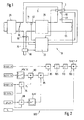
- 10 denotes an internal combustion engine with an internal combustion engine 35, which can be designed, for example, as a gasoline engine or as a diesel engine.
- the Internal combustion engine 35 is, for example, via a second mass flow line 15 an intake manifold, a gas mixture fed for combustion.
- the suction pipe 15 is fresh air on the one hand via an air mass measuring device 25, for example one Hot film air mass meter, and a throttle valve 30 and exhaust gas via a first Mass flow line 5, for example an exhaust gas recirculation channel, on the other hand.
- the exhaust gas recirculation duct 5 connects an exhaust line 55 of the internal combustion engine 35 with the intake manifold 15.
- an exhaust gas recirculation valve 1 is used as Control element arranged to control the size of the exhaust gas mass flow. This will the exhaust gas recirculation valve 1 is controlled by an engine control 20 and a Position feedback on the position of the exhaust gas recirculation valve 1 and thus its Degree of opening reported back to the engine control 20.
- the suction pipe 15 can as in FIG. 1 also shows a tank ventilation line 70, which is a Mass flow measuring device 65 and one controlled by the engine control 20 Tank vent valve 60 for controlling the intake pipe 15 via the Tank vent line 70 supplied mass flow comprises.
- the Mass flow measuring device 65 measures the mass flow in the tank ventilation line 70 and outputs the measured value to the engine control 20.
- the hot air mass meter 25 measures the mass flow of the intake pipe 15 supplied via the throttle valve 30 Fresh air and also outputs this measured value to the engine control 20.
- an intake manifold pressure sensor 40 is also provided, which measures the intake manifold pressure and outputs the measured value to the engine control 20.
- a temperature sensor 50 is arranged, the temperature at Exhaust gas recirculation valve 1 measures and outputs the measured value to the engine control 20.
- a second pressure sensor 45 is arranged, the pressure in the area the branch of the exhaust gas recirculation duct 5 from the exhaust line 55 and measures the Forwarded measured value to the engine control 20.
- the functional diagram according to FIG. 2 represents means 500 for determining the modeled temperature tgagrv_w M at the exhaust gas recirculation valve 1.
- pvagrv_w is the pressure in the exhaust gas recirculation duct 5, in the area of the branch from Exhaust line 55, which is determined by the second pressure sensor 45. Furthermore, agrvp_w is the Position or position of the exhaust gas recirculation valve 1 and thus its degree of opening, the determined by means of a suitable sensor in a manner known to the person skilled in the art and is also supplied to the motor controller 20.
- the MSNTAG characteristic is from Manufacturer of the exhaust gas recirculation valve delivered and gives the standard mass flow through the Exhaust gas recirculation valve 1 as a function of the position agrvp_w des Exhaust gas recirculation valve 1 on.
- the standard conditions include a temperature of 0 ° C, a ratio of the pressure behind the exhaust gas recirculation valve 1 to the pressure before Exhaust gas recirculation valve 1 in the exhaust gas recirculation channel 5 is less than 0.52, which is a supercritical one Pressure ratio corresponds to and a pressure upstream of exhaust gas recirculation valve 1 of 1013 hPa.
- the pressure upstream of the exhaust gas recirculation valve 1 is the pressure on the part of the Exhaust line 55 and the pressure behind the exhaust gas recirculation valve 1 is the pressure on Side of the intake pipe 15.
- the pressure upstream of the exhaust gas recirculation valve 1 is from the second Pressure sensor 45 detects and the pressure behind the exhaust gas recirculation valve 1 is from Intake manifold pressure sensor 40 detected.
- the adaptation of the exhaust gas mass flow to the Actual pressure ratios occur via the KLAF outflow characteristic, which is associated with the Ratio from intake manifold pressure ps_w to pressure pvagrv_w before Exhaust gas recirculation valve 1 is addressed.
- the KLAF outflow characteristic can be set to an engine test bench and to measure the other quantities in equation (1) become.
- a Mass flow measuring device for recording the exhaust gas mass flow msagr_w installed his.
- tgagrv_w M is the modeled temperature at the exhaust gas recirculation valve 1.
- the exhaust gas mass flow msagr_w determined according to equation (1) through the exhaust gas recirculation valve 1 cannot be used.
- the exhaust gas mass flow msagr_w is determined by comparing the inflowing and outflowing mass flows of the intake manifold 15.
- the basis for this modeling is intake manifold pressure modeling. The following is assumed for the intake manifold pressure ps_w:
- m ⁇ dk is the mass flow through the throttle valve (30), which is recorded by the hot-film air mass meter (25)
- m ⁇ cyl is the mass flow flowing out of the intake manifold 15 into the internal combustion engine 35 or the cylinders there, which corresponds approximately to the cylinder charge and is determined in the engine control 20 from the intake manifold pressure ps_w measured by the intake manifold pressure sensor 40 multiplied by a conversion factor fupsrl.
- the differentiation dps_w / dt can also be determined in the engine control 20 as the first time derivative of the intake manifold pressure ps_w measured by the intake manifold pressure sensor 40.
- the the suction pipe 15 flowing mass flow m ⁇ therefore to consist of the sum of on the throttle valve 30 supplied fresh air mass flow m ⁇ dk and through the exhaust gas recirculation passage 5 to the intake manifold 15 supplied to exhaust gas mass flow msagr_w together.
- the inflowing mass flows m ⁇ can also be supplemented by the mass flow mste_w fed from the tank ventilation line 70 to the intake manifold 15, as is taken into account in equation (4) and equation (5).
- the exhaust gas mass flow msagr_w is calculated, for example, at the filling level. According to the functional diagram according to FIG.
- the outflowing filling fraction rfdsorgi_w can be determined, for example, from the intake manifold pressure determined by the intake manifold pressure sensor 40 by multiplying this intake manifold pressure by the conversion factor fupsrl in the engine control 20 in a manner known to those skilled in the art.
- the first subtraction member 125 is supplied with the filling portion rlfgroh_w flowing through the throttle valve 30 to the intake manifold 15, which is also arranged in the manner described by a pressure sensor, not shown in FIG can be.
- the filling fraction rlfgroh_w flowing in via the throttle valve 30 is subtracted from the outflowing filling fraction rfdsorgi_w.
- the result is fed to an adder 135.
- the intake manifold pressure ps_w is fed to a differentiator 140, which forms the time derivative dps-w / dt and feeds it to a fourth division element 115.
- a conversion factor fvisrm_w is also fed to the fourth division element 115.
- the time derivative dps-w / dt is divided by the conversion factor fvisrm_w.
- the conversion factor fvisrm_w corresponds to the previously described proportional factor F from equation (3), but at the filling level, so that a corresponding filling value is fed to the addition element 135 at the output of the fourth division element 115 and is added there to the output of the first subtraction element 125.
- the output of the adder 135 is fed to a fourth multiplier 120, which is also supplied with a conversion factor umrln_w for converting cylinder fillings into mass flows.
- the fourth multiplication element 120 thus multiplies the output of the addition element 135 by the conversion factor umrln_w, so that a corresponding mass flow value results at the output of the fourth multiplication element 120.
- This is supplied to a second subtraction element 130, to which the tank ventilation mass flow mste_w flowing to the suction pipe 15 via the tank ventilation valve 60 and measured by the mass flow measuring device 65 is also supplied.
- the tank ventilation mass flow mste_w is subtracted from the output of the fourth multiplication element 120, so that msagr_w results as the output of the second exhaust gas mass flow.
- the functional diagram according to FIG. 4 can be implemented in the engine control 20 in terms of hardware and / or software.
- FIG. 2 shows a further functional diagram for modeling the temperature tgagrv_w M at the exhaust gas recirculation valve 1.
- This functional diagram can also be implemented in the engine control 20 in terms of hardware and / or software.
- equation (2) is ultimately implemented.
- the exhaust gas mass flow msagr_w which was determined according to the functional diagram according to FIG. 4, is fed to a third division element 85 and is divided there by the output of a second multiplication element 95.
- the output of a first multiplication element 90 is multiplied by the output of the outflow characteristic curve KLAF. The product is then present at the output of the second multiplication element 95.
- the output of the characteristic curve MSNTAG for the exhaust gas standard mass flow as a function of the position agrvp_w of the exhaust gas recirculation valve 1 as the input variable of the characteristic curve MSNTAG is multiplied by the pressure correction factor f p at the output of a first division element 75.
- the product is present at the output of the first multiplication element 90.
- the pressure correction factor f p is determined in the first division element 75 by dividing the pressure pvagrv_w upstream of the exhaust gas recirculation valve 1, which is determined by the second pressure sensor 45, by 1013 hPa.
- the outflow characteristic curve KLAF is supplied with the output of a second division element 80, which is obtained by dividing the intake manifold pressure ps_w by the pressure pvagrv_w upstream of the exhaust gas recirculation valve 1.
- the output of the third division element 85 is subjected to a reciprocal value formation in a reciprocal value element 105.
- the output of the reciprocal element 105 is fed to a squaring element 110, in which the output of the reciprocal element 105 is squared.
- the output of the squaring element 110 is fed to a third multiplication element 100 and is multiplied there by the standard temperature T 0 , which is 0 ° C.
- the temperatures in all equations in which they occur are converted into Kelvin.
- the modeled temperature tgagrv_w M at the exhaust gas recirculation valve 1 is then present at the output of the third multiplication element 100.
- the functional diagram according to FIG. 2 represents means 500 for determining the modeled temperature tgagrv_w M at the exhaust gas recirculation valve 1.
- FIG. 3 is a flow chart to illustrate the inventive method shown. After the start of the program at a program point 200 of the Engine control 20 by means of the functional diagram according to FIG. 4 the exhaust gas mass flow msagr_w determined in the manner described. Then becomes one Program item 205 branches.
- the engine controller 20 uses the function diagram shown in FIG. 2 to determine the modeled temperature tgagrv_w M at the exhaust gas recirculation valve 1 in the manner described. The program then branches to a program point 210.
- the program then branches to a program point 215.
- the engine control 20 checks whether the difference ⁇ is greater than one predetermined threshold value. If this is the case, then a program point 220 branches, otherwise the program branches to a program point 225.
- engine controller 20 detects one Exhaust gas recirculation mass flow through the exhaust gas recirculation channel 5 in the direction of Exhaust line 55. The program then branches to a program point 230.
- engine control 20 detects one Exhaust gas recirculation mass flow through the exhaust gas recirculation channel 5 in the direction of the intake manifold 15. The program then branches to program item 230.
- the engine control unit 20 introduces the difference ⁇ Correction member that corrects the position of the exhaust gas recirculation valve 1 so that the Difference ⁇ largely disappears.
- the correction element can be used as a controller, for example, be formed with an integral and / or a proportional component. A single control step can be carried out at program point 230.
- the program is then exited and can be used again for further control steps be run through.
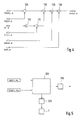
- FIG. 5 shows a functional diagram for comparing the measured temperature tgagrv_w G at the exhaust gas recirculation valve 1 with the modeled temperature tgagrv_w M , which can also be implemented in the engine control 20.
- the difference ⁇ is, on the one hand, forwarded to a threshold value comparator 310, which compares the difference ⁇ with the predetermined threshold value and is set at its output, for example, if the difference ⁇ is greater than the predetermined threshold value, by an exhaust gas mass flow through the exhaust gas recirculation channel 5 in the direction of the exhaust gas line 55 and which is reset at its output in order to indicate an exhaust gas mass flow through the exhaust gas recirculation channel 5 in the direction of the intake manifold 15 when the difference ⁇ is less than or equal to the predetermined threshold value.
- the difference ⁇ from the third subtraction element 300 is fed to a correction element 320, for example a controller, which comprises, for example, an integral and / or a proportional component.
- the output of the controller 320 controls the position or the degree of opening of the exhaust gas recirculation valve 1 in order to guide the difference ⁇ towards 0 and thus to compensate for the deviation between the measured temperature tgagrv_w G at the exhaust gas recirculation valve 1 and the modeled temperature tgagrv_w M at the exhaust gas recirculation valve 1 ,
- FIGS. 2, 4 and 5 form the invention Contraption.
- the invention is based on the example of an exhaust gas mass flow in an exhaust gas recirculation duct described, but can be used for any mass flow in a first Realize mass flow line, which opens into a second mass flow line.
- the example described is the first mass flow line of the exhaust gas recirculation duct 5 and the second mass flow line the suction pipe 15.
- the exhaust gas mass flow msagr_w according to FIG. 4 was modeled on the filling level. Alternatively, it can also be modeled at the mass flow level if the corresponding inflowing and outflowing mass flows are each determined using a mass flow measuring device, so that the exhaust gas mass flow msagr_w can be calculated directly on the basis of the mass flow balance according to equation (4).
- the mass flow m ⁇ dk through the throttle valve 30 is determined by means of the hot-film air mass meter 25, and the tank ventilation mass flow mste_w by the mass flow measuring device 65
- Exhaust gas recirculation channel 5 may be arranged downstream of a mass flow measuring device.
Landscapes
- Engineering & Computer Science (AREA)
- Chemical & Material Sciences (AREA)
- Combustion & Propulsion (AREA)
- Mechanical Engineering (AREA)
- General Engineering & Computer Science (AREA)
- Combined Controls Of Internal Combustion Engines (AREA)
- Exhaust-Gas Circulating Devices (AREA)
Abstract
Description



Claims (6)
- Verfahren zur Überwachung eines durch ein Stellelement (1) eingestellten Massenstroms durch eine erste Massenstromleitung (5) einer Brennkraftmaschine (10), dadurch gekennzeichnet, dass ein erster Wert für eine Temperatur am Stellelement (1) gemessen wird, dass ein zweiter Wert für die Temperatur am Stellelement (1) in Abhängigkeit mehrerer Betriebskenngrößen der Brennkraftmaschine (10) modelliert wird und dass in Abhängigkeit einer Differenz zwischen dem ersten Wert und dem zweiten Wert die Richtung des Massenstroms ermittelt wird.
- Verfahren nach Anspruch 1, dadurch gekennzeichnet, dass der zweite Wert abhängig von einem Druck vor dem Stellelement (1), einem Druck hinter dem Stellelement (1), einer Stellung des Stellelements (1) und eines modellierten Massenstroms durch das Stellelement (1) ermittelt wird.
- Verfahren nach Anspruch 2, dadurch gekennzeichnet, dass der Massenstrom durch das Stellelement (1) abhängig von einer Massenstrombilanz oder einer Bilanz einer davon abgeleiteten Größe einer zweiten Massenstromleitung (15) der Brennkraftmaschine (10), in die die erste Massenstromleitung (5) mündet, modelliert wird.
- Verfahren nach einem der vorherigen Ansprüche, dadurch gekennzeichnet, dass die Differenz zwischen dem ersten Wert und dem zweiten Wert für die Temperatur am Stellelement (1) mit einer vorgegebenen Schwelle verglichen wird und dass die Richtung des Massenstroms durch das Stellelement (1) aus der Lage der Differenz bezüglich der vorgegebenen Schwelle ermittelt wird.
- Verfahren nach einem der vorherigen Ansprüche, dadurch gekennzeichnet, dass die Stellung des Stellelementes (1) in Abhängigkeit der Differenz zwischen dem ersten Wert und dem zweiten Wert für die Temperatur am Stellelement (1) korrigiert wird.
- Vorrichtung zur Überwachung eines durch ein Stellelement (1) eingestellten Massenstroms durch eine erste Massenstromleitung (5) einer Brennkraftmaschine (10), dadurch gekennzeichnet, dass ein Temperatursensor (50) zur Messung eines ersten Wertes für eine Temperatur am Stellelement (1) vorgesehen ist, dass Mittel (500) zur Modellierung eines zweiten Wertes für die Temperatur am Stellelement (1) in Abhängigkeit mehrerer Betriebskenngrößen der Brennkraftmaschine (10) vorgesehen sind und dass Mittel (300, 310) zur Ermittlung einer Richtung des Massenstroms in Abhängigkeit einer Differenz zwischen dem ersten Wert und dem zweiten Wert vorgesehen sind.
Applications Claiming Priority (2)
| Application Number | Priority Date | Filing Date | Title |
|---|---|---|---|
| DE10248194 | 2002-10-16 | ||
| DE10248194A DE10248194A1 (de) | 2002-10-16 | 2002-10-16 | Verfahren und Vorrichtung zur Überwachung eines durch ein Stellelement eingestellten Massenstroms |
Publications (3)
| Publication Number | Publication Date |
|---|---|
| EP1411233A2 true EP1411233A2 (de) | 2004-04-21 |
| EP1411233A3 EP1411233A3 (de) | 2006-02-01 |
| EP1411233B1 EP1411233B1 (de) | 2008-03-05 |
Family
ID=32038721
Family Applications (1)
| Application Number | Title | Priority Date | Filing Date |
|---|---|---|---|
| EP03010969A Expired - Lifetime EP1411233B1 (de) | 2002-10-16 | 2003-05-16 | Verfahren und Vorrichtung zur Überwachung eines durch ein Stellelement eingestellten Massenstroms |
Country Status (2)
| Country | Link |
|---|---|
| EP (1) | EP1411233B1 (de) |
| DE (2) | DE10248194A1 (de) |
Family Cites Families (3)
| Publication number | Priority date | Publication date | Assignee | Title |
|---|---|---|---|---|
| DE3248603A1 (de) * | 1982-12-30 | 1984-07-12 | Robert Bosch Gmbh, 7000 Stuttgart | Einrichtung zur messung des massendurchsatzes eines stroemenden mediums |
| DE3637541A1 (de) * | 1986-11-04 | 1988-05-05 | Vdo Schindling | Vorrichtung zur bestimmung des massenstromes und der durchflussrichtung |
| EP0695928A3 (de) * | 1994-08-02 | 1996-11-27 | Hitachi Ltd | Ansaugluft-Durchflussmessgerät für eine Brennkraftmaschine |
-
2002
- 2002-10-16 DE DE10248194A patent/DE10248194A1/de not_active Withdrawn
-
2003
- 2003-05-16 EP EP03010969A patent/EP1411233B1/de not_active Expired - Lifetime
- 2003-05-16 DE DE50309300T patent/DE50309300D1/de not_active Expired - Lifetime
Also Published As
| Publication number | Publication date |
|---|---|
| DE50309300D1 (de) | 2008-04-17 |
| EP1411233B1 (de) | 2008-03-05 |
| DE10248194A1 (de) | 2004-04-29 |
| EP1411233A3 (de) | 2006-02-01 |
Similar Documents
| Publication | Publication Date | Title |
|---|---|---|
| DE102010044164B4 (de) | Verfahren und Vorrichtung zur Steuerung einer Brennkraftmaschine | |
| DE102007013250B4 (de) | Verfahren und Vorrichtung zum Betreiben einer Brennkraftmaschine mit mindestens einem Zylinder | |
| DE112005001727B4 (de) | Schätzung der Sauerstoffkonzentration im Einlasskrümmer eines ungedrosselten Magermotors | |
| DE19963358A1 (de) | Verfahren und Vorrichtung zur Steuerung einer Brennkraftmaschine mit einem Luftsystem | |
| DE60301242T2 (de) | Vorrichtung und Verfahren zum Schätzen der Einlassluftmenge einer Brennkraftmaschine | |
| DE102007025432A1 (de) | Steuervorrichtung für einen Verbrennungsmotor | |
| DE102007035314B4 (de) | Verfahren und Vorrichtung zum Betreiben einer Brennkraftmaschine | |
| DE102014205992B4 (de) | Verbrennungsmotor-Steuervorrichtung | |
| EP1015748A1 (de) | Verfahren und vorrichtung zur bestimmung einer gasfüllung eines verbrennungsmotors | |
| DE10039785B4 (de) | Verfahren und Vorrichtung zum Betreiben einer Brennkraftmaschine | |
| WO2016198299A1 (de) | Luftfüllungsbestimmung, motorsteuergerät und verbrennungskraftmaschine | |
| DE102016219781A1 (de) | Verfahren und Steuergerät zum Abgleich und zur Diagnose eines Abgasrückführmassenstrommessers | |
| EP1264227A1 (de) | Verfahren und vorrichtung zum ermitteln eines massenstromes über ein steuerventil und zum ermitteln eines modellierten saugrohrdrucks | |
| DE102007051873B4 (de) | Verfahren und Vorrichtung zum Betreiben einer Brennkraftmaschine | |
| DE102014226181A1 (de) | Verfahren und Vorrichtung zum Überprüfen eines druckbasierten Massenstromsensors in einem Luftzuführungssystem für einen Verbrennungsmotor | |
| DE10021639C1 (de) | Verfahren zur Diagnose des Umgebungsdruckes für Verbrennungskraftmaschinen | |
| DE102005022691A1 (de) | Verfahren und Vorrichtung zum Betreiben einer Brennkraftmaschine | |
| DE102004038733A1 (de) | Verfahren und Vorrichtung zum Betreiben einer Brennkraftmaschine | |
| EP1162357B1 (de) | Verfahren und Vorrichtung zum Überwachen des Betriebs eines Verbrennungsmotors | |
| DE102008042819B4 (de) | Verfahren und Vorrichtung zum Bestimmen einer gesamten Zylinderfüllung und/oder der aktuellen Restgasrate bei einem Verbrennungsmotor mit Abgasrückführung | |
| DE102007035312B4 (de) | Verfahren und Vorrichtung zum Betreiben einer Brennkraftmaschine | |
| DE102007012340B3 (de) | Verfahren zum Ermitteln und Einregeln des Luftmassenstroms im Saugrohr eines Verbrennungsmotors sowie zugehöriges Steuergerät | |
| DE102005045857B3 (de) | Verfahren zum Bestimmen des Umgebungsdrucks in einer Brennkraftmaschine | |
| EP1411233B1 (de) | Verfahren und Vorrichtung zur Überwachung eines durch ein Stellelement eingestellten Massenstroms | |
| DE10116932A1 (de) | Verfahren zum Bestimmen des Luftmassenstroms vom Saugrohr in den Zylinder einer Brennkraftmaschine |
Legal Events
| Date | Code | Title | Description |
|---|---|---|---|
| PUAI | Public reference made under article 153(3) epc to a published international application that has entered the european phase |
Free format text: ORIGINAL CODE: 0009012 |
|
| AK | Designated contracting states |
Kind code of ref document: A2 Designated state(s): AT BE BG CH CY CZ DE DK EE ES FI FR GB GR HU IE IT LI LU MC NL PT RO SE SI SK TR |
|
| AX | Request for extension of the european patent |
Extension state: AL LT LV MK |
|
| PUAL | Search report despatched |
Free format text: ORIGINAL CODE: 0009013 |
|
| AK | Designated contracting states |
Kind code of ref document: A3 Designated state(s): AT BE BG CH CY CZ DE DK EE ES FI FR GB GR HU IE IT LI LU MC NL PT RO SE SI SK TR |
|
| AX | Request for extension of the european patent |
Extension state: AL LT LV MK |
|
| 17P | Request for examination filed |
Effective date: 20060801 |
|
| AKX | Designation fees paid |
Designated state(s): DE FR IT SE |
|
| 17Q | First examination report despatched |
Effective date: 20060915 |
|
| GRAP | Despatch of communication of intention to grant a patent |
Free format text: ORIGINAL CODE: EPIDOSNIGR1 |
|
| GRAS | Grant fee paid |
Free format text: ORIGINAL CODE: EPIDOSNIGR3 |
|
| GRAA | (expected) grant |
Free format text: ORIGINAL CODE: 0009210 |
|
| AK | Designated contracting states |
Kind code of ref document: B1 Designated state(s): DE FR IT SE |
|
| REF | Corresponds to: |
Ref document number: 50309300 Country of ref document: DE Date of ref document: 20080417 Kind code of ref document: P |
|
| ET | Fr: translation filed | ||
| PLBE | No opposition filed within time limit |
Free format text: ORIGINAL CODE: 0009261 |
|
| STAA | Information on the status of an ep patent application or granted ep patent |
Free format text: STATUS: NO OPPOSITION FILED WITHIN TIME LIMIT |
|
| 26N | No opposition filed |
Effective date: 20081208 |
|
| PGFP | Annual fee paid to national office [announced via postgrant information from national office to epo] |
Ref country code: SE Payment date: 20091222 Year of fee payment: 8 |
|
| PGFP | Annual fee paid to national office [announced via postgrant information from national office to epo] |
Ref country code: FR Payment date: 20100608 Year of fee payment: 8 |
|
| PGFP | Annual fee paid to national office [announced via postgrant information from national office to epo] |
Ref country code: IT Payment date: 20100527 Year of fee payment: 8 |
|
| REG | Reference to a national code |
Ref country code: SE Ref legal event code: EUG |
|
| REG | Reference to a national code |
Ref country code: FR Ref legal event code: ST Effective date: 20120131 |
|
| PG25 | Lapsed in a contracting state [announced via postgrant information from national office to epo] |
Ref country code: IT Free format text: LAPSE BECAUSE OF NON-PAYMENT OF DUE FEES Effective date: 20110516 |
|
| PG25 | Lapsed in a contracting state [announced via postgrant information from national office to epo] |
Ref country code: FR Free format text: LAPSE BECAUSE OF NON-PAYMENT OF DUE FEES Effective date: 20110531 |
|
| PG25 | Lapsed in a contracting state [announced via postgrant information from national office to epo] |
Ref country code: SE Free format text: LAPSE BECAUSE OF NON-PAYMENT OF DUE FEES Effective date: 20110517 |
|
| PGFP | Annual fee paid to national office [announced via postgrant information from national office to epo] |
Ref country code: DE Payment date: 20150723 Year of fee payment: 13 |
|
| REG | Reference to a national code |
Ref country code: DE Ref legal event code: R119 Ref document number: 50309300 Country of ref document: DE |
|
| PG25 | Lapsed in a contracting state [announced via postgrant information from national office to epo] |
Ref country code: DE Free format text: LAPSE BECAUSE OF NON-PAYMENT OF DUE FEES Effective date: 20161201 |