EP1410136B1 - Procede et systeme permettant d'accelerer la reception des donnees dans un reseau client a client - Google Patents
Procede et systeme permettant d'accelerer la reception des donnees dans un reseau client a client Download PDFInfo
- Publication number
- EP1410136B1 EP1410136B1 EP01978794A EP01978794A EP1410136B1 EP 1410136 B1 EP1410136 B1 EP 1410136B1 EP 01978794 A EP01978794 A EP 01978794A EP 01978794 A EP01978794 A EP 01978794A EP 1410136 B1 EP1410136 B1 EP 1410136B1
- Authority
- EP
- European Patent Office
- Prior art keywords
- peer
- acceleration server
- response
- portions
- network
- Prior art date
- Legal status (The legal status is an assumption and is not a legal conclusion. Google has not performed a legal analysis and makes no representation as to the accuracy of the status listed.)
- Expired - Lifetime
Links
Images
Classifications
-
- H—ELECTRICITY
- H04—ELECTRIC COMMUNICATION TECHNIQUE
- H04L—TRANSMISSION OF DIGITAL INFORMATION, e.g. TELEGRAPHIC COMMUNICATION
- H04L67/00—Network arrangements or protocols for supporting network services or applications
- H04L67/01—Protocols
- H04L67/10—Protocols in which an application is distributed across nodes in the network
- H04L67/1097—Protocols in which an application is distributed across nodes in the network for distributed storage of data in networks, e.g. transport arrangements for network file system [NFS], storage area networks [SAN] or network attached storage [NAS]
-
- G—PHYSICS
- G06—COMPUTING OR CALCULATING; COUNTING
- G06F—ELECTRIC DIGITAL DATA PROCESSING
- G06F9/00—Arrangements for program control, e.g. control units
- G06F9/06—Arrangements for program control, e.g. control units using stored programs, i.e. using an internal store of processing equipment to receive or retain programs
- G06F9/46—Multiprogramming arrangements
- G06F9/465—Distributed object oriented systems
-
- H—ELECTRICITY
- H04—ELECTRIC COMMUNICATION TECHNIQUE
- H04L—TRANSMISSION OF DIGITAL INFORMATION, e.g. TELEGRAPHIC COMMUNICATION
- H04L67/00—Network arrangements or protocols for supporting network services or applications
- H04L67/01—Protocols
- H04L67/10—Protocols in which an application is distributed across nodes in the network
- H04L67/104—Peer-to-peer [P2P] networks
-
- H—ELECTRICITY
- H04—ELECTRIC COMMUNICATION TECHNIQUE
- H04L—TRANSMISSION OF DIGITAL INFORMATION, e.g. TELEGRAPHIC COMMUNICATION
- H04L67/00—Network arrangements or protocols for supporting network services or applications
- H04L67/01—Protocols
- H04L67/10—Protocols in which an application is distributed across nodes in the network
- H04L67/104—Peer-to-peer [P2P] networks
- H04L67/1061—Peer-to-peer [P2P] networks using node-based peer discovery mechanisms
- H04L67/1063—Discovery through centralising entities
-
- H—ELECTRICITY
- H04—ELECTRIC COMMUNICATION TECHNIQUE
- H04L—TRANSMISSION OF DIGITAL INFORMATION, e.g. TELEGRAPHIC COMMUNICATION
- H04L67/00—Network arrangements or protocols for supporting network services or applications
- H04L67/50—Network services
- H04L67/56—Provisioning of proxy services
- H04L67/568—Storing data temporarily at an intermediate stage, e.g. caching
-
- H—ELECTRICITY
- H04—ELECTRIC COMMUNICATION TECHNIQUE
- H04L—TRANSMISSION OF DIGITAL INFORMATION, e.g. TELEGRAPHIC COMMUNICATION
- H04L69/00—Network arrangements, protocols or services independent of the application payload and not provided for in the other groups of this subclass
- H04L69/30—Definitions, standards or architectural aspects of layered protocol stacks
- H04L69/32—Architecture of open systems interconnection [OSI] 7-layer type protocol stacks, e.g. the interfaces between the data link level and the physical level
- H04L69/322—Intralayer communication protocols among peer entities or protocol data unit [PDU] definitions
- H04L69/329—Intralayer communication protocols among peer entities or protocol data unit [PDU] definitions in the application layer [OSI layer 7]
Definitions
- the present invention relates to a method and system for accelerating receipt of data in a peer-to-peer network and, more particularly, to use of an acceleration server in proximity to user clients within the network to store previously received data.
- LANs local area networks
- WANs wide area networks
- Client to client networks also referred to as peer to peer networks
- peer to peer networks have become popular in recent years (see for example www.napster.com ). These networks provide members with software that allows them to transfer and receive data directly from other members across the Internet. Typically, the transferred data is organized in large files which require significant amounts of time for transfer. The volume of transferred data in client to client networks is such that it can, in some cases, reduce available bandwidth within a network. This can cause undesirable slowdowns for other users.
- EP 1 011 244 A2 (D1) describes a traditional client/server network in which requests from a client directed to an origin server are transparently redirected to a proxy cache. If the proxy cache has stored the requested object, it sends the object to the client, but it appears as if the object has come from the origin server. If the proxy cache does not have stored the requested object, it sets up a connection to the origin server, obtains the object, then forwards it to the client, and again it appears as if the object has come from the origin server.
- a method of accelerating receipt of data in a peer-to-peer network wherein each peer in the peer-to-peer network is arranged to operate a software program for implementing queries and providing responses, the method comprising the steps of: a) providing a first peer and a communication channel for transmitting communications to and from the first peer, the first peer being arranged to operate the software program for implementing a query that is relayed to at least two other peers; b) providing the at least two other peers for receiving the query, each of the at least two other peers being arranged to operate the software program to provide a portion of a response to the query, whereby the response to the query includes at least two response portions to the first peer from the respective at least two other peers; c) intercepting in an acceleration server, the query from the first peer; d) determining whether the portions of the response to the query expected to be received by the first peer are stored at the acceleration server; e) when the portions of the response to the query expected to be received
- an acceleration server connected to a peer-to-peer network in which each peer in the peer-to-peer network is arranged to operate a software program for implementing queries and providing responses, the network comprising a first peer and a communication channel for transmitting communications to and from the first peer, the first peer being arranged to operate the software program for implementing a query that is relayed to at least two other peers, and the at least two other peers for receiving the query, each of the at least two other peers being arranged to operate the software program to provide a portion of a response to the query, whereby the response to the query includes at least two response portions to the first peer from the respective at least two other peers, the acceleration server comprising: a) a means for intercepting the query from the first peer; b) means for determining whether the portions of the response to the query expected to be received by the first peer are stored at the acceleration server; c) means for transmitting the portions of the response stored at the acceleration server from the acceleration server to the first
- a system for accelerating receipt of data in a peer-to-peer network in which each peer in the peer-to-peer network is arranged to operate a software program for implementing queries and providing responses, the system comprising at least two acceleration servers, each acceleration server according to the second aspect of the invention, the relative configuration of the acceleration servers being series, parallel, or a combination thereof.
- the redirecting device is a layer 4 switch.
- the acceleration server is located in a location selected from the group consisting of within a local area network and in a server belonging to an Internet Service Provider.
- the queries are requests for data and the responses are data.
- the data is in a format selected from the group of file types consisting of MP3, MPEG-2, MPEG-1, M-JPEG, MPEG-4, ActiveMovie/Video for Windows (.avi), QuickTime (.mov), RealVideo (.rm and .ram), H263.1, HTML, Flash, Gif, Tif, mpeguide and exe.
- the step of storing is accomplished by use of an algorithm.
- the algorithm includes analysis of at least one variable selected from the group consisting of: (i) temporal information; (ii) ordinal information; (iii) frequency information (iv) peer information; and (v) identification information.
- the temporal information includes at least one datum selected from the group consisting of time of initial storage, total residence time in storage, elapsed time since last retrieval from storage, average time between retrievals from storage and time of creation of an original file.
- the ordinal information includes at least one datum selected from the group consisting of order of receipt and order of retrieval.
- the frequency information includes at least one datum selected from the group consisting of frequency of retrieval and frequency of appearance in peers of the peer-to-peer network.
- the peer information includes at least one datum selected from the group consisting of peer connection status, peer identification, and presence of a specific data on a specific peer.
- the identification information includes at least one datum selected from the group consisting of file identification, peer identification, and identification of content within a file.
- a single query and a single response are each individually intercepted by at least two acceleration servers.
- the acceleration server is located in a location selected from the group consisting of within a local area network, on a server belonging to an Internet service provider, at a cable television provider junction, at a satellite relay link, and within an ADSL junction.
- the step of transmitting a specific intercepted response to a peer submitting a specific intercepted query occurs only if a specific peer which served as a source of the specific intercepted response is available on the peer-to-peer network and only if the specific peer contains data identical to the specific intercepted response in a directory of the specific peer.
- the sub-step of transmitting a specific packet of the at least two packets to a peer submitting a specific intercepted query occurs only if a specific peer which served as a source of the specific intercepted response is available on the peer-to-peer network and only if the specific peer contains data identical to the specific intercepted response in a directory of the specific peer.
- the step of transmitting an intercepted response to a peer submitting a specific intercepted query occurs only if a specific peer which contains data equivalent to the specific intercepted response in a directory of the specific peer is available on the peer-to-peer network.
- the sub-step of transmitting a specific packet of the at least two packets to a peer submitting a specific intercepted query occurs only if a specific peer which contains data equivalent to the specific intercepted response in a directory of the specific peer is available on the peer-to-peer network.
- acceleration server further functions as a peer in the peer-to-peer network.
- the step of transmitting the intercepted responses to peers submitting intercepted queries includes simultaneous transmission of portions of a single data set from at least two of the acceleration servers.
- the step of transmitting a specific response of the intercepted responses begins while the step of intercepting is still in progress for the specific response.
- the specific peer which contains data equivalent to the specific intercepted response in a directory thereof includes at least two separate and distinct peers.
- the step of storing the intercepted responses in an acceleration server includes storing a single intercepted response which originates in at least two separate and distinct clients.
- the at least one acceleration server is further designed and configured for: (d) dividing a specific intercepted response of the intercepted responses into at least two packets and (e) transmitting the at least two packets to the peers submitting intercepted queries.
- the present invention successfully addresses the shortcomings of the presently known configurations by providing a method and system for accelerating receipt of data in a peer-to-peer network which can be easily implemented using commercially available hardware.
- the present invention is of a method and system for accelerating receipt of data in a client to client network which can be advantageously employed to reduce traffic within a wide area network and increase bandwidth availability.
- the present invention can be used to store frequently requested data on servers along a data path, thereby shortening the path for a subsequent retrieval of the same data.
- the phrase "user client” generally refers to a computer and includes, but is not limited to, personal computers (PC) having an operating system such as DOS, Windows TM , OS/2 TM or Linux; Macintosh TM , Palm OS TM , EPOC TM computers; computers having JAVA TM -OS as the operating system; and graphical workstations such as the computers of Sun Microsystems TM and Silicon Graphics TM , and other computers having some version of the UNIX operating system such as AIX TM or SOLARIS TM of Sun Microsystems TM ; or any other known and available operating system; personal digital assistants (PDA), cellular telephones having computer capabilities, a telephone having computer capabilities and Web TVs, each of which is known to include an inherent or connectable display device.
- a user client is characterized as having at least one input device and at least one output device.
- server refers to any computing machine capable of exchanging data with at least one other computing machine.
- a single server may comprise an individual computing machine or a plurality of such machines acting in concert to perform a function requested by at lest one other computing machine.
- Windows TM includes but is not limited to Windows 95 TM , Windows 2000 TM Windows 3.x TM in which "x" is an integer such as "1”, Windows NT TM , Windows 98 TM , Windows CE TM Windows Millennium TM and any upgraded versions of these operating systems by Microsoft Corp (USA) and /or window managers for the graphical X Windows system for UNIX based operating systems and / or its variants such as Linux.
- computing platform refers to any particular operating system and/or hardware device, as previously described, according to which the format for data communication and/or presentation (display) thereof is determined.
- data refers to digital data including, but not limited to a software program, a text file, a sound file, a file containing at least one video image, and an animation sequence as well as to any combinations thereof.
- channel of communication includes, but is not limited to a telephone connection, a cellular telephone connection, an Internet connection, an infrared frequency transmission connection, a local area network connection, a radio frequency connection, a fiber-optic connection or a connection by a wire.
- a communication channel Inherent in the idea of a communication channel is an open status during which data transmission may occur. In some cases, communication channels may also have a closed status during which no data transmission may occur. The phrase is to be construed in its broadest possible sense so that it encompasses any mode of data transfer.
- the phrase "software program” refers to any algorithm for performing at least one function on a computing device.
- the term specifically includes, but is not limited to web browsers, music players, animation players, video players, games, compression algorithms, search programs, client to client interfaces and viewers.
- display device refers to any device for presentation of data to a user.
- the definition includes, but is not limited to speakers, earphones, LCD screens, LED displays, CRT displays and active matrix displays.
- the phrase "input device” refers to any device for entry of data to a computing device.
- the definition includes, but is not limited to a keyboard, a computer mouse, a trackpad, a track ball, a stylus, a touchscreen, a camera and a microphone.
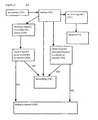
- Figure 2 illustrates a method 20 of accelerating receipt of data in a client to client network.
- data is typically received in response to a query.
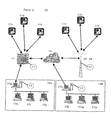
- Each client 57 ( Figure 1 ) in the client to client network operates a software program for implementing queries and providing responses.
- the software program may include, in some cases, at least two algorithms.
- the queries are requests for data and the responses are data.
- the data may be, for example, organized in a file type such as MP3, DViD, MPEG-2, MPEG-1, M-JPEG, MPEG-4, ActiveMovie/Video for Windows (.avi), QuickTime(.mov), RealVideo(.rm and .ram), H263.1, HTML, Flash, Gif, Tif, mpeguide, exe or any other file type.
- a file type such as MP3, DViD, MPEG-2, MPEG-1, M-JPEG, MPEG-4, ActiveMovie/Video for Windows (.avi), QuickTime(.mov), RealVideo(.rm and .ram), H263.1, HTML, Flash, Gif, Tif, mpeguide, exe or any other file type.
- Method 20 includes the step of intercepting 22 queries and responses in the client to client network.
- the step of intercepting is accomplished by a redirecting device which may include, for example, a layer 4 switch.
- Method 20 further includes the step of storing 24 the intercepted queries and responses in an acceleration server 52.
- Acceleration server 52 may be located, for example, within a local area network 54 (e.g. 57 g and 57 k) or in a server 60 belonging to an Internet Service Provider.
- step of storing 24 is accomplished by use of an algorithm which may include analysis of, for example, temporal information, ordinal information, frequency information, client information, identification information or combinations thereof.
- Temporal information as used herein may include, but is not limited to, data such as time of initial storage, total residence time in storage, elapsed time since last retrieval from storage, average time between retrievals from storage and time of creation of an original file.
- Time as used herein may include any reference to an absolute or relative measure of time including, but not limited to an absolute or elapsed time (e.g. 16:43:21 or 3hrs 21 minutes and 04 seconds since receipt) or an absolute or relative date (e.g. Feb. 22, 2001 or yesterday).
- Ordinal information refers to, for example, data such as order of receipt and order of retrieval.
- Frequency information refers to, for example, data such as frequency of retrieval and frequency of appearance in clients of the client to client network.
- Client information as used herein refers to, for example, data such as client connection status, client identification, and presence of specific data (i.e. a file or portion thereof) on a specific client.
- Identity information as used herein refers to, for example, data such as file identification, client identification, and identification of content within a file.
- Method 20 further includes the step of transmitting 26 the intercepted responses to clients 57 submitting intercepted queries.
- a single query or a single response may be intercepted by at least two acceleration servers.
- a query for a video game called "piggy picnic" originates at client 57h in LAN 54a .
- the query is first intercepted by acceleration server 52 of client 57 g.
- acceleration server 52 of client 57 g includes server function within LAN 54a.
- acceleration server 52 of client 57 g is not storing a copy of "piggy picnic" from a previous response, so the query is then relayed via ISP server 60 where the query is screened against stored responses in acceleration server 52 of server 60. Again, no match is found.
- the query is next relayed to user clients 57 a, b, and c and to Internet 56.
- the query is relayed to LAN 54b where it encounters acceleration server 52 of client 57k, and to Cable TV junction 62 /Satellite relay 64 which contain an additional acceleration server 52.
- the query eventually reaches all of clients 57.
- the query has been intercepted, and according to some embodiments stored, in a total of four acceleration servers 52 .
- the result of the query is that copies of piggy picnic are present on clients 57a and 57 m. This information is relayed to requesting client 57h via the same channels of communication described hereinabove.
- client 57h requests to receive a copy of piggy picnic from client 57a.
- copies of piggy picnic may be stored on acceleration servers 52 of servers 60 and 57g.
- a subsequent request from client 57c for piggy picnic may be answered by transmitting the game directly from acceleration server 52 of server 60.
- a subsequent request from client 57f for piggy picnic may be answered by transmitting the game from acceleration server 52 of server 60 via Internet 56 and acceleration server 52 of satellite relay 64 to requesting client 57f.
- an additional copy of the game is generated at acceleration server 52 of satellite relay 64.
- practice of method 20 causes copies of frequently requested data to accumulate in areas where the requests originate.
- the step of transmitting 26 a specific intercepted response to a client submitting a specific intercepted query occurs only if a specific client which served as a source of the specific intercepted response is available on the client to client network and only if the specific client contains data identical to the specific intercepted response in a directory of the specific client.
- acceleration server 52 checks 36 if a specific intercepted response is available. If it is available, transmission occurs 26. If it is not available, no transmission occurs 40.
- requested data may be divided 28 into at least two packets before transmission.
- the sub-step of transmitting a specific packet of the at least two packets to a client submitting a specific intercepted query occurs only if a specific client which served as a source of the specific intercepted response is available on the client to client network and only if the specific client contains data identical to the specific intercepted response in a directory of the specific client. That is, prior to transmitting a packet the network is checked 38 for the presence of that packet. If the packet is available, transmission occurs 26. If it is not available, no transmission occurs 40.
- the step of transmitting 26 an intercepted response to a client submitting a specific intercepted query occurs only if a specific client which contains data equivalent to the specific intercepted response in a directory of the specific client is available on the client to client network. If the equivalent data is available, transmission occurs 26. If it is not available, no transmission occurs 40. The same principle may be applied to packets. If an equivalent packet is available, transmission occurs 26. If it is not available, no transmission occurs 40.
- the step of storing 24 the intercepted responses in an acceleration server may include storing 24 a single intercepted response which originates in at least two separate and distinct clients.
- client 57a requests an accapella rendition of "Hatikva” by the Ramallah boys' choir as an MP3 file.
- the requested file is found on both clients 57b and 57c .
- the file is divided into ten packets, with packets 1,3,5,7 and 9 being sent to acceleration server 52 of server 60 by client 57b, and packets 2,4,6,8 and 10 being sent to acceleration server 52 of server 60 by client 57c.
- the step of transmitting 26 the intercepted responses to clients 57 submitting intercepted queries may include simultaneous transmission of portions of a single data set from at least two of the acceleration servers. For example, if client 57n requests an MP3 file of Suzy Cream Cheese, and the file is found on acceleration servers 52 of servers 60 and Satellite relay 64, packets having their origins in each of the two copies may be concurrently transmitted to client 57n in order to provide a single copy of this much loved ditty.
- the step of transmitting a specific response of the intercepted responses may begin while the step of intercepting is still in progress for the specific response.
- a system 50 for accelerating receipt of data in a client to client network wherein each client in the client to client network operates a software program for implementing queries and providing responses.
- the system includes at least one acceleration server 52 designed and configured to intercept queries and responses in the client to client network wherein each of the queries and each of the responses contains unique identification information therein, the unique identification information facilitating interception thereof.
- Acceleration server 52 is further designed and configured to store the responses.
- Acceleration server 52 is further designed and configured to transmit the responses to clients submitting intercepted queries. Limits may be placed on this transmission a described hereinabove and hereinbelow.
- System 50 may contain multiple acceleration servers 52 which may have a relative configuration which is either in series or in parallel or a combination thereof. For example, in fulfilling a request originating at client 57m, acceleration server 52 of server 57k and acceleration server 52 of satellite relay 64 are in series with respect to one another. Similarly, acceleration server 52 of satellite relay 64 and acceleration server 52 of ISP server 60 are in parallel with one another with respect to the same request.
- acceleration server 52 may be located in a variety of locations including, but not limited to, within local area network (54a and 54b), on a server 60 belonging to an Internet service provider, at a cable television provider junction 62, at a satellite relay link 64, and within an ADSL junction.
- acceleration server 52 may be configured to be either unidirectional or bi-directional. This means that, for example, acceleration server 52 of server 57k may be configured to transmit stored responses only to members of LAN 54b, in which case it is said to be a unidirectional acceleration server 52. Alternately acceleration server 52 of server 57k may be configured to transmit stored responses in response to queries from inside LAN 54b and from clients 57 outside LAN 54b in which case it is said to be a bi-directional acceleration server 52.
- acceleration server 52 may further function as a client 57 in the client to client network. Alternately or additionally, acceleration server 52 may act as a transparent proxy server.
- the specific client 57 which contains data equivalent to the specific intercepted response in a directory thereof includes at least two separate and distinct clients. This may be the case when, for example, a file is divided into packets as described hereinabove.
- acceleration server 52 is further designed and configured for dividing a specific intercepted response of the intercepted responses into at least two packets and transmitting the at least two packets to the clients submitting intercepted queries.
Landscapes
- Engineering & Computer Science (AREA)
- Computer Networks & Wireless Communication (AREA)
- Signal Processing (AREA)
- Software Systems (AREA)
- Theoretical Computer Science (AREA)
- Physics & Mathematics (AREA)
- General Engineering & Computer Science (AREA)
- General Physics & Mathematics (AREA)
- Computer Security & Cryptography (AREA)
- Computer And Data Communications (AREA)
- Information Transfer Between Computers (AREA)
- Communication Control (AREA)
Claims (38)
- Procédé d'accélération de la réception de données dans un réseau point à point dans lequel chaque point (57a à 57n) dans le réseau point à point est disposé de façon à exploiter un programme logiciel destiné à implémenter des requêtes et fournir des réponses, procédé comportant les étapes consistant à :a) fournir un premier point (57a à 57n) et un canal de communication pour transmettre les communications au premier point (57a à 57n) et depuis celui-ci, le premier point (57a à 57n) étant disposé de façon à exploiter le programme logiciel destiné à implémenter une requête qui est relayée vers au moins deux autres points (57a à 57n) ;b) fournir lesdits au moins deux autres points (57a à 57n) de façon à recevoir la requête, chacun desdits au moins deux autres points (57a à 57n) étant disposé de façon à exploiter le programme logiciel pour fournir une portion d'une réponse à la requête, la réponse à la requête comprenant au moins deux portions de réponse arrivant au premier point (57a à 57n) depuis lesdits au moins deux autres points respectifs (57a à 57n) ;c) intercepter dans un serveur d'accélération (52) la requête provenant du premier point (57a à 57n) ;d) établir si les portions de la réponse à la requête que le premier point (57a à 57n) attend de recevoir sont mémorisées au niveau du serveur d'accélération (52) ;e) quand les portions de la réponse à la requête que le premier point (57a à 57n) attend de recevoir sont établies comme étant mémorisées au niveau du serveur d'accélération (52), transmettre les portions de la réponse mémorisées au niveau du serveur d'accélération (52) du serveur d'accélération (52) au premier point (57a à 57n) ; etf) quand les portions de la réponse à la requête que le premier point (57a à 57n) attend de recevoir ne sont pas mémorisées au niveau du serveur d'accélération (52), intercepter lesdites portions de la réponse et mémoriser lesdites portions au niveau du serveur d'accélération (52) de telle sorte qu'une demande ultérieure interceptée au niveau du serveur d'accélération (52) pour lesdites portions provenant d'un point (57a à 57n) peut être envoyée du serveur d'accélération (52) au point (57a à 57n).
- Procédé selon la revendication 1, dans lequel les étapes c) à f) sont exécutées par au moins deux serveurs d'accélération (52).
- Procédé selon l'une quelconque des revendications précédentes, dans lequel l'étape c) consistant à intercepter la requête est exécutée par un dispositif de réorientation dans le serveur d'accélération (52).
- Procédé selon la revendication 3, dans lequel le dispositif de réorientation est un switch de niveau 4.
- Procédé selon l'une quelconque des revendications précédentes, dans lequel le serveur d'accélération (52) est situé dans un réseau local (54a, 54b), sur un serveur appartenant à un fournisseur de services Internet, au niveau d'une jonction de fournisseurs de télévision par câble (62), au niveau d'une liaison de relais par satellite (64) ou dans une jonction ADSL.
- Procédé selon l'une quelconque des revendications précédentes, dans lequel la requête est une demande de données et la réponse est des données.
- Procédé selon la revendication 6, dans lequel les données sont dans un format sélectionné dans le groupe de fichiers de type : MP3, DVid, MPEG-2, MPEG-1, M-JPEG, MPEG-4, ActiveMovie/Video pour Windows (.avi), QuickTime (.mov), Realvideo (.rm et .ram), H263.1, HTML, Flash, Gif, TIFF, mpeguide et exe.
- Procédé selon l'une quelconque des revendications précédentes dans lequel l'étape consistant à mémoriser est accomplie en utilisant un algorithme.
- Procédé selon la revendication 8, dans lequel l'algorithme comprend une analyse d'au moins une variable sélectionnée dans le groupe constitué par : (i) une information temporelle ; (ii) une information ordinale ; (iii) une information de fréquence ; (iv) une information de point ; et (v) une information d'identification.
- Procédé selon la revendication 9, dans lequel l'information temporelle comprend au moins une donnée sélectionnée dans le groupe constitué par le temps de mémorisation initiale, le temps de séjour total en mémoire, le temps écoulé depuis la dernière recherche dans la mémoire, le temps moyen entre les recherches dans la mémoire et le temps de création d'un fichier original.
- Procédé selon la revendication 9 ou la revendication 10, dans lequel l'information ordinale comprend au moins une donnée sélectionnée dans le groupe constitué par l'ordre de réception et l'ordre de recherche.
- Procédé selon l'une quelconque des revendications 9 à 11, dans lequel l'information de fréquence comprend au moins une donnée sélectionnée dans le groupe constitué par la fréquence de recherche et la fréquence d'apparition dans les points du réseau point à point.
- Procédé selon l'une quelconque des revendications 9 à 12, dans lequel l'information concernant les points comprend au moins une donnée sélectionnée dans le groupe constitué par l'état de connexion des points, l'identification de point, et la présence d'une donnée spécifique sur un point spécifique.
- Procédé selon l'une quelconque des revendications 9 à 13, dans lequel l'information d'identification comprend au moins une donnée sélectionnée dans le groupe constitué par l'identification de fichier, l'identification de point, et l'identification de contenu dans un fichier.
- Procédé selon l'une quelconque des revendications précédentes dans lequel le serveur d'accélération (52) fait partie d'un réseau et l'étape consistant à transmettre les portions de la réponse du serveur d'accélération (52) au premier point (57a à 57n) comporte la transmission des portions de la réponse au premier point (57a à 57n) dans le réseau.
- Procédé selon l'une quelconque des revendications 1 à 14, dans lequel le serveur d'accélération (52) fait partie d'un réseau et l'étape consistant à transmettre les portions de la réponse du serveur d'accélération (52) au premier point (57a à 57n) comporte la transmission des portions de la réponse au premier point (57a à 57n) à l'extérieur du réseau.
- Procédé selon l'une quelconque des revendications précédentes, dans lequel l'étape consistant à transmettre les portions de la réponse au premier point (57a à 57n) ne se produit que si lesdits au moins deux autres points (57a à 57n) qui ont servi de source desdites au moins deux portions de réponse sont disponibles sur le réseau point à point et seulement si lesdits au moins deux autres points (57a à 57n) contiennent des données identiques aux portions de réponse interceptées respectives.
- Procédé selon l'une quelconque des revendications précédentes, dans lequel le serveur d'accélération (52) fonctionne en outre comme point dans le réseau point à point.
- Procédé selon l'une quelconque des revendications précédentes, dans lequel l'étape consistant à transmettre les portions de la réponse du serveur d'accélération (52) au premier point (57a à 57n) comprend une transmission simultanée de portions d'un seul ensemble de données depuis au moins deux serveurs d'accélération (52).
- Procédé selon l'une quelconque des revendications précédentes, dans lequel l'étape e) consistant à transmettre les portions de la réponse au premier point (57a à 57n) commence alors que l'étape c) consistant à intercepter se déroule encore.
- Serveur d'accélération (52), connecté à un réseau point à point dans lequel chaque point (57a à 57n) dans le réseau point à point est disposé de façon à exploiter un programme logiciel destiné à implémenter des requêtes et fournir des réponses, réseau comportant un premier point (57a à 57n) et un canal de communication pour transmettre les communications au premier point (57a à 57n) et depuis celui-ci, le premier point (57a à 57n) étant disposé de façon à exploiter le programme logiciel destiné à implémenter une requête qui est relayée vers au moins deux autres points (57a à 57n), et lesdits au moins deux autres points (57a à 57n) de façon à recevoir la requête, chacun desdits au moins deux autres points (57a à 57n) étant disposé de façon à exploiter le programme logiciel pour fournir une portion d'une réponse à la requête, la réponse à la requête comprenant au moins deux portions de réponse arrivant au premier point (57a à 57n) depuis lesdits au moins deux autres points respectifs (57a à 57n), le serveur d'accélération comportant :a) un moyen permettant d'intercepter la requête provenant du premier point (57a à 57n) ;b) un moyen permettant d'établir si les portions de la réponse à la requête que le premier point (57a à 57n) attend de recevoir sont mémorisées au niveau du serveur d'accélération (52) ;c) un moyen permettant de transmettre les portions de la réponse mémorisée au niveau du serveur d'accélération (52) du serveur d'accélération (52) au premier point (57a à 57n) quand les portions de la réponse sont établies comme étant mémorisées au niveau du serveur d'accélération (52) ; etd) un moyen permettant d'intercepter les portions de la réponse à la requête reçue du premier point (57a à 57n) qui ne sont pas mémorisées au niveau du serveur d'accélération (52), et de mémoriser lesdites portions au niveau du serveur d'accélération (52) de sorte qu'une demande ultérieure interceptée au niveau du serveur d'accélération (52) pour lesdites portions provenant d'un point (57a à 57n) peut être envoyée du serveur d'accélération (52) au point (57a à 57n).
- Serveur d'accélération (52) selon la revendication 21, dans lequel le moyen d'interception est un dispositif de réorientation.
- Serveur d'accélération (52) selon la revendication 22, dans lequel le dispositif de réorientation est un switch de niveau 4.
- Serveur d'accélération (52) selon l'une quelconque des revendications 21 à 23, dans lequel les requêtes sont des demandes de données et les réponses sont des données.
- Serveur d'accélération (52) selon la revendication 24, dans lequel les données sont dans un format sélectionné dans le groupe de fichiers de type : MP3, DVid, MPEG-2, MPEG-1, M-JPEG, MPEG-4, ActiveMovie/Video pour Windows (.avi), QuickTime (.mov), Realvideo (.rm et .ram), H263.1, HTML, Flash, Gif, TIFF, mpeguide et exe.
- Serveur d'accélération (52) selon l'une quelconque des revendications 21 à 25, dans lequel le moyen de mémorisation mémorise les requêtes interceptées et les portions de réponse en utilisant un algorithme.
- Serveur d'accélération (52) selon la revendication 26, dans lequel l'algorithme comprend une analyse d'au moins une variable sélectionnée dans le groupe constitué par : (i) une information temporelle ; (ii) une information ordinale ; (iii) une information de fréquence ; (iv) une information de point ; et (v) une information d'identification.
- Serveur d'accélération (52) selon la revendication 27, dans lequel l'information temporelle comprend au moins une donnée sélectionnée dans le groupe constitué par le temps de mémorisation initiale, le temps de séjour total en mémoire, le temps écoulé depuis la dernière recherche dans la mémoire, le temps moyen entre les recherches dans la mémoire et le temps de création d'un fichier original.
- Serveur d'accélération (52) selon la revendication 27 ou la revendication 28, dans lequel l'information ordinale comprend au moins une donnée sélectionnée dans le groupe constitué par l'ordre de réception et l'ordre de recherche.
- Serveur d'accélération (52) selon l'une quelconque des revendications 27 à 29, dans lequel l'information de fréquence comprend au moins une donnée sélectionnée dans le groupe constitué par la fréquence de recherche et la fréquence d'apparition dans les points du réseau point à point.
- Serveur d'accélération (52) selon l'une quelconque des revendications 27 à 30, dans lequel l'information concernant les points comprend au moins une donnée sélectionnée dans le groupe constitué par l'état de connexion des points, l'identification de point, et la présence d'une donnée spécifique sur un point spécifique.
- Serveur d'accélération (52) selon l'une quelconque des revendications 27 à 31, dans lequel l'information d'identification comprend au moins une donnée sélectionnée dans le groupe constitué par l'identification de fichiers, l'identification de point, et l'identification du contenu dans un fichier.
- Serveur d'accélération (52) selon l'une quelconque des revendications 21 à 32, dans lequel le serveur d'accélération fait partie d'un réseau et le moyen de transmission des portions de la réponse du serveur d'accélération (52) au premier point (57a à 57n) est disposé de façon à transmettre les portions de la réponse au premier point (57a à 57n) dans le réseau.
- Serveur d'accélération (52) selon l'une quelconque des revendications 21 à 33, dans lequel le serveur d'accélération (52) fait partie d'un réseau et le moyen de transmission des portions de la réponse du serveur d'accélération (52) au premier point (57a à 57n) est disposé de façon à transmettre les portions de la réponse au premier point (57a à 57n) à l'extérieur du réseau.
- Serveur d'accélération (52) selon l'une quelconque des revendications 21 à 34, dans lequel le serveur d'accélération (52) fonctionne en outre comme point dans le réseau point à point.
- Serveur d'accélération (52) selon l'une quelconque des revendications 21 à 35, dans lequel le moyen de transmission est disposé de façon à commencer la transmission alors que le moyen d'interception est encore en train d'intercepter.
- Système pour accélérer la réception de données dans un réseau point à point dans lequel chaque point (57a à 57n) dans le réseau point à point est disposé de façon à exploiter un programme logiciel destiné à implémenter des requêtes et fournir des réponses, système comportant au moins deux serveurs d'accélération (52), chaque serveur d'accélération étant selon l'une quelconque des revendications 21 à 36, la configuration relative des serveurs d'accélération étant en série, ou en parallèle, ou une association des deux.
- Système selon la revendication 37 dans lequel lesdits au moins deux serveurs d'accélération (52) sont disposés de façon à transmettre simultanément les portions d'un seul ensemble de données au premier point (57a à 57n).
Applications Claiming Priority (5)
| Application Number | Priority Date | Filing Date | Title |
|---|---|---|---|
| US23927300P | 2000-10-12 | 2000-10-12 | |
| US239273P | 2000-10-12 | ||
| US810410 | 2001-03-19 | ||
| US09/810,410 US7203741B2 (en) | 2000-10-12 | 2001-03-19 | Method and system for accelerating receipt of data in a client-to-client network |
| PCT/IL2001/000947 WO2002031615A2 (fr) | 2000-10-12 | 2001-10-12 | Procede et systeme permettant d'accelerer la reception des donnees dans un reseau client a client |
Publications (3)
| Publication Number | Publication Date |
|---|---|
| EP1410136A2 EP1410136A2 (fr) | 2004-04-21 |
| EP1410136A4 EP1410136A4 (fr) | 2006-02-01 |
| EP1410136B1 true EP1410136B1 (fr) | 2008-11-26 |
Family
ID=26932423
Family Applications (1)
| Application Number | Title | Priority Date | Filing Date |
|---|---|---|---|
| EP01978794A Expired - Lifetime EP1410136B1 (fr) | 2000-10-12 | 2001-10-12 | Procede et systeme permettant d'accelerer la reception des donnees dans un reseau client a client |
Country Status (7)
| Country | Link |
|---|---|
| US (4) | US7203741B2 (fr) |
| EP (1) | EP1410136B1 (fr) |
| AT (1) | ATE415657T1 (fr) |
| AU (1) | AU2002210885A1 (fr) |
| DE (1) | DE60136749D1 (fr) |
| ES (1) | ES2316483T3 (fr) |
| WO (1) | WO2002031615A2 (fr) |
Families Citing this family (144)
| Publication number | Priority date | Publication date | Assignee | Title |
|---|---|---|---|---|
| US7203741B2 (en) * | 2000-10-12 | 2007-04-10 | Peerapp Ltd. | Method and system for accelerating receipt of data in a client-to-client network |
| US7188145B2 (en) | 2001-01-12 | 2007-03-06 | Epicrealm Licensing Llc | Method and system for dynamic distributed data caching |
| US20020198930A1 (en) * | 2001-06-25 | 2002-12-26 | International Business Machines Corporation | Method and apparatus for wide-spread distribution of electronic content in a peer to peer fashion |
| US20020198929A1 (en) * | 2001-06-25 | 2002-12-26 | International Business Machines Corporation | Method and apparatus to encourage client into a distributed peer to peer sharing technology |
| FI114365B (fi) * | 2001-08-31 | 2004-09-30 | First Hop Oy | Menetelmä langattomien verkkojen suorituskyvyn optimoimiseksi |
| US7571251B2 (en) * | 2002-05-06 | 2009-08-04 | Sandvine Incorporated Ulc | Path optimizer for peer to peer networks |
| US20060149826A1 (en) * | 2002-11-29 | 2006-07-06 | Rooney John G | Index server support to file sharing applications |
| US20130073725A1 (en) * | 2004-06-16 | 2013-03-21 | Unwired Planet, Inc. | System and method for automated content distribution |
| US20060168151A1 (en) * | 2005-01-04 | 2006-07-27 | Umberto Caselli | Method, system and computer program for retrieving information with reduced age in a periodic process |
| US8904456B2 (en) | 2006-02-13 | 2014-12-02 | Tvu Networks Corporation | Methods, apparatus, and systems for providing media content over a communications network |
| US8117305B2 (en) * | 2006-05-25 | 2012-02-14 | Duaxes Corporation | Communication management system, communication management method, and communication control device |
| US7617178B2 (en) * | 2006-12-05 | 2009-11-10 | International Business Machines Corporation | Moving file fragments from background file sharing to foreground file sharing and preventing duplicate downloads |
| US7814146B2 (en) * | 2006-12-05 | 2010-10-12 | International Business Machines Corporation | File fragment trading based on rarity values in a segmented file sharing system |
| US8131673B2 (en) * | 2006-12-05 | 2012-03-06 | International Business Machines Corporation | Background file sharing in a segmented peer-to-peer file sharing network |
| US8775562B2 (en) * | 2006-12-05 | 2014-07-08 | International Business Machines Corporation | Mapping file fragments to file information and tagging in a segmented file sharing system |
| US20090100128A1 (en) * | 2007-10-15 | 2009-04-16 | General Electric Company | Accelerating peer-to-peer content distribution |
| US8606846B2 (en) * | 2007-10-15 | 2013-12-10 | Nbcuniversal Media, Llc | Accelerating peer-to-peer content distribution |
| US7769806B2 (en) | 2007-10-24 | 2010-08-03 | Social Communications Company | Automated real-time data stream switching in a shared virtual area communication environment |
| US8407605B2 (en) | 2009-04-03 | 2013-03-26 | Social Communications Company | Application sharing |
| US8397168B2 (en) | 2008-04-05 | 2013-03-12 | Social Communications Company | Interfacing with a spatial virtual communication environment |
| US8732236B2 (en) | 2008-12-05 | 2014-05-20 | Social Communications Company | Managing network communications between network nodes and stream transport protocol |
| WO2009089291A1 (fr) | 2008-01-07 | 2009-07-16 | Peerapp, Ltd. | Procédé et système pour transmettre des données dans un réseau d'ordinateur |
| US9501542B1 (en) | 2008-03-11 | 2016-11-22 | Emc Corporation | Methods and apparatus for volume synchronization |
| WO2009146130A2 (fr) | 2008-04-05 | 2009-12-03 | Social Communications Company | Appareil et procédés basés sur un environnement de communication à espace virtuel partagé |
| US8769277B2 (en) * | 2008-06-23 | 2014-07-01 | Microsoft Corporation | Content retrieval |
| US8019882B2 (en) | 2008-06-27 | 2011-09-13 | Microsoft Corporation | Content identification for peer-to-peer content retrieval |
| US8572251B2 (en) | 2008-11-26 | 2013-10-29 | Microsoft Corporation | Hardware acceleration for remote desktop protocol |
| KR20130010911A (ko) | 2008-12-05 | 2013-01-29 | 소우셜 커뮤니케이션즈 컴퍼니 | 실시간 커널 |
| US9319357B2 (en) | 2009-01-15 | 2016-04-19 | Social Communications Company | Context based virtual area creation |
| US9069851B2 (en) | 2009-01-15 | 2015-06-30 | Social Communications Company | Client application integrating web browsing and network data stream processing for realtime communications |
| US9853922B2 (en) | 2012-02-24 | 2017-12-26 | Sococo, Inc. | Virtual area communications |
| US8793307B2 (en) * | 2009-01-28 | 2014-07-29 | Blue Coat Systems, Inc. | Content associative caching method for web applications |
| US20110282945A1 (en) * | 2009-02-06 | 2011-11-17 | Telefonaktiebolaget L M Ericsson (Publ) | Network aware peer to peer |
| WO2010118774A1 (fr) * | 2009-04-15 | 2010-10-21 | Telefonaktiebolaget Lm Ericsson (Publ) | Procédé et appareil de réduction de trafic dans un réseau de communication |
| US8135912B2 (en) | 2009-05-18 | 2012-03-13 | Hola Networks, Ltd. | System and method of increasing cache size |
| US8204791B2 (en) * | 2009-07-13 | 2012-06-19 | International Business Machines Corporation | File fragment pricing in a segmented file sharing network |
| US8280958B2 (en) * | 2009-07-13 | 2012-10-02 | International Business Machines Corporation | List passing in a background file sharing network |
| US8560604B2 (en) | 2009-10-08 | 2013-10-15 | Hola Networks Ltd. | System and method for providing faster and more efficient data communication |
| US8370648B1 (en) | 2010-03-15 | 2013-02-05 | Emc International Company | Writing and reading encrypted data using time-based encryption keys |
| US8694700B1 (en) | 2010-09-29 | 2014-04-08 | Emc Corporation | Using I/O track information for continuous push with splitter for storage device |
| IL210169A0 (en) | 2010-12-22 | 2011-03-31 | Yehuda Binder | System and method for routing-based internet security |
| CN107094176B (zh) | 2010-12-30 | 2021-07-30 | 皮尔爱普有限公司 | 用于对计算机网络上的数据通信进行缓存的方法和系统 |
| EP3518504B1 (fr) * | 2010-12-30 | 2020-09-16 | Peerapp, Ltd. | Procédés et systèmes de transmission de données sur des réseaux informatiques |
| US8849899B1 (en) * | 2011-01-30 | 2014-09-30 | Israel L'Heureux | Accelerated delivery of media content via peer caching |
| US9256605B1 (en) | 2011-08-03 | 2016-02-09 | Emc Corporation | Reading and writing to an unexposed device |
| US9286052B1 (en) | 2011-09-15 | 2016-03-15 | Emc Corporation | Upgrading software on a pair of nodes in a clustered environment |
| US10061666B1 (en) | 2011-12-30 | 2018-08-28 | Emc International Company | Method and apparatus for adding a director to storage with network-based replication without data resynchronization |
| WO2013119802A1 (fr) | 2012-02-11 | 2013-08-15 | Social Communications Company | Communications basées sur une zone virtuelle de routage |
| WO2013181026A1 (fr) | 2012-06-02 | 2013-12-05 | Social Communications Company | Interfaçage avec un environnement de communication virtuel spatial |
| US9223659B1 (en) | 2012-06-28 | 2015-12-29 | Emc International Company | Generating and accessing a virtual volume snapshot in a continuous data protection system |
| US9336094B1 (en) | 2012-09-13 | 2016-05-10 | Emc International Company | Scaleout replication of an application |
| US10235145B1 (en) | 2012-09-13 | 2019-03-19 | Emc International Company | Distributed scale-out replication |
| JP6335920B2 (ja) | 2012-12-14 | 2018-05-30 | コーニンクレッカ フィリップス エヌ ヴェKoninklijke Philips N.V. | フォトプレチスモグラム(ppg)及び加速度計を通して有意な不整脈イベントを検出するシステム及び方法 |
| US9383937B1 (en) | 2013-03-14 | 2016-07-05 | Emc Corporation | Journal tiering in a continuous data protection system using deduplication-based storage |
| US9696939B1 (en) | 2013-03-14 | 2017-07-04 | EMC IP Holding Company LLC | Replicating data using deduplication-based arrays using network-based replication |
| US9110914B1 (en) | 2013-03-14 | 2015-08-18 | Emc Corporation | Continuous data protection using deduplication-based storage |
| US9244997B1 (en) | 2013-03-15 | 2016-01-26 | Emc Corporation | Asymmetric active-active access of asynchronously-protected data storage |
| US9152339B1 (en) | 2013-03-15 | 2015-10-06 | Emc Corporation | Synchronization of asymmetric active-active, asynchronously-protected storage |
| US9081842B1 (en) | 2013-03-15 | 2015-07-14 | Emc Corporation | Synchronous and asymmetric asynchronous active-active-active data access |
| US9069709B1 (en) | 2013-06-24 | 2015-06-30 | Emc International Company | Dynamic granularity in data replication |
| US9087112B1 (en) | 2013-06-24 | 2015-07-21 | Emc International Company | Consistency across snapshot shipping and continuous replication |
| US9087008B1 (en) | 2013-06-24 | 2015-07-21 | Emc International Company | Replicating a volume using snapshots |
| US9146878B1 (en) | 2013-06-25 | 2015-09-29 | Emc Corporation | Storage recovery from total cache loss using journal-based replication |
| US9241044B2 (en) | 2013-08-28 | 2016-01-19 | Hola Networks, Ltd. | System and method for improving internet communication by using intermediate nodes |
| US10410244B2 (en) | 2013-11-13 | 2019-09-10 | Bi Science (2009) Ltd | Behavioral content discovery |
| US9367260B1 (en) | 2013-12-13 | 2016-06-14 | Emc Corporation | Dynamic replication system |
| US9405765B1 (en) | 2013-12-17 | 2016-08-02 | Emc Corporation | Replication of virtual machines |
| US9158630B1 (en) | 2013-12-19 | 2015-10-13 | Emc Corporation | Testing integrity of replicated storage |
| US10031703B1 (en) | 2013-12-31 | 2018-07-24 | Emc Corporation | Extent-based tiering for virtual storage using full LUNs |
| US9189339B1 (en) | 2014-03-28 | 2015-11-17 | Emc Corporation | Replication of a virtual distributed volume with virtual machine granualarity |
| US10082980B1 (en) | 2014-06-20 | 2018-09-25 | EMC IP Holding Company LLC | Migration of snapshot in replication system using a log |
| US9274718B1 (en) | 2014-06-20 | 2016-03-01 | Emc Corporation | Migration in replication system |
| US9619543B1 (en) | 2014-06-23 | 2017-04-11 | EMC IP Holding Company LLC | Replicating in virtual desktop infrastructure |
| US10324798B1 (en) | 2014-09-25 | 2019-06-18 | EMC IP Holding Company LLC | Restoring active areas of a logical unit |
| US10101943B1 (en) | 2014-09-25 | 2018-10-16 | EMC IP Holding Company LLC | Realigning data in replication system |
| US10437783B1 (en) | 2014-09-25 | 2019-10-08 | EMC IP Holding Company LLC | Recover storage array using remote deduplication device |
| US9529885B1 (en) | 2014-09-29 | 2016-12-27 | EMC IP Holding Company LLC | Maintaining consistent point-in-time in asynchronous replication during virtual machine relocation |
| US9910621B1 (en) | 2014-09-29 | 2018-03-06 | EMC IP Holding Company LLC | Backlogging I/O metadata utilizing counters to monitor write acknowledgements and no acknowledgements |
| US10496487B1 (en) | 2014-12-03 | 2019-12-03 | EMC IP Holding Company LLC | Storing snapshot changes with snapshots |
| US9600377B1 (en) | 2014-12-03 | 2017-03-21 | EMC IP Holding Company LLC | Providing data protection using point-in-time images from multiple types of storage devices |
| US9405481B1 (en) | 2014-12-17 | 2016-08-02 | Emc Corporation | Replicating using volume multiplexing with consistency group file |
| US9632881B1 (en) | 2015-03-24 | 2017-04-25 | EMC IP Holding Company LLC | Replication of a virtual distributed volume |
| US9557921B1 (en) | 2015-03-26 | 2017-01-31 | EMC IP Holding Company LLC | Virtual volume converter |
| US10296419B1 (en) | 2015-03-27 | 2019-05-21 | EMC IP Holding Company LLC | Accessing a virtual device using a kernel |
| US9411535B1 (en) | 2015-03-27 | 2016-08-09 | Emc Corporation | Accessing multiple virtual devices |
| US9678680B1 (en) | 2015-03-30 | 2017-06-13 | EMC IP Holding Company LLC | Forming a protection domain in a storage architecture |
| US11023846B2 (en) | 2015-04-24 | 2021-06-01 | United Parcel Service Of America, Inc. | Location-based pick up and delivery services |
| US11057446B2 (en) | 2015-05-14 | 2021-07-06 | Bright Data Ltd. | System and method for streaming content from multiple servers |
| US9665305B1 (en) | 2015-06-26 | 2017-05-30 | EMC IP Holding Company LLC | Tiering data between two deduplication devices |
| US10853181B1 (en) | 2015-06-29 | 2020-12-01 | EMC IP Holding Company LLC | Backing up volumes using fragment files |
| US10042751B1 (en) | 2015-09-30 | 2018-08-07 | EMC IP Holding Company LLC | Method and system for multi-tier all-flash array |
| US9684576B1 (en) | 2015-12-21 | 2017-06-20 | EMC IP Holding Company LLC | Replication using a virtual distributed volume |
| US10055148B1 (en) | 2015-12-22 | 2018-08-21 | EMC IP Holding Company LLC | Storing application data as an enhanced copy |
| US10409787B1 (en) | 2015-12-22 | 2019-09-10 | EMC IP Holding Company LLC | Database migration |
| US10091264B2 (en) * | 2015-12-26 | 2018-10-02 | Intel Corporation | Technologies for streaming device role reversal |
| US10229006B1 (en) | 2015-12-28 | 2019-03-12 | EMC IP Holding Company LLC | Providing continuous data protection on a storage array configured to generate snapshots |
| US10067837B1 (en) | 2015-12-28 | 2018-09-04 | EMC IP Holding Company LLC | Continuous data protection with cloud resources |
| US10235196B1 (en) | 2015-12-28 | 2019-03-19 | EMC IP Holding Company LLC | Virtual machine joining or separating |
| US10133874B1 (en) | 2015-12-28 | 2018-11-20 | EMC IP Holding Company LLC | Performing snapshot replication on a storage system not configured to support snapshot replication |
| US10108356B1 (en) | 2016-03-25 | 2018-10-23 | EMC IP Holding Company LLC | Determining data to store in retention storage |
| US9910735B1 (en) | 2016-03-30 | 2018-03-06 | EMC IP Holding Company LLC | Generating an application-consistent snapshot |
| US10579282B1 (en) | 2016-03-30 | 2020-03-03 | EMC IP Holding Company LLC | Distributed copy in multi-copy replication where offset and size of I/O requests to replication site is half offset and size of I/O request to production volume |
| US10235087B1 (en) | 2016-03-30 | 2019-03-19 | EMC IP Holding Company LLC | Distributing journal data over multiple journals |
| US10152267B1 (en) | 2016-03-30 | 2018-12-11 | Emc Corporation | Replication data pull |
| US10235088B1 (en) | 2016-03-30 | 2019-03-19 | EMC IP Holding Company LLC | Global replication policy for multi-copy replication |
| US10235060B1 (en) | 2016-04-14 | 2019-03-19 | EMC IP Holding Company, LLC | Multilevel snapshot replication for hot and cold regions of a storage system |
| US10019194B1 (en) | 2016-09-23 | 2018-07-10 | EMC IP Holding Company LLC | Eventually consistent synchronous data replication in a storage system |
| US10235091B1 (en) | 2016-09-23 | 2019-03-19 | EMC IP Holding Company LLC | Full sweep disk synchronization in a storage system |
| US10210073B1 (en) | 2016-09-23 | 2019-02-19 | EMC IP Holding Company, LLC | Real time debugging of production replicated data with data obfuscation in a storage system |
| US10146961B1 (en) | 2016-09-23 | 2018-12-04 | EMC IP Holding Company LLC | Encrypting replication journals in a storage system |
| US10235090B1 (en) | 2016-09-23 | 2019-03-19 | EMC IP Holding Company LLC | Validating replication copy consistency using a hash function in a storage system |
| US10235247B1 (en) | 2016-09-26 | 2019-03-19 | EMC IP Holding Company LLC | Compressing memory snapshots |
| US10409986B1 (en) | 2016-09-26 | 2019-09-10 | EMC IP Holding Company LLC | Ransomware detection in a continuous data protection environment |
| US10235061B1 (en) | 2016-09-26 | 2019-03-19 | EMC IP Holding Company LLC | Granular virtual machine snapshots |
| US10409629B1 (en) | 2016-09-26 | 2019-09-10 | EMC IP Holding Company LLC | Automated host data protection configuration |
| US10223023B1 (en) | 2016-09-26 | 2019-03-05 | EMC IP Holding Company LLC | Bandwidth reduction for multi-level data replication |
| US10078459B1 (en) | 2016-09-26 | 2018-09-18 | EMC IP Holding Company LLC | Ransomware detection using I/O patterns |
| US10324637B1 (en) | 2016-12-13 | 2019-06-18 | EMC IP Holding Company LLC | Dual-splitter for high performance replication |
| US10467102B1 (en) | 2016-12-15 | 2019-11-05 | EMC IP Holding Company LLC | I/O score-based hybrid replication in a storage system |
| US10191687B1 (en) | 2016-12-15 | 2019-01-29 | EMC IP Holding Company LLC | Adaptive snap-based replication in a storage system |
| US10628268B1 (en) | 2016-12-15 | 2020-04-21 | EMC IP Holding Company LLC | Proof of data replication consistency using blockchain |
| US10140039B1 (en) | 2016-12-15 | 2018-11-27 | EMC IP Holding Company LLC | I/O alignment for continuous replication in a storage system |
| US10235092B1 (en) | 2016-12-15 | 2019-03-19 | EMC IP Holding Company LLC | Independent parallel on demand recovery of data replicas in a storage system |
| US10747606B1 (en) | 2016-12-21 | 2020-08-18 | EMC IP Holding Company LLC | Risk based analysis of adverse event impact on system availability |
| US10353603B1 (en) | 2016-12-27 | 2019-07-16 | EMC IP Holding Company LLC | Storage container based replication services |
| US10235064B1 (en) | 2016-12-27 | 2019-03-19 | EMC IP Holding Company LLC | Optimized data replication using special NVME protocol and running in a friendly zone of storage array |
| US10423634B1 (en) | 2016-12-27 | 2019-09-24 | EMC IP Holding Company LLC | Temporal queries on secondary storage |
| US10114581B1 (en) | 2016-12-27 | 2018-10-30 | EMC IP Holding Company LLC | Creating a virtual access point in time on an object based journal replication |
| US10776211B1 (en) | 2016-12-27 | 2020-09-15 | EMC IP Holding Company LLC | Methods, systems, and apparatuses to update point in time journal using map reduce to create a highly parallel update |
| EP3805958B1 (fr) | 2017-08-28 | 2023-12-20 | Bright Data Ltd. | Procédé pour améliorer l'extraction de contenu par sélection de dispositifs tunnel |
| US11190374B2 (en) | 2017-08-28 | 2021-11-30 | Bright Data Ltd. | System and method for improving content fetching by selecting tunnel devices |
| US10366011B1 (en) | 2018-05-03 | 2019-07-30 | EMC IP Holding Company LLC | Content-based deduplicated storage having multilevel data cache |
| US10713221B2 (en) | 2018-07-30 | 2020-07-14 | EMC IP Holding Company LLC | Dual layer deduplication for a file system running over a deduplicated block storage |
| US10489321B1 (en) | 2018-07-31 | 2019-11-26 | EMC IP Holding Company LLC | Performance improvement for an active-active distributed non-ALUA system with address ownerships |
| US10592166B2 (en) | 2018-08-01 | 2020-03-17 | EMC IP Holding Company LLC | Fast input/output in a content-addressable storage architecture with paged metadata |
| US10747667B2 (en) | 2018-11-02 | 2020-08-18 | EMC IP Holding Company LLC | Memory management of multi-level metadata cache for content-based deduplicated storage |
| US11093158B2 (en) | 2019-01-29 | 2021-08-17 | EMC IP Holding Company LLC | Sub-lun non-deduplicated tier in a CAS storage to reduce mapping information and improve memory efficiency |
| LT3780547T (lt) | 2019-02-25 | 2023-03-10 | Bright Data Ltd. | Turinio parsisiuntimo, naudojant url bandymų mechanizmą, sistema ir būdas |
| US12164480B2 (en) | 2019-03-28 | 2024-12-10 | EMC IP Holding Company LLC | Optimizing file system defrag for deduplicated block storage |
| WO2020202135A2 (fr) | 2019-04-02 | 2020-10-08 | Luminati Networks Ltd. | Système et procédé de gestion d'un service d'extraction non directe d'url |
| US11449420B2 (en) * | 2020-10-20 | 2022-09-20 | Citrix Systems, Inc. | Content caching |
| IL309988A (en) | 2021-07-26 | 2024-03-01 | Bright Data Ltd | Emulation of a web browser in a dedicated relay unit |
| CN116546105B (zh) * | 2022-01-26 | 2025-11-25 | 腾讯科技(深圳)有限公司 | 数据传输方法、装置、设备和存储介质 |
| CN114760357A (zh) * | 2022-03-23 | 2022-07-15 | 北京字节跳动网络技术有限公司 | 一种请求处理方法、装置、计算机设备和存储介质 |
Family Cites Families (37)
| Publication number | Priority date | Publication date | Assignee | Title |
|---|---|---|---|---|
| JPH0827769B2 (ja) * | 1992-10-30 | 1996-03-21 | インターナショナル・ビジネス・マシーンズ・コーポレイション | 通信インターフェースの生成システム及びその方法 |
| US5526358A (en) * | 1994-08-19 | 1996-06-11 | Peerlogic, Inc. | Node management in scalable distributed computing enviroment |
| JP2000515692A (ja) | 1995-12-12 | 2000-11-21 | ザ ボード オブ トラスティーズ オブ ザ ユニバーシティー オブ イリノイ | 性質限定システム上でリアルタイムの動画及び音声情報を伝送し読み出すための方法及び装置 |
| US5884046A (en) * | 1996-10-23 | 1999-03-16 | Pluris, Inc. | Apparatus and method for sharing data and routing messages between a plurality of workstations in a local area network |
| US5852717A (en) * | 1996-11-20 | 1998-12-22 | Shiva Corporation | Performance optimizations for computer networks utilizing HTTP |
| US6424992B2 (en) * | 1996-12-23 | 2002-07-23 | International Business Machines Corporation | Affinity-based router and routing method |
| US5950198A (en) * | 1997-03-24 | 1999-09-07 | Novell, Inc. | Processes and apparatuses for generating file correspondency through replication and synchronization between target and source computers |
| US5987376A (en) * | 1997-07-16 | 1999-11-16 | Microsoft Corporation | System and method for the distribution and synchronization of data and state information between clients in a distributed processing system |
| US5960404A (en) * | 1997-08-28 | 1999-09-28 | International Business Machines Corp. | Mechanism for heterogeneous, peer-to-peer, and disconnected workflow operation |
| US6105029A (en) * | 1997-09-17 | 2000-08-15 | International Business Machines Corporation | Retrieving network files through parallel channels |
| US6003045A (en) * | 1997-09-17 | 1999-12-14 | International Business Machines Corporation | Accessing stored files from multiple storage devices |
| US6240461B1 (en) * | 1997-09-25 | 2001-05-29 | Cisco Technology, Inc. | Methods and apparatus for caching network data traffic |
| US5950205A (en) * | 1997-09-25 | 1999-09-07 | Cisco Technology, Inc. | Data transmission over the internet using a cache memory file system |
| WO1999023571A1 (fr) * | 1997-11-03 | 1999-05-14 | Inca Technology, Inc. | Configuration automatique des services de noms en reseau |
| US6185598B1 (en) * | 1998-02-10 | 2001-02-06 | Digital Island, Inc. | Optimized network resource location |
| US6460087B1 (en) * | 1998-02-25 | 2002-10-01 | Kdd Corporation | Method of transferring file |
| US6085251A (en) * | 1998-04-02 | 2000-07-04 | The United States Of America As Represented By The Secretary Of The Air Force | Implementing a parallel file transfer protocol |
| US6018780A (en) * | 1998-05-19 | 2000-01-25 | Lucent Technologies Inc. | Method and apparatus for downloading a file to a remote unit |
| US6199107B1 (en) * | 1998-07-22 | 2001-03-06 | Microsoft Corporation | Partial file caching and read range resume system and method |
| US6219786B1 (en) * | 1998-09-09 | 2001-04-17 | Surfcontrol, Inc. | Method and system for monitoring and controlling network access |
| US6286084B1 (en) * | 1998-09-16 | 2001-09-04 | Cisco Technology, Inc. | Methods and apparatus for populating a network cache |
| US6304914B1 (en) * | 1998-09-22 | 2001-10-16 | Microsoft Corporation | Method and apparatus for pre-compression packaging |
| US6622157B1 (en) * | 1998-09-28 | 2003-09-16 | Certeon, Inc. | Extending network services using mobile agents |
| US6389462B1 (en) | 1998-12-16 | 2002-05-14 | Lucent Technologies Inc. | Method and apparatus for transparently directing requests for web objects to proxy caches |
| US6434608B1 (en) * | 1999-02-26 | 2002-08-13 | Cisco Technology, Inc. | Methods and apparatus for caching network traffic |
| US6263371B1 (en) * | 1999-06-10 | 2001-07-17 | Cacheflow, Inc. | Method and apparatus for seaming of streaming content |
| US6976165B1 (en) * | 1999-09-07 | 2005-12-13 | Emc Corporation | System and method for secure storage, transfer and retrieval of content addressable information |
| US6339785B1 (en) * | 1999-11-24 | 2002-01-15 | Idan Feigenbaum | Multi-server file download |
| US6366907B1 (en) * | 1999-12-15 | 2002-04-02 | Napster, Inc. | Real-time search engine |
| US6742023B1 (en) * | 2000-04-28 | 2004-05-25 | Roxio, Inc. | Use-sensitive distribution of data files between users |
| US20020010866A1 (en) * | 1999-12-16 | 2002-01-24 | Mccullough David J. | Method and apparatus for improving peer-to-peer bandwidth between remote networks by combining multiple connections which use arbitrary data paths |
| US6865600B1 (en) * | 2000-05-19 | 2005-03-08 | Napster, Inc. | System and method for selecting internet media channels |
| US20020049760A1 (en) * | 2000-06-16 | 2002-04-25 | Flycode, Inc. | Technique for accessing information in a peer-to-peer network |
| US7203741B2 (en) | 2000-10-12 | 2007-04-10 | Peerapp Ltd. | Method and system for accelerating receipt of data in a client-to-client network |
| US7043644B2 (en) * | 2001-01-31 | 2006-05-09 | Qurio Holdings, Inc. | Facilitating file access from firewall-protected nodes in a peer-to-peer network |
| US7454485B2 (en) | 2001-06-29 | 2008-11-18 | Intel Corporation | Providing uninterrupted media streaming using multiple network sites |
| US20080005349A1 (en) | 2004-04-16 | 2008-01-03 | Utstarcom | Distributed multimedia streaming system |
-
2001
- 2001-03-19 US US09/810,410 patent/US7203741B2/en not_active Expired - Lifetime
- 2001-10-12 ES ES01978794T patent/ES2316483T3/es not_active Expired - Lifetime
- 2001-10-12 EP EP01978794A patent/EP1410136B1/fr not_active Expired - Lifetime
- 2001-10-12 AT AT01978794T patent/ATE415657T1/de not_active IP Right Cessation
- 2001-10-12 WO PCT/IL2001/000947 patent/WO2002031615A2/fr not_active Ceased
- 2001-10-12 DE DE60136749T patent/DE60136749D1/de not_active Expired - Lifetime
- 2001-10-12 AU AU2002210885A patent/AU2002210885A1/en not_active Abandoned
-
2007
- 2007-04-06 US US11/784,330 patent/US8037162B2/en not_active Expired - Lifetime
-
2011
- 2011-10-11 US US13/270,932 patent/US8250149B2/en not_active Expired - Fee Related
-
2012
- 2012-08-21 US US13/590,827 patent/US8930500B2/en not_active Expired - Fee Related
Also Published As
| Publication number | Publication date |
|---|---|
| US20070198726A1 (en) | 2007-08-23 |
| EP1410136A2 (fr) | 2004-04-21 |
| US7203741B2 (en) | 2007-04-10 |
| ES2316483T3 (es) | 2009-04-16 |
| US8250149B2 (en) | 2012-08-21 |
| EP1410136A4 (fr) | 2006-02-01 |
| ATE415657T1 (de) | 2008-12-15 |
| WO2002031615A3 (fr) | 2002-08-29 |
| US20130191512A1 (en) | 2013-07-25 |
| AU2002210885A1 (en) | 2002-04-22 |
| US20020133621A1 (en) | 2002-09-19 |
| US8037162B2 (en) | 2011-10-11 |
| WO2002031615A2 (fr) | 2002-04-18 |
| US8930500B2 (en) | 2015-01-06 |
| US20120030290A1 (en) | 2012-02-02 |
| DE60136749D1 (de) | 2009-01-08 |
Similar Documents
| Publication | Publication Date | Title |
|---|---|---|
| US8037162B2 (en) | Method and system for accelerating receipt of data in a client to client network | |
| US7318107B1 (en) | System and method for automatic stream fail-over | |
| US7716306B2 (en) | Data caching based on data contents | |
| US8433826B2 (en) | Proxy caching in a photosharing peer-to-peer network to improve guest image viewing performance | |
| KR101037020B1 (ko) | 데이터 제공자를 선택하는 시스템 및 방법 | |
| US8280985B2 (en) | Serving content from an off-line peer server in a photosharing peer-to-peer network in response to a guest request | |
| US6917960B1 (en) | Intelligent content precaching | |
| US6892218B2 (en) | Extending network services using mobile agents | |
| US6553376B1 (en) | Efficient content server using request redirection | |
| US6954861B2 (en) | Identifying unauthorized communication systems based on their memory contents | |
| EP1536612A1 (fr) | Procédé et dispositifs pour le partage d'applications utilisant un protocole peer-to-peer | |
| US9723055B2 (en) | System and method for acceleration of a secure transmission over satellite | |
| US7620816B1 (en) | System and method for automatic selection of service provider for efficient use of bandwidth and resources in a peer-to-peer network environment | |
| US20030145093A1 (en) | System and method for peer-to-peer file exchange mechanism from multiple sources | |
| EP0983558A2 (fr) | Procede et systeme permettant la mise en antememoire repartie, la prelecture et la reproduction de documents | |
| JP2003288290A (ja) | ファイル配信方法 | |
| JP2002261800A (ja) | サービス品質動的制御装置および制御方法 | |
| US7143163B1 (en) | System and method for exacting a system resource access cost | |
| US20030182397A1 (en) | Vector-based sending of web content | |
| US20070185971A1 (en) | Method and system for accelerating data communication that is using multipart | |
| KR200244695Y1 (ko) | 웹가속기를 가지는 네트워크 시스템 | |
| Engberg | Distributed HTTP cache | |
| JP2003173287A (ja) | コンテンツ配信方法、サーバ選択装置、ハイパーテキスト配信サーバ、およびそのためのプログラム |
Legal Events
| Date | Code | Title | Description |
|---|---|---|---|
| PUAI | Public reference made under article 153(3) epc to a published international application that has entered the european phase |
Free format text: ORIGINAL CODE: 0009012 |
|
| 17P | Request for examination filed |
Effective date: 20030814 |
|
| AK | Designated contracting states |
Kind code of ref document: A2 Designated state(s): AT BE CH CY DE DK ES FI FR GB GR IE IT LI LU MC NL PT SE TR |
|
| RAP1 | Party data changed (applicant data changed or rights of an application transferred) |
Owner name: PEERAPP LTD. |
|
| RIC1 | Information provided on ipc code assigned before grant |
Ipc: G06F 9/46 19800101AFI20051201BHEP Ipc: H04L 29/08 19900101ALI20051201BHEP Ipc: H04L 29/06 19900101ALI20051201BHEP |
|
| A4 | Supplementary search report drawn up and despatched |
Effective date: 20051216 |
|
| RAP1 | Party data changed (applicant data changed or rights of an application transferred) |
Owner name: PEERAPP LTD. |
|
| 17Q | First examination report despatched |
Effective date: 20060413 |
|
| GRAP | Despatch of communication of intention to grant a patent |
Free format text: ORIGINAL CODE: EPIDOSNIGR1 |
|
| GRAS | Grant fee paid |
Free format text: ORIGINAL CODE: EPIDOSNIGR3 |
|
| GRAA | (expected) grant |
Free format text: ORIGINAL CODE: 0009210 |
|
| AK | Designated contracting states |
Kind code of ref document: B1 Designated state(s): AT BE CH CY DE DK ES FI FR GB GR IE IT LI LU MC NL PT SE TR |
|
| REG | Reference to a national code |
Ref country code: GB Ref legal event code: FG4D |
|
| REG | Reference to a national code |
Ref country code: CH Ref legal event code: EP |
|
| REG | Reference to a national code |
Ref country code: IE Ref legal event code: FG4D |
|
| REF | Corresponds to: |
Ref document number: 60136749 Country of ref document: DE Date of ref document: 20090108 Kind code of ref document: P |
|
| RAP2 | Party data changed (patent owner data changed or rights of a patent transferred) |
Owner name: PEERAPP LTD. |
|
| REG | Reference to a national code |
Ref country code: ES Ref legal event code: FG2A Ref document number: 2316483 Country of ref document: ES Kind code of ref document: T3 |
|
| PG25 | Lapsed in a contracting state [announced via postgrant information from national office to epo] |
Ref country code: AT Free format text: LAPSE BECAUSE OF FAILURE TO SUBMIT A TRANSLATION OF THE DESCRIPTION OR TO PAY THE FEE WITHIN THE PRESCRIBED TIME-LIMIT Effective date: 20081126 |
|
| NLV1 | Nl: lapsed or annulled due to failure to fulfill the requirements of art. 29p and 29m of the patents act | ||
| PG25 | Lapsed in a contracting state [announced via postgrant information from national office to epo] |
Ref country code: FI Free format text: LAPSE BECAUSE OF FAILURE TO SUBMIT A TRANSLATION OF THE DESCRIPTION OR TO PAY THE FEE WITHIN THE PRESCRIBED TIME-LIMIT Effective date: 20081126 Ref country code: NL Free format text: LAPSE BECAUSE OF FAILURE TO SUBMIT A TRANSLATION OF THE DESCRIPTION OR TO PAY THE FEE WITHIN THE PRESCRIBED TIME-LIMIT Effective date: 20081126 |
|
| PG25 | Lapsed in a contracting state [announced via postgrant information from national office to epo] |
Ref country code: BE Free format text: LAPSE BECAUSE OF FAILURE TO SUBMIT A TRANSLATION OF THE DESCRIPTION OR TO PAY THE FEE WITHIN THE PRESCRIBED TIME-LIMIT Effective date: 20081126 Ref country code: DK Free format text: LAPSE BECAUSE OF FAILURE TO SUBMIT A TRANSLATION OF THE DESCRIPTION OR TO PAY THE FEE WITHIN THE PRESCRIBED TIME-LIMIT Effective date: 20081126 |
|
| PG25 | Lapsed in a contracting state [announced via postgrant information from national office to epo] |
Ref country code: SE Free format text: LAPSE BECAUSE OF FAILURE TO SUBMIT A TRANSLATION OF THE DESCRIPTION OR TO PAY THE FEE WITHIN THE PRESCRIBED TIME-LIMIT Effective date: 20090226 Ref country code: PT Free format text: LAPSE BECAUSE OF FAILURE TO SUBMIT A TRANSLATION OF THE DESCRIPTION OR TO PAY THE FEE WITHIN THE PRESCRIBED TIME-LIMIT Effective date: 20090427 |
|
| PLBE | No opposition filed within time limit |
Free format text: ORIGINAL CODE: 0009261 |
|
| STAA | Information on the status of an ep patent application or granted ep patent |
Free format text: STATUS: NO OPPOSITION FILED WITHIN TIME LIMIT |
|
| 26N | No opposition filed |
Effective date: 20090827 |
|
| REG | Reference to a national code |
Ref country code: FR Ref legal event code: CA |
|
| PG25 | Lapsed in a contracting state [announced via postgrant information from national office to epo] |
Ref country code: MC Free format text: LAPSE BECAUSE OF NON-PAYMENT OF DUE FEES Effective date: 20091031 |
|
| REG | Reference to a national code |
Ref country code: CH Ref legal event code: PL |
|
| PG25 | Lapsed in a contracting state [announced via postgrant information from national office to epo] |
Ref country code: IE Free format text: LAPSE BECAUSE OF NON-PAYMENT OF DUE FEES Effective date: 20091012 Ref country code: LI Free format text: LAPSE BECAUSE OF NON-PAYMENT OF DUE FEES Effective date: 20091031 Ref country code: CH Free format text: LAPSE BECAUSE OF NON-PAYMENT OF DUE FEES Effective date: 20091031 Ref country code: GR Free format text: LAPSE BECAUSE OF FAILURE TO SUBMIT A TRANSLATION OF THE DESCRIPTION OR TO PAY THE FEE WITHIN THE PRESCRIBED TIME-LIMIT Effective date: 20090227 |
|
| PG25 | Lapsed in a contracting state [announced via postgrant information from national office to epo] |
Ref country code: IT Free format text: LAPSE BECAUSE OF FAILURE TO SUBMIT A TRANSLATION OF THE DESCRIPTION OR TO PAY THE FEE WITHIN THE PRESCRIBED TIME-LIMIT Effective date: 20081126 |
|
| PG25 | Lapsed in a contracting state [announced via postgrant information from national office to epo] |
Ref country code: LU Free format text: LAPSE BECAUSE OF NON-PAYMENT OF DUE FEES Effective date: 20091012 |
|
| PG25 | Lapsed in a contracting state [announced via postgrant information from national office to epo] |
Ref country code: TR Free format text: LAPSE BECAUSE OF FAILURE TO SUBMIT A TRANSLATION OF THE DESCRIPTION OR TO PAY THE FEE WITHIN THE PRESCRIBED TIME-LIMIT Effective date: 20081126 |
|
| PG25 | Lapsed in a contracting state [announced via postgrant information from national office to epo] |
Ref country code: CY Free format text: LAPSE BECAUSE OF FAILURE TO SUBMIT A TRANSLATION OF THE DESCRIPTION OR TO PAY THE FEE WITHIN THE PRESCRIBED TIME-LIMIT Effective date: 20081126 |
|
| REG | Reference to a national code |
Ref country code: FR Ref legal event code: PLFP Year of fee payment: 16 |
|
| REG | Reference to a national code |
Ref country code: FR Ref legal event code: PLFP Year of fee payment: 17 |
|
| REG | Reference to a national code |
Ref country code: FR Ref legal event code: PLFP Year of fee payment: 18 |
|
| PGFP | Annual fee paid to national office [announced via postgrant information from national office to epo] |
Ref country code: GB Payment date: 20200930 Year of fee payment: 20 Ref country code: FR Payment date: 20200914 Year of fee payment: 20 |
|
| PGFP | Annual fee paid to national office [announced via postgrant information from national office to epo] |
Ref country code: ES Payment date: 20201105 Year of fee payment: 20 Ref country code: DE Payment date: 20200929 Year of fee payment: 20 |
|
| REG | Reference to a national code |
Ref country code: DE Ref legal event code: R071 Ref document number: 60136749 Country of ref document: DE |
|
| REG | Reference to a national code |
Ref country code: GB Ref legal event code: PE20 Expiry date: 20211011 |
|
| REG | Reference to a national code |
Ref country code: ES Ref legal event code: FD2A Effective date: 20220126 |
|
| PG25 | Lapsed in a contracting state [announced via postgrant information from national office to epo] |
Ref country code: GB Free format text: LAPSE BECAUSE OF EXPIRATION OF PROTECTION Effective date: 20211011 |
|
| PG25 | Lapsed in a contracting state [announced via postgrant information from national office to epo] |
Ref country code: ES Free format text: LAPSE BECAUSE OF EXPIRATION OF PROTECTION Effective date: 20211013 |