EP1409482B1 - Farbstoff-sulfenate für die duale phototherapie - Google Patents
Farbstoff-sulfenate für die duale phototherapie Download PDFInfo
- Publication number
- EP1409482B1 EP1409482B1 EP02744397A EP02744397A EP1409482B1 EP 1409482 B1 EP1409482 B1 EP 1409482B1 EP 02744397 A EP02744397 A EP 02744397A EP 02744397 A EP02744397 A EP 02744397A EP 1409482 B1 EP1409482 B1 EP 1409482B1
- Authority
- EP
- European Patent Office
- Prior art keywords
- receptor binding
- binding molecules
- group
- phototherapeutic agent
- independently selected
- Prior art date
- Legal status (The legal status is an assumption and is not a legal conclusion. Google has not performed a legal analysis and makes no representation as to the accuracy of the status listed.)
- Expired - Lifetime
Links
Images

Classifications
-
- A—HUMAN NECESSITIES
- A61—MEDICAL OR VETERINARY SCIENCE; HYGIENE
- A61K—PREPARATIONS FOR MEDICAL, DENTAL OR TOILETRY PURPOSES
- A61K41/00—Medicinal preparations obtained by treating materials with wave energy or particle radiation ; Therapies using these preparations
- A61K41/0028—Disruption, e.g. by heat or ultrasounds, sonophysical or sonochemical activation, e.g. thermosensitive or heat-sensitive liposomes, disruption of calculi with a medicinal preparation and ultrasounds
- A61K41/0033—Sonodynamic cancer therapy with sonochemically active agents or sonosensitizers, having their cytotoxic effects enhanced through application of ultrasounds
-
- A—HUMAN NECESSITIES
- A61—MEDICAL OR VETERINARY SCIENCE; HYGIENE
- A61K—PREPARATIONS FOR MEDICAL, DENTAL OR TOILETRY PURPOSES
- A61K41/00—Medicinal preparations obtained by treating materials with wave energy or particle radiation ; Therapies using these preparations
- A61K41/0057—Photodynamic therapy with a photosensitizer, i.e. agent able to produce reactive oxygen species upon exposure to light or radiation, e.g. UV or visible light; photocleavage of nucleic acids with an agent
-
- A—HUMAN NECESSITIES
- A61—MEDICAL OR VETERINARY SCIENCE; HYGIENE
- A61K—PREPARATIONS FOR MEDICAL, DENTAL OR TOILETRY PURPOSES
- A61K41/00—Medicinal preparations obtained by treating materials with wave energy or particle radiation ; Therapies using these preparations
- A61K41/0057—Photodynamic therapy with a photosensitizer, i.e. agent able to produce reactive oxygen species upon exposure to light or radiation, e.g. UV or visible light; photocleavage of nucleic acids with an agent
- A61K41/0071—PDT with porphyrins having exactly 20 ring atoms, i.e. based on the non-expanded tetrapyrrolic ring system, e.g. bacteriochlorin, chlorin-e6, or phthalocyanines
-
- A—HUMAN NECESSITIES
- A61—MEDICAL OR VETERINARY SCIENCE; HYGIENE
- A61K—PREPARATIONS FOR MEDICAL, DENTAL OR TOILETRY PURPOSES
- A61K49/00—Preparations for testing in vivo
- A61K49/001—Preparation for luminescence or biological staining
- A61K49/0013—Luminescence
- A61K49/0017—Fluorescence in vivo
- A61K49/0019—Fluorescence in vivo characterised by the fluorescent group, e.g. oligomeric, polymeric or dendritic molecules
- A61K49/0021—Fluorescence in vivo characterised by the fluorescent group, e.g. oligomeric, polymeric or dendritic molecules the fluorescent group being a small organic molecule
- A61K49/0032—Methine dyes, e.g. cyanine dyes
-
- A—HUMAN NECESSITIES
- A61—MEDICAL OR VETERINARY SCIENCE; HYGIENE
- A61K—PREPARATIONS FOR MEDICAL, DENTAL OR TOILETRY PURPOSES
- A61K49/00—Preparations for testing in vivo
- A61K49/001—Preparation for luminescence or biological staining
- A61K49/0013—Luminescence
- A61K49/0017—Fluorescence in vivo
- A61K49/005—Fluorescence in vivo characterised by the carrier molecule carrying the fluorescent agent
- A61K49/0056—Peptides, proteins, polyamino acids
-
- A—HUMAN NECESSITIES
- A61—MEDICAL OR VETERINARY SCIENCE; HYGIENE
- A61P—SPECIFIC THERAPEUTIC ACTIVITY OF CHEMICAL COMPOUNDS OR MEDICINAL PREPARATIONS
- A61P35/00—Antineoplastic agents
-
- A—HUMAN NECESSITIES
- A61—MEDICAL OR VETERINARY SCIENCE; HYGIENE
- A61P—SPECIFIC THERAPEUTIC ACTIVITY OF CHEMICAL COMPOUNDS OR MEDICINAL PREPARATIONS
- A61P43/00—Drugs for specific purposes, not provided for in groups A61P1/00-A61P41/00
-
- C—CHEMISTRY; METALLURGY
- C09—DYES; PAINTS; POLISHES; NATURAL RESINS; ADHESIVES; COMPOSITIONS NOT OTHERWISE PROVIDED FOR; APPLICATIONS OF MATERIALS NOT OTHERWISE PROVIDED FOR
- C09B—ORGANIC DYES OR CLOSELY-RELATED COMPOUNDS FOR PRODUCING DYES, e.g. PIGMENTS; MORDANTS; LAKES
- C09B23/00—Methine or polymethine dyes, e.g. cyanine dyes
- C09B23/02—Methine or polymethine dyes, e.g. cyanine dyes the polymethine chain containing an odd number of >CH- or >C[alkyl]- groups
- C09B23/08—Methine or polymethine dyes, e.g. cyanine dyes the polymethine chain containing an odd number of >CH- or >C[alkyl]- groups more than three >CH- groups, e.g. polycarbocyanines
- C09B23/083—Methine or polymethine dyes, e.g. cyanine dyes the polymethine chain containing an odd number of >CH- or >C[alkyl]- groups more than three >CH- groups, e.g. polycarbocyanines five >CH- groups
-
- C—CHEMISTRY; METALLURGY
- C09—DYES; PAINTS; POLISHES; NATURAL RESINS; ADHESIVES; COMPOSITIONS NOT OTHERWISE PROVIDED FOR; APPLICATIONS OF MATERIALS NOT OTHERWISE PROVIDED FOR
- C09B—ORGANIC DYES OR CLOSELY-RELATED COMPOUNDS FOR PRODUCING DYES, e.g. PIGMENTS; MORDANTS; LAKES
- C09B47/00—Porphines; Azaporphines
- C09B47/04—Phthalocyanines abbreviation: Pc
- C09B47/06—Preparation from carboxylic acids or derivatives thereof, e.g. anhydrides, amides, mononitriles, phthalimide, o-cyanobenzamide
- C09B47/065—Preparation from carboxylic acids or derivatives thereof, e.g. anhydrides, amides, mononitriles, phthalimide, o-cyanobenzamide having -COOH or -SO3H radicals or derivatives thereof, directly linked to the skeleton
-
- C—CHEMISTRY; METALLURGY
- C09—DYES; PAINTS; POLISHES; NATURAL RESINS; ADHESIVES; COMPOSITIONS NOT OTHERWISE PROVIDED FOR; APPLICATIONS OF MATERIALS NOT OTHERWISE PROVIDED FOR
- C09B—ORGANIC DYES OR CLOSELY-RELATED COMPOUNDS FOR PRODUCING DYES, e.g. PIGMENTS; MORDANTS; LAKES
- C09B47/00—Porphines; Azaporphines
- C09B47/04—Phthalocyanines abbreviation: Pc
- C09B47/06—Preparation from carboxylic acids or derivatives thereof, e.g. anhydrides, amides, mononitriles, phthalimide, o-cyanobenzamide
- C09B47/067—Preparation from carboxylic acids or derivatives thereof, e.g. anhydrides, amides, mononitriles, phthalimide, o-cyanobenzamide from phthalodinitriles naphthalenedinitriles, aromatic dinitriles prepared in situ, hydrogenated phthalodinitrile
- C09B47/0678—Preparation from carboxylic acids or derivatives thereof, e.g. anhydrides, amides, mononitriles, phthalimide, o-cyanobenzamide from phthalodinitriles naphthalenedinitriles, aromatic dinitriles prepared in situ, hydrogenated phthalodinitrile having-COOH or -SO3H radicals or derivatives thereof directly linked to the skeleton
-
- C—CHEMISTRY; METALLURGY
- C09—DYES; PAINTS; POLISHES; NATURAL RESINS; ADHESIVES; COMPOSITIONS NOT OTHERWISE PROVIDED FOR; APPLICATIONS OF MATERIALS NOT OTHERWISE PROVIDED FOR
- C09B—ORGANIC DYES OR CLOSELY-RELATED COMPOUNDS FOR PRODUCING DYES, e.g. PIGMENTS; MORDANTS; LAKES
- C09B47/00—Porphines; Azaporphines
- C09B47/04—Phthalocyanines abbreviation: Pc
- C09B47/08—Preparation from other phthalocyanine compounds, e.g. cobaltphthalocyanineamine complex
- C09B47/24—Obtaining compounds having —COOH or —SO3H radicals, or derivatives thereof, directly bound to the phthalocyanine radical
- C09B47/26—Amide radicals
Definitions
- the present invention relates to novel dye-sulfenate phototherapeutic agents, and to phototherapeutic procedures using these compounds.
- NIR visible and near-infrared
- UV-A long-wavelength
- Phototherapy has been demonstrated to be a safe and effective procedure for the treatment of various surface lesions, both external and internal. Its efficacy is akin to radiotherapy, but it advantageously lacks the harmful radiotoxicity to critical non-target organs.
- Phototherapy has been in existence for many centuries and has been used to treat various skin surface ailments. As early as 1400 B.C. in India, plant extracts (psoralens), in combination with sunlight, were used to treat vitiligo. In 1903, Von Tappeiner and Jesionek, used eosin as a photosensitizer for treating skin cancer, lupus of the skin, and condylomata of female genitalia.
- Phototherapeutic procedures require photosensitizers (i.e. chromophores) having high absorptivity. These compounds should preferably be chemically inert and become activated only upon irradiation with light of an appropriate wavelength. Selective tissue injury can be induced with light when photosensitizers bind to the target tissues, either directly or through attachment to a bioactive carrier. Furthermore, if the photosensitizer is also a chemotherapeutic agent (e.g., anthracycline antitumor agents), then an enhanced therapeutic effect can be attained.
- chemotherapeutic agent e.g., anthracycline antitumor agents
- the key requirements for the design of effective phototherapeutic agents are: (a) large molar extinction coefficients, (b) long triplet lifetimes, (c) high yields of singlet oxygen and/or other reactive intermediates, viz., free radicals, nitrenes, carbenes, or open-shell ionic species such as cabonium ions and the like, (d) efficient energy or electron transfer to cellular components, (e) low tendency to form aggregation in an aqueous milieu, (f) efficient and selective targeting of lesions, (g) rapid clearance from the blood and non-target tissues, (h) low systemic toxicity, and (i) lack of mutagenicity.
- Photosensitizers operate via two distinct mechanisms, termed Types 1 and 2.
- the type 1 mechanism is shown in the following scheme: SENSITIZER ⁇ - h v SENSITIZER * SENSITIZER * + TISSUE - TISSUE DAMAGE
- Type 1 mechanisms involve direct energy or electron transfer from the photosensitizer to the cellular components thereby causing cell death.
- Type 2 mechanisms involve two distinct steps, as shown in the following scheme: SENSITIZER ⁇ - h v SENSITIZER * SENSITIZER * + O 2 3 Triplet Oxygen - O 2 1 Singlet Oxygen O 2 1 Singlet Oxygen + TISSUE - TISSUE DAMAGE
- the first step singlet oxygen is generated by energy transfer from the triplet excited state of the photosensitizer to the oxygen molecules surrounding the tissues.
- the second step collision of singlet oxygen with the tissues promotes tissue damage.
- the photoreaction proceeds via the lowest triplet state of the sensitizer.
- a relatively long triplet lifetime is required for effective phototherapy.
- a relatively short triplet lifetime is required to avoid photodamage to the tissue caused by photosensitizers.
- Photofrin II a hematoporphyrin derivative
- Type 1 phototherapeutic agents there has not been much attention directed at developing Type 1 phototherapeutic agents, despite the fact that the Type 1 mechanism appears to be inherently more efficient than the Type 2 mechanism.
- Type 1 photosensitizers do not require oxygen for causing cellular injury.
- the Type 1 mechanism involves two steps (photoexcitation and direct energy transfer), whereas the Type 2 mechanism involves three steps (photoexcitation, singlet oxygen generation, and energy transfer).
- certain tumors have hypoxic regions, which renders the Type 2 mechanism ineffective.
- anthracyline antitumor agents only a small number of compounds have been developed that operate through the Type 1 mechanism, e.g. anthracyline antitumor agents.
- Phototherapeutic efficacy can be further enhanced if the excited state photosensitizers can generate reactive intermediates such as free radicals, nitrenes, carbenes, and the like, which have much longer lifetimes than the excited chromophore and have been shown to cause considerable cell injury.
- Phototherapeutic efficacy can be substantially improved if both Type 1 and Type 2 units are integrated into a single compound. This can be accomplished using three types of formulation:
- the present invention discloses novel sulfenate phototherapeutic agents and their bioconjugates for phototherapy of tumors and other lesions.
- the agents have the general formula wherein E is selected from the group consisting of somatostatin, heat sensitive bacterioendotoxin, neurotensin, bombesin, cholecystekinin, steroid, and carbohydrate receptor binding molecules, and dihydoxyindolecarboxylic acid.
- DYE is an aromatic or a heteroaromatic radical derived from the group consisting of cyanines, indocyanines, phthalocyanines, rhodamines, phenoxazines, phenothiazines, phenoselenazines, fluoresceins, porphyrins, benzoporphyrins, squaraines, corrins, croconiums, azo dyes, methine dyes, indolenium dyes, crellins, and hypocrellins.
- R 1 to R 5 are independently selected from the group comprising hydrogen, C1-C10 alkyl, C5-C10 aryl, C1-C10 polyhydroxyalkyl, and C1-C10 polyalkoxyalkyl.
- Ar is an aromatic or heteroaromatic radical derived from the group consisting of benzenes, naphthalenes, naphthoquinones, diphenylmethanes, fluorenes, anthracenes, anthraquinones, phenanthrenes, tetracenes, naphthacenediones, pyridines, quinolines, isoquinolines, indoles, isoindoles, pyrroles, imidiazoles, oxazoles, thiazoles, pyrazoles, pyrazines, purines, benzimidazoles, furans, benzofurans, dibenzofurans, carbazoles, acridines, acridones, phen
- the present application also discloses a method of performing a phototherapeutic procedure using the novel sulfenate derivatives and their bioconjugates.
- An effective amount of sulfenate photosensitizers having the formula is administered to a subject.
- E is selected from the group consisting of somatostatin, heat sensitive bacterioendotoxin, neurotensin, bombesin, cholecystekinin, steroid, and carbohydrate receptor binding molecules, and dihydroxyindolecarboxylic acid.
- DYE is an aromatic or a heteroaromatic radical derived from the group consisting of cyanines, indocyanines, phthalocyanines, rhodamines, phenoxazines, phenothiazines, phenoselenazines, fluoresceins, porphyrins, benzoporphyrins, squaraines, corrins, croconiums, azo dyes, methine dyes, indolenium dyes, crellins, and hypocrellins.
- R 1 to R 5 are independently selected from the group comprising hydrogen, C1-C10 alkyl, C5-C10 aryl, C1-C10 polyhydroxyalkyl, and C1-C10 polyalkoxyalkyl.
- Ar is an aromatic or heteroaromatic radical derived from the group consisting of benzenes, naphthalenes, naphthoquinones, diphenylmethanes, fluorenes, anthracenes, anthraquinones, phenanthrenes, tetracenes, naphthacenediones, pyridines, quinolines, isoquinolines, indoles, isoindoles, pyrroles, imidiazoles, oxazoles, thiazoles, pyrazoles, pyrazines, purines, benzimidazoles, furans, benzofurans, dibenzofurans, carbazoles, acridines, acridones, phen
- the present invention discloses novel sulfenate phototherapeutic agents and their bioconjugates for phototherapy of tumors and other lesions.
- sulfenates according to the present invention have the general Formula 1 above, wherein E is selected from the group consisting of somatostatin, heat sensitive bacterioendotoxin (ST), neurotensin, bombesin, cholecystekinin (CCK), steroid, and carbohydrate receptor binding molecules, and dihydroxyindolecarboxylic acid;
- DYE is an aromatic or a heteroaromatic radical derived from the group consisting of cyanines, indocyanines, phthalocyanines, rhodamines, phenoxazines, phenothiazines, fluoresceins, porphyrins, benzoporphyrins, and indolenium dyes;
- sulfenates according to the present invention have the general formula above, wherein E is selected from the group consisting of somatostatin, heat sensitive bacterioendotoxin, neurotensin, bombesin, cholecystekinin, steroid, and carbohydrate receptor binding molecules; X is -(R 5 )NOC-, and -(R 5 )NOCCH 2 O-; DYE is an aromatic or a heteroaromatic radical derived from the group consisting of cyanines, phthalocyanines, rhodamines, porphyrins, benzoporphyrins, and corrins; R 1 to R 5 are independently selected from the group comprising hydrogen, and C1-C10 alkyl; and Ar is an aromatic or heteroaromatic radical derived from the group consisting of benzenes, diphenylmethanes, fluorenes, anthraquinones, naphthacenediones, pyr
- Phototherapeutic agents operate mainly by Type I mechanism as shown in Fig. 1 , wherein -O-SR is the sulfenate moiety that produces free radicals upon photoactivation, and Ar is an aromatic chromophore that undergoes photosensitization. Aliphatic sulfenates can also be used for phototherapy, but they are generally considered to be unstable and difficult to handle under ordinary conditions. L is a linker between the chromophore and the epitope.
- Epitope (E) is a particular region of the molecule that is recognized by, and binds to, the target site on the cell.
- An epitope is usually, but not always, associated with biomolecules which include hormones, amino acids, peptides, peptidomimetics, proteins, nucleosides, nucleotides, nucleic acids, enzymes, carbohydrates, glycomimetics, lipids, albumins, mono- and polyclonal antibodies, receptors, inclusion compounds such as cyclodextrins, and receptor binding molecules.
- biomolecules which include hormones, amino acids, peptides, peptidomimetics, proteins, nucleosides, nucleotides, nucleic acids, enzymes, carbohydrates, glycomimetics, lipids, albumins, mono- and polyclonal antibodies, receptors, inclusion compounds such as cyclodextrins, and receptor binding molecules.
- biomolecules include steroid hormones for the treatment of breast and prostate lesions, somatostatin, bombesin, and neurotensin receptor binding molecules for the treatment of neuroendocrine tumors, cholecystekinin receptor binding molecules for the treatment of lung cancer, heat sensitive bacterioendotoxin (ST) receptor, and carcinoembryonic antigen (CEA) binding molecules for the treatment of colorectal cancer, dihyroxyindolecarboxylic acid and other melanin producing biosynthetic intermediates for melanoma, integrin receptor and atheroscleratic plaque binding molecules for the treatment of vascular diseases, and amyloid plaque binding molecules for the treatment of brain lesions.
- ST heat sensitive bacterioendotoxin
- CEA carcinoembryonic antigen
- Biomolecules for use in the present invention may also include synthetic polymers.
- synthetic polymers include polyaminoacids, polyols, polyamines, polyacids, oligonucleotides, aborols, dendrimers, and aptamers.
- Coupling of diagnostic and radiotherapeutic agents to biomolecules can be accomplished by methods well known in the art, as described in Hnatowich et al., Radioactive Labeling ofAntibody: A simple and efficient method. Science, 1983, 220, 613-615 ; A. Pelegrin et al., Photoimmunodiagnosis with antibody-fluorescein conjugates: in vitro and in vivo preclinical studies.
- dual phototherapeutic effect involving both Type 1 and Type 2 mechanisms can be accomplished by incorporating the reactive intermediate precursors into conventional PDT dyes and using a dual wavelength light source to effect the generation of reactive intermediates as well as the generation of singlet oxygen. In some cases it may be possible to activate both Type 1 and Type 2 mechanisms using same wavelength of light.
- an epitope For targeting purposes, external attachment of an epitope is used. If the aromatic sulfenate compounds themselves preferentially accumulate in the target tissue, however, an additional binding group may not be needed. For example, if Ar is an anthracycline moiety, it will bind to cancer cells directly and not require an epitope for targeting purposes.
- the synthesis of sulfenate derivatives is accomplished by a method which generally involves the condensation of sulfenyl chlorides with alcohols in the presence of an organic base. This method is disclosed in D.L. Pasto and F. Cottard, Demonstration of the synthetic utility of the generation of alkoxy radicals by the photo-induced, homolytic dissociation of alkyl 4-nitrobenzenesulfenates. Tetrahedron Letters, 1994, 35(25), 4303-4306 , which is expressly incorporated by reference herein in its entirety.
- the dye-sulfenate derivatives of the present invention contain additional functionalities that can be used to attach various types of biomolecules, synthetic polymers, and organized aggregates for selective delivery to various organs or tissues of interest.
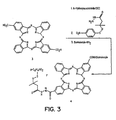
- Figs. 2 and 3 The synthesis of typical dual phototherapeutic agents incorporating both Type 1 and Type 2 mechanisms based on cyanine and phthalocyanine derivatives are shown in Figs. 2 and 3 .
- One of the active esters derived from either starting acid 1 , 3 can be attached to a Type 1 moiety and the other active ester can be conjugated to any desired biomolecule of interest.
- the biomolecule of the present invention pertains to those binding to colorectal, cervical, ovarian, lung, and neuroendocrine tumors. These include somatostatin, cholecystekinin, bombesin, neuroendrocrine, and heat sensitive bacterioendotoxin receptor binding compounds.
- the biomolecule is selected from the class of tumor markers including, but not limited to, somatostatin, bombesin, neurotensin, cholesytekinin, heat sensitive bacterioendotoxin, estrogen, and progesterone receptor binding compounds.
- tumor markers including, but not limited to, somatostatin, bombesin, neurotensin, cholesytekinin, heat sensitive bacterioendotoxin, estrogen, and progesterone receptor binding compounds.
- the biomolecule may be selected from the class of integrins, selectins, vascular endothelial growth factor, fibrins, tissue plasminogen activator, thrombin, LDL, HDL, Sialyl Lewis x and its mimics, and atherosclerotic plaque binding compounds.
- parenteral administration advantageously contains a sterile aqueous solution or suspension of the photosensitizer in a concentration ranging from about 1 nM to about 0.5 M.
- Preferred parenteral formulations have a concentration of 1 ⁇ M to 10 mM photosensitizer.
- Such solutions also may contain pharmaceutically acceptable buffers, emulsifiers, surfactants, and, optionally, electrolytes such as sodium chloride.
- Formulations for enteral administration may vary widely, as is well known in the art.
- such formulations are liquids, which include an effective amount of the complexes in aqueous solution or suspension.
- enteral formulations may optionally include buffers, surfactants, emulsifiers, thixotropic agents, and the like.
- Formulations for oral administration may also contain flavoring agents and other ingredients for enhancing their organoleptic qualities.
- Formulations for topical delivery may also contain liquid or semisolid excipients to assist in the penetration of the photosensitizer.
- the agents may also be delivered in an aerosol spray.
- the dose of the photosensitizer may vary from 0.1 to 500 mg/kg body weight, preferably from 0.5 to 2 mg/kg body weight.
- the photosensitizer is allowed to accumulate in the region of interest, followed by illumination with the light of wavelength 300 to 1200 nm, preferably 350 to 850 nm, at the site of the lesion. If the lesion is on the skin surface, the photosensitizer can be directly illuminated; otherwise, endoscopic catheters equipped with a light source may be employed to achieve phototherapeutic effect.
- the intensity, power, duration of illumination, and the wavelength of the light may vary widely depending on the location and site of the lesions.
- the wavelength of light may vary from 300 to 1200 nm.
- the fluence rate is preferably, but not always, kept below 200 mW/cm 2 to minimize thermal effects. Appropriate power depends on the size, depth, and the pathology of the lesion.
- the inventive phototherapeutic agents have broad clinical utility which includes, but is not limited to, phototherapy of tumors, inflammatory processes, and impaired vasculature.
- the inventive phototherapeutic agents can be formulated into diagnostic or therapeutic compositions for enteral, parenteral, topical, or cutaneous administration.
- Topical or cutaneous delivery of the photosensitizer may also include aerosol formulation, creams, gels, solutions, etc.
- the agents are administered in doses effective to achieve the desired diagnostic or therapeutic effect. Such doses may vary widely depending upon the particular complex employed, the organs or tissues to be examined, the equipment employed in the clinical procedure, the efficacy of treatment achieved, and the like.
- These compositions contain an effective amount of the phototherapeutic agent, along with conventional pharmaceutical carriers and excipients appropriate for the type of administration contemplated.
- These compositions may also include stabilizing agents and skin penetration enhancing agents.
Landscapes
- Health & Medical Sciences (AREA)
- Chemical & Material Sciences (AREA)
- Life Sciences & Earth Sciences (AREA)
- Veterinary Medicine (AREA)
- Animal Behavior & Ethology (AREA)
- General Health & Medical Sciences (AREA)
- Public Health (AREA)
- Organic Chemistry (AREA)
- Epidemiology (AREA)
- Medicinal Chemistry (AREA)
- Pharmacology & Pharmacy (AREA)
- Engineering & Computer Science (AREA)
- Biochemistry (AREA)
- Molecular Biology (AREA)
- Biomedical Technology (AREA)
- Nuclear Medicine, Radiotherapy & Molecular Imaging (AREA)
- Oncology (AREA)
- Proteomics, Peptides & Aminoacids (AREA)
- Chemical Kinetics & Catalysis (AREA)
- General Chemical & Material Sciences (AREA)
- Bioinformatics & Cheminformatics (AREA)
- Medicines That Contain Protein Lipid Enzymes And Other Medicines (AREA)
- Pharmaceuticals Containing Other Organic And Inorganic Compounds (AREA)
- Peptides Or Proteins (AREA)
- Radiation-Therapy Devices (AREA)
- Nitrogen Condensed Heterocyclic Rings (AREA)
- Agricultural Chemicals And Associated Chemicals (AREA)
- Medicinal Preparation (AREA)
Claims (32)
- Phototherapeutisches Agens mit der Formel

- Phototherapeutisches Agens nach Anspruch 1, wobei E ausgewählt ist aus der Gruppe, bestehend aus Somatostatin-Rezeptor bindenden Molekülen, wärmeempfindliches Bakterienendotoxin-Rezeptor bindenden Molekülen, Neurotensin-Rezeptor bindenden Molekülen, Bombesin-Rezeptor bindenden Molekülen, Cholecystekinin-Rezeptor bindenden Molekülen und Steroid-Rezeptor bindenden Molekülen; L und X unabhängig voneinander ausgewählt sind aus der Gruppe, bestehend aus -(R5)NOC- und -(R5)NOCCH2O-; DYE von Cyaninen abgeleitet ist; R1 bis R5 unabhängig voneinander ausgewählt sind aus der Gruppe, bestehend aus Wasserstoff, C1-C10 Alkyl, C5-C10 Aryl und C1-C10 Polyhydroxyalkyl; und Ar ein von Benzol abgeleiteter aromatischer Rest ist.
- Phototherapeutisches Agens nach Anspruch 1, wobei E ausgewählt ist aus der Gruppe, bestehend aus Somatostatin-Rezeptor bindenden Molekülen, wärmeempfindliches Bakterienendotoxin-Rezeptor bindenden Molekülen, Neurotensin-Rezeptor bindenden Molekülen, Bombesin-Rezeptor bindenden Molekülen, Cholecystekinin-Rezeptor bindenden Molekülen und Steroid-Rezeptor bindenden Molekülen; X ausgewählt ist aus der Gruppe, bestehend aus -(R5)NOC- und -(R5)NOCCH2O-; DYE von Phthalocyaninen abgeleitet ist; R1 bis R5 unabhängig voneinander ausgewählt sind aus der Gruppe, bestehend aus Wasserstoff, C1-C10 Alkyl, C5-C10 Aryl und C1-C10 Polyhydroxyalkyl; und Ar ein von Benzol abgeleiteter aromatischer Rest ist.
- Phototherapeutisches Agens nach Anspruch 1, wobei E ausgewählt ist aus der Gruppe, bestehend aus Somatostatin-Rezeptor bindenden Molekülen, wärmeempfindliches Bakterienendotoxin-Rezeptor bindenden Molekülen, Neurotensin-Rezeptor bindenden Molekülen, Bombesin-Rezeptor bindenden Molekülen, Cholecystekinin-Rezeptor bindenden Molekülen und Steroid-Rezeptor bindenden Molekülen; L und X unabhängig voneinander ausgewählt sind aus der Gruppe, bestehend aus -(R5)NOC- und -(R5)NOCCH2O-; DYE von Rhodaminen abgeleitet ist; R1 bis R5 unabhängig voneinander ausgewählt sind aus der Gruppe, bestehend aus Wasserstoff, C1-C10 Alkyl, C5-C10 Aryl und C1-C10 Polyhydroxyalkyl; und Ar ein von Benzol abgeleiteter aromatischer Rest ist.
- Phototherapeutisches Agens nach Anspruch 1, wobei E ausgewählt ist aus der Gruppe, bestehend aus Somatostatin-Rezeptor bindenden Molekülen, wärmeempfindliches Bakterienendotoxin-Rezeptor bindenden Molekülen, Neurotensin-Rezeptor bindenden Molekülen, Bombesin-Rezeptor bindenden Molekülen, Cholecystekinin-Rezeptor bindenden Molekülen und Steroid-Rezeptor bindenden Molekülen; L und X unabhängig voneinander ausgewählt sind aus der Gruppe, bestehend aus -(R5)NOC- und -(R5)NOCCH2O-; DYE von Porphyrinen abgeleitet ist; R1 bis R5 unabhängig voneinander ausgewählt sind aus der Gruppe, bestehend aus Wasserstoff, C1-C10 Alkyl, C5-C10 Aryl und C1-C10 Polyhydroxyalkyl; und Ar ein von Benzol abgeleiteter aromatischer Rest ist.
- Phototherapeutisches Agens nach Anspruch 1, wobei E ausgewählt ist aus der Gruppe, bestehend aus Somatostatin-Rezeptor bindenden Molekülen, wärmeempfindliches Bakterienendotoxin-Rezeptor bindenden Molekülen, Neurotensin-Rezeptor bindenden Molekülen, Bombesin-Rezeptor bindenden Molekülen, Cholecystekinin-Rezeptor bindenden Molekülen und Steroid-Rezeptor bindenden Molekülen; L und X unabhängig voneinander ausgewählt sind aus der Gruppe, bestehend aus -(R5)NOC- und -(R5)NOCCH20-; DYE von Benzoporphyrinen abgeleitet ist; R1 bis R5 unabhängig voneinander ausgewählt sind aus der Gruppe, bestehend aus Wasserstoff, C1-C10 Alkyl, C5-C10 Aryl und C1-C10 Polyhydroxyalkyl; und Ar ein von Benzol abgeleiteter aromatischer Rest ist.
- Phototherapeutisches Agens nach Anspruch 1, wobei E ausgewählt ist aus der Gruppe, bestehend aus Somatostatin-Rezeptor bindenden Molekülen, wärmeempfindliches Bakterienendotoxin-Rezeptor bindenden Molekülen, Neurotensin-Rezeptor bindenden Molekülen, Bombesin-Rezeptor bindenden Molekülen, Cholecystekinin-Rezeptor bindenden Molekülen und Steroid-Rezeptor bindenden Molekülen; L und X unabhängig voneinander ausgewählt sind aus der Gruppe, bestehend aus -(R5)NOC- und -(R5)NOCCH2O-; DYE von Corrinen abgeleitet ist; R1 bis R5 unabhängig voneinander ausgewählt sind aus der Gruppe, bestehend aus Wasserstoff, C1-C10 Alkyl, C5-C10 Aryl und C1-C10 Polyhydroxyalkyl; und Ar ein von Benzol abgeleiteter aromatischer Rest ist.
- Phototherapeutisches Agens nach Anspruch 1, wobei E ausgewählt ist aus der Gruppe, bestehend aus Somatostatin-Rezeptor bindenden Molekülen, wärmeempfindliches Bakterienendotoxin-Rezeptor bindenden Molekülen, Neurotensin-Rezeptor bindenden Molekülen, Bombesin-Rezeptor bindenden Molekülen, Cholecystekinin-Rezeptor bindenden Molekülen und Steroid-Rezeptor bindenden Molekülen; L und X unabhängig voneinander ausgewählt sind aus der Gruppe, bestehend aus -(R5)NOC- und -(R5)NOCCH2O-; DYE von Phenothiazinen abgeleitet ist; R1 bis R5 unabhängig voneinander ausgewählt sind aus der Gruppe, bestehend aus Wasserstoff, C1-C10 Alkyl, C5-C10 Aryl und C1-C10 Polyhydroxyalkyl; und Ar ein von Benzol abgeleiteter aromatischer Rest ist.
- Phototherapeutisches Agens nach Anspruch 1, wobei E ausgewählt ist aus der Gruppe, bestehend aus Somatostatin-Rezeptor bindenden Molekülen, wärmeempfindliches Bakterienendotoxin-Rezeptor bindenden Molekülen, Neurotensin-Rezeptor bindenden Molekülen, Bombesin-Rezeptor bindenden Molekülen, Cholecystekinin-Rezeptor bindenden Molekülen und Steroid-Rezeptor bindenden Molekülen; L und X unabhängig voneinander ausgewählt sind aus der Gruppe, bestehend aus -(R5)NOC- und -(R5)NOCCH2O-; DYE von Hypocrellinen abgeleitet ist; R1 bis R5 unabhängig voneinander ausgewählt sind aus der Gruppe, bestehend aus Wasserstoff, C1-C10 Alkyl, C5-C10 Aryl und C1-C10 Polyhydroxyalkyl; und Ar ein von Benzol abgeleiteter aromatischer Rest ist.
- Phototherapeutisches Agens nach Anspruch 1, wobei E ausgewählt ist aus der Gruppe, bestehend aus Somatostatin-Rezeptor bindenden Molekülen, wärmeempfindliches Bakterienendotoxin-Rezeptor bindenden Molekülen, Neurotensin-Rezeptor bindenden Molekülen, Bombesin-Rezeptor bindenden Molekülen, Cholecystekinin-Rezeptor bindenden Molekülen und Steroid-Rezeptor bindenden Molekülen; L und X unabhängig voneinander ausgewählt sind aus der Gruppe, bestehend aus -(R5)NOC- und -(R5)NOCCH2O-; DYE von Fluoresceinen abgeleitet ist; R1 bis R5 unabhängig voneinander ausgewählt sind aus der Gruppe, bestehend aus Wasserstoff, C1-C10 Alkyl, C5-C10 Aryl und C1-C10 Polyhydroxyalkyl; und Ar ein von Benzol abgeleiteter aromatischer Rest ist.
- Phototherapeutisches Agens nach Anspruch 1, wobei E ein Biomolekül ist, ausgewählt aus der Gruppe, bestehend aus Hormonen, Aminosäuren, Peptiden, Peptidomimetika, Proteinen, Nukleosiden, Nukleotiden, Nukleinsäuren, Enzymen, Kohlehydraten, Glycomimetika, Lipiden, Albuminen, monoklonalen Antikörpern, polyklonalen Antikörpern, Rezeptoren, Einschlussverbindungen, Rezeptor bindenden Molekülen, Polyaminosäuren, Polyolen, Polyaminen, Polysäuren, Oligonukleotiden, Aborolen, Dendrimeren und Aptameren.
- Phototherapeutisches Agens nach einem der vorhergehenden Ansprüche zur Verwendung in der Medizin.
- Phototherapeutisches Agens nach einem der Ansprüche 1 bis 11 zur Verwendung in einem Verfahren der Behandlung von Tumoren oder anderen Läsionen.
- Phototherapeutisches Agens nach Anspruch 13, wobei das Verfahren umfasst zu ermöglichen, dass das phototherapeutische Agens in dem Tumor oder der anderen Läsion akkumuliert, und den Tumor oder die andere Läsion Licht einer Wellenlänge zwischen 300 und 950 nm mit einer ausreichenden Leistung und Fluenzrate zu exponieren um Nekrose oder Apoptose des Tumors oder der anderen Läsion zu verursachen.
- Phototherapeutisches Agens nach einem der Ansprüche 13 bis 14, wobei das Verfahren das Verabreichen des phototherapeutischen Agens in einer Dosis von 0,1 bis 500 mg/kg Körpergewicht umfasst.
- Phototherapeutisches Agens nach Anspruch 15, wobei das Verfahren das Verabreichen des phototherapeutischen Agens in einer Dosis von 0,5 bis 2 mg/kg Körpergewicht umfasst.
- Phototherapeutisches Agens nach einem der Ansprüche 13 bis 16, wobei das Verfahren parenterale Verabreichung umfasst.
- Phototherapeutisches Agens nach Anspruch 17, wobei das Verfahren das Verabreichen des phototherapeutischen Agens in einer Lösung, enthaltend pharmazeutisch akzeptable Puffer, Emulgatoren, oberflächenaktive Mittel und optional Elektrolyte, umfasst.
- Phototherapeutisches Agens nach Anspruch 18, wobei die Lösung eine sterile wässrige Lösung oder Suspension ist und das phototherapeutische Agens in einer Konzentration im Bereich von 1 nM bis 0,5 M vorhanden ist.
- Phototherapeutisches Agens nach Anspruch 19, wobei das phototherapeutische Agens in einer Konzentration im Bereich von 1 µM bis 10 mM vorhanden ist.
- Phototherapeutisches Agens nach einem der Ansprüche 13 bis 16, wobei das Verfahren enterale Verabreichung umfasst.
- Phototherapeutisches Agens nach Anspruch 21, wobei das Verfahren das Verabreichen des phototherapeutischen Agens in einer Formulierung, enthaltend Puffer, Emulgatoren, oberflächenaktive Mittel und thixotrope Agenzien umfasst.
- Phototherapeutisches Agens nach Anspruch 22, wobei die Formulierung eine wässrige Lösung oder Suspension ist.
- Phototherapeutisches Agens nach einem der Ansprüche 13 bis 16, wobei das Verfahren topische Verabreichung umfasst.
- Phototherapeutisches Agens nach Anspruch 24, wobei das Verfahren das Verabreichen des phototherapeutischen Agens in einer Formulierung, enthaltend flüssige oder halbfeste pharmazeutische Hilfsstoffe umfasst.
- Phototherapeutisches Agens nach einem der Ansprüche 13 bis 16, wobei das Verfahren topische oder kutane Ablieferung des Photosensibilisators als eine Aerosolformulierung, eine Creme, ein Gel oder eine Lösung umfasst.
- Phototherapeutisches Agens nach einem der Ansprüche 13 bis 26, wobei E ausgewählt ist aus Somatostatin-, Bombesin-, Neurotensin-, Cholecystekinin-, wärmeempfindliches Bakterienendotoxin-, Östrogen- und Progesteron-Rezeptor bindenden Verbindungen, und das Verfahren für die Behandlung von Tumoren ist.
- Phototherapeutisches Agens nach einem der Ansprüche 13 bis 26, wobei das Verfahren für die Behandlung von kolorektalen Tumoren, zervikalen Tumoren, Eierstocktumoren, Lungentumoren und neuroendokrinen Tumoren ist.
- Phototherapeutisches Agens nach Anspruch 28, wobei E eine Somatostatin-, Cholecystekinin-, Bombesin-, Neuroendokrin- oder wärmeempfindliches Bakterienendotoxin-Rezeptor bindende Verbindung ist.
- Phototherapeutisches Agens nach einem der Ansprüche 13 bis 26, wobei E ausgewählt ist aus Integrinen, Selektinen, vaskulärem endothelialen Wachstumsfaktor, Fibrinen, Gewebe-Plasminogen-Aktivator, Thrombin, LDL, HDL, Sialyl-Lewis X und dessen Mimetika und atherosklerotische Plaquebindenden Verbindungen, und das Verfahren für die Behandlung von vaskulären Läsionen ist.
- Phototherapeutisches Agens nach einem der Ansprüche 13 bis 26, wobei E:ein Steroidhormon ist, und das Verfahren für die Behandlung von Brust- und Prostataläsionen ist;ein Somatostatin-, Bombesin- oder Neurotensin-Rezeptor bindendes Molekül ist, und das Verfahren für die Behandlung von neuroendokrinen Tumoren ist;ein Cholecystekinin-Rezeptor bindendes Molekül ist, und das Verfahren für die Behandlung von Lungenkrebs ist;ein wärmeempfindliches Bakterienendotoxin (ST) -Rezeptor oder carcinoembryonales Antigen (CEA) bindendes Molekül ist, und das Verfahren für die Behandlung von kolorektalem Krebs ist;Dihydroxyindolcarbonsäure oder ein anderes Melanin erzeugendes biosynthetisches Intermediat für die Behandlung von Melanomen ist;ein Integrin-Rezeptor oder ein atherosklerotische Plaque bindendes Molekül für die Behandlung von vaskulären Erkrankungen ist; oderein amyloide Plaque bindendes Molekül für die Behandlung von Hirnläsionen ist.
- Diagnostische oder therapeutische Zusammensetzung für enterale, perenterale, topische oder kutane Verabreichung, umfassend das phototherapeutische Agens nach einem der Ansprüche 1 bis 11.
Applications Claiming Priority (3)
| Application Number | Priority Date | Filing Date | Title |
|---|---|---|---|
| US898809 | 2001-07-03 | ||
| US09/898,809 US7351807B2 (en) | 2000-01-18 | 2001-07-03 | Cyanine-sulfenates for dual phototherapy |
| PCT/US2002/019184 WO2003004466A2 (en) | 2001-07-03 | 2002-06-18 | Dye-sulfenates for dual phototherapy |
Publications (3)
| Publication Number | Publication Date |
|---|---|
| EP1409482A2 EP1409482A2 (de) | 2004-04-21 |
| EP1409482A4 EP1409482A4 (de) | 2006-09-13 |
| EP1409482B1 true EP1409482B1 (de) | 2009-12-30 |
Family
ID=25410061
Family Applications (1)
| Application Number | Title | Priority Date | Filing Date |
|---|---|---|---|
| EP02744397A Expired - Lifetime EP1409482B1 (de) | 2001-07-03 | 2002-06-18 | Farbstoff-sulfenate für die duale phototherapie |
Country Status (9)
| Country | Link |
|---|---|
| US (2) | US7351807B2 (de) |
| EP (1) | EP1409482B1 (de) |
| JP (1) | JP2005505514A (de) |
| AT (1) | ATE453408T1 (de) |
| AU (1) | AU2002344764A1 (de) |
| CA (1) | CA2452845C (de) |
| DE (1) | DE60234930D1 (de) |
| ES (1) | ES2338216T3 (de) |
| WO (1) | WO2003004466A2 (de) |
Cited By (1)
| Publication number | Priority date | Publication date | Assignee | Title |
|---|---|---|---|---|
| US8829020B2 (en) | 2009-07-16 | 2014-09-09 | Mallinckrodt Llc | Compounds and compositions for use in phototherapy and in treatment of ocular neovascular disease and cancers |
Families Citing this family (15)
| Publication number | Priority date | Publication date | Assignee | Title |
|---|---|---|---|---|
| US7312244B2 (en) * | 1999-04-30 | 2007-12-25 | Cellgate, Inc. | Polyamine analog-amino acid conjugates useful as anticancer agents |
| DE60029944T2 (de) * | 1999-04-30 | 2007-04-05 | Cellgate, Inc., Redwood City | Polyamine und ihre therapeutische verwendung |
| US7235685B2 (en) * | 2001-07-03 | 2007-06-26 | Mallinckrodt, Inc. | Aromatic sulfenates for type I phototherapy |
| US7351807B2 (en) * | 2000-01-18 | 2008-04-01 | Mallinckrodt Inc. | Cyanine-sulfenates for dual phototherapy |
| US7230088B2 (en) * | 2001-07-03 | 2007-06-12 | Mallinckrodt, Inc. | Compounds for dual photodiagnosis and therapy |
| US20030017164A1 (en) | 2001-07-03 | 2003-01-23 | Mallinckrodt Inc. | Dye-azide compounds for dual phototherapy |
| EP1515973A1 (de) * | 2002-06-26 | 2005-03-23 | Cellgate Inc. | Porphyrin-polyamin-konjugate für die krebstherapie |
| US7226577B2 (en) | 2003-01-13 | 2007-06-05 | Bracco Imaging, S. P. A. | Gastrin releasing peptide compounds |
| CA2523605A1 (en) * | 2003-03-10 | 2004-09-23 | Charles W. Spangler | Targeted agents for both photodiagnosis and photodynamic therapy |
| JP2005119966A (ja) * | 2003-08-25 | 2005-05-12 | Institute Of Physical & Chemical Research | 光感受性機能及び制がん効果を有する高精度・高感度制がん剤、がん細胞の検出方法 |
| WO2010129258A2 (en) | 2009-04-27 | 2010-11-11 | Mallinckrodt Inc. | Tissue sealant compositions, vascular closure devices, and uses thereof |
| WO2010132554A2 (en) | 2009-05-12 | 2010-11-18 | Mallinckrodt Inc. | Diaza heterocyclic compounds for phototherapy |
| US8731655B2 (en) | 2009-05-12 | 2014-05-20 | Mallinckrodt Llc | Compounds containing acyclic N-N bonds for phototherapy |
| CN107556408A (zh) * | 2017-05-10 | 2018-01-09 | 北京化工大学 | 用于可见led光源的共轭炔基吩噻嗪类肟酯光引发剂及组合物 |
| CN117919452A (zh) * | 2023-03-09 | 2024-04-26 | 中国科学院宁波材料技术与工程研究所 | 一种亚细胞器主动靶向成像探针及其制备方法 |
Family Cites Families (12)
| Publication number | Priority date | Publication date | Assignee | Title |
|---|---|---|---|---|
| US2929824A (en) * | 1956-12-13 | 1960-03-22 | Stauffer Chemical Co | Beta-substituted sulfenate esters |
| US5518888A (en) | 1993-10-26 | 1996-05-21 | Thomas Jefferson University | ST receptor binding compounds and methods of using the same |
| US5605809A (en) | 1994-10-28 | 1997-02-25 | Oncoimmunin, Inc. | Compositions for the detection of proteases in biological samples and methods of use thereof |
| US6602274B1 (en) | 1999-01-15 | 2003-08-05 | Light Sciences Corporation | Targeted transcutaneous cancer therapy |
| US6217848B1 (en) * | 1999-05-20 | 2001-04-17 | Mallinckrodt Inc. | Cyanine and indocyanine dye bioconjugates for biomedical applications |
| US7235685B2 (en) * | 2001-07-03 | 2007-06-26 | Mallinckrodt, Inc. | Aromatic sulfenates for type I phototherapy |
| US6395257B1 (en) * | 2000-01-18 | 2002-05-28 | Mallinckrodt Inc. | Dendrimer precursor dyes for imaging |
| US20030017164A1 (en) | 2001-07-03 | 2003-01-23 | Mallinckrodt Inc. | Dye-azide compounds for dual phototherapy |
| US7230088B2 (en) | 2001-07-03 | 2007-06-12 | Mallinckrodt, Inc. | Compounds for dual photodiagnosis and therapy |
| US7351807B2 (en) | 2000-01-18 | 2008-04-01 | Mallinckrodt Inc. | Cyanine-sulfenates for dual phototherapy |
| GB0215534D0 (en) | 2002-07-04 | 2002-08-14 | Ecole Polytech | Selective photochemotherapy using oligonucleotide targeting agents |
| US7267994B2 (en) | 2003-04-28 | 2007-09-11 | Regents Of The University Of California | Element-coded affinity tags |
-
2001
- 2001-07-03 US US09/898,809 patent/US7351807B2/en not_active Expired - Fee Related
-
2002
- 2002-06-18 EP EP02744397A patent/EP1409482B1/de not_active Expired - Lifetime
- 2002-06-18 WO PCT/US2002/019184 patent/WO2003004466A2/en not_active Ceased
- 2002-06-18 AU AU2002344764A patent/AU2002344764A1/en not_active Abandoned
- 2002-06-18 AT AT02744397T patent/ATE453408T1/de not_active IP Right Cessation
- 2002-06-18 CA CA2452845A patent/CA2452845C/en not_active Expired - Fee Related
- 2002-06-18 JP JP2003510634A patent/JP2005505514A/ja active Pending
- 2002-06-18 ES ES02744397T patent/ES2338216T3/es not_active Expired - Lifetime
- 2002-06-18 DE DE60234930T patent/DE60234930D1/de not_active Expired - Lifetime
-
2006
- 2006-03-21 US US11/277,057 patent/US7758861B2/en not_active Expired - Fee Related
Cited By (3)
| Publication number | Priority date | Publication date | Assignee | Title |
|---|---|---|---|---|
| US8829020B2 (en) | 2009-07-16 | 2014-09-09 | Mallinckrodt Llc | Compounds and compositions for use in phototherapy and in treatment of ocular neovascular disease and cancers |
| US9518062B2 (en) | 2009-07-16 | 2016-12-13 | Mallinckrodt Llc | Compounds and compositions for use in phototherapy and in treatment of ocular neovascular disease and cancers |
| US9527858B2 (en) | 2009-07-16 | 2016-12-27 | Mallinckrodt Llc | Compounds and compositions for use in phototherapy and in treatment of ocular neovascular disease and cancers |
Also Published As
| Publication number | Publication date |
|---|---|
| DE60234930D1 (en) | 2010-02-11 |
| ES2338216T3 (es) | 2010-05-05 |
| US7351807B2 (en) | 2008-04-01 |
| AU2002344764A1 (en) | 2003-01-21 |
| ATE453408T1 (de) | 2010-01-15 |
| US20030036538A1 (en) | 2003-02-20 |
| EP1409482A2 (de) | 2004-04-21 |
| US7758861B2 (en) | 2010-07-20 |
| EP1409482A4 (de) | 2006-09-13 |
| CA2452845C (en) | 2011-03-29 |
| WO2003004466A2 (en) | 2003-01-16 |
| JP2005505514A (ja) | 2005-02-24 |
| CA2452845A1 (en) | 2003-01-16 |
| WO2003004466A3 (en) | 2003-03-20 |
| US20060177457A1 (en) | 2006-08-10 |
Similar Documents
| Publication | Publication Date | Title |
|---|---|---|
| US20080275017A1 (en) | Aromatic sulfenates for type i phototherapy | |
| US8658433B2 (en) | Dye compounds as photoactive agents | |
| US7230088B2 (en) | Compounds for dual photodiagnosis and therapy | |
| EP1409482B1 (de) | Farbstoff-sulfenate für die duale phototherapie | |
| US6485704B1 (en) | Azo compound for type I pototherapy | |
| US20040180864A1 (en) | Novel aromatic azides for type I phototherapy | |
| US6747151B2 (en) | Azo compounds for type I phototherapy | |
| AU2002307394B2 (en) | Azo compounds for type I phototherapy | |
| AU2002307394A1 (en) | Azo compounds for type I phototherapy |
Legal Events
| Date | Code | Title | Description |
|---|---|---|---|
| PUAI | Public reference made under article 153(3) epc to a published international application that has entered the european phase |
Free format text: ORIGINAL CODE: 0009012 |
|
| 17P | Request for examination filed |
Effective date: 20040120 |
|
| AK | Designated contracting states |
Kind code of ref document: A2 Designated state(s): AT BE CH CY DE DK ES FI FR GB GR IE IT LI LU MC NL PT SE TR |
|
| AX | Request for extension of the european patent |
Extension state: AL LT LV MK RO SI |
|
| RIN1 | Information on inventor provided before grant (corrected) |
Inventor name: ACHILEFU, SAMUEL, I. Inventor name: RAJAGOPALAN, RAGHAVAN,C/O GLIATECH Inventor name: BUGAJ, JOSEPH, E. Inventor name: DORSHOW, RICHARD, B. |
|
| A4 | Supplementary search report drawn up and despatched |
Effective date: 20060810 |
|
| RIC1 | Information provided on ipc code assigned before grant |
Ipc: A61K 41/00 20060101AFI20060804BHEP |
|
| 17Q | First examination report despatched |
Effective date: 20061129 |
|
| GRAP | Despatch of communication of intention to grant a patent |
Free format text: ORIGINAL CODE: EPIDOSNIGR1 |
|
| GRAS | Grant fee paid |
Free format text: ORIGINAL CODE: EPIDOSNIGR3 |
|
| GRAA | (expected) grant |
Free format text: ORIGINAL CODE: 0009210 |
|
| AK | Designated contracting states |
Kind code of ref document: B1 Designated state(s): AT BE CH CY DE DK ES FI FR GB GR IE IT LI LU MC NL PT SE TR |
|
| REG | Reference to a national code |
Ref country code: GB Ref legal event code: FG4D |
|
| REG | Reference to a national code |
Ref country code: CH Ref legal event code: EP |
|
| REG | Reference to a national code |
Ref country code: IE Ref legal event code: FG4D |
|
| REF | Corresponds to: |
Ref document number: 60234930 Country of ref document: DE Date of ref document: 20100211 Kind code of ref document: P |
|
| PG25 | Lapsed in a contracting state [announced via postgrant information from national office to epo] |
Ref country code: SE Free format text: LAPSE BECAUSE OF FAILURE TO SUBMIT A TRANSLATION OF THE DESCRIPTION OR TO PAY THE FEE WITHIN THE PRESCRIBED TIME-LIMIT Effective date: 20091230 Ref country code: FI Free format text: LAPSE BECAUSE OF FAILURE TO SUBMIT A TRANSLATION OF THE DESCRIPTION OR TO PAY THE FEE WITHIN THE PRESCRIBED TIME-LIMIT Effective date: 20091230 |
|
| REG | Reference to a national code |
Ref country code: ES Ref legal event code: FG2A Ref document number: 2338216 Country of ref document: ES Kind code of ref document: T3 |
|
| REG | Reference to a national code |
Ref country code: NL Ref legal event code: VDEP Effective date: 20091230 |
|
| PG25 | Lapsed in a contracting state [announced via postgrant information from national office to epo] |
Ref country code: AT Free format text: LAPSE BECAUSE OF FAILURE TO SUBMIT A TRANSLATION OF THE DESCRIPTION OR TO PAY THE FEE WITHIN THE PRESCRIBED TIME-LIMIT Effective date: 20091230 |
|
| PG25 | Lapsed in a contracting state [announced via postgrant information from national office to epo] |
Ref country code: NL Free format text: LAPSE BECAUSE OF FAILURE TO SUBMIT A TRANSLATION OF THE DESCRIPTION OR TO PAY THE FEE WITHIN THE PRESCRIBED TIME-LIMIT Effective date: 20091230 Ref country code: PT Free format text: LAPSE BECAUSE OF FAILURE TO SUBMIT A TRANSLATION OF THE DESCRIPTION OR TO PAY THE FEE WITHIN THE PRESCRIBED TIME-LIMIT Effective date: 20100430 |
|
| PG25 | Lapsed in a contracting state [announced via postgrant information from national office to epo] |
Ref country code: BE Free format text: LAPSE BECAUSE OF FAILURE TO SUBMIT A TRANSLATION OF THE DESCRIPTION OR TO PAY THE FEE WITHIN THE PRESCRIBED TIME-LIMIT Effective date: 20091230 |
|
| PG25 | Lapsed in a contracting state [announced via postgrant information from national office to epo] |
Ref country code: GR Free format text: LAPSE BECAUSE OF FAILURE TO SUBMIT A TRANSLATION OF THE DESCRIPTION OR TO PAY THE FEE WITHIN THE PRESCRIBED TIME-LIMIT Effective date: 20100331 Ref country code: CY Free format text: LAPSE BECAUSE OF FAILURE TO SUBMIT A TRANSLATION OF THE DESCRIPTION OR TO PAY THE FEE WITHIN THE PRESCRIBED TIME-LIMIT Effective date: 20091230 |
|
| PLBE | No opposition filed within time limit |
Free format text: ORIGINAL CODE: 0009261 |
|
| STAA | Information on the status of an ep patent application or granted ep patent |
Free format text: STATUS: NO OPPOSITION FILED WITHIN TIME LIMIT |
|
| 26N | No opposition filed |
Effective date: 20101001 |
|
| PG25 | Lapsed in a contracting state [announced via postgrant information from national office to epo] |
Ref country code: MC Free format text: LAPSE BECAUSE OF NON-PAYMENT OF DUE FEES Effective date: 20100630 Ref country code: DK Free format text: LAPSE BECAUSE OF FAILURE TO SUBMIT A TRANSLATION OF THE DESCRIPTION OR TO PAY THE FEE WITHIN THE PRESCRIBED TIME-LIMIT Effective date: 20091230 |
|
| REG | Reference to a national code |
Ref country code: CH Ref legal event code: PL |
|
| PG25 | Lapsed in a contracting state [announced via postgrant information from national office to epo] |
Ref country code: CH Free format text: LAPSE BECAUSE OF NON-PAYMENT OF DUE FEES Effective date: 20100630 Ref country code: LI Free format text: LAPSE BECAUSE OF NON-PAYMENT OF DUE FEES Effective date: 20100630 Ref country code: IE Free format text: LAPSE BECAUSE OF NON-PAYMENT OF DUE FEES Effective date: 20100618 |
|
| PGFP | Annual fee paid to national office [announced via postgrant information from national office to epo] |
Ref country code: ES Payment date: 20110628 Year of fee payment: 10 Ref country code: FR Payment date: 20110629 Year of fee payment: 10 |
|
| PGFP | Annual fee paid to national office [announced via postgrant information from national office to epo] |
Ref country code: GB Payment date: 20110628 Year of fee payment: 10 |
|
| PGFP | Annual fee paid to national office [announced via postgrant information from national office to epo] |
Ref country code: IT Payment date: 20110623 Year of fee payment: 10 |
|
| PGFP | Annual fee paid to national office [announced via postgrant information from national office to epo] |
Ref country code: DE Payment date: 20110629 Year of fee payment: 10 |
|
| REG | Reference to a national code |
Ref country code: ES Ref legal event code: PC2A Owner name: MALLINCKRODT LLC Effective date: 20120207 |
|
| REG | Reference to a national code |
Ref country code: DE Ref legal event code: R082 Ref document number: 60234930 Country of ref document: DE Representative=s name: FROHWITTER PATENT- UND RECHTSANWAELTE, DE Effective date: 20120621 Ref country code: DE Ref legal event code: R081 Ref document number: 60234930 Country of ref document: DE Owner name: MALLINCKRODT LLC (N.D.GES.D.STAATES DELAWARE), US Free format text: FORMER OWNER: MALLINCKRODT, INC., ST. LOUIS, US Effective date: 20120621 |
|
| PG25 | Lapsed in a contracting state [announced via postgrant information from national office to epo] |
Ref country code: LU Free format text: LAPSE BECAUSE OF NON-PAYMENT OF DUE FEES Effective date: 20100618 |
|
| PG25 | Lapsed in a contracting state [announced via postgrant information from national office to epo] |
Ref country code: TR Free format text: LAPSE BECAUSE OF FAILURE TO SUBMIT A TRANSLATION OF THE DESCRIPTION OR TO PAY THE FEE WITHIN THE PRESCRIBED TIME-LIMIT Effective date: 20091230 |
|
| GBPC | Gb: european patent ceased through non-payment of renewal fee |
Effective date: 20120618 |
|
| PG25 | Lapsed in a contracting state [announced via postgrant information from national office to epo] |
Ref country code: IT Free format text: LAPSE BECAUSE OF NON-PAYMENT OF DUE FEES Effective date: 20120618 |
|
| REG | Reference to a national code |
Ref country code: FR Ref legal event code: ST Effective date: 20130228 |
|
| REG | Reference to a national code |
Ref country code: DE Ref legal event code: R119 Ref document number: 60234930 Country of ref document: DE Effective date: 20130101 |
|
| PG25 | Lapsed in a contracting state [announced via postgrant information from national office to epo] |
Ref country code: GB Free format text: LAPSE BECAUSE OF NON-PAYMENT OF DUE FEES Effective date: 20120618 Ref country code: DE Free format text: LAPSE BECAUSE OF NON-PAYMENT OF DUE FEES Effective date: 20130101 Ref country code: FR Free format text: LAPSE BECAUSE OF NON-PAYMENT OF DUE FEES Effective date: 20120702 |
|
| REG | Reference to a national code |
Ref country code: ES Ref legal event code: FD2A Effective date: 20131030 |
|
| PG25 | Lapsed in a contracting state [announced via postgrant information from national office to epo] |
Ref country code: ES Free format text: LAPSE BECAUSE OF NON-PAYMENT OF DUE FEES Effective date: 20120619 |