Field of the Invention
-
This invention relates to a plain paper ink-jet
recording medium, and in particular to an ink-jet
recording medium which gives a high print
density without causing bleeding or feathering, and
which is also suitable for multi-color recording.
Background of the Invention
-
Ink-jet recording media may be broadly divided
into the plain paper type which resemble so-called
fine quality paper and PPC paper, and the coated
paper type which clearly have an ink-receiving
layer. Among these, plain paper ink-jet recording
media do not have an ink-receiving layer, or even
if they do, it is very thin, so they are suitable
for electrophotographic recording, or general
writing applications with a pencil or pen, and they
are also economical.
-
An ink-jet recording medium is required to
have the following performance:
- (1): Ink absorptivity must be good. Ink drops
adhering to the recording medium surface should
penetrate the inside of the base paper rapidly to
dry so that they do not contaminate recording
apparatus or other media, and are not soiled by
handling.
- (2): Ink drops should not spread by osmosis in
the underlayer or on the surface of the recording
medium more than necessary, so that the dots
recorded by the ink drops become enlarged or
distorted.
-
-
If the above performance criteria (1) and (2)
are not satisfied, high-definition printing cannot
be performed. For example, if the first criterion
is not satisfied, not only does contamination occur,
but there are blots (bleeding) at the boundaries of
different colors in multicolor printing. If the
second criterion is not satisfied, print density
falls, and as ink is absorbed along the fibers on
the paper surface, beard-like smudges (feathering)
occur.
-
In general, in the case of a coated paper ink-jet
recording medium, since a porous ink-receiving
layer is provided on a substrate, both the first
and second qualities can be attained relatively
easily. On the other hand, a plain paper ink-jet
recording medium does not have an ink-receiving
layer, and even if it does, it is only very thin,
so it is difficult to simultaneously satisfy the
aforesaid two criteria.
-
However, use of plain paper ink-jet recording
media is becoming more common, and in recent years
a demand has emerged for plain paper to be capable
of the same high quality printing as coated paper.
To meet this demand in plain paper type inkjet
recording media, an inkjet recording medium has
been proposed wherein, by coating a solution
containing a styrene acrylic sizing agent and a
water-soluble polymer on a cellulose type base
paper and drying, feathering and density unevenness
of a print fill part are reduced (JP-A No. 08-216505)
and, in JP-A No. 02-188287, an inkjet
recording sheet is disclosed wherein a coating
containing a mixture of fine particle anhydrous
silica and a cationic polymer is coated or
impregnated.
-
However, even in these inkjet recording media,
it was impossible to simultaneously satisfy the
aforesaid first and second performance criteria,
resolve the problems of bleeding and feathering,
and increase the print density.
-
In general, if the sizing degree of the inkjet
recording medium is increased, the ink drops on the
recording medium do not spread so feathering is
reduced, but as ink absorption becomes slower,
bleeding increases, conversely, if the sizing
degree of the inkjet recording medium is reduced,
ink absorption is more rapid and bleeding is
reduced, but absorption in the horizontal direction
of the recording medium also increases, so
feathering increases. In other words, feathering
and bleeding are contradictory qualities, and both
cannot be satisfied simply by adjusting the sizing
degree of the inkjet recording paper.
-
In this connection, the Inventors, after
performing intensive studies of plain paper type
inkjet recording media satisfying the aforesaid
first and second performance criteria, found that
satisfactory results can be obtained by
incorporating a synthetic emulsion in the recording
layer wherein the surfactant amount used in
manufacture is sufficiently reduced, and thereby
arrived at the present invention.
-
It is therefore an object of the present
invention to provide a regular type inkjet
recording medium which gives high print density
without bleeding, and without feathering.
SUMMARY OF THE INVENTION
-
The aforesaid object of the present invention
is attained by a regular inkjet recording medium
wherein a coating solution having a water-soluble
polymer, sizing agent and synthetic resin emulsion
as its principal components is applied to or
impregnated on at least one surface of a base paper,
wherein the aforesaid synthetic resin emulsion is
an emulsion manufactured using 1.5 wt parts or less
of surfactant relative to 100 wt parts of a
polymerizing monomer.
-
According to the present invention, it is
preferred that, in the coating solution, (weight
percent of surfactant contained in synthetic resin
emulsion) × (weight percent of synthetic resin
emulsion contained in coating solution) is 300ppm
or less relative to the coating solution, and more
preferred that the particle diameter of the
synthetic resin emulsion is 100-750nm. Further,
the water-soluble polymer is preferably polyvinyl
alcohol. As a result, a recording medium capable
of a high print density can be obtained.
-
Further, the Stöckigt sizing degree of the
inkjet recording medium is preferably adjusted so
that the value of (Stöckigt sizing degree/(basis
weight of recording medium)2) × 1000 is 1-10.
DETAILED DESCRIPTION OF THE INVENTION
-
The base paper used in the present invention
is an uncoated paper having wood cellulose fibers
as raw material, this paper being formed mainly of
paper-making pulp. Examples of papermaking pulp
are chemical pulps such as LBKP, NBKP, and
mechanical pulps such as GP, TMP, and recycled
paper pulp. This invention is not particularly
limited by the aforesaid examples, and these pulps
may be used together as necessary. Uncoated paper
means paper not having a coating layer containing
an ink-absorbing pigment on the surface.
-
According to the present invention, additives
such as filling or sizing agents or paper
reinforcing agents added to the base paper are not
particularly limited, and may be suitably selected
from among the additives known in the art. Also,
an antifoaming agent, pH regulating agent, pigment
or colored dye to adjust the color tone and
fluorescent dye to increase apparent whiteness, may
also be added.
-
The water-soluble polymer used in the coating
solution according to the present invention may be
suitably selected from among those known in the art
which are soluble in water and have film-forming
properties. Examples are starch, starch oxide,
phosphoric acid esterified starch, cationic starch,
fully saponified polyvinyl alcohol, partially
saponified polyvinyl alcohol, cation-modified
polyvinyl alcohol, silanol-modified polyvinyl
alcohol, anion-modified polyvinyl alcohol and
casein. According to the present invention, from
the viewpoint of increasing print density, the use
of polyvinyl alcohol or modified polyvinyl alcohol
is preferred.
-
The synthetic resin emulsion of the present
invention is a liquid in which fine particles of a
synthetic resin are dispersed in an aqueous solvent,
and normally a surfactant or protective colloid is
blended therewith to make it more difficult for the
fine particles of synthetic resin to stick together
in lumps. Also, the method of manufacturing the
synthetic resin emulsion may in general be emulsion
polymerization, suspension polymerization or
dispersion polymerization, but among these, as
emulsion polymerization using a surfactant
(emulsifying agent) allows easy control of particle
diameter, it is suitable for manufacture of the
synthetic resin emulsion with a high degree of
stability. However, it is difficult to eliminate
the surfactant from the emulsified and polymerized
synthetic resin emulsion, hence according to the
present invention, it is necessary to sufficiently
reduce the amount of surfactant used when
introducing the starting materials.
-
For emulsion polymerization, there is a soap-free
method which does not use emulsifying agent,
but in order to increase the stability of the final
product, it is normal even in this case to add a
surfactant.
-
Regarding the synthetic resin emulsion used in
the present invention, the surfactant amount used
in its manufacture must be no more than 1.5 wt
parts, but preferably no more than 1.0 wt parts,
relative to 100 wt parts of polymerizing monomer.
The composition of the synthetic resin emulsion and
its preparation method are not particularly limited
provided that aggregation does not occur during
manufacture of the synthetic resin emulsion, in the
coating solution or on the pulp fiber surface of
the base paper. As described later, the synthetic
resin emulsion has the effect of supplying voids
which assist ink absorption qualities in the ink-receiving
layer.
-
Examples of the polymerizing monomer,
surfactant (emulsifying agent) and polymerization
initiator which may be used during the manufacture
of the synthetic resin emulsion of the present
invention, are given below.
-
The polymerizing monomer may be an aliphatic
conjugated di-olefin monomer, cyanated vinyl
monomer, mono-olefinic aromatic monomer, ethylenic
unsaturated carboxylic acid alkyl ester monomer or
olefinic unsaturated carboxylic acid monomer.
According to the present invention, these may be
used alone, or two or more may be used in
combination. Examples of these polymerizing
monomers are butadiene, isoprene, 2-chlorobutadiene,
acrylonitrile, styrene, α-methyl styrene,
chlorostyrene, dimethylstyrene, methyl
(meth)acrylate, ethyl (meth)acrylate, butyl
(meth)acrylate, 2-ethylhexyl (meth)acrylate,
(meth)acrylic acid, crotonic acid, maleic acid,
maleic acid alkyl monoester, fumaric acid, fumaric
acid alkyl monoester, itaconic acid, itaconic acid
alkyl monoester, acrylic acid diglycidyl, acrylic
acid hydroxyethyl, acrylic acid hydroxypropyl,
acrylamide, N-methylol-acrylamide, N-methoxyacrylamide
and vinyl acetate.
-
The surfactant used in the manufacture of the
synthetic resin emulsion of the present invention
may be suitably selected from among those known in
the art. Examples of this surfactant are anionic
surfactants such as alkyl sulfonate, alkyl benzene
sulfonate, alkyl allyl sulfonate, alkyl sulfate,
alkyl naphthalene sulfonate, alkyl succinate
sulfonate and diphenyl ether alkyl sulfonate, nonionic
surfactants such as polyoxyethylene
alkylether, polyoxyethylene alkylallylether and
polyoxyethylene fatty acid esters, cationic
surfactants such as monoalkyl ammonium chloride,
dialkyl ammonium chloride and ethylene oxide adduct
ammonium chloride. These may be used alone, or two
or more may be used in combination. Non-anionic
surfactants may act as environmental hormones, and
cationic surfactants may require measures to deal
with toxicity, so the use of anionic surfactants is
preferred. Among anionic surfactants, sodium
lauryl sulfate, dodecyl benzene sulfonate and
sodium dodecyl sulfate are compatible with most
monomers, and may therefore be used widely in the
present invention.
-
The polymerization initiator may be at least
one type of oxidizing agent such as potassium
persulfate, ammonium persulphate, hydrogen peroxide,
diisobutyl benzoyl peroxide, lauryl peroxide and
cumene hydroperoxide, and these oxidizing agents
may be used in conjunction with sodium sulphite,
sodium bisulphite and sodium thiosulfate.
-
The blending proportion of water-soluble
polymer and synthetic resin emulsion according to
the present invention is preferably 5 wt parts or
more of synthetic resin emulsion, but more
preferably 10-100 wt parts, relative to 100 wt
parts of water-soluble polymer. If the blending
amount of synthetic resin emulsion is less than 5
wt parts relative to 100 wt parts water-soluble
polymer, feathering tends to occur. On the other
hand, if the blending ratio is greater than 100 wt
parts, powder dropping occurs which is a problem.
-
The surfactant amount from the synthetic resin
emulsion in the coating solution is preferably
300ppm or less, and more preferably 250ppm or less.
By reducing the surfactant amount in the coating
solution, a balance can be obtained between
feathering and bleeding when the print density is
increased.
-
According to this invention, the particle
diameter of the synthetic resin emulsion is not
particularly limited, but is preferably 100nm or
more, and more preferably 250-750nm. If the
particle diameter of the synthetic resin emulsion
is less than 100nm, the surfactant usage amount to
achieve stability of the synthetic resin emulsion
must be increased, so the effect of the sizing
agent added to the coating solution is lost.
-
The role of the synthetic resin emulsion in
the present invention is to make the water-soluble
polymer film discontinuous, and to produce visible
voids. Therefore, the minimum film-forming
temperature of the synthetic resin emulsion is
preferably 50°C or more, so that a film is not
formed during ordinary manufacture.
-
The synthetic resin in the synthetic resin
emulsion of the present invention may be a liquid
or a solid.
In this way, the problems of feathering and
bleeding can both be resolved, and a good ink jet
recording medium offering a high print density can
be obtained.
-
Although the reason is not well understood, it
appears that the blending of the sizing agent
suppresses spreading of the ink in the horizontal
direction, and due to the effect of the swelling
qualities of the water-soluble polymer itself
together with the voids in the water-soluble
polymer film formed by the synthetic resin emulsion,
the ink penetration rate in the recording medium
increases. Consequently, ink drops which are
printed on the recording medium can penetrate the
recording medium to a suitable degree without
spreading in a horizontal direction.
-
According to the present invention, a sizing
agent known in the art is added to the coating
solution. Examples of sizing agents which may be
used in the present invention may be suitably
chosen from among those known in the art including
styrene-acrylic sizing agents, acrylic olefin
sizing agents, maleic acid sizing agents, silicone
water-repellents and fluorinated water-repellents.
-
According to the present invention, the
Stöckigt sizing degree may be adjusted by selecting
the addition amount and type of the sizing agent.
In order to achieve the object of the present
invention, it is particularly preferred that the
value of (Stöckigt sizing degree/(basis weight of
recording medium)2)×1000 is 1-10.
-
If the above value is less than 1, the ink
penetration rate increases, so ink may penetrate
into the interior of the base paper and the print
density may fall. Also, the ink may spread more on
the recording medium surface, so that it may spread
along the fibers and feathering may increase. On
the other hand, if the above value is more than 10,
the ink penetration rate decreases, and there is a
tendency for ink drops to remain longer on the
surface. Consequently, in the case of multi-color
recording, ink drops of different colors mix
together on the recording medium surface, and
bleeding may increase. In the ink jet recording
medium of the present invention, it is particularly
preferred that the value of the Stöckigt sizing
degree (seconds)/(basis weight of recording medium
(g/m2))2 is 3-8. Within this range, a balance can
be obtained between feathering and bleeding, print
density is high, and a high quality print can be
obtained. According to this invention, the sizing
degree can be adjusted from the addition amount
and/or type of the sizing agent.
-
In the ink jet recording medium of the present
invention, is preferred that the coating solution
containing the aforesaid principal components is
coated to give 0.5-5.0g/m2 in terms of solids on
each surface of the medium. If the coating amount
is within this range, a recording medium close to
the quality of ordinary paper can be obtained. If
the coating amount is less than 0.5g/m2, it may be
difficult to hold the ink on the paper surface, and
also, there is a tendency for resolution to fall
and print density to fall. On the other hand, if
the coating amount is more than 5.0g/m2, it becomes
difficult to achieve the quality of plain paper,
and also, there is a tendency for ink absorption
capacity to become excessive and print density to
fall.
-
The coating solution may contain additives
generally used in the art such as a dye, water
retention agent, waterproofing agent, fluorescent
whitening agent, pH regulating agent, antifoaming
agent, lubricant, preservative, surfactant and
electrically conducting agent. The coating
solution also preferably should not contain
pigments affecting ink absorption (specifically,
porous pigments such as powdered silica and alumina,
colloidal silica and alumina sol). If these
pigments are added to the coating solution, the ink
is absorbed by the pigment, so print density falls.
-
The ink jet recording medium according to the
present invention may be manufactured by an
impregnation method or coating method known in the
art, such as impregnating the base paper with the
aforesaid coating solution and drying, or coating
it onto the base paper surface and drying. The
impregnation method may employ an impregnation type
size press apparatus, and the coating method may
employ a coating apparatus known in the art such as
a blade coater, roll coater, air knife coater, bar
coater, curtain coater, photogravure coater or gate
roll coater.
The drying method may employ an ordinary heating
means such as for example a vaporizing heater, gas
heater, infrared heater, electric heater, hot air
heater, microwave or cylinder drier. After drying,
a smoothing quality may if necessary be imparted by
a finishing step such as a super calendar or soft
calendar. In addition, according to this invention,
plain paper treatments may be used as appropriate.
-
Thus, according to the present invention as
described hereinabove, feathering and bleeding can
simultaneously be suppressed, and a good ink jet
recording medium offering high print density is
obtained. This is considered to be due to the fact
that not only is ink spreading in the horizontal
direction suppressed due to the blending of the
sizing agent, but due to the synthetic resin
emulsion, discontinuities in the water-soluble
polymer film on the pulp fiber surface are formed
so as to create voids, therefore, the ink
penetration rate in the recording medium increases,
and the ink penetrates the recording medium to a
suitable degree without ink drops printed on the
recording medium spreading in a horizontal
direction. However, if the surfactant addition
amount used in the manufacture of the synthetic
resin emulsion is large, the effect of the sizing
agent is lost, feathering occurs and print density
declines.
-
In the ink jet recording medium of the present
invention, feathering and bleeding are reduced, and
a recorded image can be obtained with a high print
density which is suitable for multi-color recording.
Further, as the quality of plain paper can be
retained, the medium may be applied also to
electrophotographic recording or to ordinary
writing applications such as writing with a pencil.
EXAMPLES
-
This invention will now be described in more
detail referring to specific examples, but it
should be understood that the invention is not to
be construed as being limited in any way thereby.
In the examples, "parts" and "%" refer to "wt
parts" and "wt%" unless otherwise specified.
(Manufacture of synthetic resin emulsion A)
-
75 parts of de-ionized water, 0.05 parts of
sodium lauryl sulfate and 0.6 parts of potassium
persulphate were introduced into an autoclave
fitted with a stirrer under a current of nitrogen,
and the temperature was raised to 70°C. At the
same time, 45 parts of de-ionized water, 0.5 parts
of sodium lauryl sulfate, 0.5 parts of tertiary
mercaptan, and a total of 100 parts of polymerizing
resin monomers (10 parts of butadiene, 65 parts of
styrene, 20 parts of methyl methacrylate, 2 parts
of methacrylic acid, 1 pa.rt of itaconic acid and 2
parts of acrylamide), were introduced into another
autoclave fitted with a stirrer under a current of
nitrogen, emulsified and dispersed, and the
temperature was raised to 70°C. This emulsion was
gradually introduced continuously into the
aforesaid aqueous solution, polymerized while
maintaining the temperature at 70°C, and when the
polymerization rate exceeded 98%, the mixture was
cooled and the reaction stopped. Next, the pH was
adjusted to 8 using a 25% aqueous solution of
caustic soda, and steam stripping was performed to
remove unreacted material. The excess water was
evaporated under vacuum using an evaporator, and
the solids were adjusted to 48% so as to obtain a
synthetic resin emulsion A.
(Manufacture of synthetic resin emulsion B)
-
75 parts of de-ionized water, 0.05 parts of
sodium lauryl sulfate and 0.6 parts of potassium
persulphate were introduced into an autoclave
fitted with a stirrer under a current of nitrogen,
and the temperature was raised to 70°C. At the
same time, 45 parts of de-ionized water, 1.0 parts
of sodium lauryl sulfate, 0.5 parts of tertiary
mercaptan, and a total of 100 parts of polymerizing
resin monomers (10 parts of butadiene, 65 parts of
styrene, 20 parts of methyl methacrylate, 2 parts
of methacrylic acid, 1 part of itaconic acid and 2
parts of acrylamide), were introduced into another
autoclave fitted with a stirrer under a current of
nitrogen, emulsified and dispersed, and the
temperature was raised to 70°C. This emulsion was
gradually introduced continuously into the
aforesaid aqueous solution, polymerized while
maintaining the temperature at 70°C, and when the
polymerization rate exceeded 98%, the mixture was
cooled and the reaction stopped. Next, the pH was
adjusted to 8 using a 25% aqueous solution of
caustic soda, and steam stripping was performed to
remove unreacted material. The excess water was
evaporated under vacuum using an evaporator, and
the solids were adjusted to 48% so as to obtain a
synthetic resin emulsion B.
(Manufacture of synthetic resin emulsion C)
-
75 parts of de-ionized water, 0.05 parts of
sodium lauryl sulfate and 0.6 parts of potassium
persulphate were introduced into an autoclave
fitted with a stirrer under a current of nitrogen,
and the temperature was raised to 70°C. At the
same time, 45 parts of de-ionized water, 1.4 parts
of sodium lauryl sulfate, 0.5 parts of tertiary
mercaptan, and a total of 100 parts of polymerizing
resin monomers (10 parts of butadiene, 65 parts of
styrene, 20 parts of methyl methacrylate, 2 parts
of methacrylic acid, 1 part of itaconic acid and 2
parts of acrylamide), were introduced into another
autoclave fitted with a stirrer under a current of
nitrogen, emulsified and dispersed, and the
temperature was raised to 70°C. This emulsion was
gradually introduced continuously into the
aforesaid aqueous solution, polymerized while
maintaining the temperature at 70°C, and when the
polymerization rate exceeded 98%, the mixture was
cooled and the reaction stopped. Next, the pH was
adjusted to 8 using a 25% aqueous solution of
caustic soda, and steam stripping was performed to
remove unreacted material. The excess water was
evaporated under vacuum using an evaporator, and
the solids were adjusted to 48% so as to obtain a
synthetic resin emulsion C.
(Manufacture of synthetic resin emulsion D)
-
75 parts of de-ionized water, 0.05 parts of
sodium lauryl sulfate and 0.6 parts of potassium
persulphate were introduced into an autoclave
fitted with a stirrer under a current of nitrogen,
and the temperature was raised to 70°C. At the
same time, 45 parts of de-ionized water, 2.0 parts
of sodium lauryl sulfate, 0.5 parts of tertiary
mercaptan, and a total of 100 parts of polymerizing
resin monomers (10 parts of butadiene, 65 parts of
styrene, 20 parts of methyl methacrylate, 2 parts
of methacrylic acid, 1 part of itaconic acid and 2
parts of acrylamide), were introduced into another
autoclave fitted with a stirrer under a current of
nitrogen, emulsified and dispersed, and the
temperature was raised to 70°C. This emulsion was
gradually introduced continuously into the
aforesaid aqueous solution, polymerized while
maintaining the temperature at 70°C, and when the
polymerization rate exceeded 98%, the mixture was
cooled and the reaction stopped. Next, the pH was
adjusted to 8 using a 25% aqueous solution of
caustic soda, and steam stripping was performed to
remove unreacted material. The excess water was
evaporated under vacuum using an evaporator, and
the solids were adjusted to 48% so as to obtain a
synthetic resin emulsion D.
(Manufacture of base paper)
-
8 parts of calcium carbonate as filler, 0.05
parts of an internal sizing agent (Sizepine SA-862:
Arakawa Chemicals) and 0.5 parts of cationic starch
were added to 100 parts of a pulp slurry comprising
broadleaf bleached craft pulp (freeness 350 ml csf),
paper was manufactured in a twin wire papermaking
machine, and dried and finished by a machine
calender to give a base paper of weighting 72g/m2.
Example 1
-
An inkjet recording medium according to
Example 1 was manufactured by impregnation-coating
the base paper manufactured as described above with
a coating solution respectively comprising 3% of
PVA (PVA 117, Kuraray) in terms of solids, 2.0% of
synthetic resin emulsion A and 0.25% of a sizing
agent (Polymalon KB, Arakawa Chemicals) using a
sizing press apparatus to give 2.5g/m2 in terms of
dry solids, and dried. The surfactant amount from
the synthetic resin emulsion in this coating
solution was 110ppm.
Example 2
-
An inkjet recording medium according to
Example 2 was manufactured by impregnation-coating
the base paper manufactured as described above with
a coating solution respectively comprising 3% of
PVA (PVA 117, Kuraray) in terms of solids, 2.0% of
synthetic resin emulsion A and 0.25% of a sizing
agent (Polymalon KB, Arakawa Chemicals) using a
sizing press apparatus to give 0.9g/m2 in terms of
dry solids, and dried.
Example 3
-
An inkjet recording medium according to
Example 3 was manufactured by impregnation-coating
the base paper manufactured as described above with
a coating solution respectively comprising 3% of
PVA (PVA 117, Kuraray) in terms of solids, 2.0% of
synthetic resin emulsion A and 0.25% of a sizing
agent (Polymalon KB, Arakawa Chemicals) using a
sizing press apparatus to give 4.3g/m2 in terms of
dry solids, and dried.
Example 4
-
An inkjet recording medium according to
Example 4 was manufactured by impregnation-coating
the base paper manufactured as described above with
a coating solution respectively comprising 3% of
PVA (PVA 117, Kuraray) in terms of solids, 2.0% of
synthetic resin emulsion B and 0.25% of a sizing
agent (Polymalon KB, Arakawa Chemicals) using a
sizing press apparatus to give 2.5g/m2 in terms of
dry solids, and dried. The surfactant amount from
the synthetic resin emulsion in this coating
solution was 210ppm.
Example 5
-
An inkjet recording medium according to
Example 5 was manufactured by impregnation-coating
the base paper manufactured as described above with
a coating solution respectively comprising 3% of
PVA (PVA 117, Kuraray) in terms of solids, 2.0% of
synthetic resin emulsion C and 0.25% of a sizing
agent (Polymalon KB, Arakawa Chemicals) using a
sizing press apparatus to give 2.5g/m2 in terms of
dry solids, and dried. The surfactant amount from
the synthetic resin emulsion in this coating
solution was 280ppm.
Example 6
-
An inkjet recording medium according to
Example 6 was manufactured by impregnation-coating
the base paper manufactured as described above with
a coating solution respectively comprising 3% of
PVA (PVA 117, Kuraray) in terms of solids, 0.5% of
synthetic resin emulsion C and 0.25% of a sizing
agent (Polymalon KB, Arakawa Chemicals) using a
sizing press apparatus to give 2.5g/m2 in terms of
dry solids, and dried. The surfactant amount from
the synthetic resin emulsion in this coating
solution was 70ppm.
Example 7
-
An inkjet recording medium according to
Example 7 was manufactured by impregnation-coating
the base paper manufactured as described above with
a coating solution respectively comprising 3% of
PVA (PVA 117, Kuraray) in terms of solids, 8.0% of
synthetic resin emulsion A and 0.25% of a sizing
agent (Polymalon KB, Arakawa Chemicals) using a
sizing press apparatus to give 2.5g/m2 in terms of
dry solids, and dried. The surfactant amount from
the synthetic resin emulsion in this coating
solution was 430ppm.
Example 8
-
An inkjet recording medium according to
Example 8 was manufactured by impregnation-coating
the base paper manufactured as described above with
a coating solution respectively comprising 3% of
PVA (PVA 117, Kuraray) in terms of solids, 2.0% of
synthetic resin emulsion B and 0.25% of a sizing
agent (Polymalon KB, Arakawa Chemicals) using a
sizing press apparatus to give 2.5g/m2 in terms of
dry solids, and dried. The surfactant amount from
the synthetic resin emulsion in this coating
solution was 410ppm.
Comparative Example 1
-
An inkjet recording medium according to
Comparative Example 1 was manufactured by
impregnation-coating the base paper manufactured as
described above with a coating solution
respectively comprising 3% of PVA (PVA 117,
Kuraray) in terms of solids, 2.0% of synthetic
resin emulsion D and 0.30% of a sizing agent
(Polymalon KB, Arakawa Chemicals) using a sizing
press apparatus to give 2.5g/m2 in terms of dry
solids, and dried. The surfactant amount from the
synthetic resin emulsion in this coating solution
was 400ppm.
Comparative Example 2
-
An inkjet recording medium according to
Comparative Example 2 was manufactured by
impregnation-coating the base paper manufactured as
described above with a coating solution
respectively comprising 3% of PVA (PVA 117,
Kuraray) in terms of solids, and 0.25% of a sizing
agent (Polymalon KB, Arakawa Chemicals) using a
sizing press apparatus to give 2.5g/m2 in terms of
dry solids, and dried.
Comparative Example 3
-
The base paper used in Example 1 was taken
alone as an inkjet recording medium according to
Comparative Example 3.
-
The composition and Stöckigt sizing degree of
the inkjet recording medium obtained in the
Examples and Comparative Examples are shown in the
following Table. The Stöckigt sizing degree was
measured according to JIS-P8122.
-
Table 1 shows the results of print density,
feathering and bleeding evaluation for the inkjet recording
media obtained in the Examples and Comparative Examples, as
below.
(Print density)
-
Fill printing (black) was performed with a printer
(BJ-F210, Canon), and the print density after 24 hours was
measured by a Macbeth densitometer (RD918). In the table,
○ is 1.3 or more, Δ is from 1.2 to 1.3, and × is less than
1.2.
(Feathering)
-
A fine black line was printed and recorded by a
printer (BJ-F210, Canon), and evaluated visually. o ○ means
not much feathering and very little line broadening, i.e.,
satisfactory; ○ means a small amount of feathering and line
broadening was observed, but not sufficient to cause a
problem, i.e., satisfactory; Δ means there was feathering
and line broadening which caused a practical problem; and ×
means a large amount of feathering and broadening, i.e.,
unsatisfactory.
(Bleeding)
-
A black rectangle in the middle of a yellow fill part
was recorded by a printer (BJ-F210, Canon), and evaluated
visually. o ○ means not much blurring at the interface,
i.e., satisfactory; ○ means some blurring at the interface
was observed, but not sufficient to cause a problem, i.e.,
satisfactory; Δ means there was blurring at the interface
which caused a practical problem; and × means a large
amount of blurring at the interface, i.e., unsatisfactory.
| | Print density | Feathering | Bleeding |
| Example 1 | 1.34 (○) | o ○ | ○ |
| Example 2 | 1.33 (○) | ○ | ○ |
| Example 3 | 1.35 (○) | ○ | ○ |
| Example 4 | 1.32 (○) | ○ | o ○ |
| Example 5 | 1.31 (○) | ○ | ○ |
| Example 6 | 1.32 (○) | ○ | ○ |
| Example 7 | 1.29 (Δ) | Δ | o ○ |
| Example 8 | 1.28 (Δ) | Δ | o ○ |
| Comp. Ex. 1 | 1.25 (Δ) | × | o ○ |
| Comp. Ex. 2 | 1.36 (○) | Δ | Δ |
| Comp. Ex. 3 | 1.12 (×) | × | o ○ |
-
The results of Table 1 confirm the efficiency of the
present invention.
Example 9
-
An inkjet recording medium according to Example 9 was
manufactured by coating the base paper manufactured as
described in Example 1, with a coating solution
respectively comprising 3% of PVA (PVA 117, Kuraray) in
terms of solids, 1.5% of styrene-acrylic resin particles of
particle diameter 500nm (Glossdale 240-V, Mitsubishi
Chemicals aqueous emulsion, minimum film-forming
temperature 100°C or higher), and 0.1% of a sizing agent
(Polymalon KB, Arakawa Chemicals) using a sizing press
apparatus to give 1.5g/m2 in terms of dry solids, and dried.
The Stöckigt sizing degree of this inkjet recording medium
was 8 seconds, and the paper thickness was 92µm.
Example 10
-
An inkjet recording medium according to Example 10
was manufactured by coating an identical base paper to that
of Example 1, with a coating solution respectively
comprising 3% of PVA (PVA 117, Kuraray) in terms of solids,
1.5% of styrene-acrylic resin particles of particle
diameter 500nm (Glossdale 240-V, Mitsubishi Chemicals
aqueous emulsion, minimum film-forming temperature 100°C or
higher), and 0.3% of a sizing agent (Polymalon KB, Arakawa
Chemicals) using a sizing press apparatus to give 1.5g/m2 in
terms of dry solids, and dried. The Stöckigt sizing degree
of this inkjet recording medium was 21 seconds, and the
paper thickness was 93µm.
Example 11
-
An inkjet recording medium according to Example 11
was manufactured by coating an identical base paper to that
of Example 1, with a coating solution respectively
comprising 3% of PVA (PVA 117, Kuraray) in terms of solids,
1.5% of styrene-acrylic resin particles of particle
diameter 500nm (Glossdale 240-V, Mitsubishi Chemicals
aqueous emulsion, minimum film-forming temperature 100°C or
higher), and 0.8% of a sizing agent (Polymalon KB, Arakawa
Chemicals) using a sizing press apparatus to give 1.5g/m2 in
terms of dry solids, and dried. The Stöckigt sizing degree
of this inkjet recording medium was 41 seconds, and the
paper thickness was 91µm.
Example 12
-
An inkjet recording medium according to Example 12
was manufactured by coating an identical base paper to that
of Example 1, with a coating solution respectively
comprising 3% of PVA (PVA 117, Kuraray) in terms of solids,
1.5% of styrene-acrylic resin particles of particle
diameter 300nm (Variastar UD318, 1.5% of Mitsubishi
Chemicals aqueous emulsion, minimum film-forming
temperature 100°C or higher), and 0.3% of a sizing agent
(Polymalon KB, Arakawa Chemicals) using a sizing press
apparatus to give 1.5g/m2 in terms of dry solids, and dried.
The Stöckigt sizing degree of this inkjet recording medium
was 19 seconds, and the paper thickness was 95µm.
Example 13
-
An inkjet recording medium according to Example 13
was manufactured by coating an identical base paper to that
of Example 1, with a coating solution respectively
comprising 3% of PVA (PVA 117, Kuraray) in terms of solids,
1.5% of styrene-acrylic resin particles of particle
diameter 600nm (Glossdale 205-S, Mitsubishi Chemicals
aqueous emulsion, minimum film-forming temperature 100°C or
higher), and 0.3% of a sizing agent (Polymalon KB, Arakawa
Chemicals) using a sizing press apparatus to give 1.5g/m2 in
terms of dry solids, and dried. The Stöckigt sizing degree
of this inkjet recording medium was 25 seconds, and the
paper thickness was 93µm.
Example 14
-
An inkjet recording medium according to Example 14
was manufactured by coating an identical base paper to that
of Example 1, with a coating solution respectively
comprising 3% of PVA (PVA 117, Kuraray) in terms of solids,
1.5% of styrene-acrylic resin particles of particle
diameter 500nm (Glossdale 240-V, Mitsubishi Chemicals
aqueous emulsion, minimum film-forming temperature 100°C or
higher), and 0.3% of a sizing agent (Polymalon KB, Arakawa
Chemicals) using a sizing press apparatus to give 0.8g/m2 in
terms of dry solids, and dried. The Stöckigt sizing degree
of this inkjet recording medium was 19 seconds, and the
paper thickness was 94µm.
Example 15
-
An inkjet recording medium according to Example 15
was manufactured by coating an identical base paper to that
of Example 1, with a coating solution respectively
comprising 3% of PVA (PVA 117, Kuraray) in terms of solids,
1.5% of styrene-acrylic resin particles of particle
diameter 500nm (Glossdale 240-V, Mitsubishi Chemicals
aqueous emulsion, minimum film-forming temperature 100°C or
higher), and 0.3% of a sizing agent (Polymalon KB, Arakawa
Chemicals) using a sizing press apparatus to give 4.5g/m2 in
terms of dry solids, and dried. The Stöckigt sizing degree
of this inkjet recording medium was 27 seconds, and the
paper thickness was 95µm.
Example 16
-
An inkjet recording medium according to Example 16
was manufactured by coating an identical base paper to that
of Example 1, with a coating solution respectively
comprising 3% of PVA (PVA 117, Kuraray) in terms of solids,
0.5% of styrene-acrylic resin particles of particle
diameter 500nm (Glossdale 240-V, Mitsubishi Chemicals
aqueous emulsion, minimum film-forming temperature 100°C or
higher), and 0.3% of a sizing agent (Polymalon KB, Arakawa
Chemicals) using a sizing press apparatus to give 1.5g/m2 in
terms of dry solids, and dried. The Stöckigt sizing degree
of this inkjet recording medium was 20 seconds, and the
paper thickness was 91µm.
Example 17
-
An inkjet recording medium according to Example 17
was manufactured by coating an identical base paper to that
of Example 1, with a coating solution respectively
comprising 3% of PVA (PVA 117, Kuraray) in terms of solids,
3.0% of styrene-acrylic resin particles of particle
diameter 500nm (Glossdale 240-V, Mitsubishi Chemicals
aqueous emulsion, minimum film-forming temperature 100°C or
higher), and 0.3% of a sizing agent (Polymalon KB, Arakawa
Chemicals) using a sizing press apparatus to give 1.5g/m2 in
terms of dry solids, and dried. The Stöckigt sizing degree
of this inkjet recording medium was 28 seconds, and the
paper thickness was 92µm.
Comparative Example 4
-
To prepare the inkjet recording medium of Comparative
Example 4, an identical coating solution to that of Example
1 was used except that it contained 1.4% of a sizing agent
(Polymalon KB, Arakawa Chemicals) on an identical base
paper to that of Example 1. This coating solution was
coated using a sizing press apparatus to give 1.5g/m2 in
terms of dry solids, and dried. The Stöckigt sizing degree
of this inkjet recording medium was 69 seconds, and the
paper thickness was 90µm.
Comparative Example 5
-
An inkjet recording medium according to Comparative
Example 5 was manufactured by coating an identical base
paper to that of Example 1, with a coating solution
respectively comprising 3% of PVA (PVA 117, Kuraray) in
terms of solids, 1.5% of styrene-acrylic resin particles of
particle diameter 200nm (Glossdale 204-S, Mitsubishi
Chemicals aqueous emulsion, minimum film-forming
temperature 100°C or higher), and 0.3% of a sizing agent
(Polymalon KB, Arakawa Chemicals) using a sizing press
apparatus to give 1.5g/m2 in terms of dry solids, and dried.
The Stöckigt sizing degree of this inkjet recording medium
was 10 seconds, and the paper thickness was 92µm.
Comparative Example 6
-
An inkjet recording medium according to Comparative
Example 6 was manufactured by coating an identical base
paper to that of Example 1, with a coating solution
respectively comprising 3% of PVA (PVA 117, Kuraray) in
terms of solids, 1.5% of styrene-acrylic resin particles of
particle diameter 60nm (Movinyl 790, Clariant Polymer
aqueous emulsion), and 0.3% of a sizing agent (Polymalon KB,
Arakawa Chemicals) using a sizing press apparatus to give
1.5g/m2 in terms of dry solids, and dried. The Stöckigt
sizing degree of this inkjet recording medium was 8 seconds,
and the paper thickness was 94µm.
Comparative Example 7
-
An inkjet recording medium according to Comparative
Example 7 was manufactured by coating an identical base
paper to that of Example 1, with a coating solution
respectively comprising 3% of PVA (PVA 117, Kuraray) in
terms of solids, 1.5% of styrene-acrylic resin particles of
particle diameter 1000nm (Glossdale 110-M, Mitsubishi
Chemicals aqueous emulsion, minimum film-forcing
temperature 100°C or higher), and 0.3% of a sizing agent
(Polymalon KB, Arakawa Chemicals) using a sizing press
apparatus to give 1.5g/m2 in terms of dry solids, and dried.
The Stöckigt sizing degree of this inkjet recording medium
was 18 seconds, and the paper thickness was 91µm.
Comparative Example 8
-
An identical base paper to that of Example 1 was
taken as the inkjet recording medium of Comparative Example
8. The Stöckigt sizing degree of this inkjet recording
medium was 0 seconds, and the paper thickness was 91µm.
Comparative Example 9
-
An inkjet recording medium according to Comparative
Example 7 was manufactured by coating an identical base
paper to that of Example 1, with a coating solution
respectively comprising 3% of PVA (PVA 117, Kuraray) in
terms of solids, and 0.3% of a sizing agent (Polymalon KB,
Arakawa Chemicals) using a sizing press apparatus to give
1.5g/m2 in terms of dry solids, and dried. The Stöckigt
sizing degree of this inkjet recording medium was 22
seconds, and the paper thickness was 90µm.
Comparative Example 10
-
An inkjet recording medium according to Comparative
Example 10 was manufactured by coating an identical base
paper to that of Example .1, with a coating solution
respectively comprising 3% of PVA (PVA 117, Kuraray) in
terms of solids, 1.5% of colloidal silica (Snowtex N30G,
Nissan Chemicals) and 0.3% of a sizing agent (Polymalon KB,
Arakawa Chemicals) using a sizing press apparatus to give
1.5g/m2 in terms of dry solids, and dried. The Stöckigt
sizing degree of this inkjet recording medium was 13
seconds, and the paper thickness was 93µm.
-
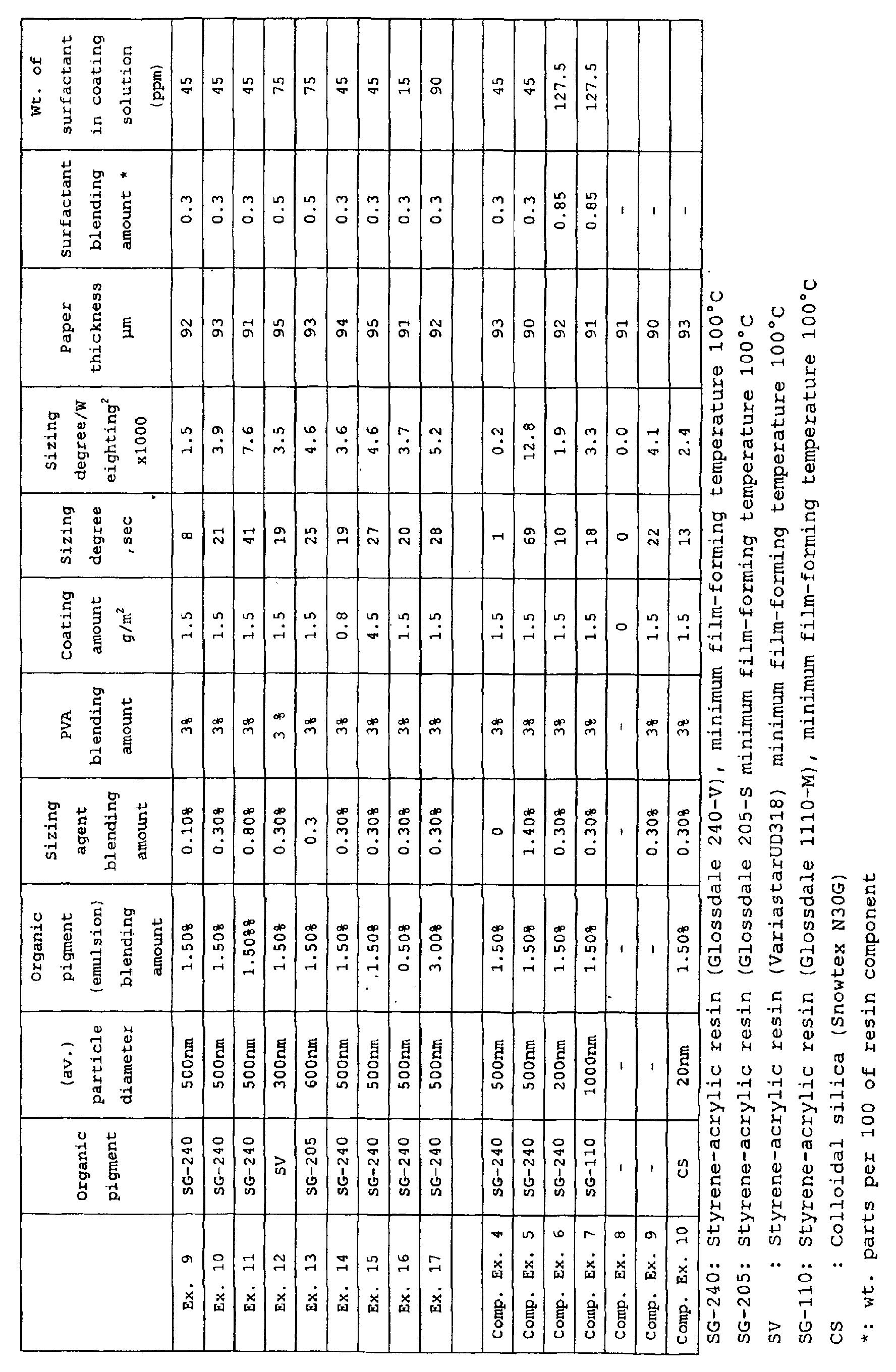
The compositions and Stöckigt sizing degrees of the
inkjet recording media obtained as in Examples 9-17, and
Comparative Examples 4-10, are as shown in the following
table.
-
Table 2 shows the results of print density,
feathering and bleeding evaluations for these inkjet
recording media as for Example 1.
| Example | Print density | Feathering | Bleeding |
| Example 1 | 1.30 (○) | ○ | o ○ |
| Example 2 | 1.35 (○) | ○ | ○ |
| Example 3 | 1.37 (○) | o ○ | ○ |
| Example 4 | 1.34 (○) | ○ | ○ |
| Example 5 | 1.33 (○) | ○ | ○ |
| Example 6 | 1.33 (○) | ○ | ○ |
| Example 7 | 1.36 (○) | o ○ | ○ |
| Example 8 | 1.34 (○) | ○ | ○ |
| Example 9 | 1.35 (○) | o ○ | ○ |
| Comp. Ex. 1 | 1.17 (×) | × | o ○ |
| Comp. Ex. 2 | 1.39 (○) | o ○ | × |
| Comp. Ex. 3 | 1.22 (Δ) | Δ | o ○ |
| Comp. Ex. 4 | 1.20 (Δ) | × | o ○ |
| Comp. Ex. 5 | 1.26 (Δ) | Δ | ○ |
| Comp. Ex. 6 | 1.12 (×) | × | o ○ |
| Comp. Ex. 7 | 1.33 (○) | Δ | Δ |
| Comp. Ex. 8 | 1.25 (Δ) | Δ | ○ |
Industrial field of application
-
The ink jet recording medium according to the present
invention is an inkjet recording medium which in addition
to little feathering and bleeding, offers high print
density and is suitable for multi-color recording, and as
it retains the quality of plain paper, it can also be used
for electrophotographic recording and general writing
applications with a pencil or the like, so it has a very
wide industrial application.