EP1400888A2 - Multi-function peripheral - Google Patents
Multi-function peripheral Download PDFInfo
- Publication number
- EP1400888A2 EP1400888A2 EP03255267A EP03255267A EP1400888A2 EP 1400888 A2 EP1400888 A2 EP 1400888A2 EP 03255267 A EP03255267 A EP 03255267A EP 03255267 A EP03255267 A EP 03255267A EP 1400888 A2 EP1400888 A2 EP 1400888A2
- Authority
- EP
- European Patent Office
- Prior art keywords
- user
- mfp
- data
- function peripheral
- time record
- Prior art date
- Legal status (The legal status is an assumption and is not a legal conclusion. Google has not performed a legal analysis and makes no representation as to the accuracy of the status listed.)
- Granted
Links
Images


Classifications
-
- G—PHYSICS
- G06—COMPUTING OR CALCULATING; COUNTING
- G06F—ELECTRIC DIGITAL DATA PROCESSING
- G06F21/00—Security arrangements for protecting computers, components thereof, programs or data against unauthorised activity
- G06F21/30—Authentication, i.e. establishing the identity or authorisation of security principals
- G06F21/31—User authentication
-
- G—PHYSICS
- G06—COMPUTING OR CALCULATING; COUNTING
- G06Q—INFORMATION AND COMMUNICATION TECHNOLOGY [ICT] SPECIALLY ADAPTED FOR ADMINISTRATIVE, COMMERCIAL, FINANCIAL, MANAGERIAL OR SUPERVISORY PURPOSES; SYSTEMS OR METHODS SPECIALLY ADAPTED FOR ADMINISTRATIVE, COMMERCIAL, FINANCIAL, MANAGERIAL OR SUPERVISORY PURPOSES, NOT OTHERWISE PROVIDED FOR
- G06Q20/00—Payment architectures, schemes or protocols
- G06Q20/08—Payment architectures
- G06Q20/12—Payment architectures specially adapted for electronic shopping systems
- G06Q20/127—Shopping or accessing services according to a time-limitation
-
- G—PHYSICS
- G07—CHECKING-DEVICES
- G07C—TIME OR ATTENDANCE REGISTERS; REGISTERING OR INDICATING THE WORKING OF MACHINES; GENERATING RANDOM NUMBERS; VOTING OR LOTTERY APPARATUS; ARRANGEMENTS, SYSTEMS OR APPARATUS FOR CHECKING NOT PROVIDED FOR ELSEWHERE
- G07C1/00—Registering, indicating or recording the time of events or elapsed time, e.g. time-recorders for work people
- G07C1/10—Registering, indicating or recording the time of events or elapsed time, e.g. time-recorders for work people together with the recording, indicating or registering of other data, e.g. of signs of identity
-
- G—PHYSICS
- G07—CHECKING-DEVICES
- G07F—COIN-FREED OR LIKE APPARATUS
- G07F17/00—Coin-freed apparatus for hiring articles; Coin-freed facilities or services
- G07F17/0014—Coin-freed apparatus for hiring articles; Coin-freed facilities or services for vending, access and use of specific services not covered anywhere else in G07F17/00
-
- G—PHYSICS
- G07—CHECKING-DEVICES
- G07F—COIN-FREED OR LIKE APPARATUS
- G07F17/00—Coin-freed apparatus for hiring articles; Coin-freed facilities or services
- G07F17/16—Coin-freed apparatus for hiring articles; Coin-freed facilities or services for devices exhibiting advertisements, announcements, pictures or the like
-
- G—PHYSICS
- G07—CHECKING-DEVICES
- G07F—COIN-FREED OR LIKE APPARATUS
- G07F7/00—Mechanisms actuated by objects other than coins to free or to actuate vending, hiring, coin or paper currency dispensing or refunding apparatus
- G07F7/02—Mechanisms actuated by objects other than coins to free or to actuate vending, hiring, coin or paper currency dispensing or refunding apparatus by keys or other credit registering devices
-
- G—PHYSICS
- G07—CHECKING-DEVICES
- G07G—REGISTERING THE RECEIPT OF CASH, VALUABLES, OR TOKENS
- G07G5/00—Receipt-giving machines
-
- H—ELECTRICITY
- H04—ELECTRIC COMMUNICATION TECHNIQUE
- H04N—PICTORIAL COMMUNICATION, e.g. TELEVISION
- H04N1/00—Scanning, transmission or reproduction of documents or the like, e.g. facsimile transmission; Details thereof
- H04N1/00127—Connection or combination of a still picture apparatus with another apparatus, e.g. for storage, processing or transmission of still picture signals or of information associated with a still picture
-
- H—ELECTRICITY
- H04—ELECTRIC COMMUNICATION TECHNIQUE
- H04N—PICTORIAL COMMUNICATION, e.g. TELEVISION
- H04N2201/00—Indexing scheme relating to scanning, transmission or reproduction of documents or the like, and to details thereof
- H04N2201/0077—Types of the still picture apparatus
- H04N2201/0094—Multifunctional device, i.e. a device capable of all of reading, reproducing, copying, facsimile transception, file transception
Definitions
- the present invention relates to the field of multi-function peripheral and more specifically, to a mufti-function peripheral with time entry and message features.
- a Multi-Function Peripheral is a single device that performs two or more functions. Many MFPs are equipped to perform as printers, scanners, facsimile machines, and copiers. Because they can perform many functions, they are advantageous over their single function counterparts. Moreover, consumers prefer MFPs because purchasing one is often less expensive than separately purchasing a printer, scanner, facsimile machine, and copier. Because of their usefulness and versatility, MFPs are very common in the workplace.
- MFPs are used as part of their day-to-day operation. For example, businesses may use the MFPs to print up a report, make copies of the report, send the report to someone else, or even scan a picture to put in the report. From a business stand point, an MFP is valuable because it saves the company money and allows their employees to be more efficient and productive.
- MFPs There are various MFPs on the market, but most are limited to the above functions. Some MFPs will combine the functionalities of a printer and copier, others may combine the functionalities of a printer and facsimile machine, while others may even combine the functionalities of a printer, facsimile machine, copier and scanner. Despite their functionalities, most MFPs have not implemented the functionality of other devices that may be commonly found in a company.
- time clock terminals There are various types of time clock terminals. One type allows an employee to insert a paper timesheet into the time clock terminal. The time clock terminal then records a time entry on the paper timesheet. This provides assurance that the timesheet accurately reflects the time that the employee arrives and leaves work.
- One drawback to this approach is that the company must manually compute the hours worked by the employee by calculating the difference between the clock in time and the clock out time. This can require a significant amount of human resources, especially when the company employs many employees.
- More sophisticated time clock terminals store time entries electronically instead of recording them on a paper timesheet. This allows the number of hours worked by an employee to be determined automatically. Another advantage of storing the time entry electronically is that it is more difficult for employees to alter their time entries. Despite the advantages that current time clock terminals may provide to companies, one major disadvantage is that companies have to purchase a separate time clock terminal system, which can be expensive.
- a multi-function peripheral (MFP) apparatus is configured to receive user identification data that uniquely identifies a user and generate time record data for the user.
- the user identification data may include a user ID and a password and the MFP may be configured to verify the user ID and password either locally or via a remote server.
- the MFP may receive the user identification data, for example, from an identification card read by a card reader or other device.
- the MFP may be further configured to provide message data or employee data to the user.
- the MFP may be, for example, a printer or copier.
- an MFP is configured to receive user identification data that uniquely identifies a user, wherein the user identification data includes a user ID and a password.
- the MFP is configured to verify the user ID and password and generate time record data for the user.
- the MFP is further configured to synchronize the time record data with master time record data located on a remote server over a conmunications link.
- the multi function peripheral apparatus of the invention may be a printer or a copier, that is a printer or copier that also performs the user identification and time recorded functions of the invention in addition to the usual printer or copier functions.
- a Multi-Function Peripheral is configured to both receive user identification data that uniquely identifies a user and to generate time record data for the user.
- the user identification data may be any type of data that uniquely identifies the user, such as a user ID and password.
- the user identification data may be verified by the MFP or verified by another entity, such as a remote server.
- the time record data may include, for example, a time at which the user identification data was received.
- the time record data may be generated in response to the user identification data being received. Alternatively, the time record data may be generated in response to other criteria being satisfied. For example, the time record data may be generated in response to receiving user input to the MFP.
- the MFP configured in the manner described may be used in a variety of applications, such as employee time clock applications.
- the MFP may be further configured to provide information for the user, such as messages and schedule information, on a Graphical User Interface (GUI).
- GUI Graphical User Interface
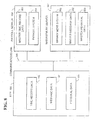
- FIG.1 is a block diagram that depicts an MFP 100 configured according to an embodiment of the invention
- MFP 100 includes an input/output device 101 for receiving input from a user and displaying output to a user.
- Input/output device 101 may be implemented by any mechanism that provides for the exchange of information, between a user and MFP 100 and the invention is not limited to any particular type of mechanism.
- Input/output device 101 may include a GUI for receiving input from a user and displaying output to a user.
- MFP 100 also includes a storage device 102 for storing data.
- the data may include, for example, time record data 103, message data 104, and personal data 105 (hereinafter collectively referred to as "local data"). However, the data may include other types of data, or any combination thereof.
- Storage device 102 may be disposed internal or external to MFP, depending upon the requirements of a particular application.
- MFP 100 may include other elements that are not depicted or described herein for purposes of brevity.
- MFP 100 may include elements for performing printing, scanning, facsimile and copying functions.
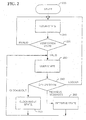
- FIG. 2 is a flow diagram depicting the operation of an MFP 100 in the context of performing various possible functions with a user.
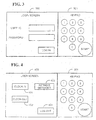
- MFP 100 proceeds to a login state 210, where MFP 100 displays a screen 300 (FIG.3) on input/output device 101.
- Login screen 300 allows a user to login to MFP 100 by providing valid user identification data.
- the user identification data includes a user ID and a password.
- the user may provide the user identification data to MFP 100 using a variety of mechanisms depending upon the requirements of a particular application.
- the user enters a user ID and password via a keypad 301.
- Keypad 301 may be a manual keypad disposed on input/output device 101, or alternatively may be a virtual keypad displayed adjacent to login screen 300 on a GUI. Furthermore, although keypad 301 is depicted in FIG.3 as numeric, keypad 301 may be alphanumeric.
- MFP 100 After receiving the user identification data in the form of a user ID and password, MFP 100 proceeds to a verification state 220.
- verification state 220 MFP 100 verifies the user identification data received from the user.
- MFP 100 verifies the user ID and password received from the user.
- MFP 100 compares the user ID and password received from the user to valid user IDs and passwords stored on storage device 102. The valid user IDs and passwords may be stored in personal data 105.
- MFP 100 determines whether the user ID and password provided by the user are not valid. If in verification state 220, a determination is made that the user ID and password provided by the user are valid, then the user is not permitted to log onto MFP 100. In this situation, MFP 100 returns to login state 210 where a new user ID and password may be received from the user. If in verification state 220, a determination is made that the user ID and password provided by the user are valid, then MFP 100 proceeds to a user state 230. In user state 230, MFP 100 displays a user screen 400 (FIG. 4) on input/output device 101. According to one embodiment of the invention, user screen 400 includes various options that may be selected by the user. These options include clock-in, clock-out, retrieve messages and logout. MFP 100 then proceeds to an option state 240, where the MFP 100 waits for the user to select an option. The aforementioned options are described in more detail hereinafter.
- a user selects the clock-in option by selecting a user interface object 401 on user screen 400 associated with the clock-in option.
- MFP 100 proceeds to a clock-in/out state 250 and generates time record data associated with the event.
- the time record data may specify a time at which the user selected user interface object 401, which corresponds to the time at which the user docked-in.
- MFP 100 stores the time record data in time record data 103, located in the storage device 102. After storing the time record data, MFP 100 returns to user state 230, displays user screen 400, and then proceeds to option state 240, where the MFP 100 waits for the user to choose another option.
- a user selects the clock-out option by selecting a user interface object 402 associated with the clock-out option.
- MFP 100 proceeds to clock-in/out state 250 and generates additional time record data associated with the event.
- the additional time record data may specify a time at which the user selected user interface object 402, which corresponds to the time at which the user clocked-out.
- MFP 100 may also store the additional time record data in time record data 103, located in the storage device 102.
- MFP 100 then returns to user state 230, displays the user screen 400, and proceeds to option state 240, where the MFP 100 waits for the user to choose another option.
- user screen 400 includes separate user interface objects 401, 402 corresponding to the clock-in and clock-out options, respectively.
- a single user interface object may be used for both the clock-in and clock-out options.
- a user selects the retrieve messages option by selecting a user interface object 403 associated with the retrieve messages option.
- MFP 100 proceeds to a retrieve messages state 260.
- retrieve messages state 260 MFP 100 retrieves from the storage device 102, messages associated with the user currently logged on to MFP 100. The messages may be stored in message data 104. If there is at least one message within the message data 104 associated with the employee, then the MFP 100 retrieves those messages and displays them on input/output device 101. Once the user has finished reading the messages, MFP 100 returns to user state 230, displays the user screen 400, and proceeds to option state 240, where the MFP 100 waits for the user to choose another option.
- a user selects the logout option by selecting user interface object 404 associated with the logout option.
- MFP 100 proceeds to login state 210.
- FIG. 5 is a block diagram that depicts two MFPs 100 communicatively coupled to a remote server 501 via a communications link 500.
- Communications link 500 may be implemented by any medium or mechanism that provides for the exchange of data between MFPs 100 and remote server 501. Examples of communications link 500 include, without limitation, a network such as a Local Area Network (LAN), Wide Area Network (WAN), Etherner or the Internet, or one or more terrestrial, satellite or wireless links.
- LAN Local Area Network
- WAN Wide Area Network
- Etherner or the Internet
- terrestrial, satellite or wireless links or one or more terrestrial, satellite or wireless links.
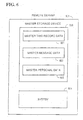
- FIG.6 is a block diagram that depicts an example embodiment of remote server 501.
- Remote server 501 includes a master storage device 600 for storing data.
- Example data includes master time record data 601, master message data 602, and master personal data 603 (hereinafter collectively referred to as "master data").
- Master data stored in remote server 501 allows data to be stored in a central location, which is advantageous in multiple MFP applications.
- Remote server 501 further includes a system 604 for processing, communicating or executing data.
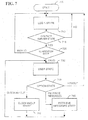
- FIG. 7 is a flow diagram depicting the operation of an MFP 100 coupled to remote server 501 via communications link 500, as it is performing various functions with a user.
- MFP 100 proceeds to a login state 710, where MFP 100 displays login screen 300 on input/output device 101. MFP 100 then waits for user identification data, in the form of a user ID and password, to be entered. Upon receipt of the user ID and password, MFP 100 proceeds to a contact server state 715.
- MFP 100 determines whether remote server 501 is available. This may be accomplished using a variety of techniques, depending upon the requirements of a particular application. For example, MFP 100 may contact a network-manager or send a status request directly to remote server 501. If MFP 100 determines that remote server 501 is available, then MFP 100 proceeds to a verification state 720.
- MFP 100 provides the user ID and password to remote server 501 for verification.
- Remote server 501 may use any type of technique for verifying the user ID and password and the invention is not limited to any particular approach. According to one embodiment of uhe invention, remote server 501 compares the user ID and password against known valid user ID and password combinations stored in master storage device 600, for example in master personal data 603. Remote server 501 provides a response to MFP 100 indicating whether the user ID and password provided by MFP 100 were successfully verified.
- MFP 100 responds to the employee entry by returning to the login state 710 and displaying the login screen 300. If remote server 501 determines that the user ID and password are valid, then MFP 100 proceeds to a user state 730, where the MFP 100 displays user screen 400 on input/output device 101. The user is now logged onto MFP 100. MFP 100 then proceeds to an option state 740, where MFP 100 waits for the user to select a desired option.
- remote server 501 or system 604 may be unavailable because communications link 500 is down, or system 604 is busy processing other applications for other MFPs.
- MFP 100 is unable to perform remote verification of user identification data using remote server 501 and may proceed to attempt local verification in stand-alone mode as described herein.
- a user selects the clock-in option by selecting a user interface object 401 on user screen 400 associated with the clock-in option.
- MFP 100 proceeds to a clock-in/out state 750 and generates time record data associated with the event.
- the time record data may specify a time at which the user selected user interface 401, which corresponds to the time at which the user clocked-in.
- MFP 100 stores the time record data in master time record data 601, located in the master storage device 600. Additionally, MFP 100 may also store the time record data in time record data 103, located in the storage device 102. After the storing of the time record data, MFP 100 returns to user state 730, displays user screen 400, and then proceeds to option state 740, where MFP 100 waits for the user to choose another option.
- a user may select the clock-out option by selecting a user interface object 402 associated with the clock-out option.
- MFP 100 proceeds to clock-in/out state 750 and generates additional time record data associated with the event.
- the additional time record data may specify a time at which the user selected user interface object 402, which corresponds to the time at which the user clocked-out.
- MFP 100 may also store the additional time record data in time record data 601, located in the master storage device 600. Additionally, MFP 100 may also store the time record data in time record 103, located in the storage device 102.
- MFP 100 then returns to user state 730, displays the user screen 400, and proceeds to option state 740, where the MFP 100 waits for the user to choose another option.
- a user selects the retrieve messages option by selecting a user interface object 403 associated with the retrieve messages option.
- MFP 100 proceeds to a retrieve messages state 760.
- retrieve messages state 760 MFP 100 retrieves from the master storage device 600, messages associated with the user currently logged on to MFP 100. The messages may be stored in master message data 602. If there is at least one message within the message data 602 associated with the employee, then the MFP 100 retrieves those messages and displays them on input/output device 101. Once the user has finished reading the messages, MFP 100 returns to user state 730, displays the user screen 400, and proceeds to option state 740, where the MFP 100 waits for the user to choose another option.
- a user selects the logout option by selecting a user interface object 404 associated with the logout option.
- the user is logged out and MFP 1 00 proceeds to login state 710.
- the master data is stored on multiple remote servers to be accessed by MFPs 100.
- FIG. 8 is a block diagram that depicts such an arrangement.
- MFP 100 is communicatively coupled via communications link 500 to a payroll server 800 that stores master time record data 601 comprising clock-in and clock-out time entries.
- Payroll server 800 also includes a payroll system for 801 for processing, communicating, or executing data.
- MFP 100 is also communicatively coupled via communications link 500 to a management server 802.
- Management server 802 includes a management system 803 for processing, communicating, or executing data.
- Management server 802 also includes master message data 602 comprising user messages.
- Management server 802 further includes master personal data 603 comprising user IDs, passwords and other personal information.
- the allocation of master data onto distributed remote servers may vary according to the requirements of a particular application. For example, a large business with many employees may want to dedicate remote servers to store only one type of data, such as the master time record data 601, master message data 602, or master personal data 603. Alternatively, a relatively small business with few employees, may find that all the master data may be stored on a single remote server. Furthermore, such a business may not need a remote server at all, if all the master data and local data can be stored in the MFP 100.
- MFPs configured in accordance with an embodiment of the invention may operate in stand-alone mode, or communicatively coupled to one or more remote servers via a communications link in a network application.
- an MFP When operating in stand-alone mode, an MFP performs the various functions described herein, such as user verification and message retrieval, based upon the local data maintained by the MFP.
- the most recent master data may be maintained on a remote server, e.g., managed by a central application. It is therefore desirable to have the local data maintained by MFPs synchronized with master data on remote servers on a regular basis to ensure data consistency.
- MFP 100 initiates a synchronization request to remote server 501. If remote server 501 is available, then remote server 501 responds by authorizing MFP 100 to transmit the entries in the local data. Once the remote server 501 receives the local data, the system 604 checks each entry in the local data and compares it with the entries in the master data. If an entry in the local data is not present in the master data then that entry is stored in the master data. Once that is done, the entry is deleted from the local data. Alternatively, if an entry in the local data is already present in the master data, then that entry is simply deleted from the local data.
- the remote server 501 transmits the master data, stored on the master storage device 600, to MFP 100.
- MFP 100 receives the master data, MFP 100 checks each entry in the master data and compares it with the entries in the local data. If an entry in the master data is not present in the local data, then that entry is stored in the local data.
- remote server 501 may transmit master message data 603 to MFP 100. Because there is no way of predicting which MFP 100 an employee may log onto next, remote server 501 may upload the master message data 603 to all the MFPs. In which case, each MFP 100 may store the master message data 603 in storage device 102 as message data 104. This ensures that the master message data 603 is available to an employee, even if the communications link 500 or remote server 501 is down or unavailable.
- remote server 501 initiates synchronization over communications link 500.
- An advantage of doing this over the previous embodiment is that it eliminates the possibility of nultiple MFPs simultaneously initiating a synchronization request to the remote server 501.
- the remote server 501 transmits a request to an MFP 100 for the local data.
- the MFP 100 then responds by transmitting the local data to the remote server 501.
- the local data is then compared with the master data.
- the remote server 501 then initiates another synchronization process with another MFP 100. This is repeated until all MFPs have been synchronized with the remote server 501.
- MFP 100 is further configured to distinguish between different types of users.
- MFP 100 is configured to distinguish between a user who is a regular employee with basic user privileges and an employee who is a special employee with additional special user privileges.
- a user with special user privileges such as a manager for instance, may be able to perform certain functions on the MFP 100 that cannot be performed by other types of users.
- Example functions include updating a master time record data 601, a master message data 602 and a master personal data 603.
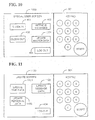
- MFP 100 proceeds to a special state, where MFP 100 checks either the personal data 105 or the master personal data 603 to determine whether the employee attempting to log on the MFP 100 has special user privileges. Once MFP 100 or remote server 501 determines that the employes has special user privileges, then MFP 100 proceeds to special user option state 900, where the employee is presented with a special user screen 1000 as depicted on FIG. 10.
- the special user screen 1000 may be similar to the user screen 400 except that it may contain additional options. These additional options may include, without limitation, synchronizing, updating and/or modifying the local data and the master data. The aforementioned options are described in more detail hereinafter.
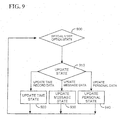
- FIG. 9 is a flow diagram depicting the operation of MFP 100 in the context of performing process to update both the master and local data.
- the update process is similar to the synchronization process described above.
- MFP 100 displays special user screen 1000.
- Special user screen 1000 includes a user interface object 100 1 for updating master data.
- the employee may initiate the update master data option by selecting user interface object 1001.
- Update screen 1100 as depicted in FIG. 11, includes a user interface object 1101 for updating the time record data 103 and master time record data 601.
- Update screen 1100 also includes a user interface object 1102 for updating the message data 104 and master message data 602.
- Update screen 1100 further includes a user interface object 1103 for updating the personal data 105 and master personal data 603. Update screen 1100 may include other user interface objects.
- MFP 100 After selecting user interface 1001, MFP 100 now proceeds to update state 910, where the employee is presented with update screen 1100. After displaying update screen 1100, MFP 100 waits for employee to make a selection.
- MFP 100 proceeds to update time state 920 and communicates with a payroll server 800. MFP 100 then transmits the time record data 103 to the payroll server 800. The payroll server 800 identifies each entry in the time record data 103. Each entry is then compared with the entries in the master time record data 601 to determine whether there is match. If no match is found in the master time record data 601, then that entry is stored in the master time record data 601. Once the entry has been stored on the master time record data 601, the entry is deleted from the time record data 103. Alternatively, if an exact entry in the time date 103 is already present in the master time record data 601, that entry is simply deleted from the time record data 103 of MFP 100. The above process is then repeated for all entries in the time record data 103. Once all entries have been compared, MFP 100 proceeds to option state 900 and waits for employee to make another selection.
- the remote server 501 transmits the master time record data 601 to MFP 100.
- MFP 100 receives the master time record data 601
- MFP 100 checks each entry in the master time record data 601 and compares it with the entries in the time record data 103. If an entry in the master time record data 601 is not present in the time record data 103, then that entry is stored in the time record data 103. If, however, the entry in the master time record data 601 is already present in time record data 103, then MFP 100 proceeds to the next entry in the master time record data 601.
- the update process for message data 104 and personal data 105 is similar to that of updating the time record data 103. If the employee selects user interface object 1102, then MFP 100 proceeds to update message state 930 and communicates with management, server 802, instead of payroll server 800. Similarly, if the employee selects user interface object 1103, then MFP 100 proceeds to update personal state and communicates with management server 802.
- the MFP 100 may perform other applications as well. For instance, if the MFP 100 is equipped with printing capabilities, it may be possible for an employee to print various things. For example, it may be possible for the employee to print his/her work schedule, his messages and his personal information. Furthermore, if MFP 100 has a scanning feature, it may be possible to have an employee use an ID card to log onto MFP 100 instead of entering an ID and password. In yet another embodiment of the invention, it may be possible for an employee to send messages from an MFP 100.
- MFPs may be configured to perform the functions described herein using hardware, computer software, or any combination of computer hardware and software and the invention is not limited to any particular implementation.
- the firm ware of an MFP may be modified to perform the functions described herein.
- additional hardware and/or computer software may be added to an MFP to provide the additional functionality.
Landscapes
- Physics & Mathematics (AREA)
- General Physics & Mathematics (AREA)
- Engineering & Computer Science (AREA)
- Theoretical Computer Science (AREA)
- Business, Economics & Management (AREA)
- Accounting & Taxation (AREA)
- Computer Security & Cryptography (AREA)
- Computer Hardware Design (AREA)
- Finance (AREA)
- General Business, Economics & Management (AREA)
- Strategic Management (AREA)
- Software Systems (AREA)
- General Engineering & Computer Science (AREA)
- Accessory Devices And Overall Control Thereof (AREA)
- Facsimiles In General (AREA)
- Control Or Security For Electrophotography (AREA)
- Time Recorders, Dirve Recorders, Access Control (AREA)
Abstract
Description
Claims (18)
- A multi-function peripheral apparatus configured to:receive user identification data that uniquely identifies a user; andgenerate time record data for the user.
- The multi-function peripheral apparatus as recited in Claim 1, wherein the user identification data includes a user ID and a password.
- The multi-function peripheral apparatus as recited in Claim 2, the apparatus being further configured to verify the user ID and password.
- The multi-function peripheral apparatus as recited in Claim 2, the apparatus being further configured to provide the user ID and the password to a remote server over a communications link.
- The multi-function peripheral apparatus as recited in Claim 1, 2, 3 or 4 the apparatus being further configured to receive a user input and generate the time record data in response to receiving the user input.
- The multi-function peripheral apparatus as recited in any one of the preceding Claims, the apparatus being further configured to generate the time record data in response to receiving the user identification data.
- The multi-function peripheral apparatus as recited in any one of the preceding Claims, wherein the time record data specifies a time at which the user identification data was received.
- The multi-function peripheral apparatus as recited in any one of the preceding Claims, the apparatus being further configured to provide the time record data to a remote server over a communications link.
- The multi-function peripheral apparatus as recited in any one of the preceding Claims, the apparatus being further configured to provide message data for the user.
- The multi-function peripheral apparatus as recited in Claim 9, the apparatus being further configured to request the message data for the user from a remote server over a communications link.
- The multi-function peripheral apparatus as recited in any one of the preceding Claims, the apparatus being further configured to provide employee data for the user.
- The multi-function peripheral apparatus as recited in any one of the preceding Claims, the apparatus being further configured to determine, based upon the user identification data, a set of one or more user privileges for the individual.
- The multi-function peripheral apparatus as recited in any one of the preceding Claims, the apparatus being further configured to determine, based upon the user identification data, a mode of operation for the multi-function peripheral apparatus.
- The multi-function peripheral apparatus as recited in any one of the preceding Claims, the apparatus being further configured to synchronize the time record data with master time record data located on a remote server over a communications link.
- A multi-function peripheral apparatus configured to:receive user identification data that uniquely identifies a user, wherein the user identification data includes a user ID and a password;verify the user ID and password;generate time record data for the user; andsynchronize the time record data with master time record data located on a remote server over a communications link.
- A multi-function peripheral apparatus according to any one of the preceding Claims that is a printer.
- The multi-function peripheral apparatus according to any one of Claims 1 to 15 that is a copier.
- A computer program comprising program code means that, when executed on a multi-function peripheral apparatus, printer or copier, instructs the peripheral apparatus, printer or copier to perform the steps of:receiving user identification data that uniquely identifies a user; andgenerating time record data for the user.
Applications Claiming Priority (2)
| Application Number | Priority Date | Filing Date | Title |
|---|---|---|---|
| US253203 | 1999-02-19 | ||
| US10/253,203 US20040056889A1 (en) | 2002-09-23 | 2002-09-23 | Multi-function peripheral |
Publications (3)
| Publication Number | Publication Date |
|---|---|
| EP1400888A2 true EP1400888A2 (en) | 2004-03-24 |
| EP1400888A3 EP1400888A3 (en) | 2004-03-31 |
| EP1400888B1 EP1400888B1 (en) | 2008-06-11 |
Family
ID=31946501
Family Applications (1)
| Application Number | Title | Priority Date | Filing Date |
|---|---|---|---|
| EP03255267A Expired - Lifetime EP1400888B1 (en) | 2002-09-23 | 2003-08-26 | Multi-function peripheral |
Country Status (4)
| Country | Link |
|---|---|
| US (1) | US20040056889A1 (en) |
| EP (1) | EP1400888B1 (en) |
| JP (1) | JP2004139561A (en) |
| DE (1) | DE60321518D1 (en) |
Cited By (5)
| Publication number | Priority date | Publication date | Assignee | Title |
|---|---|---|---|---|
| EP1865437A3 (en) * | 2006-06-05 | 2008-12-10 | Ricoh Company, Ltd. | Managing access to a document-processing device using an identification token |
| US7540416B2 (en) | 2006-02-14 | 2009-06-02 | Ricoh Company, Ltd. | Smart card authentication system with multiple card and server support |
| US8219804B2 (en) * | 2007-09-13 | 2012-07-10 | Ricoh Company, Ltd. | Approach for managing device usage data |
| CN103150778A (en) * | 2013-03-18 | 2013-06-12 | 苏州诺特丹信息技术有限公司 | Novel checking-in system |
| CN108734377A (en) * | 2018-04-03 | 2018-11-02 | 上海长海医院 | Nurse performance manages system |
Families Citing this family (27)
| Publication number | Priority date | Publication date | Assignee | Title |
|---|---|---|---|---|
| JP3732818B2 (en) * | 2002-09-26 | 2006-01-11 | パナソニック コミュニケーションズ株式会社 | Distribution server, multifunction device, and distribution server system |
| KR100582358B1 (en) * | 2003-12-29 | 2006-05-22 | 주식회사 하이닉스반도체 | On-die termination driving circuit and method of semiconductor memory device |
| US8031348B2 (en) * | 2005-06-08 | 2011-10-04 | Ricoh Company, Ltd. | Approach for securely printing electronic documents |
| US8031349B2 (en) * | 2005-06-08 | 2011-10-04 | Ricoh Company, Ltd. | Approach for securely printing electronic documents |
| US7808664B2 (en) * | 2005-06-08 | 2010-10-05 | Ricoh Company, Ltd. | Approach for securely printing electronic documents |
| JP4801468B2 (en) * | 2006-03-02 | 2011-10-26 | 株式会社リコー | Management apparatus and image forming apparatus management system |
| US8264715B2 (en) * | 2006-04-25 | 2012-09-11 | Ricoh Company, Ltd. | Approach for implementing locked printing with remote unlock on printing devices |
| US7812984B2 (en) * | 2006-05-23 | 2010-10-12 | Ricoh Company, Ltd. | Remote stored print job retrieval |
| US20080174810A1 (en) * | 2007-01-22 | 2008-07-24 | Ricoh Company, Ltd. | Fault tolerant printing system |
| US8115951B2 (en) * | 2007-04-20 | 2012-02-14 | Ricoh Company, Ltd. | Approach for implementing locked printing with unlock via a user input device |
| US20080297829A1 (en) * | 2007-06-04 | 2008-12-04 | Samsung Electronics Co., Ltd. | System and method for providing personalized settings on a multi-function peripheral (mfp) |
| US8319992B2 (en) * | 2007-07-20 | 2012-11-27 | Ricoh Company, Ltd. | Approach for processing locked print jobs obtained from other printing devices |
| KR101229497B1 (en) * | 2007-07-24 | 2013-02-04 | 삼성전자주식회사 | E-mail Printing method and apparatus according to printing environment adapted to user |
| US8228538B2 (en) * | 2008-06-23 | 2012-07-24 | Ricoh Company, Ltd. | Performance of a locked print architecture |
| US9411956B2 (en) | 2008-07-02 | 2016-08-09 | Ricoh Company, Ltd. | Locked print with intruder detection and management |
| US8555359B2 (en) * | 2009-02-26 | 2013-10-08 | Yodlee, Inc. | System and methods for automatically accessing a web site on behalf of a client |
| JP5371611B2 (en) * | 2009-07-31 | 2013-12-18 | キヤノン株式会社 | Data processing system, server, server control method, and program |
| US9082139B2 (en) * | 2010-03-10 | 2015-07-14 | Hewlett-Packard Development Company, L.P. | Printer credit management |
| US8738480B2 (en) * | 2010-12-08 | 2014-05-27 | Xerox Corporation | Virtual electronic paymaster method and system |
| US9852385B2 (en) * | 2011-12-08 | 2017-12-26 | Sap Se | Processing of business object identifiers in master data integration scenarios involving non-local identifiers |
| US9183375B2 (en) | 2013-01-30 | 2015-11-10 | Hewlett-Packard Development Company, L.P. | Use of resource up to extension value by subscription device |
| US9715645B2 (en) | 2013-06-03 | 2017-07-25 | Hewlett-Packard Development Company, L.P. | Marking agent subscription credits |
| EP2976704B1 (en) | 2013-07-24 | 2021-07-14 | Hewlett-Packard Development Company, L.P. | Marking agent credit adjustments |
| JP6217301B2 (en) * | 2013-10-15 | 2017-10-25 | 株式会社リコー | Information processing system, information processing apparatus, information processing method, and program |
| JP6748411B2 (en) * | 2015-08-31 | 2020-09-02 | キヤノン株式会社 | Information processing apparatus, control method of information processing apparatus, and program |
| JP6699289B2 (en) | 2016-03-28 | 2020-05-27 | 富士ゼロックス株式会社 | Information processing system and electronic device |
| US11734404B2 (en) | 2021-01-21 | 2023-08-22 | Kyocera Document Solutions Inc. | Robot gatekeeper for authentication prior to meeting attendance |
Family Cites Families (11)
| Publication number | Priority date | Publication date | Assignee | Title |
|---|---|---|---|---|
| US4819162A (en) * | 1985-05-17 | 1989-04-04 | Time Management Corporation | Time clock system including scheduling payroll and productivity analysis capability |
| US5366404A (en) * | 1992-10-09 | 1994-11-22 | Telequip Corporation | Auxillary coin dispenser with transaction data recording and transfer mechanisms |
| US5459657A (en) * | 1993-06-21 | 1995-10-17 | Mirage Resorts Incorporated | Employee time entry and accounting system |
| US6185514B1 (en) * | 1995-04-17 | 2001-02-06 | Ricos International, Inc. | Time and work tracker with hardware abstraction layer |
| US6338097B1 (en) * | 1998-06-19 | 2002-01-08 | Sap Aktiengesellschaft | Cross application time sheet for communicating with one or more enterprise management applications during time data entry |
| US6347306B1 (en) * | 1998-07-21 | 2002-02-12 | Cybershift.Com, Inc. | Method and system for direct payroll processing |
| US6347305B1 (en) * | 1999-10-29 | 2002-02-12 | E-Duction, Inc. | Method for selecting and processing a payroll deduction plan as a payment option during electronic commerce |
| JP3862459B2 (en) * | 1999-11-30 | 2006-12-27 | キヤノン株式会社 | Peripheral device control system, information processing apparatus and method |
| US6934688B2 (en) * | 1999-12-06 | 2005-08-23 | Balance Innovations, Llc | System, method, and computer program for managing storage and distribution of money tills |
| JP4769352B2 (en) * | 2000-10-17 | 2011-09-07 | 東芝テック株式会社 | Server device and network system |
| US20050190398A1 (en) * | 2004-03-01 | 2005-09-01 | Jayasimha Nuggehalli | Multifunction peripheral for data collection and distribution |
-
2002
- 2002-09-23 US US10/253,203 patent/US20040056889A1/en not_active Abandoned
-
2003
- 2003-08-12 JP JP2003292131A patent/JP2004139561A/en active Pending
- 2003-08-26 EP EP03255267A patent/EP1400888B1/en not_active Expired - Lifetime
- 2003-08-26 DE DE60321518T patent/DE60321518D1/en not_active Expired - Lifetime
Cited By (7)
| Publication number | Priority date | Publication date | Assignee | Title |
|---|---|---|---|---|
| US7540416B2 (en) | 2006-02-14 | 2009-06-02 | Ricoh Company, Ltd. | Smart card authentication system with multiple card and server support |
| EP1865437A3 (en) * | 2006-06-05 | 2008-12-10 | Ricoh Company, Ltd. | Managing access to a document-processing device using an identification token |
| US7788712B2 (en) | 2006-06-05 | 2010-08-31 | Ricoh Company, Ltd. | Managing access to a document-processing device using an identification token |
| US8844014B2 (en) | 2006-06-05 | 2014-09-23 | Ricoh Company Ltd. | Managing access to a document-processing device using an identification token |
| US8219804B2 (en) * | 2007-09-13 | 2012-07-10 | Ricoh Company, Ltd. | Approach for managing device usage data |
| CN103150778A (en) * | 2013-03-18 | 2013-06-12 | 苏州诺特丹信息技术有限公司 | Novel checking-in system |
| CN108734377A (en) * | 2018-04-03 | 2018-11-02 | 上海长海医院 | Nurse performance manages system |
Also Published As
| Publication number | Publication date |
|---|---|
| JP2004139561A (en) | 2004-05-13 |
| EP1400888B1 (en) | 2008-06-11 |
| EP1400888A3 (en) | 2004-03-31 |
| US20040056889A1 (en) | 2004-03-25 |
| DE60321518D1 (en) | 2008-07-24 |
Similar Documents
| Publication | Publication Date | Title |
|---|---|---|
| EP1400888B1 (en) | Multi-function peripheral | |
| US20200412911A1 (en) | Data processing system, data processing apparatus, and data processing method for transferring image data to an output destination | |
| US7725924B2 (en) | Network system, use permission determining method, network device, and recording medium | |
| US8081336B2 (en) | Image forming apparatus, image processing method, and program | |
| US20140129607A1 (en) | Information processing apparatus, information processing system, and information processing method | |
| US7693298B2 (en) | Image processing system having a plurality of users utilizing a plurality of image processing apparatuses connected to network, image processing apparatus, and image processing program product executed by image processing apparatus | |
| JP6829407B2 (en) | Information information system, information processing device, control method of information information system, control method of information processing device, and program | |
| KR20080011660A (en) | Scanning method | |
| US10075606B2 (en) | Management server, method of managing workform and execution start condition and recording medium | |
| US9710662B2 (en) | Image processing apparatus automatically requesting permission to use server | |
| CN104333672A (en) | Information processing system, apparatus, and method | |
| CN102694946B (en) | Image forming apparatus | |
| JP6341218B2 (en) | Image processing apparatus, image processing system, and program | |
| JP6666573B2 (en) | Authentication information management system, image forming apparatus, processing method and program therefor | |
| JP2010220119A (en) | Conference system, and image data management method | |
| US8751410B2 (en) | Charging system for charging for image processing conducted based on image data, image processing apparatus, and charging program embodied on computer readable medium | |
| US8392979B2 (en) | Document processing automated system and image forming apparatus | |
| JP2012098775A (en) | Scan data processing system, server, scan data processing method, and program | |
| JP5626074B2 (en) | Information processing system, control method and program thereof, and management server, processing method and program thereof | |
| JP5637200B2 (en) | Information processing apparatus, authentication system, control method, authentication method, and program thereof. | |
| US20060273177A1 (en) | MFP which has the scan history management function and a method of managing the scan history in the MFP | |
| JP2013137692A (en) | Image forming apparatus, control method and program | |
| JP7238519B2 (en) | Information processing system, information processing device and program | |
| US20100251354A1 (en) | Image forming apparatus and image forming system | |
| JP3718134B2 (en) | Image processing system, processing execution method thereof, and processing execution program thereof |
Legal Events
| Date | Code | Title | Description |
|---|---|---|---|
| PUAI | Public reference made under article 153(3) epc to a published international application that has entered the european phase |
Free format text: ORIGINAL CODE: 0009012 |
|
| PUAL | Search report despatched |
Free format text: ORIGINAL CODE: 0009013 |
|
| 17P | Request for examination filed |
Effective date: 20030826 |
|
| AK | Designated contracting states |
Kind code of ref document: A2 Designated state(s): AT BE BG CH CY CZ DE DK EE ES FI FR GB GR HU IE IT LI LU MC NL PT RO SE SI SK TR |
|
| AX | Request for extension of the european patent |
Extension state: AL LT LV MK |
|
| AK | Designated contracting states |
Kind code of ref document: A3 Designated state(s): AT BE BG CH CY CZ DE DK EE ES FI FR GB GR HU IE IT LI LU MC NL PT RO SE SI SK TR |
|
| AX | Request for extension of the european patent |
Extension state: AL LT LV MK |
|
| 17Q | First examination report despatched |
Effective date: 20040630 |
|
| AKX | Designation fees paid |
Designated state(s): DE ES FR GB IT NL |
|
| 17Q | First examination report despatched |
Effective date: 20040630 |
|
| GRAP | Despatch of communication of intention to grant a patent |
Free format text: ORIGINAL CODE: EPIDOSNIGR1 |
|
| GRAS | Grant fee paid |
Free format text: ORIGINAL CODE: EPIDOSNIGR3 |
|
| GRAA | (expected) grant |
Free format text: ORIGINAL CODE: 0009210 |
|
| AK | Designated contracting states |
Kind code of ref document: B1 Designated state(s): DE ES FR GB IT NL |
|
| REG | Reference to a national code |
Ref country code: GB Ref legal event code: FG4D |
|
| REF | Corresponds to: |
Ref document number: 60321518 Country of ref document: DE Date of ref document: 20080724 Kind code of ref document: P |
|
| PG25 | Lapsed in a contracting state [announced via postgrant information from national office to epo] |
Ref country code: NL Free format text: LAPSE BECAUSE OF FAILURE TO SUBMIT A TRANSLATION OF THE DESCRIPTION OR TO PAY THE FEE WITHIN THE PRESCRIBED TIME-LIMIT Effective date: 20080611 |
|
| NLV1 | Nl: lapsed or annulled due to failure to fulfill the requirements of art. 29p and 29m of the patents act | ||
| PG25 | Lapsed in a contracting state [announced via postgrant information from national office to epo] |
Ref country code: ES Free format text: LAPSE BECAUSE OF FAILURE TO SUBMIT A TRANSLATION OF THE DESCRIPTION OR TO PAY THE FEE WITHIN THE PRESCRIBED TIME-LIMIT Effective date: 20080922 |
|
| PLBE | No opposition filed within time limit |
Free format text: ORIGINAL CODE: 0009261 |
|
| STAA | Information on the status of an ep patent application or granted ep patent |
Free format text: STATUS: NO OPPOSITION FILED WITHIN TIME LIMIT |
|
| 26N | No opposition filed |
Effective date: 20090312 |
|
| PG25 | Lapsed in a contracting state [announced via postgrant information from national office to epo] |
Ref country code: IT Free format text: LAPSE BECAUSE OF FAILURE TO SUBMIT A TRANSLATION OF THE DESCRIPTION OR TO PAY THE FEE WITHIN THE PRESCRIBED TIME-LIMIT Effective date: 20080611 |
|
| REG | Reference to a national code |
Ref country code: FR Ref legal event code: PLFP Year of fee payment: 14 |
|
| REG | Reference to a national code |
Ref country code: FR Ref legal event code: PLFP Year of fee payment: 15 |
|
| PGFP | Annual fee paid to national office [announced via postgrant information from national office to epo] |
Ref country code: FR Payment date: 20170822 Year of fee payment: 15 Ref country code: DE Payment date: 20170822 Year of fee payment: 15 Ref country code: GB Payment date: 20170822 Year of fee payment: 15 |
|
| REG | Reference to a national code |
Ref country code: DE Ref legal event code: R119 Ref document number: 60321518 Country of ref document: DE |
|
| GBPC | Gb: european patent ceased through non-payment of renewal fee |
Effective date: 20180826 |
|
| PG25 | Lapsed in a contracting state [announced via postgrant information from national office to epo] |
Ref country code: DE Free format text: LAPSE BECAUSE OF NON-PAYMENT OF DUE FEES Effective date: 20190301 |
|
| PG25 | Lapsed in a contracting state [announced via postgrant information from national office to epo] |
Ref country code: FR Free format text: LAPSE BECAUSE OF NON-PAYMENT OF DUE FEES Effective date: 20180831 |
|
| PG25 | Lapsed in a contracting state [announced via postgrant information from national office to epo] |
Ref country code: GB Free format text: LAPSE BECAUSE OF NON-PAYMENT OF DUE FEES Effective date: 20180826 |