EP1398732A2 - Digitale Wasserzeicheneinbettung und -erkennung - Google Patents
Digitale Wasserzeicheneinbettung und -erkennung Download PDFInfo
- Publication number
- EP1398732A2 EP1398732A2 EP03018784A EP03018784A EP1398732A2 EP 1398732 A2 EP1398732 A2 EP 1398732A2 EP 03018784 A EP03018784 A EP 03018784A EP 03018784 A EP03018784 A EP 03018784A EP 1398732 A2 EP1398732 A2 EP 1398732A2
- Authority
- EP
- European Patent Office
- Prior art keywords
- digital watermark
- unit
- blocks
- embedment
- value
- Prior art date
- Legal status (The legal status is an assumption and is not a legal conclusion. Google has not performed a legal analysis and makes no representation as to the accuracy of the status listed.)
- Withdrawn
Links
Images





Classifications
-
- G—PHYSICS
- G06—COMPUTING OR CALCULATING; COUNTING
- G06T—IMAGE DATA PROCESSING OR GENERATION, IN GENERAL
- G06T1/00—General purpose image data processing
- G06T1/0021—Image watermarking
- G06T1/0028—Adaptive watermarking, e.g. Human Visual System [HVS]-based watermarking
-
- G—PHYSICS
- G06—COMPUTING OR CALCULATING; COUNTING
- G06T—IMAGE DATA PROCESSING OR GENERATION, IN GENERAL
- G06T2201/00—General purpose image data processing
- G06T2201/005—Image watermarking
- G06T2201/0051—Embedding of the watermark in the spatial domain
-
- G—PHYSICS
- G06—COMPUTING OR CALCULATING; COUNTING
- G06T—IMAGE DATA PROCESSING OR GENERATION, IN GENERAL
- G06T2201/00—General purpose image data processing
- G06T2201/005—Image watermarking
- G06T2201/0052—Embedding of the watermark in the frequency domain
-
- G—PHYSICS
- G06—COMPUTING OR CALCULATING; COUNTING
- G06T—IMAGE DATA PROCESSING OR GENERATION, IN GENERAL
- G06T2201/00—General purpose image data processing
- G06T2201/005—Image watermarking
- G06T2201/0061—Embedding of the watermark in each block of the image, e.g. segmented watermarking
Definitions
- the present invention relates to an apparatus and method for embedding embedment information as digital watermarks into an image signal, an apparatus and method for detecting the digital watermarks from the image signal, and a medium having a program recorded therein for practicing each of the above methods.
- a "digital watermark” is used as one of the efforts.
- the digital watermark is an art of embedding data into the video data without allowing human beings to perceive degradation in image quality, and further of detecting the embedded data from the image data having the embedded data embedded therein.
- Fig. 18 is a block diagram illustrating the prior art digital watermark-embedding apparatus.
- a block-dividing unit 1401 divides a moving image frame (image data) into blocks, while a block-extracting unit 1402 extracts one of the blocks, which is designated by a template 1409.
- a DCT unit 1403 practices the DCT processing of the extracted block.
- a DCT coefficient-extracting unit 1404 extracts a DCT coefficient designated by the template 1409.
- a watermark data-embedding unit 1405 increases an absolute value of a DCT coefficient value, and then embeds watermark data into the DCT coefficient value.
- An inverse DCT unit 1406 performs the inverse DCT of the DCT coefficient value having the watermark embedded therein, and then feeds a block image into a block-combining unit 1407.
- the block-combining unit 1407 combines the block images together, thereby generating one-frame image data.
- the block-combining unit 1407 feeds the one-frame image data into an MPEG-encoding unit 1408.
- the MPEG-encoding unit 1408 encodes the image data, and then outputs compressed image data.
- an image database server delivers the compressed image data to a client.
- the embedded watermark data is detected in a manner as discussed below.
- An absolute value of a DCT coefficient value of a block having watermark data embedded therein is compared with an absolute average value of a corresponding DCT coefficient value of a neighboring block.
- the absolute value of the former DCT coefficient value differs from the absolute average value of the latter DCT coefficient value by an amount equal or greater than a scheduled threshold value, then it is detected that the watermark data have been embedded.
- the embedded watermark data are difficult to detect when a block to be detected and its neighboring blocks have greatly different image complexities.
- a flat image results in a DCT coefficient having a reduced amount of an alternating current component value.
- An image abundant with edges causes a DCT coefficient having an increased amount of alternating current component.
- these different images intermingled in both of the block to be detected and the neighboring blocks bring about a problem of poor detective precision.
- a template is used to determine a block where digital watermarks are embedded. This step may degrade image quality, depending on the complexity of a corresponding image of the determined block. For example, when the block determined by the template is a flat image, then digital watermark embedment results in deteriorated image quality.
- Patent reference No. 2 discloses a method for superposing a micro level of additional information on a several-pixel basis of a video signal.
- a superposing level of additional information within on a several-pixel basis is varied to permit a superposing level pattern within on the several-pixel basis to coincide with a predetermined invariable pattern, thereby superposing the additional information onto a video signal.
- each pixel on a pixel domain is minutely varied to embed digital watermarks, with the result of an increased amount of processing.
- extension must be at first made to the pixel domain before re-encoding is carried out after the digital watermark embedment. This means that patent reference No. 2 is improper for real-time processing.
- a first object of the present invention is to provide a digital-watermarking art immune to a block image and having high-detective precision.
- a second object of the present invention is to provide a digital-watermarking art for suppressing degradation in image quality.
- a third object of the present invention is to provide a digital-watermarking art that requires a small amount of processing, and that has a high affinity for standard image-encoding represented by MPEG-encoding.
- a first aspect of the present invention selects one or more frequency components on the basis of a first characteristic amount extracted from several frequency components, and operates values of the selected one or more frequency components under a predetermined rule in accordance with a second characteristic amount.
- This feature suppresses degradation in image quality, and requires a small amount of processing.
- a second aspect of the present invention operates, under a predetermined rule, values of one or more frequency components that have experienced discrete cosine transform.
- This feature realizes digital watermark embedment that has a high affinity for standard image-encoding represented by MPEG-encoding using the discrete cosine transform.
- a third aspect of the present invention performs calculations after selecting a region having a high level of digital watermark embedment-caused variations, and a neighboring region adjacent to the former region and having pixels close in value to those of the former region.
- This feature operatively extracts only digital watermark embedment-caused variations, and realizes a digital-watermarking art having high-detective precision and immune to a block image.
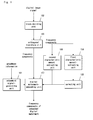
- Fig. 1 is a block diagram illustrating a digital watermark-embedding apparatus according to a first embodiment.
- the digital watermark-embedding apparatus comprises an embedment signal-generating unit 101, a block-diving unit 102, an orthogonal transform unit 103, a first characteristic amount-extracting unit 104, a selecting unit 105, and a second characteristic amount-extracting unit 106, and a digital watermark-embedding unit 107.
- the embedment signal-generating unit 101 generates, on the basis of embedment information, a signal to be embedded as a digital watermark.
- the block-dividing unit 102 divides a digital image signal into blocks that are formed by several pixels.
- the orthogonal transform unit 103 practices the orthogonal transformation of the blocks, thereby transforming the blocks into frequency components.
- the digital watermark-embedding unit 107 operates a value of at least one of the frequency components under a predetermined rule in accordance with the embedment signal from the embedment signal-generating unit 101. In consideration of detection, the value of at least one of the frequency components is operated in such a manner that amounts of variations in image within the blocks follow a predetermined pattern.
- the first characteristic amount-extracting unit 104 extracts a first characteristic amount on the basis of the frequency components.
- the selecting unit 105 selects a value of at least one of the frequency components on the basis of the extracted first characteristic amount.
- Fig. 2 is a flowchart illustrating how the digital watermark-embedding apparatus of Fig. 1 behaves.
- the embedment signal-generating unit 101 transforms embedment information into a binary bit string.
- the embedment signal-generating unit 101 transforms embedment information "715" into "0000001011001011" as expressed by the binary bit string.
- the block-dividing unit 102 divides a digital image signal into blocks formed by several pixels.
- the divided blocks are eight-by-eight pixels. Such blocks have a high affinity for a MPEG system.
- the orthogonal transform unit 103 performs orthogonal transformation of the blocks divided at step 202, thereby transforming the blocks into frequency components.
- the orthogonal transform unit 103 performs discrete cosine transform.
- the first characteristic amount-extracting unit 104 extracts a first characteristic amount from the frequency components transformed at step 203.
- the first characteristic amount is a total of specific frequency components that correspond to vertical and horizontal edges in an image within the blocks.
- each rectangle is a block that has experienced the discrete cosine transform at step 203.
- Each of the rectangles corresponds to one of the frequency components.
- a total of specific frequency components corresponding to the vertical edges are sum V, and that sum V is a total of absolute values of frequency components AC1, AC5, and AC6. Further assume that a total of specific frequency component corresponding to the horizontal edges is sumH, and that sumH is a total of absolute values of frequency components AC2, AC3, and AC9.
- sum V increases according to the strength of vertical edge components.
- sum H serves as an index of the strength of horizontal edge components.
- the selecting unit 105 select one or more frequency components on the basis of the first characteristic amount extracted at step 204.
- the frequency components are selected according to conditions as discussed below, where "R” is a predetermined threshold.
- conditions "c” frequency components “AC1” and “AC2” in Fig. 3 are selected when neither condition "a” nor condition "b” is applicable.
- the second characteristic amount-extracting unit 106 extracts a second characteristic amount from the digital image signal that is designated by the frequency components transformed at step 203.
- the second characteristic amount is a direct current component value plus a total of specific alternating current component values.
- the direct current component value is a value of frequency component "DC”
- the total of specific alternating current component values is a total of values of frequency components "AC1'' to "AC9”.
- the direct current component value "DC” designates a luminance average value of pixels in the blocks.
- the total of specific alternating current component values “AC1" to “AC9” increases in value according to the complexity of the block image, and thus serves as an index of complexity.
- the digital watermark-embedding unit 107 allocates a value of the bit string (generated at step 201 ) to each of the blocks, and then fluctuates values of one or more frequency components (selected at step 205) on the basis of the second characteristic amount extracted at step 206, thereby embedding digital watermarks into the frequency components.
- Fig. 4 shows how the bit string is allocated to each of the blocks. According to the present embodiment, as shown in Fig 4, a value of the bit string is repeatedly allocated to every other block.
- Fluctuation value "dX” is a positive value, and fluctuates with respect to a reference value in accordance with the direct current component value and the specific alternating current component values.
- Direct current component “DC” responds with the luminance average value. Accordingly, fluctuation value “dX” is desirably increased when the direct current component “DC” assumes a value at which visual characteristics of human beings are difficult to perceive variations, but fluctuation value “dX” is preferably reduced when the direct current component "DC” assumes a value at which the visual characteristics of the human beings are easy to perceive the variations.
- fluctuation value "dX" is desirably increased with an increase in total of the specific alternating current component values, but is desirably decreased with a decrease in total thereof.
- the digital watermark-embedding unit 107 provides such control over values of the frequency components selected at step 205.
- a pixel value on a pixel domain is minutely varied for each of the blocks.
- An amount of such a variation is represented by either a single pattern of a basic image in discrete cosine transform or a combination of several patterns.
- Figs. 5 to 7 illustrate variations in luminance values in the blocks having the digital watermarks embedded therein.
- Figs. 5 (a), (d), (g), (j), Figs. 6 (a), (d), (g), (j), Figs. 7 (a), (d), and (g) illustrate operations by which the digital watermarks are embedded.
- Figs. 5 (b), (e), (h), (k), Figs. 6 (b), (e), (h), (k), Figs. 7 (b), (e), and (h) illustrate distribution (specific patterns) of amounts of variations in luminance.
- Figs. 5 (a), (b), and (c) illustrates step 205 where condition "b" is fulfilled.
- Figs. 5 (d), (e), and (f) illustrates step 205 where condition "a” is met.
- Figs. 5 (g), (h), and (i) illustrates step 205 where condition "c" is met.
- Fig. 6 In addition to conditions “a”, “b”, and “c”, conditions as shown in Fig. 5 (j) to 5(l), Fig. 6, and Fig. 7 may be established to embed the digital watermarks into the frequency components.
- the specific patterns are regularly formed in such a manner that each region having a positive amount of image variations and each region having a negative amount of image variations are arranged in alternating sequence.
- Such specific patterns provide regular amounts of variations in luminance in response to the embedment of the digital watermarks. Such regularity facilitates detecting the digital watermarks, and further avoids missing the digital watermarks.
- the digital watermark-embedding apparatus selects one or more frequency components on the basis of the first characteristic amount that has been extracted from several frequency components, and then operates values of the selected one or more frequency components under a predetermined rule on the basis of the second characteristic amount. This feature suppresses degradation in image quality.
- the digital watermark-embedding apparatus requires a small amount of processing, and further operates values of one or more discrete cosine-transformed frequency components under a predetermined rule. This feature realizes digital watermark embedment having a high affinity for standard image-encoding represented by MPEG-encoding using discrete cosine transform.
- embedment information is transformed into a binary bit string at step 201.
- the present invention is not limited thereto.
- the digital image signal is divided at step 202 into the blocks formed by eight-by-eight pixels.
- the present invention is not limited thereto. Alternative blocks formed by four-by-four pixels may be employed.
- the discrete cosine transform is used as orthogonal transformation at step 203.
- the present invention is not limited thereto.
- any other transform may be used as long as it is orthogonal transformation.
- wavelet transform is acceptable.
- a total of specific frequency components corresponding to vertical and horizontal edges are used as the first characteristic amount at step 204.
- the present invention is not limited thereto. Alternatively, examples as illustrated in Figs. 5 to 7 or others may be used.
- a characteristic amount of an embedment block is extracted at step 204.
- characteristic amounts of blocks hereinafter called neighboring blocks
- one or more frequency components may be selected on the basis of the characteristic amount of the embedment block and the characteristic amounts of the neighboring blocks. This alternative step is effective in further inhibiting the degradation in image quality.
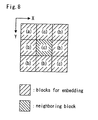
- Fig. 8 illustrates the embedment block and the neighboring blocks.
- symbols “a”, “b”, and “c” in the blocks denote conditions “a”, “b”, and “c”, respectively. This means that the block designed by, e.g., "a” is applicable to condition "a”.
- the embedment block is applicable to condition "c".
- the blocks applicable to condition "b" including the neighboring blocks are the greatest in number.
- the embedment block may alternatively be applicable to condition "b" as majority decision.
- frequency component "AC1" or “AC2”, or both of them are selected at step 205 on the basis of the first characteristic amount.
- the present invention is not limited thereto. It is desirable to select a frequency component such that the selected frequency component is closer to an image pattern illustrated by the first characteristic amount, when the selected frequency component is operated under a predetermined rule.
- direct current component value "DC” and a total of specific alternating current components “AC1" to “AC9” are used as the second characteristic amount at step 206.
- the present invention is not limited thereto.
- a characteristic amount adapted for visual characteristics of human beings may be extracted. Such an extracted characteristic amount effectively makes it difficult to perceive degradation in image quality.
- each value of a bit string is repeatedly allocated to every other block at step 207.
- the present invention is not limited thereto as long as a value of the bit string is allocated regularly to each block. In this case, all that is required is that the digital watermark-embedding apparatus and a digital watermark-detecting apparatus share such an allocation method.
- a fluctuated frequency component has value "Xwm” equal to “Xorg” + “dX” when an allocated value of the bit string is "1”, but the fluctuated frequency component has value "Xwm” equal to "Xorg” - “dX” when an allocated value of the bit string is "0".
- the value of the frequency component is operated under a predetermined rule to fluctuate the frequency component value.
- such a fluctuation is only an example of the operation under the predetermined rule.
- a digital image signal is divided into blocks, each of which is then subjected to orthogonal transformation. Thereafter, one or more frequency component values are operated in a predetermined manner, thereby embedding digital watermarks into the frequency components.
- an MPEG stream e.g., may be decoded to a level at which one or more frequency component values denote the MPEG stream, thereby embedding the digital watermarks into the frequency components. This alternative step provides similar beneficial effects.
- Fig. 9 illustrates an example in which the digital watermark-embedding apparatus of Fig. 1 is employed in a MPEG system of compressed image data.
- compressed image data of the MPEG system enters a separating unit 901, and the separating unit 901 separates the compressed image data.
- the separated image data is fed into a variable length-decoding unit 902 from the separating unit 901.
- the variable length-decoding unit 902 practices the variable length decoding of the separated compressed image, and then feeds DCT coefficient values (frequency components) into the digital watermark-embedding unit 107.
- the digital watermark-embedding unit 107 embeds digital watermarks into the DCT coefficient values.
- the DCT coefficient values having the digital watermarks embedded therein are sent to a variable length-encoding unit 903 from the digital watermark-embedding unit 107.
- the variable length-encoding unit 903 practices the variable length encoding of the DCT coefficient values having the digital watermarks embedded therein.
- the variable length-encoded DCT values are sent to a multiplexing unit 904.
- the embedment of the digital watermarks into the DCT coefficients (frequency components) eliminates a series of processes such as inverse DCT encoding, block combining, and encoding from a pixel domain, when compared with the prior art as illustrated in Fig. 18.
- a step of embedding the digital watermarks into MPEG system of compressed image data retained in, e.g., a video server, to deliver the embedded image data to a client provides advantages of a small number of processes, lighter processing loads on the video serve, and a good response to the client.
- An image of a pixel domain is obtained when an inverse quantization unit 905 inverse-quantizes the output of the variable length-decoding unit 902, and subsequently the inverse DCT unit 906 practices the inverse DCT of the inverse-quantized output. As illustrated by dashed lines in Fig. 9, the digital watermark embedment is allowable immediately after the inverse quantization.
- the present embodiment discuses a digital watermark-detecting apparatus operable to detect digital watermarks from an image signal having the digital watermarks embedded therein by the digital watermark-embedding apparatus as described in the previous embodiment.
- Fig. 10 is a block diagram illustrating a structure of the digital watermark-detecting apparatus according to the present embodiment.
- the digital watermark-detecting apparatus comprises an input unit 701, a block-dividing unit 702, a region-selecting unit 703, a calculating unit 704, a bit-detecting unit 705, a bit string-determining unit 706, and a detected bit string output unit 707, and an adjacent region-selecting unit 708
- the image signal enters the input unit 701.
- the block-dividing unit 701 divides the image signal from the input unit 701 into blocks that are formed by several pixels.
- the region-selecting unit 703 selects regions within the blocks.
- the calculating unit 704 performs predetermined calculation based on the selected regions.
- the bit-detecting unit 705 detects a value of an embedded bit on the basis of an output value from the calculating unit 704.
- the bit string-determining unit 706 determines an embedded bit string on the basis of the bit value detected by the bit-detecting unit 705.
- the detected bit string output unit 707 outputs the bit string determined by the bit string-determining unit 706.
- the adjacent region-selecting unit 708 selects neighboring regions adjacent to the regions selected by the region-selecting unit 703.
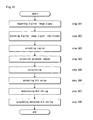
- Fig. 11 is a flowchart illustrating how the digital watermark-detecting apparatus of Fig. 10 behaves.
- an image signal having digital watermarks embedded therein enters the input unit 701.
- the block-dividing unit 702 divides the entered image signal into blocks that are formed by several pixels. Pursuant to the present embodiment, the divided blocks are formed by eight-by-eight pixels.
- the region-selecting unit 703 selects several regions from within the blocks divided at step 802. Each of the regions consists of one or more pixels.
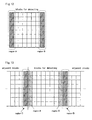
- Fig. 12 shows how the regions are selected from the blocks of eight-by-eight pixels according to the present steps.
- each rectangle corresponds to a single pixel.
- regions "A” and “B” are selected. In selecting the regions, it is desirable to select pixels that exhibit a high level of digital watermark embedment-caused variations.
- the above selection is made in such a manner as to correspond to frequency components fluctuated by the digital watermark-embedding apparatus according to the previous embodiment.
- the selected regions are varied according to the frequency components fluctuated in the digital watermark embedment.
- the adjacent region-selecting unit 708 selects several regions adjacent to the regions selected at step 803. Each of such adjacent regions consists of one or more pixels.
- Fig. 13 illustrates how the neighboring regions are selected according to the present steps.
- regions "C” and “D” contiguous to the regions "A” and “B", respectively, are selected.
- the region “C” and “D” it is desirable to select regions containing pixels that are closest in value to the pixels of the regions "A” and “B” selected at step 803, and that exhibit little variations in response to the digital watermark embedment.
- the region “C” has the pixels closest in value to those of region "A”
- the region “D” has the pixels closest in value to those of the regions "B”.
- the calculating unit 704 performs predetermined calculation of the regions selected at steps 803 and 804. Assume that the selected regions "A”, “B”, “C”, and “D” have the pixels summing up to sumA, sumB, sumC, and sumD, respectively. In this instance, an output value is equal to (sumA-sumC)-(sumB-sumD).
- "sumA-sumB” may be taken as an output value to detect digital watermarks.
- this alternative is likely to detect the digital watermarks with poor precision, depending upon how the pixels within the blocks are varied in value.
- sumC and sumD of the regions "C” and “D” having the pixels close in value to those of the regions "A” and “B” respectively are subtracted from sumA and sumB, respectively.
- the embedded bit is detected according to the output value in step 805 to determine that the embedded bit has values of "0" or "1". When the output value in step 805 is positive, then the bit value is "1". When the output value in step 805 is negative, then the bit value is "0".
- the bit string-determining unit 706 determines the embedded bit string on the basis of the bit values detected at step 806.
- the bit string-determining unit 706 arranges in sequence the values detected for each of the blocks at step 806, thereby forming a bit string.
- the digital watermark-embedding apparatus embeds the bit string repeatedly. Accordingly, the bit string circulating within an image frame is detectable. The values in the bit string are determined by majority decision in accordance with the repeatedly detected bit string.
- the detected bit string output unit 707 outputs the bit string determined at step 807.
- the digital watermark-embedding apparatus performs calculations after selecting a region having a high level of digital watermark embedment-caused variations and an adjacent region having pixels close in value to pixels of the former region, in which no digital watermark embodiment-caused variations occur in the adjacent region.
- only digital watermark embedment-caused variations are effectively extractable.
- a digital watermarking art immune to a block image and designed to detect digital watermarks with high precision is achievable.
- a total of pixel values within each of the regions are determined at step 805 to calculate differences in pixel value between the regions.
- an average of pixel values within each of the regions is acceptable.
- the pixel values may be weighted according to amounts of variations in pixels in response to the digital watermark embedment.
- the regions are selected from the present frame image where blocks to be detected are present.
- the regions may be selected in sequence of regeneration from the previous frame, the subsequent frame, or both of them. This alternative provides further pronounced detection of digital watermarks. In this instance, it is desirable to select, from the previous frame or subsequent frame, blocks nearest in image to the blocks to be detected.
- a digital watermark-embedding apparatus differs in only step 201 (see Fig. 2) from that according to the first embodiment.
- the embedment signal-generating unit 101 takes step 21. Therefore, the present embodiment discusses only an embedment signal-generating unit 101.
- the embedment signal-generating unit 101 selects a pseudo-random number sequence that corresponds to embedment information, with reference to a reference table in which the previously prepared embedment information is related to pseudo-random number sequences.
- the embedment signal-generating unit 101 generates an embedment signal from the selected pseudo-random number sequence. Each bit of the generated embedment signal is allocated to one of the blocks.
- the present embodiment employs a reference table having the pseudo-random number sequences related to a position and values of each bit that forms a binary bit string transformed from the embedment information.
- the embedment information is transformed into the binary bit string in a manner identical to the first embodiment.
- Fig. 14 (a) illustrates the binary bit string transformed from the embedment information and bit positions of the binary bit string.
- Fig. 14 (b) illustrates the reference table in which each of the pseudo-random number sequences is related to a corresponding bit position and values.
- the embedment signal-generating unit 101 selects the pseudo-random number sequences according to the reference table sequentially from the head of the bit string. For example, as seen from Fig. 14 (a), bit position ⁇ 0 ⁇ corresponds to a bit having value ⁇ 0 ⁇ . Accordingly, as illustrated in Fig. 14 (b), pseudo-random number ⁇ S000 ⁇ is selected. As a result, each bit of pseudo-random number ⁇ S000 ⁇ is allocated to one of the blocks.
- bit string of the embedment information is related to the pseudo-random number sequences to perform digital watermark embedment.
- the present embodiment uses the reference table having the pseudo-random number sequences related to the bit position and values of each bit that forms the binary bit string transformed from the embedment information.
- An alternative reference table may be used, in which each of the pseudo-random number sequences is related to a corresponding bit position and values for every several bits of the embedment information.
- the present invention is not limited to the reference table as already discussed. All that is required is that the digital watermark-embedding apparatus and the digital watermark-detecting apparatus may share the reference table.
- a fourth embodiment is now discussed with reference to the drawings.
- the present embodiment discusses a digital watermark-detecting apparatus operable to detect digital watermarks from an image signal having the digital watermarks embedded therein by the digital watermark-embedding apparatus according to the third embodiment.
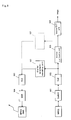
- Fig. 15 is a block diagram illustrating the digital watermark-detecting apparatus according to the present embodiment.
- the digital watermark-detecting apparatus comprises an input unit 701, a block-dividing unit 702, a region-selecting unit 703, a calculating unit 704, a sequence-recording unit 1201, a correlation value-calculating unit 1202, a threshold-setting unit 1203, a comparing unit 1204, a bit string-determining unit 706, a detected bit string output unit 707, and an adjacent region-selecting unit 708.
- the sequence-recording unit 1201 retains a reference table in which each piece of embedment information is related to a pseudo-random number sequence.
- the correlation value-calculating unit 1202 calculates values correlated between a sequence of output values calculated by the calculating unit 704 for each block and the pseudo-random number sequences included in the reference table, and then feeds the maximum of the obtained correlation values into the comparing unit 1204.
- the threshold-setting unit 1203 sets up a threshold of the correlation value.
- the comparing unit 1204 compares the maximum correlation value from the correlation value-calculating unit 1202 with the threshold from the threshold-setting unit 1203, thereby providing a pseudo-random number sequence met by results from the comparison.
- the pseudo-random number sequence is sent to the bit string-determining unit 706.
- the bit string-determining unit 706 determines a bit string to be embedded, on the basis of the pseudo-random number sequence from the comparing unit 1204 and the reference table.
- the detected bit string output unit 707 outputs the bit string determined by the bit string-determining unit 706.
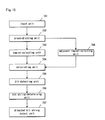
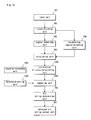
- Fig. 16 is a flowchart illustrating how the digital watermark-detecting apparatus of Fig. 15 behaves.
- an image signal having digital watermarks embedded therein enters the input unit 701.
- the block-dividing unit 702 divides the image signal into blocks that are formed by several pixels. Pursuant to the present embodiment, the divided blocks are formed by eight-by-eight pixels.
- the region-selecting unit 703 selects several regions from within the divided blocks.
- the several regions consist of one or more pixels. Since step 1303 is identical to step 803 (see Fig. 11) according to the second embodiment, descriptions related thereto are omitted.
- the adjacent region-selecting unit 708 selects several regions adjacent to the regions selected at step 1303.
- the adjacent regions consist of one or more pixels. Since step 1304 is identical to step 804 (see Fig. 11) according to the second embodiment, descriptions related thereto are omitted.
- step 1305 the calculating unit 704 performs predetermined calculation of the regions selected at steps 1303 and 1304. Since step 1305 is identical to step 805 (see Fig. 11) according to the second embodiment, descriptions related thereto are omitted.
- the sequence-recording unit 1201 records the same content as the reference table having the pseudo-random number sequence related to embedment information according to the third embodiment.
- the correlation value-calculating unit 1202 calculates values correlated between a sequence of output values calculated for each of the blocks at step 1305 and all of the pseudo-random number sequences in the reference table recorded by the sequence-recording unit 1201, and then determines the maximum from among the calculated correlation values.
- the correlation value-calculating unit 1202 feeds, into the comparing unit 1204, the maximum correlation value and one of the pseudo-random number sequences, which provides such a correlation.
- the correlation value-calculating unit 1202 determines values correlated between thirty-two pseudo-random number sequences ⁇ S000, S001 through S151 ⁇ and a sequence of output values calculated for each of the blocks, and then determines the maximum from among the determined correlation values.
- maximum correlation value SMAX is obtained from a correlation with pseudo-random number sequence ⁇ S000 ⁇
- maximum correlation value SMAX and pseudo-random number sequence ⁇ S000 ⁇ are sent to the comparing unit 1204.
- the threshold-setting unit 1203 sets up a threshold for the comparing unit 1204.
- the comparing unit 1204 compares the maximum correlation value with the threshold. When the correlation value is greater than the threshold, then a bit position corresponding to the pseudo-random number sequence that provides the maximum correlation value, and values of the bit position are sent to the bit string-determining unit 706. Referring to the reference table of Fig. 14 (b), bit position ⁇ 0 ⁇ corresponding to pseudo-random number sequence ⁇ S000 ⁇ , and value ⁇ 0 ⁇ of bit position ⁇ 0 ⁇ are sent to the bit string-determining unit 706. No processing is made when the maximum correlation value is less than the threshold.
- the comparing unit 1204 takes an exceptional step, not comparing the threshold with the correlation value. More specifically, only when maximum correlation value "S1" is related to other correlation values "Sn" under a certain condition (e.g., S1>Sn), then the comparing unit 1204 may determine a bit position corresponding to a pseudo-random number sequence that provides maximum correlation value "S1", and values of the bit position.
- the bit string-determining unit 706 retains the bit position and values thereof from the comparing unit 1204, and then forms a bit string when all bit positions of an embedded bit string and values of the bit positions are fully provided.
- the formed bit string is sent to the detected bit string output unit 707.
- the detected bit string output unit 707 outputs the bit string determined at step 1309.
- the digital watermark-detecting apparatus detects embedded digital watermarks on the basis of a correlation with a pseudo-random number sequence related to an embedment signal, and consequently provides higher-reliable detection when compared with a method of simply detecting a bit string.
- the digital watermark-embedding apparatus and digital watermark-detecting apparatus provide features achieved by a storage unit 1502 (ROM, RAM, hard disk, etc.) and a CPU 1501 (central processing unit).
- the storage unit 1502 is operable to contain a digital watermark-embedding program and a digital watermark-detecting program.
- the CPU 1501 is operable to execute such program data.
- the digital watermark-embedding program and digital watermark-detecting program are contained in a recording media 1505 such as a CD-ROM and a floppy disk, and are then loaded or installed into the storage unit 1502 from the recording medium 1505.
- the present invention selects one or more frequency components on the basis of a first characteristic amount extracted from several frequency components, and then operates values of the selected one or more frequency components under a predetermined rule. This feature suppresses degradation in image quality.
- the present invention extracts a second characteristic amount from several frequency components that has experienced orthogonal transform, and then embeds digital watermarks into the frequency components in accordance with the second characteristic amount. This feature further suppresses the degradation in image quality.
- the present invention requires a small amount of processing.
- the present invention operates, under a predetermined rule, values of one or more frequency components that have experienced discrete cosine transform. This feature realizes digital watermark embedment having a high affinity for standard image encoding represented by MPEG-encoding using the discrete cosine transform.
- the present invention performs calculations after selecting a region having a high level of digital watermark embedment-caused variations, and a neighboring region adjacent to the former region and close in pixel value to the former region, in which no digital watermark embedment-caused variations occur in the neighboring region.
- This feature operatively extracts only variations caused by digital watermark embedment, and realizes a digital-watermarking art having high-detective precision.
Landscapes
- Physics & Mathematics (AREA)
- General Physics & Mathematics (AREA)
- Engineering & Computer Science (AREA)
- Theoretical Computer Science (AREA)
- Editing Of Facsimile Originals (AREA)
- Image Processing (AREA)
Applications Claiming Priority (4)
| Application Number | Priority Date | Filing Date | Title |
|---|---|---|---|
| JP2002258525 | 2002-09-04 | ||
| JP2002258525 | 2002-09-04 | ||
| JP2002297288 | 2002-10-10 | ||
| JP2002297288 | 2002-10-10 |
Publications (2)
| Publication Number | Publication Date |
|---|---|
| EP1398732A2 true EP1398732A2 (de) | 2004-03-17 |
| EP1398732A3 EP1398732A3 (de) | 2006-09-27 |
Family
ID=31890558
Family Applications (1)
| Application Number | Title | Priority Date | Filing Date |
|---|---|---|---|
| EP03018784A Withdrawn EP1398732A3 (de) | 2002-09-04 | 2003-08-28 | Digitale Wasserzeicheneinbettung und -erkennung |
Country Status (3)
| Country | Link |
|---|---|
| US (1) | US7356700B2 (de) |
| EP (1) | EP1398732A3 (de) |
| CN (1) | CN1496100A (de) |
Cited By (2)
| Publication number | Priority date | Publication date | Assignee | Title |
|---|---|---|---|---|
| EP1589475A1 (de) * | 2004-04-21 | 2005-10-26 | Fraunhofer-Gesellschaft zur Förderung der angewandten Forschung e.V. | Verfahren zum Versehen von Bild- oder Videodaten mit einem digitalen Wasserzeichen |
| CN102034220A (zh) * | 2010-12-23 | 2011-04-27 | 武汉大学苏州研究院 | 一种基于数字水印的票据电子影像防篡改方法 |
Families Citing this family (28)
| Publication number | Priority date | Publication date | Assignee | Title |
|---|---|---|---|---|
| US7239981B2 (en) | 2002-07-26 | 2007-07-03 | Arbitron Inc. | Systems and methods for gathering audience measurement data |
| US8959016B2 (en) | 2002-09-27 | 2015-02-17 | The Nielsen Company (Us), Llc | Activating functions in processing devices using start codes embedded in audio |
| US9711153B2 (en) | 2002-09-27 | 2017-07-18 | The Nielsen Company (Us), Llc | Activating functions in processing devices using encoded audio and detecting audio signatures |
| AU2003234420A1 (en) | 2002-12-27 | 2004-07-29 | Nielsen Media Research, Inc. | Methods and apparatus for transcoding metadata |
| EP1690697A1 (de) * | 2005-02-15 | 2006-08-16 | Alpvision SA | Verfahren zum Applizieren einer optisch unsichtbaren Markierung auf einen Datenträger |
| EP1837875A1 (de) * | 2006-03-22 | 2007-09-26 | Deutsche Thomson-Brandt Gmbh | Verfahren und Vorrichtung zur Korrelierung zweier Datenteile |
| TWI335548B (en) * | 2007-08-24 | 2011-01-01 | Univ Nat Taiwan | Digital contents processing methods and systems, and machine readable medium thereof |
| CN101389027B (zh) * | 2008-09-28 | 2012-08-08 | 华为技术有限公司 | 水印嵌入方法、水印提取方法和装置及系统 |
| US8121830B2 (en) * | 2008-10-24 | 2012-02-21 | The Nielsen Company (Us), Llc | Methods and apparatus to extract data encoded in media content |
| JP2010124450A (ja) * | 2008-10-24 | 2010-06-03 | Canon Inc | 文書処理装置および文書処理方法 |
| US8359205B2 (en) | 2008-10-24 | 2013-01-22 | The Nielsen Company (Us), Llc | Methods and apparatus to perform audio watermarking and watermark detection and extraction |
| JP2010124451A (ja) * | 2008-10-24 | 2010-06-03 | Canon Inc | 文書処理装置および文書処理方法 |
| US9667365B2 (en) | 2008-10-24 | 2017-05-30 | The Nielsen Company (Us), Llc | Methods and apparatus to perform audio watermarking and watermark detection and extraction |
| JP2010103862A (ja) * | 2008-10-24 | 2010-05-06 | Canon Inc | 文書処理装置および文書処理方法 |
| US8508357B2 (en) | 2008-11-26 | 2013-08-13 | The Nielsen Company (Us), Llc | Methods and apparatus to encode and decode audio for shopper location and advertisement presentation tracking |
| CA2760677C (en) | 2009-05-01 | 2018-07-24 | David Henry Harkness | Methods, apparatus and articles of manufacture to provide secondary content in association with primary broadcast media content |
| JP5760438B2 (ja) * | 2010-12-28 | 2015-08-12 | 富士通株式会社 | 電子透かし埋め込み装置、電子透かし埋め込み方法及び電子透かし埋め込み用コンピュータプログラムならびに電子透かし検出装置 |
| US9380356B2 (en) | 2011-04-12 | 2016-06-28 | The Nielsen Company (Us), Llc | Methods and apparatus to generate a tag for media content |
| US9209978B2 (en) | 2012-05-15 | 2015-12-08 | The Nielsen Company (Us), Llc | Methods and apparatus to measure exposure to streaming media |
| US9210208B2 (en) | 2011-06-21 | 2015-12-08 | The Nielsen Company (Us), Llc | Monitoring streaming media content |
| US9282366B2 (en) | 2012-08-13 | 2016-03-08 | The Nielsen Company (Us), Llc | Methods and apparatus to communicate audience measurement information |
| US9313544B2 (en) | 2013-02-14 | 2016-04-12 | The Nielsen Company (Us), Llc | Methods and apparatus to measure exposure to streaming media |
| US9711152B2 (en) | 2013-07-31 | 2017-07-18 | The Nielsen Company (Us), Llc | Systems apparatus and methods for encoding/decoding persistent universal media codes to encoded audio |
| US20150039321A1 (en) | 2013-07-31 | 2015-02-05 | Arbitron Inc. | Apparatus, System and Method for Reading Codes From Digital Audio on a Processing Device |
| US9699499B2 (en) | 2014-04-30 | 2017-07-04 | The Nielsen Company (Us), Llc | Methods and apparatus to measure exposure to streaming media |
| US9762965B2 (en) | 2015-05-29 | 2017-09-12 | The Nielsen Company (Us), Llc | Methods and apparatus to measure exposure to streaming media |
| US10123031B2 (en) * | 2015-07-02 | 2018-11-06 | Cisco Technology, Inc. | MPEG-2 video watermarking technique |
| CN110766593B (zh) * | 2019-09-03 | 2023-05-09 | 杭州安存网络科技有限公司 | 用于图像的数字水印方法、装置、电子设备及计算机可读介质 |
Family Cites Families (9)
| Publication number | Priority date | Publication date | Assignee | Title |
|---|---|---|---|---|
| JP3106985B2 (ja) * | 1996-12-25 | 2000-11-06 | 日本電気株式会社 | 電子すかし挿入装置及び検出装置 |
| JPH1175166A (ja) | 1997-08-29 | 1999-03-16 | Sony Corp | 映像信号への付加情報の重畳方法および重畳装置 |
| JP4035257B2 (ja) * | 1998-04-10 | 2008-01-16 | キヤノン株式会社 | 画像処理装置、画像処理方法及びコンピュータ読み取り可能な記憶媒体 |
| JP2000175161A (ja) | 1998-12-01 | 2000-06-23 | Kdd Corp | 動画像に対する透かしデータ埋め込み装置および検出装置 |
| JP4178647B2 (ja) * | 1999-02-15 | 2008-11-12 | 松下電器産業株式会社 | デジタル情報埋込み・抽出装置および方法並びに当該方法を実行するためのプログラムを記録した記録媒体 |
| JP2001148776A (ja) * | 1999-11-18 | 2001-05-29 | Canon Inc | 画像処理装置及び方法及び記憶媒体 |
| JP3507743B2 (ja) * | 1999-12-22 | 2004-03-15 | インターナショナル・ビジネス・マシーンズ・コーポレーション | 圧縮オーディオデータへの電子透かし方法およびそのシステム |
| JP3614784B2 (ja) * | 2001-02-01 | 2005-01-26 | 松下電器産業株式会社 | 情報埋め込み装置、情報埋め込み方法、情報取り出し装置、および情報取り出し方法 |
| JP4208135B2 (ja) * | 2003-11-07 | 2009-01-14 | Kddi株式会社 | ドリフト補償方式 |
-
2003
- 2003-08-28 EP EP03018784A patent/EP1398732A3/de not_active Withdrawn
- 2003-09-02 CN CNA031556752A patent/CN1496100A/zh active Pending
- 2003-09-04 US US10/654,492 patent/US7356700B2/en not_active Expired - Fee Related
Cited By (3)
| Publication number | Priority date | Publication date | Assignee | Title |
|---|---|---|---|---|
| EP1589475A1 (de) * | 2004-04-21 | 2005-10-26 | Fraunhofer-Gesellschaft zur Förderung der angewandten Forschung e.V. | Verfahren zum Versehen von Bild- oder Videodaten mit einem digitalen Wasserzeichen |
| CN102034220A (zh) * | 2010-12-23 | 2011-04-27 | 武汉大学苏州研究院 | 一种基于数字水印的票据电子影像防篡改方法 |
| CN102034220B (zh) * | 2010-12-23 | 2012-12-26 | 武汉大学苏州研究院 | 一种基于数字水印的票据电子影像防篡改方法 |
Also Published As
| Publication number | Publication date |
|---|---|
| US7356700B2 (en) | 2008-04-08 |
| CN1496100A (zh) | 2004-05-12 |
| US20040093498A1 (en) | 2004-05-13 |
| EP1398732A3 (de) | 2006-09-27 |
Similar Documents
| Publication | Publication Date | Title |
|---|---|---|
| US7356700B2 (en) | Digital watermark-embedding apparatus and method, digital watermark-detecting apparatus and method, and recording medium | |
| KR100553469B1 (ko) | 전자 워터마크 데이터 삽입 장치 및 전자 워터마크 데이터 검출 장치 | |
| US6563936B2 (en) | Spatio-temporal channel for images employing a watermark and its complement | |
| EP1170938B1 (de) | Digitales Wasserzeichendateneinbettungsverfahren und Vorrichtung | |
| US6834345B2 (en) | Method for data preparation and watermark insertion | |
| US7415128B2 (en) | Method and apparatus for providing an asymmetric watermark carrier | |
| EP1164543B1 (de) | Einbettung/Extrahierung von digitaler Information | |
| US8908905B2 (en) | Device and method for embedding watermarks in contents and for detecting embedded watermarks | |
| US7287163B2 (en) | Digital watermark embedding apparatus and method, and computer program | |
| US9773290B2 (en) | Content watermarking | |
| US20020097891A1 (en) | Electronic watermarking data insertion/detection device | |
| JP2003529297A (ja) | エンコードされたデジタルビットストリームでデータを埋め込むための方法及び装置 | |
| JPH11355736A (ja) | 画像処理装置、画像処理方法及びコンピュ―タ読み取り可能な記憶媒体 | |
| JP2008522522A (ja) | ビデオフィンガープリントのシステム、方法、及びコンピュータプログラム製品 | |
| JP3353691B2 (ja) | デジタルデータのエンコードシステム及び電子透かしデータ挿入方法並びに制御プログラムを格納した記憶媒体 | |
| US7095870B2 (en) | Electronic watermark embedding apparatus and method and a format conversion device having a watermark embedding function | |
| Ye et al. | A new adaptive watermarking for real-time MPEG videos | |
| JP2003134329A (ja) | 電子透かし埋め込み処理装置、および電子透かし埋め込み処理方法、並びにコンピュータ・プログラム | |
| KR20010074604A (ko) | 엠피이지 비디오 스트림상의 블록 유닛 양자화를 이용한실시간 동영상 워터마크 삽입방법 및 검출방법 | |
| JP4223353B2 (ja) | 電子透かし埋め込み装置、電子透かし検出装置及びそれらの方法並びに記録媒体 | |
| JP2002320085A (ja) | 電子透かし埋め込み処理装置、電子透かし検出処理装置、および電子透かし埋め込み処理方法、電子透かし検出処理方法、並びにプログラム記憶媒体、プログラム | |
| JP4121907B2 (ja) | データ処理装置及び方法 | |
| JP2001111973A (ja) | 動画像電子透かし装置 | |
| US7187782B2 (en) | Digital watermark-embedding apparatus, digital watermark-embedding method, and recording medium having recoded therein a program for performing the digital watermark-embedding method | |
| Tsai et al. | Adaptive multilayer reversible data hiding using the mean-to-pixel difference modification |
Legal Events
| Date | Code | Title | Description |
|---|---|---|---|
| PUAI | Public reference made under article 153(3) epc to a published international application that has entered the european phase |
Free format text: ORIGINAL CODE: 0009012 |
|
| AK | Designated contracting states |
Kind code of ref document: A2 Designated state(s): AT BE BG CH CY CZ DE DK EE ES FI FR GB GR HU IE IT LI LU MC NL PT RO SE SI SK TR |
|
| AX | Request for extension of the european patent |
Extension state: AL LT LV MK |
|
| PUAL | Search report despatched |
Free format text: ORIGINAL CODE: 0009013 |
|
| AK | Designated contracting states |
Kind code of ref document: A3 Designated state(s): AT BE BG CH CY CZ DE DK EE ES FI FR GB GR HU IE IT LI LU MC NL PT RO SE SI SK TR |
|
| AX | Request for extension of the european patent |
Extension state: AL LT LV MK |
|
| 17P | Request for examination filed |
Effective date: 20061222 |
|
| 17Q | First examination report despatched |
Effective date: 20070124 |
|
| AKX | Designation fees paid |
Designated state(s): DE FR GB |
|
| RAP1 | Party data changed (applicant data changed or rights of an application transferred) |
Owner name: PANASONIC CORPORATION |
|
| GRAP | Despatch of communication of intention to grant a patent |
Free format text: ORIGINAL CODE: EPIDOSNIGR1 |
|
| STAA | Information on the status of an ep patent application or granted ep patent |
Free format text: STATUS: THE APPLICATION IS DEEMED TO BE WITHDRAWN |
|
| 18D | Application deemed to be withdrawn |
Effective date: 20091117 |