EP1398630A1 - Méthode pour déterminer l'indice de résistivité en fonction de la saturation en eau, de certaines roches de porosité complexe - Google Patents
Méthode pour déterminer l'indice de résistivité en fonction de la saturation en eau, de certaines roches de porosité complexe Download PDFInfo
- Publication number
- EP1398630A1 EP1398630A1 EP03291965A EP03291965A EP1398630A1 EP 1398630 A1 EP1398630 A1 EP 1398630A1 EP 03291965 A EP03291965 A EP 03291965A EP 03291965 A EP03291965 A EP 03291965A EP 1398630 A1 EP1398630 A1 EP 1398630A1
- Authority
- EP
- European Patent Office
- Prior art keywords
- sample
- network
- pores
- saturation
- family
- Prior art date
- Legal status (The legal status is an assumption and is not a legal conclusion. Google has not performed a legal analysis and makes no representation as to the accuracy of the status listed.)
- Granted
Links
- 238000000034 method Methods 0.000 title claims abstract description 26
- XLYOFNOQVPJJNP-UHFFFAOYSA-N water Substances O XLYOFNOQVPJJNP-UHFFFAOYSA-N 0.000 title claims abstract description 23
- 239000011435 rock Substances 0.000 title claims abstract description 12
- 239000011148 porous material Substances 0.000 claims abstract description 75
- 239000000523 sample Substances 0.000 claims abstract description 26
- 238000009826 distribution Methods 0.000 claims abstract description 11
- 239000012530 fluid Substances 0.000 claims abstract description 9
- 239000013074 reference sample Substances 0.000 claims abstract description 5
- 238000002347 injection Methods 0.000 claims description 7
- 239000007924 injection Substances 0.000 claims description 7
- QSHDDOUJBYECFT-UHFFFAOYSA-N mercury Chemical compound [Hg] QSHDDOUJBYECFT-UHFFFAOYSA-N 0.000 claims description 7
- 229910052753 mercury Inorganic materials 0.000 claims description 6
- 238000000679 relaxometry Methods 0.000 claims description 5
- 238000007796 conventional method Methods 0.000 abstract description 2
- 239000003921 oil Substances 0.000 description 21
- 150000004649 carbonic acid derivatives Chemical class 0.000 description 12
- 238000005259 measurement Methods 0.000 description 8
- BVKZGUZCCUSVTD-UHFFFAOYSA-L Carbonate Chemical compound [O-]C([O-])=O BVKZGUZCCUSVTD-UHFFFAOYSA-L 0.000 description 7
- 235000019738 Limestone Nutrition 0.000 description 7
- 230000000694 effects Effects 0.000 description 7
- 239000006028 limestone Substances 0.000 description 7
- 238000002474 experimental method Methods 0.000 description 6
- 230000009545 invasion Effects 0.000 description 6
- 239000004927 clay Substances 0.000 description 3
- 238000006073 displacement reaction Methods 0.000 description 3
- 230000008569 process Effects 0.000 description 3
- 241001073762 Petricola Species 0.000 description 2
- VYPSYNLAJGMNEJ-UHFFFAOYSA-N Silicium dioxide Chemical compound O=[Si]=O VYPSYNLAJGMNEJ-UHFFFAOYSA-N 0.000 description 2
- 230000032683 aging Effects 0.000 description 2
- 230000015572 biosynthetic process Effects 0.000 description 2
- 239000012267 brine Substances 0.000 description 2
- 238000013213 extrapolation Methods 0.000 description 2
- 229920006395 saturated elastomer Polymers 0.000 description 2
- HPALAKNZSZLMCH-UHFFFAOYSA-M sodium;chloride;hydrate Chemical compound O.[Na+].[Cl-] HPALAKNZSZLMCH-UHFFFAOYSA-M 0.000 description 2
- 239000004215 Carbon black (E152) Substances 0.000 description 1
- 244000000626 Daucus carota Species 0.000 description 1
- 235000002767 Daucus carota Nutrition 0.000 description 1
- 241000124784 Daucus pumilus Species 0.000 description 1
- 239000008346 aqueous phase Substances 0.000 description 1
- 230000002902 bimodal effect Effects 0.000 description 1
- 238000004140 cleaning Methods 0.000 description 1
- 239000010779 crude oil Substances 0.000 description 1
- 229940082150 encore Drugs 0.000 description 1
- 238000011156 evaluation Methods 0.000 description 1
- 238000009472 formulation Methods 0.000 description 1
- 229930195733 hydrocarbon Natural products 0.000 description 1
- 150000002430 hydrocarbons Chemical class 0.000 description 1
- 238000002847 impedance measurement Methods 0.000 description 1
- 239000002075 main ingredient Substances 0.000 description 1
- 238000004519 manufacturing process Methods 0.000 description 1
- 230000007246 mechanism Effects 0.000 description 1
- 239000000203 mixture Substances 0.000 description 1
- 238000012986 modification Methods 0.000 description 1
- 230000004048 modification Effects 0.000 description 1
- 238000005325 percolation Methods 0.000 description 1
- 230000035699 permeability Effects 0.000 description 1
- 230000008261 resistance mechanism Effects 0.000 description 1
- 239000013049 sediment Substances 0.000 description 1
- 230000035945 sensitivity Effects 0.000 description 1
- 239000000377 silicon dioxide Substances 0.000 description 1
- 239000002904 solvent Substances 0.000 description 1
- 230000006641 stabilisation Effects 0.000 description 1
- 238000011105 stabilization Methods 0.000 description 1
- 239000000126 substance Substances 0.000 description 1
Images


Classifications
-
- G—PHYSICS
- G01—MEASURING; TESTING
- G01N—INVESTIGATING OR ANALYSING MATERIALS BY DETERMINING THEIR CHEMICAL OR PHYSICAL PROPERTIES
- G01N33/00—Investigating or analysing materials by specific methods not covered by groups G01N1/00 - G01N31/00
- G01N33/24—Earth materials
- G01N33/241—Earth materials for hydrocarbon content
-
- G—PHYSICS
- G01—MEASURING; TESTING
- G01V—GEOPHYSICS; GRAVITATIONAL MEASUREMENTS; DETECTING MASSES OR OBJECTS; TAGS
- G01V3/00—Electric or magnetic prospecting or detecting; Measuring magnetic field characteristics of the earth, e.g. declination, deviation
- G01V3/18—Electric or magnetic prospecting or detecting; Measuring magnetic field characteristics of the earth, e.g. declination, deviation specially adapted for well-logging
- G01V3/32—Electric or magnetic prospecting or detecting; Measuring magnetic field characteristics of the earth, e.g. declination, deviation specially adapted for well-logging operating with electron or nuclear magnetic resonance
-
- G—PHYSICS
- G01—MEASURING; TESTING
- G01N—INVESTIGATING OR ANALYSING MATERIALS BY DETERMINING THEIR CHEMICAL OR PHYSICAL PROPERTIES
- G01N27/00—Investigating or analysing materials by the use of electric, electrochemical, or magnetic means
- G01N27/02—Investigating or analysing materials by the use of electric, electrochemical, or magnetic means by investigating impedance
- G01N27/04—Investigating or analysing materials by the use of electric, electrochemical, or magnetic means by investigating impedance by investigating resistance
- G01N27/041—Investigating or analysing materials by the use of electric, electrochemical, or magnetic means by investigating impedance by investigating resistance of a solid body
-
- Y—GENERAL TAGGING OF NEW TECHNOLOGICAL DEVELOPMENTS; GENERAL TAGGING OF CROSS-SECTIONAL TECHNOLOGIES SPANNING OVER SEVERAL SECTIONS OF THE IPC; TECHNICAL SUBJECTS COVERED BY FORMER USPC CROSS-REFERENCE ART COLLECTIONS [XRACs] AND DIGESTS
- Y02—TECHNOLOGIES OR APPLICATIONS FOR MITIGATION OR ADAPTATION AGAINST CLIMATE CHANGE
- Y02A—TECHNOLOGIES FOR ADAPTATION TO CLIMATE CHANGE
- Y02A90/00—Technologies having an indirect contribution to adaptation to climate change
- Y02A90/30—Assessment of water resources
Definitions
- the present invention relates to a method for determining the resistivity index RI as a function of the water saturation of certain rocks of complex porosity.
- the method according to the invention finds applications in particular in the field the exploitation of hydrocarbon deposits.
- Microporosity can also be the cause of the low values of n measured (typically 1.45). It was also observed that n can increase considerably under certain conditions, and that there would be a link between the RI (Sw) curve and the capillary pressure curve. The increase in the values of n is also a known effect of wettability, which tends to favor the discontinuity of the aqueous phase and thus to increase the resistivity with respect to wettability with water. The effect of wettability can cause either a sudden increase in n, or a high n value without discontinuity. Confusion is therefore possible.
- a first mode of implementation suitable for samples comprising two networks of pores it is determined from the reference sample, the values of the coefficients connecting the total conductivity of the sample to the conductivity of the first and second networks of pores and with respective water saturations of the two networks, the resistivity index being calculated from the respective volume fractions of the two pore networks and the value of the average saturation from which the network with the smallest pores, is invaded by the non-conductive fluid.
- a second mode of implementation suitable for samples comprising a third network of pores it is determined from the sample of reference, the values of the coefficients connecting the total conductivity of the sample to conductivity of the first and second pore networks and at the respective saturations in water from the first two networks, the resistivity index being calculated from the fractions respective volumes of the three pore networks, from the value of the average saturation to from which the network among the first two pore networks which has the smallest pore is invaded by the non-conductive fluid, and from the value of the average saturation to from which the network having the largest pores among the first two networks of pores, is invaded by the non-conductive fluid.
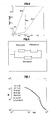
- the variations in the resistivity index obtained by application of the method best fit the experimental curves, the examples of which are illustrated in Fig. 1.
- the method is based on a powerful experimental technique to measure a continuous resistivity index curve instead of the conventional technique which describes the curve RI only by a limited number of points at capillary balance.
- the first is a sample of carbonate from deposit from the Middle East classified as a "packstone". It has been cleaned different solvents at high temperature before taking the measurements. AT ambient conditions, the experiment was carried out with refined oil and brine synthetic tank. The experiment carried out in deposit conditions was line with degassed reservoir oil filtered at tank pressure. After cleaning, the wettability of the sample is characterized by moderate to water and, after aging, by high oil wettability. The two others samples are outcrop carbonates (wettable with water).
- the porosity of the Brauvillier limestone (BL) is essentially intergranular and due to the cortex of oolite.
- the porosity of Estaillade limestone is both inter and intragranular. The populations of pores are separated by a factor of at least 10.
- the resistivity index of the samples is then measured.
- FRIM resistivity index
- a forced oil-water displacement is carried out on a small carrot 2.5 cm long and 4 cm in diameter for example.
- This displacement is very close a semipermeable wall displacement process, except that the capillary balance is not necessary.
- At ambient conditions only two or three pressure stages are used. Under deposit conditions, when using dead or crude oil, last each pressure stage the time necessary to obtain stabilization of the wettability at a given saturation. Drainage takes place in approximately two to three weeks, which typically corresponds to the kinetics of the processes chemicals related to aging.
- the simplicity of this method is due to the fact that it is enough record and report average saturation and resistance in real time to obtain a continuous resistivity index curve free of any artifact.
- the key point lies in the fact that the radial geometry of the electrodes makes it possible to examine the entire sample volume and compensate for the non-uniform saturation profile that appears in the absence of capillary balance.
- the objective is to explain the deflection of the RI curves with low saturation (type I, figure 1).
- the double porosity model considered here is essentially very close to those proposed for clay sands, where the clays present on the surface of the pores constitute a parallel path for the current.
- the two main ingredients in our model are the description of the invasion of pore networks being drained, and the description of the electrical arrangement of two different pore populations.
- the first network 1 (macropores for example) represents the major part of the pore volume, while the second network 2 (micropores) represents only a small fraction of it, which is not necessarily greater than the percolation thresholds.
- Equations 7 and 8 are essentially similar to the formulas used for clay sands, except that we introduce a second exponent n 2 which characterizes the second network.
- the parameters of the model were adjusted in order to correspond to the experimental curve RI measured on the RC sample.
- ni deposit conditions
- ni deposit conditions
- Equation 16 the use of the 3 parameters n 1 , n 2 and C is sufficient to describe the data precisely using equation 16.
- the meaning of C is approximately the same as ⁇ and may depend of the temperature.
- the formulation given in equation 16 can be used to describe standard experiments performed at capillary equilibrium for which there is only a limited number of points.
- TPC Triple porosity conductivity model
- the resistivity index can be calculated from equations 12 to 14. For the measured values of f 1 , f 2 and f 3 , it is necessary to adjust n 1 , n 2 , ⁇ 1 and ⁇ 2 to the experimental data. As in the DPC model, we expect to find ⁇ 1 on the order of f 2 / f 1 and ⁇ 2 on the order of f 3 / f 1 .
Landscapes
- Life Sciences & Earth Sciences (AREA)
- Engineering & Computer Science (AREA)
- Physics & Mathematics (AREA)
- Remote Sensing (AREA)
- Environmental & Geological Engineering (AREA)
- General Life Sciences & Earth Sciences (AREA)
- Health & Medical Sciences (AREA)
- Chemical & Material Sciences (AREA)
- General Physics & Mathematics (AREA)
- Geology (AREA)
- Biochemistry (AREA)
- Analytical Chemistry (AREA)
- Medicinal Chemistry (AREA)
- General Health & Medical Sciences (AREA)
- Food Science & Technology (AREA)
- Immunology (AREA)
- Pathology (AREA)
- High Energy & Nuclear Physics (AREA)
- Geophysics (AREA)
- Investigating Or Analyzing Materials By The Use Of Electric Means (AREA)
- Developing Agents For Electrophotography (AREA)
- Measurement Of Resistance Or Impedance (AREA)
Abstract
Description
- Bouvier L. et al, Reconciliation of Log and Laboratory Derived Irreductible Water Saturation in a Double Porosity reservoir, Advances in Core Evaluation, edited by Worthington and Longeron, Gordon and Breach Science Publishers ;
- Dixon J.R. et al (1990), The Effect of Bimodal pore Size Distribution on Electrical Properties of some Middle Eastern Limestone, Soc. Petr. Eng. 20601, 7th SPE Middle Eastern Oil Show, Bahrain, pp.743-750;
- Fleury M. (1998), "FRIM : a Fast Resistivity Index Measurement Method", Proceedings of the International Symposium of the SZociety of the Core Analysts, Den Hague ;
- Fleury M. et al (2000) "Frequecncy Effect on Resistivity Index Curves Using a New Method", Proceedings of the 41st Annual SPWLA Symposium, Dallas;
- Moore C.H., (2001) "Carbonate réservoirs, Porosity Evaluation and Diagenesis in a Séquence Stratigraphic Framework", Developments in Sedimentology 55, Elsevier Editions ;
- Petricola M.J.C. et al, (1995), "Effect of Microporosity in Carbonates: Introduction of a Versatile Saturation Equation", Soc. Petr. Eng. 29841, SPE Middle Eastern Oil Show, Bahrain, pp.607-615 ;
- Sen P.N. et al (1997), "Resistivity of Partially Saturated Rocks with Microporosity", Geophysics, Vol.62, N°2, pp. 415-425.
- type I : peut être typique de carbonates provenant de la formation Thamama,
- type II : se redressant à une saturation intermédiaire et s'aplatissant à faible saturation (la présente étude),
- type III: pente unique à faible saturation, extrapolation à Sw=1 au-dessus de Ir=1, et
- type IV: typique de systèmes mouillables à l'huile, valeurs élevées de n pouvant augmenter encore à faible saturation. Ceci est également valable pour les clastes.
- pour chaque échantillon de la famille comprenant au moins un premier et un deuxième réseaux de pores, on détermine la fraction volumique occupée par chaque réseau de pores, par application aux différents échantillons d'une technique de relaxométrie de type RMN ;
- pour chaque échantillon de la famille, on mesure par injection de mercure la distribution des seuils de pores dans les différents réseaux de pores ;
- on détermine expérimentalement sur un échantillon au moins de la famille servant de référence, les valeurs de coefficients reliant la variation de sa résistivité électrique en fonction de sa saturation en eau ; et
- on détermine l'indice de résistivité (RI) de tous les échantillons de la famille en se basant sur la variation de paramètres décrivant l'agencement du réseau poreux et en utilisant les valeurs des coefficients mesurés sur l'échantillon de référence.
- la figure 1 montre une représentation schématique en coordonnées logarithmiques de différents types de courbes RI en fonction de la saturation en eau Sw observées expérimentalement; les courbes I à III sont dus à la structure poreuse, la courbe IV est typique des effets de la mouillabilité et n'est pas spécifique aux carbonates ;
- la figure 2 montre une distribution des tailles de pores de trois carbonates étudiés : (carbonate de gisement, calcaire d'Estaillade et calcaire de Brauvillier) obtenue par RMN; les chiffres indiquent la fraction volumique de pore à gauche du segment vertical ;
- les figures 3a, 3b montrent la sensibilité du modèle à deux réseaux de pores (DPC) à la saturation Sc à laquelle les micropores sont envahis par l'huile (3a) et à α, rapport de conductivité initiale des deux populations de pores (3b) ;
- les figures 4a, 4b montrent l'application du modèle DPC à l'échantillon RC à la température ambiante (4a) et dans les conditions de gisement avec de l'huile morte (4b); la courbe expérimentale est en traits fins et le modèle en trait gras; les paramètres n1, n2 et α sont ajustés, f1 et Sc sont mesurés ;
- la figure 5 montre un scénario d'invasion dans le modèle à trois réseaux de pores (TPC) ;
- la figure 6 montre un agencement électrique modélisant les trois réseaux dans le modèle TPC;
- la figure 7 montre une courbe RI mesurée (trait fin) et modèle (trait gras) pour l'échantillon EL (calcaire d'Estaillade);
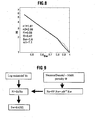
- la figure 8 montre une courbe RI mesurée (trait fin) et modèle (trait gras) pour l'échantillon BL (calcaire de Brauvillier) ; et
- la figure 9 montre une séquence de calibrage simplifié pour les diagraphies de résistivité ; pour les roches de type non-Archie, Sw(RI) est nécessaire ; les données de laboratoire fournissent généralement la relation RI(Sw).
- de mesures expérimentales effectuées sur chaque échantillon de la famille, donnant le nombre de réseaux de pores de tailles différentes et la fraction volumique occupée par chaque réseau de pores ainsi que la distribution des seuils de pores pour chacun d'eux; et
- d'une mesure expérimentale faite sur un seul échantillon de la famille, servant de référence, de la variation de sa résistivité électrique en fonction de sa saturation en eau (Sw).
Claims (3)
- Méthode pour déterminer les variations de l'indice de résistivité (RI) d'une famille d'échantillons de roche à structure poreuse complexe en fonction de la saturation en eau (Sw), en présence d'un fluide non conducteur, comportant les étapes suivantes :pour chaque échantillon de la famille comprenant au moins un premier et un deuxième réseau de pores, on détermine la fraction volumique (f1, f2) occupée par chaque réseau de pores, par application aux différents échantillons d'une technique de relaxométrie de type RMN;pour chaque échantillon de la famille, on mesure par injection de mercure la distribution des seuils de pores donnant accès aux différents réseaux de pores ;on détermine expérimentalement sur un échantillon au moins de la famille servant de référence, les valeurs de coefficients (n1, n2) reliant la variation de sa résistivité électrique en fonction de sa saturation en eau (Sw) ; eton détermine l'indice de résistivité (RI) de tous les échantillons de la famille en se basant sur la variation de paramètres décrivant l'agencement du réseau poreux (f1, f2, Sc, Sm) et en utilisant les valeurs des dits coefficients mesurés sur l'échantillon de référence.
- Méthode selon la revendication 1, caractérisée en ce que l'on détermine à partir de l'échantillon de référence, les valeurs des coefficients (n1, n2) reliant la conductivité totale (Ct) de l'échantillon aux conductivité (C1, C2) des premier et deuxième réseaux de pores et aux saturations respectives en eau (SW1, SW2) des deux réseaux, l'indice de résistivité étant calculé à partir des fractions volumiques respectives (f1, f2) des deux réseaux de pores et de la valeur de la saturation moyenne (Sc) à partir de laquelle le réseau ayant les pores les plus petits, est envahi par le fluide non conducteur.
- Méthode selon la revendication 1, caractérisée en ce que pour un échantillon comprenant un troisième réseau de pores, on détermine à partir de l'échantillon de référence, les valeurs des coefficients (n1, n2) reliant la conductivité totale (Ct) de l'échantillon aux conductivité (C1, C2) des premier et deuxième réseaux de pores et aux saturations respectives en eau (SW1, SW2) des deux premiers réseaux, l'indice de résistivité étant calculé à partir des fractions volumiques respectives (f1, f2, f3) des trois réseaux de pores, de la valeur de la saturation moyenne (Sc) à partir de laquelle le réseau qui a les plus petits pores parmi les deux premiers réseaux de pores, est envahi par le fluide non conducteur, et de la valeur (Sm) à partir de laquelle le réseau ayant les plus grands pores, parmi les deux premiers réseaux de pores, est envahi par le fluide non conducteur.
Applications Claiming Priority (2)
| Application Number | Priority Date | Filing Date | Title |
|---|---|---|---|
| FR0211282A FR2844360B1 (fr) | 2002-09-11 | 2002-09-11 | Methode pour determiner l'indice de resistivite en fonction de la saturation en eau, de certaines roches de porosite complexe |
| FR0211282 | 2002-09-11 |
Publications (2)
| Publication Number | Publication Date |
|---|---|
| EP1398630A1 true EP1398630A1 (fr) | 2004-03-17 |
| EP1398630B1 EP1398630B1 (fr) | 2006-03-22 |
Family
ID=29226268
Family Applications (1)
| Application Number | Title | Priority Date | Filing Date |
|---|---|---|---|
| EP03291965A Expired - Lifetime EP1398630B1 (fr) | 2002-09-11 | 2003-08-06 | Méthode pour déterminer l'indice de résistivité en fonction de la saturation en eau, de certaines roches de porosité complexe |
Country Status (5)
| Country | Link |
|---|---|
| US (1) | US6879154B2 (fr) |
| EP (1) | EP1398630B1 (fr) |
| DE (1) | DE60304138T2 (fr) |
| FR (1) | FR2844360B1 (fr) |
| NO (1) | NO20033998L (fr) |
Cited By (6)
| Publication number | Priority date | Publication date | Assignee | Title |
|---|---|---|---|---|
| EP2034308A1 (fr) * | 2007-09-07 | 2009-03-11 | Ifp | Méthode de mesure rapide de la saturation et de la résistivité d'un milieu poreux |
| CN103233730A (zh) * | 2013-05-02 | 2013-08-07 | 中国石油大学(华东) | 一种岩心驱替过程中混合地层水电阻率的实验测量方法 |
| CN103225506B (zh) * | 2013-04-19 | 2015-06-03 | 中国石油大学(华东) | 三组分自动混联导电饱和度模型的建立方法 |
| CN107132250A (zh) * | 2017-05-04 | 2017-09-05 | 河南理工大学 | 一种不同含水饱和度煤体复电性频散特征的测量方法 |
| CN112986091A (zh) * | 2021-02-02 | 2021-06-18 | 东北石油大学 | 基于电阻率测试的层理缝发育页岩的含油饱和度评价方法 |
| US20250216311A1 (en) * | 2024-01-02 | 2025-07-03 | Saudi Arabian Oil Company | Core flooding for electrically improved oil recovery study |
Families Citing this family (10)
| Publication number | Priority date | Publication date | Assignee | Title |
|---|---|---|---|---|
| US8005619B2 (en) | 2008-04-11 | 2011-08-23 | Schlumberger Technology Corporation | Method of determining reservoir parameters |
| CN101929973B (zh) * | 2009-06-22 | 2012-10-17 | 中国石油天然气股份有限公司 | 裂缝储层含油气饱和度定量计算方法 |
| CN102914629B (zh) * | 2011-08-06 | 2014-12-24 | 中国科学院研究生院 | 在区域尺度上确定含碎石土壤持水性的空间变异的方法 |
| CN104122593B (zh) * | 2013-04-26 | 2016-10-19 | 邓友明 | 一种对勘探测井的电容率频散测量方法和应用方法 |
| CN103233726B (zh) * | 2013-05-02 | 2014-10-15 | 中国石油大学(华东) | 一种水淹层饱和度、产水率测井评价模型的实验刻度方法 |
| CN103439748B (zh) * | 2013-08-26 | 2017-02-15 | 中国石油天然气集团公司 | 探测地层的方法、计算地层含油气饱和度的方法及复合电极和探测器 |
| CN106093350B (zh) * | 2016-08-10 | 2018-05-04 | 中国石油天然气股份有限公司 | 确定非均质碳酸盐岩储层饱和度指数的方法 |
| CN112858397B (zh) * | 2021-01-11 | 2022-09-06 | 中国海洋石油集团有限公司 | 一种地层流体中原油饱和度的测量方法 |
| CN116449102B (zh) * | 2023-03-14 | 2026-05-12 | 中国石油大学(北京) | 一种岩石电阻率的函数描述方法 |
| CN116084929B (zh) * | 2023-04-10 | 2023-06-16 | 西北大学 | 一种油水界面确定方法 |
Citations (1)
| Publication number | Priority date | Publication date | Assignee | Title |
|---|---|---|---|---|
| EP0974839A1 (fr) * | 1998-07-24 | 2000-01-26 | Institut Francais Du Petrole | Méthode de mesure rapide de l'indice de résistivité d'échantillons solides tels que des roches |
Family Cites Families (7)
| Publication number | Priority date | Publication date | Assignee | Title |
|---|---|---|---|---|
| US4211106A (en) * | 1978-09-20 | 1980-07-08 | Shell Oil Company | Estimates of permeability from capillary pressure measurements |
| US4525544A (en) * | 1982-04-12 | 1985-06-25 | The Dow Chemical Company | Vinyl ester resin composition |
| US4648261A (en) * | 1985-11-12 | 1987-03-10 | Exxon Production Research Co. | Method for determining physical properties of a porous sample using capillary pressure measurement |
| US4752882A (en) * | 1986-05-05 | 1988-06-21 | Mobil Oil Corporation | Method for determining the effective water saturation in a low-resistivity hydrocarbon-bearing rock formation based upon rock matrix conductance |
| US4926113A (en) * | 1989-01-26 | 1990-05-15 | Iowa State University Research Foundation, Inc. | Means and method for conductometric phase transition porosimetry |
| US6366087B1 (en) * | 1998-10-30 | 2002-04-02 | George Richard Coates | NMR logging apparatus and methods for fluid typing |
| US6484102B1 (en) * | 2000-08-24 | 2002-11-19 | Digital Formation Inc. | System for evaluating fluid distributions of subsurface reservoirs |
-
2002
- 2002-09-11 FR FR0211282A patent/FR2844360B1/fr not_active Expired - Fee Related
-
2003
- 2003-08-06 EP EP03291965A patent/EP1398630B1/fr not_active Expired - Lifetime
- 2003-08-06 DE DE60304138T patent/DE60304138T2/de not_active Expired - Fee Related
- 2003-09-10 NO NO20033998A patent/NO20033998L/no not_active Application Discontinuation
- 2003-09-10 US US10/658,535 patent/US6879154B2/en not_active Expired - Fee Related
Patent Citations (1)
| Publication number | Priority date | Publication date | Assignee | Title |
|---|---|---|---|---|
| EP0974839A1 (fr) * | 1998-07-24 | 2000-01-26 | Institut Francais Du Petrole | Méthode de mesure rapide de l'indice de résistivité d'échantillons solides tels que des roches |
Non-Patent Citations (6)
| Title |
|---|
| ARCHIE G E: "THE ELECTRICAL RESISTIVITY LOG AS AN AID IN DETERMINING SOME RESERVOIR CHARACTERISTICS", PETROLEUM DEVELOPMENT AND TECHNOLOGY, XX, XX, vol. 146, 1942, pages 54 - 62, XP008001923 * |
| FLEURY M: "CARACTERISATION DE STRUCTURES POREUSES PAR RELAXOMETRIE RMN", REVUE DE L'INSTITUT FRANCAIS DU PETROLE, EDITIONS TECHNIP. PARIS, FR, vol. 53, no. 4, July 1998 (1998-07-01), pages 489 - 493, XP000831361, ISSN: 1294-4475 * |
| MIROTCHNIK K ET AL: "Determination of Mud Invasion Characteristics of Sandstone Reservoirs Using a Combination of Advanced Core Analysis Techniques", SCA PROCEEDINGS, PAPER 9815, 1998, XP002245238 * |
| OHEN H A ET AL: "NMR Relaxivity Grouping or NMR Facies Identification is Key to Effective Integration of Core Nuclear Magnetic Resonance Data with Wireline Log", SCA PROCEEDINGS, PAPER 9942, 1999, XP002245237 * |
| SEN P N: "Resistivity of partially saturated carbonate rocks with microporosity", GEOPHYSICS, MARCH-APRIL 1997, SOC. EXPLORATION GEOPHYSICISTS, USA, vol. 62, no. 2, pages 415 - 425, XP002245236, ISSN: 0016-8033 * |
| SWANSON B E: "MICROPOROSITY IN RESERVOIR ROCKS: ITS MEASUREMENT AND INFLUENCE ON ELECTRICAL RESISTIVITY", LOG ANAL NOV-DEC 1985, vol. 26, no. 6, November 1985 (1985-11-01), pages 42 - 52, XP008018722 * |
Cited By (9)
| Publication number | Priority date | Publication date | Assignee | Title |
|---|---|---|---|---|
| EP2034308A1 (fr) * | 2007-09-07 | 2009-03-11 | Ifp | Méthode de mesure rapide de la saturation et de la résistivité d'un milieu poreux |
| FR2920876A1 (fr) * | 2007-09-07 | 2009-03-13 | Inst Francais Du Petrole | Methode de mesure rapide de la saturation et de la resistivite d'un milieu poreux. |
| US7642774B2 (en) | 2007-09-07 | 2010-01-05 | Institut Francais Du Petrole | Method for fast measurement of the saturation and the resistivity of a porous medium |
| CN103225506B (zh) * | 2013-04-19 | 2015-06-03 | 中国石油大学(华东) | 三组分自动混联导电饱和度模型的建立方法 |
| CN103233730A (zh) * | 2013-05-02 | 2013-08-07 | 中国石油大学(华东) | 一种岩心驱替过程中混合地层水电阻率的实验测量方法 |
| CN103233730B (zh) * | 2013-05-02 | 2014-12-10 | 中国石油大学(华东) | 一种岩心驱替过程中混合地层水电阻率的实验测量方法 |
| CN107132250A (zh) * | 2017-05-04 | 2017-09-05 | 河南理工大学 | 一种不同含水饱和度煤体复电性频散特征的测量方法 |
| CN112986091A (zh) * | 2021-02-02 | 2021-06-18 | 东北石油大学 | 基于电阻率测试的层理缝发育页岩的含油饱和度评价方法 |
| US20250216311A1 (en) * | 2024-01-02 | 2025-07-03 | Saudi Arabian Oil Company | Core flooding for electrically improved oil recovery study |
Also Published As
| Publication number | Publication date |
|---|---|
| US6879154B2 (en) | 2005-04-12 |
| FR2844360B1 (fr) | 2004-10-15 |
| EP1398630B1 (fr) | 2006-03-22 |
| DE60304138D1 (de) | 2006-05-11 |
| NO20033998L (no) | 2004-03-12 |
| DE60304138T2 (de) | 2006-12-21 |
| US20050030019A1 (en) | 2005-02-10 |
| NO20033998D0 (no) | 2003-09-10 |
| FR2844360A1 (fr) | 2004-03-12 |
Similar Documents
| Publication | Publication Date | Title |
|---|---|---|
| EP1398630B1 (fr) | Méthode pour déterminer l'indice de résistivité en fonction de la saturation en eau, de certaines roches de porosité complexe | |
| WO2004025317A1 (fr) | Methode de mesure de la mouillabilite de roches par resonance magnetique nucleaire | |
| EP1167948B1 (fr) | Méthode pour évaluer des paramètres physiques d'un gisement souterrain à partir de débris de roche qui y sont prélevés | |
| CA2957098C (fr) | Procede permettant de mesurer la mouillabilite d'une roche | |
| CA2461521C (fr) | Methode et dispositif pour evaluer des parametres physiques d'un gisement souterrain a partir de debris de roche qui y sont preleves | |
| CA2474712C (fr) | Methode et dispositif pour evaluer des parametres physiques d'un gisement souterrain a partir de debris de roche qui y sont preleves | |
| CN104838257B (zh) | 基于nmr测量和温度/压力循环的沥青质测评 | |
| CN108442927B (zh) | 现场录井应用的岩屑孔隙度测量方法、测量装置和应用 | |
| FR2886740A1 (fr) | Methode pour mettre a jour un modele geologique par des donnees sismiques et de production | |
| EP1927846A1 (fr) | Méthode pour caractériser la distribution de la perméabilité absolue d'un échantillon hétérogène | |
| US20050216223A1 (en) | Method of evaluating the capillary pressure curve of an underground deposit rocks based on rock cuttings measurements | |
| EP3650632A1 (fr) | Procede de recuperation d'hydrocarbures dans un reservoir geologique par injection d'eau faiblement saline | |
| CN106154343A (zh) | 计算致密油储层的含油饱和度的方法 | |
| EP2034308B1 (fr) | Méthode de mesure rapide de la saturation et de la résistivité d'un milieu poreux | |
| EP1548455A1 (fr) | Détermination de la perméabilité d'un milieu souterrain à partir de mesures par RMN de la perméabilité de fragments de roche issu du milieu | |
| FR2846365A1 (fr) | Procede et dispositif de localisation d'une interface par rapport a un trou fore | |
| EP2806101B1 (fr) | Procédé d'exploitation d'un milieu fracture à partir d'un modèle de réservoir calé pour des puits choisis au moyen d'un modèle de transmissivité équivalente | |
| CA3055726A1 (fr) | Procede d'exploitation d'un gisement d'hydrocarbures par injection d'un polymere | |
| WO2022112065A1 (fr) | Procede pour determiner des incertitudes associees a un modele de bassin sedimentaire | |
| WO2020094396A1 (fr) | Systeme et procede de traçage d'especes ioniques par mesures electriques multiples | |
| FR2831917A1 (fr) | Procede de determination de la variation de la permeabilite relative a au moins un fluide d'un reservoir contenant des fluides en fonction de la saturation en l'un d'entre eux | |
| FR3086394A1 (fr) | Systeme et procede de mesure d’une propriete d’ecoulement d’un fluide dans un milieu poreux avec correction | |
| CN114941524A (zh) | 一种油基泥浆钻进储层流体性质识别方法与系统 | |
| US11965848B2 (en) | Method for determining the electrical properties of a core sample | |
| FR2918701A1 (fr) | Methode pour determiner des conditions de remise en production d'un puits a gaz apres fracturation. |
Legal Events
| Date | Code | Title | Description |
|---|---|---|---|
| PUAI | Public reference made under article 153(3) epc to a published international application that has entered the european phase |
Free format text: ORIGINAL CODE: 0009012 |
|
| AK | Designated contracting states |
Kind code of ref document: A1 Designated state(s): AT BE BG CH CY CZ DE DK EE ES FI FR GB GR HU IE IT LI LU MC NL PT RO SE SI SK TR |
|
| AX | Request for extension of the european patent |
Extension state: AL LT LV MK |
|
| 17P | Request for examination filed |
Effective date: 20040917 |
|
| AKX | Designation fees paid |
Designated state(s): BE DE GB IT NL |
|
| GRAP | Despatch of communication of intention to grant a patent |
Free format text: ORIGINAL CODE: EPIDOSNIGR1 |
|
| GRAS | Grant fee paid |
Free format text: ORIGINAL CODE: EPIDOSNIGR3 |
|
| GRAA | (expected) grant |
Free format text: ORIGINAL CODE: 0009210 |
|
| AK | Designated contracting states |
Kind code of ref document: B1 Designated state(s): BE DE GB IT NL |
|
| REG | Reference to a national code |
Ref country code: GB Ref legal event code: FG4D Free format text: NOT ENGLISH |
|
| REF | Corresponds to: |
Ref document number: 60304138 Country of ref document: DE Date of ref document: 20060511 Kind code of ref document: P |
|
| GBT | Gb: translation of ep patent filed (gb section 77(6)(a)/1977) |
Effective date: 20060524 |
|
| PG25 | Lapsed in a contracting state [announced via postgrant information from national office to epo] |
Ref country code: BE Free format text: LAPSE BECAUSE OF NON-PAYMENT OF DUE FEES Effective date: 20060831 |
|
| PLBE | No opposition filed within time limit |
Free format text: ORIGINAL CODE: 0009261 |
|
| STAA | Information on the status of an ep patent application or granted ep patent |
Free format text: STATUS: NO OPPOSITION FILED WITHIN TIME LIMIT |
|
| 26N | No opposition filed |
Effective date: 20061227 |
|
| PGFP | Annual fee paid to national office [announced via postgrant information from national office to epo] |
Ref country code: DE Payment date: 20070827 Year of fee payment: 5 |
|
| BERE | Be: lapsed |
Owner name: INSTITUT FRANCAIS DU PETROLE Effective date: 20060831 |
|
| PGFP | Annual fee paid to national office [announced via postgrant information from national office to epo] |
Ref country code: IT Payment date: 20070823 Year of fee payment: 5 |
|
| PG25 | Lapsed in a contracting state [announced via postgrant information from national office to epo] |
Ref country code: DE Free format text: LAPSE BECAUSE OF NON-PAYMENT OF DUE FEES Effective date: 20090303 Ref country code: IT Free format text: LAPSE BECAUSE OF NON-PAYMENT OF DUE FEES Effective date: 20080806 |
|
| PGFP | Annual fee paid to national office [announced via postgrant information from national office to epo] |
Ref country code: GB Payment date: 20110830 Year of fee payment: 9 |
|
| PGFP | Annual fee paid to national office [announced via postgrant information from national office to epo] |
Ref country code: NL Payment date: 20110824 Year of fee payment: 9 |
|
| REG | Reference to a national code |
Ref country code: NL Ref legal event code: V1 Effective date: 20130301 |
|
| GBPC | Gb: european patent ceased through non-payment of renewal fee |
Effective date: 20120806 |
|
| PG25 | Lapsed in a contracting state [announced via postgrant information from national office to epo] |
Ref country code: NL Free format text: LAPSE BECAUSE OF NON-PAYMENT OF DUE FEES Effective date: 20130301 |
|
| PG25 | Lapsed in a contracting state [announced via postgrant information from national office to epo] |
Ref country code: GB Free format text: LAPSE BECAUSE OF NON-PAYMENT OF DUE FEES Effective date: 20120806 |