EP1398321A1 - Forisomen, Verfahren zu ihrer Isolierung und ihre Verwendung als molekulare Arbeitsmaschine - Google Patents
Forisomen, Verfahren zu ihrer Isolierung und ihre Verwendung als molekulare Arbeitsmaschine Download PDFInfo
- Publication number
- EP1398321A1 EP1398321A1 EP03020183A EP03020183A EP1398321A1 EP 1398321 A1 EP1398321 A1 EP 1398321A1 EP 03020183 A EP03020183 A EP 03020183A EP 03020183 A EP03020183 A EP 03020183A EP 1398321 A1 EP1398321 A1 EP 1398321A1
- Authority
- EP
- European Patent Office
- Prior art keywords
- protein
- terminal
- forisomes
- forisome
- phloem
- Prior art date
- Legal status (The legal status is an assumption and is not a legal conclusion. Google has not performed a legal analysis and makes no representation as to the accuracy of the status listed.)
- Granted
Links
Images



Classifications
-
- C—CHEMISTRY; METALLURGY
- C07—ORGANIC CHEMISTRY
- C07K—PEPTIDES
- C07K14/00—Peptides having more than 20 amino acids; Gastrins; Somatostatins; Melanotropins; Derivatives thereof
- C07K14/415—Peptides having more than 20 amino acids; Gastrins; Somatostatins; Melanotropins; Derivatives thereof from plants
Definitions
- the present invention relates to forisomes, i.
- Protein bodies also called crystalline P-proteins are referred to and, to the best of our knowledge, exclusively, but there ubiquitous in plants of the Fabaceae family (Fabaceae, Papillionaceae) occurrence.
- Fabaceae Fabaceae, Papillionaceae
- These protein bodies are quite extraordinary, so far not known properties that make it possible to use them as molecular machines use.
- the invention relates to a method how Forisomen from their isolate the natural environment.
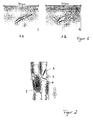
- the phloem of the higher plants includes a plant-passing system of microchannels (sieve tubes) which serves to transport photoassimilates (see Figure 2).
- the sieve tubes consist of cells, which together form a capillary system through the entire plant, namely this phloem. It is a microfluidic system with up to 3.5 MPa internal pressure and maximum flow rates of up to 3 cm / min -1 .
- Crystalline P proteins are specific constituents of the sieve elements of legumes (Fabaceae). They were first observed in plant sections and described as mostly oblong, up to 30 ⁇ m large, compact structures with highly ordered (“crystalloid") ultrastructure; however, their function remained unclear for more than a century after their discovery (Behnke, HD, Nondispersible protein bodies in elements: a survey and review of their origin, distribution and taxonomic significance, IAWA Bull., 12, 143-175 (1991)). , It is now known that they suddenly deform when drastic changes in the hydrostatic pressure occur inside the sieve tubes. In this case, the proteins change from the ordered "crystalloid" state (spindle-shaped) (see reference numeral 2 in FIG.
- the object of the present invention was to isolate the "P-proteins" previously observed only in situ , to characterize them, to specify a reproducible method for their provision and to check whether and, if so, for what purposes they might be suitable.
- the inventors succeeded in solving the task for the first time, To isolate forisomes from plants of the legume family (Fabaceae). These Insulation has proven to be extremely difficult. Although it is possible, individual Manually push protein body out of the cell and onto a slide transfer; However, these are destroyed in an uncontrollable manner, so that the obtained, more or less amorphous lumps only a low reactivity show in apparent volume changes in response to changes in the Expresses calcium concentrations in the medium. Forisomes from such plants too win, isolate and observe in intact form, but succeeded only after many failed attempts and preliminary tests.
- the starting material for the extraction of forisomes to be used phloem mechanically win by that longitudinal sections of stems or the like
- the donor plant will be freed from xylem and then the phloem from the cortex and separated from the sclerenchyma.
- the cells of the phloem are opened, and a suspension of digested cells is filtered, the pores of the Filter medium preferably have a size, the intact cells pass through denied.
- After obtaining the fraction containing the forisomes from the filtrate can be determined by means of a gradient centrifugation of the remaining components be separated.
- a medium such as 70% sucrose or 70% glycerol in V medium (Composition see Example 1) (w / v); the shelf life is very high at -20C °; at room temperature it is about 3 weeks.
- the "dispersion" is not only accompanied by a thickening of the protein body in the directions perpendicular to its longitudinal axis, but also by a contraction along the longitudinal axis (see FIG. 1).
- the induction of this conformational change can be induced by the administration of calcium ions, which raises the ambient concentration of these ions from below about 30 nM Ca 2+ to, preferably, significantly above this value (threshold concentration).
- the reaction occurs without measurable delay, coincident with the change in calcium concentration; it is complete, a further increase in the calcium concentration causes no change.
- the thickening is fully reversible and virtually any number of repeatable (experimentally, at least 50 cycles were checked).
- the reversal of the conformational change is effected by lowering the calcium ion concentration in the environment of the forisomes to below 30nM, eg by changing media or adding chelating agents for the calcium.
- the contraction due to the conformational change is up to about 30%; this is a remarkably high value compared to other actuatory proteins.
- the conformational change occurs in the millisecond range.
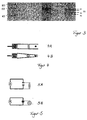
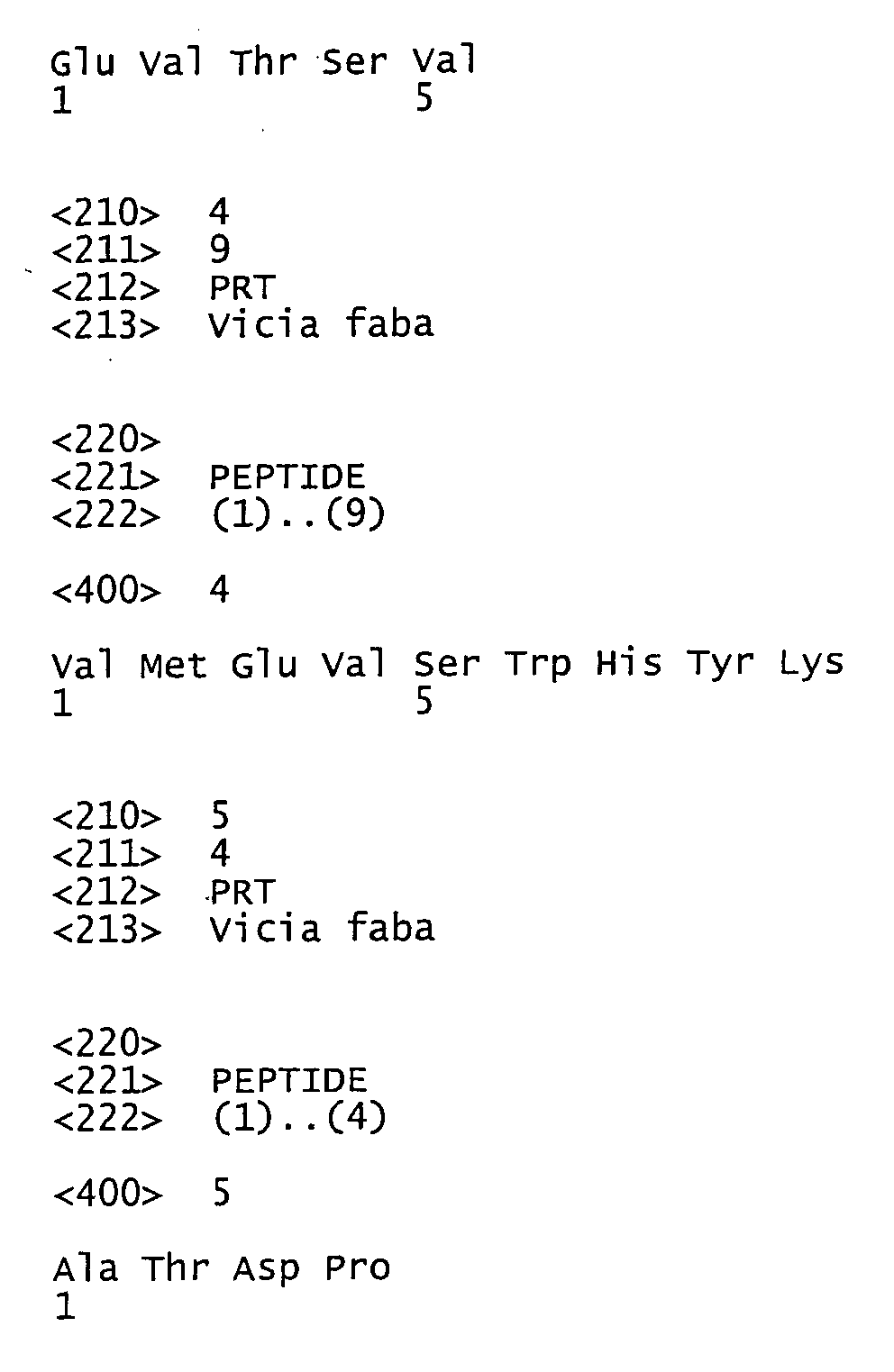
- the forisomes of the present invention have two different proteins. This was confirmed by polyacrylamide gel electrophoresis of the protein material isolated by gradient centrifugation as described above (see Figure 3). The molecular weights of the two proteins found are in the range of about 55 to 65 kDa (P1) and 53 to 63 kDa (P2). Said polyacrylamide gel electrophoresis provides additional protein bands that can be assigned to other proteins (P3 and P4), but which are degradation products of P1 and P2. This hypothesis is supported by antibody studies. Enzymatic digestion of P1 and P2 proteins yielded two peptides that could be analyzed by tandem mass spectrometry (CID-MS / MS). These two peptides have the following structures:
- protein P1 comprises the following amino acid sequences:
- forisomes or protein bodies from the sieve tubes of Legumes found that contain at least two different proteins comparable size and already in very small sized units or complexes have reversible contractile properties, which on the one hand induced by calcium ions or other comparable divalent ions, on the other hand also by a change of the pH value; being noteworthy the pH range in which the conformational change occurs is unphysiological and that the two observed conformational changes are different. For triggering the conformational change, no ATP is an energy supplier necessary.
- contractility in the presence of calcium ions are similar to the Protein bodies in some ways those of the spasm of sessile ciliates, whose Contraction is also calcium dependent. However, spasmin contracts isotropically and reacts only at hundred times higher calcium concentrations.
- Bioanalogic actuators are in bionics in the micro and nano range of increasing interest. With their mechanical activity, specific reactivity, Longevity and obvious harmlessness to the human organism (Legumes are important foods) have the protein body of the present invention over properties that for a micro or nanoaktuator especially in medical technology. Compared to other contractile ones Elements of the cytoskeleton have the advantage that their structural coherence not based on continuous assembly and disassembly. Other motor proteins of the Cytoskeletons are subject to a constant turnover, which is usually their Durability greatly limited in vitro.
- the inventors were able to show that the contraction of the invention Forisomes quantifiable in power generation.
- the fact that up Glass or other surfaces pressed forisomes adhere to this allows e.g. the fixation of individual specimens between two spring arms, e.g. out Glass fibers.
- the adhesive properties of the forisomes on the spring arms can by a suitable coating of the material of the spring arms, e.g. with poly-L-lysine or Adhesives such as Kwik-Sil (trademark of World Precision Instruments, Sarasota, FL, USA), may be improved. Is by a dose of calcium ions triggered the contraction, so every single protein body develops such a large mechanical force that the spring arms are significantly bent.
- Such Arrangement is therefore suitable as a micro tweezers, with the organic or manipulate inorganic structures such as cells, tissues or molecular bodies or be positioned.
- a pair of tweezers is shown schematically in FIG. 4: 4A denotes the open state with relaxed forisoma, 4B denotes the closed state with contracted forisoma.
- the movement of the tweezers can manually under the light microscope or electronically controlled. Because the size functional forisomes in the range of 1 ⁇ m (or even less) to 40 ⁇ m, The span of the tweezer tip can be set in a corresponding range become. With such tweezers can smallest body or substance quantities accurately transported and adapted to the reaction and biological processes Expiration be brought.
- forisomes can be used, for example, as Sensor elements for a pH change in the range at about 9.5 to 10 and for the increase of calcium ions in a medium from below to above 30 nM or vice versa, which can also be used as display elements: forisomes can be arranged between two spring arms so that their contraction is below said environmental changes a contact of the tips of these spring arms causes. When the tips are electrically conductive and over the spring arms when in contact the tips of a circuit is closed, the change of the hydrogen or Calcium ion concentration in the medium, e.g. in an enzymatic process, be detected immediately.
- FIG. 5 5A shows the open circuit with relaxed forisome
- Example 1 was repeated with the same-aged Vicia plants, the secondary Thickness growth had already begun.
- the separation of the cortex and phloem from the Xylene cylinder takes place here as follows:
- Example 1 was repeated, wherein the gradient centrifugation according to steps 7 and 8 with a plant suspension which was 0.1% before pouring the gradient. Triton X100 had been added to membrane and cell wall proteins dissolve and possible interactions between Minimize forisomes with membrane residues. After centrifugation under the same Conditions were obtained while a band distribution according to Figure 7B: Although could no chloroplasts were observed here, however, the were Forisomes despite treatment with Triton to a large extent in the Membrane band (1).
- Isolated forisomes are transferred to a 1 mL experimental chamber.
- an isolated forisoma is pressed by means of a micro-injection needle at one end to the bottom of the chamber to prevent it from dripping when flushing the chamber.
- V-medium 10 mM EDTA, 10 mM TRIS pH 7.3, 100 mM KCl
- Ca medium 10 mM CaCl 2 , 10 mM Tris-HCl pH 7.3, 100 mM KCI
- FIG. 1 shows the two conformations which the forisome adopts under V-medium, ie in the relaxed state (FIG. 1A) and under Ca-medium, ie in the contracted state (FIG. 1B).
- the microscope was in the images in transmitted light interference contrast mode.
- the width of the compartments is 30 ⁇ m each.
- An isolated forisome is placed in a 1 ml sample chamber, in which is V-medium.
- an isolated forisom with the help a microinjection needle pressed at one end to the bottom of the chamber to a To prevent drift when flushing the chamber.
- the pH using an automatic Flow rate increased in steps of 0.3 units, the used Medium remains calcium-free.
- a first reaction of the forisome may be at a pH of 9.4 can be determined. The intensity of the reaction increases with increasing pH up to pH 10.6. The reaction is always according to gifts of V-medium pH 7 completely reversible. From and above a pH of 10.9 denatures the forisoma.
- the structure of the forisome changes when it reaches a pH of 4.9. However, you can not step by step increase observe the reaction.
- the forisome is already at a pH of 4.6 denatured irreversibly.
- the conformational changes can be microscopic by means of a camera observed on the observation microscope.
- FIG. 8 shows a tweezer arrangement in which two spring arms (eg glass fibers or micropipettes) are positioned and fixed on a carrier in a distance corresponding to the length of the forisome (eg by an adhesive).
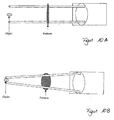
- the Forisom can be pierced, for example, at the ends with the tips of the spring arms (see Figure 9A).
- the tips naturally occurring during the production process are used.
- tips can be made by etching.
- the tweezers are then brought close to the object to be grasped so that it lies in the vicinity of the forisoma between the spring arms (see FIG. 9A).
- the forisome may be adhesively attached to the spring arms at a central location, with the spring arms being capable of adhesion-enhancing coating, as long as the adhesion of the spring arm to the forisome is insufficient.
- glass surfaces may be coated with poly-L-lysine or similar materials. Due to the central positioning of the forisome, a higher spring travel of the arms is achieved with this method (see FIG. 10A).
- the spring arms made of borosilicate glass with a diameter of about 1-2 ⁇ m and a length of about 100-500 ⁇ m were used.
- the control of the forisome can be done in different ways depending on the application.
- a contraction or an increase in volume is triggered.
- Suitable media for this purpose are, for example, those mentioned in Examples 4 and 5.
- the contraction by Ca ++ addition causes the tweezers to close, as shown in Figs. 9B and 10B.
- Micro or nanoswitch for detection of pH and calcium ion concentration changes in a medium Micro or nanoswitch for detection of pH and calcium ion concentration changes in a medium.
- micro or nanoswitches can be constructed which are useful as sensors for indicating a change in pH or a change in calcium ion concentration in the region where the reversible conformational change of the forisomes occurs he follows.
- the spring arms are made of respective metals, glass coated with a conductive material or the like, or electrodes are attached to the tips (see Fig. 11A).
- the contacts are brought together (or opened), and there is a significant decrease (or increase) in the resistance in the circuit , which in turn can be detected and decoupled by conventional means as a switching operation (see Figure 11 B).
- contacts ideally silver electrodes or copper electrodes (depending on the solution) are used. For special applications, however, contacts made of other materials are possible.
Landscapes
- Chemical & Material Sciences (AREA)
- Organic Chemistry (AREA)
- Health & Medical Sciences (AREA)
- Life Sciences & Earth Sciences (AREA)
- Biophysics (AREA)
- Biochemistry (AREA)
- Gastroenterology & Hepatology (AREA)
- General Health & Medical Sciences (AREA)
- Genetics & Genomics (AREA)
- Medicinal Chemistry (AREA)
- Molecular Biology (AREA)
- Proteomics, Peptides & Aminoacids (AREA)
- Botany (AREA)
- Peptides Or Proteins (AREA)
- Steroid Compounds (AREA)
Abstract
Description






Beilstein Registry Number: 2406632
Je nach Material der Federarme ist wegen unterschiedlicher Federkonstanten deren Durchmesser, deren Länge oder die Position und/oder Größe des Forisoms anzupassen. In diesem Beispiel wurden die Federarme aus Borosilikatglas mit einem Durchmesser von ca. 1-2µm und einer Länge von ca. 100-500µm verwendet.

Claims (15)
- Proteinkörper (Forisom), gekennzeichnet durch:seine Herstellbarkeit aus Fabaceeneine reversible, anisotrope Kontraktibilität mit der Fähigkeit, bei einer Erhöhung der umgebenden Calciumionen-Konzentration über einen Schwellenwert von ca. 30nM in den Richtungen senkrecht zur Längsachse dicker und entlang der Längsachse kürzer zu werden und umgekehrt, und der Fähigkeit, bei einer Erhöhung des umgebenden pH-Wertes auf über etwa 9,5 senkrecht zur Längsachse dicker zu werden, ohne daß er sich entlang der Längsachse entsprechend verkürzt, und umgekehrt.
- Proteinkörper (Forisom) nach Anspruch 1, gekennzeichnet durch eine Länge von etwa 1µm bis zu etwa 40µm und senkrecht hierzu mit einem Durchmesser von etwa 1µm bis zu etwa 10µm.
- Proteinkörper (Forisom) nach Anspruch 1 oder 2, gekennzeichnet dadurch, daß er ein erstes Protein (P1) mit einem Molekulargewicht im Bereich von ca. 55-65 kDa und ein zweites Protein (P2) mit einem Molekulargewicht in Bereich von 53-63 kDa umfasst.
- Proteinkörper (Forisom) nach Anspruch 3, dadurch gekennzeichnet, dass sich aus den Proteinen bei tryptischer Verdauung die folgenden Peptide nachweisen lassen:
 und dass das Protein P1 weiterhin die folgenden Bruchstücke enthält:.



- Proteinkörper (Forisom) nach einem der voranstehenden Ansprüche, gekennzeichnet durch eine Kontraktibilität entlang der Längsachse von bis zu etwa 30% bei gleichzeitiger Expansion senkrecht dazu um circa 100 %.
- Protein P1 mit einem Molekulargewicht im Bereich von ca. 55-65 kDa wie in Anspruch 3 definiert oder Bruchstück hiervon, enthaltend die oder bestehend aus der folgenden Sequenz (von N-terminal nach C-terminal gelesen):und/oder enthaltend die oder bestehend aus der folgenden Sequenz (von N-terminal nach C-terminal gelesen):


- Protein P2 mit einem Molekulargewicht im Bereich von ca. 53-63 kDa wie in Anspruch 3 definiert oder Bruchstück hiervon, enthaltend die oder bestehend aus der folgenden Sequenz (von N-terminal nach C-terminal gelesen):und/oder enthaltend die oder bestehend aus der folgenden Sequenz (von N-terminal nach C-terminal gelesen):


- Protein P1 mit einem Molekulargewicht im Bereich von ca. 55-65 kDa wie in Anspruch 3 definiert oder Bruchstück hiervon, enthaltend die oder bestehend aus den folgenden Sequenzen (von N-terminal nach C-terminal gelesen):



- Protein P1 oder Bruchstück hiervon nach Anspruch 8, weiterhin enthaltend mindestens eine der folgenden Aminosäuresequenzen:und


- Verfahren zum Isolieren von Proteinkörpern (Forisomen) nach einem der Ansprüche 1 bis 5, gekennzeichnet durch die folgenden Schritte:(a) Gewinnung des Phloems einer Pflanze aus der Familie der Fabaceen;(b) Aufschließen der Zellen des Phloems;(c) Filtrieren einer Suspension der aufgeschlossenen Zellen;(d) Abtrennen der Forisomen von den übrigen Bestandteilen der Suspension mit Hilfe einer Gradientenzentrifugation.
- Verfahren nach Anspruch 10, dadurch gekennzeichnet, daß die Gradientenzentrifugation mit einer Nycodenzlösung erfolgt, wobei das Medium der Suspension gemäß Schritt (c) KCI in einem geeigneten Puffer enthält.
- Verfahren nach Anspruch 10 oder 11, dadurch gekennzeichnet, daß die Pflanze aus der Familie der Fabaceen Vicia faba ist.
- Verwendung einer oder mehrerer Proteinkörper (Forisomen) nach einem der Ansprüche 1 bis 5 als kontraktive(s) Element(e) in einer Mikro-Pinzette oder in einem Detektionselement für pH-Wert-Änderungen oder Änderungen der Calciumionen-Konzentration .
- Verfahren zum Betreiben einer Mikropinzette, dadurch gekennzeichnet, dass ein Forisom geeigneter Größe gemäß einem der Ansprüche 1 bis 5 stabil zwischen zwei Federarmen angeordnet wird und anschließend die Konzentration an Calciumionen in der Umgebung des Forisoms von deutlich unter 30nM auf deutlich über 30nM erhöht wird.
- Verfahren zum Betreiben eines Anzeigeelementes für eine Veränderung der Calciumionen von deutlich unter 30 nm auf deutlich über 30 nm oder für eine Veränderung des pH-Wertes von unter pH 9,4 auf über pH 10,0 in einem Medium, dadurch gekennzeichnet, dass ein Forisom geeigneter Größe gemäß einem der Ansprüche 1 bis 6 stabil zwischen zwei Federarmen angeordnet wird, deren Spitzen sich bei einer Kontraktion des Forisoms berühren können, wobei die Federarme und ihre Spitzen so ausgestaltet sind, dass bei der genannten Berührung ein Stromkreis geschlossen wird und Strom fließt, wobei der Stromfluss oder die Unterbrechung des Stromkreises als Signal dafür detektiert wird, dass die Calciumionen-Konzentration auf deutlich über 30 nm steigt oder umgekehrt bzw. der pH-Wert auf über pH 10,0 steigt oder unter 9,4 fällt.
Applications Claiming Priority (2)
| Application Number | Priority Date | Filing Date | Title |
|---|---|---|---|
| DE10241681A DE10241681A1 (de) | 2002-09-09 | 2002-09-09 | Forisomen, Verfahren zu ihrer Isolierung und ihre Verwendung als molekulare Arbeitsmaschine |
| DE10241681 | 2002-09-09 |
Publications (2)
| Publication Number | Publication Date |
|---|---|
| EP1398321A1 true EP1398321A1 (de) | 2004-03-17 |
| EP1398321B1 EP1398321B1 (de) | 2006-04-05 |
Family
ID=31724546
Family Applications (1)
| Application Number | Title | Priority Date | Filing Date |
|---|---|---|---|
| EP03020183A Expired - Lifetime EP1398321B1 (de) | 2002-09-09 | 2003-09-05 | Forisomen, Verfahren zu ihrer Isolierung und ihre Verwendung als molekulare Arbeitsmaschine |
Country Status (4)
| Country | Link |
|---|---|
| US (1) | US7902331B2 (de) |
| EP (1) | EP1398321B1 (de) |
| AT (1) | ATE322504T1 (de) |
| DE (2) | DE10241681A1 (de) |
Families Citing this family (1)
| Publication number | Priority date | Publication date | Assignee | Title |
|---|---|---|---|---|
| EP2662447B1 (de) * | 2012-05-09 | 2020-02-05 | Fraunhofer-Gesellschaft zur Förderung der angewandten Forschung e.V. | Artifizielle Forisomenkörper mit SEO-F-Fusionsproteinen, pflanzliche oder Hefezellen mit Vektoren, die für diese Proteine codieren |
-
2002
- 2002-09-09 DE DE10241681A patent/DE10241681A1/de not_active Ceased
-
2003
- 2003-09-05 DE DE50302876T patent/DE50302876D1/de not_active Expired - Lifetime
- 2003-09-05 AT AT03020183T patent/ATE322504T1/de not_active IP Right Cessation
- 2003-09-05 EP EP03020183A patent/EP1398321B1/de not_active Expired - Lifetime
- 2003-09-09 US US10/605,104 patent/US7902331B2/en not_active Expired - Fee Related
Non-Patent Citations (9)
| Title |
|---|
| AMERICAN JOURNAL OF BOTANY (1982), 69(7), 1200-12, 1982 * |
| BOTANICA ACTA (1994), 107(1), 3-11, 1994 * |
| D BHATTACHARYA ET AL.: "Molecular cloning and evolutionary analysis of the calcium-modulated contractile protein, centrin, in green algae and land plants", PLANT MOLECULAR BIOLOGY., vol. 23, no. 1, 1993, NIJHOFF PUBLISHERS, DORDRECHT., NL, pages 1243 - 1254, XP002266444, ISSN: 0167-4412 * |
| DATABASE CA [online] CHEMICAL ABSTRACTS SERVICE, COLUMBUS, OHIO, US; ARSANTO, JEAN PIERRE: "Observations on P-protein in dicotyledons. Substructural and developmental features", XP002266447, retrieved from STN Database accession no. 97:123998 CA * |
| DATABASE CA [online] CHEMICAL ABSTRACTS SERVICE, COLUMBUS, OHIO, US; BEHNKE, H. -D.: "Sieve-element plastids, nuclear crystals and phloem proteins in the Zingiberales", XP002266446, retrieved from STN Database accession no. 121:78319 CA * |
| DATABASE CA [online] CHEMICAL ABSTRACTS SERVICE, COLUMBUS, OHIO, US; KNOBLAUCH, MICHAEL ET AL: "ATP-independent contractile proteins from plants", XP002266445, retrieved from STN Database accession no. 140:2831 CA * |
| DATABASE CA [online] CHEMICAL ABSTRACTS SERVICE, COLUMBUS, OHIO, US; KNOBLAUCH, MICHAEL ET AL: "Reversible calcium-regulated stopcocks in legume sieve tubes", XP002266448, retrieved from STN Database accession no. 135:150071 CA * |
| NATURE MATERIALS (2003), 2(9), 600-603, 2003 * |
| PLANT CELL (2001), 13(5), 1221-1230, 2001 * |
Also Published As
| Publication number | Publication date |
|---|---|
| EP1398321B1 (de) | 2006-04-05 |
| DE50302876D1 (de) | 2006-05-18 |
| US7902331B2 (en) | 2011-03-08 |
| DE10241681A1 (de) | 2004-03-25 |
| ATE322504T1 (de) | 2006-04-15 |
| US20090012262A1 (en) | 2009-01-08 |
Similar Documents
| Publication | Publication Date | Title |
|---|---|---|
| EP0733099B1 (de) | Verfahren zum zerkleinern von hochmolekularen strukturen | |
| DE102009033368B4 (de) | Massenspektrometrische Sepsisdiagnose | |
| DE102012011647B4 (de) | Analyse von Mikroben aus Mikrokolonien mittels MALDI-Massenspektrometrie | |
| DE69233364T2 (de) | Kältetoleranz bei pflanzen | |
| Isa | An electron microscope study on the mineralization of the skeleton of the staghorn coral Acropora hebes | |
| WO2007098951A2 (en) | Method and apparatus for extraction of protein material from silkworm glands | |
| DE102012011648A1 (de) | Analyse von Mikroben aus Mikrokolonien mittels MALDI-Massenspektrometrie | |
| EP2434873B1 (de) | Verfahren und vorrichtung zur konservierung von zellkernen | |
| DE69733755T2 (de) | Elektrode-einfang von nukleinsäuren | |
| EP1398321B1 (de) | Forisomen, Verfahren zu ihrer Isolierung und ihre Verwendung als molekulare Arbeitsmaschine | |
| DE19916534A1 (de) | RNA-Isolierungs-Kit | |
| EP3261435B1 (de) | Pflanzenschutz- und/oder pflanzenwachstumsförderungssystem | |
| EP3404417B1 (de) | Präparation biologischer zellen auf massenspektrometrischen probenträgern für eine desorbierende ionisierung | |
| EP1478749B1 (de) | Verfahren zur grobklärung von zellaufschlüssen aus mikroorganismen | |
| DE69820180T2 (de) | Verfahren zur Herstellung einer krankheitsresistenten Pflanze, welche ein Thioningen enthält | |
| DE19628895A1 (de) | Metallhaltige Ribonukleotidpolypeptide | |
| EP2270033B1 (de) | Mikroröhren, umfassend Bestandteile der äußeren Membran von E. coli Zellen und rekombinant exprimierte S-Layer-Proteine, Verfahren zur Herstellung und Verwendung | |
| DE602004011900T2 (de) | Verfahren zum Nachweis und zur Analyse von makromolekularen Komplexen | |
| Bernard et al. | Electrophysiological studies on embryonic heart cells in culture. Scorpion toxin as a tool to reveal latent fast sodium channel | |
| EP2529744A1 (de) | Proteinextrakt aus marinen Makroalgen, Verfahren zu dessen Herstellung und Verwendungen dafür | |
| DD256148A1 (de) | Verpackungsverfahren von dna zum gentransfer in tierische zellen | |
| DE69416879T2 (de) | Identifizierung, kwantifizierung und reinigung von insektiziden proteinen aus bacillus thuringiensis | |
| WO2003027669A2 (de) | Verfahren zur herstellung einer normalisierten genbank aus nukleinsäure-exktrakten von bodenproben und deren verwendung | |
| US8105633B2 (en) | Method and apparatus for extraction of arthropod gland | |
| DE10113781A1 (de) | Synthetische Spinnenseidenproteine und deren Expression in transgenen Pflanzen |
Legal Events
| Date | Code | Title | Description |
|---|---|---|---|
| PUAI | Public reference made under article 153(3) epc to a published international application that has entered the european phase |
Free format text: ORIGINAL CODE: 0009012 |
|
| AK | Designated contracting states |
Kind code of ref document: A1 Designated state(s): AT BE BG CH CY CZ DE DK EE ES FI FR GB GR HU IE IT LI LU MC NL PT RO SE SI SK TR |
|
| AX | Request for extension of the european patent |
Extension state: AL LT LV MK |
|
| RIN1 | Information on inventor provided before grant (corrected) |
Inventor name: PRUEFER, DIRK, DR. Inventor name: KNOBLAUCH, MICHAEL, DR. |
|
| 17P | Request for examination filed |
Effective date: 20040821 |
|
| AKX | Designation fees paid |
Designated state(s): AT BE BG CH CY CZ DE DK EE ES FI FR GB GR HU IE IT LI LU MC NL PT RO SE SI SK TR |
|
| 17Q | First examination report despatched |
Effective date: 20050309 |
|
| GRAP | Despatch of communication of intention to grant a patent |
Free format text: ORIGINAL CODE: EPIDOSNIGR1 |
|
| GRAS | Grant fee paid |
Free format text: ORIGINAL CODE: EPIDOSNIGR3 |
|
| GRAA | (expected) grant |
Free format text: ORIGINAL CODE: 0009210 |
|
| RIN1 | Information on inventor provided before grant (corrected) |
Inventor name: KNOBLAUCH, MICHAEL, DR. Inventor name: PRUEFER, DIRK, DR. |
|
| AK | Designated contracting states |
Kind code of ref document: B1 Designated state(s): AT BE BG CH CY CZ DE DK EE ES FI FR GB GR HU IE IT LI LU MC NL PT RO SE SI SK TR |
|
| PG25 | Lapsed in a contracting state [announced via postgrant information from national office to epo] |
Ref country code: IT Free format text: LAPSE BECAUSE OF FAILURE TO SUBMIT A TRANSLATION OF THE DESCRIPTION OR TO PAY THE FEE WITHIN THE PRESCRIBED TIME-LIMIT;WARNING: LAPSES OF ITALIAN PATENTS WITH EFFECTIVE DATE BEFORE 2007 MAY HAVE OCCURRED AT ANY TIME BEFORE 2007. THE CORRECT EFFECTIVE DATE MAY BE DIFFERENT FROM THE ONE RECORDED. Effective date: 20060405 Ref country code: SK Free format text: LAPSE BECAUSE OF FAILURE TO SUBMIT A TRANSLATION OF THE DESCRIPTION OR TO PAY THE FEE WITHIN THE PRESCRIBED TIME-LIMIT Effective date: 20060405 Ref country code: IE Free format text: LAPSE BECAUSE OF FAILURE TO SUBMIT A TRANSLATION OF THE DESCRIPTION OR TO PAY THE FEE WITHIN THE PRESCRIBED TIME-LIMIT Effective date: 20060405 Ref country code: FI Free format text: LAPSE BECAUSE OF FAILURE TO SUBMIT A TRANSLATION OF THE DESCRIPTION OR TO PAY THE FEE WITHIN THE PRESCRIBED TIME-LIMIT Effective date: 20060405 Ref country code: SI Free format text: LAPSE BECAUSE OF FAILURE TO SUBMIT A TRANSLATION OF THE DESCRIPTION OR TO PAY THE FEE WITHIN THE PRESCRIBED TIME-LIMIT Effective date: 20060405 Ref country code: NL Free format text: LAPSE BECAUSE OF FAILURE TO SUBMIT A TRANSLATION OF THE DESCRIPTION OR TO PAY THE FEE WITHIN THE PRESCRIBED TIME-LIMIT Effective date: 20060405 Ref country code: CZ Free format text: LAPSE BECAUSE OF FAILURE TO SUBMIT A TRANSLATION OF THE DESCRIPTION OR TO PAY THE FEE WITHIN THE PRESCRIBED TIME-LIMIT Effective date: 20060405 Ref country code: RO Free format text: LAPSE BECAUSE OF FAILURE TO SUBMIT A TRANSLATION OF THE DESCRIPTION OR TO PAY THE FEE WITHIN THE PRESCRIBED TIME-LIMIT Effective date: 20060405 |
|
| REG | Reference to a national code |
Ref country code: GB Ref legal event code: FG4D Free format text: NOT ENGLISH |
|
| REG | Reference to a national code |
Ref country code: CH Ref legal event code: EP |
|
| GBT | Gb: translation of ep patent filed (gb section 77(6)(a)/1977) |
Effective date: 20060405 |
|
| REG | Reference to a national code |
Ref country code: IE Ref legal event code: FG4D Free format text: LANGUAGE OF EP DOCUMENT: GERMAN |
|
| REF | Corresponds to: |
Ref document number: 50302876 Country of ref document: DE Date of ref document: 20060518 Kind code of ref document: P |
|
| PG25 | Lapsed in a contracting state [announced via postgrant information from national office to epo] |
Ref country code: SE Free format text: LAPSE BECAUSE OF FAILURE TO SUBMIT A TRANSLATION OF THE DESCRIPTION OR TO PAY THE FEE WITHIN THE PRESCRIBED TIME-LIMIT Effective date: 20060705 Ref country code: DK Free format text: LAPSE BECAUSE OF FAILURE TO SUBMIT A TRANSLATION OF THE DESCRIPTION OR TO PAY THE FEE WITHIN THE PRESCRIBED TIME-LIMIT Effective date: 20060705 |
|
| PG25 | Lapsed in a contracting state [announced via postgrant information from national office to epo] |
Ref country code: ES Free format text: LAPSE BECAUSE OF FAILURE TO SUBMIT A TRANSLATION OF THE DESCRIPTION OR TO PAY THE FEE WITHIN THE PRESCRIBED TIME-LIMIT Effective date: 20060716 |
|
| PG25 | Lapsed in a contracting state [announced via postgrant information from national office to epo] |
Ref country code: PT Free format text: LAPSE BECAUSE OF FAILURE TO SUBMIT A TRANSLATION OF THE DESCRIPTION OR TO PAY THE FEE WITHIN THE PRESCRIBED TIME-LIMIT Effective date: 20060905 |
|
| ET | Fr: translation filed | ||
| PG25 | Lapsed in a contracting state [announced via postgrant information from national office to epo] |
Ref country code: BE Free format text: LAPSE BECAUSE OF NON-PAYMENT OF DUE FEES Effective date: 20060930 Ref country code: MC Free format text: LAPSE BECAUSE OF NON-PAYMENT OF DUE FEES Effective date: 20060930 |
|
| NLV1 | Nl: lapsed or annulled due to failure to fulfill the requirements of art. 29p and 29m of the patents act | ||
| REG | Reference to a national code |
Ref country code: IE Ref legal event code: FD4D |
|
| RAP2 | Party data changed (patent owner data changed or rights of a patent transferred) |
Owner name: FRAUNHOFER-GESELLSCHAFT ZUR FOERDERUNG DER ANGEWAN |
|
| PLBE | No opposition filed within time limit |
Free format text: ORIGINAL CODE: 0009261 |
|
| STAA | Information on the status of an ep patent application or granted ep patent |
Free format text: STATUS: NO OPPOSITION FILED WITHIN TIME LIMIT |
|
| 26N | No opposition filed |
Effective date: 20070108 |
|
| PG25 | Lapsed in a contracting state [announced via postgrant information from national office to epo] |
Ref country code: AT Free format text: LAPSE BECAUSE OF NON-PAYMENT OF DUE FEES Effective date: 20060905 |
|
| BERE | Be: lapsed |
Owner name: FRAUNHOFER-GESELLSCHAFT ZUR FORDERUNG DER ANGEWAN Effective date: 20060930 |
|
| PG25 | Lapsed in a contracting state [announced via postgrant information from national office to epo] |
Ref country code: GR Free format text: LAPSE BECAUSE OF FAILURE TO SUBMIT A TRANSLATION OF THE DESCRIPTION OR TO PAY THE FEE WITHIN THE PRESCRIBED TIME-LIMIT Effective date: 20060706 |
|
| REG | Reference to a national code |
Ref country code: CH Ref legal event code: PL |
|
| PG25 | Lapsed in a contracting state [announced via postgrant information from national office to epo] |
Ref country code: BG Free format text: LAPSE BECAUSE OF FAILURE TO SUBMIT A TRANSLATION OF THE DESCRIPTION OR TO PAY THE FEE WITHIN THE PRESCRIBED TIME-LIMIT Effective date: 20060705 Ref country code: EE Free format text: LAPSE BECAUSE OF FAILURE TO SUBMIT A TRANSLATION OF THE DESCRIPTION OR TO PAY THE FEE WITHIN THE PRESCRIBED TIME-LIMIT Effective date: 20060405 |
|
| PG25 | Lapsed in a contracting state [announced via postgrant information from national office to epo] |
Ref country code: HU Free format text: LAPSE BECAUSE OF FAILURE TO SUBMIT A TRANSLATION OF THE DESCRIPTION OR TO PAY THE FEE WITHIN THE PRESCRIBED TIME-LIMIT Effective date: 20061006 Ref country code: CH Free format text: LAPSE BECAUSE OF NON-PAYMENT OF DUE FEES Effective date: 20070930 Ref country code: LI Free format text: LAPSE BECAUSE OF NON-PAYMENT OF DUE FEES Effective date: 20070930 Ref country code: LU Free format text: LAPSE BECAUSE OF NON-PAYMENT OF DUE FEES Effective date: 20060905 Ref country code: TR Free format text: LAPSE BECAUSE OF FAILURE TO SUBMIT A TRANSLATION OF THE DESCRIPTION OR TO PAY THE FEE WITHIN THE PRESCRIBED TIME-LIMIT Effective date: 20060405 |
|
| PG25 | Lapsed in a contracting state [announced via postgrant information from national office to epo] |
Ref country code: CY Free format text: LAPSE BECAUSE OF FAILURE TO SUBMIT A TRANSLATION OF THE DESCRIPTION OR TO PAY THE FEE WITHIN THE PRESCRIBED TIME-LIMIT Effective date: 20060405 |
|
| REG | Reference to a national code |
Ref country code: FR Ref legal event code: PLFP Year of fee payment: 14 |
|
| REG | Reference to a national code |
Ref country code: FR Ref legal event code: PLFP Year of fee payment: 15 |
|
| REG | Reference to a national code |
Ref country code: FR Ref legal event code: PLFP Year of fee payment: 16 |
|
| PGFP | Annual fee paid to national office [announced via postgrant information from national office to epo] |
Ref country code: FR Payment date: 20210927 Year of fee payment: 19 |
|
| PGFP | Annual fee paid to national office [announced via postgrant information from national office to epo] |
Ref country code: GB Payment date: 20210923 Year of fee payment: 19 Ref country code: DE Payment date: 20210921 Year of fee payment: 19 |
|
| REG | Reference to a national code |
Ref country code: DE Ref legal event code: R119 Ref document number: 50302876 Country of ref document: DE |
|
| GBPC | Gb: european patent ceased through non-payment of renewal fee |
Effective date: 20220905 |
|
| PG25 | Lapsed in a contracting state [announced via postgrant information from national office to epo] |
Ref country code: FR Free format text: LAPSE BECAUSE OF NON-PAYMENT OF DUE FEES Effective date: 20220930 Ref country code: DE Free format text: LAPSE BECAUSE OF NON-PAYMENT OF DUE FEES Effective date: 20230401 |
|
| PG25 | Lapsed in a contracting state [announced via postgrant information from national office to epo] |
Ref country code: GB Free format text: LAPSE BECAUSE OF NON-PAYMENT OF DUE FEES Effective date: 20220905 |