EP1398317A1 - Alicyclic compound for optical material - Google Patents
Alicyclic compound for optical material Download PDFInfo
- Publication number
- EP1398317A1 EP1398317A1 EP02733473A EP02733473A EP1398317A1 EP 1398317 A1 EP1398317 A1 EP 1398317A1 EP 02733473 A EP02733473 A EP 02733473A EP 02733473 A EP02733473 A EP 02733473A EP 1398317 A1 EP1398317 A1 EP 1398317A1
- Authority
- EP
- European Patent Office
- Prior art keywords
- bis
- epithio
- dithiacyclohexane
- diepithio
- alicyclic compound
- Prior art date
- Legal status (The legal status is an assumption and is not a legal conclusion. Google has not performed a legal analysis and makes no representation as to the accuracy of the status listed.)
- Granted
Links
Classifications
-
- C—CHEMISTRY; METALLURGY
- C08—ORGANIC MACROMOLECULAR COMPOUNDS; THEIR PREPARATION OR CHEMICAL WORKING-UP; COMPOSITIONS BASED THEREON
- C08G—MACROMOLECULAR COMPOUNDS OBTAINED OTHERWISE THAN BY REACTIONS ONLY INVOLVING UNSATURATED CARBON-TO-CARBON BONDS
- C08G75/00—Macromolecular compounds obtained by reactions forming a linkage containing sulfur with or without nitrogen, oxygen, or carbon in the main chain of the macromolecule
- C08G75/02—Polythioethers
- C08G75/06—Polythioethers from cyclic thioethers
- C08G75/08—Polythioethers from cyclic thioethers from thiiranes
-
- C—CHEMISTRY; METALLURGY
- C07—ORGANIC CHEMISTRY
- C07D—HETEROCYCLIC COMPOUNDS
- C07D331/00—Heterocyclic compounds containing rings of less than five members, having one sulfur atom as the only ring hetero atom
- C07D331/02—Three-membered rings
-
- C—CHEMISTRY; METALLURGY
- C07—ORGANIC CHEMISTRY
- C07D—HETEROCYCLIC COMPOUNDS
- C07D495/00—Heterocyclic compounds containing in the condensed system at least one hetero ring having sulfur atoms as the only ring hetero atoms
- C07D495/12—Heterocyclic compounds containing in the condensed system at least one hetero ring having sulfur atoms as the only ring hetero atoms in which the condensed system contains three hetero rings
- C07D495/14—Ortho-condensed systems
-
- G—PHYSICS
- G02—OPTICS
- G02B—OPTICAL ELEMENTS, SYSTEMS OR APPARATUS
- G02B1/00—Optical elements characterised by the material of which they are made; Optical coatings for optical elements
- G02B1/04—Optical elements characterised by the material of which they are made; Optical coatings for optical elements made of organic materials, e.g. plastics
Definitions
- the present invention relates to optical materials suitable for producing plastic lenses, prisms, optical fibers, information recording media, and filters, particularly, suitable for producing plastic spectacle lenses.
- Plastic materials have been widely used in various optical applications, particularly in manufacturing spectacle lenses, because of their lightweight, toughness and easiness of dyeing.
- Optical materials, particularly spectacle lenses are required to have, in addition to a low specific gravity, a high clearness, a low yellowness, and optical properties such as a high refractive index and a large Abbe's number. Since a large refractive index reduces the thickness of a lens, many studies have been made thereon to date and many novel compounds have been proposed. Recently, many organic compounds having sulfur atom and/or selenium atom have been proposed to achieve a high refractive index and a high Abbe's number.
- Japanese Patent Application Laid-Open No. 9-110979 proposes a straight-chain polyepisulfide compound
- Japanese Patent Application Laid-Open No. 9-71580 proposes a branched polyepisulfide compound
- Japanese Patent Application Laid-Open No. 9-255781 proposes a polyepisulfide compound having a cyclic structure
- Japanese Patent Application Laid-Open No. 11-140046 proposes a polyepisulfide compound having selenium atom.
- the refractive index of materials obtained from these polyepisulfide are limited to 1.73 at most.
- An object of the present invention is to provide an optical material which enables to attain a refractive index higher than attained by known materials.
- a five- or more membered alicyclic compound having an epithioethylene linkage and/or an epidithioethylene linkage in its ring structure and tow or more sulfur atoms in its molecule, or a composition containing the alicyclic compound provides an optical material having a high refractive index upon curing by polymerization.
- the alicyclic compound for use in the present invention has a five- or more membered ring structure which has at least one epithioethylene linkage and/or an epidithioethylene linkage (hereinafter referred to collectively as "epi(di)thioethylene linkage").
- the alicyclic compound has two or more sulfur atoms including the sulfur atom in the epi(di)thioethylene linkage.
- the optical material obtained by curing the alicyclic compound or a composition containing the alicyclic compound by polymerization exhibits a high refractive index.
- the composition may contain only one type or two or more of the alicyclic compounds.
- the composition for optical materials contains the alicyclic compound in an amount preferably 5 to 100% by weight, more preferably 10 to 100% by weight based on the total amount thereof.
- the composition for optical materials referred to herein may include a mixture comprising at least one type of the alicyclic compound as only one essential component and a mixture comprising at least one type of the alicyclic compound and a compound capable of reacting with the alicyclic compound (hereinafter referred to as "reactive compound") as the essential components.
- the reactive compound is not specifically limited as long as it provides a transparent resin usable as optical materials upon curing by polymerization with the alicyclic compound.
- Examples of the alicyclic compound of the present invention include, but not limited to, 1,2-epidithiocyclopentane, 1,2-epidithiocyclohexane, 1,2:3,4-diepithiocyclopentane, 1,2:3,4-diepithiocyclohexane, 1,2:4,5-diepithiocyclohexane, 1,2:3,4:5,6-triepithiocyclohexane, 1,2:2,3:3,4:4,5:5,6:1,6-hexaepithiocyclohexane, 1,2-epithio-4-epithioethylcyclopentane, 1,2-epithio-3-epithioethylcyclohexane, 1,2-epithio-4-epithioethylcyclohexane, 1,2-epithio-3-thiacyclopentane, 1,2-epithio-4-thia
- alicyclic compounds having at least one sulfide linkage in addition to the epi(di)thioethylene linkage in its ring structure or in its side chain such as 1,2-epithio-4-epithioethylcyclopentane, 1,2-epithio-3-epithioethylcyclohexane, 1,2-epithio-4-epithioethylcyclohexane, 1,2-epithio-3-thiacyclopentane, 1,2-epithio-4-thiacyclopentane, 1,2-epithio-3-thiacyclohexane, 1,2-epithio-4-thiacyclohexane, 1,2:4,5-diepithio-3-thiacyclohexane, 1,2:4,5-diepithio-3,6-dithiacyclohexane, 1,2:4,5-diepidithio
- alicyclic compounds having two or more epi(di)thioethylene linkages such as 1,2:4,5-diepithio-3-thiacyclohexane, 1,2:4,5-diepithio-3,6-dithiacyclohexane, 1,2:4,5-diepidithio-3,6-dithiacyclohexane, 1,2:4,5-diepithio-3,6,7-trithiacycloheptane, 1,2:5,6-diepithio-3,4,7,8-tetrathiacyclooctane, 1,2:5,6-diepidithio-3,4,7,8-tetrathiacyclooctane, 1,2:1,4:4,5-triepithio-3,6-dithiacyclohexane, 1,2:1,4:2,5:4,5-tetraepithio-3,6-dithiacyclohexane, and 1,2:1,4:2,5
- alicyclic compounds represented by the following formula 1: wherein S is sulfur atom; w and x are each independently 1 or 2; y and z are each independently integer from 0 to 2; R 1 , R 2 , R 3 and R 4 are each independently hydrogen or hydrocarbon group having 1 to 5 carbon atoms; excluding y and z being simultaneously zero.
- Examples of the alicyclic compounds represented by the formula 1 include 1,2:4,5-diepithio-3-thiacyclohexane, 1,2:4,5-diepithio-3,6-dithiacyclohexane, 1,2:4,5-diepidithio-3,6-dithiacyclohexane, 1,2:4,5-diepithio-3,6,7-trithiacycloheptane, 1,2:5,6-diepithio-3,4,7,8-tetrathiacyclooctane, and 1,2:5,6-diepidithio-3,4,7,8-tetrathiacyclooctane.
- the alicyclic compounds may be synthesized mainly from corresponding olefins, epoxy compounds, dihalogenated compounds and dithiols by the following method:
- the composition for optical materials of the present invention may contain the reactive compound in addition to the alicyclic compound.
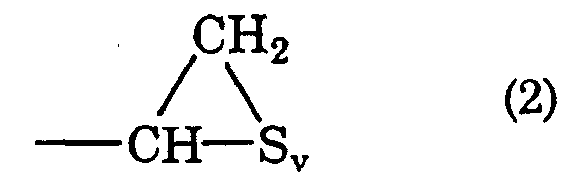
- the reactive compound is preferably an episulfide compound having a functional group that is easily reacted with the alicyclic compound, for example, an epithioethyl group and/or an epidithioethyl group represented by the following formula 2: wherein S is sulfur atom and v is 1 or 2.
- Methyl thioglycidyl ether ethyl thioglycidyl ether, propyl thioglycidyl ether, and butyl thioglycidyl ether.
- Bis( ⁇ -epithiopropyl) ether bis( ⁇ -epithiopropyloxy)methane, 1,2-bis( ⁇ -epithiopropyloxy)ethane, 1,3-bis( ⁇ -epithiopropyloxy)propane, 1,2-bis( ⁇ -epithiopropyloxy)propane, 1-( ⁇ -epithiopropyloxy)-2-( ⁇ -epithiopropyloxymethyl)propane, 1,4-bis( ⁇ -epithiopropyloxy)butane, 1,3-bis( ⁇ -epithiopropyloxy)butane, 1-( ⁇ -epithiopropyloxy)-3-( ⁇ -epithiopropyloxymethyl)butane, 1,5-bis( ⁇ -epithiopropyloxy)pentane, 1-( ⁇ -epithiopropyloxy)-4-( ⁇ -epithiopropyloxymethyl
- the episulfide compounds referred to herein may further include the compounds derived from the above episulfide compounds by replacing at least one hydrogen of its epithio group with methyl group.
- the episulfide compounds having an epi(di)thioethyl group represented by the formula 2 may be used alone or in combination of two or more, and preferably used in an amount of 1 to 95 arts by weight based on 100 parts by weight of the alicyclic compound.
- the composition for optical materials of the present invention may further contain an compound capable of reacting with the alicyclic compound and/or the additive compound (episulfide compound) in an amount of 1 to 50 parts by weight based on 100 parts by weight of the alicyclic compound.
- an additive compound episulfide compound
- a composition containing the additive compound is cured by polymerization, if necessary, in the presence of a known catalyst for curing by polymerization.
- the additive compound may include epoxy compounds, iso(thio)cyanates, carboxylic acids, carboxylic anhydrides, phenol compounds, amines, vinyl compounds, allyl compounds, acryl compounds, methacryl compounds, mercaptans, inorganic compounds having sulfur atom, and inorganic compounds having selenium atom. Examples thereof are shown below.
- Polyhydric phenol compounds such as hydroquinone, catechol, resorcinol, bisphenol A, bisphenol F, bisphenol ether, halogenated bisphenol A and novolak resins.
- Aliphatic mercaptans such as methyl mercaptan, ethyl mercaptan, n-propyl mercaptan, n-butyl mercaptan, allyl mercaptan, n-hexyl mercaptan, n-octyl mercaptan, n-decyl mercaptan, n-dodecyl mercaptan, n-tetradecyl mercaptan, n-hexadecyl mercaptan, n-octadecyl mercaptan, cyclohexyl mercaptan, isopropyl mercaptan, tert-butyl mercaptan, tert-nonyl mercaptan, tert-dodecyl mercaptan, phenyl mercaptan, benzyl mercaptan, 3-methyl
- oxides of sulfur such as sulfur dioxide and sulfur trioxide
- salts of thiocarbonic acid such as sulfur dioxide and sulfur trioxide
- Selenium hydrogen selenide, selenium dioxide, carbon diselenide, ammonium selenide, oxides of selenium such as selenium dioxide, selenic acid, salts of selenic acid, selenous acid, salts of selenous acid, salts of hydrogenselenic acid, selenosulfuric acid, salts of selenosulfuric acid, selenopyrosulfuric acid, salts of selenopyrosulfuric acid, halides such as selenium tetrabromide and selenium oxychloride, salts of selenocyanic acid, boron selenide, phosphorus selenide, arsenic selenide, and metal selenides.
- oxides of selenium such as selenium dioxide, selenic acid, salts of selenic acid, selenous acid, salts of selenous acid, salts of hydrogenselenic acid, selenosulfuric acid, salt
- composition for optical materials my be cured by polymerization, if necessary, in the presence of a curing catalyst such as amines, phosphines, quaternary ammonium salts, quaternary phosphonium salts, tertiary sulfonium salts, secondary iodonium salts, mineral acids, Lewis acids, organic acids, silicic acid compounds, tetrafluoroboric acid compounds, peroxides, azo compounds, condensates of aldehyde and ammonia compound, guanidine compounds, thiourea compounds, thiazole compounds, sulfenamide compounds, thiuram compounds, salts of dithiocarbamic acid, salts of xanthogenic acid, and esters of acid phosphoric acid.
- a curing catalyst such as amines, phosphines, quaternary ammonium salts, quaternary phosphonium salts, tertiary sulfonium salts, secondary
- Primary amines such as ethylamine, n-propylamine, sec-propylamine, n-butylamine, sec-butylamine, isobutylamine, tert-butylamine, pentylamine, hexylamine, heptylamine, octylamine, decylamine, laurylamine, myristylamine, 1,2-dimethylhexylamine, 3-pentylamine, 2-ethylhexylamine, allylamine, aminoethanol, 1-aminopropanol, 2-aminopropanol, aminobutanol, aminopentanol, aminohexanol, 3-ethoxypropylamine, 3-propoxypropylamine, 3-isopropoxypropylamine, 3-butoxypropylamine, 3-isobutoxypropylamine, 3-(2-ethylhexyloxy)propylamine, aminocyclopentane, aminocyclohe
- Trimethylphosphine triethylphosphine, triisopropylphosphine, tri-n-butylphosphine, tri-n-hexylphosphine, tri-n-octylphosphine, tricyclohexylphosphine, triphenylphosphine, tribenzylphosphine, tris(2-methylphenyl)phosphine, tris(3-methylphenyl)phosphine, tris(4-methylphenyl)phosphine, tris(diethylamino)phosphine, tris(4-methylphenyl)phosphine, dimethylphenylphosphine, diethylphenylphosphine, dicyclohexylphenylphosphine, ethyldiphenylphosphine, diphenylcyclohexylphosphine, and chlorodiphenylphosphine.
- Diphenyliodonium chloride, diphenyliodonium bromide, and diphenyliodonium iodide Diphenyliodonium chloride, diphenyliodonium bromide, and diphenyliodonium iodide.
- Hydrochloric acid sulfuric acid, nitric acid, phosphoric acid and carbonic acid, and half-esters of the mineral acids.
- Cumyl peroxyneodecanoate diisopropyl peroxydicarbonate, diallyl peroxydicarbonate, di-n-propyl peroxydicarbonate, dimyristyl peroxydicarbonate, cumyl peroxyneohexanoate, t-hexyl peroxyneodecanoate, t-butyl peroxyneodecanoate, t-hexyl peroxyneohexanoate, t-butyl peroxyneohexanoate, 2,4-dichlorobenzoyl peroxide, benzoyl peroxide, dicumyl peroxide, di-t-butyl peroxide, cumene hydroperoxide, and tert-butyl hydroperoxide.
- Reaction product of acetaldehyde and ammonia condensate of formaldehyde and p-toluidine, condensate of acetaldehyde and p-toluidine, reaction product of formaldehyde and aniline, reaction product of acetaldehyde and aniline, reaction product of butylaldehyde and aniline, reaction product of formaldehyde, acetaldehyde and aniline, reaction product of acetaldehyde, butylaldehyde and aniline, condensate of butylaldehyde and monobutylamine, reaction product of butylaldehyde and butylideneaniline, reaction product of heptaldehyde and aniline, reaction product of trichlotonylidenetetramine, condensate of ⁇ -ethyl- ⁇ -propylacrolein and aniline, and condensate of formaldehyde and alkylimidazole.
- Thiocarboanilide di-o-tolylthiourea, ethylenethiourea, diethylthiourea, dibutylthiourea, dilaurylthiourea, trimethylthiourea, dimethylethylthiourea, and tetramethylthiourea.
- the polymerization catalysts recited above are only illustrative and not limited thereto as long as a compound is effective for curing the composition by polymerization. These catalysts may be used alone or in combination of two or more.
- the addition amount of the catalyst is 0.0001 to 10.0 parts by weight, preferably 0.0005 to 5.0 parts by weight based on 100 parts by weight of the composition for optical materials (the alicyclic compound and the optional reactive compound and additive compound).
- the composition may be cured by polymerization in the presence of a known additive such as antioxidants and ultraviolet light absorbers. It is effective to improve the adhesion or the releasability between the cured materials and a mold by adding a known external and/or internal adhesion improver if the cured material is easy to separate from the mold during polymerization, or by adding a known external or internal mold release improver if the cured material is difficult to release from the mold after polymerization.
- a known additive such as antioxidants and ultraviolet light absorbers.
- the adhesion or mold release improver After uniformly blended with the catalyst, the adhesion or mold release improver, the additive such as antioxidants, bluing agents, ultraviolet absorbers, and property improvers, the alicyclic compound alone or a composition comprising it is cast into a mold made of glass or metal, heated to allow the curing by polymerization to proceed, and then released from the mold to obtain the optical materials of the present invention.
- the alicyclic compound alone or a composition comprising it Before casting into the mold, the alicyclic compound alone or a composition comprising it may be pre-polymerized partly or completely in the presence or absence of a catalyst with or without stirring at -100 to 160°C for 0.1 to 480 h. Then, the optical materials are produced by following the casting into a mold and the curing by polymerization.
- the pre-polymerization is effective, in particular, if the composition for optical materials includes a solid component and is not easy to handle.
- the pre-polymerization is performed preferably at -10 to 120°C for 0.1 to 240 h, more preferably at 0 to 100°C for 0.1 to 120 h.
- a composition prepared by blending the main starting material and the secondary starting material is cast into a mold and cured therein by polymerization to provide the optical materials of the present invention.
- the alicyclic compound, the reactive compound, the additive compound, the catalyst and the additive such as adhesion improvers, mold release improvers, antioxidants, bluing agents, ultraviolet absorbers and property improvers may be blended under stirring in a single container simultaneously or stepwise. Alternatively, a few of the starting materials are blended in separate containers and then blended together in the same container.
- the order of adding the starting materials and additives is not specifically limited. The mixing temperature and time are not critical as long as the materials are sufficiently mixed.
- the mixing temperature is about -50 to 100°C, preferably -30 to 70°C, more preferably -5 to 50°C.
- the mixing time is 1 min to 12 h, preferably 5 min to 10 h, more preferably 5 min to 6 h.
- the degasification under reduced pressure prior to the mixing, during the mixing or after the mixing of the materials and additives is preferred to prevent the generation of bubbles during the subsequent casting step and curing step by polymerization.
- the degree of evacuation is about 0.1 to 700 mmHg, preferably 0.5 to 300 mmHg.
- the curing by polymerization is conducted using an electric furnace, a water bath or an oil bath.
- the curing time is 0.1 to 100 h, preferably 1 to 72 h.
- the curing temperature is -10 to 160°C, preferably 0 to 140°C.
- the polymerization is carried out by keeping the starting mixture at a given polymerization temperature for a given period of time while raising the temperature at 0.1 to 100°C/h, lowering the temperature at 0.1 to 100°C/h or using a combination thereof.
- optical material After curing, it is preferred to anneal the optical material at 50 to 150°C for 10 min to 5 h because the strain of the optical material can be removed.
- the optical material may be further subjected to surface treatment for improving dyeability, providing hard coating and imparting non-reflection, non-fogging or impact resistance properties.
- the present invention will be described in more detail by reference to the following examples which should not be construed to limit the scope of the invention thereto.
- the refractive index (Nd) and Abbe's number (vd) of the lenses were measured at 25°C using Abbe refractometer.
- the obtained lens was excellent in heat resistance and physical properties, and showed an excellent transparency and surface condition.
- the refractive index was 1.78 and the Abbe's number was 30.
- Example 1 The procedure of Example 1 was repeated except for using 100 parts by weight of 1,2:6,7-diepithio-4-thiaheptane represented by the following formula 4: in place of 1,2:4,5-diepithio-3,6-dithiacyclohexane.
- the obtained lens had a refractive index of 1.71 and an Abbe's number of 36.
- the alicyclic compound of the present invention alone or a composition for optical materials containing it is cured by polymerization to provide optical materials having a higher refractive index.
Landscapes
- Chemical & Material Sciences (AREA)
- Organic Chemistry (AREA)
- Physics & Mathematics (AREA)
- Health & Medical Sciences (AREA)
- Chemical Kinetics & Catalysis (AREA)
- Medicinal Chemistry (AREA)
- Polymers & Plastics (AREA)
- General Physics & Mathematics (AREA)
- Optics & Photonics (AREA)
- Polymers With Sulfur, Phosphorus Or Metals In The Main Chain (AREA)
- Heterocyclic Carbon Compounds Containing A Hetero Ring Having Oxygen Or Sulfur (AREA)
- Addition Polymer Or Copolymer, Post-Treatments, Or Chemical Modifications (AREA)
Abstract
Description

aromatic mercaptans such as 1,2-Dimercaptobenzene, 1,3-dimercaptobenzene, 1,4-dimercaptobenzene, 1,3-bis(mercaptomethyl)benzene, 1,4-bis(mercaptomethyl)benzene, 2,2'-dimercaptobiphenyl, 4,4'-dimercaptobiphenyl, bis(4-mercaptophenyl)methane, 2,2-bis(4-mercaptophenyl)propane, bis(4-mercaptophenyl) ether, bis(4-mercaptophenyl) sulfide, bis(4-mercaptophenyl) sulfone, bis(4-mercaptomethylphenyl)methane, 2,2-bis(4-mercaptomethylphenyl)propane, bis(4-mercaptomethylphenyl) ether, bis(4-mercaptomethylphenyl) sulfide, 4-hydroxythiophenol, and mercaptobenzoic acid.
primary polyamines such as ethylenediamine, 1,2-diaminopropane, 1,3-diaminopropane, 1,2-diaminobutane, 1,3-diaminobutane, 1,4-diaminobutane, 1,5-diaminopentane, 1,6-diaminohexane, 1,7-diaminoheptane, 1,8-diaminooctane, dimethylaminopropylamine, diethylaminopropylamine, bis-(3-aminopropyl) ether, 1,2-bis-(3-aminopropoxy)ethane, 1,3-bis-(3-aminopropoxy)-2,2'-dimethylpropane, aminoethylethanolamine, 1,2-, 1,3- or 1,4-bisaminocyclohexane, 1,3- or 1,4-bisaminomethylcyclohexane, 1,3- or 1,4-bisaminoethylcyclohexane, 1,3- or 1,4-bisaminopropylcyclohexane, hydrogenated 4,4'-diaminodiphenylmethane, 2- or 4-aminopiperidine, 2- or 4-aminomethylpiperidine, 2- or 4-aminoethylpiperidine, N-aminoethylpiperidine, N-aminopropylpiperidine, N-aminoethylmorpholine, N-aminopropylmorpholine, isophoronediamine, menthanediamine, 1,4-bisaminopropylpiperadine, o-, m- or p-phenylenediamine, 2,4- or 2,6-tolylenediamine, 2,4-toluenediamine, m-aminobenzylamine, 4-chloro-o-phenylenediamine, tetrachloro-p-xylylenediamine, 4-methoxy-6-methyl-m-phenylenediamine, m- or p-xylylenediamine, 1,5- or 2,6-naphthalenediamine, benzidine, 4,4'-bis(o-toluidine), dianisidine, 4,4'-diaminodiphenylmethane, 2,2-(4,4'-diaminodiphenyl)propane, 4,4'-diaminodiphenyl ether, 4,4'-thiodianiline, 4,4'-diaminodiphenyl sulfone, 4,4'-diaminoditolyl sulfone, methylenebis(o-chloroaniline), 3,9-bis(3-aminopropyl)-2,4,8,10-tetraoxaspiro[5.5]undecane, diethylenetriamine, iminobispropylamine, methyliminobispropylamine, bis(hexamethylene)triamine, triethylenetetramine, tetraethylenepentamine, pentaethylenehexamine, N-aminoethylpiperadine, N-aminopropylpiperadine, 1,4-bis(aminoethylpiperadine), 1,4-bis(aminopropylpiperadine), 2,6-diaminopyridine, and bis(3,4-diaminophenyl) sulfone;
secondary amines such as diethylamine, dipropylamine, di-n-butylamine, di-sec-butylamine, diisobutylamine, di-n-pentylamine, di-3-pentylamine, dihexylamine, dioctylamine, di(2-ethylhexyl)amine, methylhexylamine, diallylamine, pyrrolidine, piperidine, 2-, 3- or 4-picoline, 2,4-, 2,6- or 3,5-lupetidine, diphenylamine, N-methylaniline, N-ethylaniline, dibenzylamine, methylbenzylamine, dinaphthylamine, pyrrol, indoline, indole, and morpholine;
secondary polyamines such as N,N'-dimethylethylenediamine, N,N'-dimethyl-1,2-diaminopropane, N,N'-dimethyl-1,3-diaminopropane, N,N'-dimethyl-1,2-diaminobutane, N,N'-dimethyl-1,3-diaminobutane, N,N'-dimethyl-1,4-diaminobutane, N,N'-dimethyl-1,5-diaminopentane, N,N'-dimethyl-1,6-diaminohexane, N,N'-dimethyl-1,7-diaminoheptane, N,N'-diethylethylenediamine, N,N'-diethyl-1,2-diaminopropane, N,N'-diethyl-1,3-diaminopropane, N,N'-diethyl-1,2-diaminobutane, N,N'-diethyl-1,3-diaminobutane, N,N'-diethyl-1,4-diaminobutane, N,N'-diethyl-1,6-diaminohexane, piperadine, 2-methylpiperadine, 2,5- or 2,6-dimethylpiperadine, homopiperadine, 1,1-di(4-piperidyl)methane, 1,2-di(4-piperidyl)ethane, 1,3-di(4-piperidyl)propane, 1,4-di(4-piperidyl)butane, and tetramethylquanidine;
tertiary amines such as trimethylamine, triethylamine, tri-n-propylamine, triisopropylamine, tri(1,2-dimethylpropyl)amine, tri(3-methoxypropyl)amine, tri-n-butylamine, triisobutylamine, tri-sec-butylamine, tri-n-pentylamine, tri-3-pentylamine, tri-n-hexylamine, tri-n-octylamine, tri(2-ethylhexyl)amine, tridodecylamine, trilaurylamine, dicyclohexylethylamine, cyclohexyldiethylamine, tricyclohexylamine, N,N-dimethylhexylamine, N-methyldihexylamine, N,N-dimethylcyclohexylamine, N-methyldicyclohexylamine, N,N-diethylethanolamine, N,N-dimethylethanolamine, N-ethyldiethanolamine, triethanolamine, tribenzylamine, N,N-dimethylbenzylamine, diethylbenzylamine, triphenylamine, N,N-dimethylamino-p-cresol, N,N-dimethylaminomethylphenol, 2-(N,N-dimethylaminomethyl)phenol, N,N-dimethylaniline, N,N-diethylaniline, pyridine, quinoline, N-methylmorpholine, N-methylpiperidine, and 2-(2-dimethylaminoethoxy)-4-methyl-1,3,2-dioxabornane;
tertiary polyamines such as tetramethylethylenediamine, pyrazine, N,N'-dimethylpiperadine, N,N'-bis(2-hydroxypropyl)piperadine, hexamethylenetetramine, N,N,N',N'-tetramethyl-1,3-butaneamine, 2-dimethylamino-2-hydroxypropane, diethyaminoethanol, N,N,N-tris(3-dimethylaminopropyl)amine, 2,4,6-tris(N,N,-dimethylaminomethyl)phenol, and heptamethylisobiguanide;
imidazoles such as imidazole, N-methylimidazole, 2-methylimidazole, 4-methylimidazole, N-ethylimidazole, 2-ethylimidazole, 4-ethylimidazole, N-butylimidazole, 2-butylimidazole, N-undecylimidazole, 2-undecylimidazole, N-phenylimidazole, 2-phenylimidazole, N-benzylimidazole, 2-benzylimidazole, 1-benzyl-2-methylimidazole, N-(2'-cyanoethyl)-2-methylimidazole, N-(2'-cycanoethyl)-2-undecylimidazole, N-(2'-cyanoethyl)-2-phenylimidazole, 3,3-bis-(2-ethyl-4-methylimidazolyl)methane, 2-mercaptoimidazole, 2-mercapto-N-methylimidazole, 2-mercaptobenzimidazole, 3-mercapto-4-methyl-4H-1,2,4-triazole, 5-mercapto-1-methyl-tetrazole, 2,5-dimercapto-1,3,4-thiadiazole, addition products of alkylimidazoles and isocyanuric acid and addition products of alkylimidazoles and formaldehyde; and
amidines such as 1,8-diazabicyclo[5.4.0]undecene-7, 1,5-diazabicyclo[4.3.0]nonene-5, and 6-dibutylamino-1,8-diazabicyclo[5.4.0]undecene-7.

| Elemental Analysis | ||
| Found | Calculated | |
| C | 26.44% | 26.64% |
| H | 2.41% | 2.24% |
| S | 71.01% | 71.12% |
| Mass Spectrum (EI) | ||
| Found | Calculated | |
| 180 | 180 |
620-630 cm-1 (stretching vibration of epithioethylene linkage)

Claims (16)
- An alicyclic compound of five- or more membered ring structure, having an epithioethylene linkage and/or an epidithioethylene linkage it its ring structure and tow or more sulfur atoms in its molecule.
- The alicyclic compound according to Claim 1, which is selected from the group consisting of 1,2-epidithiocyclopentane, 1,2-epidithiocyclohexane, 1,2:3,4-diepithiocyclopentane, 1,2:3,4-diepithiocyclohexane, 1,2:4,5-diepithiocyclohexane, 1,2:3,4:5,6-triepithiocyclohexane, 1,2:2,3:3,4:4,5:5,6:1,6-hexaepithiocyclohexane, 1,2-epithio-4-epithioethylcyclopentane, 1,2-epithio-3-epithioethylcyclohexane, 1,2-epithio-4-epithioethylcyclohexane, 1,2-epithio-3-thiacyclopentane, 1,2-epithio-4-thiacyclopentane, 1,2-epithio-3-thiacyclohexane, 1,2-epithio-4-thiacyclohexane, 1,2:4,5-diepithio-3-thiacyclohexane, 1,2:4,5-diepithio-3,6-dithiacyclohexane, 1,2:4,5-diepidithio-3,6-dithiacyclohexane, 1,2:4,5-diepithio-3,6,7-trithiacycloheptane, 1,2:5,6-diepithio-3,4,7,8-tetrathiacyclooctane, 1,2:5,6-diepidithio-3,4,7,8-tetrathiacyclooctane, 1,2:1,4:4,5-triepithio-3,6-dithiacyclohexane, 1,2:1,4:2,5:4,5-tetraepithio-3,6-dithiacyclohexane, and 1,2:1,4:2,5:4,5-tetraepidithio-3,6-dithiacyclohexane.
- The alicyclic compound according to Claim 1, which has at least one sulfide linkage in addition to the epithioethylene linkage and/or the epidithioethylene linkage.
- The alicyclic compound according to Claim 3, which is selected from the group consisting of 1,2-epithio-4-epithioethylcyclopentane, 1,2-epithio-3-epithioethylcyclohexane, 1,2-epithio-4-epithioethylcyclohexane, 1,2-epithio-3-thiacyclopentane, 1,2-epithio-4-thiacyclopentane, 1,2-epithio-3-thiacyclohexane, 1;2-epithio-4-thiacyclohexane, 1,2:4,5-diepithio-3-thiacyclohexane, 1,2:4,5-diepithio-3,6-dithiacyclohexane, 1,2:4,5-diepidithio-3,6-dithiacyclohexane, 1,2:4,5-diepithio-3,6,7-trithiacycloheptane, 1,2:5,6-diepithio-3,4,7,8-tetrathiacyclooctane, 1,2:5,6-diepidithio-3,4,7,8-tetrathiacyclooctane, 1,2:1,4:4,5-triepithio-3,6-dithiacyclohexane, 1,2:1,4:2,5:4,5-tetraepithio-3,6-dithiacyclohexane, and 1,2:1,4:2,5:4,5-tetraepidithio-3,6-dithiacyclohexane.
- The alicyclic compound according to Claim 1 or 3, which has two or more epithioethylene linkages and/or epidithioethylene linkages.
- The alicyclic compound according to Claim 5, which is selected from the group consisting of 1,2:4,5-diepithio-3-thiacyclohexane, 1,2:4,5-diepithio-3,6-dithiacyclohexane, 1,2:4,5-diepidithio-3,6-dithiacyclohexane, 1,2:4,5-diepithio-3,6,7-trithiacycloheptane, 1,2:5,6-diepithio-3,4,7,8-tetrathiacyclooctane, 1,2:5,6-diepidithio-3,4,7,8-tetrathiacyclooctane, 1,2:1,4:4,5-triepithio-3,6-dithiacyclohexane, 1,2:1,4:2,5:4,5-tetraepithio-3,6-dithiacyclohexane, and 1,2:1,4:2,5:4,5-tetraepidithio-3,6-dithiacyclohexane.
- The alicyclic compound according to any one of Claims 1, 3 and 5, which is represented by the following formula 1:wherein S is sulfur atom; w and x are each independently 1 or 2; y and z are each independently integer from 0 to 2; R1, R2, R3 and R4 are each independently hydrogen or hydrocarbon group having 1 to 5 carbon atoms; excluding y and z being simultaneously zero.

- A composition for optical materials comprising the alicyclic compound as defined in any one of Claims 1 to 7.
- The composition for optical materials according to Claim 8, wherein a content of the alicyclic compound is 5 to 100% by weight based on the total amount of the compound for optical materials.
- The composition for optical materials according to Claim 8 or 9, further comprising a compound capable of reacting with the alicyclic compound.
- The composition for optical materials according to Claim 10, wherein the compound capable of reacting with the alicyclic compound is an episulfide compound having an epithioethyl group and/or an epidithioethyl group.
- The composition for optical materials according to Claim 11, wherein a content of the episulfide compound is 1 to 95 parts by weight based on 100 parts by weight of the alicyclic compound.
- A method for producing optical materials, comprising a step of curing the alicyclic compound as defined in any one of Claims 1 to 7 by polymerization.
- A method for producing optical materials, comprising a step of curing the composition for optical materials as defined in any one of Claims 8 to 12 by polymerization.
- An optical material produced by the method according to Claim 13 or 14.
- A lens comprising the optical material according to Claim 15.
Applications Claiming Priority (3)
| Application Number | Priority Date | Filing Date | Title |
|---|---|---|---|
| JP2001185491 | 2001-06-19 | ||
| JP2001185491A JP4857489B2 (en) | 2001-06-19 | 2001-06-19 | Aliphatic cyclic compounds for optical materials |
| PCT/JP2002/005800 WO2002102806A1 (en) | 2001-06-19 | 2002-06-11 | Alicyclic compound for optical material |
Publications (3)
| Publication Number | Publication Date |
|---|---|
| EP1398317A1 true EP1398317A1 (en) | 2004-03-17 |
| EP1398317A4 EP1398317A4 (en) | 2005-01-26 |
| EP1398317B1 EP1398317B1 (en) | 2011-01-12 |
Family
ID=19025057
Family Applications (1)
| Application Number | Title | Priority Date | Filing Date |
|---|---|---|---|
| EP02733473A Expired - Lifetime EP1398317B1 (en) | 2001-06-19 | 2002-06-11 | Alicyclic compound for optical material |
Country Status (5)
| Country | Link |
|---|---|
| US (1) | US7301705B2 (en) |
| EP (1) | EP1398317B1 (en) |
| JP (1) | JP4857489B2 (en) |
| DE (1) | DE60238912D1 (en) |
| WO (1) | WO2002102806A1 (en) |
Cited By (1)
| Publication number | Priority date | Publication date | Assignee | Title |
|---|---|---|---|---|
| US7301705B2 (en) * | 2001-06-19 | 2007-11-27 | Mitsubishi Gas Chemical Company, Inc. | Alicyclic compound for optical material |
Families Citing this family (20)
| Publication number | Priority date | Publication date | Assignee | Title |
|---|---|---|---|---|
| JP4506929B2 (en) * | 2002-11-27 | 2010-07-21 | 三菱瓦斯化学株式会社 | Cyclic polythiol compound |
| KR20070072939A (en) * | 2004-09-28 | 2007-07-10 | 브레우어 사이언스 인코포레이션 | Curable High Refractive Index Resin for Optoelectronic Applications |
| US20060143398A1 (en) * | 2004-12-23 | 2006-06-29 | Stefan Rau | Method and apparatus for least recently used (LRU) software cache |
| JP5153149B2 (en) * | 2006-02-16 | 2013-02-27 | 日本合成化学工業株式会社 | Resin composition, and resin molded article and coating agent using the same |
| CN101495531B (en) * | 2006-09-19 | 2013-11-20 | 三菱瓦斯化学株式会社 | Resin composition for optical material and optical material using the same |
| CN103788372B (en) * | 2013-12-27 | 2016-01-20 | 北京彤程创展科技有限公司 | A kind of polymkeric substance containing polythiaether structure and preparation method thereof |
| CN107759788B (en) * | 2017-09-27 | 2020-10-27 | 温州大学 | A kind of polymer based on cinnamaldehyde with acid and photodegradation properties and preparation method thereof |
| US11583388B2 (en) | 2019-04-05 | 2023-02-21 | Amo Groningen B.V. | Systems and methods for spectacle independence using refractive index writing with an intraocular lens |
| US11678975B2 (en) | 2019-04-05 | 2023-06-20 | Amo Groningen B.V. | Systems and methods for treating ocular disease with an intraocular lens and refractive index writing |
| US12377622B2 (en) | 2019-04-05 | 2025-08-05 | Amo Groningen B.V. | Systems and methods for vergence matching with an optical profile and using refractive index writing |
| US12357509B2 (en) | 2019-04-05 | 2025-07-15 | Amo Groningen B.V. | Systems and methods for improving vision from an intraocular lens in an incorrect position and using refractive index writing |
| US11944574B2 (en) | 2019-04-05 | 2024-04-02 | Amo Groningen B.V. | Systems and methods for multiple layer intraocular lens and using refractive index writing |
| US11529230B2 (en) | 2019-04-05 | 2022-12-20 | Amo Groningen B.V. | Systems and methods for correcting power of an intraocular lens using refractive index writing |
| US11564839B2 (en) | 2019-04-05 | 2023-01-31 | Amo Groningen B.V. | Systems and methods for vergence matching of an intraocular lens with refractive index writing |
| US11583389B2 (en) | 2019-04-05 | 2023-02-21 | Amo Groningen B.V. | Systems and methods for correcting photic phenomenon from an intraocular lens and using refractive index writing |
| US11708440B2 (en) | 2019-05-03 | 2023-07-25 | Johnson & Johnson Surgical Vision, Inc. | High refractive index, high Abbe compositions |
| JP2022531027A (en) | 2019-05-03 | 2022-07-06 | ジョンソン・アンド・ジョンソン・サージカル・ビジョン・インコーポレイテッド | High reactivity index, high Abbe composition |
| KR102372880B1 (en) | 2019-05-21 | 2022-03-08 | 주식회사 엘지화학 | Curable composition and optical material comprising the cured product thereof |
| WO2022090857A1 (en) | 2020-10-29 | 2022-05-05 | Johnson & Johnson Surgical Vision, Inc. | Compositions with high refractive index and abbe number |
| WO2026051294A1 (en) * | 2024-09-03 | 2026-03-12 | 江苏视科新材料股份有限公司 | Ultrahigh-refractive-index blue light protective material and preparation method therefor |
Family Cites Families (8)
| Publication number | Priority date | Publication date | Assignee | Title |
|---|---|---|---|---|
| US3378522A (en) * | 1961-11-29 | 1968-04-16 | Shell Oil Co | Epithio compounds, their preparation and polymers |
| GB1121306A (en) * | 1964-08-01 | 1968-07-24 | Dunlop Co Ltd | Improvements in and relating to the production of substituted cyclic thioethers |
| JP3807759B2 (en) * | 1995-06-21 | 2006-08-09 | 住友精化株式会社 | Novel thiol derivative and method for producing the same |
| DE19637335A1 (en) * | 1995-11-03 | 1997-05-07 | Agfa Gevaert Ag | Silver halide emulsion sensitised with cyclic or macrocyclic oxirane, thiirane or aziridine |
| EP0950905A3 (en) * | 1998-03-26 | 2002-02-13 | Mitsubishi Gas Chemical Company, Inc. | Process for producing a novel resin for optical materials having excellent color tone and transparency |
| JPH11335560A (en) * | 1998-03-26 | 1999-12-07 | Mitsubishi Gas Chem Co Inc | Method for producing resin for optical material having excellent color tone and transparency |
| US20010047043A1 (en) * | 2000-03-20 | 2001-11-29 | Okoroafor Michael O. | Method of preparing a polymerizate |
| JP4857489B2 (en) * | 2001-06-19 | 2012-01-18 | 三菱瓦斯化学株式会社 | Aliphatic cyclic compounds for optical materials |
-
2001
- 2001-06-19 JP JP2001185491A patent/JP4857489B2/en not_active Expired - Lifetime
-
2002
- 2002-06-11 DE DE60238912T patent/DE60238912D1/de not_active Expired - Lifetime
- 2002-06-11 US US10/474,704 patent/US7301705B2/en not_active Expired - Fee Related
- 2002-06-11 WO PCT/JP2002/005800 patent/WO2002102806A1/en not_active Ceased
- 2002-06-11 EP EP02733473A patent/EP1398317B1/en not_active Expired - Lifetime
Non-Patent Citations (2)
| Title |
|---|
| No further relevant documents disclosed * |
| See also references of WO02102806A1 * |
Cited By (1)
| Publication number | Priority date | Publication date | Assignee | Title |
|---|---|---|---|---|
| US7301705B2 (en) * | 2001-06-19 | 2007-11-27 | Mitsubishi Gas Chemical Company, Inc. | Alicyclic compound for optical material |
Also Published As
| Publication number | Publication date |
|---|---|
| WO2002102806A1 (en) | 2002-12-27 |
| US20040158031A1 (en) | 2004-08-12 |
| JP2002371081A (en) | 2002-12-26 |
| JP4857489B2 (en) | 2012-01-18 |
| DE60238912D1 (en) | 2011-02-24 |
| EP1398317A4 (en) | 2005-01-26 |
| EP1398317B1 (en) | 2011-01-12 |
| US7301705B2 (en) | 2007-11-27 |
Similar Documents
| Publication | Publication Date | Title |
|---|---|---|
| US7091307B2 (en) | Composition for optical material | |
| US7009031B2 (en) | Composition for optical material | |
| EP1099721B1 (en) | Composition for producing resin | |
| JP3738817B2 (en) | Composition for optical materials | |
| JP5487976B2 (en) | Resin composition and optical lens containing the same | |
| EP1398317B1 (en) | Alicyclic compound for optical material | |
| JP4127169B2 (en) | Manufacturing method of optical material | |
| EP1378535B1 (en) | Polymerization regulators and compositions for resin | |
| EP1316819B1 (en) | Composition for optical material | |
| JP4716249B2 (en) | Polymerizable composition | |
| JP4573148B2 (en) | Composition for optical materials | |
| JP2004043526A (en) | Composition for optical materials | |
| JP2004269673A (en) | Composition for resin | |
| JP5387518B2 (en) | Composition for optical materials | |
| JP4506929B2 (en) | Cyclic polythiol compound | |
| JP4645979B2 (en) | Composition for optical materials | |
| JP2004197005A (en) | Composition for resin | |
| JP4139956B2 (en) | Episulfide compounds | |
| JP5028718B2 (en) | Compounds for optical materials | |
| JP2006348286A (en) | Resin composition | |
| JP3879820B2 (en) | Composition for high refractive index optical material | |
| JP2004059664A (en) | High purity sulfur-containing compounds | |
| JP2013136760A (en) | Composition for resin |
Legal Events
| Date | Code | Title | Description |
|---|---|---|---|
| PUAI | Public reference made under article 153(3) epc to a published international application that has entered the european phase |
Free format text: ORIGINAL CODE: 0009012 |
|
| 17P | Request for examination filed |
Effective date: 20031009 |
|
| AK | Designated contracting states |
Kind code of ref document: A1 Designated state(s): AT BE CH CY DE DK ES FI FR GB GR IE IT LI LU MC NL PT SE TR |
|
| A4 | Supplementary search report drawn up and despatched |
Effective date: 20041215 |
|
| 17Q | First examination report despatched |
Effective date: 20070308 |
|
| GRAP | Despatch of communication of intention to grant a patent |
Free format text: ORIGINAL CODE: EPIDOSNIGR1 |
|
| RIC1 | Information provided on ipc code assigned before grant |
Ipc: G02B 1/04 20060101ALI20100721BHEP Ipc: C07D 495/14 20060101AFI20100721BHEP |
|
| GRAS | Grant fee paid |
Free format text: ORIGINAL CODE: EPIDOSNIGR3 |
|
| GRAA | (expected) grant |
Free format text: ORIGINAL CODE: 0009210 |
|
| AK | Designated contracting states |
Kind code of ref document: B1 Designated state(s): DE FR GB IT |
|
| REG | Reference to a national code |
Ref country code: GB Ref legal event code: FG4D |
|
| REF | Corresponds to: |
Ref document number: 60238912 Country of ref document: DE Date of ref document: 20110224 Kind code of ref document: P |
|
| REG | Reference to a national code |
Ref country code: DE Ref legal event code: R096 Ref document number: 60238912 Country of ref document: DE Effective date: 20110224 |
|
| PLBE | No opposition filed within time limit |
Free format text: ORIGINAL CODE: 0009261 |
|
| STAA | Information on the status of an ep patent application or granted ep patent |
Free format text: STATUS: NO OPPOSITION FILED WITHIN TIME LIMIT |
|
| 26N | No opposition filed |
Effective date: 20111013 |
|
| REG | Reference to a national code |
Ref country code: DE Ref legal event code: R097 Ref document number: 60238912 Country of ref document: DE Effective date: 20111013 |
|
| REG | Reference to a national code |
Ref country code: FR Ref legal event code: PLFP Year of fee payment: 15 |
|
| REG | Reference to a national code |
Ref country code: FR Ref legal event code: PLFP Year of fee payment: 16 |
|
| PGFP | Annual fee paid to national office [announced via postgrant information from national office to epo] |
Ref country code: GB Payment date: 20170607 Year of fee payment: 16 Ref country code: DE Payment date: 20170606 Year of fee payment: 16 Ref country code: FR Payment date: 20170511 Year of fee payment: 16 |
|
| PGFP | Annual fee paid to national office [announced via postgrant information from national office to epo] |
Ref country code: IT Payment date: 20170619 Year of fee payment: 16 |
|
| REG | Reference to a national code |
Ref country code: DE Ref legal event code: R119 Ref document number: 60238912 Country of ref document: DE |
|
| GBPC | Gb: european patent ceased through non-payment of renewal fee |
Effective date: 20180611 |
|
| PG25 | Lapsed in a contracting state [announced via postgrant information from national office to epo] |
Ref country code: DE Free format text: LAPSE BECAUSE OF NON-PAYMENT OF DUE FEES Effective date: 20190101 Ref country code: GB Free format text: LAPSE BECAUSE OF NON-PAYMENT OF DUE FEES Effective date: 20180611 Ref country code: IT Free format text: LAPSE BECAUSE OF NON-PAYMENT OF DUE FEES Effective date: 20180611 Ref country code: FR Free format text: LAPSE BECAUSE OF NON-PAYMENT OF DUE FEES Effective date: 20180630 |