EP1396492A1 - Prodrug of an ice inhibitor - Google Patents
Prodrug of an ice inhibitor Download PDFInfo
- Publication number
- EP1396492A1 EP1396492A1 EP03020900A EP03020900A EP1396492A1 EP 1396492 A1 EP1396492 A1 EP 1396492A1 EP 03020900 A EP03020900 A EP 03020900A EP 03020900 A EP03020900 A EP 03020900A EP 1396492 A1 EP1396492 A1 EP 1396492A1
- Authority
- EP
- European Patent Office
- Prior art keywords
- disease
- compound
- inflammatory
- patient
- mediated
- Prior art date
- Legal status (The legal status is an assumption and is not a legal conclusion. Google has not performed a legal analysis and makes no representation as to the accuracy of the status listed.)
- Granted
Links
- 0 CC(C)(C)C(C(N(CCC1)C1C(O*)=O)=O)NC(c(cc1)cc(Cl)c1N)=O Chemical compound CC(C)(C)C(C(N(CCC1)C1C(O*)=O)=O)NC(c(cc1)cc(Cl)c1N)=O 0.000 description 1
Classifications
-
- C—CHEMISTRY; METALLURGY
- C07—ORGANIC CHEMISTRY
- C07K—PEPTIDES
- C07K5/00—Peptides containing up to four amino acids in a fully defined sequence; Derivatives thereof
- C07K5/04—Peptides containing up to four amino acids in a fully defined sequence; Derivatives thereof containing only normal peptide links
- C07K5/06—Dipeptides
- C07K5/06008—Dipeptides with the first amino acid being neutral
- C07K5/06017—Dipeptides with the first amino acid being neutral and aliphatic
- C07K5/06034—Dipeptides with the first amino acid being neutral and aliphatic the side chain containing 2 to 4 carbon atoms
-
- A—HUMAN NECESSITIES
- A61—MEDICAL OR VETERINARY SCIENCE; HYGIENE
- A61P—SPECIFIC THERAPEUTIC ACTIVITY OF CHEMICAL COMPOUNDS OR MEDICINAL PREPARATIONS
- A61P1/00—Drugs for disorders of the alimentary tract or the digestive system
-
- A—HUMAN NECESSITIES
- A61—MEDICAL OR VETERINARY SCIENCE; HYGIENE
- A61P—SPECIFIC THERAPEUTIC ACTIVITY OF CHEMICAL COMPOUNDS OR MEDICINAL PREPARATIONS
- A61P1/00—Drugs for disorders of the alimentary tract or the digestive system
- A61P1/02—Stomatological preparations, e.g. drugs for caries, aphtae, periodontitis
-
- A—HUMAN NECESSITIES
- A61—MEDICAL OR VETERINARY SCIENCE; HYGIENE
- A61P—SPECIFIC THERAPEUTIC ACTIVITY OF CHEMICAL COMPOUNDS OR MEDICINAL PREPARATIONS
- A61P1/00—Drugs for disorders of the alimentary tract or the digestive system
- A61P1/04—Drugs for disorders of the alimentary tract or the digestive system for ulcers, gastritis or reflux esophagitis, e.g. antacids, inhibitors of acid secretion, mucosal protectants
-
- A—HUMAN NECESSITIES
- A61—MEDICAL OR VETERINARY SCIENCE; HYGIENE
- A61P—SPECIFIC THERAPEUTIC ACTIVITY OF CHEMICAL COMPOUNDS OR MEDICINAL PREPARATIONS
- A61P1/00—Drugs for disorders of the alimentary tract or the digestive system
- A61P1/16—Drugs for disorders of the alimentary tract or the digestive system for liver or gallbladder disorders, e.g. hepatoprotective agents, cholagogues, litholytics
-
- A—HUMAN NECESSITIES
- A61—MEDICAL OR VETERINARY SCIENCE; HYGIENE
- A61P—SPECIFIC THERAPEUTIC ACTIVITY OF CHEMICAL COMPOUNDS OR MEDICINAL PREPARATIONS
- A61P1/00—Drugs for disorders of the alimentary tract or the digestive system
- A61P1/18—Drugs for disorders of the alimentary tract or the digestive system for pancreatic disorders, e.g. pancreatic enzymes
-
- A—HUMAN NECESSITIES
- A61—MEDICAL OR VETERINARY SCIENCE; HYGIENE
- A61P—SPECIFIC THERAPEUTIC ACTIVITY OF CHEMICAL COMPOUNDS OR MEDICINAL PREPARATIONS
- A61P11/00—Drugs for disorders of the respiratory system
-
- A—HUMAN NECESSITIES
- A61—MEDICAL OR VETERINARY SCIENCE; HYGIENE
- A61P—SPECIFIC THERAPEUTIC ACTIVITY OF CHEMICAL COMPOUNDS OR MEDICINAL PREPARATIONS
- A61P11/00—Drugs for disorders of the respiratory system
- A61P11/06—Antiasthmatics
-
- A—HUMAN NECESSITIES
- A61—MEDICAL OR VETERINARY SCIENCE; HYGIENE
- A61P—SPECIFIC THERAPEUTIC ACTIVITY OF CHEMICAL COMPOUNDS OR MEDICINAL PREPARATIONS
- A61P13/00—Drugs for disorders of the urinary system
-
- A—HUMAN NECESSITIES
- A61—MEDICAL OR VETERINARY SCIENCE; HYGIENE
- A61P—SPECIFIC THERAPEUTIC ACTIVITY OF CHEMICAL COMPOUNDS OR MEDICINAL PREPARATIONS
- A61P13/00—Drugs for disorders of the urinary system
- A61P13/12—Drugs for disorders of the urinary system of the kidneys
-
- A—HUMAN NECESSITIES
- A61—MEDICAL OR VETERINARY SCIENCE; HYGIENE
- A61P—SPECIFIC THERAPEUTIC ACTIVITY OF CHEMICAL COMPOUNDS OR MEDICINAL PREPARATIONS
- A61P15/00—Drugs for genital or sexual disorders; Contraceptives
- A61P15/14—Drugs for genital or sexual disorders; Contraceptives for lactation disorders, e.g. galactorrhoea
-
- A—HUMAN NECESSITIES
- A61—MEDICAL OR VETERINARY SCIENCE; HYGIENE
- A61P—SPECIFIC THERAPEUTIC ACTIVITY OF CHEMICAL COMPOUNDS OR MEDICINAL PREPARATIONS
- A61P17/00—Drugs for dermatological disorders
-
- A—HUMAN NECESSITIES
- A61—MEDICAL OR VETERINARY SCIENCE; HYGIENE
- A61P—SPECIFIC THERAPEUTIC ACTIVITY OF CHEMICAL COMPOUNDS OR MEDICINAL PREPARATIONS
- A61P17/00—Drugs for dermatological disorders
- A61P17/02—Drugs for dermatological disorders for treating wounds, ulcers, burns, scars, keloids, or the like
-
- A—HUMAN NECESSITIES
- A61—MEDICAL OR VETERINARY SCIENCE; HYGIENE
- A61P—SPECIFIC THERAPEUTIC ACTIVITY OF CHEMICAL COMPOUNDS OR MEDICINAL PREPARATIONS
- A61P17/00—Drugs for dermatological disorders
- A61P17/04—Antipruritics
-
- A—HUMAN NECESSITIES
- A61—MEDICAL OR VETERINARY SCIENCE; HYGIENE
- A61P—SPECIFIC THERAPEUTIC ACTIVITY OF CHEMICAL COMPOUNDS OR MEDICINAL PREPARATIONS
- A61P17/00—Drugs for dermatological disorders
- A61P17/06—Antipsoriatics
-
- A—HUMAN NECESSITIES
- A61—MEDICAL OR VETERINARY SCIENCE; HYGIENE
- A61P—SPECIFIC THERAPEUTIC ACTIVITY OF CHEMICAL COMPOUNDS OR MEDICINAL PREPARATIONS
- A61P17/00—Drugs for dermatological disorders
- A61P17/14—Drugs for dermatological disorders for baldness or alopecia
-
- A—HUMAN NECESSITIES
- A61—MEDICAL OR VETERINARY SCIENCE; HYGIENE
- A61P—SPECIFIC THERAPEUTIC ACTIVITY OF CHEMICAL COMPOUNDS OR MEDICINAL PREPARATIONS
- A61P19/00—Drugs for skeletal disorders
-
- A—HUMAN NECESSITIES
- A61—MEDICAL OR VETERINARY SCIENCE; HYGIENE
- A61P—SPECIFIC THERAPEUTIC ACTIVITY OF CHEMICAL COMPOUNDS OR MEDICINAL PREPARATIONS
- A61P19/00—Drugs for skeletal disorders
- A61P19/02—Drugs for skeletal disorders for joint disorders, e.g. arthritis, arthrosis
-
- A—HUMAN NECESSITIES
- A61—MEDICAL OR VETERINARY SCIENCE; HYGIENE
- A61P—SPECIFIC THERAPEUTIC ACTIVITY OF CHEMICAL COMPOUNDS OR MEDICINAL PREPARATIONS
- A61P19/00—Drugs for skeletal disorders
- A61P19/08—Drugs for skeletal disorders for bone diseases, e.g. rachitism, Paget's disease
- A61P19/10—Drugs for skeletal disorders for bone diseases, e.g. rachitism, Paget's disease for osteoporosis
-
- A—HUMAN NECESSITIES
- A61—MEDICAL OR VETERINARY SCIENCE; HYGIENE
- A61P—SPECIFIC THERAPEUTIC ACTIVITY OF CHEMICAL COMPOUNDS OR MEDICINAL PREPARATIONS
- A61P21/00—Drugs for disorders of the muscular or neuromuscular system
-
- A—HUMAN NECESSITIES
- A61—MEDICAL OR VETERINARY SCIENCE; HYGIENE
- A61P—SPECIFIC THERAPEUTIC ACTIVITY OF CHEMICAL COMPOUNDS OR MEDICINAL PREPARATIONS
- A61P21/00—Drugs for disorders of the muscular or neuromuscular system
- A61P21/02—Muscle relaxants, e.g. for tetanus or cramps
-
- A—HUMAN NECESSITIES
- A61—MEDICAL OR VETERINARY SCIENCE; HYGIENE
- A61P—SPECIFIC THERAPEUTIC ACTIVITY OF CHEMICAL COMPOUNDS OR MEDICINAL PREPARATIONS
- A61P21/00—Drugs for disorders of the muscular or neuromuscular system
- A61P21/04—Drugs for disorders of the muscular or neuromuscular system for myasthenia gravis
-
- A—HUMAN NECESSITIES
- A61—MEDICAL OR VETERINARY SCIENCE; HYGIENE
- A61P—SPECIFIC THERAPEUTIC ACTIVITY OF CHEMICAL COMPOUNDS OR MEDICINAL PREPARATIONS
- A61P25/00—Drugs for disorders of the nervous system
-
- A—HUMAN NECESSITIES
- A61—MEDICAL OR VETERINARY SCIENCE; HYGIENE
- A61P—SPECIFIC THERAPEUTIC ACTIVITY OF CHEMICAL COMPOUNDS OR MEDICINAL PREPARATIONS
- A61P25/00—Drugs for disorders of the nervous system
- A61P25/08—Antiepileptics; Anticonvulsants
-
- A—HUMAN NECESSITIES
- A61—MEDICAL OR VETERINARY SCIENCE; HYGIENE
- A61P—SPECIFIC THERAPEUTIC ACTIVITY OF CHEMICAL COMPOUNDS OR MEDICINAL PREPARATIONS
- A61P25/00—Drugs for disorders of the nervous system
- A61P25/14—Drugs for disorders of the nervous system for treating abnormal movements, e.g. chorea, dyskinesia
-
- A—HUMAN NECESSITIES
- A61—MEDICAL OR VETERINARY SCIENCE; HYGIENE
- A61P—SPECIFIC THERAPEUTIC ACTIVITY OF CHEMICAL COMPOUNDS OR MEDICINAL PREPARATIONS
- A61P25/00—Drugs for disorders of the nervous system
- A61P25/14—Drugs for disorders of the nervous system for treating abnormal movements, e.g. chorea, dyskinesia
- A61P25/16—Anti-Parkinson drugs
-
- A—HUMAN NECESSITIES
- A61—MEDICAL OR VETERINARY SCIENCE; HYGIENE
- A61P—SPECIFIC THERAPEUTIC ACTIVITY OF CHEMICAL COMPOUNDS OR MEDICINAL PREPARATIONS
- A61P25/00—Drugs for disorders of the nervous system
- A61P25/28—Drugs for disorders of the nervous system for treating neurodegenerative disorders of the central nervous system, e.g. nootropic agents, cognition enhancers, drugs for treating Alzheimer's disease or other forms of dementia
-
- A—HUMAN NECESSITIES
- A61—MEDICAL OR VETERINARY SCIENCE; HYGIENE
- A61P—SPECIFIC THERAPEUTIC ACTIVITY OF CHEMICAL COMPOUNDS OR MEDICINAL PREPARATIONS
- A61P25/00—Drugs for disorders of the nervous system
- A61P25/30—Drugs for disorders of the nervous system for treating abuse or dependence
- A61P25/32—Alcohol-abuse
-
- A—HUMAN NECESSITIES
- A61—MEDICAL OR VETERINARY SCIENCE; HYGIENE
- A61P—SPECIFIC THERAPEUTIC ACTIVITY OF CHEMICAL COMPOUNDS OR MEDICINAL PREPARATIONS
- A61P27/00—Drugs for disorders of the senses
-
- A—HUMAN NECESSITIES
- A61—MEDICAL OR VETERINARY SCIENCE; HYGIENE
- A61P—SPECIFIC THERAPEUTIC ACTIVITY OF CHEMICAL COMPOUNDS OR MEDICINAL PREPARATIONS
- A61P27/00—Drugs for disorders of the senses
- A61P27/02—Ophthalmic agents
-
- A—HUMAN NECESSITIES
- A61—MEDICAL OR VETERINARY SCIENCE; HYGIENE
- A61P—SPECIFIC THERAPEUTIC ACTIVITY OF CHEMICAL COMPOUNDS OR MEDICINAL PREPARATIONS
- A61P29/00—Non-central analgesic, antipyretic or antiinflammatory agents, e.g. antirheumatic agents; Non-steroidal antiinflammatory drugs [NSAID]
-
- A—HUMAN NECESSITIES
- A61—MEDICAL OR VETERINARY SCIENCE; HYGIENE
- A61P—SPECIFIC THERAPEUTIC ACTIVITY OF CHEMICAL COMPOUNDS OR MEDICINAL PREPARATIONS
- A61P3/00—Drugs for disorders of the metabolism
-
- A—HUMAN NECESSITIES
- A61—MEDICAL OR VETERINARY SCIENCE; HYGIENE
- A61P—SPECIFIC THERAPEUTIC ACTIVITY OF CHEMICAL COMPOUNDS OR MEDICINAL PREPARATIONS
- A61P3/00—Drugs for disorders of the metabolism
- A61P3/04—Anorexiants; Antiobesity agents
-
- A—HUMAN NECESSITIES
- A61—MEDICAL OR VETERINARY SCIENCE; HYGIENE
- A61P—SPECIFIC THERAPEUTIC ACTIVITY OF CHEMICAL COMPOUNDS OR MEDICINAL PREPARATIONS
- A61P3/00—Drugs for disorders of the metabolism
- A61P3/08—Drugs for disorders of the metabolism for glucose homeostasis
- A61P3/10—Drugs for disorders of the metabolism for glucose homeostasis for hyperglycaemia, e.g. antidiabetics
-
- A—HUMAN NECESSITIES
- A61—MEDICAL OR VETERINARY SCIENCE; HYGIENE
- A61P—SPECIFIC THERAPEUTIC ACTIVITY OF CHEMICAL COMPOUNDS OR MEDICINAL PREPARATIONS
- A61P31/00—Antiinfectives, i.e. antibiotics, antiseptics, chemotherapeutics
-
- A—HUMAN NECESSITIES
- A61—MEDICAL OR VETERINARY SCIENCE; HYGIENE
- A61P—SPECIFIC THERAPEUTIC ACTIVITY OF CHEMICAL COMPOUNDS OR MEDICINAL PREPARATIONS
- A61P31/00—Antiinfectives, i.e. antibiotics, antiseptics, chemotherapeutics
- A61P31/04—Antibacterial agents
-
- A—HUMAN NECESSITIES
- A61—MEDICAL OR VETERINARY SCIENCE; HYGIENE
- A61P—SPECIFIC THERAPEUTIC ACTIVITY OF CHEMICAL COMPOUNDS OR MEDICINAL PREPARATIONS
- A61P31/00—Antiinfectives, i.e. antibiotics, antiseptics, chemotherapeutics
- A61P31/10—Antimycotics
-
- A—HUMAN NECESSITIES
- A61—MEDICAL OR VETERINARY SCIENCE; HYGIENE
- A61P—SPECIFIC THERAPEUTIC ACTIVITY OF CHEMICAL COMPOUNDS OR MEDICINAL PREPARATIONS
- A61P31/00—Antiinfectives, i.e. antibiotics, antiseptics, chemotherapeutics
- A61P31/12—Antivirals
-
- A—HUMAN NECESSITIES
- A61—MEDICAL OR VETERINARY SCIENCE; HYGIENE
- A61P—SPECIFIC THERAPEUTIC ACTIVITY OF CHEMICAL COMPOUNDS OR MEDICINAL PREPARATIONS
- A61P31/00—Antiinfectives, i.e. antibiotics, antiseptics, chemotherapeutics
- A61P31/12—Antivirals
- A61P31/14—Antivirals for RNA viruses
-
- A—HUMAN NECESSITIES
- A61—MEDICAL OR VETERINARY SCIENCE; HYGIENE
- A61P—SPECIFIC THERAPEUTIC ACTIVITY OF CHEMICAL COMPOUNDS OR MEDICINAL PREPARATIONS
- A61P31/00—Antiinfectives, i.e. antibiotics, antiseptics, chemotherapeutics
- A61P31/12—Antivirals
- A61P31/14—Antivirals for RNA viruses
- A61P31/16—Antivirals for RNA viruses for influenza or rhinoviruses
-
- A—HUMAN NECESSITIES
- A61—MEDICAL OR VETERINARY SCIENCE; HYGIENE
- A61P—SPECIFIC THERAPEUTIC ACTIVITY OF CHEMICAL COMPOUNDS OR MEDICINAL PREPARATIONS
- A61P31/00—Antiinfectives, i.e. antibiotics, antiseptics, chemotherapeutics
- A61P31/12—Antivirals
- A61P31/14—Antivirals for RNA viruses
- A61P31/18—Antivirals for RNA viruses for HIV
-
- A—HUMAN NECESSITIES
- A61—MEDICAL OR VETERINARY SCIENCE; HYGIENE
- A61P—SPECIFIC THERAPEUTIC ACTIVITY OF CHEMICAL COMPOUNDS OR MEDICINAL PREPARATIONS
- A61P31/00—Antiinfectives, i.e. antibiotics, antiseptics, chemotherapeutics
- A61P31/12—Antivirals
- A61P31/20—Antivirals for DNA viruses
-
- A—HUMAN NECESSITIES
- A61—MEDICAL OR VETERINARY SCIENCE; HYGIENE
- A61P—SPECIFIC THERAPEUTIC ACTIVITY OF CHEMICAL COMPOUNDS OR MEDICINAL PREPARATIONS
- A61P35/00—Antineoplastic agents
-
- A—HUMAN NECESSITIES
- A61—MEDICAL OR VETERINARY SCIENCE; HYGIENE
- A61P—SPECIFIC THERAPEUTIC ACTIVITY OF CHEMICAL COMPOUNDS OR MEDICINAL PREPARATIONS
- A61P35/00—Antineoplastic agents
- A61P35/02—Antineoplastic agents specific for leukemia
-
- A—HUMAN NECESSITIES
- A61—MEDICAL OR VETERINARY SCIENCE; HYGIENE
- A61P—SPECIFIC THERAPEUTIC ACTIVITY OF CHEMICAL COMPOUNDS OR MEDICINAL PREPARATIONS
- A61P35/00—Antineoplastic agents
- A61P35/04—Antineoplastic agents specific for metastasis
-
- A—HUMAN NECESSITIES
- A61—MEDICAL OR VETERINARY SCIENCE; HYGIENE
- A61P—SPECIFIC THERAPEUTIC ACTIVITY OF CHEMICAL COMPOUNDS OR MEDICINAL PREPARATIONS
- A61P37/00—Drugs for immunological or allergic disorders
-
- A—HUMAN NECESSITIES
- A61—MEDICAL OR VETERINARY SCIENCE; HYGIENE
- A61P—SPECIFIC THERAPEUTIC ACTIVITY OF CHEMICAL COMPOUNDS OR MEDICINAL PREPARATIONS
- A61P37/00—Drugs for immunological or allergic disorders
- A61P37/02—Immunomodulators
-
- A—HUMAN NECESSITIES
- A61—MEDICAL OR VETERINARY SCIENCE; HYGIENE
- A61P—SPECIFIC THERAPEUTIC ACTIVITY OF CHEMICAL COMPOUNDS OR MEDICINAL PREPARATIONS
- A61P37/00—Drugs for immunological or allergic disorders
- A61P37/02—Immunomodulators
- A61P37/06—Immunosuppressants, e.g. drugs for graft rejection
-
- A—HUMAN NECESSITIES
- A61—MEDICAL OR VETERINARY SCIENCE; HYGIENE
- A61P—SPECIFIC THERAPEUTIC ACTIVITY OF CHEMICAL COMPOUNDS OR MEDICINAL PREPARATIONS
- A61P43/00—Drugs for specific purposes, not provided for in groups A61P1/00-A61P41/00
-
- A—HUMAN NECESSITIES
- A61—MEDICAL OR VETERINARY SCIENCE; HYGIENE
- A61P—SPECIFIC THERAPEUTIC ACTIVITY OF CHEMICAL COMPOUNDS OR MEDICINAL PREPARATIONS
- A61P5/00—Drugs for disorders of the endocrine system
-
- A—HUMAN NECESSITIES
- A61—MEDICAL OR VETERINARY SCIENCE; HYGIENE
- A61P—SPECIFIC THERAPEUTIC ACTIVITY OF CHEMICAL COMPOUNDS OR MEDICINAL PREPARATIONS
- A61P5/00—Drugs for disorders of the endocrine system
- A61P5/14—Drugs for disorders of the endocrine system of the thyroid hormones, e.g. T3, T4
-
- A—HUMAN NECESSITIES
- A61—MEDICAL OR VETERINARY SCIENCE; HYGIENE
- A61P—SPECIFIC THERAPEUTIC ACTIVITY OF CHEMICAL COMPOUNDS OR MEDICINAL PREPARATIONS
- A61P7/00—Drugs for disorders of the blood or the extracellular fluid
-
- A—HUMAN NECESSITIES
- A61—MEDICAL OR VETERINARY SCIENCE; HYGIENE
- A61P—SPECIFIC THERAPEUTIC ACTIVITY OF CHEMICAL COMPOUNDS OR MEDICINAL PREPARATIONS
- A61P7/00—Drugs for disorders of the blood or the extracellular fluid
- A61P7/04—Antihaemorrhagics; Procoagulants; Haemostatic agents; Antifibrinolytic agents
-
- A—HUMAN NECESSITIES
- A61—MEDICAL OR VETERINARY SCIENCE; HYGIENE
- A61P—SPECIFIC THERAPEUTIC ACTIVITY OF CHEMICAL COMPOUNDS OR MEDICINAL PREPARATIONS
- A61P7/00—Drugs for disorders of the blood or the extracellular fluid
- A61P7/06—Antianaemics
-
- A—HUMAN NECESSITIES
- A61—MEDICAL OR VETERINARY SCIENCE; HYGIENE
- A61P—SPECIFIC THERAPEUTIC ACTIVITY OF CHEMICAL COMPOUNDS OR MEDICINAL PREPARATIONS
- A61P9/00—Drugs for disorders of the cardiovascular system
-
- A—HUMAN NECESSITIES
- A61—MEDICAL OR VETERINARY SCIENCE; HYGIENE
- A61P—SPECIFIC THERAPEUTIC ACTIVITY OF CHEMICAL COMPOUNDS OR MEDICINAL PREPARATIONS
- A61P9/00—Drugs for disorders of the cardiovascular system
- A61P9/04—Inotropic agents, i.e. stimulants of cardiac contraction; Drugs for heart failure
-
- A—HUMAN NECESSITIES
- A61—MEDICAL OR VETERINARY SCIENCE; HYGIENE
- A61P—SPECIFIC THERAPEUTIC ACTIVITY OF CHEMICAL COMPOUNDS OR MEDICINAL PREPARATIONS
- A61P9/00—Drugs for disorders of the cardiovascular system
- A61P9/10—Drugs for disorders of the cardiovascular system for treating ischaemic or atherosclerotic diseases, e.g. antianginal drugs, coronary vasodilators, drugs for myocardial infarction, retinopathy, cerebrovascula insufficiency, renal arteriosclerosis
-
- C—CHEMISTRY; METALLURGY
- C07—ORGANIC CHEMISTRY
- C07D—HETEROCYCLIC COMPOUNDS
- C07D207/00—Heterocyclic compounds containing five-membered rings not condensed with other rings, with one nitrogen atom as the only ring hetero atom
- C07D207/02—Heterocyclic compounds containing five-membered rings not condensed with other rings, with one nitrogen atom as the only ring hetero atom with only hydrogen or carbon atoms directly attached to the ring nitrogen atom
- C07D207/04—Heterocyclic compounds containing five-membered rings not condensed with other rings, with one nitrogen atom as the only ring hetero atom with only hydrogen or carbon atoms directly attached to the ring nitrogen atom having no double bonds between ring members or between ring members and non-ring members
- C07D207/10—Heterocyclic compounds containing five-membered rings not condensed with other rings, with one nitrogen atom as the only ring hetero atom with only hydrogen or carbon atoms directly attached to the ring nitrogen atom having no double bonds between ring members or between ring members and non-ring members with hetero atoms or with carbon atoms having three bonds to hetero atoms with at the most one bond to halogen, e.g. ester or nitrile radicals, directly attached to ring carbon atoms
- C07D207/16—Carbon atoms having three bonds to hetero atoms with at the most one bond to halogen, e.g. ester or nitrile radicals
-
- C—CHEMISTRY; METALLURGY
- C07—ORGANIC CHEMISTRY
- C07D—HETEROCYCLIC COMPOUNDS
- C07D307/00—Heterocyclic compounds containing five-membered rings having one oxygen atom as the only ring hetero atom
- C07D307/02—Heterocyclic compounds containing five-membered rings having one oxygen atom as the only ring hetero atom not condensed with other rings
-
- C—CHEMISTRY; METALLURGY
- C07—ORGANIC CHEMISTRY
- C07D—HETEROCYCLIC COMPOUNDS
- C07D477/00—Heterocyclic compounds containing 1-azabicyclo [3.2.0] heptane ring systems, i.e. compounds containing a ring system of the formula:, e.g. carbapenicillins, thienamycins; Such ring systems being further condensed, e.g. 2,3-condensed with an oxygen-, nitrogen- or sulphur-containing hetero ring
- C07D477/02—Preparation
-
- C—CHEMISTRY; METALLURGY
- C07—ORGANIC CHEMISTRY
- C07D—HETEROCYCLIC COMPOUNDS
- C07D477/00—Heterocyclic compounds containing 1-azabicyclo [3.2.0] heptane ring systems, i.e. compounds containing a ring system of the formula:, e.g. carbapenicillins, thienamycins; Such ring systems being further condensed, e.g. 2,3-condensed with an oxygen-, nitrogen- or sulphur-containing hetero ring
- C07D477/10—Heterocyclic compounds containing 1-azabicyclo [3.2.0] heptane ring systems, i.e. compounds containing a ring system of the formula:, e.g. carbapenicillins, thienamycins; Such ring systems being further condensed, e.g. 2,3-condensed with an oxygen-, nitrogen- or sulphur-containing hetero ring with hydrogen atoms, hydrocarbon or substituted hydrocarbon radicals, directly attached in position 4, and with a carbon atom having three bonds to hetero atoms with at the most one bond to halogen, e.g. an ester or nitrile radical, directly attached in position 2
- C07D477/12—Heterocyclic compounds containing 1-azabicyclo [3.2.0] heptane ring systems, i.e. compounds containing a ring system of the formula:, e.g. carbapenicillins, thienamycins; Such ring systems being further condensed, e.g. 2,3-condensed with an oxygen-, nitrogen- or sulphur-containing hetero ring with hydrogen atoms, hydrocarbon or substituted hydrocarbon radicals, directly attached in position 4, and with a carbon atom having three bonds to hetero atoms with at the most one bond to halogen, e.g. an ester or nitrile radical, directly attached in position 2 with hydrogen atoms, hydrocarbon or substituted hydrocarbon radicals, attached in position 6
- C07D477/16—Heterocyclic compounds containing 1-azabicyclo [3.2.0] heptane ring systems, i.e. compounds containing a ring system of the formula:, e.g. carbapenicillins, thienamycins; Such ring systems being further condensed, e.g. 2,3-condensed with an oxygen-, nitrogen- or sulphur-containing hetero ring with hydrogen atoms, hydrocarbon or substituted hydrocarbon radicals, directly attached in position 4, and with a carbon atom having three bonds to hetero atoms with at the most one bond to halogen, e.g. an ester or nitrile radical, directly attached in position 2 with hydrogen atoms, hydrocarbon or substituted hydrocarbon radicals, attached in position 6 with hetero atoms or carbon atoms having three bonds to hetero atoms with at the most one bond to halogen, e.g. an ester or nitrile radical, directly attached in position 3
- C07D477/20—Sulfur atoms
-
- C—CHEMISTRY; METALLURGY
- C07—ORGANIC CHEMISTRY
- C07K—PEPTIDES
- C07K5/00—Peptides containing up to four amino acids in a fully defined sequence; Derivatives thereof
- C07K5/02—Peptides containing up to four amino acids in a fully defined sequence; Derivatives thereof containing at least one abnormal peptide link
- C07K5/0202—Peptides containing up to four amino acids in a fully defined sequence; Derivatives thereof containing at least one abnormal peptide link containing the structure -NH-X-X-C(=0)-, X being an optionally substituted carbon atom or a heteroatom, e.g. beta-amino acids
-
- C—CHEMISTRY; METALLURGY
- C07—ORGANIC CHEMISTRY
- C07K—PEPTIDES
- C07K5/00—Peptides containing up to four amino acids in a fully defined sequence; Derivatives thereof
- C07K5/02—Peptides containing up to four amino acids in a fully defined sequence; Derivatives thereof containing at least one abnormal peptide link
- C07K5/0205—Peptides containing up to four amino acids in a fully defined sequence; Derivatives thereof containing at least one abnormal peptide link containing the structure -NH-(X)3-C(=0)-, e.g. statine or derivatives thereof
-
- C—CHEMISTRY; METALLURGY
- C07—ORGANIC CHEMISTRY
- C07K—PEPTIDES
- C07K5/00—Peptides containing up to four amino acids in a fully defined sequence; Derivatives thereof
- C07K5/04—Peptides containing up to four amino acids in a fully defined sequence; Derivatives thereof containing only normal peptide links
- C07K5/06—Dipeptides
-
- C—CHEMISTRY; METALLURGY
- C07—ORGANIC CHEMISTRY
- C07K—PEPTIDES
- C07K5/00—Peptides containing up to four amino acids in a fully defined sequence; Derivatives thereof
- C07K5/04—Peptides containing up to four amino acids in a fully defined sequence; Derivatives thereof containing only normal peptide links
- C07K5/06—Dipeptides
- C07K5/06008—Dipeptides with the first amino acid being neutral
-
- C—CHEMISTRY; METALLURGY
- C07—ORGANIC CHEMISTRY
- C07K—PEPTIDES
- C07K5/00—Peptides containing up to four amino acids in a fully defined sequence; Derivatives thereof
- C07K5/04—Peptides containing up to four amino acids in a fully defined sequence; Derivatives thereof containing only normal peptide links
- C07K5/06—Dipeptides
- C07K5/06191—Dipeptides containing heteroatoms different from O, S, or N
-
- C—CHEMISTRY; METALLURGY
- C07—ORGANIC CHEMISTRY
- C07K—PEPTIDES
- C07K5/00—Peptides containing up to four amino acids in a fully defined sequence; Derivatives thereof
- C07K5/04—Peptides containing up to four amino acids in a fully defined sequence; Derivatives thereof containing only normal peptide links
- C07K5/08—Tripeptides
-
- C—CHEMISTRY; METALLURGY
- C07—ORGANIC CHEMISTRY
- C07K—PEPTIDES
- C07K5/00—Peptides containing up to four amino acids in a fully defined sequence; Derivatives thereof
- C07K5/04—Peptides containing up to four amino acids in a fully defined sequence; Derivatives thereof containing only normal peptide links
- C07K5/08—Tripeptides
- C07K5/0802—Tripeptides with the first amino acid being neutral
- C07K5/0804—Tripeptides with the first amino acid being neutral and aliphatic
- C07K5/0808—Tripeptides with the first amino acid being neutral and aliphatic the side chain containing 2 to 4 carbon atoms, e.g. Val, Ile, Leu
-
- A—HUMAN NECESSITIES
- A61—MEDICAL OR VETERINARY SCIENCE; HYGIENE
- A61K—PREPARATIONS FOR MEDICAL, DENTAL OR TOILETRY PURPOSES
- A61K38/00—Medicinal preparations containing peptides
-
- Y—GENERAL TAGGING OF NEW TECHNOLOGICAL DEVELOPMENTS; GENERAL TAGGING OF CROSS-SECTIONAL TECHNOLOGIES SPANNING OVER SEVERAL SECTIONS OF THE IPC; TECHNICAL SUBJECTS COVERED BY FORMER USPC CROSS-REFERENCE ART COLLECTIONS [XRACs] AND DIGESTS
- Y02—TECHNOLOGIES OR APPLICATIONS FOR MITIGATION OR ADAPTATION AGAINST CLIMATE CHANGE
- Y02A—TECHNOLOGIES FOR ADAPTATION TO CLIMATE CHANGE
- Y02A50/00—TECHNOLOGIES FOR ADAPTATION TO CLIMATE CHANGE in human health protection, e.g. against extreme weather
- Y02A50/30—Against vector-borne diseases, e.g. mosquito-borne, fly-borne, tick-borne or waterborne diseases whose impact is exacerbated by climate change
Definitions
- the present invention relates to a novel interleukin-1 ⁇ converting enzyme (ICE) inhibitor in its prodrug form.
- ICE interleukin-1 ⁇ converting enzyme
- the compound and pharmaceutical compositions thereof are useful as agents to treat interleukin-1- (IL-1), apoptosis-, interferon- ⁇ inducing factor- (IL-18), or interferon- ⁇ (IFN- ⁇ ) mediated diseases, including inflammatory diseases, autoimmune diseases, destructive bone disorders, proliferative disorders, infectious diseases, and degenerative diseases.
- This invention also relates to methods for inhibiting ICE activity and decreasing IL-18 production and IFN- ⁇ production and methods for treating interleukin-1, apoptosis-, and interferon- ⁇ - mediated diseases using the compositions of this invention.
- Interleukin-1 is a major pro-inflammatory and immunoregulatory protein that stimulates fibroblast differentiation and proliferation, the production of prostaglandins, collagenase and phospholipase by synovial cells and chondrocytes, basophil and eosinophil degranulation and neutrophil activation.
- IL-1 Interleukin-1
- it is involved in the pathogenesis of chronic and acute inflammatory and autoimmune diseases.
- IL-1 is both a mediator of inflammatory symptoms and of the destruction of the cartilage proteoglycan in afflicted joints. Wood, D.D.
- IL-1 is also a highly potent bone resorption agent. Jandiski, J.J., J. Oral Path 17, 145 (1988); Dewhirst, F.E. et al., J. Immunol. 8, 2562 1985). It is alternately referred to as "osteoclast activating factor" in destructive bone diseases such as osteoarthritis and multiple myeloma.
- IL-1 can promote.tumor cell growth and adhesion. Bani, M.R., J. Natl. Cancer Inst. 83, 123 (1991); Vidal-Vanaclocha, F., Cancer Res. 54, 2667 (1994). In these disorders, IL-1 also stimulates production of other cytokines such as IL-6, which can modulate tumor development (Tartour et al., Cancer Res. 54, p. 6243 (1994).
- IL-1 is predominantly produced by peripheral blood monocytes as part of the inflammatory response and exists in two distinct agonist forms, IL-1 ⁇ and IL-1 ⁇ .
- IL-1 ⁇ is synthesized as a biologically inactive precursor, pro-IL-1 ⁇ .
- Pro-IL-1 ⁇ lacks a conventional leader sequence and is not processed by a signal peptidase. March, C.J., Nature , 315, pp.641-647 (1985). Instead, pro-IL-1 ⁇ is cleaved by interleukin-1 ⁇ converting enzyme (ICE) between Asp-116 and Ala-117 to produce the biologically active C-terminal fragment found in human serum and synovial fluid.
- ICE interleukin-1 ⁇ converting enzyme
- ICE is a cysteine protease localized primarily in monocytes. It converts precursor IL-1 ⁇ to the mature form. Black, R.A. et al., FEBS Lett. , 247, pp.386-390 (1989); Kostura, M.J. et al., Proc. Natl. Acad. Sci. U.S.A. , 86, pp.5227-5231 (1989). Processing by ICE is also necessary for the transport of mature IL-1 ⁇ through the cell membrane.
- ICE is a member of a family of homologous enzymes called caspases. These homologs have sequence similarities in the active site regions of the enzymes. Such homologs (caspases) include TX (or ICE rel-II or ICH-2) (caspase-4) (Faucheu, et al., EMBO J. , 14, p. 1914 (1995); Kamens J., et al., J. Biol. Chem. , 270, p. 15250 (1995); Nicholson et al., J. Biol. Chem.
- Each of these ICE homologs, as well as ICE itself, is capable of inducing apoptosis when overexpressed in transfected cell lines. Inhibition of one or more of these homologs with the peptidyl ICE inhibitor Tyr-Val-Ala-Asp-chloromethylketone results in inhibition of apoptosis in primary cells or cell lines. Lazebnik et al., Nature , 371, p. 346 (1994).
- Caspases also appear to be involved in the regulation of programmed cell death or apoptosis. Yuan, J. et al., Cell , 75, pp.641-652 (1993); Miura, M. et al., Cell , 75, pp. 653-660 (1993); Nett-Fiordalisi, M.A. et al., J. Cell Biochem. , 17B, p. 117 (1993).
- ICE or ICE homologs are thought to be associated with the regulation of apoptosis in neurodegenerative diseases, such as Alzheimer's and Parkinson's disease. Marx, J. and M. Baringa, Science, 259, pp. 760-762 (1993); Gagliardini, V.
- ICE has been demonstrated to mediate apoptosis (programmed cell death) in certain tissue types.
- McGr, H. Science , 267, p. 1445 (1995); Whyte, M. and Evan, G., Nature, 376, p. 17 (1995); Martin, S.J. and Green, D.R., Cell, 82, p. 349 (1995); Alnemri, E.S., et al., J. Biol. Chem. , 270, p. 4312 (1995); Yuan, J. Curr. Opin. Cell Biol. , 7, p. 211 (1995).
- a transgenic mouse with a disruption of the ICE gene is deficient in Fas-mediated apoptosis (Kuida, K. et al., Science 267, 2000 (1995)).
- This activity of ICE is distinct from its role as the processing enzyme for pro-IL-1 ⁇ . It is conceivable that in certain tissue types, inhibition of ICE may not affect secretion of mature IL-1 ⁇ , but may inhibit apoptosis.
- Enzymatically active ICE has been previously described as a heterodimer composed of two subunits, p20 and p10 (20kDa and 10kDa molecular weight, respectively). These subunits are derived from a 45kDa proenzyme (p45) by way of a p30 form, through an activation mechanism that is autocatalytic. Thornberry, N.A. et al., Nature, 356, pp.768-774 (1992). The ICE proenzyme has been divided into several functional domains: a prodomain (p14), a p22/20 subunit, a polypeptide linker and a p10 subunit. Thornberry et al. , supra ; Casano et al., Genomics , 20, pp. 474-481 (1994).
- Full length p45 has been characterized by its cDNA and amino acid sequences.
- the p20 and p10 cDNA and amino acid sequences are also known.
- Murine and rat ICE have also been sequenced and cloned. They have high amino acid and nucleic acid sequence homology to human ICE. Miller, D.K. et al., Ann. N.Y. Acad. Sci. , 696, pp. 133-148 (1993); Molineaux, S.M. et al., Proc. Nat. Acad. Sci. , 90, pp. 1809-1813 (1993).
- the three-dimensional structure of ICE has been determined at atomic resolution by X-ray crystallography. Wilson, K.P., et al., Nature , 370, pp. 270-275 (1994).
- the active enzyme exists as a tetramer of two p20 and two p10 subunits.
- IL-18 is synthesized in vivo as the precursor protein "pro-IL-18".
- Interleukin-18 (IL-18), formerly interferon-gamma inducing factor, (IGIF) is an approximately 18-kDa polypeptide that stimulates T-cell production of interferon-gamma (IFN- ⁇ -).
- IFN- ⁇ - interferon-gamma
- IL-18 is produced by activated Kupffer cells and macrophages in vivo and is exported out of such cells upon endotoxin stimulation.
- IL-18 is synthesized as a biologically inactive precursor molecule lacking a single peptide, which requires cleavage into an acitve, mature molecule by IL-1 ⁇ converting enzyme. Dinerello, C.A. Methods, 19, pp 121-132 (1999).
- a compound that decreases IL-18 production would be useful as an inhibitor of such T-cell stimulation which in turn would reduce the levels of IFN- ⁇ production by those cells.
- IFN- ⁇ is a cytokine with immunomodulatory effects on a variety of immune cells.
- IFN- ⁇ is involved in macrophage activation and Th1 cell selection (F. Belardelli, APMIS, 103, p. 161 (1995)).
- IFN- ⁇ exerts its effects in part by modulating the expression of genes through the STAT and IRF pathways (C. Schindler and J.E. Darnell, Ann. Rev. Biochem. , 64, p. 621 (1995); T. Taniguchi, J. Cancer Res. Clin. Oncol. , 121, p. 516 (1995)).
- mice lacking IFN- ⁇ or its receptor have multiple defects in immune cell function and are resistant to endotoxic shock (S. Huang et al., Science, 259, p.1742 (1993); D. Dalton et al., Science, 259, p.1739 (1993); B.D. Car et al., J. Exp. Med. , 179, p.1437 (1994)).
- IL-12 IL-18 appears to be a potent inducer of IFN- ⁇ production by T cells (H. Okamura et al., Infection and Immunity , 63, p.3966 (1995); H. Okamura et al., Nature, 378, p.88 (1995); S. Ushio et al., J.Immunol., 156, p.4274 (1996)).
- IFN- ⁇ has been shown to contribute to the pathology associated with a variety of inflammatory, infectious and autoimmune disorders and diseases. Thus, compounds capable of decreasing IFN- ⁇ production would be useful to ameliorate the effects of IFN- ⁇ related pathologies.
- compositions and methods capable of regulating the conversion of pro-IL-18 to IL-18 would be useful for decreasing IL-18 and IFN- ⁇ production In vivo, and thus for ameliorating the detrimental effects of these proteins which contribute to human disorders and diseases.
- Caspase inhibitors represent a class of compounds useful for the control of inflammation or apoptosis or both.
- Peptide and peptidyl inhibitors of ICE have been described (PCT patent applications WO 91/15577, WO 93/05071, WO 93/09135, WO 93/12076, WO 93/14777, WO 93/16710, WO 95/35308, WO 96/30395, WO 96/33209 and WO 98/01133; European patent applications 503 561, 547 699, 618 223, 623 592, and 623 606; and US patent nos. 5,434,248, 5,710,153, 5, 716, 929, and 5,744,451).
- Such peptidyl inhibitors of ICE have been observed to block the production of mature IL-1 ⁇ in a mouse model of inflammation ( vide infra ) and to suppress growth of leukemia cells in vitro (Estrov et al., Blood, 84, 380a (1994)).
- inhibitors due to their peptidic nature, such inhibitors are typically characterized by undesirable pharmacologic properties, such as poor cellular penetration and cellular activity, poor oral absorption, instability and rapid metabolism.
- Plattner, J.J. and D.W. Norbeck in Drug Discovery Technologies, C.R. Clark and W.H. Moos, Eds. (Ellis Horwood, Chichester, England, 1990), pp.92-126. These properties have hampered their development into effective drugs.
- Non-peptidyl compounds have also been reported to inhibit ICE in vitro.
- WO 99/47545 describes a novel class of caspase inhibitors reported to have a favorable in vivo profile. These inhibitors are represented by the formula: where X, Y, and R 1 - R 6 are various substituents. Among the many examples of this class of inhibitors, the following structure was disclosed:
- Such compounds would be useful as agents for preventing and treating chronic and acute forms of IL-1-, apoptosis-, IL-18-, or IFN- ⁇ -mediated diseases, as well as inflammatory, autoimmune, destructive bone, proliferative, infectious, or degenerative diseases.
- This invention provides a novel ICE inhibitor prodrug compound with surprisingly good bioavailability in mammals.
- the compound is represented by formula I: Compound I may be used alone or in combination with other therapeutic or prophylactic agents, such as antibiotics, immunomodulators or other anti-inflammatory agents, for the treatment or prevention of diseases mediated by IL-1, apoptosis, IL-18, or IFN- ⁇ .
- This invention also relates to pharmaceutically acceptable derivatives and prodrugs of the compound.
- Compound I itself is a prodrug that undergoes bioconversion to an active ICE inhibitor II: Compound I has better in vivo activity upon oral and/or intravenous administration than the parent or active form of the drug.
- the active form aspartic aldehyde II, exhibits less than optimal in vivo activity, primarily because of poor bioavailability, and is therefore not well-suited for direct therapeutic use.
- poor bioavailability may result for any of the following reasons: the active form is not stable in the animal gut following ingestion, is not well-absorbed through the gut and/or is not well-delivered to the biological compartment (e.g., the brain or lymphatic system) for which it is intended.
- the prodrug I shows enhanced bioavailability relative to its active form II, this invention is not limited to any particular mechanism by which the bioavailability is enhanced
- a preferred isomer is compound I-A which has the "S" configuration at the carbon bearing the tert-butyl group, has the "S" configuration at the 2-position of the proline ring, has the "S” configuration at the 3-position of the furanone ring, and has the "R” configuration at the 2-ethoxy position of the furanone ring, as shown below:
- Another preferred isomer is compound I-B:
- structures depicted herein are also meant to include compounds which differ only in the presence of one or more isotopically enriched atoms.
- compounds having the present structures except for the replacement of a hydrogen by a deuterium or tritium, or the replacement of a carbon by a 13 C- or 14 C-enriched carbon are within the scope of this invention.
- the compounds of this invention may be prepared in general by methods known to those skilled in the art for analogous compounds, as illustrated by the general scheme below and by the preparative examples below
- one embodiment of this invention relates to compounds represented by formula II: wherein R is selected from hydrogen or an organic radical, preferably hydrogen or a C 1-12 alkyl, and most preferably hydrogen or tert -butyl. It is understood that the organic radical moiety is a group that is unreactive toward the other functional groups in compound II.
- Compound II is understood to include any of the four possible stereoisomers, as well as mixtures thereof.
- a preferred isomer of II is represented by formula II-A: wherein R is as described above,
- compositions of this invention comprise a compound of formula I or a pharmaceutically acceptable salt thereof and a pharmaceutically acceptable carrier. Such compositions may optionally comprise an additional therapeutic agent.
- agents include, but are not limited to, an anti-inflammatory agent, a matrix metalloprotease inhibitor, a lipoxygenase inhibitor, a cytokine antagonist, an immunosuppressant, an anti-cancer agent, an anti-viral agent, a cytokine, a growth factor, an immunomodulator, a prostaglandin or an anti-vascular hyperproliferation compound.
- pharmaceutically acceptable carrier refers to a non-toxic carrier that may be administered to a patient, together with a compound of this invention, and which does not destroy the pharmacological activity thereof.
- Pharmaceutically acceptable carriers that may be used in the pharmaceutical compositions of this invention include, but are not limited to, ion exchangers, alumina, aluminum stearate, lecithin, serum proteins, such as human serum albumin, buffer substances such as phosphates, glycine, sorbic acid, potassium sorbate, partial glyceride mixtures of saturated vegetable fatty acids, water, salts or electrolytes, such as protamine sulfate, disodium hydrogen phosphate, potassium hydrogen phosphate, sodium chloride, zinc salts, colloidal silica, magnesium trisilicate, polyvinyl pyrrolidone, cellulose-based substances, polyethylene glycol, sodium carboxymethylcellulose, polyacrylates, waxes, polyethylene-polyoxypropylene-block polymers, wool fat and self-emulsifying drug delivery systems (SEDDS) such as ⁇ -tocopherol, polyethyleneglycol 1000 succinate, or other similar polymeric delivery matrices.
- SEDDS self-e
- compositions comprising only a compound of formula I as the active component
- methods for administering these compositions may additionally comprise the step of administering to the subject an additional agent.
- agents include, but are not limited to, an anti-inflammatory agent, a matrix metalloprotease inhibitor, a lipoxygenase inhibitor, a cytokine antagonist, an immunosuppressant, an anti-cancer agent, an anti-viral agent, a cytokine, a growth factor, an immunomodulator, a prostaglandin or an anti-vascular hyperproliferation compound.
- pharmaceutically effective amount refers to an amount effective in treating or ameliorating an IL-1-, apoptosis-, IL-18-, or IFN- ⁇ -mediated disease in a patient.
- prophylactically effective amount refers to an amount effective in preventing or substantially lessening IL-1-, apoptosis-, IL-18-, or IFN- ⁇ -mediated diseases in a patient.
- the compounds of this invention may be employed in a conventional manner for controlling IL-18 and IFN- ⁇ levels in vivo and for treating diseases or reducing the advancement or severity of effects which are mediated by IL-1, apoptosis, IL-18, or IFN- ⁇ .
- Such methods of treatment, their dosage levels and requirements may be selected by those of ordinary skill in the art from available methods and techniques.
- a compound of this invention may be combined with a pharmaceutically acceptable adjuvant for administration to a patient suffering from an IL-1-, apoptosis-, IL-18-, or IFN- ⁇ -mediated disease in a pharmaceutically acceptable manner and in an amount effective to lessen the severity of that disease.
- the compounds of this invention may be used in compositions and methods for treating or protecting individuals against IL-1, apoptosis-, IL-18, or IFN- ⁇ -mediated diseases over extended periods of time.
- the compounds may be employed in such compositions either alone or together with other compounds of this invention in a manner consistent with the conventional utilization of enzyme inhibitors in pharmaceutical compositions.
- a compound of this invention may be combined with pharmaceutically acceptable adjuvants conventionally employed in vaccines and administered in prophylactically effective amounts to protect individuals over an extended period of time against IL-1-, apoptosis-, IL-18, or IFN- ⁇ -mediated diseases.
- the compounds of formula I may also be co-administered with other caspase or ICE inhibitors to increase the effect of therapy or prophylaxis against various IL-1-, apoptosis-, IL-18-, or IFN- ⁇ -mediated diseases.
- the compounds of this invention may be used in combination with either conventional anti-inflammatory agents or with matrix metalloprotease inhibitors, lipoxygenase inhibitors and antagonists of dytokines other than IL-1 ⁇ .
- the compounds of this invention can also be administered in combination with immunomodulators (e.g., bropirimine, anti-human alpha-interferon antibody, IL-2, GM-CSF, methionine enkephalin, interferon-alpha, diethyldithiocarbamate, tumor necrosis factor, naltrexone and EPO), with prostaglandins, or with antiviral agents (e.g., 3TC, polysulfated polysaccharides, ganiclovir, ribavirin, acyclovir, alpha interferon, trimethotrexate and fancyclovir) or prodrugs of these or related compounds to prevent or combat IL-1-mediated disease symptoms such as inflammation.
- immunomodulators e.g., bropirimine, anti-human alpha-interferon antibody, IL-2, GM-CSF, methionine enkephalin, interferon-alpha, diethyldithiocarbamate, tumor necros
- compositions according to this invention comprise a combination of a compound of formula I and another therapeutic or prophylactic agent.
- compositions of this invention may be administered orally, parenterally, by inhalation spray, topically, rectally, nasally, buccally, vaginally or via an implanted reservoir. We prefer oral administration.
- the pharmaceutical compositions of this invention may contain any conventional non-toxic pharmaceutically-acceptable carriers, adjuvants or vehicles.
- the pH of the formulation may be adjusted with pharmaceutically acceptable acids, bases or buffers to enhance the stability of the formulated compound or its delivery form.
- parenteral as used herein includes subcutaneous, intracutaneous, intravenous, intramuscular, intra-articular, intrasynovial, intrasternal, intrathecal, intralesional and intracranial injection or infusion techniques.
- the pharmaceutical compositions may be in the form of a sterile injectable preparation, for example, as a sterile injectable aqueous or oleaginous suspension.
- This suspension may be formulated according to techniques known in the art using suitable dispersing or wetting agents (such as, for example, Tween 80) and suspending agents.
- the sterile injectable preparation may also be a sterile injectable solution or suspension in a non-toxic parenterally-acceptable diluent or solvent, for example, as a solution in 1,3-butanediol.
- suitable vehicles and solvents that may be employed are mannitol, water, Ringer's solution and isotonic sodium chloride solution.
- sterile, fixed oils are conventionally employed as a solvent or suspending medium.
- any bland fixed oil may be employed including synthetic mono- or diglycerides.
- Fatty acids, such as oleic acid and its glyceride derivatives are useful in the preparation of injectables, as are natural pharmaceutically-acceptable oils, such as olive oil or castor oil, especially in their polyoxyethylated versions.
- These oil solutions or suspensions may also contain a long-chain alcohol diluent or dispersant, such as those described in Pharmacopeia Helvetica, or a similar alcohol.
- compositions of this invention may be orally administered in any orally acceptable dosage form including, but not limited to, capsules, tablets, and aqueous suspensions and solutions.
- carriers which are commonly used include lactose and corn starch.
- Lubricating agents such as magnesium stearate, are also typically added.
- useful diluents include lactose and dried corn starch.
- compositions of this invention may also be administered in the form of suppositories for rectal administration.
- These compositions can be prepared by mixing a compound of this invention with a suitable non-irritating excipient which is solid at room temperature but liquid at the rectal temperature and therefore will melt in the rectum to release the active components.
- suitable non-irritating excipient include, but are not limited to, cocoa butter, beeswax and polyethylene glycols.
- Topical administration of the pharmaceutical compositions of this invention is especially useful when the desired treatment involves areas or organs readily accessible by topical application.
- the pharmaceutical composition should be formulated with a suitable ointment containing the active components suspended or dissolved in a carrier.
- Carriers for topical administration of the compounds of this invention include, but are not limited to, mineral oil, liquid petroleum, white petroleum, propylene glycol, polyoxyethylene polyoxypropylene compound, emulsifying wax and water.
- the pharmaceutical composition can be formulated with a suitable lotion or cream containing the active compound suspended or dissolved in a carrier.
- Suitable carriers include, but are not limited to, mineral oil, sorbitan monostearate, polysorbate 60, cetyl esters wax, cetearyl alcohol, 2-octyldodecanol, benzyl alcohol and water.
- the pharmaceutical compositions of this invention may also be topically applied to the lower intestinal tract by rectal suppository formulation or in a suitable enema formulation. Topically-administered transdermal patches are also included in this invention.
- compositions of this invention may be administered by nasal aerosol or inhalation.
- Such compositions are prepared according to techniques well-known in the art of pharmaceutical formulation and may be prepared as solutions in saline, employing benzyl alcohol or other suitable preservatives, absorption promoters to enhance bioavailability, fluorocarbons, and/or other solubilizing or dispersing agents known in the art.
- Dosage levels of between about 0.01 and about 100 mg/kg body weight per day, preferably between 0.5 and about 75 mg/kg body weight per day and most preferably between about 1 and 50 mg/kg body weight per day of the active ingredient compound are useful in a monotherapy for the prevention and treatment of IL-1-, apoptosis-, IL-18-, and IFN- ⁇ -mediated diseases, including uveitis, inflammatory diseases, autoimmune diseases, destructive bone disorders, proliferative disorders, infectious diseases, degenerative diseases, necrotic diseases, inflammatory peritonitis, osteoarthritis, acute pancreatitis, chronic pancreatitis, asthma, adult respiratory distress syndrome, glomerulonephritis, rheumatoid arthritis, systemic lupus erythematosus, scleroderma, chronic thyroiditis, Graves' disease, autoimmune gastritis, insulin-dependent diabetes mellitus (Type I), autoimmune hemolytic anemia, autoimmune neutropenia, thrombo
- osteoporosis multiple myeloma-related bone disorder, leukemias and related disorders, myelodysplastic syndrome, acute myelogenous leukemia, chronic myelogenous leukemia, metastatic melanoma, Kaposi's sarcoma, multiple myeloma, sepsis, septic shock, Shigellosis, Alzheimer's disease, Parkinson's disease, cerebral ischemia, myocardial ischemia, myocardial infarction, congestive heart failure, Huntington's disease, atherosclerosis, spinal muscular atrophy, multiple sclerosis, AIDS-related encephalitis, HIV-related encephalitis, aging, alopecia, neurological damage due to stroke, ulcerative collitis, infectious hepatitis, juvenile diabetes, lichenplanus, acute dermatomyositis, eczema, primary cirrhosis, uveitis, Behcet's disease, atopic skin disease, pure red cell a
- the pharmaceutical compositions of this invention will be administered from about 1 to 5 times per day or alternatively, as a continuous infusion. Such administration can be used as a chronic or acute therapy.
- the amount of active ingredient that may be combined with the carrier materials to produce a single dosage form will vary depending upon the host treated and the particular mode of administration.
- a typical preparation will contain from about 5% to about 95% active compound (w/w). Preferably, such preparations contain from about 20% to about 80% active compound.
- compositions of this invention comprise a combination of a compound of formula I and one or more additional therapeutic or prophylactic agents
- both the compound and the additional agent should be present at dosage levels of between about 10% to 80% of the dosage normally administered in a monotherapy regime.
- a maintenance dose of a compound, composition or combination of this invention may be administered, if necessary. Subsequently, the dosage or frequency of administration, or both, may be reduced, as a function of the symptoms, to a level at which the improved condition is retained. When the symptoms have been alleviated to the desired level, treatment should cease. Patients may, however, require intermittent treatment on a long-term basis upon any recurrence or disease symptoms.
- IL-1 or apoptosis mediated diseases which may be treated or prevented by the compounds of this invention include, but are not limited to, inflammatory diseases, autoimmune diseases, proliferative disorders, infectious diseases, and degenerative diseases.
- the apoptosis-mediated diseases which may be treated or prevented by the compounds of this invention include degenerative diseases.
- IL-1 or apoptosis mediated inflammatory diseases which may be treated or prevented include, but are not limited to osteoarthritis, acute pancreatitis, chronic pancreatitis, asthma, and adult respiratory distress syndrome.
- the inflammatory disease is osteoarthritis or acute pancreatitis.
- IL-1 or apoptosis mediated autoimmune diseases which may be treated or prevented include, but are not limited to, glomerulonephritis, rheumatoid arthritis, systemic lupus erythematosus, scleroderma, chronic thyroiditis, Graves' disease, autoimmune gastritis, insulin-dependent diabetes mellitus (Type I), autoimmune hemolytic anemia, autoimmune neutropenia, thrombocytopenia, chronic active hepatitis, myasthenia gravis, multiple sclerosis, inflammatory bowel disease, Crohn's disease, psoriasis, atopic dermatitis and graft vs. host disease.
- the autoimmune disease is rheumatoid arthritis, inflammatory bowel disease, Crohn's disease, psoriasis, or atopic dermatitis.
- IL-1 or apoptosis mediated destructive bone disorders which may be treated or prevented include, but are not limited to, osteoporosis and multiple myeloma-related bone disorder.
- IL-1 or apoptosis mediated proliferative diseases which may be treated or prevented include, but are not limited to, leukemias and related disorders, such as myelodysplastic syndrome, acute myelogenous leukemia, chronic myelogenous leukemia, metastatic melanoma, Kaposi's sarcoma, and multiple myeloma.
- leukemias and related disorders such as myelodysplastic syndrome, acute myelogenous leukemia, chronic myelogenous leukemia, metastatic melanoma, Kaposi's sarcoma, and multiple myeloma.
- IL-1 or apoptosis mediated infectious diseases which may be treated or prevented include, but are not limited to, sepsis, septic shock, and Shigellosis.
- IL-1 or apoptosis mediated degenerative or necrotic diseases which may be treated or prevented by the compounds of this invention include, but are not limited to, Alzheimer's disease, Parkinson's disease, cerebral ischemia, and myocardial ischemia.
- the degenerative disease is Alzheimer's disease.
- IL-1 or apoptosis-mediated degenerative diseases which may be treated or prevented by the compounds of this invention include, but are not limited to, Alzheimer's disease, Parkinson's disease, cerebral ischemia, myocardial ischemia, spinal muscular atrophy, multiple sclerosis, AIDS-related encephalitis, HIV-related encephalitis, aging, alopecia, and neurological damage due to stroke.
- diseases having an inflammatory or apoptotic component may be treated or prevented by the compounds of this invention.
- diseases may be systemic diseases or-diseases with effects localized in the liver or other organs and may be caused by, for example, excess dietary alcohol intake or viruses, such as HBV, HCV, HGV, yellow fever virus, dengue fever virus, and Japanese encephalitis virus.
- IL-18- or IFN- ⁇ -mediated diseases which may be treated or prevented by the compounds of this invention include, but are not limited to, inflammatory, infectious, autoimmune, proliferative, neurodegenerative and necrotic conditions.
- IL-18- or IFN- ⁇ -mediated inflammatory diseases which may be treated or prevented include, but are not limited to osteoarthritis, acute pancreatitis, chronic pancreatitis, asthma, rheumatoid arthritis, inflammatory bowel disease, Crohn's disease, ulcerative collitis, cerebral ischemia, myocardial ischemia and adult respiratory distress syndrome.
- the inflammatory disease is rheumatoid arthritis, ulcerative collitis, Crohn's disease, hepatitis or adult respiratory distress syndrome.
- IL-18- or IFN- ⁇ -mediated infectious diseases which may be treated or prevented include, but are not limited to infectious hepatitis, sepsis, septic shock and Shigellosis.
- IL-18- or IFN- ⁇ -mediated autoimmune diseases which may be treated or prevented include, but are not limited to glomerulonephritis, systemic lupus erythematosus, scleroderma, chronic thyroiditis, Graves' disease, autoimmune gastritis, insulin-dependent diabetes mellitus (Type I), juvenile diabetes, autoimmune hemolytic anemia, autoimmune neutropenia, thrombocytopenia, myasthenia gravis, multiple sclerosis, psoriasis, lichenplanus, graft vs.
- the host disease acute dermatomyositis, eczema, primary cirrhosis, hepatitis, uveitis, Behcet's disease, atopic skin disease, pure red cell aplasia, aplastic anemia, amyotrophic lateral sclerosis and nephrotic syndrome.
- the autoimmune disease is glomerulonephritis, insulin-dependent diabetes mellitus (Type I), juvenile diabetes, psoriasis, graft vs. host disease or hepatitis.
- More preferred diseases or conditions which may be treated or prevented include rheumatoid arthritis, inflammatory bowel disease, including Crohn's disease and ulcerative colitis, inflammatory peritonitis, amyotrophic lateral sclerosis, septic shock, pancreatitis, traumatic brain injury, organ transplant rejection, osteoporosis, osteoarthritis, asthma, uveitis, psoriasis, Alzeheimer's disease, myocardial infarction, congestive heart failure, Huntington's disease, atherosclerosis, atopic dermatitis, or leukemias and related disorders, such as myelodysplastic syndrome or multiple myeloma.
- one embodiment of this invention provides a method for treating or preventing an IL-1 or apoptosis mediated disease in a subject comprising the step of administering to the subject any compound, pharmaceutical composition, or combination described herein and a pharmaceutically acceptable carrier.
- Another embodiment of this invention provides a method for decreasing IL-18 production in a subject comprising the step of administering to the subject any compound, pharmaceutical composition, or combination described herein and a pharmaceutically acceptable carrier.
- Yet another embodiment of this invention provides a method for decreasing IFN- ⁇ production in a subject comprising the step of administering to the subject any compound, pharmaceutical composition, or combination described herein and a pharmaceutically acceptable carrier.
- the compounds of this invention can also be used as inhibitory agents for other cysteine proteases.
- the compounds of this invention are also useful as commercial reagents which effectively bind to caspases or other cysteine proteases including, but not limited to ICE.
- the compounds of this invention, and their derivatives may be used to block proteolysis of a target peptide in biochemical or cellular assays for ICE and ICE homologs or may be derivatized to bind to a stable resin as a tethered substrate for affinity chromatography applications.
- HPLC Hewlett Packard HP1100 Binary Solvent Delivery System.
- Table 1 above compares the pharmacokietic values of compound I with compounds A and B that are closely related in structure. As can be seen from the data, Cmax and AUC are much higher for compound I than for the other two compounds.
Landscapes
- Health & Medical Sciences (AREA)
- Chemical & Material Sciences (AREA)
- Organic Chemistry (AREA)
- Life Sciences & Earth Sciences (AREA)
- Medicinal Chemistry (AREA)
- General Health & Medical Sciences (AREA)
- Chemical Kinetics & Catalysis (AREA)
- Public Health (AREA)
- Veterinary Medicine (AREA)
- Nuclear Medicine, Radiotherapy & Molecular Imaging (AREA)
- General Chemical & Material Sciences (AREA)
- Pharmacology & Pharmacy (AREA)
- Animal Behavior & Ethology (AREA)
- Engineering & Computer Science (AREA)
- Bioinformatics & Cheminformatics (AREA)
- Molecular Biology (AREA)
- Proteomics, Peptides & Aminoacids (AREA)
- Genetics & Genomics (AREA)
- Biophysics (AREA)
- Biochemistry (AREA)
- Neurology (AREA)
- Diabetes (AREA)
- Oncology (AREA)
- Virology (AREA)
- Biomedical Technology (AREA)
- Neurosurgery (AREA)
- Physical Education & Sports Medicine (AREA)
- Communicable Diseases (AREA)
- Hematology (AREA)
- Immunology (AREA)
- Crystallography & Structural Chemistry (AREA)
- Orthopedic Medicine & Surgery (AREA)
- Dermatology (AREA)
- Cardiology (AREA)
- Rheumatology (AREA)
- Pulmonology (AREA)
- Endocrinology (AREA)
- Heart & Thoracic Surgery (AREA)
- Urology & Nephrology (AREA)
- Obesity (AREA)
Abstract
Description
- This application claims benefit of United States Provisional Application Serial No. 60/205,439, filed May 19, 2000.
- The present invention relates to a novel interleukin-1β converting enzyme (ICE) inhibitor in its prodrug form. The compound and pharmaceutical compositions thereof are useful as agents to treat interleukin-1- (IL-1), apoptosis-, interferon-γ inducing factor- (IL-18), or interferon-γ (IFN-γ) mediated diseases, including inflammatory diseases, autoimmune diseases, destructive bone disorders, proliferative disorders, infectious diseases, and degenerative diseases. This invention also relates to methods for inhibiting ICE activity and decreasing IL-18 production and IFN-γ production and methods for treating interleukin-1, apoptosis-, and interferon-γ- mediated diseases using the compositions of this invention.
- Interleukin-1 (IL-1) is a major pro-inflammatory and immunoregulatory protein that stimulates fibroblast differentiation and proliferation, the production of prostaglandins, collagenase and phospholipase by synovial cells and chondrocytes, basophil and eosinophil degranulation and neutrophil activation. Oppenheim, J.H. et al, Immunology Today, 7, pp. 45-56 (1986). As such, it is involved in the pathogenesis of chronic and acute inflammatory and autoimmune diseases. For example, in rheumatoid arthritis, IL-1 is both a mediator of inflammatory symptoms and of the destruction of the cartilage proteoglycan in afflicted joints. Wood, D.D. et al., Arthritis Rheum. 26, 975, (1983); Pettipher, E.J. et al., Proc. Natl. Acad. Sci. USA 71, 295 (1986); Arend, W.P. and Dayer, J.M., Arthritis Rheum. 38, 151 (1995). IL-1 is also a highly potent bone resorption agent. Jandiski, J.J., J. Oral Path 17, 145 (1988); Dewhirst, F.E. et al., J. Immunol. 8, 2562 1985). It is alternately referred to as "osteoclast activating factor" in destructive bone diseases such as osteoarthritis and multiple myeloma. Bataille, R. et al., Int. J. Clin. Lab. Res. 21(4), 283 (1992). In certain proliferative disorders, such as acute myelogenous leukemia and multiple myeloma, IL-1 can promote.tumor cell growth and adhesion. Bani, M.R., J. Natl. Cancer Inst. 83, 123 (1991); Vidal-Vanaclocha, F., Cancer Res. 54, 2667 (1994). In these disorders, IL-1 also stimulates production of other cytokines such as IL-6, which can modulate tumor development (Tartour et al., Cancer Res. 54, p. 6243 (1994). IL-1 is predominantly produced by peripheral blood monocytes as part of the inflammatory response and exists in two distinct agonist forms, IL-1α and IL-1β. Mosely, B.S. et al., Proc. Nat. Acad. Sci., 84, pp. 4572-4576 (1987); Lonnemann, G. et al., Eur. J. Immunol., 19, pp. 1531-1536 (1989).
- IL-1β is synthesized as a biologically inactive precursor, pro-IL-1β. Pro-IL-1β lacks a conventional leader sequence and is not processed by a signal peptidase. March, C.J., Nature, 315, pp.641-647 (1985). Instead, pro-IL-1β is cleaved by interleukin-1β converting enzyme (ICE) between Asp-116 and Ala-117 to produce the biologically active C-terminal fragment found in human serum and synovial fluid. Sleath, P.R., et al., J. Biol. Chem., 265, pp.14526-14528 (1992); A.D. Howard et al., J. Immunol., 147, pp.2964-2969 (1991). ICE is a cysteine protease localized primarily in monocytes. It converts precursor IL-1β to the mature form. Black, R.A. et al., FEBS Lett., 247, pp.386-390 (1989); Kostura, M.J. et al., Proc. Natl. Acad. Sci. U.S.A., 86, pp.5227-5231 (1989). Processing by ICE is also necessary for the transport of mature IL-1β through the cell membrane.
- ICE (or caspase-1) is a member of a family of homologous enzymes called caspases. These homologs have sequence similarities in the active site regions of the enzymes. Such homologs (caspases) include TX (or ICErel-II or ICH-2) (caspase-4) (Faucheu, et al., EMBO J., 14, p. 1914 (1995); Kamens J., et al., J. Biol. Chem., 270, p. 15250 (1995); Nicholson et al., J. Biol. Chem., 270 15870 (1995)), TY (or ICErel-III) (caspase-5) (Nicholson et al., J. Biol. Chem., 270, p. 15870 (1995); ICH-1 (or Nedd-2) (caspase-2) (Wang, L. et al., Cell, 78, p. 739 (1994)), MCH-2 (caspase-6), (Fernandes-Alnemri, T. et al., Cancer Res., 55, p. 2737 (1995), CPP32 (or YAMA or apopain) (caspase-3) (Fernandes-Alnemri, T. et al., J. Biol. Chem., 269, p. 30761 (1994); Nicholson, D.W. et al., Nature, 376, p. 37 (1995)), CMH-1 (or MCH-3) (caspase-7) (Lippke, et al., J. Biol. Chem., 271(4), p1825-1828 (1996)); Fernandes-Alnemri, T. et al., Cancer Res., (1995)), Mch5 (caspase-8) (Muzio, M. et.al., Cell 85(6), 817-827, (1996)), MCH-6 (caspase-9) (Duan, H. et.al., J. Biol. Chem., 271(34), p. 16720-16724 (1996)), Mch4 (caspase-10) (Vincenz, C. et.al., J. Biol. Chem., 272, p. 6578-6583 (1997); Fernandes-Alnemri, T. et.al., Proc. Natl. Acad. Sci. 93, p. 7464-7469 (1996)), Ich-3 (caspase-11) (Wang, S. et.al., J. Biol. Chem., 271, p. 20580-20587 (1996)), mCASP-12 (caspase-12), (Van de Craen, M. et.al., FEBS Lett. 403, p. 61-69 (1997); Yuan, Y.and Miura, M. PCT Publication WO95/00160 (1995)), ERICE (caspase-13), (Humke, E.W., et.al., J. Biol. Chem., 273(25) p. 15702-15707 (1998)), and MICE (caspase-14) (Hu, S. et.al., J. Biol. Chem., 273(45) p. 29648-29653 (1998)).
- Each of these ICE homologs, as well as ICE itself, is capable of inducing apoptosis when overexpressed in transfected cell lines. Inhibition of one or more of these homologs with the peptidyl ICE inhibitor Tyr-Val-Ala-Asp-chloromethylketone results in inhibition of apoptosis in primary cells or cell lines. Lazebnik et al., Nature, 371, p. 346 (1994).
- Caspases also appear to be involved in the regulation of programmed cell death or apoptosis. Yuan, J. et al., Cell, 75, pp.641-652 (1993); Miura, M. et al., Cell, 75, pp. 653-660 (1993); Nett-Fiordalisi, M.A. et al., J. Cell Biochem., 17B, p. 117 (1993). In particular, ICE or ICE homologs are thought to be associated with the regulation of apoptosis in neurodegenerative diseases, such as Alzheimer's and Parkinson's disease. Marx, J. and M. Baringa, Science, 259, pp. 760-762 (1993); Gagliardini, V. et al., Science, 263, pp. 826-828 (1994). Inhibition of caspases have also recently been shown to be effective in a murine model of amylotropic lateral sclerosis. Li, M. et al.; Science, 288, pp. 335-339 (2000). Therapeutic applications for inhibition of apoptosis may include, among others, treatment of Alzheimer's disease, Parkinson's disease, stroke, myocardial infarction, spinal atrophy, and aging.
- ICE has been demonstrated to mediate apoptosis (programmed cell death) in certain tissue types. Steller, H., Science, 267, p. 1445 (1995); Whyte, M. and Evan, G., Nature, 376, p. 17 (1995); Martin, S.J. and Green, D.R., Cell, 82, p. 349 (1995); Alnemri, E.S., et al., J. Biol. Chem., 270, p. 4312 (1995); Yuan, J. Curr. Opin. Cell Biol., 7, p. 211 (1995). A transgenic mouse with a disruption of the ICE gene is deficient in Fas-mediated apoptosis (Kuida, K. et al., Science 267, 2000 (1995)). This activity of ICE is distinct from its role as the processing enzyme for pro-IL-1β. It is conceivable that in certain tissue types, inhibition of ICE may not affect secretion of mature IL-1β, but may inhibit apoptosis.
- Enzymatically active ICE has been previously described as a heterodimer composed of two subunits, p20 and p10 (20kDa and 10kDa molecular weight, respectively). These subunits are derived from a 45kDa proenzyme (p45) by way of a p30 form, through an activation mechanism that is autocatalytic. Thornberry, N.A. et al., Nature, 356, pp.768-774 (1992). The ICE proenzyme has been divided into several functional domains: a prodomain (p14), a p22/20 subunit, a polypeptide linker and a p10 subunit. Thornberry et al., supra; Casano et al., Genomics, 20, pp. 474-481 (1994).
- Full length p45 has been characterized by its cDNA and amino acid sequences. PCT patent applications WO 91/15577 and WO 94/00154. The p20 and p10 cDNA and amino acid sequences are also known. Thornberry et al., supra. Murine and rat ICE have also been sequenced and cloned. They have high amino acid and nucleic acid sequence homology to human ICE. Miller, D.K. et al., Ann. N.Y. Acad. Sci., 696, pp. 133-148 (1993); Molineaux, S.M. et al., Proc. Nat. Acad. Sci., 90, pp. 1809-1813 (1993). The three-dimensional structure of ICE has been determined at atomic resolution by X-ray crystallography. Wilson, K.P., et al., Nature, 370, pp. 270-275 (1994). The active enzyme exists as a tetramer of two p20 and two p10 subunits.
- Recently, ICE and other members of the ICE/CED-3 family have been linked to the conversion of pro-IL-18 to IL-18 or to the production of IFN-γ in vivo (PCT application PCT/US96/20843, publication no. WO 97/22619, which is incorporated herein by reference). IL-18 is synthesized in vivo as the precursor protein "pro-IL-18".
- Interleukin-18 (IL-18), formerly interferon-gamma inducing factor, (IGIF) is an approximately 18-kDa polypeptide that stimulates T-cell production of interferon-gamma (IFN-γ-). IL-18 is produced by activated Kupffer cells and macrophages in vivo and is exported out of such cells upon endotoxin stimulation. Like IL-1β, IL-18 is synthesized as a biologically inactive precursor molecule lacking a single peptide, which requires cleavage into an acitve, mature molecule by IL-1β converting enzyme. Dinerello, C.A. Methods, 19, pp 121-132 (1999). Thus, a compound that decreases IL-18 production would be useful as an inhibitor of such T-cell stimulation which in turn would reduce the levels of IFN-γ production by those cells.
- IFN-γ is a cytokine with immunomodulatory effects on a variety of immune cells. In particular, IFN-γ is involved in macrophage activation and Th1 cell selection (F. Belardelli, APMIS, 103, p. 161 (1995)). IFN-γ exerts its effects in part by modulating the expression of genes through the STAT and IRF pathways (C. Schindler and J.E. Darnell, Ann. Rev. Biochem., 64, p. 621 (1995); T. Taniguchi, J. Cancer Res. Clin. Oncol., 121, p. 516 (1995)).
- Mice lacking IFN-γ or its receptor have multiple defects in immune cell function and are resistant to endotoxic shock (S. Huang et al., Science, 259, p.1742 (1993); D. Dalton et al., Science, 259, p.1739 (1993); B.D. Car et al., J. Exp. Med., 179, p.1437 (1994)). Along with IL-12,IL-18 appears to be a potent inducer of IFN-γ production by T cells (H. Okamura et al., Infection and Immunity, 63, p.3966 (1995); H. Okamura et al., Nature, 378, p.88 (1995); S. Ushio et al., J.Immunol., 156, p.4274 (1996)).
- IFN-γ has been shown to contribute to the pathology associated with a variety of inflammatory, infectious and autoimmune disorders and diseases. Thus, compounds capable of decreasing IFN-γ production would be useful to ameliorate the effects of IFN-γ related pathologies.
- Accordingly, compositions and methods capable of regulating the conversion of pro-IL-18 to IL-18 would be useful for decreasing IL-18 and IFN-γ production In vivo, and thus for ameliorating the detrimental effects of these proteins which contribute to human disorders and diseases.
- Caspase inhibitors represent a class of compounds useful for the control of inflammation or apoptosis or both. Peptide and peptidyl inhibitors of ICE have been described (PCT patent applications WO 91/15577, WO 93/05071, WO 93/09135, WO 93/12076, WO 93/14777, WO 93/16710, WO 95/35308, WO 96/30395, WO 96/33209 and WO 98/01133; European patent applications 503 561, 547 699, 618 223, 623 592, and 623 606; and US patent nos. 5,434,248, 5,710,153, 5, 716, 929, and 5,744,451). Such peptidyl inhibitors of ICE have been observed to block the production of mature IL-1β in a mouse model of inflammation (vide infra) and to suppress growth of leukemia cells in vitro (Estrov et al., Blood, 84, 380a (1994)). However, due to their peptidic nature, such inhibitors are typically characterized by undesirable pharmacologic properties, such as poor cellular penetration and cellular activity, poor oral absorption, instability and rapid metabolism. Plattner, J.J. and D.W. Norbeck, in Drug Discovery Technologies, C.R. Clark and W.H. Moos, Eds. (Ellis Horwood, Chichester, England, 1990), pp.92-126. These properties have hampered their development into effective drugs.
- Non-peptidyl compounds have also been reported to inhibit ICE in vitro. PCT patent application WO 95/26958; US Patent 5,552,400; Dolle et al., J. Med. Chem., 39, pp. 2438-2440 (1996). It is not clear however whether these compounds have the appropriate pharmacological profiles to be therapeutically useful.
- WO 99/47545 describes a novel class of caspase inhibitors reported to have a favorable in vivo profile. These inhibitors are represented by the formula:where X, Y, and R1 - R6 are various substituents. Among the many examples of this class of inhibitors, the following structure was disclosed:
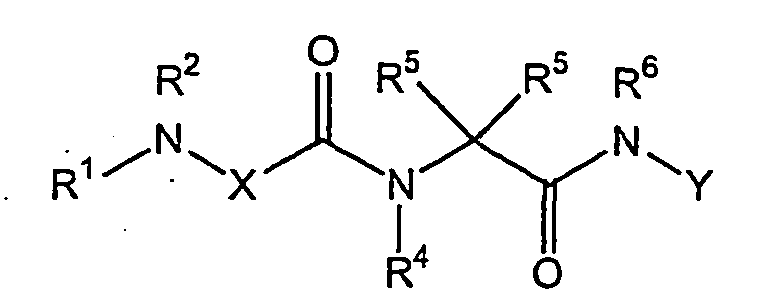
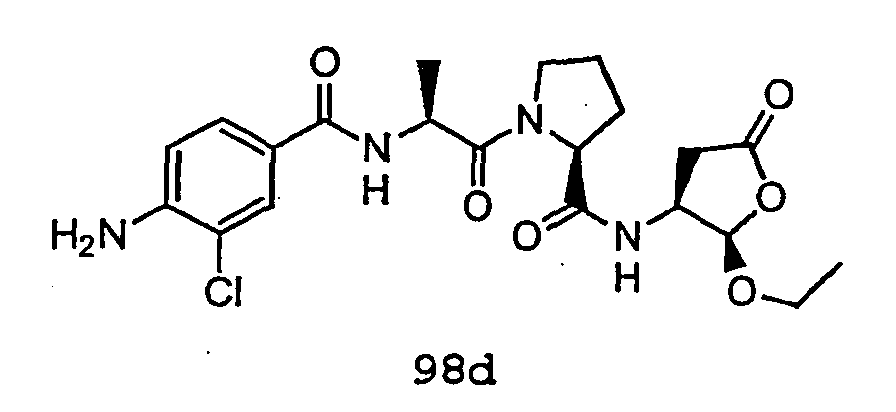
- As is known in the art, the bioavailability of compounds within a structural class is difficult to predict. Relatively minor structural modifications often have a large impact on the absorption of a compound, its blood level concentrations and/or its half-life. For example, such variations in bioavailability can be seen from the data in WO 99/47545. As a consequence, structurally related compounds that have very good in vitro potency may vary in therapeutic effectiveness,
- Though progress has been made in improving the bioavailability of ICE inhibitors, there continues to be a need to identify and develop compounds that can effectively inhibit caspases, and that have improved in vivo activity. Such compounds would be useful as agents for preventing and treating chronic and acute forms of IL-1-, apoptosis-, IL-18-, or IFN-γ-mediated diseases, as well as inflammatory, autoimmune, destructive bone, proliferative, infectious, or degenerative diseases.
- This invention provides a novel ICE inhibitor prodrug compound with surprisingly good bioavailability in mammals. The compound is represented by formula I:Compound I may be used alone or in combination with other therapeutic or prophylactic agents, such as antibiotics, immunomodulators or other anti-inflammatory agents, for the treatment or prevention of diseases mediated by IL-1, apoptosis, IL-18, or IFN-γ. This invention also relates to pharmaceutically acceptable derivatives and prodrugs of the compound.

- Compound I itself is a prodrug that undergoes bioconversion to an active ICE inhibitor II:Compound I has better in vivo activity upon oral and/or intravenous administration than the parent or active form of the drug. The active form, aspartic aldehyde II, exhibits less than optimal in vivo activity, primarily because of poor bioavailability, and is therefore not well-suited for direct therapeutic use. Generally, poor bioavailability may result for any of the following reasons: the active form is not stable in the animal gut following ingestion, is not well-absorbed through the gut and/or is not well-delivered to the biological compartment (e.g., the brain or lymphatic system) for which it is intended. While the prodrug I shows enhanced bioavailability relative to its active form II, this invention is not limited to any particular mechanism by which the bioavailability is enhanced

- Applicants studied a number of prodrug ICE inhibitors, including examples listed in the aforementioned WO 99/47545. Bioavailability was determined by quantitating the amount of ICE inhibitor in rat plasma after oral administration, as described below. Compound I was found to have unexpectedly improved bioavailability relative to other prodrug ICE inhibitors tested, including some that were closely related in structure.
- The structure for compound I depicted herein is meant to include all stereochemical forms of the compound; i.e., the R and S configurations for each asymmetric center. Therefore, single stereochemical isomers as well as enantiomeric and diastereomeric mixtures of the present compound are within the scope of the invention. A preferred isomer is compound I-A which has the "S" configuration at the carbon bearing the tert-butyl group, has the "S" configuration at the 2-position of the proline ring, has the "S" configuration at the 3-position of the furanone ring, and has the "R" configuration at the 2-ethoxy position of the furanone ring, as shown below:Another preferred isomer is compound I-B:


- Unless otherwise stated, structures depicted herein are also meant to include compounds which differ only in the presence of one or more isotopically enriched atoms. For example, compounds having the present structures except for the replacement of a hydrogen by a deuterium or tritium, or the replacement of a carbon by a 13C- or 14C-enriched carbon are within the scope of this invention.
- The compounds of this invention may be prepared in general by methods known to those skilled in the art for analogous compounds, as illustrated by the general scheme below and by the preparative examples below
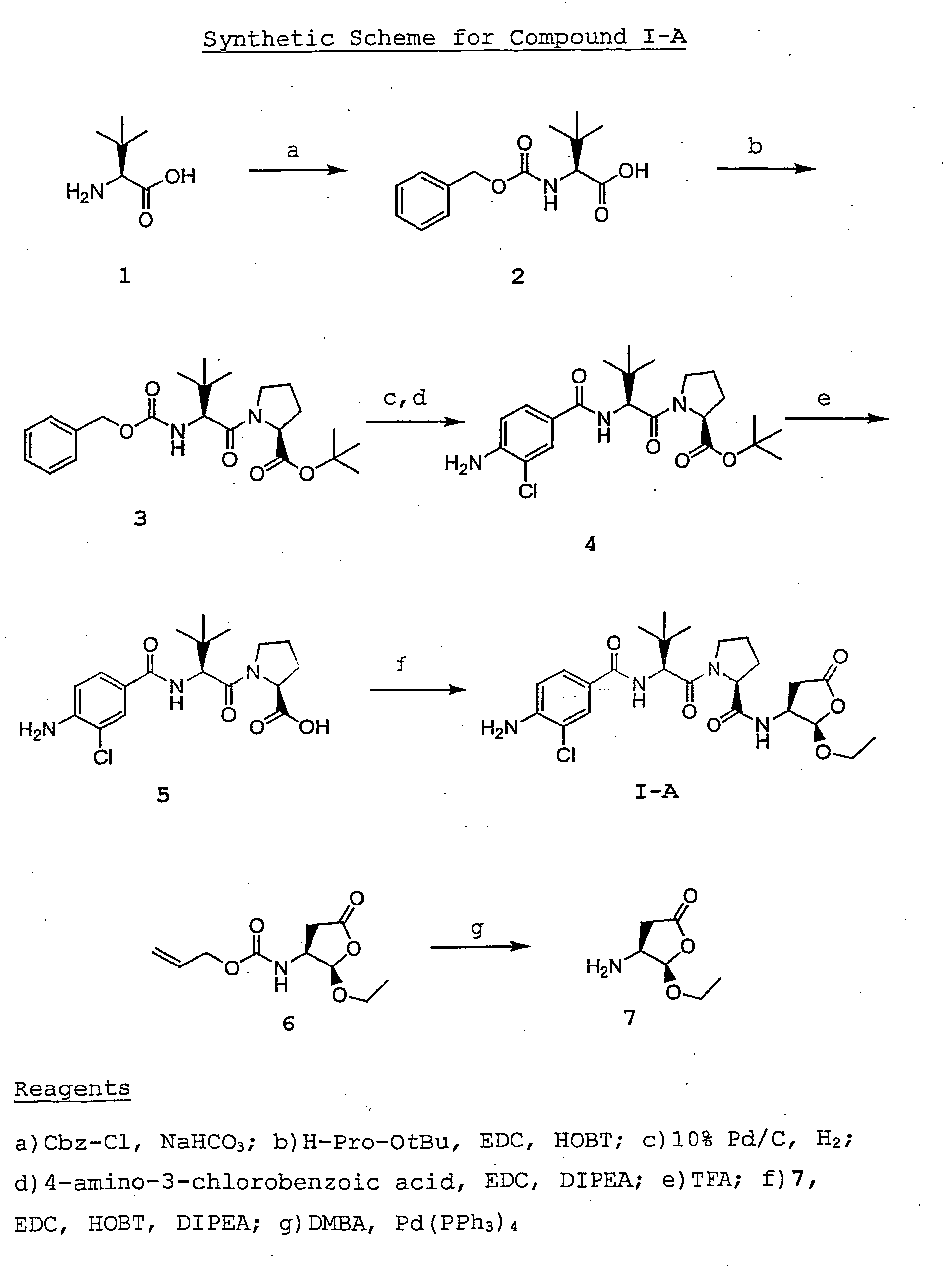
- Certain of the intermediates that are useful for making compound I are believed to be novel. Accordingly, one embodiment of this invention relates to compounds represented by formula II:wherein R is selected from hydrogen or an organic radical, preferably hydrogen or a C1-12 alkyl, and most preferably hydrogen or tert-butyl. It is understood that the organic radical moiety is a group that is unreactive toward the other functional groups in compound II. Compound II is understood to include any of the four possible stereoisomers, as well as mixtures thereof. A preferred isomer of II is represented by formula II-A:
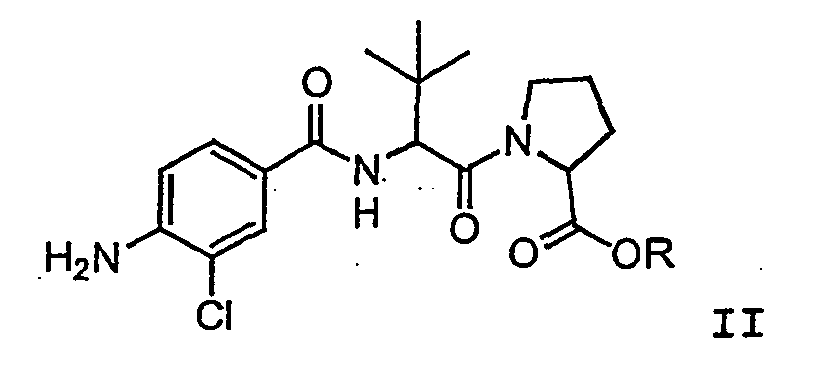 wherein R is as described above,
- Pharmaceutical compositions of this invention comprise a compound of formula I or a pharmaceutically acceptable salt thereof and a pharmaceutically acceptable carrier. Such compositions may optionally comprise an additional therapeutic agent. Such agents include, but are not limited to, an anti-inflammatory agent, a matrix metalloprotease inhibitor, a lipoxygenase inhibitor, a cytokine antagonist, an immunosuppressant, an anti-cancer agent, an anti-viral agent, a cytokine, a growth factor, an immunomodulator, a prostaglandin or an anti-vascular hyperproliferation compound.
- The term "pharmaceutically acceptable carrier" refers to a non-toxic carrier that may be administered to a patient, together with a compound of this invention, and which does not destroy the pharmacological activity thereof.
- Pharmaceutically acceptable carriers that may be used in the pharmaceutical compositions of this invention include, but are not limited to, ion exchangers, alumina, aluminum stearate, lecithin, serum proteins, such as human serum albumin, buffer substances such as phosphates, glycine, sorbic acid, potassium sorbate, partial glyceride mixtures of saturated vegetable fatty acids, water, salts or electrolytes, such as protamine sulfate, disodium hydrogen phosphate, potassium hydrogen phosphate, sodium chloride, zinc salts, colloidal silica, magnesium trisilicate, polyvinyl pyrrolidone, cellulose-based substances, polyethylene glycol, sodium carboxymethylcellulose, polyacrylates, waxes, polyethylene-polyoxypropylene-block polymers, wool fat and self-emulsifying drug delivery systems (SEDDS) such as α-tocopherol, polyethyleneglycol 1000 succinate, or other similar polymeric delivery matrices.
- In pharmaceutical composition comprising only a compound of formula I as the active component, methods for administering these compositions may additionally comprise the step of administering to the subject an additional agent. Such agents include, but are not limited to, an anti-inflammatory agent, a matrix metalloprotease inhibitor, a lipoxygenase inhibitor, a cytokine antagonist, an immunosuppressant, an anti-cancer agent, an anti-viral agent, a cytokine, a growth factor, an immunomodulator, a prostaglandin or an anti-vascular hyperproliferation compound.
- The term "pharmaceutically effective amount" refers to an amount effective in treating or ameliorating an IL-1-, apoptosis-, IL-18-, or IFN-γ-mediated disease in a patient. The term "prophylactically effective amount" refers to an amount effective in preventing or substantially lessening IL-1-, apoptosis-, IL-18-, or IFN-γ-mediated diseases in a patient.
- The compounds of this invention may be employed in a conventional manner for controlling IL-18 and IFN-γ levels in vivo and for treating diseases or reducing the advancement or severity of effects which are mediated by IL-1, apoptosis, IL-18, or IFN-γ. Such methods of treatment, their dosage levels and requirements may be selected by those of ordinary skill in the art from available methods and techniques.
- For example, a compound of this invention may be combined with a pharmaceutically acceptable adjuvant for administration to a patient suffering from an IL-1-, apoptosis-, IL-18-, or IFN-γ-mediated disease in a pharmaceutically acceptable manner and in an amount effective to lessen the severity of that disease.
- Alternatively, the compounds of this invention may be used in compositions and methods for treating or protecting individuals against IL-1, apoptosis-, IL-18, or IFN-γ-mediated diseases over extended periods of time. The compounds may be employed in such compositions either alone or together with other compounds of this invention in a manner consistent with the conventional utilization of enzyme inhibitors in pharmaceutical compositions. For example, a compound of this invention may be combined with pharmaceutically acceptable adjuvants conventionally employed in vaccines and administered in prophylactically effective amounts to protect individuals over an extended period of time against IL-1-, apoptosis-, IL-18, or IFN-γ -mediated diseases.
- The compounds of formula I may also be co-administered with other caspase or ICE inhibitors to increase the effect of therapy or prophylaxis against various IL-1-, apoptosis-, IL-18-, or IFN-γ-mediated diseases.
- In addition, the compounds of this invention may be used in combination with either conventional anti-inflammatory agents or with matrix metalloprotease inhibitors, lipoxygenase inhibitors and antagonists of dytokines other than IL-1β.
- The compounds of this invention can also be administered in combination with immunomodulators (e.g., bropirimine, anti-human alpha-interferon antibody, IL-2, GM-CSF, methionine enkephalin, interferon-alpha, diethyldithiocarbamate, tumor necrosis factor, naltrexone and EPO), with prostaglandins, or with antiviral agents (e.g., 3TC, polysulfated polysaccharides, ganiclovir, ribavirin, acyclovir, alpha interferon, trimethotrexate and fancyclovir) or prodrugs of these or related compounds to prevent or combat IL-1-mediated disease symptoms such as inflammation.
- When the compounds of this invention are administered in combination therapies with other agents, they may be administered sequentially or concurrently to the patient. Alternatively, pharmaceutical or prophylactic compositions according to this invention comprise a combination of a compound of formula I and another therapeutic or prophylactic agent.
- The pharmaceutical compositions of this invention may be administered orally, parenterally, by inhalation spray, topically, rectally, nasally, buccally, vaginally or via an implanted reservoir. We prefer oral administration. The pharmaceutical compositions of this invention may contain any conventional non-toxic pharmaceutically-acceptable carriers, adjuvants or vehicles. In some cases, the pH of the formulation may be adjusted with pharmaceutically acceptable acids, bases or buffers to enhance the stability of the formulated compound or its delivery form. The term parenteral as used herein includes subcutaneous, intracutaneous, intravenous, intramuscular, intra-articular, intrasynovial, intrasternal, intrathecal, intralesional and intracranial injection or infusion techniques.
- The pharmaceutical compositions may be in the form of a sterile injectable preparation, for example, as a sterile injectable aqueous or oleaginous suspension. This suspension may be formulated according to techniques known in the art using suitable dispersing or wetting agents (such as, for example, Tween 80) and suspending agents. The sterile injectable preparation may also be a sterile injectable solution or suspension in a non-toxic parenterally-acceptable diluent or solvent, for example, as a solution in 1,3-butanediol. Among the acceptable vehicles and solvents that may be employed are mannitol, water, Ringer's solution and isotonic sodium chloride solution. In addition, sterile, fixed oils are conventionally employed as a solvent or suspending medium. For this purpose, any bland fixed oil may be employed including synthetic mono- or diglycerides. Fatty acids, such as oleic acid and its glyceride derivatives are useful in the preparation of injectables, as are natural pharmaceutically-acceptable oils, such as olive oil or castor oil, especially in their polyoxyethylated versions. These oil solutions or suspensions may also contain a long-chain alcohol diluent or dispersant, such as those described in Pharmacopeia Helvetica, or a similar alcohol.
- The pharmaceutical compositions of this invention may be orally administered in any orally acceptable dosage form including, but not limited to, capsules, tablets, and aqueous suspensions and solutions. In the case of tablets for oral use, carriers which are commonly used include lactose and corn starch. Lubricating agents, such as magnesium stearate, are also typically added. For oral administration in a capsule form, useful diluents include lactose and dried corn starch. When aqueous suspensions and solutions and propylene glycol are administered orally, the active ingredient is combined with emulsifying and suspending agents. If desired, certain sweetening and/or flavoring and/or coloring agents may be added.
- The pharmaceutical compositions of this invention may also be administered in the form of suppositories for rectal administration. These compositions can be prepared by mixing a compound of this invention with a suitable non-irritating excipient which is solid at room temperature but liquid at the rectal temperature and therefore will melt in the rectum to release the active components. Such materials include, but are not limited to, cocoa butter, beeswax and polyethylene glycols.
- Topical administration of the pharmaceutical compositions of this invention is especially useful when the desired treatment involves areas or organs readily accessible by topical application. For application topically to the skin, the pharmaceutical composition should be formulated with a suitable ointment containing the active components suspended or dissolved in a carrier. Carriers for topical administration of the compounds of this invention include, but are not limited to, mineral oil, liquid petroleum, white petroleum, propylene glycol, polyoxyethylene polyoxypropylene compound, emulsifying wax and water. Alternatively, the pharmaceutical composition can be formulated with a suitable lotion or cream containing the active compound suspended or dissolved in a carrier. Suitable carriers include, but are not limited to, mineral oil, sorbitan monostearate, polysorbate 60, cetyl esters wax, cetearyl alcohol, 2-octyldodecanol, benzyl alcohol and water. The pharmaceutical compositions of this invention may also be topically applied to the lower intestinal tract by rectal suppository formulation or in a suitable enema formulation. Topically-administered transdermal patches are also included in this invention.
- The pharmaceutical compositions of this invention may be administered by nasal aerosol or inhalation. Such compositions are prepared according to techniques well-known in the art of pharmaceutical formulation and may be prepared as solutions in saline, employing benzyl alcohol or other suitable preservatives, absorption promoters to enhance bioavailability, fluorocarbons, and/or other solubilizing or dispersing agents known in the art.
- Dosage levels of between about 0.01 and about 100 mg/kg body weight per day, preferably between 0.5 and about 75 mg/kg body weight per day and most preferably between about 1 and 50 mg/kg body weight per day of the active ingredient compound are useful in a monotherapy for the prevention and treatment of IL-1-, apoptosis-, IL-18-, and IFN-γ-mediated diseases, including uveitis, inflammatory diseases, autoimmune diseases, destructive bone disorders, proliferative disorders, infectious diseases, degenerative diseases, necrotic diseases, inflammatory peritonitis, osteoarthritis, acute pancreatitis, chronic pancreatitis, asthma, adult respiratory distress syndrome, glomerulonephritis, rheumatoid arthritis, systemic lupus erythematosus, scleroderma, chronic thyroiditis, Graves' disease, autoimmune gastritis, insulin-dependent diabetes mellitus (Type I), autoimmune hemolytic anemia, autoimmune neutropenia, thrombocytopenia, chronic active hepatitis, myasthenia gravis, inflammatory bowel disease, Crohn's disease, psoriasis, atopic dermatitis, graft vs. host disease, osteoporosis, multiple myeloma-related bone disorder, leukemias and related disorders, myelodysplastic syndrome, acute myelogenous leukemia, chronic myelogenous leukemia, metastatic melanoma, Kaposi's sarcoma, multiple myeloma, sepsis, septic shock, Shigellosis, Alzheimer's disease, Parkinson's disease, cerebral ischemia, myocardial ischemia, myocardial infarction, congestive heart failure, Huntington's disease, atherosclerosis, spinal muscular atrophy, multiple sclerosis, AIDS-related encephalitis, HIV-related encephalitis, aging, alopecia, neurological damage due to stroke, ulcerative collitis, infectious hepatitis, juvenile diabetes, lichenplanus, acute dermatomyositis, eczema, primary cirrhosis, uveitis, Behcet's disease, atopic skin disease, pure red cell aplasia, aplastic anemia, amyotrophic lateral sclerosis, nephrotic syndrome and systemic diseases or diseases with effects localized in the liver or other organs having an inflammatory or apoptotic component caused by excess dietary alcohol intake or viruses, such as HBV, HCV, HGV, yellow fever virus, dengue fever virus, and Japanese encephalitis virus.
- Typically, the pharmaceutical compositions of this invention will be administered from about 1 to 5 times per day or alternatively, as a continuous infusion. Such administration can be used as a chronic or acute therapy. The amount of active ingredient that may be combined with the carrier materials to produce a single dosage form will vary depending upon the host treated and the particular mode of administration. A typical preparation will contain from about 5% to about 95% active compound (w/w). Preferably, such preparations contain from about 20% to about 80% active compound.
- When the compositions of this invention comprise a combination of a compound of formula I and one or more additional therapeutic or prophylactic agents, both the compound and the additional agent should be present at dosage levels of between about 10% to 80% of the dosage normally administered in a monotherapy regime.
- Upon improvement of a patient's condition, a maintenance dose of a compound, composition or combination of this invention may be administered, if necessary. Subsequently, the dosage or frequency of administration, or both, may be reduced, as a function of the symptoms, to a level at which the improved condition is retained. When the symptoms have been alleviated to the desired level, treatment should cease. Patients may, however, require intermittent treatment on a long-term basis upon any recurrence or disease symptoms.
- As the skilled artisan will appreciate, lower or higher doses than those recited above may be required. Specific dosage and treatment regimens for any particular patient will depend upon a variety of factors, including the activity of the specific compound employed, the age, body weight, general health status, sex, diet, time of administration, rate of excretion, drug combination, the severity and course of the disease, and the patient's disposition to the disease and the judgment of the treating physician.
- IL-1 or apoptosis mediated diseases which may be treated or prevented by the compounds of this invention include, but are not limited to, inflammatory diseases, autoimmune diseases, proliferative disorders, infectious diseases, and degenerative diseases. The apoptosis-mediated diseases which may be treated or prevented by the compounds of this invention include degenerative diseases.
- IL-1 or apoptosis mediated inflammatory diseases which may be treated or prevented include, but are not limited to osteoarthritis, acute pancreatitis, chronic pancreatitis, asthma, and adult respiratory distress syndrome. Preferably the inflammatory disease is osteoarthritis or acute pancreatitis.
- IL-1 or apoptosis mediated autoimmune diseases which may be treated or prevented include, but are not limited to, glomerulonephritis, rheumatoid arthritis, systemic lupus erythematosus, scleroderma, chronic thyroiditis, Graves' disease, autoimmune gastritis, insulin-dependent diabetes mellitus (Type I), autoimmune hemolytic anemia, autoimmune neutropenia, thrombocytopenia, chronic active hepatitis, myasthenia gravis, multiple sclerosis, inflammatory bowel disease, Crohn's disease, psoriasis, atopic dermatitis and graft vs. host disease. Preferably the autoimmune disease is rheumatoid arthritis, inflammatory bowel disease, Crohn's disease, psoriasis, or atopic dermatitis.
- IL-1 or apoptosis mediated destructive bone disorders which may be treated or prevented include, but are not limited to, osteoporosis and multiple myeloma-related bone disorder.
- IL-1 or apoptosis mediated proliferative diseases which may be treated or prevented include, but are not limited to, leukemias and related disorders, such as myelodysplastic syndrome, acute myelogenous leukemia, chronic myelogenous leukemia, metastatic melanoma, Kaposi's sarcoma, and multiple myeloma.
- IL-1 or apoptosis mediated infectious diseases which may be treated or prevented include, but are not limited to, sepsis, septic shock, and Shigellosis.
- IL-1 or apoptosis mediated degenerative or necrotic diseases which may be treated or prevented by the compounds of this invention include, but are not limited to, Alzheimer's disease, Parkinson's disease, cerebral ischemia, and myocardial ischemia. Preferably, the degenerative disease is Alzheimer's disease.
- IL-1 or apoptosis-mediated degenerative diseases which may be treated or prevented by the compounds of this invention include, but are not limited to, Alzheimer's disease, Parkinson's disease, cerebral ischemia, myocardial ischemia, spinal muscular atrophy, multiple sclerosis, AIDS-related encephalitis, HIV-related encephalitis, aging, alopecia, and neurological damage due to stroke.
- Other diseases having an inflammatory or apoptotic component may be treated or prevented by the compounds of this invention. Such diseases may be systemic diseases or-diseases with effects localized in the liver or other organs and may be caused by, for example, excess dietary alcohol intake or viruses, such as HBV, HCV, HGV, yellow fever virus, dengue fever virus, and Japanese encephalitis virus.
- IL-18- or IFN-γ-mediated diseases which may be treated or prevented by the compounds of this invention include, but are not limited to, inflammatory, infectious, autoimmune, proliferative, neurodegenerative and necrotic conditions.
- IL-18- or IFN-γ-mediated inflammatory diseases which may be treated or prevented include, but are not limited to osteoarthritis, acute pancreatitis, chronic pancreatitis, asthma, rheumatoid arthritis, inflammatory bowel disease, Crohn's disease, ulcerative collitis, cerebral ischemia, myocardial ischemia and adult respiratory distress syndrome. Preferably, the inflammatory disease is rheumatoid arthritis, ulcerative collitis, Crohn's disease, hepatitis or adult respiratory distress syndrome.
- IL-18- or IFN-γ-mediated infectious diseases which may be treated or prevented include, but are not limited to infectious hepatitis, sepsis, septic shock and Shigellosis.
- IL-18- or IFN-γ-mediated autoimmune diseases which may be treated or prevented include, but are not limited to glomerulonephritis, systemic lupus erythematosus, scleroderma, chronic thyroiditis, Graves' disease, autoimmune gastritis, insulin-dependent diabetes mellitus (Type I), juvenile diabetes, autoimmune hemolytic anemia, autoimmune neutropenia, thrombocytopenia, myasthenia gravis, multiple sclerosis, psoriasis, lichenplanus, graft vs. host disease, acute dermatomyositis, eczema, primary cirrhosis, hepatitis, uveitis, Behcet's disease, atopic skin disease, pure red cell aplasia, aplastic anemia, amyotrophic lateral sclerosis and nephrotic syndrome. Preferably, the autoimmune disease is glomerulonephritis, insulin-dependent diabetes mellitus (Type I), juvenile diabetes, psoriasis, graft vs. host disease or hepatitis.
- More preferred diseases or conditions which may be treated or prevented include rheumatoid arthritis, inflammatory bowel disease, including Crohn's disease and ulcerative colitis, inflammatory peritonitis, amyotrophic lateral sclerosis, septic shock, pancreatitis, traumatic brain injury, organ transplant rejection, osteoporosis, osteoarthritis, asthma, uveitis, psoriasis, Alzeheimer's disease, myocardial infarction, congestive heart failure, Huntington's disease, atherosclerosis, atopic dermatitis, or leukemias and related disorders, such as myelodysplastic syndrome or multiple myeloma.
- Accordingly, one embodiment of this invention provides a method for treating or preventing an IL-1 or apoptosis mediated disease in a subject comprising the step of administering to the subject any compound, pharmaceutical composition, or combination described herein and a pharmaceutically acceptable carrier.
- Another embodiment of this invention provides a method for decreasing IL-18 production in a subject comprising the step of administering to the subject any compound, pharmaceutical composition, or combination described herein and a pharmaceutically acceptable carrier.
- Yet another embodiment of this invention provides a method for decreasing IFN-γ production in a subject comprising the step of administering to the subject any compound, pharmaceutical composition, or combination described herein and a pharmaceutically acceptable carrier.
- Although this invention focuses on the use of the compounds disclosed herein for preventing and treating IL-1, apoptosis-, IL-18, and IFN-□-mediated diseases, the compounds of this invention can also be used as inhibitory agents for other cysteine proteases.
- The compounds of this invention are also useful as commercial reagents which effectively bind to caspases or other cysteine proteases including, but not limited to ICE. As commercial reagents, the compounds of this invention, and their derivatives, may be used to block proteolysis of a target peptide in biochemical or cellular assays for ICE and ICE homologs or may be derivatized to bind to a stable resin as a tethered substrate for affinity chromatography applications. These and other uses which characterize commercial cysteine protease inhibitors will be evident to those of ordinary skill in the art.
- In order that this invention be more fully understood, the following examples are set forth. These examples are for the purpose of illustration only and are not to be construed as limiting the scope of the invention in any way.
- To a solution of L-tert-leucine (1) (50.0g, 38.0 mmol) and NaHCO3 (96.0g, 114 mmol) in ice (500g) and water (500 ml) was added benzyl chloroformate (65.0 ml, 74.0 mmol) and the reaction stirred at 0°C for 3 hours then at room temperature for 18 hours. 0.1N Na2CO3 was added until the oily layer dissolved and the solution was washed with 10% EtOAc in hexanes (2 x 500 ml). The iced aqueous phase was acidified to pH 1 using 12N HCl then extracted using EtOAc (3 x 350 ml). The combined organic extracts were dried over Na2SO4, filtered and evaporated to give the title compound as a colorless oil (82.4g, 81.5% yield): 1H-NMR (500 MHz, CDCl3) δ1.02 (s, 9H), 4.22 (d, 1H), 5.10-5.14 (m, 2H), 5.31 (d, 1H), 7.26-7.37 (m, 5H).
- To a solution of 2 (6.01g, 2.0 mmol) in CH2Cl2 (30 ml) and anhydrous DMF (dimethylformamide)(10 ml) at 0°C was added HOBT (3.16g, 2.0 mmol), EDC (1-(3-dimethylaminopropyl-3-ethyl-carbodiimide hydrochloride) (7.19g, 4.0 mmol) and L-proline-tert-butyl ester (4.22g, 2.0 mmol). The solution was stirred at 0°C for 10 minutes, then at room temperature for 5 hours. The solvents were evaporated in-vacuo and the resulting oil dissolved in EtOAc which was washed with H2O (3 x 200 ml) and brine (200 ml). The organic phase was dried over anhydrous Na2SO4, filtered and evaporated to give the crude product. Flash chromatography on silica gel using hexanes/EtOAc (95/5 to 80/20%) afforded the title compound as a colorless oil (8.30g, 87.5% yield): 1H-NMR (500 MHz, CDCl3) δ1.04 (s, 9H), 1.45 (s, 9H), 1.89-1.96 (m, 2H), 2.02-2.05 (m, 1H), 2.18-2.22 (m, 1H), 3.65-3.69 (m, 1H), 3.79-3.82 (m, 1H), 4.34-4.37 (m, 2H), 5.03-5.19 (m, 2H), 5.53 (d, 1H), 7.26-7.38 (5H).
- To a solution of 3 (19.0g, 45.4 mmol) in MeOH (200 mL) was added 10% activated Pd on C (2.0 g) in EtOAc (50 mL) and the reaction stirred under H2 for 18 hours. The solution was filtered through Celite and the solvent evaporated to yield a viscous, colorless oil. The free amine was dissolved in dry CH2Cl2/DMF (2:1, 120 mL), the solution cooled to 0°C and 4-amino-3-chlorobenzoic acid (7.79g, 45.4mmol) and DIPEA (7.90 mL, 45.4 mmol) were added. The reaction was stirred for 10 minutes, then EDC (11.32g, 59.1 mmol) was added. The mixture was stirred at 0°C for 30 minutes then at room temperature for 18 hours. The solution was diluted with EtOAc (300 mL), washed with 0.5N NaHSO4 (2 x 250mL), 10% NaHCO3 (2 x 250 mL), saturated NaCl (150 mL), dried over MgSO4, and evaporated to dryness. Flash column chromatography on silica gel using CH2Cl2/MeOH, (99/1 to 98/2%) yielded the title compound as a white solid (19.25g, 97% yield) : 1H-NMR (500 MHz, CDCl3) δ 1.12 (s, 9H), 1.48 (s, 9H), 1.85-1.99 (m, 2H), 2.01-2.13 (m, 1H), 2.18-2.29 (m, 1H), 3.63-3.73 (m, 1H), 3.84-3.93 (m, 1H), 4.30-4.41 (m, 1H), 4.86 (d, 1H), 6.73 (d, 1H), 7.51 (d, 1H), 7.73 (s, 1H). Analytical HPLC (cyano column): 12.59 min. LC-MS (ES+) m/e=438.5 (M+H).
- To a solution of 4 (15.9 g, 36.3 mmol) in CH2Cl2 (30 mL) was added TFA (trifluoroacetic acetic acid)(30 mL) and the solution stirred at room temperature for 3 hours under N2. The reaction was transfered to a beaker (1 L) and diluted with CH2Cl2 (60 mL). To the solution at O°C was added solid NaHCO3 (39 g, 46 mmol) and stirred for 15 minutes before partitioning between EtOAc (300 mL) and H2O (300 mL). After extraction the aqueous layer was acidified to pH 4-5 and extracted with EtOAc. The organic layer was dried (MgSO4) and evaporated to dryness to give 5 as a white solid (14.0g, quantitative yield): 1H-NMR (500 MHz, CDCl3) δ1.08 (s, 9H), 1.97-2.22 (m, 3H), 2.29-2.41 (m, 1H), 3.71-3.78 (m, 1H), 3.90-3.98 (m, 1H), 4.55-4.62 (m, 1H), 4.86 (d, 1H), 6.64 (d, 1H), 6.74 (d, 1H), 7.53 (d, 1H), 7.74 (s, 1H). Analytical HPLC (cyano column): 8.24 min. LC-MS (ES+) m/e=382.4 (M+H).
- To a solution of 6 (5.05g, 22.0 mmol) in CH2Cl2 (50 mL) at O°C was added 1,3-dimethylbarbituric acid (DMBA) (3.78g, 24.2 mmol) and Pd(PPh3)4 (0.15g, 0.13 mmol). After 10 minutes, a solution of 5 (8.40g, 22.0 mmol) in DMF (25 mL) was added followed by diisopropylethylamine (DIPEA) (7.66 mL, 44.1 mmol), (2.98g, 22.0 mmol) and EDC (5.06g, 26.4 mmol). The solution was stirred at 0°C for 10 minutes then at room temperature for 18 hours. The reaction was diluted with EtOAc (200 mL), washed with 0.5N NaHSO4 (2 x 200 mL), 10% NaHCO3 (2 x 200 mL), saturated NaCl (1 x 150 mL), dried over anhydrous MgSO4, and evaporated to dryness. Flash column chromatography on silica gel using CH2Cl2/MeOH, (99/1 to 98/2%) afforded the title compound as a white solid (11.20g, 77% yield) : 1H-NMR (500 MHz, CDCl3) δ 1.08 (s, 9H), 1.27 (t, 3H), 1.85-1.99 (m, 1H), 2.00-2.06 (m. 1H), 2.07-2.18 (m, 1H), 2.32-2.48 (m, 2H), 2.78-2.89 (m, 1H), 3.62-3.76 (m, 2H), 3.82-3.96 (m, 2H), 4.39 (s, 1H), 4.54-4.60 (m, 1H), 4.62-4.76 (m, 1H), 4.85 (d, 1H), 6.57 (d, 1H), 6.73 (d, 1H) , 7.38 (d, 1H), 7.49 (d, 1H), 7.72 (s, 1H). Analytical HPLC (cyano column): 13.10 min. LC-MS (ES+) m/e=509.4 (M+H), m.p.= 96-99 °C.
- Male Sprague-Dawley rats (Harlan, Indianapolis, IN, 300-350 g) were anesthetized by an intramuscular injection of ketamine/rompun mixture. A PE-50 cannula was inserted in the right carotid artery for arterial blood sampling. The rats were allowed to recover from surgery overnight (16 hours) prior to being used in the study. Test compounds were administered orally at 50 mg/kg 100% propylene glycol (PG) at a dose volume of 10 mL/kg. Blood samples (~0.30 mL) were removed at 0.25, 0.50, 1.0, 1.5, 2, 3, 4, 6, and 8 hours post-dose, plasma separated by centrifugation and stored at -80°C pending analysis. Quantification of the plasma samples was conducted using a gradient HPLC/MS/MS similar to the one detailed below:
-
- 1. 100µl of plasma are aliquotted into Ependorf centrifuge vials.
- 2. An,equal volume of acetonitrile is added to the plasma to precipitate plasma proteins.
- 3. Samples are vortexed for 2 minutes, and centrifuged at 14,000 rpms for 3 minutes.
- 4. 100µl of the supernatant is loaded into 12mm HPLC liquid sampler vials.
- 5. A 20 µl addition of external standard is added to the 100µl aliquot to monitor variation in instrumental response.
- 6. 10 µl of sample is injected for analysis via the mass spectrometer.
-
- HPLC: Hewlett Packard HP1100 Binary Solvent Delivery System.
-
- A = H2O 0.2% Formic Acid
- B = Acetonitrile 0.2% Formic Acid
-
- HPLC Analytical Column: Keystone Phenyl -1 Hypersil 2.0x100mm, 5µ 120Å pore pore size, P/N# 105-36-2
- Injection Volume:
- 10µl
- Flow Rate:
- 0.20 mL/min.
- Pharmacokinetic analysis of these plasma concentration data was conducted using noncompartmental methods. The area under the curve (AUC(0-t)) was estimated from time zero to the last measured time point using the linear trapezoidal rule. The rate of elimination (ke) was estimated by log-linear regression from the terminal phase of the plasma concentration-time curves. Area under the tail of the curve was estimated as the ratio of the last measured concentration to ke. The area under the curve from time zero to infinity (AUC(0-∞)) was obtained by addition of the area under the tail to AUC(0-t). Elimination half-life was estimated as 0.693/ke. The observed values for the peak plasma concentration (Cmax) were recorded.

- Table 1 above compares the pharmacokietic values of compound I with compounds A and B that are closely related in structure. As can be seen from the data, Cmax and AUC are much higher for compound I than for the other two compounds.
- While we have described a number of embodiments of this invention, it is apparent that our basic constructions may be altered to provide other embodiments that utilize the products and processes of this invention.
| Mobile Phase | ||
| Time (min) | %A | m%B |
| 0 | 100 | 0 |
| 2 | 100 | 0 |
| 5 | 0 | 100 |
| 11 | 0 | 100 |
| 11.5 | 100 | 0 |
| 15 | 100 | 0 |
| Mass Spectrometry Instrumental Parameters | |
| Instrument: | Micromass Quattro Ultima, Tandem Mass Spectrometer |
| Ionization Technique | Orthogonal spray (ESI) |
| Polarity | Positive |
| Dwell Time | 300msec |
| Pause Time | 5msec |
| Scan time | 0.9sec |
| Scan Mode | MRM (Multiple Reaction Monitoring) |
| Ions/Transitions | For compound I-A m/z509.1―243.1 For compound II m/z481.1-215.1 |
Claims (12)
- A compound of formula I:or a pharmaceutically-acceptable derivative thereof.
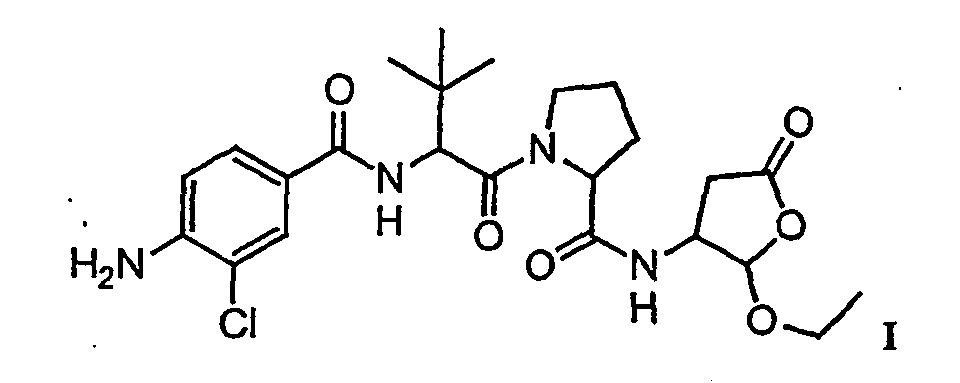
- A pharmaceutical composition comprising the compound of claim 1, and a pharmaceutically acceptable carrier, adjuvant or vehicle.
- A method for treating or preventing a disease selected from an IL-1 mediated disease, an apoptosis mediated disease, an inflammatory disease, an autoimmune disease, a destructive bone disorder, a proliferative disorder, an infectious disease, a degenerative disease, a necrotic disease, an excess dietary alcohol intake disease, a viral mediated disease, uveitis, inflammatory peritonitis, osteoarthritis, pancreatitis, asthma, adult respiratory distress syndrome, glomerulonephritis, rheumatoid arthritis, systemic lupus erythematosus, scleroderma, chronic thyroiditis, Grave's disease, autoimmune gastritis, insulin-dependent diabetes mellitus (Type I), autoimmune hemolytic anemia, autoimmune neutropenia, thrombocytopenia, chronic active hepatitis, myasthenia gravis, inflammatory bowel disease, Crohn's disease, psoriasis, atopic dermatitis, graft vs host disease, osteoporosis, leukemias and related disorders, myelodysplastic syndrome, multiple myeloma-related bone disorder, acute myelogenous leukemia, chronic myelogenous leukemia, metastatic melanoma, Kaposi's sarcoma, multiple myeloma, sepsis, septic shock, Shigellosis, Alzheimer's disease, Parkinson's disease, cerebral ischemia, myocardial ischemia, myocardial infarction, congestive heart failure, Huntington's disease, atherosclerosis, spinal muscular atrophy, multiple sclerosis, AIDS-related encephalitis, HIV-related encephalitis, aging, alopecia, neurological damage due to stroke, ulcerative colitis, traumatic brain injury, organ transplant rejection, hepatitis-B, hepatitis-C, hepatitis-G, yellow fever, dengue fever, or Japanese encephalitis, in a patient comprising the step of administering to said patient a pharmaceutical composition according to claim 2.
- The method according to claim 3, wherein the disease is rheumatoid arthritis, inflammatory bowel disease, Crohn's disease, ulcerative colitis, amyotrophic lateral sclerosis, inflammatory peritonitis, septic shock, pancreatitis, traumatic brain injury, organ transplant rejection, osteoporosis, osteoarthritis, asthma, psoriasis, Alzheimer's disease, myocardial infarction, congestive heart failure, Huntington's disease, atherosclerosis, atopic dermatitis, leukemias and related disorders, myelodysplastic syndrome, uveitis or multiple myeloma.
- A method for inhibiting an ICE-mediated function in a patient comprising the step of administering to said patient the compound of claim 1 or a pharmaceutical composition according to claim 2.
- A method for decreasing IL-18 or IFN-□ production in a patient comprising the step of administering to said patient the compound of claim 1 or a pharmaceutical composition according to claim 2.
- The use of the compound of claim 1 or a pharmaceutical composition according to claim 2 in the manufacture of a medicament for treating or preventing a disease selected from an IL-1 mediated disease, an apoptosis mediated disease, an inflammatory disease, an autoimmune disease, a destructive bone disorder, a proliferative disorder, an infectious disease, a degenerative disease, a necrotic disease, an excess dietary alcohol intake disease, a viral mediated disease, inflammatory peritonitis, osteoarthritis, pancreatitis, asthma, adult respiratory distress syndrome, glomerulonephritis, rheumatoid arthritis, uveitis, systemic lupus erythematosus, scleroderma, chronic thyroiditis, Grave's disease, autoimmune gastritis, insulin-dependent diabetes mellitus (Type I), autoimmune hemolytic anemia, autoimmune neutropenia, thrombocytopenia, chronic active hepatitis, myasthenia gravis, inflammatory bowel disease, Crohn's disease, psoriasis, atopic dermatitis, graft vs host disease, osteoporosis, leukemias and related disorders, myelodysplastic syndrome, multiple myeloma-related bone disorder, acute myelogenous leukemia, chronic myelogenous leukemia, metastatic melanoma, Kaposi's sarcoma, multiple myeloma, sepsis, septic shock, Shigellosis, Alzheimer's disease, Parkinson's disease, cerebral ischemia, myocardial ischemia, myocardial infarction, congestive heart failure, Huntington's disease, atherosclerosis, spinal muscular atrophy, multiple sclerosis, AIDS-related encephalitis, HIV-related encephalitis, aging, alopecia, neurological damage due to stroke, ulcerative colitis, traumatic brain injury, organ transplant rejection, hepatitis-B, hepatitis-C, hepatitis-G, yellow fever, dengue fever, or Japanese encephalitis, in a patient.
- The use according to claim 7, wherein the disease is rheumatoid arthritis, inflammatory bowel disease, Crohn's disease, ulcerative colitis, inflammatory peritonitis, amyotrophic lateral sclerosis, septic shock, pancreatitis, traumatic brain injury, organ transplant rejection, osteoporosis, osteoarthritis, asthma, psoriasis, Alzheimer's disease, myocardial infarction, congestive heart failure, Huntington's disease, atherosclerosis, atopic dermatitis, leukemias and related disorders, myelodysplastic syndrome, uveitis or multiple myeloma.
- The use of the compound of claim 1 or a pharmaceutical composition according to claim 2 in the manufacture of a medicament for inhibiting an ICE-mediated function in a patient.
- The use of the compound of claim 1 or a pharmaceutical composition according to claim 2 in the manufacture of a medicament for decreasing IL-18 or IFN-γ production in a patient.
- A compound represented by formula II:wherein R is selected from hydrogen or an organic radical.

- The compound of claim 11 wherein R is selected from hydrogen or tert-butyl.
Applications Claiming Priority (3)
| Application Number | Priority Date | Filing Date | Title |
|---|---|---|---|
| US20543900P | 2000-05-19 | 2000-05-19 | |
| US205439P | 2000-05-19 | ||
| EP01939230A EP1286989B1 (en) | 2000-05-19 | 2001-05-18 | Prodrug of an ICE inhibitor |
Related Parent Applications (2)
| Application Number | Title | Priority Date | Filing Date |
|---|---|---|---|
| EP01939230A Division EP1286989B1 (en) | 2000-05-19 | 2001-05-18 | Prodrug of an ICE inhibitor |
| EP01939230.7 Division | 2001-05-18 |
Publications (2)
| Publication Number | Publication Date |
|---|---|
| EP1396492A1 true EP1396492A1 (en) | 2004-03-10 |
| EP1396492B1 EP1396492B1 (en) | 2012-02-01 |
Family
ID=22762189
Family Applications (3)
| Application Number | Title | Priority Date | Filing Date |
|---|---|---|---|
| EP03020900A Expired - Lifetime EP1396492B1 (en) | 2000-05-19 | 2001-05-18 | Prodrug of an ice inhibitor |
| EP10177537.7A Expired - Lifetime EP2270005B1 (en) | 2000-05-19 | 2001-05-18 | Prodrug of an ice inhibitor |
| EP01939230A Expired - Lifetime EP1286989B1 (en) | 2000-05-19 | 2001-05-18 | Prodrug of an ICE inhibitor |
Family Applications After (2)
| Application Number | Title | Priority Date | Filing Date |
|---|---|---|---|
| EP10177537.7A Expired - Lifetime EP2270005B1 (en) | 2000-05-19 | 2001-05-18 | Prodrug of an ice inhibitor |
| EP01939230A Expired - Lifetime EP1286989B1 (en) | 2000-05-19 | 2001-05-18 | Prodrug of an ICE inhibitor |
Country Status (22)
| Country | Link |
|---|---|
| US (8) | US7417029B2 (en) |
| EP (3) | EP1396492B1 (en) |
| JP (2) | JP4890719B2 (en) |
| KR (1) | KR100863144B1 (en) |
| AP (1) | AP2002002406A0 (en) |
| AT (1) | ATE543814T1 (en) |
| AU (1) | AU2001264770A1 (en) |
| CA (1) | CA2379972C (en) |
| CY (1) | CY1112448T1 (en) |
| DK (2) | DK2270005T3 (en) |
| ES (2) | ES2380915T3 (en) |
| MX (1) | MXPA02000751A (en) |
| NO (1) | NO324354B1 (en) |
| NZ (1) | NZ516703A (en) |
| PE (1) | PE20011350A1 (en) |
| PL (1) | PL207575B1 (en) |
| PT (2) | PT2270005E (en) |
| SK (1) | SK287070B6 (en) |
| TR (1) | TR200200769T1 (en) |
| TW (1) | TWI285642B (en) |
| WO (1) | WO2001090063A2 (en) |
| ZA (1) | ZA200200610B (en) |
Cited By (2)
| Publication number | Priority date | Publication date | Assignee | Title |
|---|---|---|---|---|
| FR3114741A1 (en) | 2020-10-07 | 2022-04-08 | Etienne Jacotot | TREATMENTS FOR CORONAVIRUS INFECTIONS, CYTOKINE RELEASE SYNDROME, CYTOKINE STORM SYNDROME, OR DISEASES ASSOCIATED WITH OVER-ACTIVATION OF INFLAMMASOMES THROUGH THE USE OF INFLAMMATORY CASPASE INHIBITORS. |
| WO2022074134A1 (en) | 2020-10-07 | 2022-04-14 | Etienne Jacotot | Treatments of coronavirus infections, cytokine release syndrome, cytokine storm syndrome, or diseases associated with excessive activation of inflammasomes by the use of inhibitors of inflammatory caspases |
Families Citing this family (32)
| Publication number | Priority date | Publication date | Assignee | Title |
|---|---|---|---|---|
| CA2324226C (en) * | 1998-03-19 | 2012-06-05 | Vertex Pharmaceuticals Incorporated | Inhibitors of caspases |
| PL356836A1 (en) * | 2000-02-10 | 2004-07-12 | Abbott Laboratories | Antibodies that bind human interleukin-18 and methods of making and using |
| PE20011350A1 (en) | 2000-05-19 | 2002-01-15 | Vertex Pharma | PROPHARMAC OF AN INHIBITOR OF INTERLEUKIN-1ß CONVERTER ENZYME (ICE) |
| US7410956B2 (en) * | 2002-02-11 | 2008-08-12 | Vertex Pharmaceuticals Incorporated | Caspase inhibitor prodrugs |
| SI1487541T1 (en) * | 2002-03-22 | 2009-02-28 | Serono Lab | Use of il-18 inhibitors for the treatment and/or prevention of peripheral vascular diseases |
| AU2004290413A1 (en) * | 2003-11-10 | 2005-05-26 | Vertex Pharmaceuticals Incorporated | Methods for monitoring IL-18 |
| AU2005249503B2 (en) | 2003-11-10 | 2011-08-25 | Vertex Pharmaceuticals Incorporated | ICE inhibitors for the treatment of autoinflammatory diseases |
| US7968684B2 (en) | 2003-11-12 | 2011-06-28 | Abbott Laboratories | IL-18 binding proteins |
| WO2005053665A1 (en) * | 2003-12-01 | 2005-06-16 | Vertex Pharmaceuticals Incorporated | Treating infectious diseases using ice inhibitors |
| AU2011226946B2 (en) * | 2004-02-27 | 2012-05-03 | Vertex Pharmaceuticals Incoporated | Caspase Inhibitors and Uses Thereof |
| EP1718639A2 (en) | 2004-02-27 | 2006-11-08 | Vertex Pharmaceuticals Incorporated | Caspase inhibitors and uses thereof |
| CA2820541A1 (en) * | 2004-02-27 | 2005-09-15 | Vertex Pharmaceuticals Incorporated | Caspase inhibitors and uses thereof |
| KR101135765B1 (en) * | 2004-03-12 | 2012-04-23 | 버텍스 파마슈티칼스 인코포레이티드 | Processes and intermediates for the preparation of aspartic acetal caspase inhibitors |
| CA2566362C (en) * | 2004-05-15 | 2013-09-10 | Vertex Pharmaceuticals Incorporated | Treating seizures using ice inhibitors |
| ATE530227T1 (en) | 2005-06-03 | 2011-11-15 | Merck Serono Sa | USE OF IL-18BP ISOFORMS TO TREAT AND/OR PREVENT NEUROLOGICAL INFLAMMATORY DISEASES |
| EP1910379B1 (en) * | 2005-07-28 | 2011-10-19 | Vertex Pharmaceuticals Incorporated | Caspase inhibitor prodrugs |
| CN101489530A (en) * | 2006-05-31 | 2009-07-22 | 弗特克斯药品有限公司 | Oral controlled release formulations of an interleukin-1 beta converting enzyme inihibitor |
| CN101534824A (en) * | 2006-11-17 | 2009-09-16 | 艾博特公司 | Aminopyrrolidines as chemokine receptor antagonists |
| KR20100072167A (en) | 2007-08-03 | 2010-06-30 | 사노피-아벤티스 | Caspase imaging probes |
| WO2010071866A2 (en) | 2008-12-19 | 2010-06-24 | Nuon Therapeutics, Inc. | Combination therapy for arthritis with tranilast |
| US9365612B2 (en) | 2010-01-29 | 2016-06-14 | United States Of America As Represented By The Secretary, Department Of Health And Human Services | Caspase inhibitors |
| JP6006908B2 (en) * | 2010-11-05 | 2016-10-12 | ブランダイス ユニバーシティBrandeis University | ICE inhibitory compounds and uses thereof |
| EP2697246B1 (en) | 2011-04-15 | 2018-03-07 | Genesis Technologies Limited | Selective cysteine protease inhibitors and uses thereof |
| US9956260B1 (en) | 2011-07-22 | 2018-05-01 | The J. David Gladstone Institutes | Treatment of HIV-1 infection and AIDS |
| EP2848696A1 (en) | 2013-09-13 | 2015-03-18 | Sanofi-Aventis Deutschland GmbH | Caspase-1 imaging probes |
| CN110545835A (en) | 2016-12-23 | 2019-12-06 | A·勒布朗 | CASPASE-1 inhibition and its use for the prevention and treatment of neurological disorders |
| ES2769975B2 (en) * | 2018-12-27 | 2020-12-04 | Univ Murcia | CASPASE 1 INHIBITORS FOR THE TREATMENT OF ANEMIA |
| JP2022541021A (en) * | 2019-07-16 | 2022-09-21 | ラッシュ・ユニバーシティ・メディカル・センター | USING BENZOATE-CONTAINING COMPOSITIONS TO TREAT NEURODEGENERATIVE DISORDERS |
| CA3176737A1 (en) | 2020-05-01 | 2021-11-04 | Thomas M. FISHBEIN | Methods for treating covid-19 |
| WO2023006645A1 (en) * | 2021-07-28 | 2023-02-02 | F. Hoffmann-La Roche Ag | Haloacethydrazides useful as aep inhibitors |
| WO2024097731A2 (en) * | 2022-11-02 | 2024-05-10 | Medstar Health, Inc. | Methods for treating covid-19 |
| WO2026082873A1 (en) | 2024-10-17 | 2026-04-23 | Institut National de la Santé et de la Recherche Médicale | Use of caspase-1 inhibitors for treating ineffective erythropoiesis in patients suffering from sickle cell disease |
Citations (1)
| Publication number | Priority date | Publication date | Assignee | Title |
|---|---|---|---|---|
| WO1999047545A2 (en) * | 1998-03-19 | 1999-09-23 | Vertex Pharmaceuticals Incorporated | Inhibitors of caspases |
Family Cites Families (123)
| Publication number | Priority date | Publication date | Assignee | Title |
|---|---|---|---|---|
| US6204261B1 (en) | 1995-12-20 | 2001-03-20 | Vertex Pharmaceuticals Incorporated | Inhibitors of interleukin-1β Converting enzyme inhibitors |
| US5874424A (en) | 1995-12-20 | 1999-02-23 | Vertex Pharmaceuticals Incorporated | Inhibitors of interleukin-1β converting enzyme |
| US4465679A (en) | 1983-01-31 | 1984-08-14 | Usv Pharmaceutical Corporation | 1,2-Diaza-3-one compounds, their use in treating hypertension and pharmaceutical compositions thereof |
| IL72523A (en) | 1983-08-12 | 1988-06-30 | Takeda Chemical Industries Ltd | 3-amino-4-oxo-2,3,4,5-tetrahydro-1,5-benzoxazepine derivatives,their production and pharmaceutical compositions containing them |
| US5055451A (en) | 1986-12-22 | 1991-10-08 | Syntex Inc. | Aryloxy and arylacyloxy methyl ketones as thiol protease inhibitors |
| US5158936A (en) | 1986-12-22 | 1992-10-27 | Syntex (U.S.A.) Inc. | Aryloxy and arylacyloxy methyl ketones as thiol protease inhibitors |
| US5008245A (en) | 1988-10-27 | 1991-04-16 | University Of Kentucky Research Foundation | Novel peptidyl carbamate inhibitors of the enzyme elastase |
| CA2021660A1 (en) | 1989-07-26 | 1991-01-27 | Philippe Bey | Peptidase inhibitors |
| NZ235155A (en) | 1989-09-11 | 1993-04-28 | Merrell Dow Pharma | Peptidase substrates in which the carboxy terminal group has been replaced by a tricarbonyl radical |
| AU7775991A (en) | 1990-04-04 | 1991-10-30 | Immunex Corporation | Interleukin 1beta protease |
| US5416013A (en) | 1990-04-04 | 1995-05-16 | Sterling Winthrop Inc. | Interleukin 1β protease and interleukin 1β protease inhibitors |
| DK0503561T3 (en) | 1991-03-15 | 1999-07-05 | Hoechst Ag | Process for Preparation of Diastereoselective Reductive Pinacol Coupling of Homochiral Alpha-Amino Aldehydes |
| CA2071674C (en) | 1991-06-21 | 2003-08-19 | Kevin T. Chapman | Peptidyl derivatives as inhibitors of interleukin-1.beta. converting enzyme |
| JP3190431B2 (en) | 1991-07-01 | 2001-07-23 | 三菱化学株式会社 | Ketone derivatives |
| US5278061A (en) | 1991-08-16 | 1994-01-11 | Merck & Co., Inc. | Affinity chromatography matrix useful in purifying interleukin-1β converting enzyme |
| EP0533226A3 (en) | 1991-08-16 | 1993-08-18 | Merck & Co. Inc. | Novel chromophore containing compounds |
| US6348570B1 (en) | 1991-08-16 | 2002-02-19 | Merck & Co., Inc. | Chromophore containing compounds and their use in determining interleukin-1β convertase activity |
| DE69229252T2 (en) | 1991-08-16 | 1999-12-16 | Merck & Co., Inc. | DNA encoding the interleukin-1B precursor converting enzyme |
| JP2759895B2 (en) | 1991-08-30 | 1998-05-28 | サノフィ | DNA sequence isolate encoding interleukin 1β protease |
| ATE140449T1 (en) | 1991-10-07 | 1996-08-15 | Hoechst Ag | METHOD FOR THE DIASTEREOSELECTIVE REDUCTIVE PINAKOL COUPLING OF HOMOCHIRAL ALPHA-AMINOALDEHYDES |
| GB9123326D0 (en) | 1991-11-04 | 1991-12-18 | Sandoz Ltd | Improvements in or relating to organic compounds |
| AU1339092A (en) | 1991-12-13 | 1993-07-19 | Corvas International, Inc. | Reagents for automated synthesis of peptide analogs |
| EP0547699A1 (en) | 1991-12-19 | 1993-06-23 | Merck & Co. Inc. | Peptidyl derivatives as inhibitors of interleukin-1B converting enzyme |
| AU3479593A (en) | 1992-01-31 | 1993-09-01 | Merck & Co., Inc. | Peptidyl derivatives as inhibitors of interleukin-1beta converting enzyme |
| CA2129976C (en) | 1992-02-21 | 2002-09-17 | Kevin T. Chapman | Peptidyl derivatives as inhibitors of interleukin-1.beta. converting enzyme |
| AU4634993A (en) | 1992-06-24 | 1994-01-24 | Merck & Co., Inc. | Dna encoding precursor interleukin 1beta converting enzyme |
| ES2117133T3 (en) | 1992-07-31 | 1998-08-01 | Pfizer | PEPTIDILIC DERIVATIVES OF ACID 4-AMINO-2,2-DIFLUORO-3-OXO-1,6-HEXANODIOICO AS ANTI-INFLAMMATORY AGENTS. |
| CA2109646C (en) | 1992-11-24 | 2000-03-07 | Gaston O. Daumy | Para-nitroanilide peptides |
| EP0618223A3 (en) | 1993-03-08 | 1996-06-12 | Sandoz Ltd | Peptides inhibit the release of interleukin 1-beta useful as anti-inflammatory agents. |
| CA2122227A1 (en) | 1993-04-29 | 1994-10-30 | Roland E. Dolle | Peptide analogs as irreversible interleukin-1.beta. protease inhibitors |
| US5462939A (en) | 1993-05-07 | 1995-10-31 | Sterling Winthrop Inc. | Peptidic ketones as interleukin-1β-converting enzyme inhibitors |
| US5411985A (en) | 1993-05-17 | 1995-05-02 | Merck & Co., Inc. | Gamma-pyrone-3-acetic acid as an inhibitor or interleukin-1 β inventory enzyme |
| JPH0789951A (en) | 1993-06-03 | 1995-04-04 | Sterling Winthrop Inc | Interleukin-1β convertase inhibitor |
| ES2122145T3 (en) | 1993-06-04 | 1998-12-16 | Vertex Pharma | PEPTIDIC PHOSPHINYLOXIMETHYL-KETONES AS INHIBITORS OF THE CONVERTED ENZYME OF INTERLEUKIN-1 BETA. |
| EP0711174A4 (en) | 1993-06-24 | 1997-11-12 | Gen Hospital Corp | REGULATORY GENES OF PROGRAMMED CELL DEATH AND PROTEINS |
| WO1995001592A1 (en) | 1993-06-30 | 1995-01-12 | Ford Motor Company | Method and system for controlling an automotive hvac system |
| US5866545A (en) | 1993-08-13 | 1999-02-02 | Merck & Co., Inc. | Substituted ketone derivatives as inhibitors of interleukin-1β converting enzyme |
| US5486623A (en) | 1993-12-08 | 1996-01-23 | Prototek, Inc. | Cysteine protease inhibitors containing heterocyclic leaving groups |
| US5714484A (en) | 1993-12-08 | 1998-02-03 | Prototek, Inc. | α-(1,3-dicarbonylenol ether) methyl ketones as cysteine protease inhibitors |
| CA2186511C (en) | 1994-03-31 | 2009-02-10 | Roland E. Dolle | Pyrimidinyl derivatives as interleukin inhibitors |
| WO1995029672A1 (en) | 1994-04-29 | 1995-11-09 | Sanofi Winthrop, Inc. | HALOMETHYL AMIDES AS IL-1β PROTEASE INHIBITORS |
| BE1008343A3 (en) | 1994-05-06 | 1996-04-02 | Dsm Nv | Bidentate phosphine ligand |
| US5492824A (en) | 1994-05-12 | 1996-02-20 | Basf Ag | Ice and ice-like compositions and methods of making same |
| US5552400A (en) | 1994-06-08 | 1996-09-03 | Sterling Winthrop Inc. | Fused-bicyclic lactams as interleukin-1β converting enzyme inhibitors |
| US5856116A (en) | 1994-06-17 | 1999-01-05 | Vertex Pharmaceuticals, Incorporated | Crystal structure and mutants of interleukin-1 beta converting enzyme |
| US5756466A (en) | 1994-06-17 | 1998-05-26 | Vertex Pharmaceuticals, Inc. | Inhibitors of interleukin-1β converting enzyme |
| US6420522B1 (en) | 1995-06-05 | 2002-07-16 | Vertex Pharmaceuticals Incorporated | Inhibitors of interleukin-1β converting enzyme |
| US5716929A (en) | 1994-06-17 | 1998-02-10 | Vertex Pharmaceuticals, Inc. | Inhibitors of interleukin-1β converting enzyme |
| US5847135A (en) | 1994-06-17 | 1998-12-08 | Vertex Pharmaceuticals, Incorporated | Inhibitors of interleukin-1β converting enzyme |
| US5565430A (en) | 1994-08-02 | 1996-10-15 | Sterling Winthrop Inc. | Azaaspartic acid analogs as interleukin-1β converting enzyme inhibitors |
| US5704001A (en) | 1994-08-04 | 1997-12-30 | Qualcomm Incorporated | Sensitivity weighted vector quantization of line spectral pair frequencies |
| GB2292149A (en) | 1994-08-09 | 1996-02-14 | Ferring Res Ltd | Peptide inhibitors of pro-interleukin-1beta converting enzyme |
| US5498616A (en) | 1994-11-04 | 1996-03-12 | Cephalon, Inc. | Cysteine protease and serine protease inhibitors |
| TW394764B (en) | 1995-02-14 | 2000-06-21 | Mitsubishi Chemcal Corp | Oxygen-containing heterocyclic derivatives |
| KR0144921B1 (en) * | 1995-02-17 | 1998-07-01 | 김광호 | Capacitor Structure of Semiconductor Memory Device and Manufacturing Method Thereof |
| JPH09165360A (en) | 1995-03-31 | 1997-06-24 | Takeda Chem Ind Ltd | Cysteine protease inhibitor |
| EP0820464A2 (en) | 1995-03-31 | 1998-01-28 | Takeda Chemical Industries, Ltd. | Cysteine protease inhibitor |
| US5798442A (en) | 1995-04-21 | 1998-08-25 | Merck Frosst Canada, Inc. | Peptidyl derivatives as inhibitors of pro-apoptotic cysteine proteinases |
| JPH11514345A (en) | 1995-08-31 | 1999-12-07 | スミスクライン・ビーチャム・コーポレイション | Interleukin converting enzyme and apoptosis |
| JPH11511463A (en) | 1995-08-31 | 1999-10-05 | スミスクライン・ビーチャム・コーポレイション | Interleukin converting enzyme and apoptosis |
| EP0761680A3 (en) | 1995-09-12 | 1999-05-06 | Ono Pharmaceutical Co., Ltd. | Tetrazole compounds having Interleukin-1beta converting enzyme inhibitory activity |
| US5744451A (en) | 1995-09-12 | 1998-04-28 | Warner-Lambert Company | N-substituted glutamic acid derivatives with interleukin-1 β converting enzyme inhibitory activity |
| US5843904A (en) | 1995-12-20 | 1998-12-01 | Vertex Pharmaceuticals, Inc. | Inhibitors of interleukin-1βconverting enzyme |
| US6136834A (en) | 1995-12-27 | 2000-10-24 | Ono Pharmaceutical Co., Ltd. | Tetrazole compounds and pharmaceutical agents containing such derivative |
| WO1998001133A1 (en) | 1996-07-08 | 1998-01-15 | Yamanouchi Pharmaceutical Co., Ltd. | Bone resorption inhibitors |
| WO1998004539A1 (en) | 1996-07-29 | 1998-02-05 | Mitsubishi Chemical Corporation | Oxygenic heterocyclic derivatives |
| US5869519A (en) | 1996-12-16 | 1999-02-09 | Idun Pharmaceuticals, Inc. | C-terminal modified (n-substituted)-2-indolyl dipeptides as inhibitors of the ICE/ced-3 family of cysteine proteases |
| DE69734718T2 (en) | 1996-09-12 | 2006-08-24 | Idun Pharmaceuticals, Inc., San Diego | Inhibition of APOPTOSIS USING INHIBITORS OF INTERLEUKIN-1 BETA CONVERTING ENZYM (ICE) / CED-3 FAMILY |
| US6200969B1 (en) | 1996-09-12 | 2001-03-13 | Idun Pharmaceuticals, Inc. | Inhibition of apoptosis using interleukin-1β-converting enzyme (ICE)/CED-3 family inhibitors |
| DE69718012T2 (en) * | 1996-09-12 | 2003-09-25 | Idun Pharmaceuticals, Inc. | C-TERMINALS MODIFIED (N-SUBSTITUTED) -2-INDOLYL DIPEPTIDES AS INHIBITORS FROM THE ICE / CED-3 CYSTEIN PROTEASE FAMILY |
| DE69711845T2 (en) | 1996-09-12 | 2002-10-31 | Idun Pharmaceuticals, Inc. | NEW TRICYCLIC COMPOUNDS WITH ICE / CED-3 PROTEASE FAMILY-INHIBITING PROPERTIES |
| US5968927A (en) | 1996-09-20 | 1999-10-19 | Idun Pharmaceuticals, Inc. | Tricyclic compounds for the inhibition of the ICE/ced-3 protease family of enzymes |
| US6316415B1 (en) | 1996-10-11 | 2001-11-13 | Basf Aktiengesellschaft | Sulfonamide interleukin-1β converting enzyme inhibitors |
| CA2268098A1 (en) | 1996-10-11 | 1998-04-23 | Warner-Lambert Company | Aspartate ester inhibitors of interleukin-1.beta. converting enzyme |
| US5919790A (en) | 1996-10-11 | 1999-07-06 | Warner-Lambert Company | Hydroxamate inhibitors of interleukin-1β converting enzyme |
| CZ298749B6 (en) | 1996-10-18 | 2008-01-16 | Vertex Pharmaceuticals Incorporated | Inhibitors of serine proteases and pharmaceutical compositions in which the inhibitors are comprised |
| US5877197A (en) | 1996-12-16 | 1999-03-02 | Karanewsky; Donald S. | C-terminal modified (N-substituted)-2-indolyl dipeptides as inhibitors of the ICE/ced-3 family of cysteine proteases |
| US6184244B1 (en) | 1996-12-16 | 2001-02-06 | Idun Pharmaceuticals, Inc. | C-terminal modified (N-substituted)-2-indolyl dipeptides as inhibitors of the ICE/ced-3 family of cysteine proteases |
| US6054487A (en) | 1997-03-18 | 2000-04-25 | Basf Aktiengesellschaft | Methods and compositions for modulating responsiveness to corticosteroids |
| HUP9700816A3 (en) | 1997-04-28 | 1999-06-28 | Gyogyszerkutato Intezet | 3(r)-3-amino-4-carboxy-butiraldehyde derivatives inhibiting release of interleukin-1-beta |
| FR2766188B1 (en) | 1997-07-15 | 2000-02-11 | Hoechst Marion Roussel Inc | NOVEL PROCESS FOR THE PREPARATION OF AMINO DERIVATIVES OF ALKYLOXY FURANONE, COMPOUNDS ARISING FROM THIS PROCESS AND USE OF SUCH COMPOUNDS |
| US6184210B1 (en) | 1997-10-10 | 2001-02-06 | Cytovia, Inc. | Dipeptide apoptosis inhibitors and the use thereof |
| ES2302363T3 (en) | 1997-12-18 | 2008-07-01 | Boehringer Ingelheim Pharmaceuticals Inc. | PIRIDONAS AS INHIBITORS OF THE DOMINIA SH2 OF THE SRC GROUP. |
| DK1049703T3 (en) | 1998-01-20 | 2003-06-02 | Abbott Gmbh & Co Kg | N- [2- (5-benzyloxycarbonylamino-6-oxo-2- (4-fluorophenyl) -1,6-dihydro-1-pyrimidinyl) acetoxyl] -L-aspartic acid aldehyde as an in vivo inhibitor of interleukin-1beta converting enzyme |
| US6197750B1 (en) | 1998-07-02 | 2001-03-06 | Idun Pharmaceuticals, Inc. | C-terminal modified oxamyl dipeptides as inhibitors of the ICE/ced-3 family of cysteine proteases |
| US6323180B1 (en) | 1998-08-10 | 2001-11-27 | Boehringer Ingelheim (Canada) Ltd | Hepatitis C inhibitor tri-peptides |
| US6242422B1 (en) | 1998-10-22 | 2001-06-05 | Idun Pharmacueticals, Inc. | (Substituted)Acyl dipeptidyl inhibitors of the ice/ced-3 family of cysteine proteases |
| ATE336480T1 (en) | 1999-03-16 | 2006-09-15 | Cytovia Inc | SUBSTITUTED 2-AMINOBENZAMIN CASPASE INHIBITORS AND THEIR USE |
| AU765462B2 (en) | 1999-03-16 | 2003-09-18 | Merck Frosst Canada & Co. | Gamma-ketoacid dipeptides as inhibitors of caspase-3 |
| WO2000061542A1 (en) | 1999-04-09 | 2000-10-19 | Cytovia, Inc. | Caspase inhibitors and the use thereof |
| WO2001005772A1 (en) | 1999-07-19 | 2001-01-25 | Merck Frosst Canada & Co. | Pyrazinones, compositions containing such compounds |
| AU6894800A (en) | 1999-08-06 | 2001-03-05 | Vertex Pharmaceuticals Incorporated | Caspase inhibitors and uses thereof |
| US6442565B1 (en) | 1999-08-13 | 2002-08-27 | Hiddenmind Technology, Inc. | System and method for transmitting data content in a computer network |
| IL148426A0 (en) | 1999-08-27 | 2002-09-12 | Cytovia Inc | α-HYDROXY ACID DERIVATIVES AND PHARMACEUTICAL COMPOSITIONS CONTAINING THE SAME |
| AR026748A1 (en) | 1999-12-08 | 2003-02-26 | Vertex Pharma | A CASPASE INHIBITING COMPOUND, A PHARMACEUTICAL COMPOSITION THAT INCLUDES IT, A METHOD FOR THE SYNTHESIS OF THE SAME AND AN INTERMEDIATE COMPOUND PARADICHA SYNTHESIS |
| YU73702A (en) | 2000-03-29 | 2006-03-03 | Vertex Pharmaceuticals Incorporated | Carbamate caspase inhibitors and uses thereof |
| JP4806154B2 (en) | 2000-04-03 | 2011-11-02 | バーテックス ファーマシューティカルズ インコーポレイテッド | Inhibitors of serine proteases, especially hepatitis C virus NS3 protease |
| DE60142470D1 (en) | 2000-04-24 | 2010-08-12 | Vertex Pharma | METHOD AND INTERMEDIATE PRODUCTS FOR THE PREPARATION OF SUBSTITUTED ASPARAGINIC ACETALES |
| TWI291462B (en) | 2000-04-25 | 2007-12-21 | Daiichi Sankyo Co Ltd | Hydrate crystal of neuraminic acid compound |
| PE20011350A1 (en) | 2000-05-19 | 2002-01-15 | Vertex Pharma | PROPHARMAC OF AN INHIBITOR OF INTERLEUKIN-1ß CONVERTER ENZYME (ICE) |
| EP1283827A2 (en) | 2000-05-23 | 2003-02-19 | Vertex Pharmaceuticals Incorporated | Caspase inhibitors and uses thereof |
| EP1289993B9 (en) | 2000-06-07 | 2008-08-20 | Vertex Pharmaceuticals Incorporated | Caspase inhibitors and uses thereof |
| MXPA03000627A (en) | 2000-07-21 | 2004-07-30 | Schering Corp | Novel peptides as ns3-serine protease inhibitors of hepatitis c virus. |
| US6800619B2 (en) | 2000-09-13 | 2004-10-05 | Vertex Pharmaceuticals Incorporated | Caspase inhibitors and uses thereof |
| US6846806B2 (en) | 2000-10-23 | 2005-01-25 | Bristol-Myers Squibb Company | Peptide inhibitors of Hepatitis C virus NS3 protein |
| JP4349802B2 (en) | 2000-11-21 | 2009-10-21 | バーテックス ファーマシューティカルズ インコーポレイテッド | Inhibitors of imidazole and benzimidazole caspases and their use |
| GB0107924D0 (en) | 2001-03-29 | 2001-05-23 | Angeletti P Ist Richerche Bio | Inhibitor of hepatitis C virus NS3 protease |
| EP1381602A1 (en) | 2001-04-19 | 2004-01-21 | Vertex Pharmaceuticals Incorporated | Heterocyclyldicarbamides as caspase inhibitors |
| JP4428926B2 (en) | 2001-05-23 | 2010-03-10 | バーテックス ファーマシューティカルズ インコーポレイテッド | Caspase inhibitors and their use |
| CA2449504A1 (en) | 2001-07-11 | 2003-01-23 | Vertex Pharmaceuticals Incorporated | Bridged bicyclic serine protease inhibitors |
| AU2002348533A1 (en) | 2001-10-09 | 2003-05-26 | Vertex Pharmaceuticals Incorporated | Process for synthesizing aspartic and glutamic acid derivatives and diazoketone intermediates thereof |
| US7410956B2 (en) | 2002-02-11 | 2008-08-12 | Vertex Pharmaceuticals Incorporated | Caspase inhibitor prodrugs |
| US7960398B2 (en) | 2002-04-19 | 2011-06-14 | Vertex Pharmaceuticals Incorporated | Regulation of TNF-alpha |
| US7001899B2 (en) | 2002-06-10 | 2006-02-21 | The Procter & Gamble Company | Interleukin converting enzyme inhibitors |
| US7138395B2 (en) | 2002-06-10 | 2006-11-21 | The Procter & Gamble Company | Interleukin-1β converting enzyme inhibitors |
| US7041696B2 (en) | 2002-06-17 | 2006-05-09 | The Procter & Gamble Company | Interleukin-1β converting enzyme inhibitors |
| BR0312232A (en) | 2002-06-28 | 2005-05-10 | Vertex Pharma | Caspase inhibitors and their uses |
| EP1581501A1 (en) | 2002-12-20 | 2005-10-05 | Vertex Pharmaceuticals Incorporated | 4-oxo-3-(1-oxo-1h-isoquinolin-2-ylacetylamino)-pentanoic acid ester and amide derivatives and their use as caspase inhibitors |
| PE20050159A1 (en) | 2003-05-27 | 2005-04-19 | Vertex Pharma | DERIVATIVES OF 3- [2- (3-AMINO-2-OXO-2H-PYRIDIN-1-IL) -ACETILAMINO] -4-OXO-PENTANOICO AS CASPASE INHIBITORS |
| AU2005249503B2 (en) | 2003-11-10 | 2011-08-25 | Vertex Pharmaceuticals Incorporated | ICE inhibitors for the treatment of autoinflammatory diseases |
| AU2004290413A1 (en) | 2003-11-10 | 2005-05-26 | Vertex Pharmaceuticals Incorporated | Methods for monitoring IL-18 |
| EP1718639A2 (en) | 2004-02-27 | 2006-11-08 | Vertex Pharmaceuticals Incorporated | Caspase inhibitors and uses thereof |
| KR101135765B1 (en) | 2004-03-12 | 2012-04-23 | 버텍스 파마슈티칼스 인코포레이티드 | Processes and intermediates for the preparation of aspartic acetal caspase inhibitors |
-
2001
- 2001-05-15 PE PE2001000436A patent/PE20011350A1/en not_active Application Discontinuation
- 2001-05-18 SK SK102-2002A patent/SK287070B6/en not_active IP Right Cessation
- 2001-05-18 WO PCT/US2001/016441 patent/WO2001090063A2/en not_active Ceased
- 2001-05-18 TR TR2002/00769T patent/TR200200769T1/en unknown
- 2001-05-18 PT PT101775377T patent/PT2270005E/en unknown
- 2001-05-18 JP JP2001586252A patent/JP4890719B2/en not_active Expired - Lifetime
- 2001-05-18 EP EP03020900A patent/EP1396492B1/en not_active Expired - Lifetime
- 2001-05-18 US US09/860,750 patent/US7417029B2/en not_active Expired - Lifetime
- 2001-05-18 ES ES01939230T patent/ES2380915T3/en not_active Expired - Lifetime
- 2001-05-18 AT AT01939230T patent/ATE543814T1/en active
- 2001-05-18 KR KR1020027000779A patent/KR100863144B1/en not_active Expired - Lifetime
- 2001-05-18 AP APAP/P/2002/002406A patent/AP2002002406A0/en unknown
- 2001-05-18 NZ NZ516703A patent/NZ516703A/en not_active IP Right Cessation
- 2001-05-18 ES ES10177537.7T patent/ES2548869T3/en not_active Expired - Lifetime
- 2001-05-18 DK DK10177537.7T patent/DK2270005T3/en active
- 2001-05-18 EP EP10177537.7A patent/EP2270005B1/en not_active Expired - Lifetime
- 2001-05-18 PL PL365171A patent/PL207575B1/en unknown
- 2001-05-18 EP EP01939230A patent/EP1286989B1/en not_active Expired - Lifetime
- 2001-05-18 DK DK01939230.7T patent/DK1286989T3/en active
- 2001-05-18 MX MXPA02000751A patent/MXPA02000751A/en active IP Right Grant
- 2001-05-18 AU AU2001264770A patent/AU2001264770A1/en not_active Abandoned
- 2001-05-18 CA CA002379972A patent/CA2379972C/en not_active Expired - Lifetime
- 2001-05-18 PT PT01939230T patent/PT1286989E/en unknown
- 2001-06-12 TW TW090111976A patent/TWI285642B/en not_active IP Right Cessation
-
2002
- 2002-01-18 NO NO20020287A patent/NO324354B1/en not_active IP Right Cessation
- 2002-01-23 ZA ZA200200610A patent/ZA200200610B/en unknown
-
2008
- 2008-07-01 US US12/165,838 patent/US8022041B2/en not_active Expired - Fee Related
-
2011
- 2011-07-25 JP JP2011162436A patent/JP5285130B2/en not_active Expired - Lifetime
- 2011-08-16 US US13/210,712 patent/US8329662B2/en not_active Expired - Fee Related
-
2012
- 2012-03-06 CY CY20121100219T patent/CY1112448T1/en unknown
- 2012-12-10 US US13/709,610 patent/US9156880B2/en not_active Expired - Fee Related
-
2015
- 2015-06-23 US US14/747,578 patent/US9487555B2/en not_active Expired - Fee Related
-
2016
- 2016-10-07 US US15/288,863 patent/US9994613B2/en not_active Expired - Fee Related
-
2018
- 2018-05-09 US US15/974,855 patent/US20180327449A1/en not_active Abandoned
-
2019
- 2019-10-18 US US16/657,191 patent/US20200048306A1/en not_active Abandoned
Patent Citations (1)
| Publication number | Priority date | Publication date | Assignee | Title |
|---|---|---|---|---|
| WO1999047545A2 (en) * | 1998-03-19 | 1999-09-23 | Vertex Pharmaceuticals Incorporated | Inhibitors of caspases |
Cited By (2)
| Publication number | Priority date | Publication date | Assignee | Title |
|---|---|---|---|---|
| FR3114741A1 (en) | 2020-10-07 | 2022-04-08 | Etienne Jacotot | TREATMENTS FOR CORONAVIRUS INFECTIONS, CYTOKINE RELEASE SYNDROME, CYTOKINE STORM SYNDROME, OR DISEASES ASSOCIATED WITH OVER-ACTIVATION OF INFLAMMASOMES THROUGH THE USE OF INFLAMMATORY CASPASE INHIBITORS. |
| WO2022074134A1 (en) | 2020-10-07 | 2022-04-14 | Etienne Jacotot | Treatments of coronavirus infections, cytokine release syndrome, cytokine storm syndrome, or diseases associated with excessive activation of inflammasomes by the use of inhibitors of inflammatory caspases |
Also Published As
Similar Documents
| Publication | Publication Date | Title |
|---|---|---|
| US9994613B2 (en) | Prodrug of an ICE inhibitor | |
| EP0942925B1 (en) | Inhibitors of interleukin-1 beta converting enzyme | |
| US8691848B2 (en) | Inhibitors of caspases | |
| HK1060881B (en) | Prodrug of an ice inhibitor | |
| HK1035733B (en) | Inhibitors of caspases | |
| EP1466921A1 (en) | Inhibitors of interleukin-1 beta converting enzyme |
Legal Events
| Date | Code | Title | Description |
|---|---|---|---|
| PUAI | Public reference made under article 153(3) epc to a published international application that has entered the european phase |
Free format text: ORIGINAL CODE: 0009012 |
|
| AC | Divisional application: reference to earlier application |
Ref document number: 1286989 Country of ref document: EP Kind code of ref document: P |
|
| AK | Designated contracting states |
Kind code of ref document: A1 Designated state(s): AT BE CH CY DE DK ES FI FR GB GR IE IT LI LU MC NL PT SE TR |
|
| RIN1 | Information on inventor provided before grant (corrected) |
Inventor name: DAVIES, ROBERT J. Inventor name: WANNAMAKER, MARION WOODS |
|
| 17P | Request for examination filed |
Effective date: 20040402 |
|
| REG | Reference to a national code |
Ref country code: HK Ref legal event code: DE Ref document number: 1060881 Country of ref document: HK |
|
| AKX | Designation fees paid |
Designated state(s): GB |
|
| REG | Reference to a national code |
Ref country code: DE Ref legal event code: 8566 |
|
| R17P | Request for examination filed (corrected) |
Effective date: 20040402 |
|
| GRAP | Despatch of communication of intention to grant a patent |
Free format text: ORIGINAL CODE: EPIDOSNIGR1 |
|
| GRAS | Grant fee paid |
Free format text: ORIGINAL CODE: EPIDOSNIGR3 |
|
| GRAA | (expected) grant |
Free format text: ORIGINAL CODE: 0009210 |
|
| RIN1 | Information on inventor provided before grant (corrected) |
Inventor name: WANNAMAKER, MARION WOODS Inventor name: DAVIES, ROBERT J. |
|
| AC | Divisional application: reference to earlier application |
Ref document number: 1286989 Country of ref document: EP Kind code of ref document: P |
|
| AK | Designated contracting states |
Kind code of ref document: B1 Designated state(s): GB |
|
| REG | Reference to a national code |
Ref country code: GB Ref legal event code: FG4D |
|
| REG | Reference to a national code |
Ref country code: HK Ref legal event code: GR Ref document number: 1060881 Country of ref document: HK |
|
| PLBE | No opposition filed within time limit |
Free format text: ORIGINAL CODE: 0009261 |
|
| STAA | Information on the status of an ep patent application or granted ep patent |
Free format text: STATUS: NO OPPOSITION FILED WITHIN TIME LIMIT |
|
| 26N | No opposition filed |
Effective date: 20121105 |
|
| REG | Reference to a national code |
Ref country code: GB Ref legal event code: 732E Free format text: REGISTERED BETWEEN 20141016 AND 20141022 |
|
| PGFP | Annual fee paid to national office [announced via postgrant information from national office to epo] |
Ref country code: GB Payment date: 20200527 Year of fee payment: 20 |
|
| REG | Reference to a national code |
Ref country code: GB Ref legal event code: PE20 Expiry date: 20210517 |
|
| PG25 | Lapsed in a contracting state [announced via postgrant information from national office to epo] |
Ref country code: GB Free format text: LAPSE BECAUSE OF EXPIRATION OF PROTECTION Effective date: 20210517 |