EP1393345B1 - A method of operating a mass spectrometer to suppress unwanted ions - Google Patents
A method of operating a mass spectrometer to suppress unwanted ions Download PDFInfo
- Publication number
- EP1393345B1 EP1393345B1 EP02729688A EP02729688A EP1393345B1 EP 1393345 B1 EP1393345 B1 EP 1393345B1 EP 02729688 A EP02729688 A EP 02729688A EP 02729688 A EP02729688 A EP 02729688A EP 1393345 B1 EP1393345 B1 EP 1393345B1
- Authority
- EP
- European Patent Office
- Prior art keywords
- ions
- processing section
- cell
- rod set
- ion
- Prior art date
- Legal status (The legal status is an assumption and is not a legal conclusion. Google has not performed a legal analysis and makes no representation as to the accuracy of the status listed.)
- Expired - Lifetime
Links
- 150000002500 ions Chemical class 0.000 title claims abstract description 199
- 238000000034 method Methods 0.000 title claims abstract description 53
- 238000006243 chemical reaction Methods 0.000 claims abstract description 37
- 239000012491 analyte Substances 0.000 claims abstract description 33
- 238000012545 processing Methods 0.000 claims abstract description 22
- 239000002245 particle Substances 0.000 claims abstract description 6
- 230000008569 process Effects 0.000 claims abstract description 5
- 230000005405 multipole Effects 0.000 claims description 23
- 239000002243 precursor Substances 0.000 claims description 16
- 230000000694 effects Effects 0.000 claims description 7
- 230000007935 neutral effect Effects 0.000 claims description 6
- 230000033001 locomotion Effects 0.000 claims description 3
- 238000013016 damping Methods 0.000 claims description 2
- 230000005686 electrostatic field Effects 0.000 claims description 2
- 230000005520 electrodynamics Effects 0.000 claims 2
- 230000002452 interceptive effect Effects 0.000 abstract description 15
- 238000004949 mass spectrometry Methods 0.000 abstract description 4
- 229910001423 beryllium ion Inorganic materials 0.000 abstract description 2
- 230000002829 reductive effect Effects 0.000 abstract description 2
- 238000009877 rendering Methods 0.000 abstract 1
- 230000000979 retarding effect Effects 0.000 description 24
- 239000000047 product Substances 0.000 description 20
- 239000007789 gas Substances 0.000 description 17
- XKRFYHLGVUSROY-UHFFFAOYSA-N Argon Chemical compound [Ar] XKRFYHLGVUSROY-UHFFFAOYSA-N 0.000 description 10
- 230000015572 biosynthetic process Effects 0.000 description 10
- 230000001629 suppression Effects 0.000 description 10
- 150000001793 charged compounds Polymers 0.000 description 8
- 238000009616 inductively coupled plasma Methods 0.000 description 7
- 230000005540 biological transmission Effects 0.000 description 6
- 238000013459 approach Methods 0.000 description 5
- 229910052786 argon Inorganic materials 0.000 description 5
- 230000004888 barrier function Effects 0.000 description 4
- 238000001360 collision-induced dissociation Methods 0.000 description 4
- 238000001514 detection method Methods 0.000 description 4
- 238000009826 distribution Methods 0.000 description 4
- 238000011045 prefiltration Methods 0.000 description 4
- 238000004458 analytical method Methods 0.000 description 3
- 230000008901 benefit Effects 0.000 description 3
- 238000001914 filtration Methods 0.000 description 3
- 239000012634 fragment Substances 0.000 description 3
- 239000000523 sample Substances 0.000 description 3
- 230000002860 competitive effect Effects 0.000 description 2
- 238000013467 fragmentation Methods 0.000 description 2
- 238000006062 fragmentation reaction Methods 0.000 description 2
- 238000001095 inductively coupled plasma mass spectrometry Methods 0.000 description 2
- 239000000543 intermediate Substances 0.000 description 2
- 238000005040 ion trap Methods 0.000 description 2
- 239000000126 substance Substances 0.000 description 2
- 230000001133 acceleration Effects 0.000 description 1
- 230000003466 anti-cipated effect Effects 0.000 description 1
- 150000001486 argon compounds Chemical class 0.000 description 1
- 230000009286 beneficial effect Effects 0.000 description 1
- 239000003990 capacitor Substances 0.000 description 1
- 238000006482 condensation reaction Methods 0.000 description 1
- 238000011161 development Methods 0.000 description 1
- 238000000456 dynamic reaction cell inductively coupled plasma mass spectrometry Methods 0.000 description 1
- 238000000265 homogenisation Methods 0.000 description 1
- 239000012535 impurity Substances 0.000 description 1
- 230000006698 induction Effects 0.000 description 1
- 239000013067 intermediate product Substances 0.000 description 1
- 230000037427 ion transport Effects 0.000 description 1
- 239000003446 ligand Substances 0.000 description 1
- 238000004519 manufacturing process Methods 0.000 description 1
- 238000005259 measurement Methods 0.000 description 1
- 230000000149 penetrating effect Effects 0.000 description 1
- 230000035515 penetration Effects 0.000 description 1
- 239000012495 reaction gas Substances 0.000 description 1
- 230000002441 reversible effect Effects 0.000 description 1
- 238000000926 separation method Methods 0.000 description 1
- 238000004611 spectroscopical analysis Methods 0.000 description 1
- 230000002123 temporal effect Effects 0.000 description 1
- 238000012546 transfer Methods 0.000 description 1
- 238000006276 transfer reaction Methods 0.000 description 1
- 230000032258 transport Effects 0.000 description 1
- 238000011144 upstream manufacturing Methods 0.000 description 1
Images


Classifications
-
- H—ELECTRICITY
- H01—ELECTRIC ELEMENTS
- H01J—ELECTRIC DISCHARGE TUBES OR DISCHARGE LAMPS
- H01J49/00—Particle spectrometers or separator tubes
- H01J49/02—Details
- H01J49/06—Electron- or ion-optical arrangements
- H01J49/062—Ion guides
- H01J49/063—Multipole ion guides, e.g. quadrupoles, hexapoles
-
- H—ELECTRICITY
- H01—ELECTRIC ELEMENTS
- H01J—ELECTRIC DISCHARGE TUBES OR DISCHARGE LAMPS
- H01J49/00—Particle spectrometers or separator tubes
- H01J49/004—Combinations of spectrometers, tandem spectrometers, e.g. MS/MS, MSn
- H01J49/0045—Combinations of spectrometers, tandem spectrometers, e.g. MS/MS, MSn characterised by the fragmentation or other specific reaction
-
- H—ELECTRICITY
- H01—ELECTRIC ELEMENTS
- H01J—ELECTRIC DISCHARGE TUBES OR DISCHARGE LAMPS
- H01J49/00—Particle spectrometers or separator tubes
- H01J49/02—Details
- H01J49/10—Ion sources; Ion guns
- H01J49/105—Ion sources; Ion guns using high-frequency excitation, e.g. microwave excitation, Inductively Coupled Plasma [ICP]
-
- H—ELECTRICITY
- H01—ELECTRIC ELEMENTS
- H01J—ELECTRIC DISCHARGE TUBES OR DISCHARGE LAMPS
- H01J49/00—Particle spectrometers or separator tubes
- H01J49/26—Mass spectrometers or separator tubes
- H01J49/34—Dynamic spectrometers
- H01J49/42—Stability-of-path spectrometers, e.g. monopole, quadrupole, multipole, farvitrons
- H01J49/4205—Device types
- H01J49/421—Mass filters, i.e. deviating unwanted ions without trapping
-
- H—ELECTRICITY
- H01—ELECTRIC ELEMENTS
- H01J—ELECTRIC DISCHARGE TUBES OR DISCHARGE LAMPS
- H01J49/00—Particle spectrometers or separator tubes
- H01J49/44—Energy spectrometers, e.g. alpha-, beta-spectrometers
- H01J49/46—Static spectrometers
- H01J49/48—Static spectrometers using electrostatic analysers, e.g. cylindrical sector, Wien filter
- H01J49/488—Static spectrometers using electrostatic analysers, e.g. cylindrical sector, Wien filter with retarding grids
Definitions
- This invention relates to a method of operating a mass spectrometer to suppress unwanted ions.
- Collision cells are widely used for Collision Induced Dissociation (CID) of precursor ions in Mass Spectrometry.
- CID Collision Induced Dissociation
- the product ions of the desired CID are intended to be conducted efficiently to the next stage of a tandem mass spectrometer in order to be mass-analyzed and detected.
- many unintended or undesired processes can occur in the collision cell, producing undesirable ions, for example, cluster ions, or un-specific fragment ions that elevate chemical background and decrease signal-to-noise ratio for the ions of interest measured by a downstream mass analyzer.
- Reaction/collision cells are commonly used in Inductively Coupled Plasma Mass Spectrometry for suppression of unwanted ions originating from the ion source, which often is an Argon inductively coupled plasma source (Ar ICP).
- Ar ICP Argon inductively coupled plasma source
- Ar + , ArO + , Ar 2 + , ClO + etc. are generated in Ar ICP.
- other reactions can take place, for example, cluster formation, atom-transfer reactions, and condensation reactions that produce "undesirable" product ions that elevate background at the mass of interest measured by downstream analyzer. Generally these reactions can reduce signal-to-background ratio.
- One way is to accelerate ions while they are transported through the pressurized device in order to reduce the residence time and/or increase the ion velocity between the collisions so that undesirable reactions' cross-sections are reduced.
- This is achieved by application of the axial internal field and is described in the patent US 5,847,386 by Bruce A. Thomson and Charles L. Jolliffe , and assigned to MDS Inc. (the assignee of the present invention).
- This ion acceleration method does suppress cluster ion formation, but other reactions (for example, atom-transfer) are not intercepted, and, in fact, some endothermic reactions can be promoted by supplying through the axial internal field some additional energy to the collision complex.
- a second way is to prevent formation of undesirable product ions by making the parent or intermediate product ions unstable in the rf-quadrupolar field of the pressurized cell, as described in the patent US 6,140,638 by Scott D. Tanner and Vladimir I. Baranov (also assigned to the assignee of the present invention).
- the parameters of the quadrupole (a and q) By changing the parameters of the quadrupole (a and q), the range of ion masses that are unstable in the cell can be changed. As unstable ions are ejected from the cell, they do not contribute to the undesirable product ion formation.
- ICP DRC TM MS Inductively Coupled Plasma Dynamic Reaction Cell Mass Spectrometry
- DRC Inductively Coupled Plasma Dynamic Reaction Cell Mass Spectrometry
- the highest efficiency achieved to date in ICP DRC MS has given 9 orders of magnitude of suppression of unwanted Ar+ without significant suppression of analyte ions, by charge-exchange with NH 3 , and this is done without significant elevation of chemical background.
- the approach works well when the analyte and the unwanted precursor ion have a relatively large difference in mass, so that the unwanted precursor ion can be efficiently removed without significant suppression of the desired analyte.
- the precursor ion (NH 4 + ) that forms the interfering cluster ion is unstable in the quadrupole field, as its stability parameter q, which is inversely proportional to the ion mass, is
- a third way of discriminating against unwanted product ions is by applying kinetic discrimination downstream of the pressurized cell, as described by J. T. Rowan and R. S. Houk in their paper “Attenuation of Polyatomic Ion Interferences in Inductively Coupled Plasma Mass Spectrometry by Gas-Phase Collisions", Applied Spectroscopy, 1989, 43,976 . This approach works best for the cells pressurized to a relatively low pressure.
- Ions that are produced in the cell including undesirable product ions, have somewhat lower kinetic energy after leaving the cell, than the ions desired for detection (analyte ions) that retain some of the kinetic energy with which they entered the cell, provided there are not enough collisions to smear the difference in energy by collisional energy damping.
- This approach cannot be successfully used if, for high efficiency of the desired reaction, a high number of collisions and thus high gas pressure are required.
- the present invention provides a fourth, novel and inventive way to discriminate against product ions produced in a pressurized device, by applying an energy discrimination principle continuously during the ion transport through the cell.
- the invention provides a retarding field inside the cell, so that the product ions are discriminated against after each collision, i.e. immediately after they are formed and before their energy is damped by further collisions.
- First ions that are produced within the cell and may interfere with the determination of an analyte ion.
- the impact of the retarding internal field has a similar effect, but we will discuss them separately as the polyatomic ion alleviation has some special characteristics.
- the neutral gas molecules within the cell may normally be considered stagnant. Ions, both wanted and unwanted, lose kinetic energy in collision with the neutral gas molecules. Ions that are transformed by the exchange of a particle (electron, atom or ligand), and hence may form a new isobaric interference for an analyte ion, will tend to have less kinetic energy than an atomic ion which collides without chemical transformation. This is because at least a part of the transformed ion is derived from the stagnant neutral molecule. US-A-4 731 533 , involved with EI while rejecting CID, introduces the principle of a retarding lens at the end of the quadrupole.
- polyatomic ions either produced by reaction within the cell or sampled from the source, some of the energy that is delivered to a collision complex from the ion's pre-collision kinetic energy can be distributed into the internal degrees of freedom of the product (or original ion that has undergone collision without reaction) polyatomic ion. As a result, its post-collision kinetic energy can be lower than the kinetic energy of an atomic ion of the same mass to charge ratio.
- the polyatomic ions due to their relatively large size may have significantly larger collision cross-sections than that of atomic ions. As a result, they would experience a larger number of collisions and thus would on average lose more kinetic energy per unit length than atomic ions would.
- the present invention provides a relatively low kinetic energy barrier applied as a continuous field that decelerates the ions and that appears as a kinetic energy barrier to ions whose energies after collision are sufficiently low. Since the undesired product ions and some polyatomic ions, have lower energies after collision than do desired analyte ions, there is a higher probability of the undesired ions being discriminated against, while un-reacted analyte ions can still penetrate through the energy barrier. According to the present invention in which the collisions happen in a retarding internal field, ions that have less energy following collision necessarily have lower transmission to the downstream analyzer when compared to the analyte ions.
- a mass spectrometer system including a processing section having an input and an output, the method comprising:
- the invention includes detecting ions exiting from the processing section.
- the ions could be subject to some additional processing, e.g. steps of fragmentation, reaction and/or mass selection, prior to final detection.
- the unwanted ions could come from a variety of sources.
- the unwanted interfering ions can be ions originating from the ion source, product ions formed by reaction with gas particles in the cell, or ions produced by other processes within the cell. It is also expected that in most cases, the kinetic energy differential between unwanted, interfering ions and desired, analyte ions will result from collision processes in the cell. However, it is possible that unwanted ions could enter the cell with a lower kinetic energy than the desired ions, or at least part of the energy differential will be present when ions enter the cell.
- Figure 1 is a schematic of a mass spectrometer system, suitable for carrying out the present invention
- Figures 2a and 2b show schematic cross-sectional views through a preferred embodiment of a quadrupole rod set with auxiliary electrodes for use in the mass spectrometer system of Figure 1 .
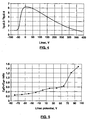
- Figure 3 is a graph showing variation of normalized intensity data with factor q in the collision cell of Figure 1 , with and without retarding internal field applied according to the present invention
- Figure 4 is a graph showing ratio of a detected signal for different q values, as a function of retarding field strength in the collision cell of Figure 1 ;
- Figure 5 illustrates the principle of retarding field suppression of CeO + , produced in the pressurized collision cell of Figure 1 .
- Figure 1 illustrates a mass spectrometer system 10 as disclosed in U.S. patent 6,140,638 , assigned to the same assignee as the present invention and suitable for carrying out the method of the present invention as described below, when modified to provide an internal field, e.g. by including auxiliary electrodes as in Figure 2 .
- the system 10 comprises an inductively coupled plasma source 12, a collision/reaction cell 41, a pre-filter 64 and a mass analyzer 66. It is to be understood that the cell 41 can be configured and used for one or both of collision and reaction between a gas introduced into the cell 41 and ions entering the cell 41.
- the inductively coupled plasma source 12 ionizes a sample material for analysis, and then injects it in the form of a stream of ions through a first orifice 14 in a sampler plate 16. As the stream of ions pass through the first orifice 14, they enter into a first vacuum chamber 18 evacuated by a mechanical pump 20 to a pressure, of for example, 3 torr.
- the stream of ions passes on through the first chamber 18, and through a second orifice 22 in a skimmer plate 24.
- a second vacuum chamber 28 which is evacuated to a lower pressure (e.g. 1 millitorr) by means of a first high vacuum pump 30.
- a first high vacuum pump 30 Within the second vacuum chamber 28, the ion stream enters a quadrupole 34 through entrance aperture 38.
- the quadrupole 34 is loaded in a can or housing 36 to form the collision cell 41.
- the quadrupole 34 provides a means for guiding ions and defines a path for the travel of ions.
- Reactive collision gas is supplied from a gas supply 42 and can be supplied in any known manner to the interior of can 36. As shown, the collision gas can be arranged to flow through a conduit 44 and out through an annular opening 46 surrounding orifice 38. As the collision cell 41 is at a higher pressure than the chamber 28, gas exits into chamber 28 through aperture 38, against the ion current flow. This gas flow prevents or reduces unionized gas from the source 12 from entering the can 36.
- a secondary conduit 48 from gas supply 42 terminates at a position 50 just in front of the orifice 38, so that reactive collision gas is directed into the ion stream before it enters quadrupole 34.
- the position 50 can in fact be any position upstream of the orifice 38, and downstream of the ion source 12.
- the mass spectrometer system 10 is primarily intended for analyzing inorganic analytes.
- the inductively coupled plasma source 12 commonly utilizes argon gas that is subject to a field that, through induction, excites and ionizes the argon gas.
- An analyte sample is injected into the resultant ionized plasma, causing ionization of the analyte.
- the plasma comprising argon and analyte ions, passes through the orifice 14, as indicated.
- Such a plasma has a large concentration of ions, many of which are unwanted ions of argon or argon compounds.
- U.S. patent 6,140,638 is directed to a bandpass technique that, essentially, interferes with chemical reaction sequences that can generate new interferences inside the cell 41.
- the technique involves setting a and q values so as to establish a desired bandpass, within which desired analyte ions are stable. It is also selected so that major interfering ions, or intermediates or precursors of these ions, are unstable. Then, the sequential chemistry generating these interfering ions is interrupted, so that the interfering ions are not detected.
- the present invention modifies the basic structure of the collision cell 41, to add a device for generating an internal field for retarding ions. Further, the present invention may be used instead of or with the original DRC. It has the advantage that it can be used with a higher order multipole operating with or without a "bandpass".
- each auxiliary electrode 114 has a blade section that extends radially inwardly toward the axis of the multipole between the multipole rods 112. The radial depth of this blade section varies along the axis, so that the cross-sections of the auxiliary electrodes 114 vary along the axis.
- this profile for the blade section is such that the DC voltage or plurality of voltages applied to the elongated rods 114 establishes a potential on or adjacent the axis that varies along the multipole, thus providing an internal field.
- the cross section provided in Figure 4a shows a blade section 116 protruding radially deeper between the rods 112, while cross-section in Figure 4b shows a shorter blade sections 117 protruding less in the radial direction between the rods 112.
- the deeper protruding ends 116 of elongated electrodes 112 By placing the deeper protruding ends 116 of elongated electrodes 112 closer to the entrance of the collision/reaction cell 41, and less protruding ends 117 closer to the exit of the collision/reaction cell 41, and by supplying to the auxiliary elongated electrodes 114 a negative potential relatively to a DC offset potential of the rods 112, one can establish an electrostatic field along the cell, that serves to retard motion of positive ions from the entrance to the exit. It is also possible to reverse the configuration of the auxiliary electrodes 113, i.e. to have the deeper protruding ends at the exit and the less protruding ends at the entrance and to use a positive DC voltage, to achieve the same effect.
- the distribution of the potential along the multipole is preferably linear, i.e. the internal field is substantially uniform, so as to provide equal force pushing the ions through the multipole to its exit.
- it can be made to vary from linear by appropriate tailoring of the profile of the elongated electrodes 114 shape and/or depth of penetration between the multipole rods 112. It has been found that a curved profile is necessary for the blade sections 116, 117, to give an approximately linear potential distribution.
- a conventional voltage supply is indicated at 118a, 118b and connected to the rods 112 in a quadrupolar fashion, for supplying RF and DC voltages.
- a DC voltage source 119 is connected to the auxiliary electrodes 114, as indicated.
- the invention is not limited to this arrangement, and further that details of the spectrometer system described can be varied in known manner.
- the collision cell 41 is described as having a quadrupole 34, it will be understood that any suitable electrode configuration can be used. More particularly, other multipoles, e.g. hexapoles and octapoles, could be used, and the present invention provides means of discrimination against unwanted ions in such multipoles that otherwise cannot efficiently suppress production of unwanted ions because they do not provide well defined stability boundaries.
- spectrometers a different class of spectrometers is configured for analyzing organic analytes.
- organic analytes are ionized using an electrospray source or some other equivalent source.
- electrospray source does not tend to produce a high level of background, unlike an ICP source, so there is no necessity to provide a collision/reaction cell for the purposes of removing the background.
- this class of spectrometers do include collision cells and there may be advantages of employing the technique of the present invention, providing a retarding field, in such a spectrometer. It is anticipated that the retarding field of the present invention could be used to discriminate against unwanted products produced in the cell, by retarding them. In certain circumstances, it is expected that a retarding field may have beneficial effects.
- mass analyzer of the disclosed apparatus can be replaced by any suitable mass analyzer, for example, a sector mass analyzer, a time of flight mass analyzer, or an ion trap mass analyzer.
- the quadrupole is operated to provide a desired bandpass.
- the quadrupole can be operated as an RF-only device, i.e. as an ion transmission device, which is a low mass cutoff bandpass device, i.e. it allows transmission of ions above a set of m/z value.
- low level resolving DC may also be applied between the rods, to reject unwanted ions both below and above a desired pass band. These voltages are supplied from a power supply 56.
- Ions from dynamic reaction cell or collision cell 41 pass through an orifice 40 and enter a third vacuum chamber 60 pumped by a second high vacuum turbo pump 62 with a mechanical pump 32 backing up both the high vacuum pumps 30, 62.
- the pump 62 maintains a pressure, of for example, 1,33 ⁇ 10 -3 Pa (1 _ 10 -5 torr) in the vacuum chamber 60.
- ions travel through a pre-filter 64 (typically an RF-only short set of quadrupole rods) into a mass analyzer 66 (which is typically a quadrupole but, as noted, may also be a different type of mass analyzer such as a time-of-flight mass spectrometer, a sector instrument, an ion trap, etc., and appropriate minor changes to the arrangement shown would be needed for some other types of spectrometers).
- the quadrupole 66 has RF and DC signals applied to its rods from a power supply 68 in a conventional manner, to enable scanning of ions received from dynamic reaction cell 41.
- the prefilter 64 is capacitively coupled to the quadrupole 66 by capacitors C1, as is conventional, thus eliminating the need for a separate power supply for the pre-filter 64.
- the ions travel through an orifice 70 in an interface plate 72 and into a detector 74, where the ion signal is detected and passed to a computer 76 for analysis and display.
- the mass spectrometer system 10 provides a bandpass tunable collision cell or dynamic reaction cell 41, where varying or tuning the RF voltage amplitude, the DC voltage and/or the RF frequency (by means of power supply 56) to the quadrupole 34 controls the band (or m/z range) of ion masses transmitted through to the third vacuum chamber 60.
- the low mass end of the bandpass is defined primarily by the RF amplitude and frequency supplied to quadrupole 34, where the high mass end of the transmission window is primarily defined by the DC voltage amplitude applied between pole pairs of the quadrupole 34.
- the mass analyzer only the m/z range of interest is selectively coupled to the mass analyzer.
- the DRC can only be set to reject precursor ions with a mass substantially different from the mass of the desired analyte ion. This does mean that this technique may be incapable of intercepting and rejecting unwanted precursor ions with an m/z close to the m/z of a desired analyte ion; the DRC technique can be used successfully to prevent generation of interfering ions at the mass of an analyte, where there is a precursor to the interfering ion with a substantially different mass.
- the present invention provides a technique for discriminating against these unwanted ions, based on a different principle, namely the realization that unwanted product ions and desired ions will often have different kinetic energies immediately after collision, and discrimination between them is best effected in the collision cell 41 immediately after the product ions are formed.
- the energy discrimination should be applied inside the cell, before further collisions make the energy distributions of the unwanted and wanted ions very similar and thus energy discrimination inefficient.
- the collision cell 41 is modified in accordance with U.S. Patent No. 5,847,386 .
- That patent discloses a number of methods for generating an axial or internal field. These include one or more of: tapered rods; inclined rods; segmented rods; auxiliary rods, which may extend only partially along the main rod set of the collision cell, which may be provided as different groups of auxiliary rods at different locations in the collision cell and which may be inclined.
- Figures 2a and 2b show a more recent development of the auxiliary electrode configuration, which relies on the principles disclosed in U.S. Patent No. 5,847,386 , and is intended to provide a more linear field.
- a further possibility for generating an internal field is to provide external electrodes, such as rings surrounding the multipole array, or a multipole housing having a voltage that varies across its length, such as could be obtained using a segmented housing, so that the internal field penetrates through the multipole rod set to the axis, where the ions are traveling.
- the retarding internal field could be produced by a variety of techniques, including all of the techniques in U.S. Patent No. 5,847,386 , or by a segmented collar.
- the data of figures 4 and 5 were obtained using a device which established an internal field using the T-shaped auxiliary electrodes identified above.
- the results of the internal retarding field are indicated by curve 122, and as shown, at a low q around 0.1-0.2, when the precursor ion is stable, the energy discrimination against the cluster is realized through the continuous internal retarding field, providing an improved ratio of 52 Cr + to (NH 3 ) 3 H + .
- Figure 4 shows the effect of an internal field, derived from a "LINAC" voltage applied to the auxiliary electrodes.
- This graph shows that with a retarding field, i.e.
- the potential is less than zero (the potential is less than zero for the particular electrode configuration used, and can be different in other arrangements or shape of electrodes, as noted above in relation to Figure 2 ) one can obtain at least a six fold suppression of the transmission of the ion cluster (bearing in mind that the residual signal is probably dominated by the Cr+ itself, the enhancement factor is significantly greater), and this is shown strongly at voltages less than minus 50 volts. As this curve shows, an accelerating field can also reduce the signal of cluster ions, most likely by suppressing their formation.
- the retarding field provided by applying the negative voltage, might be expected to promote cluster formation, since as ions are slowed the cluster formation cross-section increases.
- the retarding field applied while it may promote formation of clusters, prevents these clusters penetrating through the energy barrier due to the lower kinetic energy of the clusters. Thus, whatever the level of generation of clusters, they are not detected.
- this illustrates the principle of the present invention, a retarding internal field, applied to suppression of CeO + produced in a pressurized reaction cell, by reaction of Ce + with oxide impurities in the reaction gas.
- This shows the variation of the ratio CeO + /Ce + as a function of the internal field potential.
- the present invention has a number of advantages. Firstly, it can be combined with the bandpass concept in the dynamic reaction cell, again detailed in U.S. Patent No. 6,140,638 , to provide more efficient suppression of in-cell produced ions. It is particularly applicable in this situation when the bandpass on its own is less efficient, due to the precursors of the relevant interferences having similar m/z ratios to ions of interest. Secondly, it can be applied without the bandpass concept, and in this instance can be competitive with the bandpass method in some instances.
- Post-cell discrimination is not useful at high cell pressure where all ions are near-thermal; it is useful only at lower pressures that allow the source ions to retain a sufficient fraction of their initial energy that they can be discriminated from ions produced within the cell. But high pressure provides efficiency of removal of the source-based interference ions, and hence is desirable. Thus, at higher pressures, post cell energy discrimination is less efficient than the use of a bandpass in the collision cell itself (Bodo Hattendorf, Swiss Federal Institute of Technology, Zurich, winter Conference 2001, February 4-8, Lillehammer, Norway). Since the internal field deceleration approach works also at high pressure, it is clearly superior to post-cell discrimination.
- the present invention is readily applicable to a wide variety of collision cell configuration and designs, including multipoles of various orders. More particularly, it can be implemented by an auxiliary rod set, largely independently of the configurations of electrodes already present in the collision cell.
- the inventors believe that in-cell energy discrimination by a retarding internal field at high gas pressures is more efficient than post-cell energy discrimination.
- post-cell energy filtering the problem arises that the energy distribution of the in-cell produced polyatomic ions can overlap that of the desired, non-reacted atomic analyte ions, especially at higher cell pressures which offer higher efficiency of reactive removal of the original isobaric interference. As such, it can be impossible to set an energy level to provide efficient energy filtering separation between these two types of ions.
- the technique of the present invention should be applicable to many different collision cell designs, and could in some instances be competitive with or superior to the DRC (bandpass) method.
Landscapes
- Chemical & Material Sciences (AREA)
- Analytical Chemistry (AREA)
- Chemical Kinetics & Catalysis (AREA)
- Physics & Mathematics (AREA)
- Engineering & Computer Science (AREA)
- Plasma & Fusion (AREA)
- Other Investigation Or Analysis Of Materials By Electrical Means (AREA)
- Electron Tubes For Measurement (AREA)
Applications Claiming Priority (3)
| Application Number | Priority Date | Filing Date | Title |
|---|---|---|---|
| US853715 | 2001-05-14 | ||
| US09/853,715 US6627912B2 (en) | 2001-05-14 | 2001-05-14 | Method of operating a mass spectrometer to suppress unwanted ions |
| PCT/CA2002/000694 WO2002093148A2 (en) | 2001-05-14 | 2002-05-09 | A method of operating a mass spectrometer to suppress unwanted ions |
Publications (2)
| Publication Number | Publication Date |
|---|---|
| EP1393345A2 EP1393345A2 (en) | 2004-03-03 |
| EP1393345B1 true EP1393345B1 (en) | 2010-02-17 |
Family
ID=25316720
Family Applications (1)
| Application Number | Title | Priority Date | Filing Date |
|---|---|---|---|
| EP02729688A Expired - Lifetime EP1393345B1 (en) | 2001-05-14 | 2002-05-09 | A method of operating a mass spectrometer to suppress unwanted ions |
Country Status (8)
| Country | Link |
|---|---|
| US (2) | US6627912B2 (enExample) |
| EP (1) | EP1393345B1 (enExample) |
| JP (1) | JP4149816B2 (enExample) |
| AT (1) | ATE458263T1 (enExample) |
| AU (1) | AU2002302228B2 (enExample) |
| CA (1) | CA2447035C (enExample) |
| DE (1) | DE60235357D1 (enExample) |
| WO (1) | WO2002093148A2 (enExample) |
Cited By (2)
| Publication number | Priority date | Publication date | Assignee | Title |
|---|---|---|---|---|
| CN107408488A (zh) * | 2015-04-01 | 2017-11-28 | Dh科技发展私人贸易有限公司 | 用以增强质谱仪稳健性的rf/dc滤波器 |
| US12578307B2 (en) | 2020-04-03 | 2026-03-17 | Micromass Uk Limited | De-clustering ion guide |
Families Citing this family (29)
| Publication number | Priority date | Publication date | Assignee | Title |
|---|---|---|---|---|
| US6700120B2 (en) * | 2000-11-30 | 2004-03-02 | Mds Inc. | Method for improving signal-to-noise ratios for atmospheric pressure ionization mass spectrometry |
| US6627912B2 (en) * | 2001-05-14 | 2003-09-30 | Mds Inc. | Method of operating a mass spectrometer to suppress unwanted ions |
| GB2389452B (en) * | 2001-12-06 | 2006-05-10 | Bruker Daltonik Gmbh | Ion-guide |
| US6992281B2 (en) * | 2002-05-01 | 2006-01-31 | Micromass Uk Limited | Mass spectrometer |
| JP5529379B2 (ja) * | 2004-10-28 | 2014-06-25 | リザーランド,アルバート,エドワード | 同重体干渉物を分離する方法および機器 |
| EP2084730A4 (en) * | 2006-09-28 | 2011-12-07 | Mds Analytical Tech Bu Mds Inc | AXIAL EJECTION METHOD AND ION TRAP FRAGMENTATION USING AUXILIARY ELECTRODES IN A MULTIPOLAR MASS SPECTROMETER |
| US8207495B2 (en) * | 2006-10-11 | 2012-06-26 | Shimadzu Corporation | Quadrupole mass spectrometer |
| EP1933366B1 (en) | 2006-12-14 | 2019-06-12 | Tofwerk AG | Apparatus for mass analysis of ions |
| EP1933365A1 (en) * | 2006-12-14 | 2008-06-18 | Tofwerk AG | Apparatus for mass analysis of ions |
| EP2126960B1 (en) * | 2007-02-01 | 2019-03-13 | DH Technologies Development Pte. Ltd. | Differential mobility spectrometer pre-filter assembly for a mass spectrometer |
| EP1968100B1 (en) * | 2007-03-08 | 2014-04-30 | Tofwerk AG | Ion guide chamber |
| US7880140B2 (en) * | 2007-05-02 | 2011-02-01 | Dh Technologies Development Pte. Ltd | Multipole mass filter having improved mass resolution |
| WO2010044247A1 (ja) * | 2008-10-14 | 2010-04-22 | 株式会社日立ハイテクノロジーズ | 質量分析装置および質量分析方法 |
| WO2011003186A1 (en) * | 2009-07-06 | 2011-01-13 | Dh Technologies Development Pte. Ltd. | Methods and systems for providing a substantially quadrupole field with a higher order component |
| US9190253B2 (en) | 2010-02-26 | 2015-11-17 | Perkinelmer Health Sciences, Inc. | Systems and methods of suppressing unwanted ions |
| WO2011106768A1 (en) * | 2010-02-26 | 2011-09-01 | Perkin Elmer Health Sciences, Inc. | Plasma mass spectrometry with ion suppression |
| SG10201501031YA (en) | 2010-02-26 | 2015-04-29 | Perkinelmer Health Sci Inc | Fluid chromatography injectors and injector inserts |
| CN103329241B (zh) * | 2010-11-26 | 2016-08-31 | 耶拿分析仪器股份公司 | 质谱分析方面或相关的改进 |
| GB2497799B (en) | 2011-12-21 | 2016-06-22 | Thermo Fisher Scient (Bremen) Gmbh | Collision cell multipole |
| WO2013132308A1 (en) * | 2012-03-09 | 2013-09-12 | Dh Technologies Development Pte. Ltd. | Methods and systems for providing a substantially quadrupole field with a higher order component |
| US9754774B2 (en) | 2014-02-14 | 2017-09-05 | Perkinelmer Health Sciences, Inc. | Systems and methods for automated analysis of output in single particle inductively coupled plasma mass spectrometry and similar data sets |
| WO2015123555A1 (en) | 2014-02-14 | 2015-08-20 | Perkinelmer Health Sciences, Inc. | Systems and methods for automated optimization of a multi-mode inductively coupled plasma mass spectrometer |
| US9922810B2 (en) | 2014-05-01 | 2018-03-20 | Perkinelmer Health Sciences, Inc. | Systems and methods for detection and quantification of selenium and silicon in samples |
| US9425032B2 (en) * | 2014-06-17 | 2016-08-23 | Thermo Finnegan Llc | Optimizing drag field voltages in a collision cell for multiple reaction monitoring (MRM) tandem mass spectrometry |
| US10068761B2 (en) | 2014-08-26 | 2018-09-04 | Micromass Uk Limited | Fast modulation with downstream homogenisation |
| CN109716484B (zh) * | 2016-09-21 | 2021-02-09 | 株式会社岛津制作所 | 质谱分析装置 |
| KR102215830B1 (ko) * | 2017-09-01 | 2021-02-15 | 퍼킨엘머 헬스 사이언스 캐나다 인코포레이티드 | 이온을 선택하기 위해 가스 혼합물을 사용하는 시스템 및 방법 |
| GB2608824B (en) * | 2021-07-13 | 2024-06-12 | Isotopx Ltd | Apparatus and method |
| CN117577507A (zh) * | 2023-11-16 | 2024-02-20 | 中元汇吉生物技术股份有限公司 | 线性加速碰撞池及串级质谱仪 |
Family Cites Families (9)
| Publication number | Priority date | Publication date | Assignee | Title |
|---|---|---|---|---|
| US4731533A (en) | 1986-10-15 | 1988-03-15 | Vestec Corporation | Method and apparatus for dissociating ions by electron impact |
| CA1307859C (en) | 1988-12-12 | 1992-09-22 | Donald James Douglas | Mass spectrometer and method with improved ion transmission |
| EP0704879A1 (en) * | 1994-09-30 | 1996-04-03 | Hewlett-Packard Company | Charged particle mirror |
| EP0843887A1 (en) | 1995-08-11 | 1998-05-27 | Mds Health Group Limited | Spectrometer with axial field |
| CA2253370C (en) * | 1996-05-14 | 2006-11-07 | Analytica Of Branford, Inc. | Ion transfer from multipole ion guides into multipole ion guides and ion traps |
| GB9612070D0 (en) * | 1996-06-10 | 1996-08-14 | Micromass Ltd | Plasma mass spectrometer |
| US6163032A (en) * | 1997-03-12 | 2000-12-19 | Leco Corporation | Tapered or tilted electrodes to allow the superposition of independently controllable DC field gradients to RF fields |
| US6140638A (en) | 1997-06-04 | 2000-10-31 | Mds Inc. | Bandpass reactive collision cell |
| US6627912B2 (en) * | 2001-05-14 | 2003-09-30 | Mds Inc. | Method of operating a mass spectrometer to suppress unwanted ions |
-
2001
- 2001-05-14 US US09/853,715 patent/US6627912B2/en not_active Expired - Lifetime
-
2002
- 2002-05-09 WO PCT/CA2002/000694 patent/WO2002093148A2/en not_active Ceased
- 2002-05-09 US US10/476,875 patent/US20040124353A1/en not_active Abandoned
- 2002-05-09 AT AT02729688T patent/ATE458263T1/de not_active IP Right Cessation
- 2002-05-09 JP JP2002589778A patent/JP4149816B2/ja not_active Expired - Lifetime
- 2002-05-09 AU AU2002302228A patent/AU2002302228B2/en not_active Expired
- 2002-05-09 EP EP02729688A patent/EP1393345B1/en not_active Expired - Lifetime
- 2002-05-09 CA CA2447035A patent/CA2447035C/en not_active Expired - Lifetime
- 2002-05-09 DE DE60235357T patent/DE60235357D1/de not_active Expired - Lifetime
Cited By (2)
| Publication number | Priority date | Publication date | Assignee | Title |
|---|---|---|---|---|
| CN107408488A (zh) * | 2015-04-01 | 2017-11-28 | Dh科技发展私人贸易有限公司 | 用以增强质谱仪稳健性的rf/dc滤波器 |
| US12578307B2 (en) | 2020-04-03 | 2026-03-17 | Micromass Uk Limited | De-clustering ion guide |
Also Published As
| Publication number | Publication date |
|---|---|
| EP1393345A2 (en) | 2004-03-03 |
| ATE458263T1 (de) | 2010-03-15 |
| US20020166959A1 (en) | 2002-11-14 |
| JP2004531862A (ja) | 2004-10-14 |
| US20040124353A1 (en) | 2004-07-01 |
| WO2002093148A2 (en) | 2002-11-21 |
| JP4149816B2 (ja) | 2008-09-17 |
| CA2447035A1 (en) | 2002-11-21 |
| DE60235357D1 (de) | 2010-04-01 |
| US6627912B2 (en) | 2003-09-30 |
| AU2002302228B2 (en) | 2008-02-07 |
| WO2002093148A3 (en) | 2003-04-03 |
| CA2447035C (en) | 2010-10-05 |
Similar Documents
| Publication | Publication Date | Title |
|---|---|---|
| US6627912B2 (en) | Method of operating a mass spectrometer to suppress unwanted ions | |
| AU2002302228A1 (en) | A method of operating a mass spectrometer to suppress unwanted ions | |
| EP0986823B1 (en) | Bandpass reactive collison cell | |
| EP1337827B1 (en) | Method for improving signal-to-noise ratios for atmospheric pressure ionization mass spectrometry | |
| JP3493460B2 (ja) | プラズマ質量スペクトロメータ | |
| EP1051731B1 (en) | Method of analyzing ions in an apparatus including a time of flight mass spectrometer and a linear ion trap | |
| EP1314187B1 (en) | Device and method for preventing ion source gases from entering reaction/collision cells in mass spectrometry | |
| US6713757B2 (en) | Controlling the temporal response of mass spectrometers for mass spectrometry | |
| US8525106B2 (en) | Method and apparatus for transmitting ions in a mass spectrometer maintained in a sub-atmospheric pressure regime | |
| US7872227B2 (en) | Mass spectrometer | |
| EP2801999A1 (en) | Means for removing unwanted ions from an ion transport system and mass spectrometer | |
| AU2002221395A1 (en) | Method for improving signal-to-noise ratios for atmospheric pressure ionization mass spectrometry | |
| CN116888706A (zh) | 一种用于质谱分析的在仅射频约束场中产生高产量离子的系统 |
Legal Events
| Date | Code | Title | Description |
|---|---|---|---|
| PUAI | Public reference made under article 153(3) epc to a published international application that has entered the european phase |
Free format text: ORIGINAL CODE: 0009012 |
|
| 17P | Request for examination filed |
Effective date: 20031107 |
|
| AK | Designated contracting states |
Kind code of ref document: A2 Designated state(s): AT BE CH CY DE DK ES FI FR GB GR IE IT LI LU MC NL PT SE TR |
|
| AX | Request for extension of the european patent |
Extension state: AL LT LV MK RO SI |
|
| GRAP | Despatch of communication of intention to grant a patent |
Free format text: ORIGINAL CODE: EPIDOSNIGR1 |
|
| GRAS | Grant fee paid |
Free format text: ORIGINAL CODE: EPIDOSNIGR3 |
|
| GRAA | (expected) grant |
Free format text: ORIGINAL CODE: 0009210 |
|
| AK | Designated contracting states |
Kind code of ref document: B1 Designated state(s): AT BE CH CY DE DK ES FI FR GB GR IE IT LI LU MC NL PT SE TR |
|
| REG | Reference to a national code |
Ref country code: GB Ref legal event code: FG4D |
|
| REG | Reference to a national code |
Ref country code: CH Ref legal event code: EP |
|
| REG | Reference to a national code |
Ref country code: IE Ref legal event code: FG4D |
|
| REF | Corresponds to: |
Ref document number: 60235357 Country of ref document: DE Date of ref document: 20100401 Kind code of ref document: P |
|
| REG | Reference to a national code |
Ref country code: NL Ref legal event code: VDEP Effective date: 20100217 |
|
| PG25 | Lapsed in a contracting state [announced via postgrant information from national office to epo] |
Ref country code: ES Free format text: LAPSE BECAUSE OF FAILURE TO SUBMIT A TRANSLATION OF THE DESCRIPTION OR TO PAY THE FEE WITHIN THE PRESCRIBED TIME-LIMIT Effective date: 20100528 Ref country code: PT Free format text: LAPSE BECAUSE OF FAILURE TO SUBMIT A TRANSLATION OF THE DESCRIPTION OR TO PAY THE FEE WITHIN THE PRESCRIBED TIME-LIMIT Effective date: 20100617 |
|
| PG25 | Lapsed in a contracting state [announced via postgrant information from national office to epo] |
Ref country code: FI Free format text: LAPSE BECAUSE OF FAILURE TO SUBMIT A TRANSLATION OF THE DESCRIPTION OR TO PAY THE FEE WITHIN THE PRESCRIBED TIME-LIMIT Effective date: 20100217 Ref country code: AT Free format text: LAPSE BECAUSE OF FAILURE TO SUBMIT A TRANSLATION OF THE DESCRIPTION OR TO PAY THE FEE WITHIN THE PRESCRIBED TIME-LIMIT Effective date: 20100217 |
|
| PG25 | Lapsed in a contracting state [announced via postgrant information from national office to epo] |
Ref country code: GR Free format text: LAPSE BECAUSE OF FAILURE TO SUBMIT A TRANSLATION OF THE DESCRIPTION OR TO PAY THE FEE WITHIN THE PRESCRIBED TIME-LIMIT Effective date: 20100518 Ref country code: SE Free format text: LAPSE BECAUSE OF FAILURE TO SUBMIT A TRANSLATION OF THE DESCRIPTION OR TO PAY THE FEE WITHIN THE PRESCRIBED TIME-LIMIT Effective date: 20100217 Ref country code: BE Free format text: LAPSE BECAUSE OF FAILURE TO SUBMIT A TRANSLATION OF THE DESCRIPTION OR TO PAY THE FEE WITHIN THE PRESCRIBED TIME-LIMIT Effective date: 20100217 Ref country code: CY Free format text: LAPSE BECAUSE OF FAILURE TO SUBMIT A TRANSLATION OF THE DESCRIPTION OR TO PAY THE FEE WITHIN THE PRESCRIBED TIME-LIMIT Effective date: 20100217 Ref country code: NL Free format text: LAPSE BECAUSE OF FAILURE TO SUBMIT A TRANSLATION OF THE DESCRIPTION OR TO PAY THE FEE WITHIN THE PRESCRIBED TIME-LIMIT Effective date: 20100217 |
|
| PLBE | No opposition filed within time limit |
Free format text: ORIGINAL CODE: 0009261 |
|
| STAA | Information on the status of an ep patent application or granted ep patent |
Free format text: STATUS: NO OPPOSITION FILED WITHIN TIME LIMIT |
|
| PG25 | Lapsed in a contracting state [announced via postgrant information from national office to epo] |
Ref country code: MC Free format text: LAPSE BECAUSE OF NON-PAYMENT OF DUE FEES Effective date: 20100531 |
|
| REG | Reference to a national code |
Ref country code: CH Ref legal event code: PL |
|
| 26N | No opposition filed |
Effective date: 20101118 |
|
| PG25 | Lapsed in a contracting state [announced via postgrant information from national office to epo] |
Ref country code: DK Free format text: LAPSE BECAUSE OF FAILURE TO SUBMIT A TRANSLATION OF THE DESCRIPTION OR TO PAY THE FEE WITHIN THE PRESCRIBED TIME-LIMIT Effective date: 20100217 |
|
| PG25 | Lapsed in a contracting state [announced via postgrant information from national office to epo] |
Ref country code: CH Free format text: LAPSE BECAUSE OF NON-PAYMENT OF DUE FEES Effective date: 20100531 Ref country code: LI Free format text: LAPSE BECAUSE OF NON-PAYMENT OF DUE FEES Effective date: 20100531 |
|
| PG25 | Lapsed in a contracting state [announced via postgrant information from national office to epo] |
Ref country code: IT Free format text: LAPSE BECAUSE OF FAILURE TO SUBMIT A TRANSLATION OF THE DESCRIPTION OR TO PAY THE FEE WITHIN THE PRESCRIBED TIME-LIMIT Effective date: 20100217 |
|
| PG25 | Lapsed in a contracting state [announced via postgrant information from national office to epo] |
Ref country code: IE Free format text: LAPSE BECAUSE OF NON-PAYMENT OF DUE FEES Effective date: 20100509 |
|
| PG25 | Lapsed in a contracting state [announced via postgrant information from national office to epo] |
Ref country code: LU Free format text: LAPSE BECAUSE OF NON-PAYMENT OF DUE FEES Effective date: 20100509 |
|
| PG25 | Lapsed in a contracting state [announced via postgrant information from national office to epo] |
Ref country code: TR Free format text: LAPSE BECAUSE OF FAILURE TO SUBMIT A TRANSLATION OF THE DESCRIPTION OR TO PAY THE FEE WITHIN THE PRESCRIBED TIME-LIMIT Effective date: 20100217 |
|
| REG | Reference to a national code |
Ref country code: FR Ref legal event code: PLFP Year of fee payment: 15 |
|
| REG | Reference to a national code |
Ref country code: FR Ref legal event code: PLFP Year of fee payment: 16 |
|
| REG | Reference to a national code |
Ref country code: FR Ref legal event code: PLFP Year of fee payment: 17 |
|
| PGFP | Annual fee paid to national office [announced via postgrant information from national office to epo] |
Ref country code: DE Payment date: 20210413 Year of fee payment: 20 Ref country code: FR Payment date: 20210412 Year of fee payment: 20 |
|
| PGFP | Annual fee paid to national office [announced via postgrant information from national office to epo] |
Ref country code: GB Payment date: 20210414 Year of fee payment: 20 |
|
| REG | Reference to a national code |
Ref country code: DE Ref legal event code: R071 Ref document number: 60235357 Country of ref document: DE |
|
| REG | Reference to a national code |
Ref country code: GB Ref legal event code: PE20 Expiry date: 20220508 |
|
| PG25 | Lapsed in a contracting state [announced via postgrant information from national office to epo] |
Ref country code: GB Free format text: LAPSE BECAUSE OF EXPIRATION OF PROTECTION Effective date: 20220508 |