EP1391539A2 - Coated steel sheet provided with electrodeposition painting having superior appearance - Google Patents
Coated steel sheet provided with electrodeposition painting having superior appearance Download PDFInfo
- Publication number
- EP1391539A2 EP1391539A2 EP03254733A EP03254733A EP1391539A2 EP 1391539 A2 EP1391539 A2 EP 1391539A2 EP 03254733 A EP03254733 A EP 03254733A EP 03254733 A EP03254733 A EP 03254733A EP 1391539 A2 EP1391539 A2 EP 1391539A2
- Authority
- EP
- European Patent Office
- Prior art keywords
- steel sheet
- layer
- coated steel
- range
- coating layer
- Prior art date
- Legal status (The legal status is an assumption and is not a legal conclusion. Google has not performed a legal analysis and makes no representation as to the accuracy of the status listed.)
- Withdrawn
Links
Images


Classifications
-
- C—CHEMISTRY; METALLURGY
- C23—COATING METALLIC MATERIAL; COATING MATERIAL WITH METALLIC MATERIAL; CHEMICAL SURFACE TREATMENT; DIFFUSION TREATMENT OF METALLIC MATERIAL; COATING BY VACUUM EVAPORATION, BY SPUTTERING, BY ION IMPLANTATION OR BY CHEMICAL VAPOUR DEPOSITION, IN GENERAL; INHIBITING CORROSION OF METALLIC MATERIAL OR INCRUSTATION IN GENERAL
- C23C—COATING METALLIC MATERIAL; COATING MATERIAL WITH METALLIC MATERIAL; SURFACE TREATMENT OF METALLIC MATERIAL BY DIFFUSION INTO THE SURFACE, BY CHEMICAL CONVERSION OR SUBSTITUTION; COATING BY VACUUM EVAPORATION, BY SPUTTERING, BY ION IMPLANTATION OR BY CHEMICAL VAPOUR DEPOSITION, IN GENERAL
- C23C28/00—Coating for obtaining at least two superposed coatings either by methods not provided for in a single one of groups C23C2/00 - C23C26/00 or by combinations of methods provided for in subclasses C23C and C25C or C25D
-
- C—CHEMISTRY; METALLURGY
- C25—ELECTROLYTIC OR ELECTROPHORETIC PROCESSES; APPARATUS THEREFOR
- C25D—PROCESSES FOR THE ELECTROLYTIC OR ELECTROPHORETIC PRODUCTION OF COATINGS; ELECTROFORMING; APPARATUS THEREFOR
- C25D13/00—Electrophoretic coating characterised by the process
- C25D13/20—Pretreatment
-
- B—PERFORMING OPERATIONS; TRANSPORTING
- B05—SPRAYING OR ATOMISING IN GENERAL; APPLYING FLUENT MATERIALS TO SURFACES, IN GENERAL
- B05D—PROCESSES FOR APPLYING FLUENT MATERIALS TO SURFACES, IN GENERAL
- B05D7/00—Processes, other than flocking, specially adapted for applying liquids or other fluent materials to particular surfaces or for applying particular liquids or other fluent materials
- B05D7/50—Multilayers
- B05D7/51—One specific pretreatment, e.g. phosphatation, chromatation, in combination with one specific coating
-
- C—CHEMISTRY; METALLURGY
- C23—COATING METALLIC MATERIAL; COATING MATERIAL WITH METALLIC MATERIAL; CHEMICAL SURFACE TREATMENT; DIFFUSION TREATMENT OF METALLIC MATERIAL; COATING BY VACUUM EVAPORATION, BY SPUTTERING, BY ION IMPLANTATION OR BY CHEMICAL VAPOUR DEPOSITION, IN GENERAL; INHIBITING CORROSION OF METALLIC MATERIAL OR INCRUSTATION IN GENERAL
- C23C—COATING METALLIC MATERIAL; COATING MATERIAL WITH METALLIC MATERIAL; SURFACE TREATMENT OF METALLIC MATERIAL BY DIFFUSION INTO THE SURFACE, BY CHEMICAL CONVERSION OR SUBSTITUTION; COATING BY VACUUM EVAPORATION, BY SPUTTERING, BY ION IMPLANTATION OR BY CHEMICAL VAPOUR DEPOSITION, IN GENERAL
- C23C28/00—Coating for obtaining at least two superposed coatings either by methods not provided for in a single one of groups C23C2/00 - C23C26/00 or by combinations of methods provided for in subclasses C23C and C25C or C25D
- C23C28/30—Coatings combining at least one metallic layer and at least one inorganic non-metallic layer
- C23C28/32—Coatings combining at least one metallic layer and at least one inorganic non-metallic layer including at least one pure metallic layer
- C23C28/321—Coatings combining at least one metallic layer and at least one inorganic non-metallic layer including at least one pure metallic layer with at least one metal alloy layer
-
- C—CHEMISTRY; METALLURGY
- C23—COATING METALLIC MATERIAL; COATING MATERIAL WITH METALLIC MATERIAL; CHEMICAL SURFACE TREATMENT; DIFFUSION TREATMENT OF METALLIC MATERIAL; COATING BY VACUUM EVAPORATION, BY SPUTTERING, BY ION IMPLANTATION OR BY CHEMICAL VAPOUR DEPOSITION, IN GENERAL; INHIBITING CORROSION OF METALLIC MATERIAL OR INCRUSTATION IN GENERAL
- C23C—COATING METALLIC MATERIAL; COATING MATERIAL WITH METALLIC MATERIAL; SURFACE TREATMENT OF METALLIC MATERIAL BY DIFFUSION INTO THE SURFACE, BY CHEMICAL CONVERSION OR SUBSTITUTION; COATING BY VACUUM EVAPORATION, BY SPUTTERING, BY ION IMPLANTATION OR BY CHEMICAL VAPOUR DEPOSITION, IN GENERAL
- C23C28/00—Coating for obtaining at least two superposed coatings either by methods not provided for in a single one of groups C23C2/00 - C23C26/00 or by combinations of methods provided for in subclasses C23C and C25C or C25D
- C23C28/30—Coatings combining at least one metallic layer and at least one inorganic non-metallic layer
- C23C28/34—Coatings combining at least one metallic layer and at least one inorganic non-metallic layer including at least one inorganic non-metallic material layer, e.g. metal carbide, nitride, boride, silicide layer and their mixtures, enamels, phosphates and sulphates
- C23C28/345—Coatings combining at least one metallic layer and at least one inorganic non-metallic layer including at least one inorganic non-metallic material layer, e.g. metal carbide, nitride, boride, silicide layer and their mixtures, enamels, phosphates and sulphates with at least one oxide layer
-
- C—CHEMISTRY; METALLURGY
- C23—COATING METALLIC MATERIAL; COATING MATERIAL WITH METALLIC MATERIAL; CHEMICAL SURFACE TREATMENT; DIFFUSION TREATMENT OF METALLIC MATERIAL; COATING BY VACUUM EVAPORATION, BY SPUTTERING, BY ION IMPLANTATION OR BY CHEMICAL VAPOUR DEPOSITION, IN GENERAL; INHIBITING CORROSION OF METALLIC MATERIAL OR INCRUSTATION IN GENERAL
- C23C—COATING METALLIC MATERIAL; COATING MATERIAL WITH METALLIC MATERIAL; SURFACE TREATMENT OF METALLIC MATERIAL BY DIFFUSION INTO THE SURFACE, BY CHEMICAL CONVERSION OR SUBSTITUTION; COATING BY VACUUM EVAPORATION, BY SPUTTERING, BY ION IMPLANTATION OR BY CHEMICAL VAPOUR DEPOSITION, IN GENERAL
- C23C28/00—Coating for obtaining at least two superposed coatings either by methods not provided for in a single one of groups C23C2/00 - C23C26/00 or by combinations of methods provided for in subclasses C23C and C25C or C25D
- C23C28/30—Coatings combining at least one metallic layer and at least one inorganic non-metallic layer
- C23C28/34—Coatings combining at least one metallic layer and at least one inorganic non-metallic layer including at least one inorganic non-metallic material layer, e.g. metal carbide, nitride, boride, silicide layer and their mixtures, enamels, phosphates and sulphates
- C23C28/345—Coatings combining at least one metallic layer and at least one inorganic non-metallic layer including at least one inorganic non-metallic material layer, e.g. metal carbide, nitride, boride, silicide layer and their mixtures, enamels, phosphates and sulphates with at least one oxide layer
- C23C28/3455—Coatings combining at least one metallic layer and at least one inorganic non-metallic layer including at least one inorganic non-metallic material layer, e.g. metal carbide, nitride, boride, silicide layer and their mixtures, enamels, phosphates and sulphates with at least one oxide layer with a refractory ceramic layer, e.g. refractory metal oxide, ZrO2, rare earth oxides or a thermal barrier system comprising at least one refractory oxide layer
-
- B—PERFORMING OPERATIONS; TRANSPORTING
- B05—SPRAYING OR ATOMISING IN GENERAL; APPLYING FLUENT MATERIALS TO SURFACES, IN GENERAL
- B05D—PROCESSES FOR APPLYING FLUENT MATERIALS TO SURFACES, IN GENERAL
- B05D1/00—Processes for applying liquids or other fluent materials
- B05D1/007—Processes for applying liquids or other fluent materials using an electrostatic field
-
- B—PERFORMING OPERATIONS; TRANSPORTING
- B05—SPRAYING OR ATOMISING IN GENERAL; APPLYING FLUENT MATERIALS TO SURFACES, IN GENERAL
- B05D—PROCESSES FOR APPLYING FLUENT MATERIALS TO SURFACES, IN GENERAL
- B05D2202/00—Metallic substrate
- B05D2202/10—Metallic substrate based on Fe
-
- B—PERFORMING OPERATIONS; TRANSPORTING
- B05—SPRAYING OR ATOMISING IN GENERAL; APPLYING FLUENT MATERIALS TO SURFACES, IN GENERAL
- B05D—PROCESSES FOR APPLYING FLUENT MATERIALS TO SURFACES, IN GENERAL
- B05D2350/00—Pretreatment of the substrate
- B05D2350/60—Adding a layer before coating
- B05D2350/65—Adding a layer before coating metal layer
-
- B—PERFORMING OPERATIONS; TRANSPORTING
- B05—SPRAYING OR ATOMISING IN GENERAL; APPLYING FLUENT MATERIALS TO SURFACES, IN GENERAL
- B05D—PROCESSES FOR APPLYING FLUENT MATERIALS TO SURFACES, IN GENERAL
- B05D3/00—Pretreatment of surfaces to which liquids or other fluent materials are to be applied; After-treatment of applied coatings, e.g. intermediate treating of an applied coating preparatory to subsequent applications of liquids or other fluent materials
- B05D3/12—Pretreatment of surfaces to which liquids or other fluent materials are to be applied; After-treatment of applied coatings, e.g. intermediate treating of an applied coating preparatory to subsequent applications of liquids or other fluent materials by mechanical means
-
- Y—GENERAL TAGGING OF NEW TECHNOLOGICAL DEVELOPMENTS; GENERAL TAGGING OF CROSS-SECTIONAL TECHNOLOGIES SPANNING OVER SEVERAL SECTIONS OF THE IPC; TECHNICAL SUBJECTS COVERED BY FORMER USPC CROSS-REFERENCE ART COLLECTIONS [XRACs] AND DIGESTS
- Y10—TECHNICAL SUBJECTS COVERED BY FORMER USPC
- Y10T—TECHNICAL SUBJECTS COVERED BY FORMER US CLASSIFICATION
- Y10T428/00—Stock material or miscellaneous articles
- Y10T428/12—All metal or with adjacent metals
- Y10T428/12472—Microscopic interfacial wave or roughness
-
- Y—GENERAL TAGGING OF NEW TECHNOLOGICAL DEVELOPMENTS; GENERAL TAGGING OF CROSS-SECTIONAL TECHNOLOGIES SPANNING OVER SEVERAL SECTIONS OF THE IPC; TECHNICAL SUBJECTS COVERED BY FORMER USPC CROSS-REFERENCE ART COLLECTIONS [XRACs] AND DIGESTS
- Y10—TECHNICAL SUBJECTS COVERED BY FORMER USPC
- Y10T—TECHNICAL SUBJECTS COVERED BY FORMER US CLASSIFICATION
- Y10T428/00—Stock material or miscellaneous articles
- Y10T428/12—All metal or with adjacent metals
- Y10T428/12493—Composite; i.e., plural, adjacent, spatially distinct metal components [e.g., layers, joint, etc.]
- Y10T428/12535—Composite; i.e., plural, adjacent, spatially distinct metal components [e.g., layers, joint, etc.] with additional, spatially distinct nonmetal component
- Y10T428/12556—Organic component
-
- Y—GENERAL TAGGING OF NEW TECHNOLOGICAL DEVELOPMENTS; GENERAL TAGGING OF CROSS-SECTIONAL TECHNOLOGIES SPANNING OVER SEVERAL SECTIONS OF THE IPC; TECHNICAL SUBJECTS COVERED BY FORMER USPC CROSS-REFERENCE ART COLLECTIONS [XRACs] AND DIGESTS
- Y10—TECHNICAL SUBJECTS COVERED BY FORMER USPC
- Y10T—TECHNICAL SUBJECTS COVERED BY FORMER US CLASSIFICATION
- Y10T428/00—Stock material or miscellaneous articles
- Y10T428/12—All metal or with adjacent metals
- Y10T428/12493—Composite; i.e., plural, adjacent, spatially distinct metal components [e.g., layers, joint, etc.]
- Y10T428/12535—Composite; i.e., plural, adjacent, spatially distinct metal components [e.g., layers, joint, etc.] with additional, spatially distinct nonmetal component
- Y10T428/12556—Organic component
- Y10T428/12569—Synthetic resin
-
- Y—GENERAL TAGGING OF NEW TECHNOLOGICAL DEVELOPMENTS; GENERAL TAGGING OF CROSS-SECTIONAL TECHNOLOGIES SPANNING OVER SEVERAL SECTIONS OF THE IPC; TECHNICAL SUBJECTS COVERED BY FORMER USPC CROSS-REFERENCE ART COLLECTIONS [XRACs] AND DIGESTS
- Y10—TECHNICAL SUBJECTS COVERED BY FORMER USPC
- Y10T—TECHNICAL SUBJECTS COVERED BY FORMER US CLASSIFICATION
- Y10T428/00—Stock material or miscellaneous articles
- Y10T428/12—All metal or with adjacent metals
- Y10T428/12493—Composite; i.e., plural, adjacent, spatially distinct metal components [e.g., layers, joint, etc.]
- Y10T428/12535—Composite; i.e., plural, adjacent, spatially distinct metal components [e.g., layers, joint, etc.] with additional, spatially distinct nonmetal component
- Y10T428/12611—Oxide-containing component
-
- Y—GENERAL TAGGING OF NEW TECHNOLOGICAL DEVELOPMENTS; GENERAL TAGGING OF CROSS-SECTIONAL TECHNOLOGIES SPANNING OVER SEVERAL SECTIONS OF THE IPC; TECHNICAL SUBJECTS COVERED BY FORMER USPC CROSS-REFERENCE ART COLLECTIONS [XRACs] AND DIGESTS
- Y10—TECHNICAL SUBJECTS COVERED BY FORMER USPC
- Y10T—TECHNICAL SUBJECTS COVERED BY FORMER US CLASSIFICATION
- Y10T428/00—Stock material or miscellaneous articles
- Y10T428/12—All metal or with adjacent metals
- Y10T428/12493—Composite; i.e., plural, adjacent, spatially distinct metal components [e.g., layers, joint, etc.]
- Y10T428/12771—Transition metal-base component
- Y10T428/12785—Group IIB metal-base component
- Y10T428/12792—Zn-base component
- Y10T428/12799—Next to Fe-base component [e.g., galvanized]
-
- Y—GENERAL TAGGING OF NEW TECHNOLOGICAL DEVELOPMENTS; GENERAL TAGGING OF CROSS-SECTIONAL TECHNOLOGIES SPANNING OVER SEVERAL SECTIONS OF THE IPC; TECHNICAL SUBJECTS COVERED BY FORMER USPC CROSS-REFERENCE ART COLLECTIONS [XRACs] AND DIGESTS
- Y10—TECHNICAL SUBJECTS COVERED BY FORMER USPC
- Y10T—TECHNICAL SUBJECTS COVERED BY FORMER US CLASSIFICATION
- Y10T428/00—Stock material or miscellaneous articles
- Y10T428/12—All metal or with adjacent metals
- Y10T428/12493—Composite; i.e., plural, adjacent, spatially distinct metal components [e.g., layers, joint, etc.]
- Y10T428/12771—Transition metal-base component
- Y10T428/12861—Group VIII or IB metal-base component
- Y10T428/12951—Fe-base component
- Y10T428/12972—Containing 0.01-1.7% carbon [i.e., steel]
-
- Y—GENERAL TAGGING OF NEW TECHNOLOGICAL DEVELOPMENTS; GENERAL TAGGING OF CROSS-SECTIONAL TECHNOLOGIES SPANNING OVER SEVERAL SECTIONS OF THE IPC; TECHNICAL SUBJECTS COVERED BY FORMER USPC CROSS-REFERENCE ART COLLECTIONS [XRACs] AND DIGESTS
- Y10—TECHNICAL SUBJECTS COVERED BY FORMER USPC
- Y10T—TECHNICAL SUBJECTS COVERED BY FORMER US CLASSIFICATION
- Y10T428/00—Stock material or miscellaneous articles
- Y10T428/12—All metal or with adjacent metals
- Y10T428/12993—Surface feature [e.g., rough, mirror]
Definitions
- This invention relates to coated steel sheets each provided with an electrodeposition painting having a superior appearance, and more particularly, relates to a coated steel sheet provided with electrodeposited paint having a superior appearance, in which the coated steel sheet is preferably used for automobile bodies, home electrical appliances, and the like and is capable of forming a superior finished coat on a surface of the steel sheet which is subjected to press forming and the like.
- a coated steel sheet comprising a zinc-based plated layer has superior corrosion resistance and has been widely used in, for example, automobile bodies and home electrical appliances.
- a coated steel sheet comprising a zinc-nickel alloy plated layer or a zinc-iron alloy plated layer has been primarily used for automobile applications.
- a coated steel sheet comprising a zinc-nickel alloy plated layer is manufactured by an electroplating method, and in this method, the content of nickel (Ni) is strictly controlled in a very narrow region (generally, 12 ⁇ 1 mass %).
- Ni nickel
- a coated steel sheet comprising a zinc-iron alloy plated layer is manufactured by a hot-dip plating method or an electroplating method.
- a second coating layer is generally formed on the surface of the plated layer for improving the press formability.
- a zinc phosphate layer is formed on a plated layer by producers of coated steel sheets.
- the zinc phosphate layer thus formed as a second coating layer has the effect of retaining oil in gaps between crystal grains thereof and also has the effect of preventing the zinc plated layer from being directly brought into contact with a press die, that is, the effect of functioning as a buffer, and hence it has been believed that the press formability is improved.
- a zinc plated steel sheet used for outer plates of automobile bodies or the like is frequently processed by press forming in an automobile manufacturing process. Subsequently, the zinc plated steel sheet thus pressed is processed by electrodeposition painting to form an under painting thereon to rustproof the steel sheet, followed by finish painting performed using a spray system, such as automobile primary painting and top painting, for a good external appearance, thereby forming an automobile component.
- a spray system such as automobile primary painting and top painting
- the external surfaces of automobiles are particularly important in appearance, and hence superior clarity after painting has been required.
- a coated steel sheet which can meet the requirement described above, a coated steel sheet provided with an electrodeposition painting having minimal surface irregularities is preferably used.
- a coated steel sheet irregularities of a surface of the base steel sheet are naturally reflected in those of the surface obtained after an electrodeposition painting is performed.
- an electrodeposition painting having an irregular thickness is formed since current flows unevenly through local areas during electrodeposition painting, and as a result, a base steel sheet having small surface irregularities may have large surface irregularities after electrodeposition painting in some cases.
- the method or the technique described above for obtaining a superior painting appearance in which the surface resistance of the base steel sheet is decreased to improve the uniformity of an electrodeposition painting itself, can only be applied to an organic composite coated steel sheet which comprises an organic film on the surface of the bass steel sheet.
- an organic composite coated steel sheet which comprises an organic film on the surface of the bass steel sheet.
- only one method has been proposed for improving the coating appearance, in which the surface roughness of a base steel sheet itself is decreased.
- Japanese Unexamined Patent Application Publication No. 9-263967 discloses a method in which a superior painting appearance is obtained by controlling the roughness of a base steel sheet.
- the product of a filtered center-line waviness (Wca) and a peak per inch (PPI) of a surface of a hot-dip zinc plated steel sheet is controlled to be 40 or less, or Wca and PPI are controlled to be 0.5 ⁇ m or less and 80 or less, respectively, to decrease surface irregularities of the base steel sheet itself for improving the clarity after the painting.
- Wca and PPI peak per inch
- the painting is performed by paint application or roll coating. Hence, electrodeposition painting is not used.
- Japanese Examined Patent Application Publication No. 5-83628 has disclosed an alloyed hot-dip zinc-plated steel sheet (galvannealed steel sheet) in which the surface roughness of a base steel sheet is controlled.
- the roughness Ra and PPI of the base steel sheet are set to 1.0 ⁇ m or less and 250 or more, respectively, to improve the press formability by decreasing frictional resistance to sliding of a die.
- the reason the PPI is set to 250 or more relates to a specific alloy crystal structure obtained by alloyed hot-dip zinc plating, there is no description about the appearance of an electrodeposition painting formed on a surface of the steel sheet which is rubbed in press forming, sliding, or the like.
- Japanese Unexamined Patent Application Publication Nos. 6-246306 and 6-269803 disclose a steel sheet having superior painting clarity and press formability.
- the Ra at a concave portion of the steel sheet is set to 0.8 ⁇ m or less, and the size of a peak of a convex portion and the distance between the convex portions are controlled.
- the height of a convex portion of the steel sheet at an inner surface side in press forming is set to be larger than that at an outer surface side
- the area ratio of the concave portions at the inner surface side is set to 70% to 96%
- the average area ratio thereof is set to be smaller than that at the outer surface side, thereby obtaining superior coating clarity even after press forming.
- the roughness profiles of the front and the rear surfaces are made different from each other so that the superior painting clarity is obtained even after press forming.
- the Ra of the concave portions, the area ratio thereof, and the like are determined to obtain superior clarity after painting, and the specific values of the convex portion are determined to improve the press formability.
- the reason the painting clarity after press forming is degraded is that the surface roughness of a steel sheet is changed by press forming and an undulation component on one side surface of the steel sheet is clearly transferred on the opposite surface thereof by a pressure applied thereto.
- the roughness profiles on the front and the rear surfaces are made different from each other.
- the change of the surface roughness caused by press forming is estimated beforehand, and the roughness profiles on the front and the rear surfaces are determined to decrease the change thereof.
- the method described above may be effectively applied to a cold-rolled steel sheet or a coated steel sheet containing only one layer.
- sufficient improvement cannot be obtained by the method described above for a coated steel sheet containing at least two layers.
- the manufacturing of products may become complicated in some cases.
- the evaluation is performed by using a cold-rolled steel sheet or a coated steel sheet right after the production thereof. That is, in Japanese Unexamined Patent Application Publication Nos. 6-246306 and 6-269803, concerning the paintability, there has been no description about the appearance of an electrodeposition painting formed on a surface of the steel sheet which is rubbed in press forming, sliding, or the like.
- a coated steel sheet is conveyed to a painting step, and after treatment using phosphate is performed as a pre-treatment step, electrodeposition painting is performed. Accordingly, although a steel sheet having superior painting clarity can be obtained from a coated steel sheet by a laboratory experiment based on the related techniques described above, when the steel sheet described above is treated by electrodeposition painting after being processed by the manufacturing steps described above, the appearance of the electrodeposition painting may be degraded in some cases. This appearance is apparently different from the appearance of the electrodeposition painting formed on the surface of the coated steel sheet, not affected by press forming, sliding, or the like, by the laboratory experiment described above.
- polishing of surfaces of the coated steel sheet may be performed before electrodeposition painting in some cases, and as a result, depending on type of coated steel sheet, a problem may arise in some cases in that a polishing pattern is clearly observed on the surface of the steel sheet after electrodeposition painting is performed.
- electrodeposition painting is performed on a surface of a steel sheet, which is actually polished, the appearance of the electrodeposition painting can be correctly evaluated.
- a coated steel sheet provided with an electrodeposition painting having a superior appearance in which the coated steel sheet can be formed having a superior paint finish on a surface of the steel sheet which is subjected to press forming, sliding, and the like.
- a coated steel sheet which is provided with an electrodeposition painting having a superior appearance, the coated steel sheet comprising a steel sheet and at least two types of coating layers on the steel sheet.
- the coated steel sheet described above has surface roughness properties, in which an arithmetic mean roughness Ra, which is defined by JIS B 0601-1994, is preferably in the range of from about 0.7 to about 1.5 ⁇ m and a peak per inch PPI is preferably in the range of from about 180 to about 250.
- the area obtained from an amplitude curve in the range of from 25 to 200 ⁇ m in wavelength is preferably about 25% or more of the area obtained from the amplitude curve in the range of from 25 to 1,000 ⁇ m in wavelength.
- the coating layers are preferably a first coating layer formed on the steel sheet and a second coating layer formed on the first coating layer.
- the first coating layer may be a layer selected from the group consisting of an electroplated layer, a hot-dip plated layer, and a chemical conversion layer
- the second coating layer may be a layer, selected from the group consisting of a zinc phosphate layer and a chromate layer.
- the coating lasers are a first coating layer formed on the steel sheet, a second coating layer formed on the first coating layer, and a third coating layer formed on the second coating layer.
- the first coating layer may be a layer selected from the group consisting of an electroplated layer, a hot-dip plated layer, and a chemical conversion layer.
- the second coating layer may be a layer selected from the group consisting of a zinc phosphate layer and a chromate layer.
- the third layer may be a layer selected from the group consisting of an organic layer, an inorganic layer, and a chemical conversion layer.
- the arithmetic mean roughness Ra is more preferably in the range of from about 0.8 to about 1.3 ⁇ m.
- the peak per inch PPI is preferably in the range of from about 190 to about 240.
- a coated steel sheet provided with an electrodeposition painting having a superior appearance, the coated steel sheet comprising a steel sheet; a zinc-based plated layer formed on a surface of the steel sheet; and a zinc phosphate layer formed on a surface of the plated layer.
- the coated steel sheet described above has surface roughness properties, in which an arithmetic mean roughness Ra, which is defined by JIS B 0601-1994, is preferably in the range of from about 0.7 to about 1.5 ⁇ m and a peak per inch PPI is preferably in the range of in about 180 to about 250.
- the area obtained from an amplitude curve in the range of from 25 to 200 ⁇ m in wavelength is preferably about 25% or more of the area obtained from the amplitude curve in the range of from 25 to 1,000 ⁇ m in wavelength.
- the zinc-based plated layer preferably has a plating amount of about 20 to about 60 g/m 2 .
- the zinc phosphate layer preferably has a coating amount of about 1.0 to about 3.0 g/m 2 .
- the arithmetic mean roughness Ra described above is more preferably in the range of from about 0.8 to about 1.3 ⁇ m.
- the peak per inch PPI described above is more preferably in the range of from about 190 to about 240.
- Figs. 2, 3, and 4 show the surface conditions of products A, B, and C, respectively, in which the surfaces thereof are rubbed in press forming.
- Figs. 2, 3, and 4 are SEM micrograph of the surfaces, and in the figures, black areas indicate portions which are damaged when the surfaces are brought into contact with a die in press forming.
- Product A B C Surface Roughness Ra ( ⁇ m) of Product 0.7 1.1 0.9
- Condition 1 Surface Roughness Ra ( ⁇ m) of Electrodeposition painting without Press Forming 0.23 0.27 0.24
- Condition 2 Surface Roughness Ra ( ⁇ m) of Electrodeposition painting after Press Forming 0.35 0.30 0.24
- Condition 3 Surface Roughness Ra ( ⁇ m) of Electrodeposition painting after Polishing 0.39 0.32 0.27
- product A Since having a Ra of 0.7 ⁇ m and an PPI of 140, product A has small surface irregularities and a small number of peaks.
- the surface thereof which is rubbed thereby has the surface conditions shown in Fig. 2, and due to the surface conditions described above, the finished surface of the electrodeposition painting performed thereon is degraded.
- the surface roughness of product B is larger than that of product A since the surface roughness Ra and the PPI of product B are 1.1 ⁇ m and 200, respectively.
- the surface roughness of an electrodeposition painting formed on an unprocessed surface of product B is larger than that of product A.
- the surface of product B which is rubbed has the surface condition shown in Fig. 3, a finished surface of the electrodeposition painting formed on the steel sheet is not as degraded as compared to that of product A, thereby obtaining a superior appearance to that of product A.
- product C has a surface shape in which the Ra is 0.9 ⁇ m and the PPI is 200
- product C has a significantly superior finished surface of the electrodeposition painting.
- the surface of product C which is rubbed in press forming is shown in Fig. 4.
- the PPI is the same as that of product B, and as with product B, product C has a great number of portions at which peaks (peaks on the steel sheet surface) are damaged by the die, each portion having a small area.
- the distributions of the portions described above are different from each other. That is, in product B, although being small, the portions described above are gathered, and on the other hand, in product C, the portions are small and evenly distributed.
- the schematic cross-sections of the surfaces of products A, B, and C are as shown in Fig. 5A, 5B, and 5C, respectively.
- the degradation in finished surface of the electrodeposition painting can be significantly reduced even when press forming or polishing is performed, and it is believed that the finished surface thereof is almost equivalent to that obtained when press forming or polishing is not performed.
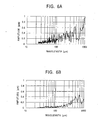
- Fig. 6A and 6B the results of spectral analysis of the surface of product B and the surface of an electrodeposition painting without forming are shown. It is understood that the amplitude (that is, irregularities) in a wavelength (cycle) of approximately 200 ⁇ m or less is remarkably decreased by electrodeposition painting, and that most of the irregularities in a wavelength of approximately 200 ⁇ m or more remain.
- the Ra and the PPI are set to be high.
- the arithmetic mean roughness Ra is less than about 0.7 ⁇ m
- the damaged peak on the surface is brought into contact with adjacent damaged peaks
- the peak per inch PPI is less than about 180, since the number of peaks is excessively small, for example, serious damage may be done to the second coating layer of the zinc plated steel sheet, that is, to the zinc phosphate layer. Accordingly, in both cases described above, the appearance of the electrodeposition painting is degraded.
- the surface roughness properties of the zinc-based plated steel sheet are determined so that the arithmetic mean roughness is about 0.7 ⁇ m or more and the peak per inch PPI is about 180 or more.
- the arithmetic mean roughness Ra is more than about 1.5 ⁇ m, since the surface irregularities are excessively increased, the appearance of the electrodeposition painting is degraded.
- the peak per inch PPI is more than about 250, since the portions which are damaged by rubbing are brought into contact with each other, the areas thereof are increased, thereby causing degradation in appearance of the electrodeposition painting. Accordingly, the arithmetic mean roughness Ra is set to about 1.5 ⁇ m or less, and the peak per inch PPI is set to about 250 or less.
- the arithmetic mean roughness Ra is set to about 0.7 ⁇ m or more in consideration of press formability
- the zinc-based plated steel sheet is applied to a component such as an automobile outer panel having a bead of a small R, which is formed by stretch forming
- the effect of retaining lubricant oil can be improved, and as a result, surface damage and breakage can be suppressed.
- the arithmetic mean roughness Ra is more than about 1.5 ⁇ m, the effect of improving the press formability cannot be further enhanced, the abrasion of the surface of a roller used for temper rolling rapidly occurs, and as a result, the steel sheet having the arithmetic mean roughness Ra described above is not practically used.
- the effect of retaining lubricant oil is decreased in press forming as compared to the case in which the number of peaks is larger and the Ra is the same as that of the above case, and on the other hand, when the PPI is more than about 250, the abrasion of the surface of a roller used for temper rolling rapidly occurs.
- the reason the area of the amplitude curve in the range of from 25 to 200 ⁇ m in wavelength is about 25% or more of that in the range of from 25 to 1,000 ⁇ m in wavelength is as follows. As described above, since most of the amplitude in the range of from 25 to 200 ⁇ m disappears when the resin flows during baking of electrodeposition paint, the appearance of the electrodeposition painting is improved when the ratio in the range described above is increased.
- the amplitude of the steel sheet itself is preferably small. However, when press forming or polishing is performed, the surface of the steel sheet described above is surely rubbed.
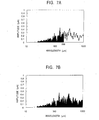
- Fig. 7A and 7B are views showing a method for analyzing the area ratio.
- the coated steel sheet having the surface roughness described above is not limited to a zinc-based plated steel sheet and includes a coated steel sheet comprising a steel sheet and at least two types of coating layers provided thereon.
- the coated steel sheet of the invention comprises at least two types of coating layers.
- a first coating layer formed on the surface of the steel sheet may be formed by a known electroplating method, a hot-dip plating method, or a chemical conversion method.
- a second coating layer, such as a zinc phosphate layer or a chromate layer, provided on the surface of the first coating layer may be formed by a chemical conversion method.
- an organic layer having an anti-rusting effect, an inorganic layer having perforative corrosion resistance, or a chemical conversion layer may be formed on the surface of the second coating layer.
- the first coating layer is preferably a zinc-based plated layer to enhance corrosion resistance. According to the coated steel sheet having the two types of coating layers and the surface roughness properties described above, by the same effects as described above, a superior finished surface of the electrodeposition painting can be formed on the surface of the steel sheet, which is rubbed by a die or the like in press forming or polishing.
- the zinc based plated steel sheet includes a zinc plated steel sheet (a steel sheet plated with pure zinc by one of electrogalvanizing and hot-dip galvanizing), an alloyed zinc-plated steel sheet, and a zinc alloy plated steel sheet.
- zinc alloy plated steel sheet for example, a zinc-nickel alloy plated steel sheet and a zinc-iron alloy plated steel sheet may be mentioned. These zinc alloy plated steel sheets may each be formed by an electroplating method using a known alloy composition.
- the alloyed zinc-plated steel sheet (galvannealed steel sheet) is generally formed by the steps of immersing a steel sheet in a zinc plating bath which contains incidental impurities such as tin (Sn), iron (Fe), and aluminum (Al), and removing the steel sheet from the plating bath to form a plated layer, followed by heating and alloying treatment.
- a zinc plating bath which contains incidental impurities such as tin (Sn), iron (Fe), and aluminum (Al)
- the zinc plated steel sheet may be manufactured by the steps of immersing a steel sheet in a hot-dip galvanizing bath, and removing the steel sheet therefrom to form a zinc plated layer on the surface thereof, followed by cooling without performing heating and alloying treatment, or may be manufactured by forming a zinc plated layer on a surface of a steel sheet by an electroplating method.
- the coating weight of the first coating layer is preferably set to about 20 to about 60 g/m 2 per surface.
- the plating amount is less than about 20 g/m 2 , the corrosion resistance is degraded, and on the other hand, when the plating amount is more than about 60 g/m 2 , since the corrosion resistance cannot be further improved, an unnecessary plating amount from economic point of view is formed, and in addition, the press formability and weldability may be degraded thereby in some cases. Accordingly, the plating amount is set as described above.
- the plated layer generally contains incidental impurities such as Sn, Fe, and Al, and to improve the corrosion resistance, each content of the incidental impurities is preferably set to about 1 mass% or less.
- the second coating layer formed on the surface of the plated layer described above is preferably a zinc phosphate layer having the effect of retaining a lubricant oil in press forming, and the amount of the zinc phosphate layer is preferably set to about 1.0 to about 3.0 g/m 2 .
- the amount of the zinc phosphate layer is less than about 1.0 g/m 2 , depending on press conditions, the effect of retaining lubricant oil may not be good enough, and as a result, a die may be directly brought into contact with the plated layer in some cases.
- the amount of the zinc phosphate layer is more than about 3.0 g/m 2 , coefficient of friction to the die may be increased depending on the press condition, and as a result, press formability may be degraded in some cases.
- elements such as nickel (Ni), manganese (Mn), and magnesium (Mg), may be contained in the zinc phosphate layer.
- a general chemical conversion solution which is used in an automobile coating line may be used, and in addition, a phosphate solution, which is composed of the chemical conversion solution, mentioned above and nickel nitrate, manganese nitrate, magnesium nitrate, or the like at an optional concentration, is preferably used.
- the phosphate solution described above is preferably prepared so that the content of Ni and the content of Mn in the layer are about 0.5 to about 1.4 mass% and about 3 to about 8 mass%, respectively.
- the crystal size thereof is preferably controlled to be about 3 ⁇ m or less to form a dense layer.
- Table 2 shows an example of the composition of the zinc phosphate solution used in a production line of the zinc plated steel sheet. Concentration of Zinc Phosphate Solution (g/l) PO 4 Zn Ni Mn NO 3 5 to 30 0.5 to 5 0.1 to 10 0 to 5 1 to 30
- the surface roughness is controlled by controlling the surface roughness of a cold-rolled steel sheet or a hot-rolled steel sheet which is used as a base steel sheet, and it rolled with a roller which is dull finished by surface treatment, such as shot blasting, electric discharging, and laser processing.
- the roughness of the steel sheet is preferably controlled before the first coating layer is formed.
- the steel sheet can be generally controlled to have a predetermined roughness pattern by adjusting the roughness of a roller used for temper rolling.
- a steel sheet is immersed in a hot-dip plating bath to form the first coating layer on the surfaces thereof.
- the irregularities of the surface of the steel sheet before plating are likely to be filled with plating material, and as a result, the surface roughness of the surface of the steel sheet after plating is different from that before plating.
- the temper rolling be performed after plating and the roughness of the roller therefor be adjusted at that stage.
- 100% of a roughness pattern of the roller used for temper rolling is not entirely transferred, approximately 40 to 50% of the Ra value of the surface of the roller is transferred to the steel sheet side, and approximately 80% of the PPI value thereof is transferred.
- a coated steel sheet having the surface roughness properties in which the arithmetic mean roughness Ra is about 0.7 to about 1.5 ⁇ m and the peak per inch PPI is about 180 to about 250 as the surface roughness properties of the roller for temper rolling, an Ra of about 1.4 to about 4.0 ⁇ m and a PPI of about 220 to about 320 are preferable.
- the amplitude in the range of 200 ⁇ m or more in wavelength that is, the undulating component (component in a longer wavelength region) of the steel sheet.
- the undulating component component in a longer wavelength region
- a method has been proposed in which temper rolling is performed using a specific roller.
- the undulation component of the steel sheet could not be sufficiently decreased by the temper rolling described above and could be significantly decreased in tandem rolling.
- the Wca of the surface of the steel sheet after tandem rolling is controlled to be about 0.8 ⁇ m or less, the amplitude in the range of 200 ⁇ m or more in wavelength, that is, the undulating component of the steel sheet (component in a longer wavelength region), is decreased, and as a result, the area ratio of the amplitude curve in the range of from 25 to 200 ⁇ m in wavelength can be increased.
- the surface of the steel sheet having a Wca of about 0.8 ⁇ m or less after tandem rolling can be obtained when a roller processed by electric discharging, laser processing, or the like is used for tandem rolling.
- Samples shown in Tables 3 and 4 were prepared by the steps: in which (1) an annealed cold-rolled steel sheet SPCE was sequentially processed by temper rolling (for adjusting the surface roughness) and electroplating (for forming the first coating layer), followed by the formation of the second coating layer and the formation of the third coating layer when necessary; or in which (2) an annealed cold-rolled steel sheet SPCE was sequentially processed by immersion in a bath (for hot-dip plating or the like), heating and alloying treatment when necessary, and temper rolling (for adjusting the surface roughness), followed by the formation of the second coating layer and the formation of the third coating layer when necessary.
- the arithmetic mean roughness Ra and the peak per inch PPI of each sample thus formed were measured by a surface roughness meter provided with a probe having a top diameter of 5 ⁇ m (manufactured by Tokyo Seimitsu Co., Ltd.). At a scanning speed of 0.3 mm/sec, the arithmetic mean roughness Ra defined by JIS B 0601-1994 was measured with a cut-off value of 0.8 mm and a measurement length of 4 mm, and the peak per inch PPI was measured with a cut-off of 0.8 mm and a measurement length of 8 mm. An analytical apparatus manufactured by Meishin Koki Co., Ltd performed the spectral analysis.
- the surface roughness of the roller for temper rolling was changed from 0.8 to 6 ⁇ m in Ra and from 170 to 350 in PPI, and the rate of elongation of a steel sheet in temper rolling was set to 0.7 to 0.8 %, thereby forming samples each having a thickness of 0.75 mm.
- Test pieces were obtained from the samples thus formed and were then rubbed, and electrodeposition painting was performed for the test pieces thus treated for evaluation of paintability. In addition, press formability of the samples was also evaluated. The results are shown in Table 3 and 4.
- the appearance of the electrodeposition painting was evaluated by two methods in accordance with evaluation 1 and evaluation 2 described below. When the appearance was accepted by both evaluation 1 and 2, it was recognized that the electrodeposition paintability was superior.
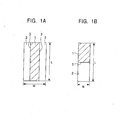
- the test piece was electrodeposition painted, and the finished surface of the electrodeposition painting on a surface which was polished, indicated by numeral 1 shown in Fig. 1A, and the finished surface of the electrodeposition painting on a surface which was rubbed with a die, indicated by numeral 2 shown in Fig. 1B, were evaluated by visual inspection.
- the surface which exhibited orange peel was represented by poor, the surface which did not show orange peel was represented by good and the surface having superior appearance was represented by excellent.
- the surface of the electrodeposition painting, which was not accepted, had to be polished to be smooth before a top coat is formed thereon.
- Fig. 1A shows a plan view of a test piece for polishing evaluation
- numeral 3 indicates a boundary line between the surface 1 which is polished and a surface 2 which is not polished
- Fig. 1B shows a plan view of a test piece for the friction test
- numeral 3 indicates a boundary line between the surface 1 which is rubbed and a surface 2 which is not rubbed.
- L indicates the length of the test piece
- W indicates the width of the test piece.
- the test piece was electrodeposition painted and the evaluation was then performed whether the boundary line 3 between the surface which was polished (rubbed) and the surface which was not polished (rubbed) was clearly observed or not by visual inspection.
- the case in which the boundary line was clearly observed was represented by poor, the case in which the boundary line was not substantially observed was represented by good, and the case in which the boundary line could not be observed at all was represented by excellent.
- the electrodeposition painting had to be polished to be smooth before a top coat is formed thereon.
- test piece was sequentially processed by alkaline degreasing, surface adjustment, and phosphate treatment. Subsequently, after electrodeposition painting, an electrodeposition painting (a target thickness of 17 ⁇ m at a surface which was not polished and was not rubbed) was formed by firing. The conditions thereof are shown below.
- the test piece obtained from each of the samples had a length L of 150 mm and a width W of 70 mm.
- a sheet having a blank diameter of 90 mm was punched out, and by using this sheet, a cylinder was formed using a punch having a diameter of 50 mm and a dice having a diameter of 52 mm under the conditions in which a blank holding pressure was 10 kN and the punch speed was 120 mm/minute.
- Press formability was evaluated from the punching force and the degree of damage done to the wall of the cylinder. When the punching force was 39 kN or less, and the damage observed by visual inspection was slight, the press formability was determined to be superior and was represented by good, and when the punching force was more than 39 kN or the damage observed by visual inspection was not slight, the press formability was determined to be inferior and was represented by poor.
- samples (examples 1 to 9) having the surface roughness properties within the scope of the invention each have superior appearance of the electrodeposition painting formed on the surface which is rubbed as compared to that of each of samples of comparative examples 1 to 6 having the surface roughness properties outside the scope of the present invention.
- the area of the amplitude in the range of from 25 to 200 ⁇ m in wavelength is 25% or more of that in the range of from 25 to 1,000 ⁇ m in wavelength, and hence a significantly superior appearance of the electrodeposition painting can be obtained.
Landscapes
- Chemical & Material Sciences (AREA)
- Engineering & Computer Science (AREA)
- Inorganic Chemistry (AREA)
- Chemical Kinetics & Catalysis (AREA)
- Materials Engineering (AREA)
- Metallurgy (AREA)
- Organic Chemistry (AREA)
- Mechanical Engineering (AREA)
- Life Sciences & Earth Sciences (AREA)
- Wood Science & Technology (AREA)
- Electrochemistry (AREA)
- Ceramic Engineering (AREA)
- Other Surface Treatments For Metallic Materials (AREA)
- Electroplating Methods And Accessories (AREA)
- Chemical Treatment Of Metals (AREA)
- Coating With Molten Metal (AREA)
- Application Of Or Painting With Fluid Materials (AREA)
- Paints Or Removers (AREA)
- Laminated Bodies (AREA)
Abstract
Description
| Product | A | B | C |
| Surface Roughness Ra (µm) of Product | 0.7 | 1.1 | 0.9 |
| Condition 1: Surface Roughness Ra (µm) of Electrodeposition painting without Press Forming | 0.23 | 0.27 | 0.24 |
| Condition 2: Surface Roughness Ra (µm) of Electrodeposition painting after Press Forming | 0.35 | 0.30 | 0.24 |
| Condition 3: Surface Roughness Ra (µm) of Electrodeposition painting after Polishing | 0.39 | 0.32 | 0.27 |
| Concentration of Zinc Phosphate Solution (g/l) | ||||
| PO4 | Zn | Ni | Mn | NO3 |
| 5 to 30 | 0.5 to 5 | 0.1 to 10 | 0 to 5 | 1 to 30 |


Claims (12)
- A coated steel sheet provided with an electrodeposition painting,
the coated steel sheet comprising:wherein the coated steel sheet has surface roughness properties, in which an arithmetic mean roughness Ra as defined by JIS B 0601-1994, is in the range of from about 0.7 to about 1.5 µm and a peak per inch PPI is in the range of from about 180 to about 250.a steel sheet; andat least two coating layers on the steel sheet, - The coated steel sheet according to Claim 1,
wherein, in a spectral analysis obtained by Fourier transformation of a surface roughness measurement curve, an area obtained from an amplitude curve in the range of from 25 to 200 µm in wavelength is about 25% or more of the area obtained from the amplitude curve in the range of from 25 to 1,000 µm in wavelength. - The coated steel sheet according to Claim 1 or 2,
wherein said at least two coating layers are a first coating layer formed on the steel sheet and a second coating layer formed on the first coating layer,
the first coating layer is a layer selected from the group consisting of an electroplated layer, a hot-dip plated layer, and a chemical conversion layer, and
the second coating layer is a layer selected from the group consisting of a zinc phosphate layer and a chromate layer. - The coated steel sheet according to Claim 1 or 2,
wherein said at least two coating layers are a first coating layer formed on the steel sheet, a second coating layer formed on the first coating layer, and a third coating layer formed on the second coating layer,
the first coating layer is a layer selected from the group consisting of an electroplated layer, a hot-dip plated layer, and a chemical conversion layer,
the second coating layer is a layer selected from the group consisting of a zinc phosphate layer and a chromate layer, and
the third coating layer is a layer selected from the group consisting of an organic layer, an inorganic layer, and a chemical conversion layer. - The coated steel sheet according to any preceding claim herein the arithmetic mean roughness Ra is in the range of from about 0.8 to about 1.3 µm.
- The coated steel sheet according to any preceding claim wherein the peak per inch PPI is in the range of from about 190 to about 240.
- A coated steel sheet provided with an electrodeposition painting,
the coated steel sheet comprising:wherein the coated steel sheet has surface roughness properties, in which an arithmetic mean roughness Ra as defined by JIS B 0601-1994, is in the range of from about 0.7 to about 1.5 µm and a peak per inch PPI is in the range of from about 180 to about 250.a steel sheet;a zinc-based plated layer formed on a surface of the steel sheet; anda zinc phosphate layer formed on a surface of the plated layer, - The coated steel sheet according to Claim 7,
wherein, in a spectral analysis obtained by Fourier transformation of a surface roughness measurement curve, an area obtained from an amplitude curve in the range of from 25 to 200 µm in wavelength is about 25% or more of the area obtained from the amplitude curve in the range of from 25 to 1,000 µm in wavelength. - The coated steel sheet according to Claim 7 or 8, wherein the zinc-based plated layer has a plating amount of about 20 to about 60 g/m2.
- The coated steel sheet according to Claim 7, 8 or 9, wherein the zinc phosphate layer has a coating amount of about 1.0 to about 3.0 g/m2.
- The coated steel sheet according to any of claims 7 to 10 wherein the arithmetic mean roughness Ra is in the range of from about 0.8 to about 1.3 µm.
- The coated steel sheet according to any of claims 7 to 11 wherein the peak per inch PPI is in the range of from about 190 to about 240.
Applications Claiming Priority (2)
| Application Number | Priority Date | Filing Date | Title |
|---|---|---|---|
| JP2002219892 | 2002-07-29 | ||
| JP2002219892 | 2002-07-29 |
Publications (2)
| Publication Number | Publication Date |
|---|---|
| EP1391539A2 true EP1391539A2 (en) | 2004-02-25 |
| EP1391539A3 EP1391539A3 (en) | 2006-02-01 |
Family
ID=30768006
Family Applications (1)
| Application Number | Title | Priority Date | Filing Date |
|---|---|---|---|
| EP03254733A Withdrawn EP1391539A3 (en) | 2002-07-29 | 2003-07-29 | Coated steel sheet provided with electrodeposition painting having superior appearance |
Country Status (5)
| Country | Link |
|---|---|
| US (1) | US7041382B2 (en) |
| EP (1) | EP1391539A3 (en) |
| KR (1) | KR100564513B1 (en) |
| CN (1) | CN1320162C (en) |
| TW (1) | TWI303672B (en) |
Families Citing this family (7)
| Publication number | Priority date | Publication date | Assignee | Title |
|---|---|---|---|---|
| US20070264522A1 (en) * | 2004-08-31 | 2007-11-15 | Jfe Steel Corporation | Black Colored Steel Sheet Having Excellent Electromagnetic Shielding Property, Electromagnetic Shielding Member, and Electromagnetic Shielding Case |
| JP4313750B2 (en) * | 2004-11-04 | 2009-08-12 | 新日本製鐵株式会社 | Steel columns with corrosion protection at the buried underground |
| US8322178B2 (en) * | 2006-12-18 | 2012-12-04 | Jfe Steel Corporation | Method for performing temper rolling on steel strip and method for manufacturing high tensile-strength cold rolled steel sheet |
| TWI510362B (en) | 2013-04-30 | 2015-12-01 | Nippon Steel & Sumitomo Metal Corp | Ni-plated steel sheet and production method thereof |
| JP6127221B2 (en) * | 2015-04-09 | 2017-05-10 | 新日鐵住金株式会社 | Steel foil for power storage device container, power storage device container and power storage device |
| MX2019014874A (en) * | 2017-06-16 | 2020-02-07 | Nippon Steel Corp | Plated steel material. |
| TR202016196A2 (en) * | 2020-10-12 | 2020-11-23 | Borcelik Celik San Tic A S | A PROCESS FOR IMPROVING THE PROPERTIES OF GALVANIZED SURFACES |
Family Cites Families (27)
| Publication number | Priority date | Publication date | Assignee | Title |
|---|---|---|---|---|
| JPS5832218B2 (en) * | 1978-08-22 | 1983-07-12 | 川崎製鉄株式会社 | Method for producing high-strength steel sheets with excellent pressability, especially shape fixability |
| US4711917A (en) * | 1985-02-07 | 1987-12-08 | Ppg Industries, Inc. | Cationic coating compositions for electrodeposition over rough steel |
| JPS61253397A (en) * | 1985-05-01 | 1986-11-11 | Kawasaki Steel Corp | Alloyed hot dip galvanized steel sheet for painting by cationic electrodeposition |
| US4775599A (en) * | 1985-12-24 | 1988-10-04 | Kawasaki Steel Corporation | Cold rolled steel sheets having an improved press formability |
| JPH0675728B2 (en) * | 1988-12-27 | 1994-09-28 | 川崎製鉄株式会社 | Manufacturing method of surface-treated steel sheet with excellent image clarity |
| US5183836A (en) * | 1989-05-18 | 1993-02-02 | Nissan Motor Co., Ltd. | Composite paint |
| JPH0379341A (en) * | 1989-08-22 | 1991-04-04 | Kawasaki Steel Corp | Painted steel plate with good weldability |
| CN1024816C (en) * | 1992-11-20 | 1994-06-01 | 冶金工业部钢铁研究总院 | Surface pretreatment agent for metal materials |
| JP2621751B2 (en) * | 1992-11-25 | 1997-06-18 | 住友金属工業株式会社 | Surface treated steel sheet for automobiles |
| JPH06246306A (en) * | 1993-03-02 | 1994-09-06 | Nippon Steel Corp | Steel plate with excellent painting distinctness of image and pressing workability |
| JPH06269803A (en) * | 1993-03-23 | 1994-09-27 | Nippon Steel Corp | Steel sheet excellent in image clarity of coating and press-workability |
| US5795660A (en) * | 1993-09-04 | 1998-08-18 | Nkk Corporation | Organic composite coated steel sheet having a high corrosion resistance in a rust-contaminated environment |
| JP2914176B2 (en) * | 1994-06-16 | 1999-06-28 | 住友金属工業株式会社 | Low gloss blackened steel sheet |
| JP2797983B2 (en) * | 1994-10-24 | 1998-09-17 | 住友金属工業株式会社 | Organic composite coated steel sheet with excellent corrosion resistance and electrodeposition coating properties |
| JPH08209303A (en) * | 1995-02-03 | 1996-08-13 | Nippon Steel Corp | Electrolytic chromic acid treated steel sheet with excellent color tone |
| US5656148A (en) * | 1995-03-02 | 1997-08-12 | Atotech Usa, Inc. | High current density zinc chloride electrogalvanizing process and composition |
| JP2959434B2 (en) * | 1995-05-26 | 1999-10-06 | 住友金属工業株式会社 | Alloyed hot-dip galvanized steel sheet with excellent electrodeposition coating properties |
| KR100213852B1 (en) * | 1995-11-13 | 1999-08-02 | 구마모토 마사히로 | Steel plate with good fire burning properties and the method of same |
| JPH09263967A (en) * | 1996-03-28 | 1997-10-07 | Kawasaki Steel Corp | Method for producing hot-dip galvanized steel sheet with excellent fingerprint resistance and gloss |
| DE19716234A1 (en) * | 1997-04-18 | 1998-04-02 | Herberts Gmbh | Multilayer coating process for automobile parts and bodies |
| EP1067212A1 (en) * | 1999-07-08 | 2001-01-10 | Kawasaki Steel Corporation | Perforative corrosion resistant galvanized steel sheet |
| US6509099B1 (en) * | 1999-08-02 | 2003-01-21 | Nkk Corporation | Phosphate-treated steel plate |
| JP2001152355A (en) * | 1999-09-17 | 2001-06-05 | Kawasaki Steel Corp | Surface treated steel sheet and method for producing the same |
| US6555249B1 (en) * | 1999-09-17 | 2003-04-29 | Kawasaki Steel Corporation | Surface treated steel sheet and method for production thereof |
| JP2002004019A (en) * | 2000-06-23 | 2002-01-09 | Nkk Corp | Galvanized steel sheet |
| EP1327697A4 (en) * | 2000-10-19 | 2009-11-11 | Jfe Steel Corp | Zinc-plated steel sheet and method for preparation thereof, and method for manufacturing formed article by press working |
| JP3600804B2 (en) * | 2001-06-27 | 2004-12-15 | 新日本製鐵株式会社 | Hot-dip galvanized steel sheet with excellent formability |
-
2003
- 2003-07-25 TW TW092120411A patent/TWI303672B/en not_active IP Right Cessation
- 2003-07-28 US US10/628,752 patent/US7041382B2/en not_active Expired - Fee Related
- 2003-07-29 KR KR1020030052339A patent/KR100564513B1/en not_active Expired - Fee Related
- 2003-07-29 CN CNB031588336A patent/CN1320162C/en not_active Expired - Fee Related
- 2003-07-29 EP EP03254733A patent/EP1391539A3/en not_active Withdrawn
Also Published As
| Publication number | Publication date |
|---|---|
| KR20040012520A (en) | 2004-02-11 |
| KR100564513B1 (en) | 2006-03-29 |
| US7041382B2 (en) | 2006-05-09 |
| US20040018376A1 (en) | 2004-01-29 |
| TW200401846A (en) | 2004-02-01 |
| CN1320162C (en) | 2007-06-06 |
| TWI303672B (en) | 2008-12-01 |
| EP1391539A3 (en) | 2006-02-01 |
| CN1495291A (en) | 2004-05-12 |
Similar Documents
| Publication | Publication Date | Title |
|---|---|---|
| EP1616973B1 (en) | Zinc hot dip galvanized steel plate excellent in press formability and method for production thereof | |
| EP3354359B1 (en) | Method for manufacturing plated steel sheet having excellent clarity of image after coating | |
| MX2008013860A (en) | Process for producing alloyed hot-dip zinc-plated steel sheet and alloyed hot-dip zinc-plated steel sheet. | |
| EP3901332B1 (en) | Electroplated steel sheet having excellent surface appearance, and manufacturing method therefor | |
| US7041382B2 (en) | Coated steel sheet provided with electrodeposition painting having superior appearance | |
| EP0882810B1 (en) | Method for manufacturing an alloying-treated iron-zinc alloy dip-plated steel sheet excellent in press-formability | |
| JP3753062B2 (en) | Alloyed hot-dip galvanized steel sheet and method for producing the same | |
| EP1666624B1 (en) | Hot dip zinc plated steel sheet and method for production thereof | |
| JP2002004019A (en) | Galvanized steel sheet | |
| JP2004156111A (en) | Alloyed hot-dip galvanized steel sheet and method for producing the same | |
| JP2792393B2 (en) | Alloyed hot-dip galvanized steel sheet for automobiles and manufacturing method thereof | |
| JP4543566B2 (en) | Manufacturing method of hot-dip galvanized steel sheet with excellent press formability | |
| JP2002302753A (en) | Galvannealed steel sheet | |
| JP2004076158A (en) | Surface treated steel sheet | |
| JP2004130352A (en) | Thin steel plate for stamping that is less likely to cause star formation | |
| JPH02225652A (en) | Manufacture of high image clarity steel sheet | |
| JP3903835B2 (en) | Manufacturing method of plated steel sheet | |
| JP2003306756A (en) | Hot-dip galvanized steel sheet and its manufacturing method | |
| KR100495620B1 (en) | Manufacturing method of galvannealed steel sheet for electric application and automotive | |
| JP2959434B2 (en) | Alloyed hot-dip galvanized steel sheet with excellent electrodeposition coating properties | |
| JP2001247950A (en) | Hot-dip galvanized steel sheet excellent in press formability and method for producing the same | |
| JPS6333592A (en) | Steel sheet having excellent press formability, resistance to die scuffing or sharpness after coating | |
| KR20010112968A (en) | The method of high image clarity alloyed hot dip galvanized steel for outcase of automobile | |
| JPH02274857A (en) | Production of high-function alloyed hot-dipped steel sheet adjusted in surface roughness | |
| KR20180073386A (en) | Skin pass rolling mill and pass rolling method using the same |
Legal Events
| Date | Code | Title | Description |
|---|---|---|---|
| PUAI | Public reference made under article 153(3) epc to a published international application that has entered the european phase |
Free format text: ORIGINAL CODE: 0009012 |
|
| AK | Designated contracting states |
Kind code of ref document: A2 Designated state(s): AT BE BG CH CY CZ DE DK EE ES FI FR GB GR HU IE IT LI LU MC NL PT RO SE SI SK TR |
|
| AX | Request for extension of the european patent |
Extension state: AL LT LV MK |
|
| 17P | Request for examination filed |
Effective date: 20040428 |
|
| PUAL | Search report despatched |
Free format text: ORIGINAL CODE: 0009013 |
|
| AK | Designated contracting states |
Kind code of ref document: A3 Designated state(s): AT BE BG CH CY CZ DE DK EE ES FI FR GB GR HU IE IT LI LU MC NL PT RO SE SI SK TR |
|
| AX | Request for extension of the european patent |
Extension state: AL LT LV MK |
|
| AKX | Designation fees paid |
Designated state(s): DE ES FR GB IT |
|
| 17Q | First examination report despatched |
Effective date: 20070510 |
|
| STAA | Information on the status of an ep patent application or granted ep patent |
Free format text: STATUS: THE APPLICATION IS DEEMED TO BE WITHDRAWN |
|
| 18D | Application deemed to be withdrawn |
Effective date: 20070926 |