EP1389639A2 - Steel sheet with excellent bendability - Google Patents
Steel sheet with excellent bendability Download PDFInfo
- Publication number
- EP1389639A2 EP1389639A2 EP03254606A EP03254606A EP1389639A2 EP 1389639 A2 EP1389639 A2 EP 1389639A2 EP 03254606 A EP03254606 A EP 03254606A EP 03254606 A EP03254606 A EP 03254606A EP 1389639 A2 EP1389639 A2 EP 1389639A2
- Authority
- EP
- European Patent Office
- Prior art keywords
- mass
- steel sheet
- retained austenite
- bendability
- less
- Prior art date
- Legal status (The legal status is an assumption and is not a legal conclusion. Google has not performed a legal analysis and makes no representation as to the accuracy of the status listed.)
- Granted
Links
Images
Classifications
-
- C—CHEMISTRY; METALLURGY
- C22—METALLURGY; FERROUS OR NON-FERROUS ALLOYS; TREATMENT OF ALLOYS OR NON-FERROUS METALS
- C22C—ALLOYS
- C22C38/00—Ferrous alloys, e.g. steel alloys
- C22C38/02—Ferrous alloys, e.g. steel alloys containing silicon
-
- C—CHEMISTRY; METALLURGY
- C21—METALLURGY OF IRON
- C21D—MODIFYING THE PHYSICAL STRUCTURE OF FERROUS METALS; GENERAL DEVICES FOR HEAT TREATMENT OF FERROUS OR NON-FERROUS METALS OR ALLOYS; MAKING METAL MALLEABLE, e.g. BY DECARBURISATION OR TEMPERING
- C21D8/00—Modifying the physical properties of ferrous metals or ferrous alloys by deformation combined with, or followed by, heat treatment
- C21D8/02—Modifying the physical properties of ferrous metals or ferrous alloys by deformation combined with, or followed by, heat treatment during manufacturing of plates or strips
- C21D8/0247—Modifying the physical properties of ferrous metals or ferrous alloys by deformation combined with, or followed by, heat treatment during manufacturing of plates or strips characterised by the heat treatment
- C21D8/0273—Final recrystallisation annealing
-
- C—CHEMISTRY; METALLURGY
- C21—METALLURGY OF IRON
- C21D—MODIFYING THE PHYSICAL STRUCTURE OF FERROUS METALS; GENERAL DEVICES FOR HEAT TREATMENT OF FERROUS OR NON-FERROUS METALS OR ALLOYS; MAKING METAL MALLEABLE, e.g. BY DECARBURISATION OR TEMPERING
- C21D9/00—Heat treatment, e.g. annealing, hardening, quenching or tempering, adapted for particular articles; Furnaces therefor
- C21D9/46—Heat treatment, e.g. annealing, hardening, quenching or tempering, adapted for particular articles; Furnaces therefor for sheet metals
-
- C—CHEMISTRY; METALLURGY
- C22—METALLURGY; FERROUS OR NON-FERROUS ALLOYS; TREATMENT OF ALLOYS OR NON-FERROUS METALS
- C22C—ALLOYS
- C22C38/00—Ferrous alloys, e.g. steel alloys
- C22C38/04—Ferrous alloys, e.g. steel alloys containing manganese
-
- C—CHEMISTRY; METALLURGY
- C22—METALLURGY; FERROUS OR NON-FERROUS ALLOYS; TREATMENT OF ALLOYS OR NON-FERROUS METALS
- C22C—ALLOYS
- C22C38/00—Ferrous alloys, e.g. steel alloys
- C22C38/06—Ferrous alloys, e.g. steel alloys containing aluminium
-
- C—CHEMISTRY; METALLURGY
- C21—METALLURGY OF IRON
- C21D—MODIFYING THE PHYSICAL STRUCTURE OF FERROUS METALS; GENERAL DEVICES FOR HEAT TREATMENT OF FERROUS OR NON-FERROUS METALS OR ALLOYS; MAKING METAL MALLEABLE, e.g. BY DECARBURISATION OR TEMPERING
- C21D1/00—General methods or devices for heat treatment, e.g. annealing, hardening, quenching or tempering
- C21D1/18—Hardening; Quenching with or without subsequent tempering
- C21D1/185—Hardening; Quenching with or without subsequent tempering from an intercritical temperature
-
- C—CHEMISTRY; METALLURGY
- C21—METALLURGY OF IRON
- C21D—MODIFYING THE PHYSICAL STRUCTURE OF FERROUS METALS; GENERAL DEVICES FOR HEAT TREATMENT OF FERROUS OR NON-FERROUS METALS OR ALLOYS; MAKING METAL MALLEABLE, e.g. BY DECARBURISATION OR TEMPERING
- C21D1/00—General methods or devices for heat treatment, e.g. annealing, hardening, quenching or tempering
- C21D1/18—Hardening; Quenching with or without subsequent tempering
- C21D1/19—Hardening; Quenching with or without subsequent tempering by interrupted quenching
- C21D1/20—Isothermal quenching, e.g. bainitic hardening
-
- C—CHEMISTRY; METALLURGY
- C21—METALLURGY OF IRON
- C21D—MODIFYING THE PHYSICAL STRUCTURE OF FERROUS METALS; GENERAL DEVICES FOR HEAT TREATMENT OF FERROUS OR NON-FERROUS METALS OR ALLOYS; MAKING METAL MALLEABLE, e.g. BY DECARBURISATION OR TEMPERING
- C21D2211/00—Microstructure comprising significant phases
- C21D2211/001—Austenite
-
- C—CHEMISTRY; METALLURGY
- C21—METALLURGY OF IRON
- C21D—MODIFYING THE PHYSICAL STRUCTURE OF FERROUS METALS; GENERAL DEVICES FOR HEAT TREATMENT OF FERROUS OR NON-FERROUS METALS OR ALLOYS; MAKING METAL MALLEABLE, e.g. BY DECARBURISATION OR TEMPERING
- C21D2211/00—Microstructure comprising significant phases
- C21D2211/003—Cementite
-
- C—CHEMISTRY; METALLURGY
- C21—METALLURGY OF IRON
- C21D—MODIFYING THE PHYSICAL STRUCTURE OF FERROUS METALS; GENERAL DEVICES FOR HEAT TREATMENT OF FERROUS OR NON-FERROUS METALS OR ALLOYS; MAKING METAL MALLEABLE, e.g. BY DECARBURISATION OR TEMPERING
- C21D2211/00—Microstructure comprising significant phases
- C21D2211/005—Ferrite
Definitions
- the present invention relates to a high-strength steel sheet with excellent bendability, especially tight bendability (ultimate deformability). More particularly, the present invention relates to a high-strength steel sheet which exhibits excellent bendability despite its high or ultra-high strength ranging from 600 to 1400 MPa.
- a steel sheet in which strength and ductility stand together. It is a steel sheet of ferrite-martensite dual phase (DP) in which the ferrite matrix contains the microstructure composed mainly of martensite which has transformed at low temperatures (disclosed in, for example, Japanese Patent Laid-open No. 122820/1980).
- DP ferrite-martensite dual phase
- This steel sheet is excellent in ductility as well as shape freezing properties in press working. The latter is attributable to a large number of free dislocations which appear in the region where martensite forms, and such dislocations eliminate yield elongation, thereby reducing yield stress. With a properly controlled microstructure, the steel sheet will have both high tensile strength (TS) and high elongation (El).
- retained austenite steel sheet (or TRIP steel sheet) with improved ductility. It contains retained austenite in the structure so that it undergoes transformation induced plastic deformation during working.
- Japanese Patent Laid-open No. 43425/1985 discloses a dual-phase steel sheet with high strength as well as excellent ductility. This steel sheet is composed of no less than 10 vol% of ferrite and no less than 10 vol% of retained austenite, with the remainder being bainite or martensite or a mixture thereof.
- retained austenite produces the effect of working-induced transformation and soft ferrite produces the effect of high ductility.
- ferrite and retained austenite contribute to ductility and bainite or martensite contributes to strength.
- All the steel sheets mentioned above are characterized by excellent elongation properties (especially uniform elongation).
- TRIP steel sheets benefit from very high elongation and very good formability (for stretching and deep drawing) owing to retained austenite therein.
- they are generally inferior to solid-solution strengthened steels in local deformation properties (bendability and bore-expandability) and ultimate deformation properties (tight bendability).
- good bending properties are essential for steel sheets for press forming in the automobile industry, there have been no steel sheets developed so far which meet these requirements.
- the present invention was completed in view of the foregoing. It is an object of the present invention to provide a high-strength steel sheet with excellent bendability, especially tight bendability, despite its high or ultra-high strength ranging from 600 to 1400 MPa.
- the present invention is directed to a steel sheet with excellent bendability comprises C (0.06 mass% to less than 0.25 mass%), at least one of Si and Al (total 0.5-3 mass%), Mn (0.5-3 mass%), P (no more than 0.15 mass%, excluding 0 mass%), and S (no more than 0.02 mass%, excluding 0 mass%), wherein the main structure of the steel sheet comprises retained austenite (5-30 area%) and ferrite (no less than 50 area%) and there exist no more than 40 carbide grains per 2000 ⁇ m 2 in the steel sheet.
- the steel sheet according to the present invention may optionally contain (a) at least one species of Mo (no more than 1 mass%, excluding 0 mass%), Ni (no more than 0.5 mass%, excluding 0 mass%), and Cu (no more than 0.5 mass%, excluding 0 mass%), and (b) Ca (no more than 0.003 mass%, excluding 0 mass%) and/or rare earth element (no more than 0.003 mass%, excluding 0 mass%).
- the present invention constructed as mentioned above provides a high-strength steel sheet which exhibits excellent bendability even though its strength as high as 600 to 1400 MPa. This steel sheet is suitable for automobiles.
- TRIP steel sheets exhibit excellent bendability.
- the present invention is based on this finding.
- the condition of quantity of carbide is defined in terms of number of the carbide grains.
- the steel sheet according to the present invention is characterized by the minimal content of carbide existing between retained austenite and ferrite, which is specified by the number of carbide grains no more than 40 per 2000 ⁇ m 2 . With the number of carbide grains exceeding 40, the resulting steel sheet is poor in bendability (especially tight bendability).
- the number of carbide grains should preferably be no more than 30.
- the steel sheet according to the present invention should also have an adequately controlled structure so that it meets requirements for high strength as well as good elongation.
- the structure should be composed mainly of retained austenite (5-30 area%) and ferrite (no less than 50 area%). This limitation is based on the following.
- Retained austenite should be present in an amount of 5 area% (preferably no less than 8 area%) so that it helps increase total elongation. With an amount in excess of 30 area%, retained austenite adversely affects bendability. Therefore, the upper limit should be 30 area%, preferably no more than 20 area%.
- the steel sheet according to the present invention should contain ferrite in an amount no less than 50 area% so that it exhibits good ductility.
- the steel sheet according to the present invention contains retained austenite and ferrite which constitute the main structure (accounting for no less than 70 area%). It may additionally contain bainite and martensite, which constitute the secondary structure, in an amount not harmful to the function of the present invention. These minor components inevitably remain in the structure during steel production. The amount of martensite should preferably be as small as possible.
- TRIP steel sheets undergo heat treatment (after hot rolling and cold rolling) in the following manner.
- the work is heated and kept at a temperature higher than A 1 point and lower than A 3 point for about 60-180 seconds.
- the work is cooled to a temperature in the zone for bainite transformation (for example, about 400 ⁇ 50°C) at an average cooling rate in excess of 10°C/s.
- the work is kept at this temperature for about 300 seconds so as to stabilize the gamma phase with an increased C concentration therein and to ensure a prescribed amount of retained austenite.
- Heat treatment in this manner causes the C concentration to vary greatly from the inside to the outside of the retained gamma phase. This in turn gives rise to carbide, thereby deteriorating bendability.
- the steel sheet containing carbide in controlled form may be obtained by the manufacturing method which includes a step of keeping the work at a temperature in the zone for ferrite transformation (for example, about 700 ⁇ 30°C) for a prescribed period of time in the course of cooling from the retention temperature not less than A 1 point and not more than A 3 point to the temperature range of bainite transformation.
- this method requires that heat treatment be carried out in two stages so as to reduce difference in C concentration in the inside and outside of the retained gamma phase and to suppress formation of carbide between retained austenite and ferrite.
- the temperature zone for ferrite transformation overlaps with the temperature zone for pearlite transformation and hence keeping the work at that temperature for an excessively long period of time permits the pearlite structure to separate out, thereby deteriorating the characteristic properties. Therefore, it is necessary to keep the work at a heating temperature for an adequate length of time, which is about 10-30 seconds.
- this heat treatment may be carried out as part of the annealing step that follows hot rolling.
- the conditions of the hot rolling and cold rolling that precede the heat treatment are not specifically limited. They may be properly selected among ordinary conditions. Also, the cooling rates after the heat treatments may be controlled adequately. For example, the average cooling rate in the case where the work is kept at a temperature in the zone for ferrite transformation for a prescribed period time and then cooled to a temperature in the zone for bainite transformation is preferably larger than 10°C/s so as to prevent the formation of carbide.
- the retained austenite steel sheet according to the present invention should have the specific structure and the controlled number of carbide grains as mentioned above so that it exhibits the desired properties.
- the steel sheet is not specifically restricted in chemical composition. However, it is desirable to control the amount of fundamental components (such as C, Si, Al, Mn, P, and S) as follows.
- C is an essential element for high strength and for ensuring retained austenite.
- C is an important element for obtaining an adequate amount of C in the austenite phase and for making a desired amount of the austenite phase remain at room temperature.
- the content of C to produce these effects should be no less than 0.06 mass%.
- Si+Al from 0.5 mass% to 3 mass%
- Si and Al effectively prevent the retained austenite from decomposing to form carbide.
- Si is also useful for solid solution strengthening.
- the total amount of Si and Al necessary for these effects is no less than 0.5 mass%, preferably no less than 0.7 mass%, more preferably no less than 1 mass%. Total amount of the elements exceeding 3 mass% makes the effects saturated. Excess Si and Al are wasted without any additional effect, and they will cause hot shortness.
- the upper limit is 3 mass%, preferably 2.5 mass%, more preferably 2 mass%.
- Mn from 0.5 mass% to 3 mass%
- Mn stabilizes austenite to give retained austenite as desired.
- the amount of Mn necessary for this effect is no less than 0.5 mass%, preferably no less than 0.7 mass%, more preferably no less than 1 mass%. Excess Mn produces an adverse effect, such as cracking in cast ingots. Therefore, the upper limit of Mn is 3 mass%, preferably 2.5 mass%, more preferably 2 mass%.
- P ensures as much retained austenite as desired.
- the amount of P necessary for this effect is no less than 0.03 mass%, preferably no less than 0.05 mass%. Excess P produces adverse effects in secondary operation. Therefore, the upper limit of P is 0.15 mass%, preferably 0.1 mass%.
- S deteriorates workability because it forms sulfide inclusions, such as MnS, to bring about cracking.
- the amount of S should be as small as possible.
- the amount of S should be below 0.02 mass%, preferably below 0.015 mass%.
- the steel sheet of the present invention may optionally contain at least one of Mo, Ni, Cu, Ca, and rare earth elements in addition to the above-mentioned fundamental components. They improve the properties of the steel sheet when they are used in an adequate amount as specified in the following.
- Ni no more than 0.5 mass% (excluding 0 mass%)
- the rare earth elements used in the present invention include scandium (Sc) and yttrium (Y), both belonging to Group III, and lanthanide elements (atomic number 51 to 71). Any of them may be used in an amount no less than 0.0003 mass%, preferably no less than 0.0005 mass%. The upper limit is 0.003 mass%, preferably 0.0025 mass%. Any excess amount is wasted without additional effect.
- the steel sheet of the present invention is composed of the above-mentioned components, with the remainder being iron. However, it may also contain Ti, Nb, V, etc. in small amounts, and the steel sheet containing such minor components is also covered by the present invention. In addition, the steel sheet of the present invention may contain inevitable impurities, such as Zr and B; they are permissible so long as their amount is small enough (less than 0.001 mass%) to save the effect of the present invention.
- a sample steel with the chemical composition shown in Table 1 was prepared by vacuum melting.
- the steel was made into a slab, which was subsequently made into a steel sheet (1.2 mm thick) by hot rolling and continuous annealing.
- Hot rolling was started at 1300°C and completed at about 900°C (which is higher than the Ar 3 point).
- the rolled sheet was wound up at a finishing temperature of about 450°C.
- the thus obtained hot-rolled steel sheet (2-3 mm thick) underwent cold rolling.
- the cold-rolled steel sheet (1.2 mm thick) underwent heat treatment (continuous annealing) in different patterns as specified below.
- This heat treatment consists of heating up to 850°C (above A 1 point and below A 3 point) and keeping this temperature for 120 seconds (for annealing), cooling to 700°C at an average rate of 5°C/s and keeping this temperature for 15 seconds, cooling to 420°C at an average rate of 15°C/s and keeping this temperature for 15 seconds (for austempering), and air cooling to room temperature at an average rate of 5°C/s.
- This heat treatment consists of heating up to 850°C (above A 1 point and below A 3 point) and keeping this temperature for 120 seconds (for annealing), cooling to 700°C at an average rate of 5°C/s and keeping this temperature for 60 seconds, cooling to 420°C at an average rate of 15°C/s and keeping this temperature for 15 seconds (for austempering), and air cooling to room temperature at an average rate of 5°C/s.
- This heat treatment consists of heating up to 850°C (above A 1 point and below A 3 point) and keeping this temperature for 120 seconds (for annealing), cooling to 420°C at an average rate of 15°C/s and keeping this temperature for 15 seconds (for austempering), and air cooling to room temperature at an average rate of 5°C/s.
- This heat treatment consists of heating up to 850°C (above A 1 point and below A 3 point) and keeping this temperature for 120 seconds (for annealing), cooling to 420°C at an average rate of 15°C/s and keeping this temperature for 200 seconds (for austempering), and air cooling to room temperature at an average rate of 5°C/s.
- Each sample undergoes electrolytic polishing (60 V - 0.5 A) with a solution containing 5% perchloric acid and acetic acid and etching (2 V - 20 mA, 2 min) with a solution of 10% acetylacetone and 90% methanol, containing 1 g of tetramethylammonium chloride.
- each sample (with its surface etched by Repeller corrosion method) is observed and photographed by using an optical microscope and a transmission electron microscope (TEM). The photographs are used to measure the areal ratio of each constituent.
- the areal ratio of retained austenite is determined by X-ray microanalysis (according to ISIJ Int. vol. 33 (1933), No. 7, p. 776).
- Samples Nos. 2-5 and 7-10 exhibit excellent bendability because they meet all of the requirements prescribed in the present invention.
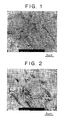
- Sample No. 4 gave a TEM photograph ( ⁇ 7500) as shown in Fig. 1. This photograph indicates that there exist a less number of carbide grains in the between retained austenite and ferrite.
- samples Nos. 1, 6, 11, 12, and 13 are not satisfactory because they do not meet any of the requirements prescribed in the present invention.
- Sample No. 1 is poor in strength on account of low carbon content.
- Sample No. 6 is poor in strength, elongation, and bendability because of insufficient retained austenite and excess pearlite structure which result from the low content of Mn and the low content of (Si+Al) combined together.
- Sample No. 11 is poor in elongation and bendability on account of excess pearlite structure and insufficient retained austenite, which results from keeping the work at 700°C for a long time during heat treatment.
- Sample No. 12 is poor in bendability on account of a large number of carbide grains, which results from not keeping the work at 700°C during heat treatment.
- Sample No. 13 is good in bendability owing to stable retained austenite with a high carbon content but is poor in tight bendability (R 0 ) owing to a large number of carbide grains, which results from not keeping the work at 700°C but keeping the work at 400°C for a long time during heat treatment.
- Sample No. 13 gave a TEM photograph ( ⁇ 7500) as shown in Fig. 2. This photograph indicates that the conventional steel sheet has a large number of carbide grains between retained austenite and ferrite.
Landscapes
- Chemical & Material Sciences (AREA)
- Engineering & Computer Science (AREA)
- Materials Engineering (AREA)
- Mechanical Engineering (AREA)
- Metallurgy (AREA)
- Organic Chemistry (AREA)
- Physics & Mathematics (AREA)
- Thermal Sciences (AREA)
- Crystallography & Structural Chemistry (AREA)
- Heat Treatment Of Sheet Steel (AREA)
Abstract
Description
- The present invention relates to a high-strength steel sheet with excellent bendability, especially tight bendability (ultimate deformability). More particularly, the present invention relates to a high-strength steel sheet which exhibits excellent bendability despite its high or ultra-high strength ranging from 600 to 1400 MPa.
- Steel sheets used for press working in automobile and machine industries are required to have both good strength and good ductility, and such requirements are becoming more rigorous than before.
- There is known a steel sheet in which strength and ductility stand together. It is a steel sheet of ferrite-martensite dual phase (DP) in which the ferrite matrix contains the microstructure composed mainly of martensite which has transformed at low temperatures (disclosed in, for example, Japanese Patent Laid-open No. 122820/1980). This steel sheet is excellent in ductility as well as shape freezing properties in press working. The latter is attributable to a large number of free dislocations which appear in the region where martensite forms, and such dislocations eliminate yield elongation, thereby reducing yield stress. With a properly controlled microstructure, the steel sheet will have both high tensile strength (TS) and high elongation (El).
- There is also known a retained austenite steel sheet (or TRIP steel sheet) with improved ductility. It contains retained austenite in the structure so that it undergoes transformation induced plastic deformation during working. For example, Japanese Patent Laid-open No. 43425/1985 discloses a dual-phase steel sheet with high strength as well as excellent ductility. This steel sheet is composed of no less than 10 vol% of ferrite and no less than 10 vol% of retained austenite, with the remainder being bainite or martensite or a mixture thereof. According to the disclosure, retained austenite produces the effect of working-induced transformation and soft ferrite produces the effect of high ductility. With the structure as specified above, ferrite and retained austenite contribute to ductility and bainite or martensite contributes to strength.
- All the steel sheets mentioned above are characterized by excellent elongation properties (especially uniform elongation). In particular, TRIP steel sheets benefit from very high elongation and very good formability (for stretching and deep drawing) owing to retained austenite therein. However, it is known that they are generally inferior to solid-solution strengthened steels in local deformation properties (bendability and bore-expandability) and ultimate deformation properties (tight bendability). Although good bending properties (particularly good tight bendability) are essential for steel sheets for press forming in the automobile industry, there have been no steel sheets developed so far which meet these requirements.
- The present invention was completed in view of the foregoing. It is an object of the present invention to provide a high-strength steel sheet with excellent bendability, especially tight bendability, despite its high or ultra-high strength ranging from 600 to 1400 MPa.
- The present invention is directed to a steel sheet with excellent bendability comprises C (0.06 mass% to less than 0.25 mass%), at least one of Si and Al (total 0.5-3 mass%), Mn (0.5-3 mass%), P (no more than 0.15 mass%, excluding 0 mass%), and S (no more than 0.02 mass%, excluding 0 mass%), wherein the main structure of the steel sheet comprises retained austenite (5-30 area%) and ferrite (no less than 50 area%) and there exist no more than 40 carbide grains per 2000 µm2 in the steel sheet.
- In addition, the steel sheet according to the present invention may optionally contain (a) at least one species of Mo (no more than 1 mass%, excluding 0 mass%), Ni (no more than 0.5 mass%, excluding 0 mass%), and Cu (no more than 0.5 mass%, excluding 0 mass%), and (b) Ca (no more than 0.003 mass%, excluding 0 mass%) and/or rare earth element (no more than 0.003 mass%, excluding 0 mass%).
- The present invention constructed as mentioned above provides a high-strength steel sheet which exhibits excellent bendability even though its strength as high as 600 to 1400 MPa. This steel sheet is suitable for automobiles.
-
- Fig. 1 is a TEM photograph of the steel sheet (sample No. 4) according to the present invention.
- Fig. 2 is a TEM photograph of the steel sheet (sample No. 13) according to the present invention.
-
- In order to develop a new steel sheet with excellent bendability, the present inventors carried out a series of researches. As the result, it was found that conventional DP steel sheets and TRIP steel sheets are poor in bendability because there is a large difference in strength between the parent phase and the second phase and this causes deformation to occur mainly in the interface between the two phases (that part of the interface which is adjacent to the parent phase).
- The present inventors' further investigation revealed that the ultimate deformability (tight bendability) of TRIP steel sheets is affected not only by difference in strength between the parent phase and the second phase but also by the presence of carbide which does not undergo plastic deformation (or which is harder than the second phase). It was finally found that if the amount of carbide existing between retained austenite and ferrite is minimized, resulting TRIP steel sheets exhibit excellent bendability. The present invention is based on this finding.
- Since the size of the carbide grain between retained austenite and ferrite is approximately constant in the steel sheet according to the present invention, the condition of quantity of carbide is defined in terms of number of the carbide grains.
- As mentioned above, the steel sheet according to the present invention is characterized by the minimal content of carbide existing between retained austenite and ferrite, which is specified by the number of carbide grains no more than 40 per 2000 µm2. With the number of carbide grains exceeding 40, the resulting steel sheet is poor in bendability (especially tight bendability). The number of carbide grains should preferably be no more than 30.
- The steel sheet according to the present invention should also have an adequately controlled structure so that it meets requirements for high strength as well as good elongation. The structure should be composed mainly of retained austenite (5-30 area%) and ferrite (no less than 50 area%). This limitation is based on the following.
- Retained austenite should be present in an amount of 5 area% (preferably no less than 8 area%) so that it helps increase total elongation. With an amount in excess of 30 area%, retained austenite adversely affects bendability. Therefore, the upper limit should be 30 area%, preferably no more than 20 area%.
- The steel sheet according to the present invention should contain ferrite in an amount no less than 50 area% so that it exhibits good ductility.
- The steel sheet according to the present invention contains retained austenite and ferrite which constitute the main structure (accounting for no less than 70 area%). It may additionally contain bainite and martensite, which constitute the secondary structure, in an amount not harmful to the function of the present invention. These minor components inevitably remain in the structure during steel production. The amount of martensite should preferably be as small as possible.
- Conventional TRIP steel sheets undergo heat treatment (after hot rolling and cold rolling) in the following manner. The work is heated and kept at a temperature higher than A1 point and lower than A3 point for about 60-180 seconds. Then, the work is cooled to a temperature in the zone for bainite transformation (for example, about 400±50°C) at an average cooling rate in excess of 10°C/s. The work is kept at this temperature for about 300 seconds so as to stabilize the gamma phase with an increased C concentration therein and to ensure a prescribed amount of retained austenite. Heat treatment in this manner, however, causes the C concentration to vary greatly from the inside to the outside of the retained gamma phase. This in turn gives rise to carbide, thereby deteriorating bendability.
- According to the present invention, the steel sheet containing carbide in controlled form may be obtained by the manufacturing method which includes a step of keeping the work at a temperature in the zone for ferrite transformation (for example, about 700±30°C) for a prescribed period of time in the course of cooling from the retention temperature not less than A1 point and not more than A3 point to the temperature range of bainite transformation. In other words, this method requires that heat treatment be carried out in two stages so as to reduce difference in C concentration in the inside and outside of the retained gamma phase and to suppress formation of carbide between retained austenite and ferrite. It is to be noted, however, that the temperature zone for ferrite transformation overlaps with the temperature zone for pearlite transformation and hence keeping the work at that temperature for an excessively long period of time permits the pearlite structure to separate out, thereby deteriorating the characteristic properties. Therefore, it is necessary to keep the work at a heating temperature for an adequate length of time, which is about 10-30 seconds. In addition, it is not necessary for the work to be held in the temperature zone for ferrite transformation for a long period of time because C concentration in the gamma phase takes place rapidly. Therefore, this heat treatment may be carried out as part of the annealing step that follows hot rolling.
- Incidentally, the conditions of the hot rolling and cold rolling that precede the heat treatment are not specifically limited. They may be properly selected among ordinary conditions. Also, the cooling rates after the heat treatments may be controlled adequately. For example, the average cooling rate in the case where the work is kept at a temperature in the zone for ferrite transformation for a prescribed period time and then cooled to a temperature in the zone for bainite transformation is preferably larger than 10°C/s so as to prevent the formation of carbide.
- The retained austenite steel sheet according to the present invention should have the specific structure and the controlled number of carbide grains as mentioned above so that it exhibits the desired properties. The steel sheet is not specifically restricted in chemical composition. However, it is desirable to control the amount of fundamental components (such as C, Si, Al, Mn, P, and S) as follows.
- C is an essential element for high strength and for ensuring retained austenite. C is an important element for obtaining an adequate amount of C in the austenite phase and for making a desired amount of the austenite phase remain at room temperature. The content of C to produce these effects should be no less than 0.06 mass%. C in an amount of 0.25 mass% or more adversely affects weldability.
- Si and Al effectively prevent the retained austenite from decomposing to form carbide. Si is also useful for solid solution strengthening. The total amount of Si and Al necessary for these effects is no less than 0.5 mass%, preferably no less than 0.7 mass%, more preferably no less than 1 mass%. Total amount of the elements exceeding 3 mass% makes the effects saturated. Excess Si and Al are wasted without any additional effect, and they will cause hot shortness. Thus, the upper limit is 3 mass%, preferably 2.5 mass%, more preferably 2 mass%.
- Mn stabilizes austenite to give retained austenite as desired. The amount of Mn necessary for this effect is no less than 0.5 mass%, preferably no less than 0.7 mass%, more preferably no less than 1 mass%. Excess Mn produces an adverse effect, such as cracking in cast ingots. Therefore, the upper limit of Mn is 3 mass%, preferably 2.5 mass%, more preferably 2 mass%.
- P ensures as much retained austenite as desired. The amount of P necessary for this effect is no less than 0.03 mass%, preferably no less than 0.05 mass%. Excess P produces adverse effects in secondary operation. Therefore, the upper limit of P is 0.15 mass%, preferably 0.1 mass%.
- S deteriorates workability because it forms sulfide inclusions, such as MnS, to bring about cracking. The amount of S should be as small as possible. The amount of S should be below 0.02 mass%, preferably below 0.015 mass%.
- The steel sheet of the present invention may optionally contain at least one of Mo, Ni, Cu, Ca, and rare earth elements in addition to the above-mentioned fundamental components. They improve the properties of the steel sheet when they are used in an adequate amount as specified in the following.
- These elements strengthen the steel sheet, stabilize retained austenite, and secure a prescribed amount of retained austenite. Their respective amount necessary and sufficient for these effects is as follows:
- Mo : no less than 0.05 mass% (preferably no less than 0.1 mass%), no more than 0.8 mass%.
- Ni : no less than 0.05 mass% (preferably no less than 0.1 mass%), no more than 0.4 mass%.
- Cu : no less than 0.05 mass% (preferably no less than 0.1 mass%), no more than 0.4 mass%.
- Cr : no less than 0.05 mass% (preferably no less than 0.1 mass%), no more than 0.8 mass%.
-
- The amounts of the elements exceeding the upper limits are wasted because of saturation of the effects.
- Ca and rare earth elements control the form of sulfide in the steel, thereby contributing to workability. The rare earth elements used in the present invention include scandium (Sc) and yttrium (Y), both belonging to Group III, and lanthanide elements (atomic number 51 to 71). Any of them may be used in an amount no less than 0.0003 mass%, preferably no less than 0.0005 mass%. The upper limit is 0.003 mass%, preferably 0.0025 mass%. Any excess amount is wasted without additional effect.
- The steel sheet of the present invention is composed of the above-mentioned components, with the remainder being iron. However, it may also contain Ti, Nb, V, etc. in small amounts, and the steel sheet containing such minor components is also covered by the present invention. In addition, the steel sheet of the present invention may contain inevitable impurities, such as Zr and B; they are permissible so long as their amount is small enough (less than 0.001 mass%) to save the effect of the present invention.
- The invention will be described in more detail with reference to the following examples, which are not intended to restrict the scope thereof and which may be modified without departing from the scope thereof.
- A sample steel with the chemical composition shown in Table 1 was prepared by vacuum melting. The steel was made into a slab, which was subsequently made into a steel sheet (1.2 mm thick) by hot rolling and continuous annealing. Hot rolling was started at 1300°C and completed at about 900°C (which is higher than the Ar3 point). The rolled sheet was wound up at a finishing temperature of about 450°C. The thus obtained hot-rolled steel sheet (2-3 mm thick) underwent cold rolling. The cold-rolled steel sheet (1.2 mm thick) underwent heat treatment (continuous annealing) in different patterns as specified below.
- This heat treatment consists of heating up to 850°C (above A1 point and below A3 point) and keeping this temperature for 120 seconds (for annealing), cooling to 700°C at an average rate of 5°C/s and keeping this temperature for 15 seconds, cooling to 420°C at an average rate of 15°C/s and keeping this temperature for 15 seconds (for austempering), and air cooling to room temperature at an average rate of 5°C/s.
- This heat treatment consists of heating up to 850°C (above A1 point and below A3 point) and keeping this temperature for 120 seconds (for annealing), cooling to 700°C at an average rate of 5°C/s and keeping this temperature for 60 seconds, cooling to 420°C at an average rate of 15°C/s and keeping this temperature for 15 seconds (for austempering), and air cooling to room temperature at an average rate of 5°C/s.
- This heat treatment consists of heating up to 850°C (above A1 point and below A3 point) and keeping this temperature for 120 seconds (for annealing), cooling to 420°C at an average rate of 15°C/s and keeping this temperature for 15 seconds (for austempering), and air cooling to room temperature at an average rate of 5°C/s.
- This heat treatment consists of heating up to 850°C (above A1 point and below A3 point) and keeping this temperature for 120 seconds (for annealing), cooling to 420°C at an average rate of 15°C/s and keeping this temperature for 200 seconds (for austempering), and air cooling to room temperature at an average rate of 5°C/s.
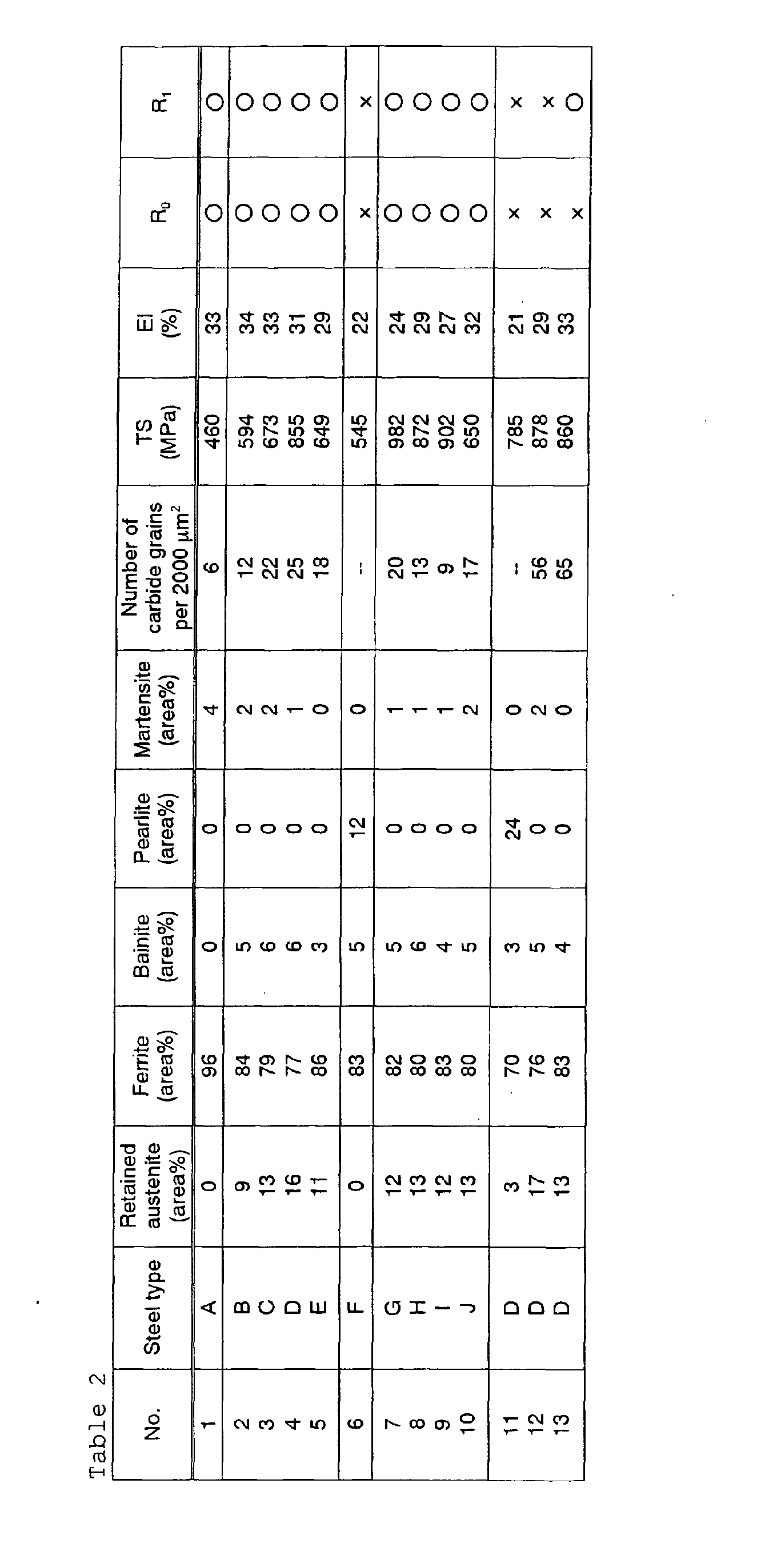
Steel Sample Chemical composition (mass%) C Si Mn P S Al Others A 0.033 1.48 1.50 0.03 0.006 0.032 - B 0.096 1.54 1.54 0.03 0.004 0.034 - C 0.157 1.57 1.53 0.02 0.004 0.033 - D 0.204 1.55 1.45 0.04 0.005 0.035 - E 0.151 0.48 1.55 0.04 0.005 1.030 - F 0.147 0.30 0.32 0.04 0.004 0.030 - G 0.150 1.46 1.55 0.03 0.005 0.033 Mo:0.2 H 0.147 1.52 1.48 0.04 0.005 0.032 Ni:0.2 I 0.154 1.44 1.50 0.03 0.006 0.028 Cu:0.2 J 0.151 1.53 1.54 0.03 0.004 0.032 Ca:0.001 - The thus obtained steel sheet samples were examined for the number of carbide grains per 2000 µm2, tensile strength (TS), elongation [total elongation (El)], areal ratio (space factor) of each structure, and bending properties (tight bendability R0 and bendability R1) in the following manner. The results are shown in Table 2.
- Each sample undergoes electrolytic polishing (60 V - 0.5 A) with a solution containing 5% perchloric acid and acetic acid and etching (2 V - 20 mA, 2 min) with a solution of 10% acetylacetone and 90% methanol, containing 1 g of tetramethylammonium chloride. A replica of the sample is formed by carbon deposition and ensuing peeling. The replica is observed under a transmission electron microscope (TEM) with a magnification of 7500. Three arbitrary areas (each measuring 40 × 17 µm) of the sample are photographed. The photographs are examined to count the number of carbide grains (per 2000 µm2 = approximate total three areas) found between retained austenite and ferrite.
- Each sample undergoes tensile test with a specimen conforming to JIS No. 5 for measurement of tensile strength (TS) and elongation (El).
- The microstructure of each sample (with its surface etched by Repeller corrosion method) is observed and photographed by using an optical microscope and a transmission electron microscope (TEM). The photographs are used to measure the areal ratio of each constituent. The areal ratio of retained austenite is determined by X-ray microanalysis (according to ISIJ Int. vol. 33 (1933), No. 7, p. 776).
- Specimens (40 mm wide, 100 mm long, and 1.2 mm thick) are cut out of each steel sheet. They are subjected to tight bending R0 and bending R1 with a 1 mm thick steel sheet inserted (both through 180°). Their bending properties are rated in terms of cracking that occurs in the specimen. (Symbols "×" and "○" denote respectively the absence and presence of cracking.)
- The foregoing results may be interpreted as follows. Samples Nos. 2-5 and 7-10 exhibit excellent bendability because they meet all of the requirements prescribed in the present invention. Sample No. 4 gave a TEM photograph (×7500) as shown in Fig. 1. This photograph indicates that there exist a less number of carbide grains in the between retained austenite and ferrite.
- By contrast, samples Nos. 1, 6, 11, 12, and 13 are not satisfactory because they do not meet any of the requirements prescribed in the present invention. Sample No. 1 is poor in strength on account of low carbon content. Sample No. 6 is poor in strength, elongation, and bendability because of insufficient retained austenite and excess pearlite structure which result from the low content of Mn and the low content of (Si+Al) combined together.
- Sample No. 11 is poor in elongation and bendability on account of excess pearlite structure and insufficient retained austenite, which results from keeping the work at 700°C for a long time during heat treatment. Sample No. 12 is poor in bendability on account of a large number of carbide grains, which results from not keeping the work at 700°C during heat treatment. Sample No. 13 is good in bendability owing to stable retained austenite with a high carbon content but is poor in tight bendability (R0) owing to a large number of carbide grains, which results from not keeping the work at 700°C but keeping the work at 400°C for a long time during heat treatment. Incidentally, Sample No. 13 gave a TEM photograph (×7500) as shown in Fig. 2. This photograph indicates that the conventional steel sheet has a large number of carbide grains between retained austenite and ferrite.
Claims (5)
- A steel sheet with excellent bendability comprising:wherein the main structure of said steel sheet comprises retained austenite of 5-30 area% and ferrite of no less than 50 area%,C : from 0.06 mass% to 0.25 mass%;at least one of Si and Al : total 0.5-3 mass%;Mn : from 0.5 mass% to 3 mass%;P : no more than 0.15 mass% (excluding 0 mass%); andS : no more than 0.02 mass% (excluding 0 mass%),
and wherein there exist no more than 40 carbide grains per 2000 µm2 in said steel sheet. - The steel sheet as claimed in Claim 1, further comprising at least one member selected from:Mo : no more than 1 mass% (excluding 0 mass%);Ni : no more than 0.5 mass% (excluding 0 mass%); andCu : no more than 0.5 mass% (excluding 0 mass%).
- The steel sheet as claimed in Claim 1 or 2, further comprising at least one of Ca of no more than 0.003 mass% (excluding 0 mass%) and rare earth element of no more than 0.003 mass% (excluding 0 mass%)
- The steel sheet as claimed in any of Claims 1 to 3, wherein the main structure of said steel sheet comprises retained austenite of 5-20 area%.
- The steel sheet as claimed in any of Claims 1 to 4, wherein there exist no more than 30 carbide grains per 2000 µm2 in said steel sheet.
Applications Claiming Priority (2)
| Application Number | Priority Date | Filing Date | Title |
|---|---|---|---|
| JP2002219662 | 2002-07-29 | ||
| JP2002219662A JP3828466B2 (en) | 2002-07-29 | 2002-07-29 | Steel sheet with excellent bending properties |
Publications (3)
| Publication Number | Publication Date |
|---|---|
| EP1389639A2 true EP1389639A2 (en) | 2004-02-18 |
| EP1389639A3 EP1389639A3 (en) | 2005-06-08 |
| EP1389639B1 EP1389639B1 (en) | 2011-01-05 |
Family
ID=30768001
Family Applications (1)
| Application Number | Title | Priority Date | Filing Date |
|---|---|---|---|
| EP03254606A Expired - Lifetime EP1389639B1 (en) | 2002-07-29 | 2003-07-24 | Steel sheet with excellent bendability |
Country Status (3)
| Country | Link |
|---|---|
| US (1) | US20040159373A1 (en) |
| EP (1) | EP1389639B1 (en) |
| JP (1) | JP3828466B2 (en) |
Cited By (2)
| Publication number | Priority date | Publication date | Assignee | Title |
|---|---|---|---|---|
| EP2128293A1 (en) * | 2008-05-27 | 2009-12-02 | Posco | Low specific gravity and high strength steel sheets with excellent ridging resistibility and manufacturing methods thereof |
| EP2980245A4 (en) * | 2013-03-28 | 2016-11-23 | Jfe Steel Corp | HIGH-RESISTANCE ALLOY STEEL SHEET BY IMMERSION IN FUSION ZINC MIXTURE AND METHOD OF MANUFACTURING THE SAME |
Families Citing this family (10)
| Publication number | Priority date | Publication date | Assignee | Title |
|---|---|---|---|---|
| EP1431406A1 (en) * | 2002-12-20 | 2004-06-23 | Sidmar N.V. | A steel composition for the production of cold rolled multiphase steel products |
| US7314532B2 (en) * | 2003-03-26 | 2008-01-01 | Kabushiki Kaisha Kobe Seiko Sho (Kobe Steel, Ltd.) | High-strength forged parts having high reduction of area and method for producing same |
| EP1512760B1 (en) * | 2003-08-29 | 2011-09-28 | Kabushiki Kaisha Kobe Seiko Sho (Kobe Steel, Ltd.) | High tensile strength steel sheet excellent in processibility and process for manufacturing the same |
| US20050150580A1 (en) * | 2004-01-09 | 2005-07-14 | Kabushiki Kaisha Kobe Seiko Sho(Kobe Steel, Ltd.) | Ultra-high strength steel sheet having excellent hydrogen embrittlement resistance, and method for manufacturing the same |
| EP1559798B1 (en) * | 2004-01-28 | 2016-11-02 | Kabushiki Kaisha Kobe Seiko Sho (Kobe Steel, Ltd.) | High strength and low yield ratio cold rolled steel sheet and method of manufacturing the same |
| ATE426686T1 (en) * | 2004-04-22 | 2009-04-15 | Kobe Steel Ltd | HIGH STRENGTH AND COLD ROLLED STEEL SHEET WITH EXCELLENT FORMABILITY AND PLATED STEEL SHEET |
| JP4288364B2 (en) * | 2004-12-21 | 2009-07-01 | 株式会社神戸製鋼所 | Composite structure cold-rolled steel sheet with excellent elongation and stretch flangeability |
| JP4716358B2 (en) * | 2005-03-30 | 2011-07-06 | 株式会社神戸製鋼所 | High-strength cold-rolled steel sheet and plated steel sheet with excellent balance between strength and workability |
| JP4716359B2 (en) * | 2005-03-30 | 2011-07-06 | 株式会社神戸製鋼所 | High strength cold-rolled steel sheet excellent in uniform elongation and method for producing the same |
| EP1767659A1 (en) * | 2005-09-21 | 2007-03-28 | ARCELOR France | Method of manufacturing multi phase microstructured steel piece |
Family Cites Families (15)
| Publication number | Priority date | Publication date | Assignee | Title |
|---|---|---|---|---|
| JP2952624B2 (en) * | 1991-05-30 | 1999-09-27 | 新日本製鐵株式会社 | High yield ratio type hot rolled high strength steel sheet excellent in formability and spot weldability and its manufacturing method and high yield ratio type hot rolled high strength steel sheet excellent in formability and its manufacturing method |
| TW363082B (en) * | 1994-04-26 | 1999-07-01 | Nippon Steel Corp | Steel sheet having high strength and being suited to deep drawing and process for producing the same |
| CA2278841C (en) * | 1997-01-29 | 2007-05-01 | Nippon Steel Corporation | High strength steels having excellent formability and high impact energy absorption properties, and a method for producing the same |
| JP3320013B2 (en) * | 1997-05-29 | 2002-09-03 | 川崎製鉄株式会社 | High strength and high workability hot rolled steel sheet with excellent impact resistance |
| JP3320014B2 (en) * | 1997-06-16 | 2002-09-03 | 川崎製鉄株式会社 | High strength, high workability cold rolled steel sheet with excellent impact resistance |
| JP3619357B2 (en) * | 1997-12-26 | 2005-02-09 | 新日本製鐵株式会社 | High strength steel sheet having high dynamic deformation resistance and manufacturing method thereof |
| JP3172505B2 (en) * | 1998-03-12 | 2001-06-04 | 株式会社神戸製鋼所 | High strength hot rolled steel sheet with excellent formability |
| JPH11323489A (en) * | 1998-05-13 | 1999-11-26 | Nippon Steel Corp | Good workability high-strength cold-rolled steel sheet excellent in shape freezing property and method for producing the same |
| JP2000256789A (en) * | 1999-03-10 | 2000-09-19 | Kobe Steel Ltd | Cold-rolled steel sheet excellent in workability and spot weldability and pre-galvannealed steel sheet and production thereof |
| JP2000313936A (en) * | 1999-04-27 | 2000-11-14 | Kobe Steel Ltd | Galvannealed steel sheet excellent in ductility and production thereof |
| FR2801061B1 (en) * | 1999-11-12 | 2001-12-14 | Lorraine Laminage | PROCESS FOR PRODUCING A VERY HIGH STRENGTH HOT LAMINATED SHEET METAL FOR USE IN FORMING AND IN PARTICULAR FOR STAMPING |
| JP3750789B2 (en) * | 1999-11-19 | 2006-03-01 | 株式会社神戸製鋼所 | Hot-dip galvanized steel sheet having excellent ductility and method for producing the same |
| JP2001152287A (en) * | 1999-11-26 | 2001-06-05 | Kobe Steel Ltd | High strength cold rolled steel sheet excellent in spot weldability |
| KR100441414B1 (en) * | 2000-04-21 | 2004-07-23 | 신닛뽄세이테쯔 카부시키카이샤 | High fatigue strength steel sheet excellent in burring workability and method for producing the same |
| CA2387322C (en) * | 2001-06-06 | 2008-09-30 | Kawasaki Steel Corporation | High-ductility steel sheet excellent in press formability and strain age hardenability, and method for manufacturing the same |
-
2002
- 2002-07-29 JP JP2002219662A patent/JP3828466B2/en not_active Expired - Fee Related
-
2003
- 2003-07-24 EP EP03254606A patent/EP1389639B1/en not_active Expired - Lifetime
- 2003-07-25 US US10/626,612 patent/US20040159373A1/en not_active Abandoned
Non-Patent Citations (1)
| Title |
|---|
| None |
Cited By (4)
| Publication number | Priority date | Publication date | Assignee | Title |
|---|---|---|---|---|
| EP2128293A1 (en) * | 2008-05-27 | 2009-12-02 | Posco | Low specific gravity and high strength steel sheets with excellent ridging resistibility and manufacturing methods thereof |
| US8778097B2 (en) | 2008-05-27 | 2014-07-15 | Posco | Low specific gravity and high strength steel sheets with excellent ridging resistibility and manufacturing methods thereof |
| EP2980245A4 (en) * | 2013-03-28 | 2016-11-23 | Jfe Steel Corp | HIGH-RESISTANCE ALLOY STEEL SHEET BY IMMERSION IN FUSION ZINC MIXTURE AND METHOD OF MANUFACTURING THE SAME |
| US10100394B2 (en) | 2013-03-28 | 2018-10-16 | Jfe Steel Corporation | High-strength galvannealed steel sheet and method for manufacturing the same |
Also Published As
| Publication number | Publication date |
|---|---|
| JP2004059996A (en) | 2004-02-26 |
| JP3828466B2 (en) | 2006-10-04 |
| EP1389639B1 (en) | 2011-01-05 |
| US20040159373A1 (en) | 2004-08-19 |
| EP1389639A3 (en) | 2005-06-08 |
Similar Documents
| Publication | Publication Date | Title |
|---|---|---|
| EP3943623B1 (en) | Hot-stamping formed body | |
| EP2465962B1 (en) | High-strength steel sheets and processes for production of the same | |
| EP1391526B1 (en) | Dual phase steel sheet with good bake-hardening properties | |
| EP2157203B1 (en) | High-strength steel sheet superior in formability | |
| EP2762579B2 (en) | High-strength hot-dip galvanized steel sheet and process for producing same | |
| CN101861406B (en) | High-strength cold-rolled steel sheet | |
| EP2184374B1 (en) | High-strength hot-dip galvanized steel sheet and process for producing the same | |
| EP3202943B1 (en) | High-strength seamless steel pipe for oil wells, and production method for high-strength seamless steel pipe for oil wells | |
| EP1865083B1 (en) | High strength hot rolled steel sheet excellent in bore expanding workability and method for production thereof | |
| EP2000554B1 (en) | High-strength steel sheet having excellent workability | |
| JP5126844B2 (en) | Steel sheet for hot pressing, manufacturing method thereof, and manufacturing method of hot pressed steel sheet member | |
| EP3255163B1 (en) | High-strength steel sheet and production method therefor | |
| KR20190042066A (en) | Steel plate | |
| EP4310205A1 (en) | Steel sheet, member, method for producing steel sheet, and method for producing member | |
| CN115461482B (en) | Steel sheet, component, and method for manufacturing same | |
| EP1389639B1 (en) | Steel sheet with excellent bendability | |
| EP3748030A1 (en) | High-carbon hot-rolled steel sheet and method for manufacturing same | |
| JP4506971B2 (en) | High-strength cold-rolled and plated steel sheets with excellent formability | |
| WO2023166934A1 (en) | Steel sheet and method for manufacturing same | |
| US20260049383A1 (en) | High-strength hot rolled steel sheet and method for producing the same | |
| JP2002226937A (en) | Cold-rolled steel sheet, plated steel sheet, and method for producing cold-rolled steel sheet excellent in ability to increase strength by heat treatment after forming | |
| WO2024058096A1 (en) | High-strength hot-rolled steel sheet | |
| CN119866384A (en) | Steel sheet, member, and method for producing same | |
| EP4603617A1 (en) | Steel sheets and methods for manufacturing same | |
| KR20250093756A (en) | A steel sheet for hot press forming, a hot press formed member and a method for producing thereof |
Legal Events
| Date | Code | Title | Description |
|---|---|---|---|
| PUAI | Public reference made under article 153(3) epc to a published international application that has entered the european phase |
Free format text: ORIGINAL CODE: 0009012 |
|
| 17P | Request for examination filed |
Effective date: 20030806 |
|
| AK | Designated contracting states |
Kind code of ref document: A2 Designated state(s): AT BE BG CH CY CZ DE DK EE ES FI FR GB GR HU IE IT LI LU MC NL PT RO SE SI SK TR |
|
| AX | Request for extension of the european patent |
Extension state: AL LT LV MK |
|
| PUAL | Search report despatched |
Free format text: ORIGINAL CODE: 0009013 |
|
| AK | Designated contracting states |
Kind code of ref document: A3 Designated state(s): AT BE BG CH CY CZ DE DK EE ES FI FR GB GR HU IE IT LI LU MC NL PT RO SE SI SK TR |
|
| AX | Request for extension of the european patent |
Extension state: AL LT LV MK |
|
| AKX | Designation fees paid |
Designated state(s): CZ FR GB |
|
| REG | Reference to a national code |
Ref country code: DE Ref legal event code: 8566 |
|
| GRAP | Despatch of communication of intention to grant a patent |
Free format text: ORIGINAL CODE: EPIDOSNIGR1 |
|
| GRAS | Grant fee paid |
Free format text: ORIGINAL CODE: EPIDOSNIGR3 |
|
| GRAA | (expected) grant |
Free format text: ORIGINAL CODE: 0009210 |
|
| AK | Designated contracting states |
Kind code of ref document: B1 Designated state(s): CZ FR GB |
|
| REG | Reference to a national code |
Ref country code: GB Ref legal event code: FG4D |
|
| PLBI | Opposition filed |
Free format text: ORIGINAL CODE: 0009260 |
|
| PLAX | Notice of opposition and request to file observation + time limit sent |
Free format text: ORIGINAL CODE: EPIDOSNOBS2 |
|
| 26 | Opposition filed |
Opponent name: THYSSENKRUPP STEEL EUROPE AG Effective date: 20111005 |
|
| PG25 | Lapsed in a contracting state [announced via postgrant information from national office to epo] |
Ref country code: CZ Free format text: LAPSE BECAUSE OF FAILURE TO SUBMIT A TRANSLATION OF THE DESCRIPTION OR TO PAY THE FEE WITHIN THE PRESCRIBED TIME-LIMIT Effective date: 20110105 |
|
| PLAF | Information modified related to communication of a notice of opposition and request to file observations + time limit |
Free format text: ORIGINAL CODE: EPIDOSCOBS2 |
|
| PLBB | Reply of patent proprietor to notice(s) of opposition received |
Free format text: ORIGINAL CODE: EPIDOSNOBS3 |
|
| PLCK | Communication despatched that opposition was rejected |
Free format text: ORIGINAL CODE: EPIDOSNREJ1 |
|
| PLBN | Opposition rejected |
Free format text: ORIGINAL CODE: 0009273 |
|
| STAA | Information on the status of an ep patent application or granted ep patent |
Free format text: STATUS: OPPOSITION REJECTED |
|
| 27O | Opposition rejected |
Effective date: 20131206 |
|
| REG | Reference to a national code |
Ref country code: FR Ref legal event code: PLFP Year of fee payment: 13 |
|
| PGFP | Annual fee paid to national office [announced via postgrant information from national office to epo] |
Ref country code: GB Payment date: 20150722 Year of fee payment: 13 |
|
| PGFP | Annual fee paid to national office [announced via postgrant information from national office to epo] |
Ref country code: FR Payment date: 20150629 Year of fee payment: 13 |
|
| GBPC | Gb: european patent ceased through non-payment of renewal fee |
Effective date: 20160724 |
|
| PG25 | Lapsed in a contracting state [announced via postgrant information from national office to epo] |
Ref country code: FR Free format text: LAPSE BECAUSE OF NON-PAYMENT OF DUE FEES Effective date: 20160801 |
|
| REG | Reference to a national code |
Ref country code: FR Ref legal event code: ST Effective date: 20170331 |
|
| PG25 | Lapsed in a contracting state [announced via postgrant information from national office to epo] |
Ref country code: GB Free format text: LAPSE BECAUSE OF NON-PAYMENT OF DUE FEES Effective date: 20160724 |