TECHNICAL FIELD
The present invention relates to a refining method for heavy oil that can
efficiently remove impurities derived from a crude oil by a solvent extraction process
and a hydrorefining process, and in particular, to a method that can obtain a refined oil
that is suitable as a feedstock for light olefin production from a heavy oil that could not
be conventionally used as feedstock for light olefin production.
BACKGROUND ART
Because of the presence of impurities originating from the source of the crude
oil, oil products that have crude oil as a starting material are produced by implementing
various types of physical and chemical refining processes, starting with atmospheric
fractional distillation.
Generally, distillate, that is, distillated oils drawn off from a tower by distillation,
have minute amounts of the impurities and these impurities can be removed by a simple
refining process. Thereby, they can be used s for automobile fuel, gas turbine fuel,
petrochemical feedstock, or the like, which are high quality oil products from which
impurities have be removed to a high degree.
In contrast, residue oils, that is, bottom oils remained at a tower by distillation,
have impurities concentrated and they exist in a state that makes them extremely
difficult to remove. There are limits to eliminating these impurities by hydrorefining,
which is a fundamental refining means. In the case of a particularly high degree of
refining, severe reaction conditions including high temperature and high pressure in the
presence of hydrogen and a catalyst are necessary, a large amount of hydrogen and
catalyst are consumed, and large investments including facilities expenses are necessary.
Thus, at present this is not economical. Therefore, a method is desired that obtains
simply and economically a high quality refined oil, that is, an oil having a high added
value, or in other words, having impurities reduced to a high degree.
One use of high quality refined oil is as a petrochemical feedstock. Light olefins
such as ethylene, propylene, and the like, which are key materials in the petrochemical
field, are produced by thermal cracking using light oils such as ethane and naphtha as
the main feedstock, but a part of the heavy fraction, such as gas oil and vacuum gas oil,
are also used as feedstock. In the United States and the Middle East, which have
plentiful and inexpensive natural gas, ethylene plants that use ethane as feedstock are
common, while in Japan, Asia, and Europe, where naphtha is inexpensive, in most cases
naphtha is used as the feedstock.
Because the generation of by-products such as tar and pitch is higher in an
ethylene plant that uses naphtha as the feedstock than is the case when ethane is used as
a feedstock, a solution to coking and fouling of the downstream quenching heat
exchanger is necessary. Vacuum gas oil, whose molecular weight is higher than
naphtha and contains much sulfur, is used as a feedstock for an ethylene plant, and is
considered to be the limit for commercial operation.
In contrast, in terms of the amount of feedstock supply and feedstock cost, if a
feed oil that is heavier than the gas oil fraction can be used as a light olefin production
feedstock, the feedstock cost would be inexpensive, and at the same time, the problem
of a stable supply of feed oil that accompanies the increasingly heavy oil stocks could
be solved, and this would be an extremely great contribution to the industry.
In consideration of the circumstances described above, it is an object of the
present invention to provide a method for economically recovering high added value
refined oil from a heavy oil that has a high concentration of impurities derived from the
crude oil. In particular, the invention provides a refining method for heavy oil that can
economically recover refined oil suitable as a feedstock for light olefin production by
carrying out a refining process using a simple and reliable method on heavy oil such as
an atmospheric residue that is not conventionally suitable as a feedstock for light olefins.
DISCLOSURE OF INVENTION
As a result of significant research to attain the object described above, the
inventors have discovered that impurities in heavy oil can be efficiently removed to
obtain a high quality refined oil having impurities removed to a high degree by using as
a feedstock a heavy oil having a hydrogen content of 12 wt% or less, processing the
heavy oil so that the hydrogen content is increased by a certain amount or greater by
using a solvent extraction, and then processing the obtained deasphalted oil so that the
hydrogen content is increased by a certain amount or greater by using a hydrorefining
process.
In the refining method for heavy oil of the present invention, a refined oil is
obtained by processing that includes a solvent extraction process that obtains an
extracted oil by subjecting a feed oil to a solvent extraction process and a hydrorefining
process that obtains a refined oil by subjecting the obtained extracted oil to a
hydrogenation process in the presence of hydrogen and a catalyst. This feed oil is a
heavy oil having a hydrogen content of 12 wt% or less.
In the solvent extraction process, a deasphalted oil (DAO) is obtained as an
extracted oil by subjecting the feed oil to a solvent extraction process such that the
hydrogen content is increased by 0.2 wt.% or greater over that of the feed oil. In the
hydrorefining process, a refined oil is obtained by hydrorefining the deasphalted oil
such that the hydrogen content is increased by 0.5 wt% or greater over that of the
deasphalted oil.
In this manner, a high quality refined oil can be reliably obtained that has
impurities reduced to a high degree that cannot be anticipated by using either of the
refining processes alone because impurities that are difficult to remove by downstream
hydrorefining are processed in advance under conditions in which the hydrogen content
is increased by a certain amount or greater by using a solvent extraction, and
subsequently being processed under conditions in which the hydrogen content increases
by a certain amount or greater by using a hydrorefining process.
By focusing on the fact that impurities cannot be reliably removed by simply
carrying out only a solvent extraction process or a hydrorefining process, the inventors
discovered that by using the hydrogen content of the heavy oil to be processed as an
index and by carrying out processing so as to increase the hydrogen content by a
predetermined amount using a solvent extraction process followed by using a
hydrorefining process, a refined oil can be obtained that has the impurities reliably and
efficiently removed to a high degree. Thereby, the refined oil can be obtained under
economic conditions wherein a balanced load is maintained without requiring that the
conditions of the solvent extraction process or the hydrorefining process be made severe
conditions.
Preferably, the hydrogen content of the obtained refined oil is 11.5 wt% or
greater, and most preferably, 12.0 wt% or greater. In this case, a commercial operation
becomes possible in which the generation of coking and fouling can be repressed even
during a thermal cracking reaction by application to a feedstock for light olefin
production, which is a petrochemical feedstock. Therefore, the present invention can
obtain a refined oil having a high added value reliably and efficiently, and is
economically superior.
BEST MODE FOR CARRYING OUT THE INVENTION
Below, the preferred embodiments of the refining method for heavy oil
according to the present invention will be explained. However, the present invention is
not limited by any of the following embodiments, and for example, the elements can be
combined together as appropriate.
The present invention uses as a feedstock a heavy oil having a hydrogen content
of 12 wt% or less, and preferably 10 to 12 wt%, and in a solvent extraction process and
a hydrorefining process, the heavy oil is processed under conditions in which respective
predetermined degrees of refinement are attained.
The heavy oil having a hydrogen content of 12 wt% or less used in the present
invention generally includes residues such as atmospheric residue, ultra heavy oil, and
the like, whose uses are limited because of their high impurity concentrations. The
hydrogen content of these heavy oils is generally 9 to 12.5 wt%, and many are 9 to 11.5
wt%, and conventionally the heavy oils have been considered to be unsuitable as a
petrochemical feedstock for light olefins or the like because their impurities could not
be removed even by refining, and thus have not been used.
The present invention carries out solvent extraction processing as a first process
using heavy oil having a hydrogen content of 12 wt% or less as a feed oil, and recovers
a deasphalted oil, which is an extracted oil having the hydrogen content increased by 0.2
wt.% or greater. In this solvent extraction process, the asphaltene component having a
low hydrogen content is selectively removed.
This asphaltene component has a micelle structure comprising compounds
having a low hydrogen content such as condensed polycyclic aromatics and
cycloparaffin rings, and it is known that among these, residual carbon and metallic
porphyrin compounds such as V and Ni are incorporated, and thus impurities are
concentrated. It is known that the asphaltene component severely inhibits the
hydrorefining reaction, and promotes degradation of the catalyst. Thus, in the present
invention, the solvent extraction process is carried out under conditions in which the
hydrogen content increases by 0.2 wt% or greater, and as a result, a predetermined
amount of asphaltene is selectively removed.
In the solvent extraction process, a conventionally known solvent deasphalting
process can be applied, and by bringing the heavy oil into contact in countercurrent with
the C3 to C5 solvents in a solvent extraction tower, the deasphalted oil and the
asphaltene, inwhich the former has a high hydrogen content and diluted metals and
residual carbon, the latter has a low hydrogen content and concentrated metals and
residual carbon, are drawn off. By appropriately selecting the types of solvent to be
used, the amount of solvent for the heavy oil, and the extraction temperature conditions,
the extraction processing conditions are controlled so that the hydrogen content is
increased by 0.2 wt% or greater, and the extracted oil of the present invention can be
obtained.
As C3 to C5 solvents, preferably at least one selected from propane, butane, or
pentane is used.
The deasphalted oil is recovered as an extracted liquid along with the solvent
from the top of the extraction tower, and can be obtained by subjecting the solvent in
the extracted liquid to separation and removal under supercritical conditions. The
asphaltene is recovered as a raffinate along with a portion of the solvent from the
bottom of the tower, and the solvent in the raffinate is recovered by vaporization.
In the present invention, the hydrogen content of the deasphalted oil obtained by
this type of solvent extraction process is increased by 0.2 wt% or greater than the
hydrogen content of the feedstock heavy oil. Furthermore, an increase by 0.2 to 1.5
wt% is preferable, and an increase by 0.2 to 1.2 wt% is most preferable.
Preferably, the increased amount of the hydrogen content in the solvent
extraction process changes depending on the value of the hydrogen content in the
feedstock heavy oil. That is, in the case that the hydrogen content of the feed oil is 11
wt% or greater, in the solvent extraction process, the extraction process conditions are
controlled such that the increase in the hydrogen content is preferably by 0.2 to 1.0 wt%,
or most preferably, 0.2 to 0.5 wt% of the feed oil. If the hydrogen content is less than
11.0 wt%, an amount of increase is preferably in a range of 0.5 to 1.5 wt%, and most
preferably, 0.8 to 1.3 wt%.
When the increase in the hydrogen content during the solvent extraction process
is 0.2 wt% or less, the elimination of asphaltene, which is an impurity, is insufficient,
and under such conditions, even if treated by a downstream hydrorefining process, the
impurities cannot be sufficiently removed. In terms of the degree of refinement, the
larger the upper limit of the amount of increase the better, but in the case that the
increase is 1.5 wt% or greater, the rate of recovery of deasphalted oil decreases, and
thus is not economical.
In the present invention, the deasphalted oil subjected to a solvent extraction
process such that the hydrogen content increases by 0.2 wt% or greater in the solvent
extraction process described above is next subject to a hydrorefining process as a
second process.
In the hydrorefining process of the present invention, processing is carried out
under the condition that the hydrogen content is increased by 0.5 wt % or greater. This
hydrorefining process is a representative refining process in which hydrocarbons are
processed at high temperature and high pressure in the presence of hydrogen and a
catalyst, and can include all the reactions such as hydrocracking, hydrodesulfurization,
hydrodemetalization, and hydrodenitrogenation. That is, it includes hydrocracking,
which obtains a low molecular weight refined oil from the feedstock heavy oil;
hydrodesulfurization, which reacts the sulfur compounds in the hydrocarbons with
hydrogen to produce and separate out hydrogen sulfide, and obtain a refined oil with a
low sulfur concentration from a feed oil; hydrodemetalization, in which a metallic
compound in the hydrocarbon is hydrolyzed at high temperature and high pressure in
the presence of hydrogen, made into elemental metals, and precipitated on the catalyst
to obtain a refined oil having a low metal concentration; and hydrodenitrogenation, in
which the nitrogen compounds in the hydrocarbons are reacted with hydrogen at high
temperature and high pressure in the presence of hydrogen to produce and separate out
ammonia and obtain a refined oil that has a low nitrogen concentration from the feed oil.
The impurities in heavy oil include sulfur components, metals, and the like, but
because the removal of these impurities in advance using only a hydrorefining process
in an upstream solvent extraction process is for removing troublesome impurities, the
impurities can be efficiently reduced to a very low concentration, without severe
conditions.
In the hydrorefining process of the present invention, preferably at least two
types of catalyst are used in a combination selected from a hydrodemetalization catalyst,
a hydrodesulfurization catalyst, a hydrodesulfurization and hydrodemetalization catalyst,
or a hydrocracking catalyst. Preferably, the catalyst used in hydrorefining is Co/Mo,
Ni/Co/Mo, or Ni/Mo.
The conditions for the hydrorefining reaction are not particularly limited, but
preferably the ranges of the hydrorefining reaction conditions are those that are
generally employed. Specifically, preferably the hydrogen partial pressure is 60 to 150
kg/cm2, and most preferably 80 to 130 kg/cm2. The hydrogen to oil ratio is preferably
400 to 1200 Nm3/kl, and most preferably 600 to 1000 Nm3/kl. The LHSV is preferably
0.1 to 1.0/hr, and most preferably 0.2 to 0.8/hr. The reaction temperature is preferably
340 to 440° C, and most preferably 350 to 420° C.
Such conditions are the general conditions for hydrorefining, and in the present
invention, if the hydrorefining process is carried out after the upstream solvent
extraction process under conditions that increase the hydrogen content by 0.5 wt% or
greater, the impurities in the final refined oil can be efficiently reduced.
In the present invention, in the case that the hydrogen content of the feed oil is
11 to 12 wt%, the hydrogen content of the refined oil obtained by the hydrorefining
process with respect to the deasphalted oil is preferably increased by 0.5 to 1.0 wt%,
and most preferably by 0.5 to 0.9 wt%. In the case that the hydrogen content of the feed
oil is less than 11 wt%, the hydrogen content of the refined oil obtained by the
hydrorefining process with respect to the deasphalted oil is increased by preferably 0.6
to 1.5 wt%, and most preferably 0.8 to 1.3 wt%.
Furthermore, the hydrogen content in the hydrorefining process of the present
invention is preferably increased by 0.5 to 1.0 wt% if the hydrogen content of the
deasphalted oil obtained by the upstream solvent extraction process is 11.5 wt% or
greater, and preferably by 0.6 to 1.5 wt% if it is less than 11.5 wt%.
When the hydrogen content in the hydrorefining process increases less than 0.5
wt%, the elimination of impurities in the deasphalted oil is insufficient, and in the case
that the amount increases by 1.5 wt% or greater, the process conditions of the
hydrorefining reaction, such as the hydrogen partial pressure, the reaction temperature,
the amount of catalyst filling, and the like, must be made severe, and thus is not
economical.
This means that described in terms of the hydrorefining reaction conditions, in
the solvent extraction process, by selectively removing in advance the asphaltene
component, which is an impurity that is difficult to remove by a hydrorefining process,
in the following hydrorefining process, the hydrogen partial pressure and the reaction
temperature are not made extremely high, and the impurities can be efficiently reduced
to low concentrations without greatly increasing the amount of the catalyst or increasing
the reaction time.
As a result, the Conradson carbon residue and metal components such as Ni and
V, which are present in the asphaltene in a state that is concentrated and difficult to
remove, can be selectively removed by solvent extraction, and then in a hydrorefining
process, the impurities such as sulfur and metals such as Ni and V, which are present in
an easily removable state, can be thoroughly removed.
Even when the refined oil that has been processed by the refining process
according to the present invention described above is used as a feed oil for light olefin
production and subject to high temperature cracking, the impurities that become the
causative agents of coking and fouling are reliably and efficiently reduced, and thus the
yield of light olefins and the continuous operability are high, which is favorable for
commercial production. This is because heavy oils such as residues and ultra heavy oils
that are not conventionally considered appropriate as light olefin feedstock are used as a
starting material, and a high quality refined oil can be obtained by simple refining.
In the present invention, an refined oil that is processed so as to satisfy the
conditions described above will be effective as a refined oil in the present invention, and
in particular, in the case that it is used as a feedstock for light olefin production, the
hydrogen content must be 11.5 wt% or greater, and preferably 12.0 wt.% or greater.
In the present invention, the hydrogen content of the refined oil obtained by the
solvent extraction and hydrorefining, two-stage refining of heavy oil must increase by
0.7 wt% or greater than the feedstock heavy oil, and preferably by 0.8 to 2.7 wt%, and
most preferably, 1.0 to 2.2 wt%. In the case that it is used as the feedstock for light
olefin production, the hydrogen content of the final refined oil is preferably 11.5 wt% or
greater, and most preferably 12.0 to 13.5 wt%.
By carrying out a solvent extraction process and a hydrorefining process so that
the hydrogen content of the refined oil is 11.5 wt% or greater and increases by 0.7 wt%
or greater than the feedstock heavy oil, the properties in each process complement each
other, a severe load is not applied to the unit for each of the solvent extraction and
hydrorefining processes, a highly refined oil can be obtained with a high yield, and even
in the case that it is used as a petrochemical feedstock, coking and fouling occur with
difficulty, and a refined oil suitable for a petrochemical feedstock can be produced with
a high yield.
In the process of subjecting the heavy oil of the present invention to a solvent
extraction process, the extraction operation was carried out under conditions wherein
the hydrogen content of this feed oil is increased by 0.2 wt% or greater, but the Ni and
V metals are included in tens to thousands of wtppm in the residue and the ultra heavy
oil. This is because they are concentrated in the asphaltene, and in order to selectively
remove the asphaltene in the solvent extraction process, the concentration of the Ni and
V metals in the deasphalted oil, which is the refined oil whose content in the
deasphalted oil has been extracted by the solvent extraction process, is 70 wtppm or less,
and most preferably 50 wtppm or less. In addition, the solvent extraction process is
carried out so that preferably the Conradson carbon residue content is 15 wt% or less,
and most preferably 12 wt% or less. That is, the hydrogen content is increased by 0.2
wt% by the solvent extraction process, and at the same time, the concentration of the Ni
and V metals is preferably 70 wtppm or less, and the Conradson carbon residue is 15
wt % or less, and thereby the conditions for the downstream hydrorefining process are
not made severe, impurities are reliably removed, and a high quality refined oil can be
obtained.
The sulfur concentration of the deasphalted oil is preferably 5 wt% or less, and
most preferably 4 wt% or less. Thereby, the sulfur component in the final refined oil
obtained by the next hydrorefining process can be reliably processed so as to be 0.5
wt% or less, and preferably 0.3 wt% or less.
By making the Ni and V concentration of the deasphalted oil 70 wtppm or less,
the Conradson carbon residue concentration is 15 wt% or less, and the sulfur
concentration is 5 wt% or less, processing can be reliably carried out such that in the
final oil obtained by the subsequent hydrorefining process, the Ni and V concentration
of the final refined oil obtained in the subsequent hydrorefining process will be 2
wtppm or less, and preferably 1 wtppm or less, the Conradson carbon residue
concentration will be 1 wt% or less, the sulfur concentration will be 0.5 wt% or less,
and preferably 0.3 wt% or less.
By making the sulfur component in the final refined oil 0.5 wt% or less, even in
the case that it is used as a feedstock for light olefin production, the corrosion of the
thermal cracking unit can be limited to an allowable range, and the commercial
production of a feedstock for light olefins becomes substantially possible.
In the present invention, preferably the solvent extraction process and the
hydrorefining process are carried out so that the Ni and V content in the final refined oil
is 2 wtppm or less, or more preferably, 1.0 wtppm or less.
When the deasphalted oil, whose Ni and V metal content is reduced to 70 wtppm
or less by the solvent extraction process, is further reduced to 1 wtppm or less by
hydrorefining, coking can be severely reduced, the refined oil can be obtained with a
high yield, and this refined oil can be used as a thermal cracking feedstock for light
olefin production.
In the industrial method of producing light olefins, including ethylene and
propylene, by a thermal cracking reaction, the maintainability of coking and fouling due
to heavy oil by-products and the olefin yield determine its economy, and in particular,
the target of the yield of the light olefins is 25 % or more. Furthermore, looking at the
light olefins in detail, the targets are an ethylene yield of 15 % or greater and a
propylene yield of 10 % or greater.
Periodic decoking and cleaning must be carried out in response to the coking
that influences the maintainability of the thermal cracking unit and fouling due to heavy
oil by-products. In particular, in relation to by-product heavy oil, when the high-temperature
cracking products cracked in a cracking vessel are quenched by a
downstream heat exchanger in order to prevent severe cracking, the heat exchanger and
the pipes become clogged when the amount of generated heavy oil is large, and long
term continuous operation is made impossible.
In the present invention, in the case of starting from a heavy oil, the amount of
generated by-product heavy oil in the thermal cracking reaction allow aiming at
commercial operation.
The refined oil obtained by the present invention subjects to a refining process a
heavy oil having a hydrogen content of 12 wt% or lower that is not conventionally used
as a feedstock for light olefin production, and in the case that it is provided as a
feedstock for light olefin production, the olefin yield during the thermal cracking and
coking properties are favorable, and industrial production is possible.
In the present invention, in the case that the content of impurities in the distillate
oil obtained in the simple fractioning distillation of the feedstock is low, and in the case
that the content of impurities can be reduced by simple refining, the feedstock is
separated into distillate oil and residue, which will serve as a starting feedstock, the
atmospheric distillate residue and the vacuum distillate residue, which are residues, are
subject to the solvent extraction and a hydrorefining process as described above to
produce a refined oil, and in the refined oil, at least one part of this hydrorefined
distillate oil is mixed with this refined oil to generate a refined oil.
In this case, if the solvent extraction process and the hydrorefining process
satisfy the criteria for increasing the hydrogen content of the present invention, by
mixing the refined oil with distillate oil having a small impurity content, the overall
impurity concentration will decrease, and furthermore, the amount of the supply of the
refined oil can be increased.
In the case that the refined oil is supplied as the feedstock for light olefin
production, the coking and the fouling in the thermal cracking reaction occurs with
more difficulty, and thus commercial production becomes possible.
EXAMPLES
The present invention will be explained in more detail using the following
Experimental Examples, but the present invention is not limited by the following
experimental examples.
Experimental Example 1
A heavy oil, which is a residue having an API gravity of 14.3 (a hydrogen
content of 11.25 wt%; a Ni + V metal content of 65 wtppm; a Conradson carbon residue
(below, abbreviated "CCR") of 11.1 wt%; and a S content of 3.95 wt%) is charged into
the solvent extraction process unit as a feed oil, and using a normal pentane solvent (a
solvent/oil ratio of 8/1), a deasphalted oil (below, abbreviated "DAO") is obtained by
extraction and separation so that the extraction rate is 81 wt%, subsequently this DAO is
subject to a refining process under the following hydrorefining conditions, and thereby
the refined oil 1 of the present invention is obtained.
Hydrorefining conditions: Ni/Mo + Ni/Co/Mo catalyst (a specific volume ratio
of 1/9), a hydrogen partial pressure of 90 atm; an H2/Oil ratio of 600 Nm3/kl; a
temperature of 380° C; and an LHSV of 0.5 (1/hr).
The yield of the obtained DAO and the refined oil with respect to the feed oil,
the hydrogen content, the amount of increase in the hydrogen content in each process,
the V + Ni content, the CCR, and sulfur concentration are shown in Table 1. The
hydrogen content was measured by CHN element analysis.
Experimental Example 2
The feed oil used in Experimental Example 1 is charged into the solvent
extraction process unit, using a normal pentane solvent (a solvent/oil ratio of 8/1), the
DAO is obtained by extraction and separation so as to attain an extraction rate of 84
wt%, and subsequently the DAO is subject to hydrorefining under conditions identical
to those of Experimental Example 1 to obtain the refined oil 2 of the present invention.
The yield of the obtained DAO and the refined oil 2 with respect to the feed oil,
the hydrogen content, the amount of increase in the hydrogen content in each process,
the V + Ni content, the CCR, and the sulfur content are shown in Table 1.
Experimental Example 3
The feed oil used in Experimental Example 1 is charged into the solvent
extraction process unit, using a normal pentane solvent (a solvent/oil ratio of 8/1), the
DAO is obtained by extraction and separation so as to attain an extraction rate of 84
wt%, and subsequently the DAO is subject to a refining process under the following
hydrorefining conditions to obtain the refined oil 3 of the present invention.
Hydrorefining conditions: Ni/Mo + Ni/Co/Mo catalyst (a specific volume ratio
of 1/9), a hydrogen partial pressure of 85 atm; an H2/Oil ratio of 600 Nm3/kl; a
temperature of 360° C; and an LHSV of 0.5 (1/hr).
The yield of the obtained DAO and the refined oil 3 with respect to the feed oil,
the hydrogen content, the amount of increase in the hydrogen content in each process,
the V + Ni content, the CCR, and the sulfur content are shown in Table 1.
Experimental Example 4
The feed oil used in Experimental Example 1 is charged into the solvent
extraction process unit, using an isobutene/normal pentane solvent (a solvent/oil ratio of
8/1), the DAO is obtained by extraction and separation so as to attain an extraction rate
of 76 wt%, and subsequently the DAO is subject to a refining under the following
hydrorefining conditions to obtain the refined oil 4 of the present invention.
Hydrorefining conditions: Ni/Mo + Ni/Co/Mo catalyst (a specific volume ratio
of 1/9), a hydrogen partial pressure of 110 atm; an H2/Oil ratio of 800 Nm3/kl; a
temperature of 380° C; and an LHSV of 0.3 (1/hr).
The yield of the obtained DAO and the refined oil 4 with respect to the feed oil,
the hydrogen content, the amount of increase in the hydrogen content in each process,
the V + Ni content, the CCR, and the sulfur content are shown in Table 1.
Using a feed oil identical to that used in Experimental Example 1, except for a
solvent extraction rate of 88%, a DAO was obtained by extraction and separation under
extraction conditions identical to those in Experimental Example 1, and subsequently a
comparative refined oil A was obtained by subjecting the DAO to hydrorefining under
the following hydrorefining conditions.
Hydrorefining conditions: Ni/Mo + Co/Mo catalyst (a specific volume ratio of
1/9), a hydrogen partial pressure of 90 atm; an H2/Oil ratio of 600 Nm3/kl; a
temperature of 360° C; and an LHSV of 0.5 (1/hr).
The yield of the obtained DAO and the refined oil A with respect to the feed oil,
the hydrogen content, the amount of increase in the hydrogen content in each process,
the V + Ni content, the CCR, and the sulfur content are shown in Table 2.
Comparative Example 2
Using a feed oil identical to that used in Experimental Example 1 and using an
normal pentane solvent (a solvent/oil ratio of 8/1), the DAO is obtained by extraction
and separation so as to attain an extraction rate of 86 wt%, and subsequently the DAO is
subject to a refining process under the following hydrorefining conditions to obtain the
comparative refined oil B of the present invention.
Hydrorefining conditions: Ni/Mo + Co/Mo catalyst (a specific volume ratio of
1/9), a hydrogen partial pressure of 90 atm; an H2/Oil ratio of 600 Nm3/kl; a
temperature of 360° C; and an LHSV of 0.5 (1/hr).
The yield of the obtained DAO and the refined oil B with respect to the feed oil,
the hydrogen content, the amount of increase in the hydrogen content in each process,
the V + Ni content, the CCR, and the sulfur content are shown in Table 2.
Comparative Example 3
Using a feed oil identical to that used in Experimental Example 1 and using an
normal pentane solvent (a solvent/oil ratio of 8/1), the DAO is obtained by extraction
separation so as to attain an extraction rate of 81 wt%, and subsequently the DAO is
subject to a refining process under the following hydrorefining conditions to obtain the
comparative refined oil C of the present invention.
Hydrorefining conditions: Ni/Mo + Co/Mo catalyst (a specific volume ratio of
1/9), a hydrogen partial pressure of 90 atm; an H2/Oil ratio of 600 Nm3/kl; a
temperature of 345° C; and an LHSV of 0.6 (1/hr).
The yield of the obtained DAO and the refined oil C with respect to the feed oil,
the hydrogen content, the amount of increase in the hydrogen content in each process,
the V + Ni content, the CCR, and the sulfur content are shown in Table 2.
Comparative Example 4
Using a feed oil identical to that used in Experimental Example 1 and using a
propane solvent (solvent/oil ratio: 8/1), a comparative refined oil D was obtained by
extraction and separation so as to attain an extraction rate of 45 wt%.
The yield of the obtained refined oil D with respect to the feed oil, the hydrogen
content, the amount of increase in the hydrogen content in each process, the V + Ni
content, the CCR, and the sulfur content are shown in Table 2.
Comparative Example 5
Using a feed oil identical to that used in Experimental Example 1, the
comparative refined oil E is obtained by a refining process under the following
hydrorefining conditions.
Hydrorefining conditions: Ni/Mo + Co/Mo catalyst (a specific volume ratio of
1/9), a hydrogen partial pressure of 150 atm; an H2/Oil ratio of 1000 Nm3/kl; a
temperature of 380° C; and an LHSV of 0.25 (1/hr).
The yield of the refined oil E with respect to the feed oil, the hydrogen content,
the amount of increase in the hydrogen content in each process, the V + Ni content, the
CCR, and the sulfur content are shown in Table 2.
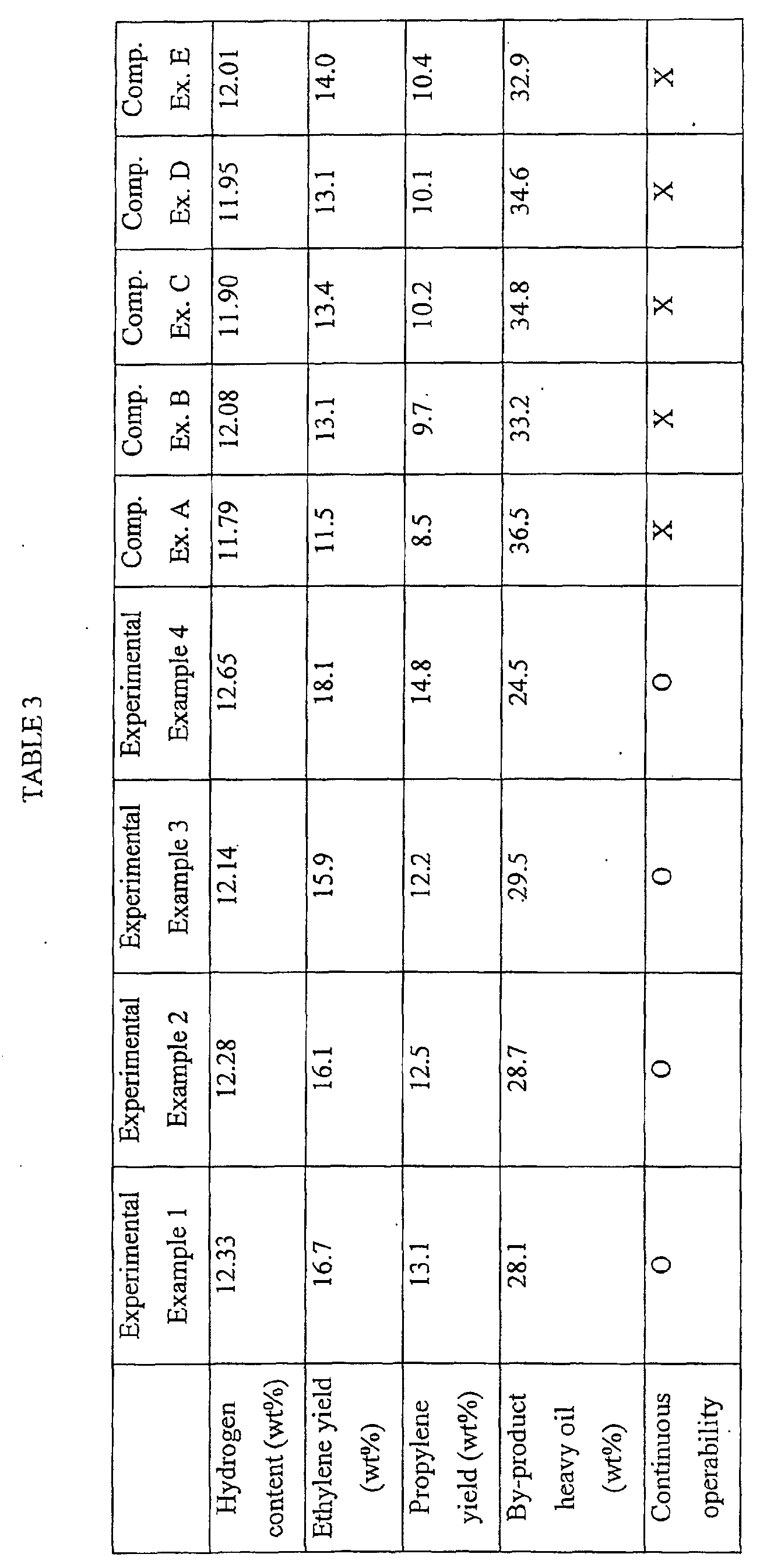
The respective final refined oils obtained in Experimental Examples 1 to 4 and
Comparative Examples 1 to 5 are thermally cracked under the following conditions.
Reaction Conditions
Reaction vessel: an HPM ethylene cracking vessel having an inner diameter of
28 mmϕ and a length of 1440 mm (a heating section of 1200 mm) was used.
Feedstock supply: the amount of the supply was adjusted so that the feed oil =
1.69 L/Hr, and the specific gravity of water with respect to the feed oil was 1.0.
The yield of the obtained light olefins (ethylene and propylene) was found from
the gas composition in the generated gas analyzed using the generated gas amount and
gas chromatography. The generated amount of by-product heavy oil was found from
the amount of the bottoms after separating the naphtha fraction from the generated oil
after quenching the thermal cracking gas by evaporation.
The determination of the continuous operability was defined as 30 wt% or less
(denoted O, indicating possible) and 30 wt% (denoted by X, indicating not possible) by
using the generated specific gravity of the by-product heavy oil, which was precipitated
in the quenching section branching from the reaction vessel and is the cause of fouling,
with respect to the feed oil.
The results are shown in Table 3.
In the Experimental Examples 1 to 4 of the present invention, the DAO obtained
by the solvent extraction processing is extracted such that in comparison to the heavy
feed oil, the hydrogen content increases by 0.2 % or greater, subsequently processed so
that in the hydrorefined oil the hydrogen content increases by 0.5 wt% or greater in
comparison to the DAO, and as a result, the final refined oil is processed such that in
comparison to the heavy feed oil, the hydrogen content increases by 0.7 wt% or greater.
In the refined oil of the present invention, in all cases a refined oil was obtained in
which impurities had been removed so that the V + Ni was 0.1 wtppm or less, the
Conradson carbon residue was 0.8 wt% or less, and the sulfur concentration was 0.3
wt% or less. In contrast, in the Comparative Examples that did not satisfy the increase
in the hydrogen content of the present invention, in the final refined oil, the Conradson
carbon residue was 0.8 wt% or greater and the sulfur concentration was 0.3 wt% or
greater.
In particular, it was understood that by using only the solvent extraction process,
even if the extraction rate of the DAO was made small, the sulfur concentration did not
decrease, and that by using only the hydrorefining process, even if the hydrogen
consumption greatly increases, the Conradson carbon residue could not be removed.
As a result of producing the light olefins by subjecting the obtained refined oil to
a hydrocracking process, for the refined oils of the present invention, in all cases the
ethylene yield exceeded 15%, the propylene yield exceeded 10%, and furthermore, in
view of the generation conditions of by-product heavy oil, the continuous operability is
within an allowable range. In contrast, it was understood that in the Comparative
Examples that do not satisfy the present invention, the ethylene concentration did not
exceed 15%, and furthermore, there was a large amount of generated by-product heavy
oil, which is a problem for continuous operability.
Experimental Example 5
A heavy oil, which is a residue having an API gravity of 4.2 (a hydrogen content
of 10.68 wt%; a Ni + V metal content of 246 wtppm; CCR, 25 wt%; and a S content of
5.5 wt%) is charged into the solvent extraction process unit as a feed oil, and using
isobutane solvent (a solvent/oil ratio of 8/1), a DAO is obtained by extraction and
separation such that the extraction rate is 63 wt%, subsequently this deasphalted oil is
subject to hydrorefining under the following conditions, and the refined oil 5 of the
present invention is obtained.
Hydrorefining conditions: Ni/Co/Mo + Co/Mo catalyst (a specific volume ratio
of 2/8), a hydrogen partial pressure of 110 atm; an H2/Oil ratio of 800 Nm3/kl; a
temperature of 380° C; and an LHSV of 0.3 (1/hr).
The yield of the obtained DAO and the refined oil 5 with respect to the feed oil,
the hydrogen content, the amount of increase in the hydrogen content in each process,
the V + Ni content, the CCR, and sulfur concentration are shown in Table 4.
Experimental Example 6
Using a feed oil identical to that used.in Experimental Example 5 and using an
isobutane solvent (a solvent/oil ratio of 8/1), the DAO is obtained by extraction and
separation so as to attain an extraction rate of 65 wt%, and subsequently the DAO is
subject to refining under the following hydrorefining conditions to obtain the refined oil
6 of the present invention.
Hydrorefining conditions: Ni/Mo + Co/Mo catalyst (a specific volume ratio of
2/8), a hydrogen partial pressure of 140 atm; an H2/Oil ratio of 1000 Nm3/kl; a
temperature of 375° C; and an LHSV of 0.2 (1/hr).
The yield of the obtained DAO and the refined oil 6 with respect to the feed oil,
the hydrogen content, the amount of increase in the hydrogen content in each process,
the V + Ni content, the CCR, and the sulfur content are shown in Table 4.
| | Feed oil | Example 5 | Example 6 |
| | | DAO | Refined oil 5 | DAO | Refined oil 6 |
| Yield (wt%) | 100 | 63 | 59 | 65 | 59 |
| Hydrogen content (wt%) | 10.68 | 11.83 | 12.71 | 11.68 | 12.96 |
| Hydrogen content increase (wt%) | - | 1.15 | 0.88 | 1.00 | 1.28 |
| Total hydrogen content increase (wt%) | - | - | 2.03 | - | 2.28 |
| V + Ni (wtppm) | 246.0 | 41.0 | <0.1 | 45.0 | <0.1 |
| Conradson carbon residue (wt%) | 25.00 | 11.60 | 0.56 | 11.90 | 0.36 |
| S (wt%) | 5.50 | 4.30 | 0.20 | 4.32 | 0.13 |
Using a feed oil identical to that used in Experimental Example 5 and using an
isobutane solvent (a solvent/oil ratio of 8/1), the DAO is obtained by extraction and
separation so as to attain an extraction rate of 65 wt%, and subsequently the DAO is
subject to refining under the following hydrorefining conditions to obtain the
Comparative Example F.
Hydrorefining conditions: Ni/Mo + Co/Mo catalyst (a specific volume ratio of
2/8), a hydrogen partial pressure of 80 atm; an H2/Oil ratio of 800 Nm3/kl; a
temperature of 340° C; and an LHSV of 0.5 (1/hr).
The yield of the obtained DAO and the refined oil F with respect to the feed oil,
the hydrogen content, the amount of increase in the hydrogen content in each process,
the V + Ni content, the CCR, and the sulfur content are shown in Table 5.
Comparative Example 7
Using a feed oil identical to that used in Experimental Example 5 and using an
isobutane solvent (a solvent/oil ratio of 8/1), the comparative refined oil G is obtained
by extraction and separation so as to attain an extraction rate of 55 wt%.
The yield of the obtained refined oil G with respect to the feed oil, the hydrogen
content, the amount of increase in the hydrogen content in each process, the V + Ni
content, the CCR, and the sulfur content are shown in Table 5.
Comparative Example 8
Using a feed oil identical to that used in Experimental Example 5, the
comparative refined oil H was obtained by a refining process under the following
hydrorefining conditions.
Hydrorefining conditions: Ni/Mo + Co/Mo catalyst (a specific volume ratio of
3/7), a hydrogen partial pressure of 140 atm; an H2/Oil ratio of 1000 Nm3/kl; a
temperature of 375° C; and an LHSV of 0.2 (1/hr).
The yield of the obtained refined oil H with respect to the feed oil, the hydrogen
content, the amount of increase in the hydrogen content in each process, the V + Ni
content, the CCR, and the sulfur content are shown in Table 5.
| | Feed oil | Comp. Ex. 6 | Comp. Ex.7 | Comp. Ex. 8 |
| | | DAO | Refined oil F | Refined oil G (extraction only) | Refined oil H (hydrogenation only) |
| Yield (wt%) | 100 | 65 | 61 | 55 | 91 |
| Hydrogen content (wt%) | 10.68 | 11.68 | 12.08 | 11.88 | 11.69 |
| Hydrogen content increase (wt%) | - | 1.00 | 0.40 | 1.20 | 1.01 |
| Total hydrogen content increse (wt%) | - | - | 1.40 | 1.20 | 1.01 |
| V + Ni (wtppm) | 246.0 | 45.0 | <0.1 | 26.0 | 32.0 |
| Conradson carbon residue (wt%) | 25.00 | 12.20 | 3.91 | 9.20 | 9.25 |
| S (wt%) | 5.50 | 4.32 | 2.60 | 4.09 | 1.31 |
The respective final refined oils obtained in Experimental Examples 5 and 6 and
the Comparative Examples 6 to 8 were subject to thermal cracking under conditions
identical to those described above, and the obtained light olefin yield, the generation
rate of by-product heavy oil, and the results of the determination of continuous
operability are shown in Table 6.
| | Experimental Example 5 | Experimental Example 6 | Comp. Ex. 6 | Comp. Ex. 7 | Comp. Ex. 8 |
| Hydrogen content (wt%) | 12.71 | 12.96 | 12.08 | 11.88 | 11.69 |
| Ethylene yield (wt%) | 18.1 | 19.1 | 13.5 | 13.1 | 12.1 |
| Propylene yield (wt%) | 14.7 | 15.2 | 9.4 | 9.1 | 8.6 |
| By-product heavy oil (wt%) | 25.0 | 23.8 | 33.2 | 35.9 | 36.1 |
| Continuous operability | O | O | X | X | X |
In the Experimental Examples 5 and 6 of the present invention, in the solvent
extraction process, extraction was carried out so that the hydrogen content increased by
0.2 wt% or greater in comparison to the heavy feed oil, and in the subsequent
hydrorefining process, processing was carried out so that the hydrogen content
increased by 0.5 wt% or greater in comparison to the DAO. As a result, in the final
refined oil the hydrogen content increased by 0.7 wt% or greater over that of the feed oil.
In the obtained refined oil of the present invention, in all cases the Ni + V concentration
was 0.1 wtppm or less, the CCR was 1 wt% or less, and the sulfur concentration was 0.5
wt% or less, and a high quality refined oil in which impurities were removed to a high
degree was obtained.
In contrast, in Comparative Example 7, which was refined using only the solvent
extraction process, it was understood that the recovery rate fell to 55 %, and even when
subject to extraction refining, the impurities could not be sufficiently removed. When
Experimental Example 6 of the present invention is compared to Comparative Example
8, which was refined only using the hydrorefining, even thought the hydrorefining was
carried out under identical conditions, it was understood that there was a great
difference in the removal of impurities, and after increasing the hydrogen content by a
predetermined amount using a solvent extraction process in advance, by carrying out a
hydrorefining process the impurities are thoroughly removed.
Furthermore, as a result of producing a light olefins by subjecting the obtained
refined oil to a thermal cracking process, in the refined oil of the present invention, the
ethylene yield exceeds 15% and the propylene yield exceeds 10%, and furthermore, in
view of the generation conditions of by-product heavy oil, the continuous operability is
within a realizable range. In contrast, it was understood that in the Comparative
Examples that did not satisfy the conditions of the present invention, the ethylene
concentration did not exceed 15%, and furthermore, there was a large amount of
generated by-product heavy oil, which is a problem for continuous operability.
Experimental Example 10
Arabian heavy crude having an API gravity of 27.4 was separated into distillate
oil and residue by distillation, and a GO was obtained by hydrorefining a part of the
distillate oil. In contrast, a heavy oil having an API gravity of 10.9, which is a residue,
served as the feed oil 1, and a solvent extraction process and hydrorefining process were
carried out under conditions identical to those of the Experimental Example 1 of the
present invention to obtain the refined oil 10.
A part of this refined oil 10 (20 parts per 100 parts of crude oil) and the above
GO were mixed with a part of the feed oil (10 parts per 100 parts of crude oil), and
using the result as a thermal cracking feedstock for light olefin production, light olefins
were produced.
The yield of the vacuum residue, deasphalted oil, the hydrorefined deasphalted
oil, and heavy ethylene feed oil, the hydrogen content, Ni + V metal content, the CCR
content, and S content in Experimental Example 10 are shown in Table 7.
| | Feed Oil 1 | Feed Oil 2 | Feed Oil (1 + 2) |
| | Atmospheric residue | DAO | Refined oil 10 | GO | Refined oil 10:20, GO:10 |
| Yield (wt%) (Crude = 100) | 61 | 49 | 45 | 18 | 30 |
| Hydrogen content (wt%) | 11.20 | 11.42 | 11.95 | 13.70 | 12.53 |
| Hydrogen content increase (wt%) | - | 0.22 | 0.53 | - | - |
| Total hydrogen content increase(wt%) | - | - | 0.75 | - | - |
| V + Ni (wtppm) | 153.0 | 14.2 | 0.7 | <0.1 | <0.1 |
| Conradson carbon residue (wt%) | 12.50 | 3.60 | 1.90 | 0.00 | 1.20 |
| S (wt%) | 4.70 | 3.50 | 0.40 | 0.05 | 0.27 |
| Ethylene yield (wt%) | - | - | - | - | 17.6 |
| Propylene yield (wt%) | - | - | - | - | 14.1 |
| By-product heavy oil (wt%) | - | - | - | - | 25.8 |
| Continuous operability | - | - | - | - | O |
In Experimental Example 10, the residue serves as the feed oil, and a separately
produced distillate oil having a low impurity concentration is mixed with the refined oil
obtained by the refining processes of the present invention to produce feedstock for the
light olefin production, and it was confirmed that both the yield of the ethylene and
propylene and the continuous operability could all be satisfied.
INDUSTRIAL APPLICABILITY
Using the refining method of the present invention, a refined oil having
decreased impurities can be obtained by reliably and economically refining a heavy oil
having a hydrogen content of 12 wt% or less, and thereby the conventionally limited
uses of heavy oil have been greatly expanded.
In the case that the refined oil obtained by the present method is used as a
feedstock for light olefin production, ethylene and propylene can be produced at a yield
that is economically attractive, and furthermore, the continuous operability is within a
range allowing commercial operation.