EP1385024A1 - Near infrared absorbing films - Google Patents
Near infrared absorbing films Download PDFInfo
- Publication number
- EP1385024A1 EP1385024A1 EP02722915A EP02722915A EP1385024A1 EP 1385024 A1 EP1385024 A1 EP 1385024A1 EP 02722915 A EP02722915 A EP 02722915A EP 02722915 A EP02722915 A EP 02722915A EP 1385024 A1 EP1385024 A1 EP 1385024A1
- Authority
- EP
- European Patent Office
- Prior art keywords
- infrared absorption
- compound
- formula
- absorption film
- represented
- Prior art date
- Legal status (The legal status is an assumption and is not a legal conclusion. Google has not performed a legal analysis and makes no representation as to the accuracy of the status listed.)
- Granted
Links
Images


Classifications
-
- G—PHYSICS
- G02—OPTICS
- G02B—OPTICAL ELEMENTS, SYSTEMS OR APPARATUS
- G02B5/00—Optical elements other than lenses
- G02B5/20—Filters
- G02B5/22—Absorbing filters
-
- G—PHYSICS
- G02—OPTICS
- G02B—OPTICAL ELEMENTS, SYSTEMS OR APPARATUS
- G02B5/00—Optical elements other than lenses
- G02B5/20—Filters
- G02B5/208—Filters for use with infrared or ultraviolet radiation, e.g. for separating visible light from infrared and/or ultraviolet radiation
-
- G—PHYSICS
- G02—OPTICS
- G02B—OPTICAL ELEMENTS, SYSTEMS OR APPARATUS
- G02B5/00—Optical elements other than lenses
- G02B5/20—Filters
- G02B5/22—Absorbing filters
- G02B5/223—Absorbing filters containing organic substances, e.g. dyes, inks or pigments
-
- Y—GENERAL TAGGING OF NEW TECHNOLOGICAL DEVELOPMENTS; GENERAL TAGGING OF CROSS-SECTIONAL TECHNOLOGIES SPANNING OVER SEVERAL SECTIONS OF THE IPC; TECHNICAL SUBJECTS COVERED BY FORMER USPC CROSS-REFERENCE ART COLLECTIONS [XRACs] AND DIGESTS
- Y10—TECHNICAL SUBJECTS COVERED BY FORMER USPC
- Y10S—TECHNICAL SUBJECTS COVERED BY FORMER USPC CROSS-REFERENCE ART COLLECTIONS [XRACs] AND DIGESTS
- Y10S430/00—Radiation imagery chemistry: process, composition, or product thereof
- Y10S430/145—Infrared
-
- Y—GENERAL TAGGING OF NEW TECHNOLOGICAL DEVELOPMENTS; GENERAL TAGGING OF CROSS-SECTIONAL TECHNOLOGIES SPANNING OVER SEVERAL SECTIONS OF THE IPC; TECHNICAL SUBJECTS COVERED BY FORMER USPC CROSS-REFERENCE ART COLLECTIONS [XRACs] AND DIGESTS
- Y10—TECHNICAL SUBJECTS COVERED BY FORMER USPC
- Y10T—TECHNICAL SUBJECTS COVERED BY FORMER US CLASSIFICATION
- Y10T428/00—Stock material or miscellaneous articles
- Y10T428/31504—Composite [nonstructural laminate]
-
- Y—GENERAL TAGGING OF NEW TECHNOLOGICAL DEVELOPMENTS; GENERAL TAGGING OF CROSS-SECTIONAL TECHNOLOGIES SPANNING OVER SEVERAL SECTIONS OF THE IPC; TECHNICAL SUBJECTS COVERED BY FORMER USPC CROSS-REFERENCE ART COLLECTIONS [XRACs] AND DIGESTS
- Y10—TECHNICAL SUBJECTS COVERED BY FORMER USPC
- Y10T—TECHNICAL SUBJECTS COVERED BY FORMER US CLASSIFICATION
- Y10T428/00—Stock material or miscellaneous articles
- Y10T428/31504—Composite [nonstructural laminate]
- Y10T428/31786—Of polyester [e.g., alkyd, etc.]
Definitions
- the present invention relates to a near-infrared absorption film suitable for disposing on a front surface of a plasma display (PDP) .
- PDP plasma display
- a near-infrared ray absorption film which absorbs near-infrared rays that cause malfunctions of other peripheral electronic equipment, is affixed to the PDP side of the display. It is required that this near-infrared absorption film has a high selective near-infrared absorbing ability to effectively block near-infrared rays while having excellent visible light transparency and tone.
- JP-A Japanese Patent Application Laid-Open
- a near-infrared absorption film according to a first aspect is provided to attain the first object, and a near-infrared absorption film according to a second aspect is provided to attain the second object for a near-infrared absorption film of the present invention.
- the near-infrared absorption film of the aforesaid first aspect comprises a transparent ("transparence” refers to transparence to "visible light”, hereafter idem) substrate, a near-infrared absorption layer, and other layers if required.
- the near-infrared absorption layer contains a predetermined cyanine compound and a predetermined diimonium compound, and contains other components if required.
- the cyanine compound is represented by the formula (1):
- A is a divalent bonding group comprising ethylene.
- R 1 " and R 2 " are monovalent groups comprising a carbon atom.
- X - " is a monovalent anion.
- a in the formula (1) is one or more of the following formulae (2) to (4) from the viewpoint that they give the film an excellent near-infrared ray blocking performance, excellent visible light transparency and excellent tone.
- Y is one of an alkyl group, a diphenylamino group, a halogen atom and a hydrogen atom.
- R 1 " and “R 2 " may for example be alkyl, aryl, alkoxy, alkoxycarbonyl, sulfonylalkyl or cyano.
- X - may for example be I - , Br - , ClO 4 - , BF 4 - , PF 6 - , SbF 6 - , CH 3 SO 4 - , NO 3 - or CH 3 -C 6 H 4 -SO 3 - .
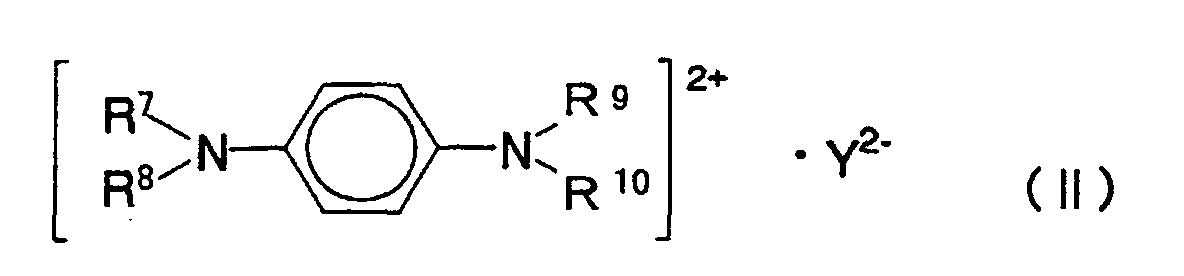
- diimonium compound there is no particular limitation on the aforesaid diimonium compound, but it may be one of the compounds represented by the following formulae (I) and (II):
- R 7 " to “R 10 " are at least one of an alkyl group, an aryl group, a group containing an aromatic ring, a hydrogen atom and a halogen atom.
- X - " is a monovalent anion
- Y 2- " is a divalent anion.
- the monovalent anion represented by "X - " may be a halogen ion such as I - , Cl - , Br - or F - , an inorganic acid ion such as NO 3 - , BF 4 - , PF 6 - , ClO 4 - , SbF 6 - , an organic carboxylic acid ion such as CH 3 COO - , CF 3 COO - or benzoic acid ion, an organic sulfonic acid ion such as CH 3 SO 3 - , CF 3 SO 3 - , benzenesulfonic acid ion or naphthalene sulfonic acid ion.
- a halogen ion such as I - , Cl - , Br - or F -
- an inorganic acid ion such as NO 3 - , BF 4 - , PF 6 - , ClO 4 - , SbF 6
- the divalent anion represented by "Y 2- " is preferably an aromatic sulfonic acid ion having two sulfonic acid groups, for example an ion such as naphthalene-1,5-disulfonic acid, R acid, G acid, H acid, benzoyl H acid (benzoyl bonded to the amino group of H acid), p-chlorobenzoyl H acid, p-toluenesulfonyl H acid, chloro H acid (amino group of H acid replaced by chlorine atom), chloroacetyl H acid, methanyl ⁇ acid, 6-sulfonaphthyl- ⁇ acid, C acid, ⁇ acid, p-toluenesulfonyl R acid, naphthalene disulfonic acid derivatives such as naphthalene-1,6-disulfonic acid and 1-naphthol-4,8-disulfonic acid, carbonyl-
- R 11 " and “R 22 " are at least one of a lower alkyl group, hydroxyl group, alkylamino group, amino group, -NHCOR 13 , -NHSO 2 R 13 and -OSO 2 R 13 (where “R 13 " represents at least one of an aryl and alkyl group, and “R 13 “ may have a substituent), acetyl group, hydrogen atom and halogen atom.
- the aforesaid diimonium compound may be the compound represented by the formula (IV).
- R is an alkyl group having 1 to 8 carbon atoms, n-butyl being particularly preferred.
- X - may be BF 4 - , PF 6 - , ClO 4 - or SbF 6 - .
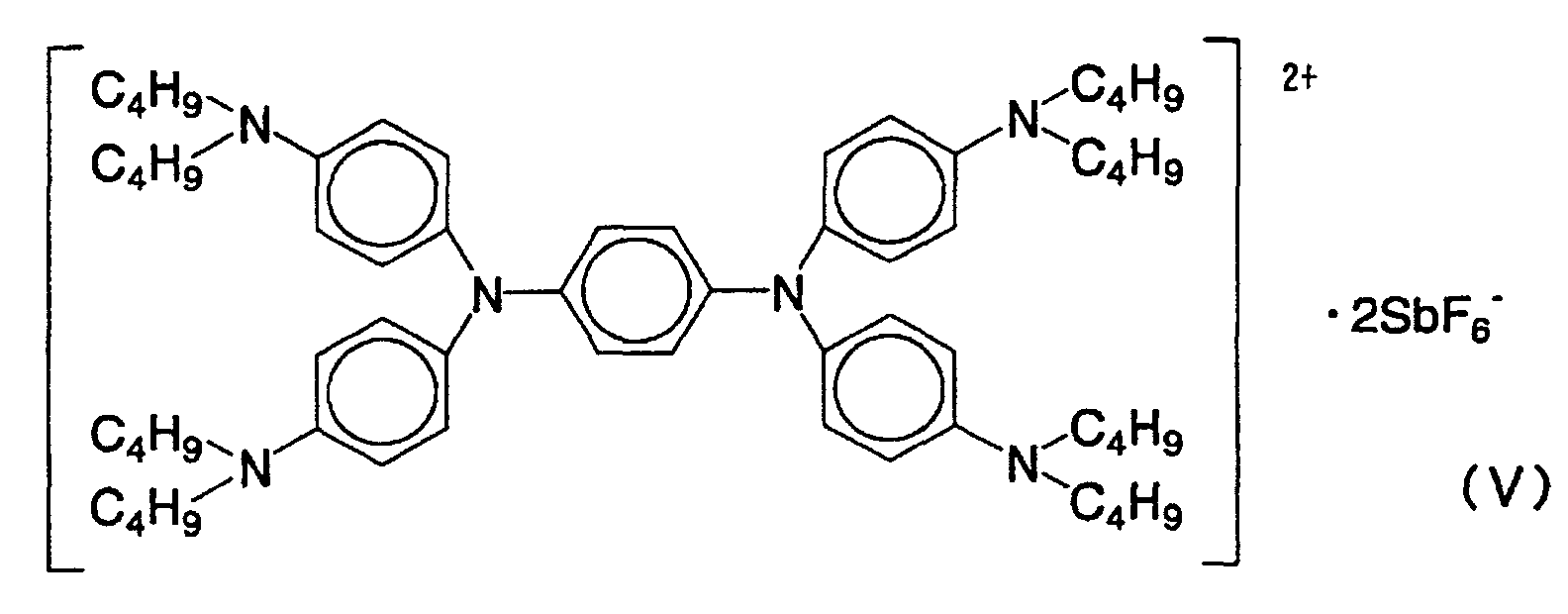
- a preferred example of this diimonium compound is shown by the formula (V).
- the anion represented by "X - " in the formula (1) and the anion represented by “X - “ in the formula (I) are preferably identical, i.e., the counter anions in the aforesaid cyanine compound and diimonium compound, are preferably identical. If these ions are identical, a near-infrared absorption layer having excellent heat-resisting property and oxidation resistance is obtained.
- the amount of the aforesaid diimonium compound is preferably at least 200 parts by weight, and more preferably 200 parts by weight to 2000 parts by weight, relative to 100 parts by weight of the aforesaid cyanine compound.
- the diimonium compound not only has an excellent near-infrared absorption effect, but also has an excellent antioxidant effect on the aforesaid cyanine compound.
- Examples of other components are various binder resins, near-infrared absorbents other than the aforesaid diimonium compound (e.g., near-infrared absorbents such as those of the phthalocyanine, nickel complex, azo, polymethine, diphenylmethane, triphenylmethane and quinone types), antioxidants (e.g., antioxidants such as those of the phenol, amine, hindered phenol, hindered amine, sulfur, phosphoric acid, phosphorous acid and metal complex types), ultraviolet absorbers, colorants for making the film more attractive, pigments and dyes.
- near-infrared absorbents such as those of the phthalocyanine, nickel complex, azo, polymethine, diphenylmethane, triphenylmethane and quinone types
- antioxidants e.g., antioxidants such as those of the phenol, amine, hindered phenol, hindered amine, sulfur, phosphoric acid
- the binder resin may be a homopolymer or a copolymer of polyester resin, acrylic resin, methacrylic resin, urethane resin, silicone resin, phenol resin, polyethylene terephthalate (PET) resin, (meth)acrylic acid ester, and the like.
- acrylic resin and polyester resin are preferred from the viewpoint that the diimonium compound and cyanine compound have excellent dispersibility therein, and high durability is obtained.
- the amount of cyanine compound is 0.1 parts by weight to 10 parts by weight and the amount of diimonium compound is 0.1 parts by weight to 20 parts by weight, and more preferred that the amount of cyanine compound is 0.1 parts by weight to 5 parts by weight and the amount of diimonium compound is 0.1 parts by weight to 10 parts by weight, relative to 100 parts by weight of the binder resin.
- the thickness of the near-infrared absorption layer described above is preferably of the order of 0.5 ⁇ m to 50 ⁇ m.
- the material of the transparent substrate which may for example be a resin of polyolefine, e.g., polyethylene or polypropylene, the resin of polyester, acrylic, cellulose, polyvinyl chloride, polycarbonate, phenolic or urethane, a polyethylene terephthalate (PET) resin, and the like.
- polyester resin is particularly preferred in respect of transparency and environmental robustness.
- the thickness of the transparent substrate is preferably of the order of 50 ⁇ m to 200 ⁇ m.
- the aforesaid cyanine compound, diimonium compound and binder resin are dissolved in a predetermined solvent to prepare a coating solution which is then coated on the transparent substrate surface.
- the predetermined solvent may for example be dichloromethane, methyl ethyl ketone, tetrahydrofuran, cyclohexanone, and the like.
- the near-infrared absorption layer is a single layer as this makes it very easy to manufacture, and permits it to be made thinner.
- the near-infrared absorption film of the aforesaid second aspect has a transparent substrate, a near-infrared absorption layer and other layers if required.
- the near-infrared absorption layer has a layer containing a cyanine compound, a layer containing a diimonium compound and other layers if required.
- the cyanine compound and diimonium are contained in separate layers for the following reasons [1] to [3].
- the cyanine compound is the same cyanine compound described for the first aspect represented by the aforesaid formula (1).
- the amount of the cyanine compound is preferably 0.1 parts by weight to 50 parts by weight, and more preferably 1 part by weight to 50 parts by weight, relative to 100 parts by weight of the diimonium compound described later.
- this amount is less than 0.1 parts by weight, near-infrared blocking properties may be insufficient, and if 50 parts by weight are exceeded, visible light transparency may be insufficient.
- the layer containing the cyanine compound can be made to contain various other components if desired.
- quencher compounds are preferred from the viewpoint that oxidation of the cyanine compound is prevented, and a near-infrared absorption film with high durability is obtained.
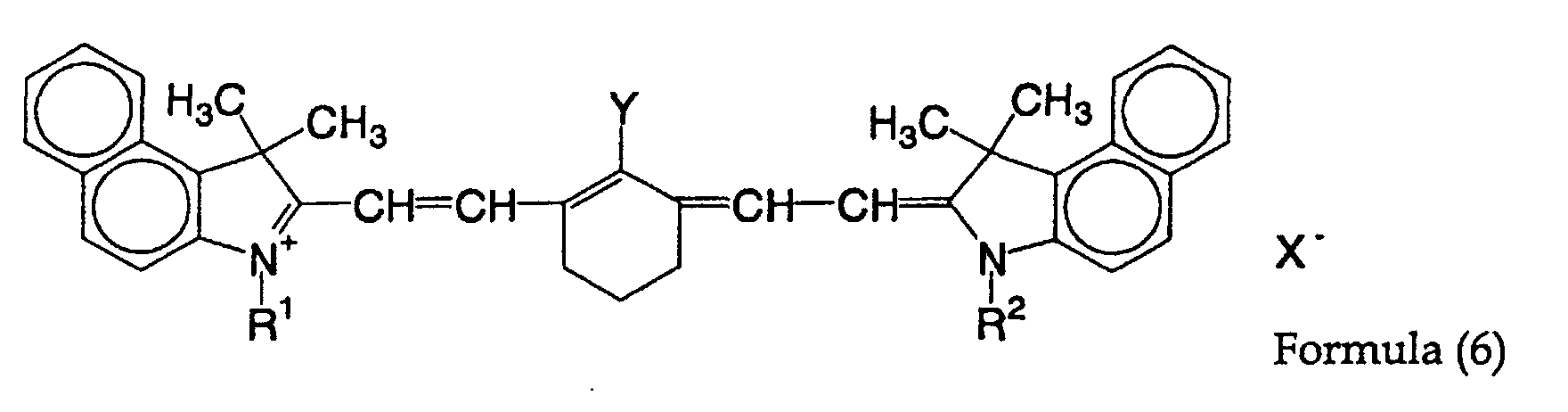
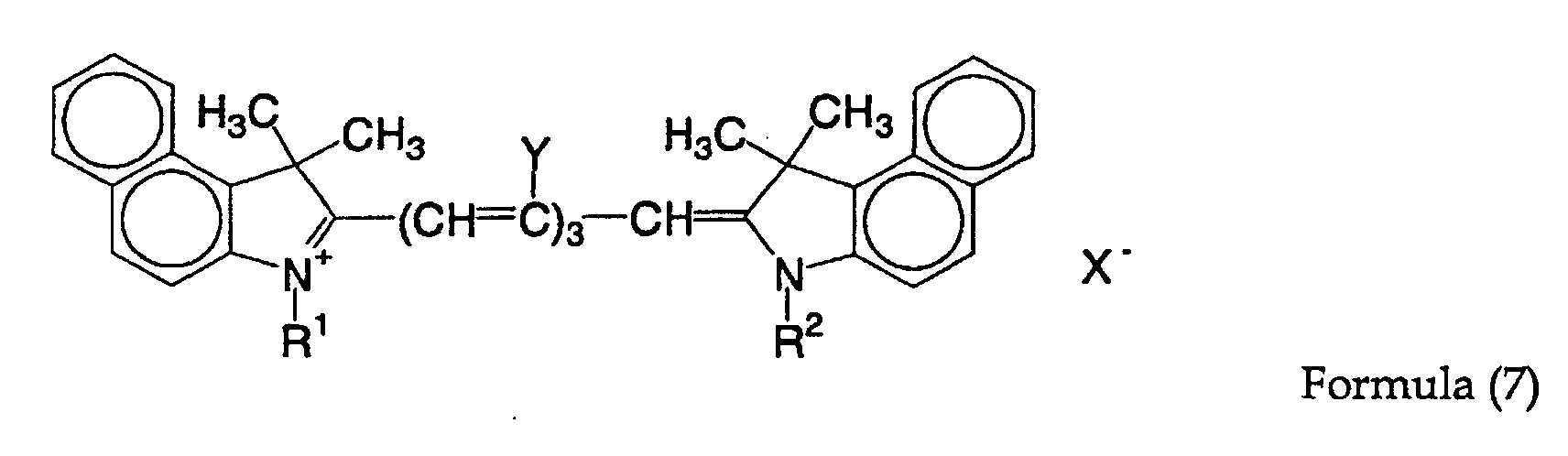
- the quencher compound there is no particular limitation on the quencher compound, but in order to more easily prevent oxidation of the cyanine compound and obtain a near-infrared absorption film having excellent durability, it is preferably at least one or both of a metal compound having a structure represented by at least one of the formula (5) and the formula (6), and an aminium compound having the structure represented by the formula (7).
- M is at least one of Ni, Cu, Co, Pt and Pd.
- R 3 " to “R 6 " are at least one of an alkyl group, an aryl group, a group having an aromatic ring, a hydrogen atom and a halogen atom.
- X - " is at least one of I - , Br - , ClO 4 - ; BF 4 - , PF 6 - , SbF 6 - ; CH 3 SO 4 -, NO 3 - , and CH 3 -C 6 H 4 -SO 3 - .
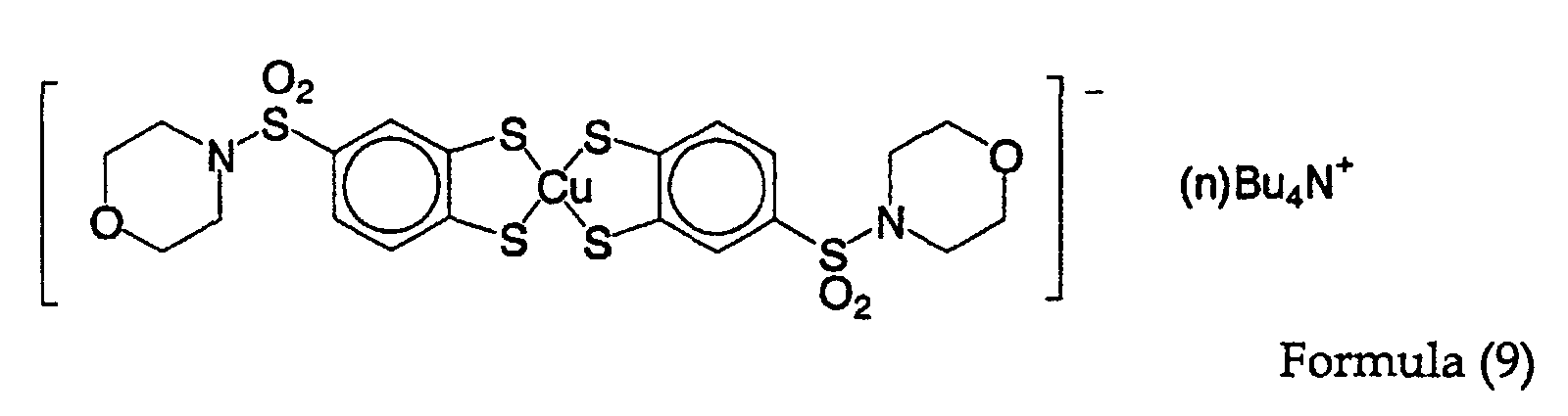
- the metal compound having the structure represented by the formula (5) may be a 1,2-benzene thiol-copper complex, 1,2-benzene thiol nickel complex or a bis-dithio benzyl nickel complex, but the metal compounds having the structure represented by the formulae (8) to (10) are more preferred from the viewpoint of anti-oxidation and durability.
- the metal complex having the structure represented by the formula (11) is more preferred from the viewpoint of anti-oxidation and durability.
- quencher compounds the quencher compounds represented by the formula (5) and the formula (7) are preferred from the viewpoint of durability improvement, and among the quencher compounds represented by the formula (5), the quencher compound represented by the formula (10) is particularly preferred.
- the amount of quencher compound in the aforesaid near-infrared absorption layer is preferably 0.1 parts by weight to 1000 parts by weight, more preferably 1 part by weight to 500 parts by weight and still more preferably 1 part by weight to 100 parts by weight, relative to 100 parts by weight of the aforesaid cyanine compound.
- the amount thereof is less than 0.1 parts by weight, durability improvements such as heat resistance, anti-oxidation properties and moisture resistance may not be sufficient, and if it is more than 1000 parts by weight, the near-infrared absorption layer may develop a coloration and the appearance of the near-infrared absorption film may be impaired.
- Examples of other components contained in the layer containing the aforesaid cyanine compound in addition to the quencher compound are various binder resins, near-infrared absorption agents other than the cyanine compound (e.g., near-infrared absorption agents such as phthalocyanines, nickel complexes, azo compounds, polymethine compounds, diphenylmethanes, triphenylmethanes, quinines and the like), antioxidants other than the quencher compound (e.g., antioxidants such as phenols, amines, hindered phenols, hindered amines, sulfur compounds, phosphoric acids, phosphorous acids, metal complexes, and the like), ultraviolet absorbers, colorants to improve the appearance of the film, pigments, dyes, and the like.
- near-infrared absorption agents e.g., near-infrared absorption agents such as phthalocyanines, nickel complexes, azo compounds, polymethine compounds, dipheny
- the binder resin may be a homopolymer or a copolymer of polyester resin, acrylic resin, methacrylic resin, urethane resin, silicone resin, phenol resin, polyethylene terephthalate (PET resin), (meth)acrylic acid ester and the like.
- acrylic resin and polyester resin are preferred.
- the thickness of the layer containing the cyanine compound is preferably of the order of 0.1 ⁇ m to 20 ⁇ m.
- the diimonium compound there is no particular limitation on the diimonium compound, but as in the case of the aforesaid first aspect, the compound represented by one of the aforesaid (I) and (II) is suitable.
- the layer containing the diimonium compound may contain various other components if desired.
- the aforesaid quencher compound is particularly preferred from the viewpoint that it more conveniently prevents oxidation of the diimonium compound and allows a near-infrared absorption film having excellent durability to be obtained.
- Specific examples of the quencher compound are completely identical to those described above.
- quencher compounds from the viewpoint of durability improvement, quencher compounds represented by the formula (5) is preferred, and among quencher compounds represented by the formula (5), quencher compounds represented by the formula (8) and the formula (9) are more preferred, and quencher compounds represented by the formula (9) are particularly preferred.
- the other components contained in the layer containing the diimonium compound may be completely identical to those mentioned in "other components contained in the layer containing the cyanine compound".
- the thickness of the layer containing the diimonium compound is preferably of the order of 0.1 ⁇ m to 20 ⁇ m.
- the transparent substrate may be identical to the transparent substrate described in the first aspect.
- a coating solution obtained by dissolving the cyanine compound and a binder resin in a predetermined solvent may be prepared, and coated on the transparent substrate.
- the predetermined solvent may for example be dichloromethane, methyl ethyl ketone, tetrahydrofuran, cyclohexanone, and the like.
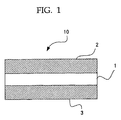
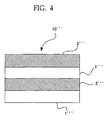
- the near-infrared absorption layer comprises a layer containing the aforesaid cyanine compound and a layer containing the aforesaid diimonium compound, for example as shown in FIGs. 1 through 4.
- FIGS. 1 through 4 are schematic diagrams showing a cross-section of the near-infrared absorption film in the present invention according to the second aspect.
- a near-infrared absorption film 10 comprises a layer 2 containing a cyanine compound and a layer 3 containing a diimonium compound on the two surfaces of a transparent substrate 1.
- a near-infrared absorption film 10' comprises a layer 3' containing a diimonium compound and a layer 2' containing a cyanine compound on a transparent substrate 1' in that order.
- a near-infrared absorption film 10" comprises a layer 2" containing a cyanine compound and a layer 3" containing a diimonium compound on a transparent substrate 1" in that order.
- a near-infrared absorption film 10''' comprises a layer 2''' containing a cyanine compound, a transparent substrate 1''' and a layer 3''' containing a diimonium compound on a transparent substrate 1''' in that order.
- the coating solution obtained was coated by a bar coater on the surface of a polyester film (transparent substrate, T600E/W07 grade, Mitsubishi Polyester Film Corporation) of width 200 mm and thickness 100 ⁇ m, and dried at 100 °C for 3 minutes to form a near-infrared absorption layer (5 ⁇ m). In this way, a near-infrared absorption film was manufactured.
- [NK5578], [NK5706], [NK2014] and [NK2911] are cyanine compounds manufactured by Hayashibara Biochemical laboratories, Inc. (for [NK5578], "A” in the formula (1) is represented by the formula (3) (wherein, “Y” in the formula (3) is diphenylamine), and "X - " is SbF 6 -.
- “A” in the formula (1) is the formula (4) (wherein, “Y” in the formula (4) is Cl-) and "X - " is SbF 6 -.
- [IRG022] is manufactured by Nippon Kayaku Co., Ltd. ("X - " is SbF 6 -), [NIR-IM2] is manufactured by Teikoku Chemical Industries (X- is SbF 6 -), [EX811K] is manufactured by Nippon Shokubai Co., Ltd., [MIR101] is manufactured by Midori Kagaku Co., Ltd., [SIR128] is manufactured by Mitsui Toatsu Chemicals, [UE3690] is a polyester resin [Elitel UE3690] manufactured by Unitika Ltd., and [80N] is a polymethylmethacrylate resin [Delpet 80N] manufactured by Asahikasei Corporation.
- the near-infrared transmittance thereof, and the luminous transmittance thereof under a light source C of JIS Z 8720 were measured with using a spectrophotometer (U-4000, Hitachi Measuring Instruments) based on JIS Z 8722.
- the film was rated O, and if it was less than 70%, it was rated X.
- the transmittances in the wavelength region of 800 nm to 1100 nm were all less than 20%, the film was rated O, and if the transmittance was 20% or more, the film was rated X. Tables 3 and 4 show the results.
- the near-infrared absorption films obtained were subjected to two durability tests, i.e., leaving the film at 80°C for 500 hours, and leaving the film under a carbon arc using a sunshine weather meter (Suga tester) at an irradiation intensity of 100 W/m 2 for 24 hours. Subsequently, the durability (heat resistance and antioxidation properties) was evaluated according to the following evaluation criteria. Tables 3 and 4 show the results.
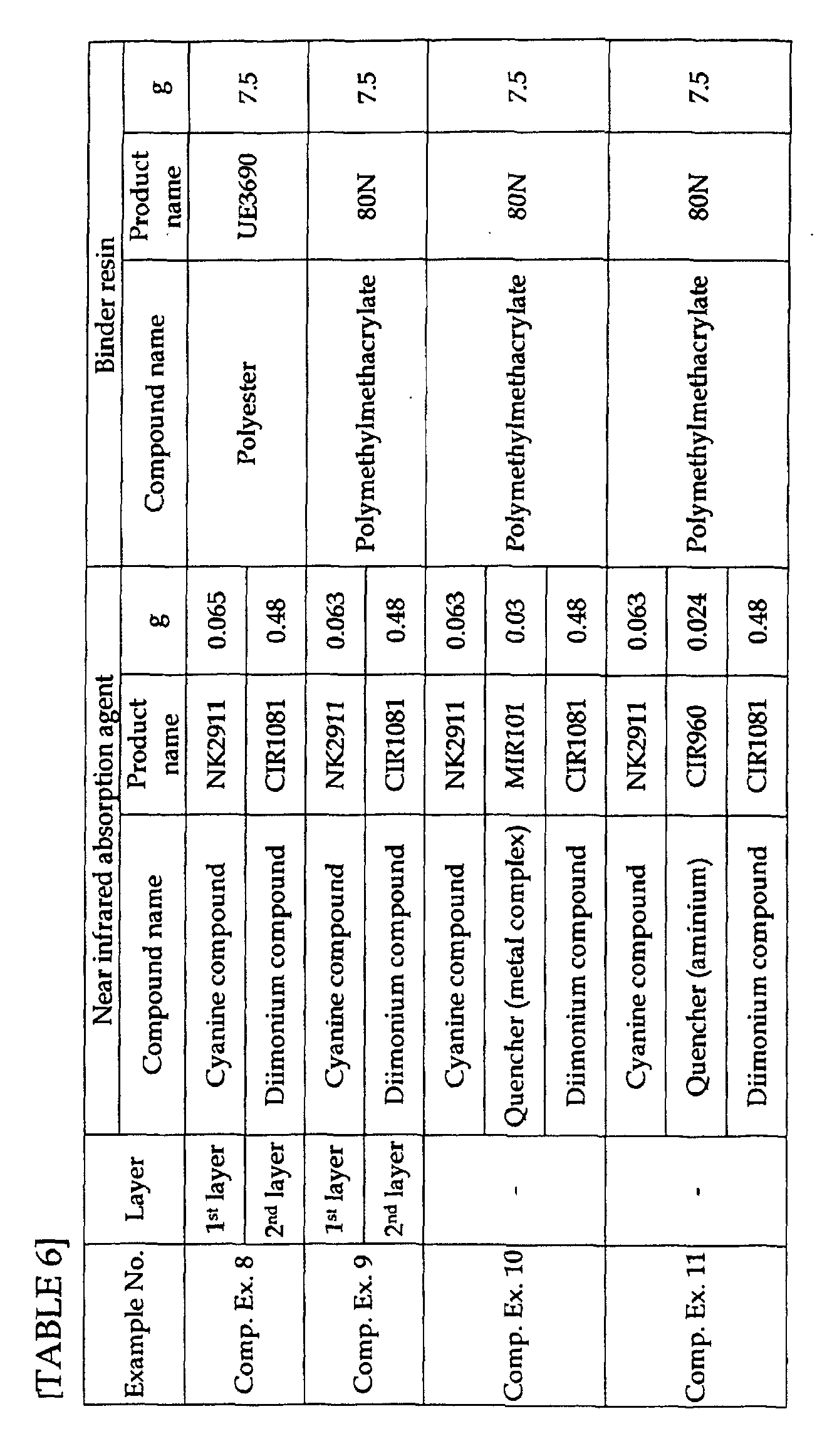
- the “near-infrared absorption agents” and “binder resins” shown in the "first layer” in the Examples and Comparative Examples of Tables 5 and 6 were dissolved in a mixed solvent comprising 18.5 g dichloromethane, 55.5 g methyl ethyl ketone and 18.5 g cyclohexanone to prepare a coating solution.
- the coating solution obtained was coated on a polyester film (transparent substrate) of width 200 mm and thickness 100 ⁇ m, and the coating was dried at 100°C for 3 minutes to form a first layer (thickness: 5 ⁇ m) on the transparent substrate surface.
- the "near-infrared absorption agents" and “binder resins” shown in the "second layer” in the Examples and Comparative Examples of Tables 5 and 6 were dissolved in a mixed solvent comprising 18.5 g dichloromethane, 55.5 g tetrahydrofuran and 18.5 g cyclohexanone to prepare a coating solution.
- the coating solution obtained was coated on the opposite surface of the transparent substrate to that on which the first layer was formed, and the coating was dried at 100°C for 3 minutes to form a second layer (thickness: 5 ⁇ m). In this way, a near-infrared absorption film was manufactured.
- the infrared absorption film obtained was evaluated together with a film adjusted by red dye (BRDOU) and blue dye (BLUE-S, Sumitomo Chemical Company Limited) so that the chromaticity (X, Y) was (0.310, 0.316).
- the “near-infrared absorption agents” and “binder resins” shown in the Comparative Examples of Table 6 were dissolved in a mixed solvent comprising 18.5 g dichloromethane, 55.5 g methyl ethyl ketone and 18.5 g cyclohexanone to prepare a coating solution.
- the coating solution obtained was coated on a polyester film (transparent substrate) of width 200 mm and thickness 100 ⁇ m, and the coating was dried at 100°C for 3 minutes to form a near-infrared absorption layer (thickness: 10 ⁇ m) on the transparent substrate surface. In this way, a near-infrared absorption film was manufactured.
- the infrared absorption film obtained was evaluated together with a film adjusted by red dye (BRDOU) and blue dye (BLUE-S, Sumitomo Chemical Company Limited) so that the chromaticity (X, Y) was (0.310, 0.316).
- [NK2014] and [NK2911] are cyanine compounds manufactured by Hayashibara Biochemical laboratories, Inc.
- [NK2014] is a cyanine compound wherein "A” in the formula (1) is represented by the formula (2) (wherein, “Y” in the formula (2) is a hydrogen atom), and "X - " is ClO 4 - .
- [NK2911] is a cyanine compound wherein "A” in the formula (1) is represented by the formula (3) (wherein, "Y” in the formula (3) is diphenylamine), and "X - " is ClO 4 - .
- [CIR1080], [CIR1081] and [CIR960] are manufactured by Japan Carlit, Co.
- [MIR101] is manufactured by Midori Kagaku, Co. Ltd.
- [EST5] is manufactured by Sumitomo Seika Chemicals, Co. Ltd.
- [UE3690] is a polyester resin [Elitel UE3690] manufactured by Unitika Ltd.
- [80N] is a polymethylmethacrylate resin [Delpet 80N] manufactured by Asahi Kasei Corporation.
- the near-infrared absorption films obtained were subjected to spectral measurements using a spectrophotometer (U-4000, Hitachi Instruments Service, Co. Ltd.). If no deterioration was observed for any pigment, the film was rated O, and if deterioration was observed for any pigment, it was rated X. Table 7 shows the results.
- the near-infrared absorption films obtained were measured and evaluated in an identical way to that of Examples 1 to 8 and Comparative Examples 1 to 7. Table 7 shows the results.
- the near-infrared absorption films obtained were measured and evaluated in an identical way to that of Examples 1 to 8 and Comparative Examples 1 to 7. Table 7 shows the results.
Landscapes
- Physics & Mathematics (AREA)
- General Physics & Mathematics (AREA)
- Optics & Photonics (AREA)
- Health & Medical Sciences (AREA)
- Toxicology (AREA)
- Optical Filters (AREA)
Abstract

Description











| Example | Near infrared adsorption agent | Binder resin | ||||
| Compound | Product name | g | Compound | Product name | g | |
| Ex. 1 | Diimonium compound | CIR1081 | 0.48 | Polyester resin | UE3690 | 7.5 |
| Cyanine compound | NK5578 | 0.063 | ||||
| Ex. 2 | Diimonium compound | IRG022 | 0.48 | Polyester resin | UE3690 | 7.5 |
| Cyanine compound | NK5578 | 0.063 | ||||
| Ex. 3 | Diimonium compound | CIR1081 | 0.48 | Polyester resin | UE3690 | 7.5 |
| Cyanine compound | NK5706 | 0.075 | ||||
| Ex. 4 | Diimonium compound | IRG022 | 0.48 | Polyester resin | UE3690 | 7.5 |
| Cyanine compound | NK5706 | 0.075 | ||||
| Ex. 5 | Diimonium compound | NIR-IM2 | 0.48 | Polyester resin | UE3690 | 7.5 |
| Cyanine compound | NK5706 | 0.075 | ||||
| Ex. 6 | Diimonium compound | CIR1081 | 0.48 | Polymethyl methacrylate | 80N | 7.5 |
| Cyanine compound | NK5706 | 0.066 | ||||
| Ex.7 | Diimonium compound | IRG022 | 0.48 | Polymethyl methacrylate | 80N | 7.5 |
| Cyanine compound | NK5706 | 0.063 | ||||
| Ex. 8 | Diimonium compound | CIR1080 | 0.48 | Polymethyl methacrylate | 80N | 7.5 |
| Cyanine compound | NK2014 | 0.03 | ||||
| Cyanine compound | NK2911 | 0.033 |

- excellent durability...o ○
- very good durability, no problem in practice...O
- inferior durability...X



Claims (11)
- A near-infrared absorption film, comprising:wherein, in the formula (1), "A" is a divalent bonding group comprising an ethylene group, "R1" and "R2" are monovalent groups containing carbon atoms, and "X-" is a monovalent anion.a transparent substrate; anda near-infrared absorption layer which comprises a cyanine compound represented by the formula (1), and a diimonium compound,

- A near-infrared absorption film, comprising:wherein, in the formula (1), "A" is a divalent bonding group comprising an ethylene group, "R1" and "R2" are monovalent groups containing carbon atoms, and "X-" is a monovalent anion.a transparent substrate; anda near-infrared absorption layer which comprises a layer containing a cyanine compound represented by the formula (1); anda layer containing a diimonium compound,

- An near-infrared film according to any one of Claims 1 and 2, wherein "A" is represented by at least one of the formulae (2) to (4):wherein, in (2) to (4), "Y" is one of an alkyl group, diphenylamino group, halogen atom and hydrogen atom.

- A near-infrared absorption film according to any one of Claims 1 to 3, wherein the diimonium compound is represented by at least one of the formulae (1) and (II):
 wherein, in the formulae (I) and (II), "R7" through "R10" are at least one of an alkyl group, an aryl group, a group containing an aromatic ring, a hydrogen atom and a halogen atom, "X-" is a monovalent anion, and "Y2-" is a divalent anion.
- A near-infrared absorption film according to Claim 1, wherein the amount of the diimonium compound is at least 200 parts by weight relative to 100 parts by weight of the cyanine compound.
- A near-infrared absorption film according to any one of Claims 1 and 5, wherein the anion represented by "X-" in formula (1) and the anion represented by "X-" in formula (I) are identical ions.
- A near-infrared absorption film according to Claim 2, wherein the near-infrared absorption layer contains a quencher compound.
- A near-infrared absorption film according to Claim 7, wherein the quencher compound is at least one of a metal compound having a structure represented by at least one of the formulae (5) and (6), and an aminium compound having a structure represented by the formula (7),
 wherein, in the formulae (5) and (6), "M" is at least one of Ni, Cu, Co, Pt and Pd,
 wherein, in the formula (7), "R3" through "R6" are at least one of an alkyl group, an aryl group, a group having an aromatic ring, a hydrogen atom and a halogen atom, "X-" is at least one of I-, Br-, ClO4 -, BF4 -, PF6 -, SbF6 -, CH3SO4-, NO3 -, and CH3-C6H4-SO3 -.
- A near-infrared absorption film according to any one of Claims 7 and 8, wherein the quencher compound is represented by at least one of the formulae (8) to (10):

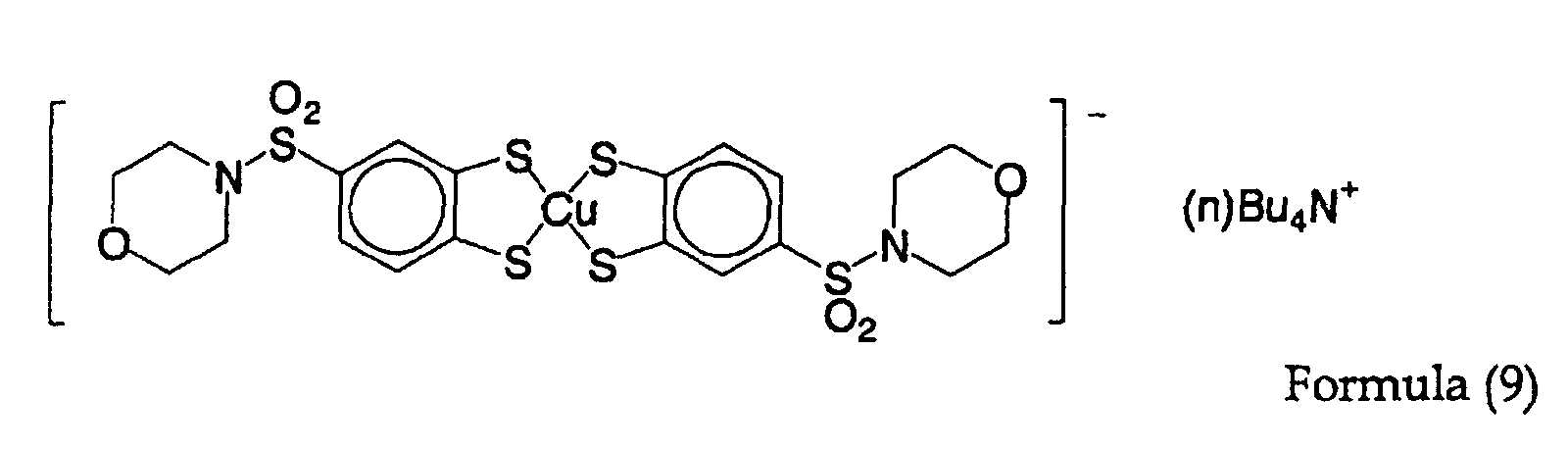

- A near-infrared absorption film according to any one of Claims 8 and 9, wherein the layer containing the cyanine compound contains a quencher compound represented by at least one of the formulae (7) and (10), and the layer containing the diimonium compound contains a quencher compound represented by at least one of the formulae (8) and (9).
- A near-infrared absorption film according to any one of Claims 2, and 7 to 10, wherein the amount of the cyanine compound is within the range of 0.1 parts by weight to 50 parts by weight relative to 100 parts by weight of the diimonium compound.
Applications Claiming Priority (5)
| Application Number | Priority Date | Filing Date | Title |
|---|---|---|---|
| JP2001134523 | 2001-05-01 | ||
| JP2001134523 | 2001-05-01 | ||
| JP2001145602 | 2001-05-15 | ||
| JP2001145602 | 2001-05-15 | ||
| PCT/JP2002/004350 WO2002091043A1 (en) | 2001-05-01 | 2002-05-01 | Near infrared absorbing films |
Publications (3)
| Publication Number | Publication Date |
|---|---|
| EP1385024A1 true EP1385024A1 (en) | 2004-01-28 |
| EP1385024A4 EP1385024A4 (en) | 2004-10-20 |
| EP1385024B1 EP1385024B1 (en) | 2010-05-19 |
Family
ID=26614606
Family Applications (1)
| Application Number | Title | Priority Date | Filing Date |
|---|---|---|---|
| EP20020722915 Expired - Lifetime EP1385024B1 (en) | 2001-05-01 | 2002-05-01 | Near infrared absorbtion film |
Country Status (4)
| Country | Link |
|---|---|
| US (1) | US7018714B2 (en) |
| EP (1) | EP1385024B1 (en) |
| DE (1) | DE60236424D1 (en) |
| WO (1) | WO2002091043A1 (en) |
Cited By (3)
| Publication number | Priority date | Publication date | Assignee | Title |
|---|---|---|---|---|
| US7245079B2 (en) | 2003-05-28 | 2007-07-17 | Solutia Incorporated | Plasma display panel filters comprising multiple layers |
| US7276849B2 (en) | 2003-05-28 | 2007-10-02 | Solutia Incorporated | Plasma display panel filters |
| US7510456B2 (en) | 2005-06-30 | 2009-03-31 | Solutia Incorporated | Method of making impact resistant, direct contact plasma display panel filters |
Families Citing this family (25)
| Publication number | Priority date | Publication date | Assignee | Title |
|---|---|---|---|---|
| JP2003114323A (en) * | 2001-10-04 | 2003-04-18 | Bridgestone Corp | Near infarared ray absorbing film |
| JP4086871B2 (en) * | 2004-11-18 | 2008-05-14 | 日立マクセル株式会社 | Near-infrared shield and display front plate |
| KR100705927B1 (en) * | 2005-10-26 | 2007-04-12 | 제일모직주식회사 | NIR absorption and color correction adhesive composition and film using same |
| US20100108957A1 (en) | 2006-12-15 | 2010-05-06 | Adeka Corporation | Optical filter |
| US20080311493A1 (en) * | 2007-06-13 | 2008-12-18 | Xerox Corporation | Inkless reimageable printing paper and method |
| US7582398B2 (en) | 2007-06-13 | 2009-09-01 | Xerox Corporation | Inkless reimageable printing paper and method |
| US7867672B2 (en) * | 2007-06-13 | 2011-01-11 | Xerox Corporation | Reimageable paper protected against UV light |
| US7852366B2 (en) * | 2007-06-13 | 2010-12-14 | Xerox Corporation | System and method for printing reimageable transient documents |
| US7588878B2 (en) * | 2007-06-13 | 2009-09-15 | Xerox Corporation | Inkless printing paper and method |
| US7718325B2 (en) | 2007-06-13 | 2010-05-18 | Xerox Corporation | Photochromic material, inkless reimageable printing paper, and methods |
| US7655366B2 (en) | 2007-06-13 | 2010-02-02 | Xerox Corporation | Inkless reimageable printing paper and method |
| US7553603B2 (en) | 2007-06-13 | 2009-06-30 | Xerox Corporation | Inkless printing paper and method |
| US7541119B2 (en) | 2007-06-13 | 2009-06-02 | Xerox Corporation | Inkless reimageable printing paper and method |
| US7666558B2 (en) * | 2007-06-13 | 2010-02-23 | Xerox Corporation | Inkless reimageable printing paper and method |
| US7645558B2 (en) * | 2007-06-13 | 2010-01-12 | Xerox Corporation | Inkless reimageable printing paper and method |
| US7572569B2 (en) * | 2007-06-13 | 2009-08-11 | Xerox Corporation | Inkless printing paper and method |
| US7572560B2 (en) * | 2007-06-13 | 2009-08-11 | Xerox Corporation | Inkless reimageable printing paper and method |
| US7569316B2 (en) * | 2007-06-13 | 2009-08-04 | Xerox Corporation | Inkless reimageable printing paper and method |
| EP2083347A3 (en) * | 2008-01-21 | 2011-04-27 | Crucial Tec Co., Ltd. | Optical input device and portable electronic device having the same |
| US7645560B1 (en) | 2008-09-08 | 2010-01-12 | Xerox Corporation | Inkless reimageable printing paper and method |
| US8865293B2 (en) * | 2008-12-15 | 2014-10-21 | 3M Innovative Properties Company | Optically active materials and articles and systems in which they may be used |
| JP5551089B2 (en) | 2008-12-25 | 2014-07-16 | 株式会社Adeka | Near-infrared absorbing material using cyanine compound and cyanine compound |
| JP2017139286A (en) * | 2016-02-02 | 2017-08-10 | ソニー株式会社 | Imaging element and camera system |
| TWM525451U (en) * | 2016-05-04 | 2016-07-11 | 白金科技股份有限公司 | Absorption type near infrared filter and image sensor |
| TWI882363B (en) * | 2023-06-16 | 2025-05-01 | 白金科技股份有限公司 | Composite photosensing structure and method for preparing the same |
Family Cites Families (19)
| Publication number | Priority date | Publication date | Assignee | Title |
|---|---|---|---|---|
| JPS6232132A (en) * | 1985-08-06 | 1987-02-12 | Nippon Kayaku Co Ltd | Improvement of light fastness of infrared absorber |
| US4923390A (en) * | 1986-10-14 | 1990-05-08 | Canon Kabushiki Kaisha | Optical recording medium IR-ray absorptive compound and optical recording medium by use thereof |
| JPS63227597A (en) * | 1987-03-13 | 1988-09-21 | Midori Kagaku Kk | Bis(dithiobenzyl)nickel complex compound |
| JPS6461492A (en) | 1987-08-28 | 1989-03-08 | Midori Kagaku Co Ltd | Bis(dithiobenzyl) complex compound |
| JPH0229485A (en) * | 1988-07-19 | 1990-01-31 | Nissan Motor Co Ltd | Photochromic sensitive material |
| JPH0236996A (en) * | 1988-07-27 | 1990-02-06 | Dainippon Printing Co Ltd | Composition for optical recording material |
| US5145963A (en) * | 1988-10-12 | 1992-09-08 | Ricoh Company, Ltd. | Optical information recording medium and nickel dithiolate complex compounds employed in the same |
| JP3009909B2 (en) | 1990-05-21 | 2000-02-14 | ティーディーケイ株式会社 | Optical recording medium |
| EP0458257B1 (en) * | 1990-05-21 | 1998-09-02 | TDK Corporation | Optical recording medium |
| JPH05104861A (en) * | 1991-10-21 | 1993-04-27 | Victor Co Of Japan Ltd | Optical recording medium |
| US5741632A (en) * | 1995-12-14 | 1998-04-21 | Agfa-Gevaert, N.V. | Class of non-sensitizing infra-red dyes for use in photosensitive elements |
| JPH09230134A (en) | 1995-12-22 | 1997-09-05 | Mitsui Toatsu Chem Inc | Filter for plasma display |
| WO1997034903A1 (en) * | 1996-03-21 | 1997-09-25 | Sumitomo Seika Chemicals Co., Ltd. | Substituted benzenedithiol-metal complexes |
| JP3485227B2 (en) | 1996-03-21 | 2004-01-13 | 住友精化株式会社 | Substituted benzenedithiol metal complex and method for producing the same |
| JPH1078509A (en) | 1996-07-12 | 1998-03-24 | Mitsui Petrochem Ind Ltd | Filters for plasma displays |
| JP3852986B2 (en) * | 1996-08-05 | 2006-12-06 | 三井化学株式会社 | Novel nickel complex compound and near-infrared absorbing resin molding for building materials using the compound |
| JP3298505B2 (en) | 1998-04-30 | 2002-07-02 | 東洋紡績株式会社 | Infrared absorption filter |
| WO1999067200A1 (en) * | 1998-06-23 | 1999-12-29 | Nippon Kayaku Kabushiki Kaisha | Amminium salt or diimmonium salt compounds and use thereof |
| JP3517210B2 (en) * | 2000-12-28 | 2004-04-12 | 日清紡績株式会社 | Near infrared absorbing material |
-
2002
- 2002-05-01 EP EP20020722915 patent/EP1385024B1/en not_active Expired - Lifetime
- 2002-05-01 WO PCT/JP2002/004350 patent/WO2002091043A1/en not_active Ceased
- 2002-05-01 DE DE60236424T patent/DE60236424D1/en not_active Expired - Lifetime
-
2003
- 2003-10-30 US US10/696,312 patent/US7018714B2/en not_active Expired - Fee Related
Cited By (3)
| Publication number | Priority date | Publication date | Assignee | Title |
|---|---|---|---|---|
| US7245079B2 (en) | 2003-05-28 | 2007-07-17 | Solutia Incorporated | Plasma display panel filters comprising multiple layers |
| US7276849B2 (en) | 2003-05-28 | 2007-10-02 | Solutia Incorporated | Plasma display panel filters |
| US7510456B2 (en) | 2005-06-30 | 2009-03-31 | Solutia Incorporated | Method of making impact resistant, direct contact plasma display panel filters |
Also Published As
| Publication number | Publication date |
|---|---|
| US7018714B2 (en) | 2006-03-28 |
| EP1385024B1 (en) | 2010-05-19 |
| WO2002091043A1 (en) | 2002-11-14 |
| DE60236424D1 (en) | 2010-07-01 |
| US20050040378A1 (en) | 2005-02-24 |
| EP1385024A4 (en) | 2004-10-20 |
Similar Documents
| Publication | Publication Date | Title |
|---|---|---|
| EP1385024B1 (en) | Near infrared absorbtion film | |
| EP1496375B1 (en) | Composition for optical film comprising a near-infrared absorbing dye and a quencher | |
| US20110082246A1 (en) | Pressure-sensitive adhesive containing near infrared absorbing coloring matter | |
| KR102056613B1 (en) | Near-infrared cut filter and solid-state imaging device | |
| EP1375600B1 (en) | Phthalocyanine compound, near infrared absorbing dye and heat ray shielding | |
| US20070275221A1 (en) | Near-infrared absorption film | |
| JP2002138203A (en) | Near-infrared shielding resin composition and near-infrared shielding laminate | |
| KR100705927B1 (en) | NIR absorption and color correction adhesive composition and film using same | |
| JP4086871B2 (en) | Near-infrared shield and display front plate | |
| JP4395947B2 (en) | Near infrared absorption film | |
| KR20050016039A (en) | Near infrared ray absorption composition and near infrared ray absorption filter | |
| JP3949603B2 (en) | Near infrared absorption filter, plasma display front plate and plasma display using the filter | |
| JP5010123B2 (en) | Phthalocyanine compound and near-infrared absorbing dye comprising the same | |
| JP2001133624A (en) | Near infrared shielding film | |
| JP5289813B2 (en) | Phthalocyanine compounds | |
| KR101050753B1 (en) | NIR absorbing film and optical filter for plasma display panel using same | |
| US7374822B2 (en) | Near-infrared ray-shielding paint, near-infrared ray-shielding laminate obtained therefrom and production method thereof | |
| JPWO2008050725A1 (en) | Near-infrared absorbing dye composition and near-infrared absorbing filter and adhesive containing the same | |
| JP2003021715A (en) | Near ir absorbing film | |
| JP4793977B2 (en) | Near infrared absorption filter | |
| JP2003043244A (en) | Near infrared absorbing film | |
| HK1129733B (en) | Near infrared ray absorbing film and optical filter for plasma display panel using the same | |
| JP2007310383A (en) | Near-infrared shield and display front plate |
Legal Events
| Date | Code | Title | Description |
|---|---|---|---|
| PUAI | Public reference made under article 153(3) epc to a published international application that has entered the european phase |
Free format text: ORIGINAL CODE: 0009012 |
|
| 17P | Request for examination filed |
Effective date: 20031106 |
|
| AK | Designated contracting states |
Kind code of ref document: A1 Designated state(s): AT BE CH CY DE DK ES FI FR GB GR IE IT LI LU MC NL PT SE TR |
|
| AX | Request for extension of the european patent |
Extension state: AL LT LV MK RO SI |
|
| A4 | Supplementary search report drawn up and despatched |
Effective date: 20040903 |
|
| RIC1 | Information provided on ipc code assigned before grant |
Ipc: 7G 02B 5/22 A Ipc: 7B 32B 27/18 B Ipc: 7G 11B 7/24 B Ipc: 7C 09K 3/00 B |
|
| 17Q | First examination report despatched |
Effective date: 20060822 |
|
| GRAP | Despatch of communication of intention to grant a patent |
Free format text: ORIGINAL CODE: EPIDOSNIGR1 |
|
| RBV | Designated contracting states (corrected) |
Designated state(s): DE FR GB |
|
| GRAS | Grant fee paid |
Free format text: ORIGINAL CODE: EPIDOSNIGR3 |
|
| RIN1 | Information on inventor provided before grant (corrected) |
Inventor name: MORIMURA, YASUHIRO Inventor name: MATSUZAKI, MASAYUKI Inventor name: SUGIMACHI, MASATO Inventor name: KOBAYASHI, TAICHI |
|
| RTI1 | Title (correction) |
Free format text: NEAR INFRARED ABSORBTION FILM |
|
| GRAA | (expected) grant |
Free format text: ORIGINAL CODE: 0009210 |
|
| AK | Designated contracting states |
Kind code of ref document: B1 Designated state(s): DE FR GB |
|
| REG | Reference to a national code |
Ref country code: GB Ref legal event code: FG4D |
|
| REF | Corresponds to: |
Ref document number: 60236424 Country of ref document: DE Date of ref document: 20100701 Kind code of ref document: P |
|
| PLBE | No opposition filed within time limit |
Free format text: ORIGINAL CODE: 0009261 |
|
| STAA | Information on the status of an ep patent application or granted ep patent |
Free format text: STATUS: NO OPPOSITION FILED WITHIN TIME LIMIT |
|
| 26N | No opposition filed |
Effective date: 20110222 |
|
| REG | Reference to a national code |
Ref country code: DE Ref legal event code: R097 Ref document number: 60236424 Country of ref document: DE Effective date: 20110221 |
|
| PGFP | Annual fee paid to national office [announced via postgrant information from national office to epo] |
Ref country code: DE Payment date: 20120502 Year of fee payment: 11 |
|
| PGFP | Annual fee paid to national office [announced via postgrant information from national office to epo] |
Ref country code: FR Payment date: 20120608 Year of fee payment: 11 Ref country code: GB Payment date: 20120425 Year of fee payment: 11 |
|
| GBPC | Gb: european patent ceased through non-payment of renewal fee |
Effective date: 20130501 |
|
| PG25 | Lapsed in a contracting state [announced via postgrant information from national office to epo] |
Ref country code: DE Free format text: LAPSE BECAUSE OF NON-PAYMENT OF DUE FEES Effective date: 20131203 |
|
| REG | Reference to a national code |
Ref country code: DE Ref legal event code: R119 Ref document number: 60236424 Country of ref document: DE Effective date: 20131203 |
|
| REG | Reference to a national code |
Ref country code: FR Ref legal event code: ST Effective date: 20140131 |
|
| PG25 | Lapsed in a contracting state [announced via postgrant information from national office to epo] |
Ref country code: GB Free format text: LAPSE BECAUSE OF NON-PAYMENT OF DUE FEES Effective date: 20130501 |
|
| PG25 | Lapsed in a contracting state [announced via postgrant information from national office to epo] |
Ref country code: FR Free format text: LAPSE BECAUSE OF NON-PAYMENT OF DUE FEES Effective date: 20130531 |