EP1382818A2 - Control system and method for motor vehicles - Google Patents
Control system and method for motor vehicles Download PDFInfo
- Publication number
- EP1382818A2 EP1382818A2 EP03016212A EP03016212A EP1382818A2 EP 1382818 A2 EP1382818 A2 EP 1382818A2 EP 03016212 A EP03016212 A EP 03016212A EP 03016212 A EP03016212 A EP 03016212A EP 1382818 A2 EP1382818 A2 EP 1382818A2
- Authority
- EP
- European Patent Office
- Prior art keywords
- internal combustion
- combustion engine
- motor
- control system
- inertia
- Prior art date
- Legal status (The legal status is an assumption and is not a legal conclusion. Google has not performed a legal analysis and makes no representation as to the accuracy of the status listed.)
- Granted
Links
Images




Classifications
-
- F—MECHANICAL ENGINEERING; LIGHTING; HEATING; WEAPONS; BLASTING
- F02—COMBUSTION ENGINES; HOT-GAS OR COMBUSTION-PRODUCT ENGINE PLANTS
- F02D—CONTROLLING COMBUSTION ENGINES
- F02D41/00—Electrical control of supply of combustible mixture or its constituents
- F02D41/02—Circuit arrangements for generating control signals
- F02D41/04—Introducing corrections for particular operating conditions
- F02D41/06—Introducing corrections for particular operating conditions for engine starting or warming up
- F02D41/062—Introducing corrections for particular operating conditions for engine starting or warming up for starting
-
- F—MECHANICAL ENGINEERING; LIGHTING; HEATING; WEAPONS; BLASTING
- F02—COMBUSTION ENGINES; HOT-GAS OR COMBUSTION-PRODUCT ENGINE PLANTS
- F02D—CONTROLLING COMBUSTION ENGINES
- F02D41/00—Electrical control of supply of combustible mixture or its constituents
- F02D41/02—Circuit arrangements for generating control signals
- F02D41/021—Introducing corrections for particular conditions exterior to the engine
-
- F—MECHANICAL ENGINEERING; LIGHTING; HEATING; WEAPONS; BLASTING
- F02—COMBUSTION ENGINES; HOT-GAS OR COMBUSTION-PRODUCT ENGINE PLANTS
- F02D—CONTROLLING COMBUSTION ENGINES
- F02D41/00—Electrical control of supply of combustible mixture or its constituents
- F02D41/02—Circuit arrangements for generating control signals
- F02D41/021—Introducing corrections for particular conditions exterior to the engine
- F02D41/0215—Introducing corrections for particular conditions exterior to the engine in relation with elements of the transmission
- F02D41/0225—Introducing corrections for particular conditions exterior to the engine in relation with elements of the transmission in relation with the gear ratio or shift lever position
-
- F—MECHANICAL ENGINEERING; LIGHTING; HEATING; WEAPONS; BLASTING
- F02—COMBUSTION ENGINES; HOT-GAS OR COMBUSTION-PRODUCT ENGINE PLANTS
- F02D—CONTROLLING COMBUSTION ENGINES
- F02D41/00—Electrical control of supply of combustible mixture or its constituents
- F02D41/02—Circuit arrangements for generating control signals
- F02D41/04—Introducing corrections for particular operating conditions
- F02D41/06—Introducing corrections for particular operating conditions for engine starting or warming up
-
- F—MECHANICAL ENGINEERING; LIGHTING; HEATING; WEAPONS; BLASTING
- F02—COMBUSTION ENGINES; HOT-GAS OR COMBUSTION-PRODUCT ENGINE PLANTS
- F02D—CONTROLLING COMBUSTION ENGINES
- F02D41/00—Electrical control of supply of combustible mixture or its constituents
- F02D41/02—Circuit arrangements for generating control signals
- F02D41/04—Introducing corrections for particular operating conditions
- F02D41/08—Introducing corrections for particular operating conditions for idling
-
- F—MECHANICAL ENGINEERING; LIGHTING; HEATING; WEAPONS; BLASTING
- F02—COMBUSTION ENGINES; HOT-GAS OR COMBUSTION-PRODUCT ENGINE PLANTS
- F02D—CONTROLLING COMBUSTION ENGINES
- F02D41/00—Electrical control of supply of combustible mixture or its constituents
- F02D41/02—Circuit arrangements for generating control signals
- F02D41/14—Introducing closed-loop corrections
- F02D41/16—Introducing closed-loop corrections for idling
-
- F—MECHANICAL ENGINEERING; LIGHTING; HEATING; WEAPONS; BLASTING
- F02—COMBUSTION ENGINES; HOT-GAS OR COMBUSTION-PRODUCT ENGINE PLANTS
- F02N—STARTING OF COMBUSTION ENGINES; STARTING AIDS FOR SUCH ENGINES, NOT OTHERWISE PROVIDED FOR
- F02N11/00—Starting of engines by means of electric motors
- F02N11/04—Starting of engines by means of electric motors the motors being associated with current generators
-
- F—MECHANICAL ENGINEERING; LIGHTING; HEATING; WEAPONS; BLASTING
- F02—COMBUSTION ENGINES; HOT-GAS OR COMBUSTION-PRODUCT ENGINE PLANTS
- F02N—STARTING OF COMBUSTION ENGINES; STARTING AIDS FOR SUCH ENGINES, NOT OTHERWISE PROVIDED FOR
- F02N11/00—Starting of engines by means of electric motors
- F02N11/08—Circuits specially adapted for starting of engines
- F02N11/0814—Circuits specially adapted for starting of engines comprising means for controlling automatic idle-start-stop
-
- F—MECHANICAL ENGINEERING; LIGHTING; HEATING; WEAPONS; BLASTING
- F02—COMBUSTION ENGINES; HOT-GAS OR COMBUSTION-PRODUCT ENGINE PLANTS
- F02D—CONTROLLING COMBUSTION ENGINES
- F02D2250/00—Engine control related to specific problems or objectives
- F02D2250/18—Control of the engine output torque
-
- F—MECHANICAL ENGINEERING; LIGHTING; HEATING; WEAPONS; BLASTING
- F02—COMBUSTION ENGINES; HOT-GAS OR COMBUSTION-PRODUCT ENGINE PLANTS
- F02D—CONTROLLING COMBUSTION ENGINES
- F02D41/00—Electrical control of supply of combustible mixture or its constituents
- F02D41/009—Electrical control of supply of combustible mixture or its constituents using means for generating position or synchronisation signals
-
- Y—GENERAL TAGGING OF NEW TECHNOLOGICAL DEVELOPMENTS; GENERAL TAGGING OF CROSS-SECTIONAL TECHNOLOGIES SPANNING OVER SEVERAL SECTIONS OF THE IPC; TECHNICAL SUBJECTS COVERED BY FORMER USPC CROSS-REFERENCE ART COLLECTIONS [XRACs] AND DIGESTS
- Y02—TECHNOLOGIES OR APPLICATIONS FOR MITIGATION OR ADAPTATION AGAINST CLIMATE CHANGE
- Y02T—CLIMATE CHANGE MITIGATION TECHNOLOGIES RELATED TO TRANSPORTATION
- Y02T10/00—Road transport of goods or passengers
- Y02T10/10—Internal combustion engine [ICE] based vehicles
- Y02T10/40—Engine management systems
Definitions
- the invention relates to a control system and method for a motor vehicle. More particularly, the invention relates to a control system and method for a motor vehicle including an internal combustion engine and a motor connected to an output shaft of the internal combustion engine.
- Japanese Laid-opened Patent Publication No. 2000-297668 discloses a control system which controls engine speed using a motor generator during engine start while prohibiting idle speed control of an internal combustion engine, thus preventing interference between the idle speed control and the engine speed control with the motor generator.
- control system and method for motor vehicles that reduce or hopefully eliminate torque shocks which may occur during an engine start.
- control system and method according to the invention incorporate the following constructions and procedures.
- a first aspect of the invention related to a control system which is applied to a motor vehicle including an internal combustion engine and a motor connected to an output shaft of the internal combustion engine, and which is operable to perform a start control for starting the internal combustion engine.
- the control system stops the cranking by the motor and estimates an inertia value indicative of inertia that acts on a rotational element related to the output shaft after the stop of the cranking by the motor. Then, the internal combustion engine is controlled based on the estimated inertia value so as to run at an idle speed.
- torque shocks can be reduced as compared to when the internal combustion engine is controlled to start and run at the idle speed without considering the inertia value.
- the inertia value be an inertia torque value indicative of the inertia torque that acts on the rotational element, as a value corresponding to an idle control amount used for controlling the internal combustion engine to run at the idle speed.
- the internal combustion engine using a control amount obtained by subtracting the inertia torque value from a target idle control amount after the stop of the cranking by the motor.
- a more appropriate control amount is used for controlling the internal combustion engine to start and run at the idle speed.
- the inertia value be estimated based on the temperature of the internal combustion engine.
- the inertia value is made more appropriate based on the temperature of the internal combustion engine, which results in further reduced torque shocks during an engine start.
- the "temperature of the internal combustion engine” may be temperature that reflects or indirectly indicates the temperature of the internal combustion engine, such as the temperature of coolant for cooling the internal combustion engine, as well as temperature that directly indicates it.
- the inertia value be estimated such that the inertia value becomes smaller as the temperature of the internal combustion engine becomes higher.
- the motor vehicle be provided with an automatic transmission to be shifted between at least a neutral position and a drive position, which transmits power output from the output shaft to the side of a vehicle axle while automatically changing the speed of rotation, and that the inertia value be estimated based on the shift position of the automatic transmission.
- the inertia value may be estimated based on an initial value of the inertia value and a diminishing rate, both corresponding to the shift position.
- the initial value, when the shift position is the neutral position become smaller than when the shift position is the drive position
- the diminishing rate, when the shift position is the neutral position become larger than when the shift position is the drive position.
- control amounts related to an idling operation of the internal combustion engine be prohibited when the inertia value is estimated to be equal to or larger than a first reference value.
- learning of the control amounts is avoided.
- driving of a given auxiliary be stopped when the inertia value is estimated to be equal to or larger than a second reference value.
- a feedback control be performed such that the internal combustion engine runs at the idle speed.
- further speed and stability can be achieved in controlling the internal combustion engine to run at the idle speed right after the engine start.
- the predetermined speed be substantially equal to the idle speed.
- the internal combustion engine can be controlled to start and run at the idle speed more smoothly while reducing torque shocks that may occur during an engine start.
- the start control be performed when a predetermined starting condition is fulfilled after a predetermined stopping condition has been fulfilled and the internal combustion engine has been automatically stopped.
- torque shocks can be further reduced during an engine start.
- a second aspect of the invention relates to a control system which is applied to a motor vehicle including an internal combustion engine and a motor connected to an output shaft of the internal combustion engine, and which is operable to perform an automatic start/stop control of the internal combustion engine.
- the control system during an automatic start of the internal combustion engine, controls the running of the internal combustion engine at an idle speed, using a different control amount from that used when a start of the internal combustion engine is triggered by an operation of an operator.
- control amounts can be made more suitable for the kinetic state of rotational elements related to the output shaft of the internal combustion engine, so that the internal combustion engine starts and runs at the idle speed while reducing torque shocks more quickly.
- a third aspect of the invention relates to a control system which is applied to a motor vehicle including an internal combustion engine and a motor connected to an output shaft of the internal combustion engine, and which is operable to perform an automatic start/stop control of the internal combustion engine.
- the control system controls the internal combustion engine so as to run at an idle speed, using a first control amount until a predetermined time passes after the internal combustion engine has started, and using a second control amount that is different from the first control amount, after the predetermined time has passed.
- control amounts that are suitable for the state of the internal combustion engine and the kinetic state of the rotational elements related to the output shaft are used until the predetermined time passes, whereby the internal combustion engine starts and runs at the idle speed while reducing torque shocks more promptly.
- the first control amount be smaller than the second control amount.
- a more suitable control amount is used until the predetermined time passes.
- the first control amount may be a value obtained by subtracting a value equivalent to inertia that acts on a rotational element related to the output shaft from the second control amount.
- a control system is applied to a motor vehicle including an internal combustion engine and a motor connected to an output shaft of the internal combustion engine, and is operable to perform a transition control for controlling a transition from a state where power is output to the output shaft from the motor to a state where the internal combustion engine idles with the motor outputting no power to the output shaft.
- the control system stops the motor and estimates an inertia value indicative of inertia that acts on a rotational element related to the output shaft after the stop of the motor. Then, the internal combustion engine is controlled so as to run at an idle speed based on the estimated inertia value.
- the transition control be performed at the time of starting the internal combustion engine.
- the motor be capable of generating electric power, and that the transition control be performed at the time of stopping the motor when the motor is generating electric power using driving power from the output shaft.
- the transition control be performed at the time of stopping the motor when the motor is generating electric power using driving power from the output shaft.
- the motor vehicle may be a hybrid vehicle that is able to run using driving power output from the motor to the output shaft.
- a fifth aspect of the invention relates to a method for controlling a start of an internal combustion engine of a motor vehicle including a motor connected to the output of the internal combustion engine.
- the cranking by the motor is stopped, and an inertia value indicative of inertia that acts on a rotational element related to the output shaft after the stop of the cranking by the motor is estimated.
- the internal combustion engine is controlled based on the estimated inertia value so as to run at an idle speed.
- a sixth aspect of the invention relates to a method for controlling an automatic start of an internal combustion engine of a motor vehicle including a motor connected to the output of the internal combustion engine.
- the internal combustion engine during an automatic start thereof, is controlled so as to run at an idle speed, using a different control amount from that used when a start of the internal combustion engine is triggered by an operation of an operator.
- a seventh aspect of the invention relates to a method for controlling an automatic start of an internal combustion engine of a motor vehicle including a motor connected to the output of the internal combustion engine.
- the internal combustion engine is controlled so as to run at an idle speed using a first control amount until a predetermined time passes after the internal combustion engine has been started, and using a second control amount that is different from the first control amount, after the predetermined time has passed.
- An eighth aspect of the invention relates to a method for controlling a transition of a start operation state of an internal combustion engine of a motor vehicle including a motor connected to an output shaft of the internal combustion engine from a state where power is output to the output shaft from the motor to a state where the internal combustion engine idles with the motor outputting no power to the output shaft.
- the motor is stopped and an inertia value indicative of inertia that acts on a rotational element related to the output shaft after the stop of the motor is estimated. Then, the internal combustion engine is controlled based on the estimated inertia value so as to run at an idle speed.
- FIG. 1 is a block diagram schematically showing the configuration of a hybrid vehicle 20 incorporating a control system according to a first embodiment of the invention.
- the hybrid vehicle 20 includes an engine 22 that runs using gasoline, an engine electronic control unit (hereinafter referred to as "engine ECU") 24 for controlling the engine 22, an automatic transmission 28 that changes the rotation speed output from the engine 22 to the crankshaft 26 and transmits power from the engine 22 to driven wheels 34a and 34b via a differential gear 32 at the changed rotation speed, an automatic transmission electronic control unit (hereinafter referred to as "AT ECU”) 30 which controls shifting of the automatic transmission 28, a motor generator 36 which both provides and receives driving power to and from the crankshaft 26 of the engine 22, a battery 40 which both provides and receives electric power to and from the motor generator 36 via an inverter 38, and a hybrid electronic control unit 50 which controls the starting and stopping of the engine 22, as well as the driving and the like of the motor generator
- the engine 22 is an internal combustion engine of a direct-injection type (i.e., direct injection engine) which directly injects gasoline into combustion chambers.
- a direct-injection type i.e., direct injection engine
- air introduced via an air cleaner 122 and a throttle valve 124 is mixed with an exhaust gas supplied from an exhaust system through an EGR pipe 126, and is delivered into a combustion chamber 128.
- the mixture is further mixed with gasoline injected from a fuel injection valve 130 into the combustion chamber 128, thus forming an air-fuel mixture.
- the air-fuel mixture is then ignited by a spark of a spark plug 132, and is thus combusted.
- a piston 134 reciprocates using the power generated from the combustion, thereby rotating a crankshaft 26.
- a throttle motor 136 is operated to open and close the throttle valve 124, and an EGR valve 138 is operated to adjust the flow rate of exhaust gas supplied from the EGR pipe 126.
- a first purifying device 140 and second purifying device 142 are provided for purifying exhaust gas.
- the first purifying device 140 is adapted to remove or reduce carbon monoxide, hydrocarbons, and nitrogen oxide (NOx) that are generated while the engine 22 is running at a stoichiometric air-fuel ratio.
- the second purifying device 142 is adapted to store NOx which is difficult to remove at the first purifying device 140 due to the presence of oxygen in exhaust gas when the engine 22 is running at a lean air-fuel ratio, and reduce the NOx into nitrogen using carbon monoxide and hydrocarbon when the engine 22 is running at the stoichiometric air-fuel ratio.
- the exhaust gas, after thus purified, is released to the outside.
- the engine 22 includes an airflow control valve 144 and actuator 146 for driving the airflow control valve 144.
- the airflow control valve 144 closes one of two intake ports provided on each cylinder when the coolant temperature is low, in order to increase the flow speed of the intake air passing through the other intake port, and thus promote turbulent flows in the lateral direction in the combustion chamber 128 for stable combustion.
- the engine ECU 24 controls the operation of the engine 22.
- the engine ECU 24 receives signals indicative of the temperature of intake air from an intake temperature sensor 148, the opening (i.e., position) of the throttle valve 124 from a throttle valve position sensor 150, the load on the engine 22 from a vacuum sensor 152, the rotational position of the camshaft, which opens and closes intake and exhaust valves for introducing air into or releasing gas from the combustion chamber 128, from a cam position sensor 154, the combustion pressure in the combustion chamber 128 from a combustion pressure sensor 156, a temperature Tw of a coolant of the engine 22 from a coolant temperature sensor 158, knocking of the engine 22 from a knock sensor 160, the rotational position of the crankshaft 26 from a crank position sensor 162, oxygen in the exhaust from an oxygen sensor 164, etc, which are all connected to the engine ECU 24.
- the engine ECU 24 outputs control signals to a continuously variable valve timing mechanism 166 for continuously changing drive signals to the fuel injection valves 130 and the opening/closing timing of the intake and exhaust valves, ignition coils 168 integrated with ignitors, and so on. Also, in order to output power from the engine 22 in accordance with operations by a operator, the engine ECU 24 receives signals indicative of a shift position SP of a shift lever 170 from a shift position sensor 172, and an accelerator pedal position AP of an accelerator pedal 174 from an accelerator pedal position sensor 176.
- the motor generator 36 is formed by, for example, a synchronous motor generator which functions as a motor as well as a generator.
- a belt 48 is provided between a motor-side pulley 46 mounted on the rotational shaft of the motor generator 36 and an engine side pulley 44 connected to the crankshaft 26 of the engine 22 through a clutch 42.
- the motor generator 36 generates electric power for recharging the battery 40 using the driving power output from the engine 22 to the crankshaft 26, and the motor generator 36 in turn runs using the electric power supplied from the battery 40, thus outputting driving power to the crankshaft 26.
- the hybrid electronic control unit 50 comprises a microprocessor which has a CPU as its main component.
- the hybrid electronic control unit 50 is also provided with ROM for storing processing programs and data and the like, RAM for storing data temporarily, input/output ports, and a communication port, none of which are not shown in the drawing.
- ROM read-only memory
- RAM random access memory
- communication port a communication port
- Such signals include signals indicative of a motor speed from a speed sensor and motor temperature from a temperature sensor, both not shown, which are mounted on the motor generator 36; a phase current to the motor generator 36 from a current sensor, not shown, which is mounted inside the inverter 38; a battery temperature from a temperature sensor, not shown, which is mounted to the battery 40; a voltage between terminals and recharging current from a voltage sensor and a current sensor, respectively, both not shown, which are mounted near an output terminal of the battery 40.
- the hybrid electronic control unit 50 also outputs various signals such as a driving signal to the starter motor 23 that cranks the crankshaft 26 of the engine 22, a switching control signal to the inverter 38 for controlling the motor generator 36, and a driving signal to the clutch 42 via the output port. Further, the hybrid electronic control unit 50 is connected via the communication port to the engine ECU 24 and the AT ECU 30, and when necessary, receives data and the like regarding the state of the engine 22 from the engine ECU 24 and data and the like regarding the state of the automatic transmission 28 from the AT ECU 30, and sends control signals to the engine ECU 24 and the AT ECU 30.
- an idling stop control is performed in which the engine 22 is automatically stopped when a predetermined stopping condition has been fulfilled, such as when the accelerator is OFF, i.e., the accelerator pedal 54 is not being depressed, and the brake is ON, i.e., the brake pedal is being depressed, and an engine speed Ne is equal to, or less than, a predetermined speed when the hybrid vehicle 20 is stationary with the engine 22 idling.
- the engine 22 is automatically started by the motor generator 36 when a predetermined starting condition has been fulfilled, such as when the accelerator is ON while the brake is OFF.
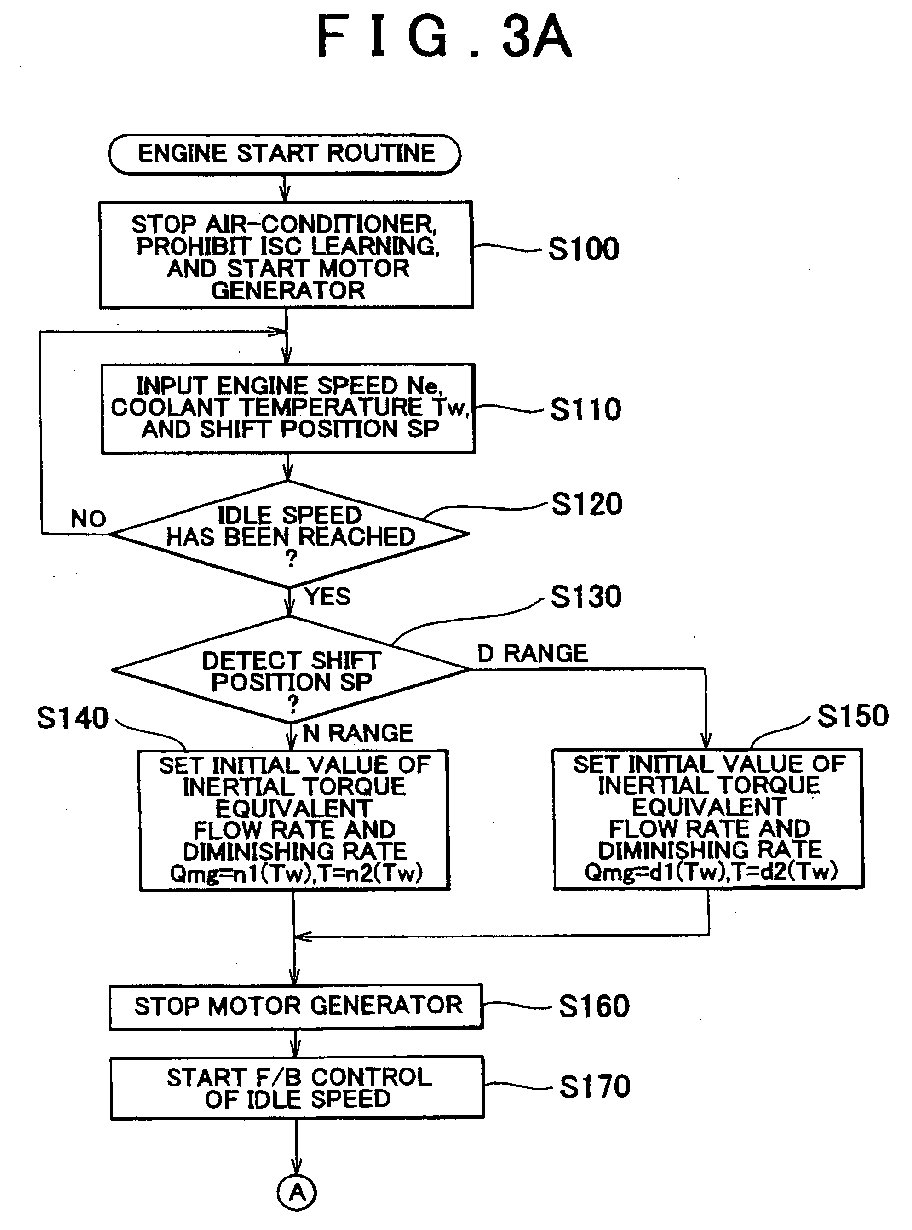
- FIG. 3 is a flowchart showing one example of an engine start routine executed by the electronic control unit 50 when the predetermined starting condition has been fulfilled during the idle stop control.
- the electronic control unit 50 first stops an air conditioner for a passenger compartment, not shown, and prohibits learning of control amounts related to the idling operation of the engine 22 (i.e., idle speed maintaining flow rate, air-fuel ratio for maintaining the idle speed), and subsequently starts the motor generator 36 (step S100).
- the clutch 42 is ON so that the engine 22 is driven and thus cranked by the motor generator 36.
- the shift position SP is in D range (i.e., drive range)
- the motor generator 36 outputs torque to the crankshaft 26.
- the rotation speed of the crankshaft 26 thus driven by the motor generator 36 is then changed at the automatic transmission 28, and is transmitted to the wheels 34a, 34b.
- the hybrid vehicle 20 is able to run using the running torque generated by the motor generator 36.
- the shift position SP is in N range (i.e., neutral range)
- a clutch (not shown) provided in the automatic transmission 28 is OFF, and therefore, the torque generated by the motor generator 36 is not output to the driven wheels 34a, 34b.
- the electronic control unit 50 reads the engine speed Ne, the coolant temperature Tw, and the shift position SP, which are all transmitted from the engine ECU 24, and waits until the engine speed Ne reaches an idle speed (steps S110, S120).
- the engine speed Ne may be determined based on the crank position detected by the crank position sensor 162 or may be directly detected using an engine speed sensor, not shown.
- the electronic control unit 50 sets an initial value of an inertia torque equivalent flow rate Qmg and a diminishing rate t based on whether the shift position SP is in N or D range (steps S130 to S150).
- the inertia torque equivalent flow rate Qmg is an air flow rate equivalent to the magnitude of inertial torque that acts on rotational elements related to the crankshaft 26, such as the motor generator 36 and the engine 22, right after the cranking of the engine 22 by the motor generator 36 has been stopped.
- the inertia torque equivalent flow rate Qmg is set based on, for example, the coolant temperature Tw and the shift position SP.
- the initial value of the inertia torque equivalent flow rate Qmg is set in the following manner. That is, the relationship between the coolant temperature Tw and the initial value of the inertia torque equivalent flow rate Qmg is obtained in advance for each shift position according tests results or the like, and the relationship is pre-stored in the ROM in the form of a map. Using the map, the initial value of the inertia torque equivalent flow rate Qmg is set according to the shift position SP and the coolant temperature Tw.
- FIG. 4 is a graph showing one example of this map.
- curve A represents the relationship established between the coolant temperature Tw and the inertia torque equivalent flow rate Qmg when the shift position is in N range
- curve B represents the same relationship established when the shift position SP is in D range.
- the initial value of the inertia torque equivalent flow rate Qmg is differently set for each shift position (D or N range). This difference corresponds to whether influences by loads located after the automatic transmission 28 are present, i.e., whether a clutch disposed in the automatic transmission 28, not shown in the drawing, is ON or OFF.
- the diminishing rate t is used for setting changes with time in the inertia torque equivalent flow rate Qmg after the motor generator 36 has been stopped.
- the diminishing rate t is set based on the coolant temperature Tw and the shift position SP.
- the diminishing rate t is set in the following manner. That is, the relationship between the coolant temperature Tw and the diminishing rate t is obtained in advance for each shift position by tests or the like, and the relationship thus determined is pre-stored in the ROM in the form of a map. Using the map, the diminishing rate t is set according to the shift position SP and the coolant temperature Tw.
- FIG. 5 is a graph showing one example of this map.
- curve C represents the relationship established between the coolant temperature Tw and the diminishing rate t when the shift position SP is in N range
- curve D represents the same relationship established when the shift position SP in D range.
- the diminishing rate t is set based on the frequency of repeating steps S180 to S260.
- the electronic control unit 50 then stops the motor generator 36 that is driving the engine 22 at the idle speed (step S160), and starts the feedback control of the idle speed (step S170).
- the intake amount is adjusted according to deviations between the engine speed Ne and the target idle speed.
- the electronic control unit 50 When the feedback control of the idle speed starts, the electronic control unit 50 first sets the idle speed maintaining flow rate Qisc at a value obtained by subtracting the inertia torque equivalent flow rate Qmg from a predetermined target idle speed maintaining flow rate Qisc* (step S180). The electronic control unit 50 then sets an opening (hereinafter, will be referred to as a "throttle opening") Sq of the throttle valve 124 based on the idle speed maintaining flow rate Qisc, and controls the engine 22 using the throttle opening Sq (step S200).
- athrottle opening an opening of the throttle valve 124 based on the idle speed maintaining flow rate Qisc
- the electronic control unit 50 calculates a new inertia torque equivalent flow rate Qmg by multiplying the inertia torque equivalent flow rate Qmg with the diminishing rate t (step S210), and compares the new inertia torque equivalent flow rate Qmg with threshold values Q1, Q2, and Q3 (steps S220 to S240). Thus, steps S180 to S260 are repeated until the inertia torque equivalent flow rate Qmg becomes equal to or smaller than the threshold value Q1.
- the threshold value Q1 is a reference value for determining whether to finish the engine start control of the engine 22
- the threshold value Q2 is a reference value for determining whether to cancel the prohibition of learning of the control amounts
- the threshold value Q3 is a reference value for determining whether to restart the air conditioner.
- these threshold values have a relationship of Q1 ⁇ Q2 ⁇ Q3. More specifically, when the inertia torque equivalent flow rate Qmg becomes equal to or smaller than the threshold value Q3 while repeating steps S180 to S260, the electronic control unit 50 resumes the operation of the air conditioner (step S260).
- the electronic control unit 50 cancels the prohibition of learning of the control amounts (step S250).
- the electronic control unit 50 starts the idle speed control at the target idle speed maintaining flow rate Qisc*, not using the inertia torque equivalent flow rate Qmg (step S270), after which the routine ends.
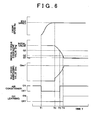
- FIG. 6 is a timechart illustrating exemplary changes with time in the engine speed Ne, the inertia torque equivalent flow rate Qmg, the idle speed maintaining flow rate Qisc, the operation state of the air conditioner, and the state of learning of the control amounts related to the idling operation of the engine 22, which are observed when the engine 22 is started according to the aforementioned routine with the shift position set in D range.
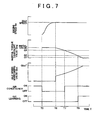
- FIG. 7 is a timechart illustrating the same exemplary changes, which are observed when the engine 22 is started according to the aforementioned routine with the shift position set in N range. As shown in FIGS.
- the electronic control unit 50 stops the air conditioner, and starts driving of the engine 22 by the motor generator 36.
- the electronic control unit 50 stops the motor generator 36, and begins to control the engine 22 using the idle speed maintaining flow rate Qisc, and calculates the idle speed maintaining flow rate Qisc using the initial value of the inertia torque equivalent flow rate Qmg which is set based on the shift position SP and the coolant temperature Tw, as aforementioned.
- the initial value of the inertia torque equivalent flow rate Qmg is set somewhat larger compared to when the shift position SP is in N range.
- the diminishing rate t is set relatively small when the shift position SP is in D range, and is set relatively large when the shift position SP is in N range.
- the inertia torque equivalent flow rate Qmg rapidly decreases when the shift position SP is in D range, and slowly decreases when the shift position SP is in N range.
- the operation of the air conditioner resumes when the inertia torque equivalent flow rate Qmg reaches the threshold value Q3 at time T3 (or T7).
- the engine 22 upon starting the engine 22, the engine 22 is driven by the motor generator 36 until its speed reaches the idle speed.
- the speed of the engine 22 is controlled at the idle speed using the idle speed maintaining flow rate Qisc calculated factoring in the inertia torque equivalent flow rate Qmg, which is equivalent to the magnitude of inertia toque that acts on rotational elements related to the crankshaft 26 after the stop of the cranking by the motor generator 36.
- the engine 22 can be started while maintaining the engine speed at the idle speed, without suffering from torque shocks.
- the idle speed maintaining flow rate Qisc is calculated using the initial value of the inertia torque equivalent flow rate Qmg and the diminishing rate t, both set based on the shift position SP and the coolant temperature Tw, it is possible to stably reduce torque shocks and start the engine while maintaining the engine speed at the idle speed, regardless of the shift position SP and the coolant temperature Tw.
- the air conditioner is stopped until the inertia torque equivalent flow rate Qmg becomes equal to or lower than the threshold value Q3. Therefore, the engine speed control can proceed without being affected by external disturbances.
- learning of control amounts related to the idle speed control is prohibited until the inertia torque equivalent flow rate Qmg becomes equal to or lower than the threshold value Q2, which prevents errors in the learning, which may otherwise occur.
- the initial value of the inertia torque equivalent flow rate Qmg and the diminishing rate t are set based on the shift position SP and the coolant temperature Tw, and the engine 22 is controlled using the idle speed maintaining flow rate Qisc which is set factoring in the inertia torque equivalent flow rate Qmg, until the inertia torque equivalent flow rate Qmg becomes almost zero.
- the engine 22 is controlled using the idle speed maintaining flow rate Qisc which is set factoring in the inertia torque equivalent flow rate Qmg, after the stop of cranking by the motor generator 36 until a predetermined time determined based on the shift position SP and the temperature Tw passes.
- the engine 22 is then controlled using the idle speed maintaining flow rate Qisc which is set without factoring in the inertia torque equivalent flow rate Qmg, that is, the target idle speed maintaining flow rate Qisc*.
- the engine 22 is controlled using the idle speed maintaining flow rate Qisc, which is a different control amount from that used for driving the engine 22 at the idle speed after engine start, during a period after the stop of the cranking by the motor generator 36 until the predetermined time passes.
- the engine 22 is then controlled using the target idle speed maintaining flow rate Qisc*, namely, a control amount equal to that used for driving the engine 22 at the idle speed after an engine start.
- the initial value of the inertia torque equivalent flow rate Qmg varies depending upon whether the shift position SP is in D or N range in the embodiment described above, the initial value may be set at the same value independent of the shift position SP, even though a slight torque shock may occur or the stability of the engine start may become somewhat lower.
- the initial value of the inertia torque equivalent flow rate Qmg varies depending upon the coolant temperature Tw, the initial value may be set independent of the coolant temperature Tw.
- the diminishing rate t of the inertia torque equivalent flow rate Qmg varies depending upon whether the shift position SP is in D or N range, the diminishing rate t may be set at the same value independent of the shift position SP, even though a slight torque shock may occur or the stability of the start may become somewhat lower. Also, while the diminishing rate t of the inertia torque equivalent flow rate Qmg varies depending upon the coolant temperature Tw, the diminishing rate t may be set independent of the coolant temperature Tw.
- the suspension of the air conditioner is not necessarily carried out, though the stability of the engine speed control may be somewhat reduced.
- the idle speed maintaining flow rate Qisc set factoring in the inertial torque equivalent flow rate Qmg may also be effectively utilized at the time of stopping the power generation of the motor generator 36 using the driving power of the engine 22. That is, the idle speed maintaining flow rate Qisc can be effectively used in controlling the engine 22 right after stopping the motor generator 36 connected to the crankshaft 26 via the clutch 42 and operating under a power running control or power regeneration control. Thus, torque shocks, which may otherwise occur at the crankshaft 26 right after the stop of the motor generator 36, can be reduced.
- the initial value of the inertia torque equivalent flow rate Qmg and the diminishing rate t are optimized according test results, or the like, using the shift position SP and the coolant temperature Tw as variables.
- inertia of the rotational elements related to the crankshaft 26 is converted into the "inertia torque equivalent flow rate" corresponding to the idle speed maintaining flow rate Qisc in the embodiment, it may be estimated as other various control values such as ignition timing, opening/closing timing of intake and exhaust valves.
- the start operation of the engine 22 is controlled using the idle speed maintaining flow rate Qisc calculated factoring in the inertial torque equivalent flow rate Qmg, that is, an air flow rate equivalent to the inertia torque which occurs in the engine 22, and the like, during the cranking by the motor generator 36.
- the start operation of the engine 22 may be controlled by setting an initial value of intake load rate based on the shift position SP and the coolant temperature Tw. This can be implemented by, for example, executing the routine shown in FIG. 8.
- step S300 the operation of the air conditioner is stopped, the learning of control amounts related to the idling operation of the engine 22 is prohibited, and driving of the engine 22 by the motor generator 36 is started (step S300).
- step S320: YES the initial value of intake load rate is calculated based on the shift position SP and the coolant temperature Tw (step S330).
- the initial value of the intake load rate is set smaller as compared to when the engine 22 is cranked and thus started by the starter motor 23 after the ignition switch is turned on . This is because the initial value of the intake load rate is set larger than necessary when it is started by the starter motor 23, thus giving the highest priority to ensuring a sufficient reliability in starting the engine 22.
- the initial value of the intake load rate is set such that it has the same characteristic as the initial value of the inertial torque equivalent flow rate Qmg, namely such that it becomes larger when the shift position is in D range as compared to when the shift position is in N range, and such that it decreases as the coolant temperature Tw increases irrespective of whether the shift position is D or N range.
- the motor generator 36 is stopped (step S340), and the fuel injection control, ignition control, and feedback control of the idle speed are started (step S350).
- the detection value of the airflow meter becomes stable, the operation of the air conditioner resumes, and the learning of control amounts related to the idling operation of the engine 22 starts (steps S360, S370), after which the routine ends.
- FIG. 9 is a timechart illustrating exemplary changes with time in the engine speed Ne, the intake load rate, the operation of the air conditioner and the learning of the control amounts related to the idling operation of the engine 22, which are observed when the engine 22 is started according to the routine described above.
- the electronic control unit 50 stops the air conditioner and starts cranking of the engine 22 by the motor generator 36.
- the electronic control unit 50 stops the motor generator 36, and starts a control of the engine 22 using the initial value of the intake load rate that is set based on the shift position SP and the coolant temperature Tw.
- the airflow meter starts outputting detection values.
- the output of the airflow meter shows some delays at the beginning, and becomes stable at time T13.
- the timechart in FIG. 9 also shows a state of the intake load rate where the initial value is set at an unnecessarily large value, a state of the same where the initial value is set at zero, and a state of the actual intake flow rate during an engine start in the embodiment.
- a better convergence of the intake air amount can be achieved regardless of the delays in the output from the air flow meter, as compared to when the initial value is set at the unnecessarily large value or zero during an engine start.
- the engine 22 is controlled to start and run at the idle speed, based on the idle speed maintaining flow rate Qisc that is calculated factoring in the inertia torque equivalent flow rate which is equivalent to the inertia torque that acts on rotational elements related to the crankshaft 26 after the stop of the cranking by the motor generator 36.
- the control for starting the engine 22 uses the initial value of the intake load rate is set basd on the shift position SP and the coolant temperature Tw, which is namely a different control amount from that used in the case where the engine 22 is started by the starter motor when the ignition switch is turned on.
- the engine 22 directly injects fuel into the combustion chambers in the above-described embodiment, it may be of a type which injects fuel to an intake manifold. That is, the control system according to the embodiment may be applied to various types of engines other than gasoline engines, such as diesel engines.
- the engine 22 is cranked by the motor generator 36 until the engine speed reaches the idle speed during an automatic engine start. At this time, optionally, the engine 22 may be driven (cranked) up to a speed that is higher than or somewhat lower than the idle speed.
- the hybrid vehicle 20 may be configured as a so-called parallel hybrid vehicle in which driving power generated by the engine is partially transmitted to the vehicle axle and the rest of the driving power is converted into electric power for recharging a secondary battery, and the electric power thus stored in the battery is supplied to a motor mounted on the side of the vehicle axle.
- the hybrid vehicle 20 may also be configured as a so-called series hybrid vehicle in which driving power generated by the engine 22 is entirely converted into an electric power for recharging a secondary battery, and the electric power thus stored in the battery is used for driving the vehicle.
- the hybrid vehicle 20 may have a configuration or construction other than that of hybrid vehicles.
- the automatic transmission 28 may be of any type, or may be omitted where appropriate.
- control system according to the invention is applied to the hybrid vehicle 20 that is able to run using the motor generator 36 in the embodiment described above, this puts no limits to the application of the control system according to the invention. Namely, it is possible to apply the control system of the invention to a motor vehicle of any other type if it has an engine.
- the electronic control unit (50) sets an initial value of an inertia torque equivalent flow rate Qmg as an air flow equivalent to an inertia torque that acts on rotational elements related to a crankshaft (26), and a diminishing rate thereof, based on a shift position SP and coolant temperature Tw after the engine (22) is cranked by a motor generator (36) and the engine speed reaches an idle speed.
- the electronic control unit (50) controls an the engine speed using an idle speed maintaining flow rate Qisc which is obtained by subtracting the inertia torque equivalent flow rate Qmg from a target idle speed maintaining flow rate Qisc*.
Landscapes
- Engineering & Computer Science (AREA)
- Chemical & Material Sciences (AREA)
- Combustion & Propulsion (AREA)
- Mechanical Engineering (AREA)
- General Engineering & Computer Science (AREA)
- Control Of Vehicle Engines Or Engines For Specific Uses (AREA)
- Electric Propulsion And Braking For Vehicles (AREA)
- Electrical Control Of Air Or Fuel Supplied To Internal-Combustion Engine (AREA)
- Hybrid Electric Vehicles (AREA)
- Combined Controls Of Internal Combustion Engines (AREA)
- Output Control And Ontrol Of Special Type Engine (AREA)
Abstract
Description
Claims (25)
- A control system for a motor vehicle including an internal combustion engine (22) and a motor (36) connected to an output shaft (26) of the internal combustion engine (22), which performs a start control for starting the internal combustion engine (22), the control system being characterized in that:when the internal combustion engine (22) is cranked by the motor (36) and a speed of the internal combustion engine (22) reaches a predetermined speed, the cranking by the motor (36) is stopped and an inertia value indicative of inertia that acts on a rotational element related to the output shaft (26) after the stop of the cranking by the motor (36) is estimated; andthe internal combustion engine (22) is controlled based on the estimated inertia value so as to run at an idle speed.
- The control system according to claim 1, characterized in that:the inertia value is an inertia torque value indicative of inertia torque that acts on the rotational element, the inertia torque value corresponding to an idle control amount used for controlling the internal combustion engine (22) to run at the idle speed.
- The control system according to claim 2, characterized in that:the internal combustion engine (22) is controlled using a control amount obtained by subtracting the inertia torque value from a target idle control amount after the stop of the cranking by the motor (36).
- The control system according to any one of claims 1 to 3, characterized in that:the inertia value is estimated based on temperature of the internal combustion engine (22).
- The control system according to claim 4, characterized in that:the inertia value is estimated such that the inertia value becomes smaller as the temperature of the internal combustion engine (22) becomes higher.
- The control system according to any one of claims 1 to 5, characterized in that:the motor vehicle is provided with an automatic transmission (28) to be shifted between at least a neutral position and a drive position, which transmits power output from the output shaft (26) to the side of a vehicle axle while automatically changing the speed of rotation; andthe inertia value is estimated based on a shift position of the automatic transmission (28).
- The control system according to any one of claims 1 to 5, characterized in that:the motor vehicle is provided with an automatic transmission (28) to be shifted between at least a neutral position and a drive position, which transmits power output from the output shaft (26) to the side of a vehicle axle while automatically changing the speed of rotation; andthe inertia value is estimated based on an initial value of the inertia value corresponding to the shift position and a diminishing rate corresponding to the shift position.
- The control system according to claim 7, characterized in that:the initial value, when the shift position is the neutral position, becomes smaller than when the shift position is the drive position; andthe diminishing rate, when the shift position is the neutral position, becomes larger than when the shift position is the drive position.
- The control system according to any one of claims 1 to 8, characterized in that:learning of control amounts related to an idling operation of the internal combustion engine (22) is prohibited when the inertia value is estimated to be equal to or larger than a first reference value.
- The control system according to any one of claims 1 to 9, characterized in that:driving of a given auxiliary is stopped when the inertia value is estimated to be equal to or larger than a second reference value.
- The control system according to any one of claims 1 to 10, characterized in that:a feedback control is performed such that the internal combustion engine (22) runs at the idle speed.
- The control system according to any one of claims 1 to 11, characterized in that:the predetermined speed is equal to one of the idle speed and an approximate value of the idle speed.
- The control system according to any one of claims 1 to 12, characterized in that:the start control is performed when a predetermined starting condition is fulfilled after a predetermined stopping condition has been fulfilled and the internal combustion engine (22) has been automatically stopped.
- A control system for a motor vehicle including an internal combustion engine (22) and a motor (36) connected to an output shaft (26) of the internal combustion engine (22), which performs an automatic start/stop control of the internal combustion engine (22), the control system being characterized in that:during an automatic start of the internal combustion engine (22), the internal combustion engine (22) is controlled so as to run at an idle speed, using a different control amount from that used when a start of the internal combustion engine (22) is triggered by an operation of an operator.
- A control system for a motor vehicle including an internal combustion engine (22) and a motor (36) connected to an output shaft (26) of the internal combustion engine (22), which performs an automatic start/stop control of the internal combustion engine (22), the control system being characterized in that:the internal combustion engine (22) is controlled so as to run at an idle speed, using a first control amount until a predetermined time passes after the internal combustion engine (22) has been started; andthe internal combustion engine (22) is controlled so as to run at the idle speed, using a second control amount that is different from the first control amount, after the predetermined time has passed.
- The control system according to claim 15, characterized in that:the first control amount is smaller than the second control amount.
- The control system according to claim 16, characterized in that:the first control amount is a value obtained by subtracting a value equivalent to inertia that acts on a rotational element related to the output shaft (26) from the second control amount.
- A control system for a motor vehicle including an internal combustion engine (22) and a motor (36) connected to an output shaft (26) of the internal combustion engine (22), which performs a transition control for controlling a transition from a state where power is output to the output shaft (26) from the motor (36) to a state where the internal combustion engine (22) idles with the motor (36) outputting no power to the output shaft (26), characterized in that:when the speed of the internal combustion engine (22) reaches a predetermined speed, the motor (36) is stopped and an inertia value indicative of inertia that acts on a rotational element related to the output shaft (26) after the stop of the motor (36) is estimated; andthe internal combustion engine (22) is controlled so as to run at an idle speed based on the estimated inertia value.
- The control system according to claim 18, characterized in that:the transition control is performed at the time of starting the internal combustion engine (22).
- The control system according to claim 18, characterized in that:the motor (36) is capable of generating electric power; andthe transition control is performed at the time of stopping the motor (36) when the motor (36) is generating electric power using driving power from the output shaft (26).
- The control system according to any one of claims 1 to 20, characterized in that:the motor vehicle comprises a hybrid vehicle that is able to run using driving power output from the motor (36) to the output shaft (26).
- A method for controlling a start of an internal combustion engine (22) of a motor vehicle including a motor (36) connected to the output of the internal combustion engine (22), characterized in that:the internal combustion engine (22) is cranked by the motor (36);the cranking by the motor (36) is stopped when a speed of the internal combustion engine (22) reaches a predetermined speed;an inertia value indicative of inertia that acts on a rotational element related to the output shaft (26) after the stop of the cranking by the motor (36) is estimated; andthe internal combustion engine (22) is controlled based on the estimated inertia value so as to run at an idle speed.
- A method for controlling an automatic start of an internal combustion engine (22) of a motor vehicle including a motor (36) connected to the output of the internal combustion engine (22), characterized in that:the internal combustion engine (22), during an automatic start of the internal combustion engine (22), is controlled so as to run at an idle speed, using a different control amount from that used when a start of the internal combustion engine (22) is triggered by an operation of an operator.
- A method for controlling an automatic start of an internal combustion engine (22) of a motor vehicle including a motor (36) connected to the output of the internal combustion engine (22), characterized in that:the internal combustion engine (22) is controlled so as to run at an idle speed using a first control amount until a predetermined time passes after the internal combustion engine (22) has been started; andthe internal combustion engine (22) is controlled so as to run at the idle speed using a second control amount that is different from the first control amount, after the predetermined time has passed.
- A method for controlling a transition of a start operation state of an internal combustion engine (22) of a motor vehicle including a motor (36) connected to an output shaft (26) of the internal combustion engine (22) from a state where power is output to the output shaft (26) from the motor (36) to a state where the internal combustion engine (22) idles with the motor (36) outputting no power to the output shaft (26), characterized in that:when the speed of the internal combustion engine (22) reaches a predetermined speed, the motor (36) is stopped and an inertia value indicative of inertia that acts on a rotational element related to the output shaft (26) after the stop of the motor (36) is estimated; and
the internal combustion engine (22) is controlled based on the estimated inertia value so as to run at an idle speed.
Priority Applications (1)
| Application Number | Priority Date | Filing Date | Title |
|---|---|---|---|
| EP05011130A EP1571315B1 (en) | 2002-07-19 | 2003-07-17 | Control system and method for motor vehicles |
Applications Claiming Priority (2)
| Application Number | Priority Date | Filing Date | Title |
|---|---|---|---|
| JP2002211031 | 2002-07-19 | ||
| JP2002211031A JP3952884B2 (en) | 2002-07-19 | 2002-07-19 | Automotive control device |
Related Child Applications (1)
| Application Number | Title | Priority Date | Filing Date |
|---|---|---|---|
| EP05011130A Division EP1571315B1 (en) | 2002-07-19 | 2003-07-17 | Control system and method for motor vehicles |
Publications (3)
| Publication Number | Publication Date |
|---|---|
| EP1382818A2 true EP1382818A2 (en) | 2004-01-21 |
| EP1382818A3 EP1382818A3 (en) | 2004-07-28 |
| EP1382818B1 EP1382818B1 (en) | 2006-06-07 |
Family
ID=29774673
Family Applications (2)
| Application Number | Title | Priority Date | Filing Date |
|---|---|---|---|
| EP05011130A Expired - Lifetime EP1571315B1 (en) | 2002-07-19 | 2003-07-17 | Control system and method for motor vehicles |
| EP03016212A Expired - Lifetime EP1382818B1 (en) | 2002-07-19 | 2003-07-17 | Control system and method for motor vehicles |
Family Applications Before (1)
| Application Number | Title | Priority Date | Filing Date |
|---|---|---|---|
| EP05011130A Expired - Lifetime EP1571315B1 (en) | 2002-07-19 | 2003-07-17 | Control system and method for motor vehicles |
Country Status (5)
| Country | Link |
|---|---|
| US (1) | US6875154B2 (en) |
| EP (2) | EP1571315B1 (en) |
| JP (1) | JP3952884B2 (en) |
| CN (2) | CN1827439A (en) |
| DE (2) | DE60323868D1 (en) |
Cited By (3)
| Publication number | Priority date | Publication date | Assignee | Title |
|---|---|---|---|---|
| WO2017012785A1 (en) * | 2015-07-22 | 2017-01-26 | Robert Bosch Gmbh | Method for determining the accuracy of a torque transmitted from a belt-drive starter-generator of an internal combustion engine to the internal combustion engine |
| EP3006697A4 (en) * | 2013-05-30 | 2017-06-07 | Nissan Motor Co., Ltd | Startup control device for internal combustion engines and startup control method |
| CN116331185A (en) * | 2023-02-23 | 2023-06-27 | 上汽通用五菱汽车股份有限公司 | A vehicle start control method, device, electronic equipment and storage medium |
Families Citing this family (54)
| Publication number | Priority date | Publication date | Assignee | Title |
|---|---|---|---|---|
| US7243011B2 (en) * | 2004-05-21 | 2007-07-10 | General Motors Corporation | Hybrid transmission launch algorithm |
| US7213397B2 (en) * | 2005-02-07 | 2007-05-08 | Eaton Corporation | Mechanism and method of combined fuel reformer and dosing system for exhaust aftertreatment and anti-idle SOFC APU |
| US7218010B2 (en) * | 2005-02-15 | 2007-05-15 | General Motors Corporation | Engine restart apparatus and method |
| JP4321530B2 (en) * | 2006-01-27 | 2009-08-26 | トヨタ自動車株式会社 | Vehicle and control method thereof |
| JP4673767B2 (en) * | 2006-02-28 | 2011-04-20 | トヨタ自動車株式会社 | INTERNAL COMBUSTION ENGINE AUTOMATIC STOP DEVICE AND AUTOMOBILE INTERNAL COMBUSTION ENGINE HAVING THE AUTOMATIC STOP DEVICE |
| US20080060370A1 (en) * | 2006-09-13 | 2008-03-13 | Cummins Power Generation Inc. | Method of cooling a hybrid power system |
| US7412322B1 (en) * | 2007-07-27 | 2008-08-12 | Gm Global Technology Operations, Inc. | Method and apparatus for engine control during auto-ignition combustion |
| DE102007047712A1 (en) | 2007-10-05 | 2009-04-09 | Robert Bosch Gmbh | Idle speed control in a hybrid vehicle |
| WO2009054757A1 (en) * | 2007-10-26 | 2009-04-30 | Volvo Lastvagnar Ab | A method for a more efficient use of a combustion engine in a vehicle |
| US7836862B2 (en) * | 2008-04-11 | 2010-11-23 | Gm Global Technology Operations, Inc. | Systems and methods for predicting engine delta friction torque using both coolant and oil temperature |
| US8187139B2 (en) * | 2009-02-06 | 2012-05-29 | Ford Global Technologies, Llc | Planetary kinematic arrangement suitable for idle engine stop |
| US20100276218A1 (en) * | 2009-04-29 | 2010-11-04 | Ford Global Technologies, Llc | Hybrid electric vehicle powertrain having high vehicle speed engine starts |
| US9168825B2 (en) | 2009-05-15 | 2015-10-27 | Ford Global Technologies, Llc | Hybrid electric vehicle and method for controlling a powertrain therein |
| US8826877B2 (en) * | 2009-10-15 | 2014-09-09 | GM Global Technology Operations LLC | Flexible mounting system for powertrain mounted components |
| US8892339B2 (en) | 2010-06-01 | 2014-11-18 | GM Global Technology Operations LLC | Transmission load predicting system for a stop-start system and a hybrid electric vehicle |
| US8972150B2 (en) | 2010-06-01 | 2015-03-03 | GM Global Technology Operations LLC | Selective cylinder disablement control systems and methods |
| US8694231B2 (en) * | 2010-06-01 | 2014-04-08 | GM Global Technology Operations LLC | Vehicle rollback control systems and methods |
| US8855896B2 (en) | 2010-06-01 | 2014-10-07 | GM Global Technology Operations LLC | Intake manifold refill and holding control systems and methods |
| US8328687B2 (en) | 2010-07-09 | 2012-12-11 | Ford Global Technologies, Llc | Method for controlling an engine that may be automatically stopped |
| US8414456B2 (en) | 2010-07-09 | 2013-04-09 | Ford Global Technologies, Llc | Method for starting an engine |
| US8864623B2 (en) | 2010-07-09 | 2014-10-21 | Ford Global Technologies, Llc | Method for controlling a transmission coupled to an engine that may be automatically stopped |
| FR2965779B1 (en) * | 2010-10-11 | 2013-06-14 | Peugeot Citroen Automobiles Sa | METHOD FOR CONTROLLING A STARTING OF A VEHICLE EQUIPPED WITH A SYSTEM FOR STARTING UP AN ENGINE |
| US9022001B2 (en) | 2011-02-01 | 2015-05-05 | GM Global Technology Operations LLC | Starter control systems and methods for engine rockback |
| JP5282117B2 (en) * | 2011-04-07 | 2013-09-04 | 本田技研工業株式会社 | Stop control device for internal combustion engine |
| TWI414674B (en) * | 2011-09-02 | 2013-11-11 | Sanyang Industry Co Ltd | Engine idling automatic flameout system and its control method |
| JP5742607B2 (en) * | 2011-09-08 | 2015-07-01 | 三菱自動車工業株式会社 | Control device for hybrid electric vehicle |
| KR101765538B1 (en) | 2012-01-31 | 2017-08-23 | 콘티넨탈 오토모티브 시스템 주식회사 | Apparatus and method for controlling engin of hybrid vehicle |
| JP5247899B1 (en) * | 2012-02-15 | 2013-07-24 | 株式会社小松製作所 | Capacitor charge / discharge control device, capacitor charge / discharge control method, and hybrid work machine equipped with capacitor charge / discharge control device |
| JP5459333B2 (en) * | 2012-02-20 | 2014-04-02 | トヨタ自動車株式会社 | Control device for hybrid vehicle |
| US9322352B2 (en) | 2012-05-14 | 2016-04-26 | GM Global Technology Operations LLC | System and method for preventing misfire during engine startup |
| ES2768239T3 (en) * | 2012-09-05 | 2020-06-22 | Fpt Ind Spa | System to control an internal combustion engine |
| US9102334B2 (en) | 2012-10-29 | 2015-08-11 | Deere & Company | Methods and apparatus to control motors |
| DE112012007084B4 (en) * | 2012-10-31 | 2020-12-31 | Toyota Jidosha Kabushiki Kaisha | Driving control device for vehicles |
| JP6089601B2 (en) * | 2012-11-02 | 2017-03-08 | 日産自動車株式会社 | Auxiliary machine control device |
| US9249750B2 (en) | 2012-11-08 | 2016-02-02 | GM Global Technology Operations LLC | System and method for controlling fuel injection when an engine is automatically started to decrease an engine startup period |
| KR101409344B1 (en) * | 2012-11-21 | 2014-06-20 | 경창정공 주식회사 | Caster |
| JP5962463B2 (en) * | 2012-11-27 | 2016-08-03 | 三菱自動車工業株式会社 | Engine start determination device |
| TWI494502B (en) * | 2013-01-24 | 2015-08-01 | Sanyang Industry Co Ltd | Method for controlling idle stop of an engine of a motorcycle |
| DE102013204200A1 (en) | 2013-03-12 | 2014-09-18 | Robert Bosch Gmbh | Electric machine in a motor vehicle with speed signal input |
| WO2014160041A1 (en) * | 2013-03-13 | 2014-10-02 | Husqvarna Ab | Riding lawn care vehicle auto idle system |
| TWI563168B (en) * | 2013-12-17 | 2016-12-21 | you-quan Zhang | A motorcycle idling stop control method and their apparatus. |
| EP2913502A1 (en) * | 2014-02-27 | 2015-09-02 | Siemens Aktiengesellschaft | Method for operating a combustion engine coupled with a generator and device for carrying out the method |
| US10099675B2 (en) | 2014-10-27 | 2018-10-16 | GM Global Technology Operations LLC | System and method for improving fuel economy and reducing emissions when a vehicle is decelerating |
| KR101684106B1 (en) * | 2015-05-07 | 2016-12-08 | 현대자동차주식회사 | Method and system for shifting automatic controll |
| US9647589B2 (en) * | 2015-06-22 | 2017-05-09 | Infineon Technologies Ag | Alternator with current measurement |
| FR3060499B1 (en) * | 2016-12-16 | 2020-09-25 | Continental Automotive France | PROCESS FOR MANAGING A TRANSITIONAL PHASE OF STARTING A THERMAL MOTOR BY AN ELECTRIC MACHINE |
| DE102019202404B4 (en) * | 2019-02-22 | 2024-03-28 | Robert Bosch Gmbh | Method for controlling the stopping behavior of an internal combustion engine |
| JP7211254B2 (en) * | 2019-05-09 | 2023-01-24 | トヨタ自動車株式会社 | vehicle controller |
| US11861957B2 (en) | 2019-05-09 | 2024-01-02 | Argo AI, LLC | Time master and sensor data collection for robotic system |
| US11864216B2 (en) * | 2019-09-30 | 2024-01-02 | Qualcomm Incorporated | Acknowledgment feedback for semi-persistent scheduling in wireless communications |
| DE102021102364B4 (en) * | 2021-02-02 | 2026-03-26 | Schaeffler Technologies AG & Co. KG | Method for operating an internal combustion engine and control unit |
| JP7463992B2 (en) * | 2021-03-22 | 2024-04-09 | トヨタ自動車株式会社 | Hybrid system control device |
| US11754014B2 (en) | 2021-05-25 | 2023-09-12 | Fang Shui | Apparatus and method for controlling transitions in a multi-combustion mode internal-combustion engine within a hybrid-electric vehicle |
| DE102022110999B3 (en) | 2022-05-04 | 2023-11-09 | Bayerische Motoren Werke Aktiengesellschaft | Method for determining an elongation of a traction device of an internal combustion engine and internal combustion engine |
Family Cites Families (12)
| Publication number | Priority date | Publication date | Assignee | Title |
|---|---|---|---|---|
| JP2896951B2 (en) | 1992-07-02 | 1999-05-31 | 株式会社エクォス・リサーチ | Hybrid vehicle |
| DE4412438C1 (en) | 1994-04-12 | 1995-11-16 | Daimler Benz Ag | Automatic stopping and starting system for automobile i.c. engine |
| EP0810362B1 (en) | 1995-10-02 | 2004-01-02 | Yamaha Hatsudoki Kabushiki Kaisha | Method for controlling an internal combustion engine |
| JP3052844B2 (en) | 1995-11-14 | 2000-06-19 | トヨタ自動車株式会社 | Power output device, control method therefor, and drive device |
| JP3610687B2 (en) | 1995-12-12 | 2005-01-19 | トヨタ自動車株式会社 | Start control device for internal combustion engine and control method thereof |
| JPH09195826A (en) | 1996-01-12 | 1997-07-29 | Yamaha Motor Co Ltd | Air-fuel ratio control method for multi-cylinder engine |
| DE19633066C2 (en) | 1996-08-16 | 1998-09-03 | Telefunken Microelectron | Method for the cylinder-selective control of a self-igniting internal combustion engine |
| JP3219006B2 (en) | 1997-01-29 | 2001-10-15 | トヨタ自動車株式会社 | Power output device |
| JP3775012B2 (en) | 1997-08-29 | 2006-05-17 | アイシン・エィ・ダブリュ株式会社 | Hybrid drive device for vehicle |
| JP3882385B2 (en) | 1999-04-12 | 2007-02-14 | 日産自動車株式会社 | Vehicle engine control device |
| JP3880752B2 (en) * | 1999-08-06 | 2007-02-14 | 本田技研工業株式会社 | Engine automatic start / stop control device |
| JP2002371905A (en) | 2001-06-18 | 2002-12-26 | Denso Corp | Control device for internal combustion engine, method for estimating moment of inertia of internal combustion engine, load estimation method for internal combustion engine, and operation control method for internal combustion engine |
-
2002
- 2002-07-19 JP JP2002211031A patent/JP3952884B2/en not_active Expired - Fee Related
-
2003
- 2003-06-27 US US10/606,996 patent/US6875154B2/en not_active Expired - Fee Related
- 2003-07-15 CN CNA2006100573831A patent/CN1827439A/en active Pending
- 2003-07-15 CN CNB031460631A patent/CN1287079C/en not_active Expired - Fee Related
- 2003-07-17 DE DE60323868T patent/DE60323868D1/en not_active Expired - Lifetime
- 2003-07-17 EP EP05011130A patent/EP1571315B1/en not_active Expired - Lifetime
- 2003-07-17 DE DE60305802T patent/DE60305802T2/en not_active Expired - Lifetime
- 2003-07-17 EP EP03016212A patent/EP1382818B1/en not_active Expired - Lifetime
Cited By (7)
| Publication number | Priority date | Publication date | Assignee | Title |
|---|---|---|---|---|
| EP3006697A4 (en) * | 2013-05-30 | 2017-06-07 | Nissan Motor Co., Ltd | Startup control device for internal combustion engines and startup control method |
| US9726137B2 (en) | 2013-05-30 | 2017-08-08 | Nissan Motor Co., Ltd. | Starting control device for internal combustion engines and starting control method |
| EP3974637A3 (en) * | 2013-05-30 | 2022-04-20 | NISSAN MOTOR Co., Ltd. | Starting control device for internal combustion engines and starting control method |
| WO2017012785A1 (en) * | 2015-07-22 | 2017-01-26 | Robert Bosch Gmbh | Method for determining the accuracy of a torque transmitted from a belt-drive starter-generator of an internal combustion engine to the internal combustion engine |
| FR3039117A1 (en) * | 2015-07-22 | 2017-01-27 | Bosch Gmbh Robert | METHOD AND DEVICE FOR DETERMINING THE PRECISION OF THE TORQUE PROVIDED BY THE GENERATOR STARTER OF AN INTERNAL COMBUSTION ENGINE |
| US10458350B2 (en) | 2015-07-22 | 2019-10-29 | Robert Bosch Gmbh | Method for ascertaining an accuracy of a torque transmitted by a belt-driven starter generator of an internal combustion engine to the internal combustion engine |
| CN116331185A (en) * | 2023-02-23 | 2023-06-27 | 上汽通用五菱汽车股份有限公司 | A vehicle start control method, device, electronic equipment and storage medium |
Also Published As
| Publication number | Publication date |
|---|---|
| DE60305802D1 (en) | 2006-07-20 |
| CN1477302A (en) | 2004-02-25 |
| US6875154B2 (en) | 2005-04-05 |
| EP1382818B1 (en) | 2006-06-07 |
| CN1287079C (en) | 2006-11-29 |
| EP1571315A3 (en) | 2006-03-08 |
| JP3952884B2 (en) | 2007-08-01 |
| EP1382818A3 (en) | 2004-07-28 |
| EP1571315A2 (en) | 2005-09-07 |
| US20040084002A1 (en) | 2004-05-06 |
| DE60305802T2 (en) | 2007-06-14 |
| CN1827439A (en) | 2006-09-06 |
| DE60323868D1 (en) | 2008-11-13 |
| JP2004052662A (en) | 2004-02-19 |
| EP1571315B1 (en) | 2008-10-01 |
Similar Documents
| Publication | Publication Date | Title |
|---|---|---|
| EP1571315B1 (en) | Control system and method for motor vehicles | |
| US8499547B2 (en) | Hybrid vehicle and control method thereof | |
| US10364767B2 (en) | Hybrid vehicle | |
| JP2010248923A (en) | INTERNAL COMBUSTION ENGINE DEVICE, ITS CONTROL METHOD, AND VEHICLE | |
| US8176727B2 (en) | Internal combustion engine control apparatus and control method of internal combustion engine | |
| CN106121842B (en) | hybrid vehicle | |
| US12194983B2 (en) | Hybrid electric vehicle propulsion start control | |
| JP5991145B2 (en) | Hybrid car | |
| JP7581981B2 (en) | Hybrid Vehicles | |
| JP6337799B2 (en) | Hybrid car | |
| JP2006161561A (en) | Fuel injection control device for internal combustion engine | |
| JP6304051B2 (en) | Hybrid car | |
| JP7468323B2 (en) | Fuel injection control device for internal combustion engine | |
| JP7690889B2 (en) | Vehicle control device | |
| US11458946B2 (en) | Hybrid vehicle and method of controlling hybrid vehicle | |
| US20250249887A1 (en) | Vehicle control device | |
| JP5516226B2 (en) | Internal combustion engine device and automobile | |
| JP4910961B2 (en) | INTERNAL COMBUSTION ENGINE DEVICE, VEHICLE MOUNTING THE SAME, AND METHOD FOR CONTROLLING INTERNAL COMBUSTION ENGINE DEVICE | |
| KR100830655B1 (en) | Control device and control method of internal combustion engine | |
| KR100877363B1 (en) | Control device and control method of internal combustion engine | |
| JP2007270676A (en) | Automatic stop / start device for internal combustion engine, automobile equipped with the same, and control method for automatic stop / start device | |
| JP2018094951A (en) | Hybrid vehicle | |
| JP3617610B2 (en) | Fuel injection control device for internal combustion engine | |
| JP2023094728A (en) | engine device | |
| JP2006299811A (en) | Internal combustion engine starter, automobile equipped with the same, and control method used for internal combustion engine starter |
Legal Events
| Date | Code | Title | Description |
|---|---|---|---|
| PUAI | Public reference made under article 153(3) epc to a published international application that has entered the european phase |
Free format text: ORIGINAL CODE: 0009012 |
|
| 17P | Request for examination filed |
Effective date: 20030717 |
|
| AK | Designated contracting states |
Kind code of ref document: A2 Designated state(s): AT BE BG CH CY CZ DE DK EE ES FI FR GB GR HU IE IT LI LU MC NL PT RO SE SI SK TR |
|
| AX | Request for extension of the european patent |
Extension state: AL LT LV MK |
|
| RIC1 | Information provided on ipc code assigned before grant |
Ipc: 7F 02D 41/16 B Ipc: 7F 02N 11/08 B Ipc: 7F 02D 41/06 B Ipc: 7F 02N 11/04 B Ipc: 7F 02D 31/00 A |
|
| PUAL | Search report despatched |
Free format text: ORIGINAL CODE: 0009013 |
|
| AK | Designated contracting states |
Kind code of ref document: A3 Designated state(s): AT BE BG CH CY CZ DE DK EE ES FI FR GB GR HU IE IT LI LU MC NL PT RO SE SI SK TR |
|
| AX | Request for extension of the european patent |
Extension state: AL LT LV MK |
|
| 17Q | First examination report despatched |
Effective date: 20041122 |
|
| AKX | Designation fees paid |
Designated state(s): DE FR GB |
|
| GRAP | Despatch of communication of intention to grant a patent |
Free format text: ORIGINAL CODE: EPIDOSNIGR1 |
|
| GRAS | Grant fee paid |
Free format text: ORIGINAL CODE: EPIDOSNIGR3 |
|
| GRAA | (expected) grant |
Free format text: ORIGINAL CODE: 0009210 |
|
| RIN1 | Information on inventor provided before grant (corrected) |
Inventor name: UCHIYAMA, TOMOYUKI Inventor name: MITSUTANI, NORITAKE |
|
| AK | Designated contracting states |
Kind code of ref document: B1 Designated state(s): DE FR GB |
|
| REG | Reference to a national code |
Ref country code: GB Ref legal event code: FG4D |
|
| RIN1 | Information on inventor provided before grant (corrected) |
Inventor name: UCHIYAMA, TOMOYUKI Inventor name: MITSUTANI, NORITAKE |
|
| REF | Corresponds to: |
Ref document number: 60305802 Country of ref document: DE Date of ref document: 20060720 Kind code of ref document: P |
|
| ET | Fr: translation filed | ||
| PLBE | No opposition filed within time limit |
Free format text: ORIGINAL CODE: 0009261 |
|
| STAA | Information on the status of an ep patent application or granted ep patent |
Free format text: STATUS: NO OPPOSITION FILED WITHIN TIME LIMIT |
|
| 26N | No opposition filed |
Effective date: 20070308 |
|
| PGFP | Annual fee paid to national office [announced via postgrant information from national office to epo] |
Ref country code: FR Payment date: 20110727 Year of fee payment: 9 |
|
| PGFP | Annual fee paid to national office [announced via postgrant information from national office to epo] |
Ref country code: DE Payment date: 20110713 Year of fee payment: 9 Ref country code: GB Payment date: 20110713 Year of fee payment: 9 |
|
| GBPC | Gb: european patent ceased through non-payment of renewal fee |
Effective date: 20120717 |
|
| REG | Reference to a national code |
Ref country code: FR Ref legal event code: ST Effective date: 20130329 |
|
| PG25 | Lapsed in a contracting state [announced via postgrant information from national office to epo] |
Ref country code: GB Free format text: LAPSE BECAUSE OF NON-PAYMENT OF DUE FEES Effective date: 20120717 Ref country code: FR Free format text: LAPSE BECAUSE OF NON-PAYMENT OF DUE FEES Effective date: 20120731 Ref country code: DE Free format text: LAPSE BECAUSE OF NON-PAYMENT OF DUE FEES Effective date: 20130201 |
|
| REG | Reference to a national code |
Ref country code: DE Ref legal event code: R119 Ref document number: 60305802 Country of ref document: DE Effective date: 20130201 |