EP1376540A2 - Verbesserung eines Mikrofonanordnungssignals unter Verwendung von Mischmodellen - Google Patents
Verbesserung eines Mikrofonanordnungssignals unter Verwendung von Mischmodellen Download PDFInfo
- Publication number
- EP1376540A2 EP1376540A2 EP03006811A EP03006811A EP1376540A2 EP 1376540 A2 EP1376540 A2 EP 1376540A2 EP 03006811 A EP03006811 A EP 03006811A EP 03006811 A EP03006811 A EP 03006811A EP 1376540 A2 EP1376540 A2 EP 1376540A2
- Authority
- EP
- European Patent Office
- Prior art keywords
- speech
- model
- signal output
- filter parameters
- adaptive
- Prior art date
- Legal status (The legal status is an assumption and is not a legal conclusion. Google has not performed a legal analysis and makes no representation as to the accuracy of the status listed.)
- Withdrawn
Links
- 239000000203 mixture Substances 0.000 title abstract description 7
- 230000003044 adaptive effect Effects 0.000 claims abstract description 73
- 238000000034 method Methods 0.000 claims abstract description 29
- 230000009466 transformation Effects 0.000 claims abstract description 10
- 238000012986 modification Methods 0.000 claims description 7
- 230000004048 modification Effects 0.000 claims description 7
- 238000004800 variational method Methods 0.000 claims description 2
- 230000001131 transforming effect Effects 0.000 claims 1
- 238000001228 spectrum Methods 0.000 description 11
- 238000012545 processing Methods 0.000 description 7
- 230000000694 effects Effects 0.000 description 6
- 238000004891 communication Methods 0.000 description 5
- 230000000875 corresponding effect Effects 0.000 description 5
- 230000006870 function Effects 0.000 description 5
- 238000012935 Averaging Methods 0.000 description 4
- 238000010586 diagram Methods 0.000 description 4
- 230000004044 response Effects 0.000 description 4
- 230000008901 benefit Effects 0.000 description 3
- 230000001143 conditioned effect Effects 0.000 description 3
- 238000009795 derivation Methods 0.000 description 3
- 238000005516 engineering process Methods 0.000 description 3
- 230000003595 spectral effect Effects 0.000 description 3
- 230000009897 systematic effect Effects 0.000 description 3
- 238000004378 air conditioning Methods 0.000 description 2
- 230000007613 environmental effect Effects 0.000 description 2
- 230000006872 improvement Effects 0.000 description 2
- 230000002093 peripheral effect Effects 0.000 description 2
- 230000008569 process Effects 0.000 description 2
- 230000001360 synchronised effect Effects 0.000 description 2
- RYGMFSIKBFXOCR-UHFFFAOYSA-N Copper Chemical compound [Cu] RYGMFSIKBFXOCR-UHFFFAOYSA-N 0.000 description 1
- 208000032041 Hearing impaired Diseases 0.000 description 1
- 238000007476 Maximum Likelihood Methods 0.000 description 1
- 239000000654 additive Substances 0.000 description 1
- 230000000996 additive effect Effects 0.000 description 1
- 230000004075 alteration Effects 0.000 description 1
- 238000007796 conventional method Methods 0.000 description 1
- 229910052802 copper Inorganic materials 0.000 description 1
- 239000010949 copper Substances 0.000 description 1
- 230000002596 correlated effect Effects 0.000 description 1
- 230000009977 dual effect Effects 0.000 description 1
- 239000000835 fiber Substances 0.000 description 1
- 238000010348 incorporation Methods 0.000 description 1
- 239000011159 matrix material Substances 0.000 description 1
- 230000005055 memory storage Effects 0.000 description 1
- 230000003287 optical effect Effects 0.000 description 1
- 238000003672 processing method Methods 0.000 description 1
- 238000005070 sampling Methods 0.000 description 1
- 238000013179 statistical model Methods 0.000 description 1
- 238000012546 transfer Methods 0.000 description 1
- 238000012800 visualization Methods 0.000 description 1
Images
Classifications
-
- G—PHYSICS
- G10—MUSICAL INSTRUMENTS; ACOUSTICS
- G10L—SPEECH ANALYSIS TECHNIQUES OR SPEECH SYNTHESIS; SPEECH RECOGNITION; SPEECH OR VOICE PROCESSING TECHNIQUES; SPEECH OR AUDIO CODING OR DECODING
- G10L21/00—Speech or voice signal processing techniques to produce another audible or non-audible signal, e.g. visual or tactile, in order to modify its quality or its intelligibility
- G10L21/02—Speech enhancement, e.g. noise reduction or echo cancellation
-
- G—PHYSICS
- G10—MUSICAL INSTRUMENTS; ACOUSTICS
- G10L—SPEECH ANALYSIS TECHNIQUES OR SPEECH SYNTHESIS; SPEECH RECOGNITION; SPEECH OR VOICE PROCESSING TECHNIQUES; SPEECH OR AUDIO CODING OR DECODING
- G10L21/00—Speech or voice signal processing techniques to produce another audible or non-audible signal, e.g. visual or tactile, in order to modify its quality or its intelligibility
- G10L21/02—Speech enhancement, e.g. noise reduction or echo cancellation
- G10L21/0208—Noise filtering
- G10L21/0216—Noise filtering characterised by the method used for estimating noise
- G10L2021/02161—Number of inputs available containing the signal or the noise to be suppressed
Definitions
- the present invention relates generally to signal enhancement, and more particularly to a system and method facilitating signal enhancement utilizing mixture models.
- the quality of speech captured by personal computers can be degraded by environmental noise and/or by reverberation (e.g. , caused by the sound waves reflecting off walls and other surfaces, especially in a large room).
- Quasi-stationary noise produced by computer fans and air conditioning can be significantly reduced by spectral subtraction or similar techniques.
- removing non-stationary noise and/or reducing the distortion caused by reverberation can be more difficult.
- De-reverberation is a difficult blind deconvolution problem due to the broadband nature of speech and the high order of the equivalent impulse response from the speaker's mouth to the microphone.
- Signal enhancement can be employed, for example, in the domains of improved human perceptual listening (especially for the hearing impaired), improved human visualization of corrupted images or videos, robust speech recognition, natural user interfaces, and communications.
- the difficulty of the signal enhancement task depends strongly on environmental conditions. Take an example of speech signal enhancement, when a speaker is close to a microphone and the noise level is low and when reverberation effects are fairly small, standard signal processing techniques often yield satisfactory performance. However, as the distance from the microphone increases, the distortion of the speech signal, resulting from large amounts of noise and significant reverberation, becomes gradually more severe.
- spectral subtraction algorithms that recover the speech spectrum of a given frame by essentially subtracting the estimated noise spectrum from the sensor signal spectrum, requiring a special treatment when the result is negative due in part to incorrect estimation of the noise spectrum when it changes rapidly over time.
- Another example is the difficulty of combining algorithms that remove noise with algorithms that handle reverberation into a single system in a systematic manner.
- the present invention provides for an adaptive system for signal enhancement.
- the system can enhance signals, for example, to improve the quality of speech that is acquired by microphones by reducing reverberation and/or noise.
- the system employs probabilistic modeling to perform signal enhancement of frequency transformed input signals.
- the system incorporates information about the statistical structure of speech signal using a speech model, which can be pre-trained on a large dataset of clean speech.
- the speech model is thus a component of the system that describes the statistical characteristics of the observed sensor signals.
- the system is parameterized by adaptive filter parameters and a specific noise model (e.g., associated with the spectra of sensor noise).
- the system can utilize an expectation maximization (EM) algorithm that facilitates estimation (modification) of the adaptive filter parameters and provides an enhanced output signal (e.g., Bayes optimal estimation of the original speech signal).
- EM expectation maximization
- the speech model characterizes the statistical properties of clean speech signals (e.g., without noise and/or reverberation effect(s)).
- the speech model can be a mixture model or a hidden Markov model (HMM).
- the speech model can be trained offline, for example, on a large dataset of clean speech.
- the noise model characterizes the statistical properties of noise recorded at the input sensors (e.g., microphones).
- the noise model can be estimated offline, from quiet moments in the noisy signal (or from separate noisy environments in absence of speech signals). It can also be estimated online using expectation maximization on the full microphone signal ( e.g., not just the quiet periods).
- the signal enhancement adaptive system combines the speech model with the noise model to create a new model for observed sensor signals.
- the resulting new, combined model is a hidden variable model, where the original speech signal and speech state are the hidden (unobserved) variables, and the sensor signals are the data (observed) variables.
- the combined model utilizes the adaptive filter parameters to provide an enhanced signal output (e.g., Bayes optimal estimator of the original speech signal) based on a plurality of frequency-transformed input signals.
- the adaptive filter parameters are modified based, at least in part, upon the speech model, the noise model and/or the enhanced signal output.
- an EM algorithm consisting of a maximization step (or M-step) and an expectation step (or E-step) is employed.
- the M-step updates the parameters of the noise signals and reverberation filters
- the E-step updates sufficient statistics, which includes the enhanced output signal (e.g., speech signal estimator).
- the EM algorithm is employed to estimate the adaptive filter parameters and/or the noise spectra from the observed sensor data via the M-step.
- the EM algorithm also computes the required sufficient statistics (SS) and the speech signal estimator (e.g., the enhanced signal output) via the E-step.
- SS required sufficient statistics
- the speech signal estimator e.g., the enhanced signal output
- An iteration in the EM algorithm consists of an E-step and an M-step. For each iteration, the algorithm gradually improves the parameterization until convergence.
- the EM algorithm may be performed as many EM iterations as necessary (e.g., to substantial convergence).
- the EM algorithm uses a systematic approximation to compute the SS. The effect of the approximation is to introduce an additional iterative procedure nested within the E-step.
- the E-step computes (1) the conditional mean and precision of the enhanced signal output, and, (2) the conditional probability of the speech model. Using the mean of the speech signal conditioned on the observed data, the enhanced signal output is also calculated. The autocorrelation of the mean of the enhanced signal output and its cross correlation with the data are also computed. In the M-step, the adaptive filter parameters are modified based on the auto correlation and cross correlation of the enhanced signal output.
- Another aspect of the present invention provides for a signal enhancement system having the signal enhancement adaptive component, a windowing component, a frequency-transformation component and/or audio input devices.
- the windowing component facilitates obtaining subband signals by applying an N-point window to input signals, for example, received from the audio input devices.
- the frequency-transformation component receives the windowed signal output from the windowing component and computes a frequency transformation (e.g. , Fast Fourier Transform) of the windowed signal.
- a computer component is intended to refer to a computer-related entity, either hardware, a combination of hardware and software, software, or software in execution.
- a computer component may be, but is not limited to being, a process running on a processor, an object, an executable, a thread of execution, a program, and/or a computer.
- an application running on a server and the server can be a computer component.
- One or more computer components may reside within a process and/or thread of execution and a component may be localized on one computer and/or distributed between two or more computers.
- x[n] denote the source signal at time point n
- y i [n] denote the signal received at sensor i at the same time.
- the source signal propagates toward the sensors, the source signal is distorted by several factors, including the response of the propagation medium and multi-path propagation conditions.
- the resulting reverberation effects can be modeled by linear filters applied to the source signal. Background noise and sensor noise, which are assumed to be additive, lead to additional distortion.
- the signal received at sensor i is: where h i [m] denotes the impulse response of the filter corresponding to sensor i, and u i [n] is the associated noise.
- Subband signals are obtained by applying an N -point window to the signal at substantially equally spaced points and computing a frequency transform of the windowed signal.
- a Fast Fourier Transform (FFT) of the windowed signal will be used; however, it is to be appreciated that any type of frequency transform suitable for carrying out the present invention can be employed and all such types of frequency transforms are intended to fall within the scope of the hereto appended claims.
- FFT Fast Fourier Transform
- the subband signals Y i / m [ k ] and U i / m [ k ] corresponding to the sensor and noise signals can be shown to satisfy the following approximate relationship: where the complex quantities H i / n [ k ] are related to the filters h i [ m ] by a linear transformation, the exact form of which is omitted for sake of brevity. While the relation set forth in equation (3) is exact only in the limit N ⁇ ⁇ , for finite N the resulting approximation can be accurate for a suitable choice of the window function.
- 2 )
- the operator E denotes averaging.
- X [ k ] denotes subband k of all frames
- X denotes all subbands of all frames:
- X ⁇ X m [ k ]
- k (0: N - 1)
- m (0: M - 1) ⁇
- Y i and U i This notation will be utilized to discuss the systems and methods of the present invention.
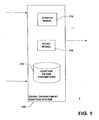
- the system 100 includes a speech model 110, a noise model 120 and adaptive filter parameters 130.
- the system 100 provides a technique that can enhance signals, for example to improve the quality of speech that is acquired by microphones (not shown) by reducing reverberation and/or noise.
- the system 100 employs probabilistic modeling to perform signal enhancement of a plurality of frequency-transformed input signals.
- the system 100 incorporates information about the statistical structure of speech signal(s) using the speech model 110, which can be pre-trained on a large dataset of clean speech.
- the speech model 110 is thus a component of the model 100 that describes observed sensor signals.
- the system 100 is parameterized by the adaptive filter parameters 130 (e.g., associated with reverberation) and the noise model 120 (e.g., associated with the spectra of sensor noise).
- the system 100 can utilize an expectation maximization (EM) algorithm that facilitates estimation (modification) of the adaptive filter parameters 130 and provides an enhanced output signal (e.g., Bayes optimal estimation of the original speech signal).
- EM expectation maximization
- the speech model 110 statistically characterizes clean speech signals (e.g., without noise and/or reverberation effect(s)).
- the speech model 110 can be a mixture model or a hidden Markov model (HMM).
- HMM hidden Markov model
- the speech model 110 can be trained offline, for example, on a large dataset of clean speech.
- the speech model 110 S for a signal having speech frames X m can be described by a C-component Gaussian mixture model.
- This Gaussian has a diagonal covariance matrix with 1/ A s [ k ] on the diagonal, leading to the interpretation of the precisions as the inverse spectrum of component s , since E (
- the mixture distribution p ( X m ) is given by ⁇ s p ( X m
- the speech model 110 is trained offline on a large speech database including 150 male and female speakers reading sentences from the Wall Street Journal (see H. Attias, L. Deng, A. Acero, J.C. Platt (2001), A new method for speech denoising using probabilistic models for clean speech and for noise, Proc. Eurospeech 2001).
- the noise model 120 U models noise recorded at the input sensors (e.g., microphones).
- a colored zero-mean Gaussian model with spectrum 1/ B i [ k ] is used: Equation (10) assumes that the noise signals at different sensors are uncorrelated; however, this assumption can be easily relaxed. Conventional noise cancellation algorithms typically rely on noise correlation between sensors.
- the noise model 120 U implies the distribution of the sensor signals conditioned on the original speech signal.
- the noise model 120 can be estimated offline, from quiet moments in the noisy signal and/or online using expectation maximization on the full microphone signal ( e.g ., not just the quiet periods).
- the complete data distribution of the system 100 is obtained: whose factors are specified by equation (9) and equation (12).
- the system 100 combines the speech model 110 with the noise model 120 to create a overall model for the observed sensor signals.
- the resulting model is a hidden variable model, where the original speech signal and speech state are the hidden (unobserved) variables, and the sensor signals are the data (observed) variables.
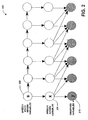
- Fig. 2 a graphical model 200 representation of components of the system 100 is illustrated.
- the graphical model 200 includes observed variables (y) 210, speech state hidden variables (s) 220 and speech hidden variables (x) 230.
- the model 100 utilizes the adaptive filter parameters 130 ( H i / m [ k ]) to provide an enhanced signal output (e.g., Bayes optimal estimator of the original speech signal) based on a plurality of frequency transformed input signals.
- the adaptive filter parameters 130 are modified based, at least in part, upon the speech model 110, the noise model 120 and/or the enhanced signal output.
- an EM algorithm is employed to estimate the adaptive filter parameters 130 ( H i / m [k]) and/or the noise spectra B i [k] from the observed sensor data Y.
- the EM algorithm also computes the required sufficient statistics (SS) and the speech signal estimator X and m [k] (e.g., the enhanced signal output).
- Each iteration in the EM algorithm consists of an expectation step (or E-step) and a maximization step (or M-step). For each iteration, the algorithm gradually improves the parameterization until convergence.
- the EM algorithm may be performed as many EM iterations as necessary (e.g., to substantial convergence).
- EM algorithm may be performed as many EM iterations as necessary (e.g., to substantial convergence).
- an EM algorithm that uses a systematic approximation to compute the SS is employed with the system 100.
- the effect of the approximation is to introduce an additional iterative procedure nested within the E-step. This approximation is based on variational techniques. Details of the EM algorithm are set forth infra.
- S m s,Y )-
- S m s,Y) .
- the mean of the speech signal X and m conditioned on the observed data Y is computed: which serves as the speech estimator (e.g. , enhanced signal output).
- the autocorrelation of the mean of the speech signal, ⁇ m [ k ] and its cross correlation with the data ⁇ m [ k ] are also computed:
- the E-step equations can be solved iteratively since the ⁇ sm and the ⁇ sm are nonlinearly coupled.
- condition F (equation (23)) as a function of the adaptive filter parameters 130.
- the derivative is computed by considering the complete-data likelihood log p ( Y,X,S ), computing its own derivative, and averaging over X and S with respect to q ( X,S ) computed in the E-step which results in equation (19).
- the algorithm has been tested using 10 sentences from the Wall Street Journal dataset referenced above, working at a 16kHz sampling rate.
- Real room, 2000 tap filters, whose impulse responses have been measured separately using a microphone array were used.
- Noise signals recorded in an office containing a PC and air conditioning were used.
- two microphone signals were created by convolving it with two different filters and adding two noise signals at 10dB SNR (relative to the convolved signals).
- the algorithm was applied to the microphone signals using a random parameter initialization. After estimating the filter and noise parameters and the original speech signal for each sentence, the SNR improvement was computed. Averaging over sentences, an improvement of the SNR to13.9dB has been obtained.
- Fig. 1 is a block diagram illustrating components for the signal enhancement adaptive model 100
- the signal enhancement adaptive model 100, the speech model 110, the noise model 120 and/or the adaptive filter parameters 130 can be implemented as one or more computer components, as that term is defined herein.
- computer executable components operable to implement the signal enhancement adaptive model 100, the speech model 110, the noise model 120 and/or the adaptive filter parameters 130 can be stored on computer readable media including, but not limited to, an ASIC (application specific integrated circuit), CD (compact disc), DVD (digital video disk), ROM (read only memory), floppy disk, hard disk, EEPROM (electrically erasable programmable read only memory) and memory stick in accordance with the present invention.
- ASIC application specific integrated circuit
- CD compact disc
- DVD digital video disk
- ROM read only memory
- floppy disk floppy disk
- hard disk hard disk
- EEPROM electrically erasable programmable read only memory
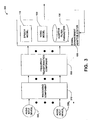
- the system 300 includes a signal enhancement adaptive system 100 (e.g., subsystem of the overall system 300), a windowing component 310, a frequency transformation component 320 and/or a first audio input device 330 I through an Rth audio input device 330 R , R being an integer greater to or equal to two.
- the first audio input device 330 I through the Rth audio input device 330 R can be collectively referred to as the audio input devices 330.
- the windowing component 310 facilitates obtaining subband signals by applying an N-point window to input signals, for example, received from the audio input devices 330.
- the windowing component 310 provides a windowed signal output.
- the frequency transformation component 320 receives the windowed signal output from the windowing component 310 and computes a frequency transform of the windowed signal.
- a Fast Fourier Transform (FFT) of the windowed signal will be used; however, it is to be appreciated that the frequency transformation component 320 can perform any type of frequency transform suitable for carrying out the present invention can be employed and all such types of frequency transforms are intended to fall within the scope of the hereto appended claims.
- FFT Fast Fourier Transform
- the frequency transformation component 320 provides frequency transformed, windowed signals to the signal enhancement adaptive model 100 which provides an enhanced signal output as discussed previously.
- program modules include routines, programs, objects, data structures, etc. that perform particular tasks or implement particular abstract data types.
- functionality of the program modules may be combined or distributed as desired in various embodiments.
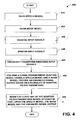
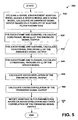
- a method 400 for speech signal enhancement in accordance with an aspect of the present invention is illustrated.
- a speech model is trained (e.g., speech model 110).
- a noise model is trained (e.g., noise model 120).
- a plurality of input signals are received (e.g., by a windowing component 310).
- the input signals are windowed (e.g., by the windowing component 310).
- the windowed input signals are frequency transformed (e.g., by a frequency transformation component 320).
- an enhanced signal output based on a plurality of adaptive filter parameters is provided.
- at least one of the plurality of adaptive filter parameters is modified based, at least in part, upon the speech model, the noise model and the enhanced signal output.
- an enhanced signal output is calculated based on a plurality of adaptive filter parameters (e.g., utilizing a signal enhancement adaptive filter having a speech model and a noise model, for example, the signal enhancement adaptive filter 100).
- a conditional mean of the enhanced signal output is calculated (e.g., using equation (14)).
- a conditional precision of the enhanced signal output is calculated (e.g., using equation (14)).
- a conditional probability of the speech model is calculated (e.g., using equation (14)).
- an autocorrelation of the enhanced signal output is calculated (e.g., using equation (16)).
- a cross correlation of the enhanced signal output is calculated (e.g., using equation (16)).
- at least one of the adaptive filter,parameters is modified based on the autocorrelation and cross correlation of the enhanced signal output (e.g., using equations 17, 18 and 19).
- system and/or method of the present invention can be utilized in an overall signal enhancement system. Further, those skilled in the art will recognize that the system and/or method of the present invention can be employed in a vast array of acoustic applications, including, but not limited to, teleconferencing and/or speech recognition.
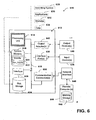
- Fig. 6 and the following discussion are intended to provide a brief, general description of a suitable operating environment 610 in which various aspects of the present invention may be implemented. While the invention is described in the general context of computer-executable instructions, such as program modules, executed by one or more computers or other devices, those skilled in the art will recognize that the invention can also be implemented in combination with other program modules and/or as a combination of hardware and software. Generally, however, program modules include routines, programs, objects, components, data structures, etc. that perform particular tasks or implement particular data types.
- the operating environment 610 is only one example of a suitable operating environment and is not intended to suggest any limitation as to the scope of use or functionality of the invention.
- an exemplary environment 610 for implementing various aspects of the invention includes a computer 612.
- the computer 612 includes a processing unit 614, a system memory 616, and a system bus 618.
- the system bus 618 couples system components including, but not limited to, the system memory 616 to the processing unit 614.
- the processing unit 614 can be any of various available processors. Dual microprocessors and other multiprocessor architectures also can be employed as the processing unit 614.
- the system bus 618 can be any of several types of bus structure(s) including the memory bus or memory controller, a peripheral bus or external bus, and/or a local bus using any variety of available bus architectures including, but not limited to, 6-bit bus, Industrial Standard Architecture (ISA), Micro-Channel Architecture (MSA), Extended ISA (EISA), Intelligent Drive Electronics (IDE), VESA Local Bus (VLB), Peripheral Component Interconnect (PCI), Universal Serial Bus (USB), Advanced Graphics Port (AGP), Personal Computer Memory Card International Association bus (PCMCIA), and Small Computer Systems Interface (SCSI).
- ISA Industrial Standard Architecture
- MSA Micro-Channel Architecture
- EISA Extended ISA
- IDE Intelligent Drive Electronics
- VLB VESA Local Bus
- PCI Peripheral Component Interconnect
- USB Universal Serial Bus
- AGP Advanced Graphics Port
- PCMCIA Personal Computer Memory Card International Association bus
- SCSI Small Computer Systems Interface
- the system memory 616 includes volatile memory 620 and nonvolatile memory 622.
- the basic input/output system (BIOS) containing the basic routines to transfer information between elements within the computer 612, such as during start-up, is stored in nonvolatile memory 622.
- nonvolatile memory 622 can include read only memory (ROM), programmable ROM (PROM), electrically programmable ROM (EPROM), electrically erasable ROM (EEPROM), or flash memory.
- Volatile memory 620 includes random access memory (RAM), which acts as external cache memory.
- RAM is available in many forms such as synchronous RAM (SRAM), dynamic RAM (DRAM), synchronous DRAM (SDRAM), double data rate SDRAM (DDR SDRAM), enhanced SDRAM (ESDRAM), Synchlink DRAM (SLDRAM), and direct Rambus RAM (DRRAM).
- SRAM synchronous RAM
- DRAM dynamic RAM
- SDRAM synchronous DRAM
- DDR SDRAM double data rate SDRAM
- ESDRAM enhanced SDRAM
- SLDRAM Synchlink DRAM
- DRRAM direct Rambus RAM
- Disk storage 624 includes, but is not limited to, devices like a magnetic disk drive, floppy disk drive, tape drive, Jaz drive, Zip drive, LS-100 drive, flash memory card, or memory stick.
- disk storage 624 can include storage media separately or in combination with other storage media including, but not limited to, an optical disk drive such as a compact disk ROM device (CD-ROM), CD recordable drive (CD-R Drive), CD rewritable drive (CD-RW Drive) or a digital versatile disk ROM drive (DVD-ROM).
- an optical disk drive such as a compact disk ROM device (CD-ROM), CD recordable drive (CD-R Drive), CD rewritable drive (CD-RW Drive) or a digital versatile disk ROM drive (DVD-ROM).
- a removable or non-removable interface is typically used such as interface 626.
- Fig 6 describes software that acts as an intermediary between users and the basic computer resources described in suitable operating environment 610.
- Such software includes an operating system 628.
- Operating system 628 which can be stored on disk storage 624, acts to control and allocate resources of the computer system 612.
- System applications 630 take advantage of the management of resources by operating system 628 through program modules 632 and program data 634 stored either in system memory 616 or on disk storage 624. It is to be appreciated that the present invention can be implemented with various operating systems or combinations of operating systems.
- a user enters commands or information into the computer 612 through input device(s) 636.
- Input devices 636 include, but are not limited to, a pointing device such as a mouse, trackball, stylus, touch pad, keyboard, microphone, joystick, game pad, satellite dish, scanner, TV tuner card, digital camera, digital video camera, web camera, and the like. These and other input devices connect to the processing unit 614 through the system bus 618 via interface port(s) 638.
- Interface port(s) 638 include, for example, a serial port, a parallel port, a game port, and a universal serial bus (USB).
- Output device(s) 640 use some of the same type of ports as input device(s) 636.
- a USB port may be used to provide input to computer 612, and to output information from computer 612 to an output device 640.
- Output adapter 642 is provided to illustrate that there are some output devices 640 like monitors, speakers, and printers among other output devices 640 that require special adapters.
- the output adapters 642 include, by way of illustration and not limitation, video and sound cards that provide a means of connection between the output device 640 and the system bus 618. It should be noted that other devices and/or systems of devices provide both input and output capabilities such as remote computer(s) 644.
- Computer 612 can operate in a networked environment using logical connections to one or more remote computers, such as remote computer(s) 644.
- the remote computer(s) 644 can be a personal computer, a server, a router, a network PC, a workstation, a microprocessor based appliance, a peer device or other common network node and the like, and typically includes many or all of the elements described relative to computer 612. For purposes of brevity, only a memory storage device 646 is illustrated with remote computer(s) 644.
- Remote computer(s) 644 is logically connected to computer 612 through a network interface 648 and then physically connected via communication connection 650.
- Network interface 648 encompasses communication networks such as local-area networks (LAN) and wide-area networks (WAN).
- LAN technologies include Fiber Distributed Data Interface (FDDI), Copper Distributed Data Interface (CDDI), Ethernet/IEEE 602.3, Token Ring/IEEE 602.5 and the like.
- WAN technologies include, but are not limited to, point-to-point links, circuit switching networks like Integrated Services Digital Networks (ISDN) and variations thereon, packet switching networks, and Digital Subscriber Lines (DSL).
- ISDN Integrated Services Digital Networks
- DSL Digital Subscriber Lines
- Communication connection(s) 650 refers to the hardware/software employed to connect the network interface 648 to the bus 618. While communication connection 650 is shown for illustrative clarity inside computer 612, it can also be external to computer 612.
- the hardware/software necessary for connection to the network interface 648 includes, for exemplary purposes only, internal and external technologies such as, modems including regular telephone grade modems, cable modems and DSL modems, ISDN adapters, and Ethernet cards.
Landscapes
- Engineering & Computer Science (AREA)
- Computational Linguistics (AREA)
- Quality & Reliability (AREA)
- Signal Processing (AREA)
- Health & Medical Sciences (AREA)
- Audiology, Speech & Language Pathology (AREA)
- Human Computer Interaction (AREA)
- Physics & Mathematics (AREA)
- Acoustics & Sound (AREA)
- Multimedia (AREA)
- Circuit For Audible Band Transducer (AREA)
Applications Claiming Priority (2)
| Application Number | Priority Date | Filing Date | Title |
|---|---|---|---|
| US183267 | 1994-01-19 | ||
| US10/183,267 US7103541B2 (en) | 2002-06-27 | 2002-06-27 | Microphone array signal enhancement using mixture models |
Publications (1)
| Publication Number | Publication Date |
|---|---|
| EP1376540A2 true EP1376540A2 (de) | 2004-01-02 |
Family
ID=29717933
Family Applications (1)
| Application Number | Title | Priority Date | Filing Date |
|---|---|---|---|
| EP03006811A Withdrawn EP1376540A2 (de) | 2002-06-27 | 2003-03-26 | Verbesserung eines Mikrofonanordnungssignals unter Verwendung von Mischmodellen |
Country Status (2)
| Country | Link |
|---|---|
| US (1) | US7103541B2 (de) |
| EP (1) | EP1376540A2 (de) |
Cited By (4)
| Publication number | Priority date | Publication date | Assignee | Title |
|---|---|---|---|---|
| RU2420813C2 (ru) * | 2005-06-28 | 2011-06-10 | Майкрософт Корпорейшн | Повышение качества речи с использованием множества датчиков с помощью модели состояний речи |
| EP2013869A4 (de) * | 2006-05-01 | 2012-06-20 | Nippon Telegraph & Telephone | Verfahren und anordnung sprachenthallung basiert auf wahrscheinlichkeits quelmodellen und raumakoustik |
| WO2013111476A1 (en) * | 2012-01-27 | 2013-08-01 | Mitsubishi Electric Corporation | Method for enhancing speech in mixed signal |
| CN106331969A (zh) * | 2015-07-01 | 2017-01-11 | 奥迪康有限公司 | 基于统计语音和噪声模型的有噪声语音的增强 |
Families Citing this family (54)
| Publication number | Priority date | Publication date | Assignee | Title |
|---|---|---|---|---|
| US7194752B1 (en) | 1999-10-19 | 2007-03-20 | Iceberg Industries, Llc | Method and apparatus for automatically recognizing input audio and/or video streams |
| US7174293B2 (en) * | 1999-09-21 | 2007-02-06 | Iceberg Industries Llc | Audio identification system and method |
| US7165028B2 (en) * | 2001-12-12 | 2007-01-16 | Texas Instruments Incorporated | Method of speech recognition resistant to convolutive distortion and additive distortion |
| US7209881B2 (en) * | 2001-12-20 | 2007-04-24 | Matsushita Electric Industrial Co., Ltd. | Preparing acoustic models by sufficient statistics and noise-superimposed speech data |
| JP2004325897A (ja) * | 2003-04-25 | 2004-11-18 | Pioneer Electronic Corp | 音声認識装置及び音声認識方法 |
| US7729908B2 (en) * | 2005-03-04 | 2010-06-01 | Panasonic Corporation | Joint signal and model based noise matching noise robustness method for automatic speech recognition |
| JP4765461B2 (ja) * | 2005-07-27 | 2011-09-07 | 日本電気株式会社 | 雑音抑圧システムと方法及びプログラム |
| US7590530B2 (en) * | 2005-09-03 | 2009-09-15 | Gn Resound A/S | Method and apparatus for improved estimation of non-stationary noise for speech enhancement |
| US7720681B2 (en) * | 2006-03-23 | 2010-05-18 | Microsoft Corporation | Digital voice profiles |
| US9462118B2 (en) * | 2006-05-30 | 2016-10-04 | Microsoft Technology Licensing, Llc | VoIP communication content control |
| US8971217B2 (en) * | 2006-06-30 | 2015-03-03 | Microsoft Technology Licensing, Llc | Transmitting packet-based data items |
| KR100853171B1 (ko) | 2007-02-28 | 2008-08-20 | 포항공과대학교 산학협력단 | 구속 순차 em 알고리즘을 이용한 깨끗한 음성 복원을위한 음성 강조 방법 |
| US7626889B2 (en) * | 2007-04-06 | 2009-12-01 | Microsoft Corporation | Sensor array post-filter for tracking spatial distributions of signals and noise |
| US8694310B2 (en) * | 2007-09-17 | 2014-04-08 | Qnx Software Systems Limited | Remote control server protocol system |
| US8180637B2 (en) * | 2007-12-03 | 2012-05-15 | Microsoft Corporation | High performance HMM adaptation with joint compensation of additive and convolutive distortions |
| JP5642339B2 (ja) * | 2008-03-11 | 2014-12-17 | トヨタ自動車株式会社 | 信号分離装置及び信号分離方法 |
| US8527266B2 (en) * | 2008-03-21 | 2013-09-03 | Tokyo University Of Science Educational Foundation Administrative Organization | Noise suppression device and noise suppression method |
| CN102046272B (zh) * | 2008-06-06 | 2013-08-28 | 日东电工株式会社 | 膜过滤装置管理系统及其采用的膜过滤装置、以及膜过滤装置管理方法 |
| US9390167B2 (en) | 2010-07-29 | 2016-07-12 | Soundhound, Inc. | System and methods for continuous audio matching |
| DK2306449T3 (da) * | 2009-08-26 | 2013-03-18 | Oticon As | Fremgangsmåde til korrektion af fejl i binære masker, der repræsenterer tale |
| FR2950461B1 (fr) * | 2009-09-22 | 2011-10-21 | Parrot | Procede de filtrage optimise des bruits non stationnaires captes par un dispositif audio multi-microphone, notamment un dispositif telephonique "mains libres" pour vehicule automobile |
| US8533355B2 (en) * | 2009-11-02 | 2013-09-10 | International Business Machines Corporation | Techniques for improved clock offset measuring |
| US9047371B2 (en) | 2010-07-29 | 2015-06-02 | Soundhound, Inc. | System and method for matching a query against a broadcast stream |
| GB2484140B (en) | 2010-10-01 | 2017-07-12 | Asio Ltd | Data communication system |
| US8712180B2 (en) * | 2011-01-17 | 2014-04-29 | Stc.Unm | System and methods for random parameter filtering |
| US9035163B1 (en) | 2011-05-10 | 2015-05-19 | Soundbound, Inc. | System and method for targeting content based on identified audio and multimedia |
| FR2976710B1 (fr) * | 2011-06-20 | 2013-07-05 | Parrot | Procede de debruitage pour equipement audio multi-microphones, notamment pour un systeme de telephonie "mains libres" |
| TWI442384B (zh) | 2011-07-26 | 2014-06-21 | Ind Tech Res Inst | 以麥克風陣列為基礎之語音辨識系統與方法 |
| US8689255B1 (en) | 2011-09-07 | 2014-04-01 | Imdb.Com, Inc. | Synchronizing video content with extrinsic data |
| TWI459381B (zh) | 2011-09-14 | 2014-11-01 | Ind Tech Res Inst | 語音增強方法 |
| US10957310B1 (en) | 2012-07-23 | 2021-03-23 | Soundhound, Inc. | Integrated programming framework for speech and text understanding with meaning parsing |
| US8955021B1 (en) | 2012-08-31 | 2015-02-10 | Amazon Technologies, Inc. | Providing extrinsic data for video content |
| US9113128B1 (en) | 2012-08-31 | 2015-08-18 | Amazon Technologies, Inc. | Timeline interface for video content |
| US9389745B1 (en) | 2012-12-10 | 2016-07-12 | Amazon Technologies, Inc. | Providing content via multiple display devices |
| CN103971680B (zh) * | 2013-01-24 | 2018-06-05 | 华为终端(东莞)有限公司 | 一种语音识别的方法、装置 |
| CN103065631B (zh) * | 2013-01-24 | 2015-07-29 | 华为终端有限公司 | 一种语音识别的方法、装置 |
| US10424009B1 (en) | 2013-02-27 | 2019-09-24 | Amazon Technologies, Inc. | Shopping experience using multiple computing devices |
| US11019300B1 (en) | 2013-06-26 | 2021-05-25 | Amazon Technologies, Inc. | Providing soundtrack information during playback of video content |
| US9507849B2 (en) | 2013-11-28 | 2016-11-29 | Soundhound, Inc. | Method for combining a query and a communication command in a natural language computer system |
| US9292488B2 (en) | 2014-02-01 | 2016-03-22 | Soundhound, Inc. | Method for embedding voice mail in a spoken utterance using a natural language processing computer system |
| US11295730B1 (en) | 2014-02-27 | 2022-04-05 | Soundhound, Inc. | Using phonetic variants in a local context to improve natural language understanding |
| US9838740B1 (en) | 2014-03-18 | 2017-12-05 | Amazon Technologies, Inc. | Enhancing video content with personalized extrinsic data |
| US9564123B1 (en) | 2014-05-12 | 2017-02-07 | Soundhound, Inc. | Method and system for building an integrated user profile |
| US9837102B2 (en) * | 2014-07-02 | 2017-12-05 | Microsoft Technology Licensing, Llc | User environment aware acoustic noise reduction |
| US9398367B1 (en) * | 2014-07-25 | 2016-07-19 | Amazon Technologies, Inc. | Suspending noise cancellation using keyword spotting |
| US9961435B1 (en) | 2015-12-10 | 2018-05-01 | Amazon Technologies, Inc. | Smart earphones |
| GB201617408D0 (en) | 2016-10-13 | 2016-11-30 | Asio Ltd | A method and system for acoustic communication of data |
| US12341931B2 (en) | 2016-10-13 | 2025-06-24 | Sonos Experience Limited | Method and system for acoustic communication of data |
| GB201617409D0 (en) | 2016-10-13 | 2016-11-30 | Asio Ltd | A method and system for acoustic communication of data |
| GB201704636D0 (en) | 2017-03-23 | 2017-05-10 | Asio Ltd | A method and system for authenticating a device |
| GB2565751B (en) | 2017-06-15 | 2022-05-04 | Sonos Experience Ltd | A method and system for triggering events |
| CN107204192B (zh) * | 2017-06-05 | 2020-10-09 | 歌尔科技有限公司 | 语音测试方法、语音增强方法及装置 |
| GB2570634A (en) | 2017-12-20 | 2019-08-07 | Asio Ltd | A method and system for improved acoustic transmission of data |
| US11988784B2 (en) | 2020-08-31 | 2024-05-21 | Sonos, Inc. | Detecting an audio signal with a microphone to determine presence of a playback device |
Family Cites Families (13)
| Publication number | Priority date | Publication date | Assignee | Title |
|---|---|---|---|---|
| US4811404A (en) * | 1987-10-01 | 1989-03-07 | Motorola, Inc. | Noise suppression system |
| DE69428119T2 (de) * | 1993-07-07 | 2002-03-21 | Picturetel Corp., Peabody | Verringerung des hintergrundrauschens zur sprachverbesserung |
| US5574824A (en) * | 1994-04-11 | 1996-11-12 | The United States Of America As Represented By The Secretary Of The Air Force | Analysis/synthesis-based microphone array speech enhancer with variable signal distortion |
| US5544250A (en) * | 1994-07-18 | 1996-08-06 | Motorola | Noise suppression system and method therefor |
| US6001131A (en) * | 1995-02-24 | 1999-12-14 | Nynex Science & Technology, Inc. | Automatic target noise cancellation for speech enhancement |
| US5878389A (en) * | 1995-06-28 | 1999-03-02 | Oregon Graduate Institute Of Science & Technology | Method and system for generating an estimated clean speech signal from a noisy speech signal |
| FR2748342B1 (fr) * | 1996-05-06 | 1998-07-17 | France Telecom | Procede et dispositif de filtrage par egalisation d'un signal de parole, mettant en oeuvre un modele statistique de ce signal |
| US6453327B1 (en) * | 1996-06-10 | 2002-09-17 | Sun Microsystems, Inc. | Method and apparatus for identifying and discarding junk electronic mail |
| EP0814458B1 (de) * | 1996-06-19 | 2004-09-22 | Texas Instruments Incorporated | Verbesserungen bei oder in Bezug auf Sprachkodierung |
| US7117358B2 (en) * | 1997-07-24 | 2006-10-03 | Tumbleweed Communications Corp. | Method and system for filtering communication |
| US6910011B1 (en) * | 1999-08-16 | 2005-06-21 | Haman Becker Automotive Systems - Wavemakers, Inc. | Noisy acoustic signal enhancement |
| US6757830B1 (en) * | 2000-10-03 | 2004-06-29 | Networks Associates Technology, Inc. | Detecting unwanted properties in received email messages |
| US20060265498A1 (en) | 2002-12-26 | 2006-11-23 | Yehuda Turgeman | Detection and prevention of spam |
-
2002
- 2002-06-27 US US10/183,267 patent/US7103541B2/en not_active Expired - Fee Related
-
2003
- 2003-03-26 EP EP03006811A patent/EP1376540A2/de not_active Withdrawn
Cited By (7)
| Publication number | Priority date | Publication date | Assignee | Title |
|---|---|---|---|---|
| RU2420813C2 (ru) * | 2005-06-28 | 2011-06-10 | Майкрософт Корпорейшн | Повышение качества речи с использованием множества датчиков с помощью модели состояний речи |
| EP2013869A4 (de) * | 2006-05-01 | 2012-06-20 | Nippon Telegraph & Telephone | Verfahren und anordnung sprachenthallung basiert auf wahrscheinlichkeits quelmodellen und raumakoustik |
| US8290170B2 (en) | 2006-05-01 | 2012-10-16 | Nippon Telegraph And Telephone Corporation | Method and apparatus for speech dereverberation based on probabilistic models of source and room acoustics |
| WO2013111476A1 (en) * | 2012-01-27 | 2013-08-01 | Mitsubishi Electric Corporation | Method for enhancing speech in mixed signal |
| CN106331969A (zh) * | 2015-07-01 | 2017-01-11 | 奥迪康有限公司 | 基于统计语音和噪声模型的有噪声语音的增强 |
| EP3118851A1 (de) * | 2015-07-01 | 2017-01-18 | Oticon A/s | Verbesserung von verrauschter sprache auf basis statistischer sprach- und rauschmodelle |
| US10262675B2 (en) | 2015-07-01 | 2019-04-16 | Oticon A/S | Enhancement of noisy speech based on statistical speech and noise models |
Also Published As
| Publication number | Publication date |
|---|---|
| US7103541B2 (en) | 2006-09-05 |
| US20040002858A1 (en) | 2004-01-01 |
Similar Documents
| Publication | Publication Date | Title |
|---|---|---|
| US7103541B2 (en) | Microphone array signal enhancement using mixture models | |
| EP0886263B1 (de) | An Umgebungsgeräusche angepasste Sprachverarbeitung | |
| CN111445919B (zh) | 结合ai模型的语音增强方法、系统、电子设备和介质 | |
| US7725314B2 (en) | Method and apparatus for constructing a speech filter using estimates of clean speech and noise | |
| EP0689194B1 (de) | Verfahren und Vorrichtung zur Signalerkennung unter Kompensation von Fehlzusammensetzungen | |
| CN110634497B (zh) | 降噪方法、装置、终端设备及存储介质 | |
| Wan et al. | Dual extended Kalman filter methods | |
| KR100549133B1 (ko) | 노이즈 감소 방법 및 장치 | |
| EP0807305B1 (de) | Verfahren zur rauschunterdrückung mittels spektraler subtraktion | |
| EP1377057A2 (de) | Sprecherdetektion und Nachführung mit audiovisuellen Daten | |
| US20030206640A1 (en) | Microphone array signal enhancement | |
| EP1398762A1 (de) | Nichtlineares Modell zur Geräuschunterdrückung von verzerrten Signalen | |
| CN110998723B (zh) | 使用神经网络的信号处理装置及信号处理方法、记录介质 | |
| KR20060048954A (ko) | 다감각 음성 향상을 위한 방법 및 장치 | |
| US6662160B1 (en) | Adaptive speech recognition method with noise compensation | |
| CN101853661B (zh) | 基于非监督学习的噪声谱估计与语音活动度检测方法 | |
| Astudillo et al. | Computing MMSE estimates and residual uncertainty directly in the feature domain of ASR using STFT domain speech distortion models | |
| US7707029B2 (en) | Training wideband acoustic models in the cepstral domain using mixed-bandwidth training data for speech recognition | |
| EP1891624A2 (de) | Multisensorische sprachverstärkung unter verwendung eines sprachstatusmodells | |
| Wang et al. | RVAE-EM: Generative speech dereverberation based on recurrent variational auto-encoder and convolutive transfer function | |
| CN118899005A (zh) | 一种音频信号处理方法、装置、计算机设备及存储介质 | |
| US7454338B2 (en) | Training wideband acoustic models in the cepstral domain using mixed-bandwidth training data and extended vectors for speech recognition | |
| US20040093194A1 (en) | Tracking noise via dynamic systems with a continuum of states | |
| WO2025007866A1 (zh) | 语音增强方法、装置、电子设备及存储介质 | |
| US20050114117A1 (en) | Method and apparatus for high resolution speech reconstruction |
Legal Events
| Date | Code | Title | Description |
|---|---|---|---|
| PUAI | Public reference made under article 153(3) epc to a published international application that has entered the european phase |
Free format text: ORIGINAL CODE: 0009012 |
|
| AK | Designated contracting states |
Kind code of ref document: A2 Designated state(s): AT BE BG CH CY CZ DE DK EE ES FI FR GB GR HU IE IT LI LU MC NL PT RO SE SI SK TR |
|
| AX | Request for extension of the european patent |
Extension state: AL LT LV MK RO |
|
| STAA | Information on the status of an ep patent application or granted ep patent |
Free format text: STATUS: THE APPLICATION IS DEEMED TO BE WITHDRAWN |
|
| 18D | Application deemed to be withdrawn |
Effective date: 20051001 |