EP1376536A1 - Sound processing apparatus - Google Patents
Sound processing apparatus Download PDFInfo
- Publication number
- EP1376536A1 EP1376536A1 EP02708744A EP02708744A EP1376536A1 EP 1376536 A1 EP1376536 A1 EP 1376536A1 EP 02708744 A EP02708744 A EP 02708744A EP 02708744 A EP02708744 A EP 02708744A EP 1376536 A1 EP1376536 A1 EP 1376536A1
- Authority
- EP
- European Patent Office
- Prior art keywords
- cluster
- voice
- voice recognition
- recognition apparatus
- dictionary
- Prior art date
- Legal status (The legal status is an assumption and is not a legal conclusion. Google has not performed a legal analysis and makes no representation as to the accuracy of the status listed.)
- Withdrawn
Links
Images




Classifications
-
- G—PHYSICS
- G10—MUSICAL INSTRUMENTS; ACOUSTICS
- G10L—SPEECH ANALYSIS TECHNIQUES OR SPEECH SYNTHESIS; SPEECH RECOGNITION; SPEECH OR VOICE PROCESSING TECHNIQUES; SPEECH OR AUDIO CODING OR DECODING
- G10L15/00—Speech recognition
- G10L15/06—Creation of reference templates; Training of speech recognition systems, e.g. adaptation to the characteristics of the speaker's voice
-
- G—PHYSICS
- G10—MUSICAL INSTRUMENTS; ACOUSTICS
- G10L—SPEECH ANALYSIS TECHNIQUES OR SPEECH SYNTHESIS; SPEECH RECOGNITION; SPEECH OR VOICE PROCESSING TECHNIQUES; SPEECH OR AUDIO CODING OR DECODING
- G10L15/00—Speech recognition
- G10L15/06—Creation of reference templates; Training of speech recognition systems, e.g. adaptation to the characteristics of the speaker's voice
- G10L15/063—Training
-
- G—PHYSICS
- G10—MUSICAL INSTRUMENTS; ACOUSTICS
- G10L—SPEECH ANALYSIS TECHNIQUES OR SPEECH SYNTHESIS; SPEECH RECOGNITION; SPEECH OR VOICE PROCESSING TECHNIQUES; SPEECH OR AUDIO CODING OR DECODING
- G10L15/00—Speech recognition
- G10L15/04—Segmentation; Word boundary detection
-
- G—PHYSICS
- G10—MUSICAL INSTRUMENTS; ACOUSTICS
- G10L—SPEECH ANALYSIS TECHNIQUES OR SPEECH SYNTHESIS; SPEECH RECOGNITION; SPEECH OR VOICE PROCESSING TECHNIQUES; SPEECH OR AUDIO CODING OR DECODING
- G10L15/00—Speech recognition
- G10L15/06—Creation of reference templates; Training of speech recognition systems, e.g. adaptation to the characteristics of the speaker's voice
- G10L15/063—Training
- G10L2015/0631—Creating reference templates; Clustering
Definitions
- the present invention relates to a voice recognition apparatus, and more particularly, to a voice recognition apparatus capable of easily updating a dictionary in which a word or a phrase to be recognized is registered.
- recognition of a voice uttered by a user is performedby referring to a dictionary in which words to be recognized are registered.
- Japanese Unexamined Patent Application Publication No. 9-81181 discloses a voice recognition apparatus in which a garbage model for detecting an unregistered word and an HMM (Hidden Markov Model) associated with phonemes such as vowels are simultaneously used so as to limit phoneme sequences associated with the unregistered word thereby making it possible to detect the unregistered word without needing complicated calculations.
- HMM Hidden Markov Model
- Japanese Patent Application No. 11-245461 discloses an information processing apparatus in which when a word set including an unregistered word is given, the similarity between the unregistered word which is not included in a database and a word included in the database is calculated on the basis of the concepts of words, and a sequence of properly arranged words is produced and output.
- One typical method for dealing with an unregistered word is to, if an unregistered word is detected in an input voice, register the unregistered word into a dictionary and treat it as an registered word thereafter.
- a phoneme typewriter In order to register an unregistered word into a dictionary, it is required to first detect a voice period of that unregistered word and then recognize the phoneme sequence of the voice in the voice period.
- the recognition of the phoneme sequence of a voice can be accomplished, for example, by a method known as a phoneme typewriter.
- a phoneme sequence corresponding to an input voice is basically output using a garbage model which accepts any phonemic change.
- One method of clustering the phoneme sequence of an unregistered word is to input, by a user, an entry (for example, a pronunciation of the unregistered word) indicating the unregistered word and then cluster the phoneme sequence of the unregistered word into a cluster indicated by the that entry.
- an entry for example, a pronunciation of the unregistered word
- cluster the phoneme sequence of the unregistered word into a cluster indicated by the that entry the user has to do a troublesome task to input the entry.
- Another method is to produce a new cluster each time an unregistered word is detected such that the phoneme sequence of the unregistered word is clustered into the newly produced cluster.
- an entry corresponding to the new cluster is registered into a dictionary each time an unregistered word is detected, and thus the size of the dictionary increases as unregistered words are registered.
- a greater time and a greater amount of process are necessary in voice recognition performed thereafter.
- the present invention provides a voice recognition apparatus comprising cluster detection means for detecting, from existing clusters obtained by clustering voices, a cluster to which an input voice is to be added as a new member; cluster division means for employing the input voice as the new member of the cluster detected by the cluster detection means and dividing the cluster depending on members of the cluster; and update means for updating the dictionary on the basis of a result of division performed by the cluster division means.
- the present invention provides a voice recognition method comprising the steps of detecting, from existing clusters obtained by clustering voices, a cluster to which the input voice is to be added as a new member; employing the input voice as the new member of the cluster detected in the cluster detection step and dividing the cluster depending on members of the cluster; and updating the dictionary on the basis of a result of division performed in the cluster division step.
- the present invention provides a program comprising the steps of detecting, from existing clusters obtained by clustering voices, a cluster to which the input voice is to be added as a new member; employing the input voice as the new member of the cluster detected in the cluster detection step and dividing the cluster depending on members of the cluster; and updating the dictionary on the basis of a result of division performed in the cluster division step.
- the present invention provides a storage medium including a program, stored therein, comprising the steps of detecting, from existing clusters obtained by clustering voices, a cluster to which the input voice is to be added as a new member; employing the input voice as the new member of the cluster detected in the cluster detection step and dividing the cluster depending on members of the cluster; and updating the dictionary on the basis of a result of division performed in the cluster division step.
- a cluster to which an input voice is to be added as a new member is detected.
- the input voice is added as a new member to the detected cluster and the cluster is divided depending on the members of the cluster.
- the dictionary is updated.
- Fig. 1 shows an example of an outward structure of a robot according to an embodiment of the present invention
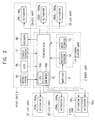
- Fig. 2 shows an example of an electric configuration thereof.
- the robot is constructed into the form of an animal having four legs, such as a dog, wherein leg units 3A, 3B, 3C, and 3D are attached, at respective four corners, to a body unit 2, and a head unit 4 and a tail unit 5 are attached, at front and bock ends, to the body unit 2.
- the tail unit 5 extends from a base 5B disposed on the upper surface of the body unit 2 such that the tail unit 5 can bend or shake with two degree of freedom.
- a controller 10 for generally controlling the robot a battery 11 serving as a power source of the robot, and an internal sensor unit 14 including a battery sensor 12 and a heat sensor 13.
- a microphone 15 serving as an ear
- a CCD (Charge Coupled Device) camera 16 serving as an eye
- a touch sensor 17 serving as a sense-of-touch sensor
- a speaker 18 serving as a mouth.
- a lower jaw unit 4A serving as a lower jaw of the mouth is attached to the head unit 4 such that the lower jaw unit 4A can move with one degree of freedom.
- the mouth of the robot can be opened and closed by moving the lower jaw unit 4A.
- actuators 3AA 1 to 3AA K , 3BA 1 to 3BA K , 3CA 1 to 3CA K , 3DA 1 to 3DA K , 4A 1 to 4A L , 5A 1 , and 5A 2 are respectively disposed in joints for joining parts of the leg units 3A to 3D, joints for joining the leg units 3A to 3D with the body unit 2, a joint for joining the head unit 4 with the body unit 2, a joint for joining the head unit 4 with the lower jaw unit 4A, and a joint for joining the tail unit 5 with the body unit 2.
- the microphone 15 disposed on the head unit 4 collects a voice (sound) including an utterance made by a user from the environment and transmits an obtained voice signal to the controller 10 .
- the CCD camera 16 takes an image of the environment and transmits an obtained image signal to the controller 10.
- the touch sensor 17 is disposed on an upper part of the head unit 4.
- the touch sensor 17 detects a pressure applied by the user as a physical action such as "rubbing” or “tapping” and transmits a pressure signal obtained as the result of the detection to the controller 10.
- the battery sensor 12 disposed in the body unit 2 detects the remaining capacity of the battery 11 and transmits the result of the detection as a battery remaining capacity signal to the controller 10.
- the heat sensor 13 detects heat in the inside of the robot and transmits information indicating the detected heat, as a heat signal, to the controller 10.
- the controller 10 detects a CPU (Central Processing Unit) 10A and a memory 10B.
- the controller 10 performs various processes by executing, using the CPU 10A, a control program stored in the memory 10B.
- CPU Central Processing Unit
- the controller 10 detects an environment state, a command given by a user, and an action of a user applied to the robot on the basis of the voice signal, the image signal, the pressure signal, the battery remaining capacity signal, and the heat signal supplied from the microphone 15, the CCD camera 16, the touch sensor 17, the battery sensor 12, and the heat sensor 13, respectively.
- the controller 10 makes a decision as to how to act.
- the controller 10 activates necessary actuators of those including actuators 3AA 1 to 3AA K , 3BA 1 to 3BA K , 3CA 1 to 3CA K , 3DA 1 to 3DA K , 4A 1 to 4A L , 5A 1 , and 5A 2 , so as to nod or shake the head unit 4 or open and close the lower jaw unit 4A.
- the controller 10 moves the tail unit 5 or makes the robot walk by moving the leg units 3A to 3D.
- the controller 10 produces synthesized voice data and supplies it to the speaker 18 thereby generating a voice, or turns on/off or blinks LEDs (Light Emitting Diode, not shown in the figures) disposed on the eyes of the robot.
- LEDs Light Emitting Diode, not shown in the figures
- the robot autonomously acts in response to the environmental conditions.
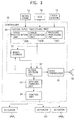
- Fig. 3 shows the functional structure of the controller 10 shown in Fig. 2. Note that the functional structure shown in Fig. 3 is realized by executing, using the CPU 10A, the control program stored in the memory 10B.
- the controller 10 includes a sensor input processing unit 50 for recognizing a specific external state, a model memory 51 for storing results of recognition performed by the sensor input processing unit 50 and representing a state of emotion, instinct, or growth, an action decision unit 52 for determining an action to be taken next in accordance with the result of recognition performed by the sensor input processing unit 50, an attitude change mechanism 53 for making the robot actually take an action in accordance with the decision made by the action decision unit 52, a control unit 54 for controlling actuators 3AA 1 to 5A 1 and 5A 2 , and a voice synthesis unit 55 for producing a synthesized voice.
- a sensor input processing unit 50 for recognizing a specific external state
- a model memory 51 for storing results of recognition performed by the sensor input processing unit 50 and representing a state of emotion, instinct, or growth
- an action decision unit 52 for determining an action to be taken next in accordance with the result of recognition performed by the sensor input processing unit 50
- an attitude change mechanism 53 for making the robot actually take an action in accordance with the decision made by
- the sensor input processing unit 50 detects specific external conditions, an action of a user applied to the robot, and a command given by the user, on the basis of the voice signal, the image signal, and the pressure signal supplied from the microphone 15, the CCD camera 16, and the touch sensor 17, respectively.
- Information indicating the detected conditions is supplied as state recognition information to the model memory 51 and the action decision unit 52.
- the sensor input processing unit 50 includes a voice recognition unit 50A for recognizing the voice signal supplied from the microphone 15. For example, if a given voice signal is recognized by the voice recognition unit 50A as a command such as "walk”, “lie down”, or “follow the ball", the recognized command is supplied as state recognition information from the voice recognition unit 50A to the model memory 51 and the action decision unit 52.
- a voice recognition unit 50A for recognizing the voice signal supplied from the microphone 15. For example, if a given voice signal is recognized by the voice recognition unit 50A as a command such as "walk”, “lie down”, or “follow the ball", the recognized command is supplied as state recognition information from the voice recognition unit 50A to the model memory 51 and the action decision unit 52.
- the sensor input processing unit 50 also includes an image recognition unit 50B for recognizing an image signal supplied from the CCD camera 16. For example, if the image recognition unit 50B detects, via the image recognition process, "something red and round” or a "plane extending vertical from the ground to a'height greater than a predetermined value", then the image recognition unit 50B supplies information indicating the recognized state of the environment such as "there is a ball” or "there is a wall” as state recognition information to the model memory 51 and the action decision unit 52.
- an image recognition unit 50B for recognizing an image signal supplied from the CCD camera 16. For example, if the image recognition unit 50B detects, via the image recognition process, "something red and round” or a "plane extending vertical from the ground to a'height greater than a predetermined value", then the image recognition unit 50B supplies information indicating the recognized state of the environment such as "there is a ball” or "there is a wall” as state recognition information to the model memory 51 and the action decision unit 52.
- the sensor input processing unit 50 further includes a pressure processing unit 50C for processing a detected pressure signal supplied from the touch sensor 17. For example, if the pressure processing unit 50C detects a pressure higher than a predetermined threshold for a short duration, the pressure processing unit 50C recognizes that the robot has been "tapped (scolded)". In a case in which the detected pressure is lower in magnitude than a predetermined threshold and long in duration, the pressure processing unit 50C recognizes that that the robot has been "rubbed (praised)". Information indicating the result of recognition is supplied as state recognition information to the model memory 51 and the action decision unit 52.
- the model memory 51 stores and manages an emotion model, an instinct model, and a growth model representing the states of the robot concerning emotion, instinct, and growth, respectively.
- the emotion model represents the state (degree) of emotion concerning, for example, “happiness”, “sadness”, “angriness”, and “pleasure” using values within predetermined ranges (for example, from -1.0 to 1.0), wherein the values are varied depending on the state recognition information supplied from the sensor input processing unit 50 and depending on the passage of time.
- the instinct model represents the state (degree) of instinct concerning, for example, “appetite”, “desire for sleep”, and “desire for exercise” using values within predetermined ranges, wherein the values are varied depending on the state recognition information supplied from the sensor input processing unit 50 and depending on the passage of time.
- the growth model represents the state (degree) of growth, such as “childhood”, “youth”, “middle age” and “old age” using values within predetermined ranges, wherein the values are varied depending on the state recognition information supplied from the sensor input processing unit 50 and depending on the passage of time.
- the states of emotion, instinct, and growth represented by values of the emotion model, the instinct model, and the growth model, respectively, are supplied as state information from the model memory 51 to the action decision unit 52.
- the model memory 51 In addition to the state recognition information supplied from the sensor input processing unit 50, the model memory 51 also receives, from the action decision unit 52, action information indicating a current or past action of the robot, such as "walked for a long time", thereby allowing the model memory 51 to produce different state information for the same state recognition information, depending on the robot's action indicated by the action information.
- the model memory 51 increases the value of the emotion model indicating the degree of happiness.
- model memory 51 does not increase the value of the emotion model indicating the degree of "happiness".
- the model memory 51 sets the values of the emotion model on the basis of not only the state recognition information but also the action information indicating the current or past action of the robot.
- the model memory 51 also increases or decreases the values on the basis of both the state recognition information and the action information, as for the emotion model. Furthermore, when the model memory 51 increases or decreases a value of one of the emotion model, the instinct model, and the growth model, the values of the other models are taken into account.
- the action decision unit 52 decides an action to be taken next on the basis of the state recognition information supplied from the sensor input processing unit 50, the state information supplied from the model memory 51, and the passage of time.
- the content of the decided action is supplied as action command information to the attitude changing unit 53.
- the action decision unit 52 manages a finite automaton, which can take states corresponding to the possible actions of the robot, as an action model which determines the action of the robot such that the state of the finite automaton serving as the action model is changed depending on the state recognition information supplied from the sensor input processing unit 50, the values of the model memory 51 associated with the emotion model, the instinct model, and the growth model, and the passage of time, and the action decision unit 52 employs the action corresponding to the changed state as the action to be taken next .
- the action decision unit 52 when the action decision unit 52 detects a particular trigger, the action decision unit 52 changes the state. More specifically, the action decision unit 52 changes the state, for example, when the period of time in which the action corresponding to the current state has been performed has reached a predetermined value, or when specific state recognition information has been received, or when the value of the state of the emotion, instinct, or growth indicated by the state information supplied from the model memory 51 becomes lower or higher than a predetermined threshold.
- the action decision unit 52 changes the state of the action model not only depending on the state recognition information supplied from the sensor input processing unit 50 but also depending on the values of the emotion model, the instinct model, and the growth model of the model memory 51, the state to which the current state is changed can be different depending on the values (state information) of the emotion model, the instinct model, and the growth model even when the same state recognition information is input.
- the action decision unit 52 produces, in response to the hand being held in front of the face of the robot, action command information indicating that shaking should be performed and the action decision unit 52 transmits the produced action command information to the attitude changing unit 53.
- the action decision unit 52 produces, in response to the hand being held in front of the face of the robot, action command information indicating that the robot should lick the palm of the hand and the action decision unit 52 transmits the produced action command information to the attitude changing unit 53.
- the action decision unit 52 When the state information indicates that the robot is angry, if the state recognition information indicates that "a user's hand with its palm facing up is held in front of the face of the robot", the action decision unit 52 produces action command information indicating that the robot should turn its face aside regardless of whether the state information indicates that the robot is or is not "hungry", and the action decision unit 52 transmits the produced action command information to the attitude changing unit 53.
- the action decision unit 52 also produces action command information for causing the robot to utter.
- the action command information for causing the robot to utter is supplied to the voice synthesizing unit 55.
- the action command information supplied to the voice synthesizing unit 55 includes a text or the like corresponding to a voice to be synthesized by the voice synthesizing unit 55. If the voice synthesizing unit 55 receives the action command information from the action decision unit 52, the voice synthesizing unit 55 produces a synthesized voice in accordance with the text included in the action command information and supplies it to the speaker 18, which in turns outputs the synthesized voice.
- the speaker 18 outputs a voice of a cry, a voice "I am hungry" to request the user for something, or a voice "What?" to respond to a call from the user.
- the action decision unit 52 produces action command information to open and close the lower jaw unit 4A as required and supplies it to the attitude changing unit 53.
- the lower jaw unit 4A is opened and closed in synchronization with outputting of the synthesized voice. This can give the user an impression that the robot is actually speaking.
- the attitude changing unit 53 produces attitude change command information for changing the attitude of the robot from the current attitude to a next attitude and transmits it to the control unit 54.
- the control unit 54 In accordance with the attitude change command information received from the attitude changing unit 53, the control unit 54 produces a control signal for driving the actuators 3AA 1 to 5A 1 and 5A 2 and transmits it to the actuators 3AA 1 to 5A 1 and 5A 2 .
- the actuators 3AA 1 to 5A 1 and 5A 2 are driven such that the robot acts autonomously.
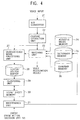
- Fig. 4 shows an example of a construction of the voice recognition unit 50A shown in Fig. 3.
- a voice signal output from the microphone 15 is supplied to an AD (Analog Digital) converter 21.
- the AD converter 21 samples and quantizes the voice signal in the form of an along signal supplied from the microphone 15 so as to convert it into voice data in the form of a digital signal.
- the resultant voice data is supplied to a feature extraction unit 22.
- the feature extraction unit 22 performs, for example, MFCC (Mel Frequency Cepstrum Coefficient) analysis on voice data input thereto on a frame-by-frame basis, wherein units of frames are properly selected.
- MFCC Mobile Frequency Cepstrum Coefficient
- the MFCCs obtained via the analysis are output in the form of a feature vector (feature parameters) to a matching unit 23 and an unregistered word period processing unit 27.
- the feature extraction unit 22 may extract, as a feature vector, linear prediction coefficients, cepstrum coefficients, a line spectrumpair, or power for each of particular frequency bands (output from filter banks).
- the matching unit 23 uses the feature vector supplied from the feature extraction unit 22 and referring, as required, to the acoustic model memory 24, the dictionary memory 25, and the grammar memory 26, the matching unit 23 recognizes the voice (input voice) input to the microphone 15 on the basis of, for example, a continuous density HMM (Hidden Markov Model).
- HMM Hidden Markov Model
- the acoustic model memory 24 stores an acoustic model representing acoustic features of respective subwords such as phonemes and syllables in a language of the voice to be recognized (wherein the acoustic model may include, in addition to the HMM, standard patterns used in the DP (Dynamic Programming) matching)).
- the acoustic model may include, in addition to the HMM, standard patterns used in the DP (Dynamic Programming) matching
- voice recognition is performed on the basis of the continuous density HMM method, and thus the HMM (Hidden Markov Model) is used as the acoustic model.
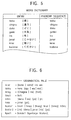
- the dictionary memory 25 stores a dictionary in which words to be recognized are described in such a manner that the entry of each word is related to information (phonemic information) indicating the pronunciation of that word in the form of a cluster of phonemes.
- Fig. 5 shows the word dictionary stored in the dictionary memory 25.
- entries of respective words are related to corresponding phoneme sequences, wherein the phoneme sequences are given in the form of clusters corresponding to the respective words.
- one entry one row in Fig. 3 corresponds to one cluster.
- each entry is represented in Roman characters and also in Japanese characters (kanji and kana characters), and each phoneme sequence is represented in Roman characters.
- "N" indicates a syllabic nasal corresponding to a Japanese phonetic symbol " ".
- the grammar memory 26 stores grammatical rules indicating how those words registered in the word dictionary stored in the dictionary memory 25 are concatenated (connected).
- Fig. 6 shows grammatical rules stored in the grammar memory 26.
- the grammatical rules shown in Fig. 6 are described in an EBNF (Extended Backus Naur Form).
- variable $sil and $garbage are not defined in the grammatical rules shown in Fig. 6, variable $sil denotes a silent acoustic model (silent model) , and variable $garbage denotes a garbage model which basically allows an arbitrary transition among phonemes.
- the matching unit 23 creates an acoustic model of a word (word model) by concatenating acoustic models stored in the acoustic model memory 24 in accordance with the word dictionary stored in the dictionary memory 25. Furthermore, the matching unit 23 concatenates some word models in accordance with grammatical rules stores in the grammar memory 26, and the matching unit 23 recognizes the voice input to the microphone 15 using the concatenated word models and the feature vectors in accordance with the continuous density HMM method.
- the matching unit 23 detects a sequence of word models having a highest score (likelihood) indicating the probability that a time sequence of feature vectors output from the feature extraction unit 22 is observed, and a sequence of entries corresponding to the sequence of word models is output as a result of voice recognition.
- the matching unit 23 determines the score for the sequence of word models by calculating the sumof occurrence probabilities (output probabilities) of the feature vectors of the sequence or words corresponding to the concatenated word models, and the matching unit 23 outputs, as a result of voice recognition, a sequence of entries corresponding to a sequence of word models having a highest score.
- the result of the voice recognition on the voice input to the microphone 15 is output as state recognition information to the model memory 51 and the action decision unit 52.
- the matching unit 23 detects a voice period corresponding to variable $garbage as a voice period of an unregistered word.
- the matching unit 23 detects a phoneme sequence of the unregistered word by detecting a phoneme sequence corresponding to variable $garbage described in the grammatical rule including unregistered word, wherein variable $garbage accepts arbitrary phonemic transitions.
- the voice period and the phoneme sequence of the unregistered word detected as the result of the voice recognition according to the grammatical rule including unregistered word are supplied from the matching unit 23 to the unregistered word period processing unit 27.
- the present invention can also be applied to a case in which an utterance includes a plurality of unregistered words or to a case in which an unregistered word is not located between words (word sequences) registered in the word dictionary.
- the unregistered word period processing unit 27 temporarily stores a sequence of feature vectors (feature vector sequence) supplied from the feature extraction unit 22 . If the unregistered word period processing unit 27 receives the voice period and the phoneme sequence of the unregistered word from the matching unit 23, the unregistered word period processing unit 27 detects a feature vector sequence of the voice in that voice period from the temporarily stored feature vectorsequence. The unregistered word period processing unit 27 assigns a unique ID (identification) to the phoneme sequence (unregistered word) supplied from the matching unit 23 and supplies it, together wit the phoneme sequence of the unregistered word and the feature vector sequence of the voice period, to the feature vector buffer 28.
- a unique ID identity
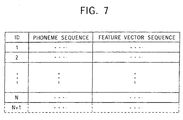
- the feature vector buffer 28 temporarily stores the ID, the phoneme sequence, and the feature vector sequence of the unregistered word, supplied from unregistered word period processing unit 27, such that they are related to each other as shown in Fig. 7.
- Fig. 7 sequential numerals starting from 1 are assigned as IDs to respective unregistered words. Therefore, for example, when the feature vector buffer 28 includes IDs, phoneme sequences, and feature vector sequences for N unregistered words already stored therein, if the matching unit 23 detects a voice period and a phoneme sequence of another unregistered word, the unregistered word period processing unit 27 assigns N + 1 as an ID to the detected unregistered word, and the ID, the phoneme sequence, and the feature vector sequence of that unregistered word are stored into the feature vector buffer 28 as represented by broken lines in Fig. 7.
- the clustering unit 29 calculates the scores for the unregistered word newly stored in the feature vector buffer 28 (hereinafter, such an unregistered word will be referred to as a new unregistered word) with respect to the other unregistered words already stored in the feature vector buffer 28 (hereinafter, such an unregistered word will be referred to as an already-stored unregistered word).
- the clustering unit 29 regards the new unregistered word as an input voice and the already-stored unregistered words as words registered in the word dictionary, and the clustering unit 29 calculates the scores of the new unregistered word with respect to the respective already-stored unregistered words, in a similar manner as with the matching unit 23 . More specifically, the clustering unit 29 detects the feature vector sequence of the new unregistered word by referring to the feature vector buffer 28 , and concatenates acoustic models in accordance with the phoneme sequences of the already-stored unregistered words. The clustering unit 29 then calculates the scores indicating the likelihood that the feature vector sequence of the new unregistered word is observed in the concatenated acoustic models.
- the clustering unit 29 calculates the score of each already-stored unregistered word with respect to the new unregistered word and updates the score sheet stored in the score sheet memory 30 using the calculated scores.
- the clustering unit 29 refers to the updated score sheet and detects, from existing clusters obtained by clustering unregistered words (already-stored unregistered words), a cluster to which the new unregistered word is to be added as a new member.
- the clustering unit 29 adds the new unregistered word as a new member to the detected cluster and divides that cluster depending on the members of that cluster.
- the clustering unit 29 then updates the score sheet stored in the score sheet memory 30 on the basis of the result of the division.
- the score sheet memory 30 stores the score sheet in which scores of the new unregistered word with respect to the already-stored unregistered words and scores of the already-stored unregistered words associated the new unregistered word are registered.
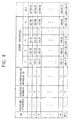
- Fig. 8 shows the score sheet.
- the score sheet includes entries in which the "ID”, “phoneme sequence”, “cluster number ", “representative member ID”, and “score” of each registered word are described.
- the clustering unit 29 For each unregistered word, the same "ID” and “phoneme sequence” as those stored in the feature vector buffer 28 are registered by the clustering unit 29 into the score sheet.
- the "cluster number” is a numeral identifying a cluster including, as a member, an unregistered word of an entry, wherein the cluster number is assigned by the clustering unit 29 and registered in the score sheet.
- the "representative member ID” is an ID of an unregistered word employed as a representative member of a cluster including, as a member, the unregistered word of the entry. On the basis of a representative member ID, it is possible to identify the representative member of a cluster including, as a member, an unregistered word.
- the representative member of a cluster is determined by the clustering unit 29, and the ID of the representative member is registered in a representative member ID field in the score sheet.
- the "score” is a score of an unregistered word of an entry with respect to each of the other unregistered words. As described earlier,thescoreiscalculated by the clustering unit 29.
- the score sheet includes IDs , phoneme sequences, cluster numbers, representative member IDs, and scores of those N unregistered words.
- the clustering unit 29 updates the score sheet as represented by broken lines in Fig. 8.
- the ID, the phoneme sequence, the cluster number, and the representative member ID of the new unregistered word, and also the scores (s (N+1, 1), s (N+1, 2),..., s (N+1, N) shown in Fig. 8) of the unregistered word with respect to the already-stored unregistered words are added to the score sheet.
- the scores (s(1, N+1), s(2, N+1) ,..., s(N, N+1) shown in Fig. 8) of the respective already-stored unregistered words with respect to the new unregistered word are added to the score sheet. Thereafter, as will be described later, cluster numbers and representative member IDs described in the score sheet are updated as required.
- s(i, j) denotes the score of an unregistered word (utterance of an unregistered word) having an ID of i with respect to an unregistered word (phoneme sequence of an unregistered word) having an ID of j.
- the score, s(i, i), of an unregistered word (utterance of an unregistered word) having an ID of i with respect to the unregistered word (phoneme sequence of the unregistered word) having the ID of i is also registered.
- This score s(i, i) is calculated by the matching unit 23 when the matching unit 23 detects the phoneme sequence of the unregistered word, and thus the clustering unit 29 does not need to calculate this score.
- the maintenance unit 31 updates the word dictionary stored in the dictionary memory 25 on the basis of the updated score sheet stored in the score sheet memory 30.
- Equation (1) max K ⁇ ⁇ denotes k which gives a maximum value to the value enclosed in braces ⁇ ⁇ , k' denotes, as with k, an ID of a member of the cluster, and ⁇ denotes the sum taken by changing k' over all IDs of the cluster.
- the representative member can be determined without having to calculate the scores. That is, in a case in which a cluster includes only one member of an unregistered word, this one unregistered word is selected as the representative member. On the other hand, when a cluster includes only two unregistered words as members, either one of the two unregistered words may be selected as the representative member.
- the method of determining the representative member is not limited to that described above.
- an unregistered word which is smallest in the sum of distances in the feature vector space from that unregistered word to the other unregistered words may be selected as the representative member of that cluster.
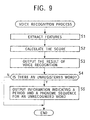
- the voice recognition unit 50A constructed in the above-described manner performs a voice recognition process for recognizing a voice input to the microphone 15 and performs unregistered word processing on unregistered words.
- the uttered voice is input to the microphone 15 and converted into digital voice data by the AD converter 21.
- the resultant digital voice data is supplied to the feature extraction unit 22.
- the feature extraction unit 22 performs, in step S1, acoustic analysis on the received voice data on a frame-by-frame basis, wherein units of frames are properly determined.
- the feature extraction unit 22 extracts feature vector via the above acoustic analysis and supplies the obtained feature vector sequence to the matching unit 23 and the unregistered word period processing unit 27.
- step S2 the matching unit 23 calculates the scores for the feature vector sequence supplied from the feature extraction unit 23, in the above-described manner. Thereafter, the process proceeds to step S3.
- step S3 on the basis of the scores obtained via the above score calculation, the matching unit 23 determines a sequence of entries of words indicating the result of voice recognition and outputs the resultant sequence of entries of words.
- the matching unit 23 determines whether the voice uttered by the user includes an unregistered word.
- the matching unit 23 detects a voice period of the unregistered word by detecting a voice period corresponding to variable $garbage in the grammatical rule including unregistered word.
- the match ing unit 23 also detects a phoneme sequence of the unregistered word by detecting a phoneme sequence corresponding to the garbage model indicated by the variable $garbage, wherein the garbage models allows an arbitrary phonemic transition.
- the resultant voice period and the phoneme sequence of the unregistered word are supplied to the unregistered word period processing unit 27, and the process is ended.
- the feature vector sequence output from the feature extraction unit 22 is temporarily stored in the unregistered word period processing unit 27. If the unregistered word period processing unit 27 receives the voice period and the phoneme sequence of the unregistered word from the matching unit 23, the unregistered word period processing unit 27 detects a feature vector sequence of the voice in the voice period. Furthermore, the unregistered word period processing unit 27 assigns an ID to the unregistered word (phoneme sequence of the unregistered word) supplied from the matching unit 23 and supplies it, together wit the phoneme sequence of the unregistered word and the feature vector sequence of the voice period, to the feature vector buffer 28.
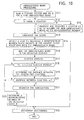
- Fig. 10 is a flow chart showing the unregistered word processing.
- step S11 the clustering unit 29 reads the ID and the phoneme sequence of the new unregistered word from the feature vector buffer 28. Thereafter, the process proceeds to step S12.
- step S12 the clustering unit 29 checks the score sheet stored in the score sheet memory 30 to determine whether there is a cluster which has already been obtained (produced).
- step S12 If it is determined in step S12 that there is no cluster which has already been obtained, that is, if the new unregistered word is a first unregistered word and the score sheet includes no entry of an already-stored unregistered word, then the process proceeds to step S13.
- step S13 The clustering unit 29 newly produces a cluster so as to include the unregistered word as a representative member thereof, and the clustering unit 29 registers information associated with the new cluster and the new unregistered word in the score sheet stored in the score sheet memory 30 thereby updating the score sheet.
- the clustering unit 29 registers, into the score sheet (Fig. 8), the ID and the phoneme sequence of the new unregistered word read from the feature vector buffer 28. Furthermore, clustering unit 29 produces a unique cluster number and registers it in the score sheet as the cluster number of the new unregistered word. The clustering unit 29 registers, in the score sheet, the ID of the new unregistered word as the representative member ID of the new registered word. Thus, in this case, the new unregistered word becomes the representative member of the new cluster.
- step S13 After the completion of step S13, the process proceeds to step S22.
- step S22 on the basis of the score sheet updated in step S13, the maintenance unit 31 updates the word dictionary stored in the dictionary memory 25, and the process is ended.
- the maintenance unit 31 recognizes the newly produced cluster by detecting the cluster number described in the score sheet.
- the maintenance unit 31 adds an entry corresponding to that cluster to the word dictionary stored in the dictionary memory 25 and registers, as aphoneme sequence of that entry, the phoneme sequence of the representative member of the new cluster, that is, in this case, the phoneme sequence of the new unregistered word.
- step S12 determines whether there is a cluster which has already been obtained, that is, if the new unregistered word is not the first unregistered word and thus the score sheet (Fig. 8) includes an entry (row) of an already-stored unregistered word.
- the process proceeds to step S14.
- the clustering unit 29 calculates the score of the new unregistered word with respect to the already-stored unregistered word and also calculates the score of the already-stored unregistered word with respect to the new unregistered word.
- the clustering unit 29 calculates the scores s(N+1, 1), s(N+1, 2), ..., s (N+1, N) for the new unregistered word with respect to the N already-stored unregistered words, respectively, as shown in a row represented by a broken line in Fig. 8, and also calculates the scores s (1, N+1), s(2, N+1) ,.., s(N, N+1) for the N already-stored unregistered words, respectively, associated with the new unregistered word.
- the clustering unit 29 calculates the above-described scores, the feature vector sequences of the new unregistered word and the N already-stored unregistered words are needed, and they are obtained by referring to the feature vector buffer 28.
- the clustering unit 29 adds the calculated scores to the score sheet (Fig. 8) together with the ID and the phoneme sequence of the new unregistered word. Thereafter, the process proceeds to step S15.
- step S16 the clustering unit 29 adds the new unregistered word to the cluster detected in step S15 (hereinafter, referred to simply as the detected cluster) as a member thereof. That is, the clustering unit 29 writes the cluster number of the representative member of the detected cluster, as the cluster number of the new unregistered word, into the score sheet.
- step S17 the clustering unit 29 divides the detected cluster into, for example, two clusters. Thereafter, the process proceeds to step 18.
- step S18 the clustering unit 29 determines whether the detected cluster has been divided, in the cluster division process performed in step S17, into two clusters. If it is determined that the detected cluster has been divided into two clusters, then the process proceeds to step S19.
- step S19 the clustering unit 29 determines the cluster-to-cluster distance between the two clusters obtained by dividing the detected cluster (hereinafter, such two clusters will be referred to as a first sub-cluster and a second sub-cluster).
- the cluster-to-cluster distance between the first and second sub-clusters is defined, for example, as follows.
- D(k1, k2) maxval K ⁇ abs(log(s(k, k1)) - log (s (k, k2)))
- abs ( ) represent the absolute value of a value enclosed in parentheses ( )
- maxval K ⁇ ⁇ represents the maximum value of values obtained by changing k of a variable enclosed in braces ⁇ ⁇
- log represents a natural or common logarithm.
- the reciprocal of the score, 1/s(k, k1) corresponds to the distance between a member #k and a representative member k1, represented by equation (2)
- the reciprocal of the score, 1/s(k, k2) corresponds to the distance between the member #k and a representative member k2.
- the cluster-to-cluster distance between the first and second sub-clusters is given by the maximum difference between the distance of any member of the first and second sub-clusters relative to the representative member #k1 of the first sub-cluster and the distance of any member of the first and second sub-clusters relative to the representative member #k2 of the second sub-cluster.
- the definition of the cluster-to-cluster distance is not limited to that described above.
- the sum of distances in the feature vector space is determined by means of the DP matching between the representative member of the first sub-cluster and the representative member of the second sub-cluster, and the sum of distances may be employed as the cluster-to-cluster distance.
- step S19 the process proceeds to step 20.
- step S20 the clustering unit 29 determines whether the cluster-to-cluster distance between the first and second sub-clusters is greater than (or equal to or greater than) a predetermined threshold ⁇ .
- step S20 If it is determined in step S20 that the cluster-to-cluster distance is greater than the predetermined threshold E, that is, if it is determined that a plurality of unregistered words included as members in the detected cluster should be separated into two clusters from the point of view of acoustic features thereof, then the process proceeds to step S21.
- step S21 the clustering unit 29 registers the first and second sub-clusters into the score sheet stored in the score sheet memory 30.
- the clusteringunit 29 assigns unique cluster numbers to the first and second sub-clusters, respectively, and updates the score sheet such that, of the cluster numbers of the respective members of the detected cluster, the cluster numbers of those members which have been clustered into the first sub-cluster are replaced with the cluster numbers of the first sub-cluster, and the cluster numbers of those members which have been clustered into the second sub-cluster are replaced with the cluster numbers of the second sub-cluster.
- the clustering unit 29 updates the score sheet such that the ID of the representative member of the first sub-cluster is employed as the representative member ID of members clustered into the first sub-cluster and the ID of the representative member of the second sub-cluster is employed as the representative member ID of members clustered into the second sub-cluster.
- the cluster number of the detected cluster may be employed as that of either one of the first or second sub-cluster.
- step S21 the maintenance unit 31 updates the word dictionary stored in the dictionary memory 25 on the basis of the score sheet. Thereafter, the process is ended.
- the maintenance unit 31 first deletes the entry corresponding to the detected cluster from the word dictionary.
- the maintenance unit 31 then adds two entries corresponding to the first and second sub-clusters to the word dictionary and registers the phoneme sequence of the representative member of the first sub-cluster as the phoneme sequence of the entry corresponding to the first sub-cluster and the phoneme sequence of the representative member of the second sub-cluster as the phoneme sequence of the entry corresponding to the second sub-cluster.
- step S18 determines a new representative member of the detected cluster and updates the score sheet.
- the clustering unit 29 refers to the score sheet stored in the score sheet memory 30 to detect scores s(k', k) needed in calculation of equation (1) for each member of the detected cluster to which the new unregistered word has been added as a member thereof.
- the clustering unit 29 determines the ID of a member to be employed as the new representative member of the detected cluster in accordance with equation (1) using the detected scores s (k' , k) .
- the clustering unit 29 then rewrites the score sheet (Fig. 8) such that the representative member ID of each member of the detected cluster is replaced with the ID of the new representative member of the detected cluster.
- step S22 the maintenance unit 31 updates the word dictionary stored in the dictionary memory 25 on the basis of the score sheet, and the process is ended.
- the maintenance unit 31 refers to the score sheet to detect the new representative member of the detected cluster and further detect the phoneme sequence of that representative member.
- the maintenance unit 31 then updates the word dictionary by replacing the phoneme sequence of the entry corresponding to the detected cluster with the phoneme sequence of the new representative member of the detected cluster.
- step S17 shown in Fig. 10 is described in further detail below.
- step S31 the clustering unit 29 selects a combination of arbitrary two members, which have not been selected yet, from the detected cluster to which the new unregistered word has been added as a member, and the clustering unit 29 employs those two members as provisional representative members.
- those two provisional representative members will be referred to as a first provisional representative member and a second provisional representative member, respectively.
- the clustering unit 29 determines whether the members of the detected cluster can be divided into two sub-clusters such that the first and second provisional representative members become the representative members of the respective two sub-clusters.
- equation (1) In order to determine whether the first and second provisional representative members can be the representative members, it is necessary to calculate equation (1), wherein the scores s(k', k) used in the calculation can be obtained by referring to the score sheet.
- step S32 In a case in which it is determined in step S32 that the members of the detected cluster cannot be divided into two sub-clusters such that the first and second provisional representative members become the representative members of the respective two sub-clusters, the process jumps to step S34 without performing step S33.
- step S32 if it is determined in step S32 that the members of the detected cluster can be divided into two sub-clusters such that the first and second provisional representative members become the representative members of the respective two sub-clusters, the process proceeds to step S33.
- step S33 the clustering unit 29 divides the members of the detected cluster into two sub-clusters such that the first and second provisional representative members become the representative members of the respective two sub-clusters, and the clustering unit 29 employs the combination of the two sub-clusters as candidates for the final first and second sub-clusters into which the detected cluster should be divided (hereinafter, such candidates will be referred to as a combination of candidate sub-clusters). Thereafter, the process proceeds to step S34.
- step S34 the clustering unit 29 determines whether the detected cluster includes a combination of two members which has not yet been selected as a combination of first and second provisional representative members. If there is such a combination of two members, the process returns to step S31 to select a combination of two members, which has not yet been selected as a combination of first and second provisional representative members, from the members of the detected cluster. Thereafter, the process is performed in a similar manner as described above.
- step S34 determines whether there is a combination of candidate sub-clusters.
- step S35 If it is determined in step S35 that there is no combination of candidate sub-clusters, the flow exits from the process without performing step S36. In this case, it is determined in step S18 in Fig. 10 that the detected cluster cannot be divided.
- step S35 if it is determined in step S35 that there is a combination of candidate sub-clusters, the process proceeds to step S36.
- step S36 if there is a plurality of combinations of candidate sub-clusters, the clustering unit 29 determines the cluster-to-cluster distance between the two candidate sub-clusters for each combination of candidate sub-clusters. The clustering unit 29 then determines a combination of candidate sub-clusters having a minimum cluster-to-cluster distance and clustering unit 29 returns that combination of candidate sub-clusters as a result of division of the detected cluster, that is, as the first and second sub-clusters. In a case in which there is only one combination of candidate sub-clusters, those candidate sub-clusters are employed as the first and second sub-clusters.
- step S18 in Fig. 10 it is determined in step S18 in Fig. 10 that the detected cluster has been divided.
- the clustering unit 29 detects, from the existing clusters each including an unregistered word, a cluster (detected cluster) to which the new unregistered word is to be added as a member thereof, and the clustering unit 29 divides the detected cluster on the basis of the members of the detected cluster so that the new unregistered word becomes a new member of the detected cluster, thereby easily clustering the unregistered words such that unregistered words having similar acoustic features are clustered into the same cluster.
- the maintenance unit 31 updates the word dictionary on the basis of the result of the clustering, and thus it becomes possible to easily register an unregistered word into the word dictionary without causing a great increase in the size of the word dictionary.
- the matching unit 23 detects a wrong voice period for an unregistered word, such an unregistered word is clustered, in the process of dividing the detected cluster, into a cluster different from a cluster into which an unregistered word whose voice period has been correctly detected.
- the phoneme sequence never have a large contribution to the scores in voice recognition performed after that, because the phoneme sequence of that entry corresponds to the voice period which was not correctly detected. Therefore, even if a wrong detection occurs for a voice period of an unregistered word, the wrong detection does not have a significant influence on the following voice recognition.
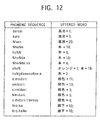
- Fig. 12 shows a result of a simulation of clustering for an utterance including an unregistered word.
- each entry (row) represents one cluster.
- a phoneme sequence of a representative member (unregistered word) of each cluster is described on the left-hand side, and an utterance of the unregistered word included as a member in the cluster and the number of utterances are described on the right-hand side.
- a cluster including, as only one member, an utterance of an unregistered word " " (a Japanese word pronounced as “furo” and corresponding to an English word “bath”) , and "doroa:” is obtained as the phoneme sequence of the representative member.
- a cluster including, as members, three utterances of the unregistered word " " (bath), and "kuro” is obtained as the phoneme sequence of the representative member.
- a cluster including, as members, four utterances of an unregistered word " " (a Japanese word pronounced as “hon” and corresponding to an English word “book”), and "NhoNde:su” is obtained as the phoneme sequence of the representative member.
- a cluster including, as members, one utterance of an unregistered word " " (a Japanese word pronounced as "orenji” and corresponding to an English word “orange") and nineteen utterances of the unregistered word " " (book), and "ohoN” is obtained as the phoneme sequence of the representative member.
- the other entries are also described in a similar manner.
- one utterance of the unregistered word " " (orange) and nineteen utterances of the unregistered word " “ (book) are clustered into the same cluster. Judging from the utterances included as members in this cluster, this cluster shouldbe of the unregistered word " " (book). However, the cluster also includes as a member an utterance of the unregistered word " " (orange).
- this cluster will be divided into a cluster including, as members, only utterances of the unregistered word " " (book) and a cluster including, as a member, only the utterance of the unregistered word” " (orange).
- the present invention has been described above with reference to embodiments in which the invention is applied to the entertainment robot (pet robot) , the invention can also be applied to a wide variety of apparatuses or systems in which a voice recognition apparatus is used, such as a voice interactive system. Furthermore, the present invention can be applied not only to actual robots that act in the real world but also to virtual robots such as that displayed on a display such as a liquid crystal display.
- a sequence of processing is performed by executing the program using the CPU 10A.
- the sequence of processing may also be performed by dedicated hardware.
- the program may be stored, in advance, in the memory 10B (Fig. 2).
- the program may be stored (recorded) temporarily or permanently on a removable storage medium such as a flexible, a CD-ROM (Compact Disc Read Only Memory), an MO (Magnetooptical) disk, a DVD (Digital Versatile Disc), a magnetic disk, or a semiconductor memory.
- a removable storage medium on which the program is stored may be provided as so-called packaged software thereby allowing the program to be installed on the robot (memory 10B).
- the program may also be installed into the memory 10B by downloading the program from a site via a digital broadcasting satellite and via a wireless or cable network such as a LAN (Local Area Network) or the Internet.
- a wireless or cable network such as a LAN (Local Area Network) or the Internet.
- the upgraded program may be easily installed in the memory 10B.
- processing steps described in the program to be executed by the CPU 10A for performing various kinds of processing are not necessarily required to be executed in time sequence according to the order described in the flow chart. Instead, the processing steps may be performed in parallel or separately (by means of parallel processing or object processing).
- the program may be executed either by a single CPU or by a plurality of CPUs in a distributed fashion.
- the voice recognition unit 50A shown in Fig. 4 may be realized by means of dedicated hardware or by means of software.
- a software program is installed on a general-purpose computer or the like .
- Fig. 13 illustrates an example of the configuration of a computer on which the program used to realize the voice recognition unit 50A is installed.
- FIG. 13 Another embodiment of a voice recognition apparatus 91 according to the present invention is shown in Fig. 13.
- the program may be stored, in advance, on a hard disk 105 serving as a storage medium or in a ROM 103 which are disposed inside the computer.
- the program may be stored (recorded) temporarily or permanently on a removable storage medium 111 such as a flexible disk, a CD-ROM, an MO disk, a DVD, a magnetic disk, or a semiconductor memory.
- a removable storage medium 111 may be provided in the form of so-called package software.
- the program may also be transferred to the computer from a download site via a digital broadcasting satellite by means of wireless transmission or via a network such as an LAN (Local Area Network) or the Internet by means of cable communication.
- the computer receives, using a communication unit 108, the program transmitted in the above-described manner and installs the received program on the hard disk 105 disposed in the computer.
- the voice recognition apparatus 91 includes a CPU (Central Processing Unit) 102.
- the CPU 102 is connected to an input/output interface 110 via a bus 101 so that when a command issuedby operating an input unit 107 including a keyboard, a mouse, a microphone, and an AD converter is input via the input/output interface 110 , the CPU 102 executes the program stored in a ROM (Read Only Memory) 103 in response to the command.
- ROM Read Only Memory
- the CPU 102 may execute a program loaded in a RAM (Random Access Memory) 104 wherein the program may be loaded into the RAM 104 by transferring a program stored on the hard disk 105 into the RAM 104, or transferring a program which has been installed on the hard disk 105 after being received from a satellite or a network via the communication unit 108, or transferring a program which has been installed on the hard disk 105 after being read from a removable recording medium 111 loaded on a drive 109.
- the CPU 102 performs the process described above with reference to the flow chart or the process described above with reference to the block diagrams.
- the CPU 102 outputs the result of the process, as required, to an output unit 106 including an LCD (Liquid Crystal Display) , a speaker, and a DA (Digital Analog) converter via the input/output interface 110.
- the result of the process may also be transmitted via the communication unit 108 or may be stored on the hard disk 105.
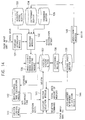
- Fig. 14 shows an example of the configuration of the software program of the voice recognition apparatus 91.
- This software program includes a plurality of modules. Each module has its own independent algorithm, and each module executes a particular operation in accordance its algorithm. Each module is stored in the RAM 13 and read and executed by the CPU 11.
- an acoustic model buffer 133 corresponds to the acoustic model memory 24, a dictionary buffer 134 to the dictionary memory 25, a grammar buffer 135 to the grammar memory 26, a feature extraction module 131 to the feature extraction unit 22, a matching module 132 to the matching unit 23, an unregistered word period processing module 136 to the unregistered word period processing unit 27, a feature vector buffer 137 to the feature vector buffer 28, a clustering module 138 to the clustering unit 29, a score sheet buffer 139 to the score sheet memory 30, and a maintenance module 140 to the maintenance unit 31.
- an input analog voice signal obtained via the microphone is supplied to the AD converter, which converts the input analog voice signal to digital voice data by means of an A/D (Analog/Digital) conversion including sampling and quantizing, and the resultant digital voice data is supplied to the feature extraction module 131.
- A/D Analog/Digital
- the feature vector buffer 137 stores, for example, as shown in Fig. 15, an ID , a phoneme sequence, a feature vector sequence, and a storage time of an unregistered word supplied from the unregistered word period processing module 136 such that they are related to each other.
- the feature vector buffer 137 stores a set of data indicating entries (in rows) corresponding to respective unregistered words.
- each entry shown in Fig. 15 is similar to the respective entries shown in Fig. 7 except that each entry shown in Fig. 15 includes additional data indicating a storage time.
- Each storage time indicates a time at which an entry is stored (recorded) into the feature vector buffer 137. The method of using the storage time will be described later.
- the clustering module 138 when the clustering module 138 performs clustering on a new unregistered word, the clustering module 138 refers to the "feature vectors" stored in the feature vector buffer 137.
- voice information which is referred to when clustering is performed on an unregistered word, will be called “utterance information”.
- the "utterance information” is not limited to “feature vectors” but a "PCM (Pulse Code Modulation) signal" such as voice data supplied to the feature extraction module 131 may also be employed as utterance information.
- the feature vector buffer 137 stores the "PCM signal” instead of the "feature vector sequence”.
- the'voice recognition apparatus 91 formed of the modules described above can operate in a similar manner as the voice recognition unit 50A shown in Fig. 4, although the detailed structure and operation of the modules corresponding to the voice recognition unit 50A are not described herein.
- the voice recognition unit 50A needs to store voice waveforms (for example, digital voice data) of clusters of unregistered words or feature vectors (for example, MFCCs (Mel Frequency Cepstrum Coefficients) obtained by performing MFCC analysis on digital voice data) as utterance information in a particular memory area or the feature vector buffer 28 serving as a memory so that the utterance information can be used to perform clustering on a newly input unregistered word.
- voice waveforms for example, digital voice data
- feature vectors for example, MFCCs (Mel Frequency Cepstrum Coefficients) obtained by performing MFCC analysis on digital voice data
- the voice recognition unit 50A when the voice recognition unit 50A detects a cluster to which an unregistered word is to be added as a new member, from existing clusters obtained by performing clustering on voices, the voice recognition unit 50A refers to the past utterance information stored in the particular storage area or the feature vector buffer 28 serving as the memory.
- the voice recognition unit 50A stores utterance information corresponding to all unregistered words one after another, then a large storage area or memory area is consumed with increasing number of input unregistered words (with increasing number of acquired unregistered words).
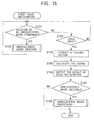
- a feature vector deletion module 141 for, when a predetermined condition is satisfied, deleting particular utterance information and associated data from the feature vector buffer 137.
- the feature vector deletion module 141 checks a score sheet, similar to that shown in Fig. 8, stored in the score sheet buffer 139 to determine whether the number of members belonging to a particular cluster has exceeded a predetermined first number. If it is determined that the number of such members is greater than the predetermined first number, the feature vector deletion module 141 deletes utterance information and associated data of a second number of members of the members belonging to the particular cluster from the feature vector buffer 137.
- data associated with a member includes an ID and a phoneme sequence of that member and also data of the member described on the score sheet.
- the feature vector deletion module 141 prevents clusters from becoming greater than a predetermined size, thereby not only suppressing consumption of memory (such as the RAM 103) but also preventing a reduction in operation speed of the voice recognition apparatus 91, that is, preventing degradation in performance of the voice recognition apparatus 91.
- first and second numbers described above are selected such that the first number is equal to or greater than the second number.
- the second number of members to be deleted may be selected, for example, in the order of storage time from oldest to newest according to the storage time data shown in Fig. 15.
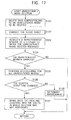
- the feature vector deletion module 141 determines that data supplied from the not-referred-to time calculation module 142 indicates that a particular cluster has not been referred to at all over a period of time equal to or longer than a predetermined length, the feature vector deletion module 141 deletes utterance information and associated data of members of that particular cluster from the feature vector buffer 137.
- the not-referred-to time calculation module 142 checks the feature vector buffer 137 to detect the latest one of times (storage times shown in Fig. 15) at which utterance information of respective members belonging to a particular cluster were stored into the feature vector buffer 137 (that is, the not-referred-to time calculation module 142 detects the time at which an entry of an unregistered word clustered last into the particular cluster was stored into the feature vector buffer 137) , and the not-referred-to time calculation module 142 employs the detected latest time as the last reference time of that particular cluster.
- the not-referred-to time calculation module 142 then subtracts the detected last reference time from the current time to determine the not-referred-to time during which the particular cluster has not been referred to and supplies the not-referred-to time to the feature vector deletion module 141.
- the not-referred-to time calculation module 142 calculates the not-referred-to time for all clusters at predetermined time intervals, there is no limitation on the number of clusters the not-referred-to time of which is calculated.
- the not-referred-to time calculation module 142 may calculate the not-referred-to time only for clusters specified by a user.
- the method of the calculation performed by the not-referred-to time calculation module 142 is not limited to that described above.
- the not-referred-to time is calculated on the basis of the storage times stored in the feature vector buffer 137, the storage times are not necessarily needed to be stored in the feature vector buffer 137, but the not-referred-to time calculation module 142 may directly detect and store the last reference time of a particular cluster and may calculate the not-referred-to time on the basis of the stored last reference time.
- the feature vector deletion module 141 deletes utterance information and associated data of all members belonging to a cluster to which no new member has not been registered for a long time, from thefeature vector buffer 137.
- utterance information and associated data of only some members of the cluster may be deleted.
- the storage time of a member (unregistered word) registered last in a cluster is employed as the last reference time of that cluster
- the last reference time of a cluster maybe determined in a different manner. For example, a time at which a cluster is detected in step S15 in Fig. 10 , or a time at which sub-clusters are registered in step S21, or a time at which a cluster is referred to in some process may be employed as the last reference time.
- the feature vector deletion module 141 may delete utterance information and associated data of part or all of members belonging to that particular cluster from the feature vector buffer 137.
- the feature vector deletion module 141 deletes a particular feature vector sequence in response to not an internal state of the voice recognition apparatus 91 but an external stimulus, amnesia due to a strong stimulus can be realized in the robot.
- the feature vector deletion module 141 may delete utterance information and associated data of part or all of members belonging to a particular cluster from the feature vector buffer 137.
- the information control module 143 can be realized by the model memory 51 shown in Fig. 3. That is, in this case, the model memory 51 supplies information indicating an emotion level as state information to the feature vector deletion module 141, wherein the emotion level indicates the state of emotion, instinct, or growth indicated by a value of the emotion model, the instinct model, and the growth model.
- the feature vector deletion module 141 deletes particular utterance information stored in the feature vector buffer 137 on the basis of the emotion level (parameter value of emotion (value of a model)) supplied from the emotion control module 143, it is possible to realize a loss in memory in a robot in response to an occurrence of strong angry or the like in the robot shown in Fig. 1 (in response to an increase in the parameter associated with the "angry" beyond a predetermined value).
- the emotion level parameter value of emotion (value of a model)
- the feature vector deletion module 141 may delete utterance information and associated data of part or all of members belonging to a particular cluster from the feature vector buffer 137.
- the used-memory-area calculation module 144 always calculates the total amount of used memory space (total memory consumption amount) and supplies data indicating the total amount of used memory space to the feature vector deletion module 141 at predetermined time intervals.
- the feature vector deletion module 141 always monitors the amount of memory consumption (of the RAM 103 or the like), and if the amount of memory consumption has exceeded the predetermined value, the feature vector deletion module 141 reduce the amount of memory consumption by deleting utterance information and associated data of members belonging to a cluster stored in the feature vector buffer 137, thereby not only suppressing consumption of memory (such as the RAM 103) but also preventing a reduction in operation speed of the voice recognition apparatus 91, that is, preventing degradation in performance of the voice recognition apparatus 91.
- the feature vector deletion module 141 determines whether the value of a parameter has exceeded a predetermined value, wherein the parameter may be the number of members of a cluster (the number of entries associated with the respective members of the same cluster stored in the feature vector buffer 137), the not-referred-to time indicated by the not-referred-to time calculation module 142, the emotion level indicated by the emotion control module 143, or the memory consumption amount indicated by the used-memory-area calculation module 144, and if the feature vector deletion module 141 determines that the value of the parameter has exceeded the predetermined value, then the feature vector deletion module 141 determines that the predetermined condition is satisfied and the feature vector deletion module 141 deletes part or all of the members of the cluster, the method of deleting members (utterance information and associated data of members) is not limited to such a method.
- the feature vector deletion module 141 may determine that the particular condition is satisfied when a trigger signal (such as a delete command supplied via the input unit 107) is input, and may delete particular utterance information.
- a trigger signal such as a delete command supplied via the input unit 107
- the emotion control module 143, the not-referred-to time calculation module 142, and the used-memory-area calculation module 144 may make the above-described judgment on the parameter value, and if it is determined in the judgment process that the value of the parameter (the emotion level, the not-referred-to time, or the total amount of used memory space) associated with one of these modules is greater than the predetermined threshold, a trigger signal may be supplied to the feature vector deletion module 141.
- the trigger signal supplied to the feature vector deletion module 141 is not limited to that described above, but another trigger signal such as that generated by a user when an arbitrary condition is satisfied may also be employed.
- the feature vector deletion module 141 determines that the particular condition is satisfied, the feature vector deletion module 141 deletes particular utterance information of members stored in the feature vector buffer 137.
- the utterance information deleted in the above process may be arbitrarily selected (set) , and the number of pieces of utterance information deleted may also be arbitrarily selected (set). For example, a user or a manufacturer may set the conditions associated with deletion of utterance information.
- members of a cluster including a small number of cluster, members having a large distance relative to a representative member, and members of a cluster to which a new member has not been added for a long time can be regarded as not having a large influence on the voice recognition accuracy, and thus it is desirable to preferentially delete such members.
- the score sheet stored in the score sheet buffer 139 includes data associated with the deleted members.
- the feature vector deletion module 141 deletes utterance information and associated data stored in the feature vector buffer 137, the feature vector deletion module 141 also deletes, from the score sheet, data associated with the members deleted from the feature vector buffer 137.
- the clustering module 138 reselects (redetermines) a representative member of a cluster to which the deleted member belonged.
- the representative member of the cluster (with a cluster number of 1) to which the member having the ID of 3 belonged as shown in Fig. 8 is reselected (redetermined). If the reselected representative member is different from the previous one (that is, if a member having an ID other than 1 is reselected as a representative member), a possibility occurs that the structures of all clusters are changed. Thus, reclustering is performed on unregistered words having any ID.
- the method of reclustering is not limited to a specific one, and, for example, a k-means method may be employed.
- the clustering module 138 performs processes (1) to (3) described below, wherein it is assumed that N unregistered words are registered in the score sheet stored in the score sheet buffer 139 and these unregistered words are clustered into k clusters.
- the scores can be determined by referring to the score sheet without actually calculating the score.
- the clustering module 138 may actually calculate the scores in the process (2).
- utterance information of the N unregistered words is needed, wherein the unregistered word can be obtained by referring to the feature vector buffer 137.
- the clusteringmodule 138 calculates the scores, if not feature vector sequences but PCM signals (voice data) are stored as utterance information in the feature vector buffer 137, the clustering module 138 calculates the scores on the basis of the PCM signals.
- the clustering module 138 and the feature vector deletion module 141 cancel the deletion of that unregistered word and also cancel all processes (updating of the score sheet and the reclustering) arising from the deletion so as to make associated data return back into the state in which the associated data was before the deletion was performed (by performing the undo process) .
- step S101 the feature vector deletion module 141 determines whether a command for deleting an unregistered word has been issued.
- the feature vector deletion module 141 determines that the command for deleting an unregistered word has been issued, when one of conditions (1) to (5) described below is satisfied:
- step S101 determines in step S101 that the command for deleting an unregistered word has been issued. If the feature vector deletion module 141 determines in step S101 that the command for deleting an unregistered word has been issued, then the feature vector deletion module 141 executes, in the next step S102, an "unregistered word deletion routine" on the unregistered word commanded to be deleted (hereinafter, referred to as the unregistered word to be deleted). Thereafter, the process returns to step S101 to again determine whether an unregistered word is commanded to be deleted.
- an "unregistered word deletion routine" on the unregistered word commanded to be deleted
- step S121 the feature vector deletion module 141 deletes, of the data stored in the feature vector buffer 137, such data corresponding to an unregistered word to be deleted.
- step S122 the feature vector deletion module 141 corrects the score sheet stored in the score sheet buffer 139.
- step S123 the clustering module 138 reselects (redetermines) a representative member for the cluster to which the deleted unregistered word previously belonged.
- the unregistered word having the ID of 3 was deleted, and thus a representative member for a cluster having a cluster number of 1 (to which the unregistered word having the ID of 3 previously belonged) described in the score sheet shown in Fig. 8 is reselected in the above-described manner.
- step S124 the clustering module 138 determines whether the reselected representative member is different from the previous representative member (that is, whether the representative member reselected in step S123 is different from the immediately previous representative member). If no change is detected in the representative member, the flow returns. That is, step S102 in Fig. 16 is ended and the process returns to step S101 to repeat the process from step S101.
- step S123 it is determined that no change has occurred in the representative member.
- a member having an ID other than 1 it is determined that the representative member has been changed.
- step S124 the process proceeds to step S125 in which the clustering module 138 performs reclustering on all unregistered words (in the present example, all unregistered words registered in the score sheet shown in Fig. 8 except for the unregistered word having the ID of 3). That is, the clustering module 138 performs reclustering on all unregistered words by means of, for example, the k-means method described earlier.
- step S126 the clustering module 138 determines whether a change has occurred in the structure of a cluster other than the cluster to which the deleted unregistered word previously belonged (more specifically, for example, clustering module 138 determines whether a change in terms of members belonging to a cluster has occurred or whether a representative member of a cluster has been changed to another member). If it is determined that no change has occurred in cluster structure, the process proceeds to step S128. In step S128 , the maintenance module 140 updates the word dictionary stored in the dictionary buffer 134 on the basis of the score sheet updated (corrected) in step S122. Thereafter, the flow returns.
- maintenance module 140 refers to the score sheet to detect clusters whose representative members have been redetermined.
- the maintenance module 140 registers, in the word dictionary stored in the dictionary buffer 134, the phoneme sequences of the new representative members as the phoneme sequences of entries corresponding to the clusters whose representative member has been redetermined.
- step S127 the clustering module 138 and the feature vector deletion module 141 return the contents of the feature vector buffer 137 and the score sheet buffer 139 into the states in which they were before deletion was performed (in step S121). That is, the clustering module 138 and the feature vector deletion module 141 perform the undo process until the state, in which associated data was before the unregistered words were deleted, is reached. Thereafter, the flow returns.
- the process (undo process) in steps S126 and S127 may be removed. That is, in the voice recognition apparatus 91, a change of a cluster may be allowed, and the undo process may not be performed.
- the voice recognition apparatus 91 may be constructed such that whether steps S126 and S127 should be performed or not can be selected (by a user or the like) from the outside of the voice recognition apparatus 91.
- step S122 steps S123 and S124 are skipped and the flow proceeds to step S125 and then to S126. If it is determined in step S126 that no change in cluster structure has occurred, the process proceed to step S128.
- step S128 the maintenance module 140 updates the word dictionary stored in the dictionary buffer 134 on the basis of the score sheet updated (corrected) in step S122. Thereafter, the flow returns.
- the maintenance module 140 refers to the score sheet to detect the deleted cluster. The maintenance module 140 then deletes an entry corresponding to the deleted cluster from the word dictionary stored in the dictionary buffer 134.
- step S101 if it is determined in step S101 that no unregistered word is commanded to be deleted, then, in step S102, the feature extraction module 131 determines whether a voice has been input.
- step S102 If it is determined in step S102 that no voice has been input, the flow returns to step S101 to repeat the process from step S101.
- the feature vector deletion module 141 always checks whether deletion of an unregistered word (utterance information of an unregistered word stored in the feature vector buffer 137) has been commanded, and the feature extraction module 131 always checks, independently of the feature vector deletion module 141, whether a voice has been input.
- the uttered voice is passed through the microphone and the AD converter in the input unit 107 thereby obtaining digital voice data.
- the resultant digital voice data is supplied to the feature extraction module 131.
- step S103 the feature extraction module 131 determines whether a voice has been input. If a voice is input (if it is determined that a voice has been input), then, in step S104, acoustic analysis is performed on thevoice data ona frame-by-frame basis thereby extract feature vectors. The sequence of the extracted feature vectors is supplied to the matching module 132 and the unregistered word period processing module 136.
- Steps S104 to S108 are similar to steps S1 to S5 described above with reference to Fig. 9, and thus steps S104 to S108 are not described herein.
- feature vector deletion module 141 determines that the specific condition is satisfied, feature vector deletion module 141 deletes, from the data stored in the feature vector buffer 137, utterance information (feature vector sequence in the example shown in Fig. 15) of a member regarded as having little influence on clustering and associated data (ID, phoneme sequence, and storage time in the example shown in Fig. 15), thereby suppressing the consumption of the storage area without causing degradation in the function of automatically acquiring unregistered words.
- the feature vector deletion module 141 corrects data related to the member (deletes unnecessary data) described in the score sheet stored in the score sheet buffer 139 thereby further suppressing the consumption of the storage area.
- the maintenance module 140 updates the word dictionary on the basis of the corrected score sheet. This makes it possible to realize amnesia or a loss in memory in the robot, thereby making the robot capable of providing greater entertainment to users.
- the steps described in the program stored in the storage medium may be performed either in time sequence in accordance with the order described in the program or in a parallel or separate fashion.
- modules may be constructed by means of hardware.
- a manufacturer may connect the respective modules in the manner shown in Fig. 14.
- the apparatus realizedbymeans of hardware constructed in the manner shown in Fig. 14 may be used as the voice recognition unit.
- voice recognition is performed by means of the HMM method.
- voice recognition may also be performed by means of another method such as a DP matching method.
- the score employed in the above-described embodiments correspond to the reciprocal of the distance between an input voice and a standard pattern.
- an unregistered word is clustered and the unregistered word is registered in the word dictionary on the basis of the result of clustering.
- the present invention may also be applied to a word which is already registered in the word dictionary.
- the above problem can be solved as follows. That is, different utterances of the same word are clustered such that acoustically similar utterances belong to the same cluster, and the dictionary is updated on the basis of the result of the clustering. As a result, different phoneme sequences are registered for the same word in the word dictionary, and thus it becomes possible to perform voice recognition for various phonemes for the same word.
- key information may be described in an entry corresponding to a cluster of an unregistered word, as described below.
- state recognition information output from the image recognition unit 50B or the pressure processing unit 50C is supplied to the voice recognition unit 50A as represented by a broken line in Fig. 3 so that the maintenance unit 31 (Fig. 4) in the voice recognition unit 50A receives the state recognition information.
- the feature vector buffer 28 and the score sheet memory 30 also store an absolute time at which an unregistered word was input.
- the maintenance unit 31 detects the state recognition information which was supplied from the action decision unit 52 when the unregistered word was input, and maintenance unit 31 regards the detected state recognition information as key information of that unregistered word.
- the maintenance unit 31 registers, in the word dictionary, the state recognition information as key information in an entry corresponding to a cluster of the unregistered word so that the entry includes the state recognition information in addition to the phoneme sequence of the representative member of that cluster.
- the voice recognition unit 50A determines a phoneme sequence of the unregistered word "red”.
- the voice recognition unit 50A adds, as an entry of the unregistered word "red” to the word dictionary, the phoneme sequence of the unregistered word "red” and the key information indicating the state recognition information "red".
- the voice recognition unit 50A outputs, as a result of voice recognition, the state recognition information "red" registered as the key information.
- the result of the voice recognition is supplied from the voice recognition unit 50A to the action decision unit 52.
- the action decision unit 52 may make the robot search the environment for the red object on the basis of the output from the image recognition unit 50B and walk toward the red object.
- the robot cannot recognize an utterance of "red” when the robot encounters it for the first time, if a user utters "red” when the robot is detecting an image of an red object, then the robot relates the utterance "red” to the red obj ect being detected as the image, thereby making is possible for the robot to, when the user utters "red” thereafter, recognize the utterance correctly as "red” and walk toward a red object present in the environment. This gives the user an impression that the robot grows by learning what the user speaks.
- the voice recognition apparatus 91 shown in Fig. 13 may also operate in a similar manner.
- the scores are stored in the score sheet, the scores may be recalculated as required.
- the detected cluster is divided into two clusters
- the detected cluster may be divided into three or more clusters.
- the detected cluster may also be divided into an arbitrary number of clusters such that the distances among the clusters become greater than a predetermined value.
- a cluster to which an input voice is to be added as a member is detected from existing clusters obtained by clustering voices.
- the input voice is added as a new member to the detected cluster, and the cluster is divided depending on the members of the cluster.
- the dictionary is updated.
Landscapes
- Engineering & Computer Science (AREA)
- Computational Linguistics (AREA)
- Health & Medical Sciences (AREA)
- Audiology, Speech & Language Pathology (AREA)
- Human Computer Interaction (AREA)
- Physics & Mathematics (AREA)
- Acoustics & Sound (AREA)
- Multimedia (AREA)
- Artificial Intelligence (AREA)
- Machine Translation (AREA)
- Manipulator (AREA)
Applications Claiming Priority (5)
| Application Number | Priority Date | Filing Date | Title |
|---|---|---|---|
| JP2001097843 | 2001-03-30 | ||
| JP2001097843 | 2001-03-30 | ||
| JP2002069603 | 2002-03-14 | ||
| JP2002069603A JP2002358095A (ja) | 2001-03-30 | 2002-03-14 | 音声処理装置および音声処理方法、並びにプログラムおよび記録媒体 |
| PCT/JP2002/003248 WO2002080141A1 (en) | 2001-03-30 | 2002-04-01 | Sound processing apparatus |
Publications (1)
| Publication Number | Publication Date |
|---|---|
| EP1376536A1 true EP1376536A1 (en) | 2004-01-02 |
Family
ID=26612647
Family Applications (1)
| Application Number | Title | Priority Date | Filing Date |
|---|---|---|---|
| EP02708744A Withdrawn EP1376536A1 (en) | 2001-03-30 | 2002-04-01 | Sound processing apparatus |
Country Status (6)
| Country | Link |
|---|---|
| US (1) | US7228276B2 (enExample) |
| EP (1) | EP1376536A1 (enExample) |
| JP (1) | JP2002358095A (enExample) |
| KR (1) | KR20030007793A (enExample) |
| CN (1) | CN1462428A (enExample) |
| WO (1) | WO2002080141A1 (enExample) |
Cited By (2)
| Publication number | Priority date | Publication date | Assignee | Title |
|---|---|---|---|---|
| US7813928B2 (en) | 2004-06-10 | 2010-10-12 | Panasonic Corporation | Speech recognition device, speech recognition method, and program |
| WO2010129102A3 (en) * | 2009-04-28 | 2011-02-10 | Luidia Inc. | Digital transcription system utilizing small aperture acoustical sensors |
Families Citing this family (56)
| Publication number | Priority date | Publication date | Assignee | Title |
|---|---|---|---|---|
| US20070265834A1 (en) * | 2001-09-06 | 2007-11-15 | Einat Melnick | In-context analysis |
| US7398209B2 (en) | 2002-06-03 | 2008-07-08 | Voicebox Technologies, Inc. | Systems and methods for responding to natural language speech utterance |
| US7693720B2 (en) | 2002-07-15 | 2010-04-06 | Voicebox Technologies, Inc. | Mobile systems and methods for responding to natural language speech utterance |
| JP4392581B2 (ja) * | 2003-02-20 | 2010-01-06 | ソニー株式会社 | 言語処理装置および言語処理方法、並びにプログラムおよび記録媒体 |
| US7110949B2 (en) * | 2004-09-13 | 2006-09-19 | At&T Knowledge Ventures, L.P. | System and method for analysis and adjustment of speech-enabled systems |
| US7634406B2 (en) * | 2004-12-10 | 2009-12-15 | Microsoft Corporation | System and method for identifying semantic intent from acoustic information |
| US7729478B1 (en) * | 2005-04-12 | 2010-06-01 | Avaya Inc. | Change speed of voicemail playback depending on context |
| CN101185115B (zh) * | 2005-05-27 | 2011-07-20 | 松下电器产业株式会社 | 语音编辑装置及方法和语音识别装置及方法 |
| US7640160B2 (en) | 2005-08-05 | 2009-12-29 | Voicebox Technologies, Inc. | Systems and methods for responding to natural language speech utterance |
| US7620549B2 (en) | 2005-08-10 | 2009-11-17 | Voicebox Technologies, Inc. | System and method of supporting adaptive misrecognition in conversational speech |
| US7949529B2 (en) | 2005-08-29 | 2011-05-24 | Voicebox Technologies, Inc. | Mobile systems and methods of supporting natural language human-machine interactions |
| WO2007027989A2 (en) | 2005-08-31 | 2007-03-08 | Voicebox Technologies, Inc. | Dynamic speech sharpening |
| KR100717385B1 (ko) * | 2006-02-09 | 2007-05-11 | 삼성전자주식회사 | 인식 후보의 사전적 거리를 이용한 인식 신뢰도 측정 방법및 인식 신뢰도 측정 시스템 |
| JP2007286356A (ja) * | 2006-04-17 | 2007-11-01 | Funai Electric Co Ltd | 電子機器 |
| JPWO2007138875A1 (ja) * | 2006-05-31 | 2009-10-01 | 日本電気株式会社 | 音声認識用単語辞書・言語モデル作成システム、方法、プログラムおよび音声認識システム |
| JP4181590B2 (ja) * | 2006-08-30 | 2008-11-19 | 株式会社東芝 | インタフェース装置及びインタフェース処理方法 |
| US8073681B2 (en) | 2006-10-16 | 2011-12-06 | Voicebox Technologies, Inc. | System and method for a cooperative conversational voice user interface |
| US7818176B2 (en) | 2007-02-06 | 2010-10-19 | Voicebox Technologies, Inc. | System and method for selecting and presenting advertisements based on natural language processing of voice-based input |
| DE102007033472A1 (de) * | 2007-07-18 | 2009-01-29 | Siemens Ag | Verfahren zur Spracherkennung |
| JP5386692B2 (ja) * | 2007-08-31 | 2014-01-15 | 独立行政法人情報通信研究機構 | 対話型学習装置 |
| US8140335B2 (en) | 2007-12-11 | 2012-03-20 | Voicebox Technologies, Inc. | System and method for providing a natural language voice user interface in an integrated voice navigation services environment |
| JP2009157119A (ja) * | 2007-12-27 | 2009-07-16 | Univ Of Ryukyus | 音声単語自動獲得方法 |
| JP5454469B2 (ja) | 2008-05-09 | 2014-03-26 | 富士通株式会社 | 音声認識辞書作成支援装置,処理プログラム,および処理方法 |
| US8589161B2 (en) | 2008-05-27 | 2013-11-19 | Voicebox Technologies, Inc. | System and method for an integrated, multi-modal, multi-device natural language voice services environment |
| US9305548B2 (en) | 2008-05-27 | 2016-04-05 | Voicebox Technologies Corporation | System and method for an integrated, multi-modal, multi-device natural language voice services environment |
| US8326637B2 (en) | 2009-02-20 | 2012-12-04 | Voicebox Technologies, Inc. | System and method for processing multi-modal device interactions in a natural language voice services environment |
| US9171541B2 (en) | 2009-11-10 | 2015-10-27 | Voicebox Technologies Corporation | System and method for hybrid processing in a natural language voice services environment |
| US9502025B2 (en) | 2009-11-10 | 2016-11-22 | Voicebox Technologies Corporation | System and method for providing a natural language content dedication service |
| US8645136B2 (en) * | 2010-07-20 | 2014-02-04 | Intellisist, Inc. | System and method for efficiently reducing transcription error using hybrid voice transcription |
| WO2012075640A1 (en) * | 2010-12-10 | 2012-06-14 | Panasonic Corporation | Modeling device and method for speaker recognition, and speaker recognition system |
| US9117444B2 (en) | 2012-05-29 | 2015-08-25 | Nuance Communications, Inc. | Methods and apparatus for performing transformation techniques for data clustering and/or classification |
| CN103219007A (zh) * | 2013-03-27 | 2013-07-24 | 谢东来 | 语音识别方法及装置 |
| US9697828B1 (en) * | 2014-06-20 | 2017-07-04 | Amazon Technologies, Inc. | Keyword detection modeling using contextual and environmental information |
| KR102246900B1 (ko) * | 2014-07-29 | 2021-04-30 | 삼성전자주식회사 | 전자 장치 및 이의 음성 인식 방법 |
| CN107003996A (zh) | 2014-09-16 | 2017-08-01 | 声钰科技 | 语音商务 |
| US9898459B2 (en) | 2014-09-16 | 2018-02-20 | Voicebox Technologies Corporation | Integration of domain information into state transitions of a finite state transducer for natural language processing |
| US9747896B2 (en) | 2014-10-15 | 2017-08-29 | Voicebox Technologies Corporation | System and method for providing follow-up responses to prior natural language inputs of a user |
| US10614799B2 (en) | 2014-11-26 | 2020-04-07 | Voicebox Technologies Corporation | System and method of providing intent predictions for an utterance prior to a system detection of an end of the utterance |
| US10431214B2 (en) | 2014-11-26 | 2019-10-01 | Voicebox Technologies Corporation | System and method of determining a domain and/or an action related to a natural language input |
| CN107112007B (zh) * | 2014-12-24 | 2020-08-07 | 三菱电机株式会社 | 语音识别装置及语音识别方法 |
| US10515150B2 (en) * | 2015-07-14 | 2019-12-24 | Genesys Telecommunications Laboratories, Inc. | Data driven speech enabled self-help systems and methods of operating thereof |
| US10455088B2 (en) | 2015-10-21 | 2019-10-22 | Genesys Telecommunications Laboratories, Inc. | Dialogue flow optimization and personalization |
| US10382623B2 (en) | 2015-10-21 | 2019-08-13 | Genesys Telecommunications Laboratories, Inc. | Data-driven dialogue enabled self-help systems |
| CN106935239A (zh) * | 2015-12-29 | 2017-07-07 | 阿里巴巴集团控股有限公司 | 一种发音词典的构建方法及装置 |
| US10331784B2 (en) | 2016-07-29 | 2019-06-25 | Voicebox Technologies Corporation | System and method of disambiguating natural language processing requests |
| US20180268844A1 (en) * | 2017-03-14 | 2018-09-20 | Otosense Inc. | Syntactic system for sound recognition |
| US20180254054A1 (en) * | 2017-03-02 | 2018-09-06 | Otosense Inc. | Sound-recognition system based on a sound language and associated annotations |
| JP6711343B2 (ja) * | 2017-12-05 | 2020-06-17 | カシオ計算機株式会社 | 音声処理装置、音声処理方法及びプログラム |
| JP7000268B2 (ja) * | 2018-07-18 | 2022-01-19 | 株式会社東芝 | 情報処理装置、情報処理方法、およびプログラム |
| US10854109B2 (en) | 2018-10-31 | 2020-12-01 | Sony Interactive Entertainment Inc. | Color accommodation for on-demand accessibility |
| US11375293B2 (en) | 2018-10-31 | 2022-06-28 | Sony Interactive Entertainment Inc. | Textual annotation of acoustic effects |
| US10977872B2 (en) | 2018-10-31 | 2021-04-13 | Sony Interactive Entertainment Inc. | Graphical style modification for video games using machine learning |
| US11636673B2 (en) | 2018-10-31 | 2023-04-25 | Sony Interactive Entertainment Inc. | Scene annotation using machine learning |
| KR20220094400A (ko) * | 2020-12-29 | 2022-07-06 | 현대자동차주식회사 | 대화 시스템, 그를 가지는 차량 및 대화 시스템의 제어 방법 |
| CN115171702B (zh) * | 2022-05-30 | 2024-09-24 | 青岛海尔科技有限公司 | 数字孪生声纹特征处理方法、存储介质及电子装置 |
| CN119495304B (zh) * | 2024-11-06 | 2025-12-12 | 深圳前海微众银行股份有限公司 | 语音识别模型微调方法、电子设备、存储介质及程序产品 |
Family Cites Families (5)
| Publication number | Priority date | Publication date | Assignee | Title |
|---|---|---|---|---|
| JPS5745680A (en) | 1980-08-30 | 1982-03-15 | Fujitsu Ltd | Pattern recognition device |
| JPS6125199A (ja) | 1984-07-14 | 1986-02-04 | 日本電気株式会社 | 音声認識方式 |
| US6243680B1 (en) * | 1998-06-15 | 2001-06-05 | Nortel Networks Limited | Method and apparatus for obtaining a transcription of phrases through text and spoken utterances |
| KR100277694B1 (ko) * | 1998-11-11 | 2001-01-15 | 정선종 | 음성인식시스템에서의 발음사전 자동생성 방법 |
| JP2002160185A (ja) | 2000-03-31 | 2002-06-04 | Sony Corp | ロボット装置、ロボット装置の行動制御方法、外力検出装置及び外力検出方法 |
-
2002
- 2002-03-14 JP JP2002069603A patent/JP2002358095A/ja not_active Abandoned
- 2002-04-01 EP EP02708744A patent/EP1376536A1/en not_active Withdrawn
- 2002-04-01 WO PCT/JP2002/003248 patent/WO2002080141A1/ja not_active Ceased
- 2002-04-01 US US10/296,797 patent/US7228276B2/en not_active Expired - Fee Related
- 2002-04-01 KR KR1020027016297A patent/KR20030007793A/ko not_active Withdrawn
- 2002-04-01 CN CN02801646A patent/CN1462428A/zh active Pending
Non-Patent Citations (1)
| Title |
|---|
| See references of WO02080141A1 * |
Cited By (2)
| Publication number | Priority date | Publication date | Assignee | Title |
|---|---|---|---|---|
| US7813928B2 (en) | 2004-06-10 | 2010-10-12 | Panasonic Corporation | Speech recognition device, speech recognition method, and program |
| WO2010129102A3 (en) * | 2009-04-28 | 2011-02-10 | Luidia Inc. | Digital transcription system utilizing small aperture acoustical sensors |
Also Published As
| Publication number | Publication date |
|---|---|
| CN1462428A (zh) | 2003-12-17 |
| US20040030552A1 (en) | 2004-02-12 |
| WO2002080141A1 (en) | 2002-10-10 |
| KR20030007793A (ko) | 2003-01-23 |
| JP2002358095A (ja) | 2002-12-13 |
| US7228276B2 (en) | 2007-06-05 |
Similar Documents
| Publication | Publication Date | Title |
|---|---|---|
| US7228276B2 (en) | Sound processing registering a word in a dictionary | |
| US12080273B2 (en) | Translation method and system using multilingual text-to-speech synthesis model | |
| US7065490B1 (en) | Voice processing method based on the emotion and instinct states of a robot | |
| CN1855224B (zh) | 信息处理装置、信息处理方法 | |
| JP6550068B2 (ja) | 音声認識における発音予測 | |
| KR101237799B1 (ko) | 문맥 종속형 음성 인식기의 환경적 변화들에 대한 강인성을 향상하는 방법 | |
| US20230186905A1 (en) | System and method for tone recognition in spoken languages | |
| US20010032075A1 (en) | Speech recognition method, apparatus and storage medium | |
| US7313524B1 (en) | Voice recognition based on a growth state of a robot | |
| KR100911429B1 (ko) | 환경 이동을 위한 잡음 적응형 음향 모델 생성 방법 및 장치 | |
| JP2001188779A (ja) | 情報処理装置および方法、並びに記録媒体 | |
| JP6350935B2 (ja) | 音響モデル生成装置、音響モデルの生産方法、およびプログラム | |
| JP3589044B2 (ja) | 話者適応化装置 | |
| JP2001154693A (ja) | ロボット制御装置およびロボット制御方法、並びに記録媒体 | |
| Hrúz et al. | Automatic fingersign-to-speech translation system | |
| Wang et al. | A Lightweight End-to-End Speech Recognition System on Embedded Devices | |
| JP2004252121A (ja) | 言語処理装置および言語処理方法、並びにプログラムおよび記録媒体 | |
| JP4178777B2 (ja) | ロボット装置、記録媒体、並びにプログラム | |
| JP2004309523A (ja) | ロボット装置の動作パターン共有システム、ロボット装置の動作パターン共有方法、及びロボット装置 | |
| JP4639533B2 (ja) | 音声認識装置および音声認識方法、並びにプログラムおよび記録媒体 | |
| JP4656354B2 (ja) | 音声処理装置および音声処理方法、並びに記録媒体 | |
| JPH1097270A (ja) | 音声認識装置 | |
| JP2003271181A (ja) | 情報処理装置および情報処理方法、並びに記録媒体およびプログラム | |
| Aarnio | Speech recognition with hidden markov models in visual communication | |
| JP2006106775A (ja) | 多言語話者適応方法、装置、プログラム |
Legal Events
| Date | Code | Title | Description |
|---|---|---|---|
| PUAI | Public reference made under article 153(3) epc to a published international application that has entered the european phase |
Free format text: ORIGINAL CODE: 0009012 |
|
| 17P | Request for examination filed |
Effective date: 20021125 |
|
| AK | Designated contracting states |
Kind code of ref document: A1 Designated state(s): AT BE CH CY DE DK ES FI FR GB GR IE IT LI LU MC NL PT SE TR |
|
| AX | Request for extension of the european patent |
Extension state: AL LT LV MK RO SI |
|
| STAA | Information on the status of an ep patent application or granted ep patent |
Free format text: STATUS: THE APPLICATION IS DEEMED TO BE WITHDRAWN |
|
| 18D | Application deemed to be withdrawn |
Effective date: 20061103 |