EP1375564A1 - Process for producing polyarylene sulfide - Google Patents
Process for producing polyarylene sulfide Download PDFInfo
- Publication number
- EP1375564A1 EP1375564A1 EP02705128A EP02705128A EP1375564A1 EP 1375564 A1 EP1375564 A1 EP 1375564A1 EP 02705128 A EP02705128 A EP 02705128A EP 02705128 A EP02705128 A EP 02705128A EP 1375564 A1 EP1375564 A1 EP 1375564A1
- Authority
- EP
- European Patent Office
- Prior art keywords
- aromatic compound
- dihalogenated aromatic
- pas
- production process
- process according
- Prior art date
- Legal status (The legal status is an assumption and is not a legal conclusion. Google has not performed a legal analysis and makes no representation as to the accuracy of the status listed.)
- Withdrawn
Links
Classifications
-
- C—CHEMISTRY; METALLURGY
- C08—ORGANIC MACROMOLECULAR COMPOUNDS; THEIR PREPARATION OR CHEMICAL WORKING-UP; COMPOSITIONS BASED THEREON
- C08G—MACROMOLECULAR COMPOUNDS OBTAINED OTHERWISE THAN BY REACTIONS ONLY INVOLVING UNSATURATED CARBON-TO-CARBON BONDS
- C08G75/00—Macromolecular compounds obtained by reactions forming a linkage containing sulfur with or without nitrogen, oxygen, or carbon in the main chain of the macromolecule
- C08G75/02—Polythioethers
- C08G75/0204—Polyarylenethioethers
- C08G75/025—Preparatory processes
Definitions
- the present invention relates to a process for producing a polyarylene sulfide. More particularly, it pertains to a process for continuously producing a polyarylene sulfide which has a high molecular weight and is excellent in thermal stability.
- a polyarylene sulfide (hereinafter sometimes abbreviated to as "PAS”), especially polyphenylene sulfide (hereinafter sometimes abbreviated to as “PPS”) is known as an engineering plastic which is excellent in mechanical strength and heat resistance and the like and which has good electrical characteristics and high rigidity.
- PAS polyarylene sulfide
- PPS polyphenylene sulfide
- PES polyphenylene sulfide
- An object of the present invention is to provide a process for continuously producing a PAS which has a high molecular weight and is excellent in thermal stability.
- Another object of the present invention is to provide a PAS which has a high molecular weight and is excellent in thermal stability and besides a composition of the PAS.
- the gist and summary of the present invention reside in a process for producing a polyarylene sulfide which comprises reacting a sulfur source with a dihalogenated aromatic compound in an aprotic organic solvent, characterized by adding the dihalogenated aromatic compound by dividing the same into a plurality of times at the time of polymerization reaction.
- the process for producing a polyarylene sulfide according to the present invention comprises reacting a sulfur source with a dihalogenated aromatic compound in an aprotic organic solvent, and is characterized by adding the above-mentioned dihalogenated aromatic compound by dividing the same into a plurality of times at the time of polymerization reaction.
- dihalogenated aromatic compound which is used for the production process according to the present invention is exemplified by dihalogenated benzene such as m-dihalogenated benzene and p-dihalogenated benzene, alkyl-substituted dihalogenated benzene, cycloalkyl-substituted dihalogenated benzene and the like such as 2,3-dihalogenated toluene; 2,5-dihalogenated toluene; 2,6-dihalogenated toluene; 3,4-dihalogenated toluene; 2,5-dihalogenated xylene; 1-ethyl-2,5-dihalogenated benzene; 1,2,4,5-tetramethyl-3,6-dihalogenated benzene; 1-n-hexyl-2,5-dihalogenated benzene; and 1-cyclohexy-2,5-dihalogenated benzen
- preferably usable aprotic organic solvent examples include in general, organic polar solvents such as amide compounds, lactam compounds, urea compounds, organosulfur compounds and cyclic organophosphorus compounds, which can be used as single solvent or a mixed solvent.
- amide compounds among the polar solvents are exemplified by N, N-dimethylformamide; N, N- diethylformamide; N,N-dimethylacetoamide; N, N-diethylacetoamide; N,N-dipropylacetoamide; N, N-dimethylbenzoic acid amide, etc.
- N-alkyl-caprolactam such as caprolactam; N-methylcaprolactam; N-ethyl-caprolactam; N-isopropylcaprolactam; N-isobutylcaprolactam; N-n-propylcaprolactam; N-n-butylcaprolactam; and N-cyclohexylcaprolactam; N-methyl- 2-pyrrolidone (NMP); N-ethyl-2-pyrrolidone; N-isopropyl-2-pyrrolidone; N-isobutyl-2-pyrrolidone; N-n-propyl-2-pyrrolidone ; N-n-butyl-2-pyrrolidone; N-cyclohexyl-2-pyrrolidone; N-methyl-3-methyl-2-pyrrolidone; N-ethyl-3-methyl-2-pyrrolidone; N-ethyl-3-methyl-2-pyrrolidone; N-
- urea compounds are exemplified by tetramethylurea; N, N'-dimethylethyleneurea; N, N'-dimethylpropyleneurea, etc.
- organosulfur compounds are exemplified by dimethylsulfoxide; diethylsulfoxide; diphenylsulfone; 1-methyl-1-oxosulfolane; 1-ethyl-1-oxosulfolane; 1-phenyl-1-oxosulfolane etc.
- the aforesaid cyclic organophosphorus compounds are exemplified by 1-methyl-1-oxophosfolane; 1-n-propyl-1-oxophosfolane; 1-phenyl-1-oxophosfolane, etc.
- any of the above-exemplified aprotic organic polar solvent can be used alone or by mixing with at least one other or by mixing with a solvent which is not cited above to the extent that the object of the invention is not impaired thereby.
- N-alkylcaprolactam and N-alkylpyrrolidone are preferable N-alkylcaprolactam and N-alkylpyrrolidone, among which N-methyl-2-pyrrolidone is particularly preferable.
- an metal sulfide typified by an alkali metal compound such as sodium sulfide, lithium sulfide and potassium sulfide. Any of the above-citd sulfur sources may be used alone or in combination with at least one other of them, or an alkaline earth metal sulfide, or a sulfur source other than those cited above.
- lithium chloride preferably usable as a phase separation agent, lithium chloride, sodium acetate and a salt of an alkali metal such as lithium, water and the like, of which lithium chloride is preferably used in particular.
- a comonomer, a branching agent, an end terminator and the like may be used in combination with the dihalogenated aromatic compound to the extent that the working effect of the invention is not impaired.
- the comonomer include 2, 3-dichlorophenol; 2,3-dibromophenol; 2,4-dichlorophenol; 2,4-dibromophenol; 2,5-dichlorophenol; 2,5-dibromophenol; 2,4-dichloroaniline; 2,4-dibromoaniline; 2,5-dichloroaniline; 2,5-dibromoaniline; 3, 3'-dichloro- 4, 4'-diaminobiphenyl; 3,3'-dibromo-4, 4'-diaminobiphenyl; 3,3'-dichloro- 4,4'-dihydroxybiphenyl; 3, 3-dibromo- 4,4'-dihydroxybiphenyl; di(3-chloro
- branching agent examples include 2,5-dichloronitrobenzene; 2,4-dinitrochlorobenzene; 1,2,4-trichlorobenzene; 1,3,5-trichlorobenzene; 1, 2, 3-trichlorobenzene.
- Examples of the end terminator include halogenated phenol such as p-bromophenol; m-bromophenol; o-bromophenol; p-chlorophenol; m-chlorophenol; o-chlorophenol; p-fluorophenol; m-fluorophenol; o-fluorophenol; p-iodophenol; m-iodophenol; and o-iodophenol. Of these are preferable p-bromophenol and p-chlorophenol.
- the process is characterized by adding the dihalogenated aromatic compound by dividing the same into a plurality of times, preferably two times, or three times at the time of polymerization reaction.
- the amount of the dihalogenated aromatic compound to be used by adding in a first time at the beginning of the polymerization reaction is in the range of preferably 0.90 to 1.04 by molar ratio, more preferably 0.93 to 1.02 by molar ratio based on the sulfur source.
- the amount of the dihalogenated aromatic compound to be used in a second time is preferably at least 0.01 by molar ratio based thereon.
- the total amount of the same to be added in the first and second times is at least 0.98, preferably 1.00 by molar ratio based thereon.
- the dihalogenated aromatic compound in the second time and thereafter at the point of time when at least 50%, preferably at least 60% of the dihalogenated aromatic compound which was added in the first time has reacted.
- the compound is added before the aforesaid point of time, the working effect of dividing addition of the same will not sufficiently be exhibited.
- the amount thereof to be added per each time is such that the amount thereof to be added in a first time needs only to satisfy the above-described range by molar ratio based thereon, and the total amount thereof to be added in a second time and thereafter needs only to be at least 0.98, preferably at least 1.00 by molar ratio based thereon.
- the amount thereof to be used is preferably in the range of 0.05 to 4.0 by molar ratio based on a metal sulfide, more preferably in the range of 0.1 to 3.0 by molar ratio based thereon.
- the molar ratio when being less than 0.05, brings about a fear of insufficient reaction, whereas the molar ratio, when being more than 4.0 causes a fear of incapability of assuring a PAS which has a high molecular weight.
- an metal hydroxide such as an alkali metal compound and / or N-methylaminobutyric acid salt of a metal such as N-methylaminobutyric acid salt of an alkali metal may be added to the reaction system in addition to the above-mentioned starting raw material.
- the amount of the additive to be used is preferably in the range of 0.01 to 1.0 by molar ratio based on a metal sulfide, more preferably in the range of 0.05 to 0.8 by molar ratio based thereon.
- the polymerization reaction in the production process according to the present invention may be carried out by either a continuous or batch-wise system, but the continuous system is preferable from the viewpoint of production cost.
- the above-mentioned polymerization reaction in the production process according to the present invention may be carried out at a temperature in the range of 230 to 290°C, preferably 240 to 280°C, more preferably 250 to 270°C.
- preliminary polymerization can be put into practice at a temperature in the range of 180 to 230°C, preferably 190 to 220°C, more preferably 195 to 215°C.
- the reaction time of polycondensation is in the range of 0.5 to 10 hours, preferably 1.0 to 10 hours, more preferably 1.5 to 10 hours.
- the reaction time, when being less than 0.5 hour gives rise to a fear of insufficient reaction, thereby leading to an insufficient increase in the molecular weight of PAS, whereas the reaction time, when being more than 10 hours, is not so effective in particular as expected.
- the polymerization vessel and an agitational impeller that are used in the process according to the present invention are not specifically limited, but the polymerization vessel is preferably of the type well suited for complete mixing, and the agitational impeller is preferably a large size impeller such as a Full zone impeller.
- the polymerization solution obtained after the substantial polymerization can be subjected to washing operation by adding water thereto to the extent that the PAS is not solidified.
- the amount of water which varies depending upon the amount and the temperature of the polymerization solution, may be such an amount that the PAS is not solidified nor precipitated by overcooling. It is preferable to usually agitate the content in a cleaning tank so that the polymerization solution and water are sufficiently mixed with each other.
- a washing solution is not specifically limited provided that impurities or byproducts which are stuck to the polymer do not exert adverse influence on the polymer by being dissolved in the washing solution.
- the washing solution include methanol, acetone, benzene, toluene, water and NMP, of which water is preferable.
- the polymerization solution after the completion of the polymerization reaction is sent to a separation vessel, where the solution is subjected to a separation procedure to separate it into a polymer phase and a solvent phase.
- the steps of washing and separation are preferably repeated optional plural times.
- the solvent removal method is not specifically limited, but may be in accordance with a well known solvent removal method which is used in the production of PAS, for instance, a flashing method disclosed in Japanese Patent Application Laid-Open No. 33878 / 1995 (Heisei 7).
- the PAS in which the solvent removal procedure has been completed can be taken out in a molten state or in the form of granule after being solidified by cooling using a proper cooling method.
- the cooling method is exemplified by air cooling, water cooling, oil cooling and the like.
- the PAS which is obtained by the process according to the present invention has a sufficiently high molecular weight, including an inherent viscosity [ ⁇ ] of at least 0.10, preferably at least 0.14, a melt index [MI] of 0 to 1000 g /10 minutes.
- a resin as described above which is excellent in thermal stability, is usable for various purposes of use under severe conditions.
- an evaluation method for thermal stability in the present invention there is suitably usable a method which comprises observing the variation in the inherent viscosity [ ⁇ ] of PAS by using the mixture of PAS with NMP and maintaining the mixture at a high temperature (265°C) for 8 hours.
- the mixing ratio of PAS to NMP is optional, but in order to enhance the reproducibility, the evaluation is made usually by blending each of them in a same amount (mass), for instance 2.5 g each.
- mass mass
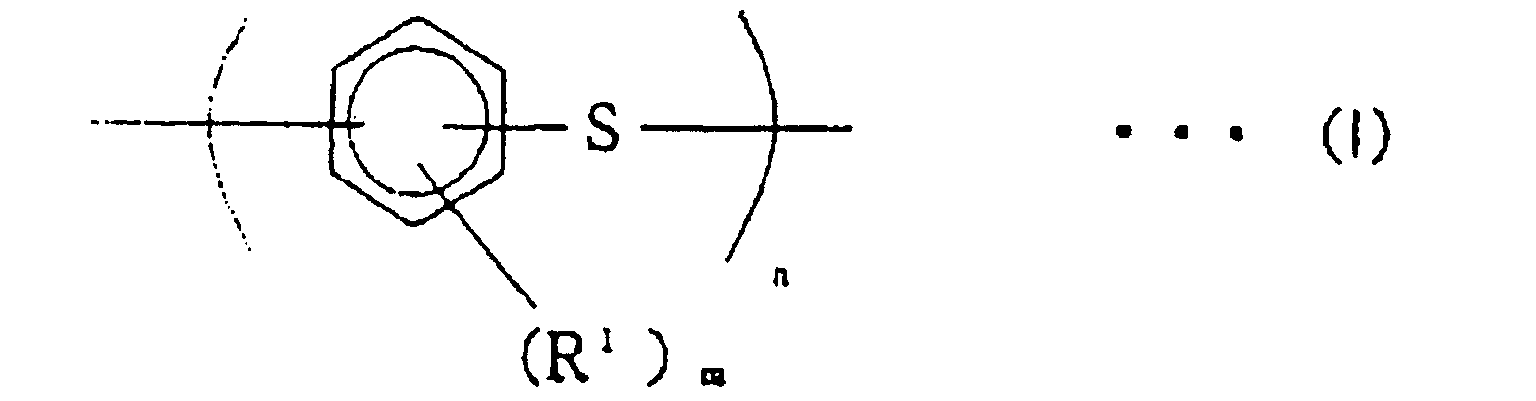
- the PAS which is obtained by the production process according to the present invention is a polymer containing at least 70 mol% of the repeating unit, for instance, represented by the constitutional formula: Ar ⁇ S ⁇ , wherein Ar is an arylene group.
- Typical PAS among those are a PPS containing at least 70 mol% of the repeating unit represented by the constitutional formula ( I ) and a PPS containing at least 70 mol% of the repeating unit represented by the constitutional formula (II): wherein R 1 is a substituent selected from an alkyl group having 1 to 6 carbon atoms, an alkoxy group, a phenyl group, a metal salt of a carboxylic acid, an amino group, a nitro group or a halogen atom such as fluorine, chlorine or bromine; m is an integer of from 0 to 4; and n is an average degree of polymerization in the range of 10 to 200: wherein n is as previously defined.
- the production process according to the present invention is effective for any type of known molecular structures of PAS including a substantially linear molecular structure without branched or crosslinked structure and a molecular structure having branched or crosslinked structure, said structure being dependent upon the production process thereof.
- the PAS is exemplified by a homopolymer or copolymer containing as a repeating unit, at least 70 mol%, preferably at least 80 mol% of para-phenylene sulfide unit.
- constitutional unit for copolymerization examples include meta-phenylene sulfide unit, ortho-phenylene sulfide unit, p, p'-diphenyleneketone sulfide unit, p, p'-diphenylenesulfone sulfide unit, p, p'-biphenylene sulfide unit, p, p'-diphenylene ether sulfide unit, p, p'-diphenylenemethylene sulfide unit, p, p'-diphenylenecumenyl sulfide unit and naphthy sulfide unit.
- polyarylene sulfide resin As an object of the polyarylene sulfide resin according to the present invention, there are included in addition to the polyarylene sulfide having a substantially linear structure, a branched or crosslinked polyarylene sulfide in which a small amount of a monomer having at least three functional groups as a part of monomers is polymerized and a blended polymer in which the polyarylene sulfide just cited is blended with the above-cited substantially linear polymer.
- the PAS resin composition according to the present invention comprises 20 to 90% by weight, preferably 20 to 70% by weight, more preferably 40 to 70% by weight of the PAS to be obtained in the above-mentioned process and 80 to 10% by weight, preferably 80 to 30% by weight, more preferably 60 to 30% by weight of an inorganic filler.
- the inorganic filler examples include glass fiber, carbon fiber, aramid fiber, potassium titanate whisker, silicon carbide whisker, mica ceramics fiber, wollastonite, mica, talc, silica, alumina, kaolin, clay, silica - alumina, carbon black, calcium carbonate, titanium oxide, lithium carbonate, molybdenum disulfide, graphite, iron oxide, glass beads, calcium phosphate, calcium sulfate, magnesium carbonate, magnesium phosphate, silicon nitride and hydrotalcite. Any of the above-cited fillers may be used alone or in combination with at least one other. Of the above-cited fillers, glass fiber is particularly preferable.
- the glass fiber is not specifically limited, but may be selected for use from among alkali glass, low alkali glass and non-alkali glass.
- the fiber length is preferably 0.1 to 8 mm, more preferably 0.3 to 6 mm, and the fiber diameter is preferably 0.1 to 30 micrometer ( ⁇ m), more preferably 0.5 to 25 ⁇ m.
- the fiber length when being less than 0.1 mm, leads to lowered reinforcing effect, whereas the length, when being more than 8 mm, brings about a decrease in fluidity of the composition.
- the fiber diameter, when being less than 0.1 ⁇ m brings about a decrease in fluidity of the resin, whereas the diameter, when being more than 30 ⁇ m, leads to lowered strength of the composition.
- the configuration of the glass fiber is not specifically limited, but may be selected for use from a variety of forms such as roving, milled fiber and chopped strand. The glass fiber may be used alone or in combination with at least one other.
- the glass fiber may be subjected to a surface treatment with any of a silane based coupling agent of aminosilane base, epoxysilane base, vinylsilane base or methacrylicsilane base, a titanate based coupling agent of tetramethyl-orthotitanate or tetraethyl-orthotitanate, a chromium complex compound and a boron compound.
- a silane based coupling agent of aminosilane base epoxysilane base, vinylsilane base or methacrylicsilane base
- a titanate based coupling agent of tetramethyl-orthotitanate or tetraethyl-orthotitanate a chromium complex compound and a boron compound.
- the process for preparing the PAS resin composition according to the present invention is not specifically limited.
- the composition can be prepared by blending the PAS, an inorganic filler and an additive to be used at need such as a silane based coupling agent, antioxidant, heat stabilizer, lubricant, plasticizer, electroconductivity imparting agent, coloring agent and pigment; mixing the components with one another by means of a tumbler blender, Henschel mixer or the like; and subjecting the resultant mixture to melt kneading granulation by the use of a single screw extruder or multi-screw extruder or by using a kneader, Banbury mixer or the like.
- an additive to be used at need such as a silane based coupling agent, antioxidant, heat stabilizer, lubricant, plasticizer, electroconductivity imparting agent, coloring agent and pigment
- mixing the components with one another by means of a tumbler blender, Henschel mixer or the like
- subjecting the resultant mixture to melt kn
- a molded article according to the present invention can be produced from the above-described PAS resin composition by means of an injection molding method, extrusion molding method or the like method.
- the PAS which is obtained by the production process according to the present invention is preferably usable as materials for a variety of molded articles such as materials for films, fibers, mechanical parts, electrical parts, electronic parts and the like.
- the PDCB concentration was determined by an internal standard method by the use of gas chromatography, wherein use was made of chloroform as the diluting solvent and 1, 2, 4 - trichlorobenzene as the internal standard.
- a miniatured pressuretight cell which had an internal volume of 10 milliliter (mL) and was made of stainless steel type SUS 316 was charged with 2.5 g of PAS and 2.5 g of N- methyl- 2- pyrrolidone (NMP), and was hermetically sealed. The cell was heated in an oil bath to raise the temperature thereof to 265°C, which was maintained for 8 hours. Then the cell was taken out from the oil bath and cooled, and then the PAS was withdrawn from the cell, washed with water and dried. Thus the inherent viscosity [ ⁇ ] of the dried PAS was measured by the foregoing procedure, and variation in the inherent viscosity [ ⁇ ] was expressed as thermal stability ⁇ [ ⁇ ].
- a 1 m 3 titanium-made starting material synthesis vessel equipped with a stirrer was charged with 633 kg of N-methyl-2-pyrrolidone(NMP) and 100 kg (2.38 kilomole) of lithium hydroxide (LiOH • H 2 O), and the resultant mixture was heated to and kept at 140°C.
- the water contained in the lithium hydroxide as a starting material was removed by batchwise distillation. Thereafter, 65 N-kiloliter of gaseous hydrogen sulfide was blown into the mixture at a temperature kept at 130°C to synthesize lithium hydrosulfide.
- the reaction product contained 1.08 kilomole of lithium sulfide and 0.214 kilomole of lithium N-methyl-4-aminobutyrate.
- To the reaction product was added 154.0 kg (1.048 kilomole) of p-dichlorobenzene (PDCB) and further 5.3 kg of pure water to proceed with reaction at 210°C for 3 hours. Then the reaction liquid was cooled to 60°C or lower, and the resultant reaction mixture was taken out from the reactor into a 20 liter vessel. The conversion of the PDCB was 90%.
- the reactor was charged with 11.1 kg (0.076 kilomole) of additional PDCB, which was sufficiently stirred and thereafter, the resultant reaction mixture was taken out from the reactor into a 20 liter vessel.
- a 10 liter autoclave equipped with a Full zone impeller was charged with 855 g of lithium chloride as a phase separation agent and 5145 g of NMP, and was heated to raise the temperature up to 260°C.
- the above-prepared prepolymer was preserved at 60°C and was continuously supplied to the reactor at a flow rate of 33.3 g / minute by the use of a gear pump.
- Example 1 The procedure in Example 1 was repeated to obtain a PAS polymerization mixture except that the amount of PDCB to be additionally used was altered from 11.1 kg (0.076 kilomole) to 7.9 kg (0.054 kilomole).
- the results of evaluation made in the same manner as in Example 1 are given in Table 1.
- Example 1 The procedure in Example 1 was repeated to obtain a PAS polymerization mixture except that the synthesis time of the prepolymer was altered from 3 to 2 hours, and the conversion of PDCB at the time of further addition was set on 60%.
- the results of evaluation made in the same manner as in Example 1 are given in Table 1.
- Example 1 The procedure in Example 1 was repeated to obtain a PAS polymerization mixture except that the amount of PDCB to be used at the time of prepolymer synthesis was altered from 154.0 kg (1.048 kilomole) to 147.7 kg (1.004 kilomole) and the amount of PDCB to be further added was altered from 11.1 kg (0.076 kilomole) to 17.5 kg (0.119 kilomole).
- Table 1 The results of evaluation made in the same manner as in Example 1 are given in Table 1.
- Example 1 The procedure in Example 1 was repeated to obtain a PAS polymerization mixture except that the amount of PDCB to be used at the time of prepolymer synthesis was altered from 154.0 kg (1.048 kilomole) to 165.1 kg (1.123 kilomole) and PDCB was not further added.
- the results of evaluation made in the same manner as in Example 1 are given in Table 1.
- Example 1 The procedure in Example 1 was repeated to obtain a PAS polymerization mixture except that the amount of PDCB to be used at the time of prepolymer synthesis was altered from 154.0 kg (1.048 kilomole) to 161.9 kg (1.102 kilomole) and PDCB was not further added.
- the results of evaluation made in the same manner as in Example 1 are given in Table 1.
- a polyarylene sulfide, especially polyphenylene sulfide is known as an engineering plastic which is excellent in mechanical strength and heat resistance and the like and which has good electrical characteristics and high rigidity. Thus it is widely employed as a variety of materials such as electronic parts, electrical parts and mechanical parts.
- a molded article of a resin composition composed of polyphenylene sulfide and an inorganic filler can be employed for a variety of purposes of use.
Landscapes
- Chemical & Material Sciences (AREA)
- Health & Medical Sciences (AREA)
- Chemical Kinetics & Catalysis (AREA)
- Medicinal Chemistry (AREA)
- Polymers & Plastics (AREA)
- Organic Chemistry (AREA)
- Polymers With Sulfur, Phosphorus Or Metals In The Main Chain (AREA)
- Manufacture Of Macromolecular Shaped Articles (AREA)
- Compositions Of Macromolecular Compounds (AREA)
Abstract
Description

| PDCB/Li2S molar ratio | [η](dl/g) | Δ [η](dl /g) | |||
| Initial | Addition | Total | |||
| Example 1 | 0.97 | 0.07 | 1.04 | 0.28 | 0.01 |
| Example 2 | 0.97 | 0.05 | 1.02 | 0.30 | 0.02 |
| Example 3 | 0.97 | 0.07 | 1.04 | 0.26 | 0.01 |
| Example 4 | 0.93 | 0.11 | 1.04 | 0.27 | 0.03 |
| Comparative Example 1 | 1.04 | 0.00 | 1.04 | 0.28 | 0.17 |
| Comparative Example 2 | 1.02 | 0.00 | 1.02 | 0.26 | 0.18 |
Claims (10)
- A process for producing a polyarylene sulfide which comprises reacting a sulfur source with a dihalogenated aromatic compound in an aprotic organic solvent, characterized by adding the dihalogenated aromatic compound by dividing the same into a plurality of times at the time of polymerization reaction.
- The production process according to Claim 1 wherein dihalogenated aromatic compound is further added to the reaction system at the point of time when 50 % or more of the added dihalogenated aromatic compound has reacted.
- The production process according to Claim 1 wherein dihalogenated aromatic compound is further added to the reaction system at the point of time when 60% or more of the added dihalogenated aromatic compound has reacted.
- The production process according to Claim 1 wherein the dihalogenated aromatic compound is added by dividing the same into two times at the time of polymerization reaction.
- The production process according to Claim 4 wherein the dihalogenated aromatic compound is used at a molar ratio of dihalogenated aromatic compound / sulfur source in the range of 0.90 to 1.04 in a first time, and in a molar ratio thereof of at least 0.01 in a second time.
- The production process according to Claim 1 wherein the polymerization reaction is continuously put into practice.
- The production process according to Claim 1 wherein the polymerization reaction is put into practice in the presence of a phase separation agent.
- The production process according to Claim 1 wherein the polyarylene sulfidehas an inherent viscosity [η] of at least 0.1.
- Apolyarylene sulfide resin composition which comprises 20 to 90% by weight of the polyarylene sulfide which is produced by the production process as set forth in any of Claims 1 to 8, and 80 to 10% by weight of an inorganic filler.
- A molded article which is produced by molding the polyarylene sulfide resin composition as set forth in Claim 9.
Applications Claiming Priority (3)
| Application Number | Priority Date | Filing Date | Title |
|---|---|---|---|
| JP2001098378 | 2001-03-30 | ||
| JP2001098378A JP2002293939A (en) | 2001-03-30 | 2001-03-30 | Method for polyarylene sulfide production |
| PCT/JP2002/002356 WO2002081548A1 (en) | 2001-03-30 | 2002-03-13 | Process for producing polyarylene sulfide |
Publications (2)
| Publication Number | Publication Date |
|---|---|
| EP1375564A1 true EP1375564A1 (en) | 2004-01-02 |
| EP1375564A4 EP1375564A4 (en) | 2005-06-15 |
Family
ID=18952030
Family Applications (1)
| Application Number | Title | Priority Date | Filing Date |
|---|---|---|---|
| EP02705128A Withdrawn EP1375564A4 (en) | 2001-03-30 | 2002-03-13 | PROCESS FOR PRODUCING POLYARYLENE SULFIDE |
Country Status (6)
| Country | Link |
|---|---|
| US (1) | US20040152823A1 (en) |
| EP (1) | EP1375564A4 (en) |
| JP (1) | JP2002293939A (en) |
| CN (1) | CN1216930C (en) |
| TW (1) | TWI299337B (en) |
| WO (1) | WO2002081548A1 (en) |
Families Citing this family (9)
| Publication number | Priority date | Publication date | Assignee | Title |
|---|---|---|---|---|
| JP2004182840A (en) * | 2002-12-03 | 2004-07-02 | Idemitsu Petrochem Co Ltd | Polyarylene sulfide resin and its composition, and their manufacturing method |
| CN103073720B (en) * | 2011-10-26 | 2016-02-17 | 中国石油化工股份有限公司 | A kind of method of synthesizing low-color high-purity fiber-grade polyphenylene sulfide resin |
| JP2015127398A (en) * | 2013-11-29 | 2015-07-09 | 東レ株式会社 | Polyarylene sulfide and manufacturing method therefor |
| EP3275620B1 (en) * | 2015-03-26 | 2019-11-13 | DIC Corporation | Method for producing a fibre-reinforced polyarylene sulfide resin molded article |
| CN105331081B (en) * | 2015-11-30 | 2018-03-09 | 江门市优巨新材料有限公司 | A kind of preparation method of high-performance modified polyethersulfone resin |
| CN106750299B (en) * | 2017-01-13 | 2018-12-07 | 四川中科兴业高新材料有限公司 | A kind of preparation method of low cost polyphenylene sulfide |
| CN110121521B (en) * | 2017-02-07 | 2021-11-12 | 株式会社吴羽 | Process for producing granular polyarylene sulfide and granular polyarylene sulfide |
| CN107722274A (en) * | 2017-11-15 | 2018-02-23 | 天津工业大学 | A kind of preparation method of melt-blown polyphenylene sulfide |
| CN113480734B (en) * | 2020-03-16 | 2022-08-05 | 万华化学集团股份有限公司 | Method for preparing sulfone polymer containing biaryl ring structure |
Family Cites Families (25)
| Publication number | Priority date | Publication date | Assignee | Title |
|---|---|---|---|---|
| JPH07121985B2 (en) * | 1986-08-04 | 1995-12-25 | 呉羽化学工業株式会社 | Method for producing polyarylensulfide |
| US5278283A (en) * | 1989-06-30 | 1994-01-11 | Idemitsu Petrochemical Company, Limited | Process for preparing polyarylene sulfides of increased molecular weight |
| JPH0672185B2 (en) * | 1989-07-17 | 1994-09-14 | 出光石油化学株式会社 | Method for producing polyarylene sulfide |
| JP2513513B2 (en) * | 1990-01-19 | 1996-07-03 | 呉羽化学工業株式会社 | Method for producing polyarylene sulfide |
| JP3125391B2 (en) * | 1991-12-06 | 2001-01-15 | 東ソー株式会社 | Method for producing high molecular weight polyphenylene sulfide |
| JPH05271414A (en) * | 1992-03-25 | 1993-10-19 | Dainippon Ink & Chem Inc | Method for producing high molecular weight polyarylene sulfide |
| JPH0649208A (en) * | 1992-07-29 | 1994-02-22 | Dainippon Ink & Chem Inc | Method for producing high molecular weight polyarylene sulfide |
| US5929203A (en) * | 1992-10-23 | 1999-07-27 | Phillips Petroleum Company | Process for preparing high molecular weight poly(arylene sulfide) polymers using lithium salts |
| JPH08134216A (en) * | 1994-11-02 | 1996-05-28 | Dainippon Ink & Chem Inc | Method for producing polyarylene sulfide with low sulfur gas generation |
| JP3582123B2 (en) * | 1994-12-21 | 2004-10-27 | 大日本インキ化学工業株式会社 | Method for producing polyarylene sulfide |
| JP3568054B2 (en) * | 1994-12-28 | 2004-09-22 | 呉羽化学工業株式会社 | Method for producing polyphenylene sulfide |
| US5789533A (en) * | 1995-06-29 | 1998-08-04 | Tonen Chemical Corporation | Polyarylene sulfide, a process for the preparation thereof and a composition comprising the same |
| JP3490195B2 (en) * | 1995-08-22 | 2004-01-26 | 出光石油化学株式会社 | Method for producing polyarylene sulfide |
| JPH09169844A (en) * | 1995-12-21 | 1997-06-30 | Idemitsu Petrochem Co Ltd | Continuous multi-stage polymerization method for poly (arylene sulfide) |
| JPH09278888A (en) * | 1996-04-16 | 1997-10-28 | Idemitsu Petrochem Co Ltd | Equipment for producing polyarylene sulfide and method for producing polyarylene sulfide using the same |
| DE19623706A1 (en) * | 1996-06-14 | 1997-12-18 | Hoechst Ag | Process for the production of sulfur-containing polymers |
| JP3588539B2 (en) * | 1996-09-30 | 2004-11-10 | 株式会社東芝 | Polyphenylene sulfide resin composition and resin-encapsulated semiconductor device using the same |
| JPH11335559A (en) * | 1998-05-28 | 1999-12-07 | Idemitsu Kosan Co Ltd | Polyarylene sulfide resin composition, and molded article and connector comprising the same |
| JP4009039B2 (en) * | 1998-07-09 | 2007-11-14 | 財団法人石油産業活性化センター | Polyarylene sulfide resin composition |
| JP3603159B2 (en) * | 1998-09-22 | 2004-12-22 | 財団法人石油産業活性化センター | Polyarylene sulfide molding material and injection molded product thereof |
| JP2002265603A (en) * | 2001-03-12 | 2002-09-18 | Idemitsu Petrochem Co Ltd | Method for producing polyaryrene sulfide |
| JP2002293936A (en) * | 2001-03-30 | 2002-10-09 | Idemitsu Petrochem Co Ltd | Ventilating method for polyarylene sulfide |
| JP2002293938A (en) * | 2001-03-30 | 2002-10-09 | Petroleum Energy Center | Method for continuous production of polyarylene sulfide |
| JP2002293937A (en) * | 2001-03-30 | 2002-10-09 | Petroleum Energy Center | Method for polyarylene sulfide by-product salt |
| JP2002293935A (en) * | 2001-03-30 | 2002-10-09 | Petroleum Energy Center | Method for baking polyarylene sulfide by-product salt |
-
2001
- 2001-03-30 JP JP2001098378A patent/JP2002293939A/en active Pending
-
2002
- 2002-03-13 EP EP02705128A patent/EP1375564A4/en not_active Withdrawn
- 2002-03-13 WO PCT/JP2002/002356 patent/WO2002081548A1/en not_active Ceased
- 2002-03-13 US US10/473,363 patent/US20040152823A1/en not_active Abandoned
- 2002-03-13 CN CN028076893A patent/CN1216930C/en not_active Expired - Fee Related
- 2002-03-25 TW TW091105767A patent/TWI299337B/zh not_active IP Right Cessation
Also Published As
| Publication number | Publication date |
|---|---|
| US20040152823A1 (en) | 2004-08-05 |
| CN1500112A (en) | 2004-05-26 |
| CN1216930C (en) | 2005-08-31 |
| JP2002293939A (en) | 2002-10-09 |
| TWI299337B (en) | 2008-08-01 |
| WO2002081548A1 (en) | 2002-10-17 |
| EP1375564A4 (en) | 2005-06-15 |
Similar Documents
| Publication | Publication Date | Title |
|---|---|---|
| US7026439B2 (en) | Process for continuous production of polyarylene sulfide | |
| US6982312B2 (en) | Process for producing polyarylene sulfide | |
| US6562900B2 (en) | Production process for polyarylene sulfide | |
| US20060122363A1 (en) | Process for the production of polyarylene sulfide | |
| US6388003B1 (en) | Polyarylensulfide, polyarylensulfide resin composition, method for producing polyarylensulfide | |
| US4433138A (en) | Process for the preparation of polyarylene sulphides | |
| US4424339A (en) | Process for the preparation of polyarylene sulphides | |
| US20040152823A1 (en) | Process for producing polyarylene sulfide | |
| US4661584A (en) | Preparation of polyarylene sulphide in presence of amino carboxylic acid | |
| JPH08269200A (en) | Production of polyarylene sulfide excellent in adhesivity | |
| CA1223690A (en) | Process for the production of optionally branched polyarylene sulfides | |
| KR940002185B1 (en) | Polyarylene sulfide, preparation method thereof and resin composition | |
| US5200499A (en) | Removal of water by venting during the polymerization of phenylene sulfide polymers with sulfur source/polar organic compound molar ratio being at least 0.36/1 | |
| JP2002293940A (en) | Method for polyarylene sulfide production | |
| TWI272280B (en) | Process for continuous production of branched polyarylene sulfides | |
| JPH0881630A (en) | Polyarylene sulfide resin composition | |
| JP2004168834A (en) | Polyarylene sulfide / polyether block copolymer and method for producing the same, and resin composition | |
| WO2023243204A1 (en) | Aromatic thioether sulfone polymer, composition, and molded article, and methods for producing same | |
| JPH068350B2 (en) | Method for preparing high molecular weight, optionally branched, polyarylene sulfides | |
| JP2022114027A (en) | Polyphenylene sulfide resin composition | |
| JPH09241379A (en) | Production of polyarylene sulfide modification, modification obtained thereby, and resin composition comprising the same | |
| JP2002308988A (en) | Method for producing polyarylene sulfide and apparatus used therefor |
Legal Events
| Date | Code | Title | Description |
|---|---|---|---|
| PUAI | Public reference made under article 153(3) epc to a published international application that has entered the european phase |
Free format text: ORIGINAL CODE: 0009012 |
|
| 17P | Request for examination filed |
Effective date: 20030912 |
|
| AK | Designated contracting states |
Kind code of ref document: A1 Designated state(s): AT BE CH CY DE DK ES FI FR GB GR IE IT LI LU MC NL PT SE TR |
|
| RAP1 | Party data changed (applicant data changed or rights of an application transferred) |
Owner name: PETROLEUM ENERGY CENTER Owner name: IDEMITSU KOSAN CO., LTD. |
|
| A4 | Supplementary search report drawn up and despatched |
Effective date: 20050503 |
|
| RIC1 | Information provided on ipc code assigned before grant |
Ipc: 7C 08G 75/02 A Ipc: 7C 08K 3/00 B Ipc: 7C 08J 5/00 B Ipc: 7C 08L 81/02 B |
|
| STAA | Information on the status of an ep patent application or granted ep patent |
Free format text: STATUS: THE APPLICATION IS DEEMED TO BE WITHDRAWN |
|
| 18D | Application deemed to be withdrawn |
Effective date: 20060530 |