EP1374168B1 - Method and apparatus for determining regions of interest in images and for image transmission - Google Patents
Method and apparatus for determining regions of interest in images and for image transmission Download PDFInfo
- Publication number
- EP1374168B1 EP1374168B1 EP01982419A EP01982419A EP1374168B1 EP 1374168 B1 EP1374168 B1 EP 1374168B1 EP 01982419 A EP01982419 A EP 01982419A EP 01982419 A EP01982419 A EP 01982419A EP 1374168 B1 EP1374168 B1 EP 1374168B1
- Authority
- EP
- European Patent Office
- Prior art keywords
- regions
- peak
- entropy
- image
- pixels
- Prior art date
- Legal status (The legal status is an assumption and is not a legal conclusion. Google has not performed a legal analysis and makes no representation as to the accuracy of the status listed.)
- Expired - Lifetime
Links
Images

Classifications
-
- G—PHYSICS
- G06—COMPUTING OR CALCULATING; COUNTING
- G06T—IMAGE DATA PROCESSING OR GENERATION, IN GENERAL
- G06T9/00—Image coding
-
- H—ELECTRICITY
- H04—ELECTRIC COMMUNICATION TECHNIQUE
- H04N—PICTORIAL COMMUNICATION, e.g. TELEVISION
- H04N19/00—Methods or arrangements for coding, decoding, compressing or decompressing digital video signals
-
- G—PHYSICS
- G06—COMPUTING OR CALCULATING; COUNTING
- G06T—IMAGE DATA PROCESSING OR GENERATION, IN GENERAL
- G06T7/00—Image analysis
- G06T7/10—Segmentation; Edge detection
- G06T7/143—Segmentation; Edge detection involving probabilistic approaches, e.g. Markov random field [MRF] modelling
-
- G—PHYSICS
- G06—COMPUTING OR CALCULATING; COUNTING
- G06V—IMAGE OR VIDEO RECOGNITION OR UNDERSTANDING
- G06V10/00—Arrangements for image or video recognition or understanding
- G06V10/20—Image preprocessing
- G06V10/25—Determination of region of interest [ROI] or a volume of interest [VOI]
-
- G—PHYSICS
- G06—COMPUTING OR CALCULATING; COUNTING
- G06V—IMAGE OR VIDEO RECOGNITION OR UNDERSTANDING
- G06V10/00—Arrangements for image or video recognition or understanding
- G06V10/40—Extraction of image or video features
- G06V10/46—Descriptors for shape, contour or point-related descriptors, e.g. scale invariant feature transform [SIFT] or bags of words [BoW]; Salient regional features
- G06V10/462—Salient features, e.g. scale invariant feature transforms [SIFT]
-
- G—PHYSICS
- G06—COMPUTING OR CALCULATING; COUNTING
- G06V—IMAGE OR VIDEO RECOGNITION OR UNDERSTANDING
- G06V10/00—Arrangements for image or video recognition or understanding
- G06V10/40—Extraction of image or video features
- G06V10/50—Extraction of image or video features by performing operations within image blocks; by using histograms, e.g. histogram of oriented gradients [HoG]; by summing image-intensity values; Projection analysis
- G06V10/507—Summing image-intensity values; Histogram projection analysis
-
- H—ELECTRICITY
- H04—ELECTRIC COMMUNICATION TECHNIQUE
- H04N—PICTORIAL COMMUNICATION, e.g. TELEVISION
- H04N19/00—Methods or arrangements for coding, decoding, compressing or decompressing digital video signals
- H04N19/10—Methods or arrangements for coding, decoding, compressing or decompressing digital video signals using adaptive coding
- H04N19/169—Methods or arrangements for coding, decoding, compressing or decompressing digital video signals using adaptive coding characterised by the coding unit, i.e. the structural portion or semantic portion of the video signal being the object or the subject of the adaptive coding
- H04N19/17—Methods or arrangements for coding, decoding, compressing or decompressing digital video signals using adaptive coding characterised by the coding unit, i.e. the structural portion or semantic portion of the video signal being the object or the subject of the adaptive coding the unit being an image region, e.g. an object
-
- G—PHYSICS
- G06—COMPUTING OR CALCULATING; COUNTING
- G06T—IMAGE DATA PROCESSING OR GENERATION, IN GENERAL
- G06T2207/00—Indexing scheme for image analysis or image enhancement
- G06T2207/20—Special algorithmic details
- G06T2207/20112—Image segmentation details
- G06T2207/20132—Image cropping
Definitions
- the present invention relates generally to the field of image processing. More particularly, but not exclusively, the invention concerns methods and apparatus for determining regions of interest in images for transmission.
- Prior art transmission technologies that are particularly suited for video applications focus on interpreting image data at the transmission source, transmitting the interpretation data rather than the image itself, and using the interpretation data at the destination.
- the interpretation data may or may not be transmitted in compressed form.
- the image-driven approach relies on features in the image, such as edges or corners, to propagate "naturally" and form meaningful descriptions or models of image content.
- a typical example is figure-ground image segmentation, where the task is to separate the object of interest in the foreground from the background.
- a number of small salient patches or 'icons' are identified within an image. These icons represent descriptors of areas of interest.
- saliency is defined in terms of local signal complexity or unpredictability, or, more specifically, the entropy of local attributes. Icons with a high signal complexity have a flatter intensity distribution, and, hence, a higher entropy. In more general terms, it is the high complexity of any suitable descriptor that may be used as a measure of local saliency.
- Known salient icon selection techniques measure the saliency of icons at the same scale across the entire image.
- the scale to use for selection across the whole image may be chosen in several ways. Typically, the smallest scale at which a maximum occurs in the average global entropy is chosen. However, the size of image features varies. Therefore a scale of analysis that is optimal for a given feature of a given size might not be optimal for a feature of a different size.
- the present invention discloses methods and apparatus for determining regions of interest in images.
- the present invention provides ways of extending the saliency measure to scale, and thereby finding features that exist at a very narrow range of scales. This yields salient icons having an optimum level of entropy.
- a method for ranking pixels in an image by degrees of saliency includes the steps of: defining a plurality of regions for each of a plurality of pixels in an image, where each of the regions for any one of the pixels at coordinates (x,y) has a different scale s; calculating an entropy value for each of the regions; identifying any of the regions as having a peak entropy value; weighting the peak entropy value of each of the peak entropy regions by a weight value corresponding to a peak width estimate of the peak entropy value; ranking the regions by the weighted peak entropy values, thereby ranking the pixels.
- the calculating step may include calculating a probability density function (PDF) estimate for the pixels within each of the regions.
- PDF probability density function
- the calculating step may include calculating using a Parzen window PDF estimator.
- the calculating step may include calculating using histogram binning.
- the method may further include the step of applying a 3-tap averaging to the peak width estimate prior to performing the weighting step.
- a method for determining regions of saliency in an image including the steps of a) defining a plurality of regions for each of a plurality of pixels in an image, where each of the regions for any one of the pixels at coordinates (x,y) has a different scale s , b) calculating an entropy value for each of the regions, c) identifying any of the regions as having a peak entropy value, d) weighting the peak entropy value of each of the peak entropy regions by a weight value corresponding to a peak width estimate of the peak entropy value, and e) for each selected one of the peak entropy regions f) selecting at least one neighboring region of peak entropy, g) determining the mean and variance of each of x , y , and s for the selected peak entropy region and the at least one neighboring region, and where the largest of the variances does not exceed
- the method further includes performing step e) in order of the weighted peak entropy values.
- the invention further comprises a method of image transmission in accordance with appended claim 11, and devices in accordance with appended claims 12 and 13.
- the present invention extends prior art measures of saliency, so as to be able to compare the salience of both different spatial points and scales.
- the invention allows the selection of certain salient scales and salient spatial locations simultaneously. Inherent in this idea is that a feature may have a different saliency value at different scales. The invention allows a direct comparison of these.
- Schemes in the first category attempt to capture the multi-scale nature of signals by processing a complete multi-scale representation of the signal.
- Schemes in the second category attempt to find a best scale or set of scales to represent the signal, often parsing a complete multi-scale representation in order to choose the particular scale(s) of interest.
- the invention is a development in the general area of the second these two approaches.
- the method of the invention is best explained by considering the behaviour of the entropy scale metric with varying scale parameter.
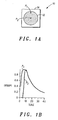
- Fig. 1A is a simplified illustration of an exemplary icon 10.
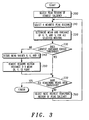
- Fig. 1B is a simplified graphical illustration of an entropy analysis for points P 1 and P 2 .
- icon 10 is illustrative of a feature within an image.
- the feature is shown as a circle for purposes of illustration. In a real image, features clearly may be radically different in shape from this idealised case.
- icon 10 is shown comprising a circle 12 in which two points P 1 and P 2 are indicated at the edge and center of circle 12 respectively.
- the whole of circle 12, including points P 1 , and P 2 is to be understood as being an entirely black icon/feature on the image.
- Fig. 1A shows the area within circle 12 as a hatched region, in order that the locations of points P 1 , and P 2 can be recognised on the figure.
- a square 14 around circle 12 represents the bounding square for the scale at which the peak in entropy for icon 10 occurs, when taken about point P 2 .
- This entropy peak is illustrated in Fig. 1B as the maximum in the entropy plot marked P2.
- Fig. 1B it may also be seen in Fig. 1B that the two plots for entropy versus scale have different peak widths.
- the plot for P 1 is approximately twice as wide as that for P 2 .
- saliency is based on complexity, defined in terms of unpredictability. In real-life images this exists at a small number of scales and spatial locations, and hence is considered to be relatively rare. If an image was complex and unpredictable at all spatial locations and scales, then it would either be a random image or fractal-like.
- the peak of P 2 is actually of greater salience than that of P 1 . It should be noted that a given point may have several peaks of entropy, each at a different scale.
- Fig. 1B This analysis of Fig. 1B indicates that the width of the entropy plot taken about different points on an image might serve as a useful indicator. Notably, a saliency estimate based on peak height alone does not enable a distinction to be made between the two plots on figure 1B.
- FIG. 2 is a simplified flowchart illustration of a method for determining icon salience, operative in accordance with a preferred embodiment of the present invention.
- a circular region of a radius s is defined around a pixel at coordinates ( x , y ) in an image (step 210).
- PDF probability density function
- the values may be gray level intensity values, color levels, or any other characteristic used to define the type of interest desired for image features.
- a Parzen window PDF estimator is preferably used where a pre-defined kernel is placed on the data points in the sample set. The PDF estimation is then the sum of all kernels across the data axis.
- a Gaussian kernel is preferably used for its mathematical tractability and resulting smooth PDF estimate, where the sigma controls the degree of smoothing applied to the PDF estimate. Since there is no arbitrary binning, the entropy value is stable under linear intensity shifts.
- a basic histogram binning method may be used as an alternative to the Parzen window PDF estimation algorithm.
- the data axis is simply divided into a number of bins, for example 16 or 32 bins, with each bin having upper and lower data values. A count for each bin is kept and is incremented for every pixel within the local window that is between the upper and lower data values for that bin.
- Radius s is then increased by the next scale increment (step 240), and the previous steps are repeated for all scales of s between s 1 and a maximum scale value s 2 (step 250).
- a maximum scale value s 2 step 250.
- Steps 200 to 270 are then preferably repeated for all pixels in the image (step 280). Once the entropy values of regions of peak entropy have been weighted, they are preferably ranked by weighted peak entropy value, thus resulting in a ranking of the pixels by peak saliency (step 290).
- the method of the invention is novel due to the use of peak width as a weighting factor in the calculation of saliency.
- the actual technique selected for peak width estimation represents a further refinement of the broad idea of using the peak width.
- the inventors have chosen a technique for peak width estimation that involves calculating the sum of absolute gradients of the histogram measured at the peak.
- the histogram meant here is an approximation to the continuous probability density function (PDF) of the intensity distributions around the points such as P1 and P2 in Figure 1A. If the sum is large, this indicates that the peak in the intensity distribution, see Fig. 1B, is quite sharp. A small value of the sum indicates that the peak is likely to be quite wide.
- PDF continuous probability density function
- the advantage of this Sum of Absolute Difference calculation is that it avoids particular cases that have to be dealt with separately for a simple measurement of peak width. These particular cases would slow down the computation if the inventors had chosen to perform a simple measurement of peak width.
- the Sum of Absolute Differences calculation is therefore robust, and does not suffer significant delays in the computation.
- a simple 3-tap averaging may be applied to the peak width estimation prior to weighting the entropy value in order to increase the robustness to noise.
- the value W(x,y,s) proportional to peak width estimate at each scale s is replaced with the average of the values at s -1, s , and s +1. That average is (W(x,y,s - 1) + W(x,y,s) + W(x,y,s + 1)) / 3
- the shape of the entropy surface is dependent on three main factors: the original image intensity surface, the shape of the sampling window or Region Of Interest (ROI) and the size of the ROI (scale).
- the shape of the ROI is circular as this allows the entropy value to be rotationally invariant.
- the dependence on the image surface is a result of a mismatch between the sampling ROI size and/or shape and the image feature of interest. Assuming that the scale is adjusted correctly, and that the shape of the ROI is fixed, it follows that this dependence is not controllable, and that picking single points in entropy space is not a robust method.
- a more robust method would be to pick regions rather than points in entropy space. Although the individual pixels within a salient region may be affected by the noise at any given instant, it is unlikely to affect all of them such that the region as a whole becomes non-salient.
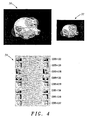
- Fig. 3 is a simplified flowchart illustration of a method for selecting salient regions, operative in accordance with a preferred embodiment of the present invention.
- the peak region (x,y,s) of highest saliency, as determined by the method of Fig. 2, is selected (step 300).
- the peak itself (x,y,s) is defined by the region's center point.
- the K nearest peak regions are then selected (step 310). Nearness may be defined in (x,y,s) space based on a sum of the squares of the vector distance ( x 2 + y 2 + s 2 ).
- the value of K determines the noise robustness of the features being detected. A higher K value will result in larger regions with well specified properties being detected, for example an automobile in the image. A smaller K value allows features of finer detail to be detected, for example a car antenna in the image. K is preferably adapted until a predefined variance threshold is exceeded.
- the mean and variance of x, y, and s are calculated for all the selected regions (step 320).
- the largest of the three variances is then compared with a threshold.
- the value of the threshold may be set in accordance with known clustering algorithms, typically 0.7 (step 330).
- a variance that is less than the threshold typically indicates that the regions are well clustered, in which case the mean values of x, y, and s are then stored (step 340).
- D may be set to be any value or preferably an adaptive value related to the variance, such as a value proportional to 3 x standard deviation.
- a variance (step 330) that is greater than the threshold typically indicates that no clustering is found, in which case the point may be stored as an isolated point, the value of K may be reduced until clustering is attained, possibly down to a single point, or else the point may simply remain in the list of salient points to see if it clusters in with anything else (step 370).
- Steps 300 - 350 are then performed on the next highest remaining region of peak entropy (step 360) until all regions of peak entropy have been processed, preferably in order of weighted peak entropy value.
- the present clustering method thus accounts for the impact of noise on the saliency calculation of Fig. 2, and gives consideration to points of high entropy that are highly correlated in saliency space.
- the variance may be zero. Where only two regions are used in the calculation, the variance calculation may be discarded.
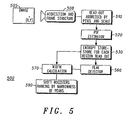
- Fig. 4 shows the results of an implementation of the method of Figs. 2 and 3.
- salient icons have been matched between the two images 30 and 32, using the method of the invention.
- salient regions and scales have been selected in two the images 30 and 32.
- the icons have been correlated, at 34, to find the best matching icons between the two images.
- Preprocessing stages may be used to reduce noise in the original image prior to carrying out the methods described herein.
- Diffusion methods are widely known for their noise reduction and smoothing properties, and are widely cited as useful for generating scale-space representations of the original signal.
- Scale space methods attempt to represent the original signal at a number of scales by successive smoothing operations.
- linear diffusion which is equivalent to smoothing with a Gaussian filter, is considered to provide the most general smoothing
- experimentation has shown that non-linear isotropic diffusion and non-linear anisotropic diffusion are preferable.
- Non-linear isotropic diffusion and non-linear anisotropic diffusion methods adjust the smoothing such that predefined significant edges are not smoothed.
- the smoothing is weighted by a local gradient function.
- non-linear anisotropic diffusion the smoothing is also directed to the direction of edges.
- Non-linear anisotropic diffusion also removes noise at edges.
- the present invention also comprises a method of image transmission.
- This method of image transmission comprises the methods explained above.
- the methods of ranking pixels and of determining saliency in an image provide a way of identifying important regions of an image. Such identification can be used to identify parts of an image that are then transmitted preferentially.
- an image may be transmitted over a radio link, to or from a mobile radio (PMR) or a mobile telephone.
- PMR mobile radio
- the bandwidth of the radio link available may restrict substantially the amount of data that can be transmitted from an image.
- the highly ranked pixels or most salient regions may be transmitted more often than other data. In fact, these may be the only portions of an image that are transmitted, for example during periods when an image changes rapidly with time.
- FIG. 5 An embodiment of such a device is illustrated in appended figure 5.
- the device (500) of figure 5 serves to rank pixels in an image by degrees of saliency.
- the device comprises:
- FIG. 5 Also shown in figure 5 is an 'acquisition and frame structure' unit 508, which includes a camera for scanning the image. Such a unit is known to the person skilled in the art, and hence is not described in further detail.
- the PDF estimator 520 provides the probability density function, as described above with reference to the methods of the invention.
- the invention also extends to an image transmission device.
- the image transmission device comprises a device as explained above, and generally explained in connection with figure 5.
- the image transmission device may select salient regions of an image for preferential transmission. Particularly where the transmission is over a radio link to or from a mobile or portable radio (PMR) or mobile telephone, the transmission may comprise the selected regions only, or these regions may be transmitted more frequently than other regions.
- PMR mobile or portable radio
- the image transmission device may form part of a mobile or portable radio (PMR) or mobile telephone.
- PMR portable radio
- bifurcations and end-points of the ridges are commonly considered to be salient.
- edge direction feature map For this task we use an edge direction feature map.
- the non-salient parts are those that consist of lines at a single scale and a single dominant direction Bifurcations and end-points consist of many edge directions, and possibly scales.
- PDF of intensity values we use the PDF of edge directions and scales.
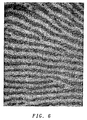
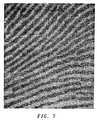
- Figure 6 shows the most salient parts, and their respective scales, of a fingerprint image found using this method. See also figure 7.
- the method and apparatus of the invention can use any suitable feature map in the determination of saliency.
- Matching is a very common operation necessary in many computer vision tasks. For example, in object recognition the appropriate model from the object database must be found. This is commonly done by exhaustively attempting to test the match between all models in the database and the image features.
- the saliency method of the present invention can improve the performance of such tasks by reducing the amount of data that needs to be stored for each model. This therefore reduces the complexity of the model search. It does this in two mains ways:
- the appropriate descriptor for the task should be chosen such that it is more powerful (or descriptive) than the one used for the saliency feature map.
- the salient regions may be used in a matching task.
Landscapes
- Engineering & Computer Science (AREA)
- Multimedia (AREA)
- Physics & Mathematics (AREA)
- Theoretical Computer Science (AREA)
- General Physics & Mathematics (AREA)
- Computer Vision & Pattern Recognition (AREA)
- Signal Processing (AREA)
- Probability & Statistics with Applications (AREA)
- Software Systems (AREA)
- Image Analysis (AREA)
- Apparatus For Radiation Diagnosis (AREA)
- Compression Or Coding Systems Of Tv Signals (AREA)
- Closed-Circuit Television Systems (AREA)
- Ultra Sonic Daignosis Equipment (AREA)
Applications Claiming Priority (3)
| Application Number | Priority Date | Filing Date | Title |
|---|---|---|---|
| GB0024669 | 2000-10-09 | ||
| GB0024669A GB2367966B (en) | 2000-10-09 | 2000-10-09 | Method and apparatus for determining regions of interest in images and for image transmission |
| PCT/EP2001/011715 WO2002031766A2 (en) | 2000-10-09 | 2001-10-09 | Method and apparatus for determining regions of interest in images and for image transmission |
Publications (2)
| Publication Number | Publication Date |
|---|---|
| EP1374168A2 EP1374168A2 (en) | 2004-01-02 |
| EP1374168B1 true EP1374168B1 (en) | 2005-10-26 |
Family
ID=9900909
Family Applications (1)
| Application Number | Title | Priority Date | Filing Date |
|---|---|---|---|
| EP01982419A Expired - Lifetime EP1374168B1 (en) | 2000-10-09 | 2001-10-09 | Method and apparatus for determining regions of interest in images and for image transmission |
Country Status (11)
| Country | Link |
|---|---|
| US (1) | US7162081B2 (cg-RX-API-DMAC10.html) |
| EP (1) | EP1374168B1 (cg-RX-API-DMAC10.html) |
| JP (1) | JP3964327B2 (cg-RX-API-DMAC10.html) |
| KR (1) | KR20040010540A (cg-RX-API-DMAC10.html) |
| AT (1) | ATE308085T1 (cg-RX-API-DMAC10.html) |
| AU (1) | AU2002214009A1 (cg-RX-API-DMAC10.html) |
| DE (1) | DE60114469T2 (cg-RX-API-DMAC10.html) |
| EA (1) | EA004910B1 (cg-RX-API-DMAC10.html) |
| ES (1) | ES2252309T3 (cg-RX-API-DMAC10.html) |
| GB (1) | GB2367966B (cg-RX-API-DMAC10.html) |
| WO (1) | WO2002031766A2 (cg-RX-API-DMAC10.html) |
Cited By (1)
| Publication number | Priority date | Publication date | Assignee | Title |
|---|---|---|---|---|
| WO2017201494A1 (en) * | 2016-05-19 | 2017-11-23 | Avantis Medical Systems, Inc. | Methods for polyp detection |
Families Citing this family (41)
| Publication number | Priority date | Publication date | Assignee | Title |
|---|---|---|---|---|
| GB2375908B (en) * | 2001-05-23 | 2003-10-29 | Motorola Inc | Image transmission system image transmission unit and method for describing texture or a texture-like region |
| GB2393062B (en) * | 2002-09-13 | 2005-01-05 | Motorola Inc | Image transmission system and method for determining regions of interest in an image transmission |
| US7382897B2 (en) * | 2004-04-27 | 2008-06-03 | Microsoft Corporation | Multi-image feature matching using multi-scale oriented patches |
| US7231076B2 (en) * | 2004-06-30 | 2007-06-12 | Accuray, Inc. | ROI selection in image registration |
| US7366278B2 (en) * | 2004-06-30 | 2008-04-29 | Accuray, Inc. | DRR generation using a non-linear attenuation model |
| US7426318B2 (en) * | 2004-06-30 | 2008-09-16 | Accuray, Inc. | Motion field generation for non-rigid image registration |
| US7327865B2 (en) * | 2004-06-30 | 2008-02-05 | Accuray, Inc. | Fiducial-less tracking with non-rigid image registration |
| US7522779B2 (en) * | 2004-06-30 | 2009-04-21 | Accuray, Inc. | Image enhancement method and system for fiducial-less tracking of treatment targets |
| US8902971B2 (en) | 2004-07-30 | 2014-12-02 | Euclid Discoveries, Llc | Video compression repository and model reuse |
| US9532069B2 (en) | 2004-07-30 | 2016-12-27 | Euclid Discoveries, Llc | Video compression repository and model reuse |
| US9743078B2 (en) | 2004-07-30 | 2017-08-22 | Euclid Discoveries, Llc | Standards-compliant model-based video encoding and decoding |
| WO2010042486A1 (en) | 2008-10-07 | 2010-04-15 | Euclid Discoveries, Llc | Feature-based video compression |
| US9578345B2 (en) | 2005-03-31 | 2017-02-21 | Euclid Discoveries, Llc | Model-based video encoding and decoding |
| US20060117268A1 (en) * | 2004-11-30 | 2006-06-01 | Micheal Talley | System and method for graphical element selection for region of interest compression |
| US8396153B1 (en) | 2004-12-07 | 2013-03-12 | Adaptix, Inc. | Cooperative MIMO in multicell wireless networks |
| JP4427001B2 (ja) * | 2005-05-13 | 2010-03-03 | オリンパス株式会社 | 画像処理装置、画像処理プログラム |
| US7330578B2 (en) * | 2005-06-23 | 2008-02-12 | Accuray Inc. | DRR generation and enhancement using a dedicated graphics device |
| US8176414B1 (en) * | 2005-09-30 | 2012-05-08 | Google Inc. | Document division method and system |
| US7512574B2 (en) * | 2005-09-30 | 2009-03-31 | International Business Machines Corporation | Consistent histogram maintenance using query feedback |
| WO2007138533A2 (en) * | 2006-05-25 | 2007-12-06 | Pace Plc | Identifying and dynamically presenting regions of interest in a digital image |
| EP2106663A2 (en) | 2007-01-23 | 2009-10-07 | Euclid Discoveries, LLC | Object archival systems and methods |
| JP2010526455A (ja) * | 2007-01-23 | 2010-07-29 | ユークリッド・ディスカバリーズ・エルエルシー | 画像データを処理するコンピュータ方法および装置 |
| CN101622876B (zh) | 2007-01-23 | 2012-05-30 | 欧几里得发现有限责任公司 | 用于提供个人视频服务的系统和方法 |
| US8228809B1 (en) | 2007-12-21 | 2012-07-24 | Adaptix, Inc. | Intelligent mode switching in communication networks |
| US8131107B2 (en) * | 2008-05-12 | 2012-03-06 | General Electric Company | Method and system for identifying defects in NDT image data |
| US20100164986A1 (en) * | 2008-12-29 | 2010-07-01 | Microsoft Corporation | Dynamic Collage for Visualizing Large Photograph Collections |
| JP5461845B2 (ja) * | 2009-02-05 | 2014-04-02 | 株式会社東芝 | 超音波診断装置及び超音波診断装置の制御プログラム |
| JP2010205067A (ja) * | 2009-03-04 | 2010-09-16 | Fujifilm Corp | 領域抽出装置、領域抽出方法及び領域抽出プログラム |
| FR2989198A1 (fr) * | 2012-04-06 | 2013-10-11 | St Microelectronics Grenoble 2 | Procede et dispositif de detection d'un objet dans une image |
| US10091507B2 (en) | 2014-03-10 | 2018-10-02 | Euclid Discoveries, Llc | Perceptual optimization for model-based video encoding |
| US9621917B2 (en) | 2014-03-10 | 2017-04-11 | Euclid Discoveries, Llc | Continuous block tracking for temporal prediction in video encoding |
| US10097851B2 (en) | 2014-03-10 | 2018-10-09 | Euclid Discoveries, Llc | Perceptual optimization for model-based video encoding |
| CN104360854B (zh) * | 2014-11-03 | 2018-08-10 | 联想(北京)有限公司 | 一种信息处理方法及电子设备 |
| CN104715251B (zh) * | 2015-02-13 | 2017-12-19 | 河南科技大学 | 一种基于直方图线性拟合的显著目标检测方法 |
| US10552968B1 (en) | 2016-09-23 | 2020-02-04 | Snap Inc. | Dense feature scale detection for image matching |
| CN107239760B (zh) * | 2017-06-05 | 2020-07-17 | 中国人民解放军军事医学科学院基础医学研究所 | 一种视频数据处理方法及系统 |
| US11809789B2 (en) * | 2019-11-06 | 2023-11-07 | Rtx Corporation | Parametric component design process |
| CN112016661B (zh) * | 2020-08-20 | 2022-05-06 | 浙江大学 | 一种基于擦除显著性区域的行人重识别方法 |
| US11941783B2 (en) * | 2020-08-28 | 2024-03-26 | Apple Inc. | Scaler de-ringing in image processing circuitry |
| US20220229946A1 (en) * | 2021-01-20 | 2022-07-21 | Insurance Services Office, Inc. | Systems and Methods for Roof Area and Slope Estimation Using a Point Set |
| CN120434357B (zh) * | 2025-04-29 | 2026-02-03 | 深圳市中彩光电科技有限公司 | 一种安防摄像头照相图像传输方法及系统 |
Family Cites Families (6)
| Publication number | Priority date | Publication date | Assignee | Title |
|---|---|---|---|---|
| US4922915A (en) * | 1987-11-27 | 1990-05-08 | Ben A. Arnold | Automated image detail localization method |
| US5588071A (en) * | 1994-10-26 | 1996-12-24 | Minnesota Mining And Manufacturing Company | Identifying an area of interest using histogram data arranged in predetermined sequence |
| US5799100A (en) * | 1996-06-03 | 1998-08-25 | University Of South Florida | Computer-assisted method and apparatus for analysis of x-ray images using wavelet transforms |
| KR100189922B1 (ko) * | 1996-06-20 | 1999-06-01 | 윤종용 | 히스토그램 등화를 이용한 동영상의 콘트라스트개선회로 및 그 방법 |
| US6735330B1 (en) * | 2000-10-17 | 2004-05-11 | Eastman Kodak Company | Automatic digital radiographic bright light |
| US6895103B2 (en) * | 2001-06-19 | 2005-05-17 | Eastman Kodak Company | Method for automatically locating eyes in an image |
-
2000
- 2000-10-09 GB GB0024669A patent/GB2367966B/en not_active Expired - Lifetime
-
2001
- 2001-10-09 EA EA200300451A patent/EA004910B1/ru not_active IP Right Cessation
- 2001-10-09 WO PCT/EP2001/011715 patent/WO2002031766A2/en not_active Ceased
- 2001-10-09 KR KR10-2003-7005016A patent/KR20040010540A/ko not_active Withdrawn
- 2001-10-09 AT AT01982419T patent/ATE308085T1/de not_active IP Right Cessation
- 2001-10-09 JP JP2002535076A patent/JP3964327B2/ja not_active Expired - Fee Related
- 2001-10-09 DE DE60114469T patent/DE60114469T2/de not_active Expired - Lifetime
- 2001-10-09 ES ES01982419T patent/ES2252309T3/es not_active Expired - Lifetime
- 2001-10-09 EP EP01982419A patent/EP1374168B1/en not_active Expired - Lifetime
- 2001-10-09 AU AU2002214009A patent/AU2002214009A1/en not_active Abandoned
- 2001-10-09 US US10/398,528 patent/US7162081B2/en not_active Expired - Lifetime
Cited By (2)
| Publication number | Priority date | Publication date | Assignee | Title |
|---|---|---|---|---|
| WO2017201494A1 (en) * | 2016-05-19 | 2017-11-23 | Avantis Medical Systems, Inc. | Methods for polyp detection |
| US11455726B2 (en) | 2016-05-19 | 2022-09-27 | Psip Llc | Methods for polyp detection |
Also Published As
| Publication number | Publication date |
|---|---|
| EA200300451A1 (ru) | 2003-10-30 |
| ES2252309T3 (es) | 2006-05-16 |
| EP1374168A2 (en) | 2004-01-02 |
| ATE308085T1 (de) | 2005-11-15 |
| WO2002031766A2 (en) | 2002-04-18 |
| WO2002031766A3 (en) | 2003-09-12 |
| US20040042656A1 (en) | 2004-03-04 |
| GB0024669D0 (en) | 2000-11-22 |
| US7162081B2 (en) | 2007-01-09 |
| GB2367966A (en) | 2002-04-17 |
| EA004910B1 (ru) | 2004-08-26 |
| GB2367966B (en) | 2003-01-15 |
| JP3964327B2 (ja) | 2007-08-22 |
| DE60114469T2 (de) | 2006-07-20 |
| JP2004519759A (ja) | 2004-07-02 |
| DE60114469D1 (de) | 2005-12-01 |
| GB2367966A8 (en) | 2002-04-17 |
| KR20040010540A (ko) | 2004-01-31 |
| AU2002214009A1 (en) | 2002-04-22 |
Similar Documents
| Publication | Publication Date | Title |
|---|---|---|
| US7162081B2 (en) | Method and apparatus for determining regions of interest in images and for image transmission | |
| Zhang et al. | Image segmentation based on 2D Otsu method with histogram analysis | |
| JP4498422B2 (ja) | 画素の分類方法および画像処理装置 | |
| US8818099B2 (en) | Document image binarization and segmentation using image phase congruency | |
| KR101566196B1 (ko) | 히스토그램 분석을 이용한 영상 분류 방법 및 장치, 이를 이용한 문자 인식 방법 및 장치 | |
| US10395393B2 (en) | Method for assessing the quality of an image of a document | |
| US8351699B2 (en) | Methods and apparatus for auto image binarization | |
| US8224114B2 (en) | Method and apparatus for despeckling an image | |
| US9552528B1 (en) | Method and apparatus for image binarization | |
| US7356185B2 (en) | Preparation of a digital image with subsequent edge detection | |
| US20100067799A1 (en) | Globally invariant radon feature transforms for texture classification | |
| JP2005129070A (ja) | 画質を評価するシステム及び方法 | |
| US7058220B2 (en) | Method and system for processing images using histograms | |
| US20040240733A1 (en) | Image transmission system, image transmission unit and method for describing texture or a texture-like region | |
| Lee et al. | Video saliency detection based on spatiotemporal feature learning | |
| KR20060007901A (ko) | 영상으로부터의 중요 객체 추출 장치 및 방법 | |
| JP2017228297A (ja) | テキスト検出方法および装置 | |
| CN112785550B (zh) | 图像质量值确定方法、装置、存储介质及电子装置 | |
| Gide et al. | The effect of distortions on the prediction of visual attention | |
| Zhang et al. | A fuzzy segmentation of salient region of interest in low depth of field image | |
| GB2393062A (en) | Image transmission system and method for determining regions of interest in an image transmission | |
| Bouman et al. | A low complexity method for detection of text area in natural images | |
| Pan et al. | A new license plate extraction framework based on fast mean shift | |
| BALAJI | LICENSE PLATE RECOGNITION AND DETECTION BY MACHINE LEARNING APPROACH | |
| CN121811222A (zh) | 图像质量识别方法、装置及相关设备 |
Legal Events
| Date | Code | Title | Description |
|---|---|---|---|
| PUAI | Public reference made under article 153(3) epc to a published international application that has entered the european phase |
Free format text: ORIGINAL CODE: 0009012 |
|
| AK | Designated contracting states |
Kind code of ref document: A2 Designated state(s): AT BE CH CY DE DK ES FI FR GB GR IE IT LI LU MC NL PT SE TR |
|
| AX | Request for extension of the european patent |
Extension state: AL LT LV MK RO SI |
|
| 17P | Request for examination filed |
Effective date: 20040312 |
|
| GRAP | Despatch of communication of intention to grant a patent |
Free format text: ORIGINAL CODE: EPIDOSNIGR1 |
|
| GRAS | Grant fee paid |
Free format text: ORIGINAL CODE: EPIDOSNIGR3 |
|
| GRAA | (expected) grant |
Free format text: ORIGINAL CODE: 0009210 |
|
| AK | Designated contracting states |
Kind code of ref document: B1 Designated state(s): AT BE CH CY DE DK ES FI FR GB GR IE IT LI LU MC NL PT SE TR |
|
| PG25 | Lapsed in a contracting state [announced via postgrant information from national office to epo] |
Ref country code: IT Free format text: LAPSE BECAUSE OF FAILURE TO SUBMIT A TRANSLATION OF THE DESCRIPTION OR TO PAY THE FEE WITHIN THE PRESCRIBED TIME-LIMIT;WARNING: LAPSES OF ITALIAN PATENTS WITH EFFECTIVE DATE BEFORE 2007 MAY HAVE OCCURRED AT ANY TIME BEFORE 2007. THE CORRECT EFFECTIVE DATE MAY BE DIFFERENT FROM THE ONE RECORDED. Effective date: 20051026 Ref country code: BE Free format text: LAPSE BECAUSE OF FAILURE TO SUBMIT A TRANSLATION OF THE DESCRIPTION OR TO PAY THE FEE WITHIN THE PRESCRIBED TIME-LIMIT Effective date: 20051026 Ref country code: LI Free format text: LAPSE BECAUSE OF FAILURE TO SUBMIT A TRANSLATION OF THE DESCRIPTION OR TO PAY THE FEE WITHIN THE PRESCRIBED TIME-LIMIT Effective date: 20051026 Ref country code: CH Free format text: LAPSE BECAUSE OF FAILURE TO SUBMIT A TRANSLATION OF THE DESCRIPTION OR TO PAY THE FEE WITHIN THE PRESCRIBED TIME-LIMIT Effective date: 20051026 |
|
| REG | Reference to a national code |
Ref country code: GB Ref legal event code: FG4D |
|
| REG | Reference to a national code |
Ref country code: CH Ref legal event code: EP |
|
| REG | Reference to a national code |
Ref country code: IE Ref legal event code: FG4D |
|
| REF | Corresponds to: |
Ref document number: 60114469 Country of ref document: DE Date of ref document: 20051201 Kind code of ref document: P |
|
| PG25 | Lapsed in a contracting state [announced via postgrant information from national office to epo] |
Ref country code: GR Free format text: LAPSE BECAUSE OF FAILURE TO SUBMIT A TRANSLATION OF THE DESCRIPTION OR TO PAY THE FEE WITHIN THE PRESCRIBED TIME-LIMIT Effective date: 20060126 Ref country code: DK Free format text: LAPSE BECAUSE OF FAILURE TO SUBMIT A TRANSLATION OF THE DESCRIPTION OR TO PAY THE FEE WITHIN THE PRESCRIBED TIME-LIMIT Effective date: 20060126 |
|
| REG | Reference to a national code |
Ref country code: SE Ref legal event code: TRGR |
|
| PG25 | Lapsed in a contracting state [announced via postgrant information from national office to epo] |
Ref country code: PT Free format text: LAPSE BECAUSE OF FAILURE TO SUBMIT A TRANSLATION OF THE DESCRIPTION OR TO PAY THE FEE WITHIN THE PRESCRIBED TIME-LIMIT Effective date: 20060327 |
|
| REG | Reference to a national code |
Ref country code: CH Ref legal event code: PL |
|
| REG | Reference to a national code |
Ref country code: ES Ref legal event code: FG2A Ref document number: 2252309 Country of ref document: ES Kind code of ref document: T3 |
|
| ET | Fr: translation filed | ||
| PLBE | No opposition filed within time limit |
Free format text: ORIGINAL CODE: 0009261 |
|
| STAA | Information on the status of an ep patent application or granted ep patent |
Free format text: STATUS: NO OPPOSITION FILED WITHIN TIME LIMIT |
|
| PGFP | Annual fee paid to national office [announced via postgrant information from national office to epo] |
Ref country code: AT Payment date: 20060915 Year of fee payment: 6 |
|
| PGFP | Annual fee paid to national office [announced via postgrant information from national office to epo] |
Ref country code: NL Payment date: 20060921 Year of fee payment: 6 |
|
| 26N | No opposition filed |
Effective date: 20060727 |
|
| PGFP | Annual fee paid to national office [announced via postgrant information from national office to epo] |
Ref country code: SE Payment date: 20061005 Year of fee payment: 6 |
|
| PG25 | Lapsed in a contracting state [announced via postgrant information from national office to epo] |
Ref country code: IE Free format text: LAPSE BECAUSE OF NON-PAYMENT OF DUE FEES Effective date: 20061009 |
|
| PGFP | Annual fee paid to national office [announced via postgrant information from national office to epo] |
Ref country code: ES Payment date: 20061024 Year of fee payment: 6 |
|
| PG25 | Lapsed in a contracting state [announced via postgrant information from national office to epo] |
Ref country code: MC Free format text: LAPSE BECAUSE OF NON-PAYMENT OF DUE FEES Effective date: 20061031 |
|
| GBPC | Gb: european patent ceased through non-payment of renewal fee |
Effective date: 20061009 |
|
| REG | Reference to a national code |
Ref country code: IE Ref legal event code: MM4A |
|
| PG25 | Lapsed in a contracting state [announced via postgrant information from national office to epo] |
Ref country code: GB Free format text: LAPSE BECAUSE OF NON-PAYMENT OF DUE FEES Effective date: 20061009 |
|
| EUG | Se: european patent has lapsed | ||
| NLV4 | Nl: lapsed or anulled due to non-payment of the annual fee |
Effective date: 20080501 |
|
| PG25 | Lapsed in a contracting state [announced via postgrant information from national office to epo] |
Ref country code: TR Free format text: LAPSE BECAUSE OF FAILURE TO SUBMIT A TRANSLATION OF THE DESCRIPTION OR TO PAY THE FEE WITHIN THE PRESCRIBED TIME-LIMIT Effective date: 20051026 Ref country code: LU Free format text: LAPSE BECAUSE OF NON-PAYMENT OF DUE FEES Effective date: 20061009 |
|
| PG25 | Lapsed in a contracting state [announced via postgrant information from national office to epo] |
Ref country code: AT Free format text: LAPSE BECAUSE OF NON-PAYMENT OF DUE FEES Effective date: 20071009 |
|
| PG25 | Lapsed in a contracting state [announced via postgrant information from national office to epo] |
Ref country code: SE Free format text: LAPSE BECAUSE OF NON-PAYMENT OF DUE FEES Effective date: 20071010 Ref country code: NL Free format text: LAPSE BECAUSE OF NON-PAYMENT OF DUE FEES Effective date: 20080501 |
|
| PG25 | Lapsed in a contracting state [announced via postgrant information from national office to epo] |
Ref country code: CY Free format text: LAPSE BECAUSE OF FAILURE TO SUBMIT A TRANSLATION OF THE DESCRIPTION OR TO PAY THE FEE WITHIN THE PRESCRIBED TIME-LIMIT Effective date: 20051026 |
|
| REG | Reference to a national code |
Ref country code: ES Ref legal event code: FD2A Effective date: 20071010 |
|
| PG25 | Lapsed in a contracting state [announced via postgrant information from national office to epo] |
Ref country code: ES Free format text: LAPSE BECAUSE OF NON-PAYMENT OF DUE FEES Effective date: 20071010 |
|
| PGRI | Patent reinstated in contracting state [announced from national office to epo] |
Ref country code: IT Effective date: 20091201 |
|
| REG | Reference to a national code |
Ref country code: FR Ref legal event code: PLFP Year of fee payment: 16 |
|
| REG | Reference to a national code |
Ref country code: FR Ref legal event code: PLFP Year of fee payment: 17 |
|
| PGFP | Annual fee paid to national office [announced via postgrant information from national office to epo] |
Ref country code: FI Payment date: 20171027 Year of fee payment: 17 Ref country code: FR Payment date: 20171031 Year of fee payment: 17 |
|
| PGFP | Annual fee paid to national office [announced via postgrant information from national office to epo] |
Ref country code: IT Payment date: 20171024 Year of fee payment: 17 |
|
| PG25 | Lapsed in a contracting state [announced via postgrant information from national office to epo] |
Ref country code: FI Free format text: LAPSE BECAUSE OF NON-PAYMENT OF DUE FEES Effective date: 20181009 |
|
| PG25 | Lapsed in a contracting state [announced via postgrant information from national office to epo] |
Ref country code: FR Free format text: LAPSE BECAUSE OF NON-PAYMENT OF DUE FEES Effective date: 20181031 |
|
| PG25 | Lapsed in a contracting state [announced via postgrant information from national office to epo] |
Ref country code: IT Free format text: LAPSE BECAUSE OF FAILURE TO SUBMIT A TRANSLATION OF THE DESCRIPTION OR TO PAY THE FEE WITHIN THE PRESCRIBED TIME-LIMIT Effective date: 20181009 |
|
| PGFP | Annual fee paid to national office [announced via postgrant information from national office to epo] |
Ref country code: DE Payment date: 20191227 Year of fee payment: 19 |
|
| REG | Reference to a national code |
Ref country code: DE Ref legal event code: R119 Ref document number: 60114469 Country of ref document: DE |
|
| PG25 | Lapsed in a contracting state [announced via postgrant information from national office to epo] |
Ref country code: DE Free format text: LAPSE BECAUSE OF NON-PAYMENT OF DUE FEES Effective date: 20210501 |