EP1369709A2 - process for producing plastic lens and plastic lens - Google Patents
process for producing plastic lens and plastic lens Download PDFInfo
- Publication number
- EP1369709A2 EP1369709A2 EP03011149A EP03011149A EP1369709A2 EP 1369709 A2 EP1369709 A2 EP 1369709A2 EP 03011149 A EP03011149 A EP 03011149A EP 03011149 A EP03011149 A EP 03011149A EP 1369709 A2 EP1369709 A2 EP 1369709A2
- Authority
- EP
- European Patent Office
- Prior art keywords
- bis
- sulfur
- process according
- compound
- prepolymer
- Prior art date
- Legal status (The legal status is an assumption and is not a legal conclusion. Google has not performed a legal analysis and makes no representation as to the accuracy of the status listed.)
- Granted
Links
Images
Classifications
-
- B—PERFORMING OPERATIONS; TRANSPORTING
- B29—WORKING OF PLASTICS; WORKING OF SUBSTANCES IN A PLASTIC STATE IN GENERAL
- B29D—PRODUCING PARTICULAR ARTICLES FROM PLASTICS OR FROM SUBSTANCES IN A PLASTIC STATE
- B29D11/00—Producing optical elements, e.g. lenses or prisms
-
- C—CHEMISTRY; METALLURGY
- C08—ORGANIC MACROMOLECULAR COMPOUNDS; THEIR PREPARATION OR CHEMICAL WORKING-UP; COMPOSITIONS BASED THEREON
- C08G—MACROMOLECULAR COMPOUNDS OBTAINED OTHERWISE THAN BY REACTIONS ONLY INVOLVING UNSATURATED CARBON-TO-CARBON BONDS
- C08G75/00—Macromolecular compounds obtained by reactions forming a linkage containing sulfur with or without nitrogen, oxygen, or carbon in the main chain of the macromolecule
- C08G75/02—Polythioethers
- C08G75/06—Polythioethers from cyclic thioethers
-
- C—CHEMISTRY; METALLURGY
- C08—ORGANIC MACROMOLECULAR COMPOUNDS; THEIR PREPARATION OR CHEMICAL WORKING-UP; COMPOSITIONS BASED THEREON
- C08G—MACROMOLECULAR COMPOUNDS OBTAINED OTHERWISE THAN BY REACTIONS ONLY INVOLVING UNSATURATED CARBON-TO-CARBON BONDS
- C08G18/00—Polymeric products of isocyanates or isothiocyanates
- C08G18/06—Polymeric products of isocyanates or isothiocyanates with compounds having active hydrogen
- C08G18/08—Processes
- C08G18/16—Catalysts
- C08G18/22—Catalysts containing metal compounds
- C08G18/24—Catalysts containing metal compounds of tin
- C08G18/244—Catalysts containing metal compounds of tin tin salts of carboxylic acids
- C08G18/246—Catalysts containing metal compounds of tin tin salts of carboxylic acids containing also tin-carbon bonds
-
- C—CHEMISTRY; METALLURGY
- C08—ORGANIC MACROMOLECULAR COMPOUNDS; THEIR PREPARATION OR CHEMICAL WORKING-UP; COMPOSITIONS BASED THEREON
- C08G—MACROMOLECULAR COMPOUNDS OBTAINED OTHERWISE THAN BY REACTIONS ONLY INVOLVING UNSATURATED CARBON-TO-CARBON BONDS
- C08G18/00—Polymeric products of isocyanates or isothiocyanates
- C08G18/06—Polymeric products of isocyanates or isothiocyanates with compounds having active hydrogen
- C08G18/28—Polymeric products of isocyanates or isothiocyanates with compounds having active hydrogen characterised by the compounds used containing active hydrogen
- C08G18/30—Low-molecular-weight compounds
- C08G18/38—Low-molecular-weight compounds having heteroatoms other than oxygen
- C08G18/3855—Low-molecular-weight compounds having heteroatoms other than oxygen having sulfur
- C08G18/3876—Low-molecular-weight compounds having heteroatoms other than oxygen having sulfur containing mercapto groups
-
- C—CHEMISTRY; METALLURGY
- C08—ORGANIC MACROMOLECULAR COMPOUNDS; THEIR PREPARATION OR CHEMICAL WORKING-UP; COMPOSITIONS BASED THEREON
- C08G—MACROMOLECULAR COMPOUNDS OBTAINED OTHERWISE THAN BY REACTIONS ONLY INVOLVING UNSATURATED CARBON-TO-CARBON BONDS
- C08G18/00—Polymeric products of isocyanates or isothiocyanates
- C08G18/06—Polymeric products of isocyanates or isothiocyanates with compounds having active hydrogen
- C08G18/70—Polymeric products of isocyanates or isothiocyanates with compounds having active hydrogen characterised by the isocyanates or isothiocyanates used
- C08G18/72—Polyisocyanates or polyisothiocyanates
- C08G18/77—Polyisocyanates or polyisothiocyanates having heteroatoms in addition to the isocyanate or isothiocyanate nitrogen and oxygen or sulfur
- C08G18/775—Polyisocyanates or polyisothiocyanates having heteroatoms in addition to the isocyanate or isothiocyanate nitrogen and oxygen or sulfur sulfur
-
- G—PHYSICS
- G02—OPTICS
- G02B—OPTICAL ELEMENTS, SYSTEMS OR APPARATUS
- G02B1/00—Optical elements characterised by the material of which they are made; Optical coatings for optical elements
- G02B1/04—Optical elements characterised by the material of which they are made; Optical coatings for optical elements made of organic materials, e.g. plastics
- G02B1/041—Lenses
Definitions
- the present invention relates to a process for producing plastic lenses for spectacles having a high refractive index and a high Abbe's number and having excellent transparency and to plastic lenses obtained by the process.
- plastic lenses having higher refractive index and Abbe's number without remarkably deteriorating basic physical properties such as mechanical strength and impact resistance are demanded.
- JP-A-2001-330701 discloses a plastic lens having a refractive index of about 1.70 and constituted of an epithio group-containing compound, a polythiol compound, and a polyisocyanate compound.
- plastic lenses having a higher refractive index than that of the plastic lens as disclosed in JP-A-2001-330701 are demanded in the market.
- Optical materials having a large refractive index and a large Abbe number are disclosed in EP-A-1 046 931. These optical materials are obtained from a composition which comprises a mixture of a compound comprising sulfur and an inorganic compound comprising at least one atom of sulfur atom and selenium atom.
- plastic lenses comprising sulfur often exhibit insufficient transparency and tend to be colored, in particular yellowish.
- the invention has been made in order to solve the above-described problems, and its object is to provide plastic lenses having high refractive index and Abbe's number, which are less colored and not remarkably deteriorated in basic physical properties such as mechanical strength and impact resistance.
- the means is a process for producing a plastic lens, which comprises mixing a) a prepolymer with b) a mixture comprising sulfur having a purity of 98% or more, from which impurities having a boiling point of 120°C or lower have substantially been removed, in an epithio group-containing compound and c) a catalyst.
- a preferred embodiment 1 is a process for producing a plastic lens, which comprises a step of preparing three kinds of starting materials of the lens, (1) a prepolymer obtained by reacting a polyisocyanate compound and a polythiol compound in an epithio group-containing compound, (2) a mixed solution obtained by mixing an epithio group-containing compound and sulfur having a purity of 98 % or more, from which impurities having a boiling point of 120 °C or lower have substantially been removed, and (3) a mixed solution obtained by mixing an epithio group-containing compound and/or a polythiol compound and a catalyst; and a step of mixing the three kinds of starting materials of the lens and polymerizing the mixture.
- the result of the invention is a color-suppressed plastic lens preferably containing an epithio group-containing compound, a polythiol compound, a polyisocyanate compound, and sulfur having a purity of 98% of more, from which impurities having a boiling point of 120 °C or lower have been removed.
- a transparent plastic lens containing an epithio group-containing compound, a polythiol compound, a polyisocyanate compound, and sulfur by previously preparing the three kinds of starting materials of the lens, mixing these three kinds of starting materials of the lens, and polymerizing the mixture.
- the prepolymer that is one of the three kinds of starting materials of the lens may be a polythiourethane prepolymer which is obtainable by reacting a polyisocyanate compound and a polythiol compound, preferably in an epithio group-containing compound.
- polyisocyanate compounds examples include xylylene diisocyanate, 3,3'-dichlorodiphenyl-4,4'-diisocyanate, 4,4'-diphenylmethane diisocyanate, hexamethylene diisocyanate, 2,5-bis(isocyanatomethyl)-1,4-dithiane, bis(isocyanatomethyl) sulfide, bis(isocyanatoethyl) sulfide, bis(isocyanatomethyl) disulfide, bis(isocyanatoethyl) disulfide, 2,2',5,5'-tetrachlorodiphenyl-4,4'-diisocyanate, and tolylene diisocyanate.
- Polyisocyanates having one or more alicyclic groups can also be used. Specific examples include bis (isocyanatomethyl)cyclohexane, bis(4-isocyanatocyclohexyl)methane, bis (4-isocyanatomethylcyclohexyl)methane, cyclohexane diisocyanate, isophorone diisocyanate, 2,5-bis(isocyanatomethyl)bicyclo[2,2,2]octane, 2,5-bis(isocyanatomethyl)bicyclo[2,2,1]heptane, 2-isocyanatomethyl-3-(3-isocyanatopropyl)-5-isocyanatomethyl-bicyclo[2,2,1]-heptane, 2-isocyanatomethyl-3-(3-isocyanatopropyl)-6-isocyanatomethyl-bicyclo[2,2,1]-heptane, 2-isocyanatomethyl-2-[3-iso
- suitable polythiol compounds include compounds having sulfur other than a mercapto group, such as methanedithiol, ethanedithiol, propanedithiol, 1,6-hexanedithiol, 1,2,3-propanetrithiol, tetrakis(mercaptomethyl)-methane, cyclohexanedithiol, 2,2-dimethylpropane-1, 3-dithiol, 3,4-dimethoxybutane-1, 2-dithiol, 2-methylcyclohexane-2,3-dithiol, bis(mercaptomethyl)cyclohexane, 2,3-dimercapto-1-propanol(2-mercaptoacetate), 2,3-dimercapto-1-propanol(3-mercaptoacetate), diethylene glycol bis(2-mercaptoacetate), diethylene glycol bis(3-mercaptopropionate), 1,2-dimercaptopropyl methyl mer
- bis(mercaptomethyl)-1,4-dithiane, bis(mercaptoethyl) sulfide, bis(mercaptoethyl) disulfide, and 1,2-bis(mercaptoethyl)thio-3-mercaptopropane are preferred as the polythiol compound that is used in the invention.
- the epithio group-containing compound is also called an episulfide-based monomer.
- suitable monomers include episulfide compounds having an alicyclic skeleton, such as 1,3- and 1,4-bis( ⁇ -epithiopropylthio)cyclohexanes, 1,3- and 1,4-bis ( ⁇ -epithiopropylthiomethyl)cyclohexanes, bis[4-( ⁇ -epithiopropylthio)cyclohexyl]methane, 2,2-bis[4-(P-epithiopropylthio)cyclohexyl]propane, and bis[4-( ⁇ -epithiopropylthio)cyclohexyl] sulfide; episulfide compounds having an aromatic skeleton, such as 1,3- and 1,4-bis (P-epithiopropylthio)benzenes, 1,3- and 1,4-bis( ⁇ -epithi
- epithio group-containing compounds are conventionally known, and specific examples thereof are disclosed in, for example, JP-A-09-071580, JP-A-09-110979, JP-A-09-255781, JP-A-03-081320, JP-A-11-140070, JP-A-11-183702, JP-A-11-189592, JP-A-11-180977, Japanese Domestic Re-Publication No. 01-810575, and U.S. Patent Nos. 5,807,975 and 5,945,504.
- the episulfide-based monomers disclosed in these patents are also employable in the present invention.
- bis( ⁇ -epithiopropyl) sulfide is preferred as the epithio group-containing compound to be used in the present invention.
- a catalyst in order to promote the reaction between the polyisocyanate compound and the polythiol compound, it is preferred to add a catalyst to the liquid of the starting materials for preparing the prepolymer.
- tin compound represented by the following general formula (I): wherein R 1 to R 4 , which may be the same or different, each represents an alkyl group having from 1 to 4 carbon atoms.
- the catalyst represented by the general formula (I) include tetramethyl-diacetoxy-distannoxane, tetraethyl-diacetoxy-distannoxane, tetrapropyl-diacetoxy-distannoxane, and tetrabutyl-diacetoxy-distannoxane.
- An amount of the catalyst to be added is preferably in the range of from 0.0005 % by weight to 0.1 % by weight on a basis of the whole amount of the starting materials of the prepolymer.
- the polythiol compound is formulated in an excessive state so as to thiolate the end terminals of the prepolymer as far as possible.
- the mixing ratio is preferably 1.75 or more in terms of an -SH/-NCO molar ratio.
- the epithio group-containing compound may be used for playing a role as a reactive diluent during the preparation of the prepolymer.
- the amount of the epithio group-containing compound to be added during the preparation of the prepolymer is preferably 50 % by weight or more on the basis of the whole amount of the starting materials of the prepolymer.
- an epithio group-containing compound may be properly added in order to regulate the viscosity of the prepolymer.
- the epithio group-containing compound When the epithio group-containing compound is used as the starting material of the prepolymer, it is considered that even when a polythiourethane is formed by the reaction of the polyisocyanate compound and the polythiol compound, the epithio group-containing compound dissolves the formed polythiourethane therein so that it becomes possible to control an increase of the viscosity.
- the viscosity of the prepolymer is preferably 5,000 mPa ⁇ s or less at 25 °C.
- the temperature and reaction time for the preparation of the prepolymer are not particularly limited. However, it is preferred from the standpoint of works that the reaction is carried out at from 10 to 80 °C for from 1 to 48 hours. Further, in order to keep the storage stability of the prepolymer after the preparation, the prepolymer can be cooled to from about -5 °C to room temperature.
- a content of the whole of the polyisocyanate compound and the polythiol compounds is 15 % by weight or less on a basis of the whole amount of the starting materials of the lens.
- the second starting material of the three kinds of starting materials of the lens which is obtained by mixing an epithio group-containing compound and sulfur having a purity of 98% or more, from which impurities having a boiling point of 120°C or lower have substantially been removed, will be described.
- An object of mixing sulfur and the epithio group-containing compound is to efficiently dissolve sulfur.
- gases are likely generated during the dissolution, or sulfur is not dissolved so that the obtained lens is inferior in transparency, and hence, such is not preferred.
- an amount of sulfur to be added is in the range of from 5 to 30 % by weight on a basis of the whole amount of the starting materials of the lens.
- the sulfur that is used in the present invention is one having a purity of 98 % or more, from which impurities having a boiling point of 120 °C or lower have substantially been removed.
- the boiling point is determined at atmospheric pressure.
- the term "substantially removed” means that the impurities having a boiling point of 120°C or lower have been removed to an extent that the obtained lens is less colored, preferably not colored when assessed visually by the naked eye.
- the impurities having a boiling point of 120°C or lower have been removed to an extent that the yellowness index of the obtained lens (when measured as defined in JIS K7103-1977) is ⁇ 15, preferably ⁇ 10, more preferably ⁇ 5 and most preferred ⁇ 2.
- the sulfur used in the present invention has a content of impurities having a boiling point of 120°C or lower of less than 0.0001% by weight, more preferably of less than 0.00001% by weight and most preferably of 0.000001% by weight or less on the basis of the total weight of the sulfur.
- Sulfur or flowers of sulfur having a purity of 99 % or more are commercially available from, for example, Wako Pure Chemical Industries, Ltd. If such sulfur is used as it stands, even when commercially available sulfur having a purity of 99.9999 % is used, the resulting lenses may possibly be colored yellow. For this reason, in order to market such lenses as lenses for spectacles, it is expected that it is required to make the lenses less colored. In order to obtain less colored lenses, the present inventor made extensive and intensive investigations. As a result, it has been found that less colored lenses can be obtained by using sulfur obtained by heating commercially available sulfur (including flowers of sulfur) having e.g. a purity of 99 % or more, and substantially removing impurities having a boiling point of 120 °C or lower as contained therein.
- the method of removal of impurities having a boiling point of 120 °C or lower is not particularly limited. Examples include a method in which the impurities are removed upon heating at atmospheric pressure or under reduced pressure, a method in which the sulfur is sublimated and recrystallized, and a method in which the sulfur is dissolved upon heating and recrystallized.
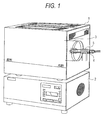
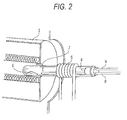
- a device As a device is enumerated a device as shown in Figs. 1 and 2.
- nitrogen gas is blown into the tube to undergo evacuation. This is made for the purposes of making impurities or sulfur not react with oxygen, etc. and evacuating the impurities.
- a cooling hose (such as a vinyl hose) is wound around the tube, and the tube is water-cooled. This is made for the purpose of depositing the sublimated sulfur. Since the sublimation temperature of sulfur is 444.6 °C, it is preferred to gradually elevate the temperature from about 300 °C. In the device as shown in Fig. 1, the sublimation is achieved by controlling the temperature of a horizontal tubular electric furnace while gradually elevating the temperature to 460 °C.
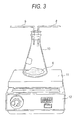
- a device is configured such that a magnetic stirrer equipped with a heatable hot plate is used, sulfur is charged in a vessel such as an Erlenmeyer flask, and nitrogen gas is blown in the vessel, thereby enabling to undergo evacuation.
- the sulfur is dissolved upon heating and then cooled for recrystallization.
- the heating temperature in the heat and dissolution method there are no particular limitations so far as the impurities can be removed upon heating at that temperature. In the case where it is intended to shorten the heating time, it is preferred to employ a high temperature largely exceeding the boiling points of the impurities but not exceeding the sublimation temperature of the sulfur.
- the sulfur that is used in the invention has a purity of 98 % or more. From the viewpoint of obtaining lenses that are transparent, less colored and have a high refractive index and a high Abbe's number, it is preferred that the sulfur before the removal of impurities has a purity of 98 % or more.
- epithio group-containing compound to be mixed with sulfur compounds the same as or different from the epithio group-containing compounds to be used during the preparation of the prepolymer can be used.
- the mixed liquid is heated and dissolved at from 40 °C to 70 °C and then stirred at from 30 to 50 °C for from 1 hour to 24 hours in order to prevent deposition of sulfur. Further, during mixing the three kinds of starting materials, the mixture can be cooled to from 10 to 25 °C.
- the mixture which is the preferred third starting material of the lens which is obtained by mixing an epithio group-containing compound and/or a polythiol compound and a catalyst, will now be described.
- the epithio group-containing compound the epithio group-containing compounds that are used during the preparation of the prepolymer and the mixture with sulfur can be used.
- the epithio group-containing compounds may be the same or may be different from those used for the prepolymer and the mixture with sulfur.
- the polythiol compound used for the prepolymer can be used.
- the polythiol compounds may be the same or may be different from those used during the preparation of the prepolymer.
- the catalyst that is used during the preparation of or as the third starting material is added with intent to react the epithio group-containing compound or the polythiol and the epithio group-containing compound.
- the catalyst can be enumerated amines, phosphines, quaternary ammonium salts, quaternary phosphonium salts, tertiary sulfonium salts, secondary iodonium salts, miral acids, Lewis acids, organic acids, silicates, and tetrafluoroborates.
- the catalyst include aminoethanol, 1-aminopropanol, 2-aminopropanol, aminobutanol, aminopentanol, aminohexanol, tetramethyiphosphonium chloride, tetramethylphosphonium bromide, tetraethylphosphonium chloride, tetraethylphosphonium bromide, tetra-n-butylphosphonium chloride, tetra-n-butylphosphonium bromide, tetra-n-butylphosphonium iodide, tetra-n-hexylphosphonium bromide, and tetra-n-octylphosphonium bromide.
- the catalyst to be used is selected and that its amount is regulated depending upon the monomers to be used. But, the amount is generally from 0.001 % by weight to 0.1 % by weight on the basis of the amount of the whole of the starting materials of the lens.
- the mixing method is not particularly limited.
- the setting temperature, the time required for this, and the like may be basically those conditions under which the respective components are thoroughly mixed. Excessive temperature and time will likely cause a non-preferred reaction among the respective starting materials and additives and additionally an increase in the viscosity, thereby making the casting operation difficult, and hence, such is not proper.
- the mixing temperature is preferably in the range of from -30 °C to 50 °C, and more preferably in the range of from -5 °C to 30 °C.
- the mixing time is from about 5 minutes to 2 hours, and preferably from about 5 minutes to 15 minutes.
- the degree of vacuum is preferably in the range of from about 0.1 mmHg to 50 mmHg, and particularly preferably in the range of from 1 mmHg to 20 mmHg.
- a filter having a pore diameter of from about 0.05 to 3 ⁇ m is preferred from the standpoint of further enhancing the quality of the optical materials of the invention.
- the mixed starting materials and the like are poured into a glass or metallic mold and subjected to polymerization curing in an electric furnace or the like. It is preferred that the curing temperature is from 5 °C to 120 °C and that the curing time is generally from about 1 to 72 hours. Further, to subject the material after completion of the curing to an annealing processing at a temperature of from 50 to 150 °C for from about 10 minutes to 5 hours is preferred for eliminating strains of the optical materials of the invention.
- the plastic lens of the invention is hardly peeled apart from the mold, using or adding known external and/or internal releasing agents may enhance the release properties.
- UV absorbers may be used; and for the purpose of protecting eyes from infrared rays, IR absorbers may be used. Their amounts vary depending upon the absorptive ability and maximum absorption wavelength of additives to be used, but are from about 0.03 % by weight to 3 % by weight. Also, there is employable a method for impregnating these absorbers in the resin later.
- an antioxidant may be added, or bluing with a small amount of a coloring matter may be employed.
- the plastic lens obtained in the invention can be subjected to a dyeing processing with a dye.
- a cured film may be formed on the plastic lens using a coating liquid comprising an organosilicon compound or an acrylic compound having finely divided inorganic materials such as tin oxide, silicon oxide, zirconium oxide, and titanium oxide.
- a primer layer composed mainly of polyurethane may be formed on the plastic lens.
- an antireflection film made of an inorganic material such as silicon oxide, titanium dioxide, zirconium oxide, and tantalum oxide may be formed on the cured film.
- a water repellent film made of a fluorine atom-containing organosilicon compound may be formed on the antireflection film.
- the present invention further relates to a plastic lens comprising sulfur having a purity of 98% or more, from which impurities having a boiling point of 120°C or lower have substantially been removed.
- a plastic lens comprising sulfur having a purity of 98% or more, from which impurities having a boiling point of 120°C or lower have substantially been removed.
- the plastic lens of the present invention is transparent, i.e. preferably has the same or essentially the same transparency as a plastic lens of the same thickness and being prepared from the same starting materials in the same amounts but without sulfur.
- the value of transparency of the lens depends on the value of refractive index of the lens, without coating of any anti-reflective film, because a lens having a high refractive index shows high reflection.
- the transparent lens of the present invention when having a refractive index of 1.55 to 1.65 preferably has a transparency in the range of 0.80-0.92, more preferably in the range of 0.85-0.92 and most preferably in the range of 0.88-0.92, when measured with a lens having a thickness of 1.8 mm at any wavelength in the range of 500 nm to 600 nm.
- the transparent lens of the present invention when having a refractive index of 1.66 to 1.76 preferably has a transparency in the range of 0.80-0.91, more preferably in the range of 0.85-0.91 and most preferably in the range of 0.88-0.91, when measured with a lens having a thickness of 1.8 mm at any wavelength in the range of 500 nm to 600 nm.
- Sulfur crystals manufactured by Wako Pure Chemical Industries, Ltd. (purity: 99.9999 %) were powdered in an agate mortar and then heat treated for 24 hours by a vacuum dryer (at 55 °C and at 10 mmHg).
- Tetrabutylphosphonium bromide (0.04 parts by weight) and bis( ⁇ -epithiopropyl) sulfide (2.00 parts by weight) were weighed and dissolved to prepare a solution.
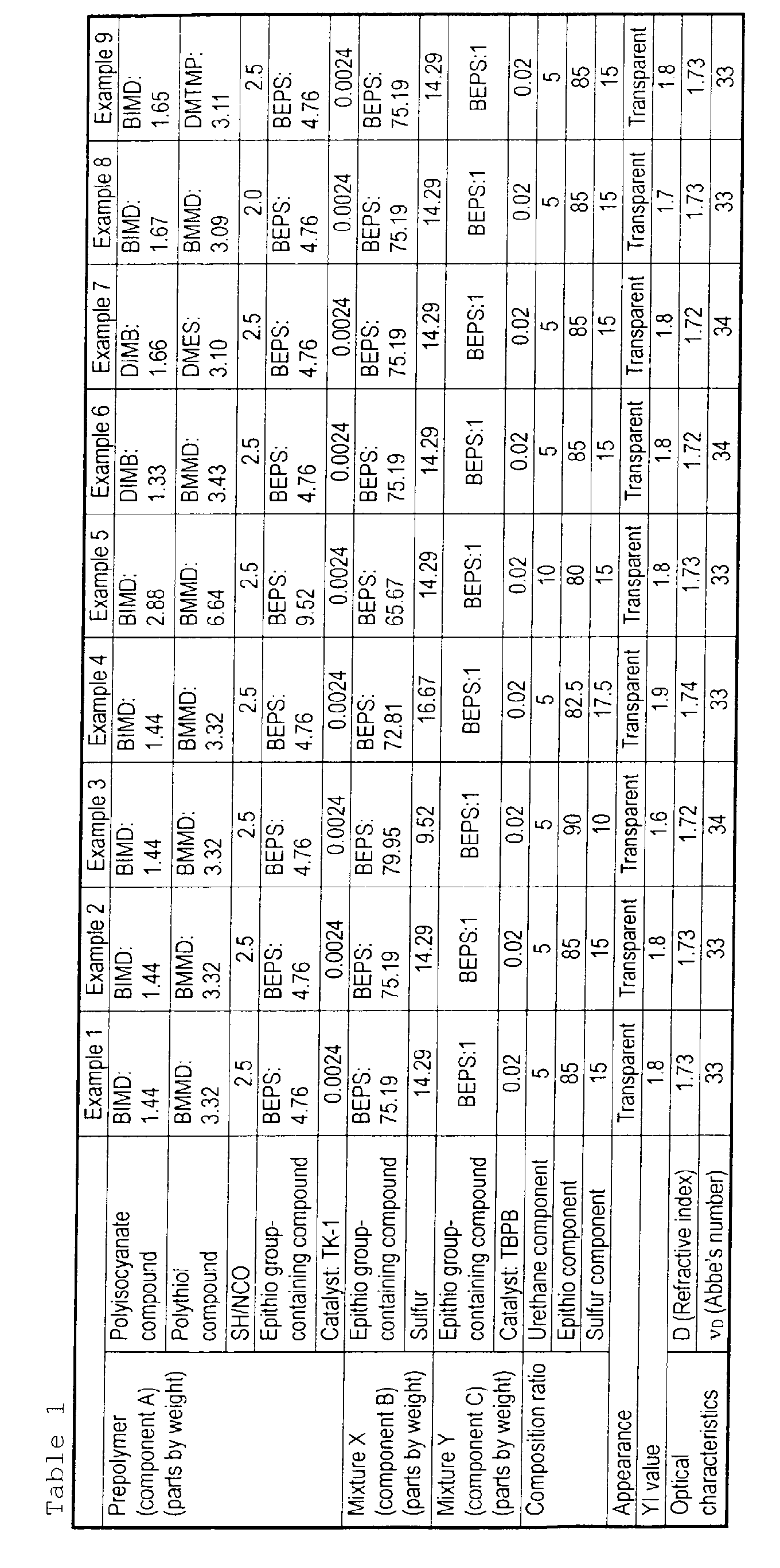
- Example 1 Lenses were prepared and evaluated in the same manner as in Example 1, except that the sulfur crystals manufactured by Wako Pure Chemical Industries, Ltd. (purity: 99.9999 %) in place of the sulfur as used in Example 1 were sublimated and further recrystallized for purification. The results are shown in Table 1.
- Example 2 The same procedures as in Example 1 were followed, except that the types and mixing ratio of the polyisocyanate compound and the polythiol compound and the amount of the epithio group-containing compound to be added were changed as shown in Table 1. The evaluation results are shown in Table 1. Similar to Example 2, lenses were obtained which were transparent, less colored and had characteristics of a high refractive index and a high Abbe's number.
- Lenses were prepared and evaluated in the same manners as in Examples 1, 3 and 4, respectively, except that sulfur crystals manufactured by Wako Chemical Industries, Ltd. (purity: 99.9999 %) were used as they were, without being treated in place of the sulfur as used in Examples 1, 3 and 4.
- the resulting resins were colored yellow compared with those of the corresponding Examples.
Landscapes
- Chemical & Material Sciences (AREA)
- Health & Medical Sciences (AREA)
- Chemical Kinetics & Catalysis (AREA)
- Medicinal Chemistry (AREA)
- Polymers & Plastics (AREA)
- Organic Chemistry (AREA)
- Physics & Mathematics (AREA)
- Optics & Photonics (AREA)
- General Physics & Mathematics (AREA)
- Engineering & Computer Science (AREA)
- Manufacturing & Machinery (AREA)
- Ophthalmology & Optometry (AREA)
- Mechanical Engineering (AREA)
- Polyurethanes Or Polyureas (AREA)
- Casting Or Compression Moulding Of Plastics Or The Like (AREA)
- Polymers With Sulfur, Phosphorus Or Metals In The Main Chain (AREA)
Abstract
Description


- 1:
- Electric furnace device
- 2:
- Electric furnace control device
- 3:
- Horizontal tubular electric furnace
- 4:
- Quartz test tube (74 × 800 mm)
- 5:
- Cooling hose
- 6:
- Sulfur crystals
- 7:
- Kaowool
- 8:
- Nitrogen inhalation tube
- 9:
- Nitrogen discharge tube
- 10:
- Erlenmeyer flask
- 11:
- Hot plate
- 12:
- Magnetic stirrer
| Reference Example 1 | Reference Example 2 | Reference Example 3 | |||
| Prepolymer (component A) (parts by weight) | Polyisocyanate compound | BIMD: 1.44 | BIMD: 1.44 | BIMD: 1.44 | |
| Polythiol compound | BMMD: 3.32 | BMMD: 3.32 | BMMD: 3.32 | ||
| SH/NCO | 2.5 | 2.5 | 2.5 | ||
| Epithio group-containing compound | BEPS: 4.76 | BEPS: 4.76 | BEPS: 4.76 | ||
| Catalyst: TK-1 | 0.0024 | 0.0024 | 0.0024 | ||
| Mixture X (component B) (parts by weight) | Epithio group-containing compound | BEPS: 75.19 | BEPS: 79.95 | BEPS: 72.81 | |
| Sulfur | 14.29 | 9.52 | 16.67 | ||
| Mixture Y (component C) (parts by weight) | Epithio group-containing compound | BEPS:1 | BEPS:1 | BEPS:1 | |
| Catalyst: TBPB | 0.02 | 0.02 | 0.02 | ||
| Composition | Urethane component | 5 5 | 5 | ||
| Epithio component | 85 | 90 | 82.5 | ||
| Sulfur component | 15 | 10 | 17.5 | ||
| Appearance | Transparent | Transparent | Transparent | ||
| Yl value | 22.3 3 | 16.7 | 25.4 | ||
| Optical | D (Refractive index) | 1.73 | 1.72 | 1.74 | |
| characteristics | νD(Abbe's number) | 33 | 34 | 33 |
- BIMD:
- Bis(isocyanatomethyl)-1,4-dithiane
- DIMB:
- Bis(isocyanatomethyl)bicyclo[2,2,1]heptane
- BMMD:
- Bis(mercaptomethyl)-1,4-dithiane
- DMES:
- Bis(mercaptoethyl) sulfide
- DMTMP:
- 1,2-Bis(mercaptoethylthio)-3-mercaptopropane
- BEPS:
- Bis(β-epithiopropyi) sulfide
- TBPB:
- Tetrabutylphosphonium bromide
- TK-1:
- Tetrabutyl-diacetoxy-distannoxane
Claims (20)
- Process for producing a plastic lens, which comprises mixing a) a prepolymer with b) a mixture comprising sulfur having a purity of 98 % or more, from which impurities having a boiling point of 120 °C or lower have substantially been removed, in an epithio group-containing compound and c) a catalyst.
- Process according to claim 1, wherein the prepolymer comprises an epithio group-containing compound.
- Process according to any of the preceding claims, wherein the prepolymer is obtainable by reacting a polyisocyanate compound and a polythiol compound in an epithio group-containing compound.
- Process according to any of the preceding claims, wherein the catalyst c) is added as mixture of the catalyst with an epithio group-containing compound and/or a polythiol compound.
- Process according to any of the preceding claims, wherein the ratio of the polythiol compound to the polyisocyanate compound in the prepolymer is 1.75 or more in terms of -SH/-NCO molar ratio.
- Process according to any of the preceding claims, wherein the weight of the epithio group-containing compound in the prepolymer is 50% by weight or more of the whole amount of the starting materials of the prepolymer.
- Process according to any of the preceding claims, wherein the content of sulfur is in the range of from 5 to 30% by weight of the whole amount of the starting materials a), b) and c).
- Process according to any of the preceding claims, wherein the whole of the polyisocyanate and the polythiol compounds used for the starting materials a) and c) of the lens is 15% by weight or less of the whole amount of the starting materials a), b) and c).
- Process according to any of the preceding claims, wherein the polyisocyanate compound is one or more of the group consisting of bis(isocyanatomethyl)bicyclo[2,2,1]heptane, cyclohexane diisocyanate, and bis(isocyanatomethyl)-1,4-dithiane.
- Process according to any of the preceding claims, wherein the polythiol compound is at least one member selected from bis(mercaptomethyl) -1,4-dithiane, bis(mercaptoethyl) sulfide, bis(mercaptoethyl) disulfide, and 1,2-bis(mercaptoethyl)thio-3-mercaptopropane.
- Process according to any of the preceding claims, wherein the epithio group-containing compound is bis(β-epithiopropyl) sulfide and/or bis (β-epithiopropyl) disulfide.
- Process according to any one of claims 3 to 11, wherein a catalyst is added to the reaction mixture for preparing the prepolymer.
- Process according to claim 12, wherein the catalyst is represented by the following general formula (I):wherein R1 to R4, which may be the same or different, each represents an alkyl group having from 1 to 4 carbon atoms.

- Process according to claim 13, wherein the catalyst represented by the general formula (I) is at least one member selected from tetramethyl-diacetoxy-distannoxane, tetraethyl-diacetoxy-distannoxane, tetrapropyl-diacetoxy-distannoxane, and tetrabutyl-diacetoxy-distannoxane.
- Plastic lens obtainable by the process according to any one of claims 1 to 14.
- Plastic lens comprising sulfur having a purity of 98% or more, from which impurities having a boiling point of 120°C or lower have substantially been removed.
- Plastic lens according to claim 16, obtainable by reacting a polyisocyanate compound, a polythiol compound, an epithio group-containing compound, and sulfur having a purity of 98% or more, from which impurities having a boiling point of 120°C or lower have substantially been removed.
- Plastic lens according to claims 16 or 17, which is transparent.
- Plastic lens comprising sulfur, characterized in that the plastic lens has a yellowness index < 15.
- Use of sulfur having a purity of 98% or more, from which impurities having a boiling point of 120°C or lower have substantially been removed, for the production of plastic lenses.
Applications Claiming Priority (2)
| Application Number | Priority Date | Filing Date | Title |
|---|---|---|---|
| JP2002162827 | 2002-06-04 | ||
| JP2002162827 | 2002-06-04 |
Publications (3)
| Publication Number | Publication Date |
|---|---|
| EP1369709A2 true EP1369709A2 (en) | 2003-12-10 |
| EP1369709A3 EP1369709A3 (en) | 2004-12-29 |
| EP1369709B1 EP1369709B1 (en) | 2006-05-03 |
Family
ID=29545686
Family Applications (1)
| Application Number | Title | Priority Date | Filing Date |
|---|---|---|---|
| EP03011149A Expired - Lifetime EP1369709B1 (en) | 2002-06-04 | 2003-05-23 | process for producing plastic lens and plastic lens |
Country Status (7)
| Country | Link |
|---|---|
| US (1) | US7001974B2 (en) |
| EP (1) | EP1369709B1 (en) |
| JP (1) | JP4255752B2 (en) |
| KR (1) | KR100566035B1 (en) |
| CN (1) | CN1302295C (en) |
| AT (1) | ATE325356T1 (en) |
| DE (1) | DE60304935T2 (en) |
Cited By (4)
| Publication number | Priority date | Publication date | Assignee | Title |
|---|---|---|---|---|
| EP1518873A3 (en) * | 2003-09-22 | 2005-06-15 | Hoya Corporation | Process of producing plastic lens and plastic lens |
| EP2144092A4 (en) * | 2007-04-27 | 2010-05-05 | Hoya Corp | PROCESS FOR PRODUCING A PLASTIC LENS |
| EP2824129A4 (en) * | 2012-03-05 | 2015-11-18 | Mitsubishi Gas Chemical Co | COMPOSITION FOR OPTICAL MATERIALS |
| EP2927222A4 (en) * | 2013-12-11 | 2015-11-25 | Mitsubishi Gas Chemical Co | NOVEL THIOL COMPOUND AND OPTICAL MATERIAL COMPOSITION USING THE SAME |
Families Citing this family (18)
| Publication number | Priority date | Publication date | Assignee | Title |
|---|---|---|---|---|
| EP1348726B1 (en) * | 2002-03-28 | 2006-09-06 | Hoya Corporation | Process for producing plastic lens and plastic lens |
| JPWO2004109369A1 (en) * | 2003-06-09 | 2006-07-20 | 株式会社アサヒオプティカル | Bifocal plastic lens |
| JP5016211B2 (en) * | 2005-09-27 | 2012-09-05 | Hoya株式会社 | Manufacturing method of plastic lens |
| JP4844136B2 (en) * | 2006-01-27 | 2011-12-28 | 三菱瓦斯化学株式会社 | Resin composition |
| JP2008255353A (en) * | 2007-03-15 | 2008-10-23 | Ube Ind Ltd | Polythiourethane polythiol and method for producing polymerized cured product using the same |
| WO2010073613A1 (en) * | 2008-12-24 | 2010-07-01 | 株式会社ニコン・エシロール | Optical resin composition, optical lens, and eyeglass plastic lens |
| BR112012000941B1 (en) * | 2009-07-16 | 2019-07-09 | Mitsubishi Gas Chemical Company, Inc. | PRODUCTION PROCESS OF OPTICAL MATERIAL, OPTICAL MATERIAL AND OPTICAL LENS |
| JP6230419B2 (en) * | 2011-04-28 | 2017-11-15 | 三菱瓦斯化学株式会社 | Curable composition and optical adhesive |
| KR101562052B1 (en) | 2012-03-01 | 2015-10-20 | 미쯔비시 가스 케미칼 컴파니, 인코포레이티드 | Polymerizable composition for optical materials |
| US9447226B2 (en) * | 2012-09-10 | 2016-09-20 | Mitsubishi Gas Chemical Company, Inc. | Composition for optical material, and method for producing same |
| TWI633140B (en) * | 2013-12-26 | 2018-08-21 | 三菱瓦斯化學股份有限公司 | Composition for optical material and method of producing the same |
| WO2017010791A1 (en) * | 2015-07-13 | 2017-01-19 | 케이에스랩(주) | Optical composition for blocking electromagnetic waves and method for manufacturing optical lens therefrom |
| CN110627981B (en) * | 2018-06-22 | 2022-01-07 | 万华化学集团股份有限公司 | Optical resin composition, optical resin material, preparation method and application thereof |
| JP7262198B2 (en) * | 2018-09-28 | 2023-04-21 | ホヤ レンズ タイランド リミテッド | Polymerizable composition for optical members |
| JP7296754B2 (en) * | 2019-03-28 | 2023-06-23 | ホヤ レンズ タイランド リミテッド | Polymerizable composition for optical member, optical member, and spectacle lens |
| JP7296755B2 (en) * | 2019-03-28 | 2023-06-23 | ホヤ レンズ タイランド リミテッド | Resin composition for optical member, optical member, and spectacle lens |
| WO2021182526A1 (en) * | 2020-03-10 | 2021-09-16 | 三井化学株式会社 | Polymerizable composition for optical material, polymerizable prepolymer composition for optical material, cured object, and method for producing optical material |
| CN116120554B (en) * | 2022-12-12 | 2025-03-18 | 益丰新材料股份有限公司 | A composition for optical lens material with high refractive index and low thermal expansion coefficient |
Family Cites Families (20)
| Publication number | Priority date | Publication date | Assignee | Title |
|---|---|---|---|---|
| CN1040810A (en) | 1988-04-30 | 1990-03-28 | 三井东圧化学株式会社 | Polysulfide base resin lens and preparation method thereof |
| JP2955298B2 (en) | 1989-08-24 | 1999-10-04 | 三井化学株式会社 | Epoxy resin lens and manufacturing method thereof |
| JP3864998B2 (en) | 1995-09-08 | 2007-01-10 | 三菱瓦斯化学株式会社 | Novel branched alkyl sulfide type episulfide compounds |
| JP3491660B2 (en) | 1995-08-16 | 2004-01-26 | 三菱瓦斯化学株式会社 | Novel linear alkyl sulfide type episulfide compound |
| US5807975A (en) | 1995-08-16 | 1998-09-15 | Mitsubishi Gas Chemical Company,Inc. | Alkyl sulfide type episulfide compound |
| US5945504A (en) | 1996-01-17 | 1999-08-31 | Mitsubishi Gas Chemical Company, Inc. | Episulfide compound |
| JPH09255781A (en) | 1996-01-17 | 1997-09-30 | Mitsubishi Gas Chem Co Inc | New episulfide compound |
| JP3883272B2 (en) | 1997-09-03 | 2007-02-21 | 三井化学株式会社 | Novel (thio) epoxy compounds |
| JPH11180977A (en) | 1997-10-16 | 1999-07-06 | Mitsubishi Gas Chem Co Inc | New episulfide compounds |
| JP3963546B2 (en) | 1997-12-18 | 2007-08-22 | 三井化学株式会社 | New (thio) epoxy resin |
| JP3987179B2 (en) | 1997-12-25 | 2007-10-03 | 三井化学株式会社 | Sulfur-containing epoxy compounds and uses thereof |
| JP2001002933A (en) * | 1999-04-23 | 2001-01-09 | Mitsubishi Gas Chem Co Inc | Composition for optical materials |
| JP3738817B2 (en) | 1999-04-23 | 2006-01-25 | 三菱瓦斯化学株式会社 | Composition for optical materials |
| JP2001131257A (en) * | 1999-11-09 | 2001-05-15 | Mitsubishi Gas Chem Co Inc | Composition for resin |
| JP2001200058A (en) * | 2000-01-19 | 2001-07-24 | Mitsubishi Gas Chem Co Inc | Optical material manufacturing method |
| JP3706036B2 (en) | 2000-03-15 | 2005-10-12 | Hoya株式会社 | Plastic lens for eyeglasses |
| CA2337955C (en) | 2000-03-15 | 2006-07-25 | Hoya Corporation | Plastic lenses for spectacles |
| JP3562579B2 (en) * | 2000-10-13 | 2004-09-08 | 三菱瓦斯化学株式会社 | Composition for optical materials |
| EP1348726B1 (en) * | 2002-03-28 | 2006-09-06 | Hoya Corporation | Process for producing plastic lens and plastic lens |
| JP4393831B2 (en) * | 2003-09-22 | 2010-01-06 | Hoya株式会社 | Manufacturing method of plastic lens |
-
2003
- 2003-05-23 EP EP03011149A patent/EP1369709B1/en not_active Expired - Lifetime
- 2003-05-23 DE DE60304935T patent/DE60304935T2/en not_active Expired - Lifetime
- 2003-05-23 AT AT03011149T patent/ATE325356T1/en not_active IP Right Cessation
- 2003-05-27 JP JP2003149149A patent/JP4255752B2/en not_active Expired - Fee Related
- 2003-05-30 US US10/448,046 patent/US7001974B2/en not_active Expired - Lifetime
- 2003-06-03 KR KR1020030035465A patent/KR100566035B1/en not_active Expired - Fee Related
- 2003-06-04 CN CNB031406874A patent/CN1302295C/en not_active Expired - Fee Related
Cited By (7)
| Publication number | Priority date | Publication date | Assignee | Title |
|---|---|---|---|---|
| EP1518873A3 (en) * | 2003-09-22 | 2005-06-15 | Hoya Corporation | Process of producing plastic lens and plastic lens |
| EP2144092A4 (en) * | 2007-04-27 | 2010-05-05 | Hoya Corp | PROCESS FOR PRODUCING A PLASTIC LENS |
| US8193303B2 (en) | 2007-04-27 | 2012-06-05 | Hoya Corporation | Method for production of plastic lens |
| EP2824129A4 (en) * | 2012-03-05 | 2015-11-18 | Mitsubishi Gas Chemical Co | COMPOSITION FOR OPTICAL MATERIALS |
| US10025005B2 (en) | 2012-03-05 | 2018-07-17 | Mitsubishi Gas Chemical Company, Inc. | Composition for optical materials |
| EP2927222A4 (en) * | 2013-12-11 | 2015-11-25 | Mitsubishi Gas Chemical Co | NOVEL THIOL COMPOUND AND OPTICAL MATERIAL COMPOSITION USING THE SAME |
| US9604959B2 (en) | 2013-12-11 | 2017-03-28 | Mitsubishi Gas Chemical Company, Inc. | Thiol compound and composition for optical materials using the same |
Also Published As
| Publication number | Publication date |
|---|---|
| ATE325356T1 (en) | 2006-06-15 |
| DE60304935T2 (en) | 2006-09-21 |
| US7001974B2 (en) | 2006-02-21 |
| EP1369709A3 (en) | 2004-12-29 |
| CN1467510A (en) | 2004-01-14 |
| JP2004059901A (en) | 2004-02-26 |
| KR100566035B1 (en) | 2006-03-30 |
| EP1369709B1 (en) | 2006-05-03 |
| DE60304935D1 (en) | 2006-06-08 |
| JP4255752B2 (en) | 2009-04-15 |
| CN1302295C (en) | 2007-02-28 |
| US20030225202A1 (en) | 2003-12-04 |
| KR20030094093A (en) | 2003-12-11 |
Similar Documents
| Publication | Publication Date | Title |
|---|---|---|
| EP1369709B1 (en) | process for producing plastic lens and plastic lens | |
| JP4393831B2 (en) | Manufacturing method of plastic lens | |
| EP2144092B1 (en) | Method for production of plastic lens | |
| CN102633980B (en) | Composition for optical material and optical material using same | |
| KR20140094607A (en) | Method for producing resin for optical material | |
| EP1348726B1 (en) | Process for producing plastic lens and plastic lens | |
| JP4298560B2 (en) | Method for producing sulfur-containing prepolymer and method for producing plastic lens | |
| KR101877590B1 (en) | Composition for optical material | |
| KR102657702B1 (en) | Composition for episulfide based optical material having high refractive index and method of preparing the optical material | |
| JP3866671B2 (en) | Manufacturing method of plastic lens | |
| JP5691569B2 (en) | Composition for optical materials | |
| CN109293865B (en) | Polymerizable composition for plastic lenses |
Legal Events
| Date | Code | Title | Description |
|---|---|---|---|
| PUAI | Public reference made under article 153(3) epc to a published international application that has entered the european phase |
Free format text: ORIGINAL CODE: 0009012 |
|
| AK | Designated contracting states |
Kind code of ref document: A2 Designated state(s): AT BE BG CH CY CZ DE DK EE ES FI FR GB GR HU IE IT LI LU MC NL PT RO SE SI SK TR |
|
| AX | Request for extension of the european patent |
Extension state: AL LT LV MK |
|
| PUAL | Search report despatched |
Free format text: ORIGINAL CODE: 0009013 |
|
| AK | Designated contracting states |
Kind code of ref document: A3 Designated state(s): AT BE BG CH CY CZ DE DK EE ES FI FR GB GR HU IE IT LI LU MC NL PT RO SE SI SK TR |
|
| AX | Request for extension of the european patent |
Extension state: AL LT LV MK |
|
| 17P | Request for examination filed |
Effective date: 20050119 |
|
| 17Q | First examination report despatched |
Effective date: 20050427 |
|
| AKX | Designation fees paid |
Designated state(s): AT BE BG CH CY CZ DE DK EE ES FI FR GB GR HU IE IT LI LU MC NL PT RO SE SI SK TR |
|
| GRAP | Despatch of communication of intention to grant a patent |
Free format text: ORIGINAL CODE: EPIDOSNIGR1 |
|
| GRAS | Grant fee paid |
Free format text: ORIGINAL CODE: EPIDOSNIGR3 |
|
| GRAA | (expected) grant |
Free format text: ORIGINAL CODE: 0009210 |
|
| AK | Designated contracting states |
Kind code of ref document: B1 Designated state(s): AT BE BG CH CY CZ DE DK EE ES FI FR GB GR HU IE IT LI LU MC NL PT RO SE SI SK TR |
|
| PG25 | Lapsed in a contracting state [announced via postgrant information from national office to epo] |
Ref country code: CZ Free format text: LAPSE BECAUSE OF FAILURE TO SUBMIT A TRANSLATION OF THE DESCRIPTION OR TO PAY THE FEE WITHIN THE PRESCRIBED TIME-LIMIT Effective date: 20060503 Ref country code: IT Free format text: LAPSE BECAUSE OF FAILURE TO SUBMIT A TRANSLATION OF THE DESCRIPTION OR TO PAY THE FEE WITHIN THE PRESCRIBED TIME-LIMIT;WARNING: LAPSES OF ITALIAN PATENTS WITH EFFECTIVE DATE BEFORE 2007 MAY HAVE OCCURRED AT ANY TIME BEFORE 2007. THE CORRECT EFFECTIVE DATE MAY BE DIFFERENT FROM THE ONE RECORDED. Effective date: 20060503 Ref country code: AT Free format text: LAPSE BECAUSE OF FAILURE TO SUBMIT A TRANSLATION OF THE DESCRIPTION OR TO PAY THE FEE WITHIN THE PRESCRIBED TIME-LIMIT Effective date: 20060503 Ref country code: BE Free format text: LAPSE BECAUSE OF FAILURE TO SUBMIT A TRANSLATION OF THE DESCRIPTION OR TO PAY THE FEE WITHIN THE PRESCRIBED TIME-LIMIT Effective date: 20060503 Ref country code: CH Free format text: LAPSE BECAUSE OF FAILURE TO SUBMIT A TRANSLATION OF THE DESCRIPTION OR TO PAY THE FEE WITHIN THE PRESCRIBED TIME-LIMIT Effective date: 20060503 Ref country code: RO Free format text: LAPSE BECAUSE OF FAILURE TO SUBMIT A TRANSLATION OF THE DESCRIPTION OR TO PAY THE FEE WITHIN THE PRESCRIBED TIME-LIMIT Effective date: 20060503 Ref country code: FI Free format text: LAPSE BECAUSE OF FAILURE TO SUBMIT A TRANSLATION OF THE DESCRIPTION OR TO PAY THE FEE WITHIN THE PRESCRIBED TIME-LIMIT Effective date: 20060503 Ref country code: SI Free format text: LAPSE BECAUSE OF FAILURE TO SUBMIT A TRANSLATION OF THE DESCRIPTION OR TO PAY THE FEE WITHIN THE PRESCRIBED TIME-LIMIT Effective date: 20060503 Ref country code: LI Free format text: LAPSE BECAUSE OF FAILURE TO SUBMIT A TRANSLATION OF THE DESCRIPTION OR TO PAY THE FEE WITHIN THE PRESCRIBED TIME-LIMIT Effective date: 20060503 Ref country code: SK Free format text: LAPSE BECAUSE OF FAILURE TO SUBMIT A TRANSLATION OF THE DESCRIPTION OR TO PAY THE FEE WITHIN THE PRESCRIBED TIME-LIMIT Effective date: 20060503 |
|
| REG | Reference to a national code |
Ref country code: GB Ref legal event code: FG4D |
|
| REG | Reference to a national code |
Ref country code: CH Ref legal event code: EP |
|
| PG25 | Lapsed in a contracting state [announced via postgrant information from national office to epo] |
Ref country code: IE Free format text: LAPSE BECAUSE OF NON-PAYMENT OF DUE FEES Effective date: 20060523 |
|
| PG25 | Lapsed in a contracting state [announced via postgrant information from national office to epo] |
Ref country code: MC Free format text: LAPSE BECAUSE OF NON-PAYMENT OF DUE FEES Effective date: 20060531 |
|
| REF | Corresponds to: |
Ref document number: 60304935 Country of ref document: DE Date of ref document: 20060608 Kind code of ref document: P |
|
| REG | Reference to a national code |
Ref country code: IE Ref legal event code: FG4D |
|
| PG25 | Lapsed in a contracting state [announced via postgrant information from national office to epo] |
Ref country code: DK Free format text: LAPSE BECAUSE OF FAILURE TO SUBMIT A TRANSLATION OF THE DESCRIPTION OR TO PAY THE FEE WITHIN THE PRESCRIBED TIME-LIMIT Effective date: 20060803 Ref country code: SE Free format text: LAPSE BECAUSE OF FAILURE TO SUBMIT A TRANSLATION OF THE DESCRIPTION OR TO PAY THE FEE WITHIN THE PRESCRIBED TIME-LIMIT Effective date: 20060803 |
|
| PG25 | Lapsed in a contracting state [announced via postgrant information from national office to epo] |
Ref country code: ES Free format text: LAPSE BECAUSE OF FAILURE TO SUBMIT A TRANSLATION OF THE DESCRIPTION OR TO PAY THE FEE WITHIN THE PRESCRIBED TIME-LIMIT Effective date: 20060814 |
|
| ET | Fr: translation filed | ||
| PG25 | Lapsed in a contracting state [announced via postgrant information from national office to epo] |
Ref country code: PT Free format text: LAPSE BECAUSE OF FAILURE TO SUBMIT A TRANSLATION OF THE DESCRIPTION OR TO PAY THE FEE WITHIN THE PRESCRIBED TIME-LIMIT Effective date: 20061003 |
|
| REG | Reference to a national code |
Ref country code: CH Ref legal event code: PL |
|
| PLBE | No opposition filed within time limit |
Free format text: ORIGINAL CODE: 0009261 |
|
| STAA | Information on the status of an ep patent application or granted ep patent |
Free format text: STATUS: NO OPPOSITION FILED WITHIN TIME LIMIT |
|
| 26N | No opposition filed |
Effective date: 20070206 |
|
| PG25 | Lapsed in a contracting state [announced via postgrant information from national office to epo] |
Ref country code: GR Free format text: LAPSE BECAUSE OF FAILURE TO SUBMIT A TRANSLATION OF THE DESCRIPTION OR TO PAY THE FEE WITHIN THE PRESCRIBED TIME-LIMIT Effective date: 20060804 |
|
| PG25 | Lapsed in a contracting state [announced via postgrant information from national office to epo] |
Ref country code: EE Free format text: LAPSE BECAUSE OF FAILURE TO SUBMIT A TRANSLATION OF THE DESCRIPTION OR TO PAY THE FEE WITHIN THE PRESCRIBED TIME-LIMIT Effective date: 20060503 Ref country code: BG Free format text: LAPSE BECAUSE OF FAILURE TO SUBMIT A TRANSLATION OF THE DESCRIPTION OR TO PAY THE FEE WITHIN THE PRESCRIBED TIME-LIMIT Effective date: 20060803 |
|
| PG25 | Lapsed in a contracting state [announced via postgrant information from national office to epo] |
Ref country code: TR Free format text: LAPSE BECAUSE OF FAILURE TO SUBMIT A TRANSLATION OF THE DESCRIPTION OR TO PAY THE FEE WITHIN THE PRESCRIBED TIME-LIMIT Effective date: 20060503 Ref country code: HU Free format text: LAPSE BECAUSE OF FAILURE TO SUBMIT A TRANSLATION OF THE DESCRIPTION OR TO PAY THE FEE WITHIN THE PRESCRIBED TIME-LIMIT Effective date: 20061104 Ref country code: LU Free format text: LAPSE BECAUSE OF NON-PAYMENT OF DUE FEES Effective date: 20060523 |
|
| PG25 | Lapsed in a contracting state [announced via postgrant information from national office to epo] |
Ref country code: CY Free format text: LAPSE BECAUSE OF FAILURE TO SUBMIT A TRANSLATION OF THE DESCRIPTION OR TO PAY THE FEE WITHIN THE PRESCRIBED TIME-LIMIT Effective date: 20060503 |
|
| REG | Reference to a national code |
Ref country code: FR Ref legal event code: PLFP Year of fee payment: 14 |
|
| REG | Reference to a national code |
Ref country code: FR Ref legal event code: PLFP Year of fee payment: 15 |
|
| REG | Reference to a national code |
Ref country code: FR Ref legal event code: PLFP Year of fee payment: 16 |
|
| PGFP | Annual fee paid to national office [announced via postgrant information from national office to epo] |
Ref country code: NL Payment date: 20190412 Year of fee payment: 17 |
|
| PGFP | Annual fee paid to national office [announced via postgrant information from national office to epo] |
Ref country code: DE Payment date: 20190508 Year of fee payment: 17 |
|
| PGFP | Annual fee paid to national office [announced via postgrant information from national office to epo] |
Ref country code: FR Payment date: 20190410 Year of fee payment: 17 |
|
| PGFP | Annual fee paid to national office [announced via postgrant information from national office to epo] |
Ref country code: GB Payment date: 20190522 Year of fee payment: 17 |
|
| REG | Reference to a national code |
Ref country code: DE Ref legal event code: R119 Ref document number: 60304935 Country of ref document: DE |
|
| REG | Reference to a national code |
Ref country code: NL Ref legal event code: MM Effective date: 20200601 |
|
| PG25 | Lapsed in a contracting state [announced via postgrant information from national office to epo] |
Ref country code: NL Free format text: LAPSE BECAUSE OF NON-PAYMENT OF DUE FEES Effective date: 20200601 |
|
| GBPC | Gb: european patent ceased through non-payment of renewal fee |
Effective date: 20200523 |
|
| PG25 | Lapsed in a contracting state [announced via postgrant information from national office to epo] |
Ref country code: FR Free format text: LAPSE BECAUSE OF NON-PAYMENT OF DUE FEES Effective date: 20200531 Ref country code: GB Free format text: LAPSE BECAUSE OF NON-PAYMENT OF DUE FEES Effective date: 20200523 |
|
| PG25 | Lapsed in a contracting state [announced via postgrant information from national office to epo] |
Ref country code: DE Free format text: LAPSE BECAUSE OF NON-PAYMENT OF DUE FEES Effective date: 20201201 |