EP1364927A1 - Magnetic oxide sinter and high-frequency circuit part employing the same - Google Patents
Magnetic oxide sinter and high-frequency circuit part employing the same Download PDFInfo
- Publication number
- EP1364927A1 EP1364927A1 EP01954432A EP01954432A EP1364927A1 EP 1364927 A1 EP1364927 A1 EP 1364927A1 EP 01954432 A EP01954432 A EP 01954432A EP 01954432 A EP01954432 A EP 01954432A EP 1364927 A1 EP1364927 A1 EP 1364927A1
- Authority
- EP
- European Patent Office
- Prior art keywords
- mol
- sintered body
- amount
- terms
- oxide
- Prior art date
- Legal status (The legal status is an assumption and is not a legal conclusion. Google has not performed a legal analysis and makes no representation as to the accuracy of the status listed.)
- Granted
Links
Images

Classifications
-
- B—PERFORMING OPERATIONS; TRANSPORTING
- B32—LAYERED PRODUCTS
- B32B—LAYERED PRODUCTS, i.e. PRODUCTS BUILT-UP OF STRATA OF FLAT OR NON-FLAT, e.g. CELLULAR OR HONEYCOMB, FORM
- B32B18/00—Layered products essentially comprising ceramics, e.g. refractory products
-
- H—ELECTRICITY
- H01—ELECTRIC ELEMENTS
- H01F—MAGNETS; INDUCTANCES; TRANSFORMERS; SELECTION OF MATERIALS FOR THEIR MAGNETIC PROPERTIES
- H01F1/00—Magnets or magnetic bodies characterised by the magnetic materials therefor; Selection of materials for their magnetic properties
- H01F1/01—Magnets or magnetic bodies characterised by the magnetic materials therefor; Selection of materials for their magnetic properties of inorganic materials
- H01F1/03—Magnets or magnetic bodies characterised by the magnetic materials therefor; Selection of materials for their magnetic properties of inorganic materials characterised by their coercivity
- H01F1/032—Magnets or magnetic bodies characterised by the magnetic materials therefor; Selection of materials for their magnetic properties of inorganic materials characterised by their coercivity of hard-magnetic materials
- H01F1/10—Magnets or magnetic bodies characterised by the magnetic materials therefor; Selection of materials for their magnetic properties of inorganic materials characterised by their coercivity of hard-magnetic materials non-metallic substances, e.g. ferrites, e.g. [(Ba,Sr)O(Fe2O3)6] ferrites with hexagonal structure
-
- C—CHEMISTRY; METALLURGY
- C04—CEMENTS; CONCRETE; ARTIFICIAL STONE; CERAMICS; REFRACTORIES
- C04B—LIME, MAGNESIA; SLAG; CEMENTS; COMPOSITIONS THEREOF, e.g. MORTARS, CONCRETE OR LIKE BUILDING MATERIALS; ARTIFICIAL STONE; CERAMICS; REFRACTORIES; TREATMENT OF NATURAL STONE
- C04B35/00—Shaped ceramic products characterised by their composition; Ceramics compositions; Processing powders of inorganic compounds preparatory to the manufacturing of ceramic products
- C04B35/01—Shaped ceramic products characterised by their composition; Ceramics compositions; Processing powders of inorganic compounds preparatory to the manufacturing of ceramic products based on oxide ceramics
- C04B35/26—Shaped ceramic products characterised by their composition; Ceramics compositions; Processing powders of inorganic compounds preparatory to the manufacturing of ceramic products based on oxide ceramics based on ferrites
- C04B35/2608—Compositions containing one or more ferrites of the group comprising manganese, zinc, nickel, copper or cobalt and one or more ferrites of the group comprising rare earth metals, alkali metals, alkaline earth metals or lead
- C04B35/2633—Compositions containing one or more ferrites of the group comprising manganese, zinc, nickel, copper or cobalt and one or more ferrites of the group comprising rare earth metals, alkali metals, alkaline earth metals or lead containing barium, strontium or calcium
-
- C—CHEMISTRY; METALLURGY
- C04—CEMENTS; CONCRETE; ARTIFICIAL STONE; CERAMICS; REFRACTORIES
- C04B—LIME, MAGNESIA; SLAG; CEMENTS; COMPOSITIONS THEREOF, e.g. MORTARS, CONCRETE OR LIKE BUILDING MATERIALS; ARTIFICIAL STONE; CERAMICS; REFRACTORIES; TREATMENT OF NATURAL STONE
- C04B35/00—Shaped ceramic products characterised by their composition; Ceramics compositions; Processing powders of inorganic compounds preparatory to the manufacturing of ceramic products
- C04B35/01—Shaped ceramic products characterised by their composition; Ceramics compositions; Processing powders of inorganic compounds preparatory to the manufacturing of ceramic products based on oxide ceramics
- C04B35/26—Shaped ceramic products characterised by their composition; Ceramics compositions; Processing powders of inorganic compounds preparatory to the manufacturing of ceramic products based on oxide ceramics based on ferrites
- C04B35/265—Compositions containing one or more ferrites of the group comprising manganese or zinc and one or more ferrites of the group comprising nickel, copper or cobalt
-
- C—CHEMISTRY; METALLURGY
- C04—CEMENTS; CONCRETE; ARTIFICIAL STONE; CERAMICS; REFRACTORIES
- C04B—LIME, MAGNESIA; SLAG; CEMENTS; COMPOSITIONS THEREOF, e.g. MORTARS, CONCRETE OR LIKE BUILDING MATERIALS; ARTIFICIAL STONE; CERAMICS; REFRACTORIES; TREATMENT OF NATURAL STONE
- C04B35/00—Shaped ceramic products characterised by their composition; Ceramics compositions; Processing powders of inorganic compounds preparatory to the manufacturing of ceramic products
- C04B35/01—Shaped ceramic products characterised by their composition; Ceramics compositions; Processing powders of inorganic compounds preparatory to the manufacturing of ceramic products based on oxide ceramics
- C04B35/26—Shaped ceramic products characterised by their composition; Ceramics compositions; Processing powders of inorganic compounds preparatory to the manufacturing of ceramic products based on oxide ceramics based on ferrites
- C04B35/2666—Other ferrites containing nickel, copper or cobalt
-
- C—CHEMISTRY; METALLURGY
- C04—CEMENTS; CONCRETE; ARTIFICIAL STONE; CERAMICS; REFRACTORIES
- C04B—LIME, MAGNESIA; SLAG; CEMENTS; COMPOSITIONS THEREOF, e.g. MORTARS, CONCRETE OR LIKE BUILDING MATERIALS; ARTIFICIAL STONE; CERAMICS; REFRACTORIES; TREATMENT OF NATURAL STONE
- C04B35/00—Shaped ceramic products characterised by their composition; Ceramics compositions; Processing powders of inorganic compounds preparatory to the manufacturing of ceramic products
- C04B35/622—Forming processes; Processing powders of inorganic compounds preparatory to the manufacturing of ceramic products
- C04B35/626—Preparing or treating the powders individually or as batches ; preparing or treating macroscopic reinforcing agents for ceramic products, e.g. fibres; mechanical aspects section B
- C04B35/62605—Treating the starting powders individually or as mixtures
- C04B35/62645—Thermal treatment of powders or mixtures thereof other than sintering
- C04B35/62675—Thermal treatment of powders or mixtures thereof other than sintering characterised by the treatment temperature
-
- H—ELECTRICITY
- H01—ELECTRIC ELEMENTS
- H01F—MAGNETS; INDUCTANCES; TRANSFORMERS; SELECTION OF MATERIALS FOR THEIR MAGNETIC PROPERTIES
- H01F1/00—Magnets or magnetic bodies characterised by the magnetic materials therefor; Selection of materials for their magnetic properties
- H01F1/01—Magnets or magnetic bodies characterised by the magnetic materials therefor; Selection of materials for their magnetic properties of inorganic materials
- H01F1/03—Magnets or magnetic bodies characterised by the magnetic materials therefor; Selection of materials for their magnetic properties of inorganic materials characterised by their coercivity
- H01F1/12—Magnets or magnetic bodies characterised by the magnetic materials therefor; Selection of materials for their magnetic properties of inorganic materials characterised by their coercivity of soft-magnetic materials
- H01F1/34—Magnets or magnetic bodies characterised by the magnetic materials therefor; Selection of materials for their magnetic properties of inorganic materials characterised by their coercivity of soft-magnetic materials non-metallic substances, e.g. ferrites
- H01F1/342—Oxides
- H01F1/344—Ferrites, e.g. having a cubic spinel structure (X2+O)(Y23+O3), e.g. magnetite Fe3O4
- H01F1/348—Hexaferrites with decreased hardness or anisotropy, i.e. with increased permeability in the microwave (GHz) range, e.g. having a hexagonal crystallographic structure
-
- H—ELECTRICITY
- H01—ELECTRIC ELEMENTS
- H01F—MAGNETS; INDUCTANCES; TRANSFORMERS; SELECTION OF MATERIALS FOR THEIR MAGNETIC PROPERTIES
- H01F1/00—Magnets or magnetic bodies characterised by the magnetic materials therefor; Selection of materials for their magnetic properties
- H01F1/01—Magnets or magnetic bodies characterised by the magnetic materials therefor; Selection of materials for their magnetic properties of inorganic materials
- H01F1/03—Magnets or magnetic bodies characterised by the magnetic materials therefor; Selection of materials for their magnetic properties of inorganic materials characterised by their coercivity
- H01F1/12—Magnets or magnetic bodies characterised by the magnetic materials therefor; Selection of materials for their magnetic properties of inorganic materials characterised by their coercivity of soft-magnetic materials
- H01F1/34—Magnets or magnetic bodies characterised by the magnetic materials therefor; Selection of materials for their magnetic properties of inorganic materials characterised by their coercivity of soft-magnetic materials non-metallic substances, e.g. ferrites
- H01F1/36—Magnets or magnetic bodies characterised by the magnetic materials therefor; Selection of materials for their magnetic properties of inorganic materials characterised by their coercivity of soft-magnetic materials non-metallic substances, e.g. ferrites in the form of particles
- H01F1/37—Magnets or magnetic bodies characterised by the magnetic materials therefor; Selection of materials for their magnetic properties of inorganic materials characterised by their coercivity of soft-magnetic materials non-metallic substances, e.g. ferrites in the form of particles in a bonding agent
-
- H—ELECTRICITY
- H01—ELECTRIC ELEMENTS
- H01F—MAGNETS; INDUCTANCES; TRANSFORMERS; SELECTION OF MATERIALS FOR THEIR MAGNETIC PROPERTIES
- H01F17/00—Fixed inductances of the signal type
- H01F17/04—Fixed inductances of the signal type with magnetic core
-
- B—PERFORMING OPERATIONS; TRANSPORTING
- B32—LAYERED PRODUCTS
- B32B—LAYERED PRODUCTS, i.e. PRODUCTS BUILT-UP OF STRATA OF FLAT OR NON-FLAT, e.g. CELLULAR OR HONEYCOMB, FORM
- B32B2311/00—Metals, their alloys or their compounds
- B32B2311/02—Noble metals
- B32B2311/08—Silver
-
- C—CHEMISTRY; METALLURGY
- C04—CEMENTS; CONCRETE; ARTIFICIAL STONE; CERAMICS; REFRACTORIES
- C04B—LIME, MAGNESIA; SLAG; CEMENTS; COMPOSITIONS THEREOF, e.g. MORTARS, CONCRETE OR LIKE BUILDING MATERIALS; ARTIFICIAL STONE; CERAMICS; REFRACTORIES; TREATMENT OF NATURAL STONE
- C04B2235/00—Aspects relating to ceramic starting mixtures or sintered ceramic products
- C04B2235/02—Composition of constituents of the starting material or of secondary phases of the final product
- C04B2235/30—Constituents and secondary phases not being of a fibrous nature
- C04B2235/32—Metal oxides, mixed metal oxides, or oxide-forming salts thereof, e.g. carbonates, nitrates, (oxy)hydroxides, chlorides
- C04B2235/3205—Alkaline earth oxides or oxide forming salts thereof, e.g. beryllium oxide
- C04B2235/3206—Magnesium oxides or oxide-forming salts thereof
-
- C—CHEMISTRY; METALLURGY
- C04—CEMENTS; CONCRETE; ARTIFICIAL STONE; CERAMICS; REFRACTORIES
- C04B—LIME, MAGNESIA; SLAG; CEMENTS; COMPOSITIONS THEREOF, e.g. MORTARS, CONCRETE OR LIKE BUILDING MATERIALS; ARTIFICIAL STONE; CERAMICS; REFRACTORIES; TREATMENT OF NATURAL STONE
- C04B2235/00—Aspects relating to ceramic starting mixtures or sintered ceramic products
- C04B2235/02—Composition of constituents of the starting material or of secondary phases of the final product
- C04B2235/30—Constituents and secondary phases not being of a fibrous nature
- C04B2235/32—Metal oxides, mixed metal oxides, or oxide-forming salts thereof, e.g. carbonates, nitrates, (oxy)hydroxides, chlorides
- C04B2235/3205—Alkaline earth oxides or oxide forming salts thereof, e.g. beryllium oxide
- C04B2235/3213—Strontium oxides or oxide-forming salts thereof
-
- C—CHEMISTRY; METALLURGY
- C04—CEMENTS; CONCRETE; ARTIFICIAL STONE; CERAMICS; REFRACTORIES
- C04B—LIME, MAGNESIA; SLAG; CEMENTS; COMPOSITIONS THEREOF, e.g. MORTARS, CONCRETE OR LIKE BUILDING MATERIALS; ARTIFICIAL STONE; CERAMICS; REFRACTORIES; TREATMENT OF NATURAL STONE
- C04B2235/00—Aspects relating to ceramic starting mixtures or sintered ceramic products
- C04B2235/02—Composition of constituents of the starting material or of secondary phases of the final product
- C04B2235/30—Constituents and secondary phases not being of a fibrous nature
- C04B2235/32—Metal oxides, mixed metal oxides, or oxide-forming salts thereof, e.g. carbonates, nitrates, (oxy)hydroxides, chlorides
- C04B2235/3205—Alkaline earth oxides or oxide forming salts thereof, e.g. beryllium oxide
- C04B2235/3215—Barium oxides or oxide-forming salts thereof
-
- C—CHEMISTRY; METALLURGY
- C04—CEMENTS; CONCRETE; ARTIFICIAL STONE; CERAMICS; REFRACTORIES
- C04B—LIME, MAGNESIA; SLAG; CEMENTS; COMPOSITIONS THEREOF, e.g. MORTARS, CONCRETE OR LIKE BUILDING MATERIALS; ARTIFICIAL STONE; CERAMICS; REFRACTORIES; TREATMENT OF NATURAL STONE
- C04B2235/00—Aspects relating to ceramic starting mixtures or sintered ceramic products
- C04B2235/02—Composition of constituents of the starting material or of secondary phases of the final product
- C04B2235/30—Constituents and secondary phases not being of a fibrous nature
- C04B2235/32—Metal oxides, mixed metal oxides, or oxide-forming salts thereof, e.g. carbonates, nitrates, (oxy)hydroxides, chlorides
- C04B2235/327—Iron group oxides, their mixed metal oxides, or oxide-forming salts thereof
- C04B2235/3272—Iron oxides or oxide forming salts thereof, e.g. hematite, magnetite
- C04B2235/3274—Ferrites
-
- C—CHEMISTRY; METALLURGY
- C04—CEMENTS; CONCRETE; ARTIFICIAL STONE; CERAMICS; REFRACTORIES
- C04B—LIME, MAGNESIA; SLAG; CEMENTS; COMPOSITIONS THEREOF, e.g. MORTARS, CONCRETE OR LIKE BUILDING MATERIALS; ARTIFICIAL STONE; CERAMICS; REFRACTORIES; TREATMENT OF NATURAL STONE
- C04B2235/00—Aspects relating to ceramic starting mixtures or sintered ceramic products
- C04B2235/02—Composition of constituents of the starting material or of secondary phases of the final product
- C04B2235/30—Constituents and secondary phases not being of a fibrous nature
- C04B2235/32—Metal oxides, mixed metal oxides, or oxide-forming salts thereof, e.g. carbonates, nitrates, (oxy)hydroxides, chlorides
- C04B2235/327—Iron group oxides, their mixed metal oxides, or oxide-forming salts thereof
- C04B2235/3275—Cobalt oxides, cobaltates or cobaltites or oxide forming salts thereof, e.g. bismuth cobaltate, zinc cobaltite
-
- C—CHEMISTRY; METALLURGY
- C04—CEMENTS; CONCRETE; ARTIFICIAL STONE; CERAMICS; REFRACTORIES
- C04B—LIME, MAGNESIA; SLAG; CEMENTS; COMPOSITIONS THEREOF, e.g. MORTARS, CONCRETE OR LIKE BUILDING MATERIALS; ARTIFICIAL STONE; CERAMICS; REFRACTORIES; TREATMENT OF NATURAL STONE
- C04B2235/00—Aspects relating to ceramic starting mixtures or sintered ceramic products
- C04B2235/02—Composition of constituents of the starting material or of secondary phases of the final product
- C04B2235/30—Constituents and secondary phases not being of a fibrous nature
- C04B2235/32—Metal oxides, mixed metal oxides, or oxide-forming salts thereof, e.g. carbonates, nitrates, (oxy)hydroxides, chlorides
- C04B2235/327—Iron group oxides, their mixed metal oxides, or oxide-forming salts thereof
- C04B2235/3279—Nickel oxides, nickalates, or oxide-forming salts thereof
-
- C—CHEMISTRY; METALLURGY
- C04—CEMENTS; CONCRETE; ARTIFICIAL STONE; CERAMICS; REFRACTORIES
- C04B—LIME, MAGNESIA; SLAG; CEMENTS; COMPOSITIONS THEREOF, e.g. MORTARS, CONCRETE OR LIKE BUILDING MATERIALS; ARTIFICIAL STONE; CERAMICS; REFRACTORIES; TREATMENT OF NATURAL STONE
- C04B2235/00—Aspects relating to ceramic starting mixtures or sintered ceramic products
- C04B2235/02—Composition of constituents of the starting material or of secondary phases of the final product
- C04B2235/30—Constituents and secondary phases not being of a fibrous nature
- C04B2235/32—Metal oxides, mixed metal oxides, or oxide-forming salts thereof, e.g. carbonates, nitrates, (oxy)hydroxides, chlorides
- C04B2235/3281—Copper oxides, cuprates or oxide-forming salts thereof, e.g. CuO or Cu2O
-
- C—CHEMISTRY; METALLURGY
- C04—CEMENTS; CONCRETE; ARTIFICIAL STONE; CERAMICS; REFRACTORIES
- C04B—LIME, MAGNESIA; SLAG; CEMENTS; COMPOSITIONS THEREOF, e.g. MORTARS, CONCRETE OR LIKE BUILDING MATERIALS; ARTIFICIAL STONE; CERAMICS; REFRACTORIES; TREATMENT OF NATURAL STONE
- C04B2235/00—Aspects relating to ceramic starting mixtures or sintered ceramic products
- C04B2235/02—Composition of constituents of the starting material or of secondary phases of the final product
- C04B2235/30—Constituents and secondary phases not being of a fibrous nature
- C04B2235/32—Metal oxides, mixed metal oxides, or oxide-forming salts thereof, e.g. carbonates, nitrates, (oxy)hydroxides, chlorides
- C04B2235/3284—Zinc oxides, zincates, cadmium oxides, cadmiates, mercury oxides, mercurates or oxide forming salts thereof
-
- C—CHEMISTRY; METALLURGY
- C04—CEMENTS; CONCRETE; ARTIFICIAL STONE; CERAMICS; REFRACTORIES
- C04B—LIME, MAGNESIA; SLAG; CEMENTS; COMPOSITIONS THEREOF, e.g. MORTARS, CONCRETE OR LIKE BUILDING MATERIALS; ARTIFICIAL STONE; CERAMICS; REFRACTORIES; TREATMENT OF NATURAL STONE
- C04B2235/00—Aspects relating to ceramic starting mixtures or sintered ceramic products
- C04B2235/02—Composition of constituents of the starting material or of secondary phases of the final product
- C04B2235/30—Constituents and secondary phases not being of a fibrous nature
- C04B2235/32—Metal oxides, mixed metal oxides, or oxide-forming salts thereof, e.g. carbonates, nitrates, (oxy)hydroxides, chlorides
- C04B2235/3298—Bismuth oxides, bismuthates or oxide forming salts thereof, e.g. zinc bismuthate
-
- C—CHEMISTRY; METALLURGY
- C04—CEMENTS; CONCRETE; ARTIFICIAL STONE; CERAMICS; REFRACTORIES
- C04B—LIME, MAGNESIA; SLAG; CEMENTS; COMPOSITIONS THEREOF, e.g. MORTARS, CONCRETE OR LIKE BUILDING MATERIALS; ARTIFICIAL STONE; CERAMICS; REFRACTORIES; TREATMENT OF NATURAL STONE
- C04B2235/00—Aspects relating to ceramic starting mixtures or sintered ceramic products
- C04B2235/02—Composition of constituents of the starting material or of secondary phases of the final product
- C04B2235/30—Constituents and secondary phases not being of a fibrous nature
- C04B2235/36—Glass starting materials for making ceramics, e.g. silica glass
-
- C—CHEMISTRY; METALLURGY
- C04—CEMENTS; CONCRETE; ARTIFICIAL STONE; CERAMICS; REFRACTORIES
- C04B—LIME, MAGNESIA; SLAG; CEMENTS; COMPOSITIONS THEREOF, e.g. MORTARS, CONCRETE OR LIKE BUILDING MATERIALS; ARTIFICIAL STONE; CERAMICS; REFRACTORIES; TREATMENT OF NATURAL STONE
- C04B2235/00—Aspects relating to ceramic starting mixtures or sintered ceramic products
- C04B2235/02—Composition of constituents of the starting material or of secondary phases of the final product
- C04B2235/30—Constituents and secondary phases not being of a fibrous nature
- C04B2235/36—Glass starting materials for making ceramics, e.g. silica glass
- C04B2235/365—Borosilicate glass
-
- C—CHEMISTRY; METALLURGY
- C04—CEMENTS; CONCRETE; ARTIFICIAL STONE; CERAMICS; REFRACTORIES
- C04B—LIME, MAGNESIA; SLAG; CEMENTS; COMPOSITIONS THEREOF, e.g. MORTARS, CONCRETE OR LIKE BUILDING MATERIALS; ARTIFICIAL STONE; CERAMICS; REFRACTORIES; TREATMENT OF NATURAL STONE
- C04B2235/00—Aspects relating to ceramic starting mixtures or sintered ceramic products
- C04B2235/65—Aspects relating to heat treatments of ceramic bodies such as green ceramics or pre-sintered ceramics, e.g. burning, sintering or melting processes
- C04B2235/656—Aspects relating to heat treatments of ceramic bodies such as green ceramics or pre-sintered ceramics, e.g. burning, sintering or melting processes characterised by specific heating conditions during heat treatment
-
- C—CHEMISTRY; METALLURGY
- C04—CEMENTS; CONCRETE; ARTIFICIAL STONE; CERAMICS; REFRACTORIES
- C04B—LIME, MAGNESIA; SLAG; CEMENTS; COMPOSITIONS THEREOF, e.g. MORTARS, CONCRETE OR LIKE BUILDING MATERIALS; ARTIFICIAL STONE; CERAMICS; REFRACTORIES; TREATMENT OF NATURAL STONE
- C04B2235/00—Aspects relating to ceramic starting mixtures or sintered ceramic products
- C04B2235/70—Aspects relating to sintered or melt-casted ceramic products
- C04B2235/74—Physical characteristics
- C04B2235/76—Crystal structural characteristics, e.g. symmetry
- C04B2235/767—Hexagonal symmetry, e.g. beta-Si3N4, beta-Sialon, alpha-SiC or hexa-ferrites
-
- C—CHEMISTRY; METALLURGY
- C04—CEMENTS; CONCRETE; ARTIFICIAL STONE; CERAMICS; REFRACTORIES
- C04B—LIME, MAGNESIA; SLAG; CEMENTS; COMPOSITIONS THEREOF, e.g. MORTARS, CONCRETE OR LIKE BUILDING MATERIALS; ARTIFICIAL STONE; CERAMICS; REFRACTORIES; TREATMENT OF NATURAL STONE
- C04B2235/00—Aspects relating to ceramic starting mixtures or sintered ceramic products
- C04B2235/70—Aspects relating to sintered or melt-casted ceramic products
- C04B2235/74—Physical characteristics
- C04B2235/77—Density
-
- C—CHEMISTRY; METALLURGY
- C04—CEMENTS; CONCRETE; ARTIFICIAL STONE; CERAMICS; REFRACTORIES
- C04B—LIME, MAGNESIA; SLAG; CEMENTS; COMPOSITIONS THEREOF, e.g. MORTARS, CONCRETE OR LIKE BUILDING MATERIALS; ARTIFICIAL STONE; CERAMICS; REFRACTORIES; TREATMENT OF NATURAL STONE
- C04B2235/00—Aspects relating to ceramic starting mixtures or sintered ceramic products
- C04B2235/70—Aspects relating to sintered or melt-casted ceramic products
- C04B2235/96—Properties of ceramic products, e.g. mechanical properties such as strength, toughness, wear resistance
-
- C—CHEMISTRY; METALLURGY
- C04—CEMENTS; CONCRETE; ARTIFICIAL STONE; CERAMICS; REFRACTORIES
- C04B—LIME, MAGNESIA; SLAG; CEMENTS; COMPOSITIONS THEREOF, e.g. MORTARS, CONCRETE OR LIKE BUILDING MATERIALS; ARTIFICIAL STONE; CERAMICS; REFRACTORIES; TREATMENT OF NATURAL STONE
- C04B2237/00—Aspects relating to ceramic laminates or to joining of ceramic articles with other articles by heating
- C04B2237/30—Composition of layers of ceramic laminates or of ceramic or metallic articles to be joined by heating, e.g. Si substrates
- C04B2237/32—Ceramic
- C04B2237/34—Oxidic
-
- C—CHEMISTRY; METALLURGY
- C04—CEMENTS; CONCRETE; ARTIFICIAL STONE; CERAMICS; REFRACTORIES
- C04B—LIME, MAGNESIA; SLAG; CEMENTS; COMPOSITIONS THEREOF, e.g. MORTARS, CONCRETE OR LIKE BUILDING MATERIALS; ARTIFICIAL STONE; CERAMICS; REFRACTORIES; TREATMENT OF NATURAL STONE
- C04B2237/00—Aspects relating to ceramic laminates or to joining of ceramic articles with other articles by heating
- C04B2237/30—Composition of layers of ceramic laminates or of ceramic or metallic articles to be joined by heating, e.g. Si substrates
- C04B2237/40—Metallic
-
- C—CHEMISTRY; METALLURGY
- C04—CEMENTS; CONCRETE; ARTIFICIAL STONE; CERAMICS; REFRACTORIES
- C04B—LIME, MAGNESIA; SLAG; CEMENTS; COMPOSITIONS THEREOF, e.g. MORTARS, CONCRETE OR LIKE BUILDING MATERIALS; ARTIFICIAL STONE; CERAMICS; REFRACTORIES; TREATMENT OF NATURAL STONE
- C04B2237/00—Aspects relating to ceramic laminates or to joining of ceramic articles with other articles by heating
- C04B2237/30—Composition of layers of ceramic laminates or of ceramic or metallic articles to be joined by heating, e.g. Si substrates
- C04B2237/40—Metallic
- C04B2237/408—Noble metals, e.g. palladium, platina or silver
Definitions
- the present invention relates to a sintered body used in a high-frequency circuit component and a high-frequency circuit component using the sintered body.
- the number of turns of the coil can be increased due to the multilayer structure and the structure is a closed magnetic circuit, so that a high inductance and a high impedance can be obtained.
- silver As a conductive body to be incorporated into a sintered body, in general, silver (Ag) is often used in consideration of electric resistivity, a melting point and costs. Since the melting point of silver is not higher than 1,000°C, an NiZn-based ferrite which exhibits a high sintered density even when based at 900°C has heretofore been generally used as a magnetic material for the multilayer structure.
- NiZn-based ferrite since the NiZn-based ferrite has low magnetic anisotropy, it causes natural resonance at frequencies of several hundred megahertz, so that it cannot be used within a frequency band of gigahertz.
- an air-core coil using a non-magnetic material is sometimes used as a high-frequency specification, use of the non-magnetic material makes it difficult to obtain a high inductance and a high impedance.
- a hexagonal ferrite hardly causes natural resonance and has high permeability even within a frequency band of gigahertz since the magnetic anisotropy in the in-plane direction of a hexagonal plate crystal is different from that in the direction perpendicular to the in-plane direction.
- the firing temperature must be high in order to obtain desired sintered density and magnetic properties.
- the content of CuO in the gazette is lower than that in the present invention, and there exists the problem that even if the effect of additives is considered, high properties cannot be obtained by increasing the yield of the Y-type hexagonal ferrite by firing about 900°C.
- the electric resistivity of a conventional, so-called Y-type hexagonal ferrite is as high as about 1 x 10 5 ⁇ m at the highest, while the electric resistivity of a Y-type hexagonal ferrite substituted with Cu or Zn for the purpose of obtaining high properties is about 1 x 10 4 ⁇ m, and it cannot but be said that these values are lower than the values exceeding an electric resistivity of 1 x 10 5 ⁇ m which is required for materials for electronic parts.
- a hexagonal ferrite has a higher dielectric constant than a spinel-type ferrite, parasitic capacitance occurring in an inductor becomes large, so that the inductor is liable to cause self-resonance and an inductance and an impedance are lowered.
- the electric resistivity of a conventional, so-called Y-type hexagonal ferrite is as high as about 1 x 10 5 ⁇ m at the highest while the electric resistivity of a Y-type hexagonal ferrite substituted with Cu or Zn for the purpose of obtaining high properties is about 1 x 10 4 ⁇ m, and it cannot but be said that these values are lower than the values exceeding an electric resistivity of 1 x 10 5 ⁇ m which is required for materials for electronic parts.
- a hexagonal ferrite has a higher dielectric constant than a spinel-type ferrite, parasitic capacitance occurring in an inductor becomes large, so that the inductor is liable to cause self-resonance and an inductance and an impedance are lowered.
- the present invention has been invented to solve the above problems of the prior art. That is, the invention of a first group of the present invention has been invented for solving the problem of the prior art which has been described in the above (1).
- An object thereof is to provide a sintered body which exhibits good magnetic properties and is usable up to a high frequency band ranging from several hundred megahertz to gigahertz, contains as few hetero phases other than a Y-type hexagonal ferrite as possible and can be calcined at a temperature of not higher than 1,000°C, particularly about 900°C, and a high-frequency circuit component using the sintered body.
- the present invention is a sintered body at least 80% of which is constituted of a Y-type hexagonal ferrite, wherein the sintered body contains, as main components, a cobalt oxide in an amount of 3 to 15 mol% in terms of CoO, a copper oxide in an amount of 5.5 to 17 mol% in terms of CuO, an iron oxide in an amount of 57 to 61 mol% in terms of Fe 2 O 3 and AO (AO is at least one of BaO or SrO) as the balance, and also contains, as an additional component, 0.5 to 7 wt% of bismuth oxide (Bi 2 O 3 ).
- AO is at least one of BaO or SrO
- the present invention is a high-frequency circuit component having the structure that a conductive body is embedded in a sintered body, wherein a Y-type hexagonal ferrite constitutes at least 80% of the sintered body, and the sintered magnetic oxide contains, as main components, a cobalt oxide in an amount of 3 to 15 mol% in terms of CoO, a copper oxide in an amount of 5.5 to 17 mol% in terms of CuO, an iron oxide in an amount of 57 to 61 mol% in terms of Fe 2 O 3 and AO (AO is at least one of BaO or SrO) as the balance, and also contains, as an additional component, 0.5 to 7 wt% of bismuth oxide (Bi 2 O 3 ).
- the invention of a second group of the present invention has been invented for solving the problem of the prior art which has been described in the above (2).
- An object thereof is to provide a sintered body which can be calcined at a temperature of not higher than 1,000°C, particularly about 900°C, has high electric resistivity and a low dielectric constant and contains a Y-type hexagonal ferrite as a main ferrite component and a high-frequency circuit component using the sintered body.
- the present invention is a sintered body at least 80% of which is constituted of a Y-type hexagonal ferrite, wherein the sintered body contains, as main components, a cobalt oxide in an amount of 3 to 15 mol% in terms of CoO, a copper oxide in an amount of 5 to 17 mol% in terms of CuO, an iron oxide in an amount of 57 to 61 mol% in terms of Fe 2 O 3 and AO (AO is at least one of BaO or SrO) as the balance and also contains, as an additional component, 0.6 to 7 wt% of borosilicate glass, borosilicate zinc glass or bismuth glass.
- AO is at least one of BaO or SrO
- the present invention is a high-frequency circuit component having the structure that a conductive body is embedded in a sintered body, wherein a Y-type hexagonal ferrite constitutes at least 80% of the sintered body, and the sintered body contains, as main components, a cobalt oxide in an amount of 3 to 15 mol% in terms of CoO, a copper oxide in an amount of 5 to 17 mol% in terms of CuO, an iron oxide in an amount of 57 to 61 mol% in terms of Fe 2 O 3 and AO (AO is at least one of BaO or SrO) as the balance and also contains, as an additional component, 0.6 to 7 wt% of borosilicate glass, borosilicate zinc glass or bismuth glass.
- AO is at least one of BaO or SrO
- the invention of a third group of the present invention has been invented for solving the problem of the prior art which has been described in the above (3).
- An object thereof is to provide a sintered body which exhibits extremely good permeability up to a high frequency band ranging from several hundred megahertz to gigahertz, contains as few hetero phases other than a Y-type hexagonal ferrite as possible and can be calcined at a temperature of not higher than 1,000°C, particularly about 900°C, and a high-frequency circuit component using the sintered body.
- the present invention is a sintered body at least 80% of which is constituted of a Y-type hexagonal ferrite, wherein the sintered body contains, as main components, a cobalt oxide in an amount of 3 to 15 mol% in terms of CoO, a copper oxide in an amount of 5 to 17 mol% in terms of CuO, an iron oxide in an amount of 57 to 61 mol% in terms of Fe 2 O 3 , 0 to 15 wt% of MO (MO is at least one of NiO, ZnO or MgO, the content of MO would never be 0), the balance being AO (AO is at least one of BaO or SrO), and also contains, as an additional component, 0.5 to 7 wt% of bismuth oxide (Bi 2 O 3 ).
- a cobalt oxide in an amount of 3 to 15 mol% in terms of CoO a copper oxide in an amount of 5 to 17 mol% in terms of CuO
- an iron oxide in an amount of 57 to 61 mol
- the present invention is a high-frequency circuit component having the structure that a conductive body is embedded in a sintered body, wherein a Y-type hexagonal ferrite constitutes at least 80% of the sintered body, and the sintered body contains, as main components; a cobalt oxide in an amount of 3 to 15 mol% in terms of CoO, a copper oxide in an amount of 5 to 17 mol% in terms of CuO, an iron oxide in an amount of 57 to 61 mol% in terms of Fe 2 O 3 , 0 to 15 wt% of MO (MO is at least one of NiO, ZnO or MgO, the content of MO would never be 0), and AO (AO is at least one of BaO or SrO) as the balance, and also contains, as an additional component, 0.5 to 7 wt% of bismuth oxide (Bi 2 O 3 ).
- the invention of a fourth group of the present invention has been invented for solving the problem of the prior art which has been described in the above (4).
- An object thereof is to provide a sintered body which can be calcined at a temperature of not higher than 1,000°C, particularly about 900°C, has good permeability in a high-frequency band, high electric resistivity and a low dielectric constant and contains a Y-type hexagonal ferrite as a main ferrite component and a high-frequency circuit component using the sintered body.
- the present invention is a sintered body at least 80% of which is constituted of a Y-type hexagonal ferrite, wherein the sintered body contains, as main components, a cobalt oxide in an amount of 3 to 15 mol% in terms of CoO, a copper oxide in an amount of 5 to 17 mol% in terms of CuO, an iron oxide in an amount of 57 to 61 mol% in terms of Fe 2 O 3 , 0 to 15 wt% of MO (MO is at least one of NiO, ZnO or MgO, the content of MO would never be 0), and AO (AO is at least one of BaO or SrO) as the balance, and also contains, as an additional component, 0.6 to 7 wt% of borosilicate glass, borosilicate zinc glass or bismuth glass.
- the present invention is a high-frequency circuit component having the structure that a conductive body is embedded in a sintered body, wherein the sintered body contains, as main components, a cobalt oxide in an amount of 3 to 15 mol% in terms of CoO, a copper oxide in an amount of 5 to 17 mol% in terms of CuO, an iron oxide in an amount of 57 to 61 mol% in terms of Fe 2 O 3 , 0 to 15 wt% of MO (MO is at least one of NiO, ZnO or MgO, the content of MO would never be 0), an AO (AO is at least one of BaO or SrO) as the balance, and also contains, as an additional component, 0.6 to 7 wt% of borosilicate glass, borosilicate zinc glass or bismuth glass.
- a cobalt oxide in an amount of 3 to 15 mol% in terms of CoO a copper oxide in an amount of 5 to 17 mol% in terms of CuO
- an iron oxide in an amount
- Fig. 1 is a schematic diagram of the inductor used in Examples.
- the sintered body in the first invention group of the present invention is sintered body, it can be produced by a general ceramic production process.
- the sintered body in the first invention group of the present invention contains, as main components, a cobalt oxide in an amount of 3 to 15 mol% (preferably 5 to 10 mol%) in terms of CoO, a copper oxide in an amount of 5.5 to 17 mol% (preferably 10 to 15 mol%) in terms of CuO, an iron oxide in an amount of 57 to 61 mol% (preferably 59 to 60 mol%) in terms of Fe 2 O 3 , and AO (AO is at least one of BaO or SrO) as the balance.
- the AO may be BaO, SrO or a mixture thereof.
- the sintered body of the present invention also contains 0.5 to 7 wt% (preferably 0.6 to 5 wt%) of bismuth oxide (Bi 2 O 3 ) as an additional component.
- the bismuth oxide (Bi 2 O 3 ) is added in the form of the oxide and generally remains in the form of the oxide even after sintering.
- the content of the above additional component when the content of the above Bi 2 O 3 is lower than 0.5 wt%, the inconvenience that at least 90% of theoretical density cannot be obtained by firing at a temperature of not higher than 1,000°C is liable to occur, while when the content of the above Bi 2 O 3 is higher than 7 wt%, the inconvenience that permeability decreases is liable to occur.
- an additional component as Bi 2 O 3 , particularly together with the inclusion of the above CuO, markedly accomplishes low-temperature sintering. They also cause such a synergistic effect as an improvement in magnetic properties.
- an electrode-incorporated closed magnetic circuit component can be produced easily by firing the sintered magnetic oxide with a low-melting-point electrode material such as Ag which is inexpensive and has a low electrical resistance incorporated therein.
- the thus-produced component is used in a high-frequency component (high-frequency circuit component) such as an inductor which is compact and has a high Q value or a noise filter which is compact and exhibits a high impedance at a particular frequency in a high-frequency band.
- At least 80%, particularly preferably at least 90%, of the sintered body in the present invention is constituted of a Y-type hexagonal ferrite.
- the unit "%" as used herein is calculated from the ratio of main peaks of X-ray diffraction intensity.
- the firing temperature is lowered. Therefore, the Y-type hexagonal ferrite must be produced in a proportion of at least 80% at the time of calcination so that the proportion of the Y-type hexagonal ferrite after sintering should be at least 80%.
- the decomposition of BaFe 12 O 19 and BaFe 2 O 4 starts at about 850°C to begin the production of the Y-type hexagonal ferrite.
- the calcination temperature must be at least 850°C, particularly 850 to 1,000°C. Further, CuO must be contained in an amount of 5.5 to 17 mol%. When the calcination temperature is lower than 850°C or the amount of CuO is out of the above range, it is difficult to produce the Y-type hexagonal ferrite in a proportion of higher than 80%. Meanwhile, when the calcination temperature is much higher than 1,000°C, fine milled powders cannot be obtained. The preparation of the fine milled powders is an extremely important technique in low-temperature firing.
- CuO as a main component must be contained in an amount of 5.5 to 17 mol%.
- the sintered body of the present invention is used as a high-frequency circuit component having the structure that a conductive body is embedded in the sintered body, such as an impeder or an inductor.
- each material was weighed so that the compositions of ferrites after sintering should become those shown in the following Table 1, and the materials were wet-blended in a steel ball mill for 15 hours. Then, these mixed powders were calcined in the air at the temperatures shown in Table 1 for 2 hours. Then, after predetermined amounts of Bi 2 O 3 as an additional component were added as shown in Table 1, the calcined materials were milled in a steel ball mill for 15 hours.
- the thus-obtained hexagonal ferrite powders were granulated and formed into desired shapes at a pressure of 100 MPa.
- the proportion of a Y-type hexagonal ferrite was calculated from the ratio of intensities of X-ray diffraction peaks using the milled powders of the sintered body.
- an impeder was prepared using the magnetic body of the present invention. That is, each material was weighed so that the composition after sintering should become the composition of the sample of Example 7 in the above Table 1, and the materials were wet-blended in a steel ball mill for 15 hours. Then, these mixed powders were calcined in the air at 950°C for 2 hours. Then, after 5 wt% of Bi 2 O 3 was added as an additional component, the calcined powders were milled in a steel ball mill for 15 hours.
- An organic binder was mixed into the calcined powders, and the paste was formed into a uniform green sheet by a doctor blade process.
- a conductive paste containing silver was prepared, and a coil was stacked in a spiral form on the above green sheet.
- a pressure was applied in the thickness direction to crimp the coil onto the sheet, thereby preparing a stacked green sheet having the electrode sandwiched between the magnetic bodies.
- the prepared green chip was sintered at 930°C for 2 hours.
- the silver paste was applied to the sides of the internal conductor of the obtained sintered body to bake external electrodes thereto, thereby obtaining an impeder (high-frequency circuit component) whose schematic constitution is shown in Fig. 1.
- Fig. 1 shows the impeder schematically for the purpose of facilitating understanding of the internal structure thereof.
- reference numeral 11 denotes an inner conductor (Ag coil), reference numeral 10 terminal conductors, and reference numeral 20 a ferrite.
- the impedance of the conventional NiCuZn-based spinel ferrite was 135 ⁇ (permeability: 1.2), while the impedance of the magnetic body of the present invention was 208 ⁇ (permeability: 3.7) with the result of an improvement of about 54% or higher over the conventional ferrite.
- the present invention is a sintered body at least 80% of which is constituted of a Y-type hexagonal ferrite, wherein the sintered magnetic oxide contains, as main components, a cobalt oxide in an amount of 3 to 15 mol% in terms of CoO, a copper oxide in an amount of 5.5 to 17 mol% in terms of CuO, an iron oxide in an amount of 57 to 61 mol% in terms of Fe 2 O 3 , and AO (AO is at least one of BaO or SrO) as the balance, and also contains, as an additional component, 0.5 to 7 wt% of bismuth oxide (Bi 2 O 3 ).
- the sintered magnetic oxide contains, as main components, a cobalt oxide in an amount of 3 to 15 mol% in terms of CoO, a copper oxide in an amount of 5.5 to 17 mol% in terms of CuO, an iron oxide in an amount of 57 to 61 mol% in terms of Fe 2 O 3 , and AO (AO is at least one of BaO
- a sintered body which exhibits good magnetic properties and is usable up to a high frequency band ranging from several hundred megahertz to gigahertz, contains as few hetero phases other than a Y-type hexagonal ferrite as possible and can be calcined at a temperature of not higher than 1,000°C, particularly about 900°C, and a high-frequency circuit component using the sintered body can be provided.
- the sintered body in the second invention group of the present invention is sintered body, it can be produced by a general ceramic production process.
- the sintered body in the second invention group of the present invention contains, as main components, a cobalt oxide in an amount of 3 to 15 mol% (preferably 3 to 5 mol%) in terms of CoO, a copper oxide in an amount of 5 to 17 mol% (preferably 5.5 to 10 mol%) in terms of CuO, an iron oxide in an amount of 57 to 61 mol% (preferably 59 to 60 mol%) in terms of Fe 2 O 3 , and AO (AO is at least one of BaO or SrO) as the balance.
- the AO may be BaO, SrO or a mixture thereof.
- the sintered body of the present invention also contains 0.6 to 7 wt% (preferably 0.6 to 5 wt%) of borosilicate glass, borosilicate zinc glass or bismuth glass as an additional component.
- the borosilicate glass generally indicates glass containing B 2 O 3 and SiO 2
- the borosilicate zinc glass generally indicates glass containing B 2 O 3 , SiO 2 and ZnO
- the bismuth glass generally indicates glass containing Bi 2 O 3 .
- the above components do not need to be main components.
- additional glass components may be used solely or in admixture of two or three. When they are used in admixture of two or three, the total wt% of the mixture should be within the above range.
- an increase in electric resistivity (increasing electric resistivity) or a decrease in dielectric constant (decreasing a dielectric constant) can be achieved. Therefore, by the addition of the glass specified by the present invention, an electric resistivity of at least 1 x 10 5 ⁇ m which is required for, for example, a multilayer component material as a high-frequency circuit component. Further, by the addition of the glass specified by the present invention, the effect of decreasing a dielectric constant is also exhibited, and when the sintered body of the present invention is used as a high-frequency component, a high impedance can be attained at high frequencies and the frequency band for the impedance can be widened.
- the above glasses must be added in the form of glass. After firing, the glass component used remains in the sintered body regardless of whether the component maintains the glass form.
- borosilicate glass and borosilicate zinc glass are particularly preferable for achieving high electric resistivity and a low dielectric constant more effectively. Further, when the above glasses are added in the same amount, bismuth glass is particularly preferable from the viewpoint that the temperature at which a relative density of at least 90% can be attained can be lowered.
- the content of the above additional component when the content of the above specified glass is lower than 0.6 wt%, the inconvenience that at least 90% of theoretical density cannot be obtained by firing at a temperature of not higher than 1,000°C is liable to occur, while when the content of the above glass is higher than 7 wt%, the inconvenience that permeability decreases is liable to occur.
- an additional glass component markedly accomplishes low-temperature sintering.
- an electrode-incorporated closed magnetic circuit component can be produced easily by firing the sintered body with a low-melting-point electrode material such as Ag which is inexpensive and has a low electrical resistance incorporated therein.
- the thus-produced component is used in a high-frequency component (high-frequency circuit component) such as an inductor which is compact and has a high Q value or a noise filter which is compact and exhibits a high impedance at a particular frequency in a high-frequency band.
- At least 80%, particularly preferably at least 90%, of the sintered body in the present invention is constituted of a Y-type hexagonal ferrite.
- the unit "%" as used herein is calculated from the ratio of main peaks of X-ray diffraction intensity.
- the firing temperature is lowered. Therefore, the Y-type hexagonal ferrite must be produced in a proportion of at least 80% at the time of calcination so that the proportion of the Y-type hexagonal ferrite after sintering should be at least 80%.
- the decompositions of BaFe 12 O 19 and BaFe 2 O 4 start about 850°C and the production of the Y-type hexagonal ferrite starts.
- the decompositions of BaFe 12 O 19 and BaFe 2 O 4 do not proceed sufficiently, the production of the Y-type hexagonal ferrite does not proceed.
- the calcination temperature must be at least 850°C, particularly 850 to 1,000°C. Further, CuO must be contained in an amount of 5.5 to 17 mol%. When the calcination temperature is lower than 850°C or a predetermined amount of CuO is not contained, it is difficult to produce the Y-type hexagonal ferrite in a proportion of higher than 80%. Meanwhile, when the calcination temperature is much higher than 1,000°C, fine milled powders cannot be obtained. The preparation of the fine milled powders is an extremely important technique in low-temperature firing.
- CuO as a main component must be preferably contained in an amount of 5.5 to 17 mol%.
- the sintered magnetic oxide of the present invention is used as a high-frequency circuit component having the structure that a conductive body is embedded in the sintered magnetic oxide, such as an impeder or an inductor.
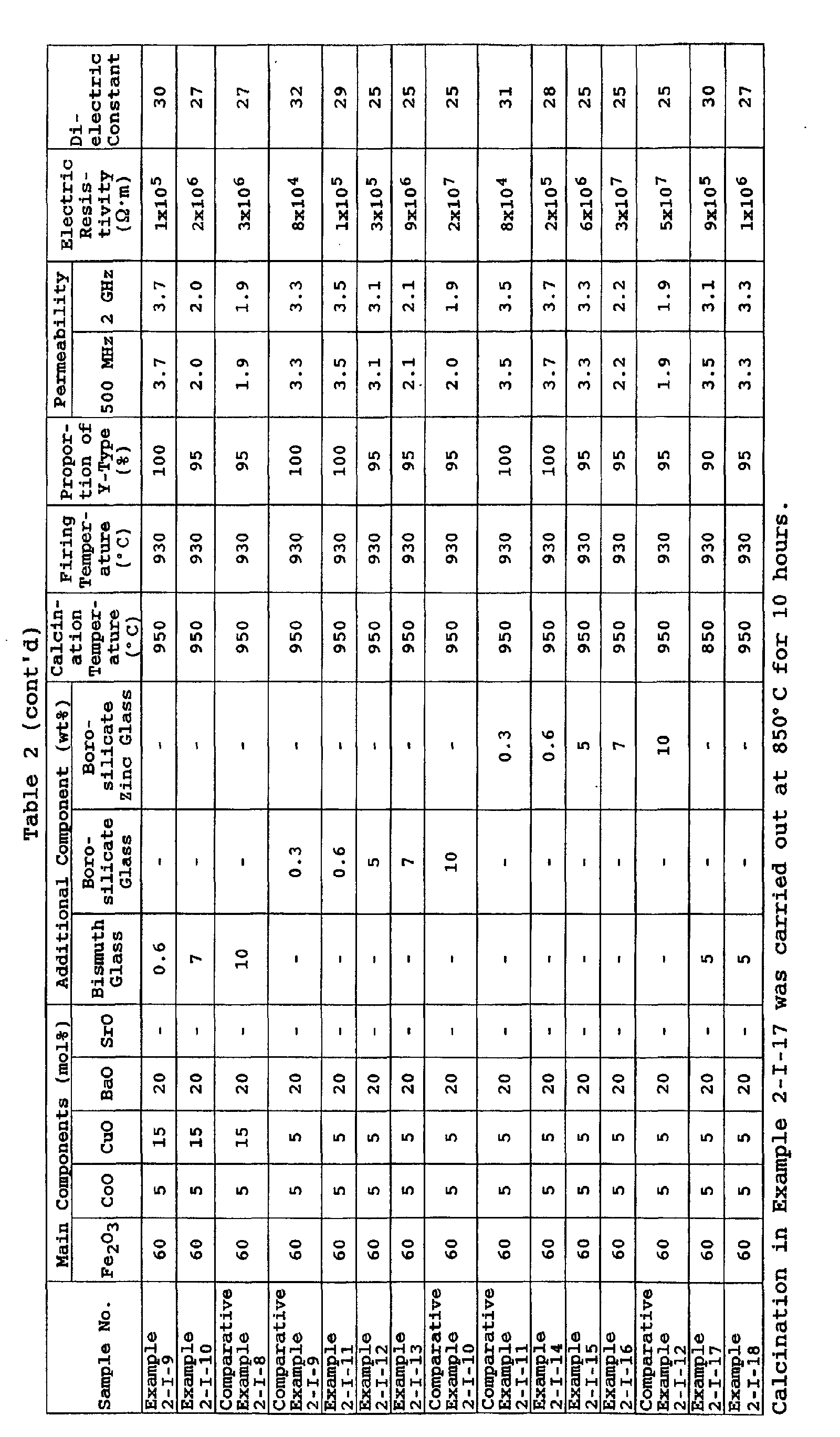
- each material was weighed so that the compositions of ferrites after sintering should become those shown in the following Table 2, and the materials were wet-blended in a steel ball mill for 15 hours. Then, these mixed powders were calcined in the air at the temperatures shown in Table 2 for 2 hours. Then, after predetermined amounts of the predetermined glasses as an additional component were added as shown in Table 2, the calcined materials were milled in a steel ball mill for 15 hours.
- the thus-obtained hexagonal ferrite powders were granulated and formed into desired shapes at a pressure of 100 MPa.
- the compositions of the sintered hexagonal ferrites are as shown in the following Table 2. These samples were measured for magnetic permeabilities at frequencies of 500 MHz and 2 GHz at 25°C, electric resistivity and a dielectric constant, and the results of the measurements are shown in Table 2.
- the target magnetic permeabilities at frequencies of 500 MHz and 2 GHz each are a value of at least 2.0. Further, the target electric resistivity is a value of 1 x 10 5 ⁇ m. The lower the dielectric constant, the better it is. In this regard, it has been found from the experiment results to be described later that when the electric resistivity is higher than 1 x 10 5 ⁇ m, the dielectric constant exhibits a low value of 30 or smaller.
- the proportion of a Y-type hexagonal ferrite was calculated from the ratio of intensities of X-ray diffraction peaks using the milled powders of the sintered body.
- Example 2-I-6 of the above Experiment 2-I A variety of samples were prepared by varying the types and amounts of the additional components to be added to the main components of Example 2-I-6 of the above Experiment 2-I as shown in the following Table 3. These samples were measured for the temperature at which a relative density of at least 90% (based on a theoretical density of 100).
- an inductance element was prepared using the magnetic body of the present invention. That is, each material was weighed so that the composition after sintering should become the composition of the Example 2-I-6 sample in the above Table 2, and the materials were wet-blended in a steel ball mill for 15 hours. Then, these mixed powders were calcined in the air at 950°C for 2 hours. Then, after 5 wt% of bismuth glass was added as an additional component, the calcined powders were milled in a steel ball mill for 15 hours.
- An organic binder was mixed into the calcined powders, and the paste was formed into a uniform green sheet by a doctor blade process.
- a conductive paste containing silver was prepared, and a coil was stacked in a spiral form on the above green sheet.
- a pressure was applied in the thickness direction to crimp the coil onto the sheet, thereby preparing a stacked green sheet having the electrode sandwiched between the magnetic bodies.
- the prepared green chip was sintered at 930°C for 2 hours.
- the silver paste was applied to the sides of the internal conductor of the obtained sintered body to bake external electrodes thereto, thereby obtaining an impeder (high-frequency circuit component) whose schematic constitution is shown in Fig. 1.
- Fig. 1 shows the impeder schematically for the purpose of facilitating understanding of the internal structure thereof.
- reference numeral 11 denotes an inner conductor (Ag coil), reference numeral 10 terminal conductors, and reference numeral 20 a ferrite.
- the impedance of the magnetic body of the present invention was 208 ⁇ (permeability: 3.7), while the impedance of the NiCuZn ferrite was 135 ⁇ (permeability: 1.2)
- the present invention is a sintered body at least 80% of which is constituted of a Y-type hexagonal ferrite, wherein the sintered magnetic oxide contains, as main components, a cobalt oxide in an amount of 3 to 15 mol% in terms of CoO, a copper oxide in an amount of 5 to 17 mol% in terms of CuO, an iron oxide in an amount of 57 to 61 mol% in terms of Fe 2 O 3 , and AO (AO is at least one of BaO or SrO) as the balance, and also contains, as an additional component, 0.6 to 7 wt% of borosilicate glass, borosilicate zinc glass or bismuth glass.
- the sintered magnetic oxide contains, as main components, a cobalt oxide in an amount of 3 to 15 mol% in terms of CoO, a copper oxide in an amount of 5 to 17 mol% in terms of CuO, an iron oxide in an amount of 57 to 61 mol% in terms of Fe 2 O 3 , and AO (AO is
- a sintered body which can be calcined at a temperature of not higher than 1,000°C, particularly about 900°C, has high electric resistivity and a low dielectric constant and contains a Y-type hexagonal ferrite as a main ferrite component and a high-frequency circuit component using the sintered body can be provided.
- the sintered body in the third invention group of the present invention is sintered body, it can be produced by a general ceramic production process.
- the sintered body in the third invention group of the present invention contains, as main components, a cobalt oxide in an amount of 3 to 15 mol% (preferably 3 to 5 mol%) in terms of CoO, a copper oxide in an amount of 5 to 17 mol% (preferably 5.5 to 10 mol%) in terms of CuO, an iron oxide in an amount of 57 to 61 mol% (preferably 59 to 60 mol%) in terms of Fe 2 O 3 , MO (MO is at least one of NiO, ZnO or MgO, the content of MO would never be 0) in an amount of 0 to 15 wt%, preferably 1 to 15 wt%, particularly preferably 5 to 15 wt%, and AO (AO is at least one of BaO or SrO) as the balance.
- a cobalt oxide in an amount of 3 to 15 mol% (preferably 3 to 5 mol%) in terms of CoO a copper oxide in an amount of 5 to 17 mol% (preferably 5.5 to 10 mol%) in terms of CuO
- the MO may be NiO, ZnO, MgO or a mixture of at least two of these compounds. When a mixture of at least two of these compounds is used as the MO, the total mol% of the mixture should be within the above range.
- the AO may be BaO, SrO or a mixture thereof.
- the sintered body of the present invention also contains 0.5 to 7 wt% (preferably 0.6 to 5 wt%) of bismuth oxide (Bi 2 O 3 ) as an additional component.
- the bismuth oxide (Bi 2 O 3 ) is added in the form of the oxide and generally remains in the form of the oxide even after sintering.
- the content of the above additional component when the content of the above Bi 2 O 3 is lower than 0.5 wt%, the inconvenience that at least 90% of theoretical density cannot be obtained by firing at a temperature of not higher than 1,000°C is liable to occur, while when the content of the above Bi 2 O 3 is higher than 7 wt%, the inconvenience that permeability decreases is liable to occur.
- the addition of such an additional component as Bi 2 O 3 markedly accomplishes low-temperature sintering. They also cause such a synergistic effect as an improvement in magnetic properties.
- an electrode-incorporated closed magnetic circuit component can be produced easily by firing the sintered magnetic oxide with a low-melting-point electrode material such as Ag which is inexpensive and has a low electrical resistance incorporated therein.
- the thus-produced component is used in a high-frequency component (high-frequency circuit component) such as an inductor which is compact and has a high Q value or a noise filter which is compact and exhibits a high impedance at a particular frequency in a high-frequency band.
- a high-frequency component high-frequency circuit component
- inductor which is compact and has a high Q value
- noise filter which is compact and exhibits a high impedance at a particular frequency in a high-frequency band.
- the sintered magnetic oxide of the present invention exhibits a particularly preferable effect on controlling a high impedance and the band of the impedance.
- At least 80%, particularly preferably at least 90%, of the sintered body in the present invention is constituted of a Y-type hexagonal ferrite.
- the unit "%" as used herein is calculated from the ratio of main peaks of X-ray diffraction intensity.
- the firing temperature is lowered. Therefore, the Y-type hexagonal ferrite must be produced in a proportion of at least 80% at the time of calcination so that the proportion of the Y-type hexagonal ferrite after sintering should be at least 80%.
- the decompositions of BaFe 12 O 19 and BaFe 2 O 4 start about 850°C and the production of the Y-type hexagonal ferrite starts.
- the decompositions of BaFe 12 O 19 and BaFe 2 O 4 do not proceed sufficiently, the production of the Y-type hexagonal ferrite does not proceed.
- the calcination temperature must be at least 850°C, particularly 850 to 1,000°C. Further, CuO must be contained in an amount of preferably 5.5 to 17 mol%. When the calcination temperature is lower than 850°C or the amount of CuO is out of the above range, it is difficult to produce the Y-type hexagonal ferrite in a proportion of higher than 80%. Meanwhile, when the calcination temperature is much higher than 1,000°C, fine milled powders cannot be obtained. The preparation of the fine milled powders is an extremely important technique in low-temperature firing.
- CuO as a main component must be preferably contained in an amount of 5.5 to 17 mol%.
- the sintered body of the present invention is used as a high-frequency circuit component having the structure that a conductive body is embedded in the sintered magnetic oxide, such as an impeder or an inductor.
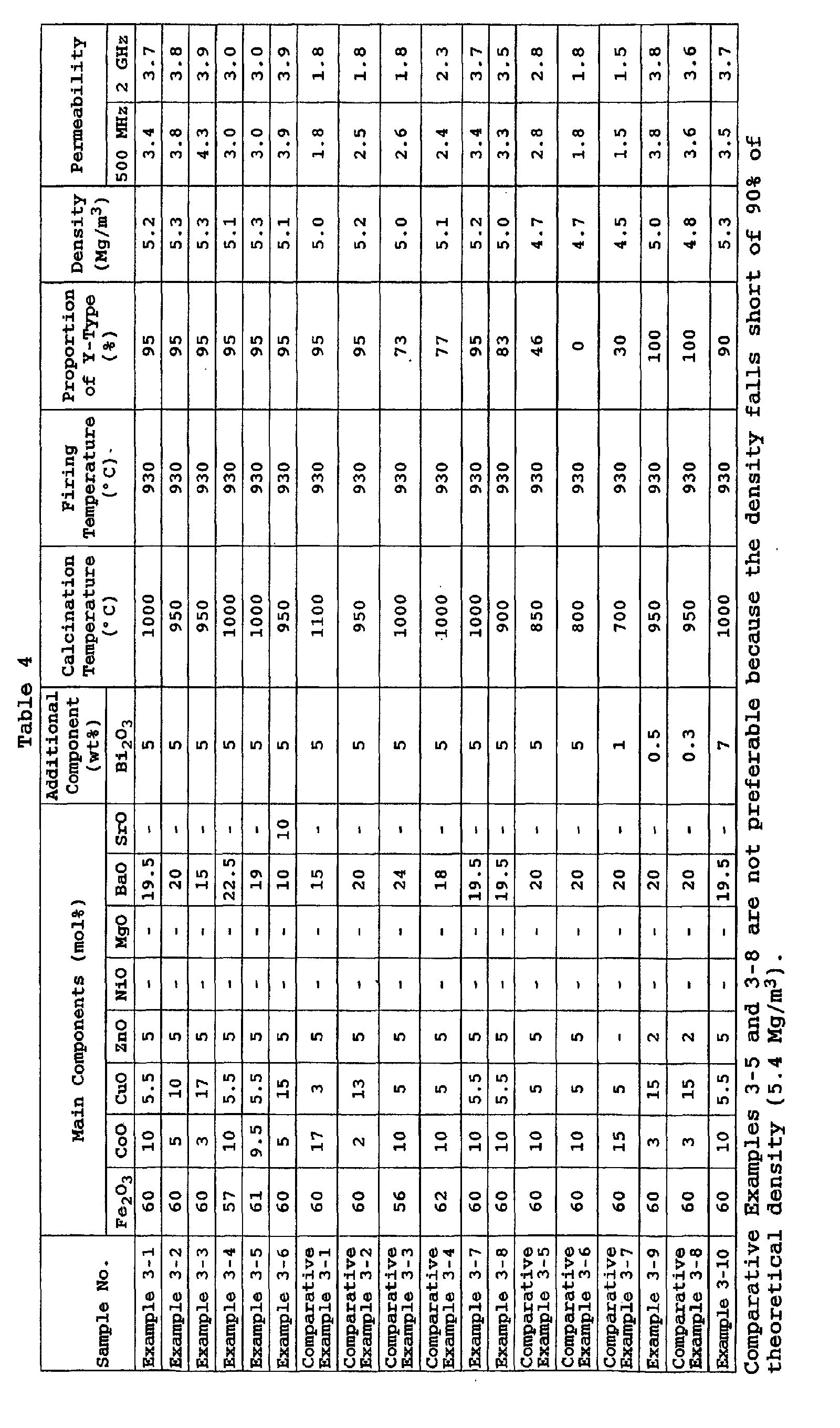
- each material was weighed so that the compositions of ferrites after sintering should become those shown in the following Table 4, and the materials were wet-blended in a steel ball mill for 15 hours. Then, these mixed powders were calcined in the air at the temperatures shown in Table 4 for 2 hours. Then, after predetermined amounts of Bi 2 O 3 as an additional component were added as shown in Table 4, the calcined materials were milled in a steel ball mill for 15 hours.
- the thus-obtained hexagonal ferrite powders were granulated and formed into desired shapes at a pressure of 100 MPa.
- the compositions of the sintered hexagonal ferrites are as shown in the following Table 4. These samples were measured for magnetic permeabilities at frequencies of 500 MHz and 2 GHz at 25°C, and the results of the measurements are shown in Table 4.
- the target permeability at a frequency of 500 MHz is a value of at least 2.5
- the target permeability at a frequency of 2 GHz is a value of at least 2.0.
- the proportion of a Y-type hexagonal ferrite was calculated from the ratio of intensities of X-ray diffraction peaks using the milled powders of the sintered body.
- an inductance element was prepared using the magnetic body of the present invention. That is, each material was weighed so that the composition after sintering should become the composition of the sample of Example 3-11 in the above Table 4, and the materials were wet-blended in a steel ball mill for 15 hours. Then, these mixed powders were calcined in the air at 950°C for 2 hours. Then, after 5 wt% of Bi 2 O 3 was added as an additional component, the calcined powders were milled in a steel ball mill for 15 hours.
- An organic binder was mixed into the calcined powders, and the paste was formed into a uniform green sheet by a doctor blade process.
- a conductive paste containing silver was prepared, and a coil was stacked in a spiral form on the above green sheet.
- a pressure was applied in the thickness direction to crimp the coil onto the sheet, thereby preparing a stacked green sheet having the electrode sandwiched between the magnetic bodies.
- the prepared green chip was sintered at 930°C for 2 hours.
- the silver paste was applied to the sides of the internal conductor of the obtained sintered body to bake external electrodes thereto, thereby obtaining an impeder (high-frequency circuit component) whose schematic constitution is shown in Fig. 1.
- Fig. 1 shows the impeder schematically for the purpose of facilitating understanding of the internal structure thereof.
- reference numeral 11 denotes an inner conductor (Ag coil), reference numeral 10 terminal conductors, and reference numeral 20 a ferrite.
- the magnetic body of the present invention exhibited an extremely excellent impedance of 236 ⁇ (permeability: 4.2).
- the impedance of the conventional NiCuZn ferrite was 135 ⁇ (permeability: 1.2).
- the present invention is a sintered body at least 80% of which is constituted of a Y-type hexagonal ferrite, wherein the sintered magnetic oxide contains, as main components, a cobalt oxide in an amount of 3 to 15 mol% in terms of CoO, a copper oxide in an amount of 5 to 17 mol% in terms of CuO, an iron oxide in an amount of 57 to 61 mol% in terms of Fe 2 O 3 , 0 to 15 wt% of MO (MO is at least one of NiO, ZnO or MgO, the content of MO would never be 0), and AO (AO is at least one of BaO or SrO) as the balance, and also contains, as an additional component, 0.5 to 7 wt% of bismuth oxide (Bi 2 O 3 ).
- the sintered magnetic oxide contains, as main components, a cobalt oxide in an amount of 3 to 15 mol% in terms of CoO, a copper oxide in an amount of 5 to 17 mol% in terms of CuO,
- a sintered body which exhibits good magnetic properties up to a high frequency band ranging from several hundred megahertz to gigahertz, contains as few hetero phases other than a Y-type hexagonal ferrite as possible and can be calcined at a temperature of not higher than 1,000°C, particularly about 900°C, and a high-frequency circuit component using the sintered body can be provided.
- the sintered body in the fourth invention group of the present invention is sintered body, it can be produced by a general ceramic production process.
- the sintered body in the fourth invention group of the present invention contains, as main components, a cobalt oxide in an amount of 3 to 15 mol% (preferably 3 to 5 mol%) in terms of CoO, a copper oxide in an amount of 5 to 17 mol% (preferably 5.5 to 10 mol%) in terms of CuO, an iron oxide in an amount of 57 to 61 mol% (preferably 59 to 60 mol%) in terms of Fe 2 O 3 , MO (MO is at least one of NiO, ZnO or MgO, the content of MO would never be 0) in an amount of 0 to 15 wt%, preferably 1 to 15 wt%, particularly preferably 5 to 15 wt%, and AO (AO is at least one of BaO or SrO) as the balance.
- a cobalt oxide in an amount of 3 to 15 mol% (preferably 3 to 5 mol%) in terms of CoO a copper oxide in an amount of 5 to 17 mol% (preferably 5.5 to 10 mol%) in terms of CuO
- the MO may be NiO, ZnO, MgO or a mixture of at least two of these compounds. When a mixture of at least two of these compounds is used, the total mol% of the mixture should be within the above range.
- the AO may be BaO, SrO or a mixture thereof.
- the sintered body of the present invention also contains 0.6 to 7 wt% (preferably 0.6 to 5 wt%) of borosilicate glass, borosilicate zinc glass or bismuth glass as an additional component.
- the borosilicate glass generally indicates glass containing B 2 O 3 and SiO 2
- the borosilicate zinc glass generally indicates glass containing B 2 O 3 , SiO 2 and ZnO
- the bismuth glass generally indicates glass containing Bi 2 O 3 .
- the above components do not need to be main components.
- These additional glass components may be used solely or in admixture of two or three. When they are used in admixture of two or three, the total wt% of the mixture should be within the above range.
- an increase in electric resistivity (increasing electric resistivity) or a decrease in dielectric constant (decreasing a dielectric constant) can be achieved. Therefore, by the addition of the glass specified by the present invention, an electric resistivity of at least 1 x 10 5 ⁇ m which is required for, for example, a multilayer component material as a high-frequency circuit component.
- the effect of decreasing a dielectric constant is also exhibited, and when the sintered body of the present invention is used as a high-frequency component, a high impedance can be attained at high frequencies and the frequency band for the impedance can be widened. Further, the above glasses must be added in the form of glass. After firing, the glass component used remains in the sintered body regardless of whether the component maintains the glass form.
- borosilicate zinc glass and borosilicate glass are particularly preferable for achieving high resistivity and a low dielectric constant more effectively. Further, when the above glasses are added in the same amount, bismuth glass is particularly preferable from the viewpoint that the temperature at which a relative density of at least 90% can be attained can be lowered.
- the content of the above additional component when the content of the above specified glass is lower than 0.6 wt%, the inconvenience that at least 90% of theoretical density cannot be obtained by firing at a temperature of not higher than 1,000°C is liable to occur, while when the content of the above glass is higher than 7 wt%, the inconvenience that permeability decreases is liable to occur.
- an additional glass component markedly accomplishes low-temperature sintering.
- an electrode-incorporated closed magnetic circuit component can be produced easily by firing the sintered body with a low-melting-point electrode material such as Ag which is inexpensive and has a low electrical resistance incorporated therein.
- the thus-produced component is used in a high-frequency component (high-frequency circuit component) such as an inductor which is compact and has a high Q value or a noise filter which is compact and exhibits a high impedance at a particular frequency in a high-frequency band.
- the sintered body of the present invention exhibits a particularly preferable effect on controlling a high impedance and the band of the impedance.
- At least 80%, particularly preferably at least 90%, of the sintered magnetic oxide in the present invention is constituted of a Y-type hexagonal ferrite.
- the unit "%" as used herein is calculated from the ratio of main peaks of X-ray diffraction intensity.
- the firing temperature is lowered. Therefore, the Y-type hexagonal ferrite must be produced in a proportion of at least 80% at the time of calcination so that the proportion of the Y-type hexagonal ferrite after sintering should be at least 80%.
- the decompositions of BaFe 12 O 19 and BaFe 2 O 4 start about 850°C and the production of the Y-type hexagonal ferrite starts.
- the decompositions of BaFe 12 O 19 and BaFe 2 O 4 do not proceed sufficiently, the production of the Y-type hexagonal ferrite does not proceed.
- the calcination temperature must be at least 850°C, particularly 850 to 1,000°C. Further, CuO must be contained in an amount of 5.5 to 17 mol%. When the calcination temperature is lower than 850°C or a predetermined amount of CuO is not contained, it is difficult to produce the Y-type hexagonal ferrite in a proportion of higher than 80%. Meanwhile, when the calcination temperature is much higher than 1,000°C, fine milled powders cannot be obtained. The preparation of the fine milled powders is an extremely important technique in low-temperature firing.
- CuO as a main component must be preferably contained in an amount of 5.5 to 17 mol%.
- the sintered body of the present invention is used as a high-frequency circuit component having the structure that a conductive body is embedded in the sintered body, such as an impeder or an inductor.
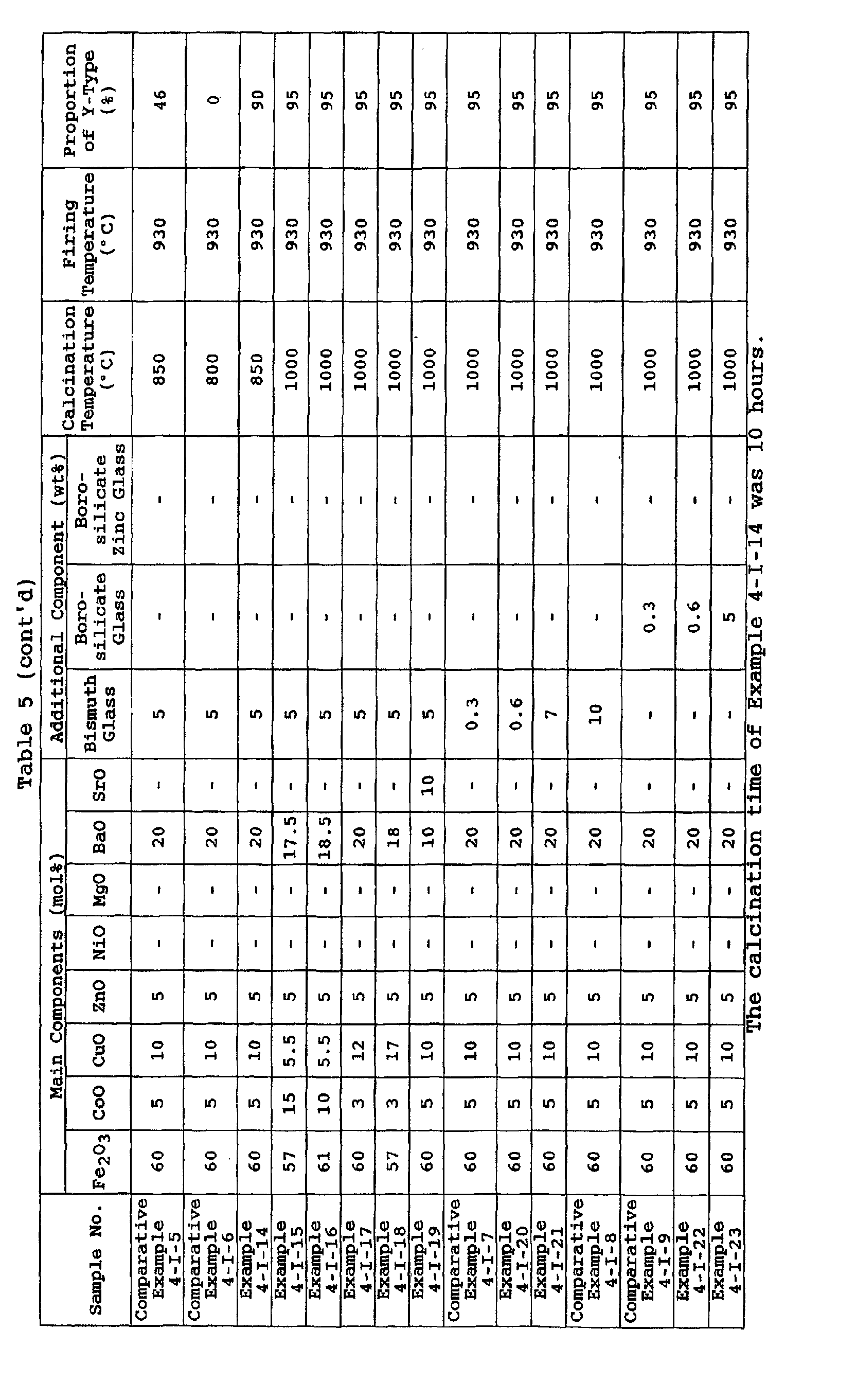
- each material was weighed so that the compositions of ferrites after sintering should become those shown in the following Table 5, and the materials were wet-blended in a steel ball mill for 15 hours. Then, these mixed powders were calcined in the air at the temperatures shown in Table 5 for 2 hours. Then, after predetermined amounts of the predetermined glasses as an additional component were added as shown in Table 5, the calcined materials were milled in a steel ball mill for 15 hours.
- the thus-obtained hexagonal ferrite powders were granulated and formed into desired shapes at a pressure of 100 MPa.
- the target permeability at a frequency of 500 MHz is a value of at least 2.5
- the target permeability at a frequency of 2 GHz is a value of at least 2.0
- the target electric resistivity is a value of 1 x 10 5 ⁇ m.
- Example 4-I-2 of the above Experiment 4-I A variety of samples were prepared by varying the types and amounts of the additional components to be added to the main components of Example 4-I-2 of the above Experiment 4-I as shown in the following Table 7. These samples were measured for the temperature at which a relative density of at least 90% (based on a theoretical density of 100).
- an impeder was prepared using the magnetic body of the present invention. That is, each material was weighed so that the composition after sintering should become the composition of the main components of the Example 4-I-2 in the above Table 5, and the materials were wet-blended in a steel ball mill for 15 hours. Then, these mixed powders were calcined in the air at 950°C for 2 hours. Then, after 5 wt% of bismuth glass was added as an additional component, the calcined powders were milled in a steel ball mill for 15 hours.
- An organic binder was mixed into the calcined powders, and the paste was formed into a uniform green sheet by a doctor blade process.
- a conductive paste containing silver was prepared, and a coil was stacked in a spiral form on the above green sheet.
- a pressure was applied in the thickness direction to crimp the coil onto the sheet, thereby preparing a stacked green sheet having the electrode sandwiched between the magnetic bodies.
- the prepared green chip was sintered at 930°C for 2 hours.
- the silver paste was applied to the sides of the internal conductor of the obtained sintered body to bake external electrodes thereto, thereby obtaining an impeder (high-frequency circuit component) whose schematic constitution is shown in Fig. 1.
- Fig. 1 shows the impeder schematically for the purpose of facilitating understanding of the internal structure thereof.
- reference numeral 11 denotes an inner conductor (Ag coil), reference numeral 10 terminal conductors, and reference numeral 20 a ferrite.
- the magnetic body of the present invention exhibited an extremely excellent impedance of 236 ⁇ (permeability: 4.2).
- the impedance of the conventional NiCuZn ferrite was 135 ⁇ (permeability: 1.2).
- the present invention is a sintered body at least 80% of which is constituted of a Y-type hexagonal ferrite, wherein the sintered body contains, as main components, a cobalt oxide in an amount of 3 to 15 mol% in terms of CoO, a copper oxide in an amount of 5 to 17 mol% in terms of CuO, an iron oxide in an amount of 57 to 61 mol% in terms of Fe 2 O 3 , 0 to 15 wt% of MO (MO is at least one of NiO, ZnO or MgO, the content of MO would never be 0), and AO (AO is at least one of BaO or SrO) as the balance, and also contains, as an additional component, 0.6 to 7 wt% of borosilicate glass, borosilicate zinc glass or bismuth glass.
- a sintered body which can be calcined at a temperature of not higher than 1,000°C, particularly about 900°C, has high permeability in a high-frequency band, has electric resistivity and a low dielectric constant and contains a Y-type hexagonal ferrite as a main ferrite component and a high-frequency circuit component using the sintered body can be provided.
- the sintered body in the present invention is used as a high-frequency circuit component having the structure that a conductive body is embedded in the sintered body, such as an impeder or an inductor.
Landscapes
- Engineering & Computer Science (AREA)
- Chemical & Material Sciences (AREA)
- Ceramic Engineering (AREA)
- Manufacturing & Machinery (AREA)
- Power Engineering (AREA)
- Materials Engineering (AREA)
- Organic Chemistry (AREA)
- Structural Engineering (AREA)
- Dispersion Chemistry (AREA)
- Physics & Mathematics (AREA)
- Thermal Sciences (AREA)
- Inorganic Chemistry (AREA)
- Crystallography & Structural Chemistry (AREA)
- Microelectronics & Electronic Packaging (AREA)
- Magnetic Ceramics (AREA)
- Soft Magnetic Materials (AREA)
Abstract
Description


| Additional Components | Amount of Glass Added | ||||
| 0.6 wt% | 1 wt% | 3 wt% | 5 wt% | 7 wt% | |
| Borosllicate Glass | 1000°C | 1000°C | 950°C | 950°C | 900° C |
| Borosilicate Zinc Glass | 1000°C | 1000°C | 950°C | 950°C | 900° C |
| Bismuth Glass | 1000°C | 950°C | 900°C | 900°C | 900° C |



| Sample No | Permeability | Electric Resistivity (Ω·m) | Dielectric Constant | |
| . | 500 MHz | 2 GHz | ||
| Example 4-I-1 | 3.4 | 3.7 | 1 x 10⁶ | 27 |
| Example 4-I-2 | 5.1 | 4.2 | 1 x 10⁶ | 27 |
| Example 4-I-3 | 10.1 | 2.2 | 1 x 10⁶ | 27 |
| Example 4-I-4 | 2.7 | 2.3 | 1 x 10⁶ | 27 |
| Example 4-I-5 | 3.3 | 2.6 | 1 x 10⁶ | 27 |
| Example 4-I-6 | 5.8 | 2.0 | 1 x 10⁶ | 27 |
| Example 4-I-7 | 2.6 | 2.2 | 1 x 10⁶ | 27 |
| Example 4-I-8 | 3.2 | 2.5 | 1 x 10⁶ | 27 |
| Example 4-I-9 | 6.2 | 2.0 | 1 x 10⁶ | 27 |
| Example 4-I-10 | 2.7 | 2.7 | 1 x 10⁶ | 27 |
| Example 4-I-11 | 2.5 | 2.2 | 1 x 10⁶ | 27 |
| Example 4-I-12 | 2.6 | 2.1 | 1 x 10⁶ | 27 |
| Comparative Example 4-I-1 | 2.1 | 2.1 | 1 x 10⁶ | 27 |
| Comparative Example 4-I-2 | 8.1 | 0.8 | 1 x 10⁶ | 27 |
| Comparative Example 4-I-3 | 5.8 | 0.8 | 1 x 10⁶ | 27 |
| Comparative Example 4-I-4 | 6.2 | 0.6 | 1 × 10⁶ | 27 |
| Example 4-I-13 | 3.8 | 3.8 | 1 x 10⁶ | 28 |
| Comparative Example 4-I-5 | 2.6 | 1.8 | 1 x 10⁶ | 28 |
| Comparative Example 4-I-6 | 1.8 | 1.8 | 1 x 10⁶ | 28 |
| Example 4-I-14 | 3.8 | 3.8 | 1 x 10⁶ | 27 |
| Example 4-I-15 | 2.5 | 2.5 | 1 x 10⁶ | 27 |
| Example 4-I-16 | 3.0 | 3.0 | 1 x 10⁶ | 27 |
| Example 4-I-17 | 3.5 | 3.3 | 9 x 10⁵ | 28 |
| Example 4-I-18 | 3.0 | 2.9 | 9 x 10⁵ | 29 |
| Example 4-I-19 | 3.9 | 3.9 | 1 x 10⁶ | 27 |
| Comparative Example 4-I-7 | 3.4 | 3.4 | 5 x 10⁴ | 35 |
| Example 4-I-20 | 3.7 | 3.7 | 3 x 10⁵ | 29 |
| Example 4-I-21 | 3.8 | 3.8 | 2 x 10⁶ | 27 |
| Comparative Example 4-I-8 | 3.0 | 1.9 | 3 x 10⁶ | 27 |
| Comparative Example 4-I-9 | 2.9 | 2.9 | 8 x 10⁴ | 32 |
| Example 4-I-22 | 3.2 | 3.2 | 3 x 10⁵ | 29 |
| Example 4-I-23 | 3.4 | 3.4 | 3 x 10⁶ | 25 |
| Example 4-I-24 | 3.4 | 3.4 | 9 x 10⁶ | 25 |
| Comparative Example 4-I-10 | 2.5 | 1.8 | 2 x 10⁷ | 25 |
| Comparative Example 4-I-11 | 2.9 | 2.9 | 8 x 10⁴ | 31 |
| Example 4-I-25 | 3.5 | 3.5 | 2 x 10⁵ | 29 |
| Example 4-I-26 | 3.6 | 3.6 | 6 x 10⁶ | 27 |
| Example 4-I-27 | 3.6 | 3.6 | 3 x 10⁷ | 27 |
| Comparative Example 4-I-12 | 2.7 | 1.9 | 5 x 10⁷ | 27 |
| Additional Components | Amount of Glass Added | ||||
| 0.6 wt% | 1 wt% | 3 wt% | 5 wt% | 7 wt% | |
| Borosilicate Glass | 1000°C | 1000°C | 950°C | 950°C | 900°C |
| Borosilicate Zinc Glass | 1000°C | 1000°C | 950°C | 950°C | 900°C |
| Bismuth Glass | 1000°C | 950°C | 900°C | 900°C | 900° C |
Claims (20)
- A sintered body at least 80% of which is constituted of a Y-type hexagonal ferrite, the sintered body containing, as main components, a cobalt oxide in an amount of 3 to 15 mol% in terms of CoO, a copper oxide in an amount of 5.5 to 17 mol% in terms of CuO, an iron oxide in an amount of 57 to 61 mol% in terms of Fe2O3, and AO (AO is at least one of BaO or SrO) as the balance, and also containing 0.5 to 7 wt% of bismuth oxide (Bi2O3) as an additional component.
- The sintered body of claim 1, wherein the calcination temperature in the production of the sintered body is in a range of 850 to 1,000°C.
- A high-frequency circuit component having the structure that a conductive body is embedded in a sintered body, wherein
at least 80% of the sintered body is constituted of a Y-type hexagonal ferrite, and
the sintered body contains, as main components, a cobalt oxide in an amount of 3 to 15 mol% in terms of CoO, a copper oxide in an amount of 5.5 to 17 mol% in terms of CuO, an iron oxide in an amount of 57 to 61 mol% in terms of Fe2O3, and AO (AO is at least one of BaO or SrO) as the balance, and also contains 0.5 to 7 wt% of bismuth oxide (Bi2O3) as an additional component. - The component of claim 3, wherein the calcination temperature in the production of the sintered body is in a range of 850 to 1,000°C.
- The component of claim 3, wherein the conductive body contains silver (Ag) as a main component.
- A sintered body at least 80% of which is constituted of a Y-type hexagonal ferrite, the sintered body containing, as main components, a cobalt oxide in an amount of 3 to 15 mol% in terms of CoO, a copper oxide in an amount of 5 to 17 mol% in terms of CuO, an iron oxide in an amount of 57 to 61 mol% in terms of Fe2O3, and AO (AO is at least one of BaO or SrO) as the balance, and also containing 0.6 to 7 wt% of borosilicate glass, borosilicate zinc glass or bismuth glass as an additional component.
- The sintered body of claim 6, wherein the calcination temperature in the production of the sintered body is 850 to 1,000°C.
- A high-frequency circuit component having the structure that a conductive body is embedded in a sintered body, wherein
at least 80% of the sintered body is constituted of a Y-type hexagonal ferrite, and
the sintered body contains, as main components, a cobalt oxide in an amount of 3 to 15 mol% in terms of CoO, a copper oxide in an amount of 5 to 17 mol% in terms of CuO, an iron oxide in an amount of 57 to 61 mol% in terms of Fe2O3, and AO (AO is at least one of BaO or SrO) as the balance, and also contains 0.6 to 7 wt% of borosilicate glass, borosilicate zinc glass or bismuth glass as an additional component. - The component of claim 8, wherein the calcination temperature in the production of the sintered body is in a range of 850 to 1,000°C.
- The component of claim 8, wherein the conductive body contains silver (Ag) as a main component.
- A sintered body at least 80% of which is constituted of a Y-type hexagonal ferrite, the sintered body containing, as main components, a cobalt oxide in an amount of 3 to 15 mol% in terms of CoO, a copper oxide in an amount of 5 to 17 mol% in terms of CuO, an iron oxide in an amount of 57 to 61 mol% in terms of Fe2O3, 0 to 15 wt% of MO (MO is at least one of NiO, ZnO or MgO, the content of MO would never be 0), and AO (AO is at least one of BaO or SrO) as the balance, and also containing 0.5 to 7 wt% of bismuth oxide (Bi2O3) as an additional component.
- The sintered body of claim 11, wherein the calcination temperature in the production of the sintered body is in a range of 850 to 1,000°C.
- A high-frequency circuit component having the structure that a conductive body is embedded in a sintered body, wherein
at least 80% of the sintered body is constituted of a Y-type hexagonal ferrite, and
the sintered body contains, as main components, a cobalt oxide in an amount of 3 to 15 mol% in terms of CoO, a copper oxide in an amount of 5 to 17 mol% in terms of CuO, an iron oxide in an amount of 57 to 61 mol% in terms of Fe2O3, 0 to 15 wt% of MO (MO is at least one of NiO, ZnO or MgO, the content of MO would never be 0), and AO (AO is at least one of BaO or SrO) as the balance, and also contains 0.5 to 7 wt% of bismuth oxide (Bi2O3) as an additional component. - The component of claim 13, wherein the calcination temperature in the production of the sintered body is in a range of 850 to 1,000°C.
- The component of claim 13, wherein the conductive body contains silver (Ag) as a main component.
- A sintered body at least 80% of which is constituted of a Y-type hexagonal ferrite, the sintered body containing, as main components, a cobalt oxide in an amount of 3 to 15 mol% in terms of CoO, a copper oxide in an amount of 5 to 17 mol% in-terms of CuO, an iron oxide in an amount of 57 to 61 mol% in terms of Fe2O3, 0 to 15 wt% of MO (MO is at least one of NiO, ZnO or MgO, the content of MO would never be 0), and AO (AO is at least one of BaO or SrO) as the balance, and also containing 0.6 to 7 wt% of borosilicate glass, borosilicate zinc glass or bismuth glass as an additional component.
- The sintered body of claim 16, wherein the calcination temperature in the production of the sintered body is in a range of 850 to 1,000°C.
- A high-frequency circuit component having the structure that a conductive body is embedded in a sintered body, wherein
the sintered body contains, as main components, a cobalt oxide in an amount of 3 to 15 mol% in terms of CoO, a copper oxide in an amount of 5 to 17 mol% in terms of CuO, an iron oxide in an amount of 57 to 61 mol% in terms of Fe2O3, 0 to 15 wt% of MO (MO is at least one of NiO, ZnO or MgO, the content of MO would never be 0), and AO (AO is at least one of BaO or SrO) as the balance, and also contains 0.6 to 7 wt% of borosilicate glass, borosilicate zinc glass or bismuth glass as an additional component. - The component of claim 18, wherein the calcination temperature in the production of the sintered body is in a range of 850 to 1,000°C.
- The component of claim 18, wherein the conductive body contains silver (Ag) as a main component.
Applications Claiming Priority (9)
| Application Number | Priority Date | Filing Date | Title |
|---|---|---|---|
| JP2001056152 | 2001-03-01 | ||
| JP2001056412 | 2001-03-01 | ||
| JP2001056413A JP4074440B2 (en) | 2001-03-01 | 2001-03-01 | Magnetic oxide sintered body and high-frequency circuit component using the same |
| JP2001056412A JP4074439B2 (en) | 2001-03-01 | 2001-03-01 | Magnetic oxide sintered body and high-frequency circuit component using the same |
| JP2001056153 | 2001-03-01 | ||
| JP2001056413 | 2001-03-01 | ||
| JP2001056153A JP4074438B2 (en) | 2001-03-01 | 2001-03-01 | Magnetic oxide sintered body and high-frequency circuit component using the same |
| JP2001056152A JP4074437B2 (en) | 2001-03-01 | 2001-03-01 | Magnetic oxide sintered body and high-frequency circuit component using the same |
| PCT/JP2001/006691 WO2002070432A1 (en) | 2001-03-01 | 2001-08-03 | Magnetic oxide sinter and high-frequency circuit part employing the same |
Publications (3)
| Publication Number | Publication Date |
|---|---|
| EP1364927A1 true EP1364927A1 (en) | 2003-11-26 |
| EP1364927A4 EP1364927A4 (en) | 2007-03-28 |
| EP1364927B1 EP1364927B1 (en) | 2008-10-15 |
Family
ID=27482080
Family Applications (1)
| Application Number | Title | Priority Date | Filing Date |
|---|---|---|---|
| EP01954432A Expired - Lifetime EP1364927B1 (en) | 2001-03-01 | 2001-08-03 | Magnetic oxide sinter and high-frequency circuit part employing the same |
Country Status (7)
| Country | Link |
|---|---|
| US (1) | US6660179B2 (en) |
| EP (1) | EP1364927B1 (en) |
| KR (1) | KR100423961B1 (en) |
| CN (1) | CN1232471C (en) |
| DE (1) | DE60136223D1 (en) |
| TW (1) | TW572864B (en) |
| WO (1) | WO2002070432A1 (en) |
Families Citing this family (18)
| Publication number | Priority date | Publication date | Assignee | Title |
|---|---|---|---|---|
| JP3876790B2 (en) * | 2001-08-27 | 2007-02-07 | 株式会社村田製作所 | High frequency circuit element |
| JP4204329B2 (en) * | 2002-01-21 | 2009-01-07 | 三洋電機株式会社 | Method for producing oxide magnetic material |
| GB2402132B (en) * | 2003-05-28 | 2005-10-19 | Reckitt Benckiser Nv | Dishwasher anti-corrosion composition |
| JP4370817B2 (en) * | 2003-06-09 | 2009-11-25 | Tdk株式会社 | Ferrite substrate manufacturing method |
| US20070054826A1 (en) * | 2003-10-17 | 2007-03-08 | Reckitt Benckiser N.V. | Water-soluble glass composition |
| ES2302030T3 (en) * | 2003-10-17 | 2008-07-01 | Reckitt Benckiser N.V. | COMPOSITION TO PROTECT GLASS ITEMS IN A DISHWASHER. |
| EP1732862B1 (en) * | 2004-03-30 | 2015-10-14 | Siemens Aktiengesellschaft | Glass ceramic composition, electrical component comprising one such composition, and ceramic multi-layer body comprising one such electric component |
| JP5256612B2 (en) | 2004-12-17 | 2013-08-07 | 日立金属株式会社 | Hexagonal ferrite and antenna and communication equipment using the same |
| JP4780460B2 (en) * | 2006-03-23 | 2011-09-28 | 日立金属株式会社 | Chip antenna, antenna device, and communication device |
| JPWO2007148438A1 (en) * | 2006-06-21 | 2009-11-12 | 日立金属株式会社 | Magnetic antenna and ferrite sintered body |
| DE102007009740A1 (en) * | 2007-02-28 | 2008-09-04 | Siemens Ag | Production of a magnetic ceramic material comprises heat treating a mechanical-chemical activated starting material at a specified temperature |
| JP5195752B2 (en) * | 2007-06-07 | 2013-05-15 | 日立金属株式会社 | CHIP ANTENNA, MANUFACTURING METHOD THEREOF, AND ANTENNA DEVICE AND COMMUNICATION DEVICE HAVING THE CHIP ANTENNA |
| KR100985723B1 (en) * | 2008-05-14 | 2010-10-06 | 국제엘렉트릭코리아 주식회사 | Multi-chamber substrate processing apparatus and method |
| WO2010038890A1 (en) * | 2008-09-30 | 2010-04-08 | 双信電機株式会社 | Composite electronic component |
| US20100277267A1 (en) * | 2009-05-04 | 2010-11-04 | Robert James Bogert | Magnetic components and methods of manufacturing the same |
| KR101620307B1 (en) | 2009-07-28 | 2016-05-13 | 삼성전자주식회사 | Y-type hexagonal ferrite, antenna apparatus therewith, and method for manufacturing the same |
| CN103265275A (en) * | 2013-05-15 | 2013-08-28 | 江粉磁材(武汉)技术研发有限公司 | NiCuZn ferrite material and preparation method thereof |
| JP7367582B2 (en) * | 2020-03-23 | 2023-10-24 | Tdk株式会社 | ferrite sintered magnet |
Family Cites Families (7)
| Publication number | Priority date | Publication date | Assignee | Title |
|---|---|---|---|---|
| JPS59181576A (en) | 1983-03-31 | 1984-10-16 | Toshiba Corp | Torque sensor |
| JPH0750645B2 (en) | 1985-06-05 | 1995-05-31 | ティーディーケイ株式会社 | Electromagnetic shield material |
| JPS6316238A (en) | 1986-07-09 | 1988-01-23 | Toshiba Corp | Torque sensor |
| JPH09124322A (en) | 1995-10-30 | 1997-05-13 | Tokin Corp | Method for producing soft magnetic hexagonal ferrite powder, sintered body and electromagnetic wave absorber using the same |
| JP3693398B2 (en) * | 1995-12-15 | 2005-09-07 | 松下電器産業株式会社 | Ceramic magnetic material and high frequency circuit component using the same |
| JPH09205031A (en) | 1996-01-24 | 1997-08-05 | Tokin Corp | Manufacturing method of laminated inductance element |
| JP3876790B2 (en) * | 2001-08-27 | 2007-02-07 | 株式会社村田製作所 | High frequency circuit element |
-
2001
- 2001-08-03 EP EP01954432A patent/EP1364927B1/en not_active Expired - Lifetime
- 2001-08-03 CN CNB018087744A patent/CN1232471C/en not_active Expired - Fee Related
- 2001-08-03 DE DE60136223T patent/DE60136223D1/en not_active Expired - Lifetime
- 2001-08-03 KR KR10-2001-7016331A patent/KR100423961B1/en not_active Expired - Fee Related
- 2001-08-03 US US10/070,706 patent/US6660179B2/en not_active Expired - Fee Related
- 2001-08-03 WO PCT/JP2001/006691 patent/WO2002070432A1/en not_active Ceased
- 2001-08-08 TW TW90119381A patent/TW572864B/en not_active IP Right Cessation
Also Published As
| Publication number | Publication date |
|---|---|
| US6660179B2 (en) | 2003-12-09 |
| DE60136223D1 (en) | 2008-11-27 |
| TW572864B (en) | 2004-01-21 |
| KR100423961B1 (en) | 2004-03-22 |
| KR20020091756A (en) | 2002-12-06 |
| US20030052299A1 (en) | 2003-03-20 |
| WO2002070432A1 (en) | 2002-09-12 |
| CN1232471C (en) | 2005-12-21 |
| EP1364927B1 (en) | 2008-10-15 |
| EP1364927A4 (en) | 2007-03-28 |
| CN1426383A (en) | 2003-06-25 |
Similar Documents
| Publication | Publication Date | Title |
|---|---|---|
| US6660179B2 (en) | Sintered body and high-frequency circuit component | |
| JP3693398B2 (en) | Ceramic magnetic material and high frequency circuit component using the same | |
| US8758721B2 (en) | Enhanced hexagonal ferrite material and methods of preparation thereof | |
| JP3876790B2 (en) | High frequency circuit element | |
| EP3180294B1 (en) | Co2 z-type ferrite composite material for use in ultra-high frequency antennas | |
| KR101899734B1 (en) | Ferrite composition and electronic component | |
| KR101928210B1 (en) | Ferrite composition, ferrite sintered body, electronic device, and chip coil | |
| KR20160118973A (en) | Ferrite composition and electronic component | |
| JP2002068830A (en) | Hexagonal y type oxide magnetic material and inductor element | |
| JP4069284B2 (en) | Magnetic ferrite materials and multilayer ferrite parts | |
| US7737803B2 (en) | Electric part including a dielectric portion and a magnetic portion | |
| KR101886489B1 (en) | Ferrite composition and electronic component | |
| DE60201699T2 (en) | Composite particles on soft magnetic hexagonal ferrite base, use of a green body may and sintered ceramics on this ferrite basis | |
| EP0326999A2 (en) | Sintered ferrite materials and chip parts | |
| JP4074440B2 (en) | Magnetic oxide sintered body and high-frequency circuit component using the same | |
| JP2001010820A (en) | Ferrite composition, ferrite sintered compact laminate- type electronic part and production thereof | |
| JP7715512B2 (en) | Ferrite composition and electronic component | |
| JP4074437B2 (en) | Magnetic oxide sintered body and high-frequency circuit component using the same | |
| JP4074438B2 (en) | Magnetic oxide sintered body and high-frequency circuit component using the same | |
| JP2004262682A (en) | Magnetic oxide sintered compact and high-frequency circuit part using the same | |
| JP4074439B2 (en) | Magnetic oxide sintered body and high-frequency circuit component using the same | |
| JP2004143042A (en) | Magnetic material for microwave, method of manufacturing the same, and high-frequency circuit component using the same | |
| JP4934947B2 (en) | Ceramic porcelain composition and method for producing the same | |
| JP2004262683A (en) | Magnetic oxide sintered compact and high-frequency circuit part using the same | |
| JP2023180401A (en) | Ferrite compositions, ferrite sintered bodies and electronic components |
Legal Events
| Date | Code | Title | Description |
|---|---|---|---|
| PUAI | Public reference made under article 153(3) epc to a published international application that has entered the european phase |
Free format text: ORIGINAL CODE: 0009012 |
|
| 17P | Request for examination filed |
Effective date: 20021218 |
|
| AK | Designated contracting states |
Kind code of ref document: A1 Designated state(s): DE FR GB NL |
|
| A4 | Supplementary search report drawn up and despatched |
Effective date: 20070228 |
|
| RIC1 | Information provided on ipc code assigned before grant |
Ipc: H01F 17/04 20060101ALI20070222BHEP Ipc: H01F 1/34 20060101ALI20070222BHEP Ipc: C04B 35/26 20060101AFI20070222BHEP Ipc: H01F 1/37 20060101ALI20070222BHEP |
|
| 17Q | First examination report despatched |
Effective date: 20070516 |
|
| GRAP | Despatch of communication of intention to grant a patent |
Free format text: ORIGINAL CODE: EPIDOSNIGR1 |
|
| GRAS | Grant fee paid |
Free format text: ORIGINAL CODE: EPIDOSNIGR3 |
|
| GRAA | (expected) grant |
Free format text: ORIGINAL CODE: 0009210 |
|
| AK | Designated contracting states |
Kind code of ref document: B1 Designated state(s): DE FR GB NL |
|
| REG | Reference to a national code |
Ref country code: GB Ref legal event code: FG4D |
|
| REF | Corresponds to: |
Ref document number: 60136223 Country of ref document: DE Date of ref document: 20081127 Kind code of ref document: P |
|
| PLBE | No opposition filed within time limit |
Free format text: ORIGINAL CODE: 0009261 |
|
| STAA | Information on the status of an ep patent application or granted ep patent |
Free format text: STATUS: NO OPPOSITION FILED WITHIN TIME LIMIT |
|
| 26N | No opposition filed |
Effective date: 20090716 |
|
| PGFP | Annual fee paid to national office [announced via postgrant information from national office to epo] |
Ref country code: NL Payment date: 20100814 Year of fee payment: 10 |
|
| PGFP | Annual fee paid to national office [announced via postgrant information from national office to epo] |
Ref country code: DE Payment date: 20100728 Year of fee payment: 10 Ref country code: FR Payment date: 20100824 Year of fee payment: 10 |
|
| PGFP | Annual fee paid to national office [announced via postgrant information from national office to epo] |
Ref country code: GB Payment date: 20100728 Year of fee payment: 10 |
|
| REG | Reference to a national code |
Ref country code: NL Ref legal event code: V1 Effective date: 20120301 |
|
| GBPC | Gb: european patent ceased through non-payment of renewal fee |
Effective date: 20110803 |
|
| REG | Reference to a national code |
Ref country code: FR Ref legal event code: ST Effective date: 20120430 |
|
| PG25 | Lapsed in a contracting state [announced via postgrant information from national office to epo] |
Ref country code: NL Free format text: LAPSE BECAUSE OF NON-PAYMENT OF DUE FEES Effective date: 20120301 |
|
| REG | Reference to a national code |
Ref country code: DE Ref legal event code: R119 Ref document number: 60136223 Country of ref document: DE Effective date: 20120301 |
|
| PG25 | Lapsed in a contracting state [announced via postgrant information from national office to epo] |
Ref country code: FR Free format text: LAPSE BECAUSE OF NON-PAYMENT OF DUE FEES Effective date: 20110831 Ref country code: GB Free format text: LAPSE BECAUSE OF NON-PAYMENT OF DUE FEES Effective date: 20110803 |
|
| PG25 | Lapsed in a contracting state [announced via postgrant information from national office to epo] |
Ref country code: DE Free format text: LAPSE BECAUSE OF NON-PAYMENT OF DUE FEES Effective date: 20120301 |