EP1364777A1 - Multi-layer laminate, packaging material and packages made therefrom - Google Patents
Multi-layer laminate, packaging material and packages made therefrom Download PDFInfo
- Publication number
- EP1364777A1 EP1364777A1 EP20030011283 EP03011283A EP1364777A1 EP 1364777 A1 EP1364777 A1 EP 1364777A1 EP 20030011283 EP20030011283 EP 20030011283 EP 03011283 A EP03011283 A EP 03011283A EP 1364777 A1 EP1364777 A1 EP 1364777A1
- Authority
- EP
- European Patent Office
- Prior art keywords
- layer
- laminate according
- polyethylene
- copolymer
- plastic
- Prior art date
- Legal status (The legal status is an assumption and is not a legal conclusion. Google has not performed a legal analysis and makes no representation as to the accuracy of the status listed.)
- Granted
Links
- 239000005022 packaging material Substances 0.000 title claims abstract description 11
- 229920001577 copolymer Polymers 0.000 claims abstract description 57
- 229920003023 plastic Polymers 0.000 claims abstract description 33
- 239000004033 plastic Substances 0.000 claims abstract description 33
- -1 polyethylene Polymers 0.000 claims description 74
- 229920001684 low density polyethylene Polymers 0.000 claims description 47
- 239000004698 Polyethylene Substances 0.000 claims description 20
- 229920000573 polyethylene Polymers 0.000 claims description 20
- 230000004888 barrier function Effects 0.000 claims description 19
- 239000000463 material Substances 0.000 claims description 14
- 239000000843 powder Substances 0.000 claims description 12
- 238000005406 washing Methods 0.000 claims description 12
- 235000013305 food Nutrition 0.000 claims description 8
- 239000004702 low-density polyethylene Substances 0.000 claims description 8
- 239000000203 mixture Substances 0.000 claims description 8
- QVGXLLKOCUKJST-UHFFFAOYSA-N atomic oxygen Chemical compound [O] QVGXLLKOCUKJST-UHFFFAOYSA-N 0.000 claims description 7
- 239000001301 oxygen Substances 0.000 claims description 7
- 229910052760 oxygen Inorganic materials 0.000 claims description 7
- 239000000126 substance Substances 0.000 claims description 5
- 229920006020 amorphous polyamide Polymers 0.000 claims description 4
- 235000013339 cereals Nutrition 0.000 claims description 4
- 239000003599 detergent Substances 0.000 claims description 4
- 239000000835 fiber Substances 0.000 claims description 4
- 244000299461 Theobroma cacao Species 0.000 claims description 3
- 235000019219 chocolate Nutrition 0.000 claims description 3
- 235000014510 cooky Nutrition 0.000 claims description 3
- 235000014347 soups Nutrition 0.000 claims description 3
- IKZZIQXKLWDPCD-UHFFFAOYSA-N but-1-en-2-ol Chemical compound CCC(O)=C IKZZIQXKLWDPCD-UHFFFAOYSA-N 0.000 claims 1
- 239000002657 fibrous material Substances 0.000 abstract description 15
- VPGLGRNSAYHXPY-UHFFFAOYSA-L zirconium(2+);dichloride Chemical compound Cl[Zr]Cl VPGLGRNSAYHXPY-UHFFFAOYSA-L 0.000 description 29
- 229920000098 polyolefin Polymers 0.000 description 13
- VGGSQFUCUMXWEO-UHFFFAOYSA-N Ethene Chemical compound C=C VGGSQFUCUMXWEO-UHFFFAOYSA-N 0.000 description 10
- 125000000058 cyclopentadienyl group Chemical group C1(=CC=CC1)* 0.000 description 10
- ZSWFCLXCOIISFI-UHFFFAOYSA-N endo-cyclopentadiene Natural products C1C=CC=C1 ZSWFCLXCOIISFI-UHFFFAOYSA-N 0.000 description 10
- 238000004806 packaging method and process Methods 0.000 description 9
- 239000000123 paper Substances 0.000 description 9
- 229920000642 polymer Polymers 0.000 description 9
- JRZJOMJEPLMPRA-UHFFFAOYSA-N olefin Natural products CCCCCCCC=C JRZJOMJEPLMPRA-UHFFFAOYSA-N 0.000 description 8
- 239000004952 Polyamide Substances 0.000 description 7
- 229920001903 high density polyethylene Polymers 0.000 description 7
- 229920002647 polyamide Polymers 0.000 description 7
- 125000004805 propylene group Chemical group [H]C([H])([H])C([H])([*:1])C([H])([H])[*:2] 0.000 description 7
- 239000005977 Ethylene Substances 0.000 description 6
- VZCYOOQTPOCHFL-OWOJBTEDSA-N Fumaric acid Chemical compound OC(=O)\C=C\C(O)=O VZCYOOQTPOCHFL-OWOJBTEDSA-N 0.000 description 6
- 229910052782 aluminium Inorganic materials 0.000 description 6
- XAGFODPZIPBFFR-UHFFFAOYSA-N aluminium Chemical compound [Al] XAGFODPZIPBFFR-UHFFFAOYSA-N 0.000 description 6
- FPYJFEHAWHCUMM-UHFFFAOYSA-N maleic anhydride Chemical compound O=C1OC(=O)C=C1 FPYJFEHAWHCUMM-UHFFFAOYSA-N 0.000 description 6
- 239000004743 Polypropylene Substances 0.000 description 5
- 125000004122 cyclic group Chemical group 0.000 description 5
- 229920001155 polypropylene Polymers 0.000 description 5
- VZCYOOQTPOCHFL-UHFFFAOYSA-N trans-butenedioic acid Natural products OC(=O)C=CC(O)=O VZCYOOQTPOCHFL-UHFFFAOYSA-N 0.000 description 5
- 239000011111 cardboard Substances 0.000 description 4
- 239000004711 α-olefin Substances 0.000 description 4
- 239000011248 coating agent Substances 0.000 description 3
- 238000000576 coating method Methods 0.000 description 3
- 239000001530 fumaric acid Substances 0.000 description 3
- VOZRXNHHFUQHIL-UHFFFAOYSA-N glycidyl methacrylate Chemical compound CC(=C)C(=O)OCC1CO1 VOZRXNHHFUQHIL-UHFFFAOYSA-N 0.000 description 3
- 239000002655 kraft paper Substances 0.000 description 3
- 235000013336 milk Nutrition 0.000 description 3
- 239000008267 milk Substances 0.000 description 3
- 210000004080 milk Anatomy 0.000 description 3
- 150000003623 transition metal compounds Chemical class 0.000 description 3
- 125000004209 (C1-C8) alkyl group Chemical group 0.000 description 2
- 239000004215 Carbon black (E152) Substances 0.000 description 2
- OFOBLEOULBTSOW-UHFFFAOYSA-N Propanedioic acid Natural products OC(=O)CC(O)=O OFOBLEOULBTSOW-UHFFFAOYSA-N 0.000 description 2
- 229920003365 Selar® Polymers 0.000 description 2
- 125000004432 carbon atom Chemical group C* 0.000 description 2
- 239000003054 catalyst Substances 0.000 description 2
- 230000000052 comparative effect Effects 0.000 description 2
- 239000011888 foil Substances 0.000 description 2
- 235000011389 fruit/vegetable juice Nutrition 0.000 description 2
- 230000009477 glass transition Effects 0.000 description 2
- 239000001257 hydrogen Substances 0.000 description 2
- 229910052739 hydrogen Inorganic materials 0.000 description 2
- VZCYOOQTPOCHFL-UPHRSURJSA-N maleic acid Chemical compound OC(=O)\C=C/C(O)=O VZCYOOQTPOCHFL-UPHRSURJSA-N 0.000 description 2
- 239000011976 maleic acid Substances 0.000 description 2
- 229940098895 maleic acid Drugs 0.000 description 2
- JFNLZVQOOSMTJK-KNVOCYPGSA-N norbornene Chemical compound C1[C@@H]2CC[C@H]1C=C2 JFNLZVQOOSMTJK-KNVOCYPGSA-N 0.000 description 2
- XMGMFRIEKMMMSU-UHFFFAOYSA-N phenylmethylbenzene Chemical group C=1C=CC=CC=1[C]C1=CC=CC=C1 XMGMFRIEKMMMSU-UHFFFAOYSA-N 0.000 description 2
- 239000005020 polyethylene terephthalate Substances 0.000 description 2
- 229920000139 polyethylene terephthalate Polymers 0.000 description 2
- 229920005606 polypropylene copolymer Polymers 0.000 description 2
- 229920006395 saturated elastomer Polymers 0.000 description 2
- 125000000999 tert-butyl group Chemical group [H]C([H])([H])C(*)(C([H])([H])[H])C([H])([H])[H] 0.000 description 2
- XBFJAVXCNXDMBH-UHFFFAOYSA-N tetracyclo[6.2.1.1(3,6).0(2,7)]dodec-4-ene Chemical compound C1C(C23)C=CC1C3C1CC2CC1 XBFJAVXCNXDMBH-UHFFFAOYSA-N 0.000 description 2
- 230000007704 transition Effects 0.000 description 2
- WKBPZYKAUNRMKP-UHFFFAOYSA-N 1-[2-(2,4-dichlorophenyl)pentyl]1,2,4-triazole Chemical compound C=1C=C(Cl)C=C(Cl)C=1C(CCC)CN1C=NC=N1 WKBPZYKAUNRMKP-UHFFFAOYSA-N 0.000 description 1
- BQTPKSBXMONSJI-UHFFFAOYSA-N 1-cyclohexylpyrrole-2,5-dione Chemical compound O=C1C=CC(=O)N1C1CCCCC1 BQTPKSBXMONSJI-UHFFFAOYSA-N 0.000 description 1
- HIDBROSJWZYGSZ-UHFFFAOYSA-N 1-phenylpyrrole-2,5-dione Chemical compound O=C1C=CC(=O)N1C1=CC=CC=C1 HIDBROSJWZYGSZ-UHFFFAOYSA-N 0.000 description 1
- OZAIFHULBGXAKX-UHFFFAOYSA-N 2-(2-cyanopropan-2-yldiazenyl)-2-methylpropanenitrile Chemical compound N#CC(C)(C)N=NC(C)(C)C#N OZAIFHULBGXAKX-UHFFFAOYSA-N 0.000 description 1
- WQNHWIYLCRZRLR-UHFFFAOYSA-N 2-(3-hydroxy-2,5-dioxooxolan-3-yl)acetic acid Chemical compound OC(=O)CC1(O)CC(=O)OC1=O WQNHWIYLCRZRLR-UHFFFAOYSA-N 0.000 description 1
- INYHZQLKOKTDAI-UHFFFAOYSA-N 5-ethenylbicyclo[2.2.1]hept-2-ene Chemical compound C1C2C(C=C)CC1C=C2 INYHZQLKOKTDAI-UHFFFAOYSA-N 0.000 description 1
- OZAIFHULBGXAKX-VAWYXSNFSA-N AIBN Substances N#CC(C)(C)\N=N\C(C)(C)C#N OZAIFHULBGXAKX-VAWYXSNFSA-N 0.000 description 1
- HRPVXLWXLXDGHG-UHFFFAOYSA-N Acrylamide Chemical compound NC(=O)C=C HRPVXLWXLXDGHG-UHFFFAOYSA-N 0.000 description 1
- 239000004342 Benzoyl peroxide Substances 0.000 description 1
- OMPJBNCRMGITSC-UHFFFAOYSA-N Benzoylperoxide Chemical compound C=1C=CC=CC=1C(=O)OOC(=O)C1=CC=CC=C1 OMPJBNCRMGITSC-UHFFFAOYSA-N 0.000 description 1
- 229920003313 Bynel® Polymers 0.000 description 1
- 125000003358 C2-C20 alkenyl group Chemical group 0.000 description 1
- CTBFXDVGDCMIQR-UHFFFAOYSA-L C[SiH](C)[Zr](Cl)(Cl)(C1C=CC=C1)C1C=Cc2ccccc12 Chemical compound C[SiH](C)[Zr](Cl)(Cl)(C1C=CC=C1)C1C=Cc2ccccc12 CTBFXDVGDCMIQR-UHFFFAOYSA-L 0.000 description 1
- MPJLHVOQWLKMRN-UHFFFAOYSA-L C[SiH](C)[Zr](Cl)(Cl)(C1C=CC=C1)C1c2ccccc2-c2ccccc12 Chemical compound C[SiH](C)[Zr](Cl)(Cl)(C1C=CC=C1)C1c2ccccc2-c2ccccc12 MPJLHVOQWLKMRN-UHFFFAOYSA-L 0.000 description 1
- SVHPGKHHBXQFLQ-UHFFFAOYSA-L Cl[Zr](Cl)(C1C=CC=C1)(C1c2ccccc2-c2ccccc12)=C(c1ccccc1)c1ccccc1 Chemical compound Cl[Zr](Cl)(C1C=CC=C1)(C1c2ccccc2-c2ccccc12)=C(c1ccccc1)c1ccccc1 SVHPGKHHBXQFLQ-UHFFFAOYSA-L 0.000 description 1
- IMROMDMJAWUWLK-UHFFFAOYSA-N Ethenol Chemical compound OC=C IMROMDMJAWUWLK-UHFFFAOYSA-N 0.000 description 1
- UFHFLCQGNIYNRP-UHFFFAOYSA-N Hydrogen Chemical compound [H][H] UFHFLCQGNIYNRP-UHFFFAOYSA-N 0.000 description 1
- HCYNNFRJVSZIHW-UHFFFAOYSA-N O=C(C1=CC=CC=C1)[Zr](C1C=CC=C1)(C1C2=CC=CC=C2C=C1)C(C1=CC=CC=C1)=O.Cl.Cl Chemical compound O=C(C1=CC=CC=C1)[Zr](C1C=CC=C1)(C1C2=CC=CC=C2C=C1)C(C1=CC=CC=C1)=O.Cl.Cl HCYNNFRJVSZIHW-UHFFFAOYSA-N 0.000 description 1
- QAOWNCQODCNURD-UHFFFAOYSA-L Sulfate Chemical compound [O-]S([O-])(=O)=O QAOWNCQODCNURD-UHFFFAOYSA-L 0.000 description 1
- XTXRWKRVRITETP-UHFFFAOYSA-N Vinyl acetate Chemical compound CC(=O)OC=C XTXRWKRVRITETP-UHFFFAOYSA-N 0.000 description 1
- LBKBUQUIRJQWLH-UHFFFAOYSA-L [Cl-].[Cl-].C1(=CC=CC=C1)CC=[Zr+2](C1C=CC=C1)C1C2=CC=CC=C2C=2C=CC=CC1=2 Chemical compound [Cl-].[Cl-].C1(=CC=CC=C1)CC=[Zr+2](C1C=CC=C1)C1C2=CC=CC=C2C=2C=CC=CC1=2 LBKBUQUIRJQWLH-UHFFFAOYSA-L 0.000 description 1
- JGMRTNMKYAPNAV-UHFFFAOYSA-L [Cl-].[Cl-].C1=CC(CCCC2)=C2C1[Zr+2](=C(C)C)C1C(CCCC2)=C2C=C1 Chemical compound [Cl-].[Cl-].C1=CC(CCCC2)=C2C1[Zr+2](=C(C)C)C1C(CCCC2)=C2C=C1 JGMRTNMKYAPNAV-UHFFFAOYSA-L 0.000 description 1
- YCIQPHTUFUTPAN-UHFFFAOYSA-L [Cl-].[Cl-].C1=CC2=CC=CC=C2C1[Hf+2](C1C2=CC=CC=C2C=C1)[SiH2]CC1=CC=CC=C1 Chemical compound [Cl-].[Cl-].C1=CC2=CC=CC=C2C1[Hf+2](C1C2=CC=CC=C2C=C1)[SiH2]CC1=CC=CC=C1 YCIQPHTUFUTPAN-UHFFFAOYSA-L 0.000 description 1
- BWUKAWLFMALYIV-UHFFFAOYSA-L [Cl-].[Cl-].C1=CC2=CC=CC=C2C1[Hf+2](C1C2=CC=CC=C2C=C1)[SiH](C=1C=CC=CC=1)C1=CC=CC=C1 Chemical compound [Cl-].[Cl-].C1=CC2=CC=CC=C2C1[Hf+2](C1C2=CC=CC=C2C=C1)[SiH](C=1C=CC=CC=1)C1=CC=CC=C1 BWUKAWLFMALYIV-UHFFFAOYSA-L 0.000 description 1
- NWBSMOHZFZYBLB-UHFFFAOYSA-L [Cl-].[Cl-].C1=CC2=CC=CC=C2C1[Zr+2](=C(C)C)C1C2=CC=CC=C2C=C1 Chemical compound [Cl-].[Cl-].C1=CC2=CC=CC=C2C1[Zr+2](=C(C)C)C1C2=CC=CC=C2C=C1 NWBSMOHZFZYBLB-UHFFFAOYSA-L 0.000 description 1
- XVMVAJPMNDQYLF-UHFFFAOYSA-L [Cl-].[Cl-].C1=CC2=CC=CC=C2C1[Zr+2](C1C2=CC=CC=C2C=C1)[SiH2]C=CC1=CC=CC=C1 Chemical compound [Cl-].[Cl-].C1=CC2=CC=CC=C2C1[Zr+2](C1C2=CC=CC=C2C=C1)[SiH2]C=CC1=CC=CC=C1 XVMVAJPMNDQYLF-UHFFFAOYSA-L 0.000 description 1
- IIYQHRJOJALMSW-UHFFFAOYSA-L [Cl-].[Cl-].C1=CC2=CC=CC=C2C1[Zr+2](C1C2=CC=CC=C2C=C1)[SiH2]CC1=CC=CC=C1 Chemical compound [Cl-].[Cl-].C1=CC2=CC=CC=C2C1[Zr+2](C1C2=CC=CC=C2C=C1)[SiH2]CC1=CC=CC=C1 IIYQHRJOJALMSW-UHFFFAOYSA-L 0.000 description 1
- DHOIFLAXQKMNNF-UHFFFAOYSA-L [Cl-].[Cl-].C1=CC2=CC=CC=C2C1[Zr+2](C1C2=CC=CC=C2C=C1)[SiH](C=1C=CC=CC=1)C1=CC=CC=C1 Chemical compound [Cl-].[Cl-].C1=CC2=CC=CC=C2C1[Zr+2](C1C2=CC=CC=C2C=C1)[SiH](C=1C=CC=CC=1)C1=CC=CC=C1 DHOIFLAXQKMNNF-UHFFFAOYSA-L 0.000 description 1
- DPXFROCZZRXAGW-UHFFFAOYSA-L [Cl-].[Cl-].C1=CC2=CC=CC=C2C1[Zr+2]([GeH](C)C)C1C2=CC=CC=C2C=C1 Chemical compound [Cl-].[Cl-].C1=CC2=CC=CC=C2C1[Zr+2]([GeH](C)C)C1C2=CC=CC=C2C=C1 DPXFROCZZRXAGW-UHFFFAOYSA-L 0.000 description 1
- FJMJPZLXUXRLLD-UHFFFAOYSA-L [Cl-].[Cl-].C1=CC2=CC=CC=C2C1[Zr+2]([SiH](C)C)C1C2=CC=CC=C2C=C1 Chemical compound [Cl-].[Cl-].C1=CC2=CC=CC=C2C1[Zr+2]([SiH](C)C)C1C2=CC=CC=C2C=C1 FJMJPZLXUXRLLD-UHFFFAOYSA-L 0.000 description 1
- DIDTVPPGXZOJGG-UHFFFAOYSA-L [Cl-].[Cl-].C1C[SiH](C1)[Zr++](C1C=Cc2ccccc12)C1C=Cc2ccccc12 Chemical compound [Cl-].[Cl-].C1C[SiH](C1)[Zr++](C1C=Cc2ccccc12)C1C=Cc2ccccc12 DIDTVPPGXZOJGG-UHFFFAOYSA-L 0.000 description 1
- OKPFRHMGNFRBIW-UHFFFAOYSA-L [SiH](c1ccccc1)c1ccccc1.Cl[Zr](Cl)(C1C=CC=C1)C1c2ccccc2-c2ccccc12 Chemical compound [SiH](c1ccccc1)c1ccccc1.Cl[Zr](Cl)(C1C=CC=C1)C1c2ccccc2-c2ccccc12 OKPFRHMGNFRBIW-UHFFFAOYSA-L 0.000 description 1
- NIXOWILDQLNWCW-UHFFFAOYSA-N acrylic acid group Chemical group C(C=C)(=O)O NIXOWILDQLNWCW-UHFFFAOYSA-N 0.000 description 1
- 150000005674 acyclic monoalkenes Chemical class 0.000 description 1
- 239000000654 additive Substances 0.000 description 1
- 239000003963 antioxidant agent Substances 0.000 description 1
- 235000019568 aromas Nutrition 0.000 description 1
- 125000003118 aryl group Chemical group 0.000 description 1
- 235000019400 benzoyl peroxide Nutrition 0.000 description 1
- 239000011230 binding agent Substances 0.000 description 1
- 230000005540 biological transmission Effects 0.000 description 1
- 125000003178 carboxy group Chemical group [H]OC(*)=O 0.000 description 1
- 150000007942 carboxylates Chemical class 0.000 description 1
- 239000012876 carrier material Substances 0.000 description 1
- 238000013329 compounding Methods 0.000 description 1
- 238000003851 corona treatment Methods 0.000 description 1
- 230000003247 decreasing effect Effects 0.000 description 1
- IVTQDRJBWSBJQM-UHFFFAOYSA-L dichlorozirconium;indene Chemical compound C1=CC2=CC=CC=C2C1[Zr](Cl)(Cl)C1C2=CC=CC=C2C=C1 IVTQDRJBWSBJQM-UHFFFAOYSA-L 0.000 description 1
- 230000007613 environmental effect Effects 0.000 description 1
- 125000003700 epoxy group Chemical group 0.000 description 1
- 150000002148 esters Chemical class 0.000 description 1
- HQQADJVZYDDRJT-UHFFFAOYSA-N ethene;prop-1-ene Chemical group C=C.CC=C HQQADJVZYDDRJT-UHFFFAOYSA-N 0.000 description 1
- SUPCQIBBMFXVTL-UHFFFAOYSA-N ethyl 2-methylprop-2-enoate Chemical compound CCOC(=O)C(C)=C SUPCQIBBMFXVTL-UHFFFAOYSA-N 0.000 description 1
- 238000001125 extrusion Methods 0.000 description 1
- 239000007789 gas Substances 0.000 description 1
- 229920001112 grafted polyolefin Polymers 0.000 description 1
- 239000000383 hazardous chemical Substances 0.000 description 1
- 239000004700 high-density polyethylene Substances 0.000 description 1
- 230000036571 hydration Effects 0.000 description 1
- 238000006703 hydration reaction Methods 0.000 description 1
- 150000002431 hydrogen Chemical class 0.000 description 1
- 239000003999 initiator Substances 0.000 description 1
- 125000001449 isopropyl group Chemical group [H]C([H])([H])C([H])(*)C([H])([H])[H] 0.000 description 1
- 238000010030 laminating Methods 0.000 description 1
- 239000007788 liquid Substances 0.000 description 1
- 239000000314 lubricant Substances 0.000 description 1
- 238000004519 manufacturing process Methods 0.000 description 1
- 239000000155 melt Substances 0.000 description 1
- 229910052751 metal Inorganic materials 0.000 description 1
- 239000002184 metal Substances 0.000 description 1
- 238000000034 method Methods 0.000 description 1
- 238000002156 mixing Methods 0.000 description 1
- 239000000178 monomer Substances 0.000 description 1
- SJYNFBVQFBRSIB-UHFFFAOYSA-N norbornadiene Chemical compound C1=CC2C=CC1C2 SJYNFBVQFBRSIB-UHFFFAOYSA-N 0.000 description 1
- 230000003647 oxidation Effects 0.000 description 1
- 238000007254 oxidation reaction Methods 0.000 description 1
- RPQRDASANLAFCM-UHFFFAOYSA-N oxiran-2-ylmethyl prop-2-enoate Chemical compound C=CC(=O)OCC1CO1 RPQRDASANLAFCM-UHFFFAOYSA-N 0.000 description 1
- 230000035515 penetration Effects 0.000 description 1
- 230000035699 permeability Effects 0.000 description 1
- 150000004291 polyenes Chemical class 0.000 description 1
- 238000006116 polymerization reaction Methods 0.000 description 1
- QQONPFPTGQHPMA-UHFFFAOYSA-N propylene Natural products CC=C QQONPFPTGQHPMA-UHFFFAOYSA-N 0.000 description 1
- 150000003254 radicals Chemical class 0.000 description 1
- 238000004064 recycling Methods 0.000 description 1
- 238000007151 ring opening polymerisation reaction Methods 0.000 description 1
- 238000007789 sealing Methods 0.000 description 1
- 235000014214 soft drink Nutrition 0.000 description 1
- 238000006467 substitution reaction Methods 0.000 description 1
- 229910021653 sulphate ion Inorganic materials 0.000 description 1
- 238000004381 surface treatment Methods 0.000 description 1
- 229920001897 terpolymer Polymers 0.000 description 1
- XLYOFNOQVPJJNP-UHFFFAOYSA-N water Chemical compound O XLYOFNOQVPJJNP-UHFFFAOYSA-N 0.000 description 1
Classifications
-
- B—PERFORMING OPERATIONS; TRANSPORTING
- B32—LAYERED PRODUCTS
- B32B—LAYERED PRODUCTS, i.e. PRODUCTS BUILT-UP OF STRATA OF FLAT OR NON-FLAT, e.g. CELLULAR OR HONEYCOMB, FORM
- B32B27/00—Layered products comprising a layer of synthetic resin
- B32B27/32—Layered products comprising a layer of synthetic resin comprising polyolefins
-
- B—PERFORMING OPERATIONS; TRANSPORTING
- B32—LAYERED PRODUCTS
- B32B—LAYERED PRODUCTS, i.e. PRODUCTS BUILT-UP OF STRATA OF FLAT OR NON-FLAT, e.g. CELLULAR OR HONEYCOMB, FORM
- B32B27/00—Layered products comprising a layer of synthetic resin
- B32B27/12—Layered products comprising a layer of synthetic resin next to a fibrous or filamentary layer
-
- Y—GENERAL TAGGING OF NEW TECHNOLOGICAL DEVELOPMENTS; GENERAL TAGGING OF CROSS-SECTIONAL TECHNOLOGIES SPANNING OVER SEVERAL SECTIONS OF THE IPC; TECHNICAL SUBJECTS COVERED BY FORMER USPC CROSS-REFERENCE ART COLLECTIONS [XRACs] AND DIGESTS
- Y10—TECHNICAL SUBJECTS COVERED BY FORMER USPC
- Y10T—TECHNICAL SUBJECTS COVERED BY FORMER US CLASSIFICATION
- Y10T428/00—Stock material or miscellaneous articles
- Y10T428/13—Hollow or container type article [e.g., tube, vase, etc.]
- Y10T428/1303—Paper containing [e.g., paperboard, cardboard, fiberboard, etc.]
-
- Y—GENERAL TAGGING OF NEW TECHNOLOGICAL DEVELOPMENTS; GENERAL TAGGING OF CROSS-SECTIONAL TECHNOLOGIES SPANNING OVER SEVERAL SECTIONS OF THE IPC; TECHNICAL SUBJECTS COVERED BY FORMER USPC CROSS-REFERENCE ART COLLECTIONS [XRACs] AND DIGESTS
- Y10—TECHNICAL SUBJECTS COVERED BY FORMER USPC
- Y10T—TECHNICAL SUBJECTS COVERED BY FORMER US CLASSIFICATION
- Y10T428/00—Stock material or miscellaneous articles
- Y10T428/13—Hollow or container type article [e.g., tube, vase, etc.]
- Y10T428/1334—Nonself-supporting tubular film or bag [e.g., pouch, envelope, packet, etc.]
- Y10T428/1341—Contains vapor or gas barrier, polymer derived from vinyl chloride or vinylidene chloride, or polymer containing a vinyl alcohol unit
-
- Y—GENERAL TAGGING OF NEW TECHNOLOGICAL DEVELOPMENTS; GENERAL TAGGING OF CROSS-SECTIONAL TECHNOLOGIES SPANNING OVER SEVERAL SECTIONS OF THE IPC; TECHNICAL SUBJECTS COVERED BY FORMER USPC CROSS-REFERENCE ART COLLECTIONS [XRACs] AND DIGESTS
- Y10—TECHNICAL SUBJECTS COVERED BY FORMER USPC
- Y10T—TECHNICAL SUBJECTS COVERED BY FORMER US CLASSIFICATION
- Y10T428/00—Stock material or miscellaneous articles
- Y10T428/13—Hollow or container type article [e.g., tube, vase, etc.]
- Y10T428/1352—Polymer or resin containing [i.e., natural or synthetic]
- Y10T428/1379—Contains vapor or gas barrier, polymer derived from vinyl chloride or vinylidene chloride, or polymer containing a vinyl alcohol unit
-
- Y—GENERAL TAGGING OF NEW TECHNOLOGICAL DEVELOPMENTS; GENERAL TAGGING OF CROSS-SECTIONAL TECHNOLOGIES SPANNING OVER SEVERAL SECTIONS OF THE IPC; TECHNICAL SUBJECTS COVERED BY FORMER USPC CROSS-REFERENCE ART COLLECTIONS [XRACs] AND DIGESTS
- Y10—TECHNICAL SUBJECTS COVERED BY FORMER USPC
- Y10T—TECHNICAL SUBJECTS COVERED BY FORMER US CLASSIFICATION
- Y10T428/00—Stock material or miscellaneous articles
- Y10T428/31504—Composite [nonstructural laminate]
- Y10T428/31725—Of polyamide
- Y10T428/3175—Next to addition polymer from unsaturated monomer[s]
-
- Y—GENERAL TAGGING OF NEW TECHNOLOGICAL DEVELOPMENTS; GENERAL TAGGING OF CROSS-SECTIONAL TECHNOLOGIES SPANNING OVER SEVERAL SECTIONS OF THE IPC; TECHNICAL SUBJECTS COVERED BY FORMER USPC CROSS-REFERENCE ART COLLECTIONS [XRACs] AND DIGESTS
- Y10—TECHNICAL SUBJECTS COVERED BY FORMER USPC
- Y10T—TECHNICAL SUBJECTS COVERED BY FORMER US CLASSIFICATION
- Y10T428/00—Stock material or miscellaneous articles
- Y10T428/31504—Composite [nonstructural laminate]
- Y10T428/31725—Of polyamide
- Y10T428/31779—Next to cellulosic
- Y10T428/31783—Paper or wood
-
- Y—GENERAL TAGGING OF NEW TECHNOLOGICAL DEVELOPMENTS; GENERAL TAGGING OF CROSS-SECTIONAL TECHNOLOGIES SPANNING OVER SEVERAL SECTIONS OF THE IPC; TECHNICAL SUBJECTS COVERED BY FORMER USPC CROSS-REFERENCE ART COLLECTIONS [XRACs] AND DIGESTS
- Y10—TECHNICAL SUBJECTS COVERED BY FORMER USPC
- Y10T—TECHNICAL SUBJECTS COVERED BY FORMER US CLASSIFICATION
- Y10T428/00—Stock material or miscellaneous articles
- Y10T428/31504—Composite [nonstructural laminate]
- Y10T428/31855—Of addition polymer from unsaturated monomers
- Y10T428/3188—Next to cellulosic
- Y10T428/31895—Paper or wood
- Y10T428/31899—Addition polymer of hydrocarbon[s] only
-
- Y—GENERAL TAGGING OF NEW TECHNOLOGICAL DEVELOPMENTS; GENERAL TAGGING OF CROSS-SECTIONAL TECHNOLOGIES SPANNING OVER SEVERAL SECTIONS OF THE IPC; TECHNICAL SUBJECTS COVERED BY FORMER USPC CROSS-REFERENCE ART COLLECTIONS [XRACs] AND DIGESTS
- Y10—TECHNICAL SUBJECTS COVERED BY FORMER USPC
- Y10T—TECHNICAL SUBJECTS COVERED BY FORMER US CLASSIFICATION
- Y10T428/00—Stock material or miscellaneous articles
- Y10T428/31504—Composite [nonstructural laminate]
- Y10T428/31971—Of carbohydrate
- Y10T428/31993—Of paper
Definitions
- the present invention relates to a multi-layer packaging material, particularly for the protection of moisture sensitive food and non-food goods, such as detergents, washing powder, zeolithe-free washing powder, moisture sensitive chemicals and foodstuffs, such as cereals, cornflakes, dried soups, chocolates, cookies and the like.
- moisture sensitive food and non-food goods such as detergents, washing powder, zeolithe-free washing powder, moisture sensitive chemicals and foodstuffs, such as cereals, cornflakes, dried soups, chocolates, cookies and the like.
- Aluminum is undecomposable on dumping areas, and it is difficult to regenerate packaging cardboard lined with aluminum.
- Aluminum used as an oxygen and aroma barrier in food packages has been replaced by polymers to an increasing extent; the most important polymers being ethyl vinyl alcohol copolymer (EVOH), polyamide (PA), and polyethylene terephthalate (PET).
- EVOH ethyl vinyl alcohol copolymer
- PA polyamide
- PET polyethylene terephthalate
- MVTR Moisture Vapor Transition Rate
- PE-LD Low Density Polyethylene
- PE-HD high density polyethylene layers
- a disadvantage of these solutions are high film thicknesses.
- Another trend also depending on material costs and tightening environmental regulations has been to decrease the amount of polymer used for the coating of packaging cardboard. It was an object of the present invention to provide a packaging material having a lower MVTR at a given thickness and to achieve higher overall moisture barrier properties /lower MVTR, respectively.
- a multi-layer laminate comprising at least one layer of fiber material and at least one layer of plastic laminated thereto, which plastic layer comprises at least 50 weight percent of a cycloolefin copolymer.
- the invention also relates to packaging materials consisting of multi-layer laminates according to the invention, and to packagings made thereof.
- Such packagings may have the shape of boxes , tumblers or may be boxes or tumblers with at least one handle.
- the MVTR of multi-layer laminates according to the invention are generally about 3 to about 5 times lower than the MVTR of multi-layer laminates equipped with PE-LD as moisture vapor barrier layer and about 2 to about 3 times lower than the MVTR of multi-layer laminates equipped with a layer sequence of PE-LD / PE-HD / PE-LD as moisture vapor barrier layer, when the MVTR is measured at a temperature of 23 °C and 85% of relative humidity.
- multi-layer laminates can be provided having an MVTR of 1.0 g per square meter and day with a coating thickness of 23 g/m 2 ; the barrier properties are about equal to more than 100 g/m 2 of PE-LD as moisture vapor barrier layer, and the amount of plastic in packaging materials according to the invention are preferably equal or less than 5 percent by weight of the total packaging.
- a fibre material such as board, paper, kraft paper, cardboard of bleached sulphate pulp may be used.
- the multi-layer laminate may contain more than one layer of board or paper.
- the multi-layer laminate comprises at least one further layer consisting essentially of polyethylene.
- the plastic layer comprising a cycloolefin copolymer is a blend thereof with a polyethylene.
- any type of polyethylene may be used for the purposes mentioned above, like PE-HD or PE-LLD, although the use of PE-LD is preferred.
- Suitable polyolefins are described in Saechtling, Kunststoff-Taschenbuch, Hanser-Verlag, 27 th edition, 1998 on pages 375 to 415, which document is incorporated by reference for all useful purposes.
- the plastic layer comprising a cycloolefin copolymer consists essentially of at least one cycloolefin copolymer.
- This embodiment is preferred if maximum barrier properties are desired, however, such a layer can sometimes be difficult to laminate to the fibre material.
- An option to improve the adhesion between the plastic layer comprising a cycloolefin copolymer and other materials is a surface treatment of this layer, which treatment preferably leads to a partial oxidation of the surface. Examples are corona treatment, flame treatment or the like.
- the plastic layer comprising a cycloolefin copolymer may also comprise more than 60 percent by weight, preferably 60 to 80 percent by weight, of a cycloolefin copolymer.
- the usage of this embodiment provides improved adhesion to the fiber material and may be easily laminated to the fiber material, particularly if the plastic layer comprising a cycloolefin copolymer is a blend of about 60 to about 80 percent by weight of the cycloolefin copolymer with PE-LD. Even types of paper which are particularly difficult to be laminated thereto may easily adhere to such a plastic layer.
- Cycloolefin copolymers usually show a high neck-in on film extrusion which can be reduced by coextrusion or blending of the cycloolefin copolymer with PE-LD.
- the PE-LD used preferably has a Melt Flow Index (MFI) of about 4 to about 7.5.
- different layer sequences may be created to optimize the multi-layer laminate for various purposes.
- Such preferred layer sequences are:
- Particularly preferable multi-layer laminates have one of the following layer sequences:
- EVOH oxygen barrier properties and/or aroma barrier properties
- polyamides particularly amorphous polyamides such as Selar® obtainable from Dupont.
- Preferable layer sequences are for example :
- the tie layer may comprise a modified polyolefin, and preferably consists essentially of a modified polyolefin.
- the modified polyolefin comprises at least a group like carboxyl, carboxyl anhydride, metal carboxylate, carboxy ester, imino, amino or epoxy group in an amount of 1 percent by weight to 50 percent by weight of the modified polyolefin.
- modified polyolefins comprise modified polyolefin copolymers or grafted copolymers, which may be obtained by incorporating groups like maleic anhydride, fumaric anhydride, citric anhydride, n-phenylmaleimide, n-cyclohexylmaleimide, glycidyl acrylate, glycidyl methacrylate, glycidyl vinyl benzoate, N-[4-(2,3-epoxpropoxy)-3,5-dimethylbenzyl]acrylamide (AXE), alkylmethacrylate and/or derivatives thereof into polyolefins like polyethylene, polypropylene, ethylene/propylene copolymers or polyamide grafted polyolefins.
- modified polyolefin is not limited in its degree of polymerization and may be an oligomer as well. Preferred modified polyolefins are
- the cycloolefin copolymer preferably has a glass transition temperature from about 60°C to about 150°C, preferably about 70°C to about 100°C. Most preferably, the glass transition temperature is about 80°C.
- the cycloolefin copolymer is preferably a polymer comprising 0.1 - 99 mole %, preferably 3 - 75 mole %, particularly preferably 10 mole % to 65 mole % of cycloolefin copolymers, polymerized units of at least one cyclic olefin of the formulae I, II, II', III, IV, V or VI whereas R 1 , R 2 , R 3 , R 4 , R 5 , R 6 , R 7 and R 8 are the same or different and are hydrogen or a C 1 -C 20 -hydrocarbon rest, like a linear or branched C 1 -C 8 -alkyl rest, C 6 -C 18 -aryl radical, C 7 -
- the acyclic olefin is an ⁇ -olefin or ethylene.
- the cycloolefin copolymer is a copolymer of ethylene, propylene or another alpha olefin having preferably 2 to 20 carbon atoms with at least one cyclic olefin of the formulae I, II, II', III, IV, V or VI.
- the cycloolefin copolymer is a copolymer of norbornene or tetracyclododecene with ethylene or an alpha olefin, like propylene.
- the cycloolefin copolymer is a copolymer of ethylene and norbornene or ethylene and tetracyclododecene.
- Cycloolefin copolymers may be obtained by ring opening polymerization of at least one monomer of the formulae I to VI, followed by a hydration step.
- the cycloolefin copolymer may further comprise 0 to 45 mol-% polymerized units which are derived from one or more monocyclic olefins of the formula VIII whereas m is an integer from 2 to 10.
- the amount of polymerized units which are derived from cyclic, particularly polycyclic olefins is preferably from about 3 mol-% to about 75 mol-%.
- the amount of polymerized units derived from the acyclic olefin is preferably from about 5 mol-% to about 80 mol-% of the cycloolefin copolymer.
- the cycloolefin copolymer consists of polymerized units derived from one or more polycyclic olefins, particularly polycyclic olefins of the formulae I or III, and polymerized units which are derived from one or more acyclic olefins of the formula VII, particularly ⁇ -olefins with 2 to 20 carbon atoms.
- Particularly preferred are cycloolefin copolymers consisting of polymerized units derived from a polycyclic olefin of the formulae I or III and an acyclic Olefin of the formula VII.
- terpolymers which consist of polymerized units derived from a polycyclic monoolefin of the formula I or III, an acyclic monoolefin of the formula VII and a cyclic or acyclic olefin, comprising at least two double bonds (polyene), particularly cyclic, preferably polycyclic dienes like norbornadiene or cyclic, particularly preferably polycyclic alkenes carrying a C 2 -C 20 -alkenyl rest, like for example vinylnorbornene.
- the cycloolefin copolymer can be prepared at temperatures of about -78°C to about 200°C and a pressure of about 0.001 to about 200 bar in the presence of one or more catalyst systems comprising at least one transition metal compound and optionally a cocatalyst a optionally a carrier material.
- Suitable transition metal compounds are metallocenes, particularly stereorigid metallocenes. Examples for suitable catalyst systems are for example described in EP-A-407 870, EP-A-485 893 and EP-A-503 422, which documents are incorporated by reference for all useful purposes. Examples for suitable transition metal compounds are
- the cycloolefin copolymer (COC) used was TOPAS® 8007, Ticona GmbH, Kelsterbach.
- the PE-LD used had a density of 922 kg/m 3 , an MFI of 7g/10 minutes.
- the PE-HD used had a density of 964 kg/m 3 and an MFI 4 g/10minutes.
- the modified polyethylene used as tie layer was Bynel® available from Dupont. As amorphous polyamide Selar® from Dupont was used.
- the board used had a thickness of 385 g/m 2 .
- the kraft paper used had a thickness of 65 g/m 2 .
- MVTR measured under tropical conditions means at a temperature of 38°C and a relative humidity of 90%, normal conditions means at a temperature of 23°C and a relative humidity of 85%.
- MVTR are given in g/m 2 24h. The MVTR was measured according to DIN 53122.
- the board used was covered with different layer sequences by means of coextrusion.
- the overall plastic layer thickness was 24 g/m2.
- the layer thicknesses in examples B and C were 3/18/3 g/m 2
- A is a comparative example with a single PE-LD layer (thickness 13 g/m 2 ).
- MVTR given in g / m 2 24h
- a layer sequence was extruded with the layer sequence board / PE-LD (2 g/m 2 ) / COC (19 g/m 2 ) / PE-LD (2 g/m 2 ) / kraft paper.
- the MVTR at normal conditions was determined being 1 g/m 2 24h.
- the barrier properties are roughly equivalent to 100 g/m 2 PE-LD coating weight. This laminating material combines excellent moisture barrier while containing less than 5% plastic weight.
- MVTR oxygen transmission rate
- a laminated article with excellent MVTR and oxygen transmission rate (OTR) a laminated article with the layer sequence board / tie (3 g/m 2 ) / COC (10 g/m 2 ) / tie (3 g/m 2 ) / amorphous polyamide (5 ⁇ m) was produced.
- the MVTR was 9 g/m 2 24h, the OTR 80 cm 3 /m 2 24h bar.
Landscapes
- Laminated Bodies (AREA)
- Wrappers (AREA)
- Cartons (AREA)
Abstract
Description
- The present invention relates to a multi-layer packaging material, particularly for the protection of moisture sensitive food and non-food goods, such as detergents, washing powder, zeolithe-free washing powder, moisture sensitive chemicals and foodstuffs, such as cereals, cornflakes, dried soups, chocolates, cookies and the like.
- It has been tried to make packages for perishable liquid or dry foods, such as milk products, juices, cereals, moisture, oxygen and aroma proof for improving the durability. The traditional procedure has been to provide the fiber-based packaging material with a grey aluminum foil, which provides an efficient protection against the penetration of moisture and oxygen and the escape of aromas in the packed product. However, the use of aluminum foil used for a long time is now decreasing due to its high costs, environmental hazards and regulations concerning the recycling of materials.
- Aluminum is undecomposable on dumping areas, and it is difficult to regenerate packaging cardboard lined with aluminum.
- Aluminum used as an oxygen and aroma barrier in food packages has been replaced by polymers to an increasing extent; the most important polymers being ethyl vinyl alcohol copolymer (EVOH), polyamide (PA), and polyethylene terephthalate (PET). By combining these polymers with binding agents and heat sealing polymers, multi-layer cardboard has been formed, with which gas barrier characteristics almost comparable with aluminum have at best been achieved. A disadvantage of these materials are their permeability to water vapor, so these materials all have a high Moisture Vapor Transition Rate (MVTR).
- This disadvantage has attempted to be overcome by the usage of polyolefin layers as moisture barriers, either alone or in combination with the polymers above. Low Density Polyethylene (PE-LD) is a widely used polyolefin used for this purpose. For even lower Moisture Vapor Transition Rates (MVTR), PE-LD layers may be combined with high density polyethylene layers (PE-HD).
A disadvantage of these solutions are high film thicknesses.
Another trend also depending on material costs and tightening environmental regulations has been to decrease the amount of polymer used for the coating of packaging cardboard.
It was an object of the present invention to provide a packaging material having a lower MVTR at a given thickness and to achieve higher overall moisture barrier properties /lower MVTR, respectively.
This object has been accomplished by a multi-layer laminate comprising at least one layer of fiber material and at least one layer of plastic laminated thereto, which plastic layer comprises at least 50 weight percent of a cycloolefin copolymer.
The invention also relates to packaging materials consisting of multi-layer laminates according to the invention, and to packagings made thereof. Such packagings may have the shape of boxes , tumblers or may be boxes or tumblers with at least one handle.
The MVTR of multi-layer laminates according to the invention are generally about 3 to about 5 times lower than the MVTR of multi-layer laminates equipped with PE-LD as moisture vapor barrier layer and about 2 to about 3 times lower than the MVTR of multi-layer laminates equipped with a layer sequence of PE-LD / PE-HD / PE-LD as moisture vapor barrier layer, when the MVTR is measured at a temperature of 23 °C and 85% of relative humidity. According to the invention multi-layer laminates can be provided having an MVTR of 1.0 g per square meter and day with a coating thickness of 23 g/m2; the barrier properties are about equal to more than 100 g/m2 of PE-LD as moisture vapor barrier layer, and the amount of plastic in packaging materials according to the invention are preferably equal or less than 5 percent by weight of the total packaging. - As the base material for multi-layer laminates according to the invention, a fibre material such as board, paper, kraft paper, cardboard of bleached sulphate pulp may be used. The multi-layer laminate may contain more than one layer of board or paper.
- In a preferred embodiment, the multi-layer laminate comprises at least one further layer consisting essentially of polyethylene.
In a further preferred embodiment, the plastic layer comprising a cycloolefin copolymer is a blend thereof with a polyethylene.
In general, any type of polyethylene may be used for the purposes mentioned above, like PE-HD or PE-LLD, although the use of PE-LD is preferred. Suitable polyolefins are described in Saechtling, Kunststoff-Taschenbuch, Hanser-Verlag, 27th edition, 1998 on pages 375 to 415, which document is incorporated by reference for all useful purposes.
In a further preferred embodiment the plastic layer comprising a cycloolefin copolymer consists essentially of at least one cycloolefin copolymer. This embodiment is preferred if maximum barrier properties are desired, however, such a layer can sometimes be difficult to laminate to the fibre material. An option to improve the adhesion between the plastic layer comprising a cycloolefin copolymer and other materials is a surface treatment of this layer, which treatment preferably leads to a partial oxidation of the surface. Examples are corona treatment, flame treatment or the like. Preferably, the plastic layer comprising a cycloolefin copolymer may also comprise more than 60 percent by weight, preferably 60 to 80 percent by weight, of a cycloolefin copolymer. The usage of this embodiment provides improved adhesion to the fiber material and may be easily laminated to the fiber material, particularly if the plastic layer comprising a cycloolefin copolymer is a blend of about 60 to about 80 percent by weight of the cycloolefin copolymer with PE-LD. Even types of paper which are particularly difficult to be laminated thereto may easily adhere to such a plastic layer. Cycloolefin copolymers usually show a high neck-in on film extrusion which can be reduced by coextrusion or blending of the cycloolefin copolymer with PE-LD. The PE-LD used preferably has a Melt Flow Index (MFI) of about 4 to about 7.5. - In further preferred embodiments, different layer sequences may be created to optimize the multi-layer laminate for various purposes. Such preferred layer sequences are:
- Fiber material / plastic layer comprising a cycloolefin copolymer
- Fiber material / plastic layer comprising a cycloolefin copolymer / PE-LD
- Fiber material / PE-LD / plastic layer comprising a cycloolefin copolymer / PE-LD, whereas the fiber material is preferably board or paper.
- Particularly preferable multi-layer laminates have one of the following layer sequences:
- board / PE-LD / plastic layer comprising a cycloolefin copolymer / PE-LD / paper
- board / plastic layer comprising a cycloolefin copolymer / PE-LD / paper
- board / plastic layer comprising a cycloolefin copolymer / paper
- board / Blend of PE-LD and a cycloolefin copolymer / paper
- If oxygen barrier properties and/or aroma barrier properties are desired, appropriate polymers with such properties are for example EVOH and polyamides, particularly amorphous polyamides such as Selar® obtainable from Dupont. Preferable layer sequences are for example :
- fiber material / EVOH / tie / plastic layer comprising a cycloolefin copolymer / PE-LD
- fiber material / tie / EVOH / tie / plastic layer comprising a cycloolefin copolymer /PE-LD
- fiber material / tie / plastic layer comprising a cycloolefin copolymer / tie / Polyamide In these embodiments board is preferably used as fiber material. The tie layer may be necessary to ensure adhesion between the layers, particularly between the plastic layer comprising a cycloolefin copolymer and the EVOH and the polyamide.
- The tie layer may comprise a modified polyolefin, and preferably consists essentially of a modified polyolefin. The modified polyolefin comprises at least a group like carboxyl, carboxyl anhydride, metal carboxylate, carboxy ester, imino, amino or epoxy group in an amount of 1 percent by weight to 50 percent by weight of the modified polyolefin. Examples for such modified polyolefins comprise modified polyolefin copolymers or grafted copolymers, which may be obtained by incorporating groups like maleic anhydride, fumaric anhydride, citric anhydride, n-phenylmaleimide, n-cyclohexylmaleimide, glycidyl acrylate, glycidyl methacrylate, glycidyl vinyl benzoate, N-[4-(2,3-epoxpropoxy)-3,5-dimethylbenzyl]acrylamide (AXE), alkylmethacrylate and/or derivatives thereof into polyolefins like polyethylene, polypropylene, ethylene/propylene copolymers or polyamide grafted polyolefins. Such products can be obtained by compounding the polyolefin with maleic anhydride or other substances as mentioned above together with a radical initiator, like for example AIBN or benzoyl peroxide.
The modified polyolefin is not limited in its degree of polymerization and may be an oligomer as well. Preferred modified polyolefins are - Maleic anhydride modified polyethylene,
- Maleic anhydride modified polypropylene,
- Maleic anhydride modified polyethylene/polypropylene-copolymer,
- Fumaric acid modified polyethylene,
- Fumaric acid modified polypropylenes,
- Fumaric acid modified polyethylene/polypropylene-copolymer,
- Glycidylmethacrylate modified polyethylene,
- Glycidylmethacrylate modified polypropylene,
- AXE modified polyethylene,
- AXE modified polypropylene. Further materials suitable to be used in the tie layer are copolymers of ethylene with unsaturated esters like vinyl acetate, (meth)acrylic esters, for example ethyl methacrylate, and copolymers of ethylene with vinylalcohol.
-
- The cycloolefin copolymer preferably has a glass transition temperature from about 60°C to about 150°C, preferably about 70°C to about 100°C. Most preferably, the glass transition temperature is about 80°C. The cycloolefin copolymer is preferably a polymer comprising 0.1 - 99 mole %, preferably 3 - 75 mole %, particularly preferably 10 mole % to 65 mole % of cycloolefin copolymers, polymerized units of at least one cyclic olefin of the formulae I, II, II', III, IV, V or VI

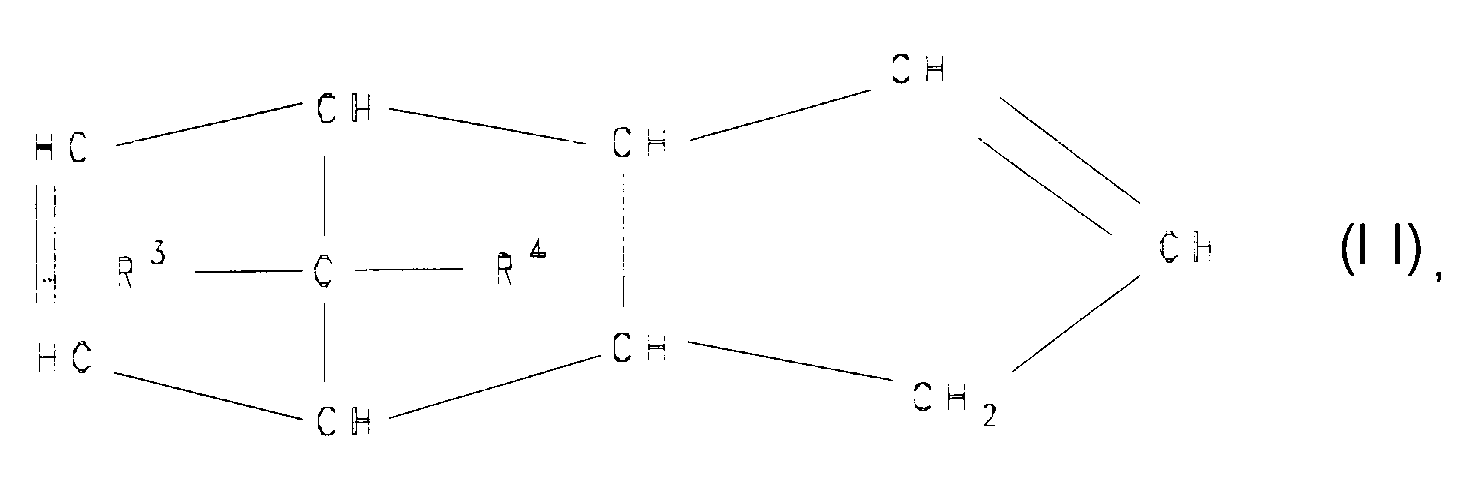

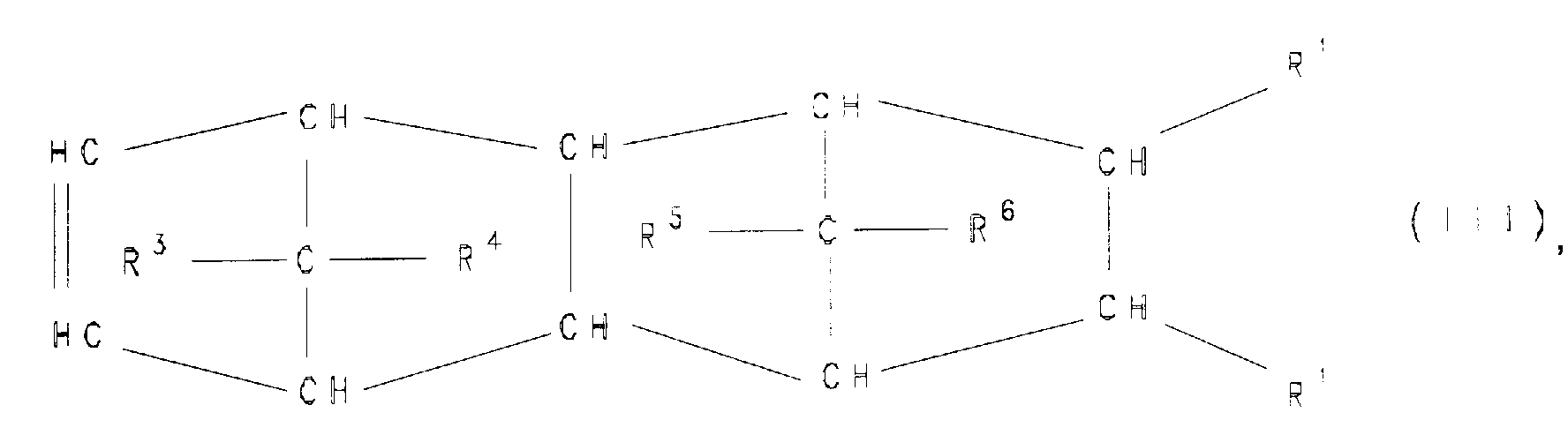

 whereas R1, R2, R3, R4, R5, R6, R7 and R8 are the same or different and are hydrogen or a C1-C20-hydrocarbon rest, like a linear or branched C1-C8-alkyl rest, C6-C18-aryl radical, C7-C20-alkylenaryl rest, a cyclic or acyclic C2-C20-alkenyl rest, or may form a saturated, unsaturated or aromatic ring, whereas equal rests R1 to R8 in different formulae I to VI can be different, whereas n is an integer of from 0 to 5, and comprises 25 to 97 mole %, preferably 35 mole % to 90 mole % polymerized units which are derived from at least one acyclic olefin of formula VII
 whereas R9, R10, R11 and R12 are the same or different and are a hydrogen, a linear, branched, saturated or unsaturated C1-C20-hydrocarbon rest such as a C1-C8-alkyl rest or a C6-C18-aryl rest. Preferably, the acyclic olefin is an α-olefin or ethylene. Particularly preferably, the cycloolefin copolymer is a copolymer of ethylene, propylene or another alpha olefin having preferably 2 to 20 carbon atoms with at least one cyclic olefin of the formulae I, II, II', III, IV, V or VI. Particularly preferably, the cycloolefin copolymer is a copolymer of norbornene or tetracyclododecene with ethylene or an alpha olefin, like propylene. Most preferably, the cycloolefin copolymer is a copolymer of ethylene and norbornene or ethylene and tetracyclododecene.
- Cycloolefin copolymers may be obtained by ring opening polymerization of at least one monomer of the formulae I to VI, followed by a hydration step.
- The cycloolefin copolymer may further comprise 0 to 45 mol-% polymerized units which are derived from one or more monocyclic olefins of the formula VIIIwhereas m is an integer from 2 to 10.
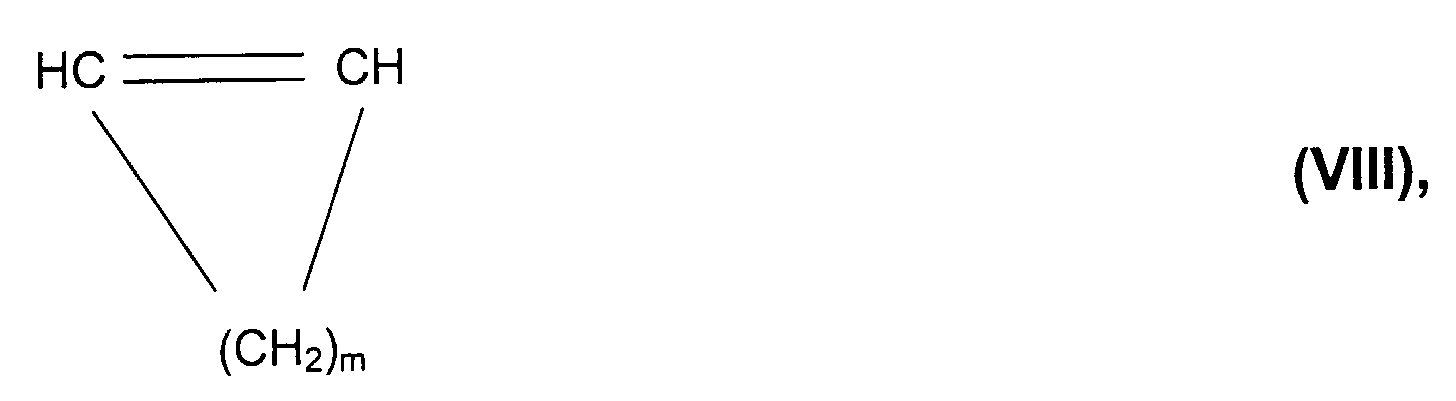
The amount of polymerized units which are derived from cyclic, particularly polycyclic olefins is preferably from about 3 mol-% to about 75 mol-%. The amount of polymerized units derived from the acyclic olefin is preferably from about 5 mol-% to about 80 mol-% of the cycloolefin copolymer. - Preferably the cycloolefin copolymer consists of polymerized units derived from one or more polycyclic olefins, particularly polycyclic olefins of the formulae I or III, and polymerized units which are derived from one or more acyclic olefins of the formula VII, particularly α-olefins with 2 to 20 carbon atoms. Particularly preferred are cycloolefin copolymers consisting of polymerized units derived from a polycyclic olefin of the formulae I or III and an acyclic Olefin of the formula VII. Further preferred are terpolymers, which consist of polymerized units derived from a polycyclic monoolefin of the formula I or III, an acyclic monoolefin of the formula VII and a cyclic or acyclic olefin, comprising at least two double bonds (polyene), particularly cyclic, preferably polycyclic dienes like norbornadiene or cyclic, particularly preferably polycyclic alkenes carrying a C2-C20-alkenyl rest, like for example vinylnorbornene.
- The cycloolefin copolymer can be prepared at temperatures of about -78°C to about 200°C and a pressure of about 0.001 to about 200 bar in the presence of one or more catalyst systems comprising at least one transition metal compound and optionally a cocatalyst a optionally a carrier material. Suitable transition metal compounds are metallocenes, particularly stereorigid metallocenes. Examples for suitable catalyst systems are for example described in EP-A-407 870, EP-A-485 893 and EP-A-503 422, which documents are incorporated by reference for all useful purposes.
Examples for suitable transition metal compounds are - rac-dimethylsilylbis(1-indenyl)zirconium dichloride,
- rac-dimethylgermylbis(1-indenyl)zirconium dichloride,
- rac-phenylmethylsilylbis(1-indenyl)zirconium dichloride,
- rac-phenylvinylsilylbis(1-indenyl)zirconium dichloride,
- 1-silacyclobutylbis(1-indenyl)zirconium dichloride,
- rac-diphenylsilylbis(1-indenyl)hafnium dichloride,
- rac-phenylmethylsilylbis(1-indenyl)hafnium dichloride,
- rac-diphenylsilylbis(1-indenyl)zirconium dichloride,
- rac-ethylene-1,2-bis(1-indenyl)zirconium dichloride,
- dimethylsilyl(9-fluorenyl)(cyclopentadienyl)zirconium dichloride,
- diphenylsilyl(9-fluorenyl)(cyclopentadienyl)zirconium dichloride,
- bis(1-indenyl)zirconium dichloride,
- diphenylmethylene(9-fluorenyl)cyclopentadienylzirconium dichloride,
- isopropylene(9-fluorenyl)cyclopentadienylzirconium dichloride,
- rac-isopropylidene-bis(1-indenyl)zirconium dichloride,
- rac-isopropylidene-bis(4,5,6,7-tetrahydro-1-indenyl)zirconium dichloride,
- phenylmethylmethylene(9-fluorenyl)cyclopentadienylzirconium dichloride,
- isopropylene(9-fluorenyl)(1-(3-isopropyl)cyclopentadienyl)zirconium dichloride,
- isopropylene(9-fluorenyl)(1-(3-methyl)cyclopentadienyl)zirconium dichloride,
- diphenylmethylene(9-fluorenyl)(1-(3-methyl)cyclopentadienyl)zirconium dichloride,
- methyl phenylmethylene(9-fluorenyl)(1-(3-methyl)cyclopentadienyl)-zirconium dichloride,
- dimethylsilyl(9-fluorenyl)(1-(3-methyl)cyclopentadienyl)zirconium dichloride,
- diphenylsilyl(9-fluorenyl)(1-(3-methyl)cyclopentadienyl)zirconium dichloride,
- diphenylmethylene(9-fluorenyl)(1-(3-tert-butyl)cyclopentadienyl)zirconium dichloride,
- isopropylene(9-fluorenyl)(1-(3-tert-butyl)cyclopentadienyl)zirconium dichloride,
- isopropylene(cyclopentadienyl)(1-indenyl)zirconium dichloride,
- diphenylcarbonyl(cyclopentadienyl)(1-indenyl)zirconium dichloride,
- dimethylsilyl(cyclopentadienyl)(1-indenyl)zirconium dichloride,
- isopropylene(methylcyclopentadienyl)(1-indenyl)zirconium dichloride,
- 4-(η5-cyclopentadienyl)-4,7,7-trimethyl(η5-4,5,6,7-tetrahydroindenyl)-zirconium dichloride,
- [4-( η5-cyclopentadienyl)-4,7,7-triphenyl(η5-4,5,6,7-tetrahydroindenyl)]zirconium dichloride,
- [4-( η5-cyclopentadienyl)4,7-dimethyl-7-phenyl(η5-4,5,6,7-tetrahydroindenyl)]zirconium dichloride,
- [4-(η5-3'-tert-butylcyclopentadienyl)-4,7,7-triphenyl(η5-4,5,6,7-tetrahydroindenyl)]zirconium dichloride,
- [4-( (η5-3'-tert-butylcyclopentadienyl)-4,7-dimethyl-7-phenyl(η5-4,5,6,7-tetrahydroindenyl)]zirconium dichloride,
- [4-( η5-3'-methylcyclopentadienyl)-4,7,7-trimethyl(η5-4,5,6,7-tetrahydroindenyl)]zirconium dichloride,
- [4-( η5-3'-methylcyclopentadienyl)-4,7,7-triphenyl(η5-4,5,6,7-tetrahydroindenyl)]zirconium dichloride,
- [4-( η5-3'-methylcyclopentadienyl)-4,7-dimethyl-7-phenyl(η5-4,5,6,7-tetrahydroindenyl)]zirconium dichloride,
- [4-( η5-3'-isopropylcyclopentadienyl)-4,7,7-trimethyl(η5-4,5,6,7-tetrahydroindenyl)]zirconium dichloride,
- [4-(η5-3'-isopropylcyclopentadienyl)-4,7,7-triphenyl(η5 -4,5,6,7-tetrahydroindenyl)]zirconium dichloride,
- [4-( η5-3'-isopropylcyclopentadienyl)-4,7-dimethyl-7-phenyl(η5-4,5,6,7-tetrahydroindenyl)]zirconium dichloride,
- [4-( η5 -cyclopentadienyl)( η5-4,5-tetrahydropentalene)]zirconium dichloride,
- [4-( η5-cyclopentadienyl)-4-methyl(η5-4,5-tetrahydropentalene)]zirconium dichloride,
- [4-( η5-cyclopentadienyl)-4-phenyl(η5-4,5-tetrahydropentalene)]zirconium dichloride,
- [4-( η5-cyclopentadienyl)-4-phenyl(η5-4,5-tetrahydropentalene)]zirconium dichloride,
- [4-( η5-3'-methylcyclopentadienyl)( η5-4,5-tetrahydropentalene)]zirconium dichloride,
- [4-( η5-3'-isopropylcyclopentadienyl)( η5-4,5-tetrahydropentalene)]zirconium dichloride,
- [4-( η5-3'-benzylcyclopentadienyl)( η5-4,5-tetrahydropentalene)]zirconium dichloride,
- [2,2,4-trimethyl-4-( η5-cyclopentadienyl)(η-4,5-tetrahydropentalene)]zirconium dichloride
- [2,2,4-trimethyl-4-( η -(3,4-diisopropyl)cyclopentadienyl)( η -4,5-tetrahydropentalene)]zirconium dichloride. The multi-layer laminates may be used for manufacturing packaging materials, which preferably consist of the multi layer laminates according to the invention. From these packaging materials packages for various products can be produced, which can have different shapes, like boxes, tumblers or the like. Preferably, these packages having the shape of tumblers or boxes have at least one handle. Such packages can be advantageously for protection of moisture sensitive food and non-food goods, such as detergents, washing powder, zeolithe-free washing powder, moisture sensitive chemicals and foodstuffs, such as cereals, cornflakes, dried soups, pet food, chocolates, cookies and the like. If desired, the package can be equipped to be heat-sealable. Such packagings can be used for packaging for milk, soft-drinks, juices or the like, in which cases particularly tight packages are desired which have low permeation rates. These packages are preferably in the shape of milk boxes. For heat-sealable equipment of the packages, the fiber material can preferably be equipped with materials and/or layer sequences as described in US 5693414 and US 5861208, which documents are incorporated by reference for all useful purposes.
-
- The cycloolefin copolymer (COC) used was TOPAS® 8007, Ticona GmbH, Kelsterbach.
The PE-LD used had a density of 922 kg/m3, an MFI of 7g/10 minutes.
The PE-HD used had a density of 964 kg/m3 and an MFI 4 g/10minutes.
The modified polyethylene used as tie layer was Bynel® available from Dupont.
As amorphous polyamide Selar® from Dupont was used.
The board used had a thickness of 385 g/m2.
The kraft paper used had a thickness of 65 g/m2.
MVTR measured under tropical conditions means at a temperature of 38°C and a relative humidity of 90%, normal conditions means at a temperature of 23°C and a relative humidity of 85%. MVTR are given in g/m2 24h. The MVTR was measured according to DIN 53122. - The board used was covered with different layer sequences by means of coextrusion.
The overall plastic layer thickness was 24 g/m2.
The layer thicknesses in examples B and C were 3/18/3 g/m2 - A) board / PE-LD
- B) board / PE-LD / PE-HD / PE-LD
- C) board / PE-LD / COC / PE-LD A and B are Comparative Examples.
-
- Different multi-layer laminates of board with COC-LDPE blends were produced with different layer thicknesses (given in µm).
Material Material 100 µm 25 µm 12 µm 38°C/90% 23°C/85% 38°C/90% 23°C/85% 38°C/90% 23°C/85% COC 1,0 0,3 4 1,2 8 2,4 Blends 20% LDPE 1,2 0,3 5 1,2 10 2,6 40% LDPE 1,5 0,4 6 1,4 13 2,9 60% LDPE 2,4 0,4 10 1,7 20 3,5 80% LDPE 3,9 0,6 16 2,3 32 4,8 PE-LD 4,8 0,9 19 3,7 40 7,7 - Different multi layer laminates were produced by coextrusion to investigate the influence of layer thicknesses of COC on the MVTR under tropical conditions. A is a comparative example with a single PE-LD layer (thickness 13 g/m2). MVTR given in g / m2 24h
- A) PE-LD MVTR: 35
- B) PE-LD / COC /PE-LD, layer thicknesses 2 / 4 / 7 g/m2 MVTR: 15
- C) PE-LD / COC /PE-LD layer, thicknesses 2 / 9 / 2 g/m2 MVTR: 9
-
- To obtain a laminated article with maximum barrier properties and moderate weight, a layer sequence was extruded with the layer sequence board / PE-LD (2 g/m2) / COC (19 g/m2) / PE-LD (2 g/m2) / kraft paper. The MVTR at normal conditions was determined being 1 g/m2 24h. The barrier properties are roughly equivalent to 100 g/m2 PE-LD coating weight. This laminating material combines excellent moisture barrier while containing less than 5% plastic weight.
- To obtain a laminated article having excellent moisture barrier board was coated with a COC layer of 40 µm and a PE-LD layer of 10 µm thickness. MVTR tropical is 2 g/m2 24h. This Example has the maximum barrier properties with a practical layer thickness.
- To obtain a laminated article with excellent MVTR and oxygen transmission rate (OTR) a laminated article with the layer sequence board / tie (3 g/m2) / COC (10 g/m2) / tie (3 g/m2) / amorphous polyamide (5 µm) was produced. The MVTR was 9 g/m2 24h, the OTR 80 cm3/m2 24h bar.
Particular preference is given to maleic-acid grafted polyethylene and maleic-acid grafted polypropylene.
The plastic layer comprising a cycloolefin copolymer may comprise usual additives in an amount of up to 0.5 percent by weight, such as lubricants or antioxidants, like Irganox® available from Ciba Specialty Chemicals.
The layer thicknesses for the plastic layer comprising a cycloolefin copolymer are generally in the range of about 10 g/m2 to about 50 g/m2. If this film is a blend of a cycloolefin copolymer, the thickness is preferably in the range of about 10 g/m2 to about 20 g/m2.
Additional layers made of PE-LD preferably have a thickness of from about 1 g/m2 to about 10 g/m2.
The thickness of the layer made of polyamide or EVOH has to be adjusted to meet the desired oxygen barrier properties.
The thickness of the fiber material layers and the plastic layers may be adjusted to meet the desired barrier properties or a given weight percentage of plastic content of the multi-layer laminate.
The overall thickness of the polymer layer on the fiber material generally is between about 5 µm and about 100 µm, preferably between about 12 µm and about 50 µm, more preferably between about 25 to about 40 µm. If the overall thickness exceeds 100µm, the processing becomes more difficult so the thickness should preferably be less than 100 µm.
Table 1 shows the results. The MVTR can be significantly improved with substitution of even PE-HD with COC.
| Example | MVTR normal | MVTR trop. |
| A | 4.8 | 19 |
| B | 2.5 | 9.2 |
| C | 1.0 | 3.2 |
Claims (15)
- Multi-layer laminate comprising at least one layer of fibre material and at least one layer of plastic laminated thereto, which plastic layer comprises at least 50 weight percent of a cycloolefin copolymer.
- Multi-layer laminate according to claim 1, comprising at least one further layer consisting essentially of polyethylene.
- Multi-layer laminate according to claim 2, whereas the polyethylene is a low density polyethylene (PE-LD).
- Multi-layer laminate according to one or more of the preceding claims, whereas the plastic layer comprising a cycloolefin copolymer is a blend thereof with polyethylene, preferably low density polyethylene (PE-LD).
- Multi-layer laminate according to claim 4, the plastic layer comprising a cycloolefin copolymer comprises more than 50 percent by weight, preferably more than 60 percent by weight, particularly preferably 60 to 80 percent by weight of a cycloolefinic copolymer.
- Multi-layer laminate according to one or more of the preceding claims, comprising up to 5 percent by weight of plastic.
- Multi-layer laminate according to one or more of the preceding claims having the layer sequence board or paper layer / cycloolefinic copolymer layer / polyethylene layer.
- Multi-layer laminate according to one or more of the preceding claims having the layer sequence board layer / polyethylene layer / cycloolefinic copolymer layer /polyethylene layer / paper layer.
- Multi-layer laminate according to one or more of the preceding claims having the layer sequence board layer / cycloolefinic copolymer layer / polyethylene layer /paper layer.
- Multi-layer laminate according to one or more of the preceding claims having the layer sequence board layer / cycloolefinic copolymer layer / paper layer.
- Multi-layer laminate according to claim 10, whereas the cycloolefinic copolymer layer is a blend of a cycloolefinic copolymer and a polyethylene.
- Multi-layer laminate according to one or more of the preceding claims comprising an oxygen barrier layer consisting essentially of an ethylvinyl alcohol or an amorphous polyamide.
- Packaging material consisting of a multi layer laminate according to one or more of the preceding claims.
- Package for moisture sensitive chemicals, detergents, washing powder, zeolithe-free washing powder, dry foodstuffs, dry soups, cereals, pet food, chocolates, cookies, cornflakes and the like, consisting of a packaging material according to claim 13.
- Package according to claim 14 having a shape of a box, tumbler, box or tumbler with at least one handle.
Applications Claiming Priority (2)
| Application Number | Priority Date | Filing Date | Title |
|---|---|---|---|
| US155957 | 1999-09-24 | ||
| US10/155,957 US6921563B2 (en) | 2002-05-24 | 2002-05-24 | Multi-layer laminate, packaging material and packages made therefrom |
Publications (2)
| Publication Number | Publication Date |
|---|---|
| EP1364777A1 true EP1364777A1 (en) | 2003-11-26 |
| EP1364777B1 EP1364777B1 (en) | 2005-08-03 |
Family
ID=29400591
Family Applications (1)
| Application Number | Title | Priority Date | Filing Date |
|---|---|---|---|
| EP20030011283 Expired - Lifetime EP1364777B1 (en) | 2002-05-24 | 2003-05-17 | Multi-layer laminate, packaging material and packages made therefrom |
Country Status (6)
| Country | Link |
|---|---|
| US (1) | US6921563B2 (en) |
| EP (1) | EP1364777B1 (en) |
| JP (1) | JP4304002B2 (en) |
| AT (1) | ATE301040T1 (en) |
| DE (1) | DE60301167T2 (en) |
| ES (1) | ES2247451T3 (en) |
Cited By (3)
| Publication number | Priority date | Publication date | Assignee | Title |
|---|---|---|---|---|
| WO2004018198A3 (en) * | 2002-08-21 | 2004-05-13 | Ticona Gmbh | Polyolefin multilayered film, method for the production of said film and use thereof |
| US10335308B2 (en) | 2011-12-22 | 2019-07-02 | Avery Dennison Corporation | Flexible barrier films containing cyclic olefins |
| US11220616B2 (en) | 2011-08-19 | 2022-01-11 | Avery Dennison Corporation | Barrier films |
Families Citing this family (16)
| Publication number | Priority date | Publication date | Assignee | Title |
|---|---|---|---|---|
| FI20011388A7 (en) * | 2001-06-28 | 2002-12-29 | Stora Enso Oyj | Polymer-coated heat-sealable packaging material and sealed packaging made from it |
| GB2386122A (en) * | 2002-03-06 | 2003-09-10 | Reckitt Benckiser Nv | Improvements in or relating to packaging |
| DE10242730A1 (en) * | 2002-09-13 | 2004-03-25 | Ticona Gmbh | A thermally formable thermoplastic polyolefin film useful as a carrier film and having very good thermal formability, good barrier properties against water, and outstanding punching behavior |
| MX2007004642A (en) * | 2004-10-18 | 2007-06-08 | Topas Advanced Polymers Gmbh | Polymer blends for producing films with a reduced number of defects. |
| JP4670744B2 (en) * | 2005-07-27 | 2011-04-13 | Dic株式会社 | Coextruded multilayer film and packaging material comprising the film |
| US20070042146A1 (en) * | 2005-08-19 | 2007-02-22 | Exopack-Technology, Llc | Grease-resistant bag and related methods |
| US8282539B2 (en) | 2008-12-22 | 2012-10-09 | Exopack, Llc | Multi-layered bags and methods of manufacturing the same |
| US20090286907A1 (en) * | 2008-01-23 | 2009-11-19 | Beltz Mark W | Fumaric Acid/Diol Polyesters and Their Manufacture and Use |
| US9056697B2 (en) | 2008-12-15 | 2015-06-16 | Exopack, Llc | Multi-layered bags and methods of manufacturing the same |
| US20100239796A1 (en) * | 2009-03-23 | 2010-09-23 | Gagne Joseph Donald | Lap sealable laminate and packaging made therefrom |
| US8604399B2 (en) | 2009-10-19 | 2013-12-10 | Exopack, Llc | Microwavable bags for use with liquid oil and related methods |
| JP6089463B2 (en) * | 2012-06-25 | 2017-03-08 | Dic株式会社 | LAMINATE, MANUFACTURING METHOD THEREOF AND PACKAGE BODY USING THE SAME |
| AR103007A1 (en) * | 2014-12-09 | 2017-04-12 | Dow Global Technologies Llc | A FILM, A METHOD OF MANUFACTURE OF THE FILM, A CONTAINER THAT UNDERSTANDS THE FILM AND A METHOD OF MANUFACTURE OF THE CONTAINER |
| DE23202633T1 (en) | 2015-12-29 | 2025-05-08 | Adapa Flexibles Denmark Slagelse A/S | METHOD FOR PROVIDING AN EXTREMELY CHEMICAL-RESISTANT FILM, FILM AND LAMINATE OBTAINED THEREFROM |
| US10150009B2 (en) * | 2017-03-23 | 2018-12-11 | Acushnet Company | Golf ball incorporating thin moisture barrier film having low normalized moisture vapor transmission rate |
| DK3513965T3 (en) | 2018-08-08 | 2022-07-25 | Danapak Flexibles As | IMPROVED FILMS AND LAMINATES FOR USE IN PACKAGING REACTIVE COMPOUNDS |
Citations (4)
| Publication number | Priority date | Publication date | Assignee | Title |
|---|---|---|---|---|
| JPH08134800A (en) * | 1994-11-14 | 1996-05-28 | Mitsui Petrochem Ind Ltd | Cyclic olefin resin laminated paper |
| JPH10237234A (en) * | 1997-02-24 | 1998-09-08 | Tamapori Kk | Packaging film |
| WO2002002324A1 (en) * | 2000-07-04 | 2002-01-10 | Nihon Tetra Pak K.K. | Container |
| WO2003002343A1 (en) * | 2001-06-28 | 2003-01-09 | Stora Enso Oyj | Polymer-coated heat-sealable packaging material, method for manufacturing the same and a sealed package made thereof |
Family Cites Families (6)
| Publication number | Priority date | Publication date | Assignee | Title |
|---|---|---|---|---|
| EP0800914B1 (en) * | 1996-04-11 | 2002-07-03 | Mitsui Chemicals, Inc. | Laminated film and packaging material |
| JP2001513829A (en) * | 1997-02-25 | 2001-09-04 | エクソン・ケミカル・パテンツ・インク | Corona discharge treated film with excellent coefficient of friction |
| US6211302B1 (en) * | 1997-08-27 | 2001-04-03 | The Dow Chemical Company | Rheology modification of interpolymers of alpha-olefins and vinylidene aromatic monomers |
| US6525123B1 (en) * | 2000-05-19 | 2003-02-25 | Chevron Phillips Chemical Company Lp | Compatible blend systems from ethylene vinyl alcohol and oxygen scavenging polymers |
| US6818150B2 (en) * | 2000-12-22 | 2004-11-16 | Chevron Phillips Chemical Company Lp | UV- or heat-triggered low oxygen packaging system employing an oxidizable polymer resin and a peroxide |
| US6559205B2 (en) * | 2001-01-16 | 2003-05-06 | Chevron Phillips Chemical Company Lp | Oxygen scavenging polymer blends and emulsion-based methods for preparing same |
-
2002
- 2002-05-24 US US10/155,957 patent/US6921563B2/en not_active Expired - Lifetime
-
2003
- 2003-05-17 ES ES03011283T patent/ES2247451T3/en not_active Expired - Lifetime
- 2003-05-17 AT AT03011283T patent/ATE301040T1/en not_active IP Right Cessation
- 2003-05-17 EP EP20030011283 patent/EP1364777B1/en not_active Expired - Lifetime
- 2003-05-17 DE DE2003601167 patent/DE60301167T2/en not_active Expired - Lifetime
- 2003-05-23 JP JP2003145989A patent/JP4304002B2/en not_active Expired - Lifetime
Patent Citations (5)
| Publication number | Priority date | Publication date | Assignee | Title |
|---|---|---|---|---|
| JPH08134800A (en) * | 1994-11-14 | 1996-05-28 | Mitsui Petrochem Ind Ltd | Cyclic olefin resin laminated paper |
| JPH10237234A (en) * | 1997-02-24 | 1998-09-08 | Tamapori Kk | Packaging film |
| WO2002002324A1 (en) * | 2000-07-04 | 2002-01-10 | Nihon Tetra Pak K.K. | Container |
| EP1302311A1 (en) * | 2000-07-04 | 2003-04-16 | Nihon Tetra Pak K.K. | Container |
| WO2003002343A1 (en) * | 2001-06-28 | 2003-01-09 | Stora Enso Oyj | Polymer-coated heat-sealable packaging material, method for manufacturing the same and a sealed package made thereof |
Non-Patent Citations (2)
| Title |
|---|
| DATABASE WPI Section Ch Week 199631, Derwent World Patents Index; Class A18, AN 1996-307222, XP002251246 * |
| DATABASE WPI Section Ch Week 199846, Derwent World Patents Index; Class A17, AN 1998-537595, XP002251247 * |
Cited By (3)
| Publication number | Priority date | Publication date | Assignee | Title |
|---|---|---|---|---|
| WO2004018198A3 (en) * | 2002-08-21 | 2004-05-13 | Ticona Gmbh | Polyolefin multilayered film, method for the production of said film and use thereof |
| US11220616B2 (en) | 2011-08-19 | 2022-01-11 | Avery Dennison Corporation | Barrier films |
| US10335308B2 (en) | 2011-12-22 | 2019-07-02 | Avery Dennison Corporation | Flexible barrier films containing cyclic olefins |
Also Published As
| Publication number | Publication date |
|---|---|
| DE60301167D1 (en) | 2005-09-08 |
| ES2247451T3 (en) | 2006-03-01 |
| JP4304002B2 (en) | 2009-07-29 |
| EP1364777B1 (en) | 2005-08-03 |
| US20030224130A1 (en) | 2003-12-04 |
| DE60301167T2 (en) | 2006-05-24 |
| US6921563B2 (en) | 2005-07-26 |
| JP2004160978A (en) | 2004-06-10 |
| ATE301040T1 (en) | 2005-08-15 |
Similar Documents
| Publication | Publication Date | Title |
|---|---|---|
| EP1364777B1 (en) | Multi-layer laminate, packaging material and packages made therefrom | |
| JP4722264B2 (en) | Pouch | |
| KR100526929B1 (en) | Laminated film | |
| US20100239796A1 (en) | Lap sealable laminate and packaging made therefrom | |
| JP7259305B2 (en) | LAMINATED POLYETHYLENE RESIN COMPOSITION AND LAMINATED PRODUCT | |
| US6960392B2 (en) | Structure comprising a binder layer non-delaminable with respect to a metallized substrate and peelable with respect to a polypropylene substrate | |
| JP4163112B2 (en) | POLYOLEFIN RESIN MATERIAL, LAMINATE USING SAME, METHOD FOR PRODUCING THE SAME, AND MOLDED ARTICLES | |
| CA2215497C (en) | Stretch wrap plastic film | |
| JP3910409B2 (en) | Laminate for packaging materials | |
| JP2002205359A (en) | Laminates for packaging materials | |
| JP3773581B2 (en) | Inner bag for bag-in-box | |
| US6641925B1 (en) | Thermoformable composite film and process to make | |
| CN117858796A (en) | Longitudinal Directional (MDO) sealable structure | |
| JP3650444B2 (en) | Laminated body, bag made of the laminated body, chuck bag, and compressed storage bag | |
| JP4902042B2 (en) | Manufacturing method of laminate | |
| EP1342566B1 (en) | Laminate for packaging material | |
| JP4722263B2 (en) | Pouch | |
| JP4808323B2 (en) | Method for producing a clean extruded laminate | |
| WO2002038379A1 (en) | Laminate for packaging material | |
| JPH09194653A (en) | Polypropylene resin composition and laminate using the same | |
| JP2003175576A (en) | Packaging material and manufacturing method thereof | |
| JP2002205358A (en) | Packaging material paper laminate | |
| JPS62152847A (en) | Laminated packaging material having excellent resistance to fatigue from flexing and gas barriering property | |
| JP3011934B2 (en) | Flexible gas barrier laminate packaging with excellent bending fatigue resistance | |
| WO2002038376A1 (en) | Laminate for packaging material |
Legal Events
| Date | Code | Title | Description |
|---|---|---|---|
| PUAI | Public reference made under article 153(3) epc to a published international application that has entered the european phase |
Free format text: ORIGINAL CODE: 0009012 |
|
| AK | Designated contracting states |
Kind code of ref document: A1 Designated state(s): AT BE BG CH CY CZ DE DK EE ES FI FR GB GR HU IE IT LI LU MC NL PT RO SE SI SK TR |
|
| AX | Request for extension of the european patent |
Extension state: AL LT LV MK |
|
| 17P | Request for examination filed |
Effective date: 20040526 |
|
| AKX | Designation fees paid |
Designated state(s): AT BE BG CH CY CZ DE DK EE ES FI FR GB GR HU IE IT LI LU MC NL PT RO SE SI SK TR |
|
| 17Q | First examination report despatched |
Effective date: 20040709 |
|
| GRAP | Despatch of communication of intention to grant a patent |
Free format text: ORIGINAL CODE: EPIDOSNIGR1 |
|
| GRAS | Grant fee paid |
Free format text: ORIGINAL CODE: EPIDOSNIGR3 |
|
| GRAA | (expected) grant |
Free format text: ORIGINAL CODE: 0009210 |
|
| AK | Designated contracting states |
Kind code of ref document: B1 Designated state(s): AT BE BG CH CY CZ DE DK EE ES FI FR GB GR HU IE IT LI LU MC NL PT RO SE SI SK TR |
|
| PG25 | Lapsed in a contracting state [announced via postgrant information from national office to epo] |
Ref country code: TR Free format text: LAPSE BECAUSE OF FAILURE TO SUBMIT A TRANSLATION OF THE DESCRIPTION OR TO PAY THE FEE WITHIN THE PRESCRIBED TIME-LIMIT Effective date: 20050803 Ref country code: CZ Free format text: LAPSE BECAUSE OF FAILURE TO SUBMIT A TRANSLATION OF THE DESCRIPTION OR TO PAY THE FEE WITHIN THE PRESCRIBED TIME-LIMIT Effective date: 20050803 Ref country code: SK Free format text: LAPSE BECAUSE OF FAILURE TO SUBMIT A TRANSLATION OF THE DESCRIPTION OR TO PAY THE FEE WITHIN THE PRESCRIBED TIME-LIMIT Effective date: 20050803 Ref country code: RO Free format text: LAPSE BECAUSE OF FAILURE TO SUBMIT A TRANSLATION OF THE DESCRIPTION OR TO PAY THE FEE WITHIN THE PRESCRIBED TIME-LIMIT Effective date: 20050803 Ref country code: EE Free format text: LAPSE BECAUSE OF FAILURE TO SUBMIT A TRANSLATION OF THE DESCRIPTION OR TO PAY THE FEE WITHIN THE PRESCRIBED TIME-LIMIT Effective date: 20050803 Ref country code: SI Free format text: LAPSE BECAUSE OF FAILURE TO SUBMIT A TRANSLATION OF THE DESCRIPTION OR TO PAY THE FEE WITHIN THE PRESCRIBED TIME-LIMIT Effective date: 20050803 Ref country code: AT Free format text: LAPSE BECAUSE OF FAILURE TO SUBMIT A TRANSLATION OF THE DESCRIPTION OR TO PAY THE FEE WITHIN THE PRESCRIBED TIME-LIMIT Effective date: 20050803 Ref country code: FI Free format text: LAPSE BECAUSE OF FAILURE TO SUBMIT A TRANSLATION OF THE DESCRIPTION OR TO PAY THE FEE WITHIN THE PRESCRIBED TIME-LIMIT Effective date: 20050803 Ref country code: CH Free format text: LAPSE BECAUSE OF FAILURE TO SUBMIT A TRANSLATION OF THE DESCRIPTION OR TO PAY THE FEE WITHIN THE PRESCRIBED TIME-LIMIT Effective date: 20050803 Ref country code: LI Free format text: LAPSE BECAUSE OF FAILURE TO SUBMIT A TRANSLATION OF THE DESCRIPTION OR TO PAY THE FEE WITHIN THE PRESCRIBED TIME-LIMIT Effective date: 20050803 |
|
| REG | Reference to a national code |
Ref country code: GB Ref legal event code: FG4D |
|
| REG | Reference to a national code |
Ref country code: CH Ref legal event code: EP |
|
| REG | Reference to a national code |
Ref country code: IE Ref legal event code: FG4D |
|
| REF | Corresponds to: |
Ref document number: 60301167 Country of ref document: DE Date of ref document: 20050908 Kind code of ref document: P |
|
| PG25 | Lapsed in a contracting state [announced via postgrant information from national office to epo] |
Ref country code: SE Free format text: LAPSE BECAUSE OF FAILURE TO SUBMIT A TRANSLATION OF THE DESCRIPTION OR TO PAY THE FEE WITHIN THE PRESCRIBED TIME-LIMIT Effective date: 20051103 Ref country code: BG Free format text: LAPSE BECAUSE OF FAILURE TO SUBMIT A TRANSLATION OF THE DESCRIPTION OR TO PAY THE FEE WITHIN THE PRESCRIBED TIME-LIMIT Effective date: 20051103 Ref country code: GR Free format text: LAPSE BECAUSE OF FAILURE TO SUBMIT A TRANSLATION OF THE DESCRIPTION OR TO PAY THE FEE WITHIN THE PRESCRIBED TIME-LIMIT Effective date: 20051103 Ref country code: DK Free format text: LAPSE BECAUSE OF FAILURE TO SUBMIT A TRANSLATION OF THE DESCRIPTION OR TO PAY THE FEE WITHIN THE PRESCRIBED TIME-LIMIT Effective date: 20051103 |
|
| PG25 | Lapsed in a contracting state [announced via postgrant information from national office to epo] |
Ref country code: PT Free format text: LAPSE BECAUSE OF FAILURE TO SUBMIT A TRANSLATION OF THE DESCRIPTION OR TO PAY THE FEE WITHIN THE PRESCRIBED TIME-LIMIT Effective date: 20060103 |
|
| PG25 | Lapsed in a contracting state [announced via postgrant information from national office to epo] |
Ref country code: HU Free format text: LAPSE BECAUSE OF FAILURE TO SUBMIT A TRANSLATION OF THE DESCRIPTION OR TO PAY THE FEE WITHIN THE PRESCRIBED TIME-LIMIT Effective date: 20060204 |
|
| REG | Reference to a national code |
Ref country code: CH Ref legal event code: PL |
|
| REG | Reference to a national code |
Ref country code: ES Ref legal event code: FG2A Ref document number: 2247451 Country of ref document: ES Kind code of ref document: T3 |
|
| ET | Fr: translation filed | ||
| PG25 | Lapsed in a contracting state [announced via postgrant information from national office to epo] |
Ref country code: IE Free format text: LAPSE BECAUSE OF NON-PAYMENT OF DUE FEES Effective date: 20060517 |
|
| PG25 | Lapsed in a contracting state [announced via postgrant information from national office to epo] |
Ref country code: MC Free format text: LAPSE BECAUSE OF NON-PAYMENT OF DUE FEES Effective date: 20060531 |
|
| PLBE | No opposition filed within time limit |
Free format text: ORIGINAL CODE: 0009261 |
|
| STAA | Information on the status of an ep patent application or granted ep patent |
Free format text: STATUS: NO OPPOSITION FILED WITHIN TIME LIMIT |
|
| 26N | No opposition filed |
Effective date: 20060504 |
|
| REG | Reference to a national code |
Ref country code: IE Ref legal event code: MM4A |
|
| PG25 | Lapsed in a contracting state [announced via postgrant information from national office to epo] |
Ref country code: LU Free format text: LAPSE BECAUSE OF NON-PAYMENT OF DUE FEES Effective date: 20060517 |
|
| PG25 | Lapsed in a contracting state [announced via postgrant information from national office to epo] |
Ref country code: CY Free format text: LAPSE BECAUSE OF FAILURE TO SUBMIT A TRANSLATION OF THE DESCRIPTION OR TO PAY THE FEE WITHIN THE PRESCRIBED TIME-LIMIT Effective date: 20050803 |
|
| REG | Reference to a national code |
Ref country code: FR Ref legal event code: PLFP Year of fee payment: 13 |
|
| REG | Reference to a national code |
Ref country code: FR Ref legal event code: PLFP Year of fee payment: 14 |
|
| REG | Reference to a national code |
Ref country code: FR Ref legal event code: PLFP Year of fee payment: 15 |
|
| REG | Reference to a national code |
Ref country code: FR Ref legal event code: PLFP Year of fee payment: 16 |
|
| PGFP | Annual fee paid to national office [announced via postgrant information from national office to epo] |
Ref country code: NL Payment date: 20220519 Year of fee payment: 20 |
|
| PGFP | Annual fee paid to national office [announced via postgrant information from national office to epo] |
Ref country code: IT Payment date: 20220524 Year of fee payment: 20 Ref country code: GB Payment date: 20220519 Year of fee payment: 20 Ref country code: FR Payment date: 20220523 Year of fee payment: 20 Ref country code: DE Payment date: 20220519 Year of fee payment: 20 |
|
| PGFP | Annual fee paid to national office [announced via postgrant information from national office to epo] |
Ref country code: BE Payment date: 20220519 Year of fee payment: 20 |
|
| PGFP | Annual fee paid to national office [announced via postgrant information from national office to epo] |
Ref country code: ES Payment date: 20220725 Year of fee payment: 20 |
|
| REG | Reference to a national code |
Ref country code: DE Ref legal event code: R071 Ref document number: 60301167 Country of ref document: DE Ref country code: NL Ref legal event code: MK Effective date: 20230516 |
|
| REG | Reference to a national code |
Ref country code: ES Ref legal event code: FD2A Effective date: 20230526 |
|
| REG | Reference to a national code |
Ref country code: BE Ref legal event code: MK Effective date: 20230517 |
|
| REG | Reference to a national code |
Ref country code: GB Ref legal event code: PE20 Expiry date: 20230516 |
|
| PG25 | Lapsed in a contracting state [announced via postgrant information from national office to epo] |
Ref country code: ES Free format text: LAPSE BECAUSE OF EXPIRATION OF PROTECTION Effective date: 20230518 |
|
| PG25 | Lapsed in a contracting state [announced via postgrant information from national office to epo] |
Ref country code: GB Free format text: LAPSE BECAUSE OF EXPIRATION OF PROTECTION Effective date: 20230516 |