EP1363422B1 - A method of managing negative acknowledgement responses - Google Patents
A method of managing negative acknowledgement responses Download PDFInfo
- Publication number
- EP1363422B1 EP1363422B1 EP03252702.0A EP03252702A EP1363422B1 EP 1363422 B1 EP1363422 B1 EP 1363422B1 EP 03252702 A EP03252702 A EP 03252702A EP 1363422 B1 EP1363422 B1 EP 1363422B1
- Authority
- EP
- European Patent Office
- Prior art keywords
- receiver
- identifier
- channel
- data packet
- sub
- Prior art date
- Legal status (The legal status is an assumption and is not a legal conclusion. Google has not performed a legal analysis and makes no representation as to the accuracy of the status listed.)
- Expired - Lifetime
Links
Images
Classifications
-
- H—ELECTRICITY
- H04—ELECTRIC COMMUNICATION TECHNIQUE
- H04L—TRANSMISSION OF DIGITAL INFORMATION, e.g. TELEGRAPHIC COMMUNICATION
- H04L1/00—Arrangements for detecting or preventing errors in the information received
- H04L1/12—Arrangements for detecting or preventing errors in the information received by using return channel
- H04L1/16—Arrangements for detecting or preventing errors in the information received by using return channel in which the return channel carries supervisory signals, e.g. repetition request signals
- H04L1/18—Automatic repetition systems, e.g. Van Duuren systems
-
- H—ELECTRICITY
- H04—ELECTRIC COMMUNICATION TECHNIQUE
- H04L—TRANSMISSION OF DIGITAL INFORMATION, e.g. TELEGRAPHIC COMMUNICATION
- H04L1/00—Arrangements for detecting or preventing errors in the information received
- H04L1/12—Arrangements for detecting or preventing errors in the information received by using return channel
- H04L1/16—Arrangements for detecting or preventing errors in the information received by using return channel in which the return channel carries supervisory signals, e.g. repetition request signals
- H04L1/1607—Details of the supervisory signal
- H04L1/1628—List acknowledgements, i.e. the acknowledgement message consisting of a list of identifiers, e.g. of sequence numbers
-
- H—ELECTRICITY
- H04—ELECTRIC COMMUNICATION TECHNIQUE
- H04L—TRANSMISSION OF DIGITAL INFORMATION, e.g. TELEGRAPHIC COMMUNICATION
- H04L1/00—Arrangements for detecting or preventing errors in the information received
- H04L1/12—Arrangements for detecting or preventing errors in the information received by using return channel
- H04L1/16—Arrangements for detecting or preventing errors in the information received by using return channel in which the return channel carries supervisory signals, e.g. repetition request signals
- H04L1/18—Automatic repetition systems, e.g. Van Duuren systems
- H04L1/1822—Automatic repetition systems, e.g. Van Duuren systems involving configuration of automatic repeat request [ARQ] with parallel processes
-
- H—ELECTRICITY
- H04—ELECTRIC COMMUNICATION TECHNIQUE
- H04L—TRANSMISSION OF DIGITAL INFORMATION, e.g. TELEGRAPHIC COMMUNICATION
- H04L1/00—Arrangements for detecting or preventing errors in the information received
- H04L1/12—Arrangements for detecting or preventing errors in the information received by using return channel
- H04L1/16—Arrangements for detecting or preventing errors in the information received by using return channel in which the return channel carries supervisory signals, e.g. repetition request signals
- H04L1/18—Automatic repetition systems, e.g. Van Duuren systems
- H04L1/1812—Hybrid protocols; Hybrid automatic repeat request [HARQ]
-
- H—ELECTRICITY
- H04—ELECTRIC COMMUNICATION TECHNIQUE
- H04L—TRANSMISSION OF DIGITAL INFORMATION, e.g. TELEGRAPHIC COMMUNICATION
- H04L1/00—Arrangements for detecting or preventing errors in the information received
- H04L1/12—Arrangements for detecting or preventing errors in the information received by using return channel
- H04L1/16—Arrangements for detecting or preventing errors in the information received by using return channel in which the return channel carries supervisory signals, e.g. repetition request signals
- H04L1/18—Automatic repetition systems, e.g. Van Duuren systems
- H04L1/1867—Arrangements specially adapted for the transmitter end
- H04L1/1887—Scheduling and prioritising arrangements
Definitions
- the present invention relates to wireless communication, and more particularly, a method of managing non-acknowledgement (NAK) responses sent by a receiver in a wireless communication system.
- NAK non-acknowledgement
- an air interface is used for the exchange of information between a mobile station and a base station or other communication system equipment.
- the air interface typically comprises a plurality of communication channels.
- a channel is time varying due to fading, mobility, and so on. More specifically, channel equality may be effected by factors such as distance between the mobile and base station, speed of the mobile station, interference, and the like. Given the limited resources (e.g., bandwidth) of wireless transmission as well as the large number of mobile stations supported by a base station at any given time, and therefore competing for those limited resources, it is important to maximize throughput of a wireless communication system.
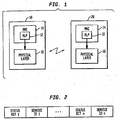
- Fig. 1 illustrates a portion of the layered structure for a transmitter 10 (e.g., such as in a base station) and a receiver 20 (e.g., such as in a mobile station) in a wireless communication system as set forth in third generation wireless standards such as CDMA -2000 employing H-ARQ.
- the H-ARQ may be called Asynchronous and Adaptive Incremental Redundancy (AAIR).
- RLP Radio Link Protocol
- MAC medium access control
- the data packets include a sequence number identifying their order in a sequence of transmitted data packets.
- the physical layer 16 turbo encodes the data packet and transmits a portion of the encoded data packet - this portion being referred to as a sub-packet - over a H-ARQ channel assigned for communication between the transmitter 10 and the receiver 20.
- the physical layer 26 of the receiver 20 receives the sub-packet and attempts to decode the sub-packet to obtain the entire data packet. If successful, the data packet is sent to the RLP 22 in the MAC 24 of the receiver 20.
- the physical layer 26 also sends an acknowledgement response (ACK) to the transmitter 10 for a properly received data packet. If the physical layer 26 is unable to decode the sub-packet, then the physical layer 26 sends a non-acknowledgement (NAK) response to the transmitter 10.
- ACK acknowledgement response
- the physical layer 16 of the transmitter 10 expects to receive an ACK or NAK response two time slots after sending the sub-packet.
- a time slot is 1.25 ms.
- the physical layer 16 encodes and transmits another data packet to any scheduled user in the system.
- no response or a NAK response is received from the physical layer 26, the physical layer 16 transmits the next sub-packet to the same user.
- Standards such as CDMA-2000 establish a maximum number of sub-packet transmissions for each packet. When the maximum number of sub-packet transmissions is reached, the physical layer 16 flushes the data packet in its buffer. The physical layer 16 then encodes and transmits another data packet for a user, which is scheduled by the transmitter 10.
- the RLP 22 of the receiver 20 receives data packets having sequence numbers 1 and 3, respectively, before receiving the data packet of sequence number 2.
- the three data packets may be sent over three different H-ARQ channels to the receiver 20 and it may take more sub-packet transmissions for proper receipt of data packet 2 as compared to that of data packets 1 and 3.
- the RLP 22 judges the data packet of sequence number 2 as missing and issues a NAK response, which is sent to and received by the RLP 12 of the transmitter 10.
- the RLP 12 reschedules transmission of the data packet having sequence number 2.
- the data packet having sequence number 2 may eventually be properly received as a result of later sub-packet transmissions; thus, rendering the rescheduling moot. Even if this occurs, the rescheduling continues, and resources and capacity are wasted.
- WO 02/15S10A (NOKIA NETWORKS OY) is directed to a data transmission protocol on a wireless communication system.
- WO 02/15510A discloses canceling a transmission of a data packet if a maximum number of transmission attempts is reached and a timeout value has been exceeded.
- WO 02/15510A is unrelated to handling NAK responses.
- WO 00/21262A (INDUS RIVER NETWORKS, Inc.) is related to a reliable data transport communication protocol for a wireless communication system.
- WO 00/21262A is directed to keeping track of a number of retransmissions at a transmitter and "giving up" on sending the failed data packets after a number of failed transmission attempts. After a number of failed transmission attempts, WO 00/21262A teaches canceling any attempted retransmissions for a failed data packet without notifying a receiver of the cancellation.
- Tsai et al. ("Error-Correction Scheme for the NASA Deep Space Network Ground Communication Facility Upgrade" World Prosperity Through Communications. Boston, June 11-14, 1989, International Conference On Communications, New York, US, vol. 2, (1989-16-11),pages 804-808, XP000075249 ) is directed to an error correction scheme for the NASA deep space network aground communication facility.
- Tsai et al. is directed to an S-ARQ scheme which allows different channel capacities in the inbound and outbound trunks and variable length data blocks.
- a status identifier is sent to the receiver for a channel assigned to the receiver.
- the status identifier for the channel indicates whether a maximum number of sub-packet transmissions for a data packet have taken place.
- the receiver sends a NAK response if it has not yet received the data packet.
- a number of sub-packet transmissions for a data packet being sent over a channel to the receiver are counted, and a channel identifier, identifying the channel to the receiver, is sent to the receiver if the count number reaches a maximum number of permitted sub-packet transmissions.
- the receiver sends a NAK response for the channel.
- a service identifier is sent instead of the channel identifier.
- each channel carries a data packet associated with a different service such that identification of the service means identification of the channel.
- a status identifier and a service identifier are sent to the receiver for a channel assigned to the receiver.
- the service identifier identifies a type of service (e.g., Voice over IP, e-mail, etc.) associated with a data packet being sent over the channel and the status identifier indicates whether a maximum number of sub-packet transmissions for the data packet have taken place.
- the receiver sends a NAK response if the status identifier indicates that the maximum number of sub-packet transmissions for the data packet have taken place and the data packet has not been properly received.
- the receiver identifies the channel associated with the status identifier based on at least one of the service identifier and a position of the status identifier in a sequence of received information.
- the channel is at least one of a Hybrid-Automated Repeat reQuest (H-ARQ) and an Automated Repeat reQuest channel.
- H-ARQ Hybrid-Automated Repeat reQuest
- Automated Repeat reQuest channel an Automated Repeat reQuest channel.
- H-ARQ Hybrid Automated Repeat reQuest
- sub-packets of a data packet are sent over the H-ARQ channel by the physical layer 16.
- the physical layer 16 also generates a status bit for each H-ARQ channel, and sends the status bits over a control channel to the receiver 20. For example, if the receiver 20 has four H-ARQ channels associated therewith, then there are four status bits.
- the status bit indicates whether a maximum number of sub-packet transmissions for a data packet being sent over the H-ARQ channel have taken place.
- a logical '1' status bit represents a pending sub-packet transmission, and a logical '0'. status bit represents no more subpacket transmission will take place (i.e. the maximum number of sub-packet transmissions have taken place).
- the status bits of the n H-ARQ channels of the receiver 20 are sent by the physical layer 16 as a sequence over a control channel directed to the receiver 20 or a common control channel. So that the physical layer 26 of the receiver 20 can identify that the status bit sequence is intended for the receiver 20 when the status bit sequence is sent over a common control channel, the physical layer 16 sends an identifier of the receiver 20, for example, the MAC ID of the receiver 20, along with the status bit sequence.
- the physical layer 26 indicates the status of the H-ARQ channels to the RLP 22 of the receiver 20.
- the RLP 22 uses the status in determining whether to send a NAK response for a H-ARQ channel to the transmitter 10. Specifically, the RLP 22 will not send a NAK response for a H-ARQ channel unless the data packet being transmitted on a H-ARQ channel has not been properly received and the status of the H-ARQ channel indicates that the maximum number of sub-packet transmission have taken place (e.g. a logical '0' status bit indicating no more sub-packet transmission will take place).
- this embodiment of the present invention improves capacity by preventing needless re-scheduling and transmission of data packets.
- the RLP 22 of the receiver 20 receives data packets having sequence numbers 1 and 3, respectively, before receiving the data packet of sequence number 2, the RLP 22 will not automatically issue a NAK response for the data packet having a sequence number of 2. Instead, if the status bit for the H-ARQ channel carrying the data packet having a sequence number of 2 indicates that sub-packet transmissions are pending, the RLP 22 will not send a NAK response. If the data packet having a sequence number of 2 is successfully received before receipt of a logic '0' status bit, this methodology will prevent needless re-scheduling and transmission of the data packet having a sequence number of 2.
- the physical layer 16 assigns a counter to each H-ARQ channel. Each counter counts the number of sub-packet transmissions for a data packet on the assigned H-ARQ channel.
- a counter for a H-ARQ channel is initially set to zero, and is incremented after each successive sub-packet transmission. Once the counter reaches the maximum number of permitted sub-packet transmissions, the physical layer 16 sends a H-ARQ channel identifier (e.g., the ARQ Channel ID in CDMA-2000) for the H-ARQ channel associated with that counter to the receiver 20 over a control channel directed to the receiver 20 or a common control channel.
- a H-ARQ channel identifier e.g., the ARQ Channel ID in CDMA-2000
- the physical layer 26 of the receiver 20 can identify that the H-ARQ channel identifier is intended for the receiver 20 when the H-ARQ channel identifier is sent over a common control channel
- the physical layer 16 sends an identifier of the receiver 20, for example, the MAC ID of the receiver 20, along with the H-ARQ channel identifier.
- the counter for a H-ARQ channel is reset to zero when the maximum permitted sub-packets are transmitted or when a new data packet is to be transmitted over the H-ARQ channel.
- the physical layer 26 indicates the H-ARQ channel identifier to the RLP 22 of the receiver 20.
- the RLP 22 uses the H-ARQ channel identifier in determining whether to send a NAK response for the identified H-ARQ channel to the transmitter 10. Specifically, the RLP 22 will not send a NAK response for a H-ARQ channel unless the data packet being transmitted on a H-ARQ channel has not been properly received and the H-ARQ channel has been identified.
- this embodiment of the present invention improves capacity by preventing needless re-scheduling and transmission of data packets.
- the RLP 22 of the receiver 20 receives data packets having sequence numbers 1 and 3, respectively, before receiving the data packet of sequence number 2, the RLP 22 will not automatically issue a NAK response for the data packet having a sequence number of 2. Instead, the RLP 22 does not send a NAK response until it receives the H-ARQ channel identifier for the H-ARQ channel carrying the data packet having the sequence number 2. If the data packet having a sequence number of 2 is successfully received before receipt of the H-ARQ channel identifier, this methodology will prevent needless re-scheduling and transmission of the data packet having a sequence number of 2.
- the service identifier (e.g., the SR-ID in CDMA-2000) is sent. Because that service identified by the service identifier is only using one of the H-ARQ channels, the receiver 20 knows the H-ARQ channel from the service identifier.
- the RLP 22 will not send a NAK response for a H-ARQ channel unless the data packet being transmitted on a H-ARQ channel has not been properly received and the service identifier for the service being received over that H-ARQ channel has been identified.
- the physical layer 16 generates a status bit for each H-ARQ channel, and sends a bit sequence having a format as shown in Fig. 2 over a control channel to the receiver 20.
- the bit sequence include a status bit for the first H-ARQ channel, a service identifier (e.g., the SR-ID in CDMA-2000) for the first H-ARQ channel, ..., the status bit for the nth H-ARQ channel, and the service identifier for the nth H-ARQ channel over a control channel to the receiver 20.
- the status bit indicates whether a maximum number of sub-packet transmissions for a data packet being sent over the H-ARQ charnel have taken place.
- a logical '1' status bit represents a pending sub-packet transmission, and a logical '0' status bit represents no more sub-packet transmission will take place (i.e., the maximum number of sub-packet transmissions have taken place).
- the service identifier identifies the type of service associated with the data packet being sent over the H-ARQ channel. Types of services include, but are not limited to, Voice over IP, e-mail, SMS, etc.
- the bit sequence of Fig. 2 is sent over a control channel directed to the receiver 20 or a common control channel. So that the physical layer 26 of the receiver 20 can identify that the bit sequence is intended for the receiver 20 when the bit sequence is sent over a common control channel, the physical layer 16 sends an identifier of the receiver 20, for example, the MAC ID of the receiver 20, along with the bit sequence.
- the physical layer 26 indicates the status of each of the services on the H-ARQ channels to the RLP 22 of the receiver 20.
- the receiver 20 identifies the H-ARQ channel to which a status bit in the bit sequence corresponds based on the service identifier paired with the status bit. Namely, if the service identifier indicates the service is e-mail, and e-mail data packets are being received over the first H-ARQ channel, then the receiver 20 knows that the status bit associated with this service identifier is for the first H-ARQ channel. In another version of this embodiment, the receiver 20 identifies the H-ARQ channel to which a status bit in the bit sequence corresponds based on the position of the status bit.
- the receiver 20 knows, a priori, that the first bit in the bit sequence is the status bit for the first H-ARQ channel, the fifth bit in the bit sequence is for the second H-ARQ channel, the ninth bit in the bit sequence is for the third H-ARQ channel, etc.
- the RLP 22 uses the status information in determining whether to send a NAK response for a H-ARQ channel to the transmitter 10. Specifically, the RLP 22 will not send a NAK response for a H-ARQ channel unless the data packet being transmitted on a H-ARQ channel has not been properly received and the status for the H-ARQ channel indicates that the maximum number of subpacket transmissions have taken place (i.e., a logical '0' status bit representing no more sub-packet transmission will take place).
- this embodiment of the present invention improves capacity by preventing needless re-scheduling and transmission of data packets.
- the RLP 22 of the receiver 20 receives data packets having sequence numbers 1 and 3, respectively, before receiving the data packet of sequence number 2, the RLP 22 will not automatically issue a NAK response for the data packet having a sequence number of 2. Instead, if the status bit for the H-ARQ channel carrying the data packet having a sequence number of 2 indicates that sub-packet transmissions are pending, the RLP 22 will not send a NAK response. If the data packet having a sequence number of 2 is successfully received before receipt of a logic '0' status bit, this methodology will prevent needless re-scheduling and transmission of the data packet having a sequence number of 2.
Landscapes
- Engineering & Computer Science (AREA)
- Computer Networks & Wireless Communication (AREA)
- Signal Processing (AREA)
- Mobile Radio Communication Systems (AREA)
- Small-Scale Networks (AREA)
- Detection And Prevention Of Errors In Transmission (AREA)
Applications Claiming Priority (2)
| Application Number | Priority Date | Filing Date | Title |
|---|---|---|---|
| US10/147,473 US7200115B2 (en) | 2002-05-17 | 2002-05-17 | Method of managing non-acknowledgement responses |
| US147473 | 2005-06-08 |
Publications (2)
| Publication Number | Publication Date |
|---|---|
| EP1363422A1 EP1363422A1 (en) | 2003-11-19 |
| EP1363422B1 true EP1363422B1 (en) | 2016-06-29 |
Family
ID=29269767
Family Applications (1)
| Application Number | Title | Priority Date | Filing Date |
|---|---|---|---|
| EP03252702.0A Expired - Lifetime EP1363422B1 (en) | 2002-05-17 | 2003-04-29 | A method of managing negative acknowledgement responses |
Country Status (4)
| Country | Link |
|---|---|
| US (1) | US7200115B2 (enExample) |
| EP (1) | EP1363422B1 (enExample) |
| JP (1) | JP4410487B2 (enExample) |
| KR (1) | KR100971892B1 (enExample) |
Families Citing this family (27)
| Publication number | Priority date | Publication date | Assignee | Title |
|---|---|---|---|---|
| US7298701B2 (en) * | 2002-10-31 | 2007-11-20 | Nokia Corporation | Apparatus, and associated method, for requesting data retransmission in a packet radio communication system |
| EP1449389B1 (en) * | 2001-11-26 | 2010-04-28 | Spyder Navigations L.L.C. | Mac layer inverse multiplexing in a third generation ran |
| US8218768B2 (en) * | 2002-01-14 | 2012-07-10 | Qualcomm Incorporated | Cryptosync design for a wireless communication system |
| US6693910B2 (en) * | 2002-06-28 | 2004-02-17 | Interdigital Technology Corporation | System and method for avoiding stall of an H-ARQ reordering buffer in a receiver |
| US8635374B1 (en) * | 2003-01-28 | 2014-01-21 | Marvell International Ltd. | Automatic media converter |
| US7050397B2 (en) * | 2003-07-02 | 2006-05-23 | Nokia Corporation | Apparatus, and associated method, for facilitating retransmission of data packets in a packet radio communication system that utilizes a feedback acknowledgement scheme |
| EP1501233A2 (en) * | 2003-07-25 | 2005-01-26 | Samsung Electronics Co., Ltd. | Method and apparatus for hybrid automatic repeat request |
| US20050193197A1 (en) * | 2004-02-26 | 2005-09-01 | Sarvar Patel | Method of generating a cryptosync |
| US20050226159A1 (en) * | 2004-04-13 | 2005-10-13 | John Terry | Apparatus, and associated method, for providing a medium access control layer hybrid automatic repeat request scheme for a carrier sense multiple access communication scheme |
| US7643419B2 (en) * | 2004-05-07 | 2010-01-05 | Interdigital Technology Corporation | Method and apparatus for implementing a data lifespan timer for enhanced dedicated channel transmissions |
| TWI543120B (zh) * | 2004-05-07 | 2016-07-21 | 內數位科技公司 | 分派混合自動重複請求過程之方法及裝置 |
| FI20045297A0 (fi) * | 2004-08-16 | 2004-08-16 | Nokia Corp | HSUPA-järjestelmän radioresurssikontrolli |
| US7508791B2 (en) | 2005-10-31 | 2009-03-24 | Kyocera Corporation | Wireless communication coding and transmission systems and methods |
| KR101086820B1 (ko) * | 2006-03-14 | 2011-11-25 | 삼성전자주식회사 | 이동통신 시스템에서 복합 재전송 방법과 이를 위한 수신방법 및 장치 |
| KR101342365B1 (ko) * | 2006-12-07 | 2013-12-16 | 엘지전자 주식회사 | 무선 통신 시스템에서의 데이터 전달 방법 |
| WO2008069617A2 (en) * | 2006-12-07 | 2008-06-12 | Lg Electronics Inc. | Method and transmitter for transmitting and method of receiving status report and structure of status data blocks in a mobile communication system |
| WO2008069616A2 (en) * | 2006-12-07 | 2008-06-12 | Lg Electronics Inc. | Methods of transferring data in a wireless communication system |
| KR101364802B1 (ko) * | 2007-01-08 | 2014-02-26 | 엘지전자 주식회사 | 무선 통신의 공통채널 수신 방법 및 그 단말 |
| WO2008084985A2 (en) * | 2007-01-09 | 2008-07-17 | Lg Electronics Inc. | Method of transmitting and receiving data in a wireless communication system |
| US8194559B2 (en) * | 2007-01-09 | 2012-06-05 | Lg Electronics Inc. | Method of controlling data retransmission in a wireless communication system |
| US8155069B2 (en) * | 2007-01-09 | 2012-04-10 | Lg Electronics Inc. | Method of transmitting and receiving scheduling information in a wireless communication system |
| CN101578783A (zh) * | 2007-01-10 | 2009-11-11 | Lg电子株式会社 | 用于在移动通信中构造数据格式的方法及其终端 |
| KR101211758B1 (ko) * | 2007-01-10 | 2012-12-12 | 엘지전자 주식회사 | 무선 통신 시스템의 블록 데이터 생성 방법 |
| KR101007824B1 (ko) * | 2007-05-02 | 2011-01-13 | 삼성전자주식회사 | 이동 통신 시스템에서 복합 자동 재송 요구 방식을 사용하는 기지국과 단말간의 패킷 데이터 송수신 장치 및 방법 |
| US8250423B2 (en) * | 2009-03-24 | 2012-08-21 | Clear Wireless Llc | Method and system for improving performance of broadcast/multicast transmissions |
| US10225826B2 (en) * | 2017-03-24 | 2019-03-05 | Nokia Technologies Oy | Transmission of uplink control information for multiple control channel format lengths |
| KR102037002B1 (ko) * | 2018-06-29 | 2019-11-26 | 연세대학교 산학협력단 | 분산 데이터 처리 시스템의 성능 측정 방법 및 이를 위한 분산 데이터처리 시스템의 노드 장치 |
Family Cites Families (14)
| Publication number | Priority date | Publication date | Assignee | Title |
|---|---|---|---|---|
| US5031179A (en) | 1987-11-10 | 1991-07-09 | Canon Kabushiki Kaisha | Data communication apparatus |
| US6091710A (en) * | 1997-07-07 | 2000-07-18 | Paradyne Corporation | System and method for preventing data slow down over asymmetric data transmission links |
| US6181704B1 (en) * | 1997-08-29 | 2001-01-30 | Intel Corporation | Method and apparatus for input/output link retry, failure and recovery in a computer network |
| KR100282403B1 (ko) * | 1998-08-20 | 2001-02-15 | 서평원 | 이동통신 시스템에서 전파 회선 프로토콜의 프레임 전송 방법 |
| US6621799B1 (en) | 1998-10-05 | 2003-09-16 | Enterasys Networks, Inc. | Semi-reliable data transport |
| KR100416996B1 (ko) * | 1999-05-10 | 2004-02-05 | 삼성전자주식회사 | 이동 통신시스템에서 라디오링크프로토콜에 따른 가변 길이의 데이터 송수신 장치 및 방법 |
| US6850514B1 (en) * | 2000-05-17 | 2005-02-01 | Interdigital Technology Corporation | Channel assignment in a spread spectrum CDMA communication system |
| KR100317267B1 (ko) * | 1999-10-02 | 2001-12-22 | 서평원 | 공통 패킷 채널의 보호 방법 |
| KR100606694B1 (ko) * | 1999-12-28 | 2006-07-31 | 엘지전자 주식회사 | 무선 링크 프로토콜의 프레임 전송 방법 및 장치 |
| GB0020442D0 (en) | 2000-08-18 | 2000-10-04 | Nokia Networks Oy | Data transmission protocol |
| KR100469701B1 (ko) * | 2001-03-10 | 2005-02-02 | 삼성전자주식회사 | 이동통신시스템에서 패킷 데이터 제어 채널 통신 장치 및방법 |
| US6950404B2 (en) * | 2001-05-14 | 2005-09-27 | Dataradio Inc. | Adaptive duty cycle management method and system for radio transmitters |
| US8218768B2 (en) * | 2002-01-14 | 2012-07-10 | Qualcomm Incorporated | Cryptosync design for a wireless communication system |
| TWM265876U (en) * | 2004-11-01 | 2005-05-21 | Coretronic Corp | Back cover assembly device for electric equipment |
-
2002
- 2002-05-17 US US10/147,473 patent/US7200115B2/en not_active Expired - Fee Related
-
2003
- 2003-04-29 EP EP03252702.0A patent/EP1363422B1/en not_active Expired - Lifetime
- 2003-05-10 KR KR1020030029561A patent/KR100971892B1/ko not_active Expired - Fee Related
- 2003-05-16 JP JP2003138259A patent/JP4410487B2/ja not_active Expired - Fee Related
Also Published As
| Publication number | Publication date |
|---|---|
| EP1363422A1 (en) | 2003-11-19 |
| JP2003348668A (ja) | 2003-12-05 |
| US20030214935A1 (en) | 2003-11-20 |
| JP4410487B2 (ja) | 2010-02-03 |
| KR100971892B1 (ko) | 2010-07-23 |
| KR20030089442A (ko) | 2003-11-21 |
| US7200115B2 (en) | 2007-04-03 |
Similar Documents
| Publication | Publication Date | Title |
|---|---|---|
| US7200115B2 (en) | Method of managing non-acknowledgement responses | |
| US8161341B2 (en) | Method of transmitting control information in wireless communication system and transmission window updating method using the same | |
| EP1695462B1 (en) | Transmitting and receiving control protocol data unit having processing time information | |
| EP2267932B1 (en) | Hybrid automatic repeat request (HARQ) scheme with in-sequence delivery of packets | |
| US7130295B2 (en) | Data retransmission apparatus and method in a mobile communication system | |
| KR101532789B1 (ko) | 재전송 데이터를 처리하는 harq 동작 방법 | |
| CA2563733C (en) | Method and system for providing autonomous retransmissions in a wireless communication system | |
| US8413002B2 (en) | Method of performing ARQ procedure for transmitting high rate data | |
| US20090319850A1 (en) | Local drop control for a transmit buffer in a repeat transmission protocol device | |
| KR101084135B1 (ko) | 무선 통신 시스템의 송수신 단에서의 상태 pdu송수신방법 | |
| AU9344601A (en) | Hybrid arq with parallel packet transmission | |
| US20110264976A1 (en) | Enhanced wireless communication with harq | |
| JP2008193351A (ja) | 無線通信装置、送信方法 | |
| JP2012147454A (ja) | 無線通信システムの状態情報送信方法及び受信装置 | |
| WO2008004725A1 (en) | Optimized am rlc re-set mechanism | |
| JPWO2007052719A1 (ja) | 再送制御方法及び受信側装置 | |
| JP5242008B2 (ja) | ブロック・サイズに基づいて自動要求再送信の数を決定すること | |
| US20110119549A1 (en) | Method of associating automatic repeat request with hybrid automatic repeat request | |
| CN113872736A (zh) | 数据传输方法、装置、设备和存储介质 | |
| LAYER | PHYSICAL/16 0 PHYSICAL fzs |
Legal Events
| Date | Code | Title | Description |
|---|---|---|---|
| PUAI | Public reference made under article 153(3) epc to a published international application that has entered the european phase |
Free format text: ORIGINAL CODE: 0009012 |
|
| 17P | Request for examination filed |
Effective date: 20030510 |
|
| AK | Designated contracting states |
Kind code of ref document: A1 Designated state(s): AT BE BG CH CY CZ DE DK EE ES FI FR GB GR HU IE IT LI LU MC NL PT RO SE SI SK TR |
|
| AX | Request for extension of the european patent |
Extension state: AL LT LV MK |
|
| 17Q | First examination report despatched |
Effective date: 20040511 |
|
| AKX | Designation fees paid |
Designated state(s): DE FR GB |
|
| 17Q | First examination report despatched |
Effective date: 20040511 |
|
| RAP3 | Party data changed (applicant data changed or rights of an application transferred) |
Owner name: LUCENT TECHNOLOGIES INC. |
|
| RAP1 | Party data changed (applicant data changed or rights of an application transferred) |
Owner name: ALCATEL-LUCENT USA INC. |
|
| 111Z | Information provided on other rights and legal means of execution |
Free format text: DE FR GB Effective date: 20130410 |
|
| D11X | Information provided on other rights and legal means of execution (deleted) | ||
| GRAP | Despatch of communication of intention to grant a patent |
Free format text: ORIGINAL CODE: EPIDOSNIGR1 |
|
| INTG | Intention to grant announced |
Effective date: 20150818 |
|
| GRAP | Despatch of communication of intention to grant a patent |
Free format text: ORIGINAL CODE: EPIDOSNIGR1 |
|
| INTG | Intention to grant announced |
Effective date: 20151014 |
|
| INTG | Intention to grant announced |
Effective date: 20160122 |
|
| GRAS | Grant fee paid |
Free format text: ORIGINAL CODE: EPIDOSNIGR3 |
|
| GRAA | (expected) grant |
Free format text: ORIGINAL CODE: 0009210 |
|
| AK | Designated contracting states |
Kind code of ref document: B1 Designated state(s): DE FR GB |
|
| REG | Reference to a national code |
Ref country code: GB Ref legal event code: FG4D |
|
| RAP2 | Party data changed (patent owner data changed or rights of a patent transferred) |
Owner name: ALCATEL LUCENT |
|
| REG | Reference to a national code |
Ref country code: DE Ref legal event code: R096 Ref document number: 60349075 Country of ref document: DE |
|
| REG | Reference to a national code |
Ref country code: DE Ref legal event code: R097 Ref document number: 60349075 Country of ref document: DE |
|
| PLBE | No opposition filed within time limit |
Free format text: ORIGINAL CODE: 0009261 |
|
| STAA | Information on the status of an ep patent application or granted ep patent |
Free format text: STATUS: NO OPPOSITION FILED WITHIN TIME LIMIT |
|
| 26N | No opposition filed |
Effective date: 20170330 |
|
| REG | Reference to a national code |
Ref country code: DE Ref legal event code: R119 Ref document number: 60349075 Country of ref document: DE |
|
| GBPC | Gb: european patent ceased through non-payment of renewal fee |
Effective date: 20170429 |
|
| REG | Reference to a national code |
Ref country code: FR Ref legal event code: ST Effective date: 20171229 |
|
| PG25 | Lapsed in a contracting state [announced via postgrant information from national office to epo] |
Ref country code: FR Free format text: LAPSE BECAUSE OF NON-PAYMENT OF DUE FEES Effective date: 20170502 Ref country code: DE Free format text: LAPSE BECAUSE OF NON-PAYMENT OF DUE FEES Effective date: 20171103 |
|
| PG25 | Lapsed in a contracting state [announced via postgrant information from national office to epo] |
Ref country code: GB Free format text: LAPSE BECAUSE OF NON-PAYMENT OF DUE FEES Effective date: 20170429 |