EP1363396A1 - Piezoelectric vibrator, ladder-type filter using this piezoelectric vibrator and double-mode piezoelectric filter - Google Patents
Piezoelectric vibrator, ladder-type filter using this piezoelectric vibrator and double-mode piezoelectric filter Download PDFInfo
- Publication number
- EP1363396A1 EP1363396A1 EP02711368A EP02711368A EP1363396A1 EP 1363396 A1 EP1363396 A1 EP 1363396A1 EP 02711368 A EP02711368 A EP 02711368A EP 02711368 A EP02711368 A EP 02711368A EP 1363396 A1 EP1363396 A1 EP 1363396A1
- Authority
- EP
- European Patent Office
- Prior art keywords
- vibrator
- thickness
- ratio
- piezoelectric
- axis
- Prior art date
- Legal status (The legal status is an assumption and is not a legal conclusion. Google has not performed a legal analysis and makes no representation as to the accuracy of the status listed.)
- Ceased
Links
Images








Classifications
-
- H—ELECTRICITY
- H03—ELECTRONIC CIRCUITRY
- H03H—IMPEDANCE NETWORKS, e.g. RESONANT CIRCUITS; RESONATORS
- H03H9/00—Networks comprising electromechanical or electro-acoustic elements; Electromechanical resonators
- H03H9/15—Constructional features of resonators consisting of piezoelectric or electrostrictive material
- H03H9/17—Constructional features of resonators consisting of piezoelectric or electrostrictive material having a single resonator
- H03H9/177—Constructional features of resonators consisting of piezoelectric or electrostrictive material having a single resonator of the energy-trap type
-
- H—ELECTRICITY
- H03—ELECTRONIC CIRCUITRY
- H03H—IMPEDANCE NETWORKS, e.g. RESONANT CIRCUITS; RESONATORS
- H03H9/00—Networks comprising electromechanical or electro-acoustic elements; Electromechanical resonators
- H03H9/02—Details
- H03H9/02007—Details of bulk acoustic wave devices
- H03H9/02015—Characteristics of piezoelectric layers, e.g. cutting angles
- H03H9/02031—Characteristics of piezoelectric layers, e.g. cutting angles consisting of ceramic
-
- H—ELECTRICITY
- H03—ELECTRONIC CIRCUITRY
- H03H—IMPEDANCE NETWORKS, e.g. RESONANT CIRCUITS; RESONATORS
- H03H9/00—Networks comprising electromechanical or electro-acoustic elements; Electromechanical resonators
- H03H9/02—Details
- H03H9/02007—Details of bulk acoustic wave devices
- H03H9/02157—Dimensional parameters, e.g. ratio between two dimension parameters, length, width or thickness
-
- H—ELECTRICITY
- H03—ELECTRONIC CIRCUITRY
- H03H—IMPEDANCE NETWORKS, e.g. RESONANT CIRCUITS; RESONATORS
- H03H9/00—Networks comprising electromechanical or electro-acoustic elements; Electromechanical resonators
- H03H9/46—Filters
- H03H9/54—Filters comprising resonators of piezoelectric or electrostrictive material
- H03H9/56—Monolithic crystal filters
- H03H9/562—Monolithic crystal filters comprising a ceramic piezoelectric layer
-
- H—ELECTRICITY
- H03—ELECTRONIC CIRCUITRY
- H03H—IMPEDANCE NETWORKS, e.g. RESONANT CIRCUITS; RESONATORS
- H03H9/00—Networks comprising electromechanical or electro-acoustic elements; Electromechanical resonators
- H03H9/46—Filters
- H03H9/54—Filters comprising resonators of piezoelectric or electrostrictive material
- H03H9/58—Multiple crystal filters
- H03H9/581—Multiple crystal filters comprising ceramic piezoelectric layers
Definitions
- the present invention relates to a piezoelectric vibrator and a piezoelectric filter which use lithium tantalate as piezoelectric material, and a ladder-type filter using this piezoelectric vibrator and a double-mode piezoelectric filter.
- the piezoelectric vibrators based on the bulk waves travelling in solid material are a piezoelectric vibrator used in various kinds of electronic apparatus as the clock source and a piezoelectric filter used in communication apparatus for extracting a frequency.
- the piezoelectric vibrator formed of lithium tantalate among other materials, is used as a VCO (voltage control oscillator) or a broad band band-pass filter; the material lithium tantalate having a higher coefficient of electro-mechanical coupling as compared with rock crystal, etc. representing the high efficiency of conversion between electric energy and mechanical energy.
- VCO voltage control oscillator
- the piezoelectric vibrators those made of the X plate of single crystal lithium tantalate are primarily vibrated by thickness shear vibration, and exhibit, depending on a direction of cutting, improved temperature characteristics in the resonance frequency.
- Japanese Patent Laid-Open Application No. S59-182617 discloses a strip-type thickness shear mode vibrator using the X plate lithium tantalate for improved frequency temperature characteristics.
- the longitudinal direction of the vibrator lies, with the X-axis used as rotation axis, in a direction +48° ⁇ 4° clockwise from the Y-axis (hereinafter, such direction is referred to simply as, e.g. +48° ⁇ 4° from Y-axis), and a ratio Le / H of the length Le of an exciting electrode to the thickness H of the vibrator is not higher than 3.8.
- the terminology strip-type vibrator means a vibrator of strip shape, the cross sectional area of which being rectangular, and provided with exciting electrode disposed covering the entire width.
- Japanese Patent Laid-Open Application No. H3-3514 teaches a vibrator which has an advantage of easy and precise processing, where the longitudinal direction forms an angle of +57° from the Y-axis. By so doing, the longitudinal direction coincides with cleavage direction of lithium tantalate.
- FIG. 17 shows a conventional piezoelectric vibrator.
- Vibrator 50 includes vibrator element 51 formed of the X plate of single crystal lithium tantalate, exciting electrodes 52 provided opposed on the front and the reverse surfaces of the vibrator element, connection electrode 53 provided for connection with external devices, and lead electrode 54 for electrically connecting exciting electrode 52 with connection electrode 53.
- the ratio Le / H has been set not to be higher than 3.8 for the purpose of improving the temperature characteristics.
- an area for exciting electrode can not be sufficiently large, resonance impedance increases and mechanical quality coefficient Q deteriorates.
- the vibrator exhibits different temperature characteristics. Conditions required for improving the temperature characteristics with a vibrator whose longitudinal direction is +57° from Y-axis have been unknown.
- the present invention aims to improve the temperature characteristics and provide a high Q for those vibrators whose longitudinal direction is +57° from Y-axis, the processing at which angle being easy.
- the piezoelectric vibrators and filters in accordance with the present invention have the following structures.
- a ratio L / H of the length L of the vibrator to the thickness H of the vibrator is at least 15, a ratio Le / H of the length Le of an exciting electrode to the thickness H of the vibrator is 3 - 6.
- a ratio W / H of the width W of the vibrator to the thickness H of the vibrator is any one among the range groups of 1.5 - 2.1, 2.5 - 3.2, 3.7 - 4.3 and 4.9 - 5.3.
- the vicinity of primary vibration's resonance frequency can be kept to be free from the spurious due to the width dimension, and stable temperature characteristics can be implemented.
- a first vibrator, a second vibrator and a third vibrator are electrically connected.
- a ratio W / H is any one among the ranges of 1.5 - 2.2, 2.4 - 3.4, 3.7 - 4.5 and 4.8 - 5.5.
- a ratio W / H is any one among the ranges of1.5 - 2.3, 2.5 - 3.5, 3.7 - 4.6 and 4.9 - 5.6.
- a ratio W / H is any one the ranges of among 1.5 - 2.4, 2.6 - 3.5, 3.8 - 4.6 and 5.0 - 5.8. In this configuration, filters of superior temperature characteristics and small insertion loss are realized.
- an element is provided with a pair of input electrode and output electrode disposed on one of the main surfaces, and the ground electrode on the other main surface.
- a ratio Li / H of the length Li of input electrode to the element thickness H and a ratio Lo / H of the length Lo of output electrode to the element thickness H are, respectively, 1.5 - 3. In this configuration, filters of superior temperature characteristics and small insertion loss are realized.
- piezoelectric vibrator 14 in the present embodiment includes vibrator element portion 1 made of the X plate of single crystal lithium tantalate which is provided with exciting electrodes 2 disposed opposed on the front and the reverse surfaces, connection electrode 3 for connection with external devices and lead electrode 4 for electrically connecting exciting electrode 2 with connection electrode 3.
- the vibrator element portion has been provided by cutting out of the single crystal so that the longitudinal direction of vibrator element lies, with the X-axis used as rotation axis, in a direction +57° clockwise from the Y-axis (hereinafter, such direction is referred to simply as, e.g. +57° from Y-axis).
- the longitudinal direction of vibrator element is allowed to be lying at the vicinity of said +57°; precisely described, +57° ⁇ 2°.
- the thickness direction of vibrator element portion 1 is substantially in parallel with the X-axis of single crystal lithium tantalate (precisely described, within an angle 0 ⁇ 5°).
- Main factors determining the temperature characteristics of a thickness shear mode vibrator using the X plate lithium tantalate are the direction of cutting and the coefficient of confinement.
- the vibrators of the X plate lithium tantalate have two thickness shear vibrations crossing each other at right angle within a plane.
- the vibrations are called as fast mode and slow mode, respectively, in accordance with difference in the sonic speed. Because the fast mode has a larger coefficient of electromechanical coupling as compared to the slow mode, the fast mode is used as the main vibration in most of the cases. Transmitting direction of the fast mode vibration is determined by an anisotropic property of the crystal. It has been known that the direction lies at the vicinity of +50° from Y-axis.
- the spurious can be suppressed when the longitudinal direction of a vibrator coincides with the above direction.
- the vibrator thickness becomes smaller, also the width smaller.
- the spurious due to chipping or micro-cracks caused at the end-face during processing of vibrator can not be ignored.
- the chipping and micro-cracks at the end-face can be reduced when the longitudinal direction of a vibrator and the cleavage direction, which is an easily-breakable direction for the X plate lithium tantalate, are made to coincide. By so doing, the spurious due to chipping or micro cracks can be reduced.
- the cleavage direction or a direction +57° from Y-axis, is not deviating far from the direction of fast mode transmission, or a vicinity of +50°. So, it is hardly affected by the spurious due to inconsistency between the direction of vibration displacement, or the longitudinal direction of vibrator, and the direction of vibration transmission.
- the f 0 ' is determined solely by the cutting direction of lithium tantalate. The f 0 changes depending on mass of electrode formed by vacuum evaporation or plating process, etc. on the main surface of vibrator.
- ratio Le / H is, to be described later, approximately 3 to 6, or it can readily change to approximately double; while that of the term ((f 0 ' - f 0 ) / f 0 ') 1/2 is about 0.3, and makes only a trivial change.
- Le / H has an overwhelming influence to the temperature characteristics.
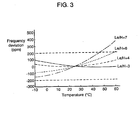
- FIG. 2 and FIG. 3 show temperature characteristics with 25°C as the reference point; where the vertical axis representing the frequency deviation of main vibration resonance frequency, the horizontal axis representing the temperature.
- FIG. 2 exhibits the case where the longitudinal direction of vibrator is +48° from Y-axis
- FIG. 3 exhibits the case where the longitudinal direction of vibrator is +57° from Y-axis.
- the primary coefficient of the frequency temperature characteristics is substantially 0, however, it is unable to make the secondary coefficient to be 0. Therefore, the temperature characteristics exhibit a secondary curve.
- FIG. 2 teaches that for those vibrators whose longitudinal direction is +48° from Y-axis, a ratio Le / H not greater than 4 satisfies the above requirements
- FIG. 3 teaches that for those whose longitudinal direction is +57° from Y-axis, a ratio Le / H not greater than 6 satisfies the above requirements.
- a ratio Le / H is not greater than 3, it means the area for exciting electrode is too small, and the energy confinement is insufficient. This results in an increased resonance impedance and a deteriorated Q, rendering it inappropriate for practical application.
- FIG. 5 shows cross sectional view of a thickness shear mode vibrator using the X plate lithium tantalate, as viewed from the longitudinal side.
- the energy is confined in the portion of opposing exciting electrodes 6 of vibrator element 5, as illustrated in FIG. 5.
- the vibration energy is known to be attenuating exponentially towards the ends of the vibrator element.
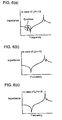
- FIG. 6 (a), (b) and (c) show impedance curves for the ratio L / H 12, 15 and 18, respectively.
- Ratio Le / H is fixed at 5 for all of the samples.
- FIG. 7 (a), (b) and (c) show temperature characteristics corresponding to respective items of FIG. 6.
- the sample of L / H 12 exhibits the spurious at the vicinity of main vibration resonance point because the L / H ratio is not large enough.
- the corresponding temperature characteristics shown in FIG. 7 (a) indicate that the main vibration and the spurious combine at 40°C and up to deteriorate the temperature characteristics.
- the samples of L / H 15 and 18 show favorable performance with respect to both the impedance curve and the temperature characteristics.
- the samples of L / H 15 or 18, corresponding to FIG. 6 (b) or (c), have high Q values 1000 or higher, despite the main vibration resonance frequency exceeding 80 MHz.
- the high Q at the high frequency is attributable to the large area in the exciting electrode.
- an appropriate ratio W / H of the width W of the vibrator to the thickness H of the vibrator has to be selected.
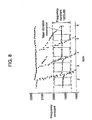
- FIG. 8 shows frequency chart of vibrators whose longitudinal direction is +57° from Y-axis.
- Horizontal axis of the frequency chart represents a ratio W / H, while the vertical axis the frequecy constant defined by the product of the resonance frequency of main vibration, spurious, etc. and the vibrator thickness.
- FIG. 8 plots results of measurement made with vibrator samples having varied widths, while the thickness fixed. Since the main vibration, or the thickness shear vibration, is relevant to thickness of the vibrator, the frequency constant stays substantially fixed at approximately 1920, staying outside the influence of ratio W / H.
- Frequency constant of main vibration at the anti-resonance point is determined mostly by a direction of cutting; so, it is approximately 2100. This too is substantially fixed, without being relevant to ratio W / H.
- squares designate regions free from the spurious.
- the corresponding ratio W / H is any one among the ranges of 1.5 - 2.1, 2.5 - 3.2, 3.7 - 4.3 and 4.9 - 5.3.
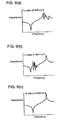
- impedance curves of three sample vibrators are shown in FIG. 9 (a), (b) and (c), the sample vibrators having the widths W 0.7 mm, 0.8 mm and 1.0 mm, while the thickness H remaining at 0.35 mm.
- the spurious due to width dimension can be kept away from the main vibration's resonance point, and there will be no deterioration in the temperature characteristics.
- a value of the ratio W / H should be maximized within the above-described preferable range.
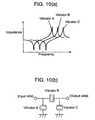
- a band pass filter which allows only a certain specific frequency band to pass through can be implemented by combining a plurality of vibrators. The principle is described referring to FIG. 10.
- FIG. 10 (a) shows impedance curves of three types of vibrators, each having its own resonance frequency of main vibration.
- FIG. 10 (b) shows a circuit diagram connecting the vibrators.
- a filter having the wiring as shown in FIG. 10 (b) is called a ladder-type filter.
- This filter works as a band pass filter, wherein respective resonance frequencies of vibrator A and vibrator C function as the filtering poles, while resonance frequency of vibrator B as the central frequency of a pass band.
- resonance frequencies of vibrator A and vibrator C function as the filtering poles
- resonance frequency of vibrator B as the central frequency of a pass band.
- vibrator B has the spurious at the vicinity of resonance, ripples might appear in the pass band region of the filter, which affects the flatness of attenuation in the pass band region. If vibrator A or vibrator B has the spurious at the vicinity of resonance, it might become difficult to secure a sufficiently large amount of attenuation at the vicinity of the filter pole.
- the region of lower frequency than the main vibration's resonance point in vibrator C is the pass band region of the filter. Therefore, no spurious is allowed in the region.
- the region of higher frequency than the main vibration's resonance point is not the pass band region; therefore, even if there is the spurious in the region it does not give a substantial influence to the filter characteristics.
- respective vibrators forming the lower frequency pole and the higher frequency pole have their own specific no-spurious regions at the vicinity of the main vibration's resonance point.
- the no-spurious range of the vibrator whose resonance frequency serves as the central frequency of the filter is different from that of the pole-setting vibrators.
- the no-spurious range is not lower than 1910 not higher than 1970 in terms of frequency constant.
- the no-spurious range is not lower than 1870 not higher than 1930 in terms of the frequency constant.
- the no-spurious range is not lower than 1890 not higher than 1950 in terms of the frequency constant.
- the preferable ranges in terms of the ratio W / H corresponding to respective frequency constants can be determined by applying these conditions to FIG. 8.
- the preferable range in terms of the ratio W / H is any one among the ranges of 1.5 - 2.2, 2.4 - 3.4, 3.7 - 4.5 and 4.8 - 5.5.
- the vibrator whose main vibration resonance frequency serves as the central frequency of the filter it is any one among the ranges of 1.5 - 2.3, 2.5 - 3.5, 3.7 - 4.6 and 4.9 - 5.6.
- the vibrator for setting the pole of higher-frequency side it is any one among the ranges of 1.5 - 2.4, 2.6 - 3.5, 3.8 - 4.6 and 5.0 - 5.8.
- the vibrators are provided with a broader range for selecting the width dimension, which leads to an improved manufacturing yield rate.
- a width dimension of vibrator is selected from among the above-described respective W / H ratios, the spurious due to width dimension does not appear in the pass band region, and the vicinity, of the filter.
- the filters of superior temperature characteristics are implemented; in the pass band region, ripple due to temperature shift does not appear, and no deterioration in the amount of attenuation at the pole.
- Q of the vibrators constituting a filter can be made higher even in high frequencies.
- the insertion loss of filter can be reduced.
- multi-mode band pass filter which is a band pass filter formed of a plurality of piezoelectric vibrators disposed on one piezoelectric plate whose vibrations are coupled.
- MCF Monolithic Crystal Filter
- Such type of filters is sometimes called as MCF (Monolithic Crystal Filter), where it positively utilizes the inharmonic overtone like a_0 mode, s_1 mode, etc.
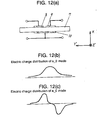
- FIG. 12 (a) shows an example of double-mode filter structure.
- a couple of input electrode 8 and output electrode 9 is provided on one of the main surfaces of X plate lithium tantalate, with a very small gap in between the electrodes; while on the other main surface, electrode 10 for grounding.
- the s_0 mode which is a symmetrical mode and the a_0 mode which is an oblique-symmetrical mode are provided to implement a band pass filter.
- FIG. 12 (b) and (c) show distribution of electric charges corresponding to the respective modes.
- the s_0 mode is line-symmetric with respect to the longitudinal direction of a vibrator, but the a_0 mode is not line-symmetric. This is why the s_0 mode is called a symmetrical mode, while the a_0 mode an oblique-symmetrical mode.
- ground electrode 10 is provided for only one in FIG. 12 (a), the ground electrode may be provided for a plurality as shown in FIG. 13, opposing to input electrode 8 and output electrode 9 respectively.
- the s_0 mode is identical to vibration mode of the thickness shear vibration, which is the main vibration of a vibrator.
- the small gap provided between the input electrode and the output electrode is negligibly small as compared to the length Li of input electrode and the length Lo of output electrode. Therefore, in order to improve the temperature characteristics of double-mode filter, a ratio (Li + Lo) / H of the sum of the length Li of the input electrode and the length Lo of the output electrode (Li + Lo) to the thickness H of element may be made to be not less than 3 not greater than 6, like the case with a single-use vibrator.
- vibration modes other than the s_0 mode and the a_0 mode turn out to be the spurious. Therefore, in order not to pick up such vibrations in the form of electric signal, the length of an input electrode and the length of an output electrode should preferably be equal.
- FIG. 14 shows a piezoelectric vibrator which uses the X plate of lithium tantalate and is primarily vibrated by thickness shear vibration.
- piezoelectric vibrator 14 configured as shown in FIG. 1 is attached on mounting board 12 provided with external terminal 13, using gluing resin 11 which contains conductive material.
- the thickness H of the vibrator is 20 ⁇ m
- the resonance frequency is approximately 100 MHz.
- the length Le of the exciting electrode is 100 ⁇ m
- the ratio Le / H is 5, namely within the range 3 - 6.
- the ratio W / H is 4; therefore, the spurious due to the width dimension does not exist in the vicinity of the main vibration resonance.
- the ratio L / H is 20, namely not less than 15. Consequently, vibration displacement at the end part of the vibrator has been sufficiently attenuated, and no spurious is caused by the reflected wave at the end part.
- vibrators of favorable temperature characteristics are realized.
- FIG. 15 shows a ladder-type filter which contains three pieces of piezoelectric vibrator 14 of FIG. 1 which uses the X plate of lithium tantalate and is primarily vibrated by thickness shear vibration.
- piezoelectric vibrator 14 is attached, conductive resin 11, on mounting board 12 provided with external terminal 15 for inputting, external terminal 16 for outputting and external terminal 16 for grounding.
- the ratio Le / H is 5 and the ratio L/H is 18, with each of the vibrators contained in the filter.
- the ratio W / H of the vibrators for forming the poles is 4, that of the vibrator for the pass band region is 2. Since the Le / H is within the range 3 - 6, frequency deviation due to temperature shift is small, and there is no influence by the spurious due to the reflected wave at the end part of vibrator, or by the spurious due to the width dimension. Furthermore, since a ratio of electrostatic capacitance between vibrators for forming the poles and that for pass band is greater than 1, it has an advantage of large attenuation amount outside the pass band region.
- FIG. 16 shows a double-mode piezoelectric filter which contains the X plate of lithium tantalate and is primarily vibrated by thickness shear vibration.
- Vibrator element portion 18 is attached on mounting board 22 using conductive resin 11.
- Mounting board 12 is provided with external terminal 22 for inputting, external terminal 24 for outputting and external terminal 25 for grounding.
- Input electrode 19, output electrode 20 of vibrator element portion 18 and external terminal 22, external terminal 24 provided on the mounting board are electrically connected, respectively, with fine metal wire 23.
- the central frequency of the filter is approximately 80 MHz.
- the ratio Li / H and the ratio Lo / H are both 2.4, namely within a range 1.5 - 3. Therefore, the filter characteristics exhibit only small frequency deviation due to temperature shift. Furthermore, as the element width W is 100 ⁇ m, the ratio W / H is 4. Therefore, favorable filter characteristics are implemented with no spurious due to the width dimension in the pass band region.
- the thickness direction of vibrator forms an angle of 0° ⁇ 5° to the X-axis, the longitudinal direction of vibrator lies, with the X-axis used as rotation axis, in a direction +57° ⁇ 2° clockwise from Y-axis, and is primarily vibrated by thickness shear vibration;
- a ratio L / H of the length L of vibrator to the thickness H of vibrator is at least 15, a ratio Le / H of the length Le of exciting electrode to the thickness H of vibrator is not more than 3 - 6.
- the longitudinal direction of vibrator is in line with the cleavage direction; which facilitates easy processing during manufacturing operation, and secures a large area for the exciting electrode.
- the vibrators in the present invention have a high Q in the high frequencies, and superior temperature characteristics.
Landscapes
- Chemical & Material Sciences (AREA)
- Physics & Mathematics (AREA)
- Acoustics & Sound (AREA)
- Engineering & Computer Science (AREA)
- Ceramic Engineering (AREA)
- Crystallography & Structural Chemistry (AREA)
- Piezo-Electric Or Mechanical Vibrators, Or Delay Or Filter Circuits (AREA)
Abstract
Description
Claims (9)
- A piezoelectric vibrator primarily vibrated by thickness shear vibration comprisinga vibrator element portion formed of single crystal lithium tantalate, andan exciting electrode provided on said vibration element portion; whereina thickness direction of said vibrator element portion forms an angle of 0° ±5° to the X-axis of said single crystal, a longitudinal direction of said vibrator element portion lies, with said X-axis used as a rotation axis, in a direction +57° ±2° clockwise from the Y-axis of said single crystal, a ratio L / H of the length L of said vibrator element portion to the thickness H is not less than 15, and a ratio Le / H of the length Le of said exciting electrode to the thickness H of said vibrator element portion is 3 - 6.
- The piezoelectric vibrator of claim 1, wherein
a ratio W / H of the width W of said vibrator element portion to the thickness H of a vibrator is selected from the group consisting of 1.5 - 2.1, 2.5 - 3.2, 3.7 - 4.3 and 4.9 - 5.3. - A ladder-type filter comprisinga first vibrator,a second vibrator electrically connected with said first vibrator anda third vibrator electrically connected with said second vibrator, whereina ratio W / H of the width W of said first vibrator to the thickness H is one of groups of 1.5 - 2.2, 2.4 - 3.4, 3.7 - 4.5 and 4.8 - 5.5, a ratio W / H of the width W of said second vibrator to the thickness H is one of groups of 1.5 - 2.3, 2.5 - 3.5, 3.7 - 4.6 and 4.9 - 5.6, and a ratio W / H of the width W of said third vibrator to the thickness H is selected from the group consisting of 1.5 - 2.4, 2.6 - 3.5, 3.8 - 4.6 and 5.0 - 5.8.
- A double-mode piezoelectric filter comprisinga piezoelectric vibrator,a pair of an input electrode and an output electrode provided on one of main surfaces of said piezoelectric vibrator, anda ground electrode provided on another one of the main surfaces of said piezoelectric vibrator, whereina ratio Li / H of the length Li of said input electrode to an element thickness H of said piezoelectric vibrator and a ratio Lo / H of the length Lo of said output electrode to the thickness H of said element, respectively, are 1.5 - 3.
- The ladder-type filter of claim 3, wherein
said first, second and third vibrators comprise single crystal lithium tantalate, a thickness direction of said vibrators forms an angle of 0° ±5° to an X-axis of said single crystal, a longitudinal direction of said vibrators lies, with said X-axis used as rotation axis, in a direction +57° ±2° clockwise from a Y-axis of said single crystal, and primarily vibrated by thickness shear vibration. - The ladder-type filter recited in claim 3 or claim 5, wherein
a ratio Le / H of the length Le of an exciting electrode to the vibrator thickness H in said first, second and third vibrators is respectively 3 - 6. - The double-mode piezoelectric filter of claim 4, wherein
said piezoelectric vibrator comprises single crystal lithium tantalate, thickness direction of said vibrator forms an angle of 0° ±5° to an X-axis of said single crystal, a longitudinal direction of said vibrator lies, with said X-axis used as a rotation axis, in a direction +57° ±2° clockwise from a Y-axis of said single crystal, and primarily vibrated by thickness shear vibration. - The double-mode piezoelectric filter recited in claim 4 or claim 7, wherein
a ratio W / H of the width W of said piezoelectric vibrator to the thickness H is selected from the group consisting of 1.5 - 2.1, 2.5 - 3.2, 3.7 - 4.3 and 4.9 - 5.3. - The double-mode piezoelectric filter recited in any one of claims 4, 7 and 8, wherein
the length Li of said input electrode and the length Lo of said output electrode are equal.
Applications Claiming Priority (3)
| Application Number | Priority Date | Filing Date | Title |
|---|---|---|---|
| JP2001041329 | 2001-02-19 | ||
| JP2001041329A JP2002246871A (en) | 2001-02-19 | 2001-02-19 | Piezoelectric vibrator, ladder type filter using this piezoelectric vibrator, and dual mode piezoelectric filter |
| PCT/JP2002/001013 WO2002067424A1 (en) | 2001-02-19 | 2002-02-07 | Piezoelectric vibrator, ladder-type filter using this piezoelectric vibrator and double-mode piezoelectric filter |
Publications (2)
| Publication Number | Publication Date |
|---|---|
| EP1363396A1 true EP1363396A1 (en) | 2003-11-19 |
| EP1363396A4 EP1363396A4 (en) | 2010-01-13 |
Family
ID=18903787
Family Applications (1)
| Application Number | Title | Priority Date | Filing Date |
|---|---|---|---|
| EP02711368A Ceased EP1363396A4 (en) | 2001-02-19 | 2002-02-07 | PIEZOELECTRIC VIBRATOR, SCALE TYPE FILTER USING THE SAME, AND DOUBLE MODE PIEZOELECTRIC FILTER |
Country Status (4)
| Country | Link |
|---|---|
| US (1) | US6992424B2 (en) |
| EP (1) | EP1363396A4 (en) |
| JP (1) | JP2002246871A (en) |
| WO (1) | WO2002067424A1 (en) |
Cited By (3)
| Publication number | Priority date | Publication date | Assignee | Title |
|---|---|---|---|---|
| RU2276455C1 (en) * | 2004-09-21 | 2006-05-10 | Федеральное государственное унитарное предприятие Омский научно-исследовательский институт приборостроения | Quartz resonator |
| RU2334352C1 (en) * | 2007-02-14 | 2008-09-20 | Федеральное государственное унитарное предприятие Омский научно-исследовательский институт приборостроения | Quartz resonator |
| CN105207641A (en) * | 2014-06-19 | 2015-12-30 | 日本电波工业株式会社 | Dual-mode crystal oscillator |
Families Citing this family (5)
| Publication number | Priority date | Publication date | Assignee | Title |
|---|---|---|---|---|
| JP2004165879A (en) * | 2002-11-12 | 2004-06-10 | Alps Electric Co Ltd | Surface acoustic wave element |
| RU2246791C1 (en) * | 2003-09-08 | 2005-02-20 | Мацак Андрей Николаевич | Piezoelectric resonator |
| JP4552916B2 (en) * | 2005-12-21 | 2010-09-29 | 株式会社大真空 | Piezoelectric vibration device |
| CN104838589A (en) * | 2012-12-27 | 2015-08-12 | 京瓷株式会社 | Piezoelectric component |
| US20220126027A1 (en) * | 2020-10-22 | 2022-04-28 | Insulet Corporation | Techniques and insulin pump for enhanced site health and blood glucose control for aid systems |
Family Cites Families (13)
| Publication number | Priority date | Publication date | Assignee | Title |
|---|---|---|---|---|
| JPS5683110A (en) * | 1979-12-10 | 1981-07-07 | Toshiba Corp | Thickness slip oscillator of litium tantalate |
| DE3377043D1 (en) * | 1982-02-22 | 1988-07-14 | Fujitsu Ltd | Piezoelectric resonators |
| JPS59127413A (en) * | 1983-01-11 | 1984-07-23 | Nippon Dempa Kogyo Co Ltd | Lithium tantalate oscillator |
| JPS59182617A (en) * | 1983-03-31 | 1984-10-17 | Fujitsu Ltd | Lithium tantalate oscillator |
| JPH01149608A (en) * | 1987-12-07 | 1989-06-12 | Matsushima Kogyo Co Ltd | Piezo-vibrator |
| JPH01152809A (en) * | 1987-12-10 | 1989-06-15 | Matsushima Kogyo Co Ltd | Piezoelectric vibrator |
| JPH0213007A (en) * | 1988-06-29 | 1990-01-17 | Murata Mfg Co Ltd | Litao3 thickness-share vibrator |
| JP2855208B2 (en) | 1989-05-31 | 1999-02-10 | 株式会社村田製作所 | LiTaO 3 Lower piezoelectric resonator |
| JPH05243889A (en) * | 1992-02-27 | 1993-09-21 | Kyocera Corp | Thickness-shear piezoelectric oscillator |
| JP3225687B2 (en) * | 1993-04-15 | 2001-11-05 | 株式会社村田製作所 | Ladder type filter |
| JPH06303090A (en) * | 1993-04-15 | 1994-10-28 | Murata Mfg Co Ltd | Piezoelectric filter |
| JPH098594A (en) * | 1995-06-23 | 1997-01-10 | Murata Mfg Co Ltd | Piezoelectric resonator |
| EP0802628B1 (en) * | 1996-04-16 | 2003-07-02 | Matsushita Electric Industrial Co., Ltd. | Piezoelectric resonator and method for fabricating the same |
-
2001
- 2001-02-19 JP JP2001041329A patent/JP2002246871A/en active Pending
-
2002
- 2002-02-07 WO PCT/JP2002/001013 patent/WO2002067424A1/en not_active Ceased
- 2002-02-07 US US10/467,742 patent/US6992424B2/en not_active Expired - Fee Related
- 2002-02-07 EP EP02711368A patent/EP1363396A4/en not_active Ceased
Cited By (3)
| Publication number | Priority date | Publication date | Assignee | Title |
|---|---|---|---|---|
| RU2276455C1 (en) * | 2004-09-21 | 2006-05-10 | Федеральное государственное унитарное предприятие Омский научно-исследовательский институт приборостроения | Quartz resonator |
| RU2334352C1 (en) * | 2007-02-14 | 2008-09-20 | Федеральное государственное унитарное предприятие Омский научно-исследовательский институт приборостроения | Quartz resonator |
| CN105207641A (en) * | 2014-06-19 | 2015-12-30 | 日本电波工业株式会社 | Dual-mode crystal oscillator |
Also Published As
| Publication number | Publication date |
|---|---|
| US20040090147A1 (en) | 2004-05-13 |
| WO2002067424A1 (en) | 2002-08-29 |
| US6992424B2 (en) | 2006-01-31 |
| EP1363396A4 (en) | 2010-01-13 |
| JP2002246871A (en) | 2002-08-30 |
Similar Documents
| Publication | Publication Date | Title |
|---|---|---|
| US7061345B2 (en) | Filter circuit with series and parallel elements | |
| EP1041717A2 (en) | Bulk acoustic wave resonator with improved lateral mode suppression | |
| EP0897218A2 (en) | Surface acoustic wave filter | |
| US4356421A (en) | Piezoelectric resonators of an energy-trapping type of a width extensional vibratory mode | |
| US12413203B2 (en) | Acoustic wave device | |
| WO2019201526A1 (en) | Electroacoustic resonator, rf filter with increased usable bandwidth and method of manufacturing an electroacoustic resonator | |
| EP1037383A2 (en) | Piezoelectric vibration device and piezoelectric resonance component | |
| US5793147A (en) | Surface wave resonator having single component including a plurality of resonant units | |
| KR100318245B1 (en) | Piezoelectric Element | |
| US6992424B2 (en) | Piezoelectric vibrator ladder-type filter using piezoeletric vibrator and double-mode piezolectric filter | |
| EP3766176A1 (en) | Transducer structure for source suppression in saw filter devices | |
| JP3310132B2 (en) | Surface acoustic wave device and antenna duplexer using the same | |
| EP1320192A1 (en) | Surface acoustic wave filter device | |
| EP1376864A1 (en) | Piezoelectric vibration element and piezoelectric filter | |
| EP1309084B1 (en) | Piezoelectric vibrator and filter using the same | |
| KR100465975B1 (en) | Surface acoustic wave device and communication device | |
| US6621194B1 (en) | Piezoelectric element having thickness shear vibration and mobile communication device using the same | |
| JPH06177703A (en) | Longitudinal triplex mode saw filter | |
| KR20250016295A (en) | Elastic wave device | |
| WO2023190654A1 (en) | Elastic wave device | |
| KR100510563B1 (en) | Surface acoustic wave device preferable for g㎐ band | |
| JP3397195B2 (en) | Edge reflection type surface acoustic wave filter | |
| SU1780144A1 (en) | Piezoelectric element | |
| JP3733020B2 (en) | Piezoelectric element and mobile communication device using the same | |
| CN113992178A (en) | Reflection structure of plate wave resonator, and MEMS device |
Legal Events
| Date | Code | Title | Description |
|---|---|---|---|
| PUAI | Public reference made under article 153(3) epc to a published international application that has entered the european phase |
Free format text: ORIGINAL CODE: 0009012 |
|
| 17P | Request for examination filed |
Effective date: 20030812 |
|
| AK | Designated contracting states |
Kind code of ref document: A1 Designated state(s): AT BE CH CY DE DK ES FI FR GB GR IE IT LI LU MC NL PT SE TR |
|
| RAP1 | Party data changed (applicant data changed or rights of an application transferred) |
Owner name: PANASONIC CORPORATION |
|
| A4 | Supplementary search report drawn up and despatched |
Effective date: 20091216 |
|
| 17Q | First examination report despatched |
Effective date: 20100205 |
|
| REG | Reference to a national code |
Ref country code: DE Ref legal event code: R003 |
|
| STAA | Information on the status of an ep patent application or granted ep patent |
Free format text: STATUS: THE APPLICATION HAS BEEN REFUSED |
|
| 18R | Application refused |
Effective date: 20110217 |