EP1362524A1 - Dispositif d'application d'un produit, notamment cosmétique, et son procédé de fabrication - Google Patents
Dispositif d'application d'un produit, notamment cosmétique, et son procédé de fabrication Download PDFInfo
- Publication number
- EP1362524A1 EP1362524A1 EP03291126A EP03291126A EP1362524A1 EP 1362524 A1 EP1362524 A1 EP 1362524A1 EP 03291126 A EP03291126 A EP 03291126A EP 03291126 A EP03291126 A EP 03291126A EP 1362524 A1 EP1362524 A1 EP 1362524A1
- Authority
- EP
- European Patent Office
- Prior art keywords
- foam
- fibers
- application
- product
- craters
- Prior art date
- Legal status (The legal status is an assumption and is not a legal conclusion. Google has not performed a legal analysis and makes no representation as to the accuracy of the status listed.)
- Granted
Links
Images

Classifications
-
- A—HUMAN NECESSITIES
- A45—HAND OR TRAVELLING ARTICLES
- A45D—HAIRDRESSING OR SHAVING EQUIPMENT; EQUIPMENT FOR COSMETICS OR COSMETIC TREATMENTS, e.g. FOR MANICURING OR PEDICURING
- A45D34/00—Containers or accessories specially adapted for handling liquid toiletry or cosmetic substances, e.g. perfumes
- A45D34/04—Appliances specially adapted for applying liquid, e.g. using roller or ball
-
- A—HUMAN NECESSITIES
- A45—HAND OR TRAVELLING ARTICLES
- A45D—HAIRDRESSING OR SHAVING EQUIPMENT; EQUIPMENT FOR COSMETICS OR COSMETIC TREATMENTS, e.g. FOR MANICURING OR PEDICURING
- A45D33/00—Containers or accessories specially adapted for handling powdery toiletry or cosmetic substances
- A45D33/34—Powder-puffs, e.g. with installed container
-
- A—HUMAN NECESSITIES
- A45—HAND OR TRAVELLING ARTICLES
- A45D—HAIRDRESSING OR SHAVING EQUIPMENT; EQUIPMENT FOR COSMETICS OR COSMETIC TREATMENTS, e.g. FOR MANICURING OR PEDICURING
- A45D2200/00—Details not otherwise provided for in A45D
- A45D2200/10—Details of applicators
- A45D2200/1009—Applicators comprising a pad, tissue, sponge, or the like
- A45D2200/1018—Applicators comprising a pad, tissue, sponge, or the like comprising a pad, i.e. a cushion-like mass of soft material, with or without gripping means
-
- A—HUMAN NECESSITIES
- A45—HAND OR TRAVELLING ARTICLES
- A45D—HAIRDRESSING OR SHAVING EQUIPMENT; EQUIPMENT FOR COSMETICS OR COSMETIC TREATMENTS, e.g. FOR MANICURING OR PEDICURING
- A45D33/00—Containers or accessories specially adapted for handling powdery toiletry or cosmetic substances
- A45D33/006—Vanity boxes or cases, compacts, i.e. containing a powder receptacle and a puff or applicator
Definitions
- the present invention relates to devices for applying a product, especially cosmetic, and their manufacturing processes.
- Cosmetic product means a product as defined in the Council Directive 93/35 / EEC of 14 June 1993 amending for the sixth time 76/768 / EEC.
- organ Foam applicator whose surface is used for the application of the product on the skin, by example a powder, a milk or a cream.
- the foam is sometimes flocked.
- the presence of flocking may reduce the amount of product that can be loaded by the applicator, which may result in less coverage and / or require the user to recharge more frequently the application member produces.
- the subject of the invention is an application device a product, in particular a cosmetic product, comprising an applicator member comprising at least less a fibrous or cellular element whose surface serves to apply the product, this device capable of being characterized by the fact that at least a portion of said surface has protruding fibers, these fibers being formed of the same material as the part of the element to which they are connected.
- fiber should be understood in a broad sense and encompasses structures that may not be completely filiform, for example presenting one or several free ends and one or more zones, for example two or three, connected to the rest of the element.
- a fiber can thus comprise, for example, ramifications.
- a fiber may comprise one or more filiform extensions having free ends, and connect flexibly to the rest of the element.
- the fibers are made of one holding with the part of the element to which they are connected.
- the surface of the element used for the application can be made more comfortable and more able to load with an increased amount of product.
- Fibers can form a down that covers more than a quarter or more of the half, for example more than three quarters of the area used for the application.
- the element may be elastically deformable and / or compressible.
- the element can be a felt or a foam. This felt or foam may not have only one material.
- felt here means a fibrous structure comprising filaments entangled in all directions. Such a structure can be relatively compact.
- At least a portion of the fibers may be formed by cell walls exploded. Such down may provide a softness to the application comparable to that brought by a flocking, without presenting its disadvantages.
- the aforementioned down may extend over a surface of the foam which corresponds by example to more than half of the surface of application.
- Most of the fibers may have ramifications.
- the foam may have on its surface craters, which may have example a depth greater than or equal to 0.4 mm, possibly greater than or equal to at 0.7 mm, for example greater than or equal to 1.3 mm, or even greater than or equal to 1.5 mm.
- Such craters which can be obtained by removing the walls of a group of cells, this comprising for example between 5 and 15 cells, allow the foam to store on the surface a quantity of product superior to that which is the case when the Foam was cut with a sharp tool without further processing.
- the fibers can extend around each crater.
- the craters can be scattered, especially regularly scattered, on a surface of the foam which corresponds to more than half of the area of application, by example.
- the foam may comprise a network of filiform walls, being made by example in a material chosen from the following list: polyurethane, polyether, polyester, polyvinyl chloride, EVA, this list not being limiting.
- the element may have hydrophilic properties, in particular incorporating at least one water-absorbing compound, by for example a polyacrylate.
- the fact that the foam has a surface condition as defined above can further enhance its affinity for products containing water.
- the application member may be, for example, an independent sponge any support.
- the application member may be used to take product from a container, being for example housed in the container when it is closed, in the absence of use.
- the applicator member may be secured to a support, this support being able to example include a handle or a gripping member adapted to also constitute a closure member of a container containing the product to be applied.
- the applicator member may comprise a first foam element attached to a second foam member so as to form an application member connected to a support or alternatively a sponge independent of any support.
- the two elements can define between them an interior cavity, in particular a cavity filled with air, giving the application member more flexibility to the application.
- Both elements can have surface states substantially identical or different.
- the applicator member may be fixed by a central region on a support and present a free peripheral region, capable for example of flexing while being pressed when using against the surface on which the product is to be deposited.
- the surface of the application member for the application can be concave outward, such a shape that can increase the amount of product that is responsible for the application organ.
- the element may further comprise a flocking.
- the application member may have two portions of its surface serving to the application having different surface states, one corresponding for example to the cutting of a foam by a cutting element and the other surface state being different from first, corresponding for example to the treatment of the foam by an abrasive tool.
- the abrasion can be carried out by means of a grinding wheel, a milling cutter or a brush.
- Abrasion can be performed while the element is compressed.
- Another subject of the invention is a method of manufacture of an application device in which a surface of an element is treated fibrous or alveolar, intended to serve as an application surface, so as to form fibers in the same material as the element, these fibers projecting from the surface of item.
- Such a surface state can in particular be obtained by subjecting the surface of the element an abrasive treatment, which allows in the case of a foam to burst the walls of the cells present on the surface of the foam, creating a down and craters.
- the abrasive treatment can be carried out by means of a grinding wheel, a milling cutter or of a brush, and take place for example while the element is compressed.
- the surface condition may be different depending on the roughness of the wheel or the used strawberry or the nature of the brush and the pressure exerted on the element during the treatment thereof.
- the general shape of the element before and after the abrasive treatment may not be substantially modified.
- the abrasive treatment can alternatively contribute to giving the element its definitive form.
- Another subject of the invention is a device comprising an applicator member comprising at least one fibrous or cellular element, in particular a foam, a surface of which serves for the application of the product, this device characterized by the fact that at least a portion of said surface has a surface state different from that which would be obtained by cutting the element by means of a sharp tool.
- Another object of the invention is, according to another of its aspects, a kit of conditioning and application of a cosmetic product, comprising a container containing the product to be applied and an application device as defined above.
- Another subject of the invention is a method of manufacture of an application device in which a surface of an element is treated fibrous or alveolar material, in particular a foam intended to serve at least partially surface of application, so as to give it a surface state different from that obtained by cutting the element with a sharp tool.
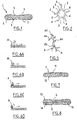
- FIG. 1 shows a sponge 1 intended for example for application a powdery product on the skin.
- the sponge 1 is constituted by a block of a foam open cells, for example a flexible polyurethane foam.
- the sponge could be done in a felt.
- each cell 3 is formed by a plurality of interconnected filiform walls 4 extending in multiple directions.
- Each cell may for example comprise a succession of four or five walls 4 each substantially rectilinear, forming a loop.
- the sponge 1 shown in FIG. 1 has two opposite main faces 5 and 6, slightly concave to the outside, having each received an abrasive treatment in order to form on their surface a down 7 and craters.
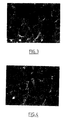
- the down 7 is formed by the walls of the shredded cells, as can be see the photograph shown in Figure 3.
- the surface state of faces 5 and 6 is therefore different from that which would be obtained by cutting the foam with a sharp tool.
- Figure 4 a photograph of the surface of the foam in the case where it would be cut by means of a cutting tool.
- FIG. 5 shows diagrammatically an example of fiber obtained by destructuring the surface of the foam.
- the fiber has ramifications 4a, which may be coplanar or not.
- the distance d measured between a connecting end 4b of the fiber to the rest of the element (that is to say the unaltered structure) and a free end 4c may be greater than the average length of a wall 4 of a cell.
- the depth of a crater 8 can be determined for example by a optical method, which consists in making a first development, by means of a microscope, on the walls 4 bordering the crater, then to carry out a second at the point on the walls 4 which constitute the bottom of the crater, and to raise the indication concerning the movement of the microscope between the two.
- an average depth of crater which may for example be greater than 0.7 mm.
- Various tools can be used to perform the abrasion treatment of the fibrous or cellular element, in particular foam.
- the treatment can be carried out for example while the surface to be treated is substantially flat, the element resting for example on a plane support.
- the treatment can be carried out by moving the surface of the element grinding wheel M driven around an axis of rotation substantially perpendicular to the surface treated (FIG. 6A) or substantially parallel to the treated surface (FIG. 6B), a cutter F (Figure 6C) or brush B ( Figure 6D).
- the number and depth of the craters mentioned above, as well as the length of fibers formed, depends on the abrasive treatment performed and in particular on the pressure exerted on the foam during abrasion as well as the surface condition of the tool used to treat the foam, for example its roughness.
- the depth of the craters can thus be for example more or less important, for example between about 0.4 mm and about 2 mm.
- the fibers created by the abrasion can extend substantially around each crater.
- the down 7 makes the foam softer on application and avoids especially that it scrapes the product deposited on the skin when it is moved to its contact.
- the craters 8 constitute cavities that can accumulate produced when the application surface is loaded.
- the application surface presents greater ability to load product, which can improve coverage and / or the autonomy of the enforcement body.
- FIG. 7 shows a variant of sponge having a face 11 which has received an abrasive treatment and has a down 7 on its surface and an opposite face 12 which has has been obtained by cutting in a conventional manner and has a surface condition similar to the one shown in Figure 4.
- One or the other of the faces 11 and 12 can be used at the choice of the user depending on the desired effect.
- the application member may consist of a single block of cellular material fibrous, especially of foam, as is the case of the examples of FIGS. 1 and 7 or alternatively by assembling at least two elements, in particular two elements made of foam.
- FIG. 8 a sponge which differs from that represented in FIG. 1 by the fact that the foam block 2 is replaced by two elements 13 and 14 foam assembled according to a median plane 15.
- a cavity can still be made within the sponge, as shown in the Figures 9 and 10.
- FIG 9 there is shown a sponge which is formed by the assembly of two elements 17 and 18 in foam, for example of discoid shape, each having received a abrasive treatment on one side, these elements forming between them a cavity 19 filled with air.
- the elements can be welded together at their periphery 20, around the cavity 19.
- Figure 10 differs from that of Figure 9 in that only the element 17 has received on its outer face an abrasive treatment.
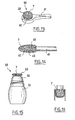
- FIG. 11 shows a packaging and application kit 20 which comprises a receptacle 21 and an application device 22, which comprises an organ for application comprising a foam element 23 having received on at least a portion of its face 24 for application an abrasion treatment to form a down 7 and craters.
- the foam is fixed by the opposite face 25 to a support 26 which constitutes also a closure member of the container.
- peripheral region of the element is free, leaving a space 27 with the support, which can make it possible to provide greater flexibility to the enforcement body.
- the container may comprise a movable bottom 28 making it possible to move the product P towards the applicator member 23.
- the container is made differently and comprises for example a sieve 60, as illustrated in FIG. Figure 12.
- the applicator member may be secured to a rigid or flexible support which may also not be a closure element of a container.
- FIG. 13 shows a device 30 for the application of a product, which comprises a handle 31 provided with a head 32 on a face of which is fixed a block 33 of a foam having received on the surface an abrasion treatment to form a down 7 and craters.
- FIG. 14 shows another example in which the organ application 40 is integral with a rod 41 partially shown.
- This rod 41 can be intended for example to dive into a container containing the product, with crossing or not of a wiper.
- the applicator member may comprise a first portion 42 whose surface has received an abrasive treatment and a second portion 43, for example diametrically opposed to the first one, having received no abrasive treatment, after being shaped using a conventional tool.
- the application member can still, as illustrated in FIG. integral with a container containing the product to be applied.
- FIG. 15 shows a kit 50 comprising a container 51 having a mouthpiece 52 in the upper part, dome-shaped, on which is fixed an organ 53 made of a foam element whose outer surface has received a abrasion treatment to form a down 7 and craters.
- the application member can still be received in a housing whose bottom comprises at least one product supply port, as shown in FIG. in this figure that the cellular or fibrous element can be configured so as to come supported by its periphery against a side wall of the housing, or even in support against the bottom of the house.
Landscapes
- Cleaning Implements For Floors, Carpets, Furniture, Walls, And The Like (AREA)
- Coating Apparatus (AREA)
- Brushes (AREA)
Abstract
Description
- la figure 1 représente de manière schématique une éponge réalisée conformément à l'invention,
- la figure 2 représente de manière schématique une cellule de la mousse,
- la figure 3 est une photographie de la surface d'une mousse après traitement abrasif,
- la figure 4 est une photographie de la surface d'une mousse obtenue par coupe au moyen d'un élément tranchant,
- la figure 5 représente isolément un exemple de fibre,
- les figures 6A à 6D représentent de manière schématique différents outils pouvant être utilisés pour traiter la mousse,
- les figures 7 à 10 illustrent différentes variantes d'éponges, et
- les figures 11 à 15 représentent de manière schématique et partielle, quelques exemples de dispositifs, parmi d'autres, mettant en oeuvre l'invention.
Claims (39)
- Dispositif d'application d'un produit, notamment cosmétique, comprenant un organe d'application comportant au moins un élément fibreux ou alvéolaire dont une surface sert à l'application du produit, caractérisé par le fait qu'au moins une portion de ladite surface comporte des fibres formant saillie, ces fibres étant formées dans le même matériau que la partie de l'élément à laquelle elles se raccordent.
- Dispositif selon la revendication précédente, caractérisé par le fait que les fibres forment un duvet (7) qui couvre plus de la moitié de la surface servant à l'application.
- Dispositif selon l'une des revendications précédentes, caractérisé par le fait que l'élément est élastiquement déformable.
- Dispositif selon l'une quelconque des revendications précédentes, caractérisé par le fait que l'élément est compressible.
- Dispositif selon l'une quelconque des revendications 1 à 4, caractérisé par le fait que l'élément est un feutre.
- Dispositif selon l'une quelconque des revendications 1 à 4, caractérisé par le fait que l'élément est une mousse.
- Dispositif selon la revendication précédente, caractérisé par le fait qu'au moins une partie des fibres est formée par des parois de cellules éclatées.
- Dispositif selon la revendication 6 ou 7, caractérisé par le fait qu'au moins une partie des fibres, notamment la majeure partie des fibres, comporte des ramifications (4a).
- Dispositif selon la revendication 7 ou 8, caractérisé par le fait que pour une majorité de fibres, une distance (d) entre une extrémité libre (4c) de la fibre et une extrémité de raccordement (4b) est supérieure à la longueur moyenne d'une paroi (4) d'une cellule.
- Dispositif selon l'une quelconque des revendications 6 à 9, caractérisé par le fait que la surface de la mousse comporte des cratères (8) ayant une profondeur supérieure ou égale à 0,4 mm.
- Dispositif selon la revendication précédente, caractérisé par le fait que les cratères présentent une profondeur supérieure ou égale à 0,7 mm.
- Dispositif selon la revendication 11, caractérisé par le fait que les cratères présentent une profondeur supérieure ou égale à 1,5 mm.
- Dispositif selon l'une quelconque des revendications 10 à 12, caractérisé par le fait que les cratères sont disséminés sur une surface de la mousse qui correspond à plus de la moitié de la surface d'application.
- Dispositif selon l'une quelconque des revendications 6 à 13, caractérisé par le fait que la mousse comporte un réseau de parois (4) filiformes.
- Dispositif selon l'une quelconque des revendications 6 à 14, caractérisé par le fait que la mousse est réalisée dans un matériau choisi dans la liste suivante: polyuréthane, polyéther, polyester, polychlorure de vinyle, EVA.
- Dispositif selon l'une quelconque des revendications 6 à 15, caractérisé par le fait que l'organe d'application comporte deux éléments (17, 18) en mousse, assemblés.
- Dispositif selon la revendication 16, caractérisé par le fait que les deux éléments définissent une cavité intérieure (19).
- Dispositif selon l'une quelconque des revendications précédentes, caractérisé par le fait que l'élément présente des propriétés hydrophiles.
- Dispositif selon l'une quelconque des revendications précédentes, caractérisé par le fait que l'élément incorpore au moins un composé hydroabsorbant.
- Dispositif selon l'une quelconque des revendications précédentes, caractérisé par le fait qu'il comporte un récipient contenant un produit à appliquer.
- Dispositif selon l'une quelconque des revendications précédentes, caractérisé par le fait que l'organe d'application constitue une éponge.
- Dispositif selon l'une quelconque des revendications 1 à 20, caractérisé par le fait que l'élément est solidaire d'un support (26 ; 31 ; 41 ; 52).
- Dispositif selon la revendication 22, caractérisé par le fait que l'élément est fixé par sa région centrale sur le support et présente une région périphérique libre.
- Dispositif selon l'une des revendications 22 et 23, caractérisé par le fait que le support constitue un organe de préhension.
- Dispositif selon l'une quelconque des revendications précédentes, caractérisé par le fait que la surface (5, 6) servant à l'application est concave vers l'extérieur.
- Dispositif selon l'une quelconque des revendications précédentes,
caractérisé par le fait que l'organe d'application présente deux portions (42, 43) de sa surface servant à l'application qui ont des états de surface différents. - Dispositif selon l'une quelconque des revendications 1 à 26, caractérisé par le fait que l'élément comporte en outre un flocage.
- Dispositif selon l'une quelconque des revendications précédentes, caractérisé par le fait que les fibres sont obtenues en faisant subir à l'élément un traitement abrasif.
- Dispositif selon la revendication 28, caractérisé par le fait que l'abrasion est effectuée au moyen d'une meule (M), d'une fraise (F) ou d'une brosse (B).
- Dispositif selon l'une des revendications 28 et 29, caractérisé par le fait que l'abrasion est effectuée alors que l'élément est comprimé.
- Procédé de fabrication d'un dispositif d'application, dans lequel on traite une surface d'un élément fibreux ou alvéolaire, destinée à servir de surface d'application, de manière à former des fibres dans le même matériau que l'élément, ces fibres formant saillie à la surface de l'élément.
- Procédé selon la revendication 31, caractérisé par le fait que les fibres sont obtenues en faisant subir à la surface de la mousse un traitement abrasif.
- Procédé selon la revendication 32, caractérisé par le fait que le traitement abrasif est effectué au moyen d'une meule, d'une fraise ou d'une brosse.
- Procédé selon l'une des revendications 32 et 33, caractérisé par le fait que le traitement abrasif a lieu alors que l'élément est comprimé.
- Procédé selon l'une quelconque des revendications 31 à 34, caractérisé par le fait que la forme générale de l'élément avant et après le traitement n'est pas sensiblement modifiée.
- Procédé selon l'une quelconque des revendications 31 à 34, caractérisé par le fait que le traitement contribue à donner à l'élément sa forme définitive.
- Procédé selon l'une quelconque des revendications 31 à 36, caractérisé par le fait que l'élément est en mousse.
- Procédé selon la revendication 37, caractérisé par le fait que la mousse comporte un réseau de parois (4) filiformes.
- Kit (20 ; 50) de conditionnement et d'application d'un produit cosmétique, caractérisé par le fait qu'il comporte un récipient (21 ; 51) contenant le produit et un dispositif d'application selon l'une quelconque des revendications 1 à 30.
Applications Claiming Priority (2)
| Application Number | Priority Date | Filing Date | Title |
|---|---|---|---|
| FR0206089 | 2002-05-17 | ||
| FR0206089A FR2839625B1 (fr) | 2002-05-17 | 2002-05-17 | Dispositif d'application d'un produit, notamment cosmetique, et son procede de fabrication |
Publications (2)
| Publication Number | Publication Date |
|---|---|
| EP1362524A1 true EP1362524A1 (fr) | 2003-11-19 |
| EP1362524B1 EP1362524B1 (fr) | 2005-08-10 |
Family
ID=29266116
Family Applications (1)
| Application Number | Title | Priority Date | Filing Date |
|---|---|---|---|
| EP20030291126 Expired - Lifetime EP1362524B1 (fr) | 2002-05-17 | 2003-05-14 | Dispositif d'application d'un produit, notamment cosmétique, et son procédé de fabrication |
Country Status (4)
| Country | Link |
|---|---|
| EP (1) | EP1362524B1 (fr) |
| DE (1) | DE60301227T2 (fr) |
| ES (1) | ES2246038T3 (fr) |
| FR (1) | FR2839625B1 (fr) |
Cited By (4)
| Publication number | Priority date | Publication date | Assignee | Title |
|---|---|---|---|---|
| US7955018B2 (en) | 2006-03-31 | 2011-06-07 | L'oreal | Applicator and a packaging and applicator device |
| WO2012168887A1 (fr) | 2011-06-07 | 2012-12-13 | L'oreal | Dispositif applicateur à double face |
| WO2019072790A1 (fr) | 2017-10-12 | 2019-04-18 | L'oreal | Applicateur destiné à appliquer un produit cosmétique sur des matières de kératine |
| EP3760075A1 (fr) * | 2019-07-01 | 2021-01-06 | Anna Krummel | Flacon |
Families Citing this family (1)
| Publication number | Priority date | Publication date | Assignee | Title |
|---|---|---|---|---|
| FR2882506B1 (fr) | 2005-02-25 | 2007-05-18 | Oreal | Procede de maquillage au moyen d'un applicateur vibrant |
Citations (5)
| Publication number | Priority date | Publication date | Assignee | Title |
|---|---|---|---|---|
| US3068545A (en) * | 1960-03-03 | 1962-12-18 | Du Pont | Napped fibrous regenerated sponge structure and process of making same |
| US4776356A (en) * | 1986-02-01 | 1988-10-11 | Yukigaya Kagaku Kogyo Kabushiki-Kaisha | Cosmetic applicator |
| US4908252A (en) * | 1988-10-26 | 1990-03-13 | Arcade, Inc. | Pleasant-feeling fragrance sampler containing microcapsules |
| DE19633687A1 (de) * | 1996-08-01 | 1998-02-19 | Nishikawa Rubber Co Ltd | Schwammartiger Kosmetikbausch |
| US6044512A (en) * | 1997-05-19 | 2000-04-04 | Lake Country Manufacturing, Inc. | Foam buffing pad and method of manufacture thereof |
-
2002
- 2002-05-17 FR FR0206089A patent/FR2839625B1/fr not_active Expired - Fee Related
-
2003
- 2003-05-14 EP EP20030291126 patent/EP1362524B1/fr not_active Expired - Lifetime
- 2003-05-14 ES ES03291126T patent/ES2246038T3/es not_active Expired - Lifetime
- 2003-05-14 DE DE2003601227 patent/DE60301227T2/de not_active Expired - Lifetime
Patent Citations (5)
| Publication number | Priority date | Publication date | Assignee | Title |
|---|---|---|---|---|
| US3068545A (en) * | 1960-03-03 | 1962-12-18 | Du Pont | Napped fibrous regenerated sponge structure and process of making same |
| US4776356A (en) * | 1986-02-01 | 1988-10-11 | Yukigaya Kagaku Kogyo Kabushiki-Kaisha | Cosmetic applicator |
| US4908252A (en) * | 1988-10-26 | 1990-03-13 | Arcade, Inc. | Pleasant-feeling fragrance sampler containing microcapsules |
| DE19633687A1 (de) * | 1996-08-01 | 1998-02-19 | Nishikawa Rubber Co Ltd | Schwammartiger Kosmetikbausch |
| US6044512A (en) * | 1997-05-19 | 2000-04-04 | Lake Country Manufacturing, Inc. | Foam buffing pad and method of manufacture thereof |
Cited By (7)
| Publication number | Priority date | Publication date | Assignee | Title |
|---|---|---|---|---|
| US7955018B2 (en) | 2006-03-31 | 2011-06-07 | L'oreal | Applicator and a packaging and applicator device |
| WO2012168887A1 (fr) | 2011-06-07 | 2012-12-13 | L'oreal | Dispositif applicateur à double face |
| WO2019072790A1 (fr) | 2017-10-12 | 2019-04-18 | L'oreal | Applicateur destiné à appliquer un produit cosmétique sur des matières de kératine |
| FR3072257A1 (fr) * | 2017-10-12 | 2019-04-19 | L'oreal | Applicateur pour appliquer un produit cosmetique sur les matieres keratiniques |
| CN111295111A (zh) * | 2017-10-12 | 2020-06-16 | 欧莱雅 | 用于将美容产品涂抹至角质材料的涂抹器 |
| US11419405B2 (en) | 2017-10-12 | 2022-08-23 | L'oreal | Applicator for applying a cosmetic product to keratinous materials |
| EP3760075A1 (fr) * | 2019-07-01 | 2021-01-06 | Anna Krummel | Flacon |
Also Published As
| Publication number | Publication date |
|---|---|
| FR2839625B1 (fr) | 2005-05-13 |
| FR2839625A1 (fr) | 2003-11-21 |
| DE60301227T2 (de) | 2006-03-23 |
| ES2246038T3 (es) | 2006-02-01 |
| EP1362524B1 (fr) | 2005-08-10 |
| DE60301227D1 (de) | 2005-09-15 |
Similar Documents
| Publication | Publication Date | Title |
|---|---|---|
| CA2227902C (fr) | Ensemble de conditionnement et d'application d'un produit de maquillage de fibres keratiniques | |
| CA2314468C (fr) | Dispositif de conditionnement et d'application d'un produit sur les cils ou les sourcils | |
| EP1070467B1 (fr) | Dispositif de conditionnement et d'application d'un produit sur les cils ou les sourcils | |
| CA2227903C (fr) | Dispositif d'application d'un produit de maquillage de fibres keratiniques, notamment des cils, et ensemble de conditionnement et d'application utilisant un tel dispositif | |
| EP1106101B1 (fr) | Dispositif pour l'application d'un produit, notamment capillaire, sur une mèche de cheveux et procédé de traitement capillaire | |
| EP0792602B1 (fr) | Applicateur de produit et ensemble de conditionnement comprenant un tel applicateur | |
| CA2344203C (fr) | Dispositif pour l'application d'un produit sur les fibres keratiniques, notamment les cils ou les sourcils | |
| CA2348807C (fr) | Dispositif pour l'application d'un produit cosmetique ou de soin sur les fibres keratiniques, notamment les cils ou les sourcils | |
| EP0884008B1 (fr) | Dispositif pour l'application en mèches d'un produit capillaire | |
| CA2348801C (fr) | Dispositif pour l'application d'un produit, cosmetique ou de soin, sur les fibres keratiniques, notamment les cils ou les sourcils | |
| EP1275320A1 (fr) | Dispositif pour l'application en mèches d'un produit capillaire | |
| EP0611184B1 (fr) | Ensemble applicateur d'un produit cosmétique | |
| EP1161896A1 (fr) | Dispositif d'application d'un produit sur les fibres kératiniques, notamment sur les cils ou les sourcils | |
| FR2860960A1 (fr) | Applicateur d'un produit, notamment cosmetique | |
| FR2943512A1 (fr) | Applicateur metallique. | |
| EP1070465A2 (fr) | Dispositif de conditionnement et d'application d'un produit sur les cils ou les sourcils | |
| EP2027792A1 (fr) | Applicateur pour appliquer un produit sur les matières kératiniques comportant une source vibrante | |
| EP3386345A1 (fr) | Applicateur de produit cosmetique comprenant des protuberances en boucle | |
| FR3095115A1 (fr) | Applicateur de cosmétique avec structures de brosse et d'applicateur moulé séparées | |
| WO2001005272A1 (fr) | Dispositif pour l'application d'un produit sur les fibres keratiniques, notamment les cils ou les sourcils | |
| EP3481254A1 (fr) | Applicateur de produit cosmétique | |
| EP1362524B1 (fr) | Dispositif d'application d'un produit, notamment cosmétique, et son procédé de fabrication | |
| FR2963217A1 (fr) | Dispositif de conditionnement et d'application d'au moins une composition cosmetique solide | |
| WO2010086513A1 (fr) | Procede de maquillage au moyen d'un applicateur vibrant et dispositif de conditionnement et d'application comportant un applicateur vibrant | |
| US7083351B2 (en) | Device for applying a substance, in particular a cosmetic, and its method of manufacture |
Legal Events
| Date | Code | Title | Description |
|---|---|---|---|
| PUAI | Public reference made under article 153(3) epc to a published international application that has entered the european phase |
Free format text: ORIGINAL CODE: 0009012 |
|
| 17P | Request for examination filed |
Effective date: 20030520 |
|
| AK | Designated contracting states |
Kind code of ref document: A1 Designated state(s): AT BE BG CH CY CZ DE DK EE ES FI FR GB GR HU IE IT LI LU MC NL PT RO SE SI SK TR |
|
| AX | Request for extension of the european patent |
Extension state: AL LT LV MK |
|
| 17Q | First examination report despatched |
Effective date: 20040129 |
|
| AKX | Designation fees paid |
Designated state(s): DE ES FR GB IT |
|
| GRAP | Despatch of communication of intention to grant a patent |
Free format text: ORIGINAL CODE: EPIDOSNIGR1 |
|
| GRAS | Grant fee paid |
Free format text: ORIGINAL CODE: EPIDOSNIGR3 |
|
| GRAA | (expected) grant |
Free format text: ORIGINAL CODE: 0009210 |
|
| AK | Designated contracting states |
Kind code of ref document: B1 Designated state(s): DE ES FR GB IT |
|
| REG | Reference to a national code |
Ref country code: GB Ref legal event code: FG4D Free format text: NOT ENGLISH |
|
| REF | Corresponds to: |
Ref document number: 60301227 Country of ref document: DE Date of ref document: 20050915 Kind code of ref document: P |
|
| GBT | Gb: translation of ep patent filed (gb section 77(6)(a)/1977) |
Effective date: 20050928 |
|
| REG | Reference to a national code |
Ref country code: ES Ref legal event code: FG2A Ref document number: 2246038 Country of ref document: ES Kind code of ref document: T3 |
|
| PLBE | No opposition filed within time limit |
Free format text: ORIGINAL CODE: 0009261 |
|
| STAA | Information on the status of an ep patent application or granted ep patent |
Free format text: STATUS: NO OPPOSITION FILED WITHIN TIME LIMIT |
|
| 26N | No opposition filed |
Effective date: 20060511 |
|
| REG | Reference to a national code |
Ref country code: FR Ref legal event code: PLFP Year of fee payment: 14 |
|
| REG | Reference to a national code |
Ref country code: FR Ref legal event code: PLFP Year of fee payment: 15 |
|
| REG | Reference to a national code |
Ref country code: FR Ref legal event code: PLFP Year of fee payment: 16 |
|
| PGFP | Annual fee paid to national office [announced via postgrant information from national office to epo] |
Ref country code: DE Payment date: 20190430 Year of fee payment: 17 Ref country code: ES Payment date: 20190603 Year of fee payment: 17 |
|
| PGFP | Annual fee paid to national office [announced via postgrant information from national office to epo] |
Ref country code: GB Payment date: 20190508 Year of fee payment: 17 |
|
| PGFP | Annual fee paid to national office [announced via postgrant information from national office to epo] |
Ref country code: FR Payment date: 20200414 Year of fee payment: 18 |
|
| PGFP | Annual fee paid to national office [announced via postgrant information from national office to epo] |
Ref country code: IT Payment date: 20200414 Year of fee payment: 18 |
|
| REG | Reference to a national code |
Ref country code: DE Ref legal event code: R119 Ref document number: 60301227 Country of ref document: DE |
|
| GBPC | Gb: european patent ceased through non-payment of renewal fee |
Effective date: 20200514 |
|
| PG25 | Lapsed in a contracting state [announced via postgrant information from national office to epo] |
Ref country code: GB Free format text: LAPSE BECAUSE OF NON-PAYMENT OF DUE FEES Effective date: 20200514 |
|
| PG25 | Lapsed in a contracting state [announced via postgrant information from national office to epo] |
Ref country code: DE Free format text: LAPSE BECAUSE OF NON-PAYMENT OF DUE FEES Effective date: 20201201 |
|
| REG | Reference to a national code |
Ref country code: ES Ref legal event code: FD2A Effective date: 20210929 |
|
| PG25 | Lapsed in a contracting state [announced via postgrant information from national office to epo] |
Ref country code: ES Free format text: LAPSE BECAUSE OF NON-PAYMENT OF DUE FEES Effective date: 20200515 |
|
| PG25 | Lapsed in a contracting state [announced via postgrant information from national office to epo] |
Ref country code: FR Free format text: LAPSE BECAUSE OF NON-PAYMENT OF DUE FEES Effective date: 20210531 |
|
| PG25 | Lapsed in a contracting state [announced via postgrant information from national office to epo] |
Ref country code: IT Free format text: LAPSE BECAUSE OF NON-PAYMENT OF DUE FEES Effective date: 20200514 |
|
| PG25 | Lapsed in a contracting state [announced via postgrant information from national office to epo] |
Ref country code: IT Free format text: LAPSE BECAUSE OF NON-PAYMENT OF DUE FEES Effective date: 20210514 |