EP1361283A1 - Novel assay method - Google Patents
Novel assay method Download PDFInfo
- Publication number
- EP1361283A1 EP1361283A1 EP02712305A EP02712305A EP1361283A1 EP 1361283 A1 EP1361283 A1 EP 1361283A1 EP 02712305 A EP02712305 A EP 02712305A EP 02712305 A EP02712305 A EP 02712305A EP 1361283 A1 EP1361283 A1 EP 1361283A1
- Authority
- EP
- European Patent Office
- Prior art keywords
- reaction system
- subject matter
- measuring method
- phosphogluconate dehydrogenase
- phosphogluconate
- Prior art date
- Legal status (The legal status is an assumption and is not a legal conclusion. Google has not performed a legal analysis and makes no representation as to the accuracy of the status listed.)
- Withdrawn
Links
Images


Classifications
-
- C—CHEMISTRY; METALLURGY
- C12—BIOCHEMISTRY; BEER; SPIRITS; WINE; VINEGAR; MICROBIOLOGY; ENZYMOLOGY; MUTATION OR GENETIC ENGINEERING
- C12Q—MEASURING OR TESTING PROCESSES INVOLVING ENZYMES, NUCLEIC ACIDS OR MICROORGANISMS; COMPOSITIONS OR TEST PAPERS THEREFOR; PROCESSES OF PREPARING SUCH COMPOSITIONS; CONDITION-RESPONSIVE CONTROL IN MICROBIOLOGICAL OR ENZYMOLOGICAL PROCESSES
- C12Q1/00—Measuring or testing processes involving enzymes, nucleic acids or microorganisms; Compositions therefor; Processes of preparing such compositions
- C12Q1/54—Measuring or testing processes involving enzymes, nucleic acids or microorganisms; Compositions therefor; Processes of preparing such compositions involving glucose or galactose
-
- G—PHYSICS
- G01—MEASURING; TESTING
- G01N—INVESTIGATING OR ANALYSING MATERIALS BY DETERMINING THEIR CHEMICAL OR PHYSICAL PROPERTIES
- G01N33/00—Investigating or analysing materials by specific methods not covered by groups G01N1/00 - G01N31/00
- G01N33/48—Biological material, e.g. blood, urine; Haemocytometers
- G01N33/50—Chemical analysis of biological material, e.g. blood, urine; Testing involving biospecific ligand binding methods; Immunological testing
- G01N33/66—Chemical analysis of biological material, e.g. blood, urine; Testing involving biospecific ligand binding methods; Immunological testing involving blood sugars, e.g. galactose
Definitions
- the present invention relates to a measuring method avoiding measurement errors caused by a hemolytic constituent contained in the specimen when a subject matter is measured using a measurement reaction system which utilizes an enzyme reaction for a biological sample.
- a method in which a subject constituent is quantitatively measured by receiving variation of amount of coenzymes (NAD, NADP, NADH, NADPH, Thio-NAD, Thio-NAD, Thio-HADH, Thio-NADP, Thio-NADPH) as variation of absorbance is often used.
- Serum is generally used as a specimen but, since there are cases where physical impacts are given to blood cells when blood is taken to obtain serum or blood cells burst because of a human mis-operation, hemolysis may be induced.
- hemolysis When blood is taken from a patient having a hemolytic disease, hemolysis may be recognized because of the disease.
- measurements in which the entire blood is used to reduce the time necessary for an examination are attempted and hemolysis may also be recognized for such specimens.
- MK myokinase
- G6PDH glucose-6-phosphate dehydrogenase
- a glycolysis preventive comprising a mixture of NaF, MgCl 2 , NaH 2 PO 4 and an anticoaglant in order to avoid measurement errors caused by hemolysis when a glucose constituent is measured (JP Publication of Unexamined Patent No. H05-126834) and AP 5 A is reported to be effective for MK activity.
- the object of the invention is to provide a measuring method to obtain correct measured values when the subject matter is measured using a reaction system capable of producing 6-phosphogluconate for a biological sample.
- 6-phosphogluconate hereinafter abbreviated to "6PG”
- 6-PG-dehydrogenase hereinafter abbreviated to "6PGDH”
- the present invention provides:
- a reaction system for measuring hexose or phosphoric-acidificated hexose using coenzymes is exemplified.
- Hexose refers to 6-carbon sugars and its representative one is glucose.
- glucose (GLU) glucose
- TG neutral fat
- IP inorganicphosphorus
- CPK creatine kinase
- sucrose inulin
- BUN ureanitrogen
- creatinine are exemplified.
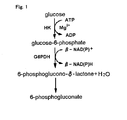
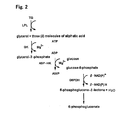
- the end product in the case where a reaction system for producing glucose is used is 6PG when glucose or neutral fat is measured.
- hemolysis interference For a reaction system for measuring hexose or phosphoric-acidificated hexose using coenzymes, there is a phenomenon that difference is produced between the correct and erred values for measured values when hemolysis occurs and this phenomenon is called hemolysis interference.
- NAD and NADH are influenced by a dehydrogenase, especially lactate dehydrogenase (hereinafter referred to as "LDH"; NAD-depedent) in the specimen but the influence of LDH can be avoided completely by presence of oxalic acid, oxamic acid or their salts in the reaction system. Therefore, this phenomenon can be combined with the measuring method.
- LDH lactate dehydrogenase
- one or more enzyme ( s ) or sugar(s) selected from HK, G6PDH, hexose, G6P can be used being combined with the coenzyme.
- Methods for measuring glucose with these enzyme approaches are widely known.
- human red blood cells were obtained by centrifuging the blood at 3,000rpm.
- the blood cells were frozen at -20°C and melted at a room temperature. These operations caused the blood cells to burst and hemolysis constituents were obtained.
- the constituents were diluted with physiological salt solution to a hemoglobin concentration of 500mg/dL. Then, the reagents described as follows were prepared.
- the following reagents were prepared and used for measurement of glucose (GLU).
- Tris 100mM HK: 3.5U/mL
- G6PDH 5.0U/mL
- ⁇ -NAD 3mM magnesium acetate: 10mM pH 6.0
- Tris 200mM ATP: 6mM pH 9.0
- Bicine 50mM Potassium-chloride: 100mM Magnesium chloride: 10mM Nonion A-10R: 0.5% Triton X-100: 0.2% Sodium azide: 0.1% PEP: 4.0mM ATP: 3.0mM G6PDH: 4.5U/mL PK: 3.0U/mL GK: 3.0U/mL pH: 8.5
- MES 50mM Oxalic acid: 100mM Glucose: 80mM Triton X-100: 0.25% ⁇ -NAD: 7.0mM Sodium azide: 0.1% ADP-HK: 10.0U/mL Lipase: 1500U/mL pH: 6.5
- the operation for measurement was carried out in the same way as the measurement of glucose and neutral fat was measured.
Landscapes
- Health & Medical Sciences (AREA)
- Life Sciences & Earth Sciences (AREA)
- Chemical & Material Sciences (AREA)
- Engineering & Computer Science (AREA)
- Hematology (AREA)
- Immunology (AREA)
- Molecular Biology (AREA)
- Urology & Nephrology (AREA)
- Biomedical Technology (AREA)
- Biochemistry (AREA)
- General Health & Medical Sciences (AREA)
- Microbiology (AREA)
- Physics & Mathematics (AREA)
- Organic Chemistry (AREA)
- Analytical Chemistry (AREA)
- Biotechnology (AREA)
- Pathology (AREA)
- General Physics & Mathematics (AREA)
- Medicinal Chemistry (AREA)
- Food Science & Technology (AREA)
- Zoology (AREA)
- Diabetes (AREA)
- Wood Science & Technology (AREA)
- Proteomics, Peptides & Aminoacids (AREA)
- Cell Biology (AREA)
- Genetics & Genomics (AREA)
- Emergency Medicine (AREA)
- General Engineering & Computer Science (AREA)
- Bioinformatics & Cheminformatics (AREA)
- Biophysics (AREA)
- Measuring Or Testing Involving Enzymes Or Micro-Organisms (AREA)
- Investigating Or Analysing Biological Materials (AREA)
Abstract
Description
HK: 3.5U/mL
G6PDH: 5.0U/mL
β-NAD: 3mM
magnesium acetate: 10mM
pH 6.0
ATP: 6mM
pH 9.0
Potassium-chloride: 100mM
Magnesium chloride: 10mM
Nonion A-10R: 0.5%
Triton X-100: 0.2%
Sodium azide: 0.1%
PEP: 4.0mM
ATP: 3.0mM
G6PDH: 4.5U/mL
PK: 3.0U/mL
GK: 3.0U/mL
pH: 8.5
Oxalic acid: 100mM
Glucose: 80mM
Triton X-100: 0.25%
β-NAD: 7.0mM
Sodium azide: 0.1%
ADP-HK: 10.0U/mL
Lipase: 1500U/mL
pH: 6.5
Claims (11)
- A subject matter measuring method wherein when a subject matter is measured using a reaction system capable of producing 6-phosphogluconate for a biological sample, 6-phosphogluconate dehydrogenase is placed outside of the reaction system.
- The subject matter measuring method according to claim 1, wherein means for placing 6-phosphogluconate dehydrogenase outside of the reaction system is to use a coenzyme which does not react with 6-phosphogluconate dehydrogenase in the reaction system.
- The subject matter measuring method according to claim 2, wherein NAD or Thio-NAD is used as the coenzyme which does not react with 6-phosphogluconate dehydrogenase.
- The subject matter measuring method according to claim 1, wherein a 6-phosphogluconate dehydrogenase activation inhibitor is used as the means for placing 6-phosphogluconate dehydrogenase outside of the reaction system.
- The subject matter measuring method according to claim 1, wherein an anti-6-phosphogluconate dehydrogenase antibody is used as the means for placing 6-phosphogluconate dehydrogenase outside of the reaction system.
- The subject matter measuring method according to any one of claims 1 to 5, wherein further lactate dehydrogenase is placed outside of the reaction system.
- The subject matter measuring method according to claim 6, wherein the means for placing lactate dehydrogenase outside of the reaction system is to contain oxalic acid, oxamic acid or their salts therein.
- The subject matter measuring method according to any one of claims 1 to 7, wherein the subject matter is a substance which is measurable by using a reaction system capable of producing glucose.
- The subject matter measuring method according to any one of claims 1 to 8, wherein the subject matter is one or more substances selected from hexose, neutral fat, inorganic phosphorus, creatine kinase or its isozyme, or amylase or its isozyme.
- A method for avoiding hemolysis interference wherein 6-phosphogluconate dehydrogenase generated by hemolysis is placed outside of the reaction system.
- A reagent composition comprising reagents necessary for the method according to any one of claims 1 to 9 in the form of a kit or comprising one of the reagents.
Applications Claiming Priority (3)
| Application Number | Priority Date | Filing Date | Title |
|---|---|---|---|
| JP2001036863 | 2001-02-14 | ||
| JP2001036863 | 2001-02-14 | ||
| PCT/JP2002/001173 WO2002064819A1 (en) | 2001-02-14 | 2002-02-13 | Novel assay method |
Publications (2)
| Publication Number | Publication Date |
|---|---|
| EP1361283A1 true EP1361283A1 (en) | 2003-11-12 |
| EP1361283A4 EP1361283A4 (en) | 2004-03-17 |
Family
ID=18900077
Family Applications (1)
| Application Number | Title | Priority Date | Filing Date |
|---|---|---|---|
| EP02712305A Withdrawn EP1361283A4 (en) | 2001-02-14 | 2002-02-13 | NEW DOSING PROCESS |
Country Status (6)
| Country | Link |
|---|---|
| EP (1) | EP1361283A4 (en) |
| JP (1) | JP4106270B2 (en) |
| KR (1) | KR100836179B1 (en) |
| CN (1) | CN1228636C (en) |
| TW (1) | TWI275795B (en) |
| WO (1) | WO2002064819A1 (en) |
Cited By (2)
| Publication number | Priority date | Publication date | Assignee | Title |
|---|---|---|---|---|
| EP1388735A1 (en) * | 2002-08-09 | 2004-02-11 | Sysmex Corporation | Reagent for assaying lipids |
| CN105699640A (en) * | 2014-05-07 | 2016-06-22 | 北京中生金域诊断技术有限公司 | Kit for detecting barrier function of intestinal tract |
Families Citing this family (5)
| Publication number | Priority date | Publication date | Assignee | Title |
|---|---|---|---|---|
| CN100430487C (en) * | 2002-11-15 | 2008-11-05 | 江西特康科技有限公司 | Preparation method of single stable nicotinamide coenzyme liquid reagent |
| CN101324613A (en) * | 2007-06-13 | 2008-12-17 | 苏州艾杰生物科技有限公司 | Inorganic phosphorus diagnosis/ determination reagent kit and method for determining inorganic phosphorus concentration |
| JP5843072B2 (en) * | 2010-04-30 | 2016-01-13 | 日東紡績株式会社 | Method for measuring specific substance and kit for measuring specific substance |
| ES2911268T3 (en) * | 2013-12-17 | 2022-05-18 | Siemens Healthcare Diagnostics Inc | Preparation of multi-hapten mutant G6PDH conjugates and their use for detection of multiple analytes |
| CN115078341B (en) * | 2022-08-22 | 2022-11-29 | 上海执诚生物科技有限公司 | Reagent for detecting glucose-6-phosphate dehydrogenase and application thereof |
Family Cites Families (13)
| Publication number | Priority date | Publication date | Assignee | Title |
|---|---|---|---|---|
| DE1598067A1 (en) * | 1951-01-28 | 1970-03-26 | Boehringer Mannheim Gmbh | Methods and diagnostic agents for the enzymatic determination of glucose |
| GB1318568A (en) * | 1970-09-17 | 1973-05-31 | Miles Lab | Colourimetric assay of dehydrogenases |
| US3956069A (en) * | 1974-04-29 | 1976-05-11 | Abbott Laboratories | Enzymatic assays for glucose, creatine phosphokinase or plasma ammonia |
| DE3303098A1 (en) * | 1983-01-31 | 1984-08-02 | Boehringer Mannheim Gmbh, 6800 Mannheim | METHOD AND REAGENT FOR DETERMINING GLUCOSE IN HAEMOLYSED BLOOD |
| JPH0244520B2 (en) * | 1988-06-07 | 1990-10-04 | Mitsubishi Petrochemical Co | GURUKOOSUSOKUTEIYOSOSEIBUTSU |
| ES2065005T3 (en) * | 1990-02-20 | 1995-02-01 | Iatron Lab | METHOD OF DETERMINATION OF GLUCOSE-6-PHOSPHATE AND COMPOSITION FOR THE SAME. |
| JPH08501392A (en) * | 1992-09-14 | 1996-02-13 | パーデュー リサーチ ファウンデーション | Chemical analysis by electrophoresis |
| JP3685268B2 (en) * | 1995-03-10 | 2005-08-17 | 東洋紡績株式会社 | α-Amylase activity measuring method and measuring reagent composition |
| JPH07250698A (en) * | 1995-03-15 | 1995-10-03 | Unitika Ltd | Analytical reagent and analytical method using the same |
| JP3674018B2 (en) * | 1996-12-26 | 2005-07-20 | 日東紡績株式会社 | Terminator for conjugated dehydrogenase reaction, termination method, and method for measuring specific substance |
| DE19756238A1 (en) * | 1996-12-26 | 1998-07-02 | Nitto Boseki Co Ltd | Interrupter for conjugated dehydrogenase reaction, interrupt method and method for measuring a specific substance |
| US5801006A (en) * | 1997-02-04 | 1998-09-01 | Specialty Assays, Inc. | Use of NADPH and NADH analogs in the measurement of enzyme activities and metabolites |
| US6162618A (en) * | 1998-04-10 | 2000-12-19 | Smithkline Beecham Corporation | 6-phosphogluconate dehydrogenase of Streptococcus pneumoniae |
-
2001
- 2001-12-31 TW TW090133584A patent/TWI275795B/en not_active IP Right Cessation
-
2002
- 2002-01-08 KR KR1020020000955A patent/KR100836179B1/en not_active Expired - Fee Related
- 2002-02-09 CN CNB021045992A patent/CN1228636C/en not_active Expired - Lifetime
- 2002-02-13 JP JP2002565130A patent/JP4106270B2/en not_active Expired - Fee Related
- 2002-02-13 EP EP02712305A patent/EP1361283A4/en not_active Withdrawn
- 2002-02-13 WO PCT/JP2002/001173 patent/WO2002064819A1/en not_active Ceased
Cited By (3)
| Publication number | Priority date | Publication date | Assignee | Title |
|---|---|---|---|---|
| EP1388735A1 (en) * | 2002-08-09 | 2004-02-11 | Sysmex Corporation | Reagent for assaying lipids |
| CN105699640A (en) * | 2014-05-07 | 2016-06-22 | 北京中生金域诊断技术有限公司 | Kit for detecting barrier function of intestinal tract |
| CN105699640B (en) * | 2014-05-07 | 2017-06-06 | 北京中生金域诊断技术股份有限公司 | A kind of kit for detecting gut barrier function |
Also Published As
| Publication number | Publication date |
|---|---|
| EP1361283A4 (en) | 2004-03-17 |
| JP4106270B2 (en) | 2008-06-25 |
| KR20020066953A (en) | 2002-08-21 |
| TWI275795B (en) | 2007-03-11 |
| CN1228636C (en) | 2005-11-23 |
| JPWO2002064819A1 (en) | 2004-06-17 |
| KR100836179B1 (en) | 2008-06-09 |
| WO2002064819A1 (en) | 2002-08-22 |
| CN1370994A (en) | 2002-09-25 |
Similar Documents
| Publication | Publication Date | Title |
|---|---|---|
| JP5906604B2 (en) | Whole blood sample component measurement method | |
| CS228127B2 (en) | Reagencni cinidlo | |
| Zhu et al. | An enzymatic colorimetric assay for glucose-6-phosphate | |
| WO1987005113A1 (en) | Glucose reference control for glucose test strips | |
| CN106868096B (en) | High-stability and low-cost glucose detection reagent by hexokinase method | |
| US6309852B1 (en) | Method and reagent for quantitative determination of 1,5-anhydroglucitol | |
| CN112159833A (en) | Reagent for eliminating endogenous glucose interference and application and method thereof | |
| JP4106270B2 (en) | New measurement method | |
| EP0639646A1 (en) | High precision determination of d-glucose-6-phosphate and composition therefor | |
| US20010036636A1 (en) | Biochemical method to measure niacin status in a biological sample | |
| EP1376133B1 (en) | Method of screening prediabetic state and screening reagent | |
| CN113881658A (en) | A highly stable creatine kinase enzyme protection additive | |
| CN112255219A (en) | 1, 5-sorbitan determination kit, and preparation method and application thereof | |
| US5587296A (en) | Reagent for assaying glucose | |
| US7407774B2 (en) | Method for reducing influence of hemoglobin with albumin in an assay | |
| US5834227A (en) | Kit for assaying creatine kinase | |
| US3293146A (en) | Composition for detecting guanase and process for diagnosing viral hepatitis therewith | |
| JP2000262299A (en) | Method for determining glucose by glucose dehydrogenase and reagent for determining glucose | |
| WO2000012753A1 (en) | Diagnosis of hepatocellular injuries using serum fructose-1,6-biphosphatase | |
| JP5633669B2 (en) | ADP measurement method and ADP measurement kit | |
| JP3078881B2 (en) | Method for measuring components in biological samples | |
| JP4067147B2 (en) | Method and reagent for measuring creatine phosphokinase activity | |
| JP3034984B2 (en) | Highly sensitive method and composition for quantification of D-galactose | |
| JP3936976B2 (en) | Enzymatic degradation of AMP | |
| JP2001231596A (en) | Measuring method for avoiding influence of hemolysis of specimen and measuring reagent used in the method |
Legal Events
| Date | Code | Title | Description |
|---|---|---|---|
| PUAI | Public reference made under article 153(3) epc to a published international application that has entered the european phase |
Free format text: ORIGINAL CODE: 0009012 |
|
| 17P | Request for examination filed |
Effective date: 20030820 |
|
| AK | Designated contracting states |
Kind code of ref document: A1 Designated state(s): AT BE CH CY DE DK ES FI FR GB GR IE IT LI LU MC NL PT SE TR |
|
| AX | Request for extension of the european patent |
Extension state: AL LT LV MK RO SI |
|
| A4 | Supplementary search report drawn up and despatched |
Effective date: 20040203 |
|
| RIC1 | Information provided on ipc code assigned before grant |
Ipc: 7C 12Q 1/32 A |
|
| 17Q | First examination report despatched |
Effective date: 20050614 |
|
| RAP1 | Party data changed (applicant data changed or rights of an application transferred) |
Owner name: SYSMEX CORPORATION |
|
| STAA | Information on the status of an ep patent application or granted ep patent |
Free format text: STATUS: THE APPLICATION IS DEEMED TO BE WITHDRAWN |
|
| 18D | Application deemed to be withdrawn |
Effective date: 20071121 |