EP1361068A1 - Staggered multi-phase firing of nozzle heads for a printer - Google Patents
Staggered multi-phase firing of nozzle heads for a printer Download PDFInfo
- Publication number
- EP1361068A1 EP1361068A1 EP02100467A EP02100467A EP1361068A1 EP 1361068 A1 EP1361068 A1 EP 1361068A1 EP 02100467 A EP02100467 A EP 02100467A EP 02100467 A EP02100467 A EP 02100467A EP 1361068 A1 EP1361068 A1 EP 1361068A1
- Authority
- EP
- European Patent Office
- Prior art keywords
- nozzles
- printing
- marking elements
- image
- Prior art date
- Legal status (The legal status is an assumption and is not a legal conclusion. Google has not performed a legal analysis and makes no representation as to the accuracy of the status listed.)
- Withdrawn
Links
- 238000010304 firing Methods 0.000 title claims abstract description 95
- 238000007639 printing Methods 0.000 claims abstract description 125
- 238000000034 method Methods 0.000 claims abstract description 31
- 238000004590 computer program Methods 0.000 claims description 7
- PCTMTFRHKVHKIS-BMFZQQSSSA-N (1s,3r,4e,6e,8e,10e,12e,14e,16e,18s,19r,20r,21s,25r,27r,30r,31r,33s,35r,37s,38r)-3-[(2r,3s,4s,5s,6r)-4-amino-3,5-dihydroxy-6-methyloxan-2-yl]oxy-19,25,27,30,31,33,35,37-octahydroxy-18,20,21-trimethyl-23-oxo-22,39-dioxabicyclo[33.3.1]nonatriaconta-4,6,8,10 Chemical compound C1C=C2C[C@@H](OS(O)(=O)=O)CC[C@]2(C)[C@@H]2[C@@H]1[C@@H]1CC[C@H]([C@H](C)CCCC(C)C)[C@@]1(C)CC2.O[C@H]1[C@@H](N)[C@H](O)[C@@H](C)O[C@H]1O[C@H]1/C=C/C=C/C=C/C=C/C=C/C=C/C=C/[C@H](C)[C@@H](O)[C@@H](C)[C@H](C)OC(=O)C[C@H](O)C[C@H](O)CC[C@@H](O)[C@H](O)C[C@H](O)C[C@](O)(C[C@H](O)[C@H]2C(O)=O)O[C@H]2C1 PCTMTFRHKVHKIS-BMFZQQSSSA-N 0.000 claims description 6
- PXXLQQDIFVPNMP-UHFFFAOYSA-N 3-(diethylcarbamoyl)benzoic acid Chemical compound CCN(CC)C(=O)C1=CC=CC(C(O)=O)=C1 PXXLQQDIFVPNMP-UHFFFAOYSA-N 0.000 claims description 2
- 238000013500 data storage Methods 0.000 claims description 2
- 239000000976 ink Substances 0.000 description 21
- 238000003491 array Methods 0.000 description 11
- 239000011295 pitch Substances 0.000 description 11
- 239000000758 substrate Substances 0.000 description 7
- 238000007641 inkjet printing Methods 0.000 description 6
- XLYOFNOQVPJJNP-UHFFFAOYSA-N water Substances O XLYOFNOQVPJJNP-UHFFFAOYSA-N 0.000 description 6
- 230000001351 cycling effect Effects 0.000 description 4
- 238000004364 calculation method Methods 0.000 description 3
- 238000005516 engineering process Methods 0.000 description 3
- 230000000740 bleeding effect Effects 0.000 description 2
- 239000003086 colorant Substances 0.000 description 2
- 230000006872 improvement Effects 0.000 description 2
- 239000000463 material Substances 0.000 description 2
- 230000008569 process Effects 0.000 description 2
- 239000002904 solvent Substances 0.000 description 2
- 238000010023 transfer printing Methods 0.000 description 2
- 239000004831 Hot glue Substances 0.000 description 1
- 230000009471 action Effects 0.000 description 1
- 239000000654 additive Substances 0.000 description 1
- 239000003963 antioxidant agent Substances 0.000 description 1
- 230000015572 biosynthetic process Effects 0.000 description 1
- 230000008859 change Effects 0.000 description 1
- 238000002508 contact lithography Methods 0.000 description 1
- 239000003431 cross linking reagent Substances 0.000 description 1
- 239000013078 crystal Substances 0.000 description 1
- 238000013501 data transformation Methods 0.000 description 1
- 230000001934 delay Effects 0.000 description 1
- 230000003111 delayed effect Effects 0.000 description 1
- 238000013461 design Methods 0.000 description 1
- 238000010586 diagram Methods 0.000 description 1
- 238000009472 formulation Methods 0.000 description 1
- 230000006870 function Effects 0.000 description 1
- 238000007429 general method Methods 0.000 description 1
- 238000010921 in-depth analysis Methods 0.000 description 1
- 239000007788 liquid Substances 0.000 description 1
- 239000003550 marker Substances 0.000 description 1
- 239000011159 matrix material Substances 0.000 description 1
- 230000007246 mechanism Effects 0.000 description 1
- 238000002844 melting Methods 0.000 description 1
- 230000008018 melting Effects 0.000 description 1
- 238000002493 microarray Methods 0.000 description 1
- 239000000203 mixture Substances 0.000 description 1
- 238000012986 modification Methods 0.000 description 1
- 230000004048 modification Effects 0.000 description 1
- 238000007645 offset printing Methods 0.000 description 1
- 239000003960 organic solvent Substances 0.000 description 1
- 239000000049 pigment Substances 0.000 description 1
- 239000004033 plastic Substances 0.000 description 1
- 229920000642 polymer Polymers 0.000 description 1
- 239000002861 polymer material Substances 0.000 description 1
- 238000002360 preparation method Methods 0.000 description 1
- 230000002940 repellent Effects 0.000 description 1
- 239000005871 repellent Substances 0.000 description 1
- 239000007787 solid Substances 0.000 description 1
- 239000011343 solid material Substances 0.000 description 1
- 238000010186 staining Methods 0.000 description 1
- 239000004753 textile Substances 0.000 description 1
- 239000010409 thin film Substances 0.000 description 1
- 238000012546 transfer Methods 0.000 description 1
Images



Classifications
-
- B—PERFORMING OPERATIONS; TRANSPORTING
- B41—PRINTING; LINING MACHINES; TYPEWRITERS; STAMPS
- B41J—TYPEWRITERS; SELECTIVE PRINTING MECHANISMS, i.e. MECHANISMS PRINTING OTHERWISE THAN FROM A FORME; CORRECTION OF TYPOGRAPHICAL ERRORS
- B41J2/00—Typewriters or selective printing mechanisms characterised by the printing or marking process for which they are designed
- B41J2/005—Typewriters or selective printing mechanisms characterised by the printing or marking process for which they are designed characterised by bringing liquid or particles selectively into contact with a printing material
- B41J2/01—Ink jet
- B41J2/21—Ink jet for multi-colour printing
- B41J2/2132—Print quality control characterised by dot disposition, e.g. for reducing white stripes or banding
-
- B—PERFORMING OPERATIONS; TRANSPORTING
- B41—PRINTING; LINING MACHINES; TYPEWRITERS; STAMPS
- B41J—TYPEWRITERS; SELECTIVE PRINTING MECHANISMS, i.e. MECHANISMS PRINTING OTHERWISE THAN FROM A FORME; CORRECTION OF TYPOGRAPHICAL ERRORS
- B41J19/00—Character- or line-spacing mechanisms
- B41J19/18—Character-spacing or back-spacing mechanisms; Carriage return or release devices therefor
- B41J19/20—Positive-feed character-spacing mechanisms
- B41J19/202—Drive control means for carriage movement
Definitions
- the present invention relates to apparatus and methods for printing and in particular to drop-on-demand (DOD) inkjet printing methods and apparatus.
- DOD drop-on-demand
- thermal inkjet When DOD inkjet is considered, two main groups can be discerned: thermal inkjet and piezo inkjet.
- thermal inkjet technology tiny resistors rapidly heat a thin layer of liquid ink.
- the heated ink causes a vapour bubble to be formed, expelling or ejecting drops of ink through nozzles and placing them precisely on a surface to form text or images.
- thermal inkjet technology water-based inks are used.
- Piezoelectric printing technology commonly called piezo - pumps ink through nozzles using pressure, like a squirt gun.
- a piezo crystal used as a very precise pump places ink onto the printing medium.
- a wide range of ink formulations solvent, water, UV may be used.
- a typical concept as described in US-4887100, WO 96/10488, WO 97/04963 and WO 99/12738, uses so called shared walls.
- the pressure chambers containing the ink are next to each other, while their dividing walls are the actuators.
- WO 96/10488 is described that the nozzles are divided in three interlaced groups (A, B, C). Neighbouring nozzles are fired in a sequence ABC. Two solutions are possible to print dots on a straight line.
- a first solution uses a complete nozzle array under a certain angle. By doing this, the resolution is increased, and by using the right fast scan speed, dots fired in a sequence A, B, C are on a straight line.
- a second solution uses a head perpendicular to the fast scan direction, in which the A, B, and C nozzles are staggered in the fast scan direction.
- Printing of a line of pixels is divided into three cycles.
- the dividing walls to either side of the A channels are driven (if ink is to be ejected from them - depending on the image to be printed) with a pulsed signal.
- the dividing walls to either side of the B channels are driven (if ink is to be ejected from them - depending on the image to be printed) with a pulsed signal.
- the dividing walls to either side of the C channels are driven (if ink is to be ejected from them - depending on the image to be printed) with a pulsed signal.
- the pressure pulses developed in the channels that are not included in the current cycle are not larger than 1/2 of those in the channels that are intended to eject ink.
- the printing apparatus is arranged so that such pulses with 1/2 magnitude do not cause ink ejection.
- a drawback of this concept is that, once the firing frequency is defined, only one fast scan speed can be used to print ABC dots on a straight line, as explained hereinafter. In the fast scan direction, the head will e.g. print each 1/360-inch.
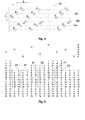
- Fig. 1 shows a piezo printhead 10 according to the prior art, having nozzles 12 which are divided into three sets, called a set of A nozzles, a set of B nozzles and a set of C nozzles, each set intended to be fired during different firing cycles.
- the different sets of nozzles are staggered with respect to each other over a stagger distance D1 in the fast scan direction.
- the nozzles are divided in groups G of three, every first nozzle is part of the set of A nozzles, every second nozzle is part of the set of B nozzles and every third nozzle is part of the set of C nozzles. All nozzles in one set A, B, C are positioned on a straight line in the slow scan direction S, which lines are located at the stagger distance D1 with respect to each other in the fast scan direction F.
- the firing frequency is 12.4 kHz, meaning that every set A, B, C of nozzles can be fired every 80.65 ⁇ s
- the nozzles 12 are fired in an ABC sequence, with the A nozzles at the leading edge of the printhead 10 in the fast scan direction F.
- the set of B nozzles fires 26.88 ⁇ s after the set of A nozzles
- the set of C nozzles fires 53.76 ⁇ s after the set of A nozzles.
- 80.65 ⁇ s the set of A nozzles fires again.
- One type of printing may be called “mutually interstitial printing”, also called shingling e.g. as in US-4,967,203, in which adjacent pixels on a raster line in the fast scan direction are not printed by the same nozzle in the printhead.
- Printing dictionaries refer to “shingling” as a method to compensate for creep in book-making.
- the inventors are not aware of any industrially accepted term for the printing method wherein no adjacent pixels on a raster line are printed by one and the same nozzle. Therefore, from here on and in what follows, the terms “mutually interstitial printing” or “interstitial mutually interspersed printing” are used.
- an image to be printed is split up in a set of sub-images, each sub-image comprising printed parts and spaces, and wherein at least a part of the spaces in one printed sub-image form a location for the printed parts of another sub-image, and vice versa.
- the printhead speed should theoretically double to 1.750 m/s.
- the delays for firing B and C need to be shorter to make sure that dots are printed on the same line.
- Nozzle set B has to be fired 13.44 ⁇ s after nozzle set A, and nozzle set C 26.88 ⁇ s after nozzle set A.
- a print head used has a longitudinal axis in a slow scan direction and has an array of marking elements comprising at least one group of marking elements.
- Marking elements of one group are staggered with respect to each other over a stagger distance in a fast scan direction, which is perpendicular to the slow scan direction.
- the print head is intended to be driven with a reference velocity Vref, which is equal to the stagger distance, multiplied by a reference firing frequency Fref.
- One marking element of a group is able to be fired at each reference firing frequency pulse (whether it fires depends upon the image to be printed).
- the marking elements of the print head are intended to be fired according to a reference firing order to print an image with a first resolution.
- the method of the present invention is characterised in that it is operated at an operating velocity that is different from the reference velocity so as to print the same image with a different resolution.
- the operating velocity may be equal to reference velocity / nX +1 or to reference velocity / nX -1 , X being an integer larger than 0.
- the firing order of the marking elements equals the reference firing order
- it equals the inverse of the reference firing order
- the above methods may be used for carrying out fast mutually interstitial printing.
- the present invention also includes a printing device with a print head (10) having a longitudinal axis in a first direction (S) and having an array of marking elements (A, B, C; A, B, C, D) comprising at least one group (G) of marking elements (A, B, C; A, B, C, D), marking elements (A, B, C; A, B, C, D) of one group (G) being staggered with respect to each other over a stagger distance (D1) in a second direction (F) perpendicular to the first direction (S), the print head (10) being intended to be driven with a reference velocity (Vref) equal to the stagger distance (D1) multiplied by a reference firing frequency (Fref), one marking element of a group being firable at each reference firing frequency pulse, the marking elements (A, B, C; A, B, C, D) of the print head (10) being intended to be fired according to a reference firing order to print an image at a first resolution, further comprising means for driving the
- n marking elements A, B, C; A, B, C, D
- the operating velocity for printing with the second resolution is equal to reference velocity / nX +1 , X being an integer larger than or equal to 0.
- the firing order of the marking elements (A, B, C; A, B, C, D) to print the second resolution being the same as the reference firing order (ABC; ABCD).
- this printing device has n marking elements (A, B, C; A, B, C, D) in one group (G), wherein the operating velocity to print the second resolution is equal to reference velocity / nX -1 , X being an integer larger than 0, the firing order of the marking elements (A, B, C; A, B, C, D) to print the second resolution equalling the inverse of the reference firing order (CBA; DCBA).
- the marking elements (A, B, C; A, B, C, D) of one group (G) may be staggered with respect to each other over a stagger distance (D1) in a second direction (F) perpendicular to the first direction (S) to form a plurality of rows of marking elements, and the printing device may be adapted to supply printing data representing the image to the marking elements of one row which is delayed with respect to the printing data supplied to another row.
- the present invention also includes a computer program product for executing any of the methods of the present invention when executed on a computing device associated with a printing head.
- a machine readable data storage device may store the computer program product.
- the computer program product may be transmitted over a local or wide area telecommunications network.
- the present invention also includes a control unit for a printer for printing an image on a printing medium using a print head (10) having a longitudinal axis in a first direction (S) and having an array of marking elements (A, B, C; A, B, C, D) comprising at least one group (G) of marking elements (A, B, C; A, B, C, D), marking elements (A, B, C; A, B, C, D) of one group (G) being staggered with respect to each other over a stagger distance (D1) in a second direction (F) perpendicular to the first direction (S), the control unit being adapted to control the driving of the print head (10) with a reference velocity (Vref) equal to the stagger distance (D1) multiplied by a reference firing frequency (Fref), and for controlling the firing of one marking element of a group at each reference firing frequency pulse, and for controlling the firing of the marking elements (A, B, C; A, B, C, D) of the print head (10) according to
- printing should be construed broadly. It relates to forming markings whether by ink or other materials or methods onto a printing substrate.
- Various printing methods which may be used with the present invention are described in the book “Principles of non-impact printing", J. L. Johnson, Palatino Press, Irvine, 1998, e.g. thermal transfer printing, thermal dye transfer printing, deflected ink jet printing, ion projection printing, field control printing, impulse ink jet printing, drop-on-demand ink jet printing, continuous ink jet printing.
- Non-contact printing methods are particularly preferred.
- the present invention is not limited thereto. Any form of printing including dots or droplets on a substrate is included within the scope of the present invention, e.g.
- piezoelectric printing heads may be used to print polymer materials as used and described by Plastic Logic ( http://plasticlogic.com/ ) for the printing of thin film transistors.
- the term "printing” in accordance with the present invention not only includes marking with conventional staining inks but also the formation of printed 2-D or 3-D structures or areas of different characteristics on a substrate.
- the term "printing medium” or “printing substrate” should also be given a wide meaning including not only paper, transparent sheets, textiles but also flat plates or curved plates which may be included in or be part of a printing press.
- the printing may be carried out at room temperature or at elevated temperature, e.g. to print a hot-melt adhesive the printing head may be heated above the melting temperature.
- the term "ink” should also be interpreted broadly including not only conventional inks but also solid materials such as polymers which may be printed in solution or by lowering their viscosity at high temperatures as well as materials which provide some characteristic to a printed substrate such as information defined by a structure on the surface of the printing substrate, water repellence, or binding molecules such as DNA which are spotted onto microarrays.
- solvents both water and organic solvents may be used.
- Inks as used with the present invention may include a variety of additives such as ant-oxidants, pigments and cross-linking agents.
- the speed in the fast scan direction is changed with reference to a reference velocity which the printhead is intended to be driven with, while preferably keeping the firing frequency of the sets of nozzles unchanged. This is done in order to be able to print, with a printhead of a certain type, which is intended to print images with a certain resolution, images with other resolutions. If needed, the firing sequence is changed as well.
- a printhead 10 used according to the first embodiment has three sets of marking elements or nozzles 12: a set of A-nozzles, a set of B-nozzles and a set of C-nozzles. This means that there a three nozzles 12 in one group G, as represented in Fig. 1.
- a printhead 10 intended to print images of a certain basic resolution
- changing the firing sequence from ABC to CBA while using half the fast scan speed used for the ABC sequence makes it possible to print images with a resolution which is the double of the basic resolution.
- a type 360 head with a stagger distance D1 of 23.52 ⁇ m between two neighbouring sets of nozzles, which head 10 is normally intended to be fired (in an ABC firing sequence) at a frequency of 12.4 kHz and moved with a speed of 0.875 m/s, can be used for printing images with a resolution of 720 dpi by using half the fast scan speed (i.e. 0.4375 m/s) and by firing the nozzles in a sequence CBA.
- the set of C nozzles is fired first, the set of B nozzles is already 23.52 ⁇ m ahead in the fast scan direction F. At a speed of 0.875 m/s (at a firing frequency of 12.4 kHz), the set of B nozzles would have travelled another 23.52 ⁇ m in the fast scan direction F before actually firing. When, however, half the fast scan speed is used, the set of B nozzles will only travel over 11.76 ⁇ m before it is fired, so that there is a distance of 35.28 ⁇ m in the fast scan direction between the dots printed by the set of C nozzles and the dots printed by the set of B nozzles. This corresponds to the distance between dots in a 720 dpi image.
- the dots printed by the sets of A, B and C nozzles in one cycle are not printed on one straight line, with a pitch of 1/360 inch between lines printed during different cycles, but instead they are printed on three different lines with a pitch of 1/720 inch between them.
- pitches or modes are possible with the same head type at different fast scan speeds.
- the only difference with the "standard pitch” is that the dots printed during one CBA cycle are not on one straight line, contrary to the dots printed during one normal ABC cycle.
- a "normal ABC cycle” is meant: firing the nozzles 12 in an ABC firing sequence, with a reference firing frequency and driving the head 10 with a reference driving speed for which the head 10 is intended.
- V mode V FF c with v mode the speed for the considered mode
- v FF the reference speed for the head type for use with a predetermined firing frequency FF.
- the speed V FF is given by (phi) ⁇ x nozzle stagger distance (D I ) x the firing frequency where ⁇ (phi) is the number of staggered rows of nozzles.
- a more in depth analysis shows that a type 90 head offers following possibilities: Head type Nozzle stagger Firing frequency Desired image resolution in fast scan direction Head speed Cycling direction 90 94.07 ⁇ m 12400 Hz 90 dpi 3.50 m/s ABC 90 94.07 ⁇ m 12400 Hz 180 dpi 1.75 m/s CBA 90 94.07 ⁇ m 12400 Hz 360 dpi 0.87 m/s ABC 90 94.07 ⁇ m 12400 Hz 450 dpi 0.70 m/s CBA 90 94.07 ⁇ m 12400 Hz 630 dpi 0.50 m/s ABC 90 94.07 ⁇ m 12400 Hz 720 dpi 0.44 m/s CBA 90 94.07 ⁇ m 12400 Hz 900 dpi 0.35 m/s ABC 90 94.07 ⁇ m 12400 Hz 990 dpi 0.32 m/s CBA 90 94.07 ⁇ m 12400 Hz 1170 d
- the pixels printed during one printing cycle are not printed in one row.
- nozzle A prints dots on an image line during cycle x
- the B nozzles will print during cycle x+int( c /3) and the C nozzles during cycle x+int(2 c /3) on the same image line.
- nozzle A prints dots on an image line during cycle x
- the B nozzles will print on the same image line during cycle x+int( c /3)+1 and the C nozzles will print on the same image line during cycle x+int(2 c /3)+1.
- the set of A nozzles is driven first.
- a nozzles eject a drop on locations 14 on a straight line 16 in the slow scan direction S.
- the set of C nozzles is located at a location 20 at a distance of 188.15 ⁇ m behind the set of A nozzles.
- the set of B nozzles ejects a drop on locations 22 on a straight line 24 in the slow scan direction S, where necessary according to the image to be printed.
- the set of C nozzles is located at a location 26 at a distance of 94.07 ⁇ m behind the set of B nozzles.
- the set of C nozzles ejects a drop on locations 28 on a straight line 30 in the slow scan direction S, where necessary according to the image to be printed.
- the set of A nozzles is located at a location 32 at a distance of 188.15 ⁇ m in front of the set of C nozzles, and the set of B nozzles is located at a location 34 at a distance of 94.07 ⁇ m behind the set of A (or 94.07 ⁇ m in front of the set of C nozzles).
- the head 10 is moved over a distance of 13.44 ⁇ m in the fast scan direction F.
- the set of A nozzles eject a drop on locations 36 on a straight line 38 in the slow scan direction S, where necessary according to the image to be printed.
- the set of B nozzles is located at a location 40 at a distance of 94.07 ⁇ m behind the set of A nozzles.
- the head 10 is moved over a distance of 13.44 ⁇ m in the fast scan direction F.
- the set of B nozzles eject a drop on locations 42 on a straight line 43 in the slow scan direction S, where necessary according to the image to be printed.
- the printhead 10 continues to move on in the fast scan direction F up to the end of the printing medium on which an image is to be printed, according to the content of the image to be printed. Dots are printed on straight lines 16, 24, 30, 38, 43 and so on, in the slow scan direction S, each straight line comprising dots printed by the set of A nozzles, the set of B nozzles and the set of C nozzles, if necessary for the image to be printed.
- a nozzle plate 50 of two nozzle arrays 52, 54 is shown, each nozzle array 52, 54 having 225 npi (nozzles per inch), and placed so that the combined resolution is 450 dpi (i.e. whereby each nozzle of the second nozzle array 54 is always located in the middle, in the slow scan direction S, between two nozzles of the first nozzle array 52).
- the distance between two adjacent nozzles of one nozzle array in the slow scan direction S is 112.89 ⁇ m.
- the nozzle stagger in the fast scan direction F is 94.07 ⁇ m (type 90 head).
- the type 90 head is used in 450 dpi mode to obtain an image with a resolution of 900 dpi in at least two passes.
- a type 90 head used in mode 450 follows a CBA printing cycle, as shown in Table 1.
- C nozzles eject a drop on the printing medium, whereby C nozzles of the first nozzle array 52 eject drops on locations 62, and C nozzles of the second nozzle array 54 eject drops on locations 64.
- the set of B nozzles of the first nozzle array 52 ejects a drop on locations 70, where necessary according to the image to be printed
- the set of B nozzles in the second array 54 ejects a drop on locations 72, where necessary according to the image to be printed.
- the set of A nozzles of the first array 52 is located at a location 74 at a distance of 94.07 ⁇ m before the set of B nozzles of the first array 52
- the set of A nozzles of the second array 54 is located at a location 76 at a distance of 94.07 ⁇ m before the set of B nozzles of the second array 54.
- the head 50 Before firing the sets of A nozzles, the head 50 is moved over a distance of 18.81 ⁇ m in the fast scan direction F.
- the set of A nozzles of the first array 52 ejects a drop on locations 78
- the set of A nozzles of the second array 54 ejects a drop on location 80, both where necessary according to the image to be printed.
- the set of C nozzles of the first array 52 is located at locations 82, and the set of C nozzles of the second array 54 is located at locations 84.
- the head 50 is moved over a distance of 18.81 ⁇ m in the fast scan direction F.
- the set of C nozzles of the first array 52 ejects a drop on locations 86, and the set of C nozzles of the second array 54 ejects a drop on locations 88, both where necessary according to the image to be printed.
- the set of B nozzles of the first array 52 is located at location 90 at a distance of 94.07 ⁇ m before the set of C nozzles of the first array 52
- the set of B nozzles of the second array 54 is located at locations 92 at a distance of 94.07 ⁇ m before the set of C nozzles of the second array 54.
- the head 50 is moved over a distance of 18.81 ⁇ m in the fast scan direction F.
- the set of B nozzles of the first nozzle array 52 ejects a drop on locations 94, where necessary according to the image to be printed
- the set of B nozzles in the second array 54 ejects a drop on locations 96, where necessary according to the image to be printed.
- the set of A nozzles of the first array 52 is located at a location 98 at a distance of 94.07 ⁇ m before the set of B nozzles of the first array 52
- the set of A nozzles of the second array 54 is located at a location 100 at a distance of 94.07 ⁇ m before the set of B nozzles of the second array 54.
- the head 50 Before firing the sets of A nozzles during the second cycle, the head 50 is moved over a distance of 18.81 ⁇ m in the fast scan direction F.
- the set of A nozzles of the first array 52 ejects a drop on locations 102, where necessary according to the image to be printed
- the set of A nozzles of the second array 54 ejects a drop on location 104, where necessary according to the image to be printed.
- the set of C nozzles of the first array 52 is located at locations 106, and the set of C nozzles of the second array 54 is located at locations 108.
- the head 50 is moved over a distance of 18.81 ⁇ m in the fast scan direction F.
- the set of C nozzles of the first array 52 ejects a drop on locations 110, where necessary according to the image to be printed, and the set of C nozzles of the second array 54 ejects a drop on locations 112, where necessary according to the image to be printed.
- Drops printed by the set of C nozzles of the first array 52 on locations 110 during the third printing cycle are printed on a straight line 111, on which line 111 previously (during the first printing cycle) drops 70 have been printed by the set of B nozzles of the first array 52.
- drops printed by the set of C nozzles of the second array 54 on locations 112 during the third printing cycle are printed on a straight line 113, on which line 113 previously (during the first printing cycle) drops 72 have been printed by the set of B nozzles of the second array 54.
- the printhead 50 Before starting a second pass, the printhead 50 is moved in the slow scan direction S so as to make droplets fall in between already printed droplets in the slow scan direction S. For the example under consideration, if the resolution is to be obtained in two passes, the printhead 50 is moved in the slow scan direction S over a paper feed distance of 28.22 ⁇ m or an odd multiple thereof. During the second and further printing passes, a CBA cycle is then applied as explained for the first printing pass.
- the most convenient solution consists in shifting the pixel lines along the fast scan direction (if different nozzle arrays are combined resulting in pixel lines belonging to one phase one also speaks of image bands) related to the different phases over a number of cycles as given by formula 6 or 7.
- the shift between pixel line A and B and between B and C is equal to a number equal to the ⁇ cycle as given by formula 6 (formula 7 in case a CBA cycle is involved). It is necessary to reorganise the sequence of input data so that the final image is correctly printed.
- data for pixels on a certain slow scan line is printed by the A phase, the data for the same slow scan line but for the B-phase nozzles will be presented to them later.
- the C-phase nozzles will receive the data related to that slow scan line.
- the B-phase prints during that cycle a dot that is ⁇ cycle dot positions behind the A phase, while the C-phase is printing 2 ⁇ cycle dot positions behind the A phase.
- 2 or 4 dot positions as defined in equation 8.
- the data transformation needs to be done for each new fast scan because it is possible that when using mutually interstitial printing, nozzles belonging to different phases print a certain pixel line in the fast direction.
- This printing technique requires more pixel positions than the number of pixel positions in a fast scan pixel line to finish a fast scan than would be required if the nozzles were not staggered but on a straight line.
- the printhead itself consists of 2 nozzle arrays 132, 134, each having 382 nozzles with each a nozzle pitch of 180 npi. By shifting both nozzle arrays 132, 134 over half a pitch, the complete 764 nozzle head 130 has a nozzle pitch of 360 npi.
- Each of the two nozzle arrays 132, 134 consists of 3 phases (A, B and C). The calculation given does not consider the staggering of the nozzles in the different phases nor the phases itself.
- First an imaginary paper feed L base is calculated by dividing the length of the head 130 (expressed in pixels on the final resolution) by the total number of required passes (equal to the number of sub-images to be printed).
- NP (1/360) inch
- pixel pitch DP (1/720) inch.
- the last pixel corresponding with nozzle 764 is pixel 1527.
- the image needed is 1527 x w p x 720 (with 720 dpi resolution and w p the printing width).
- the number of passes needed to print all pixels is given by P(I/hs), where P is the number of mutually interstitial printing passes, I is the required number of interlacing steps (normally given by dpi/npi or NP/DP).
- Interlacing is used to increase the resolution of a printing device. That is, although the spacing between nozzles on the printing head along the slow scan direction S is a certain distance X, the distance between printed dots in the slow scan direction S is less than this distance.
- the relative movement between the printing medium (not shown) and the printing head 130 is indexed by a distance given by the distance X divided by an integer.
- L base in the given example is the integer value being 95 pixels.
- I' I hs , I being the number of interlacing steps needed and hs being the number of nozzle rows printing the same colour.
- the value of 94 is incremented by l 1 or l 2 (respectively for a first paper feed L 1 and a second paper feed L 2 ).
- An odd value for one of the paper feeds guarantees that there will also be printed on pixel lines not addressed before (the other paper feed can be even).
- the above formulae for the first paper feed L 1 and the second paper feed L 2 can generate a whole set of values depending on the chosen l 1 , l 2 and j and i. By applying a number of boundary conditions on l 1 , l 2 for I'>2, this set can be limited. if I' > 2 then l 1 + l 2 ⁇ kI' k integer
- L 1 and L 2 must meet a set of two equations :
- Equation (16) can find all L 1 , L 2 and associated a and b based on l 1 , l 2 , i and j . Although this is the most general method, it is often advantageous to restrict to a subset of the above. The above method allows any filling order.
- CMYK complementary metal-oxide-semiconductor
- the image is being filled up in a regular way. This can be guaranteed by shifting nozzle arrays of a different colour over a distance of at least 3/P in the slow scan direction, P being the number of mutually interstitial printing passes.
- P being the number of mutually interstitial printing passes.
- the value of 3 is derived as follows: a sub-image table counts N lines. When in a sub-image table three pixel rows are filled row by row, there can be started with the next colour on the second row (also starting on the first row could result in bleeding towards row N of the sub image table), while the first colour is printed on the fourth row.
- the distance two consecutive heads need to be shifted is at least 3/P.
- the B and C nozzles are not used during the same ABC cycle.
- the A nozzles pass above pixels indicated with 5, but are not fired. Instead the B nozzles are fired during this pass 1 above the location indicated with 5. So the A and C nozzles are not fired during this second ABC cycle.
- the A-nozzles and the B-nozzles pass above pixels 9 without being fired, while the C-nozzles are fired at pixels indicated with a 9.
- the next fire pulse is a fully redundant pulse: no nozzles are fired at position 13.
- the B and C nozzles are not used during the same ABC cycle.
- the A nozzles pass above pixels indicated with 6, but are not fired. Instead the B nozzles are fired during this pass 2 above the location indicated with 6. So the A and C nozzles are not fired during this second ABC cycle.
- the A-nozzles and the B-nozzles pass above pixels 10 without being fired, while the C-nozzles are fired at pixels indicated with a 10.
- the next fire pulse is a fully redundant pulse: no nozzles are fired at position 14.
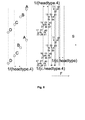
- a printing scheme for a system with four marking elements in a group (number of phases ⁇ is four) is given in Fig. 6, and is explained hereinafter.
- the normal speed or reference speed for a 90 type head is 3.50 m/s.
- the set of A nozzles is driven. Where necessary, according to the image, A nozzles eject a drop on locations 11.
- the set of C nozzles is located at location 15 at a distance of 141.11 ⁇ m behind the set of A nozzles
- the set of D nozzles is located at location 17 at a distance of 211.67 ⁇ m behind the set of A nozzles.
- the set of B nozzles eject a drop on locations 19, where necessary according to the image to be printed.
- the set of C nozzles At the moment of firing the set of B nozzles, the set of C nozzles is located at a location 21 at a distance of 70.56 ⁇ m behind the set of B nozzles, and the set of D nozzles is located at a location 23 at a distance of 141.11 ⁇ m behind the set of B nozzles.
- the head 10 Before firing the set of C nozzles, the head 10 is moved over a distance of 14.11 ⁇ m in the fast scan direction F.
- the set of C nozzles eject a drop on locations 25 where necessary according to the image to be printed.
- the set of D nozzles is located at a location 27 at a distance of 70.56 ⁇ m behind the set of C nozzles.
- the head 10 is moved over a distance of 14.11 ⁇ m in the fast scan direction F.
- the set of D nozzles eject a drop on location 29, where necessary according to the image to be printed.
- the set of A nozzles is located at a location 31 at a distance of 211.67 ⁇ m in front of the set of D nozzles
- the set of B nozzles is located at a location 33 at a distance of 141.11 ⁇ m in front of the set of D nozzles
- the set of C nozzles is located at locations 35 at a distance of 70.56 ⁇ m in front of the set of D nozzles.
- the set of B nozzles is located at a location 39 at a distance of 70.56 ⁇ m behind the set of A nozzles.
- the head 10 is moved over a distance of 14.11 ⁇ m in the fast scan direction F.
- the set of B nozzles eject a drop on locations 41, where necessary according to the image to be printed.
- the set of C nozzles is located at locations 45 at a distance of 70.56 ⁇ m behind the set of B nozzles.
- the head 10 is moved over a distance of 14.11 ⁇ m in the fast scan direction F.
- the set of C nozzles eject a drop on locations 47 where necessary according to the image to be printed.
- the set of D nozzles is located at locations 49 at a distance of 70.56 ⁇ m behind the set of C nozzles.
- the head 10 is moved over a distance of 14.11 ⁇ m in the fast scan direction F.
- the set of D nozzles eject a drop on locations 51, where necessary according to the image to be printed.
- each straight line comprising dots printed with each of the sets of nozzles A, B, C, D.
- Fig. 7 is a highly schematic general perspective view of an inkjet printer 20 which can be used with the present invention.
- the printer 20 includes a base 31, a carriage assembly 32, a step motor 33, a drive belt 34 driven by the step motor 33, and a guide rail assembly 36 for the carriage assembly 32.
- Mounted on the carriage assembly 32 is a print head 10 that has a plurality of nozzles.
- the print head 10 may also include one or more ink cartridges or any suitable ink supply system.
- a sheet of paper 37 is fed in the slow scan direction over a support 38 by a feed mechanism (not shown).
- the carriage assembly 32 is moved along the guide rail assembly 36 by the action of the drive belt 34 driven by the step motor 33 in the fast scanning direction.
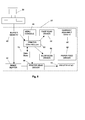
- Fig. 8 is a block diagram of the electronic control system of a printer 20, which is one example of a control system for use with a print head 10 in accordance with the present invention.
- the printer 20 includes a buffer memory 40 for receiving a print file in the form of signals from a host computer 30, an image buffer 42 for storing printing data, and a printer controller 60 that controls the overall operation of the printer 10.
- a fast scan driver 62 for a carriage assembly drive motor 66
- a slow scan driver 64 for a paper feed drive motor 68
- a head driver 44 for the print head 10.
- there is a data store 70 for storing parameters for controlling the interlaced and mutual interstitial printing operation in accordance with the present invention.
- Host computer 30 may be any suitable programmable computing device such as personal computer with a Pentium III microprocessor supplied by Intel Corp. USA, for instance, with memory and a graphical interface such as Windows 98 as supplied by Microsoft Corp. USA.
- the printer controller 60 may include a computing device, e.g. microprocessor, for instance it may be a microcontroller.
- it may include a programmable printer controller, for instance a programmable digital logic element such as a Programmable Array Logic (PAL), a Programmable Logic Array, a Programmable Gate Array, especially a Field Programmable Gate Array (FPGA).
- PAL Programmable Array Logic
- FPGA Field Programmable Gate Array
- the user of printer 20 can optionally set values into the data store 70 so as to modify the operation of the printer head 10.
- the user can for instance set values into the data store 70 by means of a menu console 46 on the printer 20.
- these parameters may be set into the data store 70 from host computer 30, e.g. by manual entry via a keyboard.
- a printer driver (not shown) of the host computer 30 determines the various parameters that define the printing operations and transfers these to the printer controller 60 for writing into the data store 70, e.g. the resolution.
- the printer controller 60 controls the operation of printer head 10 in accordance with settable parameters stored in data store 70.
- the printer controller reads the required information contained in the printing data stored in the buffer memory 40 and sends control signals to the drivers 62, 64 and 44.
- controller 60 is adapted for a dot matrix printer for printing an image on a printing medium, the control unit comprising, software or hardware means for controlling printing of the image as at least one set of monochromatic mutually interstitially printed images, and software or hardware means for setting the resolution.
- the controller may be used for independently setting the resolution.
- the controller is also adapted to control the operation of the printing head 10 so that each mutually interstitial printing step and/or each interlacing step is a pass of the printing head 10 at the appropriate resolution.
- the printing head has an array of marker elements under the control of the controller.
- the controller may be adapted so that for a specific resolution the speed of the head in the fast scan direction and the sequence of firing of the staggered nozzles is controlled.
- the printing data is broken down into the individual colour components to obtain image data in the form of a bit map for each colour component which is stored in the receive buffer memory 30.
- the head driver 44 reads out the colour component image data from the image buffer memory 52 in accordance with a specified resolution to drive the speed and the array(s) of nozzles on the print head 10 to achieve the required resolution.
- the controller 60 may be programmable, e.g. it may include a microprocessor or an FPGA.
- a printer in accordance with the present invention may be programmed to provide different resolutions.
- the basic model of the printer may provide selection of one resolution only.
- An upgrade in the form of a program to download into the microprocessor or FPGA of the controller 60 may provide additional selection functionality, e.g. a plurality of resolutions.
- the present invention includes a computer program product which provides the functionality of any of the methods according to the present invention when executed on a computing device.
- the present invention includes a data carrier such as a CD-ROM or a diskette which stores the computer product in a machine readable form and which executes at least one of the methods of the invention when executed on a computing device.
- a data carrier such as a CD-ROM or a diskette
- the present invention includes transmitting the printing computer product according to the present invention over a local or wide area network.
- the computing device may include one of a microprocessor and an FPGA.
- the data store 70 may comprise any suitable device for storing digital data as known to the skilled person, e.g. a register or set of registers, a memory device such as RAM, EPROM or solid state memory.
- the preparation for the printing file to carry out the above mentioned printed embodiments may be prepared by the host computer 30 and the printer 20 simply prints in accordance with this file as a slave device of the host computer 30.
- the present invention includes that the printing schemes of the present invention are implemented in software on a host computer and printed on a printer which carries out the instructions from the host computer without amendment.
- the present invention includes a computer program product which provides the functionality of any of the methods according to the present invention when executed on a computing device which is associated with a printing head, that is the printing head and the programmable computing device may be included with the printer or the programmable device may be a computer or computer system, e.g. a Local Area Network connected to a printer.
- the printer may be a network printer.
- the present invention includes a data carrier such as a CD-ROM or a diskette which stores the computer product in a machine readable form and which can execute at least one of the methods of the invention when the program stored on the data carrier is executed on a computing device.
- the computing device may include a personal computer or a work station.
- the present invention includes transmitting the printing computer product according to the present invention over a local or wide area network.
Landscapes
- Engineering & Computer Science (AREA)
- Quality & Reliability (AREA)
- Ink Jet (AREA)
Priority Applications (3)
| Application Number | Priority Date | Filing Date | Title |
|---|---|---|---|
| EP02100467A EP1361068A1 (en) | 2002-05-08 | 2002-05-08 | Staggered multi-phase firing of nozzle heads for a printer |
| US10/410,971 US6669330B2 (en) | 2002-05-08 | 2003-04-10 | Staggered multi-phase firing of nozzle heads for a printer |
| JP2003119711A JP2003326687A (ja) | 2002-05-08 | 2003-04-24 | プリンターヘッドを駆動する方法 |
Applications Claiming Priority (1)
| Application Number | Priority Date | Filing Date | Title |
|---|---|---|---|
| EP02100467A EP1361068A1 (en) | 2002-05-08 | 2002-05-08 | Staggered multi-phase firing of nozzle heads for a printer |
Publications (1)
| Publication Number | Publication Date |
|---|---|
| EP1361068A1 true EP1361068A1 (en) | 2003-11-12 |
Family
ID=29225714
Family Applications (1)
| Application Number | Title | Priority Date | Filing Date |
|---|---|---|---|
| EP02100467A Withdrawn EP1361068A1 (en) | 2002-05-08 | 2002-05-08 | Staggered multi-phase firing of nozzle heads for a printer |
Country Status (2)
| Country | Link |
|---|---|
| EP (1) | EP1361068A1 (enExample) |
| JP (1) | JP2003326687A (enExample) |
Cited By (3)
| Publication number | Priority date | Publication date | Assignee | Title |
|---|---|---|---|---|
| US6669330B2 (en) | 2002-05-08 | 2003-12-30 | Agfa-Gevaert | Staggered multi-phase firing of nozzle heads for a printer |
| WO2006131137A1 (en) * | 2005-06-09 | 2006-12-14 | Telecom Italia S.P.A. | Ink-jet printing method and ink-jet printing sytsem for multi-definition printing |
| WO2019115608A1 (en) * | 2017-12-13 | 2019-06-20 | Xeikon Manufacturing N.V. | Digital printing apparatus and method |
Families Citing this family (3)
| Publication number | Priority date | Publication date | Assignee | Title |
|---|---|---|---|---|
| JP5034591B2 (ja) * | 2007-03-23 | 2012-09-26 | コニカミノルタホールディングス株式会社 | インクジェット記録装置 |
| JP5084413B2 (ja) * | 2007-09-07 | 2012-11-28 | 大日本スクリーン製造株式会社 | 印刷装置および印刷方法 |
| JP6241019B2 (ja) * | 2012-04-17 | 2017-12-06 | ブラザー工業株式会社 | インクジェットプリンタ |
Citations (7)
| Publication number | Priority date | Publication date | Assignee | Title |
|---|---|---|---|---|
| US4887100A (en) | 1987-01-10 | 1989-12-12 | Am International, Inc. | Droplet deposition apparatus |
| US4967203A (en) | 1989-09-29 | 1990-10-30 | Hewlett-Packard Company | Interlace printing process |
| US4972270A (en) * | 1989-04-17 | 1990-11-20 | Stephen Kurtin | Facsimile recorder with acutely mounted staggered array ink jet printhead |
| EP0623473A2 (en) * | 1993-05-03 | 1994-11-09 | Hewlett-Packard Company | Increased print resolution in the carriage scan axis of an inkjet printer |
| WO1996010488A1 (en) | 1994-09-30 | 1996-04-11 | Xaar Limited | Method of multi-tone printing |
| WO1997004963A1 (en) | 1995-07-26 | 1997-02-13 | Xaar Limited | Pulsed droplet deposition apparatus |
| WO1999012738A1 (en) | 1997-09-08 | 1999-03-18 | Xaar Technology Limited | Drop-on-demand multi-tone printing |
-
2002
- 2002-05-08 EP EP02100467A patent/EP1361068A1/en not_active Withdrawn
-
2003
- 2003-04-24 JP JP2003119711A patent/JP2003326687A/ja active Pending
Patent Citations (7)
| Publication number | Priority date | Publication date | Assignee | Title |
|---|---|---|---|---|
| US4887100A (en) | 1987-01-10 | 1989-12-12 | Am International, Inc. | Droplet deposition apparatus |
| US4972270A (en) * | 1989-04-17 | 1990-11-20 | Stephen Kurtin | Facsimile recorder with acutely mounted staggered array ink jet printhead |
| US4967203A (en) | 1989-09-29 | 1990-10-30 | Hewlett-Packard Company | Interlace printing process |
| EP0623473A2 (en) * | 1993-05-03 | 1994-11-09 | Hewlett-Packard Company | Increased print resolution in the carriage scan axis of an inkjet printer |
| WO1996010488A1 (en) | 1994-09-30 | 1996-04-11 | Xaar Limited | Method of multi-tone printing |
| WO1997004963A1 (en) | 1995-07-26 | 1997-02-13 | Xaar Limited | Pulsed droplet deposition apparatus |
| WO1999012738A1 (en) | 1997-09-08 | 1999-03-18 | Xaar Technology Limited | Drop-on-demand multi-tone printing |
Cited By (7)
| Publication number | Priority date | Publication date | Assignee | Title |
|---|---|---|---|---|
| US6669330B2 (en) | 2002-05-08 | 2003-12-30 | Agfa-Gevaert | Staggered multi-phase firing of nozzle heads for a printer |
| WO2006131137A1 (en) * | 2005-06-09 | 2006-12-14 | Telecom Italia S.P.A. | Ink-jet printing method and ink-jet printing sytsem for multi-definition printing |
| US8201906B2 (en) | 2005-06-09 | 2012-06-19 | Telecom Italia S.P.A. | Ink-jet printing method and ink-jet printing system for multi-definition printing |
| WO2019115608A1 (en) * | 2017-12-13 | 2019-06-20 | Xeikon Manufacturing N.V. | Digital printing apparatus and method |
| NL2020081B1 (en) * | 2017-12-13 | 2019-06-21 | Xeikon Mfg Nv | Digital printing apparatus and method |
| CN111479696A (zh) * | 2017-12-13 | 2020-07-31 | 西康制造有限公司 | 数字打印装置和方法 |
| US11298936B2 (en) | 2017-12-13 | 2022-04-12 | Xeikon Manufacturing N.V. | Digital printing apparatus and method |
Also Published As
| Publication number | Publication date |
|---|---|
| JP2003326687A (ja) | 2003-11-19 |
Similar Documents
| Publication | Publication Date | Title |
|---|---|---|
| JP2000211166A (ja) | 一つの印刷ヘッド上の複数の寸法のインク滴放出器を用いた印刷方法 | |
| US6669330B2 (en) | Staggered multi-phase firing of nozzle heads for a printer | |
| US6402280B2 (en) | Printhead with close-packed configuration of alternating sized drop ejectors and method of firing such drop ejectors | |
| CN103568569B (zh) | 液体排出装置及其控制方法 | |
| JP2944805B2 (ja) | インクジェットプリンタ及び印字方法 | |
| US6679583B2 (en) | Fast mutually interstitial printing | |
| JPH0569598A (ja) | インタレース印刷方法 | |
| JPH07276794A (ja) | 図形像のプリンティング方法及びそのプリンティング装置 | |
| US6682172B2 (en) | Method and apparatus for maintaining colour sequence when printing | |
| CN103568565B (zh) | 液体排出装置及液体排出控制方法 | |
| EP1361068A1 (en) | Staggered multi-phase firing of nozzle heads for a printer | |
| JPH06135013A (ja) | 多色インクを使用したインクジェット記録方法 | |
| US6902247B2 (en) | Multi-resolution printing method and printing device | |
| EP1361070B1 (en) | Multi-resolution printing method and printing device | |
| US7025437B2 (en) | Printing methods and apparatus for mutually interstitial printing and optional interlacing | |
| EP1308296B1 (en) | Method and apparatus for maintaining colour sequence when printing | |
| EP1642723B1 (en) | Printing methods and apparatus for reducing banding due to paper transport | |
| US20030128252A1 (en) | Printing methods and apparatus for reducing banding due to paper transport | |
| JP2012030594A (ja) | インクジェット記録装置および記録方法 | |
| EP1308293B1 (en) | Printing methods and apparatus for mutually interstitial printing and optional interlacing | |
| EP0897804A2 (en) | Liquid ink printhead | |
| EP1308881A1 (en) | Fast mutually interstitial printing | |
| EP1621353B1 (en) | Printing apparatus for maintaining colour sequence when printing | |
| EP1893412B1 (en) | Ink-jet printing method and ink-jet printing sytsem for multi-definition printing | |
| JPH07323610A (ja) | 分割記録方法及びその装置 |
Legal Events
| Date | Code | Title | Description |
|---|---|---|---|
| PUAI | Public reference made under article 153(3) epc to a published international application that has entered the european phase |
Free format text: ORIGINAL CODE: 0009012 |
|
| AK | Designated contracting states |
Kind code of ref document: A1 Designated state(s): AT BE CH CY DE DK ES FI FR GB GR IE IT LI LU MC NL PT SE TR |
|
| AX | Request for extension of the european patent |
Extension state: AL LT LV MK RO SI |
|
| 17P | Request for examination filed |
Effective date: 20040512 |
|
| AKX | Designation fees paid |
Designated state(s): DE FR GB |
|
| RAP1 | Party data changed (applicant data changed or rights of an application transferred) |
Owner name: AGFA GRAPHICS N.V. |
|
| 17Q | First examination report despatched |
Effective date: 20080414 |
|
| STAA | Information on the status of an ep patent application or granted ep patent |
Free format text: STATUS: THE APPLICATION IS DEEMED TO BE WITHDRAWN |
|
| 18D | Application deemed to be withdrawn |
Effective date: 20111006 |