EP1359234A1 - Alloyed zinc dip galvanized steel sheet - Google Patents
Alloyed zinc dip galvanized steel sheet Download PDFInfo
- Publication number
- EP1359234A1 EP1359234A1 EP02710485A EP02710485A EP1359234A1 EP 1359234 A1 EP1359234 A1 EP 1359234A1 EP 02710485 A EP02710485 A EP 02710485A EP 02710485 A EP02710485 A EP 02710485A EP 1359234 A1 EP1359234 A1 EP 1359234A1
- Authority
- EP
- European Patent Office
- Prior art keywords
- steel sheet
- galvannealing
- phase
- coating
- mass
- Prior art date
- Legal status (The legal status is an assumption and is not a legal conclusion. Google has not performed a legal analysis and makes no representation as to the accuracy of the status listed.)
- Withdrawn
Links
Images


Classifications
-
- C—CHEMISTRY; METALLURGY
- C22—METALLURGY; FERROUS OR NON-FERROUS ALLOYS; TREATMENT OF ALLOYS OR NON-FERROUS METALS
- C22C—ALLOYS
- C22C38/00—Ferrous alloys, e.g. steel alloys
-
- C—CHEMISTRY; METALLURGY
- C22—METALLURGY; FERROUS OR NON-FERROUS ALLOYS; TREATMENT OF ALLOYS OR NON-FERROUS METALS
- C22C—ALLOYS
- C22C38/00—Ferrous alloys, e.g. steel alloys
- C22C38/14—Ferrous alloys, e.g. steel alloys containing titanium or zirconium
-
- C—CHEMISTRY; METALLURGY
- C22—METALLURGY; FERROUS OR NON-FERROUS ALLOYS; TREATMENT OF ALLOYS OR NON-FERROUS METALS
- C22C—ALLOYS
- C22C38/00—Ferrous alloys, e.g. steel alloys
- C22C38/004—Very low carbon steels, i.e. having a carbon content of less than 0,01%
-
- C—CHEMISTRY; METALLURGY
- C22—METALLURGY; FERROUS OR NON-FERROUS ALLOYS; TREATMENT OF ALLOYS OR NON-FERROUS METALS
- C22C—ALLOYS
- C22C38/00—Ferrous alloys, e.g. steel alloys
- C22C38/04—Ferrous alloys, e.g. steel alloys containing manganese
-
- C—CHEMISTRY; METALLURGY
- C22—METALLURGY; FERROUS OR NON-FERROUS ALLOYS; TREATMENT OF ALLOYS OR NON-FERROUS METALS
- C22C—ALLOYS
- C22C38/00—Ferrous alloys, e.g. steel alloys
- C22C38/06—Ferrous alloys, e.g. steel alloys containing aluminium
-
- C—CHEMISTRY; METALLURGY
- C22—METALLURGY; FERROUS OR NON-FERROUS ALLOYS; TREATMENT OF ALLOYS OR NON-FERROUS METALS
- C22C—ALLOYS
- C22C38/00—Ferrous alloys, e.g. steel alloys
- C22C38/12—Ferrous alloys, e.g. steel alloys containing tungsten, tantalum, molybdenum, vanadium, or niobium
-
- C—CHEMISTRY; METALLURGY
- C23—COATING METALLIC MATERIAL; COATING MATERIAL WITH METALLIC MATERIAL; CHEMICAL SURFACE TREATMENT; DIFFUSION TREATMENT OF METALLIC MATERIAL; COATING BY VACUUM EVAPORATION, BY SPUTTERING, BY ION IMPLANTATION OR BY CHEMICAL VAPOUR DEPOSITION, IN GENERAL; INHIBITING CORROSION OF METALLIC MATERIAL OR INCRUSTATION IN GENERAL
- C23C—COATING METALLIC MATERIAL; COATING MATERIAL WITH METALLIC MATERIAL; SURFACE TREATMENT OF METALLIC MATERIAL BY DIFFUSION INTO THE SURFACE, BY CHEMICAL CONVERSION OR SUBSTITUTION; COATING BY VACUUM EVAPORATION, BY SPUTTERING, BY ION IMPLANTATION OR BY CHEMICAL VAPOUR DEPOSITION, IN GENERAL
- C23C2/00—Hot-dipping or immersion processes for applying the coating material in the molten state without affecting the shape; Apparatus therefor
- C23C2/04—Hot-dipping or immersion processes for applying the coating material in the molten state without affecting the shape; Apparatus therefor characterised by the coating material
- C23C2/06—Zinc or cadmium or alloys based thereon
-
- C—CHEMISTRY; METALLURGY
- C23—COATING METALLIC MATERIAL; COATING MATERIAL WITH METALLIC MATERIAL; CHEMICAL SURFACE TREATMENT; DIFFUSION TREATMENT OF METALLIC MATERIAL; COATING BY VACUUM EVAPORATION, BY SPUTTERING, BY ION IMPLANTATION OR BY CHEMICAL VAPOUR DEPOSITION, IN GENERAL; INHIBITING CORROSION OF METALLIC MATERIAL OR INCRUSTATION IN GENERAL
- C23C—COATING METALLIC MATERIAL; COATING MATERIAL WITH METALLIC MATERIAL; SURFACE TREATMENT OF METALLIC MATERIAL BY DIFFUSION INTO THE SURFACE, BY CHEMICAL CONVERSION OR SUBSTITUTION; COATING BY VACUUM EVAPORATION, BY SPUTTERING, BY ION IMPLANTATION OR BY CHEMICAL VAPOUR DEPOSITION, IN GENERAL
- C23C2/00—Hot-dipping or immersion processes for applying the coating material in the molten state without affecting the shape; Apparatus therefor
- C23C2/26—After-treatment
- C23C2/28—Thermal after-treatment, e.g. treatment in oil bath
-
- Y—GENERAL TAGGING OF NEW TECHNOLOGICAL DEVELOPMENTS; GENERAL TAGGING OF CROSS-SECTIONAL TECHNOLOGIES SPANNING OVER SEVERAL SECTIONS OF THE IPC; TECHNICAL SUBJECTS COVERED BY FORMER USPC CROSS-REFERENCE ART COLLECTIONS [XRACs] AND DIGESTS
- Y10—TECHNICAL SUBJECTS COVERED BY FORMER USPC
- Y10T—TECHNICAL SUBJECTS COVERED BY FORMER US CLASSIFICATION
- Y10T428/00—Stock material or miscellaneous articles
- Y10T428/12—All metal or with adjacent metals
- Y10T428/12493—Composite; i.e., plural, adjacent, spatially distinct metal components [e.g., layers, joint, etc.]
- Y10T428/12771—Transition metal-base component
- Y10T428/12785—Group IIB metal-base component
- Y10T428/12792—Zn-base component
- Y10T428/12799—Next to Fe-base component [e.g., galvanized]
Definitions
- the present invention relates to a galvannealed steel sheet for use in an automobile steel sheet (including steel strip). More particularly, the present invention relates to a galvannealed steel sheet (hereinafter may be referred to as "GA") having a surface appearance with no non-coating, ripple, galvannealing non-uniformity, and having excellent press formability (powdering resistance, friction property), and its production method.
- GA galvannealed steel sheet having a surface appearance with no non-coating, ripple, galvannealing non-uniformity, and having excellent press formability (powdering resistance, friction property), and its production method.
- Galvannealed steel sheets are low price, have excellent rust prevention property, and therefore are widely used as automobile steel sheets.
- the galvannealed steel sheet is required to have not only excellent corrosion resistance, but also a good surface appearance, powdering resistance, and friction property upon press forming.
- the non-plating means that a non-coating portion exists on the steel sheet, which should be avoided since the appearance is damaged, and the rust prevention property is adversely affected. It is conventionally known that the non-coating is easily produced when an alloy element such as Si, Mn and P is increased for strengthen the steel sheet, these strengthen elements are produced on the surface of the steel sheet as oxides in annealing prior to coating, to decrease wettability between the steel sheet and zinc.
- the coating Even if the coating is deposited on the steel sheet, a too large amount of the coating is deposited on a portion where the coating is considered to be deposited together with an oxidized film on a surface of a coating bath. Such portion has a different color from other portions, and is convex. As a result, appearance non-uniformity is observed, and is referred to as the ripple.
- the portion where the oxides are deposited has a different galvannealing rate from those of the other portions.
- the portion has the larger amount of the plating, and has a convex surface so that the portion is in a white color, which is different from that of the other portions.
- the ripple is easily produced when strengthen elements are increased, similar to the non-coating. It is considered that the ripple is produced by an effects of the oxide of the strengthen element produced on the surface of the steel sheet so that the oxidized film on the surface of the coating bath is easily deposited on the steel sheet.
- the galvannealing non-uniformity is produced by a difference in galvannealing rates.
- a difference in color is produced on the GA surface since a not-galvannealed portion remains. An irregular color appearance is observed.
- the galvannealing rate largely depends on a galvannealing temperature and an Al concentration in the coating bath.
- coating layer properties largely depends on the press formability of the galvannealed steel sheet.
- a Zn-Fe alloy coating phase is produced by a diffusion of zinc and steel sheet (Fe).
- a ⁇ phase (including a ⁇ phase and a ⁇ 1 phase) is produced at a steel sheet side of the coating layer, and a ⁇ phase is produced at the surface of the coating layer.
- the ⁇ phase has high Fe content, and is hard and brittle, which inhibits tight coating adhesion, and especially becomes a factor of a coating peel, which is called powdering, upon the press forming.
- the ⁇ phase is soft, which inhibits the friction property upon the press forming, and becomes a factor of a press crack.
- Japanese Unexamined Patent Application Publication No. 7-70723 proposes a method for coating by concentrating components in a steel sheet on a surface of the steel sheet with annealing, removing a layer thus-concentrated with pickling, and then heating again.
- the method needs two times of annealing and pickling steps, the costs inevitably increase.
- Japanese Unexamined Patent Application Publication No. 5-132748 proposes a method for regulating the amount of Al in the bath by the amount of Ti and P in the steel.
- the contents of the elements in the steel differ depending on a tapping steel. It is extremely difficult to change the amount of Al in the bath in response thereto. It will also be disadvantage in the cost point of view.
- Japanese Unexamined Patent Application Publication No. 6-88187 proposes a method for forming a metal coating layer made of Fe, Ni, Co, Cu and the like on a steel sheet after annealing but before coating.
- a normal continuous galvannealing line includes no facility to produce the metal coat after the annealing and before plating. It requires to newly provide the facility. It is difficult to conduct the method that requires the coat forming process.
- Japanese Unexamined Patent Application Publication No. 1-319661 discloses a method for iron-based electrogalvanizing on an upper layer of a galvannealed steel sheet.
- the electrogalvanizing step is needed extra in addition to the normal production steps of the galvannealed steel sheet. It makes the steps complex, and increases the costs.
- Japanese Unexamined Patent Application Publication No. 9-165662 indicates that a high temperature galvannealing at 495°C or more and at 520°C or less, with a bath temperature of 470°C or less, a high immersed sheet temperature, whereby a production of a soft ⁇ phase is inhibited and galvannealing is performed microscopically to provide excellent powdering resistance.
- Japanese Unexamined Patent Application Publication No. 9-165663 indicates that the similar effects are obtained by a low bath temperature of 460°C or less, and a high temperature galvannealing at 495°C or more and 520°C or more.
- the coating bath temperature is not stabilized, and a production of a dross is increased by a change in the bath temperature and a bath temperature difference between a steel sheet and the other portions.
- the dross is attached to the steel sheet, resulting in a poor appearance.
- the bath temperature increases or decreases by a heat transfer between the steel sheet and the coating bath.
- it is required to provide a temperature control device and the like for cooling or heating the coating bath at lower or higher than the normally required.
- An object of the present invention is to provide a galvannealed steel sheet with excellent surface appearance and press formability, and its production method, that can solve the aforementioned conventional problems upon the galvannealed steel sheet production.
- the present inventors considered that a difference in galvannealing rate due to a different coil, i.e., a difference in the amount of minor elements in a steel sheet, affects the surface appearance and the press formability of the galvannealed steel sheet, with a production of galvannealing non-uniformity regardless of rapid change in an Al content in a coating bath taking into consideration.
- the present inventors experimented and studied for detail in view of a composition of the steel sheet. As a result, it has been discovered that it is significantly important to adjust contents of Si, Mn and P so that a predetermined relation is satisfied for solving the aforementioned problems, and the present invention has been achieved.
- the subject matters of the present invention as follows:
- the present inventors examined an effect of the elements in the steel on the galvannealing rate.
- an galvannealing temperature critical galvannealing temperature
- the content of Fe in the galvannealing layer exceeds 8%. This is based on the fact that non-galvannealing (galvannealing non-uniformity) occurs and the productivity becomes poor, if it takes more time to complete the galvannealing.
- the difference in the galvannealing temperatures changes the coating adhesion and friction property.
- a peeled amount of the coating was determined by a cup drawing test.
- Fig. 3 shows the results.
- the galvannealing temperature exceeds 520°C, the peeled amount of the coating is increased, and the coating adhesion is decreased.
- the amount of the ⁇ phase is also increased. It can be considered that convex and concave portions at an interface is decreased to weaken the adhesion, since the ⁇ phase is produced in a layer shape at an interface with the steel sheet, when the galvannealing is conducted at high temperature of more than 520°C.
- the galvannealing temperature decreases less than 500°C, the soft ⁇ phase is easily produced to deteriorate the friction property.
- the galvannealing temperature should be 500°C or more and 520°C or less in order to provide both the adhesion and the friction property, and avoid the coating non-uniformity.
- the contents of Si, Mn and P in the steel sheet should satisfy the relation 0.030% ⁇ Si + P + Mn /20 ⁇ 0.070% as shown in Fig. 2.
- the friction property differed, when the contents of the elements in the steel sheet changed, even if the ⁇ amount was the same in the coating layer.
- a mechanism of the friction property difference was examined. It was found that shapes of the GA surface, i.e., numbers of craters produced on the surface, were different. It was discovered that the numbers of the craters were decreased by increasing the amount of Si, Mn, and P in the steel sheet, and that the craters could be controlled by controlling the addition amounts of the strengthen elements in the steel sheet.
- the craters herein means thinner portions of the coating layer observed by SEM (scanning electron microscope) and the like. In most cases, they correspond to crystal grains of the steel sheet.
- Fig. 5 shows illustrative craters (SEM image).
- a production mechanism of the craters will be considered as follows:
- the Si and Mn surface oxides at grain boundary and grain boundary segregation of P are produced preferentially.
- the diffusion of iron at grain boundary is inhibited so that convex portions are difficult to be formed, and a smooth surface is formed.
- the diffusion rate of iron is high at intergranular boundary as compared to within grains.
- An alloy phase called an outburst is produced at the intergranular boundary.
- the alloy phase also takes Zn within grains slowly diffused to produce the convex portions. Within the slowly diffused grains, the alloy phase less and slowly develops to form concave portions (craters). It can be considered that the convex and concave portions thus produced on the GA surface affect as a file upon sliding, increase frictional resistance, and deteriorate the friction property.
- C can decrease deep drawability when a large amount of C is contained.
- the content of C is 0.005% or less.
- the lower limit is 0.001% in order to assure some degree of strength in the steel sheet, with a decarburization limit during the normal operation taking into consideration.
- the content of Si exceeds 0.040%, the non-coating or the ripple are produced. It should be 0.040% or less. On the other hand, if the content of Si is less than 0.010%, too large numbers of the aforementioned crater are formed on the GA surface, or the total crater area is too great to decrease the friction property. The content of Si should be 0.010% or more.
- the content of Mn exceeds 0.25%, the non-coating or the ripple are produced, it should be 0.25% or less. If the content of Mn is less than 0.05%, too large numbers of the aforementioned crater are formed on the GA surface, or the total crater area is too great to decrease the friction property. The content of Mn should be 0.05% or more.
- the content of P exceeds 0.030%, the non-coating or the ripple are produced, it should be 0.030% or less. If the content of P is less than 0.010%, too large numbers of the aforementioned crater are formed on the GA surface, or the total crater area is too great to decrease the friction property.
- the content of P should be 0.010% or more. Preferably, the content of P is 0.012% or more, more preferably 0.015% or more.
- these Si, Mn and P are most suitably galvannealed at a temperature ranging from 500 to 520°C. Accordingly, the relation 0.030% ⁇ Si + P + Mn / 20 ⁇ 0.070% should be satisfied.
- Ti is an element for forming a carbonitride
- Nb is an element for forming a carbide. They are added to improve deep drawability as required. If the content of Ti is less than 0.010%, and the content of Nb is less than 0.005%, the effects are insufficient. The content of Ti should be 0.010% or more, and the content of Nb should be 0.005% or more. If they are added excessively, the effects are saturated. The upper limit of Ti is 0.060%, and the upper limit of Nb is 0.040%. It is more preferable that Ti be contained within the range of 0.010 to 0.35%. In view of a decrease in anisotropy, it is effective to contain 0.005 to 0.030% Nb. 0.015% ⁇ Ti + Nb ⁇ 0.050%, and 0.010% ⁇ Ti - (48C/12+48S/32+48N/14)
- Ti is contained to satisfy the relation 0.015% ⁇ Ti + Nb ⁇ 0.050%, and 0.010% ⁇ Ti - (48C/12+48S/32+48N/14) Sb: 0.001 to 0.10%
- Sb is a useful element to inhibit nitriding when slab heating, and when heating under reducing atmosphere, and to inhibit a curing of an outermost surface of the steel sheet.
- Sb can be added as required.
- the nitriding is inhibited with 0.001% or more of Sb. If more than 0.10% of Sb is added, the effects are saturated.
- the upper limit of Sb is 0.10% or less.
- B In addition to the above-described components, B, Ca, REM and the like may be added to the steel sheet, as required.
- B is segragated at grain boundary, and is an element for improving secondary elaboration brittleness resistance. If more than 0.001% of B is added, the effects are saturated. It is desirable that 0.001% or less of B be added.
- At least one surface of the steel sheet comprising the above-described composition is subjected to galvannealing.
- a deposit amount of a coating layer should be 25 g/m 2 per surface to assure the rust prevention property, but 60 g/m 2 or less to maintain the powdering resistance.
- the content of Fe average value of the coating layer such as the ⁇ phase and the ⁇ phase
- the content of Fe be 14% or less for assuring the powdering resistance.
- the ⁇ phase of the coating layer has a thickness of 0.5 ⁇ m or less determined by a controlled potential measurement.
- the ⁇ phase preferably has a thickness of 1.5 ⁇ m or less determined by the controlled potential measurement. The thinner the ⁇ phase is, the better the powdering resistance is. However, it is difficult to be 0 ⁇ m.
- the galvannealed steel sheet according to the present invention can be manufactured by producing an ultra low carbon cold-rolled steel sheet using a normal method, and galvanizing and galvannealing it. In these steps, for example, the cold-rolled steel sheet is desirably cleaned by removing the rust preventative oil and the like.
- the annealing step is conducted at a temperature set to complete recrystallization under reducing atmosphere. Thus, when the steel sheet is immersed in the coating bath, a production of iron oxides should be as low as possible.
- the coating bath contains about 0.13 to 0.15% of Al, and preferably has a temperature of about 450 to 490°C. More preferably, the coating bath contains 0.135 to 0.145% of Al, and has a temperature of 455 to 475°C.
- the holding temperature should be 500 to 520°C.
- the holding time is desirably 10 to 15 seconds.
- Each steel containing the components shown in Tables 1 and 2 was melted in a converter, and continuous cast into a slab with a thickness of 230 mm.
- the slab was again heated at 1150°C for 60 minutes, and hot-rolled to a hot-rolled coil having a thickness of 4 mm at a finished temperature (FDT) of 900°C and at a coiling temperature (CT) of 500°C.
- FDT finished temperature
- CT coiling temperature
- the cold-rolled steel sheet was recrystallized and annealed in a continuous galvannealing line (CGL) at a dew point of -30°C, and an annealing temperature of 800 to 850°C. Thereafter, the sheet was immersed in a coating bath containing 0.135 to 0.140% of Al at a temperature of 460°C to 470°C to conduct galvannealing. The immersing temperature was also set to 460 to 470°C, and a coating weight was adjusted by wiping. Then, the temperature and the time were changed as required to conduct the galvannealing treatment to produce the galvannealed steel sheet.
- CGL continuous galvannealing line
- the resultant GA steel sheet was measured for the coating weight, the Fe content in the coating layer, the thicknesses of the ⁇ and ⁇ phases, the non-coating, the ripple, the galvannealing non-uniformity, the powdering resistance, and the friction property (friction coefficient). These items were measured and evaluated as follows:
- Photographic density 1 less peeled, ., 5: largely peeled Friction property (friction coefficient)
- the sheet was sheared at a 10 mm width in a rolling direction, was removed burrs, and applied a press oil of 1.5 g/m 2 per one side.
- the friction test was conducted using a flat plate friction tester at a sliding speed of 1000 mm/min, a surface pressure of 4 kg/mm 2 , and a sliding distance of 50 mm.
- the friction coefficient was determined by a drawing load of 15 mm to 45 mm.
- Tables show that each of the sheets of the present invention has a good surface appearance without non-coating, ripple, and galvannealing non-uniformity, includes the coating layer having the adequate Fe content and thicknesses of the ⁇ and ⁇ phase, and good press formability without problems in the powdering resistance and the friction property.
- the galvannealed steel sheet having both excellent surface appearance and press formability by controlling the alloy elements in the steel sheet within the adequate range. Accordingly, in the present invention, the properties can be improved only by controlling the amounts of the alloy elements in the steel sheet.
- a method for manufacturing the galvannealed steel sheet without requiring new steps and facilities, and with the stability in the operation.
Landscapes
- Chemical & Material Sciences (AREA)
- Engineering & Computer Science (AREA)
- Materials Engineering (AREA)
- Mechanical Engineering (AREA)
- Metallurgy (AREA)
- Organic Chemistry (AREA)
- Chemical Kinetics & Catalysis (AREA)
- Physics & Mathematics (AREA)
- Oil, Petroleum & Natural Gas (AREA)
- Thermal Sciences (AREA)
- Coating With Molten Metal (AREA)
- Heat Treatment Of Sheet Steel (AREA)
Abstract
A galvannealed steel sheet having excellent surface
appearance and press formability, characterized in that a
steel sheet comprises a galvannealed layer at least one
surface of the steel sheet, the steel sheet comprising 0.001
to 0.005% by mass of C, 0.010 to 0.040% by mass of Si, 0.05
to 0.25% by mass of Mn, and 0.010 to 0.030% by mass of P,
wherein the Si, Mn, and P satisfy the relation 0.030% ≤ Si +
P + Mn /20 ≤ 0.070%, and its production method.
Description
The present invention relates to a galvannealed steel
sheet for use in an automobile steel sheet (including steel
strip). More particularly, the present invention relates to
a galvannealed steel sheet (hereinafter may be referred to as
"GA") having a surface appearance with no non-coating, ripple,
galvannealing non-uniformity, and having excellent press
formability (powdering resistance, friction property), and
its production method.
Galvannealed steel sheets are low price, have excellent
rust prevention property, and therefore are widely used as
automobile steel sheets. The galvannealed steel sheet is
required to have not only excellent corrosion resistance, but
also a good surface appearance, powdering resistance, and
friction property upon press forming.
Poor surface appearance in the GA includes non-coating,
ripple, and galvannealing non-uniformity. The non-plating
means that a non-coating portion exists on the steel sheet,
which should be avoided since the appearance is damaged, and
the rust prevention property is adversely affected. It is
conventionally known that the non-coating is easily produced
when an alloy element such as Si, Mn and P is increased for
strengthen the steel sheet, these strengthen elements are
produced on the surface of the steel sheet as oxides in
annealing prior to coating, to decrease wettability between
the steel sheet and zinc.
Even if the coating is deposited on the steel sheet, a
too large amount of the coating is deposited on a portion
where the coating is considered to be deposited together with
an oxidized film on a surface of a coating bath. Such
portion has a different color from other portions, and is
convex. As a result, appearance non-uniformity is observed,
and is referred to as the ripple. In a galvannealing
treatment, the portion where the oxides are deposited has a
different galvannealing rate from those of the other portions.
The portion has the larger amount of the plating, and has a
convex surface so that the portion is in a white color, which
is different from that of the other portions. The ripple is
easily produced when strengthen elements are increased,
similar to the non-coating. It is considered that the ripple
is produced by an effects of the oxide of the strengthen
element produced on the surface of the steel sheet so that
the oxidized film on the surface of the coating bath is
easily deposited on the steel sheet.
The galvannealing non-uniformity is produced by a
difference in galvannealing rates. A difference in color is
produced on the GA surface since a not-galvannealed portion
remains. An irregular color appearance is observed. The
galvannealing rate largely depends on a galvannealing
temperature and an Al concentration in the coating bath.
On the other hand, coating layer properties largely
depends on the press formability of the galvannealed steel
sheet. In the GA, a Zn-Fe alloy coating phase is produced by
a diffusion of zinc and steel sheet (Fe). A Γ phase
(including a Γ phase and a Γ1 phase) is produced at a steel
sheet side of the coating layer, and a ζ phase is produced at
the surface of the coating layer. The Γ phase has high Fe
content, and is hard and brittle, which inhibits tight
coating adhesion, and especially becomes a factor of a
coating peel, which is called powdering, upon the press
forming. The ζ phase is soft, which inhibits the friction
property upon the press forming, and becomes a factor of a
press crack.
Conventionally, a number of attempts have been made in
order to improve the surface appearance and the press
formability as described above.
For example, as to non-coating and the ripple caused by
the decrease in the wettability between the steel sheet and
zinc, Japanese Unexamined Patent Application Publication No.
7-70723 proposes a method for coating by concentrating
components in a steel sheet on a surface of the steel sheet
with annealing, removing a layer thus-concentrated with
pickling, and then heating again. However, since the method
needs two times of annealing and pickling steps, the costs
inevitably increase.
As to the galvannealing non-uniformity, Japanese
Unexamined Patent Application Publication No. 5-132748
proposes a method for regulating the amount of Al in the bath
by the amount of Ti and P in the steel. However, the
contents of the elements in the steel differ depending on a
tapping steel. It is extremely difficult to change the
amount of Al in the bath in response thereto. It will also
be disadvantage in the cost point of view.
In order to improve the non-coating, the galvannealing
non-uniformity, and the powdering resistance, Japanese
Unexamined Patent Application Publication No. 6-88187
proposes a method for forming a metal coating layer made of
Fe, Ni, Co, Cu and the like on a steel sheet after annealing
but before coating. However, a normal continuous
galvannealing line includes no facility to produce the metal
coat after the annealing and before plating. It requires to
newly provide the facility. It is difficult to conduct the
method that requires the coat forming process.
As to the friction property improvement, Japanese
Unexamined Patent Application Publication No. 1-319661
discloses a method for iron-based electrogalvanizing on an
upper layer of a galvannealed steel sheet. However, in the
method, the electrogalvanizing step is needed extra in
addition to the normal production steps of the galvannealed
steel sheet. It makes the steps complex, and increases the
costs.
As to the powdering resistance and friction property
(stability of a friction coefficient within a coil)
improvement, Japanese Unexamined Patent Application
Publication No. 9-165662 indicates that a high temperature
galvannealing at 495°C or more and at 520°C or less, with a
bath temperature of 470°C or less, a high immersed sheet
temperature, whereby a production of a soft ζ phase is
inhibited and galvannealing is performed microscopically to
provide excellent powdering resistance. Japanese Unexamined
Patent Application Publication No. 9-165663 indicates that
the similar effects are obtained by a low bath temperature of
460°C or less, and a high temperature galvannealing at 495°C
or more and 520°C or more.
However, in the operation in which the bath temperature
and the immersed sheet temperature is different, the coating
bath temperature is not stabilized, and a production of a
dross is increased by a change in the bath temperature and a
bath temperature difference between a steel sheet and the
other portions. The dross is attached to the steel sheet,
resulting in a poor appearance. When the steel sheet is
immersed in the bath at high temperature or at low
temperature, the bath temperature increases or decreases by a
heat transfer between the steel sheet and the coating bath.
In order to stabilize the bath temperature, it is required to
provide a temperature control device and the like for cooling
or heating the coating bath at lower or higher than the
normally required.
Thus, the conventional methods for improving the surface
appearance and the press formability of the galvannealed
steel sheet unfavorably requires new steps and facilities,
and lacks the stability in the coating operation.
An object of the present invention is to provide a
galvannealed steel sheet with excellent surface appearance
and press formability, and its production method, that can
solve the aforementioned conventional problems upon the
galvannealed steel sheet production.
The present inventors considered that a difference in
galvannealing rate due to a different coil, i.e., a
difference in the amount of minor elements in a steel sheet,
affects the surface appearance and the press formability of
the galvannealed steel sheet, with a production of
galvannealing non-uniformity regardless of rapid change in an
Al content in a coating bath taking into consideration. The
present inventors experimented and studied for detail in view
of a composition of the steel sheet. As a result, it has
been discovered that it is significantly important to adjust
contents of Si, Mn and P so that a predetermined relation is
satisfied for solving the aforementioned problems, and the
present invention has been achieved. The subject matters of
the present invention as follows:
Firstly, an important discovery according to the present
invention will be described. The present inventors examined
an effect of the elements in the steel on the galvannealing
rate. As an indicator of the galvannealing rate, there was
used an galvannealing temperature (critical galvannealing
temperature) at which the galvannealing is completed for a
holding time of 12 seconds, i.e., the content of Fe in the
galvannealing layer exceeds 8%. This is based on the fact
that non-galvannealing (galvannealing non-uniformity) occurs
and the productivity becomes poor, if it takes more time to
complete the galvannealing.
Steel sheets having different contents of alloy elements
were galvannealed to find a relation with their galvannealing
temperatures. As a result, the galvannealing temperature
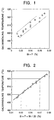
tends to increase as Si + P increases as shown in Fig. 1, but
there is no correlative relation. Then, the relation was
reconsidered using a parameter with the Mn content taking
into consideration as shown in Fig. 2. There is a tight
relation with Si + P + Mn/20. It was found that as the Si +
P+ Mn/20 increased, the galvannealing was delayed linearly.
It seems that such tendency arises from suppression of a
diffusion rate of Fe by a surface enrichment of Si and Mn
oxides and intergranular segregation of P, similar to the
case of the non-coating and the ripple defects.
The difference in the galvannealing temperatures changes
the coating adhesion and friction property.
For evaluating the adhesion, a peeled amount of the
coating was determined by a cup drawing test. Fig. 3 shows
the results. When the galvannealing temperature exceeds
520°C, the peeled amount of the coating is increased, and the
coating adhesion is decreased. The amount of the Γ phase is
also increased. It can be considered that convex and concave
portions at an interface is decreased to weaken the adhesion,
since the Γ phase is produced in a layer shape at an
interface with the steel sheet, when the galvannealing is
conducted at high temperature of more than 520°C. As shown
in Fig. 4, when the galvannealing temperature decreases less
than 500°C, the soft ζ phase is easily produced to
deteriorate the friction property. Furthermore, in order to
prevent the galvannealing non-uniformity, it is required to
complete the galvannealing within a certain galvannealing
temperature range. Through an analysis of the operation
conditions by the present inventors, it was discovered that a
difference of the critical galvannealing temperatures should
be within 20°C in order to avoid the galvannealing non-uniformity.
In summarizing the above discoveries, the galvannealing
temperature should be 500°C or more and 520°C or less in
order to provide both the adhesion and the friction property,
and avoid the coating non-uniformity. To obtain the
galvannealing temperature of 500°C or more and 520°C or less,
the contents of Si, Mn and P in the steel sheet should
satisfy the relation 0.030% ≤ Si + P + Mn /20 ≤ 0.070% as
shown in Fig. 2.
In addition, through the studies by the present
inventors, it was observed that the friction property
differed, when the contents of the elements in the steel
sheet changed, even if the ζ amount was the same in the
coating layer. A mechanism of the friction property
difference was examined. It was found that shapes of the GA
surface, i.e., numbers of craters produced on the surface,
were different. It was discovered that the numbers of the
craters were decreased by increasing the amount of Si, Mn,
and P in the steel sheet, and that the craters could be
controlled by controlling the addition amounts of the
strengthen elements in the steel sheet. The craters herein
means thinner portions of the coating layer observed by SEM
(scanning electron microscope) and the like. In most cases,
they correspond to crystal grains of the steel sheet. Fig. 5
shows illustrative craters (SEM image).
A production mechanism of the craters will be considered
as follows:
When the contents of Si, P, and Mn in the steel sheet
are high, the Si and Mn surface oxides at grain boundary and
grain boundary segregation of P are produced preferentially.
The diffusion of iron at grain boundary is inhibited so that
convex portions are difficult to be formed, and a smooth
surface is formed. On the other hand, when the contents of
the elements that inhibit the diffusion at intergranular
boundary are low, the diffusion rate of iron is high at
intergranular boundary as compared to within grains. An
alloy phase called an outburst is produced at the
intergranular boundary. The alloy phase also takes Zn within
grains slowly diffused to produce the convex portions.
Within the slowly diffused grains, the alloy phase less and
slowly develops to form concave portions (craters). It can
be considered that the convex and concave portions thus
produced on the GA surface affect as a file upon sliding,
increase frictional resistance, and deteriorate the friction
property.
It was also found that 0.010% or more of Si, 0.05% by
mass or more of Mn, and 0.010% by mass or more of P were
required in order not to produce such craters.
Next, the reasons for limiting the contents of each
elements will be described.
C can decrease deep drawability when a large amount of C
is contained. The content of C is 0.005% or less. The lower
limit is 0.001% in order to assure some degree of strength in
the steel sheet, with a decarburization limit during the
normal operation taking into consideration.
If the content of Si exceeds 0.040%, the non-coating or
the ripple are produced. It should be 0.040% or less. On
the other hand, if the content of Si is less than 0.010%, too
large numbers of the aforementioned crater are formed on the
GA surface, or the total crater area is too great to decrease
the friction property. The content of Si should be 0.010% or
more.
If the content of Mn exceeds 0.25%, the non-coating or
the ripple are produced, it should be 0.25% or less. If the
content of Mn is less than 0.05%, too large numbers of the
aforementioned crater are formed on the GA surface, or the
total crater area is too great to decrease the friction
property. The content of Mn should be 0.05% or more.
If the content of P exceeds 0.030%, the non-coating or
the ripple are produced, it should be 0.030% or less. If the
content of P is less than 0.010%, too large numbers of the
aforementioned crater are formed on the GA surface, or the
total crater area is too great to decrease the friction
property. The content of P should be 0.010% or more.
Preferably, the content of P is 0.012% or more, more
preferably 0.015% or more.
As described above, in order to have adhesion and
friction property, and not to produce the galvannealing non-uniformity,
these Si, Mn and P are most suitably galvannealed
at a temperature ranging from 500 to 520°C. Accordingly, the
relation 0.030% ≤ Si + P + Mn / 20 ≤ 0.070% should be
satisfied.
Ti is an element for forming a carbonitride, and Nb is
an element for forming a carbide. They are added to improve
deep drawability as required. If the content of Ti is less
than 0.010%, and the content of Nb is less than 0.005%, the
effects are insufficient. The content of Ti should be 0.010%
or more, and the content of Nb should be 0.005% or more. If
they are added excessively, the effects are saturated. The
upper limit of Ti is 0.060%, and the upper limit of Nb is
0.040%. It is more preferable that Ti be contained within
the range of 0.010 to 0.35%. In view of a decrease in
anisotropy, it is effective to contain 0.005 to 0.030% Nb.
0.015% ≤ Ti + Nb ≤ 0.050%, and 0.010% ≥ Ti -
(48C/12+48S/32+48N/14)
It is required to limit excess Ti that affects the
galvannealing speed in order to more severely limit the
galvannealing non-uniformity. It is preferable that Ti is
contained to satisfy the relation 0.015% ≤ Ti + Nb ≤ 0.050%,
and
0.010% ≥ Ti - (48C/12+48S/32+48N/14)
Sb: 0.001 to 0.10%
Sb is a useful element to inhibit nitriding when slab
heating, and when heating under reducing atmosphere, and to
inhibit a curing of an outermost surface of the steel sheet.
Sb can be added as required. The nitriding is inhibited with
0.001% or more of Sb. If more than 0.10% of Sb is added, the
effects are saturated. The upper limit of Sb is 0.10% or
less.
In addition to the above-described components, B, Ca,
REM and the like may be added to the steel sheet, as required.
B is segragated at grain boundary, and is an element for
improving secondary elaboration brittleness resistance. If
more than 0.001% of B is added, the effects are saturated.
It is desirable that 0.001% or less of B be added.
At least one surface of the steel sheet comprising the
above-described composition is subjected to galvannealing. A
deposit amount of a coating layer should be 25 g/m2 per
surface to assure the rust prevention property, but 60 g/m2
or less to maintain the powdering resistance. It is
preferable that the content of Fe (average value of the
coating layer such as the Γ phase and the ζ phase) be 9% or
more for losing a η phase sufficiently, and decreasing the ζ
phase. On the other hand, it is preferable that the content
of Fe be 14% or less for assuring the powdering resistance.
Furthermore, in view of the friction property, the ζ phase of
the coating layer has a thickness of 0.5 µm or less
determined by a controlled potential measurement. The
thinner the ζ phase is, the better the friction property is.
However, it is difficult to be 0 µm. In view of the
powdering resistance, the Γ phase preferably has a thickness
of 1.5 µm or less determined by the controlled potential
measurement. The thinner the Γ phase is, the better the
powdering resistance is. However, it is difficult to be 0 µm.
The conditions used for the controlled potential
measurement for determining the thicknesses of the ζ and Γ
phases were as follows:
thickness of the Γ phase: dissolved at -860mV, and then -825mV
The thicknesses of the ζ and Γ phases were determined based on electrochemical equivalent using the following equation:
- A: quantity of electricity measured(C)
- S: dissolved area (m2)
- M/2: average equivalent of coating phase 64.4/2 (g/mol)
- F: Faraday constant 96500 (C/mol)
- ρ: ζ phase density: 7.15 x 10⁶ (g/m3)
Γ phase density: 7.36 x 10⁶ (g/m3)
The galvannealed steel sheet according to the present
invention can be manufactured by producing an ultra low
carbon cold-rolled steel sheet using a normal method, and
galvanizing and galvannealing it. In these steps, for
example, the cold-rolled steel sheet is desirably cleaned by
removing the rust preventative oil and the like. The
annealing step is conducted at a temperature set to complete
recrystallization under reducing atmosphere. Thus, when the
steel sheet is immersed in the coating bath, a production of
iron oxides should be as low as possible. The coating bath
contains about 0.13 to 0.15% of Al, and preferably has a
temperature of about 450 to 490°C. More preferably, the
coating bath contains 0.135 to 0.145% of Al, and has a
temperature of 455 to 475°C. In the subsequent galvannealing
treatment, the holding temperature should be 500 to 520°C.
The holding time is desirably 10 to 15 seconds.
Each steel containing the components shown in Tables 1
and 2 was melted in a converter, and continuous cast into a
slab with a thickness of 230 mm. The slab was again heated
at 1150°C for 60 minutes, and hot-rolled to a hot-rolled coil
having a thickness of 4 mm at a finished temperature (FDT) of
900°C and at a coiling temperature (CT) of 500°C. Then, iron
oxides thereon were dissolved and removed in a pickling line.
The coil was cold-rolled to provide a cold-rolled steel sheet
having a thickness of 0.7 mm. The cold-rolled steel sheet
was recrystallized and annealed in a continuous galvannealing
line (CGL) at a dew point of -30°C, and an annealing
temperature of 800 to 850°C. Thereafter, the sheet was
immersed in a coating bath containing 0.135 to 0.140% of Al
at a temperature of 460°C to 470°C to conduct galvannealing.
The immersing temperature was also set to 460 to 470°C, and a
coating weight was adjusted by wiping. Then, the temperature
and the time were changed as required to conduct the
galvannealing treatment to produce the galvannealed steel
sheet.
The resultant GA steel sheet was measured for the
coating weight, the Fe content in the coating layer, the
thicknesses of the ζ and Γ phases, the non-coating, the
ripple, the galvannealing non-uniformity, the powdering
resistance, and the friction property (friction coefficient).
These items were measured and evaluated as follows:
thickness of the Γ phase: dissolved at -860mV, and then -825mV
The thicknesses of the ζ and Γ phases were determined
based on electrochemical equivalent using the following
equation:
When the η phase remains as the alloying non-uniformity, a
thickness of the η + ζ phases is taken at -930 mV.
Thickness of ζ or Γ phase (µm) = A/Sx(M/2)/(Fxρ)x10-6
where
To the sheet, 1.5 g/m2 of a press oil was applied. A
cup drawing was conducted with a blank diameter of 60 mm,
and a punch diameter of 33 mm (a drawing ratio of 1.82)
using an Erichsen tester. An outer circumference of the cup
was peeled with an adhesive tape to visually observed and
evaluated a photographic density.
The sheet was sheared at a 10 mm width in a rolling
direction, was removed burrs, and applied a press oil of 1.5
g/m2 per one side. The friction test was conducted using a
flat plate friction tester at a sliding speed of 1000 mm/min,
a surface pressure of 4 kg/mm2, and a sliding distance of 50
mm. The friction coefficient was determined by a drawing
load of 15 mm to 45 mm.
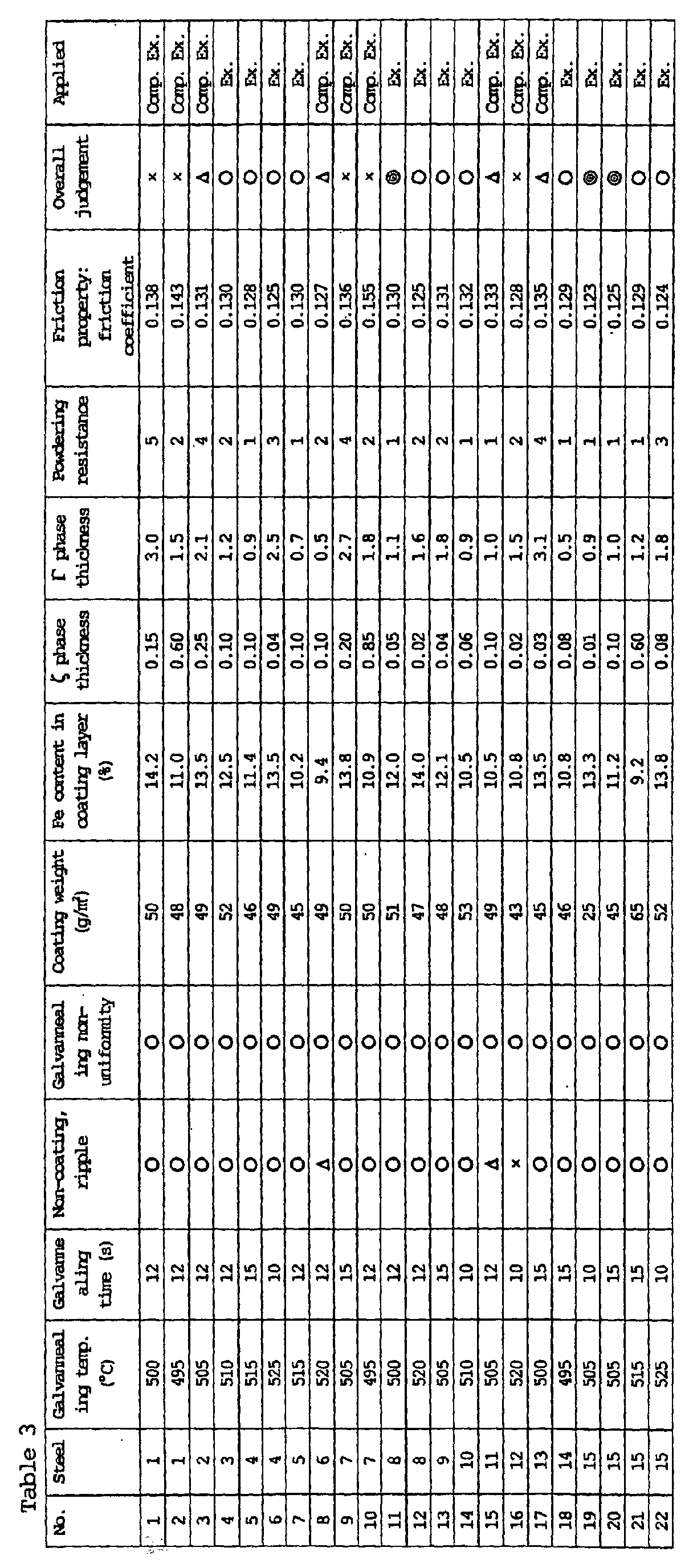
The results are summarized in Tables 3 and 4.
Tables show that each of the sheets of the present
invention has a good surface appearance without non-coating,
ripple, and galvannealing non-uniformity, includes the
coating layer having the adequate Fe content and thicknesses
of the ζ and Γ phase, and good press formability without
problems in the powdering resistance and the friction
property.
As described above, according to the present invention,
there can be provided the galvannealed steel sheet having
both excellent surface appearance and press formability by
controlling the alloy elements in the steel sheet within the
adequate range. Accordingly, in the present invention, the
properties can be improved only by controlling the amounts of
the alloy elements in the steel sheet. There can be provided
a method for manufacturing the galvannealed steel sheet
without requiring new steps and facilities, and with the
stability in the operation.



Claims (7)
- A galvannealed steel sheet having excellent surface appearance and press formability, characterized in that a steel sheet comprises galvannealed layer at least one surface of the steel sheet, the steel sheet comprising 0.001 to 0.005% by mass of C, 0.010 to 0.040% by mass of Si, 0.05 to 0.25% by mass of Mn, and 0.010 to 0.030% by mass of P, wherein the Si, Mn, and P satisfy the relation 0.030% ≤ Si + P + Mn /20 ≤ 0.070%.
- A galvannealed steel sheet having excellent surface appearance and press formability according to claim 1, wherein the steel sheet further comprises one or two of 0.010 to 0.060%'by mass of Ti and 0.005 to 0.040% by mass of Nb.
- A galvannealed steel sheet having excellent surface appearance and press formability according to claim 2, wherein the Ti and Nb satisfy the relation 0.015% ≤ Ti + Nb ≤ 0.050%, and 0.010% ≥ Ti -(48C/12+48S/32+48N/14).
- A galvannealed steel sheet having excellent surface appearance and press formability according to any one of claims 1 to 3, wherein the steel sheet further comprises 0.001 to 0.10% by mass of Sb.
- A galvannealed steel sheet having excellent surface appearance and press formability according to any one of claims 1 to 3, wherein the layer deposits in the amount of 25 to 60 g/m2, contains 9 to 14% of Fe, and has a ζ phase with a thickness of 0.5 µm or less, and a Γ phase with a thickness of 1.5 µm or less.
- A galvannealed steel sheet having excellent surface appearance and press formability according to claim 4, wherein the layer deposits in the amount of 25 to 60 g/m2, contains 9 to 14% of Fe, and has a ζ phase with a thickness of 0.5 µm or less, and a Γ phase with a thickness of 1.5 µm or less.
- A method for producing a galvannealed steel sheet having excellent surface appearance and press formability, comprising the steps of galvannealing at least one surface of a steel sheet, and galvannealing at a temperature ranging from 500 to 520°C; the steel sheet comprising 0.001 to 0.005% by mass of C, 0.010 to 0.040% by mass of Si, 0.05 to 0.25% by mass of Mn, and 0.010 to 0.030% by mass of P, wherein the Si, Mn, and P satisfy the relation 0.030% ≤ Si + P + Mn / 20 ≤ 0.070%.
Applications Claiming Priority (3)
| Application Number | Priority Date | Filing Date | Title |
|---|---|---|---|
| JP2001028379A JP3912014B2 (en) | 2001-02-05 | 2001-02-05 | Alloyed hot-dip galvanized steel sheet and method for producing the same |
| JP2001028379 | 2001-02-05 | ||
| PCT/JP2002/000876 WO2002063057A1 (en) | 2001-02-05 | 2002-02-04 | Alloyed zinc dip galvanized steel sheet |
Publications (2)
| Publication Number | Publication Date |
|---|---|
| EP1359234A1 true EP1359234A1 (en) | 2003-11-05 |
| EP1359234A4 EP1359234A4 (en) | 2006-05-31 |
Family
ID=18892889
Family Applications (1)
| Application Number | Title | Priority Date | Filing Date |
|---|---|---|---|
| EP02710485A Withdrawn EP1359234A4 (en) | 2001-02-05 | 2002-02-04 | Alloyed zinc dip galvanized steel sheet |
Country Status (8)
| Country | Link |
|---|---|
| US (1) | US6872469B2 (en) |
| EP (1) | EP1359234A4 (en) |
| JP (1) | JP3912014B2 (en) |
| KR (1) | KR100839724B1 (en) |
| CN (1) | CN1196802C (en) |
| CA (1) | CA2404962C (en) |
| TW (1) | TWI263696B (en) |
| WO (1) | WO2002063057A1 (en) |
Families Citing this family (13)
| Publication number | Priority date | Publication date | Assignee | Title |
|---|---|---|---|---|
| JP4559918B2 (en) * | 2004-06-18 | 2010-10-13 | 新日本製鐵株式会社 | Steel plate for tin and tin free steel excellent in workability and method for producing the same |
| JP3889767B2 (en) * | 2005-03-31 | 2007-03-07 | 株式会社神戸製鋼所 | High strength steel plate for hot dip galvanizing |
| JP4757622B2 (en) * | 2005-12-20 | 2011-08-24 | 新日本製鐵株式会社 | Method for producing alloyed hot-dip galvanized steel with excellent appearance quality |
| JP4720618B2 (en) * | 2006-05-29 | 2011-07-13 | 住友金属工業株式会社 | Alloyed hot-dip galvanized steel sheet and method for producing the same |
| JP4969954B2 (en) * | 2006-08-31 | 2012-07-04 | 新日本製鐵株式会社 | Alloyed hot-dip galvanized steel sheet with excellent appearance quality and method for producing the same |
| CN102725431B (en) * | 2010-01-25 | 2014-03-12 | 新日铁住金株式会社 | Steel plate for cold forging and manufacturing method thereof |
| JP5533000B2 (en) * | 2010-02-15 | 2014-06-25 | 新日鐵住金株式会社 | Method for producing galvannealed steel sheet |
| EP2644736A4 (en) * | 2010-11-26 | 2015-12-16 | Jfe Steel Corp | Al-Zn-BASED HOT-DIP PLATED STEEL SHEET AND MANUFACTURING METHOD THEREOF |
| MX359228B (en) * | 2011-09-30 | 2018-09-20 | Nippon Steel & Sumitomo Metal Corp | Steel sheet having hot-dip galvanized layer and exhibiting superior plating wettability and plating adhesion, and production method therefor. |
| KR101731693B1 (en) | 2012-06-25 | 2017-04-28 | 제이에프이 스틸 가부시키가이샤 | Galvannealed steel sheet with excellent anti-powdering property |
| JP5852690B2 (en) * | 2013-04-26 | 2016-02-03 | 株式会社神戸製鋼所 | Alloyed hot-dip galvanized steel sheet for hot stamping |
| US10040270B2 (en) | 2013-05-20 | 2018-08-07 | Nippon Steel & Sumitomo Metal Corporation | Galvannealed steel sheet and manufacturing method thereof |
| CN105908200A (en) * | 2016-05-13 | 2016-08-31 | 武汉钢铁股份有限公司 | Method for manufacturing environment-friendly zinc-iron alloying sheet |
Family Cites Families (11)
| Publication number | Priority date | Publication date | Assignee | Title |
|---|---|---|---|---|
| DE3166285D1 (en) * | 1980-05-31 | 1984-10-31 | Kawasaki Steel Co | Method for producing cold rolled steel sheets having a noticeably excellent formability |
| US5049453A (en) * | 1990-02-22 | 1991-09-17 | Nippon Steel Corporation | Galvannealed steel sheet with distinguished anti-powdering and anti-flaking properties and process for producing the same |
| JPH0441658A (en) * | 1990-06-07 | 1992-02-12 | Nippon Steel Corp | Galvannealed steel sheet excellent in powdering resistance and having baking hardenability and high strength and its production |
| JP2827740B2 (en) * | 1992-08-31 | 1998-11-25 | 日本鋼管株式会社 | Method for producing steel sheet with excellent fatigue characteristics and deep drawability |
| JP3293015B2 (en) * | 1995-02-23 | 2002-06-17 | 新日本製鐵株式会社 | Cold rolled steel sheet with excellent workability uniformity |
| CN1152340A (en) * | 1995-03-27 | 1997-06-18 | 新日本制铁株式会社 | Ultralow-carbon cold-rolled sheet and galvanized sheet both excellent in fatigue characteristics and process for producing both |
| JP3016122B2 (en) * | 1995-10-13 | 2000-03-06 | 住友金属工業株式会社 | Galvannealed steel sheet with excellent paintability and its manufacturing method |
| JPH09235652A (en) * | 1996-02-27 | 1997-09-09 | Kobe Steel Ltd | Cold-rolled steel sheet and galvannealed steel sheet with excellent press workability |
| JPH10130781A (en) * | 1996-10-23 | 1998-05-19 | Nippon Steel Corp | Hot-dip galvanized steel sheet |
| JP3745496B2 (en) * | 1997-04-18 | 2006-02-15 | 新日本製鐵株式会社 | Manufacturing method of cold-rolled steel sheet and alloyed hot-dip galvanized steel sheet with excellent paint bake hardening performance |
| JPH11269625A (en) * | 1998-03-25 | 1999-10-05 | Sumitomo Metal Ind Ltd | Alloyed hot-dip galvanized steel sheet and method for producing the same |
-
2001
- 2001-02-05 JP JP2001028379A patent/JP3912014B2/en not_active Expired - Fee Related
-
2002
- 2002-01-30 TW TW091101546A patent/TWI263696B/en not_active IP Right Cessation
- 2002-02-04 US US10/240,550 patent/US6872469B2/en not_active Expired - Lifetime
- 2002-02-04 CN CNB028010817A patent/CN1196802C/en not_active Expired - Fee Related
- 2002-02-04 CA CA002404962A patent/CA2404962C/en not_active Expired - Fee Related
- 2002-02-04 EP EP02710485A patent/EP1359234A4/en not_active Withdrawn
- 2002-02-04 KR KR1020027013400A patent/KR100839724B1/en not_active Expired - Fee Related
- 2002-02-04 WO PCT/JP2002/000876 patent/WO2002063057A1/en not_active Ceased
Also Published As
| Publication number | Publication date |
|---|---|
| CN1460128A (en) | 2003-12-03 |
| CA2404962C (en) | 2007-05-29 |
| EP1359234A4 (en) | 2006-05-31 |
| US20030168134A1 (en) | 2003-09-11 |
| CN1196802C (en) | 2005-04-13 |
| JP2002235146A (en) | 2002-08-23 |
| WO2002063057A1 (en) | 2002-08-15 |
| JP3912014B2 (en) | 2007-05-09 |
| KR100839724B1 (en) | 2008-06-19 |
| TWI263696B (en) | 2006-10-11 |
| US6872469B2 (en) | 2005-03-29 |
| CA2404962A1 (en) | 2002-09-30 |
| KR20020087484A (en) | 2002-11-22 |
Similar Documents
| Publication | Publication Date | Title |
|---|---|---|
| EP0763608B1 (en) | Rust-preventive steel sheet for fuel tank and process for producing the sheet | |
| CN113557318A (en) | Coated steel sheet | |
| CN101454473A (en) | Sheet steel product provided with an anticorrosion coating and process for producing it | |
| CN100543170C (en) | High-strength quenched formed article having good corrosion resistance and method for producing same | |
| EP3502299B1 (en) | Hot-rolled galvanizing steel sheet having excellent galling resistance, formability and sealer-adhesion property and method for manufacturing same | |
| JP4837604B2 (en) | Alloy hot-dip galvanized steel sheet | |
| US6872469B2 (en) | Alloyed zinc dip galvanized steel sheet | |
| EP3034646A1 (en) | Production method for high-strength hot-dip galvanized steel sheets and production method for high-strength alloyed hot-dip galvanized steel sheets | |
| JP3600804B2 (en) | Hot-dip galvanized steel sheet with excellent formability | |
| EP2803750B1 (en) | High-manganese hot-rolled galvanized steel sheet and manufacturing method thereof | |
| CA2605486C (en) | Hot dip galvannealed steel sheet and method of production of the same | |
| JP5245376B2 (en) | Alloyed hot dip galvanized steel sheet using steel sheet for galvannealed alloy with excellent bake hardenability | |
| JP2009079277A (en) | Alloyed hot-dip galvanized steel sheet excellent in deep drawability and manufacturing method of alloyed hot-dip galvanized steel sheet | |
| JPH06256903A (en) | Galvannealed steel sheet excellent in press workability and plating peeling resistance | |
| JP6597947B1 (en) | Molten Sn-Zn alloy-plated steel sheet and method for producing the same | |
| JP3503594B2 (en) | Hot-dip Zn-Al alloy coated steel sheet excellent in blackening resistance and method for producing the same | |
| JPH11269625A (en) | Alloyed hot-dip galvanized steel sheet and method for producing the same | |
| JP3367443B2 (en) | Method for producing Zn-Al-Si alloy-plated steel sheet excellent in design | |
| JP4452126B2 (en) | Steel plate for galvannealed alloy | |
| JP3016122B2 (en) | Galvannealed steel sheet with excellent paintability and its manufacturing method | |
| WO1998030729A1 (en) | Hot dip galvanized steel sheet reduced in defects derived from failed plating and excellent in contact plating adhesion and process for producing the same | |
| JP3372853B2 (en) | Alloyed hot-dip galvanized steel sheet with excellent slidability | |
| JP2004197120A (en) | Hot-dip galvanized steel sheet excellent in chemical conversion property, slidability and weldability and manufacturing method | |
| EP1391530A1 (en) | Alloy galvanized steel plate having excellent slidability | |
| JPH06336666A (en) | Method for producing alloyed hot-dip galvanized steel sheet with excellent surface properties |
Legal Events
| Date | Code | Title | Description |
|---|---|---|---|
| PUAI | Public reference made under article 153(3) epc to a published international application that has entered the european phase |
Free format text: ORIGINAL CODE: 0009012 |
|
| 17P | Request for examination filed |
Effective date: 20020923 |
|
| AK | Designated contracting states |
Kind code of ref document: A1 Designated state(s): AT BE CH CY DE DK ES FI FR GB GR IE IT LI LU MC NL PT SE TR |
|
| RAP1 | Party data changed (applicant data changed or rights of an application transferred) |
Owner name: JFE STEEL CORPORATION |
|
| STAA | Information on the status of an ep patent application or granted ep patent |
Free format text: STATUS: THE APPLICATION HAS BEEN WITHDRAWN |
|
| A4 | Supplementary search report drawn up and despatched |
Effective date: 20060419 |
|
| 18W | Application withdrawn |
Effective date: 20060512 |